


Abstract
This study reconsiders museum accessibility not simply as a matter of distance or locational reach, but as a sequential and experience-based urban condition shaped across three stages of museum visiting: pre-trip feasibility, in-transit experience, and post-arrival usability. Using survey data from residents and tourists across China’s metropolitan areas, the study develops a user-centred framework that differentiates time feasibility, journey comfort and predictability, and arrival/visit usability. Rather than claiming museum-level or city-level causal effects, the analysis identifies how respondents’ overall evaluations of these accessibility dimensions are structured by detailed item-level conditions and by differences in familiarity with the urban environment. The resident–tourist comparison shows that accessibility is interpreted differently under habitual and unfamiliar mobility contexts. The contribution of the study lies in providing a framework-building account of museum accessibility as a spatially mediated and socially experienced urban process, while also clarifying the limits of the current dataset and the need for future integration with geocoded museum, transport, and urban-form data.
1. Introduction
1.1. Background and Purpose
Museums are increasingly framed not only as destinations of cultural consumption, but also as public cultural infrastructures through which cities facilitate learning, reinforce local identity, promote civic interaction, and enrich tourism-related experience. From this perspective, the central issue is not merely where museums are located, but whether access to and use of museums are perceived as practically manageable, predictable, and meaningful across different user groups. This question is consequential for urban cultural sustainability because cultural participation is sustained not solely through the presence of institutions, but through the practical conditions that make repeated and meaningful engagement possible.
Within this broader discussion, the “15-min city” has been widely presented as a planning approach aimed at reducing car dependency and lowering the time and cost burdens of daily mobility while improving access to essential urban services within short travel times [1,2,3,4,5]. More recently, this discussion has expanded beyond basic services such as healthcare, education, and parks to include cultural facilities and activities [6,7,8,9]. At the same time, museums have increasingly been understood not merely as places of cultural consumption, but as public cultural infrastructures that support learning, identity formation, civic encounter, and the continuity of cultural life, which is why museum accessibility may be discussed in relation to cultural sustainability [10,11,12,13,14,15,16,17,18,19,20,21,22]. However, the practical meaning of a “15-min” threshold is inherently context-dependent, as it varies according to urban form, transport systems, and everyday social practices. This variability suggests that the analytical focus should be placed less on the threshold itself than on the broader issues of proximity, time burden, and the lived conditions of urban cultural access.
At the same time, accessibility is not only spatial but also experiential. Existing studies suggest that proximity alone does not automatically produce higher attendance or sustained use [23,24,25]. Even where formal distances are similar, perceived barriers—such as unsafe crossings, discontinuous pedestrian environments, inconvenient transfers, weak wayfinding, limited real-time information, and travel uncertainty—may accumulate and discourage participation [26,27,28,29]. Moreover, a museum visit is not reducible to travel time alone; it also includes arrival procedures, waiting, and the usability of surrounding public spaces [30,31]. Accordingly, the issue addressed in this study is not catchment-based spatial coverage alone, but the subjective accessibility through which museum use is actually experienced.
Furthermore, subjective accessibility to a given place is not likely to be uniformly perceived across user groups. It is shaped not only by objective spatial conditions, but also by the degree of familiarity individuals have with the surrounding environment. Residents, who typically possess accumulated knowledge of local routes, transport systems, and everyday spatial cues, may evaluate accessibility in terms of routine convenience and repeatability. External tourists, by contrast, are more likely to experience the same setting under conditions of relative unfamiliarity, and may therefore be more strongly affected by uncertainty, wayfinding demands, and the predictability of travel and on-site use. Accordingly, the perceived accessibility of museum visits may vary systematically between residents and tourists, even within similar metropolitan contexts.
Against this backdrop, the present study does not attempt to measure museum accessibility solely through fixed travel thresholds, nor does it claim to provide a museum-level or city-level test of spatial performance. Instead, it examines how museum accessibility is perceived and organized as a sequence of user experience, including pre-trip feasibility, in-transit experience, and post-arrival usability, and how these evaluations vary systematically between residents and tourists.
The contribution of the study is therefore primarily conceptual and framework-building. First, it reframes museum accessibility beyond travel distance and location by conceptualizing it as a staged and user-centred urban experience. Second, it introduces the resident–tourist distinction as a meaningful analytical lens through which spatial familiarity, uncertainty, and navigational burden can be interpreted. Third, it clarifies that the present dataset captures perception-based evaluations of accessibility rather than objective museum-, route-, or city-level spatial conditions. In this sense, the study should be read as a first-step framework for future work that will need to combine perception data with geocoded museum, transport, and urban-form datasets in order to produce a fuller spatial explanation of museum visitation.
1.2. Literature Review and Analytical Framework
Museum accessibility in the present study is not treated as a purely locational condition, but as a subjective and experience-based process through which museum participation is assessed before, during, and after the trip. Existing studies suggest that formal proximity alone does not necessarily lead to higher attendance, sustained use, or willingness to return [23,24,25]. Even where travel distances are similar, perceived barriers—such as unsafe crossings, discontinuous pedestrian routes, inconvenient transfers, weak wayfinding, limited real-time information, and travel uncertainty—may accumulate and discourage participation [26,27,28,29]. Moreover, the experience of museum use is not exhausted by the journey itself, because arrival procedures, waiting, circulation, and the usability of surrounding public spaces also shape whether a visit is experienced as manageable and worth repeating [30,31]. For this reason, the present study conceptualizes museum accessibility as subjective accessibility, that is, an experience-based condition through which museum participation is evaluated across the full course of the visit.
Within this analytical perspective, subjective accessibility functions as the overarching concept of the framework. At the first hierarchical level, this concept is organized into three interrelated dimensions: time feasibility, journey comfort and predictability, and arrival/visit usability. These dimensions correspond to three sequential stages of museum participation: pre-trip feasibility, in-transit experience, and post-arrival usability. Accessibility is therefore understood not as a single threshold or a one-dimensional locational attribute, but as a staged condition through which participation becomes practically possible and potentially repeatable.
At the second hierarchical level, these three dimensions are further specified through five configuration indicators. The first dimension, time feasibility, is represented by Time-based accessibility. This indicator refers to whether a museum visit is perceived as realistically compatible with acceptable time and cost conditions. Because time constitutes a basic constraint on cultural participation, judgments regarding whether a museum can be reached and used within an acceptable time and cost range are likely to shape perceived feasibility and repeatability [32,33,34,35].
The second dimension, journey comfort and predictability, is represented by Pedestrian-based access environment and public transportation connectivity. Pedestrian-based access environment refers to the continuity, comfort, and safety of pedestrian movement on the way to the museum. It captures whether walking routes are perceived as continuous, physically comfortable, and secure, since interruptions or unsafe conditions may intensify perceived friction during travel [36,37,38,39,40,41,42,43,44,45,46]. Its observation scale therefore consists of items relating to pedestrian continuity, walking comfort, and walking safety. Public transportation connectivity refers to the intelligibility, convenience, and predictability of public transport use in accessing the museum. Simplicity of transfers, route legibility, and reliable transport information reduce uncertainty during travel and help transform formal reachability into practically usable access.
The third dimension, arrival/visit usability, is represented by Quality of stay environment and Convenience of information and procedures. Quality of stay environment refers to whether the museum-related environment remains usable after arrival, including the burden of waiting, the clarity of circulation, and the comfort and safety of surrounding public spaces. Because museum participation also involves waiting, resting, circulation, and time spent in and around the venue, poor stay conditions may weaken the perceived value of the visit and discourage repeated participation [47,48,49,50,51,52,53,54]. Its observation scale therefore includes items concerning waiting burden, circulation clarity, and the comfort and safety of the surrounding environment. Convenience of information and procedures refers to whether the information and procedures associated with museum use are perceived as clear, accessible, and low-friction. Procedural or informational barriers may undermine usability even after the destination has been reached, whereas clear guidance and convenient procedures may support repeatable participation.
Taken together, this hierarchical structure proceeds from the overarching concept of subjective accessibility, to three stage-based dimensions, to five configuration indicators, and finally to observable survey items. In this way, the framework avoids reducing museum accessibility to a single spatial measure and instead captures it as a cumulative chain of perceived demands. A museum visit may be time-feasible but uncomfortable in transit, easy to reach but difficult to use after arrival, or manageable for habitual users while remaining uncertain for unfamiliar visitors. The framework therefore makes it possible to analyze museum accessibility as a differentiated and sequential condition of participation rather than as a single locational attribute. The specific hierarchical composition and operationalization of these dimensions and indicators are summarized in Table 1. At the measurement level, each accessibility subdomain was represented by a set of item-specific indicators and a corresponding block-level overall evaluation item. The overall evaluation items were used in the regression analysis as dependent variables for the respective block-wise models.
Table 1.
Hierarchical operationalization of subjective accessibility.
This framework becomes analytically more meaningful when differences in user context are taken into account. Subjective accessibility is unlikely to be perceived uniformly across all users, even under similar spatial conditions. It is shaped not only by the material characteristics of routes, transport systems, and museum environments, but also by the degree of familiarity individuals have with the surrounding urban context. Residents are more likely to possess accumulated knowledge of local routes, transport options, and everyday spatial cues, and may therefore evaluate museum accessibility in relation to routine convenience and repeatability. External tourists, by contrast, are more likely to encounter the same environment under conditions of relative unfamiliarity and may therefore be more sensitive to uncertainty, wayfinding demands, and the predictability of travel and on-site use.
To clarify the scope of the present study, the proposed framework should be understood as a user-centred and spatially mediated conceptual model rather than a completed multi-source spatial model. In the current dataset, spatiality is approached indirectly through respondents’ evaluations of time burden, pedestrian continuity, transfer convenience, wayfinding clarity, and post-arrival usability. These variables capture how spatial conditions are experienced, but they do not yet include objective indicators such as network travel time, museum catchment, density of nearby cultural facilities, transit service levels, land-use mix, streetscape quality, or museum typology. Accordingly, the present study addresses a research gap at the level of conceptual reframing: it moves museum-access research beyond travel distance and static location by proposing a sequential, experience-based interpretation of accessibility that is explicitly designed to be extended in future work through integration with geocoded museum, transport, and urban-form datasets.
On this basis, the present study examines how the three dimensions of subjective accessibility can be interpreted within a sequential and user-centred framework of museum visitation. Rather than treating accessibility as a static locational attribute, the analysis focuses on how pre-trip feasibility, in-transit conditions, and post-arrival usability are structured and evaluated by respondents under different mobility contexts. From this analytical framework, the following research questions are derived:
Research Question 1 (RQ1).
How is perceived time feasibility structured in relation to respondents’ overall evaluation of museum accessibility before the trip?
Research Question 2 (RQ2).
How are perceived journey conditions structured in relation to respondents’ overall evaluation of museum accessibility during the trip?
Research Question 3 (RQ3).
How is perceived arrival/visit usability structured in relation to respondents’ overall evaluation of museum accessibility after arrival, and how do these patterns differ between residents and tourists?
2. Materials and Methods
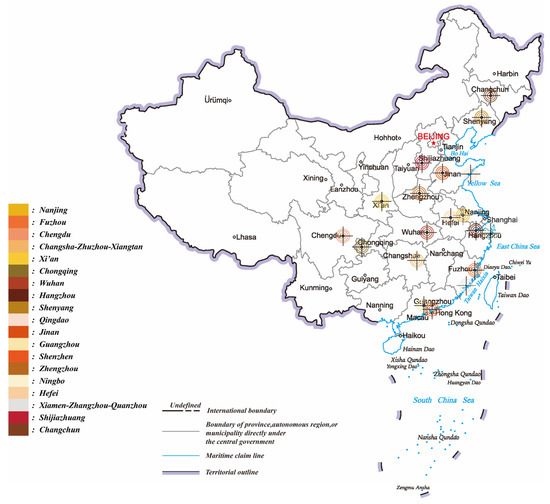
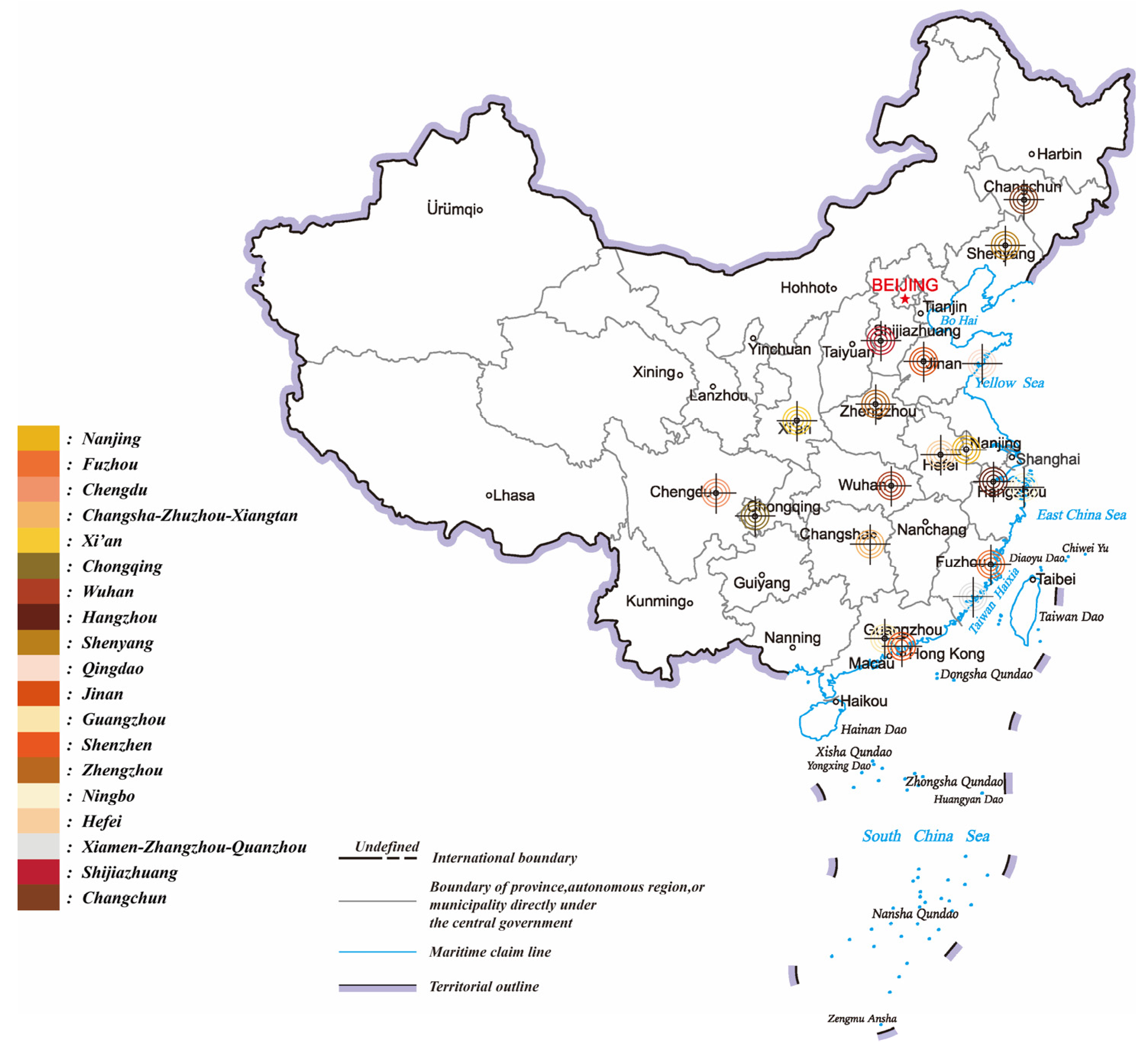
The respondents were restricted to adults who either resided in, or travelled as tourists within, China’s 19 state-level city clusters (Figure 1) [55,56]. This metropolitan framework was retained to reflect the national planning context of the study, while the empirical analysis was conducted at the pooled individual level rather than as an inter-cluster comparison. An online survey mode was adopted because the target respondents were geographically dispersed and because the study sought to capture subjective evaluations of recent museum visits.
Figure 1.
Locations of the online survey. Source: The author plotted the locations on the standard Map World China map (No. GS(2019)1651) [56].
The questionnaire was administered as a self-completed online survey and consisted of five parts: (1) informed consent, (2) demographic information, (3) time feasibility, (4) journey comfort and predictability, and (5) arrival/visit usability. All attitudinal and perceptual items were measured on a five-point Likert scale ranging from 1 (“strongly disagree”) to 5 (“strongly agree”). The consent item was mandatory, and respondents who selected “disagree” were not permitted to proceed, thereby ensuring that no substantive survey data were collected without explicit consent.
To define the geographical scope of response, participants were asked to select one target metropolitan area corresponding to China’s national plan for the development of 19 state-level city clusters. Eligibility was restricted to adults who had visited at least one museum within the selected metropolitan area during the previous 12 months. Respondents were instructed to answer all substantive items with reference to their most recent museum visit within that metropolitan area. Accordingly, the survey captures retrospective evaluations of museum accessibility rather than direct observations of a specifically identified museum.
The survey recorded demographic characteristics such as gender and age group, and also included screening items used to classify respondents into the two analytical groups. Residents were defined as adults living within the selected metropolitan area, whereas tourists were defined as adult non-residents engaging in tourism activities within the same metropolitan area. Age and gender are reported in order to document the composition of the sample and to make the resident–tourist comparison transparent, although they are not introduced as separate explanatory variables in the present analysis.
Within each accessibility block, the questionnaire included both item-specific indicators and one block-level overall evaluation item. Specifically, the Time feasibility block included three item-specific indicators (A-1 to A-3) and one overall evaluation item (A-Overall). The Journey comfort and predictability block included two subdomains: Pedestrian-based access environment, consisting of four item-specific indicators (B-1 to B-4) and one overall evaluation item (B-Overall), and public transportation connectivity, consisting of four item-specific indicators (C-1 to C-4) and one overall evaluation item (C-Overall). The Arrival/visit usability block also included two subdomains: Quality of stay environment, consisting of five item-specific indicators (D-1 to D-5) and one overall evaluation item (D-Overall), and Convenience of information and procedures, consisting of four item-specific indicators (E-1 to E-4) and one overall evaluation item (E-Overall).
Several procedures were employed to improve response quality. Two attention-check items were embedded in reverse-coded form to identify inattentive or inconsistent responding. Completion time was used only as an indicator for further review rather than as an automatic exclusion criterion. Cases were removed only when unusually short completion time coincided with clear signs of low-quality data, such as repetitive response patterns, logical inconsistencies in screening items, or failure on the attention checks. Because all accessibility variables are based on self-reported perceptions, the method is appropriate for examining perceived accessibility; however, it cannot independently verify objective street conditions, transport performance, or museum-specific operational conditions.
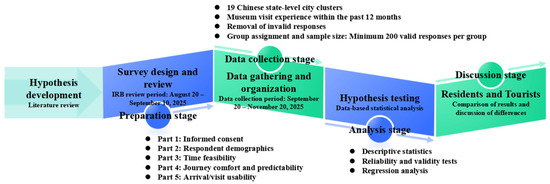
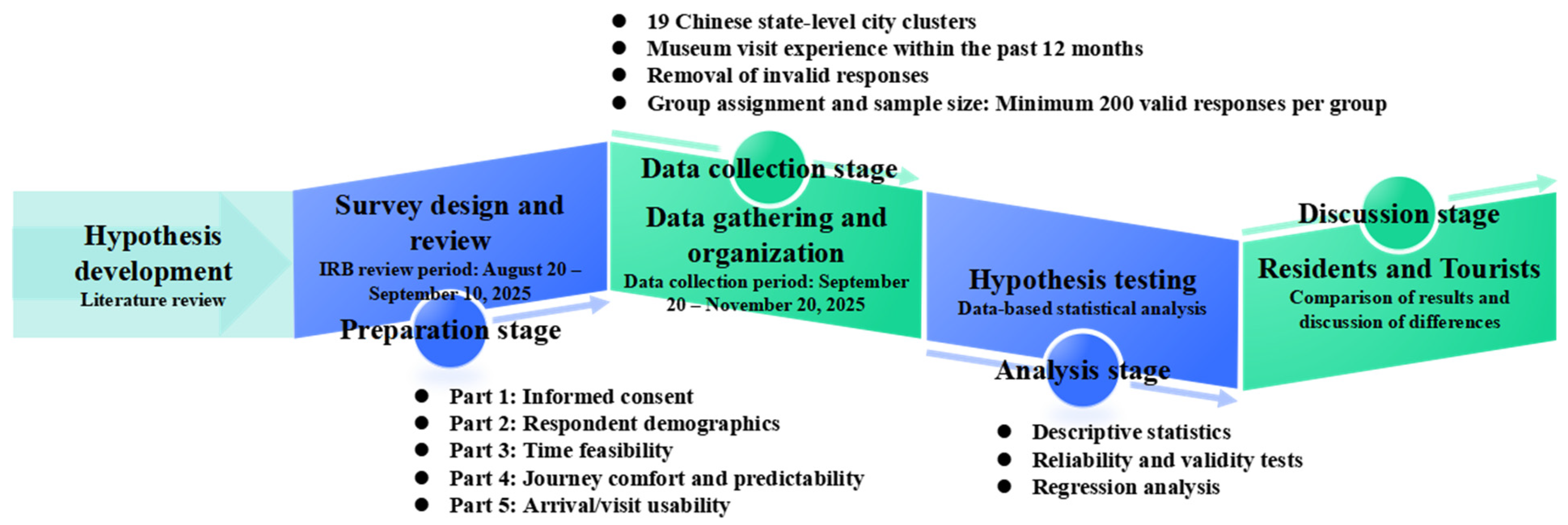
The survey aimed to secure at least 400 valid responses, with approximately 200 valid cases in each group, as a pragmatic threshold for stable subgroup comparison in a multivariate survey design of this scope. After data collection, the dataset was organized into resident and tourist subsamples. The analysis then proceeded in four stages. First, descriptive statistics were used to summarize sample characteristics and the distributions of the principal variables. Second, reliability and factorial adequacy were assessed to determine whether the item set was operationally suitable for subsequent analysis. Third, regression models were estimated separately for the A–E blocks rather than as a single joint model controlling for all dimensions simultaneously. In each model, the item-specific indicators within a given block were entered as predictors, and the corresponding block-level overall evaluation item was used as the dependent variable. Fourth, the results for residents and tourists were compared in order to interpret differences between familiar and unfamiliar mobility contexts. Figure 2 summarizes the overall analytical procedure. The online survey was administered through the online SoJump platform [57], and all statistical analyses were conducted using IBM SPSS Statistics 25. The questionnaire is provided in Supplementary Materials.
Figure 2.
Research procedures.
Because the survey spans multiple metropolitan areas and does not identify the specific museum visited, the study cannot directly distinguish neighbourhood museums from city-centre museums or support institution-level claims. In addition, no city-level fixed effects were introduced into the analysis. The findings should therefore be interpreted as pooled individual-level patterns of perceived museum accessibility rather than as causal estimates or city-specific evaluations.
The present dataset is therefore sufficient for developing and testing a perception-based framework of museum accessibility, but it is not sufficient for a full spatial explanation of museum visitation. No geocoded museum-level dataset, network-based travel-time dataset, or external urban-form dataset was linked to the survey responses in the current stage of analysis. Accordingly, the study is positioned as a framework-building step that identifies theoretically relevant dimensions of accessibility and prepares the ground for future multi-source integration.
3. Results
3.1. Descriptive Statistics, Reliability Analysis, and Validity Analysis
Data were collected through the online survey between 20 September and 20 November 2025. A total of 546 survey entries were recorded. After applying the pre-specified eligibility screening and response-quality control procedures, 105 cases were excluded, yielding 441 valid responses for the final analysis.
Additional exclusions were made to preserve analytical validity. These excluded cases included respondents who did not meet the eligibility criteria (e.g., no museum visit within the selected metropolitan area during the previous 12 months), failures on attention-check items, response patterns indicating carelessness or logical inconsistency, and probable duplicates identified through repeated response IDs in combination with regional information.
The final sample (n = 441) was classified into two analytical groups—Residents (n = 214) and Tourists (n = 227)—on the basis of the screening items included in the demographic section. Respondents were drawn from the 19 state-level city clusters specified in China’s national city-cluster plan, which defines the metropolitan scope of the study. However, the purpose of the analysis is not to estimate city-cluster-specific effects or to make cluster-level claims. Rather, respondents from the 19 clusters were pooled, and the subsequent regression analyses were conducted at the individual level in order to identify general pooled individual-level patterns in the structure and evaluation of perceived museum accessibility across metropolitan contexts. Accordingly, the average number of respondents per cluster implied by dividing the total group size by 19 should not be interpreted as the effective sample size for any cluster-level inference.
Table 2 presents the distributions of gender, age, and metropolitan area across the two groups. In both groups, women constituted the majority of respondents, accounting for 58.9% of Residents and 62.6% of Tourists. The age profile differed somewhat between the groups: Tourists were more concentrated in younger cohorts, especially those aged 25–34 (36.1%), whereas Residents were distributed more evenly across age categories, with comparatively larger proportions in the 25–34 (25.7%), 45–54 (22.4%), and 55 and older (22.0%) groups. Responses were obtained from all 19 state-level city clusters, although the largest shares in both groups were drawn from Nanjing, Changsha–Zhuzhou–Xiangtan, and Hangzhou. These descriptive statistics are reported to profile the sample, clarify the basic demographic and spatial composition of the two analytical groups, and provide the empirical context necessary for interpreting subsequent comparative and regression-based analyses. They are therefore used for descriptive and contextual purposes, rather than to claim representativeness for each metropolitan area or to function as separate explanatory variables in the regression models.
Table 2.
Basic demographic statistics of the two groups.
Prior to the regression analysis, the internal consistency and factorial adequacy of the item set were examined. The reliability results indicate high internal consistency in both groups, with Cronbach’s alpha values of 0.926 for Residents and 0.920 for Tourists (Table 3). The data were also found to be suitable for factor analysis: the KMO values were 0.899 for Residents and 0.890 for Tourists, and Bartlett’s tests of sphericity were statistically significant in both groups (Table 4). These statistics indicate that the item set shows acceptable internal consistency and factorial adequacy; however, they should not be interpreted as sufficient evidence of construct validity by themselves. Accordingly, the subsequent regression results are interpreted as block-wise associations within the questionnaire structure rather than as evidence of a fully independent latent measurement model.
Table 3.
Summary item statistics.
Table 4.
KMO and Bartlett’s test.
3.2. Block-Wise Regression Results for the Three Research Questions
Regression analysis was conducted to address RQ1–RQ3 by examining the internal structure of the five accessibility blocks and the ways in which item-specific indicators were associated with respondents’ overall evaluations of each accessibility dimension. The results reported in Table 5, Table 6 and Table 7 should be interpreted as five separate block-wise models for each group, rather than as a single joint model simultaneously controlling for all accessibility dimensions. In each model, the item-specific indicators within a given block were entered as predictors, and the corresponding block-level overall evaluation item was used as the dependent variable. Thus, Model A estimated the association of A-1 to A-3 with the overall evaluation of time feasibility; Model B estimated the association of B-1 to B-4 with the overall evaluation of pedestrian-based access environment; Model C estimated the association of C-1 to C-4 with the overall evaluation of public transportation connectivity; Model D estimated the association of D-1 to D-5 with the overall evaluation of quality of stay environment; and Model E estimated the association of E-1 to E-4 with the overall evaluation of information and procedures.
Table 5.
Model summary.
Table 6.
ANOVA.
Table 7.
Regression analysis results.
Model summaries and ANOVA results are reported in Table 5 and Table 6, and all estimated models are statistically significant. The Durbin–Watson statistics reported in Table 5 suggest limited residual autocorrelation, while the collinearity diagnostics shown in Table 7 indicate acceptable levels of multicollinearity. These results support the statistical stability of the estimated associations within the pooled individual-level framework of the study.
With respect to RQ1, the results indicate that respondents’ overall evaluation of pre-trip time feasibility is significantly associated with the detailed time-related indicators. This finding suggests that respondents’ general judgment regarding whether a museum visit was feasible before departure is shaped by their perceived reachability within a short and acceptable time window, the acceptability of total travel time, and the acceptability of travel cost. The resident–tourist comparison further clarifies this pattern. Tourists appear to rely more strongly on immediate judgments of whether a museum visit was within reach under limited schedules and unfamiliar conditions, whereas residents are more likely to evaluate time feasibility in relation to the compatibility of museum visiting with repeated use under ordinary urban conditions.
With respect to RQ2, the regression results show that respondents’ overall evaluation of journey comfort and predictability during the trip is significantly associated with the detailed indicators within both the pedestrian and public transportation subdomains. This indicates that respondents’ general judgment of in-transit accessibility is not reducible to a single travel attribute, but is instead formed through multiple perceived conditions, including pedestrian continuity, crossing safety, walking comfort, access to stops and stations, transfer convenience, and the predictability of transport information. The comparison between residents and tourists sharpens this interpretation. Residents are more responsive to conditions that make travel reliably workable within familiar settings, whereas tourists are more sensitive to cues that reduce uncertainty and improve legibility in unfamiliar environments.
With respect to RQ3, the results indicate that respondents’ overall evaluation of arrival/visit usability after arrival remains significantly associated with the detailed indicators of both the stay environment and information/procedure usability. This is analytically important because it shows that the perceived usability of museum visiting is shaped not only by reaching the destination, but also by whether the visit remains manageable in terms of congestion, circulation clarity, surrounding-space comfort and safety, pre-visit information, signage, admission procedures, and on-site support. Here again, the resident–tourist comparison is meaningful. Tourists attach greater importance to cues that reduce uncertainty and support navigation after arrival, whereas residents respond more strongly to conditions that reduce friction for repeated use.
Taken together, the results suggest that each accessibility block has a coherent internal structure in which respondents’ overall evaluations are meaningfully associated with specific item-level conditions. The overall statistical pattern therefore supports an interpretation of museum accessibility as a staged and multidimensional experience extending from pre-trip feasibility to journey quality and post-arrival usability. The findings should accordingly be understood as pooled individual-level evidence on how respondents structure and evaluate museum accessibility across these three stages, rather than as direct evidence of museum-level, city-level, or causal effects.
4. Discussion
The principal contribution of this study lies in offering a more coherent way to interpret museum accessibility within the analytical limits of the current dataset. Rather than treating accessibility as a static question of distance, catchment coverage, or facility location alone, the present study suggests that museum accessibility is more meaningfully understood as a sequential and user-centred condition shaped across pre-trip feasibility, in-transit experience, and post-arrival usability. This reframing does not amount to a complete spatial model of museum visitation, because the present analysis does not incorporate geocoded museum-level, transport-network, or urban-form datasets. Nevertheless, it helps clarify why conventional location-based approaches are often insufficient for explaining museum participation as it is actually experienced. In earlier research, accessibility has often been approached through distance, catchment coverage, or the spatial distribution of facilities, which remains valuable for identifying whether cultural resources are unevenly allocated across urban space [23,24,25,26,27,28,29,30,31,58,59,60,61,62,63,64,65]. However, such approaches are less effective in explaining why formally reachable museums may still be perceived as difficult to use, or why the same spatial setting may be evaluated differently by different users. In this respect, the present findings support a more differentiated interpretation: what matters is not only whether a museum is locationally available, but whether the overall conditions of access are experienced as manageable, intelligible, and worth repeating. This shift in emphasis—from static spatial provision to perceived usability across the full course of the visit—also provides the basis for the following discussion.
This shift also helps clarify the limited but relevant role of the 15-min city in the present study. Previous discussions of the 15-min city have emphasized proximity, reduced travel burden, and improved access to daily services [1,2,3,4,5,6,7,8,9]. Yet the literature has also shown that the practical meaning of short-distance access is highly contingent on urban form, transport systems, and everyday mobility conditions. The present findings are consistent with that broader debate, but they suggest that the analytical value of the 15-min discussion lies less in any fixed threshold than in its emphasis on time burden and practical manageability. In other words, the present study does not confirm a threshold-based understanding of access; rather, it supports a more process-oriented interpretation in which museum participation depends on whether a visit is experienced as realistically incorporable into everyday or travel-based routines. This interpretation helps move the discussion beyond the assumption that physical proximity is, by itself, an adequate indicator of cultural accessibility.
A second point concerns the relationship between accessibility and public space. Prior studies have shown that discontinuous pedestrian routes, unsafe crossings, inconvenient transfers, weak wayfinding, and limited travel information can discourage access even when destinations appear geographically close [26,27,28,29,30,31,36,37,38,39,40,41,42,43,44,45,46]. The present study reinforces that argument by indicating that the approach environment is not external to museum use, but part of the experiential conditions through which access is judged. This is important because it situates museum accessibility within the wider urban environment rather than within the institution alone. Streets, crossings, pedestrian continuity, and surrounding movement systems are relevant not simply as transport infrastructure, but as components of the cultural access experience. In this sense, the findings strengthen the view that public space matters not only for urban mobility in general, but also for whether cultural participation is perceived as practically approachable and worth repeating. Compared with studies that focus primarily on institutional provision or facility location, the present analysis highlights the mediating role of the access environment itself.
An additional implication of the present framework is that museum accessibility should be examined through a closer articulation between perceived experience and observable spatial conditions. The dimensions identified in this study—time feasibility, journey comfort and predictability, and arrival/visit usability—indicate that museum access is shaped not only by where a facility is located, but also by how routes, transfers, surrounding public space, and on-site conditions are encountered in practice. In this sense, the framework developed here can be extended through future integration with geocoded museum locations, network-based travel times, pedestrian-network continuity, transit-service indicators, land-use diversity, and measures of public-space quality. Such an extension would make it possible to move from a perception-based account of accessibility toward a more comprehensive explanation of how museum visitation is structured by the interaction between user experience and urban spatial conditions.
The findings also refine how museum accessibility should be understood in relation to cultural sustainability. Previous research has linked museums to learning, identity formation, civic encounter, and the continuity of cultural life, thereby suggesting that access to museums may matter for broader discussions of cultural sustainability [10,11,12,13,14,15,16,17,18,19,20,21,22]. The present study does not attempt to evaluate that broad relationship at the institutional or city level. Instead, it supports a narrower interpretation: at the level of user perception, cultural sustainability is partly reflected in whether museum participation appears repeatable, manageable, and socially reproducible. This narrower framing is important because it avoids making claims that the data cannot support, while still explaining why accessibility matters conceptually. The significance of the findings, therefore, is not that accessibility defines the cultural value of museums, but that it forms part of the practical conditions under which museums may be perceived as resources that can be used continuously rather than exceptionally.
A further contribution of the study lies in showing that subjective accessibility is not experienced uniformly across user groups. Earlier research has often treated access barriers as if they affected all users in broadly similar ways, or has focused more strongly on aggregate spatial inequality than on differences in familiarity and mobility context [23,24,25,26,27,28,29,30,31,58,59,60,61,62,63,64,65]. The resident–tourist comparison in the present study suggests that this assumption is too simplified. The meaning of accessibility varies depending on whether museum use is embedded in habitual urban life or in an unfamiliar travel setting. This does not merely indicate demographic variation; rather, it points to a contextual difference in how accessibility is interpreted. Compared with earlier museum-access studies that privilege locational reach or aggregate attendance patterns, this finding contributes a more context-sensitive understanding of accessibility as a perception shaped by familiarity with the urban environment.
5. Conclusions
This study re-examined museum accessibility as a multidimensional and sequential urban experience rather than as a simple issue of travel distance or locational proximity. Across the three stages of museum visiting—pre-trip feasibility, journey conditions, and post-arrival usability—the findings indicate that museum accessibility is better understood as the practical manageability of participation as perceived by users under different mobility contexts.
The contribution of the study is primarily conceptual and framework-building. Rather than claiming a completed spatial explanation of museum visitation, the study clarifies how museum accessibility may be analytically reorganized beyond static location-based accounts and how this reorganization becomes more meaningful when differences between residents and tourists are taken into account. In this respect, the article offers a user-centred framework that can support future integration with geocoded museum, transport, and urban-form datasets.
The resident–tourist comparison further refines this conclusion by demonstrating that subjective accessibility is not interpreted uniformly across user groups. Rather, it is shaped by differences in familiarity with the urban environment and by distinct mobility contexts. Residents are more likely to assess museum accessibility in relation to routine compatibility and repeated use within ordinary urban life, whereas tourists are more likely to evaluate it in relation to navigability, predictability, and reduction in uncertainty in unfamiliar settings. This distinction is analytically important because it indicates that accessibility cannot be inferred from spatial conditions alone, but must also be interpreted in relation to the context in which cultural participation is experienced.
At the same time, the scope of the present conclusions should be defined with precision. The regression models did not use an empirically separate multi-item cultural sustainability scale as the dependent variable. Instead, they relied on block-level overall evaluation items corresponding to each accessibility dimension. The present conclusions should therefore be read as evidence concerning the internal structure of perceived museum accessibility rather than as direct evidence of causal or independent effects on cultural sustainability. More broadly, the findings indicate that museum accessibility should be approached as a multidimensional and context-sensitive experiential condition whose overall evaluation is shaped by multiple detailed aspects of time feasibility, journey quality, and post-arrival usability.
Several limitations should be acknowledged. First, all variables were measured through a single-source, self-reported questionnaire collected at one point in time, which limits causal interpretation and raises the possibility of common method bias. Second, the present analysis did not integrate objective spatial datasets such as geocoded museum locations, network-based travel times, pedestrian-network attributes, transit supply indicators, or urban-form measures. As a result, the study cannot yet determine how the identified perception-based dimensions correspond directly observed spatial conditions. Third, the survey did not identify specific museums and therefore cannot support museum-level or city-level performance claims.
These limitations also define the next stage of research. Future studies should combine the present perception-based framework with external datasets on museum typology, network accessibility, transit service, land-use structure, and surrounding public-space conditions. Such integration would allow researchers to move beyond the current framework-building stage and examine more rigorously how spatial conditions shape museum visitation in ways that are both perceptually experienced and empirically observable.
Supplementary Materials
The following supporting information can be downloaded at: https://www.mdpi.com/article/10.3390/buildings16091843/s1.
Author Contributions
Conceptualization, T.H. and X.Z.; methodology, T.H., H.Z., J.Z. and X.Z.; software, X.Z.; validation, J.W., X.W. and J.Z.; formal analysis, J.W. and X.W.; investigation, J.W., X.W. and X.Z.; resources, H.Z.; data curation, J.Z.; writing—original draft preparation, T.H. and X.Z.; writing—review and editing, T.H. and X.Z.; supervision, X.Z.; project administration, X.Z.; funding acquisition, X.Z. All authors have read and agreed to the published version of the manuscript.
Funding
This research was funded by the Jilin Provincial Department of Education, 2025 Social Science Research Project (grant number: JJKH20251257SK).
Institutional Review Board Statement
The study protocol was approved by the Ethics Committee of Yantai University (protocol code YTUHR-20250820-001; approval date: 10 September 2025).
Informed Consent Statement
Informed consent was obtained from all subjects involved in the study.
Data Availability Statement
The original contributions presented in this study are included in this article. Further inquiries can be directed to the corresponding author.
Conflicts of Interest
The authors declare no conflicts of interest.
References
- Khavarian-Garmsir, A.R.; Sharifi, A.; Sadeghi, A. The 15-minute city: Urban planning and design efforts toward creating sustainable neighborhoods. Cities 2023, 132, 104101. [Google Scholar] [CrossRef] [Scilit]
- Pozoukidou, G.; Chatziyiannaki, Z. 15-Minute City: Decomposing the new urban planning eutopia. Sustainability 2021, 13, 928. [Google Scholar] [CrossRef] [Scilit]
- Papadopoulos, E.; Sdoukopoulos, A.; Politis, I. Measuring compliance with the 15-minute city concept: State-of-the-art, major components and further requirements. Sustain. Cities Soc. 2023, 99, 104875. [Google Scholar] [CrossRef] [Scilit]
- Papas, T.; Basbas, S.; Campisi, T. Urban mobility evolution and the 15-minute city model: From holistic to bottom-up approach. Transp. Res. Procedia 2023, 69, 544–551. [Google Scholar] [CrossRef] [Scilit]
- Teixeira, J.F.; Silva, C.; Seisenberger, S.; Büttner, B.; McCormick, B.; Papa, E.; Cao, M. Classifying 15-minute Cities: A review of worldwide practices. Transp. Res. A Policy Pract. 2024, 189, 104234. [Google Scholar] [CrossRef] [Scilit]
- Khavarian-Garmsir, A.R.; Sharifi, A.; Hajian Hossein Abadi, M.; Moradi, Z. From garden city to 15-minute city: A historical perspective and critical assessment. Land 2023, 12, 512. [Google Scholar] [CrossRef] [Scilit]
- Wan, J.; Sun, H.; Fan, X.; Phillips, A.; Zhao, Y.; Chen, Y.; Wang, Z.; Xiao, H.; Dong, X.; Zhu, W. Refining the 15-minute community living circle: An innovative evaluation method for medical facility allocation in Chengdu. Land Use Policy 2024, 145, 107286. [Google Scholar] [CrossRef] [Scilit]
- Iqbal, A.; Nazir, H.; Qazi, A.W. Exploring the 15-Minutes City Concept: Global Challenges and Opportunities in Diverse Urban Contexts. Urban Sci. 2025, 9, 252. [Google Scholar] [CrossRef] [Scilit]
- Moreno, C.; Gall, C.; Woo, J.; Lee, D.; Bencekri, M. Assessing accessibility of cultural sites through the 15-minute city framework in Seoul. Int. J. Urban Sci. 2025, 29, 8–39. [Google Scholar] [CrossRef] [Scilit]
- Naheed, S.; Shooshtarian, S. The role of cultural heritage in promoting urban sustainability: A brief review. Land 2022, 11, 1508. [Google Scholar] [CrossRef] [Scilit]
- Magliacani, M. How the sustainable development goals challenge public management. Action research on the cultural heritage of an Italian smart city. J. Manag. Gov. 2023, 27, 987–1015. [Google Scholar] [CrossRef] [Scilit]
- Zheng, S.; Yang, S.; Ma, M.; Dong, J.; Han, B.; Wang, J. Linking cultural ecosystem service and urban ecological-space planning for a sustainable city: Case study of the core areas of Beijing under the context of urban relieving and renewal. Sustain. Cities Soc. 2023, 89, 104292. [Google Scholar] [CrossRef] [Scilit]
- Lazar, N.; Chithra, K. Role of culture in sustainable development and sustainable built environment: A review. Environ. Dev. Sustain. 2022, 24, 5991–6031. [Google Scholar] [CrossRef] [Scilit]
- Pozoukidou, G.; Angelidou, M. Urban planning in the 15-minute city: Revisited under sustainable and smart city developments until 2030. Smart Cities 2022, 5, 1356–1375. [Google Scholar] [CrossRef] [Scilit]
- Ashley, A.J.; Loh, C.G.; Bubb, K.; Durham, L. Diversity, equity, and inclusion practices in arts and cultural planning. J. Urban Aff. 2022, 44, 727–747. [Google Scholar] [CrossRef] [Scilit]
- Akcali, S.; Ispalar Cahantimur, A. How socio-spatial aspects of urban space influence social sustainability: A case study. J. Hous. Built Environ. 2023, 38, 2525–2557. [Google Scholar] [CrossRef] [Scilit]
- Sonke, J.; Pesata, V.; Colverson, A.; Morgan-Daniel, J.; Rodriguez, A.K.; Carroll, G.D.; Burch, S.; Abraham, A.; Akram, S.; Marjani, S.; et al. Relationships between arts participation, social cohesion, and well-being: An integrative review of evidence. Front. Public Health 2025, 13, 1589693. [Google Scholar] [CrossRef] [Scilit]
- Chahardowli, M.; Sajadzadeh, H. A strategic development model for regeneration of urban historical cores: A case study of the historical fabric of Hamedan City. Land Use Policy 2022, 114, 105993. [Google Scholar] [CrossRef] [Scilit]
- Cerisola, S.; Panzera, E. Cultural participation in Cultural and Creative Cities: Positive regional outcomes and potential congestion concerns. Pap. Reg. Sci. 2022, 101, 1245–1262. [Google Scholar] [CrossRef] [Scilit]
- Yin, J.; Ji, Y.; Ni, Y. How does cultural confidence awaken community citizenship behaviors? The moderating effect of cultural involvement. J. Hosp. Tour. Manag. 2023, 55, 425–434. [Google Scholar] [CrossRef] [Scilit]
- De Bernard, M.; Comunian, R.; Gross, J. Cultural and creative ecosystems: A review of theories and methods, towards a new research agenda. Cult. Trends 2022, 31, 332–353. [Google Scholar] [CrossRef] [Scilit]
- Chang, S.; Smith, M.K. Residents’ quality of life in smart cities: A systematic literature review. Land 2023, 12, 876. [Google Scholar] [CrossRef] [Scilit]
- Zhao, X.; Moon, J. Analysis of urban spatial accessibility of museums within the scope of Seoul. Buildings 2022, 12, 1749. [Google Scholar] [CrossRef] [Scilit]
- Zhao, X.; Hong, K. Basic analysis of the correlation between the accessibility and utilization activation of public libraries in Seoul: Focusing on location and subway factors. Buildings 2023, 13, 600. [Google Scholar] [CrossRef] [Scilit]
- Zhao, X.; Lee, J.; Hong, K. A Comparative Analysis of Museum Accessibility in High-Density Asian Cities: Case Studies from Seoul and Tokyo. Buildings 2023, 13, 1886. [Google Scholar] [CrossRef] [Scilit]
- Smith, M.K.; Pinke-Sziva, I.; Berezvai, Z. The relative importance of culture in urban tourism: Implications for segmentation. Consum. Behav. Tour. Hosp. 2023, 18, 157–173. [Google Scholar] [CrossRef] [Scilit]
- Wan, Y.K.P. Casual walking in urban tourism destinations through the lens of stimulus–organism–response (S–O–R) and hierarchy of walking needs theories. Leis. Stud. 2025, 44, 231–247. [Google Scholar] [CrossRef] [Scilit]
- Zhong, L.; Dong, Y. Big data and conventional information sources in sustainable urban tourism. In Handbook on Sustainable Urban Tourism; Edward Elgar Publishing: Cheltenham, UK, 2024; pp. 379–391. [Google Scholar] [CrossRef] [Scilit]
- Hysa, B.; Zdonek, I.; Karasek, A. Social media in sustainable tourism recovery. Sustainability 2022, 14, 760. [Google Scholar] [CrossRef] [Scilit]
- Maekawa, T.; Kasahara, H.; Ma, Q. Tour route generation considering spot congestion. In International Conference on Database and Expert Systems Applications; DEXA 2023; Springer Nature: Cham, Switzerland, 2023; pp. 478–492. [Google Scholar] [CrossRef] [Scilit]
- Myers, S. “Definite Renewal”: Emotional and Attention Impacts of Rest Spaces in Museums. Master’s Thesis, University of Washington, Seattle, WA, USA, 2025. [Google Scholar]
- Biraghi, C.A.; Ogut, O.; Dong, T.; Tadi, M. CityTime: A novel model to redefine the 15-Minute city globally through urban diversity and proximity. Urban Sci. 2025, 9, 36. [Google Scholar] [CrossRef] [Scilit]
- Bruno, M.; Monteiro Melo, H.P.; Campanelli, B.; Loreto, V. A universal framework for inclusive 15-minute cities. Nat. Cities 2024, 1, 633–641. [Google Scholar] [CrossRef] [Scilit]
- Birkenfeld, C.; Victoriano-Habit, R.; Alousi-Jones, M.; Soliz, A.; El-Geneidy, A. Who is living a local lifestyle? Towards a better understanding of the 15-minute-city and 30-minute-city concepts from a behavioural perspective in Montréal, Canada. J. Urban Mobil. 2023, 3, 100048. [Google Scholar] [CrossRef] [Scilit]
- Rhoads, D.; Solé-Ribalta, A.; Borge-Holthoefer, J. The inclusive 15-minute city: Walkability analysis with sidewalk networks. Comput. Environ. Urban Syst. 2023, 100, 101936. [Google Scholar] [CrossRef] [Scilit]
- Willberg, E.; Fink, C.; Toivonen, T. The 15-minute city for all?—Measuring individual and temporal variations in walking accessibility. J. Transp. Geogr. 2023, 106, 103521. [Google Scholar] [CrossRef] [Scilit]
- Gaglione, F.; Gargiulo, C.; Zucaro, F.; Cottrill, C. Urban accessibility in a 15-minute city: A measure in the city of Naples, Italy. Transp. Res. Procedia 2022, 60, 378–385. [Google Scholar] [CrossRef] [Scilit]
- Bartzokas-Tsiompras, A.; Bakogiannis, E. Quantifying and visualizing the 15-Minute walkable city concept across Europe: A multicriteria approach. J. Maps 2023, 19, 2141143. [Google Scholar] [CrossRef] [Scilit]
- Nofre, J. The need to design a nocturnal 15-min city. Urban Geogr. 2024, 45, 1267–1277. [Google Scholar] [CrossRef] [Scilit]
- Mouratidis, K. The 15-minute city revisited: A GIS approach to measuring, visualizing, and analyzing accessibility by proximity and by public transport supply. Travel Behav. Soc. 2026, 42, 101151. [Google Scholar] [CrossRef] [Scilit]
- Liu, D.; Kwan, M.P.; Wang, J. Developing the 15-Minute City: A comprehensive assessment of the status in Hong Kong. Travel Behav. Soc. 2024, 34, 100666. [Google Scholar] [CrossRef] [Scilit]
- Jin, T.; Wang, K.; Xin, Y.; Shi, J.; Hong, Y.; Witlox, F. Is a 15-minute city within reach? Measuring multimodal accessibility and carbon footprint in 12 major American cities. Land Use Policy 2024, 142, 107180. [Google Scholar] [CrossRef] [Scilit]
- Ferrer-Ortiz, C.; Marquet, O.; Mojica, L.; Vich, G. Barcelona under the 15-minute city lens: Mapping the accessibility and proximity potential based on pedestrian travel times. Smart Cities 2022, 5, 146–161. [Google Scholar] [CrossRef] [Scilit]
- Büttner, B.; Silva, C.; Merlin, L.; Geurs, K. Just around the corner: Accessibility by proximity in the 15-minute city. J. Urban Mobil. 2024, 6, 100095. [Google Scholar] [CrossRef] [Scilit]
- Wang, J.; Kwan, M.P.; Xiu, G.; Deng, F. A robust method for evaluating the potentials of 15-minute cities: Implications for sustainable urban futures. Geogr. Sustain. 2024, 5, 597–606. [Google Scholar] [CrossRef] [Scilit]
- Lin, L.; Chen, T. The activity space and the 15-minute neighborhood. J. Transp. Land Use 2023, 16, 1–17. [Google Scholar] [CrossRef] [Scilit]
- Abbiasov, T.; Heine, C.; Sabouri, S.; Salazar-Miranda, A.; Santi, P.; Glaeser, E.; Ratti, C. The 15-minute city quantified using human mobility data. Nat. Hum. Behav. 2024, 8, 445–455. [Google Scholar] [CrossRef] [Scilit]
- Feng, X.; Jia, N.; Su, X.; Adams, M.D.; Deng, Y.; Ling, S. Assessing the applicability of the 15-minute city: Insights from a spatial accessibility perspective. Transp. Res. A Policy Pract. 2025, 199, 104579. [Google Scholar] [CrossRef] [Scilit]
- Yasin, H.; Mohíno, I.; Carpio-Pinedo, J. Exploring the Relationship Between 15 Minute Access and Life Satisfaction. Land 2025, 14, 2259. [Google Scholar] [CrossRef] [Scilit]
- Liu, D.; Kwan, M.P.; Wang, L.; Kan, Z.; Wang, J.; Huang, J. Development of a Chrono-Urbanism Status Composite Index under the 5/10/15-Minute City Concept Using Social Media Big Data. Tijdschr. Econ. Soc. Geogr. 2024, 115, 554–570. [Google Scholar] [CrossRef] [Scilit]
- Carvalho, T.; Farber, S.; Manaugh, K.; El-Geneidy, A. Assessing the readiness for 15-minute cities: A literature review on performance metrics and implementation challenges worldwide. Transp. Rev. 2025, 45, 801–827. [Google Scholar] [CrossRef] [Scilit]
- Murgante, B.; Di Ruocco, I. Public participation in the 15-minute city. The role of ICT and accessibility to reduce social conflicts. In International Conference on Computational Science and Its Applications; Springer Nature: Cham, Switzerland, 2024; pp. 77–92. [Google Scholar] [CrossRef] [Scilit]
- Moreno, C. “The 15-Minute City”: Redesigning urban life with proximity to services. Barc. Soc. 2024, 30, 1–15. [Google Scholar]
- Ninivaggi, F.; Cutrini, E. Resilience, proximity and the 15-minute city: A case study for Central Italy. Netw. Spat. Econ. 2025. early access. [Google Scholar] [CrossRef] [Scilit]
- Wang, D. The National Metropolitan Area Has Expanded to 19 Countries, with a Comprehensive Coordination System Basically Taking Shape. Tencent News. 3 January 2026. Available online: https://news.qq.com/rain/a/20260103A01B2I00 (accessed on 3 January 2026).
- Map World, China Map No. GS(2019)1651. Available online: https://www.csgpc.org/list/254.html (accessed on 20 March 2026).
- SoJump Platform, Online Survey Tool. Available online: https://www.wjx.cn (accessed on 20 September 2025).
- Ma, W.; Zhang, W.; Chen, Q.; Jiang, H.; Zhao, K.; Song, C.; Yin, Y. Understanding the regional dynamics and determinants of urban cultural facilities in the Yangtze River Economic Belt, China. Humanit. Soc. Sci. Commun. 2025, 12, 547. [Google Scholar] [CrossRef] [Scilit]
- Zhao, K.; Cao, X.; Wu, F.; Chen, C. Spatial pattern and drivers of China’s public cultural facilities between 2012 and 2020 based on POI and statistical data. ISPRS Int. J. Geo-Inf. 2023, 12, 273. [Google Scholar] [CrossRef] [Scilit]
- Jiang, Z. Exploring the spatial dynamics of cultural facilities based on multi-source data: A case study of Nanjing’s art institutions. Open Geosci. 2023, 15, 20220532. [Google Scholar] [CrossRef] [Scilit]
- Riva, P.; Agostino, D. Latent dimensions of museum experience: Assessing cross-cultural perspectives of visitors from tripadvisor reviews. Mus. Manag. Curatorsh. 2022, 37, 616–640. [Google Scholar] [CrossRef] [Scilit]
- Çolak, O.; Karakan, H.I. Integrated evaluation of visitor experience factors in the scope of museum management. J. Hosp. Tour. Insights 2024, 7, 1720–1742. [Google Scholar] [CrossRef] [Scilit]
- Yi, T.; Lee, H.Y.; Yum, J.; Lee, J.H. The influence of visitor-based social contextual information on visitors’ museum experience. PLoS ONE 2022, 17, e0266856. [Google Scholar] [CrossRef] [Scilit]
- Erdoğan, H.H.; Enginkaya, E. Exploring servicescape experiences across museum types. J. Serv. Mark. 2023, 37, 706–718. [Google Scholar] [CrossRef] [Scilit]
- Uysal, M.; Woo, E.; Singal, M. Tourism area life cycle (TALC) and the quality of life (QOL) of destination community revisited. In Handbook of Tourism and Quality-of-Life Research II: Enhancing the Lives of Tourists, Residents of Host Communities and Service Providers; Springer International Publishing: Cham, Switzerland, 2023; pp. 271–285. [Google Scholar] [CrossRef] [Scilit]

Disclaimer/Publisher’s Note: The statements, opinions and data contained in all publications are solely those of the individual author(s) and contributor(s) and not of MDPI and/or the editor(s). MDPI and/or the editor(s) disclaim responsibility for any injury to people or property resulting from any ideas, methods, instructions or products referred to in the content. |
© 2026 by the authors. Licensee MDPI, Basel, Switzerland. This article is an open access article distributed under the terms and conditions of the Creative Commons Attribution (CC BY) license.