


Abstract
A novel self-centering variable friction damper (SC-VFD) was designed, which has the characteristics of high bearing capacity and good durability. This damper has a dual self-centering mechanism, which can provide restoring force via a coil spring under small earthquakes, as well as restoring force via a coil spring and a disc spring under medium or large earthquakes. In addition, this damper has variable friction capacity under different earthquakes. The configuration and the working mechanism of the SC-VFD was studied, and the mechanical model was established; then, finite element analysis of the SC-VFD was carried out. The results show that the SC-VFD has good self-centering performance and energy dissipation capacity; the residual displacement could be controlled by adjusting the preload and the stiffness of the disc spring; the hysteresis curves obtained through theoretical calculation and numerical simulation are in good agreement, verifying the correctness of the theoretical model and the finite element model. Finally, a four-story steel frame structure was designed for seismic performance analysis in order to verify the effect of the SC-VFD on the energy dissipation and vibration reduction of the frame structure. The results show that the vibration reduction rates of the SC-VFD can reach 33% under frequent earthquakes and 51% under rare earthquakes. Therefore, the SC-VFD has good seismic effects and can be applied to increase the resilience of building structures.
1. Introduction
In order to dissipate seismic energy and ensure the integrity of the main body of a structure, current control of structural vibration is mainly divided into the following three types: a passive control system, an active control system and a hybrid control system [1,2]. Due to the lower cost of passive control systems compared with the other two control systems, this system has received widespread attention from scholars [3]. Passive control systems are generally divided into two categories: hysteretic dampers and base isolation systems [4]. Although base isolation can directly reduce the seismic energy of the structure, the installation and maintenance of passive control systems remain challenging. Hysteretic dampers are being used more and more frequently in structures due to their simplicity and reliability [5]. Within hysteretic dampers, friction dampers are one of the most prevalent kind for three reasons [4]. First, a friction damper is not only used to improve the seismic behavior of structures, but also in mechanical engineering [6], railway engineering [7] and many other fields [8]. Second, the rectangular hysteresis loop of thae friction damper can dissipate more energy than other hysteretic dampers, and the performance is not considerably influenced by loading amplitude, frequency and the number of cycles [9,10]. Finally, a friction damper can be utilized not only independently but also in conjunction with various other kinds of energy dissipation devices [11,12]. The concept of friction-based energy dissipation in structures was first proposed by Pall in 1980 [13], leading to the development of the Pall Frictional Damper (PFD) in 1982 [14]. The hysteretic properties of the PFD are not affected by the yield force of brace, but there are certain challenges such as exorbitant processing costs, and it requires specialized installation expertise. Fitz improved the bolted connection and proposed the Slotted Bolted Connection (SBC) in 1989 [15]. The results show that the SBC has the advantages of simplicity and very low cost. Using brass between the friction plates would be better than using steel as it is more uniform and simple in terms of simulation analysis. Since its inception, scholars have studied two other forms of the SBC: the Symmetric Friction Connection (SFC) [16] and the Asymmetric Friction Connection (AFC) [17]. Sumitomo proposed the Sumitomo Friction Damper (SFD) in 1990 [18]. The SFD consists of inner wedges, outer wedges, an outer cylinder, a friction pad, and cup springs (Belleville washer springs). Because SFD processing is too difficult, wide application of the SFD is hindered. The Energy Dissipating Restraint (EDR) has a friction force that is proportional to its displacement, self-centering capacity and variable friction, but its self-centering capacity can only be realized when the loading displacement is larger than the designed gap [19]. Richter conducted experimental tests on the EDR at the University of California, Berkeley in 1990 [20]. Mualla introduced the idea of rotation into the friction damper and proposed the Rotational Friction Damper (RFD) in 2002 [21]. This damper employs in-plane rotational motion rather than conventional linear sliding, comprising three key components: a central vertical plate, two horizontal side plates, and two circular friction pads. Wu modified the classical PFD and proposed the Improved Pall Frictional Damper (IPFD) in 2005 [22]. Under the premise of ensuring the same mechanical properties as the PFD, the IPFD uses a T-shaped plate instead of the cross plate used in the PFD to reduce the processing cost and simplify the analysis of the PFD. An innovative idea to dissipate seismic energy by using a shrink fitting cylinder and shaft was first proposed by Mirtaheri in 2011 [23], and the damper was called the Cylindrical Frictional Damper (CFD). The CFD is composed of two core parts—the inner shaft and the outer cylinder—which have the advantages of simple assembly and great energy dissipation. The Modified Friction Damper (MFD) was proposed by Monir in 2013 [24], which is an innovation based on the PFD and the IPFD. The MFD dissipates energy by alternating its shape from square to diamond, so it can work well in both tension and compression directions. The Arc-surfaced Friction Damper (AFD) was proposed by Wang in 2017 [25], and its damping force varies with displacement.
By summarizing these classical friction dampers, it can be seen that although the traditional friction dampers have great energy dissipation capacity, the residual deformation is too large, meaning that the residual displacement and the loading displacement are almost equal. Therefore, in order to continuously improve the friction damper, scholars use prestressed tendons [26], shape memory alloys [27,28] or springs [29] to ensure that it has self-centering capacity, which would greatly reduce the residual deformation. Although the modified self-centering friction damper has great self-centering and energy dissipation capacity, it has a constant friction force which is independent of deformation; it is also known as the Constant Friction Self-Centering Damper (CFSCD) [30]. The damper with constant friction force cannot take into account the different conditions of small, medium and large earthquakes. If the design is based on the conditions of small and medium earthquakes, the energy dissipation capacity of the CFSCD is deficient under large earthquakes. If the design is based on the condition of large earthquakes, the CFSCD often does not work under small and medium earthquakes.
In recent years, scholars have proposed a kind of variable friction self-centering damper based on previous ideas. The dampers not only have high energy dissipation efficiency and compact configuration, but also have self-centering capacity and friction force that varies with loading displacement [31]. Hashemi proposed a novel type of friction joint called a Resilient Slip Friction (RSF) joint [32]. The RSF joint consists of cap plates, center plates, high-strength bolts, Belleville springs and slotted holes. Energy is dissipated by the sliding of the center slotted plates, and the reversing force generated by Belleville springs returns the center plates to their original position. Their experimental results confirmed that this technology has the potential to provide a robust solution for seismic resilient structures. Xue proposed a Self-Centering Slip Friction (SCSF) brace to dissipate seismic energy and reduce the residual displacement of an RC double-column bridge bent [33]. The SCSF brace includes nine parts: (1) the wedge-shaped inner core, (2) two outer sleeves, (3) disc springs, (4) cushion blocks, (5) nuts, (6) high-strength bolts, (7) four ear plates, (8) stiffeners and (9) two end plates. Experimental and numerical results show that the brace has prominent energy dissipation and self-centering capabilities, and it can significantly enhance the cyclic behaviors of an RC double-column bridge bent. Wang proposed a novel Resilient Variable Friction Brace (RVFB) to avoid the complex prestressing process of a traditional resilient brace [34,35]. The seismic performance of the RVFB is evaluated by conducting shaking table tests of the one-third-scaled frame. The results demonstrate that the RVFB exhibits a novel flag-shaped curve with greater loading stiffness and has an effective working mechanism and good resilience even under strong seismic shaking intensities. Zhang proposed a novel Variable Friction Hybrid Self-Centering Damper (VFHSCD) with significant self-centering and hysteretic energy dissipation performance [30,31]. The energy of the VFHSCD dissipates through sliding friction between a V-shaped friction plate and a wedge slider, while restoring force is provided by transversal compression springs and auxiliary restoring springs. The results show that the VFHSCD can obtain significant energy dissipation capacity without significantly weakening its self-centering capacity.
First, most self-centering dampers adopt shape memory alloys or prestressed steel bars to provide the self-centering capability. However, these two materials have disadvantages. Shape memory alloy is greatly affected by temperature, and the ultimate elastic deformation capability of prestressed steel bar is insufficient.
Second, the traditional friction dampers have a constant frictional force, but they cannot take different working conditions into account, such as small, medium and large earthquakes. If the damper is designed according to small and medium earthquake conditions, the energy dissipation capacity is insufficient under large earthquakes; if it is designed according to the large earthquake condition, it will not work under small and medium earthquake conditions.
Third, at present, there are few variable friction dampers with radial self-centering function, and the variable friction dampers with self-centering function usually cannot bear heavy load, and they are easily damaged under large earthquakes.
Fourth, most existing studies on dampers focus primarily on experiments and finite element simulations, while seriously lacking physical calculation models and theoretical analyses. This deficiency hinders the fundamental investigation into the mechanical properties of dampers.
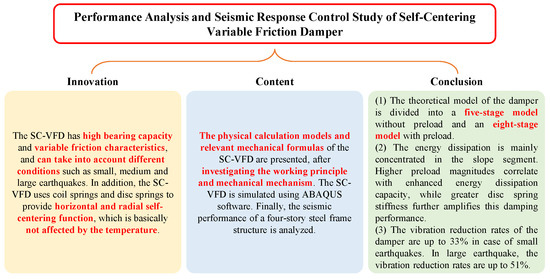
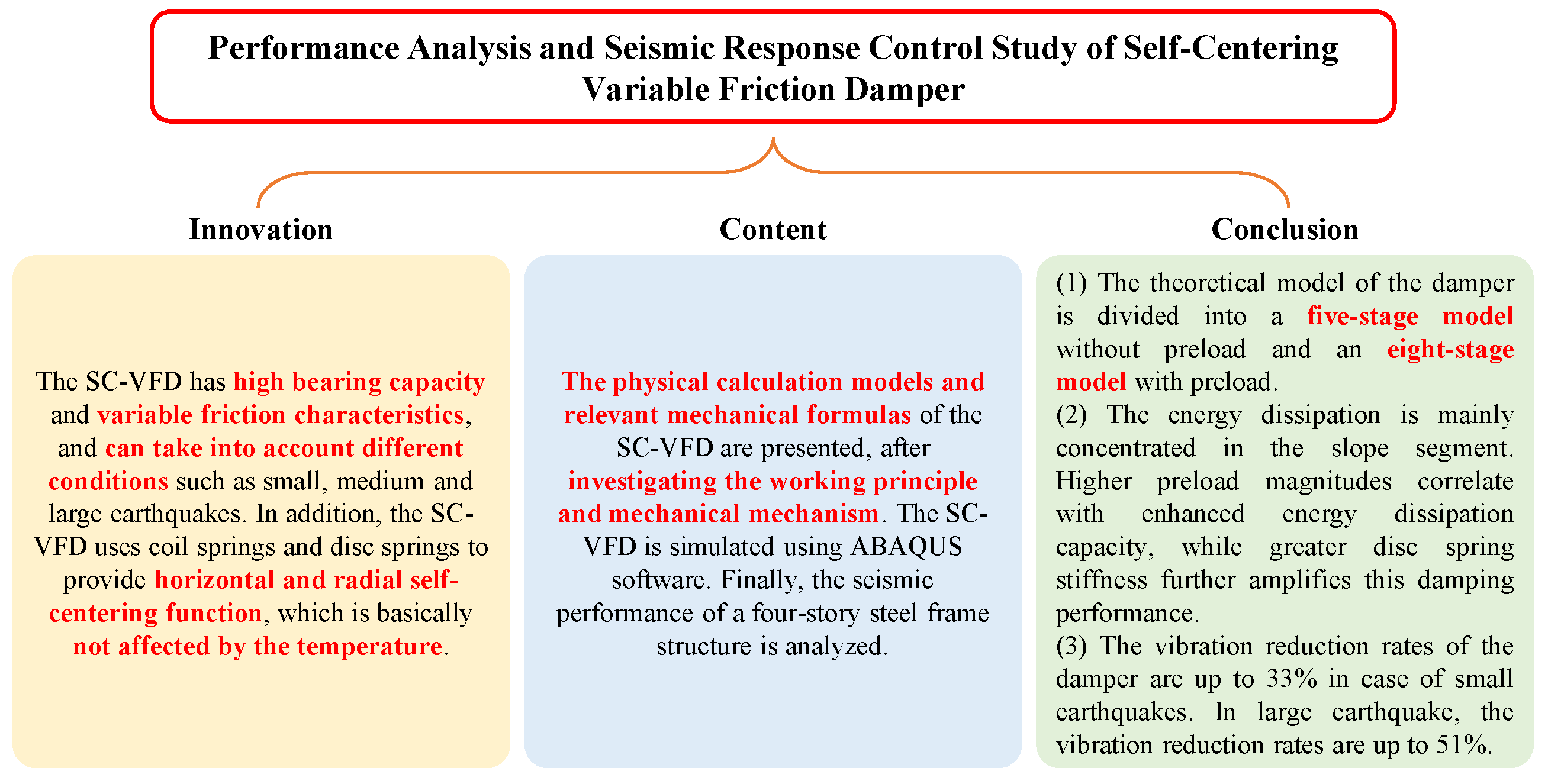
Therefore, this paper designs a novel type of Self-Centering Variable Friction Damper (SC-VFD), which has high bearing capacity and variable friction characteristics, and can take into account different conditions such as small, medium and large earthquakes. In addition, the SC-VFD uses coil springs and disc springs with good deformation capacity and restoring force to provide horizontal and radial self-centering function, which is basically not affected by the temperature, and is suitable for application in resilient structures. After investigating the working principle and mechanical mechanism of the SC-VFD, this paper presents its physical calculation models and relevant mechanical formulas, which lays a theoretical foundation for further in-depth research on this type of damper. The SC-VFD is simulated using ABAQUS 2022 software, and the accuracy of the finite element model is verified. Finally, the seismic performance of a four-story steel frame structure is analyzed, and it is proved that the SC-VFD exhibits significantly improved seismic performance in practical application. A systematic summary of the SC-VFD is shown in Figure 1.
Figure 1.
A systematic summary of the SC-VFD.
2. Self-Centering Variable Friction Damper (SC-VFD)
2.1. Configuration
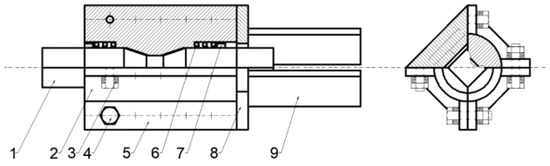
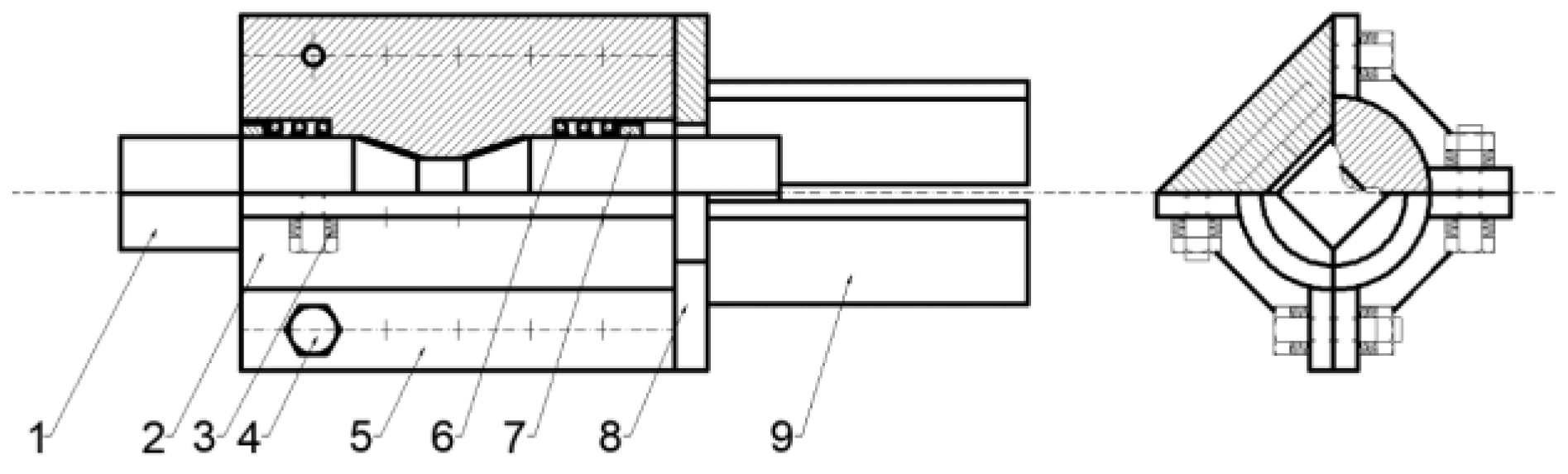
The new SC-VFD comprises an inner tube, an outer tub, helical springs, disc springs, high-strength bolts, and auxiliary components, as illustrated in Figure 2. The inner tube (Component 1) is fabricated from solid square-section steel and is concentrically nested within the outer tube assembly (Component 2). Outer tube 2 is composed of four one-quarter round tubes integrated with extension plates (Component 5), maintaining direct surface contact with the inner tube. Two Baffle plates (Component 7) are mounted at both termini of the inner tube, each preloaded with a helical spring (Component 6). The structural integrity of the system is achieved through welding of the outer tube segments (Component 2), extension plates (Component 5), transition plates (Component 8), and fixed plates (Component 9). High-strength bolts (Component 4) are installed along the outer tube axially, and disc springs (Component 3) are installed on it. The damper’s operational mechanism involves two distinct friction regimes: planar and inclined. Under planar friction conditions, radial displacement of the outer tube assembly is constrained. Conversely, during inclined friction engagement, the four outer tube segments exhibit coordinated radial displacement, enabling energy dissipation through controlled tube expansion under diametral loading.
Figure 2.
A schematic diagram of damper assembly. Note: 1. Inner tube; 2. outer tube; 3. disc spring; 4. high-strength bolt; 5. extension plate; 6. helical spring; 7. Baffle; 8. transition plate; 9. fixed plate.
2.2. Working Mechanism
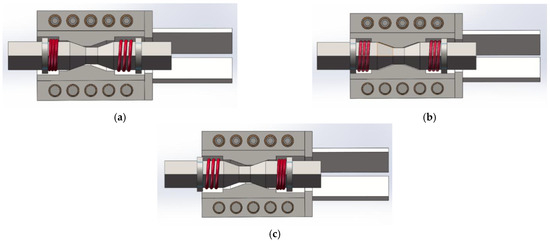
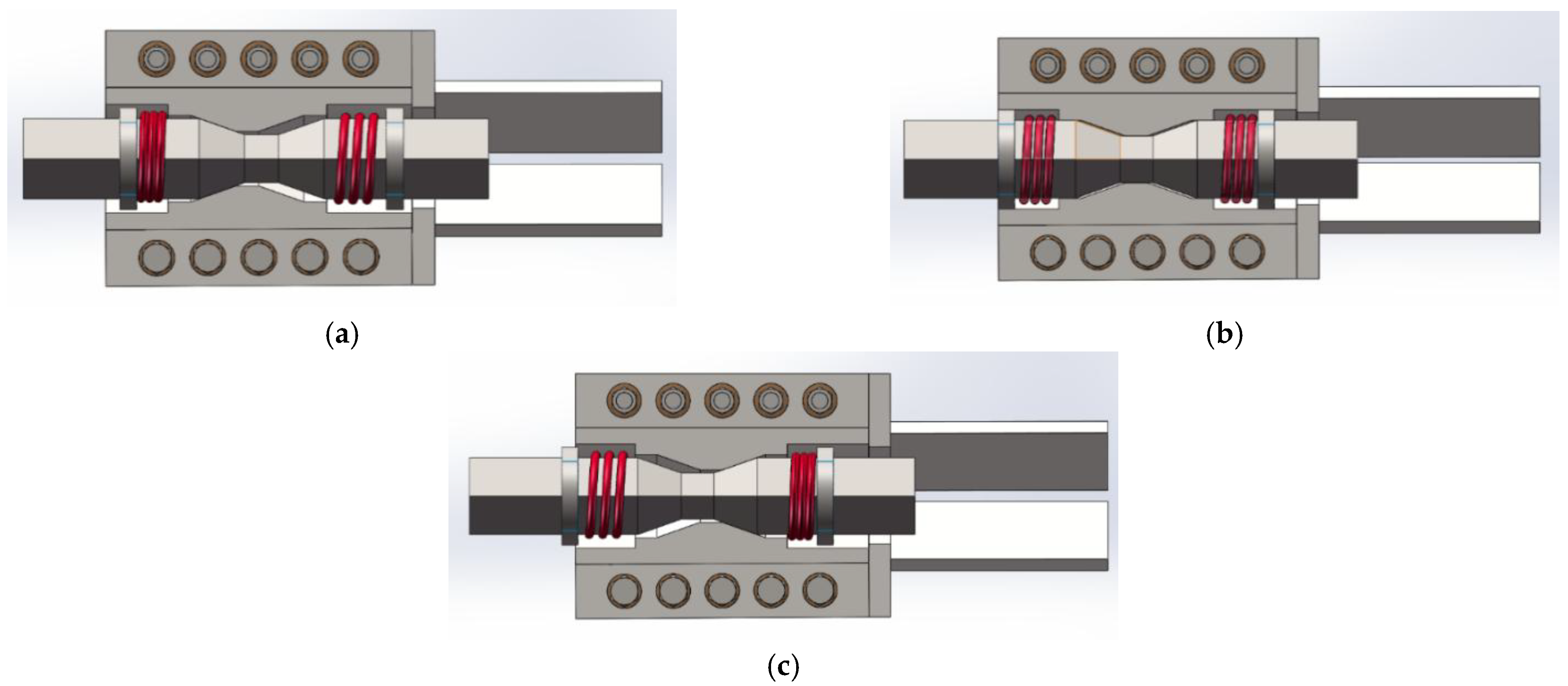
The damper incorporates a dual-stage self-centering system comprising two distinct mechanisms: the helical spring-based horizontal self-centering mechanism and the disc spring-driven radial self-centering mechanism. Under the action of tension and compression load, the damper has three states, as shown in Figure 3.
Figure 3.
The three states of the damper: (a) the press state of the damper; (b) the equilibrium state of the damper and (c) the tension state of the damper.
2.2.1. Horizontal Self-Centering Mechanism
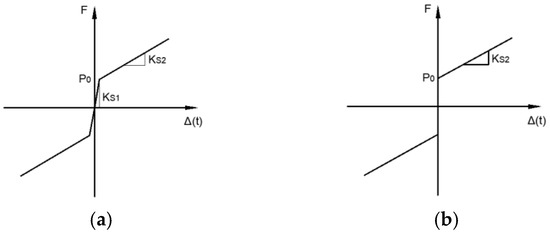
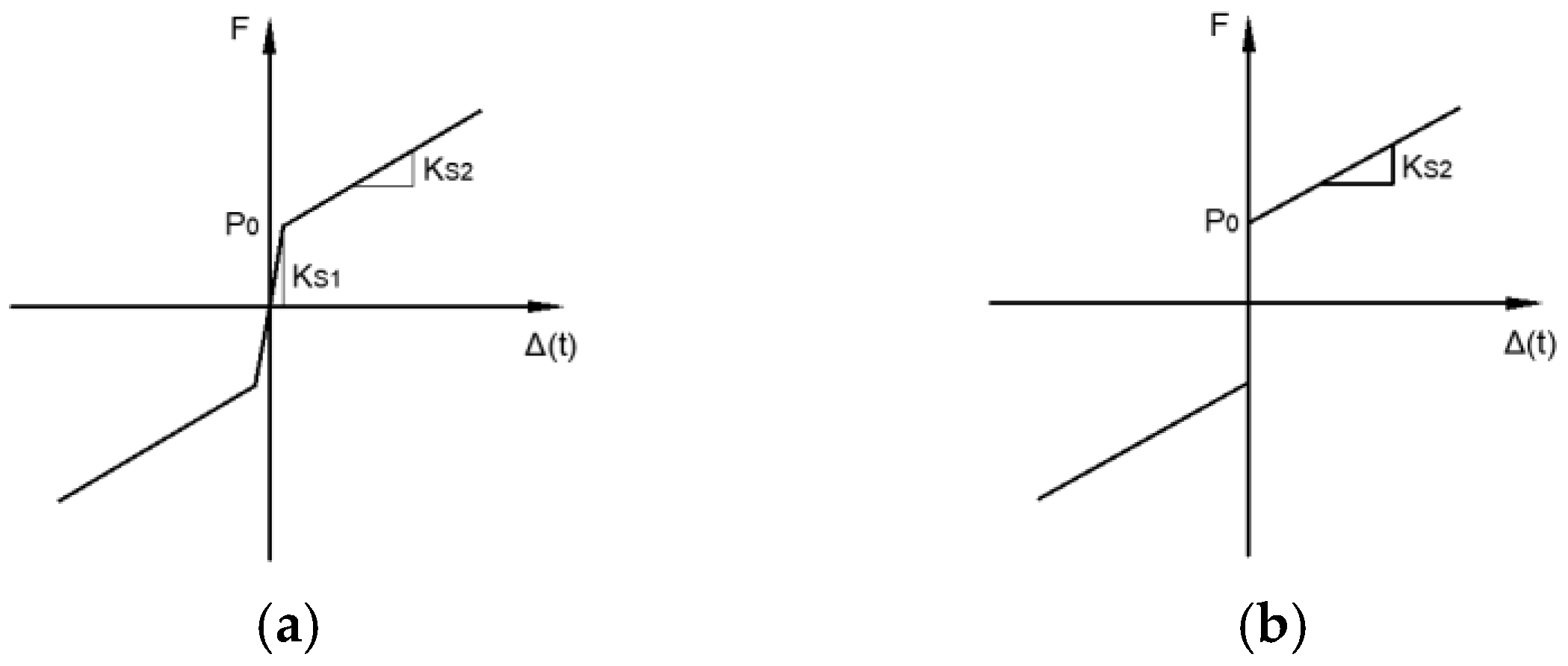
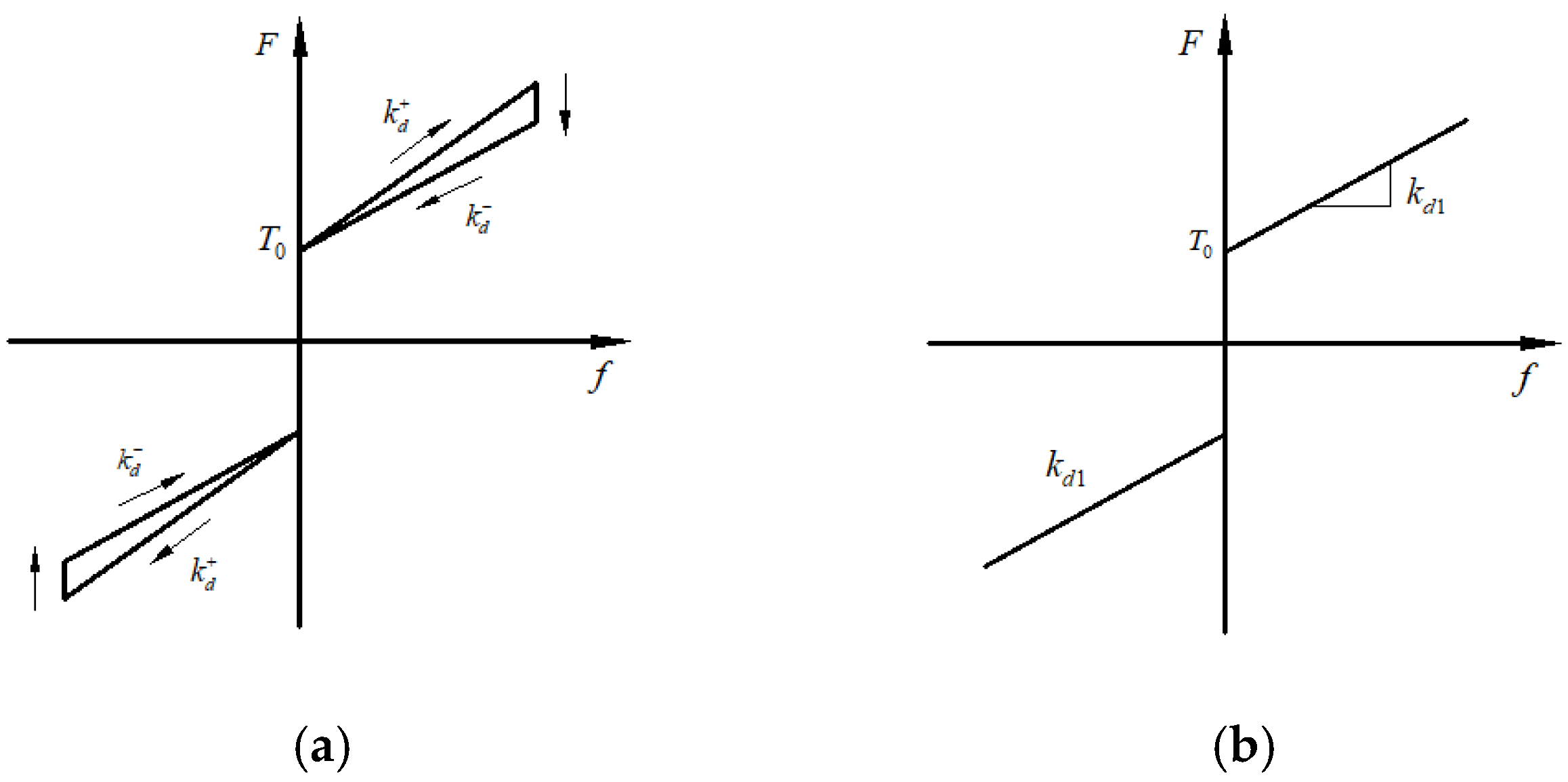
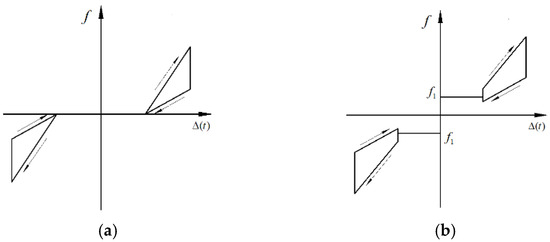
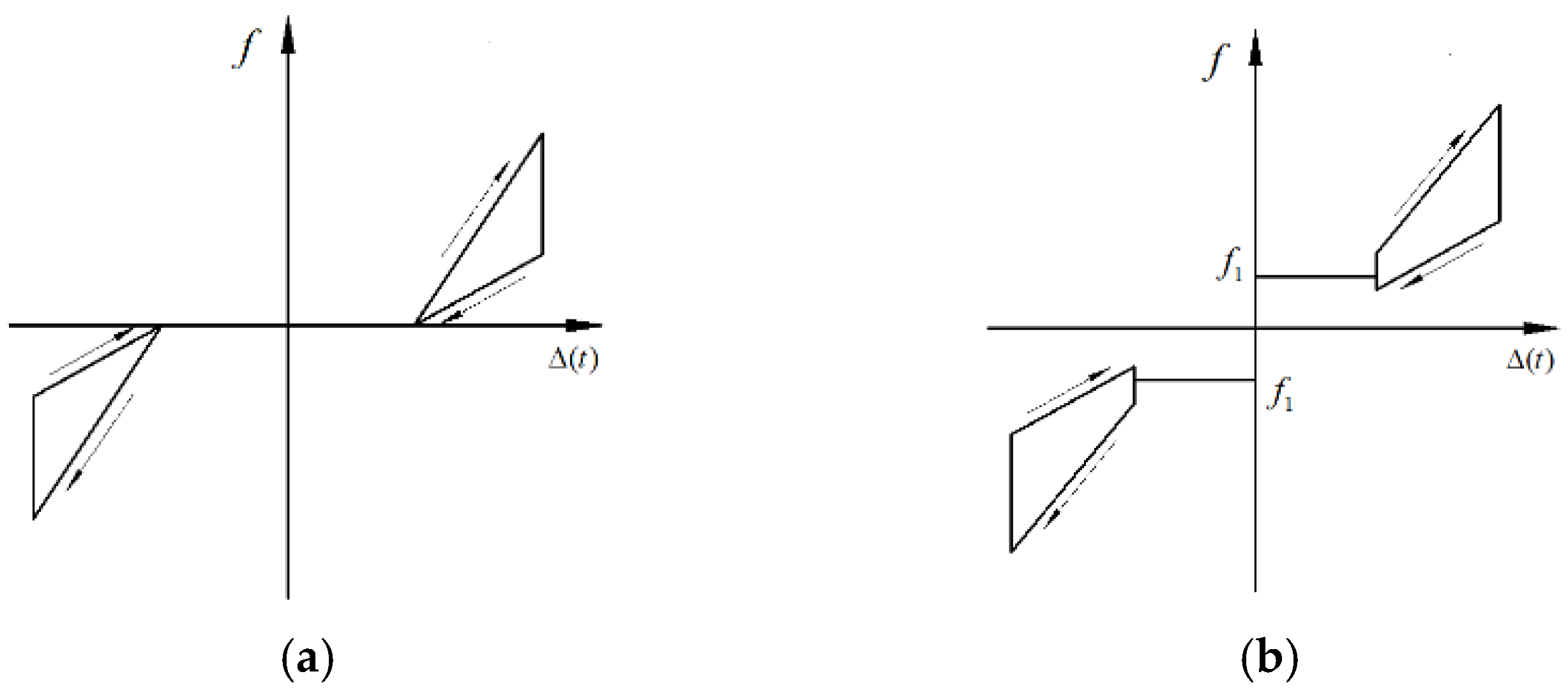
The horizontal self-centering mechanism is theoretically a double-line elastic–plastic model [36,37], which is simplified as shown in Figure 4, where is the initial load.
Figure 4.
A model of the horizontal hysteretic system: (a) before simplification; (b) after simplification.
2.2.2. Radial Self-Centering Mechanism
The radial self-centering mechanism involves a combination of disc springs. This paper uses GB/T 1972-2005 [38] to calculate the disc spring.
(1) Single disc spring
The formulas for force and deformation are as follows:
The calculated bearing capacity of the disc spring at full compression:
The parameters are calculated as follows:
Stiffness of the disc spring:
where E is the elastic modulus of the disc spring; D is the outer diameter; d is the inner diameter; t1 is the thickness of the disc spring with support surfaces, while t2 is the thickness of the disc spring without support surfaces; h0 is the deflection of the disc spring at full compression; and C is the diameter ratio. For disc springs without support surfaces, Kd4 = 1.
(2) Stacked Application of Disc Springs
Friction exists when disc springs are used in stacks. The relevant parameters are given as follows:
a. When the effect of friction is neglected, the following holds:
b. When friction is considered, it increases the load of disc springs during loading and decreases the load during unloading:
where and represent the load of the stacked disc springs during loading and unloading, respectively; and represent the stiffness of the stacked disc springs during loading and unloading, respectively. is the friction coefficient between the conical surfaces of the disc springs; is the friction coefficient, which can be obtained by looking up tables according to the specifications for the corresponding disc spring types.
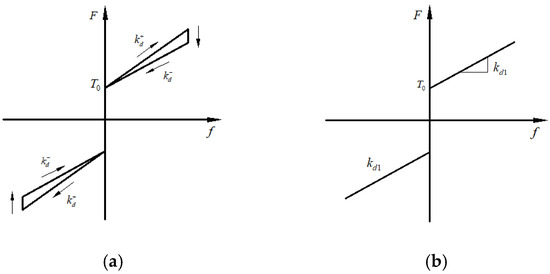
The hysteretic model derived from the above formulas is shown in Figure 5, where T0 denotes the preload of the disc springs. Although friction exists in stacked disc springs, its influence on the results can be reduced by means of lubrication. Meanwhile, only a small number of stacked disc springs are required in the SC-VFD, and thus neglecting friction has little effect on the analytical results.
Figure 5.
Hysteretic model of disc spring: (a) friction considered; (b) friction not considered.
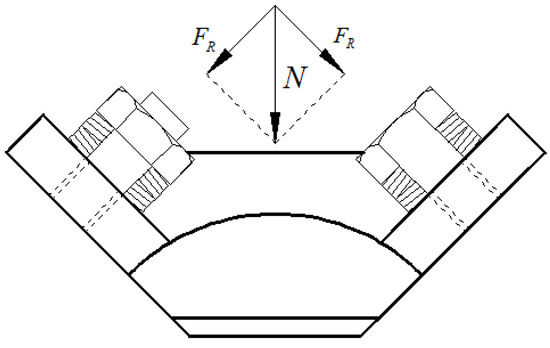
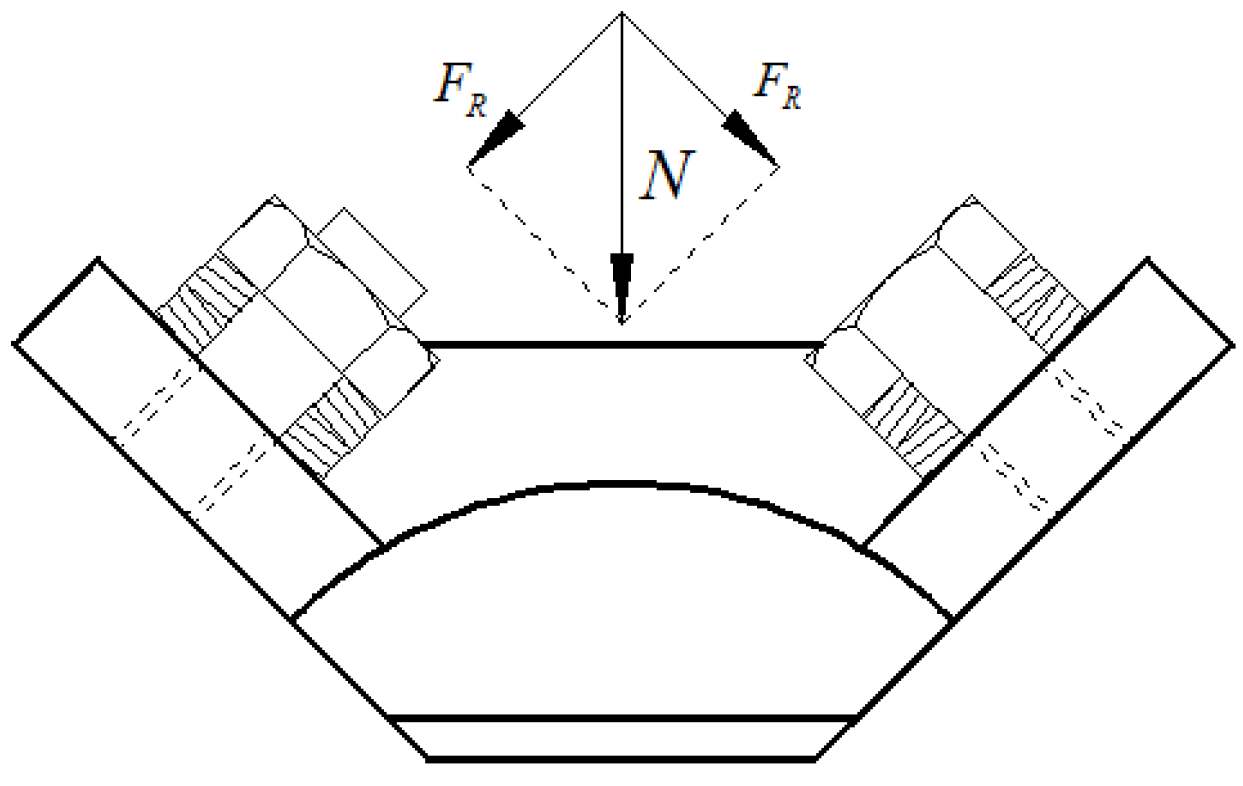
The disc spring assembly exerts its restoring force along the damper’s radial axis; the contact interface between the inner and outer tubes varies geometrically, , as illustrated in Figure 6. In the planar segment, tube surfaces maintain orthogonal alignment (90°) relative to the disc spring’s force vector; in the inclined segment, the interface reorients to a 45° angular offset from the spring’s radial loading direction.
Figure 6.
A schematic diagram of the disc springs’ acting force in the plane and slope segments.
2.2.3. Equivalent Axial Self-Centering Force
This force transformation mechanism operates within the slope section, where the radial self-centering force of the disc spring is converted into an equivalent axial self-centering force.
(1) No preload condition
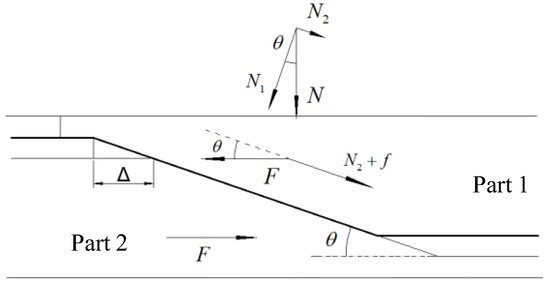
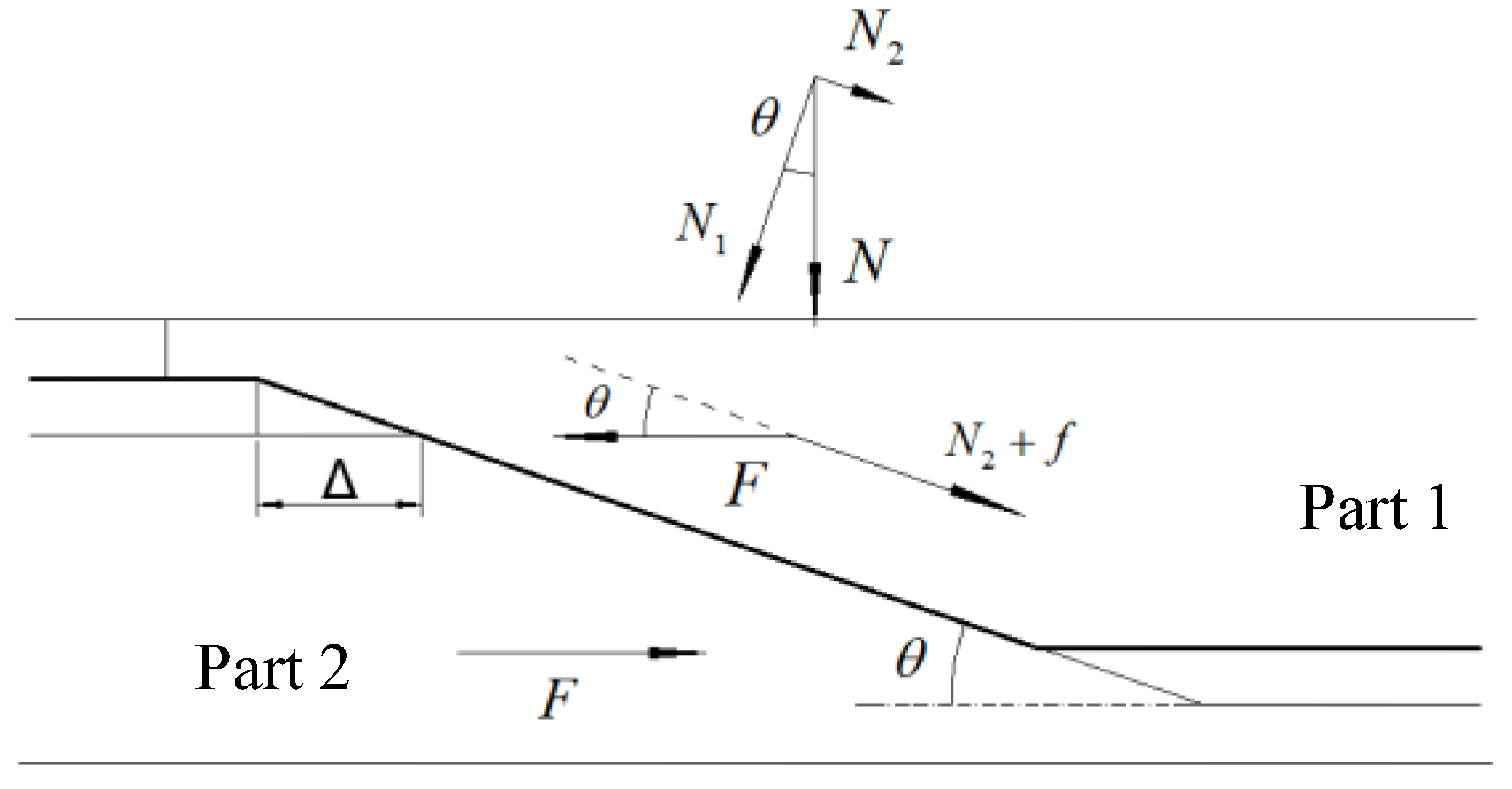
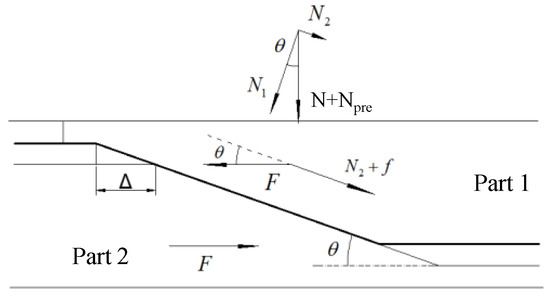
(1.1) The mechanical model of the loading process is shown in Figure 7.
Figure 7.
Force on slope during loading.
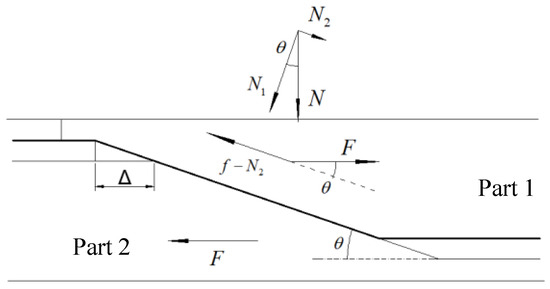
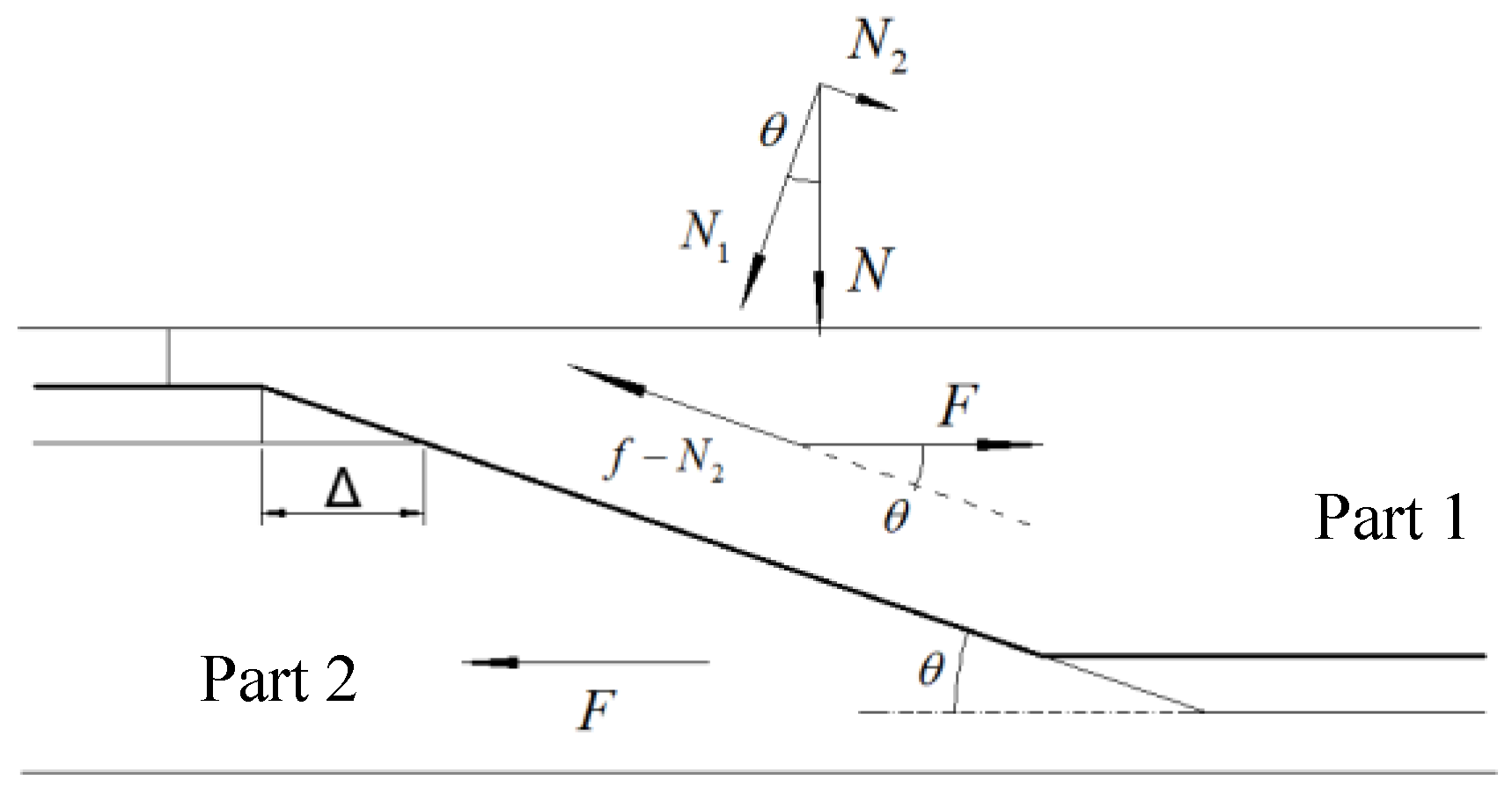
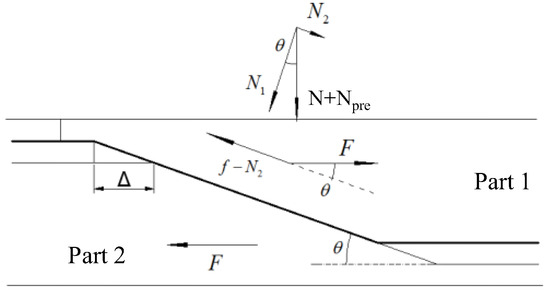
The parameters in Figure 8 are as follows: N is the restoring force provided by the disc springs, N1 is the positive pressure perpendicular to the slope, N2 is the component of the restoring force parallel to the slope, f is the slope friction force, θ is the slope, μ is the friction coefficient, F is the damper force, and kd is the disc springs stiffness. The application of external force F will induce an axial relative displacement δ between member 1 and member 2.
Figure 8.
Force on slope during unloading.
When bending and axial deformation of the components are ignored, the following holds:
Damper loading stiffness is as follows:
(1.2) The mechanical model of the unloading process is shown in Figure 8.
Damper unloading stiffness is as follow:
It can be seen that the stiffness of the damper is proportional to the stiffness of the disc springs when the slope and friction coefficient are fixed.
(2) Preload condition
The preload is provided by the disc springs under the preload condition. The disc springs have a preload displacement , the preload is , the preload of the disc springs is , and the definitions of the other parameters remain unchanged.
(2.1) The mechanical model of the loading process is shown in Figure 9.
Figure 9.
Force on slope during loading.
When bending and axial deformation of the components are ignored, the following holds:
(2.2) The mechanical model of the unloading process is shown in Figure 10.
Figure 10.
Force on slope during unloading.
Damper unloading stiffness is as follow:
Through comparative analysis of damper stiffness with and without preload, the following is found:
(1) The preload has no influence on the loading and unloading stiffness of the damper.
(2) During the loading process, and are positively correlated with the loading stiffness.
(3) In the unloading process, the self-centering ability is available only when is less than . If μ is greater than , the slope will be ‘stuck’ in the self-centering stage.
(4) The absolute stiffness of the damper is positively correlated with and in all cases.
2.2.4. Energy Dissipation Mechanism
The energy dissipation of the slope section can be divided into two conditions with or without preload. is the slope friction during loading, and is the slope friction during unloading.
(1) Without the preload condition:
(2) With the preload condition:
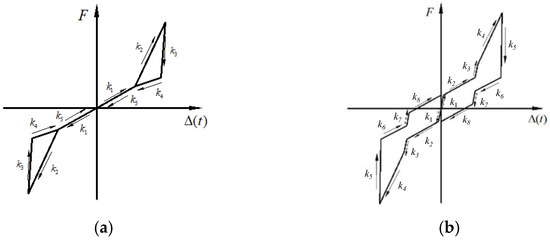
After simplification, it can be considered that the stiffness of the hysteretic model of the disc springs remains unchanged, and the hysteretic model of the energy dissipation mechanism of the whole process is shown in Figure 11. is the plane segment friction force generated by the preload of the disc springs.
Figure 11.
Hysteretic model of energy dissipation mechanism: (a) without preload; (b) with preload.
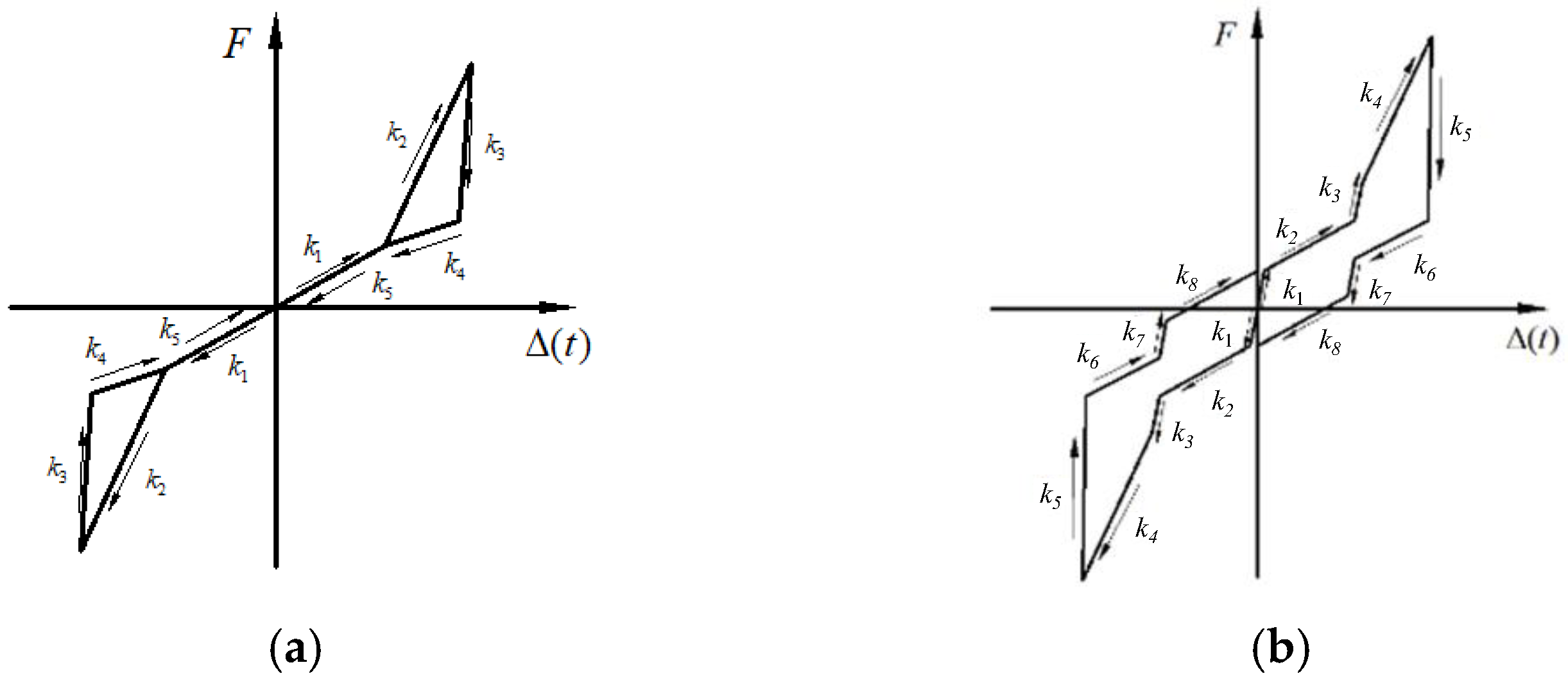
There is a series relationship between the energy dissipation mechanism and the horizontal self-centering mechanism. In the case of considering the double-line model of the helical spring and the friction force of the disc spring, Figure 12 shows the mechanical model combined with superposition and considering the intervention time of self-centering.
Figure 12.
Mechanical model of damper: (a) without preload condition; (b) with preload condition.
2.3. Mechanical Properties
The load–displacement curve and stiffness change of the damper under tension are taken as examples to conduct force analysis. The original mechanical model of the damper is adopted, which can be divided into two conditions. The derivation process is as follows.
2.3.1. No Preload Condition
The preload and stiffness of both helical springs are and respectively; the preload and stiffness of the disc springs are 0 and respectively. and are the loading and unloading stiffness of the damper of the disc springs in Equations (2) and (4).
The first stage: plane loading.
The maximum deformation of the first stage is .
The second stage: slope loading.
The maximum deformation of the second stage is , and the maximum force of the second stage is .
The third stage: static reverse.
During this stage, the inner and outer tubes remain in a relatively static state, and the deformation of the damper is the material deformation of the inner and outer tubes. We assume that the inner tube stiffness is , the outer tube stiffness is , and the inner and outer tubes are connected in series:
is the deformation at the end of the third stage.
The fourth stage: slope unloading.
The fifth stage: plane unloading.
This stage works in the same way as the first stage. This stage is also known as the final stage of self-centering.
The self-centering force of the damper is in the final stage of self-centering, which can achieve complete self-centering.
2.3.2. Preload Condition
The preload and the stiffness of the helical spring are and , respectively. The preload and the stiffness of the disc spring are and respectively. The frictional force of the plane stage is .
The first stage: from the stress stage to the sliding stage.
The maximum deformation of the first stage is .
The second stage: the plane loading stage.
The load in this stage is the same as that in the first stage without preload, and is assumed to be the maximum deformation in the second stage.
The third stage: the mutation stage.
The mechanical formula of the plane segment is different from that of the slope segment. There is a sudden change in force when leaving the plane segment, and the sliding force of the slope segment is different from the external force at this time. Deformation at the end of the third stage is .
The fourth stage: the slope loading stage.
and are the maximum deformation and force in the fourth stage.
The fifth stage: the static reverse stage.
The load at this stage is the same as that at the third stage without preload. Deformation at the end of the fifth stage is .
The sixth stage: the slope unloading stage.
The load at this stage is the same as that at the fourth stage without preload. Deformation at the end of the sixth stage is .
Stage 7: the mutation stage.
There is load mutation in the transition from the slope to the plane segment.
The eighth stage: the plane unloading stage.
At this stage, the disc springs disengage, leaving the helical spring as the sole source of the restoring force. The working principle is the same as in the fifth stage without preload.
The final residual displacement of the damper is as follow:
The residual displacement can be controlled by adjusting the values of and , but the self-centering effect cannot be achieved under preload.
The mechanical properties of the two kinds of springs are discussed, and the hysteresis model of the friction device is obtained; the mathematical relationship between the parameters is established, the appropriate mechanical model is established, and the self-centering effect is finally demonstrated. The results show that the residual displacement can be controlled by adjusting the values of and , and the self-centering effect can be achieved when the preload is 0.
3. Numerical Simulation Study of SC-VFD
3.1. Specimen Design
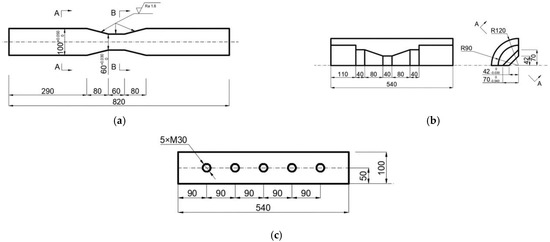
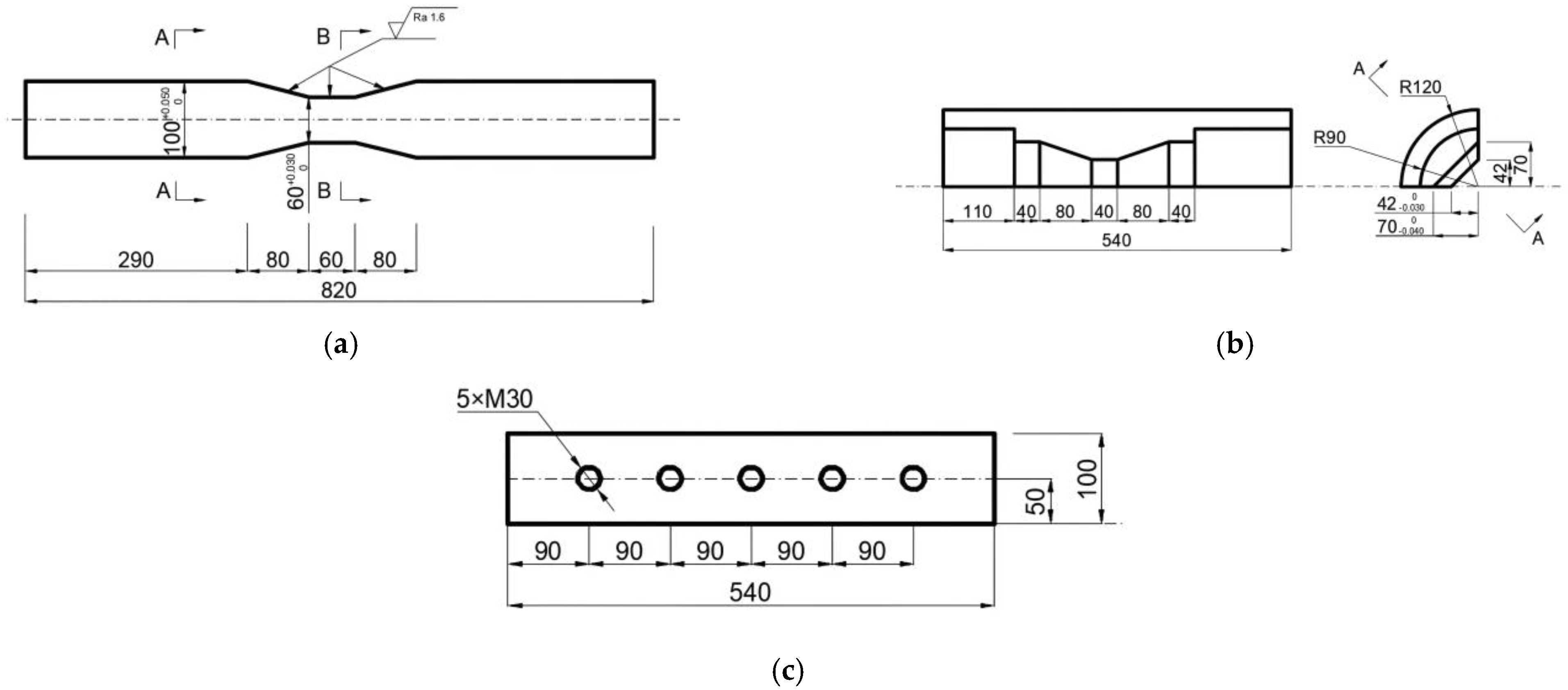
The material and total quantity of the new SC-VFD components are shown in Table 1. The total size after assembly is 1130 mm in length and 440 mm in width. The machining dimensions of the main components are shown in Figure 13.
Table 1.
Component processing requirements.
Figure 13.
Processing dimension of damper component: (a) processing size of inner tube; (b) processing size of outer tube; (c) processing size of extension plate.
The inner diameter of the helical spring used is 145 mm, the wire diameter is 20 mm, the free length is 100 mm, the pressing height is 60 mm, the working height is 80 mm, the coil is 3 turns, the closing number is 2 turns, and 60Si2MnA spring steel is used for the helical spring.
Two kinds of disc-shaped springs were used in the test, both of which adopted 60Si2MnA as the requirement of the GB/T 1972-2005 standard [38]. The specifications are shown in Table 2. Here, D stands for the outer diameter, d stands for the inner diameter, t stands for thickness, h stands for height, and h/t stands for the height–thickness ratio. In the implemented design, Type A disc springs were configured with three stacked layers, while Type B utilized a two-layer stack.
Table 2.
Disc spring specifications.
3.2. Loading Profile
The friction in the plane friction segment of the damper is directly related to the preload of the disc spring, while the preload of the disc spring is controlled by high-strength bolts. The formula for torque is as follows:
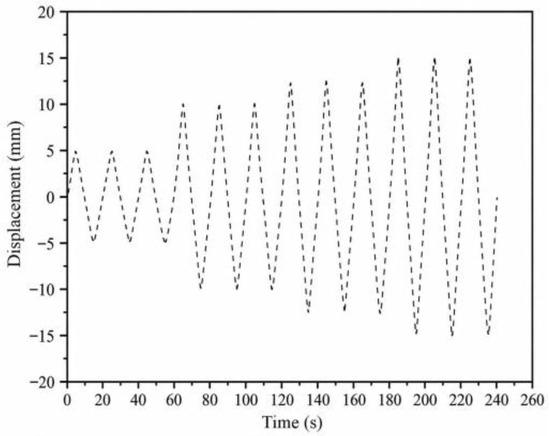
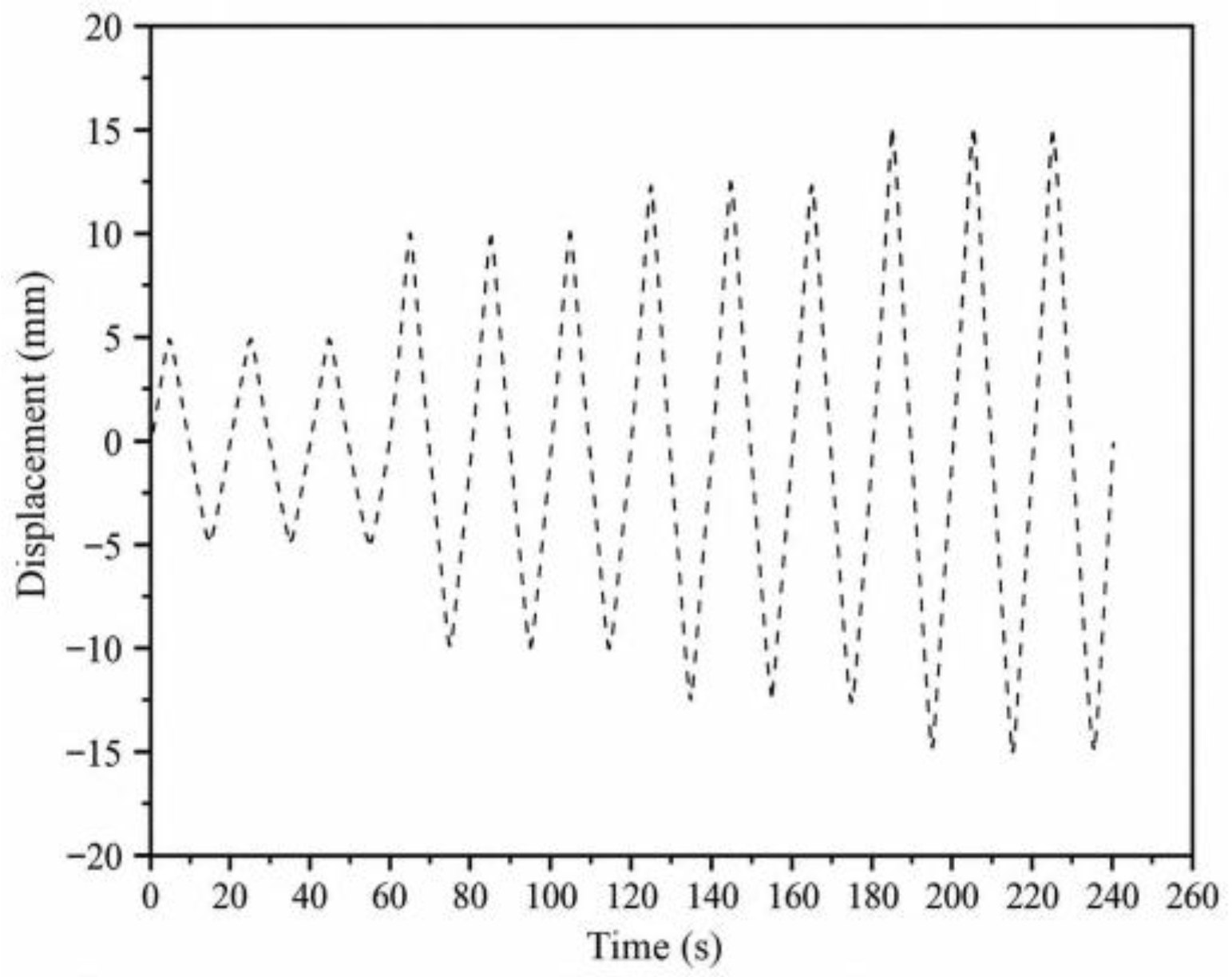
where k is the torque coefficient, d is the nominal diameter of the screw thread, and P0 is the preload of the bolt. According to the experimental requirements, the positive preload of the friction surface in the horizontal section was designed to be 0 kN and 60 kN, and the corresponding torques were set as 0 N·m and 10 N·m. There are four working cases in the simulation, and the working cases are shown in Table 3. The loading protocol curves of the four working cases are the same, as shown in Figure 14, with a frequency of 0.05 Hz.
Table 3.
Loading cases.
Figure 14.
Loading protocol curve.
3.3. Finite Element Model
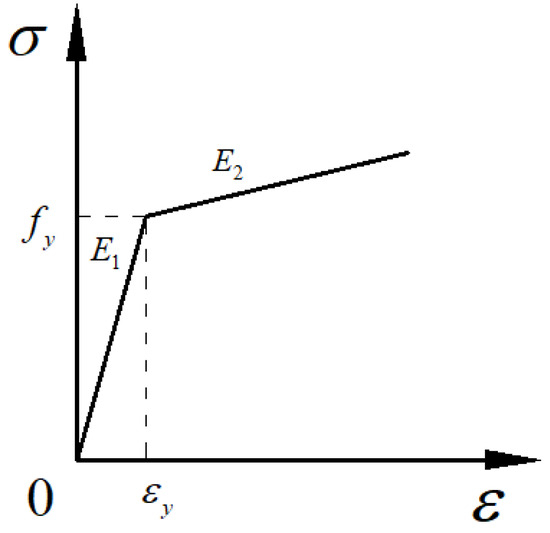
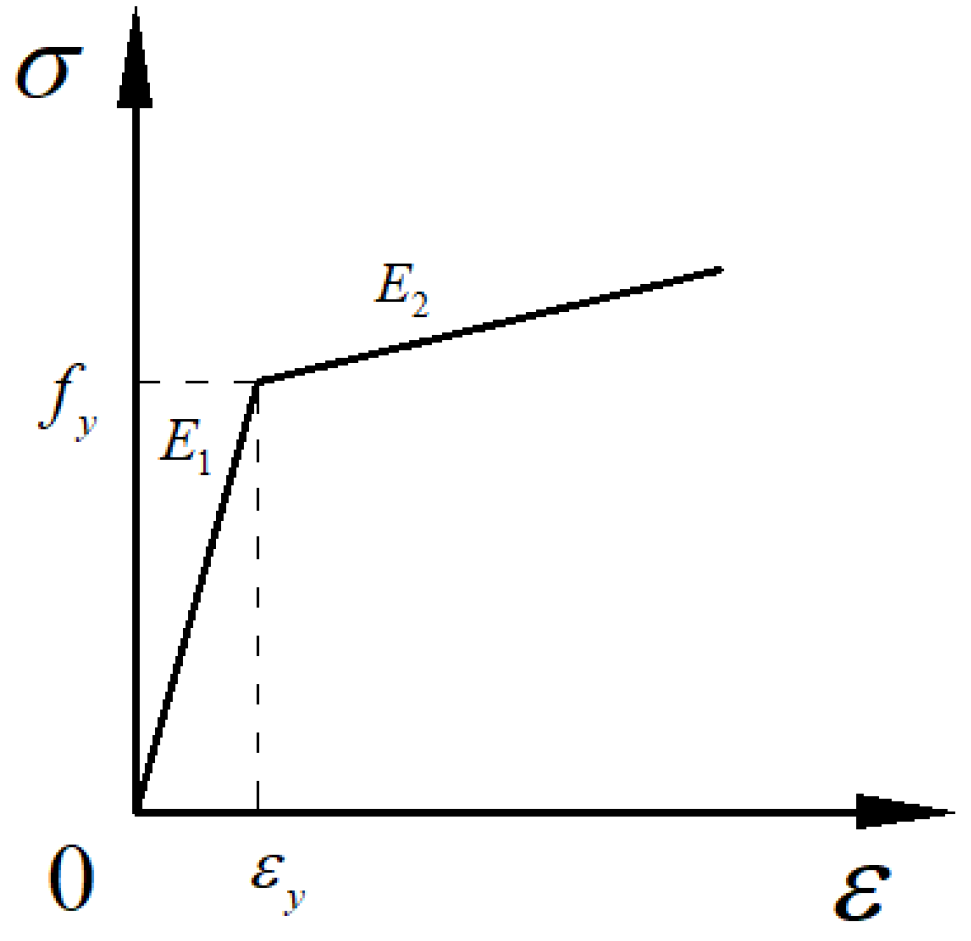
The Mises yield criterion [39,40] and the classical bilinear kinematic hardening material model were adopted to simulate the steel material. The constitutive relationship is shown in Figure 15. The elastic modulus of the steel , the second elastic modulus of the steel is , and Poisson’s ratio is 0.3.
Figure 15.
Bilinear constitutive model of steel.
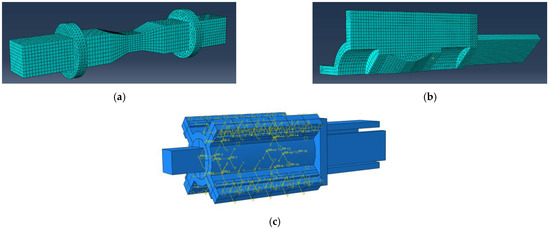
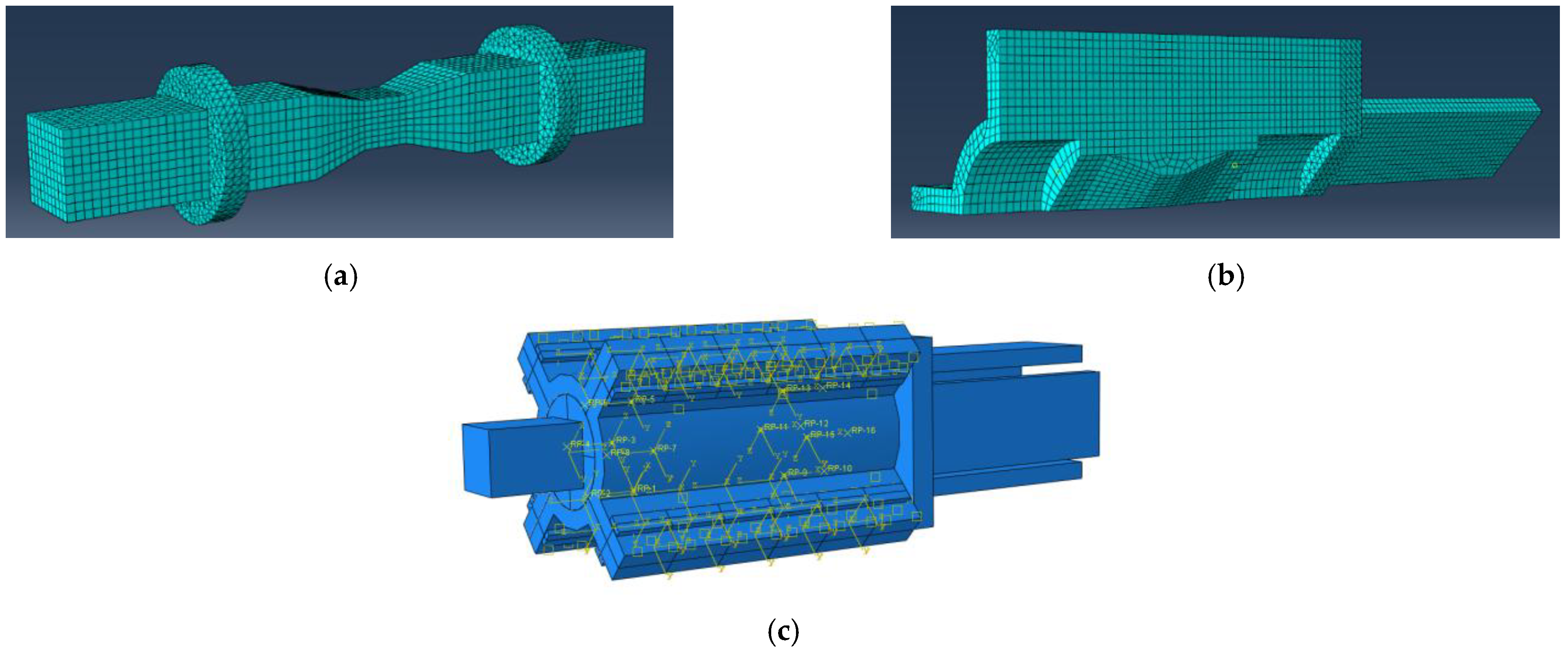
The steel was simulated using C3D8R solid element in ABAQUS. The mesh sizes on both sides of the transition plate were different, and C3D10 solid element was used for simulation. The connector element was equivalent to the disc and coil springs. There was friction between the inner tube and the outer tube, the tangential friction coefficient was empirically 0.1 [41], and the normal contact was hard. The contact surface between the outer tubes was set to be frictionless. The finite element model is shown in Figure 16.
Figure 16.
Finite element model: (a) inner tube meshing; (b) outer tube meshing; (c) global geometric model.
3.4. Numerical Results and Discussion
3.4.1. Hysteretic Performance
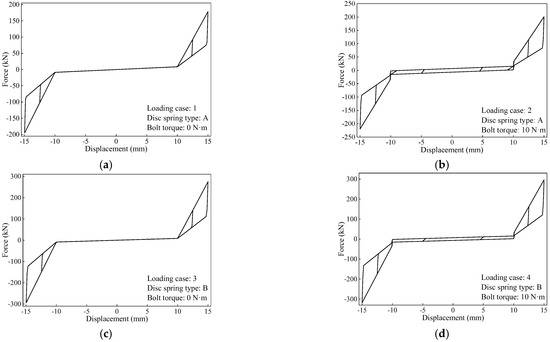
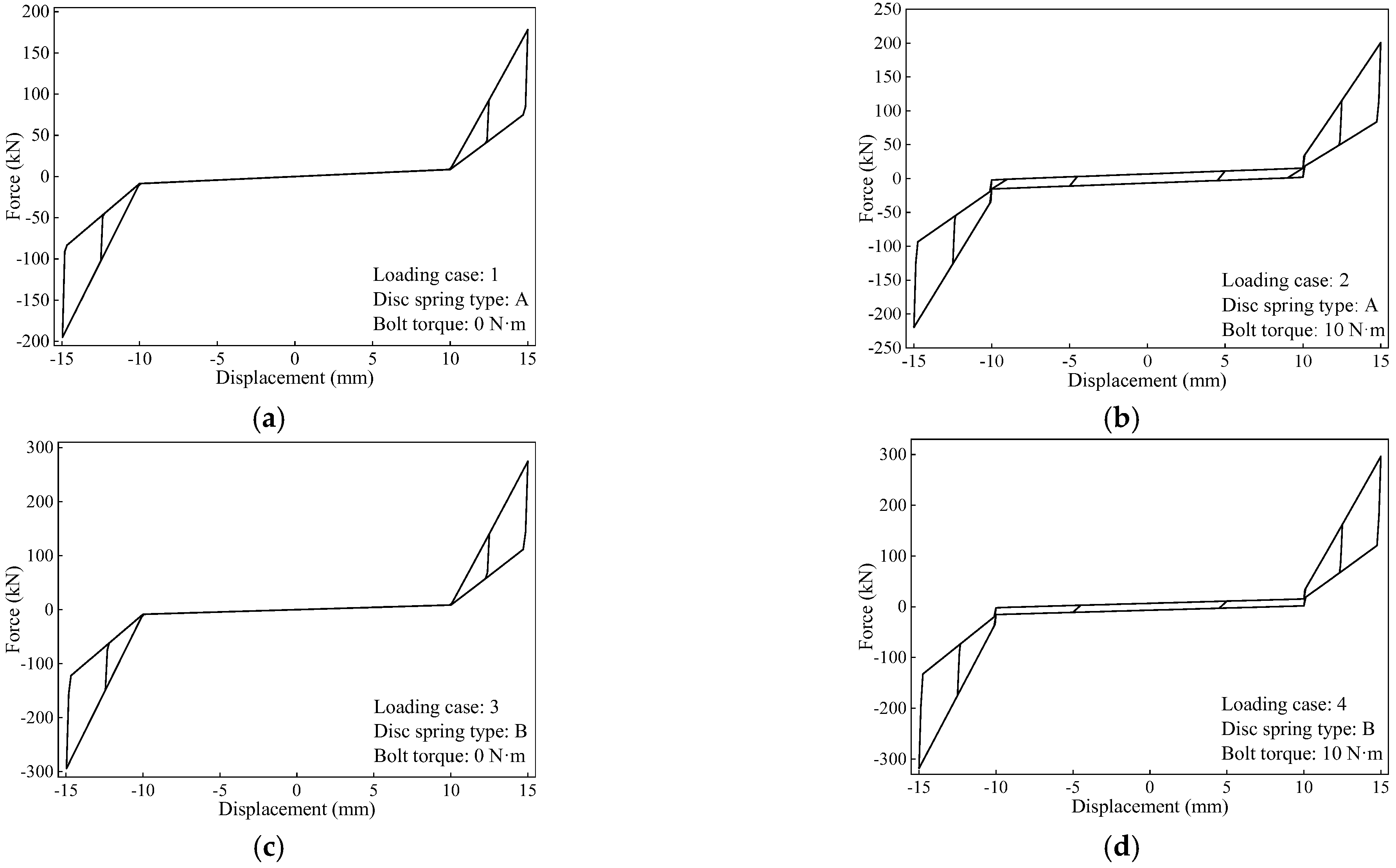
The hysteresis curve of the SC-VFD, under the loading cases presented in Table 3, is shown in Figure 17. The self-centering performance of the SC-VFD is great in these cases, and the hysteretic curves is similar to the ‘S type’.
Figure 17.
Hysteretic curves of dampers under different cases: (a) case 1; (b) case 2; (c) case 3; (d) case 4.
The following can be seen from Figure 17:
(1) The existence of disc spring preload cannot achieve complete self-centering.
(2) The friction of the slope section is much greater than that of the plane section, which can confer variable friction characteristics.
(3) The bearing capacity of the damper is increased by about 10% through preload.
(4) The damper bearing capacity of the two kinds of disc springs differs by about 50%.
(5) The preload increases the energy dissipation capacity of the plane section and slope section.
3.4.2. Ultimate Bearing Capacity
Theoretically, the maximum design displacement of the damper is ±17.47 mm, which can still stand larger loads. Before determining the ultimate bearing capacity of the damper, it is necessary to study the most unfavorable position of the force. The most unfavorable position of the force obtained by simulation is shown in Figure 18.
Figure 18.
The most unfavorable position under tension and compression load: (a) under tension load; (b) under compression load.
The Mises stress values were compared at the most unfavorable position under tensile and compression load; the most unfavorable position is the variable section of the inner tube. Working case 4 was taken as an example; the damper was subjected to tensile load which exceeded the maximum design displacement. The displacement at yield was about 17.7 mm according to the Mises yield rules, and the ultimate bearing capacity under 17.7 mm displacement was 472.99 kN under tension.
3.4.3. Comparison Between Theoretical and Numerical Results
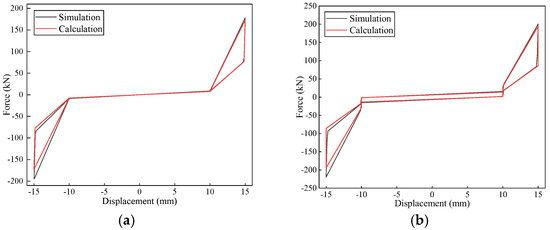
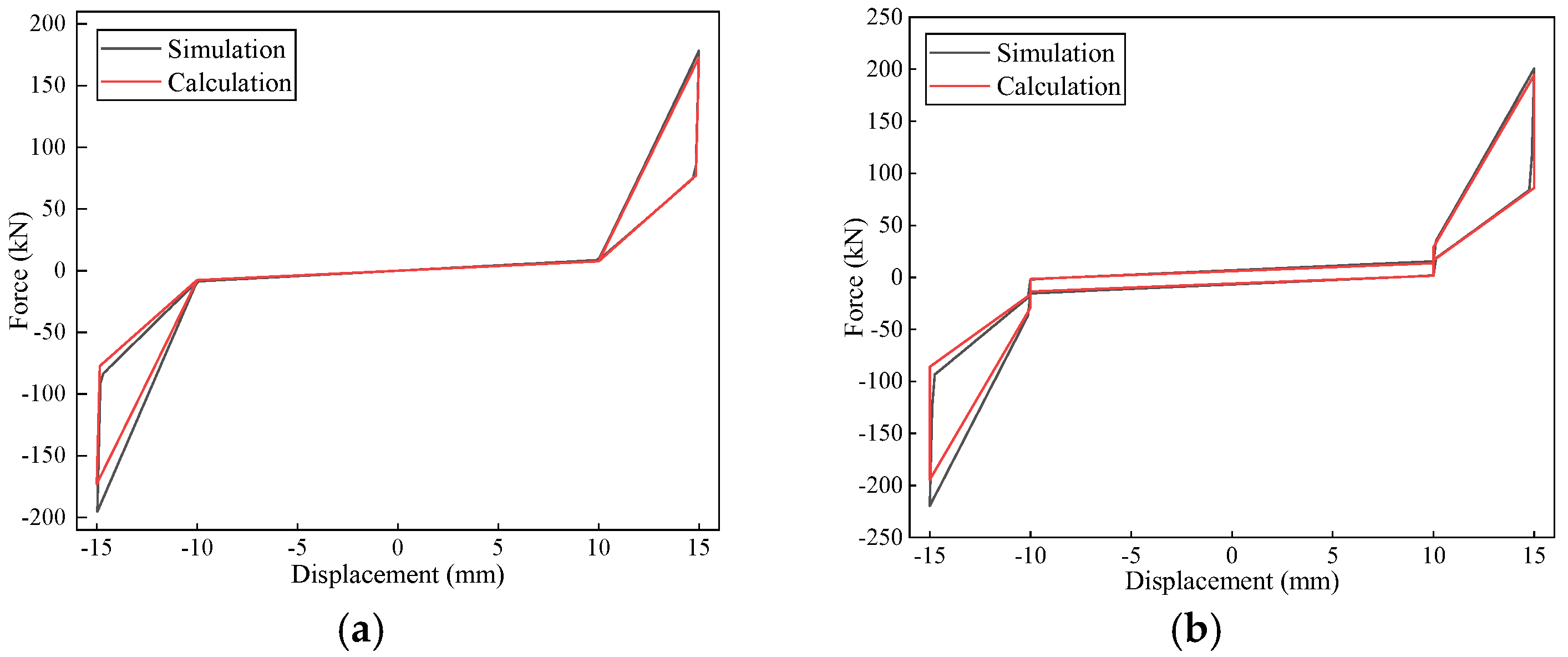
Figure 19 shows a comparison of the hysteretic curves of the dampers obtained by numerical simulation and theoretical calculation under working cases 1 and 2. The deviation of the numerical simulation compared with the theoretical calculation is shown in Table 4 and Table 5.
Figure 19.
Comparison of hysteresis curves: (a) case 1; (b) case 2.
Table 4.
Comparison under case 1.
Table 5.
Comparison under case 2.
Collectively, the numerical simulation data and analytical calculations were broadly aligned, validating the accuracy of the proposed mechanical model. The error is less than 13%, and the mechanical model is more conservative than the numerical simulation results.
The dimensional and material specifications of the new SC-VFD were finalized. Numerical simulations demonstrated the damper’s robust energy dissipation performance, with dissipation predominantly occurring during the transition phase. A direct correlation was observed between preload magnitude and energy dissipation capacity: higher preloads enhanced damping efficacy. Similarly, increased stiffness of the disc springs resulted in greater energy dissipation capability. The maximum displacement of the damper was 17.7 mm and the ultimate bearing capacity was 472.99 kN when Q345 steel was used. Finally, the theoretical calculation and simulation results were compared, and the error was not more than 13%.
4. A Numerical Example
A four-story steel frame structure was established in ABAQUS. Seismic waves were inputted on the structure through time-history analysis [42]. A new SC-VFD design was applied to the steel frame model, and the energy dissipation and shock absorption effect of the damper on the frame structure was analyzed in many aspects.
4.1. Description of Model
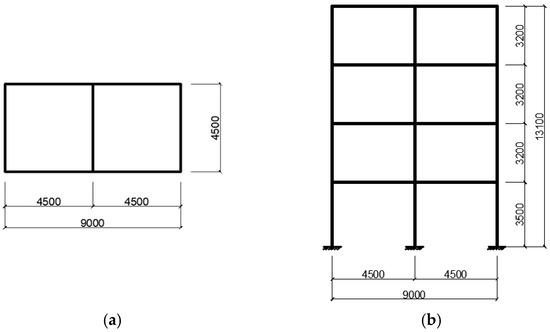
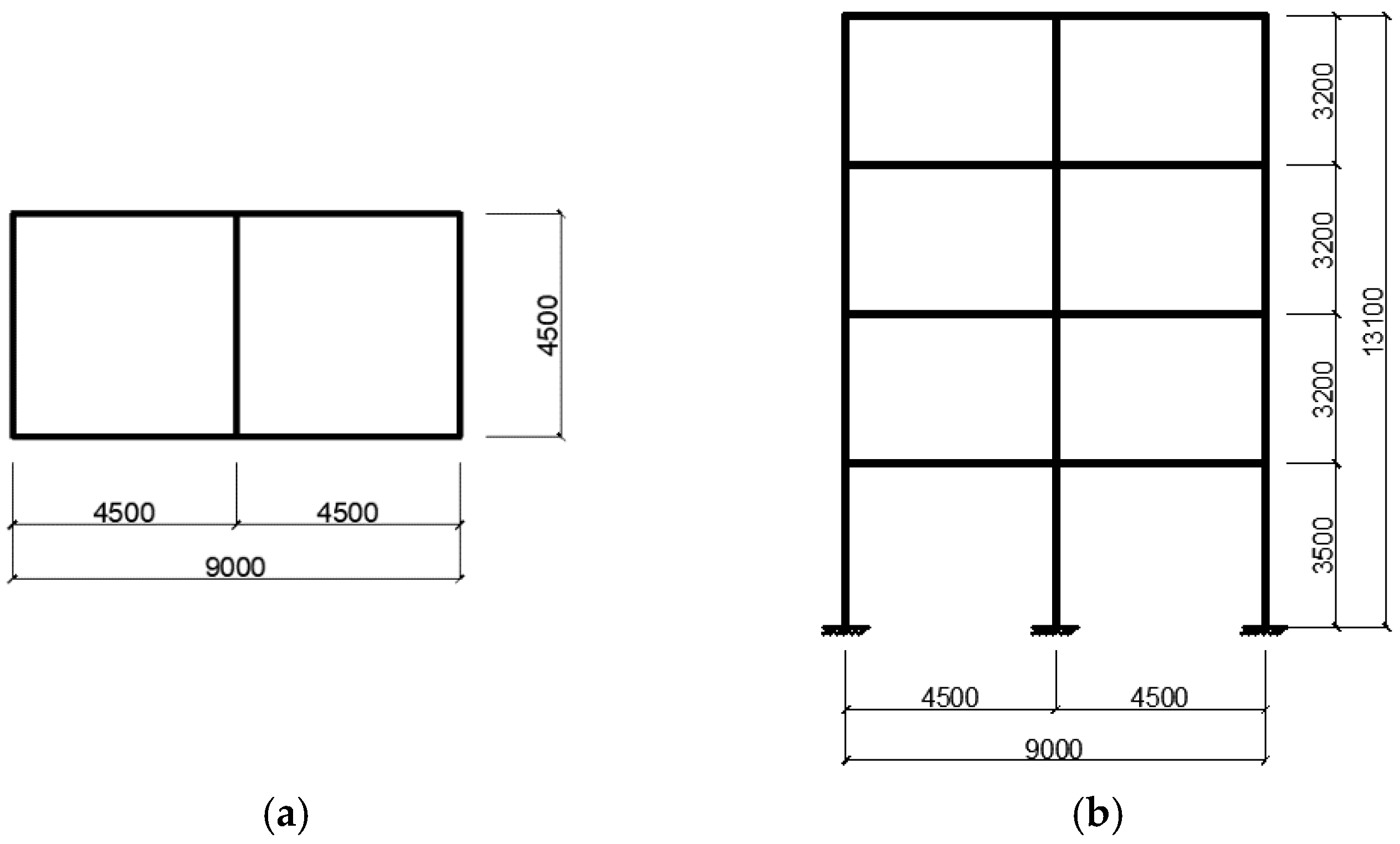
A four-story steel frame structure was designed on Chinese codes [43]. The plan and elevation of the structure are shown in Figure 20. The floor height of the structure was 3.500 m, the other floors were 3.200 m, and the total height of the structure was 13.100 m. Column axis size was 4.5 m × 4.5 m, while column section size and beam section size were and respectively. The structure was made of Q235 steel. Floor slabs, with a thickness of 100 mm, were constructed by cast in situ concrete; the floor dead load was and the live load was . People could not step on the roof; the roof dead load was and the live load was .
Figure 20.
Structure diagram: (a) structural plane diagram; (b) structural elevation diagram.
B31 element was chosen to simulate the beams and columns of the steel frame structure, while S4R element was chosen to simulate the floors. The beams and columns were made of Q235 steel, with . The floors were made of C30 concrete, and its elastic modulus is , Poisson’s ratio is 0.2, and . The plastic damage relationship was not considered in the structures.
Wire is used to simulate the new SC-VFD, and its hysteresis model parameters adopt the numerical simulation results of the fourth working case, using Q345 material. The position of the dampers is shown in Figure 21, and the total number is 16, 4 SC-VFDs in each layer.
Figure 21.
Damper layout in frame.
4.2. Selection of Ground Motions
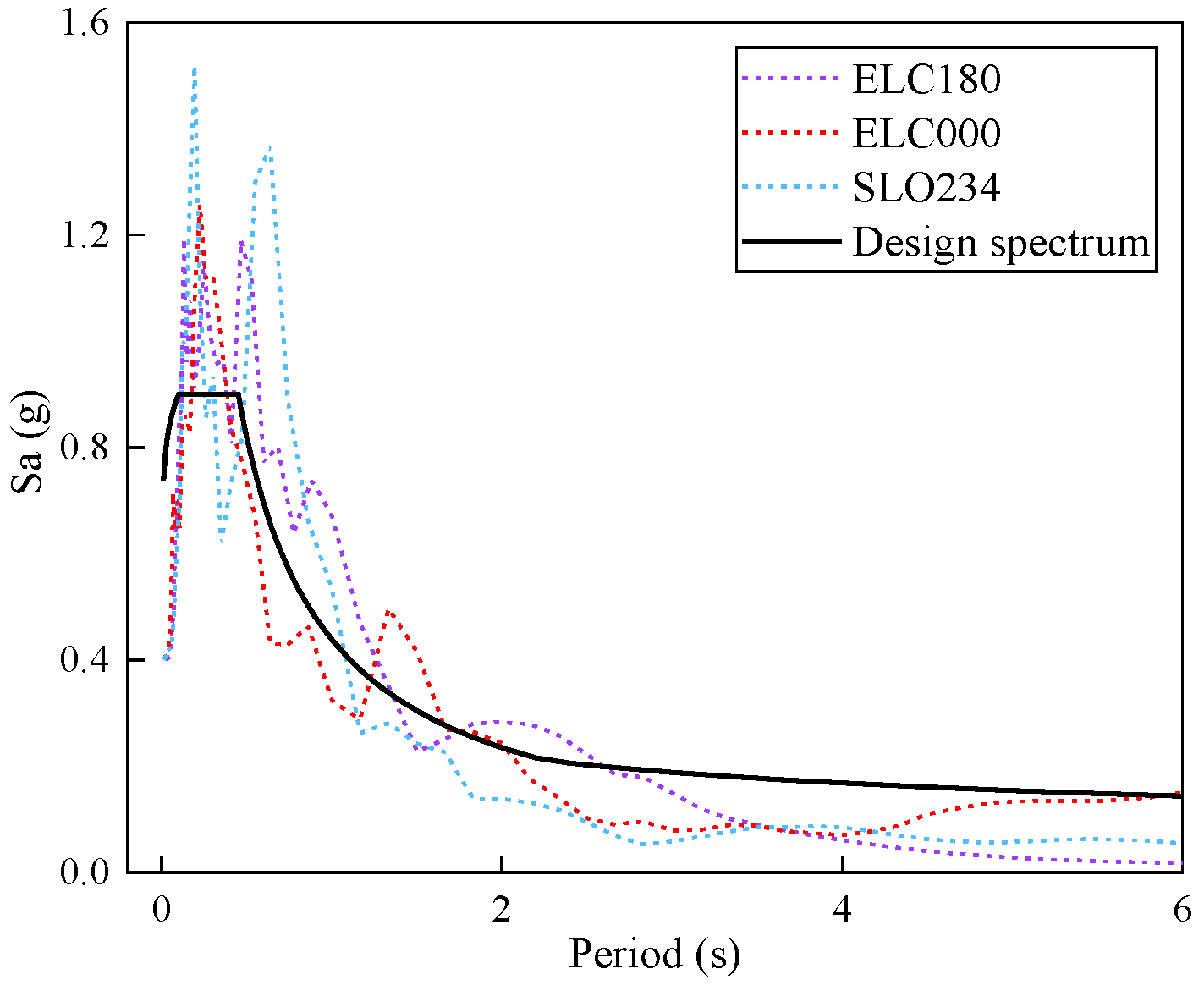
The steel frame is set to be in the 8th-degree seismic area, the site category is III, the earthquake group is the first group, the characteristic period is 0.45 s, and the damping ratio is 5% according to the code [43]. According to the above conditions, the response spectrum (8th-degree rare earthquake response spectrum) was chosen according to the specifications [44,45,46], and three seismic waves were selected from the PEER database, whose names and recording stations are shown in Table 6.
Table 6.
Information of seismic waves.
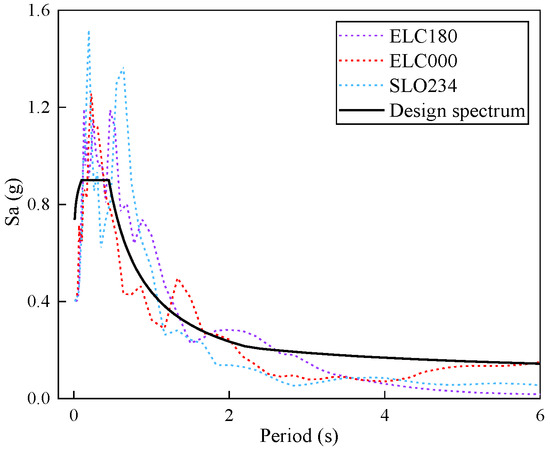
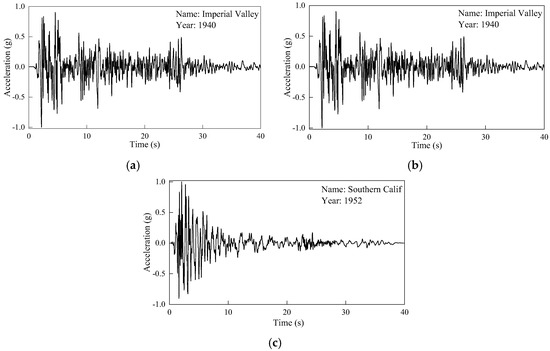
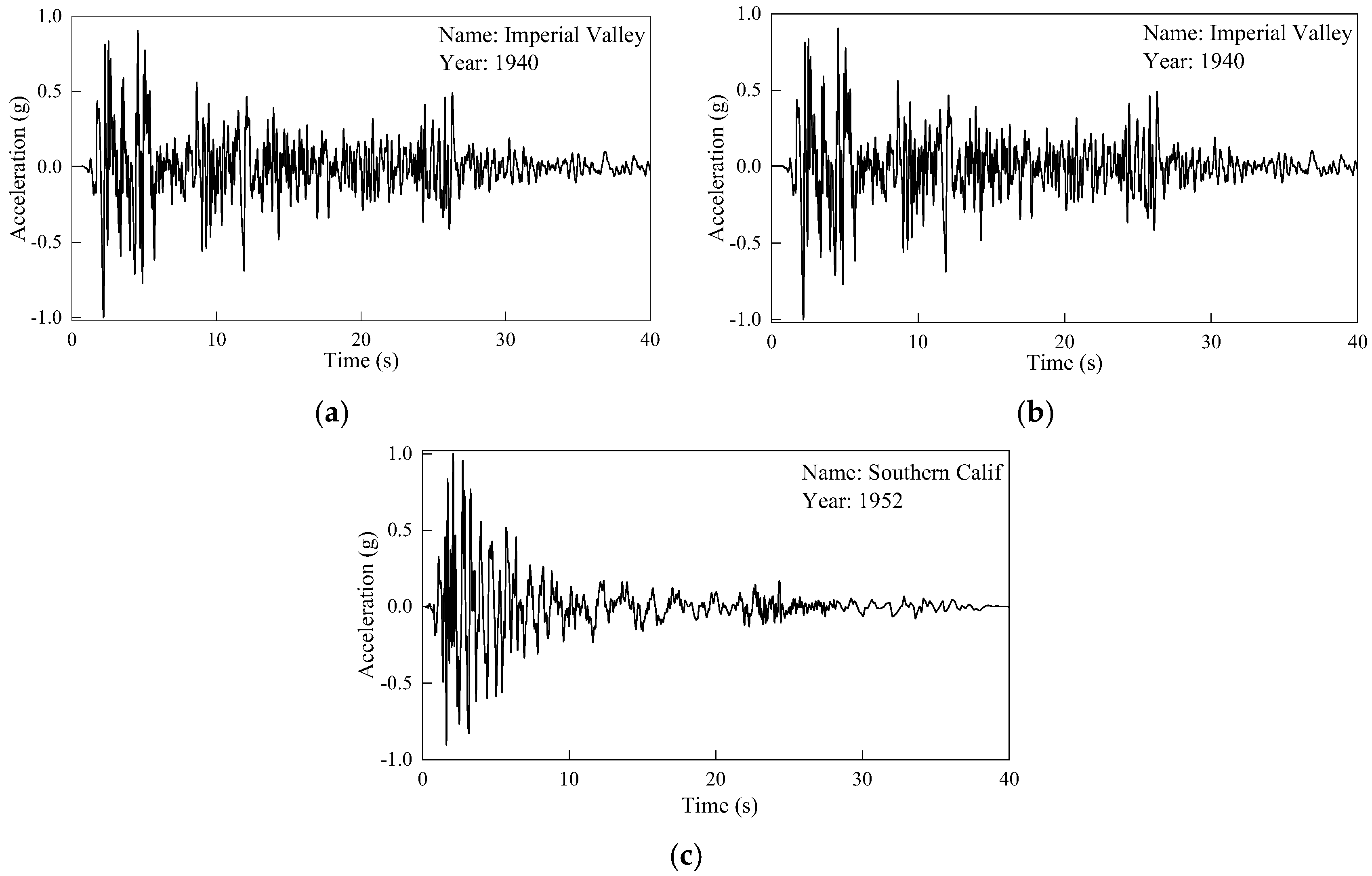
The spectrum of the selected ground motions is analyzed and compared with the response spectrum of the standard design, as shown in Figure 22. It can be seen that the ground motions satisfy the selection criteria. After normalization processing of the three ground motions (amplitude modulation of peak acceleration to 1 g), the time-history curves of the first 40 s were extracted, as shown in Figure 23.
Figure 22.
Response spectrum of ground motions and standard design.
Figure 23.
Input ground motions: (a) time history of ELC180; (b) time history of ELC000; (c) time history of SLO234.
4.3. Seismic Responses
In this section, steel frames with and without dampers were compared and analyzed, and the energy dissipation and shock absorption effects of dampers were analyzed from multiple structural vibration response parameters. Table 7 shows the vibration reduction rates of a steel frame structure with dampers compared with a steel frame structure without dampers under frequent earthquakes.
Table 7.
Damping ratio under frequent earthquakes.
According to the specification, the peak acceleration of seismic waves was 400 under rare earthquakes, and the duration and step length of the three kinds of seismic waves are the same with frequent earthquakes. Table 8 shows the vibration reduction rates of steel frame structures with dampers compared with those without dampers in rare earthquakes. The damper proposed in this paper is a variable stiffness damper, so the stiffness of dampers varies at each story, with larger stiffness at the lower stories and smaller stiffness at the upper stories. This leads to the redistribution of internal forces in the structure, causing an increase in internal forces and a slight growth in the story drift of the fourth story. Although the additional stiffness and force introduced by the dampers may alter the dynamic response characteristics of the structure due to the properties of seismic waves, which could lead to a slight increase in the story drift at the top story under certain ground motions, the dampers still provide excellent control over the story drift under the ELC000 seismic wave.
Table 8.
Damping ratio under rare earthquakes.
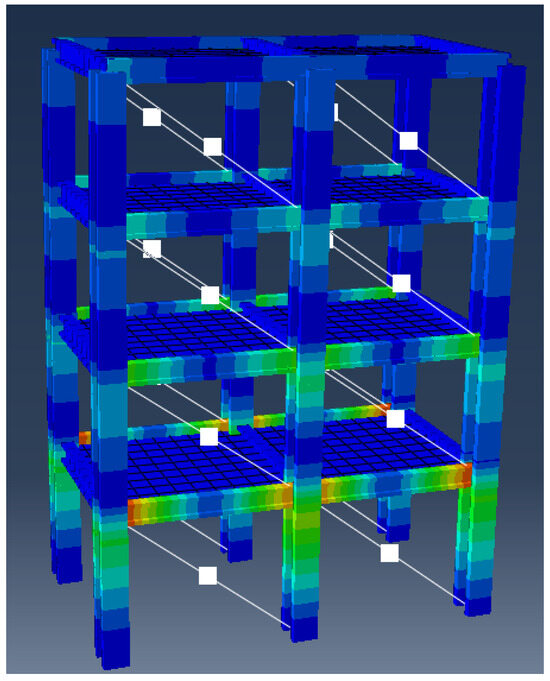
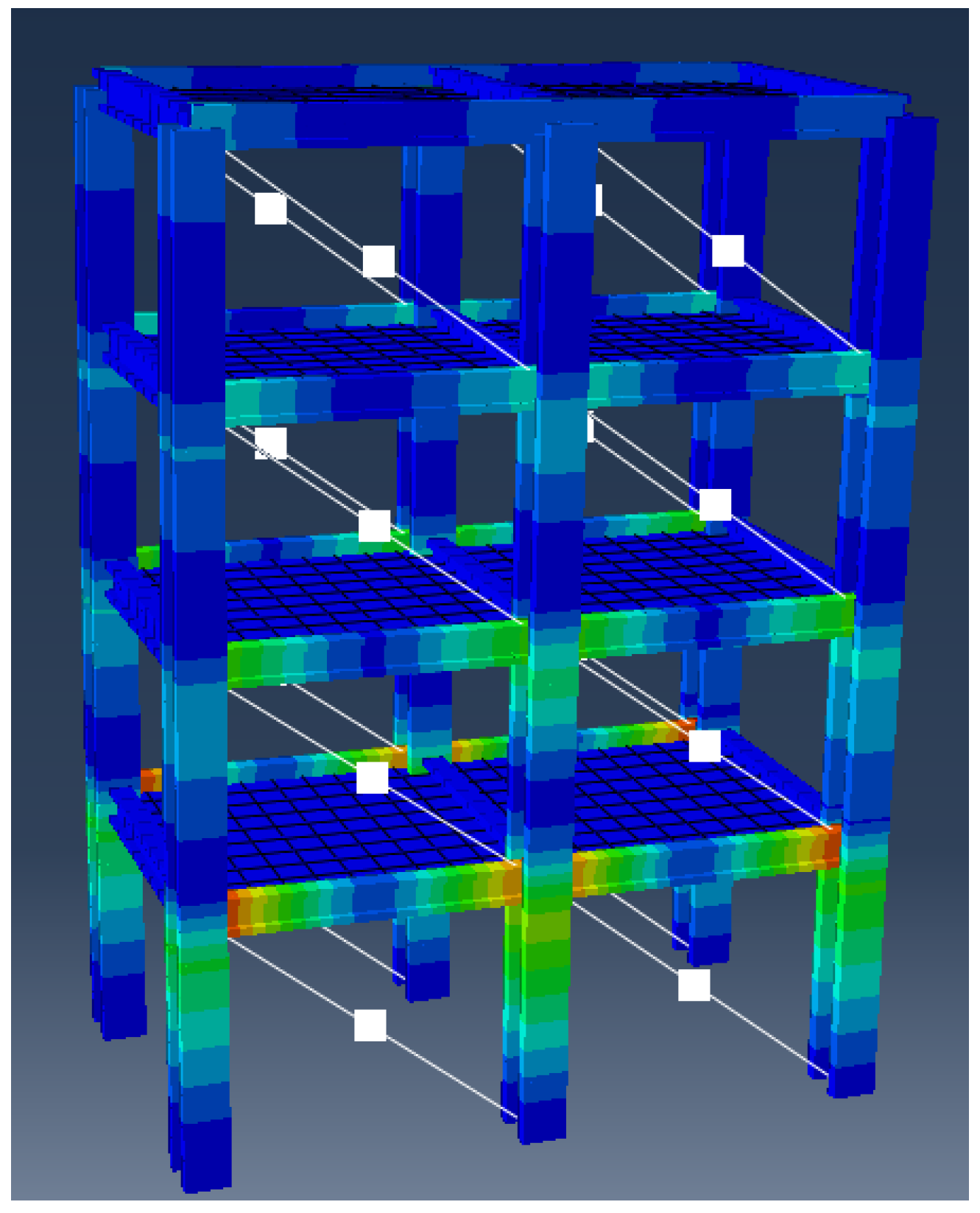
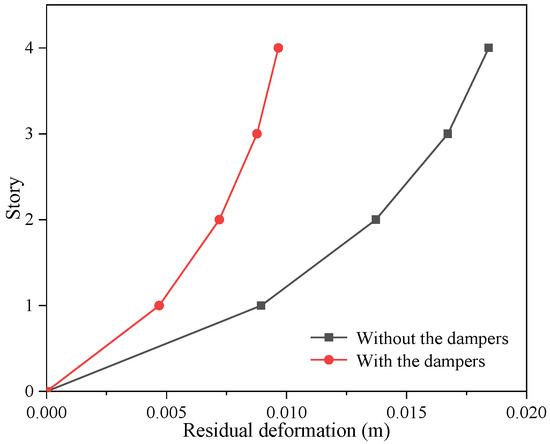
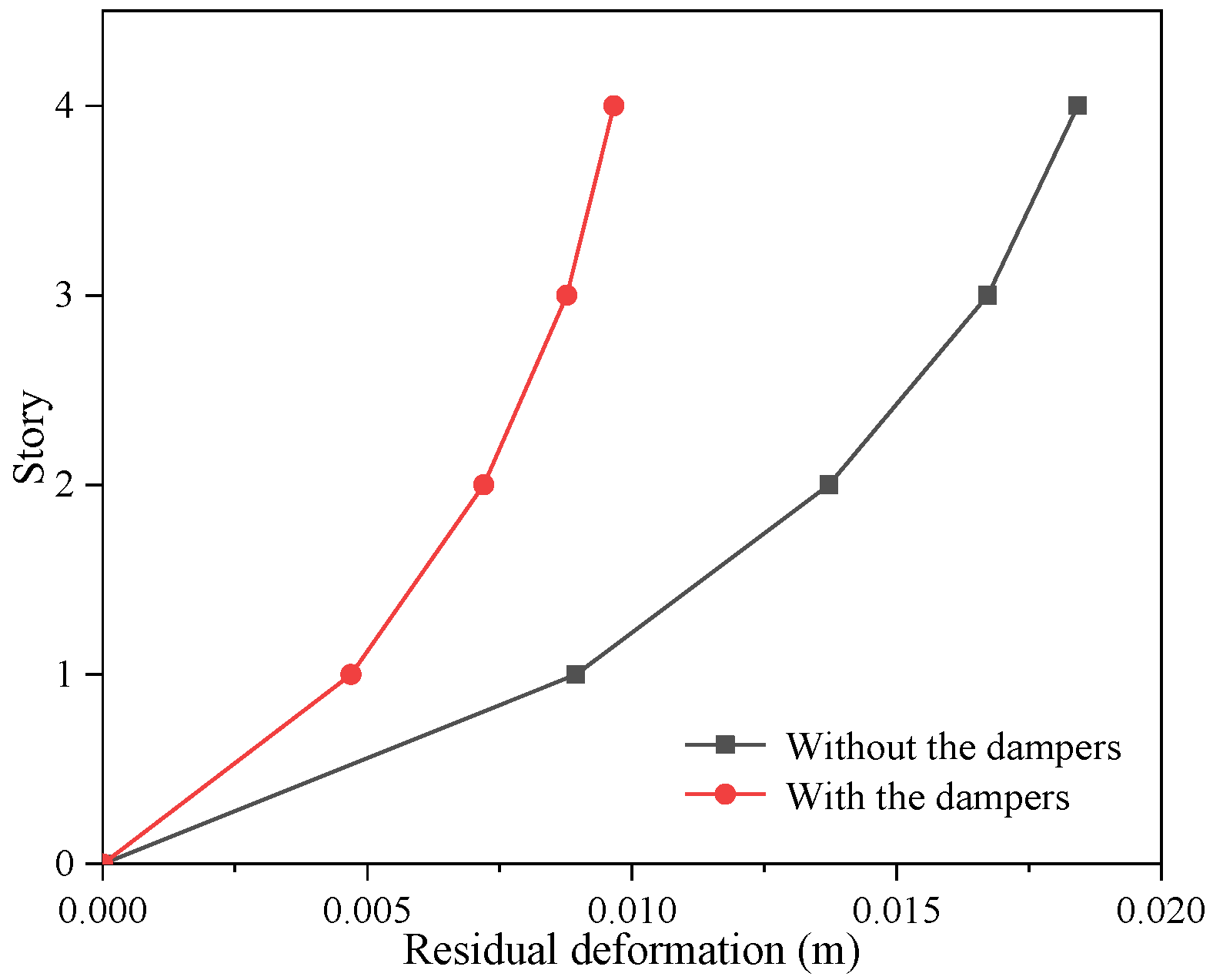
The post-earthquake residual deformation is shown in Figure 24 under ELC180, and its vibration reduction rates are shown in Table 9. The vibration reduction rates of each story are basically identical, the effect of the damper is stable, and the vibration reduction rates are above 47%.
Figure 24.
Residual deformation of frame.
Table 9.
Residual deformation and vibration reduction rate of frame.
A four-story steel frame structure model was established, and three seismic waves were selected to simulate the model. The vibration reduction rates of the damper were up to 33% in the case of frequent earthquakes. Meanwhile, the vibration reduction rates were up to 51% in rare earthquakes and the residual strain can be reduced by 47%. The SC-VFD had good performance in control seismic vibrations.
5. Discussion
(1) The theoretical model of the damper is divided into a five-stage model without preload and an eight-stage model with preload. The residual displacement can be controlled by adjusting the values of friction force in plane segments and the stiffness of the helical springs, and the self-centering effect can be realized when the preload is 0.
(2) The numerical simulation results of the damper show that the damper has a good energy dissipation capacity, and the energy dissipation is mainly concentrated in the slope segment. Higher preload magnitudes correlate with enhanced energy dissipation capacity, while greater disc spring stiffness further amplifies this damping performance. In the case of using Q345 steel, the maximum displacement of the damper is 17.7 mm, and the ultimate bearing capacity is 472.99 kN. The theoretical calculation and numerical simulation trend are the same, and the performance error is within 13%.
(3) The seismic action of the steel frame is simulated by using time-history analysis, and the vibration reduction rates of the damper were up to 33% in the case of frequent earthquakes. In rare earthquakes, the vibration reduction rates were up to 51% and the residual displacement was reduced by 47%.
The SC-VFD proposed in this paper shows good constructability in practical application. It is composed of standard mechanical components with a clear mechanical configuration, which is convenient for processing, assembly and installation in frame structures. In terms of maintainability, durability and cost, the SC-VFD has a simple mechanical structure without complex driving devices; it not only reduces the manufacturing cost but also facilitates routine inspection and maintenance. To sum up, it can be seen that the damper has good energy dissipation capacity, high bearing capacity and good self-centering effect without preload. The seismic performance of the damper can be significantly improved with preload. The damper can effectively absorb the vibrations during an earthquake and is suitable for use in resilient structures.
It should be noted that this study has limitations due to the lack of experimental verification. Although the theoretical calculation results of the proposed SC-VFD are consistent with the finite element simulation results within an acceptable error range, numerical and theoretical analyses cannot fully verify the damper’s actual working behavior in engineering practice.
The limitations and opportunities of this work are as follows. (1) In this paper, theoretical analysis and numerical simulation are conducted on the SC-VFD. Further experimental research can be carried out in future studies to provide more comprehensive data for the engineering application of this damper. (2) This study only investigates the energy dissipation and seismic reduction effect of the novel self-centering variable friction damper on frame structures. It is recommended that other structural forms be simulated in subsequent research to expand the application scope of the damper.
Author Contributions
Methodology, C.G.; Software, C.G.; Validation, Z.X.; Data curation, C.G. and Z.X.; Writing—review & editing, P.L. and C.G.; Supervision, Z.X.; Funding acquisition, P.L. All authors have read and agreed to the published version of the manuscript.
Funding
The work was financially supported by the National Key R&D Program of China (grant No. 2022YFC3801202).
Data Availability Statement
The original contributions presented in this study are included in the article. Further inquiries can be directed to the corresponding author.
Conflicts of Interest
The authors declare no conflicts of interest.
Abbreviations
The following abbreviations are used in this manuscript:
| SC-VFD | Self-Centering Variable Friction Damper |
| PFD | Pall Frictional Damper |
| SBC | Slotted Bolted Connection |
| SFC | Symmetric Friction Connection |
| AFC | symmetric Friction Connection |
| SFD | Sumitomo Friction Damper |
| EDR | Energy Dissipating Restraint |
| RFD | Rotational Friction Damper |
| IPFD | Improved Pall Frictional Damper |
| CFD | Cylindrical Frictional Damper |
| MFD | Modified Friction Damper |
| AFD | Arc-surfaced Friction Damper |
| CFSCDs | Constant Friction Self-Centering Dampers |
| RSF | Resilient Slip Friction |
| SCSF | Self-Centering Slip Friction |
| RVFB | Resilient Variable Friction Brace |
| VFHSCD | Variable Friction Hybrid Self-Centering Damper |
References
- Symans, M.D.; Charney, F.A.; Whittaker, A.S.; Constantinou, M.C.; Kircher, C.A.; Johnson, M.W.; McNamara, R.J. Energy dissipation systems for seismic applications: Current practice and recent developments. J. Struct. Eng. 2008, 134, 3–21. [Google Scholar] [CrossRef] [Scilit]
- Spencer, B.F., Jr.; Nagarajaiah, S. State of the art of structural control. J. Struct. Eng. 2003, 129, 845–856. [Google Scholar] [CrossRef] [Scilit]
- Saaed, T.E.; Nikolakopoulos, G.; Jonasson, J.E.; Hedlund, H. A state-of-the-art review of structural control systems. J. Vib. Control 2015, 21, 919–937. [Google Scholar] [CrossRef] [Scilit]
- Jaisee, S.; Yue, F.; Ooi, Y.H. A state-of-the-art review on passive friction dampers and their applications. Eng. Struct. 2021, 235, 112022. [Google Scholar] [CrossRef] [Scilit]
- Jaisee, S.; Yue, F.; Chen, L.; Yin, W.; Gong, H.; Wang, C. Shaking table investigations on the seismic performance of a steel frame with optimized passive energy dissipation devices. IOP Conf. Ser. Earth Environ. Sci. 2019, 330, 22081. [Google Scholar] [CrossRef] [Scilit]
- Pesaresi, L.; Stender, M.; Ruffini, V.; Schwingshackl, C.W. DIC Measurement of the Kinematics of a Friction Damper for Turbine Applications. Dyn. Coupled Struct. 2017, 4, 93–101. [Google Scholar]
- Lopez, I.; Busturia, J.M.; Nijmeijer, H. Energy dissipation of a friction damper. J. Sound Vib. 2004, 278, 539–561. [Google Scholar] [CrossRef] [Scilit]
- Sun, Y.; Yuan, J.; Pesaresi, L.; Denimal, E.; Salles, L. Parametric Study and Uncertainty Quantification of the Nonlinear Modal Properties of Frictional Dampers. J. Vib. Acoust. 2020, 142, 051102. [Google Scholar] [CrossRef] [Scilit]
- Roh, J.-E.; Hur, M.-W.; Choi, H.-H.; Lee, S.-H. Development of a multiaction hybrid damper for passive energy dissipation. Shock. Vib. 2018, 2018, 5630746. [Google Scholar] [CrossRef] [Scilit]
- Housner, G.W.; Bergman, L.A.; Caughey, T.K.; Chassiakos, A.G.; Claus, R.O.; Masri, S.F.; Skelton, R.E.; Soong, T.T.; Spencer, B.F.; Yao, J.T.P. Structural control: Past, present, and future. J. Eng. Mech.-Asce 1997, 123, 897–971. [Google Scholar] [CrossRef] [Scilit]
- Lee, C.-H.; Kim, J.; Kim, D.-H.; Ryu, J.; Ju, Y.K. Numerical and experimental analysis of combined behavior of shear-type friction damper and non-uniform strip damper for multi-level seismic protection. Eng. Struct. 2016, 114, 75–92. [Google Scholar] [CrossRef] [Scilit]
- Kim, J.; Shin, H. Seismic loss assessment of a structure retrofitted with slit-friction hybrid dampers. Eng. Struct. 2017, 130, 336–350. [Google Scholar] [CrossRef] [Scilit]
- Pall, A.S.; Marsh, C.; Fazio, P. Friction joints for seismic control of large panel structures. J. Prestress. Concr. Inst. 1980, 25, 38–61. [Google Scholar] [CrossRef] [Scilit]
- Pall, A.S.; Marsh, C. Response of friction damped braced frames. ASCE J. Struct. Div. 1982, 108, 1313–1323. [Google Scholar] [CrossRef] [Scilit]
- Fitzgerald, T.F.; Anagnos, T.; Goodson, M.; Zsutty, T. Slotted bolted connections in aseismic design for concentrically braced connections. Earthq. Spectra 1989, 5, 383–391. [Google Scholar] [CrossRef] [Scilit]
- Grigorian, C.E.; Popov, E.P. Energy Dissipation with Slotted Bolted Connections. Ph.D. Thesis, University of California, Berkeley, CA, USA, 1994. [Google Scholar]
- Khoo, H.H.; Clifton, C.; Butterworth, J.; MacRae, G.; Ferguson, G. Influence of steel shim hardness on the Sliding Hinge Joint performance. J. Constr. Steel Res. 2012, 72, 119–129. [Google Scholar] [CrossRef] [Scilit]
- Aiken, I.A.; Ian, D.J.M. Earthquake Simulator Testing and Analytical Studies of Two Energy-Absorbing Systems for Multistorys. Ph.D. Thesis, University of California, Berkeley, CA, USA, 1990. [Google Scholar]
- Nims, D.K.; Richter, P.J.; Bachman, R.E. The use of the energy dissipating restraint for seismic hazard mitigation. Earthq. Spectra 1993, 9, 467–489. [Google Scholar] [CrossRef] [Scilit]
- Richter, P.J.; Nims, D.K.; Kelly, J.M.; Kallenbach, R.M. The EDR-energy dissipating restraint. A new device for mitigation of seismic effects. In Proceedings of the 1990 SEAOC Convention; SEAOC: Sacramento, CA, USA, 1990; Volume 1, pp. 377–401. [Google Scholar]
- Mualla, I.H.; Belev, B. Performance of steel frames with a new friction damper device under earthquake excitation. Eng. Struct. 2002, 24, 365–371. [Google Scholar] [CrossRef] [Scilit]
- Wu, B.; Zhang, J.; Williams, M.S.; Ou, J. Hysteretic behavior of improved Pall-typed frictional dampers. Eng. Struct. 2005, 27, 1258–1267. [Google Scholar] [CrossRef] [Scilit]
- Mirtaheri, M.; Zandi, A.P.; Samadi, S.S.; Samani, H.R. Numerical and experimental study of hysteretic behavior of cylindrical friction dampers. Eng. Struct. 2011, 33, 3647–3656. [Google Scholar] [CrossRef] [Scilit]
- Monir, H.S.; Zeynali, K. A modified friction damper for diagonal bracing of structures. J. Constr. Steel Res. 2013, 87, 17–30. [Google Scholar] [CrossRef] [Scilit]
- Wang, G.; Wang, Y.; Yuan, J.; Yang, Y.; Wang, D. Modeling and experimental investigation of a novel arc-surfaced frictional damper. J. Sound Vib. 2017, 389, 89–100. [Google Scholar] [CrossRef] [Scilit]
- Naeem, A.; Kim, J. Seismic retrofit of 3000 kVA power transformer using friction dampers and prestressed tendons. Structures 2021, 32, 641–650. [Google Scholar] [CrossRef] [Scilit]
- Li, H.; Huang, Z.; Fu, X.; Li, G. A re-centering deformation-amplified shape memory alloy damper for mitigating seismic response of building structures. Struct. Control Health Monit. 2018, 25, e2233. [Google Scholar] [CrossRef] [Scilit]
- Qian, H.; Li, H.; Song, G. Experimental investigations of building structure with a superelastic shape memory alloy friction damper subject to seismic loads. Smart Mater. Struct. 2016, 25, 125026. [Google Scholar] [CrossRef] [Scilit]
- Xu, L.; Fan, X.; Li, Z. Experimental behavior and analysis of self-centering steel brace with pre-pressed disc springs. J. Constr. Steel Res. 2017, 139, 363–373. [Google Scholar] [CrossRef] [Scilit]
- Zhang, Z.; Shen, H.; Wang, Q. Mechanical characteristics of a novel variable friction hybrid self-centering damper. Structures 2023, 58, 105424. [Google Scholar] [CrossRef] [Scilit]
- Zhang, Z.; Zhan, Y.; Shen, H.; Qian, H.; Sheng, P. Seismic performance of self-centering braced rocking frame with novel self-centering friction dampers characterized by low-secondary stiffness. Structures 2023, 57, 105225. [Google Scholar] [CrossRef] [Scilit]
- Hashemi, A.; Zarnani, P.; Masoudnia, R.; Quenneville, P. Experimental testing of rocking cross-laminated timber walls with resilient slip friction joints. J. Struct. Eng. 2018, 144, 04017180. [Google Scholar] [CrossRef] [Scilit]
- Xue, D.; Bi, K.; Dong, H.; Qin, H.; Han, Q.; Du, X. Development of a novel self-centering slip friction brace for enhancing the cyclic behaviors of RC double-column bridge bents. Eng. Struct. 2021, 232, 111838. [Google Scholar] [CrossRef] [Scilit]
- Wang, Y.; Zeng, B.; Zhou, Z.; Huang, L.; Yao, J. Shaking table test of a three-story frame with resilient variable friction braces. J. Constr. Steel Res. 2022, 192, 107252. [Google Scholar] [CrossRef] [Scilit]
- Wang, Y.; Zhou, Z.; Ge, H.; Yao, J.; Xie, Q. Experimental validation and numerical simulation of a dual-self-centering variable friction braced frame under strong ground motions. J. Build. Eng. 2022, 56, 104761. [Google Scholar] [CrossRef] [Scilit]
- Huang, H.; Li, Y. Parametric dentification of Nonlinear vibration isolators with memory. J. Vib. Eng. 1989, 2, 17–27. [Google Scholar]
- Liu, W.; Wang, J.; Tang, J. Determining method of elasto-plastic double broken line model for seismic capacity curve. Build. Struct. 2015, 45, 14–17+26. [Google Scholar] [CrossRef] [Scilit]
- GB/T 1972-2005; Disc Spring. National Standard of the People’s Republic of China: Beijing, China, 2005.
- Yang, F.; Sun, Q. A new computational model of metal plasticity based onvon mises criterion correction and tangent modulus. Chin. J. Theor. Appl. Mech. 2010, 42, 804–810. [Google Scholar]
- Wan, M.; Cheng, C.; Meng, B.; Cai, Z. Mechanical model for yielding behaviour and plastic instability of sheet metals and its application at microscale. J. Netshape Form. Eng. 2019, 11, 1–13. [Google Scholar]
- MÃntylÃ, A.; Hintikka, J.; Frondelius, T.; Vaara, J.; Lehtovaara, A.; Juoksukangas, J. Prediction of contact condition and surface damage by simulating variable friction coefficient and wear. Tribol. Int. 2020, 143, 106054. [Google Scholar] [CrossRef] [Scilit]
- Li, M.; Jin, G.; Yang, Y.; Wu, Y. Anti-seismic strengthening and dynamic time-history analysis of a steel frame structure. J. Shenyang Univ. Technol. 2011, 33, 456–461. [Google Scholar]
- GB50017-2017; Standard for Design of Steel Structures. Ministry of Housing and Urban-Rural Development: Beijing, China, 2017.
- Xu, L.J.; Xie, L.L.; Hu, J.J. The review of development and certain problems in seismic design spectra. World Earthq. Eng. 2007, 23, 46–57. [Google Scholar]
- Zhu, X.T.; Yu, G.J.; Yang, C.H. Framework seismic analysis based on ABAQUS. Shanxi Archit. 2013, 39, 36–38. [Google Scholar]
- Wang, Y.Y. Selection of seismic waves in time history analysis of structural seismic design. Aseismic Eng. 1988, 4, 15–22. [Google Scholar]



Disclaimer/Publisher’s Note: The statements, opinions and data contained in all publications are solely those of the individual author(s) and contributor(s) and not of MDPI and/or the editor(s). MDPI and/or the editor(s) disclaim responsibility for any injury to people or property resulting from any ideas, methods, instructions or products referred to in the content. |
© 2026 by the authors. Licensee MDPI, Basel, Switzerland. This article is an open access article distributed under the terms and conditions of the Creative Commons Attribution (CC BY) license.