


Abstract
Building Information Modelling has become a common paradigm in the construction industry. To bridge the gap between end users and BIM data, some studies have adopted Natural Language Processing (NLP) in the BIM applications. Due to the incorrect segmentation of users’ natural language, most NLP-based BIM applications usually provide users with redundant or inaccurate BIM data. Sequence labeling has been widely studied in the area of NLP to find correct segments of a natural language sequence. However, the existing sequence labeling schemes perform poorly for specific BIM models. To address this issue, this study proposed a BIM model of an adaptive natural-language Sequence Labeling scheme using Machine learning, termed BIM-SeL. We first presented the problem definition of sequence labeling and the overall framework of the BIM-SeL. The BIM-SeL employs Conditional Random Field (CRF) to model the sequence labeling problem and Machine learning to train a sequence labeling model using a corpus of millions of data from the news and web domains. Then, a BIM dictionary extraction algorithm is developed to collect the exclusive vocabularies from the BIM models. A BIM dictionary-enhanced sequence labeling scheme is proposed to achieve the BIM model adaptive sequence labeling, by jointly utilizing the trained sequence labeling model and the BIM dictionary. To further enhance contextual representation and compare with state-of-the-art deep learning methods, we extend BIM-SeL with an advanced BERT*-BiLSTM-CRF model under the same framework. The effectiveness of the BIM-SeL was verified through two real-world projects, the BUCEA Library and a water pump house. The experiment results showed that the sequence accuracies of BIM-SeL in the BUCEA Library and the water pump house projects achieved 92.61% and 93.41%, respectively, and the vocabulary accuracies reach 96.77% and 97.32%, respectively. Compared with the original CRF-based sequence labeling algorithm, the BIM-SeL improved the sequence accuracies by 7.05 and 18.50 times, and the vocabulary accuracies by 1.33 and 2.48 times, in the two projects. Meanwhile, the BERT-BiLSTM-CRF variant obtains up to 99.93% vocabulary accuracy on real BIM test sequences, further validating the generality and advancement of the proposed framework. These observations proved that the BIM-SeL contributed to the natural language understanding of BIM applications using BIM data and could bridge the gap between users and BIM data.
1. Introduction
Building Information Modelling/Model (BIM) captures both physical and functional characteristics of facilities in a building [1]. A BIM is a digital information model which provides shared knowledge resources to support reliable decisions during a building’s life cycle [2]. Due to the interoperability of life-cycle data and the collaboration among stakeholders in construction projects, BIM has been widely adopted in Architecture, Engineering, Construction, Operation, and the Facility Management (AECO/FM) industry [3]. Currently, BIM has become a common paradigm in the AECO/FM industry [4].
A BIM records the total information (spatial geometry information, quantity and attributes of buildings, procurement detail, etc.) of a building and the volume of BIM data increases dramatically as the project proceeds [5]. The increasing volume of BIM data causes the information overload problem, and users have more difficulties in properly obtaining useful and concentrated information [4]. Moreover, the data retrieval requirements differ among applications and users. For example, in the process of indoor pathfinding, it is necessary to extract the geometric data from BIM for the construction of a path navigation algorithm [6]. In the process of facility maintenance management, the equipment managers need to extract information in various aspect of the operation performance from the BIM model [7]. In the conformity checking process, the managers need to check both entities (e.g., a beam) and attributes (e.g., the name and placement of the beam) in the IFC file [8]. Undoubtedly, accurately and effectively extracting information from BIM models is the foundation for implementing BIM processes. With the pervasiveness of novel information systems and online applications, users are accustomed to retrieving data simply through natural language. To bridge the gap between users and large-scale BIM data, some studies [4,9,10,11,12,13] explored the adoption of Natural Language Processing (NLP) [14] in varieties of BIM systems. These (semi-)automated systems significantly avoid the tediousness and error proneness of manual work. More recently, the emergence of large language models (LLMs) has further enabled flexible BIM interactions, such as multi-agent IFC querying and reasoning [15] and LLM-based BIM information retrieval [16]. However, most current technologies of BIM using NLP are not intelligent in the segmentation of users’ natural language, and fail to model users’ purposes, resulting in redundant and inaccurate BIM information for users. Notably, even advanced LLM-driven BIM frameworks assume that the underlying segmentation of user input—particularly in Chinese—has already been correctly performed, an assumption that rarely holds in practice.
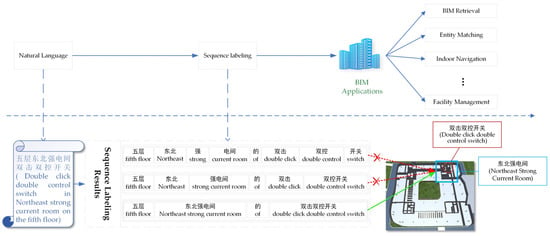
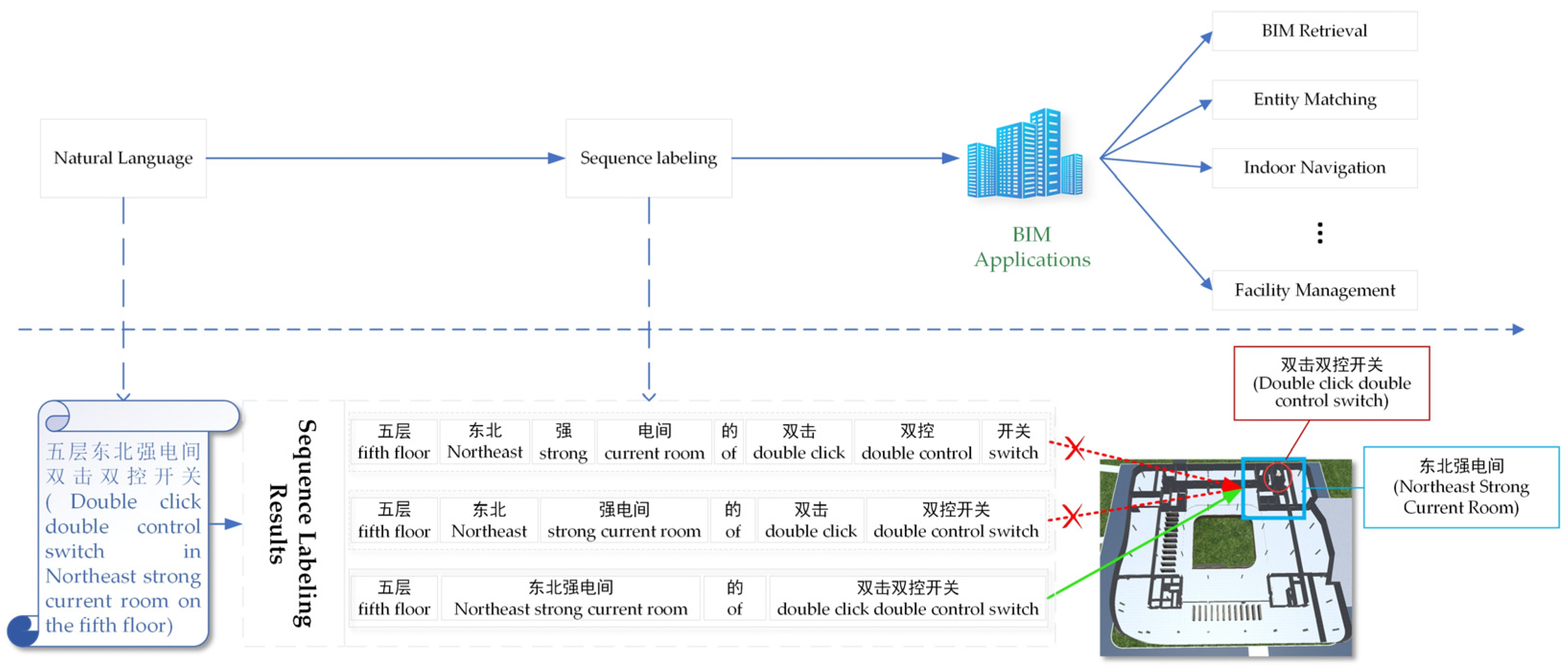
Sequence labeling [17] is one of the most fundamental NLP models, and aims to find the correct segments and give them the correct labels. Sequence labeling [18] has drawn extensive research attentions for a few decades, and has been employed to enhance many tasks, such as part-of-speech (POS) tagging [19], named entity recognition (NER) [20], chunking [21], and word segmentation [22]. The output of sequence labeling can be used for downstream applications. For instance, facility name identification through sequence labeling trained on user search queries can be utilized to identify which spans of text are facilities, thus triggering an accurate facility searching and avoiding redundant information for users. As shown in Figure 1, for the natural language “五层东北强电间双击双控开关” in the Chinese environment (“Double click double control switch in Northeast strong current room on the fifth floor” in the English environment) input by the user, if it can be correctly segmented into “五层”, “东北强电间”, “的”, and “双击双控开关” (“fifth floor”, “Northeast strong current room”, “of”, and “double click double control switch”) using a sequence labeling scheme, the accurate information searching of the fifth floor, Northeast strong current room (marked with a blue rectangle) and double click double control switch (marked with a red circle) will be triggered. The retrieved information can be further used in various BIM applications such as entity matching, indoor navigation, facility management, and so on.
Figure 1.
Example of BIM information retrieval using natural language.
Sequence labeling [18] has been widely investigated in the area of NLP. Sequence labeling can facilitate the accurate segmentation of natural language sequences and correct identification of users’ purpose, thus improving the adoption of BIM for decision support during a building’s life cycle. However, the current sequence labeling schemes are usually trained by a common corpus from the news and web domain, and cannot label the natural language sequences of specific BIM models (e.g., facility name, attribute name) correctly. In other words, the current sequence labeling schemes are not adaptive to specific BIM models. Note that the BIM data can contribute to the natural language understanding of specific BIM models. This study addresses the BIM model inadaptability problem by proposing a model adaptive natural-language sequence labeling scheme using BIM data and Machine learning, termed BIM-SeL. To fully evaluate the framework, we implement not only a CRF-based basic model, but also a state-of-the-art deep learning extension based on BERT*-BiLSTM-CRF, both sharing the same BIM dictionary and adaption mechanism. To the best of our knowledge, the BIM-SeL is the first effort to explore the BIM adaptive sequence labeling scheme which lays a basic foundation for intelligent information filtering in the BIM environment and advances the adoption of BIM in decision making.
The rest of this study is organized as follows: Section 2 introduces the related works of the NLP-based BIM study and sequence labeling. Section 3 presents the definitions and overall framework, while Section 4 proposes the BIM adaptive sequence labeling scheme, including the basic CRF method and the extended BERT*-BiLSTM-CRF model. Section 5 looks at how the experiments were conducted. Section 6 concludes the whole study.
2. Related Works
2.1. NLP-Based BIM Applications
Natural language is a language that we humans naturally use every day. The BIM data is computer codes. NLP [14] is a subfield of linguistics, computer science, information engineering, and artificial intelligence concerned with the interactions between computers and human (natural) languages. Since NLP bridges the gap between humans and computers through natural language, it has been extensively studied in the area of computer science.
The last few years have witnessed some efforts regarding the adoption of NLP, and they provide more acceptable BIM applications for users. Lin et al. [4] proposed a method for intelligent data retrieval and representation of cloud BIM applications that is based on NLP to improve the value of BIM big data, and verified the method with actual project data. Wu et al. [10] proposed an intelligent retrieval engine based on NLP in a BIM object database. Their retrieval results were given by extracting keywords and restricted sequences from natural language, as well as by expanding concepts through domain ontology semantic relations. Using NLP to abstract domain knowledge from IFC and Wikipedia, Liu et al. [11] propose an explicit semantic analysis-enhanced retrieval scheme for BIM components. Zhou et al. [12] employed NLP to minimize information asymmetry between technical developers and AECO/FM users on BIM applications. Xie et al. [13] proposed a method of using NLP to extract key information from building information and natural language for matching building facilities with BIM models. Jung et al. [23] deployed natural language processing (NLP) and common unsupervised learning for text classification, namely latent semantic analysis (LSA) and latent Dirichlet allocation (LDA), to automate and expedite the BIM interest analysis. Zhang et al. [24] integrated semantic NLP and logic reasoning into a unified system for fully-automated code checking.
More recently, the emergence of large language models (LLMs) has opened new possibilities for BIM interaction. Gao et al. presented IFC-Agent, an LLM-based multi-agent framework for querying and editing IFC models via schema-guided reasoning, supporting automated and explainable BIM applications [15]. Liu and Chen proposed BIMCoder, an LLM fusion model translating natural language into structured BIM queries, achieving 87.16% accuracy on 1680 query pairs [16]. In the domain of requirement extraction, Zhou and Ma performed NER on construction documents by fine-tuning LLMs on low-quality datasets, demonstrating LLM robustness without high-quality annotations [25]. Wei et al. proposed T2S4BIM, a Transformer-based text-to-structure method that extracts intent and slots from BIM user queries, outperforming existing approaches and validated via a Revit plug-in [26]. Furthermore, Hsiu Tung et al. presented an LLM-based framework that converts IFC data into a knowledge graph for natural language BIM queries, supporting sustainable building management [27].
Equipped with the NLP, many BIM applications become more intelligent and more acceptable to the end users. The current NLP-based BIM applications cover a variety of areas, e.g., information retrieval [4,10,11], information asymmetry analysis [12], data integration [13], purpose analysis [23], and code checking [24], to name a few. Nonetheless, many applications usually fail to provide the exact BIM data for users. The main reason is the inconsistency between the natural language segments generated by traditional NLP technologies and the BIM data. Notably, even the most advanced LLM-driven BIM frameworks assume that the underlying segmentation of user input—particularly in Chinese—has already been correctly performed. In practice, Chinese lacks explicit word delimiters, and BIM-specific terminology (e.g., facility names, spatial designations, property identifiers) is rarely covered by general-domain NLP tools. Consequently, incorrect segmentation at the foundational level propagates errors to downstream retrieval and reasoning modules. To mitigate this issue, this study investigates a BIM model adaptive natural-language sequence labeling scheme, termed BIM-SeL.
2.2. Sequence Labeling
Sequence labeling has been traditionally investigated using statistical approaches [28,29]. Since the input sequence is modeled with discrete features as the representation [30,31], conditional random field (CRF) [28] has been proven an effective framework among the statistical approaches. Due to its effectiveness and efficiency, CRF has been extensively adopted in real-world applications. Current existing open-source statistical CRF sequence labeling toolkits include CRF++ (https://taku910.github.io/crfpp/, accessed on 10 March 2026), CRFSuite (http://www.chokkan.org/software/crfsuite/, accessed on 10 March 2026) and FlexCRFs (http://flexcrfs.sourceforge.net, accessed on 10 March 2026). These toolkits provide users with flexible means of feature extraction, various training settings, and decoding formats, facilitating quick implementation and extension on state-of-the-art models. Recently, many studies have explored the neural sequence labeling problem by introducing deep learning. These deep learning sequence labeling models have achieved good performance in many tasks. For example, Ma and Hovy proposed a neural network architecture for sequence labeling, and this method achieved 97.55% and 91.21% accuracy on two linguistic sequence labeling tasks, respectively [32]. Ling et al. developed a character-to-word model for constructing vector representation of words by composing characters, and in the experiment the “composed” word representations yield good results in language modeling and part-of-speech tagging [33]. Neural networks, e.g., long short-term memory (LSTM) [34] and convolution neural network (CNN) [35], are employed to extract the features automatically through network structures with distributed word representations. Similar to discrete models, a CRF layer is used in many state-of-the-art neural sequence labeling models for capturing label dependencies [36,37].
In the context of Chinese sequence labeling, integrating external lexicon knowledge has emerged as an effective strategy to compensate for the lack of explicit word boundaries. Lai et al. proposed KnowFREE, a span-based knowledge fusion model enhanced by LLM-generated contextual explanations, for low-resource domain-specific sequence labeling [38]. Xu proposed Word Boundary Attention (WBA) for Chinese word representation, which explicitly models word boundaries using character head–tail positions and achieves a 2.51% improvement over the base model on the Weibo dataset [39]. These recent advances highlight the importance of boundary-aware modeling and external knowledge integration—insights that are directly relevant to the BIM dictionary-enhanced sequence labeling approach proposed in this study.
Different from CRF, the limited open-source neural sequence labeling toolkits are available. Although some codes were released along with the sequence labeling papers, they often do not scale well. As mentioned in [40], when the amount of training data changes, the parameters of neural models for sequence labeling will change exponentially, resulting in the lack of a deep learning-based sequence labeling model with good scalability.
This study employs the CRF-based sequence labeling to facilitate the training of the sequence labeling model, with a consideration of two reasons. On the one hand, many open-source CRF toolkits exist to ease the implementation of BIM model adaptive sequence labeling, while the application of existing deep learning-based schemes requires enormous code migration task; on the other hand, although deep learning models achieved good performance, their training process is time-consuming and expensive (usually requiring GPU clusters).
3. Definitions and Overall Framework
3.1. Definitions
Problem Definition 1 (Sequence Labeling Problem).
Given an observed sequence x = (x1, …, xT), where xt denotes the t-th word in a sentence and T represents the length of the sentence, a sequence y = (y1, …, yT) is a possible label corresponding to x. The sequence labeling problem can be defined as
where θ is the parameter to be learned and p(y|x; θ) is the probability of obtaining y from x under θ.
Definition 1 (Labeling Space).
The labeling space Θ is a discrete space, to which yt belongs.
In application, Θ usually appears as a set. Since each label can take values from Θ, the sequence labeling problem can be considered as a multiclass classification problem with |Θ|T different classes.
Definition 2 (Corpus).
Corpus X is a set of labeled sequences. That is, X includes both a set of natural sequences and their corresponding labeled sequences. Corpus X is employed to train the Equation (1) and obtain θ.
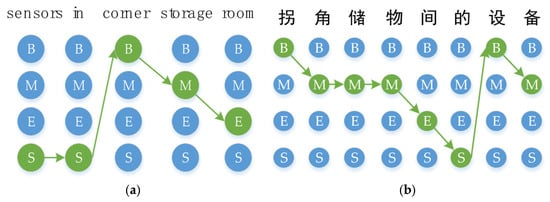
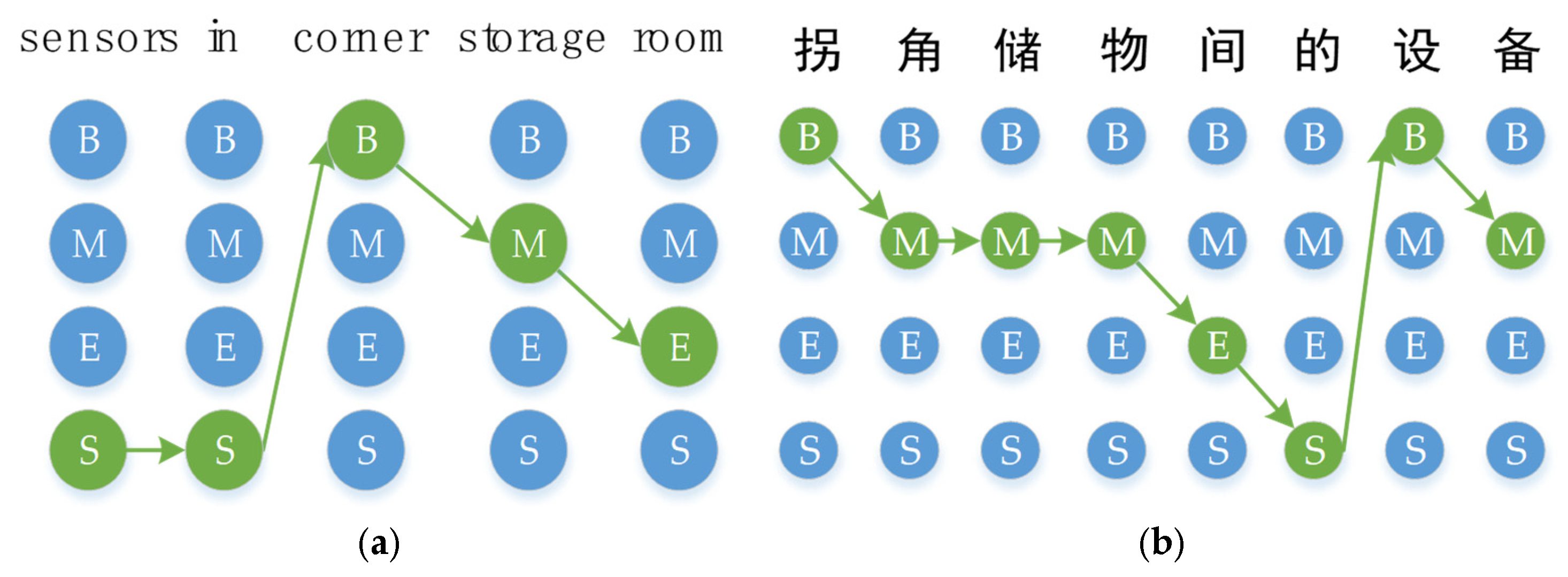
This study aims to correctly label the object names and attribute names from natural language. Four labels are adopted in Θ. That is, Θ = {B, M, E, S}, where B, M, E, and S represent the Beginning, Middle, and End of a multi-character word, and a Single character word, respectively. Figure 2 shows examples of the sequence labeling problem of “sensors in corner storage room” in the English environment and “拐角储物间里的设备” in the Chinese environment. Both “corner storage room” and “拐角储物间” are exclusive vocabularies in a building or specific BIM models, which have the same meaning. Since the exclusive vocabularies are not included in the corpus X in traditional sequence labeling schemes, they cannot be correctly labeled.
Figure 2.
Sequence labeling. Traditional sequence labeling schemes cannot correctly identify the object names “corner storage room” in (a) and “拐角储物间里的设备 (sensors in corner storage room)” in (b).
We employ Figure 2a as an illustration to show the power of sequence labeling. The natural-language sequence input by the user is “sensors in corner storage room”. In this scenario, x = (“sensors”, “in”, “corner”, “storage”, “room”). If the sequence labeling scheme identifies the “corner storage room” as vocabulary denoting a specific space in a building, then it will help the search engine or IR system correctly retrieve data items describing sensors in the corner storage room. Otherwise, the search engine or IR system would return data items containing “sensors in corner storage room” or items with any words in {“sensors”, “in”, “corner”, “storage”, “room”}. These inaccurate or redundant data cause users to spend more steps on data requests or/and data filtering to obtain the exact information. However, the current sequence labeling schemes are not able to tag “corner storage room”, because “corner storage room” is an exclusive vocabulary for a specific building or BIM models. This study aims to address this issue and propose a novel BIM adaptive sequence labeling scheme, termed BIM-SeL.
3.2. Overall Framework
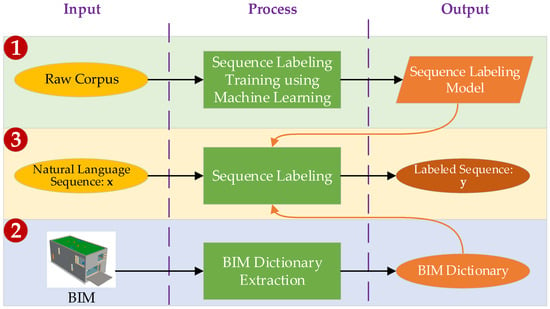
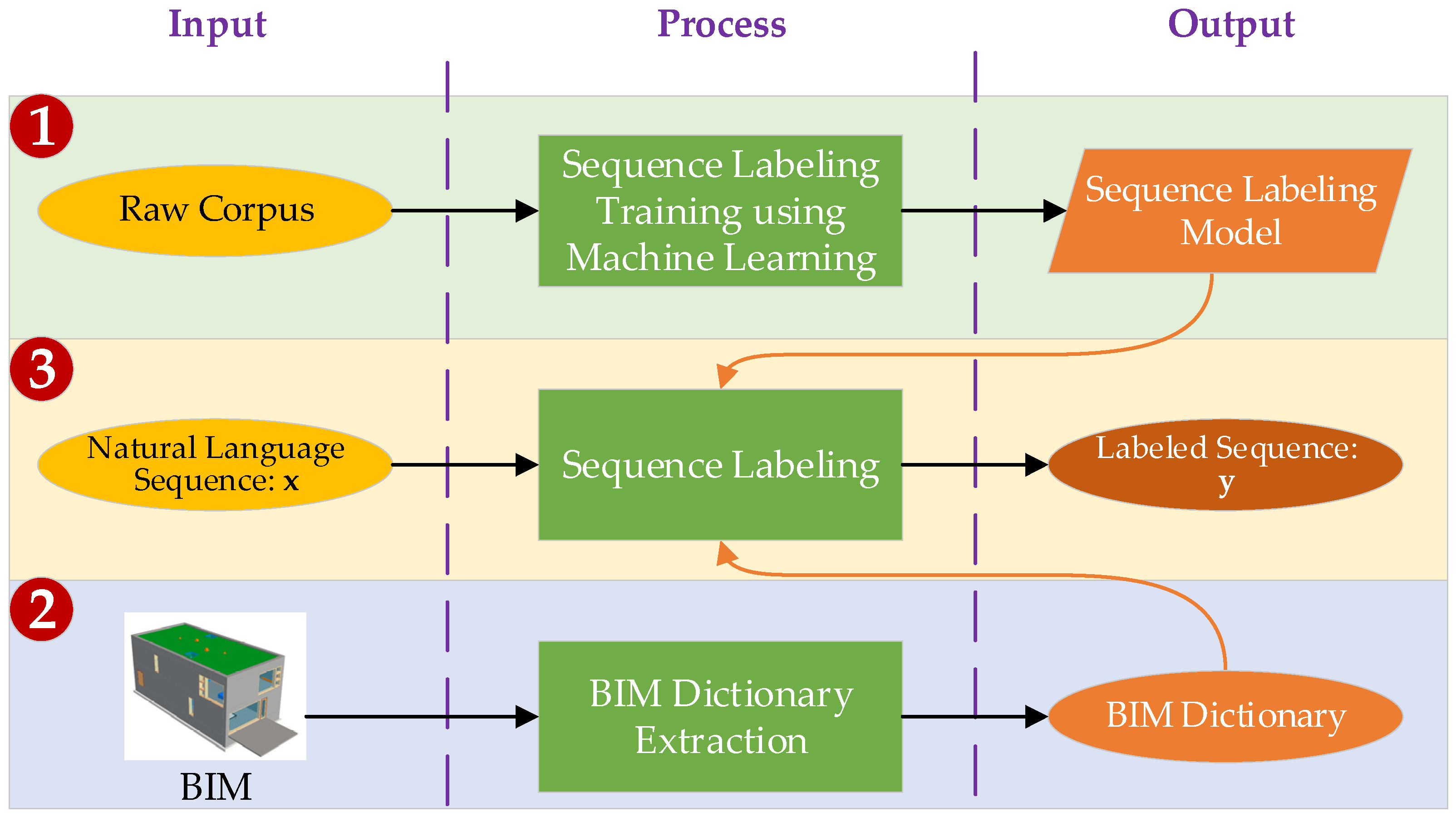
Figure 3 presents the overall framework of the proposed BIM adaptive sequence labeling scheme using machine learning, termed BIM-SeL. The BIM-SeL mainly consists of three workflows, namely the sequence labeling training process, BIM dictionary extraction process, and sequence labeling process. The sequence labeling training process outputs the sequence labeling model, which is the crucial integration for the sequence labeling process. The BIM dictionary extraction process provides the sequence labeling process with the BIM dictionary, which enables the model adaption in the BIM-SeL. Both the sequence labeling training and BIM dictionary extraction processes are executed offline. Contrarily, the sequence labeling process is a responsive service, which handles the sequence labeling requests with a quick response at any time.
Figure 3.
Overall framework of the BIM adaptive sequence labeling using machine learning.
- (1)
- Sequence labeling training process. The sequence labeling training process employs the corpus X and uses Machine learning to train a sequence labeling model. Since the training process is time-consuming, it has to be trained before the sequence labeling enters into services. This pre-trained model helps the efficient labeling during responsive services. However, it also causes the failure to identify untrained vocabularies. It is noticed that the vocabularies in the dictionary, but not in the corpus, also cannot be trained sufficiently, resulting in incorrect labeling.
- (2)
- BIM dictionary extraction process. The BIM dictionary extraction process collects exclusive vocabularies (e.g., object name, property name) from the BIM data. This dictionary facilitates the model adaptive sequence labeling. Since the BIM dictionary extraction process does not abstract the corpus for the exclusive vocabularies, the BIM dictionary cannot serve the sequence labeling training process, due to the lack of a corpus. Thus, this study utilizes the BIM dictionary to assist the sequence labeling process.
- (3)
- Sequence labeling process. The sequence labeling process provides quick responses for sequence labeling requests, and jointly utilizes the sequence labeling model trained by the sequence labeling training process and the BIM dictionary generated from the BIM dictionary extraction process.
4. BIM Adaptive Sequence Labeling Using Machine Learning
4.1. Sequence Labeling Training Using Machine Learning
Sequence labeling training exploits both the corpus and dictionary to generate a sequence labeling model for sequence labeling. It consists of two steps: feature extraction and sequence labeling model training. Feature extraction embeds the corpus and the dictionary into vectors, so that they can be trained using Machine learning. The output of feature extraction is the training dataset. Sequence labeling model training uses the training dataset to train the sequence labeling model and computes θ. The steps of sequence labeling training using machine learning are presented in Figure 4. The training corpus used in this study includes three parts: (1) the PKU corpus from SIGHAN CWS BAKEOFF 2005, which contains about 1.1 million annotated characters; (2) 74,79 construction terms collected from the Sogou (http://www.ctnoc.com/) Pinyin Dictionary; and (3) 25,740 terms extracted from 3200 sentences crawled from 1300 articles on the China Construction Technology Management website (http://www.ctnoc.com/). All domain terms were automatically annotated with B/M/E/S labels, as they are isolated vocabulary entries rather than full sentences. The corpus X in this study contains millions of data. Since corpus X does not contain exclusive vocabularies for a specific building, the trained sequence labeling model itself cannot identify these exclusive vocabularies.
Figure 4.
Steps of sequence labeling training using machine learning.
In the CRF-based sequence labeling framework, the domain terms are incorporated as lexical features through the Type(xi) feature template (Table 1) and dictionary mapping. This allows the model to utilize domain-specific vocabulary knowledge during feature extraction, while maintaining the integrity of the gold-standard PKU training sequences.
Table 1.
Feature templates for xi.
- (1)
- Feature Extraction
Since the raw corpus and dictionary are characters, they cannot be entered into a Machine learning framework directly. Feature extraction uses the dictionary to map the corpus into vectors.
This study follows the settings of the work of Sun and Xu [31] to construct the features. Table 1 lists the feature templates for modeling the sequence feature, including four standard types: Unigram, Bigram, character Type, and Identical features. Given xi in a sequence x, the n-gram features represent the surrounding characters of this character. When n = 1 and 2, the 1-g and 2-g are also termed as unigram and bigram, respectively. Ci represents the position of xi in the corpus X. If a large portion of xi in X happens to be Θk, then Ci = Θk. Type(xi) categorizes xi into digit, punctuation, English, and other. Identical (xi, xj) indicates whether the xi is the same as xj. All features are extracted within a ±3 context window of each character, and all discrete features are encoded into numerical vectors via dictionary mapping as the input of the CRF model.
- (2)
- Sequence labeling model training
Despite the better performance, the deep neural network-based sequence labeling schemes are not employed in the implementation, due to the time-consuming training process. Considering the trade-off between time cost and high accuracy, this study utilizes a well-performing and fast-training model, CRF, as the implementation.
Given a natural character sequence x, the task is to assign one segmentation label from Θ = {B, M, E, S} to each character. The linear-chain CRF can be formalized as
where fk is the feature functions and Z is the probability normalizer. We have
For fully-annotated training data, the learning problem of CRF is to maximize the log-likelihood over all the training data
where |X| denotes the number of training items in X, and x(n) and y(n) compose the n-th item in corpus X.
Both the likelihood p(y(n)|x(n)) and its gradient can be calculated by a recursive algorithm in linear time. During the inference process, the Viterbi Forney algorithm [41] is adopted to find the sequence of tags by dynamic programming. For CRF with many high-dimensional features, this study uses adaptive online gradient descent based on feature frequency information (ADF) [42] to avoid the expensive training cost. The ADF algorithm turns the learning rate into a vector with the same dimension as the parameters, and the learning rate of each parameter is automatically adjusted according to the frequency of the parameter. The CRF model was implemented using the open-source CRF++ toolkit (version 0.58) with its default training parameters: a maximum of 100 iterations, L2 regularization, and a feature cutoff threshold of 1 (i.e., features occurring fewer than 2 times in the training corpus are discarded). All other settings, including the ±3 context window for feature extraction, followed Table 1.
4.2. BIM Dictionary Extraction
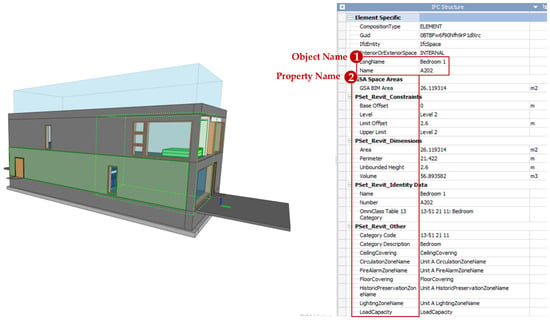
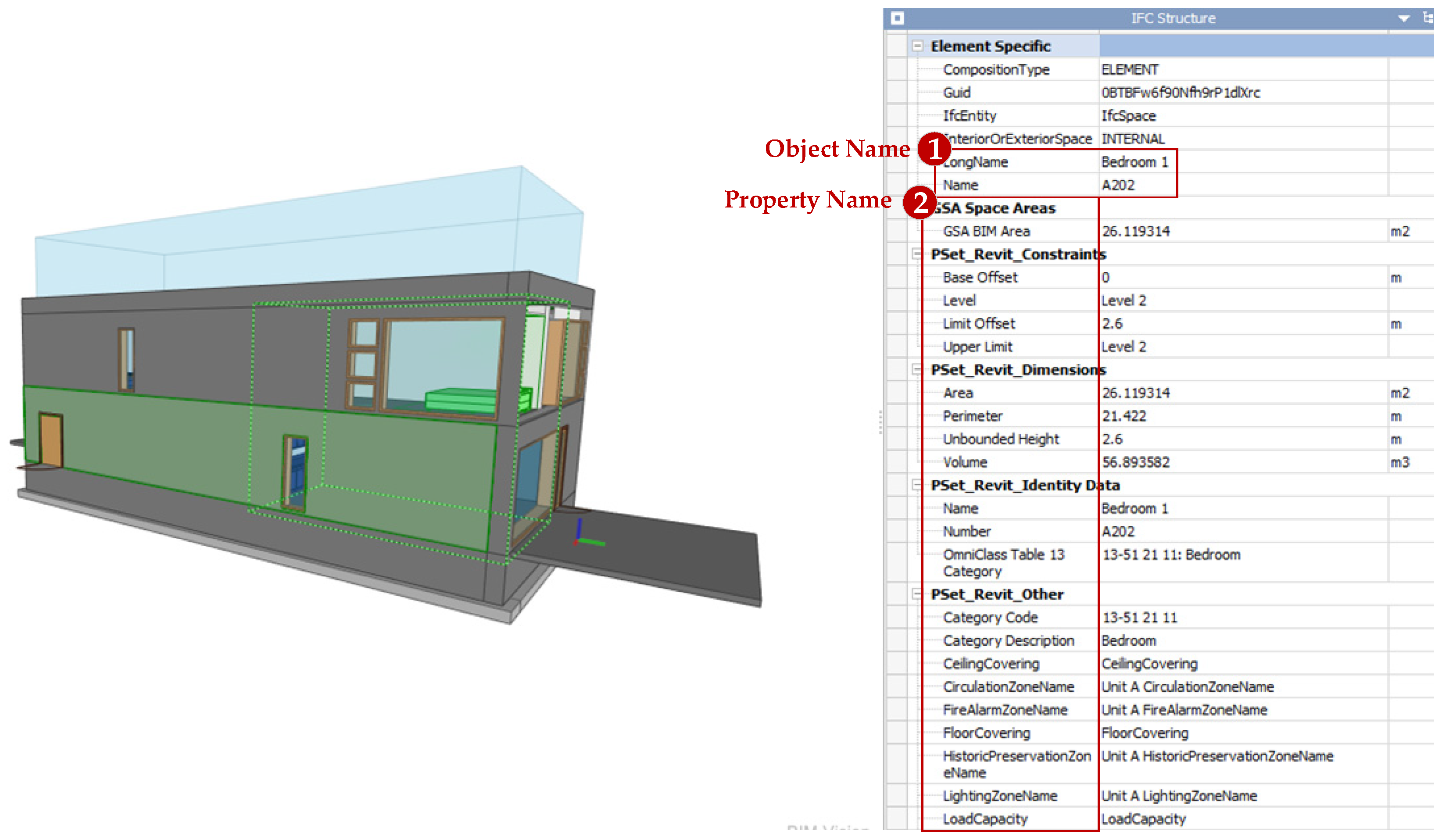
Since corpus X does not contain exclusive vocabularies of a specific building or a BIM model, the trained sequence labeling model is not able to mark these vocabularies in an input sequence. As shown in Figure 5, “Bedroom 1” is the name of space in the Duplex model. However, the traditional sequence labeling schemes tag “bedroom” and “1” with different labels. This failure may result in presenting the users with all “bedrooms” from the Duplex model while querying for “bedroom 1”. A similar failure happens when users search for a concrete property, e.g., “limit offset” in Figure 5.
Figure 5.
Object names and property names are two categories of meaningful information for objects in a BIM model. Object names include both LongName and Name.
Notice that these exclusive vocabularies exist in the BIM model. If these vocabularies are extracted from the BIM model, then they can mitigate the sequence labeling problem for specific BIM models. Since the Industry Foundation Classes (IFC) (https://www.buildingsmart.org/standards/bsi-standards/industry-foundation-classes/, accessed on 10 March 2026) is a widely adopted BIM data exchange standard, this study extracts the vocabularies of a BIM model according to IFC. This study classifies the novel vocabularies of a BIM model into three types: object name, property name, and other values. As shown in Figure 5, the object name includes the value of attributes Name and LongName. The property names are a list of names defining all IFC objects’ properties. Since some property or attribute values may also be exclusive in a BIM model, and these property values fall into the third type.
- (1)
- Object name
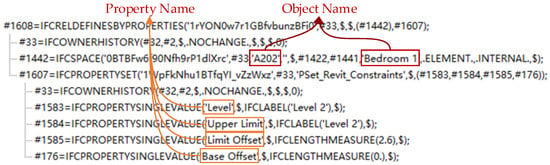
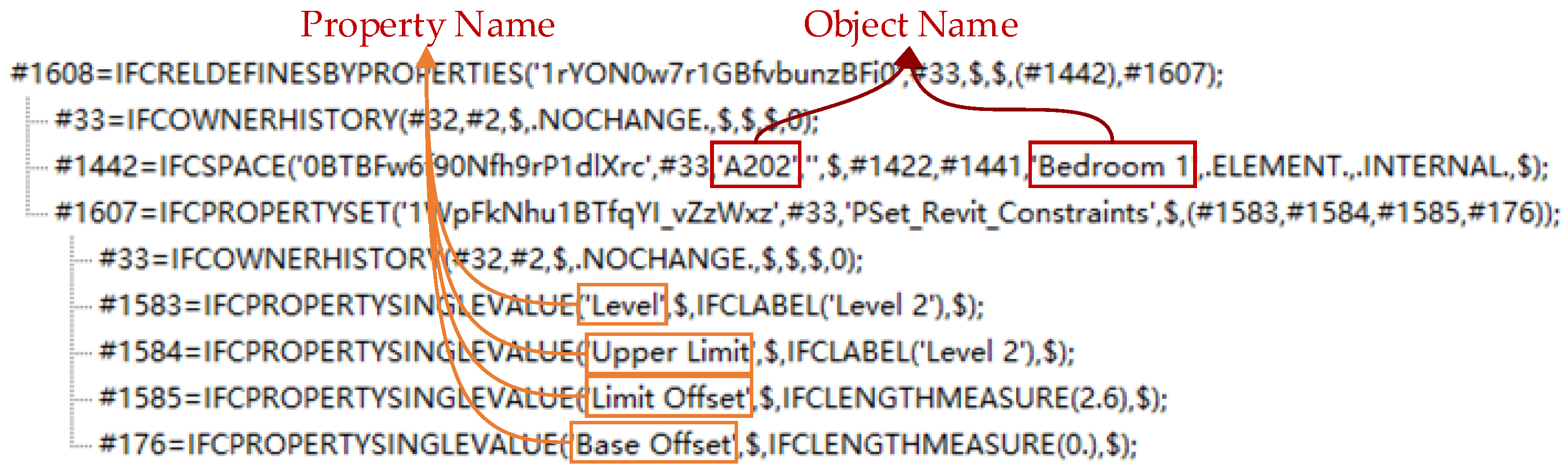
In the IFC specification, IfcRoot is the most abstract and root class for all entity definitions that root in the kernel or subsequent layers. IfcRoot defines an explicit attribute named Name (which appears as the third attribute in the standard sequential order of STEP physical files), the element name could be obtained. In other words, the value of the Name attribute is the object name of an IFC instance. Figure 6 presents the “Name” definition of IfcSpace. #1442 is an IfcSpace instance. The value of its Name attribute is “A202”. Since all classes are inherited from IfcRoot, all IFC instances possess the Name attribute. It is noted that the Name attribute is optional for many IFC instances. When the Name attribute is empty, it will be ignored during the exclusive vocabulary collection.
Figure 6.
Property names and element names in an IFC file.
The “LongName” attribute is only defined in IfcSpaticalElement in the IFC specification. IfcSpaticalElement has three subclasses, namely IfcExternalSpatialStructureElement, IfcSpatialStructureElement, and IfcSpatialZone. IfcSite, IfcBuilding, IfcBuildingStorey, and IfcSpace are the subclasses of IfcSpatialStructureElement. The “LongName” attribute is used for informal purposes, in conjunction with the inherited “Name” attribute. The “LongName” attribute is the eighth attribute in an IfcSpaticalElement. Thus, the value of the eighth attribute contributes to the “LongName”. Take the IfcSpace instance #1442 in Figure 6 as an example. Its eighth attribute value is “Bedroom 1”, which is the “LongName” value. In our implementation, both Name and LongName are accessed via their schema-defined attribute identifiers (e.g., getAttribute (“Name”)) rather than relying on their physical ordering in the STEP file. This semantic access pattern ensures robust extraction across files generated by different IFC authoring tools.
- (2)
- Property name
The IfcPropertyAbstraction class is an abstract supertype of all property-related entities defined as dependent resource entities within the IFC specification. The IfcPropertyAbstraction has four subclasses: IfcExtendedProperties, IfcPreDefinedProperties, IfcProperty, and IfcPropertyEnumeration. The IFC properties are mainly described by IfcProperty, IfcExtendedProperties and IfcPropertyEnumeration instances. In the IFC schema, all these subclasses define an attribute named Name (positioned first in the standard attribute sequence). Thus, the property name can be directly obtained by querying the Name attribute of these instances. Take the IfcPropertySingle instance #1584 in Figure 6 as an illustration. IfcPropertySingle is a subclass of IfcProperty. The value of its Name attribute is “Upper Limit”, which is one of the property names associated with IfcSpace instance #1442.
- (3)
- Other value
The “Tag” attribute defines a tag (or label) identifier for the particular instance of a product, e.g., the serial number, or the position number. In IFC specification, only IfcBuildingElement and IfcProxy classes have the “Tag” attribute. In the application, a value of the “Tag” attribute can correctly correspond to an IfcBuldingElement or IfcProxy instance. Thus, the values of the “Tag” attribute are important for sequence labeling. This study also collects the values of the “Tag” attribute for all IfcBuldingElement or IfcProxy instances. The Tag attribute is defined as the eighth explicit attribute in both classes in the standard schema, and it is accessed in Algorithm 1 via its attribute name Tag, rather than a numeric index.
Table 2 summarizes the attribute values to be collected as exclusive vocabularies of a BIM model, listing the schema-defined Attribute Name for each vocabulary type. Algorithm 1 outlines the complete process of BIM dictionary extraction. Suppose an IFC file *f* has |*f*| IFC instances and the IFC specification defines *o* classes. It is easy to deduce that Algorithm 1 costs O(*o* × |*f*|) in time complexity. Since the BIM dictionary extraction is based on the IFC universal standard, the BIM-SeL framework is not limited to specific project structures, and possesses inherent generality for diverse BIM models.
| Algorithm 1: BIMDictionaryExtraction—Extract exclusive vocabularies from an IFC file |
| Input: IFC file f Output: BIM Dictionary D 1:function BIMDicExtract(f): 2: BIM dictionary D = {} 3: for each instance i in f: 4: t = class of i. 5: if t is a class or subclass of IfcRoot: 6: name = i.getAttribute(“Name”)//Get by standard IFC attribute name. 7: D = D + { name }. 8: end if 9: if t is a class or subclass of IfcSpatialElement: 10: lname = i.getAttribute(“LongName”) // Get by standard IFC attribute name. 11: D = D + { lname }. 12: end if 13: if t is a class or subclass of IfcProperty, IfcExtendedProperties, Or IfcPropertyEnumeration: 14: pname = i.getAttribute(“Name”) // Get by standard IFC attribute name. 15: D = D + { pname }. 16: end if 17: if t is a class or subclass of IfcBuildingElement or IfcProxy: 18: tag = i.getAttribute(“Tag”) // Get by standard IFC attribute name. 19: D = D + { tag }. 20: end if 21: end for 22: Remove empty values from D. 23: return D. |
Table 2.
Attribute values to be collected as vocabularies in a BIM model.
The BIM dictionary extraction algorithm was implemented using IfcOpenShell, an open-source library for parsing IFC-SPF files. The BIM models employed in this study were exported according to the IFC 4.0 schema. During extraction, Chinese attribute values encoded in the ISO-8859-1\X2\…\X0 format (per ISO 10303-21 [43]) were decoded to standard UTF-8 strings. Extracted terms were deduplicated via case-insensitive exact matching, and empty values were discarded, as indicated in Algorithm 1.
4.3. BIM Dictionary-Enhanced Sequence Labeling
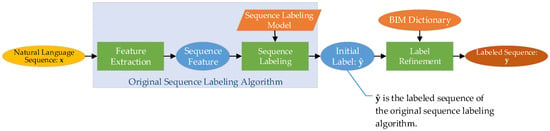
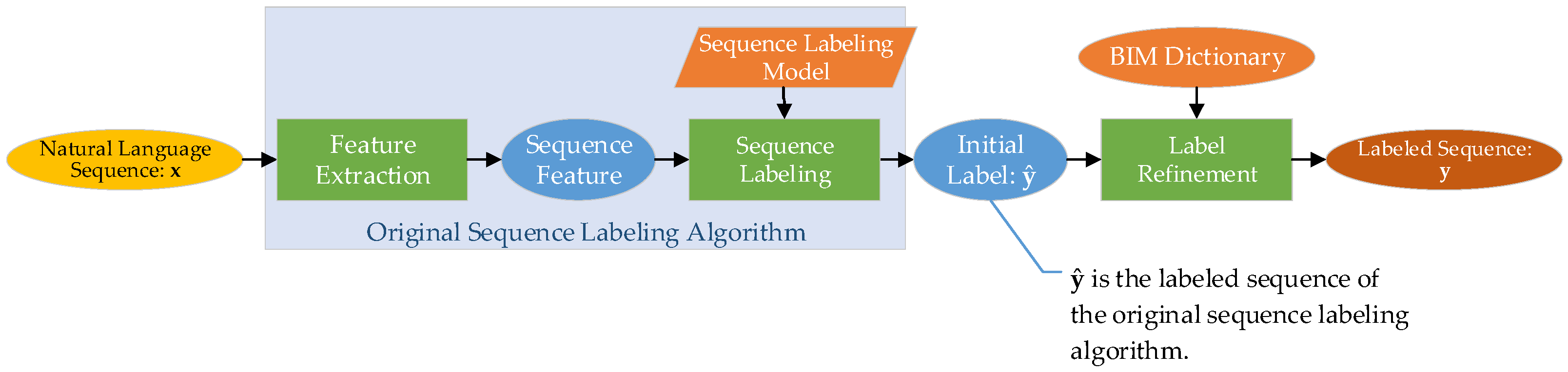
BIM dictionary-enhanced sequence labeling aims to use the trained sequence labeling model and the BIM dictionary together, to correctly label the input natural language sequence. Figure 7 presents the structure of the BIM dictionary-enhanced sequence labeling. It mainly consists of three steps: feature extraction, sequence labeling using the sequence labeling model, and label refinement using the BIM dictionary.
Figure 7.
Structure of BIM dictionary-enhanced sequence labeling.
The first step is feature extraction, which extracts the features of a natural language sequence x. The feature extraction performs in the same manner as that in the sequence labeling training process. Since the same features are captured, the trained sequence labeling model can generate a labeled sequence.
The sequence labeling is the second step, and outputs a label sequence ŷ for the natural language sequence x using the trained sequence labeling model. It is noted that the feature extraction and the sequence labeling using the sequence labeling model are the main steps of the original CRF-based sequence labeling algorithm. ŷ is the result of the original CRF-based sequence labeling algorithm. Due to a lack of knowledge of the BIM data, ŷ is far from being enough to correctly segment the input sequence. As a result, the original sequence labeling algorithm is not enough to bridge the gap between users and the BIM data.
Label refinement is the critical step to build a BIM model adaptive sequence labeling scheme. The label refinement tries to merge the initial labels ŷ according to the BIM dictionary. Since the bi-directional maximum matching algorithm [44] is efficient, it is employed to generate the final label sequence y from ŷ. During the bi-directional maximum matching, two segmentations will be merged if the generated segmentation happens to be vocabulary in the BIM dictionary.
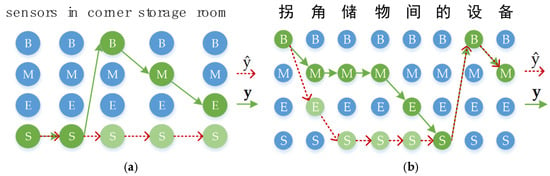
Figure 8 presents examples of the initially labeled sequence ŷ and the BIM model adaptive labeled sequence y. As shown in Figure 8a, all the words in the “sensors in corner storage room” are marked as a single (S) instance in the initially labeled sequence ŷ, which is generated by the trained sequence labeling model. Since “corner storage room” is vocabulary in the BIM dictionary, the bi-directional maximum matching algorithm merges the “corner”, “storage”, and “room” into one segmentation. This merging outputs the final label sequence, y. Figure 8b is an example of “拐角储物间的设备” (facilities in the corner storage room) from the Chinese environment. The initially labeled sequence ŷ segments the original natural language sequence into “拐角” (corner), “储” (storage), “物” (goods), “间” (room), “的” (’s), and “设备” (facility). The label refinement incorporates “拐角” (corner), “储” (storage), “物” (goods), and “间” (room) into one segmentation, according to the BIM dictionary, because “拐角储物间” is an object name in the BIM models, which is extracted as vocabulary in the BIM dictionary. Since more than one refinement scheme may exist according to the BIM dictionary, the bi-directional maximum matching algorithm is employed to select the one with the least segments.
Figure 8.
Comparison of sequence labeling results before and after BIM dictionary refinement. (a) Labeling results of the sentence “sensors in corner storage room”, showing incorrect segmentation by the original CRF model and corrected segmentation by the proposed BIM-SeL; (b) labeling results of the Chinese sentence “拐角储物间里的设备 (sensors in corner storage room)”, presenting missegmentation by the conventional CRF model and optimized segmentation after BIM dictionary adaptation.
Algorithm 2 summarizes the whole process of the label refinement using the bi-directional maximum matching algorithm. Lines 2 and 3 obtain two candidate refined label sequences, yf and yb, using forward maximum matching and backward maximum matching, respectively. If yf and yb contain the number of vocabulary instances, then the one with fewer Single items of vocabulary is considered the final refined label sequences (Lines 5–7). Line 9 returns the one with fewer vocabulary instances which is considered the final refined label sequence. Lines 10–22 present the forward maximum matching, while Lines 23–35 are the backward maximum matching. Suppose the length of x is |x| and |D| vocabulary instances exist in D. Since Lines 14 and 27 cost O(|D|) in time complexity, the time complexities of both forward and backward maximum matching are O(|x| × |D|). To sum up, the label refinement costs O(|x| × |D|) in the time complexity. Since both |x| and |D| are limited, it is efficient to compute the final label sequence y in real-world applications.
The label refinement process described in Algorithm 2 operates as follows. During forward scanning (Lines 10–22), the algorithm identifies substrings between a starting vocabulary index (voc_index) and a detected word boundary (indicated by label ‘E’ or ‘S’ in the initial CRF output ŷ). If a substring exactly matches an entry in the BIM dictionary D, the segment is merged into a single term: the first character receives label ‘B’, the last character receives label ‘E’, and all intermediate characters receive label ‘M’ (Line 15). Because the algorithm always checks the maximal span from voc_index to the current boundary, the longest match principle is implicitly applied when multiple dictionary en561–577tries could overlap. The backward scanning (Lines 23–35) follows the same logic in reverse direction. After both passes complete, the refined sequences yf and yb are compared (Lines 5–9). The algorithm selects the sequence with fewer total vocabulary segments. If the segment counts are equal, the sequence with fewer single-character words (label ‘S’) is preferred. For any text span not found in the BIM dictionary, the initial CRF labels are retained without modification, providing a natural fallback that prevents over-segmentation of out-of-vocabulary terms. Edge cases such as empty input sequences are handled gracefully by the loop boundary conditions.
| Algorithm 2: LblSeqRefine—Refine the initial labeled sequence ŷ using BIM dictionary D |
| Input: Input sequence x, Initial labeled sequence ŷ, BIM dictionary D Output: Refined labeled sequence y 1:function LblSeqRefine(x, ŷ, D): 2: yf = ForwardRefine(x, ŷ, D). 3: yb = BackwardRefine(x, ŷ, D). 4: no_voc_f = number of vocabularies in yf, no_voc_b = number of vocabularies in yb. 5: if no_voc_f == no_voc_b: 6: no_s_f = number of ‘S’ in yf, no_s_b = number of ‘S’ in yb. 7: return yf if no_s_f < no_s_b else yb. 8: else: 9: return yf if no_voc_f < no_voc_b else yb. 10:function ForwardRefine(x, ŷ, D): 11: index = 0, voc_index = 0, E_index = 0, yf = ŷ. 12: for index = 1 to len(x) − 1: 13: if (ŷ[index] == ‘E’) OR (ŷ[index] == ‘S’): 14: if ∃d ∊ D, satisfying d starting with x[voc _index: index]: 15: yf[voc _index] = ‘B’; yf[index] = ‘E’; yf[i] = ‘M’, i ∈ [voc _index + 1, index − 1]. 16: E_index = index. 17: else: 18: voc_ index = E_index. 19: end if 20: end if 21: end for 22: return yf. 23:function BackwardRefine(x, ŷ, D): 24: index = 0, voc _index = len(x) − 1, B_index = len(x) − 1, yb = ŷ. 25: for index = len(x) − 1 to 0: 26: if (ŷ[index] == ‘B’) OR (ŷ[index] == ‘S’): 27: if ∃d ∊ D, satisfying d starting with x[index:voc _index]: 28: yb[index] = ‘B’; yb[voc_index] = ‘E’; yb[i] = ‘M’, i ∈ [voc _index + 1, index − 1]. 29: B_index = index. 30: else: 31: voc_ index = B_index. 32: end if 33: end if 34: end for 35: return yb. |
4.4. Advanced Implementation: BERT*-BiLSTM-CRF for BIM-Adaptive Sequence Labeling
To compare with state-of-the-art sequence labeling models and further verify the universality and extensibility of the BIM-SeL framework, we extend BIM-SeL to a deep learning version using BERT*-BiLSTM-CRF. This variant reuses the same BIM dictionary extraction pipeline and maintains model adaption to project-specific terms, ensuring a fair and consistent comparison with the CRF-based approach.
- (1)
- BiLSTM-CRF Baseline Architecture
BiLSTM-CRF is adopted as the fundamental neural sequence labeling architecture, and consists of two core components:
The BiLSTM layer captures bidirectional contextual dependencies and long-range semantic information from character sequences.
The CRF layer models global label transition constraints and avoids invalid label patterns such as “B→B” or “M→B”, ensuring legitimate and consistent labeling outputs.
- (2)
- Improved BERT Language Model (BERT*)
Standard BERT relies on single-character masking, which is unsuitable for Chinese domain terms and professional BIM phrases. To enhance the perception of complete professional vocabulary, we use whole-word masking BERT (BERT-WWM), denoted as BERT*. This improved pre-trained language model masks entire words during pre-training, enabling better representation of long professional terms such as “五层西南强电间” and “双击双控开关”. By preserving the semantic integrity of domain terms, BERT* significantly strengthens contextual understanding for BIM-oriented text.
- (3)
- BIM-Adaptive BERT*-BiLSTM-CRF Model
We integrate BERT* as the contextual embedding layer into BiLSTM-CRF:
- (1)
- BERT* outputs deep contextual character embeddings training.
- (2)
- BiLSTM further encodes sequence features
- (3)
- CRF outputs the optimal label sequence under transition constraints
This advanced version also incorporates the same BIM domain-feature dictionary (derived from the building ontology) into the training process, but does not employ the post-processing maximum matching used in the CRF-based method. By leveraging deep contextual semantic modeling, this extension can generalize to infer boundaries of out-of-dictionary BIM terms without pure reliance on dictionary matching, thus improving the recognition of unseen professional terms.
5. Experiments
5.1. Experimental Settings
Indicators. Since the BIM-SeL aims to improve the sequence labeling accuracy for tagging a natural language sequence of a specific BIM model, this study utilizes accuracy to evaluate the performance of the BIM-SeL. The first accuracy, termed sequence accuracy, measures the fraction of correctly labeled sequences among all the testing sequences. The second accuracy, termed vocabulary accuracy, indicates how many vocabulary items are correctly identified in the testing sequences. The sequence accuracy and the vocabulary accuracy are denoted as acc_seq and acc_voc, respectively. Formally, acc_seq and acc_voc can be defined as
Experiment Environment. The experiments were conducted in a computer with an Intel Core i7 2.8 GHz CPU, 16 G Memory, and Mac OS 10.14.6 operating system. All the experiments in this study were implemented in Python 3.10.
Domain Vocabularies. To enable the identification of domain vocabularies, this study also crawled the vocabularies related to architecture and engineering from Sogou and the website of China Construction Technology Management. The domain vocabularies from Sogou contain 7479 items, and 25,740 terms from 3200 sentences in 1300 articles crawled from the website of China Construction Technology Management.
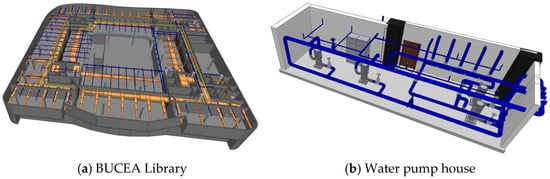
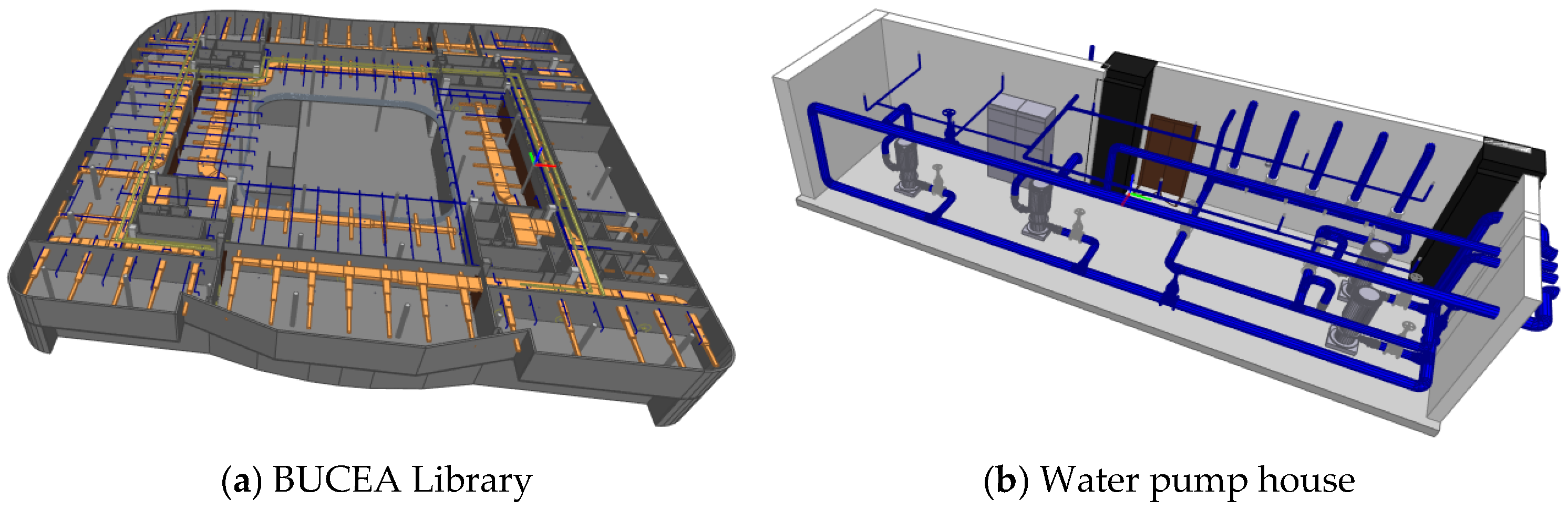
Datasets. The BIM models of the Beijing University of Civil Engineering and Architecture (BUCEA) Library and a water pump house were employed to evaluate the performance of the BIM-SeL. Figure 9 presents the 3D views of both the BUCEA Library and the water pump house BIM models. These two projects are typical representative scenarios in the AECO industry, covering public buildings and mechanical- and electrical-facility systems, respectively.
Figure 9.
BIM models (partial inner view) for experiments.
In the BUCEA Library BIM model, the natural language sequences being tested were obtained from the facility installation documents of fire engineering. The facility installation information for each fire facility was recorded as a list in spreadsheets. In total, the facility installation spreadsheets contain 1191 items describing the locations of the installation and the names of the fire facilities in the 52 categories of 1191 fire facilities. These 1191 items provide us with 1191 testing natural language sequences. Table 3 shows four examples from the facility installation spreadsheets. The Loop and Address columns are the addresses in the Modbus protocol. The Fire Facility column presents the type of fire facility, and the Location column lists the locations of corresponding fire facilities.
Table 3.
Four example items in the Facility Installation Spreadsheets for the BUCEA Library.
Test Data Preparation and Annotation. The construction domain test set was created from the original 3200 complete sentences crawled from the China Construction Technology Management website. These sentences were manually annotated with B/M/E/S labels by domain experts, to serve as a reliable evaluation benchmark. Note that the 25,740 isolated terms mentioned above were automatically extracted from these sentences and used for dictionary augmentation (Section 4.1), whereas the full sentences themselves were manually annotated for testing purposes.
For the BIM model test sets, both the BUCEA Library and the water pump house projects are professional IFC 4.0 standard models. Testing sequences were generated by concatenating the Location and Facility columns from the original facility spreadsheets (see Table 3 and Table 4). This concatenation mimics the natural language queries that a facility manager would issue when searching for equipment. All test strings originate from authentic project documentation; no synthetic strings were used. The ground-truth B/M/E/S labels for these sequences were derived by applying the 4-tag scheme to the constituent terms identified via the BIM dictionary, and all labels were manually verified by the authors.
Table 4.
Three example items in the Facility Information Spreadsheets of the Water Pump House.
The natural language testing sequences for the water pump house BIM model are the facility information of the water system. Similarly, the facility information is stored in spreadsheets. We collected 668 items from the spreadsheets, which provide 668 testing sequences. Table 4 shows three examples from the spreadsheets that record the facility information. Different from the information in fire facility installation spreadsheets, the facility information of the water system does not have addresses. Besides the Facility and Location columns, the Serial No. and Other columns are included in the water facility spreadsheets. The Serial No. column describes the identifiers for each water facility, which correspond to the “Tag” attribute in the BIM model. The Other column presents the working parameters of water facilities which match the properties in the BIM model.
Baselines. As far as we know, the BIM-SeL is the first to present a BIM adaptive Chinese word segmentation framework. In this study, we adopt the original CRF-based sequence labeling algorithm as the baseline method. BIM-SeL (CRF) denotes the proposed CRF-based scheme enhanced with the BIM dictionary, as detailed in Section 4.1, Section 4.2 and Section 4.3. BIM-SeL (BERT*-BiLSTM-CRF) represents the deep learning extension of BIM-SeL developed in Section 4.4.
Furthermore, the vocabulary accuracy of BIM-SeL (CRF) and BIM-SeL (BERT*-BiLSTM-CRF) is validated on both the domain dataset from architecture and engineering and the BIM model test dataset (the BUCEA Library).
5.2. Experiment Results
We evaluated the performance of the proposed BIM-SeL using both the BUCEA Library and the water pump house projects. Comprehensive experiments were conducted on two layers of comparison: the baseline Original CRF model, the BIM-SeL (CRF) variant enhanced by the BIM dictionary, and the advanced BIM-SeL (BERT*-BiLSTM-CRF) variant.
- (1)
- Performance Comparison with Original CRF
Table 5 shows the experiment results. In the BUCEA Library project, the BIM-SeL (CRF) correctly labeled 1103 out of 1191 testing sequences. The sequence accuracy of the BIM-SeL (CRF) is 92.61%. On the other hand, the original CRF-based sequence labeling can only identify 137 natural language sequences, with 11.50% sequence accuracy. This observation showed that the original CRF-based sequence labeling cannot meet the sequence labeling tasks in the BUCEA Library project. Obviously, the BIM-SeL (CRF) improves the sequence accuracy by as much as 92.61/11.50 − 1 = 7.05 times. The testing sequences of the BUCEA Library project contained a total of 3589 vocabulary items. The BIM-SeL (CRF) and original CRF-based sequence labeling algorithm correctly tagged 3473 and 1507 vocabulary items, respectively. The vocabulary accuracy of the BIM-SeL (CRF) hit 96.77%, while that of the original CRF-based algorithm was only 41.99%. The vocabulary accuracy of the BIM-SeL (CRF) is 97.77/41.99 = 2.33 times that of the original CRF-based algorithm. The water pump house project had 668 testing sequences, including 5811 vocabulary items. The BIM-SeL (CRF) recognized 634 testing sequences and 5654 vocabulary items, with a 94.91% sequence accuracy and 97.32% vocabulary accuracy. The original CRF-based algorithm performed much worse in the water pump house project, which only correctly labeled 32 testing sequences and 1624 vocabulary items. The sequence accuracy and the vocabulary accuracy were only 4.79% and 27.95%, respectively. With the help of the BIM dictionary, the BIM-SeL (CRF) improved the sequence accuracy by 93.41/4.79 − 1= 18.50 times and the vocabulary accuracy by 97.32/27.95 − 1 = 2.48 times. Obviously, the BIM-SeL (CRF) significantly improved the performance of sequence labeling in both the BUCEA Library and the water pump house projects. The experiment results verified that our proposed BIM-SeL (CRF) was a more powerful sequence labeling tool for a specific BIM model.
Table 5.
Accuracy comparisons between the BIM-SeL (CRF) and original CRF-based algorithm.
Table 5 also showed that the vocabulary accuracies were much higher than the sequence accuracies in both the BUCEA Library and water pump house projects using either the BIM-SeL (CRF) or the original CRF-based algorithm. It is because once a vocabulary in a testing sequence failed to be identified, the testing sequence was marked as an error. In terms of accuracy, both the BIM-SeL (CRF) and the original CRF-based algorithm could correctly label some vocabulary items in many failure-marked testing sequences. This resulted in higher values of vocabulary accuracies than sequence accuracies.
We also observed that both the sequence accuracy and the vocabulary accuracy had higher values in the BUCEA Library project and those in the water pump house project. This is because the testing sequences in the BUCEA Library project are much more standardized than those in the water pump house project. For example, the “Other” column in the facility spreadsheets of the water pump house may introduce many irregular or unknown vocabularies.
- (2)
- Performance Comparison between BIM-SeL (CRF) and BIM-SeL (BERT*-BiLSTM-CRF)
To further validate the effectiveness and advancement of the proposed deep learning extension, we conduct a comprehensive performance comparison between BIM-SeL (CRF) (Section 4.1, Section 4.2 and Section 4.3) and BIM-SeL (BERT*-BiLSTM-CRF) (Section 4.4). Both models share the same BIM dictionary extraction mechanism and target with respect to BIM-adaptive sequence labeling, while differing in model structure and feature representation.
Table 6 presents the performance comparison between BIM-SeL (CRF) and BIM-SeL (BERT*-BiLSTM-CRF) on both the architecture and engineering domain dataset and the BIM model test dataset. On the domain dataset, BIM-SeL (CRF) achieves a vocabulary accuracy of 68.43%, while BIM-SeL (BERT*-BiLSTM-CRF) yields a slightly lower vocabulary accuracy of 65.75%. On the BIM model test dataset, BIM-SeL (BERT*-BiLSTM-CRF) performs better than BIM-SeL (CRF), with a vocabulary accuracy of 99.93% compared with 96.77% of BIM-SeL (CRF).
Table 6.
Accuracy comparisons between the BIM-SeL (BERT*-BiLSTM-CRF) and BIM-SeL (CRF).
On the domain dataset, BIM-SeL (BERT*-BiLSTM-CRF) performs slightly worse than BIM-SeL (CRF). This is mainly due to the difference in sequence feature modeling between CRF and LSTM layers in the domain text test set. Specifically, CRF pursues global optimality during modeling, while LSTM prefers local optimality, which easily accumulates errors and affects the final prediction. On the BIM model test dataset, BIM-SeL (BERT*-BiLSTM-CRF) achieves a higher performance than BIM-SeL (CRF). This is mainly because the sentences in the BIM model test set are relatively fixed; most are phrases with few long sentences, which is convenient for LSTM to give full play to its advantages in sequence modeling. These results demonstrate that the two variants of BIM-SeL have complementary performance advantages and can be selected according to specific application scenarios in architecture and engineering.
The experimental results confirm that both BIM-SeL (CRF) and BIM-SeL (BERT*-BiLSTM-CRF) serve as effective sequence labeling tools tailored for specific BIM models. Despite the remarkable performance improvement brought by BIM-SeL (CRF) in sequence labeling for dedicated BIM models, neither its sequence accuracy nor vocabulary accuracy reached 100% on the BUCEA Library and water pump house test sets. To better understand the remaining errors, we categorize them into the following three types, based on their underlying causes:
Type 1: Orthographic Variations and Typos
This type arises from inconsistent wording or typos in source documents. Spelling variations in test sequences, such as using “感烟探测器” instead of “烟感探测器” in the fire-fighting spreadsheet, lead to labeling failures. Although semantically equivalent, such variations break exact matching with the BIM dictionary. Resolving this issue may require preprocessing with fuzzy matching or typo correction.
Type 2: Terminological Inconsistency
This type refers to mismatches between colloquial terms in user queries and formal naming conventions in IFC models. For example, “讨论室” in construction spreadsheets corresponds to “研讨室” in BIM data. In future work, a domain-specific synonym lexicon will be explored to alleviate such terminological discrepancies.
Type 3: Boundary Ambiguity in Compound BIM Entities
This type occurs when the baseline CRF model incorrectly segments long compound BIM terms, which cannot be corrected by the dictionary refinement step. For instance, the phrase “七层东南强电间” may be wrongly split into “七层东” and “南强电间”, making it impossible to recover the correct labels “七层” and “东南强电间”. This suggests that stronger boundary awareness is required during the initial sequence labeling to maintain the integrity of compound terms.
This error categorization provides clear guidance for future improvements, including fuzzy matching for orthographic variations, synonym lexicons for terminological consistency, and boundary-aware modeling for compound BIM entities. Furthermore, the current experiments are limited to two typical projects, and the generalization ability of BIM-SeL on more complex BIM scenarios requires further validation. Additionally, although BIM-SeL achieves significant performance improvements on the two typical projects, its generalization performance on more complex BIM models such as commercial complexes and transportation hubs still needs to be further verified in future work. In terms of runtime efficiency, BIM-SeL introduces minimal computational overhead: CRF inference scales linearly with input length and is efficiently implemented in the CRF++ toolkit, while the label refinement step (Algorithm 2) operates in O(|x| × |D|) time; given that typical BIM queries are short (10–30 characters) and project dictionaries contain a few thousand entries, the overall processing completes well within the latency tolerance of interactive BIM applications.
6. Conclusions
This study proposed a BIM model adaptive sequence labeling scheme, termed BIM-SeL. We first presented the problem definition of the sequence labeling problem, followed by the overall framework of our proposed BIM-SeL. A sequence labeling training scheme using CRF was introduced to train a sequence labeling model using a corpus with millions of data from the news and web domains. An algorithm to extract the exclusive vocabularies of BIM models was developed to generate the BIM dictionary. Jointly utilizing the sequence labeling model and the BIM dictionary, a BIM dictionary-enhanced sequence labeling scheme was proposed, which labels the natural language sequence efficiently. Furthermore, a deep learning extension named BIM-SeL (BERT*-BiLSTM-CRF) was developed to enhance contextual feature learning for BIM-adaptive sequence labeling. Finally, the performance of our proposed BIM-SeL framework (including both the CRF-based and deep learning variants) was evaluated on two real-world projects (the BUCEA Library and the water pump house) and an architecture- and engineering-domain dataset.
The experiment results indicated that our proposed BIM-SeL (CRF) obtained 92.61% and 93.41% sequence accuracies in the BUCEA Library and the water pump house projects, respectively. The BIM-SeL (CRF) improved the sequence accuracy of the original CRF-based sequence labeling algorithm by as much as 7.05 times in the BUCEA Library project and 18.50 times in the water pump house project. The vocabulary accuracies of the BIM-SeL (CRF) were 96.77% in the BUCEA Library project and 97.32% in the water pump house project, which were 2.33 times and 2.48 times those of the original CRF-based sequence labeling algorithm, respectively. Further validation on the architecture and engineering domain dataset showed that BIM-SeL (CRF) achieved a vocabulary accuracy of 68.43%. Meanwhile, the deep learning variant BIM-SeL (BERT*-BiLSTM-CRF) yielded 65.75% vocabulary accuracy on the domain dataset and an outstanding 99.93% vocabulary accuracy on the BUCEA Library test set. The two variants presented complementary advantages: BIM-SeL (CRF) performed better on standardized domain vocabularies, owing to global optimization, while BIM-SeL (BERT*-BiLSTM-CRF) excelled in fixed-phrase BIM model scenarios by leveraging LSTM’s sequence modeling strengths. These high accuracies and complementary performances proved that the BIM-SeL framework was BIM model-adaptive, and was able to address the sequence labeling problem for specific BIM models.
The innovation of this study was that a BIM model adaptive sequence labeling scheme using Machine learning and deep learning was proposed. To the best of our knowledge, the BIM-SeL is the first effort to address the BIM model adaptive sequence labeling problem. The main contributions of this study include the following:
- (1)
- We proposed a model adaptive sequence labeling scheme using BIM data and hybrid learning methods. Natural language understanding, e.g., natural-language sequence labeling, plays a critical role in computers’ understanding of human language. Although the BIM data is stored in computer code, it can assist the natural-language sequence labeling. This study exploited the power of BIM data and put forward a novel BIM model adaptive natural-language sequence labeling framework, BIM-SeL, which covers both a CRF-based basic version and a BERT*-BiLSTM-CRF deep learning extension. The BIM-SeL enables model adaption by developing a BIM dictionary-enhanced sequence labeling algorithm, where the sequence labeling model trained by Machine learning and the BIM dictionary extracted from BIM data are jointly utilized.
- (2)
- We developed a systematic BIM dictionary extraction algorithm. This study systemically explored the BIM data according to the IFC standard to collect exclusive vocabulary items that facilitate domain-specific natural language understanding. We partitioned the exclusive vocabularys into three types: object name, property name, and other values, and presented a complete algorithm to extract the three types of exclusive vocabulary and form the standardized BIM dictionary.
- (3)
- We evaluated the performance comprehensively on multi-source datasets. The experiments on two real-world BIM projects and one architecture- and engineering-domain dataset verified the effectiveness and generalization of the BIM-SeL framework. The comparison between the two BIM-SeL variants further reveals the adaptability of different model structures to diverse BIM text scenarios. Since the proposed BIM-SeL achieves high accuracies in sequence labeling for specific BIM models, it can help identify users’ purposes via NLP and bridge the gap between end users and BIM data.
Although this study investigated a BIM model adaptive natural-language sequence labeling scheme, our proposed BIM-SeL will inspire other BIM model adaptive natural language understanding tasks. With the developed BIM-SeL, the natural language input by BIM users (designers, engineers, equipment managers, etc.) can be accurately segmented, and then accurate information searching will be triggered. Furthermore, the retrieved information will be beneficial to developing more acceptable BIM applications, e.g., BIM information retrieval [4,10,11], facility and BIM-model matching through NLP [13], and text mining [45] in the AECO industry. Moreover, the BIM-SeL method developed in this study has more application value in pictographic languages such as Chinese. The limitations of incomplete accuracy caused by text inconsistency, terminology mismatch, and neural network feature randomness also point out feasible directions for future optimization of BIM-adaptive natural language processing. Future work will extend the proposed method to multilingual BIM scenarios to address challenges arising from different grammatical structures and terminology systems in international projects. Furthermore, subsequent research will investigate the integration of BIM-SeL with semantic parsing and relation extraction techniques to support more complex natural language queries involving conditions and spatial relationships, thereby advancing toward comprehensive natural language understanding in BIM applications.
Author Contributions
Conceptualization, Q.Q. and X.Z. (Xiaoping Zhou); Methodology, X.Z. (Xiaoping Zhou); Software, Q.Q.; Validation, X.Z. (Xiaoping Zhou) and M.G.; Investigation, J.Z.; Resources, J.Z. and M.G.; Data curation, Y.W. and M.G.; Writing—original draft, Y.W. and X.Z. (Xin Zhang); Writing—review & editing, Q.Q. and X.Z. (Xin Zhang); Supervision, J.Z. All authors have read and agreed to the published version of the manuscript.
Funding
The Young Scientists Fund of Hunan Provincial Natural Science Foundation (2024JJ6076), Research on the Formation of Digital Capabilities of Construction Enterprises Based on “BIM+”.
Data Availability Statement
The original contributions presented in this study are included in the article. Further inquiries can be directed to the corresponding author.
Conflicts of Interest
Author Jichao Zhao was employed by the company CNPC Managers Training Institute. The remaining authors declare that the research was conducted in the absence of any commercial or financial relationships that could be construed as potential conflicts of interest.
References
- Bastem, S.S.; Cekmis, A. Development of historic building information modelling: A systematic literature review. Build. Res. Inf. 2021, 50, 527–558. [Google Scholar] [CrossRef] [Scilit]
- Succar, B. Building information modelling framework: A research and delivery foundation for industry stakeholders. Autom. Constr. 2009, 18, 357–375. [Google Scholar] [CrossRef] [Scilit]
- Santos, R.; Costa, A.A.; Grilo, A. Bibliometric analysis and review of Building Information Modelling literature published between 2005 and 2015. Autom. Constr. 2017, 80, 118–136. [Google Scholar] [CrossRef] [Scilit]
- Lin, J.; Hu, Z.; Zhang, J.; Yu, F. A natural-language-based approach to intelligent data retrieval and representation for cloud BIM. Comput.-Aided Civ. Infrastruct. Eng. 2016, 31, 18–33. [Google Scholar] [CrossRef] [Scilit]
- Zhou, X.; Zhao, J.; Wang, J.; Guo, M.; Liu, J.; Shi, H. Towards product-level parallel computing of large-scale building information modeling data using graph theory. Build. Environ. 2020, 169, 106558. [Google Scholar] [CrossRef] [Scilit]
- Zhou, X.; Xie, Q.; Guo, M.; Zhao, J.; Wang, J. Accurate and efficient indoor pathfinding based on building information modeling data. IEEE Trans. Ind. Inform. 2020, 16, 7459–7468. [Google Scholar] [CrossRef] [Scilit]
- Chen, K.; Chen, W.; Li, C.T.; Cheng, J.C.P. A BIM-based location aware AR collaborative framework for facility maintenance management. J. Inf. Technol. Constr. 2019, 24, 360–380. [Google Scholar]
- Zhang, J.; El-Gohary, N.M. Automated extraction of information from building information models into a semantic logic-based representation. Congr. Comput. Civ. Eng. Proc. 2015, 2015, 173–180. [Google Scholar]
- Pezeshki, Z.; Ivari, S.A.S. Applications of BIM: A brief review and future outline. Arch. Comput. Methods Eng. 2018, 25, 273–312. [Google Scholar] [CrossRef] [Scilit]
- Wu, S.; Shen, Q.; Deng, Y.; Cheng, J. Natural-language-based intelligent retrieval engine for BIM object database. Comput. Ind. 2019, 108, 73–88. [Google Scholar] [CrossRef] [Scilit]
- Liu, H.; Liu, Y.; Pauwels, P.; Guo, H.; Gu, M. Enhanced explicit semantic analysis for product model retrieval in construction industry. IEEE Trans. Ind. Inform. 2017, 13, 3361–3369. [Google Scholar] [CrossRef] [Scilit]
- Zhou, S.; Ng, S.; Lee, S.; Xu, J.; Yang, Y. A domain knowledge incorporated text mining approach for capturing user needs on BIM applications. Engineering. Constr. Archit. Manag. 2019, 27, 458–482. [Google Scholar] [CrossRef] [Scilit]
- Xie, Q.; Zhou, X.; Wang, J.; Gao, X.; Chen, X.; Liu, C. Matching Real-World Facilities to Building Information Modeling Data Using Natural Language Processing. IEEE Access 2019, 7, 119465–119475. [Google Scholar] [CrossRef] [Scilit]
- Young, T.; Hazarika, D.; Poria, S.; Cambria, E. Recent trends in deep learning based natural language processing. IEEE Comput. Intell. Mag. 2018, 13, 55–75. [Google Scholar] [CrossRef] [Scilit]
- Gao, Y.; Hu, F.; Chai, C.; Weng, Y.; Li, H. Multi-agent framework for schema-guided reasoning and tool-augmented interaction with IFC models. Autom. Constr. 2026, 186, 106888. [Google Scholar] [CrossRef] [Scilit]
- Liu, B.; Chen, H. BIMCoder: A Comprehensive Large Language Model Fusion Framework for Natural Language-Based BIM Information Retrieval. Appl. Sci. 2025, 15, 7647. [Google Scholar] [CrossRef] [Scilit]
- Yang, J.; Zhang, Y. NCRF++: An Open-source Neural Sequence Labeling Toolkit. Assoc. Comput. Linguist. 2018, 15, 74–79. [Google Scholar] [CrossRef] [Scilit]
- Yang, J.; Liang, S.; Zhang, Y. Design Challenges and Misconceptions in Neural Sequence Labeling. In Proceedings of the 27th International Conference on Computational Linguistics, Santa Fe, NM, USA, 20–26 August 2018; pp. 3879–3889. [Google Scholar] [CrossRef] [Scilit]
- Yasunaga, M.; Kasai, J.; Radev, D. Robust Multilingual Part-of-Speech Tagging via Adversarial Training. In Proceedings of the 2018 Conference of the North American Chapter of the Association for Computational Linguistics: Human Language Technologies, New Orleans, LA, USA, 1–6 June 2018; Volume 1, pp. 976–986. [Google Scholar] [CrossRef] [Scilit]
- Gui, T.; Ma, R.; Zhang, Q.; Zhao, L.; Jiang, Y.; Huang, X. CNN-based Chinese NER with Lexicon Rethinking. In Proceedings of the 28th International Joint Conference on Artificial Intelligence, Macao, China, 10–16 August 2019; pp. 4982–4988. [Google Scholar] [CrossRef] [Scilit]
- Zhai, F.; Potdar, S.; Xiang, B.; Zhou, B. Neural models for sequence chunking. In Proceedings of the Thirty-First AAAI Conference on Artificial Intelligence, San Francisco, CA, USA, 4–9 February 2017; pp. 3365–3371. [Google Scholar] [CrossRef] [Scilit]
- Zhang, M.; Zhang, Y.; Fu, G. Transition-based neural word segmentation. In Proceedings of the 54th Annual Meeting of the Association for Computational Linguistics, Berlin, Germany, 7–12 August 2016; Volume 1, pp. 421–431. [Google Scholar] [CrossRef] [Scilit]
- Jung, N.; Lee, G. Automated classification of building information modeling (BIM) case studies by BIM use based on natural language processing (NLP) and unsupervised learning. Adv. Eng. Inform. 2019, 41, 100917. [Google Scholar] [CrossRef] [Scilit]
- Zhang, J.; El-Gohary, N.M. Integrating semantic NLP and logic reasoning into a unified system for fully-automated code checking. Autom. Constr. 2017, 73, 45–57. [Google Scholar] [CrossRef] [Scilit]
- Zhou, J.; Ma, Z. Named entity recognition for construction documents based on fine-tuning of large language models with low-quality datasets. Autom. Constr. 2025, 174, 106151. [Google Scholar] [CrossRef] [Scilit]
- Wei, Y.; Li, X.; Petzold, F. Text-to-structure interpretation of user requests in BIM interaction. Autom. Constr. 2025, 174, 106119. [Google Scholar] [CrossRef] [Scilit]
- Tung, Y.H.; Rezvani, S.; Asgharzadeh, F.; Neumann, M.; Hartmann, T. IFC Whisperer: Querying Building Information Models with Large Language Models and IFC-based Knowledge Graphs. J. Phys. Conf. Ser. 2025, 3140, 162007. [Google Scholar] [CrossRef] [Scilit]
- Lafferty, J.D.; McCallum, A.; Pereira, F.C.N. Conditional Random Fields: Probabilistic Models for Segmenting and Labeling Sequence Data. In Proceedings of the Eighteenth International Conference on Machine Learning, San Francisco, CA, USA, 28 June–1 July 2001; pp. 282–289. [Google Scholar] [CrossRef] [Scilit]
- Ratinov, L.; Roth, D. Design challenges and misconceptions in named entity recognition. In Proceedings of the Thirteenth Conference on Computational Natural Language Learning, Boulder, CO, USA, 4–5 June 2009; pp. 147–155. [Google Scholar] [CrossRef] [Scilit]
- Sha, F.; Pereira, F. Shallow parsing with conditional random fields. In Proceedings of the 2003 Conference of the North American Chapter of the Association for Computational Linguistics on Human Language Technology; Association for Computational Linguistics: Stroudsburg, PA, USA, 2003; Volume 1, pp. 134–141. [Google Scholar] [CrossRef] [Scilit]
- Sun, W.; Xu, J. Enhancing Chinese word segmentation using unlabeled data. In Proceedings of the Conference on Empirical Methods in Natural Language Processing, Edinburgh, UK, 27–31 July 2011; pp. 970–979. Available online: https://aclanthology.org/D11-1090/ (accessed on 10 March 2026).
- Ma, X.; Hovy, E. End-to-end sequence labeling via Bi-directional LSTM-CNNsCRF. In Proceedings of the 54th Annual Meeting of the Association for Computational Linguistics, Berlin, Germany, 7–12 August 2016; Volume 1, pp. 1064–1074. [Google Scholar] [CrossRef] [Scilit]
- Ling, W.; Dyer, C.; Black, A.W.; Trancoso, I.; Fermandez, R.; Amir, S.; Marujo, L.; Luís, T. Finding Function in Form: Compositional Character Models for Open Vocabulary Word Representation. In Proceedings of the 2015 Conference on Empirical Methods in Natural Language Processing, Lisbon, Portugal, 17–21 September 2015; pp. 1520–1530. [Google Scholar] [CrossRef] [Scilit]
- Liu, W.; Xu, T.; Xu, Q.; Song, J.; Zu, Y. An encoding strategy based word-character LSTM for Chinese NER. In Proceedings of the 2019 Conference of the North American Chapter of the Association for Computational Linguistics: Human Language Technologies, Minneapolis, MN, USA, 2–7 June 2019; Volume 1, pp. 2379–2389. [Google Scholar] [CrossRef] [Scilit]
- Chen, H.; Lin, Z.; Ding, G.; Lou, J.; Zhang, Y.; Karlsson, B. GRN: Gated relation network to enhance convolutional neural network for named entity recognition. In Proceedings of the AAAI Conference on Artificial Intelligence, Honolulu, HI, USA, 27 January–1 February 2019; Volume 33, pp. 6236–6243. [Google Scholar] [CrossRef] [Scilit]
- Peters, M.E.; Ammar, W.; Bhagavatula, C.; Power, R. Semi-supervised sequence tagging with bidirectional language models. Assoc. Comput. Linguist. 2017, 1, 1756–1765. [Google Scholar] [CrossRef] [Scilit]
- Lample, G.; Ballesteros, M.; Subramanian, S.; Kawakami, K.; Dyer, C. Neural architectures for named entity recognition. In Proceedings of the 2016 Conference of the North American Chapter of the Association for Computational Linguistics: Human Language Technologies, San Diego, CA, USA, 12–17 June 2016; pp. 260–270. [Google Scholar] [CrossRef] [Scilit]
- Lai, P.; Gan, J.; Ye, F.; Zhang, W.; Fu, F.; Wang, Y.; Cui, B. Improving Low-Resource Sequence Labeling with Knowledge Fusion and Contextual Label Explanations. In Proceedings of the 2025 Conference on Empirical Methods in Natural Language Processing, Suzhou, China, 4–9 November 2025; pp. 5666–5685. [Google Scholar]
- Xu, S. DEEP-CWS: Distilling Efficient pre-trained models with Early exit and Pruning for scalable Chinese Word Segmentation. Inf. Sci. 2025, 719, 122470. [Google Scholar] [CrossRef] [Scilit]
- He, Z.; Wang, Z.; Wei, W.; Feng, S.; Mao, X.; Jiang, S. A survey on recent advances in sequence labeling from deep learning models. arXiv 2020, arXiv:2011.06727. [Google Scholar] [CrossRef] [Scilit]
- Maymon, S.; Eldar, Y.C. The Viterbi algorithm for subset selection. IEEE Signal Process. Lett. 2014, 22, 524–528. [Google Scholar] [CrossRef] [Scilit]
- Sun, X.; Wang, H.; Li, W. Fast online training with frequency-adaptive learning rates for chinese word segmentation and new word detection. In Proceedings of the 50th Annual Meeting of the Association for Computational Linguistics, Jeju Island, Republic of Korea, 10 July 2012; Volume 1, pp. 253–262. Available online: https://aclanthology.org/P12-1027/ (accessed on 10 March 2026).
- ISO 10303-21:2002; Industrial Automation Systems and Integration—Product Data Representation and Exchange—Part 21: Implementation Methods: Clear Text Encoding of the Exchange Structure. International Organization for Standardization: Geneva, Switzerland, 2002.
- Yan, X.; Xiong, X.; Cheng, X.; Huang, Y.; Zhu, H.; Hu, F. HMM-BiMM: Hidden Markov Model-based word segmentation via improved Bi-directional Maximal Matching algorithm. Comput. Electr. Eng. 2021, 94, 107354. [Google Scholar] [CrossRef] [Scilit]
- Marocco, M.; Garofolo, I. Operational text-mining methods for enhancing building maintenance management. Build. Res. Inf. 2021, 49, 893–911. [Google Scholar] [CrossRef] [Scilit]



Disclaimer/Publisher’s Note: The statements, opinions and data contained in all publications are solely those of the individual author(s) and contributor(s) and not of MDPI and/or the editor(s). MDPI and/or the editor(s) disclaim responsibility for any injury to people or property resulting from any ideas, methods, instructions or products referred to in the content. |
© 2026 by the authors. Licensee MDPI, Basel, Switzerland. This article is an open access article distributed under the terms and conditions of the Creative Commons Attribution (CC BY) license.