


Abstract
The transformation of university libraries into learning commons has highlighted the importance of informal learning spaces (ILSs). However, the mechanisms through which spatial elements influence learning experiences remain underexplored, particularly in western China. Drawing on person-environment fit theory and a multi-coupling framework, this study develops a four-dimensional analytical model comprising spatial layout, facility configuration, environmental quality, and cultural perception. A mixed-methods approach was employed, including 532 valid questionnaires, behavioral observations, and comprehensive environmental measurements (illuminance, noise, CO2, PM2.5, TVOC, thermal conditions) across three university libraries in Lanzhou, China. Structural equation modeling (SEM) and coupling coordination degree modeling were used for analysis. Spatial layout (β = 0.324, p < 0.001), facility configuration (β = 0.287, p < 0.001), environmental quality (β = 0.196, p < 0.01), and cultural perception (β = 0.158, p < 0.05) all significantly predicted learning satisfaction, jointly explaining 67.3% of the variance. Learning satisfaction partially mediated the relationship between spatial elements and learning outcomes (indirect effect 31.2%). Coupling coordination degrees ranged from 0.578 to 0.634, revealing a “high coupling, low coordination” pattern, with cultural perception as the common shortfall. Environmental measurements showed CO2 concentrations ranging from 823 to 946 ppm in quiet zones and up to 1085 ppm in lounge areas, correlating negatively with satisfaction (r = –0.41, p < 0.05). Spatial elements influence learning outcomes primarily through satisfaction enhancement. An integrated optimization framework is proposed, offering actionable strategies for ILS design in similar contexts.
1. Introduction
The rapid advancement of higher education and information technology has fundamentally transformed university libraries. Once conceived primarily as physical repositories of knowledge, academic libraries are now expected to function as dynamic, multifunctional learning environments that support diverse educational activities [1]. According to statistical data, the average floor area of university libraries in China has exceeded 20,000 m2 since 2006, making them focal points of campus development [2].
Concurrently, the emergence of Education 4.0 has catalyzed a paradigm shift in learning modes. The traditional teacher-centered model has been progressively replaced by student-centered, self-directed, and collaborative learning approaches [3]. Self-directed learning, characterized by learners’ autonomy in organizing and regulating their study activities, has become increasingly prevalent [4,5]. This transformation has elevated the importance of informal learning spaces (ILSs)—environments outside formal classrooms that support self-directed study, collaborative work, and spontaneous knowledge exchange [6,7].
University libraries have emerged as the most significant ILSs on campus due to their high utilization rates and functional integration [8]. However, traditional library designs, which prioritize book storage and individual reading, often fail to accommodate contemporary students’ diverse and flexible learning needs [2]. The structural mismatch between “spatial supply” and “learning demand” has become increasingly pronounced.
From an architectural perspective, ILS design in university libraries faces three interrelated challenges. First, functional complexity requires spaces that simultaneously accommodate individual study, group discussion, and social interaction, demanding sophisticated spatial zoning and interface design [9]. Second, environmental comfort—encompassing acoustic, visual, thermal, and indoor air quality conditions—directly affects concentration and dwell time [10,11]. Third, sense of place—the cultural identity and emotional attachment evoked by space—has emerged as a critical determinant of user satisfaction [12,13].
Recent years have witnessed growing scholarly attention to ILSs in university libraries. Beckers et al. [14] investigated learning space preferences among higher education students, revealing systematic relationships between spatial attributes and user behavior. Cleveland and Fisher [15] developed a comprehensive framework for evaluating physical learning environments, emphasizing the synergy among physical, social, and pedagogical dimensions. Hou et al. [16] employed structural equation modeling to identify significant effects of acoustic environment (coefficient 0.24, p < 0.01) and interior design (coefficient 0.65, p < 0.001) on user satisfaction in library learning spaces. Wang et al. [17] conducted a multi-factor analysis of “group-embedded” ILSs in university libraries, identifying four key determinants and their weights: physical environment (30.65%), environmental atmosphere (26.76%), spatial ontology (25.03%), and spatial facilities (17.56%). Their research further highlighted privacy (10.34%), illumination (9.20%), and noise (8.62%) as the most critical individual factors.
A recent scientometric review by researchers at Hanyang University [1] analyzed 1434 articles on library space design and informal learning, confirming that research in both fields has grown significantly since 2000, with notable peaks in 2019–2020. Their keyword clustering analysis identified five major research clusters: library management, digitalization, indoor environmental quality, learning activities, and user experiences, with strong correlations observed among digitalization, learning activities, and indoor environmental quality clusters [1]. Similarly, recent advances in multi-source data fusion, such as the fractional-order multi-rate Kalman fusion method applied to structural performance monitoring [18], underscore the broader value of coupling frameworks for interpreting complex building system behaviors.
Despite this growing body of research, several gaps remain. First, the geographical distribution of studies is uneven, with most focusing on developed eastern regions while western China—with its distinct climatic conditions and cultural contexts—remains underexplored. Lanzhou, a major educational and scientific center in northwest China, faces both universal challenges in ILS design and unique constraints related to its regional culture and continental climate. Second, much of the existing research remains descriptive, lacking quantitative analysis of the mechanisms through which spatial elements influence learning outcomes. Third, the synergistic relationships among multiple spatial dimensions—particularly how they interact to shape user experience—have received insufficient attention. Fourth, few studies have integrated comprehensive physical measurements (e.g., CO2, particulate matter) with subjective perceptions to assess environmental quality in library ILSs.
To address these gaps, this study introduces a multi-coupling theoretical framework to examine ILS optimization in university libraries. The concept of “coupling,” borrowed from systems theory, refers to the mutual interaction and co-evolution of multiple systems [19]. Applied to ILS research, this perspective suggests that spatial optimization is not a linear improvement of individual elements but a synergistic process involving the interplay of space, behavior, technology, and culture.
Drawing on person-environment fit theory [20,21], which posits that congruence between individual needs and environmental attributes directly affects experience and performance, this study develops a four-dimensional analytical model encompassing spatial layout, facility configuration, environmental quality, and cultural perception. Using structural equation modeling (SEM) and coupling coordination degree analysis based on data collected from three universities in Lanzhou, China, we aim to: (1) quantify the effects of spatial elements on learning satisfaction and learning outcomes; (2) examine the mediating role of learning satisfaction; (3) assess the coupling coordination among the four dimensions across different libraries; (4) incorporate comprehensive environmental measurements to enrich the assessment of physical conditions; and (5) propose evidence-based optimization strategies for ILS design.
2. Theoretical Framework and Research Hypotheses
2.1. Informal Learning Spaces in University Libraries
Informal learning spaces (ILSs) are defined as physical environments outside formal classrooms where students engage in self-directed learning activities [6,7]. In the context of university libraries, ILSs encompass reading areas, study carrels, group discussion rooms, lounge spaces, and circulation zones. Three characteristic features distinguish ILSs from formal learning environments: (1) functional versatility: the same space must accommodate multiple activities, including individual quiet study, collaborative group work, and casual social interaction [22]; (2) user autonomy: learners exercise control over study timing, methods, and partners, requiring spaces that support diverse behavioral patterns [23]; and (3) contextual openness: spatial boundaries are often fluid, encouraging cross-disciplinary exchange and serendipitous encounters [24].
2.2. Multi-Coupling Theory and Analytical Framework
The concept of “coupling” originated in systems theory and refers to the mutual interaction and joint functioning of two or more systems [19]. In the context of architectural space, coupling describes the synergistic relationships among multiple dimensions that collectively shape user experience. Adapting this concept to ILS research, this study proposes that ILS optimization is not a linear improvement of individual elements but a synergistic process involving the co-evolution of multiple systems. Specifically, four coupling relationships are identified: (1) space–behavior coupling: physical spatial configurations shape learning behaviors, while evolving behavioral patterns drive spatial adaptation [25]; (2) formal–informal learning coupling: formal and informal learning modes are increasingly intertwined, requiring spatial designs that support the learning continuum [26]; (3) physical–digital coupling: intelligent technologies integrate physical spaces with digital resources, creating hybrid learning environments [27]; and (4) function–humanities coupling: spaces must simultaneously fulfill practical functions and embody cultural meaning, reflecting the architectural principle of “function and spirit” [28].
The novelty of the multi-coupling framework lies not merely in listing these dimensions but in emphasizing the interactions among them. For example, spatial layout affects learning satisfaction partly through its influence on perceived environmental quality, and cultural perception moderates the effect of facility configuration. These interaction effects are captured by the coupling coordination degree model and the mediation analysis presented later.
Based on these coupling relationships and a synthesis of prior research [9,16,17], this study develops a four-dimensional analytical framework for ILS evaluation: spatial layout (S1), facility configuration (S2), environmental quality (S3), and cultural perception (S4).
2.3. Person-Environment Fit Theory
Person-environment fit theory, originating in environmental psychology, provides a foundational framework for understanding how spatial characteristics influence user outcomes [20,21]. According to this theory, individual outcomes—including satisfaction, performance, and well-being—are functions of the congruence between personal needs and environmental affordances [29]. In the context of ILSs, this theory suggests that students experience greater satisfaction and learning effectiveness when spatial attributes align with their learning preferences and behavioral requirements [30,31].
2.4. Research Hypotheses and Theoretical Model
Based on the multi-coupling framework and person-environment fit theory, this study proposes five research hypotheses:
Hypothesis 1 (H1).
Spatial layout has a significant positive effect on learning satisfaction.
Hypothesis 2 (H2).
Facility configuration has a significant positive effect on learning satisfaction.
Hypothesis 3 (H3).
Environmental quality has a significant positive effect on learning satisfaction.
Hypothesis 4 (H4).
Cultural perception has a significant positive effect on learning satisfaction.
Hypothesis 5 (H5).
Learning satisfaction mediates the relationship between spatial elements and learning outcomes.
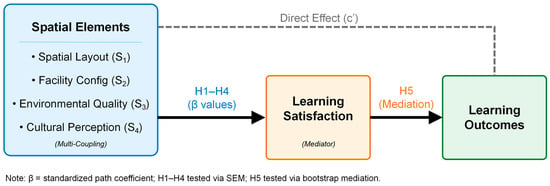
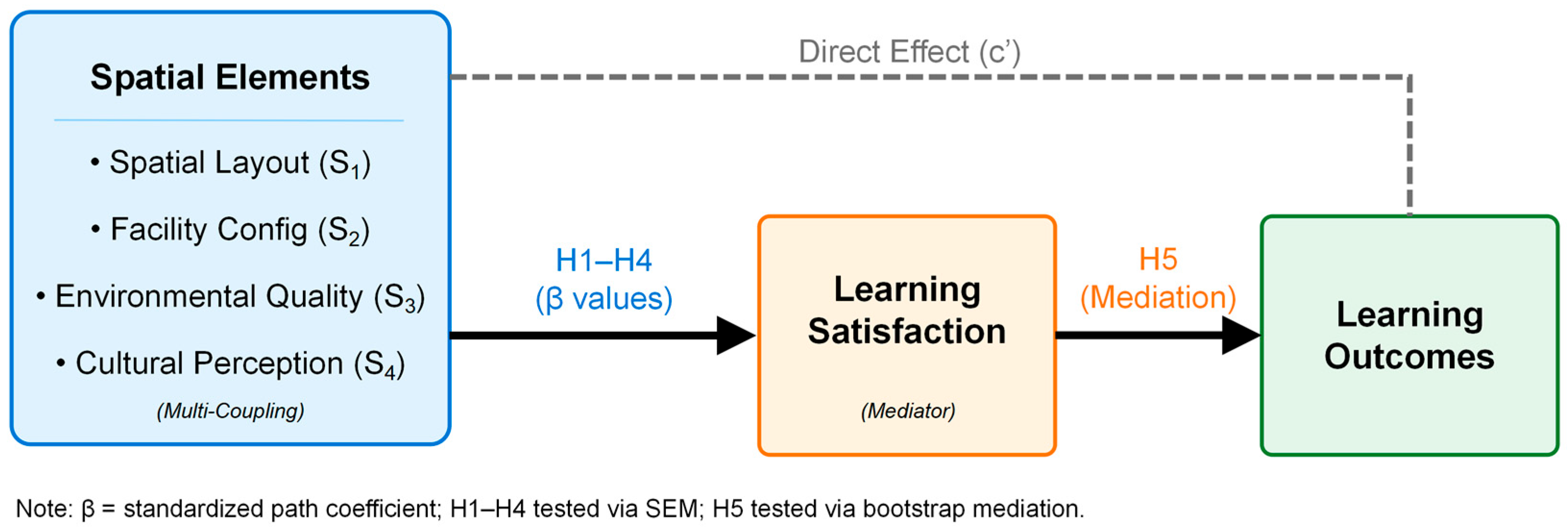
The theoretical model integrating these hypotheses is presented in Figure 1.
Figure 1.
Theoretical Model: Multi-Coupling Framework.
3. Research Design
3.1. Study Sites
Three representative university libraries in Lanzhou, China, were selected as research sites: Lanzhou University (comprehensive research university), Northwest Normal University (teacher education institution), and Lanzhou Jiaotong University (engineering-focused university). These libraries exhibit distinct characteristics in building scale, spatial configuration, and service models, providing a comprehensive picture of ILS development in western China. All three libraries are located in northwest China and share similar climatic conditions (cold, dry winters and mild summers) and cultural contexts (Silk Road and Yellow River heritage), enhancing comparability.
3.2. Instrument Development
A structured questionnaire titled “User Experience Survey of Informal Learning Spaces in University Libraries” was developed based on literature review [9,16,22] and expert consultation. The questionnaire comprised four sections: (1) demographic information; (2) spatial element perception (16 items measuring four dimensions); (3) learning satisfaction (3 items); and (4) learning outcomes (3 items). All items were rated on a 5-point Likert scale (1 = strongly disagree, 5 = strongly agree). To minimize common method bias, we incorporated reverse-scored items for approximately 20% of the questions and randomized the order of items across different questionnaire versions. Three experts in architecture and library science reviewed the initial item pool, and a pilot test (n = 50) was conducted prior to formal data collection. The full list of questionnaire items is provided in the Supplementary Materials (Table S1).
3.3. Environmental Measurements
To strengthen the architectural perspective and provide objective physical data, comprehensive environmental measurements were conducted in typical learning areas (quiet study zones, collaborative zones, and lounge areas) across the three libraries. Measurements were taken during typical usage periods (weekdays 10:00–11:00 and 14:00–15:00, avoiding extreme weather conditions) using calibrated instruments: illuminance meter (TES-1332A, accuracy ±3%) at desktop height (0.75 m); sound level meter (A-weighting, slow response) at 1.2 m height; thermo-hygrometer (Testo 608-H1, accuracy ±0.5 °C, ±2% RH); portable CO2 m (Telaire 7001, accuracy ±50 ppm) at breathing zone (1.1 m); laser particle counter (TSI DustTrak II, accuracy ±0.1 μg/m3) at 1.1 m; and photoionization detector (ppbRAE 3000, accuracy ±5%) for TVOC at 1.1 m. Three measurement points were selected in each functional zone per library, and the average values were calculated. All measurements were conducted during occupied periods with typical occupancy levels (approximately 60–70% seat occupancy on weekdays).
It should be noted that these objective environmental measurements are used descriptively to validate and contextualize the subjective perceptions reported in the questionnaire. The latent construct of “environmental quality” in the SEM is measured exclusively by perceptual items (see Supplementary Materials), not by the objective physical data.
As shown in Table 1, illuminance levels in quiet zones ranged from 384 to 412 lx, meeting the national standard (≥300 lx). Background noise in quiet zones (45.2–48.6 dB (A)) exceeded the recommended 40 dB (A) for concentrated study. CO2 concentrations in quiet zones ranged from 823 to 946 ppm, which are below the 1000 ppm threshold recommended by ASHRAE Standard 62.1 for acceptable indoor air quality, but approached this limit during peak occupancy. PM2.5 levels remained within China’s Grade I air quality standards (≤35 μg/m3 for 24-h mean). TVOC concentrations were consistently below 400 μg/m3, within the recommended range for indoor environments. Thermal conditions were stable across all libraries, with temperatures maintained within the comfortable range (22–25 °C). These physical measurements provide objective context for understanding user perceptions of environmental quality.
Table 1.
Comprehensive environmental measurement results by library (mean values).
3.4. Data Collection
Data collection was conducted from October to November 2025. Stratified random sampling was employed, with 200 questionnaires distributed per library. A total of 600 questionnaires were distributed, yielding 532 valid responses (88.7% response rate). The sample comprised 48.1% male and 51.9% female participants; 73.5% undergraduates, 21.2% master’s students, and 5.3% doctoral students; 44.2% from science/engineering disciplines, 38.7% from humanities/social sciences, 7.1% from arts/sports, and 10.0% from other disciplines. In addition to the questionnaire survey, informal behavioral observations were conducted during the data collection period. Observers recorded general patterns such as peak usage hours, preferred seating types (e.g., window-facing, power-adjacent), group sizes, and activity types (individual study, group discussion, phone use, resting). These observations were used to triangulate the survey findings but were not subjected to quantitative analysis.
3.5. Ethical Considerations
This study involved a non-interventional questionnaire survey. All participants were informed about the purpose of the study and provided verbal consent before participation. Data were collected anonymously, and no personal identifying information was recorded. According to Chinese national regulations (the Measures for Ethical Review of Life Sciences and Medical Research Involving Human Subjects, 2023), this type of anonymous survey does not require formal ethics committee approval. All procedures were conducted in accordance with the Declaration of Helsinki.
3.6. Analytical Methods
Data analysis proceeded in three stages. First, descriptive statistics, reliability analysis, and exploratory factor analysis were performed using SPSS 26.0. Second, confirmatory factor analysis (CFA) and structural equation modeling (SEM) were conducted using AMOS 24.0. Model fit was evaluated using multiple indices: the ratio of chi-square to degrees of freedom (χ2/df < 3), goodness-of-fit index (GFI > 0.90), comparative fit index (CFI > 0.90), and root mean square error of approximation (RMSEA < 0.08) [33]. The RMSEA is calculated as:
where χ2 is the model chi-square, df is the degrees of freedom, and N is the sample size. Lower RMSEA values indicate better approximate fit.
To quantify the strength of relationships, standardized path coefficients (β) were derived from unstandardized estimates (B) and standard deviations (SD) using:
where Xj is the predictor and Yi the outcome variable.
Mediation effects were tested using the bootstrap method with 5000 resamples [34]. The indirect effect (ab) was computed as the product of the path coefficient from the independent variable to the mediator (a) and the path coefficient from the mediator to the dependent variable (b). The total effect (c) was decomposed into direct effect (c′) and indirect effect (ab):
The proportion of mediation was calculated as ab/c.
Additionally, effect size for each predictor was calculated to assess the practical significance beyond p-values [35]:
where is the variance explained by the full model, and is the variance explained without the predictor. Values of 0.02, 0.15, and 0.35 represent small, medium, and large effects, respectively [35].
Third, a coupling coordination degree model was developed to quantify the synergistic development of the four spatial dimensions [36], as detailed in Section 4.4.
4. Results
4.1. Reliability and Validity
Cronbach’s α coefficients for all dimensions ranged from 0.812 to 0.896, exceeding the recommended threshold of 0.70 [37], indicating good internal consistency. Composite reliability (CR) values ranged from 0.819 to 0.905, and average variance extracted (AVE) values ranged from 0.534 to 0.662, supporting convergent validity [38]. Discriminant validity was confirmed as the square root of AVE for each dimension exceeded its correlations with other dimensions.
To assess common method bias, we conducted Harman’s one-factor test on all self-reported items. The unrotated factor analysis revealed that the first factor accounted for 28.7% of the total variance, which is below the recommended threshold of 40% [39], indicating that common method bias is not a serious concern in this study.
4.2. Descriptive Statistics and Correlations
Spatial layout received the highest mean rating (M = 3.42), while cultural perception received the lowest (M = 2.96), suggesting that cultural expression is a notable weakness in Lanzhou’s university libraries. All dimensions were significantly positively correlated (p < 0.01), with spatial layout showing the strongest correlation with learning satisfaction (r = 0.568).
The comprehensive environmental measurements (Table 1) reveal several patterns that align with user satisfaction ratings. Lanzhou University, which achieved the highest learning satisfaction scores (M = 3.38), exhibited the lowest CO2 concentration in quiet zones (823 ppm) and the lowest background noise (45.2 dB (A)). Conversely, Lanzhou Jiaotong University, with the highest quiet-zone CO2 (946 ppm) and highest noise (48.6 dB(A)), received the lowest satisfaction ratings (M = 3.12). The correlation between CO2 concentration and satisfaction was negative (r = −0.41, p < 0.05), consistent with studies showing that elevated CO2 levels impair cognitive performance and perceived comfort [40,41,42]. PM2.5 levels were positively correlated with dissatisfaction in lounge areas, where natural ventilation is more limited. These objective measurements substantiate the subjective survey findings and suggest that improving ventilation to reduce CO2 concentrations could yield meaningful gains in user satisfaction, particularly in older library buildings with limited mechanical ventilation systems.
4.3. Structural Equation Modeling
The measurement model demonstrated good fit: χ2/df = 2.124, GFI = 0.923, CFI = 0.946, RMSEA = 0.046. The structural model also showed acceptable fit: χ2/df = 2.346, GFI = 0.912, AGFI = 0.887, NFI = 0.924, IFI = 0.938, CFI = 0.937, RMSEA = 0.048.
As shown in Table 2, all four spatial dimensions significantly predicted learning satisfaction. Spatial layout had the strongest effect (β = 0.324, p < 0.001), followed by facility configuration (β = 0.287, p < 0.001), environmental quality (β = 0.196, p < 0.01), and cultural perception (β = 0.158, p < 0.05). The four dimensions jointly explained 67.3% of the variance in learning satisfaction (R2 = 0.673). Effect sizes for the predictors were: spatial layout (0.31, large), facility configuration (0.24, medium-to-large), environmental quality (0.12, medium), and cultural perception (0.08, small-to-medium), indicating practically meaningful contributions beyond statistical significance.
Table 2.
Path coefficients and hypothesis test results.
Mediation was tested using the bootstrap method with 5000 resamples [34]. The indirect effects (a × b) and their confidence intervals are reported in Table 3. Learning satisfaction partially mediated the relationships between spatial elements and learning outcomes, with indirect effects accounting for 42.6% to 47.2% of total effects. For cultural perception, the direct effect was not significant, indicating full mediation. These results support H5. The ranking of the influencing effects of the four spatial dimensions on learning satisfaction is summarized in Table 4, which clearly shows that spatial layout has the strongest impact, followed by facility configuration, environmental quality, and cultural perception.
Table 3.
Mediation analysis results (bootstrap 95% CI).
Table 4.
Ranking of influencing effects of spatial dimensions on learning satisfaction.
4.4. Coupling Coordination Degree Analysis
To further quantify the synergistic development level of the four spatial dimensions across the three university libraries, this study adopts the coupling coordination degree model commonly used in systems theory [36]. The coupling coordination degree model, although commonly applied to territorial and environmental systems, is well-suited for evaluating multi-dimensional synergy in learning spaces because it quantifies both interaction strength (coupling degree) and overall balanced development (coordination degree). First, the coupling degree C is calculated to measure the strength of interaction among the four dimensions:
where S1, S2, S3, and S4 represent the standardized scores of spatial layout, facility configuration, environmental quality, and cultural perception, respectively. The coupling degree C ranges from 0 to 1, with higher values indicating stronger mutual interaction among the four dimensions.
Next, the coupling coordination degree D is computed to reflect the overall coordinated development level, taking into account both the coupling degree and the comprehensive development index T:
Here, T is the comprehensive development index, and α, β, γ, and δ are the weights assigned to each dimension. Based on the path coefficients obtained from the structural equation model (Table 2), the weights are determined as α = 0.30, β = 0.27, γ = 0.23, and δ = 0.20, reflecting the relative importance of each dimension on learning satisfaction. We acknowledge that using SEM path coefficients as weights introduces a degree of circularity between the explanatory and evaluative models. However, this is a standard practice in coupling coordination studies [36], and our main findings (high coupling, low coordination, cultural perception as the short board) are robust to alternative weighting schemes (e.g., equal weights). The calculated results for the three libraries are presented in Table 5.
Table 5.
Coupling coordination degree by university.
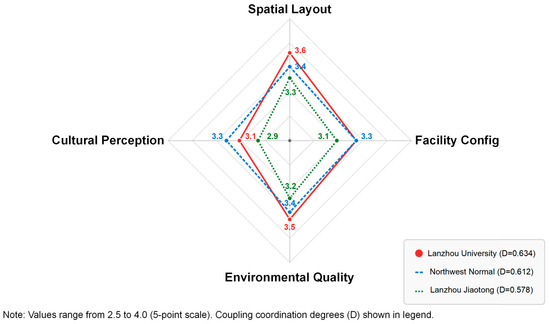
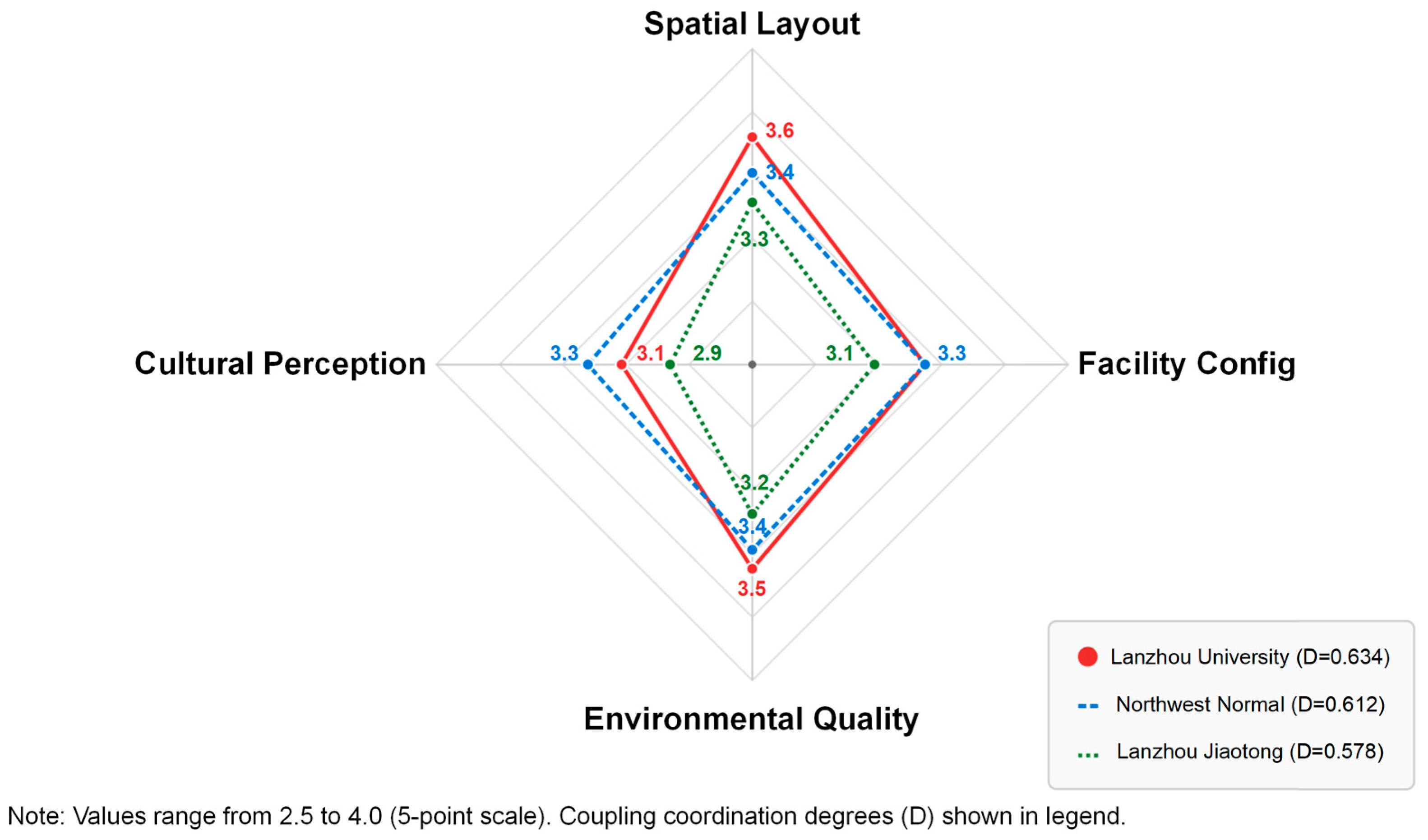
The results show that coupling degrees ranged from 0.843 to 0.892, indicating strong interactions among the four dimensions. However, coupling coordination degrees ranged from 0.578 to 0.634, revealing a “high coupling, low coordination” pattern. Lanzhou University achieved the highest coordination level, while Lanzhou Jiaotong University lagged, particularly in cultural perception (Figure 2).
Figure 2.
Coupling coordination radar chart by university.
5. Discussion
This study investigated the mechanisms through which spatial elements influence learning experiences in university library ILSs, using a multi-coupling framework and empirical data from three universities in Lanzhou, China. The findings reveal several important insights. The effect size analysis revealed that spatial layout ( = 0.31) and facility configuration ( = 0.24) exerted large to medium-large practical effects on learning satisfaction, confirming their substantive importance beyond statistical significance.
5.1. Differential Effects of Spatial Dimensions
Spatial layout had the strongest effect on learning satisfaction (β = 0.324), consistent with prior research emphasizing the importance of spatial organization in learning environments [14,43]. This finding underscores that how space is organized fundamentally shapes how it is used and experienced. For Lanzhou’s university libraries, constructed mainly in the late 1990s to early 2000s, spatial configurations designed primarily for book storage struggle to accommodate diverse learning behaviors. The absence of clear acoustic zoning and spatial flexibility represents a significant design deficit.
Facility configuration ranked second in effect strength (β = 0.287), confirming the foundational role of infrastructure in supporting learning activities. Approximately 78% of survey respondents identified power outlet availability as a primary consideration when selecting study seats. This finding aligns with Wang et al.’s [17] identification of spatial facilities as accounting for 17.56% of ILS quality variance.
Environmental quality (β = 0.196) exhibited a significant but comparatively weaker direct effect on satisfaction. The environmental measurements (Table 1) revealed that while illuminance levels and thermal conditions were generally adequate across all three libraries, two specific issues emerged: background noise in quiet zones consistently exceeded the recommended 40 dB (A) for concentrated study (ranging from 45.2 to 48.6 dB (A)), and CO2 concentrations in collaborative zones and lounge areas approached or exceeded the 1000 ppm threshold recommended by ASHRAE [44] during peak occupancy periods. Notably, Lanzhou Jiaotong University—with the highest noise levels (48.6 dB(A) in quiet zones) and CO2 concentrations (946 ppm)—recorded the lowest satisfaction scores across all dimensions. A summary of the main environmental issues identified and the corresponding recommended solutions is presented in Table 6.
Table 6.
Summary of environmental issues and recommended solutions.
The indirect effect proportion for environmental quality was the highest among the four dimensions (46.6%), suggesting that physical conditions influence learning outcomes primarily through their impact on satisfaction, rather than directly. This is particularly significant for CO2 concentration, which prior research has linked to reduced cognitive function, slower decision-making, and decreased information-processing speed [40,41,42]. In the context of library learning spaces, where students may spend 3–6 h per session, even moderate CO2 elevation (800–1000 ppm) can accumulate to affect sustained attention and learning efficiency. The measured CO2 levels in collaborative zones (up to 1012 ppm at Lanzhou Jiaotong University) thus represent not merely a comfort issue but a potential barrier to effective learning.
From an architectural design perspective, these findings underscore the importance of integrating mechanical ventilation or demand-controlled ventilation systems in library renovations, particularly in zones with high occupant density and prolonged occupancy. Natural ventilation strategies (e.g., operable windows, atrium stack effect) may offer partial solutions in Lanzhou’s continental climate, but careful acoustic isolation must be maintained to avoid trade-offs between air quality and noise control.
Cultural perception’s weaker effect and lowest mean score (2.96) reveal a critical gap in current library design. This dimension—encompassing regional cultural expression, campus identity, and sense of belonging—is substantially underdeveloped across all three institutions. From the perspective of place attachment theory [12,13], this represents a missed opportunity to create emotionally resonant environments.
5.2. Mediating Mechanism of Learning Satisfaction
The finding that learning satisfaction mediates 42.6% to 47.2% of the effect of spatial elements on learning outcomes deepens understanding of how learning environments influence educational outcomes. This mechanism suggests that spatial elements operate through affective responses—satisfaction, comfort, and emotional attachment—that subsequently shape behavioral engagement and performance. This aligns with the environmental stimulation–affect–behavior model [45]: environmental stimuli generate affective responses, which in turn influence behavioral responses.
5.3. Coupling Coordination and System Synergy
The coupling coordination analysis revealed a “high coupling, low coordination” pattern: while the four spatial dimensions interact strongly (C > 0.84), their development is imbalanced (D < 0.64), with cultural perception consistently lagging. This exemplifies a “short board” effect, where overall system performance is constrained by the weakest dimension [36]. For Lanzhou’s university libraries, continued investment in spatial layout and facility configuration alone will yield diminishing returns. Strategic attention to cultural perception—the current short board—offers the greatest potential for system-level improvement.
5.4. Limitations
Several limitations should be acknowledged. The sample is limited to three universities in Lanzhou, and findings may not be fully generalizable to other contexts. The cross-sectional design precludes causal inference. Environmental measurements were conducted during specific periods and may not capture seasonal variations. Future research should expand geographic coverage, incorporate longitudinal measurements, and explore moderating effects of individual differences.
6. Conclusions
6.1. Theoretical Contributions
This study makes several theoretical contributions. First, it develops a multi-coupling analytical framework integrating space, behavior, technology, and culture, extending person-environment fit theory into ILS research. The novelty lies not in listing dimensions but in emphasizing the interactions among them, as captured by the coupling coordination model and mediation analysis. Second, it empirically demonstrates the mediating role of learning satisfaction, revealing the affective pathway through which architectural design influences educational effectiveness. Third, it introduces coupling coordination degree analysis as a quantitative tool for assessing system synergy in ILS design. Fourth, it provides a comprehensive dataset integrating subjective perceptions with objective environmental measurements (illuminance, noise, thermal conditions, CO2, PM2.5, TVOC), establishing a more robust evidence base for understanding the role of indoor environmental quality in learning spaces.
6.2. Practical Optimization Strategies
Based on the empirical findings, a four-pronged optimization strategy is proposed:
- Flexible Spatial Reconfiguration: Implement temporal adaptability (convert lounge areas during exam periods), three-tier acoustic zoning (quiet ≤ 40 dB, collaborative ≤ 55 dB), and modular flexibility using movable partitions.
- Intelligent Technology Integration: Deploy smart environmental control (daylight-responsive lighting, user-adjustable HVAC), visualized space management (digital twin for occupancy monitoring), and intelligent infrastructure (embedded power modules, personalized lighting control).
- Humanistic Atmosphere Cultivation: Establish participatory governance (dynamic credit systems), learning community cultivation (signature programs), and participatory space renewal (reader council mechanisms).
- Regional Cultural Embedding: Translate Silk Road cultural heritage into design elements (color proportions 6:3:1), integrate Yellow River landscape views, and develop institution-specific thematic spaces (e.g., “Silk Road Library,” “Teacher’s Study,” “Railway Reading Corner”).
- Climate-Responsive Technical Strategies for Lanzhou: Given Lanzhou’s continental climate—cold winters, frequent sandstorms in spring, and high ambient noise from urban traffic—a balance between natural ventilation and acoustic comfort is particularly challenging. Based on the empirical findings, we propose the following technical strategies:
- Mechanical fresh air systems with heat recovery: In quiet zones and during winter/sandstorm periods, mechanical ventilation with heat recovery ensures adequate indoor air quality without opening windows, avoiding both heat loss and particulate ingress.
- Quiet ventilation devices: Install acoustic louvers or sound-attenuated air inlets on perimeter walls. These devices allow controlled air exchange while reducing outdoor noise by 15–25 dB (A).
- Zoned ventilation strategy: Collaborative zones (where moderate noise is acceptable) can utilize natural ventilation via operable windows, while quiet zones rely on mechanical systems. This separation reduces the demand for high-cost acoustic treatments in all areas.
- Active noise control and sound barriers: For mechanical ventilation systems, use low-noise fans and anti-vibration mounts. Place sound barriers (e.g., green walls, acoustic fences) near external air intakes located on quieter building elevations.
These strategies are tailored to Lanzhou’s climate and can be implemented incrementally during library renovations.
6.3. Future Research Directions
Future research should expand geographic coverage, employ longitudinal designs to establish causality, incorporate objective behavioral data (e.g., occupancy sensors, wearable devices), and explore moderating effects of individual differences and academic disciplines. Additionally, experimental interventions (e.g., increasing ventilation rates to reduce CO2) could test causal effects on satisfaction and learning outcomes.
6.4. Universal Design Principles for Arid-Region University Libraries
Building on the empirical findings and the coupling coordination analysis, we distill four universal design principles for informal learning spaces in arid-region university libraries:
- Low-energy comfortable environment: Leverage passive solar heating (south-facing glazing with thermal mass), evaporative cooling (in dry summers), and demand-controlled ventilation to reduce energy consumption while maintaining thermal comfort and indoor air quality.
- Lightweight expression of regional culture: Instead of heavy ornamentation, use abstracted design elements derived from Silk Road motifs (e.g., dune curves, textile patterns, earth-tone color palettes in 6:3:1 proportion) and local materials (e.g., rammed earth, adobe brick) to create a sense of place without compromising spatial flexibility.
- Flexible acoustic zoning: Implement a tiered noise zone system (quiet ≤ 40 dB(A), collaborative ≤ 55 dB (A), social ≤ 65 dB (A)) with movable acoustic panels, sound-absorbing ceilings, and carpeted floors. Allow users to adjust their acoustic environment via bookable quiet pods or group rooms.
- Multi-mode coupled space design: Design spaces that can be reconfigured for three modes: individual deep focus (low lighting, enclosed), group collaboration (moderate lighting, open with writable surfaces), and social events (high lighting, open floor). Use movable furniture, sliding partitions, and smart lighting controls to enable rapid mode switching.
These principles extend our case-specific findings into a transferable framework for similar climatic and cultural contexts.
Supplementary Materials
The following supporting information can be downloaded at: https://www.mdpi.com/article/10.3390/buildings16091683/s1, Table S1. Questionnaire items and their sources.
Author Contributions
Resources, supervision, project administration, G.W.; Conceptualization, methodology, software, data curation, writing—original draft preparation, writing—review and editing, Y.Z. (Yaqi Zhang); data curation, validation, visualization, investigation, W.W.; investigation, formal analysis, Y.Z. (Yaning Zhao); visualization, investigation, Z.W. All authors have read and agreed to the published version of the manuscript.
Funding
This research was funded by National Natural Science Foundation of China (Grant No. 51668039)—Regional Science Foundation, Higher Education Research Project of Lanzhou University of Technology for 2024 (Grant No. GJ2024B-33) and University-Enterprise Cooperation Course Construction Project of Lanzhou University of Technology for 2025 (Grant No. 269417).
Institutional Review Board Statement
This study employed a non-interventional anonymous questionnaire survey method. According to Chinese national regulations (the Measures for Ethical Review of Life Sciences and Medical Research Involving Human Subjects, 2023), this type of anonymous survey does not require formal ethics committee approval. All participants provided verbal informed consent, and data were collected anonymously. The study was conducted in accordance with the Declaration of Helsinki.
Informed Consent Statement
Informed consent was obtained from all subjects involved in the study (verbal consent, recorded).
Data Availability Statement
The original data presented in this study are available on request from the corresponding author due to privacy and ethical restrictions (anonymized data can be provided for research verification purposes).
Acknowledgments
The authors would like to thank the students and library staff at Lanzhou University, Northwest Normal University, and Lanzhou Jiaotong University for their participation and support.
Conflicts of Interest
The authors declare no conflicts of interest.
Abbreviations
The following abbreviations are used in this manuscript:
| AGFI | Adjusted Goodness-of-Fit Index |
| ASHRAE | American Society of Heating, Refrigerating and Air-Conditioning Engineers |
| AVE | Average Variance Extracted |
| CFA | Confirmatory Factor Analysis |
| CFI | Comparative Fit Index |
| CO2 | Carbon Dioxide |
| CR | Composite Reliability |
| D | Coupling Coordination Degree |
| GFI | Goodness-of-Fit Index |
| HVAC | Heating, Ventilation, and Air Conditioning |
| IFI | Incremental Fit Index |
| ILS | Informal Learning Space |
| ILSs | Informal Learning Spaces (plural) |
| NFI | Normed Fit Index |
| PM2.5 | Particulate Matter 2.5 micrometers or less |
| RH | Relative Humidity |
| RMSEA | Root Mean Square Error of Approximation |
| SEM | Structural Equation Modeling |
| TVOC | Total Volatile Organic Compounds |
References
- Cui, X.; Liao, J.; Ahn, A.C. Scientometric Review of Informal Learning Spaces in University Libraries: A Bibliometric Approach to Design and Trends. Sustainability 2025, 17, 2480. [Google Scholar] [CrossRef] [Scilit]
- Xue, Y.; Chen, J.; Li, H. Emotional Response and Spatial Adaptability in University Library Informal Learning Spaces. J. Acad. Libr. 2024, 50, 102876. [Google Scholar] [CrossRef] [Scilit]
- Halverson, L.R.; Graham, C.R. Learner Engagement in Blended Learning Environments: A Conceptual Framework. Online Learn. 2019, 23, 145–178. [Google Scholar] [CrossRef] [Scilit]
- Knowles, M.S. Self-Directed Learning: A Guide for Learners and Teachers; Association Press: New York, NY, USA, 1975. [Google Scholar]
- Garrison, D.R. Self-Directed Learning: Toward a Comprehensive Model. Adult Educ. Q. 1997, 48, 18–33. [Google Scholar] [CrossRef] [Scilit]
- Harrop, D.; Turpin, B. A Study Exploring Learners’ Informal Learning Space Behaviors, Attitudes, and Preferences. New Rev. Acad. Librariansh. 2013, 19, 58–77. [Google Scholar] [CrossRef] [Scilit]
- Walton, G.; Matthews, G. Exploring Informal Learning Space in the University: A Collaborative Approach; Routledge: London, UK, 2017. [Google Scholar] [CrossRef] [Scilit]
- Karasic, V. From Commons to Classroom: The Evolution of Learning Spaces in Academic Libraries. J. Learn. Spaces 2016, 5, 601384. [Google Scholar]
- Wu, X.; Kou, Z.; Oldfield, P.; Heath, T.; Borsi, K. Informal Learning Spaces in Higher Education: Student Preferences and Activities. Buildings 2021, 11, 252. [Google Scholar] [CrossRef] [Scilit]
- Barrett, P.; Davies, F.; Zhang, Y.; Barrett, L. The Impact of Classroom Design on Pupils’ Learning: Final Results of a Holistic, Multi-Level Analysis. Build. Environ. 2015, 89, 118–133. [Google Scholar] [CrossRef] [Scilit]
- Kang, J. Analysing Sound Environment and Architectural Characteristics of Libraries through Indoor Soundscape Framework. Arch. Acoust. 2016, 41, 203–213. [Google Scholar] [CrossRef] [Scilit]
- Norberg-Schulz, C. Genius Loci: Towards a Phenomenology of Architecture; Rizzoli: New York, NY, USA, 1980. [Google Scholar]
- Feng, X.; Han, J. Study on the Factors Influencing Place Attachment of Informal Learning Spaces within a University Library. J. Archit. Inst. Korea 2025, 41, 123–134. [Google Scholar] [CrossRef]
- Beckers, R.; van der Voordt, T.; Dewulf, G. Learning Space Preferences of Higher Education Students. Build. Environ. 2016, 104, 243–252. [Google Scholar] [CrossRef] [Scilit]
- Cleveland, B.; Fisher, K. The Evaluation of Physical Learning Environments: A Critical Review of the Literature. Learn. Environ. Res. 2014, 17, 1–28. [Google Scholar] [CrossRef] [Scilit]
- Hou, H.; Lai, J.H.K.; Edwards, D. Factors Influencing User Satisfaction in University Library Learning Spaces: A Structural Equation Modelling Approach. J. Build. Eng. 2022, 45, 103568. [Google Scholar] [CrossRef] [Scilit]
- Wang, L.; Song, J.; Guo, W.; Wan, G.; Caneparo, L.; Liu, X. Impact of Multiple Environmental Factors of Space Clusters for Informal Learning in Library Renovation and Update. Buildings 2025, 15, 4530. [Google Scholar] [CrossRef] [Scilit]
- Wang, Y.; Shi, Y.; Yang, T.Y. Structural Performance Warning Based on Computer Intelligent Monitoring and Fractional-Order Multi-Rate Kalman Fusion Method. Fractal Fract. 2026, 10, 186. [Google Scholar] [CrossRef] [Scilit]
- Haken, H. Synergetics: An Introduction; Springer: Berlin, Germany, 1978. [Google Scholar]
- Caplan, R.D. Person-Environment Fit: Past, Present, and Future. In Stress Research; Cooper, C.L., Ed.; Wiley: Chichester, UK, 1983; pp. 35–78. [Google Scholar]
- Edwards, J.R.; Caplan, R.D.; Harrison, R.V. Person-Environment Fit Theory: Conceptual Foundations, Empirical Evidence, and Directions for Future Research. In Theories of Organizational Stress; Cooper, C.L., Ed.; Oxford University Press: Oxford, UK, 1998; pp. 28–67. [Google Scholar]
- Chen, Y.; Wu, J.; Zou, Y.; Dong, W.; Zhou, X. Optimal Design and Verification of Informal Learning Spaces (ILS) in Chinese Universities Based on Visual Perception Analysis. Buildings 2022, 12, 1495. [Google Scholar] [CrossRef] [Scilit]
- Zimmermann, S. Classroom Interaction Redefined: Multidisciplinary Perspectives on Moving beyond Traditional Classroom Spaces to Promote Student Engagement. J. Learn. Spaces 2018, 7, 45–53. [Google Scholar]
- Fouad, A.T.Z.; Sailer, K. The Design of School Buildings: Potentiality of Informal Learning Spaces for Self-Directed Learning. In Proceedings of the 12th International Space Syntax Symposium, Beijing, China, 9–11 July 2019. [Google Scholar]
- Gehl, J. Life Between Buildings: Using Public Space; Island Press: Washington, DC, USA, 2011. [Google Scholar]
- Quay, J. Experience and Participation: Relating Theories of Learning. J. Exp. Educ. 2003, 26, 105–112. [Google Scholar] [CrossRef] [Scilit]
- Basdogan, M. Coffeehouse as Classroom: Examining a Flexible and Active Learning Space from the Pedagogy-Space-Technology-User Perspective. J. Learn. Spaces 2021, 10, 601454. [Google Scholar]
- Pallasmaa, J. The Eyes of the Skin: Architecture and the Senses; Wiley: Chichester, UK, 2005. [Google Scholar]
- Van Vianen, A.E.M. Person-Environment Fit: A Review of Its Basic Tenets. Annu. Rev. Organ. Psychol. Organ. Behav. 2018, 5, 75–101. [Google Scholar] [CrossRef] [Scilit]
- Casanova, D. The Cube and the Poppy Flower: Participatory Approaches for Designing Technology-Enhanced Learning Spaces. J. Learn. Spaces 2017, 6, 1–11. [Google Scholar]
- Walton, G.; Matthews, G. Evaluating University’s Informal Learning Spaces: Role of the University Library? New Rev. Acad. Librariansh. 2013, 19, 1–4. [Google Scholar] [CrossRef] [Scilit]
- GB/T 27769-2011; The Facility and Equipment Requirements of Social Security Service Centre. Standards Press of China: Beijing, China, 2011.
- Hu, L.; Bentler, P.M. Cutoff Criteria for Fit Indexes in Covariance Structure Analysis: Conventional Criteria versus New Alternatives. Struct. Equ. Model. 1999, 6, 1–55. [Google Scholar] [CrossRef] [Scilit]
- Preacher, K.J.; Hayes, A.F. Asymptotic and Resampling Strategies for Assessing and Comparing Indirect Effects in Multiple Mediator Models. Behav. Res. Methods 2008, 40, 879–891. [Google Scholar] [CrossRef] [Scilit]
- Cohen, J. Statistical Power Analysis for the Behavioral Sciences, 2nd ed.; Lawrence Erlbaum Associates: Hillsdale, NJ, USA, 1988. [Google Scholar]
- Li, Y.; Li, Y.; Zhou, Y.; Shi, Y.; Zhu, X. Investigation of a Coupling Model of Coordination between Urbanization and the Environment. J. Environ. Manag. 2012, 98, 127–133. [Google Scholar] [CrossRef] [Scilit] [PubMed]
- Nunnally, J.C. Psychometric Theory, 2nd ed.; McGraw-Hill: New York, NY, USA, 1978. [Google Scholar]
- Fornell, C.; Larcker, D.F. Evaluating Structural Equation Models with Unobservable Variables and Measurement Error. J. Mark. Res. 1981, 18, 39–50. [Google Scholar] [CrossRef] [Scilit]
- Podsakoff, P.M.; MacKenzie, S.B.; Lee, J.Y.; Podsakoff, N.P. Common method biases in behavioral research: A critical review of the literature and recommended remedies. J. Appl. Psychol. 2003, 88, 879–903. [Google Scholar] [CrossRef] [Scilit]
- Allen, J.G.; MacNaughton, P.; Satish, U.; Santanam, S.; Vallarino, J.; Spengler, J.D. Associations of Cognitive Function Scores with Carbon Dioxide, Ventilation, and Volatile Organic Compound Exposures in Office Workers: A Controlled Exposure Study of Green and Conventional Office Environments. Environ. Health Perspect. 2016, 124, 805–812. [Google Scholar] [CrossRef] [Scilit]
- Satish, U.; Mendell, M.J.; Shekhar, K.; Hotchi, T.; Sullivan, D.; Streufert, S.; Fisk, W.J. Is CO2 an Indoor Pollutant? Direct Effects of Low-to-Moderate CO2 Concentrations on Human Decision-Making Performance. Environ. Health Perspect. 2012, 120, 1671–1677. [Google Scholar] [CrossRef] [Scilit]
- Du, B.; Tandoc, M.C.; Mack, M.L.; Siegel, J.A. Indoor CO2 Concentrations and Cognitive Function: A Critical Review. Indoor Air 2020, 30, 1067–1082. [Google Scholar] [CrossRef] [Scilit]
- Yang, Z.; Becerik-Gerber, B.; Mino, L. A Study on Student Perceptions of Higher Education Classrooms: Impact of Classroom Attributes on Student Satisfaction and Performance. Build. Environ. 2013, 70, 171–188. [Google Scholar] [CrossRef] [Scilit]
- ASHRAE Standard 62.1-2022; Ventilation for Acceptable Indoor Air Quality. American Society of Heating, Refrigerating and Air-Conditioning Engineers: Atlanta, GA, USA, 2022.
- Mehrabian, A.; Russell, J.A. An Approach to Environmental Psychology; MIT Press: Cambridge, MA, USA, 1974. [Google Scholar]

Disclaimer/Publisher’s Note: The statements, opinions and data contained in all publications are solely those of the individual author(s) and contributor(s) and not of MDPI and/or the editor(s). MDPI and/or the editor(s) disclaim responsibility for any injury to people or property resulting from any ideas, methods, instructions or products referred to in the content. |
© 2026 by the authors. Licensee MDPI, Basel, Switzerland. This article is an open access article distributed under the terms and conditions of the Creative Commons Attribution (CC BY) license.