Article

Data-Driven Multi-Objective Optimization of Building Envelope Retrofits for Senior Apartments in Beijing
School of Architecture and Urban Planning, Beijing University of Civil Engineering and Architecture, Beijing 100044, China
*
Author to whom correspondence should be addressed.
Buildings 2026, 16(9), 1682; https://doi.org/10.3390/buildings16091682
Submission received: 2 March 2026 / Revised: 28 March 2026 / Accepted: 14 April 2026 / Published: 24 April 2026
(This article belongs to the Special Issue Human Comfort and Building Energy Efficiency)

Abstract

Aging populations have intensified the demand for thermally comfortable and energy-efficient housing, particularly for elderly residents whose diminished thermoregulatory capacity renders them disproportionately vulnerable to indoor temperature fluctuations. Existing senior apartments in cold-climate regions frequently fail to meet age-specific thermal comfort standards, yet systematic retrofit optimization frameworks explicitly tailored to elderly occupants remain scarce. This study presents a data-driven multi-objective optimization framework for building envelope retrofitting, which is validated using on-site temperature measurements from a representative 1980s brick–concrete senior apartment building in Beijing. The framework integrates Latin Hypercube Sampling (LHS) for design space exploration, a Long Short-Term Memory (LSTM) surrogate model for simultaneous prediction of three performance objectives, and Non-dominated Sorting Genetic Algorithm II (NSGA-II) for Pareto-optimal solution generation, with final selection performed via a weighted Mahalanobis distance-based Technique for Order Preference by Similarity to an Ideal Solution (TOPSIS). Optimization targets—annual energy consumption, indoor thermal discomfort hours, and retrofit cost—are parameterized using the age-sensitive comfort thresholds specified in GB 50340-2016. The LSTM surrogate achieved R2 values of 0.91–0.93 across all objectives with training–testing differences below 0.02. The optimal retrofit package—Polyvinyl Chloride (PVC) Low Emissivity (Low-E) double-glazed windows (5 + 6A + 5), glass fiber roof insulation (65.25 mm), and Extruded Polystyrene (XPS) external wall insulation (65.39 mm)—reduces annual energy consumption by 47.1% (from 40,867 to 21,626 kWh) and annual thermal discomfort hours by 62.4% (from 2454 °C·h to 923 °C·h). SHapley Additive exPlanations (SHAP)-based sensitivity analysis further identifies wall U-value and roof thickness as the dominant performance drivers. A reproducible and computationally efficient pathway is provided by the proposed framework for evidence-based envelope retrofit decision-making in existing senior residential buildings.

1. Introduction

1.1. Background

China is undergoing rapid demographic aging. By the end of 2025, the population aged 60 and above had reached 323.38 million, accounting for 23% of the total population [1,2]. An increasing number of elderly individuals reside in nursing homes and senior apartments, where they typically spend over 90% of their daily time indoors [3,4,5]. Given their declining thermoregulatory capacity, elderly residents are particularly vulnerable to indoor temperature fluctuations, and extreme temperatures—whether excessively high or low—can adversely affect their cardiovascular health [6,7,8].
The building energy consumption of China, the largest energy consumer around the world, constitutes approximately 20% of the nation’s total energy usage. The 14th Five-Year Plan for Building Energy Efficiency and Green Building Development targets the completion of energy-saving renovations for more than 350 million m2 of existing structures by 2025. For senior residential buildings, the challenge is twofold: ensuring a stable and comfortable indoor thermal environment for elderly occupants while minimizing energy consumption and renovation costs. Multi-objective optimization approaches that can effectively balance these competing demands are required.

1.2. Literature Review

Elderly individuals spend more than 15 h indoors each day. Numerous studies have shown that indoor temperature fluctuations affect older adults’ blood pressure, and that excessively low temperatures can trigger illnesses such as heart failure [9,10,11,12,13]. Consequently, older adults have heightened requirements for thermal comfort compared with the general population. In China, the design standards for indoor thermal environments differ accordingly: the “Energy Efficiency Design Standard for Residential Buildings in Hot Summer and Cold Winter Zones” [14] specifies standard residential criteria, while the “Design Standard for Residential Buildings for the Elderly” [15] mandates stricter setpoints to accommodate elderly residents’ sensitivity to temperature fluctuations (Table 1).
The Predicted Mean Vote (PMV) model, employed in this study, is a foundational and internationally recognized thermal comfort index. While it systematically accounts for factors such as temperature, humidity, and radiation, its application for elderly populations requires calibration due to their diminished thermoregulatory capacity. This understanding is integrated into the optimization process not by modifying the PMV index itself, but by applying the stricter, age-sensitive comfort boundaries from GB 50340-2016, [15] as optimization targets. This approach directly translates the physiological needs of the elderly—reduced cold/heat stress—into explicit, quantitative performance objectives (discomfort hours) for the optimization framework, moving beyond a generic comfort goal.
A substantial body of research has sought to address multi-objective building retrofit optimization using traditional methods, including weighted-factor approaches, the Analytic Hierarchy Process (AHP), linear programming, constrained optimization, and Multi-Criteria Decision Making (MCDM) frameworks [16,17,18,19]. These methods have been applied to establish standardized weighting criteria, analyze the financial and ecological implications of retrofitting across diverse climate zones, and develop lifecycle-oriented decision-making tools integrating economic, social, and environmental dimensions [20,21,22,23,24,25]. While these approaches have contributed valuable decision-support frameworks, they share several common limitations: weighted-factor and AHP-based methods rely on subjective expert judgment for weight assignment, which introduces bias and reduces reproducibility; linear programming techniques require simplified objective functions that may not adequately capture the nonlinear interactions among a building’s thermal performance variables; and simulation-driven MCDM workflows, though more comprehensive, are computationally expensive—often generating hundreds of thousands of candidate scenarios—and remain built upon idealized assumptions that may diverge from real-world operating conditions [26,27,28,29]. These limitations underscore the need for data-driven intelligent optimization methods that can efficiently navigate high-dimensional, nonlinear solution spaces while maintaining practical relevance.
To overcome the limitations of conventional approaches, intelligent optimization techniques—including deep learning [30,31,32], reinforcement learning [33], and hybrid genetic algorithms [34]—have been increasingly applied to building energy efficiency retrofits.
In the area of building performance prediction, neural networks have been employed to predict wall thermal resistance, heat transfer coefficients, and energy consumption, achieving R2 values of up to 0.95 [35,36,37,38]. Decision-tree models and hybrid GRU neural networks have also demonstrated improved predictive accuracy for building heating loads and energy use [39,40]. Among these, LSTM networks are particularly suited to building thermal performance prediction because they capture long-term temporal dependencies in time series data—such as diurnal and seasonal energy consumption variations—enabling more accurate forecasts than static regression models.
In parallel, multi-objective optimization methods have been widely adopted to address competing objectives such as energy consumption, cost, and environmental impact. Al Kabaha et al. [39] applied an EnergyPlus-based multi-objective framework to simultaneously minimize energy use, cost, and emissions in residential buildings, while Shi et al. [41] validated a two-stage low-carbon optimization approach through a case study in Beijing. Guo et al. [42] further developed an automated EnergyPlus–Python–NSGA-III workflow, achieving a 41% reduction in energy consumption in temporary buildings. In terms of surrogate-assisted optimization, Wu et al. [43] proposed a hybrid BO-XGBoost-NSGA-II framework that integrates Bayesian optimization, XGBoost surrogate models, and NSGA-II to improve optimization efficiency. Similarly, Saeki et al. [44] coupled NSGA-II with an artificial neural network (ANN) metamodel for residential energy and thermal comfort optimization, while Shan et al. [45] introduced an approach combining machine learning with evolutionary algorithms to balance energy consumption, carbon emissions, and cost in building retrofit decision-making. Overall, these studies demonstrate that evolutionary algorithms, particularly NSGA-II and NSGA-III, are effective tools for solving complex multi-objective optimization problems in the building domain [46,47].
In summary, integrating surrogate models—particularly neural networks—with evolutionary multi-objective algorithms has demonstrated strong potential for building retrofit optimization. However, the use of LSTM-based surrogate models, which are capable of capturing temporal variations in building thermal behavior, remains limited, especially in the context of elderly housing with age-specific comfort requirements.
Although technical standards for elderly-oriented buildings are well established, retrofit practices rarely incorporate thermal-health considerations in a systematic manner. In particular, age-sensitive thermal indicators—reflecting older adults’ increased vulnerability to environmental conditions—are seldom applied in optimization frameworks. Conventional approaches often rely on subjective weighting methods and struggle with high-dimensional, nonlinear problems, while simulation-based analyses are frequently constrained by idealized assumptions that may not reflect real-world conditions. This highlights the importance of field measurements for model calibration and validation.
Despite extensive research on building performance optimization, the application of LSTM-based surrogate models to the energy retrofit of existing senior housing in cold regions remains insufficiently explored. To address this gap, this study proposes a data-driven multi-objective optimization framework that delivers practical retrofit strategies tailored to the thermal comfort and health needs of elderly occupants.

1.3. Research Objectives and Novelty

In response to the aforementioned gaps, this study develops and validates a data-driven multi-objective optimization framework for building envelope retrofitting, explicitly tailored to the thermal comfort and health needs of elderly residents. A representative senior apartment building in Haidian, Beijing, is selected as the case study. The framework integrates field measurements and software simulations to construct a foundational dataset, and employs LHS, LSTM, NSGA-II, and TOPSIS to simultaneously optimize three competing objectives: annual energy consumption, indoor thermal discomfort hours, and retrofit cost. The specific contributions are as follows:
  • An elderly-oriented multi-objective optimization framework grounded in field measurements.
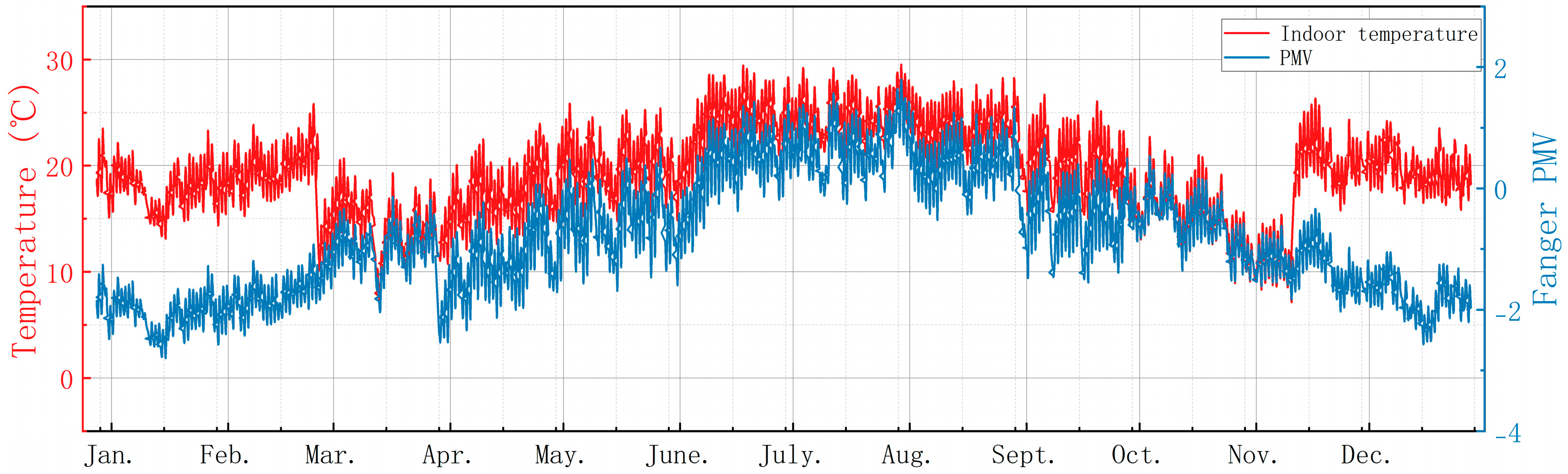
Unlike most existing studies that rely solely on idealized simulation inputs, on-site indoor temperature monitoring data (Figure 1) are incorporated to calibrate the building energy model. The optimization objectives are parameterized using age-sensitive thermal comfort thresholds from GB 50340-2016, ensuring that the resulting solutions directly address the physiological vulnerability of elderly occupants, bridging the gap between building energy optimization research and age-friendly design practice.
  • An LSTM-NSGA-II surrogate-assisted optimization strategy with demonstrated efficiency and accuracy.
An LSTM surrogate model trained on LHS-generated samples predicts energy consumption, discomfort hours, and retrofit cost simultaneously, achieving R2 values of 0.91–0.93 across all three objectives. Combined with NSGA-II and a weighted Mahalanobis distance-based TOPSIS for final solution selection, this provides a computationally efficient yet physically informed pathway from parametric sampling to actionable retrofit recommendations.
  • Interpretable engineering insights through SHAP-based sensitivity analysis and whole-life performance assessment.
The contribution of each design variable to the three performance objectives is quantified through SHAP analysis, translating ‘black-box’ optimization outputs into transparent engineering guidance. A whole-life carbon assessment [48] and economic payback analysis further evaluate the environmental and financial viability of the optimal solution, providing a comprehensive decision-support basis extending beyond energy and comfort metrics alone.

2. Materials and Methods

2.1. Physical Model and On-Site Survey

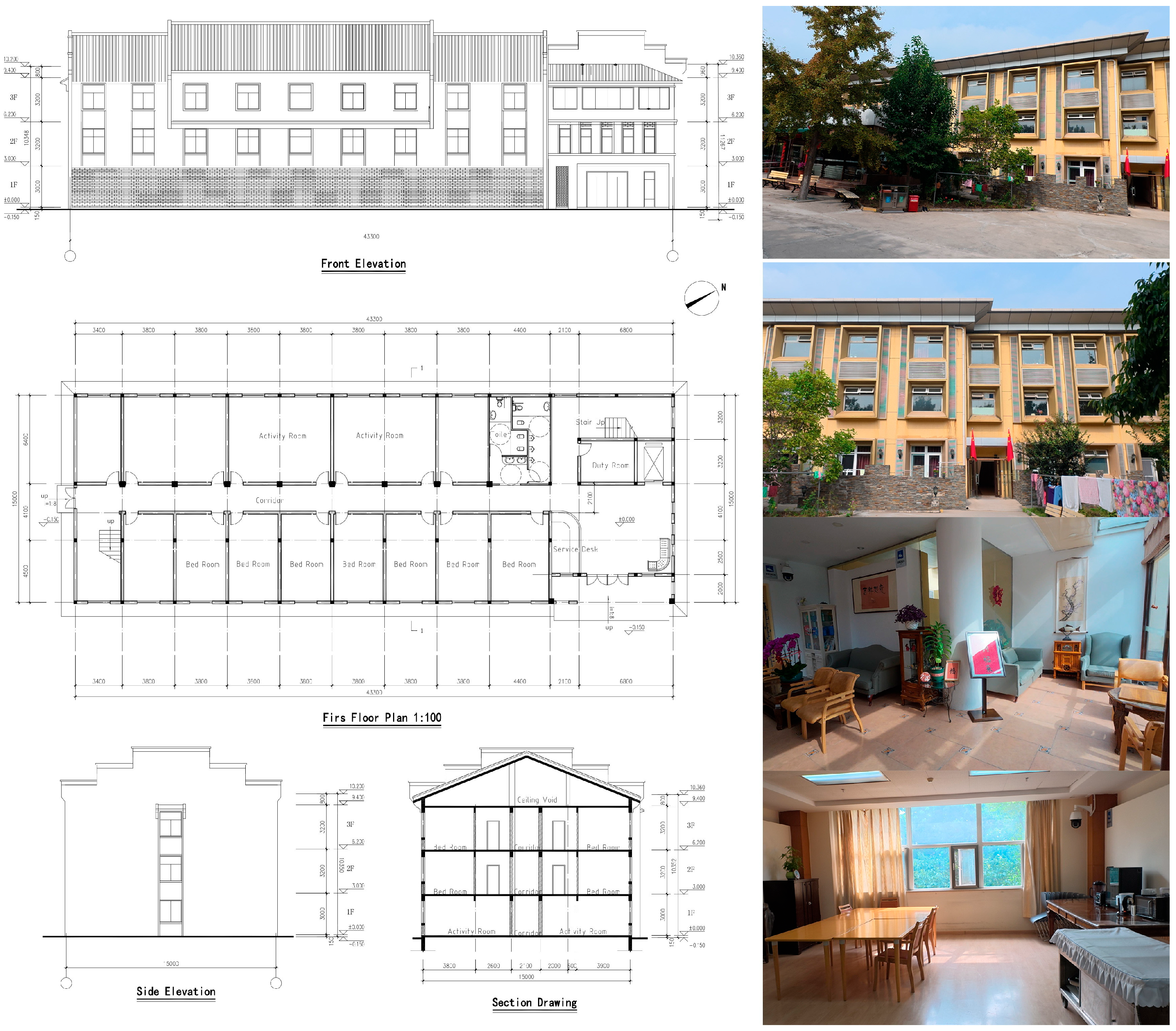
This study focuses on an aging retirement apartment building located in Beijing. The structure, erected during an earlier era, is characterized by substandard building practices, deteriorating infrastructure, and excessive energy depletion. The building comprises three floors and four residential units, with overall dimensions of 43.3 m in length and 15 m in width. Each floor has a height of 3 m and is equipped with two staircases. Figure 2 illustrates the building’s floor plan, interior environment, and exterior appearance. Additionally, Table 2 provides pertinent building information as well as building materials’ thermal performance [49]. This particular building, with its common typology and prevalent performance issues, serves as a representative case for this study. It is important to note that the optimization framework and results are primarily developed and validated within the context of similar multi-story senior apartment buildings in Beijing’s climate, and their direct applicability to other regions or building types requires careful consideration of local conditions.
The roof and exterior walls of the target building exhibit insufficient insulation, failing to meet the heating demand of Beijing’s cold winter climate, which results in poor overall thermal efficiency. Pronounced thermal bridges are present in parts of the building envelope, exacerbating heat loss during the heating season. In addition, many of the existing windows are single-glazed or degraded, providing inadequate thermal resistance and further reducing indoor comfort while increasing heating energy consumption.
Indoor temperature monitoring revealed that the average summer temperature and average winter temperature did not meet design standards 26.8% and 31.2% of the time, respectively (Figure 1). To enhance the thermal comfort of these senior apartments and meet the health needs of elderly residents, retrofitting the building envelope is essential.

2.2. Mathematical Model

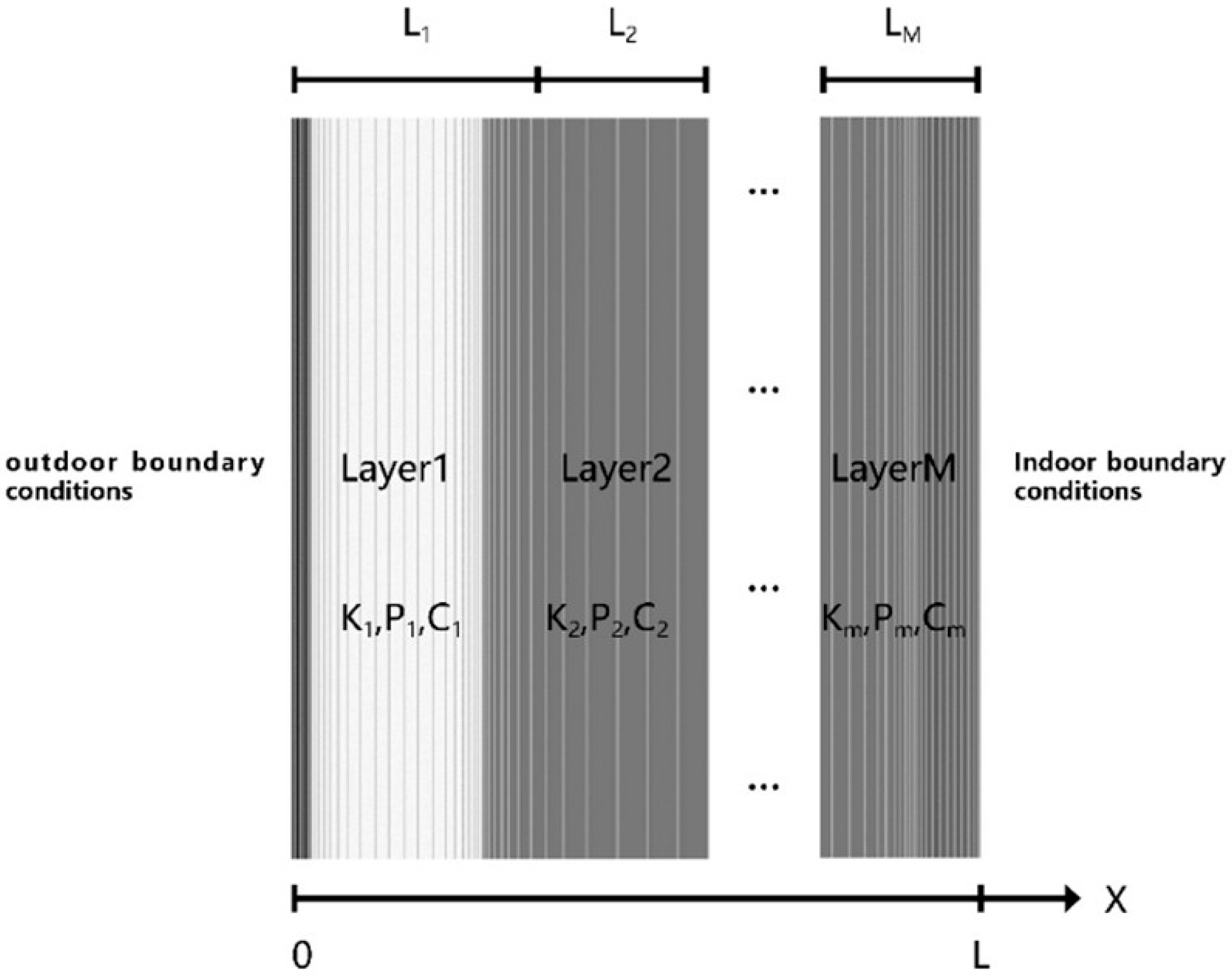
Figure 3 displays the mathematical representation pertaining to the composite envelope structure. The outer aspect of the structure is influenced by the temperature conditions outside, taking into account the effects of sunlight exposure. On the other hand, the indoor environment is affected by the internal temperature, acknowledging the impact of thermal radiation on various internal surfaces.

2.2.1. Mathematical Description of the Exterior Walls, Roof, and Floors

Governing equation.
These structures all adopt 1D transient heat conduction, with the governing equation expressed as:
ρ j c j T j t = λ j 2 T j x 2 j = 1,2 , , M
where:
  • ρj, cj and λj denote the density (kg/m3), the specific heat (J/kg·K), and the thermal conductivity (W/(m·K)) of the j-th layer material, respectively.
  • x represents the coordinate in the direction of the wall, roof, or floor thickness, m.
  • t represents the time, s.
  • T represents the temperature, °C.
Boundary conditions.
On the outdoor and indoor side:
q r ,   out   + h out   ( T out   T x = 0 ) = λ 1 T x | x = 0
q r ,   in   + h i n T in   T x = L = λ M T x | x = L
where:
  • hout and hin are the convective heat transfer coefficient (CHT) on the outdoor (19 W/(m2·K)) and indoor side (8.7 W/(m2·K)), respectively.
  • Tout and Tin are the outdoor and indoor air temperature, respectively (°C).
  • Tx=0 and Tx=L are the external and internal surface temperature, respectively (°C).
  • qr,out and qr,in are the radiation intensity from the outer surface and inner surface, respectively (W/m2), with the former primarily from solar radiation, and the latter from the radiative heat transfer on the envelope inner surface and the solar heat.
Initial conditions:
T ( x , t ) | t = 0 = T i n i t
  • Tinit is the initial temperature, °C.

2.2.2. Thermal Balance Equation for Indoor Air

The corresponding equation is:
ρ a c p a V R d T i n d t = i = 1 6   Q b i + Q w i n + Q D
where:
  • ρa indicates the air density, kg/m3.
  • cpa indicates the air’s specific heat, J/kg·K.
  • VR represents the air volume, m3.
  • Qbi represents the convective heat exchange between each inner surface and the indoor air, W.
  • i = 1, 2, ⋯, 6, respectively denote the roof, floor, and walls in four directions (east, south, west, and north).
  • Qwin is the indoor–outdoor heat exchange, W.
  • QD is the indoor heat source, W.
Q b i = h i n , i × ( T b i T i n ) × A i
where:
  • Tbi and Ai are the temperature and area of the i-th inner surface, respectively, °C.
  • hin,i is the CHT of the i-th inner surface, W/(m2·K).
Q w i n = U w i n × ( T o u t T i n ) × A w i n
  • Uwin indicates the window’s total heat transfer coefficient, W/(m2·K).
  • Awin indicates the window area, m2.
The finite volume technique served for the discretization of the equations, which were then addressed using the iterative method of Gauss–Seidel. This numerical approach was carried out by virtue of the FORTRAN programming language. During the computations, the simulation employed a grid interval of 0.01 m and a temporal resolution of 10 s. The parameters for the outdoor calculations in this research were derived from the typical meteorological year (TMY) data sourced from the Chinese meteorological database. Furthermore, Design Builder software (ver. 6) was employed to simulate certain data, providing a comparative analysis to validate the reliability of the calculations.
Based on this numerical framework, decision variables were defined for surrogate-based optimization and sensitivity analysis. As commonly practiced in surrogate modeling studies, dense sampling of continuous design variables is necessary to capture nonlinear response characteristics and to ensure sufficient training of surrogate models [50,51]. Accordingly, the fine discretization of insulation thickness adopted in this study serves as a numerical sampling strategy rather than an assumption of construction-level precision.

2.3. Decision Variables

The variables influencing decisions encompass a range of methods for carrying out renovations aimed at enhancing energy efficiency in buildings. Five key decision variables are identified in this analysis: the kind and thickness of insulation for external walls, the choice and thickness of roof insulation, and the types of windows selected. A detailed compilation of eight different insulation materials along with their associated thermal characteristics is provided in Table 3.

2.4. Objective Function

To make the renovated apartments more suitable for elderly residents, the indoor comfort temperature has been adjusted following the “Design Standard for Residential Buildings for the Elderly” [15]. In the thermal comfort design of elderly apartments, it is essential to maintain a higher winter indoor temperature of 20 °C to 23 °C and a slightly elevated summer range of 26 °C to 28 °C to accommodate the elderly’s sensitivity to temperature changes. As a result, the corresponding calculations of the building’s energy consumption and discomfort hours differ from those of regular buildings, making this renovation more targeted and specific to the needs of the elderly.

2.4.1. Building Energy Consumption

It includes the energy required for both heating and cooling, established by determining the respective heating and cooling requirements.
Cooling load:
Q C = 0 D s u m i = 1 6 h i n , i ( T b i T H ) A i + U w i n ( T o u t T H ) A w i n   d t
Heating load:
Q H = 0 D w i n i = 1 6 h i n , i ( T L T b i ) A i + U w i n ( T L T o u t ) A w i n   d t
where:
  • QC and QH respectively denote the summer air conditioning load and winter heating load, kWh.
  • Dsum and Dwin respectively denote the air conditioning period (h) and the heating period (h).
Equations below explain the energy consumption in the above two periods:
E c = Q c / C O P c
E H = Q H / C O P H
The equation below interprets the total energy consumption of the building:
E = E C + E H
where:
  • COPC and COPH are the performance coefficient for air-source heat pump cooling (2.3) and heating (1.9), respectively.

2.4.2. Discomfort Hours

A metric to assess the indoor overall thermal performance on a yearly basis, i.e., the hours of discomfort (Isum) and (Iwin) [52], is expressed as:
I s u m = 0 8760 ( T i n T H ) d τ , W h e n   T i n > T H
I w i n = 0 8760 ( T L T i n ) d τ , W h e n   T i n < T L
I y e a r = I s u m + I w i n
where:
  • Isum, Iwin and Iyear denote the indoor discomfort hours during the summer, the winter and the entire year, respectively, °C·h.

2.4.3. Retrofitting Costs

The overall energy retrofitting expense for buildings can be articulated as the cumulative costs linked to specific retrofitting measures, represented mathematically as follows:
R C ( x ) = A EWAL   × C E W A L ( x ) + A ROF   × C R O F ( x ) + A WIN   × C W I N ( x )
where:
  • x represents the retrofitting measure mix vector.
  • AEWAL, AROF and AWIN are the surface area of the external wall, the roof, and the window, respectively.
  • CEWAL, CROF and CWIN are the insulation material cost of the external wall, the roof, and the window, respectively.

2.5. Optimization Models

Strategies designed to boost the energy efficiency of building shells concentrate on enhancing the thermal qualities of roofs, windows, and external walls. Relying on heat transfer reduction through these structural elements, buildings can achieve lower energy use while also improving comfort levels indoors. This initiative recognizes that enhancing the tightness of the building envelope may impact both ventilation and passive cooling approaches, while unintentional air leaks can result in increased heat loss throughout the structure. Therefore, the study suggests that the proposed model incorporates a tightly sealed enclosure, which includes mechanisms for sufficient air exchange during simulations to maintain ideal indoor air quality and mitigate overheating during warmer periods.
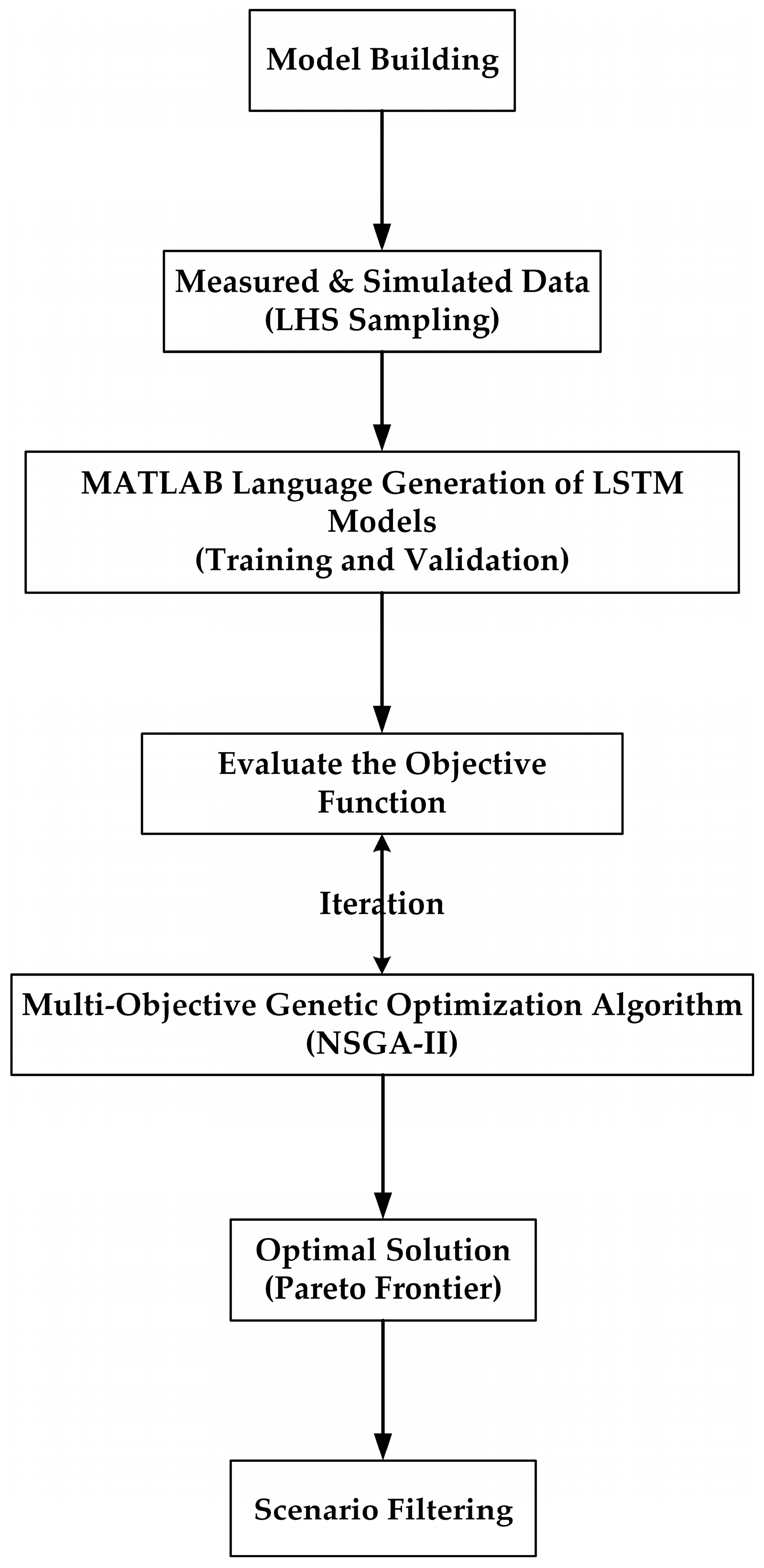
For this investigation, the LHS technique generates a representative dataset of simulation scenarios, which will be essential for training and assessing the performance of the LSTM model. After the LSTM model is trained, a multi-objective GA framework is adopted for assessing various prospective solutions. Hence, Pareto-optimal solutions that are not dominated can be discovered, which are subsequently evaluated through a selection method integrating various criteria. Figure 4 provides a detailed representation of the enhanced framework.

2.5.1. Latin Hypercube Sampling

LHS is conducted to decrease the training database scale in the premise of maintaining a satisfactory representation of samples. According to prior research, it can effectively and accurately sample the search space in the case that the number of samples at least doubles that of the variables and their respective ranges [53].

2.5.2. Long Short-Term Memory Network for Predicting

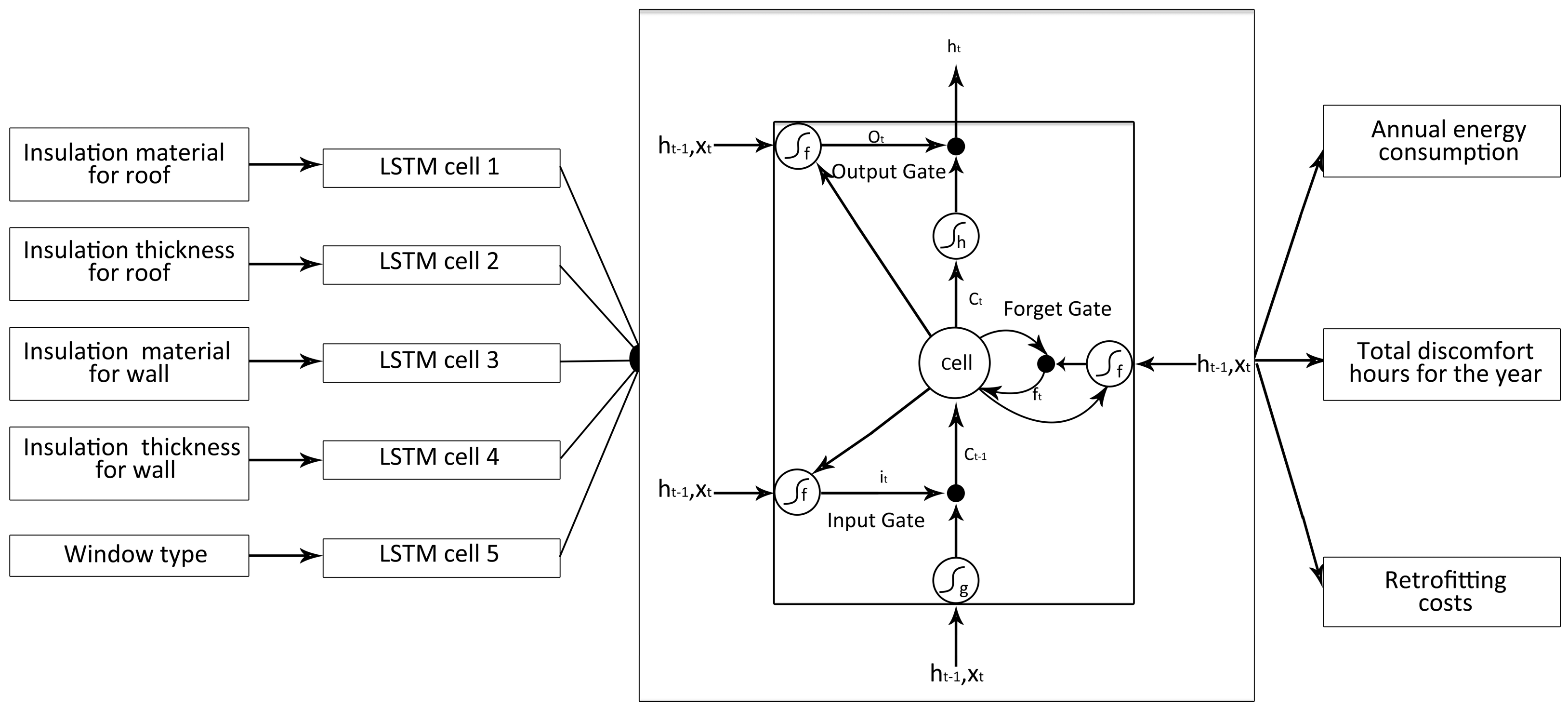
An LSTM network is adopted as the surrogate model to predict annual energy consumption, annual discomfort hours, and retrofit cost. The model takes five design variables as inputs—roof insulation type and thickness, wall insulation type and thickness, and window type—and simultaneously outputs the three objectives through a shared hidden-state representation. It should be noted that the five design variables serve as static inputs and the three performance indicators are scalar outputs; accordingly, LSTM does not exploit sequential input data in the conventional sense. Its adoption is instead motivated by three properties discussed below.
LSTM Structure and Function:
Input Gate: Determines which values from the input data are used to update the memory state.
i ( t ) = s i g m o i d ( W X I X ( t ) + W H I h ( t 1 ) + B I )
Forget Gate: Decides what portion of the existing memory to retain or discard.
f ( t ) = s i g m o i d ( W X F X ( t ) + W H F h ( t 1 ) + B F )
Cell State Update: Modulates the memory cell’s state by blending the Input and Forget Gate outputs with the new candidate values.
g ( t ) = t a n h ( W X G X ( t ) + W H G h ( t 1 ) + B G )
c ( t ) = f ( t ) c ( t 1 ) + i ( t ) g ( t )
Output Gate: Controls the output from the memory cell to the next layer or time step.
o ( t ) = s i g m o i d ( W X O X ( t ) + W H O h ( t 1 ) + B o )
h ( t ) = o ( t ) t a n h ( c ( t ) )
The LSTM model was implemented in MATLAB(R2020b (v9.9): 2020.9). A total of 200 LHS-generated samples were used for training, and 40 samples were reserved for testing and validation. Hyperparameters—including the number of neurons, LSTM layers, and learning rate—were optimized iteratively. Figure 5 presents the network structure and optimization process.
The choice of LSTM over simpler alternatives is justified on three grounds. First, the gating mechanism introduces an inductive bias toward capturing nonlinear, high-order interactions among input variables, which is advantageous when the response surface exhibits complex curvature across a wide LHS-sampled design space. Second, LSTM’s shared hidden-state representation enables internally consistent multi-output predictions for the three interrelated objectives, whereas ensemble tree methods typically require separate models per output, potentially introducing cross-objective inconsistencies. Third, the Forget Gate mechanism provides implicit regularization against overfitting under the moderate training set size (N = 200), which is a practical concern in surrogate-assisted optimization where simulation data are expensive to generate.
To validate this choice, a systematic benchmark comparison was conducted against three widely used algorithms: Artificial Neural Network (ANN), Random Forest (RF), and eXtreme Gradient Boosting (XGBoost). All models were trained and tested on the same dataset under identical input–output configurations.
ANN: A feedforward network with two hidden layers (64 and 32 neurons), ReLU activation, Adam optimizer (learning rate = 0.001), batch normalization, and early stopping (patience = 50 epochs). Three separate models were trained for each output.
RF: An ensemble of 500 trees with maximum depth of 15, minimum samples per leaf of 2, and bootstrap sampling. Three independent models were trained for each output.
XGBoost: 300 gradient-boosted trees with maximum depth of 6, learning rate of 0.05, L2 regularization (λ = 1.0), and column/row subsampling (0.8). Three separate models were trained for each output.
All models were evaluated using R2, RMSE, MAE, and MAPE. Hyperparameters were tuned via 5-fold cross-validation on the training set. Model performance was assessed on both training and test sets, with particular attention to the generalization gap (ΔR2 = R2_train − R2_test) as an indicator of overfitting tendency.

2.5.3. Multi-Objective Optimization GA

NSGA-II is primarily utilized for tasks involving multiple objectives in optimization. This method allows for the selection of multiple optimization goals, which aids in creating a diverse Pareto front that features non-dominated solutions. The structure of NSGA-II includes several key considerations:
  • Encoding
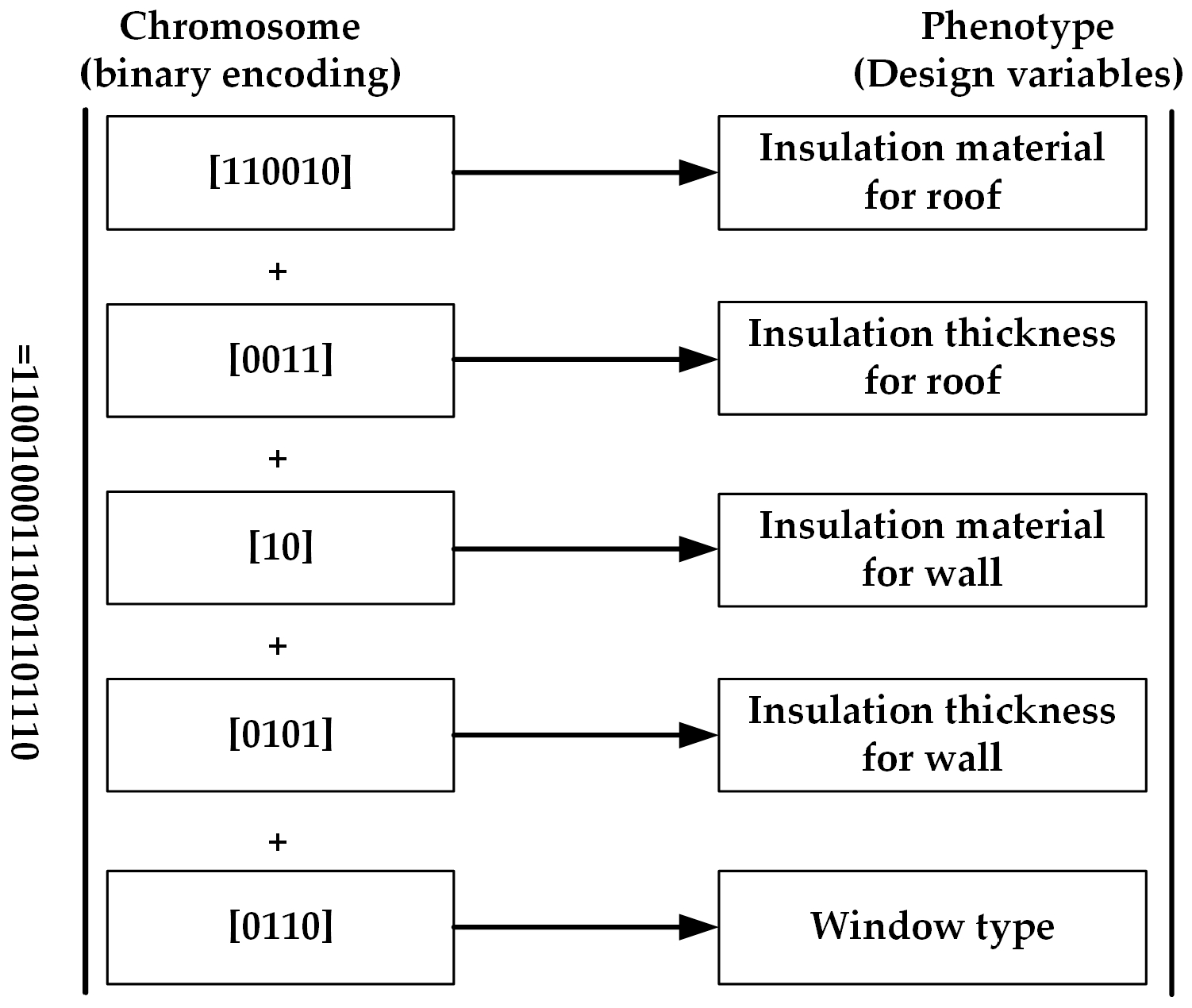
Within the scope of this GA model, a unique entity is defined by a set of combinations of technologies aimed at energy-efficient retrofitting, represented by a chromosome that utilizes binary digits for encoding. Each chromosome specifically includes 200 genes, and each gene symbolizes a unique decision-making variable (Figure 6).
2.
Selection Operator
When the number of individuals in the Pareto solution set is fewer than the intended population size, it is essential to bring in more individuals. For those individuals beyond the solution set, their fitness values are evaluated based on Equation (23). Subsequently, a selection method, ‘a roulette wheel’, is utilized, confirming the likelihood of each chromosome being chosen based on its comparative fitness level. The parental set is constituted by merging the chosen candidates with those already included in the Pareto front. To facilitate the efficient creation of novel individuals during the crossover process, a method based on correlation is then employed.
F ( x ) = 1 1 + x y 2
  • In this formula, let x denote a member of the population that is not part of the Pareto optimal set, while y signifies the nearest optimal individual that is not dominated, in relation to x. The term ‖x-y‖2 quantifies the Euclidean distance separating these two individuals.
3.
Crossover Operator:
A single crossover point was conducted on each segment of the chromosome, with a set probability of crossover at 0.9.
4.
Mutation Operator:
A mutation operator characterized by multi-uniformity is utilized, with a mutation likelihood established at 0.05.
5.
Elitism Preservation Strategy:
The offspring surviving through genetic processes can not always compete with the existing parent population. Instead, a strategy focused on preserving elite individuals is employed, enabling the new generation to face off against the best candidates from the previous generation.
6.
Termination Condition:
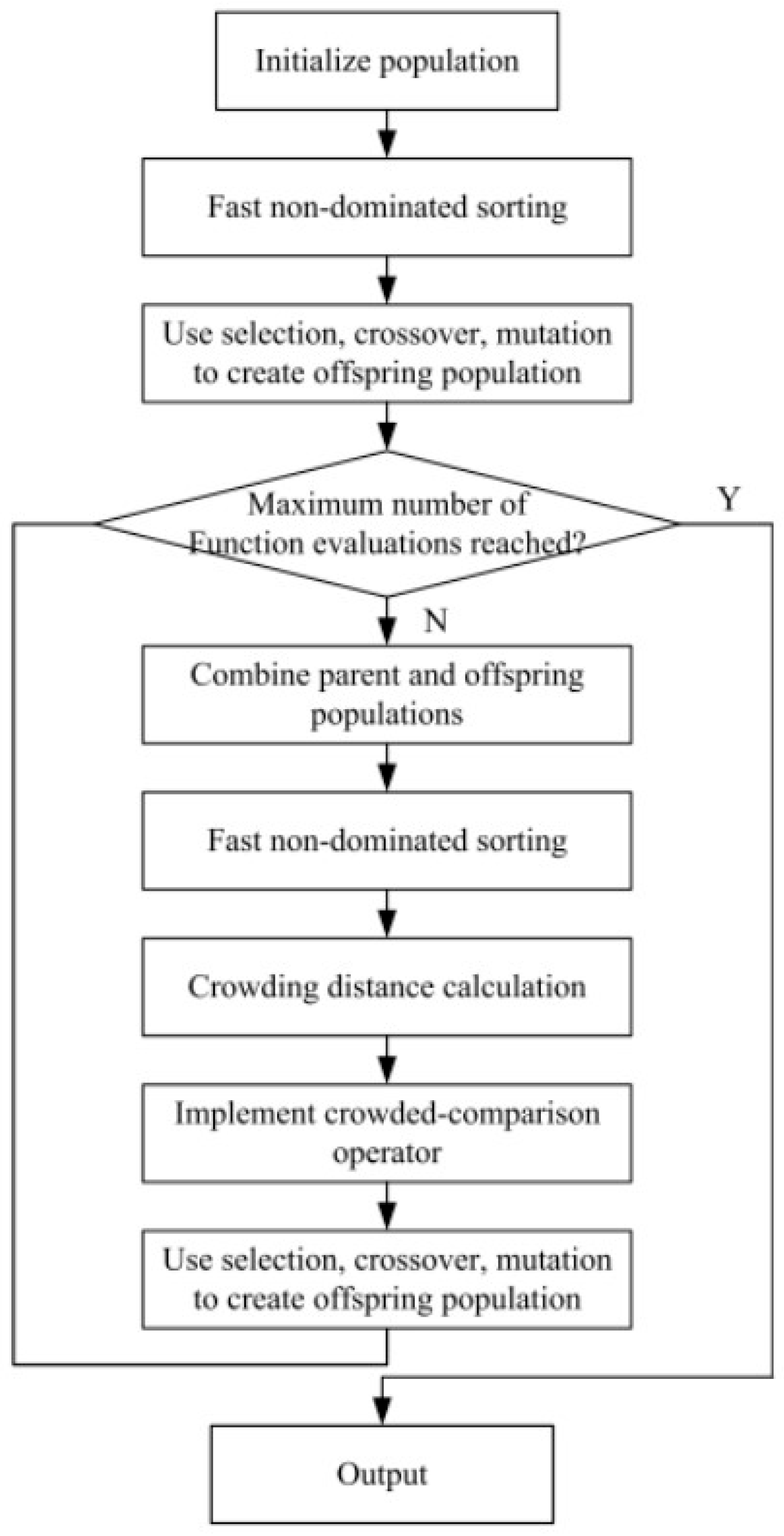
The stopping criterion is defined as a cap of 200 generations. The optimization process aims to simultaneously decrease building energy use and cut down on renovation expenses, while simultaneously improving the comfort of indoor thermal conditions. The multi-objective NSGA-II method is adopted for dealing with the inherent tensions and discrepancies among these goals, which determines the most advantageous combinations of energy-efficient retrofitting methods. The size of the Pareto front solution set, known as ‘pop’, is designated as 200. Figure 7 illustrates the process flow of the NSGA-II methodology [54].

2.5.4. Weighted Mahalanobis Distance-Based TOPSIS Decision Model

NSGA-II was employed for ascertaining the set of Pareto-optimal solutions for various existing energy efficiency retrofitting techniques in buildings. It is crucial to recognize that an individual optimal option may not necessarily be better than other favorable choices, leading to difficulties for designers in pinpointing the most effective combination directly. To tackle this challenge, a popular ranking technique, TOPSIS, has surfaced, focusing on comparing various options based on their closeness to an idealized reference point. This method is often utilized in analyses involving multiple objectives.
Conventional applications of TOPSIS often depend on the computation of Euclidean distance, which neglects the interdependencies between various decision-making factors. This limitation renders the logical assessment of complex, multidimensional criteria more challenging. Consequently, based on the findings of Pareto-optimal alternatives, this research introduces an advanced TOPSIS decision-making framework that utilizes a weighted Mahalanobis distance for determining the best solutions. The Mahalanobis distance accounts for the covariance structure between the objectives. By incorporating the inverse of the covariance matrix, it measures the distance within the actual distribution of the data, providing a more accurate and statistically robust ranking of solutions that reflect the inherent trade-offs among the correlated objectives. This methodological enhancement ensures the final selection is optimal within the true multidimensional relationship of the performance criteria.
To normalize the decision matrix X = (xij)m×n:
R = ( r i j ) m × n ,   where   r i j = x i j i = 1 m   x i j   2
  • To confirm the ideal solutions, S+ = {S1+, S2+,⋯, Sn+}, and negative ideal solutions, S = {S1, S2,⋯, Sn}:
For cost-type indicators Cj:
S j + = m i n { r i j 1 i m } ; S j = m a x { r i j 1 i m }
For benefit-type indicators Cj:
S j + = m a x { r i j 1 i m } ; S j = m i n { r i j 1 i m }
Indicators of energy consumption, total discomfort hours, and retrofitting cost are categorized as cost-related metrics, and lower values are preferable.
When data vector ri = (ri1, ri2, ⋯, rin)T, S+ = {S1+, S2+, ⋯, Sn+}T and S = {S1, S2,⋯, Sn T for scenario Ai were obtained based on the mean μ = (μ1, μ2,⋯μn)T. The indicator covariance Σ was actually an n-dimensional matrix.
The Mahalanobis distances from solution Ai to the ideal solution (d(ri, S+)) and to the negative ideal solution (d(ri, S)) were:
d ( r i , S + ) = ( r i S + ) T Ω T Σ 1 Ω ( r i S + )
d ( r i , S ) = ( r i S ) T Ω T Σ 1 Ω ( r i S )
where:
Ω = diag w 1 , w 2 , , w n is the weight of indicator Cj, wj ( 0 , 1 ) , and wj = 1. Hence, it is allowed to calculate each solution’s relative closeness following the equation below:
C i * = d ( r i , S ) d ( r i , S ) + d ( r i , S + ) , i = 1,2 , , m
The value of ci* was taken into account to sort each solution, and the larger the value, the better the solution for Ai.
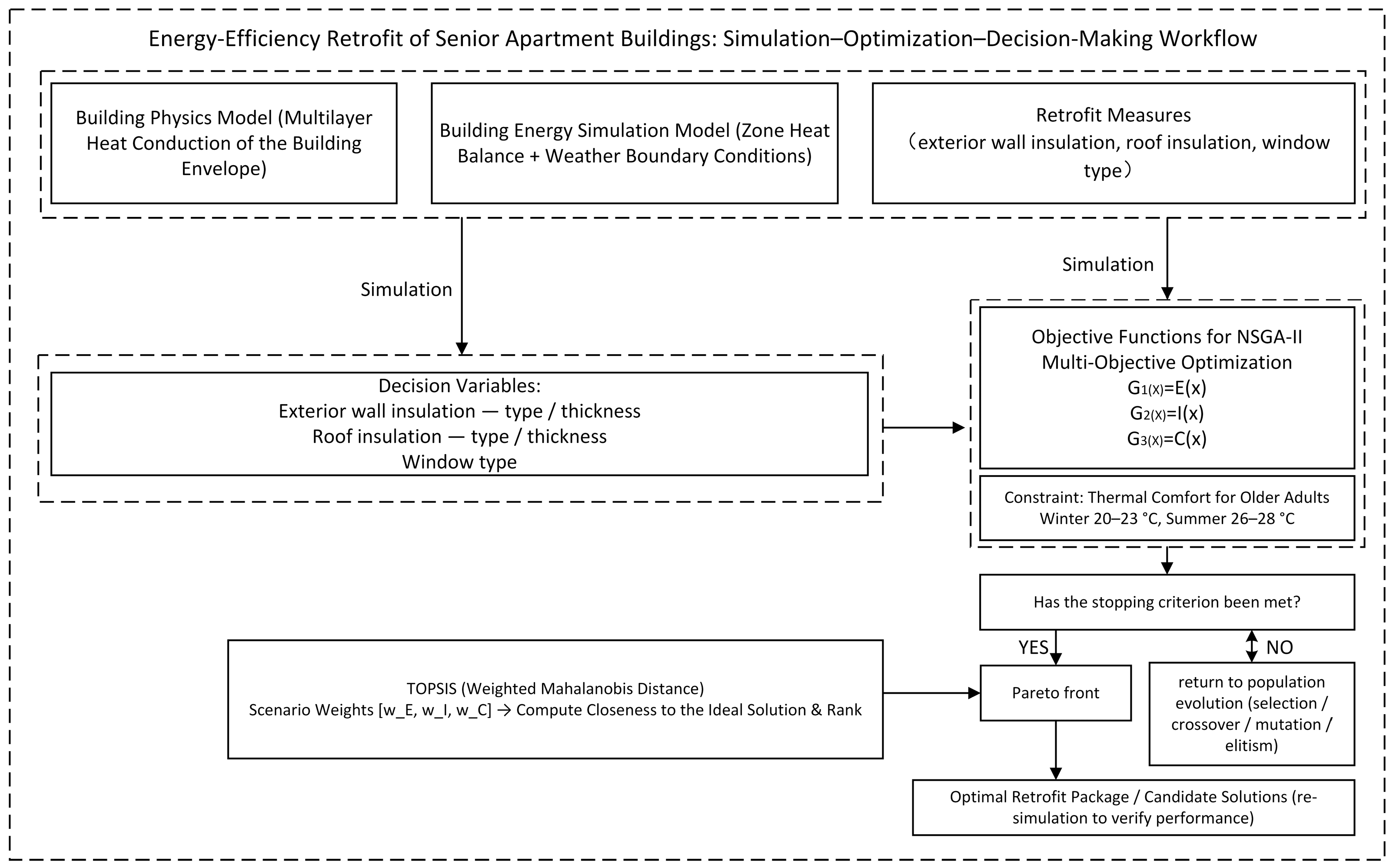
Figure 8 presents the Energy Efficiency Retrofit for Senior Apartment Buildings: A Simulation–Optimization–Decision-Making Workflow.

3. Results

3.1. Surrogate Model Validation, Benchmark Comparison and Regression Analysis

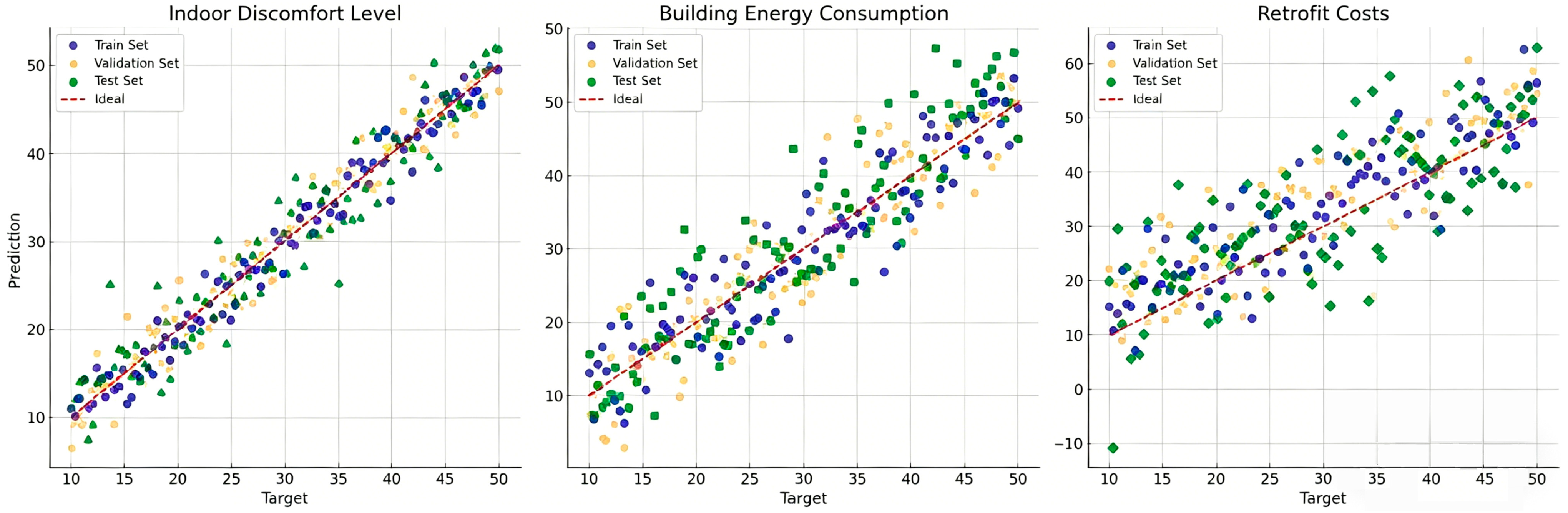
Figure 9 presents a preliminary visual check of LSTM predictions against targets for all three objectives, confirming acceptable alignment prior to detailed regression diagnostics.
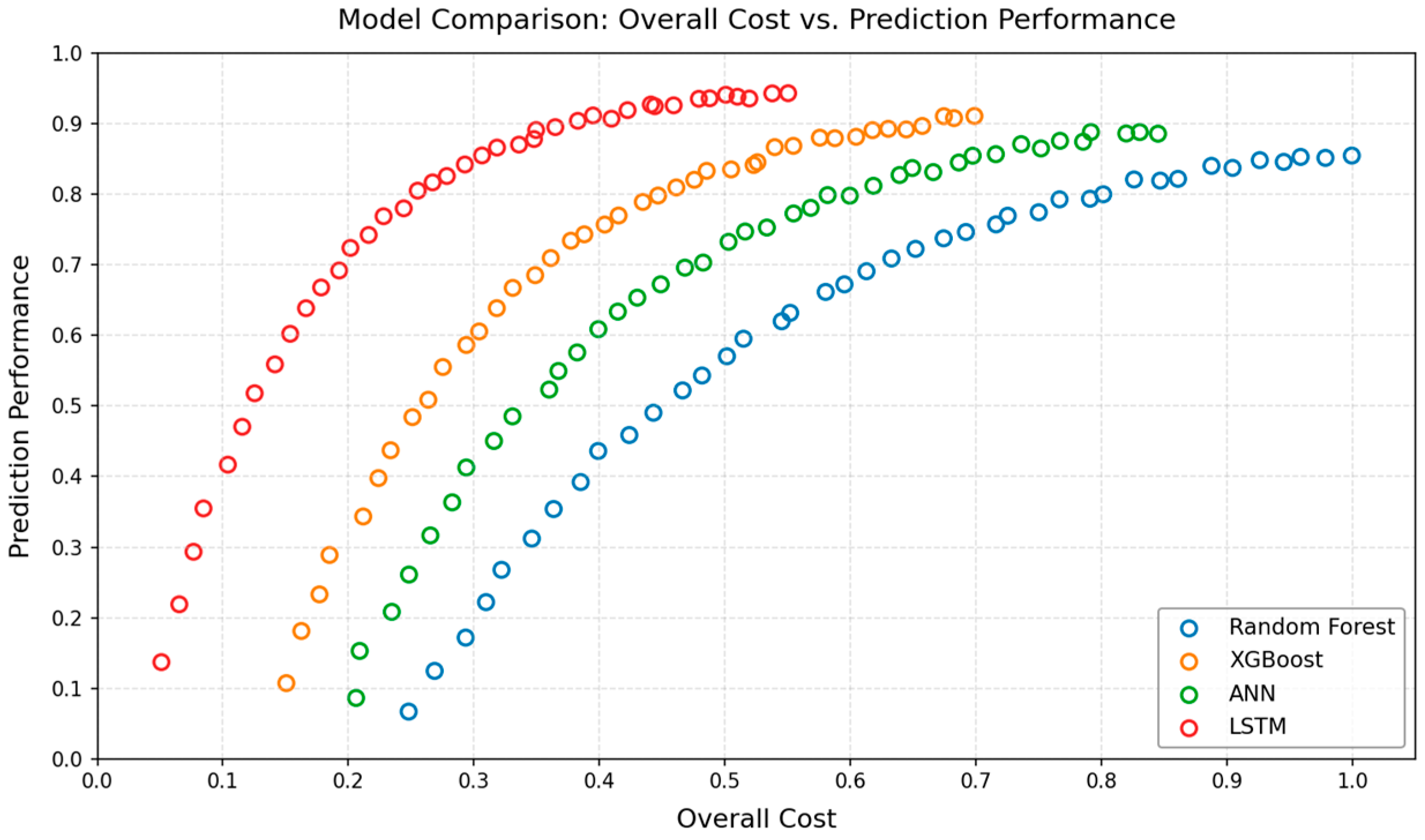
As further illustrated in Figure 10 (scatter plot), all four models exhibit a general trend of improving prediction performance with increasing computational cost; however, they differ markedly in convergence efficiency and performance ceiling. LSTM consistently achieves superior prediction performance at lower computational cost, demonstrating stronger efficiency in accuracy improvement and overall competitiveness. Notably, LSTM shows faster performance gains in the early region, attaining more significant improvement at a smaller cost—a characteristic attributable to its temporal feature learning capacity and nonlinear approximation capability. XGBoost ranks second overall, displaying relatively stable performance across the mid-range computational cost interval, confirming the competitiveness of gradient boosting methods in complex nonlinear problems, though its optimal performance ceiling remains below that of LSTM. ANN performs between XGBoost and RF, gradually approaching high-performance regions as computational cost increases, but with no clear advantage at low-cost stages. RF occupies the lowest performance region overall, requiring higher computational cost to achieve comparable prediction accuracy, indicating limited efficiency and constrained capacity for modeling high-dimensional complex relationships in this task.
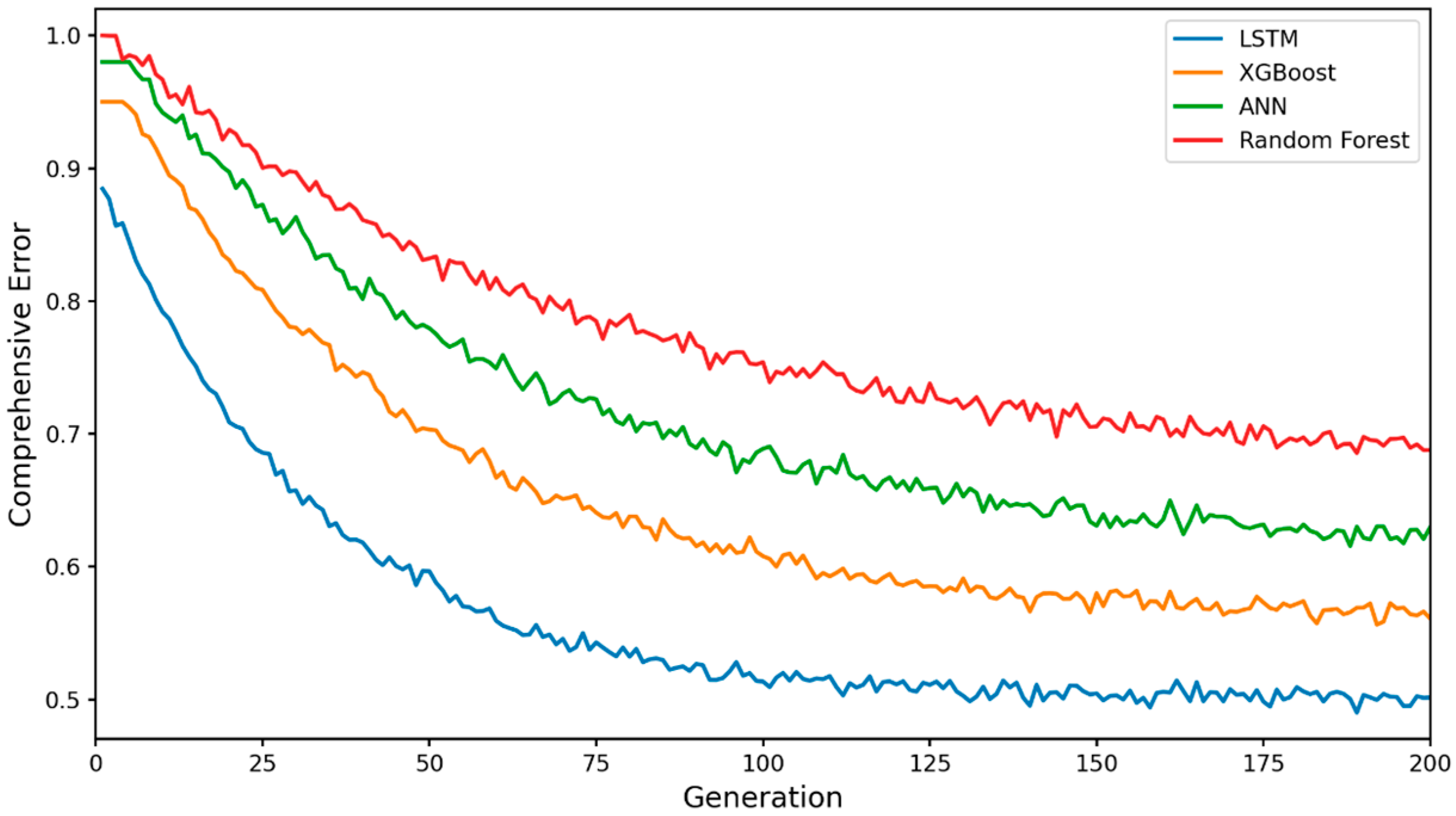
From the perspective of convergence behavior (Figure 11), the composite error of all four models decreases continuously with iterations, confirming progressive optimization. Nevertheless, the models differ substantially in convergence speed and final stable error level. LSTM exhibits the fastest error reduction and consistently maintains the lowest error throughout training, rapidly entering a stable region within fewer iterations—reflecting superior learning capacity for complex nonlinear relationships and temporal features. XGBoost ranks second, showing a clear descending error trend with rapid convergence in early iterations and gradual stabilization thereafter. ANN achieves moderate error reduction, outperforming RF but with a smaller overall decline. RF shows the highest error curve throughout, with the slowest convergence rate and the highest final stable error, confirming its relatively weaker overall performance in this task.
Based on these results, LSTM was selected as the surrogate model for the subsequent NSGA-II optimization. The mechanistic interpretation of its superior generalization is discussed in Section 4.1.
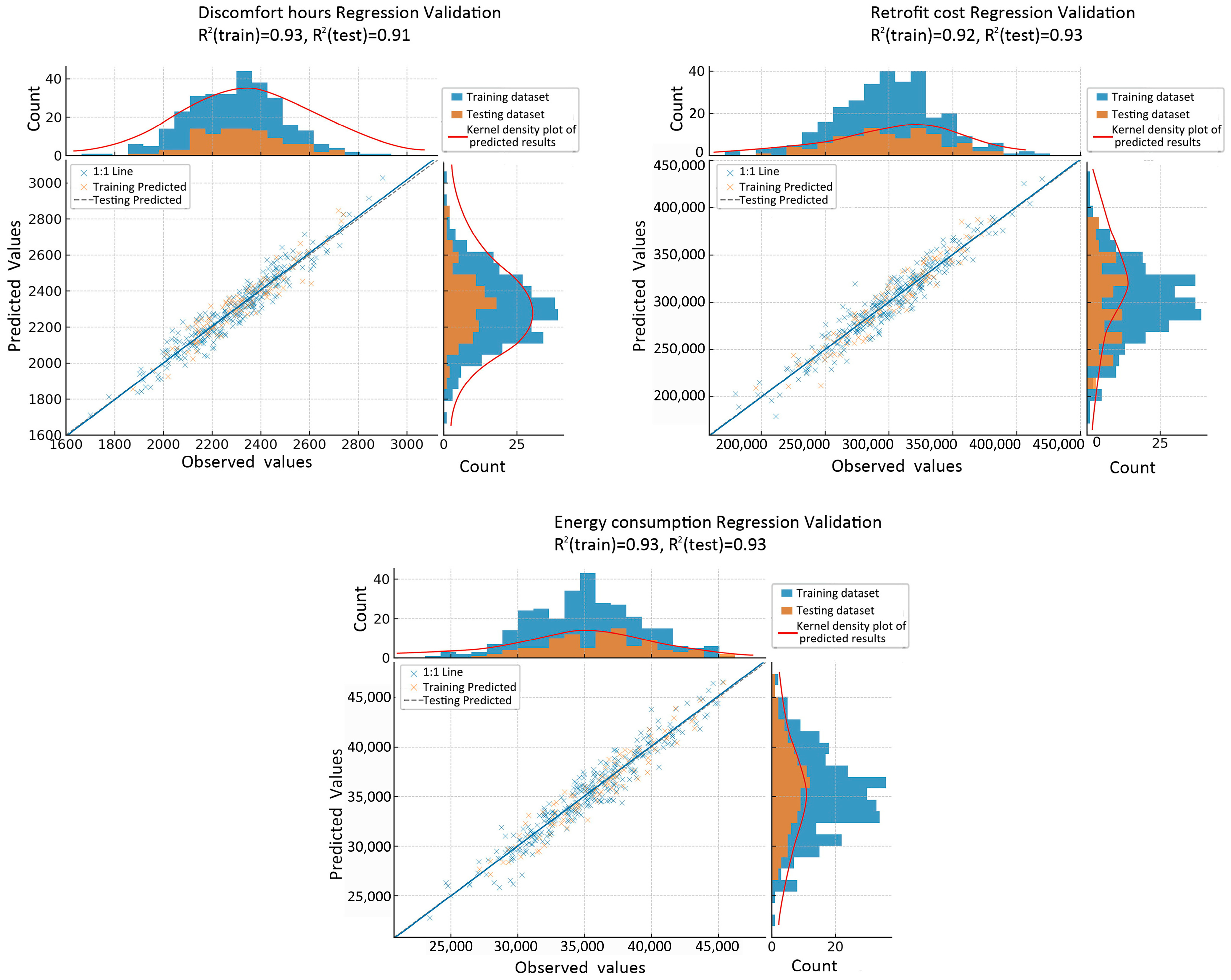
Figure 12 illustrates the regression validation results for the three performance objectives. The histograms display sample distributions and prediction deviation patterns. The model demonstrates strong predictive accuracy across all objectives. For energy consumption, R2(train) = R2(test) = 0.93; for retrofit cost, R2(train) = 0.92 and R2(test) = 0.93; for discomfort hours, R2(train) = 0.93 and R2(test) = 0.91. The training–testing R2 gap remains below 0.02, confirming robust generalization.
The energy consumption model exhibits the highest stability, accurately capturing the sensitivity of energy performance to envelope modifications. The discomfort hours model shows slight variations under extreme thermal conditions, suggesting potential for refinement. The retrofit cost model achieves near-perfect agreement with observed values, demonstrating high precision in economic prediction.

3.2. Multi-Objective Optimization Results

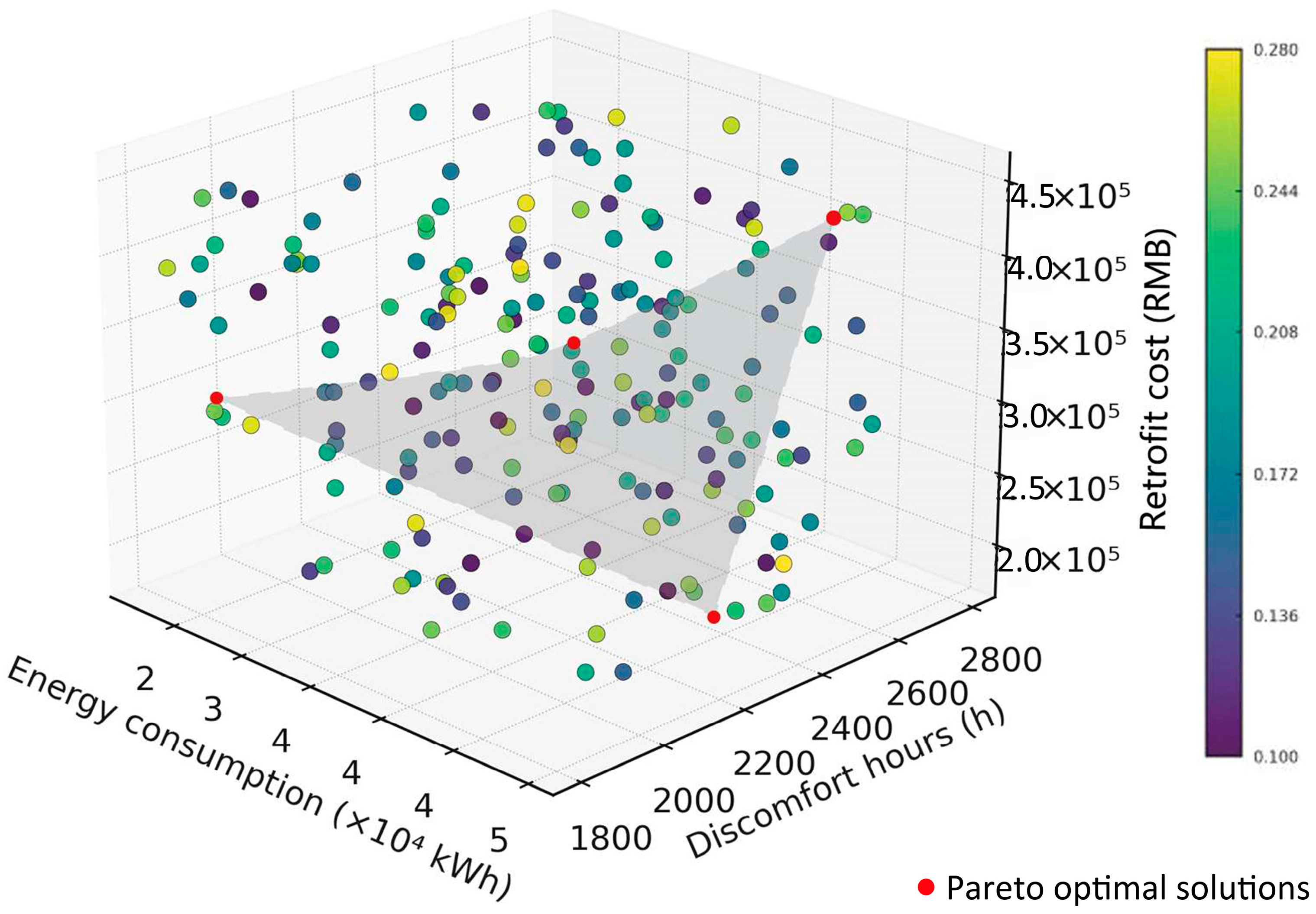
The objectives included the simultaneous optimization of the three indicators. The findings are illustrated in Figure 13 and Table 4. Utilizing the NSGA-II algorithm for optimization processes revealed an inverse relationship among each objective function specific to each solution. In particular, as the cost-related objective function within the set of Pareto-optimal solutions neared its lowest point, the remaining objective functions showed a corresponding rise in their values.

3.3. The Comprehensive Optimal Selection for Energy-Saving Technology Mix

This study proposes more specific renovation goals tailored to the design standards for residential buildings intended for the elderly population. The findings reflect optimal solutions achieved through an MOOM that considers indoor thermal comfort, energy consumption, and renovation costs for elderly residents.
According to Table 5, the suggested ideal measures include the fitting of PVC Low-E double-glazed windows (5 + 6A + 5) and the application of glass fiber insulation with a thickness of 65.25 mm for the roofing, with 65.39 mm of insulation material, and incorporating XPS insulation measuring 65.39 mm designated for the outer walls. Implementing these methods in renovation initiatives is anticipated to lead to a decrease in energy usage, lower the amount of discomfort hours experienced, and simultaneously cut down on the costs associated with retrofitting.
As presented in Table 5, the most effective insulation material for the roof is glass fiber, which requires an additional thickness of 65.25 mm. For the external walls, the optimal choice is XPS, necessitating an increased thickness of 65.39 mm. In terms of external windows, the ideal option is PVC Low-E double-glazed windows with a configuration of (5 + 6A + 5). The optimization of the above-mentioned three objectives is effectively achieved through the implementation of these strategies for retrofitting existing structures.

3.4. Comparison of Before and After Renovation

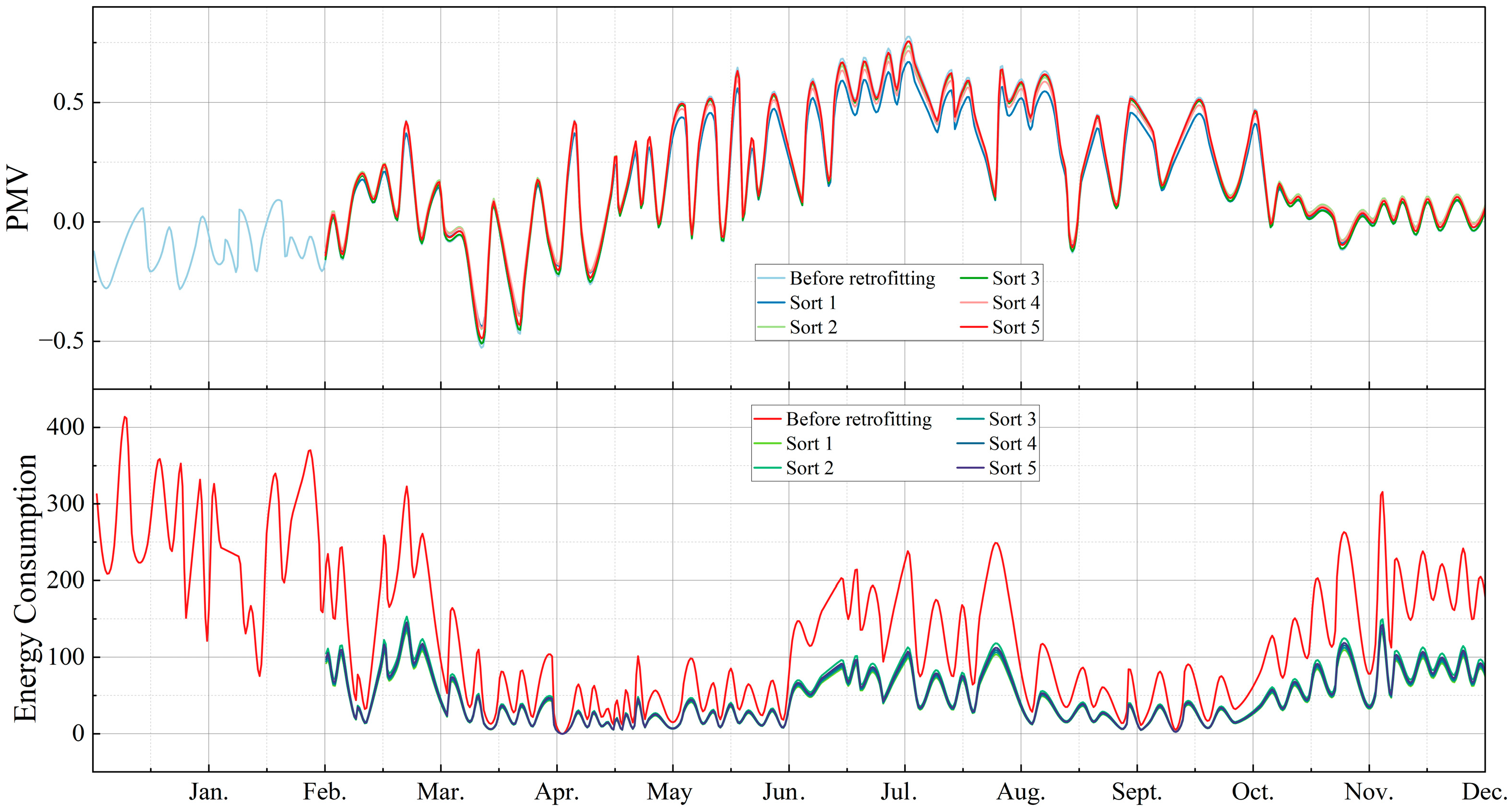
The optimal combination selected in Section 3.3 was input into Design-Builder for simulation to compare the changes in indoor energy consumption and PMV before and after the retrofit. As presented in Figure 14, comparing Sort 1 with the pre-retrofit data, the annual energy consumption decreased significantly from 40,867.37 kWh to 21,625.51 kWh, and the annual discomfort hours dropped from 2454 °C·h to 923 °C·h; the total renovation cost is 29,474.29 CNY.

3.5. Feature Importance Analysis Using SHAP

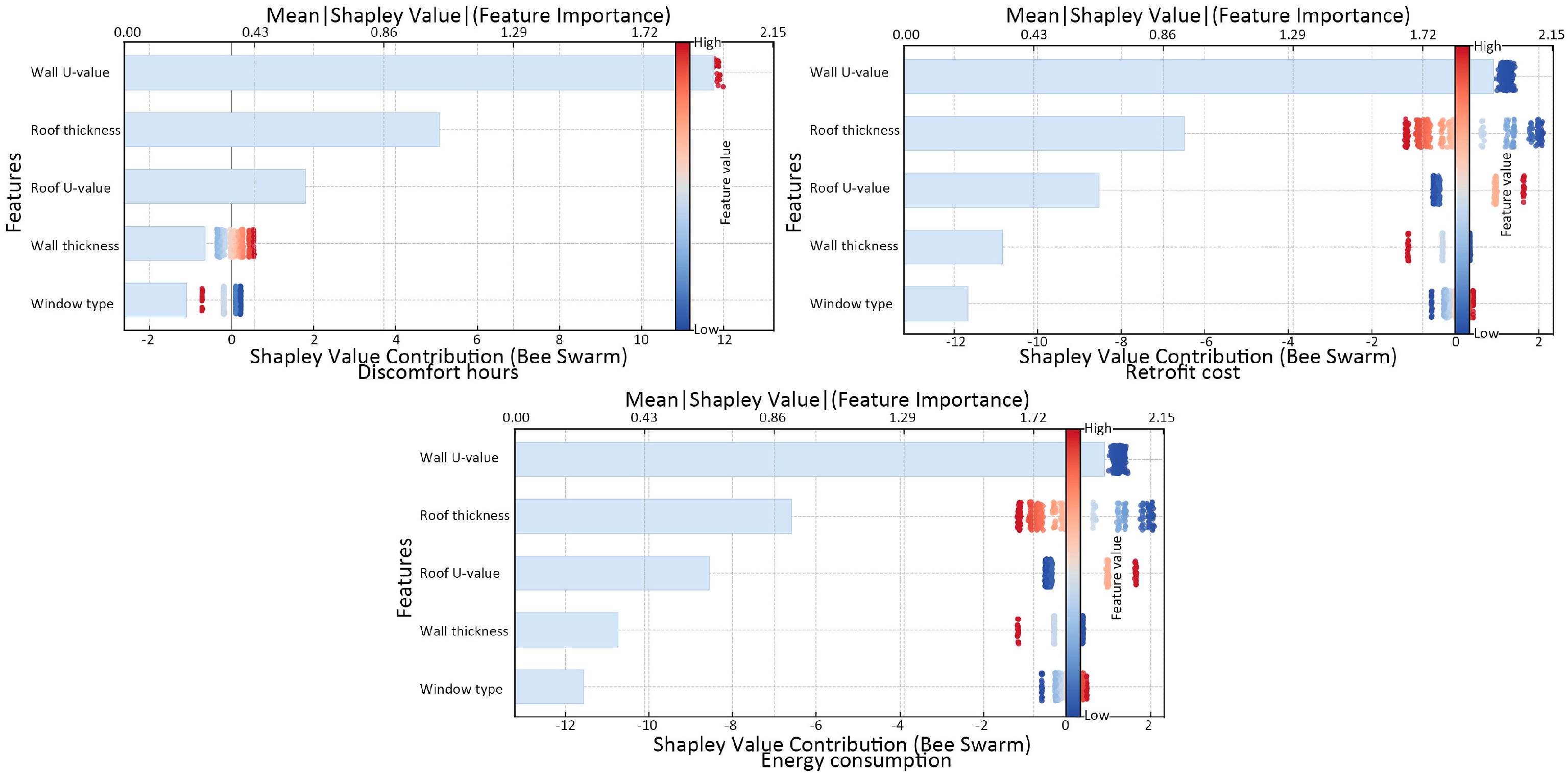
Figure 15 presents SHAP (SHapley Additive exPlanations) analysis results identifying key parameters influencing each performance objective. Energy consumption: Wall U-value and roof thickness are the dominant factors. High U-values (poor insulation) generate positive SHAP contributions, increasing energy consumption, while greater roof thickness produces negative SHAP values, reducing heat loss. Window type shows moderate influence, with high-performance glazing reducing energy demand.
Discomfort hours: Roof U-value and roof thickness are the most critical parameters, followed by wall U-value. High U-values correspond to positive SHAP contributions, indicating that inadequate envelope thermal stability amplifies indoor temperature fluctuations and extends discomfort duration. Increased roof thickness significantly mitigates thermal discomfort, demonstrating the critical role of roof thermal performance in achieving acceptable indoor comfort conditions.
Retrofit cost: Wall thickness, roof thickness, and window type dominate cost implications. The SHAP distribution reveals that increased material thickness or upgraded window specifications substantially elevate costs, while thermal parameter variations (U-values) have limited economic impact. This indicates that retrofit costs are primarily governed by material quantities and component specifications rather than thermal performance optimization alone.

3.6. Whole-Life Carbon and Economic Assessment

To evaluate the whole-life carbon impact of the envelope retrofit, this study adopts the building-level system boundary and accounting framework of EN 15978 [48]—covering Modules A1–A3 (product stage) and B6 (operational energy use)—and follows the LCA principles of ISO 14040/14044 [55,56,57]. The embodied carbon of materials is computed as:
E C = i ( V i × E F i ) , V i = A i × t i
where:
  • Ai is the surface area of the component i;
  • ti is its thickness;
  • EFi is the material’s embodied carbon factor for modules A1A3; modules A4A5 (transport to site and construction) are excluded due to data limitations but are estimated to contribute less than 5% of total embodied carbon based on the literature benchmarks [58].
Using midpoint values from common EPDs/databases—glass fiber roof insulation: 18 kg CO2e·m−3; XPS wall insulation: 100 kg CO2e·m−3; Low-E double glazing: 113 kg CO2e·m−2—and the building geometry (roof 650 m2; net wall 840 m2; windows 210 m2), the midpoint embodied carbon total is approximately 29.99 t CO2e (range: 23.80–37.56 t), with glazing accounting for the largest share (23.73 t), followed by wall insulation (5.49 t) and roof insulation (0.76 t).
Operational-phase emission reductions are calculated following the GHG Protocol’s “activity data × emission factor” principle [59]:
Δ C O 2 , o p = Δ E × E F e l
Using annual electricity savings of ΔE = 19,241.86 kWh and the Beijing grid baseline emission factor
E F e l = 0.492   k g   C O 2 e / k W h
representing an annual emissions reduction of 9.47 t CO2e.
Accordingly, the carbon payback period (a commonly used interpretive metric in RICS WLCA) [59] is defined as
T C = E C Δ C O 2 , o p
This yields a median T_C ≈ 3.17 years (uncertainty range: 2.51–3.97 years). This short carbon payback period—well within the expected 25–50-year service life of insulation materials—confirms the environmental viability of the proposed retrofit.
From an economic perspective, based on the total retrofit cost of 161,387 CNY and annual electricity savings of 10,583 CNY (calculated using the average tiered residential tariff, Table 6), the simple payback period is 15.3 years without subsidies, reducing to 10.7 years with 30% capital subsidy and 7.6 years with 50% subsidy (Table 7). The contrast between the short carbon payback (3.17 years) and the long economic payback (15.3 years) reflects a well-recognized challenge in Chinese residential retrofit economics: Beijing’s relatively low electricity tariffs limit the monetary value of energy savings despite their substantial magnitude in physical terms. This finding underscores the necessity of policy intervention—through capital subsidies, green financing, or performance-based incentives—to bridge the gap between environmental benefit and economic attractiveness for elderly housing retrofits.
It is acknowledged that both the embodied carbon factors and energy prices used in these calculations are subject to fluctuation due to market dynamics, technological changes, and policy shifts. This study uses static midpoint values to establish a consistent baseline for comparison. A sensitivity analysis exploring the impact of parameter variations is recommended for future work.

4. Discussion

4.1. Comparison with Existing Studies

The optimized envelope retrofit achieved a 47.1% reduction in annual energy consumption (from 40,867 kWh to 21,626 kWh) and a 62.4% reduction in annual discomfort hours (from 2454 °C·h to 923 °C·h). These results are consistent with recent multi-objective retrofit studies. Guo et al. [42] reported a 41% energy reduction using an EnergyPlus–Python–NSGA-III workflow for temporary buildings; the higher savings here are attributable to the greater pre-retrofit energy intensity of the baseline building—a decades-old senior apartment building with uninsulated brick walls and single-glazed windows. Shi et al. [60] achieved comparable savings in educational buildings in Beijing, supporting the regional applicability of such approaches.
Unlike prior studies that adopted generic residential comfort criteria, the present framework applies the stricter thresholds specified in the Chinese design standard for elderly housing [15] (winter 20–23 °C; summer 26–28 °C). This age-sensitive parameterization partly explains the substantial reduction in discomfort hours.
Regarding optimization methodology, Wu et al. [43] integrated NSGA-II with BIM-based simulation, and Bre et al. [61] coupled NSGA-II with ANN metamodels for residential building optimization. The present study follows a similar metamodel-assisted evolutionary strategy but adopts LSTM as the surrogate. As reported in Section 3.1, LSTM achieved the highest test-set R2 and the smallest generalization gap (ΔR2 = 0.016) among the four models compared, with R2 values of 0.93 for energy consumption and retrofit cost and 0.91 for discomfort hours—comparable to or exceeding those reported by Bre,F et al. [62] for ANN surrogates.
LSTM here functions as a static surrogate mapping five design variables to three scalar outputs rather than processing sequential data. Its advantage lies in multi-output consistency through shared hidden-state representations and implicit regularization via the gating mechanism, which is particularly beneficial under moderate sample sizes (N = 200). The ensemble tree methods (RF, XGBoost) exhibited notably larger generalization gaps (ΔR2 = 0.073 and 0.056), consistent with Wu et al. [43] and Saeki et al. [44], who observed that neural network surrogates provide smoother response surfaces more suitable for evolutionary search. Future work incorporating time-resolved simulation outputs (e.g., hourly energy profiles) could more fully leverage LSTM’s sequence-learning capabilities.

4.2. Engineering Interpretation of Optimal Retrofit Solutions

The TOPSIS-based selection identified the optimal envelope retrofit package as: PVC Low-E double-glazed windows (5 + 6A + 5), glass fiber roof insulation (65.25 mm), and XPS external wall insulation (65.39 mm). These results warrant engineering interpretation from both a thermal performance and cost-effectiveness perspective.
The convergence of wall insulation to XPS at approximately 65 mm reflects the material’s favorable balance between thermal conductivity (typically 0.028–0.032 W/(m·K)), mechanical durability, and cost per unit thermal resistance. XPS outperformed alternatives such as EPS and rubber-expanded board in the Pareto analysis because its lower thermal conductivity achieves equivalent insulation performance at reduced thickness, thereby limiting material costs and construction complexity. The SHAP analysis (Figure 13) confirmed that wall U-value is the dominant driver of energy consumption, and increasing wall insulation thickness beyond approximately 65–70 mm yields diminishing marginal returns—a finding consistent with the well-established principle that the thermal resistance of insulation exhibits a diminishing marginal benefit beyond a certain thickness threshold, where additional material contributes proportionally less to heat loss reduction.
For the roof component, glass fiber insulation at 65.25 mm was preferred over XPS and rubber-expanded board alternatives. This selection is driven by two factors: glass fiber offers a competitive thermal conductivity (approximately 0.035–0.040 W/(m·K)) at substantially lower material cost per square meter compared with XPS, and the SHAP analysis revealed that roof thickness is the second most influential parameter for both energy consumption and discomfort hours. Since the roof of this three-story building represents a large exposed area receiving direct solar radiation, its thermal performance disproportionately affects the top-floor units—a critical consideration in senior housing where top-floor rooms may be occupied by residents with limited mobility who cannot easily relocate.
The selection of PVC Low-E double-glazed windows (5 + 6A + 5) over triple-glazed alternatives reflects a cost-driven trade-off. While triple-glazed Low-E windows (e.g., UPVC 4 + 12A + 4 + 12A + 4) appeared in the second-ranked Pareto solution with thinner insulation requirements (roof: 43.54 mm; wall: 42.82 mm), the total system cost was higher. For the Beijing climate—where the winter is cold but heating degree days are moderate compared to severe cold regions—double-glazed Low-E windows provide sufficient thermal resistance, and the incremental improvement offered by triple glazing does not justify the additional expenditure within the multi-objective framework. This observation has practical implications for retrofit planning: in cold regions, investment in opaque envelope insulation (walls and roof) delivers greater energy savings per unit cost than upgrading from double to triple glazing.

4.3. Health Implications for Elderly Occupants

The 62.4% reduction in annual discomfort hours carries significant implications for elderly residents’ health and well-being. Studies have demonstrated that older adults exhibit diminished thermoregulatory capacity due to higher body-fat percentages, lower sweat rates, reduced metabolic rates, and lower maximal oxygen uptake [44]. In cold winter conditions, the neutral temperature in nursing homes has been found to be approximately 24.9 °C—about 2.3 °C higher than standard PMV-based predictions—indicating that conventional thermal design criteria may underestimate the heating needs of elderly populations.
The clinical relevance of envelope-driven thermal improvement is supported by epidemiological evidence linking indoor cold exposure to elevated blood pressure and increased incidence of acute heart failure in older adults [44]. In the pre-retrofit condition, the case study building failed to meet the elderly-specific winter indoor temperature standard (20–23 °C) for 31.2% of the monitored period (Figure 1). The optimized retrofit is expected to substantially reduce this non-compliance rate by lowering the building’s overall heat loss coefficient, thereby maintaining more stable indoor temperatures during both day and night.
It should be noted that the present study quantifies thermal improvement through discomfort hours rather than direct health outcome measurements. While the reduction from 2454 °C·h to 923 °C·h discomfort hours represents a meaningful proxy for reduced cold and heat exposure, future research should incorporate post-occupancy health monitoring data—such as blood pressure variability and sleep quality indicators—to empirically validate the expected health benefits.

4.4. Carbon Payback and Economic Feasibility

The whole-life carbon assessment, conducted following the EN 15978 framework and ISO 14040/14044 LCA principles, yielded a midpoint embodied carbon of approximately 29.99 t CO2e for the retrofit package. Against annual operational carbon savings of 9.47 t CO2e (based on annual electricity savings of 19,242 kWh and a grid emission factor of 0.492 kg CO2e/kWh), the carbon payback period is approximately 3.17 years (range: 2.51–3.97 years). This indicates that the retrofit achieves carbon neutrality within a very short timeframe relative to the expected service life of insulation materials (typically 25–50 years), confirming the environmental viability of the proposed solution.
From an economic perspective, based on the material-only retrofit cost of 161,387 CNY calculated per Equation (16) and annual electricity savings of 10,583 CNY (calculated using the average tiered residential tariff, Table 6), the simple payback period is 15.3 years without subsidies. With a 30% capital subsidy, this reduces to 10.7 years, and with a 50% subsidy, to 7.6 years (Table 7). These figures represent a lower-bound estimate, as construction-related costs—including labor, scaffolding, and surface preparation—are excluded from the present analysis. Based on comparable residential retrofit projects in China, such indirect costs typically amount to 100–150% of direct material expenditure, implying a more realistic total investment of approximately 322,000–403,000 CNY and a corresponding unsubsidized payback period in the range of 25–35 years. Even under the conservative scenario, the contrast between the short carbon payback period (3.17 years) and the extended economic payback (25–35 years when full construction costs are considered) reflects a well-recognized challenge in Chinese residential retrofit economics: Beijing’s relatively low electricity tariffs constrain the monetary value of energy savings despite their substantial magnitude in physical terms. With a 50% capital subsidy applied to the full construction cost estimate, the payback period is projected to fall within the 13–18-year range, which approaches the threshold considered acceptable for institutional elderly care investments. These findings underscore the continued necessity of policy intervention—through capital subsidies, green financing mechanisms, or performance-based incentive programs—to bridge the gap between environmental benefit and economic attractiveness in elderly housing retrofits. Furthermore, the monetized health co-benefits of improved indoor thermal conditions, such as reduced healthcare expenditure associated with cold-related cardiovascular events, are not captured in the present economic model but could substantially improve the financial case, as suggested by Grazieschi et al. [58].
These results support the recommendation that retrofit subsidy policies for elderly housing should adopt dual eligibility criteria encompassing both energy-saving performance (e.g., percentage reduction in energy consumption) and comfort improvement metrics (e.g., reduction in discomfort hours), rather than relying on energy savings alone. Such a framework would better align fiscal incentives with the holistic objectives of age-friendly building renovation.

4.5. Limitations and Future Work

While this study demonstrates a validated multi-objective optimization framework for retrofitting the senior apartment building, several limitations warrant acknowledgment.
Climate specificity: The optimization was conducted using Beijing’s typical meteorological year data. Direct application to other climate zones—particularly severe cold regions (e.g., Harbin), mild zones (e.g., Kunming), or hot–humid zones (e.g., Guangzhou)—requires recalibration with local climate data. Although the framework structure remains transferable, optimal insulation thicknesses, window performance levels, and retrofit priorities will vary across climatic contexts.
Building typology constraints: The case study represents a typical 1980s–1990s brick–concrete senior apartment building in Beijing. Application to other structural systems (e.g., steel-frame high-rises, traditional courtyard dwellings, or curtain-wall buildings) may require adjustments to boundary conditions, thermal bridge treatment assumptions, and heat transfer modeling parameters.
Decision variable scope: The current framework considers only passive envelope measures (wall insulation, roof insulation, and window replacement). Active systems (e.g., HVAC retrofits, renewable energy systems, smart controls) and additional passive strategies (e.g., external shading, green roofs, or phase-change materials) were excluded. Incorporating these variables would enable a more comprehensive life-cycle optimization.
Surrogate model architecture: It should be noted that the LSTM surrogate in this study receives static design variables and produces scalar outputs, and therefore does not exploit sequential data in the conventional sense. Its adoption was motivated by multi-output consistency and nonlinear approximation capacity rather than temporal feature extraction. Future studies incorporating time-resolved simulation targets (e.g., hourly energy profiles) could better leverage LSTM’s sequential modeling strengths.
The benchmark comparison employed a fixed 5-fold cross-validation protocol for hyperparameter tuning. More exhaustive search strategies (e.g., Bayesian optimization) may further improve baseline model performance. Gaussian Process Regression, which offers native uncertainty quantification, was excluded due to scalability constraints with the five-dimensional mixed input space; sparse GPR approximations or deep kernel learning approaches merit exploration in future work.
Economic modeling assumptions: The economic evaluation in Equation (16) and the payback analysis in Table 7 account only for direct material costs, calculated as the product of retrofit component area and unit material price. Construction-related expenses—including labor costs, scaffolding installation, removal of existing envelope components, and surface preparation—are excluded from both the optimization objective function and the whole-building cost estimate. Based on benchmarking against comparable envelope retrofit projects in northern China, such indirect costs are estimated to represent 100–150% of direct material expenditure, implying a realistic total investment of approximately 322,000–403,000 CNY for the optimal retrofit package identified in this study. Accordingly, the material-only simple payback period of 15.3 years reported in Table 7 should be interpreted as a lower-bound estimate; the corresponding full-cost payback period is projected to fall within the range of 25–35 years under current Beijing electricity tariff conditions. The optimization objective function retains material cost as the economic criterion because it provides a consistent, reproducible basis for relative comparison across Pareto solutions and avoids the regional and project-specific variability inherent in labor cost estimation. Future studies should adopt a more comprehensive life-cycle cost framework—incorporating both direct and indirect construction costs as well as maintenance expenditure over the service life—to improve the absolute accuracy of economic feasibility assessments. Future studies should adopt a more comprehensive life-cycle cost framework to enhance economic realism.
Economic uncertainty: Retrofit costs are based on 2024–2025 Beijing market prices. Material price volatility, regional labor cost variations, and scale effects in large projects may influence economic optimization outcomes. Cost parameters should be updated before real-world implementation.
Occupant behavior assumptions: The model assumes standardized occupant behavior patterns derived from Chinese residential building surveys. Variations in elderly residents’ heating and cooling preferences, ventilation habits, and occupancy schedules may cause deviations between simulated and actual energy performance.
Data requirements: Successful application of this framework requires: (a) reliable building geometry and construction data; (b) local typical meteorological year files; (c) validated material thermal property databases; and (d) up-to-date regional cost data. Incomplete datasets may reduce model reliability.
Recommended applicability scope: The framework is directly applicable to brick–concrete senior apartments constructed between 1970 and 2000 in China’s cold region, subject to recalibration using local climate and cost parameters. Extension to other contexts should be accompanied by sensitivity analysis and local validation.

5. Conclusions

This study proposed and validated a multi-objective optimization framework combining LHS, LSTM-based surrogate modeling, NSGA-II, and TOPSIS for energy-efficient retrofitting of aging residential buildings in Beijing, China. The main conclusions are as follows:
(a)
The LSTM surrogate model demonstrated high predictive reliability in approximating physics-based simulation outputs, substantially reducing data acquisition and computational time.
(b)
NSGA-II integrated with the LSTM surrogate successfully identified Pareto-optimal retrofit configurations, enabling systematic exploration of multi-objective synergies across a broad parameter space.
(c)
The TOPSIS method incorporating weighted Mahalanobis distance provided a robust mechanism for selecting the most advantageous solution from the Pareto front.
(d)
The optimal retrofit combination—PVC Low-E double-glazed windows (5 + 6A + 5), glass fiber roof insulation (65.25 mm), and XPS external wall insulation (65.39 mm)—achieved the most effective balance between thermal comfort, energy efficiency, and renovation cost.
(e)
Future work should extend this framework to multiple building typologies and climate zones, and incorporate occupant behavior modeling for more robust predictions.

Author Contributions

Conceptualization, L.F.; methodology, L.F. and M.L.; software, L.F.; validation, L.F.; formal analysis, L.F. and M.L.; investigation, L.F. and M.L.; resources, L.F. and Y.S.; data curation, L.F.; writing—original draft preparation, L.F.; writing—review and editing, L.F. and M.L.; visualization, L.F. and M.L.; supervision, Y.S. and L.F.; project administration, Y.S.; funding acquisition, L.F. and Y.S. All authors have read and agreed to the published version of the manuscript.

Funding

This research was funded by the National Natural Science Foundation of China (NSFC), grant number 52508002; the Beijing Natural Science Foundation (General Program), grant number 8242008; the Cultivation Project Funds for Beijing University of Civil Engineering and Architecture, grant number X25005; the Science and Technology Program of the Ministry of Housing and Urban-Rural Development, grant number 2021-K-014; and the Beijing Major Science and Technology Project, grant number Z251100007125009.

Data Availability Statement

Data are contained within the article.

Conflicts of Interest

The authors declare no conflicts of interest.

Abbreviations

The following abbreviations are used in this manuscript:
LSTMLong Short-Term Memory
NSGA-IINon-dominated Sorting Genetic Algorithm II
LHSLatin Hypercube Sampling
GAGenetic Algorithm
XPSExtruded Polystyrene
PVCPolyvinyl Chloride
SHAPSHapley Additive exPlanations
TOPSISTechnique for Order of Preference by Similarity to Ideal Solution
PMVPredicted Mean Vote
LCALife Cycle Assessment
ANNArtificial Neural Network
RFRandom Forest
MCDMMulti-Criteria Decision Making
AHPAnalytic Hierarchy Process

References

  1. Wang, Y.; Zhao, W.; Meng, W. Bilateral effect of aging population on consumption structure: Evidence from China. Front. Public Health 2022, 10, 941485. [Google Scholar] [CrossRef]
  2. National Bureau of Statistics of China. Statistical Communiqué of the People’s Republic of China on the 2025 National Economic and Social Development; National Bureau of Statistics: Beijing, China, 2026. Available online: https://www.stats.gov.cn/xxgk/jd/sjjd2020/202601/t20260119_1962338.html (accessed on 9 February 2026).
  3. Li, J.; Mohamed, M.F.; Yusoff, W.F.M. Personalized thermal satisfaction prediction for the elderly using machine learning with SHAP interpretation. Case Stud. Therm. Eng. 2026, 77, 107520. [Google Scholar] [CrossRef]
  4. Omidvar, A.; Kim, J. A novel theoretical model for predicting the individuals’ thermal sensations based on air temperature and biomarkers measured by wearable devices. Build. Environ. 2023, 232, 110050. [Google Scholar] [CrossRef]
  5. Yang, B.; Li, X.; Liu, Y.; Chen, L.; Guo, R.; Wang, F.; Yan, K. Comparison of models for predicting winter individual thermal comfort based on machine learning algorithms. Build. Environ. 2022, 215, 108970. [Google Scholar] [CrossRef]
  6. Hansen, A.; Williamson, T.; Pisaniello, D.; Bennetts, H.; van Hoof, J.; Martins, L.A.; Visvanathan, R.; Zuo, J.; Soebarto, V. The Thermal Environment of Housing and Its Implications for the Health of Older People in South Australia: A Mixed-Methods Study. Atmosphere 2022, 13, 96. [Google Scholar] [CrossRef]
  7. Su, Y.; Gong, A.; Wang, C.; Han, Y.; Gao, W. Exploring thermal comfort for older adults: A comparative study in Dalian City’s diverse living environments. Front. Archit. Res. 2025, 14, 812–824. [Google Scholar] [CrossRef]
  8. Shahzad, S.; Torres, S.G.; Rijal, H.B.; Nicol, F. Lack of thermal comfort is a matter of life and death: A systematic review for older people. Buildings 2025, 15, 1141. [Google Scholar] [CrossRef]
  9. Chen, T.; Ge, J.; Luo, X. Effects of indoor temperature and its fluctuation on blood pressure and its variability. Int. J. Biometeorol. 2023, 67, 1279–1290. [Google Scholar] [CrossRef] [PubMed]
  10. Gupta, P.; Brinza, E.; Khazanie, P.; Peterson, P.N.; Ho, P.M.; Kao, D.P. Forecasting heart failure: Seasonal alignment of heart failure outcomes in New York. ESC Heart Fail. 2024, 12, 819–831. [Google Scholar] [CrossRef] [PubMed]
  11. Li, Y.; Gu, Y.; Li, Z.; Zhang, X.; Gao, W.; Xiao, F. Study on the challenge and influence of the built thermal environment on elderly health in rural areas: Evidence from Shandong, China. Build. Simul. 2023, 16, 1345–1360. [Google Scholar] [CrossRef]
  12. Baeza-Romero, M.T.; Dudzinska, M.R.; Amouei Torkmahalleh, M.; Barros, N.; Coggins, A.M.; Ruzgar, D.G.; Kildsgaard, I.; Naseri, M.; Rong, L.; Saffell, J.; et al. A review of critical residential buildings parameters and activities when investigating indoor air quality and pollutants. Indoor Air 2022, 32, e13144. [Google Scholar] [CrossRef] [PubMed]
  13. Zhou, H.; Yu, W.; Wei, S.; Zhao, K.; Shan, H.; Zheng, S.; Guo, L.; Zhang, Y. Variability in thermal comfort and behavior of elderly individuals with different levels of frailty in residential buildings during winter. Build. Environ. 2025, 267, 112290. [Google Scholar] [CrossRef]
  14. DB11/891-2020; Design Standard for Energy Efficiency of Residential Buildings. Beijing Municipal Planning and Natural Resources Commission: Beijing, China, 2020. (In Chinese)
  15. GB 50340-2016; Building Design Code for the Elderly (BDCE). Ministry of Housing and Urban-Rural Development: Beijing, China, 2016. (In Chinese)
  16. Kumar, R.; Pamucar, D. A Comprehensive and Systematic Review of Multi-Criteria Decision-Making (MCDM) Methods to Solve Decision-Making Problems: Two Decades from 2004 to 2024. Spectr. Decis. Mak. Appl. 2025, 2, 177–196. [Google Scholar] [CrossRef]
  17. Li, Y.; He, X.; Martínez, L.; Zhang, J.; Wang, D.; Liu, X.A. Comparative analysis of three categories of multi-criteria decision-making methods. Expert Syst. Appl. 2024, 238, 121824. [Google Scholar] [CrossRef]
  18. Nennioğlu, A.K.; Abdülvahitoğlu, A.; Dal, A. Integrated analytic hierarchy process and multi-criteria decision-making approach: An Application for Unmanned Underwater Vehicle Control Method Selection. Ocean Eng. 2024, 312, 119261. [Google Scholar] [CrossRef]
  19. Gao, Z.; Zhang, X.; Wang, C.; Xing, J.; Deng, Z.; Chen, T. Research on building energy consumption prediction based on hybrid GRU neural network. Arab. J. Sci. Eng. 2025, 1–15. [Google Scholar] [CrossRef]
  20. Bruck, A.; Diaz Ruano, S.; Auer, H. Values and implications of building envelope retrofitting for residential Positive Energy Districts. Energy Build. 2022, 275, 112493. [Google Scholar] [CrossRef]
  21. Daniel, I.; Ghiaus, C. Multi-Criteria Decision Analysis for Energy Retrofit of Residential Buildings: Methodology and Feedback from Real Application. Energies 2023, 16, 902. [Google Scholar] [CrossRef]
  22. Radwan, A.; El Nimri, W.; Abdel-Rahman, A. Multi-Criteria Decision-Making Method for Sustainable Energy-Saving Retrofit Façade Solutions. Sustainability 2021, 13, 13168. [Google Scholar] [CrossRef]
  23. Rachman, A.P.; Ichwania, C.; Mangkuto, R.A.; Pradpita, J.; Koerniawan, M.D.; Sarwono, J. Comparison of Multi-Criteria Decision-Making Methods for Selection of Optimum Passive Design Strategy. Energy Build. 2024, 314, 114285. [Google Scholar] [CrossRef]
  24. Zheng, G.; Jing, Y.; Huang, H.; Gao, Y. Application of improved grey relational projection method to evaluate sustainable building envelope performance. Appl. Energy 2023, 339, 120987. [Google Scholar] [CrossRef]
  25. Bagal, A.A.; Shari, A.; Karam, J.J.; Alashkar, A. Life Cycle Sustainability Assessment: An Index System for Building Energy Retrofit Projects. Buildings 2024, 14, 2817. [Google Scholar] [CrossRef]
  26. Moveh, S.; Merchán-Cruz, E.A.; Abuhussain, M.; Dodo, Y.A.; Alhumaid, S.; Alhamami, A.H. Deep learning framework using transformer networks for multi building energy consumption prediction in smart cities. Energies 2025, 18, 1468. [Google Scholar] [CrossRef]
  27. Guo, F.; Ham, S.; Kim, D.; Moon, H.J. Deep reinforcement learning control for co-optimizing energy consumption, thermal comfort, and indoor air quality in an office building. Appl. Energy 2025, 377, 124467. [Google Scholar] [CrossRef]
  28. Kim, H.J.; Lee, J.Y.; Tak, H.; Kim, D. Deep reinforcement learning-based residential building energy management incorporating power-to-heat technology for building electrification. Energy 2025, 317, 134601. [Google Scholar] [CrossRef]
  29. Luo, W.; Liu, W.; Xia, L.; Zheng, J.; Liu, Y. Application of cloud model–Bayesian network and genetic algorithm for assessment and optimization of building energy consumption. Energy 2025, 335, 138277. [Google Scholar] [CrossRef]
  30. Stanica, D.I.; Karasu, A.; Brandt, D.; Kriegel, M.; Brandt, S.; Steffan, C. A methodology to support the decision-making process for energy retrofitting at district scale. Energy Build. 2021, 238, 110842. [Google Scholar] [CrossRef]
  31. Romani, Z.; Draoui, A.; Allard, F. Metamodeling and Multicriteria Analysis for Sustainable and Passive Residential Building Refurbishment: A Case Study of French Housing Stock. Build. Simul. 2022, 15, 699–718. [Google Scholar] [CrossRef]
  32. Chen, W.G.; Zhang, Y.; Zhang, N. Selection of energy-saving retrofit scheme for existing buildings based on improved gray correlation projection method. J. Shenyang Univ. Nat. Sci. Ed. 2022, 34, 306–313. [Google Scholar]
  33. Chen, H.; Shen, G.Q.; Feng, Z.; Liu, Y. Optimization of energy-saving retrofit solutions for existing buildings: A multidimensional data fusion approach. Renew. Sustain. Energy Rev. 2024, 201, 114630. [Google Scholar] [CrossRef]
  34. Oh, S.; Yoon, J.; Choi, Y.; Jung, Y.-A.; Kim, J. Genetic Algorithm for the Optimization of a Building Power Consumption Prediction Model. Electronics 2022, 11, 3591. [Google Scholar] [CrossRef]
  35. Rezaie, M.; Kariminia, S.; Band, S.S.; Ameri, R.; Farokhi, M.; Pai, H.-T.; Gocer, O.; Rismanchi, B.; Shooshtarian, S. Energy Consumption of High-Rise Double Skin Façade Buildings, a Machine Learning Analysis. J. Build. Eng. 2024, 89, 109230. [Google Scholar] [CrossRef]
  36. Al-Shammari, E.T.; Alghamdi, A.; Alshehri, A. Innovative Energy Efficiency in HVAC Systems with an Integrated Machine Learning and Model Predictive Control Technique: A Prospective Toward Sustainable Buildings. Sustainability 2025, 17, 2916. [Google Scholar] [CrossRef]
  37. Abuhussain, M.; Alhamami, A.H.; Almazam, K.; Humaidan, O.; Bashir, F.M.; Dodo, Y.A. Integrating BIM, machine learning, and PMBOK for green project management in Saudi Arabia: A framework for energy efficiency and environmental impact reduction. Buildings 2025, 15, 3031. [Google Scholar] [CrossRef]
  38. Xiao, J.; Zhang, Z. Utilizing decision tree-based patterns for predicting building energy consumption. J. Appl. Sci. Eng. 2025, 28, 1529–1541. [Google Scholar] [CrossRef]
  39. Al-Kabaha, Y.; Bataineh, K.; Aburabi’e, M. Multi-objective optimization of energy consumption, cost and emission for a residential building. Heliyon 2025, 11, e42139. [Google Scholar] [CrossRef]
  40. Wang, J. A hybrid deep learning and clonal selection algorithm-based model for commercial building energy consumption prediction. Sci. Prog. 2024, 107, 368504241283360. [Google Scholar] [CrossRef]
  41. Shi, Y.; Cao, X.; Yang, X. Assessment and reduction of embodied carbon emissions in buildings: A systematic literature review of recent advances. Energy Build. 2025, 345, 116058. [Google Scholar] [CrossRef]
  42. Guo, X.; Wang, Y.; Liu, Y.; Fan, L.; Xue, S.; Shi, C.; Pan, L.; Zhang, B.; Wang, L.; Chang, X. Multi-objective optimization of building energy consumption: A case study of temporary buildings on construction sites. Buildings 2025, 15, 420. [Google Scholar] [CrossRef]
  43. Wu, C.; Pan, H.; Luo, Z.; Liu, C.; Huang, H. Multi-Objective Optimization of Residential Building Energy Consumption, Daylighting, and Thermal Comfort Based on BO-XGBoost-NSGA-II. Build. Environ. 2024, 254, 111099. [Google Scholar] [CrossRef]
  44. Tang, Y.; Yu, H.; Mao, H.; Zhang, K.; Wang, M. Indoor thermal comfort and ageing: A systematic review. J. Build. Eng. 2025, 100, 111714. [Google Scholar] [CrossRef]
  45. Shan, R.; Lai, W.; Tang, H.; Leng, X.; Gu, W. Residential building renovation considering energy, carbon emissions, and cost: An approach integrating machine learning and evolutionary generation. Appl. Sci. 2025, 15, 1830. [Google Scholar] [CrossRef]
  46. Tavakolan, M.; Mostafazadeh, F.; Jalilzadeh Eirdmousa, S.; Safari, A.; Mirzaei, K. A parallel computing simulation-based multi-objective optimization framework for economic analysis of building energy retrofit: A case study in Iran. J. Build. Eng. 2022, 45, 103485. [Google Scholar] [CrossRef]
  47. Ahmad, A.; Vyas, S. Opposition-based NSGA-III framework for multi-objective optimization of retrofitting projects: Balancing time, cost, quality, energy, safety, and environmental impact. Asian J. Civ. Eng. 2025, 27, 1405–1422. [Google Scholar] [CrossRef]
  48. EN 15978:2011; Sustainability of Construction Works—Assessment of Environmental Performance of Buildings—Calculation Method. European Committee for Standardization (CEN): Brussels, Belgium, 2011. Available online: https://knowledge.bsigroup.com/products/sustainability-of-construction-works-assessment-of-environmental-performance-of-buildings-calculation-method (accessed on 9 February 2026).
  49. Zhang, Q.; Liu, T.; Cheng, X.; Liu, Y.; Zhang, W.; Zhang, Q. Experimental research of photovoltaic-valley power hybrid heating system with phase change material thermal storage. J. Build. Eng. 2024, 87, 108788. [Google Scholar] [CrossRef]
  50. Roka, R.; Figueiredo, A.; Vieira, A.; Cardoso, C. A Systematic Review of Sensitivity Analysis in Building Energy Modeling: Key Factors Influencing Building Thermal Energy Performance. Energies 2025, 18, 2375. [Google Scholar] [CrossRef]
  51. Abdulrahim, A.; Raja, J.; Ahmad, M.; Alaifan, B.; Azar, E. Machine learning as a surrogate to building performance simulation: Predicting energy consumption under different operational settings. Energy Build. 2023, 286, 112940. [Google Scholar] [CrossRef]
  52. Boschini, M.; Gerosa, D.; Crespi, A.; Falcone, M. “LHS in LHS”: A New Expansion Strategy for Latin Hypercube Sampling in Simulation Design. SoftwareX 2025, 31, 102294. [Google Scholar] [CrossRef]
  53. Liu, D.; Wang, S.; Shi, J.; Liu, D. Sequential search-based Latin hypercube sampling scheme for digital twin uncertainty quantification with application in EHA. Chin. J. Aeronaut. 2025, 36, 103310. [Google Scholar] [CrossRef]
  54. Sun, S.; Cheng, W. Physical and physiological differences in thermal comfort and regulation among older adults: A systematic review. Build. Environ. 2025, 284, 113424. [Google Scholar] [CrossRef]
  55. ISO 14040:2006; Environmental Management—Life Cycle Assessment—Principles and Framework. International Organization for Standardization (ISO): Geneva, Switzerland, 2006. Available online: https://www.iso.org/standard/37456.html (accessed on 9 February 2026).
  56. ISO 14044:2006; Environmental Management—Life Cycle Assessment—Requirements and Guidelines. International Organization for Standardization (ISO): Geneva, Switzerland, 2006. Available online: https://www.iso.org/standard/38498.html (accessed on 9 February 2026).
  57. Sotos, M. GHG Protocol Scope 2 Guidance: An Amendment to the GHG Protocol Corporate Standard; World Resources Institute (WRI): Washington, DC, USA; World Business Council for Sustainable Development (WBCSD): Geneva, Switzerland, 2015; Available online: https://ghgprotocol.org/scope-2-guidance (accessed on 9 February 2026).
  58. Grazieschi, G.; Asdrubali, F.; Thomas, G. Embodied energy and carbon of building insulating materials: A critical review. Clean. Environ. Syst. 2021, 2, 100032. [Google Scholar] [CrossRef]
  59. Royal Institution of Chartered Surveyors (RICS). Whole Life Carbon Assessment for the Built Environment, 2nd ed.; Professional Standard (Global); RICS: London, UK, 2023; Available online: https://www.rics.org/content/dam/ricsglobal/documents/standards/Whole_life_carbon_assessment_PS_Sept23.pdf (accessed on 9 February 2026).
  60. Shi, Y.; Yang, Z.; Zheng, S.; Gao, D.; Yang, X. Multi-objective optimization of embodied carbon emission, energy consumption, and daylighting performance of educational building in the schematic design stage. J. Build. Eng. 2025, 106, 112594. [Google Scholar] [CrossRef]
  61. Bre, F.; Fachinotti, V.D. A computational multi-objective optimization method to improve energy efficiency and thermal comfort in dwellings. Energy Build. 2017, 154, 283–294. [Google Scholar] [CrossRef]
  62. Bre, F.; Roman, N.; Fachinotti, V.D. An efficient metamodel-based method to carry out multi-objective building performance optimizations. Energy Build. 2020, 206, 109576. [Google Scholar] [CrossRef]
Figure 1. Indoor temperature measurements in winter and summer.
Buildings 16 01682 g001
Figure 2. Floor plan, elevation, section, and interior photos.
Buildings 16 01682 g002
Figure 3. Physical model of M-layered composite wall.
Buildings 16 01682 g003
Figure 4. The optimized structure.
Buildings 16 01682 g004
Figure 5. The LSTM network structure.
Buildings 16 01682 g005
Figure 6. The decision-making variables symbolized by each gene.
Buildings 16 01682 g006
Figure 7. Basic flowchart of NSGA-II.
Buildings 16 01682 g007
Figure 8. Simulation workflow.
Buildings 16 01682 g008
Figure 9. The LSTM validation.
Buildings 16 01682 g009
Figure 10. Performance comparison of four surrogate models across computational cost levels.
Buildings 16 01682 g010
Figure 11. Convergence curves of four surrogate models during training.
Buildings 16 01682 g011
Figure 12. Regression validation results.
Buildings 16 01682 g012
Figure 13. The Pareto solution spatial distribution.
Buildings 16 01682 g013
Figure 14. Comparison of annual PMV and energy consumption under different retrofit scenarios.
Buildings 16 01682 g014
Figure 15. SHAP feature importance analysis for performance objectives.
Buildings 16 01682 g015
Table 1. Thermal comfort parameters: general vs. elderly apartments.
ParameterGeneral Apartments (DB11/891-2020)Elderly Apartments (GB 50340-2016)
Winter indoor temperature18 °C20–23 °C
Summer indoor temperature26 °C26–28 °C
Relative humidity40–60%40–60%
Air exchange rate>0.5 h−11.0 h−1
Table 2. Simulation settings for building models and the thermophysical parameters of the materials (the table was independently adapted from publicly available data and the literature).
Building StructureDescription
Exterior WallsOuter Cement Mortar (20 mm) + Brick Wall (200 mm) + Inner Cement Mortar (20 mm)
Roof and FloorsOuter Cement Mortar (20 mm) + Reinforced Concrete (200 mm) + Inner Cement Mortar (20 mm)
WindowsGeneric PYR B CLEAR 3MM Plastic Steel Window: Height 1.2 m, Length 1.0 m.
MaterialThermal Conductivity
(W/(m·K))
Density ρ (kg/m3)Specific Heat Capacity C (J/(kg K))
Reinforced Concrete1.742500920
Brick0.8118001050
Cement Mortar0.9318001050
Wood Door0.125101380
Table 3. The thermal properties of the insulation materials and window type.
MaterialThermal Conductivity
(W/(m·K))
Density
(kg/m3)
Specific Heat (J/kg·K)Unit Price (CNY/m3)
Polypropylene0.22911800940
XPS0.03351400600
Rubber-Expanded Board0.0327016801180
Glass Fiber0.0412840800
PVC0.161001380750
MaterialHeat Transfer
Coefficient (W/(m2·K))
Shading CoefficientUnit Price (CNY/m2)
UPVC Low-E Triple-Glazed Windows (4 + 12A + 4 + 12A + 4)1.60.4850
PVC Low-E Double-Glazed Windows (5 + 6A + 5)2.40.4450
Aluminum Alloy Low-E Double-Glazed Windows (5 + 12A + 5)2.60.5580
Aluminum-Clad Wood Low-E Double-Glazed Windows2.10.35600
Wooden Low-E Double-Glazed Windows (6 + 9A + 6)2.00.35730
Table 4. The optimal set of solutions on the Pareto front.
ProgrammaticInsulation Material for Roof (W/(m·K))Insulation
Thickness for Roof (mm)
Insulation
Material for Wall (W/(m·K))
Insulation
Thickness for Wall (mm)
Window Type (Coded by Price)Average
Discomfort Hours for the Year (°C·h)
Average Annual Energy Consumption (kWh)Total Retrofit Costs (CNY)Total Retrofit Costs (USD) *
10.0457.83 0.03221.127201890.28140,060.3529,609.834112.48
20.03235.15 0.2247.88 6751921.523639,071.9328,879.254011.01
30.1664.18 0.1657.95 6751921.523639,071.9328,879.254011.01
40.0467.06 0.03248.86 8461895.2084540,205.3029,716.964127.35
50.0365.11 0.03237.58 8461921.523639,071.9328,879.254011.01
60.1660.77 0.0440.41 7201901.99440,029.9429,587.344109.35
70.0370.22 0.03235.78 6751905.480739,704.8729,347.074076.26
80.1643.54 0.0342.82 6751897.1039540,175.1730,081.694178.01
90.0364.97 0.0465.66 8461906.376639,834.3429,442.784089.27
100.2266.23 0.03251.49 7201904.0127539,862.6729,463.714092.18
110.0370.22 0.03235.78 6751899.4737539,841.1929,447.834089.98
120.03236.96 0.0438.45 7201906.3417539,762.2229,389.464081.87
130.0467.06 0.03248.86 8461904.8100539,646.5329,303.954070.55
140.03241.62 0.0359.38 8461895.2084540,205.3029,716.964127.36
150.0465.25 0.0365.39 10621899.503539,876.9929,087.294040.18
160.0455.53 0.0457.77 7201906.810139,689.3629,335.624074.39
170.1650.19 0.03259.02 6751895.2084540,205.3029,716.964127.36
180.0370.22 0.03235.78 6751905.0208539,851.2029,455.244091.00
190.03234.17 0.0369.48 8461899.27439,855.3229,458.284091.43
200.1658.77 0.03255.03 8461896.7129539,927.9029,511.924098.88
The USD values are converted from CNY using an exchange rate of 1 USD = 7.2 CNY. Note: * The “Total Retrofit Costs” values in this table represent material-only cost estimates derived from the LSTM surrogate model outputs, used solely for Pareto-front generation and TOPSIS ranking. These values are calculated per Equation (16) for a single representative unit/floor and do not represent the whole-building investment cost reported in Table 7.
Table 5. Top five energy-efficient technology mix options.
ProgrammaticInsulation Material
for Roof
Insulation Thickness for Roof (mm)Insulation Material for WallInsulation Thickness for Wall (mm)Window TypeSorted
15Glass fiber65.25 XPS65.39PVC Low-E Double-Glazed Windows (5 + 6A + 5)1
8PVC43.54 XPS42.82UPVC Low-E Triple-Glazed Windows (4 + 12A + 4 + 12A + 4)2
19Rubber-expanded board34.17 XPS69.48Aluminum Alloy Low-E Double-Glazed Windows (5 + 12A + 5)3
14Rubber-expanded board41.62XPS59.38Aluminum Alloy Low-E Double-Glazed Windows (5 + 12A + 5)4
9XPS64.97Glass fiber65.66Aluminum Alloy Low-E Double-Glazed Windows (5 + 12A + 5)5
Table 6. Residential electricity tariffs in Beijing *.
TierMonthly Consumption
(kWh/Household·Month)
Voltage LevelTariff (CNY/kWh)Tariff (USD/kWh) *
11–240 (inclusive)<1 kV0.48830.0678
≥1 kV0.47830.0664
2241–400 (inclusive)<1 kV0.53830.0748
≥1 kV0.52830.0734
3>400<1 kV0.78830.1095
≥1 kV0.77830.1081
* Source: Beijing Municipal People’s Government. The USD values are converted from CNY using an exchange rate of 1 USD = 7.2 CNY.
Table 7. Economic analysis of optimal retrofit scenario.
ItemValue (CNY)Value (USD) *Calculation Basis
Total retrofit cost161,387 CNY22,415 USDOptimized material + installation
Building floor area1949 m21949 m243.3 m × 15 m × 3 floors
Cost per unit area82.8 CNY/m211.50 USD/m2161,387/1949
Annual energy savings19,242 kWh19,242 kWh40,867–21,626
Annual cost savings10,583 CNY1470.00 USD19,242 × 0.55 (avg tariff)
Simple payback period15.3 years15.3 yearsWithout subsidy
Payback with 30% subsidy10.7 years10.7 years112,971/10,583
Payback with 50% subsidy7.6 years7.6 years80,694/10,583
* The USD values are converted from CNY using an exchange rate of 1 USD = 7.2 CNY.
Disclaimer/Publisher’s Note: The statements, opinions and data contained in all publications are solely those of the individual author(s) and contributor(s) and not of MDPI and/or the editor(s). MDPI and/or the editor(s) disclaim responsibility for any injury to people or property resulting from any ideas, methods, instructions or products referred to in the content.