


Abstract
To investigate the synergistic reinforcement mechanism of single and combined incorporation of carbon nanotubes (CNTs) and graphene oxide (GO) on the dynamic mechanical properties of alkali-activated recycled aggregate concrete (AARAC), 81 cylindrical specimens were designed with varying dimensions, recycled coarse aggregate (RCA) replacement ratios, and single/combined nanomaterial incorporation schemes. Uniaxial compression tests were conducted to obtain the stress–strain curves of AARAC under different strain rates (10−5 s−1, 10−3 s−1, and 10−1 s−1), and a dynamic constitutive model for AARAC was established. The results indicate that under static conditions (strain rates of 10−5 s−1 and 10−3 s−1), the coupling law between the RCA replacement ratio and nanomaterial dosage is determined by the balance between the defect degree of recycled aggregates and the improvement effect of nanomaterials. Specifically, at a 50% RCA replacement ratio, the single incorporation of 0.1% CNTs can enhance the mechanical properties of AARAC; at a 100% RCA replacement ratio, the synergistic effect of the combined incorporation of 0.1% CNTs and 0.05% GO can mitigate the defects of fully recycled aggregates. In contrast, under dynamic conditions (strain rate of 10−1 s−1), Nanomaterials (CNTs and GO) optimize load transfer efficiency and slow down the process of crack propagation, leading to a much greater improvement in the mechanical properties of AARAC compared to static conditions, with the combined incorporation achieving better performance at a 100% RCA replacement ratio. As the specimen size increases from 75 mm to 150 mm, the increase in static peak strain is relatively small, which is attributed to the more uniform deformation distribution and stronger deformation coordination capability of larger specimens under static loading. Under dynamic loading, the influence law of peak strain and elastic modulus is consistent with that of peak stress. Based on these findings, a dynamic constitutive model for AARAC modified by single and combined incorporation of CNTs/GO was established. The predicted curves of the model are in good agreement with the experimental curves, with an error range of 2.3–7.1%, which can well describe the constitutive relationship of the tested material.
1. Introduction
With the rapid development of urbanization, the cement industry accounts for approximately 13.4% of China’s total carbon emissions, causing severe environmental pollution. Utilizing alkali-activated materials to replace cement in concrete preparation is an effective pathway to reduce construction-related carbon emissions [1]. Simultaneously, China’s annual output of construction waste exceeds 3 billion tons, accounting for over 40% of the total solid waste. The extensive dumping or landfilling of this waste has caused serious impacts on the ecological environment. Therefore, exploring the use of construction solid waste to replace natural aggregates for preparing Alkali-Activated Recycled Aggregate Concrete (AARAC) has become a critical pathway to improve the resource utilization level of construction solid waste and reduce environmental pollution [2,3,4].
Scholars at home and abroad have conducted extensive research on the mechanical properties of AARAC, and the results show that the variation law of AARAC’s mechanical properties with the recycled aggregate replacement ratio is similar to that of ordinary recycled concrete [5]. Refs. [6,7,8,9] carried out mechanical performance tests on AARAC with different RCA replacement ratios, and their results showed that an increase in the RCA replacement ratio leads to a decrease in the mechanical indices of AARAC, such as compressive strength. Notably, the compressive strength of AARAC at a 50% RCA replacement ratio outperforms that of conventional recycled aggregate concrete. Shi et al. [10] and Nuaklongp et al. [11] conducted experimental studies on the mechanical properties of AARAC under different replacement ratio parameters, and the findings revealed that when the RCA replacement ratio was 50%, the compressive strength of this AARAC was higher than that of ordinary recycled concrete. Furthermore, after modification with materials such as metakaolin (MK), even when the RCA replacement ratio reached 100%, the decreasing trend in AARAC strength could be effectively inhibited. Collectively, these studies have systematically elucidated the mechanical performance laws of AARAC under static loading, thereby providing a solid static performance basis for its practical engineering application and laying a foundation for subsequent performance optimization and design practice [12,13,14].
In practical engineering applications, AARAC is subjected not only to static loads but also to dynamic loads such as seismic actions and blast impacts. To improve the dynamic mechanical properties of AARAC, researchers at home and abroad have proposed various enhancement methods, such as treating aggregate parameters [15,16,17], adding modifying materials [18], and incorporating fibers [19,20,21,22]. Guo et al. [23] studied mechanical property tests conducted on alkali slag–carbide slag activated concrete with different curing ages as the parameter. The results showed that the composite activation system of alkali slag and carbide slag could effectively enhance the mechanical properties of concrete, and the uniaxial stress–strain stress–strain curves under different alkali slag-carbide slag dosages were obtained. Li et al. [24] and Wang et al. [25] took the RCA replacement ratio as a parameter to conduct uniaxial dynamic compressive mechanical tests on concrete and obtained the uniaxial compressive stress–strain curves of recycled concrete at different strain rates, and proposed a dynamic stress–strain constitutive model for modified recycled concrete. Liu et al. [26] studied the full load–deformation curves of recycled concrete specimens through uniaxial compression tests, determined the peak compressive stress, peak compressive strain, and ultimate compressive strain of specimens with different replacement ratios and strength grades, and proposed a constitutive equation. Tang et al. [27] and Xie et al. [28] investigated geopolymer concrete blocks with different RCA replacement ratios through uniaxial compression experiments, and their results indicated that indicators such as peak stress decreased with the increase in the RCA replacement ratio; an empirical stress–strain model was established based on the test results. Zhao et al. [29] conducted uniaxial compression tests with RCA replacement ratios (50%, 100%) and steel fiber volume fraction as parameters, obtained the compressive stress–strain relationship of steel fiber-reinforced geopolymer recycled concrete, and established a uniaxial compressive constitutive equation. Wan et al. [30] performed uniaxial compression tests on AARAC specimens with different RCA replacement ratios. The results showed that AARAC’s mechanical properties, failure characteristics, and mechanical responses are affected by RCA replacement ratio and exhibit strain rate sensitivity. They further established a uniaxial compressive stress-strain equation for AARAC with different replacement ratios. Yuan et al. [31] also conducted uniaxial compression tests on AARAC with varying RCA replacement ratios. Their findings indicated that RCA replacement ratio regulates AARAC’s mechanical properties and failure modes, and AARAC shows strain rate sensitivity. Based on this, they proposed a uniaxial compressive stress-strain equation for AARAC corresponding to different replacement ratios. Given the relatively poor mechanical performance of AARAC under dynamic compression, it is necessary to conduct in-depth research on methods to improve its mechanical properties to further enhance structural safety.
Incorporating nanomaterials such as carbon nanotubes (CNTs) and graphene oxide (GO) into AARAC can synergistically optimize stress distribution and inhibit microcrack propagation by leveraging the high strength of CNTs and the crack-arresting capability of GO, thereby significantly enhancing the mechanical properties of AARAC [32,33,34]. Saafi et al. [35] studied the mechanical properties of graphene/fly ash geopolymeric composite cement with different graphene oxide (GO) concentrations. Their results showed that the geopolymer specimens with a GO concentration of 0.35% exhibited the highest mechanical performance—compared with the blank group without GO, the flexural strength, Young’s modulus, and flexural toughness were increased by 134%, 376% and 56%, respectively. Yang et al. [36] focused on the effect of GO size on the mechanical properties of fly ash-based geopolymers and found that small-sized GO exhibits a more significant reinforcing effect, which is attributed to its better dispersibility in the geopolymer matrix. Additionally. Ranjbar et al. [37] investigated the microstructure of specimens using scanning electron microscopy (SEM) and X-ray diffraction (XRD), and the results indicated that after incorporating 1% wt. CNTs into geopolymers, the relative compressive strength of the modified geopolymer concrete was increased by 1.44 times. Marwan et al. [38] and Liu et al. [39] conducted static stress tests on recycled aggregate concrete with different dosages of carbon nanotubes (CNTs) and different recycled concrete aggregate (RCA) replacement ratios, and the results showed that an appropriate amount of CNTs can alter the microscopic interfacial structure of concrete, optimize its pore distribution, and significantly enhance its mechanical properties.
Although the aforementioned scholars have conducted some research on the dynamic mechanical properties of AARAC, studies on the dynamic mechanical characteristics of AARAC modified by single or combined incorporation of nanomaterials (CNTs and GO) under low strain rates remain a research gap. In light of this, this paper focuses on AARAC, designing and conducting uniaxial compression tests with parameters including RCA replacement ratio, CNTs, and GO dosages, specimen size, and loading strain rate. The full uniaxial dynamic compressive stress–strain curves of AARAC modified by single and combined incorporation of CNTs and GO were tested, and the influence of design parameters on its failure mode, compressive strength, peak strain, and stress–strain curve was discussed. Furthermore, based on existing research and the experimental results of this paper, a uniaxial compressive stress–strain constitutive equation for AARAC modified by incorporating CNTs and GO was established.
2. Experimental Design
2.1. Experimental Materials
The experiment adopted S95 mineral powder (MP) and Grade I fly ash (FA) produced by Henan Borun Casting Materials Co., Ltd. (Zhengzhou, China), and their chemical compositions and physical properties are presented in Table 1. The aggregates used were divided into natural coarse aggregate (NCA) and recycled coarse aggregate (RCA). The NCA was continuously graded crushed stone with a particle size range of 5–25 mm, while the RCA was obtained by crushing and screening construction waste from a site in Beijing, also with a particle size range of 5–25 mm; its specific properties are detailed in Table 2. The fine aggregate used in the raw materials was natural river sand, with an apparent density of 2560 kg·m−3 and a fineness modulus of 2.7.
Table 1.
Chemical composition and physical properties of MP and FA.
Table 2.
Physical properties of natural and recycled coarse aggregates.
2.2. Mix Proportion Design and Specimen Preparation
To investigate the effects of the recycled coarse aggregate replacement rate and the incorporation of CNTs and GO on the mechanical properties of alkali-activated recycled aggregate concrete (AARAC), a total of nine mix groups were designed based on references [30,40]. The alkali activator dosage was 5%, with 80% mineral powder and 20% fly ash. The water-binder ratio was 0.42. CNTs were incorporated at 0.1%, GO at 0.05%, and RCA replacement rates were set at 0%, 50%, and 100%. The detailed mix proportions are shown in Table 3.
Table 3.
Mix proportions of AARAC.
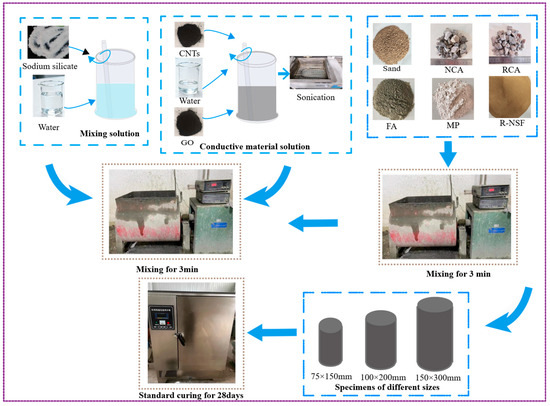
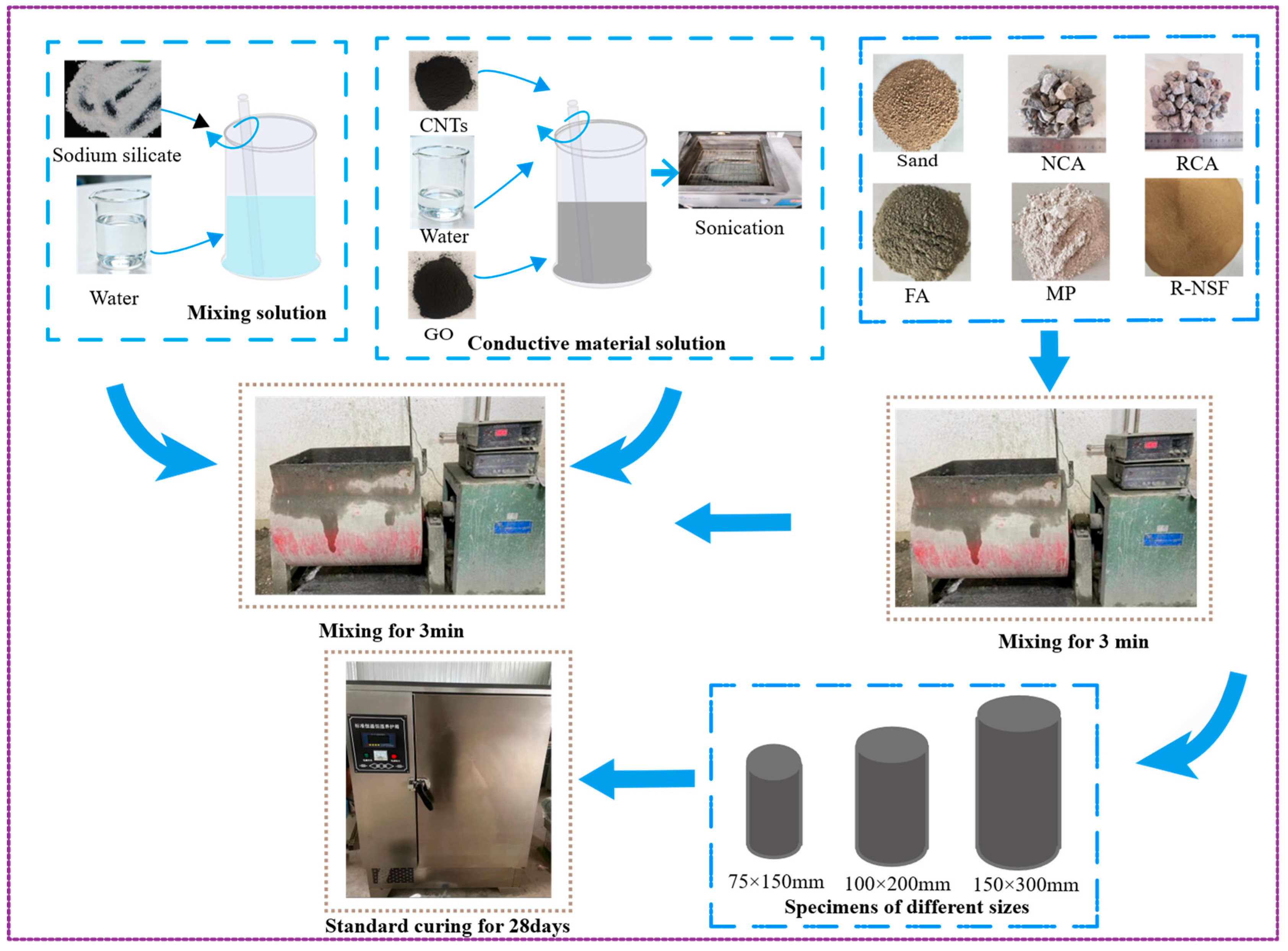
Three cylindrical specimen sizes were prepared: diameter 150 mm × height 300 mm, diameter 100 mm × height 200 mm, and diameter 75 mm × height 150 mm. For each parameter group (RCA replacement rate of 0%, 50%, 100%; incorporation of CNTs alone at 0.1%, and incorporation of CNTs at 0.1% with GO at 0.05%), three specimens were cast, and all specimens were prepared and cured under uniform standard conditions. The preparation process is illustrated in Figure 1. Prior to mixing, CNTs and GO suspensions were prepared by adding pre-weighed powders into beakers containing water, followed by ultrasonic treatment at 40 kHz for 30 min to ensure stable dispersions. The alkali activator solution was also prepared 24 h in advance to ensure complete dissolution of sodium silicate. During specimen preparation, mineral powder and fly ash were first accurately weighed and then placed in a 60 L compulsory mixer for 1 min of dry mixing. Subsequently, natural sand was added, and water along with the alkali activator solution was slowly incorporated while mixing for 2 min, followed by continuous mixing for an additional 2–3 min. Finally, the suspension of carbon nanotubes (CNTs) and graphene oxide (GO) was added, with mixing continued for another 3–5 min. The fresh concrete was poured into the prepared molds and vibrated for 3 min to ensure full compaction. After that, the specimens were placed in a laboratory environment (temperature: 20 ± 5 °C, relative humidity ≥ 95%) for 24 h, then demolded and transferred to standard curing conditions for 28 days of curing.
Figure 1.
Preparation process of AARAC specimens.
2.3. Loading and Testing Procedure
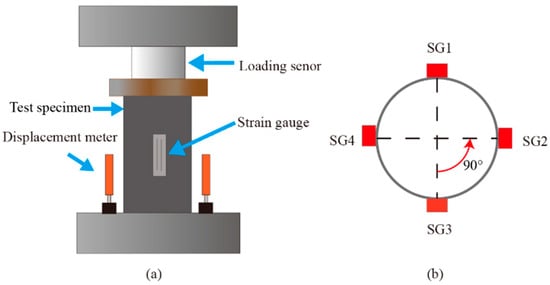
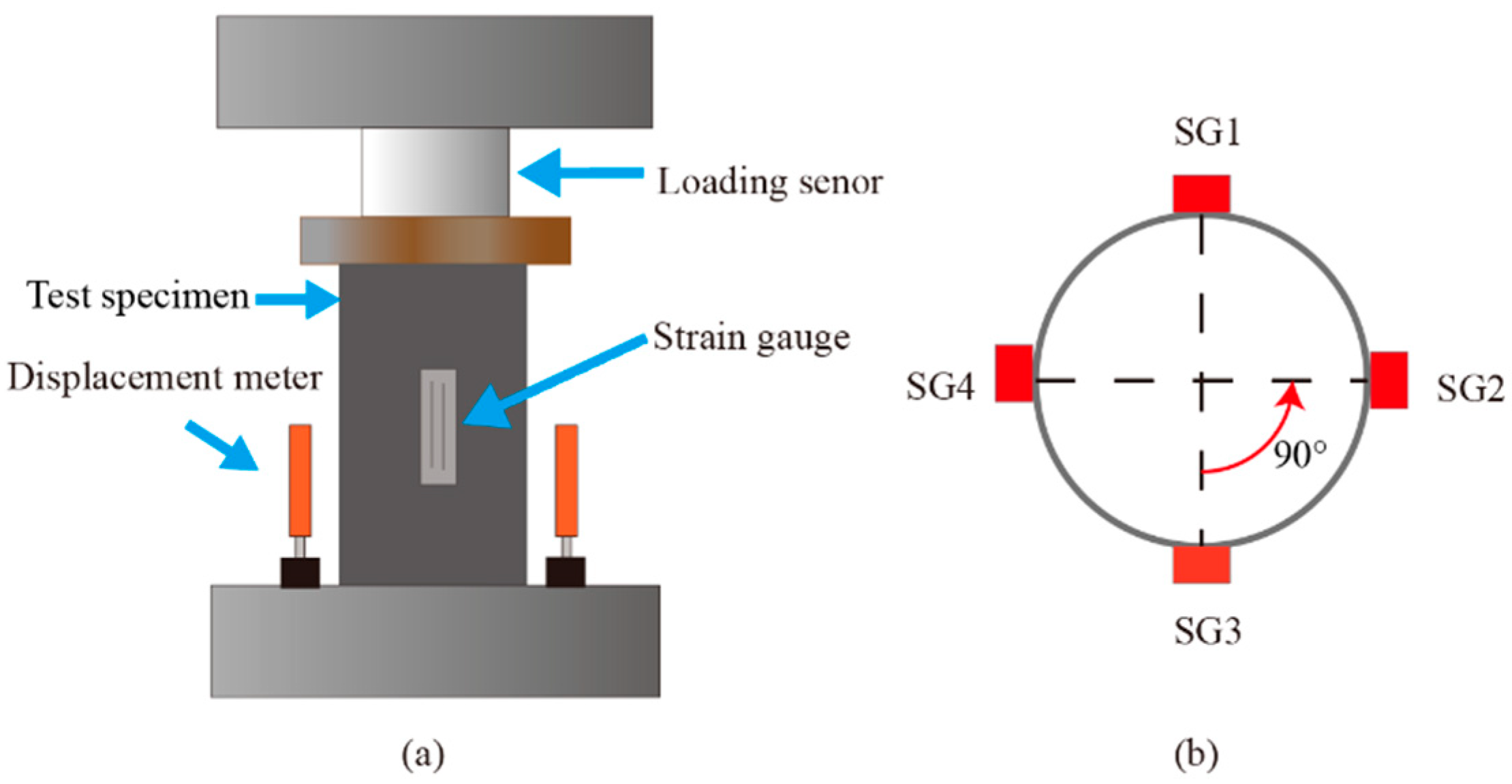
In this experiment, an MTS electro-hydraulic servo loading system was adopted to conduct uniaxial compression stress–strain curve tests on the cylindrical specimens of three sizes. Prior to the loading test in, accordance with GB/T 50081-2019 “Standard for Test Methods of Mechanical Properties of Ordinary Concrete” [41], to eliminate the influence of surface unevenness on the test results, the top and bottom surfaces of the specimens were polished with sandpaper. To accurately measure the axial strain with reference to GB/T 50081-2019 [41], four axial strain gauges with a gauge length of 100 mm were symmetrically attached to the longitudinal mid-section of each specimen. Meanwhile, according to ASTM C469/C469M-22 “Standard Test Method for Static Modulus of Elasticity and Poisson’s Ratio of Concrete” [42], two displacement transducers were installed at the base of the loading device to measure the axial compressive deformation of the specimens. A load cell was placed under the top plate of the testing machine, and a metal backing plate was placed beneath the load cell to ensure a more uniform distribution of the axial load applied by the testing machine and reduce measurement errors. A schematic diagram of the test loading device and the positions of strain measurement points is shown in Figure 2. The loading process was divided into preloading and formal loading stages. Following GB/T 50082-2024 “Standard Test Methods for Long-Term Performance and Durability of Ordinary Concrete” [43]. Preloading was controlled by force, with the preload set at 5 kN. Formal loading was controlled by displacement, where the loading rate was set according to different strain rate requirements, and the maximum displacement was set at 3 mm. The strain rates adopted in this experiment were 10−5 s−1, 10−3 s−1, and 10−1 s−1, corresponding to loading rates of 0.003 mm·s−1, 0.3 mm·s−1, and 30 mm·s−1, respectively, among which 0.003 mm·s−1 was the quasi-static loading rate.
Figure 2.
(a) Test setup; (b) instrumentation.
3. Specimen Result Analysis
3.1. Failure Morphology
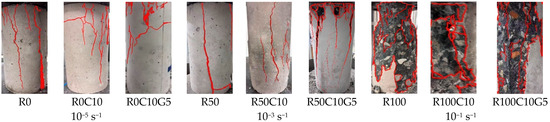
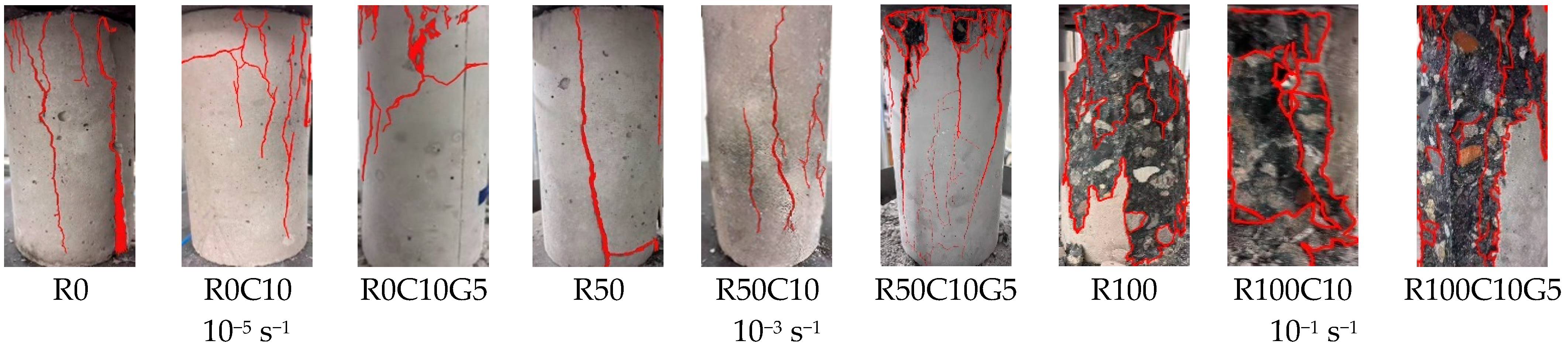
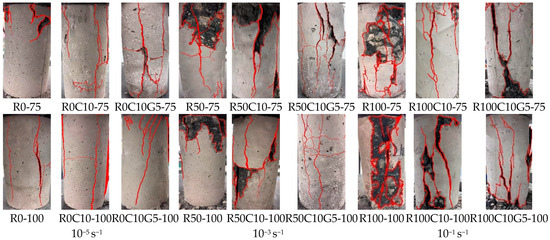
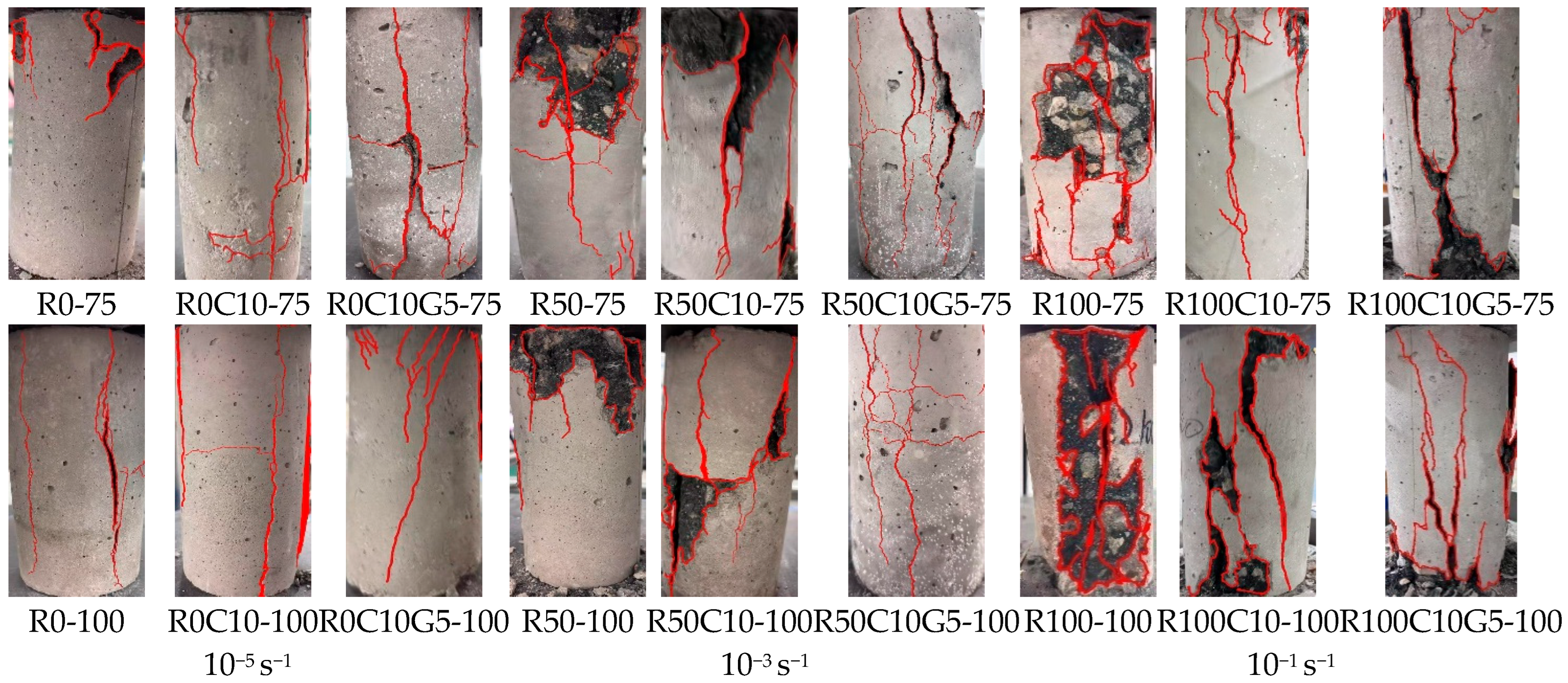
All specimens exhibited brittle failure characteristics under axial compression at different strain rates, and the typical failure modes are shown in Figure 3. The evolution law of failure modes is directly related to the coupling effect of recycled coarse aggregate (RCA) replacement rate, strain rate, and the contents of nanomaterials (CNTs and GO), with the specific manifestations as follows:
Figure 3.
Failure modes of specimens under different strain rates.
Under the influence of the RCA replacement rate, as the replacement rate increases, the number of microcracks induced by surface pores of RCA and interfacial transition zone (ITZ) inside the concrete increases, and the weak points of ITZ are further amplified. The failure mode gradually evolves from relatively flat cracks dominated by natural coarse aggregate (NCA) interface failure to a crumbly and uneven morphology with an increased proportion of RCA fracture, and finally presents as an irregular failure surface with large-area spalling and fragment peeling of the specimen. Overall, the brittleness and failure degree intensify with the increase in RCA replacement rate.
The influence of strain rate on the failure mode shows a significant rate effect. Specifically, at the low strain rate of 10−5 s−1 and medium strain rate of 10−3 s−1, the loading rate is slow and the crack propagation time is sufficient, thus the failure mode of specimens is featured by finer and longer-extended cracks. At the high strain rate of 10−1 s−1, the loading rate is fast, and cracks propagate rapidly and penetrate the specimen under instantaneous stress concentration, leading to a violent fragment peeling failure mode with concentrated and highly penetrative cracks.
The dosage of nanomaterials (CNTs and GO) further regulates the brittle characteristics of the specimens’ failure mode. In the case of single CNT incorporation, the R0C10 series specimens exhibited narrower primary cracks and slower crack coalescence, accompanied by fine branched cracks, indicating that CNTs can hinder rapid crack propagation and promote the dispersed extension of cracks. For the R100C10 series specimens, crack propagation was more gradual, yielding smaller debris with partial adhesion between fragments and no evident spalling; this suggests that CNTs enhance the interfacial bonding between aggregates and the cementitious matrix, thereby reducing brittle peeling.
In summary, the failure morphology was the result of the synergistic influence of RCA replacement rate, strain rate, and nanomaterial incorporation. Higher RCA content and faster strain rates led to more brittle, fragmented failure modes. With increased dosages of CNTs and GO, the failure mode transitioned from concentrated brittle cracking to distributed ductile microcracking by suppressing localized crack propagation. This rule is directly reflected in the failure characteristics of the specimens. For specimen R100, the interfacial defects of internal RCA are concentratedly released under dynamic loading, exhibiting typical brittle spalling failure. In contrast, for specimen R0C10G5, the bridging and densification effects of nanomaterials effectively inhibit the concentrated propagation of cracks, resulting in a ductile fine-cracking failure mode.
3.2. Stress–Strain Curves
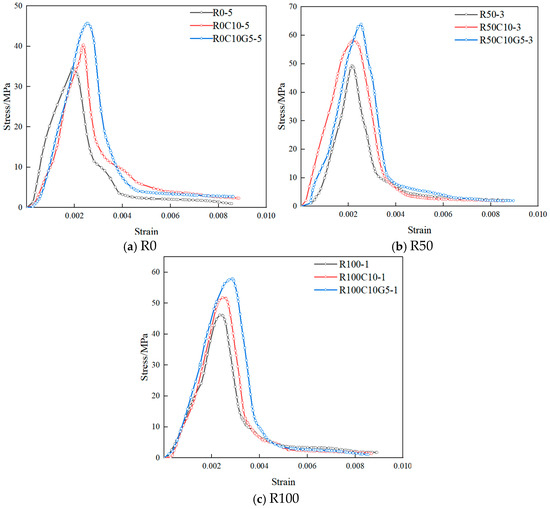
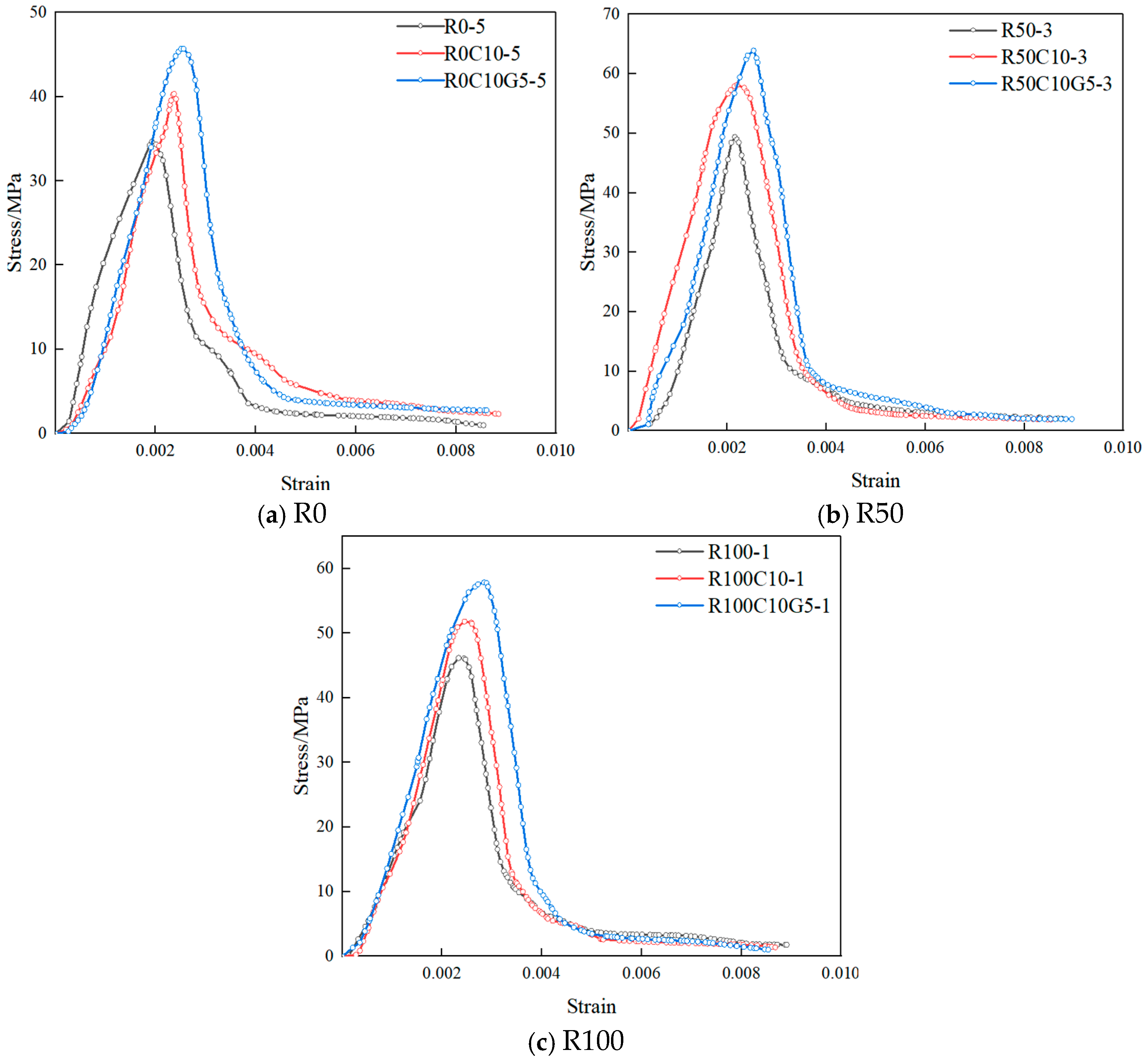
Figure 4 presents the test results of stress–strain curves of specimens under different recycled coarse aggregate (RCA) replacement rates and strain rates. It can be seen from the figure that the stress–strain curves of specimens with different RCA replacement rates (R0, R50, R100) share similar profiles. At a low strain rate of 10−5 s−1, prior to reaching the peak stress, the stress–strain curve of specimen R0C10G5 exhibited the fastest stress increase and the highest peak stress, compared to R0C10 and R0. This can be attributed to the synergistic effect of CNTs and GO, which enhances the load-bearing capacity of AARAC during the elastic phase. After reaching the peak stress, a comparison of the stress–strain curves of specimen R0C10 and specimen R0C10G5 indicates that specimen R0 has the fastest stress drop rate. An inflection point appears on the curve when the stress decreases to approximately 80% of the peak stress, at which point the internal microcracks of the specimen interconnect and develop into macrocracks, exhibiting typical brittle failure characteristics. In contrast, the stress decline of specimens R0C10 and R0C10G5 is gentler, showing the ductile cracking characteristics of dispersed propagation of multiple microcracks. At the medium strain rate of 10−3 s−1, the variation characteristics of the stress–strain curves of specimens R50, R50C10 and R50C10G5 are roughly consistent with those at the strain rate of 10−5 s−1. However, due to the increased loading rate and inherent defects of RCA, specimen R50 is characterized by a single main crack penetrating the entire specimen. The ductility of specimen R50C10 is lower than that at the low strain rate of 10−5 s−1, showing rapid propagation of microcracks. Specimen R50C10G5 can still delay the formation of the main crack through the synergistic effect of nanomaterials, but the overall number of cracks is larger than that at the low strain rate. At the high strain rate of 10−1 s−1, the stress growth rate before the peak gradually accelerates and the rising segment of the curve is shortened. Specimen R100 exhibits the development of multiple cracks, while specimens R100C10 and R100C10G5 show the dispersed propagation of fine microcracks. After the peak stress, the stress drop rate accelerates: specimen R100 undergoes rapid cracking with splashing fragments; specimen R100C10 is characterized by small and tightly bonded fragments; specimen R100C10G5 has small fragments with a lower quantity, and its integrity is better than that of specimen R100C10. When the stress drops to about 80% of the peak stress, an inflection point appears on the stress–strain curve, and specimens R100C10 and R100C10G5 also undergo complete failure.
Figure 4.
Stress–strain relationship curves of different RCA replacement rate. Note: Specimen number rules refer to the Note in Table 3.
3.3. Key Mechanical Performance Indicators
3.3.1. Peak Stress
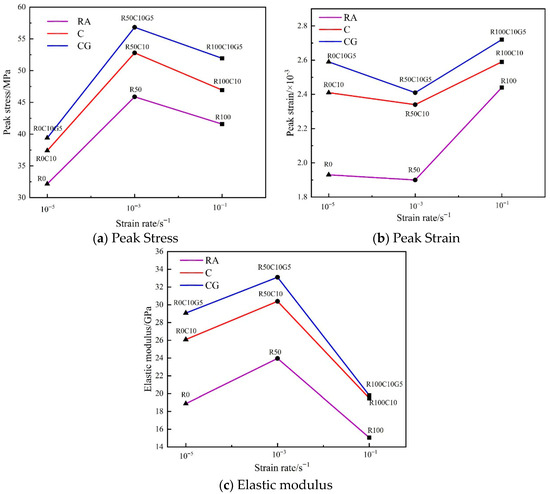
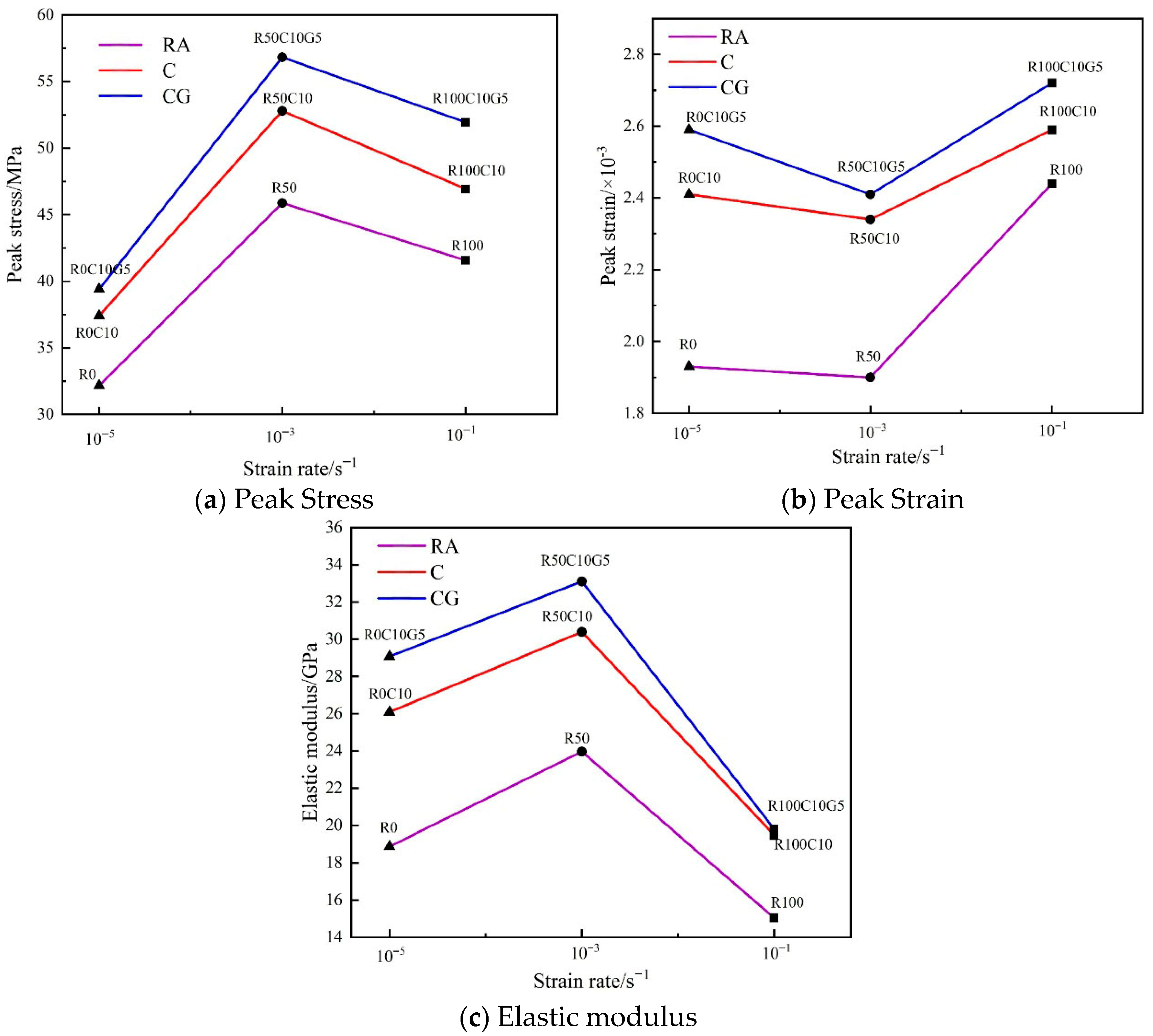
The test results of peak stress of specimens with different recycled coarse aggregate (RCA) replacement rates and nanomaterial contents are shown in Figure 5a. As can be seen from the figure, compared with the specimens with 0% RCA replacement rate, the peak stress of alkali-activated recycled aggregate concrete (AARAC) specimens increased from approximately 45 MPa to about 56 MPa when the RCA replacement rate was 50%, indicating that the specimens with 50% RCA replacement rate had a strong strain rate sensitivity. When the RCA replacement rate reached 100%, the peak stress of AARAC specimens increased from about 41 MPa to around 52 MPa, and the growth amplitude was slightly lower than that of the R50 series specimens. When nanomaterials (CNTs and GO) were incorporated, the peak stress of specimens with different RCA replacement rates was significantly improved: for the R0 series specimens, the peak stress of R0C10 and R0C10G5 increased by 16.31% and 22.53%, respectively. This indicates that the synergistic effect of the combined incorporation of CNTs and GO was superior to that of the single incorporation of CNTs. For the R50 series, the increases for R50C10 and R50C10G5 reach 15.09% and 23.87%. This indicates that under the mixed aggregate interface, the synergistic effect of CNTs and GO facilitates more uniform stress transfer, thereby preventing abrupt stress fluctuations caused by RCA defects. For the R100 series, the increases for specimens R100C10 and R100C10G5 are 12.90% and 24.92%; although their strength is lower than that of the R50 series, the incorporation of nano-materials still effectively improves the compressive mechanical properties under RCA replacement. From the coupling effect of strain rate, recycled coarse aggregate replacement rate, and nanomaterial content, it can be seen that without the incorporation of nano-materials, the influence of RCA replacement rate on strain rate sensitivity is strongest for the R50 series, followed by the R100 series, both of which are higher than the R0 series. After the incorporation of nano-materials, the strain rate sensitivity of all specimens increases significantly. Moreover, the specimens with the incorporation of CNTs alone exhibit higher strain rate sensitivity than the specimens incorporating CNTs and GO. This is because CNTs enhance the rate-dependence of crack propagation, leading to larger increments in peak stress and elastic modulus with increasing strain rate, as well as more pronounced changes in failure mode, thus improving strain rate sensitivity. In contrast, for the composite incorporation of CNTs and GO, GO optimizes interfacial densification and mitigates the response of crack propagation to strain rate; consequently, the mechanical properties show a smaller increase with strain rate, and the variation in failure mode becomes more gradual, resulting in slightly lower strain rate sensitivity than that of the single-CNT group.
Figure 5.
Variation in the mechanical properties of AARAC with different RCA replacement rates under strain rates. Note: RA: Corresponds to the reference group of specimens without nanomaterial incorporation. C: Corresponds to the group of specimens where 0.1 wt% (weight percentage) of CNTs (carbon nanotubes) are singly added to the reference group. CG: Corresponds to the group of specimens where 0.1 wt% of CNTs and 0.05 wt% of GO (graphene oxide) are compositely added to the reference group.
3.3.2. Peak Strain
The peak strain test results for specimens with varying RCA replacement ratios and nanomaterial contents are presented in Figure 5b. When the RCA replacement ratio is 0%, the peak strain of AARAC specimens increases from 1.9 × 10⁻³ to 2.6 × 10⁻³. The strain rate sensitivity was higher after the incorporation of nano-materials, with the hybrid group exhibiting greater sensitivity than the single-doped group. This suggests that nanomaterials effectively enhance the deformation capacity of natural aggregate specimens, with the synergistic effect of hybrid doping being superior. At a 50% RCA replacement ratio, the peak strain rises from 1.9 × 10⁻³ to 2.4 × 10⁻³. The strain rate response is higher than that of the R100 series but lower than that of the R0 series. This indicates that the deformation stability of the mixed aggregate system is superior to that of the full recycled aggregate (R100) system, yet slightly inferior to that of the R0 series, reflecting a slight weakening of deformation coordination induced by the introduction of RCA. Overall, the system exhibits deformation characteristics, jointly regulated by the synergy of NCA and RCA. After the incorporation of nanomaterials, the strain rate sensitivity of the R50 series was still significantly enhanced compared with the unmodified group, suggesting that nanomaterials can improve the deformation coordination of the mixed aggregate system—though the enhancement effect is slightly diminished due to the inherent characteristics of RCA. When the RCA replacement reaches 100%, the peak strain ranges between 2.4 × 10⁻³ and 2.7 × 10⁻³, showing the highest strain rate sensitivity. This indicates that the deformation behavior of the full RCA system is more sensitive to loading rate—the higher the loading rate, the more significant the deformation response of the specimens. The enhancement effect on peak strain after the incorporation of nanomaterials was the weakest in this system: the peak strain of the R100C10 series with 0.1% CNTs added alone increased by only 6.14% compared to the unmodified group, while that of the hybrid-doped R100C10G5 series increased by 11.48%. These results suggest that the improvement effect of nanomaterials on the deformation performance of the full RCA system is limited. Analyzing the coupled effect of strain rate, RCA replacement ratio, and nanomaterial content, without nanomaterials, the R100 series exhibits the highest strain rate sensitivity, followed by R50, both exceeding R0, i.e., higher RCA content leads to more significant loading-rate-dependent deformation. After nanomaterial incorporation, the R0 series shows the largest enhancement in strain rate sensitivity, with the specimens incorporating CNTs and GO surpassing the single CNTs group; the R50 series exhibits a marked increase in sensitivity compared to the unmodified group, while the R100 series maintains a high level of sensitivity.
3.3.3. Elastic Modulus
The elastic modulus results for specimens with different RCA replacement ratios and nanomaterial contents are shown in Figure 5c. When the RCA replacement ratio is 0%, the elastic modulus ranges from 18 to 30 GPa and increases with strain rate, indicating the static stiffness stability of R0 specimens. At a 50% RCA replacement ratio, the elastic modulus rises from approximately 23 GPa to 33 GPa, showing significantly higher strain rate sensitivity compared to the R0 series. This indicates that specimens with 50% RCA replacement have greater stiffness responsiveness to loading rate. When the RCA replacement reaches 100%, the elastic modulus ranges from 15 to 19 GPa, significantly lower than that of the R50 group, suggesting a notable reduction in the upper limit and strain rate sensitivity of stiffness for fully recycled aggregate specimens. Upon the incorporation of nanomaterials (CNTs and GO), the elastic modulus of specimens R50C10 and R50C10G5 increased by 26.83% and 38.16%, respectively. The R50C10G5 group outperformed the R50C10 group, indicating that the modification effect of nanomaterials is most prominent in the mixed aggregate system, with hybrid doping exhibiting superior performance to single doping. The elastic modulus of R100C10 and R100C10G5 increases by 29.44% and 31.59%, respectively, demonstrating that at full RCA replacement, nanomaterials effectively mitigate interfacial stiffness defects, with hybrid doping providing stronger reinforcement than single CNTs doping. Analyzing the coupled effect of strain rate, RCA replacement ratio, and nanomaterial content, without nanomaterials, the R0 series shows the highest strain rate sensitivity, followed by the R50 series, both exceeding the R100 series. This indicates that lower RCA replacement ratios result in stiffness being more responsive to loading rate. After nanomaterial incorporation, the strain rate sensitivity of elastic modulus increases significantly for all specimens, with the hybrid-doped specimens consistently showing higher sensitivity than the single-doped ones, aligning perfectly with the observed trends in elastic modulus enhancement.
3.4. Analysis of Size Effect on Mechanical Properties
3.4.1. Failure Morphology Under Different Specimen Sizes
The failure morphologies of AARAC specimens with different sizes, RCA replacement ratios, and strain rates are shown in Figure 6. As shown in the figure, for AARAC specimens with a diameter of 75 mm, the R0 and R0C10 series predominantly exhibited a single vertical crack, with no obvious branched cracks or aggregate spalling, displaying a relatively regular failure mode that reflects the failure stability of small-sized specimens with low RCA replacement ratios. For instance, the R0 series specimens developed only one straight axial crack, retaining good overall integrity. For the R0C10 series specimens, the incorporation of CNTs alone reduced the width of the main crack and prevented fragment detachment, resulting in a more gradual failure process. In contrast, the R50 and R100 series specimens generated multiple branched cracks and an expanded failure zone, indicating that high RCA replacement ratios have weakened the failure stability of small-sized specimens, shifting the cracking pattern from “single concentrated” to “dispersed propagation. For 100 mm-diameter specimens, both the number and width of cracks increase compared to the 75 mm specimens. The R0 and R0C10 series specimens maintained a regular failure mode characterized by a single vertical main crack, whereas the R100C10 and R100C10G5 series exhibited a significant increase in crack number and width along with more complex branching. This indicates that the differences in the failure mode of medium-sized specimens arise from the coupling effect between RCA replacement ratio and nanomaterial modification, rather than merely the amplification of stress gradients induced by specimen size. The 150 mm-diameter specimens show the most extensive crack propagation and branching upon failure. Notably, the R100C10G5 specimens exhibit large areas of mortar spalling and aggregate exposure, indicating that in large specimens, the size effect accentuates internal stress concentration and further amplifies RCA defects.
Figure 6.
Failure modes of specimens under different strain rates and dimensions. Note: Specimen number follows the rule in Table 3 (Section 2.2) “-75/-100/-150” = diameter (mm); suffix in the bottom row = strain rate (s−1).
3.4.2. Key Mechanical Properties
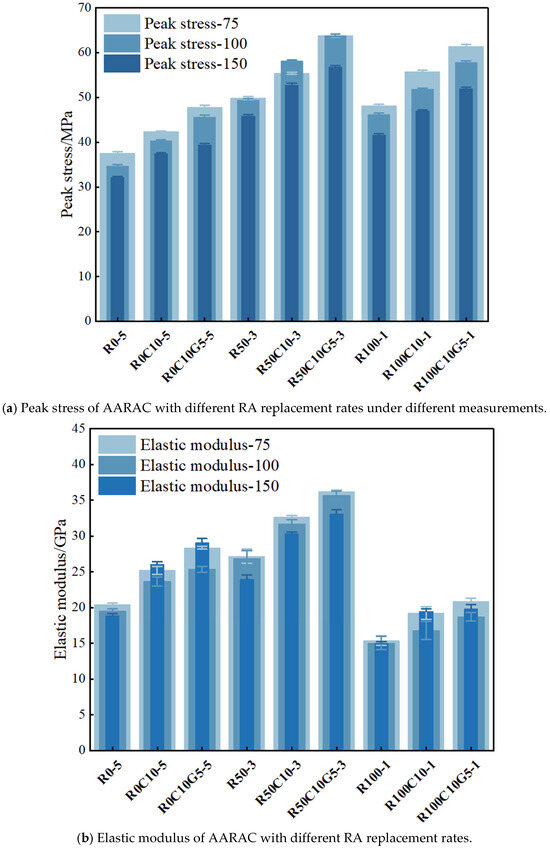
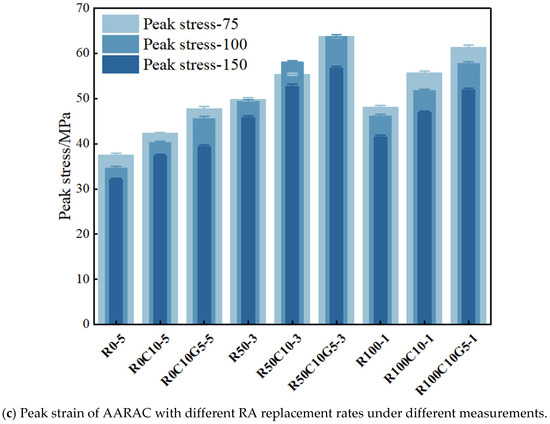
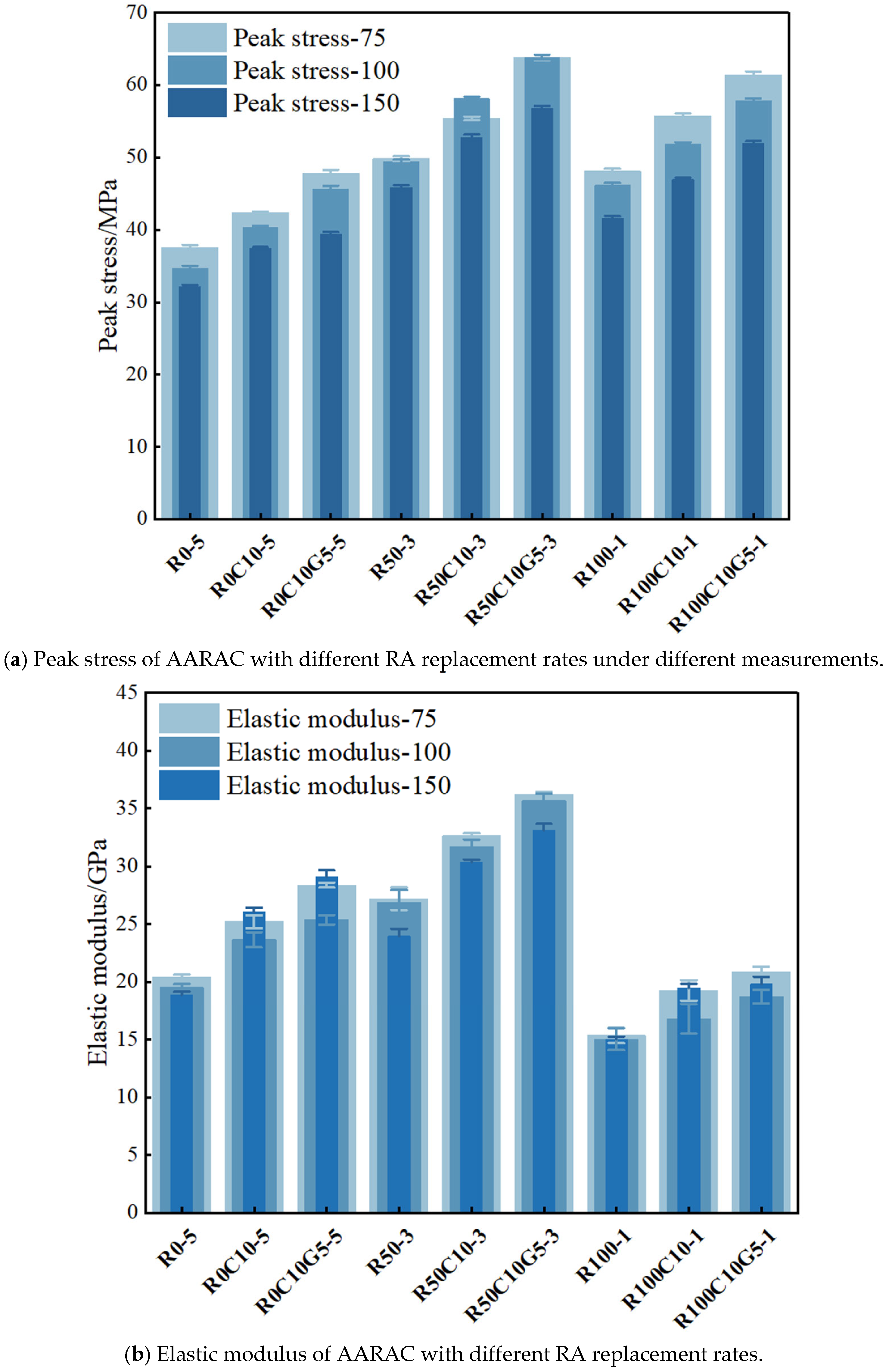
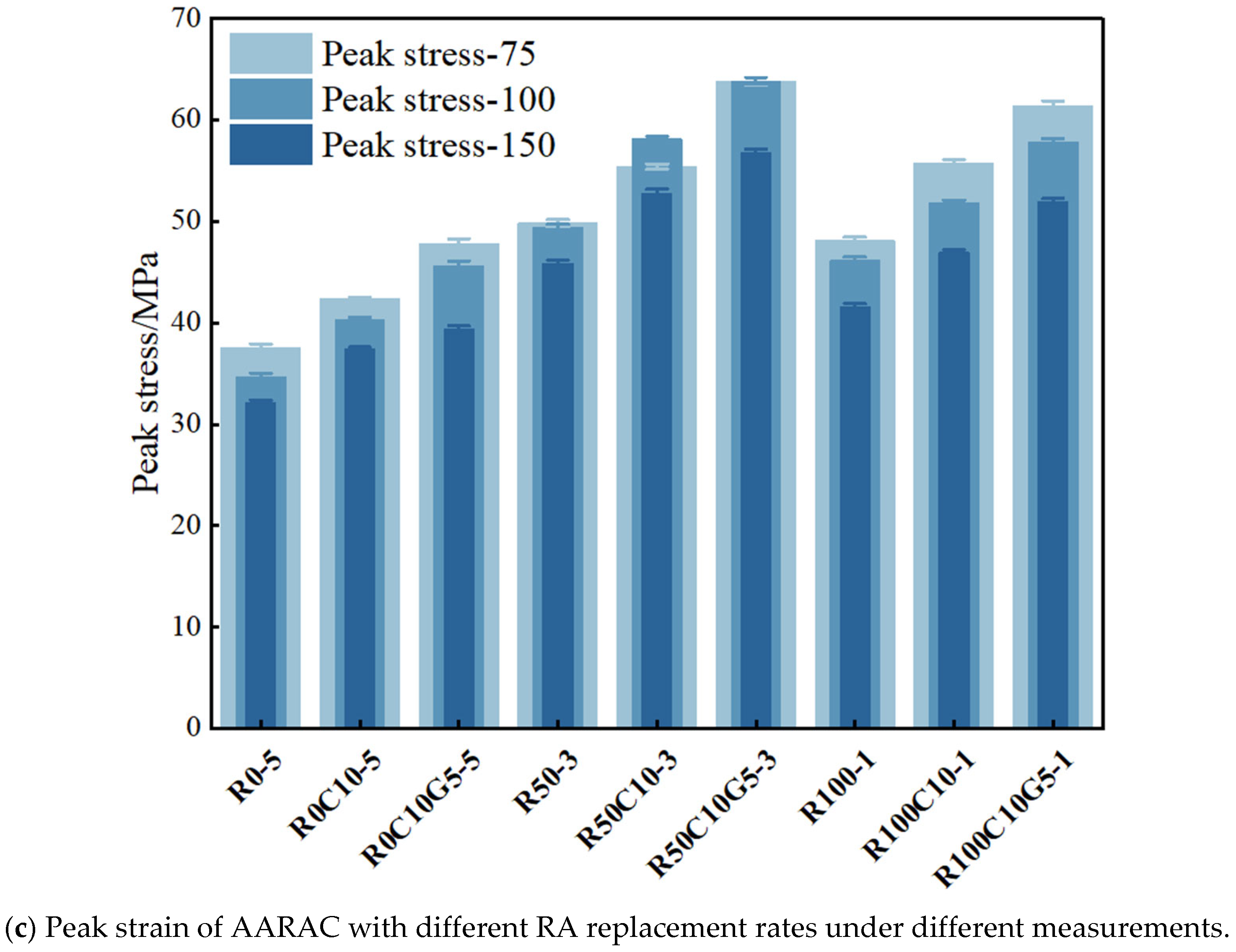
The peak stress, peak strain, and elastic modulus results for specimens with different RCA replacement ratios, nanomaterial contents, and sizes are presented in Figure 7. Figure 7a,b show that under static loading conditions (strain rates of 10−5 s−1 and 10−3 s−1), specimens with 50% RCA replacement exhibit the highest peak stress and elastic modulus. Specifically, the 100 mm-diameter R50C10G5 specimen shows a peak stress of 65 MPa at a strain rate of 10−3 s−1. This is attributed to the regular surface and stable strength of NCA, which acts as a “rigid skeleton” for load transmission. In contrast, the presence of RCA buffers stress concentrations via interfacial deformation, leading to a more uniform stress distribution throughout the specimen and a significant enhancement in stress transfer efficiency. With nanomaterial incorporation, dual-doped CNTs/GO specimens demonstrate the most significant improvement in average peak stress and elastic modulus under static conditions. For instance, the 100 mm diameter R0C10G5 specimen shows a 31.60% increase in peak stress at a strain rate of 10−5 s−1 compared to R0, while the 150 mm diameter R0C10G5 specimen exhibits a 54.03% increase in elastic modulus at 10−5 s−1. This demonstrates that nanomaterials can optimize failure modes and enhance the continuity of load transmission, thereby achieving superior reinforcement effects. As the specimen diameter increases from 75 mm to 150 mm, the static peak stress slightly decreases, while the peak strain slightly increases. The latter is attributed to more uniform deformation distribution and better coordination in larger specimens, consistent with the general size effect observed in static concrete mechanical behavior [40]. Under dynamic loading (strain rate of 10−1 s−1), peak stress increases with strain rate, and the growth rate of dual-doped CNTs/GO specimens is significantly higher than that of single-doped and undoped groups. For example, the R100C10G5 specimen exhibits a 24.92% increase. At 100% RCA replacement, the presence of nanomaterials brings the peak stress of R100 series specimens closer to those of R0 and R50 series. The R100C10G5 specimen reaches a peak stress of approximately 52 MPa, close to the R50 specimens. This is attributed to the synergistic effect of the nanomaterials CNTs and GO, which significantly improves load transmission efficiency and effectively mitigates the degradation of mechanical properties caused by full recycled aggregate incorporation.
Figure 7.
Key mechanical properties under different measurements.
Figure 7c show that under static loading (strain rates of 10−5 s−1 and 10−3 s−1), specimens with 100% RCA replacement exhibit the highest peak strain. This is due to the inherent defects of recycled aggregate, which cause the specimens to exhibit mechanical characteristics characterized by low stiffness and high deformability. After the incorporation of nano-materials, the variation pattern of the peak strain is consistent with that of the peak stress. As the specimen diameter increases from 75 mm to 150 mm, the peak strain of the specimen under the static loading strain rate rises slightly, reflecting the characteristics that large-sized specimens exhibit more uniform deformation distribution and stronger deformation coordination ability under static loading. Under dynamic loading, the variation laws of peak strain and elastic modulus are basically consistent with those of peak stress.
4. Constitutive Model Analysis
4.1. Comparative Analysis of Prediction Results of Existing Models
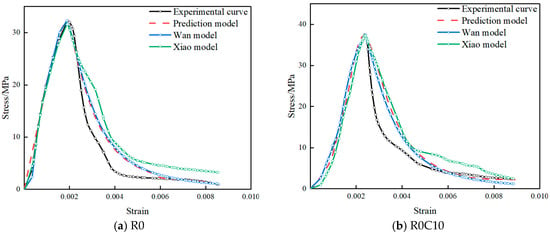
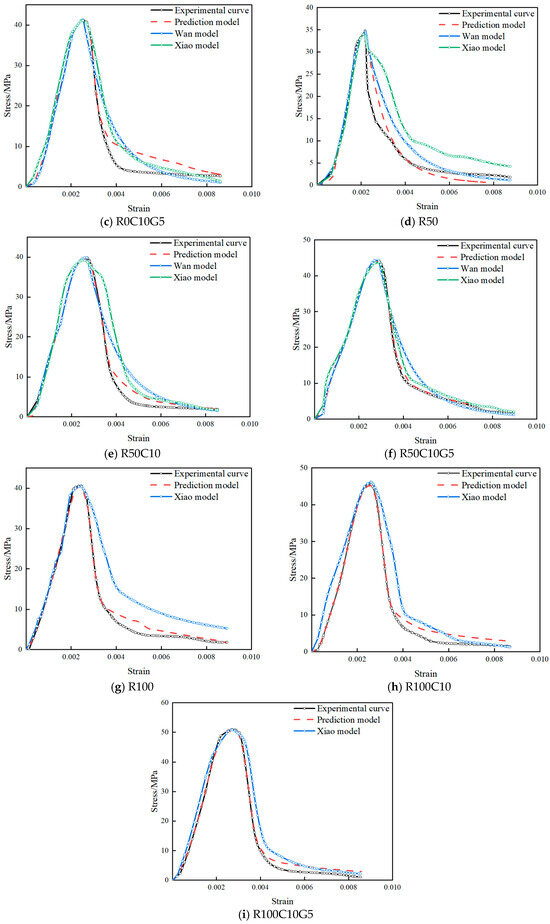
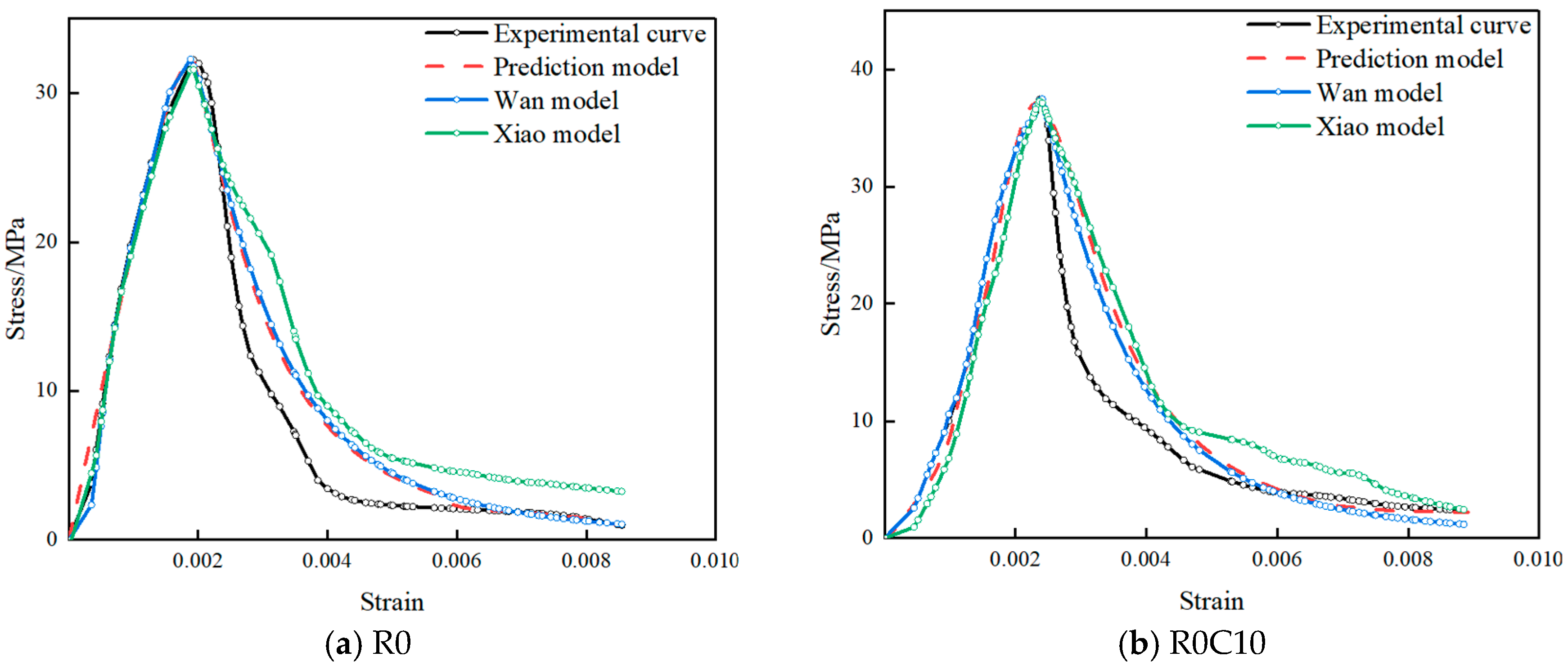
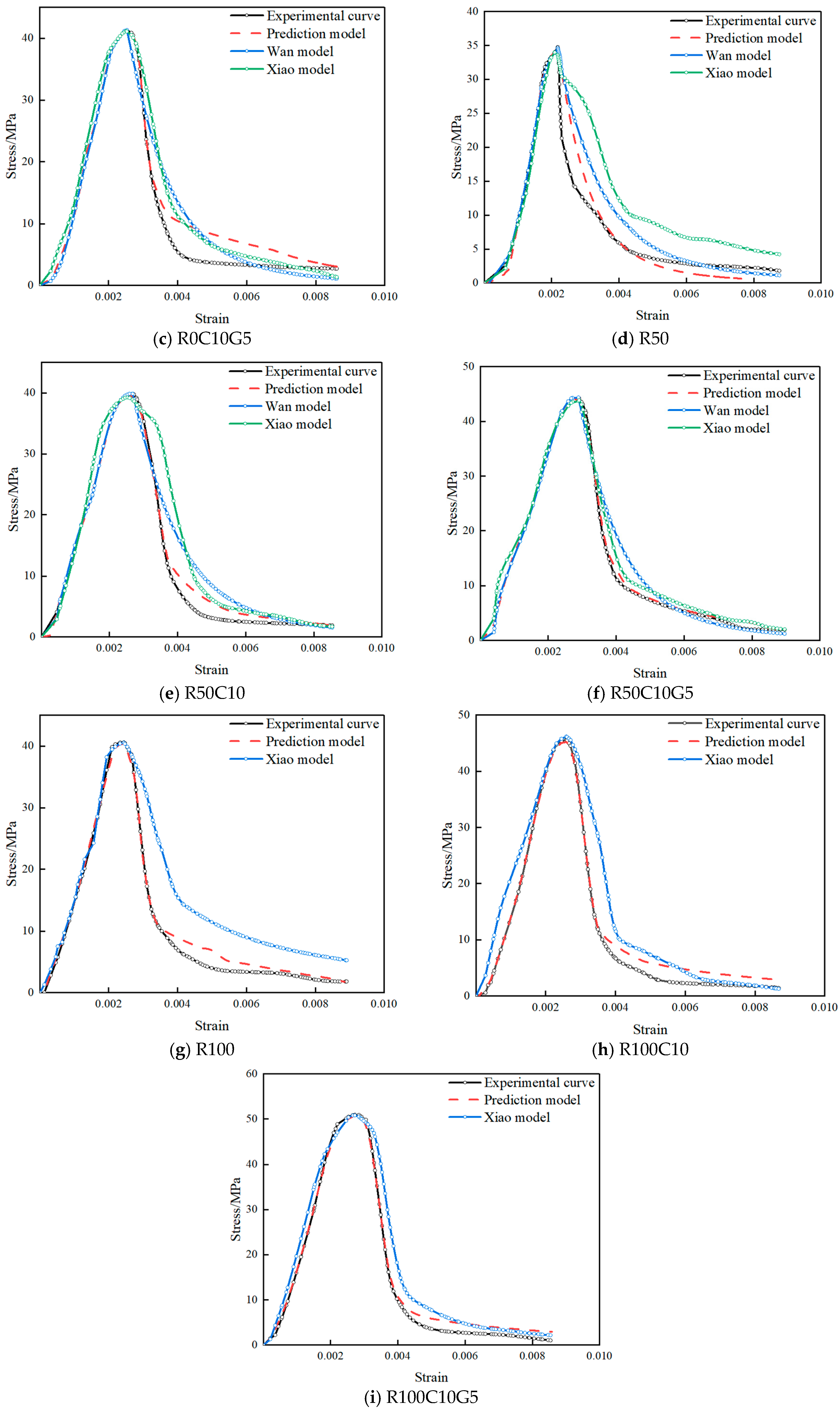
To clarify the mechanical behavior characteristics of nanomaterial-modified alkali-activated recycled concrete under uniaxial compression at different strain rates, this paper proposes a dynamic uniaxial compressive stress–strain constitutive model for nanomaterial-modified alkali-activated recycled concrete with static peak stress and peak strain as parameters. After the model is established, the stress–strain curve results obtained in this paper are compared with the prediction results of the Wan [30] model and the Xiao [15] model. The comparison diagrams of the curves from different models and the stress–strain curves obtained from the tests in this paper are shown in Figure 8. The following is one model [30]
Figure 8.
Comparison of model curves and AARAC test curves stress and strain relationship model.
In the formula, ,, are parameters that control the curvature of the ascending and descending sections on the curve. For the ascending stage, the parameter is
For the descending stage, the parameters , are
In the formula: represents the compressive strength of the concrete at the center; represents the peak stress; represents the peak strain; represents the peak strain; represents the elastic modulus.
Xiao Model [15]:
In the formula: represents compressive stress; represents the damage factor; and ; ; ; represents the shape coefficient of the descending section.
The comparison results between the predicted curves of static and dynamic constitutive models and the experimental curves are shown in Figure 8. For the comparison between the constitutive model prediction curves and the experimental curves under static conditions, it can be seen that compared with the ascending section of the stress–strain curve, the prediction curves of the Wan model and the Xiao model are more consistent with the experimental results. However, in the descending section of the curve, the prediction effects of different models are different. For the specimens with RAC replacement rates of 0 and 50%, the prediction effect of the Wan model for the descending section of the stress–strain curve is better than that of the Xiao model. For the curves after adding nanomaterials CNTs and GO, most of them show that the prediction effect of the Xiao model for the descending section of the stress–strain curve is better than that of the Wan model. From the comparison of the dynamic constitutive model prediction curves and the experimental curves, it can be seen that the prediction effect of the Xiao model for the ascending section is better, while the prediction effect of the descending section is average.
4.2. Constitutive Model Parameters
4.2.1. Correction Coefficient for Recycled Aggregate Replacement Rate
To characterize the influence of interfacial defects in recycled coarse aggregates on the mechanical properties of AARAC, a correction factor for RCA replacement ratio is introduced. Combined with the experimental phenomena presented in Section 3, the results indicate that when the RCA replacement ratio increases from 0% to 100%, the peak stress, peak strain, and elastic modulus of AARAC all decrease to varying degrees. The physical significance of this parameter is to describe the weakening degree of the defects induced by residual mortar on the surface of recycled coarse aggregates with respect to the peak stress, peak strain, and elastic modulus. By performing linear fitting on the test data, the relationship with the replacement rate is obtained, as shown in Equation (7).
4.2.2. Coefficient of Synergistic Enhancement of Nanomaterials
To characterize the synergistic regulatory effect of CNTs and GO on the mechanical properties of AARAC, a nanomaterial synergistic enhancement coefficient is introduced. Combined with the experimental phenomena presented in Section 3, the results indicate that when nanomaterials are incorporated, the peak stress, peak strain, and elastic modulus of AARAC all increase to varying degrees with the single incorporation of 0.1% CNTs; the enhancement amplitude is even greater with the composite incorporation of 0.1% CNTs and 0.05% GO. The physical significance of this coefficient is to quantify the comprehensive enhancement degree of nanomaterials on the peak stress, peak strain, and elastic modulus of AARAC—under the coupling effect of specific nanomaterial dosage and recycled coarse aggregate (RCA) replacement ratio—by optimizing load transmission efficiency, slowing down the crack propagation process, and repairing the interfacial defects of RCA. Among them, is the enhancement coefficient for single CNT incorporation, and is the enhancement coefficient for composite incorporation of CNTs and GO.
Taking the peak stress of the R0 specimen series as the reference, for the specimen series with a single doping of 0.1% CNTs, the improvement in the mechanical properties of AARAC under different RCA substitution rates is calculated. Based on the obtained experimental data, a piecewise linear fitting is performed to obtain the relationship with the substitution rate R, as shown in Equation (8).
For the test specimens with 0.1% CNTs and 0.05% GO added in combination, the mechanical performance improvement of AARAC under different RCA substitution rates was calculated, respectively. Based on the obtained experimental data, a linear fitting was conducted to obtain the relationship between and the substitution rate R, as shown in Equation (9).
4.3. Modified Constitutive Model Under Static Loading Conditions
The static stress–strain curve expression is applicable to loading conditions with strain rates of 10−5 s−1 and 10−3 s−1.
In the formula, and are the shape parameters of the ascending section; and are the shape coefficients of the descending section, which are shown in Table 4. Their physical meanings are that the larger is, the higher the initial stiffness is; the larger is, the more significant the plastic deformation is; controls the deceleration rate and controls the later smoothness, and is the static ultimate strain, taking The peak stress, peak strain, and elastic modulus of AARAC can be calculated by substituting Equations (7)–(9) into Equations (11)–(13):
Table 4.
Static increase factor of AARAC.
In the formula, , , , respectively, represent the corrected peak stress, peak strain, and elastic modulus; represents the correction coefficient for the replacement rate of recycled aggregates; represents the correction coefficient for nanomaterials. The calculation results are shown in Table 5.
Table 5.
Recycled aggregate replacement rate correction coefficient and nano-material synergistic enhancement coefficient.
4.4. Modified Constitutive Model Under Dynamic Loading Conditions
To accurately describe the dynamic enhancement effect of the loading rate on the mechanical performance of AARAC, a dynamic growth factor (DIF, dynamic increase factors) is introduced. It is defined as the ratio of the mechanical performance parameters of the dynamic loading rate and the static loading rate under the same variables. According to the conclusion in Reference [44], the dynamic growth factor has a significant linear correlation with the logarithm of the strain rate. The linear fitting of the dynamic growth factor and the logarithm of the strain rate obtained from the experiments in this paper is carried out, and a unified form of the prediction formula is obtained, as shown in Table 6. In the formula, is the strain rate sensitivity coefficient; is the reference correction coefficient; is the loading strain rate. Due to the insignificant linear relationship between the dynamic growth factor of the peak strain and the strain rate, the change in the peak strain is not considered. Based on the nonlinear fitting of the dynamic stress–strain decline segments of different groups, the shape coefficients and are determined, and the fitting results are shown in Table 7.
Table 6.
Dynamic increase factor of AARAC.
Table 7.
Modified factor of descending branch.
Based on Equations (14) and (15), the dynamic peak stress and the dynamic elastic modulus are determined.
In the dynamic stress–strain model, the peak stress and the dynamic growth factor of the elastic modulus are determined according to the relationship shown in Table 6. Based on Equations (14) and (15), the dynamic peak stress and the dynamic elastic modulus are determined. The shape coefficient of the decline section is determined according to Table 7. After substituting into the static stress–strain model, the dynamic stress–strain curve prediction model is obtained.
4.5. Model Validation
To verify the validity of the model proposed in this paper, the predicted curves of the modified static and dynamic constitutive models presented in this paper were compared with the experimental stress–strain curves, as shown in Figure 8. From the figure, it can be seen that the proposed prediction model in this paper has a high degree of agreement with the experimental curves in the elastic stage (where the strain is less than 0.002) and the peak stress region. The relative prediction error range is 2.3% to 3.5%, which is lower than that of the Wan model (4.8% to 6.2%) and the Xiao model (5.3% to 7.1%), while in the strain softening stage (where the strain is greater than 0.002), the deviation between the prediction model and the experimental curves gradually increases, but the overall fitting effect is better than that of the Wan model and the Xiao model.
5. Conclusions
Through the research in this paper, the following main conclusions were obtained:
- (1)
- The failure characteristics of the alkali-activated concrete specimens are similar to those of the ordinary recycled concrete specimens. During failure, it shows brittle fracture, and the cracks rapidly penetrate along the RCA interface, with the failure area concentrated in a single main crack. The failure morphology of the alkali-sprayed recycled concrete specimens with nano-materials added is multi-crack dispersed expansion, and the width of the main crack decreases.
- (2)
- Under static loading conditions at a strain rate of 10−5 s−1, the coupling law between RCA replacement ratio and nanomaterial dosage depends on the balance between the severity of RCA defects and the improvement effect of nanomaterials. At the 50% RCA replacement ratio, the single incorporation of 0.1% CNTs can optimize the stress state of the specimens, increasing the peak stress and elastic modulus of AARAC by 18.6% and 15.3%, respectively, compared to the control group without nanomaterials. When the RCA replacement ratio increases to 100%, the synergistic modification effect of composite incorporation of 0.1% CNTs and 0.05% GO is superior, making the enhancement amplitude of peak stress 9.2% higher than that of the single CNT incorporation system, thus compensating for the defects of the full recycled aggregate. Compared with the increase in strain rate, nanomaterials optimize load transmission efficiency and slow down the crack propagation process, resulting in a 23.5–31.8% higher enhancement amplitude of the mechanical properties of AARAC under dynamic conditions than under static conditions.
- (3)
- When the specimen diameter increases from 75mm to 150mm, without adding nano-materials, the peak stress and elastic modulus of the specimens decrease by 14.7% and 10.3%, respectively, in the full strain range. When singly adding 0.1% CNTs, both decrease by 8.3% and 7.8%, respectively. When adding 0.1% CNTs and 0.05% GO in combination, both decrease by 6.3% and 5.1%, respectively. This highlights that the incorporation of nanomaterials improves the overall uniformity of specimen performance and mitigates performance degradation associated with the inherent characteristics of larger-sized specimens. From the failure phenomenon, small-sized specimens fail mainly due to interface detachment, while large-sized specimens without nano-material addition show aggregate fracture. When combined with nano-materials, the failure mode still mainly consists of multi-crack ductile cracking, and the influence of specimen size on failure modes is significantly attenuated by the modification effect of nanomaterials.
- (4)
- The modified constitutive model under static and dynamic loading conditions proposed in this paper has a prediction error range of 2.3% to 7.1% in the full strain range. The average relative error at the peak point is 2.1%. The reproduction accuracy of the descending section is improved by approximately 63% compared to the Xiao and Wan model, and it has high accuracy, which can be applied in actual engineering design.
Author Contributions
C.L.: Conceptualization, Methodology, Software, Validation, Formal analysis, Data collation, Writing-manuscript, Writing—review and editing, Visualization. X.Y.: Investigation, Data collection, Data interpretation, Writing—review and editing. Y.G. (Yali Gu): Participated in part of the experiments, Data analysis, and Review. Y.G. (Ya Ge): Methodology, Writing, Review, and Editing. All authors have read and agreed to the published version of the manuscript.
Funding
This work was supported by the National Natural Science Foundation of China under Grant No. 52278507, the Natural Science Foundation of Shandong Province under Grant No. ZR2022ME160, Kashi University Research Startup Funding Project (Grant No. GCC2025ZK-021).
Data Availability Statement
Data will be made available on request.
Conflicts of Interest
The authors declare that they have no known competing financial interests or personal relationships that could have appeared to influence the work reported in this paper.
References
- Yang, K.H.; Song, J.K.; Song, K.I. Assessment of CO2 Reduction of Alkali-Activated Concrete. J. Clean. Prod. 2013, 39, 265–272. [Google Scholar] [CrossRef] [Scilit]
- Provis, J.L. Alkali-Activated Materials. Cem. Concr. Res. 2018, 114, 40–48. [Google Scholar] [CrossRef] [Scilit]
- Wardhono, A.; Gunasekara, C.; Law, D.W.; Setunge, S. Comparison of Long-Term Performance Between Alkali-Activated Slag and Fly Ash Geopolymer Concretes. Constr. Build. Mater. 2017, 143, 272–279. [Google Scholar] [CrossRef] [Scilit]
- Fernández-Jiménez, A.; Palomo, A. Composition and Microstructure of Alkali Activated Fly Ash Binder: Effect of the Activator. Cem. Concr. Res. 2005, 35, 1984–1992. [Google Scholar] [CrossRef] [Scilit]
- Li, L.; Lu, J.; Shen, P.; Sun, K.; Pua, L.E.L.; Xiao, J.; Poon, C.S. Roles of Recycled Fine Aggregate and Carbonated Recycled Fine Aggregate in Alkali-Activated Slag and Glass Powder Mortar. Constr. Build. Mater. 2023, 364, 129876. [Google Scholar] [CrossRef] [Scilit]
- Nanayakkara, O.; Gunasekara, C.; Law, D.W.; Xia, J.; Setunge, S. Alkali-Activated Slag Concrete with Recycled Aggregate: Long-Term Performance. J. Mater. Civ. Eng. 2021, 33, 04021167. [Google Scholar] [CrossRef] [Scilit]
- Li, B.; Wu, F.; Xia, D.; Li, Y.; Cui, K.; Wu, F.; Yu, J. Compressive and Flexural Behavior of Alkali-Activated Slag-Based Concrete: Effect of Recycled Aggregate Content. J. Build. Eng. 2023, 67, 105993. [Google Scholar] [CrossRef] [Scilit]
- Nanayakkara, O.; Gunasekara, C.; Sandanayake, M.; Law, D.W.; Xia, J.; Setunge, S. Alkali Activated Slag Concrete Incorporating Recycled Aggregate Concrete: Long Term Performance and Sustainability Aspect. Constr. Build. Mater. 2021, 271, 121512. [Google Scholar] [CrossRef] [Scilit]
- Wang, X.; Liu, Z.; Liu, C.; Wang, L.; Chen, M.; Yue, G. Study of Mix Design and Performance of Alkali-Activated Concrete with Recycled Aggregate. SSRN Electron. J. 2023, 400, 132882. [Google Scholar] [CrossRef] [Scilit]
- Shi, X.S.; Collins, F.G.; Zhao, X.L.; Wang, Q. Mechanical Properties and Microstructure Analysis of Fly Ash Geopolymeric Recycled Concrete. J. Hazard. Mater. 2012, 237, 20–29. [Google Scholar] [CrossRef] [Scilit]
- Nuaklong, P.; Sata, V.; Chindaprasirt, P. Properties of Metakaolin-High Calcium Fly Ash Geopolymer Concrete Containing Recycled Aggregate from Crushed Concrete Specimens. Constr. Build. Mater. 2018, 161, 365–373. [Google Scholar] [CrossRef] [Scilit]
- Ding, Y.; Dai, J.G.; Shi, C.J. Mechanical Properties of Alkali-Activated Concrete: A State-of-the-Art Review. Constr. Build. Mater. 2016, 127, 68–79. [Google Scholar] [CrossRef] [Scilit]
- Kathirvel, P.; Kaliyaperumal, S.R.M. Influence of Recycled Concrete Aggregates on the Flexural Properties of Reinforced Alkali Activated Slag Concrete. Constr. Build. Mater. 2016, 102, 51–58. [Google Scholar] [CrossRef] [Scilit]
- Faridmehr, I.; Bedon, C.; Huseien, G.F.; Nikoo, M.; Baghban, M.H. Assessment of Mechanical Properties and Structural Morphology of Alkali-Activated Mortars with Industrial Waste Materials. Sustainability 2021, 13, 2062. [Google Scholar] [CrossRef] [Scilit]
- Xiao, J.Z.; Li, B.; Zhang, K.J.; Su, W.; Pan, Y. Dynamic Mechanical Properties of Nano-Silica Modified Recycled Aggregate Concrete under Uniaxial Compression. J. Tongji Univ. (Nat. Sci. Ed.) 2021, 49, 30–39. [Google Scholar] [CrossRef]
- Xiao, J.Z. Experimental Study on Uniaxial Compressive Stress-Strain Full Curve of Recycled Concrete. J. Tongji Univ. (Nat. Sci. Ed.) 2007, 35, 1445–1449. [Google Scholar] [CrossRef]
- Xiao, J.Z.; Tang, Y.X.; Zhang, K.J.; Yang, H.F. Stress-Strain Relationship of Recycled Coarse Aggregate Concrete. Eng. Mech. 2024, 41, 43–55. [Google Scholar] [CrossRef]
- Yang, S.; Wang, Y.G.; Qi, M. Effects of Graphene Oxide on Strength, Piezoresistive Properties and Microstructure of Multi-Walled Carbon Nanotube Blended Cement Mortar. Acta Mater. Compos. Sin. 2022, 39, 2340–2355. [Google Scholar] [CrossRef]
- Sun, Q.; Qu, Y.D.; Yu, Z.M.; Kong, X.Q.; Lin, H.Q. Research Progress on Mechanical Properties of Steel Fiber Reinforced Recycled Concrete. Concrete 2018, 5, 6–10, 15. [Google Scholar] [CrossRef]
- Li, B.; Xu, L.; Shi, Y.; Chi, Y.; Liu, Q.; Li, C. Effects of Fiber Type, Volume Fraction and Aspect Ratio on the Flexural and Acoustic Emission Behaviors of Steel Fiber Reinforced Concrete. Constr. Build. Mater. 2018, 181, 474–486. [Google Scholar] [CrossRef] [Scilit]
- Zhang, W.J.; Bao, C.C.; Kong, X.Q.; Qu, Y.D.; Liu, H.X. Experimental Study on Mechanical Properties of Hybrid Fiber-Reinforced Recycled Concrete. Sci. Technol. Eng. 2016, 16, 106–112. [Google Scholar] [CrossRef]
- Tian, K. Effect of Basalt Fiber on Mechanical Properties of Recycled Concrete. New Build. Mater. 2019, 46, 22–24. [Google Scholar] [CrossRef]
- Guo, W.C.; Zhao, Q.X.; Qiu, Y.X.; Shi, Y.X.; Wang, S. Basic Mechanical Properties and Stress-Strain Relationship of Alkali Slag-Carbide Slag Activated Concrete. Mater. Rev. 2024, 38, 136–143. [Google Scholar] [CrossRef]
- Li, L.; Xiao, J.Z.; Huang, K.W. Numerical Simulation on Strain-Rate Sensitivity of Mechanical Properties of Recycled Aggregate Concrete. J. Southeast Univ. (Nat. Sci. Ed.) 2017, 47, 776–784. [Google Scholar] [CrossRef]
- Wang, C.Q.; Xiao, J.Z.; Sun, Z.P. Effects of Recycled Coarse Aggregate Replacement Ratio on Dynamic Mechanical Behavior of Confined Recycled Aggregate Concrete. China Civ. Eng. J. 2016, 49, 8–13. [Google Scholar] [CrossRef]
- Liu, B.; Zhang, B.; Wang, Z.-Z.; Bai, G.-L. Study on the Stress–Strain Full Curve of Recycled Coarse Aggregate Concrete under Uniaxial Compression. Constr. Build. Mater. 2023, 363, 129884. [Google Scholar] [CrossRef] [Scilit]
- Tang, Z.; Hu, Y.; Tam, V.W.; Li, W. Uniaxial Compressive Behaviors of Fly Ash/Slag-Based Geopolymeric Concrete with Recycled Aggregates. Cem. Concr. Compos. 2019, 104, 103375. [Google Scholar] [CrossRef] [Scilit]
- Xie, J.; Wang, J.; Zhang, B.; Fang, C.; Li, L. Physicochemical Properties of Alkali Activated GGBS and Fly Ash Geopolymeric Recycled Concrete. Constr. Build. Mater. 2019, 204, 384–398. [Google Scholar] [CrossRef] [Scilit]
- Zhao, Q.H.; Dong, S.; Xie, M. Experimental Study on Uniaxial Compression Full Curve of Steel Fiber-Reinforced Geopolymer Recycled Concrete. J. Build. Struct. 2022, 43, 255–265. [Google Scholar] [CrossRef]
- Wan, F.X.; Hou, J.; Tao, Z.H.; Yang, Z.H.; Li, B. Study on Uniaxial Compressive Stress-Strain Relationship of Alkali-Activated Slag Recycled Concrete. J. Hydroelectr. Eng. 2024, 22, 114–121. [Google Scholar] [CrossRef]
- Yuan, X.H.; Li, Y.Q.; Zhang, H.; Wang, S.G. Experimental Study and Numerical Simulation on Dynamic Compressive Properties of Alkali-Activated Slag Concrete. Sci. Technol. Eng. 2018, 18, 130–135. [Google Scholar] [CrossRef]
- Guan, X.; Yu, L.; Li, H. Experimental Study on Fracture Mechanics of Cementitious Materials Reinforced by Graphene Oxide–Silica Nanocomposites. Constr. Build. Mater. 2022, 325, 126758. [Google Scholar] [CrossRef] [Scilit]
- Liu, Y.; Shi, T.; Zhao, Y.; Gu, Y.; Zhao, Z.; Chen, J.; Zheng, B.; Shi, S. Autogenous Shrinkage and Crack Resistance of Carbon Nanotubes Reinforced Cement-Based Materials. Int. J. Concr. Struct. Mater. 2020, 14, 43. [Google Scholar] [CrossRef] [Scilit]
- Shi, T.; Li, Z.X.; Li, S.S. Autogenous Shrinkage and Crack Resistance of Carbon Nanotube-Reinforced Cement-Based Composites. Acta Mater. Compos. Sin. 2019, 36, 1528–1535. [Google Scholar] [CrossRef]
- Saafi, M.; Leung, T.; Fung, J.; Rahman, M.; Liggat, J. Enhanced Properties of Graphene/Fly Ash Geopolymeric Composite Cement. Cem. Concr. Res. 2015, 67, 292–299. [Google Scholar] [CrossRef] [Scilit]
- Yang, H.Y.; Hu, X.; Zheng, Y.X.; Liu, X.; Wan, C.J. Effect of Graphene Oxide on Mechanical Properties of Fly Ash-Based Geopolymer. Concrete 2022, 1, 88–91. [Google Scholar] [CrossRef]
- Ranjbar, N.; Mehrali, M.; Mehrali, M.; Alengaram, U.J.; Jumaat, M.Z. Graphene Nanoplatelet-Fly Ash Based Geopolymer Composites. Cem. Concr. Res. 2015, 76, 222–231. [Google Scholar] [CrossRef] [Scilit]
- Allujami, H.M.; Abdulkareem, M.; Jassam, T.M.; Al-Mansob, R.A.; Ibrahim, A.; Ng, J.L.; Yam, H.C. Mechanical Properties of Concrete Containing Recycled Concrete Aggregates and Multi-Walled Carbon Nanotubes under Static and Dynamic Stresses. Case Stud. Constr. Mater. 2022, 17, e01651. [Google Scholar] [CrossRef] [Scilit]
- Liu, J.H.; Feng, P.L.; Yang, J.R. Preparation and Workability of Carbon Nanotube-Modified Solid Waste Concrete. J. Funct. Mater. 2025, 56, 1223–1229. [Google Scholar] [CrossRef]
- Wan, F.X.; Jiang, G.L.; Wu, F.; Li, P. Study on Size Effect of Compressive Strength of Alkali-Activated Slag-Fly Ash Based Recycled Concrete. J. Hydroelectr. Eng. 2024, 22, 182–188, 220. Available online: https://kns.cnki.net/kcms2/article/abstract?v=Ks9d5KSMf4VN6j0ZeP2khqXS3n-76YfbtrAQ2P48MYo-dC0OnwxepzlPLIMp0D-lNcdAChPK3AhlRQNf4423_kQul9jEQrbAKa8J1zVphHzk-rplDFKCzbT9OnxwxcXEfs6q0Kow6-lBaOUpBQ1P9Ups9bEbStJQiT-Lf872p9U=&uniplatform=NZKPT (accessed on 27 February 2025).
- GB/T 50081-2019; Standard for Test Methods of Concrete Physical and Mechanical Properties. China Architecture & Building Press: Beijing, China, 2019.
- ASTM C469-02e1; Standard Test Method for Static Modulus of Elasticity and Poisson’s Ratio of Concrete in Compression. ASTM International: West Conshohocken, PA, USA, 2010. [CrossRef] [Scilit]
- GB/T 50082-2024; Standard for Test Methods of Long-Term Performance and Durability of Concrete. China Architecture & Building Press: Beijing, China, 2024.
- Xiao, J.; Zhang, K.; Akbarnezhad, A. Variability of Stress-Strain Relationship for Recycled Aggregate Concrete under Uniaxial Compression Loading. J. Clean. Prod. 2018, 181, 753–771. [Google Scholar] [CrossRef] [Scilit]

Disclaimer/Publisher’s Note: The statements, opinions and data contained in all publications are solely those of the individual author(s) and contributor(s) and not of MDPI and/or the editor(s). MDPI and/or the editor(s) disclaim responsibility for any injury to people or property resulting from any ideas, methods, instructions or products referred to in the content. |
© 2026 by the authors. Licensee MDPI, Basel, Switzerland. This article is an open access article distributed under the terms and conditions of the Creative Commons Attribution (CC BY) license.