


Abstract
Timber beams have assumed a prominent role in contemporary structural engineering, driven by sustainability requirements and the advancement of engineered wood products. Despite the evident environmental and building advantages, the performance of timber beam elements under fire conditions remains one of the main design challenges, due to the strong nonlinearity of thermal behavior, progressive charring, and degradation of mechanical properties. In this context, numerical simulations have become a central tool for the thermal and thermomechanical assessment of timber beams exposed to fire. This study presents a technical and critical review of numerical approaches applied to timber beam elements, with emphasis on finite element–based models, thermal modeling strategies, representation of charring, thermomechanical coupling, and the use of reduced-order and surrogate models. The distinctive contribution of this work lies in an integrated and critical analysis of these approaches, explicitly articulating high-fidelity numerical models with reduced-order and symbolic models, aiming at their use as complementary tools in structural design. The analysis was conducted thematically, based on literature selected from major international databases, emphasizing modeling assumptions, levels of numerical complexity, and methodological limitations. The results indicate a predominance of transient finite element (FEM) models, widespread use of two-dimensional cross-sectional analyses, increasing adoption of enthalpy-based formulations for charring, and a prevalence of sequential thermomechanical coupling strategies. In contrast, the literature reveals strong heterogeneity in thermal parameters, limited standardization of validation procedures, restricted use of probabilistic approaches, and still incipient integration of reduced-order and symbolic models. It is concluded that future advances in the field depend on the standardization of modeling strategies, the expansion of thermal property databases, and, above all, the integration of high-fidelity models with interpretable reduced-order models, capable of supporting parametric analyses and performance-based structural design methodologies.
1. Introduction
Timber has consolidated itself as a strategic material in contemporary engineering due to its ability to act as a natural carbon sink, the increasing sustainability requirements, and the advancement of engineered wood products that use wood as their primary material, such as glued laminated timber and cross-laminated timber. These technologies significantly expand the application range of this natural composite, enabling its use in larger buildings and more complex structural systems; for example, multiple applications allow a series of architectural styles from traditional to contemporary projects, building techniques from artisanal to industrial processes, and building systems from lighter to heavier structural compositions [1]. In this context, the performance of timber structures under fire conditions plays a central role in the design process, since exposure to high temperatures compromises the integrity and load-bearing capacity of structural elements.
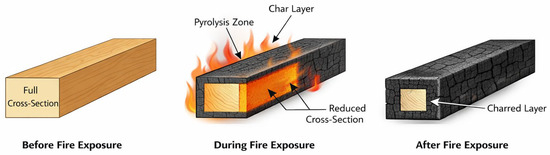
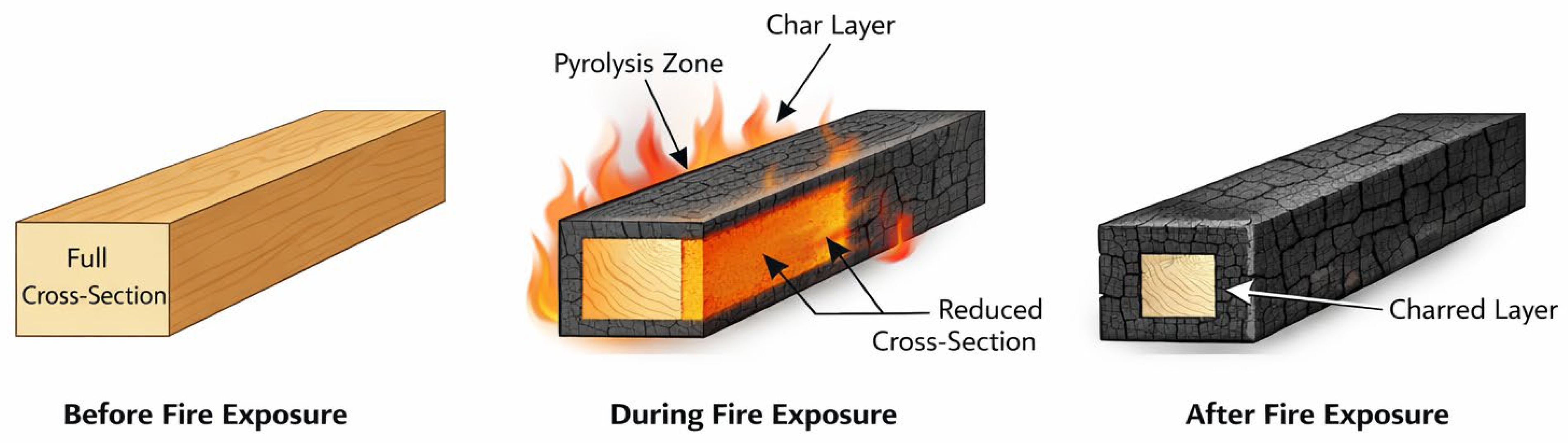
Highly nonlinear phenomena characterize the thermal behavior of timber under fire conditions, involving the formation of a charred layer, physicochemical degradation of the material, and transient heat transfer. Although the charred layer naturally delays the increase in temperature within the core of the structural element cross-section, the gradual reduction in the effective cross-section and the deterioration of mechanical properties ultimately lead to loss of structural capacity, as schematically illustrated in Figure 1. Reliable assessment of the thermal performance of timber beams is therefore essential to ensure adequate levels of safety and fire protection [2,3,4].
Figure 1.
Conceptual illustration of charring progression and effective cross-section reduction in a timber beam exposed to fire.
Traditionally, the design of timber structures under fire conditions has been based on prescriptive methods, founded on nominal standard fire curves, constant charring rates, and simplified representations of thermal and mechanical properties. Despite their ease of application and broad regulatory acceptance, these methods tend to be conservative and poorly representative of real fire scenarios, particularly when nonstandard geometries, asymmetric thermal exposures, or hybrid structural systems are considered [2,4,5]. In parallel, full-scale experimental tests provide valuable information on the behavior of timber at elevated temperatures; however, they are limited by high costs, logistical complexity, and difficulties in exploring a wide range of parameters, such as different timber species, geometric configurations, and loading conditions [3,6].
In an effort to overcome these limitations, the growing use of numerical simulations has been observed as an alternative to prescriptive and experimental approaches. Models based on the Finite Element Method (FEM) have been employed to simulate the behavior of timber beams at high temperatures, allowing the evaluation of time-dependent temperature fields and the estimation of charring depth under different boundary conditions [2,4,7,8]. Such analyses enable the consideration of nonstandard thermal exposures, including natural or compartment fires, thereby overcoming the limitations associated with the exclusive use of normative temperature–time curves [2,5].
Numerical approaches allow the assessment of the progressive loss of stiffness, strength, and global stability over the duration of fire exposure, providing relevant insights into the studied phenomena [4,8,9,10,11]. In reinforced or hybrid structural systems, numerical simulations have proven particularly relevant for investigating the influence of different parameters and the interactions among structural components [9,12,13].
Nevertheless, numerical modeling presents specific challenges. One of the main challenges is related to the anisotropy of timber, as its properties vary according to fiber orientation. Another critical aspect concerns the modeling of charring, since the definition of the charred depth may be based on different criteria, such as specific isotherms or enthalpy-based formulations, each with distinct implications for numerical results. Furthermore, the charring rate depends on timber species, density, moisture content, fire intensity, and ventilation conditions, and therefore cannot be considered a constant parameter. Recent studies have shown that the adoption of normative charring rates may not adequately represent nonconventional species, reinforcing the need for numerically calibrated models tailored to specific materials [3,7,8,14,15].
From a thermal and mechanical complexity standpoint, parameters such as thermal conductivity, specific heat, modulus of elasticity, and mechanical strength undergo significant variations during heating, directly affecting the structural response. Incorporating these temperature-dependent properties into numerical models increases their realism; however, it also raises computational cost and modeling complexity [4,9,11]. The interaction between thermal and mechanical fields requires robust numerical strategies to ensure model stability and convergence [8,10].
The increasing complexity of numerical models has motivated the development of reduced-order and empirical models, as well as multi-fidelity strategies. In this context, methods based on machine learning and genetic programming have emerged as promising alternatives for constructing surrogate models. The use of such models is not intended to replace high-fidelity numerical simulations, but rather to establish a complementary relationship between complex and simplified approaches, thereby enhancing the practical applicability of analyses [11,16,17].
Given this scenario, the need for a critical and integrated analysis of how numerical simulations have been applied to the thermal and thermomechanical assessment of timber beams becomes evident. A significant portion of the literature addresses modeling strategies in a fragmented manner, which hinders the consolidation of this field from a unified perspective and limits the clear identification of convergences, limitations, and future trends.
The objective of this work is to present a comprehensive and critical review of numerical approaches applied to the thermal and thermomechanical analysis of timber beams under fire conditions. The study discusses the main modeling methods employed, the challenges associated with timber properties, the treatment of charring and thermomechanical interaction, as well as the complementary role of reduced-order and symbolic models in relation to high-fidelity approaches, aiming to identify research gaps and outline perspectives for advancing numerical simulations in the context of structural design and fire safety engineering for timber structures.
Although the broader category of timber structural elements includes columns, wall panels (e.g., CLT), floor systems, connections, and hybrid assemblies, the present review is intentionally delimited to predominantly linear structural members, particularly timber beams. This focus is justified by the high recurrence of beam-type elements in numerical fire studies and by the methodological coherence required for a consistent comparative analysis of thermal and thermomechanical modeling strategies. Therefore, other structural components are mentioned only when directly relevant to beam behavior or hybrid beam systems and are not treated systematically within this review.
Despite the significant growth in numerical modeling studies applied to timber beams under fire, the literature still lacks a structured and integrated comparative synthesis capable of clearly identifying methodological convergences, divergences, and practical implications for structural fire design. The absence of standardized modeling frameworks and the limited integration between high-fidelity simulations and reduced-order approaches hinder the consolidation of consistent design-oriented methodologies. From both scientific and applied perspectives, there is therefore a need to systematically organize existing modeling strategies and to critically evaluate their assumptions, limitations, and potential for integration.
2. Literature Survey Methodology
A literature survey was conducted with the aim of identifying and analyzing studies that employ numerical simulations applied to the thermal and thermomechanical analysis of timber beams and predominantly linear timber members, with emphasis on modeling methods, adopted assumptions, and the main results obtained. Although the present work is structured as a narrative and thematic review, a transparent and traceable search and selection procedure was adopted to ensure methodological rigor and reproducibility.
The database search was conducted between November and December 2025, with the final search update performed on 15 December 2025. The research focused on the main international databases widely used in structural engineering, wood science, and fire safety engineering: Scopus, Web of Science, and ScienceDirect.
2.1. Search Strategy
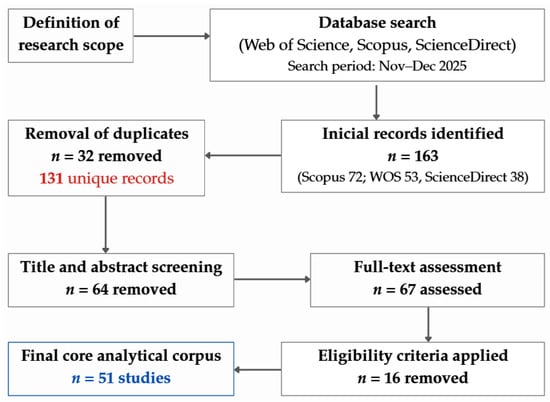
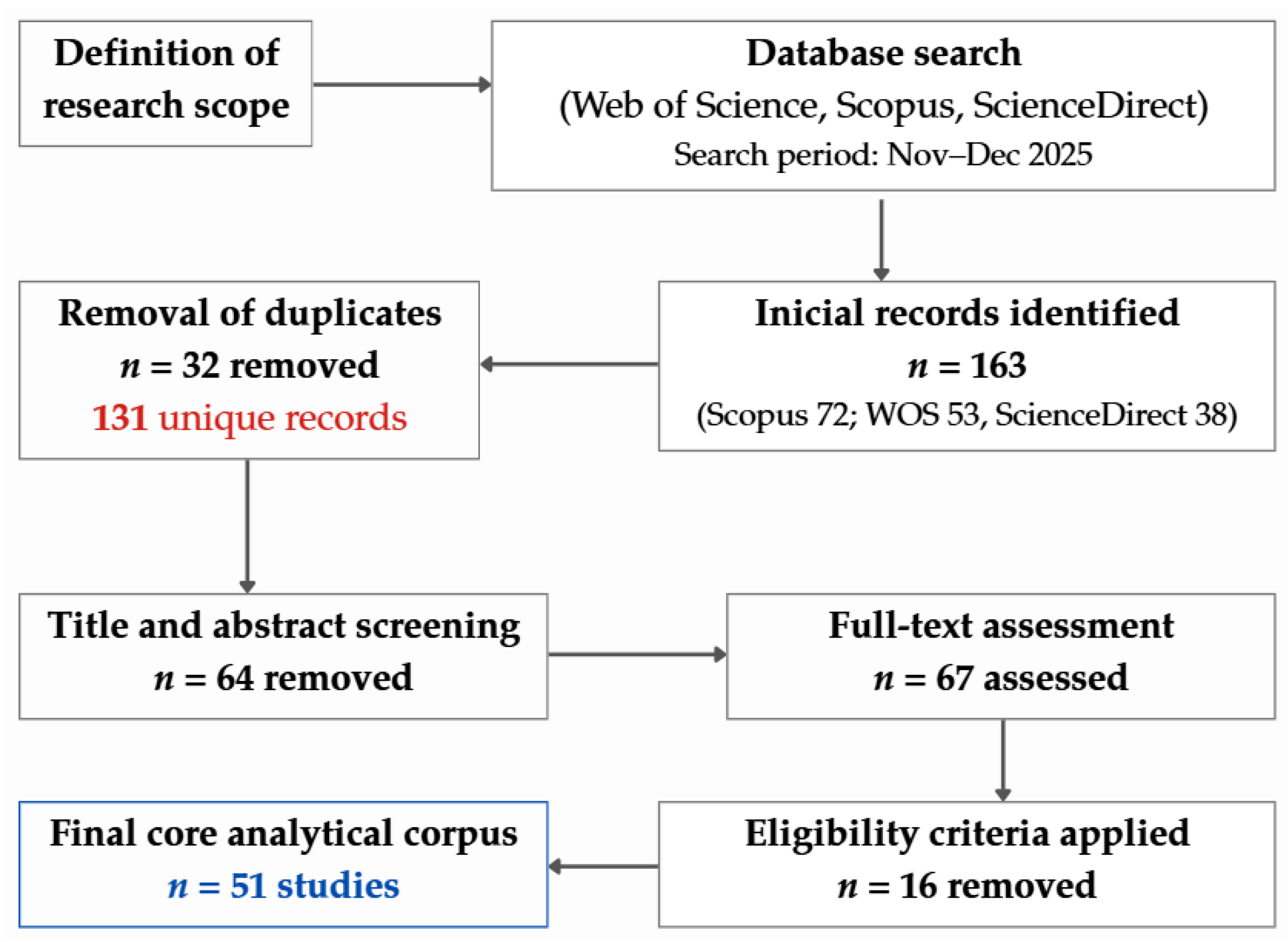
The initial search across the three databases resulted in 112 records (Scopus: 48; Web of Science: 37; ScienceDirect: 27). After removal of duplicate entries (21 records), 91 unique publications remained. These records were screened based on title and abstract, leading to the exclusion of 52 studies that did not directly address numerical thermal or thermomechanical modeling of timber beams under fire conditions. The remaining 39 articles were assessed through full-text reading. At this stage, 14 additional studies were excluded because they (i) focused exclusively on experimental analysis without numerical modeling, (ii) addressed timber elements not predominantly beam-type members without clear applicability to beam modeling, or (iii) were limited to purely prescriptive approaches without computational implementation. The complete methodological workflow of the literature identification and selection process is illustrated in Figure 2. The search strings (Table 1) were adapted to the specific syntax of each database, while maintaining conceptual consistency among them.
Figure 2.
Methodological flowchart of the review study.
Table 1.
Search strings used in the databases.
No temporal limits were imposed on the research, to include both classical studies and more recent contributions. Subsequently, the results were refined based on the review of titles, abstracts, and keywords, so as to ensure thematic alignment with the scope of the study.
2.2. Selection Criteria for the Studies
After obtaining the initial results, the articles were selected based on qualitative inclusion and exclusion criteria (Table 2), to ensure adherence to the scope of the present study and consistency with the objective of analyzing numerical approaches applied to the thermal and structural response of timber under fire conditions.
Table 2.
Inclusion and exclusion criteria adopted.
This step allowed the reduction in the initial set of publications to a group of articles directly related to the objectives of the study, ensuring thematic consistency and technical depth. The final corpus analyzed comprised 25 articles, distributed among different categories of thermal, thermomechanical, and structural modeling.
2.3. Organization and Categorization of the Articles
The articles were organized thematically, considering their main focus within numerical simulations. It is important to emphasize that this thematic classification is analytical and non-mutually exclusive. Several studies address multiple modeling dimensions (e.g., thermal analysis, charring modeling, and thermomechanical coupling) and may therefore appear in more than one thematic category. This does not alter the total number of core articles (n = 25) but reflects the multidimensional character of advanced numerical studies.
Table 3 clearly indicates that most studies are still concentrated on deterministic models based on the finite element method, as well as the existence of fragmentation between thermal, mechanical, and structural reinforcement studies. It is also observed that reduced-order models and multi-fidelity strategies remain underrepresented, despite their significant potential for practical applications.
Table 3.
Thematic classification of the articles.
The analysis of the selected articles was conducted in a qualitative and comparative manner, emphasizing the modeling assumptions adopted, the level of numerical complexity, the variables considered in thermal and structural analyses, and the main limitations identified by the authors themselves. This approach enabled a more in-depth assessment of methodological contributions and emerging trends in the field, while also supporting an integrated discussion between high-fidelity models and reduced-order models. It is emphasized that, although structured search and screening steps were adopted, the objective of the present work is not statistical synthesis but rather a critical and thematic integration of representative studies in the field.
3. Results and Discussion
3.1. Numerical Approaches for the Thermal Analysis of Timber Elements
Numerical analyses in the thermal domain applied to timber beams exposed to fire have been predominantly developed based on the finite element method (FEM), using transient heat conduction formulations and different levels of complexity in the representation of thermal properties and degradation mechanisms. The studies indicate that, although there is convergence regarding the use of FEM as the main tool, there are significant variations in thermal modeling strategies, boundary condition assumptions, and in the way charring and material property degradation are treated [2,4,7,13,14,15].
Thermal models with two-dimensional and three-dimensional geometries based on FEM have been developed, with the most frequent approach being the use of 2D simplifications to represent cross-sections of beams under different fire exposure conditions. This strategy reduces computational costs and allows more extensive parametric analyses, especially when the main interest lies in the evolution of the temperature field and the depth of the charred layer [4,7,15]. In contrast, three-dimensional models are employed when there is a need to consider non-uniform boundary conditions, internal reinforcements, or local effects associated with the spatial distribution of heat flux [2,13].
The definition of thermal boundary conditions constitutes one of the main sources of divergence among studies. Parts of the models adopt normative fire curves, such as standard time–temperature curves, while others employ non-standard thermal scenarios or distributions obtained from advanced simulations, including approaches coupled with computational fluid dynamics. Models that incorporate non-standard fire scenarios tend to produce more heterogeneous temperature fields and more pronounced thermal gradients in the cross-section, highlighting the limitations of approaches based exclusively on normative curves.
Another central issue concerns the representation of charring. The use of critical isotherms to define the charring front, enthalpy-based models, and approaches that explicitly incorporate the latent heat associated with pyrolysis have been adopted as modeling strategies. Enthalpy-based models have proven effective in representing the thermochemical transition associated with wood degradation, allowing a better estimation of charring depth and the evolution of temperature in the thermal transition zone [7,15]. On the other hand, approaches based solely on critical isotherms offer simpler implementation, but a reduced ability to capture the effects of property variation and heating rate. Table 4 summarizes the modeling strategies adopted by the studies discussed in this subsection.
Table 4.
Thermal modeling strategies adopted.
The consideration of temperature-dependent thermal properties is recurrent in more recent models, including variations in thermal conductivity and specific heat throughout the heating process. Studies that incorporate temperature-dependent curves tend to show better agreement with experimental results, particularly in predicting thermal gradients and charring rate progression [4,8,14,15]. Nevertheless, significant variability can be observed in the adopted curves, often derived from standards or limited experimental databases, which introduces uncertainty into the results. In order to provide a practical reference for preliminary studies and comparative analyses, Table 5 presents typical ranges of thermal and charring parameters frequently adopted in the reviewed literature.
Table 5.
Synthesis of typical orders of magnitude for numerical models.
Nevertheless, some models go beyond pure heat conduction and incorporate coupled heat and moisture transfer, recognizing the influence of moisture content on the thermal response of wood. The inclusion of this coupling alters the temperature distribution, especially during the initial stages of heating, due to evaporation effects and vapor transport, but significantly increases numerical complexity and the number of required parameters [14].
Across the set of analyzed studies, it is observed that most thermal models are still developed with a deterministic focus, high fidelity, and relatively high computational cost. In contrast, approaches based on reduced, empirical, or surrogate models, aimed at the rapid prediction of internal temperatures, charring depth, or fire resistance time, are less frequent. Multi-fidelity modeling strategies and surrogate models trained from detailed simulations have been proposed as alternatives for studies involving many variables and for uncertainty analyses, indicating a trend toward integration between physics-based models and approximation models [16].
In this context, advanced empirical models and techniques based on genetic programming and symbolic regression show significant potential as complementary tools to finite element simulations, acting either as rapid approximations for preliminary estimates or as metamodels calibrated from numerical databases. However, their specific application to the thermal analysis of timber beams under fire conditions still remains limited in the literature, representing a clear research opportunity.
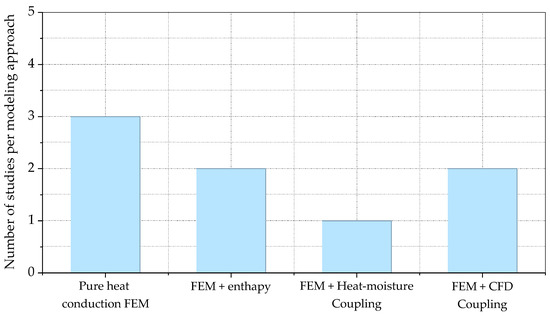
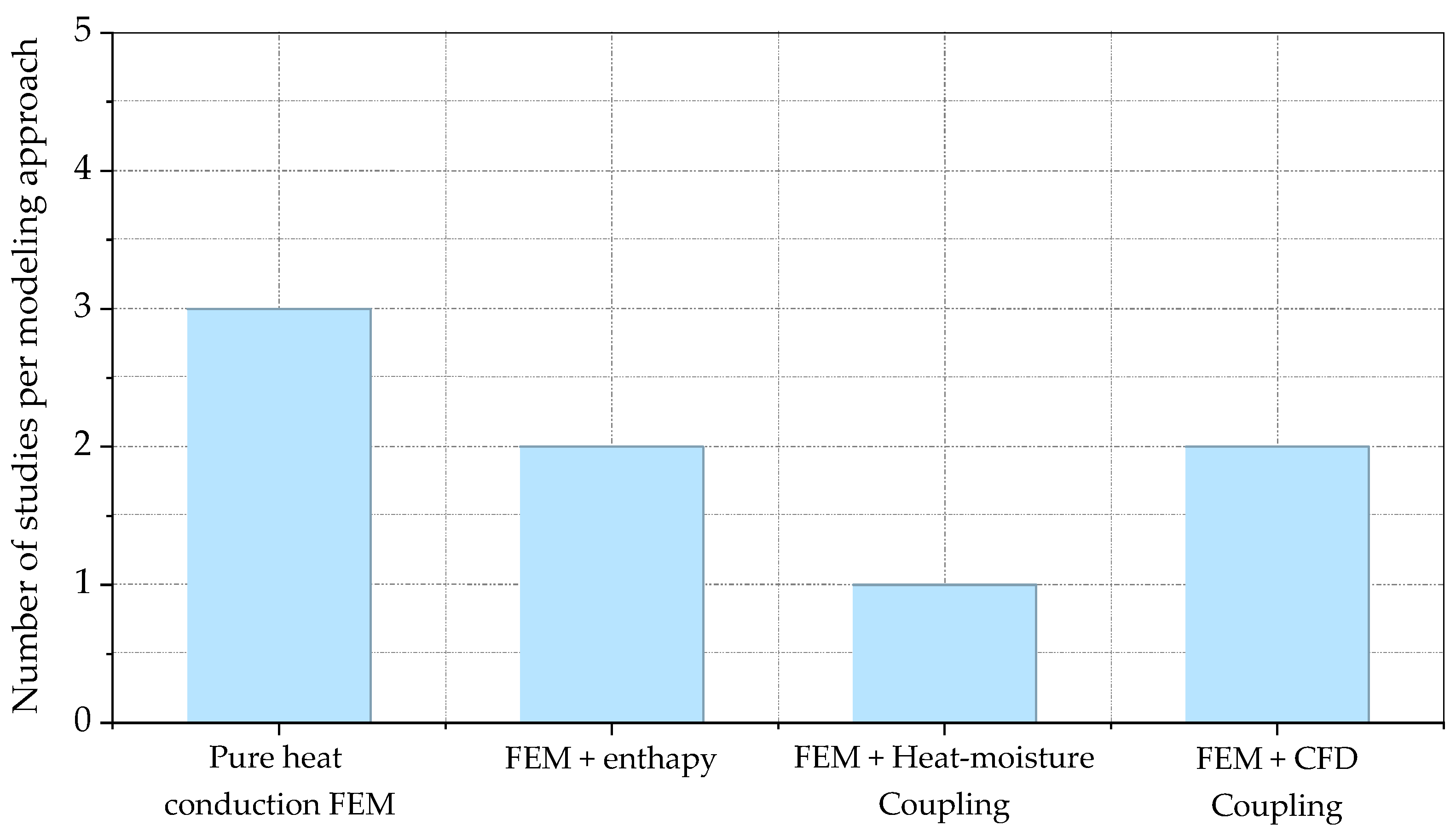
Although there is maturity in the use of FEM for the thermal analysis of timber beams, relevant methodological differences persist regarding the definition of thermal properties, charring modeling, treatment of boundary conditions, and level of physical coupling. This heterogeneity complicates the direct comparison among studies and reinforces the need for comparative frameworks and more consolidated modeling guidelines. Figure 1 illustrates the distribution of modeling approaches adopted by the studies analyzed in this subsection.
3.2. Modeling of Charring and Thermal Degradation
Numerical modeling of charring constitutes one of the most critical aspects in the thermal analysis of timber beams, as it directly links the temperature field to the effective loss of load-bearing cross-section and, consequently, to the structural response. The studies show that, although there is consensus regarding the importance of charring in the thermal and thermomechanical behavior of wood, there is significant diversity in the numerical strategies adopted for its representation (Figure 3) [3,4,7,15].
Figure 3.
Distribution of thermal modeling approaches employed in the studies analyzed in this subsection.
In general, three main approaches can be identified: models based on prescribed charring rates, models grounded on critical isotherms, and models based on enthalpy formulations that explicitly incorporate the energetic effects associated with pyrolysis. Each of these strategies presents different levels of complexity, computational cost, and physical fidelity.
Models based on prescribed charring rates generally derive from normative formulations or experimental adjustments and are frequently employed in parametric analyses and comparative studies due to their simplicity of implementation. In this approach, the charring front is defined based on an average advancement rate, applied uniformly along the faces exposed to fire. Although operationally efficient, this strategy tends not to capture local variations in heat flux, geometric effects, and changes in thermal regime, which may lead to conservative or non-representative estimates in non-standard fire scenarios [3,4].
An alternative widely employed in finite element models consists of using critical isotherms to define the depth of the charred layer. The position of the charring front is associated with a limiting temperature within the cross-section, with values close to the onset of pyrolysis commonly adopted. This strategy allows the progression of charring to be directly linked to the numerically computed thermal field, introducing sensitivity to boundary conditions and to the thermal properties adopted in the model [4,7,15]. Compared with prescribed-rate models, the isotherm-based approach exhibits greater physical coherence; however, it remains dependent on the choice of the critical temperature and on the quality of the underlying thermal modeling.
More advanced models employ enthalpy-based formulations, in which the effects of thermal degradation and material transformation are incorporated through equivalent energetic terms. In these models, the latent heat associated with thermal decomposition is explicitly considered, allowing a more realistic representation of the transition zone between intact wood and the charred layer. Studies adopting this strategy report better agreement with experimental results regarding the position of the charring front and the evolution of internal temperature, particularly under transient heating conditions [7,15]. On the other hand, numerical implementation is more complex and requires a larger set of thermal and thermochemical parameters.
Beyond the definition of the charring front, the literature highlights the importance of progressive thermal degradation of wood properties. Most recent thermal models incorporate temperature-dependent variations for properties such as thermal conductivity and specific heat, while thermomechanical models also include degradation of elastic modulus and strength. Neglecting these dependencies may result in underestimation of thermal gradients and inconsistent predictions of the degraded layer thickness.
Although most thermal models focus primarily on conductive heat transfer and temperature-dependent property degradation, the coupled transport of heat and moisture represents an additional layer of complexity that remains insufficiently explored in many numerical studies. During fire exposure, moisture migration, evaporation, and vapor pressure development within the timber matrix may significantly influence internal temperature evolution and damage mechanisms. Hygrothermal models that incorporate coupled heat and moisture transfer demonstrate that vapor pressure gradients can modify local thermal fields and delay or accelerate charring depending on permeability assumptions and boundary conditions [14].
In engineered wood products, particularly layered configurations, the buildup of vapor pressure may contribute to cracking, interfacial damage, and delamination phenomena under severe thermal exposure. While such mechanisms have been more extensively investigated in cross-laminated timber systems, their underlying thermophysical processes are equally relevant to laminated beams and hybrid assemblies. However, explicit incorporation of moisture transport, pore pressure evolution, and fracture or interface degradation remains limited within the reviewed corpus, indicating a methodological gap in current numerical modeling practices.
The absence of consistent hygrothermal coupling may lead to simplified representations of internal damage mechanisms, particularly in situations involving high initial moisture content or rapid heating rates. Future developments in thermomechanical modeling of timber beams would benefit from integrating coupled heat–moisture formulations with constitutive damage models capable of representing cracking and interfacial degradation, thereby enhancing physical fidelity in fire simulations.
Another relevant aspect concerns the influence of wood species and density on the charring rate and thermal response. Studies dedicated to calibrating models for specific species indicate significant variations relative to average normative values, especially for tropical woods and higher-density materials. This suggests that the direct application of generic parameters may introduce uncertainties in numerical modeling and reinforces the need for more comprehensive thermal property databases [3,15].
It is also noted that, in most studies, charring modeling is treated in a decoupled manner from mechanical modeling, with the residual cross-section determined from the thermal field and subsequently used in sequential structural analyses. Although this strategy is computationally efficient, it may not fully capture stress redistribution effects during progressive degradation. Fully coupled models remain less frequent due to their greater numerical complexity [8,14]. About the modeling strategies for thermal degradation effects in timber beams, Table 6 summarizes the approaches adopted by the studies referenced in this subsection.
Table 6.
Adopted thermal modeling strategies.
From the perspective of reduced and empirical models, charring depth and time to thermal failure constitute variables particularly well suited for approximation by metamodels and symbolic regression techniques. The generation of response surfaces based on large sets of numerical simulations creates opportunities for the use of surrogate models as rapid prediction tools, especially in preliminary design stages or probabilistic analyses. However, the literature still shows limited application of these techniques specifically to the modeling of charring in timber beams, representing a relevant methodological gap.
In summary, the analyzed studies indicate consistent progress in the numerical modeling of charring, with a gradual transition from simplified approaches toward more energetically consistent formulations. Nevertheless, challenges persist related to the calibration of thermal properties, variability among wood species, the level of physical coupling, and the standardization of criteria for defining the charring front—factors that directly affect the comparability of models and the reliability of predictions.
3.3. Thermomechanical Coupling in Simulations
The analysis of the behavior of timber beams exposed to fire requires, at more advanced levels of modeling, the integration of thermal and mechanical fields in order to simultaneously represent temperature evolution, degradation of material properties, and structural response. Studies involving thermomechanical coupling have predominantly been carried out using sequential strategies, while fully coupled approaches remain relatively rare. The limited number of fully coupled thermomechanical studies is mainly justified by computational cost and the numerical complexity involved in such analyses.
In the sequential strategy, a transient thermal analysis is first performed, typically using the finite element method, to obtain temperature fields over time. These thermal fields are then applied as loads in a mechanical model, in which material properties are updated as a function of local temperature. This approach offers modularity in modeling, greater numerical stability, and reduced computational time, making it suitable for parametric studies and comparative assessments [4,8,9].
Sequential models have been successfully employed to predict stiffness loss, strength reduction, and time to structural failure of timber beams and reinforced systems. In these models, thermal degradation is usually incorporated through temperature-dependent constitutive laws for elastic modulus, compressive strength, tensile strength, and plasticity parameters. In terms of result quality, performance strongly depends on the consistency between the thermal model and the adopted mechanical degradation curves [8,9,11].
Beyond the numerical coupling strategy itself, the structural response of timber beams under fire is fundamentally governed by temperature-dependent degradation of stiffness and strength. Sequential thermomechanical models incorporating temperature-dependent reduction factors have demonstrated that the progressive decrease in elastic modulus significantly affects flexural rigidity (EI), accelerating deflection growth even before complete cross-sectional loss occurs [8,9,11]. The accuracy of displacement and failure predictions therefore depends not only on thermal field consistency but also on the adequacy of the adopted mechanical degradation laws.
Strength degradation follows a similarly nonlinear pattern. Compressive and tensile resistances decrease progressively with temperature, directly influencing bending capacity and ultimate load-bearing performance. Reliability-based numerical analyses indicate that fire exposure may reduce structural safety indices by more than 50% depending on beam geometry, density, and exposure duration, highlighting the strong interaction between temperature penetration and load-bearing capacity reduction [11]. This reduction results from the combined effects of stiffness loss, strength degradation, and effective cross-section reduction due to charring.
The interaction between charring progression and structural stability constitutes a critical aspect of thermomechanical behavior. As the char front advances, the effective load-bearing section diminishes, shifting the neutral axis and increasing stress concentrations in the heated residual core. Under bending and compressive stresses, this process may trigger local instability phenomena and amplify second-order effects (P–Δ), particularly in slender elements [10,17]. Dynamic formulations further demonstrate that temperature-dependent stiffness variation alters vibration characteristics and may influence time-to-failure predictions under combined mechanical loading and fire exposure [17].
In reinforced and hybrid systems, additional complexity arises from differential thermal expansion and degradation between timber and reinforcement materials. Thermomechanical simulations show that reinforcement positioning and cover depth strongly influence stress redistribution during heating, modifying the composite action as timber properties deteriorate [9,10]. Accurate representation of these mechanisms requires consistent integration of temperature-dependent constitutive laws, cross-section reduction modeling, and geometric nonlinearity within the numerical framework. In contrast, fully coupled models solve thermal and mechanical equations simultaneously within a single numerical system, allowing the consideration of feedback effects such as contact changes, crack opening, and geometric alterations that affect heat transfer conditions. Although conceptually more comprehensive, these models are computationally more demanding and require robust constitutive formulations, particularly for anisotropic materials with progressive degradation, such as timber [10].
Approaches with some degree of coupling become particularly relevant in hybrid systems, such as timber beams reinforced with steel or composites, in which differences in thermal conductivity, coefficients of thermal expansion, and mechanical degradation between materials generate highly non-uniform stress and strain fields. Numerical models applied to mixed systems indicate that reinforcement positioning, cover depth, and thermal compatibility between materials significantly influence structural performance under fire conditions, requiring integrated representation of thermal and mechanical phenomena [9,10,12,13].
Another recurring aspect in the literature is the treatment of material and geometric nonlinearity in thermomechanical analyses. The response of timber at elevated temperatures exhibits nonlinearity associated with compressive plasticity, tensile brittleness, and progressive stiffness degradation. Numerical models that incorporate anisotropic plasticity, fiber-direction-dependent failure criteria, and gradual degradation of constitutive parameters tend to reproduce experimentally observed failure modes more accurately, albeit at the expense of substantially increased computational cost and calibration effort [8,11,17].
Studies that incorporate parameter variability and uncertainty quantification demonstrate that dispersion in timber properties can lead to significant variations in fire resistance time and failure modes. Multi-fidelity modeling strategies and integration with surrogate models have been proposed to enable uncertainty analyses at reduced computational cost. In this context, the combination of high-fidelity thermomechanical models with data-driven reduced models, such as metamodels and symbolic expressions obtained through genetic programming, emerges as a promising strategy. Detailed simulations can be used to generate training datasets, from which symbolic regressions are able to rapidly estimate failure time, residual cross-section, or effective stiffness as a function of geometric, thermal, and loading variables. Nevertheless, the adoption of these techniques in the analysis of timber beams under fire conditions remains limited, representing a clear opportunity for methodological advancement.
Finally, the analysis of these studies (Table 7) indicates that thermomechanical coupling is already recognized as an essential component of advanced simulations; however, there is still a predominance of sequential approaches, diversity in adopted degradation laws, and low standardization of validation strategies. Expanding the use of coupled models, together with the integration of surrogate models and symbolic learning techniques, represents one of the main future directions for progress in this field.
Table 7.
Thermomechanical coupling strategies.
3.4. Reduced and Empirical Models as a Complement to Numerical Simulations
The advancement of thermal and thermomechanical numerical simulations of timber beams exposed to fire has been accompanied by a progressive increase in model complexity and associated computational cost. Three-dimensional finite element–based models, incorporating temperature-dependent properties, enthalpy formulations, and coupled thermomechanical analyses, can represent the involved physical phenomena with a high level of detail; however, they often require long processing times and large volumes of input data [2,8,10,11]. In this context, there has been growing interest in the development of reduced-order and surrogate models aimed at the rapid prediction of thermal and structural responses.
Empirical and semi-empirical models continue to be widely used in the design of timber structures under fire conditions, particularly in the form of charring rate equations and simplified expressions for residual cross-sections. These models offer practical applicability and low computational cost but are generally derived from limited experimental datasets and are valid only within specific ranges of geometry, timber species, and thermal exposure conditions. Comparisons with numerical simulation results indicate that such models may exhibit significant deviations when applied outside their calibration domains, especially under non-standard fire scenarios or in reinforced systems [3,4,15].
In response to these limitations, several modeling strategies have been proposed in which high-fidelity numerical models are used to generate synthetic datasets that are subsequently employed to calibrate approximate models. These strategies include response surface methods, multivariate regressions, and surrogate models based on machine learning. Multi-fidelity modeling frameworks have been adopted to combine simplified and detailed models, enabling the exploration of parameter uncertainty and property variability with controlled computational cost [11,16].
Within this set of approaches, symbolic regression and genetic programming methods exhibit particularly suitable characteristics for the problem at hand. Unlike purely statistical models or black-box neural networks, symbolic models yield explicit analytical expressions that relate geometric, thermal, and mechanical variables to quantities of interest, such as time to failure, charring depth, or residual stiffness. This feature facilitates interpretation, physical verification, and direct incorporation into preliminary design routines.
The application of symbolic regression is especially promising when combined with databases generated from parametric thermomechanical simulations. In this framework, finite element models are used to systematically sample the variable space, such as cross-section dimensions, thermal intensity, reinforcement position, and load levels, and the resulting data are employed to train symbolic models capable of reproducing the structural response with controlled error. This strategy enables a drastic reduction in evaluation time for sensitivity analyses, optimization, and reliability studies, while maintaining consistency with the physics represented in high-fidelity models.
Despite this potential, the results discussed throughout this work indicate that the still limited adoption of symbolic models does not stem from conceptual constraints, but rather from the lack of standardized numerical databases, the diversity of output variables used in simulations, and the absence of consistent cross-validation procedures. Most studies remain focused on direct deterministic models or conventional statistical metamodels [11,16]. The lack of standardized frameworks for numerical data generation and cross-validation of surrogate models therefore constitutes a relevant methodological gap.
Another critical issue concerns the transferability of reduced-order models. Empirical models and metamodels trained on a restricted set of configurations may not generalize adequately to different geometries, timber species, or thermal scenarios. For this reason, hybrid strategies, where reduced models are used as preliminary filters or initial estimators, followed by verification with finite element models, tend to offer greater robustness.
Despite their conceptual potential, symbolic regression and genetic programming techniques remain underrepresented within the reviewed corpus, appearing explicitly in only a limited number of studies. Their inclusion in this review is therefore not intended to suggest methodological predominance, but rather to identify an emerging research direction with potential for integration into multi-fidelity frameworks. At present, finite element–based high-fidelity models clearly constitute the dominant paradigm in the field.
3.5. Numerical Modeling of Reinforced Beams and Hybrid Systems Under Thermal Action
Numerical modeling of reinforced timber beams and hybrid systems has received increasing attention in the literature, particularly due to the expanded use of metallic and composite reinforcements to enhance stiffness, strength, and ductility. Studies involving steel bars, steel plates, and fiber-reinforced polymers (FRP) demonstrate that numerical simulation is a central tool for evaluating material interaction, stress redistribution, and failure modes, both at ambient temperature and under elevated thermal exposure [9,12,18,19,20,21,22,23,24,25,26].
Finite element models are widely employed to represent reinforced beams, with different levels of refinement in the description of the timber–reinforcement interface. Approaches range from perfectly bonded models to formulations including interface elements and nonlinear bond–slip laws. Accounting for timber anisotropy and material nonlinearity has proven essential to adequately reproduce the structural response and failure mechanisms observed experimentally in beams reinforced with steel bars and FRP [20,21,22,24].
In the thermal and fire context, the presence of reinforcements introduces additional modeling challenges. Significant differences in thermal conductivity, heat capacity, and coefficients of thermal expansion between timber, steel, and composites generate non-uniform thermal and mechanical fields, with pronounced gradients and differential stresses. Thermomechanical simulations indicate that reinforcement positioning within the cross-section, cover depth, and thermal protection strategies strongly influence fire resistance time and structural failure mode [9,10,12,13].
Numerical models applied to beams reinforced with steel bars show that internal reinforcement can contribute to maintaining load-bearing capacity during the initial heating stages but may also induce stress concentrations and deformation redistribution as timber degrades and the effective cross-section is reduced. Adequate representation of the simultaneous thermal degradation of timber and steel is therefore required for reliable performance predictions [9,18,19].
For FRP reinforcements, numerical modeling reveals high sensitivity to the assumptions adopted for composite behavior and the adhesive interface. Nonlinear numerical studies indicate that composite reinforcements can significantly alter beam stiffness and failure mode, promoting a transition from brittle tensile failure to more ductile modes governed by timber compression. However, the performance of FRP at elevated temperatures is strongly dependent on the thermal behavior of the polymer matrix and the bonding system, which introduces additional uncertainties into thermomechanical modeling [20,21,22,23,24,25,26].
It is observed that a significant portion of studies on reinforced timber beams focus on ambient temperature conditions, with a more limited number of numerical models explicitly incorporating fire exposure and coupled thermal degradation for reinforced systems. This asymmetry highlights a relevant research gap, considering the growing use of composite and metallic reinforcements in engineered timber structures. The systematic extension of thermal and thermomechanical models to reinforced beams therefore represents a clear research opportunity [9,12,13,20].
From a computational perspective, modeling reinforced hybrid systems tends to significantly increase the number of degrees of freedom, constitutive parameters, and interface conditions, raising simulation costs. In this context, hierarchical modeling and metamodeling strategies become particularly attractive. High-fidelity models can be used to generate parametric databases involving reinforcement type, reinforcement ratio, position, and cover depth, while reduced and symbolic models can be calibrated for rapid prediction of residual stiffness and time to failure. The application of symbolic regression and gene expression programming (GEP) to such databases represents a promising pathway for constructing simplified yet physically informed design models.
The application of symbolic regression and genetic programming to these datasets thus represents a promising avenue for developing simplified, physically informed design models capable of capturing the combined effects of reinforcement, thermal degradation, and loading.
In summary, numerical studies of reinforced beams and hybrid systems demonstrate the potential of advanced simulations to capture complex material–material interaction mechanisms and differential thermal degradation. At the same time, they highlight the need for greater integration between thermal modeling, interface modeling, and constitutive degradation, as well as the opportunity to develop interpretable reduced models as support tools for fire design.
3.6. Comparative Discussion and Structured Synthesis of Numerical Modeling Strategies
Although the previous subsections examined numerical approaches according to thematic categories, a cross-cutting comparative discussion enables a more critical interpretation of the methodological differences and convergences identified across the reviewed studies. Beyond classification, this section synthesizes the principal results reported in the literature, contrasts modeling assumptions and validation strategies, and evaluates their implications in terms of physical fidelity, computational demand, and engineering applicability. Table 8 consolidates the structured comparative framework, while Table 9 presents a synthesis of the main contributions, limitations, and practical implications of each modeling approach.
Table 8.
Cross-comparative framework of numerical modeling strategies.
Table 9.
Comparative synthesis of modeling approaches, main contributions, limitations, and engineering implications.
A quantitative synthesis of the 25 core analytical studies further clarifies these tendencies. Sequential thermomechanical coupling predominates, being adopted in 21 of the 25 studies (84%), whereas only 4 investigations (16%) employed fully coupled thermomechanical formulations. Experimental validation was reported in 18 studies (72%), typically through comparison with fire tests on beams under standard exposure, while 7 studies (28%) relied exclusively on numerical or theoretical benchmarking. Explicit heat–moisture transport modeling was incorporated in only 3 investigations (12%), confirming that hygrothermal coupling remains relatively uncommon due to its elevated parameter and computational requirements. Regarding charring representation, 9 studies (36%) employed prescribed charring rates or simplified criteria, 10 studies (40%) adopted isotherm-based approaches, and 6 studies (24%) implemented enthalpy-based formulations or energetically enriched degradation models.
These figures demonstrate a clear methodological concentration around sequential coupling and simplified thermal assumptions, while fully coupled and moisture-sensitive models remain limited. The quantitative distribution corroborates the comparative assessment presented in Table 8 and reinforces the identification of methodological gaps discussed in the following section.
Regarding thermal boundary conditions, models based on standard fire curves exhibit lower input uncertainty and improved reproducibility, which makes them suitable for comparative parametric studies. However, they offer limited representativeness for localized or non-uniform fire exposure. In contrast, models incorporating non-standard thermal actions or CFD-derived heat flux distributions (Table 4) provide greater physical realism but require more complex calibration and significantly higher computational effort. Similar trade-offs emerge in charring modeling: prescribed-rate approaches are computationally efficient and operationally simple but insensitive to local thermal gradients, whereas isotherm-based criteria improve coherence with computed temperature fields. Enthalpy-based formulations offer the highest physical consistency by explicitly accounting for pyrolysis energetics, though at the expense of additional thermochemical parameters and increased numerical stiffness (Table 6).
The consideration of heat–moisture coupling further accentuates these differences. Pure heat-conduction models dominate the literature due to their numerical stability and moderate parameter requirements. Coupled hygrothermal formulations improve prediction of early-stage temperature evolution and evaporation effects yet introduce substantial complexity and calibration challenges (Table 6). In thermomechanical analyses, sequential coupling remains the predominant strategy, as confirmed in Table 7, as it provides robustness and computational efficiency for structural response prediction. Fully coupled formulations allow feedback mechanisms between mechanical degradation and heat transfer but demand advanced constitutive modeling and exhibit greater convergence sensitivity, restricting their widespread application.
Across all strategies, a clear gradient of computational demand can be identified, ranging from low-cost two-dimensional thermal models with prescribed charring rates (Table 4 and Table 6) to highly demanding three-dimensional enthalpy-based thermomechanical simulations incorporating material nonlinearity. Validation practices also vary considerably, with most studies relying on limited experimental comparisons rather than multi-case or probabilistic validation frameworks (Table 6 and Table 7). The quantitative synthesis presented above confirms that high-fidelity finite element models, particularly those employing sequential thermomechanical coupling, constitute the prevailing methodological paradigm within the reviewed corpus. Reduced-order and symbolic approaches appear only marginally and should therefore be interpreted as emerging complementary strategies rather than representative trends in the current state of the literature.
3.7. Methodological Gaps and Future Opportunities
The comparative analysis of studies on numerical simulations applied to the thermal and thermomechanical assessment of timber beams exposed to fire reveals consistent advances in the use of finite element models, as well as in the incorporation of temperature-dependent properties, charring formulations, and physical coupling strategies. However, it also exposes a relevant set of methodological gaps and development opportunities that affect comparability among studies, prediction reliability, and the practical applicability of models [2,4,7,10,11,15].
A first gap concerns the heterogeneity of thermal modeling assumptions. There is substantial variation in the definition of thermal properties, charring criteria, pyrolysis treatment, and thermal boundary conditions. Different studies adopt distinct temperature-dependent conductivity and specific heat curves, often based on limited experimental sources or generic normative recommendations. This variability hampers direct comparison of results and suggests the need for broader and more standardized thermal property databases, organized by timber species, density, and moisture content [3,14,15].
Another recurring limitation is associated with the representation of material variability. Timber is inherently anisotropic and heterogeneous, with significant dispersion in mechanical and thermal properties. Despite this, most numerical models adopt deterministic mean parameters. Studies incorporating variability and uncertainty quantification demonstrate that property dispersion can significantly affect fire resistance time and failure modes, indicating that probabilistic approaches remain underutilized in this domain [11,16].
With respect to charring modeling, although enthalpy-based formulations and advanced thermal criteria are increasingly adopted, there is still no standardization of criteria for defining the char front nor consensus on ideal thermochemical parameters. Simplified prescribed charring rate models continue to be widely used, particularly in parametric studies, but their validity outside normative conditions remains limited. There is a clear opportunity for developing hybrid models that combine physical robustness with computational efficiency [4,7,15].
Regarding thermomechanical coupling, sequential approaches predominate, with relatively limited use of fully coupled models. While sequential strategies are efficient and stable, they do not always capture feedback effects between mechanical degradation and heat transfer. The advancement of robust coupled formulations, adapted to timber anisotropy and nonlinearity, represents an important research direction, especially for hybrid systems and reinforced beams [8,9,10].
A further gap is observed in the standardization of validation procedures. Many models are validated against specific and limited experimental datasets, often associated with a single geometry or exposure condition. The absence of cross-validation protocols and shared experimental databases hinders comparative performance assessment among different modeling strategies.
From a computational standpoint, increasing model fidelity is accompanied by higher processing costs, limiting large-scale studies, probabilistic analyses, and optimization. In this context, the integration of high-fidelity models with data-driven reduced models, including metamodels and symbolic regressions, emerges as a strategic opportunity. The use of simulation-generated datasets to train interpretable surrogate models, such as those obtained via genetic programming, can enable rapid assessments of thermal performance and time to failure, with direct application in preliminary design and sensitivity analysis.
Additionally, most studies focus on relatively conventional geometries and loading conditions. There is scope for expanding investigations to include non-standard geometries, localized thermal exposures, simulated natural fires, and time-varying mechanical actions. The integration of CFD-based fire simulations with structural models remains limited and represents another promising research direction [5,10].
Based on the critical analysis performed, it is possible to outline minimum guidelines for the numerical modeling of timber beams under fire conditions. Model comparability and reliability fundamentally depend on a clear logical sequence: (i) explicit definition of thermal assumptions and boundary conditions, (ii) coherent representation of charring consistent with the adopted thermal model, and (iii) consistent incorporation of temperature-dependent mechanical degradation. The lack of standardization in these aspects explains a significant portion of the dispersion observed among results reported in the literature.
Finally, there is an opportunity to develop integrated modeling workflows in which thermal simulations, thermomechanical analyses, uncertainty quantification, and reduced symbolic models are combined within multi-level frameworks. Such an approach can support performance-based design methodologies that are more flexible, transparent, and aligned with the real variability of materials and fire scenarios.
4. Engineering Implications for Timber Design Under Fire Conditions
The comparative analysis of numerical modeling strategies presented throughout this review provides relevant implications for the design and construction of timber structures subjected to fire exposure. Although the reviewed studies primarily focus on methodological development, their findings directly affect performance-based structural design and the evaluation of fire resistance in engineered timber systems.
First, the variability observed in thermal properties and charring criteria has significant consequences for structural sizing. Prescribed charring rates, commonly adopted in simplified design approaches, may not adequately represent species-specific behavior or non-standard fire scenarios, particularly when density and moisture content vary from normative assumptions [3,4,15]. Numerical studies incorporating isotherm-based or enthalpy-based formulations demonstrate that the definition of the charring front directly influences the estimation of residual cross-section and, consequently, load-bearing capacity [4,7,15]. For engineering practice, this indicates that advanced modeling may reduce uncertainties in residual section evaluation, especially in performance-based verification contexts.
Second, thermomechanical simulations highlight that temperature-dependent degradation of elastic modulus and strength significantly affects flexural stiffness (EI), deflection development, and ultimate resistance [8,9,11]. In slender beams, the interaction between cross-sectional reduction and stiffness loss may amplify second-order effects, influencing global stability under fire conditions [10,17]. These findings reinforce the importance of incorporating temperature-dependent constitutive models and geometric nonlinearity in advanced fire design assessments, particularly for long-span or heavily loaded members.
In reinforced and hybrid systems, differential thermal expansion and distinct degradation rates between timber and reinforcement materials introduce additional design considerations. Numerical analyses indicate that reinforcement positioning, cover depth, and interface modeling substantially influence stress redistribution and time to failure under fire exposure [9,10,12,13]. For construction practice, these results emphasize the relevance of detailing strategies and the need for integrated thermal–structural assessment when metallic or composite reinforcements are employed.
Finally, the limited but emerging use of reduced-order and surrogate models suggests opportunities for practical implementation in preliminary design, parametric exploration, and uncertainty quantification [11,16]. While high-fidelity finite element models remain the dominant paradigm, the integration of structured numerical databases with interpretable reduced models may facilitate faster performance assessments and support the development of performance-based fire design methodologies for timber structures.
Overall, the reviewed literature demonstrates that advances in numerical modeling are not restricted to theoretical development, but provide actionable insights for structural design, detailing strategies, and the implementation of performance-based approaches in timber construction under fire conditions.
5. Conclusions
The structured and quantitative synthesis conducted in this review confirms that finite element–based models constitute the dominant methodological framework in the thermal and thermomechanical analysis of timber beams under fire. Among the 25 core analytical studies examined, sequential thermomechanical coupling clearly predominates (84%) over fully coupled formulations (16%), and deterministic approaches remain significantly more frequent than models incorporating uncertainty quantification or probabilistic analysis. Explicit hygrothermal coupling is reported in only 12% of the studies. These figures substantiate the observed heterogeneity in modeling assumptions, validation strategies, and physical coupling levels, providing an evidence-based foundation for identifying methodological gaps and future research directions. Based on the critical analysis, the following main conclusions can be highlighted:
5.1. Scientific Findings
- The finite element method is the dominant approach in thermal and thermomechanical analyses of timber beams, with wide application in transient heat conduction models and temperature-dependent structural simulations;
- Two-dimensional cross-sectional thermal models are widely used for charring studies and temperature field evaluation, offering a good balance between computational cost and fidelity, while three-dimensional models are applied in cases involving non-uniform boundary conditions and reinforced systems;
- Charring modeling has evolved from approaches based on prescribed charring rates toward strategies based on critical isotherms and enthalpy formulations, which provide greater physical consistency, although they still lack standardization in terms of parameters and criteria for defining the charring front;
- The reviewed studies reveal substantial heterogeneity in the definition of temperature-dependent thermal properties and charring front criteria, as evidenced by the diversity of modeling strategies summarized in Table 6, indicating the need for more consolidated thermal property databases organized by timber species and density;
- Thermomechanical coupling is predominantly treated using a sequential strategy, with fully coupled formulations representing a minority of the analyzed studies (Table 7), despite their theoretical potential to represent feedback effects between thermal and mechanical fields;
- Most models rely on deterministic mean properties, with limited integration of uncertainty quantification, suggesting that reliability-based frameworks remain underdeveloped in fire analysis of timber beams;
- Reduced and symbolic surrogate models, including techniques based on genetic programming and symbolic regression, appear only marginally within the reviewed corpus. Their integration into multi-fidelity workflows represents an emerging complementary research direction rather than a currently dominant paradigm.
5.2. Engineering Implications
- Numerical modeling of reinforced and hybrid systems highlights the importance of differential thermal behavior and interface representation, yet comprehensive coupled thermomechanical simulations of such systems remain comparatively scarce.
- The predominance of sequential thermomechanical coupling strategies implies that, in practical design applications, structural safety assessment under fire is typically performed through decoupled thermal and mechanical analyses. While computationally efficient, this approach may underestimate feedback mechanisms between stiffness degradation, geometric nonlinearity, and heat transfer, particularly in slender or highly loaded beams.
- The widespread use of two-dimensional cross-sectional thermal models suggests that performance-based fire design for timber beams is often grounded on sectional response assumptions. For complex boundary conditions, asymmetric fire exposure, or hybrid systems, three-dimensional analyses may become necessary to avoid oversimplified resistance estimations.
- The limited integration of uncertainty quantification indicates that current engineering practice remains largely deterministic, potentially overlooking variability in material properties, moisture content, and fire intensity. Incorporating probabilistic frameworks could significantly improve reliability-based fire design methodologies for timber structures.
5.3. Limitations and Future Research Perspectives
- A fundamental limitation identified in this review is the absence of standardized benchmarking protocols for validating numerical fire models of timber beams, which restricts cross-study comparability and the consolidation of unified modeling guidelines.
- The relatively small proportion of studies incorporating hygrothermal coupling or fully coupled thermomechanical formulations indicates that important physical mechanisms (such as vapor pressure effects, interface degradation, and stability interaction) remain insufficiently explored in advanced simulations.
- Future scientific development should therefore prioritize the establishment of shared numerical databases, systematic multi-scenario validation campaigns, and integrated modeling frameworks capable of simultaneously addressing thermal degradation, mechanical instability, moisture transport, and material variability.
- Future advances in the field depend on the integration of high-fidelity models, parametric databases, and interpretable reduced models, supporting performance-based design methodologies that are computationally efficient, transparent, and aligned with the real variability of materials and fire scenarios.
Overall, progress in this field depends on improved methodological standardization, expanded thermal and mechanical property databases, enhanced validation frameworks, and the structured integration of high-fidelity simulations with interpretable reduced-order models capable of supporting performance-based fire design. From a long-term scientific perspective, advancing toward unified multi-fidelity modeling environments, where detailed finite element simulations, reduced-order models, and reliability-based assessment tools interact consistently, represents a key pathway for consolidating the technical and normative evolution of timber fire design.
Author Contributions
Conceptualization, E.M.M. and A.L.C.; methodology, E.M.M.; software, not applicable; validation, E.M.M., V.A.D.A. and F.J.R.M.; formal analysis, E.M.M.; investigation, E.M.M.; resources, A.L.C. and S.N.M.; data curation, E.M.M.; writing/original draft preparation, E.M.M.; writing/review and editing, E.M.M., V.A.D.A., F.J.R.M., S.N.M., A.R.G.d.A. and A.L.C.; visualization, E.M.M.; supervision, A.L.C.; project administration, A.L.C.; funding acquisition, not applicable. All authors have read and agreed to the published version of the manuscript.
Funding
This research received no external funding.
Data Availability Statement
No new data were created or analyzed in this study. Data sharing is not applicable to this article as no datasets were generated or analyzed during the current study.
Conflicts of Interest
The author declares no conflicts of interest.
References
- De Araujo, V. Timber construction as a multiple valuable sustainable alternative: Main characteristics, challenge remarks and affirmative actions. Int. J. Constr. Manag. 2021, 23, 1334–1343. [Google Scholar] [CrossRef] [Scilit]
- Chen, C.; Jiang, L.; McLaggan, M.S.; Wang, S.; Usmani, A. Modelling Heat Transfer of Timber Sections Subjected to Non-standard Fire Action. Fire Technol. 2026, 62, 5. [Google Scholar] [CrossRef] [Scilit]
- Zhang, J.; Liu, Z.; Xu, Y.; Ma, S.; Xu, Q. An experimental and numerical study on the charring rate of timber beams exposed to three-side fire. Sci. China Technol. Sci. 2012, 55, 3434–3444. [Google Scholar] [CrossRef] [Scilit]
- Zhang, J.; Xu, Q.; Xu, Y.; Wang, B.; Shang, J. A numerical study on fire endurance of wood beams exposed to three-side fire. J. Zhejiang Univ. Sci. A 2014, 13, 491–505. [Google Scholar] [CrossRef] [Scilit]
- Perković, N.; Skejić, D.; Rajčić, V. Numerical Analysis of Fire Resistance in Cross-Laminated Timber (CLT) Constructions Using CFD: Implications for Structural Integrity and Fire Protection. Forests 2024, 15, 2046. [Google Scholar] [CrossRef] [Scilit]
- Fragiacomo, M.; Menis, A.; Moss, P.; Clemente, I.; Buchanan, A.; Nicolo, B.D. Predicting the fire resistance of timber members loaded in tension. Fire Mater. 2013, 37, 114–129. [Google Scholar] [CrossRef] [Scilit]
- Špilák, D.; Majlingová, A.; Kačíková, D.; Tischler, P. Determining the Charred Layer of Wooden Beams with Finite Element Analysis Based on Enthalpy Approach. Buildings 2022, 12, 875. [Google Scholar] [CrossRef] [Scilit]
- Khelifa, M.; Thi, V.D.; Oudjène, M.; Khennane, A.; El Ganaoui, M.; Rogaume, Y. Modelling the Response of Timber Beams Under Fire. Int. J. Civ. Eng. 2024, 22, 1537–1549. [Google Scholar] [CrossRef] [Scilit]
- Padilha, T.M.; Meneghetti, E.M.; Reis, E.D.; Christoforo, A.L. Assessment of glued laminated timber beams reinforced with steel bars under bending at high temperatures. J. Braz. Soc. Mech. Sci. Eng. 2025, 47, 611. [Google Scholar] [CrossRef] [Scilit]
- Godoy Dellepiani, M.; Roa Munoz, G.; Yanez, S.J.; Guzmán, C.F.; Saavedra Flores, E.I.; Pina, J.C. Numerical study of the thermomechanical behavior of steel–timber structures exposed to fire. J. Build. Eng. 2023, 65, 105758. [Google Scholar] [CrossRef] [Scilit]
- Navaratnam, S.; Munmulla, T.; Rajeev, P.; Tesfamariam, S. Assessing the post-fire residual stiffness of glue-laminated timber using numerical analysis and a reliability-based framework. Structures 2025, 79, 109598. [Google Scholar] [CrossRef] [Scilit]
- Wdowiak-Postulak, A.; Świt, G.; Dziedzic-Jagocka, I. Application of Composite Bars in Wooden, Full-Scale, Innovative Engineering Products-Experimental and Numerical Study. Materials 2024, 17, 730. [Google Scholar] [CrossRef] [Scilit]
- Jończyk, D. Temperature distributions in the cross-section of timber beams reinforced with various steel elements under conditions of high temperature. Arch. Metall. Mater. 2025, 70, 1267–1273. [Google Scholar] [CrossRef] [Scilit]
- Pecenko, R.; Planinc, I.; Svensson, S.; Hozjan, T. Implementing coupled heat and moisture transfer model in the fire analysis. Fire Safety J. 2019, 107, 170–178. [Google Scholar] [CrossRef] [Scilit]
- Francis, L.; Kueh, A.B.H.; Bhkari, N.M.; Azlan, H.M.; Ahmad, Z. Development of Finite Element Model for Charring Rate for Solid Timber from Malaysian Tropical Hardwood Subjected to Standard Fire. BioResources 2025, 20, 7695–7712. [Google Scholar] [CrossRef] [Scilit]
- Tongchen, H.; Solomon, T. Multi-fidelity modelling for uncertainty quantification of timber beam-column connections exposed to standard fire. Reliab. Eng. Syst. Saf. 2026, 265, 111467. [Google Scholar] [CrossRef] [Scilit]
- Nubissie, A.; Ndoukouo Ngamie, A.; Woafo, P. Dynamical behavior of a wooden beam under mechanical loading and fire. Mater. Des. 2011, 32, 1331–1336. [Google Scholar] [CrossRef] [Scilit]
- Quiquero, H.; Gales, J.; Abu, A.; Al Hamd, R. Finite Element Modelling of Post-tensioned Timber Beams at Ambient and Fire Conditions. Fire Technol. 2020, 56, 737–767. [Google Scholar] [CrossRef] [Scilit]
- Christoforo, A.L.; Gomes, A.F.F.; Arroyo, F.N.; Mascarenhas, F.J.R.; Santos, H.F.d.; Topolniak, L.; Akasaki, J.L. Reinforcement of Timber Beams with Steel Bars: Parametric Analysis Using the Finite Element Method. Buildings 2022, 12, 1036. [Google Scholar] [CrossRef] [Scilit]
- Wdowiak-Postulak, A.; Kawecki, B. Investigations on structural-sized GLT beams reinforced with steel and FRP composite bars: Experimental tests and nonlinear numerical approach. Arch. Civ. Mech. Eng. 2025, 25, 80. [Google Scholar] [CrossRef] [Scilit]
- Khelifa, M.; Auchet, S.; Méausoone, P.-J.; Celzard, A. Finite element analysis of flexural strengthening of timber beams with Carbon Fibre-Reinforced Polymers. Eng. Struct. 2015, 101, 364–375. [Google Scholar] [CrossRef] [Scilit]
- Wdowiak-Postulak, A.; Wieruszewski, M.; Bahleda, F.; Prokop, J.; Brol, J. Fibre-Reinforced Polymers and Steel for the Reinforcement of Wooden Elements-Experimental and Numerical Analysis. Polymers 2023, 15, 2062. [Google Scholar] [CrossRef] [Scilit] [PubMed]
- Raftery, G.M.; Rodd, P.D. FRP reinforcement of low-grade glulam timber bonded with wood adhesive. Constr. Build. Mater. 2015, 91, 116–125. [Google Scholar] [CrossRef] [Scilit]
- Raftery, G.M.; Harte, A.M. Nonlinear numerical modelling of FRP reinforced glued laminated timber. Compos. Part B Eng. 2013, 52, 40–50. [Google Scholar] [CrossRef] [Scilit]
- Donadon, B.F.; Mascia, N.T.; Vilela, R.; Trautwein, L.M. Experimental investigation of glued-laminated timber beams with Vectran-FRP reinforcement. Eng. Struct. 2020, 202, 109818. [Google Scholar] [CrossRef] [Scilit]
- Corradi, M.; Vo, T.P.; Poologanathan, K.; Osofero, A.I. Flexural behaviour of hardwood and softwood beams with mechanically connected GFRP plates. Compos. Struct. 2018, 206, 610–620. [Google Scholar] [CrossRef] [Scilit]

Disclaimer/Publisher’s Note: The statements, opinions and data contained in all publications are solely those of the individual author(s) and contributor(s) and not of MDPI and/or the editor(s). MDPI and/or the editor(s) disclaim responsibility for any injury to people or property resulting from any ideas, methods, instructions or products referred to in the content. |
© 2026 by the authors. Licensee MDPI, Basel, Switzerland. This article is an open access article distributed under the terms and conditions of the Creative Commons Attribution (CC BY) license.