Article

A Flow Balance Index-Based Method for Evaluating the Balance Degree of Flow Allocation in Heating Networks
by
Bing Sun
1,
Jigang Li
1,
Wenhao Li
1 and
Yongjiang Shi
1,2,3,4,*
1
Department of Energy Engineering, Hebei University of Architecture, Zhangjiakou 075000, China
2
Hebei Engineering Research Center for Renewable Energy Heating, Zhangjiakou 075000, China
3
Hebei Technology Innovation Center for Thermal Energy Storage and Heating, Zhangjiakou 075000, China
4
Hebei Collaborative Innovation Center for Green Building, Zhangjiakou 075000, China
*
Author to whom correspondence should be addressed.
Buildings 2026, 16(5), 1068; https://doi.org/10.3390/buildings16051068
Submission received: 10 February 2026 / Revised: 2 March 2026 / Accepted: 4 March 2026 / Published: 8 March 2026

Abstract

To address the critical issue of uneven flow allocation in district heating systems, this paper proposes a novel, systematic evaluation framework centered on the Flow Balance Index. The basic approach transforms discrete actual flow rates of users across the entire network into a continuous, normalized flow allocation curve. By analytically examining the geometric concavity of this curve, the overall imbalance level of the system is intuitively captured, which is further quantitatively represented by calculating the Flow Balance Index. The primary innovation of this method lies in shifting from local, point-based deviation metrics to a global, mathematical quantification of flow distribution balance by calculating the area of allocation deviation. To verify the effectiveness of this method, a parameterized branched heating network was constructed, simulating ideal balance, mild imbalance, and severe imbalance conditions. Within these simulated scenarios, the calculated Flow Balance Index successfully differentiated the varying degrees of global imbalance, yielding specific values of 0.16, 0.46, and 0.91, respectively. The results demonstrate that this method provides both an intuitive identification tool and an objective, scale-independent quantitative target for refined flow regulation strategies.

1. Introduction

Hydraulic imbalance in heating systems has long been recognized as one of the most critical operational challenges faced by the heating industry. Specifically, hydraulic imbalance refers to the phenomenon where the actual flow rate received by a user deviates significantly from its design thermal requirement. This complex physical process is driven by multiple interacting factors. Fundamentally, from a hydrodynamic perspective, it stems from the spatial maldistribution of available pressure head along the pipeline network [1,2], which causes near-source users to easily receive excess flow while remote terminal users suffer from severe flow deficits. Furthermore, this inherent structural imbalance is frequently exacerbated by external thermal dynamics and human factors, including differences in building envelope structures [3], dynamic outdoor temperature variations, and improper or delayed operation and maintenance strategies [4]. Despite decades of development in network design methodologies [5] and flow regulation strategies [6], this phenomenon remains widespread in practical operation [7]. Uneven flow allocation—defined as the deviation of actual flow rates from their design values [8]—not only degrades heating service quality but also leads to significant energy waste [9].
In recent years, resolving hydraulic imbalance in district heating networks has become a critical focal point, driving remarkable advancements across multiple research dimensions. In the aspect of system condition monitoring and evaluation, Existing studies have predominantly relied on statistical analyses of SCADA [10] (Supervisory Control and Data Acquisition) data, employing conventional point-based indicators such as flow deviation ratios and hydraulic imbalance indices [11]. In the aspect of intelligent predictive control, to improve the precision of client heat load control, researchers have proposed state-of-the-art Informer-based model predictive control (MPC) frameworks integrated with group-controlled hydraulic balance models [12]. Furthermore, from the perspective of dynamic regulation and mathematical optimization, novel intelligent heating methodologies focusing on the on-demand optimized regulation of hydraulic balance have been developed to enhance the energy efficiency of secondary networks [13]. Meanwhile, the application of nonlinear programming has been introduced as a novel theoretical approach to resolve complex hydraulic dynamic imbalances within the network [14]. However, despite these sophisticated advancements in localized SCADA monitoring, predictive algorithms, and intelligent control strategies, a fundamental methodological gap persists in the macroscopic evaluation dimension. While existing studies either rely on intrinsically “node-centric” statistical indicators [15,16,17] or focus on targeted algorithmic control actions, they fundamentally lack a unified, dimensionless geometric metric to macroscopically quantify the overarching spatial degree of flow maldistribution across the entire network. Because these state-of-the-art methods treat user flow rates as fragmented data points, evaluating the continuous, system-level allocation pattern before and after applying these advanced regulation strategies remains challenging. Therefore, developing a macroscopic indicator—such as the Flow Balance Index proposed in this study—to geometrically map the overall flow allocation pattern is an urgent necessity.
In view of these limitations, a novel identification and evaluation method grounded in statistical theory and geometric representation is proposed in this study. The core idea of the proposed approach is to quantify the global state of flow allocation through a flow balance index. Rather than treating user flow rates as isolated data points, the discrete flow data are transformed into a continuous geometric trajectory, referred to as the flow allocation curve. This representation provides an intuitive and system-wide description of how flow is distributed among users, thereby enabling a more comprehensive assessment of flow allocation balance in heating networks [18].

2. Evaluation Method for the Balance Degree of Flow Allocation in Heating Networks

To quantitatively evaluate the overall balance degree of flow distribution in a heating network, an identification method based on the flow balance index was developed in this section. During the construction of the evaluation model, the heterogeneity of design heat loads among users caused by differences in building areas was taken into account. To address this issue, the concept of an infinitesimal element was introduced to establish an equivalent representation of the heating system. Each heating object in the system was treated as a continuum composed of an infinite number of infinitesimal elements, with each element regarded as an individual user. Under the assumption that the heat demand index of each infinitesimal user was identical, their corresponding design flow rates were equal. Consequently, in a perfectly balanced flow allocation state, each infinitesimal user (hereinafter uniformly referred to as a “user”) should receive the same design flow rate.
The core logic of the proposed method was formulated from a statistical perspective. First, the actual flow data of all users were sorted in ascending order and normalized, after which they were mapped onto a continuous geometric trajectory with clear physical meaning, referred to as the flow allocation curve. On this basis, the flow distribution among users was intuitively characterized by quantifying the geometric deviation between the actual flow allocation curve and the ideal flow balance line representing “on-demand allocation.” This deviation was defined as the area enclosed by the concave portion of the curve. Finally, the geometric deviation was transformed into a scalar indicator ranging from 0 to 1, namely the flow balance index. A larger index value indicated a greater deviation of the actual flow allocation from the ideal state and, consequently, a higher degree of flow distribution imbalance in the heating network.
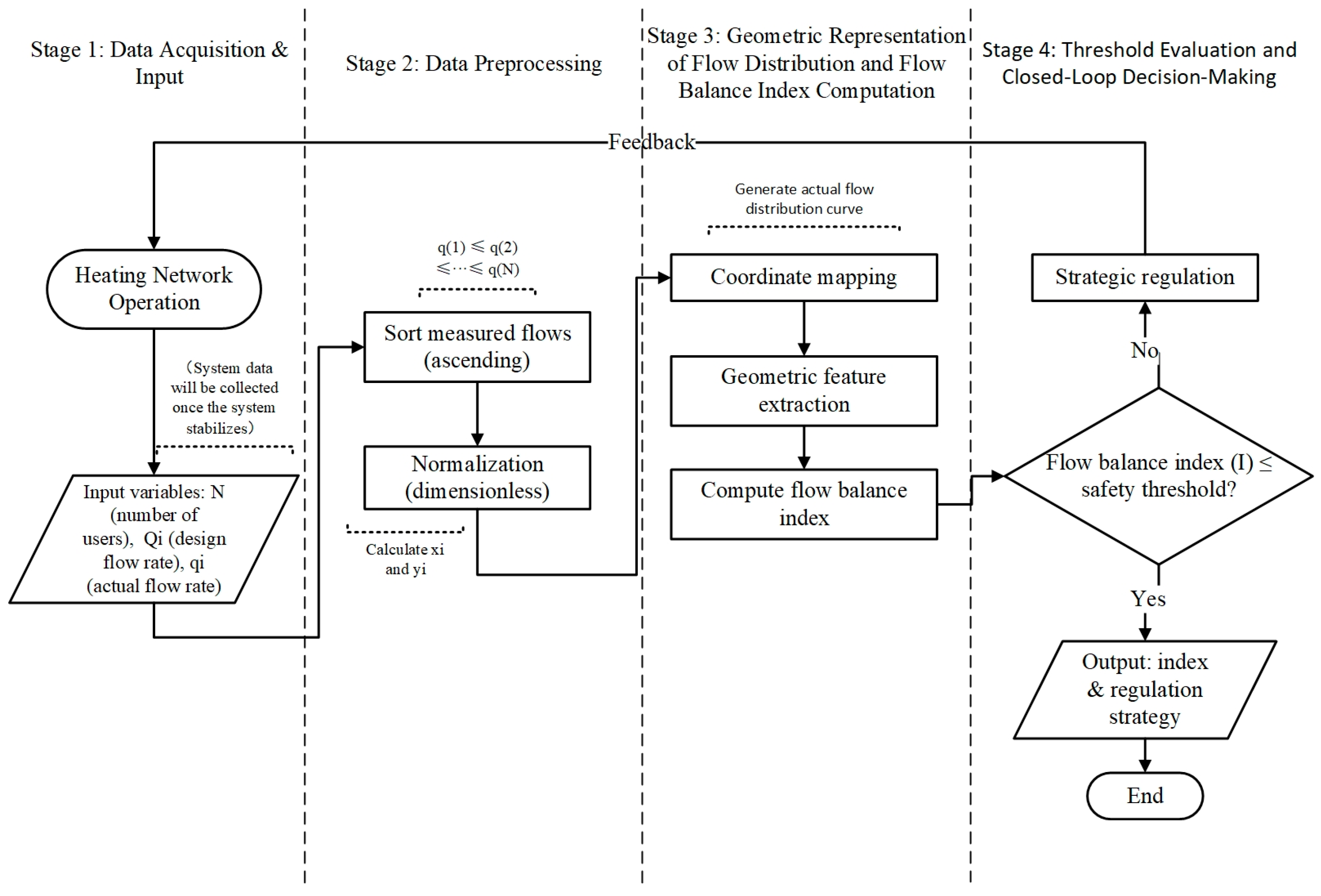
To clearly illustrate the fundamental approach and the closed-loop regulation workflow of the proposed evaluation method, a comprehensive systematic framework is presented in Figure 1. The framework consists of four interconnected stages: (1) continuous data acquisition from the operating heating network; (2) data preprocessing via ascending-order sorting and dimensionless normalization; (3) geometric representation of the flow distribution; and (4) threshold evaluation for closed-loop decision-making. As shown in the flowchart, the dynamically calculated Flow Balance Index serves as a critical feedback metric. If the index exceeds the safety threshold, targeted strategic regulation is triggered, forming a continuous closed-loop control strategy until the system returns to a balanced state. The detailed mathematical expression for each stage is elaborated in the following subsections.

2.1. Data Statistical Processing and Coordinate System Construction

2.1.1. Data Acquisition and Preprocessing

The construction of the flow allocation curve was based on the sampling and statistical processing of actual user flow data. Considering the smoothing effect of the thermal inertia [19] of building envelopes on short-term flow fluctuations [20], a sampling interval of 30 min was adopted in this study. This time scale effectively filtered out high-frequency noise induced by short-term disturbances such as valve adjustments, while still capturing the influence of medium- and long-term factors, including outdoor temperature variations, on flow distribution.
For a heating network consisting of N users, the actual flow rate of the i-th user at a given sampling instant was denoted as qi. The raw measured flow data were generally unordered. In order to extract meaningful statistical information from these scattered measurements, an ascending-order sorting procedure was applied as a preprocessing step. By introducing order statistics, the original data set was rearranged from the smallest to the largest value, yielding an ordered sequence q ( 1 ) q ( 2 ) q ( n ) . It should be noted that users appearing at the beginning of the ordered sequence are typically terminal users located far from the heat source, where pipeline resistance is relatively high. These users usually receive flow rates lower than their design values and are therefore in an under-flow state. Conversely, users at the end of the sequence are generally located close to the heat source, experience lower hydraulic resistance, and tend to receive flow rates exceeding their design values, corresponding to an over-flow state. This flow-based reordering process effectively maps the complex physical topology of the heating network into a one-dimensional sequence in the flow state space, thereby providing a foundation for evaluating the global flow distribution characteristics of the network.

2.1.2. Establishment of the Normalized Cartesian Coordinate System

To eliminate the influence of differences in user population size and flow magnitude among various heating systems and to enable standardized cross-system evaluation, a normalized Cartesian coordinate system was constructed. First, the ordered flow sequence was rendered dimensionless. The horizontal axis was defined as the cumulative user proportion, representing the fraction of the first i users in the ordered sequence relative to the total number of users in the network. For the i-th ordered user, the cumulative user proportion was defined as:
x i = i N ,   i = 1 , 2 , , N
This coordinate is not merely a statistical cumulative percentage; it also represents an ordered spatial unfolding of the flow distribution. As the horizontal coordinate increases from 0 to 1, the corresponding points reflect a gradual transition of users from the under-flow region (actual flow lower than the design value, typically far from the heat source) to the over-flow region (actual flow higher than the design value, typically close to the heat source).
Second, the vertical axis was defined as the cumulative flow proportion, representing the ratio of the sum of actual flow rates of the first i users to the total flow of the entire network. The cumulative flow proportion was defined as:
y i = i = 1 n q ( i ) Q t
By transforming discrete flow values into cumulative proportions, the vertical coordinate quantitatively describes the share of total system flow actually occupied by a given proportion of users. Within this normalized coordinate system, the flow distribution state of any heating network was mapped onto a continuous trajectory starting from (0,0) and terminating at (1,1), thereby enabling a unified geometric representation of flow allocation behavior across different systems.

2.2. Geometric Characterization and Evaluation Benchmarks

Based on the normalized Cartesian coordinate system, the effective identification and quantitative evaluation of flow allocation states in heating networks relied fundamentally on the establishment of appropriate comparison benchmarks. These benchmarks consisted of two complementary components: the evaluated object and the reference criteria. The former was represented by the actual flow allocation curve, which reflected the current operational flow distribution of the network, while the latter was defined by two limiting reference lines—the flow balance line and the extreme flow concentration line—which delineated the operational boundaries of the network corresponding to the optimal and worst flow allocation states, respectively. Together, these three curves, each associated with a distinct physical meaning, constituted the characteristic trajectories of the proposed evaluation framework. By analyzing the relative positions and geometric differences among these trajectories within the coordinate plane, the extent to which the actual flow distribution deviated from the ideal on-demand allocation state was intuitively and systematically revealed.

2.2.1. Definition of the Characteristic Trajectory Lines

(1)
Flow Balance Line.
The flow balance line corresponded to the design operating condition of a heating system, under which the actual flow rate received by each user was equal to its design flow rate. In this ideal state, the cumulative actual flow of any first i users was exactly equal to the cumulative design flow of the same users. Consequently, the cumulative flow proportion maintained a strictly linear relationship with the cumulative user proportion, which can be expressed as:
y = x ,   x [ 0 , 1 ]
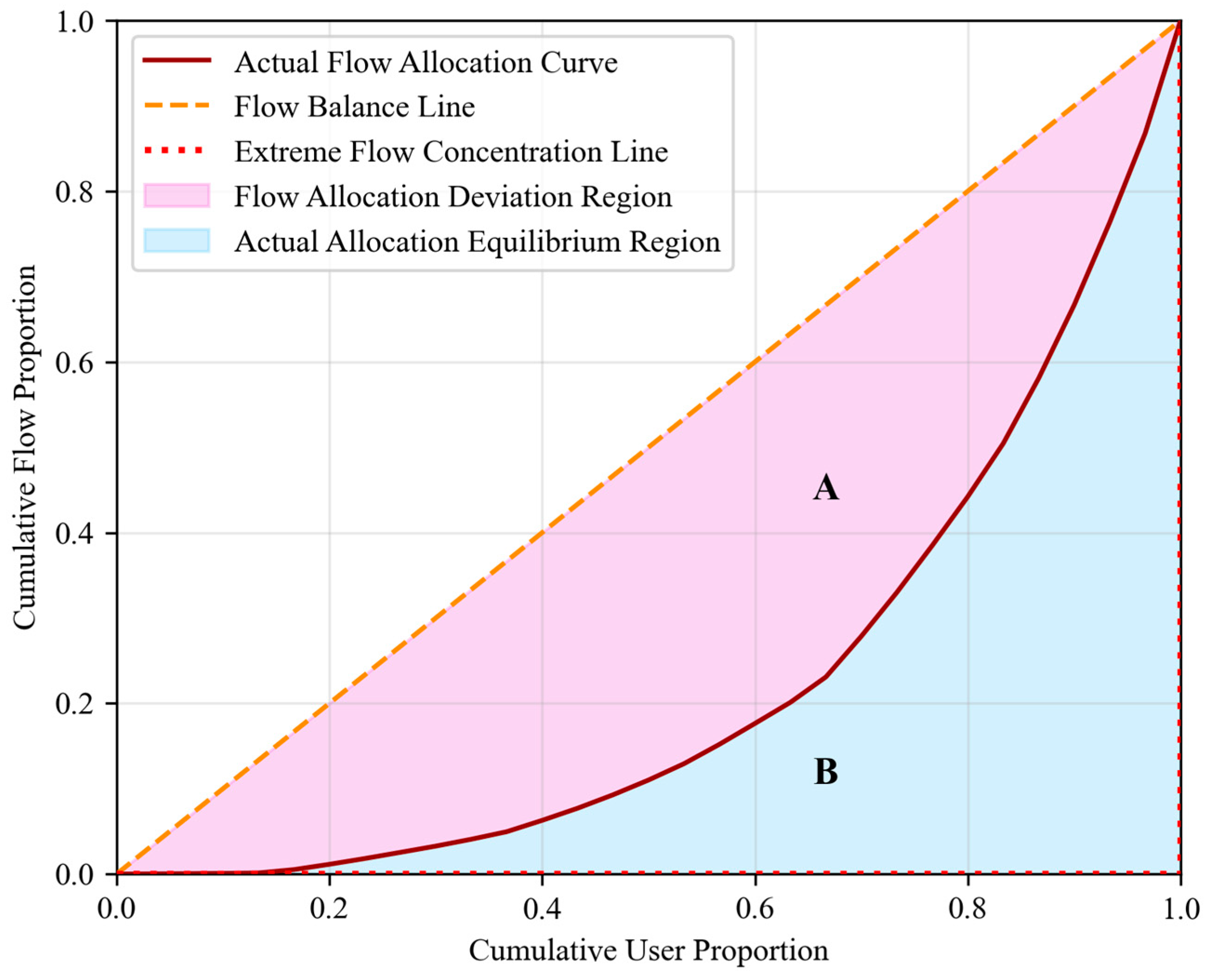
As illustrated in Figure 2, the flow balance line was represented by the diagonal line connecting the origin (0,0) and the terminal point (1,1), with a constant slope of unity. Under this condition, the heating network operated in an ideal flow allocation state, where neither terminal users suffered from insufficient flow that would degrade heating quality nor near-source users experienced excessive flow leading to unnecessary energy consumption.
(2)
Extreme Flow Concentration Line.
The extreme flow concentration line characterized the limiting case of flow allocation imbalance in a heating network. The term “Concentration” is utilized here to describe the physical limiting state of severe hydraulic imbalance, wherein almost the entire system flow is monopolized by a minimal fraction of near-source users, leaving remote users with near-zero flow. In this state, the fluid mass is extremely concentrated at the front end of the network topology. Accordingly, as the cumulative user proportion increased from 0 toward 1, the cumulative flow proportion remained nearly zero over most of the interval and exhibited a step-like jump from 0 to 1 only when approaching the upper limit. This limiting behavior can be expressed as:
y = 0 , 0 x < 1 1 , x = 1
In the Cartesian coordinate plane, this line (Figure 2) was represented by a polyline extending horizontally along the x-axis from the origin to (1,0), followed by a vertical rise to the terminal point (1,1).
(3)
Actual Flow Allocation Curve.
The actual flow allocation curve was constructed by sequentially connecting the normalized coordinate points derived from the measured user flow data. Its geometric form lay between the flow balance line and the extreme flow concentration line, reflecting the actual flow distribution state of the heating network under operating conditions. The concavity of the curve fundamentally originated from the spatial non-uniformity of hydraulic resistance within the network. Users located at the front of the ordered sequence, corresponding to under-flow users, received actual flow rates lower than their design values. Their cumulative contribution to total flow was therefore limited, resulting in an initial tangential slope of the curve that was significantly smaller than unity. As the user index increased, the curve gradually transitioned toward users whose actual flow rates approached or exceeded the design values, causing the slope to increase progressively and approach unity, where the curve became locally tangent to the flow balance line. At the tail of the sequence, over-flow users received substantially higher flow rates than designed, leading to a rapid increase in cumulative flow and a local slope far exceeding unity. This nonlinear evolution of slope—from gentle to steep—formed a downward-concave arc in the geometric sense, which visually captured the imbalance pattern characterized by near-source over-supply and terminal under-supply (Figure 2).

2.2.2. Physical Interpretation of Characteristic Regions

In the flow allocation curve diagram, the triangular area enclosed by the diagonal and the x-axis (denoted as S e ) was defined as the ideal allocation reference region. This region represented the total cumulative distribution capacity under a perfectly balanced flow allocation state. The area enclosed by the actual flow allocation curve and the x-axis (denoted as S B ) was defined as the actual allocation equilibrium region, which characterized the share of allocation fairness that had actually been achieved by the system under the current operating condition. The area enclosed between the flow balance line and the actual flow allocation curve (denoted as S A ) was defined as the flow allocation deviation region.
From a physical perspective, region A did not represent a loss of flow in the hydraulic sense; instead, it quantified the degree of mismatch in the spatial distribution of flow caused by over-supply near the heat source and under-supply at remote terminals. Because regions A and B were strictly complementary within the benchmark domain S e , an increase in the area fraction of region A implied that the actual allocation equilibrium region B was increasingly compressed. Consequently, a larger proportion of S A indicated a more severe level of hydraulic imbalance in the heating network.

2.3. Construction of the Quantitative Index

Although the concavity of the flow allocation curve could intuitively reflect the flow distribution state of a heating network, a scalar indicator was still required to serve as an objective function for flow regulation strategies. Therefore, a quantitative indicator, referred to as the flow balance index, was introduced in this section.

2.3.1. Definition of the Flow Balance Index

In this study, the flow balance index was proposed as the core indicator for quantifying the degree of flow allocation imbalance in heating networks. The formulation of this index was derived directly from the physical interpretations of the three characteristic regions defined previously. Specifically, the flow allocation deviation region represented the cumulative deviation of the actual flow distribution from the ideal balanced state, whereas the ideal allocation reference region represented the theoretical benchmark required for satisfying all users under perfectly balanced conditions. The ratio of these two regions constituted the quantitative index.
From a geometric perspective, the flow allocation deviation region corresponded to the area enclosed between the flow balance line and the actual flow allocation curve. Let the functional form of the actual flow allocation curve be denoted as y = f ( x ) , where x [ 0 , 1 ] . The area of the deviation region S A was expressed as:
S A = 0 1 ( x f ( x ) ) d x
Because the actual flow allocation curve was a concave function satisfying the imposed boundary constraints, the integrand remained non-negative over the interval [ 0 , 1 ] , thereby ensuring the non-negativity of the integral value. The ideal allocation reference region corresponded to the right triangular area enclosed by the flow balance line and the extreme flow concentration line. Its area S e was given by: S e = 1 2 .
Based on the above definitions, the flow balance index I was defined as:
I = S A S e = 2 0 1 ( x f ( x ) ) d x
When the flow balance index approached 0, the actual flow allocation curve converged to the flow balance line, indicating that the heating network was operating under a balanced flow allocation state. Conversely, when the flow balance index approached 1, the actual flow allocation curve tended toward the extreme flow concentration line, corresponding to the limiting state of severe hydraulic imbalance in the network.

2.3.2. Characteristics of the Flow Balance Index

First, the flow balance index was a dimensionless quantity. This scale-independence is fundamentally guaranteed by the normalization process used to construct the coordinate system. Because both the horizontal axis (cumulative user proportion) and the vertical axis (cumulative flow proportion) are strictly bounded within the interval [0, 1], any heating network—regardless of whether it comprises a few dozen users or tens of thousands—is geometrically projected onto the exact same unit square domain. This mathematical formulation ensures that the index evaluates the relative inequality of flow distribution rather than absolute flow deficits. Consequently, it inherently eliminates the influence of absolute user number, network scale, and total flow magnitude, enabling direct comparison among heating systems with different service areas, capacities, and structural scales.
Second, the value range of the flow balance index was strictly confined to [0, 1]. A value closer to 0 indicated a more balanced flow allocation and system operation closer to the design condition, whereas a value closer to 1 indicated a more severe imbalance. This bounded and monotonic characteristic made the index intuitive and convenient for practical application. In real-world operation, threshold intervals of the flow balance index could be defined based on engineering experience or design standards.
More importantly, the flow balance index captured the global characteristics of flow allocation in heating networks. Unlike local user-based flow deviations that only reflected the hydraulic state of individual loops, the computation of the flow balance index incorporated flow information from all users across the entire network. Through sorting and cumulative processing, discrete and scattered measurement data were transformed into a single, ordered global indicator. This transformation implicitly accounted for network topology effects. Heating networks are inherently strongly coupled fluid distribution systems [21], in which adjustments in a single loop often induce flow fluctuations in other loops [22]. Their operating states are continuously constrained by the combined effects of stochastic outdoor temperature variations, thermal inertia of building envelopes, and transport delays within the network. The flow balance index captured the influence of such global coupling effects on flow distribution patterns through the geometric characteristics of the actual flow allocation curve.

3. Case Study Verification and Analysis

In this section, a set of numerical case studies was constructed through a combination of numerical simulation and statistical analysis to verify the effectiveness of the proposed evaluation method for flow allocation balance in heating networks [23]. It should be noted that the primary objective of this section is to theoretically validate the mathematical mechanism and sensitivity of the Flow Balance Index across its entire measurement range (from ideal balance to extreme imbalance). Because an actual, operating heating network typically functions within a narrow and relatively stable operational band, therefore, rather than using a single real dataset—which would only represent a limited operational state—this study constructs a parameterized, typical multi-level branched heating network. This approach allows for the precise control of perturbation parameters, enabling the systematic simulation of the full spectrum of operational conditions on the exact same topology to robustly prove the index’s full-range effectiveness.
With respect to case construction, a hydraulic numerical simulation framework with a multi-level network topology was developed based on the typical structural characteristics of branched heating networks. The network topology was generated using a recursive algorithm, and its geometric and hydraulic properties were parameterized by the number of hierarchical levels, branching factors, and pipe diameter scaling coefficients. This approach resulted in an engineering-consistent distribution of pipe segment resistances [24]. In terms of flow allocation mechanisms, controlled simulations of different imbalance levels were achieved by introducing level-dependent interception parameters and branch perturbation factors. To ensure computational efficiency while preserving the dominant hydraulic characteristics, the hydraulic coupling process was appropriately simplified [25]. Pipe resistance was described using the Darcy–Weisbach equation [26], and under the quadratic resistance assumption [27], the network operation was approximated as a quasi-steady-state flow allocation problem [28]. These treatments enabled efficient generation of a large number of flow allocation scenarios with distinct imbalance characteristics, providing a stable data foundation for index validation.
At the data processing and index calculation level, an analysis workflow consistent with the theoretical framework presented in Section 2 was developed based on the simulated user flow data. The workflow first sorted and normalized the user flow rates, transforming discrete flow data into flow allocation curves in the normalized coordinate plane. Subsequently, numerical integration was applied to compute the area difference between the actual flow allocation curve and the ideal balance line, from which the flow balance index was obtained. In parallel, the shapes of the flow allocation curves and associated statistical features were analyzed to achieve intuitive visualization and quantitative evaluation of the overall flow distribution state of the network under different operating conditions.
Through the above case construction and data processing procedures, the proposed flow allocation balance evaluation method was transformed into a reproducible and verifiable numerical experimental framework. In the following sections, specific case studies are further examined to systematically analyze the applicability and effectiveness of the index in distinguishing different degrees of imbalance and characterizing global flow distribution patterns across the entire network.

3.1. Construction of the Network Numerical Simulation Platform

3.1.1. Generation of Heating Network Topology

To construct a representative numerical simulation environment for heating networks, a recursively generated, multi-level, tree-like branched network structure was adopted in this model. This structure was designed to emulate the complete hydraulic distribution network of a typical heating system, extending progressively from the heat source outlet through main pipelines and secondary branches to terminal users.
(1)
Multi-level branched topology architecture.
Branched networks represent the most common topological form in heating systems. In this model, the generation depth of the network (i.e., the number of hierarchical levels) was set to K , and the number of branches at each node was set to B . The generation process started from the heat source as the root node and expanded downward recursively following a depth-first principle. At each level, pipelines extended from the upstream level and were responsible for distributing the incoming flow to the next-level branches.
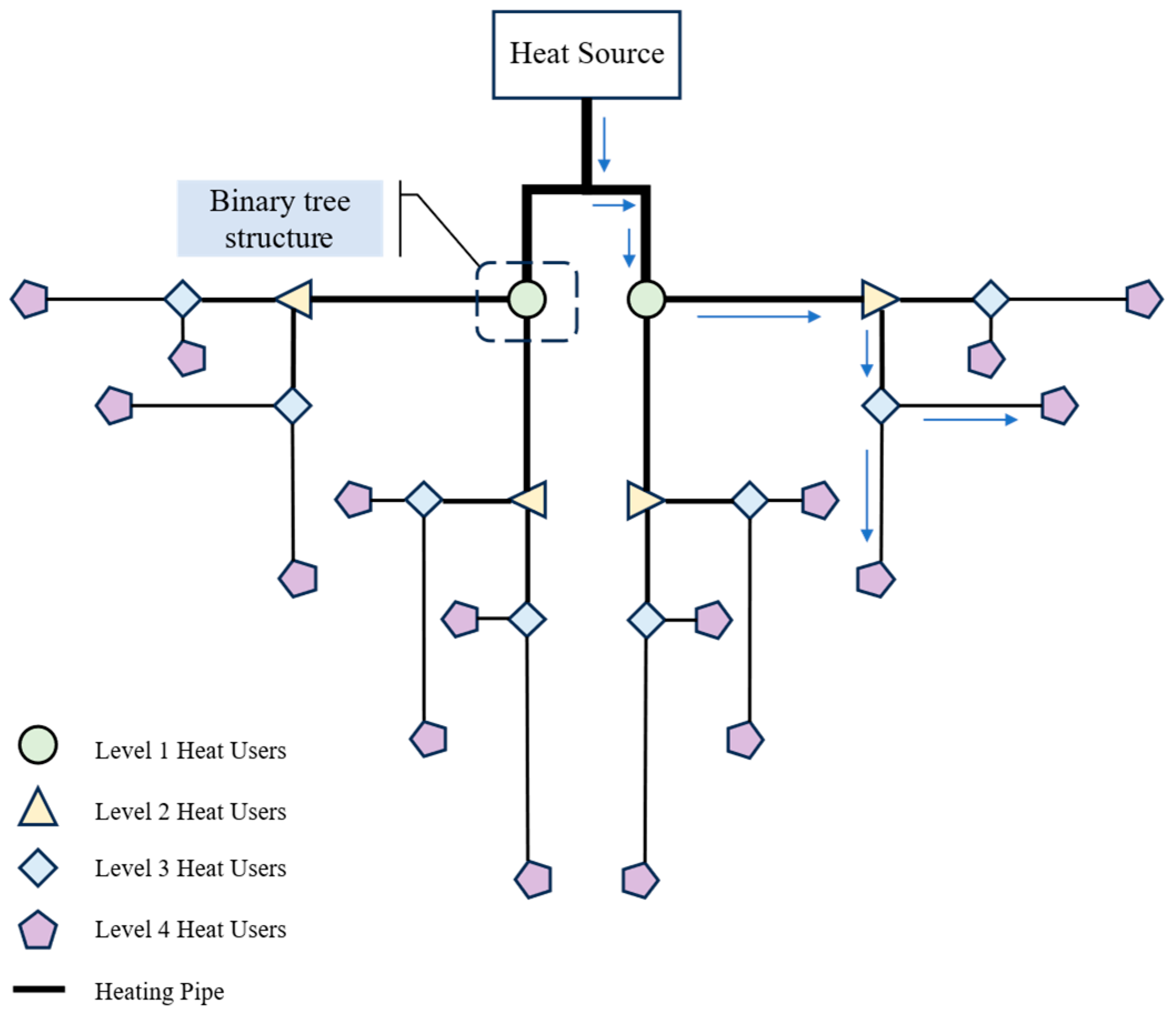
This recursive structure physically corresponded to the hierarchical configuration of “trunk pipe–branch pipe–service pipe” commonly observed in heating systems. In the present case study, specific values of K and B were selected to construct a typical branched heating network comprising 30 key nodes (Figure 3).
(2)
Hierarchical scaling of network geometric parameters.
In practical engineering design, as the network hierarchy increases, the flow rate conveyed by each pipe segment decreases progressively. To maintain the internal flow velocity within an economically reasonable range, pipe diameters are correspondingly designed to decrease from upstream to downstream. Meanwhile, as the network extends toward terminal users, the serviced heating area generally diminishes, resulting in a decreasing trend in pipe segment control lengths.
To reproduce these engineering characteristics, the geometric parameters of pipe segments at each hierarchical level were defined using a combination of exponential scaling and random perturbation. The length Lk and diameter Dk of pipe segments at the k-th level followed the relations:
l k = l b λ l k ξ l d k = d b λ d k ξ d
where Lk and Dk denote the reference length and reference diameter of the main trunk pipe at level k = 0, representing the initial design parameters at the heat source outlet. The parameters α and β are the length scaling coefficient and diameter scaling coefficient, respectively ( 0 < λ < 1 ), which determine the exponential decay of network geometric dimensions with increasing topological level. The variable k denotes the hierarchical level of the current pipe segment ( k = 0 , 1 , , 4 ).
(3)
Random simulation of engineering non-uniformity.
Although the ideal hierarchical scaling structure reflects the macroscopic rule of network design, generating overly regular and standardized networks would fail to capture the inherent non-uniformity present in real engineering systems. Therefore, random perturbation factors ξ l and ξ d were introduced into the geometric parameter generation formulas.
Both ξ l and ξ d were assumed to follow log-normal distributions. The physical meaning of introducing these random variables was to simulate engineering realities such as unequal routing layouts, non-standard pipe segments, and construction deviations that are commonly encountered in practice. This treatment ensured that the generated network data conformed to hydraulic design principles at the macroscopic level while retaining sufficient microscopic variability, thereby enabling effective validation of the proposed flow balance index under non-ideal and complex network topologies.

3.1.2. Simulation of the Hierarchical Flow Allocation Mechanism in Heating Networks

To verify the effectiveness of the proposed flow balance identification method under different operating conditions, it was necessary to construct a numerical case framework capable of reproducing the full spectrum of flow allocation states, ranging from ideal flow allocation to severely imbalanced flow distribution. Rather than pursuing high-resolution microscopic modeling of a specific heating network, the present model was designed to follow the macroscopic fluid distribution principles of branched networks and to establish a top-down, hierarchically recursive flow allocation algorithm. This mechanism simulated the complete physical process by which fluid originated from the heat source and was successively distributed through multiple network levels to terminal users. In actual operation of heating networks, total flow distribution is a progressive diversion process that unfolds along the network hierarchy. When fluid was conveyed from an upstream level to a node at the current level, the allocation of flow was primarily governed by the interaction between the node’s design flow target and the prevailing hydraulic conditions. In the present model, this process was described through two coupled physical mechanisms.
First, during the design stage of a heating network, the flow allocation ratio at each node is determined according to its assigned thermal load, i.e., the design flow. Under ideal hydraulic balance conditions, differences in frictional and local resistances along the network can be compensated through valve regulation, enabling each user to receive an actual flow equal to the design value. However, under conditions of ineffective or incomplete regulation, fluid motion follows the minimum-resistance principle in fluid mechanics. Nodes located closer to the heat source possess higher available pressure head and experience smaller cumulative friction losses, thereby gaining an inherent hydraulic advantage in acquiring flow. To reproduce this physical phenomenon, a hydraulic imbalance weighting factor based on the hierarchical position of each user was superimposed onto the baseline design flow. This mechanism simulated the over-flow behavior of near-source users resulting from surplus available pressure head in the absence of effective regulation, as well as the corresponding pressure deficiency and flow shortage experienced by remote users. By adjusting the imbalance weighting parameter, the model was able to generate characteristic flow distribution data consistent with engineering practice.
Second, flow allocation among parallel branches was governed by differences in branch hydraulic resistance. When fluid entered multiple parallel branch pipes at the next hierarchical level, the flow distribution depended on the hydraulic impedance S of each branch. Under ideal conditions, the resistances of parallel loops should be balanced through valve adjustment. In practical engineering systems, however, random deviations in actual resistance characteristics frequently arise due to local fitting losses, non-standard routing, or unequal pipe lengths. To capture this inherent non-uniformity within the network, a Dirichlet probability distribution was introduced to describe the stochastic characteristics of flow allocation among parallel branches. This treatment reflected the imbalance in flow distribution caused by resistance heterogeneity among branches and enabled realistic simulation of flow allocation non-uniformity observed in real heating networks [29].

3.1.3. Random Perturbations and Operating Condition Design

If user flow data in a heating network were generated solely based on ideal engineering design assumptions, the resulting data would exhibit overly regular patterns and would fail to reflect the random errors and hydraulic imbalance phenomena that are commonly observed in real engineering systems. To address this issue, two key control parameters were introduced into the flow allocation process in the present model: the hierarchical imbalance weight and the branch dispersion coefficient. These two parameters imposed physically consistent random perturbations on the network flow distribution from two orthogonal dimensions, namely the vertical differences across topological levels and the horizontal differences among parallel branches.
The hierarchical imbalance weight was introduced to quantify flow allocation inequality arising from differences in transmission distance within the network. From a physical perspective, this parameter simulated the phenomenon whereby upstream nodes (users located closer to the heat source) receive flow rates exceeding their design values due to advantages in available pressure head and hydraulic impedance, which in turn leads to downstream nodes (users farther from the heat source) receiving less than their design flow rates.
Variation in this weight directly determined whether flow allocation within the network remained balanced. When the hierarchical imbalance weight was set to ω = 0, the system represented an ideal condition in which flow was strictly allocated according to design requirements at all hierarchical levels. As ω increased, the hydraulic advantage of upstream nodes became increasingly pronounced, manifested by significantly higher actual flow rates at near-source nodes and corresponding flow attenuation at downstream nodes due to upstream over-allocation. By adjusting this parameter, the model was able to generate a continuous spectrum of hydraulic imbalance states, ranging from globally balanced flow allocation to near-end over-flow and terminal under-flow conditions.
The horizontal imbalance parameter κ characterized the differences in hydraulic resistance among parallel loops within the same branching level and was positively correlated with the degree of flow allocation uniformity. When κ was assigned a large value, the resistances of parallel branches were highly consistent, and flow was distributed almost evenly among them, representing a network state after fine initial balancing. As κ decreased, the variance of the random distribution increased markedly, leading to severe flow allocation inequality among parallel branches and reproducing the imbalance phenomena commonly encountered in real heating networks. The introduction of this parameter ensured that the generated flow data exhibited sufficient random dispersion in the parallel-branch dimension. Based on the combined regulation of these two core parameters, three representative operating conditions with increasing imbalance severity were designed to construct the test dataset for validating the proposed flow allocation balance index, as summarized in Table 1.
Based on the probabilistic allocation mechanism and the hierarchical weighting mechanism adopted in the model, the mathematical meanings and parameter selection principles of the horizontal imbalance parameter κ and the hierarchical imbalance weight ω were quantitatively explained as follows.
(1)
Quantitative Meaning of the Horizontal Imbalance Parameter κ
Consider a node that splits into m parallel downstream branches. The flow allocation proportion vector among these branches was denoted as   p = ( p 1 , , p m ) , i = 1 m p i = 1 . The design flow proportions of the branches were taken as the expected allocation, defined as:
μ i = Q i d e s j = 1 m Q j d e s
In this study, the uncertainty of parallel flow allocation was modeled using a Dirichlet distribution:
p ~ Dir ( α 1 , , α m ) , α i = κ μ i ,   κ > 0
According to the properties of the Dirichlet distribution, the following relations hold:
E [ p i ] = μ i , Var ( p i ) = μ i ( 1 μ i ) κ + 1 , Cov ( p i , p j ) = μ i μ j κ + 1 ( i j )
Here, α i was not an independently specified parameter, but was jointly determined by the design proportion μ i and the dispersion intensity κ . Since α i = κ , the parameter κ controlled the overall fluctuation level of the distribution. Therefore, κ was a dimensionless dispersion control parameter: a larger κ resulted in a smaller variance, and the parallel allocation approached a uniform distribution (or more closely followed the design proportions); a smaller κ significantly increased dispersion, making it more likely for a small number of branches to receive disproportionately high flow rates.
Accordingly, when κ = 100.0, Var ( p i ) μ i ( 1 μ i ) / 101 , which corresponded to a low-dispersion, approximately deterministic allocation, representing a nearly hydraulically balanced parallel system after fine initial regulation. When κ = 3.0, Var ( p i ) μ i ( 1 μ i ) / 4 , a level of mild allocation non-uniformity commonly observed in engineering practice was produced and used to test the sensitivity of the proposed index. When κ = 1.2, Var ( p i ) μ i ( 1 μ i ) / 2.2 , dispersion increased significantly, enabling the construction of severely imbalanced parallel allocation scenarios. A value slightly greater than 1 was deliberately chosen to avoid degenerate cases approaching single-branch domination, which could otherwise result in vanishing terminal flows and numerical instability.
(2)
Quantitative Meaning of the Hierarchical Imbalance Weight ω
The hierarchical imbalance weight ω was introduced to characterize the amplification strength of the near-source available pressure head advantage during the hierarchical flow allocation process. Let the set of all users in the network be denoted as N . The n-th user was located at the kn-th hierarchical level, where kn = 1 indicated the user closest to the heat source and larger values of kn corresponded to users progressively closer to the terminal end. Let K denote the maximum number of hierarchical levels in the network.
To express the hierarchical advantage as a controllable, dimensionless bias—interpretable as the systematic tendency of the allocation rule toward users closer to the heat source—a hierarchical weighting factor was introduced as g ( k n ) = exp [ ω ( 1 k n L ) ] . Based on this definition, the hierarchically biased target share (used as the baseline proportion for recursive allocation) was defined as:
μ u ( ω ) = Q n d e s , g ( k n ) ν N Q ν d e s g ( k ν ) ,
Here, U denotes the set of terminal users (or heat-load nodes); u represents the user currently being evaluated; v is an index variable used to traverse the set N in the denominator summation; Q v d e s is the design flow of the v-th user; k ν is the hierarchical level at which the v-th user is located; and g ( k ν ) is the corresponding hierarchical weighting factor.
It is evident that when ω = 0 , the weighting factor satisfies g ( k n ) 1 , and flow is allocated strictly in proportion to the design values, corresponding to a hydraulically balanced state. When ω > 0 , users located closer to the heat source possess larger values of g ( k n ) and therefore obtain higher normalized shares after normalization, reflecting the vertical polarization phenomenon of near-end over-flow and far-end under-flow.
Accordingly, when ω = 0 , no hierarchical bias was introduced, forming the ideal balanced reference state. When ω = 0.1 , weak exponential weighting was applied ( ( exp ( 0.1 Δ ) 1 + 0.1 Δ ) ), introducing only mild near-source preference to simulate commonly observed incomplete regulation conditions. When ω = 30 , strong exponential amplification caused upstream hierarchical levels to dominate after normalization, enabling the construction of severely imbalanced vertical allocation scenarios. This configuration ensured coverage of the high-value range of the flow balance index and enabled validation of its discrimination capability over the full measurement range.

3.2. Flow Allocation Curve Morphology Under Three Operating Conditions

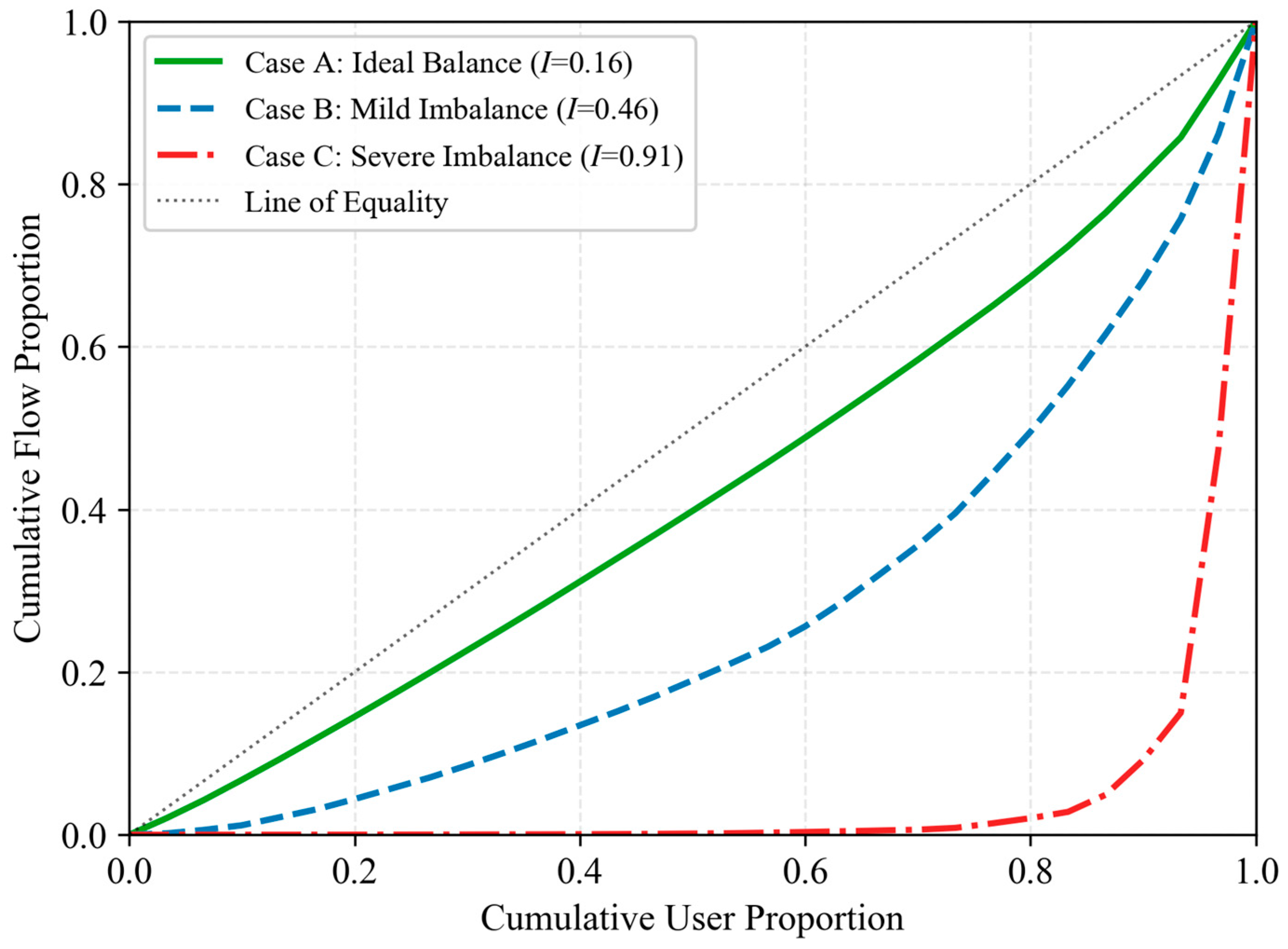
The three sets of operating condition data were processed, and the resulting flow allocation curves are compared in Figure 4.
As shown in Figure 4, the evolution of the curve morphology with increasing severity of operating conditions can be clearly observed.
(1) Case A (ideal balance). In Case A, the flow allocation curve almost coincides with the flow balance line and exhibits a pronounced linear characteristic. This mathematical form intuitively indicates that the network operated under an ideal flow allocation balance state. In terms of parameter settings, the hierarchical imbalance weight was set to ω = 0, and the horizontal imbalance parameter was set to κ = 100.0. Under this condition, the actual flow rates of all users across the network closely matched their design values. This case was designed to verify whether the flow balance index could yield a value close to zero under ideal balanced conditions.
(2) Case B (mild imbalance). In Case B, the flow allocation curve exhibits a slight downward concavity and deviates modestly from the flow balance line. The parameter settings corresponded to a nonzero hierarchical imbalance weight and a moderate horizontal imbalance parameter, representing a network that had undergone partial regulation but remained limited by regulation accuracy. Under this condition, near-source users experienced mild flow surplus, and normal resistance differences existed among parallel branches. This case was designed to verify whether the proposed evaluation index could sensitively capture small flow deviations and thus assess the sensitivity of the indicator.
(3) Case C (severe imbalance). In Case C, a severe fault condition was simulated by substantially increasing the hierarchical imbalance weight (ω = 30) and significantly decreasing the horizontal imbalance parameter (κ = 1.2). Under this extreme condition, the flow allocation curve exhibits an “L-shaped” distortion, characterized by an almost horizontal initial segment followed by a sharply increasing terminal segment. This curve shape visually reflects the severe imbalance pattern in which the majority of users suffer from serious flow deficiency, while a very small number of near-source users occupy most of the system flow. This case was designed to test the quantitative identification capability of the index under extreme data distributions and to ensure that the indicator maintains good discriminative power across its full measurement range.

3.3. Validation of Index Effectiveness and Sensitivity

To verify whether the proposed flow balance index could quantitatively characterize the degree of hydraulic imbalance in heating networks, the index values were calculated for the three representative operating conditions constructed previously, namely Case_A (ideal balance), Case_B (mild imbalance), and Case_C (severe imbalance). The calculation results are summarized in Table 2.
The primary criterion for validating the effectiveness of the index is its correct response to the direction of system deterioration. The calculated results show that, as the physical operating condition of the network evolves from ideal balance to severe imbalance, the flow balance index exhibits a monotonically increasing trend. This numerical evolution fundamentally reflects the phenomenon whereby near-source users, by virtue of their available pressure head advantage, progressively appropriate flow from downstream users. The more uneven the flow allocation becomes, the more pronounced this polarization effect of “the strong becoming stronger and the weak becoming weaker.” In the flow allocation curve, such extreme flow concentration manifests as an increasing degree of downward concavity. In Case_A, flow is distributed relatively uniformly, and the curve remains close to the flow balance line (the 45° diagonal). In contrast, in Case_C, a large proportion of the flow is concentrated in a small number of near-source nodes, causing the curve slope in the initial segment to approach zero and that in the terminal segment to approach infinity. As a result, a pronounced flow allocation deviation region is formed. Because the flow balance index is defined directly as the ratio between the flow allocation deviation region and the ideal allocation reference region, the degree of hydraulic imbalance in the heating network is quantitatively reflected by the relative size of the deviation region and is ultimately mapped to an increase in the index value.

4. Discussion

4.1. General Applicability of the Flow Allocation Balance Index

The flow balance index proposed in this study is constructed on the basis of measured user-side flow data and is intended for macroscopic evaluation of the overall flow allocation state in heating networks. Because the index is computed directly from user flow measurements and reflects the aggregated allocation outcome at the user level, it remains effective even in situations where high-fidelity hydraulic models are unavailable or network topology parameters are incomplete. This characteristic enables its application in a wide range of practical scenarios, including operational condition monitoring, comparative assessment of regulation strategies, and horizontal comparison of operating states across multiple heating systems. From the perspective of evaluation scale, the proposed index is a system-level, statistical indicator. By mapping flow deviations of all users onto a flow allocation curve and quantifying the deviation from the balance line through an integral area measure, the index provides a compact representation of the global deviation in flow allocation across the entire network. As a dimensionless indicator, it further mitigates the influence of system scale, such as the number of users, thereby enabling cross-system comparability. It should be noted that the index is particularly well suited for assessing overall balance conditions and comparing trends, rather than diagnosing localized hydraulic issues [30].
In practice, operators can use this index for continuous, feedback-driven regulation by mapping its thresholds to indoor temperature targets. As a “rule of thumb,” the index value calculated when under-flow users drop below design temperatures serves as the “imbalance trigger” or safe upper limit. During operation, if the calculated index remains within this safe threshold, no network intervention is required. However, once the index exceeds this limit, targeted valve adjustments must be initiated. The index is then iteratively recalculated to monitor the system’s response, continuing the regulation loop until the value returns to the safe range. Ultimately, when regulation successfully restores all disadvantaged loops to their design temperatures, the corresponding index defines the system’s “ideal threshold.” While universal numerical criteria require further validation, this closed-loop, temperature-mapping approach effectively translates the abstract hydraulic index into actionable operational guidelines.

4.2. Limitations and Future Extensions

Despite its effectiveness in characterizing flow allocation states in heating networks, the proposed flow balance index has several limitations. First, as a statistical indicator, it lacks explicit spatial localization capability. While it can quantify the severity of imbalance, it does not directly identify specific pipe segments or regions responsible for the imbalance, nor does it distinguish whether deviations are primarily caused by near-source over-supply or terminal blockage. Second, the current formulation is based on the assumption that all infinitesimal users share identical thermal indices (i.e., identical design flow rates) and does not yet incorporate weighting mechanisms for heterogeneous design flows. When significant differences exist among user design flow rates, constructing flow allocation curves under an equal-design-flow assumption may introduce bias and reduce evaluation accuracy. Therefore, the method is presently more suitable for systems in which design flow rates are known and can be used as a normalization baseline. Third, while the numerical case studies incorporated spatial and structural randomness—such as unequal routing layouts, non-standard pipe segments, and resistance heterogeneity —to simulate certain engineering non-uniformities, the current model approximates network operation as a quasi-steady-state flow allocation problem. Consequently, it does not fully capture the highly dynamic and complex realities of field operations. Practical temporal variables, such as rapidly fluctuating user demands, progressive pipe aging over years of operation, and specific non-linear valve characteristics, were not explicitly modeled.
Future research will focus on four main directions.
(1) Graph-theoretic methods and GIS information will be integrated to associate statistical anomalies with network spatial structures, enabling traceable localization of imbalance regions or fault points and providing a basis for generating targeted regulation strategies [31].
(2) A corrected model incorporating design load (or design flow) weighting will be developed to more accurately isolate imbalance effects caused by hydraulic factors.
(3) Engineering criteria and grading standards will be established to define reasonable tolerance intervals and triggering thresholds for the flow balance index, with critical values determined by jointly considering techno-economic performance and user thermal comfort feedback under different operational scenarios [32].
(4) Regulation methods that use the flow balance index as an objective function will be further explored to guide valve adjustment and system operation optimization, ultimately enabling intelligent control of flow allocation in heating networks [33].
(5) Hydraulic models will be developed to investigate the temporal evolution of the flow balance index under dynamic field disturbances, thereby incorporating the impacts of fluctuating user heat demands, equipment aging, and complex valve adjustments into the evaluation framework.
(6) Deploying and validating this proposed index within a large-scale, actual district heating project using real data will be a primary focus of our immediate future work.

5. Conclusions

(1) To address the pervasive problem of flow allocation imbalance in the operation of heating networks, this study proposed a flow balance evaluation method based on the flow allocation curve and verified its effectiveness through numerical case studies. The results demonstrate that the proposed method enables quantitative identification of the global flow allocation state using only user-side measured flow data.
(2) By normalizing user flow rates and constructing the flow allocation curve, the distribution characteristics of flow among users under different operating conditions can be intuitively represented. The degree of deviation of the curve from the ideal balance line is consistent with the level of hydraulic imbalance in the system and can be used to characterize overall imbalance severity.
(3) A flow balance index based on the deviation area between the actual allocation curve and the ideal balance line was formulated to achieve a dimensionless, system-wide quantitative evaluation of flow allocation states. Numerical results indicate that the index responds monotonically to increasing imbalance and effectively discriminates among operating conditions with different imbalance intensities.
(4) Compared with evaluation approaches based on local parameters, the proposed indicator framework emphasizes the cumulative effects of multi-user flow deviations at the system level. It facilitates a transition from local monitoring to holistic operational state assessment and provides a quantitative basis for the formulation and performance evaluation of flow regulation strategies.

Author Contributions

Conceptualization, Y.S. and B.S.; methodology, J.L.; software, B.S.; validation, B.S. and J.L.; formal analysis, B.S.; investigation, W.L.; resources, Y.S.; data curation, W.L.; writing—original draft preparation, B.S.; writing—review and editing, W.L.; visualization, Y.S.; supervision, J.L.; project administration, Y.S.; funding acquisition, Y.S. All authors have read and agreed to the published version of the manuscript.

Funding

This research was funded by Municipal Subsidy Fund for Scientific and Technological Innovation (2060499).

Data Availability Statement

The original contributions presented in this study are included in the article. Further inquiries can be directed to the corresponding author.

Conflicts of Interest

The authors declare no conflicts of interest.

References

  1. Kou, J.; Chen, Y.; Zhou, X.; Lu, H.; Wu, F.; Fan, J. Optimal Structure of Tree-like Branching Networks for Fluid Flow. Phys. Stat. Mech. Its Appl. 2014, 393, 527–534. [Google Scholar] [CrossRef]
  2. Friih, T. Simulation of Water Flow in the Branched Tree Architecture. Silva Fenn. 1997, 31, 275–284. [Google Scholar] [CrossRef]
  3. Bao, L.; Zhao, J.; Zhu, N. Analysis and Proposal of Implementation Effects of Heat Metering and Energy Efficiency Retrofit of Existing Residential Buildings in Northern Heating Areas of China in “the 11th Five-Year Plan” Period. Energy Policy 2012, 45, 521–528. [Google Scholar] [CrossRef]
  4. Ashfaq, A.; Ianakiev, A. Investigation of Hydraulic Imbalance for Converting Existing Boiler Based Buildings to Low Temperature District Heating. Energy 2018, 160, 200–212. [Google Scholar] [CrossRef]
  5. Li, H.; Svendsen, S. District Heating Network Design and Configuration Optimization with Genetic Algorithm. J. Sustain. Dev. Energy Water Environ. Syst. 2013, 1, 291–303. [Google Scholar] [CrossRef][Green Version]
  6. Fu, L.; Li, Y.; Wu, Y.; Wang, X.; Jiang, Y. Low Carbon District Heating in China in 2025—A District Heating Mode with Low Grade Waste Heat as Heat Source. Energy 2021, 230, 120765. [Google Scholar] [CrossRef]
  7. Zhang, Y.; Xia, J.; Fang, H.; Jiang, Y.; Liang, Z. Field Tests on the Operational Energy Consumption of Chinese District Heating Systems and Evaluation of Typical Associated Problems. Energy Build. 2020, 224, 110269. [Google Scholar] [CrossRef]
  8. Yao, H.; Huang, Y.; Xu, J.; Ma, G.; Wang, Y.; Liu, C.; Sun, S. Status and challenges of clean heating technologies in northern China. Bull. Chin. Acad. Sci. 2024, 35, 1177–1188. [Google Scholar] [CrossRef]
  9. Liu, L.; Fu, L.; Jiang, Y. Application of an Exhaust Heat Recovery System for Domestic Hot Water. Energy 2010, 35, 1476–1481. [Google Scholar] [CrossRef]
  10. Cvetković, S.; Zdravković, M.; Ignjatović, M. Exploring District Heating Systems: A SCADA Dataset for Enhanced Explainability—PMC. Data Brief 2025, 59, 111320. [Google Scholar] [CrossRef]
  11. Sun, C.; Yan, H.; Cao, S.; Xia, G.; Liu, Y.; Wu, X. A Control Strategy Considering Buildings’ Thermal Characteristics to Mitigate Heat Supply-Demand Mismatches in District Heating Systems. Energy 2024, 307, 132637. [Google Scholar] [CrossRef]
  12. Guo, C.; Zhang, J.; Yuan, H.; Yuan, Y.; Wang, H.; Mei, N. Informer-Based Model Predictive Control Framework Considering Group Controlled Hydraulic Balance Model to Improve the Precision of Client Heat Load Control in District Heating System. Appl. Energy 2024, 373, 123951. [Google Scholar] [CrossRef]
  13. Che, Z.; Sun, J.; Na, H.; Yuan, Y.; Qiu, Z.; Du, T. A Novel Method for Intelligent Heating: On-Demand Optimized Regulation of Hydraulic Balance for Secondary Networks. Energy 2023, 282, 128900. [Google Scholar] [CrossRef]
  14. Yang, J.; Zhu, J.; Peng, M.; Zhao, T.; Shi, X. A Novel Perspective of Addressing the Hydraulic Dynamic Imbalance in District Heating Network: The Application of Nonlinear Programming. Energy 2024, 312, 133537. [Google Scholar] [CrossRef]
  15. Liu, Z.; Zhang, H.; Wang, Y.; Fan, X.; You, S.; Jiang, Y.; Gao, X. Optimization of Hydraulic Distribution Using Loop Adjustment Method in Meshed District Heating System with Multiple Heat Sources. Energy 2023, 284, 128595. [Google Scholar] [CrossRef]
  16. Liu, G.; Zhou, X.; Yan, J.; Yan, G. Dynamic Integrated Control for Chinese District Heating System to Balance the Heat Supply and Heat Demand. Sustain. Cities Soc. 2023, 88, 104286. [Google Scholar] [CrossRef]
  17. Huang, J.; Fan, J.; Furbo, S. Feasibility Study on Solar District Heating in China—ScienceDirect. Renew. Sustain. Energy Rev. 2019, 108, 53–64. [Google Scholar] [CrossRef]
  18. Zhang, Z.; Zhou, X.; Du, H.; Cui, P. A New Model Predictive Control Approach Integrating Physical and Data-Driven Modelling for Improved Energy Performance of District Heating Substations. Energy Build. 2023, 301, 113688. [Google Scholar] [CrossRef]
  19. Verbeke, S.; Audenaert, A. Thermal Inertia in Buildings: A Review of Impacts across Climate and Building Use. Renew. Sustain. Energy Rev. 2018, 82, 2300–2318. [Google Scholar] [CrossRef]
  20. He, X.; Zhou, J.; Li, N.; Chen, S. Optimal Control for District Heating Systems Based on Imbalance Analysis of Pipe Networks. J. Build. Eng. 2024, 96, 110560. [Google Scholar] [CrossRef]
  21. Moody, L.F. Friction Factors for Pipe Flow. Trans. Am. Soc. Mech. Eng. 2022, 66, 671–678. [Google Scholar] [CrossRef]
  22. Swamee, P.K.; Jain, A.K. Explicit Equations for Pipe-Flow Problems. J. Hydraul. Div. 1976, 102, 657–664. [Google Scholar] [CrossRef]
  23. Boghetti, R.; Kämpf, J.H. Verification of an Open-Source Python Library for the Simulation of District Heating Networks with Complex Topologies. Energy 2024, 290, 130169. [Google Scholar] [CrossRef]
  24. Colebrook, C.F. Turbulent flow in pipes, with particular reference to the transition region between the smooth and rough pipe laws. J. Inst. Civ. Eng. 1939, 11, 133–156. [Google Scholar] [CrossRef]
  25. Meibodi, S.S.; Rees, S.; Loveridge, F. Modeling District Heating Pipelines Using a Hybrid Dynamic Thermal Network Approach. Energy 2024, 290, 130107. [Google Scholar] [CrossRef]
  26. Guelpa, E. Impact of Network Modelling in the Analysis of District Heating Systems. Energy 2020, 213, 118393. [Google Scholar] [CrossRef]
  27. Zheng, X.; Xu, B.; Wang, Y.; You, S.; Zhang, H.; Wei, S.; Wang, N. Hydraulic Transient Modeling and Analysis of the District Heating Network. Sustain. Energy Grids Netw. 2021, 25, 100409. [Google Scholar] [CrossRef]
  28. Dancker, J.; Wolter, M. Improved Quasi-Steady-State Power Flow Calculation for District Heating Systems: A Coupled Newton-Raphson Approach. Appl. Energy 2021, 295, 116930. [Google Scholar] [CrossRef]
  29. Liu, Y.; Wang, P.; Luo, P. Pipe Hydraulic Resistances Identification of District Heating Networks Based on Matrix Analysis. Energies 2020, 13, 3007. [Google Scholar] [CrossRef]
  30. Chicherin, S. Hydraulic Balancing of District Heating Systems and Improving Thermal Comfort in Buildings. Energies 2025, 18, 1259. [Google Scholar] [CrossRef]
  31. Zheng, X.; Shi, Z.; Wang, Y.; Zhang, H.; Tang, Z. Digital Twin Modeling for District Heating Network Based on Hydraulic Resistance Identification and Heat Load Prediction. Energy 2024, 288, 129726. [Google Scholar] [CrossRef]
  32. Kuś, J.; Mika, Ł.; Żurawski, M. Validation Strategies for District Heating Network Models. Energies 2025, 18, 5012. [Google Scholar] [CrossRef]
  33. Lin, X.; Zhang, N.; Luo, Z.; Feng, E.; Zhong, W. Balanced Operation Strategies of District Heating Systems Based on Dynamic Hydraulic-Thermal Modeling. Energy Built Environ. 2025, 6, 466–483. [Google Scholar] [CrossRef]
Figure 1. Closed-loop regulation strategy flowchart based on the flow balance index.
Buildings 16 01068 g001
Figure 2. Flow Allocation Curve. Area A and Area B represent the Flow Allocation Deviation Region and the Actual Allocation Equilibrium Region, respectively. The diagonal dashed line represents the Flow Balance Line, while the dashed lines along the boundaries (y = 0 and x = 1) denote the Extreme Flow Concentration Line.
Buildings 16 01068 g002
Figure 3. Schematic diagram of the fractal branched heating network for simulation.
Buildings 16 01068 g003
Figure 4. Comparison of flow allocation curves under different hydraulic operating conditions.
Buildings 16 01068 g004
Table 1. Parameter settings for the case study operating conditions.
Case IDDescription of Flow Allocation StateHorizontal Imbalance Parameter (κ)Hierarchical Imbalance Weight (ω)
Case_AIdeal balance100.00
Case_BMild imbalance3.00.1
Case_CSevere imbalance1.230
Table 2. Flow balance index values under different operating conditions.
Case IDIndex Value (Flow Balance Index)EvaluationPhysical Interpretation
Case_A0.16GoodThe flow allocation deviation region accounts for 16% of the reference area, indicating that system operation is close to the theoretical optimum.
Case_B0.46ModeratePronounced flow allocation imbalance exists, with 46% of the flow being misallocated.
Case_C0.91PoorSevere operational failure occurs, and the majority of flow is not effectively delivered to terminal users.
Disclaimer/Publisher’s Note: The statements, opinions and data contained in all publications are solely those of the individual author(s) and contributor(s) and not of MDPI and/or the editor(s). MDPI and/or the editor(s) disclaim responsibility for any injury to people or property resulting from any ideas, methods, instructions or products referred to in the content.