A Comparative Study of Outdoor Thermal Comfort in Centralized Traditional Organic and Modern Standardized Rural Settlements


Abstract
1. Introduction
- Provides a typological comparison of rural thermal characteristics between centralized traditional organic and modern standardized layouts.
- Developing a morphological characteristic scale and a framework to explain the quantitative relationship between micro-morphology and PET in rural areas.
- Identifying the risk of thermal homogenization and the shrinking of effective cool refuges caused by standardized reconstruction.
2. Methods
2.1. Sites and Case Identification
2.1.1. Geography, Climate, and Reconstruction Policy
2.1.2. Representative Zones and Geometric Characteristics
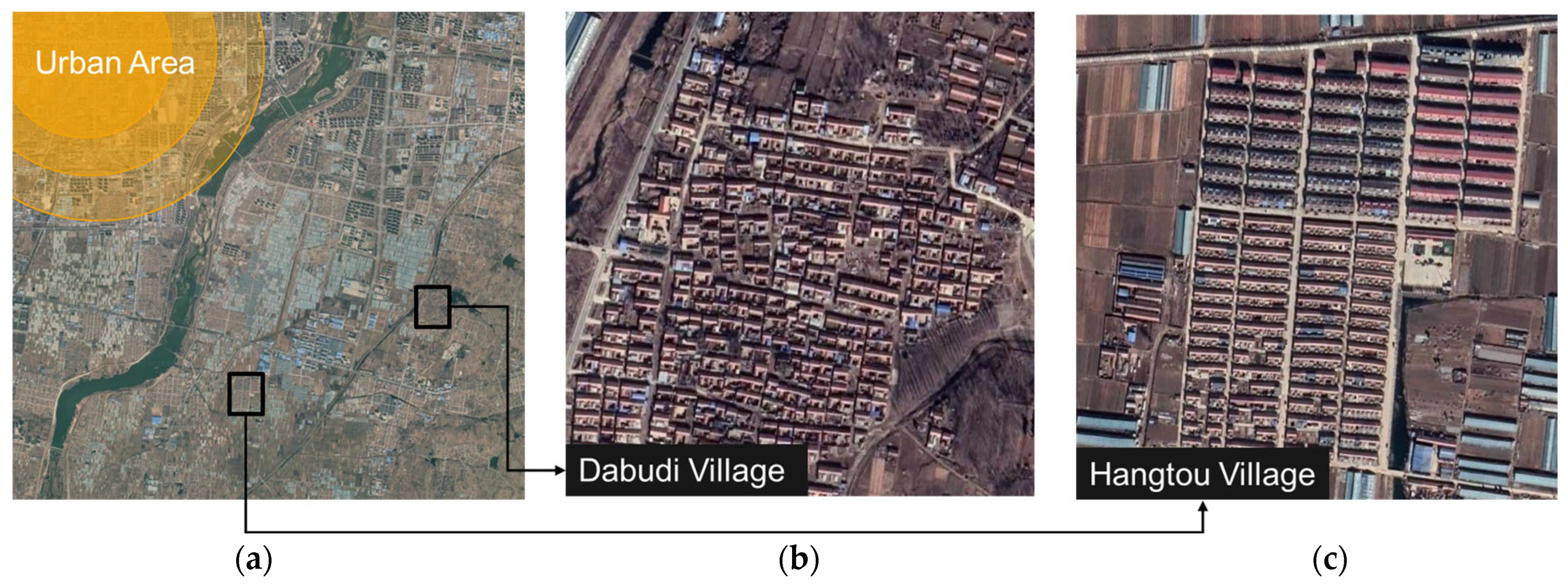
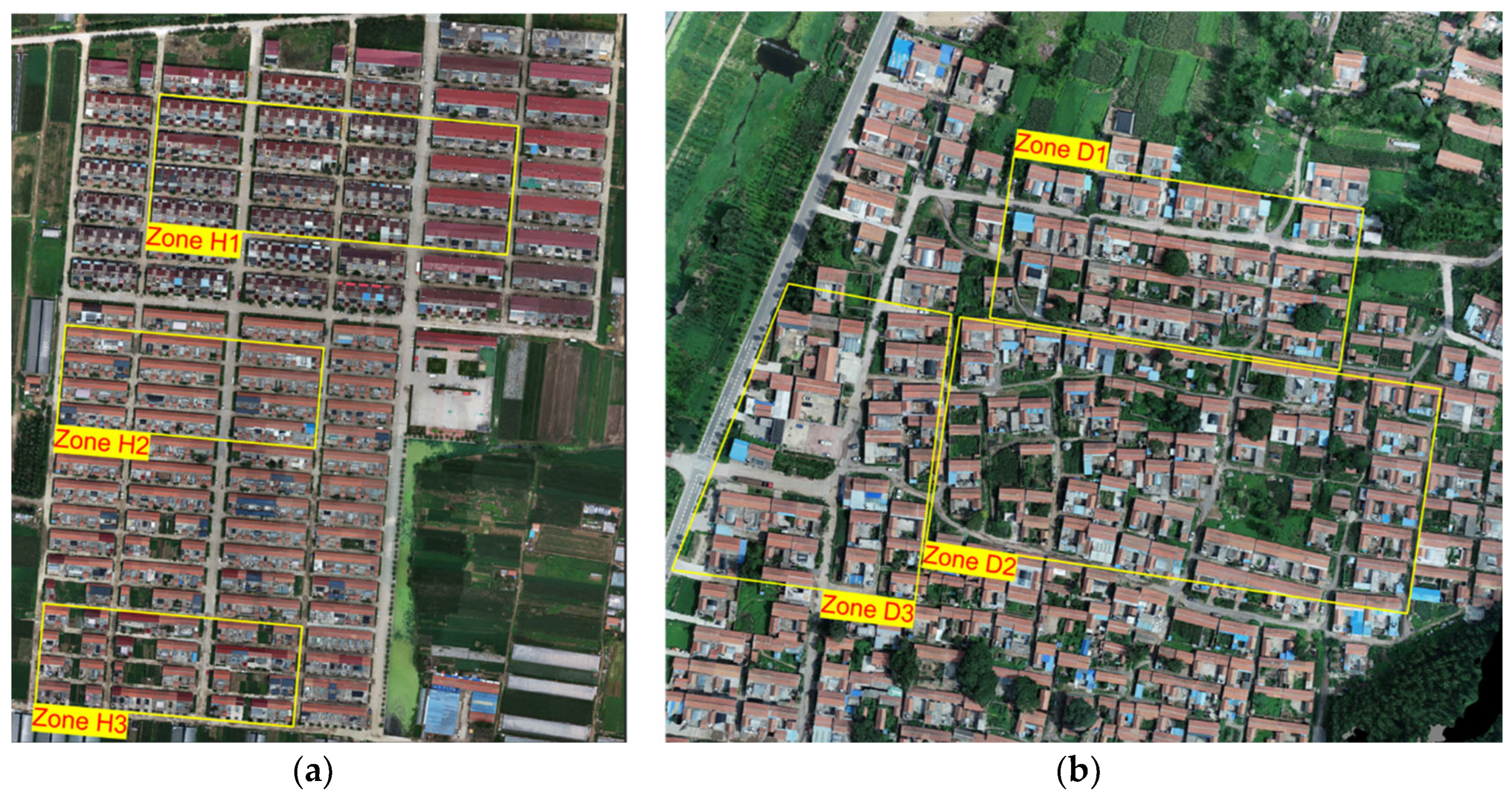
- Zone 1 (H1) is defined as a multi-story high-density area, covering 23,904 m2 (249 m × 96 m). It mainly consists of 9 m high three-story houses and 3 m high auxiliary courtyards. The area includes three north–south roads of varying widths and four east–west roads of uniform width.
- Zone 2 (H2) is a single-story high-density area with a uniform building height of 6 m. It covers an area of 15,372 m2 (183 m × 84 m). The road network consists of two north–south roads of varying widths and four east–west roads of uniform width.
- Zone 3 (H3) maintains the same geometric dimensions, road structure, and building height as H2 but is identified as a single-story low-density area. The main difference is that H3 contains large open spaces covered with shrubs, which significantly reduces the proportion of hard impervious surfaces.
- Zone 1 (D1) is a single-story high-density area composed of 6 m high houses and 3 m high auxiliary rooms. It covers 6240 m2 and includes three north–south and three east–west roads with significant imbalances in street width.
- Zone 2 (D2) is classified as a single-story low-density area with a building height of 6 m and a total area of approximately 13,200 m2. It contains four north–south and six east–west roads. The road network is highly complex, with large width variations between and within roads, as well as several dead-end paths.
- Zone 3 (D3) is identified as a combination of a single-story high-density area and a public plaza. Due to the constraints of the main village road, it shows an irregular trapezoidal shape with a total area of 7425 m2. As a core public gathering space, D3 includes a large activity plaza and other open spaces, with a road network of two north–south and three east–west roads.
2.2. Morphology Data Collection and Processing
2.3. Model Configuration and Validation
3. Results
3.1. Morphological Characteristics
3.2. Temporal Thermal Comfort
3.3. Spatial Thermal Patterns
3.4. Quantitative Thermal Drivers
4. Discussion
4.1. Potential Risks of Homogenized Thermal Environments
4.2. Research Limitations and Future Study Directions
5. Conclusions
- Standardized communities exhibit significant vertical growth and surface hardening, where the REH of 9.55 m is nearly double that of traditional villages (4.5–5.7 m), while ISF consistently exceed 0.38.
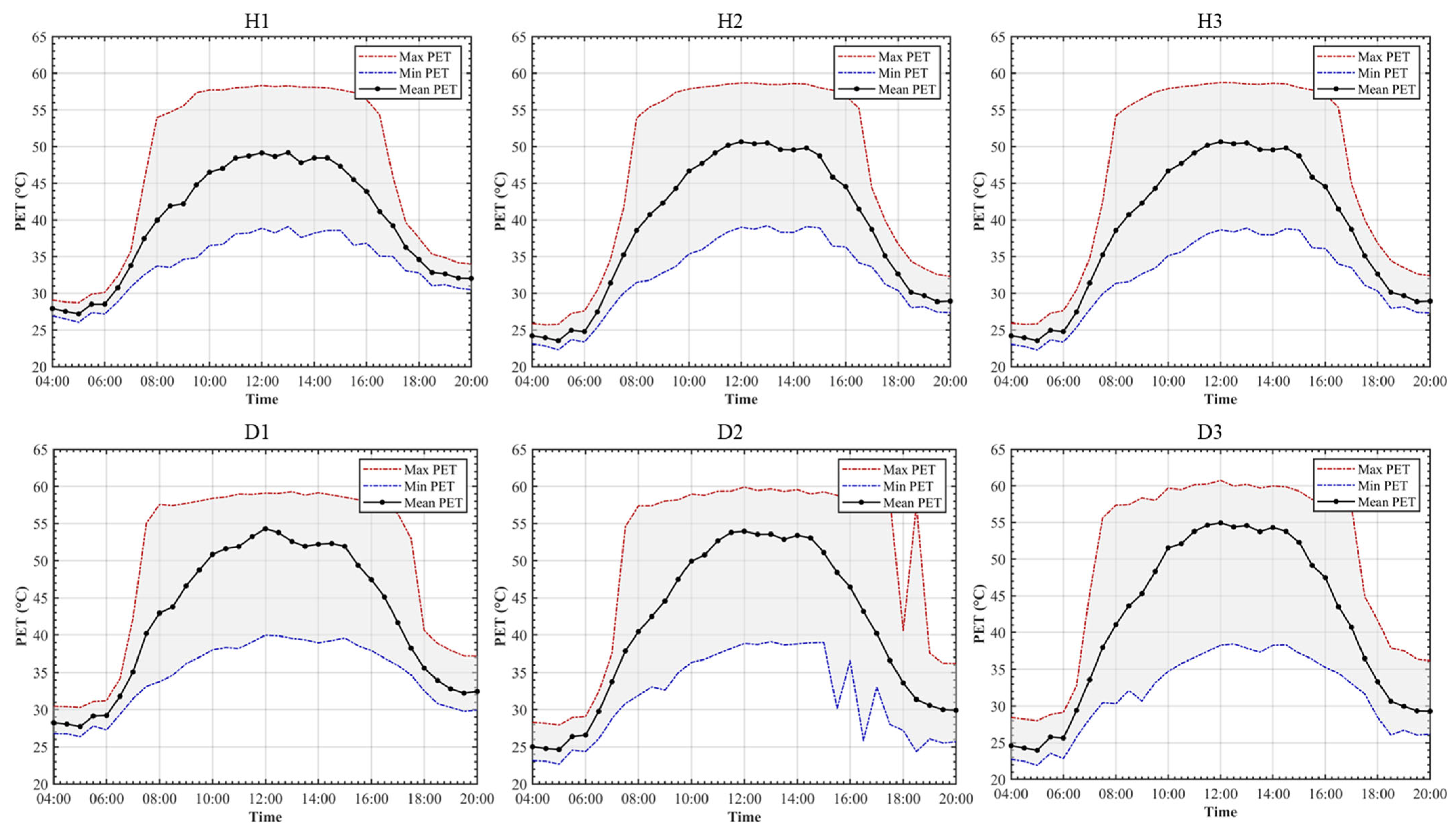
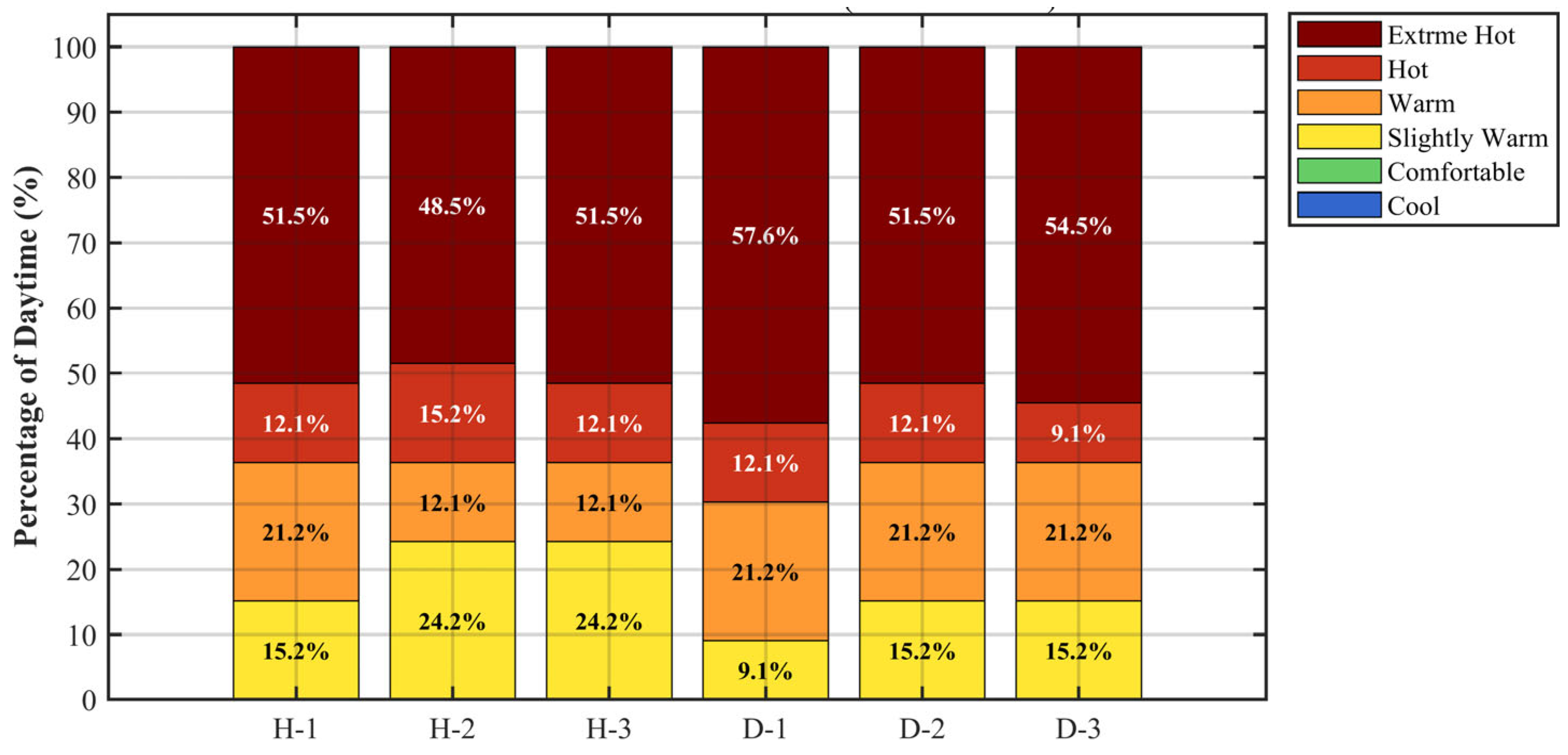
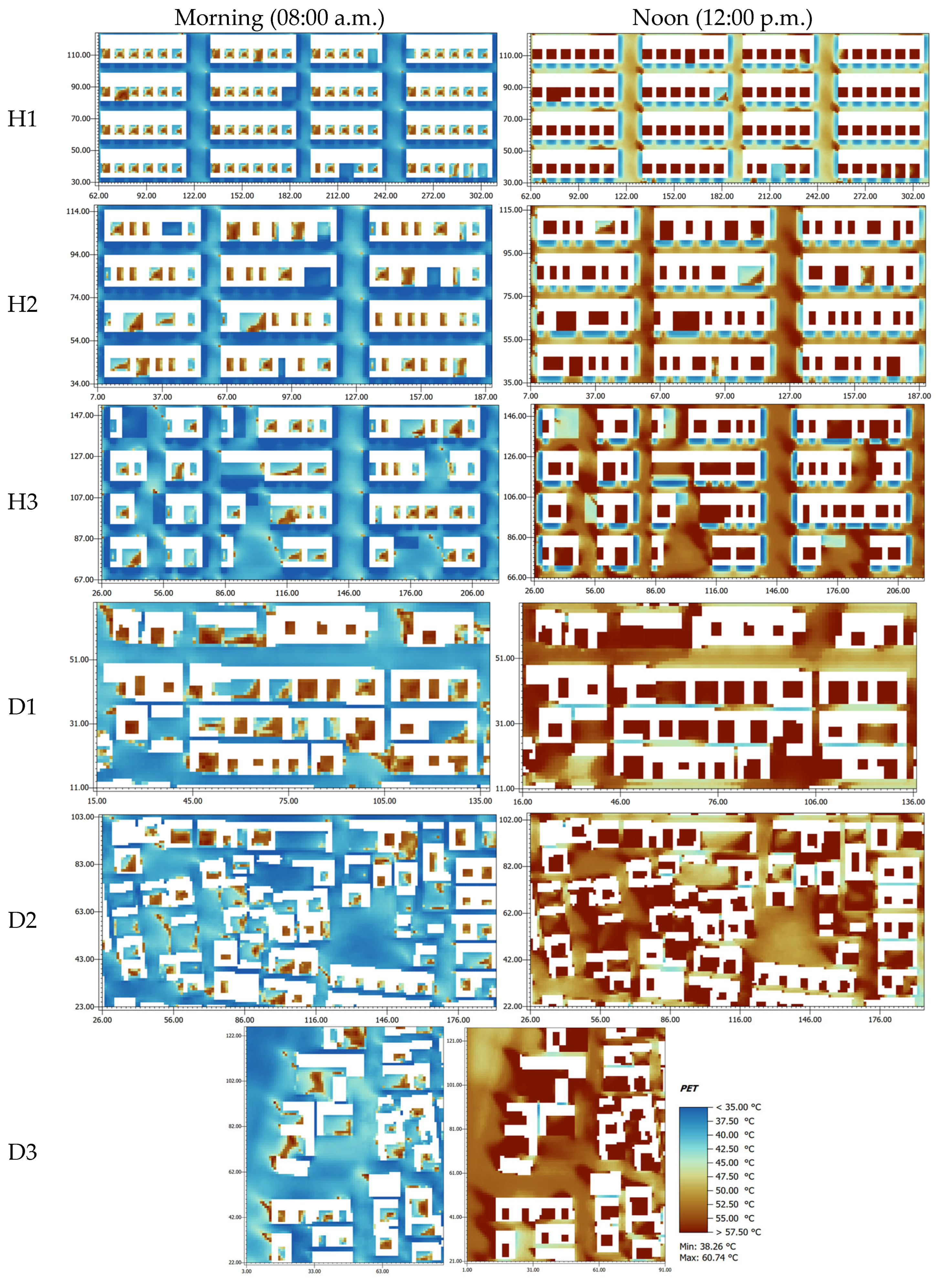
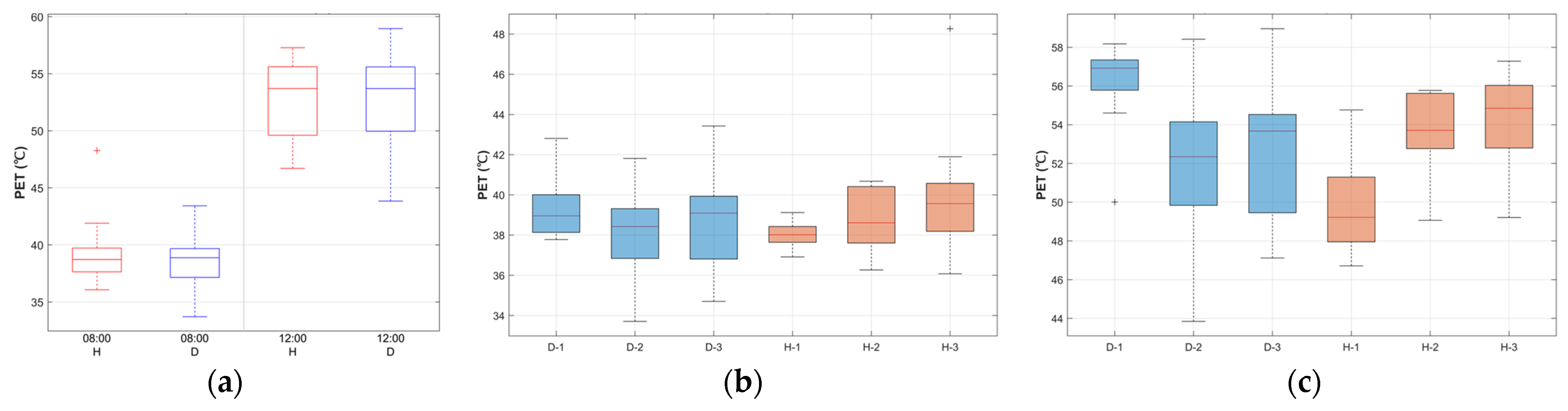
- All study areas experience extreme heat stress (PET > 39 °C) for 8 to 10 h daily, and although standardized zones show slightly lower peak values (49.2–51.8 °C) than traditional ones (53.5–55.2 °C), they provide a longer window of non-extreme stress.
- A core finding is the risk of thermal homogenization in standardized areas, which leads to a loss of spatial thermal resilience. Although peak temperatures are slightly mitigated, the overall thermal environment degrades as the ”lower limit“ of the temperature range is raised. This trade-off means that residents in standardized communities are deprived of the shaded refuges essential for behavioral adaptation during extreme heat.
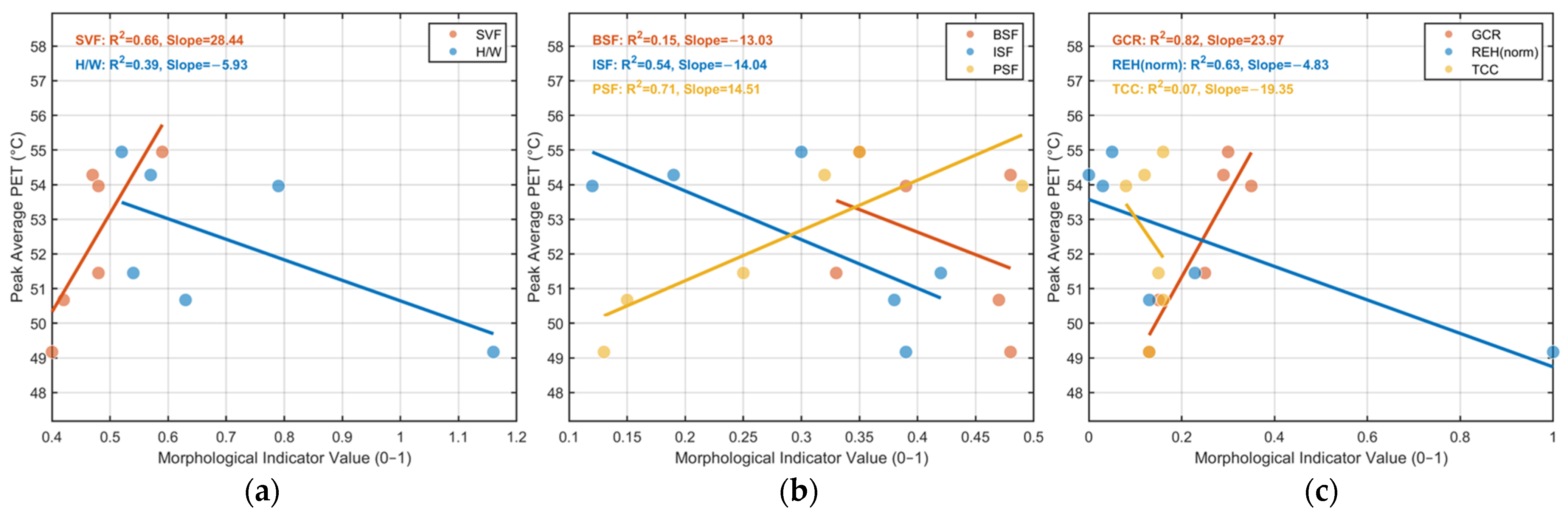
- Standardized reconstruction leads to a significant upward shift in the lower thermal limit, as traditional villages retain local cool spots with PET as low as 44.0 °C, while the PET at the majority of sampling points in standardized communities exceed 47.0 °C, indicating a systemic shift toward the reduction in shaded refuges. Specifically, the results establish a quantitative link confirming that greening coverage (GCR, R2 = 0.82) and surface perviousness (PSF, R2 = 0.71) are the most significant positive predictors for thermal mitigation.
Author Contributions
Funding
Data Availability Statement
Conflicts of Interest
References
- WMO. Guidelines on the Definition and Monitoring of Extreme Weather and Climate Events; WMO: Geneva, Switzerland, 2016. [Google Scholar]
- IPCC. Climate Change 2023: Synthesis Report. Contribution of Working Groups I, II and III to the Sixth Assessment Report of the Intergovernmental Panel on Climate Change; IPCC: Geneva, Switzerland, 2023. [Google Scholar]
- World Health Organization. Climate Change and Health; World Health Organization: Geneva, Switzerland, 2018. [Google Scholar]
- McMichael, A.J.; Woodruff, R.E.; Hales, S. Climate change and human health: Present and future risks. Lancet 2006, 367, 859–869. [Google Scholar] [CrossRef] [Scilit]
- Malcoti, M.D.; Zia, H.; Kabre, C. Relevance of Urban Geometry and Outdoor Thermal Comfort in Urban Heat Island Mitigation—A Review. J. Clim. Chang. 2023, 9, 39–52. [Google Scholar] [CrossRef] [Scilit]
- Liu, Z.; Zhou, Z.J.; Liu, C. Estimating the impact of rural centralized residence policy interventions on energy poverty in China. Renew. Sustain. Energy Rev. 2023, 187, 113687. [Google Scholar] [CrossRef] [Scilit]
- Du, Y.M.; Zhang, A.X.; Zhen, Q.; Taleghani, M.; Zheng, C.; Zhu, L.; Zheng, Y.; Zhang, Q. Rural heat island effect of centralized residences in China: Mitigation through localized measures. Sustain. Cities Soc. 2024, 114, 105782. [Google Scholar] [CrossRef] [Scilit]
- Park, J.; Chae, Y. Analysis of time-dependent effects of ambient temperatures on health by vulnerable groups in Korea in 1999–2018. Sci. Rep. 2023, 13, 922. [Google Scholar] [CrossRef] [Scilit]
- Long, H.L.; Ma, L.; Zhang, Y.N.; Qu, L.L. Multifunctional rural development in China: Pattern, process and mechanism. Habitat Int. 2022, 121, 102530. [Google Scholar] [CrossRef] [Scilit]
- Liu, L.; Gao, X.S.; Zhuang, J.X.; Wu, W.; Yang, B.; Cheng, W.; Xiao, P.F.; Yao, X.Z.; Deng, O.P. Evaluating the lifestyle impact of China’s rural housing land consolidation with locational big data: A study of Chengdu. Land Use Pol. 2020, 96, 104623. [Google Scholar] [CrossRef] [Scilit]
- Li, K.M.; Geng, H.Z.; Yue, L.Y.; Li, K.S.; Huang, L. Spatial Differentiation Characteristics and Driving Mechanism of Rural Settlements Transformation in the Metropolis: A Case Study of Pudong District, Shanghai. Front. Environ. Sci. 2021, 9, 755207. [Google Scholar] [CrossRef] [Scilit]
- Wen, Y.Y.; Zhang, Z.F.; Liang, D.; Xu, Z. Rural Residential Land Transition in the Beijing-Tianjin-Hebei Region: Spatial-Temporal Patterns and Policy Implications. Land Use Pol. 2020, 96, 104700. [Google Scholar] [CrossRef] [Scilit]
- Anand, J.; Sailor, D.J. Role of pavement radiative and thermal properties in reducing excess heat in cities. Sol. Energy 2022, 242, 413–423. [Google Scholar] [CrossRef] [Scilit]
- Yang, J.; Wang, Z.-H.; Kaloush, K.E.; Dylla, H. Effect of pavement thermal properties on mitigating urban heat islands: A multi-scale modeling case study in Phoenix. Build. Environ. 2016, 108, 110–121. [Google Scholar] [CrossRef] [Scilit]
- Yu, J.; Han, B.; Bi, M. Multi-objective optimization study of rural infrastructure. Intell. Build. Int. 2025, 1–26. [Google Scholar] [CrossRef] [Scilit]
- Chen, Y.; Lu, B.; Chen, R.S. Evaluating the life satisfaction of peasants in concentrated residential areas of Nanjing, China: A fuzzy approach. Habitat Int. 2016, 53, 556–568. [Google Scholar] [CrossRef] [Scilit]
- Zhao, H.H.; Xu, G.Y.; Shi, Y.R.; Li, J.L.; Zhang, Y.F. The characteristics of dynamic and non-uniform thermal radiation experienced by pedestrians in a street canyon. Build. Environ. 2022, 222, 109361. [Google Scholar] [CrossRef] [Scilit]
- Salvati, A.; Kolokotroni, M.; Kotopouleas, A.; Watkins, R.; Giridharan, R.; Nikolopoulou, M. Impact of reflective materials on urban canyon albedo, outdoor and indoor microclimates. Build. Environ. 2022, 207, 108459. [Google Scholar] [CrossRef] [Scilit]
- Stewart, I.D.; Oke, T.R. Local Climate Zones for Urban Temperature Studies. Bull. Am. Meteorol. Soc. 2012, 93, 1879–1900. [Google Scholar] [CrossRef] [Scilit]
- Yuan, B.; Zhou, L.; Hu, F.N.; Zhang, Q. Diurnal dynamics of heat exposure in Xi’an: A perspective from local climate zone. Build. Environ. 2022, 222, 109400. [Google Scholar] [CrossRef] [Scilit]
- Zou, B.W.; Fan, C.L.; Li, J.J. Quantifying the Influence of Different Block Types on the Urban Heat Risk in High-Density Cities. Buildings 2024, 14, 2131. [Google Scholar] [CrossRef] [Scilit]
- Yang, W.; Lin, Y.; Wong, N.H.; Zhou, J. Thermal comfort requirements in the summer season in subtropical urban spaces. Intell. Build. Int. 2014, 6, 224–238. [Google Scholar] [CrossRef] [Scilit]
- Bruse, M.; Fleer, H. Simulating surface–plant–air interactions inside urban environments with a three dimensional numerical model. Environ. Modell. Softw. 1998, 13, 373–384. [Google Scholar] [CrossRef] [Scilit]
- Qin, Y.H. Urban canyon albedo and its implication on the use of reflective cool pavements. Energy Build. 2015, 96, 86–94. [Google Scholar] [CrossRef] [Scilit]
- Zhang, A.X.; Bokel, R.; van den Dobbelsteen, A.; Sun, Y.C.; Huang, Q.; Zhang, Q. An integrated school and schoolyard design method for summer thermal comfort and energy efficiency in Northern China. Build. Environ. 2017, 124, 369–387. [Google Scholar] [CrossRef] [Scilit]
- Zhang, A.X.; Bokel, R.; van den Dobbelsteenb, A.; Sun, Y.C.; Huang, Q.; Zhang, Q. Optimization of thermal and daylight performance of school buildings based on a multi-objective genetic algorithm in the cold climate of China. Energy Build. 2017, 139, 371–384. [Google Scholar] [CrossRef] [Scilit]
- Bhiwapurkar, P.; Moschandreas, D. Street geometry and energy conservation of urban buildings in Chicago. Intell. Build. Int. 2010, 2, 233–250. [Google Scholar] [CrossRef]
- Zhang, A.X.; Bokel, R.; van den Dobbelsteen, A.; Sun, Y.C.; Huang, Q.; Zhang, Q. The Effect of Geometry Parameters on Energy and Thermal Performance of School Buildings in Cold Climates of China. Sustainability 2017, 9, 1708. [Google Scholar] [CrossRef] [Scilit]
- Qaid, A.; Ossen, D.R. Effect of asymmetrical street aspect ratios on microclimates in hot, humid regions. Int. J. Biometeorol. 2015, 59, 657–677. [Google Scholar] [CrossRef] [Scilit]
- Li, J.; Wang, Y.; Xia, Y. A novel geometric parameter to evaluate the effects of block form on solar radiation towards sustainable urban design. Sustain. Cities Soc. 2022, 84, 104001. [Google Scholar] [CrossRef] [Scilit]
- Salata, F.; Golasi, I.; Vollaro, A.D.; Vollaro, R.D. How high albedo and traditional buildings’ materials and vegetation affect the quality of urban microclimate. A case study. Energy Build. 2015, 99, 32–49. [Google Scholar] [CrossRef] [Scilit]
- Jang, S.; Bae, J.; Kim, Y. Street-level urban heat island mitigation: Assessing the cooling effect of green infrastructure using urban IoT sensor big data. Sustain. Cities Soc. 2024, 100, 105007. [Google Scholar] [CrossRef] [Scilit]
- Fanger, P. Thermal Comfort: Analysis and Applications in Environmental Engineering; Danish Technical Press: Copenhagen, Denmark, 1970. [Google Scholar]
- Nikolopoulou, M.; Baker, N.; Steemers, K. Thermal comfort in outdoor urban spaces: Understanding the human parameter. Sol. Energy 2001, 70, 227–235. [Google Scholar] [CrossRef] [Scilit]
- Gagge, A.P.; Fobelets, A.; Berglund, L. A Standard Predictive Index of Human Response to the Thermal Environment; ASHRAE: Atlanta, GA, USA, 1986. [Google Scholar]
- Jendritzky, G.; de Dear, R.; Havenith, G. UTCI-Why another thermal index? Int. J. Biometeorol. 2012, 56, 421–428. [Google Scholar] [CrossRef] [Scilit]
- Fiala, D.; Havenith, G.; Bröde, P.; Kampmann, B.; Jendritzky, G. UTCI-Fiala multi-node model of human heat transfer and temperature regulation. Int. J. Biometeorol. 2012, 56, 429–441. [Google Scholar] [CrossRef] [Scilit]
- Höppe, P. The physiological equivalent temperature -: A universal index for the biometeorological assessment of the thermal environment. Int. J. Biometeorol. 1999, 43, 71–75. [Google Scholar] [CrossRef] [Scilit]
- Chen, L.; Ng, E. Outdoor thermal comfort and outdoor activities: A review of research in the past decade. Cities 2012, 29, 118–125. [Google Scholar] [CrossRef] [Scilit]
- Ali-Toudert, F.; Mayer, H. Numerical study on the effects of aspect ratio and orientation of an urban street canyon on outdoor thermal comfort in hot and dry climate. Build. Environ. 2006, 41, 94–108. [Google Scholar] [CrossRef] [Scilit]
- Thorsson, S.; Honjo, T.; Lindberg, F.; Eliasson, I.; Lim, E.M. Thermal comfort and outdoor activity in Japanese urban public places. Environ. Behav. 2007, 39, 660–684. [Google Scholar] [CrossRef] [Scilit]
- Cheng, V.; Ng, E.; Chan, C.; Givoni, B. Outdoor thermal comfort study in a sub-tropical climate: A longitudinal study based in Hong Kong. Int. J. Biometeorol. 2012, 56, 43–56. [Google Scholar] [CrossRef] [Scilit] [PubMed]
- Lin, T.P. Thermal perception, adaptation and attendance in a public square in hot and humid regions. Build. Environ. 2009, 44, 2017–2026. [Google Scholar] [CrossRef] [Scilit]
- Haseh, R.H.; Khakzand, M.; Ojaghlou, M. Optimal Thermal Characteristics of the Courtyard in the Hot and Arid Climate of Isfahan. Buildings 2018, 8, 166. [Google Scholar] [CrossRef] [Scilit]
- Xin, K.; Zhao, J.Y.; Wang, T.H.; Gao, W.J.; Zhang, Q.H. Architectural Simulations on Spatio-Temporal Changes of Settlement Outdoor Thermal Environment in Guanzhong Area, China. Buildings 2022, 12, 345. [Google Scholar] [CrossRef] [Scilit]
- Henna, K.; Saifudeen, A.; Mani, M. Resilience of vernacular and modernising dwellings in three climatic zones to climate change. Sci. Rep. 2021, 11, 9172. [Google Scholar] [CrossRef] [Scilit]
- Gado, T.; Osman, M. Investigating traditional natural ventilation methods used in El-Dakhla Oasis, old village. Intell. Build. Int. 2010, 2, 267–285. [Google Scholar] [CrossRef]
- Neteler, M.; Bowman, M.H.; Landa, M.; Metz, M. GRASS GIS: A multi-purpose open source GIS. Environ. Modell. Softw. 2012, 31, 124–130. [Google Scholar] [CrossRef] [Scilit]
- Schwarz, K.; Fragkias, M.; Boone, C.G.; Zhou, W.; McHale, M.; Grove, J.M.; O’Neil-Dunne, J.; McFadden, J.P.; Buckley, G.L.; Childers, D. Trees grow on money: Urban tree canopy cover and environmental justice. PLoS ONE 2015, 10, e0122051. [Google Scholar] [CrossRef] [Scilit]
- ASHRAE, Standard 55-2013; Thermal Environmental Conditions for Human Occupancy. American Society of Heating, Refrigerating and Air-Conditioning Engineers: Atlanta, GA, USA, 2013.
- Yi, T.; Wang, H.; Liu, C.; Li, X.; Wu, J. Thermal comfort differences between urban villages and formal settlements in Chinese developing cities: A case study in Shenzhen. Sci. Total Environ. 2022, 853, 158283. [Google Scholar] [CrossRef] [Scilit]
- Du, Y.; Zhang, A.; Zhen, Q.; Wei, S.; Jing, H.; Zheng, Y.; Zhang, Q. Remapping spatio-temporal cumulative heat stress of centralized rural community: An agent-based modeling approach. Build. Environ. 2025, 284, 113429. [Google Scholar] [CrossRef] [Scilit]
- Tang, H.; Gao, Y.L.; Tan, S.T.; Guo, Y.; Gao, W.J. Field Investigation on Adaptive Thermal Comfort in Rural Dwellings: A Case Study in Linyi (China) during Summer. Buildings 2024, 14, 1429. [Google Scholar] [CrossRef] [Scilit]
- Ren, C.; Wang, K.; Shi, Y.; Kwok, Y.T.; Morakinyo, T.E.; Lee, T.-C.; Li, Y. Investigating the urban heat and cool island effects during extreme heat events in high-density cities: A case study of Hong Kong from 2000 to 2018. Int. J. Climatol. 2021, 41, 6736–6754. [Google Scholar] [CrossRef] [Scilit]
- Debnath, K.B.; Wang, X.F.; Peters, T.; Menon, S.; Awate, S.; Patwardhan, G.; Wadkar, N.; Patankar, M.; Shendage, P. Rural Cooling Needs Assessment towards Designing Community Cooling Hubs: Case Studies from Maharashtra, India. Sustainability 2021, 13, 5595. [Google Scholar] [CrossRef] [Scilit]
- Das, M.; Das, A.; Momin, S. Quantifying the cooling effect of urban green space: A case from urban parks in a tropical mega metropolitan area (India). Sustain. Cities Soc. 2022, 87, 104062. [Google Scholar] [CrossRef] [Scilit]
- Toyo Diaz, A.; Sajjadian, S.M. Simulation-based evaluation of low carbon design strategies for extreme climates. Intell. Build. Int. 2023, 15, 191–204. [Google Scholar] [CrossRef] [Scilit]
- Mu, J.; Yu, S.; Hao, S. Quantitative evaluation of thermal conductivity of earth materials with different particle size distributions. Renew. Sustain. Energy Rev. 2023, 184, 113574. [Google Scholar] [CrossRef] [Scilit]
- Patricia Lopez-Cabeza, V.; Diz-Mellado, E.; Alberto Rivera-Gomez, C.; Galan-Marin, C. Shade and Thermal Comfort in Courtyards: Experimental versus Simulation Results. Buildings 2022, 12, 1961. [Google Scholar] [CrossRef] [Scilit]
- Molake, A.; Zhang, R.; Zhou, Y.H. Multi-Objective Optimization of Daylight Performance and Thermal Comfort of Enclosed-Courtyard Rural Residence in a Cold Climate Zone, China. Sustainability 2023, 15, 7953. [Google Scholar] [CrossRef] [Scilit]
- Aljawabra, F.; Nikolopoulou, M. Influence of hot arid climate on the use of outdoor urban spaces and thermal comfort: Do cultural and social backgrounds matter? Intell. Build. Int. 2010, 2, 198–217. [Google Scholar] [CrossRef]
- Li, J.; Niu, J.; Mak, C.M. Study of pedestrians’ mixed thermal responses when experiencing rapid and simultaneous variations in sun and wind conditions in urban continuums. Sustain. Cities Soc. 2022, 87, 104169. [Google Scholar] [CrossRef] [Scilit]
- Melnikov, V.R.; Christopoulos, G.I.; Krzhizhanovskaya, V.V.; Lees, M.H.; Sloot, P.M.A. Behavioural thermal regulation explains pedestrian path choices in hot urban environments. Sci. Rep. 2022, 12, 2441. [Google Scholar] [CrossRef] [Scilit]





| Parameter | Definition | Unit |
|---|---|---|
| 1. Sky View Factor (SVF) | The ratio of the visible sky hemisphere | - |
| 2. Aspect Ratio (H/W) | Mean building height divided by street/space width | - |
| 3. Building Surface Fraction (BSF) | Area proportion covered by buildings | - |
| 4. Impervious Surface Fraction (ISF) | Proportion of paved/hard surfaces | - |
| 5. Pervious Surface Fraction (PSF) | Proportion of soil/grass permeable surfaces | - |
| 6. Green Coverage Ratio (GCR) | Proportion of vegetation surfaces | - |
| 7. Roughness Element Height (REH) | Average height of dominant roughness elements | m |
| 8. Tree Canopy Cover (TCC) | Horizontal projection of tree crowns over the ground area | - |
| Parameter | Value | |
|---|---|---|
| Space | Location | Ju Xian |
| Position | 35.63 °E 118.90 °N | |
| Time zone | +8 | |
| Model dimensions | H1: L = 382.0 m × D = 151.0 m × H = 25.0 m H2: L = 253.0 m × D = 142.0 m × H = 30.0 m H3: L = 274.0 m × D = 163.0 m × H = 30.0 m D1: L = 147.0 m × D = 86.0 m × H = 30.0 m D2: L = 213.0 m × D = 125.0 m × H = 25.0 m D3: L = 112.0 m × D = 152.0 m × H = 25.0 m | |
| Size of grid cell in meters | dx = 1 dy = 1 dz = 1 | |
| Date and time | Start date | 2025.08.01 |
| Start time | 0:00 a.m. | |
| Total simulation time | 23 h | |
| Meteorology | Boundary conditions | Full forcing |
| Forcing data | Wind&Air temperature&Clouds&Humidity | |
| Measurement height | Air temperature and Relative humidity 2.0 m Wind speed and direction 10.0 m | |
| Roughness length | 0.1 m |
| Device Type | Model | Parameter | Interval | Accuracy |
|---|---|---|---|---|
| Temperature/RH Logger | HOBO MX2301 and MX1101 | Air temperature | 5 min | 0.01 °C |
| Relative humidity | 5 min | 0.01% | ||
| Black-bulb Thermometer | HQZY-1 | Black globe temperature | 5 min | 0.1 °C |
| Multifunction Meter | KIMO AMI310 | Wind speed | 1 h | 0.1 m/s |
| Parameter | H1 | H2 | H3 | D1 | D2 | D3 |
|---|---|---|---|---|---|---|
| 1. Sky View Factor (SVF) | 0.40 | 0.42 | 0.48 | 0.47 | 0.48 | 0.59 |
| 2. Aspect Ratio (H/W) | 1.16 | 0.63 | 0.54 | 0.57 | 0.79 | 0.52 |
| 3. Building Surface Fraction (BSF) | 0.48 | 0.47 | 0.33 | 0.48 | 0.39 | 0.35 |
| 4. Impervious Surface Fraction (ISF) | 0.39 | 0.38 | 0.42 | 0.19 | 0.12 | 0.30 |
| 5. Pervious Surface Fraction (PSF) | 0.13 | 0.15 | 0.25 | 0.32 | 0.49 | 0.35 |
| 6. Green Coverage Ratio (GCR) | 0.13 | 0.15 | 0.25 | 0.29 | 0.35 | 0.30 |
| 7. Roughness Element Height (REH) | 9.55 | 5.21 | 5.70 | 4.56 | 4.71 | 4.81 |
| 8. Tree Canopy Cover (TCC) | 0.13 | 0.16 | 0.15 | 0.12 | 0.08 | 0.16 |
| PET Metrics | SVF | H/W | BSF | ISF | PSF | GCR | REH | TCC |
|---|---|---|---|---|---|---|---|---|
| Peak average PET | 0.81 | −0.63 | −0.39 | −0.74 | 0.85 | 0.91 | −0.80 | −0.26 |
| Max PET at peak | 0.77 | −0.65 | −0.71 | −0.02 | 0.39 | 0.42 | −0.61 | 0.36 |
| Min PET at peak | 0.17 | 0.01 | 0.45 | −0.82 | 0.49 | 0.43 | −0.33 | −0.51 |
Disclaimer/Publisher’s Note: The statements, opinions and data contained in all publications are solely those of the individual author(s) and contributor(s) and not of MDPI and/or the editor(s). MDPI and/or the editor(s) disclaim responsibility for any injury to people or property resulting from any ideas, methods, instructions or products referred to in the content. |
© 2026 by the authors. Licensee MDPI, Basel, Switzerland. This article is an open access article distributed under the terms and conditions of the Creative Commons Attribution (CC BY) license.
Share and Cite
Du, Y.; Zhang, A.; Zhen, Q.; Wei, S.; Zhu, L.; Tian, Y. A Comparative Study of Outdoor Thermal Comfort in Centralized Traditional Organic and Modern Standardized Rural Settlements. Buildings 2026, 16, 1066. https://doi.org/10.3390/buildings16051066
Du Y, Zhang A, Zhen Q, Wei S, Zhu L, Tian Y. A Comparative Study of Outdoor Thermal Comfort in Centralized Traditional Organic and Modern Standardized Rural Settlements. Buildings. 2026; 16(5):1066. https://doi.org/10.3390/buildings16051066
Chicago/Turabian StyleDu, Yiming, Anxiao Zhang, Qi Zhen, Shen Wei, Ling Zhu, and Yixin Tian. 2026. "A Comparative Study of Outdoor Thermal Comfort in Centralized Traditional Organic and Modern Standardized Rural Settlements" Buildings 16, no. 5: 1066. https://doi.org/10.3390/buildings16051066
APA StyleDu, Y., Zhang, A., Zhen, Q., Wei, S., Zhu, L., & Tian, Y. (2026). A Comparative Study of Outdoor Thermal Comfort in Centralized Traditional Organic and Modern Standardized Rural Settlements. Buildings, 16(5), 1066. https://doi.org/10.3390/buildings16051066