Intelligent Evolutionary Optimisation Method for Ventilation-on-Demand Airflow Augmentation in Mine Ventilation Systems Based on JADE

Abstract
1. Introduction
2. Materials and Methods
2.1. Solution of Mine Ventilation Networks with Multiple Fans in Joint Operation
2.1.1. Construction of the Ventilation Network Matrices
2.1.2. Branch Characteristics
2.1.3. Wind Network Calculation Control Equation
2.1.4. Iterative Solution of the Ventilation Network
2.2. Taylor-Difference-Based Method for Mine Roadway Sensitivity
2.3. ES–Hybrid JADE with Competitive Niching for Airflow Regulation
2.3.1. Optimisation Problem and Constraints
2.3.2. Inner-Layer JADE Optimisation
2.3.3. Competitive Niching
2.3.4. ES-Based Adaptive Tuning of JADE and Niching Hyper-Parameters
3. Results
3.1. Basic Description of the Mine Ventilation System
3.2. Maximum Increment of Roadway Resistance
3.3. Optimal Branch Combinations for Airflow Augmentation
3.4. Practical Airflow Augmentation Strategies for the Ventilation System
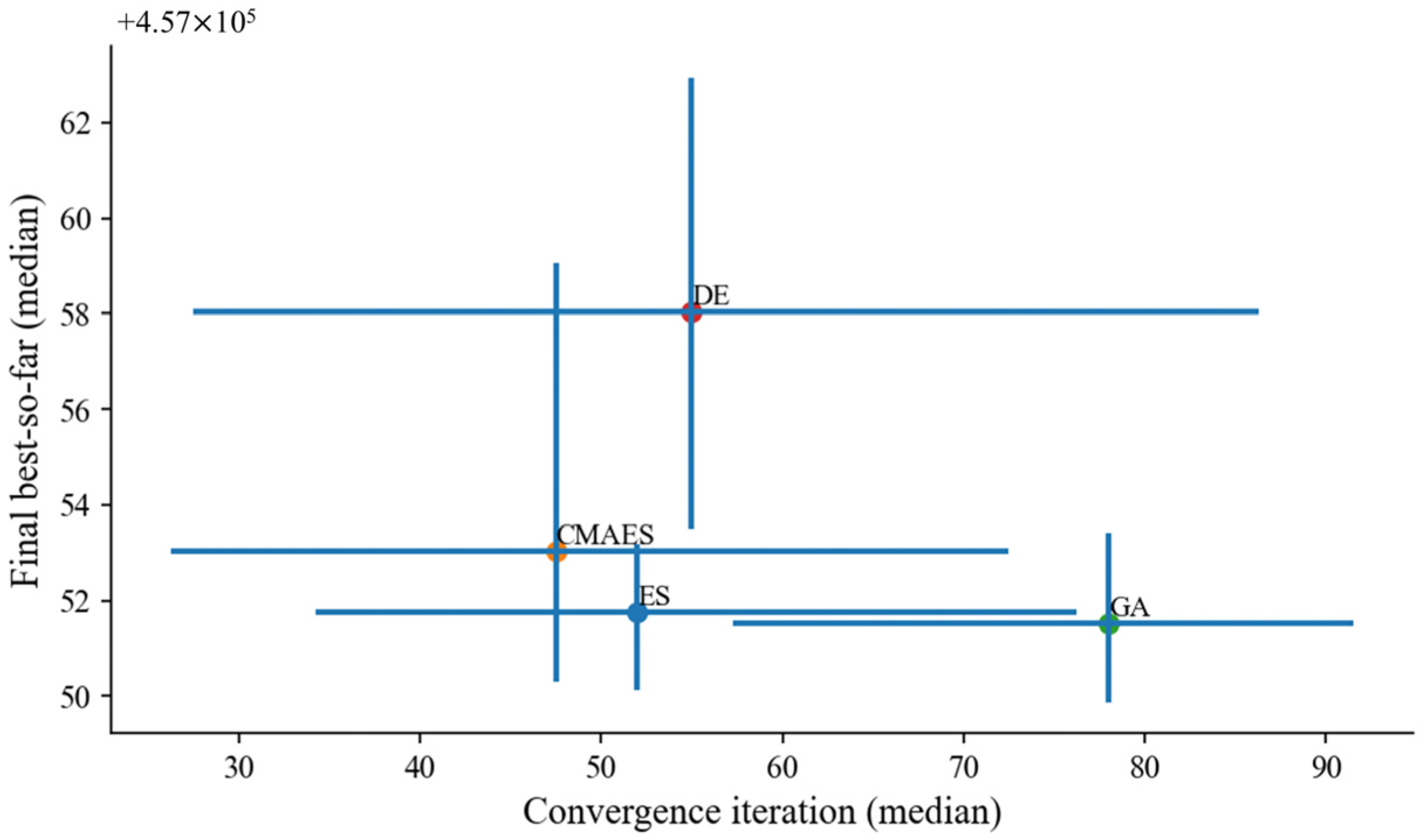
3.4.1. Comparison of Outer-Layer Optimisation Algorithms
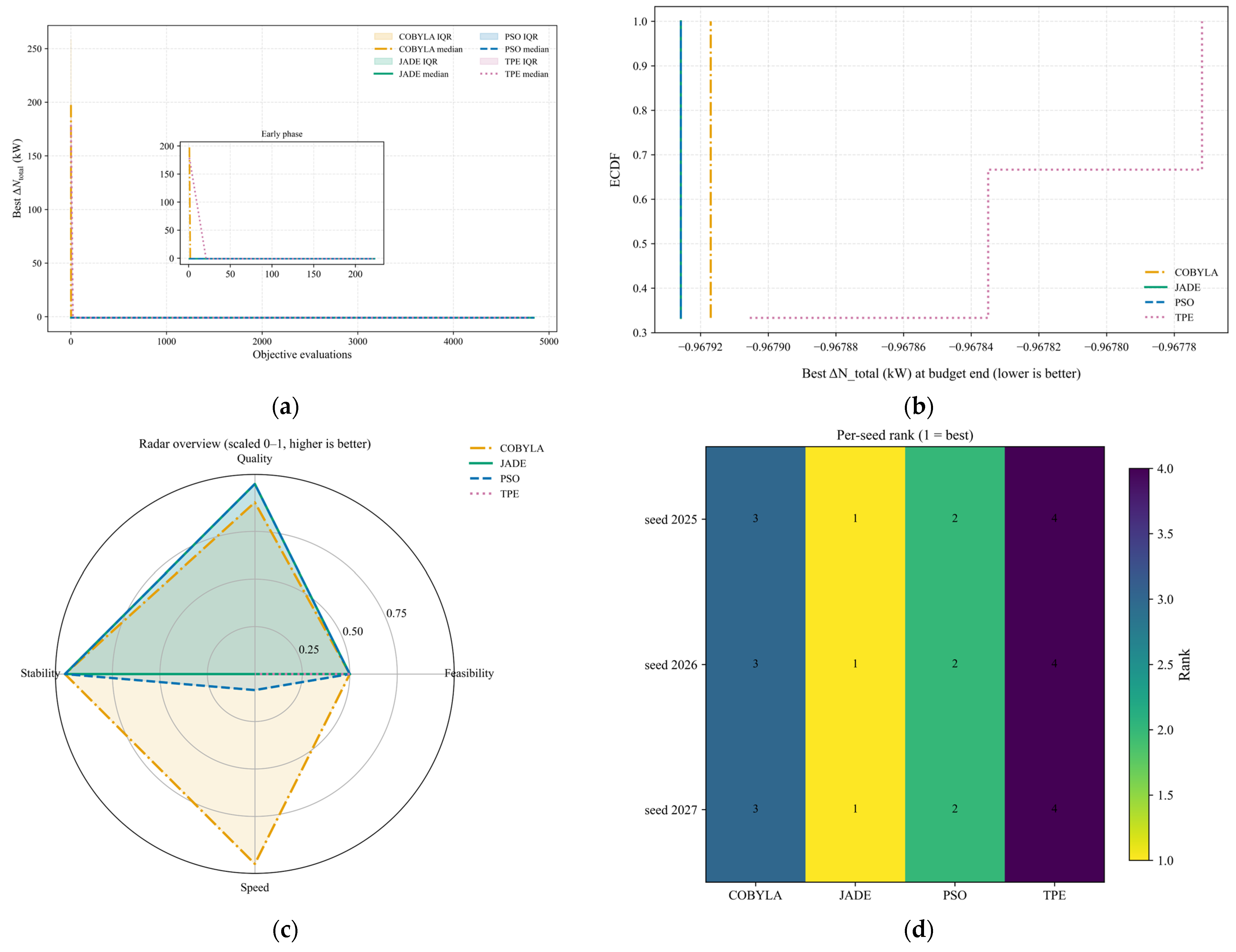
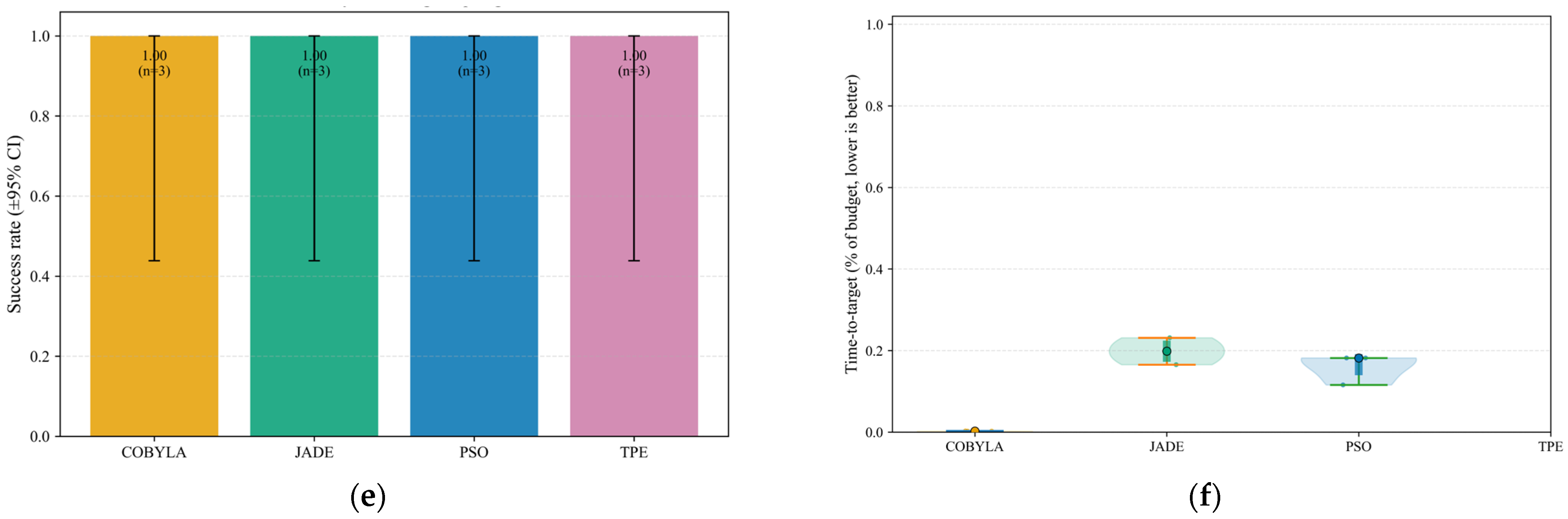
3.4.2. Comparison of Inner-Layer Optimisation Algorithms
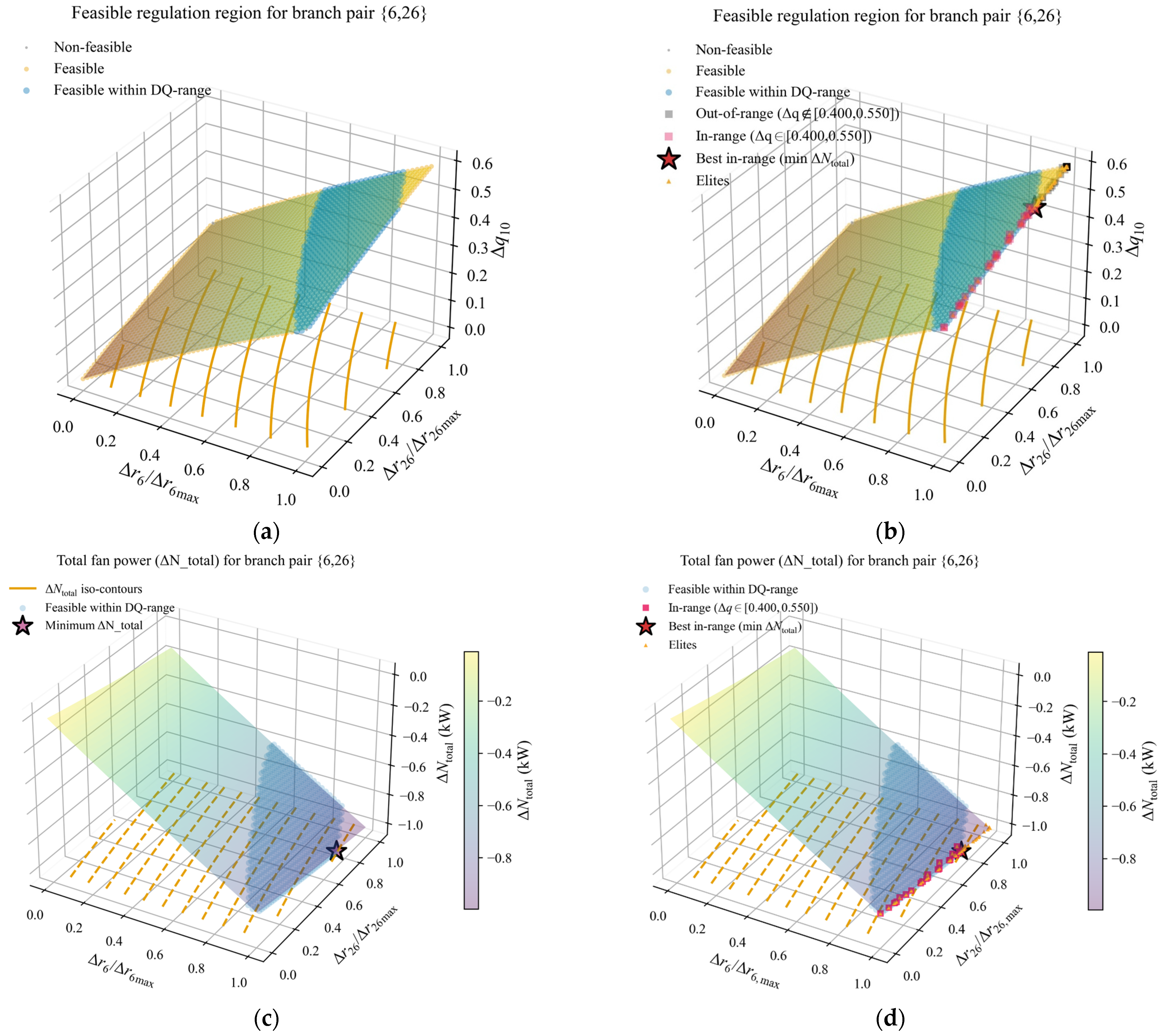
3.5. Branch-Level Airflow Augmentation Strategy
- (1)
- Airflow increment in the range [0.40, 0.55]
- (2)
- Airflow increment in the range [0.55, 0.63]
4. Conclusions
- (1)
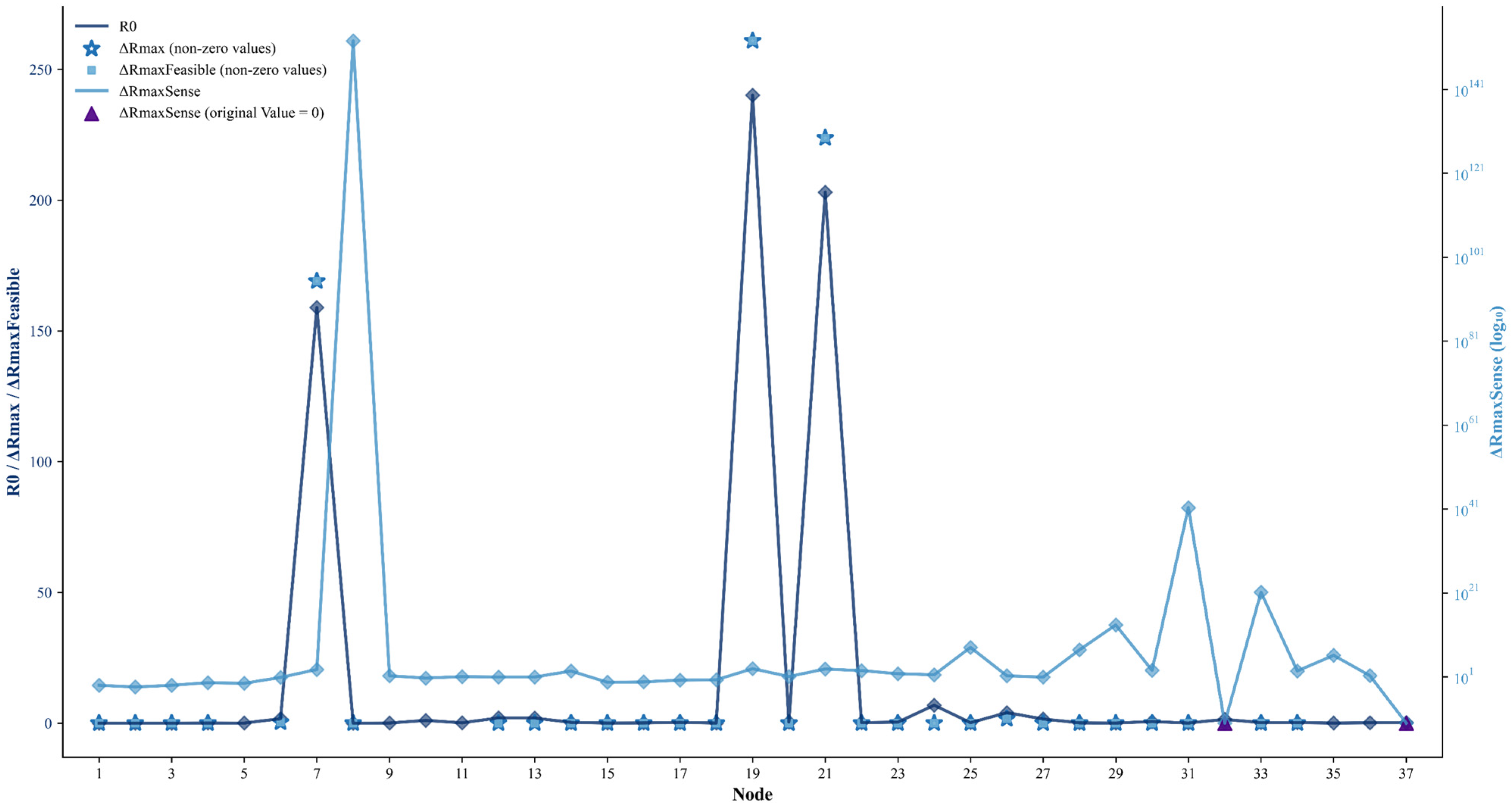
- An engineering constraint-contraction mechanism based on feasibility-region bounds and sensitivity analysis is proposed, providing explicit limits on adjustable resistance. Feasible increments that do not violate system-wide airflow upper/lower bounds and effective increments filtered by sensitivity thresholds are jointly used to define constraints, from which the maximum practically implementable resistance increment for each branch is derived. In this way, invalid search regions are eliminated at the outset, ensuring that optimisation is performed within a physically meaningful domain.
- (2)
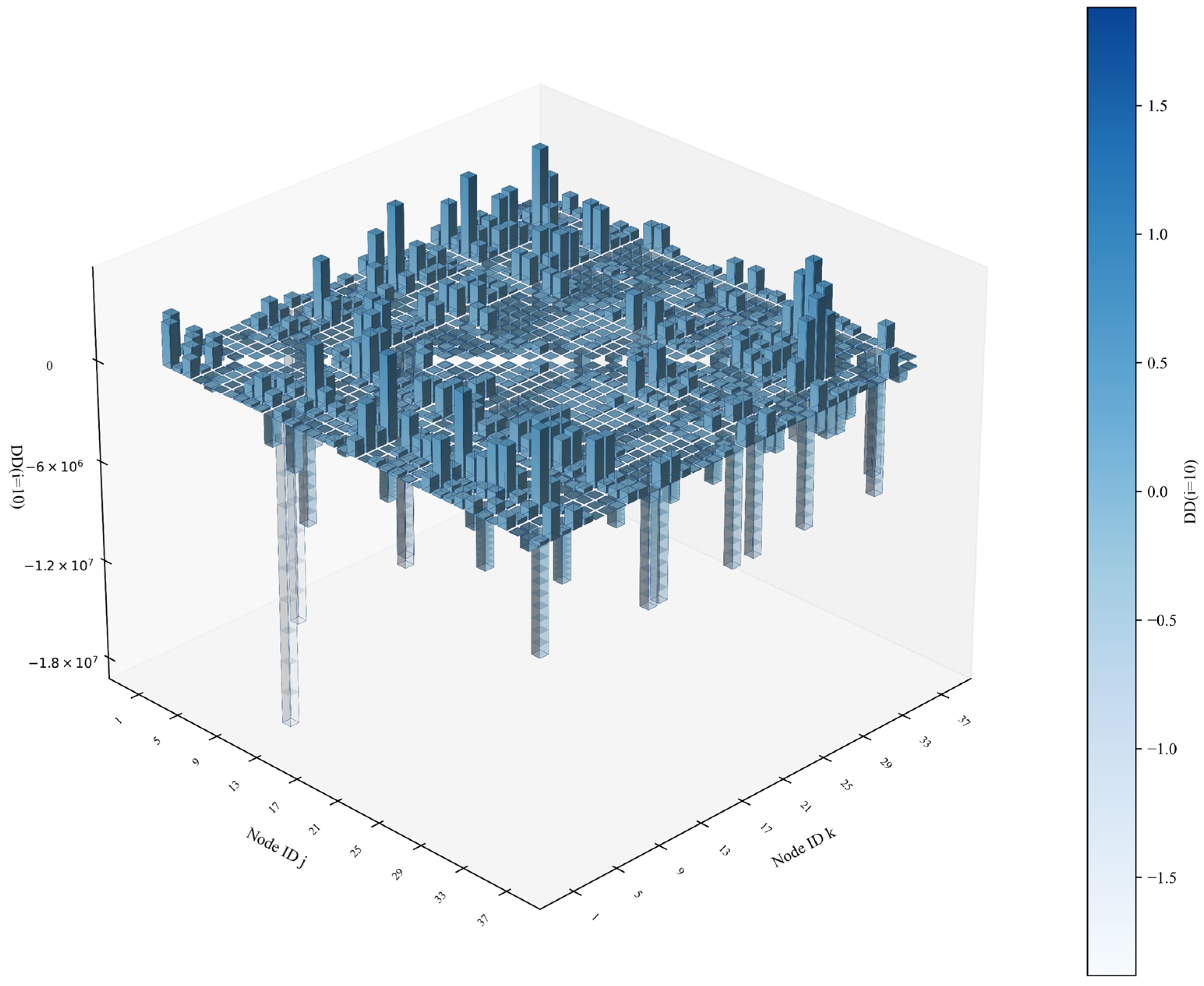
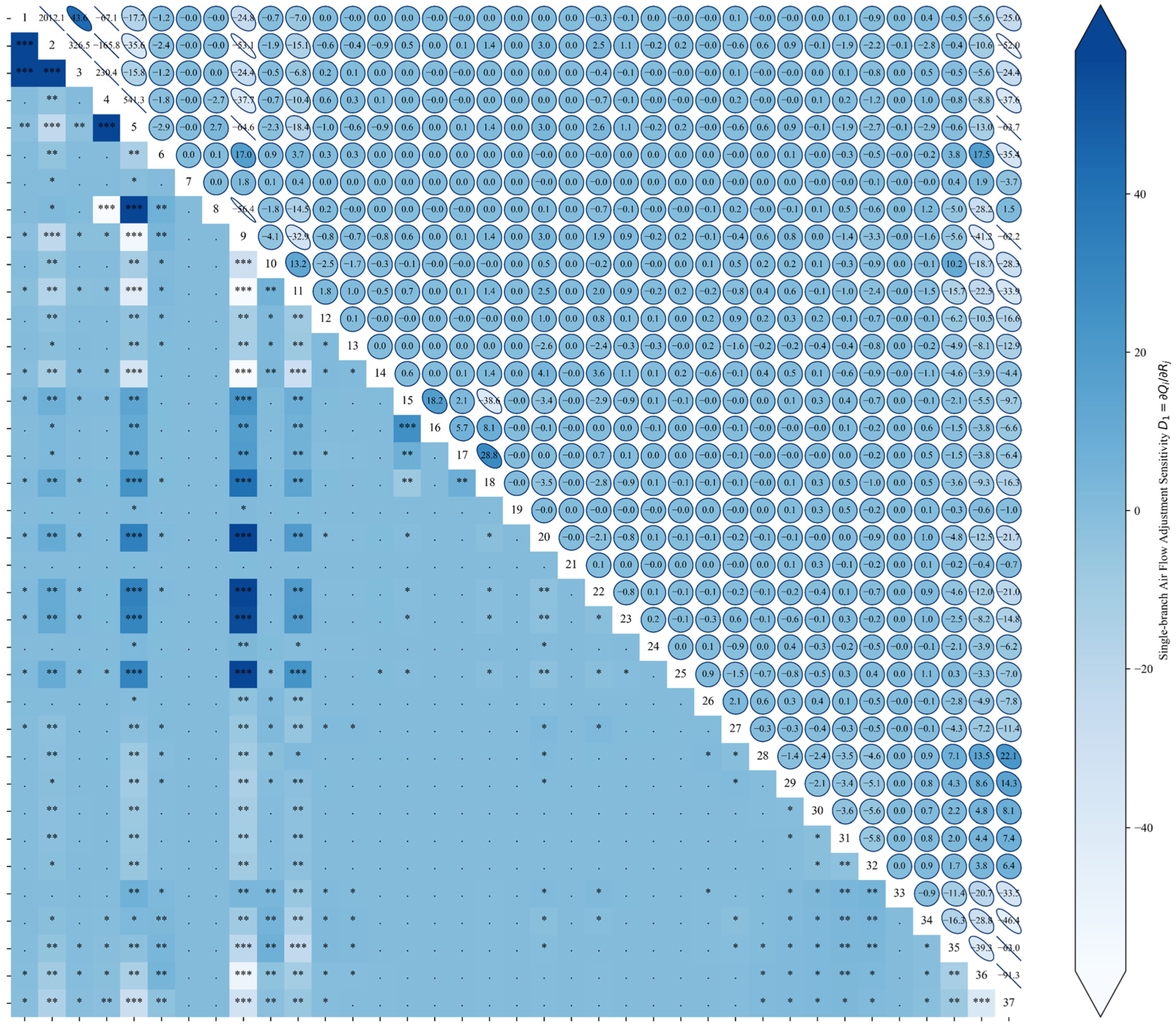
- Taylor-difference predictions are elevated to core constraints within the optimisation framework, thereby accelerating computation. It is demonstrated that the Taylor-difference estimates of the objective-branch airflow increment exhibit only small deviations from full-network solutions. These predictions are then used directly to construct the “maximum airflow” constraint for subsequent optimisation, which substantially reduces reliance on computationally expensive full-network iterative solving and forms a fast “prediction–constraint–search” closed loop.
- (3)
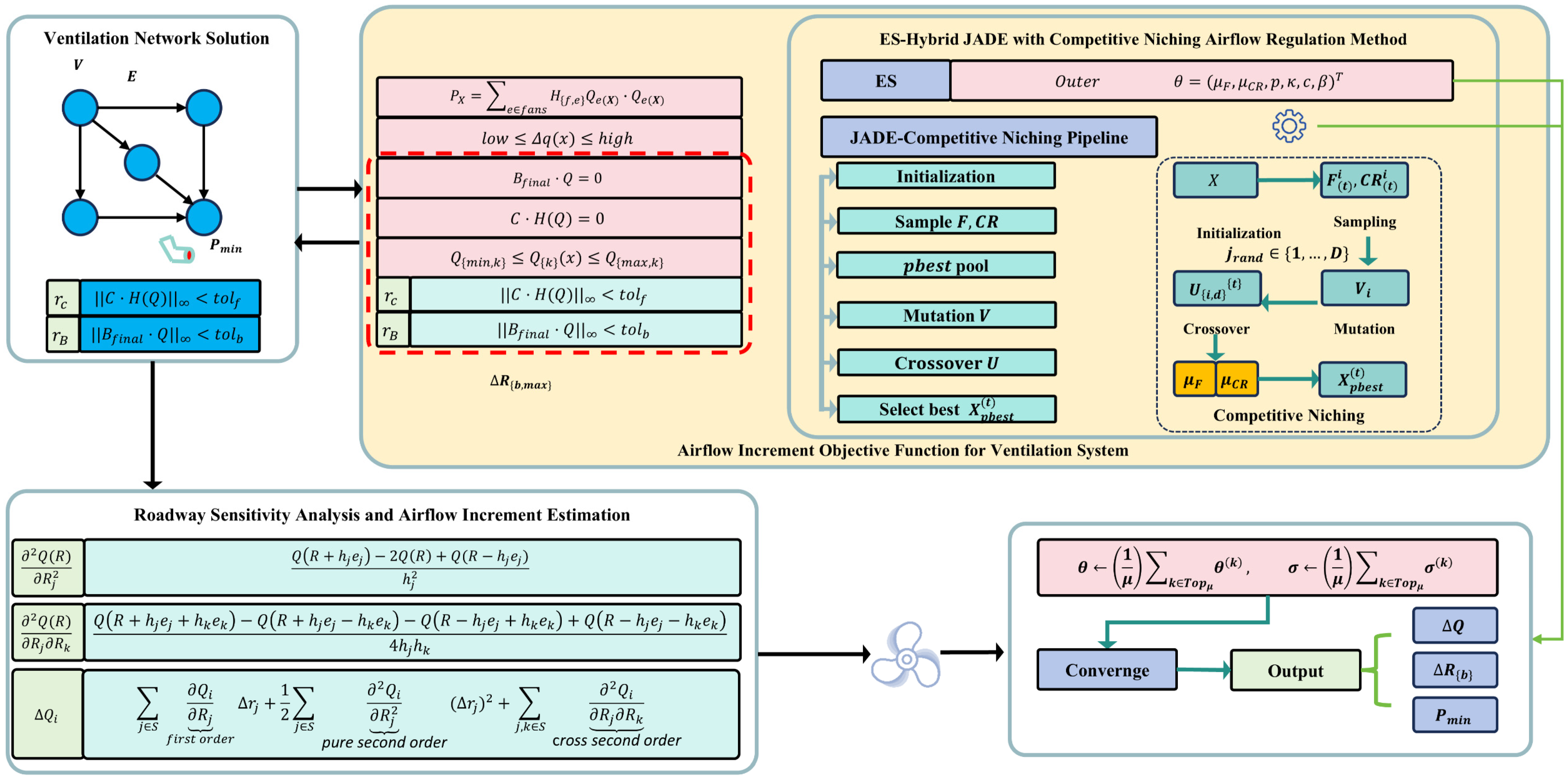
- A two-layer adaptive optimisation framework (ES–Hybrid JADE with Competitive Niching) is constructed to accelerate the generation of roadway airflow augmentation strategies. In the outer layer, ES is used to adaptively search the hyperparameter vector (with , , , , , , etc., treated as tuning variables), improving robustness across operating conditions and random seeds while enhancing engineering usability under limited trial budgets. In the inner layer, JADE performs the main search. Competitive Niching is incorporated to maintain multiple basins of attraction through species partitioning and local competitive replacement, preventing premature collapse to a single solution and enabling reliable output of multimodal elite solutions.
- (4)
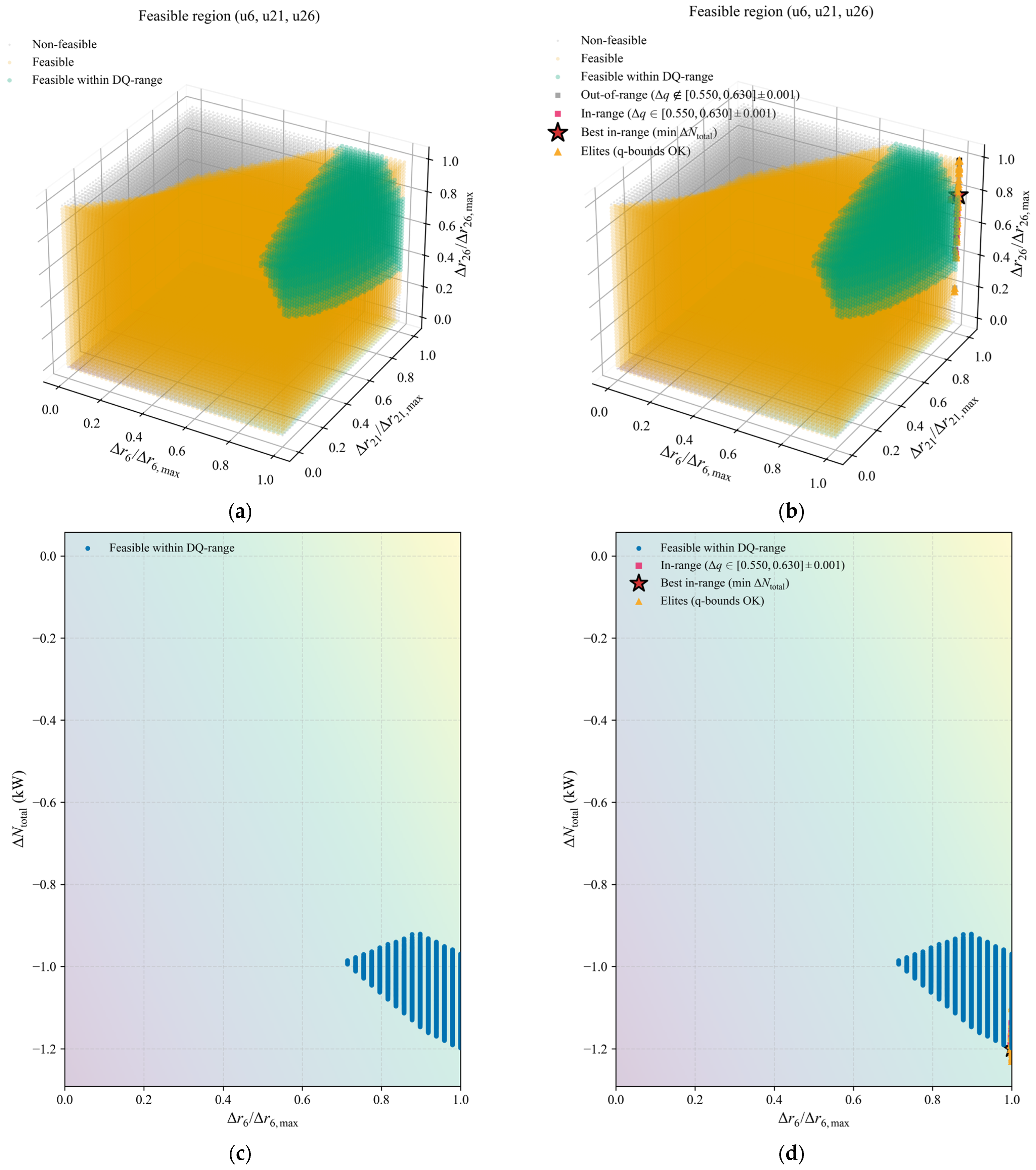
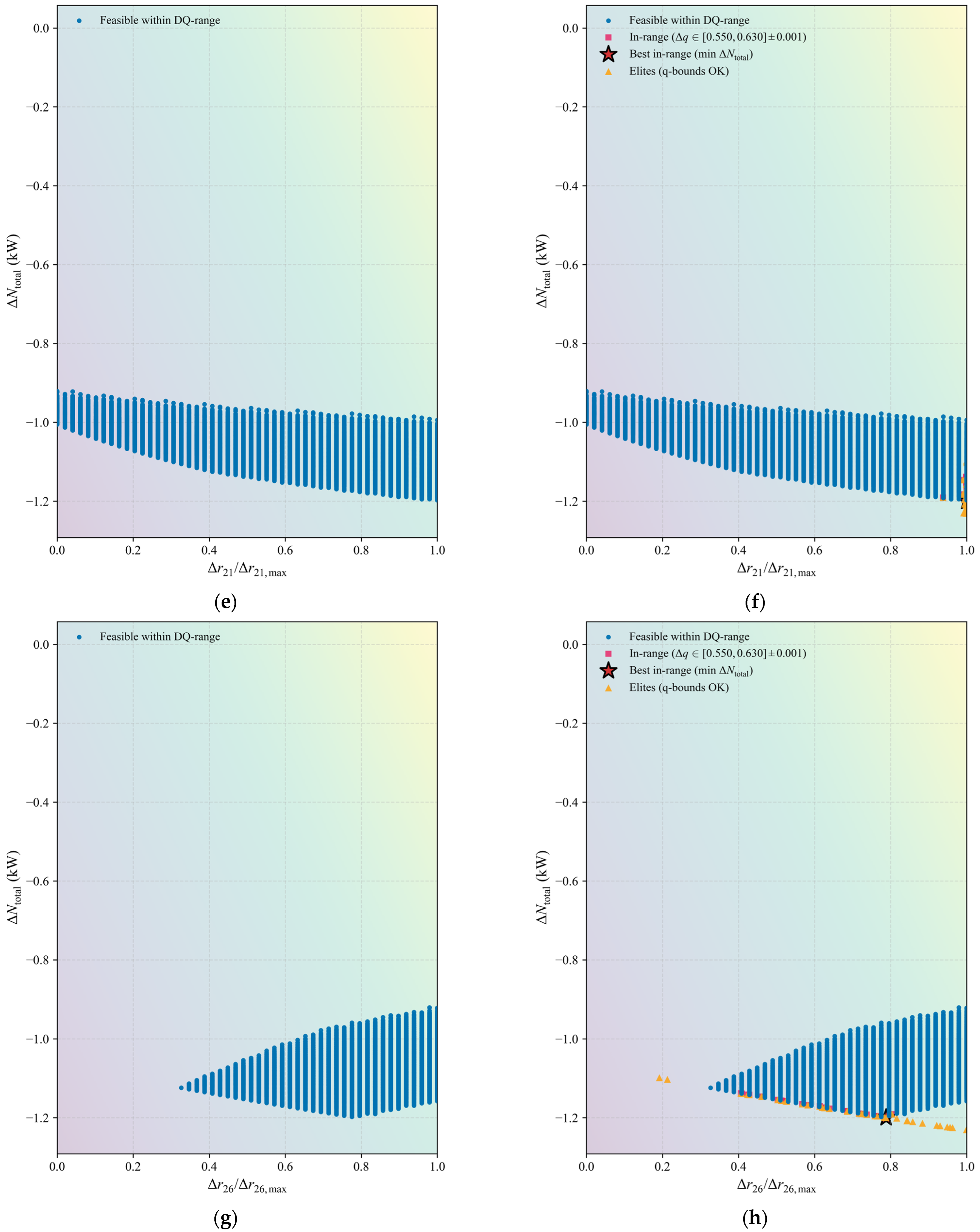
- The real-time value of “near-optimal yet extremely fast” optimisation is validated in a real dual-main-fan system, and a practical set of alternative solutions is produced. Within the airflow-gain interval , the composite algorithm yields near-identical optimal results to direct solving, while reducing runtime from approximately 29 min to about 13 s, and simultaneously providing multimodal elite solutions that can accommodate different construction and scheduling preferences, thereby markedly improving online decision usability. Under global constraints, the maximum achievable airflow increment for the objective branch (Branch 10) is approximately 0.66 m3/s; under the segmented-interval strategy, the optimal dual-branch combination for is identified as Branches 6 and 26.
Author Contributions
Funding
Data Availability Statement
Conflicts of Interest
References
- Wang, J.; Xiao, J.; Xue, Y.; Wen, L.; Shi, D. Optimization of Airflow Distribution in Mine Ventilation Networks Using the Modified Sooty Tern Optimization Algorithm. Min. Metall. Explor. 2024, 41, 239–257. [Google Scholar] [CrossRef] [Scilit]
- Liu, Y.; Liu, Z.; Gao, K.; Huang, Y.; Zhu, C. Efficient Graphical Algorithm of Sensor Distribution and Air Volume Reconstruction for a Smart Mine Ventilation Network. Sensors 2022, 22, 2096. [Google Scholar] [CrossRef] [Scilit]
- Nardo, M.D.; Yu, H. Intelligent Ventilation Systems in Mining Engineering: Is ZigBee WSN Technology the Best Choice? Appl. Syst. Innov. 2021, 4, 42. [Google Scholar] [CrossRef] [Scilit]
- Yan, Z.; Wang, Y.; Fan, J.; Huang, Y.; Zhong, Y. An Efficient Method for Optimizing Sensors’ Layout for Accurate Measurement of Underground Ventilation Networks. IEEE Access 2023, 11, 72630–72640. [Google Scholar] [CrossRef] [Scilit]
- Wang, K.; Jiang, S.; Wu, Z.; Shao, H.; Zhang, W.; Pei, X.; Cui, C. Intelligent Safety Adjustment of Branch Airflow Volume during Ventilation-on-Demand Changes in Coal Mines. Process Saf. Environ. Prot. 2017, 111, 491–506. [Google Scholar] [CrossRef] [Scilit]
- Wen, L.; Wang, J.; Wang, L.; Zhong, D.; Liu, Y. Optimization of Airflow Distribution in Mine Ventilation Networks Considering Ventilation Energy Consumption and Number of Regulators. Eng. Optim. 2025, 57, 3588–3609. [Google Scholar] [CrossRef] [Scilit]
- Prince; Hati, A.S.; Kumar, P. An Adaptive Neural Fuzzy Interface Structure Optimisation for Prediction of Energy Consumption and Airflow of a Ventilation System. Appl. Energy 2023, 337, 120879. [Google Scholar] [CrossRef] [Scilit]
- Fakhari, S.M.; Mrad, H. Optimization of an Axial-Flow Mine Ventilation Fan Based on Effects of Design Parameters. Results Eng. 2024, 21, 101662. [Google Scholar] [CrossRef] [Scilit]
- Liu, Y.; Huang, D.; Li, Y. Predictive Modelling of CART-Based Frictional Resistance in Mine Ventilation Systems. Min. Metall. Explor. 2022, 39, 301–315. [Google Scholar] [CrossRef] [Scilit]
- Zhou, L.; Bahrami, D. A Derivative Method to Calculate Resistance Sensitivity for Mine Ventilation Networks. Min. Metall. Explor. 2022, 39, 1833–1839. [Google Scholar] [CrossRef] [Scilit]
- Li, J.; Li, Y.; Zhang, J.; Li, B.; Zhang, Z.; Dong, J.; Cui, Y. Accurate and Real-Time Network Calculation for Mine Ventilation without Wind Resistance Measurement. J. Wind Eng. Ind. Aerodyn. 2022, 230, 105183. [Google Scholar] [CrossRef] [Scilit]
- Li, J.; Li, Y.; Zhang, W.; Dong, J.; Cui, Y. Multi-Objective Intelligent Decision and Linkage Control Algorithm for Mine Ventilation. Energies 2022, 15, 7980. [Google Scholar] [CrossRef] [Scilit]
- Liu, L.; Liu, J.; Zhou, Q. Mine Ventilation System Reliability Evaluation Based on a Markov Chain. Sci. Rep. 2022, 12, 17115. [Google Scholar] [CrossRef] [Scilit] [PubMed]
- Zhang, Z.; Li, J.; Li, Y. Real-Time Online Resistance-Alteration-Based Multiple-Fault Diagnosis Framework and Implementation for Mine Ventilation Systems. Adv. Eng. Inform. 2024, 59, 102305. [Google Scholar] [CrossRef] [Scilit]
- Wang, Y.; Pan, Q.; Gao, L.; Cao, Y.; Liu, P.; Yi, H.; Gao, C. Analysis of Distribution Method of Designed Air Quantity in Coal Mine Ventilation—A Case Study. Sci. Rep. 2024, 14, 10917. [Google Scholar] [CrossRef] [Scilit]
- Hao, H.; Jiang, S.; Wu, Z.; Wang, K.; Xi, X. Experimental Study on Precise Control Air Quantity on Demand by the Cooperation of Multiple Main Fans in Mine. J. Clean. Prod. 2023, 414, 137626. [Google Scholar] [CrossRef] [Scilit]
- Zeqiri, I.; Gashi, J.; Brahimaj, F.; Zeqiri, R. Effectiveness of Ventilation Regulation in a Simple Diagonal System of Underground Mines. Min. Miner. Depos. 2022, 16, 81–86. [Google Scholar] [CrossRef] [Scilit]
- Ihsan, A.; Widodo, N.P.; Cheng, J.; Wang, E. Ventilation on Demand in Underground Mines Using Neuro-Fuzzy Models: Modeling and Laboratory-Scale Experimental Validation. Eng. Appl. Artif. Intell. 2024, 133, 108048. [Google Scholar] [CrossRef] [Scilit]
- Han, Y.; Cheng, W.; Liu, H.; Wang, G.; Hu, Y. Treatment Methods for Natural Wind Pressure in Mines with Zonal Ventilation System with Diagonal Branches—A Case Study of Wudong Coal Mine. Energy Sources Part A Recovery Util. Environ. Eff. 2023, 45, 6118–6130. [Google Scholar] [CrossRef] [Scilit]
- Der, O. Multi-Output Prediction and Optimization of CO2 Laser Cutting Quality in FFF-Printed ASA Thermoplastics Using Machine Learning Approaches. Polymers 2025, 17, 1910. [Google Scholar] [CrossRef] [Scilit]
- Huang, S.; Fu, Z.; Liu, C.; Li, J. Multi-Objective Optimization of Fiber Laser Cutting Quality Characteristics of Glass Fiber Reinforced Plastic (GFRP) Materials. Opt. Laser Technol. 2023, 167, 109720. [Google Scholar] [CrossRef] [Scilit]
- Acuña, E.I.; Lowndes, I.S. A Review of Primary Mine Ventilation System Optimization. Interfaces 2014, 44, 163–175. [Google Scholar] [CrossRef] [Scilit]
- Chen, Y. Optimization of Ventilation On-Demand in Mines Based on Niche Particle Swarm Optimization Algorithm. Doctoral Dissertation, China University of Mining and Technology, Xuzhou, China, 2023. [Google Scholar]
- Knowles, J.; Corne, D. The Pareto Archived Evolution Strategy: A New Baseline Algorithm for Pareto Multiobjective Optimisation. In Proceedings of the 1999 Congress on Evolutionary Computation-CEC99 (Cat. No. 99TH8406); IEEE: Piscataway, NJ, USA, 1999; Volume 1, pp. 98–105. [Google Scholar]
- Zhang, J.; Sanderson, A.C. JADE: Adaptive Differential Evolution with Optional External Archive. IEEE Trans. Evol. Comput. 2009, 13, 945–958. [Google Scholar] [CrossRef] [Scilit]
- Wang, W.; Bai, Y.; Yang, Z.; Li, H.; Chen, Y.; Ma, Y. Research on optimization method of mine ventilation network based on GA-PSO. Min. Saf. Environ. Prot. 2025, 52, 24–29. [Google Scholar] [CrossRef]
- Lin, X.; Luo, W.; Xu, P. Differential Evolution for Multimodal Optimization with Species by Nearest-Better Clustering. IEEE Trans. Cybern. 2021, 51, 970–983. [Google Scholar] [CrossRef] [Scilit]





| Name | Number | Start Node | End Node | Type | Air Resistance/N · s2/m8 | Airflow/m3/s | Fan | Air Pressure/Pa |
|---|---|---|---|---|---|---|---|---|
| 408 Car Yard | 1 | 1 | 2 | 1 | 0.02 | 27.91 | 0 | 255.68 |
| Vertical Shaft Rope Way | 2 | 1 | 2 | 1 | 0.0045 | 58.84 | 0 | 255.68 |
| Auxiliary Shaft Rope Way | 3 | 1 | 2 | 1 | 0.02 | 27.91 | 0 | 255.68 |
| Auxiliary Blind Incline | 4 | 2 | 4 | 1 | 0.0625 | 43.46 | 0 | 488.25 |
| Vertical Blind Incline | 5 | 2 | 5 | 1 | 0.0233 | 71.20 | 0 | 278.80 |
| South Return Air Main | 6 | 4 | 6 | 1 | 1.6924 | 33.91 | 0 | 348.91 |
| Explosive Depot 1 | 7 | 4 | 6 | 1 | 158.9181 | 3.49 | 0 | 348.79 |
| North Haulage Main 1 | 8 | 5 | 4 | 1 | 0.0018 | 6.04 | 0 | 209.44 |
| North Haulage Main 2 | 9 | 5 | 7 | 1 | 0.0561 | 77.25 | 0 | 69.35 |
| 2323 Preparation Face | 10 | 7 | 8 | 2 | 1 | 30.89 | 0 | 158.22 |
| 5# Coal Rail Roadway 1 (Upper) | 11 | 9 | 7 | 1 | 0.1156 | 46.35 | 0 | 88.86 |
| 11502 Driving Face | 12 | 9 | 10 | 2 | 2 | 17.84 | 0 | 74.30 |
| 2321 Working Face | 13 | 11 | 9 | 2 | 1.9374 | 16.98 | 0 | 24.01 |
| 5# Coal Rail Roadway 2 (Upper) | 14 | 12 | 9 | 1 | 0.2699 | 11.52 | 0 | 139.15 |
| Main Incline Shaft | 15 | 3 | 1 | 1 | 0.0556 | 13.06 | 0 | 21.63 |
| Auxiliary Incline Shaft | 16 | 3 | 1 | 1 | 0.0925 | 10.12 | 0 | 21.63 |
| Adit | 17 | 21 | 1 | 1 | 0.2832 | 11.34 | 0 | 64.90 |
| 250 Car Yard | 18 | 21 | 3 | 1 | 0.0501 | 23.18 | 0 | 43.27 |
| Crossheading Air Leakage | 19 | 20 | 21 | 1 | 240.1303 | 2.99 | 0 | 174.85 |
| 250 Main Roadway | 20 | 21 | 19 | 1 | 0.4242 | 31.53 | 0 | 66.67 |
| Explosive Depot 2 | 21 | 18 | 19 | 1 | 203.0269 | 2.86 | 0 | 48.31 |
| Measure Roadway | 22 | 19 | 16 | 1 | 0.1994 | 28.66 | 0 | 114.99 |
| Construction Measure Roadway | 23 | 16 | 15 | 1 | 0.3615 | 18.46 | 0 | 127.11 |
| 08 Working Face | 24 | 17 | 16 | 2 | 6.8396 | 10.20 | 0 | 12.12 |
| 5# Coal Rail Roadway 3 (Upper) | 25 | 15 | 12 | 1 | 0.1687 | 6.70 | 0 | 131.96 |
| 08 Air Meeting and Personnel Incline | 26 | 14 | 15 | 1 | 4 | 11.75 | 0 | 4.84 |
| 11501 Working Face | 27 | 13 | 12 | 2 | 1.5705 | 18.22 | 0 | 7.19 |
| 3# Coal Return Air Decline 1 | 28 | 14 | 13 | 1 | 0.1012 | 15.36 | 0 | 129.57 |
| Return Air Incline Roadway | 29 | 17 | 14 | 1 | 0.0482 | 27.12 | 0 | 134.41 |
| 280 Bypass Roadway | 30 | 18 | 17 | 1 | 0.575 | 37.33 | 0 | 146.54 |
| 280 Return Air Roadway | 31 | 20 | 18 | 1 | 0.0405 | 40.20 | 0 | 194.85 |
| 385 Return Air Fan Roadway | 32 | 1 | 20 | 3 | 1.4308 | 43.20 | 1 | 369.71 |
| 3# Coal Return Air Decline 2 | 33 | 13 | 11 | 1 | 0.1735 | 2.85 | 0 | 122.38 |
| 3# Coal Return Air Decline 3 | 34 | 11 | 10 | 1 | 0.1976 | 19.84 | 0 | 98.36 |
| 3# Coal Return Air Decline 4 | 35 | 10 | 8 | 1 | 0.0488 | 37.68 | 0 | 172.67 |
| Return Air Crosscut | 36 | 8 | 6 | 1 | 0.1398 | 68.58 | 0 | 330.89 |
| Main Exhaust Airway | 37 | 6 | 1 | 3 | 0.1896 | 106.00 | 2 | 1028.60 |
| Branch Combination | /m3/s | /m3/s |
|---|---|---|
| 6 + 21 + 26 | 0.6390593289089929 | 0.661693882718577 |
| 6 + 26 + 34 | 0.5935760364684373 | 0.5912356166568671 |
| 6 + 26 | 0.5927471910316433 | 0.5912271980456367 |
| 6 + 30 | 0.4209646869769671 | 0.416435367192836 |
| … | … | … |
| Algorithms | ||||
|---|---|---|---|---|
| CMAES | 0.81 | 1.17 | 1.80 | 0.36 |
| DE | 0.56 | 2.47 | 2.10 | 3.13 |
| ES | 0.87 | 1.22 | 1.62 | 24.49 |
| GA | 0.48 | 1.22 | 2.09 | 10.68 |
| 0.15 | 3 | 1.22 | 38 | 73 |
| 0.19 | 4 | 0.64 | 29 | 55 |
| 0.03 | 3 | 2.18 | 41 | 68 |
| 0.19 | 4 | 0.85 | 45 | 62 |
| Algorithm | final_median | iter_median | rank_final | rank_iter | rank_mean |
|---|---|---|---|---|---|
| ES | 457,251.75 | 52.0 | 2.0 | 2.0 | 2.0 |
| CMAES | 457,253.02 | 47.5 | 3.0 | 1.0 | 2.0 |
| GA | 457,251.53 | 78.0 | 1.0 | 4.0 | 2.5 |
| DE | 457,258.03 | 55.0 | 3.0 | 3.0 | 3.5 |
| /N · s2/m8 | /N · s2/m8 | /m3/s | /Kw |
|---|---|---|---|
| 0.3267 | 1.1793 | 0.5499 | −967.8704 |
| 0.3267 | 1.1488 | 0.5469 | −965.1666 |
| 0.3267 | 1.0972 | 0.5419 | −960.5506 |
| 0.3254 | 1.0939 | 0.5401 | −957.0837 |
| … | … | … | … |
| /N · s2/m8 | /N · s2/m8 | /N · s2/m8 | /m3/s | /Kw |
|---|---|---|---|---|
| 0.3267 | 1.2855 | 223.7688 | 0.6299 | −1199.6412 |
| 0.3267 | 1.2784 | 223.7688 | 0.6292 | −1198.9874 |
| 0.3267 | 1.2489 | 222.5465 | 0.6261 | −1195.5269 |
| 0.3254 | 1.2378 | 223.7688 | 0.6253 | −1195.2486 |
| … | … | … | … |
Disclaimer/Publisher’s Note: The statements, opinions and data contained in all publications are solely those of the individual author(s) and contributor(s) and not of MDPI and/or the editor(s). MDPI and/or the editor(s) disclaim responsibility for any injury to people or property resulting from any ideas, methods, instructions or products referred to in the content. |
© 2026 by the authors. Licensee MDPI, Basel, Switzerland. This article is an open access article distributed under the terms and conditions of the Creative Commons Attribution (CC BY) license.
Share and Cite
Niu, G.; Li, C. Intelligent Evolutionary Optimisation Method for Ventilation-on-Demand Airflow Augmentation in Mine Ventilation Systems Based on JADE. Buildings 2026, 16, 568. https://doi.org/10.3390/buildings16030568
Niu G, Li C. Intelligent Evolutionary Optimisation Method for Ventilation-on-Demand Airflow Augmentation in Mine Ventilation Systems Based on JADE. Buildings. 2026; 16(3):568. https://doi.org/10.3390/buildings16030568
Chicago/Turabian StyleNiu, Gengxin, and Cunmiao Li. 2026. "Intelligent Evolutionary Optimisation Method for Ventilation-on-Demand Airflow Augmentation in Mine Ventilation Systems Based on JADE" Buildings 16, no. 3: 568. https://doi.org/10.3390/buildings16030568
APA StyleNiu, G., & Li, C. (2026). Intelligent Evolutionary Optimisation Method for Ventilation-on-Demand Airflow Augmentation in Mine Ventilation Systems Based on JADE. Buildings, 16(3), 568. https://doi.org/10.3390/buildings16030568