


Abstract
Industrialised timber construction increasingly relies on digital technologies such as Digital Product Passports (DPP), Digital Building Logbooks (DBL), Electronic Performance Monitoring (EPM), and Digital Twins (DTw) to improve traceability, information continuity, and circularity, yet integrating them as a socio-technical system remains constrained by interoperability, governance, and stakeholder-alignment challenges. This study develops an exploratory, expert-informed framework for a digital platform supporting traceability and intelligent management of industrialised timber construction. A mixed-methods design combined a desk-based narrative review of academic and technical sources on DPP, DBL, EPM, and DTw in industrialised timber construction, Abductive Grounded Theory, and two Delphi studies with expert panels. The literature review was exploratory rather than systematic and served to map representative work and inform the framework, not to quantify all existing research on the topic. Results define a layered, federated system of systems, identity and material traceability, building memory, performance monitoring, digital twin, and interoperability layers, together with role definitions, an event-ownership model, and API-level integration logic linking DPP, DBL, EPM, and DTw. Both panels converged on a decentralised interoperability architecture rather than a centralised repository, distinguishing raw observations from validated and derived information. The framework offers an exploratory, expert-informed basis for traceable, circular, lifecycle-oriented digital management of industrialised timber buildings.
1. Introduction
The timber construction market is expanding, driven by innovations such as cross-laminated timber (CLT) and increased awareness of timber’s advantages [1]. Persistent fragmentation within the construction sector and a lack of effective stakeholder integration hinder the adoption of industrialised timber methods, especially among modular timber building companies [2]. The integration of the Digital Product Passport (DPP), Digital Building Logbook (DBL), Electronic Performance Monitoring (EPM), and Digital Twin (DTw) as a socio-technical system offers significant potential to improve traceability, information continuity, and sustainability in industrialised timber construction. However, achieving this requires addressing challenges related to data interoperability, stakeholder collaboration, and technological adoption.
DPPs enable traceability and lifecycle data integration for products, supporting circular-economy practices and sustainability goals [3,4,5]. In construction, DPPs provide detailed product information, such as material composition, environmental performance, and end-of-life pathways, which are critical for resource recovery and lifecycle assessments (LCA) [4,5]. DPP effective implementation challenges include data standardisation, interoperability, and stakeholder engagement [6,7]. DBLs act as repositories for building lifecycle data, including static and dynamic information such as energy performance and renovation history [8,9]. DBL facilitates data sharing among stakeholders and supports decision making across the building lifecycle [9,10,11]. DBL integration with other systems, such as Digital Twins, enhances data accessibility and circularity [12]. EPM systems monitor construction processes and resource performance in real time, enabling productivity improvements and early issue detection [13,14,15]. Automated monitoring technologies, such as sensors and computer vision, provide accurate and timely data for decision making. Challenges include data integration, stakeholder alignment, and technological adoption [13]. Digital Twins create real-time virtual models of physical assets, enabling dynamic monitoring, forecasting, and optimisation of construction processes [16,17,18]. DTw enhances data integration throughout the lifecycle, from design to deconstruction, and supports predictive decision making [19].
Recent advances in industrialised timber construction have demonstrated the growing adoption of digital technologies across different stages of the project lifecycle. Diao and Loss (2025) [20] developed a standardised digital workflow integrating CAD/CAM environments, CNC manufacturing, and DfMA principles for prefabricated timber assemblies, highlighting the need for integrated digital environments capable of linking design and manufacturing requirements. Forcael et al. (2025) [21] further demonstrated the integration of BIM, Digital Twins, simulation, and robotic assembly to improve planning accuracy, automation, and construction efficiency in CLT projects. More recently, Morganti et al. (2025) [22] proposed the forest-to-building digital framework, extending Digital Twin applications to the timber supply chain and demonstrating the feasibility of improving traceability and environmental information exchange across multiple stakeholders. However, despite these significant advances, the authors recognise that interoperability between Digital Twins, Digital Product Passports, Digital Building Logbooks, manufacturing data systems, and other digital infrastructures remains a major research challenge for achieving continuous lifecycle information management and supporting circular construction.
In this context, the integration of DPP, DBL, EPM, and DTw components as a socio-technical system requires data interoperability, stakeholder collaboration, dynamic asset–state integration, circularity, and sustainability. Its integration requires unified standards and protocols to ensure seamless data exchange among DPP, DBL, EPM, and DTw [7,12]. Also, it is necessary to clearly define roles for data providers and users throughout the lifecycle to ensure effective data flow and decision making [9,10]. Real-time updates from DTw and EPM systems are needed to maintain continuity and accuracy of information [16,23]. Leveraging DPP and DBL to track material flows and environmental impacts is required, supporting circular construction practices [4,5,12].
Recent studies have already addressed important parts of this problem. Çetin et al. (2026) examine the socio-technical integration of Digital Product Passports and Digital Building Logbooks [24], while Morganti et al. (2025) propose a forest-to-building digital framework linking timber-supply-chain traceability, Digital Twins, and actor-based environmental assessment [22]. The present study does not claim to introduce either DPP–DBL integration or forest-to-building traceability. Its contribution is narrower and complementary: it links actor-specific information needs identified in industrialised timber construction to a federated architecture that assigns responsibilities and information flows across DPP, EPM, DBL, and DTw. This linkage connects the project-stage requirements of clients, designers, MEP specialists, manufacturers, logistics actors, and contractors with the proposed information ownership, event model, and API-level exchange logic.
2. Materials and Methods
This research adopted an exploratory mixed-methods approach, combining a desk-based narrative review [25], Abductive Grounded Theory (AGT), and two Delphi studies to develop and refine the framework. The literature review was not designed as a systematic review; instead, it was a focused desk search intended to map representative work on Digital Product Passports (DPP), Digital Building Logbooks (DBL), Electronic Performance Monitoring (EPM), and Digital Twins (DTw) in industrialised timber construction. An initial database query in Scopus and Web of Science used a deliberately narrow, conjunctive search string that required all four concepts and timber terms to appear in the same record, which yielded a small core set of publications explicitly addressing their joint integration. To avoid treating this constrained query as exhaustive, the authors subsequently expanded the evidence base through desk research and snowballing from key papers, standards, and the experts’ prior work, adding further academic and technical sources that were used qualitatively to contextualise the framework rather than to support quantitative claims about field maturity or research volume. Accordingly, the review should be interpreted as a narrative, expert-informed mapping of relevant work rather than a systematic screen of all publications on each concept.
Following the literature review, the authors developed an initial concept for a digital platform for traceability and intelligent management of industrialised timber construction. This initial concept was iteratively refined through cycles of abduction, induction, deduction, and verification following the principles of Abductive Grounded Theory [26]. To evaluate and improve the proposed concept, a two-round Delphi study was conducted via an online survey distributed to 9 experts.
The study involved two expert panels comprising nine participants in total. The industrialised timber construction panel comprised five professionals selected based on their roles and direct experience in the timber construction industry. Through a two-round Delphi process, this panel identified, assessed, and refined the Level of Information Need and its relationship with the requirements of a digital platform [27]. Based on their feedback and using the lens of Abductive Grounded Theory [26], the authors refined the initial concept and developed a preliminary framework to address the identified information needs. The Information Technology in Construction (ITC) panel comprised four experts selected based on their specialised academic and research expertise in DPP, DBL, EPM, DTw, semantic interoperability, and industrialised construction. Through a second two-round Delphi process, this panel assessed and refined the preliminary framework, including its architecture, functions, information exchanges, and governance principles. Based on the feedback from both panels, the authors formalised a socio-technical framework [26] to support the development of a digital platform for traceability and intelligent management of industrialised timber construction. Figure 1 illustrates the research flow.
Figure 1.
Research method.
Although this judgmental/purposive sampling may introduce some bias, its selection was a methodological choice based on the consideration that this specific theme could be better discussed with experts than with the general public [28]. Detailed information regarding the expert sample is provided in the following sections.
3. Information Requirements and Level of Information Need in Industrialised Timber Construction
3.1. Expert Panel and Delphi Process
Reliable information exchange in industrialised timber construction depends on aligning information with the responsibilities of each actor, the activity being performed, the project stage, the relevant asset level, the required degree of definition, the delivery format, and the moment at which the information becomes available [29,30]. In industrialised timber construction specifically, this alignment is complicated by governance structures that retain centralised contractual control even as prefabrication shifts coordination requirements toward earlier design–production interfaces, generating tensions in timing, expertise, and responsibility boundaries during detailed design and production preparation [31]. To investigate these dimensions, a two-round Delphi process was conducted with professionals involved in industrialised timber construction.
The first round elicited information requirements and produced an initial characterisation of the critical information needs. The second round assessed these needs and their associated LOIN dimensions, distinguishing between acceptance without modification, acceptance subject to corrections, and disagreement. The section therefore progresses from the initial elicitation to the second-round assessment results, the authors’ refinements, and the final expert-informed characterisation.
Participants were selected based on their direct experience in timber construction projects in Chile and in industrialised construction. The first-round panel comprised five professionals: two architects or designers, one manufacturer or supplier, one MEP specialist, and one client representative. Their professional experience ranged from 5 to 16 years, with a mean of 8.8 years. The panel covered architectural and technical design, MEP coordination, manufacturing and prefabrication, industrialised construction, sustainability, building information modelling, construction, and project management. See expert sample details in Table 1.
Table 1.
Composition and participation of the Delphi LOIN panel.
In the first round, participants first identified the project stages and professional domains in which they reported direct involvement. They were then asked to identify information requirements only within those self-reported areas of experience. This sequencing was intentional: the first round was an elicitation exercise designed to capture experience-based requirements, not an importance-rating exercise covering the entire project lifecycle. Therefore, a participant’s failure to select a stage, category, or need was not interpreted as evidence that the information was unnecessary or unimportant. It indicated only that the participant did not report direct involvement in that area or did not elicit an additional requirement within the scope of the question. The 14 resulting needs were subsequently submitted as a common set to the second-round participants for explicit assessment.
The questionnaire was informed by the EN 17412-1:2020 framework [29], considering the purpose, provider, asset level, and timing of information delivery. It additionally used five qualitative response options to elicit the minimum degree of definition required: indicative, approximate, defined and coordinated, exact, and verified. These questionnaire-specific labels are not levels prescribed by the standard and do not replace the standard’s separate specification of geometrical information, alphanumeric information, and documentation. Participants were instructed to select the minimum sufficient degree; individual definitions of the five labels were not provided.
Three participants completed the second round, corresponding to 60% panel retention. Each evaluated all 14 needs, producing 42 item-level judgements with no missing responses. The predefined acceptance threshold was 80% [32,33], which, with three respondents, required acceptance by all three. Results are therefore reported as agreement among the continuing experts, with counts distinguishing full agreement, accepted with corrections, and not accepted. Acceptance with corrections was treated as conditional acceptance, and the authors’ subsequent revisions were not independently reassessed by the panel.
The authors classified the subsequent revisions as either clarifications or substantive changes to the information category, provider, content, or asset-level characterisation. Neither type of revised formulation was reassessed by the panel. The final characterisation, therefore, distinguishes needs accepted without modification from formulations revised by the authors in response to conditional acceptance.
The panel mainly represented project definition, design, coordination, manufacturing, and construction. Facility managers, operators, reuse specialists, and recycling actors were not represented as principal professional roles. The client representative and one of the two architects did not participate in the second round. Consequently, the findings reflect agreement among the three continuing experts and should be interpreted as exploratory, without assuming that they represent the information needs of all stakeholders in Chilean industrialised timber construction.
3.2. First-Round Elicitation of Information Requirements
The first-round participants identified information requirements only for the project stages [34] in which they reported direct involvement. This process generated 118 stage–information category selections. Table 2 differentiates the number of participants involved in each stage from the total number of category selections and the frequency of the leading categories.
Table 2.
First-round information requirements by project stage.
Technical design and spatial coordination involved all five participants and yielded the most selections. Both stages required integrating materials, geometry, interfaces, technical performance, costs, and logistics. Manufacturing and construction were evaluated by three participants, all of whom selected supply, transport, and logistics and programming and sequencing. By contrast, strategic definition and project preparation were represented by only one and two participants, respectively, and their results should be treated as indicative.
Across stages, 118 selections were distributed among 13 information categories. Table 3 groups categories with equal frequencies while retaining their individual classification.
Table 3.
First-round information selections by category.
Materials and composition, geometry, dimensions, interfaces, supply, transport, and logistics were the three most frequent categories. Logistics, manufacturing, construction, and sequencing information were identified during conceptual and technical design as well as during manufacturing and construction. This indicates that production capacity, transport restrictions, assembly methods, and sequencing influence design decisions before production begins, consistent with reported gaps in early manufacturer involvement and manufacturer-ready data exchange in prefabricated timber design-to-manufacturing workflows [35,36].
Environmental information, quality, traceability, compliance, and disassembly, reuse, and end of life were less frequent. These values should not be interpreted as evidence of lower importance, because the panel was primarily involved in design, coordination, manufacturing, and construction and did not include actors principally responsible for operation, reuse, or recycling. Design-for-disassembly research on prefabricated timber systems has independently identified this as a significant gap, showing that current fastening and connection practices prioritise assembly speed over disassemblability and material recovery [37].
In a separate section of the first-round questionnaire, participants proposed 14 critical information needs: four participants each provided three records, while the MEP specialist provided two. Each record included an information category, provider, intended activity or decision, asset level, minimum degree of definition, delivery format, and required timing. All records were retained and ordered by project stage for Round 2, with minor editorial and presentation adjustments. No records were merged or excluded, and no frequency-based selection was applied. The designation as critical reflected the participants’ proposals rather than the first-round consensus. These 14 records were distinct from the 118 stage–information category selections presented in Table 2 and Table 3.
3.3. Critical Information Needs Submitted for Assessment
The first-round elicitation produced 14 critical information needs, summarised below in their initial form submitted for second-round assessment. Identifiers combine the project-stage abbreviation with a sequential number within each stage:
- Project preparation and briefing (PB): PB1: fabrication, machining and transport costs, execution rates, and stored biogenic carbon.
- Conceptual design (CD): CD1: early selection of the industrialising company and its production capabilities; CD2: machining, manufacturing, transport and tooling constraints.
- Spatial coordination (SC): SC1: fixings, connections and installations; SC2: MEP dimensions, cross-sections and linear weights; SC3: identification and dimensions of structural and non-structural elements, including connector locations.
- Technical design (TD): TD1: project location and transport routes affecting component dimensions; TD2: assembly contractor selection, experience, capabilities, and methods; TD3: manufacturer capabilities and working methods; TD4: developed engineering information for manufacturing; TD5: final MEP definition, including insulation and access for operation; TD6: manufacturing lead times, capacity, prefabrication levels, and connection requirements.
- Manufacturing and construction (MC): MC1: production, transport, loading, delivery, lifting, and quality-control information; MC2: alignment of manufacturing and delivery orders with the assembly sequence.
Each need was submitted together with its initial information category, principal provider, intended activity or decision, asset level, minimum degree of definition, delivery format, and required timing.
Table 4 groups the 14 needs according to the principal information category assigned in the first round. This classification represents the version submitted for assessment; the refinements requested by the experts are presented in Section 3.5.
Table 4.
Initial classification of critical information needs by principal information category.
Manufacturers or suppliers were identified as the principal providers for six needs. Structural engineers, MEP specialists, and contractors or builders were each identified in two cases, whereas the client was identified in one case. One additional need assigned joint responsibility to structural and MEP specialists.
Table 5 summarises the initial LOIN characterisation submitted to the second-round experts. Multiple asset levels and delivery formats could be selected for the same need; frequencies for these dimensions are therefore not mutually exclusive.
Table 5.
Initial LOIN characterisation submitted for second-round assessment.
In the initial characterisation, the component or element was the most frequently selected asset level, appearing in nine needs. Eight needs required defined and coordinated information, and eight included tables, spreadsheets, or databases as delivery formats. Information was required before the corresponding stage began for ten needs and at the beginning of the stage for four. These results describe the version submitted for second-round assessment; subsequent revisions are presented in Section 3.5 and Section 3.6.
3.4. Second-Round Assessment Results
Unlike the first round, the second round was not restricted to each participant’s previously reported area of experience. All continuing respondents assessed the same 14 needs and their associated LOIN characterisation. This common-item assessment provided the mechanism for distinguishing conditional support from explicit non-acceptance. A “full agreement” response indicated acceptance of the submitted formulation; “accepted with corrections” indicated that the need was considered relevant but required clarification or refinement; and “not accepted” indicated explicit non-acceptance of the proposed need.
The three second-round respondents assessed all 14 critical information needs and their initial LOIN characterisation, producing 42 item-level judgements: 30 full agreements, 12 accepted with corrections, and no not accepted responses. Seven needs received full agreement from all three respondents. The remaining seven received acceptance with corrections from at least one respondent. Table 6 distinguishes the number of needs from the individual judgments associated with each outcome.
Table 6.
Second-round assessment of critical information needs.
Seven needs were accepted without modification, while the remaining seven required revisions. These revisions were introduced by the authors in response to the experts’ comments and were not submitted to a further assessment. Section 3.5 describes the changes and distinguishes clarifications from substantive refinements.
3.5. Refinement of the Critical Information Needs
The authors reviewed and consolidated the comments associated with the 12 Accepted with corrections judgements. Seven information needs were revised: three changes were classified as clarifications of the submitted information, while four substantively modified the information category, provider, content, or asset level. Table 7 summarises the revisions and the authors’ classification of their extent.
Table 7.
Refinements introduced following the second Delphi round.
The authors classified the changes concerning fixings and connections, MEP information, and manufacturer capabilities as clarifications because they made the requested variables, units, constraints, and responsibilities more explicit without changing the project stage or intended activity. However, these revised formulations were not returned to the panel, so their acceptance after revision was not independently confirmed.
The four substantively revised needs were retained by the authors because the respondents had accepted them subject to corrections. Their final characterisations incorporate the experts’ feedback but were not reassessed. Accordingly, they are presented as expert-informed refinements rather than independently validated formulations. No information needs were removed or divided into additional needs.
3.6. Final LOIN Characterisation
The resulting characterisation comprises 14 critical information needs: one in project preparation, two in conceptual design, three in spatial coordination, six in technical design, and two in manufacturing and construction. This set reflects the stages and professional domains covered by the panel and should not be interpreted as an exhaustive specification of information requirements across the project lifecycle. No critical need was elicited for strategic definition. This result should not be interpreted as evidence that strategic-definition information is unnecessary, unimportant, or rejected by the experts. Strategic definition was represented by only one first-round participant, and the elicitation procedure did not provide the basis for treating non-elicitation outside a participant’s reported expertise as a negative judgment. The absence, therefore, indicates a gap in the evidence generated by the present panel and instrument, which should be investigated through targeted participation by clients, strategic decision-makers, and other actors involved in early project definition.
Table 8 presents the characterisation resulting from the second-round assessment and the authors’ subsequent refinements. The LOIN attributes are organised into two compound columns: information category, provider, and supported activity; and asset level, degree of definition, delivery format, and required timing.
Table 8.
Final LOIN characterisation of the critical information needs.
Table 9 defines all abbreviations used in Table 8. Grouping the codes by LOIN dimension avoids repeating their definitions for each information need.
Table 9.
Legend for the codes used in the final LOIN characterisation.
The final characterisation combines seven needs accepted without modification and seven revised by the authors in response to expert feedback. The revised formulations were not reassessed by the panel. Accordingly, Table 8 presents an exploratory, expert-informed characterisation rather than an independently validated specification of all 14 needs.
4. Framework for a Digital Platform and Discussion
4.1. Expert Panel and Participation
The four ITC experts were selected through purposive sampling based on their demonstrated, peer-reviewed contributions to DPP, DBL, DTw, EPM, ontologies, semantic interoperability, construction informatics, and industrialised construction. The panel was therefore academically oriented and was intended to assess the conceptual coherence and cross-domain plausibility of the proposed architecture. It was not designed as an implementation-readiness or engineering-deployment panel. The panel did not include participants specifically recruited as platform developers, data-space operators, information-technology staff from timber manufacturers, or building owners’ or operators’ representatives responsible for safety, regulatory compliance, asset management, and operational decision making. Accordingly, the panel’s assessment provides evidence of expert-informed architectural plausibility, but not of deployability under real organisational, technical, contractual, or operational conditions.
Appendix A shows the template sent to experts. After collecting, analysing and consolidating, the authors improved the technological framework. Appendix B presents the consensus assessment and the implications for resolution. Finally, the amended framework was sent back to experts for final validation.
Expert “A” is a professor in Europe, a recognised researcher on DPP and DBL in construction, with multiple peer-reviewed publications that explicitly address DPP data frameworks, barriers and opportunities, and the linkage between product-level passports and building-level information. His work directly engages with the EU policy context (Ecodesign Directive, Construction Products Regulation) and the practical challenges of data standardisation, interoperability, and stakeholder engagement in circular construction. He brings domain-specific expertise on DPP/DBL concepts, data requirements and governance, ensuring that the framework’s product-passport and logbook layers are aligned with current European and international discourse.
Expert “B” is a professor in construction informatics and Digital Twins in Europe, with a strong publication record on ontologies for production control, construction control rooms, human–digital twin interfaces, BIM-asset management interoperability, and semantic data integration for Digital Twins. His research addresses how construction data are structured, visualised, and used in real time to support decision making, including the development of ontologies that enable Digital Twin implementation and the design of control-room interfaces as human–twin interaction points. He provides specialist expertise in Digital Twins, ontologies, semantic interoperability, and human–data interaction in construction, ensuring that the framework’s DTw and interoperability layers are technically robust, semantically coherent, and aligned with state-of-the-art research in construction informatics.
Expert “C” is a professor in Latin America with a PhD in smart construction and cyber-physical systems in the USA, and research interests in BIM, virtual design and construction, Digital Twins, workforce productivity, and human–computer interaction in construction. His work includes BIM-interoperable, voice-based intelligent agents, and the practical deployment of digital tools on-site, linking digital models to real-world productivity and human–data interaction. He provides a Latin American, site-focused, and human-centred digital construction perspective, strengthening the framework’s relevance for local practice, EPM in the field, and the socio-technical adoption of Digital Twins and monitoring systems.
Expert “D” is a professor in Europe, whose research focuses on industrialised construction, robotics and automation, advanced manufacturing technologies, and the integration of Industry 4.0 methods into low-digitalised environments such as construction. His publication record includes work on robotic CLT panel machining, the digital carbon footprint of design workflows, and uncertainty in AI predictors for construction, demonstrating expertise in automated timber manufacturing, digital workflows, and performance-oriented decision making. He contributes an industrialised timber and advanced manufacturing perspective, ensuring that the framework’s EPM and DTw layers are realistic for off-site production, CNC/CAM environments, and automated quality control in timber construction.
The four expert responses provided substantive support for the conceptual socio-technical architecture, particularly its decentralised system-of-systems logic, separation of DPP, DBL, EPM, and DTw responsibilities, and use of persistent identifiers, structured events, semantic mappings, and controlled data exchange. However, because the panel was composed exclusively of academic researchers, this consensus should be interpreted as support for the architecture’s conceptual coherence and academic feasibility. It should not be interpreted as evidence that the framework is technically deployable, economically viable, organisationally adoptable, or operationally usable in timber-construction projects. The panel composition did not permit systematic stress testing of platform implementation, data-space operation, legacy-system integration, manufacturing IT constraints, owner-side governance, safety/compliance workflows, or field-level usability.
4.2. Definitions and Information Hierarchy
To avoid ambiguity in the subsequent framework, the terms conceptualised in this work are as follows:
- Digital Product Passport (DPP): A machine-readable product and product-instance record that provides authoritative information on identity, composition, provenance, certifications, product-level chain of custody, manufacturer-declared performance and environmental data, and manufacturer-provided disassembly and circularity information. The DPP is primarily product-centred and may be linked to, but does not duplicate, building-use information.
- Digital Building Logbook (DBL): A governed building-level information service that preserves as-built information, building occurrence data, maintenance, renovation, replacement and building-level compliance evidence. The DBL is primarily building-centred and may reference DPPs, BIM models, EPM records, and DTw states without duplicating all underlying data.
- Electronic Performance Monitoring (EPM): An evidence-capture, monitoring and validation capability that ingests raw observations and processes data from sensors, RFID, QR codes, GPS, machine controllers and manual records; validates quality, authority and completeness; and routes verified events and indicators to DPP, DBL, DTw or other systems according to data ownership and governance rules.
- Digital Twin (DTw): A purpose-specific, synchronised virtual representation of an identifiable physical asset, process, or system. During design and early planning, the framework supports a design-stage virtual model for coordination and scenario testing. After fabrication, installation, or commissioning, the model can progressively become a DTw when it is connected to an identifiable physical asset and synchronised with validated observations, inspections, or operational data.
- Chain of custody (CoC): A time-ordered sequence of events documenting what happened, to which item or batch, by whom, where, when and with what verification evidence, across harvest, transport, processing, transfer, installation, relocation, disassembly, and reuse.
- Information hierarchy: The framework distinguishes four levels: (i) product type; (ii) product batch; (iii) product instance; (iv) building occurrence. The DPP contains or references information at the type, batch, and instance levels. The DBL records the building occurrence and subsequent building-related events. The DPP-DBL relationship supports one-to-many and many-to-one relationships because components can be split, combined, transformed, replaced, or reused.
4.3. Framework for a Digital Passport Platform
The design pattern of this framework is not a single tool but a decentralised system of systems: the DPP identifies timber components, the DBL preserves building history, EPM keeps performance data flowing, and the Digital Twin turns that data into actionable intelligence for circular and operational management [24,38,39,40]. The main implementation bottleneck is interoperability and governance, not the absence of individual technologies [7,22,24,41]. A workable framework is a layered digital platform that links DPP, DBL, EPM, and Digital Twin (see Figure 2) around a shared interoperability backbone to deliver traceability, lifecycle transparency, and decision support for industrialised timber construction [22,24,38,39]. The platform is a logical integration architecture rather than a single physical database: data remain with their authoritative custodians whenever appropriate, and the shared backbone consists of common identifiers, semantic models, APIs, event rules, access policies, and metadata. Hardware and edge infrastructure sensors, RFID readers, QR codes, machine controllers, mobile devices, and gateways form part of the enabling infrastructure but are not themselves information repositories.
Figure 2.
Framework for a Digital Passport platform (DPp).
The proposed architecture should therefore be understood as a requirements-driven extension of existing conceptual frameworks rather than as an independent claim to DPP–DBL or forest-to-building integration. The information needs elicited in Section 3 provide the design link between project actors and system functions. For example, requirements concerning manufacturer capabilities, transport restrictions, machining constraints, assembly sequencing, and quality control are translated into relationships among product records, EPM evidence, building occurrences, and digital twin states. The resulting architecture makes explicit which information is generated by each actor, which system retains the authoritative record, and how the information is exchanged across lifecycle stages. In this respect, the study complements the DPP–DBL integration pathway described by Çetin et al. (2026) [24] and the forest-to-building digital framework proposed by Morganti et al. (2025) [22] by providing an exploratory requirements-to-architecture linkage for industrialised timber construction. Key layers and functions are related to the following:
- Identity and material traceability: Assigns a digital identity to each timber product/component at the type, batch, and instance levels, and stores its composition, provenance, certifications, and reuse/disassembly data in the DPP [4,42,43,44]; the DBL records the building occurrence and installation context linked to the same identifiers.
- Building memory layer: Uses the DBL as a governed building-level information service that preserves as-built and lifecycle information, including KPI and maintenance data, without necessarily duplicating all data from BIM, COBie, or other repositories [40,45,46,47]; the DBL may reference external models and documents while maintaining building-level records and links to product passports.
- Performance monitoring layer: Collects operational and construction-phase data from sensors/IoT for EPM, enabling real-time monitoring and dynamic updates; EPM acts as an evidence-capture, monitoring and validation capability that routes verified events and indicators to DPP, DBL, and DTw according to data ownership and governance rules.
- Digital twin layer: Maintains a live virtual model for prediction, lifecycle assessment, and scenario testing [22,48,49,50,51]. During design and early planning, the framework supports a design-stage virtual model for coordination and scenario testing; after fabrication, installation, or commissioning, the model can progressively become a DTw when it is connected to an identifiable physical asset and synchronised with validated observations, inspections or operational data.
- Interoperability layer: Connects BIM/IFC, GIS, ontologies, APIs, persistent identifiers (QR/RFID/EPCIS), shared data standards, and controlled data spaces, enabling DPP, DBL, EPM, and DTw to exchange data reliably.
For timber supply chains, the most defensible data model is not a single database schema, but a passported, ontology-based interoperability model: the passport holds the timber item’s identity and lifecycle data, the ontology normalises meanings across actors, and BIM/IFC plus RFID/QR/EPCIS carry the traceability across forest, mill, construction, operation, and end-of-life stages [24,52,53,54,55]. The main limitation remains interoperability, not a lack of tracking technology [7,24,56]. Multiple independent sources converge on the same architecture, with direct evidence from timber and forest supply chains, as well as broader DPP/ontology traceability frameworks [24,52,53,55,57]. The framework is conceived as a federated ontology-based data-space architecture in which data remain with their authoritative custodians and are linked through common identifiers and semantic mappings. Recommended operating logic can be set as the following:
- DPP: Authoritative product and product-instance identity, provenance, composition, chain-of-custody evidence and manufacturer-declared performance; in-use performance is linked from EPM/DBL rather than stored directly in the DPP.
- EPM: Raw and validated process/monitoring evidence, including telemetry and inspections; BIM/IFC and ontology-based mappings harmonise heterogeneous data across actors and lifecycle stages, while EPM routes verified outputs to DPP, DBL, or DTw according to event type and governance rules.
- DTw: Current virtual state, predictions, scenario outputs, anomaly assessments [22,48,50], state representation, synchronisation, simulation, decision support, visualisation, and uncertainty management; the DTw is purpose specific and risk based, and structural monitoring is optional and may be handled by specialised systems.
- DBL: Persistent building-level record, cross-system references, documentary evidence and controlled stakeholder access [40,45,47]; the DPP is product-centred, and the DBL is building-centred, and circularity depends on their linkage. The platform supports reuse, disassembly, material recovery, and carbon/LCA assessment for timber systems [5,39,43,58].
In the proposed federated architecture, each information domain retains authoritative ownership of the data it is responsible for. The DPP is authoritative for product and product-instance identity, composition, provenance, product-level certification, chain-of-custody events, and manufacturer-declared product information. The EPM or associated time-series system is authoritative for raw observations, process runs, device metadata, and evidence-quality records. The DBL is authoritative for building occurrence, installation context, maintenance, renovation, replacement, and building-level documentation. The DTw is authoritative for purpose-specific synchronised states, derived indicators, predictions, simulations, and analytical outputs. Other systems do not overwrite these master records; they store persistent identifiers, semantic mappings, versioned references, and authorised projections.
Identity resolution is therefore based on a persistent product or asset identifier, supplemented by batch, product-instance, building-occurrence, IFC GUID, and process-run identifiers. A resolver or interoperability service maps these identifiers without requiring all data to be copied into a central repository. For example, a timber panel may retain a DPP identifier as its product identity, an IFC GUID as its model identity, an EPCIS event identifier for custody or transformation events, and a building-occurrence identifier in the DBL. The mapping service maintains the relationships among these identifiers and records their validity intervals.
Conflicts are not resolved by silently overwriting records. When two systems provide incompatible values, the interoperability layer should retain both source assertions, record their timestamps and provenance, apply a predefined authority rule where one exists, and otherwise create a conflict requiring review. Version merging should preserve immutable source events while generating a new reconciled projection that records the responsible actor, merge rule, time of resolution, and references to the contributing versions. Offline operation should use locally queued, time-stamped events with stable identifiers and idempotency keys. When connectivity is restored, the gateway should reconcile events according to sequence numbers, timestamps, causal references, and authority rules, while preserving the original offline event and any subsequent corrections.
The endpoint patterns proposed in this study are conceptual and do not by themselves constitute a production API specification. A deployable implementation would require an API gateway and event-management layer providing at least authentication through mechanisms such as OAuth 2.0/OpenID Connect, API keys for controlled machine clients, or mutual TLS for trusted system-to-system connections; role- and attribute-based authorisation; input validation and schema enforcement; rate limiting and quota management; idempotency keys for event submission; audit logs recording actor, action, timestamp, source, outcome, and version; retry and dead-letter mechanisms for failed events; and explicit API and schema-version compatibility rules.
Event processing would also require reliable temporal and ordering controls. Events should carry an event time, ingestion time, source sequence number, causality or predecessor reference where applicable, and clock-quality metadata. Clock synchronisation should be monitored at the device or gateway level, while the receiving service should preserve both source time and server-ingestion time rather than replacing one with the other. Out-of-order events should be accepted only under defined rules and should trigger reprocessing or reconciliation where they affect the derived state. Duplicate submissions should be detected through stable event identifiers and idempotency keys.
Storage should be designed according to data type, access frequency, retention period, and evidentiary value. A hot layer may support recent observations and operational queries; a warm layer may support project history, KPI calculation, and investigation; and a cold or archival layer may preserve immutable evidence and long-term lifecycle records. The appropriate design depends on the number of projects, monitored assets, observation frequency, payload size, retention period, and query requirements. These capacity and storage choices were not measured in the present study.
4.4. Digital Product Passport (DPP) on Timber Construction
A Digital Product Passport (DPP) can encode timber provenance by linking a product’s digital identity to its origin, composition, chain of custody, certifications, and lifecycle events in a machine-readable record. It is essentially a digital interface that ties a single identifiable product to its lifecycle registrations and sustainability/circularity attributes [59,60], with linked external lifecycle records rather than a single monolithic data store. A timber Digital Product Passport (DPP) should include fields for identity, provenance, composition, traceability, compliance, lifecycle, and circularity, so that the timber item can be linked to its physical counterpart and updated across use phases [61,62,63,64,65].
Semantic models normalise timber data so that different actors interpret the same fields consistently; modular ontologies capture lifecycle information from origin to end of life [66]. Also, BIM/IFC/APIs linkage connects passport data to building/component context, which helps preserve traceability in construction use cases [7,67]. Physical identifiers such as QR, RFID, and decentralised IDs bind the Digital Passport to the physical timber item, reducing weak links between metadata and material [68,69]. Blockchain or distributed ledgers are often proposed to make provenance records tamper evident and harder to alter [70,71,72]. Multiple timber-specific and DPP-specific sources converge on the same encoding pattern, with some variation in the technical stack used [57,60,66,68]. The provenance elements to get encoded on DPP for timber construction can be listed as follows:
- Identity: The passport is anchored to a unique item or batch identity, often via QR code, RFID, or similar identifiers [57,73]. Identity is defined using the persistent identifier, product instance, batch, type, and building occurrence terminology, consistent with the ISO 19650 vocabulary.
- Origin: Product-level data can include the timber’s origin and, in some cases, geographic source information [60,74,75]. Spatial and geographic references are supported through GIS, while sensitive origin data may be access controlled.
- Composition/attributes: DPPs can store composition and related product data, supporting compliance and traceability [60,76,77].
- Certifications/legality: Certification and legality data are part of timber traceability systems and can be carried in the passport record [70,71]. Product-level certifications (for example, FSC/PEFC, EPD, declaration of performance) are distinguished from building-level certifications recorded in the DBL.
- Environmental data: Carbon footprint, environmental performance, LCA-related data, energy use, and end-of-life scenario data [78,79,80]. Environmental data may exist at the product, process, building, or project level and are scoped accordingly.
- Lifecycle events: Manufacturer-relevant product events are stored in the DPP; building-use, maintenance and reuse events are stored in the DBL and linked to the DPP.
- Technical interoperability: BIM/IFC links, ontologies or semantic mappings, and references to data standards/APIs [66,80,81,82,83]. The framework uses open, extensible semantic mappings, ontologies, and profiles rather than a closed vocabulary.
- Chain of custody: Each transfer or processing step is recorded so that the product can be traced through forest, mill, transport, and downstream use [56,57]. The DPP exposes or stores authoritative product-level CoC evidence, while detailed operational records may remain in supply-chain or EPM repositories and be linked.
- Processing/transformation: Cutting, sawing, transport, manufacturing, installation, and other process history; associated process timestamps and locations [79,84,85,86]. Associated process timestamps and locations; product transformations and manufacturing events are retained in the DPP, while detailed process telemetry from EPM is linked rather than duplicated.
To operationalise the proposed timber DPP, the platform should expose a small, event-oriented API surface. The API separates relatively stable passport master data from append-only events concerning provenance, processing, compliance, environmental performance, installation, and circularity. Table 10 presents the DPP API endpoints evaluated and improved by the experts. This distinction prevents the loss of historical information and enables a timber component to remain traceable when material is split, aggregated, transformed into engineered wood products, installed in a building, recovered, and reused. Persistent identifiers should link the physical timber item to its DPP, while IFC GUIDs and ontology-based mappings link the passport to its building context.
Table 10.
DPP API endpoints proposal.
4.5. Electronic Performance Monitoring (EPM) on Timber Construction
A timber chain of custody (CoC) can be structured as a time-ordered event log, in which each custody step records what happened, to which item/batch, by whom, where, when, and with what verification evidence. The strongest pattern in the evidence is to combine event metadata, physical identifiers, and provenance proof so that the record remains linked to the timber item throughout harvest, transport, processing, transfer, and final recipient verification [87,88,89]. The main design requirement is to ensure that each event is both machine-readable and tamper-evident [69,90,91].
In this framework, CoC denotes an information domain or event sequence, while EPM is an evidence-capture, monitoring and validation capability that supports that sequence. EPM collects and validates chain-of-custody, processing, transformation, inspection and monitoring evidence generated by manufacturing, logistics and construction activities. When evidence meets the defined validation requirements, EPM submits a structured event to the DPP, DBL, or DTw in accordance with data ownership and governance rules, while the DPP retains authoritative ownership of product-level provenance and lifecycle history where appropriate. A recommended event structure is presented in Table 11.
Table 11.
EPM recommended event structure.
To operationalise EPM within the integrated platform, the proposed API should distinguish raw observations, monitored process runs, human inspections, verification records, and derived performance indicators. Table 12 presents the EPM API endpoint proposed based on the experts’ comments and improvements. EPM acts as an evidence-capture and validation layer rather than as the authoritative owner of product provenance. Once validated, relevant evidence of custody, transformation, installation, and circularity is submitted to the DPP as an append-only lifecycle event, while selected operational observations are provided to the DTw for state synchronisation, prediction, and scenario analysis. The DBL preserves the validated records and KPI summaries required for long-term building management, audit, certification, and reuse decisions.
Table 12.
EPM API endpoints proposal.
Table 13 summarises the role of EPM as the operational evidence layer connecting field data capture to the DPP, DTw, and DBL. Data generated through RFID, QR codes, GPS, machine controllers, sensors, and mobile applications are initially captured and time-stamped as raw observations or process events within EPM. The EPM validation workflow subsequently assesses data completeness, quality, actor authority, and supporting evidence before submitting verified lifecycle events to the DPP, DBL, or DTw through POST/dpps/{passportId}/events or equivalent endpoints, where they become part of the authoritative product or building record according to data ownership and governance rules. In parallel, the EPM KPI and alert engine aggregates validated observations to identify deviations, performance trends, and condition-related risks, providing curated observations and alerts to the DTw for state updates, analysis, and prediction.
Table 13.
Platform integration logic with EPM functions.
Finally, the EPM evidence repository preserves the underlying data and verification trail while transferring validated records, KPI summaries, document references, and audit evidence to the DBL for long-term building information management, certification, and circularity-related decision making. Raw operational data remain in EPM or associated time-series systems; the DPP receives only relevant, verified product events.
4.6. Digital Twins (DTw) on Timber Construction
A DTw can use a structured event-log schema for twin updates, in which each update is recorded as a time-stamped, identity-linked event that ties sensor or operational data to the same assets via a persistent ID and, where available, an IFC/GUID reference. The DBL serves as the long-term repository for those updates rather than a free-text archive [43,44,46,101,102]. The DTw captures live or near-real-time sensor/operational data as discrete events rather than overwriting records [38,47,65]. It is relevant to normalise event meaning through semantic mappings/ontologies so that DPP, DBL, EPM, and DTW systems interpret the same fields consistently [46,48,77,103]. Finally, it stores the event stream in the DBL as the building’s long-term memory, with the twin reading from it for alignment and prediction [42,51,101,102].
The DBL should structure the twin-synchronisation payloads as machine-readable, time-ordered events centred on a persistent asset ID, with fields for event type, actor, timestamp, location, provenance/evidence, and IFC/GUID links, so that the digital twin can update its state continuously and traceably [43,44,45,46,104,105,106,107]. An integrated platform should treat each payload as a structured event log entry, not free text, with timestamp-based ordering as the core synchronisation rule [42,108,109,110]. Also, it should use a stable envelope-plus-payload split so the DBL can standardise routing and validation while preserving heterogeneous provider data within the payload [111].
A possible endpoint set is a small event-driven API surface: POST/dtw-observations, POST/dwt-events, or PATCH/assets/{id}/events for appending state and lifecycle changes, GET/assets/{id} for the unified view, and GET/lineage/{id} for provenance/history queries, all anchored by a persistent asset ID and semantic/IFC mapping [112,113,114,115,116,117]. It is recommended to use a single persistent asset ID with semantic/IFC mapping, so that each endpoint writes to or resolves the same building object across systems [104,118,119]. A hypermedia-driven or federated REST layer is recommended because the literature emphasises interconnected APIs rather than point-to-point custom integrations [115,120,121]. Based on that, possible endpoint patterns were validated by the experts and are presented in Table 14 next.
Table 14.
DTw API endpoints proposal.
Table 15 defines a clear ownership structure for the different event types generated across the timber construction lifecycle, preventing duplication and ambiguity among the DPP, EPM, DTw, and DBL. The DTw is purpose specific and risk based; structural monitoring is optional and may be handled by specialised systems, while the DTw remains useful for scenario analysis, moisture risk, maintenance, carbon assessment, construction progress, and circularity even when continuous structural monitoring is absent.
Table 15.
Event ownership model.
In contrast, EPM or an associated time-series platform retains ownership of raw operational measurements, such as moisture, temperature, deformation, and sensor readings, which can be transmitted to the DTw through POST/dtw/observations. The DTw is responsible for generating derived insights, including anomaly detection, predicted degradation, and simulated carbon-performance outcomes, using verified DPP events and EPM observations as inputs. Finally, the DBL preserves maintenance records, renovation history, asset documentation, and other long-term building information, enabling the DTw to access historical context for operational management, maintenance planning, and circularity decisions.
4.7. Digital Building Logbook (DBL) on Timber Construction
The DBL should function as the building memory layer for timber components, preserving static as-built data and dynamic lifecycle updates, while the chain of custody (CoC) record provides the provenance and custody history that the DBL can expose to maintenance, reuse, and renovation workflows [8,45,47,122,123,124]. In this framework, CoC denotes a time-ordered sequence of events documenting what happened, to which item or batch, by whom, where, when, and with what verification evidence, across harvest, transport, processing, transfer, installation, relocation, disassembly, and reuse. A timber chain of custody in a DBL should be stored as a time-ordered, verified event log linked to each timber item’s unique ID, with the DBL acting as the building’s long-term repository for as-built and lifecycle data rather than a free-text archive [45,47,122,123].
DBL can serve as a shared repository of sustainability evidence for reusing asset data, energy and carbon data, operational performance records, maintenance history, and audit evidence, thereby reducing the need for repeated requests for separate files [124,125,126]. Certification bodies and sustainability teams rarely need one isolated document; they need a persistent record of asset characteristics, performance, maintenance, and supporting evidence over time [40,125,127]. Traditional sustainability certification workflows often rely on a mix of BIM models, CAD drawings, specifications, site maps, transport-route information, utility records, and program documentation [127]. A DBL can provide controlled access so that owners, operators, tenants, and auditors can each read or write only what is appropriate to their roles, with explicit rules for validation, privacy, consent, and liability [128,129,130]. A DBL receives information by aggregating building data from multiple upstream source systems and provides it by organising that data into certification-ready views, templates, and evidence packages for downstream users [122,131]. Finally, the DBL can shift sustainability reporting away from repeatedly assembling fragmented files toward maintaining a continuously updated record [132].
To support energy-efficiency tracking, EPCs, and renovation planning, the DBL should store energy use, heating/cooling/electricity data, operational energy consumption, smart readiness indicators, and theoretical vs actual energy use [130,133,134,135]. Also, to help measure decarbonisation progress and reduce data carbon footprint through reuse, it is recommended to store data correlated with CO2 emissions, carbon emissions, lifecycle GWP, and net-zero objectives [38,136]. Indoor environmental quality, temperature, lighting control, occupancy patterns, and other user preferences can help link sustainability to comfort and performance in use [125,137]. In addition, to support the circular economy, reuse, and design for disassembly, it is recommended to provide information on as-built BIM data, asset inventory, material composition, origin, lifespan, recyclability, and product/component traceability [138,139,140]. Finally, DBL can make certification and reporting easier by reusing existing data, such as example EPC fields, sustainability indicators, smartness indicators, renovation passport inputs, audit evidence, and compliance documentation [38,133,136].
5. Conclusions
This study developed and refined a socio-technical framework for improving traceability, information continuity, and lifecycle decision making in industrialised timber construction through two complementary Delphi processes. Within the scope of the non-systematic, desk-based review, only a small number of publications explicitly addressed the joint integration of DPP, DBL, EPM, and DTw in industrialised timber construction, supporting the treatment of the present framework as exploratory and expert informed. Because the review was not systematic and relied on a deliberately narrow search string supplemented by desk research, it does not aim to quantify the overall maturity of research on each individual concept, and the literature-related findings should be interpreted accordingly.
The LOIN process involved five Chilean professionals in Round 1 and three in Round 2, representing 60% panel retention. Participants proposed 14 critical information needs across project preparation, conceptual design, spatial coordination, technical design, and manufacturing and construction. Seven needs received full agreement from all three second-round respondents, while seven received conditional acceptance and were revised by the authors without further panel assessment. These results provide an exploratory, expert-informed characterisation of the required information, its providers, the activities it supports, asset levels, degree of definition, delivery formats, and timing. Its scope is limited by the small panel, the absence of principal roles in facility management, operation, reuse, and recycling, and potential differences in interpreting the questionnaire’s degree-of-definition labels, which were not individually defined. The 14 needs should therefore not be treated as an exhaustive lifecycle specification.
The second Delphi process involved four international ITC experts and supported the conceptual coherence of the proposed federated system-of-systems architecture. However, the ITC panel was academically oriented and did not include platform developers, data-space operators, timber-manufacturer IT personnel, or owner- and operator-side safety, compliance, and asset-management representatives. The resulting consensus should therefore be interpreted as academic and architectural validation rather than engineering or deployment validation. It supports the plausibility of the proposed boundaries, information flows, ownership model, and interoperability mechanisms, but it does not demonstrate operational readiness, implementation feasibility, usability, cost effectiveness, or organisational adoption.
The framework was not tested through a real or synthetic end-to-end project replay. Consequently, the study does not demonstrate the execution of a complete lifecycle sequence from forest or supplier origin through sawing, CNC processing, transport, assembly, operation, maintenance, and potential reuse. It also does not demonstrate whether the proposed DPP events, EPM observations and KPIs, DBL records, and DTw states can be generated, exchanged, reconciled, queried, and archived without duplication or loss of provenance.
A suitable next step is a single-case proof of concept using either a cross-laminated timber project or a controlled synthetic dataset. The test should include product and batch identifiers, transformation and custody events, manufacturing and logistics observations, IFC component references, building-occurrence records, EPM-derived KPIs, DBL lifecycle entries, and DTw state updates. The objective would be to verify the end-to-end information flow and identify implementation conflicts, not to claim statistical generalisability from a single project.
The main contribution of this research is an exploratory linkage between requirements and architecture for industrialised timber construction. The study does not claim to introduce DPP-DBL integration or forest-to-building traceability, which have been addressed in previous work. Rather, it connects actor-specific information needs characterised by provider, activity, asset level, degree of definition, delivery format, and timing with a federated architecture assigning information responsibilities and exchange relationships across DPP, EPM, DBL, and DTw. Ultimately, effective traceability in industrialised timber construction does not depend on concentrating all information on a single platform. It depends on ensuring that every actor and system can provide the right information, at the required level of definition and at the appropriate time, while preserving its authority, provenance, and connection to the physical asset throughout its lifecycle.
Author Contributions
Conceptualization, D.C.; methodology, D.C.; software, D.C. and D.M.; validation, D.C. and D.M.; formal analysis, D.C. and D.M.; investigation, D.C. and D.M.; resources, D.C. and D.M.; data curation, D.C. and D.M.; writing—original draft preparation, D.C. and D.M.; writing—review and editing, D.C. and D.M. All authors have read and agreed to the published version of the manuscript.
Funding
The APC was funded by Centro Nacional de Excelencia para la Industria de la Madera, ANID BASAL FB210015 (CENAMAD), Chile.
Data Availability Statement
The original contributions presented in this study are included in the article. Further inquiries can be directed to the corresponding author.
Acknowledgments
During the preparation of this manuscript/study, the author(s) used Grammarly (https://support.grammarly.com/hc/en-us) and ChatGPT 6 in order to improve readability and language. The authors have reviewed and edited the output and take full responsibility for the content of this publication.
Conflicts of Interest
The authors declare no conflicts of interest.
Appendix A
Figure A1.
ITC Delphi framework 1–13.
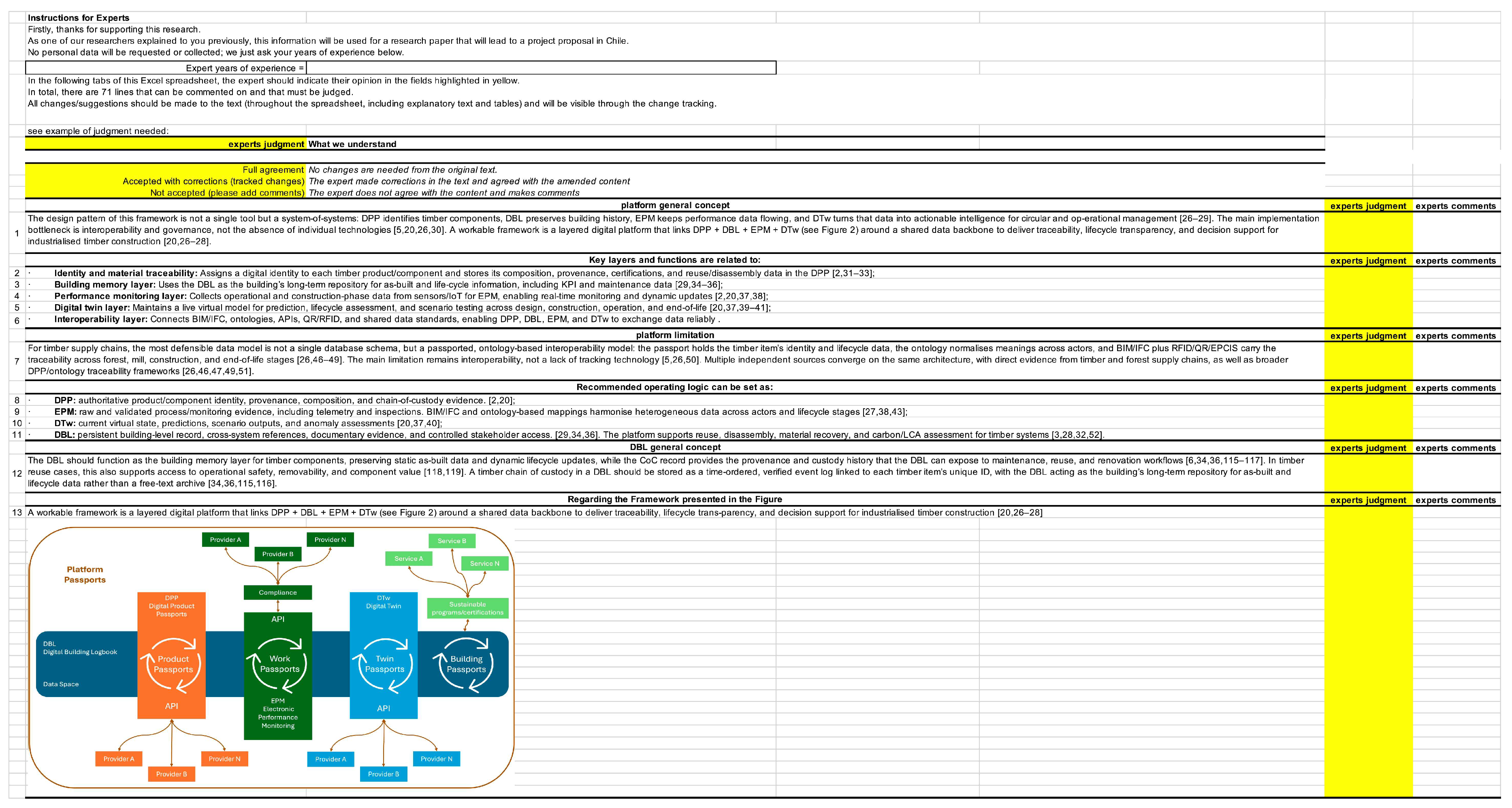
Figure A2.
ITC Delphi framework 14–38.
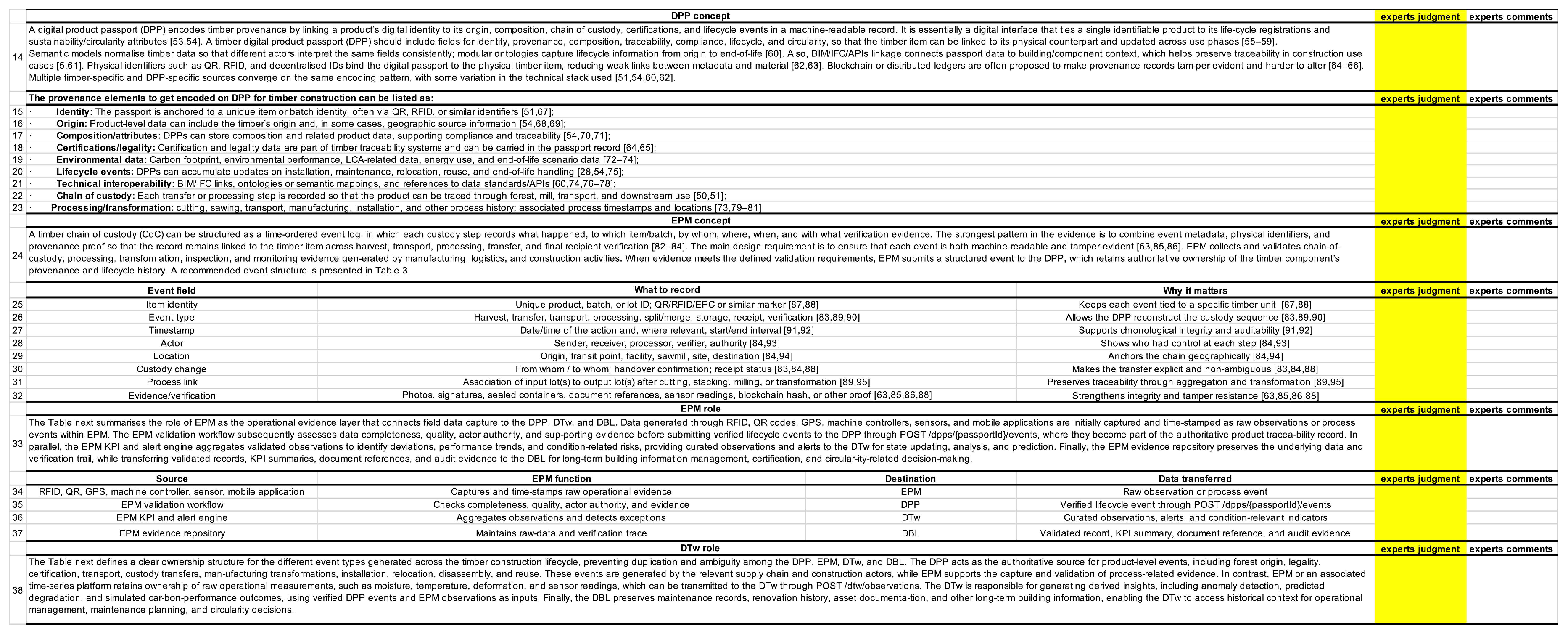
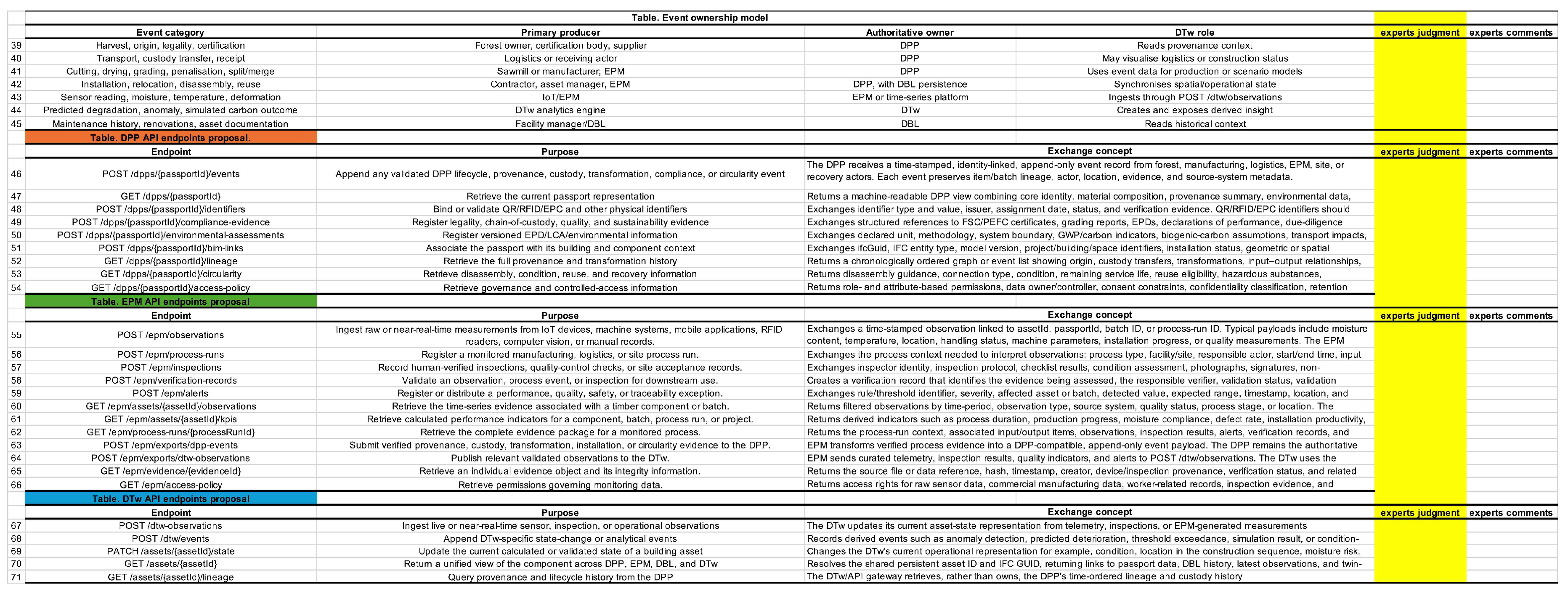
Figure A3.
ITC Delphi framework 39–71.
Appendix B
Table A1.
Consensus assessment.
Appendix C
First Round LOIN Questionnaire
Screenshots of the first-round instrument identified by the authors as the questionnaire sent to the panel. Original Spanish wording is retained. The figures document the questions and response options; interface examples are not participant response records.
Figure A4.
Professional profile and fields for identifying areas of experience. Fields are shown blank.
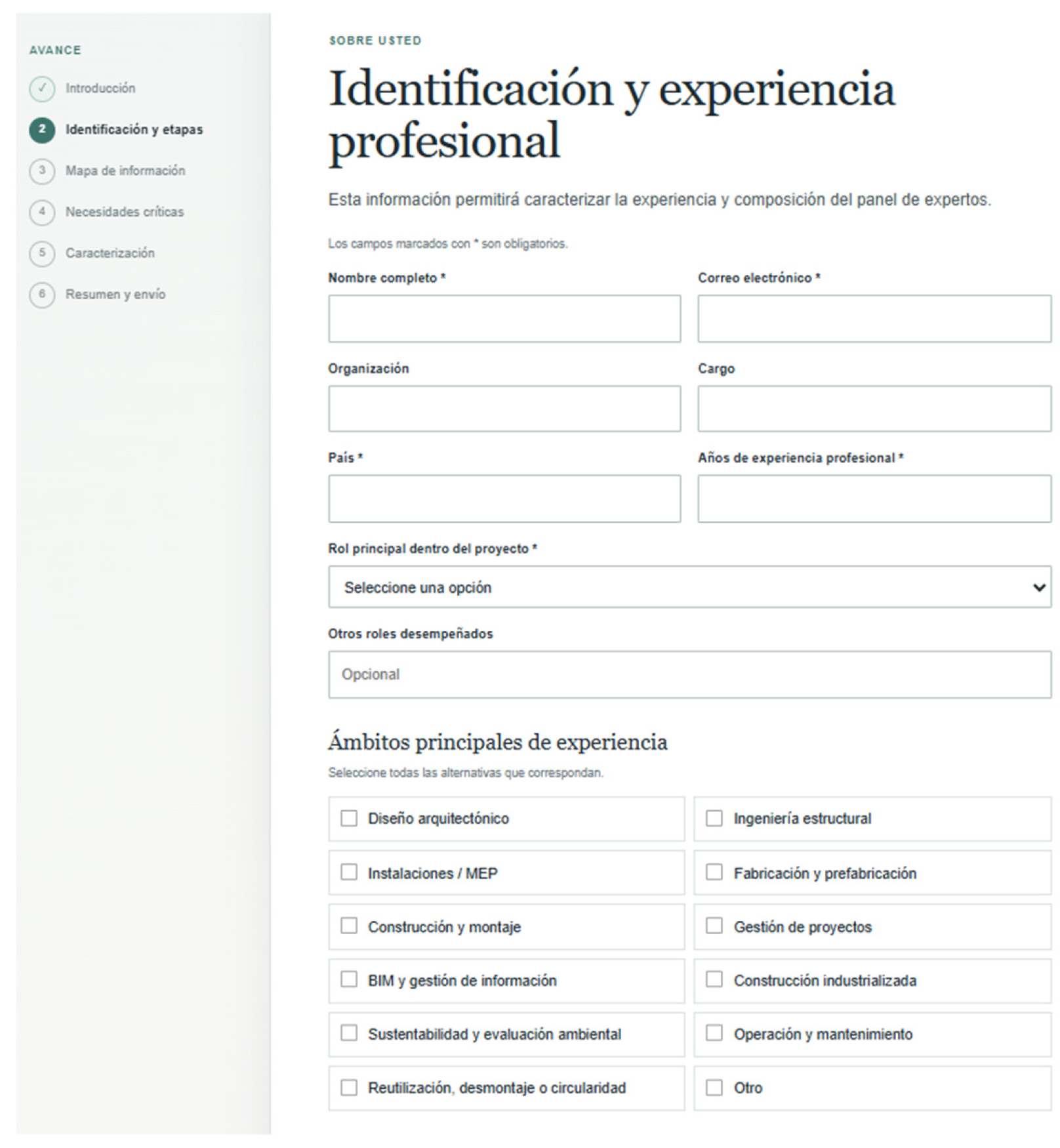
Figure A5.
Project stages in which participants reported direct involvement. Multiple selections were permitted.
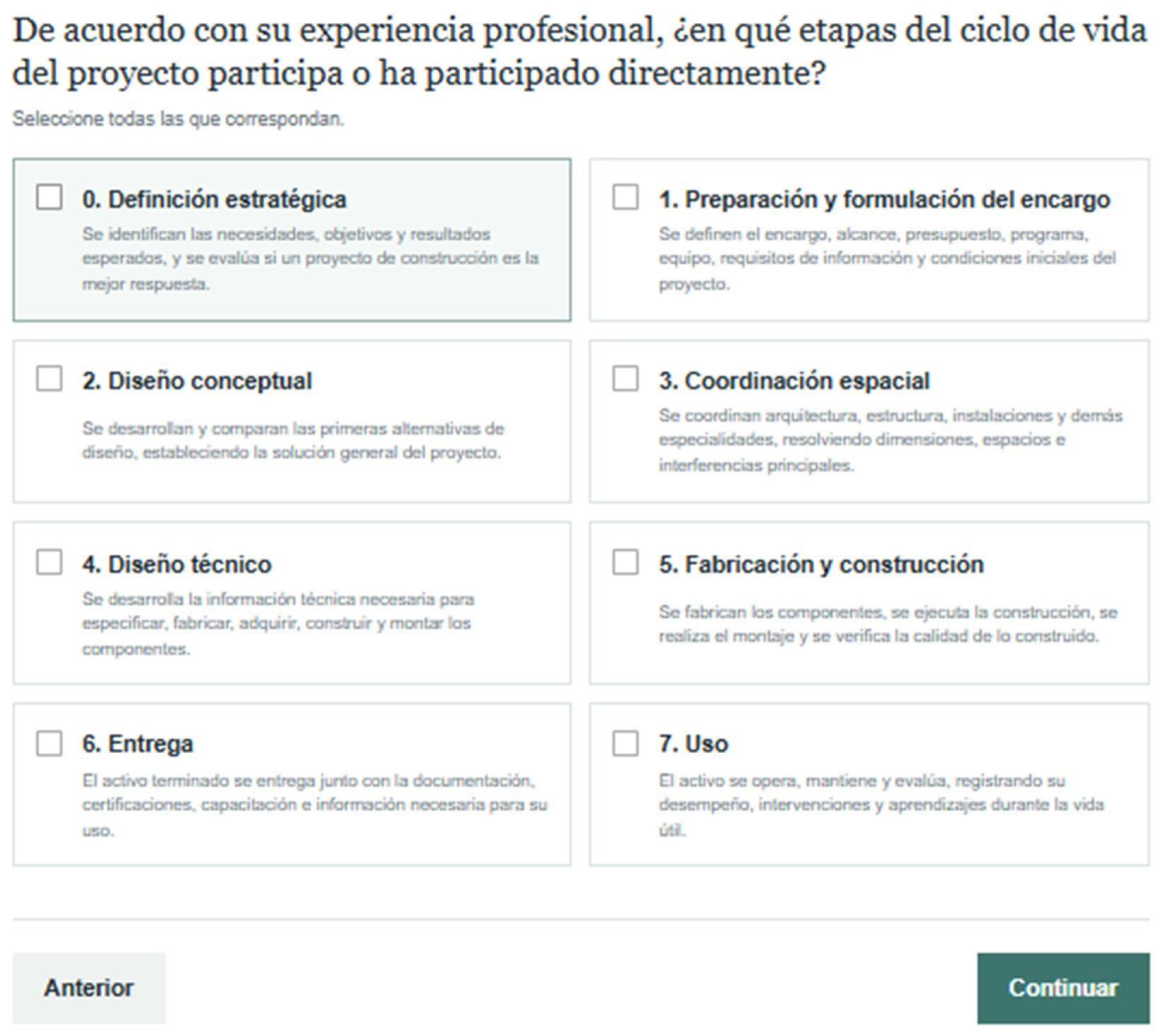
Figure A6.
Information categories and their explanatory examples.
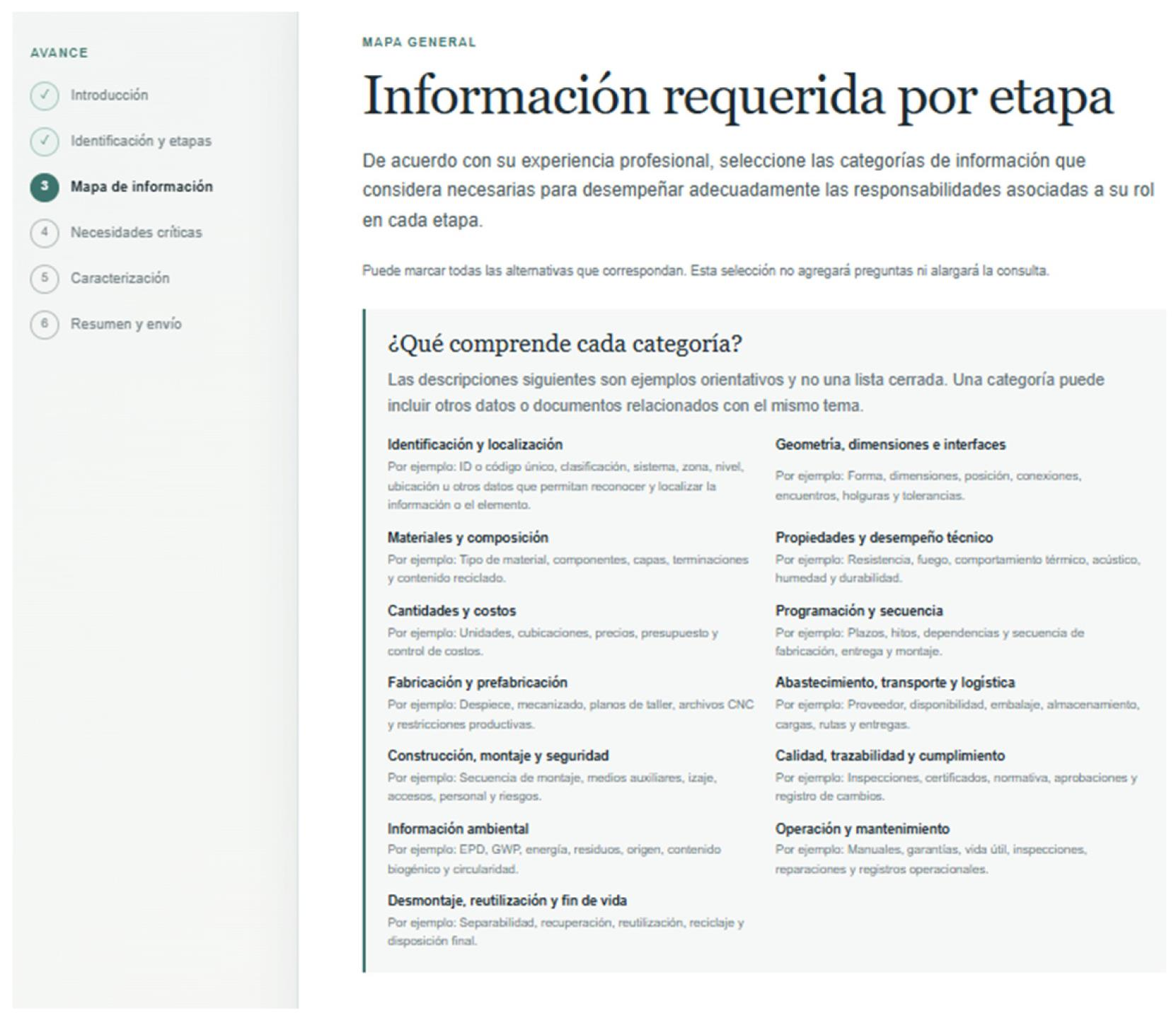
Figure A7.
Illustration of category selection by project stage. The interface displays the stages selected by the participant.
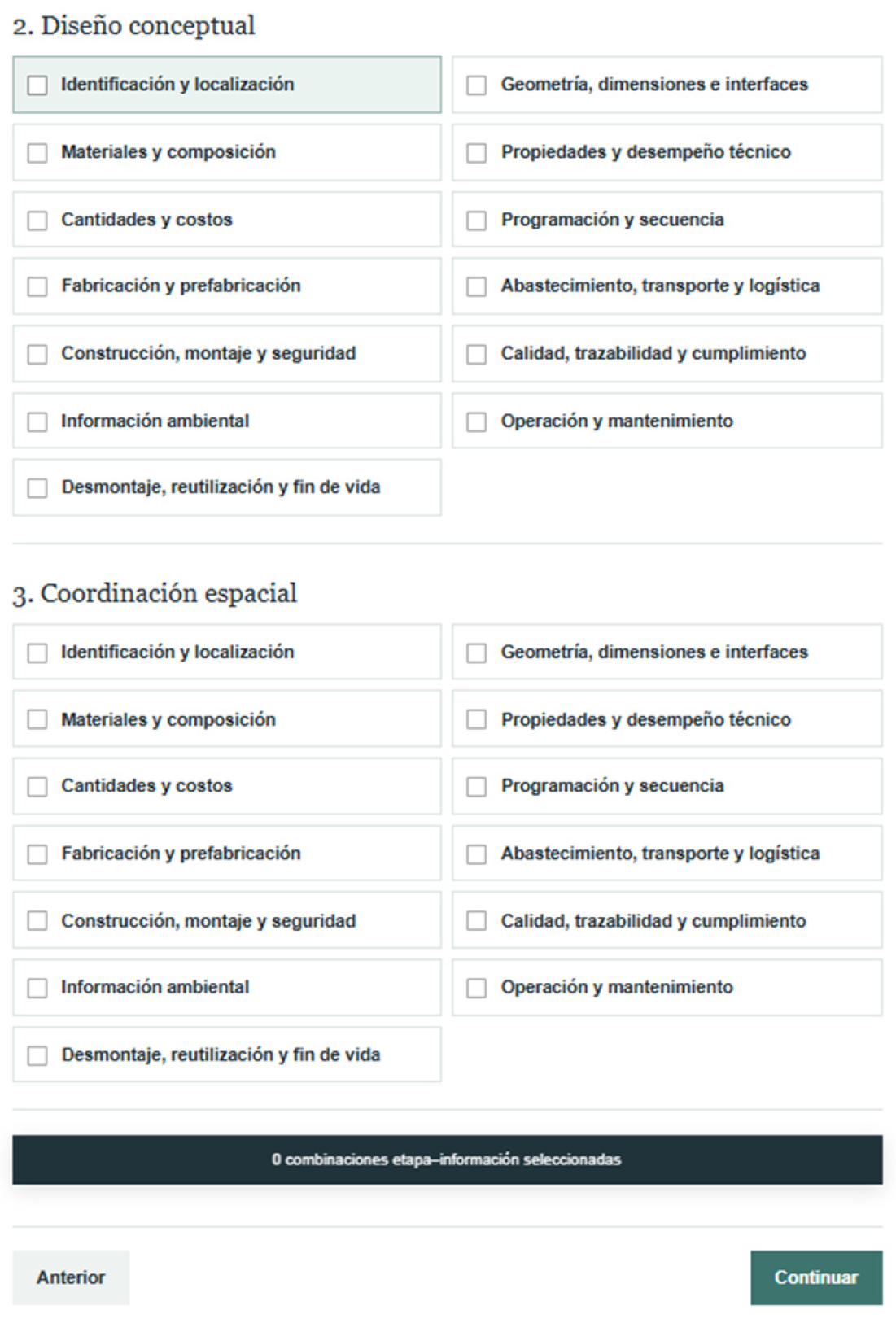
Figure A8.
Selection of up to three critical needs from previously selected stage–category combinations. The combinations displayed are interface examples.
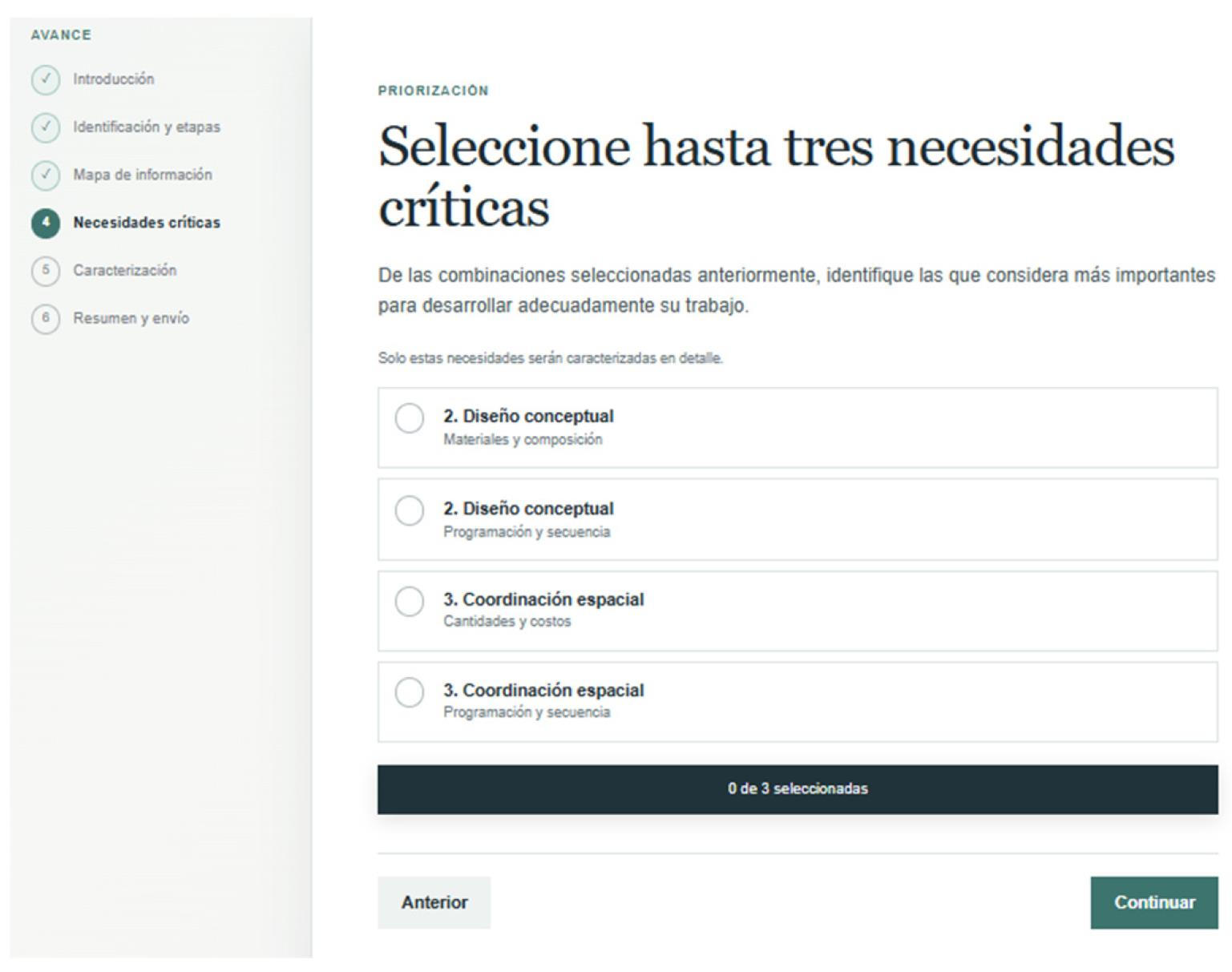
Figure A9.
Critical need characterisation: specific information requested, provider, intended activity or decision, and asset level.
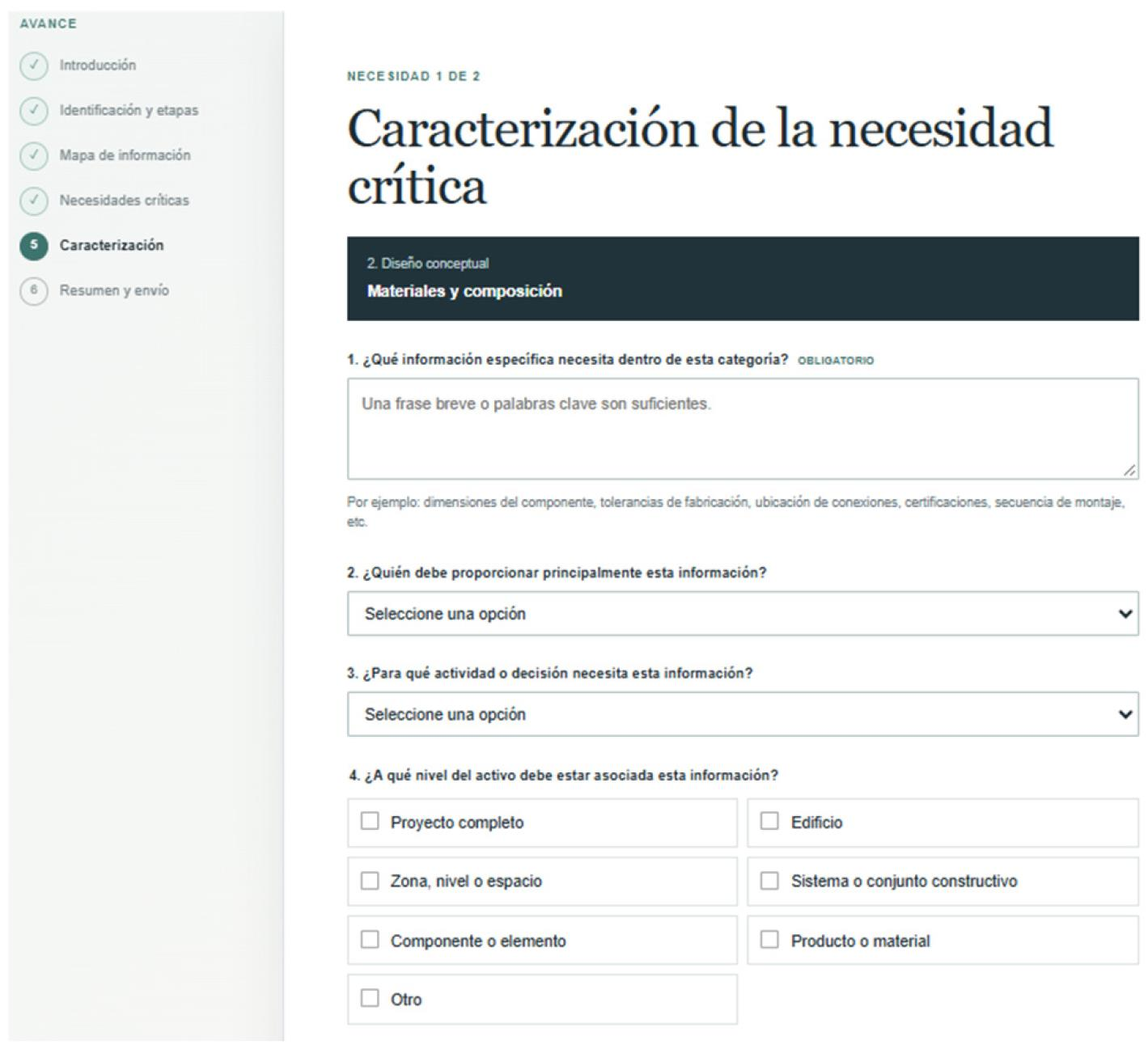
Figure A10.
Critical need characterisation: minimum degree of definition, delivery format, required timing, and optional additional conditions.
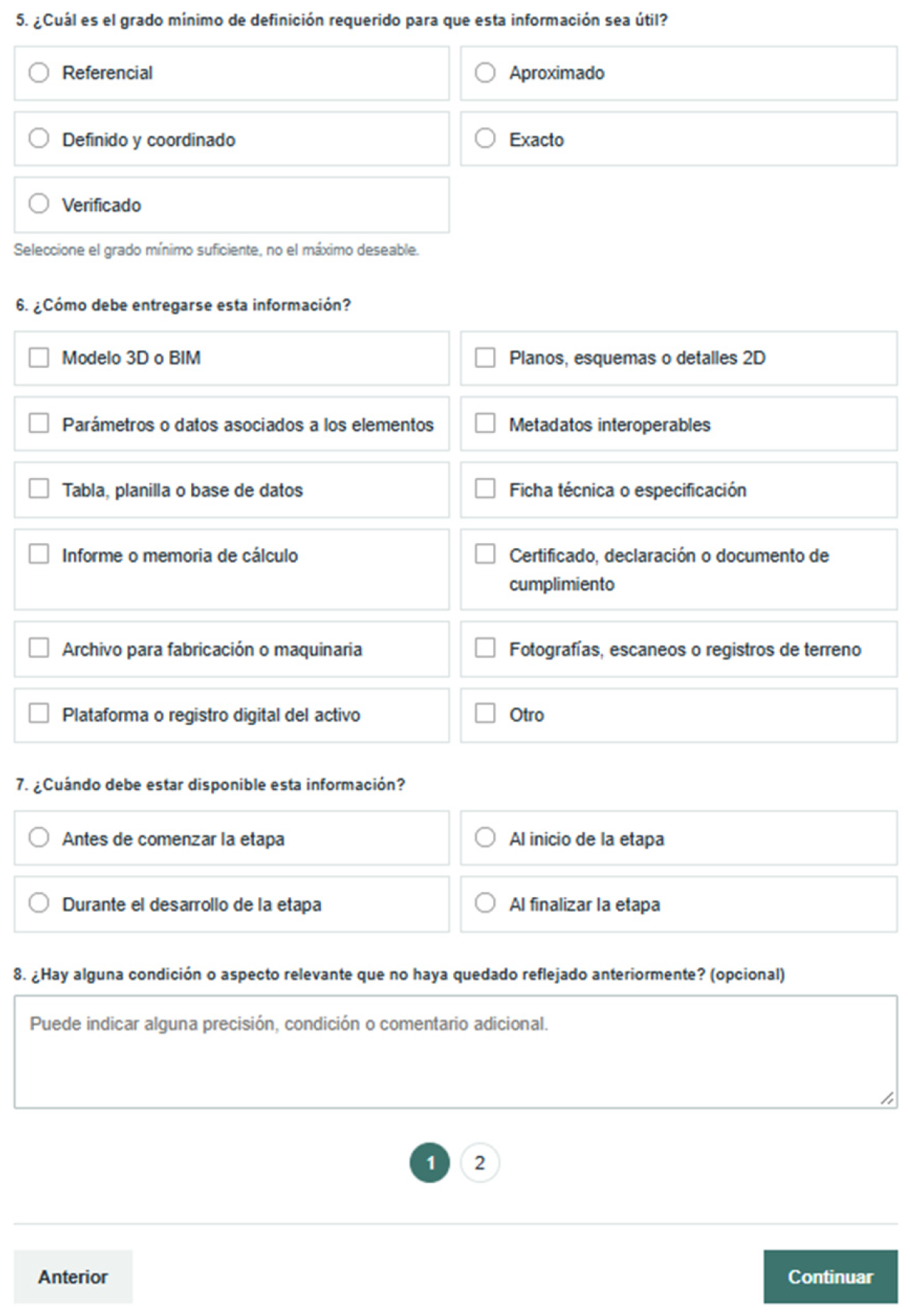
Appendix D
Second Round LOIN Assessment
The second round assessed the 14 participant-proposed critical information needs and their initial LOIN characterization. Figure A11 reproduces the instructions and response options in the original Spanish instrument. Table A2 summarises the three respondents’ judgements and the subsequent actions taken by the authors.
Figure A11.
Instruction and response options for the second Delphi round.
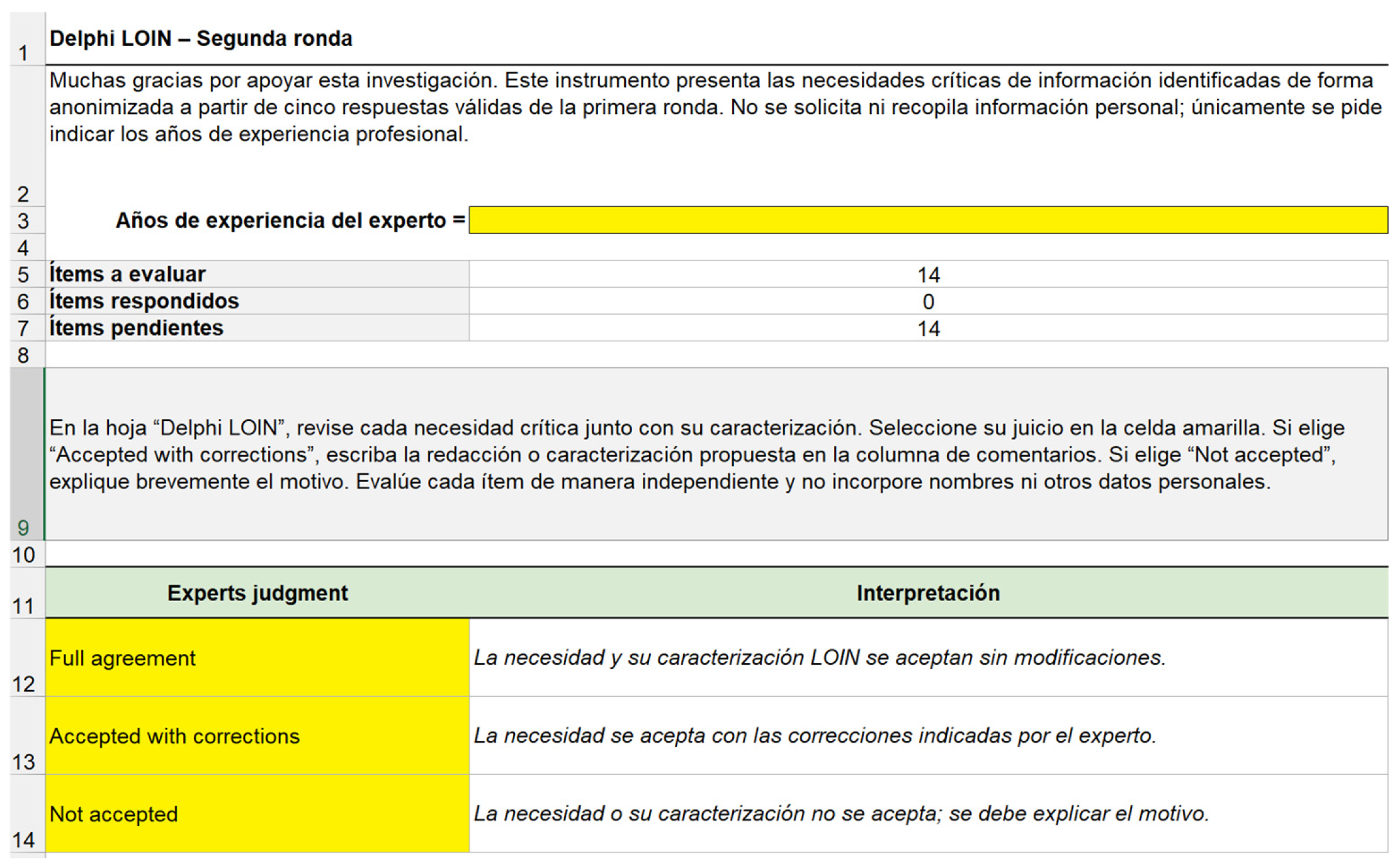
Table A2.
Second round judgements and subsequent author revisions.
References
- De Araujo, V.; Aguiar, F.; Jardim, P.; Mascarenhas, F.; Marini, L.; Aquino, V.; Santos, H.; Panzera, T.; Lahr, F.; Christoforo, A. Is Cross-Laminated Timber (CLT) a Wood Panel, a Building, or a Construction System? A Systematic Review on Its Functions, Characteristics, Performances, and Applications. Forests 2023, 14, 264. [Google Scholar] [CrossRef] [Scilit]
- Mesa, H.; Ramírez, M.; Guindos, P.; Carpio, M. Modeling Intra-Organization Fragmentation and Integration to Enhance Performance in Industrialized Timber Construction. Buildings 2025, 15, 2206. [Google Scholar] [CrossRef] [Scilit]
- Mêda, P.; Calvetti, D.; Hjelseth, E.; Sousa, H. Digital Product Passports in Construction—Barriers and Opportunities at People, Process and Technology Dimensions. In Proceedings of the 2024 European Conference on Computing in Construction, Chania, Greece, 14–17 July 2024. [Google Scholar]
- Pracucci, A.; Giovanardi, M. Design of a Sensor-Based Digital Product Passport for Low-Tech Manufacturing: Traceability and Environmental Monitoring in Bio-Block Production. Sensors 2025, 25, 5653. [Google Scholar] [CrossRef] [Scilit]
- Psarommatis, F.; May, G.; Kalb, I. Bridging Construction and Manufacturing: Digital Product Passports for Circular Timber Waste Remanufacturing. Procedia Comput. Sci. 2026, 277, 3341–3350. [Google Scholar] [CrossRef] [Scilit]
- Mêda, P.; Munir, M.; Calvetti, D.; Sousa, H. Information Needs in Digital Products Passport—Discussing Data Framework and Reasonability. In Proceedings of the 2023 European Conference on Computing in Construction and the 40th International CIB W78 Conference, Heraklion, Greece, 10–12 July 2023. [Google Scholar]
- Hamidkhaniha, S.; Martinez, A.G.; Sedaghat, M. Integrating Digital Product Passports and BIM for Circular Construction: A Review of Challenges and Opportunities for Data-Driven Material Reuse and Sustainability Assessment. IOP Conf. Ser. Earth Environ. Sci. 2025, 1568, 012026. [Google Scholar] [CrossRef] [Scilit]
- Gómez-Gil, M.; Espinosa-Fernández, A.; López-Mesa, B. Contribution of New Digital Technologies to the Digital Building Logbook. Buildings 2022, 12, 2129. [Google Scholar] [CrossRef] [Scilit]
- Mêda, P.; Calvetti, D.; Kifokeris, D.; Kassem, M. A Process-Based Framework for Digital Building Logbooks. In Proceedings of the 2022 European Conference on Computing in Construction, Rhodes, Greece, 24–26 July 2022. [Google Scholar]
- Hwang, S.-A. Digital Building Logbooks and Stakeholder Mapping: A Cross-Sectoral Approach to Data Collection and Sharing. In Proceedings of the 2024 European Conference on Computing in Construction, Chania, Greece, 14–17 July 2024. [Google Scholar]
- Ibba, A.; Hwang, S.A.; Recupero, D.R.; Alonso, R.; Olivadese, R. Defining Valuable Data and Stakeholder Engagement in Digital Building Logbooks: A Framework for Effective Data Storage. In Proceedings of the 2024 European Conference on Computing in Construction, Chania, Greece, 14–17 July 2024. [Google Scholar]
- Alonso, I.-N.C.; Sahebzamani, E.; Lendinez, F.; Forcada, N. Circular economy and digital twins in the construction sector. In Proceedings of the Proceedings from the International Congress on Project Management and Engineering, Terrassa, Spain, 5–8 July 2022; pp. 444–456. [Google Scholar]
- Calvetti, D.; Kifokeris, D.; Mêda, P.; Sousa, H. Human-Data Interaction as a Critical Enabler of Electronic Performance Monitoring at Construction Sites. ITcon 2024, 29, 722–749. [Google Scholar] [CrossRef] [Scilit]
- Cheung, S.O.; Suen, H.C.H.; Cheung, K.K.W. PPMS: A Web-Based Construction Project Performance Monitoring System. Autom. Constr. 2004, 13, 361–376. [Google Scholar] [CrossRef] [Scilit]
- Edirisinghe, R. Digital Skin of the Construction Site: Smart Sensor Technologies towards the Future Smart Construction Site. ECAM 2019, 26, 184–223. [Google Scholar] [CrossRef] [Scilit]
- Zhang, J.; Cheng, J.C.P.; Chen, W.; Chen, K. Digital Twins for Construction Sites: Concepts, LoD Definition, and Applications. J. Manag. Eng. 2022, 38, 04021094. [Google Scholar] [CrossRef] [Scilit]
- Sacks, R.; Brilakis, I.; Pikas, E.; Xie, H.S.; Girolami, M. Construction with Digital Twin Information Systems. DCE 2020, 1, e14. [Google Scholar] [CrossRef] [Scilit]
- Boje, C.; Guerriero, A.; Kubicki, S.; Rezgui, Y. Towards a Semantic Construction Digital Twin: Directions for Future Research. Autom. Constr. 2020, 114, 103179. [Google Scholar] [CrossRef] [Scilit]
- Boje, C.; Hahn Menacho, Á.J.; Marvuglia, A.; Benetto, E.; Kubicki, S.; Schaubroeck, T.; Navarrete Gutiérrez, T. A Framework Using BIM and Digital Twins in Facilitating LCSA for Buildings. J. Build. Eng. 2023, 76, 107232. [Google Scholar] [CrossRef] [Scilit]
- Diao, Y.; Loss, C. Prefabricated Mass Timber Hybrid Systems: Investigation On Adopting Cnc-Made Carpentry Joints to Industrialized Long-Span Floors. In Proceedings of the World Conference on Timber Engineering 2025, Brisbane, Australia, 22–26 June 2025; pp. 1208–1217. [Google Scholar]
- Forcael, E.; Mata, R.; González, B.; Opazo-Vega, A.; García-Alvarado, R.; González, M.; Núñez, E.; Padilla, J. Enhanced Robotic Cross-Laminated Timber Panel Assembly Process. Dev. Built Environ. 2025, 22, 100667. [Google Scholar] [CrossRef] [Scilit]
- Morganti, L.; Rudenå, A.; Brunklaus, B.; Bomark, P.; Armijo Prieto, A.; Skog, J.; Zaffagnini, T.; Pracucci, A.; Astudillo Larraz, J. Wood-for-Construction Supply Chain Digital Twin to Drive Circular Economy and Actor-Based LCA Information. J. Clean. Prod. 2025, 520, 146074. [Google Scholar] [CrossRef] [Scilit]
- Kan, C.; Anumba, C.J. Digital Twins as the Next Phase of Cyber-Physical Systems in Construction. In Proceedings of the Computing in Civil Engineering 2019, Atlanta, GA, USA, 17–19 June 2019; American Society of Civil Engineers: Reston, VA, USA, 2019; pp. 256–264. [Google Scholar]
- Çetin, S.; Mêda, P.; Farghaly, K.; Hwang, S.-A. Linking Digital Product Passports and Digital Building Logbooks: Socio-Technical Challenges and a Pathways for Integration. Dev. Built Environ. 2026, 25, 100877. [Google Scholar] [CrossRef] [Scilit]
- Moore, N. How to Do Research: A Practical Guide to Designing and Managing Research Projects, 1st ed.; Facet: London, UK, 2013; ISBN 978-1-85604-982-5. [Google Scholar]
- Rahmani, F.; Leifels, K. Abductive Grounded Theory: A Worked Example of a Study in Construction Management. Constr. Manag. Econ. 2018, 36, 565–583. [Google Scholar] [CrossRef] [Scilit]
- ISO 7817-1: 2024; Building Information Modelling—Level of Information Need Part 1: Concepts and Principles. ISO: Geneva, Switzerland, 2024.
- Bhardwaj, P. Types of Sampling in Research. J. Pract. Cardiovasc. Sci. 2019, 5, 157–163. [Google Scholar] [CrossRef] [Scilit]
- BS EN 17412-1:2020; Building Information Modelling—Level of Information Need—Par 1: Concepts and Principles. BSI: London, UK, 2020.
- International Organization for Standardization. Organization and Digitization of Information about Buildings and Civil Engineering Works, Including Building Information Modelling (BIM); ISO: Geneva, Switzerland, 2018. [Google Scholar]
- Franssila, J.; Koozani, H.; Puhto, J.; Kurvinen, A. Delivery-System Misfit and Role Reconfiguration in Industrialised Timber Construction: A Phase-Sensitive Analysis of a Turnkey Project. Int. J. Constr. Manag. 2026, 1–17. [Google Scholar] [CrossRef] [Scilit]
- Hsu, C.-C.; Sandford, B.A. The Delphi Technique: Making Sense of Consensus. Pract. Assess. Res. Eval. 2007, 12, 10. [Google Scholar] [CrossRef]
- Jünger, S.; Payne, S.A.; Brine, J.; Radbruch, L.; Brearley, S.G. Guidance on Conducting and REporting DElphi Studies (CREDES) in Palliative Care: Recommendations Based on a Methodological Systematic Review. Palliat. Med. 2017, 31, 684–706. [Google Scholar] [CrossRef] [Scilit]
- RIBA. DfMA Overlay to the RIBA Plan of Work—Mainstreaming Design for Manufacture and Assembly in Contruction, 2nd ed.; RIBA: London, UK, 2021. [Google Scholar]
- Samarawickrama, S.; Gunawardena, T.; Mendis, P.; Bao, D.W. Design-to-Manufacturing Integration for Prefabricated Timber Construction in Australia: A Systematic Review and Conceptual Framework Linking BIM, CAD/CAM and CNC Workflows. Sustainability 2026, 18, 6790. [Google Scholar] [CrossRef] [Scilit]
- Golański, M.; Juchimiuk, J.; Podlasek, A.; Starzyk, A. Design for Manufacturing and Assembly (DfMA) in Timber Construction: Advancing Energy Efficiency and Climate Neutrality in the Built Environment. Energies 2025, 18, 6332. [Google Scholar] [CrossRef] [Scilit]
- Torres, V.; Íñiguez-González, G.; Blanchet, P.; Giorgio, B. Challenges in the Design for Disassembly of Light Timber Framing Panelized Components. Buildings 2025, 15, 321. [Google Scholar] [CrossRef] [Scilit]
- Zhang, Z.; Gu, J.; Li, R.; Lian, W.; Ma, C.; Tian, J. Bridging Digital and Green Transitions: A Literature Review of Digital Product Passport Systems. Renew. Sustain. Energy Rev. 2026, 228, 116600. [Google Scholar] [CrossRef] [Scilit]
- Moghayedi, A.; Awuzie, B. Unlocking Sustainability Futures: A Framework for Digital Product Passports and Material Banks in a Circular Built Environment. Constr. Innov. 2026, 26, 135–166. [Google Scholar] [CrossRef] [Scilit]
- Mêda, P.; Fauth, J.; Schranz, C.; Sousa, H.; Urban, H. Twinning the Path of Digital Building Permits and Digital Building Logbooks—Diagnosis and Challenges. Dev. Built Environ. 2024, 20, 100573. [Google Scholar] [CrossRef] [Scilit]
- Cervantes Puma, G.C.; Bragança, L. Operationalising Digital Circularity: A Critical Systematic Review of Artificial Intelligence Applications to Material and Digital Product Passports. Buildings 2026, 16, 2048. [Google Scholar] [CrossRef] [Scilit]
- Munaro, M.R.; Fischer, A.C.; Azevedo, N.C.; Tavares, S.F. Proposal of a Building Material Passport and Its Application Feasibility to the Wood Frame Constructive System in Brazil. IOP Conf. Ser. Earth Environ. Sci. 2019, 225, 012018. [Google Scholar] [CrossRef] [Scilit]
- Loeb, L.; Ibach, A.-K.; Kelm, A.; Deich, J.; Pomp, A.; Meins-Becker, A. Recommendations for a digital building product passport using CLT elements as a case study. Proc. Int. Struct. Eng. Constr. 2025, 12, CON-17-1 –CON-17-6. [Google Scholar] [CrossRef] [Scilit]
- Seddiqui, M.H.; Farazi, F.; Giunchiglia, F.; Bagchi, M.; Bocca, S.; Akroyd, J.; Mosbach, S.; Arifin, F.; Ahmed, R.; Arman, M.; et al. A Material Passport Ontology for a Circular Economy. Comput. Ind. 2026, 178, 104465. [Google Scholar] [CrossRef] [Scilit]
- Karami, S.; Almeida, J.P.D.; Ellul, C.; Cardoso, A. Semantic Mapping Analysis of Digital Building LogBook/Passport Models. In Proceedings of the 2024 European Conference on Computing in Construction, Chania, Greece, 14–17 July 2024. [Google Scholar]
- Landi, F.; Bevilacqua, M.G.; Caroti, G.; Meligeni, F.; Piemonte, A.; Rechichi, P.; Croce, P. Digital Twin and Building Logbook for the Management of Heritage and Strategic Buildings: The BUILDCHAIN Demo-Pilot, Palazzo Poniatowski-Guadagni in Florence. In Proceedings of the International Conference on Communication and Computational Technologies; Kumar, S., Hiranwal, S., Garg, R., Purohit, S.D., Eds.; Lecture Notes in Networks and Systems; Springer Nature: Singapore, 2025; Volume 1122, pp. 191–204. ISBN 978-981-97-7425-8. [Google Scholar]
- Al-Sadoon, N.; Fauth, J.; Menzel, K. Digital Twins as Enabler for Long Term Data Management Using Building Logbooks. In Collaborative Networks in Digitalization and Society 5.0; Camarinha-Matos, L.M., Boucher, X., Ortiz, A., Eds.; IFIP Advances in Information and Communication Technology; Springer Nature: Cham, Switzerland, 2023; Volume 688, pp. 673–686. ISBN 978-3-031-42621-6. [Google Scholar]
- Petri, I.; Amin, A.; Ghoroghi, A.; Hodorog, A.; Rezgui, Y. Digital Twins for Dynamic Life Cycle Assessment in the Built Environment. Sci. Total Environ. 2025, 993, 179930. [Google Scholar] [CrossRef] [Scilit]
- Calvetti, D.; Mêda, P.; Hjelseth, E.; De Sousa, H. Incremental Digital Twin Framework: A Design Science Research Approach for Practical Deployment. Autom. Constr. 2025, 170, 105954. [Google Scholar] [CrossRef] [Scilit]
- Ahmadi, L.; Bilal, M.; Olumo, A.; Mollaei, A.; Jalaei, F.; Ebrahimi, N.; Mozaffari, H.; Kim, J.; Haas, C. Enhancing Circularity in the Building Industry: A Review of Material Passports and Digital Twin Technologies. J. Constr. Eng. Manag. 2026, 152, 03125012. [Google Scholar] [CrossRef] [Scilit]
- Miraj, P.; Wang, T.; Koutamanis, A.; Chan, P. Organising Digital Twin in the Built Environment: A Systematic Review and Research Directions on the Missing Links of Use and User Perspectives of Digital Twin in Architecture, Engineering and Construction (AEC) Sector. Constr. Manag. Econ. 2025, 43, 465–481. [Google Scholar] [CrossRef] [Scilit]
- Silva, H.; Gomes, R.; Sousa, C. Classifying Forest Supply Chain Traceability Data with an Ontological Approach. Procedia Comput. Sci. 2025, 253, 3049–3058. [Google Scholar] [CrossRef] [Scilit]
- Esmail, M.; Berg, A.; Kelm, A.; Meins-Becker, A. BIM- and IOT-based traceability of construction products. Proc. Int. Struct. Eng. Constr. 2025, 12, 1–6. [Google Scholar] [CrossRef] [Scilit]
- Glachs, D.; Wohnig, J.; Strohmeier, F. Semantic Data Integration for Digital Product Passports. Procedia Comput. Sci. 2026, 277, 3175–3184. [Google Scholar] [CrossRef] [Scilit]
- Erber, G.; Visser, R.; Stampfer, K.; Kühmaier, M.; Pichler, G. A Systematic Review of Timber Tracking and Tracing in Forest and Timber Industry Supply Chain: An Analysis of Subject Areas, Objectives, and Characteristics. Croat. J. For. Eng. (Online) 2026, 47, 203–232. [Google Scholar] [CrossRef] [Scilit]
- Chan, K.K. Supply Chain Traceability Systems—Robust Approaches for the Digital Age. In The Digital Supply Chain; Elsevier: Amsterdam, The Netherlands, 2022; pp. 163–179. ISBN 978-0-323-91614-1. [Google Scholar]
- Pichler, G.; Sandak, J.; Picchi, G.; Kastner, M.; Graifenberg, D.; Stampfer, K.; Kühmaier, M. Timber Tracking in a Mountain Forest Supply Chain: A Case Study to Analyze Functionality, Bottlenecks, Risks, and Costs. Forests 2022, 13, 1373. [Google Scholar] [CrossRef] [Scilit]
- Ghobadi, M.; Sepasgozar, S.M.E. Circular Economy Strategies in Modern Timber Construction as a Potential Response to Climate Change. J. Build. Eng. 2023, 77, 107229. [Google Scholar] [CrossRef] [Scilit]
- Van Capelleveen, G.; Vegter, D.; Olthaar, M.; Van Hillegersberg, J. The Anatomy of a Passport for the Circular Economy: A Conceptual Definition, Vision and Structured Literature Review. Resour. Conserv. Recycl. Adv. 2023, 17, 200131. [Google Scholar] [CrossRef] [Scilit]
- Xia, H.; Li, J.; Jan Li, Q.; Milisavljevic-Syed, J.; Salonitis, K. Integrating Blockchain with Digital Product Passports for Managing Reverse Supply Chain. Transp. Res. Part E Logist. Transp. Rev. 2025, 202, 104336. [Google Scholar] [CrossRef] [Scilit]
- Damaševičius, R.; Maskeliūnas, R. An Analytical Approach to Blockchain-Driven Identity Management in Sustainable Forest Supply Chains. Supply Chain Anal. 2025, 12, 100161. [Google Scholar] [CrossRef] [Scilit]
- Kühn, M.; Baumann, M.; Volz, F.; Stojanovic, L. Digital Product Passport Design Supporting the Circular Economy Based on the Asset Administration Shell. Sustainability 2025, 17, 969. [Google Scholar] [CrossRef] [Scilit]
- Ruismäki, W.; Zu Castell-Rüdenhausen, M.; Pohjalainen, E.; Wahlström, M. Stakeholder Perspectives on Digital Product Passports for Construction Products. Clean. Logist. Supply Chain 2025, 17, 100275. [Google Scholar] [CrossRef] [Scilit]
- Wan, P.K.F.; Jiang, S. Enabling a Dynamic Information Flow in Digital Product Passports during Product Use Phase: A Literature Review and Proposed Framework. Sustain. Prod. Consum. 2025, 54, 362–374. [Google Scholar] [CrossRef] [Scilit]
- Jensen, S.F.; Kristensen, J.H.; Adamsen, S.; Christensen, A.; Waehrens, B.V. Digital Product Passports for a Circular Economy: Data Needs for Product Life Cycle Decision-Making. Sustain. Prod. Consum. 2023, 37, 242–255. [Google Scholar] [CrossRef] [Scilit]
- Kebede, R.; Moscati, A.; Tan, H.; Johansson, P. A Modular Ontology Modeling Approach to Developing Digital Product Passports to Promote Circular Economy in the Built Environment. Sustain. Prod. Consum. 2024, 48, 248–268. [Google Scholar] [CrossRef] [Scilit]
- Aguiar, A.; Vonk, R.; Kamp, F. BIM and Circular Design. IOP Conf. Ser. Earth Environ. Sci. 2019, 225, 012068. [Google Scholar] [CrossRef] [Scilit]
- Byers, B.S.; Emmenegger, P.; Hunhevicz, J.J.; Schumm, D.; Heisel, F.; Hall, D.M.; De Wolf, C. Decentralized Phygital Identifier Systems for Digital Passports in Circular Construction: A Design Science Evaluation. Constr. Innov. 2025, 26, 2519–2553. [Google Scholar] [CrossRef] [Scilit]
- Abdallah, R.; Şahinel, D.; Adarve, O.A.; Montfort, D. Enhancing Digital Product Passports with Material Fingerprinting and Decentralized Non-Conformity Signals: Application to Critical Raw Materials. Procedia Comput. Sci. 2026, 277, 1051–1060. [Google Scholar] [CrossRef] [Scilit]
- Cueva-Sanchez, J.J.; Coyco-Ordemar, A.J.; Ugarte, W. A Blockchain-Based Technological Solution to Ensure Data Transparency of the Wood Supply Chain. In Proceedings of the 2020 IEEE ANDESCON; IEEE: Quito, Ecuador, 2020; pp. 1–6. [Google Scholar]
- Stopfer, L.; Kaulen, A.; Purfürst, T. Potential of Blockchain Technology in Wood Supply Chains. Comput. Electron. Agric. 2024, 216, 108496. [Google Scholar] [CrossRef] [Scilit]
- Henry, T.; Assekour, L.; Bernier, C.; Tucci-Piergiovanni, S.; Troussier, N. Trustworthy Digital Product Passports Based on Distributed Ledgers-A Review and Guidelines. Procedia Comput. Sci. 2026, 277, 596–605. [Google Scholar] [CrossRef] [Scilit]
- Joo, H.; Ko, S.; Chun, B.; Koo, Y. Can Digital Product Passports Become the Next-Generation Eco-Label? Analyzing Consumer Preferences for Labeling Using Digital Product Passports. J. Clean. Prod. 2026, 538, 147403. [Google Scholar] [CrossRef] [Scilit]
- Tnah, L.H.; Lee, S.L.; Ng, K.K.S.; Tani, N.; Bhassu, S.; Othman, R.Y. Geographical Traceability of an Important Tropical Timber (Neobalanocarpus Heimii) Inferred from Chloroplast DNA. For. Ecol. Manag. 2009, 258, 1918–1923. [Google Scholar] [CrossRef] [Scilit]
- Finkeldey, R.; Leinemann, L.; Gailing, O. Molecular Genetic Tools to Infer the Origin of Forest Plants and Wood. Appl. Microbiol. Biotechnol. 2010, 85, 1251–1258. [Google Scholar] [CrossRef] [Scilit]
- Burad, R.; Sinha, D.; Telalwar, S. Privacy-Preserving Digital Product Passports for the Garment and Clothing Industry. In Resilient Privacy-Preserving Mechanisms for Digital Identity Management; Kalam, A., Khullar, S., Mamodiya, U., Joshi, M.L., Khan, S.B., Eds.; IGI Global Scientific Publishing: Hershey, PA, USA, 2026; pp. 61–104. ISBN 979-8-3373-7292-1. [Google Scholar]
- Psarommatis, F.; May, G. A Comprehensive Review of Digital Product Passports in Sustainable Manufacturing: Current State, Challenges, and Future Directions. Circ. Econ. Sustain. 2026, 6, 207. [Google Scholar] [CrossRef] [Scilit]
- Liang, Y.; Mogollón, J.M.; Cunha, S.; Donati, F.; Li, C.; Mintjes, B.; Kleijn, R.; Climent, D.M.; Wang, R.; Muller, S.; et al. Emerging Digital Product Passport Initiatives Require Improved Data Structuring to Support Life Cycle Assessment. J. Ind. Ecol. 2026, 30, 2131–2139. [Google Scholar] [CrossRef] [Scilit]
- Björk, A.; Erlandsson, M.; Häkli, J.; Jaakkola, K.; Nilsson, Å.; Nummila, K.; Puntanen, V.; Sirkka, A. Monitoring Environmental Performance of the Forestry Supply Chain Using RFID. Comput. Ind. 2011, 62, 830–841. [Google Scholar] [CrossRef] [Scilit]
- Çetin, S.; Raghu, D.; Honic, M.; Straub, A.; Gruis, V. Data Requirements and Availabilities for Material Passports: A Digitally Enabled Framework for Improving the Circularity of Existing Buildings. Sustain. Prod. Consum. 2023, 40, 422–437. [Google Scholar] [CrossRef] [Scilit]
- El Sibaii, M.; Granja, J.; Azenha, M. An Open and Standards-Compliant Platform for Product Data Templates in Digital Construction. ITcon 2025, 30, 679–710. [Google Scholar] [CrossRef] [Scilit]
- Boutillier, K. Digital Product Passport for Circular Economy: A Review of Semantic Web Vocabularies and Requirements for Interoperability. Circ. Econ. Sust. 2026, 6, 267. [Google Scholar] [CrossRef] [Scilit]
- Lindblad, F. Digital Circularity in Construction: A Systematic Review and Conceptual Framework with a Timber Focus. Int. J. Sustain. Eng. 2026, 19, 2619254. [Google Scholar] [CrossRef] [Scilit]
- Furness, A.; Osman, K.A. Developing Traceability Systems across the Food Supply Chain: An Overview. In Improving Traceability in Food Processing and Distribution; Elsevier: Amsterdam, The Netherlands, 2006; pp. 3–25. ISBN 978-1-85573-959-8. [Google Scholar]
- Furness, A.; Osman, K.A. Developing Traceability Systems across the Supply Chain. In Food Authenticity and Traceability; Elsevier: Amsterdam, The Netherlands, 2003; pp. 473–495. ISBN 978-1-85573-526-2. [Google Scholar]
- Figorilli, S.; Antonucci, F.; Costa, C.; Pallottino, F.; Raso, L.; Castiglione, M.; Pinci, E.; Del Vecchio, D.; Colle, G.; Proto, A.R.; et al. A Blockchain Implementation Prototype for the Electronic Open Source Traceability of Wood along the Whole Supply Chain. Sensors 2018, 18, 3133. [Google Scholar] [CrossRef] [Scilit]
- Fernández, P.; Tost, M.; Climent, D.M.; Nowaz, T.; Castillo, E. A Conceptual Framework for Mineral Supply Chain Traceability: Enabling Conditions and Core Dimensions. Extr. Ind. Soc. 2026, 26, 101858. [Google Scholar] [CrossRef] [Scilit]
- Damaševičius, R.; Maskeliūnas, R. Blockchain-Enabled Smart Contracts for Secure and Transparent Timber Traceability. J. Ind. Inf. Integr. 2025, 48, 100934. [Google Scholar] [CrossRef] [Scilit]
- Sirago, G.; Dell’Erba, A.; Ferorelli, D. The European Organ Donation Framework: A Medico-Legal Cartography of Consent, Governance, and Traceability. Med. Law Rev. 2026, 34, fwag015. [Google Scholar] [CrossRef] [Scilit]
- Tortola, D.; Felicioli, C.; Canciani, A.; Severino, F. Authenticated Data Visualization for Hybrid Blockchain-Based Digital Product Passports. Comput. Commun. 2025, 236, 108110. [Google Scholar] [CrossRef] [Scilit]
- Bharath Singh, J.; Surya, K.; Jebarson, S.; Udhayan, V.S.; Sri Hari, K.; Vivekrabinson, K. Decentralized Chain-of-Custody System for Forensic Evidence Integrity Using Blockchain. In Proceedings of the 2026 International Conference on Intelligent Computing, Networks, and Security (IC-ICNS), Bhubaneswar, India, 26–28 March 2026; pp. 1–5. [Google Scholar]
- Virdin, J.; Vegh, T.; Ratcliff, B.; Havice, E.; Daly, J.; Stuart, J. Combatting Illegal Fishing through Transparency Initiatives: Lessons Learned from Comparative Analysis of Transparency Initiatives in Seafood, Apparel, Extractive, and Timber Supply Chains. Mar. Policy 2022, 138, 104984. [Google Scholar] [CrossRef] [Scilit]
- Peng, X.; Hou, X.; Tang, Z.; Meng, F. Study on the Application of UV Laser in QR Code Marking of Wood Flooring. Opt. Laser Technol. 2025, 192, 113509. [Google Scholar] [CrossRef] [Scilit]
- Bechini, A.; Cimino, M.G.C.A.; Marcelloni, F.; Tomasi, A. Patterns and Technologies for Enabling Supply Chain Traceability through Collaborative E-Business. Inf. Softw. Technol. 2008, 50, 342–359. [Google Scholar] [CrossRef] [Scilit]
- Benfer, M.; Gartner, P.; Treber, S.; Kuhnle, A.; Häfner, B.; Lanza, G. Implementierung von Unternehmensübergreifender Traceability: Entwicklung, Implementierung Und Bewertung von Traceability-Systemen Entlang Des Gesamten Produktlebenszyklus. Z. Für Wirtsch. Fabr. 2020, 115, 304–308. [Google Scholar] [CrossRef] [Scilit]
- Reedy, P. Interpol Review of Digital Evidence for 2019–2022. Forensic Sci. Int. Synerg. 2023, 6, 100313. [Google Scholar] [CrossRef] [Scilit]
- Reedy, P. Interpol International Forensic Science Managers Symposium Digital Evidence Review 2023–2025. Forensic Sci. Int. Synerg. 2026, 13, 100702. [Google Scholar] [CrossRef] [Scilit]
- Pestana, G.; Sofou, S. Digital Chain of Custody Innovation Management Roadmap. Eur. Phys. J. Plus 2024, 139, 633. [Google Scholar] [CrossRef] [Scilit]
- Liang, W.; Fan, L.; Yang, Z.; Yang, J.; Zou, Q.; Huang, C.; Huang, Q.; Duan, H.; Yang, J. How to Track the Dumped Waste? From Data Collection to Advanced Source Identification. J. Hazard. Mater. 2025, 499, 140052. [Google Scholar] [CrossRef] [Scilit]
- Satit, K.; Somjit, A. RESTful Economic-ADS Model for Cost-Effective Chain-Wide Traceability System-Based Cloud Computing. Comput. Electron. Agric. 2017, 139, 164–179. [Google Scholar] [CrossRef] [Scilit]
- Gao, Y.; Xiong, G.; Hu, Z.; Chai, C.; Li, H. Bridge Digital Twin for Practical Bridge Operation and Maintenance by Integrating GIS and BIM. Buildings 2024, 14, 3731. [Google Scholar] [CrossRef] [Scilit]
- Susilawati, D.; Kanowski, P.J. Sustainability Certification and Legality Verification in Indonesian Natural Forest-Based Wood Products Value Chains. Int. For. Rev. 2021, 23, 365–391. [Google Scholar] [CrossRef] [Scilit]
- Bjørnskov, J.; Badhwar, A.; Shikhar Singh, D.; Sehgal, M.; Åkesson, R.; Jradi, M. Development and Demonstration of a Digital Twin Platform Leveraging Ontologies and Data-Driven Simulation Models. J. Build. Perform. Simul. 2025, 19, 1–13. [Google Scholar] [CrossRef] [Scilit]
- Kochovski, P.; Fujs, D.; Vavpotič, D.; Chiachío, J.; Miri, P.; Stankovski, V. Leveraging IFC Semantics and W3C Decentralized Identifiers for Digital Building Logbooks in Construction and Deep Renovation. Autom. Constr. 2026, 189, 107065. [Google Scholar] [CrossRef] [Scilit]
- Sedigh, M.; Müller, J. IFC-Based Digital Twin for Real-Time Building Data Integration and Its Case Study. J. Phys. Conf. Ser. 2025, 3140, 042023. [Google Scholar] [CrossRef] [Scilit]
- Rico Thirion, M.A.; Moghtadernejad, S.; Xu, Y.; Lounis, Z.; Chen, Q. Digital Twin Platform Based on an Identity-Semantic-Interaction Framework to Improve Bridge Management Workflows. Digit. Eng. 2026, 11, 100111. [Google Scholar] [CrossRef] [Scilit]
- Urlainis, A.; Giat, Y.; Mitelman, A. Harnessing Large Language Models for Digital Building Logbook Implementation. Buildings 2025, 15, 3399. [Google Scholar] [CrossRef] [Scilit]
- Cuzzocrea, A.; Benlaredj, I. Multidimensional Risk Analysis and Prediction over Digital Twins via Big Data Paradigms. Inf. Sci. 2026, 753, 123582. [Google Scholar] [CrossRef] [Scilit]
- Andrews, R.; Van Dun, C.G.J.; Wynn, M.T.; Kratsch, W.; Röglinger, M.K.E.; Ter Hofstede, A.H.M. Quality-Informed Semi-Automated Event Log Generation for Process Mining. Decis. Support Syst. 2020, 132, 113265. [Google Scholar] [CrossRef] [Scilit]
- Durán, F.; Pozas, N.; Rocha, C. Business Processes Resource Management Using Rewriting Logic and Deep-Learning-Based Predictive Monitoring. J. Log. Algebr. Methods Program. 2024, 136, 100928. [Google Scholar] [CrossRef] [Scilit]
- Osolinskyi, O.; Lipianina-Honcharenko, K.; Komar, M. Semantic Core for Sensor Telemetry Ingestion for Digital Twins. Smart Cities 2026, 9, 77. [Google Scholar] [CrossRef] [Scilit]
- Lim, Y.; Lee, Y.K.; Yoo, J.; Yoon, D. An Open Source-Based Digital Twin Broker Interface for Interaction between Real and Virtual Assets. In Proceedings of the 2022 13th International Conference on Information and Communication Technology Convergence (ICTC), Jeju Island, Republic of Korea, 19–21 October 2022; pp. 1657–1659. [Google Scholar]
- Berezovskyi, A.; Inam, R.; El-khoury, J.; Törngren, M.; Fersman, E. Efficient State Update Exchange in a CPS Environment for Linked Data-Based Digital Twins. In Proceedings of the 2019 IEEE 17th International Conference on Industrial Informatics (INDIN); IEEE: Helsinki, Finland, 2019; pp. 983–989. [Google Scholar]
- Lohman, W.; Cornelissen, H.; Borst, J.; Klerkx, R.; Araghi, Y.; Walraven, E. Building Digital Twins of Cities Using the Inter Model Broker Framework. Future Gener. Comput. Syst. 2023, 148, 501–513. [Google Scholar] [CrossRef] [Scilit]
- Malakuti, S.; Schmitt, J.; Platenius-Mohr, M.; Grüner, S.; Gitzel, R.; Bihani, P. A Four-Layer Architecture Pattern for Constructing and Managing Digital Twins. In Software Architecture; Bures, T., Duchien, L., Inverardi, P., Eds.; Lecture Notes in Computer Science; Springer International Publishing: Cham, Switzerland, 2019; Volume 11681, pp. 231–246. ISBN 978-3-030-29982-8. [Google Scholar]
- Alghamdi, W.; Albassam, E. Synchronization Patterns for Digital Twin Systems. J. Appl. Data Sci. 2024, 5, 1026–1037. [Google Scholar] [CrossRef] [Scilit]
- Kornblum, W.; Schumann, R. Digitale Zwillinge ermöglichen fundierte Entscheidungen durch vernetzte Daten. Bautechnik 2023, 100, 198–205. [Google Scholar] [CrossRef] [Scilit]
- Wang, C.; Zhang, L.; Yan, W. Enhancement and Validation of ifcOWL Ontology Based on Shapes Constraint Language (SHACL). Autom. Constr. 2024, 160, 105293. [Google Scholar] [CrossRef] [Scilit]
- Okonta, E.D.; Rahimian, F.; Vukovic, V.; Rodriguez, S. Semantic Interoperability on IoT: Aligning IFC and Smart Application Reference (SAREF) Sensor Data Models. Autom. Constr. 2025, 177, 106328. [Google Scholar] [CrossRef] [Scilit]
- Platenius-Mohr, M.; Malakuti, S.; Grüner, S.; Schmitt, J.; Goldschmidt, T. File- and API-Based Interoperability of Digital Twins by Model Transformation: An IIoT Case Study Using Asset Administration Shell. Future Gener. Comput. Syst. 2020, 113, 94–105. [Google Scholar] [CrossRef] [Scilit]
- Herlé, S.; Blankenbach, J. Hypermedia-Driven RESTful API for Digital Twins of the Built Environment. Autom. Constr. 2024, 165, 105551. [Google Scholar] [CrossRef] [Scilit]
- Gómez-Gil, M.; Sesana, M.M.; Salvalai, G.; Espinosa-Fernández, A.; López-Mesa, B. The Digital Building Logbook as a Gateway Linked to Existing National Data Sources: The Cases of Spain and Italy. J. Build. Eng. 2023, 63, 105461. [Google Scholar] [CrossRef] [Scilit]
- Signorini, M.; Dejaco, M.C.; Lupica Spagnolo, S. The Evolution of Digital Building Logbook: Exploring Building Information Gathering Systems to Boost Building Maintenance and Renovation. Appl. Sci. 2025, 15, 771. [Google Scholar] [CrossRef] [Scilit]
- Mêda, P.; Calvetti, D.; Sousa, H.; Moreira, J. Data Discovery for Digital Building Logbook (DBL): Directly Implementing and Enabling a Smarter Urban Built Environment. Urban Sci. 2024, 8, 160. [Google Scholar] [CrossRef] [Scilit]
- Jaberi, M.; Dautremont, C.; Poirier, E.A. An Evaluation of Digital Capabilities to Enable a Sustainable Built Asset Industry: Developing a Consolidated Sustainability Matrix to Inform Digital Use Cases and Practices. J. Build. Eng. 2025, 114, 114421. [Google Scholar] [CrossRef] [Scilit]
- Alsehrawy, A.; Tong, M.; Amoudi, O. Leveraging ISO 7817 for BIM-Driven Sustainability Assessments: The GLOIN Framework. J. Build. Eng. 2025, 116, 114527. [Google Scholar] [CrossRef] [Scilit]
- Olawumi, T.O.; Chan, D.W.M. Application of Generalized Choquet Fuzzy Integral Method in the Sustainability Rating of Green Buildings Based on the BSAM Scheme. Sustain. Cities Soc. 2020, 61, 102147. [Google Scholar] [CrossRef] [Scilit]
- Flores Lara, J.C.; El-Fadel, M.; Rauf, A.; Khalfan, M.M.A. Pathways toward Net-Zero Emissions in the Construction Industry: A Framework Integrating Circular Economy and Industry 4.0 Innovations. Build. Environ. 2025, 285, 113652. [Google Scholar] [CrossRef] [Scilit]
- Pathmabandu, C.; Grundy, J.; Chhetri, M.B.; Baig, Z. Privacy for IoT: Informed Consent Management in Smart Buildings. Future Gener. Comput. Syst. 2023, 145, 367–383. [Google Scholar] [CrossRef] [Scilit]
- Andriamamonjy, A.; Ma, Y. Integrating Digital Building Logbooks with the Solid Specification for Enhanced Data Privacy and Management. J. Phys. Conf. Ser. 2025, 3140, 042001. [Google Scholar] [CrossRef] [Scilit]
- Mugarra, A.; Borges, C.; Ferrón, L.; Soimu, O. The Future of EPCs: Data, Policy, and Public Perception in the Race for Energy Efficiency. Urban Gov. 2025, 5, 32–44. [Google Scholar] [CrossRef] [Scilit]
- Mêda, P.; Fauth, J.; Schranz, C.; Urban, H.; Sousa, H. Digital Building Permits and Digital Building Logbooks—Clustering the Challenges and Requirements for Alignment. In Proceedings of the 2024 European Conference on Computing in Construction (2024 EC3), Chania, Greece, 14–17 July 2024. [Google Scholar]
- Malinovec Puček, M.; Khoja, A.; Bazzan, E.; Gyuris, P. A Data Structure for Digital Building Logbooks: Achieving Energy Efficiency, Sustainability, and Smartness in Buildings across the EU. Buildings 2023, 13, 1082. [Google Scholar] [CrossRef] [Scilit]
- Lavikka, R.; Fauth, J.; Toscano, M.; Costa, G.; Beach, T.; Meda Magalhães, P.; Stoter, J.; Kaiser, S.B.D.; Werbrouck, J. Navigating the Shift towards Sustainable Digital Building Permits and Building Logbooks. Open Res. Eur. 2025, 5, 90. [Google Scholar] [CrossRef] [Scilit]
- Legorburu, G.; Smith, A.D. Incorporating Observed Data into Early Design Energy Models for Life Cycle Cost and Carbon Emissions Analysis of Campus Buildings. Energy Build. 2020, 224, 110279. [Google Scholar] [CrossRef] [Scilit]
- Karami, S.; De Almeida, J.-P.; Ellul, C.; Cardoso, A. Semantic Mapping-Based Comparison of Digital Building LogBook and Energy Performance Certificate Models—Envisaging Data Reuse. Dev. Built Environ. 2025, 22, 100674. [Google Scholar] [CrossRef] [Scilit]
- Karami, S.; De Almeida, J.-P.; Ellul, C.; Cardoso, A. Towards an Applicable DBL Data Model: Proposing an Integrated DBL Model and Evaluating Its Potential in Building Applications. Dev. Built Environ. 2026, 27, 100973. [Google Scholar] [CrossRef] [Scilit]
- Spudys, P.; Jurelionis, A.; Fokaides, P. Digitizing Buildings Sustainability Assessment: Integrating Energy Audits, Operational Energy Assessments, and Life Cycle Assessments for Enhanced Building Assessment. Energy 2025, 316, 134429. [Google Scholar] [CrossRef] [Scilit]
- Van Der Zwaag, M.; Wang, T.; Bakker, H.; Van Nederveen, S.; Schuurman, A.C.B.; Bosma, D. Evaluating Building Circularity in the Early Design Phase. Autom. Constr. 2023, 152, 104941. [Google Scholar] [CrossRef] [Scilit]
- Byers, B.S.; Raghu, D.; Olumo, A.; De Wolf, C.; Haas, C. From Research to Practice: A Review on Technologies for Addressing the Information Gap for Building Material Reuse in Circular Construction. Sustain. Prod. Consum. 2024, 45, 177–191. [Google Scholar] [CrossRef] [Scilit]
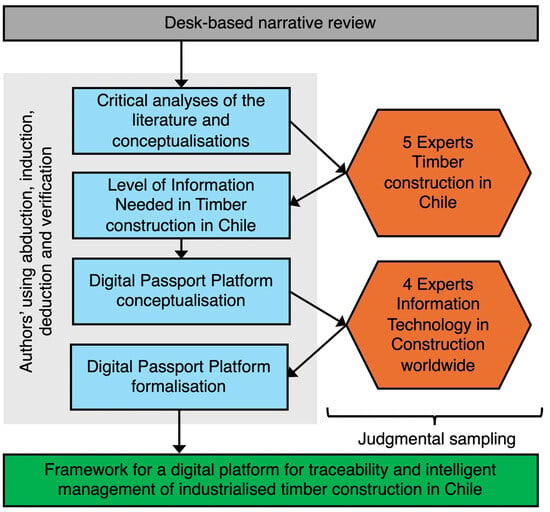
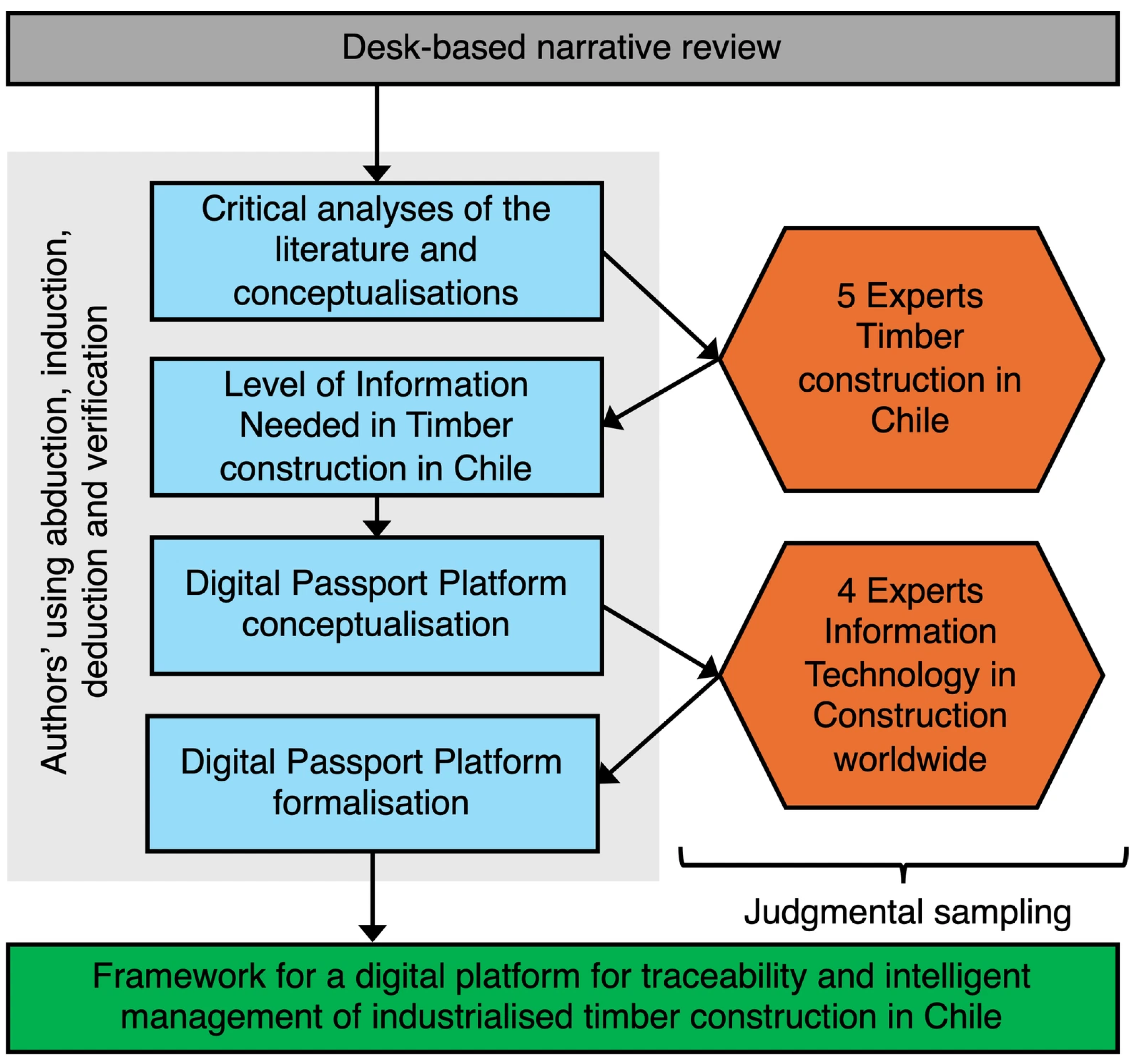
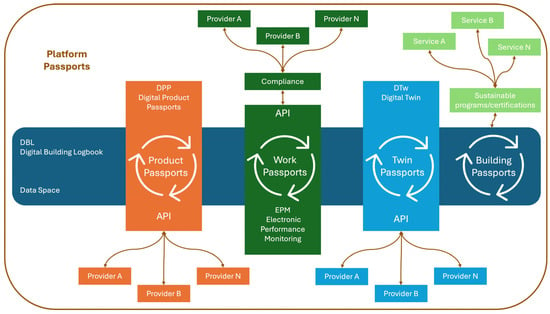
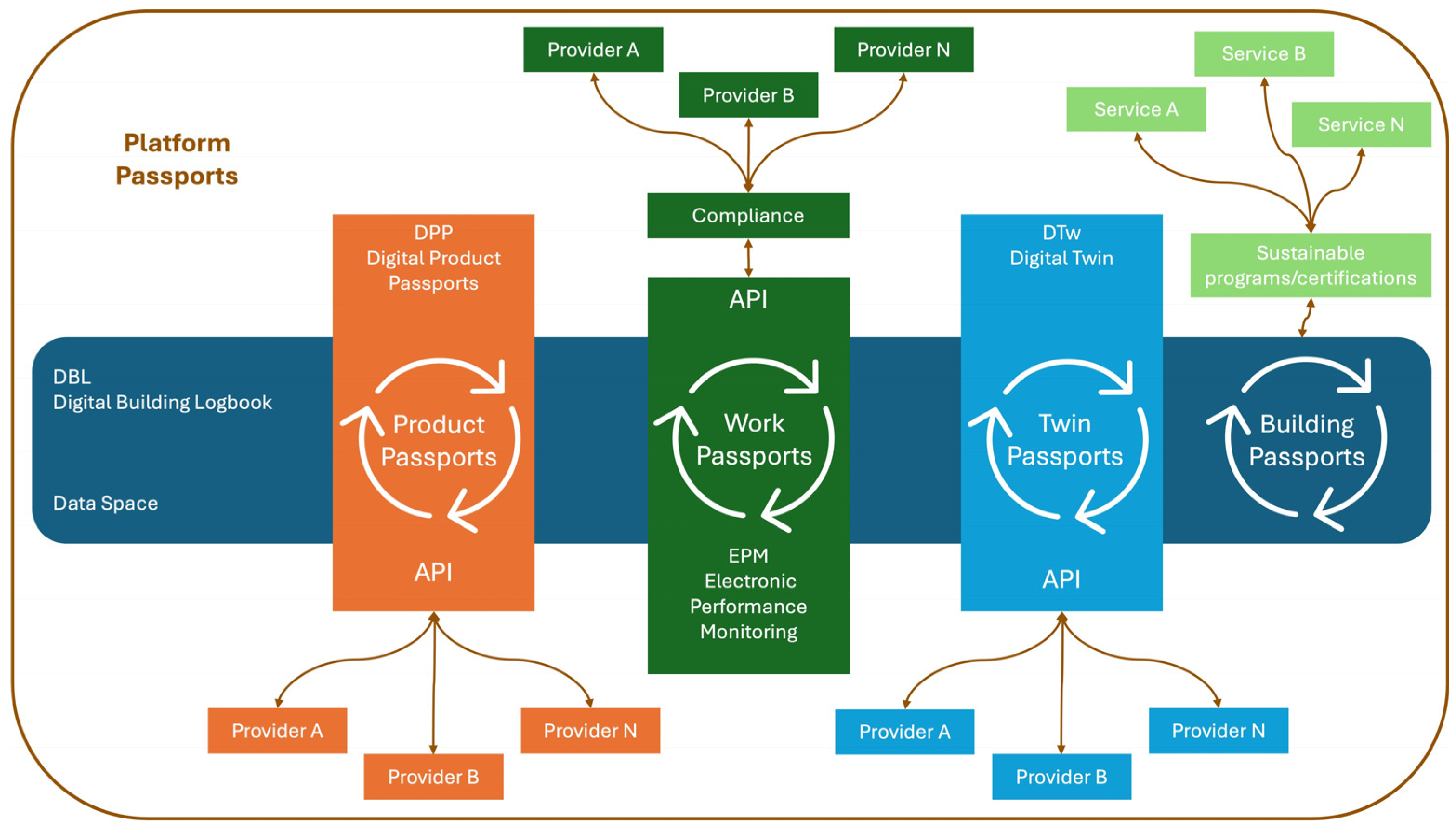

Disclaimer/Publisher’s Note: The statements, opinions and data contained in all publications are solely those of the individual author(s) and contributor(s) and not of MDPI and/or the editor(s). MDPI and/or the editor(s) disclaim responsibility for any injury to people or property resulting from any ideas, methods, instructions or products referred to in the content. |
© 2026 by the authors. Licensee MDPI, Basel, Switzerland. This article is an open access article distributed under the terms and conditions of the Creative Commons Attribution (CC BY) license.