


Abstract
Ground granulated blast-furnace slag (GGBFS)-based geopolymer mortar is a low-carbon alternative to ordinary Portland cement. However, its reliance on the availability of natural river sand and its inherent brittleness are major constraints from the viewpoint of environmental sustainability and resistance to cracking. Because the combined effect of waste foundry sand (WFS) and polypropylene (PP) fibers in slag geopolymers is largely unexplored, the present research examined the possibility of using WFS to partially replace river sand and PP fibers for reinforcement of GGBFS-based geopolymer mortar. Twelve mixtures were prepared in which river sand was replaced by WFS at 0%, 25%, and 50% by volume, and 0%, 1%, 2%, and 3% PP fiber (by mass of binder) was incorporated into the mixtures. The effects of WFS and PP fiber on workability and hardened properties were analyzed using compressive strength, flexural strength, ultrasonic pulse velocity, water absorption, electrical resistivity, and modulus of elasticity. An increase in WFS content led to a decrease in workability and hardened properties. The greatest reduction in compressive strength was observed at 50% WFS, with a 46.0% reduction after 28 days (43.6% at 25% WFS). The addition of PP fiber also led to reductions in flowability, compressive strength, ultrasonic pulse velocity, and electrical resistivity. However, an improvement in flexural strength was observed with PP fiber addition across all WFS replacement levels. The maximum increase in flexural strength was 21.6% with 2% PP fiber, while at 3% fiber, flexural strength decreased slightly but remained higher than that of the fiber-free samples. Fractured specimens exhibited increased cohesion after cracking and reduced crack widths with increasing PP fiber content. Overall, the combined use of WFS and PP fibers can improve waste utilization and crack resistance, although the associated reduction in compressive strength should be considered in mix selection.
1. Introduction
Concrete remains one of the most widely used construction materials in the world, and its demand is expected to grow with continued urbanization and infrastructure development. Ordinary Portland cement (OPC) is the main binder used in conventional concrete and is produced on a very large scale worldwide. Global cement consumption is projected to reach about 5.2 billion tons by 2050 [1]. However, producing OPC requires substantial energy because limestone, one of its main raw materials, must be heated to temperatures above 1400 °C during the manufacturing process. Such production releases CO2 directly due to the decomposition of calcium carbonate, resulting in emissions of approximately 850 kg CO2 per ton of clinker [1,2]. Thus, the cement industry is considered one of the major sources of anthropogenic CO2 emissions and emits approximately 1.5 gigatons of CO2 into the atmosphere every year, a number that continues to rise [3]. Apart from the carbon emissions, the cement-based construction industry puts additional stress on natural resources, including high-quality river sand, which is commonly used as fine aggregate, and its excessive mining causes environmental problems in many countries [4]. These factors have driven researchers to search for more environmentally friendly binding agents and aggregate options for concrete.
Among the numerous potential options explored yet, the “geopolymer” binders are considered among the most realistic low-carbon alternatives to OPC. Geopolymers are characterized by the alkali-activation of Si-Al-O-rich source materials to have a homogeneous amorphous three-dimensional Si-O-Al network. This reaction is referred to as geopolymerization, which is completely chemically different from the C-S-H products responsible for the binder strength of OPC concrete [5]. Unlike the production of clinker by a high-temperature process, geopolymer materials are produced by reacting Si-Al-O-rich raw materials, often in the form of industrial waste, with alkaline liquids such as sodium hydroxide (NaOH) and an alkaline solution of sodium silicate (Na2SiO3), typically at room or mild temperatures and pressures [6]. The elimination of the calcination process and the relatively low curing temperatures required for geopolymerization significantly reduce the energy demand of geopolymer binders, contributing to their lower environmental impact compared with conventional cementitious binders [7]. Ngayakamo and Ikotun (2026) reported that geopolymer concrete has an up to 70% lower CO2 footprint than conventional concrete [7]. With the minimal energy requirement, geopolymer binders have shown similar or even more compressive strength compared to ordinary OPC concrete [8,9]. Geopolymer binders also displayed comparable or even better durability performance compared with that of ordinary OPC binders, including enhanced stability under fire, higher resistance against acid or alkali conditions, increased resistance to chemical attack from sulphates and chlorides, and reduced shrinkage under different exposure conditions, as documented in [8,9,10,11,12].
Among the aluminosilicate precursors used in geopolymers, such as fly ash, metakaolin, and volcanic ash, GGBFS is one of the most favorable [6,13]. It is a glassy, calcium-rich by-product of steel production, obtained by water-quenching molten slag and milling it into powder, with global production estimated at over 500 million tons per year [1]. Its high calcium content accelerates polymerization and promotes the formation of both N-A-S-H and C-A-S-H gels [14], and GGBFS-rich geopolymer mortars show high strength [14,15] and lower water absorption, sorptivity, and chloride penetration than OPC-based mortars [8,9,15,16].
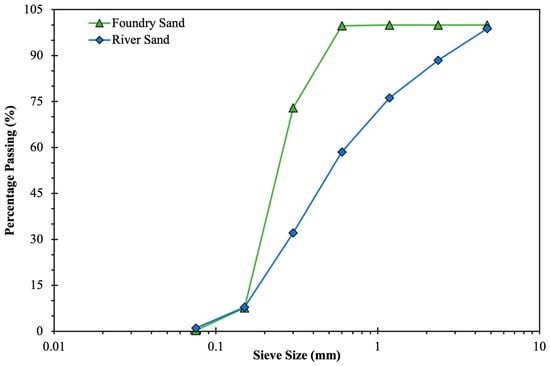
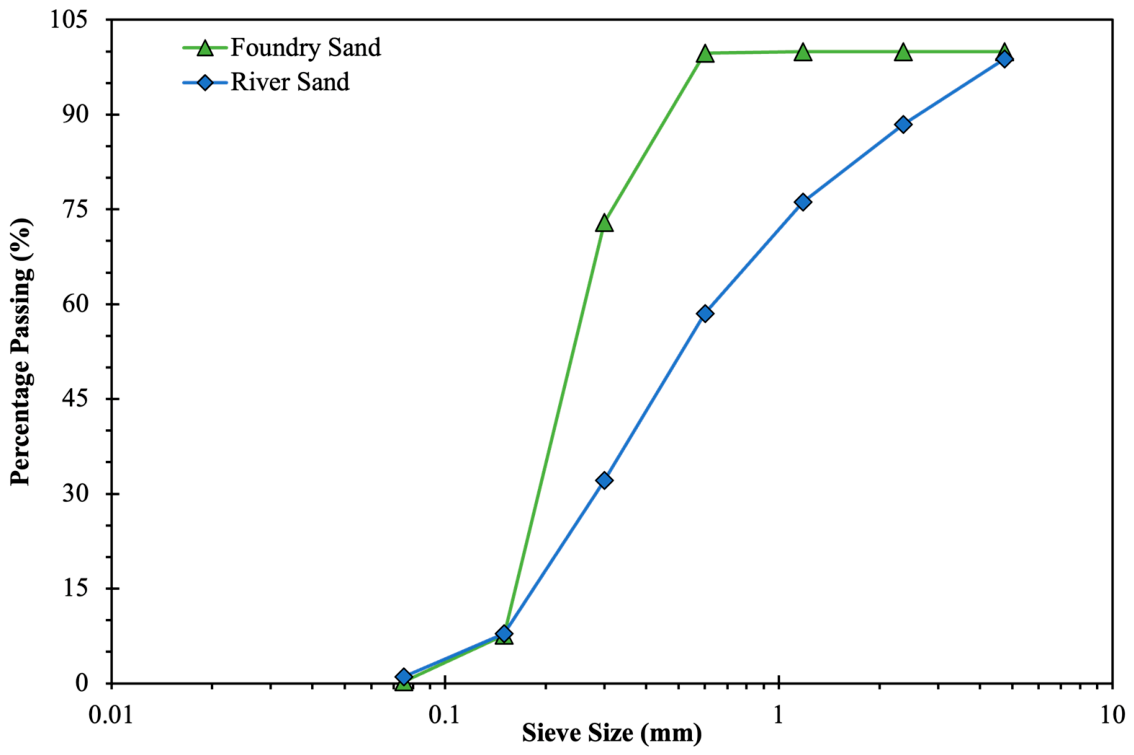
Despite extensive studies and progress on replacing the binder phase in concrete with geopolymer chemistry, the fine aggregate phase, which generally accounts for the highest percentage of the mix volume, still largely depends on natural virgin river sand or crushed sand. The increasing deficiency of natural sand and detrimental environmental effects caused by its extraction make it reasonable to incorporate recycled or industrial by-product aggregate in a geopolymer system and expand the sustainability advantages derived from geopolymer binders [4]. Waste foundry sand (WFS) is one such by-product of the metal casting industry, generated in enormous amounts. In the United States, the estimated amount of WFS generated annually is between 6 and 10 million tons, among which, less than 30% is diverted to various beneficial uses. Disposal of the remaining amount continues to incur economic and environmental burdens [17]. WFS consists of high-quality silica sand whose outer surfaces are coated with residual binder material from the molding process, so the silica content of WFS is similar to that of natural fine aggregate [18]; however, the particle size distribution is generally finer and more uniform [19] (Figure 1).
Figure 1.
Particle size distribution of river sand and WFS.
Several researchers have shown that WFS is able to replace natural sand partially or completely in cementitious and geopolymer systems with no reduction, or in some cases an improvement in performance [19]. Bhardwaj and Kumar (2018) [19] showed that replacing natural sand with WFS in ambient-cured geopolymer concrete, workability decreased while compressive strength increased by approximately 43% at a 60% replacement level, while simultaneously reducing sorptivity, with the finer particle size and residual binder coating of the WFS particles contributing to the improved performance [19]. On the contrary side, Danish and Torres (2025) [20] reported improvement in the fluidity of the GGBFS-fly ash-based geopolymer with 30% incorporation of the WFS. Salim and Moro (2025) [21] also reported that 25% incorporation of WFS into GGBFS–cenosphere-based geopolymer improved the compressive strength by 1–10%. Moreover, WFS also improved acid and thermal resistance, reducing mass loss and compressive strength loss under acid exposure [21]. Sabour et al. (2022) [22] used WFS as fine aggregate in slag-based geopolymer mortar and evaluated its mechanical, durability, and environmental performance, reporting better flexural strength and adhesion with treated WFS than with untreated WFS. However, their study did not include fibers. A more recent systematic review of the topic, also by García et al. (2024), concluded that WFS is a technically suitable replacement for natural sand in mortar, concrete, and self-compacting concrete (SCC), with comparable or better mechanical and durability performance at low-to-moderate replacement levels and a reduction in the cost of materials [18]. Beyond mechanical considerations, the use of WFS in construction materials offers clear environmental benefits. These include recycling industrial waste streams and conserving dwindling river-sand resources. It also helps immobilize potentially mobile trace elements in a strong geopolymer matrix. This reduces the risks of leaching associated with the uncontrolled disposal of untreated WFS [19].
However, replacing river sand with a fine, residue-coated by-product sand can change the strength, paste–aggregate interface, and crack resistance of the mortar. Reduced strength and weaker interfacial zones have been reported for WFS [23,24,25], and geopolymer matrices are, themselves, brittle [26]. Short PP fibers are a logical complement to WFS. PP fibers are chemically stable in alkaline environments and bridge microcracks, thereby improving tensile and flexural behavior and post-cracking integrity [27,28]; however, high dosages reduce workability [27,29]. The two materials therefore address different needs: WFS reduces the use of natural sand and diverts an industrial waste stream, while PP fibers may limit the loss of flexural performance and crack control that WFS replacement can cause. In geopolymer mortars, PP fibers have been studied in fly ash–slag systems for their effects on fresh, mechanical, durability, high-temperature, and microstructural properties [30], but without WFS.
Although considerable work has been conducted individually on GGBFS-based geopolymer binders, WFS as a recycled fine aggregate, and PP fiber reinforcement, it also shows the trade-off between compressive strength and flexural, crack-control performance, which supports application-based mix selection. WFS has been examined in geopolymer mortars without fibers [20,22], and PP fibers in geopolymer mortars without WFS [30,31], while studies combining WFS and PP fibers are mainly on Portland cement concrete [28,29]. In particular, the interactive effects of different WFS replacement levels and PP fiber dosages on the fresh, mechanical, and durability properties of GGBFS-based geopolymer mortar remain largely unaddressed. The purpose of this study is to systematically investigate a GGBFS-based geopolymer mortar utilizing WFS as a replacement for river sand at three levels (0%, 25%, and 50%), along with four PP fiber dosages (0%, 1%, 2%, and 3% by mass of binder). Using a 12 mixture design, this study evaluates the fresh, mechanical, and durability properties of the resulting mortars, including flowability; compressive strength, flexural strength, and modulus of elasticity; and ultrasonic pulse velocity (UPV), electrical resistivity, and water absorption, contributing to a better understanding of how the combined use of an industrial by-product aggregate and synthetic fiber reinforcement affects the fresh, mechanical, and durability performance of slag-based geopolymer composites. By combining two industrial by-products, GGBFS and WFS, with fiber reinforcement to enhance mechanical performance, this work aims to support the development of an environmentally conscious and circular mortar composite that utilizes both waste materials and fiber reinforcement for high performance.
Previous studies have examined WFS in geopolymer mortars without fibers [20,22] and PP fibers in geopolymer mortars without WFS [30,31]. To the authors’ knowledge, the combined effect of WFS replacement and PP fiber dosage in a slag-only geopolymer mortar has not been reported. This study addresses that gap with a full 3 × 4 factorial design that separates the individual and interactive effects of the two variables on fresh, mechanical, and durability-related properties. The trade-off between compressive strength and flexural, crack-control performance is also shown, supporting application-based mix selection.
2. Materials and Methods
The details of the material properties used in this study are presented in the following subsections. Additionally, the mix design, mixing procedure, and test methods used in this study are also described below.
2.1. Materials
This research article is based on a single precursor system (i.e., GGBFS), whose chemical composition is shown in Table 1. The slag had a Blaine fineness of 382 m2/kg. Based on the oxide composition, the slag has a CaO/SiO2 ratio of 1.31 and a (CaO + MgO)/(SiO2 + Al2O3) ratio of 1.09, indicating a basic slag with a high CaO content.
Table 1.
Chemical composition of GGBFS (wt.%).
Natural river sand was employed as the principal fine aggregate and was partially replaced with WFS at 25% and 50% by volume. The gradation curves of both river sand and WFS are shown in Figure 1. The material characteristics of PP fibers used in this study, along with the physical properties of GGBFS, river sand, and WFS, are shown in Table 2.
Table 2.
Physical properties of the materials used.
Figure 1 shows that the two sands differ in gradation. The WFS was uniformly fine, with about 93% of the particles between 0.15 and 0.6 mm, and none retained on the 0.6 mm sieve, whereas the river sand was more widely graded, with about 41% retained on the 0.6 mm sieve. The fineness moduli calculated from Figure 1 were approximately 1.2 for WFS and 2.4 for river sand, and approximately 2.1 and 1.8 for the 25% and 50% WFS blends, respectively. The content of particles finer than 0.15 mm was similar in both sands (about 7–8%). Both sands were used as received, without sieving or blending, because the objective was to evaluate WFS as available in practice; regrading would add processing and reduce the practical value of the replacement. Replacement was performed by volume, so the sand volume and, hence, the paste volume were the same in all mixtures (Table 3).
Table 3.
Mixture proportioning of all geopolymer mixtures examined in this study.
The geopolymer binder was activated using a combination of NaOH and Na2SiO3 solutions. The NaOH solution was prepared in the laboratory by dissolving the required quantity of powdered NaOH in distilled water. The sodium silicate solution was obtained commercially and consisted of approximately 38% total solids and 62% water by mass. According to the supplier’s product specification, the sodium silicate solution had a SiO2/Na2O weight ratio of approximately 2.4–3.3 (molar silicate modulus of approximately 2.5–3.4). To allow the activator solutions to equilibrate before mixing, both solutions were prepared one day prior to mortar preparation and stored under controlled room-temperature conditions of 23 ± 2 °C.
2.2. Methods
2.2.1. Mix Design
A total of 12 geopolymer mortar mixtures were prepared in this study. Table 3 lists all of the mixtures’ proportions and identification. GGBFS was used as the only precursor in all of mixtures. Natural river sand was replaced with WFS volumetrically in three replacement proportions, 0%, 25%, and 50% of total sand, represented as M1, M5, and M9 accordingly. PP fibers were subsequently incorporated at 1%, 2%, and 3% by mass of GGBFS (approximately 0.5, 1.0, and 1.5% by volume of mortar, respectively) within each WFS level, resulting in mixtures M2-M4, M6-M8, and M10-M12, respectively. The liquid-to-binder (L/B) ratio of all the mixes was kept constant at 0.60 in order to get suitable workability. The alkaline solution was a combination of NaOH and Na2SiO3 which has ratio of Na2SiO3 to NaOH solutions of 2:1 by mass. Considering the difference in specific gravity between WFS and natural river sand, WFS replacement was performed on a volumetric basis. A NaOH concentration of 6 M was selected based on previously reported findings [20,32,33]. In total, 240 g of powdered NaOH was dissolved in distilled water, and the volume adjusted to 1 L to obtain a 6 M concentration of NaOH. Binder-to-fine-aggregate (B/FA) ratios of all mixes were kept constant at 1:3.
2.2.2. Mixing and Casting
Before mixing, the fine aggregates were pre-dried in an oven at 105 ± 5 °C for 24 h until reaching an oven-dry (OD) condition. The measured amount of absorption water was added to the OD aggregates and mixed for 30 s, and then left to stand for about 10 min to reach the saturated surface-dry (SSD) condition. Afterwards, the binder ingredients and the PP fibers were mixed by the dry-mixing method for 30 s at the beginning. Following that, the alkaline activator solution was added gradually over 30 s, and mixing continued for a further 2 min, until a homogeneous geopolymer mortar was obtained. The fresh mortar was cast into molds immediately after mixing and compacted by vibration for 25–30 s to remove entrapped air from the mortar. Specimens, after demolding, were wrapped in plastic film and stored at 23 ± 2 °C for 24 h so that the loss of water was as little as possible during the early stage. Subsequently, all specimens were cured at room temperature, under high-humidity conditions (23 ± 2 °C and 98 ± 2%), until the specified testing ages.
2.2.3. Description of Tests
Fresh, mechanical, and durability properties were tested using three specimens from each mix at each test age. Flexural and compressive strengths were measured at ages of 3, 7, and 28 days. However, prior to testing for flexural and compressive strengths, the same specimens were used for both UPV and electrical resistivity testing, because these tests do not degrade the samples. Three geopolymer mortar specimens were tested for each mixture at 3, 7, and 28 days for UPV and electrical resistivity. Water absorption and elastic modulus were tested at 28 days on three specimens per mix. The reported values for all tests represent the average of the three specimens tested. Mortar flow was assessed in accordance with the ASTM C1437 procedure [34]. Flexural strength was measured using prisms measuring 40 × 40 × 160 mm following ASTM C348 [35]. The portions of the prism remaining after flexural strength testing were used to measure the compressive strength of the material in accordance with ASTM C349 [36]. The UPV was conducted in accordance with ASTM C597 [37]. Electrical resistivity was tested using a Proceq Resipod, and the formula used to convert resistivity readings from electrical potential difference and resistance is given in Equation (1):
where “ρ” is the electrical resistivity of the material being tested in Ω·cm, “a” is the spacing between electrodes in mm, “V” is the difference in electrical potential in volts, and “I” is the current flowing between the electrodes in amperes.
Water absorption of geopolymer mortars was analyzed at 28 days of curing age. Specimens were weighed in the saturated surface-dry (SSD) condition (X2), followed by drying in the oven at 105 ± 5 °C for 24 h (X1), to determine the oven-dry (OD) mass. The water absorption rate was determined by Equation (2):
The dynamic modulus of elasticity was computed using an Emodumeter (Resonant Frequency Tester) manufactured by James Instruments (Chicago, IL, USA), in accordance with the ASTM C215 procedure [38].
2.2.4. Statistical Analysis
The effects of WFS replacement level, PP fiber dosage, and their interaction on compressive strength were evaluated by two-way ANOVA, using the mean of the two prism halves of each specimen as one value (n = 3 per mixture). Significant effects (p < 0.05) were followed by Tukey’s Honestly Significant Difference (HSD) test. Residual normality and homogeneity of variance were checked with the Shapiro–Wilk and Levene tests, and, because variances differed between mixtures, borderline comparisons were also checked with Welch’s t-test. Analyses were performed in Python 3.13 using statsmodels 0.15.0 and SciPy 1.18.1.
3. Results and Discussion
This section presents and discusses the results obtained from the experimental investigation. The effects of WFS replacement and PP fiber incorporation on the flowability, compressive strength, flexural strength, ultrasonic pulse velocity (UPV), electrical resistivity, water absorption, and modulus of elasticity of the GGBFS-based geopolymer mortar are evaluated and discussed.
3.1. Flowability
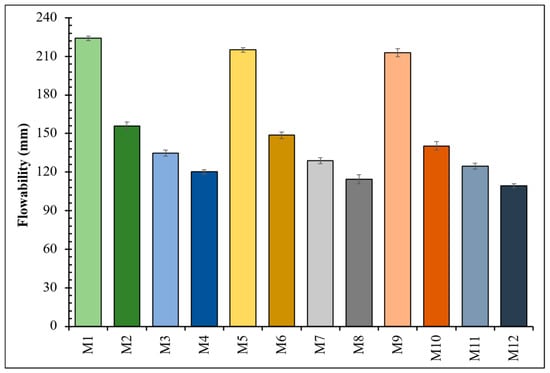
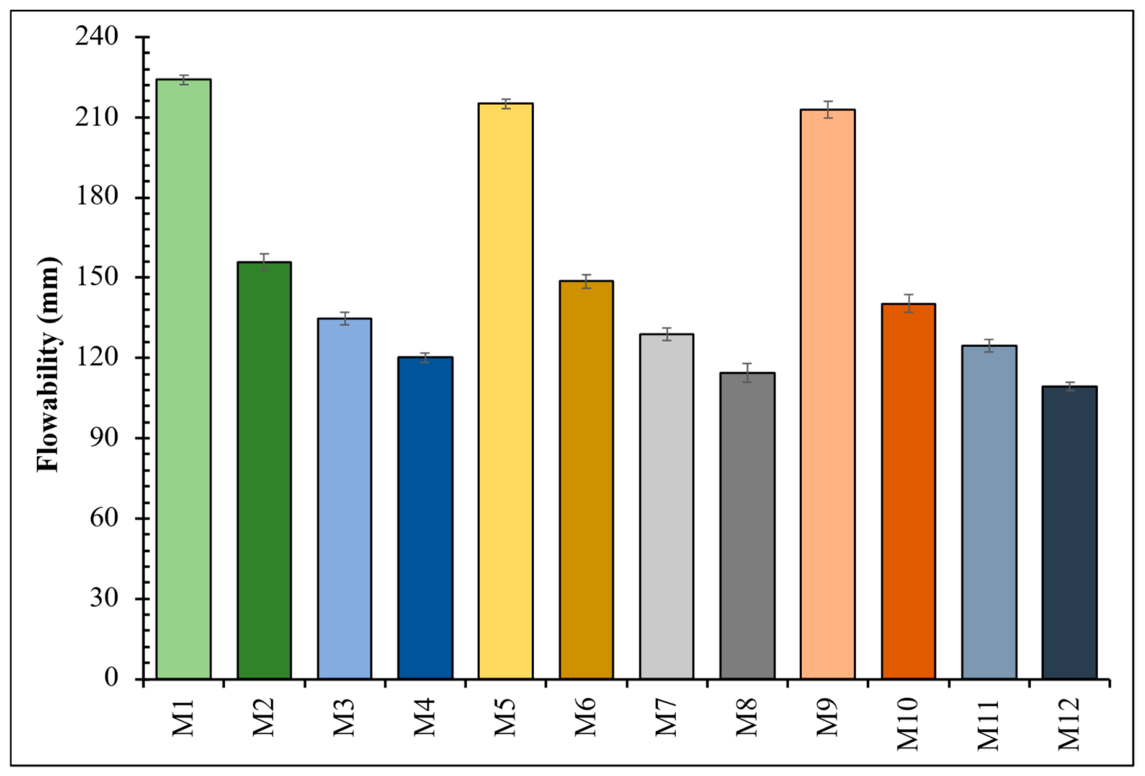
Figure 2 shows the flowability of the 12 GGBFS-based geopolymer mortar mixtures containing different WFS replacement levels and PP fiber dosages. The reference mixture, M1 (0% WFS and 0% PP fiber), showed the highest flowability, at 224 mm. In the mixtures without PP fiber, increasing the WFS content slightly reduced flowability. Mixtures M5 (25% WFS) and M9 (50% WFS) recorded flowability values of 215 mm and 212 mm, respectively. These values represent reductions of 4.0% and 5.4% compared with M1. This trend is consistent with several studies reporting reduced workability upon WFS incorporation. García et al. (2024) [18] reported a linear relationship between slump reduction and WFS content across multiple studies, attributing the loss in workability to the predominantly sub-angular shape of WFS particles, which promotes particle interlocking, as well as residual clay and ash coatings that increase water demand. Similarly, Bhardwaj and Kumar (2018) [19] observed decreased workability when natural sand was replaced with WFS in ambient-cured geopolymer concrete, attributing it to the finer particle size distribution and higher surface area of WFS relative to natural river sand, both of which increase the demand for activator solution to achieve equivalent flow.
Figure 2.
Flowability of all geopolymer mixtures with varying proportions of WFS and PP fiber.
Contrary to the trend observed in Figure 2, some studies report an improvement in workability with foundry sand incorporation, particularly in alkali-activated and geopolymer systems. Hua et al. (2024) [39] found that replacing fine aggregate and sodium silicate with waste sodium silicate-bonded foundry sand in an alkali-activated blast-furnace slag mortar significantly improved flowability and reduced flow loss. This effect was attributed to residual sodium silicate and sodium carbonate/bicarbonate compounds retained on the sand surface. These compounds supplemented the alkaline activator and improved particle dispersion. Similarly, Angel et al. (2022) [40] reported improved fresh-state properties, including slump flow, when natural sand was replaced with used foundry sand at 50% and 100% by volume in self-compacting concrete. Salim and Moro (2025) [21] also observed improvement in flowability of GGBFS-based geopolymer mortar with 25% replacement of river sand with WFS. However, flowability decreased with 50% WFS replacement. In some cases, these improvements can be mainly attributed to the smoother and more rounded particle shape produced during the metal-casting process. The improved flowability may also be related to the compatibility between the residual binder and the surrounding alkaline matrix. Overall, these findings suggest that the effect of WFS on flowability depends not only on the replacement level but also on the type of binder used in the foundry sand (clay-bonded or chemically bonded), its residual chemistry, and its compatibility with the activator system.
PP fiber had a much greater effect on flowability than WFS replacement. In the RS100-FS0 series, adding 1%, 2%, and 3% PP fiber (M2, M3, and M4) reduced the flowability to 155, 135, and 120 mm, respectively. These values correspond to reductions of 30.5%, 39.9%, and 46.4% compared with M1. A similar reduction was observed for the mixtures containing 25% and 50% WFS (M6-M8 and M10-M12, respectively). Compared with M5 and M9, flowability decreased by about 31–34% with 1% fiber, 40–42% with 2% fiber, and 47–49% with 3% fiber. This indicates that the effect of PP fiber was largely independent of WFS content, with little interaction between the two variables. This trend is consistent with previous studies. Kashapaga et al. (2023) [41] reported a continuous reduction in workability with increasing PP fiber content in slag-based geopolymer concrete. Similarly, Li et al. (2024) [42] found that increasing PP fiber content up to 3% by volume can reduce the fluidity of coal gangue-based geopolymer mortar. This reduction phenomenon was attributed to the fiber-bridging effect within the viscous geopolymer slurry, which limits particle movement. Afriansya et al. (2023) [43] also reported a similar trend in fly ash-based geopolymer mortar, where workability decreased as PP fiber content increased from 0% to 1%, even when a superplasticizer and additional water were used to compensate for the loss of flow. The reduction in flowability with increasing PP fiber content can be explained by the way the fibers are distributed throughout the mixture. The randomly dispersed fibers increase internal friction and restrict the movement of paste and aggregate particles. In addition, the relatively large surface area of the fibers requires more paste to coat them, leaving less free paste to lubricate the mixture. At higher fiber contents, some fiber clustering may also occur, which can further restrict flow [26].
Because GGBFS is rich in CaO (39.87%, Table 1), slag-based mixtures set faster than other geopolymer precursors, and setting time becomes a practical concern [44,45]. Retarders have been used to control setting time in fly ash–slag geopolymers; for example, a starch and borax combination at 3% by binder mass extended the initial and final setting times without lowering compressive strength, whereas most other retarders reduced strength [44]. The effectiveness of retarders depends on the precursor and activator, so the reported results cannot be assumed to apply to the slag-only mixtures used here. Setting time was not measured in this study. However, all mixtures used the same GGBFS, activator, and L/B ratio of 0.60, and WFS replaced only the sand, so the setting behavior of the binder paste was the same for all mixtures and the relative effects of WFS and PP fiber are therefore not expected to depend on setting behavior.
3.2. Compressive Strength
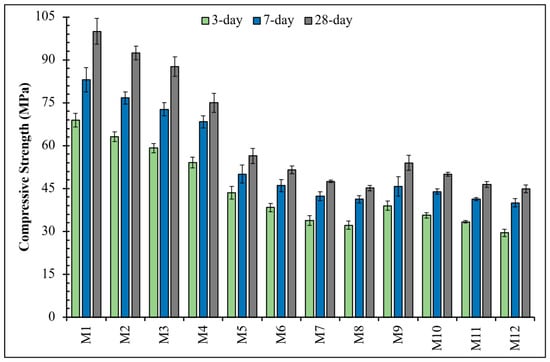
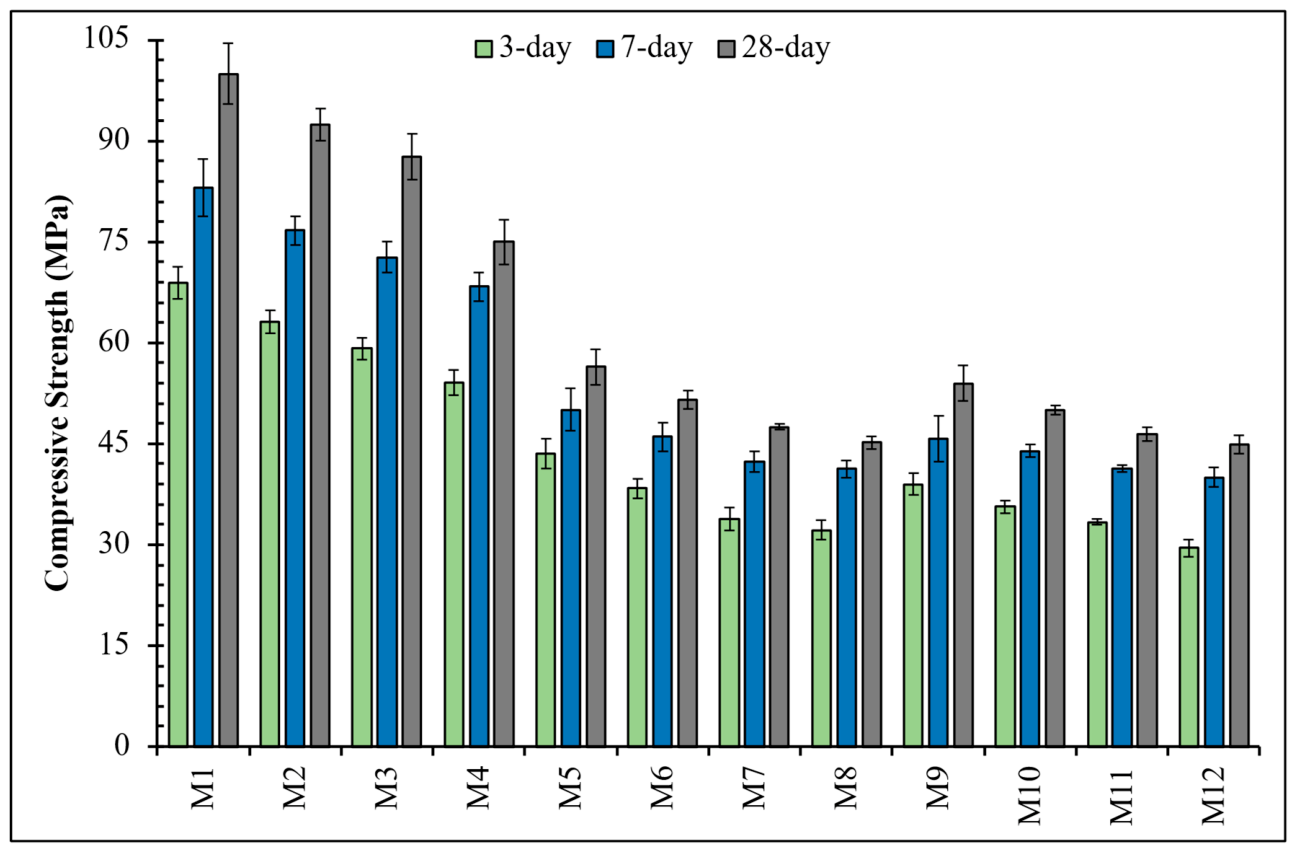
Figure 3 shows compressive strength increasing progressively across all 12 mixtures from 3 to 28 days, consistent with the continued dissolution of GGBFS and precipitation of calcium- and sodium-aluminosilicate gel that characterizes strength development in solely GGBFS-based geopolymer systems over time [46]. The reference mixture M1 recorded the highest strength at every age, reaching 68.91, 83.06, and 99.97 MPa at 3, 7, and 28 days, respectively, while the lowest-performing mixtures were found to be M8, M11, and M12, that reached to 45–47 MPa by 28 days. Both WFS replacement and PP fiber addition reduced compressive strength compared with reference mixture M1. However, WFS had a much greater effect on strength than PP fiber at all curing ages, as confirmed by two-way ANOVA (28 days: WFS F = 1866 and fiber F = 111, both p < 0.001), in which WFS accounted for about 90% and fiber for about 8% of the total variance (Table 4).
Figure 3.
Compressive strength of all geopolymer mixtures with varying proportions of WFS and PP fiber.
Table 4.
Two-way ANOVA results (F-values and p-values) for the effects of WFS replacement level, PP fiber dosage, and their interaction on the compressive strength of GGBFS-based geopolymer mortar at 3, 7, and 28 days.
For the mixtures without PP fiber (M1, M5, and M9), increasing WFS content caused a clear reduction in compressive strength. At 3 days, the strength decreased by 36.9% and 43.4% with 25% and 50% WFS replacement, respectively. Similarly, at 7 days, the reductions were 39.7% and 44.9%, while at 28 days, decline in compressive strength reached 43.6% and 46.0%. However, the reduction was strongly non-linear. Most of the loss already occurred at 25% WFS (p < 0.001), whereas increasing WFS from 25% to 50% reduced the 28-day strength by only 2.4 MPa (4.3%), which was not statistically significant (p = 0.88). The same was true at 7 days (p = 0.11), whereas, at 3 days, the 50% mixture was significantly lower than the 25% mixture (10.3%, p = 0.006). The strength loss caused by WFS is consistent with previous studies. Feijoo et al. (2021) [23] reported a steeper decline above 30% replacement, in contrast to the level between 25% and 50% observed here. Wang et al. (2022) [24] also reported compressive strength reductions of up to 27.29% at high WFS contents in a Ca(OH)2-activated slag system. The reduction in strength with increasing WFS content may be related to the finer and more uniformly graded WFS (Figure 1), which increases the paste–aggregate interfacial area and can lead to a wider and weaker interfacial transition zone [23]. This can affect the distribution of water within the mixture and increase the thickness of the water film around the aggregate particles. It can also lead to a wider and weaker interfacial transition zone between the paste and aggregate [23]. In geopolymer-based slag systems, the effect may be further influenced by the residual sodium silicate and clay-based binder present on the WFS surface from the original casting process. These residual materials can interfere with slag dissolution and affect the formation and continuity of reaction products at the paste–aggregate interface [24]. The small additional loss between 25% and 50% WFS suggests that the strength loss is controlled by an effect already developed at 25% replacement, such as residual binder and fines on the WFS surface interfering with slag dissolution and weakening the paste–aggregate interface, rather than by a gradual dilution of the river sand. Without microstructural evidence (SEM/XRD), this interpretation remains tentative. The gradation difference between the sands (Figure 1) may also have contributed to the WFS effects, and the present design cannot fully separate the influence of material type from that of gradation. The finer and more uniform WFS has a larger specific surface area and lacks coarse particles, so a fixed paste volume (constant L/B and B/FA) must coat more surface and fill more voids, leaving thinner paste films. The small flow reduction (4–5%, Section 3.1) and the larger interfacial area discussed above agree with such an effect. However, the fineness modulus decreased progressively (2.4, 2.1, and 1.8 for 0%, 25%, and 50% WFS), whereas the strength dropped mainly at 25% WFS, so gradation alone does not explain the non-linear trend. The comparatively small changes in UPV and modulus (Section 3.4 and Section 3.7) are consistent with the nearly constant density of the mixtures.
However, not all studies have reported a reduction in compressive strength with WFS. Bilal et al. (2019) [47] found a 7.82% increase in 28-day compressive strength at 30% WFS replacement in conventional Portland cement concrete. This improvement was attributed to the filler effect of WFS, which suggests that WFS can improve strength when its particle-packing benefits outweigh its potential negative effects. However, its effect depends on the binder system and replacement level. In GGBFS-based systems, where strength development is strongly influenced by calcium-driven reactions and gel formation, the effect of WFS may depend on how its physical and chemical properties interact with the geopolymer matrix. In OPC-based systems, improved particle packing may have a greater influence on strength development. Similar behavior has also been reported in GGBFS-based geopolymer systems. Salim and Moro (2025) [21] reported enhancement in compressive strength of GGBFS-based geopolymer mortar with 25% replacement of river sand with WFS. However, 50% WFS replacement decreased the compressive strength. The positive influence of WFS incorporation was attributed to filler effect, along with high iron content (Fe2O3) present in WFS, which can take part in gel formation and densification, leading to higher compressive strength [48,49]. Contrarily, higher substitution of WFS results in unsuitable particle gradient instead of densification, thereby reducing compressive strength [21].
PP fiber also caused a reduction in compressive strength; however, its effect was smaller than that of WFS. At 28 days, the strength decreased by approximately 7–9% with 1% fiber, 12–16% with 2% fiber, and 17–25% with 3% fiber compared with the corresponding mixtures without fiber. A similar reduction was observed at 3 and 7 days. The reduction at 1% fiber was small and not consistently significant (p = 0.002, 0.10, and 0.31 at 0%, 25%, and 50% WFS, respectively), whereas 2% and 3% fiber reduced the strength significantly in all three series (p ≤ 0.002). The interaction between WFS and fiber was also significant (p < 0.001): 3% fiber reduced the strength by 25.0 MPa (25.0%) without WFS but by only 11.2 MPa (19.9%) and 9.1 MPa (16.8%) at 25% and 50% WFS, respectively. These results agree with previous studies. Xu et al. (2025) [50] found that PP fiber contents above 0.8% by volume reduced compressive strength in an alkali-activated copper slag–slag cementitious material. Similarly, Mirgozar Langaroudi et al. (2025) [51] reported about a 12% reduction in compressive strength when PP fiber content increased from 0.2% to 0.4% by volume in a slag-based geopolymer mortar. The reduction was attributed to the negative effect of higher fiber contents on the overall matrix performance. Chindaprasirt et al. (2021) [52] explain this behavior mechanistically: beyond an optimum fiber content, PP fibers tend to agglomerate within the fresh paste, and the accompanying loss of workability requires either additional mixing water or leaves entrapped air within the matrix, both of which increase porosity and weaken the hardened composite. This finding is not universal at lower dosages. Xu et al. (2020) [53], also working with alkali-activated slag mortar, found that PP fiber content up to 1% by volume improved compressive strength through effective crack-bridging and good bonding with the surrounding paste. Because fiber dosage in this study is expressed by binder mass, 1–3% corresponds to roughly 0.5–1.5% by volume of mortar, which is comparable to the dosages in the studies cited above. Strength losses already appeared at 1% fiber (about 0.5% by volume), together with a 30% drop in flow, so poor compaction and entrapped air at the fixed L/B of 0.60 may have contributed, consistent with the lower UPV in Section 3.4. In addition, the matrix is very strong (about 100 MPa for M1), and the PP fibers are much less stiff (about 6.5 GPa, Table 2), so the fibers probably contribute little load-bearing capacity under compression. Under flexure, the fibers bridge cracks, thus explaining why flexural strength increased while compressive strength decreased.
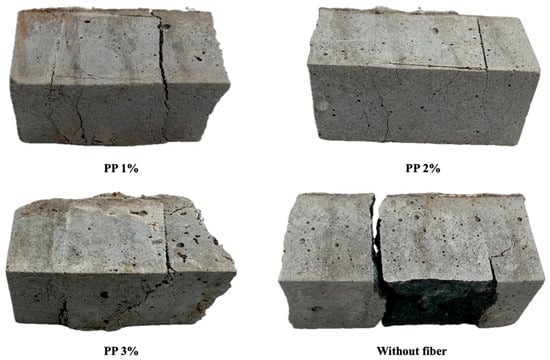
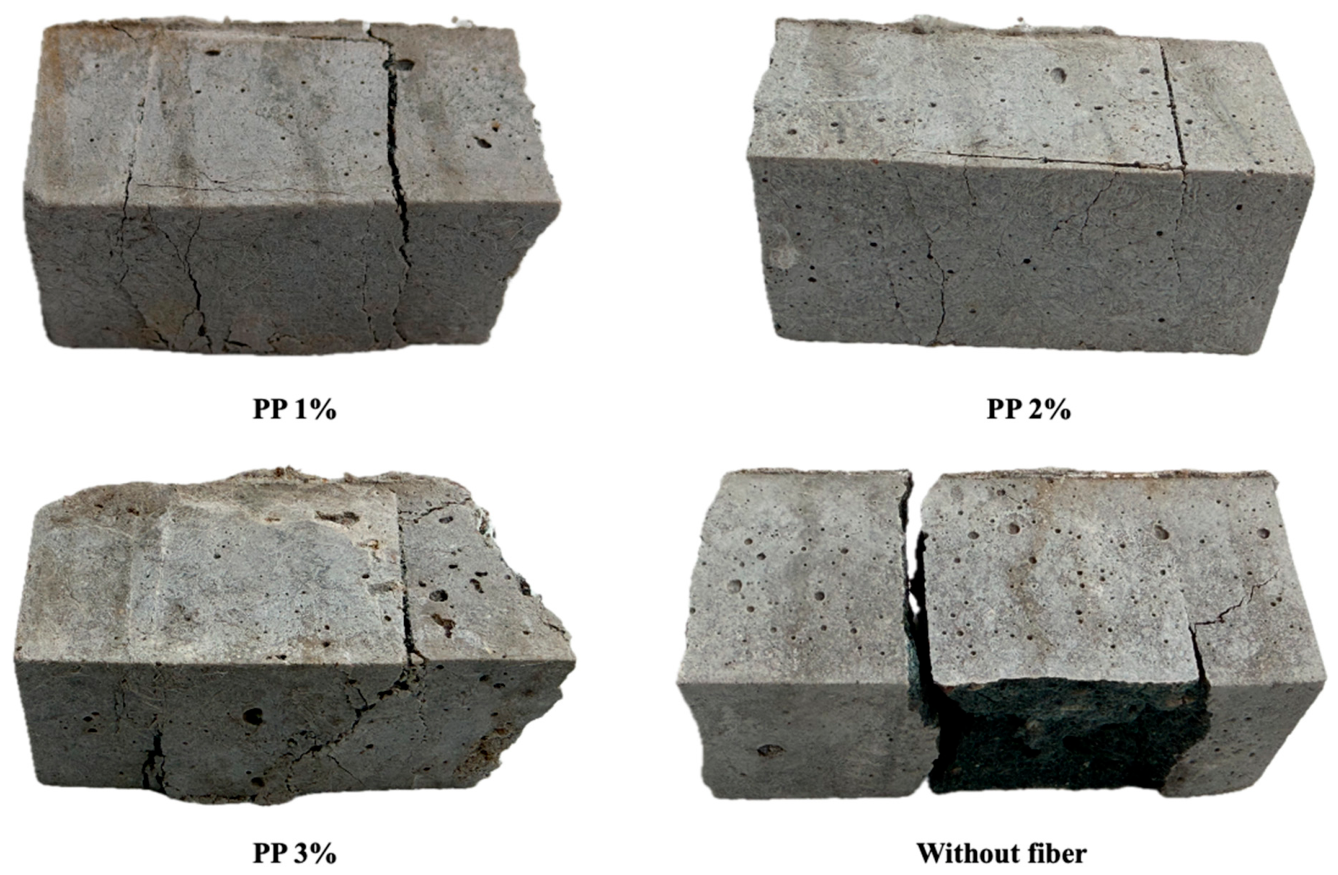
Figure 4 demonstrates the compressive loading failure mode of both non-reinforced and PP fiber-reinforced specimens. As evident from Figure 3, compressive strength decreased gradually with increasing PP fiber content; however, the cracks are visibly bridged by the fibers on the fractured surfaces. In contrast to the specimen without fiber, the PP fiber-reinforced specimen retained a higher level of cohesiveness after failure, with the fractured segments remaining partially connected rather than completely dismembered. Therefore, it was observed that while increasing fiber content resulted in lower compressive strength, the presence of PP fibers still offered substantial crack resistance and helped maintain specimen integrity after cracking.
Figure 4.
Failure mode of compressive strength specimens with and without PP fiber.
3.3. Flexural Strength
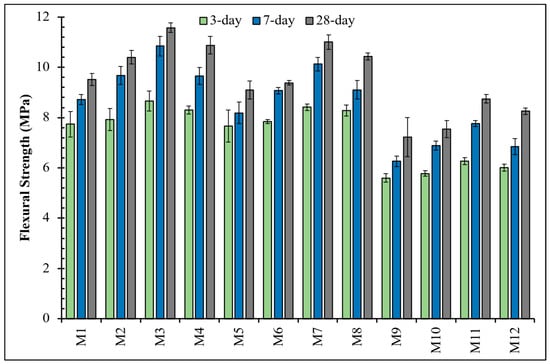
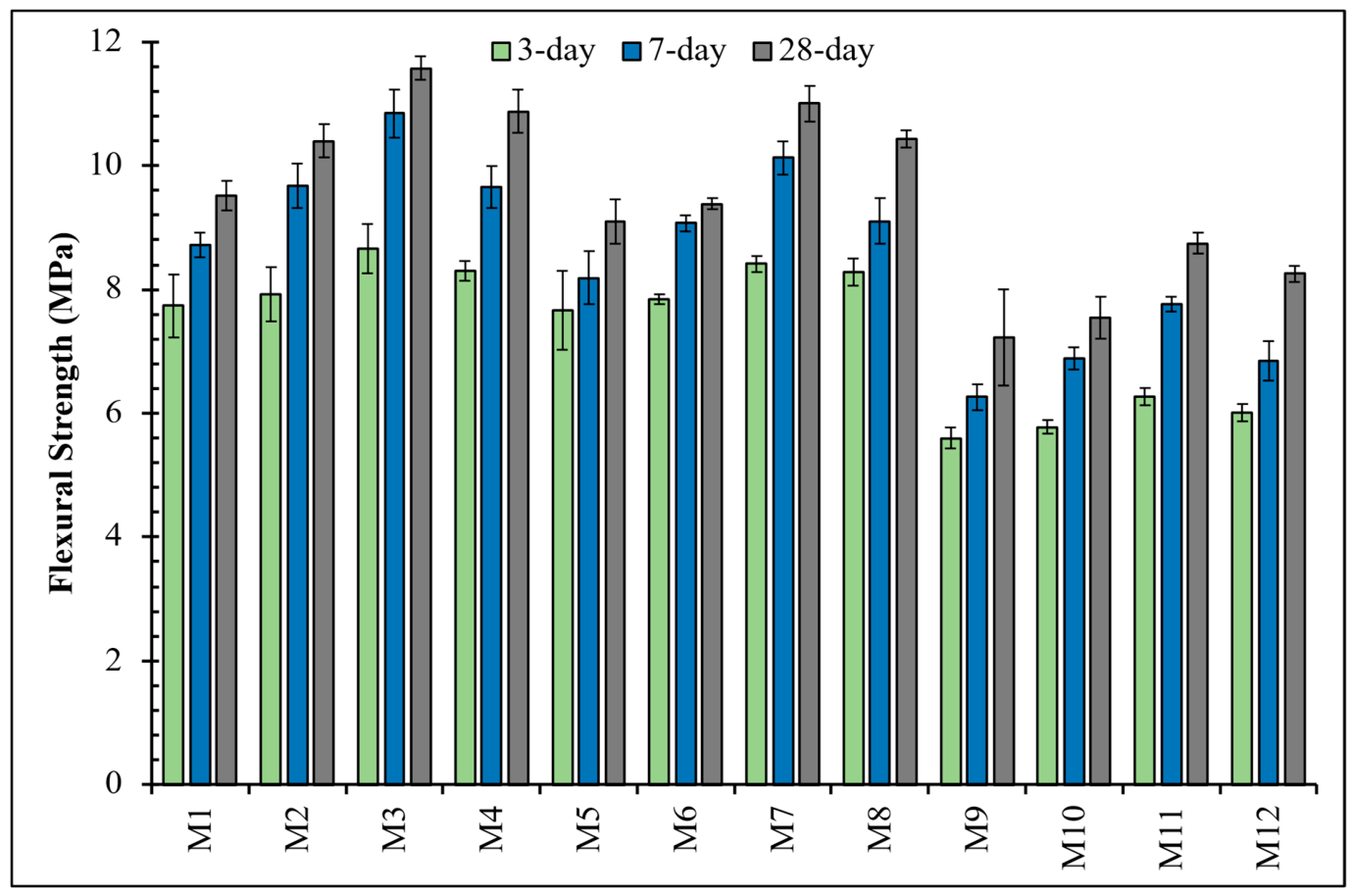
Figure 5 presents the flexural strength results for all 12 mixtures at 3, 7, and 28 days. As expected, flexural strength increased with curing age for all mixtures, following a trend similar to that observed for compressive strength [46]. However, unlike the compressive strength results, the addition of PP fibers did not consistently reduce flexural strength. The highest flexural strength in each WFS series was reached at 2% PP fiber, unlike compressive strength, which attained optimum strength at 0%. Overall, 28-day flexural strength values range from 7.55 MPa (M10) to 11.58 MPa (M3).
Figure 5.
Flexural strength of all geopolymer mixtures with varying proportions of WFS and PP fiber.
Looking at the mixtures without PP fiber (M1, M5, and M9), WFS content reduced flexural strength, and this reduction grew larger with more WFS. At 28 days, flexural strength dropped by 4.4% at 25% WFS and by 24.0% at 50% WFS, compared to M1. The drop in flexural strength was found to be more prominent at earlier ages, such as reaching to 27.6% at 3 days for the 50% WFS mixture. P.M. and Prasad (2019) [25] reported a similar trend, finding a 28.38% drop in flexural strength at 40% foundry sand replacement in paver blocks. Not all studies reported the same trend. For instance, Bilal et al. (2019) [47] found a 10.35% increase in flexural strength at 30% WFS replacement; however, their study used normal concrete rather than a geopolymer system, which may explain the difference.
PP fiber improved flexural strength at all WFS levels (i.e., 0, 25, and 50%), which is inconsistent with the trends observed with compressive strength. At 28 days, flexural strength increased by 3.1–21.6% at 1–2% fiber content across all three WFS series, always peaking at 2% fiber. At 3% fiber, strength dropped slightly but stayed above the 0% fiber mixtures. This pattern matches published work. Mohamed and Zuaiter (2024) [54] found that PP fiber content above 2% causes de-bonding between the fiber and the paste, which lowers flexural strength beyond that point. Liu et al. (2025) [55] reported a similar trend in a different system, where flexural strength increased by 53% with 1.5% fiber addition but decreased at 2% fiber content, which was attributed to fiber clumping during mixing.
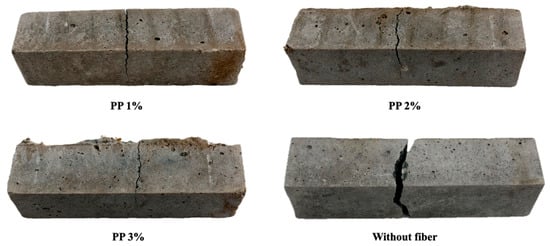
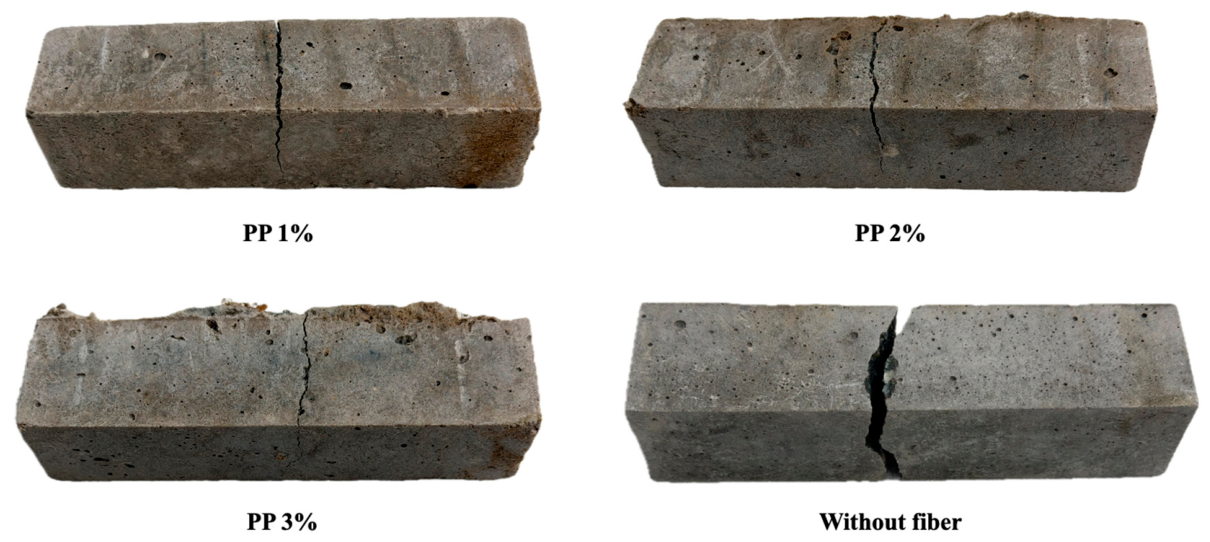
Figure 6 shows the crack patterns observed in the broken specimens. The sample without fiber split into two separate pieces, showing the brittle failure typically associated with unreinforced geopolymer mortar. In contrast, the fiber-reinforced specimens remained connected after cracking, as the PP fibers bridged the cracks and helped hold the two sides together. This shift from brittle to more ductile failure matches other studies on fiber-reinforced geopolymer [56]. Interestingly, the crack at 3% fiber was narrower than at 1% or 2%, even though 3% fiber gave a lower flexural strength than 2%. A likely reason is that more fibers cross the crack at 3% content, spreading the crack opening across more bridging points and keeping the crack tighter.
Figure 6.
Broken specimen failure pattern following flexural strength with and without PP fiber.
3.4. Ultrasonic Pulse Velocity
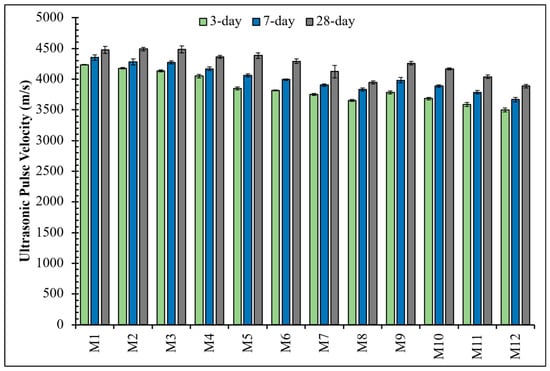
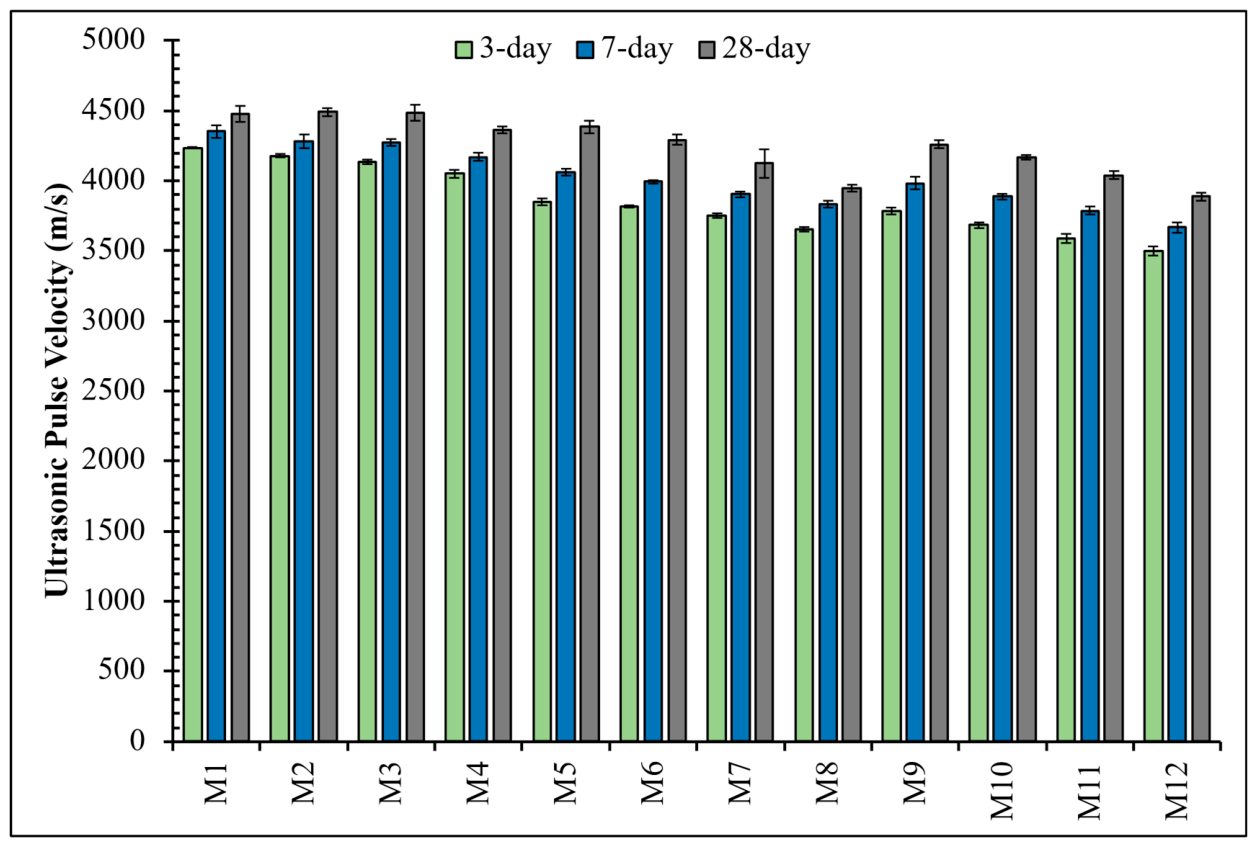
Figure 7 shows the UPV results of the 12 mixtures with varying amounts of WFS and PP fibers. The UPV increased during the curing process for all mixtures, indicating progressive development and densification of the geopolymer matrix with the ongoing reaction. This upward trend in UPV with increasing curing age has also been reported in studies on alkali-activated and geopolymer materials, where UPV increased with age as the matrix became denser and strength development progressed [57,58]. M1, the control mixture, showed the highest UPV at all curing ages, a finding which agrees well with its high compressive strength reported in Figure 3. The correlation between UPV and compressive strength is generally strong, and this is again supported by studies on GGBFS-based geopolymer mortar and geopolymer concrete [58,59].
Figure 7.
Ultrasonic pulse velocity of all geopolymer mixtures with varying proportions of WFS and PP fiber.
As the substitution level of WFS increased, a gradual decrease in UPV occurred. The 25% and 50% WFS mixtures generally exhibited lower UPV values than M1 at all curing ages. This trend parallels the decrease in compressive strength observed with increasing WFS content. The decrease in UPV suggests a less continuous internal structure, which might stem from the incorporation of WFS, leading to a higher number of voids and weaker interfacial regions. Khatib et al. (2010) [60] reported a gradual decline in UPV with an escalating amount of WFS replacement. Their study also reported a corresponding reduction in compressive strength. Although the magnitude of the effect varies depending on the characteristics of the WFS and the surrounding binder matrix, this trend is in line with the present study.
PP fiber reinforcement mainly reduced the UPV values in the WFS series, whereas in the WFS-free series, the reduction was observed only at 3% fiber (2.5% at 28 days). Overall, increasing the PP fiber content from 0% to 3% resulted in a gradual decrease in UPV. The decline is probably due to the additional fiber–matrix interfaces and the potential for entrapped air or voids, which can interrupt the transmission path of ultrasonic waves at higher fiber contents. Griño et al. (2023) [61] reported lower UPV values for PP fiber-reinforced geopolymer mortar compared with the fiber-free mixture, which was attributed to discontinuities such as cracks and voids. Masoud et al. (2024) [62] also found that higher PP fiber contents adversely affected the properties of geopolymer concrete, and microscopic observations revealed the presence of voids around the fibers. Bhutta et al. (2019) [63], on the other hand, stated that the inclusion of fibers can have a considerable effect on the properties of geopolymer mortar, such as density and porosity. Therefore, the gradual reduction in UPV with increasing PP fiber content is consistent with the reduction in compressive strength and suggests that higher fiber contents may have increased internal heterogeneity.
Although UPV decreased with both WFS and PP fiber, the reductions at 28 days were small compared with the strength losses: UPV ranged from 3887 to 4490 m/s, with WFS alone reducing UPV by 2.0% (25% WFS) and 4.8% (50% WFS) relative to M1, and the largest combined reduction (M12) being 13.1%. The bulk density of the mortars changed very little, because WFS replaced river sand by volume and has a similar specific gravity (2.57 vs. 2.61, Table 2), and the fibers occupied only about 0.5–1.5% of the volume. In addition, UPV is measured at very low strain and follows the stiffest continuous path through the paste and sand grains, so UPV is much less sensitive than compressive strength to weak interfacial zones and local voids.
3.5. Electrical Resistivity
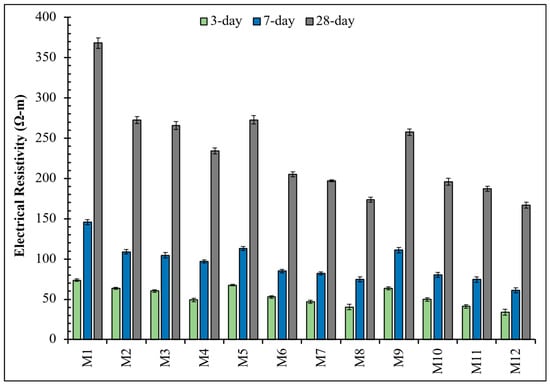
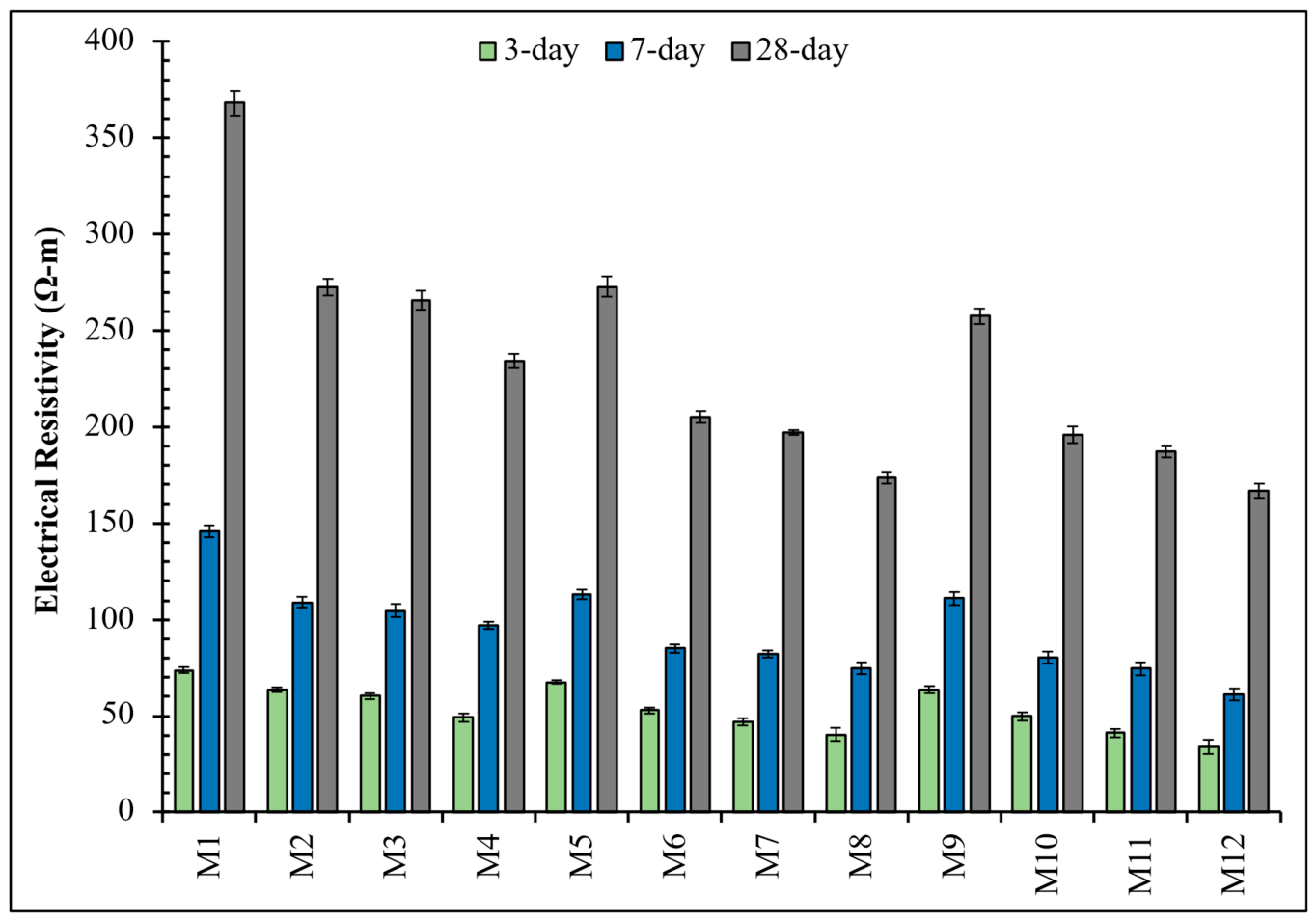
Figure 8 shows the electrical resistivity results for all 12 mixtures at 3, 7, and 28 days. Electrical resistivity is a non-destructive test that measures a material’s resistance to electrical current and reflects the connectivity of its pore structure [64]. Higher resistivity indicates a denser matrix with less-connected pores, while lower resistivity suggests a more open pore network and potentially higher permeability [64]. Electrical resistivity results also follow the same overall pattern as compressive strength: M1 demonstrated the highest resistivity at all ages, and both WFS and PP fiber reduced resistivity with an escalating incorporation level. The reference mixture, M1, reached 73.8 Ω·m, 145.8 Ω·m, and 368.1 Ω·m at 3, 7, and 28 days.
Figure 8.
Electrical resistivity of all geopolymer mixtures with varying proportions of WFS and PP fiber.
Considering the mixtures without PP fiber (M1, M5, and M9), increasing the WFS content reduced resistivity at all curing ages, with the decline becoming more pronounced as the curing age increased. At 28 days, resistivity decreased by 25.9% and 30.0% for 25% and 50% WFS, respectively, compared with M1. In contrast, at 3 days, the reduction was smaller, ranging from approximately 8.6% to 13.8%. Coppio et al. (2019) [65] reported a similar observation in concrete containing WFS and reported that its effect on electrical resistivity depends on the specific properties of the sand used. The authors also reported a reduction in compressive strength, which is consistent with the trend observed in the present study. The decrease in electrical resistivity with increasing WFS content may be related to changes in the pore structure of the matrix. The fine particles and clay present in WFS can increase water demand and affect compaction, potentially resulting in a more porous and interconnected pore structure. This can provide easier pathways for ionic movement and, consequently, lower the electrical resistivity. A similar decrease in resistivity with increasing foundry sand content was reported by Prabhu et al. (2015) [66].
PP fiber addition also reduced electrical resistivity at all WFS levels and curing ages, following a trend similar to that observed for compressive strength. At 28 days, resistivity decreased by 23.9–26.0% with 1% fiber, 27.2–27.8% with 2% fiber, and 35.2–36.4% with 3% fiber across the three WFS series. Hanif Khan et al. (2022) [67] reported a similar trend in cement-based mortar, where increasing PP fiber content resulted in lower electrical resistivity. Liu (2021) [68] attributed this behavior to the interfacial transition zone (ITZ) formed between the fibers and the surrounding paste. The ITZ is generally more porous than the bulk matrix, providing easier pathways for ion movement and thus reducing resistivity. As the fiber content increases, the number of these interfaces also increases, which can contribute to a further reduction in electrical resistivity.
3.6. Water Absorption
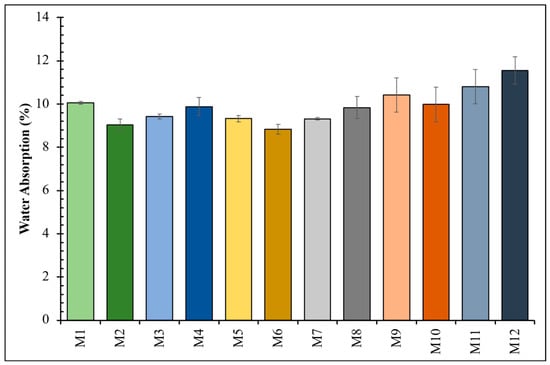
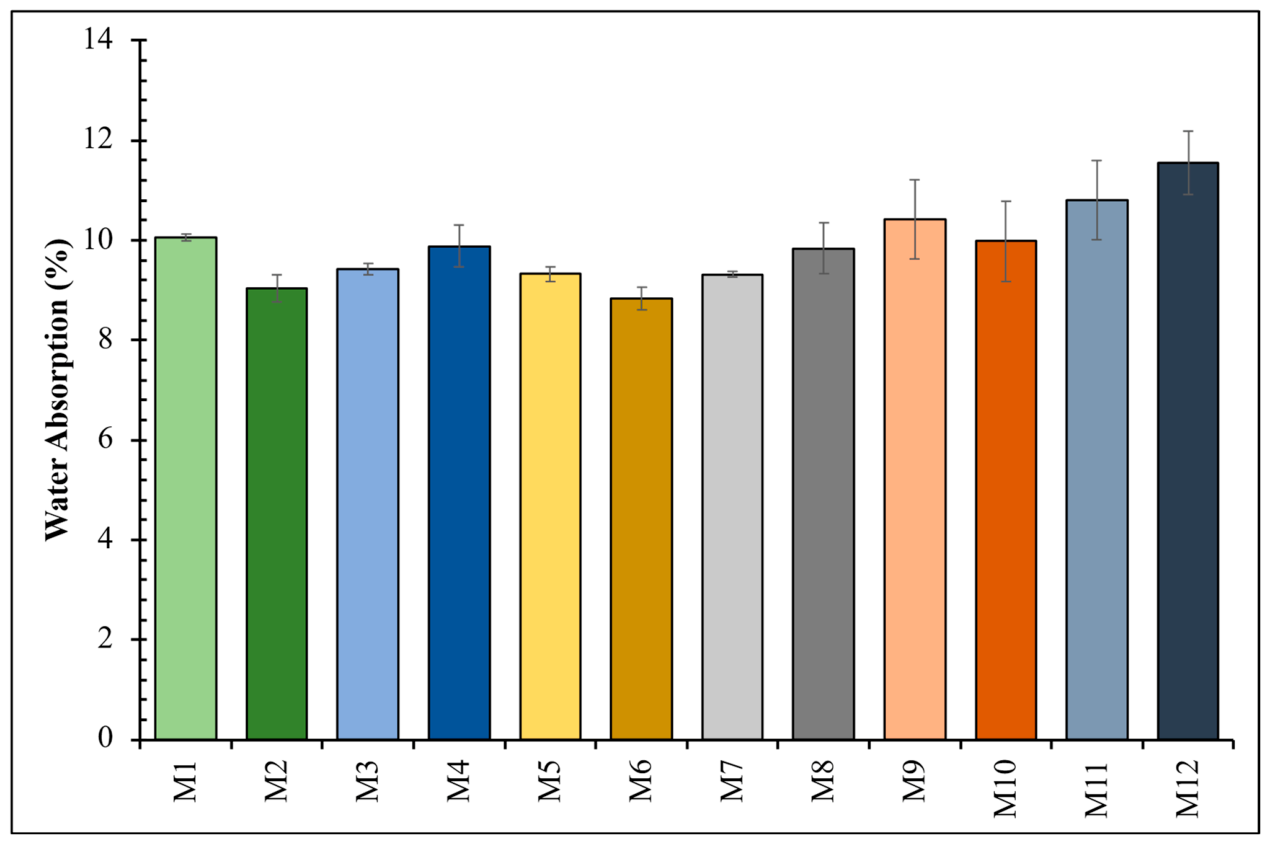
Water absorption is an important indicator of durability because it provides an indirect measure of the void content and the ability of a material to resist the penetration of water and other harmful substances [1]. In general, lower water absorption indicates better durability, while higher absorption suggests a more permeable and less durable matrix. Figure 9 presents the 28-day water absorption results for all 12 mixtures. The reference mixture, M1, had a water absorption of 10.05%.
Figure 9.
Water absorption of all geopolymer mixtures with varying proportions of WFS and PP fiber.
For the mixtures without PP fiber (M1, M5, and M9), the effect of WFS was not consistent. At 25% WFS, water absorption decreased slightly to 9.32%, representing a 7.2% reduction compared with M1. However, increasing the WFS content to 50% increased water absorption to 10.41%, which was 3.5% higher than M1. Similar variations have been reported in previous studies [69,70]. Huseien et al. (2019) [69] evaluated the effect of incorporating WFS in GGBFS–fly-ash-based alkali-activated materials and observed that water absorption decreased at 25% WFS replacement and then increased up to 100%. This can be attributed to the filling effect of WFS; however, a huge incorporation of WFS may lead to inefficient gradation fine aggregate in the matrix, resulting in higher water absorption. Contrary to this, some researchers reported the opposite trends, increase in the water absorption even at smaller replacement levels. Doğan-Sağlamtimur (2018) [71], for example, investigated a WFS-based geopolymer and reported a 1.5–2.9% increase in water absorption at 15% WFS replacement compared with a mixture without WFS. The increase was attributed to the higher water demand and residual binder coatings on the WFS particles, which can contribute to greater porosity in the matrix.
PP fiber showed a more consistent effect on water absorption. At 1% fiber content, water absorption decreased in all three WFS replacement levels by 10.1%, 5.3%, and 4.1%, respectively, compared with corresponding fiber-free mixtures. This reduction became smaller at 2% fiber and eventually reversed at 3% fiber. The change was most noticeable in the 50% replaced WFS series, where water absorption increased by 10.85% at 3% fiber compared with M9. Mohamed and Zuaiter (2024) [54] reported a similar trend in fiber-reinforced geopolymer composites, suggesting that fiber contents beyond an optimum level can negatively affect material performance. Liu et al. (2025) [55] attributed this behavior to fiber clumping at higher fiber contents, which prevents the fibers from being distributed uniformly throughout the mixture and can introduce additional voids into the matrix. At lower fiber contents, the fibers can help bridge micro-voids and limit shrinkage cracking, which may explain the reduction in water absorption observed at 1% fiber. However, as the fiber content increases, clumping and the resulting voids can outweigh these benefits, leading to higher water absorption at 3% fiber.
3.7. Modulus of Elasticity
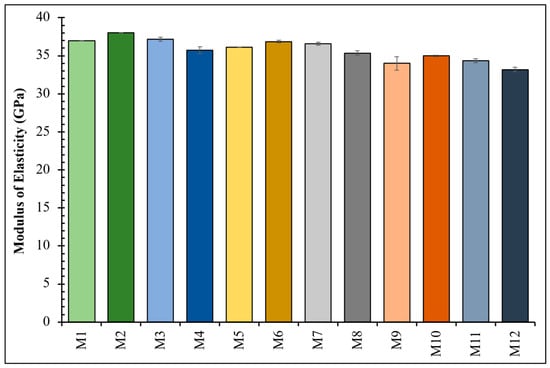
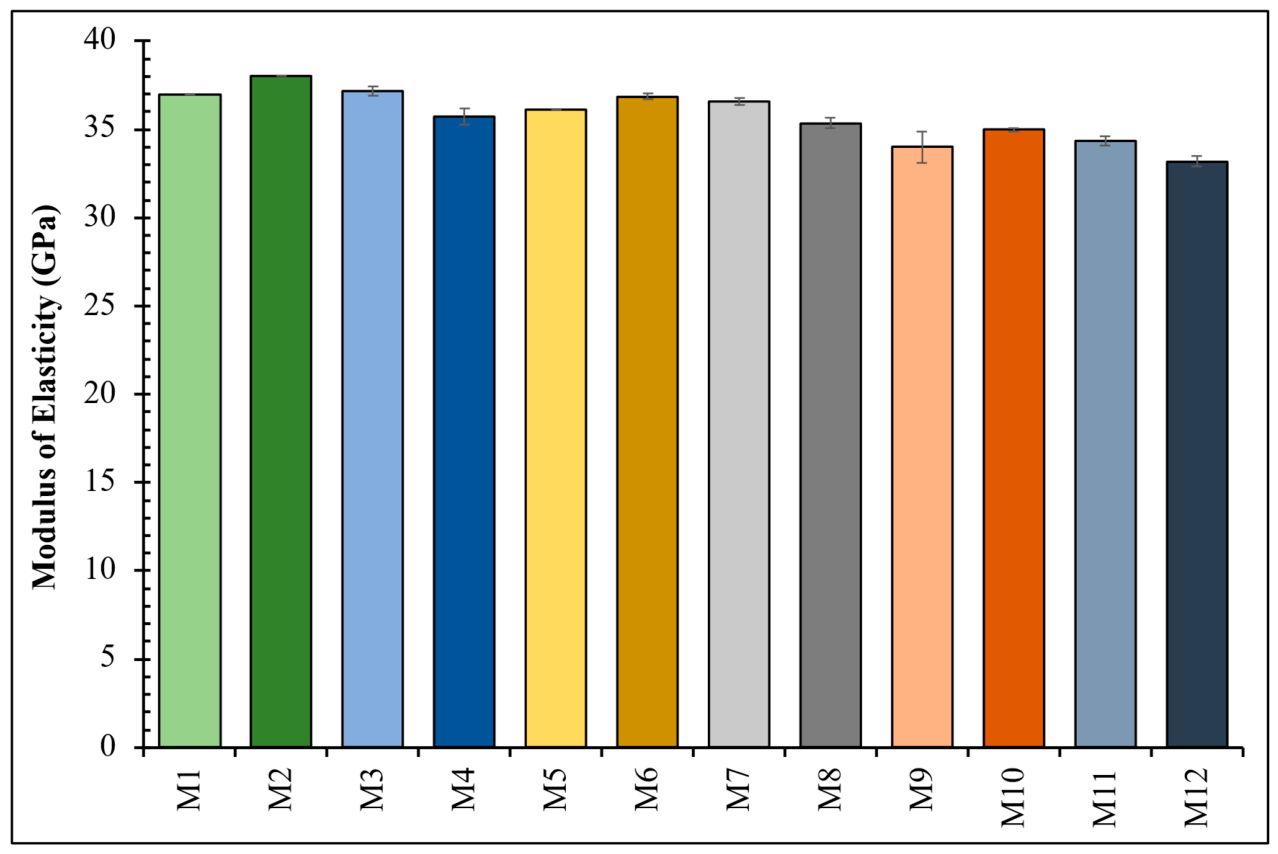
The modulus of elasticity measures how stiff a material is under load, and it was tested in this research using a resonant frequency method. Figure 10 presents the 28-day modulus of elasticity for all 12 mixtures. The reference mixture, M1, had a modulus of 37.0 GPa. Overall, the modulus values were relatively close across the mixtures, ranging from 33.2 GPa for M12 to 38.0 GPa for M2. This range was considerably smaller than the variations observed in compressive and flexural strength. The small variation can be explained by the nearly constant bulk density of the mixtures, since WFS replaced river sand by volume and has a similar specific gravity (Table 2), and by the fact that the dynamic modulus is determined at very small strain. The dynamic modulus therefore reflects the stiffness of the bulk matrix and aggregate rather than the weak interfacial zones that control compressive strength. The PP fibers (E ≈ 6.5 GPa) are also less stiff than the mortar and were used at low volume, so the effect of the fibers on modulus was within ±3.5%.
Figure 10.
Modulus of elasticity of all geopolymer mixtures with varying proportions of WFS and PP fiber.
For the mixtures without PP fiber (M1, M5, and M9), increasing the WFS content resulted in a gradual reduction in the modulus of elasticity. Compared with M1, the modulus decreased by 2.4% at 25% WFS and by 8.1% at 50% WFS. A similar reduction was reported by Monosi et al. (2010) [72] for concrete containing foundry sand, where the modulus of elasticity was 20–30% lower than that of mixtures containing natural sand. The authors attributed this reduction to the higher porosity that develops around foundry sand particles compared with natural aggregate, which can reduce the overall stiffness of the matrix.
PP fiber had a relatively small effect on the modulus of elasticity. The modulus generally increased at 1% fiber content but then decreased as the fiber content increased further, falling below the corresponding fiber-free mixtures at 3% fiber. At 1% fiber, the modulus increased by 2.7%, 2.1%, and 2.9% for the FS0, FS25, and FS50 series, respectively. By 3% fiber, it dropped below the fiber-free baseline in every series, by 3.5%, 2.0%, and 2.4%. Mohamed and Zuaiter (2024) [54] cite similar results from other researchers, where adding 1% PP or basalt fiber to geopolymer concrete raised the modulus of elasticity from 27.4 GPa without fiber to 32 GPa and above with fiber, since fibers can help fill small internal voids and improve compaction at low content. At higher fiber content, this benefit is lost. As discussed for compressive strength, too much fiber tends to clump together rather than spread evenly through the mix, which adds porosity and works against the stiffening effect seen at lower dosages.
3.8. Comparison with Previous Studies and Contribution of This Study
Previous studies on WFS in geopolymers, which did not include fibers, reported performance gains that depended on the binder and the replacement level. Bhardwaj and Kumar (2018) [19] reported an increase of about 43% in compressive strength at 60% WFS in geopolymer concrete, and Salim and Moro (2025) [21] reported gains of 1–10% at 25% WFS in a GGBFS–cenosphere mortar. In contrast, WFS reduced the compressive strength of the slag-only mortar in the present study by 43.6% at 25% WFS and 46.0% at 50% WFS, showing that the effect of WFS cannot be transferred directly from one binder system to another. The addition of PP fibers, in turn, increased the flexural strength but reduced the compressive strength at higher dosages, in agreement with the fiber-related studies discussed in Section 3.2 and Section 3.3.
The combined design added the following findings: (i) the WFS-induced strength loss was non-linear, with most of the loss at 25% WFS and no significant further loss up to 50% WFS; (ii) the strength reduction caused by PP fibers was minor at 1% and significant at 2–3%, and was smaller in the presence of WFS (significant WFS × fiber interaction); (iii) WFS accounted for about 90% and PP fiber for about 8% of the 28-day compressive strength variance (Table 4), identifying WFS as the dominant factor; and (iv) the opposite effects of the two components on different properties show that no single mixture is optimal for all properties, thus supporting application-based mix selection (Section 4).
4. Recommendations
Based on the findings of this study, the following recommendations are made for practitioners and future research:
For applications where compressive strength and matrix density are important, lower WFS contents (0–25%; 25% WFS still reached about 56 MPa at 28 days) with up to 1% PP fiber by binder mass are recommended. Higher WFS and fiber contents tend to reduce compressive strength, UPV, electrical resistivity, and modulus of elasticity. When crack resistance and toughness are more important, such as in overlays, repair mortars, or elements exposed to impact and restrained shrinkage, 2% PP fiber by binder mass is recommended. This dosage provided the highest flexural strength across all WFS levels. It also improved the failure behavior compared with unreinforced mortar. Based on the obtained results of this study, no single mixture can be prescribed as a best mixture that has performed best in all trades, so mix selection will therefore be governed by the intended application.
SEM, XRD, and porosity measurements were not performed, so the interfacial mechanisms proposed in Section 3.2, Section 3.4, and Section 3.7 remain to be verified. In addition, the loss on ignition of the slag was not determined. Furthermore, the WFS and river sand were not gradation-matched, so the effects of material type and gradation could not be fully separated. Future work should include a WFS regraded to match the river sand gradation.
Future research should be centered on the microstructural characterization, using scanning electron microscopy (SEM) and X-ray diffraction (XRD), to better understand the governing mechanism proposed for the property changes observed with the WFS and PP incorporation. The PP fiber dosage should be investigated more closely between 1% and 2% to identify the optimum content. The results suggest that the optimum flexural strength and modulus of elasticity may occur within this range. The effect of PP fiber on workability should also be considered, as increasing fiber content tends to reduce workability. The setting time of the slag-only mixtures and the use of retarders such as starch and borax should also be investigated. The long-term durability characteristics should also be examined under intensively aggressive environmental conditions such as sulfate attack, freeze–thaw cycling, chloride ingress, etc. Additionally, life-cycle assessment and cost analysis of GGBFS-based geopolymer mortar with WFS and PP fiber can help pave the way for the practical applications of this material by quantifying the environmental and cost benefits.
5. Conclusions
Based on the experimental results obtained after accessing the effects of WFS replacement and PP fiber on the fresh and mechanical properties, and durability indicators of GGBFS-based geopolymer mortar, the following conclusions can be drawn:
- Incorporating WFS in the GGBFS-based geopolymer resulted in a slight reduction of flowability (e.g., 4.0% and 5.4% at 25% and 50% WFS, respectively) as compared to the reference mixture. However, PP fiber portrayed a stronger effect, reducing flowability by up to 49% at 3% (by binder mass) fiber content.
- A decline in the compressive strength was observed with increasing contents of WFS and PP fibers. Unlike flowability, WFS had a stronger impact on the compressive strength, resulting in a 46% reduction at 28 days at 50% WFS (43.6% at 25% WFS). Meanwhile, at the same age, PP fiber led to a 25% decline at 3% dosage.
- Flexural strength showed a deviated trend from compressive strength, as WFS replacement reduced flexural strength and PP fiber addition considerably increased flexural strength. The peak improvement in flexural strength was observed at 2% fiber dosage (by binder mass), which led to a 21.6% increase as compared to fiber-free mixtures. This significant phenomenon highlights the crack-bridging effect of PP fibers.
- A clear difference was observed in the failure pattern of the specimens subjected to flexural strength loading. The PP fiber-reinforced specimens remained connected even after the failure, unlike unreinforced specimens, which split into two pieces in flexure and fragmented in compression.
- Ultrasonic pulse velocity decreased with increasing WFS content and increasing PP fiber content, consistent with the trends observed for compressive strength.
- Electrical resistivity followed the same pattern as compressive strength, decreasing with both WFS and PP fiber content, with reductions of up to 30% and 36.4%, respectively, at 28 days.
- Water absorption showed a less consistent trend. WFS produced a small decrease at 25% replacement, followed by an increase at 50%, while PP fiber reduced water absorption at 1% before this benefit reversed into an increase at 3%.
- Modulus of elasticity decreased with increasing WFS content, by up to 8.1% at 50% WFS, while PP fiber produced a small increase at 1% fiber before falling below the fiber-free baseline at 3%.
Overall, these results demonstrate that WFS and PP fiber can each be incorporated into GGBFS-based geopolymer mortar to support waste valorization and improved crack resistance, respectively, but their combined use involves clear trade-offs between compressive strength-related properties and flexural, crack-control performance. This provides a basis for selecting WFS and PP fiber dosages according to the mechanical and durability demands of a given application, supporting the development of more sustainable and circular mortar systems.
Author Contributions
Conceptualization, M.S.A. and M.U.S.; methodology, M.S.A., N.A.K., F.A.M., A.D., and M.U.S.; validation, M.S.A., N.A.K., F.A.M., and A.D.; formal analysis, M.S.A., F.A.M., and A.D.; investigation, M.S.A., N.A.K., F.A.M., A.D., and M.U.S.; resources, M.S.A., N.A.K., F.A.M., A.D., and M.U.S.; data curation, N.A.K., A.D., and M.U.S.; writing—original draft, M.S.A.; writing—review and editing, N.A.K., A.D., and M.U.S.; visualization, M.S.A., N.A.K., F.A.M., A.D., and M.U.S.; supervision, N.A.K., A.D., and M.U.S.; project administration, F.A.M. and M.U.S. All authors have read and agreed to the published version of the manuscript.
Funding
This research received no external funding.
Data Availability Statement
Data is contained within the article.
Acknowledgments
The authors utilized AI-based tools only to enhance the clarity, language, and readability of the manuscript.
Conflicts of Interest
The authors declare no conflicts of interest.
References
- Qu, Z.; Liu, Z.; Si, R.; Zhang, Y. Effect of various fly ash and ground granulated blast furnace slag content on concrete properties: Experiments and modelling. Materials 2022, 15, 3016. [Google Scholar] [CrossRef] [Scilit]
- Chen, W.; Hong, J.; Xu, C. Pollutants generated by cement production in China, their impacts, and the potential for environmental improvement. J. Clean. Prod. 2015, 103, 61–69. [Google Scholar] [CrossRef] [Scilit]
- Andrew, R.M. Global CO2 emissions from cement production, 1928–2018. Earth Syst. Sci. Data 2019, 11, 1675–1710. [Google Scholar] [CrossRef] [Scilit]
- Bhardwaj, B.; Kumar, P. Waste foundry sand in concrete: A review. Constr. Build. Mater. 2017, 156, 661–674. [Google Scholar] [CrossRef] [Scilit]
- Davidovits, J. Geopolymers: Inorganic polymeric new materials. J. Therm. Anal. Calorim. 1991, 37, 1633–1656. [Google Scholar] [CrossRef] [Scilit]
- Salim, M.U.; Moro, C. Towards sustainable construction: Performance evaluation of slag-cenosphere geopolymers under different NaOH concentrations. J. Build. Eng. 2024, 91, 109605. [Google Scholar] [CrossRef] [Scilit]
- Ngayakamo, B.H.; Ikotun, B.D. Geopolymer concrete for sustainable construction exploring materials properties challenges and future prospects. Discov. Concr. Cem. 2026, 2, 46. [Google Scholar] [CrossRef] [Scilit]
- Bellum, R.R.; Muniraj, K.; Madduru, S.R.C. Exploration of mechanical and durability characteristics of fly ash-GGBFS based green geopolymer concrete. SN Appl. Sci. 2020, 2, 919. [Google Scholar] [CrossRef] [Scilit]
- Ngo, S.-H.; Nguyen, N.-T.; Nguyen, X.-H. Assessing the effect of GGBFS content on mechanical and durability properties of high-strength mortars. Civ. Eng. J. 2022, 8, 938–950. [Google Scholar] [CrossRef] [Scilit]
- Wasim, M.; Ngo, T.D.; Law, D. A state-of-the-art review on the durability of geopolymer concrete for sustainable structures and infrastructure. Constr. Build. Mater. 2021, 291, 123381. [Google Scholar] [CrossRef] [Scilit]
- Thunuguntla, C.S.; Rao, T.G. Effect of mix design parameters on mechanical and durability properties of alkali activated slag concrete. Constr. Build. Mater. 2018, 193, 173–188. [Google Scholar] [CrossRef] [Scilit]
- Fu, Y.; Cai, L.; Yonggen, W. Freeze–thaw cycle test and damage mechanics models of alkali-activated slag concrete. Constr. Build. Mater. 2011, 25, 3144–3148. [Google Scholar] [CrossRef] [Scilit]
- Salim, M.U.; Adewale, K.; Abadi, G.G.H.; Moro, C. Long-term performance evaluation of slag-cenosphere geopolymer mortar. Constr. Build. Mater. 2024, 457, 139491. [Google Scholar] [CrossRef] [Scilit]
- Zhang, T.; Shi, X.; Wang, Q.; Peng, W. Comprehensive evaluation of the performance and benefits of SSA–GGBS geopolymer mortar. Materials 2023, 16, 4137. [Google Scholar] [CrossRef] [Scilit]
- Mhanna, H.H.; Hawileh, R.A.; Abdalla, J.A.; Ayman, A.; Moussa, A.; Mahdi, B.E.D.; Kuwatly, Y. Mechanical properties and durability of GGBS based geopolymer mortar. Mater. Today Proc. 2023. [Google Scholar] [CrossRef] [Scilit]
- Lashkari, S.; Yazdipanah, F.; Shahri, M.; Sarker, P. Mechanical and durability assessment of cement-based and alkali-activated coating mortars in an aggressive marine environment. SN Appl. Sci. 2021, 3, 618. [Google Scholar] [CrossRef] [Scilit]
- Agency, U.S.E.P. Beneficial Uses of Spent Foundry Sands. 2026. Available online: https://www.epa.gov/smm/beneficial-uses-spent-foundry-sands (accessed on 11 August 2026).
- García, G.; Cabrera, R.; Rolón, J.; Pichardo, R.; Thomas, C. Systematic review on the use of waste foundry sand as a partial replacement of natural sand in concrete. Constr. Build. Mater. 2024, 430, 136460. [Google Scholar] [CrossRef] [Scilit]
- Bhardwaj, B.; Kumar, P. Effect of waste foundry sand addition on strength, permeability and microstructure of ambient cured geopolymer concrete. In Proceedings of the IOP Conference Series: Materials Science and Engineering; IOP Publishing: Bristol, UK, 2018; p. 092009. [Google Scholar]
- Danish, A.; Torres, A.S. Performance assessment of reclaimed fly ash–slag geopolymers incorporating waste spent garnet and waste foundry sand under different curing regimes. Environ. Res. 2025, 122738. [Google Scholar] [CrossRef] [Scilit]
- Salim, M.U.; Moro, C. Promoting circularity in cenosphere geopolymer binders through waste spent garnet. Constr. Build. Mater. 2025, 495, 143716. [Google Scholar] [CrossRef] [Scilit]
- Sabour, M.R.; Derhamjani, G.; Akbari, M. Mechanical, durability properties, and environmental assessment of geopolymer mortars containing waste foundry sand. Environ. Sci. Pollut. Res. 2022, 29, 24322–24333. [Google Scholar] [CrossRef] [Scilit]
- Feijoo, B.; Tobón, J.I.; Restrepo-Baena, O. Substitution of aggregates by waste foundry sand: Effects on physical properties of mortars. Mater. Constr. 2021, 71, e251. [Google Scholar] [CrossRef] [Scilit]
- Wang, C.; Chen, P.; Xu, Y.; Zhang, L.; Luo, Y.; Li, J.; Wang, Y. Investigation on the utilization of spent waterglass foundry sand into Ca (OH) 2-activated slag materials considering the coating layer of dried waterglass. Constr. Build. Mater. 2022, 329, 127180. [Google Scholar] [CrossRef] [Scilit]
- Salim, P.M.; Prasad, B. Strength Parameters of Paver Blocks By Incorporating Used Foundry Sand. A Period. J. 2019, 9, 4705–4711. [Google Scholar] [CrossRef] [Scilit]
- Qin, L.; Yan, J.; Zhou, M.; Liu, H.; Wang, A.; Zhang, W.; Duan, P.; Zhang, Z. Mechanical properties and durability of fiber reinforced geopolymer composites: A review on recent progress. Eng. Rep. 2023, 5, e12708. [Google Scholar] [CrossRef] [Scilit]
- Fallah, S.; Nematzadeh, M. Mechanical properties and durability of high-strength concrete containing macro-polymeric and polypropylene fibers with nano-silica and silica fume. Constr. Build. Mater. 2017, 132, 170–187. [Google Scholar] [CrossRef] [Scilit]
- Selvarani, B.; Prabhavathy, R.A. Ecofriendly polypropylene fibrereinforced concrete using foundry sand: Experimental investigation. Res. Dev. Eng. Res. 2023, 67. [Google Scholar] [CrossRef] [Scilit]
- Prasad, V.D.; Prakash, E.L.; Abishek, M.; Dev, K.U.; Kiran, C.S. Study on concrete containing waste foundry sand, fly ash and polypropylene fibre using Taguchi method. Mater. Today Proc. 2018, 5, 23964–23973. [Google Scholar] [CrossRef] [Scilit]
- Şenol, A.F.; Çalışkan, Ö. High-temperature mechanical performance and microstructural insights of polypropylene fiber-reinforced fly ash–slag geopolymer mortars. Next Mater. 2026, 13, 102737. [Google Scholar] [CrossRef] [Scilit]
- Cemalgil, S.; Gülmez, N.; Yön, M.Ş.; Karataş, M. Enhancing the mechanical and durability properties of fly ash/GGBS-based geopolymer mortars using dunite and polypropylene fibers. Struct. Concr. 2026, 27, 4543–4566. [Google Scholar] [CrossRef] [Scilit]
- Danish, A.; Torres, A.S. Upcycling reclaimed fly ash and waste tire crumb rubber through geopolymerization: Synthesis, characterization, and cost analysis. Waste Manag. 2026, 209, 115182. [Google Scholar] [CrossRef] [Scilit]
- Salim, M.U.; Moro, C. Microstructural insights of geopolymer mortar containing cenosphere: Effects on fresh properties and durability. Mater. Struct. 2025, 58, 101. [Google Scholar] [CrossRef] [Scilit]
- ASTM C1437; Standard Test Method for Flow of Hydraulic Cement Mortar. ASTM: West Conshohocken, PA, USA, 2007.
- ASTM C348-21; Standard Test Method for Flexural Strength of Hydraulic-Cement Mortars. ASTM: West Conshohocken, PA, USA, 2021.
- ASTM C349-18; Standard Test Method for Compressive Strength of Hydraulic-Cement Mortars (Using Portions of Prisms Broken in Flexure). ASTM: West Conshohocken, PA, USA, 2018.
- ASTM C597; Standard Test Method for Ultrasonic Pulse Velocity Through Concrete. ASTM: West Conshohocken, PA, USA, 2008.
- ASTM C215; Standard Test Method for Fundamental Transverse, Longitudinal, and Torsional Resonant Frequencies of Concrete Specimens. ASTM: West Conshohocken, PA, USA, 2008; p. 50.
- Hua, C.-Y.; Tsai, C.-J.; Shyu, W.-S.; Fazeldehkordi, L. Investigating the impact of foundry by-product sand as an activator on workability improvement and strength development in alkali-activated blast furnace slag mortar. Results Mater. 2024, 24, 100632. [Google Scholar] [CrossRef] [Scilit]
- Del Angel, G.G.; Aghajanian, A.; Cabrera, R.; Tamayo, P.; Sainz-Aja, J.A.; Thomas, C. Influence of partial and total replacement of used foundry sand in self-compacting concrete. Appl. Sci. 2022, 13, 409. [Google Scholar] [CrossRef] [Scilit]
- Kashapaga, L.S.; Srinivas, T.; Reddy, T.H. Studies of polypropylene fibres’ effect on strength and workability of slag based geopolymer concrete. In Proceedings of the E3S Web of Conferences; EDP Sciences: Les Ulis, France, 2023. [Google Scholar]
- Li, Y.; Maimait, A.; Cheng, J.; Duan, Y.; Chen, Y.; Dong, H. Properties of fiber-reinforced geopolymer mortar using coal gangue and aeolian sand. Materials 2024, 17, 3225. [Google Scholar] [CrossRef] [Scilit]
- Afriansya, R.; Anisa, E.A.; Astuti, P.; Cahyati, M.D. Effect of polypropylene fiber on workability and strength of fly ash-based geopolymer mortar. In Proceedings of the E3S Web of Conferences; EDP Sciences: Les Ulis, France, 2023. [Google Scholar]
- John, S.K.; Cascardi, A.; Nandana, M.; Kurian, F.; Fathima, N.A.; Arif, M.M.; Nadir, Y. Innovative Retarders for Controlling the Setting Characteristics of Fly Ash-Slag Geopolymers. Eng 2025, 6, 366. [Google Scholar] [CrossRef] [Scilit]
- Li, P.; Chen, D.; Jia, Z.; Li, Y.; Li, S.; Yu, B. Effects of borax, sucrose, and citric acid on the setting time and mechanical properties of alkali-activated slag. Materials 2023, 16, 3010. [Google Scholar] [CrossRef] [Scilit]
- Aziz, I.H.; Abdullah, M.M.A.B.; Salleh, M.M.; Azimi, E.A.; Chaiprapa, J.; Sandu, A.V. Strength development of solely ground granulated blast furnace slag geopolymers. Constr. Build. Mater. 2020, 250, 118720. [Google Scholar] [CrossRef] [Scilit]
- Bilal, H.; Yaqub, M.; Rehman, S.K.U.; Abid, M.; Alyousef, R.; Alabduljabbar, H.; Aslam, F. Performance of foundry sand concrete under ambient and elevated temperatures. Materials 2019, 12, 2645. [Google Scholar] [CrossRef] [Scilit]
- Shettima, A.U.; Hussin, M.W.; Ahmad, Y.; Mirza, J. Evaluation of iron ore tailings as replacement for fine aggregate in concrete. Constr. Build. Mater. 2016, 120, 72–79. [Google Scholar] [CrossRef] [Scilit]
- Yellishetty, M.; Karpe, V.; Reddy, E.; Subhash, K.; Ranjith, P.G. Reuse of iron ore mineral wastes in civil engineering constructions: A case study. Resour. Conserv. Recycl. 2008, 52, 1283–1289. [Google Scholar] [CrossRef] [Scilit]
- Xu, Q.; Liu, S.; Qian, J.; Xu, R.; Ma, W. Effects of three different types of fibers and dosage on the properties of alkali-activated copper slag–slag cementitious materials. Sci. Rep. 2025, 15, 26438. [Google Scholar] [CrossRef] [Scilit]
- Mirgozar Langaroudi, M.A.; Mohtasham Moein, M.; Saradar, A.; Karakouzian, M. Investigation of the mechanical properties and durability of fiber-reinforced geopolymer mortars containing metakaolin and glass powder. Infrastructures 2025, 10, 25. [Google Scholar] [CrossRef] [Scilit]
- Chindaprasirt, P.; Boonbamrung, T.; Poolsong, A.; Kroehong, W. Effect of elevated temperature on polypropylene fiber reinforced alkali-activated high calcium fly ash paste. Case Stud. Constr. Mater. 2021, 15, e00554. [Google Scholar] [CrossRef] [Scilit]
- Xu, Y.; Chen, H.; Wang, P. Effect of polypropylene fiber on properties of alkali-activated slag mortar. Adv. Civ. Eng. 2020, 2020, 4752841. [Google Scholar] [CrossRef] [Scilit]
- Mohamed, O.; Zuaiter, H. Fresh properties, strength, and durability of fiber-reinforced geopolymer and conventional concrete: A review. Polymers 2024, 16, 141. [Google Scholar] [CrossRef] [Scilit]
- Liu, S.; Zhang, L.; Hou, N.; Meng, W. Enhancing the Mechanical and Rheological Properties of Coal-Based Geopolymer Grouting Materials with Nano-SiO2 and Polypropylene Fibers. Polymers 2025, 17, 3338. [Google Scholar] [CrossRef] [Scilit]
- Li, L.; Sun, H.-X.; Zhang, Y.; Yu, B. Surface cracking and fractal characteristics of bending fractured polypropylene fiber-reinforced geopolymer mortar. Fractal Fract. 2021, 5, 142. [Google Scholar] [CrossRef] [Scilit]
- Adediran, A.; Yliniemi, J.; Illikainen, M. Development of sustainable alkali-activated mortars using Fe-rich fayalitic slag as the sole solid precursor. Front. Built Environ. 2021, 7, 653466. [Google Scholar] [CrossRef] [Scilit]
- Omer, S.A.; Demirboga, R.; Khushefati, W.H. Relationship between compressive strength and UPV of GGBFS based geopolymer mortars exposed to elevated temperatures. Constr. Build. Mater. 2015, 94, 189–195. [Google Scholar] [CrossRef] [Scilit]
- Ghosh, R.; Sagar, S.P.; Kumar, A.; Gupta, S.K.; Kumar, S. Estimation of geopolymer concrete strength from ultrasonic pulse velocity (UPV) using high power pulser. J. Build. Eng. 2018, 16, 39–44. [Google Scholar] [CrossRef] [Scilit]
- Khatib, J.; Baig, S.; Bougara, A.; Booth, C. Foundry sand utilisation in concrete production. In Proceedings of the Second International Conference on Sustainable Construction Materials and Technologies, Ancona, Italy, 28–30 June 2010. [Google Scholar]
- Griño, A.A., Jr.; Soriano, H.S.P.; Promentilla, M.A.B.; Ongpeng, J.M.C. Exploring the potential of polypropylene fibers and bacterial co-culture in repairing and strengthening geopolymer-based construction materials. Buildings 2023, 13, 2668. [Google Scholar] [CrossRef] [Scilit]
- Masoud, L.; Hammoud, A.; Mortada, Y.; Masad, E. Rheological, mechanical, and microscopic properties of polypropylene fiber reinforced-geopolymer concrete for additive manufacturing. Constr. Build. Mater. 2024, 438, 137069. [Google Scholar] [CrossRef] [Scilit]
- Bhutta, A.; Farooq, M.; Banthia, N. Performance characteristics of micro fiber-reinforced geopolymer mortars for repair. Constr. Build. Mater. 2019, 215, 605–612. [Google Scholar] [CrossRef] [Scilit]
- Sangiorgi, C.; Tataranni, P.; Simone, A.; Vignali, V.; Lantieri, C.; Dondi, G. Waste bleaching clays as fillers in hot bituminous mixtures. Constr. Build. Mater. 2014, 73, 320–325. [Google Scholar] [CrossRef] [Scilit]
- Coppio, G.J.; de Lima, M.G.; Lencioni, J.W.; Cividanes, L.S.; Dyer, P.P.; Silva, S.A. Surface electrical resistivity and compressive strength of concrete with the use of waste foundry sand as aggregate. Constr. Build. Mater. 2019, 212, 514–521. [Google Scholar] [CrossRef] [Scilit]
- Ganesh Prabhu, G.; Bang, J.W.; Lee, B.J.; Hyun, J.H.; Kim, Y.Y. Mechanical and durability properties of concrete made with used foundry sand as fine aggregate. Adv. Mater. Sci. Eng. 2015, 2015, 161753. [Google Scholar] [CrossRef] [Scilit]
- Hanif Khan, M.; Zhu, H.; Ali Sikandar, M.; Zamin, B.; Ahmad, M.; Muayad Sabri Sabri, M. Effects of various mineral admixtures and fibrillated polypropylene fibers on the properties of engineered cementitious composite (ECC) based mortars. Materials 2022, 15, 2880. [Google Scholar] [CrossRef] [Scilit]
- Liu, Y.; Wang, L.; Cao, K.; Sun, L. Review on the durability of polypropylene fibre-reinforced concrete. Adv. Civ. Eng. 2021, 2021, 6652077. [Google Scholar] [CrossRef] [Scilit]
- Huseien, G.F.; Sam, A.R.M.; Shah, K.W.; Budiea, A.; Mirza, J. Utilizing spend garnets as sand replacement in alkali-activated mortars containing fly ash and GBFS. Constr. Build. Mater. 2019, 225, 132–145. [Google Scholar] [CrossRef] [Scilit]
- Muttashar, H.L.; Ariffin, M.A.M.; Hussein, M.N.; Hussin, M.W.; Ishaq, S.B. Self-compacting geopolymer concrete with spend garnet as sand replacement. J. Build. Eng. 2018, 15, 85–94. [Google Scholar] [CrossRef] [Scilit]
- Doğan-Sağlamtimur, N. Waste foundry sand usage for building material production: A first geopolymer record in material reuse. Adv. Civ. Eng. 2018, 2018, 1927135. [Google Scholar] [CrossRef] [Scilit]
- Monosi, S.; Sani, D.; Tittarelli, F. Used foundry sand in cement mortars and concrete production. Open Waste Manag. J. 2010, 3, 18–25. [Google Scholar] [CrossRef] [Scilit]

Disclaimer/Publisher’s Note: The statements, opinions and data contained in all publications are solely those of the individual author(s) and contributor(s) and not of MDPI and/or the editor(s). MDPI and/or the editor(s) disclaim responsibility for any injury to people or property resulting from any ideas, methods, instructions or products referred to in the content. |
© 2026 by the authors. Licensee MDPI, Basel, Switzerland. This article is an open access article distributed under the terms and conditions of the Creative Commons Attribution (CC BY) license.