


Abstract
Safe and inclusive construction workplaces require more than conventional hazard control; they also depend on suitable welfare provision, personal protective equipment (PPE), reporting arrangements, and gender-responsive working conditions. This study examines women engineers’ occupational-safety experiences in Iraq’s construction sector through site exposure, welfare and privacy conditions, PPE suitability, gendered workplace interactions, reporting climate, and perceptions of digital and AI-enabled support. A survey-based design combining quantitative items with open-ended responses was used with 215 valid responses from women engineers in construction-related roles. Quantitative analysis included descriptive statistics, reliability analysis, ranked item means, Kruskal–Wallis tests, effect sizes, and Dunn post-hoc comparisons, while open-ended responses were analyzed thematically. Respondents strongly supported sanitary facilities, safe transportation, suitable PPE, contractor obligations, rest areas, managerial training, confidential reporting, women’s participation in safety committees, and anonymous digital reporting. Significant unadjusted differences were found across site-exposure groups for several safety, reporting, gender-related, and improvement dimensions. After adjustment, the associations remained significant for preparedness, safety concern, reporting barriers, and improvement priorities, but not for gender barriers. Open-ended responses emphasized male-dominated workplace culture, weak safety enforcement, welfare and privacy gaps, management practices, and transportation constraints. Digital and AI-enabled reporting options were viewed positively, alongside concerns about privacy, confidentiality, and organizational response. The findings suggest that safer and more inclusive construction workplaces should address site-exposure-sensitive arrangements, gender-responsive safety provisions, trusted reporting mechanisms, and carefully governed digital support.
1. Introduction
Construction remains a high-risk work environment because of changing site conditions, work at height, heavy equipment, subcontracting, and complex interactions among workers and organizations. Accordingly, construction-safety research has traditionally emphasized hazard control, PPE, training, compliance, and accident prevention. However, these approaches do not fully explain how organizational practices, job roles, reporting climates, and gendered workplace conditions shape employees’ safety experiences. Construction-safety risk is also shaped by interacting human, site, social, economic, regulatory, ergonomic, and organizational factors, reinforcing the need to look beyond physical hazards alone [1].
The Iraqi construction industry provides an important context in which to examine these issues. Construction safety is a continuous managerial and institutional problem, as revealed by repeated studies conducted in Iraq. Buniya et al. [2] reported that there is limited safety research and weak safety performance in the Iraqi construction industry, while Qaddoori and Breesam [3] found that the most influential factors affecting safe-ty performance are management practices, PPE, first aid and medical care, and contractor safety programs. More general project-performance issues, such as inadequate planning, insufficient resource allocation, shortage of skilled labor, low labor productivity and fluctuating economic conditions, can also have an impact on the organization of the sites, their supervision and enforcement capacity [4]. Similarly, Alomari et al. [5], examining engineers in Iraq’s construction-related oil and gas sector, found generally good basic safety understanding but weaker understanding of risk-management and planning tools, indicating continuing gaps between safety awareness and formal risk-management practice.
The construction industry remains predominantly male despite increasing efforts to diversify its workforce. Earlier discussions frequently focused on recruitment and numerical representation. Yet, more recent research shows that representation alone is insufficient. Factors that continue to shape women’s participation and retention include workplace cultures, informal networks, mentoring practices, long hours, harassment, discrimination, and recurring expectations that women prove their professional competence [6,7,8,9]. From a construction-workplace inclusion perspective, the issue is therefore not only whether women enter the sector, but whether working arrangements allow them to participate safely, equitably, and sustainably [10]. These conditions can affect access to information, confidence in reporting, comfort during site visits, and willingness to undertake field-based work.
Women engineers occupy a distinct spot within this organizational setting. Women engineers in construction-related roles may work across design, supervision, laboratory testing, project follow-up, consulting, inspection, and project administration, with differing levels of direct site involvement. They are therefore exposed to risks primarily in their work with construction sites. Some women engineers work almost exclusively in offices, others visit sites on an occasional basis, regular or almost daily. This variation is important because it relates to the physical hazards, mobility restrictions, welfare issues, privacy issues, PPE issues and gendered interactions that engineers face when working on a site. Thus, a role-based approach is required to differentiate between the office-based construction, site-based construction, and fluid construction roles [11].
Women engineers’ construction-safety experiences cannot be reduced to conventional hazard control. The PPE sizing for males may not be appropriate for females, resulting in decreased comfort and protection [12,13].
Other factors that can impact safe and dignified site operations for women include inadequate sanitation, no private waiting or rest facilities, distance to the project, and un-safe transportation [14,15].
For women engineers these issues can also be considered as occupational-safety conditions as they affect exposure, participation, comfort and professional performance. As for reporting climate, women may be reluctant to report unsafe situations, inappropriate behavior, privacy issues, or concerns related to welfare in male-dominated construction work environments if they think they will get no response, be blamed, embarrassed, or that their identity will be exposed. Safety communication research indicates that women may occupy different positions within safety-information networks, which can affect both access to safety information and whose concerns are heard [16]. Digital and AI-enabled technologies may offer additional sup-port through mobile reporting, dashboards, anonymous channels, and AI-assisted com-plaint-pattern detection. However, such systems depend on privacy protection, institutional readiness, and trust [17,18].
Despite growing literature on women in construction, several gaps remain. Few studies have examined how occupational-safety perceptions among women engineers vary according to their actual level of site exposure. Welfare, privacy, mobility, and PPE suitability are not always integrated within the same occupational-safety assessment. AI-enabled reporting also remains relatively underexamined as a potential safety-support mechanism for sensitive workplace concerns. Finally, although Iraq-based studies have examined safety programs, PPE knowledge, safety-performance factors, project performance, and BIM-based safety support, women engineers’ occupational safety has not been directly examined through the combined lenses of site exposure, welfare conditions, re-porting climate, gendered barriers, and AI-enabled support.
From a construction-workplace perspective, these conditions extend beyond physical hazard control. Site-visit arrangements, welfare provision, suitable PPE, reporting channels, managerial response, and digital support form part of the working environment through which women engineers experience safety and participation in construction work. A workplace may satisfy conventional safety requirements while still creating barriers to safe and equitable participation if facilities, PPE, transportation, reporting mechanisms, or site routines do not account for women engineers’ needs. These conditions should therefore be considered as connected components of a safe and inclusive construction workplace rather than as secondary diversity issues.
Site exposure was treated as the main analytical grouping variable because women engineers’ contact with construction-site conditions ranges from office-only work to occasional, frequent, and almost daily site involvement. To address the identified gaps, this study examines occupational-safety concerns among women engineers in Iraq’s construction sector through site hazards, PPE suitability, welfare and privacy conditions, reporting climate, gendered professional barriers, digital and AI-enabled safety support, and improvement priorities. It also examines whether these perceptions differ by site-exposure level. The study contributes by examining variation within women engineers according to actual site exposure, treating welfare, privacy, mobility, and PPE suitability as gender-responsive construction-safety conditions, and assessing digital and AI-enabled reporting as potential support for concerns that may remain underreported through conventional channels.
These dimensions were underlined because they cover separate but related aspects of women engineers’ construction-safety experience. Site exposure measures the extent of contact with construction-site conditions and can be used to compare office based, occasional, frequent and site-based work. Gender-responsive working conditions reflect welfare, privacy, mobility, suitability of PPE, reporting and professional interactions that impact the safe participation of women but are not adequately addressed through traditional hazard-control approaches. Digital safety reporting was explored given that there might be safety concerns that are underreported using traditional methods and that digital tools such as anonymous reporting, mobile apps, dashboards, and AI-based complaint analysis could offer new avenues for reporting and identifying patterns. These dimensions are combined in one occupational-safety framework that includes physical exposure, workplace conditions and reporting support.
Accordingly, the study addresses the following research questions:
- RQ1. What occupational-safety, welfare and mobility, PPE, reporting, and gen-der-related concerns are reported by women engineers in Iraq’s construction sector?
- RQ2. Do these perceptions differ according to women engineers’ level of site expo-sure?
- RQ3. Which organizational improvement priorities and digital or AI-enabled safe-ty-support options receive the strongest support from respondents?
The paper is structured in the following manner: The literature review is presented in Section 2, covering women engineers, gender responsive working conditions, reporting, and digital safety support. The research design, questionnaire, sample, and analytical procedures are explained in Section 3. The quantitative and open-ended findings are presented in Section 4. The results, practical implications, limitations, and directions for future research are discussed in Section 5. The conclusions are presented in Section 6.
2. Literature Review
2.1. Women Engineers: Gendered Barriers, Inclusion, and Site Exposure
In spite of the push for inclusion and diversification of the workforce in the construction sector, it remains one of the most gender-segregated professional environments [6,7,10]. Previous research tended to assume that participation was a recruitment or representation issue among women. Deeper examination and extensive research revealed that the issue is not the level of difficulty, it is women’s experience in and actual retention in workplaces that are male-dominated by informal networks, long hours, and expectations of competence and availability [7,9]. These conditions impact mentoring, succession, professional status and opportunities for gaining field experience. Recent evidence similarly identifies exclusionary workplace practices, limited mentoring and networking opportunities, and work–life constraints as persistent barriers to women’s progression and retention in construction [19]. From a workplace-inclusion perspective, this distinction matters because numerical representation and workplace inclusion are not the same. Diversity initiatives may have limited effect if recruitment increases while working arrangements, field access, mentoring, welfare provision, reporting systems, and managerial response remain unchanged. Organizational research distinguishes diversity from inclusion, while construction-specific research similarly emphasizes initiatives that support women’s participation beyond recruitment alone [10,20].
These gendered conditions are directly related to occupational safety. In construction, safety is typically tackled through aspects of physical hazards, PPE, training, compliance, and accident prevention. But women’s experiences about their safety are also determined by whether they are accepted as legitimate professionals on site, whether their concerns are heeded, and whether they can raise concerns about discomfort, risk, or inappropriate behavior without resulting reputation damage [12,15]. Recent evidence from South African female engineers similarly shows that professional identity and belonging are negotiated within organizational cultures shaped by gendered norms of competence, legitimacy, and inclusion [21]. Gender-specific safety research in construction likewise shows that women’s occupational risks are shaped by both physical hazards and the broader psychosocial and organizational conditions of construction work [22]. Mariam et al. [23] showed that research on women’s health and safety in construction remains comparatively underdeveloped, with major themes including psychological health, occupational injuries, gender inclusivity and sexism, and gender-specific safety analysis.
Abdelwahed and Soomro [24] examined occupational safety among female engineers in Egypt and identified work environment, personal protection, safety training, knowledge of safety regulations, and safety commitment as relevant factors. Less attention, however, has been given to how women engineers’ safety perceptions vary according to actual site exposure, welfare conditions, reporting climate, privacy, and digital reporting support. Afful et al. [11] made distinctions between on-site, offsite and fluid roles for women in construction. This distinction is helpful when considering the focus of the present study, which was on site exposure, not job title.
2.2. Welfare, PPE, Privacy, and Reporting as Safety and Inclusion Conditions
Site exposure is important as it is during site visits that many concerns relating to the engineer’s role as a woman arise, not in the normal office setting. The results of the Desai & D’Souza [14] indicate that women professionals working at a construction site encounter problems in relation to long working hours, the locations of the projects, the lack of flexibility in working hours, sanitary facilities, and access to clean restrooms. They can seem logistical but for women engineers they can make the difference between work that is safe, dignified and manageable or not. Similarly, Pamidimukkala and Kermanshachi [12] highlight the importance of providing sanitary facilities, providing appropriate PPE, implementing flexible workplace culture, providing role models and gender-specific safety training as a way of improving the health and safety of women in construction. PPE suitability is a good example of how seemingly neutral safety systems may not meet women’s needs. PPE is assumed to provide the protection and comfort when provided, but fit, design and usability have an impact on protection and comfort. The local relevance of PPE is also evident in Iraq, where Abdulla [25] identified continuing issues related to PPE knowledge, attitudes, and use among construction workers in Erbil.
Lack of properly fitted PPE is a recurring occupational barrier for women in construction [12]. Aytac et al. [13] link this issue to male-centered design assumptions, ergonomic strain, psychosocial stressors, and gender-blind safety systems. PPE should therefore be understood not only as equipment, but as a gender-sensitive safety condition that affects mobility, confidence, professionalism, and protection.
Welfare and privacy conditions should also be treated as part of occupational safety rather than secondary workplace conveniences. Women’s ability to conduct site visits or remain at project locations may be constrained by the absence of suitable toilets, private rest or waiting areas, secure changing spaces, and reliable transportation. Pokhrel et al. [15] note that many construction sites lack gender-sensitive amenities. In developing-country contexts, remote or temporary project locations may further increase concerns related to safe transport, waiting time, privacy, and return travel.
Reporting climate links these conditions to institutional response. In male-dominated workplaces, reporting may be complicated by fear of being ignored, blamed, misunderstood, or judged as unable to cope with construction conditions. From an organizational-behavior perspective, safety reporting can also be understood as a context-specific form of employee voice. Research on inclusive leadership indicates that psychological safety is an important mechanism through which employees become more willing to express workplace concerns [26]. Evidence from other male-dominated occupations also indicates that masculinity norms can be associated with safety priority, safety violations, and the reporting of safety oversights [27].
In mixed-gender construction crews, Allison and Kaminsky [16] identified that women had less incoming communication and longer information stream than men, meaning that safety information might not be disseminated equally. Reporting is particularly sensitive where welfare, privacy or concerns relating to harassment, discrimination, inappropriate comments or gender specific discomfort are reported.
Such concerns may remain hidden in conventional safety records if women avoid reporting due to reputational harm, weak response, or identity exposure [15,28]. Recent construction research also shows that reluctance to disclose workplace concerns may be reinforced by fear, stigma, possible repercussions, and mistrust in organizational response, highlighting the importance of protected reporting mechanisms in creating safer workplaces [29].
2.3. Digital and AI-Enabled Reporting for Safer Construction Workplaces
Digital technologies, including mobile applications, reporting platforms, dashboards, and AI-supported systems, are increasingly used to support workplace communication, monitoring, and decision-making. Anonymous reporting systems, mobile safety applications, digital dashboards, and AI-assisted complaint analysis can help document repeated problems, identify patterns, and assist management in prioritizing corrective action. Recent Iraq-based research also highlights the potential of digital construction technologies to strengthen safety monitoring and risk management, while identifying implementation constraints related to infrastructure, regulation, and resources [30].
This is important when women do not speak out about inappropriate facilities, unsafe transport, lack of privacy, harassment, PPE issues, and poor site arrangements, via traditional channels. Digital systems and AI-based systems, however, also pose governance challenges. While Wu et al. [17] emphasize stakeholder acceptance and adoption conditions for emerging construction technologies, Köchling and Wehner [31] show that algorithmic decision-making can introduce risks of unfair treatment, implicit discrimination, and perceived unfairness in organizational settings. AI should therefore be viewed as a potential support for reporting and analysis rather than as a substitute for reporting systems, managerial response, or organizational accountability. Recent construction-safety research similarly shows that AI-enabled applications can support more responsive safety practices, but their implementation remains dependent on organizational readiness, system reliability, data quality, and responsible governance [32].
Recent evidence from employees in the GCC and Lebanon further shows that comfort with AI-driven workplace decision-making is closely associated with perceived benefits and trust in AI systems. This reinforces the importance of transparency, human oversight, and responsible implementation when digital or AI-enabled reporting mechanisms are introduced in organizations [18].
Evidence from Iraq remains especially limited. The present study responds to these gaps by examining women engineers in Iraq’s construction sector through site exposure, welfare and privacy conditions, reporting climate, gendered barriers, and digital or AI-enabled support.
2.4. Women’s Professional Position and Workplace Rights in Iraq
Women engineers in Iraq are employed in public institutions, consulting, design, supervision, inspection and construction related activities. The workplace arrangements, mobility, site access, privacy, appropriate PPE, reporting mechanism, and workplace culture of male-dominated environments, however, may affect professional participation. Therefore, in this study, workplace rights are explored practically in terms of women engineers being able to participate safely, professionally, and equitably in construction work, in line with the broader literature on women’s inclusion in and occupational safety in construction [10,12,15].
2.5. Characteristics of the Iraqi Construction Sector
The Iraqi construction sector continues to face safety and project-management challenges. Previous studies have reported weaknesses in safety performance, management practices, PPE provision, planning, resource allocation, and workforce productivity [2,3,4,25]. More recent Iraqi research also identifies opportunities for digital technologies to support construction-safety monitoring, although infrastructure, regulatory, and resource constraints remain [30]. The conditions frame the local context of the study of women engineers’ site exposure, working conditions and safety-reporting needs.
3. Materials and Methods
3.1. Research Design and Sample
This study used a survey-based design combining quantitative items with open-ended responses to examine occupational-safety perceptions among women engineers in Iraq’s construction sector. The quantitative component measured perceptions of site safety, PPE suitability, welfare and privacy conditions, reporting climate, gendered professional barriers, digital and AI-enabled safety support, and improvement priorities. The qualitative component captured additional explanations and examples through open-ended responses.
Data were collected from February to April 2026. The Arabic questionnaire was distributed electronically through professional and organizational contacts, including contacts in public and private engineering firms and offices, who shared the survey with women engineers professionally connected to construction-related work. The participation was voluntary, and the respondents were asked to contribute using their own professional experience.
A total of 258 responses were received. Some questionnaires were incomplete because completion of each of the items was not technically required by the electronic form. The incomplete responses were excluded, resulting in 215 completed questionnaires for final analysis. The survey platform was designed so that only one response could be sent per person, so no duplicate responses were accepted. All 215 retained records contained complete responses for the substantive questionnaire items used to con-struct the study outcomes. Six respondents did not report region; therefore, 209 complete cases were analyzed for the adjusted analyses.
The sampling method used was non-probabilistic because there were no exhaustive national lists of women engineers eligible to participate in construction-related occupations. Because the questionnaire was distributed through organizational and professional contacts, the exact number of eligible women who received the survey invitation was unknown and a conventional response rate could not be calculated. The relatively high representation of respondents from the southern governorates and government departments should therefore be considered when interpreting the findings. The results describe the participating women engineers and should not be assumed to represent all women engineers working in Iraq.
The inclusion of office-only, occasional, weekly/high-frequency, and site-based respondents was intentional because the study aimed to examine variation across levels of construction-site exposure rather than restrict the sample to engineers working permanently on site. Eligibility was determined by the questionnaire profile information which confirmed engineering background and involvement in construction related work.
3.2. Questionnaire and Variables Examined
The questionnaire was developed based on previous literature on women in construction, occupational safety, site welfare, PPE suitability, reporting climate, gendered workplace barriers, and digital support for safety. Before full distribution, the questionnaire was pilot tested with eight participants to assess item clarity, wording, and suitability for the study context. Minor wording adjustments were made where needed before the final questionnaire was distributed. Content coverage was not the result of a separate formal expert-panel content-validation exercise; rather, it was determined in reference to the literature and by means of the pilot content-assessment with the eight participants in terms of clarity, wording, and contextual suitability. To facilitate understanding and reduce possible confusion over technical and sensitive items, the questionnaire was prepared in Arabic. Closed-ended Likert-type items and open-ended questions were included in the survey. The five-point scales were used for closed-ended questions to indicate levels of agreement or perceived importance, and open-ended questions were provided to elicit further concerns, challenges, and recommendations from the respondents. The questionnaire included questions about demographic and career characteristics, types of work performed, site exposure, working conditions and safety risks, PPE, reporting climate, gender barriers in the workplace, digital and AI-enabled safety support, and workplace improvement priorities. A full mapping of items-to-construct and literature is given in Supplementary Table S2. The original Arabic questionnaire administered to participants and its English translation are also provided as Supplementary Materials. The English version was compared to the Arabic wording to ensure that the Arabic meaning of the items was maintained.
Since the primary analytical grouping variable was site exposure, respondents were categorized according to frequency of site-visiting reported. Exposure groups included: office only/no site visits, occasional exposure (defined as visits only when needed or 1–2 times per month), weekly/high-frequency exposure (defined as 1–2 site visits per week or 3 or more per week), and site-based exposure (defined as almost daily site work). Occupational safety, PPE barriers, welfare/mobility barriers, reporting barriers, gender barriers, Digital and AI-Enabled Safety Support, and improvement priorities were thematically grouped into question items for each of the constructs. Where conceptually appropriate, construct scores were calculated by averaging related items. Constructs with low reliability were interpreted cautiously and were supported by item-level results rather than relying on the composite score alone. The two items of the Exposure Risk measure were therefore used as an exploratory index and interpreted alongside the results for each individual item, and not as a strong latent or aggregated measure.
3.3. Data Analysis
Data analysis was conducted in R-4.4.3. Descriptive statistics summarized respondent characteristics using frequencies and percentages. Reliability analysis was conducted for multi-item constructs using Cronbach’s alpha. Item-level means, standard deviations, and agreement or importance percentages were calculated for the main questionnaire items. Agreement percentages were calculated as the percentage selecting 4 or 5 on the agreement scale, while importance percentages were calculated as the percentage selecting “important” or “very important.” Statistical significance was assessed at p < 0.05.
Differences across site-exposure groups were examined using the Kruskal–Wallis test because the variables were based on Likert-type responses and the comparison involved more than two independent groups. Effect size was reported using epsilon-squared (ε2) to indicate the magnitude of between-group differences. Epsilon-squared was calculated as ε2 = H/(N − 1), where H is the Kruskal–Wallis statistic and N is the total sample size. For constructs showing significant Kruskal–Wallis results, Dunn’s post-hoc tests were conducted with Benjamini–Hochberg adjustment to identify which site-exposure groups differed. For the nine omnibus comparisons, Benja-mini-Hochberg adjusted p-values were calculated as a sensitivity check for multiplicity and are presented in addition to the unadjusted p-values in Section 4. The overall pattern of statistically significant results was not changed by the adjustment. Full post-hoc results are reported in Supplementary Table S1. Because several constructs were examined, omnibus results were interpreted together with effect sizes, post-hoc comparisons, and the consistency of the observed patterns rather than on p-values alone.
A hybrid thematic coding approach was used in the analysis of open-ended responses. Of the 215 respondents, 191 gave at least one substantive response that could be thematically coded; responses were not coded if participants indicated no substantive issue across all three open-ended questions. Initial coding categories were based on the questionnaire domains and literature, and further or overlapping themes emerged upon review of the responses. One respondent may be assigned to more than one theme. Any uncertainties or difference in classifications were discussed until an agreement could be reached. Given that the open-ended questions were incorporated to support the survey results and were not a separately sampled qualitative study therefore thematic saturation was not utilized as a recruitment or stopping criterion. The qualitative results were used to provide context for and compare with the quantitative results where the same concerns emerged in both components.
Since site exposure was the primary analytical grouping variable, the demographic and professional make-up of the four exposure groups were also analyzed by age, professional experience, engineering discipline, organization type, and region. Exact contingency-table tests were applied where the assumptions for Pearson’s chi-square test were not valid due to sparse cells, and Cramér’s V was reported as an association measure. These characteristics varied by exposure group, and adjusted sensitivity analyses were performed on the principal outcomes. The main predictor was site-exposure group, adjusting for age, experience, engineering discipline, organization type and region. Discipline was coded as civil versus other; organization was coded as government versus non-government; and region was coded as southern versus non-southern. Heteroskedasticity-robust standard errors were used.
4. Results
4.1. Respondent Profile and Construct Patterns
Table 1 summarizes the respondent profile and site-exposure distribution. A total of 215 valid responses from women engineers were included in the analysis. The largest age group was 25–34 years (n = 94, 43.7%), followed by 35–44 years (n = 68, 31.6%). Most respondents held a bachelor’s degree (n = 130, 60.5%), while 34.0% held a master’s degree and 5.6% held a PhD. Civil engineering was the dominant discipline (n = 133, 61.9%). Most respondents worked in government departments (n = 127, 59.1%), followed by universities or educational institutions and contracting companies. Geographically, most responses came from the southern governorates and Baghdad. Site exposure varied across the sample. Half of the respondents reported occasional or monthly site visits (n = 109, 50.7%), while 44 respondents (20.5%) reported office-only work or no site visits. A further 40 respondents (18.6%) were site-based or almost daily exposed to construction sites, and 22 respondents (10.2%) reported weekly or high-frequency site visits. This distribution supports the use of site exposure as a central grouping variable.
Table 1.
Respondent profile of women engineers in Iraq (N = 215).
Reliability analysis revealed strong internal consistency for improvement priorities, gender barriers, and Digital and AI-Enabled Safety Support. Reliability coefficients and descriptive statistics of construct-level are shown in Table 2. Acceptable reliability was observed for reporting of barriers and the preparedness for work-site safety. Safety Concern, PPE Barriers, and Welfare/Mobility Barriers demonstrated marginal internal consistency; the two-item Exposure Risk index demonstrated low internal consistency and thus was interpreted with caution with respect to the results from the individual items. Improvement priorities had the highest construct mean, followed by Digital and AI-Enabled Safety Support. The lowest mean of the constructs was reporting barriers; however, reporting related improvement measures, especially confidential reporting and anonymous reporting, were supported at the item level.
Table 2.
Construct reliability and descriptive statistics.
4.2. Safety Barriers, Workplace Improvement Priorities, and Digital/AI-Enabled Support
The highest-ranked barriers concerned remote-site safety, inappropriate workplace conduct, sanitary facilities, transportation, and PPE suitability (Table 3). Gender-related items also appeared prominently, indicating that respondents’ concerns extended beyond physical hazards to organizational and social conditions affecting site participation.
Table 3.
Ranked safety, welfare, reporting, and gendered barriers (top 15 items).
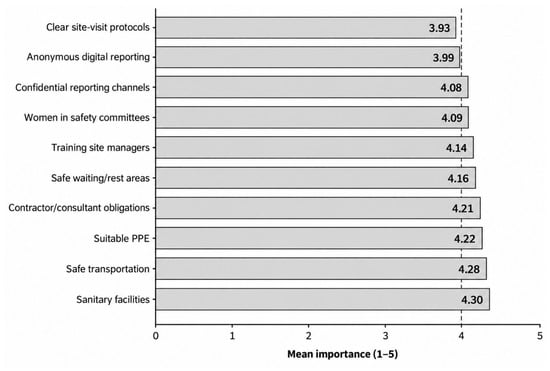
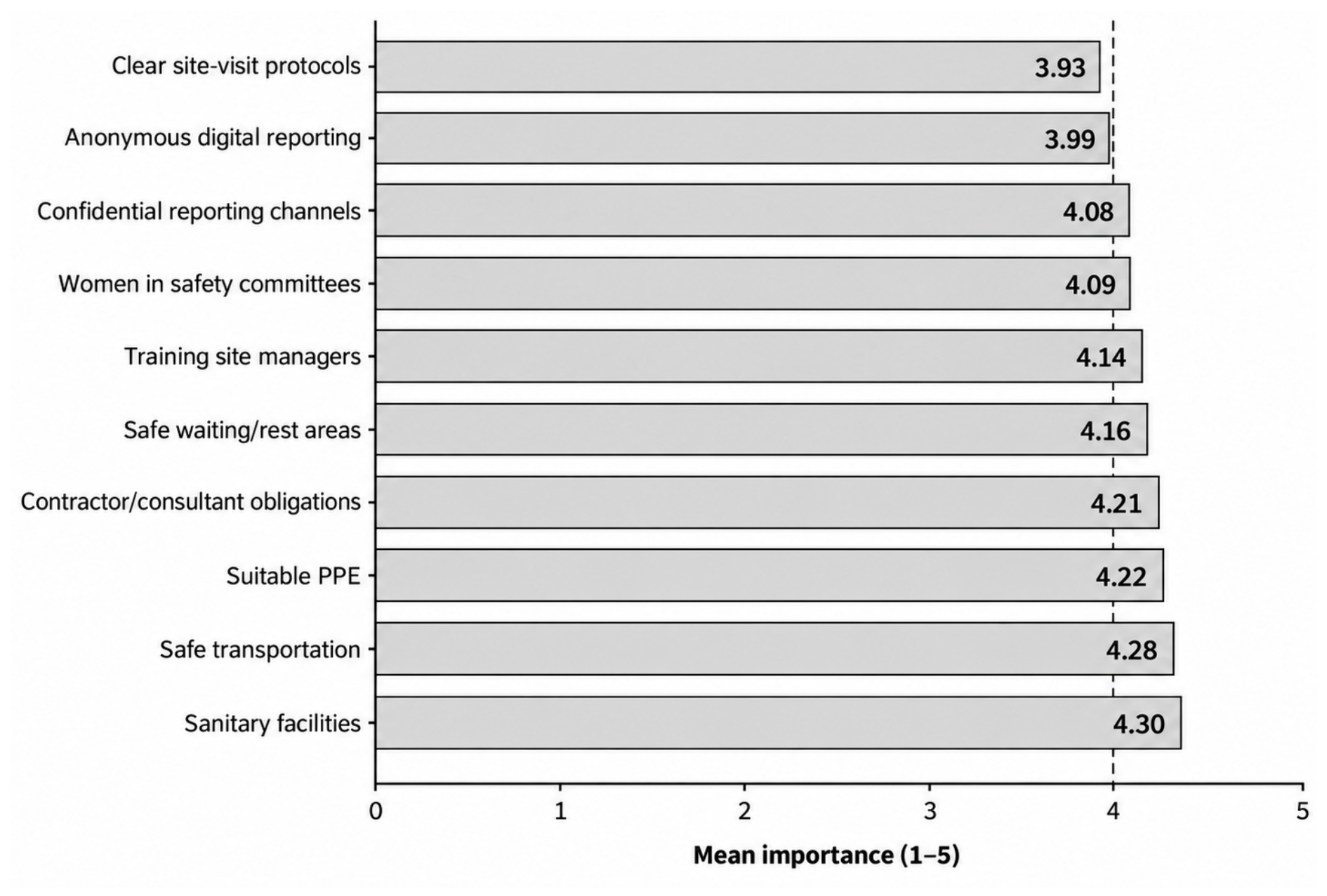
Improvement priorities received consistently high ratings (Table 4; Figure 1). Sanitary facilities, safe transportation, suitable PPE, and contractor obligations received the highest mean scores, while the remaining organizational and reporting measures also received broad support.
Table 4.
Ranked improvement priorities (N = 215).
Figure 1.
Ranked improvement priorities for women engineers’ occupational-safety conditions. Bars show mean importance scores on a five-point scale. The dashed line indicates the “important” threshold of 4.0.
Table 5 summarizes respondents’ perceptions of digital and AI-enabled safety-support options. In general, the participants were positive about the digital safety-support possibilities and of the particular function of the AI-based complaint analysis examined. The highest-rated item concerned mobile safety applications for improving site communication, followed by digital dashboards for prioritizing safety improvements, anonymous digital reporting systems, and AI-based complaint analysis for detecting repeated safety problems. At the same time, respondents expressed privacy-related caution. Nearly half agreed that fear of identity disclosure may deter the use of digital reporting. Thus, the findings indicate generally positive perceptions of digital and AI-enabled safety support, while also showing that respondents’ perceptions were accompanied by concerns about confidentiality, privacy protection, and organizational response. The items reflect varying levels of technology-enabled safety reporting, with AI1, AI2 and AI4 containing items related to digital tools, AI3 related to the explicit use of an analytical function enabled by technology, and AI5 and AI6 related to privacy issues that affect willingness to use digital safety reporting.
Table 5.
Perceptions of digital and AI-enabled safety-support options.
4.3. Differences by Site-Exposure Level
Table 6 compares construct scores across the four site-exposure groups. Significant differences were identified for occupational-safety exposure risk, preparedness, safety concern, reporting barriers, gender barriers, and improvement priorities. No significant differences were found for PPE barriers, welfare/mobility barriers, or Digital and AI-Enabled Safety Support. These findings indicate that site-exposure level was associated with differences in several dimensions of women engineers’ safety perceptions, although the patterns were not uniformly linear across exposure groups.
Table 6.
Site-exposure group comparisons using Kruskal-Wallis tests.
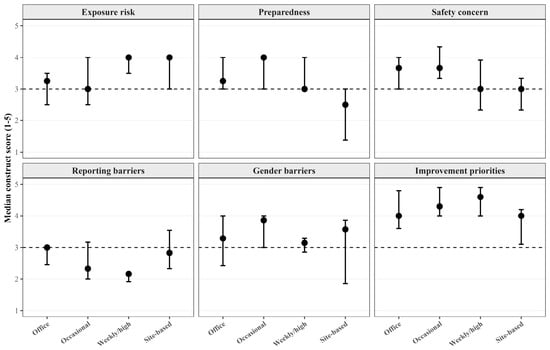
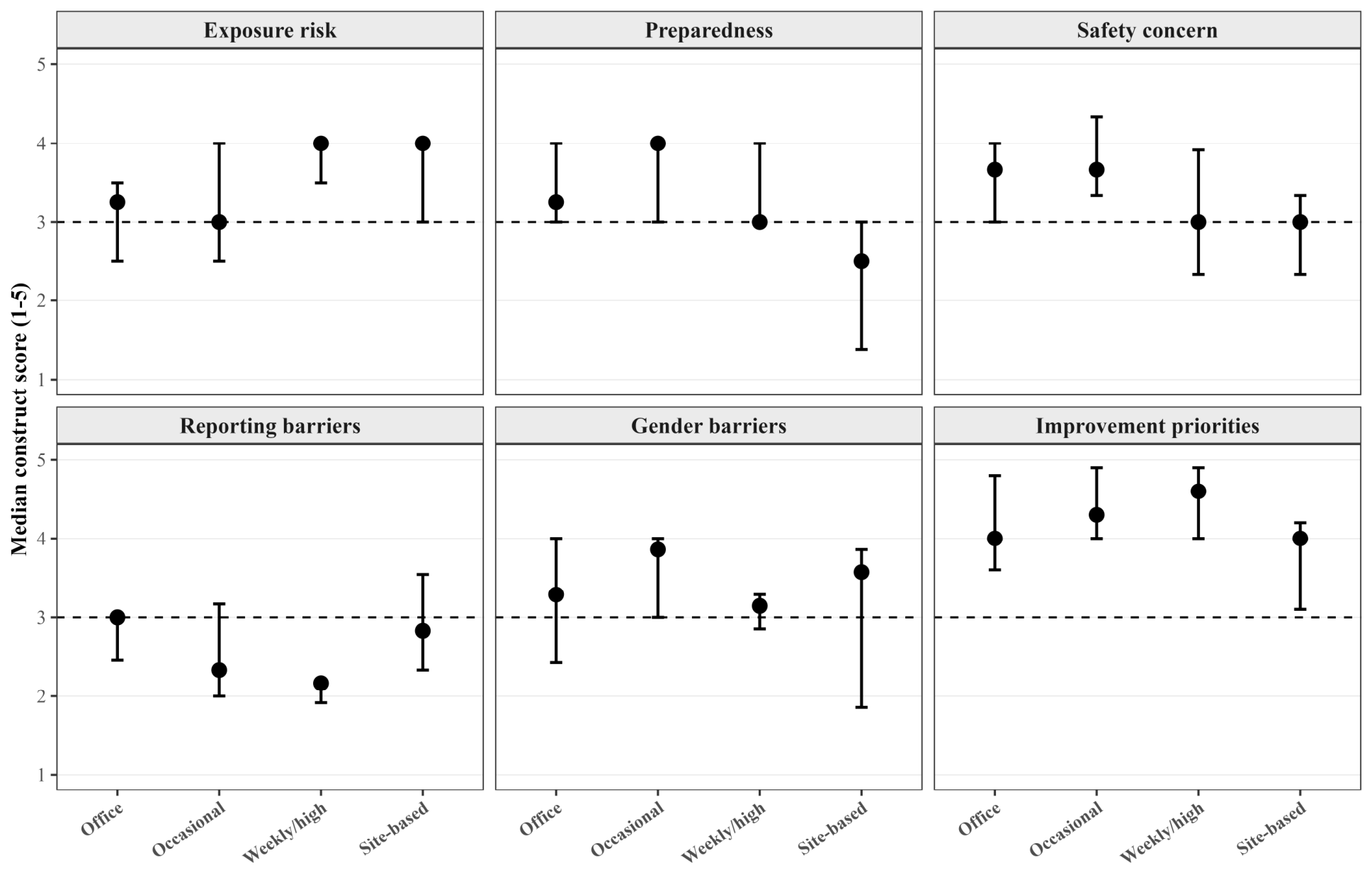
The largest group differences were observed for preparedness, H(3) = 32.967, p < 0.001, ε2 = 0.154, and exposure risk, H(3) = 31.062, p < 0.001, ε2 = 0.145. Exposure-risk scores were highest among the weekly/high-frequency and site-based groups, both with a median of 4.00, compared with medians of 3.25 among office-only respondents and 3.00 among occasional/monthly respondents. The pattern was different in the case of preparedness, the highest median in the case of occasional/monthly respondents (4.00) and the lowest in the case of site-based respondents (2.50). Safety concern was also significantly different, H(3) = 21.260, p < 0.001, ε2 = 0.099; office-only and occasional/monthly group medians scored 3.67 and the weekly/high frequency group and site-based group scored 3.00.
Also, there were differences across site-exposure groups in reporting barriers and improvement priorities. Gender barriers showed a significant overall group difference, H(3) = 9.859, p = 0.020, although the corresponding adjusted pairwise comparisons did not identify a single group contrast that remained statistically significant. PPE barriers, welfare/mobility barriers, and Digital and AI-Enabled Safety Support did not differ significantly across site-exposure groups. The main group patterns are illustrated in Figure 2. The significant group difference for Exposure Risk should be considered with caution due to the low internal consistency for this two-item index (Table 2).
Figure 2.
Median construct scores by site-exposure group for selected constructs showing significant unadjusted between-group differences. The error bars show the interquartile range (Q1–Q3), and the dashed horizontal line is the neutral point of 3.0 on the five-point scale. Given the low internal consistency, caution must be used in interpreting the results of the Exposure Risk index. The Gender Barriers association was not statistically significant in the adjusted sensitivity analysis.
The demographic and professional composition of the four site-exposure groups was not uniform. Significant differences were identified by age, experience, engineering discipline, organization type, and region (all p < 0.001; Supplementary Table S3). Principal outcomes of adjusted sensitivity analyses (N = 209) were therefore assessed, with sensitivity analyses taken into account for these characteristics. The association with site exposure was still statistically significant with preparedness (p = 0.001), safety concern (p < 0.001), reporting barriers (p = 0.006), and improvement priorities (p < 0.001); however, the association with gender barriers was no longer statistically significant (p = 0.224; Supplementary Table S4). The unadjusted omnibus comparison was significant for gender barriers, but this association was not retained in the adjusted sensitivity analysis. The results in this study suggest that a number of the main patterns of site-exposure were still present post-adjustment, and that the relatively low gender-barrier was sensitive to the composition of the respondents.
4.4. Open-Ended Responses
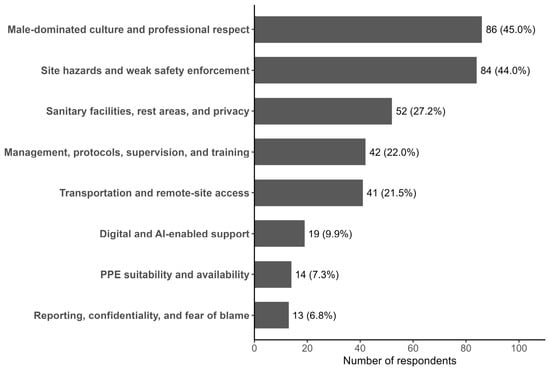
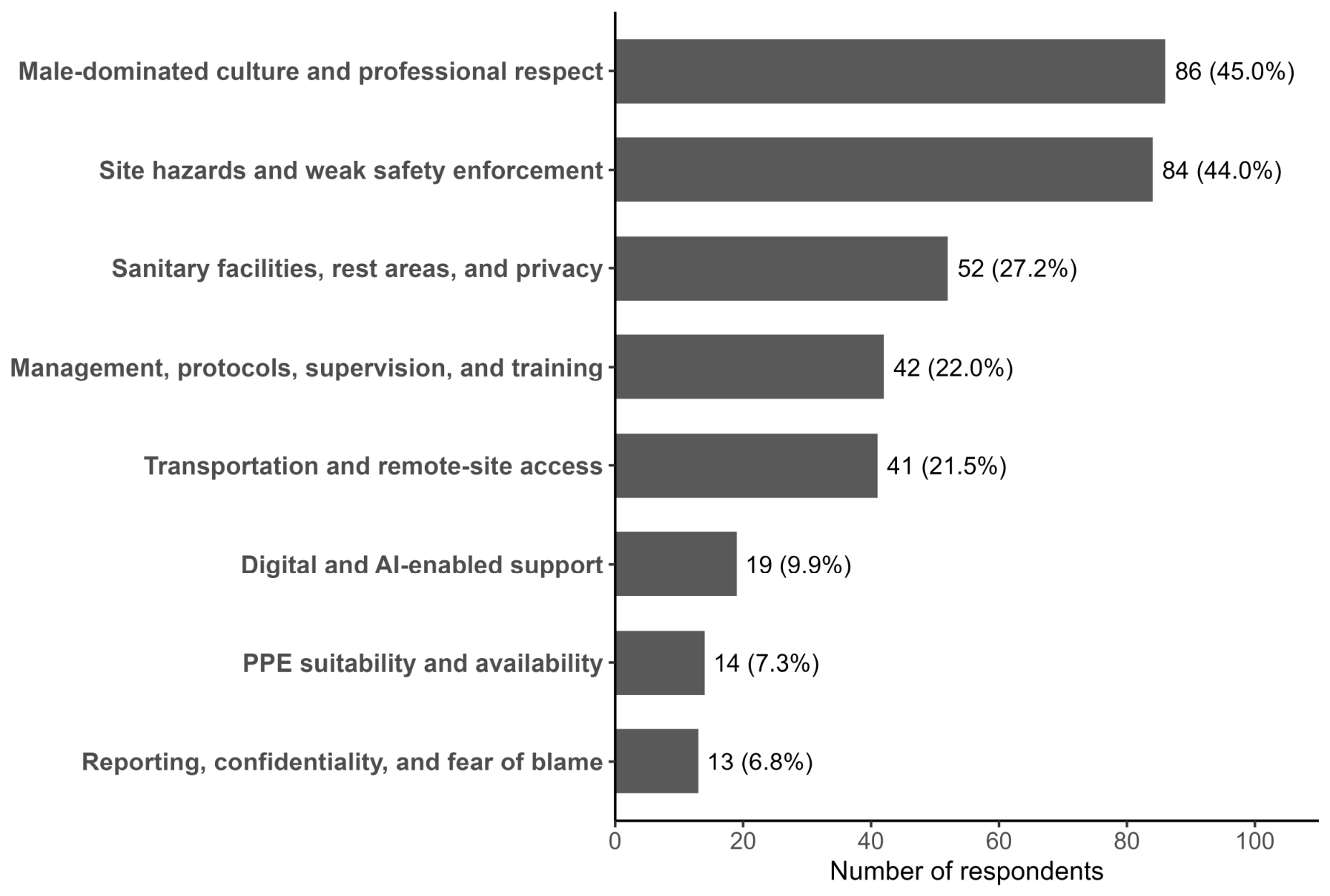
Of the 215 respondents, 191 provided substantive open-ended responses that are suitable for thematic coding. Figure 3 summarizes the themes identified from the open-ended responses. The qualitative findings provided additional context for the quantitative results. The most frequent theme was male-dominated culture and professional respect (n = 86, 45.0%), including concerns about professional recognition, inappropriate conduct, and maintaining professional boundaries in male-dominated work environments. Site safety hazards and weak safety enforcement were almost equally prominent (n = 84, 44.0%), including unsafe work areas, heavy-equipment movement, poor housekeeping, work at height, and inadequate enforcement of safety procedures. Sanitary facilities, rest areas, and privacy formed the third most frequent theme (n = 52, 27.2%), followed by management, protocols, supervision, and training (n = 42, 22.0%) and transportation and remote-site access (n = 41, 21.5%). Less frequent themes included digital and AI-enabled support (n = 19, 9.9%), PPE suitability and availability (n = 14, 7.3%), and reporting channels, confidentiality, and fear of blame (n = 13, 6.8%). Overall, the qualitative responses reinforced the quantitative finding that women engineers’ workplace-safety experiences involve not only physical hazards but also organizational conditions, workplace inclusion, mobility, reporting, and institutional response. These themes were echoed in illustrative anonymous comments. One respondent referred to “working in a male-dominated field environment, where maintaining professional boundaries can sometimes be difficult and attention to safety procedures is weak.” Another respondent highlighted the “unprofessional conduct among work crews and the lack of privacy for women engineers on site.” A third respondent identified “weak safety procedures, lack of suitable facilities, long working hours, and an unorganized work environment” as important concerns. The translations of the quotations are for reporting purposes only.
Figure 3.
Frequency of themes identified from open-ended responses. Several themes were coded for a single respondent; percentages are based on the 191 respondents who gave substantive open-ended responses.
5. Discussion
5.1. Site Exposure and Construction-Safety Support Needs
The findings support treating women engineers as a heterogeneous professional group whose workplace-safety experiences vary according to site exposure and organizational conditions. In this study, site exposure represents a work-context variable that differentiates respondents’ exposure to site routines, safety arrangements, reporting opportunities, and institutional support. Differences across some of the safety, reporting, gender-related, and improvement dimensions were found in relation to site exposure. The Exposure Risk results are considered exploratory due to lower internal consistency. The clearest pattern was observed for exposure risk. Exposure-risk scores were highest among the weekly/high frequency group (median of 4.00) and the site-based group (median of 4.00), whereas office-only respondents had a median score of 3.25. This pattern supports the use of site exposure as a meaningful grouping variable, although the relationship was not strictly linear.
Safety Concern was highest among the occasional/monthly group (median = 3.67) and lowest among the weekly/high-frequency and site-based groups (median = 3.00). One possible explanation is that occasional site visitors may encounter construction-site hazards without being as fully integrated into site routines, access arrangements, or safety procedures as personnel who work on site more continuously. This interpretation should nevertheless be treated cautiously because the study measured perceptions rather than directly observed site conditions.
Preparedness also differed significantly across site-exposure groups. Occasional/monthly respondents had the highest level of preparedness (median = 4.00) and site-based respondents had the lowest level of preparedness (median = 2.50). This finding suggests that frequent or continuous site involvement does not necessarily correspond to stronger perceived preparedness. Institutional arrangements surrounding site work, including training, appropriate PPE, transportation, site protocols, and clear reporting procedures, may therefore be important alongside the frequency of site exposure. The practical implication is not to reduce women engineers’ participation in site work, but to ensure that such participation is appropriately supported and organized. These cross-sectional differences reflect relationships between site-exposure level and reported perceptions and are not interpreted as evidence of the causal effects of site exposure.
Exposure groups also varied in terms of demographics and professions, substantiating that these unadjusted comparisons should not be viewed as being solely attributable to site exposure. However, adjusted sensitivity analyses indicated that the relationships with preparedness, safety concern, and reporting barriers, as well as improvement priorities, remained after the inclusion of age, experience, discipline, organization type, and region. After adjustment, the weaker gender-barrier association was not significant.
5.2. Gender-Responsive Safety and Inclusive Working Conditions
A central finding is the strong support for welfare and mobility measures. Sanitary facilities, safe transportation, suitable PPE, rest areas, contractor obligations, managerial training, and women’s participation in safety committees should not be treated as peripheral workplace conveniences. In this study, they represent gender-responsive components of construction-safety infrastructure because they influence whether women engineers can participate in site work safely, comfortably, and professionally. The findings therefore extend construction safety beyond conventional hazard-control categories to include the working conditions that enable safe and equitable site participation.
The suitability of PPE also needs to be considered. Unsuitable PPE was one of the highest-ranking barriers and suitable PPE was one of the highest ranked improvement priorities. The issue is not merely the availability of PPE but its suitability and usability for women engineers. Poorly fitted PPE may reduce comfort, restrict movement, impair protection, and discourage participation in some site activities.
Gendered professional barriers also emerged strongly in the item-level and qualitative findings, and the gender-barriers construct showed a significant overall difference across site-exposure groups. However, no individual pairwise comparison remained statistically significant after Benjamini–Hochberg adjustment. This suggests that the overall group pattern should be interpreted cautiously rather than attributed to one specific site-exposure contrast. This finding is consistent with Reuben et al. [21], who show that women engineers’ professional identity and sense of belonging are shaped within gendered organizational environments. In the present study, such conditions are also reflected in site participation, professional recognition, and workplace-safety experiences.
5.3. Reporting Climate and Digital/AI-Enabled Safety Support
Reporting climate is a critical component as site issues cannot be resolved if not communicated and acted upon. The lowest overall construct mean was for reporting barriers yet there was a strong rating for confidential reporting and anonymous digital reporting as improvement priorities. This indicates that reporting is not always a consistent challenge for all respondents; however, trusted reporting options are widely seen as essential. Reporting is particularly sensitive where issues relate to privacy, inappropriate behavior, welfare facilities, transport and/or discomfort in male-dominated settings. These concerns may not be readily addressed by the traditional safety system, which generally deals with physical hazards or near misses.
Institutional response is as important as access to reporting channels. A reporting channel is not very useful if women engineers think nothing will change, their identity might be revealed, or reporting could hurt their professional reputation. The systems should therefore be confidential, easy to access, and should include documented follow-up. Effective reporting requires more than the availability of a reporting channel; it also requires a workplace climate in which employees can raise concerns without fear of negative consequences. This finding connects with employee-voice research. Fatoki [26] emphasizes the role of psychological safety in employees’ willingness to express workplace concerns; similarly, the present findings suggest that reporting mechanisms may be less effective where confidentiality, institutional response, and protection from negative consequences are uncertain. This pattern is consistent with recent construction-sector evidence showing that fear, stigma, and anticipated repercussions can discourage disclosure of workplace concerns and leave important occupational risks less visible to organizations [29].
The results show that perceptions of several technology-supported safety features are positive although the distinction between the digital and AI-enabled features should be made. Digital safety-support tools included mobile safety applications, anonymous digital reporting and digital dashboards, while AI-enabled functions included AI-based complaint-pattern analysis, which was the unique AI-enabled function assessed in the questionnaire. The overall ratings for all four options were generally positive. Such tools may potentially facilitate women engineers to convey safety issues, record recurring issues, and highlight underreported issues to decision makers. If implemented and appropriately governed, such systems may help identify recurring patterns: a report of an inappropriate facility, unsafe transport, PPE mismatch, inappropriate comments, or weak site arrangements might seem not linked; however, systematic analysis can uncover recurring issues related to a single site, contractor, or institution.
The two privacy-related digital-reporting items were separately treated and not combined as a governance construct. Over half of respondents reported they would be willing to use digital reporting, provided that privacy is assured, and 49.3% said that concerns about disclosure of identity might prevent them from using digital reporting. These responses suggest that perceived technological sophistication or efficiency alone is insufficient to generate trust.
The findings therefore suggest that privacy protection, appropriate governance, and confidence in organizational response are important considerations for digital reporting in sensitive workplace contexts. Data from other BIM-based construction projects indicate that trust in digital systems depends not only on the technology, but also on the organizational management, the state of the systems, the policy and user readiness [33]. This conditional acceptance is consistent with El Achi et al. [18], who found that employees’ comfort with AI-supported workplace decision-making is closely related to trust and perceived benefits. In the present context, privacy protection and confidence in organizational response appear particularly important to perceptions of AI-enabled safety reporting. AI-enabled reporting should therefore be viewed as a support mechanism for organizational safety management rather than as a substitute for appropriate welfare provision, suitable PPE, supportive workplace culture, or accountable institutional response.
5.4. Implications for Safe and Inclusive Construction Workplaces, Limitations, and Future Research
From a construction-safety and workplace-inclusion perspective, the findings point to four practical priorities. These are: site-exposure-sensitive work arrangements, gender-responsive welfare and PPE provision, managerial training, and trustworthy reporting governance. These priorities translate safety, equity, and inclusion into concrete site-level practices rather than treating women’s participation primarily as a representation issue. The practical implications of this study are: First, women engineers’ safety needs should be assessed according to site-exposure level. Occasional and periodic site visitors should not be overlooked, because they may experience site risk without being fully integrated into site routines. Second, the respondents were very supportive of the idea of incorporating gender-responsive welfare features in project specifications and contractor commitments, such as sanitary facilities, safe waiting/rest areas, safe transportation, and PPE in appropriate sizes. The provisions could thus be taken into consideration in designing gender-responsive site-readiness arrangements.
Third, there was a strong consensus on the need for practical training of site managers and supervisors on women engineers’ safety needs. Training may include site-visit procedures, communication, movement on site, privacy, access to welfare, reporting issues, and responding to inappropriate behavior. Fourth, there was also strong respondent support for confidential reporting channels which can be considered in conjunction with clear follow-up mechanisms. Digital or AI-enabled reporting tools may be piloted, but only with strong privacy protection, transparent governance, and institutional commitment to corrective action. The need for targeted safety training is also in line with Alhammadi et al. [34] who pointed out that construction safety education should focus on specific safety knowledge gaps to better equip people with the necessary safety knowledge to work in the construction industry.
This study has limitations. It used non-probability sampling, which limits generalizability to all women engineers in Iraq. Because the study included women engineers only, it does not estimate differences between women and men. The findings should therefore be interpreted as variation within women engineers according to their reported site exposure and workplace experiences, rather than as evidence of gender differences relative to male engineers. The site-exposure groups were unequal in size, particularly the weekly/high-frequency group, and subgroup comparisons should therefore be interpreted cautiously. Data were self-reported; therefore, the findings represent perceived rather than independently observed site conditions. In addition, some constructs demonstrated marginal or low internal consistency and were interpreted cautiously alongside item-level and qualitative findings. The improvement priorities reflect the perceived importance of the proposed measures to the respondents; the study did not assess the effectiveness of the interventions or their regulatory adequacy.
Future research could include male engineers, contractors, site managers, and institutional decision makers to compare perspectives across stakeholder groups. Further studies could also evaluate interventions such as anonymous reporting platforms, mobile safety applications, and gender-responsive site protocols.
Despite these limitations, the study provides focused evidence from Iraq on women engineers’ workplace-safety experiences. It also reports their views on possible digital and AI-enabled safety-support options.
6. Conclusions
This study examined women engineers’ workplace-safety experiences in Iraq’s construction sector, including site exposure, welfare and privacy conditions, PPE suitability, reporting climate, and gendered workplace barriers. It also examined respondents’ views on possible digital and AI-enabled safety-support options. Evidence from 215 survey responses and open-ended comments shows that these experiences involve not only physical site hazards but also work arrangements, organizational provisions, reporting systems, and confidence in organizational response.
A central practical finding concerns the strong support for workplace improvements. Facilities for sanitation, safe transportation, appropriate PPE, contractor/consultant responsibilities, rest areas, site manager training, women on safety committees, and confidential or anonymous reporting channels were all high in importance for the respondents. The findings indicate that welfare, mobility, and privacy are not secondary workplace considerations but important occupational-safety conditions.
Several safety, reporting, gender-related, and improvement dimensions differed across site-exposure groups in the unadjusted analysis. After adjustment, the associations with preparedness, safety concern, reporting barriers, and improvement priorities remained significant, while the gender-barrier association did not. The result with lower-reliability exploratory indices should be interpreted with caution and in conjunction with the item-level evidence. These differences suggest that office-only respondents, occasional/monthly visitors, weekly/high-frequency visitors, and site-based/almost daily respondents may require different forms of organizational and safety support.
The results indicate that promoting safer and more inclusive construction workplaces should not stop at increasing women’s representation. Respondents’ priorities indicate the critical role of site arrangements, provisions of welfare and PPE, reporting mechanisms, managerial support, and digital governance that can be trusted in supporting women engineers’ safe and equitable engagement in construction work.
Supplementary Materials
The following supporting information can be downloaded at: https://www.mdpi.com/article/10.3390/buildings16214371/s1, Supplementary File S1, original Arabic questionnaire administered to participants; Supplementary File S2, English translation of the Arabic questionnaire; Supplementary Table S1, Dunn post-hoc pairwise comparisons across site-exposure groups with Benjamini–Hochberg adjustment; Supplementary Table S2, item-to-construct mapping and literature basis; Supplementary Table S3, demographic and professional composition across site-exposure groups; Supplementary Table S4, adjusted sensitivity analyses for the principal outcomes.
Author Contributions
Conceptualization, K.A.A. and M.N.A.; methodology, K.A.A. and M.N.A.; software, K.A.A.; validation, K.A.A. and M.N.A.; formal analysis, K.A.A.; investigation, K.A.A. and M.N.A.; resources, K.A.A. and M.N.A.; data curation, K.A.A.; writing—original draft preparation, K.A.A.; writing—review and editing, K.A.A. and M.N.A.; visualization, K.A.A.; supervision, K.A.A.; project administration, K.A.A. All authors have read and agreed to the published version of the manuscript.
Funding
This research received no external funding.
Institutional Review Board Statement
The study was conducted in accordance with the Declaration of Helsinki and approved by the Scientific Research Ethics Committee, College of Engineering, University of Thi-Qar (protocol code EC-SREC-2025-22; approved 5 November 2025).
Informed Consent Statement
Informed consent was obtained from all participants involved in the study. Participation was voluntary, and responses were collected anonymously.
Data Availability Statement
The data used for this study are available from the corresponding author upon reasonable request. The data are not publicly available because the participants’ responses are confidential.
Acknowledgments
The authors sincerely thank the women engineers who participated in this study and shared their experiences and perspectives. Their contributions were essential to the completion of this research.
Conflicts of Interest
The authors declare no conflicts of interest.
References
- Alomari, K.A.; Gambatese, J.A.; Tymvios, N. Risk perception comparison among construction safety professionals: Delphi perspective. J. Constr. Eng. Manag. 2018, 144, 04018107. [Google Scholar] [CrossRef] [Scilit]
- Buniya, M.K.; Othman, I.; Durdyev, S.; Sunindijo, R.Y.; Ismail, S.; Kineber, A.F. Safety program elements in the construction industry: The case of Iraq. Int. J. Environ. Res. Public Health 2021, 18, 411. [Google Scholar] [CrossRef] [Scilit]
- Qaddoori, Q.Q.; Breesam, H.K. Significant safety factors affecting the safety performance in Iraqi construction projects. J. Eng. 2024, 30, 41–53. [Google Scholar] [CrossRef] [Scilit]
- Mohammed, S.; Hasan, A. In-depth analysis of critical factors affecting Iraqi construction projects performance. Open Eng. 2024, 14, 20240006. [Google Scholar] [CrossRef] [Scilit]
- Alomari, K.; Abdulridha, N.A.; Al-Bayati, A.J.; Muttashar, M. Occupational safety basics understanding in oil and gas industry: An evaluation. Period. Eng. Nat. Sci. 2020, 8, 2255–2262. [Google Scholar] [CrossRef] [Scilit]
- Norberg, C.; Johansson, M. “Women and ‘ideal’ women”: The representation of women in the construction industry. Gend. Issues 2021, 38, 1–24. [Google Scholar] [CrossRef] [Scilit]
- Ghanbaripour, A.N.; Tumpa, R.J.; Sunindijo, R.Y.; Zhang, W.; Yousefian, P.; Camozzi, R.N.; Hon, C.; Talebian, N.; Liu, T.; Hemmati, M. Retention over attraction: A review of women’s experiences in the Australian construction industry; Challenges and solutions. Buildings 2023, 13, 490. [Google Scholar] [CrossRef] [Scilit]
- Galea, N.; Powell, A.; Loosemore, M.; Chappell, L. The gendered dimensions of informal institutions in the Australian construction industry. Gend. Work Organ. 2020, 27, 1214–1231. [Google Scholar] [CrossRef] [Scilit]
- Petelin, A.; Todorov, D.; Sadeh, H. A grounded theory exploration of workplace culture and mentorship: Advancing women’s career growth and retention in construction. In Proceedings of Associated Schools of Construction 61st Annual International Conference; Collins, W., Perrenoud, A.J., Posillico, J., Eds.; EPiC Series in Built Environment; EasyChair: Stockport, UK, 2025; Volume 6, pp. 705–714. [Google Scholar] [CrossRef] [Scilit]
- Yan, D.; Sunindijo, R.Y.; Wang, C.C. Analysis of gender diversity initiatives to empower women in the Australian construction industry. Buildings 2024, 14, 1707. [Google Scholar] [CrossRef] [Scilit]
- Afful, A.E.; Wang, C.C.; Sunindijo, R.Y.; Frimpong, S.; Boadu, E.; Baah, B. The evolving job roles of women in the construction industry. J. Constr. Eng. Manag. 2025, 151, 04025003. [Google Scholar] [CrossRef] [Scilit]
- Pamidimukkala, A.; Kermanshachi, S. Development of strategies to improve health and safety of women in construction industry: A Delphi method. In Construction Research Congress 2022: Health and Safety, Workforce, and Education; Jazizadeh, F., Shealy, T., Garvin, M.J., Eds.; American Society of Civil Engineers: Reston, VA, USA, 2022; pp. 314–323. [Google Scholar] [CrossRef] [Scilit]
- Aytaç, S.; Akalp, H.G.; Yamankaradeniz, N.; Bayram Arlı, N. Human-centered safety and ergonomic design for women in high-risk industrial occupations: A systematic review within intelligent systems context. In Intelligent Human Systems Integration (IHSI 2026): Disruptive and Innovative Technologies; AHFE International: Louisville, KY, USA, 2026; Volume 200, pp. 432–443. [Google Scholar] [CrossRef] [Scilit]
- Desai, V.P.; D’Souza, L. Women professionals in construction industry: Barriers and approaches to improve wellbeing, safety and health. J. Eng. Proj. Prod. Manag. 2024, 14, 0013. [Google Scholar] [CrossRef] [Scilit]
- Pokhrel, P.; Jin, X.; Osei-Kyei, R.; Alashwal, A. Women’s well-being in construction: A systematic review of hazards and primary preventive measures. Int. J. Constr. Manag. 2026, 26, 3788–3808. [Google Scholar] [CrossRef] [Scilit]
- Allison, L.; Kaminsky, J. Safety communication networks: Females in small work crews. J. Constr. Eng. Manag. 2017, 143, 04017050. [Google Scholar] [CrossRef] [Scilit]
- Wu, S.; Walzer, A.N.; Kahlert, A.; Dillenburger, B.; Hall, D.M. Understanding stakeholders’ intention to use construction robots: A fuzzy-set qualitative comparative analysis. Constr. Robot. 2024, 8, 5. [Google Scholar] [CrossRef] [Scilit]
- El Achi, S.; Aoun, D.; Lahad, W.; Jabbour Al Maalouf, N. Employee comfort with AI-driven algorithmic decision-making: Evidence from the GCC and Lebanon. Adm. Sci. 2026, 16, 49. [Google Scholar] [CrossRef] [Scilit]
- Amponsah-Asante, L.N.A.; Botchway, B.; Ofori, J.N.A.; Acheampong, A.; Simpeh, E.K.; Antwi-Afari, M.F. The future is built by all: Unearthing barriers to women’s career progression and retention in the construction industry. Int. J. Constr. Manag. 2026, 26, 2408–2426. [Google Scholar] [CrossRef] [Scilit]
- Roberson, Q.M. Disentangling the meanings of diversity and inclusion in organizations. Group Organ. Manag. 2006, 31, 212–236. [Google Scholar] [CrossRef] [Scilit]
- Reuben, S.; Bobat, S.; van Niekerk, T. Negotiating multiple identities: The intersection of race and gender in the lived experiences of South African female engineers. Adm. Sci. 2026, 16, 99. [Google Scholar] [CrossRef] [Scilit]
- Curtis, H.M.; Meischke, H.; Stover, B.; Simcox, N.J.; Seixas, N.S. Gendered safety and health risks in the construction trades. Ann. Work. Expo. Health 2018, 62, 404–415. [Google Scholar] [CrossRef] [Scilit]
- Mariam, A.T.; Olalusi, O.B.; Haupt, T.C. A scientometric review and meta-analysis of the health and safety of women in construction: Structure and research trends. J. Eng. Des. Technol. 2021, 19, 446–466. [Google Scholar] [CrossRef] [Scilit]
- Abdelwahed, N.A.A.; Soomro, B.A. Factors impacting occupational safety among women engineers. Safety 2023, 9, 38. [Google Scholar] [CrossRef] [Scilit]
- Abdulla, S.A. Evaluation of personal protective equipment usage among construction workers in Erbil City, Iraq. Cureus 2024, 16, e68937. [Google Scholar] [CrossRef] [Scilit]
- Fatoki, O. Inclusive leadership and employee voice behaviour: Serial mediating effects of psychological safety and affective commitment. Adm. Sci. 2024, 14, 199. [Google Scholar] [CrossRef] [Scilit]
- Nielsen, K.J.; Hansen, C.D.; Bloksgaard, L.; Christensen, A.-D.; Jensen, S.Q.; Kyed, M. The impact of masculinity on safety oversights, safety priority and safety violations in two male-dominated occupations. Saf. Sci. 2015, 76, 82–89. [Google Scholar] [CrossRef] [Scilit]
- Rios, F.C.; Chong, W.K.; Grau, D. The need for detailed gender-specific occupational safety analysis. J. Saf. Res. 2017, 62, 53–62. [Google Scholar] [CrossRef] [Scilit]
- Bruce, P.; Hickey, N.; Hrymak, V.; Bruce, C.; Mannix McNamara, P. Reporting of work-related stress: Disclosure hesitancy among a sample of construction managers in Ireland. Buildings 2026, 16, 1071. [Google Scholar] [CrossRef] [Scilit]
- Mahdi, I.A.; Hilal, M.A. Enhancing safety and risk management in residential construction through BIM integration. Eng. Technol. Appl. Sci. Res. 2025, 15, 27828–27833. [Google Scholar] [CrossRef] [Scilit]
- Köchling, A.; Wehner, M.C. Discriminated by an algorithm: A systematic review of discrimination and fairness by algorithmic decision-making in the context of HR recruitment and HR development. Bus. Res. 2020, 13, 795–848. [Google Scholar] [CrossRef] [Scilit]
- Sarathchandra, T.; George, G.; Ranasinghe, U.; Wijewickrama, M.K.C.S.; Edwards, D.J. Role of generative artificial intelligence in transforming construction safety training. Buildings 2026, 16, 2686. [Google Scholar] [CrossRef] [Scilit]
- Farouk, A.M.; Zulhisham, A.Z.; Lee, Y.S.; Rajabi, M.S.; Rahman, R.A. Factors, Challenges and Strategies of Trust in BIM-Based Construction Projects: A Case Study in Malaysia. Infrastructures 2023, 8, 13. [Google Scholar] [CrossRef] [Scilit]
- Alhammadi, Y.; Farouk, A.M.; Rahman, R.A. Enhancing Construction Safety Education: Insights from Student Perspectives. Buildings 2024, 14, 660. [Google Scholar] [CrossRef] [Scilit]

Disclaimer/Publisher’s Note: The statements, opinions and data contained in all publications are solely those of the individual author(s) and contributor(s) and not of MDPI and/or the editor(s). MDPI and/or the editor(s) disclaim responsibility for any injury to people or property resulting from any ideas, methods, instructions or products referred to in the content. |
© 2026 by the authors. Licensee MDPI, Basel, Switzerland. This article is an open access article distributed under the terms and conditions of the Creative Commons Attribution (CC BY) license.