


Abstract
Modular construction (MC) offers significant environmental and efficiency advantages yet maintains low market penetration in China despite substantial government support. This study addresses the critical knowledge gap by systematically analyzing complex barrier interrelationships across project phases and stakeholder groups (university, construction authority, supplier/manufacturer company) to develop a comprehensive MC promotion framework. A four-phase mixed method approach was employed. (1) Grounded theory analysis of MC policy frameworks was performed in Singapore, the United States, and Hong Kong to extract best practice insights. (2) A systematic literature review and multi-round Delphi expert consultations were used to identify 21 core barriers across six project stages (decision-making, procurement, design, production, transportation, and construction acceptance). (3) The DEMATEL analysis reveals causal relationships among barriers based on experts’ perceived influence between factors. (4) Integrated ISM-MICMAC methodology was used to establish hierarchical structures and barrier classifications. Institutional barriers emerged as the primary impediment to MC diffusion, with unclear authority distribution between government administrations and design organizations identified as the most critical factor. The MICMAC analysis categorized the 21 barriers into four distinct groups based on their driving power and dependence characteristics, revealing complex causal relationships among barriers across the six project stages while highlighting the emergent role of higher education institutions in industrial transformation. Successful MC implementation requires market-oriented, context-specific strategies prioritizing institutional framework development, with the findings providing actionable insights for policymakers to address regulatory ambiguities and practical guidance for industry practitioners developing targeted MC promotion strategies in emerging markets.
1. Introduction
The construction industry remains a focal point for global decarbonization due to its substantial energy footprint and resource inefficiency [1]. In China, this sector accounts for approximately 50% of national carbon emissions, with building operations contributing 20–30%. Traditional cast-in-place construction exacerbates environmental degradation through excessive material waste and inefficient on-site energy use. As a high-efficiency alternative, modular construction (MC) facilitates low-carbon development by integrating standardized design with off-site prefabrication [2]. Empirical data demonstrate that MC reduces material-related emissions by 29.08% and construction-phase PM10 by up to 18% [3,4]. Technically, MC optimizes productivity by shortening production cycles by 40% and reducing defect rates by 25% [5]. Despite an 8% increase in initial capital costs, the technology yields superior long-term cost-effectiveness through a 30% reduction in labor demand and accelerated capital turnover [6,7]. Consequently, MC serves as a strategic pathway for China’s construction sector to transition toward the intelligent, green manufacturing goals mandated by the “Made in China 2025” initiative [8].
To ensure conceptual clarity and establish research benchmarks, several core definitions must be delineated. Industrialized building integrates industrial production principles, characterized by systematic quality control, mechanized operations, and economies of scale [9]. Prefabricated building, or off-site construction (OSC) [10], serves as the implementation framework and is categorized into three hierarchical tiers of integration: first-level (individual components, like beams and columns), second-level (panelized assemblies, such as wall/floor systems), and third-level (modular units) [11]. Assembled building represents an advanced form primarily utilizing first- and second-level prefabrication, where standardized elements are factory-produced for on-site assembly [12]. In this study, the “three-dimensional (3D) module” refers to a unit of MC, defined as a fully integrated room or functional partition featuring factory-installed structures, MEP (mechanical, electrical, and plumbing), and interior finishes. This signifies third-level prefabrication—the highest degree of integration, distinguishing MC from assembled methods that rely on lower-level components [12,13]. Ultimately, MC represents a paradigm shift toward manufacturing-based construction, necessitating a fundamental restructuring of design, procurement, logistics, and installation processes.
Despite its theoretical potential, modular construction (MC) faces systemic adoption barriers [14]. Supply chain constraints and the scarcity of specialized manufacturers limit MC to only 3–4% of new buildings in regions like Australia [15]. This is exacerbated by industry resistance to transformation and developer concerns regarding technological maturity [16,17]. Furthermore, MC suffers from a lack of cultural identity, and its sustainability depends heavily on subsidy–cost ratios [18]. Recent McKinsey reports (2023, 2024) suggest that scaling MC requires shifting from “customized prefabrication” to an integrated ecosystem characterized by design–build collaboration [19] and the mass production of standardized units [20]. Ultimately, achieving large-scale adoption requires a synergistic system combining clear policy guidance with value chain restructuring.
Despite growing academic interest, current research on modular construction (MC) adoption exhibits three critical limitations. (1) Contextual Gap. Studies predominantly focus on developed markets, leaving a knowledge void regarding China’s unique institutional frameworks, policy–practice dynamics, and stakeholder ecosystems. (2) Holistic Gap. The existing literature often adopts fragmented, single-stakeholder, or isolated project-phase perspectives. This fails to account for the systemic interdependencies and cascading effects of barriers across the entire project lifecycle [17,21]. (3) Methodological Gap. Current approaches, including some ISM-based studies [22], focus on barrier identification or ranking rather than deconstructing the complex causal networks and dynamic interactions between barriers. Consequently, the hierarchical structures and intervention priorities within these systems remain poorly understood.
To address these critical research limitations, this study advances MC barrier analysis through several key innovations. (1) Integrated Lifecycle Framework. This research develops a comprehensive framework spanning six project phases (decision-making, procurement, design, production, transportation, and acceptance). By integrating multi-stakeholder perspectives, it provides a holistic understanding of MC challenges, advancing beyond fragmented, single-phase studies. (2) Hybrid Methodological Approach. For the first time in MC research, this study integrates DEMATEL, ISM, and MICMAC methodologies. This hybrid approach simultaneously reveals causal relationships, hierarchical structures, and driving power classifications, overcoming the limitations of isolated analytical methods. (3) Context-Specific Modeling. Focused on China’s institutional landscape, the study establishes a systematic barrier network model. Through grounded theory analysis of regional policies, it bridges the gap between international best practices and the realities of emerging markets. (4) Practical Decision Support. The research translates theoretical insights into actionable tools by mapping stakeholder–barrier interactions. This provides targeted intervention strategies, directly addressing the gap between academic theory and industry implementation.
Building on these innovations, this study contributes to construction engineering and management in three key dimensions. (1) Theoretical Contribution. By integrating grounded theory with international best practices, the research establishes a robust analytical framework for MC barriers in emerging markets, extending the boundaries of technology adoption theory. (2) Methodological Contribution. This demonstrates the efficacy of the hybrid DEMATEL-ISM-MICMAC approach in deconstructing complex barrier networks, offering a sophisticated methodological template for studying construction technology implementation. (3) Practical Contribution. By identifying critical intervention points and stakeholder-specific strategies, the study provides actionable decision support for promoting MC in China and similar emerging economies.
2. Materials and Methods
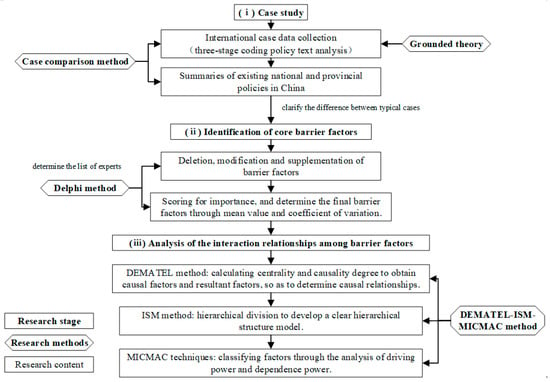
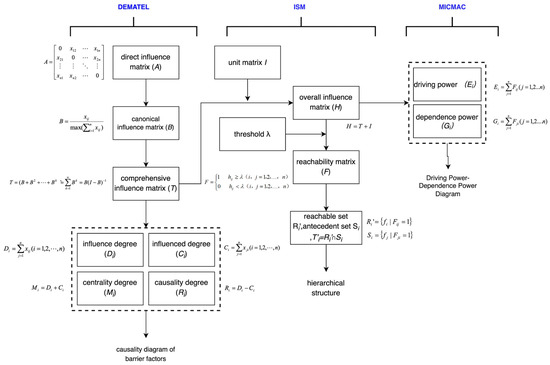
In order to achieve the above research objectives, this study adopts a mixed research methodology. Figure 1 illustrates the specific research process implemented through a three-stage framework, which outlines the methods employed, the corresponding research content, and the logical connections between each phase of the study. Firstly, the case study employs a dual-track qualitative approach: distilling generic MC strategies from international best practices and identifying institutional constraints through a systematic review of Chinese national and provincial policies. Following that, by comparing international cases with domestic practices and conducting a literature review, an initial list of MC adoption barriers in China was established. This list was subsequently refined via the Delphi method, involving interviews with academic and industry experts to reach a consensus on core barriers. Finally, based on structured questionnaires, an integrated DEMATEL-ISM-MICMAC methodology was employed to analyze causal relationships, transmission paths, and the driving/dependence power of barriers. This provided a robust foundation for developing targeted promotion strategies.
Figure 1.
Research process of this study.
2.1. Participants Sampling
To validate the scientific rigor of the identified barriers, this study employed the Delphi method, engaging 12 experts from academia, construction authorities, and supplier/manufacturer sectors. These experts were selected based on two stringent criteria. (1) Qualifications included holding at least a bachelor’s degree with over 10 years of industry experience, and (2) practice included extensive involvement in leading or decision-making roles within MC production and promotion. The diverse backgrounds and deep expertise of this group (detailed in Table 1, including working organization, role in the organization, education, and years of experience, all of which align with the preliminary expert selection criteria) ensure the high representativeness and validity of the research data.
Table 1.
Background information of interviewed experts.
The research focuses on the “technology–production–regulation” supply-side loop, specifically analyzing technical feasibility, policy frameworks, and upstream integration. Consequently, demand-side stakeholders (e.g., customers and contractors) are excluded from the current scope and reserved for future study. Given that MC is an emerging field where practitioner expertise significantly impacts data reliability, the sample was intentionally restricted to high-level professionals to exclude those lacking sufficient project experience, thereby ensuring the findings originate from robust practical insights.
2.2. Data Collection and Analysis
The research was conducted in three phases. In the initial two phases, the Delphi method was employed to identify the core obstacle factors. In the first round, an expert revision form (Appendix A) was distributed via email. Based on practical evidence and written feedback, the initial factors were systematically refined—merging duplicates, splitting composite factors, and adding practice-driven elements—to establish a refined list for the subsequent round. In the second round, importance levels were assessed using a five-point Likert scale (Appendix B). After collecting expert ratings, a two-dimensional validation was applied: (1) calculating the mean value of each factor and setting 3.0 as the baseline value of importance and (2) testing the degree of expert consensus by the coefficient of variation (CV = standard deviation/mean value), with CV < 0.25 as the convergence criterion [23], and ultimately identifying the barrier factors. In the third round, the same expert panel evaluated inter-factor relationships using a 0–4 influence scale (Appendix C), generating the direct influence matrix [23]. Throughout the process, continuous communication via email and phone ensured a precise understanding of barrier definitions among respondents, thereby minimizing operational bias and ensuring data reliability.
2.3. DEMATEL-ISM-MICMAC Method
- Step 1: Creating a direct impact matrix and determining causal factors and resultant factors—DEMATEL method.
The DEMATEL method was proposed by the Geneva Research Center of the Battelle Memorial Institute in the 1970s and was initially used to solve the problem of causal association in complex systems. In this study, based on the number of experts participating in the scoring questionnaire, the arithmetic mean of the scores of each barrier factor was calculated and rounded to generate the direct influence matrix (A) to minimize the error caused by subjective judgments of the experts through the group mean algorithm. The DEMATEL method is implemented through the canonical influence matrix (B) and comprehensive influence matrix (T) transformation, determining the influence degree (Di), the influenced degree (Ci), the centrality degree (Mi), and the causality degree (Ri) of each factor, revealing the direct/indirect influence relationship between the factors and ultimately outputting a visualized influence relationship diagram. The complete computational framework is presented in Table 2, which includes calculation elements, interpretation, and specific formulas, providing a clear understanding of the meaning of each element and its computational relationships.
Table 2.
Calculation elements and formulas.
- Step 2: Modeling reachable matrix and multilayer recursive order structures—ISM method.
The ISM method transforms the complex causal network output from DEMATEL into a multi-level recursive order structure through hierarchical decomposition, which intuitively reveals the hierarchical relationships among factors [24]. Using , we can obtain the overall influence matrix (H), where T is the comprehensive influence matrix and I is the unit matrix. The reachability matrix (F) characterizes the existence of direct influence between factors. In order to eliminate the weak interference, it is necessary to binarize the matrix H. In the matrix H, the number less than the threshold λ is made to be “0”, and the others are made to be “1” (Equation (8), where hij denotes the element located in the i-th row and j-th denotes the column of matrix H). The method of selecting the threshold λ should be scientific and reasonable, and it cannot be too large or too small for taking the value; otherwise, it will affect the reasonableness of the results. This study adopts λ = mean(T) (the average value of matrix T) as the threshold [25], based on the central tendency of the data distribution, to effectively identify significant influence relationships and simplify weak connections, thereby highlighting the dominant structure of the system. Robustness tests demonstrate that within a reasonable fluctuation range of the threshold, the sets of fundamental and surface factors in the system remain stable, and the main driving pathways and core causal logic are consistent, confirming the reliability of the threshold selection.
Interval decomposition and inter-level decomposition are performed on the reachability matrix F [26]. When a factor ai satisfies R(ai) = Ti = R′(ai)∩S(ai), it indicates that R(ai) is the highest level factor. Extract the current layer of factors, delete the rows and columns corresponding to the factor R(ai) in the reachable matrix F, recalculate the reachable set (Ri′), the antecedent set (Si), and the common set (Ti), and continue to find the next layer according to this method until all the factors have been divided to form the final factor hierarchy.
- Reachable set denotes the set of factors Fij that are jointly formed by any row i in the reachability matrix F and the column j whose values are all 1.
- Antecedent set denotes the set of factors Fji that are jointly formed by any column i in the reachability matrix F and the row j whose values are all 1.
- Common set T′i is the intersection Ri′∩Si of the above two elements.
- Step 3: Analyzing driving power—dependence power and strategy classification—MICMAC techniques
Based on the ISM output of the reachability matrix F, the MICMAC technique quantifies the driving and dependency relationships between factors. Calculate the total number of factors in the i-th row of the matrix F where the factor Fij is located with matrix element 1 to obtain the driving power Ei (Equation (9)), and when the value of Ei is larger, it means that the factor is more likely to influence the other factors. Calculate the total number of factors in the i-th column of the matrix where the factor Fij is located with matrix element 1 to obtain the dependence power Gi (Equation (10)), and when the value of Gi is larger, it means that the factor is more likely to be influenced by the influence of other factors. Based on the analysis of the driving power and dependence power of the variables, the variables are divided into four quadrants, autonomous factors (low Ei and low Gi), dependent factors (low Ei and high Gi), linkage factors (high Ei and high Gi), and independent factors (high Ei and low Gi) [10], so as to clarify the roles and development trends of the different types of factors in the system and to help identify the core barrier factors and develop phased strategies.
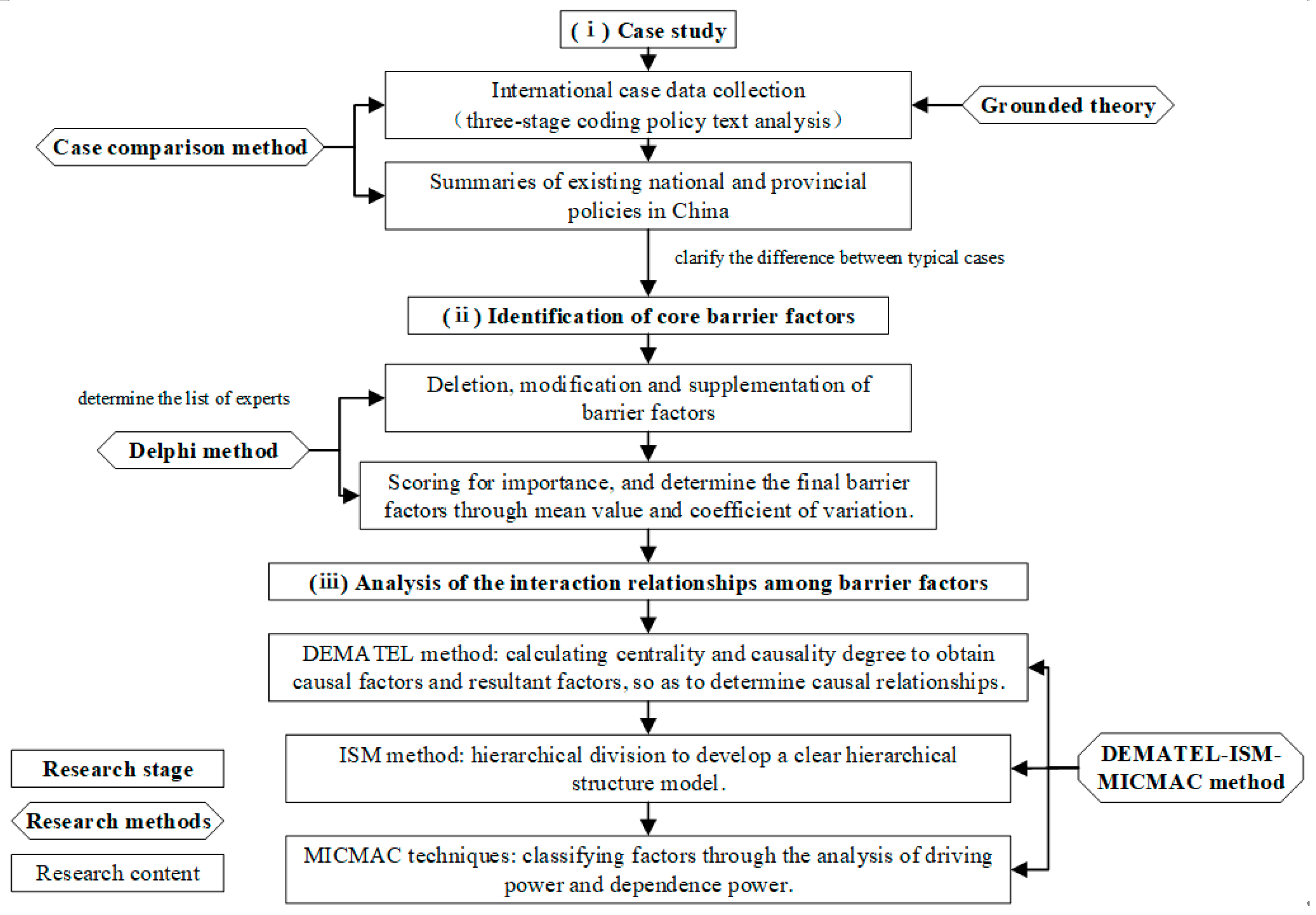
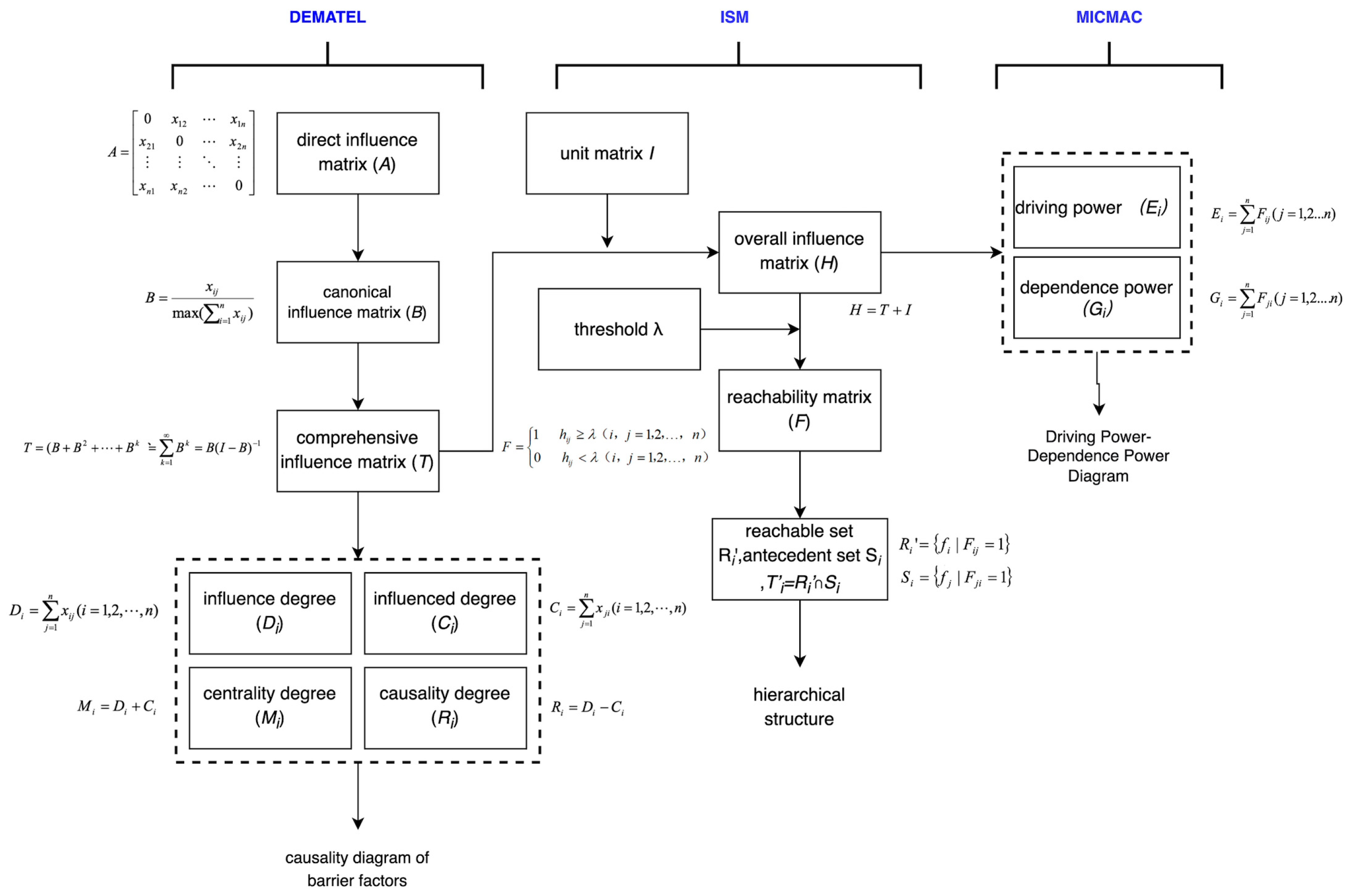
This study integrates the DEMATEL, ISM, and MICMAC methods to construct a systematic analytical framework. First, through the DEMATEL method, the direct influence matrix (A), canonical influence matrix (B), and comprehensive influence matrix (T) are utilized to calculate the influence degree (Di), influenced degree (Ci), centrality degree (Mi), and causality degree (Ri) of each factor, thereby identifying key causal factors. Second, based on a set threshold (λ), the comprehensive influence matrix (T) is transformed into the overall influence matrix (H) and the reachability matrix (F) in the ISM method. Through iterative calculations of the reachable set (Ri′) and antecedent set (Si), the hierarchical structure of the factors is decomposed. Finally, using the row sums and column sums of the same reachability matrix (F), the driving power (Ei) and dependence power (Gi) are calculated, respectively, and the driving power–dependence power quadrant diagram (MICMAC) is plotted. The formula chain in Figure 2 traces the complete computational path from the initial data of numerical relationship matrices to causal attributes, system structure, and coordinate mapping.
Figure 2.
Integration framework of DEMATEL, ISM, and MICMAC: modeling and formula flow.
3. Analysis of Case Studies
3.1. Mechanisms of International MC Management Excellence
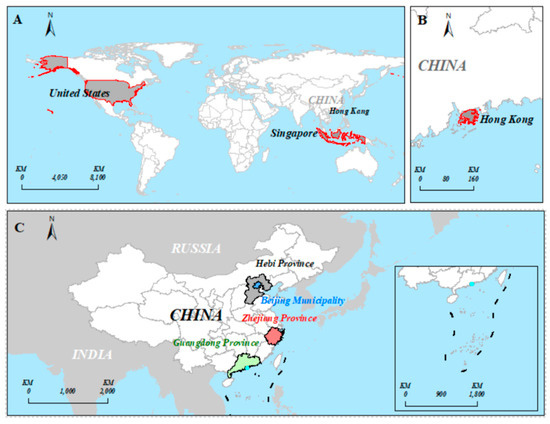
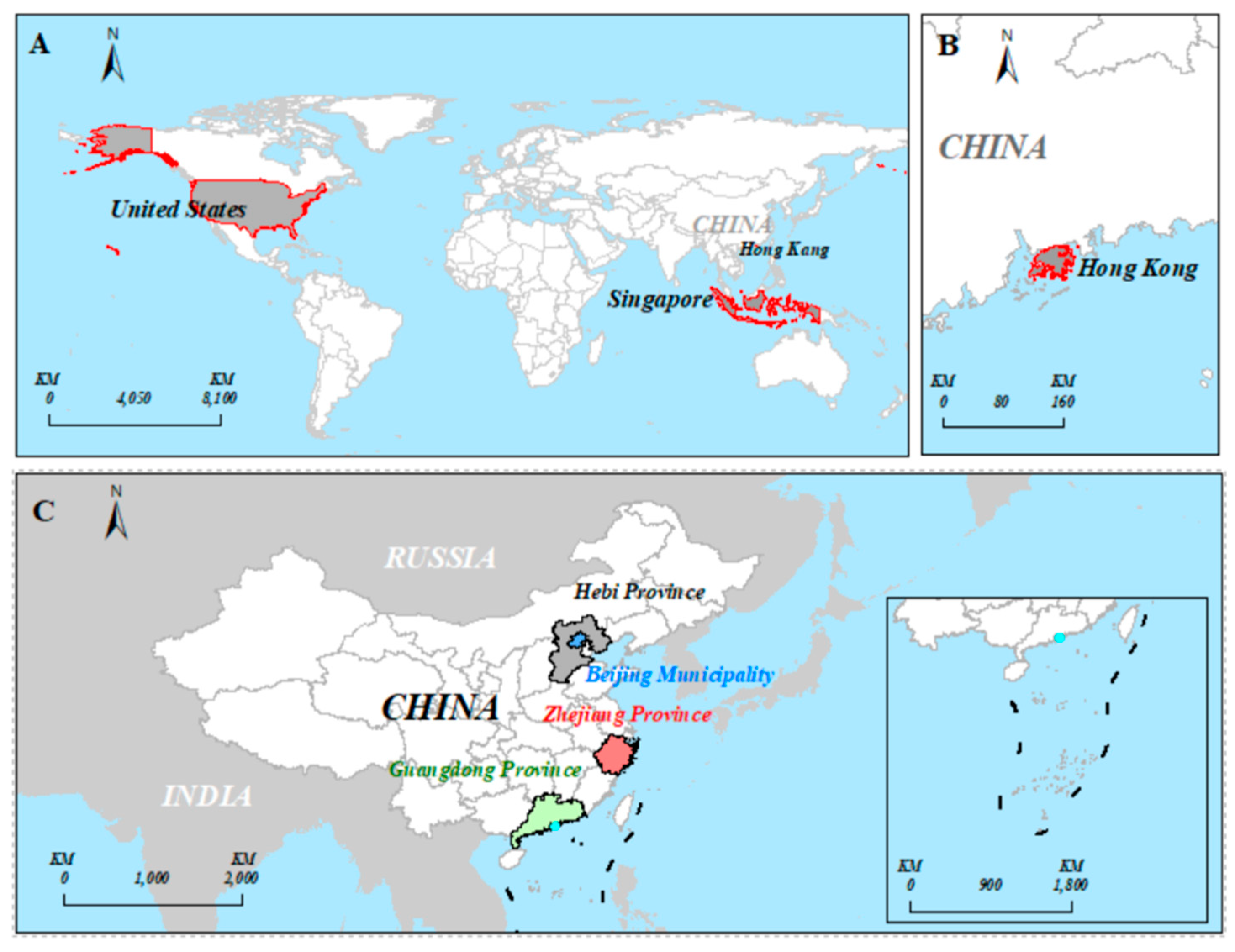
Singapore, Hong Kong (China), and the United States were selected as benchmark cases for MC promotion, with their spatial distribution presented in Figure 3A,B. Despite varying levels of development, these regions lead globally in building industrialization, where MC serves as a pivotal stage. Furthermore, they have established effective policy systems to encourage high-rise prefabrication [19], supported by continuous market growth [27]. Given China’s current emphasis on high-rise MC, the promotion paths of these regions are highly relevant.
Figure 3.
The investigated area of this study.
The three countries/regions differ in the official designation of MC. Singapore is called Design for Manufacture and Assembly (DFMA) and Prefabricated Prefinished Volumetric Construction (PPVC) [28], Hong Kong’s Buildings Department defines it as Modular Integrated Construction (MIC) [29], and the United States categorizes modular buildings into Permanent Modular Construction (PMC) and Relocatable Buildings (RBs). However, their core characteristics remain consistent: all are based on freestanding 3D functional modules integrated with finishes and fixtures prior to on-site assembly. This aligns perfectly with the definition of MC in this study. Consequently, the mature policy tools and experiences of these regions offer significant transferable value for promoting high-rise MC in China.
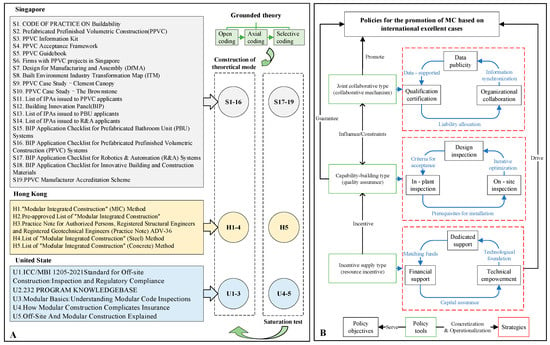
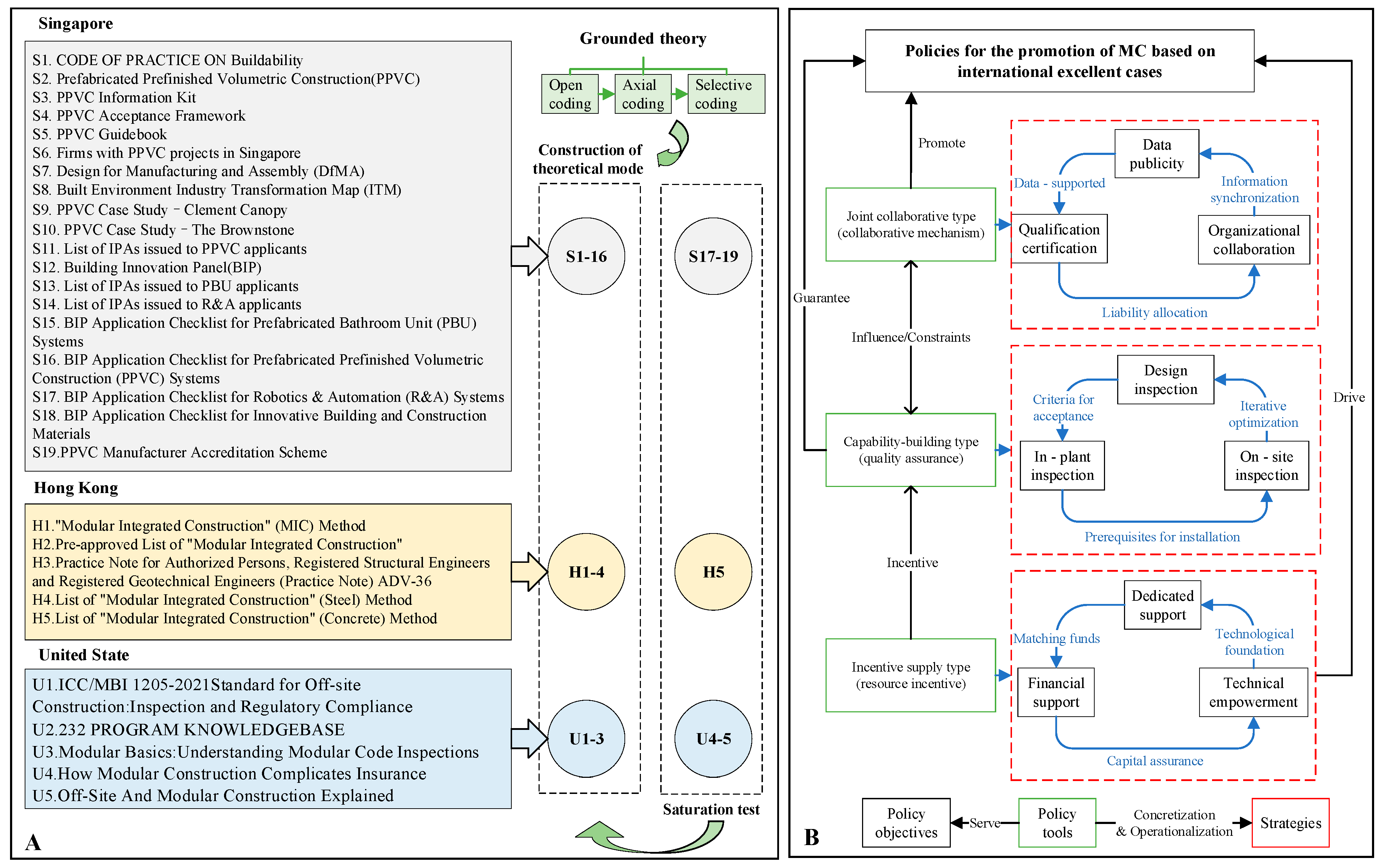
Firstly, MC-related policy texts were systematically collected from official government and industry association channels, including the Hong Kong Buildings Department and the Singapore Building and Construction Authority (BCA). After screening for authority, timeliness, and relevance, 29 policy samples were secured: Singapore (S1–19), Hong Kong (H1–5), and the United States (U1–5). These texts were imported into NVivo 11 for grounded theory analysis. Following the three-stage coding process (open, axial, and selective coding), twenty-three texts (S1–16, H1–4, U1–3) were coded, while the remaining six (S17–19, H5, U4–5) were reserved for theoretical saturation testing. Saturation was confirmed when new concept emergence dropped below 2%. Figure 4A details the categorization of these documents by region and type.
Figure 4.
MC promotion practice model based on international excellent cases.
The specific coding process was implemented as follows. (1) Open Coding. Sentence-by-sentence parsing of 198 original excerpts yielded 78 initial concepts, which were then condensed into 20 initial categories based on semantic similarity and significance. (2) Axial Coding. Integrating Schneider & Ingram’s policy tool framework [30] with cross-sectoral synergy perspectives, the 20 categories were iteratively refined into nine sub-categories (specific strategies): data publicity, qualification certification, organizational collaboration, design inspection, in-plant inspection, on-site inspection, dedicated support, financial support, and technical empowerment. These were further mapped to three main policy tool categories: joint collaborative, capability building, and incentive supply. (3) Selective Coding. The causal chains between main categories were analyzed to finalize the theoretical model. As shown in Figure 4B, this model illustrates the MC promotion practice framework and the synergistic relationships between core policy dimensions, providing a foundation for analyzing adoption barriers in China.
3.2. National and Provincial MC Policies in China
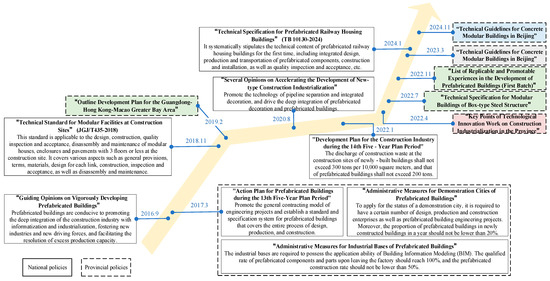
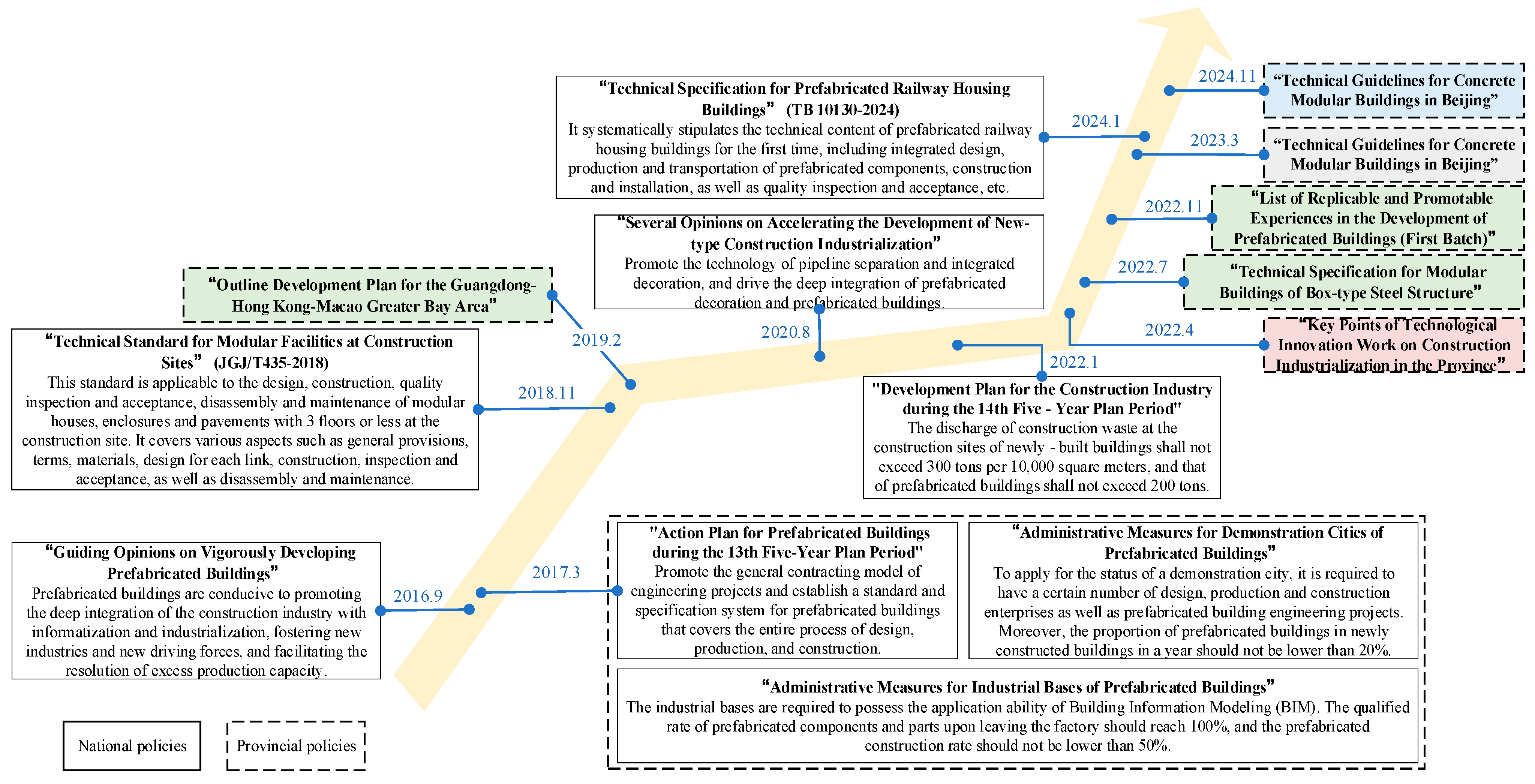
Chronological sorting of national MC-related policy documents was performed, including information from the official website of the Central People’s Government (https://www.gov.cn/ (accessed on 25 April 2025)), the official website of the Ministry of Housing and Urban-Rural Development (https://www.mohurd.gov.cn/ (accessed on 25 April 2025)), and so on. China’s construction industrialization system has evolved in three stages: (1) the “vigorously promote assembly construction” program was put forward in 2016; (2) the quantitative milestone of ≥15% of assembly construction in 2020 was set during the “13th Five-Year Plan”; (3) the “14th Five-Year Plan” promotes a standardized design and production system. The study found that China’s target setting in the direction of construction industrialization has been continuously refined, which is in line with the development stages of different periods and gradually guides the industry towards higher levels of development. In addition, industry policies have expanded from simply encouraging promotion to covering the entire chain of industrial base and demonstration city construction, technical standards and specifications development, parts and components library establishment, and construction site facilities specification, forming a complete policy system from macro-goal guidance to medium demonstration projects to micro-operation specification. However, although China’s relevant policy documents cover qualification management, quality control, construction review, etc., most of them are fragmented clauses, without forming an exclusive policy framework for MC. Obviously, the existing policy system still follows the traditional cast-in-place building management model and has not completed the adaptive transformation to the industrialized construction paradigm. There is an obvious institutional path dependence, which is due to the fact that the policy does not distinguish between MC and the traditional building approval process, regulatory standards of the technical nature of the differences.
In addition, based on the criteria of regional representativeness, policy innovativeness, and technology maturity, this study selects Guangdong Province, Beijing Municipality, Hebei Province, and Zhejiang Province as the local supplementary cases in China, and the specific regional locations are shown in Figure 3C. The basis of selection is as follows. (1) Guangdong Province was a pioneer province in the application of MC technology, relying on policy support (e.g., the planning of the Greater Bay Area), and enterprises, such as CIMC and China Construction Hailong, have led a number of international-level benchmark projects, and the technology is exported to the world. (2) Beijing, as the capital city, should have a significant leading effect on its policies and technologies. (3) Xiong’an New Area in Hebei Province, as a national new area, enjoys policy dividends, and its application of MC is exemplary and prospective, which is of great significance to the rest of the country. (4) Zhejiang Province, in which the comprehensive level of industrialization of construction is at the forefront of the country, is an important part of the building industry. It is found that all four places regard MC as the hand of industrialization transformation and lower the threshold of technology application through a combination of policies such as volume rate incentives, financial subsidies, and standard setting. In addition, Beijing focuses on the rapid transformation of dilapidated buildings, Hebei focuses on energy saving and consumption reduction, and Guangdong and Zhejiang explore the integration of smart cities, the essence of which is that technology serves the pain points of regional development, and modular technology needs to be applied flexibly in different scenarios. However, due to the high initial investment in modular buildings, there is a need for large-scale application to dilute the cost, but the domestic project is still mainly a pilot. The lack of market scale leads to a lack of motivation to promote the standard reuse of enterprises, and functional differences lead to the module interface, piping layout, and other aspects that are difficult to standardize. This study systematically collates and visually presents the relevant policy documents in chronological order (Figure 5). In this figure, a white background represents national-level policies, while colored backgrounds represent provincial-level policies, with their colors corresponding exactly to the geographical markers of the case provinces in Figure 3C.
Figure 5.
Summary of national and provincial policies concerning MC in China.
4. Results and Discussion
4.1. Analyzing Core Obstacle Factors
Based on a systematic comparison of excellent cases in China and internationally, this study recognizes that there is currently insufficient basic capacity building for the promotion of MC products in the Chinese market, and the overall system is fragmented and lacks coherence. Although MCs have been successful in individual pilot projects, the lack of comprehensive and systematic policy support has limited the further application of MCs nationwide. Drawing on the literature and case evidence, this paper is summarized to form a preliminary list of barrier factors (Appendix A). Table 3 shows the refined barrier factors utilizing the Delphi method, and the corresponding calculations for the expert scoring (Appendix B). Table 3 fully presents the core barrier factors that have reached consensus through multiple rounds of expert consultation, their respective project implementation phases, detailed descriptions of each factor, and key quantitative indicators of expert consensus, including the mean and coefficient of variation of expert ratings. The empirical results show that the mean values of all factors (M = 3.583–4.333) exceeded the baseline value of 3.0, and the coefficient of variation interval was 0.109–0.235 (CV < 0.25), indicating that there was a high degree of consensus on the barrier factors among the expert community.
Table 3.
Analysis of barrier factors in the amended Delphi method.
4.2. Calculation of Centrality and Causality Degree
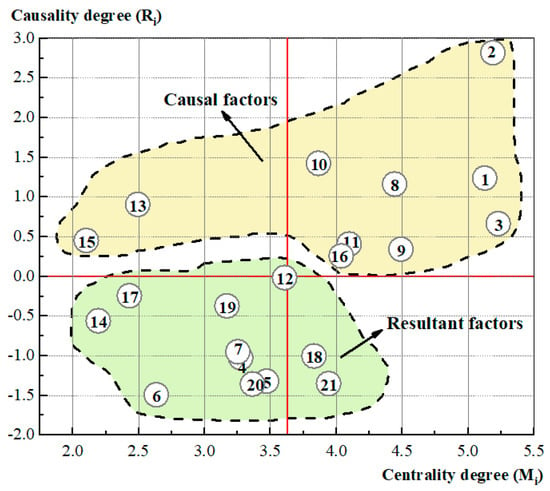
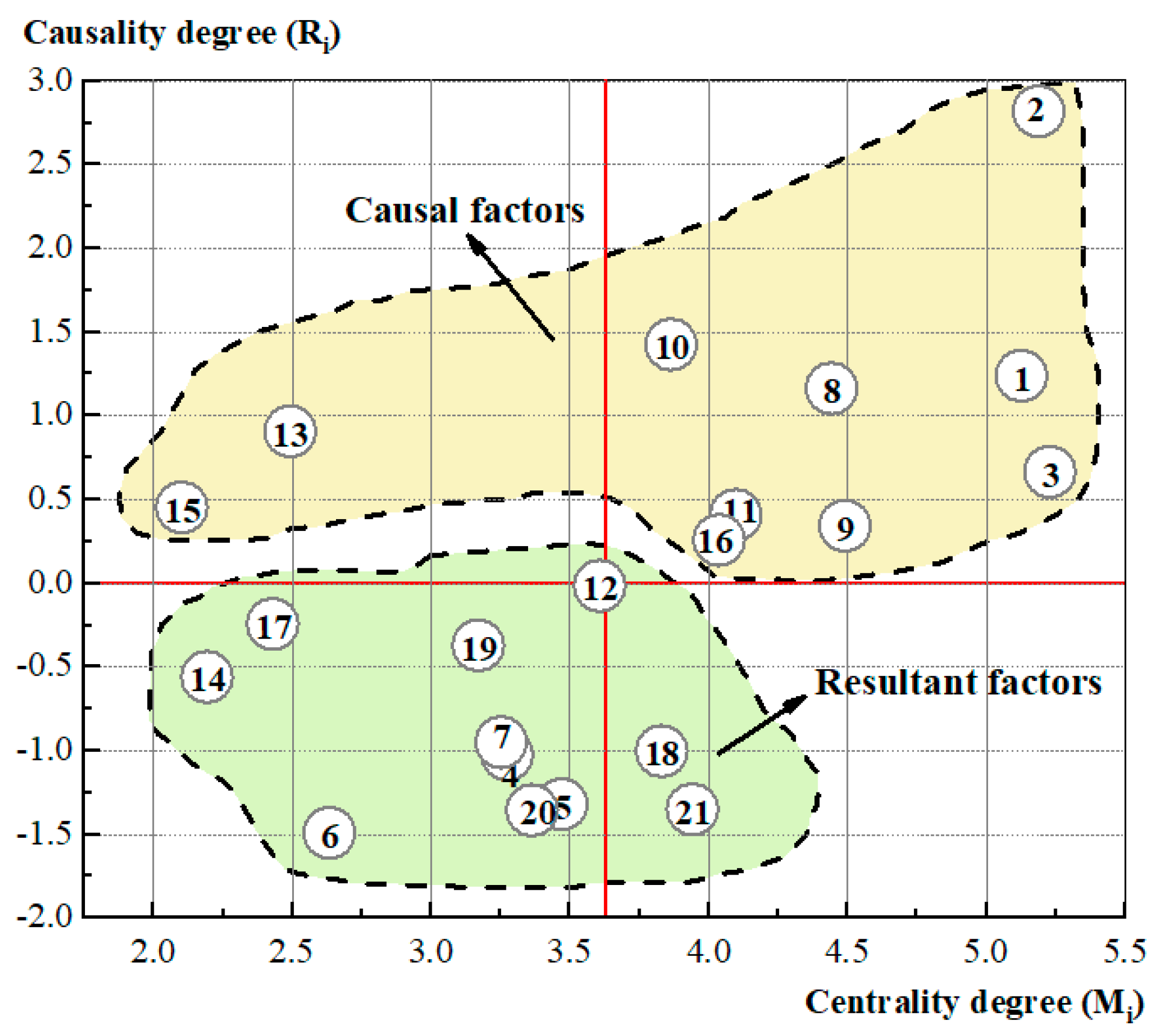
According to Formulas (1)–(7) in Table 2, the influence degree Di, the influenced degree Ci, the centrality degree Mi, and the causality degree Ri of each influencing factor were calculated, and the ranking of the calculation results is detailed in Table 4. In addition, the attributes of the factors were judged according to the positive and negative relationship of the cause degree (cause factor/resultant factor). On the basis of Table 4, a DEMATEL causality diagram of barrier factors to the promotion of MC in China was drawn (Figure 6). The centrality degree Mi is the x-axis and the causality degree Ri is the y-axis, and the barrier factors with positive values of Ri are the causal factors, i.e., they are located above the coordinate axis, and these are the factors that directly affect the promotion of China’s MCs; the negative values are the resultant factors, i.e., they are located below the coordinate axis, and they are affected by the cause factors and they indirectly affect the factors of the promotion of China’s MC. As a result, the numbering set of causal factors is {F1, F2, F3, F8, F9, F10, F11, F13, F15, F16}; the numbering set of resultant factors is {F4, F5, F6, F7, F12, F14, F17, F18, F19, F20, F21}. The “causal” relationships identified in this study are derived from an influence network model based on the structured judgments of a Delphi expert panel.
Table 4.
Calculation results of the influence degree Di, the influenced degree Ci, the centrality degree Mi, and the causality degree Ri.
Figure 6.
A DEMATEL causality diagram of barrier factors.
From a management perspective, the barrier factors with high centrality and high causality (F1, F2, F3, F10) collectively point to systemic governance challenges in the promotion of modular construction. First, F2 reveals that overlapping departmental authorities and unclear responsibilities hinder the unification of standard systems. Second, F3 highlights how traditional quality supervision models fail to adapt to the new context of factory-based production. Finally, F1 and F10 together demonstrate that disparities in enterprise capabilities and insufficient industry–university–research collaboration constrain overall industrial upgrading. This indicates that advancing modular construction requires institutional-level collaborative innovation: cross-departmental coordination mechanisms should be established to clarify responsibilities, a comprehensive quality supervision system covering both factory and on-site processes should be developed, and policy guidance should be strengthened to enhance capability-building and collaboration across the industrial chain.
Focusing on the High Centrality Degree–High Causality Degree quadrant (the area marked yellow in Figure 6) with the mean value of centrality degree of the 21 barrier factors (M′ = 3.630), eight core factors were targeted for prioritization of interventions, F1, F2, F3, F8, F9, F10, F11, and F16, among which, F1, F2, F3, and F10 were sufficiently discussed in the previous analyses. The new key mechanisms are structured as follows: F8 is the underlying causative factor for questioning the safety of MC houses; F9 illustrates that the traditional linear review model is not adapted to the modular parallel engineering characteristics due to the fact that the building’s structural, electrical, and plumbing are prefabricated in the factories, and they are transformed from a single site scenario to a factory–transportation route–site cross-scenario supervision [22]; and F11 is due to the fact that in the traditional building design process, designers are involved in construction coordination, field services and as-built acceptance, and the current research has deficiencies in sorting out the responsibilities of the factory phase. Again, this feature would extend to F16.
In addition, each of the four quadrants in Figure 6 corresponds to a differentiated governance strategy. The core resultant factors (high Mi + low Ri) need to be monitored for changes and moderated by upstream factors. For example, MC shifts the quality control focus from discrete material inspection at the construction site to full lifecycle performance verification of modular units in the factory, which leads to the paradox of F18. Diaphragm connections [55], inter- and intra-module joints [56], and other important technologies provide solutions for F21. Edge causal factors (low Mi + high Ri) can be used as local optimization and complementary means, including F13 and F15, which can be remedied by manual experience or traditional methods as short-term alternatives. Marginal resultant factors (low Mi + low Ri) need to be simplified or ignored to reduce system complexity.
4.3. Establishing the Hierarchy Structure
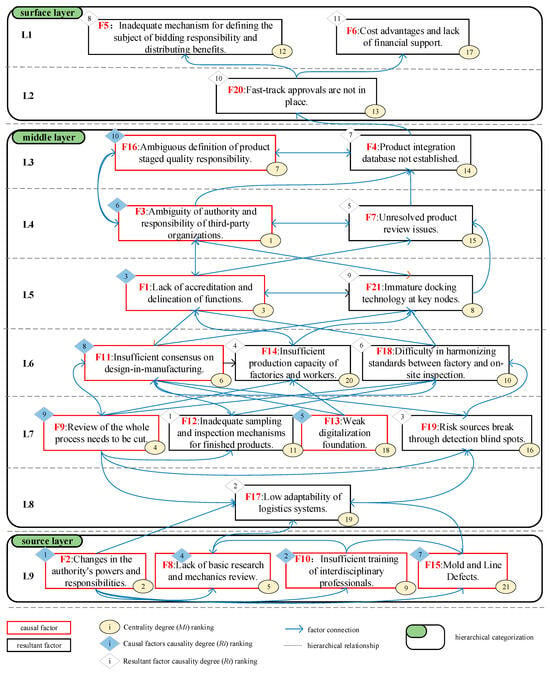
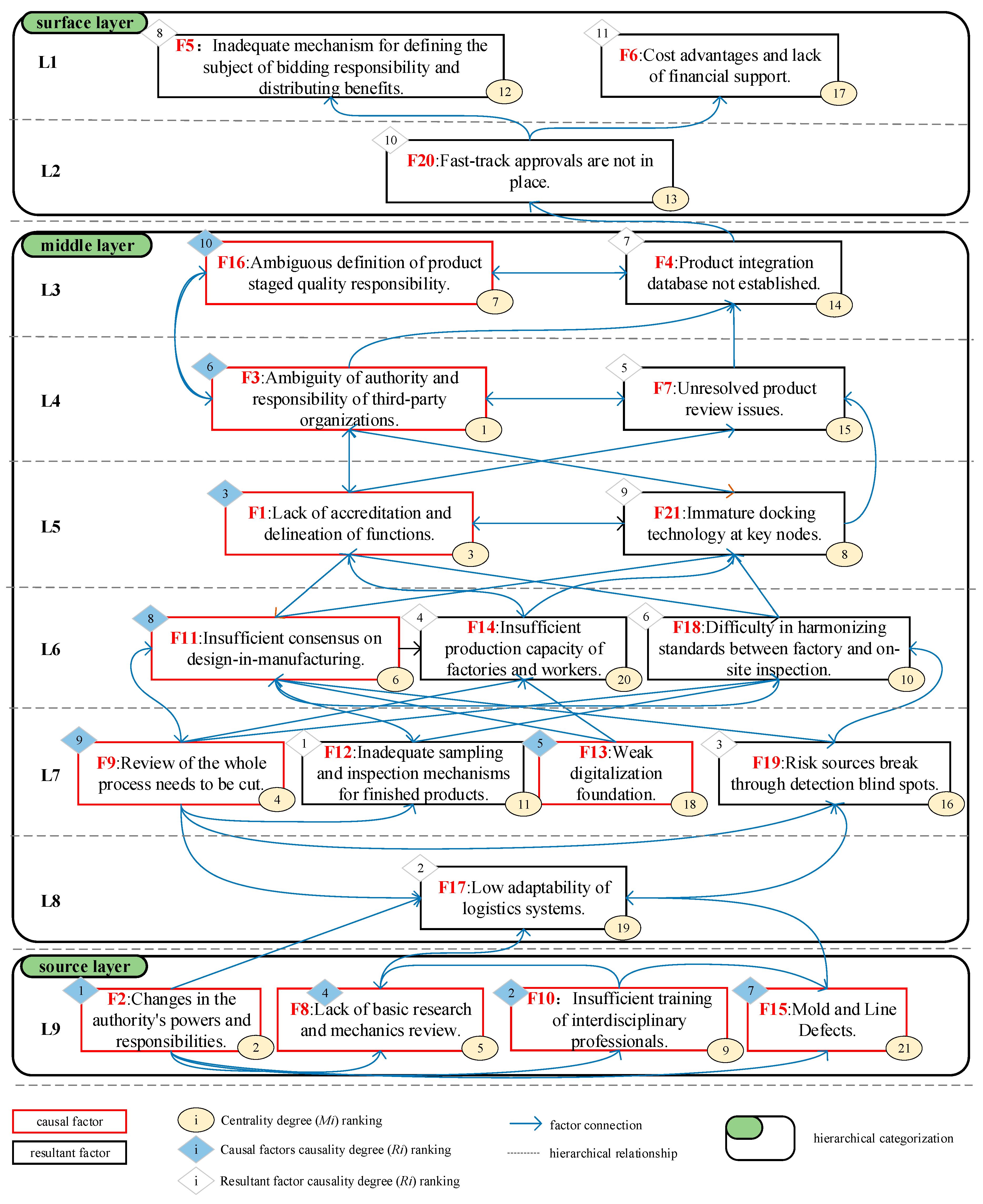
Firstly, through the calculation of reachable matrix F, reachable set Ri′, antecedent set Si, and common set Ti for each factor in Step 2, Table 5 is obtained. Secondly, layer division is performed according to Table 5, and the first layer element is delineated as L1 = {5, 6}, and then the rows and columns in which F5 and F6 are located are deleted in order to divide reachable sets and antecedent sets and to obtain the next layer element of the model of this system. The second layer element is L2 = {20}, and keep operating the same method to obtain the third layer elements L3 = {4, 16}, L4 = {3, 7}, L5 = {1, 21}, L6 = {11, 14, 18}, L7 = {9, 12, 13, 19}, L8 = {17}, and L9 = {2, 8, 10, 15}, in turn. Finally, based on Table 5, this study constructed a multi-level hierarchical structural model of the barriers to modular construction promotion (Figure 7). In terms of hierarchical structure, the model distributes the factors across different levels according to the computational partitioning results (L1–L9). Regarding key attributes, each factor node is labeled with its “causality degree ranking” and “centrality degree ranking” and is distinguished as a causal factor or a resultant factor, providing a visual basis for identifying key factors. Concerning interaction relationships, strictly based on matrix F (where a directed connection is established if and only if the matrix element F(i,j) = 1), unidirectional or bidirectional arrows are used to intuitively illustrate the direct and mutual influences among the factors. The details of the analysis are as follows.
Table 5.
Reachable set Ri′, antecedent set Si, and common set Ti.
Figure 7.
Analysis and classification of barrier factors.
A total of three (L1-F5, F6; L2-F20) of the barrier factors at the surface layer are end resultant factors, and they are greatly influenced by factors L3–L9. At the same time, they are in the key aspects of project initiation and implementation, i.e., bidding and approval process, which reflects the lack of adaptability of the existing system to the new model. However, all of the above barrier factors are directly manifested at the operational level and are easily observable. Therefore, solving the surface factors needs to be preceded by solving the middle and source layer barrier factors that have an impact on them. The study found that F6-related financial instruments are not the most direct approach in MC policy. For example, companies may simply split and package traditional buildings into MC projects in order to obtain subsidies, rather than truly promoting technological innovation.
There are a total of 14 barrier factors at the middle layer, which play a top-down role in the structure, having an impact on the surface level barrier factors (L1–L2), which in turn are influenced by the source level barrier factors (L9). Among them, eight barrier factors (L3-F4; L4-F7; L5-F21; L6-F14, F18; L7-F12, F19; L8-F17) are resultant factors and six barrier factors (L3-F16; L4-F3; L5-F1; L6-F11; L7-F9, F13) are causal factors. The core contradiction has three main parts. (1) F4 and F7 are mainly related to data coherence. F13 is a causal factor that clearly points out the importance of the digital delivery. F21 is used to meet the demand for precision control, which is the essence of the digital standard mapping in the physical world. (2) F11, F18, and F3 cannot close the loop. F16, as a resultant factor, summarizes the problem of the broken responsibility chain from the perspective of the whole lifecycle, and F1 illustrates the importance of responsibility allocation from the perspective of the delineation of functions among stakeholders. (3) The iterative speed of the capability of industrial entities lags behind the demand for technological innovation, including the enterprise side (F1 and F17), the design and review side (F9), the factory and worker side (F14), and the testing organization side (F12 and F19). In summary, the current system lacks a core closed loop based on data, responsibility as a constraint, and review and sampling as a verification to constitute the quality management of the whole lifecycle of MC.
There are a total of four barrier factors at the bottom layer (L9-F2, F8, F10, F15). Since MC transfers more than 60% of the processes of traditional on-site construction to factories, which makes building products have the dual attributes of industrial products and engineering projects, F2 reflects the failure of the qualification management and quality supervision system based on on-site operations. It is found that different departments (mainly housing and construction departments and industry and information departments) have overlapping management authority over the emerging field of MC, which is prone to face problems such as conflicting interests, fragmentation of standards and technical parameters, and duplication of approvals. In fact, institutional problems, such as sectoral division and power distribution, and unclear industry categorization, have become root barrier factors, and neither the reality aspect nor the research aspect has been able to express this view clearly.
F8 and F10 illustrate that the functions of universities are not fully utilized from the perspectives of scientific research and talent cultivation, which are analyzed in detail as follows. (1) The mechanical characteristics of MC (e.g., dynamic load response, fatigue performance of connecting nodes) need to be supported by a large amount of experimental data [57]. At the same time, there are research barriers and difficulties between the mechanics of building structures and disciplines, such as mechanical vibration science and material surface engineering. (2) There is a structural mismatch between education supply and industrial demand. The industry has a capacity gap of “those who know how to manufacture do not know how to build, and those who know how to build do not know how to manufacture”, and there is an insufficient proportion of construction faculty members with practical experience in factories, coupled with the fact that the training program in the practical teaching link mostly stays in the cognitive internship, and the traditional curriculum does not have enough knowledge of manufacturing.
In addition, F15 is not only a technical problem but also focuses on the scale and customization of the contradiction; a detailed analysis is as follows. (1) Modular production requires the construction of factories, the purchase of special equipment, and the initial capital investment is much higher than traditional construction [29]. (2) The traditional construction industry occupies more than half of the project cost share. MC reduces the cast-in-place operation and the profit compression of the general contracting enterprise, and the labor subcontracting market shrinks, which directly threatens its interests [58], so MC will be resisted by the traditional industry chain. (3) Users have long been accustomed to houses built by traditional construction methods, and the publicity of MC is not wide enough, so it is difficult for ordinary users to obtain comprehensive information about the structural safety, material durability, and waterproof and soundproof performance of modular buildings [59]. The above conclusion deeply explains the reasons for the low penetration of the MC market and the difficulty in creating a scale effect.
4.4. Calculation of Driving Power and Dependence Power
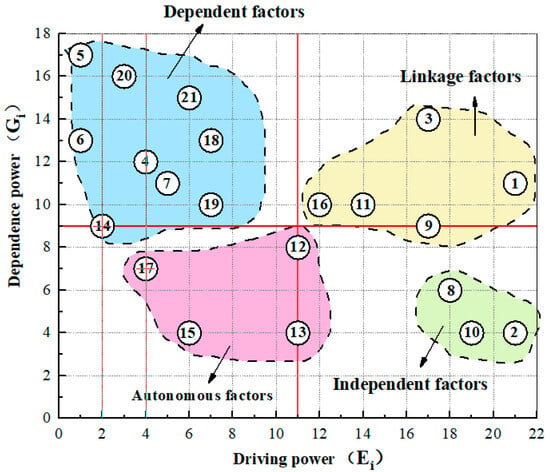
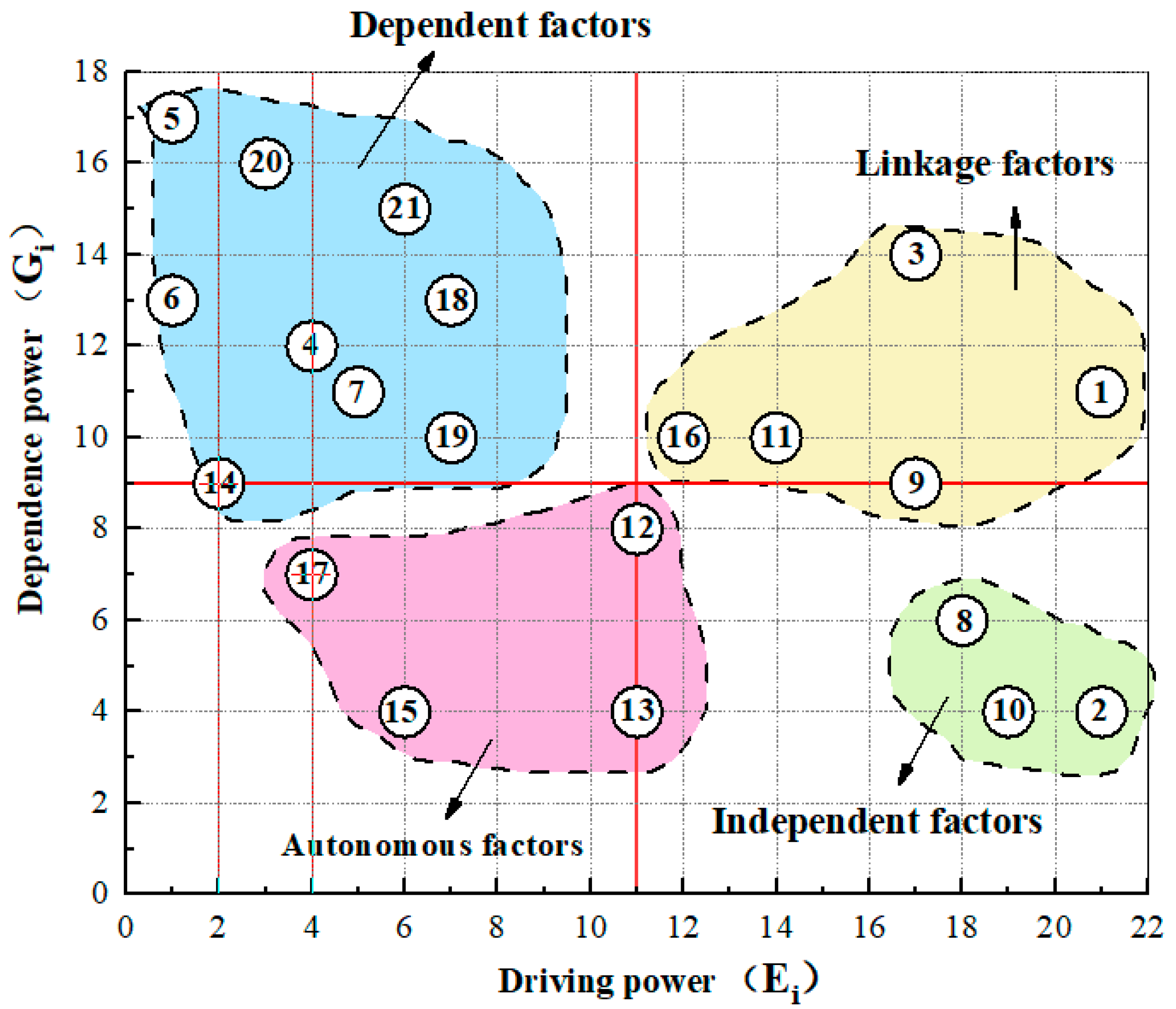
The driving power and dependence power were calculated according to Equations (9) and (10) and filled in the MICMAC analysis quadrant chart with the values of driving power Ei and dependence power Gi of each factor as coordinates, where driving power Ei is the horizontal coordinate and dependence power Gi is the vertical coordinate, and then they were plotted on a scatter plot. At the same time, the average value of dependence and driving power was used as the dividing line of the quadrant to classify the autonomous factor, dependent factor, linkage factor, and independent factor, and the results of the division are shown in Figure 8.
Figure 8.
The driving power and dependence power of each barrier.
The core feature of autonomous factors (low Ei + low Gi) is that they are independent, and their improvement does not depend on the cooperation of other links. There are four barrier factors in this category, which are F12, F13, F15, and F17. Among them, F12 and F17 are resultant factors and rank in the top two in terms of the causality degree of resultant factors. The former suggests that the approval problem requires external policy intervention, while the latter manifests the lack of cross-border supply chain facilities and information interaction, both of which are difficult to be solved naturally through technological upgrading within the industry chain, although the relevant technologies [60] are constantly being revolutionized. Manufacturers need to invest a lot of money in upgrading digital software (F13) and mold and production line modification (F15), and the short-term benefits are not obvious, especially for small- and medium-sized manufacturers, so firms tend to prolong the lifecycle of existing equipment [10]. Therefore, to attract continuous investment from stakeholders (design units, modularization manufacturers, logistics companies, etc.) at all stages [51], the government needs to systematically optimize business processes in addition to financial and tax support. This idea has been well documented [59,61], confirming the importance of upstream and downstream supply chain partnerships, especially for demand-pull supply chain upgrading.
The core feature of independent factors (high Ei + low Gi) is that they have a strong motivation to improve on their own and do not need to rely on external synergies. There are three barriers in this category, namely, F2, F8, and F10, and all of them are causal factors and the source-level barrier factors in the ISM model. Therefore, it is necessary to prioritize addressing these three elements, involving policy, technology, and human resources. This study argues that the division of authority and responsibility between and within stakeholders and the harmonization of standards need to be designed in a more systematic and synergistic way to achieve effective project planning and complexity management to unlock the productivity of the industry after the breakthrough, a viewpoint that has been expressed in several articles [62,63]. This study suggests that in order to ensure project compliance, research institutions and regulators need to join forces in order to quickly develop standards under specific functions and to force design-end changes to standardization once the standards are released. This model of customized standards is attempted to be implemented with reference to the above specific approach. In addition, regarding the development of MC technology and management courses in civil engineering curriculum, teachers need to have both manufacturing and construction expertise and project experience [10], and the development of training and research programs should be systematically designed with the development of the industry as a goal so as to promote the qualification of the practitioners, industry training, and cooperation between schools and enterprises.
Dependent factors (low Ei + high Gi) are centrally characterized by the need for multi-linkage improvement and the lack of autonomous breakthroughs, which is essentially a product of system synergy failure. There are nine such barrier factors, namely, F4, F5, F6, F7, F14, F18, F19, F20, and F21, which are all resultant factors. It is found that the low driving force causes mainly focus on cost and benefit imbalance, liability spillover, technology lock-in, etc., and the high dependence performance lies in technology dependence, data dependence, and system dependence. However, an increasing number of studies [64,65] are focusing on addressing this aspect. This side-by-side comparison corroborates that the traditional construction project process is not applicable to MC project implementation, which is in line with the important findings of the existing literature [10].
The core feature of linkage factors (high Ei + high Gi) is that the improvement needs are urgent but require deep synergy among multiple parties, and there are five barrier factors in this category, namely, F1, F3, F9, F11, and F16, with all of them being the causal factors. F1 relies on multi-departmental joint development of certification systems for housing, industry, and market regulation, and it needs to balance quality and price, which fits with the view of previous studies [66,67]. In addition, F3 relies on design institutes, factories, supervisors, and testing organizations to reconstruct the collaborative process, F9 illustrates that failures in transportation and lifting can lead to schedule delays and the pursuit of legal liabilities, and F16 cuts through the relationship of responsibility between the various subjects from a full lifecycle perspective, which all validate that MC requires a higher level of management to meet the needs of multi-party participation and multi-part collaboration. F11 and F16 rely on real-time interaction between design tools and production system data, barcode methods [68], and visual inspection methods [69] to become informative and intelligent solutions, which is in line with existing studies [70].
4.5. Integrating Multi-Method Insights
Based on the integrated results of DEMATEL, ISM, and MICMAC, the promotion of modular construction in China is constrained by a complex barrier system transmitted progressively through four dimensions: institutional governance, knowledge and capability, process coordination, and project outcomes. These barriers do not stem from isolated issues but reflect a structurally embedded, multi-level systemic challenge. The three methods, examining causal strength, hierarchical structure, and driving–dependence relationships, respectively, converge into a highly consistent systemic understanding.
(1) Fundamental institutional and capability-related obstacles exert deep-rooted driving effects. The DEMATEL results reveal that F2, F8, F10, and F15 all exhibit high centrality influence, serving as core drivers shaping the entire system. The ISM hierarchy further places these factors at the bottom root layer, demonstrating strong upward propagation across the structure. MICMAC positions them within the independent quadrants, indicating that improvements in these factors rely minimally on other internal system variables yet play a decisive role in system evolution. Overall, mismatches in governmental institutional supply and deficiencies in knowledge and talent provision by universities and research institutions constitute the primary root-level obstacles to modular construction development.
(2) Linkage-type intermediate obstacles reflect systemic failures in responsibility chains and process coordination. F1, F3, F9, F11, and F16 show high consistency across all three methods. They appear as causal factors with high centrality and causality in DEMATEL, as bridging elements in the middle layers of the ISM hierarchy, and as high-driving, high-dependence linkage-type elements in MICMAC. This pattern indicates that these obstacles are both urgent and highly dependent on multi-department, multi-actor collaboration. In essence, there is an absence of stable coordination mechanisms within firms and across supply chains, approval chains, and design–manufacturing interfaces.
(3) Approval and cost-related obstacles at the surface level are visible symptoms of systemic imbalance. Within the ISM hierarchy, F5, F6, and F20 are concentrated in the topmost layer, representing surface-level barriers. In DEMATEL, they are primarily identified as result factors; in MICMAC, they fall into dependent or low-driving categories. This demonstrates that improvements in these areas rely heavily on upstream systemic reforms. Fiscal subsidies or procedural optimization alone are insufficient to produce a substantial impact. Without the systemic reconstruction of institutional supply, knowledge support, and enterprise coordination mechanisms, financial and cost-oriented interventions can only produce temporary, partial corrective effects.
(4) Quality management and digital infrastructure serve as critical foundational supports. Factors such as F4, F7, F12, F13, F17, F18, F19, and F21 predominantly manifest as outcome factors in DEMATEL analysis, with some exhibiting high centrality. In ISM, they are positioned at intermediate or near-surface levels; in MICMAC analysis, they are distributed across autonomous, dependent, and linkage quadrants. These factors ultimately reflect a combined external manifestation of long-standing systemic, knowledge-based, and collaborative issues, characterized by insufficient user trust, conservative risk preferences of financial institutions, and low corporate investment willingness, further undermining motivation for technological advancement and institutional reform.
In conclusion, advancing modular construction in China requires not only technological enhancement but, more critically, systemic reconstruction in governmental governance logic, standard-setting frameworks, enterprise capability systems, and talent cultivation. Only by reshaping the interdependent relationships among these core actors can the technological advantages and policy incentives of modular construction be effectively transformed into sustainable, market-driven adoption.
5. Conclusions, Limitations, and Future Studies
5.1. Conclusions
5.1.1. Key Findings
Modular construction (MC) offers a key path to low-carbon transformation and industrialization in construction. Yet, its adoption in China remains limited due to few projects and unresolved cost barriers, keeping most manufacturers in traditional production modes.
(1) This study innovatively analyzes MC promotion barriers through cross-case analysis, integrating grounded theory and the Delphi method with multi-source data: expert interviews, international policy texts, and the academic literature. Using mixed method analysis across six project phases—decision-making, procurement, design, production, transportation, and construction acceptance—we identify 21 barrier factors hindering MC diffusion in China.
(2) Unlike prior research focusing on isolated MC elements, this study pioneers the exploration of structural relationships among barrier factors. Through DEMATEL analysis, we differentiate causal factors from resultant factors, constructing a heuristic framework for understanding the barrier system’s complexity. The findings are intended to inform strategic formulation rather than assert definitive causality.
- China’s pilot-driven approach restricts market scale and discourages standardization. Current policies remain tied to traditional cast-in-place management, lacking adaptation to industrialized construction and overlooking fundamental distinctions between MC and conventional methods. MC introduces factory production, necessitating multi-scenario responsibility allocation (factory–transportation–site) and updated quality inspection standards.
- MC transforms quality assurance from on-site material verification to factory-based performance validation of modular units—marking a transition from construction to manufacturing. However, insufficient foundational research and standardization fuel safety concerns and undermine market trust. These institutional challenges in China’s construction industrialization remain critically underexplored in both practice and scholarship.
(3) Based on this, this study employs the ISM model to stratify barrier factors into a three-tier implementation roadmap: surface level (three factors), middle level (fourteen factors), and source level (four factors). The research reveals that the construction industry’s project-oriented mindset, lacking a product-driven approach, intensifies systemic ambiguities in power and responsibility distribution among government administrations in the Chinese context. This challenge extends to credentialing entities within the industry, rebuilding quality monitoring and approval systems, and achieving cross-stage inspection reciprocity—a process that necessitates emphasis on digital and intelligent delivery methods.
(4) This study classifies barrier factors into four types within a two-dimensional matrix based on driving and dependence forces using the MICMAC method: four autonomous, three independent, nine dependent, and five linkage factors. This provides a basis for policymakers to prioritize resource allocation, with independent barriers—such as adjustments to departmental authority and responsibilities, gaps in basic research and mechanical reviews, and insufficient interdisciplinary professional training—being the most effective to address. For the first time, this paper systematically identifies areas for optimization in Chinese universities from the perspective of construction industry transformation, focusing on scientific research, talent cultivation, and industry collaboration.
Thus, this study integrates DEMATEL, ISM, and MICMAC methods to reveal that the promotion of modular construction in China is constrained by a complex barrier system transmitted progressively across four dimensions: institutional governance, knowledge and capabilities, process coordination, and project outcomes. These barriers are not isolated but represent a multi-level, structurally embedded systemic challenge.
5.1.2. Policy Recommendations
- 1.
- Adopt a rational market perspective and avoid blind investment.
- MC promotion should return to market and scenario analysis, focusing on user acceptance, benefit distribution, and input–output ratios.
- Enterprises are advised to adopt a project-oriented approach for product refinement, gradually expanding the market through demonstration projects rather than large-scale blind investments.
- 2.
- Optimize policy tools with outcome-oriented and resource integration focus.
- Shift from purely rewarding technical inputs to establishing outcome-linked incentive mechanisms.
- Utilize subsidies, concessional loans, green bonds, and other tools as levers to promote the formation of industrial alliances and integrate industry resources.
- Policy efforts should prioritize long-term market cultivation and user education.
- 3.
- Strengthen tripartite collaboration to build an innovation ecosystem.
- Universities should enhance research related to construction industry modernization and promote faculty development, interdisciplinary talent training, and entrepreneurial practices.
- Governments need to create an institutional environment conducive to R&D and innovation, providing endogenous conditions for the application of new technologies and products.
- The tripartite government–university–enterprise collaboration mechanism requires further refinement to form a systemic synergy for advancing MC development.
5.2. Limitations and Future Studies
- 1.
- Research Content and Scope
- Analysis of application scenarios. MC in China is primarily applied in sheltered and residential housing, rapid urban renewal projects (e.g., old neighborhood renovations), and rapid deployment of healthcare and educational facilities during emergencies. High-rise modular projects are mostly government-procured. Additionally, products with optimized floor heights (especially zero-carbon buildings integrating wastewater treatment and photovoltaics) show potential.
- Research boundaries and future directions. This study establishes a barrier framework and preliminary prioritization for MC promotion, but practical changes in each area require further research. It does not address barriers faced by Chinese MC firms expanding overseas. As the domestic real estate market nears saturation, enterprises are looking to international markets, yet varying economic and policy conditions across countries necessitate deeper research to support large-scale market formation.
- Key pathways for technological innovation. Industry exchanges reveal that material innovation is crucial for MC feasibility. Traditional concrete modules are heavy and fixed in volume, leading to high transportation costs and regulatory constraints. Therefore, achieving lightweight, transportable, functionally integrated, and environmentally sustainable solutions through material and structural innovation is an inevitable direction for technological development.
- Research gaps and future needs. From a circular economy perspective, this study focuses on the “take-make” stages; the “waste” stage remains to be addressed. MC development ultimately relies on systematic innovation in technology systems and policy support, requiring more detailed and specialized interdisciplinary research.
- 2.
- Methodological Limitations and Future Directions
- Empirical scope requires expansion. The “Exemplary Practice Model” developed in this study is based on policy analyses of leading regions, such as the United States, Singapore, and Hong Kong, China, and does not include other outstanding global cases. Future research could incorporate policies and practices from more countries and regions to enhance the model’s universality through cross-national comparisons.
- Policy timeliness needs ongoing tracking. The policy landscape is continuously evolving, and this study has inherent time sensitivity. Subsequent research should systematically monitor the latest policy developments across countries and introduce more dimensions of international comparison to improve the adaptability of the analytical framework.
- Stakeholder perspectives require broader inclusion. The experts consulted via the Delphi method in this study were primarily from academia, government, and suppliers, leading to a focus on supply-side systemic barriers. Future research should incorporate perspectives from demand-side and implementation-side stakeholders, such as developers and contractors, to establish a more balanced analytical system.
Author Contributions
Conceptualization, C.Y. and G.Z.; methodology, C.Y.; software, C.Y.; validation, C.Y. and G.Z.; formal analysis, G.Z.; investigation, C.Y.; resources, G.Z.; data curation, C.Y.; writing—original draft preparation, C.Y.; writing—review and editing, C.Y.; visualization, C.Y.; supervision, G.Z.; project administration, C.Y.; funding acquisition, G.Z. All authors have read and agreed to the published version of the manuscript.
Funding
This study is funded by the Hunan Provincial Department of Housing and Urban Rural Development project—Innovative System and Talent Cultivation of Green Construction “Hunan Model”, project number Xiangcai Electric Procurement [2024] 494498. The funding number is HNU [Sci & Tech] (2024) 2612.
Data Availability Statement
The authors confirm that the data supporting the findings of this study are available within the article.
Acknowledgments
The authors have reviewed and edited the output and take full responsibility for the content of this publication.
Conflicts of Interest
The funders had no role in the design of the study; in the collection, analyses, or interpretation of data; in the writing of the manuscript; or in the decision to publish the results.
Abbreviations
The following abbreviations are used in this manuscript:
| MC | Modular Construction |
| DEMATEL ISM | Decision-Making Trial and Evaluation Laboratory Interpretative Structural Modeling |
| MICMAC | Matrices Impacts Croisés Multiplication Appliquée à un Classement |
| DFMA | Design for Manufacture and Assembly |
| PPVC | Prefabricated Prefinished Volumetric Construction |
| MIC | Modular Integrated Construction |
| PMC | Permanent Modular Construction |
| RBs | Relocatable Buildings |
| BCA | Building and Construction Authority |
Appendix A
Table A1.
This is a form of revised opinions from experts on obstacle factors.
Appendix B
Table A2.
This is a questionnaire on the importance of barrier factors.
Appendix C
Table A3.
This is a questionnaire on the influencing relationship between barrier factors.
References
- Hu, S.; Li, S.; Meng, X.; Peng, Y.; Tang, W. Study on Regional Differences of Carbon Emission Efficiency: Evidence from Chinese Construction Industry. Energies 2023, 16, 6882. [Google Scholar] [CrossRef] [Scilit]
- Andersen, S.C.; Sohn, J.; Oldfield, P.; Birkved, M. Evaluating the environmental impacts of conventional and modular buildings in absolute measures: A case study across different geographical contexts. Build. Environ. 2022, 223, 109509. [Google Scholar] [CrossRef] [Scilit]
- Zhang, R.; Xu, Y. The Air Quality Impact Evaluation of Modular Construction Practices in Hong Kong and Singapore. Sustainability 2022, 14, 1016. [Google Scholar] [CrossRef] [Scilit]
- Bian, J.; Liu, C.; Zuo, C.; Hao, J.; Ma, W.; Duan, B.; Chen, C.; Liu, J. Reducing Carbon Emissions from Prefabricated Decoration: A Case Study of Residential Buildings in China. Buildings 2024, 14, 550. [Google Scholar] [CrossRef] [Scilit]
- Fagbenro, R.K.; Sunindijo, R.Y.; Illankoon, C.; Frimpong, S. Importance of Prefabrication to Easing Construction Workers’ Experience of Mental Health Stressors. Int. J. Environ. Res. Public Health 2024, 21, 1218. [Google Scholar] [CrossRef] [Scilit] [PubMed]
- Aghasizadeh, S.; Tabadkani, A.; Hajirasouli, A.; Banihashemi, S. Environmental and economic performance of prefabricated construction: A review. Environ. Impact Assess. Rev. 2022, 97, 106897. [Google Scholar] [CrossRef] [Scilit]
- Jang, H.; Ahn, Y.; Roh, S. Comparison of the Embodied Carbon Emissions and Direct Construction Costs for Modular and Conventional Residential Buildings in South Korea. Buildings 2022, 12, 51. [Google Scholar] [CrossRef] [Scilit]
- Zhu, M.; Dai, J.; Liu, R.; Xu, J.; Alwisy, A. Two-Period Based Carbon-Economy Equilibrium Strategy for Modular Construction Supply Planning. J. Clean. Prod. 2021, 290, 125674. [Google Scholar] [CrossRef] [Scilit]
- Aman, M.H.; Liu, Y. Research in the Field of Prefabricated Building Management: A Case Study. Eur. J. Theor. Appl. Sci. 2024, 2, 373–375. [Google Scholar] [CrossRef] [Scilit]
- Gan, X.; Chang, R.; Zuo, J.; Wen, T.; Zillante, G. Barriers to the Transition Towards Off-site Construction in China: An Interpretive Structural Modeling Approach. J. Clean. Prod. 2018, 197, 8–18. [Google Scholar] [CrossRef] [Scilit]
- Bai, G. Analysis of Prefabricated Building System on Construction Quality and Efficiency. J. Civ. Eng. Urban Plan. 2023, 5, 35–43. [Google Scholar] [CrossRef] [Scilit]
- Wang, Y.; Yuan, Z.; Sun, C. Research on Assembly Sequence Planning and Optimization of Precast Concrete Buildings. J. Civ. Eng. Manag. 2018, 24, 106–115. [Google Scholar] [CrossRef] [Scilit]
- Shahzad, W.M.; Rajakannu, G.; Ghalenoei, N.K. Potential of Modular Offsite Construction for Emergency Situations: A New Zealand Study. Buildings 2022, 12, 1970. [Google Scholar] [CrossRef] [Scilit]
- Feldmann, F.G.; Birkel, H.; Hartmann, E. Exploring Barriers Towards Modular Construction–A Developer Perspective Using Fuzzy DEMATEL. J. Clean. Prod. 2022, 367, 133023. [Google Scholar] [CrossRef] [Scilit]
- Navaratnam, S.; Ngo, T.; Gunawardena, T.; Henderson, D. Performance Review of Prefabricated Building Systems and Future Research in Australia. Buildings 2019, 9, 38. [Google Scholar] [CrossRef] [Scilit]
- Thirunavukkarasu, K.; Kanthasamy, E.; Gatheeshgar, P.; Poologanathan, K.; Rajanayagam, H.; Suntharalingam, T.; Dissanayake, M. Sustainable Performance of a Modular Building System Made of Built-Up Cold-Formed Steel Beams. Buildings 2021, 11, 460. [Google Scholar] [CrossRef] [Scilit]
- Jiang, L.; Li, Z.; Li, L.; Gao, Y. Constraints on the Promotion of Prefabricated Construction in China. Sustainability 2018, 10, 2516. [Google Scholar] [CrossRef] [Scilit]
- Fu, C.; Yu, W.; Wang, Y.; Feng, W.; Chen, J. Low-Carbon Strategy Analysis in A Construction Supply Chain Considering Government Subsidies and Contract Design. J. Clean. Prod. 2024, 470, 143326. [Google Scholar] [CrossRef] [Scilit]
- McKinsey Global Institute. The Next Big Arenas of Competition. 2024. Available online: https://www.mckinsey.com/~/media/mckinsey/mckinsey%20global%20institute/our%20research/the%20next%20big%20arenas%20of%20competition/the-next-big-arenas-of-competition_final.pdf (accessed on 1 January 2025).
- McKinsey Global Institute. Making Modular Construction Fit. 2023. Available online: https://www.mckinsey.com/capabilities/operations/our-insights/making-modular-construction-fit (accessed on 1 January 2025).
- Zhou, Z.; Syamsunur, D.; Wang, L.; Nugraheni, F. Identification of Impeding Factors in Utilising Prefabrication during Lifecycle of Construction Projects: An Extensive Literature Review. Buildings 2024, 14, 1764. [Google Scholar] [CrossRef] [Scilit]
- Khan, A.; Yu, R.; Liu, T.; Guan, H.; Oh, E. Drivers towards Adopting Modular Integrated Construction for Affordable Sustainable Housing: A Total Interpretive Structural Modelling (TISM) Method. Buildings 2022, 12, 637. [Google Scholar] [CrossRef] [Scilit]
- Ding, Y. Study on Influencing Factors and Mechanism of Urban Resilience in the Post-COVID Era. Master’s Thesis, Shandong Jianzhu University, Jinan, China, 2023. (In Chinese) [Google Scholar]
- Ahmad, N.; Qahmash, A. SmartISM: Implementation and Assessment of Interpretive Structural Modeling. Sustainability 2021, 13, 8801. [Google Scholar] [CrossRef] [Scilit]
- Zhang, X. Research on Obstacle Factors of ISO 9001 Certification Effectiveness Based on DEMA℡-ISM Model. Master’s Thesis, Shandong University, Jinan, China, 2021. (In Chinese) [Google Scholar]
- Wu, H.; Niu, D. Study on Influence Factors of Electric Vehicles Charging Station Location Based on ISM and FMICMAC. Sustainability 2017, 9, 484. [Google Scholar] [CrossRef] [Scilit]
- Wuni, I.Y.; Shen, G.Q. Barriers to the Adoption of Modular Integrated Construction: Systematic Review and Meta-analysis, Integrated Conceptual Framework, and Strategies. J. Clean. Prod. 2020, 249, 119347. [Google Scholar] [CrossRef] [Scilit]
- Abdelmageed, S.; Zayed, T. A Study of Literature in Modular Integrated Construction-Critical Review and Future Directions. J. Clean. Prod. 2020, 277, 124044. [Google Scholar] [CrossRef] [Scilit]
- Li, Z.; Guo, Y.; Rao, S.; Shang, X.; Noori, M.; Altabey, W.A.; Farsangi, E.N.; Zhu, H.; Liu, P. On the Investigation of Modular High-Rise Concrete Buildings in the Asia Pacific Region: Engineering Application Analysis and Future Directions. Results Eng. 2025, 26, 104830. [Google Scholar] [CrossRef] [Scilit]
- Schneider, A.; Ingram, H. Social Construction of Target Populations: Implications for Politics and Policy. Am. Political Sci. Rev. 1993, 87, 334–347. [Google Scholar] [CrossRef] [Scilit]
- Wuni, I.Y.; Shen, G.Q. Fuzzy Modelling of the Critical Failure Factors for Modular Integrated Construction Projects. J. Clean. Prod. 2020, 264, 121595. [Google Scholar] [CrossRef] [Scilit]
- Ayinla, K.O.; Cheung, F.; Tawil, A.-R. Demystifying the Concept of Offsite Manufacturing Method. Constr. Innov. 2020, 20, 223–246. [Google Scholar] [CrossRef] [Scilit]
- Wang, T.; Xu, D.; Du, X.; Han, X. Construction of an Integrated Management System for Underground Pipelines in the Context of Holistic Governance. In Proceedings of the 2020 4th International Seminar on Education, Management and Social Sciences (ISEMSS 2020), Dali, China, 17–19 July 2020; Atlantis Press: Dordrecht, The Netherlands, 2020; pp. 118–123. [Google Scholar] [CrossRef] [Scilit]
- Yuan, X.; Zhang, X.; Liang, J.; Wang, Q.; Zuo, J. The Development of Building Energy Conservation in China: A Review and Critical Assessment from the Perspective of Policy and Institutional System. Sustainability 2017, 9, 1654. [Google Scholar] [CrossRef] [Scilit]
- Yu, Y.; Zhu, X.; Fu, F. Exploration of the Audit Independence. In Proceedings of the 3d International Conference on Applied Social Science Research, Beijing, China, 22–23 May 2015; Atlantis Press: Dordrecht, The Netherlands, 2016; pp. 436–439. [Google Scholar] [CrossRef] [Scilit]
- Hussein, M.; Eltoukhy, A.E.E.; Karam, A.; Shaban, I.A.; Zayed, T. Modelling in Off-site Construction Supply Chain Management: A Review and Future Directions for Sustainable Modular Integrated Construction. J. Clean. Prod. 2021, 310, 127503. [Google Scholar] [CrossRef] [Scilit]
- Kim, I.; Shin, J.; Shah, S.H.; Rehman, S.U. Client-Centered Detached Modular Housing: Natural Language Processing-Enabled Design Recommender System. J. Comput. Des. Eng. 2024, 11, 137–157. [Google Scholar] [CrossRef] [Scilit]
- Zhang, Y.; Shen, G.Q.; Xue, J. A Bibliometric Analysis of Supply Chain Management within Modular Integrated Construction in Complex Project Management. Buildings 2024, 14, 1667. [Google Scholar] [CrossRef] [Scilit]
- Tan, Q.; Ye, M.; Ye, K. Subsidy or reward-penalty? The effects of government policies on environmental responsibility decisions in the prefabricated construction supply chain. Environ. Impact Assess. Rev. 2026, 116, 108089. [Google Scholar] [CrossRef] [Scilit]
- Zhou, J.; Ren, D. A hybrid model of external environmental benefits compensation to practitioners for the application of prefabricated construction. Environ. Impact Assess. Rev. 2020, 81, 106358. [Google Scholar] [CrossRef] [Scilit]
- Wu, Z.; Lu, Y.; He, Q.; Hong, Q.; Chen, C.; Antwi-Afari, M.F. Investigating the Key Hindering Factors and Mechanism of BIM Applications Based on Social Network Analysis. Buildings 2022, 12, 1270. [Google Scholar] [CrossRef] [Scilit]
- Ying, Y.; Koeva, M.; Kuffer, M.; Zevenbergen, J. Toward 3D Property Valuation—A Review of Urban 3D Modelling Methods for Digital Twin Creation. ISPRS Int. J. Geo Inf. 2023, 12, 2. [Google Scholar] [CrossRef] [Scilit]
- Hong, S.; Kim, G.; Gu, H.; Kim, T.; Choo, S. Development of Building Component Combination Algorithms for Generative Design-based DfMA Applications. In Proceedings of the 41st Conference on Education and Research in Computer Aided Architectural Design in Europe, Graz, Austria, 20–22 September 2023. [Google Scholar] [CrossRef] [Scilit]
- Khan, H.; Zahid, Z.B.; Malik, U.J.; Ahmad, J. Performance evaluation of innovative connection systems for structural and seismic challenges in high-rise modular construction: A state-of-the-art review. J. Build. Eng. 2025, 108, 112808. [Google Scholar] [CrossRef] [Scilit]
- Zhou, J.; Liu, J.; Qi, H.; Shan, W. Cross-phase automated structural design of modular buildings using a unified matrix method and multi-objective optimization. Expert Syst. Appl. 2024, 249, 123788. [Google Scholar] [CrossRef] [Scilit]
- Alidaee, B.; Wang, H.; Sua, L.S. The Last-Mile Delivery of Heavy, Bulky, Oversized Products: Literature Review and Research Agenda. Logistics 2023, 7, 98. [Google Scholar] [CrossRef] [Scilit]
- Hu, Y.; Ai, Z.; Zhang, G.; Zong, J.; Liu, Z. Analyzing the impact of design factors on external walls in lightweight modular construction based on life-cycle analysis: Energy, economic, and environmental trade-offs. J. Build. Eng. 2025, 103, 112090. [Google Scholar] [CrossRef] [Scilit]
- Zhou, J.X.; Huang, L.; Shen, G.Q.; Wu, H.; Luo, L. Modeling Stakeholder-Associated Productivity Performance Risks in Modular Integrated Construction Projects of Hong Kong: A Social Network Analysis. J. Clean. Prod. 2023, 423, 138699. [Google Scholar] [CrossRef] [Scilit]
- Li, C.Z.; Li, S.; Ya, Y.; Tam, V.W.Y. Digital Inspection Techniques of Modular Integrated Construction. Heliyon 2023, 9, e21399. [Google Scholar] [CrossRef] [Scilit]
- Zhang, Y.; Pan, M.; Pan, W.; Yang, Y.; Wu, J. Enhancing Modular Construction Supply Chain: Drivers, Opportunities, Constraints, Concerns, Strategies, and Measures. Dev. Built Environ. 2024, 18, 100408. [Google Scholar] [CrossRef] [Scilit]
- Ali, A.H.; Kineber, A.F.; Elyamany, A.; Ibrahim, A.H.; Daoud, A.O. Modelling the Role of Modular Construction’s Critical Success Factors in the Overall Sustainable Success of Egyptian Housing Projects. J. Build. Eng. 2023, 71, 106467. [Google Scholar] [CrossRef] [Scilit]
- Chen, M.; He, Y.; Gao, J. A Quantitative Model of the Multisubject Quality Responsibility of Construction Projects Based on an IPSO. Math. Probl. Eng. 2023, 2023, 3852588. [Google Scholar] [CrossRef] [Scilit]
- Wu, L.; Li, X.; Zhao, R.; Lu, W.; Xu, J.; Xue, F. A Blockchain-Based Model With An Incentive Mechanism for Cross-Border Logistics Supervision and Data Sharing in Modular Construction. J. Clean. Prod. 2022, 375, 133460. [Google Scholar] [CrossRef] [Scilit]
- Zhang, J.; Wei, W.; Chen, L.; Jiang, Z. Evaluation of Hidden Cost Risk of Prefabricated Construction Based on SEM-MEECM. Appl. Sci. 2023, 13, 7902. [Google Scholar] [CrossRef] [Scilit]
- Meng, G.; He, X.-H.-C. Enhancing the Robustness of Steel MiC Structures: Incorporating Diaphragm Connections and Its Design Methods. Structures 2025, 77, 109176. [Google Scholar] [CrossRef] [Scilit]
- He, X.-H.-C.; Chan, T.-M. Classification System for Inter- and Intra-Module Joints in Non-Sway Steel MiC Structures. J. Constr. Steel Res. 2023, 206, 107913. [Google Scholar] [CrossRef] [Scilit]
- Hajirezaei, R.; Sharafi, P.; Kildashti, K.; Alembagheri, M. Robustness of Corner-Supported Modular Steel Buildings with Core Walls. Buildings 2024, 14, 235. [Google Scholar] [CrossRef] [Scilit]
- Wang, D.; Gao, W. Model and Simulation of Benefit Distribution of Collaborative Cooperation in the Supply Chain of General Contracting Projects. Buildings 2023, 13, 1788. [Google Scholar] [CrossRef] [Scilit]
- Shin, J.; Moon, S.; Cho, B.; Hwang, S.; Choi, B. Extended Technology Acceptance Model to Explain the Mechanism of Modular Construction Adoption. J. Clean. Prod. 2022, 342, 130963. [Google Scholar] [CrossRef] [Scilit]
- Zhu, A.; Zhang, Z.; Pan, W. Developing a Fast and Accurate Collision Detection Strategy for Crane-Lift Path Planning in High-Rise Modular Integrated Construction. Adv. Eng. Inform. 2024, 61, 102509. [Google Scholar] [CrossRef] [Scilit]
- Waqar, A.; Houda, M.; Ahsan, M.; Nisar, S. Enhancing Project Performance Through Sustainable Supply Chain Management: A Comprehensive Analysis of Residential Construction Practices. Environ. Chall. 2025, 18, 101075. [Google Scholar] [CrossRef] [Scilit]
- Negi, P.; Thakur, G.; Singh, R.; Gehlot, A.; Thakur, A.K.; Gupta, L.R.; Priyadarshi, N.; Twala, B. Perception of Lean Construction Implementation Barriers in the Indian Prefabrication Sector. Heliyon 2024, 10, e36458. [Google Scholar] [CrossRef] [Scilit]
- Zhang, S.; Wang, X. Does innovative city construction improve the industry–university–research knowledge flow in urban China? Technol. Forecast. Soc. Change 2022, 174, 121200. [Google Scholar] [CrossRef] [Scilit]
- Milovanović, N.; Tankova, T.; Simões, R.; Silva, L.C.; Craveiro, H.D.; Costa, R.; Martins, C.; da Silva, L.S. Hybrid modular construction system “INNO3DJOINTS”: Experimental behaviour and numerical modelling of isolated sub-frames. J. Build. Eng. 2024, 98, 110781. [Google Scholar] [CrossRef] [Scilit]
- Tan, P.; Qin, J.; Zhou, F.; Tang, M.; Zhang, Y. Experimental investigation of innovative modular bidirectional load-bearing and energy-dissipating joints for high-rise modular constructions. J. Build. Eng. 2024, 85, 108747. [Google Scholar] [CrossRef] [Scilit]
- Pan, W.; Pan, M.; Yang, Y. A Dialectical System Framework for Enhancing the Modular Construction Supply Chain. Proc. Inst. Civ. Eng. Eng. Sustain. 2024, 177, 187–199. [Google Scholar] [CrossRef] [Scilit]
- Hwang, B.-G.; Shan, M.; Looi, K.-Y. Key Constraints and Mitigation Strategies for Prefabricated Prefinished Volumetric Construction. J. Clean. Prod. 2018, 183, 183–193. [Google Scholar] [CrossRef] [Scilit]
- Byers, B.S.; Stengele, K.; De Wolf, C. Data Carriers for Circular Construction Supply Chains: An Exploratory Quantitative Analysis. J. Clean. Prod. 2025, 494, 145053. [Google Scholar] [CrossRef] [Scilit]
- Feng, C.; Xiao, Y.; Willette, A.; McGee, W.; Kamat, V.R. Vision Guided Autonomous Robotic Assembly and As-Built Scanning on Unstructured Construction Sites. Autom. Constr. 2015, 59, 128–138. [Google Scholar] [CrossRef] [Scilit]
- Wang, Z.; Hu, H.; Gong, J.; Ma, X.; Xiong, W. Precast Supply Chain Management in Off-site Construction: A Critical Literature Review. J. Clean. Prod. 2019, 232, 1204–1217. [Google Scholar] [CrossRef] [Scilit]

Disclaimer/Publisher’s Note: The statements, opinions and data contained in all publications are solely those of the individual author(s) and contributor(s) and not of MDPI and/or the editor(s). MDPI and/or the editor(s) disclaim responsibility for any injury to people or property resulting from any ideas, methods, instructions or products referred to in the content. |
© 2026 by the authors. Licensee MDPI, Basel, Switzerland. This article is an open access article distributed under the terms and conditions of the Creative Commons Attribution (CC BY) license.