Skip to Content
BuildingsBuildings
  • Article
  • Open Access

8 January 2026

Perceived Restorative Environments and Visitor Well-Being in Urban Wetland Parks: The Mediating Roles of Environmental Preference and Place Attachment


,
,

,
,
,
,
,
,
1
Department of Environmental Design, School of Sch Art & Design, Hunan First Normal University, Changsha 410205, China
2
Center for the Built Environment, College of Environmental Design, University of California, Berkeley, Berkeley, CA 94720-1839, USA
3
The Establishment of the Key Laboratory for High-Density Habitat Ecology and Energy Conservation of Ministry of Education, Tongji University, Shanghai 200092, China
4
Department of Environmental Design, School of Architecture and Art, Central South University, Changsha 410083, China

Abstract

As critical urban blue–green infrastructure, urban wetland parks serve as vital venues for visitors to obtain restorative experiences. However, existing studies primarily emphasize their ecological and economic benefits, with comparatively limited attention paid to their roles in promoting public mental health and enhancing well-being. Using Yanghu Wetland Park in Changsha as a case study, this research investigates how restorative environmental perception influences visitors’ well-being through two mediating variables: environmental preference and place attachment. A total of 251 valid responses were collected through field surveys and questionnaires. Structural equation modeling (SEM) was employed to empirically examine the relationships among the variables. This study enriches the theoretical framework of environmental psychology and urban landscape behavior research. It also provides evidence-based insights into the planning and design of urban wetland parks, contributing to the enhancement of public well-being and overall life satisfaction.

1. Introduction

Urbanization stands as one of the most prominent trends in contemporary global population development, exerting profound impacts on social, economic, and environmental structures [1,2,3]. Currently, over 55% of the global population resides in urban areas, with projections indicating this proportion will rise to at least 68% by 2050 [4]. However, while dense urban development stimulates economic growth, it also intensifies environmental pressures and public health challenges [5,6,7], including air pollution, noise exposure, and the reduction of natural spaces. All of these not only threaten physical health but also exacerbate psychological stress, leading to issues such as anxiety, depression, and attention fatigue [8,9,10]. Against this backdrop, improving residents’ quality of life and mental health through access to natural environments has become a critical research focus. Extensive evidence shows that urban blue–green spaces promote psychological restoration and subjective well-being, positioning them as a “natural antidote” to counteract the negative impacts of urbanization [5,11]. Consequently, they have become focal points in urban planning and environmental psychology research [12].
Extensive empirical research has revealed that natural environments enhance instantaneous experiential well-being through pathways such as restoring attention, alleviating stress, and boosting positive emotions [13,14]. Among these, instantaneous experiential well-being primarily refers to the immediate positive emotions and short-term satisfaction experienced by individuals within specific contexts. In natural settings, green spaces (such as urban parks and forests) typically promote psychological restoration by reducing cognitive load and enhancing positive affect arousal [15]; whereas blue spaces (such as rivers and ponds) are more likely to evoke emotional resonance and aesthetic pleasure, thereby triggering affect regulation [16]. Urban parks, forests, and green spaces are the most frequently studied types of spaces, with research confirming the role of green spaces in promoting mental health. However, although water bodies (blue spaces) have also been found to positively influence psychological restoration [17], existing studies often discuss blue and green spaces separately, with less attention given to the combined effects of integrated composite spaces. This gap limits our understanding of the differential effects and synergistic interactions between different types of blue–green spaces.
Urban wetland parks are typical representatives of blue–green composite Spaces. Centered on wetland ecosystems, they bridge the roles of nature reserves and traditional urban parks while emphasizing sustainable management and resource utilization grounded in ecological preservation [1,18]. On one hand, it plays a crucial role in regulating regional climate, purifying water quality, maintaining biodiversity, and providing ecosystem services [19,20,21]. On the other hand, it plays an increasingly vital role in residents’ daily recreation and psychological restoration [22,23,24]. Unlike vegetation-dominated green spaces or water-centric waterfront areas, wetland parks integrate water bodies and vegetation through a “blue–green interweaving” characteristic, offering visitors multidimensional environmental experiences such as water sounds, light–shadow variations, and riparian microclimates. These unique sensory cues enhance environmental complexity, mystery, and appeal, thereby fostering stronger environmental preference among visitors [17] and potentially generating synergistic or unique advantages for psychological restoration and well-being. However, the underlying mechanisms remain underexplored, as existing research largely concentrates on conventional parks or singular green spaces, leaving the restorative potential of integrated wetland environments insufficiently understood.
In summary, while existing research has thoroughly demonstrated the significant role of urban blue–green spaces in mental health and well-being, systematic empirical studies on urban wetland parks remain limited. This not only hinders our deep understanding of the psychological restorative benefits of wetland parks but also restricts their potential applications in urban public health and spatial planning. To address this research gap, this study constructs a functional model linking perceptions of restorative environments, environmental preference, place attachment, and well-being within the context of urban wetland parks. The contributions of this paper are twofold: First, it extends the boundaries of existing environmental psychology research by applying restorative environment theory to the wetland park context. Second, it reveals the unique value of wetland parks in promoting residents’ mental health and enhancing urban quality of life, providing empirical support and policy implications for the future planning and management of urban blue–green spaces.

2. Research Framework and Hypotheses

2.1. Theoretical Foundations

This study is underpinned by Attention Restoration Theory (ART) and Stress Reduction Theory (SRT). These theories jointly elucidate the dual-dimensional mechanisms through which blue–green spaces influence individual psychological states—namely, ‘cognitive restoration’ and ‘emotional and physiological relief’—thereby establishing the theoretical logic linking restorative environmental perception to well-being.

2.1.1. Attention Restoration Theory (ART)

Proposed by the Kaplans in 1989, ART posits that natural environments activate “undirected attention,” thereby enabling the rest and restoration of directed attention [25,26]. In urban wetland park settings, features such as spaces isolated from urban noise, continuous landscapes, the visual appeal of blue–green elements, and facilities aligned with recreational needs position these parks as restorative environments. They provide visitors with spaces conducive to physical and mental health, emotional regulation, and social interaction [27]. Visitors in such spaces experience reduced anxiety and depression, heightened positive emotions, and increased well-being and belonging, thereby promoting positive physiological, psychological, and cognitive adjustments and recovery [28].

2.1.2. Stress Recovery Theory (SRT)

Ulrich’s Stress Recovery Theory (SRT) [29] complements restorative mechanisms through the dual dimensions of emotion and physiology: natural environments rapidly alleviate stress via “automatic affective response”—when individuals engage with natural landscapes, the visual system prioritizes capturing “non-threatening” elements, triggering positive emotional feedback in the brain while reducing physiological stress indicators, thereby relieving psychological strain.
Urban wetland parks enhance well-being by simultaneously restoring long-term psychological fatigue through ART and alleviating immediate stress via SRT. Reeves’ study, through qualitative analysis of a UK wetland visitor center, explicitly validated that wetland environments provide both ART-based cognitive restoration benefits and SRT-based emotional and physiological relaxation benefits, emphasizing that these synergistically promote visitors’ mental health and well-being [28].

2.2. Hypothesis Framework

2.2.1. Restorative Environmental Perception and Well-Being

The concept of restorative environmental perception was first introduced by Kaplan in his Attention Restoration Theory (ART). Based on the four dimensions of ART, it refers to individuals’ subjective perceptions of the “regenerative qualities” of urban wetland parks. Specifically, this includes perceptions of: “distance from urban disturbance” (remoteness), “spatial integrity of wetland landscapes” (extensiveness), “attractiveness of blue–green elements” (appeal), and “facility compatibility with recreational needs” (compatibility) [27].
Well-being focuses on instantaneous experiential well-being. This differs from long-term stable “trait well-being” and is measured through emotional scales (e.g., PANAS) and satisfaction ratings [30,31].
Restorative environmental perception influences well-being through dual pathways: “Attention Restoration Theory (ART)” and “Stress Reduction Theory (SRT)”. Under ART, the heightened perception of a wetland’s “sense of remoteness and expansiveness” can repair directed attention fatigue, reduce negative emotions, and enhance positive experiences. Grassini et al. demonstrated via EEG evidence that viewing nature videos induces stronger alpha waves—associated with brain relaxation—providing physiological support for ART [32]. Under SRT, the “appeal” perception of wetlands triggers automatic positive emotions, reduces physiological stress, and directly correlates with well-being. Biassoni reviewed SRT, emphasizing that an environment’s expressive qualities (appeal) can evoke rapid, unconscious positive emotional responses, thereby delivering restorative benefits. The article notes that natural environments featuring water views, due to their aesthetic appeal, effectively promote psychophysiological well-being [33]; Hung et al.’s pilot study across Taiwan and Sweden demonstrated that psychological and physiological responses to restorative landscapes are indeed influenced by cultural context. For instance, Taiwanese participants exhibited higher heart rates when viewing unfamiliar Swedish landscapes, yet no significant differences emerged between the two regions in core restorative indicators like attention and working memory, supporting the universality of fundamental restorative benefits [34].
Therefore, this study proposes the following hypotheses:
H1. 
Restorative environmental perception significantly and positively influences visitors’ well-being.

2.2.2. Place Attachment

Place attachment is an interdisciplinary concept proposed by Daniel Williams and Joseph Rogenbeck in 1989. It refers to the three-dimensional connection—emotional, cognitive, and behavioral—formed between individuals and urban wetland parks. This includes: the emotional level of “liking and dependence” toward the wetland; the cognitive level of identifying with the “alignment between the wetland and one’s own values”; and the behavioral level of the tendency toward “repeated visits and proactive maintenance”. It represents a stable emotional bond formed through long-term interaction, distinct from short-term environmental preference [8,35].
Restorative environmental perception provides the psychological foundation for place attachment. Visitors’ consistent recognition of a wetland’s restorative attributes (e.g., stress reduction with each visit) establishes strong associations between the wetland and positive experiences, gradually fostering emotional dependence and place identification. Sapiains et al.’s study of urban wetlands in Punta Arenas, Chile tested a theoretical model incorporating place attachment, connection to nature, and prior environmental behaviors. They found place attachment plays a crucial role in shaping wetland conservation intentions, closely linked to restorative environmental perception [36]. Jiang et al. constructed a structural equation model of the perceptual mechanism of rural landscape restorativeness, revealing that place attachment serves as a key mediating variable for restorative environmental perception. The standardized path coefficient reached 0.805 (p < 0.001), indicating place attachment plays the most critical mediating role in restorative environmental perception [37].
Therefore, the following specific hypotheses are proposed:
H2. 
Restorative environmental perception significantly and positively influences visitors’ place attachment.
Place attachment is typically categorised into two principal dimensions: place dependence and place identity [35]. Place Dependence refers to functional reliance on a place due to its resources, facilities, or functions that satisfy users’ specific activity needs (e.g., recreation, sports, learning). When the environment effectively supports personal goals, positive functional connections form. Place Identity goes a step further, referring to the incorporation of a place into one’s self-concept through interaction, generating emotional belonging, identification, and meaning. It constitutes the emotional core of place attachment.
Place attachment influences well-being through the combined effects of place dependence and place identity. In Sieng’s study, participating New Zealand elderly immigrants all held strong place identification with their countries of origin before arriving in Aotearoa. All participants developed strong place dependence toward Aotearoa over their lifetimes, with some subsequently developing place identity with Aotearoa. Research indicates that older adults establish emotional connections through place dependence and place identity. This positive attachment correlates with better health outcomes [38].
Specifically, the following hypotheses are proposed:
H3. 
Place attachment significantly and positively influences visitors’ well-being.

2.2.3. Environmental Preference

Environmental preference refers to an individual’s inclination toward specific characteristics of their surroundings [27]. Individuals exhibit distinct preferences for different environmental types, such as natural landscapes, urban settings, or outdoor activity venues. These preferences may be influenced by cultural background, personal experiences, and personality traits [39].
Research indicates a close relationship between environmental preference and restorative environmental perception [40]. The psychological restorative effects visitors actually experience in an environment directly reinforce their affection for and willingness to choose that environment, serving as the core driving force for forming and consolidating environmental preference [41]. Jeong (2024) [42] found that among wellness tourists, perceptions of a destination’s restorative function directly influence their preference rankings. Destinations perceived as highly restorative are more likely to become top choices, and this perception also strengthens repeat visit intentions; Bogerd’s multi-level analysis indicates that university students assign significantly higher restorative ratings and preference scores to indoor spaces featuring green walls, indoor plants, or nature-themed posters, as well as outdoor spaces incorporating green elements, compared to standard settings without greenery [43].
Based on this, the following hypothesis is proposed:
H4. 
Restorative environmental perception significantly and positively influences visitors’ environmental preference.
Furthermore, individual environmental preference exerts a certain influence on positive emotions [44]. High environmental preference can trigger positive emotions and enhance experiential engagement, directly yielding pleasurable immediate emotions—a core component of well-being.
Prinzing notes that individuals with pro-environmental preference experience positive emotions like “warmth and pleasure” when engaging in eco-friendly behaviors. Simultaneously, such individuals actively participate in outdoor environmental experiences due to their preferences. This proactive engagement and accompanying positive emotions significantly enhance their sense of well-being and meaning in life [45]. Vaznonis’ research confirmed through multiple regression analysis that pro-environmental attitudes (including environmental preference) are significantly positively correlated with subjective well-being. The triggering of positive emotions and sustained experiential engagement serve as the core pathways linking these two factors [46].
Based on this, the following hypotheses are proposed:
H5. 
Environmental preference significantly and positively influences visitors’ well-being.
Environmental preference serves as a “prerequisite” for place attachment formation. Its essence lies in individuals’ positive perception of how environmental characteristics align with their personal needs. This perception drives individuals to actively increase interaction frequency with the place, accumulate positive emotional memories, and gradually develop place dependence and place identification, ultimately constructing stable place attachment [40]. In the Wilkie & Clements study, participants were first surveyed about their preferences for natural or urban environments. Subsequently, through scenario simulations, they experienced corresponding walking environments, with measures such as Place Attachment, Place Dependence, and Place Identity assessed. Results revealed significant convergent validity between environmental preference and place identity, place attachment, and place dependence. For instance, participants with high natural environment preferences not only perceived greater restorative effects in simulated natural walking scenarios but also developed more pronounced place attachment. Conversely, those favoring urban environments exhibited stronger place attachment in urban green space settings. This indicates that environmental preference directly guides the direction and intensity of place attachment formation [47].
Based on this, the following hypothesis is proposed:
H6. 
Environmental preference significantly and positively influences visitors’ place attachment.
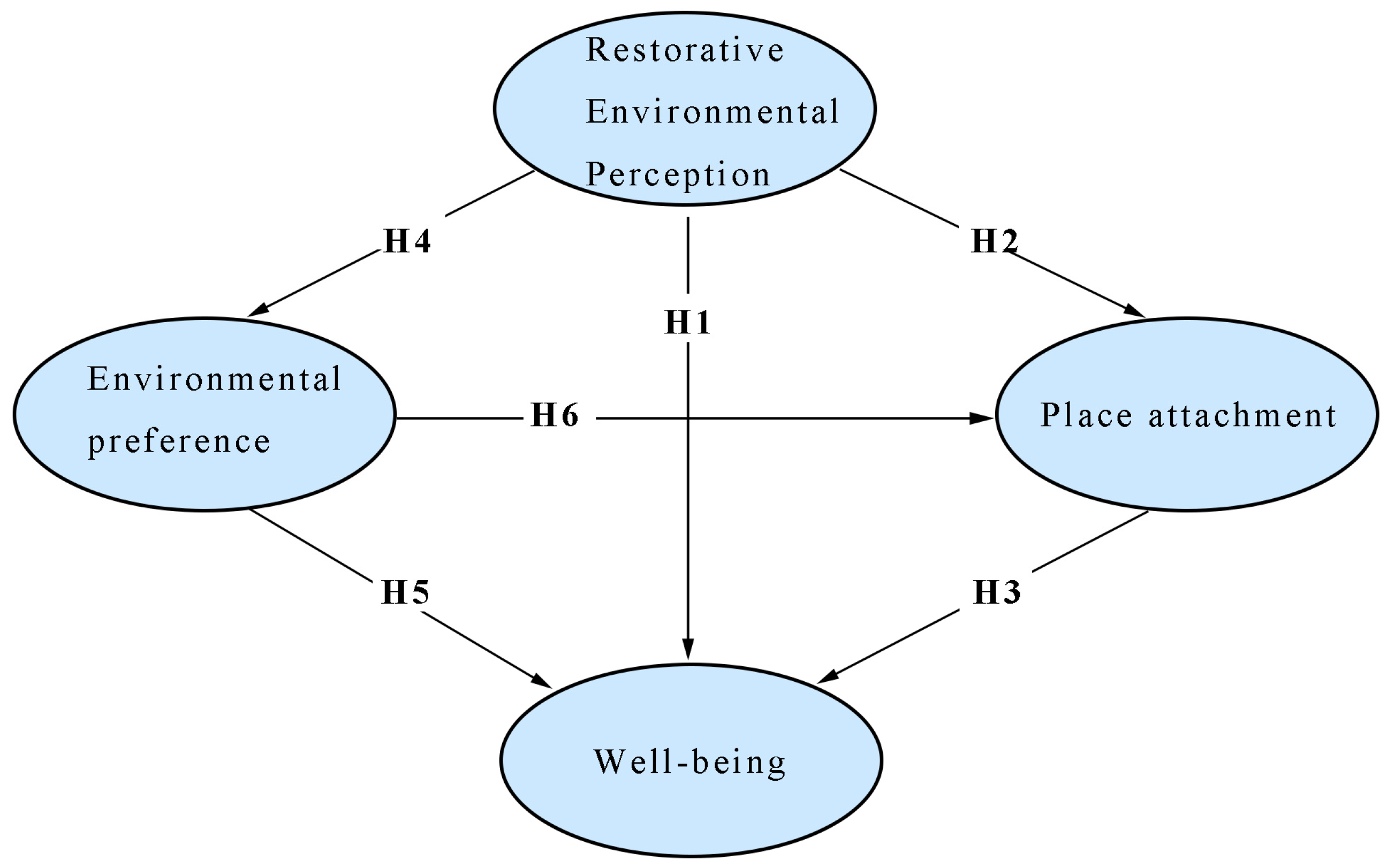
The above six hypotheses are shown in Figure 1.
Figure 1. Hypothetical Model.

3. Methodology

3.1. Study Area

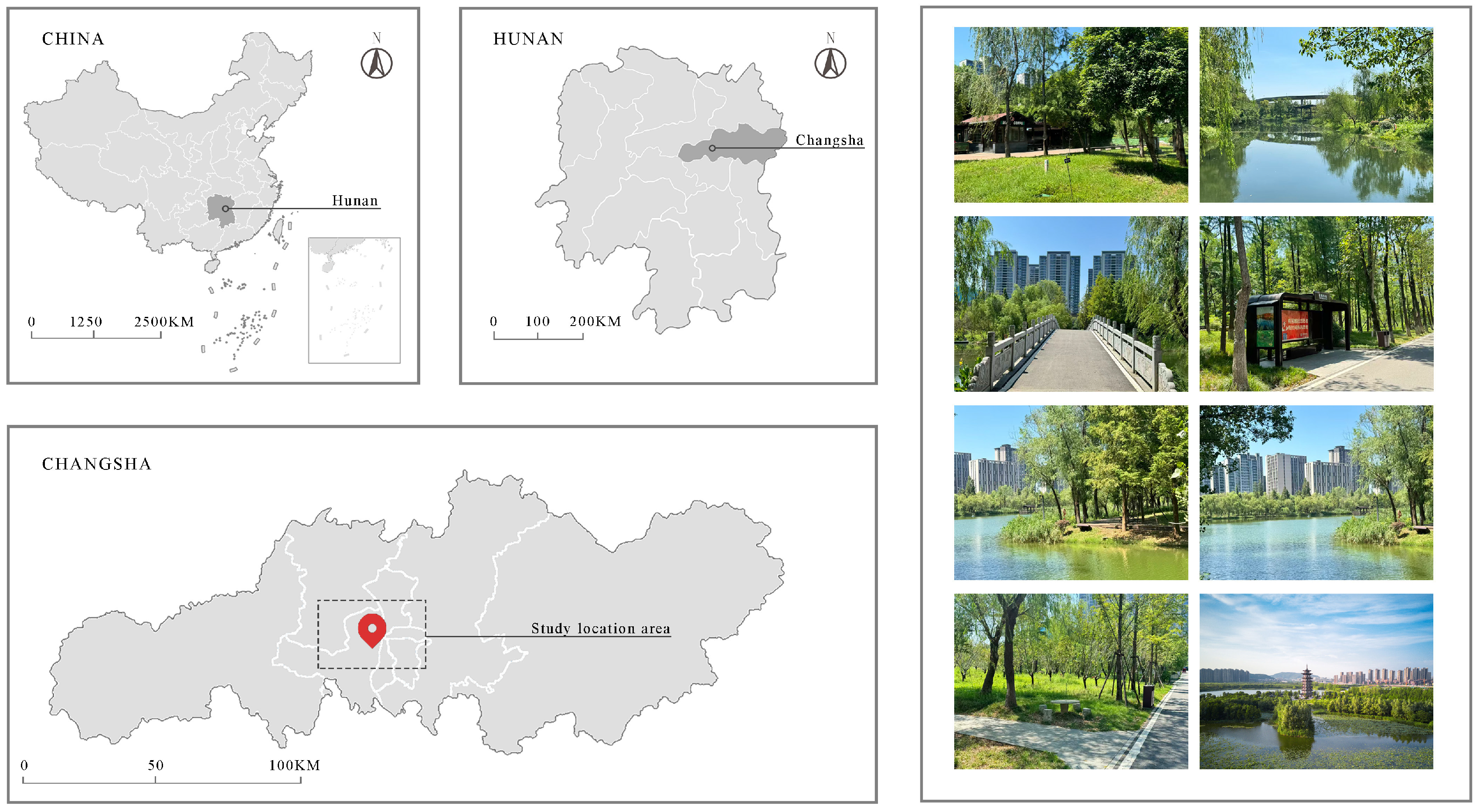
This study selected Yanghu Wetland Park in Changsha as its research site (Figure 2). Located in the southern part of Yuelu District, Changsha City, Hunan Province, Yanghu Wetland Park overlooks Yuelu Mountain to the north and borders the Xiang River to the east. Surrounded by the Jinjiang River and Ya River, it is an urban wetland park integrating multiple functions including ecology, culture, recreation, and education. The park is divided into five major zones: Wetland Science Education Area, Wetland Biodiversity Exhibition Area, Wetland Ecological Conservation Area, Wetland Recreation Area, and Management Service Area. With a remarkable 90% green coverage, the park hosts over 1300 wetland plant species, including metasequoia and sweet flag. Temperatures here average approximately 3 °C lower than downtown areas, while negative oxygen ion concentrations exceed urban centers by over sixfold. Annually, the park absorbs and sequesters 6500 tons of carbon dioxide. The park is home to over 300 bird species, including gray swans and egrets, alongside diverse subtropical animals, aquatic life, and insects. This forms a complete wetland ecosystem, exemplifying the harmonious coexistence of ecological conservation and urban living. As the largest national wetland park in central China, Yanghu National Wetland Park has been designated a 4A-level national scenic area, attracting over 2 million visitors annually [48], ensuring high representativeness of the study sample.
Figure 2. Study Location.

3.2. Questionnaire Design

The questionnaire designed for this study comprises five sections:
Part One collects demographic information from urban wetland park visitors, including gender, age, education level, employment status, and visit frequency [44]. Given the diversity and varying levels of activity among urban wetland park visitors, eight questions were designed covering gender, age, education level, employment status, travel companions, visit frequency, and visit motivation to analyze the social characteristics of wetland park visitors. Data from this section will undergo single-choice descriptive statistical analysis by group.
Part Two comprises the Environmental Preference Scale, primarily referencing Peng et al.’s research. It includes four dimensions: consistency, legibility, complexity, and mystery [26,49].
Part Three comprises the well-being scale, primarily based on the research by R Kammann et al. [30].
Part Four comprises the Environmental Restorativeness Evaluation Scale, drawing from Liu’s research [50] and Peng’s revised scale [49]. It encompasses four dimensions—remoteness, compatibility, expansiveness, and appeal—with a total of 8 test items designed.
Part Five comprises the Place Attachment Scale, primarily drawing from scales developed by Williams [51] and others. Considering the close relationship between restorative environmental perceptions and place attachment in visitor recreation experiences [52,53], this study specifically examines the influence of restorative environments on place attachment. Concurrently, prior research indicates that visitors’ restorative perceptions positively influence well-being enhancement [54]. Therefore, descriptive statistical analyses will also be conducted for this section’s data by group.
The entire questionnaire employs a 5-point Likert scale, where scores ranging from 1 to 5 represent respondents’ attitudes from “strongly disagree” to “strongly agree”.

3.3. Data Collection

In November 2023, a preliminary survey was conducted at Yanghu Wetland Park in Changsha. Feedback from 20 visitors, gathered through questionnaires and interviews, informed revisions to refine the questionnaire’s clarity and relevance, ultimately resulting in the final version.
The formal survey was conducted at Yanghu Wetland Park from December 2023 to January 2024. Data collection employed a combination of offline and online questionnaires. The offline component primarily involved distributing questionnaires through random sampling within the park, with survey times concentrated during peak visitor activity periods: 8:00–11:00 AM and 3:00–6:00 PM. Prior to distribution, surveyors provided detailed explanations of the questionnaire content to ensure respondents fully understood the questions. All questionnaires are completed anonymously to ensure respondents can freely express their opinions and minimise social desirability bias.
The online questionnaire was adopted due to the wetland park’s visitor base exhibiting distinct mobility and seasonal characteristics. The online and offline questionnaires employ identical structures and wording to prevent measurement reliability and validity from being compromised by version discrepancies. Some respondents continue to engage with Yanghu Wetland Park via online platforms (such as the park’s WeChat official account, tourism communities, and relevant social media) outside the survey period. Distributing the questionnaire online not only broadens the sample coverage but also captures the opinions of potential visitors who might otherwise be unable to participate in offline surveys due to timing constraints or distance limitations. This approach ensures the sample more comprehensively reflects the public’s perceptions and experiences of the wetland park.
A total of 276 questionnaires were distributed, including 62 offline and 189 online surveys. A total of 251 valid questionnaires were collected, yielding a response rate of 90.9%. The overall sample distribution was balanced and representative, accurately reflecting different groups’ perceptions and experiences of the wetland park.

4. Results

4.1. Basic Sample Characteristics

To ensure representative sampling, this study employed stratified random sampling. Samples were selected based on key demographic characteristics of the target population, including gender, age, and education level. First, we referenced relevant literature on Yanghu Wetland Park to determine the overall distribution of visitors’ gender, age, and education levels. Based on these data, we allocated the sample proportionally to ensure its distribution across these characteristics aligned with the population.
Among the collected samples, males accounted for 27.5% and females for 72.5%, indicating a significantly higher number of female visitors than males. This gender ratio generally aligns with the actual gender distribution trend among wetland visitors in the target study area, demonstrating good representativeness of the sample in terms of gender. Regarding age structure, respondents were predominantly concentrated in the 18–25 age group, comprising 52.5% of the total sample; followed by the 36–45 age group at 16.7%. This age distribution reflects the reality that young adults constitute the primary demographic among wetland visitors, ensuring the sample’s representativeness of the main visitor cohort. Regarding educational attainment, 59.8% held a bachelor’s degree, fully reflecting the high proportion of highly educated individuals among wetland visitors.
Therefore, based on these demographic characteristics, the selected sample possesses strong representativeness and provides reliable data support for subsequent empirical research (Table 1).
Table 1. Demographic Characteristics Scales.

4.2. Reliability and Validity Analysis

The questionnaire comprised 23 items. To ensure reliability, Cronbach’s α coefficient was used to assess internal consistency. Results indicated a total Cronbach’s α of 0.973, with all latent variables exceeding 0.8, confirming high reliability and sound design [55]. Furthermore, the standard factor loadings of each observed variable on its corresponding latent variable were all greater than 0.5 and close to 1, indicating good internal consistency of the scale [56].
Regarding validity analysis, both KMO values and Bartlett’s sphericity test results indicated data suitability for factor analysis. KMO values for all four primary variables (environmental preference, well-being, restorative environmental perception, and place attachment) exceeded 0.6, while Bartlett’s test significance consistently fell below 0.01, validating the questionnaire’s construct validity [57].
Furthermore, the overall item correlations exceeded 0.3. The AVE values for environmental preference and place attachment both exceeded 0.5, with CR values above 0.6. Although the AVE for well-being and restorative environmental perception was slightly below 0.5, their CR values remained above 0.6. According to the criteria established by Fornell and Larcker (1981) [56], the convergent validity remains acceptable. Therefore, the overall reliability and validity of the questionnaire are good (Table 2).
Table 2. Reliability and Validity Test Results.

4.3. Structural Equation Modeling Analysis

4.3.1. Model Fit Analysis

To validate the structural validity of the measurement model designed in this study, confirmatory factor analysis (CFA) was conducted to assess the model’s fit to the data. Fitting analysis was performed using AMOS 23.0 software, employing key fit indices including: Root Mean Square Error of Approximation (RMSEA), Comparative Fit Index (CFI), Goodness-of-Fit Index (GFI), Chi-Square/Degrees of Freedom (χ2/df), Normative Fit Index (NFI), and Tolerance/Least Squares Index (TLI) [58]. Specifically, RMSEA measures the error approximation in the model, reflecting the discrepancy between observed data and model-predicted data [59,60]; CFI assesses model fit on a scale from 0 to 1, with values closer to 1 indicating superior fit [61]; χ2/df is used to reduce the influence of sample size on chi-square values. The ideal range is between 1 and 3; a smaller value indicates better model fit. However, a value below 1 indicates overfitting, suggesting the researcher has overly adjusted the model [60]; TLI is another indicator for assessing model fit, ranging from 0 to 1. Values closer to 1 indicate better model fit [60,62].
As shown in Table 3, all indicators of the Yanghu Wetland Park model meet reasonable standards. Specifically: χ2/df is 2.222, falling within the ideal range of 1 to 3, indicating that the model fits well. The GFI value is slightly below the recommended threshold of 0.90. However, prior methodological studies have noted that GFI is sensitive to sample size and model complexity, and values above 0.80 can still be considered acceptable when other fit indices indicate good model fit [63,64,65]; The CFI, NFI, IFI, and TLI values were 0.942, 0.908, 0.942, and 0.933, respectively, all exceeding the reference standard of 0.9. The RMSEA value was 0.079, below the recommended upper limit of 0.080 [66,67].
Table 3. Structural equation model fitting results.

4.3.2. Structural Equation Model

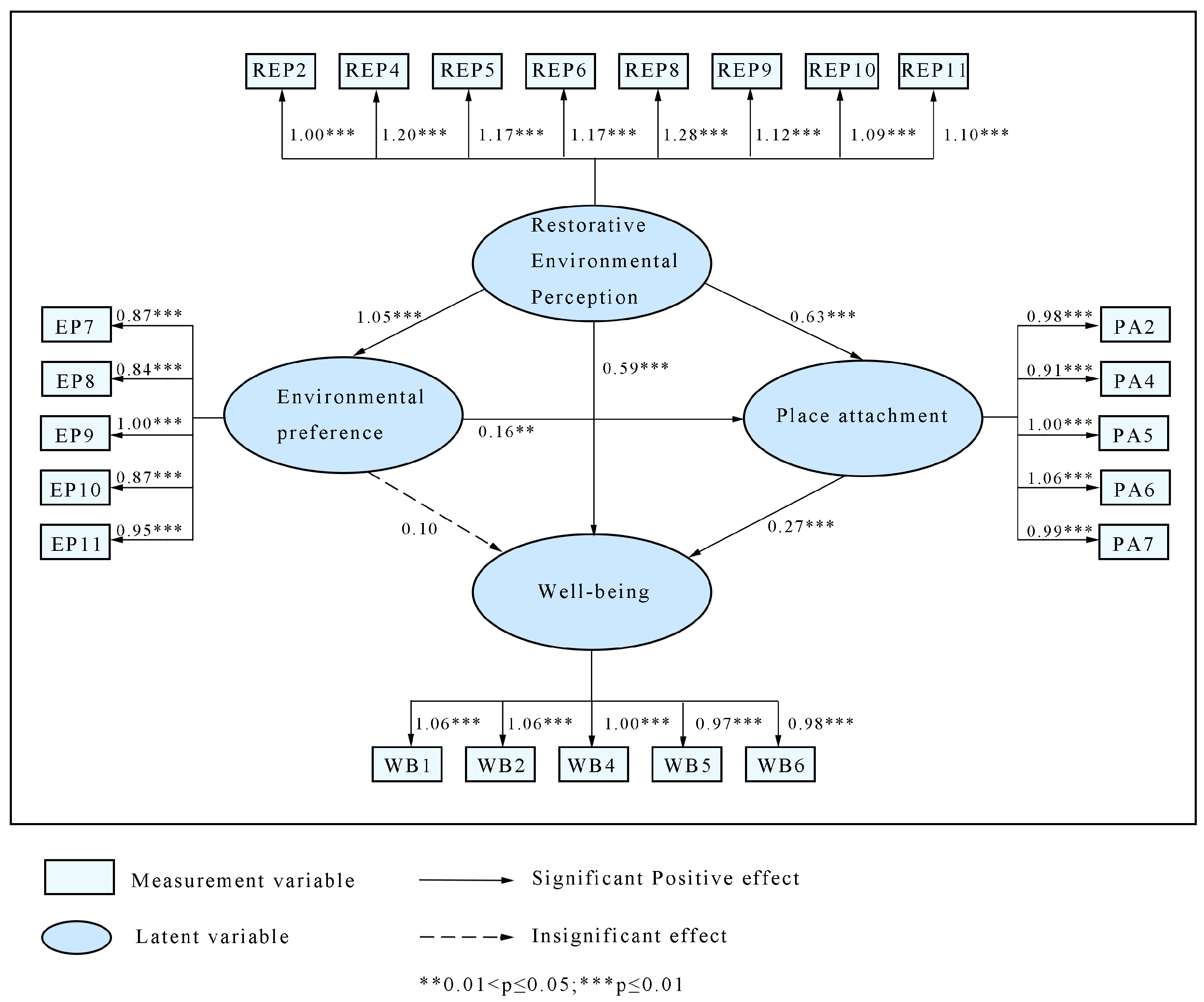
Standardized path coefficients and significance levels from the SEM are presented in Table 4 and Figure 3. Results indicate that the path coefficient for Hypothesis H5 did not reach statistical significance, meaning environmental preference does not significantly influence visitor well-being; thus, Hypothesis H5 is not supported. Path coefficients for the remaining hypotheses—H1, H2, H3, H4, and H6—were all significant, validating these research hypotheses.
Table 4. Structural model path coefficients.
Figure 3. Structural Equation Model Results.
Specifically, restorative environmental perception significantly and positively influenced well-being (β = 0.585, p < 0.01) and exerted a significant positive effect on place attachment (β = 0.627, p < 0.001). Furthermore, place attachment significantly and positively impacted well-being (β = 0.267, p < 0.001). The effect of restorative environmental perception on environmental preference was also significant (β = 1.049, p < 0.001), and environmental preference exerted a significant positive influence on place attachment (β = 0.159, p < 0.005). However, the direct effect of environmental preference on well-being was not significant (β = 0.102, p > 0.05), indicating that this path failed to pass the significance test.

4.3.3. Testing the Mediating Effects

We employed the Bootstrap method for empirical analysis, setting 2000 repeated samples to test the effects of place attachment and environmental preference as mediating variables within a 95% confidence interval. If the 95% confidence interval (95% CI) for the indirect effect does not include zero, it indicates that the mediating effect is statistically significant [68]. The model generated results for direct effects, total effects, and indirect effects (Table 5).
Table 5. Results of mediating effect test.
The analysis revealed that the overall effect of restorative environmental perception on well-being was significant (β = 0.875, 95% CI = [0.839, 1.070]), with a direct effect of β = 0.539 (95% CI = [0.093, 0.487], excluding zero). Within the pathway “restorative environmental perception → place attachment → well-being”, the indirect effect was β = 0.154, 95% CI = [0.082, 0.318], significantly non-zero, confirming the existence of this mediating pathway, which accounted for 17.6% of the total effect. In the path “ restorative environmental perception → environmental preference → well-being”, the indirect effect β = 0.098, 95% CI = [−0.122, 0.370], included 0, indicating this mediating path was not significant. In the path “ restorative environmental perception → environmental preference → place attachment”, the indirect effect β = 0.252, 95% CI = [0.117, 0.589], was significantly different from zero, accounting for 28.8% of the total effect. The total effect of the three indirect paths was β = 0.364, accounting for 41.6% of the total effect.
Furthermore, comparing the effect differences between distinct indirect pathways (STD1 versus STD2) revealed that their confidence intervals both encompassed zero (e.g., STD1 CI = [−0.202, 0.305]). This indicates no significant difference in mediating strength between the two pathways, suggesting that both environmental preference and place attachment exerted important yet non-dominant roles within the mediating mechanism.

5. Discussion

Based on field survey data from Changsha Yanghu Wetland Park, this study delves into the pathways through which restorative environmental perception influences visitor well-being, examining the mediating roles of environmental preference and place attachment. The findings not only validate the core role of restorative environmental perception in promoting visitor well-being but also reveal the distinct psychological transmission pathways undertaken by environmental preference and place attachment within this mechanism.
Using SEM, this study validated the relationships among restorative environmental perception, environmental preference, place attachment, and well-being. Results indicate that most hypotheses are supported, suggesting good model fit. Notably, the relationship between restorative environmental perception and both well-being and place attachment is significant. This finding aligns with the conclusions of Kaplan & Kaplan’s (1989) [25] and Hartig’s research on “benefits of nature experiences” [69], further demonstrating that the “psychological restoration” function of natural environments effectively alleviates emotional exhaustion and enhances individual subjective well-being. As urban green spaces integrating ecological and recreational functions, wetland parks offer visitors opportunities for psychological recovery from urban stress through their abundant natural elements, diverse landscape layers, and low-disturbance open environments. Perceived restorative environments not only satisfy aesthetic and relaxation needs but also promote psychological energy regeneration, directly enhancing well-being. Thus, restorative environmental qualities are core elements in constructing positive tourism experiences and promoting well-being.
Furthermore, this study reveals that restorative environmental perception exerts a significant indirect influence on well-being through place attachment (indirect effect value = 0.167, p < 0.05). This indicates that visitors’ restorative experiences within wetland parks foster emotional belonging and attachment, thereby further enhancing well-being. This result aligns with Jiang’s research [37]. Place attachment functions not only as an emotional bond but also as a cognitive sense of belonging, reflecting individuals’ meaning-making within the environment. When visitors experience pleasure, tranquility, and restorative psychological states in wetland parks, they are more likely to form emotional attachments, psychologically perceiving the environment as a “vehicle for positive experiences.” This emotional connection enhances the persistence and stability of well-being. Thus, place attachment serves as an indispensable psychological mediator in the formation of visitor well-being, shifting the role of environmental experiences from the perceptual to the emotional level.
Although environmental preference did not significantly influence well-being directly (β = 0.102, p > 0.05), it exerted a significant positive effect on place attachment (β = 0.159, p < 0.005) and indirectly impacted well-being through place attachment. According to Kaplan’s ART and place identity theory [35], a plausible explanation is that while environmental preference may capture attention, individuals require establishing ‘compatibility’ and emotional connections within the setting to foster enduring well-being. That is, when visitors internalise their affection for the environment as an emotional bond (attachment), the setting becomes an extension of the self, thereby providing more stable psychological support. Unlike traditional urban parks integrated into residents’ daily lives, wetland parks possess stronger pristine and ‘wild’ characteristics. Visitors require deeper emotional engagement (attachment) to overcome feelings of alienation from the natural environment, thereby achieving a sense of well-being. Therefore, in the landscape planning and design of wetland parks, managers can enhance emotional resonance between visitors and the environment through interactive, immersive experiences, and culturally symbolic elements. This includes integrating local cultural narratives and ecological knowledge into interpretive systems, while enhancing the sense of place through environmental education and interactive installations. This facilitates the transformation of preferences into attachment, thereby promoting sustained improvements in well-being.
The research findings hold significant practical implications for wetland park planning and management (Table 6). First, emphasis should be placed on enhancing the restorative qualities of the environment. This can be achieved by optimizing landscape diversity, creating tranquil atmospheres, and strengthening spatial continuity and explorability to intensify visitors’ psychological recovery experiences. Second, cultural storytelling displays, nature education activities, and participatory experience designs can deepen visitors’ place attachment, fostering stable cognitive, emotional, and behavioral connections to the site. And communication and management strategies should leverage online platforms (e.g., social media, virtual exhibitions) to reinforce visitors’ emotional memories and environmental identification, thereby extending the lasting effects of well-being experiences. Finally, climate resilience has also become one of the core objectives in the design of urban blue–green spaces. Traditional blue–green infrastructure models have predominantly focused on ecological services (such as flood storage and biodiversity), whereas recent research increasingly emphasises their social and psychological co-benefits [70].
Table 6. Path Mechanism Differences Between Wetland Parks and Traditional Urban Green Spaces.
Although this study analyzed the relationships among restorative environmental perception, environmental preference, place attachment, and well-being through field research and structural equation modeling, several limitations exist. (1) This study employs Yanghu Wetland Park in Changsha, Hunan Province as a case study. Whilst the park possesses typical wetland ecological landscapes and peri-urban geographical characteristics, rendering it reasonably representative, its spatial attributes, cultural context and management practices exhibit distinct particularities. Furthermore, the relatively high proportion of young women in the sample may affect the validity of the findings across different gender and age groups. Future research could conduct multi-site comparative studies across different wetland park types and employ balanced sampling designs to enhance the generalisability of conclusions. (2) This study utilised a cross-sectional design, precluding definitive causal inferences. While the structural model demonstrated directional relationships between variables, alternative explanatory pathways cannot be ruled out. Longitudinal tracking or experimental designs may be considered in future research to more effectively test the stability and directionality of causal relationships among these variables. (3) The scales employed in this study primarily rely on subjective evaluations, potentially introducing social desirability bias. Subsequent research may enhance reliability by integrating physiological indicators (e.g., heart rate variability, skin conductance response) or behavioural data (e.g., dwell time, route preferences). (4) Key variables in this study (e.g., Restorative environmental perception, place attachment) were adapted from classical scales. Although reliability indices were high, there remains scope for improvement in contextual fit and dimensional breadth. Future research should expand measurement dimensions, refine item wording, and undertake localised scale revisions grounded in practical settings to enhance construct content validity and model fit.

6. Conclusions

Through field investigation and data analysis conducted at Yanghu Wetland Park in Changsha, this study confirms the critical roles of restorative environmental perception, place attachment, and environmental preference, and elucidates how these factors influence visitor well-being through both direct and indirect pathways. The findings show that restorative environmental perception directly enhances well-being and further strengthens this effect through the mediating roles of environmental preference and place attachment.
Notably, place attachment serves as a key mediator between restorative environmental perception and well-being, suggesting that designing environmental features that cultivate place attachment is an essential strategy for improving visitor well-being in urban park planning and management. Although environmental preference does not exert a significant direct effect on well-being, its indirect influence via place attachment highlights the importance of aligning environmental design with visitor preferences.
Based on these insights, urban planners and wetland park managers are encouraged to prioritize the enhancement of restorative environmental perception, reinforce visitors’ place attachment, and foster environmental preference to more effectively promote mental health and well-being. These findings offer both theoretical contributions and practical guidance for the planning and management of urban wetland parks.

Author Contributions

Conceptualization, X.C., J.L. and Y.C.; Methodology, X.C., D.F., C.Z. and H.Z.; Formal analysis, D.F., J.L., C.Z., Y.C., D.W., Y.P., W.L., L.Y. and M.G.; Investigation, D.F., J.L., C.Z., Y.C., D.W., Y.P., W.L., L.Y. and M.G.; Resources, X.C., J.L., Y.C. and W.L.; Writing—original draft, X.C., D.F., J.L. and Y.C.; Writing—review & editing, X.C. and D.F.; Supervision, J.L., Y.C. and H.Z.; Funding acquisition, X.C., C.Z. and L.Y. All authors have read and agreed to the published version of the manuscript.

Funding

This work was supported by the National Natural Science Foundation of China (No. 52108049), the Natural Science Foundation of Hunan Province, China (No. 2023JJ30182), the Program of China Scholarship Council (No. 202308430129), the Scientific Research Foundation of Hunan Provincial Department of Education (No. 23A0639), the Graduate Innovation and Exploration Foundation of Central South University (No. 2024ZZTS0596).

Institutional Review Board Statement

This study only involved an anonymous questionnaire survey with no sensitive information collected. The Research Ethics Committee of Hunan First Normal University has confirmed that no ethical approval is required.

Data Availability Statement

The datasets generated and analyzed during the current study are available from the corresponding author on reasonable request.

Conflicts of Interest

The authors declare that the research was conducted in the absence of any commercial or financial relationships that could be construed as a potential conflict of interest.

References

  1. Chen, Y.; Ge, H.; Chen, M. What drives urban land green use efficiency in China: A global meta-frontier Malmquist Index approach. Ecol. Indic. 2025, 175, 113550. [Google Scholar] [CrossRef] [Scilit]
  2. Ma, G.; Pellegrini, P.; Han, H.Q. The vitality of pocket parks in high-density urban areas. An evaluation system from the users’ perspective in Southwest China. Urban For. Urban Green. 2025, 104, 128596. [Google Scholar] [CrossRef] [Scilit]
  3. Su, Y.L.; Lu, C.Y.; Su, Y.; Wang, Z.L.; Huang, Y.F.; Yang, N.C. Spatio-temporal Evolution of Urban Expansion Based on a Novel Adjusted Index and GEE: A Case Study of Central Plains Urban Agglomeration, China. Chin. Geogr. Sci. 2023, 33, 736–750. [Google Scholar] [CrossRef] [Scilit]
  4. United Nations Department of Economic and Social Affairs. World Urbanization Prospects: The 2018 Revision; United Nations: New York, NY, USA, 2019. [Google Scholar]
  5. Hongxiao, L.; Yujin, P.; Min, J.; Xiao, S.; Hai, R.; Le, L.; Taotao, H.; Yuan, L.; Shanwen, Z.; Chunhua, S. Greenspace exposure and its dual role as mediator and moderator in the relationship between urban density and mental health. Landsc. Urban Plan. 2025, 264, 105497. [Google Scholar] [CrossRef] [Scilit]
  6. Sun, B.; Yin, C.; Yao, X. Densification and health in China: A U-shaped association between population density and obesity. Trans. Plan. Urban Res. 2022, 1, 135–151. [Google Scholar] [CrossRef] [Scilit]
  7. Sun, B.D.; Yin, C. Relationship between multi-scale urban built environments and body mass index: A study of China. Appl. Geogr. 2018, 94, 230–240. [Google Scholar] [CrossRef] [Scilit]
  8. Chang, Y.T.; Yang, Y.; Cai, X.X.; Zhou, L.Q.; Li, J.; Liu, S.B. How Campus Landscapes Influence Mental Well-Being Through Place Attachment and Perceived Social Acceptance: Insights from SEM and Explainable Machine Learning. Land 2025, 14, 1712. [Google Scholar] [CrossRef] [Scilit]
  9. Li, J.; Chang, Y.T.; Cai, X.X.; Liu, S.B.; Peng, Y.; Feng, T.; Qi, J.L.; Ji, Y.F.; Xia, Y.T.; Lai, W.B. Health perception and restorative experience in the therapeutic landscape of urban wetland parks during the COVID-19 pandemic. Front. Public Health 2023, 11, 1272347. [Google Scholar] [CrossRef] [Scilit]
  10. Wang, J.; Long, R.; Chen, H.; Li, Q. Measuring the Psychological Security of Urban Residents: Construction and Validation of a New Scale. Front. Psychol. 2019, 10, 2423. [Google Scholar] [CrossRef] [Scilit] [PubMed]
  11. Liu, S.B.; Qi, J.L.; Yang, Y.; Huo, W.; Li, J.; Chang, Y.T.; Peng, Y. Deconstructing urban green justice and well-being: A multi-group structural equation modeling analysis based on the activity space perspective. Front. Public Health 2025, 13, 1670454. [Google Scholar] [CrossRef] [Scilit] [PubMed]
  12. Isabella, D.M.; Claudia, B.; Giulia, C.M.; Alessandro, C.; Alessandro, P. Citizens’ use of public urban green spaces at the time of the COVID-19 pandemic in Italy. Urban For. Urban Green. 2022, 77, 127739. [Google Scholar] [CrossRef] [Scilit]
  13. Berman, M.G.; Jonides, J.; Kaplan, S. The Cognitive Benefits of Interacting With Nature. Psychol. Sci. 2008, 19, 1207–1212. [Google Scholar] [CrossRef] [Scilit]
  14. Hammoud, R.; Tognin, S.; Burgess, L.; Bergou, N.; Smythe, M.; Gibbons, J.; Davidson, N.; Afifi, A.; Bakolis, I.; Mechelli, A. Smartphone-based ecological momentary assessment reveals mental health benefits of birdlife. Sci. Rep. 2022, 12, 17589. [Google Scholar] [CrossRef] [Scilit] [PubMed]
  15. Zhang, G.C.; Li, T.T.; Cui, Y.; Ren, T.H. The restorative effects of working individually in a vegetated office space: A crossover controlled experimental study in real-life workplace setting. Work 2025, 81, 3070–3082. [Google Scholar] [CrossRef] [Scilit]
  16. de Bell, S.; Graham, H.; Jarvis, S.; White, P. The importance of nature in mediating social and psychological benefits associated with visits to freshwater blue space. Landsc. Urban Plan. 2017, 167, 118–127. [Google Scholar] [CrossRef] [Scilit]
  17. Georgiou, M.; Morison, G.; Smith, N.; Tieges, Z.; Chastin, S. Mechanisms of Impact of Blue Spaces on Human Health: A Systematic Literature Review and Meta-Analysis. Int. J. Environ. Res. Public Health 2021, 18, 2486. [Google Scholar] [CrossRef] [Scilit]
  18. Alikhani, S.; Nummi, P.; Ojala, A. Urban Wetlands: A Review on Ecological and Cultural Values. Water 2021, 13, 3301. [Google Scholar] [CrossRef] [Scilit]
  19. Chen, B.Y.; Lu, Y.; Imran, M.; Adam, N.A.; Jang, J. Evaluating and transferring social value of ecosystem services in urban wetland parks using the SolVES model. Ecol. Indic. 2025, 172, 113270. [Google Scholar] [CrossRef] [Scilit]
  20. Deng, Y.; Jiang, W.G.; Ling, Z.Y.; Liu, L.L.; Sun, S.J. Revealing the driving factors of urban wetland park cooling effects using Random Forest regression and SHAP algorithm. Sustain. Cities Soc. 2025, 120, 106151. [Google Scholar] [CrossRef] [Scilit]
  21. Li, T.J.; Jin, Y.; Huang, Y. Water quality improvement performance of two urban constructed water quality treatment wetland engineering landscaping in Hangzhou, China. Water Sci. Technol. 2022, 85, 1454–1469. [Google Scholar] [CrossRef] [Scilit]
  22. Li, H.Y.; Peng, J.X.; Jiao, Y.; Ai, S.S. Experiencing Urban Green and Blue Spaces in Urban Wetlands as a Nature-Based Solution to Promote Positive Emotions. Forests 2022, 13, 473. [Google Scholar] [CrossRef] [Scilit]
  23. Li, J.; Pan, Q.; Peng, Y.; Feng, T.; Liu, S.B.; Cai, X.X.; Zhong, C.X.; Yin, Y.C.; Lai, W.B. Perceived Quality of Urban Wetland Parks: A Second-Order Factor Structure Equation Modeling. Sustainability 2020, 12, 7204. [Google Scholar] [CrossRef] [Scilit]
  24. Zhang, X.D.; Zhang, Y.X.; Zhai, J.; Wu, Y.F.; Mao, A.Y. Waterscapes for Promoting Mental Health in the General Population. Int. J. Environ. Res. Public Health 2021, 18, 11792. [Google Scholar] [CrossRef] [Scilit] [PubMed]
  25. Kaplan, R.S.-W.; Kaplan, S. The Experience of Nature: A Psychological Perspective; Cambridge University Press: Cambridge, UK, 1989. [Google Scholar]
  26. Kaplan, S. The restorative benefits of nature: Toward an integrative framework. J. Environ. Psychol. 1995, 15, 169–182. [Google Scholar] [CrossRef] [Scilit]
  27. White, M.P.; Hartig, T.; Martin, L.; Pahl, S.; van den Berg, A.E.; Wells, N.M.; Costongs, C.; Dzhambov, A.M.; Elliott, L.R.; Godfrey, A.; et al. Nature-based biopsychosocial resilience: An integrative theoretical framework for research on nature and health. Environ. Int. 2023, 181, 108234. [Google Scholar] [CrossRef] [Scilit]
  28. Reeves, J.P.; John, C.H.D.; Wood, K.A.; Maund, P.R. A Qualitative Analysis of UK Wetland Visitor Centres as a Health Resource. Int. J. Environ. Res. Public Health 2021, 18, 8629. [Google Scholar] [CrossRef] [Scilit] [PubMed]
  29. Ulrich, R.S.; Simons, R.F.; Losito, B.D.; Fiorito, E.; Miles, M.A.; Zelson, M. Stress recovery during exposure to natural and urban environments. J. Environ. Psychol. 1991, 11, 201–230. [Google Scholar] [CrossRef] [Scilit]
  30. Kammann, R.; Farry, M.; Herbison, P. The analysis and measurement of happiness as a sense of well-being. Soc. Indic. Res. 1984, 15, 91–115. [Google Scholar] [CrossRef] [Scilit]
  31. Su, L.L.; Zhou, S.H.; Kwan, M.P.; Chai, Y.W.; Zhang, X. The impact of immediate urban environments on people’s momentary happiness. Urban Stud. 2022, 59, 140–160. [Google Scholar] [CrossRef] [Scilit]
  32. Grassini, S.; Segurini, G.V.; Koivisto, M. Watching Nature Videos Promotes Physiological Restoration: Evidence From the Modulation of Alpha Waves in Electroencephalography. Front. Psychol. 2022, 13, 871143. [Google Scholar] [CrossRef] [Scilit]
  33. Biassoni, F.; Gandola, M.; Gnerre, M. Grounding the Restorative Effect of the Environment in Tertiary Qualities: An Integration of Embodied and Phenomenological Perspectives. J. Intell. 2023, 11, 208. [Google Scholar] [CrossRef] [Scilit]
  34. Hung, S.H.; Pálsdóttir, A.M.; Sang, A.O.; Shahrad, A.; Liao, H.H.; Hsu, Y.Y.; Chang, C.Y. How restorative landscapes can benefit psychological and physiological responses: A pilot study of human-nature relationships in Sweden and Taiwan. Landsc. Res. 2023, 48, 1073–1090. [Google Scholar] [CrossRef] [Scilit]
  35. Williams, D.R.; Roggenbuck, J.W. Measuring Place Attachment: Some Preliminary Results. In Proceedings of the NRPA Symposium on Leisure Research, San Antonio, TX, USA, 20–22 October 1989. [Google Scholar]
  36. Sapiains, R.; Elgueta, H.; Ríos, P.F.; Miño, M. Strengthening Environmental Conservation: The Role of Connectedness to Nature and Place Attachment in Intentions to Protect Urban Wetlands in Punta Arenas, Chilean Patagonia. Sustainability 2025, 17, 1665. [Google Scholar] [CrossRef] [Scilit]
  37. Jiang, S.; Li, X.; Lin, J.; Ji, X.; Ji, W. Research on restorative perception mechanisms in rural landscapes based on structural equation modelling. Ecol. Indic. 2025, 172, 113252. [Google Scholar] [CrossRef] [Scilit]
  38. Sieng, V.; Szabó, A. Exploring the place attachments of older migrants in Aotearoa: A life course history approach. Adv. Life Course Res. 2023, 57, 100560. [Google Scholar] [CrossRef] [Scilit]
  39. Rosa, C.D.; Larson, L.R.; Collado, S.; Cloutier, S.; Profice, C.C. Gender Differences in Connection to Nature, Outdoor Preferences, and Nature-Based Recreation Among College Students in Brazil and the United States. Leis. Sci. 2023, 45, 135–155. [Google Scholar] [CrossRef] [Scilit]
  40. van den Berg, A.E.; Koole, S.L.; van der Wulp, N.Y. Environmental preference and restoration: (How) are they related? J. Environ. Psychol. 2003, 23, 135–146. [Google Scholar] [CrossRef] [Scilit]
  41. Zhang, H.M.; Zhang, X.; Yang, Y.J.; Ma, J.Y. From nature experience to visitors’ pro-environmental behavior: The role of perceived restorativeness and well-being. J. Sustain. Tour. 2024, 32, 861–882. [Google Scholar] [CrossRef] [Scilit]
  42. Jeong, H. Relationship Between Tourists’ Perceived Restorative Environment and Wellness Tourism Destinations. Int. J. Tour. Res. 2024, 26, e2765. [Google Scholar] [CrossRef] [Scilit]
  43. van den Bogerd, N.; Dijkstra, S.C.; Seidell, J.C.; Maas, J. Greenery in the university environment: Students’ preferences and perceived restoration likelihood. PLoS ONE 2018, 13, e0192429. [Google Scholar] [CrossRef] [Scilit]
  44. Liu, S.B.; Ji, Y.F.; Li, J.; Peng, Y.; Li, Z.T.; Lai, W.B.; Feng, T. Analysis of students’ positive emotions around the green space in the university campus during the COVID-19 pandemic in China. Front. Public Health 2022, 10, 888295. [Google Scholar] [CrossRef] [Scilit]
  45. Prinzing, M. Proenvironmental Behavior Increases Subjective Well-Being: Evidence From an Experience-Sampling Study and a Randomized Experiment. Psychol. Sci. 2024, 35, 951–961. [Google Scholar] [CrossRef] [Scilit]
  46. Vaznonis, B.; Staugaitis, A.J.; Vaznoniene, G. The Interrelationship between Pro-Environmental Attitudes and Subjective Well-Being: The Case of Central and Eastern European Countries. Sustainability 2024, 16, 3434. [Google Scholar] [CrossRef] [Scilit]
  47. Wilkie, S.; Clements, H. Further exploration of environment preference and environment type congruence on restoration and perceived restoration potential. Landsc. Urban Plan. 2018, 170, 314–319. [Google Scholar] [CrossRef] [Scilit]
  48. Yang, L.; Li, M. Research on the coordination of ecotourism development and ecological civilisation construction coupling in national wetland parks--Taking Yanghu National Wetland Park as an example. J. Urban Stud. 2023, 44, 38–46. [Google Scholar] [CrossRef]
  49. Peng, H.; Li, X.; Yang, T.; Tan, S. Research on the Relationship between the Environmental Characteristics of Pocket Parks and Young People’s Perception of the Restorative Effects—A Case Study Based on Chongqing City, China. Sustainability 2023, 15, 3943. [Google Scholar] [CrossRef] [Scilit]
  50. Qunyue, L.I.U.; Ye, C.; Wei, Z.; Yijun, Z.; Qitang, H.; Siren, L.A.N. Tourists’ environmental preferences, perceived restoration and perceived health at Fuzhou National Forest Park. Resour. Sci. 2018, 40, 381–391. [Google Scholar] [CrossRef] [Scilit]
  51. Williams, D.R.; Patterson, M.E.; Roggenbuck, J.W.; Watson, A.E. Beyond the commodity metaphor: Examining emotional and symbolic attachment to place. Leis. Sci. 1992, 14, 29–46. [Google Scholar] [CrossRef] [Scilit]
  52. Jiaran, L.; Le, Z.; Renqiang, Q. The Research Frontier of Place Attachment Theory in Landscape Architecture and China’s Dynamic Analysis—A Review of Relevant Research Literature at Home and Abroad from 2011 to 2021. Chin. Landsc. Archit. 2022, 38, 140–144. [Google Scholar] [CrossRef]
  53. Qiu, H.; Wang, G.; Ren, L.; Zhang, J.; Wang, J. The impact of restorative destination environments on tourists’ well-being and environmentally responsible behavior: A Reasonable Person Model. Tour. Manag. Perspect. 2022, 44, 101028. [Google Scholar] [CrossRef] [Scilit]
  54. Ratcliffe, E.; Korpela, K.M. Memory and place attachment as predictors of imagined restorative perceptions of favourite places. J. Environ. Psychol. 2016, 48, 120–130. [Google Scholar] [CrossRef] [Scilit]
  55. Schryver, J.; Shankar, M.; Xu, S. Moving from descriptive to causal analytics: Case study of discovering knowledge from us health indicators warehouse. In Proceedings of the 2012 International Workshop on Smart Health and Wellbeing, Maui, HI, USA, 29 October 2012; pp. 1–8. [Google Scholar]
  56. Fornell, C.; Larcker, D.F. Structural Equation Models with Unobservable Variables and Measurement Error: Algebra and Statistics. J. Mark. Res. 1981, 18, 382–388. [Google Scholar] [CrossRef] [Scilit]
  57. Norhayati, M.N.; Nawi, Z.M. Validity and reliability of the Noor Evidence-Based Medicine Questionnaire: A cross-sectional study. PLoS ONE 2021, 16, e0249660. [Google Scholar] [CrossRef] [Scilit] [PubMed]
  58. Cheung, G.W.; Cooper-Thomas, H.D.; Lau, R.S.; Wang, L.C. Reporting reliability, convergent and discriminant validity with structural equation modeling: A review and best-practice recommendations. Asia Pac. J. Manag. 2024, 41, 745–783. [Google Scholar] [CrossRef] [Scilit]
  59. Mw, B. Alternative ways of assessing model fit. In Testing Structural Equation Models; SAGE Publications Inc.: Thousand Oaks, CA, USA, 1993. [Google Scholar]
  60. Wen, Z.; Hau, K.-T.; Marsh, H.W. Structural Eouation Model Testing: Cutoff Criteria for Goodness of Fit Indices and Chi-Souare Test. Acta Psychol. Sin. 2004, 36, 186–194. [Google Scholar]
  61. Bentler, P.M. Comparative fit indexes in structural models. Psychol. Bull. 1990, 107, 238–246. [Google Scholar] [CrossRef] [Scilit]
  62. Tucker, L.R.; Lewis, C. A reliability coefficient for maximum likelihood factor analysis. Psychometrika 1973, 38, 1–10. [Google Scholar] [CrossRef] [Scilit]
  63. Byrne, B.M. Structural Equation Modeling with Mplus: Basic Concepts, Applications, and Programming; Routledge: New York, NY, USA, 2013. [Google Scholar]
  64. Hu, L.T.; Bentler, P.M. Cutoff Criteria for Fit Indexes in Covariance Structure Analysis: Conventional Criteria Versus New Alternatives. Struct. Equ. Model. 1999, 6, 1–55. [Google Scholar] [CrossRef] [Scilit]
  65. Bollen, K.A. Structural Equations with Latent Variables; John Wiley & Sons: Oxford, UK, 1989; p. xiv.514. [Google Scholar]
  66. Wu, M. Structural Equation Modelling: An Advanced Practice of Amos; Chongqing University Press: Chongqing, China, 2013. [Google Scholar]
  67. Jie, H.; Anmin, H.; Feifei, Y.; Ruxia, C. Tourists’Perceived Restorative Qualities and Post-visit Behavioral Intention: The Mechanism and Boundary Condition. Tour. Trib. 2022, 37, 31–45. [Google Scholar] [CrossRef]
  68. Miočević, M.; O’Rourke, H.P.; MacKinnon, D.P.; Brown, H.C. Statistical properties of four effect-size measures for mediation models. Behav. Res. Methods 2018, 50, 285–301. [Google Scholar] [CrossRef] [Scilit]
  69. Hartig, T.; Berg, A.E.V.D.; Hagerhall, C.M.; Tomalak, M.; Bauer, N.; Hansmann, R.; Ojala, A.; Syngollitou, E.; Carrus, G.; Herzele, A.V. Health Benefits of Nature Experience: Psychological, Social and Cultural Processes. In Forests, Trees and Human Health; Springer: Berlin/Heidelberg, Germany, 2011; pp. 126–167. [Google Scholar]
  70. Paton, E.; Nardi, M.; Churkina, G.; Hoffmann, K.; Joseph, B.; Kluge, B.; Salim, M.; Schubert, S.; Tams, L. Merits, limits and preposition of coupling modelling tools for blue-green elements to enhance the design of future climate-resilient cities. Environ. Res. Lett. 2025, 20, 043002. [Google Scholar] [CrossRef] [Scilit]
Disclaimer/Publisher’s Note: The statements, opinions and data contained in all publications are solely those of the individual author(s) and contributor(s) and not of MDPI and/or the editor(s). MDPI and/or the editor(s) disclaim responsibility for any injury to people or property resulting from any ideas, methods, instructions or products referred to in the content.

Article Metrics

Citations

Article Access Statistics

Multiple requests from the same IP address are counted as one view.