1. Introduction
Nowadays, design procedures are focused on the rational design of sustainable buildings. The effectiveness of a structural solution depends on the reliability of the design procedures and the initial data. Foundation structures are very important structural elements, which could affect behaviour of the above-ground load-bearing structures as well. The interpretation accuracy of the behaviour of foundations directly affects the analysis results of the structures [
1,
2]. Therefore, accurate description of behaviour of foundation is an important stage and must be carried out with great precision.
One of the most popular foundation solutions are pile foundations. They are most effective where soils are weaker and more deformable. According to the requirements of the Eurocodes, it is necessary to verify the suitability of the method by conducting field pile tests. And only if the test results correspond to the design results, it can be assumed that the design assumptions were correct. When conducting field tests, a load-deformation curve is always obtained [
2,
3,
4].
European standards define the scope of different types of pile testing. Standards specify the applicable circumstances and types of tests. It is generally used in conjunction with Eurocode 7 to define design factors, limit state criteria and correlation with characteristic values from test results. Standard ISO 22477-1:2018 [
5] provides specification for execution of static axial pile load tests to check that piles behave as designed and to determine the resistance of the pile. Test piles should be constructed in a similar manner to working piles—the same installation method, machinery and materials. Test piles should be of the same diameter as working piles. There are recommended time periods between the installation and the testing of the pile. The requirements for applying the test load and measuring the results are set out in ISO 22477-1:2018. The test must also be carried out strictly in accordance with the test program. Shocks or vibrations are not allowed when applying the test load. The test report must provide the required results and interpretative results. Processing test results and comparing the behaviour of test piles with design assumptions is a very important stage of design according to Eurocodes.
By having characteristic load–deformation curves for specific soil situations, designers can characterise the pile stiffness [
6]. The stiffness of piles can be used in the calculation scheme to obtain more accurate and realistic results for the calculation of building structures [
4].
The more complex the frame structure is, the more difficult it is to predict the influence of support settlements on the behaviour of the whole structure. To avoid human mistakes and inaccurate predictions, supports can be described by assigning load–settlement curves to them, in other words, by assigning the stiffness of the supports to any load magnitude. This would accurately describe the response of the building structure to support settlements [
7,
8]. At the same time, the supports in the calculation scheme would also have more exact loads from the building structures supported above. This gives designers and researchers a more realistic result of the behaviour of the foundation structures and the structures above them.
When analysing the bearing capacity of a pile foundation using graphical methods, a pile load–settlement diagram is also employed [
9]. Describing the process mathematically reduces the likelihood of human error, as some of the operations can be expressed in mathematical terms.
The aim of this study was to analyse individual methods for describing load–deformation curves. Normative documents do not specify which methods should be used. The article presents statistical analysis that was performed to determine which methods are more suitable. The results show the accuracy of existing methods. More accurate approximation methods allow for more reliable and, accordingly, more safe solutions.
2. Theoretical Approach for the Description of Settlements of Piles
One of the best methods for analysing the behaviour of a pile loaded with axial force is static pile tests. However, the load–settlement graph of a static test is not a smooth curve, but a dotted line, where a straight line is drawn between individual observation points. The observed points are the settlement value for a specific load. The segment connecting two adjacent observation points would mean that the settlement amount increases proportionally with increasing of the load.
The use of the load–settlement graph in modelling the behaviour of buildings requires a mathematical expression that would describe the behaviour of the pile with a smooth curve. Also, by applying mathematical methods, such a curve can be more easily analysed to find the bearing capacity of the pile base. In the literature [
10,
11], various dependencies can be found that are applied to the description of the load–settlement of the pile. However, which of the proposed mathematical expressions is the most accurate is usually decided by the similarity of the graphs.
The article presents the four most popular and practically used methods for describing load–deformation curves: the quadratic hyperbolics curve [
12], power law distribution [
13,
14], the exponential shape of curve [
10], rectangular hyperbolas [
9,
11].
- 1.
The quadratic hyperbolics curve [
12] has recently been introduced by Lastiasih et al. (2013):
where
s—settlement of pile top mm,
Q—the compression load, kN and
A,
B,
C,
D are constants. The value of
A represents the load when settlement approaching infinity, the value of
B represents the slope of a straight line tangent to the curve after reaching the peak, the value of
C represents the parameter of parabolic curve at the peak, and the value of
D represents the slope of straight line tangent to the curve at the beginning of the curve [
12].
- 2.
Power law distributions occur in many situations of scientific interest and have significant consequences for our understanding of natural and man-made phenomena [
13]. For the power law method, Xing Zheng Wu, Jun-Xia Xin, 2019 [
14], the load–settlement relationship for piles can be written as
where
s—settlement of pile top, mm,
Q—the compression load, kN,
C1 and n are the power law curve constants. The constant
C1 characterises the slope of the curve and its value is always positive. The constant n controls the curvature of the curve, and it must be smaller than 1. This function is one of the most accessible to use, as it can be found even in the simplest mathematical tools (e.g., Excel—trendline).
- 3.
The exponential shape of the curve recalls a well-known function in the branch of biology, which represents the growth of a living individual as a function of time. In the same way, the load–settlement curve can be represented by the following formula [
10]:
where
s—settlement of pile top mm,
Q—the compression load, kN,
C2 and k are constants.
- 4.
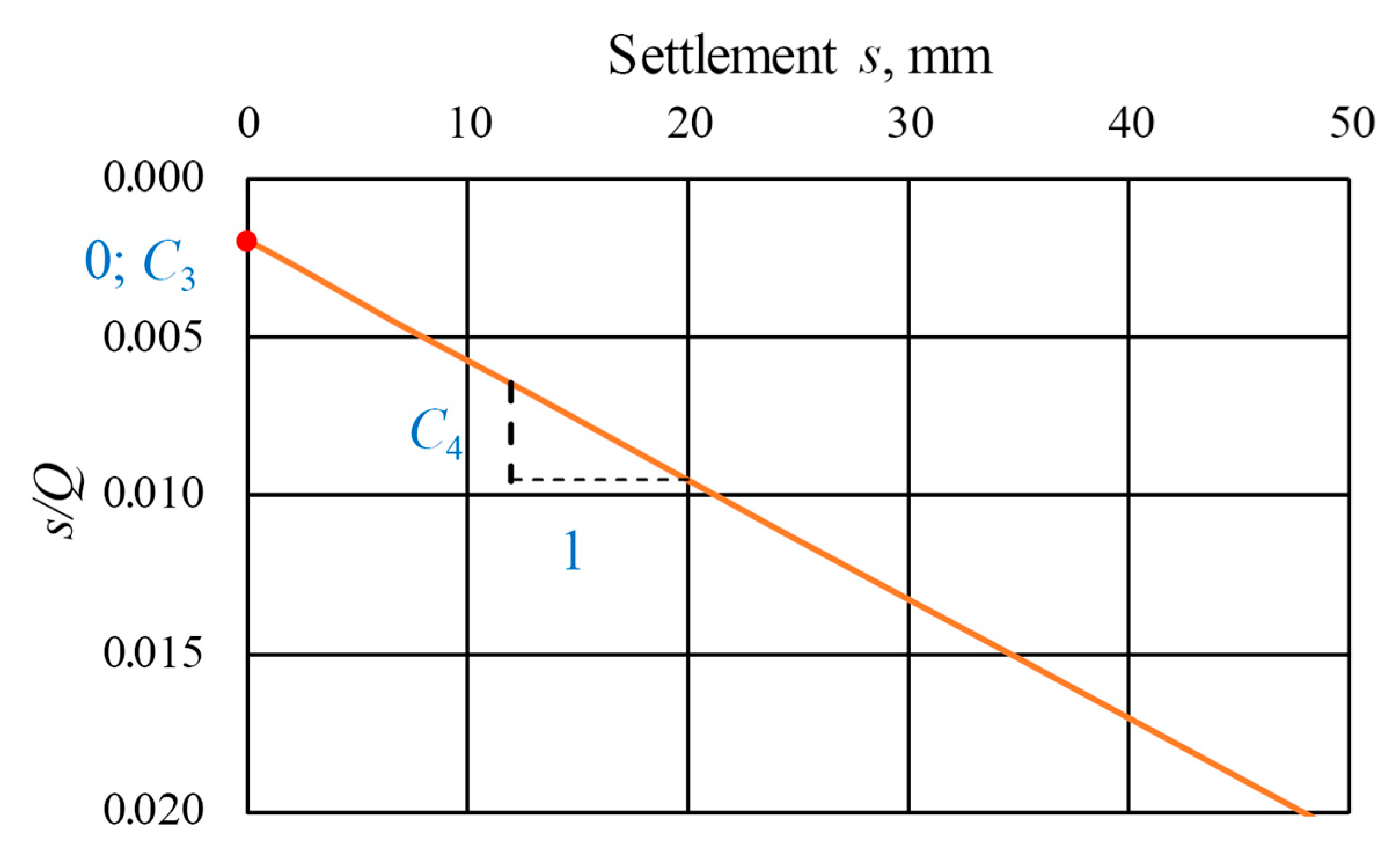
Stress–strain curves for many soils can be approximated reasonably accurately by rectangular hyperbolas [
9]. On this basis, Chin, F.V. (1970) [
11] proposed to describe the pile settlement curve by the follwing equation:
where
s—settlement of pile top mm,
Q—the compression load, kN,
C3 and
C4 are constants, which in the graph, whose axes are
s/
Q and s, respectively, mean the intercept of the
C3 line on the
s/
Q axis, the slope of the C
4 line (1 in C
4), as shown in
Figure 1.
From this equation, according to Chin (1970) [
11], the limiting bearing capacity of the pile can be found, which is defined by the value to which the hyperbola asymptotically approaches
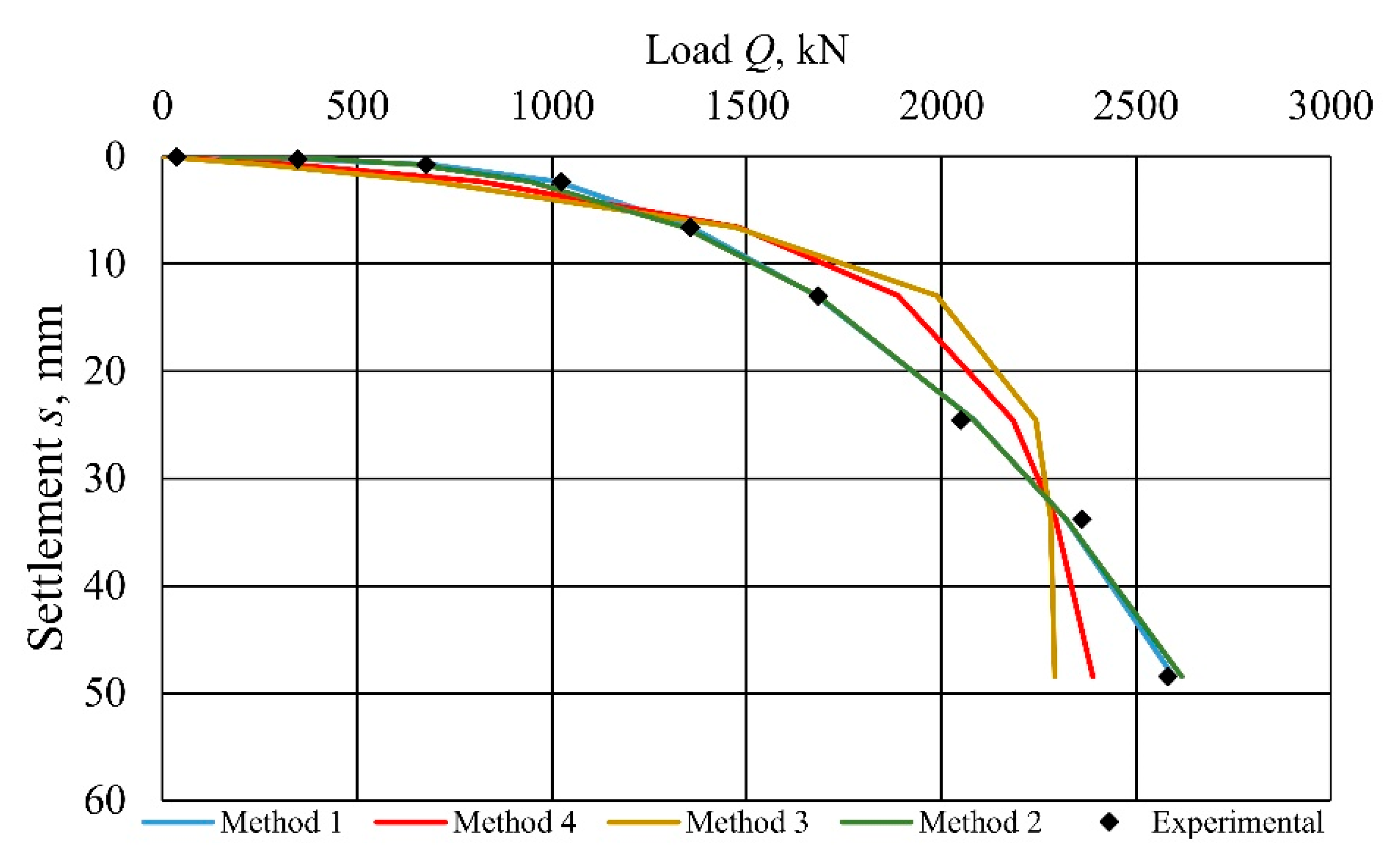
Both exponential shape functions (Method 1) and rectangular hyperbolas (Method 4) are highly suitable for describing phenomena where the variable asymptotically approaches a limiting value (asymptote). This would correspond to the graphs from static pile load tests when the s/D ratio is large and the end bearing capacity of the pile is low.
In
Figure 2, all types of curves are presented, which are adapted to the results of the pile No 1 static load test.
In order to find out which of the curve types would be best suited to describe the behaviour of piles, a statistical analysis was performed based on the available static pile tests.
3. Analysis and Evaluation of Statistical Data
The field testing program was conducted between 2019 and 2025 at various active construction sites throughout Lithuania. All static load tests were performed by Geotechnikos grupė II Ltd in strict accordance with the requirements specified in the ISO 22477-1:2018 standards for geotechnical investigation and testing. The study involved the analysis of load–settlement curves (
Appendix A) for 23 CFA-type piles. The specimen lengths ranged from 3 to 25 m, with diameters varying between 0.4 and 1.02 m. The piles were constructed using C25/30 grade concrete and reinforced with spatial cages fabricated from S500 class steel. Specific geometric properties, as well as the maximum applied test loads for each pile, are summarised in
Table 1.
Vertical loads were applied to the pile head using one or more hydraulic jacks. Prior to the main testing sequence, a preliminary seating load ranging from 10 to 65 kN was applied to verify the functional integrity of the loading and measurement systems. The applied load was monitored via calibrated pressure gauges integrated into the hydraulic system, ensuring a measurement accuracy within 1% of the test load. The number of loading and unloading stages for each test is provided in
Table 1.
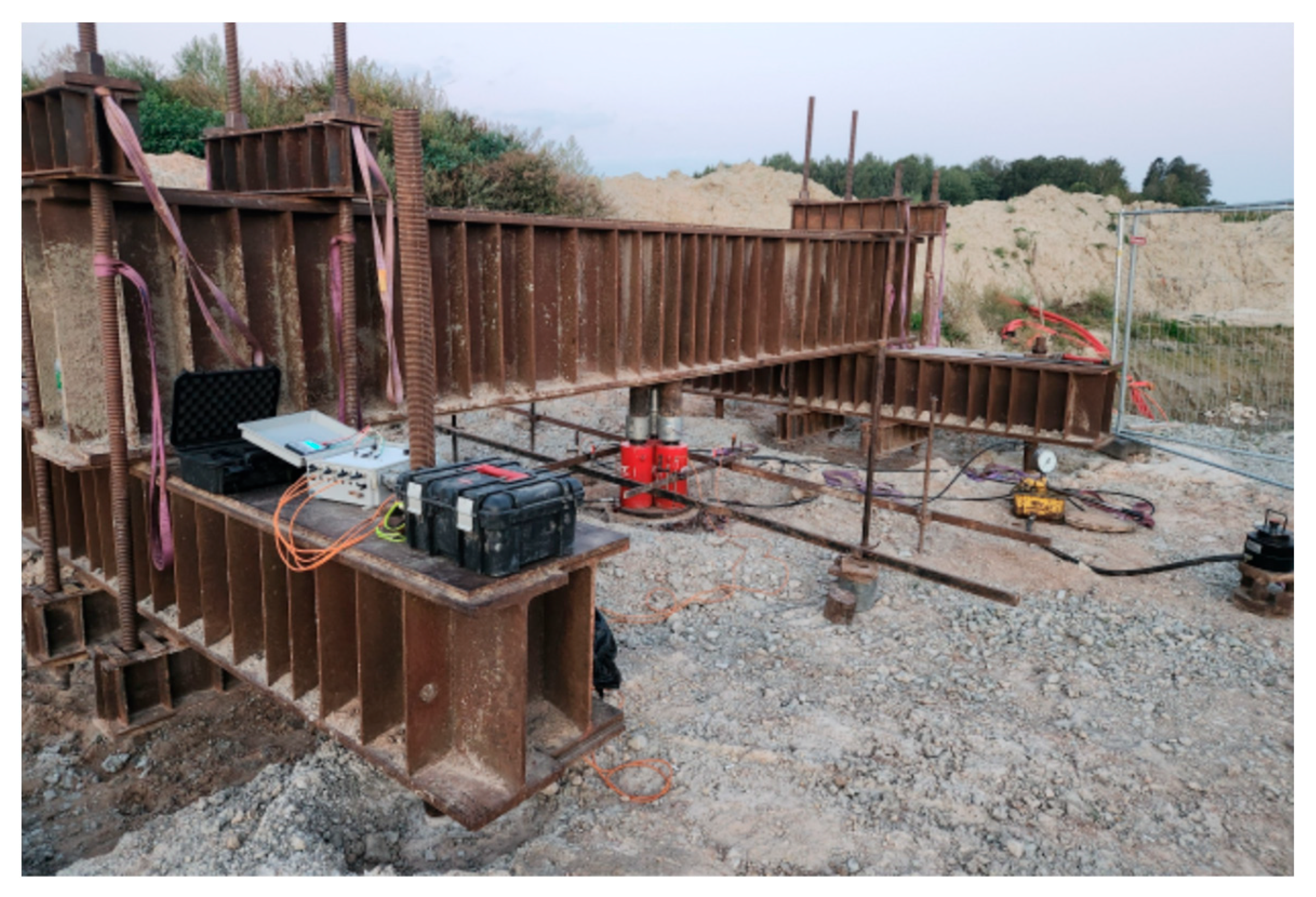
Pile head displacements were recorded using a configuration of two or four VWDT-5004 vibrating wire displacement transducers
Figure 3 (Geosense, UK), featuring a 50 mm stroke and a precision of ±0.1% of the full scale. The duration of each loading and unloading stage was governed by the observed displacement rates:
Loading stages: each increment was maintained for 30 min if the total pile head displacement was less than 1.5 mm, and for 60 min if the displacement exceeded this threshold.
Unloading stages: each decompression stage was held for 15 min if the elastic rebound was less than 1.5 mm, and for 30 min if the rebound exceeded 1.5 mm.
Final observation: upon reaching the fully unloaded state (0 kN), the pile status was monitored for a minimum duration of 60 min to ensure stabilisation.
Geological drilling and CPT tests were carried out near the tested piles. The soil stratigraphy is presented in
Appendix B.
During pile tests, the ultimate bearing capacities of the piles were usually not reached. The maximum loads reached were related to the range of loads acting on the piles.
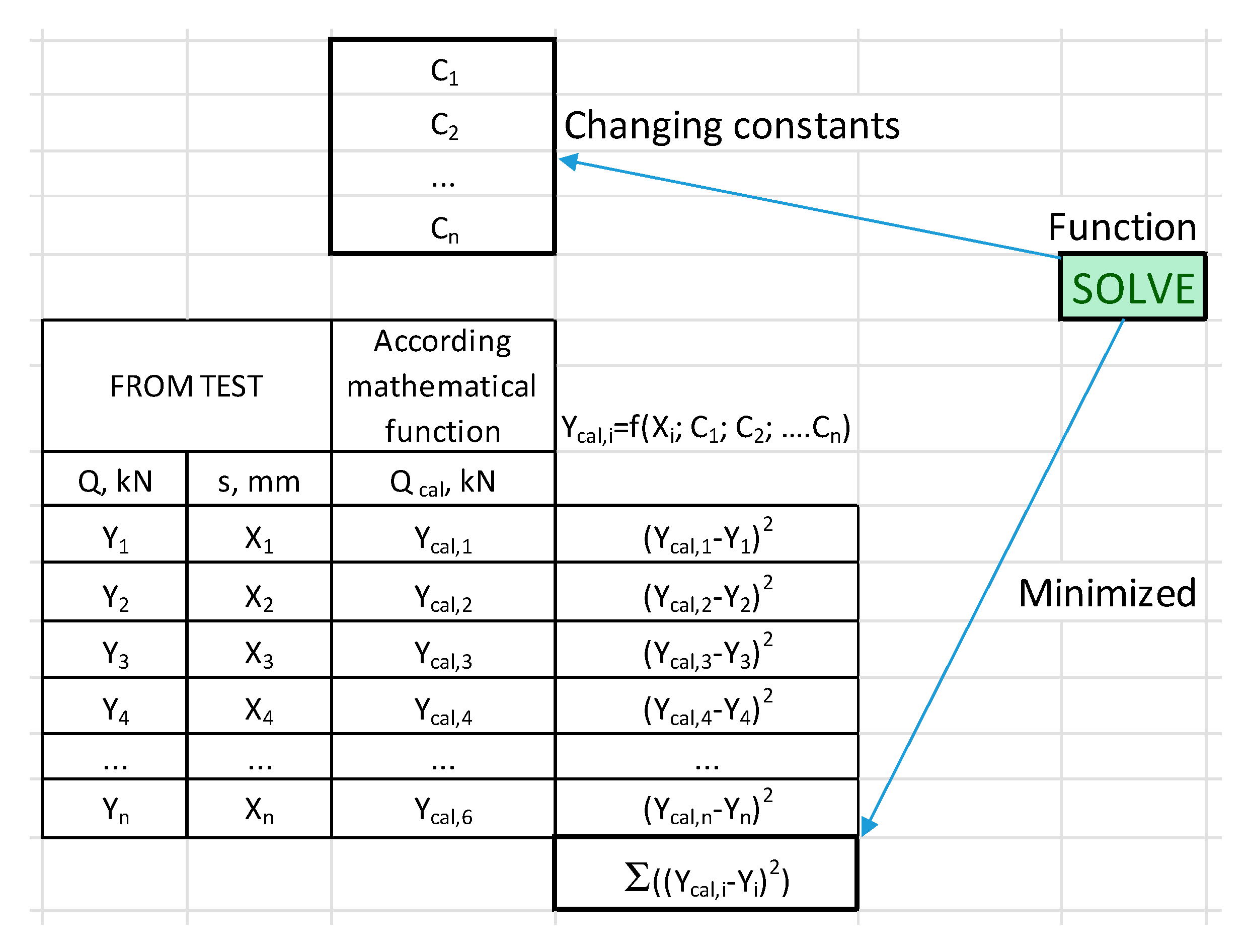
In the first stage of the study, the theoretical dependencies of the four aforementioned methods were recorded for the settlement load curves of pile tests using the least squares method. This was achieved using Excel function Solve (
Figure 4).
Following a preliminary analysis of the methods based on residual and scatter diagrams (see
Appendix C), it was concluded that all methods were sufficiently accurate. The residual diagrams showed that the first two methods produced values that were closer together. Depending on the behaviour of the individual pile, the deviations of the theoretical load values from the experimental values are not in the same places on the graph according to the residual and scatter diagrams. Therefore, when choosing a method, attention must be paid to which part of the graph is important when using the method in further studies, e.g., when determining the bearing capacity of the pile base or evaluating the static model of the building.
However, only a deeper statistical analysis can objectively assess the accuracy of the methods.
Four evaluation criteria were adopted to determine accuracy: (1)
Qtest/
Qcalc correlation coefficients
r of experimental and theoretical dependencies; (2) Q
test/
Qcalc systematic and random errors; and (3) the coefficient of variation (4). Based on criteria 3–4, the analysed methods are also evaluated using the Demerit Point Method (DPC) [
15] to assess their design safety.
Table 2 shows the summary of statistical results of the aforementioned evaluation criteria. All calculation data is presented in
Appendix D. The calculations were performed and compared with the experimental values of 23 test piles. Each statistical criterion for each method and for each unique test was recalculated for eight experimental settlements, providing statistical results from a sufficiently large sample of 184 test points (23 × 8). The average calculated values of the statistical indicators are presented at the end of the table.
When analysing the correlation coefficient r presented in
Table 2, it is particularly close to one for Methods 1 and 2. The average correlation coefficients for Methods 1 and 2 are 0.999 and 0.997, respectively. The correlation coefficient of the calculated values for Methods 1 and 2 is only 0.3%. This indicates very good agreement between the values. When analysing Methods 3 and 4, it can be seen that the correlation coefficients are slightly lower for different types of experimental soil. The lowest correlation value is 0.947 and the highest is 0.999. While the correlation coefficients do not differ significantly and all four Methods can be said to have a very strong correlation, the spread of the correlation coefficients calculated by Methods 3 and 4 around the mean is up to five times greater, amounting to 1.16%. In summary, while the correlation of all Methods is very strong, the most accurate are methods 1 and 2.
When analysing the second evaluation criterion, the systematic error
μ∆R (average of
Qtest/
Qcalc), it can be seen that Methods 1 and 2 also have the highest accuracy. The systematic errors
μ∆R of these Methods are 1.06 and 0.9, respectively, while those of Methods 3 and 4 are 1.60 and 1.41. It should be noted that the systematic errors
μ∆R of Methods 3 and 4 are greater, particularly for small settlements. For example, of the 23 load–settlement dependencies calculated using Method 3, 5 values do not match the experimental results by a factor of between 2.46 and 3.23 (see
Table 1 for details of samples No. 1, 2, 6, 18 and 23). The fourth method is more accurate. The results differ by more than three times only for sample No. 2. The values for samples 1, 6, 18 and 23 differ by less than 1.77–1.98. In summary, based on the systematic error criterion
μ∆R, Methods 1 and 2 remain the most accurate.
For the comparison of systematic errors of the methods, an extended statistical analysis was additionally performed, using the correlation coefficients between the methods and the sensitivity of systematic errors with respect to soil type as evaluation criteria. Based on the calculation results presented in
Appendix D,
Table 3 shows the calculated correlation coefficients of
Qtest/
Qcalc for all four methods. As can be seen from the data, correlation relationships between the analysed methods are positive; however, their strength varies considerably, ranging from weak to strong. This indicates that the methods are neither completely independent nor can they be considered highly similar to each other. Method 1 exhibits weak correlation relationships with all other methods: a weak negative correlation is observed with Method 2 (r ≈ −0.11), indicating that these methods are essentially unrelated or even partially contradictory, while the relationships with Method 3 and Method 4 are only weakly positive (r ≈ 0.18 and r ≈ 0.27, respectively). Meanwhile, Method 2 shows moderate positive correlations with Method 3 (r ≈ 0.51) and Method 4 (r ≈ 0.39), suggesting that it is relatively close to these methods but not strongly associated with them. The strongest mutual relationship is identified between Method 3 and Method 4, for which the correlation is strong (r ≈ 0.78), indicating that these methods produce very similar results.
After determination of the correlation relationships between the methods, the sensitivity of the systematic errors of the methods with respect to soil type was further analysed. The calculation results are presented in
Table 4. The analysis of the results in
Table 5 showed that Method 1 and Method 2 show the lowest sensitivity to soil properties compared to Method 3 and Method 4. The systematic error of Method 1 remains close to 1.0 in most soil types and increases only slightly in weak clays, indicating a limited dependence on soil type. Method 2 is characterised by the highest stability, with its error range in almost all cases varying between approximately 0.87 and 1.10, regardless of soil composition, density or degree of saturation. Due to these characteristics, Method 2 can be considered the most universal method.
When analysing the other methods, it was found that the smallest systematic errors of Method 3 and Method 4 occur in fine and silty medium-dense sands and in homogeneous medium-strength clays, where the errors are approximately 1.00–1.13 and 1.00–1.06, respectively. A moderate increase in error is observed in low-plasticity medium-strength clays and in sandy clays with gravel under non-saturated conditions, where the error range of Method 3 is approximately 1.25–1.40 and that of Method 4 is approximately 1.15–1.35. The largest errors are identified in dense and very dense sands, saturated silty or gravelly sands, and in weak clays containing gravel or organic inclusions. Under these conditions, the systematic error of Method 3 may reach up to 3.33, while that of Method 4 may reach up to 3.06. This demonstrates a strong dependence of the sensitivity of these methods on varying soil properties.
The same trends are observed when comparing the Methods according to the third and fourth criteria, i.e., the random error σ∆R of the average of Qtest/Qcalc values and the coefficient of variation in the random error. Methods 1 and 2 demonstrate the highest accuracy, with random σ∆R errors of 0.215 and 0.205, respectively. The random errors of Methods 3 and 4 are five times greater, making these methods significantly less accurate. When the analysis compared the coefficient of variation in the random error of the Qtest/Qcalc values, Method 1 is the most accurate. Its coefficient of variation is 0.18; the coefficients of variation in Methods 2, 4 and 3 are 0.222, 0.516 and 0.613, respectively.
It should be noted that systematic and random errors are both very important when calculating and evaluating the reliability of structures. In design standards such as EN 1990:2023 [
16], these errors are included directly in the reliability calculation algorithm:
where
μZ—mean value of safety margin function;
σz—the standard deviation of the strength safety function Z; σxi—the standard deviation of the i-th term of the safety margin function, including the method’s random error σ∆R.
μ∆R—systematic error of the method.
The reliability of the strength safety is calculated as the ratio between the mean value and the standard deviation of the strength safety distribution, expressed by the reliability index
β. When calculating the strength safety function and its standard deviation, both the systematic method error μ∆R and the random method error σ∆R are included in the computations. Therefore, if the systematic method error is >1, the strength safety increases, and consequently, the reliability index
β also increases. Conversely, an increase in the random method error leads to a higher standard deviation of the strength safety function, thereby decreasing the reliability index beta. Therefore, methods are considered more reliable when their systematic error is only slightly greater than 1 (since higher values would artificially increase reliability) and when their systematic error is minimal. Based on the data in
Table 2, Methods 3 and 4 have very large random errors σ∆R (0.613 and 0.516), and are therefore less reliable than the first two methods. Although the random error of the second method is slightly smaller, its systematic error is <1 and equals 0.944. This indicates that Method 1 will be more reliable than Method 2, as its systematic error equals 1.06.
As mentioned earlier, the systematic errors can also be evaluated using the Demerit Point Method (DPC) [
15]. According to this classification, when the systematic errors of the methods are inserted into the evaluation, Methods 1 and 2 fall into the “Appropriate and safe” group. Unfortunately, Methods 3 and 4 are classified as “Conservative methods.”
Table 5 presents the ranking of the methods according to the criteria discussed above.