


Abstract
Magnesium potassium phosphate cement (MKPC) exhibits rapid setting and high early strength, but its long-term performance is limited by microstructural heterogeneity and pore structure defects. These microstructural defects can increase pore connectivity and facilitate the ingress of aggressive agents, thereby limiting the long-term durability and service reliability of MKPC-based repair and protective materials. Nanomaterials have been applied to improve MKPC performance; however, the differences between conventional nano-SiO2 (NS) and nano-Fe2O3 (NF), particularly their effects on hydration regulation and microstructure evolution, remain insufficiently understood. In this study, the effects of NF and NS incorporation on the hydration behavior, phase evolution, pore structure, and mechanical properties of MKPC were comparatively investigated. Orthogonal experiments, mechanical testing, calorimetry, XRD, FTIR, Raman mapping, SEM/EDS, MIP, and nanoindentation were employed to establish the relationship between nano-modification, microstructural evolution, and mechanical performance. The results provide a basis for selecting suitable nanomodifiers for MKPC-based materials used in rapid repair, protective applications, and other construction scenarios requiring rapid strength development and improved microstructural compactness. Compared with pure MKPC and previously reported NS-MKPC results, NF-MKPC showed higher strength development, refined pore structure, and improved micromechanical uniformity. The observed performance enhancement of NF-MKPC is consistent with accelerated early hydration, possible heterogeneous nucleation, pore refinement, and matrix densification. In comparison, NS-MKPC exhibited a different hydration and pore-evolution behavior under the investigated conditions. These findings indicate that NF and NS may regulate hydration and microstructure development differently in MKPC and provide guidance for selecting suitable nano-modifiers for high-performance phosphate cement materials. Under the investigated conditions, NF modification shows potential for MKPC applications requiring rapid strength development and improved microstructural compactness, such as rapid pavement repair, concrete surface repair, and protective coating applications.
1. Introduction
Magnesium phosphate cement (MKPC) is an emerging inorganic binder with a unique acid–base neutralization hydration mechanism, exhibiting rapid setting, high early strength, and excellent bonding performance compared with ordinary Portland cement (OPC) [1,2,3,4]. It can develop compressive strengths exceeding 20 MPa within 1 h and typically reaches 40–80 MPa after 28 days. Moreover, its bond strength to substrates such as steel and stone is three to five times higher than that of OPC. These characteristics make MKPC attractive for various special engineering applications. For example, its rapid strength development enables efficient road repair under harsh conditions [5,6], while its immobilization capability is beneficial for nuclear waste treatment [7,8]. Its low shrinkage characteristics also make it suitable for heritage conservation applications [9], and its biocompatibility provides potential for biomedical applications [10].
Despite these advantages, the practical application of MKPC is still restricted by its inherent microstructural limitations. The hardened matrix generally contains abundant interconnected pores, which facilitate the penetration of aggressive ions (e.g., Cl−, SO42−) and may compromise long-term durability [11]. The main hydration product, magnesium potassium phosphate hexahydrate (struvite-K, MKP), exhibits a layered crystalline morphology [12], which may result in inter-crystalline voids and relatively weak interfaces within the matrix [13]. Moreover, the coexistence of crystalline hydration products, amorphous phosphate gel, and residual MgO particles produces a heterogeneous three-phase structure that limits mechanical stability and water resistance. Although optimizing macroscopic parameters such as the water-to-binder ratio (w/b) and magnesium-to-phosphorus ratio (M/P) can improve MKPC performance [14,15], these approaches may not fundamentally regulate the intrinsic microstructural defects. Therefore, nanoscale modification provides a promising strategy for further improving MKPC performance.
Nanomaterials have been widely investigated as effective modifiers for cement-based materials due to their filling effect and nucleation ability. Recent reviews have shown that different nanomaterials can regulate cement hydration kinetics, hydration products, pore structure, and microstructural development, while their effectiveness depends strongly on nanoparticle type, dosage, and dispersion state [16,17]. Nano-SiO2 has been extensively investigated because of its high surface area and reactivity, and has been reported to improve the mechanical properties and durability of cementitious composites through nucleation, filling, and other physicochemical effects [18]. However, the effectiveness of nano-SiO2 is strongly affected by its dispersion state, as nanoparticle agglomeration can reduce its effective modification efficiency and hinder uniform microstructural refinement [19,20]. Previous studies have demonstrated that nano-SiO2 and nano-Al2O3 can refine pore structures through filling effects [21,22]. Nano-Al2O3 has also been reported to modify early hydration and microstructural development in cementitious materials, indicating that alumina-based nanoparticles can influence both hydration products and mechanical characteristics [23]. In addition, other nanoparticles such as nano-CaCO3 have been widely investigated because of their nucleation and filling effects, which can accelerate hydration, refine pore structures, and improve the compactness of cement-based materials [24]. Nano-TiO2 has also been investigated as a modifier for cementitious composites, with reported effects on mechanical properties, durability, and microstructural characteristics [25,26]. Nanodiamond has recently been explored as a nano-modifying additive for concrete, with reported improvements in structural characteristics and mechanical properties [27]. Rice-husk-derived nanomaterials, particularly nano rice husk ash, have also attracted attention as sustainable nano-modifiers, with reported effects on the mechanical performance, durability, and microstructural properties of ultra-high-performance concrete [28]. Nano-Fe2O3 has also attracted attention because of its potential to modify the phase composition, microstructure, pore characteristics, and mechanical performance of cementitious composites [29]. Surface hydroxyl groups of nanoparticles can also regulate crystal growth and hydration product orientation [30,31]. In our previous study, nano-SiO2 (NS) was introduced into MKPC and improved its mechanical performance [32]. However, NS exhibits relatively high surface reactivity and dissolution susceptibility under acidic conditions compared with more stable oxide nanoparticles [32]. In addition, nano-Al2O3 may consume phosphate species and interfere with MKP formation [33,34]. These limitations indicate that conventional nano-modifiers may not simultaneously improve the strength development, durability, and microstructural stability of MKPC. Therefore, the long-term durability and stability of nano-modified MKPC may require further consideration.
Nano-Fe2O3 (NF) offers a promising alternative. Owing to its high chemical stability, corrosion resistance, and unique redox activity, NF has been reported to refine microstructure, influence hydration, and enhance durability in cementitious systems [29,35]. Its nanoscale size may allow it to fill intercrystalline voids, thereby contributing to matrix density and uniformity [36], while its redox properties may contribute to stabilization of the hydration environment under acidic conditions [37]. Previous studies have shown that NF can improve water resistance, reduce permeability, and enhance strength in concrete and other composites [29,38]. Moreover, NF has been reported to increase chemically bound water, promote the formation of stable hydration products, and improve resistance to sulfate and chloride attack [36].
Compared with NS-modified MKPC reported in previous studies [32], NF may offer several potential advantages under the investigated conditions: (1) NF exhibits relatively high chemical stability in acidic environments and may therefore have limited dissolution under the investigated conditions; (2) NF may have less direct interaction with PO43− ions than reactive nano-modifiers, whether this difference affects phosphate availability and struvite-K formation requires direct chemical verification; (3) NF may contribute to microstructural refinement through its nanoscale particle size and surface characteristics; Nevertheless, the effects of NF on MKPC hydration kinetics, phase evolution, pore structure development, and micromechanical behavior have not been systematically clarified.
Despite the promising performance of NF in cementitious materials, three key issues regarding NF-modified magnesium potassium phosphate cement (NF-MKPC) remain unresolved. First, the strengthening mechanism of NF in MKPC has not been clearly established. It remains unclear whether the improvement mainly originates from nanoparticle filling, heterogeneous nucleation, pore refinement, or their combined effects. Second, the influence of NF dosage on MKPC performance and the corresponding dispersion behavior require further clarification, particularly regarding the relationship between NF content and microstructural evolution. Third, quantitative correlations between NF-induced microstructural changes and macroscopic properties, including strength development, pore structure, and micromechanical behavior, are still lacking.
Accordingly, this study focuses on how NF affects the hydration, phase evolution, pore structure, and micromechanical properties of MKPC, and on identifying an appropriate NF dosage for improving its mechanical and microstructural performance in potential repair applications.
To address these issues, this study systematically investigates the effect of NF modification on the hydration behavior, microstructure evolution, and mechanical performance of MKPC through a multi-scale experimental approach. First, an orthogonal experimental design involving M/P, W/C, B/M, and NF/M ratios was employed to evaluate the influence of different factors on the mechanical properties and identify a preferred mixture proportion. Second, hydration kinetics and phase evolution were investigated using isothermal calorimetry, XRD, and Raman mapping to reveal the influence of NF on hydration processes and phase development. Third, SEM/EDS and BSE characterization were performed to analyze morphology, elemental distribution, and microstructural features. Finally, nanoindentation and mercury intrusion porosimetry (MIP) were applied to evaluate micromechanical properties and pore structure characteristics, examining the relationships between NF modification, microstructural evolution, and macroscopic performance. This study provides new insights into the role of NF in regulating MKPC microstructure and offers guidance for designing high-performance phosphate cement materials.
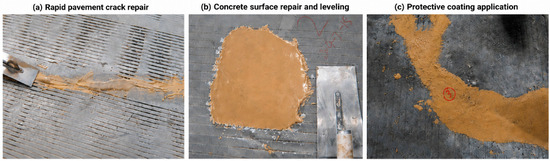
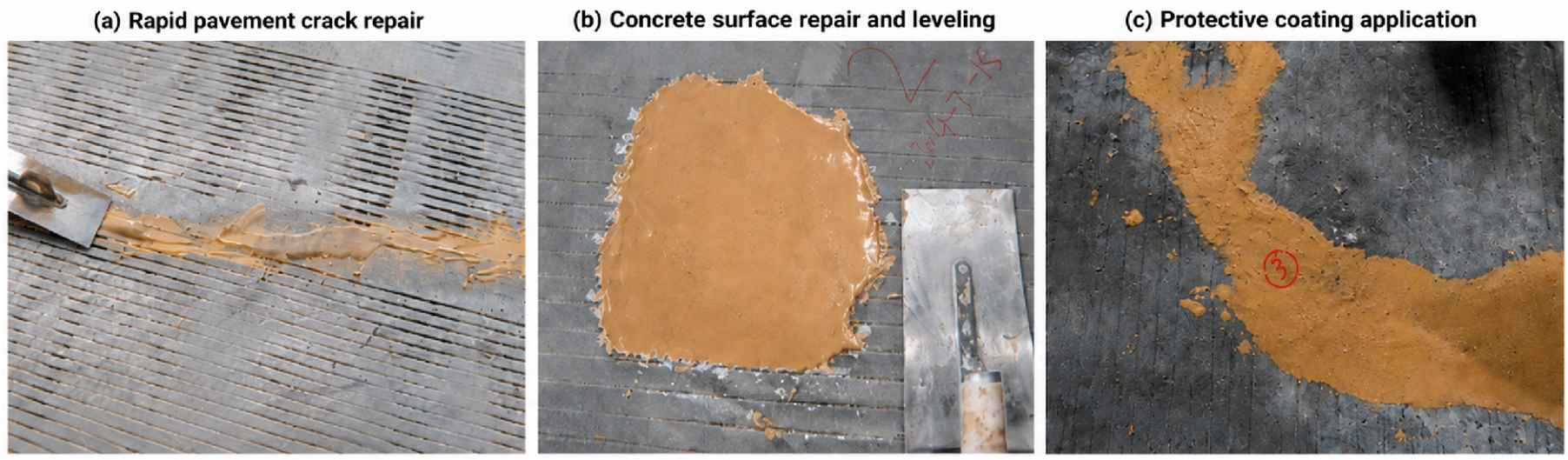
The rapid strength development and high bonding performance of MKPC make it attractive for engineering applications where the rapid restoration of mechanical capacity and good substrate compatibility are required [39,40]. Representative engineering scenarios include rapid pavement crack repair, concrete surface repair and leveling, and protective coating applications, as illustrated by the representative photographs in Figure 1 [41,42]. These photographs are provided to illustrate representative application contexts of magnesium phosphate cement and do not represent field validation of the NF-MKPC developed in this study.
Figure 1.
Representative engineering applications of MKPC: (a) rapid pavement crack repair; (b) concrete surface repair and leveling; (c) protective coating application. The photographs were provided by the research group and are presented to illustrate representative application scenarios [41,42].
2. Raw Materials and Experimental Programs
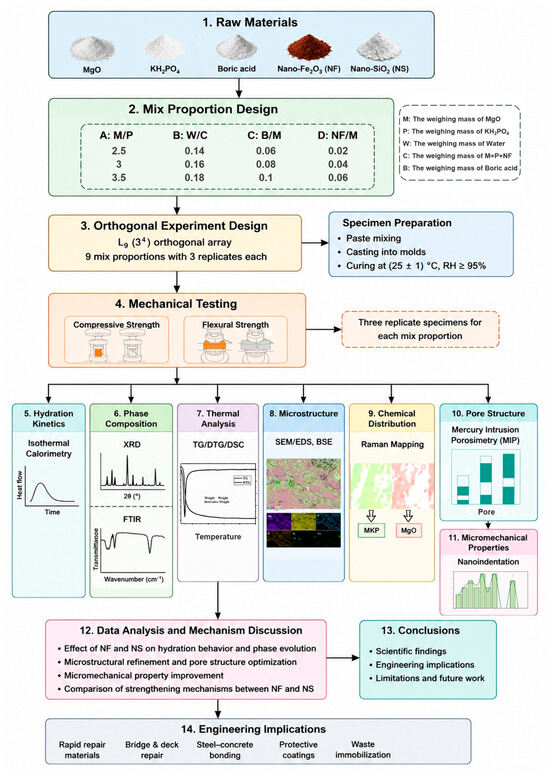
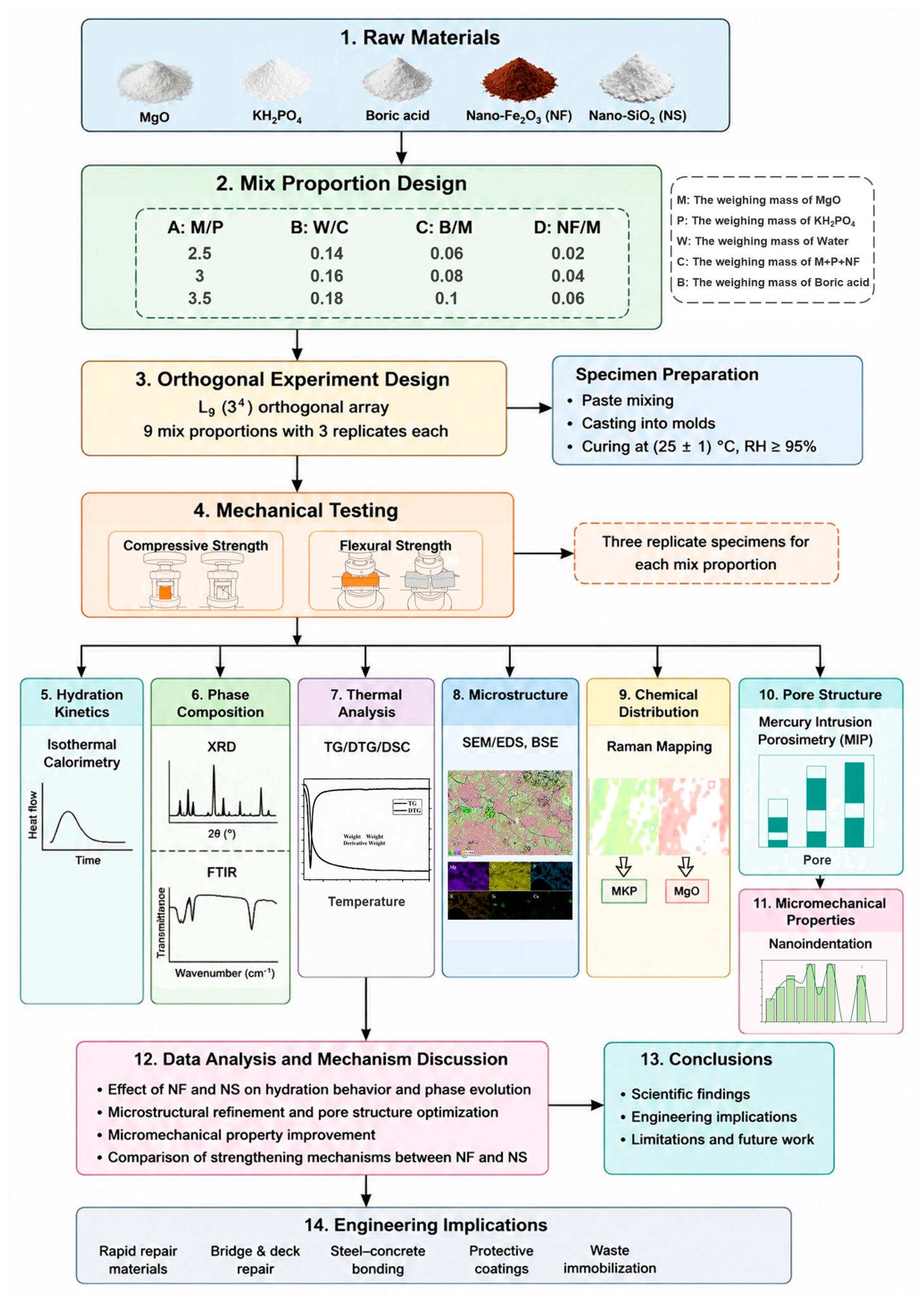
The overall experimental program is schematically illustrated in Figure 2.
Figure 2.
Flowchart of the experimental program.
2.1. Raw Materials and Mix Proportion
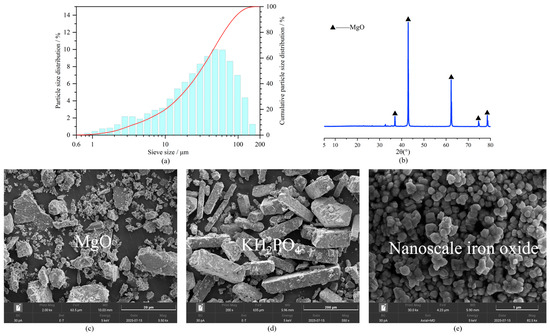
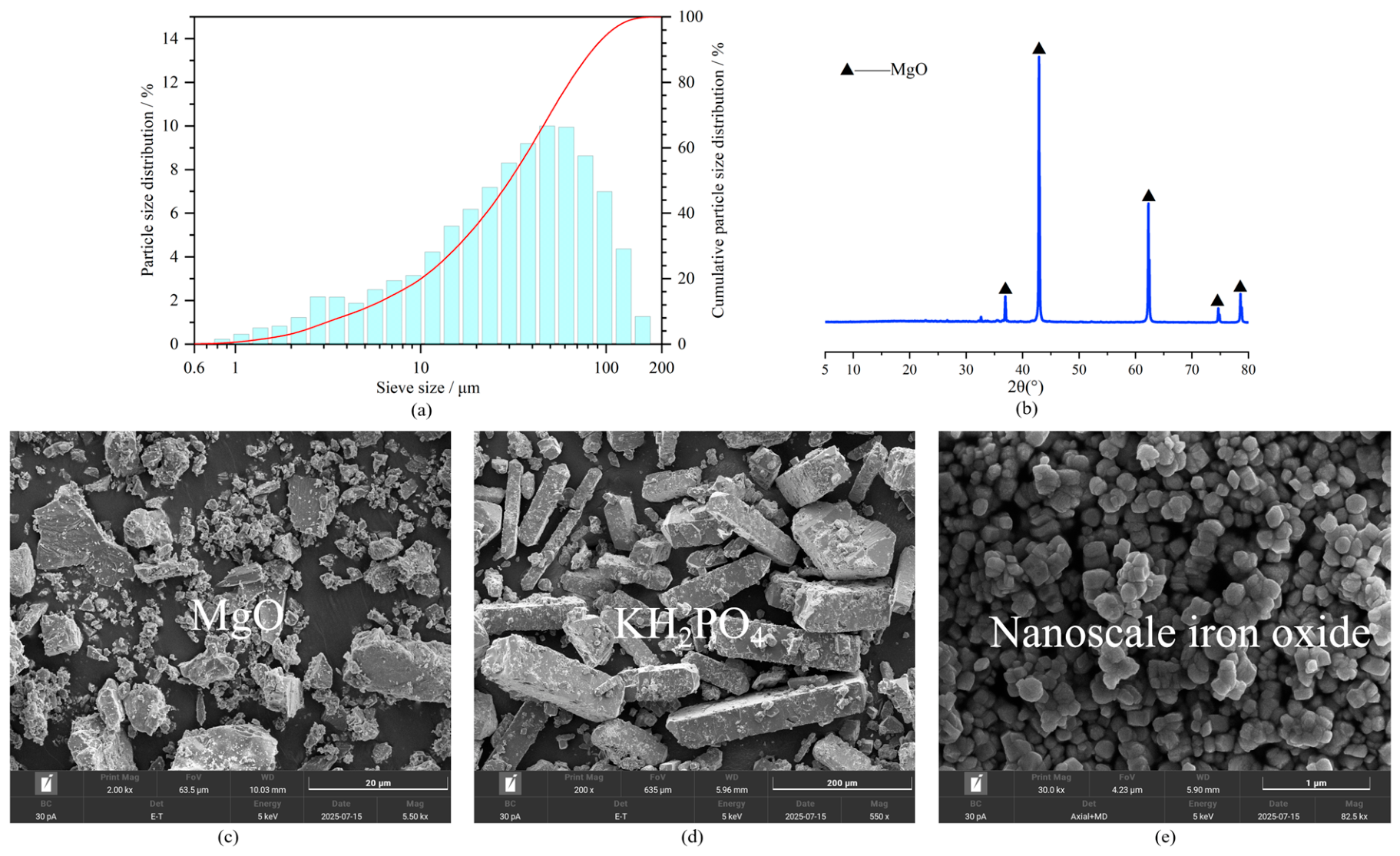
The raw materials used for preparing NF-MKPC binders included dead-burnt magnesium oxide (DBM), potassium dihydrogen phosphate (KH2PO4, analytically pure), deionized water, and borax (Na2B4O7·10H2O, analytically pure). NF with an average particle size of 20 nm, bulk density of 0.85–1.05 g/cm3, and purity of 99.9% was used as the nano-modifier. The chemical composition of dead-burnt magnesium oxide (DBM) is listed in Table 1, with a density of 3.46 g/cm3. The particle size distribution and XRD pattern of DBM are presented in Figure 3a and Figure 3b, respectively. Representative SEM micrographs of DBM, KH2PO4, and NF are shown in Figure 3c–e. The quantities of constituent materials used for pure MKPC preparation are listed in Table 2.
Table 1.
Chemical composition of DBM.
Figure 3.
Characterization of the raw materials: (a) particle-size distribution of DBM; (b) XRD pattern of DBM; (c) SEM morphology of DBM; (d) SEM morphology of KH2PO4; (e) SEM morphology of NF.
Table 2.
Quantities of constituent materials used for pure MKPC preparation (g).
For comparison with nano-SiO2 modified MKPC (NS-MKPC), the NS-MKPC results reported in our previous study [32] were introduced. The NS-MKPC and NF-MKPC specimens were prepared and tested simultaneously within the same experimental campaign under the same experimental conditions, although the NS-MKPC results were published earlier [32].
2.2. Specimen Preparation
For the preparation of pure MKPC, KH2PO4 and borax were initially introduced into the mixing vessel and blended at 150 r/min for 30 s. DBM was then added, and mixed at the same speed for another 30 s. Afterward, deionized water was incorporated and mixing was continued at 150 r/min for 30 s. The paste was subsequently homogenized at 290 r/min for 60 s after the inner wall of the vessel had been scraped clean.
For NF-MKPC, half of the total mixing water was first used to disperse NF through ultrasonic treatment for 10 min at 400 W. The resulting NF suspension was added to the dry mixture before the remaining water was introduced. The mixture was then stirred at 150 r/min for 30 s and subsequently homogenized at 290 r/min for 60 s. This procedure was adopted to improve the dispersion of NF within the paste.
The fresh binders were cast into prismatic molds measuring 160 × 40 × 40 mm for flexural testing and cubic molds measuring 40 × 40 × 40 mm for compressive testing. The molds were vibrated immediately after casting to eliminate entrapped air. The specimens were demolded after 30 min and subsequently cured at 20 ± 5 °C and 60 ± 5% relative humidity. Mechanical and microstructural characterizations were conducted at curing ages of 3 h, 7 d, and 28 d.
2.3. Testing Methods
2.3.1. Isothermal Conduction Calorimetry
The early-age hydration behavior was monitored using an isothermal calorimeter maintained at 20 °C. After uniform mixing, the fresh material was immediately transferred into the calorimetric cell. The instrument continuously recorded the heat-flow rate and cumulative heat released during hydration.
2.3.2. Mechanical Strength Testing
Three specimens were tested for each mixture to obtain the mechanical properties. The mechanical strengths were measured following GB/T 17671-2021 [43], using loading rates of 2400 N/s for compression and 50 N/s for flexural testing, respectively. The resulting strength values were obtained from Equations (1) and (2).
Here, is used for compressive strength (MPa). refers to the peak failure load (N), while represents the loaded area (mm2). The flexural strength is expressed as (MPa). is the fracture load (N). is the distance between the supporting columns (mm). is the side length of the square cross-section (40 mm).
2.3.3. Phase Composition
XRD, TG/DTG, DSC, FTIR, and Raman mapping were employed to characterize the phase composition and hydration-related changes of the specimens after 3 h, 7 d, and 28 d of curing.
XRD measurements were conducted in continuous scanning mode over a 2θ range of 5–80° at a scanning rate of 10°/min. Thermal behavior was evaluated by TG/DTG using approximately 25 mg of sample, which was heated from 50 to 1000 °C at a rate of 10 °C/min under a nitrogen atmosphere in alumina crucibles. FTIR spectra were collected from 4000–400 cm−1 to identify the characteristic vibrational bands associated with the phases present.
Raman spectra were acquired over the range of 1800–400 cm−1 using 10% laser power, a 10 s exposure time, and one accumulation. Raman mapping was conducted over a 40 × 40 µm2 region with a spatial interval of 2 µm. A total of 441 measurement points (21 × 21) were collected for each sample to obtain the corresponding phase-distribution maps.
2.3.4. SEM/EDS and BSE
SEM/EDS was used to characterize the morphology and elemental distribution of the hydrated matrices. Prior to observation, the cured specimens were vacuum-dried at 50 °C for 24 h, followed by surface polishing with fine sandpaper. The polished surfaces were cleaned ultrasonically and coated with a carbon film before mounting on the specimen stage.
SEM/EDS observations were conducted at an accelerating voltage of 5–15 kV. Images were collected at different magnifications to examine the morphology and spatial arrangement of the hydration products, residual particles, and pores. EDS mapping was further used to determine the distributions of Mg, K, P, O, Si, and other major elements within the matrix.
BSE observations were performed at 15 kV. Variations in image brightness arising from differences in average atomic number were used to distinguish the major phases and examine their spatial distribution in the pure MKPC and NF-MKPC matrices.
2.3.5. Pore Distribution
The pore structure was quantified by mercury intrusion porosimetry (MIP). Samples obtained after 3 h, 7 d, and 28 d of curing were broken into fragments of approximately 1.5–2 g for testing. Before mercury intrusion, the specimens were vacuum-dried and subsequently degassed.
During the test, mercury was progressively introduced into the pore system under controlled pressure. The corresponding intrusion pressure was used to determine the pore-size distribution. The resulting data were used to evaluate the total porosity, pore-size distribution, and cumulative pore volume of the MKPC matrices.
2.3.6. Nanoindentation
Nanoindentation was employed to evaluate the hardness and elastic modulus of the different phases within pure MKPC and NF-MKPC at three curing ages. Before measurement, the specimen surfaces were prepared by sequential grinding and polishing to achieve a flat testing region with a surface roughness of less than 50 nm.
For each specimen, 36 indentation locations were arranged in a 6 × 6 grid. The indentation depth was set to 2 µm, and adjacent test points were separated by 80 μm. The indentation modulus and hardness were subsequently determined from the load–displacement responses using Equations (3)–(5).
Here, refers to the indentation modulus (GPa), whereas is the unloading stiffness obtained from the unloading segment of the curve. The parameter is determined by the indenter geometry, including its tip half-angle , together with the Poisson’s ratio , and is assigned a value of 1.034 [44]. The projected contact area between the indenter and specimen is denoted by (nm2), while represents the peak indentation load obtained from the P-h response (mN). The indentation hardness is expressed as (GPa). In addition, the symbols and denote the Poisson’s ratio of the Berkovich indenter and the tested material, respectively, while and are their corresponding elastic moduli (GPa).
3. Results
3.1. Orthogonal Analysis
The orthogonal experimental design matrix presented in Table 3 incorporates four key mixture-design factors, each with three discrete levels. Factor a denotes the mass ratio of dibasic magnesium phosphate (DBM) to phosphate (M/P); factor b represents the water-to-cement ratio (W/C), wherein the cementitious content (C) is defined as the sum of DBM, phosphate, and nano-Fe2O3 (C = M + P + NF); factor c signifies the borax-to-DBM mass ratio (B/M); and factor d indicates the nano-Fe2O3-to-DBM mass ratio (NF/M).
Table 3.
Factor levels for the NF-MKPC orthogonal design.
Their corresponding levels were 2.5, 3.0, and 3.5 for a; 0.14, 0.16, and 0.18 for b; 0.06, 0.08, and 0.10 for c; and 0.02, 0.04, and 0.06 for d, respectively. The NF/M interval of 2–6% was selected to assess the dosage effect while retaining a feasible number of mixtures within the orthogonal design. Mechanical performance was evaluated for all nine mixtures by measuring compressive and flexural strengths after 3 h and 1 d of curing.
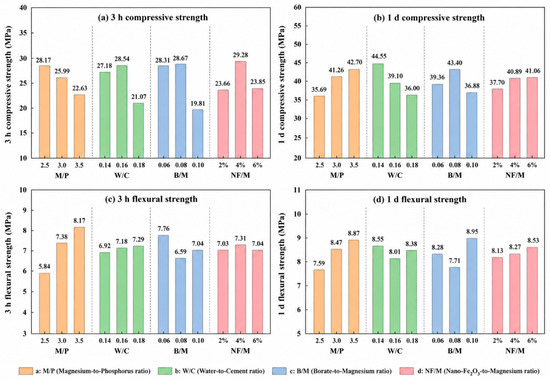
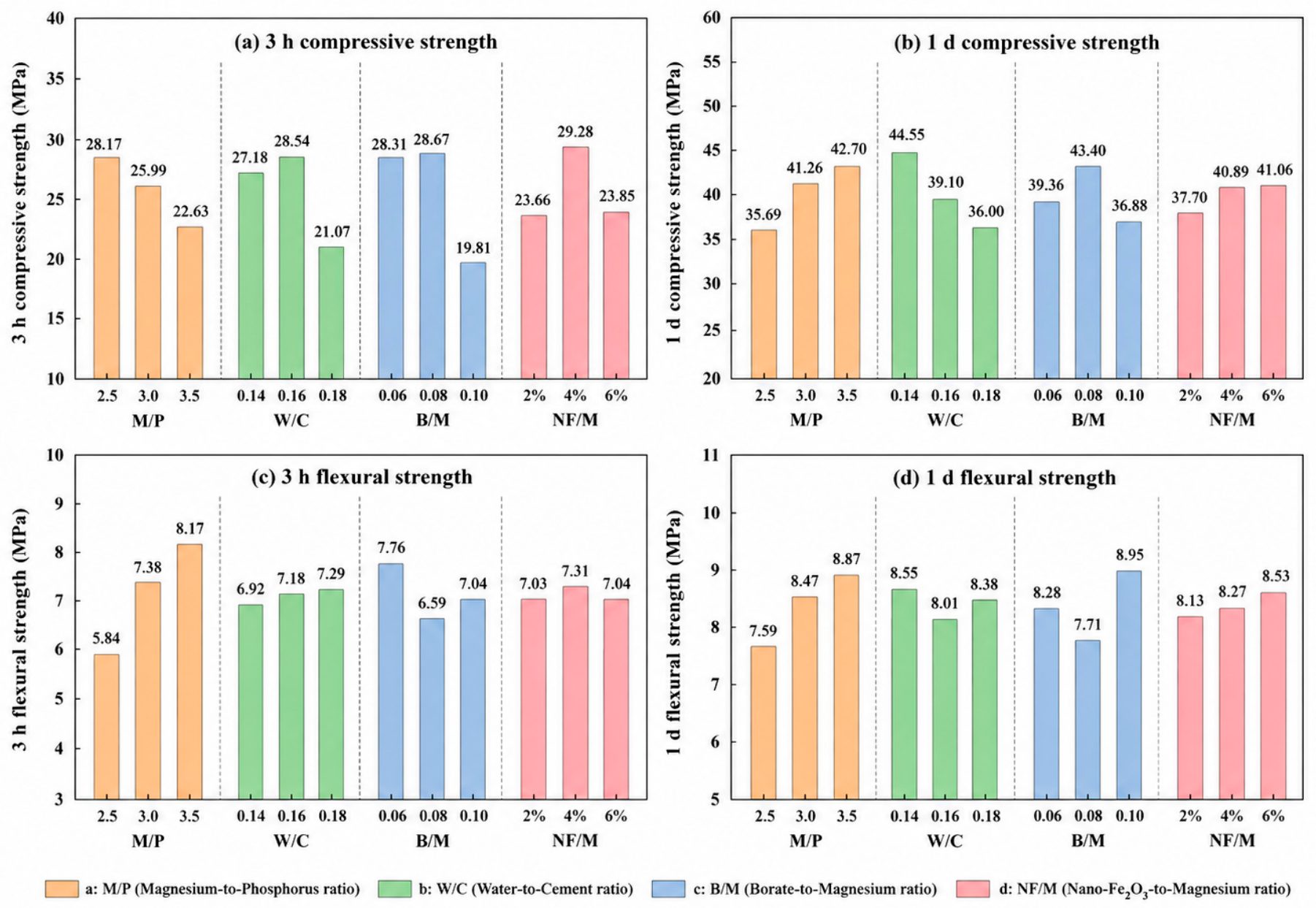
A four-factor, three-level orthogonal experiment was conducted to evaluate the compressive and flexural strengths at 3 h and 1 d. Based on the mechanical property data in Table 4 and the range and mean analysis in Figure 4, the effects of each factor on NF-MKPC were evaluated. Regarding compressive strength, the magnitude of early 3 h compressive strength is primarily determined by factor c, with a range of 8.86 MPa, which is 18.4% higher than that of factor b (7.48 MPa).
Table 4.
Mechanical properties obtained from the nine orthogonal mixtures.
Figure 4.
Effects of mixture factors on NF-MKPC mechanical performance based on range analysis: (a) compressive strength at 3 h; (b) compressive strength at 1 d; (c) flexural strength at 3 h; (d) flexural strength at 1 d.
To further evaluate the relative importance of the four mixture-design factors, pooled-error ANOVA was performed in addition to the range analysis. The results are summarized in Table 5, including the sum of squares (SS), range (R), and p-value for each factor. The factor with the largest R was identical to the factor with the lowest p-value for all four mechanical-strength responses. Specifically, factor c was identified as the most influential factor for 3 h compressive strength, factor b for 1 d compressive strength, and factor a for both 3 h and 1 d flexural strength. This consistency between the range analysis and ANOVA provides additional support for the factor-ranking results. Among the four responses, factor a showed a statistically significant effect on 3 h flexural strength (p = 0.018). Although the other dominant factors did not reach the 5% significance level, each had the lowest p-value among the four investigated factors for the corresponding response.
Table 5.
Comparison of range analysis and pooled-error ANOVA for the effects of mixture-design factors on mechanical strength.
Under the investigated mixture conditions, an NF/M ratio of 4% was selected as the preferred dosage based on the overall range and mean analysis of the mechanical responses. Increasing the NF/M ratio from 4% to 6% did not consistently improve strength and resulted in lower early-age compressive strength.
3.2. Mechanical Properties
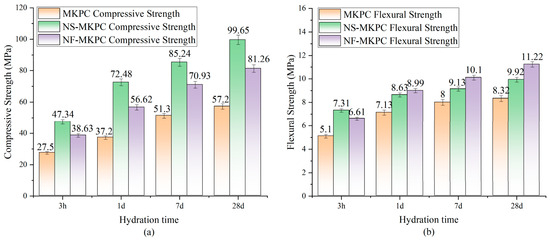
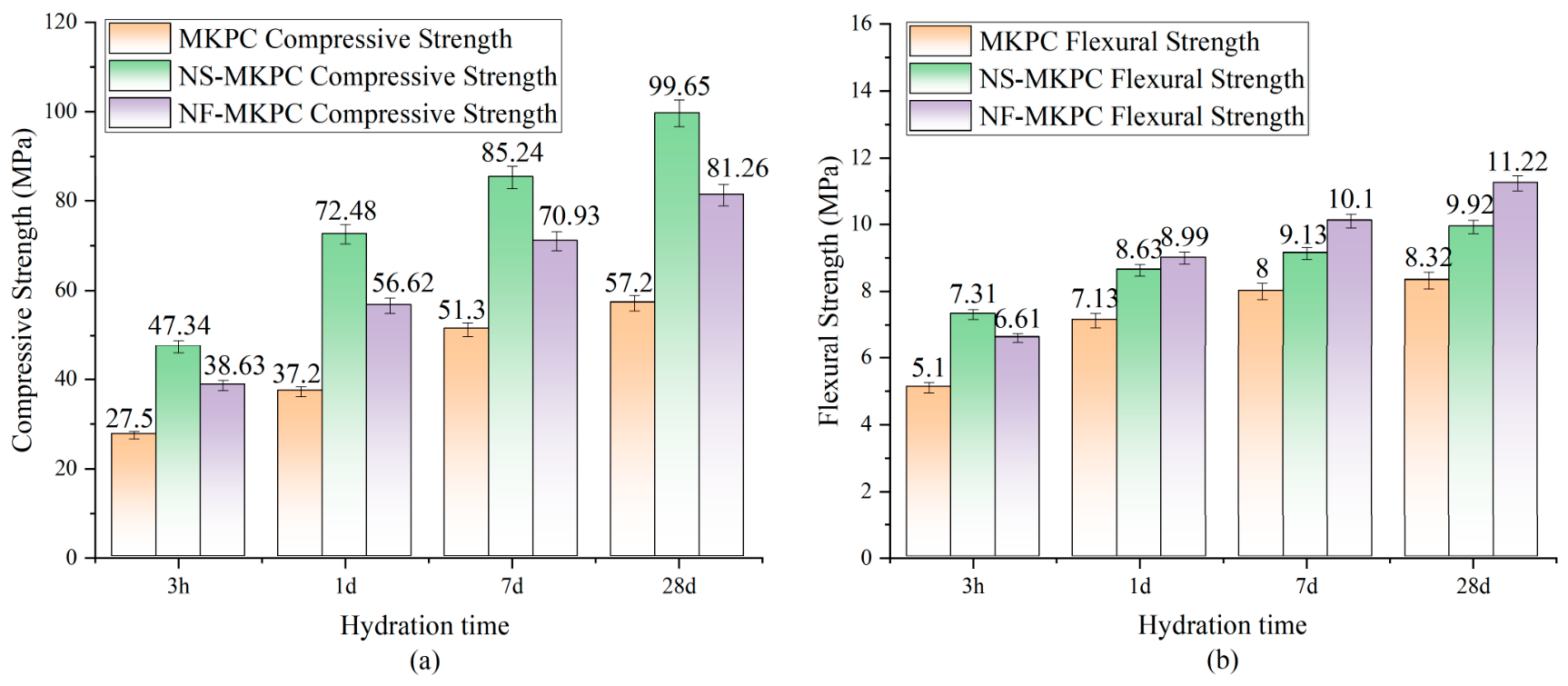
The compressive and flexural strength development of pure MKPC and NF-MKPC were evaluated at 3 h, 1 d, 7 d, and 28 d using the mix proportion selected from the orthogonal analysis, as shown in Figure 5. For compressive strength, NF-MKPC exhibited 38.63 MPa at 3 h, a 40.5% increase compared with MKPC (27.5 MPa), as shown in Figure 5a. At 1 d, NF-MKPC reached 56.62 MPa versus 37.2 MPa for MKPC. At later ages, NF-MKPC maintained a clear advantage, achieving 70.93 MPa (7 d) and 81.26 MPa (28 d) compared with 51.3 MPa and 57.2 MPa for MKPC. For flexural strength, NF-MKPC consistently outperformed MKPC across all curing ages, as shown in Figure 5b. At 3 h, NF-MKPC reached 6.61 MPa versus 5.1 MPa for MKPC. At 1 d, 7 d, and 28 d, NF-MKPC achieved 8.99, 10.1, and 11.22 MPa, respectively, while the MKPC values were 7.13, 8.0, and 8.32 MPa.
Figure 5.
Variation in the mechanical performance of NF-MKPC with curing age: (a) compressive strength; (b) flexural strength.
3.3. Hydration Heat Test
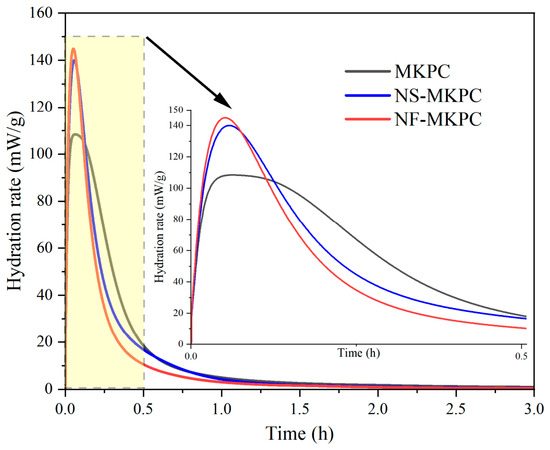
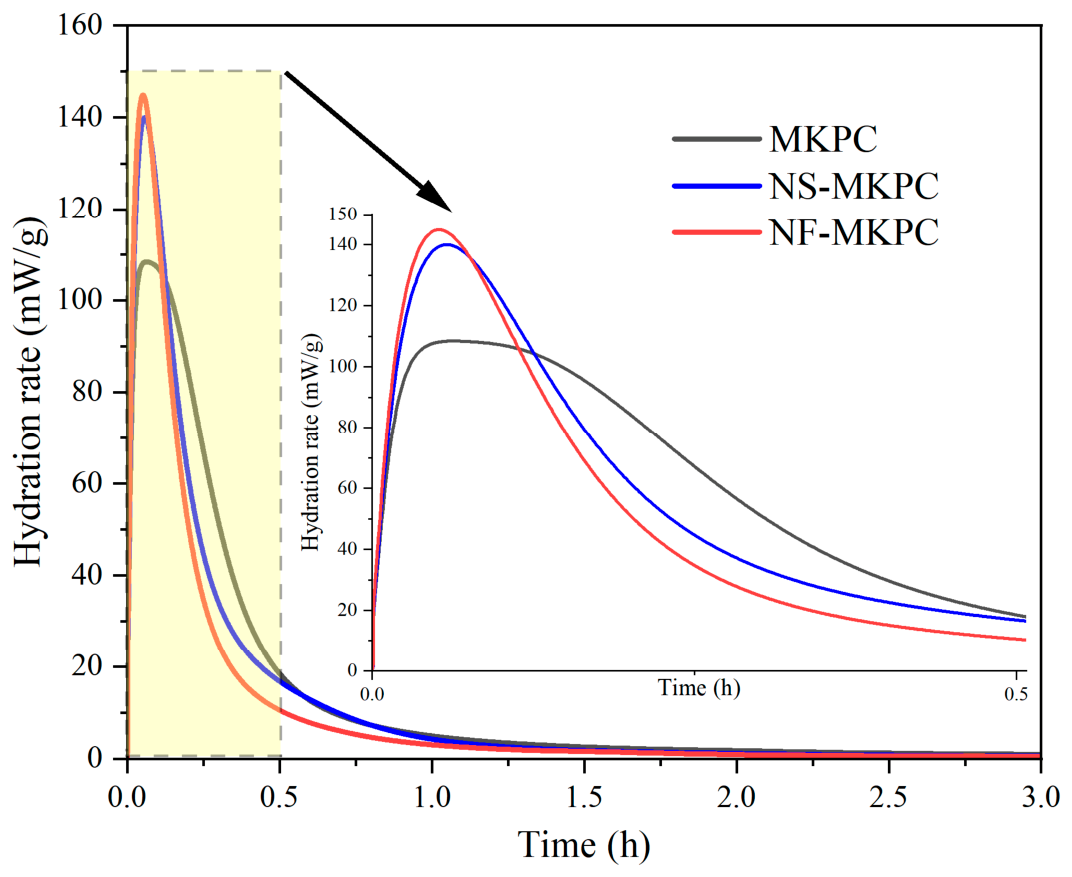
The early-age hydration behavior of pure MKPC, NS-MKPC, and NF-MKPC was compared over the first 3 h of reaction, with the initial 0–0.5 h interval shown separately at an enlarged scale in Figure 6.
Figure 6.
Early-age hydration heat-flow profiles of pure MKPC, NS-MKPC [32], and NF-MKPC, including an enlarged view of the first 0.5 h.
All three mixtures exhibited an initial increase in heat-flow rate followed by a gradual decrease. Differences among the three mixtures were more apparent during the first 0.5 h. The NF-MKPC mixture exhibited the highest and earliest heat-flow peak among the three systems.
The peak heat-flow rate of NF-MKPC was 148 mW/g, with the peak occurring at approximately 0.1 h. The peak heat-flow rates of pure MKPC and NS-MKPC were 110 and 140 mW/g, respectively. The peak times of pure MKPC and NS-MKPC were later than that of NF-MKPC.
3.4. Phase Composition Analysis
3.4.1. XRD Analysis
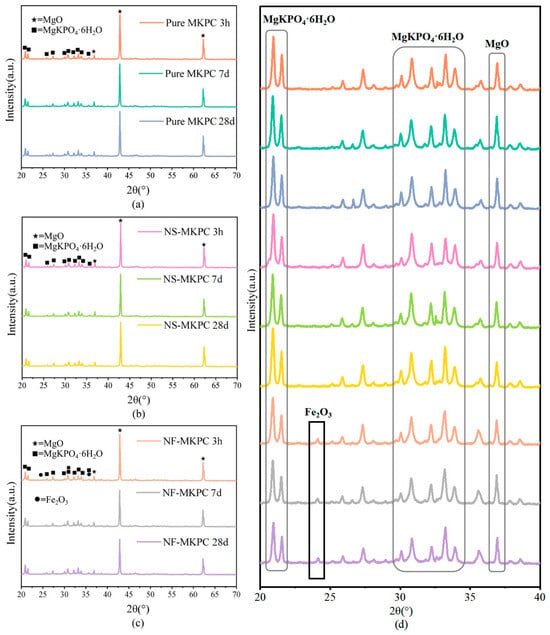
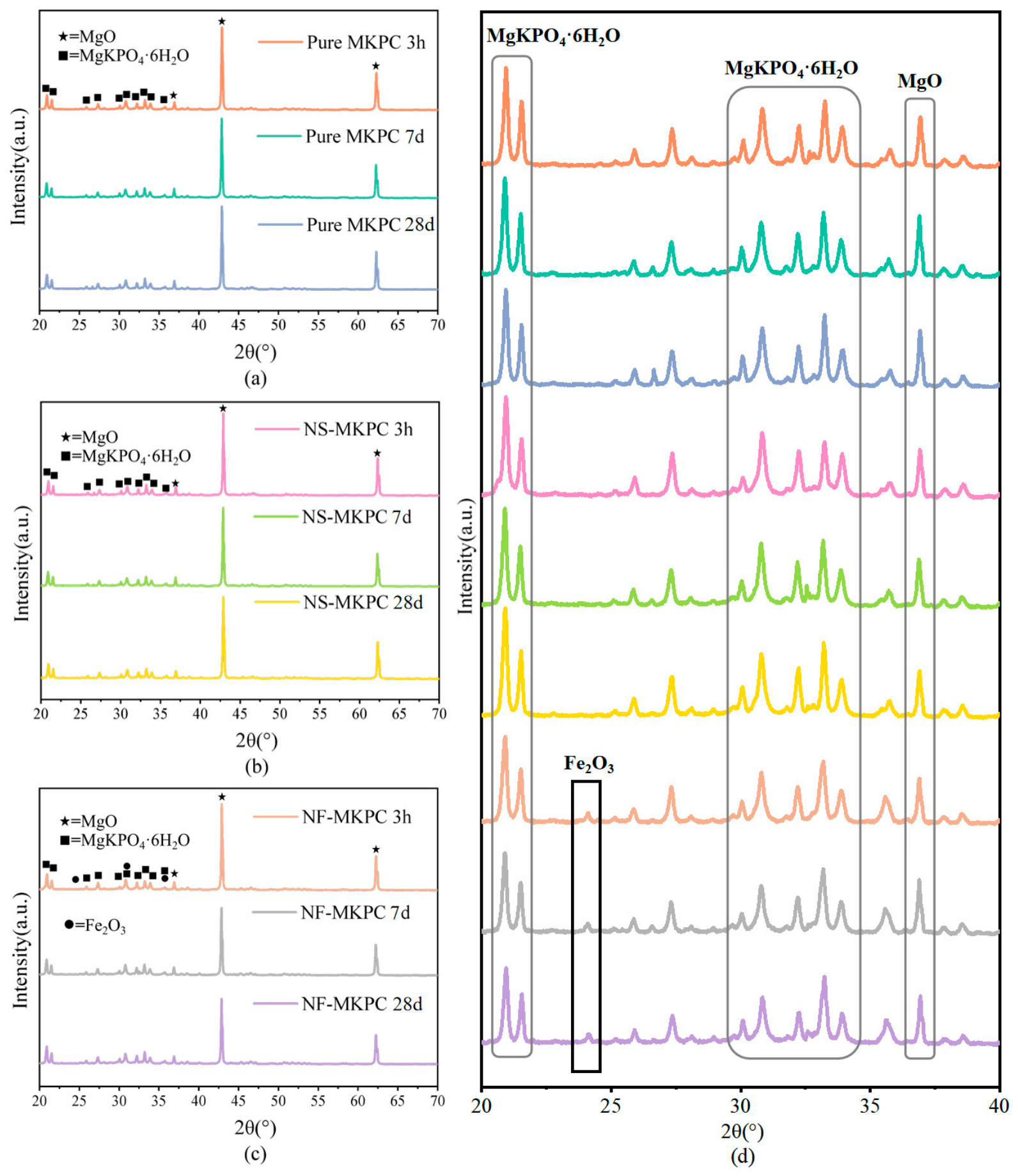
Figure 7 compares the phase characteristics of pure MKPC, NS-MKPC, and NF-MKPC after 3 h, 7 d, and 28 d of curing, based on their XRD patterns.
Figure 7.
XRD characterization of the investigated MKPC systems at different curing ages: (a) pure MKPC; (b) NS-MKPC [32]; (c) NF-MKPC; (d) magnified view of the 20–40° diffraction-angle range.
All three systems exhibited diffraction peaks corresponding to MgO, mainly located at approximately 43° and 62.3°. The MgO peak intensity decreased with increasing curing age in all three systems. Meanwhile, the characteristic peaks of struvite-K increased with curing age. The main struvite-K peaks were observed at approximately 21°, 30°, and 32°.
The XRD patterns indicate that residual MgO remained readily detectable in pure MKPC at 28 d, while the formation of struvite-K was less pronounced. The NS-modified specimens, in contrast, exhibited a progressive weakening of the MgO reflections together with clearer struvite-K diffraction features over the same curing period.
NF-MKPC exhibited the lowest MgO peak intensity and the most pronounced struvite-K peaks among the three systems at the corresponding curing ages. In addition, weak diffraction signals attributable to Fe2O3 were observed at approximately 24° in the NF-MKPC patterns.
3.4.2. FTIR Analysis
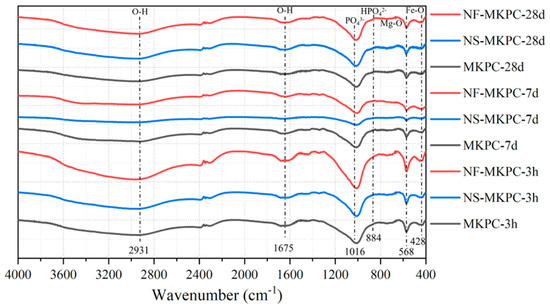
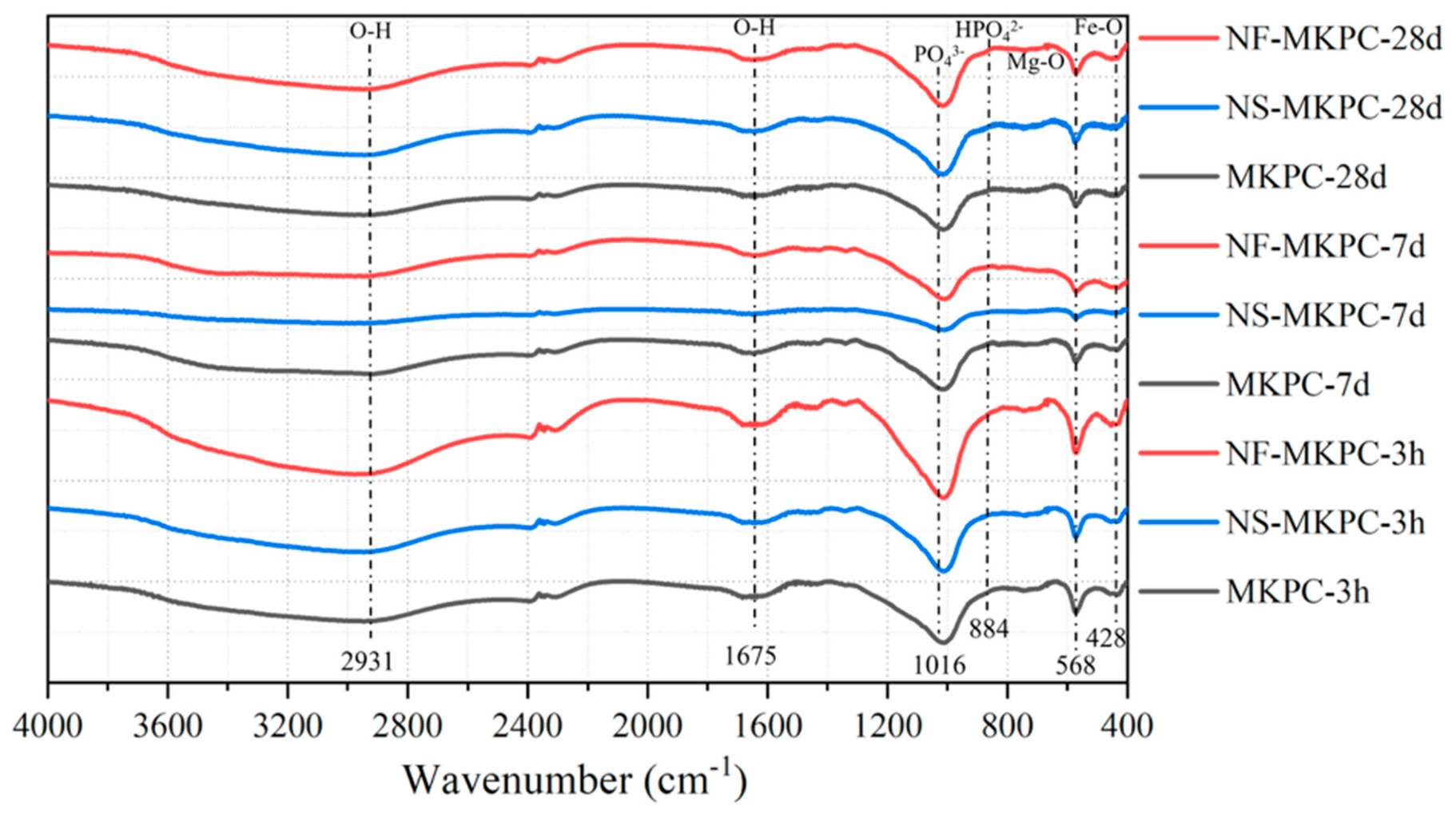
The FTIR response of pure MKPC, NS-MKPC, and NF-MKPC was examined at 3 h, 7 d, and 28 d, with the corresponding spectra presented in Figure 8. The spectra of all systems contained characteristic bands associated with O-H, PO43−, Mg-O, and Fe-O vibrations. Specifically, broad O-H stretching bands were observed near 2931 cm−1 and 1675 cm−1. The PO43− group exhibited a strong band near 1016 cm−1, while Mg-O vibrations appeared at 568 cm−1. For NF-MKPC, an additional absorption band was observed near 428 cm−1 and was assigned to Fe-O vibrations. This band was not observed in pure MKPC or NS-MKPC, which is attributable to the nano-Fe2O3 phase itself and is therefore considered a characteristic feature of the incorporated NF.
Figure 8.
Evolution of the FTIR response of pure MKPC, NS-MKPC [32], and NF-MKPC with curing ages.
The absorption bands associated with O-H changed with increasing curing age in all three systems. At 28 d, the corresponding bands of the modified systems showed relatively stable profiles. In the phosphate vibration region, the band near 1016 cm−1 became more pronounced with curing age. The bands near 884 cm−1 and 1016 cm−1 in NF-MKPC and NS-MKPC became sharper and more intense with increasing curing age.
The Mg-O band near 568 cm−1 also changed with curing age. For all three systems, this band became sharper and more pronounced with increasing curing age. In NF-MKPC, the Fe-O band near 428 cm−1 decreased in intensity with increasing curing age.
3.4.3. TGA and DSC Analysis
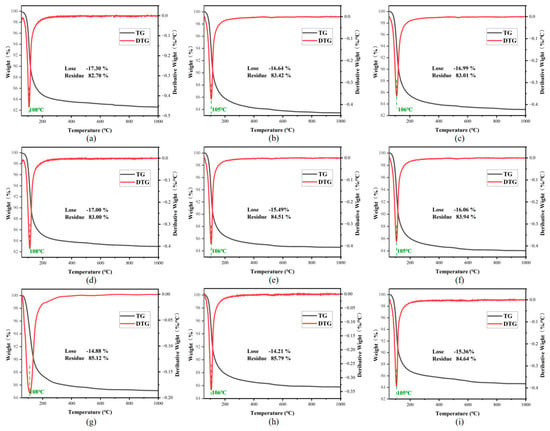
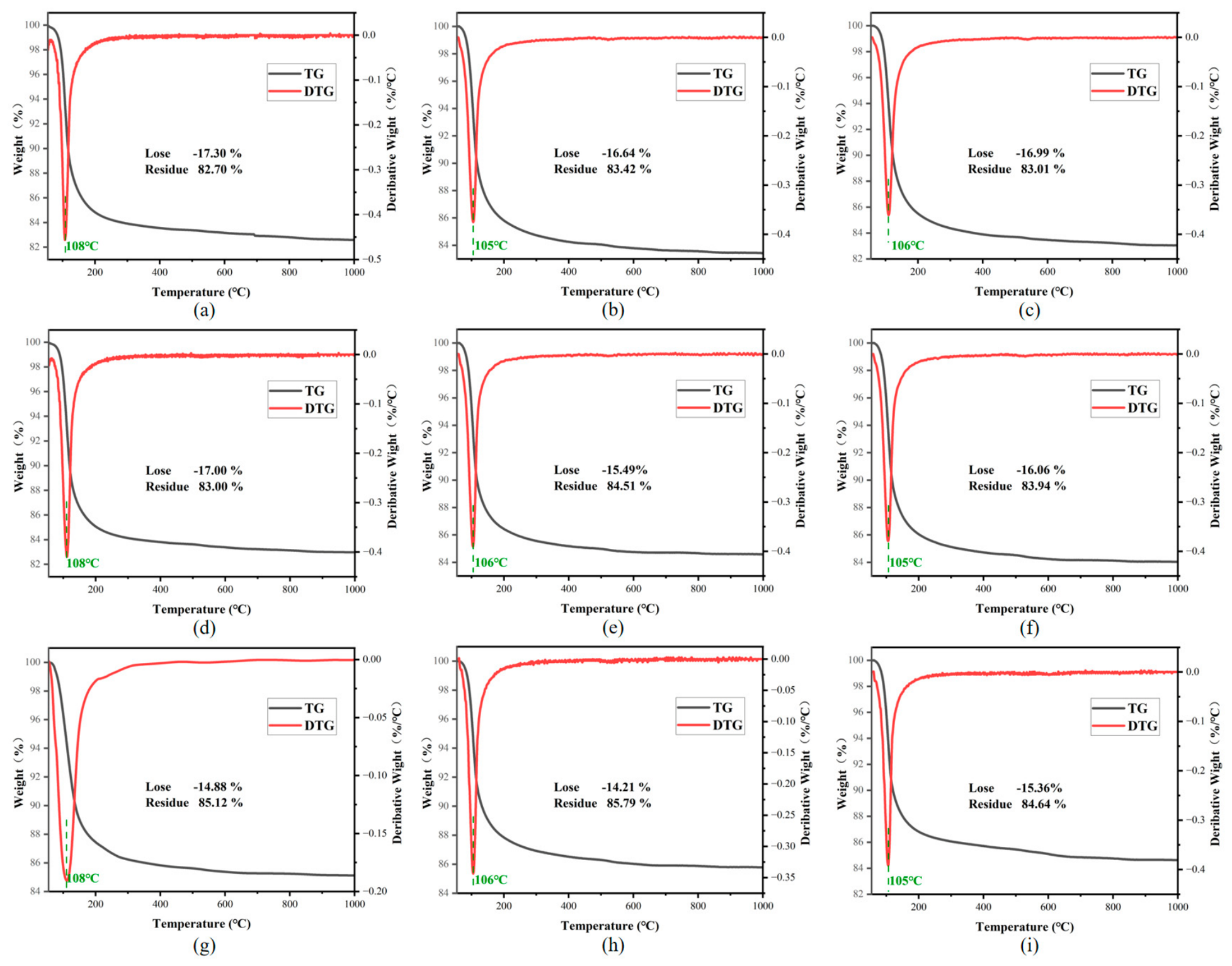
Figure 9 compares the thermal responses of pure MKPC, NS-MKPC, and NF-MKPC after curing for 3 h, 7 d, and 28 d using TG/DTG analysis. All samples exhibited a major mass-loss stage below 200 °C, followed by a slower mass-loss stage between 200 and 800 °C. Above 800 °C, the mass of the samples remained relatively stable. In the first stage, the main DTG peak occurred at approximately 104–108 °C. The second stage ranged from 200 °C to 800 °C, where a slow and continuous mass loss was detected. When the temperature exceeded 800 °C, the mass remained nearly constant.
Figure 9.
TG/DTG curves of pure MKPC, NS-MKPC [32] and NF-MKPC: (a–c) pure MKPC at 3 h, 7 d, and 28 d; (d–f) NS-MKPC at 3 h, 7 d, and 28 d; (g–i) NF-MKPC at 3 h, 7 d, and 28 d.
For pure MKPC, the mass loss in the first stage slightly decreased from 16.99% at 3 h to 16.64% at 7 d, and then rose moderately to 17.30% at 28 d. Accordingly, the residual mass increased from 83.01% (3 h) to 83.42% (7 d) and finally stabilized at 82.70% (28 d).
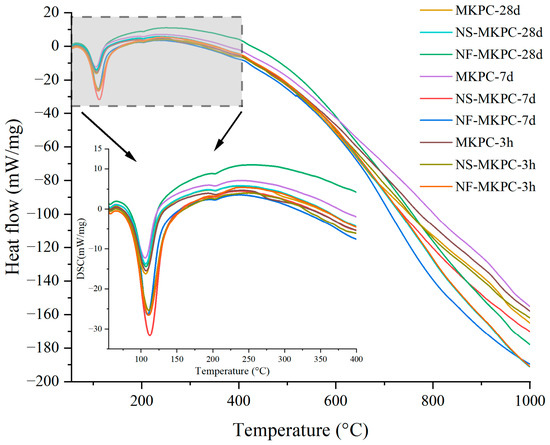
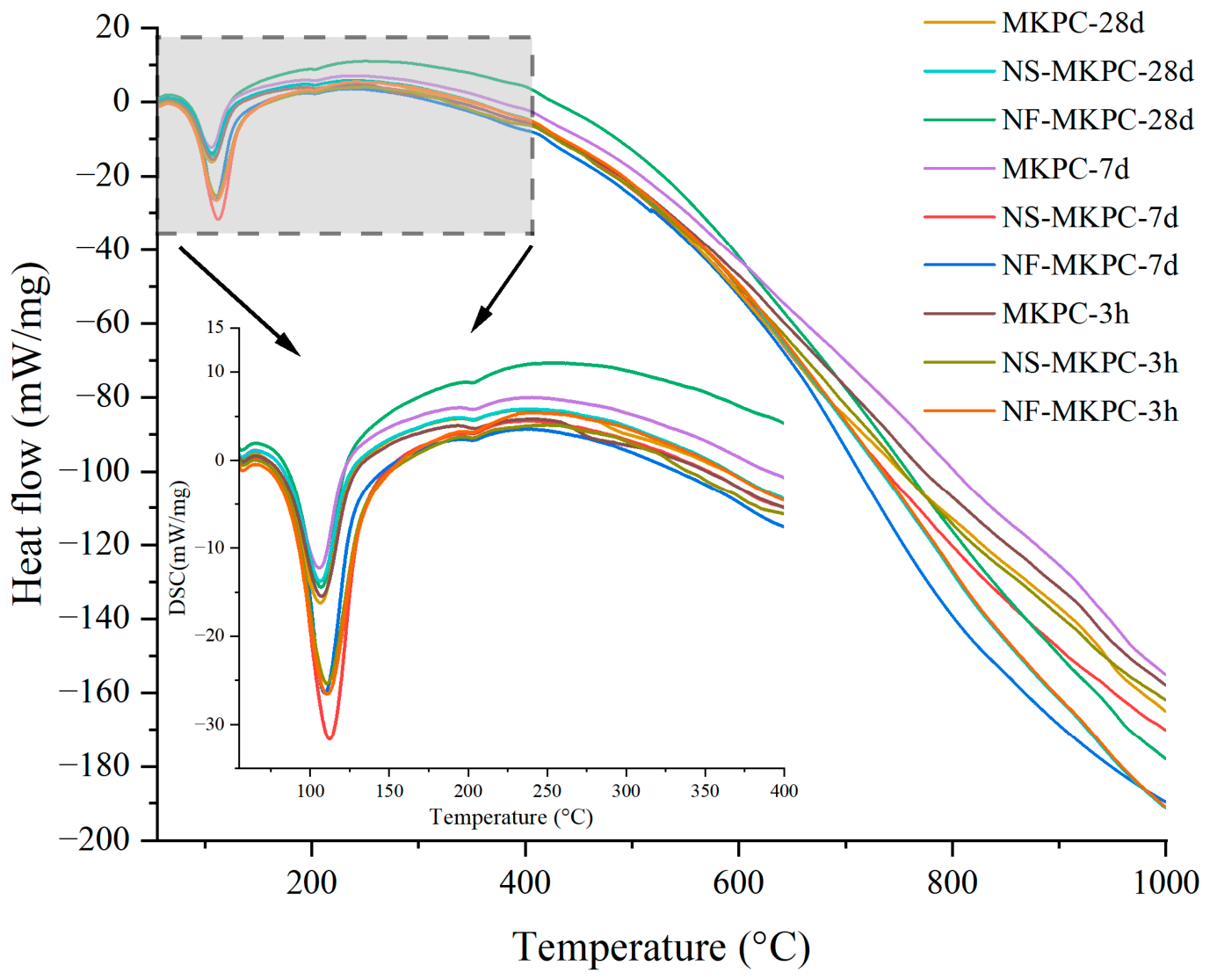
Figure 10 displays the DSC curves of all groups at different curing ages. Three characteristic thermal events can be identified across all specimens. A sharp endothermic peak appeared at 100–150 °C. A weak thermal response was detected in the range of 200–400 °C, while there was a broad thermal event above 400 °C.
Figure 10.
DSC characterization of pure MKPC, NS-MKPC [32], and NF-MKPC at selected curing ages.
3.4.4. SEM/EDS and BSE Analysis
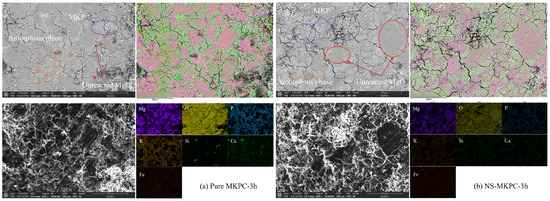
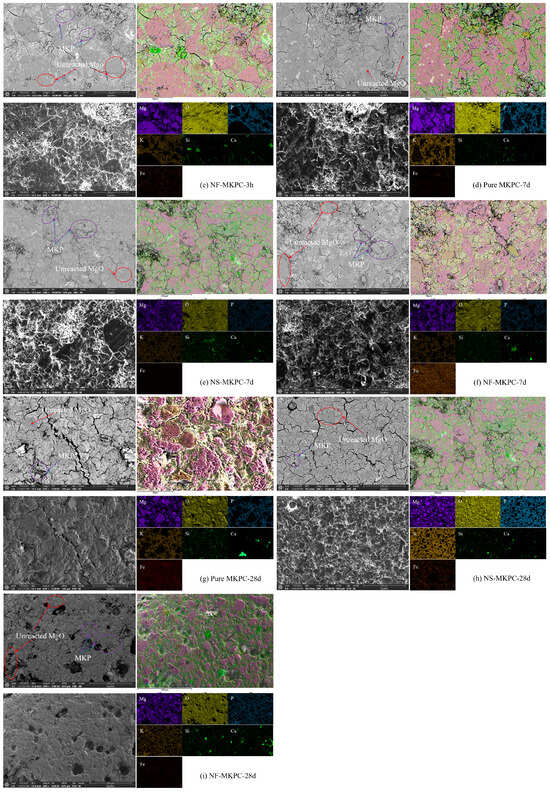
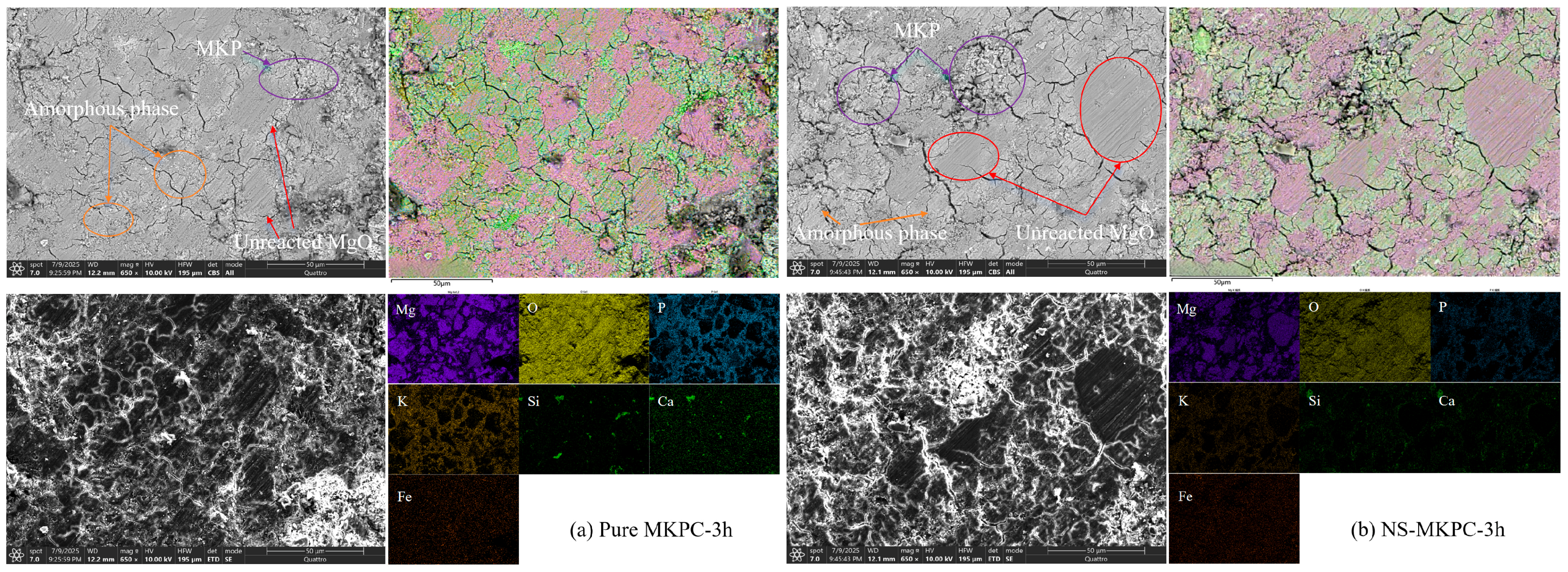
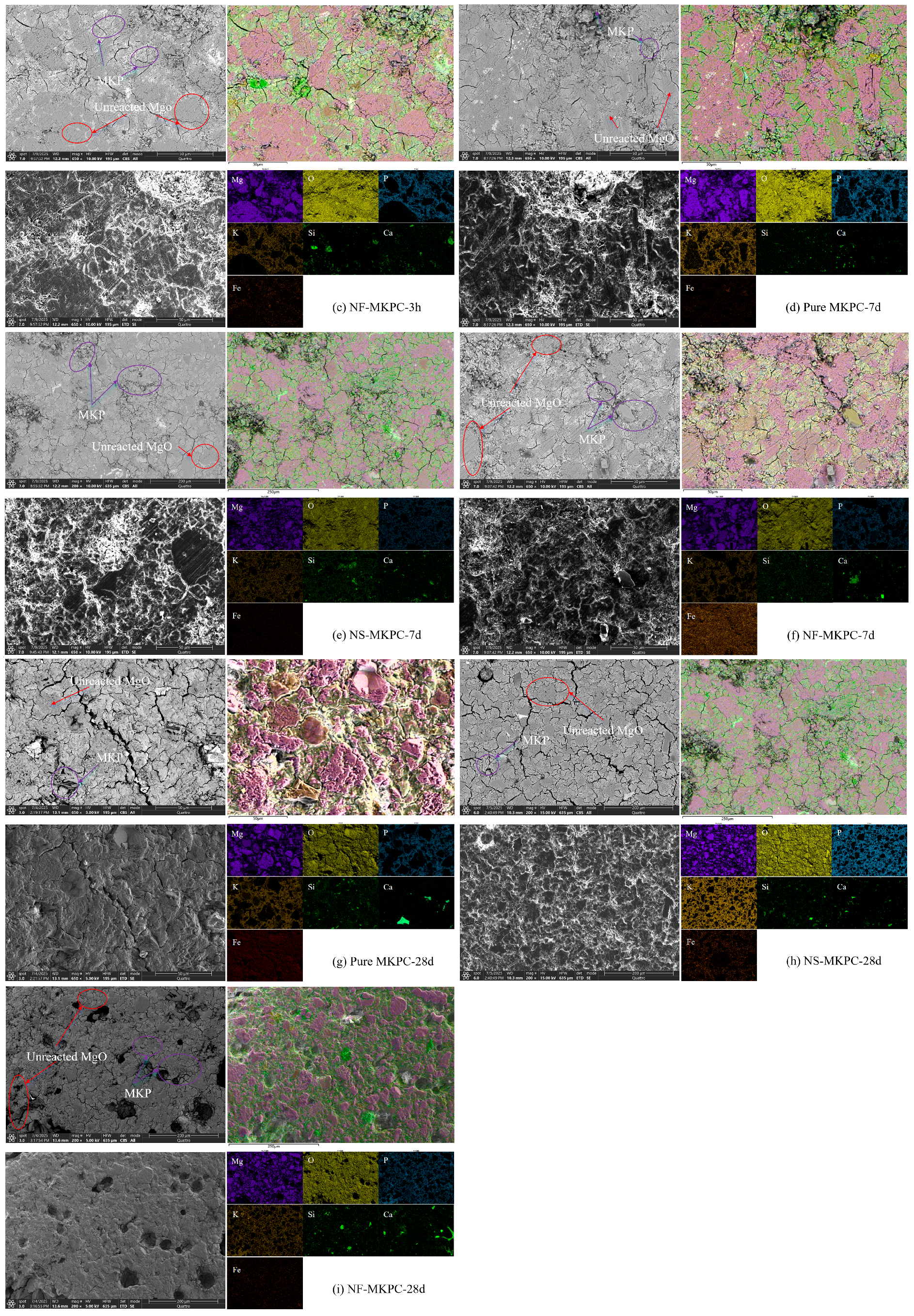
Figure 11 compares the microstructural features of pure MKPC, NS-MKPC, and NF-MKPC at 3 h, 7 d, and 28 d using SEM, BSE imaging, and EDS elemental mapping.
Figure 11.
SEM/BSE microstructural observations of the MKPC systems with curing age: (a) pure MKPC at 3 h; (b) NS-MKPC at 3 h; (c) NF-MKPC at 3 h; (d) pure MKPC at 7 d; (e) NS-MKPC at 7 d; (f) NF-MKPC at 7 d; (g) pure MKPC at 28 d; (h) NS-MKPC at 28 d; (i) NF-MKPC at 28 d.
At 3 h, all three systems exhibited relatively loose matrices with residual MgO particles and visible interparticle voids. Hydration products were distributed around the residual particles, with a relatively discontinuous morphology. In the BSE images, regions with different contrast were observed between residual MgO particles and the surrounding matrix. EDS mapping showed that Mg was mainly concentrated in the residual particle regions, while P was distributed more locally. K, Ca, Si, and Fe showed relatively dispersed distributions.
At 7 d, the matrices of all three systems became more compact, and the amount of visible residual MgO decreased. Hydration products were distributed around and between the residual particles. The BSE images showed reduced contrast differences between some residual particles and the surrounding matrix. EDS mapping showed a more continuous distribution of P, while Mg remained concentrated in some residual particle regions and was also distributed throughout the matrix. The distributions of O and K became more uniform compared with those at 3 h.
At 28 d, unreacted MgO particles were scarcely observed in all three systems. SEM images revealed dense and continuous three-dimensional networks with markedly reduced porosity and well-developed MKP crystals. BSE images displayed nearly uniform contrast. EDS mapping showed strong spatial correlation between Mg and P. Oxygen remained uniformly distributed, while K and Ca were evenly dispersed and incorporated into the hydration products.
3.4.5. Mercury Intrusion Porosimetry (MIP) Analysis
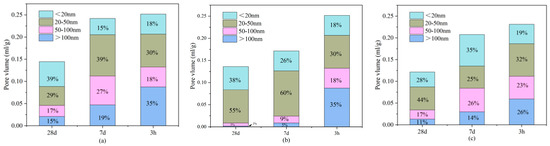
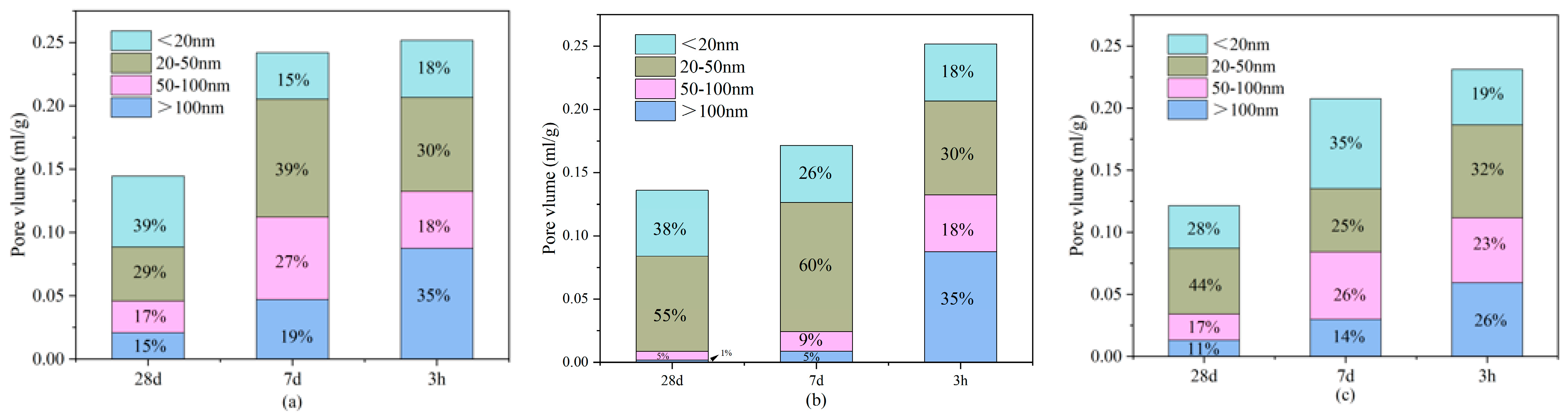
MIP was used to characterize the pore-size distribution of pure MKPC, NS-MKPC, and NF-MKPC after 3 h, 7 d, and 28 d of curing, as shown in Figure 12. The pore size ranges were classified as macropores (>100 nm), mesopores (20–50 nm and 50–100 nm), and micropores (<20 nm).
Figure 12.
Pore-size characteristics determined by MIP at the investigated curing ages: (a) pure MKPC; (b) NS-MKPC [32]; (c) NF-MKPC.
For pure MKPC, the total pore volume decreased progressively with curing time, from approximately 0.25 mL/g at 3 h to approximately 0.24 mL/g at 7 d and approximately 0.15 mL/g at 28 d. In terms of pore size distribution, macropores (>100 nm) dominated at 3 h (35%), while micropores (<20 nm) accounted for only 18%. By 7 d, the proportion of 20–50 nm mesopores increased to 39%, accompanied by a reduction in macropores to 19%. At 28 d, micropores expanded to 39%, while macropores further decreased to 15%.
The total of NS-MKPC pore volume decreased more rapidly than that of pure MKPC. At 3 h, the pore size distribution was similar to pure MKPC, but by 7 d, macropores (>100 nm) dropped to only 5%, while 20–50 nm mesopores surged to 60%. At 28 d, macropores were nearly eliminated, and 20–50 nm mesopores dominated at 55%, with micropores accounting for 38%.
At 3 h, macropores accounted for approximately 26% of the NF-MKPC pore volume compared with about 35% in pure MKPC, whereas micropores represented approximately 19% of the NF-MKPC pore structure. At 7 d, the micropore proportion increased to 35%, while the macropore proportion decreased to 14%. At 28 d, 20–50 nm mesopores accounted for approximately 44%, micropores accounted for 28%, and macropores accounted for 11%.
3.4.6. Raman Mapping Analysis of Phase Evolution
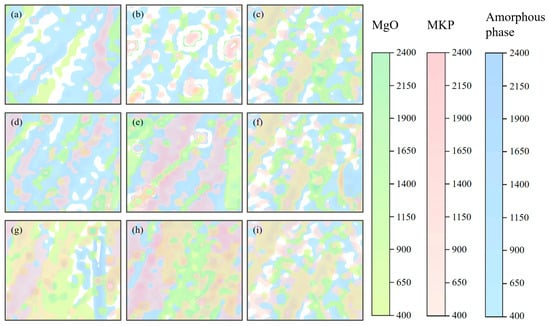
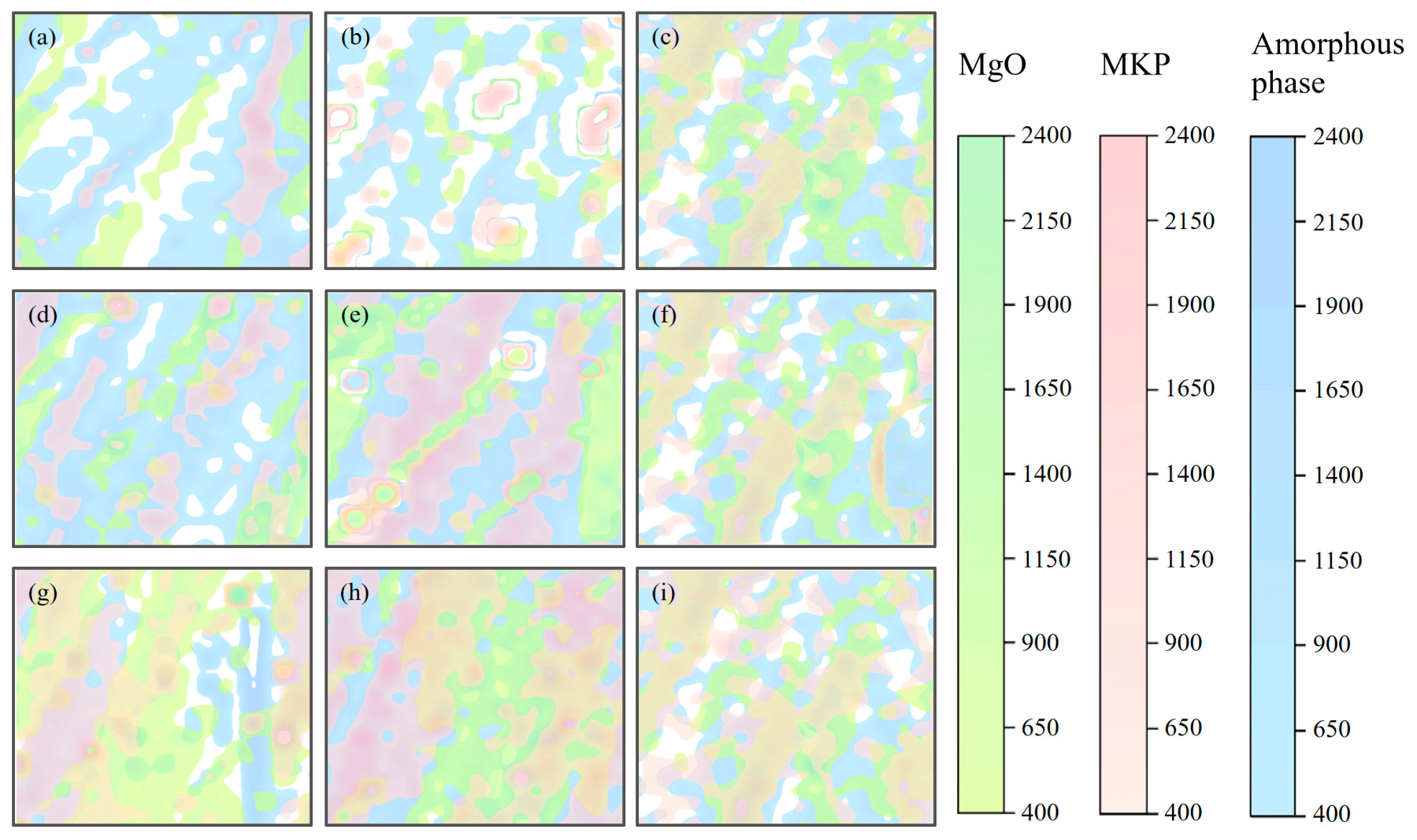
Figure 13 shows the spatial distribution of the investigated phases in pure MKPC, NS-MKPC, and NF-MKPC based on Raman mapping at 3 h, 7 d, and 28 d, allowing their microstructural changes with curing to be compared. Three representative spectral features were distinguished based on characteristic Raman bands, with corresponding colors assigned for intuitive visualization. The green, pink, and blue regions are associated with MgO-related signals, crystalline hydration products (e.g., struvite-K and MKP), and amorphous phosphate-rich phases (e.g., phosphate gel matrix), respectively.
Figure 13.
Raman mapping of the MKPC systems during curing: (a) pure MKPC at 3 h; (b) NS-MKPC at 3 h; (c) NF-MKPC at 3 h; (d) pure MKPC at 7 d; (e) NS-MKPC at 7 d; (f) NF-MKPC at 7 d; (g) pure MKPC at 28 d; (h) NS-MKPC at 28 d; (i) NF-MKPC at 28 d.
At 3 h, the pure MKPC matrix was dominated by blue amorphous phases, with only scattered pink MKP crystals and extensive green MgO domains.
By 7 d, the fraction of MKP in pure MKPC increased only slightly and remained discontinuous, with residual MgO still forming prominent clusters and amorphous regions exhibiting local heterogeneity. In NS-MKPC and NF-MKPC, however, MKP phases developed into larger, interconnected patch-like clusters, residual MgO was more dispersed, and amorphous phases became denser and more evenly distributed.
At 28 d, pure MKPC still contained noticeable MgO clusters, and although MKP regions expanded, they failed to form a continuous network. The amorphous phase also exhibited poor homogeneity. In sharp contrast, both NS-MKPC and NF-MKPC showed nearly no residual MgO, while MKP phases formed continuous, interconnected networks. The amorphous gel matrix in modified systems was densely and uniformly distributed, filling the gaps between MKP crystals without distinct phase separation.
3.5. Nanoindentation Analysis
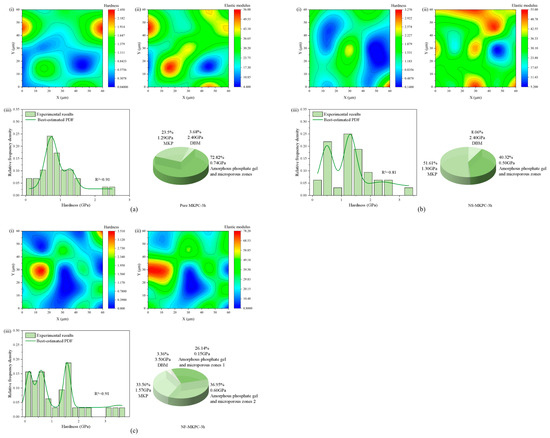
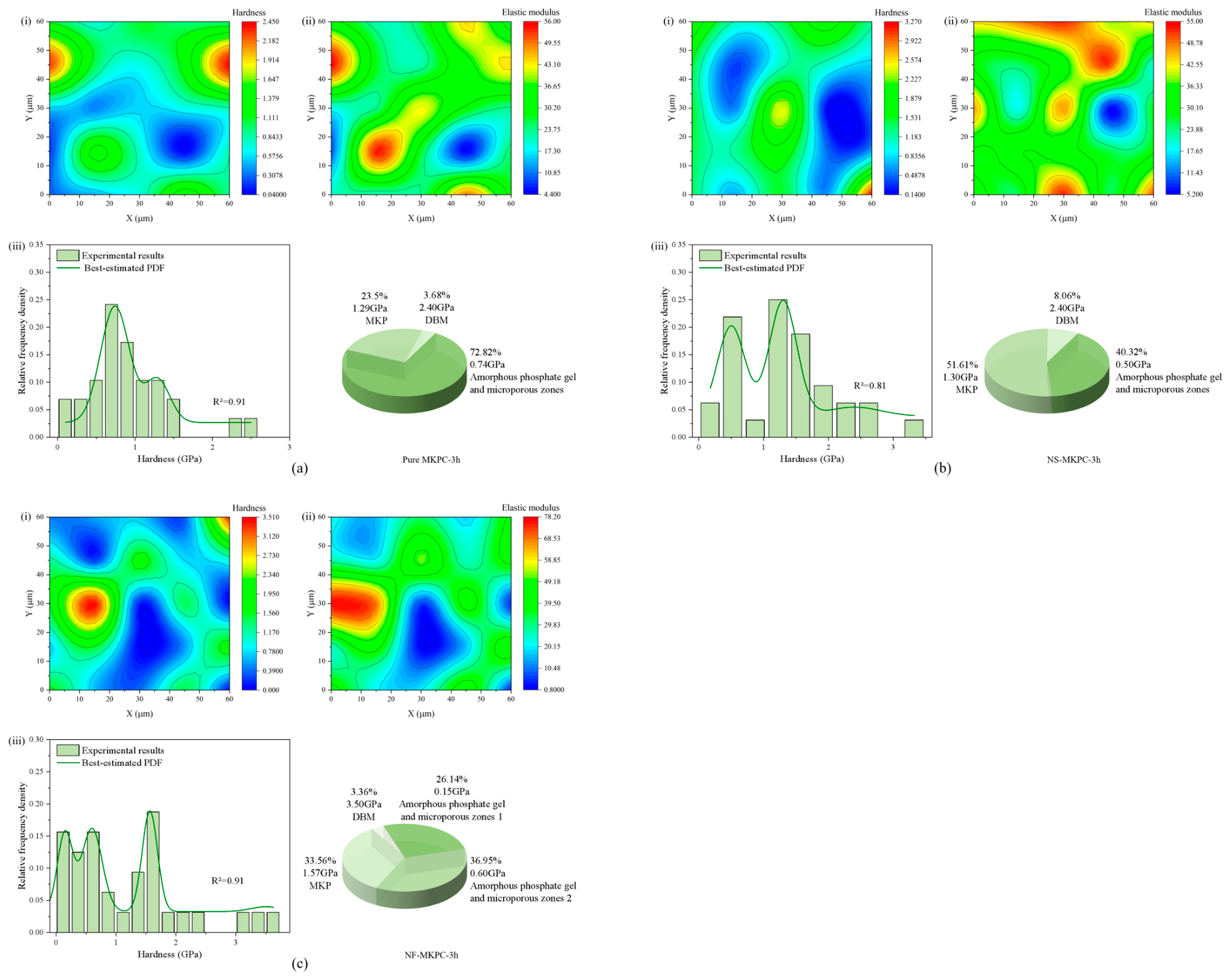
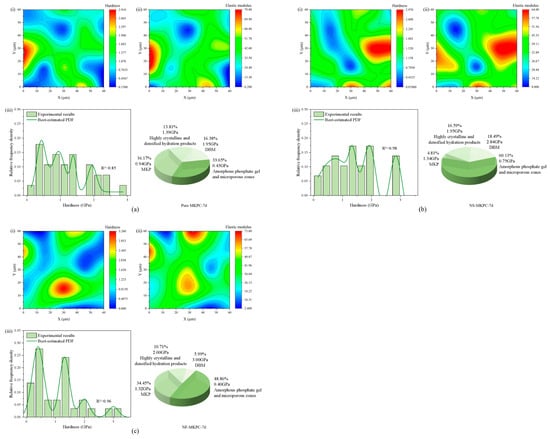
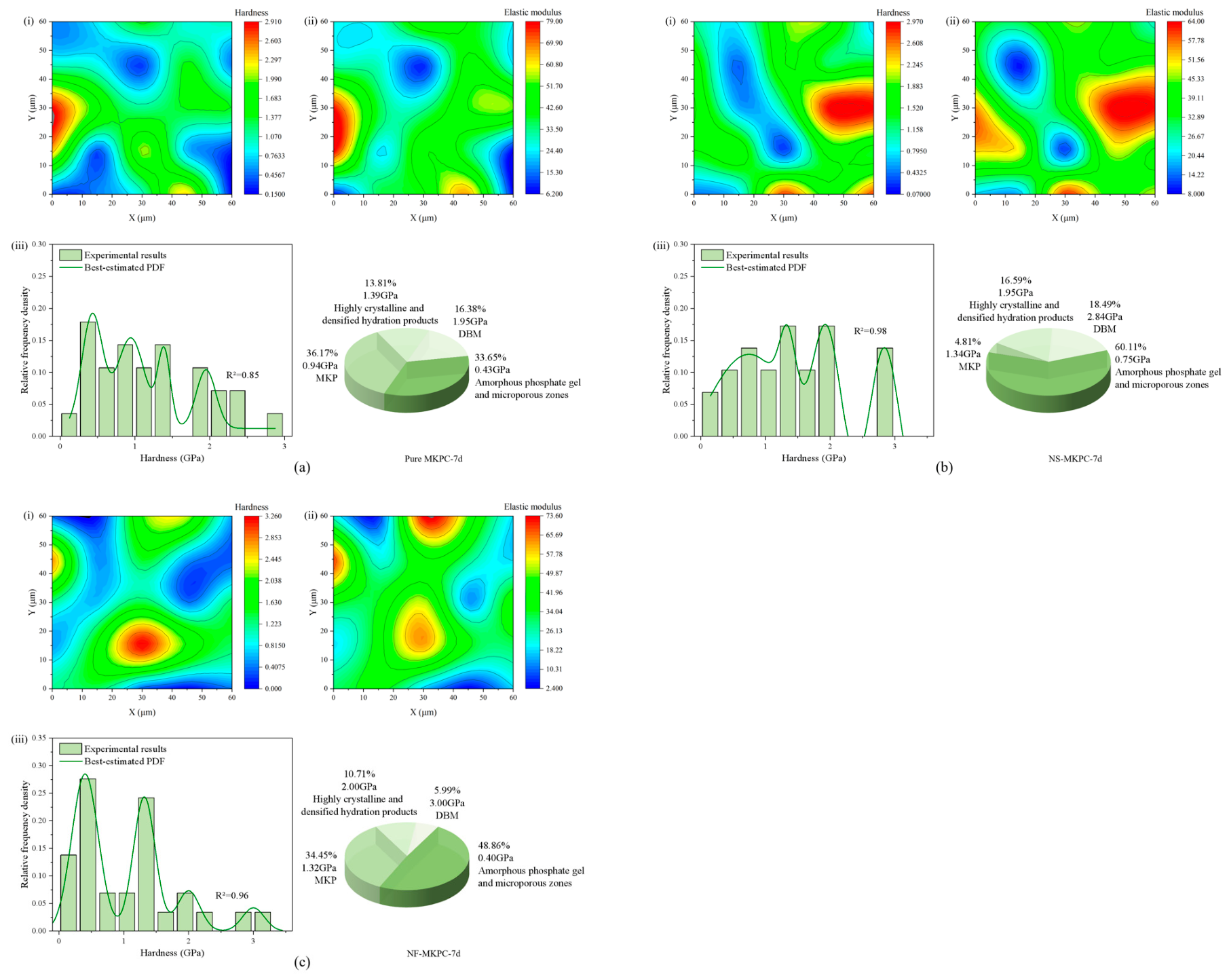
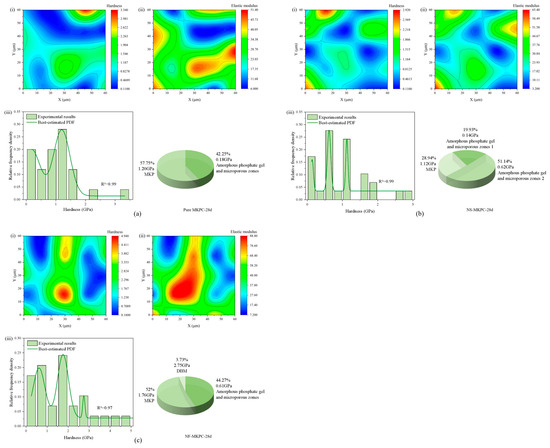
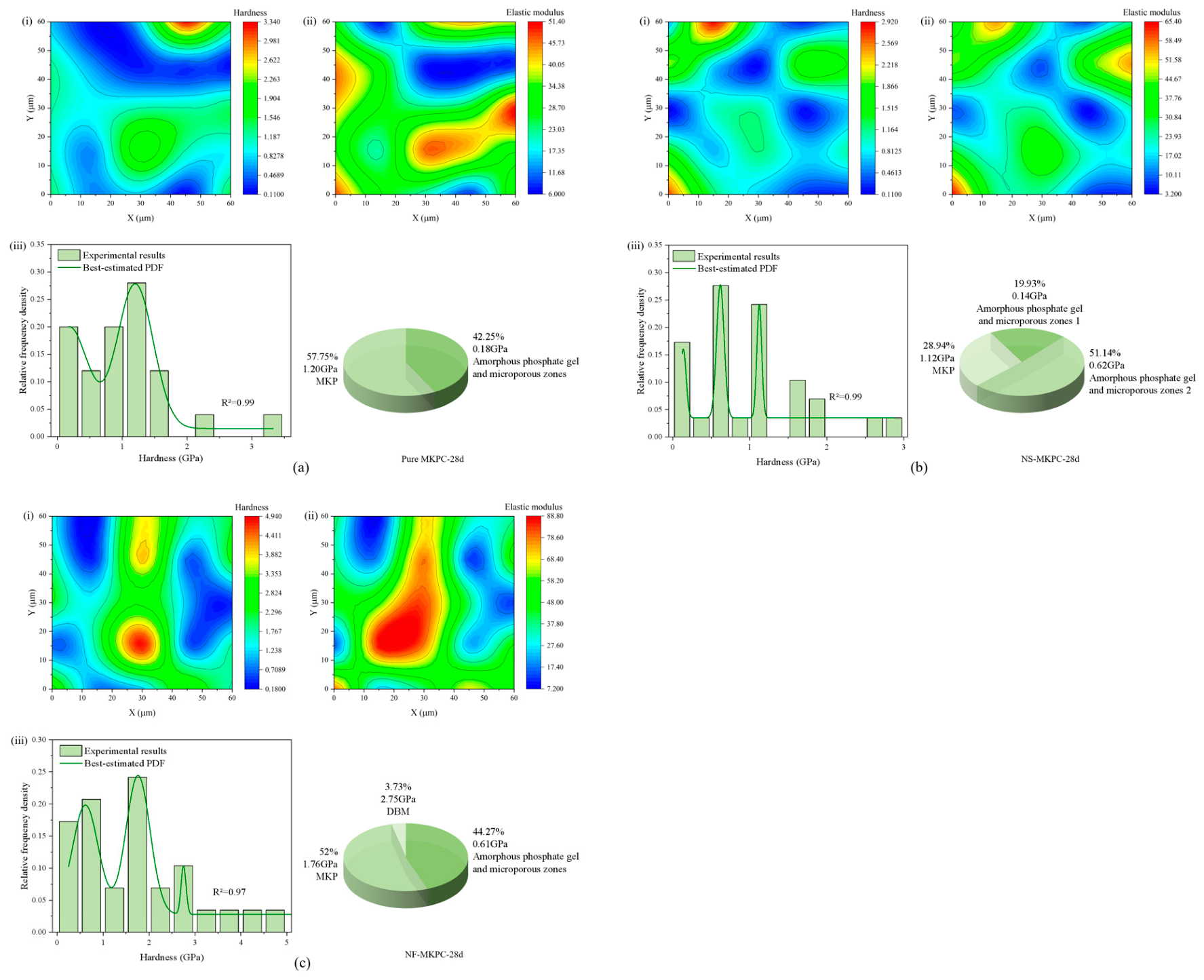
The nanoindentation responses of pure MKPC, NS-MKPC, and NF-MKPC were characterized at 3 h, 7 d, and 28 d, with the corresponding results shown in Figure 14, Figure 15 and Figure 16. The two-dimensional distributions of hardness and elastic modulus, together with the corresponding frequency distributions, reveal the evolution of micromechanical heterogeneity during hydration.
Figure 14.
Nanoindentation results after 3 h of curing: (a) pure MKPC (i)–(iii); (b) NS-MKPC (i)–(iii); (c) NF-MKPC (i)–(iii).
Figure 15.
Nanoindentation results after 7 d of curing: (a) pure MKPC (i)–(iii); (b) NS-MKPC (i)–(iii); (c) NF-MKPC (i)–(iii).
Figure 16.
Nanoindentation results after 28 d of curing: (a) pure MKPC (i)–(iii); (b) NS-MKPC (i)–(iii); (c) NF-MKPC (i)–(iii).
At 3 h (Figure 14), pure MKPC contained a large proportion of low-performance regions, suggesting that the hydration products had not yet formed a sufficiently compact structure. In comparison, NS-MKPC and NF-MKPC showed increased fractions of high-mechanical-response regions. Among them, NF-MKPC exhibited higher maximum hardness and elastic modulus values.
With prolonged curing, the mechanical response distributions of all samples gradually shifted toward higher hardness and modulus values (Figure 15 and Figure 16). Compared with pure MKPC, nano-modified systems showed narrower distributions and fewer weak regions. At 7 d, NF-MKPC exhibited the highest hardness and elastic modulus values among the three systems, reaching approximately 3.26 GPa and 73.6 GPa, respectively. At 28 d, the improvement became more pronounced, with NF-MKPC achieving the highest hardness and elastic modulus values (approximately 4.94 GPa and 88.8 GPa), followed by NS-MKPC and pure MKPC.
4. Discussion
4.1. Effect of NF on Hydration and Phase Evolution
The hydration heat results indicate that nano-modification changes the early hydration behavior of MKPC. As shown in Figure 6, NF-MKPC exhibited a higher and earlier heat-release peak than both pure MKPC and NS-MKPC. The peak heat-release rate of NF-MKPC reached approximately 148 mW/g at around 0.1 h, compared with approximately 140 mW/g for NS-MKPC and 110 mW/g for pure MKPC. These results suggest that NF promotes the early-stage hydration reaction and may facilitate the rapid development of the hydration products.
The earlier heat-release peak of NF-MKPC can be reasonably associated with the high specific surface area of the nanoparticles. Nano-Fe2O3 may provide additional surfaces for the initial formation of hydration products, thereby facilitating heterogeneous nucleation. The combined calorimetry, XRD, FTIR, and Raman results support the occurrence of accelerated early hydration, while the specific contribution of heterogeneous nucleation remains to be further clarified.
The difference between NF-MKPC and NS-MKPC is also noteworthy. NS-MKPC exhibited a relatively prolonged heat-release process after the main peak, whereas NF-MKPC showed a more rapid decrease toward the baseline. This difference may be related to the different interactions of the two nanoparticles with the MKPC reaction environment. Previous work on NS-MKPC reported that nano-SiO2 can participate in reactions in the acidic phosphate environment, which may influence the availability of reactive species [32]. The different heat-release profiles observed for NF-MKPC and NS-MKPC may therefore reflect differences in their interactions with the MKPC hydration environment.
The XRD results provide further evidence for the development of crystalline hydration products. With increasing curing age, the intensity of MgO peaks decreased, whereas the characteristic peaks of struvite-K became more pronounced. This evolution was more evident in the NF-MKPC system, which exhibited a relatively larger reduction in MgO peak intensity and stronger struvite-K peaks. These changes are consistent with enhanced conversion of the initial reactants into crystalline phosphate-containing hydration products.
The FTIR results showed a similar evolution. The progressive sharpening and intensification of the PO43−-related bands with curing age suggest increasing structural ordering of the phosphate-containing hydration products. The Mg-O-related bands also changed with curing age, consistent with the continued participation of Mg-containing phases in hydration. The Fe-O-related band observed in NF-MKPC is attributable to the nano-Fe2O3 phase itself and is therefore considered a characteristic feature of the incorporated NF.
The thermal analysis further supports the interpretation of progressive hydration and product development. Both TG/DTG and DSC results showed changes in dehydration behavior with curing age, while NF-MKPC generally exhibited a more pronounced thermal response than pure MKPC. These observations are consistent with changes in the amount and structural state of hydration products. However, thermal analysis cannot independently identify the exact origin of each phase, and therefore these results are best interpreted together with XRD and FTIR rather than as independent evidence of a specific reaction pathway.
Taken together, the calorimetry, XRD, FTIR, TG-DTG, and DSC results indicate that NF is associated with accelerated early hydration and enhanced development of crystalline hydration products. The combined evidence is consistent with a possible contribution of heterogeneous nucleation, although this mechanism was not directly verified in the present study.
4.2. NF-Induced Microstructural Refinement
The microstructural results provide further evidence that NF modification is associated with progressive matrix densification. SEM and BSE observations showed that the three systems evolved from relatively loose structures containing residual MgO at early age toward denser and more continuous matrices at later ages. At 3 h, all systems contained obvious unreacted MgO particles, voids, and locally developed hydration products. At 7 d and 28 d, the amount of residual MgO decreased and the hydration products became more continuously distributed.
Compared with pure MKPC, the nano-modified systems showed a more continuous hydration-product distribution at intermediate and later ages. In particular, NF-MKPC exhibited a relatively dense matrix and a more uniform Fe distribution. These observations are consistent with the possibility that NF provides additional surfaces for hydration-product formation and contributes to local microstructural refinement. Nevertheless, the SEM/EDS observations do not allow the filling effect and nucleation effect to be quantitatively separated.
The MIP results provide quantitative support for this microstructural refinement. The proportion of macropores in NF-MKPC decreased from 26% at 3 h to 11% at 28 d, while the proportion of smaller pores increased during curing. Compared with pure MKPC, NF-MKPC therefore exhibited an earlier reduction in large pores and a more refined pore-size distribution.
This pore refinement is likely related to the continued formation and growth of hydration products. The nanoparticles may also contribute to filling or modifying the spaces between larger particles. The observed reduction in large pores is therefore likely associated with both hydration-product formation and nano-modification.
The Raman mapping results provide a spatial perspective on this evolution. At 3 h, NF-MKPC showed a relatively larger distribution of crystalline MKP-related regions and a reduced distribution of MgO-related regions compared with pure MKPC. At 7 d and 28 d, both NS-MKPC and NF-MKPC exhibited more continuous crystalline-product regions and more homogeneous phase distributions. These observations are consistent with the XRD results and suggest that nano-modification promotes the development and spatial continuity of hydration products.
The nanoindentation results further indicate that the microstructural refinement is accompanied by improved local mechanical response. At 7 d, NF-MKPC exhibited a hardness of approximately 3.26 GPa and an elastic modulus of approximately 73.6 GPa, while the corresponding values increased to approximately 4.94 GPa and 88.8 GPa at 28 d. The distributions also became narrower, with fewer low-performance regions.
These results suggest that NF modification is associated with a more homogeneous and mechanically competent hydrated matrix. The relationship between the nanoindentation results and the MIP and SEM observations is particularly relevant: reduced large-pore content and a denser microstructure are consistent with the observed increase in local hardness and elastic modulus. Thus, the micromechanical results provide additional support for the microstructural refinement observed by SEM, MIP, and Raman mapping.
4.3. Comparison with NS-MKPC
The comparison with NS-MKPC provides useful information for distinguishing the effects of different nano-modifiers. In terms of early hydration, NF-MKPC exhibited the highest and earliest calorimetric peak, whereas NS-MKPC showed a somewhat more prolonged reaction process. This suggests that the two nanoparticles influence the hydration process differently.
The XRD and FTIR results also indicate differences in phase evolution. Both NS and NF were associated with reduced MgO signals and enhanced development of phosphate-containing hydration products. However, NF-MKPC generally showed stronger struvite-K-related diffraction peaks and more pronounced changes in the MgO-related signals. This suggests that NF may provide more favorable conditions for early crystallization of the main hydration products.
The pore-structure results show another difference between the two systems. NS-MKPC exhibited particularly strong refinement of the 20–50 nm pore range at later ages, whereas NF-MKPC showed an earlier reduction in macropores. At 28 d, the macropore fraction was approximately 11% for NF-MKPC compared with an almost eliminated macropore fraction for NS-MKPC. Therefore, neither nano-modifier can be considered universally superior in every aspect of pore refinement. Instead, the two systems appear to exhibit different pore-evolution characteristics.
The SEM and Raman results similarly indicate that both nano-modifiers contribute to microstructural refinement, although the spatial distribution of hydration products differs between the two systems. NS-MKPC showed a relatively uniform microstructure at later ages, while NF-MKPC also developed a dense and continuous matrix with well-distributed Fe-containing regions.
The comparison therefore suggests that NF and NS may provide strengthening through partially overlapping but not identical mechanisms. For NF, the present results are consistent with a combination of heterogeneous nucleation, microstructural refinement, and possible particle-filling effects. For NS, previous work has associated its effect with physical filling and additional reactions involving nano-SiO2 [32].
4.4. Strengthening Mechanism and Engineering Implications
Based on the combined results of mechanical testing, hydration analysis, phase characterization, microstructural observation, pore analysis, and nanoindentation, a possible strengthening mechanism of NF-MKPC can be proposed.
At the early hydration stage, NF may promote the formation of hydration products by providing additional surfaces for heterogeneous nucleation. The higher and earlier calorimetric peak of NF-MKPC, together with the more pronounced development of crystalline hydration products observed by XRD, FTIR, and Raman mapping, is consistent with this interpretation. However, heterogeneous nucleation was not directly measured in the present study. The observed strengthening is therefore likely associated with multiple coupled effects rather than a single mechanism.
As hydration proceeds, the development of hydration products and the presence of nanoscale NF particles are associated with progressive pore refinement and matrix densification. The MIP results show a clear reduction in the proportion of macropores, while SEM and Raman mapping reveal a more continuous and homogeneous microstructure in NF-MKPC. These changes suggest that NF modification promotes the development of a denser hydrated matrix. Physical filling effects of the nanoparticles may also contribute to this refinement, although their contribution cannot be quantitatively distinguished from the present data.
The resulting microstructural refinement is reflected at the micromechanical scale. NF-MKPC exhibits higher hardness and elastic modulus values than the reference systems at later curing ages, together with a reduced proportion of low-response regions. The improved local mechanical response is consistent with the formation of a denser and more mechanically homogeneous matrix. At the macroscopic scale, NF-MKPC simultaneously exhibits higher compressive and flexural strengths, indicating that the microstructural and micromechanical improvements contribute to enhanced load-bearing capability.
The engineering significance of this coupled mechanism is reflected in the strength development of NF-MKPC. The compressive strength reached 38.63 MPa at 3 h and increased to 81.26 MPa at 28 d, while the corresponding flexural strengths were 6.61 and 11.22 MPa, respectively. Thus, NF modification provides both rapid early strength development and sustained strength growth during later curing. This combination may be advantageous for MKPC applications requiring relatively rapid strength development together with adequate later-age mechanical performance, such as rapid repair and rehabilitation materials.
Overall, the available evidence suggests that the strengthening effect of NF does not arise from a single mechanism but from the coupled effects of accelerated early hydration, possible heterogeneous nucleation, pore refinement, matrix densification, and improved micromechanical homogeneity. Nevertheless, the relative contribution of these mechanisms has not yet been quantitatively determined. Further studies involving direct dissolution measurements, quantitative nanoparticle dispersion analysis, and phase- or interface-specific characterization are required to establish the individual contribution of each mechanism.
5. Conclusions and Outlooks
Based on the systematic experimental characterization and comparative analysis, this study investigated the effects of nano-Fe2O3 (NF) and nano-SiO2 (NS) modification on the hydration behavior, phase evolution, pore structure, microstructure, micromechanical properties, and mechanical performance of magnesium potassium phosphate cement (MKPC). The main conclusions are summarized as follows.
5.1. Scientific Conclusions
- (1)
- Both NS and NF improve the compressive and flexural strengths of MKPC at early and long-term ages. Among them, NF-MKPC exhibited the highest strength growth, with a 3 h compressive strength of 38.63 MPa (40.5% higher than MKPC) and a 28 d compressive strength of 81.26 MPa (42.1% higher than MKPC). The 28 d flexural strength reached 11.22 MPa, 34.8% higher than pure MKPC, enabling simultaneous improvement of both compressive and flexural strength.
- (2)
- NF was associated with accelerated early hydration of MKPC. The maximum heat-release rate of NF-MKPC reached 148 mW/g compared with 140 mW/g for NS-MKPC and 110 mW/g for pure MKPC. XRD, FTIR, and Raman characterization further showed differences in the development of hydration products and phase evolution between NF-MKPC and the reference systems. The calorimetric and phase-characterization results are consistent with an accelerated early hydration process in NF-MKPC, although the specific chemical contribution of NF to phosphate consumption and dissolution was not directly determined.
- (3)
- Both NS and NF refined the pore structure and densify the microstructure of MKPC. NF reduced macropores (>100 nm) to below 14% and increased micropores (<20 nm) to 28% at 28 d. SEM, BSE, and Raman mapping further revealed a more continuous and relatively homogeneous microstructure with increasing curing age. These observations indicate that NF modification is associated with the development of a more compact pore structure and hydrated matrix.
- (4)
- Nanoindentation revealed that NF-MKPC exhibited higher hardness and elastic modulus values and a lower proportion of low-response regions at later curing ages than the reference systems. These are consistent with a more mechanically homogeneous matrix and provide a micromechanical basis for the improved macroscopic strength of NF-MKPC.
- (5)
- Comparison with NS-MKPC indicates that the two nano-modifiers produce different hydration and microstructural responses under the investigated conditions. NF-MKPC showed a more pronounced early hydration response together with progressive pore refinement and improved micromechanical properties. The strengthening behavior is therefore likely associated with several coupled contributions, including accelerated early hydration, possible heterogeneous nucleation, pore refinement, matrix densification, and physical filling effects, although their individual contributions could not be quantitatively separated.
5.2. Engineering Implications
From an engineering perspective, the results indicate that NF modification provides potential benefits for MKPC applications requiring rapid strength development and improved microstructural compactness. The compressive strength reached 38.63 MPa at 3 h and increased to 81.26 MPa at 28 d, while the corresponding flexural strengths were 6.61 and 11.22 MPa, respectively. Thus, NF modification provides both rapid early strength development and sustained strength growth during later curing.
Under the investigated mixture conditions, an NF/M ratio of 4% was selected as the preferred dosage based on the orthogonal range and mean analysis, as increasing the NF/M ratio to 6% did not consistently improve the mechanical performance. The combination of rapid strength development, pore refinement, and improved micromechanical uniformity suggests potential for applications such as rapid road repair, concrete repair and rehabilitation, and protective coating materials. These characteristics may help shorten repair time and improve the mechanical reliability of repaired or protected concrete components.
However, the engineering implications should be considered within the scope of the present experimental conditions. The long-term durability and field-scale performance of NF-MKPC under aggressive environments have not yet been directly evaluated. Therefore, the present results provide a material-level basis for potential engineering applications rather than definitive evidence of long-term field performance.
5.3. Limitations and Future Work
Despite the above findings, several limitations should be considered when interpreting the present results.
- (1)
- Dissolution and ion-release behavior. No direct dissolution or ion-release measurements were conducted in the present study. Therefore, the effects of NF and NS on phosphate-ion consumption and dissolution behavior cannot be directly established. The differences observed in the calorimetric responses should consequently be interpreted as differences in hydration behavior rather than definitive evidence of different dissolution or ion-consumption mechanisms. Future studies should combine calorimetry with solution chemistry measurements, such as dissolved Mg, P, Si, and Fe concentrations, to clarify the chemical interactions of the nano-modifiers during hydration.
- (2)
- Quantitative nanoparticle dispersion. Although ultrasonic dispersion was used during specimen preparation, and SEM/EDS and Raman mapping provided qualitative information on the spatial distribution of relevant phases, the dispersion state and possible agglomeration of NF were not quantitatively characterized. In particular, the possible influence of higher NF dosage on particle agglomeration cannot be directly verified from the present data. Future work should employ quantitative image analysis, particle-size characterization, or complementary three-dimensional characterization to establish the relationship between NF dosage, dispersion state, and mechanical performance.
- (3)
- Long-term engineering performance. The present study mainly focused on hydration, phase evolution, pore structure, microstructure, micromechanical behavior, and mechanical strength. Long-term durability under aggressive environments was not directly evaluated. In particular, the effects of freeze–thaw cycling, sulfate exposure, water immersion, and other environmental conditions remain to be clarified. Future studies should therefore evaluate the long-term durability and dimensional stability of NF-MKPC before its practical engineering application is considered.
- (4)
- Mechanistic quantification and engineering optimization. The relative contributions of heterogeneous nucleation, physical filling, and nanoparticle dispersion to the observed strengthening could not be quantitatively separated. Future work should combine quantitative dispersion characterization, solution chemistry, phase-specific analysis, and expanded mixture optimization to establish more direct structure–property relationships and evaluate engineering feasibility.
Overall, NF shows potential as a nano-modifier for improving the early hydration behavior, microstructural compactness, and mechanical performance of MKPC. Nevertheless, the present findings should be interpreted within the scope of the experimental conditions and the above limitations.
Author Contributions
Y.Q.: Conceptualization, Writing—original draft preparation, Software, Data curation. F.L.: Conceptualization, Methodology, Writing—review & editing, Supervision, Investigation, Funding acquisition. Y.X.: Formal Analysis, Software. S.L.: Formal Analysis, Writing—review. C.Z.: Supervision, Writing—review. B.P.: Supervision, Visualization. B.W.: Investigation. All authors have read and agreed to the published version of the manuscript.
Funding
This work was financially supported by the Youth Fund Project of National Natural Science Foundation of China under Grant Number 52408238, the China Postdoctoral Science Foundation under Grant Numbers 2024M760330 and 2025T180889, the Postdoctoral Fellowship Program of CPSF under Grant Number GZB20250751, and the Natural Science Foundation of Liaoning Province 2025-BS-0031.
Data Availability Statement
The data presented in this study are available from the corresponding author upon reasonable request.
Conflicts of Interest
The authors declare no conflicts of interest.
References
- Huang, X.; Liu, G.; Zheng, Y.; Luo, H. The performance of magnesium phosphate cement in negative temperature environment: A state-of-the-art review. J. Build. Eng. 2023, 76, 107278. [Google Scholar] [CrossRef] [Scilit]
- Jiang, H.; Zhang, J.; Li, T.; Wang, Y.; Liu, Y.; De Backer, H. Feasibility analysis of magnesium phosphate cement as a repair material for base slab of China railway track system II ballastless track. Constr. Build. Mater. 2022, 326, 126821. [Google Scholar] [CrossRef] [Scilit]
- Liu, F.; Zhou, C.; Wang, B.; Chen, Z.; Fan, C. Understanding the interface fracture mechanism by composite BFPMPC mortar and cement concrete bending beam. J. Build. Eng. 2024, 95, 110145. [Google Scholar] [CrossRef] [Scilit]
- Tonelli, M.; Gelli, R.; Ridi, F.; Baglioni, P. Magnesium phosphate-based cements containing Halloysite nanotubes for cracks repair. Constr. Build. Mater. 2021, 301, 124056. [Google Scholar] [CrossRef] [Scilit]
- Yuan, J.; Huang, X.; Chen, X.; Zhang, Z.; Ge, Q.; Liu, Y. Potentialities of magnesium phosphate cement-based ultra-high-performance concrete in extremely cold weather construction. Constr. Build. Mater. 2024, 456, 139297. [Google Scholar] [CrossRef] [Scilit]
- Yuan, J.; Huang, X.; Chen, X.; Ge, Q.; Zhang, Z. Early-age mechanical properties and hydration degrees of magnesium phosphate cement paste in freezing winter of cold regions. Constr. Build. Mater. 2022, 345, 128337. [Google Scholar] [CrossRef] [Scilit]
- Xu, B.; Winnefeld, F.; Ma, B.; Rentsch, D.; Lothenbach, B. Influence of aluminum sulfate on properties and hydration of magnesium potassium phosphate cements. Cem. Concr. Res. 2022, 156, 106788. [Google Scholar] [CrossRef] [Scilit]
- Pantazopoulou, E.; Ntinoudi, E.; Zouboulis, A.I.; Mitrakas, M.; Yiannoulakis, H.; Zampetakis, T. Heavy metal stabilization of industrial solid wastes using low-grade magnesia, Portland and magnesia cements. J. Mater. Cycles Waste Manag. 2020, 22, 975–985. [Google Scholar] [CrossRef] [Scilit]
- Feng, H.; Zheng, X.; Yu, Z.; Chen, B.; Zhu, P.; Yu, J.; Luo, Z. Development of sprayable ultra-high ductility magnesium phosphate cement-based composites based on the rheological properties. Constr. Build. Mater. 2023, 377, 131113. [Google Scholar] [CrossRef] [Scilit]
- Gu, X.; Li, Y.; Qi, C.; Cai, K. Biodegradable magnesium phosphates in biomedical applications. J. Mater. Chem. B 2022, 10, 2097–2112. [Google Scholar] [CrossRef] [Scilit]
- Du, Y.; Gao, P.; Yang, J.; Shi, F. Research on the Chloride Ion Penetration Resistance of Magnesium Phosphate Cement (MPC) Material as Coating for Reinforced Concrete Structures. Coatings 2020, 10, 1145. [Google Scholar] [CrossRef] [Scilit]
- Zhang, G.; Wang, Q.; Li, Y.; Zhang, M. Microstructure and micromechanical properties of magnesium phosphate cement. Cem. Concr. Res. 2023, 172, 107227. [Google Scholar] [CrossRef] [Scilit]
- Li, Y.; Zhang, G.; Wang, Z. Experimental-Computational Approach to Investigate Nanoindentation of Magnesium Potassium Phosphate Hexahydrate (MKP) with X-CT Technique and Finite Element Analysis. Front. Mater. 2020, 6, 344. [Google Scholar] [CrossRef] [Scilit]
- Xu, B.; Lothenbach, B.; Leemann, A.; Winnefeld, F. Reaction mechanism of magnesium potassium phosphate cement with high magnesium-to-phosphate ratiod. Cem. Concr. Res. 2018, 108, 140–151. [Google Scholar] [CrossRef] [Scilit]
- Xu, B.; Winnefeld, F.; Kaufmann, J.; Lothenbach, B. Influence of magnesium-to-phosphate ratio and water-to-cement ratio on hydration and properties of magnesium potassium phosphate cements. Cem. Concr. Res. 2019, 123, 105781. [Google Scholar] [CrossRef] [Scilit]
- He, S.; Chai, J.; Yang, Y.; Cao, J.; Qin, Y.; Xu, Z. Effect of nano-reinforcing phase on the early hydration of cement paste: A review. Constr. Build. Mater. 2023, 367, 130147. [Google Scholar] [CrossRef] [Scilit]
- Metaxa, Z.S.; Tolkou, A.K.; Efstathiou, S.; Rahdar, A.; Favvas, E.P.; Mitropoulos, A.C.; Kyzas, G.Z. Nanomaterials in Cementitious Composites: An Update. Molecules 2021, 26, 1430. [Google Scholar] [CrossRef] [Scilit]
- Zhang, L.; Bian, M.; Xiao, Z.; Wang, X.; Han, B. A comprehensive review of cementitious composites modified with nano silica: Fabrication, microstructures, properties and applications. Constr. Build. Mater. 2023, 409, 133922. [Google Scholar] [CrossRef] [Scilit]
- Rong, Z.; Jiao, M.; Zhang, J. Effect of modified nano-SiO2 on properties and microstructure of the high-performance cementitious composites. Constr. Build. Mater. 2023, 403, 133063. [Google Scholar] [CrossRef] [Scilit]
- Tabish, M.; Zaheer, M.M.; Baqi, A. Effect of nano-silica on mechanical, microstructural and durability properties of cement-based materials: A review. J. Build. Eng. 2023, 65, 105676. [Google Scholar] [CrossRef] [Scilit]
- Karan, P.; Sonal, T. Effect of Incorporation of Nano-Silica on Mechanical Properties of Mortar and Concrete. In International Conference Innovation in Smart and Sustainable Infrastructure; Springer: Singapore, 2024; pp. 369–381. [Google Scholar]
- Ziada, M.; Erdem, S. Strain hardening green cementitious composites reinforced with nanoparticles: Mechanical and microstructural properties and high temperature effect. Case Stud. Constr. Mater. 2023, 18, e2033. [Google Scholar] [CrossRef] [Scilit]
- Sharma, U.; Chaudhury, R.; Singh, L.P.; Poon, C. Early hydration studies of cementitious materials incorporating nanoalumina. Adv. Cem. Res. 2023, 36, 105–115. [Google Scholar] [CrossRef]
- Fu, Q.; Zhang, Z.; Zhao, X.; Xu, W.; Niu, D. Effect of nano calcium carbonate on hydration characteristics and microstructure of cement-based materials: A review. J. Build. Eng. 2022, 50, 104220. [Google Scholar] [CrossRef] [Scilit]
- Döndüren, M.; Cemaloğlu, M. A review of the effect and optimization of use of nano-TiO2 in cementitious composites. Res. Eng. Struct. Mater. 2022, 8, 283–305. [Google Scholar] [CrossRef] [Scilit]
- Yang, F.; Xie, J.; Wang, W.; Wang, W.; Wang, Z. The role of nano-TiO2 on the mechanical properties and hydration behavior of C2S, C3S and C4A3S. Constr. Build. Mater. 2023, 388, 131558. [Google Scholar] [CrossRef] [Scilit]
- Beskopylny, A.N.; Stel’Makh, S.A.; Shcherban’, E.M.; Varavka, V.; Meskhi, B.; Mailyan, L.R.; Kovtun, M.; Kurlovich, S.; El’Shaeva, D.; Chernil’Nik, A.; et al. Performance and mechanism of the structure formation and physical-mechanical properties of concrete by modification with nanodiamonds. Constr. Build. Mater. 2024, 452, 138994. [Google Scholar] [CrossRef] [Scilit]
- Samarajeewa, P.; Buddika, S.; Yapa, H.; Gunasekara, C.; Law, D.W. Rice husk ash and nanomaterial-blended cement composites: A review. Environ. Sci. Pollut. Res. 2026, 33, 717–735. [Google Scholar] [CrossRef] [Scilit]
- Najafi Kani, E.; Rafiean, A.H.; Alishah, A.; Hojjati Astani, S.; Ghaffar, S.H. The effects of Nano-Fe2O3 on the mechanical, physical and microstructure of cementitious composites. Constr. Build. Mater. 2021, 266, 121137. [Google Scholar] [CrossRef] [Scilit]
- Althoey, F.; Zaid, O.; Martinez-Garcia, R.; Alsharari, F.; Ahmed, M.; Arbili, M.M. Impact of Nano-silica on the hydration, strength, durability, and microstructural properties of concrete: A state-of-the-art review. Case Stud. Constr. Mater. 2023, 18, e01997. [Google Scholar] [CrossRef] [Scilit]
- Yuan, B.; Yang, S.; Xu, B.; Qiao, X.; Duan, J. Effects of amorphous nano-silica on hydration products of tricalcium silicate at 80 °C. Constr. Build. Mater. 2023, 370, 130716. [Google Scholar] [CrossRef] [Scilit]
- An, X.; Liu, F.; Zhou, C.; Wang, B. Microstructure evolution and strengthening mechanism of nano-silica modified magnesium potassium phosphate cement. J. Build. Eng. 2025, 114, 114320. [Google Scholar] [CrossRef] [Scilit]
- Luo, X.Z.; Lai, Z.Y.; Liu, Z.; Xiao, R.; Chen, J.W.; Lu, Z.Y.; Lv, S.Z.; Wang, J. Effect of Modified Magnesium Oxide on the Properties of Magnesium Phosphate Cement under a Negative Temperature Environment. Materials 2022, 15, 9047. [Google Scholar] [CrossRef] [Scilit]
- Li, Y.; Zhang, G.; Hou, D.; Wang, Z. Nanoscale insight on the durability of magnesium phosphate cement: A molecular dynamics study. RSC Adv. 2020, 10, 40180–40195. [Google Scholar] [CrossRef] [Scilit]
- Heikal, M.; Zaki, M.; Ibrahim, S.M. Characterization, hydration, durability of nano-Fe2O3-composite cements subjected to sulphates and chlorides media. Constr. Build. Mater. 2021, 269, 121310. [Google Scholar] [CrossRef] [Scilit]
- Jose, P.A.; Alex, A.G.; Gebrehiwet, T.; Murugan, S. Influence of Fe2O3 Nanoparticles on the Characteristics of Waste Marble Powder Mixed Cement Mortars. Int. J. Concr. Struct. Mater. 2023, 17, 23. [Google Scholar] [CrossRef] [Scilit]
- Li, X. An Overview on the Rheology, Mechanical Properties, Durability, 3D Printing, and Microstructural Performance of Nanomaterials in Cementitious Composites. Materials 2021, 14, 2950. [Google Scholar] [CrossRef] [Scilit]
- Du, X.; Li, Y.; Huangfu, B.; Si, Z.; Huang, L.; Wen, L.; Ke, M. Modification mechanism of combined nanomaterials on high performance concrete and optimization of nanomaterial content. J. Build. Eng. 2023, 64, 105648. [Google Scholar] [CrossRef] [Scilit]
- Liu, J.; Xie, Z.; Li, X.; Jia, X.; Hou, P.; Qian, J. Research Progress on Nanomaterials Modified Magnesium Phosphate Cementitious Materials: From Performance Regulation to Functional Applications. J. Build. Eng. 2026; in press. [CrossRef] [Scilit]
- Qin, J.; Qian, J.; Song, Q.; Ren, W.; Jia, X. Research Progress on Magnesium Phosphate Cement. J. Chin. Ceram. Soc. 2022, 50, 1592–1606. [Google Scholar] [CrossRef]
- Dai, X.; Qian, J.; Qin, J.; Yue, Y.; Zhao, Y.; Jia, X. Preparation and Properties of Magnesium Phosphate Cement-Based Fire Retardant Coating for Steel. Materials 2022, 15, 4134. [Google Scholar] [CrossRef] [Scilit]
- Dai, X.; Qian, J.; Qin, J.; Jia, X.; Tang, H. Preparation and properties of gradient fire & corrosion protection magnesium phosphate cement coatings. Dev. Built Environ. 2024, 17, 100327. [Google Scholar] [CrossRef] [Scilit]
- GB/T 17671-2021; State Administration for Market Regulation. Test Method of Cement Mortar Strength (ISO Method). Standardization Administration of the People’s Republic of China: Beijing, China, 2021.
- Velez, K.; Maximilien, S.; Damidot, D.; Fantozzi, G.; Sorrentino, F. Determination by nanoindentation of elastic modulus and hardness of pure constituents of Portland cement clinker. Cem. Concr. Res. 2001, 31, 555–561. [Google Scholar] [CrossRef] [Scilit]

Disclaimer/Publisher’s Note: The statements, opinions and data contained in all publications are solely those of the individual author(s) and contributor(s) and not of MDPI and/or the editor(s). MDPI and/or the editor(s) disclaim responsibility for any injury to people or property resulting from any ideas, methods, instructions or products referred to in the content. |
© 2026 by the authors. Licensee MDPI, Basel, Switzerland. This article is an open access article distributed under the terms and conditions of the Creative Commons Attribution (CC BY) license.