


Abstract
This study experimentally investigated the mechanical properties and electrical resistivity of cement mortar incorporating fly ash and lead zirconate titanate (PZT) for potential application in smart and disaster-resilient building materials. Class F fly ash replaced cement at 0%, 10%, 20%, and 30% by volume. In the PZT mixtures, 5% of the fine-aggregate volume was replaced with PZT powder. Flowability, compressive strength, ultrasonic pulse velocity, water absorption, and electrical resistivity were evaluated at curing ages of 1, 7, 28, and 56 days. Electrical resistivity was measured under saturated surface-dry (SSD) and oven-dried (OD) conditions using direct-current voltages of 50 and 100 V, corresponding to nominal electric-field intensities of 10 and 20 V/cm. At 28 days, compressive strength ranged from 31.0 to 20.4 MPa for the control mixtures and from 29.0 to 19.0 MPa for the PZT mixtures as the fly ash content increased. Under the 50 V SSD condition, the corresponding resistivity ranges were 1870–1588 and 1419–1286 Ω·cm, respectively, whereas under the 100 V OD condition, they were 2671–3013 and 3247–3415 Ω·cm. Increasing the fly ash content improved flowability but generally reduced compressive strength and ultrasonic pulse velocity and increased water absorption because the low-calcium Class F fly ash slowed strength development. The PZT mixtures exhibited slightly lower compressive strength, likely owing to weaker interfacial bonding, but showed distinct electrical behaviour: PZT reduced resistivity under SSD conditions and increased it under OD conditions relative to the control mixtures. Resistivity increased with compressive strength under SSD conditions but decreased with compressive strength under OD conditions because pore water enhanced ionic conduction. Higher applied voltage also reduced the measured resistivity. Overall, moisture condition and measurement voltage strongly governed the electrical response, while the incorporation of 5 vol.% PZT altered the electrical-resistivity characteristics while producing only relatively small differences in the measured basic engineering properties.
1. Introduction
Taiwan is frequently affected by earthquakes because of its location near active tectonic plate boundaries, while typhoon-induced rainfall further increases the risk of damage to buildings and infrastructure. These conditions highlight the need for construction materials that can contribute not only to structural resistance but also to damage detection and condition monitoring. Piezoelectric composites have therefore attracted increasing attention in civil engineering because they can convert mechanical actions into measurable electrical responses [1,2,3]. When incorporated into cement-based materials, they may provide additional sensing functions that are not available in conventional concrete, thereby supporting the development of structural monitoring systems for disaster-resilient buildings [4,5,6,7].
Fly ash is widely used as a supplementary cementitious material in concrete. Thermal power plants in Taiwan generate approximately one million metric tons of fly ash each year, most of which is currently recycled. Its use as a partial cement replacement can reduce cement consumption while providing engineering and resource-utilization benefits [8,9,10,11,12,13]. The fly ash produced in Taiwan is predominantly low-calcium Class F material, generally containing less than 10% CaO and relatively high contents of SiO2 and Al2O3 [14,15,16]. However, its performance in cementitious systems varies with particle size, morphology, surface characteristics, and pozzolanic activity; these factors affect both the workability of fresh mixtures and the strength development of hardened materials [17,18,19].
Fly ash is commonly used in cement-based materials because it can improve workability, reduce heat generation during hydration, and lower cement consumption and material costs [20,21,22]. However, its performance depends strongly on its source and chemical composition. For example, biomass ash generally contains more alkali metals and less Al2O3 than coal fly ash [23]. Previous studies have also examined carbon-based materials and nano-silica because these additions can interact with cement hydration products and influence the microstructure and strength of the hardened matrix [24,25,26,27]. Despite the environmental and engineering benefits of fly ash [28,29,30,31], low-calcium fly ash often reacts slowly, which may delay early-age strength development when the replacement level is high [32,33]. Piezoelectric materials include ceramic, polymeric, and composite systems [34,35]. Among the available ceramic materials, lead zirconate titanate (PZT) has received considerable attention because of its strong piezoelectric response and favorable electromechanical properties [36,37,38,39]. Piezoelectric sensors have already been used for monitoring bridges, slopes, and reinforced-concrete structures. However, sensors originally developed for metallic or polymeric systems may not perform similarly when embedded in cement-based materials because of differences in stiffness, deformation capacity, and thermal expansion. These compatibility concerns have led researchers to develop cement-based piezoelectric composites that can be integrated more directly with concrete structures [40,41,42,43].
In 0–3 cement-based piezoelectric composites, PZT particles are dispersed throughout a continuous cement matrix. This configuration provides flexibility in specimen shape; however, the large differences in density, electrical impedance, and deformation characteristics between PZT and cement may affect interfacial bonding and overall composite performance [44,45,46]. Because PZT is considerably denser than the cement paste, particle settlement and uneven distribution may occur during mixing. PZT also has no cementitious activity and absorbs little water, so its adhesion to the surrounding matrix depends mainly on the quality of the cement paste. The amount of mixing water must therefore be carefully controlled. Excess water can increase porosity, whereas insufficient water may reduce workability and weaken the PZT–matrix interface. Although increasing the PZT content can improve polarization and electrical response, it also increases material consumption and cost [47,48,49]. Cement-based piezoelectric composites have nevertheless been investigated for use in sensors, actuators, functional tiles, and other intelligent building components [50,51,52,53,54].
Electrical and electromagnetic fields have also been employed in cement-based materials through several processing routes, including electromagnetic activation of fresh constituents, direct electrical curing, and magnetic treatment of mixing water. Shcherban’ et al. [55] used a vortex layer apparatus to electromagnetically activate the cement–sand mortar constituents of lightweight fiber-reinforced concrete. The treatment increased the measured strength by approximately 27–61% and improved the deformation characteristics by up to 12%, depending on the activation duration. Wang et al. [56] investigated direct electrical curing of cement mortar and reported that its improvement in 1-day compressive strength was comparable to that achieved through steam curing. Direct electrical curing also reduced porosity, refined the pore structure, and required substantially less energy than steam curing. Zhao et al. [57] treated mixing water using an alternating magnetic field and found that the surface tension of the water decreased by up to 20.6%, while the compressive strength of the resulting mortar increased by up to 14.8%. These studies demonstrate that externally applied electric or electromagnetic fields can modify the processing conditions, hydration development, pore structure, and mechanical properties of cement-based materials.
However, these techniques generally employ electric or electromagnetic fields as material-activation or curing treatments. By contrast, the 50 and 100 V DC levels used in the present study were applied only during the electrical-resistivity measurements of hardened specimens. They were not used to activate the raw materials, accelerate curing, polarize the PZT particles, or directly modify the microstructure of the mortar.
The electrical resistance of cementitious materials is commonly determined using a two-probe method, in which the same pair of electrodes supplies the current and records the voltage. The accuracy of the measurement depends partly on the electrode arrangement because the geometry of the electrodes affects the current path through the specimen. In this study, parallel electrodes were attached to two opposite surfaces of each specimen to obtain a more uniform current distribution. The measured resistance was then converted into bulk electrical resistivity using the electrode area and the distance between the electrodes [58,59,60].
Previous studies on cement-based piezoelectric composites have generally used high PZT contents, in many cases above 50 vol.%, together with high-field polarization to obtain a measurable piezoelectric response. Such mixtures require a large amount of commercial PZT, which increases material cost and raises concerns associated with its lead content [61]. It remains unclear whether a much lower PZT dosage, without prior polarization, can still produce a detectable change in the electrical response of fly-ash mortar while maintaining its basic engineering performance. In addition, the extent to which specimen moisture and the voltage used during measurement affect the reported resistivity has not been sufficiently examined. Although external electric and electromagnetic fields have been investigated for constituent activation, mixing-water treatment, and accelerated curing, limited information is available on the voltage-dependent resistivity of hardened fly-ash mortar containing a low dosage of unpolarized PZT. The present study therefore focused on electrical measurement rather than electromagnetic processing or electrical curing. From a scientific perspective, the unresolved problem is whether a low dosage of unpolarized PZT can measurably alter the moisture- and voltage-dependent electrical resistivity of fly-ash mortar without substantially changing its basic engineering properties. From an applied perspective, the principal challenge is to obtain a detectable and reproducible electrical response while avoiding the high PZT contents, high-field polarization procedures, and substantial modifications to conventional mortar production commonly adopted in cement-based piezoelectric composites. The present study addresses these problems through a preliminary comparison of fly-ash mortars with and without 5 vol.% PZT under two moisture conditions and two DC measurement voltages.
Accordingly, the present study used Class F fly ash to replace 0%, 10%, 20%, and 30% of the cement by volume, while PZT powder replaced 5 vol.% of the fine aggregate. The 5 vol.% PZT content was selected as a preliminary low-dosage screening condition to determine whether a small amount of unpolarized PZT could modify the electrical resistivity of fly-ash mortar without substantially impairing its basic engineering properties. This dosage was not intended to represent an optimum PZT content, a critical piezoelectric concentration, or an electrical percolation threshold. The specimens were not subjected to high-field polarization before testing. Direct-current voltages of 50 and 100 V, corresponding to nominal electric-field intensities of 10 and 20 V/cm, respectively, were used solely as two comparative measurement levels for evaluating voltage-dependent resistivity under SSD and OD conditions. These voltage levels were not treated as polarization or piezoelectric excitation thresholds [62,63,64,65].
Using a small amount of PZT reduces the total quantity of lead-containing material in the mortar; however, this alone cannot confirm its environmental safety. In the hardened specimens, the PZT particles were enclosed by the cementitious matrix, but their long-term stability was not examined in this study. In particular, no tests were conducted to determine lead release during service, demolition, recycling, or disposal. Environmental impacts over the full life cycle and the additional cost of PZT were also outside the scope of the present work. The findings should therefore be interpreted as a preliminary assessment of the mechanical and electrical behaviour of the composite, rather than as evidence that the material is ready for practical use. Future work should include lead-leaching tests, long-term exposure and durability studies, life-cycle and cost assessments, and comparisons with lead-free piezoelectric materials.
The results of this research will contribute to the establishment of a database that can serve as a valuable reference for both engineering practitioners and academic researchers. By utilizing recycled materials together with piezoelectric materials, this study seeks to develop construction materials that simultaneously possess “a functional cement-based composite incorporating recycled fly ash and low-dosage PZT” and “smart functionality”. The results provide preliminary information for the future development of functional cement-based materials incorporating fly ash and low-dosage PZT.
2. Experiment
2.1. Materials and Rationale for Material Selection
The constituent materials were selected to establish a conventional cement-mortar matrix while independently evaluating the effects of locally available Class F fly ash and a low dosage of commercial PZT powder. Type I Portland cement was used as the reference binder because of its widespread engineering application and standardized composition. Class F fly ash from the Hsinta Power Plant was selected as a locally available low-calcium industrial by-product to evaluate the effects of partial cement replacement and curing age on the engineering and electrical properties of the mortar. Natural fine aggregate conforming to ASTM C33 [66] was used to maintain a conventional mortar skeleton and provide a consistent reference for PZT replacement. Commercial S-44 PZT powder was selected because it is an available piezoelectric ceramic with established electrical characteristics; however, it was incorporated at only 5 vol.% as a preliminary low-dosage condition rather than as an optimized piezoelectric phase content. Mixing water satisfying ASTM C94 [67] was used to minimize the influence of uncontrolled impurities on hydration and electrical-resistivity measurements.
The materials used in this study comprised cement, mixing water, fine aggregates, fly ash, and the piezoelectric material lead zirconate titanate (PZT). The physical properties and chemical compositions of the materials are presented in Table 1 and Table 2, respectively. The materials used in the experiments were as follows:
Table 1.
Material physical properties.
Table 2.
Unit of chemical composition of materials: %.
- Cement: Type I Portland cement manufactured by Taiwan Cement Corporation that conformed to the requirements of ASTM C150 [68] was used.
- Mixing water: Mixing water that satisfied the requirements of ASTM C94 for concrete mixing water was used.
- Fine aggregate: Fine aggregates (sand) obtained from the Ligang area that met the requirements of ASTM C33 were used.
- Fly ash: Class F fly ash obtained from the Hsinta Power Plant of Taiwan Power Company that complied with the requirements of ASTM C618 [69] was used.
- PZT: Commercial S-44 PZT piezoelectric powder purchased from Sunnytec Electronics was used. The reported density of the PZT powder was 7.7 g/cm3.
2.2. Mix Proportions and Experimental Variables
As indicated in Table 3, the mixture proportions were developed using the ASTM C109 [70] reference mortar framework, with a cement-to-fine-aggregate mass ratio of 1:2.75. A water-to-binder ratio of 0.64 was selected through preliminary flow trials and was maintained for all mixtures. A volumetric design was adopted, in which fly ash replaced cement at levels of 0%, 10%, 20%, and 30% in the control group. In the piezoelectric group, 5% of the fine aggregates were replaced with PZT piezoelectric powder. The PZT replacement level was fixed at 5 vol.% as a preliminary low-dosage screening condition. The purpose was to compare mixtures with and without a small amount of PZT while maintaining a largely unchanged mortar matrix. Because only one PZT content was examined, the selected value should not be interpreted as an optimum dosage or a percolation threshold. Further studies using multiple PZT replacement levels are required to establish the dosage–response relationship.
Table 3.
Unit of test proportions by unit weight: kg/m3.
Because of the relatively high specific gravity of PZT, the PZT powder was mixed with the other dry constituents before water addition to improve its initial distribution. A consistent mixing sequence and duration were adopted for all mixtures. After mixing, the flow test and specimen casting were conducted immediately to reduce the time available for gravitational settlement. No viscosity-modifying admixture was used. Because the vertical distribution of PZT was not quantitatively examined, localized particle segregation cannot be completely excluded.
2.3. Experimental Program
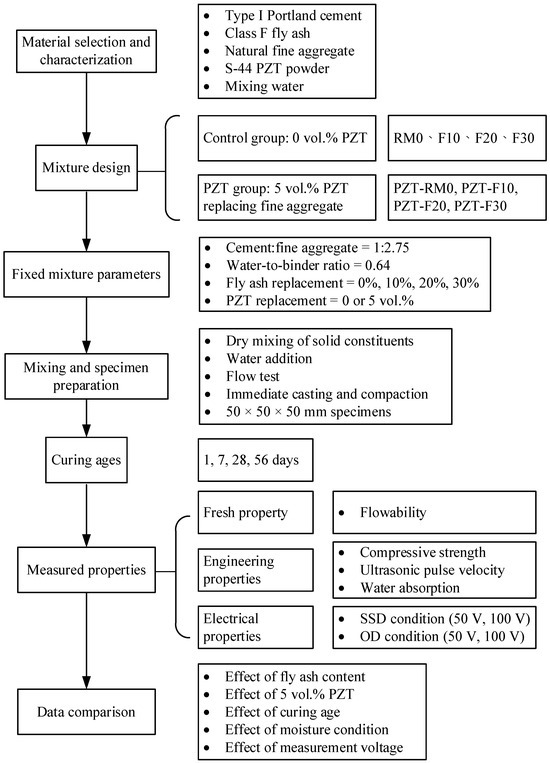
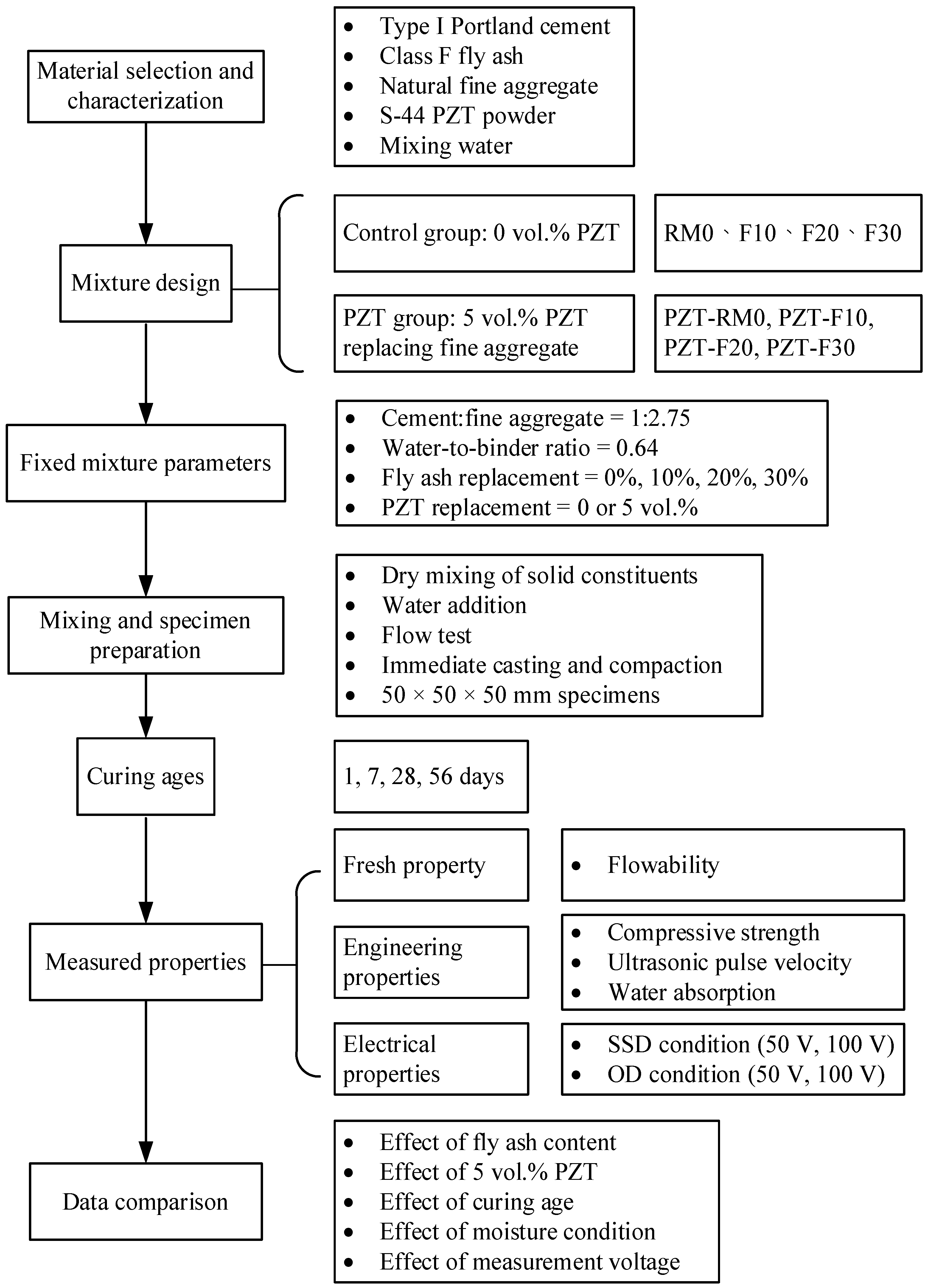
The experimental program was designed as a two-factor comparison involving four fly ash replacement levels and two PZT conditions. A total of eight mixtures were prepared: four control mixtures without PZT and four PZT mixtures containing 5 vol.% PZT as a replacement for fine aggregate. The water-to-binder ratio and cement-to-fine-aggregate ratio were maintained at 0.64 and 1:2.75, respectively. The specimens were evaluated at curing ages of 1, 7, 28, and 56 days. For each mixture and testing condition, three independently prepared specimens were used. The principal experimental factors and measured responses are summarized in Figure 1.
Figure 1.
Experimental program and investigated variables.
2.4. Test Items
Cement mortar specimens with dimensions of 5 cm × 5 cm × 5 cm were prepared, and their flow was evaluated. Mechanical property tests, specifically tests of compressive strength, ultrasonic wave velocity, and water absorption rate, as well as electrical property tests, were conducted at curing ages of 1, 7, 28, and 56 days. Electrical resistivity was measured under saturated-surface-dry (SSD) and oven-dried (OD) conditions at applied voltages of 50 and 100 V. In the electrical property tests, electrical resistivity measurements were performed under SSD and OD conditions at curing ages of 1, 7, 28, and 56 days. During testing, DC voltages of 50 or 100 V were applied, with the current-compliance limit set to 0.01 A. The electrical resistance of the specimens was subsequently measured to determine their electrical resistivity.
2.5. Test Equipment and Measurement Parameters
Compressive strength was measured using a computer-controlled compression testing machine with a maximum capacity of 50 tons. The tests were conducted on 50 mm cubic specimens at curing ages of 1, 7, 28, and 56 days. The loading rate was maintained at 1.2 kN/s, and the reported value for each mixture was obtained from three replicate specimens.
Ultrasonic pulse velocity was measured using a Proceq ultrasonic testing device (Proceq AG, Schwerzenbach, Switzerland) equipped with two 54-kHz transducers. Before measurement, the instrument was calibrated using the manufacturer-provided reference bar. Vaseline was applied as a coupling agent between each transducer and the specimen surface. The transducers were positioned on two opposite surfaces of the 50 mm cubic specimen, and the measurements were conducted using the direct-transmission method. Ultrasonic pulse velocity was calculated by dividing the 50 mm transmission path by the measured transit time. Each specimen was measured three times, and the mean value was reported.
For the water-absorption test, the specimens were dried in an HCH-1206090H oven (Jin Ching Her Enterprise Co., Ltd., Huwei, Taiwan) at 110 ± 5 °C until a constant mass was achieved. Constant mass was defined as a mass difference of less than 0.1% between two successive measurements taken 24 h apart. The specimens were weighed using an electronic balance (AJ-12KE, VIBRA, Shinko Denshi Co., Ltd., Tokyo, Japan) with a maximum capacity of 2200 g and a readability of 0.01 g, immersed in water for 24 h, surface-dried, and weighed again. Water absorption was calculated from the difference between the saturated and oven-dried masses.
Electrical measurements were performed using a single-channel Keithley 2611A System SourceMeter. The instrument was operated in voltage-source/current-measure mode using DC voltages of 50 and 100 V. The current-compliance limit was set to 0.01 A. The two electrodes covered an area of 2500 mm2, and the distance between them was 50 mm. The applied voltages of 50 and 100 V corresponded to nominal electric-field intensities of 10 and 20 V/cm across the 50 mm electrode spacing. These values were selected as two comparative DC measurement levels, with a twofold difference between them, to evaluate whether the apparent resistivity was dependent on the applied voltage. They were not used for high-field polarization and were not regarded as piezoelectric excitation thresholds. The resistance, R, was calculated from the applied voltage, V, and measured current, I, as R = V/I. The bulk electrical resistivity was then calculated as:
where is the electrical resistivity, A is the electrode contact area, and L is the distance between the electrodes. For each mixture and testing condition, three specimens were measured, and the mean value was reported.
For each mixture and testing age, three independently prepared specimens were used for the compressive strength, water absorption, and electrical resistivity tests. Ultrasonic pulse velocity was also measured using three independent specimens, with three repeated readings obtained from each specimen. The reported values represent the arithmetic means of the three independent specimens. The archived dataset retained for the present study contains mixture-level mean values and does not permit reliable retrospective calculation of specimen-level standard deviations. Therefore, the figures are presented without error bars, and no inferential statistical significance is claimed.
2.6. Preparation of Specimens for Electrical Testing
After being cured, the cubic specimens were conditioned to either an SSD or OD state. Two opposite surfaces of each specimen were polished using waterproof sandpapers with grit sizes of 1500, 2000, and 3000 to obtain smooth, flat surfaces suitable for electrical measurements. A conductive silver paint was uniformly applied to the two polished surfaces of each specimen and left to dry. Conductive copper foil tape was cut to an appropriate length according to the dimensions of the specimen, with a protruding section of approximately 0.5–1.0 cm left at the centre of the tape to facilitate electrode attachment during electrical testing. The conductive copper foil tape was subsequently affixed to the two silver-coated surfaces of the specimen. To mitigate electrical leakage, insulating tape was carefully applied around the perimeter of the conductive silver coating and the copper foil tape. After the specimens had been prepared, electrical resistance measurements were conducted to evaluate electrical resistivity.
3. Results and Analyses
3.1. Standard Flow
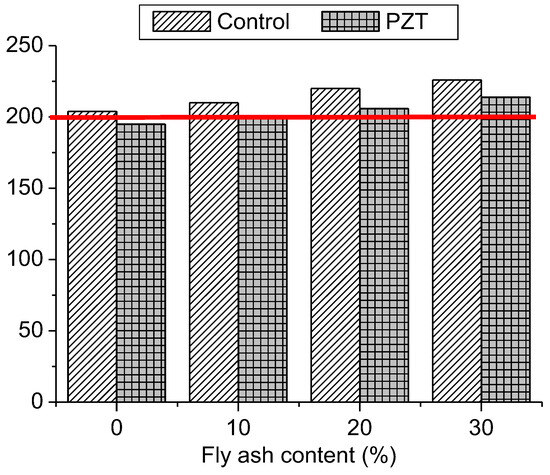
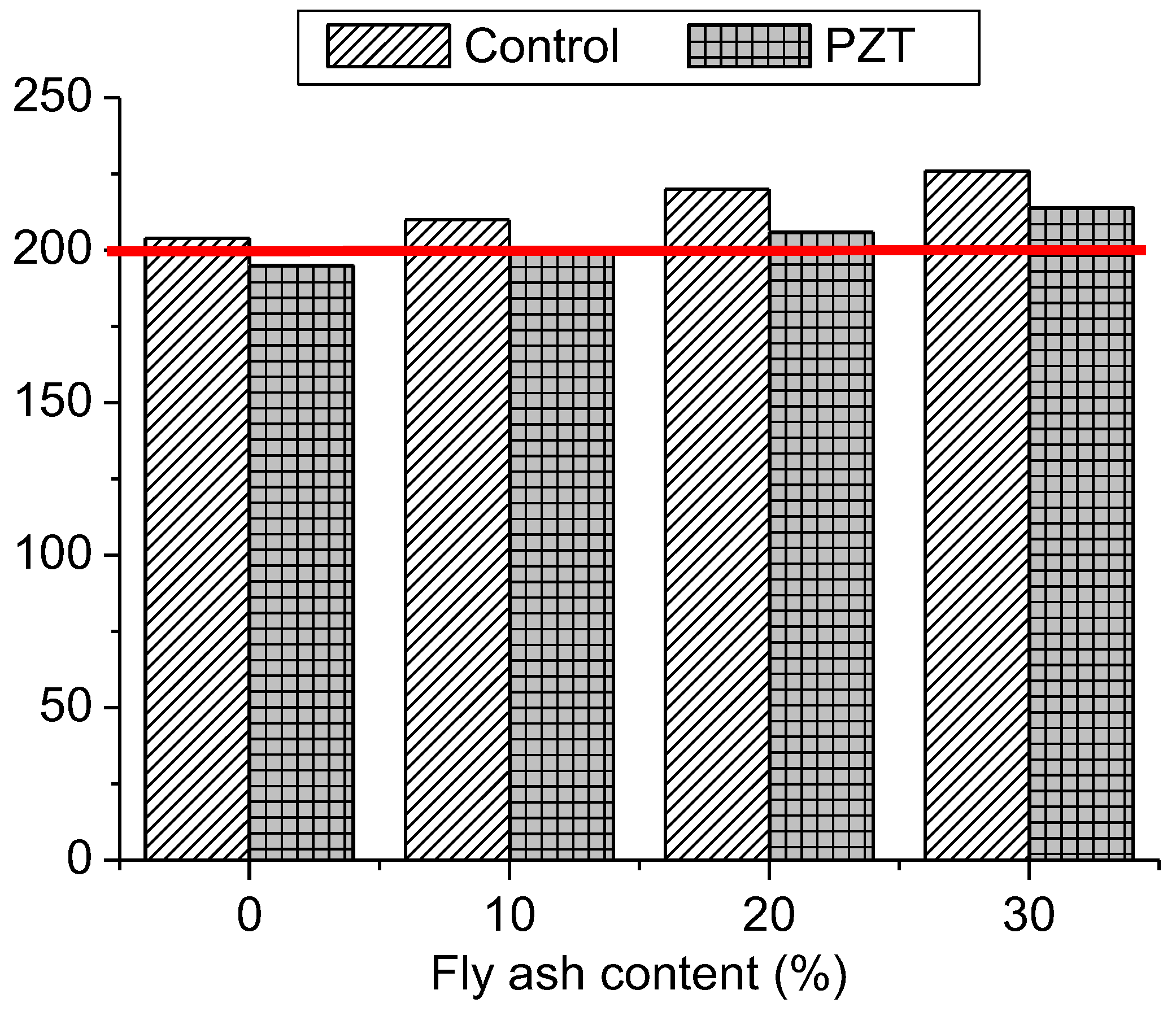
As indicated in Figure 2, the cement mortar achieved a flow of 200 mm at a water-to-binder ratio of 0.64, a value within the standard flow range required by ASTM C109. In the control group mixtures containing 0–30% fly ash, the measured flow values ranged from 204 to 226 mm. By contrast, in the piezoelectric group mixtures containing 0–30% fly ash, the measured flow values ranged from 195 to 214 mm; only the mixture containing 0% fly ash (195 mm) failed to achieve the target flow of 200 mm. As the fly ash level was increased, the flow value also increased. At a fly ash level of 30%, the flow value increased by approximately 22 mm compared with that of a fly ash level of 0%. This increase was primarily attributable to the specific gravity of fly ash, which is approximately two-thirds that of cement and resulted in an increased paste volume when the cement was replaced by fly ash. In addition, the smooth spherical morphology of the fly ash particles produced a ball-bearing effect that enhanced lubrication between the particles. Because the fly ash itself did not contribute directly to hydration bonding, the corresponding lubricating paste thickness surrounding the aggregates increased, enhancing workability. Notably, the PZT group exhibited a flow value approximately 12 mm lower than that of the control group. This reduction may be associated with changes in the particle characteristics and packing of the mortar after fine aggregate was partially replaced with PZT powder.
Figure 2.
Relationship between fly ash content and cement mortar flowability.
3.2. Compressive Strength
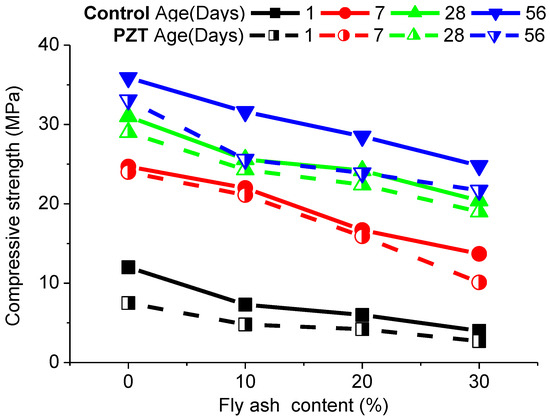
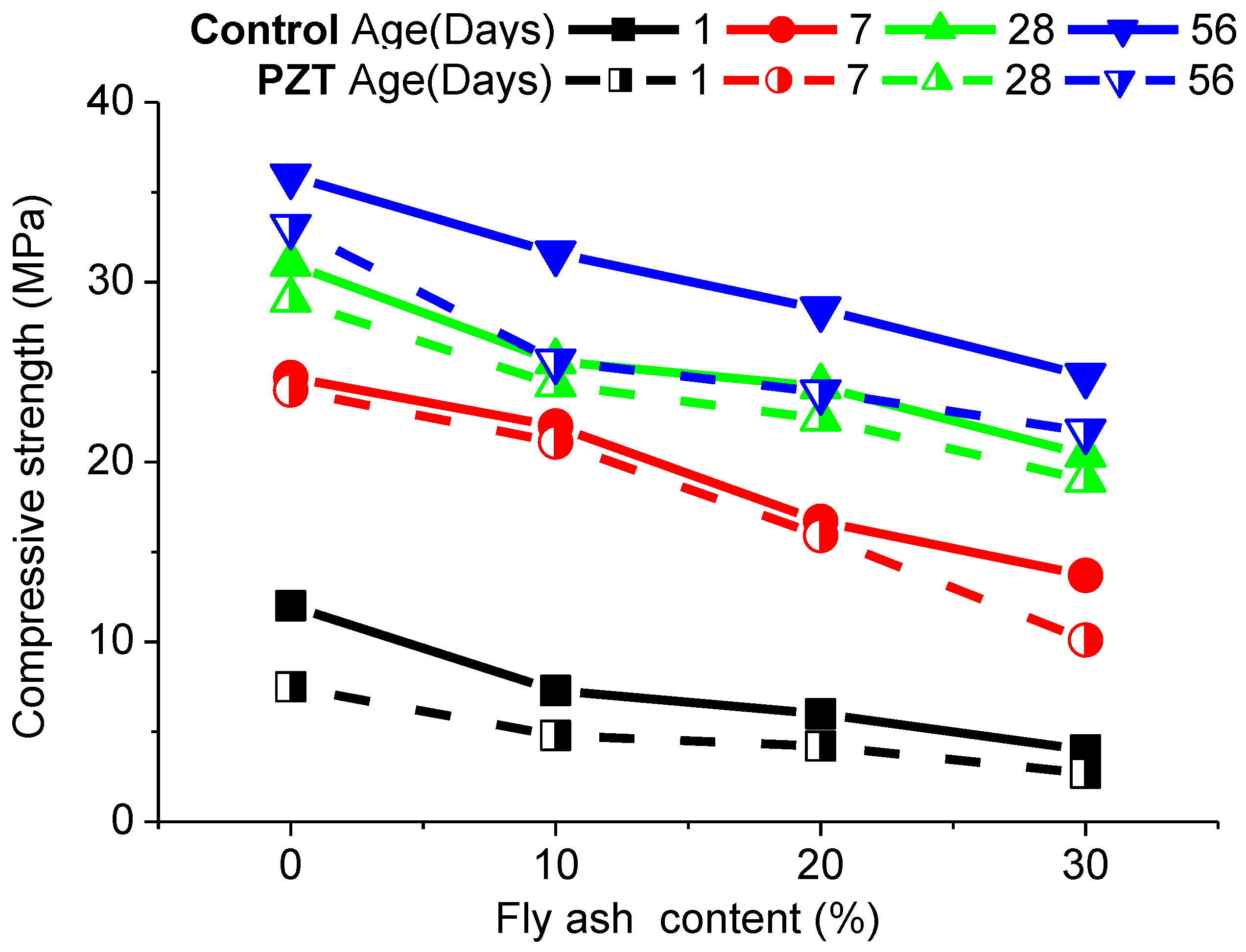
Figure 3 presents the compressive strength results. In the control group mixtures containing 0–30% fly ash, the compressive strength at curing ages of 1, 7, 28, and 56 days was 12.0–4.0 MPa, 24.7–13.7 MPa, 31.0–20.4 MPa, and 35.9–24.8 MPa, respectively. In the piezoelectric group mixtures containing identical levels of fly ash, the corresponding compressive strength was 7.5–2.7 MPa, 24.0–10.1 MPa, 29.0–19.0 MPa, and 33.1–21.7 MPa, respectively. In both groups, compressive strength decreased with increasing fly ash levels because of the use of class F fly ash, a low-calcium material with low levels of calcium oxide (CaO). During hydration, higher levels of fly ash were associated with reduced cement levels, resulting in an insufficient supply of calcium hydroxide. Consequently, some fly ash particles were unable to undergo a pozzolanic reaction. Furthermore, the high water-to-fly ash ratio slowed the pozzolanic reactions that occurred, hindering the development of compressive strength as the material aged, reducing compressive strength and material compactness. In addition, compared with the control group, the piezoelectric group exhibited lower compressive strength because of the replacement of 5% of the fine aggregates with PZT. Because PZT is nonabsorptive, it did not bond effectively with the cement and fine aggregates, which reduced the overall compressive strength of the material. Moreover, as the fly ash level was increased, the compressive strength in the piezoelectric group became nonsignificant after a curing age of 28 days due to the slow pozzolanic reaction of the fly ash and the nonabsorptive and nonbonding properties of PZT, which hindered the development of compressive strength.
Figure 3.
Relationship between fly ash content and compressive strength of cement mortar.
3.3. Ultrasonic Wave Velocity
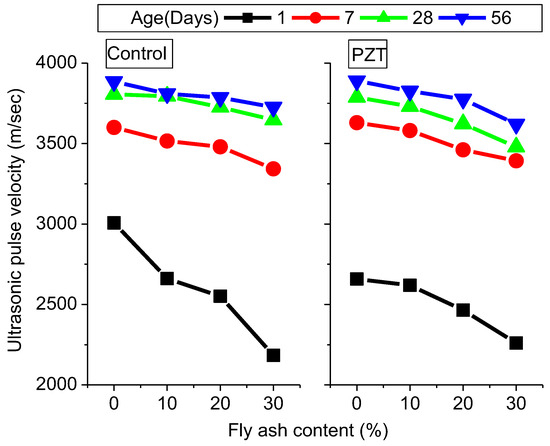
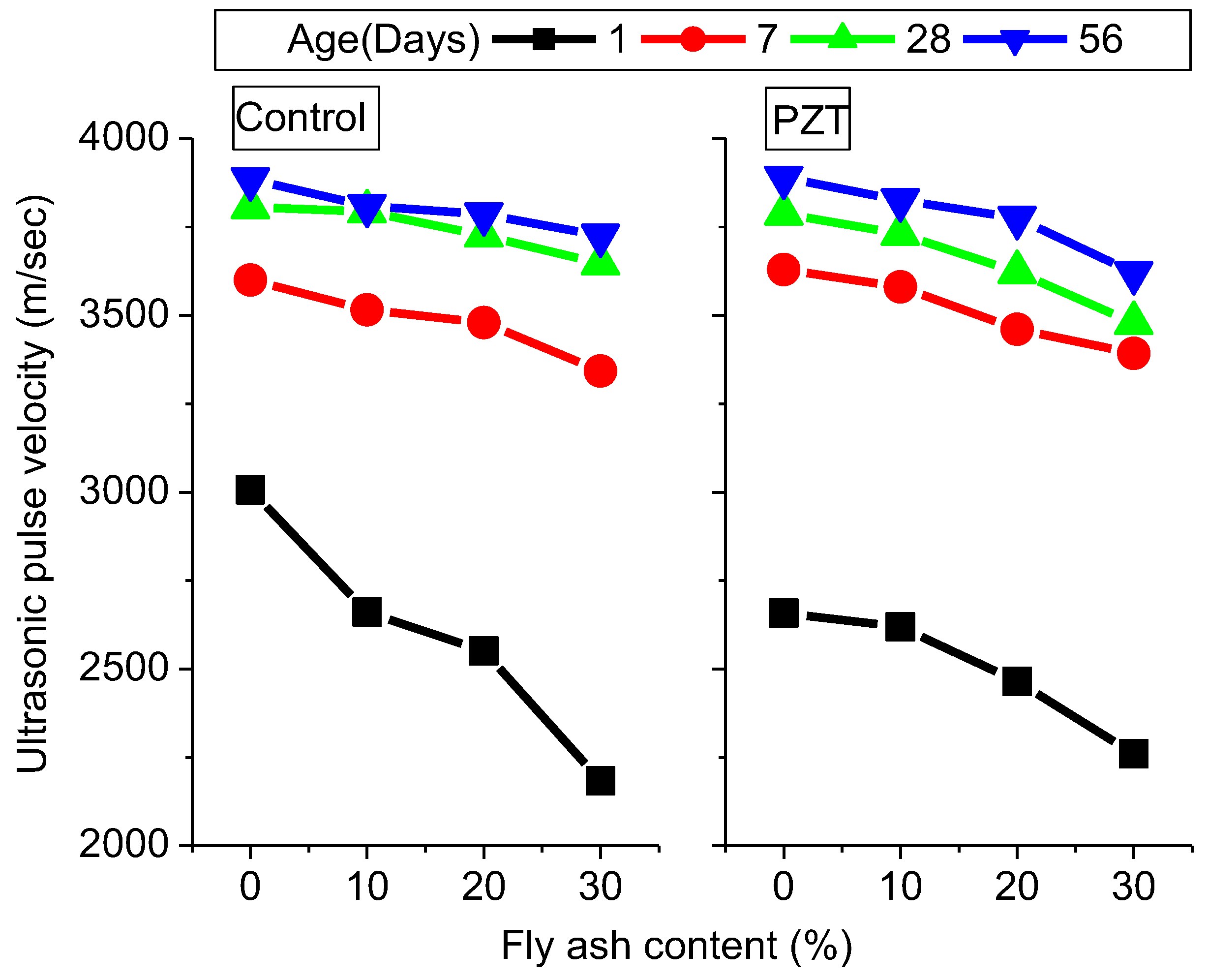
As indicated in Figure 4, at curing ages of 1, 7, 28, and 56 days, the ultrasonic wave velocity of the control group mixtures containing fly ash was lower than was that of the reference group that did not contain fly ash. At all curing ages, the ultrasonic wave velocity decreased as the fly ash level was increased. At a curing age of 28 days, the ultrasonic wave velocity ranged from 3806 to 3647 m/s. This low ultrasonic wave velocity was primarily attributable to the low CaO levels of class F fly ash, which adversely affected the development of compressive strength. As fly ash replaced cement, the supply of calcium hydroxide generated during hydration was reduced, hindering the pozzolanic reaction. Influenced by the high water-to-fly ash ratio, the slowed pozzolanic reaction hindered the development of compressive strength as the material aged, leading to a decrease in the ultrasonic wave velocity. A similar trend was observed in the piezoelectric group, in which the ultrasonic wave velocity decreased with increasing levels of fly ash. At a curing age of 28 days, the ultrasonic wave velocity in the piezoelectric group ranged from 3788 to 3479 m/s. Notably, the ultrasonic wave velocity in the piezoelectric group was consistently lower than that of the control group, primarily due to the replacement of 5% of the fine aggregates with PZT. Because of its nonabsorptive characteristics, PZT could not form effective bonds with the cement and fine aggregates, and the overall compactness of the mortar specimens was reduced.
Figure 4.
Relationship between fly ash content and ultrasonic wave velocity in cement mortar.
3.4. Water Absorption Rate
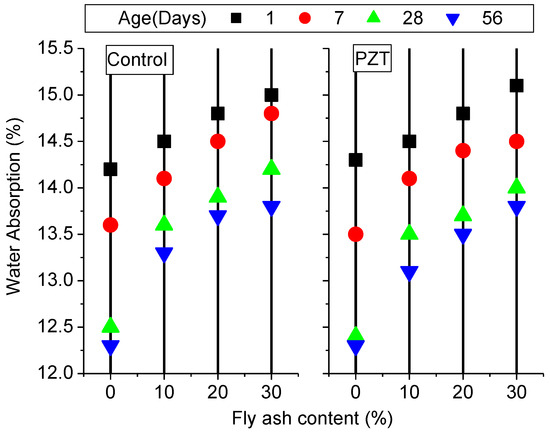
As depicted in Figure 5, the water absorption rates of the control group mixtures at curing ages of 1 and 28 days were 14.2–15.0% and 12.5–14.2%, respectively, whereas those of the piezoelectric group mixtures were 14.3–15.1% and 12.4–14.0%, respectively. An increase in the fly ash level resulted in an increase in the water absorption rate owing to the use of class F fly ash, which contains low levels of CaO that hindered the development of compressive strength. As the fly ash level was increased, the proportion of cement in the specimens decreased, leading to an insufficient supply of calcium hydroxide for pozzolanic reaction. In addition, the high water-to-fly ash ratio slowed the pozzolanic reaction, limiting the formation of sufficient colloids to fill and block pores. Consequently, the hardened specimens contained a high volume of pores, which increased their water absorption rates. By contrast, in the piezoelectric group, a portion of the fine aggregates was replaced with PZT. Because PZT particles are finer than fine aggregate particles, they partially filled the pores generated through cementitious bonding, resulting in slightly lower water absorption rates than were observed in the control group.
Figure 5.
Relationship between fly ash content and water absorption rate of cement mortar.
3.5. Electrical Resistivity Under 50 V in the SSD Condition
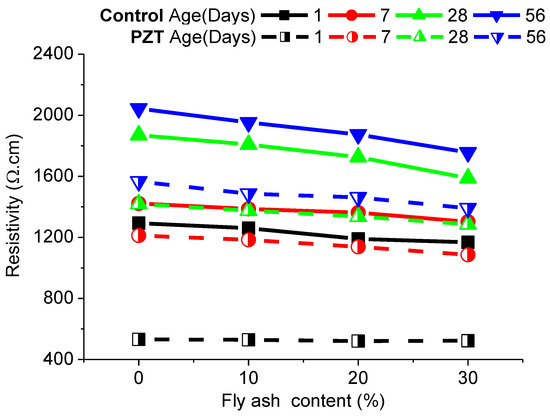
Figure 6 illustrates the electrical resistivity of cement mortar specimens measured under an applied voltage of 50 V in the SSD condition. For all groups, electrical resistivity increased with curing age, which was indirectly associated with changes in the water absorption rate. At a curing age of 1 day, the electrical resistivity of the control and piezoelectric groups was 1293–1168 Ω·cm and 532–521 Ω·cm, respectively; at a curing age of 28 days, the electrical resistivity was 1870–1588 Ω·cm and 1419–1286 Ω·cm, respectively. The substantial difference between the materials at curing ages of 1 and 28 days was attributable to incomplete hydration and to the excellent electrical conductivity of PZT, which provided conductive pathways in the specimens. Consequently, the piezoelectric group exhibited considerably lower resistivity than the control group did. However, as curing progressed, ongoing hydration gradually disrupted the conductive pathways between the PZT particles, reducing their electrical conductivity and increasing overall resistivity.
Figure 6.
Relationship between fly ash content and 50 V-SSD resistivity of cement mortar.
3.6. Electrical Resistivity Under 50 V in the OD Condition
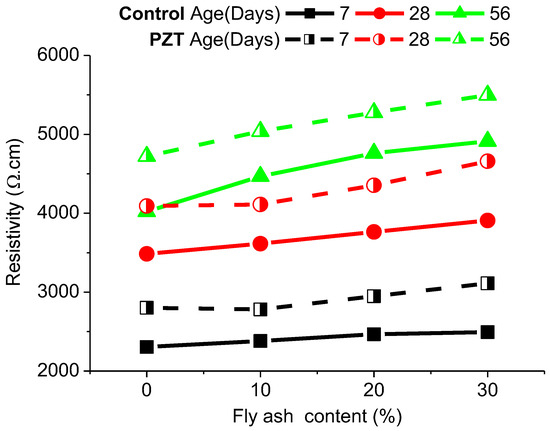
As illustrated in Figure 7, the electrical resistivity of the cement mortar specimens was measured under an applied voltage of 50 V in the OD condition. At a curing age of 28 days, the electrical resistivity of the control and piezoelectric groups was 3485–3908 Ω·cm and 4092–4659 Ω·cm, respectively. The piezoelectric group consistently exhibited higher electrical resistivity than the control group did. In the absence of water, the PZT particles acted as the primary electricity transmission pathway. After they absorbed electrical energy, the PZT particles behaved as capacitance in the cement mortar, reducing the electrical conductivity of the specimens and generating high electrical resistivity. A comparison between the SSD and OD conditions at an applied voltage of 50 V verified this capacitance behaviour. At a curing age of 28 days, the electrical resistivity of the piezoelectric group under the SSD condition was 1419–1286 Ω·cm, whereas that under the OD condition was 4092–4659 Ω·cm. These results indicated that in the absence of water, the incorporation of PZT promoted capacitive behaviour in the specimens that led to markedly higher electrical resistivity under the OD condition than was observed under the SSD condition.
Figure 7.
Relationship between fly ash content and 50 V-OD resistivity of cement mortar.
3.7. Electrical Resistivity Under 100 V in the SSD Condition
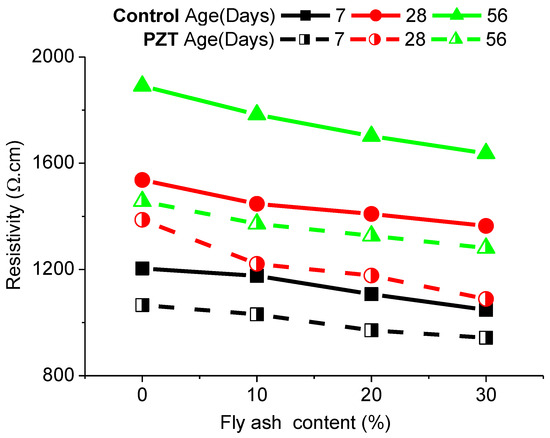
As indicated in Figure 8, the electrical resistivity of the cement mortar specimens was measured under an applied voltage of 100 V in the SSD condition. As the fly ash level was increased, the hydration effect and the electrical resistivity of the material decreased. At a curing age of 28 days, the electrical resistivity under the 50-V SSD condition in the control and piezoelectric groups was 1870–1588 Ω·cm and 1419–1286 Ω·cm, respectively. By contrast, under the 100-V SSD condition, the electrical resistivity of the control and piezoelectric groups was 1537–1364 Ω·cm and 1387–1089 Ω·cm, respectively. These results indicated that higher applied voltages were associated with lower electrical resistivity due to the enhanced electrical conductivity in the specimens under the strong electric field, which facilitated electrical transport and reduced electrical resistivity.
Figure 8.
Relationship between fly ash content and 100 V-SSD resistivity of cement mortar.
3.8. Electrical Resistivity Under 100 V in the OD Condition
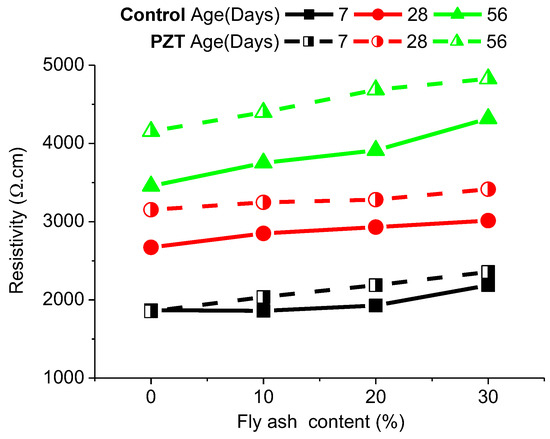
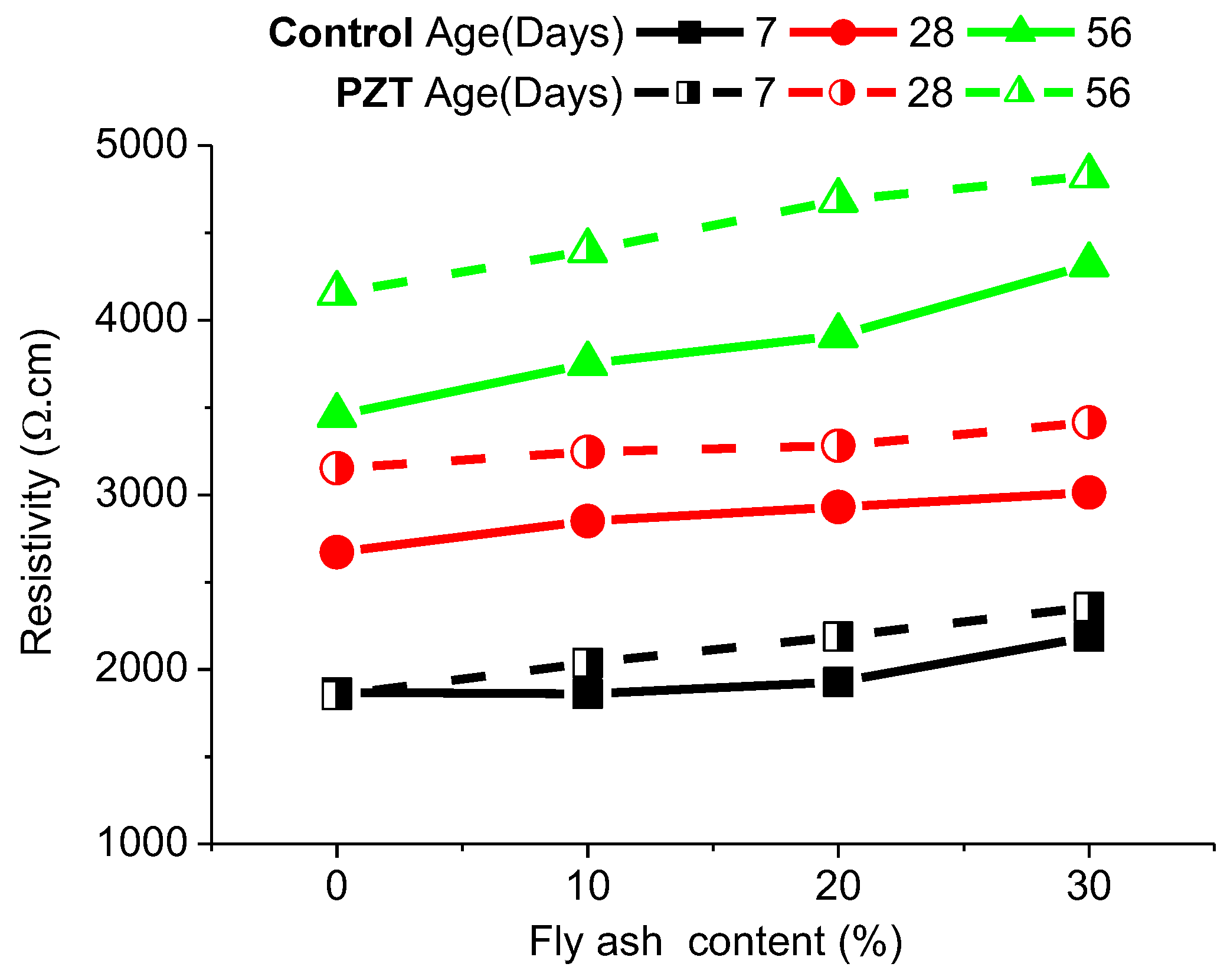
Figure 9 presents the electrical resistivity values of the cement mortar specimens measured under an applied voltage of 100 V in the OD condition. At a curing age of 28 days, the electrical resistivity of the control and piezoelectric groups was 2671–3013 Ω·cm and 3247–3415 Ω·cm, respectively. The overall electrical resistivity trends of the piezoelectric group were consistent with those of the control group; however, the electrical resistivity of the piezoelectric group was consistently higher than was that of the control group. A possible explanation for this trend is that in the absence of water, the PZT particles served as a transmission pathway; after they absorbed electrical energy, the PZT particles behaved as capacitance in the cement mortar. This capacitive effect reduced electrical conductivity and increased electrical resistivity. A similar trend was observed under the 50-V OD condition. At a curing age of 28 days, the electrical resistivity of the control group was 3485–3908 Ω·cm and, whereas that under the 100-V OD condition was 2671–3013 Ω·cm. These results demonstrated that higher applied voltages were associated with lower electrical resistivity. In other words, the enhanced electric field increased the electrical conductivity of the specimens, facilitating electrical transport and decreasing electrical resistivity.
Figure 9.
Relationship between fly ash content and 100 V-OD resistivity of cement mortar.
3.9. Association Between Compressive Strength and Water Absorption Rate
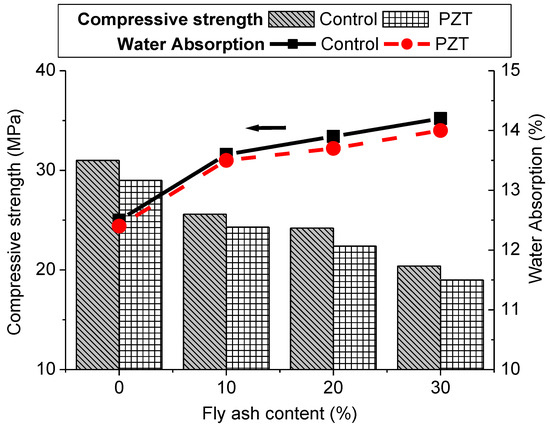
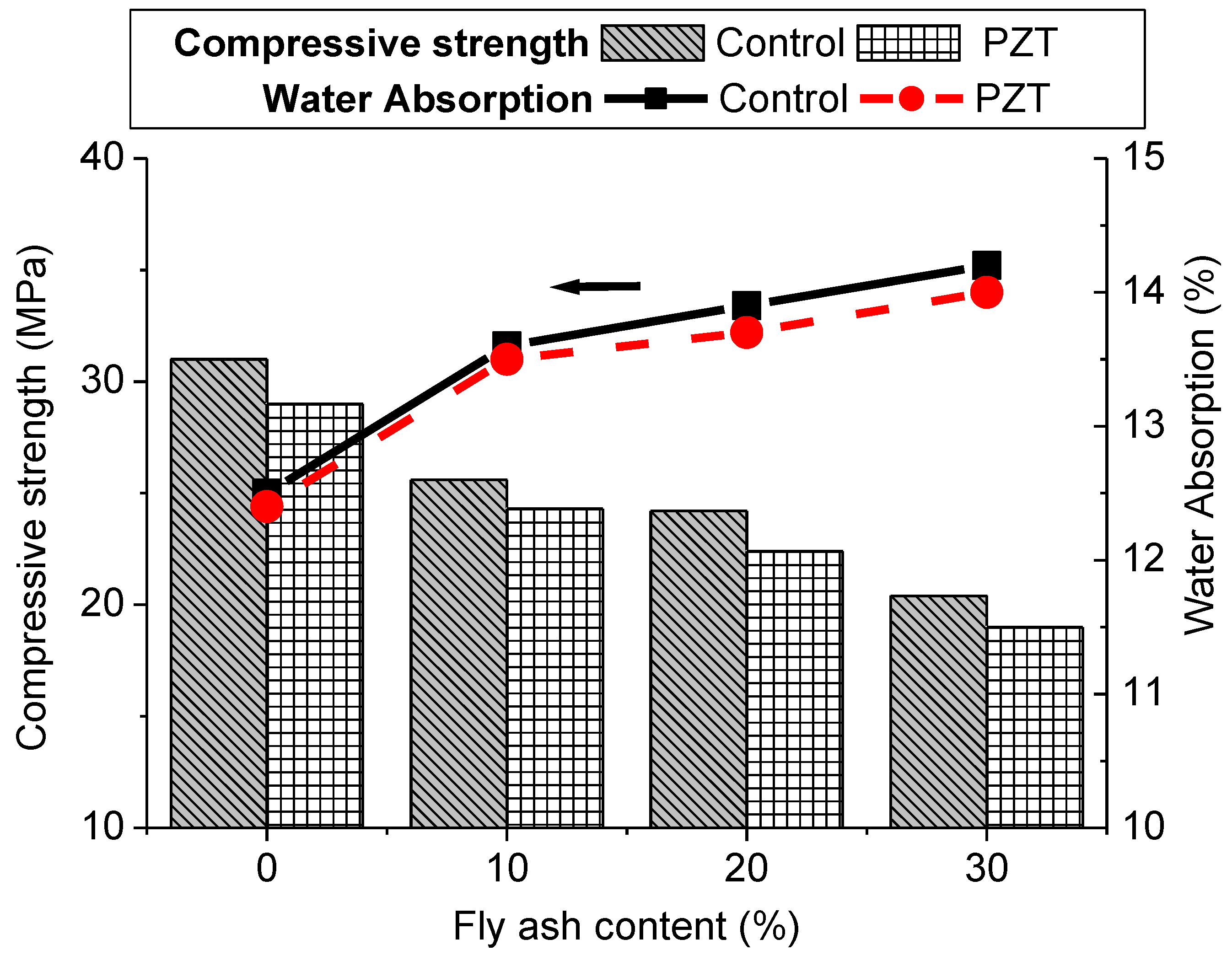
As illustrated in Figure 10, at a curing age of 28 days, the compressive strength of the control and piezoelectric groups was 31.0–20.4 MPa and 29.0–19.0 MPa, respectively. The corresponding water absorption rates were 12.5–14.2% and 12.4–14.0%, respectively. As the fly ash level was increased, the compressive strength of the material decreased, whereas the water absorption rate increased. This trend was attributable to the low CaO content of class F fly ash, which hindered the development of compressive strength. In addition, as the fly ash level was increased, the level of cement in the material decreased, resulting in an insufficient supply of calcium hydroxide to facilitate a pozzolanic reaction. Furthermore, the high water-to-fly ash ratio slowed the pozzolanic reaction that occurred, impeding the formation of sufficient colloids to fill and block pores. Consequently, the hardened specimens became less compact, the volume of pores increased, water absorption rates increased, and compressive strength decreased. Notably, the piezoelectric group exhibited slightly lower compressive strength and water absorption rates than the control group did. This lower compressive strength was attributable to the nonabsorptive qualities of PZT, which hindered bonding with the cement and fine aggregates. By contrast, because PZT replaced a portion of the fine aggregates with particles that were finer than those of the aggregates, it partially filled the pores generated through cementitious bonding, resulting in slightly lower water absorption rates than those observed in the control group. Nevertheless, the nonabsorptive and nonbonding characteristics of PZT resulted in a compressive strength that was slightly lower than that of the control group.
Figure 10.
Relationship between compressive strength and water absorption rate of cement mortar.
3.10. Association Between Compressive Strength and Electrical Resistivity
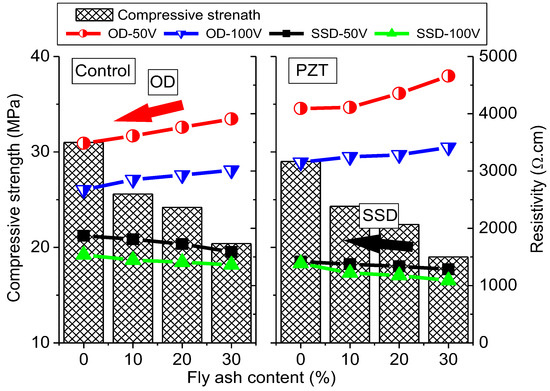
As indicated in Figure 11, at a curing age of 28 days, the compressive strength of the control and piezoelectric groups was 31.0–20.4 MPa and 29.0–19.0 MPa, respectively. Under the SSD condition and an applied voltage of 50 V, the electrical resistivity of the control and piezoelectric groups was 1870–1588 Ω·cm and 1419–1286 Ω·cm, respectively. By contrast, under the SSD condition at an applied voltage of 100 V, the corresponding electrical resistivity was 1537–1364 Ω·cm and 1387–1089 Ω·cm, respectively. In addition, under the OD condition at an applied voltage of 50 V, the electrical resistivity of the control and piezoelectric groups was 3485–3908 Ω·cm and 4092–4659 Ω·cm, respectively, whereas under the OD condition at an applied voltage of 100 V, the corresponding electrical resistivity was 2671–3013 Ω·cm and 3247–3415 Ω·cm, respectively. As the fly ash level was increased, the compressive strength of the specimens decreased. Furthermore, compressive strength and electrical resistivity trended in opposite directions under the SSD and OD conditions. That is, under the SSD condition, electrical resistivity increased with increasing compressive strength, whereas under the OD condition, electrical resistivity decreased with increasing compressive strength. This trend was attributable to the presence of water in the pores of the specimens. Because the pores in the OD condition were not filled with water, the electrical resistivity under the OD condition was higher than that under the SSD condition. As the fly ash level was increased, the cement level decreased, resulting in an insufficient supply of calcium hydroxide. In addition, the high water-to-binder ratio slowed the pozzolanic reaction, preventing the formation of sufficient colloids to fill and block pores. Consequently, the volume of pores in the specimens increased. Under the OD condition, the increased volume of dry pores resulted in higher electrical resistivity, and compressive strength decreased with increasing fly ash levels. By contrast, under the SSD condition, the presence of water in the pores facilitated electrical conduction, causing the electrical resistivity to decrease as pore volume increased.
Figure 11.
Relationship between compressive strength and electrical resistivity of cement mortar.
3.11. Association Between Water Absorption Rate and Electrical Resistivity
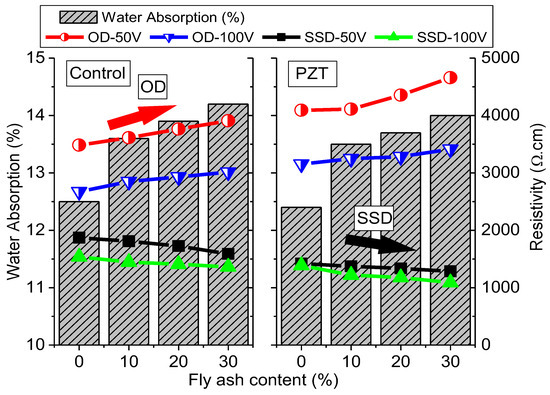
Figure 12 illustrates the association between the water absorption rate and electrical resistivity. At a curing age of 28 days, the water absorption rates of the control and piezoelectric groups were 12.5–14.2% and 12.4–14.0%, respectively. The electrical resistivity of the control and piezoelectric groups under the SSD and OD conditions at applied voltages of 50 V and 100 V have been presented in the preceding sections. Notably, the water absorption rates increased with increasing fly ash levels. Moreover, the water absorption rates and electrical resistivity trended in opposite directions under the SSD and OD conditions. Specifically, higher water absorption rates corresponded to lower electrical resistivity under the SSD condition and to higher electrical resistivity under the OD condition. This was primarily attributable to the water levels in the pores: the electrical resistivity of the specimens under the OD condition, in which the pores were not filled with water, was substantially higher than that of the specimens under the SSD condition, in which the pores were filled with water. Moreover, as the fly ash level was increased, the cement level decreased, leading to an insufficient supply of calcium hydroxide. Furthermore, the high water-to-binder ratio slowed the pozzolanic reaction, hindering the formation of sufficient colloids to fill and block pores. Consequently, the pore volume increased. Under the OD condition, the high pore volume and the absence of water increased electrical resistivity. By contrast, under the SSD condition, the presence of water in the pores enhanced electrical conduction, reducing electrical resistivity. This indicated that water-filled pores were crucial to electrical transport in the specimens.
Figure 12.
Relationship between water absorption rate and electrical resistivity of cement mortar.
4. Discussion
The mechanical-property trends observed in this study were generally consistent with previous investigations of Class F fly-ash cementitious materials [15,32,33]. Increasing the fly-ash replacement level improved flowability but reduced compressive strength and ultrasonic pulse velocity, particularly at early ages, which may be associated with the relatively slow pozzolanic reaction of low-calcium fly ash [15,32,33]. The incorporation of 5 vol.% PZT produced only relatively small changes in the measured engineering properties. This differs from many previous studies on 0–3 cement-based piezoelectric composites, in which substantially higher PZT contents and polarization treatments were commonly adopted to obtain pronounced dielectric, piezoelectric, or electromechanical responses [41,44,45,46,47,48,49].
The electrical results demonstrated that the measured resistivity was strongly dependent on specimen moisture condition. Under SSD conditions, the PZT mixtures generally exhibited lower resistivity than the corresponding control mixtures, whereas the opposite trend was observed under OD conditions. Previous studies have shown that the electrical and impedance responses of cementitious materials are influenced by pore solution, water-to-cement ratio, material composition, electrode configuration, and measurement conditions [48,49,53,59,60]. In PZT–cement composites, the dielectric and electrical responses may also vary with PZT content, polarization condition, and matrix characteristics [41,48,49]. Therefore, the contrasting SSD and OD results observed in the present study may reflect the combined effects of pore-water conduction, electrode polarization, contact resistance, and the dielectric characteristics of PZT. However, these individual mechanisms cannot be distinguished directly using the present two-electrode DC measurements.
Previous studies have incorporated piezoelectric powders into cement mortars containing ground-granulated blast-furnace slag, recycled materials, or waste LCD glass [63,64,65]. Compared with these studies, the scientific novelty of the present work lies in systematically evaluating Class F fly-ash replacement levels of 0–30% together with only 5 vol.% unpolarized PZT and examining the apparent resistivity under two moisture conditions and two DC measurement voltages. From an applied perspective, the relatively small changes in the basic engineering properties suggest that low-dosage PZT may provide a preliminary material-design route for functional fly-ash mortar without substantially modifying the conventional production process. Nevertheless, the present results do not confirm piezoelectric sensing or structural-health-monitoring performance. Future studies should include multiple PZT dosages, AC impedance spectroscopy, direct electromechanical loading, microstructural characterization, particle-segregation assessment, long-term durability, and lead-leaching tests.
5. Conclusions
This study investigated the mechanical properties and electrical resistivity of cement mortar incorporating 0–30% Class F fly ash and 5 vol.% PZT as a partial replacement for fine aggregate. Based on the experimental results, the following conclusions were drawn:
- Compressive strength decreased with increasing fly ash content. At 28 and 56 days, the compressive strengths ranged from 31.0 to 20.4 MPa and from 35.9 to 24.8 MPa, respectively, for the control mixtures, compared with 29.0–19.0 MPa and 33.1–21.7 MPa for the PZT mixtures. This reduction was primarily attributed to the low CaO content of Class F fly ash and the reduced availability of calcium hydroxide for the pozzolanic reaction. The PZT mixtures exhibited slightly lower strengths than the control mixtures, possibly because the nonabsorptive PZT particles provided weaker interfacial bonding with the cementitious matrix.
- Ultrasonic pulse velocity decreased, whereas water absorption increased, with increasing fly ash replacement. The PZT mixtures generally exhibited slightly lower ultrasonic pulse velocities than the control mixtures, indicating reduced matrix compactness. At 28 days, the water absorption rates were 12.5–14.2% for the control mixtures and 12.4–14.0% for the PZT mixtures. Although PZT weakened interfacial bonding, its finer particles partially filled the pores within the mortar, resulting in slightly lower water absorption than that of the corresponding control mixtures.
- Electrical resistivity was strongly influenced by curing age, moisture condition, PZT incorporation, and applied voltage. Resistivity generally increased with curing age. At 28 days and 50 V under SSD conditions, the control mixtures exhibited higher resistivity values (1870–1588 Ω·cm) than the PZT mixtures (1419–1286 Ω·cm). Under OD conditions, however, the PZT mixtures exhibited higher resistivity values (4092–4659 Ω·cm) than the control mixtures (3485–3908 Ω·cm). This contrasting behaviour suggests that pore-water conduction and the polarization or capacitive response of PZT jointly governed the measured electrical properties.
- Increasing the applied voltage from 50 to 100 V reduced the measured resistivity. At 30% fly ash replacement, the resistivity of the PZT mixture decreased from 1286 to 1089 Ω·cm under SSD conditions and from 4659 to 3415 Ω·cm under OD conditions. This result indicates that the apparent resistivity of the mortar was voltage-dependent, with the stronger electric field facilitating electrical transport through the specimens.
- The relationships among compressive strength, water absorption, and resistivity depended on moisture condition. Under SSD conditions, resistivity increased with compressive strength and decreased with water absorption because water-filled pores promoted ionic conduction. Under OD conditions, the opposite trends were observed: resistivity decreased with compressive strength and increased with water absorption. The higher pore volume associated with increasing fly ash content therefore increased resistivity in dry specimens but reduced resistivity when the pores contained water.
- The incorporation of 5 vol.% PZT produced only minor changes in the basic engineering properties of the mortar but altered its moisture- and voltage-dependent apparent resistivity. These findings indicate that low-dosage PZT can modify the electrical response of fly-ash mortar. However, the present study did not directly evaluate piezoelectric output, sensing sensitivity, signal-transmission distance, or damage-detection capability. Therefore, the results should be regarded as a preliminary electrical-resistivity assessment rather than as confirmation of structural-health-monitoring performance.
Author Contributions
Conceptualization, S.-C.C. and H.-Y.W.; methodology, S.-C.C. and H.-Y.W.; validation, S.-C.C. and H.-Y.W.; formal analysis, S.-C.C. and K.-T.L.; investigation, S.-C.C. and C.-C.H.; resources, S.-C.C. and K.-T.L.; data curation, K.-T.L.; writing—original draft preparation, S.-C.C., K.-T.L. and C.-C.H.; writing—review and editing, K.-T.L.; visualization, S.-C.C. and C.-C.H. supervision, H.-Y.W.; project administration, S.-C.C., K.-T.L. and C.-C.H.; funding acquisition, S.-C.C., K.-T.L. and C.-C.H. All authors have read and agreed to the published version of the manuscript.
Funding
This research received no external funding.
Data Availability Statement
The data that support the findings of this study are available from the corresponding author upon reasonable request. Certain data are subject to confidentiality restrictions.
Acknowledgments
The authors would like to thank all colleagues and students who contributed to this study.
Conflicts of Interest
The authors declare no conflicts of interest.
References
- Ju, M.; Dou, Z.; Li, J.-W.; Qiu, X.; Shen, B.; Zhang, D.; Yao, F.-Z.; Gong, W.; Wang, K. Piezoelectric Materials and Sensors for Structural Health Monitoring: Fundamental Aspects, Current Status, and Future Perspectives. Sensors 2023, 23, 543. [Google Scholar] [CrossRef] [Scilit] [PubMed]
- Dong, W.; Li, W.; Guo, Y.; Sun, Z.; Qu, F.; Liang, R.; Shah, S.P. Application of intrinsic self-sensing cement-based sensor for traffic detection of human motion and vehicle speed. Constr. Build. Mater. 2022, 355, 129130. [Google Scholar] [CrossRef] [Scilit]
- Dinesh, A.; Saravanakumar, P.; Prasad, B.R.; Raj, S.K. Carbon black based self-sensing cement composite for structural health monitoring—A review on strength and conductive characteristics. Mater. Today Proc. 2023, in press. [Google Scholar] [CrossRef] [Scilit]
- Fan, Y.; Miao, Y.; Qu, F.; Dong, W.; Zhao, H.; Chen, Y.; Tsang, D.C.W.; Li, W. Carbon nanomaterial–enabled multifunctional concrete for next-generation smart infrastructure: Multiscale modeling and physical mechanism. Carbon 2026, 253, 121463. [Google Scholar] [CrossRef] [Scilit]
- Tian, Q.; Zhou, J.; Hou, J.; Zhou, Z.; Liang, Z.; Sun, M.; Hu, J.; Huang, J. Building the future: Smart concrete as a key element in next-generation construction. Constr. Build. Mater. 2024, 429, 136364. [Google Scholar] [CrossRef] [Scilit]
- Li, H.; Long, W.; Li, H.; Luo, J.; Feng, G.; Hu, K.; Guo, R. Self-sensing concrete technologies: Advances in formulation, fabrication, and sensing characterization. J. Build. Eng. 2026, 117, 114922. [Google Scholar] [CrossRef] [Scilit]
- Dong, W.; Peng, S.; Wang, K.; Huang, Y.; Shi, L.; Wu, F.; Li, W. Integrated triboelectric self-powering and piezoresistive self-sensing cementitious composites for intelligent civil infrastructure. Nano Energy 2025, 135, 110656. [Google Scholar] [CrossRef] [Scilit]
- Mohanty, S.K.; Biswal, D.R.; Beriha, B.; Mohapatra, B.G.; Pradhan, R. Fatigue behaviours of fiber-reinforced cement-stabilized fly ash aggregate under cyclic indirect tensile loading. J. Road Eng. 2026, 6, 287–298. [Google Scholar] [CrossRef] [Scilit]
- Liu, B.; Wang, Z.; Ni, G. Fly ash ceramic concrete: A comprehensive study of properties, preparation and application. Int. Core J. Eng. 2024, 10, 1–5. [Google Scholar]
- Luo, C.; Feng, H.; Zhao, C.; Zhao, L.; Meng, Z.; Zhang, D.; Li, K.; Liang, D.; Wang, F. A review of fly ash-based insulation materials: Mechanism, application, and evaluation. Energy Build. 2026, 363, 117571. [Google Scholar] [CrossRef] [Scilit]
- Sudam, P.A.; Heeralal, M.; Srinivas, K. Strength characteristics of geopolymer synthetic sand using fly ash. J. Mater. Civ. Eng. 2023, 35, 04023119. [Google Scholar] [CrossRef] [Scilit]
- Rida, L.; Alaoui, A.H. Effect of high volume fly ash and curing temperature on delayed ettringite formation. Mater. Today Proc. 2022, 58, 1285–1293. [Google Scholar] [CrossRef] [Scilit]
- Sajjad, U.; Sheikh, M.N.; Hadi, M.N.S. Incorporation of graphene in slag-fly ash-based alkali-activated concrete. Constr. Build. Mater. 2022, 322, 126417. [Google Scholar] [CrossRef] [Scilit]
- Zou, D.; Dou, Y.; Wang, S.; Zhang, Y.; Zhu, J. Enhanced reactivity of depolymerized Class F fly ash: Mechanism and its effect on the performance of high-volume fly ash cementitious materials. J. Build. Eng. 2026, 125, 116181. [Google Scholar] [CrossRef] [Scilit]
- Alterary, S.S.; Marei, N.H. Fly ash properties, characterization, and applications: A review. J. King Saud Univ. Sci. 2021, 33, 101536. [Google Scholar] [CrossRef] [Scilit]
- Lin, S.; Jiang, X.; Zhao, Y.; Yan, J. Zeolite greenly synthesized from fly ash and its resource utilization: A review. Sci. Total Environ. 2022, 851, 158182. [Google Scholar] [CrossRef] [Scilit] [PubMed]
- He, J.; Li, Z.; Xu, D.; Tang, W.; Rong, H.; Dai, J.; Yang, X. Study on the effect and mechanism of fly ash on the leachability resistance of cement mortar. Case Stud. Constr. Mater. 2026, 24, e05830. [Google Scholar] [CrossRef] [Scilit]
- Cui, G.; Zhou, Y.; Shen, J.; Qiu, W.; Ma, Y. Study on the effects and mechanism of gypsum on the setting, hardening, and mechanical properties of fly ash-cement composites. Constr. Build. Mater. 2026, 528, 146510. [Google Scholar] [CrossRef] [Scilit]
- Liu, Q.-F.; Xiong, Q.-X.; Ji, L.; Yang, J.; Zhou, J.; Meng, Z.; Zhou, Y.; Tong, L.-Y. Coupled modelling of hydration, calcium leaching, and sulfate attack in fly ash-blended cementitious materials. Cem. Concr. Compos. 2026, 171, 106590. [Google Scholar] [CrossRef] [Scilit]
- Li, Z.; Fei, M.-E.; Huyan, C.; Shi, X. Nano-engineered, fly ash-based geopolymer composites: An overview. Resour. Conserv. Recycl. 2021, 168, 105334. [Google Scholar] [CrossRef] [Scilit]
- Das, P.; Barai, S.V. Durability and microstructural characterization of ITZ of fly ash incorporated air-cooled ferrochrome slag aggregate concrete. Constr. Build. Mater. 2026, 533, 146677. [Google Scholar] [CrossRef] [Scilit]
- Sajeev, P.S.; Rajagopal, V.S.G.; Balasundaram, N. Sustainable concrete incorporating fly ash and metakaolin: Experimental insights and machine learning analysis. Next Sustain. 2026, 7, 100353. [Google Scholar] [CrossRef] [Scilit]
- Wang, Y.; Yang, J.; Zhao, S.; Gao, Y.; Mi, Y.; Zhang, Y. Strategic component design for high-incorporation fly ash-based porous glass with controlled microstructure. J. Non-Cryst. Solids 2026, 689, 124186. [Google Scholar] [CrossRef] [Scilit]
- Wilińska, I. Investigation of physicochemical processes taking place in chemically activated very high volume fly ash mixtures. Constr. Build. Mater. 2023, 406, 133359. [Google Scholar] [CrossRef] [Scilit]
- Tian, L.; Zhang, F.; Chen, J.; Sun, J.; Zhu, H. Modification of high volume fly ash composites containing calcined Stöber nano-SiO2 particles. J. Build. Eng. 2022, 51, 104272. [Google Scholar] [CrossRef] [Scilit]
- Feng, Y.; Yang, X.; Quan, L.; Liang, J.; Tian, B.; Li, L.; Zhang, F. Study on the deterioration mechanism of fly ash-modified permeable pavement concrete under hydrodynamic leaching action. Constr. Build. Mater. 2026, 531, 146620. [Google Scholar] [CrossRef] [Scilit]
- Li, G.; Li, W.-Q.; Dong, P.; Chen, L.; Zheng, Y.; Gao, Y.; Zhang, J.; Quach, W.-M.; Xie, F.; Dong, B. Internal carbonation of fly ash blended cement pastes via CO2-impregnated zeolite: Compressive strength, microstructure, and phase evolution. Constr. Build. Mater. 2026, 527, 146500. [Google Scholar] [CrossRef] [Scilit]
- Ritu; Seeni, B.S.; Sharma, S.; Siddique, R. Effect of high-volume fly ash on the engineering properties of pervious concrete—A techno-sustainability assessment. Constr. Build. Mater. 2026, 527, 146484. [Google Scholar] [CrossRef] [Scilit]
- Wang, X.; Zhang, Y.; Wang, J.; Wang, G.; Yang, C.; Yang, R.; Gao, Y. A systematic evaluation on mix design of CLSM with Portland cement–fly ash–steel slag binder: Implications from dimensional stability and carbon footprint. Constr. Build. Mater. 2026, 535, 146978. [Google Scholar] [CrossRef] [Scilit]
- Wang, K.; Guo, S.; Yuan, H.; Ren, J.; Chen, P.; Zhang, Q. Influence of cement particle size, ultra-fine fly ash, and ultra-fine silica fume on the physical and microscopic properties of slurry. Case Stud. Constr. Mater. 2025, 22, e04337. [Google Scholar] [CrossRef] [Scilit]
- Jamal, M.; Abdi, F.N.; Sari, D.P. The effect of fly ash on compressive strength and energy dispersive X-ray spectroscopy of concrete in sulfuric acid environment. Next Mater. 2026, 12, 102115. [Google Scholar] [CrossRef] [Scilit]
- Li, X.; Fan, Y.; Li, Q.; Shah, S.P. Experimental study on early-age fracture behavior of cement mortar with the addition of fly ash. Constr. Build. Mater. 2025, 465, 140255. [Google Scholar] [CrossRef] [Scilit]
- Ordillas, K.A.; Gombeda, M.J.; Mendonca, F.; Lallas, Z.N. Reassessing early-age strength development of high-volume fly ash concretes for precast buildings. J. Build. Eng. 2025, 100, 111630. [Google Scholar] [CrossRef] [Scilit]
- Liu, H.; Liu, Y.-X.; Song, A.; Li, Q.; Yin, Y.; Yao, F.-Z.; Wang, K.; Gong, W.; Zhang, B.-P.; Li, J.-F. (K,Na)NbO3-based lead-free piezoceramics: One more step to boost applications. Natl. Sci. Rev. 2022, 9, nwac101. [Google Scholar] [CrossRef] [Scilit] [PubMed]
- Fang, Z.; Tian, X.; Zheng, F.; Jiang, X.; Ye, W.; Qin, Y.; Wang, X.; Zhang, Y. Enhanced piezoelectric properties of Sm3+-modified PMN-PT ceramics and their application in energy harvesting. Ceram. Int. 2022, 48, 7550–7556. [Google Scholar] [CrossRef] [Scilit]
- Fei, X.; Lin, X.; Wang, C.; Li, W.; Yu, F.; Yang, C.; Huang, S. Sb2O3-modified lead zirconate titanate piezoelectric ceramics with enhancing piezoelectricity and low loss. J. Am. Ceram. Soc. 2023, 106, 501–512. [Google Scholar]
- Liu, H.; Luo, Y.; Chen, H.; Zhuang, W.; Wang, W.; Zhu, J. Improvement of piezoelectric properties of PZT-based low-temperature-sintered ceramics through heterovalent ion doping. J. Am. Ceram. Soc. 2025, 108, e20296. [Google Scholar]
- Krupska-Klimczak, M.; Fathabad, S.M.; Shvartsman, V.V.; Lupascu, D.C.; Jankowska-Sumara, I. Role of Zr/Ti ratio in modulating PZT properties near the MPB with stable dopant levels. J. Mater. Sci. 2026, 61, 17068–17082. [Google Scholar] [CrossRef] [Scilit]
- Gayakwad, H.; Thiyagarajan, J.S. Structural damage detection through EMI and wave propagation techniques using embedded PZT smart sensing units. Sensors 2022, 22, 2296. [Google Scholar] [CrossRef] [Scilit] [PubMed]
- Aydin, A.C.; Çelebi, O. Piezoelectric materials in civil engineering applications: A review. ACS Omega 2023, 8, 19168–19193. [Google Scholar] [CrossRef] [Scilit] [PubMed]
- Ding, W.; Liu, Y.; Shiotani, T.; Wang, Q.; Han, N.; Xing, F. Cement-based piezoelectric ceramic composites for sensing elements: A comprehensive state-of-the-art review. Sensors 2021, 21, 3230. [Google Scholar] [CrossRef] [Scilit] [PubMed]
- Guo, R.; Suo, Y.; Xia, H.; Yang, Y.; Ma, Q.; Yan, F. Study of piezoresistive behavior of smart cement filled with graphene oxide. Nanomaterials 2021, 11, 206. [Google Scholar] [CrossRef] [Scilit] [PubMed]
- Penna, R.; Landi, G.; Lovisi, G.; Lambiase, A.; Feo, L. Micromechanical modeling of the piezoelectric behavior of CNT cement-matrix composites. Compos. Part B Eng. 2025, 306, 112810. [Google Scholar] [CrossRef] [Scilit]
- Chaipanich, A.; Rianyoi, R.; Potong, R.; Jaitanong, N. Aging of 0–3 piezoelectric PZT ceramic–Portland cement composites. Ceram. Int. 2014, 40, 13579–13584. [Google Scholar] [CrossRef] [Scilit]
- Zhang, Y.; Liu, Z.; Ding, F.; Zhang, W. Effect of piezoelectric ceramic particles size gradation on piezoelectric properties of 0–3 cement-based piezoelectric composites. Smart Mater. Struct. 2018, 27, 085029. [Google Scholar] [CrossRef] [Scilit]
- Chomyen, P.; Potong, R.; Rianyoi, R.; Ngamjarurojana, A.; Chindaprasirt, P.; Chaipanich, A. Microstructure, dielectric and piezoelectric properties of 0–3 lead free barium zirconate titanate ceramic-Portland fly ash cement composites. Ceram. Int. 2018, 44, 76–82. [Google Scholar] [CrossRef] [Scilit]
- Wang, Z.; Jin, X.Y.; Chen, W.Q.; Zhang, C.; Fu, C.Q.; Gong, H.Y. Micro-scaled size-dependence of the effective properties of 0–3 PZT–cement composites: Experiments and modeling. Compos. Sci. Technol. 2014, 105, 183–189. [Google Scholar] [CrossRef] [Scilit]
- Santos, J.A.; Sanches, A.O.; Akasaki, J.L.; Tashima, M.M.; Longo, E.; Malmonge, J.A. Influence of PZT insertion on Portland cement curing process and piezoelectric properties of 0–3 cement-based composites by impedance spectroscopy. Constr. Build. Mater. 2020, 238, 117675. [Google Scholar] [CrossRef] [Scilit]
- Pan, H.H.; Wang, C.-K.; Tia, M.; Su, Y.-M. Influence of water-to-cement ratio on piezoelectric properties of cement-based composites containing PZT particles. Constr. Build. Mater. 2020, 239, 117858. [Google Scholar] [CrossRef] [Scilit]
- Guo, Y.; Qu, F.; Dong, W.; Wang, Y.; Yoo, D.-Y.; Maruyama, I.; Li, W. Self-sensing performance of nanoengineered one-part alkali-activated materials-based sensors after exposure to elevated temperature. Cem. Concr. Compos. 2025, 164, 106257. [Google Scholar] [CrossRef] [Scilit]
- Hong, C.; Li, Q.; Song, F.; Lai, H.; Xie, H.; Hao, Y.; Xu, S. Coupled effect of MWCNTs concentration and induced pore structures on compressive performance and elastic modulus of ultra-high toughness cementitious composites: Experimental and theoretical studies. Carbon 2024, 228, 119415. [Google Scholar] [CrossRef] [Scilit]
- Dinesh, A.; Abirami, B.; Moulica, G. Carbon nanofiber embedded cement composites: Properties and promises as sensor—A review. Mater. Today Proc. 2021, 44, 4166–4172. [Google Scholar] [CrossRef] [Scilit]
- Honorio, T.; Bonfim, W.B.; Cascudo, O. Impedance and electrical conductivity of C-S-H. Cem. Concr. Res. 2026, 201, 108123. [Google Scholar] [CrossRef] [Scilit]
- Li, Q.; Hong, C.; Xie, H.; Lai, H.; Shen, Y.; Xu, S.; Kong, P. Piezoresistive behavior in cement-based sensors: Nonlinear modeling and preliminary application. Compos. Part A Appl. Sci. Manuf. 2023, 175, 107786. [Google Scholar] [CrossRef] [Scilit]
- Nagaoka, S.; Nakayama, K.; Iwanami, M. Analysis of impedance data of silane-treated concrete obtained by four-probe method. Proc. Inst. Civ. Eng. Constr. Mater. 2025, 178, 94–105. [Google Scholar] [CrossRef] [Scilit]
- Shcherban’, E.M.; Stel’makh, S.A.; Beskopylny, A.; Mailyan, L.R.; Meskhi, B.; Shuyskiy, A. Improvement of strength and strain characteristics of lightweight fiber concrete by electromagnetic activation in a vortex layer apparatus. Appl. Sci. 2022, 12, 104. [Google Scholar] [CrossRef] [Scilit]
- Wang, J.; Xiang, Y.; Li, Y.; Dong, R.; Xiao, Q.; Cai, Y.; Ren, X.; Long, G. A comparative study on the properties and environmental impact of mortar with different paste-to-aggregate ratios under direct electrical and steam curing. J. Build. Eng. 2023, 66, 105918. [Google Scholar] [CrossRef] [Scilit]
- Zhao, G.; Zhang, Z.; Ma, N.; Wang, Y.; Cheng, S. Preparation and characterization of cement mortar mixed with alternating field-magnetized water. Constr. Build. Mater. 2024, 416, 135204. [Google Scholar] [CrossRef] [Scilit]
- Minagawa, H.; Miyamoto, S.; Kurashige, I.; Hisada, M. Appropriate geometrical factors for four-probe method to evaluate electrical resistivity of concrete specimens. Constr. Build. Mater. 2023, 374, 130784. [Google Scholar] [CrossRef] [Scilit]
- Liang, S.; Song, G.; Luo, Y.; Wei, Y. Experimental and numerical simulation studies of electrical resistance of cementitious materials under varying temperature history. Constr. Build. Mater. 2024, 439, 137371. [Google Scholar] [CrossRef] [Scilit]
- Zhang, M.-H.; Shen, C.; Zhao, C.; Dai, M.; Yao, F.-Z.; Wu, B.; Ma, J.; Nan, H.; Wang, D.; Yuan, Q.; et al. Deciphering the phase transition-induced ultrahigh piezoresponse in (K,Na)NbO3-based piezoceramics. Nat. Commun. 2022, 13, 3434. [Google Scholar] [CrossRef] [Scilit] [PubMed]
- Thomoglou, A.K.; Falara, M.G.; Gkountakou, F.I.; Elenas, A.; Chalioris, C.E. Smart cementitious sensors with nano-, micro-, and hybrid-modified reinforcement: Mechanical and electrical properties. Sensors 2023, 23, 2405. [Google Scholar] [CrossRef] [Scilit] [PubMed]
- Kuo, W.-T.; Chen, S.-H.; Wang, H.-Y.; Lin, J.-C. A study on the mechanical and electricity properties of cement mortar added with GGBFS and piezoelectric powder. Constr. Build. Mater. 2013, 49, 251–256. [Google Scholar] [CrossRef] [Scilit]
- Wang, H.-Y.; Wang, C.-C.; Chang, S.-C.; Lin, J.-C. A study of engineering and electricity properties of cement mortar added with recycled materials and piezoelectric powders. Constr. Build. Mater. 2016, 113, 297–305. [Google Scholar] [CrossRef] [Scilit]
- Chang, S.-C.; Wang, C.-C.; Wang, H.-Y. Study on the engineering and electricity properties of cement mortar added with waste LCD glass and piezoelectric powders. Comput. Concr. 2018, 21, 311–319. [Google Scholar]
- ASTM C33/C33M-18; Standard Specification for Concrete Aggregates. ASTM International: West Conshohocken, PA, USA, 2018.
- ASTM C94/C94M-22; Standard Specification for Ready-Mixed Concrete. ASTM International: West Conshohocken, PA, USA, 2022.
- ASTM C150/C150M-22; Standard Specification for Portland Cement. ASTM International: West Conshohocken, PA, USA, 2022.
- ASTM C618-22; Standard Specification for Coal Ash and Raw or Calcined Natural Pozzolan for Use in Concrete. ASTM International: West Conshohocken, PA, USA, 2022.
- ASTM C109/C109M-21; Standard Test Method for Compressive Strength of Hydraulic Cement Mortars (Using 50 mm [2 in.] Cube Specimens). ASTM International: West Conshohocken, PA, USA, 2021.

Disclaimer/Publisher’s Note: The statements, opinions and data contained in all publications are solely those of the individual author(s) and contributor(s) and not of MDPI and/or the editor(s). MDPI and/or the editor(s) disclaim responsibility for any injury to people or property resulting from any ideas, methods, instructions or products referred to in the content. |
© 2026 by the authors. Licensee MDPI, Basel, Switzerland. This article is an open access article distributed under the terms and conditions of the Creative Commons Attribution (CC BY) license.