


Abstract
This study characterises the airtightness of school classrooms in several Spanish educational centres using blower-door measurements (ISO 9972:2015). Building envelope airtightness governs uncontrolled air infiltration and plays a central role in indoor air quality (IAQ): excessively permeable envelopes increase the ingress of outdoor pollutants such as PM2.5, while highly airtight classrooms without adequate mechanical ventilation may accumulate indoor CO2 and thermal discomfort. In Mediterranean climates, where mechanical ventilation is not systematically installed in schools, uncontrolled infiltration frequently becomes the dominant air renewal mechanism during the heating season. The measured classrooms show a mean n50 of 9.08 h−1 (range: 4.32–22.67 h−1), placing them at an intermediate level in the international literature. High within-school variability was identified, indicating that single-classroom measurements may be insufficient to represent building-level airtightness. External façade area showed the strongest exploratory association with n50 (Spearman ρ = 0.663, p = 0.037), but the small, non-random sample does not support generalising this relationship beyond the measured classrooms. The paired comparison in Centre C4 did not suggest an airtightness improvement beyond measurement uncertainty after the specific ETICS intervention, while the C5 case illustrates the potential influence of unsealed service penetrations. Overall, the observations point to windows, junctions and service penetrations as priority locations for diagnosis and targeted sealing, to be verified in larger and more diverse samples.
1. Introduction
People in industrialised countries spend more than 80% of their time indoors, making indoor environmental quality a major determinant of health, comfort and cognitive performance [1]. Educational buildings are particularly sensitive environments because children are more vulnerable than adults to airborne pollutants due to their lower body weight, higher respiratory rates and developing physiological systems [2]. Exposure to various air pollutants in school buildings risks severe damage to pupils’ health, since they inhale a larger volume of air relative to their body weight than do adults [3]. In addition, classrooms typically operate under high occupancy densities, frequently accommodating 20–30 students for prolonged periods, which increases the importance of adequate ventilation and air renewal [4]. Reports over the past two decades have noted that poor IAQ can affect respiratory symptoms, allergies, asthma exacerbation, cognitive function, attention span and academic achievement [5]. Poor ventilation can lead to increased exposure to airborne pollutants, exacerbating respiratory conditions such as childhood asthma while impairing concentration, memory and academic performance, contributing to a substantial number of missed school days annually due to asthma-related complications [6]. More recent work in Spanish educational buildings has confirmed these concerns in the Mediterranean context: studies conducted in Spanish secondary school and university classrooms have assessed indoor air quality and infection risk, highlighting the inadequacy of ventilation in naturally ventilated buildings during the heating season [7], while measurements in schools in the Community of Madrid showed that during winter months, when outdoor ventilation is reduced, pollutant levels exceeded recommended limits, underlining the need for effective indoor conditioning strategies in educational spaces [8].
Within this context, building envelope airtightness plays a central role in determining indoor environmental conditions. Airtightness governs the rate of uncontrolled air infiltration through cracks, joints and discontinuities in the building envelope, directly influencing ventilation rates, thermal comfort, energy consumption and pollutant transport. Poor envelope airtightness may distort the intended ventilation airflow pattern, leaving some rooms largely under-ventilated while others are over-ventilated, and may also allow pollutants from outdoor sources or from building material emissions to enter the room; furthermore, in buildings equipped with mechanical ventilation incorporating filtration, poor airtightness can reduce the effectiveness of those filters [9]. In Mediterranean climates, where many school buildings rely on natural or mixed-mode ventilation and mechanical ventilation systems are not systematically installed, uncontrolled infiltration frequently becomes the dominant air renewal mechanism during the heating season, when windows remain closed [10]. Studies conducted in naturally ventilated schools across southern Spain have shown that CO2 concentrations regularly exceeded 1000 ppm even with the windows open and that the average values with closed windows approached 1878 ppm—with nearly 42% of classrooms surpassing 2000 ppm—while students reported symptoms including dizziness, headaches and nasal congestion with increasing frequency at higher CO2 levels [11].
The relationship between airtightness and IAQ is complex and bidirectional. Excessively permeable envelopes may increase the infiltration of outdoor pollutants, particularly fine particulate matter (PM2.5), during pollution episodes or adverse outdoor conditions. Simultaneous indoor and outdoor measurements in a traffic-influenced primary school in Madrid showed that road traffic emissions were a dominant driver of indoor particulate matter concentrations, with indoor-to-outdoor ratios varying substantially with meteorological conditions and occupancy [12]. Conversely, highly airtight classrooms without adequate mechanical ventilation may experience elevated indoor CO2 concentrations and thermal discomfort due to insufficient air renewal [13]. School building renovation measures aimed at improving energy performance—including envelope airtightness and thermal insulation—must therefore be coordinated with HVAC system interventions, since acting on the envelope alone without addressing ventilation may compromise indoor environmental quality [14]. Achieving an appropriate balance between airtightness and ventilation is therefore essential for reconciling energy efficiency, thermal comfort and healthy indoor environments in schools.
Several studies have quantified the influence of airtightness on indoor pollutant concentrations. Wan et al. (2015) [15] (pp. 706–713), demonstrated that indoor-to-outdoor PM2.5 ratios increase systematically in less airtight buildings. Yang et al. (2022) [16] reported that improving classroom airtightness in South Korean schools through window replacement and active sealing strategies reduced indoor fine particle concentrations by up to 22%. Similarly, Eom et al. (2021) [17], identified strong correlations between the effective leakage area (ELA) and outdoor particle infiltration in school classrooms, while Eom and Kang (2025) [18] (p. 36), showed that airtight classrooms combined with portable air-cleaning systems substantially reduced breathing-zone pollutant concentrations. These studies highlight the importance of envelope airtightness as a key parameter governing indoor exposure conditions in educational environments.
Despite the growing relevance of airtightness to indoor air quality and energy performance, classroom-level field measurements remain limited, particularly in Europe. Most directly comparable evidence comes from South Korea, where studies have reported n50 values of approximately 9.5–26.5 h−1 and have repeatedly identified sliding windows and opening interfaces as relevant leakage paths [16,19,20,21,22]. Earlier retrofit research in North American schools likewise showed that sealing construction joints and window-frame interfaces can reduce air leakage [22]. In Spain, systematic blower-door datasets for educational buildings remain scarce, and the effects of façade configuration, rehabilitation measures, suspended ceilings and ventilation systems have not yet been examined systematically across multiple school centres.
Evidence from other building typologies provides a useful basis for interpreting the mechanisms that may also affect educational buildings. Blower-door studies of dwellings in Catalonia, Greece, Italy and Portugal, as well as broader analyses of the Spanish housing stock, have reported substantial variability among buildings with apparently similar construction periods and typological characteristics [23,24,25,26,27,28,29,30,31,32]. Frequently identified leakage paths include window and door frames, roller-shutter boxes, façade junctions, service ducts and construction joints. These studies also suggest that airtightness is shaped by the interaction of several factors—including age, geometry, construction system, conservation status and workmanship—rather than by any single building descriptor.
Retrofit and high-performance case studies offer a complementary perspective. Window sealing and replacement have improved airtightness in several Mediterranean residential buildings, whereas the results from rehabilitated social housing and heritage buildings indicate that the effectiveness of an intervention depends on the initial envelope condition, the continuity of the air barrier and the quality of execution [33,34,35,36]. Although these findings cannot be transferred directly to classrooms because of differences in test-zone volume, glazed area, corridor connections, occupancy patterns and service distribution, they identify plausible leakage mechanisms and provide a basis for examining the role of openings, shading systems, envelope junctions and service penetrations in school buildings.
The novelty of this study lies in providing the first multi-centre field assessment in Spain to quantify both inter- and intra-building variability in classroom airtightness using a consistent blower-door protocol. The selected sample comprises differentiated case studies that are illustrative of recurrent school typologies, construction periods and envelope configurations in Andalusia, including buildings from the major expansion of educational infrastructure during the 1970s and early 1980s, as well as more recently rehabilitated classrooms. This study aims to characterise airtightness through the n50, effective leakage area (ELA) and airflow exponent n; assess variability between classrooms within the same school; explore the performance of recent rehabilitation measures; and examine the geometric and constructive variables that may be associated with air leakage in the analysed sample. By integrating these aspects, this research provides an exploratory empirical baseline for Mediterranean educational buildings and supports comparison with international evidence and with other construction typologies.
2. Methodology
2.1. Description of the Case Study Centres
Eleven multipurpose classrooms were measured across six non-university educational institutions (C1–C6) located in Seville, Spain, selected to represent a range of construction periods (1970–2021), façade typologies and constructive conditions (Table 1). All centres correspond to exempt-from-planning educational buildings with linear or comb-shaped layouts, consistent with the standard typologies commonly used in Spanish public educational infrastructure. The analysed classrooms accommodate up to 30 students and present floor areas between 40 and 70 m2, ceiling heights ranging from 2.7 to 3.3 m, and glazed surfaces exceeding 30% of the containing façade. Internal partitions connect the classrooms to adjacent rooms and to the circulation corridor, generally through two access doors.
Table 1.
Main characteristics of the studied educational centres.
The six centres were purposively selected, subject to access for blower-door testing, to encompass a broad range of construction periods, façade typologies and rehabilitation conditions that are recurrent in Andalusian public educational buildings, rather than through random or stratified sampling. Accordingly, the cases are illustrative of this regional building context but do not constitute a statistically representative sample of the Andalusian or Spanish school stock. Because all measured centres are located in Seville, the findings are directly relevant to a hot-summer Mediterranean climate (Köppen Csa/Csb); extrapolation to other Spanish climatic regions should therefore be made with caution.
Most of the analysed classrooms correspond to schools constructed during the 1970s and early 1980s, a period associated with the major expansion of the Spanish public educational infrastructure following the General Education Act of 1970 and subsequent regional emergency construction programmes. This period is particularly relevant because it represents a substantial and still operational segment of the Spanish school building stock, typically characterised by naturally ventilated operation and limited thermal regulation requirements. The predominance of buildings from this period in the sample therefore reflects the historical composition of the existing educational stock rather than an arbitrary selection. More recent rehabilitated classrooms and one recently refurbished building were additionally included to evaluate the potential influence of contemporary retrofit interventions and current constructive standards on airtightness performance.
Centre C1, constructed in 1970, is the oldest case in the sample. It has a continuous rendered façade and incorporates mechanical ventilation. Centres C2 (1972) and C3 (1976) are naturally ventilated buildings with exposed brick façades and no previous energy rehabilitation. C3 includes the largest classroom analysed, with a floor area of 70 m2.
Centre C4 provides a within-building comparison between original and rehabilitated conditions. One classroom preserves the original 1980 construction configuration, whereas the adjacent classroom underwent an ETICS rehabilitation completed in 2021. This case therefore enables direct assessment of the possible influence of façade energy retrofitting on airtightness performance.
Centre C5, built in 2007, is the only classroom equipped with both mechanical ventilation and a suspended ceiling. Finally, Centre C6, refurbished in 2020, represents the most recent intervention included in this study (Table 1).
At the time of testing, all classrooms were in their ordinary operational condition, with no reported pending maintenance works on windows, doors or façade sealing; window frames and door seals corresponded to the original installation, except in C4-2 and C6, where joinery had been replaced during the respective rehabilitation works.
2.2. Airtightness Measurement Method
Airtightness was measured using the fan pressurisation method defined in ISO 9972:2015 [37], considering each classroom as an individual test zone. The tests were carried out with a Minneapolis Blower Door Model 4/230V System controlled by TECTITE Express 5.0 software. Measurements were performed under both pressurisation and depressurisation, and the average value was used as the final result. The applied pressure range was ±10 to ±70 Pa.
Because most classrooms were connected to the corridor through two access doors, the standard single-zone test was adapted using a three-measurement procedure previously applied to educational spaces. This approach allows the contribution of each access door and the remaining envelope leakage to be separated. Three depressurisation configurations were tested in each classroom: first, the fan was installed in door B while door A remained unsealed; second, the fan was installed in door A while door B remained unsealed; and third, the fan was installed in door A while door B was sealed.
The total air change rate at 50 Pa was calculated as:
which can be expressed as:
where is the net internal volume of the classroom. In addition to , the effective leakage area (ELA), the ELA normalised by net floor area and the airflow exponent were calculated. The estimated natural infiltration rate was derived as:
following the simplified approach proposed in previous infiltration studies. It should be noted that this simplified approach does not account for actual wind speed, indoor–outdoor temperature differential or the stack effect and therefore provides only an order-of-magnitude estimate of natural infiltration rather than a site- and weather-specific value; the associated uncertainty should be considered when using these estimates for energy or IAQ modelling purposes.
2.3. Measured Indicators and Geometrical Variables
For each classroom, geometrical, constructive and airtightness-related variables were recorded. The geometrical variables included the net floor area, internal volume and external façade area. The constructive variables included the construction or refurbishment year, façade typology, type of shading device, presence of mechanical ventilation, suspended ceiling and energy rehabilitation. Table 2 presents the dataset for the eleven measured classrooms.
Table 2.
Geometrical parameters for all measured classrooms.
The airtightness indicators derived from the blower-door tests were the , , effective leakage area, ELA normalised by floor area and airflow exponent . These variables were used to characterise the airtightness performance of the classrooms and to explore the influence of construction period, façade configuration and retrofit conditions on air leakage behaviour.
2.4. Statistical Analysis
Preliminary normality assessment using the Shapiro–Wilk test indicated non-normal distributions for both () and ELA/ (). Consequently, the statistical analysis was based on non-parametric methods.
The following analyses were performed: (i) descriptive statistics, including the mean, median, standard deviation, geometric mean and interquartile range (P25–P75), for all airtightness indicators; (ii) calculation of the within-school coefficient of variation (CV) for to assess intra-building variability; (iii) Spearman rank correlation analysis () between and the recorded geometrical and constructive variables; (iv) Mann–Whitney U tests comparing values between groups defined by rehabilitation status and façade typology, with effect sizes calculated as ; and (v) direct comparison between the original and rehabilitated classrooms in Centre C4, interpreted considering the blower-door measurement uncertainty specified in [24] ISO 9972:2015 (±5%).
All statistical analyses were performed in Python 3 using the SciPy scientific computing library [38].
The sample size was fixed by the classrooms that could be accessed for testing, and no a priori power analysis was performed. All inferential results are therefore treated as exploratory: p-values are reported to describe the strength of evidence within this selected sample, not to establish general effects or the absence of effects. Results close to conventional thresholds are interpreted as sample-specific tendencies, and no adjustment for multiple exploratory comparisons was applied.
3. Results
3.1. Identification and Treatment of the Outlier Case
Centre C5 produced an exceptionally high airtightness result, with , more than 3.4 times the mean value of the remaining classrooms. A post hoc inspection showed that this result was mainly caused by unsealed duct and cable penetrations above the suspended ceiling. This feature was not present in the other classrooms and was considered unrepresentative of the ordinary constructive conditions of the sample.
For this reason, C5 was excluded from the main statistical analysis. However, it is retained and discussed separately as an illustrative case of the potential impact of poorly sealed service penetrations on classroom airtightness. The main analytical sample therefore comprises ten classrooms from five centres: C1, C2, C3, C4 and C6.
3.2. General Airtightness Characterisation
The descriptive statistics of the main airtightness indicators are summarised in Table 3. The distribution of was non-normal according to the Shapiro–Wilk test (, ), supporting the use of robust and non-parametric descriptors. The measured classrooms showed an arithmetic mean of 9.08 h−1, a median of 7.49 h−1 and a geometric mean of 8.06 h−1. Values ranged from 4.32 h−1 in the ETICS-rehabilitated classroom C4-2 to 22.67 h−1 in classroom C6-2, representing a 5.2-fold difference between the least and most permeable cases.
Table 3.
Descriptive statistics for airtightness indicators (n = 10 classrooms, C5 excluded).
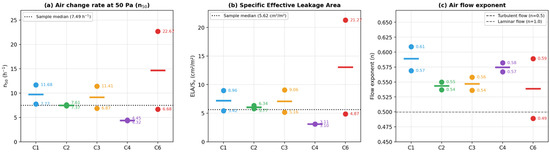
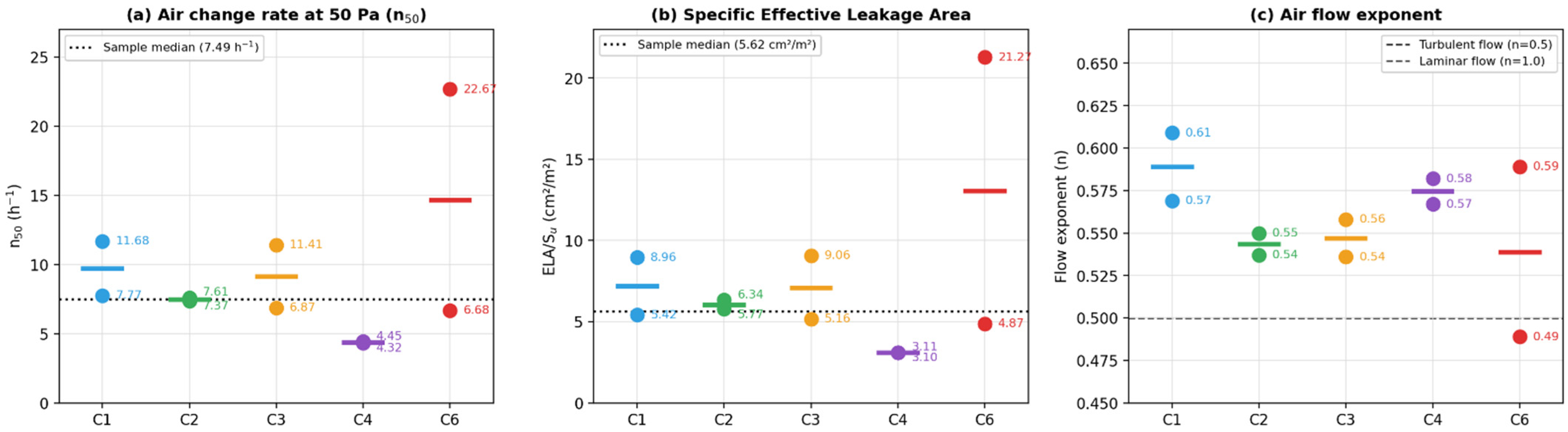
Within this sample, the dispersion indicates marked heterogeneity in classroom airtightness. The global coefficient of variation for n50 was 59.0%, while the standard deviation reached 5.36 h−1. Figure 1a shows that most observations lie near the sample median, whereas C6-2 is substantially higher than the other measured classrooms. This individual case illustrates that a recently refurbished building can still contain a highly permeable classroom, but it does not establish that refurbishment is generally unrelated to airtightness. Both C4 classrooms were below the sample median, indicating comparatively lower leakage in those two measured rooms.
Figure 1.
Airtightness indicators per school centre: (a) n50, (b) ELA/Su, (c) flow exponent n. Lines indicate group means.
The revised ELA dataset shows a non-normal distribution for the specific effective leakage area, ELA/Su (p = 0.001). ELA/Su had a median of 5.62 cm2/m2, a mean of 7.30 cm2/m2 and a range of 3.10–21.28 cm2/m2. Absolute ELA values had a median of 301.3 cm2, a mean of 372.9 cm2 and a range of 151.9–851.1 cm2. The lowest specific values occurred in the two C4 classrooms, while the highest value corresponded to C6-2. These data indicate substantial variation in leakage area among the measured rooms; however, because n50 and ELA are derived from the same pressure–flow tests, their association should be interpreted primarily as internal consistency between related indicators rather than as an independent causal relationship.
The airflow exponent n presented less dispersion than n50 or ELA/Su, with a mean of 0.559, a median of 0.562 and a standard deviation of 0.033. The values ranged from 0.489 to 0.609 and were generally closer to the turbulent-flow reference (n = 0.5) than to the laminar-flow reference (n = 1.0). Within the limits of the test and sample, this pattern is compatible with leakage through relatively concentrated cracks, joints or openings, although the exponent alone cannot identify the physical location or size of individual leakage paths.
Airflow exponents near n ≈ 0.5 are commonly associated with more turbulent flow through discrete openings, whereas higher exponents may be consistent with narrower or more distributed paths. The observed range (0.489–0.609) therefore supports, but does not prove, the hypothesis that window and door interfaces, service penetrations and construction joints contribute materially to leakage in these classrooms. Direct leakage mapping would be required to quantify the relative contribution of each component.
Figure 1 also shows the within-school variation in the measured pairs. Centres C1 and C3 had ranges of 7.77–11.68 h−1 and 6.87–11.41 h−1, respectively. C6 showed the largest contrast, with one classroom near the sample median (6.68 h−1) and the other at 22.67 h−1. In this small set of paired measurements, classrooms within the same centre can therefore differ substantially, although the frequency of this behaviour in the wider school stock cannot be estimated from the present sample.
For modelling applications, these observations suggest caution when a single classroom value is used to represent a whole centre. Where preliminary inspections indicate heterogeneous windows, penetrations or envelope interfaces, a range of n50 values or measurements in more than one classroom may better reflect uncertainty than a single deterministic input. The proposed 30% CV threshold is used here as a practical screening criterion and should be validated with larger datasets.
The results have methodological implications for the measured centres: one classroom was not always sufficient to describe the observed within-building range. Differences between paired classrooms were sometimes comparable with differences between centres. This finding supports further evaluation of multi-classroom testing protocols, particularly for refurbished or visibly heterogeneous buildings, but it should not be interpreted as evidence that every school requires the same sampling intensity.
3.3. Within-School Variability
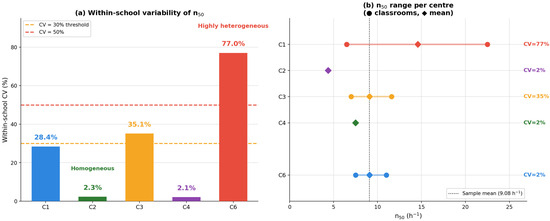
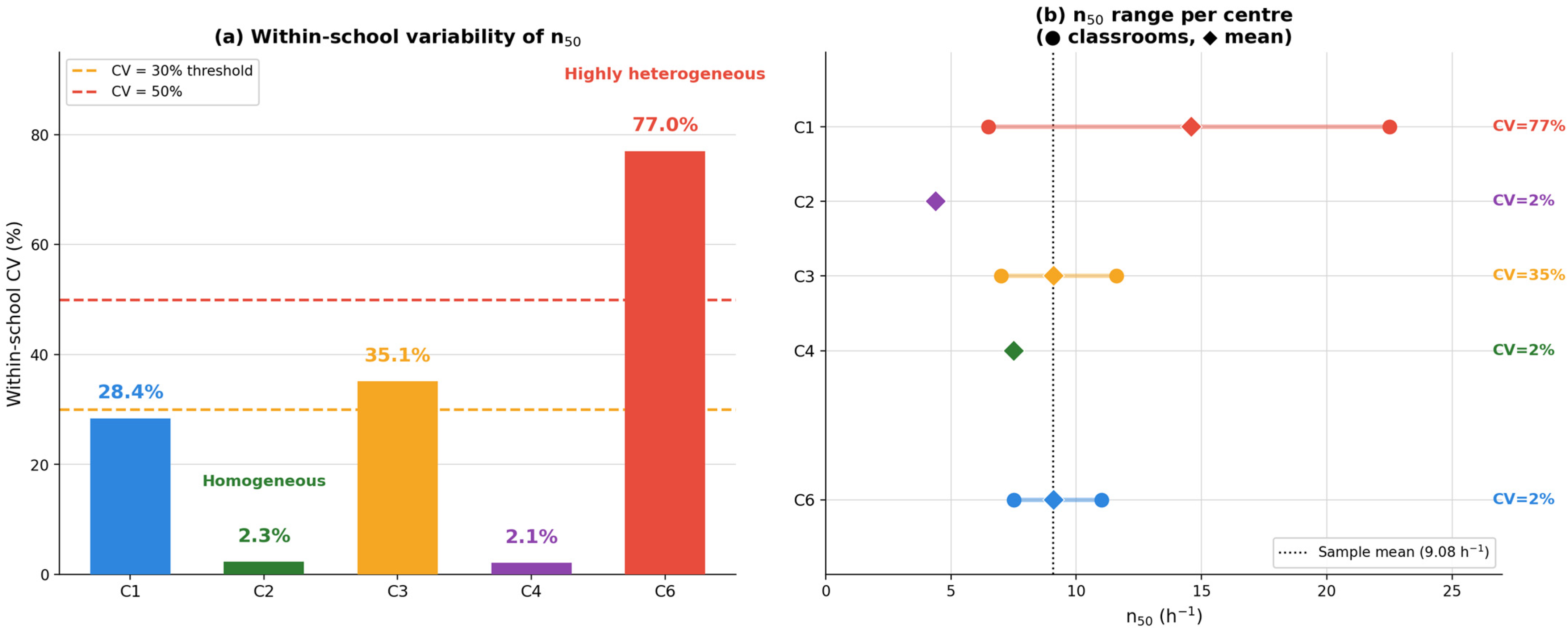
A notable feature of the campaign is the variability observed between the two classrooms measured in each centre (Table 4; Figure 2). Centres C2 and C4 had low within-centre coefficients of variation (2.3% and 2.1%). For these particular pairs, one measurement would have produced a value close to the other classroom result; however, two-room agreement in these centres does not demonstrate whole-building homogeneity.
Table 4.
Within-school variability of n50.
Figure 2.
Within-school variability: (a) CV of n50 per centre; (b) n50 range per centre (circles = individual classrooms, diamonds = centre mean).
Centre C6 showed the largest internal contrast. The measured n50 values ranged from 6.68 h−1 in C6-1 to 22.67 h−1 in C6-2, a 3.39-fold difference and a within-school CV of 77.0%. The revised effective leakage areas similarly ranged from approximately 194.9 cm2 to 851.1 cm2, or about a 4.4-fold difference. This pair suggests that local defects, window conditions, service penetrations or execution quality may outweigh the shared refurbishment label in individual rooms, although the present measurements do not isolate the contribution of each factor.
Centres C1 and C3 showed intermediate within-centre variation, with CV values of 28.4% and 35.1%. Their absolute differences, 3.91 h−1 and 4.54 h−1, were of the same order as several between-centre contrasts in this dataset. The selected cases therefore indicate that general building descriptors may not always predict the value of an individual classroom.
Across the ten-classroom analytical sample, the CV was 59.0%, which is close to the value observed within C6. As an exploratory practical implication, centres with visibly heterogeneous openings, penetrations or renovation details may warrant measurements in more than one room. The approximate 30% criterion used here should be regarded as a provisional decision aid rather than a validated universal threshold.
The observed pattern is compatible with school and residential airtightness studies that attribute room-to-room or dwelling-to-dwelling variation to window conditions, sealing continuity, service penetrations and workmanship [16,17,22,28,29,30,31,32,33,34,35,36,37,38,39,40]. For retrofit assessment, the present data support classroom-level verification where heterogeneity is suspected, while larger studies are needed to determine the sampling strategy required for different school typologies.
3.4. Correlation Analysis
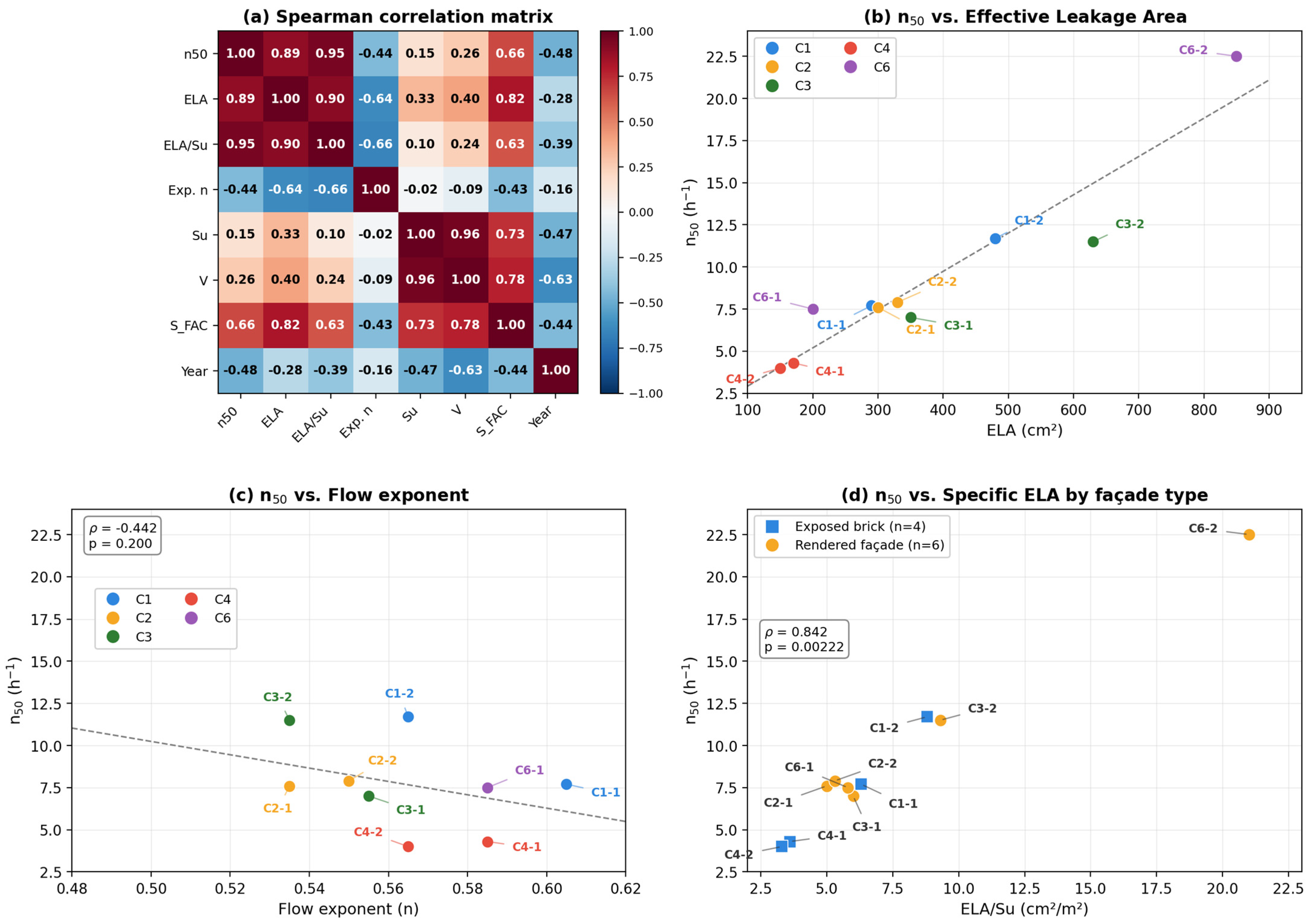
The exploratory correlation analysis is presented in Table 5 and Figure 3. Among the geometrical and constructive variables considered, external façade area showed the largest association with n50 in the ten-classroom sample (Spearman ρ = 0.663, p = 0.037). This pattern is compatible with a greater number or extent of façade and window interfaces contributing to leakage. Nevertheless, the sample is small, classrooms are clustered within centres, and several bivariate comparisons were examined; the result should therefore be treated as a sample-specific hypothesis rather than a general relationship.
Table 5.
Exploratory Spearman correlation coefficients between n50 and geometric/constructive variables (n = 10).
Figure 3.
Correlation analyses based on the revised ELA dataset: (a) Spearman correlation matrix; (b) n50 vs. ELA; (c) n50 vs. flow exponent; (d) n50 vs. ELA/Su by façade type.
A sensitivity calculation that included the excluded C5 classroom produced a similar n50–S_FAC coefficient (ρ = 0.656, p = 0.028). The stability of the sign and magnitude indicates that this particular association is not driven solely by excluding C5, but it does not remove the limitations arising from non-random sampling, centre-level clustering and low statistical power.
Using the revised ELA values, n50 showed strong rank associations with absolute ELA (ρ = 0.891, p < 0.001) and ELA/Su (ρ = 0.952, p < 0.001). Figure 3b,d shows the updated classroom values, including the high ELA of C6-2. These coefficients are expected to be high because n50, ELA and ELA/Su are derived from the same pressure–flow measurements and differ partly through geometric normalisation. They therefore confirm the consistency among related airtightness indicators, but they should not be interpreted as evidence that ELA is an independent explanatory variable for n50.
The airflow exponent showed a moderate negative rank association with n50 (ρ = −0.442, p = 0.200). The direction of the sample pattern is compatible with more permeable classrooms tending towards lower exponents and more turbulent leakage behaviour. However, the uncertainty is large, and the data do not provide clear evidence of a general relationship between the flow exponent and n50.
Construction year showed a negative sample association with n50 (ρ = −0.485, p = 0.156), but the evidence was insufficient to distinguish this pattern from sampling variability. The results therefore do not demonstrate either the presence or the absence of an age effect. In the measured cases, the contrast between C4 and C6 suggests that maintenance, window replacement, detailing and local sealing may interact with age and refurbishment status.
ELA and ELA/Su were also strongly associated (ρ = 0.976, p < 0.001), as expected for an absolute indicator and its floor-area-normalised counterpart. Classroom volume and floor area showed weak rank associations with n50 in this dataset. These results describe the selected classrooms only and do not exclude size effects in a broader or differently distributed sample.
Taken together, the exploratory results are consistent with façade exposure, local detailing and execution quality contributing to the measured variability, but they do not allow their independent effects to be ranked reliably. Larger samples with multilevel or multivariable models are required before assigning greater explanatory importance to façade area, age, typology or rehabilitation status.
3.5. Group Comparisons by Constructive Variables
Group comparisons for the categorical constructive variables were explored with Mann–Whitney U tests (Table 6). The tests did not provide clear evidence of differences between refurbished and non-refurbished classrooms or between the exposed-brick and rendered-façade groups. The estimated effect sizes were small to negligible (r = 0.136 for rehabilitation status and r = 0.034 for façade type), but the very small and unbalanced groups mean that these results cannot establish equivalence or the absence of a practically relevant effect.
Table 6.
Comparison of n50 by categorical constructive variables. Mann–Whitney U test.
A comparison by presence of mechanical ventilation was not performed because only Centre C1 in the analytical sample was mechanically ventilated; C5, the only other mechanically ventilated case, was treated separately as an outlier. The resulting group sizes (n = 2 versus n = 8) were considered inadequate for an interpretable group test.
The sample medians were 6.68 h−1 for refurbished classrooms and 7.61 h−1 for non-refurbished classrooms. Exposed-brick classrooms had a median of 7.49 h−1, compared with 7.22 h−1 for rendered façades. These descriptive differences are small relative to the within-group dispersion, but the limited sample does not support concluding that rehabilitation or façade type has no effect.
The observed overlap between groups is compatible with local conditions—such as window conditions, sealing continuity, service penetrations and workmanship—contributing substantially to classroom leakage. The high internal variability in C6 supports this interpretation as a plausible explanation for the selected cases, although it does not establish that local defects are generally more important than age, construction system or façade type.
For the measured classrooms, the results support prioritising diagnostic attention to localised leakage pathways rather than assuming airtightness from broad typological labels alone. Retrofit strategies may therefore benefit from explicit sealing specifications for windows, joints and service penetrations, followed by verification testing. The effectiveness of these measures should be evaluated in a larger set of paired pre- and post-intervention cases.
From a practical perspective, the selected cases suggest that quality control during school retrofit works should include window and door-frame interfaces, junctions between envelope elements and service penetrations, in addition to opaque-façade insulation. Post-intervention blower-door testing can verify whether the intended continuity has been achieved, while visual inspection alone may miss concealed leakage paths. This recommendation is based on the observed mechanisms and supporting literature rather than on a statistically representative estimate of failure frequency.
3.6. International Benchmarking
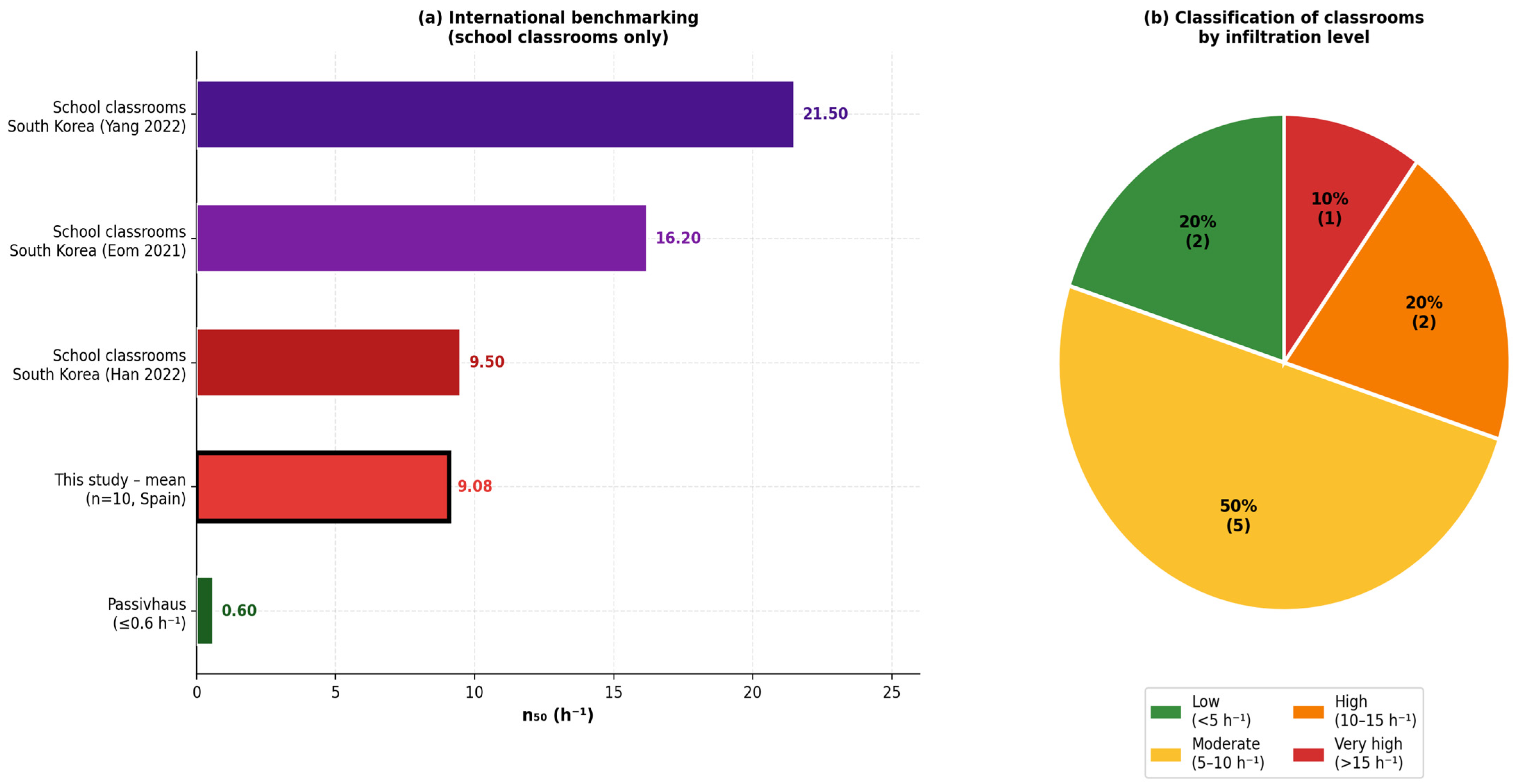
Table 7 and Figure 4 place the ten analysed classrooms alongside the limited published school-classroom evidence. The sample mean was 9.08 h−1, the median was 7.49 h−1, and the range was 4.32–22.67 h−1. Descriptively, these values fall between high-performance examples and many reported South Korean classroom measurements. Because the studies differ in climate, construction, test boundaries and sampling, the comparison should be read as contextual rather than as a formal ranking of national school stocks.
Table 7.
Comparative summary with reference studies on school classroom airtightness.
Figure 4.
International benchmarking: (a) n50 comparison with published studies on school classrooms; (b) classification of classrooms in this study by infiltration level [16,17,19].
Most recent directly comparable classroom measurements have been reported in South Korea, with n50 values commonly ranging from approximately 9.5 h−1 to above 20 h−1. The Spanish sample has a lower mean than several Korean series, while C6-2 lies within their upper range. This descriptive difference may reflect construction and window systems, but it may also be influenced by sample composition and testing protocols; no cross-country causal inference is possible from the available datasets.
Constructive and typological differences provide plausible hypotheses for the observed contrast. Korean schools frequently use sliding-window systems that have been identified as important leakage sources. Spanish schools also commonly include sliding or restricted-opening windows and external shading devices, which may create leakage paths at tracks, shutter or louvre boxes and frame junctions. The present sample is consistent with these mechanisms, but window type was not recorded with sufficient detail or sample size to estimate its independent effect.
Evidence from other Mediterranean and southern European building types helps interpret mechanisms, although residential values are not direct classroom benchmarks. Studies in Catalonia, Athens, southern Italy, Portugal and the Spanish housing stock report wide dispersion among nominally similar masonry buildings and repeatedly identify window-to-wall interfaces, roller-shutter boxes, service ducts, construction joints, maintenance condition and workmanship as influential leakage locations or predictors [23,24,25,26,27,28,29,30,31,32]. Spanish predictive studies further suggest that age, typology, state of conservation, construction system and geometry may act jointly rather than through a single dominant variable [24,33,34,35,36]. The C5 penetration case and the C6 room-to-room contrast are compatible with this broader evidence, but the present sample cannot quantify the relative contribution of these mechanisms.
Intervention studies in Mediterranean residential buildings show that window replacement or dedicated sealing can substantially reduce leakage when continuity at frames, joints and penetrations is controlled, whereas outcomes vary with initial condition and execution quality. These findings support targeted diagnosis and verification in schools, but they also underline important typological differences: classrooms have larger glazed fractions, multiple access doors, corridor interfaces, shading systems and service distributions. Residential n50 thresholds should therefore not be transferred directly to classrooms, even when the wall construction is similarly based on rendered or exposed-brick masonry.
The international comparison presented in this study is necessarily limited to the countries for which published field data on classroom airtightness are available in the scientific literature. Beyond the South Korean and North American studies reviewed, systematic blower-door measurement campaigns specifically in school classrooms have not been identified in other major European building stocks, despite the fact that several countries have incorporated mandatory airtightness testing into their building regulations. A comparative analysis of ten European countries shows that mandatory building airtightness testing has gradually come into force in the United Kingdom, France, Ireland and Denmark, while in other countries such as Germany, it remains voluntary and is incentivised through energy certification programmes and funding schemes rather than enforced by regulation [39]. In France, airtightness requirements under the RT 2012 thermal regulation apply to residential buildings as well as to non-residential uses including offices, hotels, educational and healthcare buildings, with the successor regulation RE 2020 extending these obligations to all new schools and offices from July 2022. In the United Kingdom, testing under Part L of the Building Regulations is mandatory for all newly constructed non-domestic buildings—explicitly including schools, offices and hospitals—with dwellings subject to a sampling regime. In Denmark, the requirement has been in force since 2006 and applies to both residential and non-residential new construction. Despite these regulatory frameworks, the available measurement data across all these countries are predominantly oriented towards residential buildings, and no publicly accessible dataset specifically reporting classroom-level airtightness values was identified in the course of this review [40]. The absence of comparable European school data therefore reflects a gap in publicly reported research on this building typology rather than an absence of testing practice, and future studies should seek to access or contribute to national databases in order to build a more comprehensive European benchmark for educational building airtightness.
It should also be noted that direct comparison with high-performance airtightness benchmarks such as Passivhaus is of limited relevance in the Spanish Mediterranean context. The climate of Seville, characterised by hot, dry summers and mild winters, does not favour ultra-tight construction strategies designed primarily for cold climates: the dominant energy demand is cooling rather than heating, and the building stock prioritises solar shading and controlled ventilation during the occupied season. Furthermore, Spanish schools are typically closed during the summer months, when outdoor temperatures peak, and operate mainly during autumn, winter and spring. These climatic and operational characteristics define a different optimisation framework than that underlying Passivhaus or northern European airtightness benchmarks, and direct comparisons should therefore be interpreted with caution.
The technical feasibility of Passivhaus airtightness standards in school buildings has nonetheless been demonstrated in northern European climates. A comparative study of two early years centres of identical floor area (295 m2) constructed in Scotland—one to Passivhaus standard (Blackridge EYC) and one to conventional construction (St. Mary’s EYC)—reported measured airtightness values of 0.9 m3/h·m2 at 50 Pa and 4.5 m3/h·m2 at 50 Pa, respectively (Morrison Construction/University of Edinburgh, 2022). Converting the Passivhaus result to an equivalent air change rate yields approximately 0.6 h−1 at 50 Pa, a value that is more than an order of magnitude lower than the mean n50 recorded in the Spanish classrooms of this study. The conventional Scottish building, with 4.5 m3/h·m2 at 50 Pa, falls within the lower range of the Spanish sample, illustrating that even standard construction in a cold-climate regulatory context—where Part L of the Building Regulations mandates airtightness testing for all new non-domestic buildings—achieves performance levels comparable to the best-performing classrooms measured here. This comparison underlines that the gap between Spanish existing school buildings and high-performance standards is not primarily a climatic constraint but a consequence of construction age, the absence of airtightness-specific sealing strategies, and a regulatory framework that has historically not required blower-door testing in educational buildings.
It is worth noting that Spanish regulations—specifically the Reglamento de Instalaciones Térmicas en los Edificios (RITE)—prohibit the use of window opening as the primary ventilation strategy in educational buildings and require mechanical ventilation systems to be installed. However, a large proportion of the existing school building stock was constructed before this requirement came into force, and these buildings continue to operate without compliant mechanical ventilation systems, leaving window opening as the only available air renewal mechanism in practice. This situation is not without risk: during episodes of elevated outdoor air pollution—a relevant concern in traffic-influenced urban areas such as parts of Seville—window opening to achieve adequate CO2 dilution simultaneously increases the infiltration of outdoor particulate matter, exposing occupants to concentrations that may exceed recommended thresholds [12,19]. The envelope airtightness data reported in this study are therefore particularly relevant for this pre-regulation building stock, as improving airtightness at windows, joints and service penetrations, combined with the installation of demand-controlled mechanical ventilation with filtration, would allow these buildings to meet both the current regulatory intent and the indoor air quality requirements without depending on uncontrolled window opening.
The estimated natural infiltration rates in the measured classrooms ranged from 0.216 to 1.134 h−1. Under closed-window conditions and high occupancy, values in this range would generally be unlikely to provide the outdoor airflow needed for CO2 control on their own, although actual air exchange depends on the wind, temperature difference and operation. This interpretation is consistent with monitoring in naturally ventilated schools in southern Spain, where elevated CO2 has been reported during the heating season [11]. Mechanical ventilation remains the most controllable means of providing adequate and filterable outdoor air in existing schools.
In traffic-influenced urban locations, classroom leakage may also increase the penetration of outdoor particulate matter when windows are closed, all else being equal [12,17]. A highly permeable room such as C6-2 may therefore be more exposed to outdoor pollutants than a tighter room under similar boundary conditions, but pollutant concentrations were not measured in this campaign. Targeted sealing combined with demand-controlled, filtered mechanical ventilation is a plausible integrated retrofit strategy that should be tested through simultaneous airtightness and IAQ monitoring.
Overall, the selected cases and cross-typology literature support classroom-specific diagnosis of sliding-window tracks, shading-system junctions, service penetrations, doors and façade interfaces. They do not support using a single construction year, façade finish or general benchmark as a reliable predictor of an individual classroom’s leakage without direct measurement.
3.7. Study Limitations
Several limitations should be considered when interpreting the results. First, the main analysis includes ten classrooms from five centres. The centres were purposively selected to encompass differentiated cases that are illustrative of recurrent school typologies, construction periods and envelope configurations in Andalusia, although the final sample was also conditioned by the availability of access for testing. This study was therefore designed to provide an exploratory empirical baseline rather than a statistically representative estimate of the Andalusian or Spanish school stock. No a priori power analysis was performed, some observations are clustered within the same centres, and the number of classrooms is limited in relation to the variables examined. Consequently, the reported associations, p-values and effect sizes should be interpreted as patterns observed within the selected sample and as hypotheses to be tested in larger datasets.
Second, the statistical analysis is based on separate bivariate Spearman correlations. A multilevel multivariable model would allow the simultaneous assessment of façade area, construction period, rehabilitation status, façade typology and centre-level clustering. However, the current sample does not provide sufficient observations for stable estimation of such a model. In addition, n50, ELA and ELA/Su are derived from the same pressure–flow measurements, and the correlations among these indicators mainly reflect their shared physical and mathematical basis rather than independent explanatory relationships.
Third, all the analysed centres are located in Seville and primarily reflect a hot-summer Mediterranean climatic and constructive context. Although the selected cases cover recurrent Andalusian school configurations, the results may not apply directly to other climatic regions, educational building layouts or construction systems. Measurements were also conducted during a single campaign and therefore do not capture possible seasonal variations associated with material moisture, seal performance or the thermal movement of envelope components.
Fourth, CO2, PM2.5 and other indoor air quality parameters were not monitored simultaneously with the blower-door tests. The implications discussed for indoor air quality are therefore interpretations based on the measured airtightness indicators and previous published evidence, rather than effects demonstrated directly in the same classrooms. Future studies combining airtightness testing with concurrent pollutant and ventilation measurements would be required to verify these relationships empirically.
Finally, the estimated natural infiltration rate, ACH_nat, was calculated using a simplified single-coefficient conversion that does not explicitly account for wind conditions, indoor–outdoor temperature differences or stack effects. These values should therefore be regarded as approximate indicators of the potential magnitude of natural infiltration and not as precise design or operational air-change rates.
4. Conclusions
This study provides an exploratory field characterisation of classroom airtightness in a selected group of Spanish school buildings using ISO 9972:2015 blower-door measurements. The data show substantial variability among the measured classrooms and identify leakage pathways that merit attention in future retrofit studies, but the sample is too small to support general estimates for Spanish schools and was a non-random sample.
The ten classrooms in the main analysis had a mean n50 of 9.08 h−1 and a range of 4.32–22.67 h−1. Descriptively, the sample lies below several reported South Korean school series and above high-performance examples. The estimated natural infiltration rates of 0.216–1.134 h−1 suggest that uncontrolled leakage alone is unlikely to provide reliable ventilation under closed-window, high-occupancy conditions; actual rates will depend on weather and operation.
The within-centre CV values ranged from 2.1% to 77.0%, with an overall sample CV of 59.0%. In the selected centres, a single classroom measurement would not always have represented the observed room-to-room range. These results support evaluating multi-room sampling where heterogeneous windows, penetrations or retrofit details are present, while the required sampling intensity remains to be established in larger studies.
The external façade area showed the strongest exploratory association among the recorded geometrical and constructive variables (ρ = 0.663, p = 0.037). This sample pattern is compatible with façade and window interfaces contributing to leakage, but it should not be generalised because of the small, clustered sample and multiple comparisons. Construction year and façade typology did not yield clear evidence of association in these data; this does not demonstrate that they are unimportant in the wider stock.
The paired C4 measurements did not show an airtightness difference beyond the stated measurement uncertainty after the specific ETICS intervention. This observation suggests that insulating the opaque façade without dedicated continuity measures at openings and junctions may leave major leakage paths unchanged, but the inference is based on one pair and cannot be extended to ETICS systems in general. The C5 case similarly indicates that unsealed services above a suspended ceiling can be important, although their separate contribution was not quantified.
The ETICS result should therefore be viewed as a case-specific observation that motivates further paired pre- and post-retrofit testing. Future studies should document the exact sealing scope, window and door works, service penetrations and quality-control procedures so that the effect of insulation and airtightness interventions can be distinguished.
For the existing Mediterranean school stock, the results support an integrated retrofit hypothesis: diagnose and seal uncontrolled leakage paths, and then provide demand-controlled mechanical ventilation with appropriate filtration. This approach may reduce pollutant ingress and improve the effectiveness of controlled ventilation, but its IAQ and energy benefits should be confirmed through simultaneous monitoring rather than being inferred from airtightness alone.
The IAQ implications in this article are consequently framed as evidence-informed interpretations. CO2, PM2.5 and other pollutants were not measured in the tested classrooms, so dedicated monitoring is required to establish how the observed leakage levels affect exposure under different weather and operating conditions.
Future research should extend the campaign to a larger, stratified and climatically diverse sample; include multiple classrooms per centre; conduct paired measurements before and after clearly documented interventions; combine blower-door testing with leakage mapping and simultaneous CO2 and PM2.5 monitoring; and apply multilevel multivariable models that account for centre clustering and interacting construction variables.
Author Contributions
Conceptualization, J.F.-A., J.B.-W., V.D.-R. and S.D.-A.; Methodology, J.F.-A., J.B.-W., V.D.-R. and S.D.-A.; Software, J.F.-A.; Validation, J.F.-A., J.B.-W., V.D.-R. and S.D.-A.; Formal analysis, J.F.-A., J.B.-W., V.D.-R. and S.D.-A.; Investigation, J.F.-A., J.B.-W., V.D.-R. and S.D.-A.; Data curation, J.F.-A., J.B.-W., V.D.-R. and S.D.-A.; Writing—original draft, J.F.-A., J.B.-W., V.D.-R. and S.D.-A.; Writing—review and editing, J.F.-A., J.B.-W., V.D.-R. and S.D.-A.; Visualization, J.F.-A., J.B.-W., V.D.-R. and S.D.-A.; Supervision, J.F.-A. and S.D.-A.; Project administration, J.F.-A. and S.D.-A.; Funding acquisition, J.F.-A. and S.D.-A. All authors have read and agreed to the published version of the manuscript.
Funding
This research was funded by the Spanish Ministry of Science, Innovation and Universities through the Juan de la Cierva Research Fellowship Programme, under grant numbers CAS24/00312 and PRX24/00501.
Data Availability Statement
The data presented in this study are available on request from the corresponding author.
Acknowledgments
The authors gratefully acknowledge the financial support of the Spanish Ministry of Science, Innovation and Universities through the Juan de la Cierva research fellowship programme, which funded the research stay at the University of Edinburgh during which the international benchmarking data and comparative analysis presented in this study were developed. The authors also wish to thank the University of Edinburgh and Morrison Construction for providing access to the airtightness measurement data from the Blackridge and St. Mary’s Early Years Centres, which served as key reference cases for the comparative discussion.
Conflicts of Interest
The authors declare no conflicts of interest.
References
- Klepeis, N.E.; Nelson, W.C.; Ott, W.R.; Robinson, J.P.; Tsang, A.M.; Switzer, P.; Engelmann, W.H. The National Human Activity Pattern Survey (NHAPS): A resource for assessing exposure to environmental pollutants. J. Expo. Anal. Environ. Epidemiol. 2001, 11, 231–252. [Google Scholar] [CrossRef] [Scilit] [PubMed]
- Alves, C.A.; Urban, R.C.; Pegas, P.N.; Nunes, T. Indoor/outdoor relationships between PM10 and associated organic compounds in a primary school. Aerosol Air Qual. Res. 2014, 14, 86–98. [Google Scholar] [CrossRef] [Scilit]
- Sadrizadeh, S.; Yao, R.; Yuan, F.; Awbi, H.; Bahnfleth, W.; Bi, Y.; Cao, G.; Croitoru, C.; de Dear, R.; Haghighat, F.; et al. Indoor air quality and health in schools: A critical review for developing the roadmap for the future school environment. J. Build. Eng. 2022, 57, 104908. [Google Scholar] [CrossRef] [Scilit]
- Xia, T.; Raneses, J.; Schmiesing, A.; Garcia, A.; Walding, B.; DeMajo, R.; Schulz, B.; Batterman, S. How teacher behaviors and perceptions, air change rates, and portable air purifiers affect indoor air quality in naturally ventilated schools. Front. Built Environ. 2024, 12, 1427116. [Google Scholar] [CrossRef] [Scilit] [PubMed]
- Zhao, Z.; Zhang, Z.; Wang, Z.; Ferm, M.; Liang, Y.; Norbäck, D. Asthmatic symptoms among pupils in relation to winter indoor and outdoor air pollution in schools in Taiyuan, China. Environ. Health Perspect. 2008, 116, 90–97. [Google Scholar] [CrossRef] [Scilit] [PubMed]
- Ezeamii, V.C.; Egbuchiem, A.N.; Obianyo, C.M.; Nwoke, P.; Okwuonu, L. Air quality monitoring in schools: Evaluating the effects of ventilation improvements on cognitive performance and childhood asthma. Cureus 2025, 17, e83306. [Google Scholar] [CrossRef] [Scilit] [PubMed]
- Rodríguez, D.; Urbieta, I.R.; Velasco, Á.; Campano-Laborda, M.Á.; Jiménez, E. Assessment of indoor air quality and risk of COVID-19 infection in Spanish secondary school and university classrooms. Build. Environ. 2022, 226, 109717. [Google Scholar] [CrossRef] [Scilit] [PubMed]
- Leal Matilla, A.; Diaz Velilla, J.P.; Zaragoza-Benzal, A.; Ferrández, D.; Santos, P. Experimental study of indoor air quality in educational buildings: A Spanish case study. Buildings 2023, 13, 2780. [Google Scholar] [CrossRef] [Scilit]
- AIVC. What Are the Impacts of Poor Envelope Airtightness on Ventilation, Indoor Air Quality and Building Damage? Air Infiltration and Ventilation Centre. 2020. Available online: https://www.aivc.org/resources/faqs/what-are-impacts-poor-envelope-airtightness-ventilation-indoor-air-quality-and (accessed on 10 June 2026).
- Fernández-Agüera, J.; Campano, M.A.; Domínguez-Amarillo, S.; Sendra, J.J. Characterisation of the airtightness level in school classrooms in Mediterranean climate. Int. J. Archit. Environ. Eng. 2016, 10, 21–24. [Google Scholar]
- Fernández-Agüera, J.; Campano, M.Á.; Domínguez-Amarillo, S.; Acosta, I.; Sendra, J.J. CO2 concentration and occupants’ symptoms in naturally ventilated schools in Mediterranean climate. Buildings 2019, 9, 197. [Google Scholar] [CrossRef] [Scilit]
- Alonso-Blanco, E.; Gómez-Moreno, F.J.; Díaz-Ramiro, E.; Barreiro, M.; Fernández, J.; Figuero, I.; Rubio-Juan, A.; Santamaría, J.M.; Artíñano, B. Indoor air quality at an urban primary school in Madrid (Spain): Influence of surrounding environment and occupancy. Int. J. Environ. Res. Public Health 2024, 21, 1263. [Google Scholar] [CrossRef] [Scilit] [PubMed]
- Almeida, R.M.S.F.; de Freitas, V.P. Indoor environmental quality of classrooms in Southern European climate. Energy Build. 2014, 81, 127–140. [Google Scholar] [CrossRef] [Scilit]
- Pellegrino, M.; Simonetti, M.; Chiesa, G. Impact of school design on indoor air quality and thermal comfort. In Sustainable Built Environment; Springer: Berlin/Heidelberg, Germany, 2024. [Google Scholar]
- Wan, Y.; Chen, C.; Wang, P.; Wang, Y.; Chen, Z.; Zhao, L. Infiltration characteristic of outdoor fine particulate matter (PM2.5) for the window gaps. Procedia Eng. 2015, 121, 706–713. [Google Scholar] [CrossRef] [Scilit]
- Yang, S.; Yuk, H.; Yun, B.Y.; Kim, Y.U.; Wi, S.; Kim, S. Passive PM2.5 control plan of educational buildings by using airtight improvement technologies in South Korea. J. Hazard. Mater. 2022, 423, 126990. [Google Scholar] [CrossRef] [Scilit] [PubMed]
- Eom, Y.S.; Park, B.R.; Shin, H.W.; Kang, D.H. Evaluation of outdoor particle infiltration into classrooms considering air leakage and other building characteristics in Korean schools. Sustainability 2021, 13, 7382. [Google Scholar] [CrossRef] [Scilit]
- Eom, Y.S.; Kang, D.H. Influence of building airtightness on the placement of a portable air cleaner in an elementary school classroom. Aerosol Air Qual. Res. 2025, 25, 36. [Google Scholar] [CrossRef] [Scilit]
- Han, B.; Hong, K.; Shin, D.; Kim, H.J.; Kim, Y.J.; Kim, S.B.; Noh, K.C. Field tests of indoor air cleaners for removal of PM2.5 and PM10 in elementary school classrooms in Seoul, Korea. Aerosol Air Qual. Res. 2022, 22, 210383. [Google Scholar] [CrossRef] [Scilit]
- Na, H.; Choi, H.; Kim, H.; Park, D.; Lee, J.; Kim, T. Optimizing indoor air quality and noise levels in old school classrooms with air purifiers and HRV: A CONTAM simulation study. J. Build. Eng. 2023, 73, 106645. [Google Scholar] [CrossRef] [Scilit]
- Park, D.Y.; Han, S.H.; Park, D.J.; Park, B.; Jeon, J. Fine dust inflow paths and heating load variation based on field measurement of air tightness in two Korean schools. Heliyon 2024, 10, e26284. [Google Scholar] [CrossRef] [Scilit] [PubMed]
- Shaw, C.Y. Improvement of Airtightness in Four Schools; Building Practice Note No. 34; Division of Building Research, National Research Council of Canada: Ottawa, ON, Canada, 1982. [CrossRef] [Scilit]
- D’Ambrosio Alfano, F.R.; Dell’Isola, M.; Ficco, G.; Tassini, F. Experimental analysis of air tightness in Mediterranean buildings using the fan pressurization method. Build. Environ. 2012, 53, 16–25. [Google Scholar] [CrossRef] [Scilit]
- D’Ambrosio Alfano, F.R.; Dell’Isola, M.; Ficco, G.; Palella, B.I.; Riccio, G. Experimental air-tightness analysis in Mediterranean buildings after windows retrofit. Sustainability 2016, 8, 991. [Google Scholar] [CrossRef] [Scilit]
- Fernández-Agüera, J.; Domínguez-Amarillo, S.; Campano, M.Á. Characterising draught in Mediterranean multifamily housing. Sustainability 2019, 11, 2433. [Google Scholar] [CrossRef] [Scilit]
- Feijó-Muñoz, J.; Poza-Casado, I.; González-Lezcano, R.A.; Pardal, C.; Echarri, V.; Assiego de Larriva, R.; Fernández-Agüera, J.; Dios-Viéitez, M.J.; del Campo-Díaz, V.J.; Montesdeoca Calderín, M.; et al. Methodology for the study of the envelope airtightness of residential buildings in Spain: A case study. Energies 2018, 11, 704. [Google Scholar] [CrossRef] [Scilit]
- Feijó-Muñoz, J.; Pardal, C.; Echarri, V.; Fernández-Agüera, J.; Assiego de Larriva, R.; Montesdeoca Calderín, M.; Poza-Casado, I.; Padilla-Marcos, M.Á.; Meiss, A. Energy impact of the air infiltration in residential buildings in the Mediterranean area of Spain and the Canary Islands. Energy Build. 2019, 188–189, 226–238. [Google Scholar] [CrossRef] [Scilit]
- Poza-Casado, I.; Rodríguez-del-Tío, P.; Fernández-Temprano, M.; Padilla-Marcos, M.Á.; Meiss, A. An envelope airtightness predictive model for residential buildings in Spain. Build. Environ. 2022, 223, 109435. [Google Scholar] [CrossRef] [Scilit]
- Montoya, M.I.; Pastor, E.; Carrié, F.R.; Guyot, G.; Planas, E. Air leakage in Catalan dwellings: Developing an airtightness model and leakage airflow predictions. Build. Environ. 2010, 45, 1458–1469. [Google Scholar] [CrossRef] [Scilit]
- Pinto, M.; Viegas, J.; de Freitas, V.P. Air permeability measurements of dwellings and building components in Portugal. Build. Environ. 2011, 46, 2480–2489. [Google Scholar] [CrossRef] [Scilit]
- Ramos, N.M.M.; Almeida, R.M.S.F.; Curado, A.; Pereira, P.F.; Manuel, S.; Maia, J. Airtightness and ventilation in a mild climate country rehabilitated social housing buildings—What users want and what they get. Build. Environ. 2015, 92, 97–110. [Google Scholar] [CrossRef] [Scilit]
- Sfakianaki, A.; Pavlou, K.; Santamouris, M.; Livada, I.; Assimakopoulos, M.N.; Mantas, P.; Christakopoulos, A. Air tightness measurements of residential houses in Athens, Greece. Build. Environ. 2008, 43, 398–405. [Google Scholar] [CrossRef] [Scilit]
- Echarri-Iribarren, V.; Sotos-Solano, C.; Espinosa-Fernández, A.; Prado-Govea, R. The Passivhaus standard in the Spanish Mediterranean: Evaluation of a house’s thermal behaviour of enclosures and airtightness. Sustainability 2019, 11, 3732. [Google Scholar] [CrossRef] [Scilit]
- Martín-Garín, A.; Millán-García, J.A.; Hidalgo-Betanzos, J.M.; Hernández-Minguillón, R.J.; Baïri, A. Airtightness analysis of the built heritage—Field measurements of nineteenth-century buildings through blower-door tests. Energies 2020, 13, 6727. [Google Scholar] [CrossRef] [Scilit]
- Tombarević, E.; Vušanović, I.; Šekularac, M. The impact of windows replacement on airtightness and energy consumption of a single apartment in a multi-family residential building in Montenegro: A case study. Energies 2023, 16, 2208. [Google Scholar] [CrossRef] [Scilit]
- Raafat, R.; Marey, A.; Goubran, S. Experimental study of envelope airtightness in new Egyptian residential dwellings. Buildings 2023, 13, 728. [Google Scholar] [CrossRef] [Scilit]
- ISO9972:2015; Thermal performance of Buildings—Determination of Air Permeability of Buildings—Fan Pressurisation Method. International Organization for Standardization: Geneva, Switzerland, 2015. Available online: https://www.iso.org/standard/55718.html (accessed on 25 March 2026).
- Virtanen, P.; Gommers, R.; Oliphant, T.E.; Haberland, M.; Reddy, T.; Cournapeau, D.; Burovski, E.; Peterson, P.; Weckesser, W.; Bright, J.; et al. SciPy 1.0: Fundamental algorithms for scientific computing in Python. Nat. Methods 2020, 17, 261–272. [Google Scholar] [CrossRef] [Scilit] [PubMed]
- Leprince, V.; Carrié, F.R.; Kapsalaki, M. Building and ductwork airtightness requirements in Europe: Comparison of 10 European countries. In Proceedings of the 38th AIVC Conference “Ventilating Healthy Low-Energy Buildings”, Nottingham, UK, 13–14 September 2017; pp. 192–201. [Google Scholar]
- Poza-Casado, I.; Cardoso, V.E.M.; Almeida, R.M.S.F.; Meiss, A.; Ramos, N.M.M.; Padilla-Marcos, M.Á. Residential buildings airtightness frameworks: A review on the main databases and setups in Europe and North America. Build. Environ. 2020, 183, 107221. [Google Scholar] [CrossRef] [Scilit]

Disclaimer/Publisher’s Note: The statements, opinions and data contained in all publications are solely those of the individual author(s) and contributor(s) and not of MDPI and/or the editor(s). MDPI and/or the editor(s) disclaim responsibility for any injury to people or property resulting from any ideas, methods, instructions or products referred to in the content. |
© 2026 by the authors. Licensee MDPI, Basel, Switzerland. This article is an open access article distributed under the terms and conditions of the Creative Commons Attribution (CC BY) license.