


Abstract
For the sake of investigating the theoretical design optimization of high-rise plane frames, an optimization model was established by taking the minimum top-story lateral displacement as the objective function and treating material strength, story height, and span length as design variables. The design parameters of the frame were optimized using an Assimilation–Competition Quantum-behaved Particle Swarm Optimization (ACQPSO) algorithm. First, the accuracy and computational efficiency of the ACQPSO algorithm were evaluated using four benchmark functions. Then, a five-span, seven-story reinforced-concrete plane frame with a total span of 24 m and a total height of 34 m was taken as a case study. The cross-sectional dimensions of the beams and columns were determined according to relevant design specifications, and the top-story lateral displacement calculated by the D-value method was verified using the Finite Element Method (FEM), confirming its accuracy and effectiveness. Finally, a parametric analysis was carried out to investigate the effects of material strength, story height, span length, and member cross-sectional dimensions on the objective function. The results indicate that story height and column concrete strength have a greater influence on the top-story lateral displacement, whereas the effect of span length is relatively small. In addition, the cross-sectional dimensions of beams and columns affect the top-story lateral displacement more significantly than beam strength.
1. Introduction
With rapid urban development and ongoing advances in construction technology, high-rise buildings with long spans are increasing in modern cities. Unlike low- and mid-rise structures, high-rise buildings are much more sensitive to lateral loads, especially wind and earthquake loads. Hence, improving lateral stiffness while meeting multiple design requirements has become a key issue in high-rise structural design.
Against this background, optimization methods have been widely introduced into structural engineering. Among them, the Genetic Algorithm (GA) and Grey Wolf Optimizer (GWO) have received some attention. In truss optimization, Kaveh et al. [1] proposed the Improved Grey Wolf Optimizer (IGWO), in which a small number of additional control parameters were introduced to improve search adaptability. Their study examined the algorithm by using several benchmark functions and truss design examples with different levels of complexity. Li et al. [2] further applied IGWO to typical engineering design problems, including pressure vessels, tension/compression springs, welded beams, and three-bar trusses. The reported results showed that the method achieved faster convergence and higher solution accuracy, while also maintaining good robustness. To reduce the computational burden of multi-objective antenna topology optimization and to better coordinate exploration and exploitation, Dong et al. [3] developed a Competitive Binary Multi-Objective Grey Wolf Optimizer (CBMOGWO). By combining a population competition strategy with an improved cosine-based convergence factor, the proposed method produced better optimization performance than several conventional approaches, with a noticeable reduction in computational cost. Kandiri et al. [4] established an Artificial Neural Network (ANN) model to predict the compressive strength of recycled-aggregate concrete and compared its performance with several optimization algorithms, including Genetic Algorithm (GA), Salp Swarm Algorithm (SSA), and Grasshopper Optimization Algorithm (GOA). Their results indicated that the ANN-based model provided the most accurate predictions among the methods considered.
Compared with GA and GWO, Particle Swarm Optimization (PSO) is notably representative and has wide-ranging application potential. This is primarily attributed to its robust global search capability, uncomplicated structure, minimal control parameters, and ease of engineering implementation. PSO was introduced by Kennedy and Eberhart [5] in 1995. The fundamental concept is inspired by the collective foraging behavior observed in bird flocks. Like other evolutionary algorithms, PSO exhibits characteristics of both evolution and swarm intelligence. It efficiently explores the solution space by simulating information sharing and coordination among individuals within a swarm. In recent years, considerable efforts have been directed toward enhancing PSO and expanding its applications in engineering. These investigations provide a robust technical foundation for tackling complex structural optimization issues. Trelea [6] conducted a theoretical analysis of PSO, leveraging classical results from dynamical systems to propose graphical guidelines for parameter selection. They also provided a detailed examination of the trade-off between exploration and exploitation. Their findings showed that PSO achieved better optimization performance than the other algorithms. Meanwhile, Perez et al. [7] developed a computational model for structural optimization, further refining parameter settings and constraint-handling strategies, which led to a more effective swarm-intelligence-based approach. To handle design problems with multiple constraints, Luh et al. [8] proposed a two-stage PSO-based optimization model for lightweight truss design, decomposing the design task into a sequential procedure that includes topology optimization followed by size–shape optimization. The effectiveness of the proposed method was validated using a two-layer, 39-bar truss as an example. To jointly consider project duration, cost, and quality in construction engineering, Hu et al. [9] proposed a hybrid optimization method that combines a genetic algorithm with a time-varying mutation rate and particle swarm optimization. The results show improved global optimality and better solution stability. The method outperforms standalone GA and PSO in various construction projects. It also reduces solution fluctuations. To address the limitations of conventional design methods in optimization problems with nonlinear loads and nonlinear constraints, Yazd et al. [10] developed a PSO-based, swarm-intelligence approach. They established a cross-section optimization model with the dam base width and upstream slope as design variables. Under the requirement of long-term structural stability, the model minimizes the cost by reducing concrete consumption. Using a 60-story high-rise building as an example, Li et al. [11,12] developed a wind-resistant optimization design model by integrating a genetic algorithm (GA) with an improved penalty-function scheme. The results show that the model can effectively reduce wind-induced responses. It can also optimize the structural weight. In addition, it helps coordinate structural performance with material consumption. Hu et al. [13] combined quantum-behaved particle swarm optimization with a fuzzy logic system and proposed a Quantum-behaved Particle Swarm Optimization and Fuzzy Logic (QPSOFL) to improve the energy efficiency and lifetime of wireless sensor networks. To maintain population diversity, Sobol sequences were introduced. Lévy flights and Gaussian perturbations were also incorporated to reduce the risk of premature convergence. For the optimization of high-rise reinforced-concrete buildings under multiple loading cases, Lou et al. [14] established a response-surface surrogate model subject to both load-case and code constraints. They further adopted a two-stage optimization procedure by coupling the response surface method with discrete particle swarm optimization. In this way, the computational burden was reduced, while the requirements of multiple loading cases and design codes were still satisfied. The results show that material consumption can be reduced by 14.3%, while the computational efficiency is significantly improved. Gholizadeh. [15] proposed an efficient PSO variant for improved structural optimization. The method enhances global search capability by introducing cellular automata. Specifically, a new cellular-automata-based term is incorporated into the velocity update equation, and the swarm evolves on a low-dimensional grid using the actual values of the design variables. The proposed approach shows better convergence than conventional PSO and significantly reduces the number of structural analyses. To optimize structural shape and size, Fourie et al. [16] developed an improved PSO algorithm based on swarm-intelligence theory by mimicking social behaviors observed in bird flocks. They innovatively introduced elite-velocity and elite-particle operators, which improve search efficiency and convergence performance. Wang et al. [17] developed an improved particle-swarm-based method for the wind-resistant design of supertall buildings under wind loading. In their work, the equivalent static wind load was formulated through the harmonic excitation method. Chaotic mapping was then introduced into the search process to improve the overall optimization performance. The method converged quickly at the early stage and was still able to identify the optimum solution after further iterations.
To overcome the shortcomings of conventional PSO, such as slow convergence and a tendency to be trapped in local optima, many improvement strategies have been proposed. For example, Sun et al. [18,19] developed the Quantum-behaved Particle Swarm Optimization (QPSO) algorithm from the perspective of quantum mechanics. In QPSO, a δ potential well is introduced, and particles move within a δ potential well centered at point p. In the quantum domain, particle velocity and position cannot be determined simultaneously. Therefore, a particle state is not described by position and velocity, but by a wave function. By introducing quantum behavior into particle updating, QPSO strengthens global exploration and improves solution accuracy. Subsequent studies have focused on refining the algorithm itself and extending its use in engineering applications. Wang et al. [20] applied QPSO to the performance optimization of a turbofan engine. Their results showed that the method reduced the sensitivity to initial values and helped prevent the search from being trapped in local optima. Miao et al. [21] developed a prediction model based on Quantum-behaved Particle Swarm Optimization and Support Vector Machine (QPSO-SVM) for safety risk assessment in high-rise building construction. In their work, a comprehensive evaluation system with multi-dimensional indicators was established, and QPSO was used to optimize the parameters of the SVM classifier. For the multi-objective design of laminated composite structures, Omkar et al. [22] proposed a QPSO-based optimization scheme. Subject to prescribed strength requirements, structural weight and manufacturing cost were taken as the two objective functions, while three failure criteria were employed to evaluate the design. The results demonstrated that this method could balance lightweight design and cost control more effectively than conventional PSO. Cheng et al. [23] addressed the lightweight design of an asymmetric thin-walled box girder by formulating the sectional design problem as a global optimization task. On this basis, they established an optimization model using an improved QPSO algorithm. Penalty functions were introduced to handle constraints related to strength, stiffness, and stability, and Lévy flights were incorporated to enhance global search performance. As a result, the cross-sectional area of the box girder could be minimized while all design constraints were satisfied. Case studies showed that the proposed approach can reduce manufacturing costs by 9.6%.
Conventional algorithms often struggle with high-dimensional, multi-constrained structural optimization problems. In particular, it is difficult to achieve both strong global exploration and high local search accuracy. Therefore, an “assimilation–competition” strategy has been incorporated into QPSO by combining inter-particle information exchange with a mechanism for inheriting superior solutions. In QPSO, a global-best particle can be identified at each iteration. This particle is regarded as the strongest “nation,” whereas the remaining particles are treated as weaker “nations.” The global-best particle continuously assimilates the others so that the remaining particles gradually move toward it. Based on this idea, some researchers embedded the assimilation–competition strategy into QPSO and developed the ACQPSO algorithm.
Based on the above review of structural optimization studies, the lateral stiffness of high-rise structures is clearly critical. However, accurate and effective optimization methods are still limited. In particular, studies that use ACQPSO to optimize the lateral stiffness of high-rise buildings remain scarce. Therefore, this study takes the top-story lateral displacement of a high-rise plane frame as the optimization objective. An ACQPSO-based optimization model is established with design variables including column concrete strength grade, story height, and span length. A case study is then conducted to verify the effectiveness of the proposed model. Finally, a parametric analysis is performed to examine how the main design parameters influence the optimization results.
2. Plane Frame Model
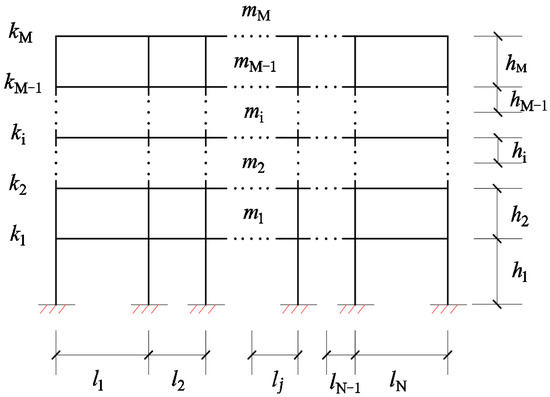
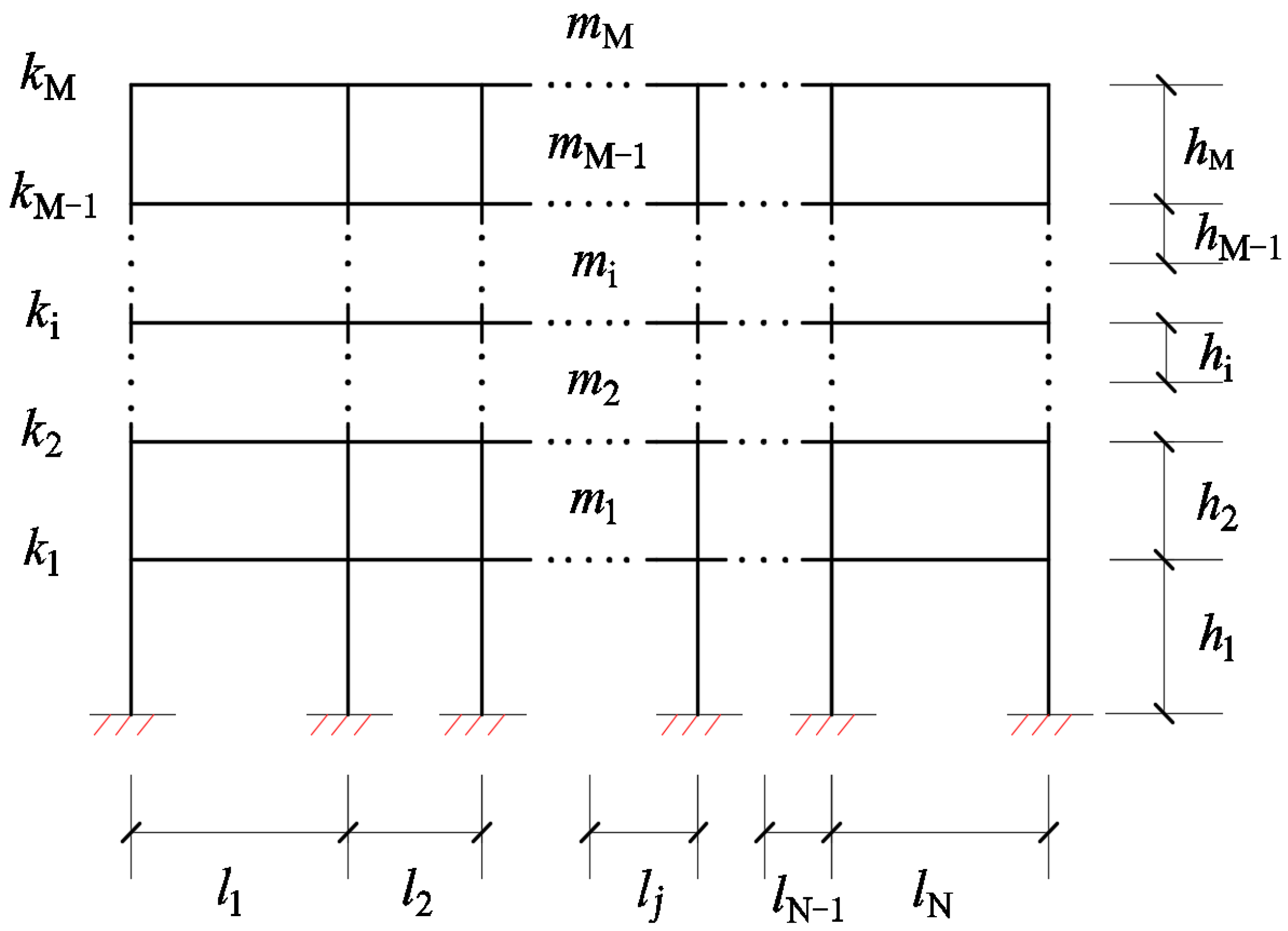
A multi-rise plane frame with M stories and N spans is shown in Figure 1. The columns on the ground floor are fixed to the foundation, and the columns are aligned vertically throughout the height. For the i-th story, the height, the beam–slab mass, and the shear stiffness are denoted by , and , (i = 1, …, M). The span of the j-th bay is denoted by (j = 1, …, N). The horizontal load at the i-th story is (i = 1, …, M), and it is applied to the beam at each story.
Figure 1.
Plane frame model.
By neglecting the axial deformation of columns under horizontal loads, the relative horizontal displacement of each story can be calculated using the equivalent static load method based on the D-value method [24,25]. The linear stiffness of the beam in the j-th bay at the i-th story is given by
where E is the elastic modulus of the beam, and is the span length. For an edge beam, ; for an interior beam, , where denotes the moment of inertia of the beam section.
The lateral stiffness of the column in the j-th bay at the i-th story can be calculated by
where is the column height, denotes the column linear stiffness. is the modification factor, which is calculated as follows:
bottom-story column:
columns in the upper stories:
where is the ratio of the combined linear stiffness of the beams connected to the columns. For a bottom-story column, , for a column in the upper stories, . Accordingly, the total lateral stiffness of the columns at i-th story is given by
The story shear forces can be obtained from the horizontal loads acting on each story as
The top-story lateral displacement of the frame can be calculated using the D-value method as
3. ACQPSO Optimization Algorithm
In what follows, a seven-story, five-span (M = 7, N = 5) reinforced concrete plane frame is used as an example to illustrate the optimization procedure using the ACQPSO algorithm. The span length of the odd-numbered bays is denoted by , while that of the even-numbered bays is . The first-story height is , and the remaining story heights are . The optimization objective is to minimize the top-story lateral displacement . The design variables include the concrete strength grade , the edge-span length , and the first-story height . Due to site limitations, the total height and total span length of the frame are the kept parameters. Therefore, and . The ranges of the design variables are listed in Table 1.
Table 1.
Design variables and their ranges.
The optimization model is formulated as
where denotes the top-story lateral displacement, which is calculated using the D-value method. Here, and represent the current iteration number and the maximum number of iterations, respectively.
The optimization procedure is summarized as follows:
Step 1: Set the optimization dimension to 3, the population size to 5, the maximum number of iterations to 100, and the assimilation coefficient to 2. The position of each particle represents a specific combination of the design variables. Initialize the position of each particle and its personal-best position:
where 0 is the initial parameters, L is the potential-well length, and .
Step 2: Compute the global mean best position of the swarm:
where Q is the swarm size, and t is the current iteration index.
Step 3: Compute the initial top-story displacement for each particle. Then determine the initial personal-best position and the initial global-best position .
Step 4: Update the position of each particle:
where is the contraction–expansion factor. Let and be uniformly distributed random numbers in the interval (0, 1). The value of is calculated as follows:
Step 5: Compute the top-story lateral displacement for each updated particle and identify the global-best particle.
Step 6: Assimilate the remaining particles using the following equation to generate a new swarm:
where () is a uniformly distributed random function, is the assimilation coefficient greater than 1, is the distance between a particle and the global-best particle, and V is the direction vector from the particle to the global-best particle.
Step 7: Compare the assimilated particles one by one. If any particle achieves a better objective value than the current global-best particle, update the global-best particle accordingly.
Step 8: Check whether the current iteration number reaches the preset maximum number of iterations . If not, increment the iteration number by 1 and return to Step 3 to continue the loop. If the current iteration number reaches the maximum iteration number , terminate the iteration and output the final optimal value and the global-best position . The algorithm then ends.
4. Comparative Examples and Parametric Analysis
4.1. Comparative Examples
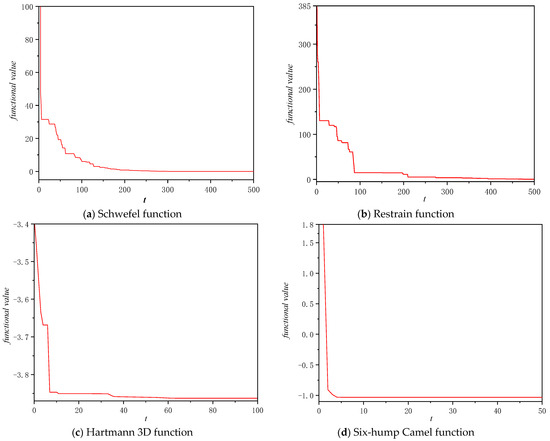
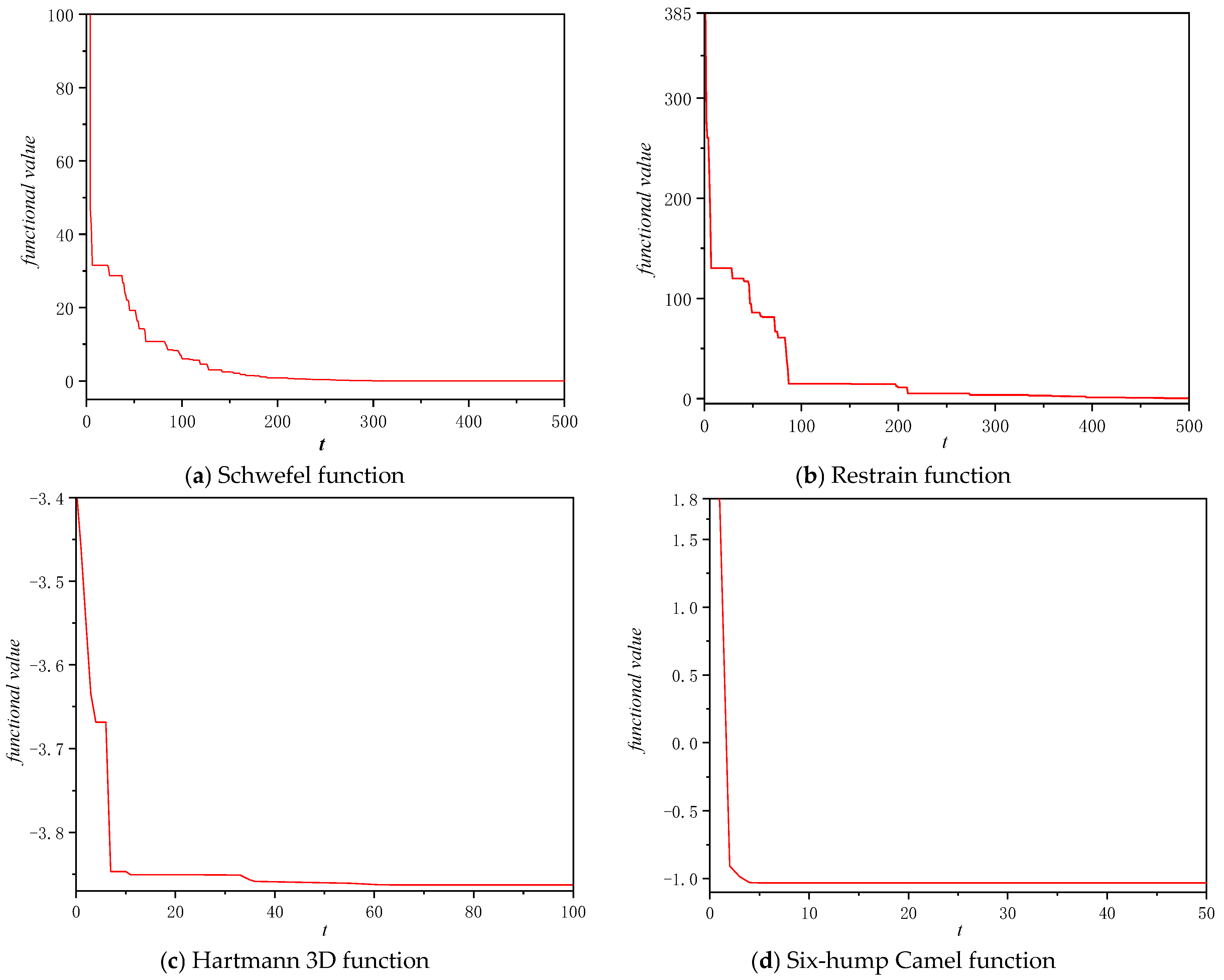
First, to evaluate the ACQPSO algorithm, four benchmark test functions are selected. Table 2 presents the relevant information for the functions. These four benchmark functions are optimized using ACQPSO, and the results are compared with those obtained by the GWO algorithm [25]. Table 3 and Figure 2 present the comparison results. In the tests, the problem dimension is set in the range of 2–30, and the population size is set to 30. The contraction–expansion factor decreases linearly from 1.0 to 0.5, and the assimilation coefficient is set to = 2.
Table 2.
Basic information on the test functions.
Table 3.
Test results of the test functions.
Figure 2.
Optimization processes of the four benchmark functions.
As shown in Figure 2, the Rastrigin function and Schwefel function contain many local optima. They are therefore used to examine whether the algorithm tends to be trapped in local solutions. By contrast, the Hartmann 3D function and Six-hump Camel function are suitable for evaluating the convergence speed. These functions can indicate whether the algorithm approaches the optimum rapidly with a relatively small number of iterations. As shown in Table 3, the results obtained in this study are close to those reported in Ref. [26]. Overall, both the numerical results and the convergence curves indicate that ACQPSO achieves better optimization performance. This suggests that incorporating the assimilation–competition mechanism into QPSO can effectively improve convergence speed and global search capability. It also helps the algorithm avoid being trapped in local optima. These observations confirm the effectiveness of the proposed algorithm.
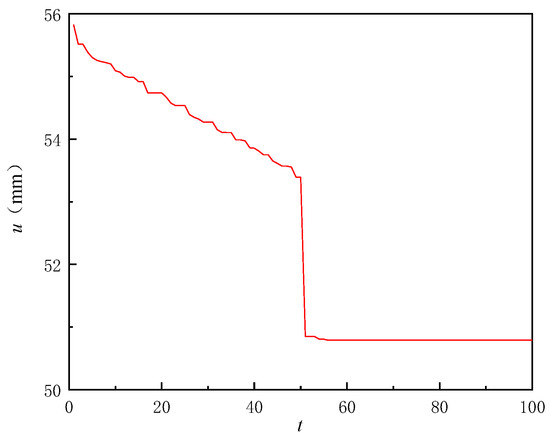
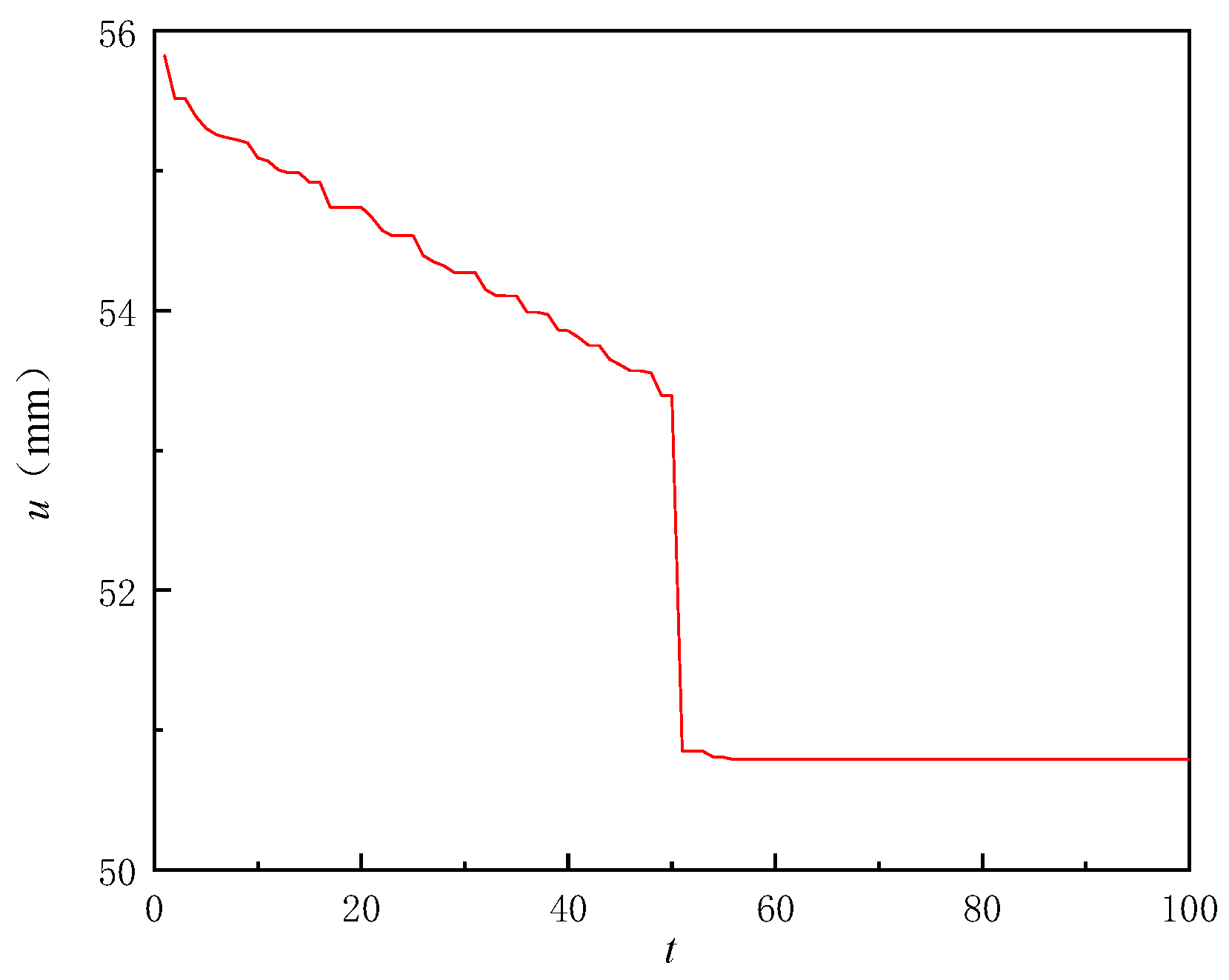
Then, the above plane frame structure under horizontal seismic action is optimized using ACQPSO. The fundamental natural period of the structure is set to 0.69 s, the site characteristic period is 0.35 s, and the maximum horizontal seismic coefficient is . The brick wall thickness is 200 mm, with a unit weight of = 18 kN/m3; the concrete slab thickness is 200 mm, with a unit weight of 25 kN/m3; the cement–sand mortar plaster thickness is 20 mm, with a unit weight of 20 kN/m3. The seismic load is simplified as a static load [27] applied to the beams at each story. The expression of is provided in Appendix A. The beam concrete strength grade is C30. The cross-sectional dimensions of the edge beams and interior beams are 300 mm × 600 mm and 300 mm × 400 mm, respectively. The column cross-section is 600 mm × 600 mm. The mechanical properties of concrete are listed in Table 4. Regarding the reinforcement details of structural members, the slab reinforcement was arranged as 8@200. For columns, the longitudinal reinforcement consisted of 16 22 bars, with 4 25 corner bars, and the stirrups were arranged as 8@100/200. For beams, the longitudinal reinforcement consisted of 3 22, 4 22, 4 22, and 4 16 bars. The stirrups were arranged as 8@100(2) and 8@100/200(2). In addition, the torsional reinforcement was N6 12, and the waist reinforcement was G6 12. In the optimization, the population size is set to 5 and the maximum number of iterations is = 100. The contraction–expansion factor decreases linearly from 1.0 to 0.5 with iteration, and the assimilation coefficient is set to = 2. Figure 3. shows the convergence history, and Table 5 summarizes the optimal results.
Table 4.
Concrete performance parameters.
Figure 3.
ACQPSO optimization process.
Table 5.
Optimization results of the plane frame.
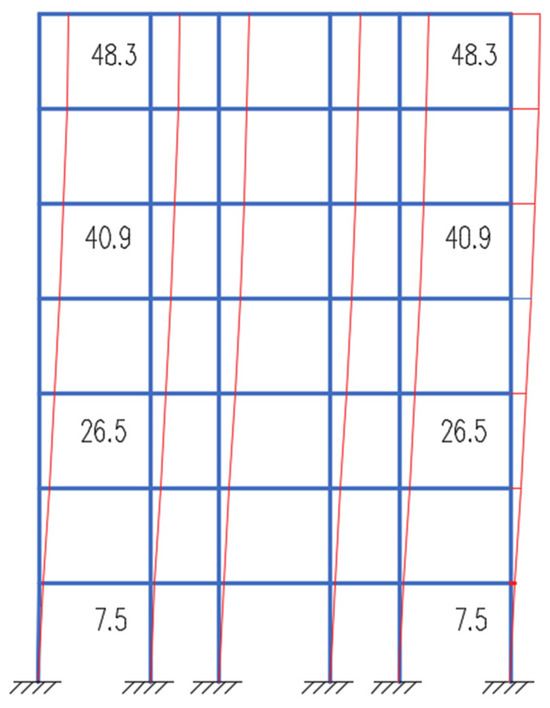
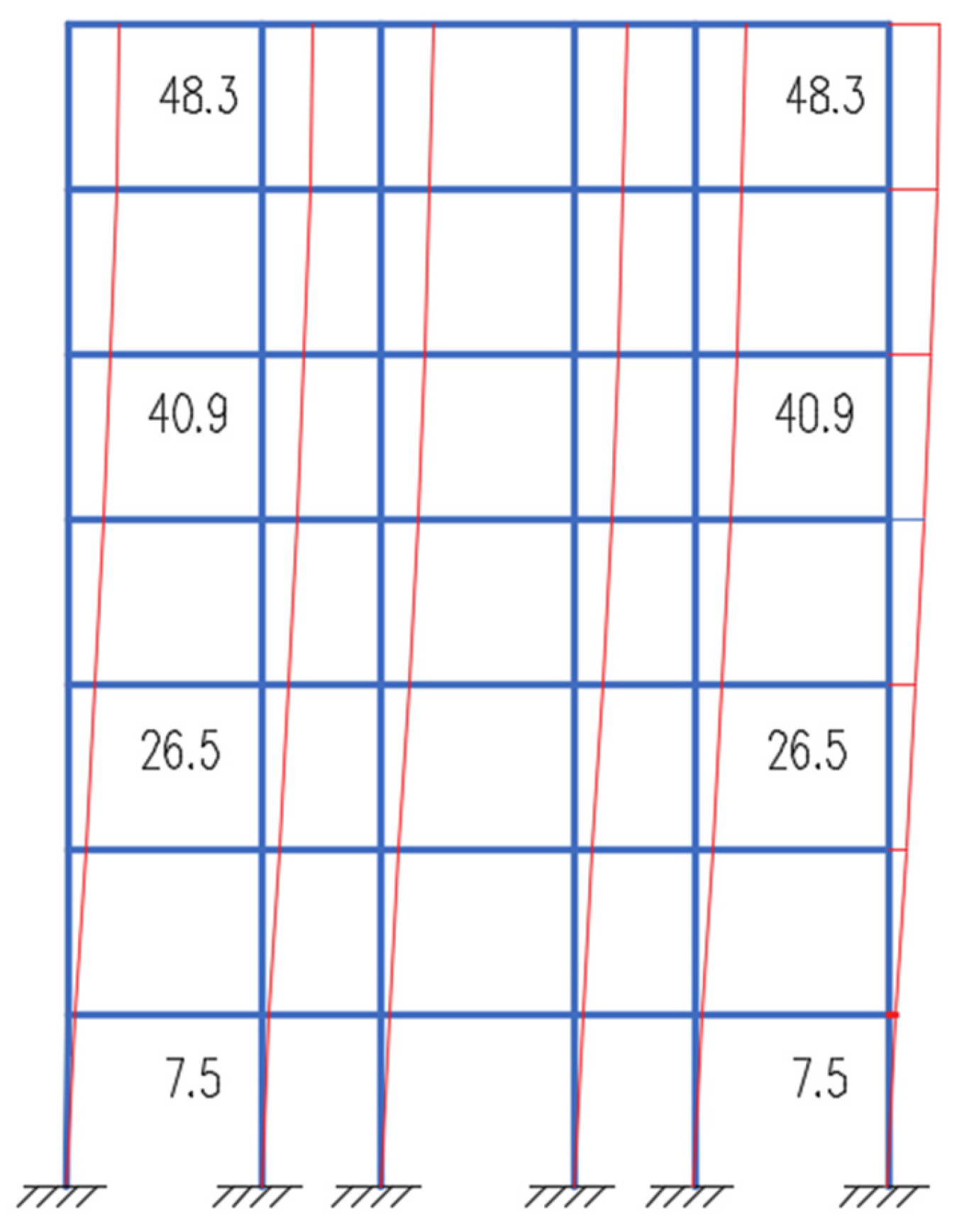
To further verify the accuracy of the proposed method, the plane frame with the optimal design parameters is analyzed using the finite element software of PKPMV2.2.1. The results are then compared with those obtained from the D-value method used in this study. The selected variable combination is = , = 6.0 m, and = 5.0 m. The story-wise lateral displacements calculated by PKPM are shown in Figure 4, while the top-story lateral displacements obtained by the two methods are listed in Table 5.
Figure 4.
Nodal displacement diagram under seismic action (mm).
As shown in Table 6, the error between the D-value method and the Finite Element Method (PKPM) is 4.846%, indicating a relatively small deviation. The displacement obtained by the D-value method is slightly larger than that from the finite element analysis, which can mainly be attributed to two factors. First, the D-value method was used to calculate the lateral displacement response of the frame building, whereas the FEM analysis was performed only on one selected five-span, seven-story plane frame. Second, as a simplified analytical method, the D-value method usually adopts equivalent simplifications in interstory drift analysis, including member stiffness, inflection point positions, overall deformation compatibility, and story shear distribution. Therefore, it cannot fully capture the beam–column interaction, the global slab effect, or the influence of structural detailing on lateral stiffness. In contrast, the FEM can account more comprehensively for deformation compatibility and internal-force redistribution. It can also represent the stiffness distribution and boundary constraints in greater detail, thereby providing displacement results that are closer to the numerical model response.
Table 6.
Comparison of top-story lateral displacement calculated by FEM and the D-value method.
4.2. Parametric Analysis
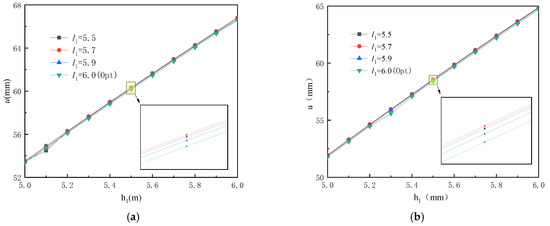
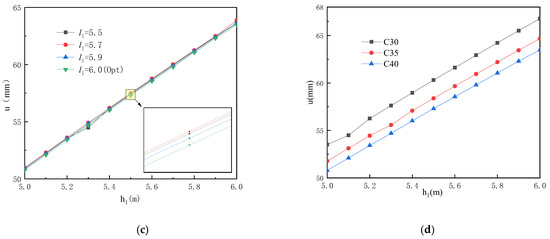
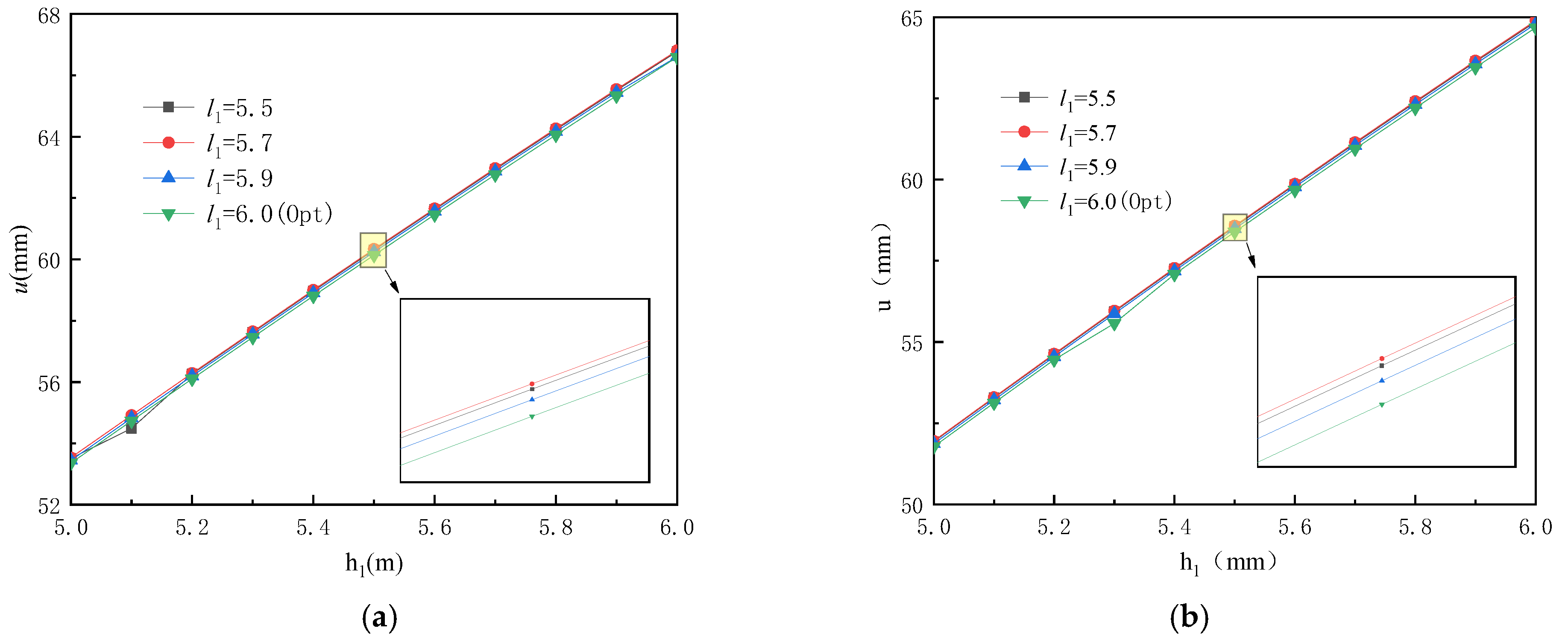
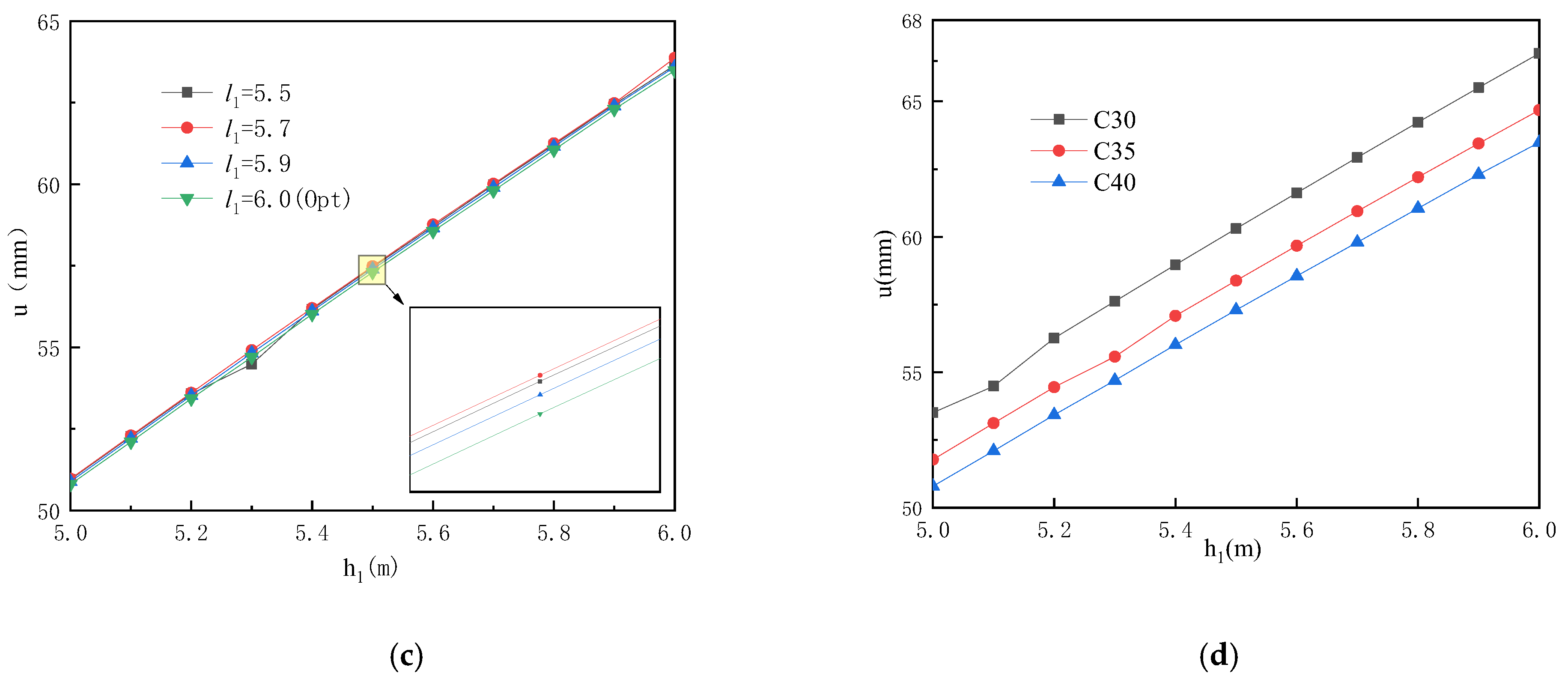
Figure 5 shows how the top-story lateral displacement varies with the design variables. When the concrete strength grade is C40, = 6.0 m, and = 5.0 m, the minimum top-story lateral displacement is 50.76 mm. This indicates that the frame has the greatest overall stiffness and the most stable structural response under this parameter combination. In addition, when the story height decreases from 6 m to 5 m, the column concrete strength grade increases from C30 to C40, and the span length increases from 5.5 m to 6.0 m, the top-story lateral displacement is reduced by 24.5%, 4.7%, and 0.3%, respectively. This indicates that story height has a pronounced influence on the top-story displacement, whereas the effect of span length is relatively small. A reduction in story height substantially increases the bending stiffness of the structure. Increasing the column concrete strength grade also improves the deformation resistance of the frame, thereby reducing the top-story displacement.
Figure 5.
Horizontal displacement curves under different strength grades. (a) Column concrete strength grade C30; (b) column concrete strength grade C35; (c) column concrete strength grade C40; (d) top-story horizontal displacement for different concrete strength grades under the optimal span length.
Table 7 summarizes the effects of beam strength grade, short-span beam cross-sectional dimensions, column cross-sectional dimensions, and wall thickness on the top-story displacement. The results show that, under all considered conditions, the optimal combination of column concrete strength grade, span length, and first-story height remains C40, 6.0 m, and 5.0 m, respectively. When the wall thickness increases from 200 mm to 240 mm, the top-story displacement increases by 2.2%. This is mainly because a thicker wall increases the gravity load, which leads to a larger displacement. When the interior beam section increases from 300 mm × 400 mm to 300 mm × 600 mm, the top-story displacement decreases by about 14%. Increasing the beam strength grade from C30 to C40 changes the top-story displacement by about 3%. When the column section increases from 550 mm × 550 mm to 650 mm × 650 mm, the top-story displacement decreases by about 30.8%. Overall, these changes are attributed to the increase in structural stiffness, which improves structural stability.
Table 7.
Optimized results under different conditions.
Based on the above analysis of the optimization results, the top-story lateral displacement is primarily affected by the cross-sectional dimensions of beams and columns, while the influence of beam strength grade and wall thickness is comparatively minor.
5. Conclusions
This study proposes an optimization method for high-rise planar frames based on the ACQPSO algorithm, and a seven-story, five-bay planar frame is adopted as the illustrative case. The optimization is performed with the objective of minimizing the top-story lateral displacement, while the concrete strength grade of columns, the side-span length, and the first-story height are selected as the design variables. Further numerical analyses are conducted to investigate the influence of these factors on the optimization results. It should be noted that, although the present study focuses on a two-dimensional high-rise planar frame, the proposed ACQPSO algorithm is a general optimization method and is not limited to two-dimensional structures. When combined with a three-dimensional spatial analysis model, the algorithm can also be applied to the optimal design of three-dimensional frames and more complex spatial structures, thereby providing a reference for future studies on related three-dimensional structural problems. The main conclusions are summarized as follows:
- (1)
- Numerical simulations on four representative benchmark functions show that the optimization results obtained by the proposed method are comparable to those of GWO. The proposed ACQPSO algorithm can identify the optimal solution accurately and efficiently.
- (2)
- The optimal design parameters for the column concrete strength grade, edge-span length, and first-story height are C40, 6 m, and 5 m, respectively. In addition, the beam and column cross-sectional dimensions have a pronounced effect on the top-story lateral displacement, whereas the effects of beam strength grade and wall thickness are relatively small. These factors act independently of each other.
- (3)
- Story height and column concrete strength grade have a significant influence on the top-story lateral displacement, whereas the effect of span length is relatively small. When the story height increases from 5 m to 6 m, the column concrete strength grade decreases from C40 to C30, and the span length increases from 5.5 m to 6.0 m, the top-story lateral displacement increases by 24.5%, 4.7%, and 0.3%, respectively. Therefore, within the considered design ranges, more attention should be paid to variations in story height and column concrete strength grade. Proper optimization of these parameters can improve the lateral stiffness of the frame and enhance structural safety and stability.
Author Contributions
J.Z.: Formal analysis, the main analysis, preprocessing, Writing—original draft. L.W.: Data curation, investigation, validation, Writing—original draft. H.F.: Writing—review and editing, literature collection, preparation of figures and tables. W.C.: Writing—review and editing, literature collection, preparation of figures and tables. X.H.: Methodology, Project administration, Writing—review and editing, Funding acquisition. All authors have read and agreed to the published version of the manuscript.
Funding
The present research is funded by the Natural Science Foundation of Guangxi [No. 2025GXNSFAA069217] and the National Undergraduate Innovation Program [No. 202410595058]. The authors are grateful for this support.
Data Availability Statement
The original contributions presented in this study are included in the article. Further inquiries can be directed to the corresponding author.
Conflicts of Interest
The authors declare no conflicts of interest.
Appendix A
In Equation (6),the horizontal seismic load at story i (i = N) under horizontal seismic action is given by (i = N):
where Hi is the height from the floor of story i to the top surface of the foundation, and is an additional coefficient. If , then ; if , then . denotes the standard value of the total horizontal seismic effect of the structure, which is calculated as follows:
where is the representative value of the gravity load at story i.
References
- Kaveh, A.; Zakian, P. Improved GWO algorithm for optimal design of truss structures. Eng. Comput. 2018, 34, 685–707. [Google Scholar] [CrossRef] [Scilit]
- Li, Y.; Lin, X.; Liu, J. An improved gray wolf optimization algorithm to solve engineering problems. Sustainability 2021, 13, 3208. [Google Scholar] [CrossRef] [Scilit]
- Dong, J.; Yuan, X.; Wang, M. Competitive binary multi-objective grey wolf optimizer for fast compact antenna topology optimization. Front. Inf. Technol. Electron. Eng. 2022, 23, 1390–1406. [Google Scholar] [CrossRef] [Scilit]
- Kandiri, A.; Sartipi, F.; Kioumarsi, M. Predicting compressive strength of concrete containing recycled aggregate using modified ANN with different optimization algorithms. Appl. Sci. 2021, 11, 485. [Google Scholar] [CrossRef] [Scilit]
- Kennedy, J.; Eberhart, R. Particle swarm optimization. In Proceedings of the ICNN’95—International Conference on Neural Networks, Perth, WA, Australia, 27 November–1 December 1995; Volume 4, pp. 1942–1948. [Google Scholar]
- Trelea, I.C. The particle swarm optimization algorithm: Convergence analysis and parameter selection. Inf. Process. Lett. 2003, 85, 317–325. [Google Scholar] [CrossRef] [Scilit]
- Perez, R.E.; Behdinan, K. Particle swarm approach for structural design optimization. Comput. Struct. 2007, 85, 1579–1588. [Google Scholar] [CrossRef] [Scilit]
- Luh, G.C.; Lin, C.Y. Optimal design of truss-structures using particle swarm optimization. Comput. Struct. 2011, 89, 2221–2232. [Google Scholar] [CrossRef] [Scilit]
- Hu, W.; Zhang, Y.; Liu, L.; Zhang, P.; Qin, J.; Nie, B. Study on multi-objective optimization of construction project based on improved genetic algorithm and particle swarm optimization. Processes 2024, 12, 1737. [Google Scholar] [CrossRef] [Scilit]
- Yazd, H.G.H.; Arabshahi, S.J.; Tavousi, M.; Alvani, A. Optimal designing of concrete gravity dam using particle swarm optimization algorithm (PSO). Indian J. Sci. Technol. 2015, 8, 1. [Google Scholar] [CrossRef] [Scilit]
- Li, Y.; Duan, R.-B.; Li, Q.-S.; Li, Y.-G.; Huang, X. Wind-resistant optimal design of tall buildings based on improved genetic algorithm. Structures 2020, 27, 2182–2191. [Google Scholar] [CrossRef] [Scilit]
- Li, Y.; Zhou, J.; Chen, F.; Sun, M. An improved particle swarm optimization for wind resistance performance design of high-rise buildings. Adv. Wind Eng. 2025, 2, 100053. [Google Scholar] [CrossRef] [Scilit]
- Hu, H.; Fan, X.; Wang, C. Energy efficient clustering and routing protocol based on quantum particle swarm optimization and fuzzy logic for wireless sensor networks. Sci. Rep. 2024, 14, 18595. [Google Scholar] [CrossRef] [Scilit] [PubMed]
- Lou, H.; Xiao, Z.; Wan, Y.; Quan, G.; Jin, F.; Gao, B.; Lu, H. Size optimization design of members for shear wall high-rise buildings. J. Build. Eng. 2022, 61, 105292. [Google Scholar] [CrossRef] [Scilit]
- Gholizadeh, S. Optimum design of structures by an improved particle swarm algorithm. Asian J. Civ. Eng. 2010, 11, 777–793. [Google Scholar]
- Fourie, P.C.; Groenwold, A.A. The particle swarm optimization algorithm in size and shape optimization. Struct. Multidiscip. Optim. 2002, 23, 259–267. [Google Scholar] [CrossRef] [Scilit]
- Wang, S. Wind resistance performance optimization of PSO algorithm in skyscrapers design. Sustain. Build. 2025, 8, 2. [Google Scholar] [CrossRef] [Scilit] [PubMed]
- Sun, J.; Xu, W.; Feng, B. Adaptive parameter control for quantum-behaved particle swarm optimization on individual level. In Proceedings of the 2005 IEEE International Conference on Systems, Man and Cybernetics, Waikoloa, HI, USA, 12 October 2005; Volume 4, pp. 3049–3054. [Google Scholar]
- Sun, J.; Xu, W.; Fang, W. Quantum-behaved particle swarm optimization with a hybrid probability distribution. In Proceedings of the Pacific Rim International Conference on Artificial Intelligence, Guilin, China, 7–11 August 2006; pp. 737–746. [Google Scholar]
- Wang, F.W.; Qian, K.; Zhang, R.; Jiang, L. Application of QPSO algorithm in aeroengine performance optimization. In Proceedings of the 2021 IEEE 2nd International Conference on Information Technology, Big Data and Artificial Intelligence (ICIBA), Chongqing, China, 17–19 December 2021; IEEE: Piscataway, NJ, USA, 2021; Volume 2, pp. 1–4. [Google Scholar]
- Miao, Y.; Chen, J. Predicting the High-rise building construction project safety risk based on QPSO-SVM model. Comput. Model. New Technol. 2013, 17, 179–182. [Google Scholar]
- Omkar, S.; Khandelwal, R.; Ananth, T.; Naik, G.N.; Gopalakrishnan, S. Quantum-behaved particle swarm optimization (QPSO) for multi-objective design optimization of composite structures. Expert Syst. Appl. 2009, 36, 11312–11322. [Google Scholar] [CrossRef] [Scilit]
- Cheng, W.; Qin, Y.; Gu, J.; Gao, H.; Yan, Y.; Yang, J.; Chen, Y.; Su, S.; Yang, K. Improved quantum-behaved particle swarm method for optimizing complex thin plate structure. KSCE J. Civ. Eng. 2023, 27, 1672–1681. [Google Scholar] [CrossRef] [Scilit]
- Mu, Z.; Xu, Y.; Yang, Y.; Fan, Z. Study of Effective Length Factor of Frame–Core Wall Structure with Cross-Layer Columns. Appl. Sci. 2023, 13, 6875. [Google Scholar] [CrossRef] [Scilit]
- Chen, C.K. Seismic Analysis of Building Frames with Semirigid Connections. In Proceedings of the 8th World Conference on Earthquake Engineering, San Francisco, CA, USA, 21–28 July 1984; Volume 5, pp. 725–732. [Google Scholar]
- Mirjalili, S.; Mirjalili, S.M.; Lewis, A. Grey wolf optimizer. Adv. Eng. Softw. 2014, 69, 46–61. [Google Scholar] [CrossRef] [Scilit]
- GB/T 50011—2010; Standard for Seismic Design of Buildings. China Architecture & Building Press: Beijing, China, 2024. (In Chinese)

Disclaimer/Publisher’s Note: The statements, opinions and data contained in all publications are solely those of the individual author(s) and contributor(s) and not of MDPI and/or the editor(s). MDPI and/or the editor(s) disclaim responsibility for any injury to people or property resulting from any ideas, methods, instructions or products referred to in the content. |
© 2026 by the authors. Licensee MDPI, Basel, Switzerland. This article is an open access article distributed under the terms and conditions of the Creative Commons Attribution (CC BY) license.