Article

Multimodal Evidence of How Indoor CO2 Concentration Impairs Office Task Efficiency: Behavioral and EEG Insights


1
Department of Management Science and Engineering, School of Geographic Science and Planning, Huaiyin Normal University, Huai’an 223300, China
2
Department of Management Science and Engineering, School of Management, Shanghai University, Shanghai 200444, China
3
Department of Urban Planning and Design, The University of Hong Kong, Hong Kong 999077, China
*
Author to whom correspondence should be addressed.
Buildings 2026, 16(11), 2210; https://doi.org/10.3390/buildings16112210
Submission received: 17 April 2026 / Revised: 17 May 2026 / Accepted: 27 May 2026 / Published: 30 May 2026

Abstract

Indoor carbon dioxide (CO2) concentration significantly influences office workers’ cognitive performance, yet the neurobehavioral mechanisms linking exposure to task efficiency remain insufficiently understood. This study investigates how varying indoor CO2 concentrations (500, 1000, and 2500 ppm) impact task efficiency (accuracy and reaction time) through neurophysiological pathways grounded in Cognitive Load Theory. Using a within-subject repeated-measures design, 20 participants performed three office tasks—numerical verification, text entry, and reading comprehension—while behavioral metrics, daytime sleepiness, and electroencephalography (EEG) signals were recorded. Results demonstrate that increasing CO2 concentration monotonically decreased mean accuracy from 93.50% at 500 ppm to 80.89% at 2500 ppm, while mean reaction time rose from 2.00 s to 2.74 s. Daytime sleepiness significantly mediated the CO2–accuracy relationship. Furthermore, task type significantly moderated this effect (β = −6.182, p = 0.0289), with accuracy declines being more pronounced in tasks with higher intrinsic cognitive demand. EEG spectral analysis corroborated these findings, revealing systematic reductions in beta and theta power under elevated CO2. These findings indicate that CO2 acts as an extraneous cognitive load interacting with intrinsic task demands, providing a neurobehavioral basis for developing cognitive-aware environmental control strategies in intelligent buildings.

1. Introduction

Indoor Environmental Quality (IEQ) is widely recognized as a critical determinant of occupants’ health, comfort, and productivity in office environments [1]. Among IEQ parameters, carbon dioxide (CO2) concentration serves not only as a key indicator of ventilation adequacy but has also been increasingly examined for its potential direct effects on cognitive performance. Experimental evidence suggests that elevated CO2 exposure may impair working memory, sustained attention, and decision-making ability [2,3]. In contemporary office settings, indoor CO2 concentrations commonly range between 600 and 1200 ppm [4], highlighting the practical importance of understanding whether such exposure levels meaningfully influence task performance. However, despite the growing body of empirical findings, the neurocognitive mechanisms through which CO2 exposure translates into measurable performance degradation remain insufficiently clarified.
While the detrimental effects of extremely high CO2 concentrations on cognitive performance have been well documented [5], more recent research indicates that even moderate concentrations (1000–1500 ppm) may lead to measurable reductions in complex cognitive task performance [6]. Meta-analytic evidence further confirms that short-term exposure within the range of 500–2500 ppm is associated with deterioration across reasoning, memory, and language-related tasks [7]. Neurophysiological studies provide additional support: EEG analyses have reported suppression of high-frequency oscillations and enhancement of low-frequency activity under elevated CO2 exposure [8,9,10,11], suggesting altered cortical activation patterns. However, despite accumulating behavioral and electrophysiological evidence, existing findings remain fragmented. Most studies focus either on behavioral outcomes or neural responses independently, and few have integrated multimodal data to establish a coherent neurobehavioral mechanism linking CO2 exposure to task efficiency decline.
In addition to direct cognitive effects, elevated CO2 concentrations may indirectly impair task performance by inducing physiological states associated with fatigue and reduced arousal. Daytime sleepiness, characterized by diminished alertness and difficulty sustaining attention [12], has been shown to impair reaction time, executive control, and error monitoring [13,14,15,16,17,18]. Experimental evidence further suggests that CO2 exposure can increase subjective sleepiness and fatigue levels [19,20,21,22]. Nevertheless, the mediating role of daytime sleepiness in the pathway from CO2 exposure to behavioral efficiency has not been quantitatively tested within a unified experimental framework.
Moreover, task type may influence the extent to which environmental stressors affect performance outcomes. Cognitive theories, including attention resource theory [23] and Cognitive Load Theory (CLT) [24,25,26], propose that human cognitive capacity is limited and that performance efficiency depends on the allocation of working memory resources. Under this framework, environmental stressors such as elevated CO2 can be conceptualized as sources of extraneous cognitive load that compete with intrinsic task demands. When intrinsic load (task complexity) and extraneous load (environmental stress) jointly approach or exceed available cognitive capacity, performance deterioration becomes more pronounced. Empirical evidence suggests that performance under fatigue or sleepiness is more vulnerable in high-demand tasks than in low-demand tasks [27,28,29,30,31], yet whether task type moderates CO2-related cognitive impairment remains insufficiently investigated.
Therefore, although substantial research has examined the behavioral and physiological effects of indoor CO2 exposure, three critical gaps persist:
(1)
The absence of an integrated neurobehavioral evidence chain linking CO2 exposure, neural activity alteration, and task performance;
(2)
The lack of mediation modeling to quantify the indirect role of daytime sleepiness; and
(3)
Limited empirical validation of task-dependent boundary effects within real exposure conditions.
To address these gaps, this study adopts a multimodal repeated-measures experimental design integrating behavioral performance metrics (accuracy and reaction time), subjective sleepiness assessment (Stanford Sleepiness Scale), and electroencephalographic (EEG) spectral analysis under three ecologically relevant indoor CO2 concentrations (500, 1000, and 2500 ppm). Grounded in the interpretative framework of Cognitive Load Theory, we examine: (1) the direct effect of CO2 concentration on task efficiency, (2) the mediating role of daytime sleepiness, and (3) the moderating influence of task type on the sleepiness–performance relationship. By combining mediation and moderation modeling with neurophysiological validation, the present study aims not only to evaluate whether elevated CO2 exposure affects task performance, but also to explore how these effects may emerge through changes in neurophysiological activity and subjective states. By integrating EEG indicators, subjective sleepiness, behavioral performance metrics, mediation analysis, and moderation analysis within a unified experimental framework, this study attempts to open the “black box” between indoor environmental exposure and cognitive performance decline.

2. Literature Review and Research Hypotheses

2.1. Environmental CO2 Exposure and Cognitive Resource Constraint

Although prior studies have established associations between elevated indoor CO2 concentrations and reduced cognitive performance, the robustness and underlying mechanisms of these effects remain subjects of ongoing discussion. Experimental studies report significant declines in decision-making ability, attention, and complex task performance when CO2 concentrations increase to 2500 ppm or higher [8]. Importantly, recent evidence indicates that even moderate concentrations within commonly observed office ranges (1000–2500 ppm) may adversely affect higher-order cognitive processes [9]. Beyond short-term laboratory findings, longitudinal observations in natural exposure contexts provide additional ecological relevance [10]. Comprehensive critical reviews generally conclude that elevated CO2 or low-ventilation environments tend to impair cognitive performance at the population level [11]. These findings suggest that CO2 may exert direct effects on cognitive functioning rather than merely serving as a proxy for ventilation quality.
From a cognitive systems perspective, task efficiency depends on the stable allocation of attentional and working memory resources [23,32]. Empirical research consistently demonstrates that declines in attention and working memory are closely linked to reductions in occupational performance [33,34]. Therefore, if elevated CO2 concentrations disrupt neural activation and impair core cognitive functions, a corresponding decline in behavioral task efficiency would be expected.
Synthesizing the empirical evidence and cognitive resource framework, this study conceptualizes elevated indoor CO2 concentration as an environmental factor capable of constraining cognitive resource allocation and impairing task execution efficiency. Accordingly, the following hypothesis is proposed:
Hypothesis 1.
Indoor CO2 concentration negatively affects office workers’ task efficiency, resulting in reduced accuracy and prolonged reaction time.

2.2. The Mediating Role of Daytime Sleepiness in the CO2 Concentration–Performance Relationship

While Section 2.1 conceptualizes elevated indoor CO2 concentration as a constraint on cognitive resource availability, the specific pathway through which this constraint translates into performance degradation requires further clarification. One plausible intermediate mechanism is daytime sleepiness, which reflects a reduction in physiological arousal [35] and sustained attentional capacity [36]. Daytime sleepiness is characterized by diminished alertness, reduced vigilance, and increased difficulty in maintaining focused attention [12]. Extensive empirical evidence demonstrates that heightened sleepiness impairs executive control, slows reaction time, and increases error rates across cognitive tasks [13,14,15,16,17,18].
Physiological studies indicate that elevated indoor CO2 concentration can induce fatigue-related symptoms, including subjective sleepiness and altered arousal states [19,20]. Furthermore, indoor CO2 concentration has been linked to the suppression of resting-state neural activity and respiratory alterations [21,22], suggesting that elevated CO2 may promote daytime sleepiness through multi-system physiological mechanisms. EEG studies report increased subjective sleepiness and altered neural activity under elevated CO2 conditions [19], while physiological responses, including cardiovascular measurements, reveal changes in heart rate and blood pressure associated with reduced attentional maintenance [20,37,38].
In the present study, daytime sleepiness is operationally defined as the subjective state of reduced alertness, quantified using the Stanford Sleepiness Scale. Conceptually, ‘mediation’ implies a multi-stage statistical pathway where the independent environmental variable (X: controlled indoor CO2 exposure at 500, 1000, and 2500 ppm) drives variations in the mediator (M: SSS scores), which sequentially exerts a quantitative parametric effect on the dependent variables of task efficiency (Y: behavioral accuracy in % and reaction time in seconds). To establish an operationally testable dose–response framework, we conceptualize that incremental doses of CO2 exposure will systematically increase sleepiness severity (the CO2–sleepiness dose–response relationship), which in turn parameterizes a predictable decline in performance metrics. Accordingly, the following operationally testable hypotheses are proposed:
Hypothesis 2a.
Daytime sleepiness mediates the relationship between indoor CO2 concentration and accuracy; specifically, higher indoor CO2 concentration increases sleepiness, which subsequently reduces accuracy.
Hypothesis 2b.
Daytime sleepiness mediates the relationship between indoor CO2 concentration and reaction time; specifically, higher indoor CO2 concentration increases sleepiness, which subsequently prolongs reaction time.

2.3. The Moderating Role of TASK TYPE in the Sleepiness–Performance Relationship

While elevated CO2 exposure may constrain cognitive resources and daytime sleepiness may further deplete available capacity, performance outcomes are also contingent upon task-related demands. Task type determines the intrinsic cognitive load imposed on working memory and executive systems, thereby influencing how vulnerable performance is under resource-limited states [39].
McGrath reported that low task clarity tends to result in ambiguous work objectives and communication misunderstandings [40], thereby reducing task completion efficiency. Frequent task interruptions or switching have likewise been shown to cause attentional dispersion, time losses, and negative affect. According to Cognitive Load Theory (CLT), cognitive efficiency depends on the balance between intrinsic load (task complexity) and extraneous load (environmental stressors) [23,24,25,26]. When individuals operate under conditions of reduced arousal or sleepiness, available cognitive resources decline [27,28]. Under low intrinsic load tasks, the remaining resources may still suffice to sustain acceptable performance. In contrast, under high intrinsic load tasks, the combined effects of intrinsic and extraneous load may exceed cognitive capacity, leading to disproportionately greater performance deterioration
Empirical evidence supports this interaction pattern. Research has shown that sleepiness and fatigue impair executive control and working memory more severely in complex tasks than in simple reaction tasks [29,30,31]. Task type such as complexity, continuity, and demand for cognitive integration influences the degree to which reduced arousal translates into observable efficiency loss [41,42,43]. Therefore, task type may moderate the impact of daytime sleepiness on behavioral outcomes by regulating intrinsic load levels.
Furthermore, “moderation” by task type is operationally evaluated through the statistical interaction effect between the continuous mediator (SSS score) and the categorical moderator (Task Type: numerical verification, text entry, and reading comprehension, which represent varying levels of intrinsic cognitive workload). Mechanistically, a moderation effect implies that the parametric slope representing the impact of sleepiness on task performance is non-equivalent across task contexts, being significantly steeper for tasks with higher intrinsic cognitive demands. Accordingly, the following operationally testable hypotheses are proposed:
Hypothesis 3a.
Task type moderates the effect of daytime sleepiness on task accuracy.
Hypothesis 3b.
Task type moderates the effect of daytime sleepiness on reaction time.

2.4. Conceptual Model of Indoor CO2 Concentration Effects on Task Efficiency

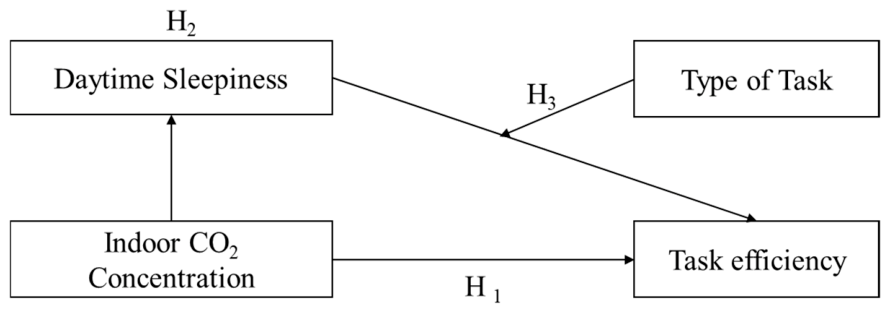
Based on the theoretical reasoning presented in Section 2.1, Section 2.2 and Section 2.3, this study proposes a conceptual model describing the mechanism through which indoor CO2 concentration influences office task efficiency (Figure 1). In this model, indoor CO2 concentration is specified as the independent variable, task efficiency (measured by accuracy and reaction time) as the dependent variable, daytime sleepiness as the mediating variable, and task type as the moderating variable. The model integrates both direct and indirect pathways.
First, elevated CO2 concentrations are hypothesized to directly constrain cognitive resource availability, leading to reduced task efficiency (H1). Second, CO2 exposure is expected to increase daytime sleepiness, which in turn depletes attentional and working memory resources, thereby indirectly impairing performance (H2). Third, task type regulates intrinsic cognitive load and moderates the relationship between sleepiness and task efficiency (H3a, H3b).

3. Materials and Methods

3.1. Experimental Design

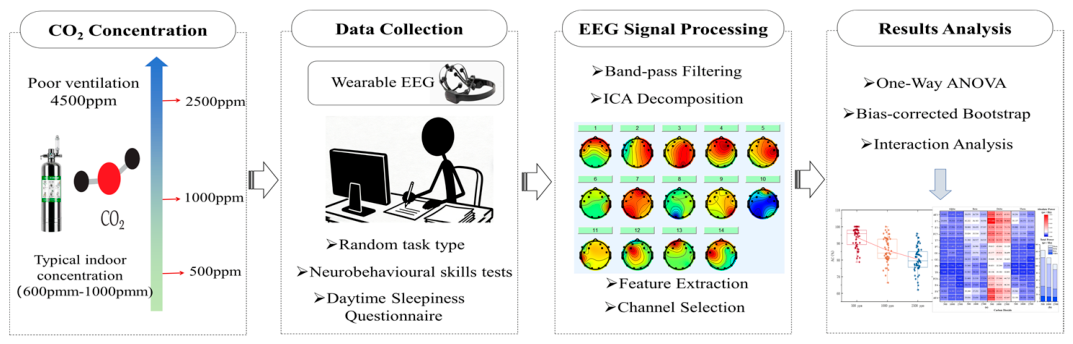
This study employed a 3 × 3 within-subject repeated-measures design. The first factor was indoor CO2 concentration (500 ppm, 1000 ppm, and 2500 ppm), and the second factor was task type (numerical verification, text entry, and reading comprehension). All participants completed all experimental conditions. The research framework of the proposed study is illustrated in Figure 2. The numbers 1–14 denote the 14 independent components (ICs) decomposed by ICA; each topography map shows the spatial weight distribution of one IC across all EEG channels.
The within-subject design was adopted to minimize inter-individual variability in cognitive performance and neural responses. The order of CO2 exposure conditions and task presentation was randomized across participants to minimize potential order, learning, and carryover effects. Prior to the formal experiment, all participants completed practice trials to familiarize themselves with the experimental tasks and procedures, thereby reducing practice-related performance improvement during the formal sessions.
To mitigate fatigue accumulation and attentional decline associated with the relatively long experimental duration, short rest intervals (5–10 min) were provided between consecutive experimental conditions in a well-ventilated resting environment. Participants were also allowed to temporarily pause the experiment if they experienced noticeable discomfort or excessive fatigue. In addition, the within-subject repeated-measures design ensured that each participant experienced all exposure conditions under counterbalanced sequences, which helped minimize systematic bias caused by time-related effects.
Although residual fatigue or time effects cannot be completely excluded in long-duration laboratory experiments, the above procedures were implemented to minimize their influence and improve the internal validity of the observed CO2-related effects.
Task efficiency, operationalized as accuracy and reaction time, served as the primary dependent variables. Daytime sleepiness was treated as a mediating variable, and task type was examined as a moderator in the sleepiness–task efficiency relationship.

3.2. Participants

Twenty healthy university students (aged 18–26 years) participated in the experiment. All participants had normal or corrected-to-normal vision and right-handedness to ensure consistency in neurophysiological recordings. Prior to participation, subjects were instructed to wash hair, maintain regular sleep and dietary habits and to avoid strenuous physical activity.
A priori power analysis was conducted using G*Power 3.1 (α = 0.05, Cohen’s f = 0.4) indicating that a sample size of 20 provided statistical power exceeding 0.95 for detecting medium-to-large effects in repeated-measures designs. All participants provided informed consent, and the experimental protocol was approved by the institutional ethics committee (ECSHU 2025–228).

3.3. Experiment Procedure

A 3 (Indoor CO2 concentration: 500, 1000, 2500 ppm) × 3 (Task type: numerical verification, text entry, reading comprehension) within-subject repeated measures design was employed. Each participant completed all nine experimental conditions. Task efficiency was operationalized as the accuracy and reaction time obtained from six neurobehavioral tests (Table 1). The three indoor CO2 concentration levels represent an ideal ventilation baseline (500 ppm), a typical office threshold (1000 ppm), and a poorly ventilated high-exposure condition (2500 ppm). The selected task types (Table 2)—numerical verification, text entry, and reading comprehension—reflect common office activities [44,45,46], enabling the examination of task efficiency and neural responses across distinct task contexts.
Environmental conditions were continuously monitored throughout the experiment to reduce potential confounding influences from thermal comfort or ventilation-related variations. Therefore, indoor CO2 concentration served as the primary manipulated environmental variable in the present study.
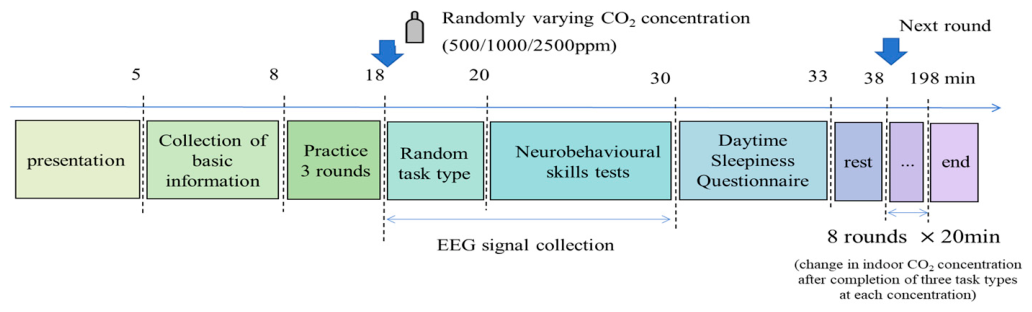
The total experimental session lasted approximately 198 min, including practice trials and rest intervals. After completing demographic registration and practice sessions to ensure task familiarity, participants entered the formal experimental phase. Each condition consisted of a 20 min task session under a specific indoor CO2 concentration, followed by neurobehavioral testing and the assessment of daytime sleepiness using the Stanford Sleepiness Scale (SSS) [47]. Indoor CO2 concentrations were adjusted using a controlled indoor environmental system and randomized across sessions to minimize order effects. Short breaks (5–10 min) were provided between conditions in a well-ventilated room to reduce fatigue accumulation and potential carryover effects.
To ensure that the observed cognitive and neurophysiological responses were primarily associated with variations in indoor CO2 concentration, other major indoor environmental parameters were maintained as stable as possible throughout the experiment. During all experimental sessions, indoor air temperature was maintained within the thermal comfort range (approximately 24–26 °C), relative humidity was controlled at approximately 40–60%, and indoor air velocity was kept at a low and stable level to minimize draft-related discomfort. The experimental chamber was mechanically ventilated, and CO2 concentration was adjusted through a controlled indoor environmental regulation system while other environmental parameters remained relatively constant across conditions.
Behavioral responses (accuracy and reaction time) were recorded using E-Prime 2.0 software. EEG signals were collected using the EMOTIV EPOC X system to capture neural activity during task execution. The overall experimental procedure is illustrated in Figure 3.

3.4. EEG Data Acquisition and Processing

EEG signals were recorded using the Emotiv EPOC X wireless headset with 14 scalp electrodes positioned according to the international 10–20 system (AF3, F7, F3, FC5, T7, P7, O1, O2, P8, T8, FC6, F4, F8, and AF4). The sampling rate was 128 Hz. Raw EEG data were preprocessed using EEGLAB toolbox and the ADJUST plugin in MATLAB R2023a. Signals were band-pass filtered between 1 and 30 Hz to remove slow drifts and high-frequency noise. Ocular and motion artifacts were identified and removed using Independent Component Analysis (ICA). Residual artifacts exceeding ±100μV were excluded from further analysis. Power Spectral Density (PSD) was computed using Fast Fourier Transform (FFT) for each experimental condition. Absolute power values were extracted for standard frequency bands: delta (1–4 Hz), theta (4–8 Hz), alpha (8–13 Hz), and beta (13–30 Hz). EEG preprocessing yielded a total of 3528 valid spectral data observations, providing a robust data foundation for subsequent statistical analysis. This total was derived from the product of four core dimensions: the number of valid participants, the three indoor CO2 concentration conditions, the 14 EEG channels, and the number of valid 1 s segments per participant per condition. Specifically, after excluding unqualified participants and artifact-laden epochs, the final dataset was constructed to ensure comprehensive coverage across all experimental variables and neural pathways.

3.5. Statistical Analysis

All statistical analyses were conducted using SPSS (Version 4). In the analytical framework of the present study, indoor CO2 concentration was treated as the primary independent environmental exposure variable. Subjective sleepiness, measured using self-reported sleepiness ratings collected after each exposure condition, was treated as the mediator variable representing reduced alertness and attentional readiness. EEG spectral indicators were treated as neurophysiological variables reflecting changes in neural activation patterns under different exposure conditions, while behavioral performance indicators, including task accuracy and response time, were treated as dependent variables representing task-efficiency outcomes.
Given the within-subject repeated-measures design, repeated-measures ANOVA was performed to examine the direct effects of CO2 concentration on task efficiency (accuracy and reaction time), followed by post hoc comparisons where appropriate. Pearson correlation analysis was conducted to verify associations among key variables.
To evaluate the indirect pathway between CO2 exposure and task performance, mediation analysis was performed using subjective sleepiness as the mediator variable. The mediation model examined: (1) the association between CO2 exposure and subjective sleepiness, (2) the association between subjective sleepiness and task performance, and (3) the indirect effect of CO2 exposure on behavioral performance outcomes. To formally quantify the dose–response relationship between CO2 exposure and daytime sleepiness, and the subsequent quantitative parametric effects on task performance, a path-analytic mediation framework was implemented using regression modeling with bias-corrected bootstrapping (5000 resamples). The parametric relationships were evaluated using unstandardized regression coefficients (β), where path a quantified the dose–response effect of CO2 increments on subjective sleepiness, and path b quantified the effect of subjective sleepiness on task-performance outcomes.
Moderation analysis was further conducted to examine whether neural activation patterns influenced the strength of the relationship between CO2 exposure and task performance under different exposure conditions. Hierarchical regression analyses were performed, and interaction terms were constructed after mean-centering predictors. Changes in R2 were examined to determine the significance of moderation effects.

4. Results

4.1. Direct Effects of Indoor CO2 Concentration on Task Efficiency

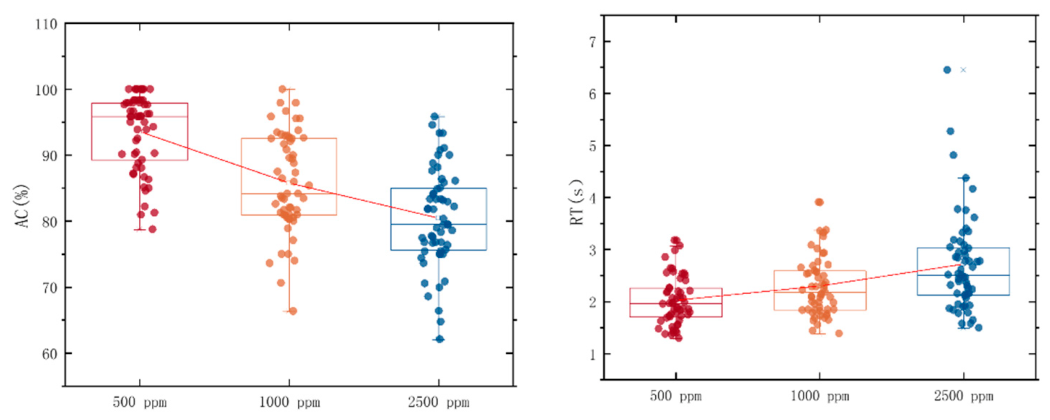
Mean accuracy decreased monotonically with increasing CO2 concentration (500 ppm: 93.50%; 1000 ppm: 85.77%; 2500 ppm: 80.89%), while mean reaction time increased correspondingly (2.00 s, 2.29 s, and 2.74 s, respectively; Figure 4). Colored circles represent individual data points, boxplots show the median, interquartile range, and range, the red dashed line indicates the mean trend across CO2 levels, and the “×” mark in panel B denotes an outlier reaction time value. Notably, the minimum accuracy across all conditions remained above 60%, suggesting that participants fully comprehended the tasks and that the test design did not pose a conceptual barrier. Across all CO2 concentration, the average RT did not exceed 7 s, demonstrating that participants were able to make timely selections for all assessment items.
One-Way ANOVA revealed a significant main effect of CO2 concentration on accuracy, F (2, 168) = 50.89, p < 0.001, and on reaction time, F (2, 168) = 14.35, p < 0.001 (Table 3). Post hoc multiple comparisons indicated that accuracy followed the pattern Low > Medium > High, whereas reaction time was significantly longer under high CO2 compared to the other conditions. These findings support Hypothesis 1, indicating that elevated CO2 concentration significantly reduces task efficiency.

4.2. The Mediating Role of Daytime Sleepiness

To examine whether daytime sleepiness mediates the relationship between indoor CO2 concentration and task efficiency, regression-based mediation analysis with bias-corrected bootstrapping (5000 resamples) was performed. To ensure the data met the necessary prerequisites for mediation analysis, the Shapiro–Wilk test was first performed to assess the normality of the variables. The results demonstrated that all nine datasets—comprising sleepiness levels, accuracy, and reaction time across the three CO2 concentration conditions—followed a normal distribution (p > 0.05), thereby satisfying the assumptions for parametric correlation analysis. As shown in Table 4, indoor CO2 concentration had a significant effect on daytime sleepiness. Correlation analysis further indicated significant associations among daytime sleepiness, accuracy, and reaction time (Table 5), providing preliminary support for the proposed mediation pathway.
The regression results are presented in Table 6. Indoor CO2 concentration significantly predicted both task efficiency and daytime sleepiness. It exerted a significant negative influence on mean accuracy (t = −10.03, p < 0.001) and a significant positive influence on daytime sleepiness (t = 26.08, p < 0.001), aligning with the preceding analysis. When daytime sleepiness was introduced as a mediator, the direct effect of CO2 concentration on accuracy remained statistically significant (t = −13.37, p < 0.001), indicating that daytime sleepiness partially mediates the pathway between CO2 exposure and task accuracy. In contrast, for the reaction time (RT) pathway, the effect of CO2 concentration became non-significant (p > 0.05) following the inclusion of the mediator, suggesting that daytime sleepiness does not mediate the impact of CO2 on reaction time.
The decomposition results in Table 7 further clarify the mediation pattern. For accuracy, the indirect effect of indoor CO2 concentration through daytime sleepiness was statistically significant, as the 95% confidence intervals (CIs) did not include zero. Specifically, indoor CO2 concentration both directly influenced the accuracy of participants (direct effect = 0.65) and concurrently impaired performance by increasing daytime sleepiness (indirect effect = −1.39). This result indicates that daytime sleepiness significantly mediates the relationship between indoor CO2 concentration and accuracy, supporting Hypothesis 2a. For reaction time, although indoor CO2 concentration significantly predicted reaction time, the indirect effect through daytime sleepiness was not statistically significant, as the 95% CI included zero. This suggests that while elevated CO2 concentration prolongs reaction time, this effect does not primarily manifest through the physiological state of sleepiness measured in this study. Therefore, Hypothesis 2b was not supported.

4.3. The Moderating Effect of Task Type

Following the confirmation of data normality via the Shapiro–Wilk test (all p > 0.05), we conducted a hierarchical regression analysis to examine whether task type moderates the relationship between CO2 concentration and task efficiency. The analysis focused on the interaction between CO2 levels (independent variable) and task type. The results are presented in Table 8 and Table 9.
Preliminary analysis confirmed that the experimental data satisfied the homogeneity of variance test, providing a valid basis for examining whether a significant interaction exists between CO2 concentration and task types regarding accuracy. To this end, three hierarchical models were developed: Model 1 evaluated the direct effect of CO2 concentration on mean accuracy, excluding the influence of the moderator, to establish the main effect of CO2 exposure. Model 2 incorporated the mediator (daytime sleepiness) into Model 1 to explore its independent role and its potential impact on the primary relationship. Model 3 introduced the interaction term (Daytime Sleepiness × Task Type) to determine if task type significantly moderates the effect of sleepiness on the CO2-performance relationship. Statistical significance of this interaction term in Model 3 would indicate the presence of a moderating effect.
For accuracy, the interaction term was statistically significant (coefficient β = −6.182, t = −2.2046, p = 0.0289), and the inclusion of the interaction term resulted in a significant change in explained variance (ΔR2 significant; Table 8). This indicates that task type significantly moderates the relationship between daytime sleepiness and accuracy. Specifically, the negative effect of sleepiness on accuracy was more pronounced under tasks with higher intrinsic cognitive demand, suggesting that when cognitive resources are constrained, task type influences the extent to which environmental effects manifest behaviorally. These findings align with the research by Kajtar and Herczeg regarding the interaction between task type and environmental factors [48]. Consequently, Hypothesis 3a is accepted.
In the regression model construction, indoor CO2 concentration was defined as the independent variable, daytime sleepiness as the mediating variable, reaction time (RT) as the dependent variable, and task type as the moderating variable. Given that the preliminary analysis confirmed the homogeneity of variance, we proceeded to investigate whether a significant interaction exists between CO2 concentration and task type in relation to RT. Analogous to the previous analysis, three hierarchical models were constructed: Model 4 examined the direct effect of CO2 concentration on RT without considering the moderator (task type), aiming to identify the main effect of CO2 concentration. Model 5 integrated the mediator (daytime sleepiness) into Model 4 to explore its potential influence on the CO2–RT relationship and isolate the independent contribution of the mediator. Model 6 introduced the interaction term (Daytime Sleepiness × Task Type) to determine if task type significantly moderates the effect of sleepiness on the relationship between CO2 and RT. A statistically significant interaction in Model 6 would indicate a moderating effect.
For reaction time (RT), however, the interaction term (Daytime Sleepiness × Task Type) was not statistically significant (coefficient β = 0.057, t = 1.2312, p = 0.2205), as shown in Table 9. Although both CO2 concentration and task type independently influenced reaction time, task type did not significantly moderate the sleepiness–RT relationship. This finding aligns with existing literature suggesting that variations in RT are primarily driven by direct environmental stressors and task type rather than through complex interactive pathways [11]. Consequently, Hypothesis 3b is rejected.
In summary, the experimental results demonstrate that indoor CO2 concentration significantly impacts reaction times (RT) in neurobehavioral assessments. Furthermore, both daytime sleepiness and task type exert independent and significant effects on the relationship between CO2 exposure and RT. However, the interaction between task type and daytime sleepiness in moderating this relationship did not reach statistical significance.

4.4. Summary of Hypothesis Testing

The empirical findings provide partial support for the proposed conceptual model. As hypothesized, indoor CO2 concentration exerted a significant negative effect on task efficiency, reflected in reduced accuracy and prolonged reaction time (H1 supported).
Daytime sleepiness was found to significantly mediate the relationship between CO2 concentration and task accuracy, indicating that increased sleepiness constitutes a primary pathway through which environmental exposure impairs performance. However, this mediation effect was not observed for reaction time (H2 partially supported).
With respect to moderation, task type significantly moderated the relationship between daytime sleepiness and accuracy, suggesting that intrinsic task demands influence the extent to which resource depletion translates into performance decline. In contrast, no significant moderation effect was observed for reaction time (H3a supported; H3b not supported).
Collectively, these results support a mechanism in which elevated CO2 acts as an extraneous cognitive load, increasing daytime sleepiness and thereby impairing task efficiency, particularly under tasks with higher intrinsic cognitive demand.

4.5. EEG Spectral Responses Under Indoor CO2 Concentrations

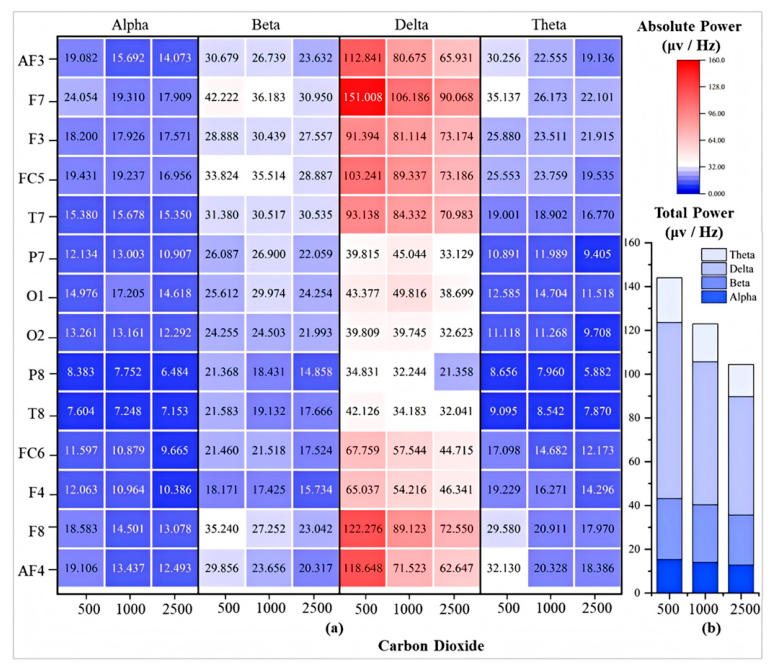
To further examine the neurophysiological effects of indoor CO2 concentration exposure, EEG spectral power across multiple frequency bands was analyzed under the three concentration conditions. As shown in Figure 5a, absolute power across most EEG channels exhibited a decreasing trend with increasing CO2 concentration. In particular, β-band power, typically associated with sustained attention and sensory alertness [49], and θ-band power, linked to memory formation and retrieval [50], both declined under elevated CO2 exposure. These findings may reflect alterations in attentional engagement and memory-related neural activity under elevated CO2 exposure conditions. However, the observed EEG spectral changes should be interpreted cautiously, as frequency-band variations do not provide direct evidence of specific cognitive processes. Total EEG power (Figure 5b) also decreased with increasing CO2 concentration, indicating reduced overall cortical activation. Such a reduction in overall cortical power indicates retarded information processing speeds and insufficient cognitive resource allocation, conditions frequently correlated with cognitive decline and impaired behavioral control. These observations suggest that elevated CO2 exposure was associated with changes in overall neural activation patterns. However, the present EEG measures do not permit definitive conclusions regarding specific mechanisms such as cognitive suppression or impaired self-regulation.
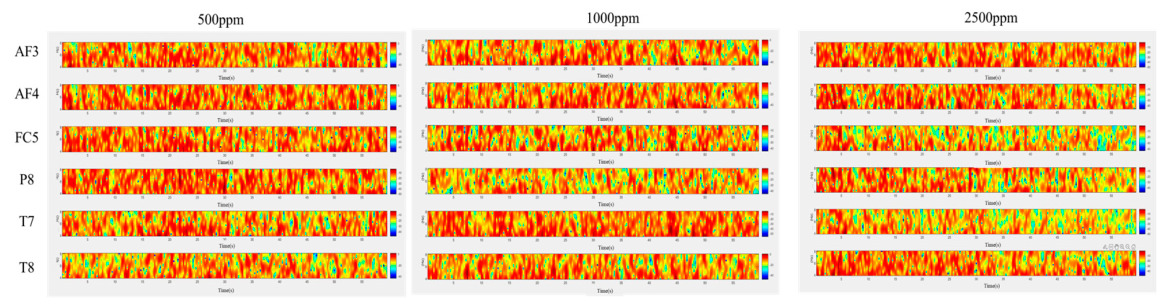
To further elucidate these neural alterations, time-frequency analysis of the θ band at representative frontal and temporal electrodes (AF3, AF4, FC5, T7, and T8) revealed a progressive reduction in θ power under high CO2 exposure (Figure 6). This suggests that elevated CO2 concentrations exert a more pronounced and rapid impact on cognitive capacity, potentially triggering a substantial decline in work performance within a short duration.
Taken together, these shifts in neural activity provide supportive neurophysiological evidence that elevated CO2 exposure is associated with altered cortical activity during task performance. Nevertheless, these EEG findings should be interpreted as correlational indicators rather than definitive evidence of specific neural suppression mechanisms. Specifically, CO2 acutely impairs the functional neural networks responsible for maintaining alertness and task-oriented attention, which manifests behaviorally as a reduction in operational efficiency. The findings of this study provide empirical support for CO2 as an environmental neuro-stressor and expand the scope of IAQ research from traditional comfort assessments to the mechanisms of functional impairment at the cognitive-neural level. This establishes a verifiable neurophysiological evidence chain for the field of environmental neuroscience.
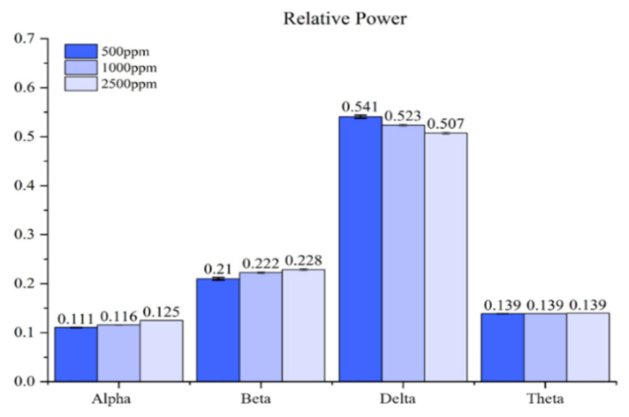
Relative power spectral analysis further demonstrated shifts in frequency band distribution across exposure levels (Figure 7). Although absolute power declined, relative power in specific bands showed redistribution patterns, reflecting altered spectral balance under elevated CO2 conditions. As illustrated in Figure 7, relative power in the theta and beta bands—typically associated with active cognitive engagement and alertness—showed a monotonic decrease as indoor CO2 concentration rose from 500 ppm to 2500 ppm, with the most pronounced reductions observed in the frontal and central regions. Conversely, the alpha band, which is often linked to reduced physiological arousal, exhibited a progressive increase in relative power across all five brain regions (frontal, central, temporal, parietal, and occipital) as CO2 concentration intensified. The delta band remained highest in the frontal region but followed a general downward trend with increasing exposure. These neurophysiological shifts toward higher alpha and lower beta/theta proportions suggest a transition into a state of increased daytime sleepiness, providing a spectral basis for the observed declines in task efficiency, specifically reduced accuracy and prolonged reaction time.
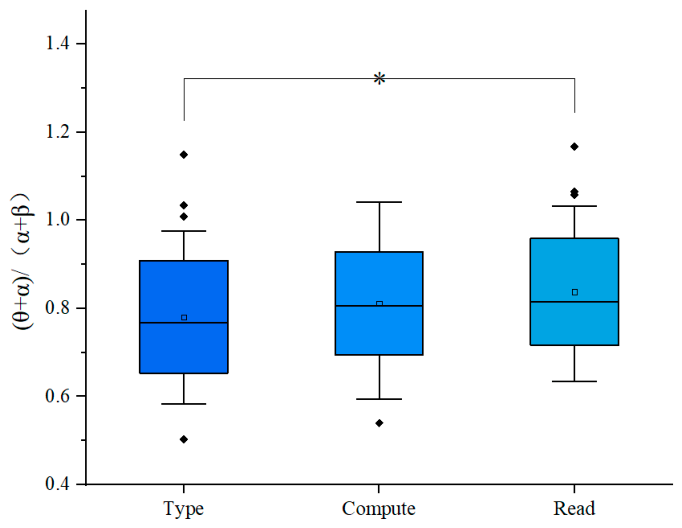
The EEG-derived mental fatigue index, defined as (θ + α)/(α + β), was analyzed across task types. A one-way ANOVA revealed a significant effect of task type on mental fatigue levels (F = 3.087, p = 0.048; Table 10). While group means across the three tasks were similar, their dispersions varied, suggesting that although the average fatigue levels are comparable at a population level, specific individuals exhibit higher fatigue sensitivity to certain tasks. Notably, a statistically significant difference was observed between the text entry (typing) and reading tasks (p < 0.05) as shown in Figure 8. This divergence likely stems from differences in cognitive processing demands: typing requires the multi-dimensional integration of visual processing, motor planning, hand-eye coordination, and motor execution, whereas reading focuses on linguistic processing, such as semantic extraction and language comprehension. The distinct weighting of cognitive components and processing modalities may lead to differentiated spatiotemporal neural activity patterns, resulting in significant differences in mental fatigue indices.
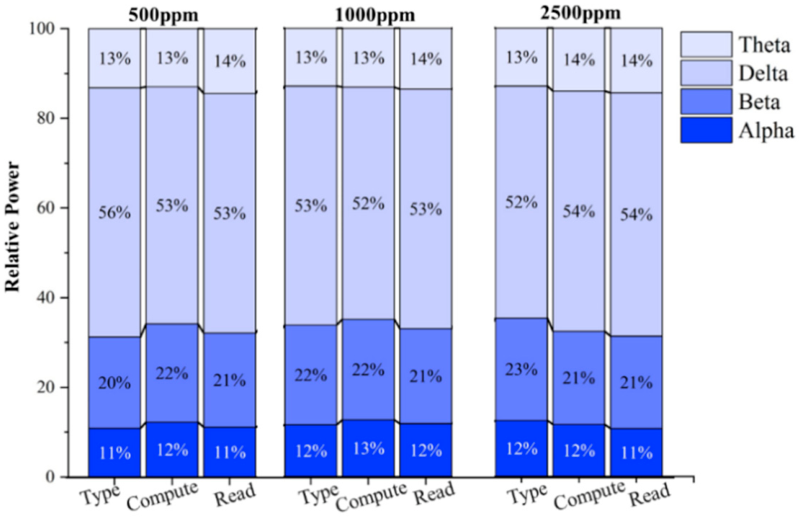
To further examine task-dependent modulation of neural activity under different CO2 conditions, relative EEG spectral power across frequency bands was compared across task types (Figure 9). The results demonstrate that task type significantly moderates the impact of CO2 exposure on neural activity. Under low and medium CO2 concentrations, calculation tasks exhibited relatively higher alpha and beta power compared with reading and text entry tasks. In contrast, under high CO2 exposure, elevated alpha and beta relative power was more prominent during text entry tasks. These findings suggest that neural responses to environmental load are modulated by Task type, reflecting task-dependent shifts in cortical activation balance.
Collectively, the EEG findings demonstrate that elevated indoor CO2 concentration is associated with systematic alterations in spectral power distribution and neural activation dynamics during task performance.

5. Discussion

5.1. Integration of Behavioral and Neurophysiological Evidence

A key contribution of the present study lies not merely in confirming the association between elevated indoor CO2 exposure and reduced task efficiency, which has been reported in prior literature, but in exploring the intermediate neurobehavioral processes through which these effects may occur. By integrating EEG activity, subjective sleepiness, behavioral performance, mediation analysis, and moderation analysis, the study attempts to provide a process-oriented framework for understanding how indoor environmental exposure may influence cognitive functioning.
The present study provides convergent behavioral and neurophysiological evidence that elevated indoor CO2 concentration impairs task efficiency. Behaviorally, increasing CO2 concentration significantly reduced accuracy and prolonged reaction time, as CO2 concentrations rose from background levels (500 ppm) to high concentrations (2500 ppm), the participants’ average task accuracy dropped significantly from 93.50% to 80.89%, whilst the average reaction time increased from 2.00 s to 2.74 s. This pattern is largely consistent with the findings of previous studies, which indicate that short-term exposure to carbon dioxide leads to a measurable decline in cognitive task performance, with the impact being particularly pronounced for tasks requiring higher-order cognitive resources, such as reading comprehension and numerical verification, which were included in this experiment [7]. These findings are also consistent with experimental studies conducted in enclosed spaces, which indicate that elevated CO2 concentrations in office-like environments impair decision-making performance and reduce cognitive processing capacity [5,6,7,8].
At the neurophysiological level, the observed reduction in absolute spectral power and the redistribution of relative band activity in electroencephalogram (EEG) data further corroborate the behavioral findings. EEG data indicate that, as CO2 exposure increases, activity in brain regions closely associated with attentional monitoring diminishes; this finding is highly consistent with the neurophysiological findings of Lee [5] in an office setting, where high CO2 concentrations suppress activity in attention-related brain regions; that is, elevated indoor CO2 concentrations alter neural activation patterns and electrophysiological responses during cognitive tasks. This echoes the multidimensional response model proposed by Xie [51] in their study of enclosed spaces. In our experiment, as CO2 concentrations rose, participants’ subjective feelings of drowsiness increased; this discomfort was not only associated with physiological fluctuations such as heart rate but was also directly reflected in task processing delays. Compared to previous studies that relied solely on subjective reports, this study elucidates a clearer neurobehavioral pathway by linking EEG spectral responses to behavioral performance and mechanisms associated with drowsiness.
Taken together, these findings establish a coherent neurobehavioral evidence chain in which indoor CO2 exposure is associated with altered neural activation dynamics, and measurable declines in task efficiency. By integrating behavioral performance, subjective sleepiness, and EEG spectral analysis within the same experimental framework, this study extends indoor environmental quality research beyond symptom reporting and toward a mechanistic understanding of cognitive impairment under elevated CO2 exposure [52].
Nevertheless, the EEG findings should be interpreted with appropriate caution. Although alterations in theta-, alpha-, and beta-band activity are commonly associated with attentional regulation, arousal state, and cognitive processing in prior literature, EEG spectral changes alone cannot provide definitive evidence of specific neural mechanisms or cognitive states. The present results therefore indicate associations between elevated CO2 exposure and altered neural activity patterns rather than direct proof of “cognitive suppression” or “brain resource depletion.” Future studies combining higher-resolution neuroimaging methods, multimodal physiological measurements, and larger participant samples are needed to further clarify the neural mechanisms underlying CO2-related cognitive effects.

5.2. CO2 as Extraneous Cognitive Load: A Resource Depletion Pathway

It should be noted that Cognitive Load Theory was applied in the present study primarily as an interpretive framework rather than a directly testable neurological model. The study does not claim that EEG spectral changes provide direct quantitative measurements of cognitive load itself. Instead, the framework was used to organize the observed relationships among environmental exposure, subjective sleepiness, neural activity patterns, and behavioral performance within a coherent process-oriented perspective.
The mediation analysis showed that daytime sleepiness significantly mediates the relationship between indoor CO2 concentration and accuracy. This finding suggests that the detrimental effects of high CO2 concentrations on office productivity do not stem solely from direct physiological toxicity; rather, they operate primarily by modulating individuals’ arousal states and the availability of cognitive resources. This is highly consistent with the research on the physiological and neurophysiological fluctuations induced by high indoor CO2 concentrations [8], and also supports the recent findings that dynamically increasing CO2 environments directly alter brainwave rhythms by inducing drowsiness [53]. Furthermore, this pattern of indirectly influencing cognition via intermediate physiological and psychological states is corroborated by the study on indoor air pollution, which similarly found that deteriorating air quality impairs cognitive function in older adults via mediating pathways involving sleep disturbances and negative emotions [54]. From the perspective of Cognitive Load Theory, elevated CO2 concentration may be conceptualized as an extraneous cognitive load that constrains the effective pool of working memory and attentional resources. The observed suppression pattern in the mediation analysis indicates that the primary pathway of impairment operates through increased sleepiness, reflecting a resource depletion mechanism. Once sleepiness is statistically accounted for, the residual direct association becomes substantially attenuated, highlighting the central role of arousal regulation in environmental–cognitive interactions [54].
The EEG results further support this interpretation. The alterations in the EEG power spectrum and shifts in frequency band distribution observed in high-CO2 environments indicate a reduction in cortical engagement. This reorganization of spectral characteristics is not an isolated phenomenon; similar processes of neural compensation and effort reallocation have been observed in studies, Position dual-task walking loads [55], and on cognitive reserve in healthy ageing [56]. This implies that when participants attempt to maintain basic task performance in a poor indoor environment, the brain must engage in compensatory processing by altering the dynamic characteristics of specific frequency bands (such as alpha or theta waves). However, as the experimental results demonstrate, even though the brain attempts this neural-level resource reallocation, the ultimate decline in accuracy and the slowing of reaction times cannot be prevented due to a scarcity of total resources [57].
From a theoretical perspective, these findings contribute to the growing intersection of indoor environmental research and environmental neuroscience by showing that indoor CO2 exposure can be interpreted not merely as an air-quality indicator, but also as an environmental condition that interacts with arousal regulation and cognitive resource allocation. In this sense, the present study provides empirical support for extending Cognitive Load Theory to the interpretation of indoor environmental effects on office task performance.

5.3. Task–Environment Interaction and Intrinsic Load Regulation

The analysis of moderating effects has further deepened our understanding of the complex relationship between environmental factors and individual performance: task type significantly moderates the relationship between daytime sleepiness and task accuracy. Specifically, tasks with higher intrinsic cognitive demands exhibit greater sensitivity to the resource depletion caused by sleepiness. This is manifested in the fact that, in high-difficulty tasks such as reading comprehension, CO2-induced sleepiness interferes with accuracy to a far greater extent than in simple numerical verification tasks. This finding is highly consistent with the conclusions of Edinger [58], namely that the impact of drowsiness on cognitive function is not universal but selective, with the extent of impairment often increasing non-linearly as task complexity and cognitive load rise.
This interaction pattern aligns precisely with the superimposed framework of ‘internal load’ and ‘external load’ within Cognitive Load Theory (CLT). In the present study, the effects of exposure to high concentrations of CO2 can be regarded as an ‘external load’ superimposed upon the task itself. As in study of confined environments, there is a significant interaction between indoor CO2 concentrations and mental workload, with environmental stressors significantly amplifying performance decline during high-load tasks [59]. When environmental load (CO2-induced physiological stress) and task-intrinsic load (task complexity) jointly approach an individual’s cognitive capacity threshold, the resource pool originally allocated for compensation and error correction is depleted, leading to a ‘cliff-like’ decline in performance on high-difficulty tasks. In contrast, simple tasks, which can be sustained by remaining resources, demonstrate greater resilience under the same environmental stress.
Psychological fatigue indices derived from electroencephalography (EEG) and task-specific spectral patterns further corroborate this task-dependent regulatory mechanism. Under sustained exposure to high CO2 concentrations, the reorganized spectral power distribution observed in participants’ brains reflects the dynamic impact of psychological fatigue on neural activity, consistent with the findings of Tran regarding the EEG characteristics of psychological fatigue [60]. Further analysis indicates that this allocation of neural resources is not linear. Prolonged or high-intensity cognitive engagement impairs the brain’s ability to allocate resources within working memory; furthermore, in complex office environments, the mechanism by which individuals maintain baseline performance by sacrificing some neural efficiency has its limits [61].
From a practical perspective, these findings imply that indoor environmental management should not rely exclusively on fixed CO2 thresholds. In office settings where employees alternate between routine and cognitively demanding tasks, task-aware ventilation or environmental control may provide a more effective strategy for protecting cognitive efficiency than static air-quality management alone. Accordingly, the present study offers not only a neurobehavioral explanation of CO2-related performance decline but also a basis for more human-centered and task-sensitive indoor environmental management.

6. Conclusions

This study investigated the impact of indoor CO2 concentration on office task efficiency by integrating behavioral performance, mediation–moderation modeling, and EEG spectral analysis. Based on the experimental results, the following conclusions can be drawn:
(1)
Elevated CO2 concentrations significantly impair cognitive performance in office-like environments. As CO2 levels rose from 500 ppm to 2500 ppm, mean task accuracy decreased monotonically from 93.50% to 80.89%, while average reaction time prolonged from 2.00 s to 2.74 s. These findings provide robust behavioral evidence that exceeding common indoor air quality thresholds (e.g., 1000 ppm) leads to a measurable decline in productivity, particularly for high-order cognitive tasks such as reading comprehension.
(2)
Arousal regulation and task complexity are key determinants of environmental–cognitive interactions. Mediation analysis revealed that daytime sleepiness partially explains the detrimental effect of CO2 on performance, suggesting that CO2 exposure acts as an extraneous cognitive load that depletes neural resources. Furthermore, the moderating role of task type indicates that tasks with higher intrinsic cognitive demands are more susceptible to CO2-induced impairment, a finding that extends Cognitive Load Theory into the domain of indoor environmental research.
(3)
Neurophysiological responses corroborate behavioral degradation. EEG spectral analysis showed that high CO2 exposure (2500 ppm) leads to reduced absolute power and altered frequency band distributions, reflecting diminished cortical engagement and compensatory neural reallocation. These objective metrics provide a mechanistic understanding of how poor air quality disrupts the “arousal-performance” balance.
(4)
Practical implications for building management. The results suggest that static CO2 thresholds may be insufficient for maintaining optimal productivity in diverse office settings. Building managers and HVAC designers should consider task-aware ventilation strategies—prioritizing enhanced fresh air delivery in zones designated for cognitively demanding work. Integrating real-time cognitive state monitoring with smart building control systems could offer a more human-centered approach to indoor environmental management.
Despite these insights, this study is limited by its relatively homogeneous sample (university students) and the controlled laboratory setting. The participant sample consisted exclusively of healthy university students aged 18–26 rather than actual office employees. Therefore, the findings should be interpreted cautiously when generalizing to broader office-worker populations with different occupational experiences, age structures, and health conditions. Although the present study emphasizes mechanistic explanation under controlled laboratory conditions and the sample size is consistent with prior EEG-based environmental exposure studies, future research should recruit larger and more diverse populations in real-world office settings to further improve external validity. Moreover, future studies may adopt multi-dimensional physiological indicators to examine the long-term impacts of carbon dioxide exposure in actual office environments, and employ diversified participant groups to formulate task-specific indoor air quality criteria.

Author Contributions

Conceptualization, H.Z. and S.L. (Shiyuan Li); methodology, S.L. (Siyu Liao); software, H.Z., S.L. (Shiyuan Li) and X.C.; validation, D.C.; formal analysis, H.Z. and S.L. (Shiyuan Li); investigation, X.C. and D.C.; resources, D.C. and S.L. (Siyu Liao); data curation, S.L. (Shiyuan Li); writing—original draft preparation, H.Z. and S.L. (Shiyuan Li); writing—review and editing, X.C. and D.C.; visualization, S.L. (Siyu Liao); supervision, H.Z. and D. C.; project administration, H.Z. and D.C.; funding acquisition, H.Z. and D.C. All authors have read and agreed to the published version of the manuscript.

Funding

This research was funded by Jiangsu Province Industry–University–Research Cooperation Project 2024 (grant number BY20240949), the Science and Technology Commission of Shanghai Municipality (grant number 23DZ1202102 and 23DZ1202804).

Institutional Review Board Statement

The study was conducted in accordance with the Declaration of Helsinki, and approved by the Ethics Committee of Shanghai University. The approval code is ECSHU 2025-228, and the approval date is 5 January 2026.

Informed Consent Statement

The authors confirm that all participants involved in this study have received and signed the informed consent form prior to their participation.

Data Availability Statement

The data presented in this study are available on request from the corresponding author. (please specify the reason for restriction, e.g., the data are not publicly available due to privacy or ethical restrictions.).

Conflicts of Interest

The authors declare no conflicts of interest.

References

  1. ASHRAE. ASHRAE Guideline 10-2023: Interactions Affecting the Achievement of Acceptable Indoor Environments; American Society of Heating, Refrigerating and Air-Conditioning Engineers: Atlanta, GA, USA, 2023. [Google Scholar]
  2. Dutheil, F.; Baker, J.S.; Navel, V. COVID-19 as a factor influencing air pollution? Environ. Pollut. 2020, 263, 114466. [Google Scholar] [CrossRef]
  3. Du, W.; Wang, G. Indoor air pollution was nonnegligible during COVID-19 lockdown. Aerosol Air Qual. Res. 2020, 20, 1851–1855. [Google Scholar] [CrossRef]
  4. Dam-Krogh, E.P.; Clausen, G.; Toftum, J. Optimising indoor environmental quality: Development of a benchmarking tool for valuing performance in office buildings. Build. Environ. 2024, 266, 112120. [Google Scholar] [CrossRef]
  5. Lee, J.; Wan Kim, T.; Lee, C.; Koo, C. Integrated approach to evaluating the effect of indoor CO2 concentration on human cognitive performance and neural responses in office environment. J. Manag. Eng. 2022, 38, 04021085. [Google Scholar] [CrossRef]
  6. Chen, D.; Huebner, G.; Bagkeris, E.; Ucci, M.; Mumovic, D. Effects of short-term exposure to moderate pure carbon dioxide levels on cognitive performance, health symptoms and perceived indoor environment quality. Build. Environ. 2023, 245, 110967. [Google Scholar] [CrossRef]
  7. Fan, Y.; Cao, X.; Zhang, J.; Lai, D.; Pang, L. Short-term exposure to indoor carbon dioxide and cognitive task performance: A systematic review and meta-analysis. Build. Environ. 2023, 237, 110331. [Google Scholar] [CrossRef]
  8. Snow, S.; Boyson, A.S.; Paas, K.H.; Gough, H.; King, M.-F.; Barlow, J.; Noakes, C.J. Exploring the physiological, neurophysiological and cognitive performance effects of elevated carbon dioxide concentrations indoors. Build. Environ. 2019, 156, 243–252. [Google Scholar] [CrossRef]
  9. Li, S.; Zhao, Y.; Wang, Q.; Li, X.; Chen, C.; Zuo, Y. Electroencephalographic depression after abruptly increasing partial pressure of end-tidal carbon dioxide: A case series. BMC Anesthesiol. 2024, 24, 373. [Google Scholar] [CrossRef]
  10. Zhang, N.; Liu, C.; Hou, C.; Wang, W.; Yuan, Q.; Gao, W. The impact of indoor carbon dioxide exposure on human brain activity: A systematic review and meta-analysis based on studies utilizing electroencephalogram signals. Build. Environ. 2024, 259, 111687. [Google Scholar] [CrossRef]
  11. Du, B.; Tandoc, M.C.; Mack, M.L.; Siegel, J.A. Indoor CO2 concentrations and cognitive function: A critical review. Indoor Air 2020, 30, 1067–1082. [Google Scholar] [CrossRef]
  12. Garlow, S.J.; Rosenberg, J.; Moore, J.D.; Haas, A.P.; Koestner, B.; Hendin, H.; Nemeroff, C.B. Depression, desperation, and suicidal ideation in college students: Results from the American Foundation for Suicide Prevention College Screening Project at Emory University. Depress. Anxiety 2008, 25, 482–488. [Google Scholar] [CrossRef] [PubMed]
  13. Minhas, A.A.; Jabbar, S.; Farhan, M.; Najam ul Islam, M. A smart analysis of driver fatigue and drowsiness detection using convolutional neural networks. Multimed. Tools Appl. 2022, 81, 26969–26986. [Google Scholar] [CrossRef]
  14. Ansari, S.; Naghdy, F.; Du, H. Human-machine shared driving: Challenges and future directions. IEEE Trans. Intell. Veh. 2022, 7, 499–519. [Google Scholar] [CrossRef]
  15. Stawarczyk, D.; François, C.; Wertz, J.; D’Argembeau, A. Drowsiness or mind-wandering? Fluctuations in ocular parameters during attentional lapses. Biol. Psychol. 2020, 156, 107950. [Google Scholar] [CrossRef] [PubMed]
  16. Zhang, Z.; Ning, H.; Zhou, F. A systematic survey of driving fatigue monitoring. IEEE Trans. Intell. Transp. Syst. 2022, 23, 19999–20020. [Google Scholar] [CrossRef]
  17. Saurav, S.; Mathur, S.; Sang, I.; Prasad, S.S.; Singh, S. Yawn detection for driver’s drowsiness prediction using bi-directional LSTM with CNN features. In International Conference on Intelligent Human Computer Interaction; Springer International Publishing: Cham, Switzerland, 2019; pp. 189–200. [Google Scholar]
  18. Yun, C.-H.; Kim, H.; Lee, S.K.; Suh, S.; Lee, S.H.; Park, S.-H.; Thomas, R.J.; Au, R.; Shin, C. Daytime sleepiness associated with poor sustained attention in middle and late adulthood. Sleep Med. 2015, 16, 143–151. [Google Scholar] [CrossRef]
  19. Jin, R.N.; Inada, H.; Négyesi, J.; Ito, D.; Nagatomi, R. Carbon dioxide effects on daytime sleepiness and EEG signal: A combinational approach using classical frequentist and Bayesian analyses. Indoor Air 2022, 32, e13055. [Google Scholar] [CrossRef]
  20. Chen, R.Y.; Ho, K.F.; Chang, T.Y.; Hong, G.B.; Liu, C.W.; Chuang, K.J. In-vehicle carbon dioxide and adverse effects: An air filtration-based intervention study. Sci. Total Environ. 2020, 723, 138047. [Google Scholar] [CrossRef]
  21. Xu, F.; Uh, J.; Brier, M.R.; Hart, J., Jr.; Yezhuvath, U.S.; Gu, H.; Yang, Y.; Lu, H. The influence of carbon dioxide on brain activity and metabolism in conscious humans. J. Cereb. Blood Flow Metab. 2011, 31, 58–67. [Google Scholar] [CrossRef]
  22. Colasanti, A.; Salamon, E.; Schruers, K.; Van Diest, R.; Van Duinen, M.; Griez, E.J. Carbon dioxide-induced emotion and respiratory symptoms in healthy volunteers. Neuropsychopharmacology 2008, 33, 3103–3110. [Google Scholar] [CrossRef]
  23. Kahneman, D. Attention and Effort; Prentice-Hall: Englewood Cliffs, NJ, USA, 1973; Volume 1063, pp. 218–226. [Google Scholar]
  24. Sweller, J. Cognitive load during problem solving: Effects on learning. Cogn. Sci. 1988, 12, 257–285. [Google Scholar] [CrossRef] [PubMed]
  25. Paas, F.; Van Merrienboer, J.J. Cognitive-load theory: Methods to manage working memory load in the learning of complex tasks. Curr. Dir. Psychol. Sci. 2020, 29, 394–398. [Google Scholar] [CrossRef]
  26. van Nooijen, C.C.; de Koning, B.B.; Bramer, W.M.; Isahakyan, A.; Asoodar, M.; Kok, E.; van Merrienboer, J.J.G.; Paas, F. A cognitive load theory approach to understanding expert scaffolding of visual problem-solving tasks: A scoping review. Educ. Psychol. Rev. 2024, 36, 12. [Google Scholar] [CrossRef]
  27. Shevlin, B.R.; Krajbich, I. Attention as a source of variability in decision-making: Accounting for overall-value effects with diffusion models. J. Math. Psychol. 2021, 105, 102594. [Google Scholar] [CrossRef]
  28. Gkintoni, E.; Antonopoulou, H.; Sortwell, A.; Halkiopoulos, C. Challenging cognitive load theory: The role of educational neuroscience and artificial intelligence in redefining learning efficacy. Brain Sci. 2025, 15, 203. [Google Scholar] [CrossRef]
  29. Abdelhack, M.; Zhukovsky, P.; Milic, M.; Harita, S.; Wainberg, M.; Tripathy, S.J.; Griffiths, J.D.; Hill, S.L.; Felsky, D. Opposing brain signatures of sleep in task-based and resting-state conditions. Nat. Commun. 2023, 14, 7927. [Google Scholar] [CrossRef]
  30. Tai, X.Y.; Chen, C.; Manohar, S.; Husain, M. Impact of sleep duration on executive function and brain structure. Commun. Biol. 2022, 5, 201. [Google Scholar] [CrossRef] [PubMed]
  31. Piechowski, S.; Kalkoffen, L.J.; Benderoth, S.; Wolf, O.T.; Rittweger, J.; Aeschbach, D.; Mühl, C. Effects of total sleep deprivation on performance in a manual spacecraft docking task. npj Microgravity 2024, 10, 21. [Google Scholar] [CrossRef]
  32. Baddeley, A. Working memory: Theories, models, and controversies. Annu. Rev. Psychol. 2012, 63, 1–29. [Google Scholar] [CrossRef] [PubMed]
  33. Sackett, P.R.; Demeke, S.; Bazian, I.M.; Griebie, A.M.; Priest, R.; Kuncel, N.R. A contemporary look at the relationship between general cognitive ability and job performance. J. Appl. Psychol. 2024, 109, 687. [Google Scholar] [CrossRef] [PubMed]
  34. Hosseinioun, M.; Neffke, F.; Zhang, L.; Youn, H. Skill dependencies uncover nested human capital. Nat. Hum. Behav. 2025, 9, 673–687. [Google Scholar] [CrossRef]
  35. Yerkes, R.M.; Dodson, J.D. The relation of strength of stimulus to rapidity of habit-formation. J. Comp. Neurol. Psychol. 1908, 18, 459–482. [Google Scholar] [CrossRef]
  36. Warm, J.S.; Parasuraman, R.; Matthews, G. Vigilance requires hard mental work and is stressful. Hum. Factors 2008, 50, 433–441. [Google Scholar] [CrossRef] [PubMed]
  37. Satish, U.; Mendell, M.J.; Shekhar, K.; Hotchi, T.; Sullivan, D.; Streufert, S.; Fisk, W.J. Is CO2 an indoor pollutant? Direct effects of low-to-moderate CO2 concentrations on human decision-making performance. Environ. Health Perspect. 2012, 120, 1671–1677. [Google Scholar] [CrossRef]
  38. Allen, J.G.; MacNaughton, P.; Satish, U.; Santanam, S.; Vallarino, J.; Spengler, J.D. Associations of cognitive function scores with carbon dioxide, ventilation, and volatile organic compound exposures in office workers: A controlled exposure study of Green and Conventional office environments. Environ. Health Perspect. 2016, 124, 805–812. [Google Scholar] [CrossRef] [PubMed]
  39. Pechová, J.; Volfová, H.; Jírová, A. Impact of task assignment on effectiveness in work teams. Entrep. Sustain. Issues 2023, 10, 152. [Google Scholar] [CrossRef] [PubMed]
  40. McGrath, S.K.; Whitty, S.J. What do project management practitioners think governance is? A study on perceptions in Queensland, Australia. Int. J. Manag. Proj. Bus. 2020, 13, 961–980. [Google Scholar] [CrossRef]
  41. Walter, S.R.; Brown, B.M.; Dunsmuir, W.T. Detecting changes in task length due to task-switching in the presence of repeated length-biased sampling. Aust. New Zealand J. Stat. 2020, 62, 133–152. [Google Scholar] [CrossRef]
  42. Shan, Y.; Shang, J.; Yan, Y.; Ye, X. Workflow interruption and nurses’ mental workload in electronic health record tasks: An observational study. BMC Nurs. 2023, 22, 63. [Google Scholar] [CrossRef]
  43. Alibasa, M.J.; Purwanto, R.W.; Yacef, K.; Glozier, N.; Calvo, R.A. Doing and feeling: Relationships between moods, productivity and task-switching. IEEE Trans. Affect. Comput. 2020, 13, 1140–1154. [Google Scholar] [CrossRef]
  44. Schotter, E.R.; Bicknell, K.; Howard, I.; Levy, R.; Rayner, K. Task effects reveal cognitive flexibility responding to frequency and predictability: Evidence from eye movements in reading and proofreading. Cognition 2014, 131, 1–27. [Google Scholar] [CrossRef]
  45. Kaakinen, J.K.; Hyönä, J. Task effects on eye movements during reading. J. Exp. Psychol. Learn. Mem. Cogn. 2010, 36, 1561. [Google Scholar] [CrossRef]
  46. Burgoyne, A.P.; Saba-Sadiya, S.; Harris, L.J.; Becker, M.W.; Brascamp, J.W.; Hambrick, D.Z. Revisiting the self-generation effect in proofreading. Psychol. Res. 2023, 87, 800–815. [Google Scholar] [CrossRef]
  47. Vehviläinen, T.; Lindholm, H.; Rintamäki, H.; Pääkkönen, R.; Hirvonen, A.; Niemi, O.; Vinha, J. High indoor CO2 concentrations in an office environment increases the transcutaneous CO2 level and sleepiness during cognitive work. J. Occup. Environ. Hyg. 2016, 13, 19–29. [Google Scholar] [CrossRef]
  48. Kajtár, L.; Herczeg, L. Influence of carbon-dioxide concentration on human well-being and intensity of mental work. Q. J. Hung. Meteorol. Serv. 2012, 116, 145–169. [Google Scholar]
  49. Lagopoulos, J.; Xu, J.; Rasmussen, I.; Vik, A.; Malhi, G.S.; Eliassen, C.F.; Arntsen, I.E.; Sæther, J.G.; Hollup, S.; Holen, A.; et al. Increased theta and alpha EEG activity during nondirective meditation. J. Altern. Complement. Med. 2009, 15, 1187–1192. [Google Scholar] [CrossRef] [PubMed]
  50. Stevens, C.E., Jr.; Zabelina, D.L. Creativity comes in waves: An EEG-focused exploration of the creative brain. Curr. Opin. Behav. Sci. 2019, 27, 154–162. [Google Scholar] [CrossRef]
  51. Xie, Z.; Wang, Q.; Zhou, K.; Ma, L.; Wang, J.; Li, Y.; Chen, S.; Wei, W. Field Investigations on Subjective Perception, Physiological Responses, and Cognitive Performance under Increasing CO2 Concentration in an Underground Confined Space. Indoor Air 2024, 2024, 5781565. [Google Scholar] [CrossRef]
  52. Zhang, N.; Liu, C.; Li, J.; Hou, K.; Shi, J.; Gao, W. A Comprehensive Review of Research on Indoor Cognitive Performance using Electroencephalogram Technology. Build. Environ. 2024, 257, 111555. [Google Scholar] [CrossRef]
  53. Guo, B.; Wang, W.; Yan, B.; Fan, H. Effects of Dynamic Increases in Indoor CO2 Concentration on Daytime Sleepiness: An EEG-Based Study. Buildings 2026, 16, 752. [Google Scholar] [CrossRef]
  54. Shaw, S.; Kundu, S.; Chattopadhyay, A.; Rao, S. Indoor air pollution and cognitive function among older adults in India: A multiple mediation approach through depression and sleep disorders. BMC Geriatr. 2024, 24, 81. [Google Scholar] [CrossRef]
  55. Possti, D.; Fahoum, F.; Sosnik, R.; Giladi, N.; Hausdorff, J.; Mirelman, A.; Maidan, I. Changes in the EEG spectral power during dual-task walking with aging and Parkinson’s disease: Initial findings using Event-Related Spectral Perturbation analysis. J. Neurol. 2020, 268, 161–168. [Google Scholar] [CrossRef]
  56. Perez, V.; Hidalgo, V.; Salvador, A. Linking cognitive reserve to neuropsychological outcomes and resting-state frequency bands in healthy aging. Front. Aging Neurosci. 2025, 17, 1540168. [Google Scholar] [CrossRef]
  57. Wisniewski, M.; Zakrzewski, A.; Bell, D.; Wheeler, M. EEG power spectral dynamics associated with listening in adverse conditions. Psychophysiology 2021, 58, e13877. [Google Scholar] [CrossRef]
  58. Edinger, J.; Bathgate, C.; Tsai, S.; Khassawneh, B. Impact of daytime sleepiness and insomnia on simple and complex cognitive task performances. Sleep Med. 2021, 87, 46–55. [Google Scholar] [CrossRef] [PubMed]
  59. Zhang, J.; Pang, L.; Cao, X.; Wanyan, X.; Wang, X.; Liang, J.; Zhang, L. The effects of elevated carbon dioxide concentration and mental workload on task performance in an enclosed environmental chamber. Build. Environ. 2020, 178, 106938. [Google Scholar] [CrossRef]
  60. Tran, Y.; Craig, A.; Craig, R.; Chai, R.; Nguyen, H. The influence of mental fatigue on brain activity: Evidence from a systematic review with meta-analyses. Psychophysiology 2020, 57, e13554. [Google Scholar] [CrossRef] [PubMed]
  61. Yang, S.; Shi, B.; Wang, L.; Wang, Z.; Peng, S. Long-Term Cognitive Tasks Impair the Ability of Resource Allocation in Working Memory: A Study of Time-Frequency Analysis and Event-Related Potentials. IEEE Access 2020, 8, 211482–211489. [Google Scholar] [CrossRef]
Figure 1. Model of the effects of indoor CO2 concentration on office workers’ task efficiency.
Buildings 16 02210 g001
Figure 2. Research framework of the proposed study.
Buildings 16 02210 g002
Figure 3. Experimental flowchart.
Buildings 16 02210 g003
Figure 4. Descriptive statistics of indoor CO2 concentration effects on AC and RT.
Buildings 16 02210 g004
Figure 5. (a). Absolute power of different frequency bands across 14 channels at varying CO2 concentrations; (b). Total power at different CO2 concentrations.
Buildings 16 02210 g005
Figure 6. Time-frequency map results for theta waves in AF3, AF4, FC5, T7, and T8 channels at different CO2 concentrations.
Buildings 16 02210 g006
Figure 7. Relative power results for each brainwave under different CO2 concentrations.
Buildings 16 02210 g007
Figure 8. Analysis of intergroup effects by task type.
Buildings 16 02210 g008
Figure 9. Relative power results for various brain waves under different task conditions.
Buildings 16 02210 g009
Table 1. Representative neurobehavioral assessment items.
Cognitive DimensionAssessment Item
Attention(1) Stroop color-word test (2) Redirection
Memory(3) Symbol-digit modalities test (4) N-back test
Execution(5) Number calculation (6) Visual choice reaction time
Table 2. Detailed descriptions of task types.
Task TypeTask DescriptionSimulation Scenario
Numerical verification Rapidly scan digital spreadsheets to identify erroneous entriesData verification within office environments
Typing tasksInput specific text according to on-screen promptsCommon office operations such as document editing and email replies
Reading tasksRead textual materials from the National Civil Service Examination and extract key information within a time limitInformation comprehension and summarization
Table 3. One-Way ANOVA of indoor CO2 concentration effects on accuracy (AC) and reaction time (RT) in neurobehavioral testing.
Sum of SquaresDegrees of FreedomMean SquareFSignificanceMultiple Comparisons
AC
(%)
Between groups4955.90422477.95250.8910.000 ***Low > Medium > High
Within groups8180.19916848.692
Total13136.1170
RT
(s)
Between groups14.00527.00314.3450.000 ***Low < High
Medium < High
Within groups82.0121680.488
Total96.018170
Note: “***” indicates p < 0.001.
Table 4. One-way ANOVA of indoor CO2 concentration on daytime sleepiness.
Sum of SquaresDegrees of FreedomMean SquareFSignificanceMultiple Comparisons
Daytime
sleepiness
Between groups390.2222195.111353.4590.000 ***Medium < High
Low < High
Within groups92.7371680.552
Total482.959170
Note: “***” indicates p < 0.001.
Table 5. Correlation Analysis between Daytime Sleepiness Severity and Accuracy (AC) and Reaction Time (RT) in Neurobehavioral Tests.
Daytime SleepinessACRT
Daytime sleepinessPearson correlation coefficient1−0.8 **0.398 **
Sig. 0.000 ***0.000 ***
ACPearson correlation coefficient−0.8 **1−0.304 **
Sig.0.000 *** 0.000 ***
RTPearson correlation coefficient0.398 **−0.304 **1
Sig.0.000 ***0.000 ***
Note: “***” indicates p < 0.001, “**” indicates p < 0.01.
Table 6. Testing the mediating effect model between daytime sleepiness, indoor CO2 concentration, and accuracy (AC) and reaction time (RT) in neurobehavioral performance tests.
Result VariablePredictor VariableFitting CriteriaCoefficient Significance
R2Ftp
ACAccuracyCO2 concentration0.373100.509−10.030.000 ***
Daytime sleepinessCO2 concentration0.801680.17526.080.000 ***
AccuracyCO2 concentration0.696192.5425.5610.000 ***
Daytime sleepiness −13.3720.000 ***
RTReaction timeCO2 concentration0.14428.3455.320.000 ***
Daytime sleepinessCO2 concentration0.801680.17426.080.000 ***
Reaction timeCO2 concentration0.16116.1140.7260.469
Daytime sleepiness1.8620.064
Note: “***” indicates p < 0.001.
Table 7. Decomposition of the Total Effect, Direct Effect, and Mediating Effect of Indoor CO2 Concentration on the Accuracy (AC) through Daytime Sleepiness.
Effect SizeIndirect Effect Error95% Confidence Interval
Lower BoundUpper Bound
Total effect−0.750.07−0.89−0.60
Direct effect0.650.120.420.88
Indirect effect−1.390.11−1.62−1.18
Table 8. Analysis Results of the Moderating Effects of Task Type on the Relationship Between Indoor CO2 Concentration and Accuracy in Neurobehavioral Tests.
VariablesModel 1Model 2Model 3
CoefficientStandard ErrortpCoefficientStandard ErrortpCoefficientStandard Errortp
CO2 concentration−6.55540.541−12.11780.000 ***4.07251.29073.15530.0019 **4.07251.35373.0090.0026 **
Daytime sleepiness −5.76060.6572−8.76480.000 ***−5.76060.6583−8.7570.000 ***
Task type −1.14380.6028−1.89740.0595−1.14380.6463−1.770.0781
Daytime sleepiness × Task type −6.1820.2864−2.20460.0289 *
R20.75890.71070.749
Adjust R20.75590.7050.742
FF (3, 167) = 75.5814, p = 0.000 ***F (4, 166) = 101.951, p = 0.000 ***F (1, 165) = 105.845, p = 0.0289 *
ΔR20.0113−0.0903−0.313
ΔFΔF (1, 167) = 4.4506, p = 0.0364 *ΔF (1, 168) = 0.0383, p > 0.05ΔF (1, 167) = 13.59, p = 0.000 ***
Note: “***” indicates p < 0.001, “**” indicates p < 0.01, “*” indicates p < 0.05.
Table 9. Analysis Results of the Moderating Effect of Task Type on the Relationship Between Indoor CO2 Concentration and Reaction Time in Neurobehavioral Tests.
VariablesModel 4Model 5Model 6
CoefficientStandard ErrortpCoefficientStandard ErrortpCoefficientStandard Errortp
CO2 concentration0.34780.0635.52010.000 ***0.4690.18162.58230.0107 **0.4690.15473.02910.0025 **
Daytime sleepiness −0.06660.0925−7.2030.4724−0.06720.0789−0.85220.3985
Task type 0.26530.08483.12710.0021 **0.26510.07433.5680.0005 **
Daytime sleepiness × Task type 0.0570.04631.23120.2205
R20.46130.46490.495
Adjust R20.45260.4610.492
FF (3, 167) = 15.0494, p = 0.000 ***F (4, 166) = 11.4426, p = 0.000 ***F (1, 165) = 3.5680, p = 0.0025 **
ΔR20.00850.110.029
ΔFΔF (1, 167) = 1.8053, p = 0.1809ΔF (3, 165) = 2.375, p > 0.05ΔF (1, 165) = 1.152, p = 0.2205
Note: “***” indicates p < 0.001, “**” indicates p < 0.01.
Table 10. Effects of Task Type on Mental Fatigue.
Cognitive StatusEquationSSDfMSFp
Mental Fatigue(θ + α)/(α + β)0.09320.0463.0870.048
Disclaimer/Publisher’s Note: The statements, opinions and data contained in all publications are solely those of the individual author(s) and contributor(s) and not of MDPI and/or the editor(s). MDPI and/or the editor(s) disclaim responsibility for any injury to people or property resulting from any ideas, methods, instructions or products referred to in the content.