


Abstract
The construction industry is under increasing pressure to reduce its carbon footprint, driving the development of low-carbon construction technologies. Printable concrete has attracted increasing attention in the construction sector due to its advantages in automation and material efficiency, which are considered beneficial for sustainable and low-carbon construction practices. However, its structural performance under fire exposure remains insufficiently understood, particularly regarding the anisotropic mechanical response induced by layer-by-layer fabrication. This study experimentally investigates the mechanical behavior of printable concrete at ambient temperature and after exposure to elevated temperatures of 200 °C, 400 °C, and 600 °C. Manually printed specimens were prepared to replicate the layered characteristics of printable concrete, while cast concrete specimens served as a reference. Results show clear anisotropy in compressive strength among the X, Y, and Z loading directions, with the Z-direction exhibiting the highest strength due to improved interlayer integrity. Compared with cast concrete, printable concrete showed up to 37.77% lower compressive strength at ambient temperature. After thermal exposure, the compressive strength of printable concrete decreased by 16.68%, 34.40%, and 37.54% after exposure to 200 °C, 400 °C, and 600 °C, respectively, while the elastic modulus decreased by up to 78.18%. Mass loss and surface cracking intensified with increasing temperature, reflecting progressive dehydration and microstructural deterioration. These findings provide important insights into the fire performance and post-fire structural assessment of printable concrete.
1. Introduction
Printable concrete, as a rapidly developing digital fabrication technology, has drawn significant attention for its ability to improve construction efficiency, reduce labor demand, and eliminate conventional formwork [1,2]. Importantly, these advantages also contribute to reducing material waste, optimizing resource utilization, and lowering embodied carbon, making printable concrete a promising approach for low-carbon and sustainable construction. Over the past decade, extensive research has been conducted on the mixture design of printable concrete [3,4,5]. Specifically, early studies primarily focused on optimizing material composition to ensure pumpability, extrudability, and shape stability. Subsequent advancements refined the understanding of mix rheology, including the roles of yield stress evolution, thixotropy, and time-dependent buildability in shaping printed elements.
A substantial body of research has further emphasized the mechanical performance of printable concrete under ambient conditions. Numerous studies have confirmed that its strength and stiffness are strongly direction-dependent due to the presence of interlayer interfaces [6]. These interfaces, influenced by printing interval, moisture exchange, and local thixotropic recovery, often act as planes of weakness. Investigations involving directional loading tests, interlayer bonding characterization, and microstructural analysis using X-ray computed tomography (CT) or scanning electron microscopy (SEM) have consistently demonstrated the anisotropic nature of printable concrete [7,8]. To mitigate interlayer weakness, various strategies have been proposed, including fiber incorporation, modification of surface contact conditions between layers, optimization of printing parameters, and embedding reinforcement during printing [9,10]. Although these efforts have significantly advanced the understanding of structural performance, they are largely limited to room-temperature behavior.
Despite the extensive knowledge base established for conventional concrete, research on printable concrete under elevated temperatures remains relatively limited. Fire exposure induces dehydration of hydration products, thermal incompatibility between aggregates and cement paste, pore-pressure-driven cracking, and overall loss of load-bearing capacity [11]. Owing to its layered architecture, higher porosity, and weaker interlayer bonding, printable concrete is expected to exhibit degradation mechanisms that differ fundamentally from those of cast concrete [12]. As a result, fire-resistance models and post-fire evaluation approaches developed for conventional concrete cannot be directly applied to printable concrete.
Only a limited number of studies have addressed the high-temperature performance of printable concrete. Xiao et al. [13] investigated the mechanical properties and surface characteristics of 3D-printed concrete incorporating polyethylene fibers and recycled sand after exposure to elevated temperatures, and reported that printed and cast specimens exhibited similar trends in strength degradation. However, pronounced interlayer delamination was observed in printed concrete at temperatures above 600 °C due to weak interlayer bonding. Microstructural analysis using CT scanning revealed increased porosity with rising temperature, consistent with mechanical deterioration. Dong et al. [14] further studied the residual properties of 3D-printed ultra-high-performance concrete (3D-UHPC) after high-temperature exposure, considering the effects of bonding zones, fiber reinforcement, specimen preparation methods, loading direction, and temperature. Their results indicated that appropriate fiber incorporation and fabrication methods can enhance fire resistance, while microstructural observations using SEM revealed significant temperature-induced damage evolution. In addition, Weng et al. [15] investigated the mechanical and fire resistance behavior of 3D-printed concrete incorporating supplementary cementitious materials. Cicione et al. [16] proposed an experimental method based on one-dimensional heat transfer theory to evaluate fire resistance, while Suntharalingam et al. [17] developed numerical models to study the thermal response of 3D-printed concrete with different densities. Although these studies have provided valuable insights, they often focus on specific material systems or structural forms. However, most existing studies mainly focus on the ambient-temperature anisotropy or the overall high-temperature performance of printable concrete. Limited attention has been paid to the anisotropic residual mechanical behavior after thermal exposure. In particular, systematic comparisons of the residual properties in different loading directions after elevated-temperature exposure remain scarce. Therefore, the combined effects of anisotropy and high temperature on printable concrete are still not fully understood. Moreover, most existing post-fire assessment approaches are adapted directly from conventional concrete and do not explicitly consider the layered architecture and directional dependence inherent to printable concrete. These limitations highlight the need for a comprehensive experimental investigation into the residual mechanical behavior of printable concrete after elevated-temperature exposure, with particular emphasis on anisotropy and direct comparison with cast concrete.
In response to these research gaps, the present study conducts a systematic experimental investigation on the residual mechanical properties of printable concrete exposed to 200 °C, 400 °C, and 600 °C. Printable specimens prepared through controlled manual deposition were used to replicate the anisotropic characteristics of extrusion-based printing, while cast concrete specimens with identical mix proportions served as reference. Comparative analyses were performed to evaluate compressive strength, stress–strain response, elastic modulus, peak strain, mass loss, and surface damage before and after thermal exposure. The results aim to clarify temperature-dependent degradation mechanisms and provide fundamental experimental evidence for the post-fire evaluation and safe structural application of printable concrete.
2. Experimental Program
2.1. Materials and Mixture Design
The printable concrete used in this study was designed to satisfy the essential requirements of pumpability, extrudability, and buildability while maintaining sufficient mechanical strength. Ordinary Portland cement (PI 42.5, Produced by Fushun Cement Co., Ltd., Fushun, China) was used as the primary binder due to its stable composition and suitability for evaluating admixture performance. Natural river sand and crushed stone (Produced by China National Building Materials Research Institute in Guanzhuang, Chaoyang District, Beijing, China) with a nominal size of 10–20 mm served as fine and coarse aggregates, respectively. The aggregate grading was selected to ensure adequate packing density and smooth flow during extrusion, which are critical for printable concrete systems.
A polycarboxylate ether (PCE, Produced by Tianjin Wehe Technology Development Co., Ltd. Tianjin, China) superplasticizer (SP) was incorporated to achieve the desired workability and reduce the water-to-cement ratio. To enhance thixotropic recovery and improve shape stability after deposition, a hydroxypropyl methylcellulose (HPMC, Produced by Jinzhou Baoyi Building Materials Technology Co., Ltd., Jinzhou, China) viscosity-modifying agent (VMA) was added. In addition, an alkali-free liquid accelerator (ACC, Produced by Laiyang Keyu Construction Additive Factory, Laiyang, China) based on aluminum sulfate was included to shorten the setting time and increase early-age green strength, enabling multilayer build-up without collapse. The solid content of the superplasticizer (SP) was approximately 40%, while HPMC was used in powder form with a solid content of approximately 100%.
The final mixture proportions adopted in this study (per cubic meter of concrete) are summarized in Table 1. The selected mixture proportions were based on preliminary trials and previous studies on printable concrete [18]. Compared with conventional concrete, a lower water-to-binder ratio and the incorporation of HPMC and an accelerator were adopted to improve buildability, shape stability, and interlayer bonding during the printing process. In addition, coarse aggregates were included to better represent practical structural concrete applications. The same mixture composition was used to fabricate both the printable and the cast concrete specimens, ensuring a consistent basis for comparing their mechanical performance and high-temperature behavior. The mixture was designed with a water-to-binder ratio of 0.38, providing adequate flowability for printing while maintaining sufficient mechanical strength after hardening. The binder-to-sand ratio was 0.50, selected to balance printability, shape stability, and interlayer bonding. The dosage of HPMC was incorporated at 0.10% by mass of the binder. The superplasticizer (SP) was added at 1.0% by mass of binder. In addition, the accelerator (ACC) was introduced at 2.5% by mass of binder.
Table 1.
Mixture design of printable and cast concrete (kg/m3).
2.2. Sample Preparation
All mixtures were prepared using a forced-action concrete mixer following a standardized sequence to ensure homogeneity and prevent premature setting, which is essential for printable concrete. Initially, cement, sand, coarse aggregate, and HPMC were dry-mixed for 3 min to ensure uniform dispersion of the admixture throughout the solid components. Water was then gradually added while mixing continued for 1 min, followed by incorporation of SP, which was mixed for an additional 2 min to achieve full activation and dispersion. Finally, ACC was added during the last minute of mixing to avoid early stiffening during the preparation stage. After mixing, the material was allowed to rest briefly to stabilize its rheological behavior prior to printing or casting.
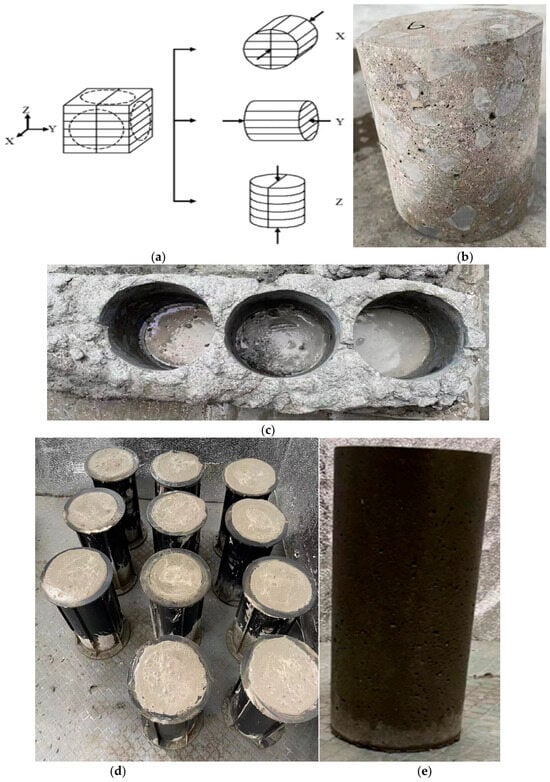
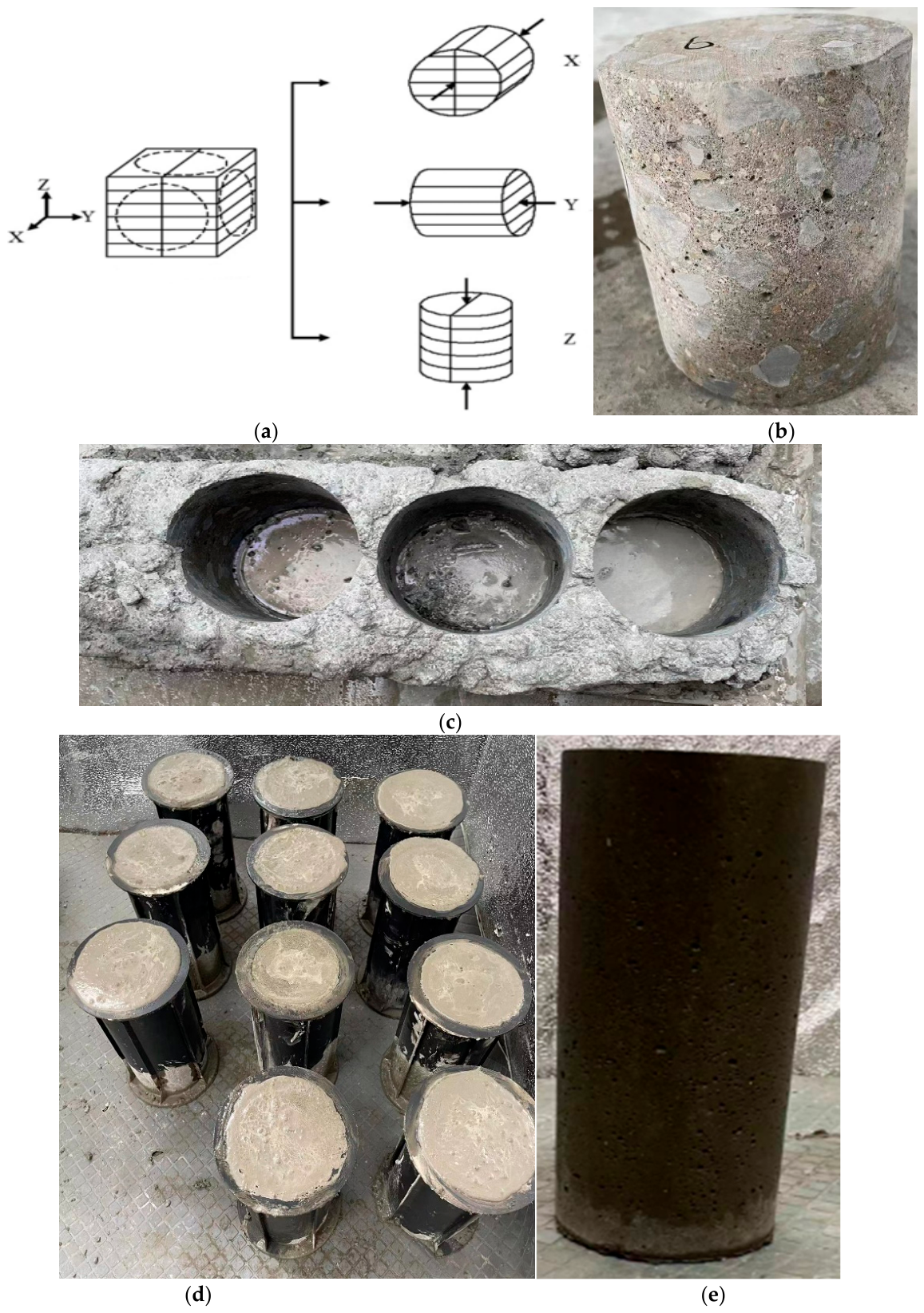
Printable concrete specimens were manufactured through a controlled manual deposition process designed to replicate the layer-by-layer characteristics inherent to automated extrusion-based printing. Fresh material was loaded into a cylindrical mortar extruder and deposited onto a flat substrate following predetermined layer paths. The layer thickness was approximately 20 mm, and the time interval between successive layers was maintained at approximately 3 min during the printing process. Each layer was placed with a short interval to allow thixotropic structural build-up while ensuring adequate bonding between adjacent layers. Once the required height was reached, the printed elements were allowed to cure under standard laboratory conditions. After hardening, cylindrical specimens with a diameter of 100 mm were extracted using a core-drilling machine. To investigate anisotropy, cores were obtained along the X, Y, and Z orientations relative to the printing direction, as shown in Figure 1a. Each core was then trimmed to a height of 100 mm to produce non-standard cylindrical specimens suitable for mechanical testing.
Figure 1.
Sample preparation diagram: (a) schematic showing the core sampling directions in printable concrete; (b) printable concrete specimen; (c) drilling effect diagram; (d) cast concrete removal; (e) cast concrete specimen.
For comparison, cast concrete specimens were prepared using the same mixture design. Fresh concrete was placed into steel molds with dimensions of 100 mm in diameter and 200 mm in height, compacted on a vibrating table to remove entrapped air, and subsequently cured under the same conditions as the printable concrete. After curing, the molds were removed, and the cylinders were cut to a height of 100 mm to match the geometry of the printed specimens, ensuring consistent evaluation of mechanical properties.
2.3. Testing Program
The experimental program consisted of two major components: mechanical characterization at ambient temperature and residual performance evaluation after exposure to elevated temperatures.
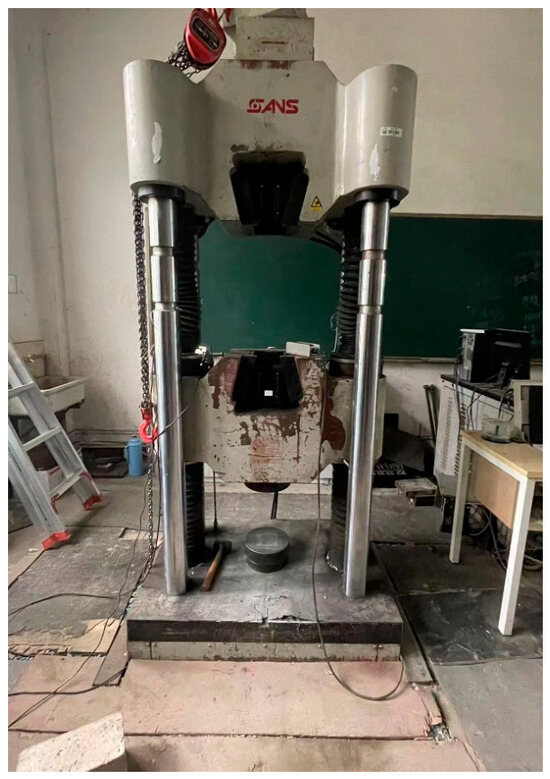
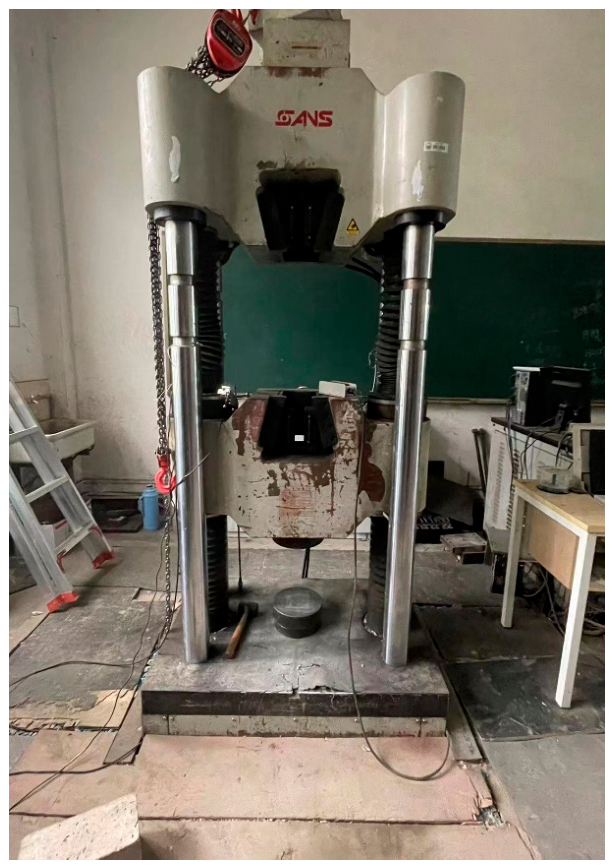
As shown in Figure 2, Compressive strength tests were conducted using a servo-controlled universal testing machine. For printable concrete, specimens extracted along the X, Y, and Z directions were tested to evaluate anisotropy in mechanical properties. Testing procedures followed the requirements of GB/T 50081 [19] and the Chinese technical specification for printable concrete (T/CBMF 183) [20]. A loading rate of 0.3 MPa/s was adopted, and axial strain was monitored using surface-mounted strain gauges. The strain gauges were mounted on two opposite sides of each specimen, positioned as symmetrically as possible. Prior to testing, a preloading procedure was conducted to verify the symmetry of the strain readings from both sides, ensuring reliable axial strain measurement.
Figure 2.
Computer-controlled electro-hydraulic servo universal testing machine.
To evaluate the fire resistance of both printable and cast concrete, specimens were exposed to three target temperatures: 200 °C, 400 °C, and 600 °C. The selection of these temperature levels was based on previous studies reported in the literature [11], which indicates that the compressive strength of concrete decreases gradually with increasing temperature. Specifically, when the temperature ranges from 200 °C to 400 °C, the reduction in compressive strength is relatively limited, whereas a rapid and significant strength degradation occurs when the temperature exceeds 600 °C. Therefore, the three temperature conditions of 200 °C, 400 °C, and 600 °C were selected to represent low-, medium-, and high-temperature exposure scenarios, respectively.
During heating, specimens were placed in the central region of the furnace. Heating was carried out using an electric resistance furnace with a controlled heating rate of 5 °C/min until the target temperature was reached. After reaching the prescribed temperature, specimens were maintained at the target temperature for 30 min to ensure thermal stabilization throughout the specimen. Subsequently, the furnace was switched off, and the specimens were allowed to cool naturally to room temperature inside the furnace.
In fire resistance testing of structural elements, the temperature-time curve recommended by the International Organization for Standardization (ISO 834) [21] is commonly adopted as the standard fire exposure curve. The ISO 834 fire curve is expressed as [22]:
where T is the temperature of the specimen at time t (°C), t is the heating time (min), and T0 is the initial ambient temperature (°C).
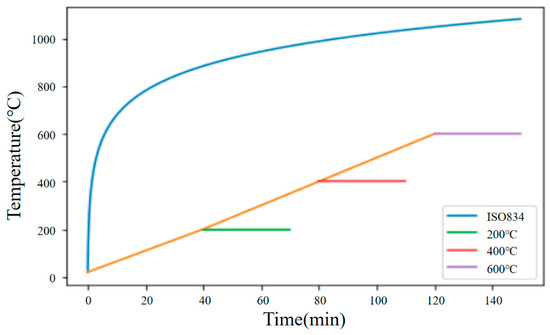
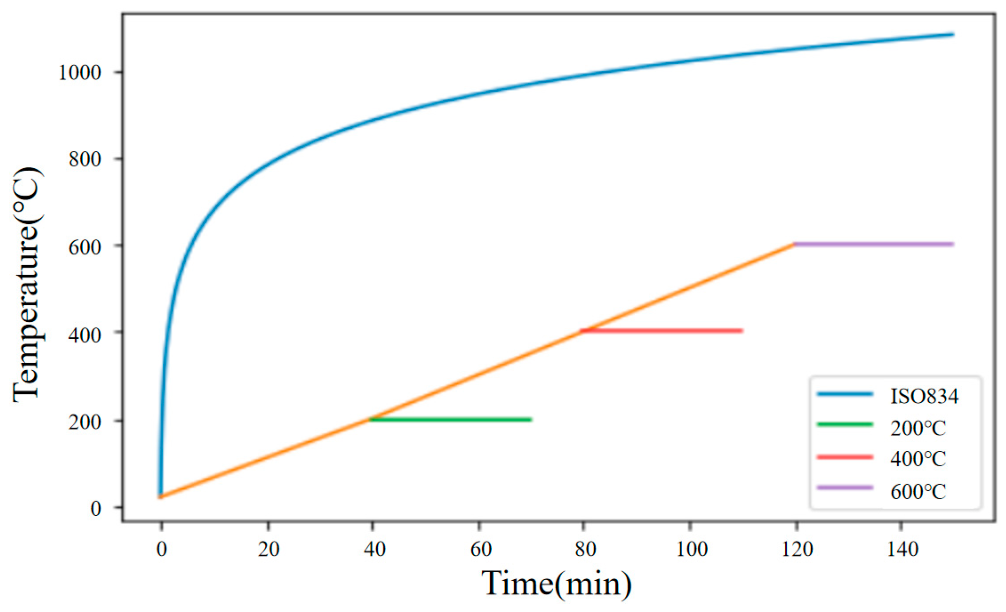
As illustrated in Figure 3, the ideal fire exposure during a standard fire resistance test should follow the ISO 834 temperature-time curve. However, in practice, it is difficult for conventional electric furnaces to accurately reproduce the rapid and nonlinear heating rate associated with the ISO 834 curve. Therefore, based on previous studies [22,23], a simplified and controllable linear heating regime was adopted in this study to simulate high-temperature exposure while ensuring stable and repeatable thermal conditions. The heating device used in this study was an electric resistance furnace manufactured by Shanghai Yifeng Electric Furnace Co., Ltd., Shanghai, China. The main technical parameters of the furnace are summarized in Table 2.
Figure 3.
ISO 834 fire temperature-time curve and electric furnace heating curve. The orange line represents the heating process.
Table 2.
Main technical parameters of the furnace.
Visual inspections were conducted to document surface cracks, color changes, and spalling. Mass loss was recorded for each specimen to assess thermal decomposition and dehydration effects.
After cooling, compressive strength tests were repeated for all specimens following the same procedure as ambient tests. The elastic modulus was determined from the uniaxial compressive stress–strain curves. Specifically, the elastic region of each curve was identified, and the elastic modulus was obtained by performing a linear least-squares regression over that portion. The range selected for linear fitting typically corresponded to 5–30% of the peak stress, within which the stress–strain response remained essentially linear. Stress–strain curves, elastic modulus, and residual strength degradation were analyzed to quantify the effects of elevated temperature. Differences between printable and cast concrete were evaluated to understand how layered architecture influences thermal damage mechanisms.
3. Results and Discussion
3.1. Anisotropy of Printable Concrete at Ambient Temperature
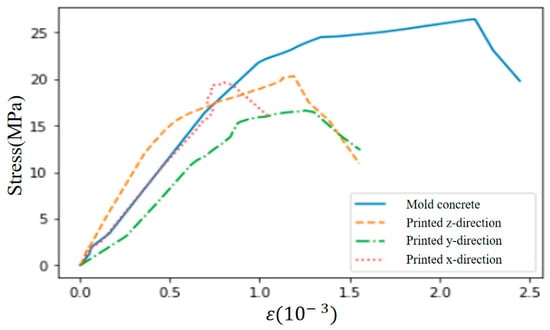
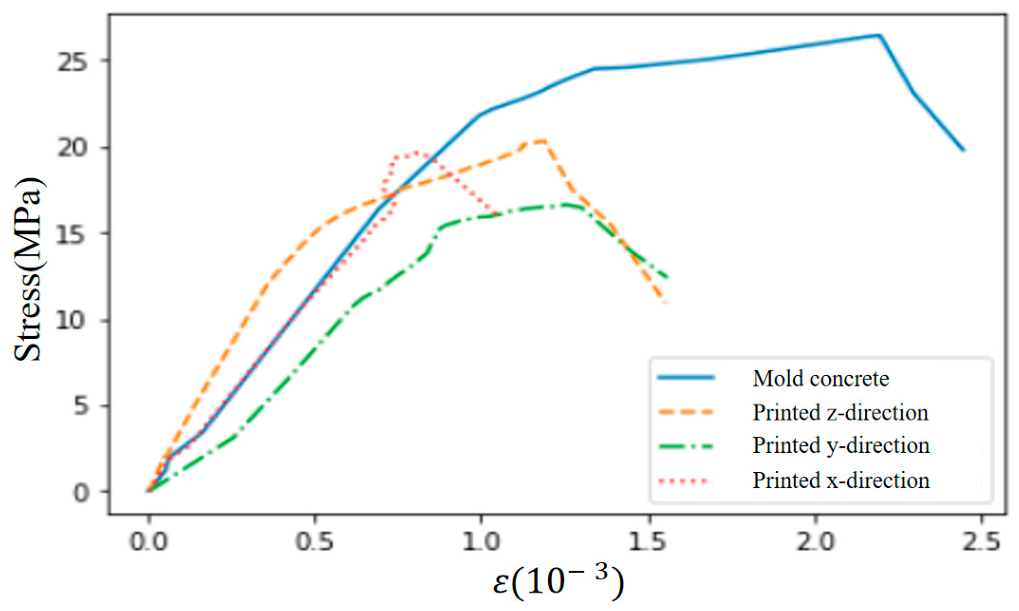
Figure 4 presents the compressive stress–strain relationships of the cast concrete and the 3D-printed concrete specimens loaded in three orthogonal directions (x-, y-, and z-directions). Each direction was repeated three times, and one representative curve was selected from among them. All curves exhibit the typical response of cement-based materials under compression, including an initial elastic stage, followed by a nonlinear elastoplastic stage, a peak stress point, and a subsequent descending branch. With increasing load, the compressive strain gradually increases until the maximum stress is reached. Beyond the peak stress, the stress decreases with further strain accumulation, eventually leading to failure. Compared with the molded concrete, the 3D-printed specimens show pronounced anisotropy in both peak stress and post-peak behavior, which can be attributed to the layer-by-layer deposition process and the presence of interlayer interfaces. Previous studies [6,24] have shown that the interlayer porosity of printable concrete is significantly higher than that of cast concrete. This will lead to a decrease in the bonding strength at the interface between layers, resulting in significant anisotropy. Due to the relatively small specimen size adopted in this study, the post-peak softening and failure stages are relatively short and less pronounced, resulting in a rapid stress drop after the peak, as shown in Figure 4.
Figure 4.
Stress–strain curves of mold concrete and printed concrete at ambient temperature.
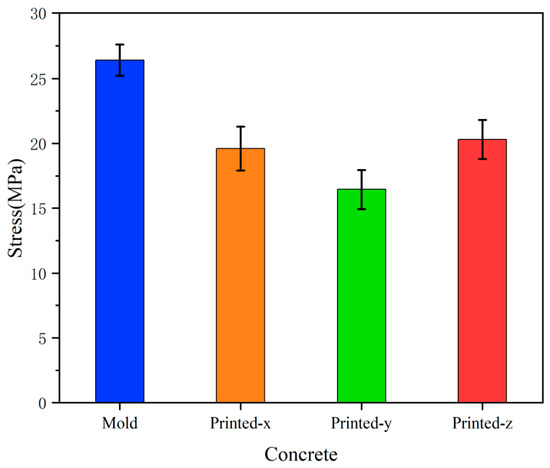
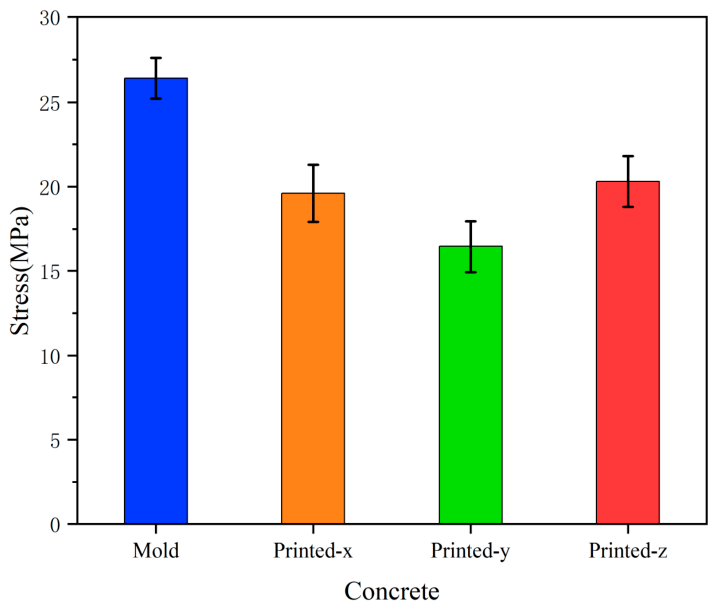
Based on the peak stresses obtained from the compressive stress–strain curves discussed in the previous section, the compressive strengths of the cast and 3D-printed concrete specimens are summarized in Figure 5. The cast concrete exhibited the highest compressive strength of 26.42 MPa. In comparison, the 3D-printed concrete showed lower compressive strengths with clear directional dependence, measuring 19.61 MPa, 16.44 MPa, and 20.31 MPa in the X, Y, and Z directions, respectively. Consequently, the compressive strengths of the cast specimens were 25.78%, 37.77%, and 23.13% higher than those of the printed specimens loaded in the X, Y, and Z directions, respectively. The compressive strength in the Y direction is only 83.83% of that in the X direction. This is very similar to the results in existing literature (82.56%) [25]. These consistent findings across different studies reinforce the inherent anisotropic nature of printed concrete, arising primarily from the layered fabrication process and the presence of interlayer interfaces.
Figure 5.
Compressive strength of mold concrete and printed concrete at ambient temperature.
A comparison among the three printing orientations further highlights the anisotropic mechanical behavior of the printed concrete. The compressive strength in the X direction was 16.17% higher than that in the Y direction, while the Z-direction strength exceeded the Y-direction strength by 19.05%. The difference between the Z and X directions was relatively small, with the Z-direction strength being only 3.44% higher. These trends are consistent with the differences observed in the corresponding stress–strain curves, particularly in terms of peak stress and post-peak response.
The observed strength anisotropy can be attributed to the layer-by-layer fabrication process inherent to 3D concrete printing. As illustrated in the directional definition, loading in the Z direction is applied perpendicular to the interlayer interfaces, forcing stress transfer across successive layers. Under this configuration, the interlayer interfaces primarily experience compressive loading, which reduces their detrimental effect on load-bearing capacity and results in relatively higher compressive strength. In contrast, both X- and Y-direction loading are applied parallel to the interlayer interfaces, rendering the mechanical response more sensitive to interlayer bonding quality and facilitating crack initiation and propagation along these planes of weakness.
Although both X and Y directions are parallel to the printing layers, a more pronounced strength reduction was observed in the Y direction. This difference is likely related to heterogeneities associated with the printing process within the layer plane, such as variations in filament alignment, filament overlap, and local void distribution. In the present study, the manual deposition process used to replicate printable concrete may have introduced additional fabrication-induced variability, including inconsistent layer spacing or larger-than-intended interlayer gaps. These imperfections could have preferentially weakened the Y-direction specimens, leading to the notably lower compressive strength observed in this orientation.
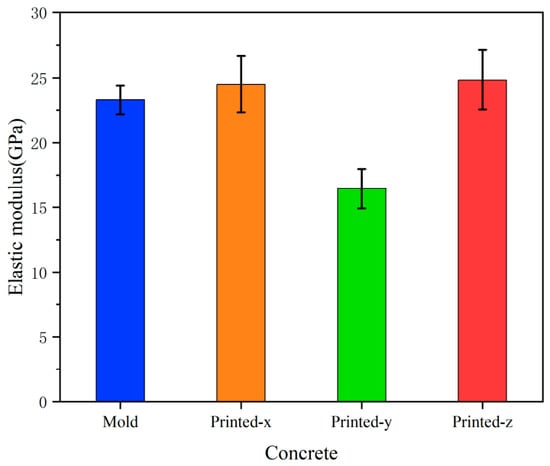
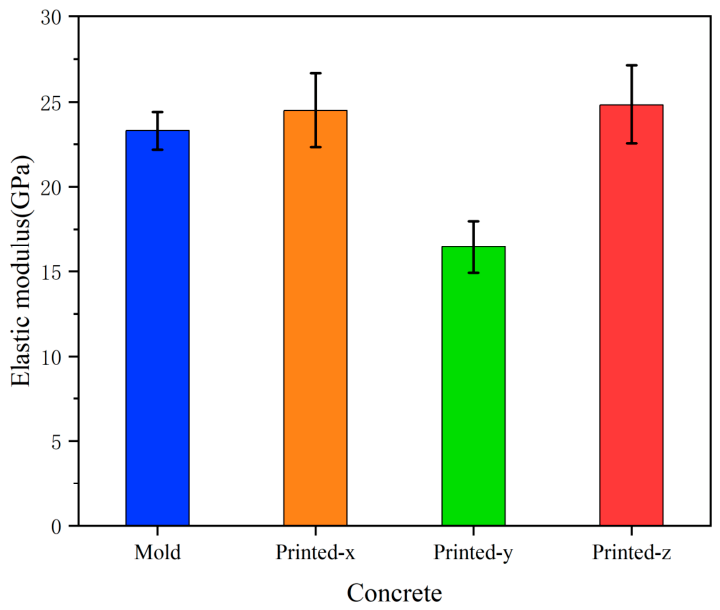
As shown in Figure 6, it presents the elastic modulus of the cast concrete and the 3D-printed concrete specimens tested at ambient temperature. Following the analysis of compressive stress–strain behavior and compressive strength, the elastic modulus results further highlight the pronounced anisotropy introduced by the layer-by-layer printing process.
Figure 6.
Elastic modulus of mold concrete and printed concrete at ambient temperature.
The measured elastic moduli were 24.84 GPa for the printed concrete loaded in the Z direction, 24.51 GPa in the X direction, 23.30 GPa for the cast concrete, and 16.45 GPa in the Y direction. This ranking indicates that the printed concrete exhibited the highest stiffness when loaded along the Z direction, followed closely by the X direction, whereas a substantially lower modulus was observed in the Y direction. Compared with the cast concrete, its elastic modulus was 5.19% lower than that of the X-direction printed specimen and 6.61% lower than that of the Z-direction printed specimen, but 29.40% higher than that of the Y-direction specimen.
Comparisons among the three printing orientations further emphasize the directional dependence of stiffness. The elastic modulus in the X direction exceeded that in the Y direction by 32.88%, while the Z-direction modulus was 33.78% higher than that in the Y direction. In contrast, the difference between the X and Z directions was relatively small (1.33%), indicating broadly comparable stiffness in these two orientations. These trends are consistent with the elastic slopes observed in the initial linear portions of the corresponding stress–strain curves.
The notably lower elastic modulus measured in the Y direction is consistent with the reduced compressive strength observed in the same orientation, suggesting weaker interlayer bonding and a higher sensitivity to interfacial defects under loading parallel to the layer interfaces. In this configuration, the presence of incomplete filament fusion and localized porosity along the interlayer planes can significantly reduce the effective load-bearing area, leading to diminished stiffness. Conversely, loading in the Z direction, which is applied perpendicular to the interlayer interfaces, promotes stress transfer across successive layers and reduces the adverse influence of interlayer defects, resulting in higher stiffness. The close agreement between the elastic moduli in the X and Z directions further suggests relatively uniform structural integrity in these orientations, likely associated with more favorable deposition quality and interlayer contact conditions during the printing process.
3.2. Residual Mechanical Properties at Elevated Temperatures
3.2.1. Surface Appearance of Specimens
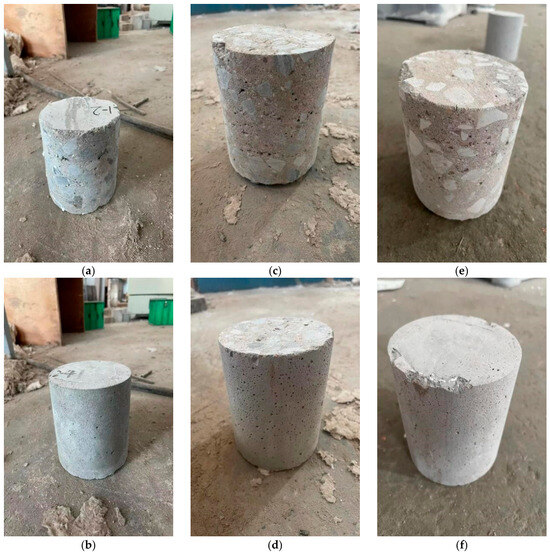
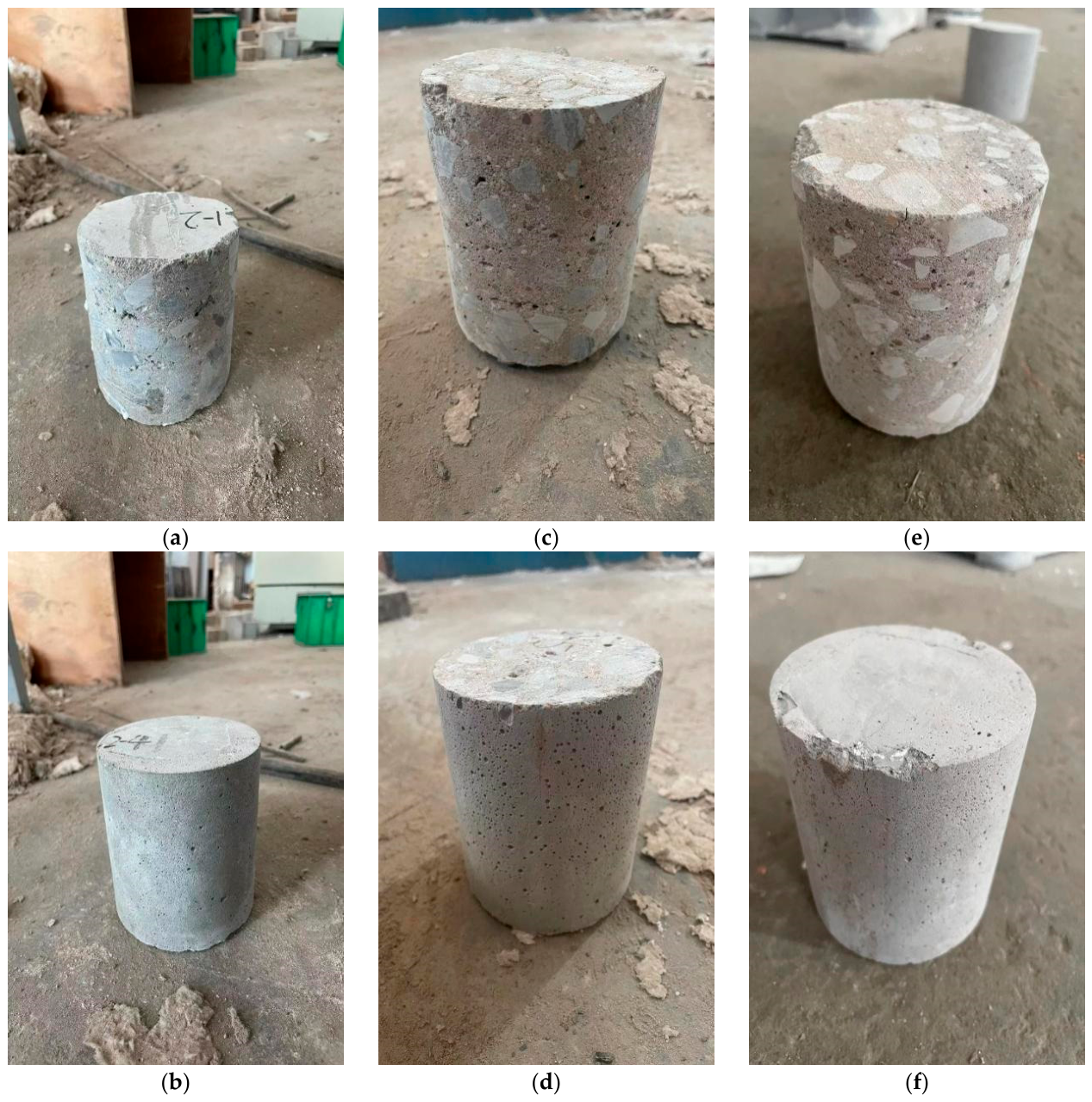
After high-temperature exposure, the specimens were removed from the electric furnace and placed on a flat surface to cool naturally to room temperature. Subsequently, the surface appearance of both 3D-printed concrete and cast concrete specimens subjected to different temperature conditions was carefully examined.
After exposure to 200 °C, both the printed concrete and the cast concrete specimens exhibited only minor changes in surface appearance compared with those at ambient temperature. The surface color became slightly lighter, showing a faint whitish tone, while the specimens remained largely intact without visible damage. The corresponding appearance is shown in Figure 7a,b.
Figure 7.
Appearance of specimens: (a) 3D-printed concrete after exposure to 200 °C; (b) cast concrete after exposure to 200 °C, (c) 3D-printed concrete after exposure to 400 °C; (d) cast concrete after exposure to 400 °C, (e) 3D-printed concrete after exposure to 600 °C; and (f) cast concrete after exposure to 600 °C.
After exposure to 400 °C, the printed concrete specimens exhibited a grayish-white surface accompanied by a small number of fine cracks. In contrast, a limited portion of the cast concrete surface appeared dark reddish in color, and similarly, a small number of fine cracks were observed. The surface conditions of both types of specimens after heating to 400 °C are illustrated in Figure 7c,d.
After exposure to 600 °C, the surface of the printed concrete specimens became noticeably whitened, with a greater number of cracks that were longer and more pronounced compared with those observed after 400 °C. The cast concrete specimens also exhibited a whitish surface and a significant increase in crack density and crack length relative to the 400 °C condition. Notably, the cast concrete specimens showed substantially more visible cracking than the printed concrete specimens after 600 °C. The corresponding surface appearances are presented in Figure 7e,f.
3.2.2. Mass Loss
Under high-temperature exposure, calcium silicate hydrate (C-S-H) gel in concrete undergoes dehydration and gradual decomposition. With increasing temperature, moisture evaporation intensifies, which adversely affects the original mechanical properties of concrete. Previous studies have shown that the degree of mechanical degradation of concrete after high-temperature exposure is closely related to the amount of moisture loss within the material [26].
The mass loss rate is defined as the ratio of the mass difference in a concrete specimen before and after high-temperature exposure to its initial mass prior to heating [27], and it can be expressed as:
where L is the mass loss rate (%), M is the mass of the specimen before high-temperature exposure, and M1 is the mass of the specimen after heating and cooling.
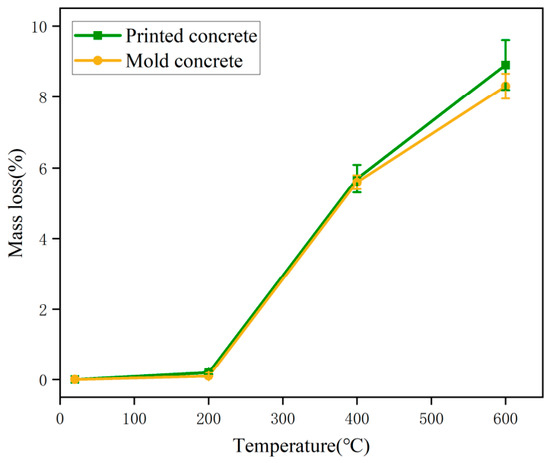
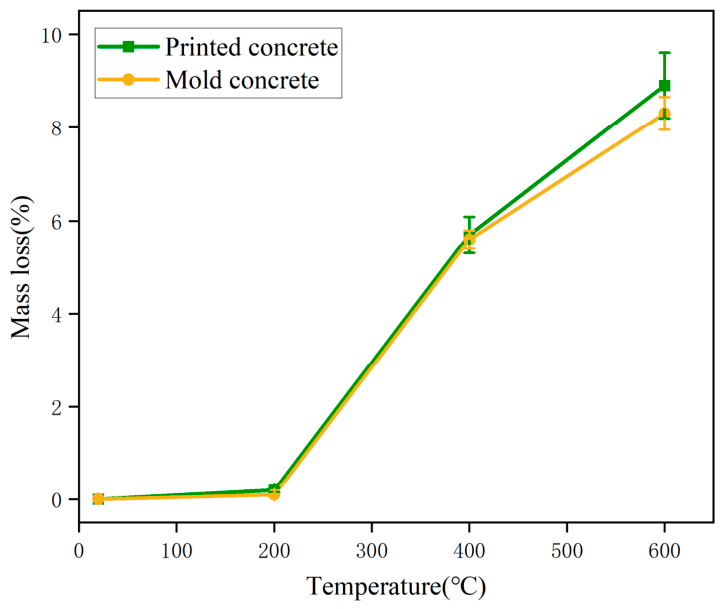
The results indicate that both 3D-printed concrete and cast concrete experienced mass loss after exposure to elevated temperatures. At a maximum temperature of 200 °C, the mass loss rates of both printed and cast concrete specimens were negligible and close to 0%. When the maximum temperature increased to 400 °C, the mass loss rates of both types of specimens increased to approximately 5%. At 600 °C, a pronounced increase in mass loss was observed, with mass loss rates of 8.3% for printed concrete and 8.9% for cast concrete.
Overall, the mass loss rate increased progressively with increasing temperature. When the temperature was less than 200 °C, the increase in mass loss was minimal, indicating limited moisture evaporation. However, when the temperature exceeded 200 °C, the mass loss rate increased significantly with further temperature elevation, reflecting intensified dehydration and decomposition processes within the concrete.
As shown in Figure 8, the comparison between the two material types indicates that the mass loss rate of cast concrete was consistently slightly higher than that of printed concrete at elevated temperatures. This difference can be attributed to several factors. First, during the printing process, concrete is deposited layer by layer with time intervals between successive layers, allowing partial moisture loss to occur prior to high-temperature exposure [28]. As a result, printed concrete may contain a lower amount of free water compared with cast concrete. Second, printed concrete typically exhibits a more open pore structure, and the relatively high ambient temperature during printing can further promote early moisture evaporation [29]. These factors reduce the amount of water available for evaporation during subsequent high-temperature exposure, leading to a slightly lower mass loss rate for printed concrete compared with cast concrete.
Figure 8.
Mass loss rate of cast concrete and printed concrete after high-temperature exposure.
3.2.3. Mechanical Performance
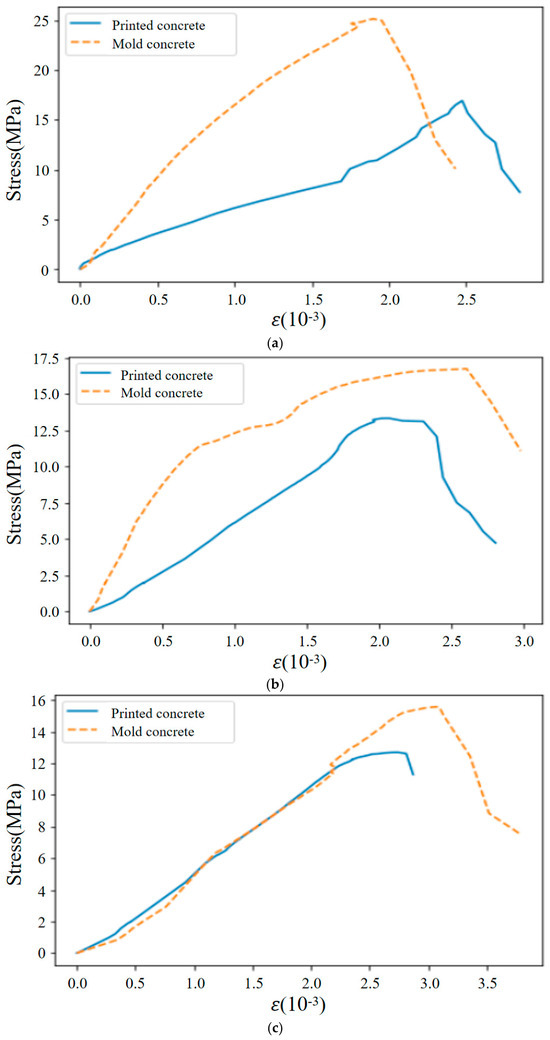
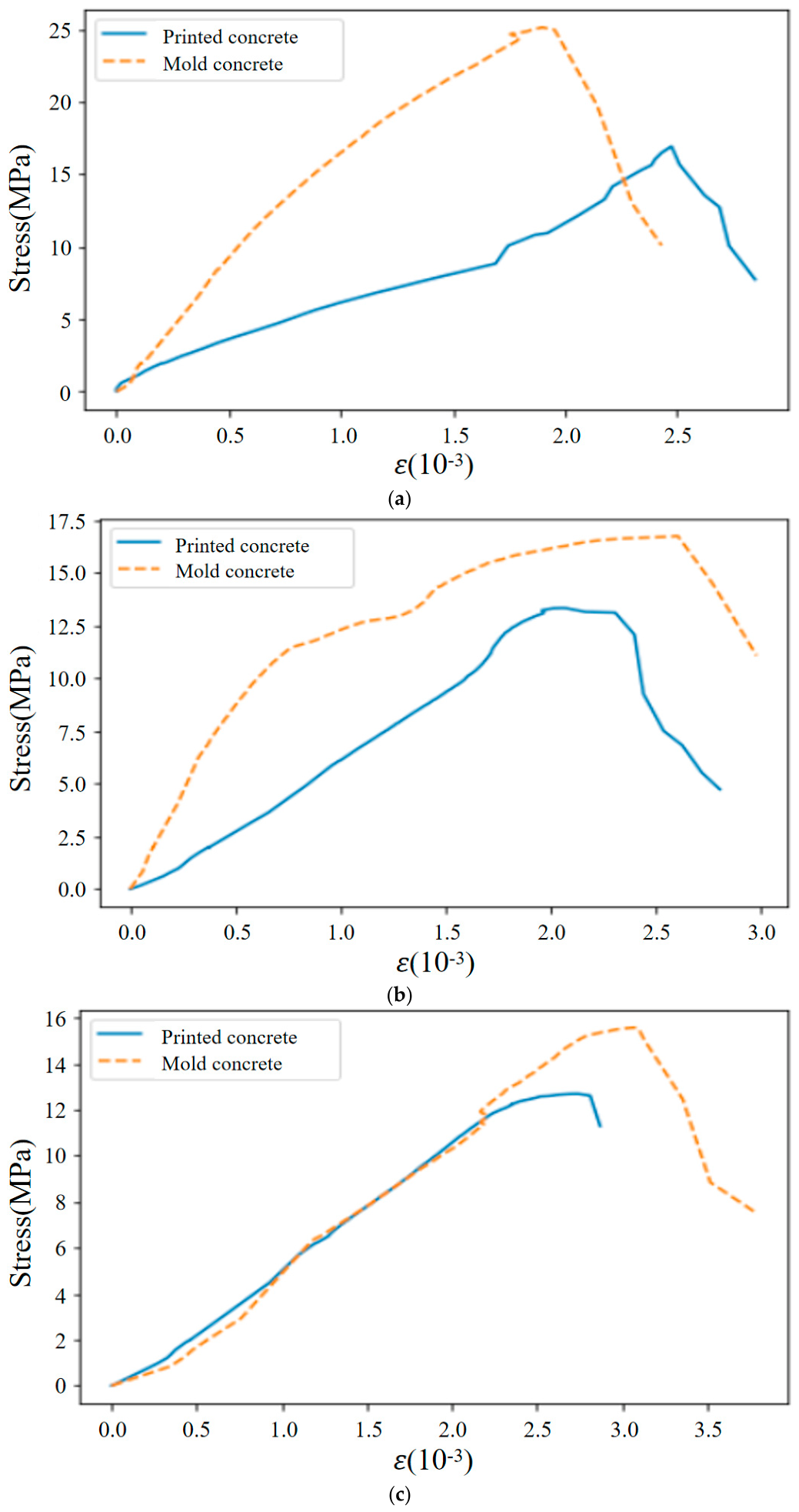
All compressive tests after elevated-temperature exposure were conducted along the Z-direction, which is parallel to the printing direction (i.e., the build direction). This direction was selected because it typically exhibits the highest compressive strength in 3D-printed concrete and corresponds to the primary load-bearing orientation in vertical structural elements such as walls and columns. Based on the experimental results, both 3D-printed concrete and cast concrete specimens exhibited compressive stress–strain responses after high-temperature exposure that are generally similar to those observed at ambient temperature. As shown in Figure 9, the stress–strain curves at elevated temperatures still follow the typical four-stage evolution of concrete under compression, including the elastic stage, elastoplastic stage, peak stress point, and descending branch. The primary differences induced by high-temperature exposure are reflected in the peak stress level and the post-peak behavior.
Figure 9.
Stress–strain curves of printed concrete and mold concrete at elevated temperatures in the Z direction, (a) 200 °C, (b) 400 °C, and (c) 600 °C.
As shown in Figure 9, after exposure to 200 °C, both printed and cast concrete specimens showed only a moderate reduction in peak stress compared with room-temperature behavior, and the overall shape of the stress–strain curves remained relatively intact. After exposure to 400 °C, a more pronounced decrease in peak stress was observed for both materials, accompanied by a reduction in stiffness and a more evident post-peak softening behavior. After exposure to 600 °C, significant degradation in mechanical performance was evident, with substantially lower peak stress and a more abrupt descending branch, indicating severe thermal damage and reduced load-bearing capacity.
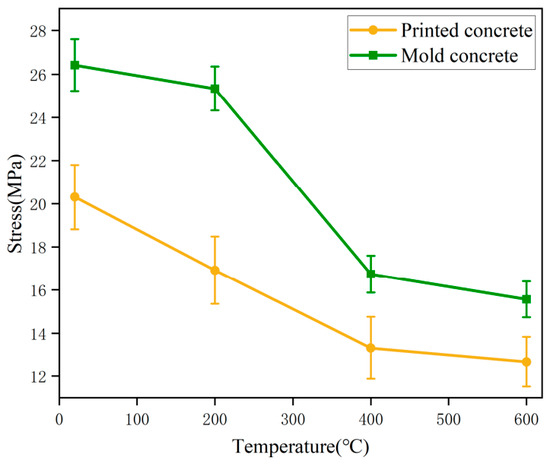
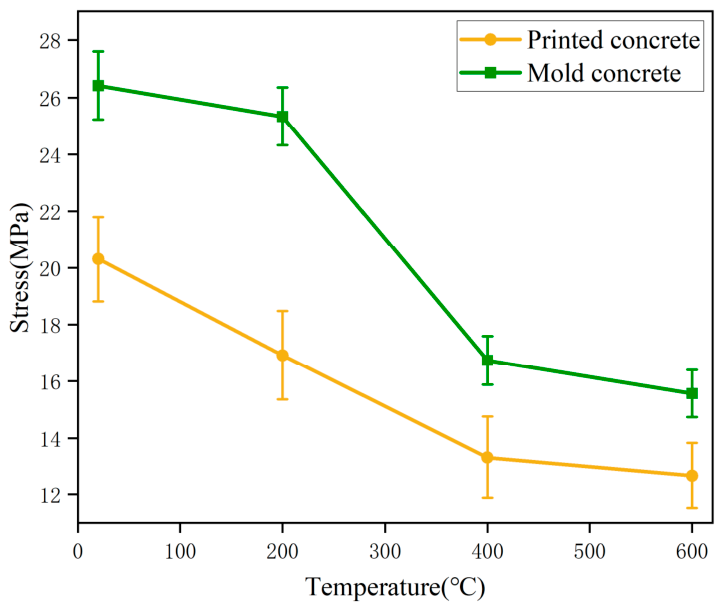
The compressive strengths of the 3D-printed concrete specimens at ambient temperature (20 °C) and after exposure to 200 °C, 400 °C, and 600 °C were measured as 20.31 MPa, 16.92 MPa, 13.32 MPa, and 12.68 MPa, respectively. For the cast concrete specimens, the corresponding compressive strengths were 26.42 MPa, 25.34 MPa, 16.74 MPa, and 15.57 MPa. The variation in compressive strength with temperature for both materials is illustrated in Figure 10.
Figure 10.
Compressive strength of printed concrete and mold concrete at ambient temperature and elevated temperatures in the Z direction.
Based on these results, the compressive strength of the printed concrete decreased by 16.68% after exposure to 200 °C, 34.40% after exposure to 400 °C, and 37.54% after exposure to 600 °C, relative to its ambient-temperature strength. A similar degradation trend was observed for the cast concrete. Specifically, the compressive strength reductions in cast concrete were 4.09%, 36.64%, and 41.07% after exposure to 200 °C, 400 °C, and 600 °C, respectively. Notably, the cast concrete exhibited only a minor strength reduction after exposure to 200 °C.
The relatively small strength loss of cast concrete after 200 °C can be attributed to its higher initial strength and denser internal microstructure [30]. At this temperature level, the primary thermal effect is the evaporation of free water and partial loss of physically bound water, while the dehydration of hydration products remains limited. As a result, the internal damage is relatively minor, leading to a small reduction in compressive strength. In contrast, the printed concrete, which typically exhibits a more heterogeneous microstructure with interlayer interfaces and higher porosity [6,24], is more sensitive to early-stage thermal damage, resulting in a more pronounced strength reduction even at moderate temperatures.
Combining the compressive strength results with the previously discussed stress–strain behavior and mass loss characteristics, it can be observed that the degradation of printed concrete is strongly temperature dependent. When the temperature is less than 400 °C, the compressive strength of printed concrete deteriorates rapidly with increasing temperature. This stage is mainly associated with moisture evaporation, dehydration of C-S-H gel, and the development of thermally induced microcracks, particularly along interlayer interfaces. When the temperature increases further to the range of between 400 °C and 600 °C, the rate of strength degradation becomes relatively slower. This phenomenon may be related to the fact that a substantial portion of the physically bound water has already been lost at lower temperatures, and the subsequent damage is dominated by gradual microstructural coarsening rather than abrupt phase transformations.
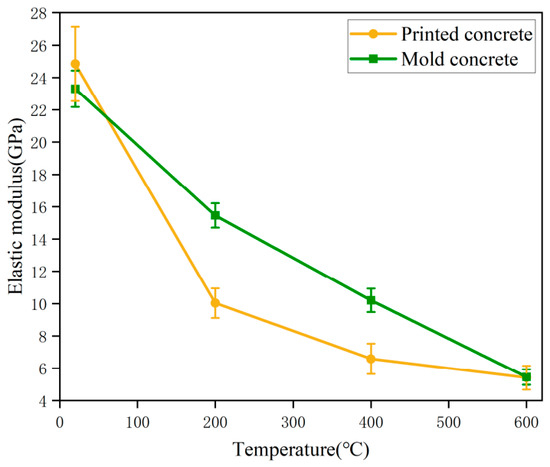
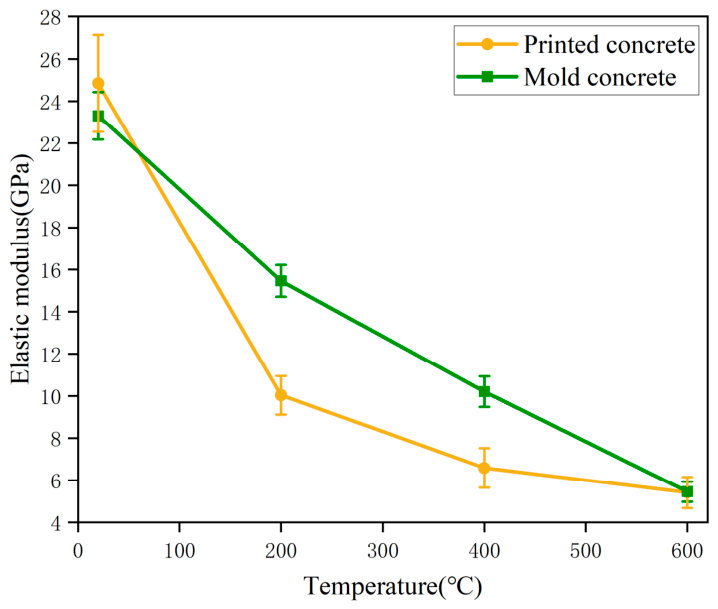
The elastic modulus values after high-temperature exposure are illustrated in Figure 11. For the 3D-printed concrete, the elastic modulus at ambient temperature (20 °C) was 24.84 GPa, which decreased to 10.03 GPa, 6.58 GPa, and 5.42 GPa after exposure to 200 °C, 400 °C, and 600 °C, respectively. In comparison, the elastic modulus of the cast concrete decreased from 23.30 GPa at ambient temperature to 15.46 GPa, 10.20 GPa, and 5.46 GPa after exposure to the same temperature levels.
Figure 11.
Elastic modulus of printed concrete and mold concrete at ambient temperature and elevated temperatures in the Z direction.
Based on these results, the elastic modulus of the printed concrete decreased by 59.62% after 200 °C, 73.51% after 400 °C, and 78.18% after 600 °C relative to its ambient-temperature value. A similar degradation trend was observed for the cast concrete, with elastic modulus reductions of 33.65%, 56.22%, and 76.57% after 200 °C, 400 °C, and 600 °C, respectively.
The results clearly indicate that the elastic modulus is more sensitive to high-temperature exposure than compressive strength, particularly at lower temperature levels. When the temperature is 400 °C, the elastic modulus of printed concrete deteriorated rapidly with an increasing temperature. This pronounced reduction can be attributed to the evaporation of free water, dehydration of physically bound water, and the initiation of thermally induced microcracks, which significantly reduce the stiffness of the cementitious matrix [17]. These effects are further amplified in printed concrete due to its inherent interlayer interfaces and higher microstructural heterogeneity.
When the temperature increased to between 400 °C and 600 °C, the rate of elastic modulus degradation became relatively slower. At this stage, substantial microstructural damage had already occurred at lower temperatures, and further temperature increases mainly led to gradual coarsening of the pore structure rather than abrupt changes in load-bearing stiffness. This trend is consistent with the observed stress–strain behavior, where the initial elastic slope decreases sharply at moderate temperatures and then tends to stabilize at higher temperatures.
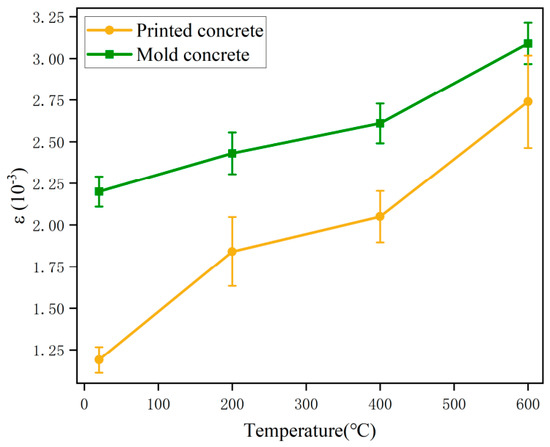
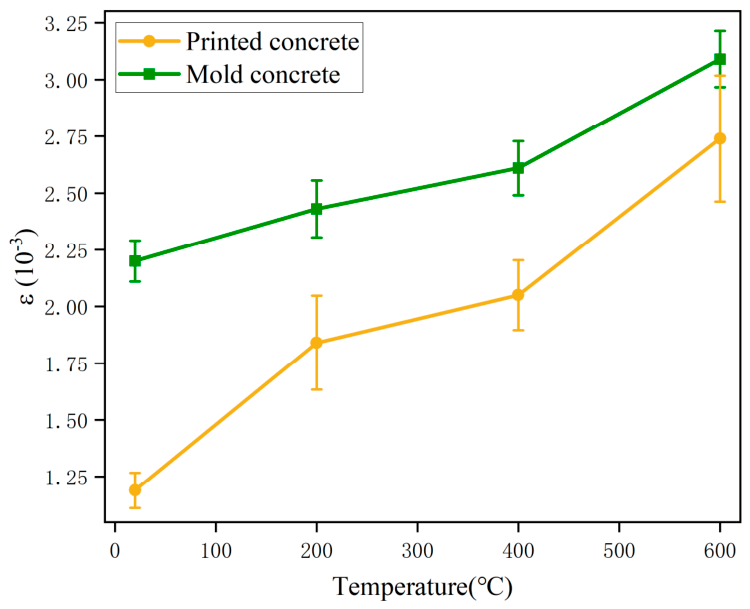
The peak strain values of both printed concrete and cast concrete after high-temperature exposure were determined from the compressive stress–strain curves. The results are summarized in Figure 12. For the 3D-printed concrete, the peak strain at ambient temperature (20 °C) was 1.19 × 10⁻³, which increased to 1.84 × 10⁻³, 2.05 × 10⁻³, and 2.74 × 10⁻³ after exposure to 200 °C, 400 °C, and 600 °C, respectively. In comparison, the peak strain values of the cast concrete increased from 2.20 × 10⁻³ at ambient temperature to 2.43 × 10⁻³, 2.61 × 10⁻³, and 3.09 × 10⁻³ after exposure to the same temperature levels.
Figure 12.
Critical strain of printed concrete and mold concrete at ambient temperature and elevated temperatures in the Z direction.
Relative to the ambient temperature condition, the peak strain of the printed concrete increased by 35.22% after exposure to 200 °C, 41.99% after exposure to 400 °C, and 56.64% after exposure to 600 °C. A similar increasing trend was observed for the cast concrete, although with smaller magnitudes. Specifically, the peak strain increments of the cast concrete were 9.47%, 15.71%, and 28.80% after 200 °C, 400 °C, and 600 °C, respectively.
The experimental results indicate that the peak strain of both materials increased progressively with increasing temperature after natural cooling. The increase in peak strain reflects the progressive softening of the concrete matrix and the accumulation of thermally induced microcracks, which reduce stiffness and allow larger deformation to develop before reaching peak stress. This trend is consistent with the previously observed reduction in elastic modulus and the more pronounced post-peak softening behavior in the stress–strain curves.
Compared with cast concrete, the printed concrete exhibited a larger relative increase in peak strain with temperature, indicating a higher sensitivity of deformation capacity to thermal damage. This behavior can be attributed to the inherent interlayer interfaces and higher microstructural heterogeneity of printed concrete, which promote earlier microcrack initiation and more distributed damage under high-temperature exposure. Nevertheless, despite the larger increase rate, the absolute peak strain values of printed concrete remained lower than those of cast concrete at all temperature levels, reflecting its comparatively lower deformation capacity prior to failure.
To provide a clear and concise overview of the key experimental results, Table 3 summarizes the main mechanical properties of both cast and 3D-printed concrete. The table includes the mass loss rate, residual compressive strength, elastic modulus, and critical strain determined at ambient temperature and after exposure to 200, 400, 600, and 800 °C. All values are reported as mean ± standard deviation. This summary allows for a direct quantitative comparison between the two fabrication methods and highlights the progressive degradation of mechanical performance with increasing temperature.
Table 3.
Summary of mass loss rate, residual compressive strength, elastic modulus, and critical strain of cast and printed concrete after exposure to ambient and elevated temperatures.
It should be noted that the mechanical tests in this study were conducted after the specimens had cooled to ambient temperature. Therefore, the results represent the residual properties of printable concrete after thermal exposure, rather than the instantaneous mechanical behavior at elevated temperatures. Under real fire scenarios, the degradation of strength and stiffness at high temperatures can be more severe, owing to factors such as thermal stress gradients, vapor pressure buildup, and ongoing physicochemical changes. Consequently, the residual values reported here may not be directly applicable to structural fire resistance assessments without further adjustment. Due to limitations in experimental equipment, in situ high-temperature testing was not feasible in the present work. This limitation should be taken into account when interpreting the findings, and future studies incorporating high-temperature mechanical testing or physics-based predictive modeling are recommended to bridge the gap between residual properties and real-time fire behavior.
Furthermore, the present study was conducted on laboratory-scale specimens prepared through a controlled manual deposition process, which may not fully represent the complexity of real-scale automated printing systems and structural elements. The results indicate that interlayer interfaces play a critical role in the fire performance of printable concrete, highlighting the importance of printing quality control in engineering applications. Future studies should further investigate the fire resistance behavior of full-scale printed structural members, the influence of different printing parameters and reinforcement strategies, as well as the coupled effects of thermal loading and structural stress under realistic fire scenarios.
4. Conclusions
Based on the experimental investigation of printable concrete and cast concrete subjected to elevated temperatures, the following conclusions can be drawn:
- Printable concrete exhibits clear anisotropy in mechanical properties at ambient temperature due to its layer-by-layer fabrication. Loading perpendicular to the interlayer interfaces results in higher compressive strength and elastic modulus than loading parallel to the layers, while the Y-direction shows the weakest performance, reflecting sensitivity to interlayer bonding quality and deposition-induced heterogeneity. Compared with cast concrete, printable concrete showed up to 37.77% lower compressive strength at ambient temperature.
- High-temperature exposure leads to progressive surface discoloration and cracking in both printable and cast concrete. Mass loss increases monotonically with temperature and becomes pronounced above 400 °C, corresponding to intensified dehydration and decomposition of hydration products. Printed concrete consistently exhibits slightly lower mass loss than cast concrete, likely due to partial moisture loss during the printing process and its more open pore structure.
- Both printable and cast concrete experience significant reductions in compressive strength after thermal exposure. For printable concrete, the compressive strength decreased by 16.68%, 34.40%, and 37.54% after exposure to 200 °C, 400 °C, and 600 °C, respectively. The strength degradation is rapid when the temperature is below 400 °C and becomes more gradual between 400 °C and 600 °C. Cast concrete shows a smaller strength reduction after 200 °C, attributed to its denser microstructure and higher initial strength.
- The elastic modulus is more sensitive to elevated temperature than compressive strength for both materials. The elastic modulus of printable concrete decreased by up to 78.18% after thermal exposure. Printable concrete shows a particularly pronounced reduction in stiffness at moderate temperatures, reflecting early microcrack development and interlayer damage. Above 400 °C, the rate of stiffness degradation decreases as substantial microstructural damage has already occurred.
- Peak strain increases progressively with temperature for both printable and cast concrete, indicating a shift toward a more deformable but mechanically weakened response after thermal exposure. Printable concrete exhibits a larger relative increase in peak strain than cast concrete, although its absolute peak strain values remain lower at all temperature levels.
- Compared with cast concrete, printable concrete demonstrates lower residual strength and stiffness and higher sensitivity to thermal damage, primarily due to its layered architecture and interlayer interfaces. These features significantly influence post-fire mechanical behavior and should be explicitly considered in fire resistance assessment and structural evaluation of printable concrete.
Author Contributions
Software, H.Z.; Validation, Y.R. and Y.Y.; Funding acquisition, Y.R. and Y.Y.; Investigation, K.X., J.Z., Y.Z., C.Z. and H.Z.; Methodology, K.X.; J.Z., Y.Z. and Z.Z.; Writing—original draft, K.X. and J.Z.; Writing—review and editing, Y.R., Y.Z., Z.Z., C.Z., H.Z. and Y.Y. All authors have read and agreed to the published version of the manuscript.
Funding
The work was supported by the Science and Technology Commission of Shanghai Municipality, China (No. 23DZ1202906) and the Science and Technology Project of the Department of Transportation of Jiangxi Province, grant No. 2021C0008 and No. 2025ZG021.
Data Availability Statement
The original contributions presented in the study are included in the article, further inquiries can be directed to the corresponding author.
Conflicts of Interest
Authors Kai Xiong, Youhua Zhang and Huijie Zou were employed by the company Jiangxi Communications Investment Group Co., Ltd. Authors Yao Rong, Zewen Zhu and Chengke Zhang were employed by the company Jiangxi Communications Investment Maintenance Technology Group Co., Ltd. Author Yong Yuan was employed by the company Shanghai Tongji Green Building Prefabrication Construction Engineering Technology Co., Ltd. The remaining authors declare that the research was conducted in the absence of any commercial or financial relationships that could be construed as a potential conflict of interest.
References
- Flatt, R.J.; Wangler, T. On sustainability and digital fabrication with concrete. Cem. Concr. Res. 2022, 158, 106837. [Google Scholar] [CrossRef] [Scilit]
- De Schutter, G.; Lesage, K.; Mechtcherine, V.; Nerella, V.N.; Habert, G.; Agusti-Juan, I. Vision of 3D printing with concrete—Technical, economic and environmental potentials. Cem. Concr. Res. 2018, 112, 25–36. [Google Scholar] [CrossRef] [Scilit]
- Zhang, N.; Xia, M.; Sanjayan, J. Short-duration near-nozzle mixing for 3D concrete printing. Cem. Concr. Res. 2022, 151, 106616. [Google Scholar] [CrossRef] [Scilit]
- Zhang, Y.; Ren, Q.; Dai, X.; Tao, Y.; Zhang, Y.; Jiang, Z.; Van Tittelboom, K.; De Schutter, G. A potential active rheology control approach for 3D printable cement-based materials: Coupling of temperature and viscosity modifiers. Cem. Concr. Compos. 2024, 149, 105496. [Google Scholar] [CrossRef] [Scilit]
- Roussel, N.; Bessaies-Bey, H.; Kawashima, S.; Marchon, D.; Vasilic, K.; Wolfs, R. Recent advances on yield stress and elasticity of fresh cement-based materials. Cem. Concr. Res. 2019, 124, 105798. [Google Scholar] [CrossRef] [Scilit]
- Rahul, A.V.; Santhanam, M.; Meena, H.; Ghani, Z. Mechanical characterization of 3D printable concrete. Constr. Build. Mater. 2019, 227, 116710. [Google Scholar] [CrossRef] [Scilit]
- Liu, H.; Liu, C.; Wu, Y.; Bai, G.; He, C.; Zhang, R.; Wang, Y. Hardened properties of 3D printed concrete with recycled coarse aggregate. Cem. Concr. Res. 2022, 159, 106868. [Google Scholar] [CrossRef] [Scilit]
- Rahul, A.V.; Mohan, M.K.; De Schutter, G.; Van Tittelboom, K. 3D printable concrete with natural and recycled coarse aggregates: Rheological, mechanical and shrinkage behaviour. Cem. Concr. Compos. 2022, 125, 104311. [Google Scholar] [CrossRef] [Scilit]
- Kruger, J.; van Zijl, G. A compendious review on lack-of-fusion in digital concrete fabrication. Addit. Manuf. 2021, 37, 101654. [Google Scholar] [CrossRef] [Scilit]
- Bester, F.; van den Heever, M.; Kruger, J.; van Zijl, G. Reinforcing digitally fabricated concrete: A systems approach review. Addit. Manuf. 2021, 37, 101737. [Google Scholar] [CrossRef] [Scilit]
- Chen, Z.; Xiao, J.; Ding, T. Behaviours of novel prefabricated RAC-HSC composite beams subjected to fire: An experimental and numerical study. Eng. Struct. 2025, 322, 119108. [Google Scholar] [CrossRef] [Scilit]
- Hou, S.; Duan, Z.; Xiao, J.; Ye, J. A review of 3D printed concrete: Performance requirements, testing measurements and mix design. Constr. Build. Mater. 2021, 273, 121745. [Google Scholar] [CrossRef] [Scilit]
- Xiao, J.; Han, N.; Zhang, L.; Zou, S. Mechanical and microstructural evolution of 3D printed concrete with polyethylene fiber and recycled sand at elevated temperatures. Constr. Build. Mater. 2021, 293, 123524. [Google Scholar] [CrossRef] [Scilit]
- Dong, L.; Yang, Y.; Liu, Z.; Ren, Q.; Li, J.; Zhang, Y.; Wu, C. Microstructure and mechanical behaviour of 3D printed ultra-high performance concrete after elevated temperatures. Addit. Manuf. 2022, 58, 103032. [Google Scholar] [CrossRef] [Scilit]
- Weng, Y.; Li, M.; Liu, Z.; Lao, W.; Lu, B.; Zhang, D.; Tan, M.J. Printability and fire performance of a developed 3D printable fibre reinforced cementitious composites under elevated temperatures. Virtual Phys. Prototyp. 2019, 14, 284–292. [Google Scholar] [CrossRef] [Scilit]
- Cicione, A.; Kruger, J.; Walls, R.S.; Van Zijl, G. An experimental study of the behavior of 3D printed concrete at elevated temperatures. Fire Saf. J. 2021, 120, 103075. [Google Scholar] [CrossRef] [Scilit]
- Suntharalingam, T.; Upasiri, I.; Gatheeshgar, P.; Poologanathan, K.; Nagaratnam, B.; Rajanayagam, H.; Navaratnam, S. Fire resistance of 3D printed concrete composite wall panels exposed to various fire scenarios. J. Struct. Fire Eng. 2021, 12, 377–409. [Google Scholar] [CrossRef] [Scilit]
- Yuan, Y.; Sheng, R.; Yao, X.; Pichler, B.; Mang, H.A.; Zhang, J.-L. A three-step development strategy for 3D printable concrete containing coarse aggregates. Case Stud. Constr. Mater. 2025, 22, e04540. [Google Scholar] [CrossRef] [Scilit]
- GB/T 50081-2002; Standard for Test Method of Mechanical Properties on Ordinary Concrete. China Architecture & Building Press: Beijing, China, 2003.
- T/CBMF 183-2022; Test Methods for Basic Mechanical Properties of 3D Printed Concrete. China Building Materials Federation: Beijing, China, 2022.
- ISO 834-1:1999; Fire-Resistance Tests—Elements of Building Construction—Part 1: General Requirements. International Organization for Standardization: Geneva, Switzerland, 1999.
- Zuo, W.; Chen, M.-T.; Young, B. Structural behaviour of cold-formed steel elliptical hollow section stub columns after exposure to ISO-834 fire curve. Thin-Walled Struct. 2024, 197, 111309. [Google Scholar] [CrossRef] [Scilit]
- Lee, T.; Kim, G.; Choe, G.; Hwang, E.; Lee, J.; Ryu, D.; Nam, J. Spalling Resistance of Fiber-Reinforced Ultra-High-Strength Concrete Subjected to the ISO-834 Standard Fire Curve: Effects of Thermal Strain and Water Vapor Pressure. Materials 2020, 13, 3792. [Google Scholar] [CrossRef] [Scilit]
- Du, L.; Zhou, J.; Lai, J.; Wu, K.; Yin, X.; He, Y. Effect of pore structure on durability and mechanical performance of 3D printed concrete. Constr. Build. Mater. 2023, 400, 132581. [Google Scholar] [CrossRef] [Scilit]
- Liu, C.; Yue, S.; Zhou, C.; Sun, H.; Deng, S.; Gao, F.; Tan, Y. Anisotropic mechanical properties of extrusion-based 3D printed layered concrete. J. Mater. Sci. 2021, 56, 16851–16864. [Google Scholar] [CrossRef] [Scilit]
- Phan, L.T.; Lawson, J.R.; Davis, F.L. Effects of elevated temperature exposure on heating characteristics, spalling, and residual properties of high performance concrete. Mater. Struct. 2001, 34, 83–91. [Google Scholar] [CrossRef] [Scilit]
- Chen, L.; Fang, Q.; Jiang, X.; Ruan, Z.; Hong, J. Combined effects of high temperature and high strain rate on normal weight concrete. Int. J. Impact Eng. 2015, 86, 40–56. [Google Scholar] [CrossRef] [Scilit]
- Sanjayan, J.G.; Nematollahi, B.; Xia, M.; Marchment, T. Effect of surface moisture on inter-layer strength of 3D printed concrete. Constr. Build. Mater. 2018, 172, 468–475. [Google Scholar] [CrossRef] [Scilit]
- Wang, L.; Tian, Z.; Ma, G.; Zhang, M. Interlayer bonding improvement of 3D printed concrete with polymer modified mortar: Experiments and molecular dynamics studies. Cem. Concr. Compos. 2020, 110, 103571. [Google Scholar] [CrossRef] [Scilit]
- Kruger, J.; du Plessis, A.; van Zijl, G. An investigation into the porosity of extrusion-based 3D printed concrete. Addit. Manuf. 2021, 37, 101740. [Google Scholar] [CrossRef] [Scilit]

Disclaimer/Publisher’s Note: The statements, opinions and data contained in all publications are solely those of the individual author(s) and contributor(s) and not of MDPI and/or the editor(s). MDPI and/or the editor(s) disclaim responsibility for any injury to people or property resulting from any ideas, methods, instructions or products referred to in the content. |
© 2026 by the authors. Licensee MDPI, Basel, Switzerland. This article is an open access article distributed under the terms and conditions of the Creative Commons Attribution (CC BY) license.