


Abstract
Granulated blast furnace slag is a commonly used supplementary cementitious material in cement-based materials. The raw materials for ironmaking and the cooling process affect its composition, thereby influencing its reactivity. Three types of slag were selected and incorporated at replacement ratios of 15%, 30%, and 50% to investigate the influence of chemical composition on the activity index of slag at different ages and the mechanisms. The results indicate that in the early hydration stage, slag primarily plays a mechanical filling and dilution role (inert volumetric occupation without significant heterogeneous nucleation), while the pozzolanic effect dominates at later stages. Al2O3 in the slag is activated at early ages to form ettringite; at replacement ratios of 30%, C-A-S-H gel is also formed at later ages; when the replacement ratio reaches 50%, the significant reduction in cement clinker content leads to dropping in system alkalinity—corresponding to a 50% reduction in cement-derived Ca(OH)2, the activation of Al2O3 in the slag is not significant at early ages. The effects of glass content, alkali content, specific surface area, CaO + MgO content, quality coefficient, and basicity coefficient on the reactivity become prominent at longer ages. No additional crystalline phases beyond those present in pure cement paste were detected in the cement paste after slag incorporation. This study provides a theoretical basis and data support for the high-value utilization of industrial solid waste in green building materials.
1. Introduction
Granulated blast furnace slag is a byproduct generated during the smelting of pig iron in steel plants. It is classified as smelting slag, one of the seven major categories of bulk industrial solid waste [1]. For every ton of pig iron produced, approximately 0.25 to 0.5 tons of granulated blast furnace slag are generated [2]. Currently, the utilization rate of blast furnace slag in China is about 80%, while in developed countries it ranges from 90% to 100% [3]. As the civil engineering industry gradually contracts, the utilization of slag is showing a declining trend. The stockpiling of slag occupies vast amounts of land, generates fugitive dust, contaminates groundwater, damages the ecological environment, harms human health, and can even lead to disasters such as landslides and dam failures.
Slag can be utilized in building materials [4,5,6], environmental protection [7], and agriculture [2]. Utilizing slag as a supplementary cementitious material in cement-based materials to enhance their performance is one of the most effective ways to utilize it, as well as one of the most widely practiced solutions for reducing carbon emissions in the cement industry [8]. Bougara found that the incorporation of slag prolongs the hydration time of the cementitious system, causing the later-stage strength of the cement paste to increase gradually, even surpassing that of pure cement paste [9]. Studies by Zhang Tao et al. show that as the slag content increases, the water requirement for normal consistency in the cement paste decreases, the initial and final setting times are prolonged, the fluidity of the paste is improved, the early-age compressive strength decreases, but the later-age strength increases significantly, and the chloride ion fixation rate is enhanced [10].
Due to differences in the composition of ironmaking raw materials and the cooling processes of slag, the chemical composition and mineral phases of different slags vary to some extent [11], which can lead to different performance effects on cement-based materials. If not identified and controlled, these variations may cause adverse effects in applications. An increase in the glass content of slag leads to higher reactivity, whereas an increase in SiO2 content results in decreased reactivity. When the Al2O3 content is between 14% and 15%, it has a negative effect on the reactivity of slag; however, when the content is between 15% and 16.5%, it promotes the reactivity instead [12]. When the average particle size of slag is 32 μm, the activity index shows no obvious trend with an increase in the SiO2/Al2O3 ratio, when the average particle size is 11 μm, the activity index decreases as the SiO2/Al2O3 ratio increases [13]. Haha et al. investigated the hydration reactions of three types of slag activated by two different alkaline activators, the results showed that an increase in the Al2O3 content (ranging from 7% to 17%) of the slag reduced the hydration rate and compressive strength at 1 d and 7 d, but had no significant effect on the degree of hydration, volume of hydration products, coarse porosity, or compressive strength at 28, 90, and 180 d [14]. The greater the alkalinity, the smaller the chemical bond energies of the Ca-O, Si-O, and Al-O bonds, making them easier to break and resulting in better slag reactivity [11,15]. The higher the content of CaO + MgO, the more easily the network structure of the slag is dissolved, the faster the reaction rate and the higher the reactivity [16]. The more TiO2 content, the higher the content of [TiO4]4− and [TiO6]8− network structural units in the slag, which leads to a more stable structure, a reduced hydration rate, and thus poorer hydration activity [17]. Li Ning et al. demonstrated that after remelting four types of slag and subjecting them to water quenching, the content of glass phase in the slag significantly increased. However, the basicity and glass phase content of the slag had no regular effect on the 3 d and 28 d activity indices, while an increase in TiO2 content (ranging from 1.74% to 16.76%) led to a marked decrease in the 28 d activity index [18]. Blotevogel et al. mixed slag with a TiO2 content of 0.6% and cement in a ratio of 3:1, and then added 0.5%, 1%, 1.4%, and 1.9% TiO2 additives, respectively. They found that the compressive strengths of mortar specimens at 1 d, 2 d, and 28 d gradually decreased with increasing TiO2 content. When the TiO2 additive reached 1.9%, the compressive strengths of the mortar specimens at each age decreased by 31.6%, 61.2%, and 44.2%, respectively, compared to the reference sample [19]. Relevant studies have found that the silica tetrahedra and alumina tetrahedra in slag are interconnected via bridging oxygen atoms, forming a spatial network structure. The essence of the pozzolanic reaction is the rupture of this network structure in an alkaline environment, followed by the participation of the resulting species in reactions. When the Al/Si ratio is high, more [AlO4]5− tetrahedra substitute [SiO4]4− tetrahedra within the network. In this case, Ca2+ ions balance the negative charge on the [AlO4]5− groups, leading to an increase in the number of non-bridging oxygen atoms. This reduces the degree of polymerization of the silica tetrahedral polymer units, thereby enhancing the reactivity of the slag [20]. When Al3+ is in fourfold coordination, the bonding of cations with [AlO4]5− tetrahedra in the network structure is much weaker than that with [SiO4]4− tetrahedra; consequently, the former dissolves more readily, further increasing the reaction activity of the slag [21].
Although existing studies have revealed the roles of individual components such as CaO, SiO2, Al2O3, and TiO2, slag is a complex glassy system composed of multiple oxides, and its overall activity is synergistically driven by comprehensive indicators such as the quality coefficient, basicity coefficient, and alkali content. Currently, there are inconsistent conclusions regarding the influence of Al2O3 content. A significant research gap exists concerning the competitive interplay between Al2O3 and TiO2, and research on the impact of comprehensive indicators on the activity index remains somewhat insufficient.
This study selected three slags from different sources to investigate the effect of their chemical composition on the activity index of cement mortar. Using X-ray diffraction (XRD), Fourier-transform infrared spectroscopy (FTIR), and scanning electron microscopy combined with energy-dispersive spectroscopy (SEM-EDS), the micro-evolution of hydration products at long ages and the dynamic changes in the calcium-silicon ratio (C/S) were revealed.
2. Materials and Testing Methods
2.1. Materials
The experiment used three types of granulated blast furnace slag sourced from the Hunan region, designated as S1, S2, and S3. The cement used was the special reference cement for concrete admixture testing produced by Fushun Cement Company, which is P·I 42.5 Portland cement. The main chemical composition of the cement is shown in Table 1.
Table 1.
The main chemical composition of cement/%.
2.2. Testing Methods
2.2.1. Determination of Activity Index
The activity indices of the three slags were determined in accordance with GB/T 18046-2017 [22] and GB/T 17671-2021 [23]. The mix proportion of the reference mortar was cement:standard sand:water = 1:3:0.5, with a cement mass of 450 g. Test mortar specimens were prepared by replacing cement with each of the three slags at replacement ratios of 15%, 30%, and 50%, respectively. The amounts of mixing water and standard sand were maintained constant to ensure that the experimental results reflect the intrinsic reactivity of different slag types without interference from water-demand variations. The test mix proportions are shown in Table 2. Three specimens were made for each group, with dimensions of 40 mm × 40 mm × 160 mm. They were cured in water at a temperature of 20 ± 1 °C until the ages of 1 d, 3 d, 7 d, and 28 d. The three slags at a replacement ratio of 50% were further cured to 60 d, 90 d, and 340 d. The activity index at a given age was defined as the ratio of the compressive strength of the test mortar to that of the reference mortar at the same age.
Table 2.
Mortar mix proportion for test.
2.2.2. Phase Analysis and Microstructure
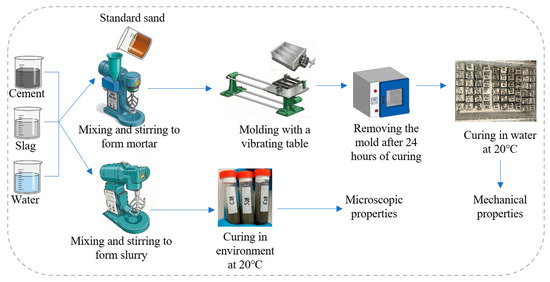
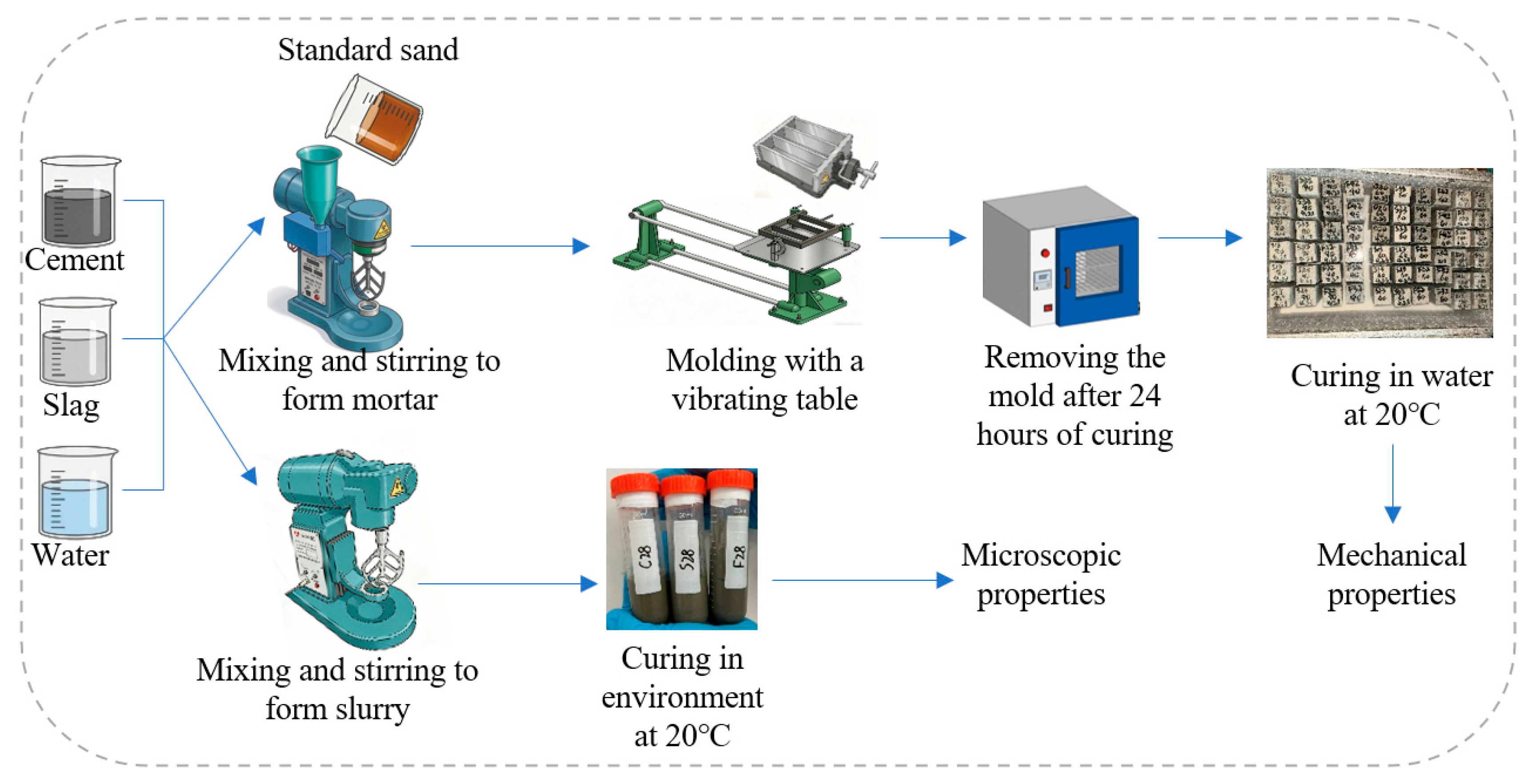
Cement paste blocks were prepared using S3 slag at a replacement ratio of 30%, with a water-to-binder ratio of 0.284. When cured to specific ages, the specimens were immersed in anhydrous ethanol solution to terminate hydration. The phase composition and microstructure of the slag at 3 d, 28 d, and 157 d were analyzed by means of XRD, FTIR, and SEM-EDS techniques. The instruments used in this experiment included a D8 ADVANCE X-ray diffractometer (Bruker, Karlsruhe, Germany), a Thermo Fisher Scientific Fourier-transform infrared spectrometer (Waltham, MA, USA), and a JSM-IT500LV produced by JEOL scanning electron microscope equipped with an energy-dispersive spectrometer (Japan, Tokyo). The complete experimental protocol is illustrated in Figure 1.
Figure 1.
Test procedure.
3. Results and Discussion
3.1. Analysis of Slag Composition
The chemical compositions of the slags determined by X-ray fluorescence spectroscopy are shown in Table 3, and the quality coefficient, basicity coefficient, and alkali content calculated according to Equations (1)–(3) are also listed in Table 3. As can be seen from the table, CaO is the most abundant component in all three slags, exceeding 39%, and its content ranks in the order S2 > S3 > S1. The SiO2 content shows little variation among the slags, all around 32%. The Al2O3 content ranges from 14.79% to 16.70%, with S1 having the highest value of 16.70%, S3 slightly lower than S1, and S2 the lowest at 14.79%. S3 has the highest MgO content of 6.53%, while the MgO contents of S1 and S2 are similar. The TiO2 content of S2 is 0.79%, significantly lower than those of S1 and S3 (around 2%). S3 has the highest SO3 content of 1.34%, S1 is slightly lower than S3, and S2 has the lowest at 1.14%; the contents of other oxides are all below 1%. S2 has the lowest alkali content of 0.70%, and S3 has the highest at 0.74%. Slag S2 has the highest quality coefficient of 1.93, while S1 has the lowest at 1.79. The basicity coefficients of S1 and S3 are less than 1, classifying them as acidic slags, whereas the basicity coefficient of S2 is greater than 1, classifying it as a basic slag. The loss on ignition for the three slags are all negative, which may be attributed to the oxidation of some low-valent elements in the slags in high-temperature air, resulting in an increase in mass of the sample.
Table 3.
The chemical composition of slag/%.
The specific surface areas of S1, S2, and S3 are 420.5, 452.0, and 420.8 m2·kg−1, respectively; their moisture contents are 0.7%, 1.0%, and 0.7%, respectively; and their densities are 2.84, 2.91, and 2.89 g·cm−3, respectively. All of these meet the requirements for S95-grade slag.
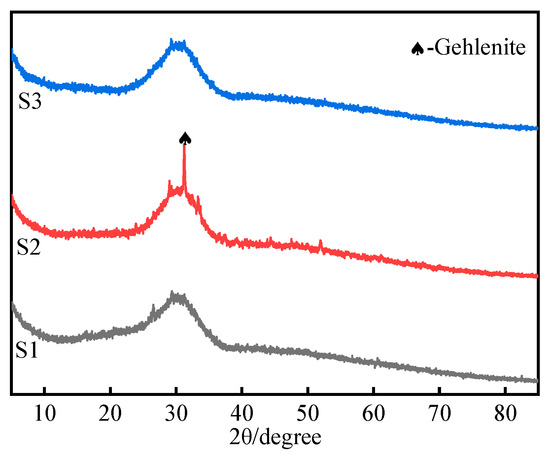
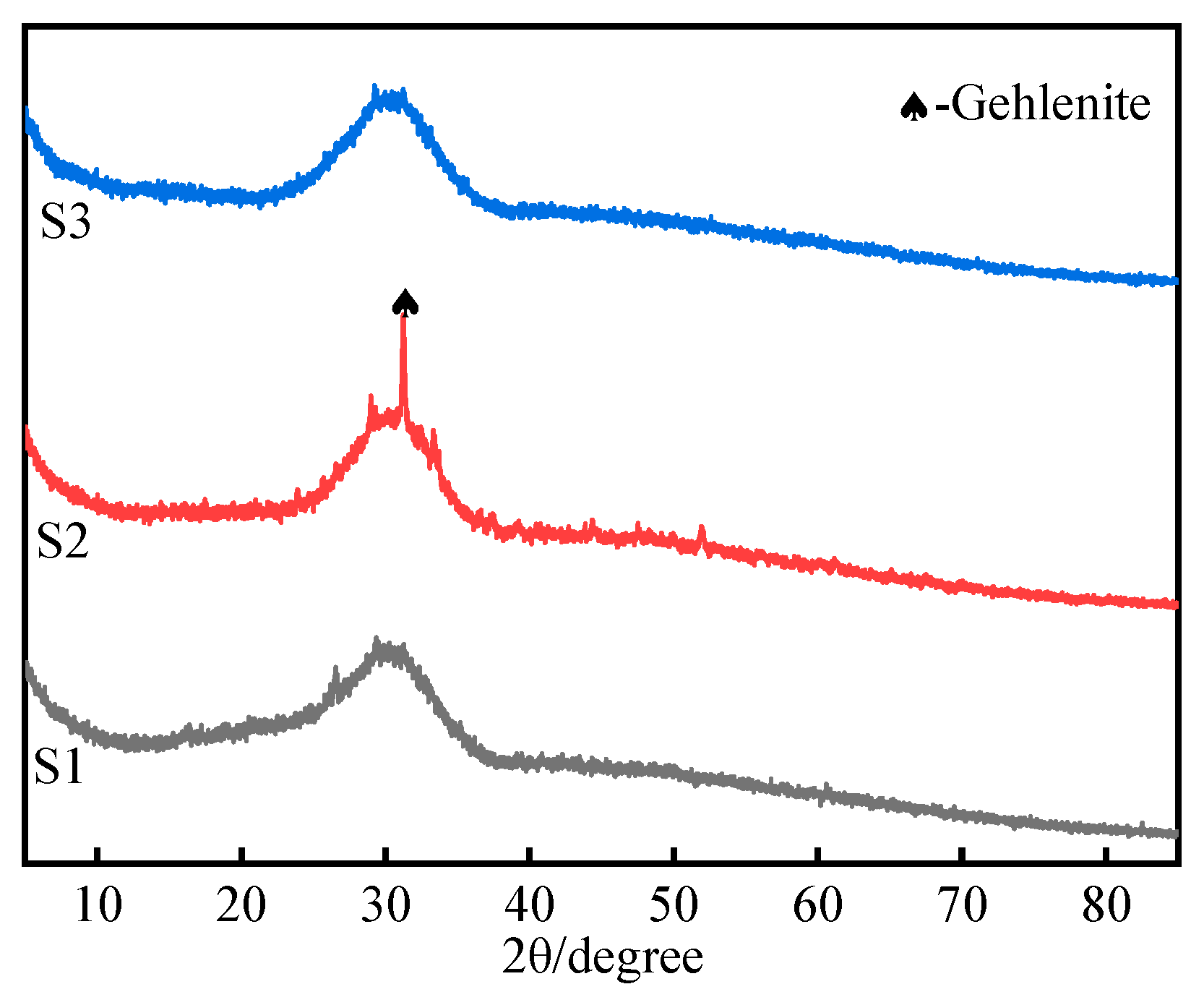
The XRD test results of the slags are shown in Figure 2. All three slags contain a large amount of amorphous glass phase, and S2 has a small amount of gehlenite. According to GB/T 18046-2017, the glass contents of S1, S2, and S3 were determined to be 98.72%, 95.28%, and 98.53%, respectively.
Figure 2.
XRD pattern of slag.
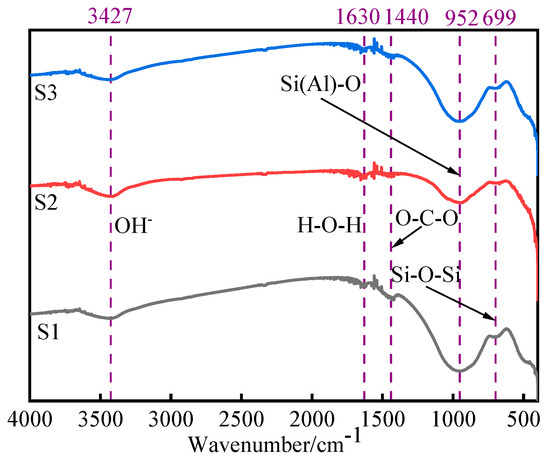
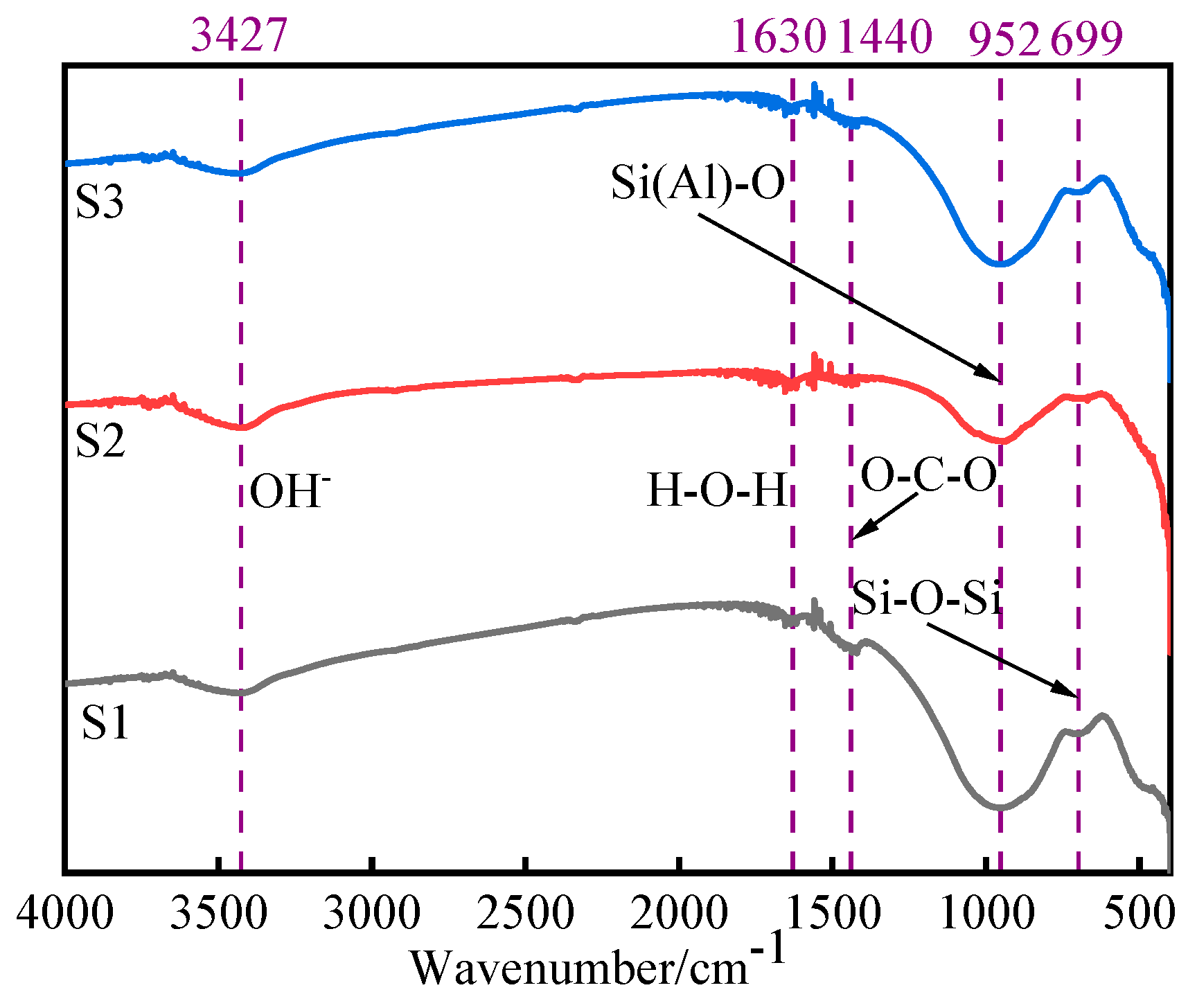
The FTIR test results of the slags are shown in Figure 3. The results indicate that the absorption bands at 3427 cm−1 and 1630 cm−1 suggest the presence of water molecules in all three slags. The absorption band at 952 cm−1 corresponds to the Si(Al)-O bond, with S1 and S3 showing approximately the same intensity, while S2 exhibits the weakest intensity. S1 shows a distinct absorption band at 1440 cm−1, which is attributed to the symmetric stretching vibration of carbonate, indicating that S1 has undergone carbonation [24] whereas S2 and S3 show virtually no such band.
Figure 3.
FTIR pattern of slag.
3.2. Compressive Strength and Activity Index
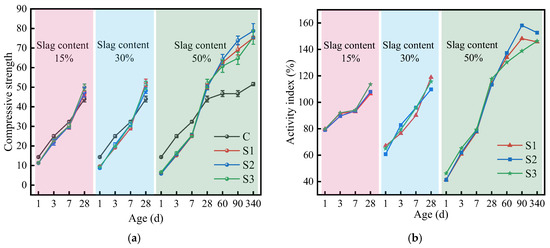
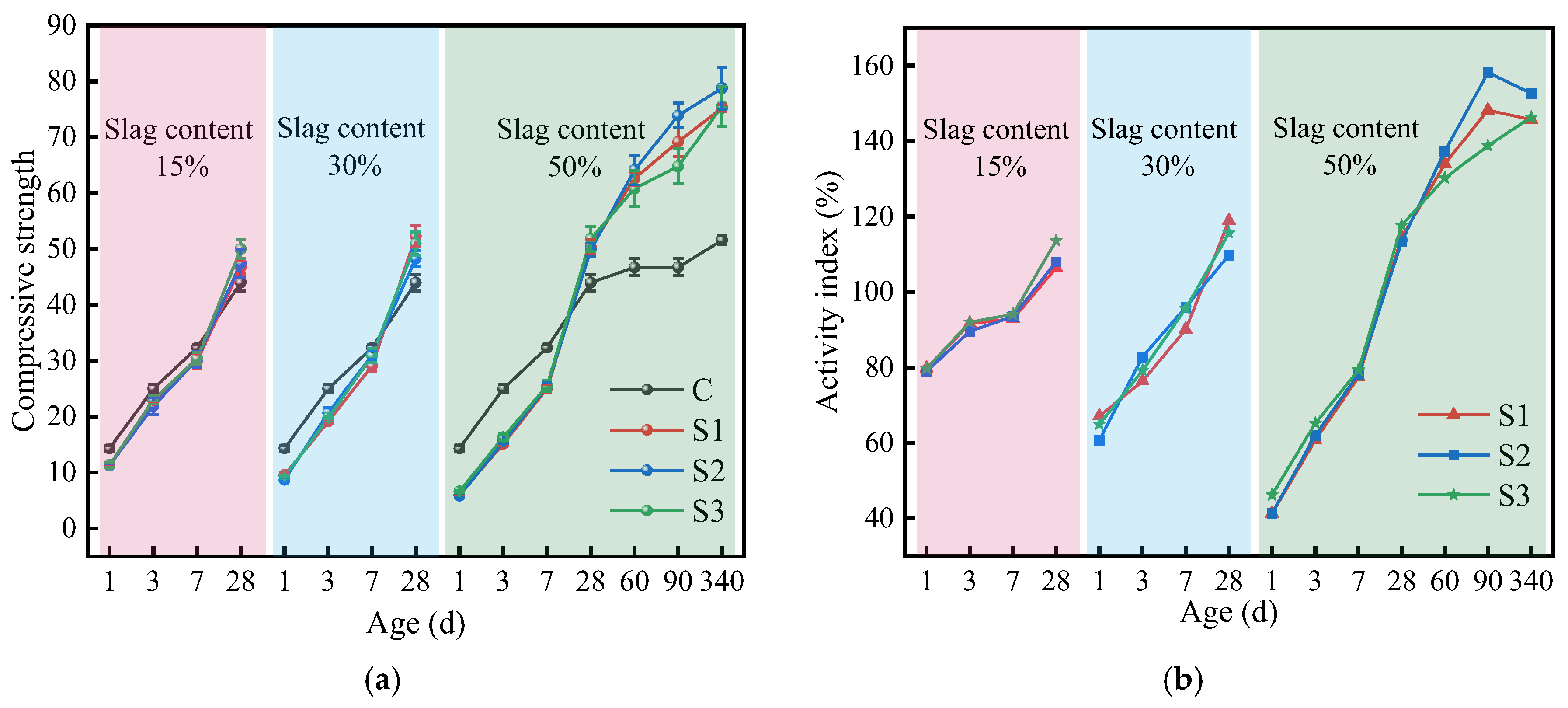
The compressive strength and activity index of cement mortar specimens mixed with three types of slag are shown in Figure 4. The results indicate that for each type of slag, a higher replacement ratio leads to lower compressive strength and activity index at 1 d, 3 d, and 7 d, but higher compressive strength and activity index at 28 d. The strength of slag-blended specimens surpasses that of pure cement specimens, meaning the activity index exceeds 100%.
Figure 4.
The influence of slag content on compressive strength and activity index. (a) Compressive strength. (b) Activity index.
For specimens mixed with any type of slag, the extent of increase in compressive strength at 1 d, 3 d, and 7 d are roughly similar to those of pure cement specimens, while the extent of increase at 28 d is greater than that of pure cement specimens. Beyond 28 days, when the slag replacement ratio is 50%, the overall strength increase in specimens mixed with the three types of slag is significantly higher than that of pure cement specimens. The compressive strength at 340 days is approximately 1.50 times that at 28 d for slag-blended specimens, compared to 1.17 times for pure cement specimens. Under the same replacement ratio, the compressive strength and activity index of all cement mortar specimens increase with age, except for the 340 d activity indices of S1 and S2, which are lower than their 90 d activity indices. This is because the extent of increase in strength of the pure cement specimens from 90 d to 340 d is higher than that of the cement mortar specimens mixed with S1 and S2.
The hydration reaction of cement paste mixed with slag can be divided into two stages. In the early stage, the slag primarily acts as a physical filler and diluent. Notably, no evidence of heterogeneous nucleation was observed at early ages, based on the consistent decrease in strength with increasing slag content. The strength development mainly comes from the hydration reaction of the cement clinker minerals. The higher the slag content, the less cement is used, resulting in a lower compressive strength of the paste, with the activity index below 100%. In the later stage, the calcium hydroxide generated from cement hydration undergoes a pozzolanic reaction with the glass phase in the slag. The resulting gel fills the capillary pores, optimizes the internal microstructure, as supported by SEM observations, and enhances the later-stage strength. Cement hydration dominates in the early stage, while the pozzolanic effect of slag dominates in the later stage [25].
When the slag replacement ratio is 50%, the 7 d activity indices of S1, S2, and S3 are 77.4%, 78.3%, and 79.3%, respectively, meeting the requirement of at least 70% for S95-grade slag specified in GB/T 18046-2017. The 28 d activity indices are 114.5%, 113.4%, and 117.7%, respectively, meeting the requirement of at least 105% for S105-grade slag.
3.3. Factors Influencing the Activity Index
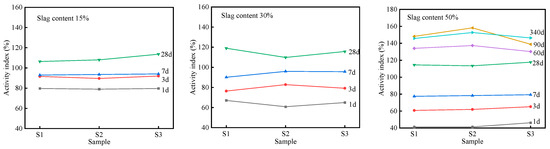
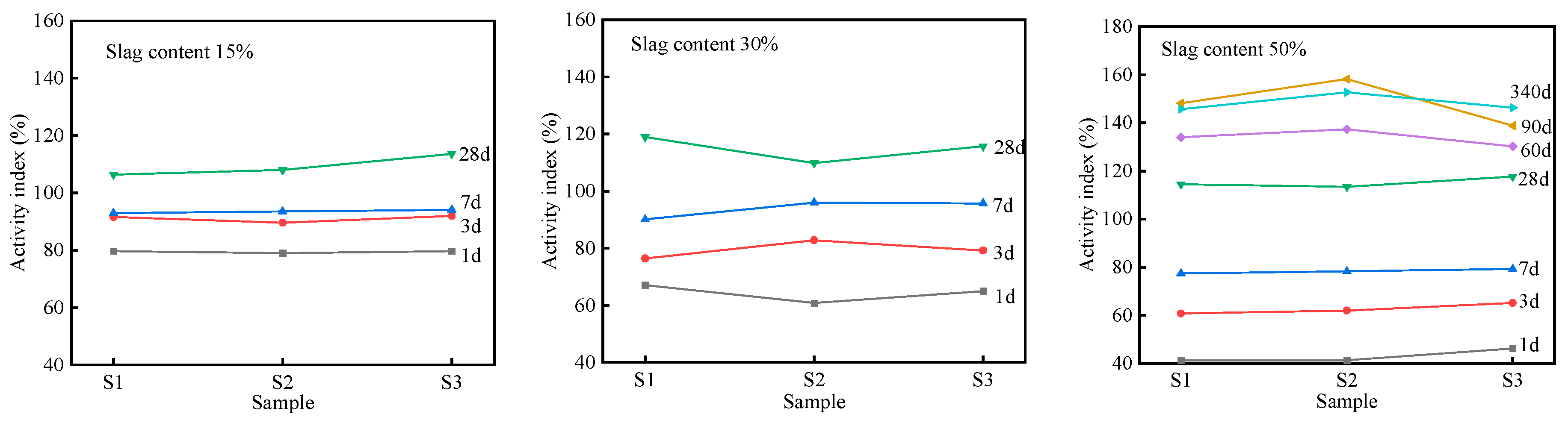
The pattern of the activity index of cement mortar specimens mixed with the three types of slag is shown in Figure 5. At a slag replacement ratio of 15%, the pattern of the activity index at 1 d and 3 d is S3 = S1 > S2, and at 7 d and 28 d it is S3 > S2 > S1. The Al2O3 contents of S1 and S3 are almost equal and significantly higher than that of S2. In the early hydration stage (1 d and 3 d), Al2O3 is activated by Ca(OH)2, a product of cement hydration, and gypsum to form ettringite, thereby enhancing the early-age activity of the slag [12,16]. At this stage, the negative effect of the high TiO2 content in S1 and S3 on reactivity has been offset by the positive effect of Al2O3. The glass contents of S1 and S3 are almost equal and significantly higher than that of S2. S3 has the highest alkali content, while among the three types of slag, S2 has the highest CaO + MgO content and S1 has the lowest. The glass content is the source of slag activity. Na2O and K2O provide a strongly alkaline environment, further promoting the dissolution of the slag surface [26]. CaO and MgO are network modifiers in the glass structure of slag, which can reduce the degree of polymerization of network-forming ions and enhance slag activity [16]. Therefore, the pattern of the activity index at 7 d and 28 d is S3 > S2 > S1.
Figure 5.
The activity index pattern of mortar test blocks mixed with slag.
When the slag replacement ratio is 30%, the influence patterns of the activity index at 1 d, 3 d, and 7 d are roughly similar to those when the slag replacement ratio is 15%, but the 28 d activity index of the cement mortar specimen mixed with S1 is the highest. This is because S1 has the highest Al2O3 content. When the slag replacement ratio increases, more Al2O3 in S1 contributes to the strength: in the early hydration stage, part of the Al2O3 is activated by Ca(OH)2 and gypsum to form ettringite; as the age extends, the remaining Al2O3 is continuously activated by Ca(OH)2 to form C-A-S-H gel, thereby increasing the strength of the paste [27,28].
When the slag replacement ratio is 50%, the 1 d and 3 d activity indices of the cement mortar specimen mixed with S1 are smaller than those of the specimen mixed with S2, while the patterns of the remaining activity indices are the same as those at a replacement ratio of 15%. Although the Al2O3 content of S1 is high, the cement content is very low, which weakens the alkaline environment and results in an insignificant early-age activation effect on Al2O3 [29]. In contrast, S3 has a high alkali content that is not affected by the reduction in cement content. For the activity indices at longer ages (60 d, 90 d, and 340 d), the cement mortar specimens mixed with S2 exhibit the highest values. This is because the pozzolanic effect of slag mainly manifests at longer ages. S2 has the highest specific surface area, CaO + MgO content, quality coefficient, and basicity coefficient, giving it the highest latent hydraulic property. After the hydration products of slag nucleate on the particle surface, the diffusion distance of ions from the particle interior to the exterior is shortened. Although the later-stage reaction has partially penetrated into the particle interior, a larger initial specific surface area results in a smaller unreacted core inside the particle, thereby enhancing its sustained reactivity and leading to a higher later-age activity index. During long-term hydration, the glass phase in S2 is thoroughly disintegrated, generating a large amount of C-S-H gel, and the strength continues to increase. The TiO2 content of S2 is significantly lower than that of S1 and S3. In calcium-aluminosilicate glasses, Ti4+ can act as network formers, increasing the overall connectivity and chemical stability of the network structure. At a slag replacement ratio of 50%, where the system alkalinity is low, S2 with only 0.79% TiO2 has a less polymerized, more reactive glass network that can be more thoroughly depolymerized over time, leading to higher long-term compressive strength.
3.4. Phase Analysis of Hydration Products
3.4.1. XRD Analysis
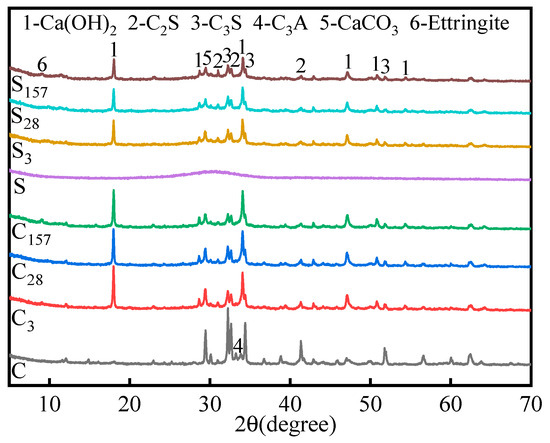
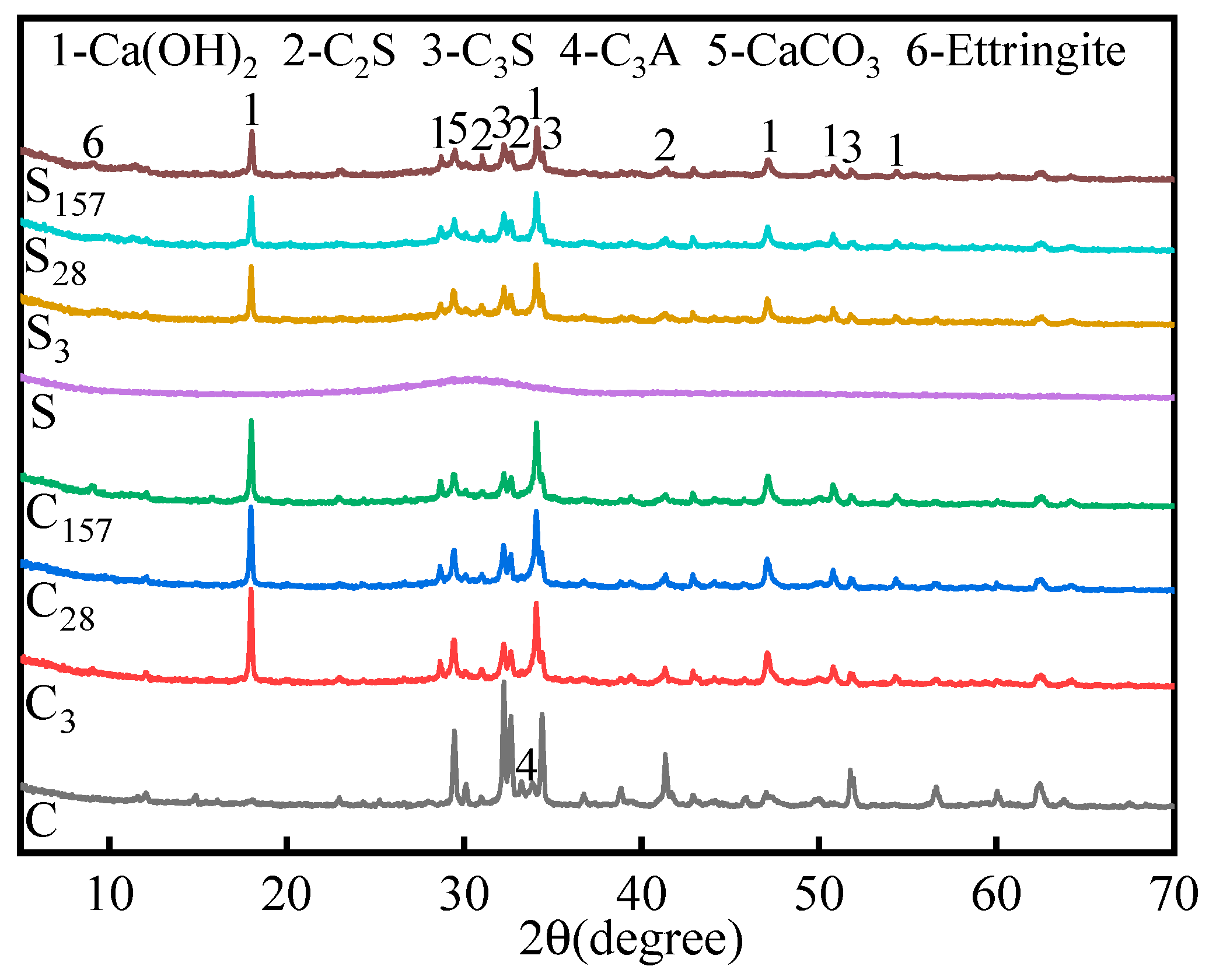
Figure 6 shows the XRD patterns of unhydrated cement C, slag S3, pure cement paste, and cement paste with 30% S3 at 3 d, 28 d, and 157 d of hydration. Unhydrated cement contains C3S (2θ = 32.2°, 34.4°, and 51.8°), C2S (2θ = 31.0°, 32.6°, and 41.3°), C3A (2θ = 33.2°), and calcium carbonate (2θ = 29.4°), where the calcium carbonate comes from incompletely calcined cement raw materials and the carbonation of cement hydration products in air. The C4AF content is low and not obvious in the pattern. Slag is mainly glass, and there are no characteristic peaks in the pattern. Compared with unhydrated cement, the patterns of pure cement paste at 3 d, 28 d, and 157 d of hydration show the addition of Ca(OH)2 (2θ = 18.0°, 28.7°, 34.1°, 47.1°, 50.8°, and 54.3°), and at 157 d of hydration, ettringite (2θ = 9.1°) is also added. The amount of ettringite at 3 d and 28 d is small, and the characteristic peaks are not obvious. The characteristic peaks of cement paste with slag at 3 d, 28 d, and 157 d of hydration are completely the same as those of pure cement paste, but the intensities of the characteristic peaks of Ca(OH)2, C3S, and C2S are smaller than those of pure cement paste. This is mainly because the amount of cement is less than that of pure cement paste, resulting in less Ca(OH)2 generated, and the Ca(OH)2 is also consumed by the active oxides in the slag [30]. No additional crystalline phases were observed in the XRD patterns of slag-blended cement paste compared to pure cement paste. However, it should be noted that the diffraction peaks of C-S-H gel and C-A-H gel cannot be detected in XRD. The chemical evolution of the amorphous gel phase, partic-ularly the formation of C-A-S-H through the substitution of silicon by aluminum from the slag, is further characterized in the following FTIR and EDS sections.
Figure 6.
The XRD patterns of cement, slag, and cement paste. (In the figure, C represents unhydrated cement, C3, C28, and C157 respectively represent pure cement paste hydrated for 3 days, 28 days, and 157 days, S represents slag S3, and S3, S28, and S157 respectively represent cement paste with 30% S3 hydrated for 3 days, 28 days, and 157 days).
3.4.2. FTIR Analysis
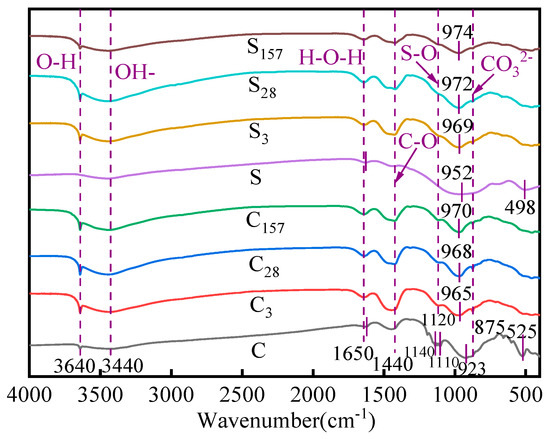
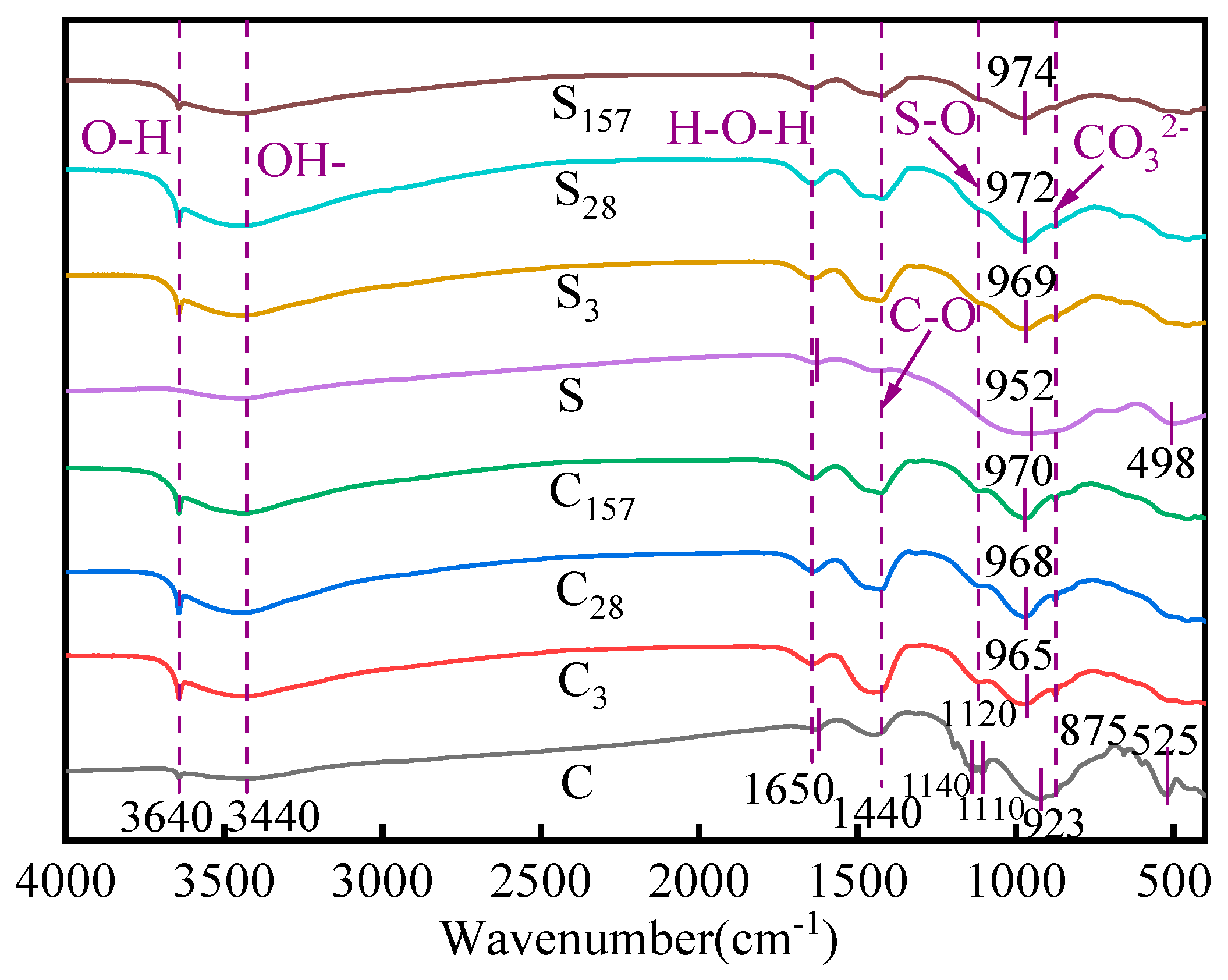
Figure 7 shows the FTIR patterns of unhydrated cement C, slag S3, pure cement paste, and cement paste with 30% S3 at 3 d, 28 d, and 157 d of hydration. The main absorption bands of unhydrated cement include: the Si-O bending vibration bands at 525 cm−1 and 923 cm−1; the symmetric stretching and bending vibration bands of calcium carbonate at 875 cm−1 and 1440 cm−1; the sulfate stretching vibration bands at 1110 cm−1 and 1140 cm−1 [31]; the bending and stretching vibration bands of water molecules at 1650 cm−1 and 3440 cm−1; and the O-H stretching vibration band of Ca(OH)2 at 3640 cm−1. The absorption bands of Ca(OH)2 and calcium carbonate indicate that the cement has undergone hydration and carbonation with moisture in the air. The main absorption bands of slag include the Si-O bending vibration bands at 498 cm−1 and 952 cm−1, which are slightly shifted compared with unhydrated cement. The species corresponding to the absorption bands at 875 cm−1, 1440 cm−1, 1620 cm−1, and 3440 cm−1 are consistent with unhydrated cement. The positions of the characteristic peaks of the pure cement paste and the cement paste blended with S3 are identical, indicating that no new crystalline or molecular vibrational species distinct from those in pure cement paste are detected. Compared with unhydrated cement, the sulfate band becomes a single peak at 1120 cm−1 in the pastes, indicating the formation of ettringite [32]. The absorption band at 1620 cm−1 shifts to 1650 cm−1 in the hydrated pastes, suggesting that adsorbed water has been converted to crystalline water [33]. With the progression of hydration, the Si-O absorption band of unhydrated cement gradually shifts from 923 cm−1 to a higher wavenumber of 970 cm−1, while that of slag shifts from 952 cm−1 to 974 cm−1. This is attributed to the gradual polymerization of silicate tetrahedra within the system, along with the consumption of Q1 units and the increase in Q2 units, which results in a higher mean chain length (MCL) of silicates and the formation of C-S-H gel [34,35]. Beyond the wavenumber shift, the gradual increasing in Full Width at Half Maximum (FWHM) of the Si-O bond absorption peak indicates that Al partially substitutes for Si in tetrahedral sites, forming C-A-S-H gel and increasing structural disorder [36]. Unlike the hydration of pure cement paste, the intensity of the Ca(OH)2 absorption band in the cement paste blended with S3 is significantly weakened at later hydration ages, indicating that slag hydration consumes a large amount of Ca(OH)2 at later stages.
Figure 7.
The FTIR patterns of cement, slag, and cement paste.
3.5. SEM-EDS Analysis
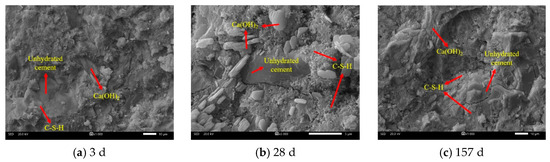
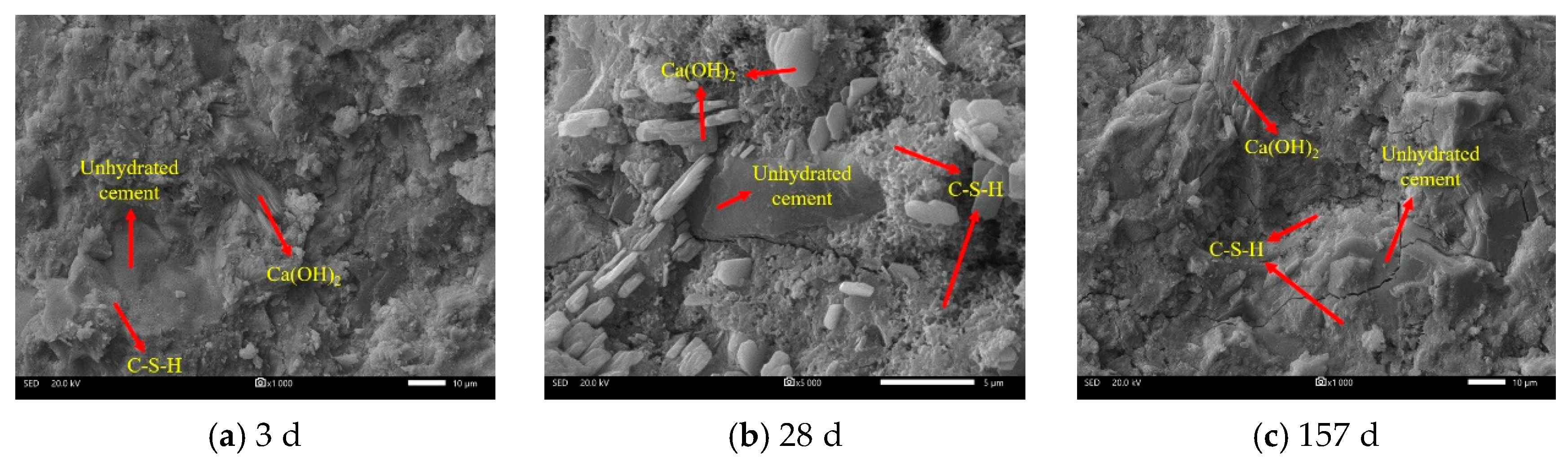
Figure 8 presents the secondary electron SEM images of the pure cement paste. At a hydration age of 3 d, hydration products including C-S-H gel and Ca(OH)2 crystals have already formed. The C-S-H gel is located near the unhydrated cement, whereas the Ca(OH)2 crystals are farther away from the unhydrated cement. At a hydration age of 28 d, the amounts of C-S-H gel and Ca(OH)2 crystals increase significantly. At a hydration age of 157 d, the hydration products further increase, intertwining with each other and becoming densely packed within the paste, almost completely encapsulating the unhydrated cement. The surface of the unhydrated cement has already been covered by a thin layer of C-S-H gel.
Figure 8.
Secondary electron image of pure cement paste under SEM.
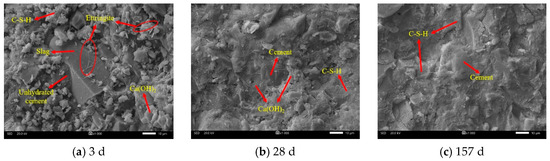
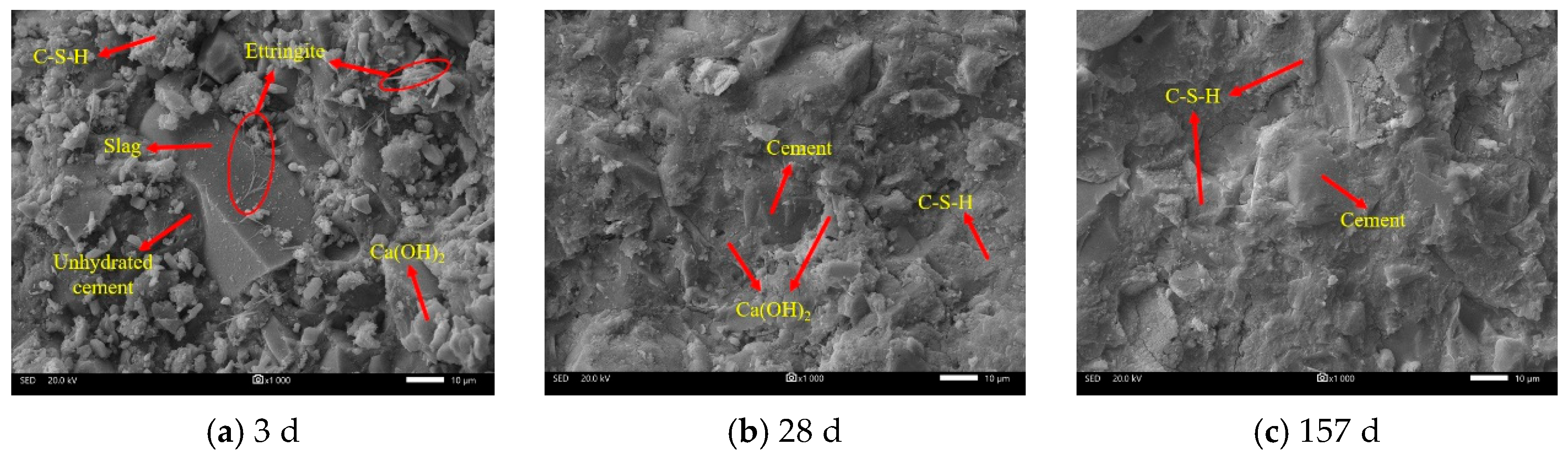
Figure 9 presents the secondary electron SEM images of the cement paste blended with 30% S3. At a hydration age of 3 d, a clear boundary is observed between unhydrated cement (with a Ca/Si ratio of 2.98 and an Al content of 2.63%) and slag (with a Ca/Si ratio of 1.26 and an Al content of 6.49%). In addition to C-S-H gel and Ca(OH)2 crystals, numerous elongated needle-like ettringite crystals are clearly visible, although the overall structure is relatively loose. A small amount of ettringite is also present on the slag surface, indicating that Al2O3 in the slag had already participated in the hydration reaction by 3 d. The high Al2O3 content contributes to improving the 3 d activity index of the slag. At a hydration age of 28 d, the number of ettringite crystals decreases significantly due to their transformation into monosulfate (AFm). The Ca(OH)2 crystals are closely integrated with the C-S-H gel, and the overall structure is markedly denser compared with that at 3 d. At a hydration age of 157 d, the hydration products become intertwined and interconnected within the paste, and the slag and cement are completely integrated into a single entity. The surface of the paste is fully covered by C-S-H gel, exhibiting higher compactness and structural integrity. The Ca(OH)2 crystal content at hydration ages of 28 d and 157 d is significantly lower than that in the pure cement paste, confirming the occurrence of the pozzolanic reaction in the paste. That is, the Ca(OH)2 crystals formed by cement hydration react with the reactive oxides in the slag to generate a denser C-S-H gel. This further optimization of the microstructure explains why the later-age strength of the cement paste blended with slag is higher than that of the pure cement paste.
Figure 9.
Secondary electron image of cement paste with S3 addition under SEM.
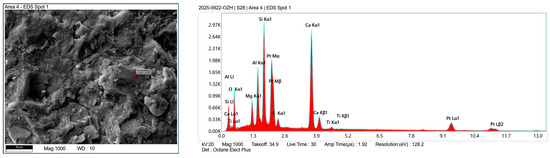
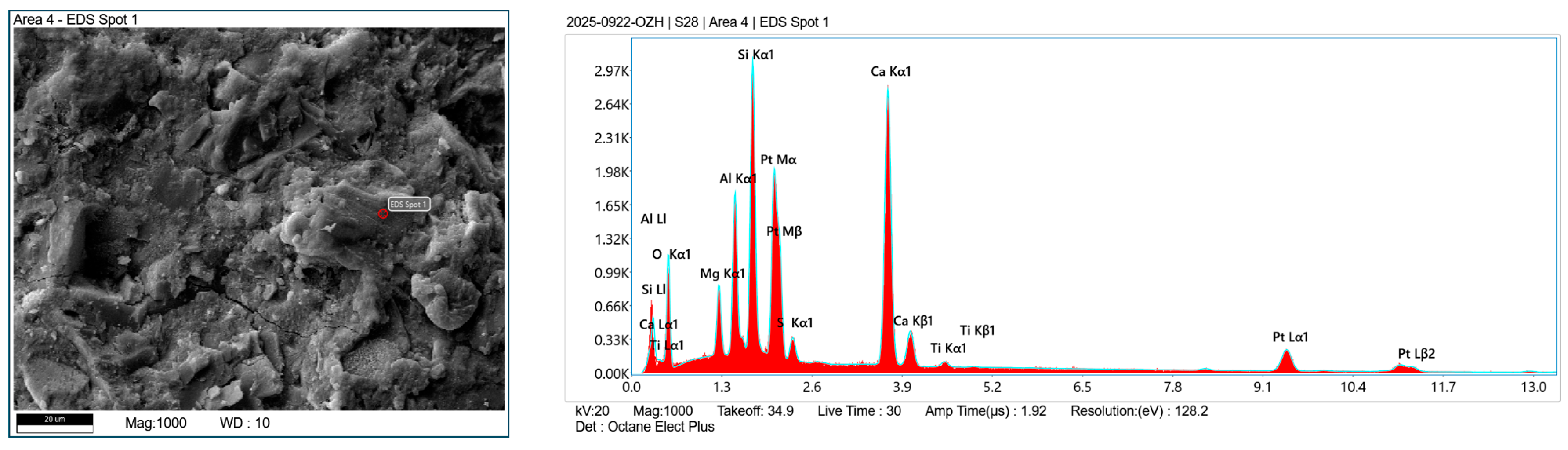
Figure 10 presents the EDS spectrum at Point 1 of the cement paste blended with 30% S3 hydrated for 28 d. The contents of elements O, Ca, Si, Mg, and Al are 36.55%, 32.34%, 16.17%, 8.96%, and 4.23%, respectively. The calcium-to-silicon ratio (C/S) of the hydration product in the paste is 1.40, and the calcium-to-aluminum ratio (C/A) is 2.43, indicating that the hydration product is C-A-S-H gel containing MgO. It is important to note that, in addition to C-A-S-H gel, the presence of MgO may promote the formation of hydrotalcite-like Mg-Al layered double hydroxide (LDH) phases, also referred to as M-A-H phases. However, due to its low crystallinity, this phase is not clearly visible in the XRD and FTIR pattern. When the cement paste blended with S3 is hydrated for 3, 28, and 157 d, the C/S ratios in the system are 1.71, 1.40, and 1.38, respectively. With the progression of hydration, the C/S ratio in the S3-blended cement paste gradually decreases, indicating the substantial formation of C-A-S-H gel at later stages [37]. The SiO2 and Al2O3 in the slag undergo a pozzolanic reaction with Ca(OH)2 generated by the hydration of cement clinker. The slag provides much more silicon than the amount of calcium it consumes, and aluminum substitutes for part of the silicon in the C-S-H gel to form C-A-S-H gel, leading to a gradual decrease in the C/S ratio of the system. After the reaction is complete, the C/S ratio gradually stabilizes. This also explains the speculation in Section 3.3: when the slag replacement ratio is high, Al2O3 enhances the 28 d activity index of the slag.
Figure 10.
The EDS spectrum of 28-day hydration products of cement paste with S3 addition.
4. Conclusions
In this study, the effects of the chemical composition of three types of slag on their activity indices were investigated by incorporating the slags into cement at replacement ratios of 15%, 30%, and 50%. The main conclusions are as follows:
- (1)
- In the early hydration stage, slag mainly acts as a physical filler and diluent, and the 1 d, 3 d, and 7 d activity indices decrease with increasing slag content. In the later hydration stage, the pozzolanic effect dominates, and the activity indices after 28 d all exceed 100%.
- (2)
- At a replacement ratio of 15%, Al2O3 in the slag is activated in the early stage to form ettringite, thereby enhancing the early-age activity of the slag. When the replacement ratio increases to 30%, Al2O3 in the slag can further form C-A-S-H gel in the later stage, improving the later-age activity of the slag. At a replacement ratio of 50% with a low alkalinity of the system, the early-stage activation of Al2O3 in the slag is not significant.
- (3)
- The glass content, alkali content, specific surface area, CaO + MgO content, quality coefficient, and basicity coefficient of slag are important factors influencing slag activity. For the three replacement ratios specified in this study, all of these factors exert their effects in the later stage.
- (4)
- After slag incorporation, no new phases are formed in the cement paste. Nevertheless, the interaction between slag and cement hydration products leads to the refinement of the amorphous gel phase, transitioning from C-S-H to C-A-S-H as hydration progresses.
- (5)
- Experimental results demonstrate that the selected slags all meet the technical requirements of Grade S95 or S105. In practical engineering applications, the mix proportion design can be optimized by adjusting the chemical composition of the slag according to the strength requirements at early or later ages, thereby promoting the large-scale application of low-carbon construction materials.
Author Contributions
Conceptualization, Z.O.; Formal analysis, H.C. and H.L.; Investigation, H.C. and H.L.; Resources, Z.O.; Data curation, H.C.; Writing—original draft, H.C.; Writing—review and editing, H.C., Z.O., J.W. and M.H.; Supervision, Z.O. and M.H.; Funding acquisition, J.W. All authors have read and agreed to the published version of the manuscript.
Funding
This research was funded by the National Natural Science Foundation of China, grant number 42402325.
Data Availability Statement
The original contributions presented inthis study are included in the article. Further inquiries can be directed to the corresponding author.
Conflicts of Interest
The authors declare no conflicts of interest.
References
- National Development and Reform Commission. Guiding Opinions on Comprehensive Utilization of Bulk Solid Wastes During the 14th Five-Year Plan Period [EB/OL]. 2021. Available online: https://www.gov.cn/zhengce/zhengceku/2021-03/25/content_5595566.htm (accessed on 26 May 2025).
- Wu, Z.H.; Zou, Z.S.; Wu, W. Utilization of ferrous metallurgical slags as resource materials in agriculture. China Metall. 2005, 15, 34–36, 40. (In Chinese) [Google Scholar]
- Xu, Y.; Li, E.; Hu, C.; Zhang, F.; Meng, X. Recycling of iron and steel slag for carbon reduction and low-environment load application. Carbon Neutraliz. 2024, 3, 606–628. [Google Scholar] [CrossRef] [Scilit]
- Megat Johari, M.A.; Brooks, J.; Kabir, S.; Rivard, P. Influence of supplementary cementitious materials on engineering properties of high strength concrete. Constr. Build. Mater. 2011, 25, 2639–2648. [Google Scholar] [CrossRef] [Scilit]
- Gao, H.; Liu, X.; Chen, J.; Qi, J.; Wang, Y.; Ai, Z. Preparation of glass-ceramics with low density and high strength using blast furnace slag, glass fiber and water glass. Ceram. Int. 2017, 44, 6044–6053. [Google Scholar] [CrossRef] [Scilit]
- Bakharev, T.; Sanjayan, J.G.; Cheng, Y.B. Sulfate attack on alkali-activated slag concrete. Cem. Concr. Res. 2002, 32, 211–216. [Google Scholar] [CrossRef] [Scilit]
- Dong, Q.-G.; Li, J.; Kang, Z.-Q.; Anwar, M.I.; Asad, M.; Miao, B.; Wang, S.; Younas, A. Unlocking the potential: A comprehensive review on blast furnace slag and silica analog adsorbents for sustainable industrial and pharmaceutical pollution control and resource utilization. Emerg. Contam. 2024, 10, 100387. [Google Scholar] [CrossRef] [Scilit]
- Scrivener, K.L.; John, V.M.; Gartner, E.M. Eco-efficient cements: Potential economically viable solutions for a low-CO2 cement-based materials industry. Cem. Concr. Res. 2018, 114, 2–26. [Google Scholar] [CrossRef] [Scilit]
- Bougara, A.; Lynsdale, C.; Milestone, N.B. The influence of slag properties, mix parameters and curing temperature on hydration and strength development of slag/cement blends. Constr. Build. Mater. 2018, 187, 339–347. [Google Scholar] [CrossRef] [Scilit]
- Zhang, T.; Wang, T.; Zhang, Y.; Tan, H.B.; Liu, J.L.; Dong, C. Effect of GGBS on properties and chloride binding of cement paste. Bull. Chin. Ceram. Soc. 2023, 42, 3240–3247. (In Chinese) [Google Scholar]
- Tripathy, S.K.; Dasu, J.; Murthy, Y.R.; Kapure, G.; Pal, A.R.; O Filippov, L. Utilisation perspective on water quenched and air-cooled blast furnace slags. J. Clean. Prod. 2020, 262, 121354. [Google Scholar] [CrossRef] [Scilit]
- Liang, X.J. Effect of blast furnace slag characteristics on its activity and vertical mill production. Cement 2021, 2, 8–10, 14. (In Chinese) [Google Scholar]
- Cui, S.P.; Liu, L.L.; Wang, Y.L.; Wang, H.; Dong, S.J. Influence of fineness on activity index of blast furnace slag with different SiO2/Al2O3. Mater. Sci. Forum 2015, 814, 579–582. [Google Scholar] [CrossRef] [Scilit]
- Haha, M.B.; Lothenbach, B.; Saout, G.L.; Winnefeld, F. Influence of slag chemistry on the hydration of alkali-activated blast-furnace slag—Part II: Effect of Al2O3. Cem. Concr. Res. 2012, 42, 74–83. [Google Scholar] [CrossRef] [Scilit]
- Yang, S.Y.; Huang, W.; Zhao, J.Q.; Zhang, W.M.; Wang, L.; Wang, J.F. Research status of hydration and activation of slag. Bull. Chin. Ceram. Soc. 2025, 44, 169–179. (In Chinese) [Google Scholar]
- Blotevogel, S.; Doussang, L.; Poirier, M.; André, L.; Canizarès, A.; Simon, P.; Montouillout, V.; Kaknics, J.; Patapy, C.; Cyr, M. The influence of Al2O3, CaO, MgO and TiO2 content on the early-age reactivity of GGBS in blended cements, alkali-activated materials and supersulfated cements. Cem. Concr. Res. 2024, 178, 107439. [Google Scholar] [CrossRef] [Scilit]
- Shen, F.; Zhang, G.; Tian, J.; Zheng, H.; Gao, Q.; Jiang, X. Effect of TiO2 on the structural properties and viscosity of CaO-SiO2-8.25% MgO-15% Al2O3-TiO2 slags. J. Non-Cryst. Solids 2024, 640, 123114. [Google Scholar] [CrossRef] [Scilit]
- Li, N.; Zhao, L.G.; Zhao, S.W.; Wang, H.; Zheng, Y.C. Influence mechanism of Ti content on structure and hydration activity of slag-based glass. Bull. Chin. Ceram. Soc. 2024, 43, 1325–1334. (In Chinese) [Google Scholar]
- Blotevogel, S.; Steger, L.; Hart, D.; Doussang, L.; Kaknics, J.; Poirier, M.; Bornhöft, H.; Deubener, J.; Patapy, C.; Cyr, M. Effect of TiO2 and 11 minor elements on the reactivity of ground-granulated blast-furnace slag in blended cements. J. Am. Ceram. Soc. 2021, 104, 128–139. [Google Scholar] [CrossRef] [Scilit]
- Duxson, P.; Fernández, J.A.; Provis, J.L.; Lukey, G.C.; Palomo, A.; van Deventer, J.S.J. Geopolymer technology: The current state of the art. J. Mater. Sci. 2007, 42, 2917–2933. [Google Scholar] [CrossRef] [Scilit]
- Wang, P.Z.; Trettin, R.; Rudert, V.; Spaniol, T. Influence of Al2O3 content on hydraulic reactivity of granulated blast-furnace slag, and the interaction between Al2O3 and CaO. Adv. Cem. Res. 2004, 16, 1–7. [Google Scholar] [CrossRef]
- GB/T 18046-2017; Ground Granulated Blast Furnace Slag Used for Cement, Mortar and Concrete. China Standards House: Beijing, China, 2017.
- GB/T 17671-2021; Test Method of Cement Mortar Strength (ISO Method). China Standards House: Beijing, China, 2021.
- Huang, X.; Yu, L.; Li, D.W.; Shiau, Y.C.; Li, S.; Liu, K.X. Preparation and properties of geopolymer from blast furnace slag. Mater. Res. Innov. 2015, 19, S10-413–S10-419. [Google Scholar] [CrossRef] [Scilit]
- Majhi, R.K.; Nayak, A.N.; Mukharjee, B.B. Development of sustainable concrete using recycled coarse aggregate and ground granulated blast furnace slag. Constr. Build. Mater. 2018, 159, 417–430. [Google Scholar] [CrossRef] [Scilit]
- Wan, X.; Ren, L.; Lv, T.; Wang, D.; Wang, B. Research on Alkali-Activated Systems Based on Solid Waste-Derived Activators: A Review. Sustainability 2025, 17, 254. [Google Scholar] [CrossRef] [Scilit]
- Zhu, X.; Richardson, I. Morphology-structural change of C-A-S-H gel in blended cements. Cem. Concr. Res. 2023, 168, 107156. [Google Scholar] [CrossRef] [Scilit]
- Chen, W.; Brouwers, H.J.H. The hydration of slag, part 2: Reaction models for blended cement. J. Mater. Sci. 2007, 42, 444–464. [Google Scholar] [CrossRef] [Scilit]
- Cascardi, A.; Verre, S.; Micelli, F.; Aiello, M.A. Durability-aimed performance of glass FRCM-confined concrete cylinders: Experimental insights into alkali environmental effects. Mater. Struct. 2025, 58, 329. [Google Scholar] [CrossRef] [Scilit]
- Liu, S.H.; Han, W.W.; Li, Q.L. Hydration Properties of Ground Granulated Blast-Furnace Slag (GGBS) Under Different Hydration Environments. Mater. Sci. 2017, 23, 70–77. [Google Scholar] [CrossRef] [Scilit]
- Mollah, M.Y.A.; Lu, F.; Cocke, D.L. An X-ray diffraction (XRD) and Fourier transform infrared spectroscopic (FT-IR) characterization of the speciation of arsenic (V) in Portland cement type-V. Sci. Total Environ. 1998, 224, 57–68. [Google Scholar] [CrossRef] [Scilit]
- Taylor, H.F.W. Cement Chemistry, 2nd ed.; Thomas Telford Ltd.: London, UK, 1997. [Google Scholar]
- Ma, B.G.; Ou, Z.H.; Jian, S.W.; Xu, R. Influence of cellulose ethers on hydration products of portland cement. J. Wuhan Univ. Technol. Mater. Sci. Ed. 2011, 26, 588–593. [Google Scholar] [CrossRef] [Scilit]
- Xiao, J.M.; Li, H.; Zhu, H.M.; Dang, Y. Analysis on hydration products of cement-slag complex binder pastes by FTIR and NMR. J. Mater. Sci. Eng. 2018, 4, 644–649, 630. (In Chinese) [Google Scholar]
- Djenaoucine, L.; Picazo, A.; De La Rubia, M.A.; Gálvez, J.C.; Moragues, A. Effect of graphene oxide on the hydration process and macro-mechanical properties of cement. Bol. Soc. Esp. Ceram. Vidr. 2024, 63, 294–303. [Google Scholar] [CrossRef] [Scilit]
- Renaudin, G.; Russias, J.; Leroux, F.; Cau-Dit-Coumes, C.; Frizon, F. Structural characterization of C-S-H and C-A-S-H samples—Part II: Local environment investigated by spectroscopic analyses. J. Solid State Chem. 2009, 182, 3320–3329. [Google Scholar] [CrossRef] [Scilit]
- Liang, M.; Zhang, Y.; He, S.; Chen, Y.; Schlangen, E.; Šavija, B. On the chemo-mechanical evolution process of high-volume slag cement paste. Constr. Build. Mater. 2023, 400, 132891. [Google Scholar] [CrossRef] [Scilit]

Disclaimer/Publisher’s Note: The statements, opinions and data contained in all publications are solely those of the individual author(s) and contributor(s) and not of MDPI and/or the editor(s). MDPI and/or the editor(s) disclaim responsibility for any injury to people or property resulting from any ideas, methods, instructions or products referred to in the content. |
© 2026 by the authors. Licensee MDPI, Basel, Switzerland. This article is an open access article distributed under the terms and conditions of the Creative Commons Attribution (CC BY) license.