


Abstract
This paper presents the results of a study on the utilization of chromium-containing waste in the production of mineral wool based on natural basalt. It was shown that a mixture of low-dolomite chromate sludge and low-carbon ferrochrome slag in a 1:1 ratio is compositionally close to dolomite. When dolomite is equivalently replaced in the mineral wool batch, the physicochemical characteristics of the melt remain suitable for mineral wool production. The complete reduction of iron and chromium oxides is achieved in the presence of carbon, resulting in their transfer to the metallic phase, where iron and chromium cations are present in the form of carbides. Due to the cost difference between chromium waste and dolomite, implementing the proposed technology makes it possible to significantly improve the efficiency of chromium waste utilization by reducing the production cost of mineral wool. The Aktobe region has all the prerequisites for implementing the developed technology, with active sources of chromium-containing waste pollution (ACCP, AFP) and basalt deposits, as well as the operational experience of the mineral-wool-manufacturing enterprise Basalt-A LLP.
1. Introduction
Chromium-containing industrial wastes generated by the chemical and ferroalloy industries represent one of the major environmental challenges associated with modern metallurgical production. Large quantities of chromate sludge and ferrochrome slags have accumulated worldwide as a consequence of chromite ore processing and ferrochrome manufacturing. The waste products of these processes contain chromium in both trivalent and hexavalent oxidation states. While trivalent chromium is relatively stable, hexavalent chromium (Cr(VI)) is highly toxic, carcinogenic, and readily soluble, posing serious risks to soils, groundwater, ecosystems, and human health [1,2,3,4]. Consequently, the development of environmentally safe and economically viable technologies for the utilization of chromium-bearing waste has become one of the key research priorities in sustainable metallurgy and circular resource management [5,6,7].
The principal sources of chromium-containing waste are chromate sludge generated during sodium monochromate production and slags produced during refined ferrochrome manufacturing. The content of hexavalent chromium in chromate sludge can reach up to 3.2%, whereas the total chromium content can exceed 7.8%. Although the concentration of Cr(VI) in low-carbon ferrochrome slag is considerably lower, the enormous quantities of accumulated slag continue to represent a serious environmental challenge [2,6,8].
Various technologies have been proposed for the treatment of chromium-containing waste, including chemical reduction, hydrometallurgical extraction, vitrification, stabilization/solidification, pyrometallurgical processing, and the utilization of the waste in ceramic and construction materials [3,5,9,10,11,12]. Nevertheless, despite considerable scientific progress, only a limited number of these technologies have reached the stage of industrial implementation, mostly due to their high capital and operating costs, technological complexity, and the relatively low economic value of the recovered chromium and iron compared with the cost of processing the waste [9,10,11,12,13].
An alternative approach that is attracting increasing attention involves the incorporation of chromium-bearing waste into existing high-temperature industrial processes, where hazardous components can be simultaneously detoxified while replacing natural mineral raw materials. Such integrated utilization not only minimizes waste disposal but also contributes to resource conservation and supports circular economy principles [5,10,14].
Among the more promising applications, basalt-based mineral wool production is of particular interest. Mineral wool is widely used as an efficient thermal insulation material thanks to its low thermal conductivity, excellent fire resistance, and chemical durability [15,16]. During its production, mineral additives are introduced to regulate the acidity modulus, melting temperature, crystallization behavior, and viscosity of basalt melts. Dolomite is conventionally used as a fluxing additive owing to its favorable chemical composition and its ability to adjust the melt properties required for stable fiber formation [15,16,17].
The physicochemical properties of oxide melts, particularly viscosity, play a decisive role in mineral wool production. In industrial practice, the viscosity of the melt determines tapping conditions, fiber-forming stability, and final product quality. For cupola furnaces, a viscosity of approximately 1 Pa·s at 1400 °C is generally considered acceptable in burden design. Ore-smelting electric furnaces operate over a broader temperature range, reaching approximately 2000 °C, thereby enabling the production of melts with higher crystallization temperatures that are suitable for the manufacture of high-temperature-resistant mineral wool [16,17,18].
Although numerous investigations have examined the utilization of individual metallurgical slags in silicate materials, studies on combined chromate sludge and low-carbon ferrochrome slag as a substitute for natural dolomite remain extremely limited. Furthermore, available information on the phase transformations of chromium during reductive smelting and their influence on melt viscosity and environmental safety remains insufficient. Consequently, the development of integrated technologies capable of simultaneously detoxifying chromium-bearing waste and replacing natural mineral resources remains an important scientific and technological challenge [11,12,13,14,18].
The objective of this study was therefore to investigate the feasibility of utilizing a chromate sludge and low-carbon ferrochrome slag mixture as a substitute for natural dolomite in basalt-based mineral wool production. Thermodynamic modeling was combined with laboratory-scale experimental investigations to evaluate phase transformations, chromium reduction, melt viscosity, and the physicochemical characteristics of the resulting oxide melts. The proposed approach contributes to the sustainable utilization of hazardous chromium-containing waste, reduces the consumption of natural mineral resources, and supports circular economy principles and sustainable metallurgical production.
2. Materials and Methods
Natural basalt from the Dubersai deposit was used as the principal raw material for mineral wool production. The chromium-containing waste consisted of chromate sludge generated during sodium monochromate production and low-carbon ferrochrome slag obtained from a ferrochrome refining process. Commercial dolomite was used as the reference fluxing additive.
The chemical compositions of basalt, dolomite, chromate sludge, ferrochrome slag, and their mixtures were determined using standard analytical procedures routinely employed for metallurgical materials. Based on the chemical composition, a 1:1 mixture of chromate sludge and low-carbon ferrochrome slag was selected as a substitute for natural dolomite [5,14,19,20].
Thermodynamic equilibrium calculations were performed using the TERRA (Version 4.6, Professor Boris Trusov, Bauman Moscow State Technical University, Moscow, Russia) software package to predict phase transformations occurring during the reductive smelting of chromium-containing mineral wool charges. The calculations were carried out over the temperature range of 300–3000 K under the reducing conditions produced by carbon addition [21,22].
Particular attention was paid to the reduction of chromium and iron oxides, the formation of carbide phases, and the distribution of components between metallic and oxide phases. The amount of coke required for the complete reduction of chromium and iron oxides was determined using thermodynamic equilibrium calculations.
Experimental charges were prepared by replacing natural dolomite with a 1:1 mixture of chromate sludge and low-carbon ferrochrome slag. Three replacement levels (10, 20, and 30 wt.%) were investigated.
Coke was added to each charge in an amount stoichiometrically calculated for the complete reduction of Fe2O3 and Cr2O3 to Fe3C and Cr7C3 carbides with CO gas evolution. For example, for the charge with 30% replacement (100 g basalt + 30 g waste mixture), the coke addition was 6.2 g, which corresponds to 4.8 wt.% of the total charge. For the 10% and 20% replacement levels, the coke amounts were 2.1 g (1.9 wt.%) and 4.1 g (3.4 wt.%), respectively.
Prior to smelting, all raw materials were dried to a constant weight, weighed according to the calculated compositions, thoroughly homogenized, and loaded into graphite crucibles.
Although the external furnace atmosphere is air, the graphite crucible and the added coke create a local reducing environment inside the crucible. The equilibrium C(s) + CO2(g) ⇄ 2CO(g), established due to the presence of solid carbon, produces a gas phase with x(CO) > 0.999 and an oxygen partial pressure pO2 ≈ 10−18–10−8 atm at 1650–1700 °C. This range exactly matches the conditions used in the thermodynamic calculations (the Cr–Fe–O–C system with carbon activity a_C = 1). Thus, the experimental reducing atmosphere is identical to that assumed in the modeling.
Laboratory-scale smelting experiments were carried out in a high-temperature Tamman furnace (manufactured by UralNIIM in Yekaterinburg, Russia) using graphite crucibles.
Approximately 200 g of the prepared charge was loaded into each crucible. Smelting was performed at 1700 °C with an isothermal holding time of 30 min under atmospheric conditions. Coke was added in a stoichiometric amount determined by thermodynamic equilibrium calculations to ensure the complete reduction of chromium and iron oxides.
Upon the completion of the smelting process, the crucibles were removed from the furnace and cooled naturally in air. The obtained products consisted of metallic and oxide (slag) phases, which were mechanically separated. The metallic phase was subjected to chemical analysis, whereas the slag phase was used for viscosity measurements.
The temperature dependence of slag viscosity was determined using an electro-vibrational viscometer (manufactured by UralNIIM in Yekaterinburg, Russia) equipped with molybdenum accessories.
Approximately 15 g of slag obtained via reductive smelting was used for each viscosity measurement. Measurements were carried out in molybdenum crucibles with an inner diameter of 20 mm and a height of 35 mm. The molybdenum spindle with a diameter of 2.5 mm was immersed into the melt to a depth of 10 ± 0.5 mm [23,24].
The melt temperature was measured using a WR30/6 platinum–rhodium thermocouple (manufactured by UralNIIM in Yekaterinburg, Russia), the hot junction of which was positioned at the bottom of the crucible through a specially designed channel. Viscosity measurements were performed in a vertical Tamman furnace. The immersion depth of the spindle was adjusted using a precision micrometer lifting device, while contact between the spindle and the molten slag was detected using a millivoltmeter connected to the viscometer (manufactured by UralNIIM in Yekaterinburg, Russia).
To prevent oxidation of the molybdenum crucible and spindle, purified argon was continuously supplied into the furnace throughout the experiments.
Viscosity measurements were performed during continuous cooling of the melt at an average cooling rate of 1–3 °C min−1, beginning from the homogeneous liquid state and continuing until complete solidification. After each experiment, the solidified slag was removed from the crucible by freezing it onto a molybdenum rod. Before the next measurement, the crucible was rinsed with a small amount of slag of the same composition to eliminate contamination.
The crystallization temperature of the investigated slags was determined graphically from the relationship between the logarithm of viscosity and the reciprocal absolute temperature [22].
Prior to the viscosity measurements, the viscometer was calibrated using a high-density reference liquid based on a Clerici solution. The initial density of the solution (4.2–4.5 g cm−3) was adjusted by dissolving glucose at 80 °C, resulting in a final density of 2.85–3.0 g cm−3, which is close to that of molten metallurgical slags.
The viscosity of the calibration liquid varied from fractions of a poise to approximately 200 P during cooling from 80 to 20 °C. The calibration curve relating the electromotive force of the viscometer to the viscosity of the reference liquid showed a smooth continuous relationship, allowing reliable interpolation over a wide viscosity range.
The performance of the viscometer was periodically verified using a well-characterized reference slag.
The reductive smelting experiments were performed under stable thermal conditions. The principal source of experimental uncertainty was associated with the temperature measurements. To improve temperature control, the working zone of the Tamman furnace was additionally monitored using a control thermocouple introduced from the upper part of the furnace. Continuous monitoring ensured stable thermal conditions throughout the experiments.
According to the calibration results and the technical specifications of the electro-vibrational viscometer, the uncertainty of the viscosity measurements did not exceed ±5%. Owing to stable temperature control and operating conditions, the overall experimental uncertainty of the laboratory smelting experiments did not exceed ±3%.
3. Research Results
The technology selected as the object of the present study was the production of mineral wool based on basalts from the Dubersai deposit with the following chemical composition (wt.%): 11.85 CaO, 52.5 SiO2, 5.29 MgO, 13.19 Al2O3, and 12.36 Fe2O3 (see Table 1). In the present study, the quality of the mineral wool charge and the resulting slag was evaluated using the acidity modulus (Mk) and slag basicity. The acidity modulus (Mk), also known as the silicate modulus, represents a ratio of acidic oxides to basic oxides and is defined by the following formula:
Table 1.
Chemical composition of raw materials.
Slag basicity, which characterizes the ratio of basic components to the silica content, was calculated as follows:
In practice, dolomite is most commonly used for this purpose. The chemical composition of the dolomite used in this study is presented in Table 1.
For comparative analysis, a base technology was modeled using charges with dolomite contents of 10, 20, and 30%. The chemical compositions of the experimental charges are presented in Table 2. The silica modulus of the charges decreased from 3.879 to 2.14.
Table 2.
Chemical composition of the charges with additions of dolomite and a mixture of slag and sludge.
Table 3 presents the results of experimental studies on the temperature dependence of the viscosity of the melts obtained from the experimental charges. The results show that the charges satisfy the required physical properties of the melt at a dolomite content of 30%.
Table 3.
Temperature dependence of melt viscosity.
The proportion of dolomite in the charge is approximately 23%. In 2025, crushed basalt cost USD 3.40 per ton, whereas dolomite cost USD 62.00 per ton. At the above consumption level, dolomite accounts for 85% or more of the raw material cost.
To improve the efficiency of utilizing chromium-containing waste (sludge and slag), these materials are proposed as substitutes for dolomite in the mineral wool production charge.
The 1:1 mixture of dolomite-free sludge and low-carbon ferrochrome slag has a CaO and MgO content comparable to that of natural dolomite.
When up to 30% of this mixture is added to the charge (in excess of 100%), the silica modulus decreases from 3.879 to 2.36; i.e., it falls within the range recommended by GOST 4640 for melts intended for mineral wool production.
In general, the chemical compositions of the charges containing different amounts of the sludge–slag mixture are characterized by somewhat increased acidity values and the presence of trivalent and hexavalent chromium oxides. Studies of the temperature dependence of the viscosity of these melts, presented in Table 3, showed that despite somewhat elevated temperatures corresponding to the target viscosity values, the melts generally satisfy the requirements for cupola smelting.
Reductive smelting in the presence of carbon is proposed in order to reduce chromium oxides to the metallic state, thereby solving the problem of chromium oxide detoxification.
In this regard, thermodynamic modeling of the behaviors of chromium, iron, and other components under reducing conditions was initially carried out. Calculations were performed for a charge containing 30% of the sludge–slag mixture.
Investigations were conducted on the chemical transformations occurring during the joint remelting of monochromate sludge, refined ferrochrome production slag, and basalt with added carbon (coke) to achieve the complete reduction of chromium and iron from oxides. Even before the onset of reduction processes, heating causes interaction between charge oxides, resulting in the formation of binary and ternary compounds. Of greatest interest are the compounds containing iron and chromium, which must be transferred into their metallic phases.
The interaction of hematite with coke carbon, even at temperatures above 1000 K, leads to the formation of iron carbide according to the reaction:
3Fe2O3 + 11C = 2Fe3C + 9CO(g), ΔG1000K = −222.93 kJ.
The carbide subsequently participates in the reduction of chromium and silicon and is completely consumed at temperatures above 2000–2100 K.
This process eliminates the conditions necessary for the existence of stable hexavalent chromium [7,25,26]. The low oxygen potential (pO2 ≈ 10−18–10−8 atm.) created by carbon prevents hexavalent chromium from forming in the resulting slag. Trivalent chromium is present in the slag as calcium chromite, CaCr2O4. The behavior of CaCrO4 and CaCr2O4 established in this study is consistent with previous investigations in this field [7,8].
Calcium chromite, CaCr2O4, remains stable up to 800–900 KA, after which it dissociates according to the following scheme:
CaCr2O4 = CaO + Cr2O3.
The released trivalent chromium reacts with free magnesium oxide to form magnesiochromite spinel according to the following reaction:
Cr2O3 + MgO = MgCr2O4, ΔG273K = −42.5 kJ.
Due to coke carbon, chromium reduction from this compound proceeds as follows:
7Cr2MgO4 + 27C = 2Cr7C3 + 7MgO + 21CO(g), ΔG1500K = −9.2 kJ.
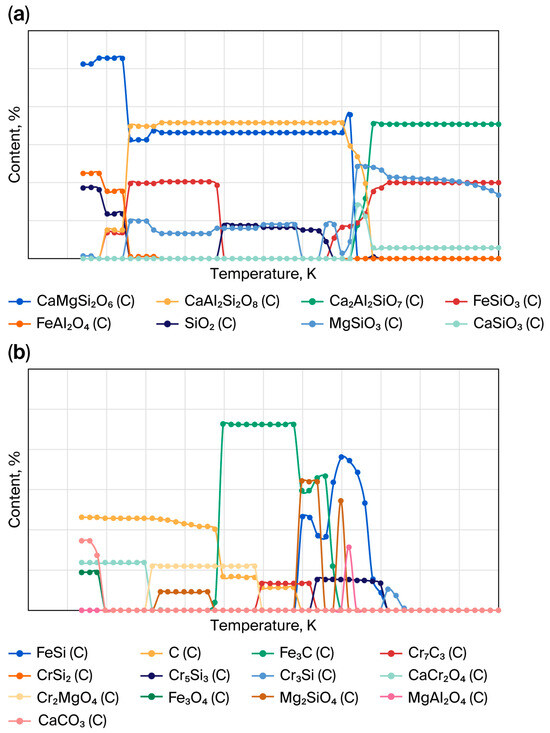
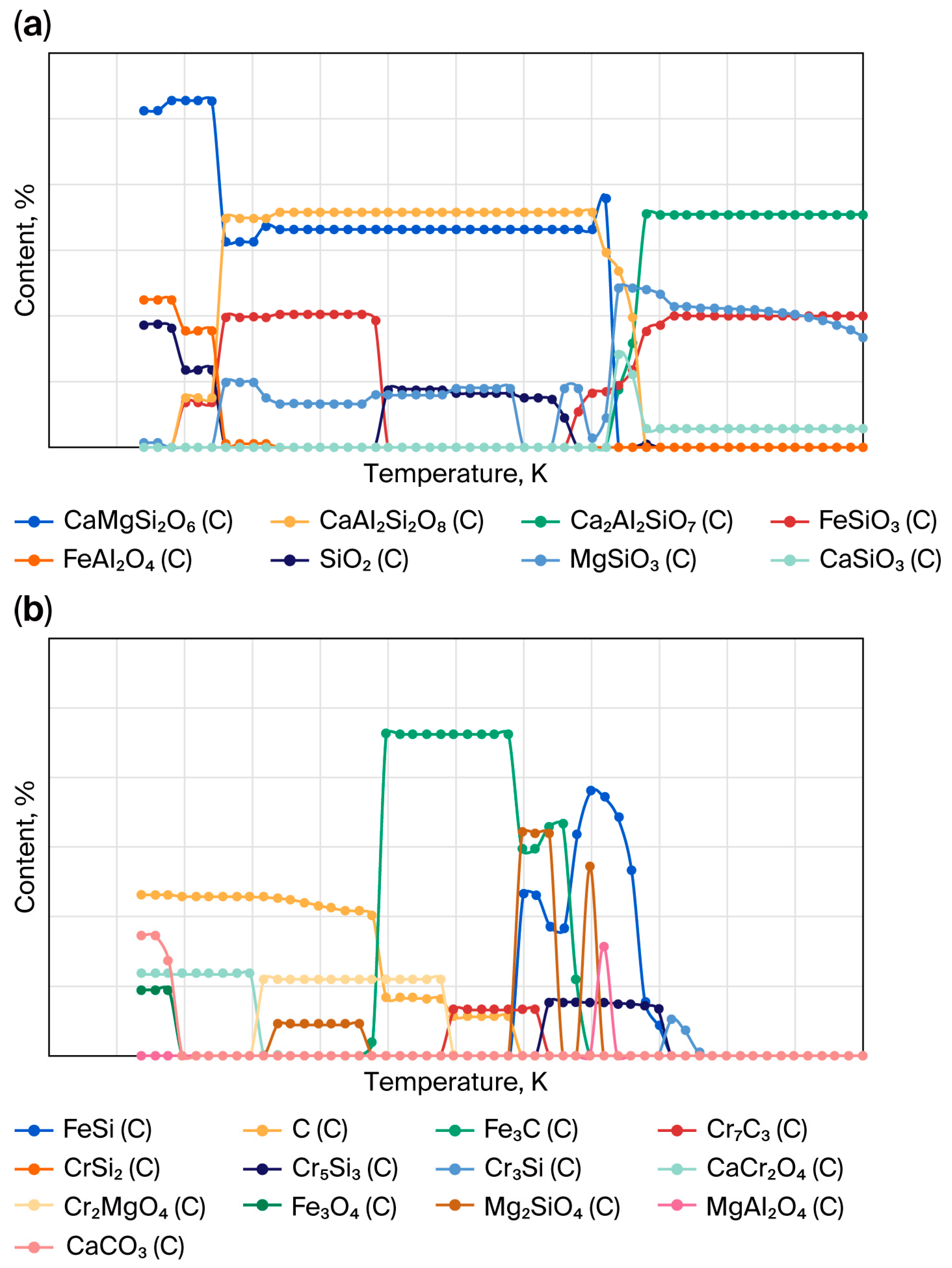
Complete depletion of Cr2MgO4 occurs at 1500 K, when trivalent chromium is absent in the slag. The amount of coke carbon in the charge is also sufficient for the reduction of silicon from SiO2 and its transfer into the metallic phase in the form of FeSi (Figure 1a,b). The appearance of chromium silicides Cr5Si3 and Cr3Si in the metal is attributed to FeSi acting as a reducing agent.
Figure 1.
(a) Phase composition and content of the thermodynamic modeling products as a function of temperature during reductive charge smelting; (b) products of charge reductive smelting.
At the tapping temperature of the smelting products from the furnace (≈2000 K), neither hexavalent nor trivalent chromium is present in the slag. In the metallic phase, chromium and iron are represented by stable and environmentally safe carbides.
In the proposed technology, reductive smelting in the presence of carbon completely reduces chromium and iron oxides from the melt intended for mineral wool production. This enables the formation of a melt that retains physicochemical properties (in particular, the viscosity modulus) at a level suitable for cupola furnace smelting.
Experimental studies were carried out to investigate the remelting of test mixtures and to evaluate melt quality after reductive smelting.
These experimental investigations were performed in graphite crucibles in a high-temperature Tamman furnace with a carbon heater.
The experimental conditions were as follows:
- -
- Temperature: 1650–1700 °C;
- -
- Holding time: 30 min;
- -
- Carbon addition: Calculated for the complete reduction of chromium and iron oxides.
The smelting products consist of an oxide melt (slag) and a carbon-containing metal—with the composition 81.5–82.1% Fe, 7.2–8.6% Cr, 6.1–6.4% C, and 3.1–3.8% Si—that can be used as iron-containing scrap in the production of carbon grades of ferrochrome.
Table 4 shows the chemical composition of the slags after reductive smelting. The absence of chromium and iron oxides in the slags directly confirms the completeness of the reduction, in full agreement with our thermodynamic predictions.
Table 4.
Chemical compositions of the mineral components of the charge (slag).
The chemical compositions of the oxide melts after reductive smelting are presented in Table 4.
The results of the study on the temperature dependence of melt viscosity after reductive smelting are presented in Table 5.
Table 5.
Temperature dependence of charge melt viscosity.
Analysis of these results shows that, at the same silica modulus values, optimal viscosity characteristics are achieved at temperatures of 1575–1650 °C, which is consistent with the requirements of mineral wool production in electric arc furnaces, making it possible to manufacture final products with improved thermal resistance properties.
4. Conclusions
- The present study demonstrated the feasibility of utilizing a mixture of chromate sludge and low-carbon ferrochrome slag as a substitute for natural dolomite in basalt-based mineral wool production. Thermodynamic modeling and laboratory-scale experiments confirmed that the proposed charge compositions provide melt characteristics suitable for mineral wool manufacturing while ensuring the reduction of chromium and iron oxides to environmentally stable metallic phases.
- The obtained results indicate that the proposed approach has the potential to improve the utilization of chromium-containing industrial waste by simultaneously reducing the consumption of natural dolomite and lowering the production cost of mineral wool. In addition, the proposed process contributes to the sustainable management of hazardous chromium-bearing waste and supports the principles of circular resource utilization.
- The investigation was conducted under laboratory conditions and demonstrates the technical feasibility of the proposed technology. Further pilot-scale studies are required to validate the process under industrial operating conditions and to evaluate its long-term technical, economic, and environmental performance.
- Given the availability of chromium-containing waste, basalt deposits, and existing mineral wool production facilities in the Aktobe region, the proposed technology has strong potential for future pilot-scale implementation and subsequent industrial application.
Author Contributions
Conceptualization, A.A. and A.K.; methodology, A.K., R.S. and A.A.; software, R.S. and K.T.; validation, A.K., R.S. and K.T.; formal analysis, R.S. and A.A.; investigation, A.K., R.S. and A.A.; resources, R.S. and K.T.; data curation, R.S.; writing—original draft, A.K., A.K. and R.S.; writing—review and editing, A.A., A.K., K.T. and R.S.; supervision, K.T. and R.S.; project administration, R.S.; funding acquisition, A.K. All authors have read and agreed to the published version of the manuscript.
Funding
This study was carried out under grant AP23488320 from the Science Committee of the Ministry of Education and Science of the Republic of Kazakhstan.
Data Availability Statement
The original contributions presented in this study are included in the article. Further inquiries can be directed to the corresponding authors.
Conflicts of Interest
The authors declare no conflicts of interest.
References
- Das, S.K.; Tripathi, A.K.; Kandi, S.K.; Mustakim, S.M.; Bhoi, B.; Rajput, P. Ferrochrome slag: A critical review of its properties, environmental issues and sustainable utilization. J. Environ. Manag. 2023, 326, 116674. [Google Scholar] [CrossRef] [Scilit] [PubMed]
- Xu, J.; Liu, M.; Ma, G.; Zheng, D.; Zhang, X.; Hou, Y. Valuable Recovery Technology and Resource Utilization of Chromium-Containing Metallurgical Dust and Slag: A Review. Metals 2023, 13, 1768. [Google Scholar] [CrossRef] [Scilit]
- Tripathi, A.K.; Das, S.K.; Mustakim, S.M.; Kandi, S.K.; Rajput, P. Integrated management of ferrochrome slag: Metal recovery, Cr(VI) stabilization, and sustainable reuse in construction materials. J. Environ. Manag. 2025, 389, 126268. [Google Scholar] [CrossRef] [Scilit] [PubMed]
- Sariyev, O.; Tolymbekova, L.; Dossekenov, M.; Kelamanov, B.; Yessengaliyev, D.; Davletova, A.; Abdirashit, A. Analysis and Chromium Recovery from Ferrochrome Waste (Stockpiled Refined Ferrochrome Slags). Metals 2025, 15, 740. [Google Scholar] [CrossRef] [Scilit]
- Mao, L.; Gao, B.; Deng, N.; Zhai, J.; Zhao, Y.; Li, Q.; Cui, H. The role of temperature on Cr(VI) formation and reduction during heating of chromium-containing sludge in the presence of CaO. Chemosphere 2015, 138, 197–204. [Google Scholar] [CrossRef] [Scilit] [PubMed]
- Aiken, M.L.; Abernathy, M.J.; Schaefer, M.V.; Lee, I.; Ying, S.C. Inhibition of Chromium(III) Oxidation through Manganese(IV) Oxide Passivation and Iron(II) Abiotic Reduction. ACS Earth Space Chem. 2023, 7, 2327–2338. [Google Scholar] [CrossRef] [Scilit]
- Apte, A.D.; Tare, V.; Bose, P. Extent of oxidation of Cr(III) to Cr(VI) under various conditions pertaining to natural environment. J. Hazard. Mater. 2006, 128, 164–174. [Google Scholar] [CrossRef] [Scilit] [PubMed]
- Lee, Y.M.; Nassaralla, C.L. Standard Free Energy of Formation of Calcium Chromate. Mater. Sci. Eng. A 2006, 428, 106–110. [Google Scholar] [CrossRef] [Scilit]
- Piatak, N.M.; Parsons, M.B.; Seal, R.R. Characteristics and environmental aspects of slag: A review. Appl. Geochem. 2015, 57, 236–266. [Google Scholar] [CrossRef] [Scilit]
- Das, P.K.; Das, B.P.; Dash, P. Chromite mining pollution, environmental impact, toxicity and phytoremediation: A review. Environ. Chem. Lett. 2020, 18, 1427–1471. [Google Scholar] [CrossRef] [Scilit]
- Baumgartner, S.J.; Cherkaev, A.V.; Pettersen, J.B.; Reynolds, Q.G.; Tranell, G. A Numerical Study of Cr(VI) Emissions from Ferrochrome Slag Based on Dynamic Leaching Behavior. J. Sustain. Metall. 2026, 12, 3541–3556. [Google Scholar]
- Acharya, P.K.; Patro, S.K. Evaluation of Functional, Microstructural, Environmental Impact, and Economic Performance of Sustainable Concrete Containing Ferrochrome Slag. J. Sustain. Metall. 2022, 8, 1573–1589. [Google Scholar] [CrossRef] [Scilit]
- Zhang, H.; Liu, C.; Wu, H.; Li, H.; Jiang, L.; Yang, C.; Wang, T.; Hao, X. Selection of Basalt Fiber Raw Materials from an Improved Empirical Correlation. Nat. Resour. Res. 2026, 35, 717–728. [Google Scholar] [CrossRef] [Scilit]
- Dou, H.; Wang, Y.; Bai, J.; Kong, L.; Bai, Z.; Li, H.; Guo, Z.; Li, W. Effect of Zirconium on the Viscosity, Structure and Crystallization Behavior of Melts for Basalt Fiber Production. Ceram. Int. 2025, 51, 19497–19507. [Google Scholar] [CrossRef] [Scilit]
- Kazakova, M.N.; Eminov, A.A.; Shokosimov, I.K. Chemical-Mineralogical Investigation of Basalt and Serpentinite for Mineral Wool and Basalt Fiber Production. Glass Ceram. 2023, 80, 150–153. [Google Scholar] [CrossRef] [Scilit]
- Tian, T.; Jin, X.; Zhang, Y.; Long, Y.; Kou, X.; Yang, J. The Effect of Acidity Coefficient on the Crystallization Properties and Viscosity of Modified Blast Furnace Slag for Mineral Wool Production. Materials 2022, 15, 4606. [Google Scholar] [CrossRef] [Scilit] [PubMed]
- Yang, C.; Liu, X.; Jiang, Y.; Li, T.; Zhang, H.; Zeng, L.; Wang, D.; Liu, J.; Li, H.; Liu, C.; et al. Structural Characterization and Mechanical Properties of Basalt-Based Glasses and Fibers with Different Fe2O3 Contents. Results Eng. 2025, 28, 107706. [Google Scholar] [CrossRef] [Scilit]
- Xinjiang Institute of Physics and Chemistry, Chinese Academy of Sciences. Research Progress: Melt Viscosity Prediction and Fiber Formation of Basalt Melts; Xinjiang Institute of Physics and Chemistry, Chinese Academy of Sciences: Urumqi, China, 2024; Available online: https://english.xjipc.cas.cn/PROGRESS/202412/t20241217_894827.html (accessed on 16 July 2026).
- Farghal, H.H.; Madkour, T.M. Basalt Fiber Composites: Structure, Properties, Sustainability, and Life Cycle Analysis. J. Compos. Sci. 2026, 10, 253. [Google Scholar] [CrossRef] [Scilit]
- Gutnikov, S.I.; Zhukovskaya, E.S.; Popov, S.S.; Lazoryak, B.I. Basalt Fiber Mechanical Properties After Low-Temperature Treatment. Textiles 2025, 5, 32. [Google Scholar] [CrossRef] [Scilit]
- Bale, C.W.; Bélisle, E.; Chartrand, P.; Decterov, S.A.; Eriksson, G.; Hack, K.; Jung, I.-H.; Kang, Y.-B.; Melançon, J.; Pelton, A.D.; et al. FactSage thermochemical software and databases—Recent developments. Calphad 2016, 54, 35–53. [Google Scholar]
- Zhang, R.; Hallström, S.; Mao, H.; Kjellqvist, L.; Chen, Q. Accurate Viscosity Prediction for Molten Slags: A New Model and Database. ISIJ Int. 2021, 61, 1379–1388. [Google Scholar] [CrossRef] [Scilit]
- Mills, K.C.; Keene, B.J.; Brooks, R.F.; Shirali, A. Estimation Models for Molten Slag and Alloy Viscosities. High Temp. Mater. Process. 2001, 20, 113–139. [Google Scholar]
- Quested, P.N.; Monaghan, B.J. The Measurement of Thermophysical Properties of Molten Slags and Fluxes. High Temp. Mater. Processes 2001, 20, 219. [Google Scholar] [CrossRef] [Scilit]
- Akberdin, A.; Kim, A.; Orlov, A.; Sultangaziyev, R. Features of formation and neutralization of environmentally hazardous CrO3 in chromium pyrometallurgy. Sci. Rep. 2026, 16, 2139. [Google Scholar] [CrossRef] [Scilit] [PubMed]
- Karavalakis, G.; McCaffery, C. Final Report Hexavalent Chromium Emissions from Industrial Heat-Treating Furnaces. South Coast Air Quality Management District, Contract #18258. 2021. Available online: https://www.aqmd.gov/docs/default-source/rule-book/Proposed-Rules/1435/final-report-hexavalent-chromium-emissions-from-industrial-heat-treating-furnaces.pdf (accessed on 16 July 2026).

Disclaimer/Publisher’s Note: The statements, opinions and data contained in all publications are solely those of the individual author(s) and contributor(s) and not of MDPI and/or the editor(s). MDPI and/or the editor(s) disclaim responsibility for any injury to people or property resulting from any ideas, methods, instructions or products referred to in the content. |
© 2026 by the authors. Licensee MDPI, Basel, Switzerland. This article is an open access article distributed under the terms and conditions of the Creative Commons Attribution (CC BY) license.