Effect of Ceramic Reinforcement Type on Friction Stability and Wear Resistance of Cu and Cu–Bronze Matrix Powder Metallurgy Brake Composites


Abstract
1. Introduction
2. Materials and Methods
2.1. Materials
2.2. Compaction and Sintering
2.3. Density and Hardness Tests
2.4. Characterization
2.5. Tribological Tests
3. Results and Discussion
3.1. Density and Hardness Results
3.2. Microstructural Evaluations
3.2.1. Optical Microscopy Analysis
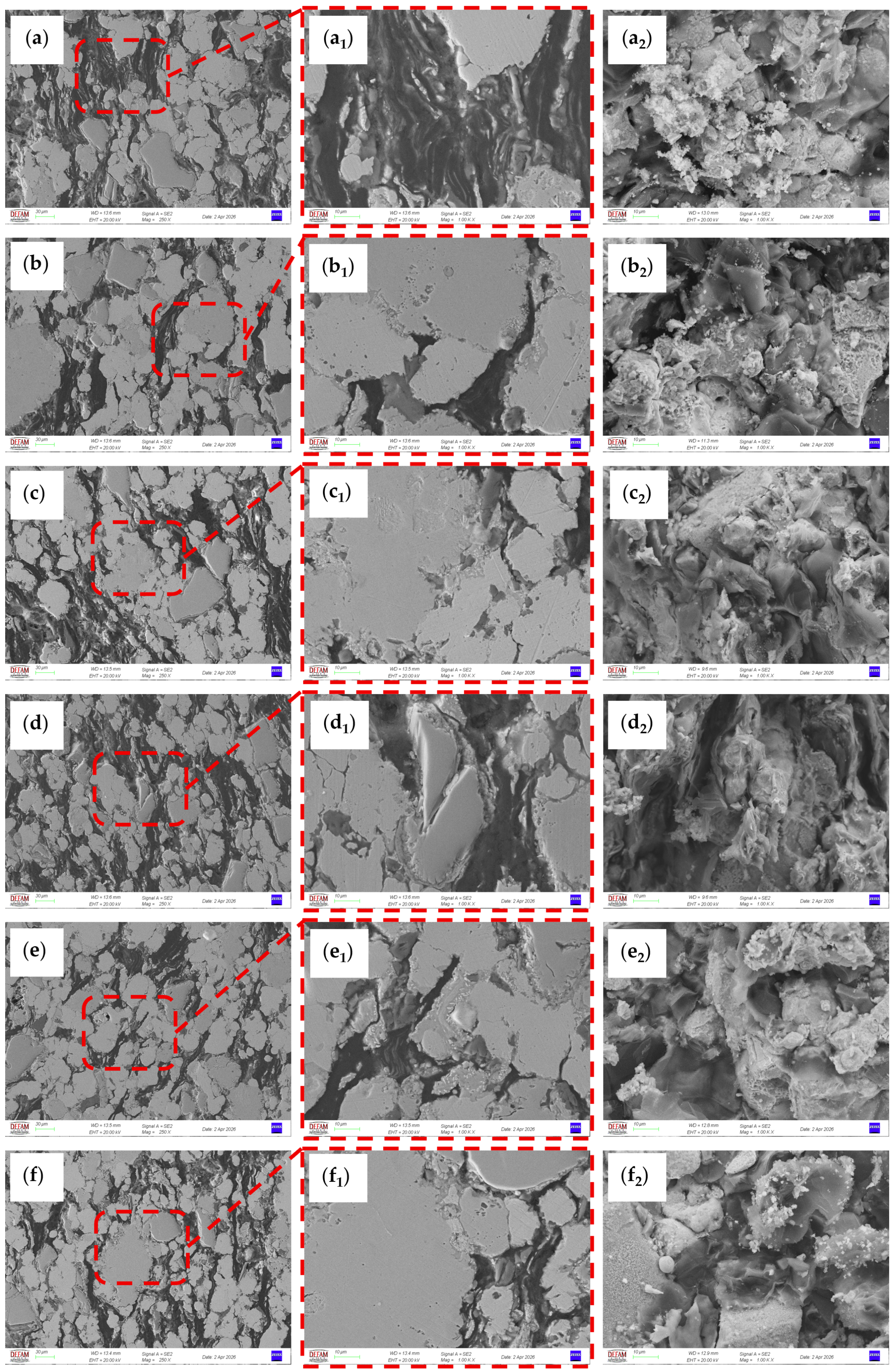
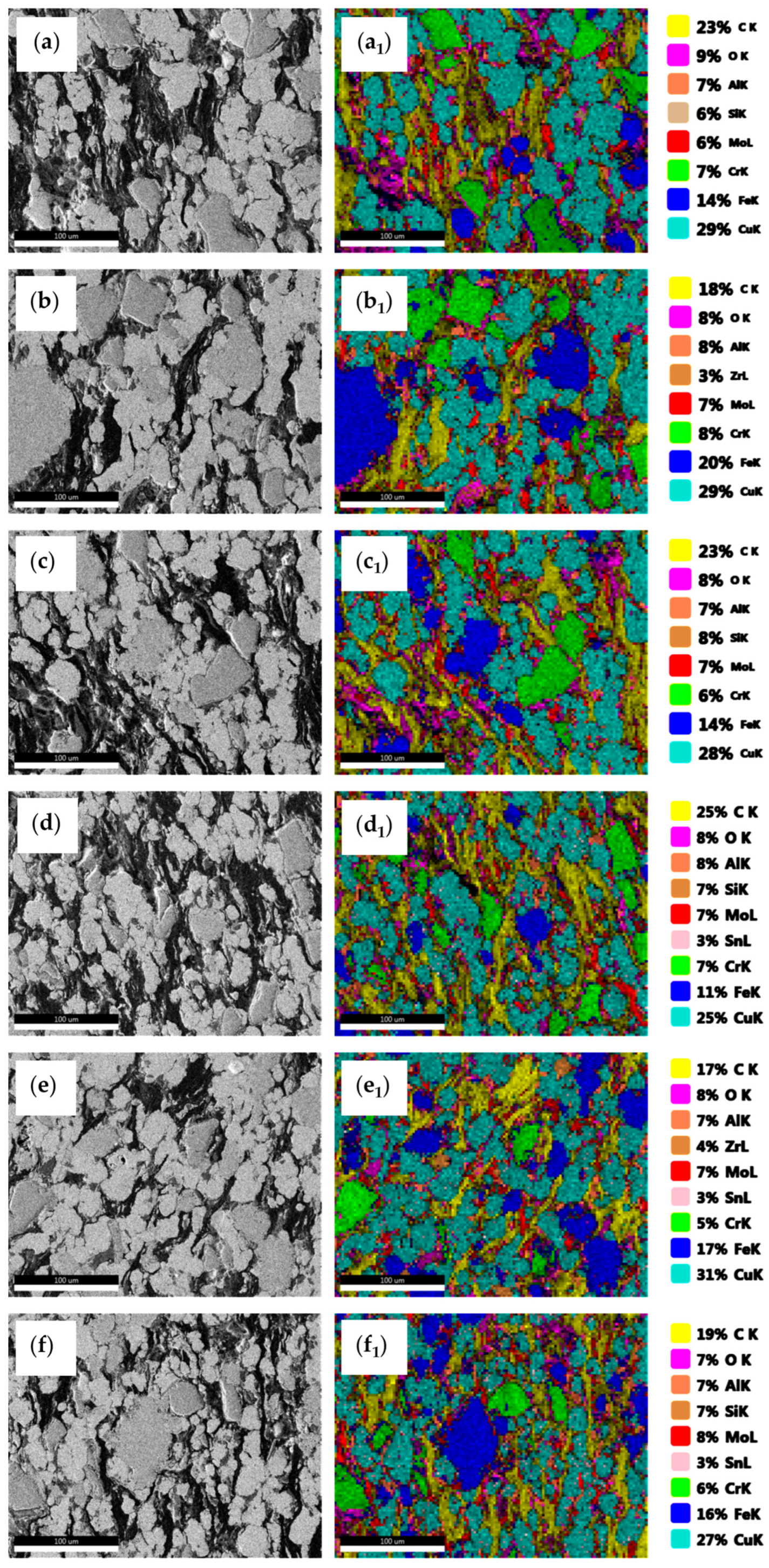
3.2.2. SEM/EDS Analysis
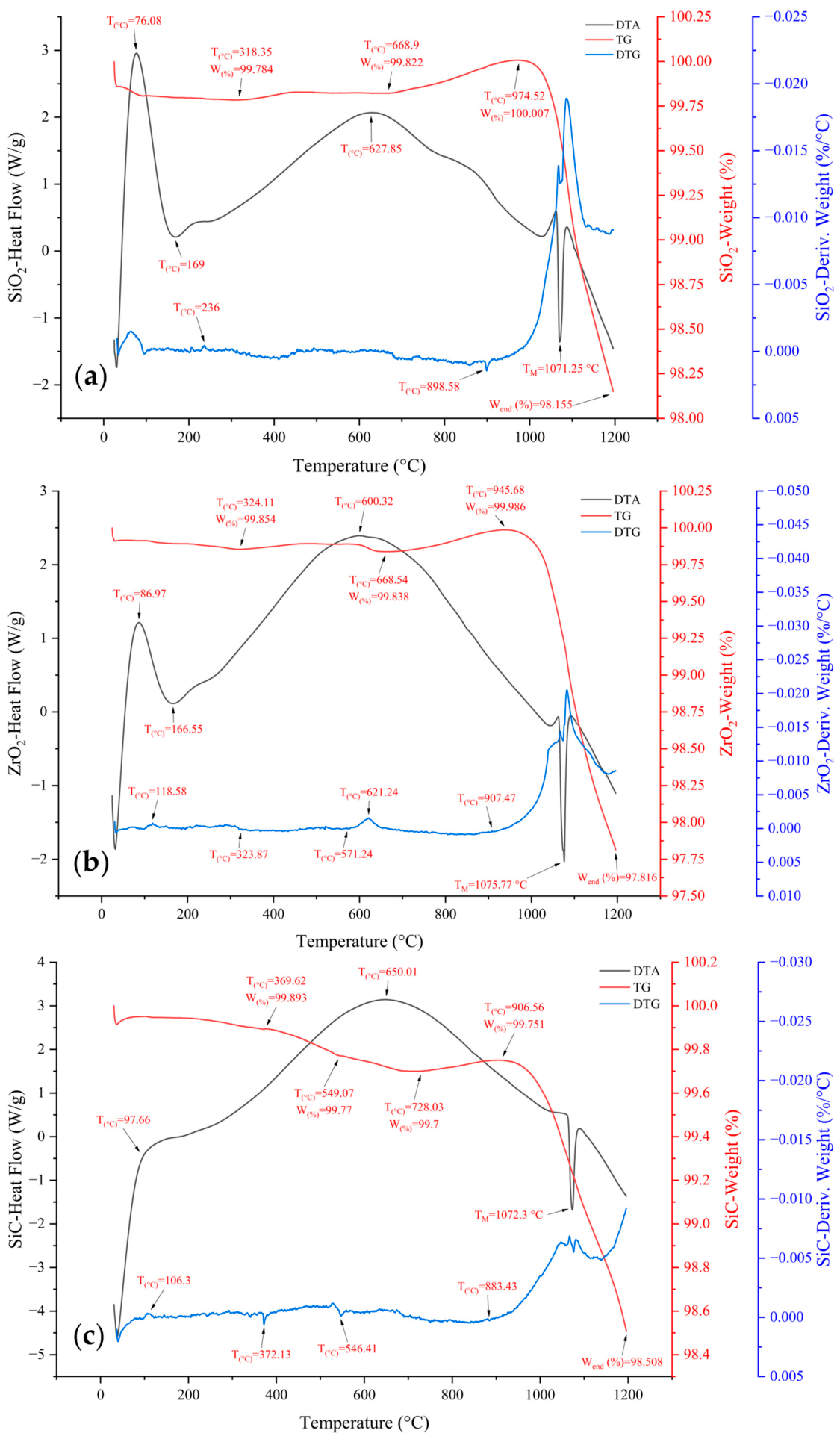
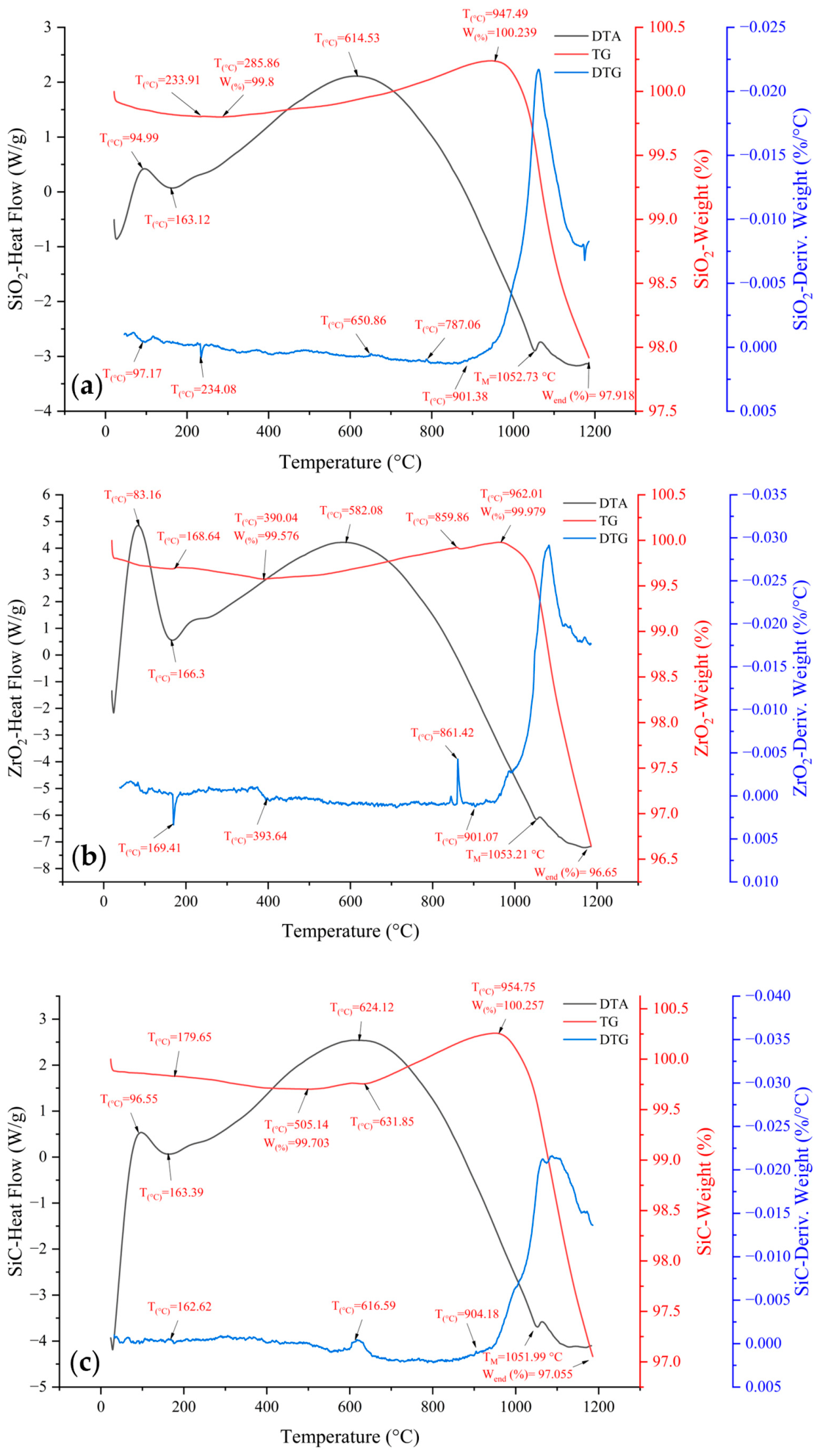
3.3. Differential Thermal Analysis (DTA) and Thermogravimetric Analysis (TGA)
3.4. Friction and Wear Test Results
4. Conclusions
- The Cu-based composites exhibited porosity values between 17.27% and 19.68%, whereas the Cu–Br-based composites showed higher values between 19.85% and 22.14%. Cu–ZrO2 had the highest sintered density of 4.819 g/cm3 and the lowest porosity of 17.27% among all formulations.
- The hardness ranged from 21.1 to 24.4 HBW. Cu–SiC exhibited the highest hardness among the Cu-based composites with 24.4 HBW, while Cu–Br–SiC showed the highest hardness within the Cu–Br-based composites with 22.4 HBW. The lowest hardness was measured for Cu–Br–ZrO2 with 21.1 HBW.
- The onset of the dominant high-temperature mass-loss process occurred between 907 and 975 °C for the Cu-based mixtures and between 947 and 962 °C for the Cu–Br-based mixtures. Total mass losses ranged from 1.493% to 2.185% for the Cu-based composites and from 2.082% to 3.350% for the Cu–Br-based composites. The corresponding high-temperature endothermic peaks occurred between approximately 1071 and 1076 °C for the Cu-based mixtures and between 1052 and 1053 °C for the Cu–Br-based mixtures.
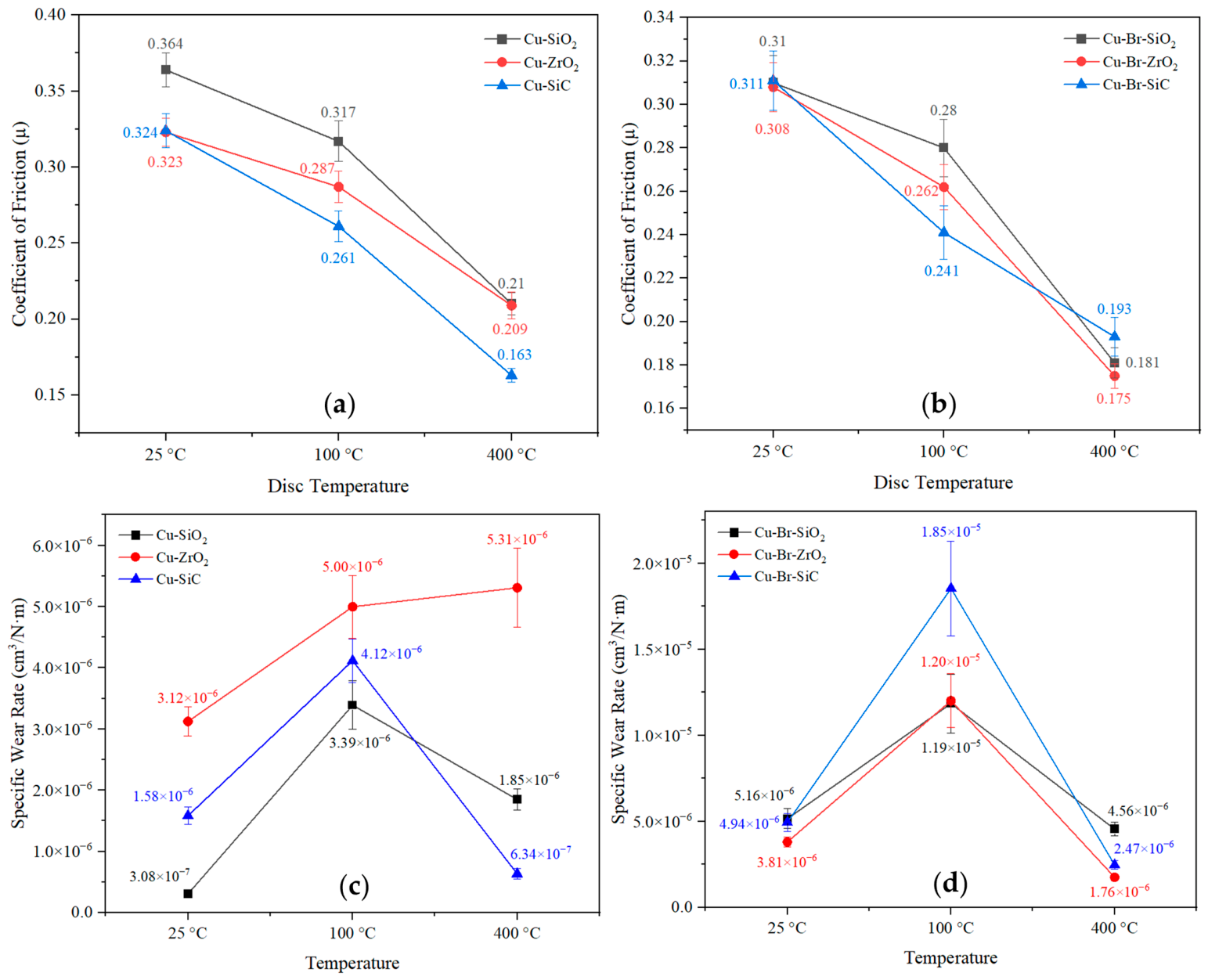
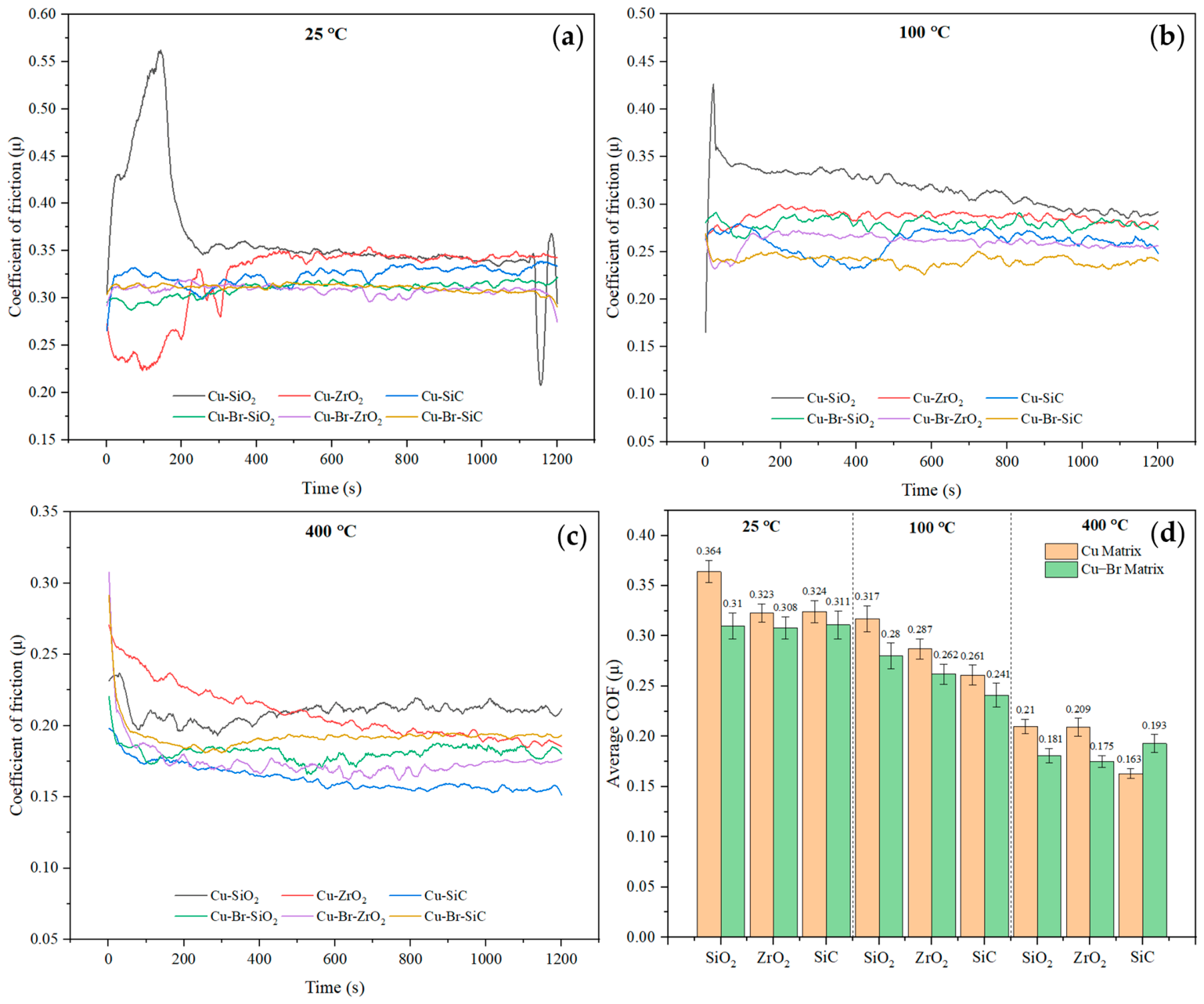
- The COF decreased with increasing test temperature for all six composites. In the Cu-based composites, the COF decreased from a range of 0.323–0.364 at 25 °C to 0.163–0.210 at 400 °C. In the Cu–Br-based composites, the corresponding COF range decreased from 0.308–0.311 at 25 °C to 0.175–0.193 at 400 °C. The Cu–Br-based composites therefore maintained a narrower reinforcement-dependent COF range than the Cu-based composites over the investigated temperature range.
- The highest COF retention from 25 to 400 °C was obtained for Cu–ZrO2 among the Cu-based composites at 64.7% and for Cu–Br–SiC among the Cu–Br-based composites at 62.1%.
- The lowest specific wear rate among all composites was obtained for Cu–SiO2 at 25 °C with a value of 3.080 × 10⁻⁷ cm3/N·m. At 400 °C, Cu–SiC exhibited the lowest specific wear rate with a value of 6.335 × 10⁻⁷ cm3/N·m. The highest specific wear rate was measured for Cu–Br–SiC at 100 °C with a value of 1.854 × 10⁻⁵ cm3/N·m. Within the Cu–Br-based group at 400 °C, Cu–Br–ZrO2 showed the lowest specific wear rate with a value of 1.758 × 10⁻⁶ cm3/N·m.
Author Contributions
Funding
Data Availability Statement
Acknowledgments
Conflicts of Interest
Abbreviations
| 3DMS | Three-dimensional mixing system |
| ASTM | ASTM International |
| BSE | Backscattered electron |
| C/C–SiC | Carbon/carbon–silicon carbide composite |
| COF | Coefficient of friction |
| Cu–Br | Copper–bronze matrix |
| Cu-MMCs | Copper-based metal matrix composites |
| DTA | Differential thermal analysis |
| DTG | Derivative thermogravimetry |
| EDS | Energy-dispersive X-ray spectroscopy |
| HBW | Brinell hardness |
| PM | Powder metallurgy |
| SEM | Scanning electron microscopy |
| TGA | Thermogravimetric analysis |
| Al | Aluminium |
| Al2O3 | Aluminium Oxide |
| Ar | Argon |
| C | Carbon |
| Cr | Chromium |
| Cu | Copper |
| Fe | Iron |
| Mo | Molybdenum |
| MoS2 | Molybdenum disulphide |
| O | Oxygen |
| S | Sulfur |
| Si | Silicon |
| SiC | Silicon carbide |
| SiO2 | Silicon dioxide |
| Sn | Tin |
| Zr | Zirconium |
| ZrO2 | Zirconium dioxide |
References
- Xiang, Z.Y.; Zhang, J.K.; Xie, S.L.; Mo, J.L.; Zhu, S.; Zhai, C.Z. Friction-Induced Vibration and Noise Characteristics, and Interface Tribological Behavior during High-Speed Train Braking: The Effect of the Residual Height of the Brake Pad Friction Block. Wear 2023, 516, 204619. [Google Scholar] [CrossRef] [Scilit]
- Xiao, J.-K.; Li, T.-T.; Chen, J.; Zhang, C. Effects of Oxidation Temperature on the Microstructure and Tribological Performance of Cu-Based Brake Pad for High-Speed Train. Wear 2023, 514, 204559. [Google Scholar] [CrossRef] [Scilit]
- Djafri, M.; Bouchetara, M.; Busch, C.; Khatir, S.; Khatir, T.; Weber, S.; Shbaita, K.; Abdel Wahab, M. Influence of Thermal Fatigue on the Wear Behavior of Brake Discs Sliding against Organic and Semimetallic Friction Materials. Tribol. Trans. 2018, 61, 861–868. [Google Scholar] [CrossRef] [Scilit]
- Yun, R.; Filip, P.; Lu, Y. Performance and Evaluation of Eco-Friendly Brake Friction Materials. Tribol. Int. 2010, 43, 2010–2019. [Google Scholar] [CrossRef] [Scilit]
- Xiao, Y.; Zhang, Z.; Yao, P.; Fan, K.; Zhou, H.; Gong, T.; Zhao, L.; Deng, M. Mechanical and Tribological Behaviors of Copper Metal Matrix Composites for Brake Pads Used in High-Speed Trains. Tribol. Int. 2018, 119, 585–592. [Google Scholar] [CrossRef] [Scilit]
- Wu, J.; Li, Z.; Wen, G.; Gao, Z.; Li, Y.; Zhao, Y. Friction Mechanism Analysis of Copper-Based Composites Reinforced with Ball-Milled and Modified Composite Ceramic Powders. Wear 2023, 528, 204959. [Google Scholar] [CrossRef] [Scilit]
- Zheng, D.; Zhao, X.; An, K.; Chen, L.; Zhao, Y.; Khan, D.F.; Qu, X.; Yin, H. Effects of Fe and Graphite on Friction and Wear Properties of Brake Friction Materials for High-Speed and Heavy-Duty Vehicles. Tribol. Int. 2023, 178, 108061. [Google Scholar] [CrossRef] [Scilit]
- Zhang, P.; Zhang, L.; Wei, D.; Wu, P.; Cao, J.; Shijia, C.; Qu, X. Adjusting Function of MoS2 on the High-Speed Emergency Braking Properties of Copper-Based Brake Pad and the Analysis of Relevant Tribo-Film of Eddy Structure. Compos. B Eng. 2020, 185, 107779. [Google Scholar] [CrossRef] [Scilit]
- Su, L.; Gao, F.; Han, X.; Fu, R.; Zhang, E. Tribological Behavior of Copper–Graphite Powder Third Body on Copper-Based Friction Materials. Tribol. Lett. 2015, 60, 30. [Google Scholar] [CrossRef] [Scilit]
- Xu, W.; Xu, Z.; Fu, C.; Yi, M.; Zhong, M. Influences of CrFe Granularity and Proportion on Braking Performance and Dynamic Response of Cu-Based Pads. Wear 2023, 530, 205043. [Google Scholar] [CrossRef] [Scilit]
- Zhang, P.; Zhang, L.; Fu, K.; Wu, P.; Cao, J.; Shijia, C.; Qu, X. The Effect of Al2O3 Fiber Additive on Braking Performance of Copper-Based Brake Pads Utilized in High-Speed Railway Train. Tribol. Int. 2019, 135, 444–456. [Google Scholar] [CrossRef] [Scilit]
- Xiao, J.-K.; Xiao, S.-X.; Chen, J.; Zhang, C. Wear Mechanism of Cu-Based Brake Pad for High-Speed Train Braking at Speed of 380 km/h. Tribol. Int. 2020, 150, 106357. [Google Scholar] [CrossRef] [Scilit]
- Monreal-Pérez, P.; González, J.; Iraizoz, A.; Bilbao, U.; Clavería, I. Effect of the Steel Fiber Length on the Friction Performance and Wear Mechanism of Railway Brake Shoes. Tribol. Int. 2022, 172, 107589. [Google Scholar] [CrossRef] [Scilit]
- Si, L.; Liu, C.; Yan, H.; Wang, Y.; Yang, Y.; Zhang, S.; Zhang, Y. The Influences of High Temperature on Tribological Properties of Cu-Based Friction Materials with a Friction Phase of SiO2/SiC/Al2O3. AIP Adv. 2021, 11, 025335. [Google Scholar] [CrossRef] [Scilit]
- Lu, C.; Jiang, X.; Chen, X.; Mo, J. Experimental Study on the Evolution of Friction and Wear Behaviours of Railway Friction Block during Temperature Rise under Extreme Braking Conditions. Eng. Fail. Anal. 2022, 141, 106621. [Google Scholar] [CrossRef] [Scilit]
- Zhang, P.; Zhang, L.; Wei, D.; Wu, P.; Cao, J.; Shijia, C.; Qu, X. A High-Performance Copper-Based Brake Pad for High-Speed Railway Trains and Its Surface Substance Evolution and Wear Mechanism at High Temperature. Wear 2020, 444, 203182. [Google Scholar] [CrossRef] [Scilit]
- Soy, G.; Korucu, S. A Study on the Deformation Behavior of AA7075 Powder with Three-Dimensional Ball Mill. Celal Bayar Univ. J. Sci. 2022, 18, 425–434. [Google Scholar] [CrossRef] [Scilit]
- Keser, B.; Soy, G.; Akgün, S. The Effect of Sintering Graphene and SiC Reinforced Aluminum Hybrid Composites with Ultra-High Frequency Induction Heating System (UHFIS) on Mechanical Properties. Celal Bayar Univ. J. Sci. 2025, 21, 118–127. [Google Scholar] [CrossRef] [Scilit]
- Soy, G.; Korucu, S. Investigations on the Mechanical Alloying Properties of Al 2024 Alloy by Three-Dimensional Ball Mill, Surface Review and Letters. Surf. Rev. Lett. 2022, 29, 2250142. [Google Scholar] [CrossRef] [Scilit]
- Soy, G.; Keser, B.; Kayral, S.; Yaylalı, B. TGA/DTA-Based Sintering Optimization of Al-Graphene-B4C Hybrid Composites and Effect on Mechanical and Tribological Behavior. Macromol. Mater. Eng. 2026, 311, e70248. [Google Scholar] [CrossRef] [Scilit]
- Soy, G. High-Temperature Tribological Performance of Graphite and MoS2 Hybrid Reinforced CuSn10. Diam. Relat. Mater. 2026, 166, 113685. [Google Scholar] [CrossRef] [Scilit]
- Keser, B.; Soy, G.; Kayral, S. Al 6xxx Matrisli Grafen ve SiC Takviyeli Hibrit Kompozitlerde Yaşlandırma Isıl İşleminin Mekanik ve Tribolojik Davranışa Etkisi. Gazi Univ. J. Sci. Part C Des. Technol. 2026, 14, 1000–1013. [Google Scholar] [CrossRef] [Scilit]
- ASTM E10-18; Standard Test Method for Brinell Hardness of Metallic Materials. ASTM International: West Conshohocken, PA, USA, 2018. [CrossRef] [Scilit]
- Suleiman, B.; Zhang, H.; Ding, Y.; Li, Y. Microstructure and Mechanical Properties of Cold Sintered Porous Alumina Ceramics. Ceram. Int. 2022, 48, 13531–13540. [Google Scholar] [CrossRef] [Scilit]
- ASTM G99-17; Standard Test Method for Wear Testing with a Pin-on-Disk Apparatus. ASTM International: West Conshohocken, PA, USA, 2017. [CrossRef] [Scilit]
- Riva, G.; Valota, G.; Perricone, G.; Wahlström, J. An FEA Approach to Simulate Disc Brake Wear and Airborne Particle Emissions. Tribol. Int. 2019, 138, 90–98. [Google Scholar] [CrossRef] [Scilit]
- Bebekoğlu, S.; Topuz, A.; Çakır, E.; Adsoy, A.; Yıldıran, T. Development of Sinter Linings for High-Speed Trains. Mater. Test. 2024, 66, 1153–1167. [Google Scholar] [CrossRef] [Scilit]
- Kamal, T.; Gouthama; Upadhyaya, A. Machine Learning Aided Prediction of Sintering Induced Swelling in Powder Metallurgical Cu-Sn Alloys. Comput. Mater. Sci. 2024, 235, 112827. [Google Scholar] [CrossRef] [Scilit]
- Si, Q.; Wu, S.; Xiao, A.; Li, S.; Wang, Y.; Fan, J.; Zhou, X.; Cui, G.; Li, X.; Wei, S. Effect of Cr3C2-CrFe Hybrid Friction Components on Micro and Macro Tribology Behavior of Cu-Based High-Speed Train Brake Pads. Tribol. Trans. 2026, 69, 283–295. [Google Scholar] [CrossRef] [Scilit]
- Sankhla, A.M.; Patel, K.M.; Makhesana, M.A.; Giasin, K.; Pimenov, D.Y.; Wojciechowski, S.; Khanna, N. Effect of Mixing Method and Particle Size on Hardness and Compressive Strength of Aluminium Based Metal Matrix Composite Prepared through Powder Metallurgy Route. J. Mater. Res. Technol. 2022, 18, 282–292. [Google Scholar] [CrossRef] [Scilit]
- Teisanu, C. Liquid Phase Sintering of Fe-Cu-Sn-Pb System for Tribological Applications. In Sintering—Methods and Products; Shatokha, V., Ed.; IntechOpen: London, UK, 2012; pp. 147–172. [Google Scholar]
- De Mello, J.D.B.; Binder, C.; Hammes, G.; Binder, R.; Klein, A.N. Tribological Behaviour of Sintered Iron Based Self-Lubricating Composites. Friction 2017, 5, 285–307. [Google Scholar] [CrossRef] [Scilit]
- Wong-Ángel, W.D.; Téllez-Jurado, L.; Chávez-Alcalá, J.F.; Chavira-Martínez, E.; Verduzco-Cedeño, V.F. Effect of Copper on the Mechanical Properties of Alloys Formed by Powder Metallurgy. Mater. Des. 2014, 58, 12–18. [Google Scholar] [CrossRef] [Scilit]
- Xiong, X.; Chen, J.; Yao, P.; Li, S.; Huang, B. Friction and Wear Behaviors and Mechanisms of Fe and SiO2 in Cu-Based P/M Friction Materials. Wear 2007, 262, 1182–1186. [Google Scholar] [CrossRef] [Scilit]
- Gong, T.; Yao, P.; Xiong, X.; Zhou, H.; Zhang, Z.; Xiao, Y.; Zhao, L.; Deng, M. Microstructure and Tribological Behavior of Interfaces in Cu-SiO2 and Cu-Cr Metal Matrix Composites. J. Alloys Compd. 2019, 786, 975–985. [Google Scholar] [CrossRef] [Scilit]
- Xiao, Y.; Cheng, Y.; Zhou, H.; Liang, W.; Shen, M.; Yao, P.; Zhao, H.; Xiong, G. Evolution of Contact Surface Characteristics and Tribological Properties of a Copper-Based Sintered Material during High-Energy Braking. Wear 2022, 488, 204163. [Google Scholar] [CrossRef] [Scilit]
- Hu, J.; He, Y.; Li, Z.; Zhang, L. On the Deformation Mechanism of SiC under Nano-Scratching: An Experimental Investigation. Wear 2023, 522, 204871. [Google Scholar] [CrossRef] [Scilit]
- Hui, Y.; Liu, G.; Shi, R.; Zhang, Y.; Yan, T. Tribological Behavior and Wear Mechanism of C/C–SiC Brake Discs Based on Third-body Layer. Int. J. Appl. Ceram. Technol. 2023, 20, 1310–1326. [Google Scholar] [CrossRef] [Scilit]
- Zhou, H.; Yao, P.; Gong, T.; Xiao, Y.; Zhang, Z.; Zhao, L.; Fan, K.; Deng, M. Effects of ZrO2 Crystal Structure on the Tribological Properties of Copper Metal Matrix Composites. Tribol. Int. 2019, 138, 380–391. [Google Scholar] [CrossRef] [Scilit]
- Zou, H.; Ran, X.; Zhu, W.; Wang, Y.; Zhan, S.; Hao, Z. Tribological Behavior of Copper–Graphite Composites Reinforced with Cu-Coated or Uncoated SiO2 Particles. Materials 2018, 11, 2414. [Google Scholar] [CrossRef] [Scilit] [PubMed]
- Zhang, L.; Li, Y.; Zhou, R.; Wang, X.; Wang, Q.; Xie, L.; Li, Z.; Xu, B. First-Principles Study of the Effect of Sn Content on the Structural, Elastic, and Electronic Properties of Cu–Sn Alloys. Crystals 2023, 13, 1532. [Google Scholar] [CrossRef] [Scilit]
- Ramousse, S.; Høj, J.W.; Sørensen, O.T. Thermal Characterisation of Brake Pads. J. Therm. Anal. Calorim. 2001, 64, 933–943. [Google Scholar] [CrossRef] [Scilit]
- Xiao, J.-K.; Zhang, Z.-Z.; Chen, J.; Wu, D.-L.; Zhang, C. Effect of Cyclic Oxidation Temperature on Compressive Strength of Cu-Based Brake Pad for High-Speed Train. J. Alloys Compd. 2024, 1005, 176129. [Google Scholar] [CrossRef] [Scilit]
- Xiao, J.; Li, T.; Bao, T.; Chen, J.; Zhang, C. Oxidation Behavior of Cu-Based Brake Pad for High-Speed Train. Trans. Nonferrous Met. Soc. China 2024, 34, 2260–2274. [Google Scholar] [CrossRef] [Scilit]
- Tan, Q.; Atrens, A.; Mo, N.; Zhang, M.-X. Oxidation of Magnesium Alloys at Elevated Temperatures in Air: A Review. Corros. Sci. 2016, 112, 734–759. [Google Scholar] [CrossRef] [Scilit]
- Plascencia, G.; Utigard, T.; Marín, T. The Oxidation Resistance of Copper-Aluminum Alloys at Temperatures up to 1000 °C. JOM 2005, 57, 80–84. [Google Scholar] [CrossRef] [Scilit]
- Hayes, H.M.; Schmidt, M.; Sorarù, G.D.; Gervais, C.; Kroll, P. Not so Inert Gases: Substantial Weight Gain by Oxidation of a Porous SiCO Gel under N2, Ar, and He Atmospheres. J. Solgel Sci. Technol. 2026, 119, 21. [Google Scholar] [CrossRef] [Scilit]
- Chen, F.; Li, Z.; Luo, Y.; Li, D.; Ma, W.; Zhang, C.; Tang, H.; Li, F.; Xiao, P. Braking Behaviors of Cu-Based PM Brake Pads Mating with C/C–SiC and 30CrMnSi Steel Discs under High-Energy Braking. Wear 2021, 486, 204019. [Google Scholar] [CrossRef] [Scilit]
- Bahrom, M.Z.; Berhan, M.N.; Mohamed, R. Thermal Characteristics of Light Rail Transit Friction Materials. J. Mek. 2009, 29, 35–51. [Google Scholar]
- Zhu, W.; Kamali, A.R. Thermal Oxidation of MoS2 into Defective Crystalline MoO3 with Enhanced Li-Ion Storage Kinetics. J. Alloys Compd. 2023, 968, 171823. [Google Scholar] [CrossRef] [Scilit]
- Fei, L.; Lei, S.; Zhang, W.-B.; Lu, W.; Lin, Z.; Lam, C.H.; Chai, Y.; Wang, Y. Direct TEM Observations of Growth Mechanisms of Two-Dimensional MoS2 Flakes. Nat. Commun. 2016, 7, 12206. [Google Scholar] [CrossRef] [Scilit] [PubMed]
- de Oro Calderon, R.; Gierl-Mayer, C.; Danninger, H. Application of Thermal Analysis Techniques to Study the Oxidation/Reduction Phenomena during Sintering of Steels Containing Oxygen-Sensitive Alloying Elements. J. Therm. Anal. Calorim. 2017, 127, 91–105. [Google Scholar] [CrossRef] [Scilit]
- Kılınç, A.Ç.; Goktas, A.A.; Keskin, Ö.Y.; Köktaş, S. Extrusion-Based 3D Printing of CuSn10 Bronze Parts: Production and Characterization. Metals 2021, 11, 1774. [Google Scholar] [CrossRef] [Scilit]
- Gu, D.; Shen, Y.; Fang, S.; Xiao, J. Metallurgical Mechanisms in Direct Laser Sintering of Cu–CuSn–CuP Mixed Powder. J. Alloys Compd. 2007, 438, 184–189. [Google Scholar] [CrossRef] [Scilit]
- Zhang, X.; Zhong, W.; Ma, X.; Zhang, X.; Yan, Q. Improving High-Speed Braking Performance of Cu-Based Friction Materials via Built-in Cu Columns. Tribol. Int. 2026, 217, 111605. [Google Scholar] [CrossRef] [Scilit]
- Zhang, P.; Zhang, L.; Fu, K.; Wu, P.; Cao, J.; Shijia, C.; Qu, X. Fade Behaviour of Copper-Based Brake Pad during Cyclic Emergency Braking at High Speed and Overload Condition. Wear 2019, 428, 10–23. [Google Scholar] [CrossRef] [Scilit]
- Eriksson, M.; Bergman, F.; Jacobson, S. On the Nature of Tribological Contact in Automotive Brakes. Wear 2002, 252, 26–36. [Google Scholar] [CrossRef] [Scilit]
- Xu, G.; Zhu, Y.; Peng, L.; Xie, H.; Li, Z.; Huang, S.; Yang, Z.; Zhang, W.; Mi, X. Effect of Sn Addition on Microstructure, Aging Properties and Softening Resistance of Cu-Cr Alloy. Materials 2022, 15, 8441. [Google Scholar] [CrossRef] [Scilit] [PubMed]
- Chen, J.; Yu, C.; Cheng, Q.; Guan, Y.; Zhang, Q.; Li, W.; Ouyang, F.; Wang, Z. Research on Friction Performance and Wear Rate Prediction of High-Speed Train Brake Pads. Wear 2023, 514, 204564. [Google Scholar] [CrossRef] [Scilit]
- Zhong, W.; Zhang, X.; Zhang, X.; Yan, Q. Braking Performance of Fe-Based and Cu-Based Powder Metallurgy Pads Paired with C/C-SiC Disk on Full-Scale Dynamometer. Tribol. Trans. 2024, 67, 436–451. [Google Scholar] [CrossRef] [Scilit]
- Zhao, S.; Yan, Q.; Peng, T.; Zhang, X.; Wen, Y. The Braking Behaviors of Cu-Based Powder Metallurgy Brake Pads Mated with C/C–SiC Disk for High-Speed Train. Wear 2020, 448, 203237. [Google Scholar] [CrossRef] [Scilit]



| Sample | Cu % | Bronze % | Fe % | C % | CrFe % | MoS2% | Al2O3% | SiO2% | ZrO2% | SiC % |
|---|---|---|---|---|---|---|---|---|---|---|
| 1 | 54 | - | 14 | 13 | 8 | 5 | 4 | 2 | - | - |
| 2 | 54 | - | 14 | 13 | 8 | 5 | 4 | - | 2 | - |
| 3 | 54 | - | 14 | 13 | 8 | 5 | 4 | - | - | 2 |
| 4 | 30 | 24 | 14 | 13 | 8 | 5 | 4 | 2 | - | - |
| 5 | 30 | 24 | 14 | 13 | 8 | 5 | 4 | - | 2 | - |
| 6 | 30 | 24 | 14 | 13 | 8 | 5 | 4 | - | - | 2 |
| No | Samples | Theoretical Density (g/cm3) | Green Density (g/cm3) | Sintered Density (g/cm3) | Hardness (HBW 2.5/15.625) | Porosity (%) |
|---|---|---|---|---|---|---|
| 1 | Cu–SiO2 | 5.691 | 5.194 | 4.571 | 23.6 | 19.68 |
| 2 | Cu–ZrO2 | 5.825 | 5.477 | 4.819 | 23.3 | 17.27 |
| 3 | Cu–SiC | 5.735 | 5.326 | 4.649 | 24.4 | 18.94 |
| 4 | Cu–Br–SiO2 | 5.675 | 5.296 | 4.459 | 21.3 | 21.43 |
| 5 | Cu–Br–ZrO2 | 5.808 | 5.489 | 4.522 | 21.1 | 22.14 |
| 6 | Cu–Br–SiC | 5.719 | 5.453 | 4.584 | 22.4 | 19.85 |
| No | Sample | Specific Wear Rate (cm3/N·m) | Coefficient of Friction (µ) | ||||
|---|---|---|---|---|---|---|---|
| 25 °C | 100 °C | 400 °C | 25 °C | 100 °C | 400 °C | ||
| 1 | Cu–SiO2 | 3.080 ± 0.2556 × 10⁻⁷ | 3.390 ± 0.3966 × 10⁻⁶ | 1.849 ± 0.1738 × 10⁻⁶ | 0.364 ± 0.011 | 0.317 ± 0.013 | 0.210 ± 0.007 |
| 2 | Cu–ZrO2 | 3.123 ± 0.2373 × 10⁻⁶ | 4.997 ± 0.5147 × 10⁻⁶ | 5.309 ± 0.6424 × 10⁻⁶ | 0.323 ± 0.009 | 0.287 ± 0.010 | 0.209 ± 0.009 |
| 3 | Cu–SiC | 1.584 ± 0.1441 × 10⁻⁶ | 4.117 ± 0.3582 × 10⁻⁶ | 6.335 ± 0.8489 × 10⁻⁷ | 0.324 ± 0.011 | 0.261 ± 0.010 | 0.163 ± 0.005 |
| 4 | Cu–Br-SiO2 | 5.164 ± 0.5784 × 10⁻⁶ | 1.185 ± 0.1695 × 10⁻⁵ | 4.557 ± 0.3919 × 10⁻⁶ | 0.310 ± 0.013 | 0.280 ± 0.013 | 0.181 ± 0.007 |
| 5 | Cu–Br-ZrO2 | 3.810 ± 0.3010 × 10⁻⁶ | 1.202 ± 0.1575 × 10⁻⁵ | 1.758 ± 0.1881 × 10⁻⁶ | 0.308 ± 0.011 | 0.262 ± 0.010 | 0.175 ± 0.006 |
| 6 | Cu–Br-SiC | 4.943 ± 0.5140 × 10⁻⁶ | 1.854 ± 0.2744 × 10⁻⁵ | 2.472 ± 0.2423 × 10⁻⁶ | 0.311 ± 0.014 | 0.241 ± 0.012 | 0.193 ± 0.009 |
| No | Samples | Δμ = μ25 °C − μ400 °C | μ400 °C/μ25 °C | COF Retention (%) | COF Loss (%) |
|---|---|---|---|---|---|
| 1 | Cu–SiO2 | 0.154 | 0.577 | 57.7 | 42.3 |
| 2 | Cu–ZrO2 | 0.114 | 0.647 | 64.7 | 35.3 |
| 3 | Cu–SiC | 0.161 | 0.503 | 50.3 | 49.7 |
| 4 | Cu–Br-SiO2 | 0.129 | 0.584 | 58.4 | 41.6 |
| 5 | Cu–Br-ZrO2 | 0.133 | 0.568 | 56.8 | 43.2 |
| 6 | Cu–Br-SiC | 0.118 | 0.621 | 62.1 | 37.9 |
Disclaimer/Publisher’s Note: The statements, opinions and data contained in all publications are solely those of the individual author(s) and contributor(s) and not of MDPI and/or the editor(s). MDPI and/or the editor(s) disclaim responsibility for any injury to people or property resulting from any ideas, methods, instructions or products referred to in the content. |
© 2026 by the authors. Licensee MDPI, Basel, Switzerland. This article is an open access article distributed under the terms and conditions of the Creative Commons Attribution (CC BY) license.
Share and Cite
Soy, G.; Öktem, H.; Akıncıoğlu, S.; Uygur, İ. Effect of Ceramic Reinforcement Type on Friction Stability and Wear Resistance of Cu and Cu–Bronze Matrix Powder Metallurgy Brake Composites. Metals 2026, 16, 985. https://doi.org/10.3390/met16090985
Soy G, Öktem H, Akıncıoğlu S, Uygur İ. Effect of Ceramic Reinforcement Type on Friction Stability and Wear Resistance of Cu and Cu–Bronze Matrix Powder Metallurgy Brake Composites. Metals. 2026; 16(9):985. https://doi.org/10.3390/met16090985
Chicago/Turabian StyleSoy, Gürkan, Hasan Öktem, Sıtkı Akıncıoğlu, and İlyas Uygur. 2026. "Effect of Ceramic Reinforcement Type on Friction Stability and Wear Resistance of Cu and Cu–Bronze Matrix Powder Metallurgy Brake Composites" Metals 16, no. 9: 985. https://doi.org/10.3390/met16090985
APA StyleSoy, G., Öktem, H., Akıncıoğlu, S., & Uygur, İ. (2026). Effect of Ceramic Reinforcement Type on Friction Stability and Wear Resistance of Cu and Cu–Bronze Matrix Powder Metallurgy Brake Composites. Metals, 16(9), 985. https://doi.org/10.3390/met16090985