


Abstract
The tribological performance of copper-matrix sintered brake pads for high-speed rail applications is strongly influenced by ceramic reinforcement type. However, a systematic comparison of SiC, ZrO2, and SiO2 within Cu and Cu–Bronze (Cu–Br) matrix systems remains limited. In this study, six powder metallurgy composites were produced by cold pressing and sintering at 900 °C, with each matrix reinforced with 2 wt.% SiC, ZrO2, or SiO2 and containing graphite and MoS2 as solid lubricants. Tribological tests were performed at 25, 100, and 400 °C under an 18 N normal load. Microstructural and thermal characteristics were evaluated using optical microscopy, SEM/EDS, and DTA/TGA. The coefficient of friction (COF) ranged from 0.163 to 0.364 across all formulations and temperatures. The Cu–Br-based composites exhibited a narrower reinforcement-dependent COF range than the Cu-based composites, particularly at elevated temperatures. Cu–SiO2 showed the highest COF within the Cu-based at all test temperatures, whereas Cu–Br–SiC composite exhibited the highest COF among the Cu–Br-based composites at 400 °C. The lowest specific wear rates were obtained for Cu–SiO2 at 25 °C and Cu–SiC at 400 °C. SiC-reinforced composites exhibited the highest hardness within both matrix systems.
1. Introduction
Friction materials in heavy-duty braking systems convert kinetic energy into heat under high-load conditions [1,2,3]. Organic friction materials may exhibit friction fade at elevated temperatures due to thermal degradation of their organic constituents [3,4]. The limited thermal stability and thermal-fade resistance of organic friction materials restrict their use at elevated temperatures, whereas Cu-based metal-matrix composites (Cu-MMCs) offer high thermal conductivity and favorable tribological performance under severe braking conditions [5].
Cu-MMCs are multi-constituent materials fabricated by powder metallurgy, consisting of a Cu matrix together with reinforcing, friction-generating, and lubricating phases [6]. Generally, Fe is added to Cu-MMCs to strengthen the Cu matrix, while graphite and molybdenum disulphide (MoS2) are employed as solid lubricants [7,8]. Graphite and MoS2 contribute to interfacial lubrication through the formation of stable tribo-films on the friction surface, resulting in a lower friction coefficient and improved wear resistance [8,9].
Common friction-generating constituents in Cu-based friction materials include silica (SiO2), zirconia (ZrO2), silicon carbide (SiC), alumina (Al2O3), and ferrochrome (CrFe) [10,11]. Ceramic additives such as SiO2, ZrO2, and Al2O3 are commonly incorporated to improve the tribological performance of Cu-based brake materials [11]. However, the smooth polygonal morphology of CrFe and SiC particles may result in weak interfacial bonding with the Cu matrix, facilitating particle detachment and abrasive third-body formation during high-speed braking [12]. Al2O3 particles act as contact platforms that hinder the flow of softened material at high speeds and enhance the deformation resistance of the substrate surface [10]. The formation of load-bearing plateaus and compaction of wear debris contribute to interfacial stability by enlarging the effective friction surface and reducing excessive wear and friction fluctuations [13].
Cu-based sintered friction materials have been widely investigated for braking applications due to their stable friction response and wear resistance under different operating conditions. Xiao et al. [5] evaluated a Cu-MMC reinforced with 6–8 wt.% ZrO2 and CrFe and reported that the average COF decreased from 0.378 at 300 km/h to 0.321 at 380 km/h. Zhang et al. [8] showed that increasing MoS2 from 0 to 10 wt.% in Cu-MMCs reduced the COF from 0.349 to 0.246, while the Cu-MMCs + 2 wt.% MoS2 composition exhibited the lowest wear loss of 1.73 g. Xiao et al. [12] reported that the oxide-based tribolayer formed on a Cu-MMCs + SiC brake pad reduced the wear rate from 19.3 × 10⁻⁵ to 5.5 × 10⁻⁵ mm3/N·m. Si et al. [14] compared Cu-MMCs reinforced with 5 wt.% SiO2, 5 wt.% SiC, or 5 wt.% Al2O3 at 25–500 °C and obtained COF values of approximately 0.30–0.70, with wear losses of 301, 322, and 429 μg at 300 °C, respectively. Temperature-dependent studies further demonstrated substantial changes in tribological behavior. Xiao et al. [2] reported wear rates of 1.7, 1.3, 4.9, and 8.3 × 10⁻⁵ mm3/N·m after oxidation at 25, 200, 400, and 600 °C, respectively. Lu et al. [15] observed that the COF increased from 0.33 at room temperature to 0.43 at 240 °C and remained relatively stable up to 400 °C. Similarly, Zhang et al. [16] reported a COF range of 0.35–0.45 up to 600 °C for a Cu-MMCs + 2 wt.% SiC brake pad.
Although Cu-based sintered friction materials have been widely studied, previous research has mainly examined SiO2, ZrO2, and SiC reinforcements individually or within Cu-Fe based matrix systems. However, a direct comparison of these ceramic abrasives in Cu and Cu–Br matrices under identical powder metallurgy processing and tribological test conditions remains limited. In particular, the effect of Sn-containing Cu–Br matrix chemistry on reinforcement-dependent friction stability, wear resistance, and thermal fade behavior has not been clearly established. Moreover, the temperature-dependent COF and wear responses of these reinforcement–matrix combinations over the range of 25–400 °C remain insufficiently quantified. To address these gaps, this study investigates six composite formulations consisting of Cu and Cu–Br matrices reinforced with 2 wt.% SiO2, ZrO2 or SiC. This work provides a direct comparative evaluation of the selected ceramic reinforcements, clarifies the role of Sn in the Cu–Br matrix on COF stability and thermal fade resistance, and establishes composition–microstructure–tribological performance relationships for high-speed train brake pad applications.
2. Materials and Methods
2.1. Materials
In this study, Cu-based and Cu–Br-based train brake composites reinforced with SiO2, ZrO2 and SiC were fabricated by powder metallurgy. Copper (Cu) powder with a particle size of <75 μm and a purity of 99.9 wt.%, together with bronze powder (90Cu–10Sn, particle size <44 μm), was used as the matrix material. Iron (Fe) powder (<45 μm, 99% purity), graphite (C) powder (<150 μm, 99% purity), ferrochrome (CrFe) powder (<75 μm, 99.5% purity), and MoS2 powder (<44 μm, 99.9% purity) were used as additional constituents. Al2O3 powder (particle size 3–19 μm, purity 99.1%), SiO2, ZrO2, and SiC powders (all <44 μm, ≥99.9% purity) were employed as ceramic reinforcement phases. The nominal chemical compositions of the Cu-based and Cu–Br-based brake composites are listed in Table 1.
Table 1.
Nominal chemical compositions of Cu-based brake and Cu–Br-based composites (wt.%).
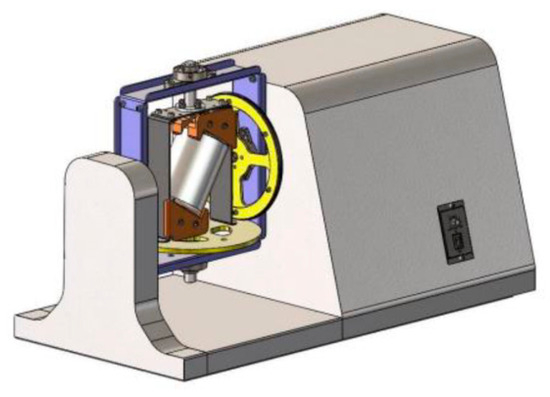
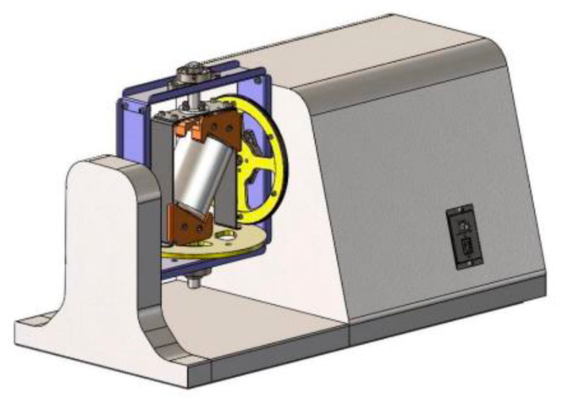
The powder constituents for all Cu- and Cu–Br-based SiO2, ZrO2 and SiC-reinforced brake composites were weighed using a digital balance with a precision of 0.001 g and blended in a three-dimensional mixing system (3DMS) at 150 rpm for 2 h. Alumina balls (Ø 3 mm) at a ball-to-powder mass ratio of 1:1 were used to promote homogeneous distribution of the matrix and reinforcement constituents. The 3DMS unit employed for powder mixing is illustrated in Figure 1.
Figure 1.
Three-dimensional mixing system (3DMS) [17,18,19,20,21,22].
2.2. Compaction and Sintering
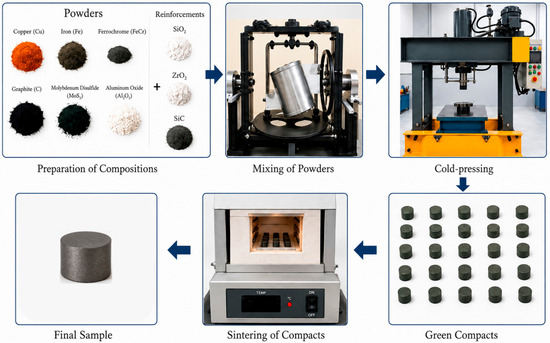
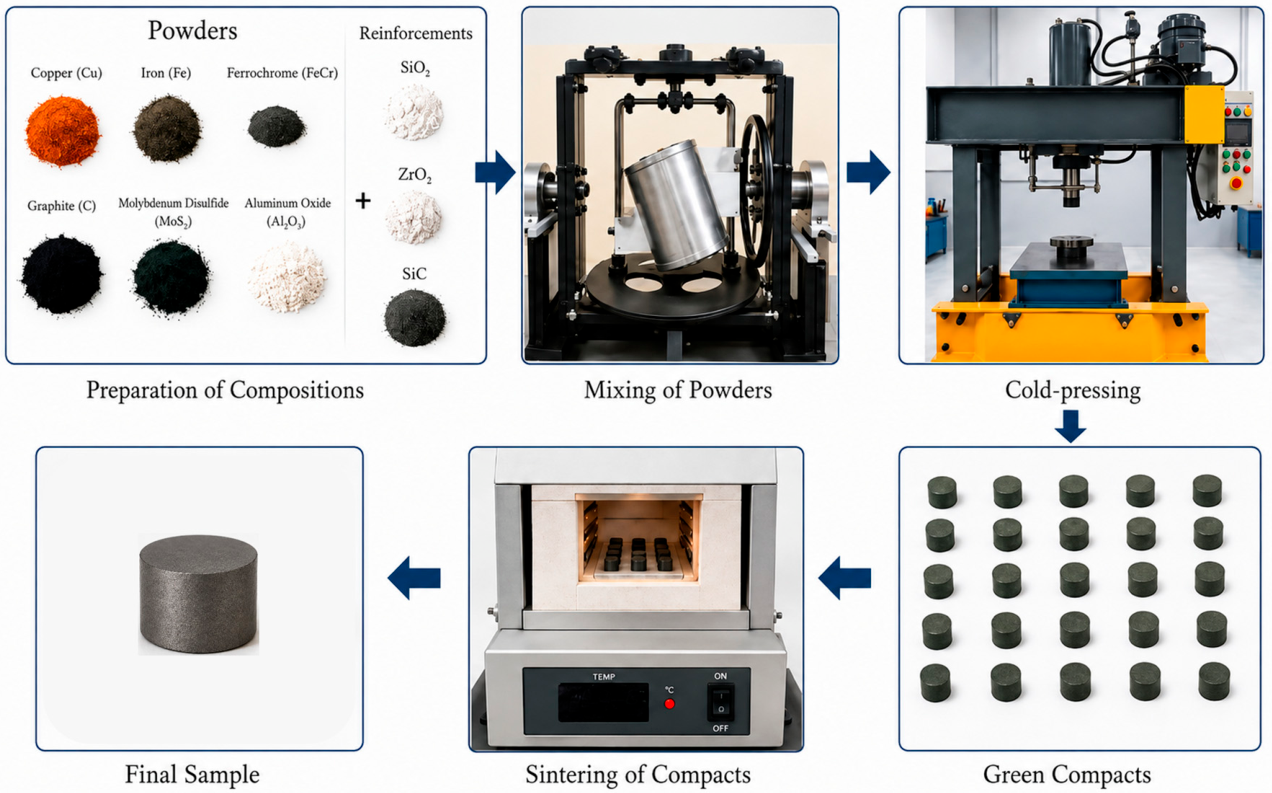
All composite brake pad specimens were cold-pressed at 600 MPa using a uniaxial hydraulic press to obtain cylindrical green compacts of Ø11 × 6 mm. Prior to sintering, the thermal behavior and mass changes of the blended powder mixtures were analyzed by differential thermal analysis and thermogravimetric analysis (DTA/TGA) using a TA Instruments SDT650 (TA Instruments, New Castle, DE, USA) under a flowing N2 atmosphere. The samples were heated to 1200 °C at a heating rate of 20 °C/min. The sintering temperature was determined by evaluating the mass-loss temperature ranges, endothermic and exothermic reaction peaks, and potential phase transformations identified from the DTA curves. The brake pad compacts produced were sintered in a furnace (Protherm, PLF 120/5, Protherm Furnaces, Ankara, Türkiye) under an argon atmosphere (99.99% purity and 500 mL/min flow rate) at 900 °C for 1 h, with a heating rate of 10 °C/min. The complete fabrication process flow for the Cu-based and Cu–Br-based ceramic-reinforced train brake composites is schematically illustrated in Figure 2.
Figure 2.
Fabrication process of Cu- and Cu–Br-based brake composites.
2.3. Density and Hardness Tests
Brinell hardness measurements were performed using an EMCO-TEST DuraVision G5 (EMCO-TEST Prüfmaschinen GmbH, Kuchl, Austria) Brinell hardness tester in accordance with ASTM E10-18 [23]. Three hardness indentations were made at 1 mm intervals on the polished cross-sectional surface of each composite specimen using a 15.625 kgf load and a 2.5 mm diameter ball indenter. The theoretical density of each composite was calculated using the rule of mixtures (Equation (1)), and the sintered density was determined by the Archimedes method (Equation (2)).
where is theoretical density, is the density of each constituent, is the weight fraction of each constituent [20].
where is the density of the specimen (g/cm3), is the dry mass of the specimen (g), is the saturated mass of the specimen in liquid (g), is the mass of the specimen suspended in liquid (g). In addition, relative densities () were calculated to evaluate the sinterability of the samples (Equation (3)) [20].
The porosity values for each specimen were calculated using Equation (4), where P is the porosity (%), is sintered density (g/cm3), is theoretical density (g/cm3) [24]. The calculated porosity values for all specimens are reported in Table 2.
Table 2.
Green density, sintered density, Brinell hardness, and porosity of Cu-based and Cu–Br-based composites.
2.4. Characterization
All composite brake pad specimens were metallographically prepared by sequential grinding using SiC abrasive papers (Hermes Schleifmittel GmbH, Hamburg, Germany) of 240, 400, 600, 800, 1000, 1200, and 2500 grit, followed by polishing with 6 and 1 μm diamond suspensions on cloth. For microstructural imaging, an optical microscope (Nikon Eclipse LV150, Nikon Corporation, Tokyo, Japan) was employed. Additionally, scanning electron microscopy (SEM) images and energy-dispersive X-ray spectroscopy (EDS, EDAX LLC, Mahwah, NJ, USA) analyses were performed on the polished cross-sections of all Cu- and Cu–Br-based SiO2, ZrO2, and SiC-reinforced specimens using a Zeiss Gemini 500 (Carl Zeiss Microscopy GmbH, Jena, Germany) field-emission SEM equipped with an EDS detector to characterize elemental distribution and composition. DTA/TGA analyses were performed to assess the thermal stability and decomposition behavior of the brake pad composites.
2.5. Tribological Tests
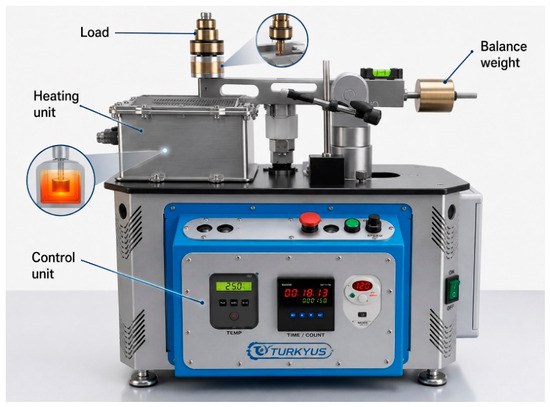
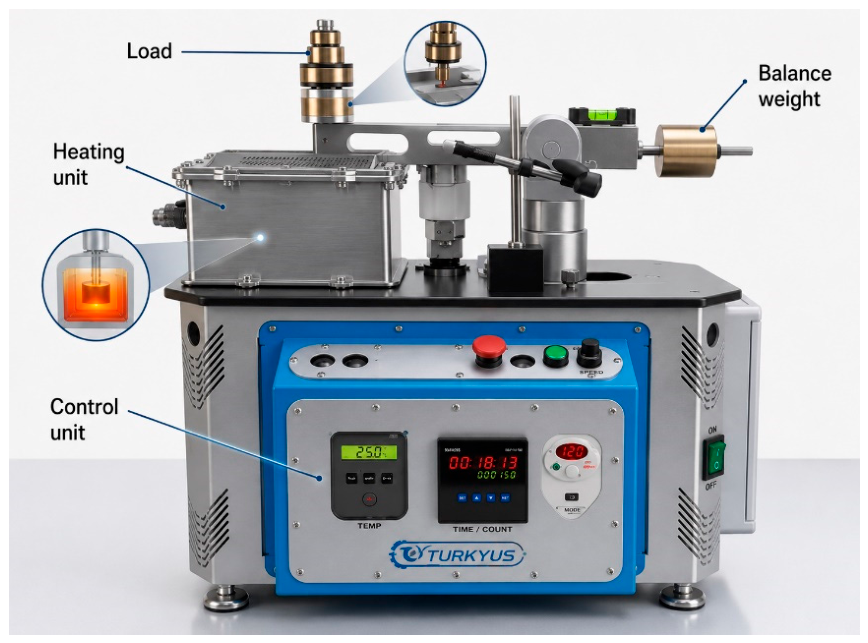
Sliding wear tests were conducted using a pin-on-disc tribometer (Turkyus, Bursa, Türkiye), as illustrated in Figure 3, in accordance with the ASTM G99-17 standard [25]. All test parameters were maintained constant throughout each experiment. The wear tests were conducted against the flat surface of a 1.2379 tool steel disc supplied by the tribometer manufacturer as the standard counterface. The 18 N normal load was selected as a constant laboratory-scale condition for comparative screening of the six composite formulations. The cylindrical specimens had a flat contact face with a diameter of 11 mm. Accordingly, the nominal contact area was 95.03 mm2, corresponding to a nominal apparent contact pressure of approximately 0.19 MPa under the applied normal load of 18 N. Tests were performed at a rotational speed of 250 rpm with a wear track diameter of 50 mm, corresponding to a nominal sliding speed of approximately 0.65 m/s. The total sliding distance per test was fixed at 785 m, with a test duration of 20 min. To ensure statistical reliability, each test was repeated three times per specimen. Prior to each test, the disc surface was cleaned with an appropriate solvent to remove surface contaminants and then dried. Specimen mass was determined by weighing before and after each test using a Radwag precision balance (RADWAG Balances and Scales, Radom, Poland) with a resolution of 0.001 g. Specimens were ultrasonically cleaned before each weighing to remove loose wear debris from the surface. The mass loss (Δm) was calculated according to Equation (5) [20]:
Figure 3.
Pin-on-disc friction and wear test machine.
When the friction coefficient of the pads is calculated, the amount of wear can be observed depending on the weight loss. The specific wear rate (W) of the friction material was calculated according to Equation (6) [26].
where W is the specific wear rate in cm3/N·m, and the initial mass of the specimen before testing and the final mass of the specimen after testing (g), n is the number of brake disc rotations (rev), R is the distance between the center of the specimen and the center of the rotating disc (mm), f is the average sliding friction force (N), and ρ is the density of the samples (g/cm3).
The use of constant test parameters and triplicate measurements provides a consistent basis for comparing the tribological performance of the composite formulations. The coefficient of kinetic friction was calculated using Equation (7) [20].
where is the friction force, is the normal force, and is the coefficient of kinetic friction.
3. Results and Discussion
3.1. Density and Hardness Results
The sintered densities, Brinell hardness values, and calculated porosity levels of all composite formulations are presented in Table 2. Among the Cu-based composites, Cu–ZrO2 showed the highest sintered density (4.819 g/cm3) and the lowest porosity (17.27%), corresponding to a relative density of 82.7% with respect to the rule-of-mixtures theoretical value. This higher densification is likely associated with the comparatively low surface reactivity of ZrO2 with the Cu matrix at the sintering temperature of 900 °C, which limits the formation of interfacial reaction barriers and supports diffusion-driven neck growth and pore closure. Cu–SiO2 exhibited the lowest sintered density (4.571 g/cm3, porosity 19.68%) among the Cu-based variants, suggesting that the limited chemical affinity of SiO2 for the Cu matrix reduced interfacial wettability and impeded densification during solid-state sintering. Cu–SiC showed an intermediate sintered density (4.649 g/cm3, porosity 18.94%), indicating an intermediate densification response between the SiO2- and ZrO2-reinforced Cu-based composites. Brinell hardness values of Cu-based composites ranged from 23.3 HBW (Cu–ZrO2) to 24.4 HBW (Cu–SiC), with Cu–SiC showing the highest value. While reduced porosity generally enhances densification, hardness in multiphase composites is also governed by the nature and distribution of the reinforcement phases. In the present study, Cu–ZrO2 exhibited the lowest porosity (17.27%) but a hardness of 23.3 HBW, whereas Cu–SiC showed a slightly higher porosity (18.94%) and the highest hardness of 24.4 HBW. A similar behavior was reported by Si et al. [14], who found that the incorporation of hard ceramic particles into Cu-based friction materials increased the hardness from 70.8 HV to 86.4–89.7 HV, although the porosity simultaneously increased from 5.27% to 5.38–7.71%. Therefore, the hardness ranking in the present composites cannot be explained by porosity alone and reflects the combined contributions of densification and reinforcement type.
The Cu–Br-based composites exhibited systematically higher porosity (19.85–22.14%) than their Cu-based counterparts (17.27–19.68%), despite exhibiting slightly higher green densities. This indicates that the difference in residual porosity developed during the sintering stage. Bebekoğlu et al. [27] employed different sintering temperatures for Cu-based and Cu–10Sn-based railway brake linings, indicating composition-dependent sintering requirements. Kamal et al. [28] reported that liquid-phase-sintered Cu–Sn alloys are susceptible to abnormal swelling associated with excessive porosity generation. Accordingly, the higher residual porosity observed in the present Cu–Br composites may be associated with Sn-dependent dimensional and pore evolution during sintering, which limited complete pore closure during the 900 °C/1 h cycle. The Cu–Br-based composites also exhibited lower absolute hardness values (21.1–22.4 HBW) than their Cu-based counterparts.
Cu–Br–SiC showed the lowest porosity (19.85%) and highest hardness (22.4 HBW) among Cu–Br-based variants, indicating the favorable densification and hardness response of SiC in the Cu–Br matrix. Cu–Br–ZrO2 showed the highest porosity (22.14%) among all six formulations, in contrast to the densification behavior observed for Cu–ZrO2, indicating that ZrO2 did not provide the same densification effect in the Cu–Br matrix. Despite these inter-system differences, the Brinell hardness values of all composites (21.1–24.4 HBW) remained within a narrow range, indicating that the 600 MPa cold-pressing and 900 °C sintering route produced comparable hardness levels among the investigated formulations. Collectively, the physical and mechanical characterization data indicate the following hierarchical ranking of densification efficiency: Cu–ZrO2 > Cu–SiC > Cu–SiO2 > Cu–Br–SiC > Cu–Br–SiO2 > Cu–Br–ZrO2, while hardness follows: Cu–SiC > Cu–SiO2 > Cu–ZrO2 > Cu–Br–SiC > Cu–Br–SiO2 > Cu–Br–ZrO2.
3.2. Microstructural Evaluations
3.2.1. Optical Microscopy Analysis
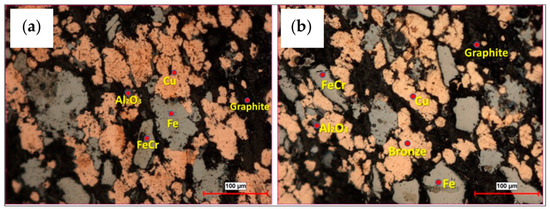
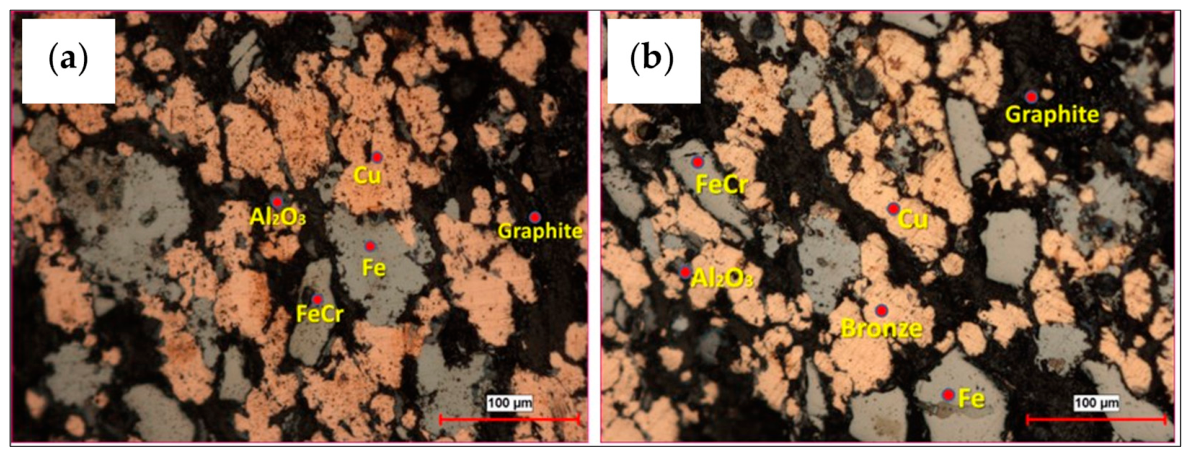
Optical micrographs of representative Cu and Cu–Br-based composites, acquired at 200× magnification on metallographically polished cross-sections, are presented in Figure 4a and Figure 4b, respectively. The micrographs reveal a multi-phase, heterogeneous sintered architecture consistent with the multi-constituent composition of the brake composites. The constituent phases are distinguishable by their characteristic contrast: the continuous orange-reddish regions correspond to the Cu or Cu–Br metallic matrix, which constitutes the continuous metallic framework of the composite. Irregularly shaped dark-gray to black features distributed throughout the matrix are attributable to C and MoS2 solid lubricant phases. Large, angular gray particles are identified as Fe, while finer elongated gray phases correspond to CrFe reinforcement particles. Previous studies on Cu-based brake materials have reported that Fe-containing constituents can participate in oxide-rich surface-layer formation during high-temperature sliding [29]. Very fine, dark phases uniformly dispersed within the matrix are associated with Al2O3 particles, whose hardness and thermal stability at elevated temperatures suppress matrix deformation and contribute to matrix reinforcement of the composite under braking loads.
Figure 4.
Optical image of brake composite: (a) Cu-based, (b) Cu–Br-based.
The fine-scale SiO2, ZrO2, and SiC ceramic reinforcements (each at 2 wt.%) are not individually resolvable by optical microscopy, owing to their small particle size and limited optical contrast against the surrounding matrix; their detailed characterization is therefore addressed by SEM–EDS in Section 3.2.2. Importantly, the optical micrographs demonstrate a generally homogeneous distribution of all constituent phases in both matrix systems, with no evidence of macro-scale segregation, reinforcement clustering, or large pore clustering. This microstructural homogeneity is consistent with the 3DMS powder mixing process (150 rpm, 2 h), which promotes uniform mixing of matrix and reinforcement powders prior to compaction [21,30]. Residual porosity, which is inherent to pressureless-sintered powder metallurgy composites, manifests as dark, rounded-to-irregular voids distributed within the matrix. Quantitative measurements (Table 2) yielded porosity values of 17.27–19.68% for Cu-based and 19.85–22.14% for Cu–Br-based composites. The systematically higher porosity of the Cu–Br system is attributable to the reduced sinterability of Sn-containing bronze powder at 900 °C, as tin alloying shifts the densification window and can generate transient liquid-phase pathways that alter pore-closure kinetics [31]. Notably, among all composites, Cu–ZrO2 exhibited the lowest porosity (17.27%) and highest sintered density (4.819 g/cm3), suggesting that ZrO2 particles more effectively promote diffusion-driven densification during sintering, consistent with their comparatively lower surface reactivity with the Cu matrix and superior thermal stability among the three ceramic reinforcements.
The interconnected pore network in Cu–Br composites has a dual effect on tribomechanical performance. Higher porosity reduces mechanical strength and promotes crack initiation, whereas the pores retain wear debris and facilitate the formation of a self-lubricating tribolayer during sliding [32,33]. Among the Cu-based variants, Cu–SiC exhibited intermediate porosity (18.94%), reflecting a partial pore-bridging effect of SiC particles through mechanical interlocking within the sintered compact. The Cu–Br–SiC composite (19.85%) similarly displayed the lowest porosity among all Cu–Br-based variants, suggesting an analogous densification-assisting role of SiC in that matrix system. These microstructural characteristics influence both the Brinell hardness (21.1–24.4 HBW, Table 2) and the tribological response discussed in Section 3.4, establishing a clear microstructure–property–performance relationship across all composite formulations.
3.2.2. SEM/EDS Analysis
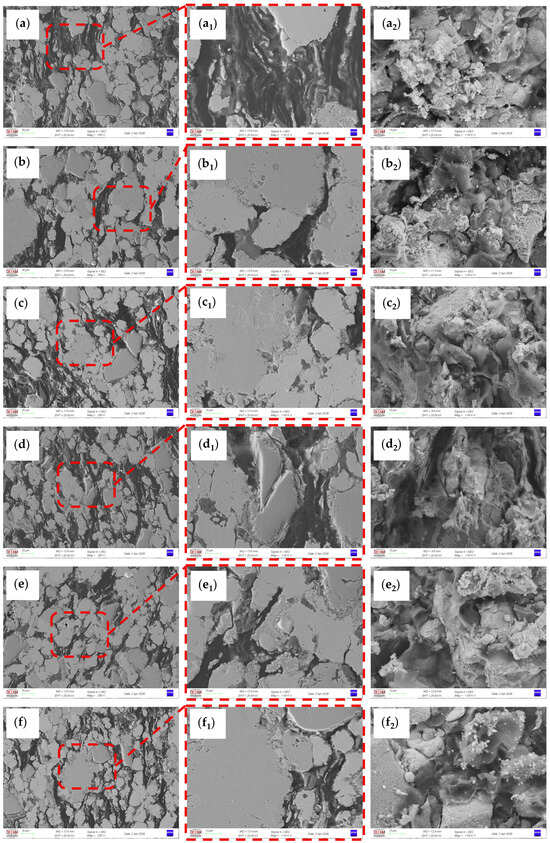
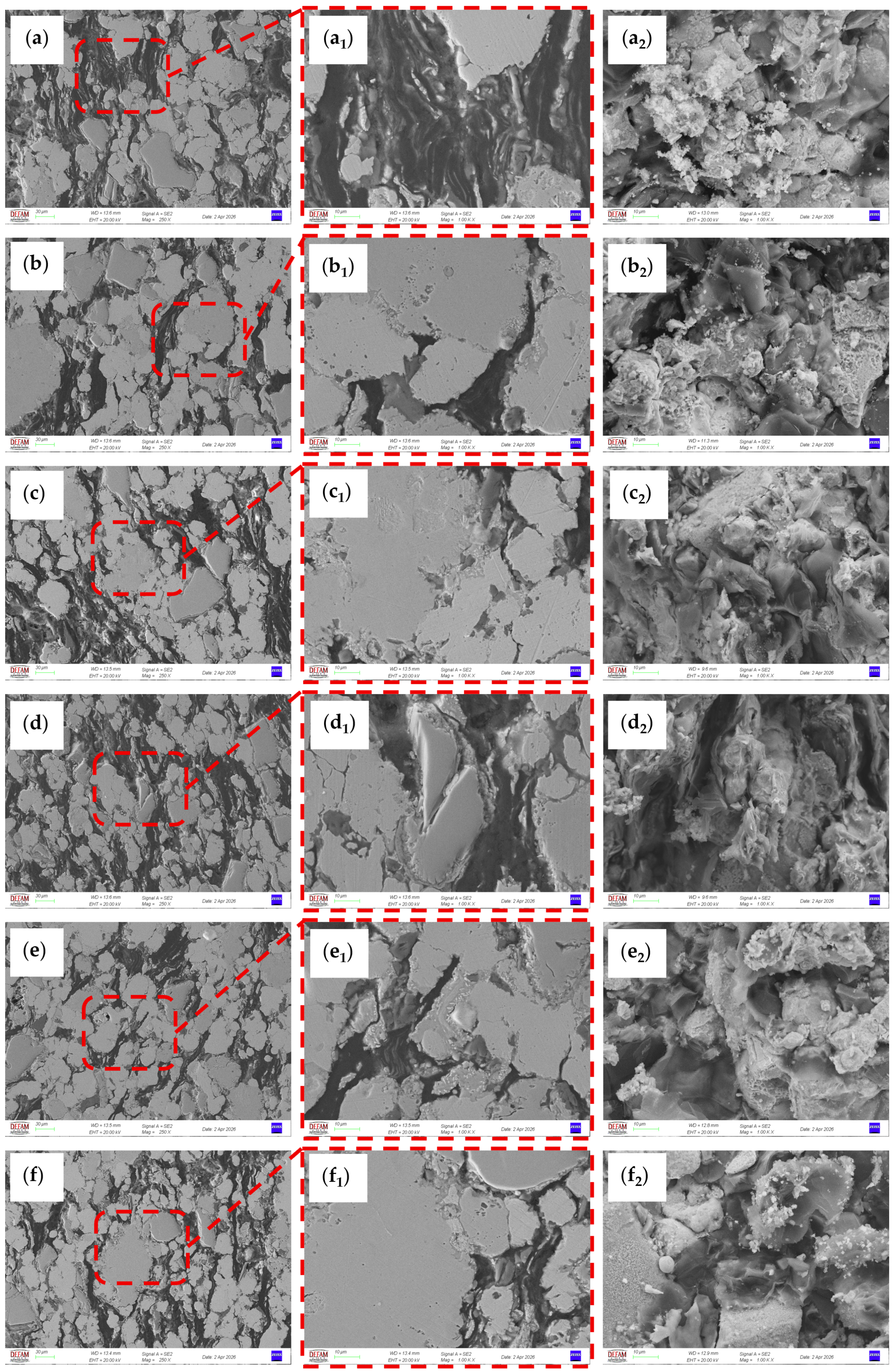
The SEM micrographs of all six composite formulations presented in Figure 5 at two progressive magnifications (250× and 1000×) reveal a multiphase sintered microstructure with a relatively homogeneous distribution of the constituent phases. At low magnification (250×), the brightest continuous regions in the BSE images correspond to the Cu-rich metallic matrix. Graphite lamellae are visible as dark, elongated or irregularly shaped regions and are distributed throughout both matrix systems, confirming the incorporation of the solid-lubricant phase within the sintered microstructure [34]. The Fe and CrFe phases appear as discrete angular or blocky gray particles embedded within the matrix, with sizes consistent with their original powder particle-size ranges (<45 μm and <75 μm, respectively). The Fe and CrFe constituents contribute to matrix strengthening, while the hard CrFe particles can act as load-bearing contact regions and restrict the plastic flow of the surrounding softer matrix [10], and Fe- and Cr-containing phases can participate in the formation of an oxide-based tribolayer that contributes to friction stability and improved wear resistance [12].
Figure 5.
Surface SEM images (250× → 1000×): (a,a1) Cu–SiO2, (b,b1) Cu–ZrO2, (c,c1) Cu–SiC, (d,d1) Cu–Br-SiO2, (e,e1) Cu–Br-ZrO2, (f,f1) Cu–Br-SiC and Fractured surface SEM images (1000×): (a2) Cu–SiO2, (b2) Cu–ZrO2, (c2) Cu–SiC, (d2) Cu–Br-SiO2, (e2) Cu–Br-ZrO2, (f2) Cu–Br-SiC.
At 1000× magnification, the distribution of fine ceramic reinforcements becomes increasingly discernible. In the SiO2-reinforced composites, fine SiO2 particles are observed decorating grain boundaries and filling inter-particle pockets, exhibiting an angular to sub-rounded morphology. The angular morphology of SiO2 particles may promote abrasive interaction during sliding [34,35]. In the ZrO2-reinforced variants, ZrO2 particles display a finer, more equiaxed morphology with notably more homogeneous dispersion throughout the matrix. The comparatively uniform ZrO2 distribution may contribute to a more homogeneous mechanical response during sliding, consistent with the relatively stable COF behavior observed for the ZrO2-reinforced composites [36]. SiC particles in the Cu–SiC and Cu–Br-SiC composites exhibit a faceted, polyhedral morphology with pronounced angular edges characteristic of brittle fracture-dominated comminution. The high hardness of SiC (9-9.5 Mohs [37]) contributes to its abrasive behavior during sliding, which can result in slight ploughing damage at the sliding interface [38].
At the highest magnification (1000×), the quality of particle–matrix interfacial bonding can be assessed qualitatively. In Cu–ZrO2 composites, ZrO2 particles appear well integrated within the matrix, with no visible interfacial gaps or delamination features, indicating satisfactory diffusion-assisted bonding at the sintering temperature. The observed particle–matrix integration is consistent with the strong bonding between monoclinic ZrO2 particles and the Cu matrix reported by Zhou et al. [39]. In contrast, SiO2 particles in some regions exhibit local interfacial debonding and narrow gaps between the particles and the surrounding matrix. Such weak interfacial bonding can facilitate particle pullout during tribological loading. The detached SiO2 particles may subsequently intensify abrasive wear at the sliding interface [40].
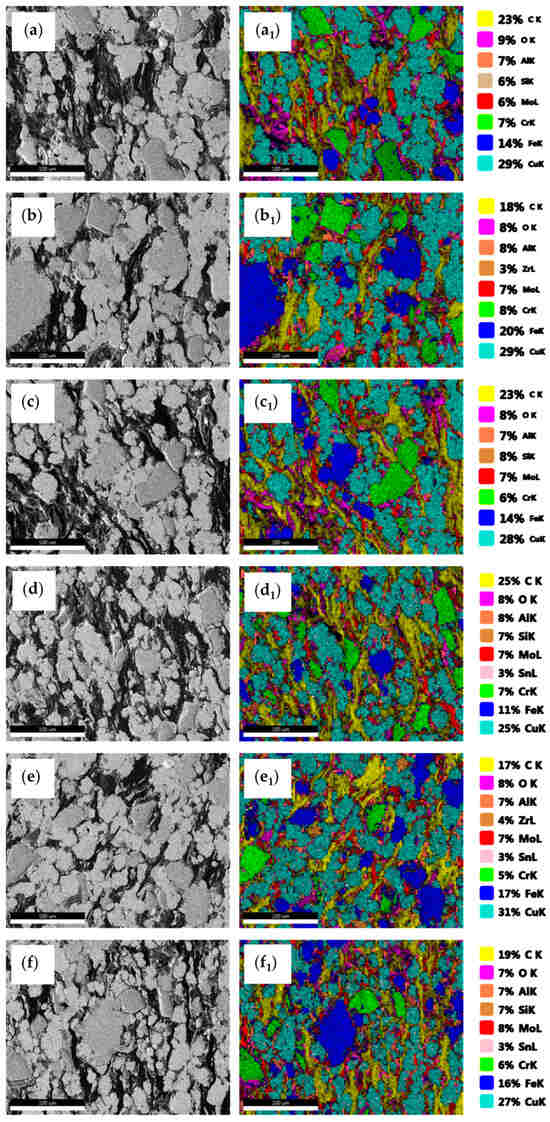
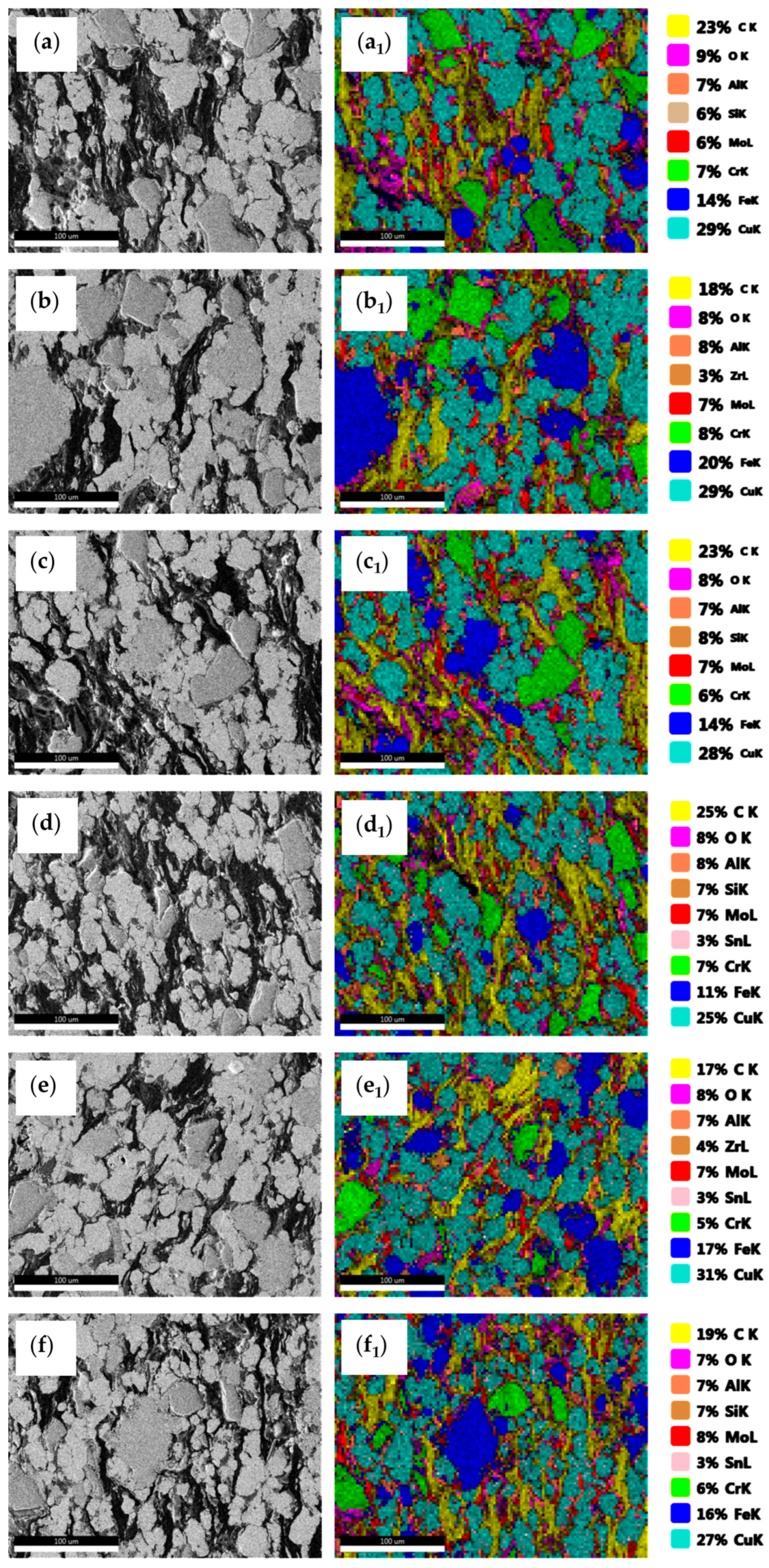
EDS maps and point analyses (Figure 6) confirm the distribution of Cu, Fe, Cr, Si, Zr, C, O, and Sn across the cross-section, supporting the phase assignments in the SEM micrographs. The Cu signal dominates the bright matrix regions, while Fe and Cr signals co-localize with the discrete angular gray particles previously identified as Fe and CrFe constituents. The C signal corresponds principally to graphite lamellae, whereas the Mo signal is associated with the MoS2 phase. The Si signal in SiO2- and SiC-containing composites is distributed relatively uniformly throughout the matrix, with slightly elevated concentrations in particle-rich interphase regions, confirming the effectiveness of the 3DMS blending protocol in achieving a homogeneous reinforcement distribution without significant agglomeration. In ZrO2-containing composites, the Zr signal is confined to discrete, fine equiaxed regions uniformly dispersed within the matrix, consistent with the morphological observations in Figure 6. The O signal is primarily associated with the oxide ceramic phases and may also include a contribution from limited surface oxidation of the metallic constituents. This behavior is consistent with the thermogravimetric oxidation sequence discussed in Section 3.3. In the Cu–Br-based composites, the Sn signal is uniformly distributed throughout the metallic matrix, indicating a relatively uniform Sn distribution within the Cu–Br matrix during sintering. The relatively uniform distribution of Sn within the matrix indicates homogeneous distribution of the CuSn10 bronze constituent, while Sn alloying can contribute to strengthening of the Cu-rich phase through solid-solution effects [41].
Figure 6.
EDS analysis of composite brake pads (x: SEM image, x1: EDS elemental map and elemental distribution): (a) Cu–SiO2, (b) Cu–ZrO2, (c) Cu–SiC, (d) Cu–Br-SiO2, (e) Cu–Br-ZrO2, (f) Cu–Br-SiC.
Comparative analysis of the Cu-based and Cu–Br-based microstructures reveals that the Cu–Br system exhibits a marginally higher porosity (Table 2) that does not, however, translate proportionally into lower hardness. This behavior may be associated with the solid-solution strengthening contribution of Sn, which partially compensates for the reduced inter-particle contact area arising from the higher porosity. The Cu–Br-based composites nevertheless exhibited a narrower COF range (0.175–0.311) than the Cu-based composites (0.163–0.364). Among the investigated reinforcements, ZrO2 showed a relatively homogeneous distribution and, in the Cu matrix, was associated with the highest densification, while the ZrO2-reinforced composites exhibited comparatively stable friction behavior. SiC-reinforced composites exhibited the highest hardness but also a comparatively more variable friction response. The SiO2-reinforced composite exhibited the highest COF within the Cu-based system, whereas the corresponding wear response remained strongly temperature-dependent. These structure–property–performance relationships are consistent with previous studies on Cu-based sintered friction composites containing different hard ceramic phases, which have demonstrated that reinforcement type and the resulting microstructure significantly influence mechanical properties, friction behavior, and wear resistance [14].
3.3. Differential Thermal Analysis (DTA) and Thermogravimetric Analysis (TGA)
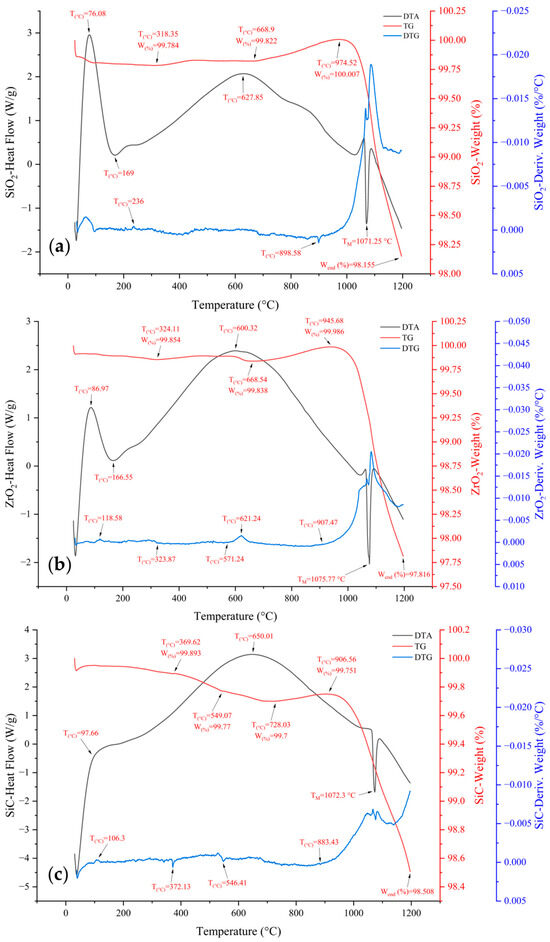
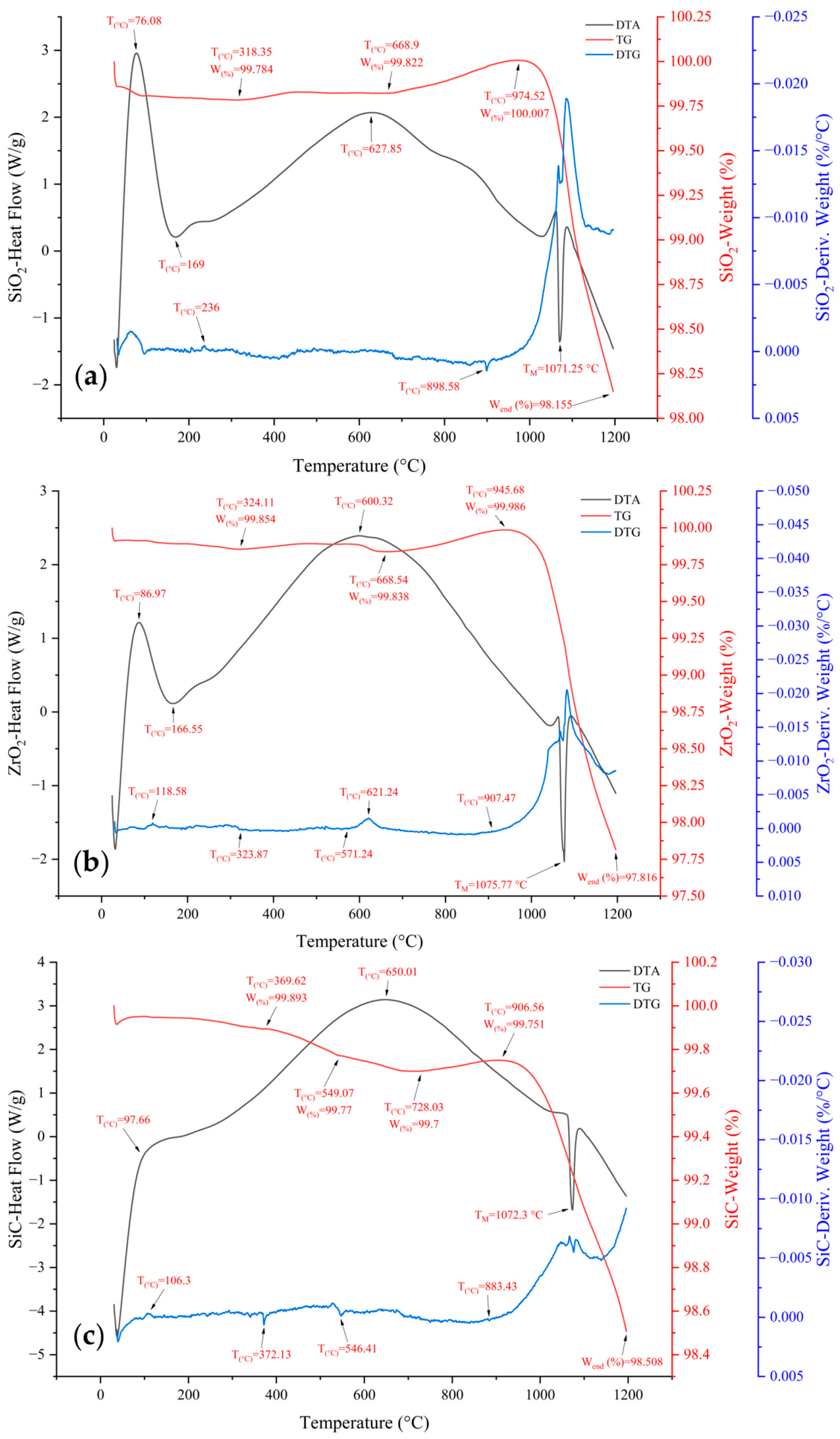
The DTA/TGA profiles of the investigated powder mixtures are presented in Figure 7a–c. The TGA curve records mass loss and gain as a function of temperature, while the DTA curve identifies endothermic and exothermic reactions within the specimen; the DTG curve, representing the first derivative of the TGA signal, highlights the temperatures at which the rate of mass change reaches its maximum, thereby facilitating the differentiation of overlapping thermal events. Examination of the Cu-based composites in Figure 7a–c reveals that the first stage, occurring below 100 °C, was characterized by a minor mass loss attributable to the evaporation of physically retained volatile species [42]. This behavior is corroborated by the low-temperature peaks observed in the DTA curves at approximately 76–98 °C. Continued mass loss up to ~324 °C is associated with the progressive removal of organic constituents, residual adsorbed water, and volatile compounds. Under oxygen-containing atmospheres, pure copper has been reported to gain mass above approximately 200–220 °C due to progressive oxidation [43,44]. Under such conditions, Cu2O formation has been reported between approximately 300 °C and 650 °C, while CuO becomes increasingly predominant at higher temperatures [43]. Oxidation-induced mass gain has been reported to become increasingly pronounced above approximately 400 °C [45,46]. Similarly, iron powder begins to oxidize at approximately 365 °C, with its oxidation rate continuing to increase up to 700 °C [44]. At temperatures above 550 °C, iron transforms primarily according to 3Fe(s) + 2O2(g) → Fe3O4(s), while at temperatures exceeding 600 °C the reaction 2Fe(s) + 3/2O2(g) → Fe2O3(s) becomes dominant. Although the present DTA/TGA measurements were performed under a flowing N2 atmosphere, minor oxidation may have occurred. Hayes et al. [47] demonstrated measurable oxidation during TGA even under 99.999% N2, Ar, and He attributed this behavior to trace oxygen-containing impurities in the supplied gases. Accordingly, the modest mass gain observed in the SiO2- and ZrO2-reinforced mixtures may include a contribution from residual oxygen. Although its initial oxidation rate remains relatively low, graphite oxidation has been reported to become detectable at approximately 535 °C [44]. Exothermic peaks in the DTA curves at 600–650 °C are consistent with this behavior [42]. Furthermore, Chen et al. [48] reported that graphite oxidation proceeds rapidly above 673 °C, resulting in the formation of CO and CO2. Above 550 °C, the formation of CO and CO2 via carbon oxidation in oxygen-containing atmospheres has also been reported [43,44]. Bahrom et al. reported that graphite oxidation can persist to temperatures approaching 850 °C [49]. The porosity generated by graphite burnout further accelerates mass loss by increasing the accessible surface area for oxidation [12]. Similarly, Zhu and Kamali [50] reported that MoS2 exhibits a cumulative mass loss of 45.4% by 900 °C, and Xiao et al. reported that CrFe powder undergoes only ~2% mass change up to 800 °C, under their experimental conditions [43]. In addition, sulfur loss from MoS2 has been reported at temperatures around 900 °C [51]. For the Cu-based composites, pronounced mass losses commence at ~975 °C for the SiO2-reinforced, ~946 °C for the ZrO2-reinforced, and ~907 °C for the SiC-reinforced specimens. These temperatures represent the onset of the dominant net mass-loss process. In powder metallurgical systems, metallic powder surfaces are naturally covered by oxide layers, which can undergo carbothermal reduction in the presence of graphite at elevated temperatures [52]. De Oro Calderon et al. showed that carbothermal reduction becomes increasingly important at high temperatures and is accompanied by the evolution of gaseous CO and CO2 species [52]. Therefore, carbon-assisted reduction of native surface oxides may contribute to the pronounced high-temperature mass loss observed in the present composites. The relatively broad onset interval of the Cu-based composites (907–975 °C) suggests that the kinetics of these overlapping high-temperature reactions depend on the specific composite composition. The endothermic peaks observed in the DTA profiles at ~1071 °C (SiO2), ~1076 °C (ZrO2), and ~1072 °C (SiC) correspond to the onset of melting of the respective mixtures. The total mass losses relative to the initial specimen mass were determined to be 1.847% for the SiO2, 2.185% for the ZrO2, and 1.493% for the SiC-reinforced composites.
Figure 7.
DTA/TGA results: Cu brake composites: (a) SiO2 reinforcement, (b) ZrO2 reinforcement and (c) SiC reinforcement.
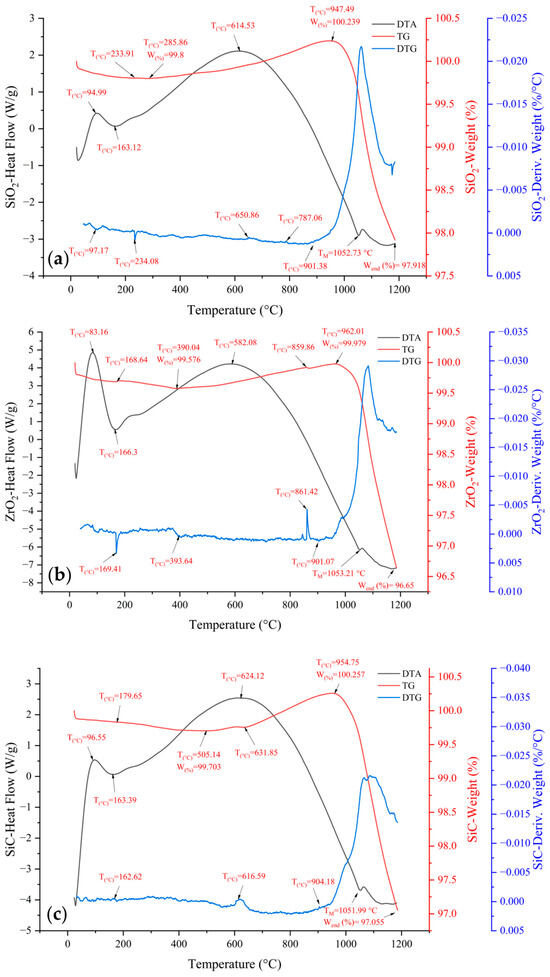
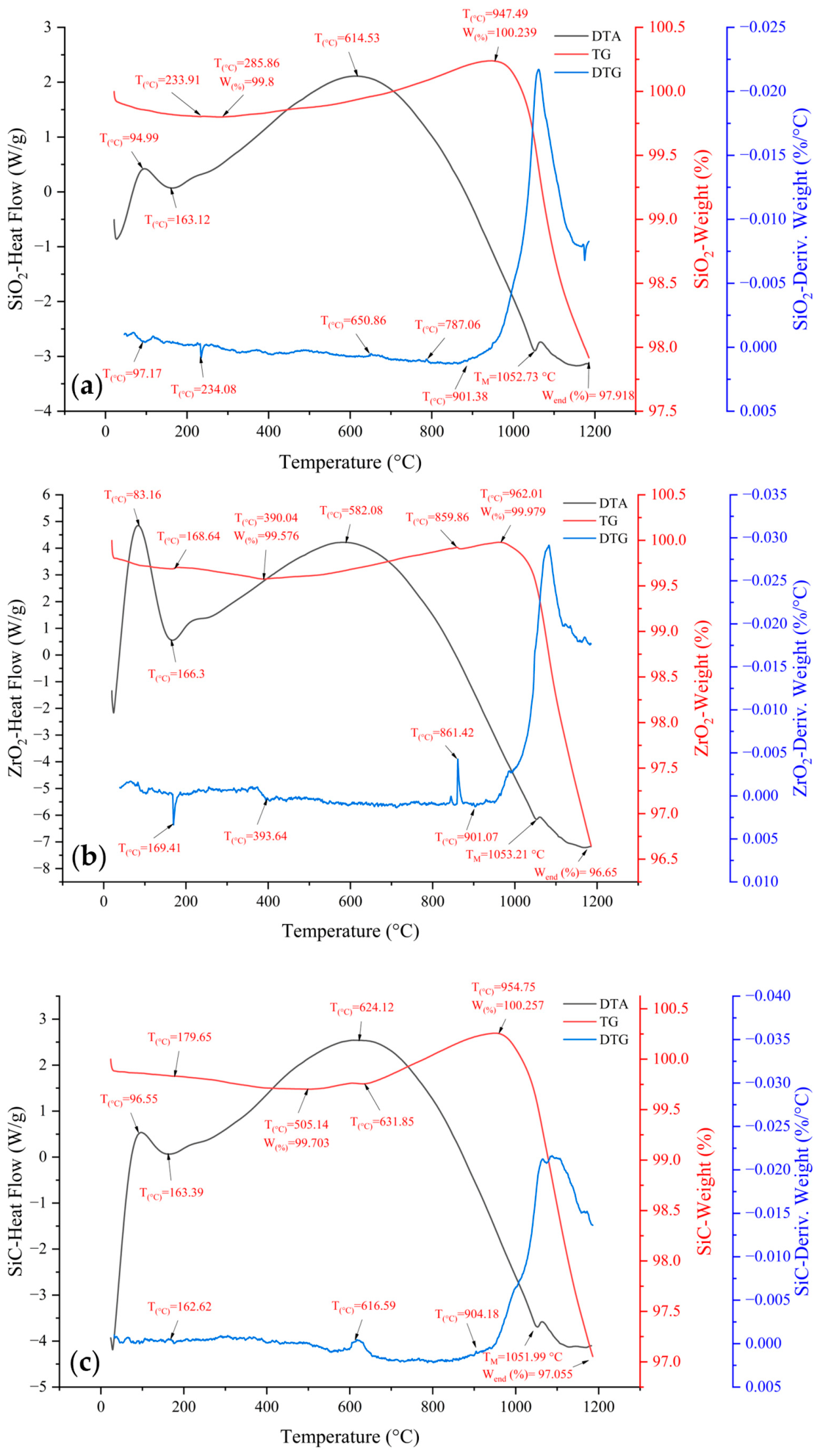
The DTA/TGA results for the Cu–Br-based composites, presented in Figure 8a–c, exhibit a thermal response broadly similar to that of the Cu-based systems. The initial stage, occurring below 100 °C, is characterized by minor mass losses corresponding to the elimination of adsorbed moisture, consistent with the low-temperature DTA peaks observed in the range of approximately 83–97 °C. Following the removal of volatile species and bound moisture in the initial stage, additional thermally activated reactions among the constituents become increasingly important as temperature increases. The modest mass changes observed in the Cu–Br-based mixtures within the intermediate temperature range likely reflect the superposition of several thermally activated processes, including a possible contribution from limited oxidation in the presence of residual oxygen [47]. DTA peaks in the intermediate temperature range were identified at ~615 °C for the SiO2, ~582 °C for the ZrO2, and ~624 °C for the SiC-reinforced composites. Pronounced mass losses commence at ~947 °C for the SiO2, ~962 °C for the ZrO2, and ~955 °C for the SiC-reinforced specimens. The pre-alloyed CuSn10 constituent has a relatively low solidus temperature (~840 °C) and an increased liquid-phase fraction has been reported at 900 °C [53,54]. Accordingly, the difference in mass-loss onset temperatures between the Cu- and Cu–Br-based composites may be partly related to the different high-temperature phase state and reaction kinetics introduced by the CuSn10 phase. The endothermic peaks in the DTA profiles of the Cu–Br-based composites at ~1053 °C (SiO2 and ZrO2) and ~1052 °C (SiC) are associated with the melting of the respective mixtures. The total mass losses relative to the initial specimen mass were calculated as 2.082% for the SiO2, 3.35% for the ZrO2, and 2.945% for the SiC-reinforced composites.
Figure 8.
DTA/TGA results: Cu–Br brake composites: (a) SiO2 reinforcement, (b) ZrO2 reinforcement and (c) SiC reinforcement.
3.4. Friction and Wear Test Results
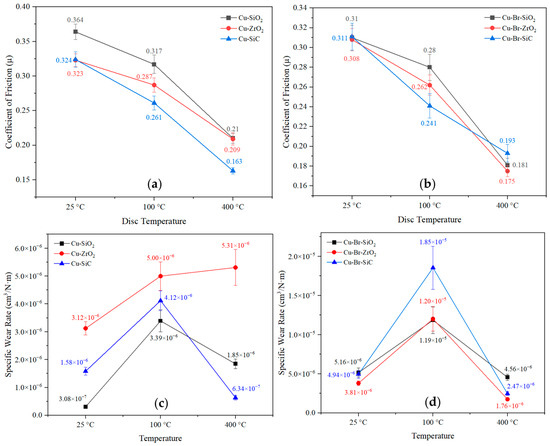
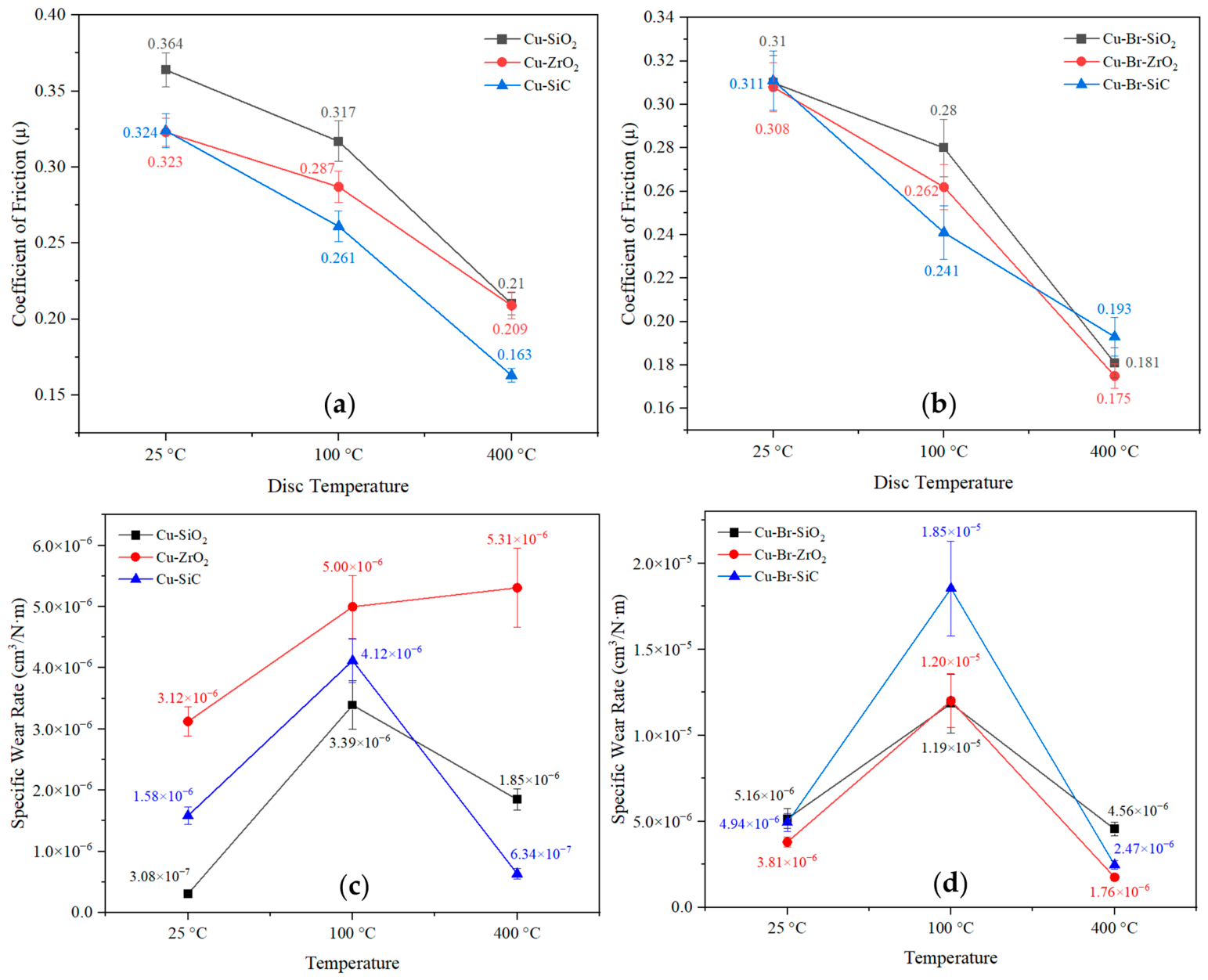
The wear test results of the Cu- and Cu–Br-based samples at 25, 100, and 400 °C are presented in Table 3. At 25 °C, the COF of the Cu-based composites ranged from 0.323 to 0.364, while the Cu–Br-based composites exhibited a considerably narrower band of 0.308–0.311 (Figure 9a). A systematic and temperature-dependent decline in COF was observed in both matrix systems as test temperature was elevated, with values falling to 0.163–0.210 for the Cu-based and 0.175–0.193 for the Cu–Br-based composites at 400 °C (Figure 9b).
Table 3.
Wear test results of Cu- and Cu–Br-based samples.
Figure 9.
Variations of friction coefficients as a function of disc temperature: (a) Cu-based and (b) Cu–Br-based; Specific wear rate under various temperatures: (c) Cu-based and (d) Cu–Br-based.
The COF retention and thermal fade parameters are presented in Table 4. The analysis indicates that thermal fade resistance was influenced by both matrix composition and ceramic reinforcement type. Among the Cu-based composites, Cu–ZrO2 exhibited the highest COF retention, preserving 64.7% of the COF measured at 25 °C after testing at 400 °C. In the Cu–Br-based system, the highest retention was obtained for Cu–Br–SiC, with a value of 62.1%.
Table 4.
COF retention and thermal fade parameters of Cu- and Cu–Br-based composites.
Progressive thermal friction fade is a well-established phenomenon in sintered copper-based brake pads for high-speed railway applications. Zhang et al. [55] reported that frictional heating induces softening, partial melting, and recrystallization of the Cu phase, resulting in the formation of Cu-rich soft zones and a reduction in friction. Similarly, Zhang et al. [56] showed that elevated temperatures promote softening and flow of the Cu-rich phase within the friction surface layer, contributing to the reduction in frictional resistance and the development of friction fade. In addition, Eriksson et al. [57] demonstrated that the real contact area at the pad–disc interface continuously evolves with changes in temperature, pressure, deformation, and wear. The Cu–Br-based composites maintained a narrower and more stable COF band across the entire test temperature range compared to their Cu-based counterparts. Xu et al. [58] reported that Sn addition improved the thermal stability of Cu alloys by suppressing recrystallization and increasing the softening temperature. Therefore, the enhanced resistance of the Sn-containing matrix to thermal softening may have contributed to the comparatively narrower COF variation observed in the Cu–Br-based composites.
The specific wear rates of all composite formulations under various temperature conditions are presented in Figure 9c,d. At 25 °C, the lowest wear rate was measured for the Cu–SiO2 composite (3.080 × 10⁻⁷ cm3/N·m), whereas at 400 °C the Cu–SiC composite exhibited the lowest wear rate (6.335 × 10⁻⁷ cm3/N·m). Among the Cu-based composites, Cu–ZrO2 showed the highest wear rates at all test temperatures, reaching 5.309 × 10⁻⁶ cm3/N·m at 400 °C. In the Cu–Br matrix, all composites exhibited relatively high wear rates at 100 °C, with values ranging from 1.185 × 10⁻⁵ to 1.854 × 10⁻⁵ cm3/N·m. At 400 °C, the Cu–Br–ZrO2 composite showed the lowest wear rate (1.758 × 10⁻⁶ cm3/N·m), while Cu–Br–SiO2 exhibited the highest wear rate (4.557 × 10⁻⁶ cm3/N·m). These results indicate that wear resistance is governed by the effects of ceramic reinforcement type, matrix chemistry, and testing temperature.
This interpretation is consistent with previous studies on Cu-based sintered friction materials. Si et al. [14] demonstrated that the incorporation of hard ceramic particles such as SiO2, SiC, and Al2O3 significantly influences the high-temperature tribological behavior of Cu-based friction materials. Among the investigated ceramic reinforcements, the SiC-containing composite exhibited the highest COF, while the presence of hard particles alleviated high-temperature matrix softening and reduced adhesive wear. The effect of ZrO2 reinforcement can be associated with the strong interaction of ZrO2 particles with the Cu matrix and their ability to restrict subsurface deformation during sliding, thereby limiting material removal and improving wear resistance [5,39].
To contextualize the COF range obtained in the present study (0.163–0.364), previous investigations of Cu-based sintered brake pads for high-speed railway applications have commonly reported friction coefficients in the range of approximately 0.35–0.45 under severe braking conditions [16,59]. The ambient-temperature COF values measured in the present study (0.308–0.364) are closer to this range, whereas the pronounced decrease at 400 °C reflects temperature-induced friction fade, which has also been associated with thermal softening of the Cu-rich matrix during high-energy braking. The 2 wt.% ceramic reinforcement fractions, the relatively low normal load (18 N), and the pin-on-disc geometry represent substantially milder conditions than those encountered in high-energy dynamometer investigations. Full-scale dynamometer studies under high-energy braking conditions have reported COF values generally higher than those measured in the present pin-on-disc tests. Xiao et al. [5] reported average COF values ranging from 0.321 to 0.378 at braking speeds of 300–380 km/h in full-scale dynamometer tests. Zhong et al. [60] reported a mean COF of approximately 0.371 for Cu-based P/M brake pads under dry full-scale dynamometer conditions. Zhang et al. [16] also reported COF values of approximately 0.35–0.45 for a Cu-based high-speed railway brake pad.
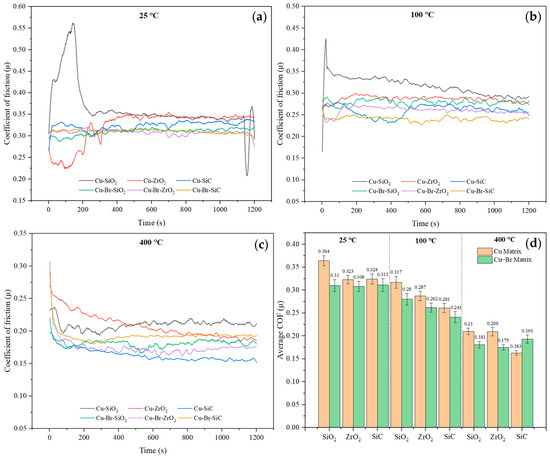
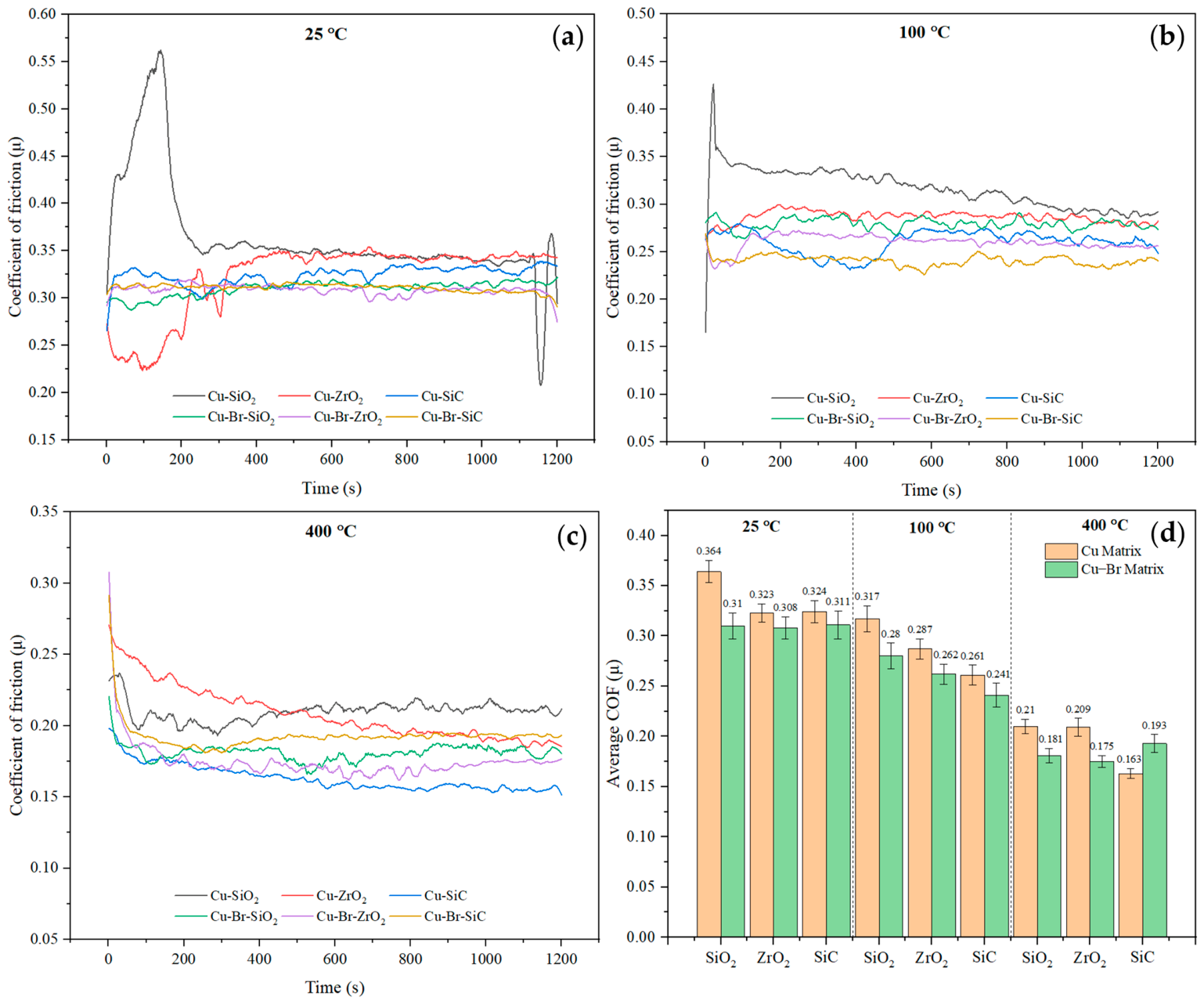
Friction stability is a critical performance criterion for sintered brake pad materials, particularly in railway braking systems, where a predictable frictional response is required under varying thermal conditions. Figure 10a–d compare the average COF values of all six composite formulations at 25 °C, 100 °C, and 400 °C. A comparative assessment of the ceramic reinforcements indicates that the friction response was controlled by the combined effects of matrix composition, reinforcement type, and test temperature rather than by a single reinforcement-dependent hierarchy.
Figure 10.
Instantaneous COF curves at (a) 25 °C, (b) 100 °C, and (c) 400 °C, and (d) comparison of average COF values.
In Figure 10, the fluctuations observed in the instantaneous COF curves can be associated with the continuous evolution of the friction interface in these multiphase composites. Zhao et al. [61] reported that the friction behavior of Cu-based powder-metallurgy brake materials is closely related to the continuous formation, growth, and degradation of contact patches and the corresponding evolution of the friction film. During sliding, wear debris is generated and redistributed at the contact interface, while changes in the friction layer continuously modify the effective contact conditions [61]. In addition, Xiao et al. [12] demonstrated that the tribological response of Cu-based brake pads is strongly governed by the composition and structure of the tribolayer and that surface evolution involves plastic deformation, mechanical mixing, oxidation, graphite lubricating-film formation, material transfer, and delamination. The exposure of graphite at the sliding interface can enhance lubrication and decrease the COF after removal of the surface tribolayer [12]. Accordingly, the short-term fluctuations observed in the present COF curves can reasonably be attributed to the combined effects of contact-patch evolution, wear-debris redistribution, graphite lubrication, and repeated formation and disruption of the friction layer [12,61].
In the Cu-based composites, the SiO2-reinforced sample exhibited the highest COF values at 25 °C, 100 °C, and 400 °C. In contrast, the Cu–Br-based composites showed a narrower COF band, particularly at 25 °C and 400 °C, indicating a more uniform friction response among the other ceramic reinforcements. The reduction in COF with increasing temperature from 25 °C to 400 °C reflects thermal fade in all composites. This decrease may be associated with matrix softening, changes in real contact conditions, and the temperature-dependent behavior of the solid-lubricant phases. Zhang et al. [56] showed that friction fade stems from thermal softening of the Cu matrix.
Although the present pin-on-disc tests provide a controlled comparative assessment of the effects of reinforcement type and matrix composition, these tests do not fully replicate the contact pressure, braking energy, sliding speed, and thermal cycling conditions encountered in full-scale high-speed railway braking. Therefore, the obtained results should be regarded as laboratory-scale screening data, and full-scale dynamometer validation is required before drawing direct application-level conclusions.
4. Conclusions
This study comparatively evaluated the microstructural, physical, thermal, and tribological characteristics of Cu- and Cu–Br-based powder metallurgy brake composites reinforced with 2 wt.% SiO2, ZrO2, or SiC. The principal findings are summarized as follows:
- The Cu-based composites exhibited porosity values between 17.27% and 19.68%, whereas the Cu–Br-based composites showed higher values between 19.85% and 22.14%. Cu–ZrO2 had the highest sintered density of 4.819 g/cm3 and the lowest porosity of 17.27% among all formulations.
- The hardness ranged from 21.1 to 24.4 HBW. Cu–SiC exhibited the highest hardness among the Cu-based composites with 24.4 HBW, while Cu–Br–SiC showed the highest hardness within the Cu–Br-based composites with 22.4 HBW. The lowest hardness was measured for Cu–Br–ZrO2 with 21.1 HBW.
- The onset of the dominant high-temperature mass-loss process occurred between 907 and 975 °C for the Cu-based mixtures and between 947 and 962 °C for the Cu–Br-based mixtures. Total mass losses ranged from 1.493% to 2.185% for the Cu-based composites and from 2.082% to 3.350% for the Cu–Br-based composites. The corresponding high-temperature endothermic peaks occurred between approximately 1071 and 1076 °C for the Cu-based mixtures and between 1052 and 1053 °C for the Cu–Br-based mixtures.
- The COF decreased with increasing test temperature for all six composites. In the Cu-based composites, the COF decreased from a range of 0.323–0.364 at 25 °C to 0.163–0.210 at 400 °C. In the Cu–Br-based composites, the corresponding COF range decreased from 0.308–0.311 at 25 °C to 0.175–0.193 at 400 °C. The Cu–Br-based composites therefore maintained a narrower reinforcement-dependent COF range than the Cu-based composites over the investigated temperature range.
- The highest COF retention from 25 to 400 °C was obtained for Cu–ZrO2 among the Cu-based composites at 64.7% and for Cu–Br–SiC among the Cu–Br-based composites at 62.1%.
- The lowest specific wear rate among all composites was obtained for Cu–SiO2 at 25 °C with a value of 3.080 × 10⁻⁷ cm3/N·m. At 400 °C, Cu–SiC exhibited the lowest specific wear rate with a value of 6.335 × 10⁻⁷ cm3/N·m. The highest specific wear rate was measured for Cu–Br–SiC at 100 °C with a value of 1.854 × 10⁻⁵ cm3/N·m. Within the Cu–Br-based group at 400 °C, Cu–Br–ZrO2 showed the lowest specific wear rate with a value of 1.758 × 10⁻⁶ cm3/N·m.
The results obtained under the present pin-on-disc conditions provide a comparative basis for evaluating the effects of matrix composition and ceramic reinforcement type in Cu-based railway brake composites.
Author Contributions
G.S.: Methodology, Validation, Investigation, Data curation, Writing—original draft, Writing—review and editing and Visualization; H.Ö.: Conceptualization, Supervision, Methodology, Validation, Formal analysis, Investigation, Writing—original draft, Writing—review and editing and Project administration; S.A.: Methodology, Conceptualization, Visualization, Formal analysis, Investigation, Writing—original draft, and Writing—review and editing; İ.U.: Methodology, Conceptualization, Formal analysis, Writing—original draft, and Writing—review and editing. All authors have read and agreed to the published version of the manuscript.
Funding
This work was supported by the Kocaeli University Scientific Research Projects Coordination Unit under Project No. FBA-2026-5287.
Data Availability Statement
The data presented in this study are available on request from the corresponding author due to the data being part of an ongoing study.
Acknowledgments
We dedicate this work to the memory of our dear colleague and co-author, Sıtkı Akıncıoğlu, whose untimely passing occurred during the revision of this manuscript. We are deeply grateful for his invaluable contributions to this work.
Conflicts of Interest
The authors declare no conflict of interest.
Abbreviations
The following abbreviations are used in this manuscript:
| 3DMS | Three-dimensional mixing system |
| ASTM | ASTM International |
| BSE | Backscattered electron |
| C/C–SiC | Carbon/carbon–silicon carbide composite |
| COF | Coefficient of friction |
| Cu–Br | Copper–bronze matrix |
| Cu-MMCs | Copper-based metal matrix composites |
| DTA | Differential thermal analysis |
| DTG | Derivative thermogravimetry |
| EDS | Energy-dispersive X-ray spectroscopy |
| HBW | Brinell hardness |
| PM | Powder metallurgy |
| SEM | Scanning electron microscopy |
| TGA | Thermogravimetric analysis |
| Al | Aluminium |
| Al2O3 | Aluminium Oxide |
| Ar | Argon |
| C | Carbon |
| Cr | Chromium |
| Cu | Copper |
| Fe | Iron |
| Mo | Molybdenum |
| MoS2 | Molybdenum disulphide |
| O | Oxygen |
| S | Sulfur |
| Si | Silicon |
| SiC | Silicon carbide |
| SiO2 | Silicon dioxide |
| Sn | Tin |
| Zr | Zirconium |
| ZrO2 | Zirconium dioxide |
References
- Xiang, Z.Y.; Zhang, J.K.; Xie, S.L.; Mo, J.L.; Zhu, S.; Zhai, C.Z. Friction-Induced Vibration and Noise Characteristics, and Interface Tribological Behavior during High-Speed Train Braking: The Effect of the Residual Height of the Brake Pad Friction Block. Wear 2023, 516, 204619. [Google Scholar] [CrossRef] [Scilit]
- Xiao, J.-K.; Li, T.-T.; Chen, J.; Zhang, C. Effects of Oxidation Temperature on the Microstructure and Tribological Performance of Cu-Based Brake Pad for High-Speed Train. Wear 2023, 514, 204559. [Google Scholar] [CrossRef] [Scilit]
- Djafri, M.; Bouchetara, M.; Busch, C.; Khatir, S.; Khatir, T.; Weber, S.; Shbaita, K.; Abdel Wahab, M. Influence of Thermal Fatigue on the Wear Behavior of Brake Discs Sliding against Organic and Semimetallic Friction Materials. Tribol. Trans. 2018, 61, 861–868. [Google Scholar] [CrossRef] [Scilit]
- Yun, R.; Filip, P.; Lu, Y. Performance and Evaluation of Eco-Friendly Brake Friction Materials. Tribol. Int. 2010, 43, 2010–2019. [Google Scholar] [CrossRef] [Scilit]
- Xiao, Y.; Zhang, Z.; Yao, P.; Fan, K.; Zhou, H.; Gong, T.; Zhao, L.; Deng, M. Mechanical and Tribological Behaviors of Copper Metal Matrix Composites for Brake Pads Used in High-Speed Trains. Tribol. Int. 2018, 119, 585–592. [Google Scholar] [CrossRef] [Scilit]
- Wu, J.; Li, Z.; Wen, G.; Gao, Z.; Li, Y.; Zhao, Y. Friction Mechanism Analysis of Copper-Based Composites Reinforced with Ball-Milled and Modified Composite Ceramic Powders. Wear 2023, 528, 204959. [Google Scholar] [CrossRef] [Scilit]
- Zheng, D.; Zhao, X.; An, K.; Chen, L.; Zhao, Y.; Khan, D.F.; Qu, X.; Yin, H. Effects of Fe and Graphite on Friction and Wear Properties of Brake Friction Materials for High-Speed and Heavy-Duty Vehicles. Tribol. Int. 2023, 178, 108061. [Google Scholar] [CrossRef] [Scilit]
- Zhang, P.; Zhang, L.; Wei, D.; Wu, P.; Cao, J.; Shijia, C.; Qu, X. Adjusting Function of MoS2 on the High-Speed Emergency Braking Properties of Copper-Based Brake Pad and the Analysis of Relevant Tribo-Film of Eddy Structure. Compos. B Eng. 2020, 185, 107779. [Google Scholar] [CrossRef] [Scilit]
- Su, L.; Gao, F.; Han, X.; Fu, R.; Zhang, E. Tribological Behavior of Copper–Graphite Powder Third Body on Copper-Based Friction Materials. Tribol. Lett. 2015, 60, 30. [Google Scholar] [CrossRef] [Scilit]
- Xu, W.; Xu, Z.; Fu, C.; Yi, M.; Zhong, M. Influences of CrFe Granularity and Proportion on Braking Performance and Dynamic Response of Cu-Based Pads. Wear 2023, 530, 205043. [Google Scholar] [CrossRef] [Scilit]
- Zhang, P.; Zhang, L.; Fu, K.; Wu, P.; Cao, J.; Shijia, C.; Qu, X. The Effect of Al2O3 Fiber Additive on Braking Performance of Copper-Based Brake Pads Utilized in High-Speed Railway Train. Tribol. Int. 2019, 135, 444–456. [Google Scholar] [CrossRef] [Scilit]
- Xiao, J.-K.; Xiao, S.-X.; Chen, J.; Zhang, C. Wear Mechanism of Cu-Based Brake Pad for High-Speed Train Braking at Speed of 380 km/h. Tribol. Int. 2020, 150, 106357. [Google Scholar] [CrossRef] [Scilit]
- Monreal-Pérez, P.; González, J.; Iraizoz, A.; Bilbao, U.; Clavería, I. Effect of the Steel Fiber Length on the Friction Performance and Wear Mechanism of Railway Brake Shoes. Tribol. Int. 2022, 172, 107589. [Google Scholar] [CrossRef] [Scilit]
- Si, L.; Liu, C.; Yan, H.; Wang, Y.; Yang, Y.; Zhang, S.; Zhang, Y. The Influences of High Temperature on Tribological Properties of Cu-Based Friction Materials with a Friction Phase of SiO2/SiC/Al2O3. AIP Adv. 2021, 11, 025335. [Google Scholar] [CrossRef] [Scilit]
- Lu, C.; Jiang, X.; Chen, X.; Mo, J. Experimental Study on the Evolution of Friction and Wear Behaviours of Railway Friction Block during Temperature Rise under Extreme Braking Conditions. Eng. Fail. Anal. 2022, 141, 106621. [Google Scholar] [CrossRef] [Scilit]
- Zhang, P.; Zhang, L.; Wei, D.; Wu, P.; Cao, J.; Shijia, C.; Qu, X. A High-Performance Copper-Based Brake Pad for High-Speed Railway Trains and Its Surface Substance Evolution and Wear Mechanism at High Temperature. Wear 2020, 444, 203182. [Google Scholar] [CrossRef] [Scilit]
- Soy, G.; Korucu, S. A Study on the Deformation Behavior of AA7075 Powder with Three-Dimensional Ball Mill. Celal Bayar Univ. J. Sci. 2022, 18, 425–434. [Google Scholar] [CrossRef] [Scilit]
- Keser, B.; Soy, G.; Akgün, S. The Effect of Sintering Graphene and SiC Reinforced Aluminum Hybrid Composites with Ultra-High Frequency Induction Heating System (UHFIS) on Mechanical Properties. Celal Bayar Univ. J. Sci. 2025, 21, 118–127. [Google Scholar] [CrossRef] [Scilit]
- Soy, G.; Korucu, S. Investigations on the Mechanical Alloying Properties of Al 2024 Alloy by Three-Dimensional Ball Mill, Surface Review and Letters. Surf. Rev. Lett. 2022, 29, 2250142. [Google Scholar] [CrossRef] [Scilit]
- Soy, G.; Keser, B.; Kayral, S.; Yaylalı, B. TGA/DTA-Based Sintering Optimization of Al-Graphene-B4C Hybrid Composites and Effect on Mechanical and Tribological Behavior. Macromol. Mater. Eng. 2026, 311, e70248. [Google Scholar] [CrossRef] [Scilit]
- Soy, G. High-Temperature Tribological Performance of Graphite and MoS2 Hybrid Reinforced CuSn10. Diam. Relat. Mater. 2026, 166, 113685. [Google Scholar] [CrossRef] [Scilit]
- Keser, B.; Soy, G.; Kayral, S. Al 6xxx Matrisli Grafen ve SiC Takviyeli Hibrit Kompozitlerde Yaşlandırma Isıl İşleminin Mekanik ve Tribolojik Davranışa Etkisi. Gazi Univ. J. Sci. Part C Des. Technol. 2026, 14, 1000–1013. [Google Scholar] [CrossRef] [Scilit]
- ASTM E10-18; Standard Test Method for Brinell Hardness of Metallic Materials. ASTM International: West Conshohocken, PA, USA, 2018. [CrossRef] [Scilit]
- Suleiman, B.; Zhang, H.; Ding, Y.; Li, Y. Microstructure and Mechanical Properties of Cold Sintered Porous Alumina Ceramics. Ceram. Int. 2022, 48, 13531–13540. [Google Scholar] [CrossRef] [Scilit]
- ASTM G99-17; Standard Test Method for Wear Testing with a Pin-on-Disk Apparatus. ASTM International: West Conshohocken, PA, USA, 2017. [CrossRef] [Scilit]
- Riva, G.; Valota, G.; Perricone, G.; Wahlström, J. An FEA Approach to Simulate Disc Brake Wear and Airborne Particle Emissions. Tribol. Int. 2019, 138, 90–98. [Google Scholar] [CrossRef] [Scilit]
- Bebekoğlu, S.; Topuz, A.; Çakır, E.; Adsoy, A.; Yıldıran, T. Development of Sinter Linings for High-Speed Trains. Mater. Test. 2024, 66, 1153–1167. [Google Scholar] [CrossRef] [Scilit]
- Kamal, T.; Gouthama; Upadhyaya, A. Machine Learning Aided Prediction of Sintering Induced Swelling in Powder Metallurgical Cu-Sn Alloys. Comput. Mater. Sci. 2024, 235, 112827. [Google Scholar] [CrossRef] [Scilit]
- Si, Q.; Wu, S.; Xiao, A.; Li, S.; Wang, Y.; Fan, J.; Zhou, X.; Cui, G.; Li, X.; Wei, S. Effect of Cr3C2-CrFe Hybrid Friction Components on Micro and Macro Tribology Behavior of Cu-Based High-Speed Train Brake Pads. Tribol. Trans. 2026, 69, 283–295. [Google Scholar] [CrossRef] [Scilit]
- Sankhla, A.M.; Patel, K.M.; Makhesana, M.A.; Giasin, K.; Pimenov, D.Y.; Wojciechowski, S.; Khanna, N. Effect of Mixing Method and Particle Size on Hardness and Compressive Strength of Aluminium Based Metal Matrix Composite Prepared through Powder Metallurgy Route. J. Mater. Res. Technol. 2022, 18, 282–292. [Google Scholar] [CrossRef] [Scilit]
- Teisanu, C. Liquid Phase Sintering of Fe-Cu-Sn-Pb System for Tribological Applications. In Sintering—Methods and Products; Shatokha, V., Ed.; IntechOpen: London, UK, 2012; pp. 147–172. [Google Scholar]
- De Mello, J.D.B.; Binder, C.; Hammes, G.; Binder, R.; Klein, A.N. Tribological Behaviour of Sintered Iron Based Self-Lubricating Composites. Friction 2017, 5, 285–307. [Google Scholar] [CrossRef] [Scilit]
- Wong-Ángel, W.D.; Téllez-Jurado, L.; Chávez-Alcalá, J.F.; Chavira-Martínez, E.; Verduzco-Cedeño, V.F. Effect of Copper on the Mechanical Properties of Alloys Formed by Powder Metallurgy. Mater. Des. 2014, 58, 12–18. [Google Scholar] [CrossRef] [Scilit]
- Xiong, X.; Chen, J.; Yao, P.; Li, S.; Huang, B. Friction and Wear Behaviors and Mechanisms of Fe and SiO2 in Cu-Based P/M Friction Materials. Wear 2007, 262, 1182–1186. [Google Scholar] [CrossRef] [Scilit]
- Gong, T.; Yao, P.; Xiong, X.; Zhou, H.; Zhang, Z.; Xiao, Y.; Zhao, L.; Deng, M. Microstructure and Tribological Behavior of Interfaces in Cu-SiO2 and Cu-Cr Metal Matrix Composites. J. Alloys Compd. 2019, 786, 975–985. [Google Scholar] [CrossRef] [Scilit]
- Xiao, Y.; Cheng, Y.; Zhou, H.; Liang, W.; Shen, M.; Yao, P.; Zhao, H.; Xiong, G. Evolution of Contact Surface Characteristics and Tribological Properties of a Copper-Based Sintered Material during High-Energy Braking. Wear 2022, 488, 204163. [Google Scholar] [CrossRef] [Scilit]
- Hu, J.; He, Y.; Li, Z.; Zhang, L. On the Deformation Mechanism of SiC under Nano-Scratching: An Experimental Investigation. Wear 2023, 522, 204871. [Google Scholar] [CrossRef] [Scilit]
- Hui, Y.; Liu, G.; Shi, R.; Zhang, Y.; Yan, T. Tribological Behavior and Wear Mechanism of C/C–SiC Brake Discs Based on Third-body Layer. Int. J. Appl. Ceram. Technol. 2023, 20, 1310–1326. [Google Scholar] [CrossRef] [Scilit]
- Zhou, H.; Yao, P.; Gong, T.; Xiao, Y.; Zhang, Z.; Zhao, L.; Fan, K.; Deng, M. Effects of ZrO2 Crystal Structure on the Tribological Properties of Copper Metal Matrix Composites. Tribol. Int. 2019, 138, 380–391. [Google Scholar] [CrossRef] [Scilit]
- Zou, H.; Ran, X.; Zhu, W.; Wang, Y.; Zhan, S.; Hao, Z. Tribological Behavior of Copper–Graphite Composites Reinforced with Cu-Coated or Uncoated SiO2 Particles. Materials 2018, 11, 2414. [Google Scholar] [CrossRef] [Scilit] [PubMed]
- Zhang, L.; Li, Y.; Zhou, R.; Wang, X.; Wang, Q.; Xie, L.; Li, Z.; Xu, B. First-Principles Study of the Effect of Sn Content on the Structural, Elastic, and Electronic Properties of Cu–Sn Alloys. Crystals 2023, 13, 1532. [Google Scholar] [CrossRef] [Scilit]
- Ramousse, S.; Høj, J.W.; Sørensen, O.T. Thermal Characterisation of Brake Pads. J. Therm. Anal. Calorim. 2001, 64, 933–943. [Google Scholar] [CrossRef] [Scilit]
- Xiao, J.-K.; Zhang, Z.-Z.; Chen, J.; Wu, D.-L.; Zhang, C. Effect of Cyclic Oxidation Temperature on Compressive Strength of Cu-Based Brake Pad for High-Speed Train. J. Alloys Compd. 2024, 1005, 176129. [Google Scholar] [CrossRef] [Scilit]
- Xiao, J.; Li, T.; Bao, T.; Chen, J.; Zhang, C. Oxidation Behavior of Cu-Based Brake Pad for High-Speed Train. Trans. Nonferrous Met. Soc. China 2024, 34, 2260–2274. [Google Scholar] [CrossRef] [Scilit]
- Tan, Q.; Atrens, A.; Mo, N.; Zhang, M.-X. Oxidation of Magnesium Alloys at Elevated Temperatures in Air: A Review. Corros. Sci. 2016, 112, 734–759. [Google Scholar] [CrossRef] [Scilit]
- Plascencia, G.; Utigard, T.; Marín, T. The Oxidation Resistance of Copper-Aluminum Alloys at Temperatures up to 1000 °C. JOM 2005, 57, 80–84. [Google Scholar] [CrossRef] [Scilit]
- Hayes, H.M.; Schmidt, M.; Sorarù, G.D.; Gervais, C.; Kroll, P. Not so Inert Gases: Substantial Weight Gain by Oxidation of a Porous SiCO Gel under N2, Ar, and He Atmospheres. J. Solgel Sci. Technol. 2026, 119, 21. [Google Scholar] [CrossRef] [Scilit]
- Chen, F.; Li, Z.; Luo, Y.; Li, D.; Ma, W.; Zhang, C.; Tang, H.; Li, F.; Xiao, P. Braking Behaviors of Cu-Based PM Brake Pads Mating with C/C–SiC and 30CrMnSi Steel Discs under High-Energy Braking. Wear 2021, 486, 204019. [Google Scholar] [CrossRef] [Scilit]
- Bahrom, M.Z.; Berhan, M.N.; Mohamed, R. Thermal Characteristics of Light Rail Transit Friction Materials. J. Mek. 2009, 29, 35–51. [Google Scholar]
- Zhu, W.; Kamali, A.R. Thermal Oxidation of MoS2 into Defective Crystalline MoO3 with Enhanced Li-Ion Storage Kinetics. J. Alloys Compd. 2023, 968, 171823. [Google Scholar] [CrossRef] [Scilit]
- Fei, L.; Lei, S.; Zhang, W.-B.; Lu, W.; Lin, Z.; Lam, C.H.; Chai, Y.; Wang, Y. Direct TEM Observations of Growth Mechanisms of Two-Dimensional MoS2 Flakes. Nat. Commun. 2016, 7, 12206. [Google Scholar] [CrossRef] [Scilit] [PubMed]
- de Oro Calderon, R.; Gierl-Mayer, C.; Danninger, H. Application of Thermal Analysis Techniques to Study the Oxidation/Reduction Phenomena during Sintering of Steels Containing Oxygen-Sensitive Alloying Elements. J. Therm. Anal. Calorim. 2017, 127, 91–105. [Google Scholar] [CrossRef] [Scilit]
- Kılınç, A.Ç.; Goktas, A.A.; Keskin, Ö.Y.; Köktaş, S. Extrusion-Based 3D Printing of CuSn10 Bronze Parts: Production and Characterization. Metals 2021, 11, 1774. [Google Scholar] [CrossRef] [Scilit]
- Gu, D.; Shen, Y.; Fang, S.; Xiao, J. Metallurgical Mechanisms in Direct Laser Sintering of Cu–CuSn–CuP Mixed Powder. J. Alloys Compd. 2007, 438, 184–189. [Google Scholar] [CrossRef] [Scilit]
- Zhang, X.; Zhong, W.; Ma, X.; Zhang, X.; Yan, Q. Improving High-Speed Braking Performance of Cu-Based Friction Materials via Built-in Cu Columns. Tribol. Int. 2026, 217, 111605. [Google Scholar] [CrossRef] [Scilit]
- Zhang, P.; Zhang, L.; Fu, K.; Wu, P.; Cao, J.; Shijia, C.; Qu, X. Fade Behaviour of Copper-Based Brake Pad during Cyclic Emergency Braking at High Speed and Overload Condition. Wear 2019, 428, 10–23. [Google Scholar] [CrossRef] [Scilit]
- Eriksson, M.; Bergman, F.; Jacobson, S. On the Nature of Tribological Contact in Automotive Brakes. Wear 2002, 252, 26–36. [Google Scholar] [CrossRef] [Scilit]
- Xu, G.; Zhu, Y.; Peng, L.; Xie, H.; Li, Z.; Huang, S.; Yang, Z.; Zhang, W.; Mi, X. Effect of Sn Addition on Microstructure, Aging Properties and Softening Resistance of Cu-Cr Alloy. Materials 2022, 15, 8441. [Google Scholar] [CrossRef] [Scilit] [PubMed]
- Chen, J.; Yu, C.; Cheng, Q.; Guan, Y.; Zhang, Q.; Li, W.; Ouyang, F.; Wang, Z. Research on Friction Performance and Wear Rate Prediction of High-Speed Train Brake Pads. Wear 2023, 514, 204564. [Google Scholar] [CrossRef] [Scilit]
- Zhong, W.; Zhang, X.; Zhang, X.; Yan, Q. Braking Performance of Fe-Based and Cu-Based Powder Metallurgy Pads Paired with C/C-SiC Disk on Full-Scale Dynamometer. Tribol. Trans. 2024, 67, 436–451. [Google Scholar] [CrossRef] [Scilit]
- Zhao, S.; Yan, Q.; Peng, T.; Zhang, X.; Wen, Y. The Braking Behaviors of Cu-Based Powder Metallurgy Brake Pads Mated with C/C–SiC Disk for High-Speed Train. Wear 2020, 448, 203237. [Google Scholar] [CrossRef] [Scilit]

Disclaimer/Publisher’s Note: The statements, opinions and data contained in all publications are solely those of the individual author(s) and contributor(s) and not of MDPI and/or the editor(s). MDPI and/or the editor(s) disclaim responsibility for any injury to people or property resulting from any ideas, methods, instructions or products referred to in the content. |
© 2026 by the authors. Licensee MDPI, Basel, Switzerland. This article is an open access article distributed under the terms and conditions of the Creative Commons Attribution (CC BY) license.