


Abstract
A quaternary electrolyte system consisting of sulfuric acid, boric acid, citric acid, and aluminum sulfate was developed to regulate oxide film growth and improve the corrosion resistance of hard anodic oxide films on 2A12 aluminum alloy. The electrolyte composition and anodizing parameters were systematically optimized using single-factor experiments and orthogonal design. The optimized oxide film exhibits a thickness of 55.43 μm and a microhardness of 278 HV, exhibiting a compact and continuous microstructure with fewer structural defects. SEM, EDS, XRD, and XPS analyses reveal that the optimized coating mainly consists of amorphous or poorly crystalline alumina. Electrochemical measurements demonstrate that the corrosion current density decreases from 5.32 × 10⁻⁵ A/cm2 for the substrate to 2.14 × 10⁻⁸ A/cm2, corresponding to a corrosion inhibition efficiency of 99.96%. The quaternary electrolyte system promoted the formation of a thicker and more compact oxide layer with fewer structural defects, thereby significantly enhancing the corrosion resistance and providing insights into the design of multicomponent electrolytes for the hard anodizing of high-copper aluminum alloys.
1. Introduction
2A12 aluminum alloy is a typical Al-Cu-Mg high-strength aluminum alloy. Owing to its high specific strength, excellent machinability, and good fatigue resistance, it has been widely used in aerospace structural components (such as wing skins and fuselage frames) and high-end equipment manufacturing fields [1,2]. However, due to the relatively high copper content (approximately 3.8–4.9 wt.%), intermetallic phases such as Al2CuMg and Al2Cu are readily formed within the microstructure. These phases exhibit a significant potential difference with the aluminum matrix, which promotes micro-galvanic corrosion in chloride-containing environments, leading to preferential initiation of pitting corrosion and localized corrosion [3,4]. Therefore, improving the corrosion resistance of 2A12 aluminum alloy is of great importance for extending its service life and enhancing structural reliability.
Hard anodizing, as an important surface-strengthening technique for aluminum alloys, can form a relatively thick, high-hardness oxide film that is strongly bonded to the substrate, thereby improving the wear resistance, corrosion resistance, and electrical insulation properties of the material [5,6]. However, for high-copper aluminum alloys such as 2A12, the selective dissolution and redeposition of Cu-rich phases during anodizing tend to cause non-uniform film growth, increased porosity, and localized burning, which may limit the overall performance of hard anodic oxide films [7,8].
In response to the challenges encountered in the hard anodizing of high-copper aluminum alloys, extensive studies have been conducted by researchers worldwide [9]. In addition to process improvements such as pulse anodizing, composite anodizing, and subsequent sealing treatments, optimizing the electrolyte composition to regulate oxide film growth is considered one of the most direct and industrially promising approaches [10]. Relevant studies have shown that introducing organic or inorganic additives into conventional sulfuric acid electrolytes can effectively improve the microstructure and properties of the oxide film [11]. However, most of these studies focused on the effects of individual additives, while the interactions among different electrolyte components and their combined influence on oxide film growth have received much less attention. For instance, citric acid can regulate the migration behavior of Al3+ through complexation, thereby reducing the localized dissolution rate of the oxide film and improving its uniformity [12,13]. Boric acid plays a buffering role, stabilizing the local pH at the oxide/electrolyte interface and promoting uniform film growth [14,15]. Meanwhile, aluminum sulfate can increase the concentration of Al3+ in the electrolyte, thereby suppressing oxide dissolution and enhancing film densification [16]. Although these additives have been reported to improve oxide film properties individually, the synergistic regulation of oxide film growth arising from the combined effects of buffering, complexation, and Al3+ supply has rarely been systematically investigated.
Currently, research on electrolyte modification for anodizing high-copper aluminum alloys has mainly focused on binary acid systems, such as sulfuric acid–citric acid systems, sulfuric acid–boric acid systems, and other binary mixed acid electrolytes [12]. Although these studies have demonstrated that single additives can improve film performance, they generally focused on binary electrolyte systems or individual process optimization. Consequently, the synergistic interactions among multiple additives, together with their influence on oxide film growth, microstructural evolution, and corrosion protection, remain insufficiently understood [17]. For instance, citric acid can regulate the film growth kinetics, boric acid can stabilize the local reaction environment, and aluminum sulfate can help maintain the balance of Al3+ concentration during film formation. However, for multicomponent mixed-acid systems simultaneously containing citric acid, boric acid, and aluminum sulfate, the mechanisms governing oxide film formation, microstructural evolution, and corrosion resistance enhancement remain insufficiently understood [18,19]. Moreover, the relationships between process parameters and film structure as well as corrosion performance in such multicomponent systems have not been clearly established, which hinders the rational design and industrial application of multicomponent electrolytes for high-performance hard anodizing.
Therefore, in this study, 2A12 aluminum alloy was selected as the substrate material, and a quaternary mixed-acid hard anodizing system consisting of sulfuric acid, boric acid, citric acid, and aluminum sulfate was established. The hard anodizing process parameters were optimized using a combination of single-factor experiments and orthogonal experimental design. The microstructure, phase composition, and corrosion resistance of the resulting oxide films were systematically characterized using SEM, EDS, XRD, XPS, and electrochemical techniques. Unlike previous studies that mainly focused on binary electrolyte systems or individual additives, this work systematically investigates the synergistic effects of boric acid, citric acid, and aluminum sulfate in regulating oxide film growth within a quaternary mixed-acid electrolyte. Furthermore, correlations among electrolyte composition, oxide film growth, microstructure, and corrosion resistance are established, providing mechanistic insights into the design of multicomponent electrolytes for hard anodizing of high-copper aluminum alloys.
2. Materials and Methods
The substrate material was 2A12-T4 aluminum alloy, with specimen dimensions of 150 mm × 100 mm × 10 mm. A symmetrical Φ6 mm hole was drilled at both ends of each specimen for suspension during anodizing. The chemical composition of the alloy is listed in Table 1. For clarity in the following discussion, the 2A12-T4 aluminum alloy substrate, the 15% sulfuric acid film, the orthogonally optimized film, and the film prepared under optimal process conditions are denoted as Sub, 15S, Ort, and Opt, respectively.
Table 1.
Chemical composition of 2A12 aluminum alloy.
All specimens were subjected to a pretreatment process prior to hard anodizing to remove surface contaminants and the natural oxide layer. The pretreatment procedure consisted of degreasing (2 g/L NaOH, 6 g/L Na2CO3, and 12 g/L Na3PO4 at 60–70 °C for 5 min), alkaline etching (50 g/L NaOH at 50–60 °C for 30 s), acid pickling (25 vol.% HNO3 solution at room temperature for 30 s), and chemical polishing (85 vol.% H3PO4 solution at 100–105 °C for 30 s). After each step, the samples were thoroughly rinsed with deionized water.
Hard anodizing was carried out using a multicomponent mixed-acid electrolyte system composed of sulfuric acid, boric acid, citric acid, and aluminum sulfate. A lead plate was used as the cathode. The electrolyte composition and the range of processing parameters are listed in Table 2. Air agitation was applied during anodizing, and the electrolyte temperature was strictly controlled throughout the process. Based on previous studies on mixed-acid hard anodizing systems and considering electrolyte stability and experimental operability, the concentrations of citric acid and aluminum sulfate were fixed at 15 g/L and 10 g/L, respectively, and were not included as variables for subsequent optimization. The effects of sulfuric acid concentration, boric acid concentration, anodizing temperature, current density, and anodizing time on the properties of the oxide films were systematically investigated.
Table 2.
Composition of electrolyte and range of process parameters.
All reagents used in the hard anodizing process were of analytical grade, including sulfuric acid (H2SO4), boric acid (H3BO3), citric acid monohydrate (C6H8O7·H2O), and aluminum sulfate octadecahydrate (Al2(SO4)3·18H2O) for electrolyte preparation, as well as sodium hydroxide (NaOH), sodium carbonate (Na2CO3), trisodium phosphate dodecahydrate (Na3PO4·12H2O), nitric acid (HNO3), and phosphoric acid (H3PO4) for specimen pretreatment. The main equipment included an SS-130300 DC regulated power supply (Tianjin Shengxinquan Technology Co., Ltd., Tianjin, China), an SXQ-5WC air-cooled chiller (Tianjin Shengxinquan Technology Co., Ltd., Tianjin, China), and a BMVF22 air agitation system (Tianjin Shengxinquan Technology Co., Ltd., Tianjin, China).
To determine the optimal sulfuric acid concentration in the multicomponent mixed-acid system, sulfuric acid concentrations were set at 10%, 12.5%, 15%, 17.5%, and 20%, while the concentrations of citric acid, boric acid, and aluminum sulfate were kept constant. Four parallel specimens were prepared for each condition. Based on the single-factor experiments, boric acid concentration, temperature, current density, and anodizing time were selected as the investigated factors, each at three levels, as shown in Table 3 and Table 4. An L9(34) orthogonal array design was employed to develop the experimental scheme. Film thickness and microhardness were selected as evaluation indices. The primary and secondary relationships among the factors, as well as the optimal process combination, were determined through range analysis and macroscopic quality assessment of the oxide films.
Table 3.
Experimental factors and their levels.
Table 4.
Orthogonal experimental design.
The microstructure was observed using a JEOL JSM-6510 scanning electron microscope (SEM, JEOL Ltd., Tokyo, Japan). Prior to observation, all specimens were sputter-coated with a thin gold layer, and the accelerating voltage was set to 15 kV. Energy-dispersive X-ray spectroscopy (EDS) attached to the SEM was used to analyze the elemental distribution on the film surface and cross-section. The phase composition of the oxide films was characterized using a Rigaku SmartLab SE X-ray diffractometer (Rigaku Corporation, Tokyo, Japan) with Cu Kα radiation operated at 40 kV and 40 mA. The scanning range was 20–90° with a scanning rate of 2°/min. The chemical states of elements on the film surface were analyzed using an AXIS SUPRA X-ray photoelectron spectroscopy (XPS, Kratos Analytical Ltd., Manchester, UK) system equipped with a monochromatic Al Kα X-ray source operated at 150 W. The spectra were acquired with a fixed pass energy of 40 eV and an energy step size of 0.1 eV. All binding energies were calibrated using the C 1s peak at 284.8 eV.
The coating thickness was measured using an MP0 eddy current thickness gauge, while the microhardness was determined using a micro-Vickers hardness tester (Shanghai Taiming Optical Instrument Co., Ltd., Shanghai, China) with a load of 50 g (0.49 N) and a dwell time of 15 s. For each experimental condition, four independently prepared specimens were evaluated. Twenty random thickness measurements and ten random hardness indentations were performed on each specimen, and the reported results are expressed as the mean ± standard deviation (SD, n = 4).
The corrosion resistance was evaluated using a CHI660E electrochemical workstation (Chenhua Instruments Co., Ltd., Shanghai, China). A saturated calomel electrode (SCE) was used as the reference electrode, a platinum electrode served as the counter electrode, and the tested specimen acted as the working electrode with an exposed area of 1 cm2. The electrolyte was 3.5 wt.% NaCl solution. Potentiodynamic polarization tests were performed at a scan rate of 1 mV/s within a potential range of ±300 mV versus the open-circuit potential. Electrochemical impedance spectroscopy (EIS) measurements were carried out over a frequency range of 100 kHz to 10 mHz with a sinusoidal perturbation amplitude of 10 mV. The impedance spectra were fitted using the ZSimpWin (Version 3.30) software based on the nonlinear least-squares method. The fitting quality was verified according to the χ2 criterion and fitting residuals provided by the fitting procedure. All electrochemical tests were repeated at least three times, and representative curves were selected for presentation.
3. Results
3.1. Results of Single-Factor Experiment
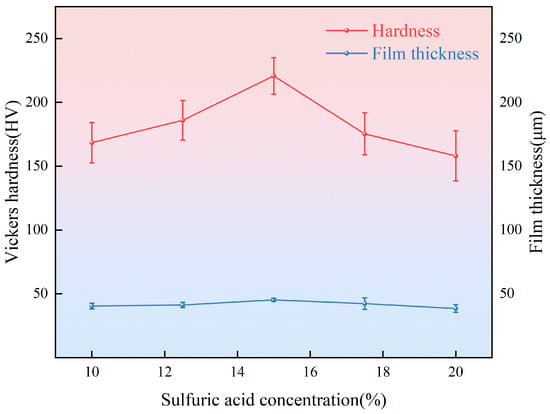
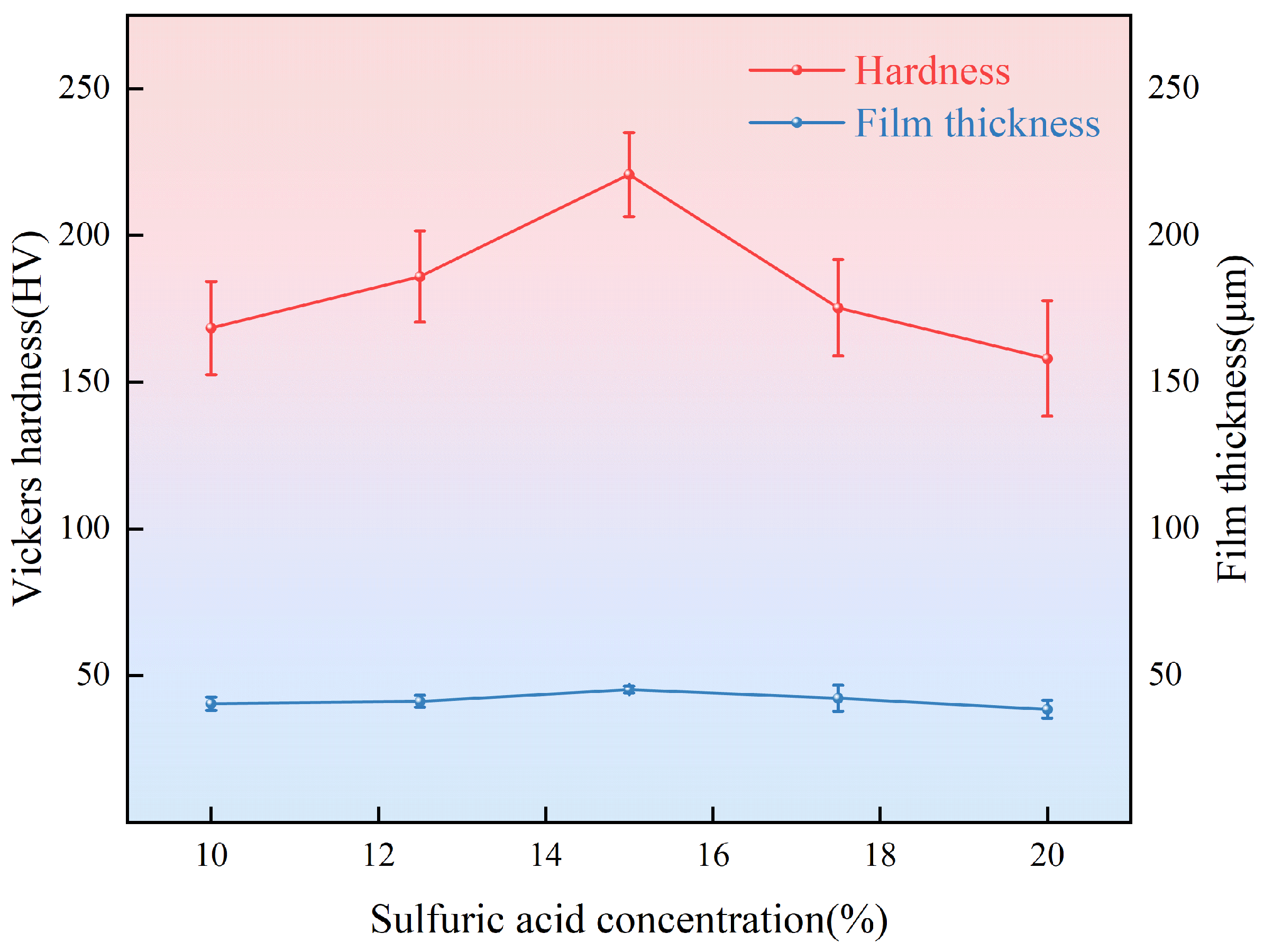
Figure 1 shows the variations in film thickness and microhardness of hard anodic oxide films formed on 2A12 aluminum alloy at different sulfuric acid concentrations. Both film thickness and hardness increase significantly as the sulfuric acid concentration rises from 10% to 15%. However, when the concentration is further increased to 20%, both parameters exhibit a decreasing trend. At low sulfuric acid concentration, insufficient electrolyte conductivity limits the growth rate of the oxide film, resulting in a relatively porous structure and lower hardness. At 15% sulfuric acid concentration, a balance between oxide growth and localized dissolution is achieved, leading to a film with both greater thickness and higher hardness. When the acid concentration becomes too high, the enhanced acidity causes localized current concentration and intensified chemical dissolution. In particular, in Cu-rich regions of the 2A12 aluminum alloy, pores and microcracks are more likely to form, resulting in local over-dissolution of the oxide layer and a consequent deterioration in film compactness and mechanical properties [20].
Figure 1.
Effect of sulfuric acid concentration on film thickness and microhardness.
In summary, the sulfuric acid concentration affects the film thickness and hardness by regulating the dynamic balance between oxide film growth and dissolution. Under the experimental conditions in this work, a sulfuric acid concentration of 15% yields a hard anodic oxide film with relatively optimal overall performance, providing a suitable basis for subsequent orthogonal experiments and further optimization of film properties.
3.2. Orthogonal Test and Optimization
3.2.1. Orthogonal Experimental Results
Based on the results of the single-factor experiments, boric acid concentration (A), temperature (B), current density (C), and anodizing time (D) were further selected as key factors for optimization. Each factor was set at three levels to comprehensively evaluate its effects on the performance of hard anodic oxide films on 2A12 aluminum alloy. To improve experimental efficiency and the reliability of data analysis, an L9(34) orthogonal array was employed to design the experimental scheme, resulting in nine experimental runs. The experimental results, along with the corresponding film thickness and hardness data for each run, are summarized in Table 5.
Table 5.
Orthogonal experiment results for thickness and hardness of anodized coatings.
3.2.2. Range Analysis
Table 6.
Range analysis of microhardness.
Table 7.
Range analysis of film thickness.
The range analysis of microhardness (Table 6) indicates that the primary influence order of the factors is as follows: boric acid concentration (A) > anodizing time (D) > current density (C) > temperature (B). The optimal process combination is A3B1C1D2, corresponding to a boric acid concentration of 15 g/L, a temperature of −5 °C, a current density of 2 A/dm2, and an anodizing time of 90 min.
The range analysis of film thickness (Table 7) indicates that the primary influence order of the factors is as follows: anodizing time (D) > current density (C) > temperature (B) > boric acid concentration (A). The optimal process combination is A2B3C3D3, corresponding to a boric acid concentration of 10 g/L, a temperature of 5 °C, a current density of 4 A/dm2, and an anodizing time of 120 min.
The discrepancy between the optimal combinations obtained from the range analysis of hardness (A3B1C1D2) and film thickness (A2B3C3D3) indicates that there exists a certain synergistic–competitive relationship between coating hardness and thickness. A shorter anodizing time is favorable for achieving higher hardness; however, the resulting film thickness is relatively limited. With increasing anodizing time, continuous film growth leads to an increase in thickness, but enhanced local heat generation and chemical dissolution gradually intensify, which may introduce more internal defects in the oxide layer, thereby deteriorating its compactness and mechanical properties [21].
Therefore, this study does not simply pursue the maximum film thickness. Instead, by comprehensively considering film thickness, hardness, and process stability, the optimal parameter set A3B1C1D2 was selected. Under these conditions, a better dynamic balance between oxide film growth and dissolution rates can be achieved, resulting in a hard anodic oxide film with superior overall performance.
3.2.3. Verification Experiment
To verify the reliability and reproducibility of the optimized process parameters, four independent validation experiments were conducted using the optimal parameter combination (A3B1C1D2) determined from the orthogonal experimental analysis. The optimized coating exhibited an average thickness of 55 ± 1 μm and a microhardness of 278 ± 2 HV (mean ± SD, n = 4). Both values were higher than those obtained from all orthogonal experimental runs, confirming the good repeatability and reliability of the optimized process. These results further demonstrate that the optimized combination of electrolyte composition and anodizing parameters effectively regulates the balance between oxide film growth and electrolyte dissolution, thereby simultaneously enhancing coating thickness and microhardness.
3.3. Microstructure and Phase Analysis
3.3.1. Morphological Comparison of Different Samples
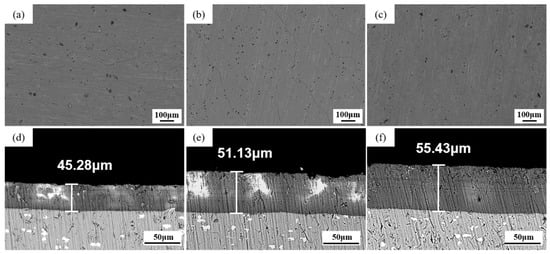
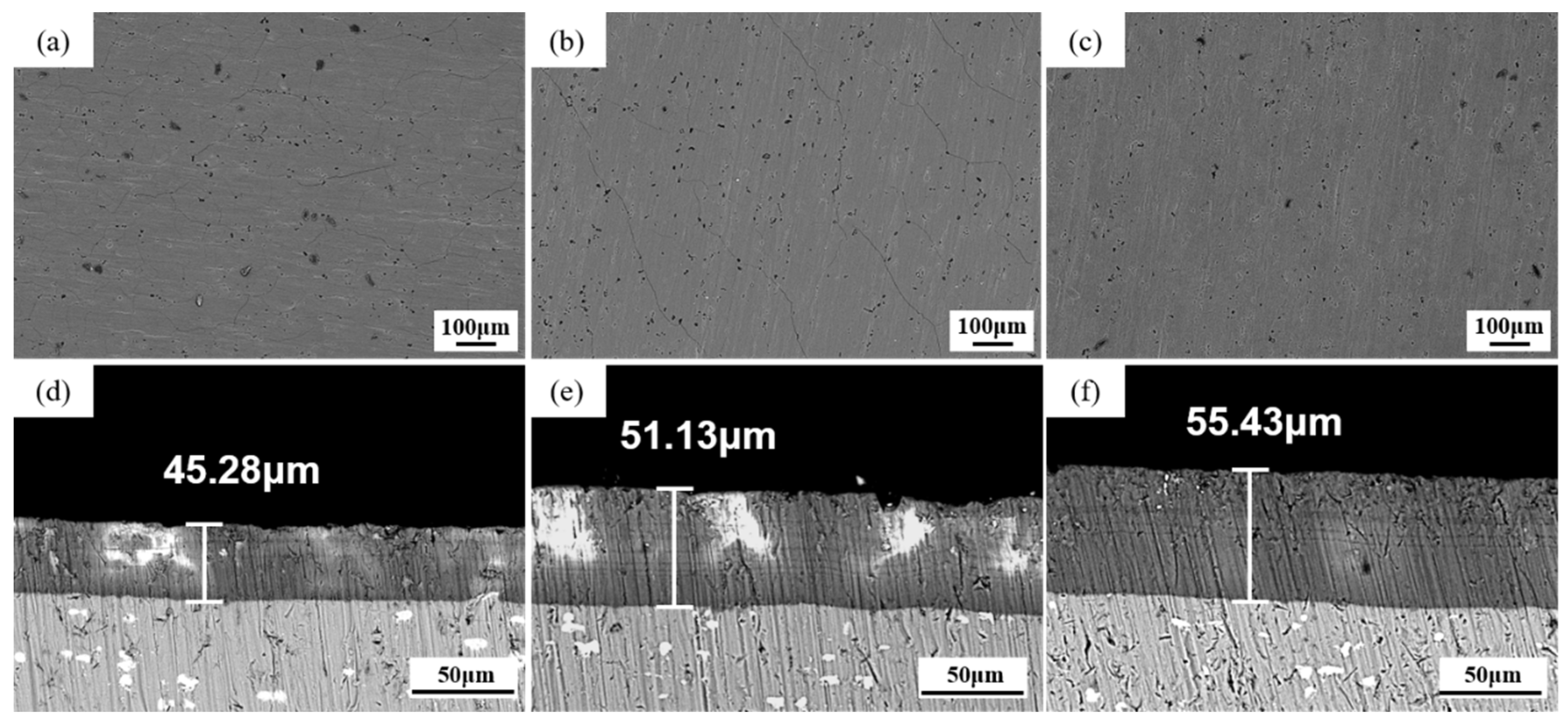
Figure 2 shows the surface and cross-sectional morphologies of hard anodic oxide films prepared under different process conditions. As shown in Figure 2a–c, all three samples exhibit surface defects to varying degrees, including micropores, microcracks, and defect sites formed by the detachment of second-phase particles, which are typical surface features of hard anodic oxide films on 2A12 aluminum alloy [22]. Compared with the 15S and Ort samples, the Opt sample exhibits a significantly reduced number of surface defects, and no large-area pore aggregation or through-thickness microcracks are observed. This indicates that the optimized process effectively suppresses defect formation induced by localized dissolution during oxide film growth.
Figure 2.
Surface and cross-sectional morphologies of samples prepared under different process conditions: (a,d) 15S; (b,e) Ort; (c,f) Opt.
The cross-sectional morphologies shown in Figure 2d–f indicate that all three samples form continuous and intact oxide layers that are tightly bonded to the substrate, with a clear interface and no obvious delamination or cracking observed. With the optimization of process parameters, the film thickness exhibits an increasing trend. Among them, the Opt sample presents a relatively thicker and more uniform oxide layer. Meanwhile, its cross-sectional structure appears more continuous and compact, accompanied by a marked reduction in surface defects. These results suggest that the optimized process conditions can effectively promote stable oxide film growth and facilitate the formation of a more homogeneous and structurally integrated oxide layer.
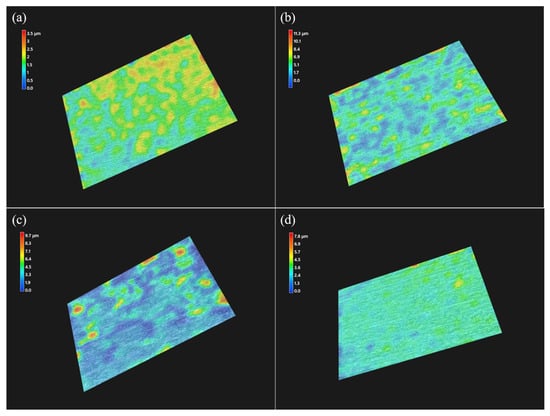
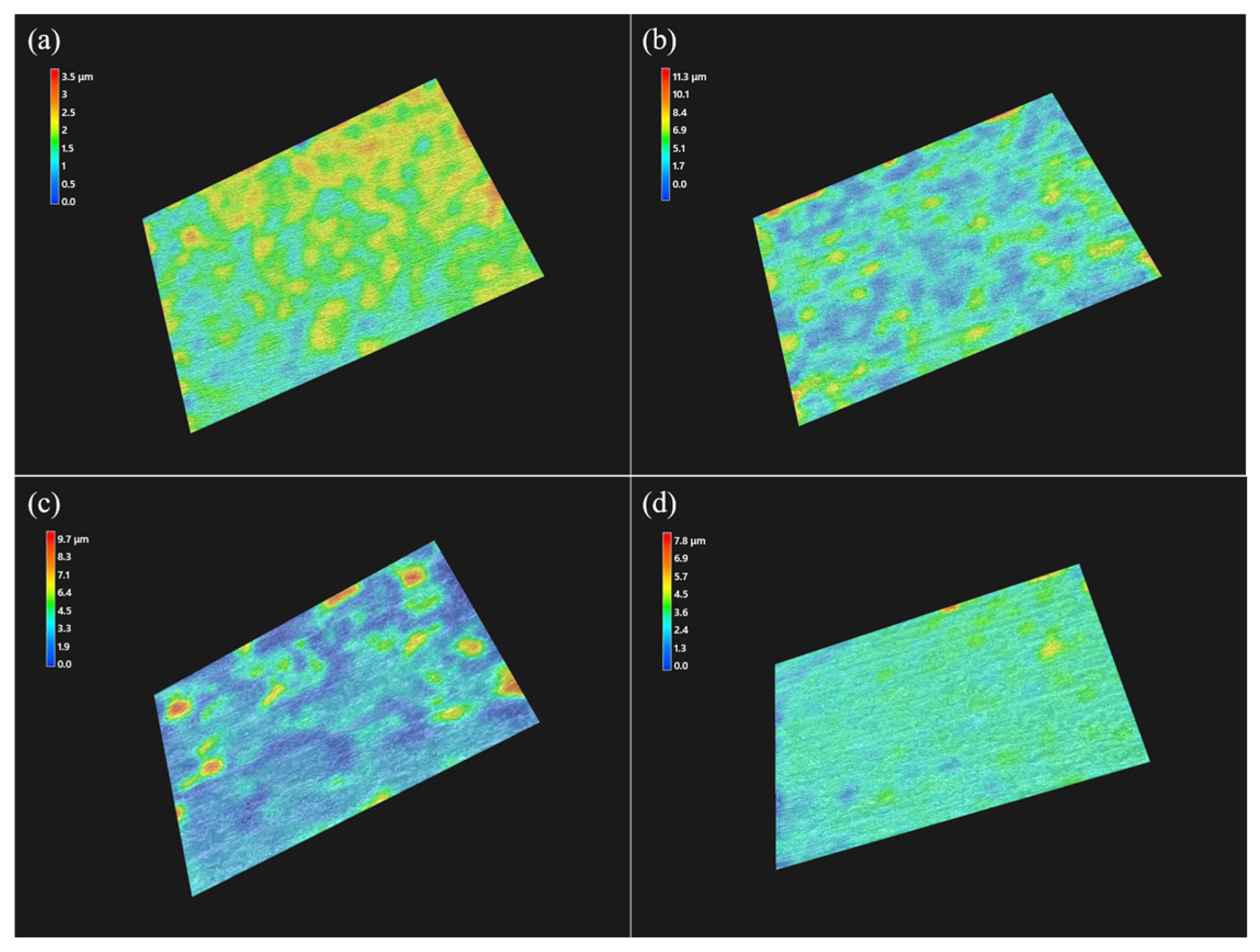
To further characterize the surface morphology, three-dimensional surface topography of the four samples was analyzed, as shown in Figure 3. The substrate (Sub) exhibits relatively pronounced surface height fluctuations, which are mainly associated with the polishing traces and the heterogeneous distribution of second-phase particles. After anodizing in the conventional sulfuric acid electrolyte (15S), the surface becomes more continuous; however, noticeable localized protrusions and depressions are still observed. Similar surface height variations are also present in the Ort coating, indicating that the oxide film remains relatively non-uniform.
Figure 3.
Three-dimensional surface topography of (a) Sub, (b) 15S, (c) Ort, and (d) Opt samples.
In contrast, the Opt coating exhibits a more homogeneous surface with fewer localized protrusions and depressions distributed over the scanned area. These observations are consistent with the SEM results, further demonstrating that the optimized anodizing conditions promote the formation of a more continuous and compact anodic oxide film. The improved surface uniformity of the Opt coating is also in good agreement with its superior corrosion resistance observed in the electrochemical measurements.
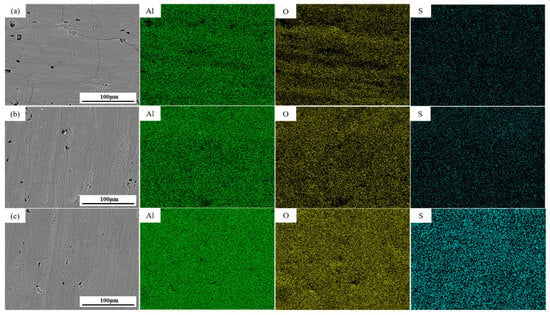
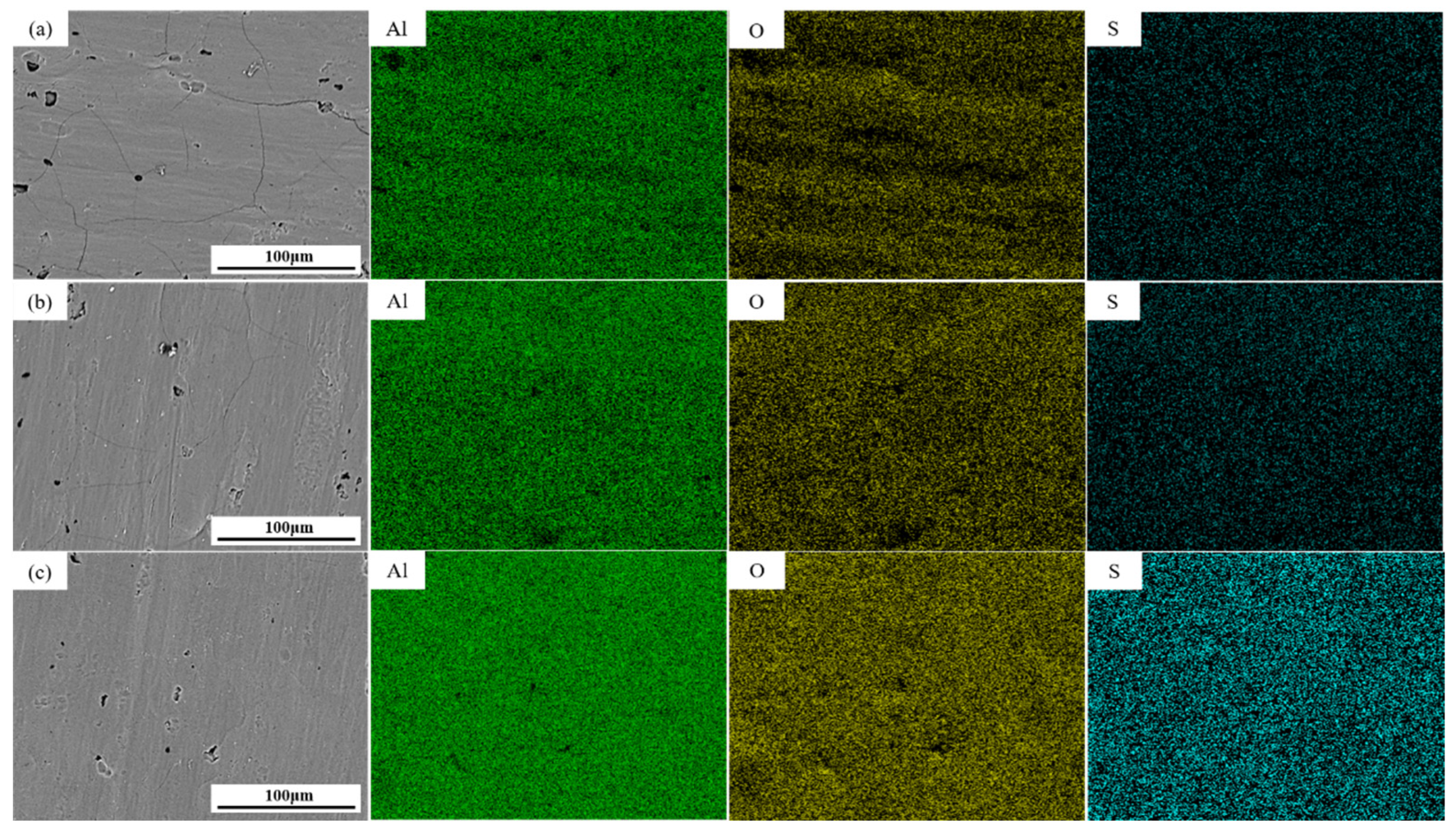
Figure 4 shows the EDS elemental mapping results of the surface of different samples. The results indicate that Al and O elements are uniformly distributed within the oxide film, suggesting complete surface coverage and a relatively homogeneous film composition. In addition, a small amount of S is detected, implying that sulfur-containing species from the electrolyte may have been incorporated into the oxide film during the anodizing process. Compared with the 15S sample, the elemental distribution uniformity of Al, O, and S is gradually improved in the Ort and Opt samples. Among them, the Opt sample exhibits the most uniform elemental distribution, which is consistent with the reduced surface defects observed in the SEM results. This further confirms that the optimized process is beneficial for forming a dense and compositionally uniform oxide film.
Figure 4.
EDS elemental mapping on the surface of samples prepared under different process conditions: (a) 15S; (b) Ort; (c) Opt.
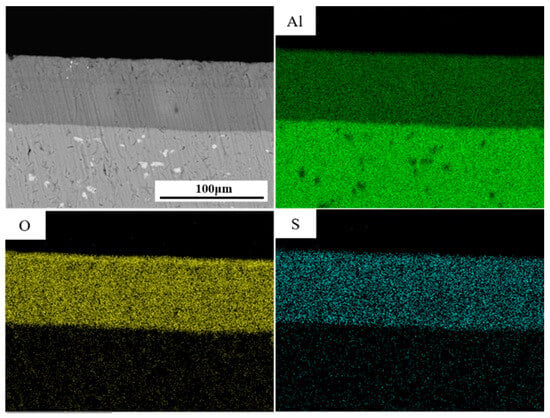
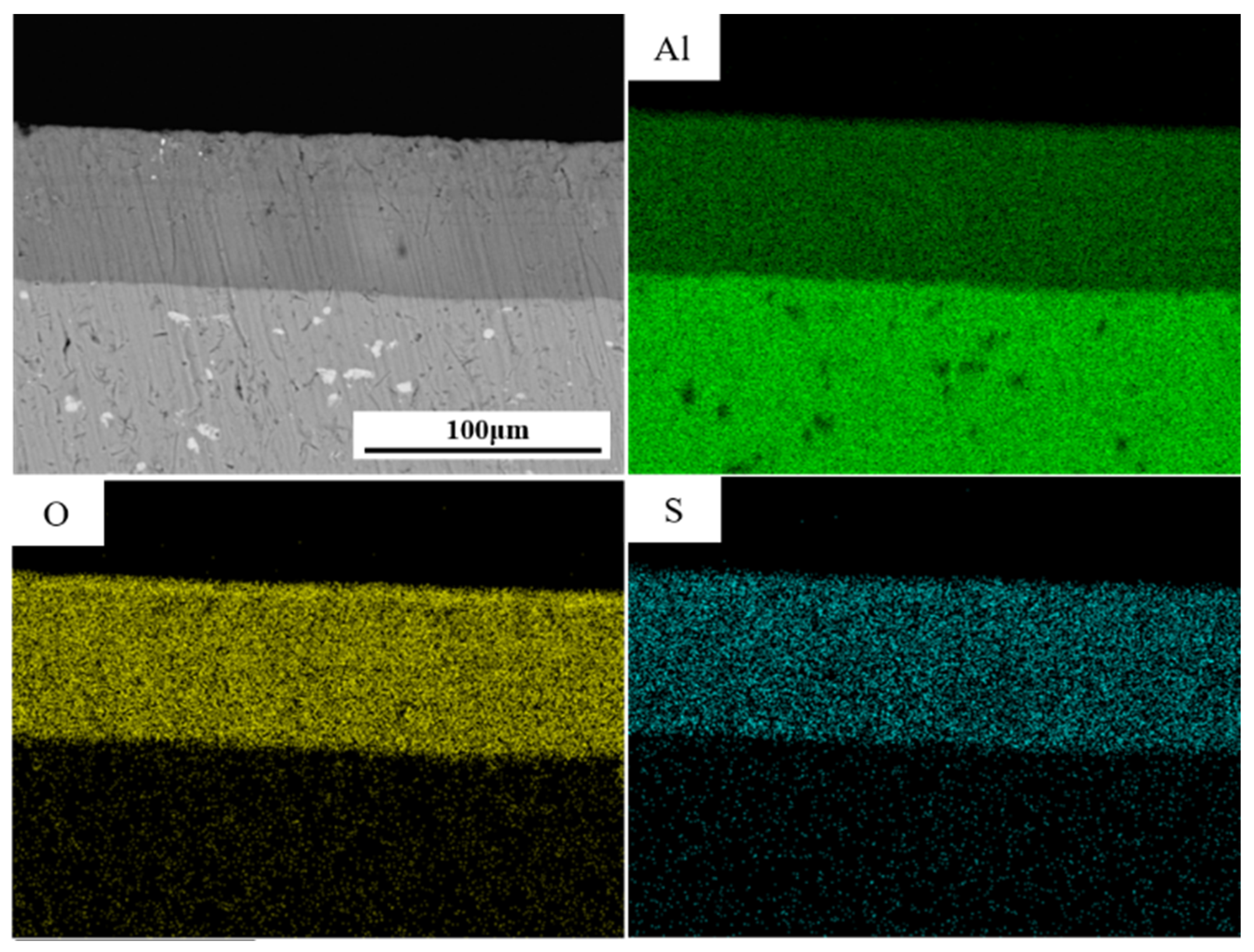
To further analyze the elemental distribution within the oxide film, cross-sectional EDS mapping of the Opt sample was performed, as shown in Figure 5. Al and O elements are mainly enriched within the oxide layer and exhibit a relatively uniform distribution along the film thickness direction, indicating that the oxide film is primarily composed of aluminum oxide. In contrast, S is also detected throughout the oxide layer. Considering that the main anionic species in the electrolyte originates from sulfate ions, the detected S is likely associated with the partial incorporation, adsorption, or incorporation of sulfate-related species into the oxide film during the anodizing process.
Figure 5.
EDS elemental mapping on the cross-section of the Opt sample.
Meanwhile, a pronounced change in Al concentration is observed at the film/substrate interface, whereas O is mainly concentrated within the oxide layer region, further confirming a well-defined and distinct interface between the oxide film and the aluminum alloy substrate. Overall, no obvious elemental segregation is detected within the film, indicating that the optimized process produces an oxide layer with good compositional uniformity and structural stability. The reduction in surface defects and the improvement in cross-sectional continuity suggest that the diffusion pathways of corrosive species through the oxide film toward the substrate are effectively suppressed, which is beneficial for enhancing the barrier properties and corrosion resistance of the oxide coating.
3.3.2. Phase Composition Analysis
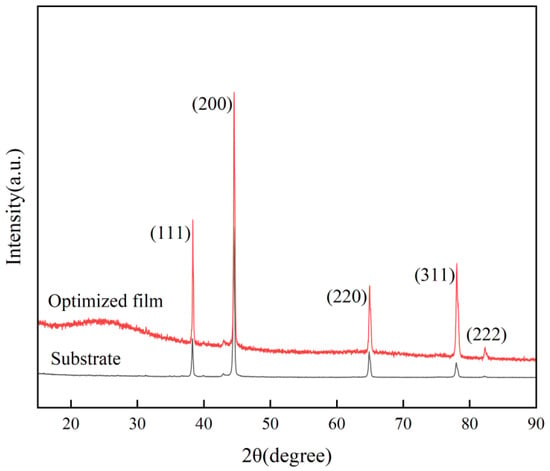
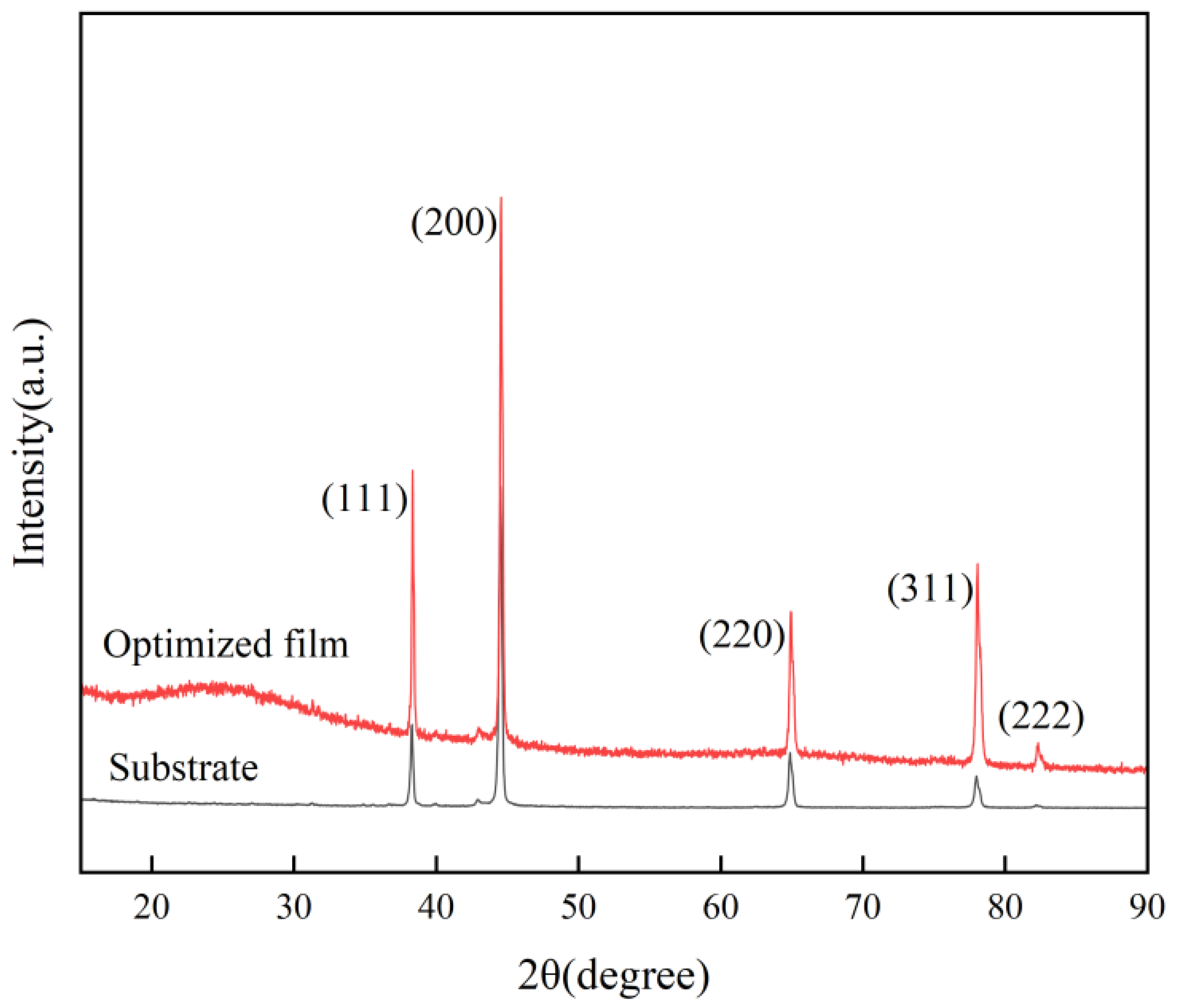
Figure 6 shows the XRD patterns of the Sub and Opt samples. The Sub sample exhibits the typical diffraction peaks of face-centered cubic aluminum, corresponding to the (111), (200), (220), (311), and (222) crystal planes, indicating that the Sub sample mainly consists of metallic Al. After hard anodizing treatment, the Opt sample retains the diffraction peaks of the aluminum substrate. However, no obvious and sharp crystalline aluminum oxide diffraction peaks are observed. Instead, a broad and diffuse hump appears in the 2θ range of 20–35°, suggesting that the oxide film is predominantly amorphous in nature [23].
Figure 6.
XRD patterns of the Sub and Opt samples.
In general, during hard anodizing in a sulfuric acid system, the resulting oxide film is mainly composed of amorphous Al2O3. Under a strong electric field, Al3+ and O2− continuously migrate and react to form the oxide layer. However, the relatively low electrolyte temperature and high film growth rate restrict the crystallization of aluminum oxide, making it difficult to form an ordered crystalline structure. Meanwhile, under localized high electric field intensity and transient temperature rise, a small amount of low-crystallinity γ-Al2O3 may form within the film. However, due to its low content and very small crystallite size, no distinct diffraction peaks corresponding to crystalline aluminum oxide are observed in the XRD patterns.
Combined with the SEM results, it can be observed that the oxide film prepared under optimized conditions exhibits a more intact surface morphology and a continuous cross-sectional structure. In addition, the XRD results indicate that the oxide layer is mainly composed of amorphous aluminum oxide. The homogeneous and continuous structural characteristics of amorphous Al2O3 are beneficial for reducing the penetration rate of corrosive species, thereby providing a structural basis for the excellent corrosion resistance of the oxide film.
3.3.3. Surface Chemical State Analysis
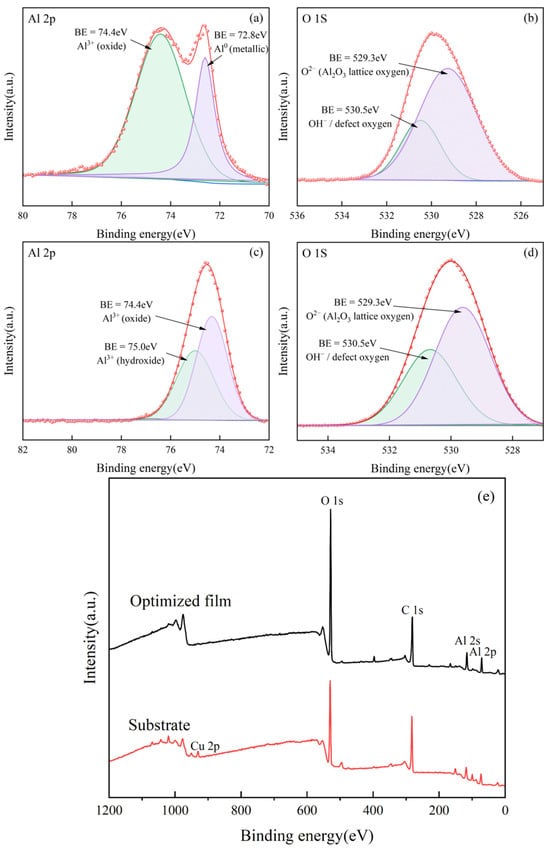
To further investigate the surface chemical composition of the oxide films, X-ray photoelectron spectroscopy (XPS) analyses were performed on the substrate (Sub) and the optimized oxide film (Opt). The survey spectra (Figure 7e) show that the Sub sample mainly contains Al, C, O and Cu signals, whereas the Cu signal almost disappears after hard anodizing and the O signal becomes markedly stronger. This indicates that the optimized oxide film uniformly covers the substrate surface and effectively attenuates the photoelectron signal from the underlying alloy.
Figure 7.
XPS spectra of Sub and Opt samples: (a,b) Sub; (c,d) Opt; (e) survey spectrum.
The high-resolution Al 2p spectra are shown in Figure 7a,c. For the Sub sample, the spectrum can be deconvoluted into two components located at 74.4 eV and 72.8 eV, corresponding to oxidized aluminum (Al3+, oxide) and metallic aluminum (Al0), respectively. The presence of the metallic Al signal indicates that the naturally formed oxide layer on the substrate is thin and does not completely shield the underlying aluminum substrate.
In contrast, the Al 2p spectrum of the Opt sample consists of two oxidized aluminum components located at 74.4 eV and 75.0 eV, which are assigned to Al3+ species coordinated with oxygen in the alumina network (Al–O) and Al3+ associated with hydroxyl species (Al-OH), respectively. The disappearance of the metallic Al component indicates that the optimized anodizing treatment produced a continuous oxide film with complete surface coverage.
The O 1s spectra (Figure 7b,d) can be resolved into two components corresponding to oxygen species in different chemical environments. The peak at 529.3 eV is assigned to oxygen species strongly bonded with aluminum atoms (Al–O), representing the oxide network of alumina. The peak at 530.5 eV is attributed to less coordinated oxygen environments, which may involve hydroxyl-related species and structural disorder within the amorphous anodic oxide layer. Compared with the Sub sample, the Opt sample exhibits a higher contribution from Al–O-related oxygen species and a reduced proportion of non-equivalent oxygen environments, suggesting a more stable and compact oxide structure with improved chemical integrity.
Overall, the XPS results demonstrate that the optimized anodic film is mainly composed of aluminum oxide with a small amount of hydroxyl-related species. The absence of metallic Al and the predominant Al–O coordination environment confirm the formation of a continuous oxide layer with enhanced structural integrity. These results are consistent with the SEM observations of a dense surface morphology and the XRD results showing that the oxide film is predominantly amorphous Al2O3.
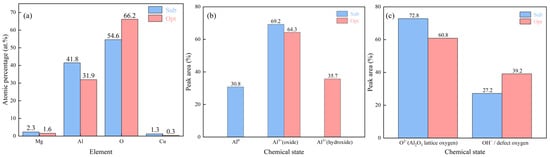
Quantitative XPS analysis was further performed to evaluate the changes in the surface chemical composition after anodizing, and the results are summarized in Figure 8. As shown in Figure 8a, the oxygen atomic concentration increased markedly from 54.6 at.% for the substrate to 66.2 at.% for the optimized coating, whereas the aluminum, magnesium and copper contents decreased from 41.8, 2.3 and 1.3 at.% to 31.9, 1.6 and 0.3 at.%, respectively. The decrease in the detected metallic elements, together with the increase in oxygen content, indicates that the substrate surface was effectively covered by the anodic oxide film.
Figure 8.
XPS quantitative analysis of the substrate (Sub) and optimized coating (Opt): (a) atomic concentrations of surface elements; (b) relative peak area percentages of Al 2p chemical states; (c) relative peak area percentages of O 1s chemical states.
The quantitative analysis of the Al 2p spectra (Figure 8b) shows that the substrate contains both metallic Al and oxidized Al3+ species, whereas only oxidized Al3+ species are detected after anodizing. Meanwhile, the O 1s spectra (Figure 8c) can be deconvoluted into lattice oxygen (O2−) and hydroxyl/defect oxygen components. Compared with the substrate, the optimized coating exhibits changes in the relative proportions of these oxygen species, indicating a modified surface chemical state after anodizing. These quantitative XPS results provide further evidence for the successful formation of the anodic oxide film, which is consistent with the XRD analysis.
3.4. Electrochemical Test
3.4.1. Potentiodynamic Polarization
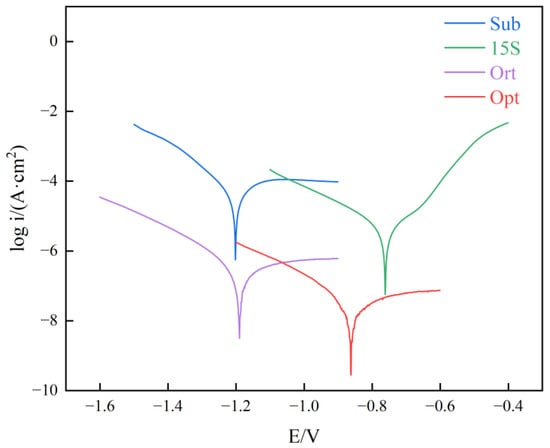
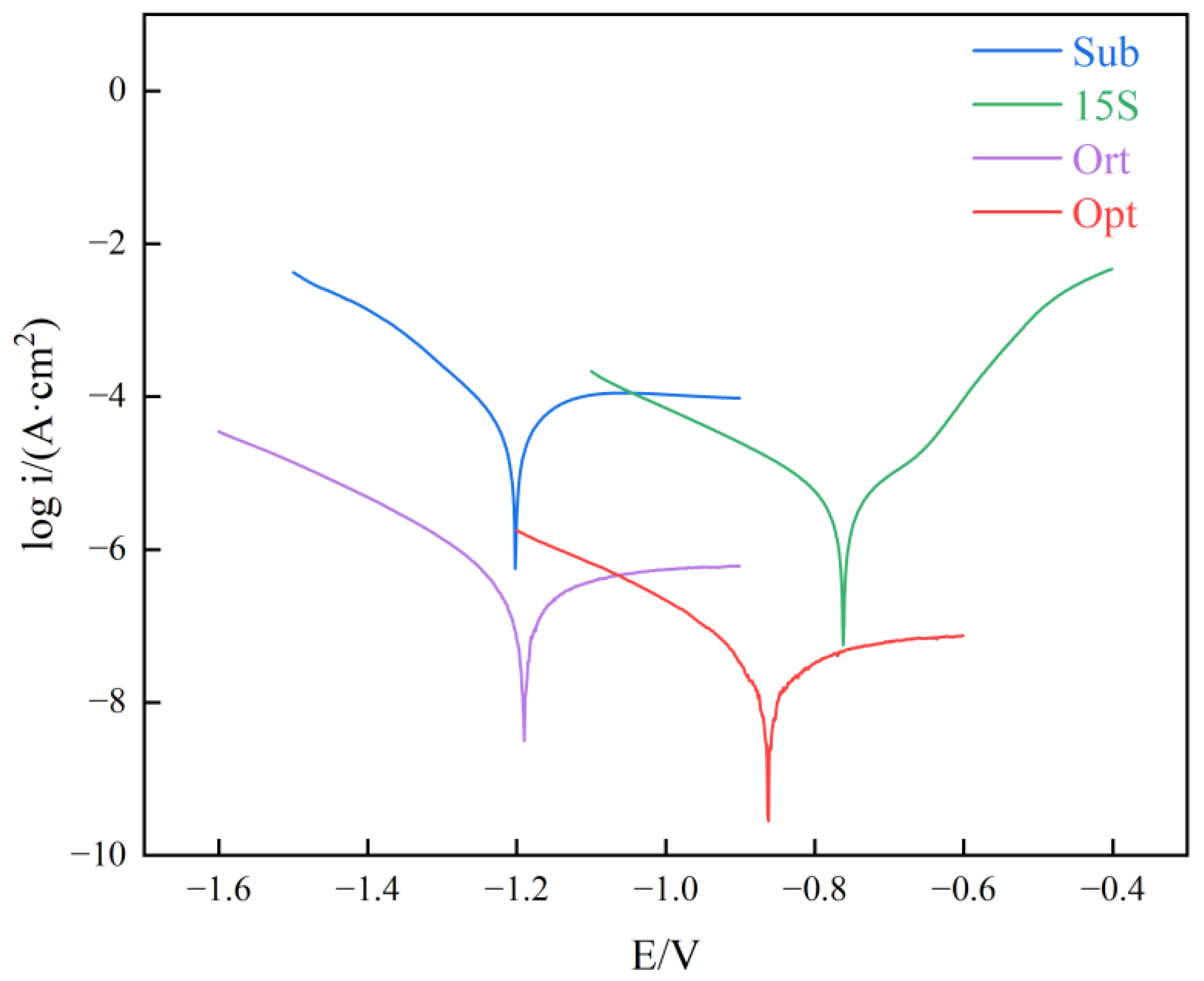
To evaluate the corrosion resistance of the oxide films, potentiodynamic polarization tests were conducted for the Sub, 15S, Ort, and Opt samples in a 3.5 wt.% NaCl solution (Figure 9), and the fitted electrochemical parameters are listed in Table 8. The results show that anodizing treatment significantly improves the corrosion resistance of the material. Compared with the substrate, all anodized samples exhibit a positive shift in corrosion potential (Ecorr) and a remarkable decrease in corrosion current density (Icorr).
Figure 9.
Potentiodynamic polarization curves of the four samples.
Table 8.
Electrochemical parameters of the substrate and optimized anodized coatings.
Among them, the Opt sample exhibits the best corrosion resistance. The corrosion potential shifts from −1.2217 V (vs. SCE) for the substrate to −0.8552 V, while the corrosion current density decreases from 5.32 × 10⁻⁵ A·cm−2 to 2.14 × 10⁻⁸ A·cm−2, corresponding to a reduction of approximately three orders of magnitude. The corrosion rate can be calculated according to the following equation:
where v is the corrosion rate (mm·y−1), Icorr is the corrosion current density (A·cm−2), M is the molar mass of the metal (g·mol−1), ρ is the material density (g·cm−3), and n is the number of electrons transferred. By substituting the data in Table 8, the corrosion rate of the Opt sample is calculated to be 2.26 × 10⁻⁴ mm·y−1, which is significantly lower than that of the substrate. The corrosion inhibition efficiency (η) can be expressed as:
The calculated corrosion inhibition efficiency η is approximately 99.96%, further indicating that the optimized process significantly suppresses the corrosion reaction.
In addition, the polarization curves show that both the anodic and cathodic branches of the Opt sample shift toward lower current densities, indicating that the optimized oxide film not only reduces the anodic dissolution rate of the Al substrate but also suppresses the cathodic reduction reactions, thereby contributing to an overall improvement in corrosion resistance.
3.4.2. Electrochemical Impedance Spectroscopy (EIS)
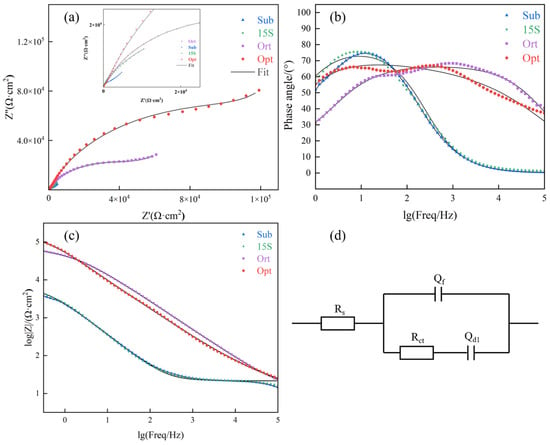
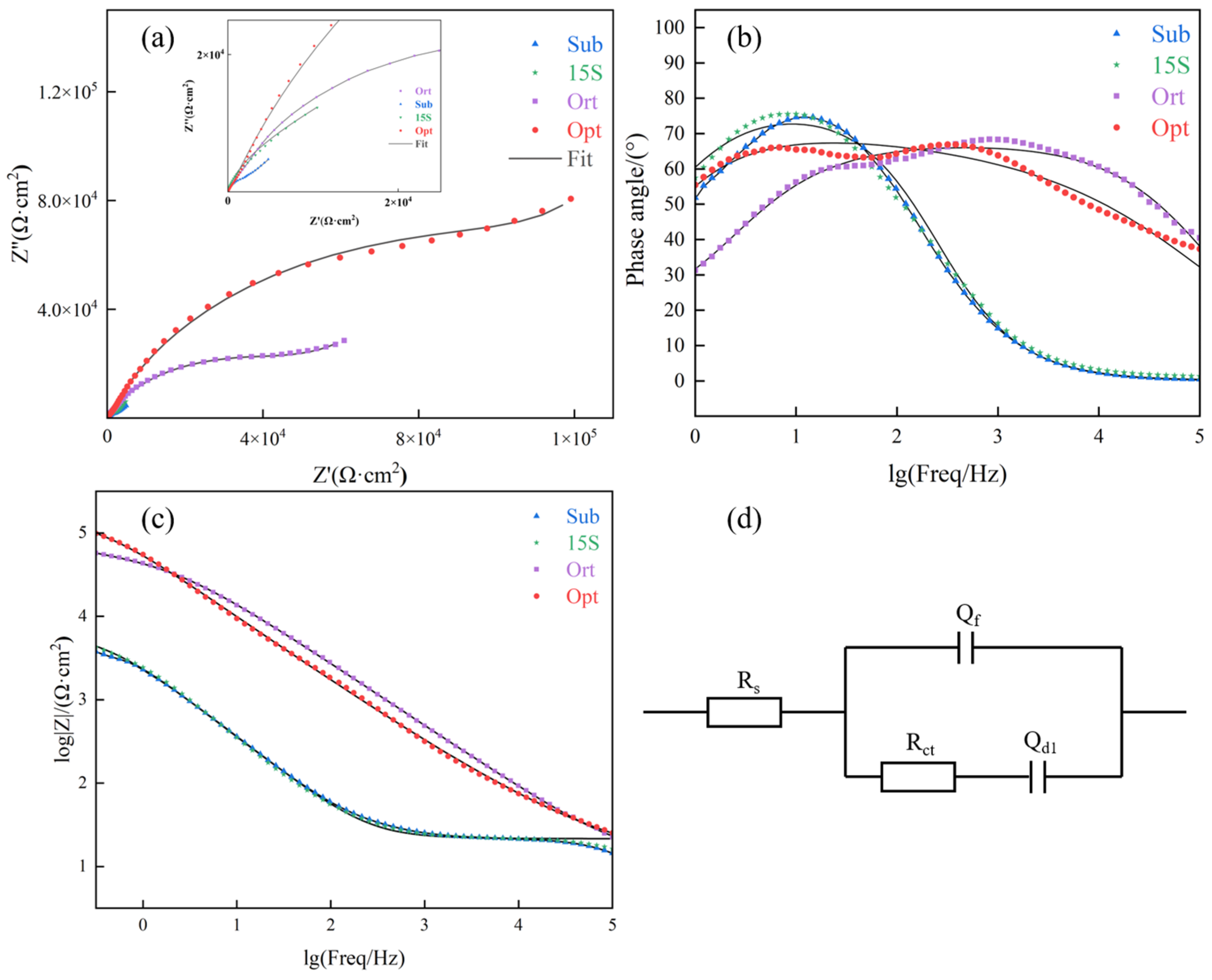
To further investigate the barrier properties and interfacial stability of the oxide films, electrochemical impedance spectroscopy (EIS) measurements were performed (Figure 10), and the data were fitted using the equivalent circuit Rs(Q(RQ)) shown in Figure 10d. The fitted parameters are listed in Table 9.
Figure 10.
Electrochemical test results of the four samples: (a) Nyquist plots; (b) Bode phase angle plots; (c) Bode impedance modulus plots; (d) equivalent circuit model used for EIS fitting.
Table 9.
Electrochemical parameters obtained from EIS fitting.
The Nyquist plots (Figure 10a) show that all samples exhibit a capacitive semicircle feature in the high- to medium-frequency region, and the diameter of the semicircle follows the order:
indicating that the optimized coating exhibits the highest interfacial impedance and the best barrier performance. Specifically, the charge transfer resistance (Rct) of the Opt sample reaches 1.615 × 10⁵ Ω·cm2, which is approximately 5370 times higher than that of the substrate (30.07 Ω·cm2), demonstrating that the oxide film can effectively suppress electron and ion exchange between the corrosive medium and the substrate.
Rct,Opt > Rct,Ort > Rct,15S > Rct,Sub
The Bode phase plots (Figure 10b) show that the Opt sample maintains a relatively high phase angle (close to −80°) over a wide frequency range (from 105 Hz down to approximately 1 Hz), indicating a more capacitive and homogeneous oxide layer with fewer defects. In contrast, the Sub sample exhibits a significantly lower phase angle, reflecting the absence of a protective barrier and the dominance modulus plots (Figure 10c) reveal that the low-frequency impedance modulus (|Z|_{0.01Hz}) of the Opt sample is significantly higher than those of other samples by approximately two to three orders of magnitude, further confirming the superior interfacial stability and barrier performance of the optimized oxide film.
The reliability of the equivalent circuit fitting was evaluated using the chi-square (χ2) values. The χ2 values obtained for the Sub, 15S, Ort, and Opt samples were 0.006932, 0.008155, 0.0007644, and 0.002925, respectively. All χ2 values were below 10−2, indicating good agreement between the experimental impedance spectra and the proposed equivalent circuit model.
The fitted constant phase element parameters also support this interpretation. The n1 value for the Opt sample (0.8090, close to 1) suggests that the outer layer of the oxide film behaves more like an ideal capacitor, indicating a dense and homogeneous structure. In contrast, the n1 value for the 15S sample (0.876) deviates from ideal capacitive behavior, implying a rougher or more porous film surface. The reduced defect density, enhanced dielectric properties, and improved blocking capability of the Opt sample are all consistent with the formation of a continuous and compact alumina layer under optimized conditions.
Importantly, the EIS results are in good agreement with the potentiodynamic polarization measurements presented in Section 3.4.1. In electrochemical theory, the corrosion current density (Icorr) is inversely related to the charge transfer resistance (Rct), as both parameters reflect the kinetics of charge transfer across the oxide/electrolyte interface. For the substrate sample, the low Rct value of 30.07 Ω·cm2 corresponds to a high Icorr of 5.32 × 10⁻⁵ A·cm−2, indicating a nearly unprotected surface. In contrast, the Opt sample exhibits a drastically increased Rct of 1.615 × 10⁵ Ω·cm2, which is consistent with its markedly reduced Icorr of 2.14 × 10⁻⁸ A·cm−2. The approximately three-orders-of-magnitude decrease in Icorr and the four-orders-of-magnitude increase in Rct both confirm that the optimized oxide film acts as an effective physical barrier, significantly suppressing charge transfer and ion diffusion at the electrode/electrolyte interface.
Overall, the combined EIS and polarization results demonstrate that the optimized process not only forms a continuous and compact oxide film, but also produces an amorphous Al2O3-dominated structure. From both chemical composition and structural perspectives, the oxide layer effectively inhibits the diffusion of corrosive species (especially Cl− ions) toward the substrate, thereby significantly enhancing the corrosion resistance of the 2A12 aluminum alloy.
4. Discussion
During hard anodizing, oxide film formation is governed by the coupled effects of electric-field-assisted oxide growth and electrolyte-assisted chemical dissolution, and the final coating structure depends on the dynamic balance between these two processes [24,25]. Under the applied electric field, aluminum atoms at the metal/oxide interface are oxidized to Al3+, while oxygen-containing species (O2− and OH−) migrate inward through the growing oxide layer, resulting in the continuous formation of Al2O3. Simultaneously, the acidic electrolyte continuously dissolves the outer oxide layer. The characteristic porous structure of anodic alumina therefore originates from the dynamic competition between oxide growth and chemical dissolution. Conventional single sulfuric acid systems tend to cause localized over-dissolution, resulting in pores and microcracks on the film surface, thereby reducing film integrity and corrosion resistance [26]. The use of a quaternary mixed-acid electrolyte system composed of sulfuric acid, boric acid, citric acid, and aluminum sulfate can effectively mitigate this issue. In this system, the synergistic effects among the components enable a dynamic balance between film growth and dissolution, which not only promotes the continuous growth of the oxide film but also suppresses excessive local dissolution, resulting in a thicker, continuous, more uniform, and low-defect oxide coating. A thicker oxide coating provides a longer diffusion path for aggressive ions such as Cl−, thereby enhancing the barrier effect against corrosive media, while the reduced number of structural defects further suppresses electrolyte penetration through pores and microcracks. Therefore, both coating thickness and coating compactness contribute to the corrosion protection of the anodic oxide film.
This quaternary electrolyte system provides an adequate source of Al3+ ions through aluminum sulfate while regulating the local reaction environment during oxide film formation through the complexation and buffering effects of citric acid and boric acid, respectively. Rather than acting independently, these electrolyte components cooperatively regulate ion transport, oxide growth kinetics, and localized dissolution during anodizing. Boric acid buffers pH fluctuations near the anodic interface caused by electrochemical reactions, thereby mitigating localized acidification-induced film dissolution and, to some extent, suppressing defect formation associated with selective dissolution of Cu-enriched phases [27,28]. Citric acid regulates the migration and deposition behavior of Al3+ through complexation, reduces localized current concentration during film growth, and thereby promotes the uniform growth of the oxide film [29]. Aluminum sulfate supplies additional Al3+ ions, helping to maintain ionic balance between film growth and dissolution processes, alleviating excessive interfacial dissolution, and promoting continuous oxide film formation [30]. The synergistic effects of buffering, complexation, and Al3+ supplementation collectively stabilize oxide growth kinetics, promote more homogeneous oxide formation, and improve the growth–dissolution equilibrium during anodizing, resulting in a more homogeneous and stable film structure. SEM observations revealed that the Opt sample exhibited significantly fewer surface defects and a continuous, intact cross-sectional morphology. In addition, the Opt coating exhibited the greatest thickness among all the prepared coatings (Figure 2), indicating that the optimized quaternary mixed-acid electrolyte not only enhanced the structural integrity and microstructural stability of the oxide film but also promoted its continuous growth. Therefore, the superior corrosion resistance of the Opt coating is attributed to the synergistic effects of increased coating thickness and improved coating compactness rather than either factor alone. The thicker and denser oxide coating effectively delays the transport of aggressive ions toward the substrate, thereby providing enhanced long-term corrosion protection.
The microstructure of the oxide film is not only influenced by the electrolyte composition but is also closely related to anodizing temperature, current density, anodizing time, and boric acid concentration [31,32]. A moderate increase in current density can enhance ion migration and accelerate film growth; however, excessively high current density may lead to localized Joule heating, resulting in film burning and an increase in defects [33,34]. An increase in anodizing time promotes film thickening, but excessive duration may induce chemical dissolution at the pore bottoms and microcrack formation, thereby compromising film continuity. An appropriate temperature is beneficial for improving film integrity while avoiding excessively rapid localized dissolution.
The orthogonal experimental results indicate that both film thickness and microhardness are improved under the optimized process conditions. SEM observations show a continuous and intact cross-sectional structure with a significantly reduced number of surface defects, indicating that the optimized parameters effectively regulate the balance between oxide film growth and dissolution. XRD analysis reveals no distinct diffraction peaks corresponding to crystalline aluminum oxide, while a broad diffuse hump is observed, suggesting that the oxide film is predominantly composed of amorphous Al2O3 [35,36]. This result is consistent with previous reports that anodic aluminum oxide films formed in acidic electrolytes generally exhibit an amorphous or poorly crystalline structure rather than well-developed crystalline alumina phases. The absence of characteristic diffraction peaks of γ-Al2O3 or α-Al2O3 indicates that the oxide growth process under the present anodizing conditions does not provide sufficient thermal energy for extensive crystallization. Similar amorphous characteristics have been reported for anodic oxide films prepared in sulfuric acid-based electrolytes, where rapid oxide formation, simultaneous field-assisted ion migration, and hydration reactions during anodization inhibit long-range atomic ordering [37]. In addition, the low-temperature hard anodizing condition used in this work (−5 °C) further suppresses the structural rearrangement of alumina, favoring the retention of an amorphous oxide framework. Previous studies on hard anodized aluminum alloys have also demonstrated that the broad diffuse halo in XRD patterns is a typical feature of amorphous anodic alumina layers, while crystalline alumina phases generally appear only after additional thermal treatment or under conditions promoting crystallization [38]. The formation of an amorphous alumina structure is beneficial for corrosion protection because the absence of crystalline grain boundaries reduces preferential pathways for corrosive ion transport, contributing to the improved barrier performance of the optimized coating.
XPS analysis further demonstrates the significant changes in the surface chemical composition after anodizing. Quantitative analysis (Figure 8) shows that the oxygen atomic concentration increases from 54.6 at.% for the substrate to 66.2 at.% for the optimized coating, while the aluminum, magnesium, and copper contents decrease from 41.8, 2.3 and 1.3 at.% to 31.9, 1.6 and 0.3 at.%, respectively. The increase in oxygen content together with the decrease in metallic elements indicates the formation of a continuous oxide layer that effectively covers the substrate surface. The Al 2p spectra reveal that the metallic Al component observed on the substrate disappears after anodizing, whereas only oxidized Al3+ species are detected in the optimized coating, confirming complete surface coverage by the anodic oxide film. Quantitative peak area analysis further demonstrates that the oxide layer is dominated by oxidized aluminum species. Meanwhile, the O 1s spectra consist of oxygen species with different chemical environments, including Al–O-related oxygen and hydroxyl-related oxygen species, indicating the coexistence of various oxygen configurations within the anodic oxide film. The dominant contribution of Al–O-related oxygen species is consistent with the characteristic chemical structure of anodic alumina reported in previous studies, suggesting the formation of a relatively stable alumina network [39,40,41]. Moreover, no sulfur-containing species were detected in the XPS spectra, suggesting that sulfate ions were not significantly incorporated into the outer oxide layer. Therefore, sulfate ions are considered to mainly regulate oxide growth kinetics through the electrolyte rather than directly participating in the oxide framework. These results suggest that the optimized anodizing process produces a continuous oxide layer with improved surface coverage and structural integrity. Therefore, the optimized process in this work achieves simultaneous enhancement of film thickness, structural integrity, and chemical stability.
The corrosion resistance of the oxide film is primarily governed by its ability to impede the transport of corrosive species. Surface pores, microcracks, and internal defects within the film can provide diffusion pathways for aggressive ions such as Cl−, thereby accounting for the protective capability of the coating [42]. SEM results show that the Opt sample exhibits a compact and continuous morphology with markedly fewer defects. Furthermore, the three-dimensional surface topography analysis confirms the improved surface uniformity of the Opt coating, with fewer localized surface irregularities compared with the other samples. The homogeneous surface morphology contributes to reducing preferential sites for electrolyte accumulation and localized corrosion initiation, thereby further enhancing the protective capability of the anodic oxide film [43]. Combined with the XRD results indicating the formation of predominantly amorphous Al2O3 and the XPS results revealing a continuous oxide layer dominated by Al-O bonding without detectable metallic Al, these findings demonstrate that the optimized coating possesses improved structural integrity and chemical stability [44]. The combined effects of increased film thickness, reduced structural defects, and the formation of a stable oxide framework effectively suppress electrolyte penetration and retard charge transfer at the coating/substrate interface, thereby contributing to the superior corrosion resistance of the optimized coating.
Electrochemical tests further confirm the advantages of the optimized film structure. It should be noted that the corrosion potential (Ecorr) and corrosion current density (Icorr) represent different electrochemical characteristics. Ecorr mainly reflects the thermodynamic tendency for corrosion initiation, whereas Icorr is a kinetic parameter directly related to the corrosion rate. Therefore, the corrosion resistance of anodic oxide coatings should be primarily evaluated according to Icorr rather than Ecorr. Although the 15S sample exhibits the most positive Ecorr, its relatively high Icorr indicates that the coating still contains structural defects, such as pores and microcracks, which provide preferential pathways for electrolyte penetration and accelerate corrosion once initiated [45]. Consequently, a more positive Ecorr does not necessarily correspond to a lower corrosion rate. Similarly, the Ecorr of the Ort sample remains close to that of the substrate, whereas its markedly reduced Icorr indicates that the optimized microstructure effectively suppresses charge transfer and corrosion kinetics without significantly altering the thermodynamic corrosion tendency. Therefore, the superior corrosion resistance of the optimized coatings is mainly reflected by the substantial reduction in Icorr rather than by the shift in Ecorr.
The polarization curves show that the corrosion current density of the Opt sample decreases from 5.32 × 10⁻⁵ A·cm−2 to 2.14 × 10⁻⁸ A·cm−2, corresponding to a corrosion inhibition efficiency of 99.96%. The EIS results indicate that the charge transfer resistance increases from 30.07 Ω·cm2 to 1.615 × 10⁵ Ω·cm2, representing an approximately 5370-fold improvement. In addition, both the low-frequency impedance modulus and phase angle are significantly enhanced. These results indicate that the oxide film formed under the optimized process effectively suppresses charge transfer between the corrosive medium and the substrate, thereby markedly improving corrosion resistance. Overall, the superior corrosion resistance of the optimized coating can be attributed to the coupled effects of electric-field-assisted oxide growth, synergistic electrolyte regulation, improved coating compactness, and enhanced chemical stability of the amorphous alumina framework. These synergistic effects effectively suppress electrolyte penetration and charge transfer at the coating/substrate interface, thereby significantly improving the corrosion resistance of the 2A12 aluminum alloy.
5. Conclusions
- (1)
- The optimized hard anodizing conditions for 2A12 aluminum alloy were determined through single-factor experiments and orthogonal design as follows: sulfuric acid concentration of 15%, citric acid concentration of 15 g/L, aluminum sulfate concentration of 10 g/L, boric acid concentration of 15 g/L, electrolyte temperature of −5 °C, current density of 2 A/dm2, and anodizing time of 90 min. The optimized process achieves a balance between film thickness and hardness, resulting in an oxide film with improved mechanical properties and enhanced structural integrity.
- (2)
- SEM observations reveal that the oxide film prepared under the optimized conditions exhibits a more compact and uniform morphology with reduced pores and microcracks. The cross-sectional structure is continuous with good interfacial integrity. XRD analysis indicates that the oxide layer is mainly amorphous alumina, while XPS results confirm the dominance of Al–O bonding, indicating the formation of a stable oxide framework.
- (3)
- Polarization tests demonstrate that the corrosion current density of the Opt sample decreases by approximately three orders of magnitude (from 5.32 × 10⁻⁵ A·cm−2 to 2.14 × 10⁻⁸ A·cm−2), corresponding to a corrosion inhibition efficiency of 99.96%. Meanwhile, the corrosion potential shifts positively from −1.222 V to −0.855 V (vs. SCE), indicating the enhanced corrosion protection provided by the anodic oxide film.
- (4)
- EIS results show that the charge transfer resistance of the Opt sample increases from 30.07 Ω·cm2 to 1.615 × 10⁵ Ω·cm2, representing an approximately 5370-fold improvement. The enhanced corrosion resistance is attributed to the synergistic regulation of the quaternary electrolyte system and optimized anodizing parameters, which promote the formation of a thicker, more compact, and chemically stable oxide layer with reduced pathways for corrosive species transport.
Author Contributions
Conceptualization, Y.X., Y.J., Y.H. and C.S.; Methodology, Y.X., Y.H. and C.S.; Software, Y.X.; Validation, Y.X., Y.J., M.W. and F.N.; Formal analysis, Y.X., Y.J. and M.W.; Investigation, Y.X., C.S. and F.N.; Resources, Y.H., M.W. and F.N.; Data curation, Y.X., Y.J. and M.W.; Writing—original draft, Y.X.; Writing—review & editing, Y.X., Y.J., Y.H., M.W., C.S. and F.N.; Visualization, Y.X.; Supervision, Y.J. and Y.H.; Project administration, Y.J. and Y.H.; Funding acquisition, Y.J., Y.H. and F.N. All authors have read and agreed to the published version of the manuscript.
Funding
The Key Research and Development for University-Local Government Collaboration of Lvliang City (2024XDHZ-201).
Data Availability Statement
The original contributions presented in this study are included in the article. Further inquiries can be directed to the corresponding author.
Conflicts of Interest
Authors Yiming Xu, Yaxu Jin, Yong Hu, Chao Shi, and Fei Ning were employed by the company Shanxi Henghe Material Treatment Technology Co., Ltd. The remaining authors declare that the research was conducted in the absence of any commercial or financial relationships that could be construed as a potential conflict of interest.
References
- Paz Martínez-Viademonte, M.; Abrahami, S.T.; Hack, T.; Burchardt, M.; Terryn, H. A Review on Anodizing of Aerospace Aluminum Alloys for Corrosion Protection. Coatings 2020, 10, 1106. [Google Scholar] [CrossRef] [Scilit]
- Liu, J.; Shi, H.; Yu, M.; Du, R.; Rong, G.; Li, S. Effect of Divalent Metal Ions on Durability and Anticorrosion Performance of Layered Double Hydroxides on Anodized 2A12 Aluminum Alloy. Surf. Coat. Technol. 2019, 373, 56–64. [Google Scholar] [CrossRef] [Scilit]
- Olgiati, M.; Denissen, P.J.; Garcia, S.J. When All Intermetallics Dealloy in AA2024-T3: Quantifying Early Stage Intermetallic Corrosion Kinetics under Immersion. Corros. Sci. 2021, 192, 109836. [Google Scholar] [CrossRef] [Scilit]
- Xiao, X.; Zhou, Z.; Liu, C.; Cao, L. Microstructure and Its Effect on the Intergranular Corrosion Properties of 2024-T3 Aluminum Alloy. Crystals 2022, 12, 395. [Google Scholar] [CrossRef] [Scilit]
- Shin, D.-H.; Kim, S.-J. Effects of Hard Anodizing on Mechanical and Electrochemical Characteristics of Aluminum Alloys under Tribocorrosion Condition. Corros. Sci. 2024, 240, 112503. [Google Scholar] [CrossRef] [Scilit]
- Miramontes, J.C.; Gaona Tiburcio, C.; García Mata, E.; Esneider Alcála, M.Á.; Maldonado-Bandala, E.; Lara-Banda, M.; Nieves-Mendoza, D.; Olguín-Coca, J.; Zambrano-Robledo, P.; López-León, L.D.; et al. Corrosion Resistance of Aluminum Alloy AA2024 with Hard Anodizing in Sulfuric Acid-Free Solution. Materials 2022, 15, 6401. [Google Scholar] [CrossRef] [Scilit] [PubMed]
- Cabral-Miramontes, J.; Cabral-Miramontes, N.; Nieves-Mendoza, D.; Lara-Banda, M.; Maldonado-Bandala, E.; Olguín-Coca, J.; Lopez-Leon, L.D.; Estupiñan-Lopez, F.; Calderon, F.A.; Gaona Tiburcio, C. Anodizing of AA2024 Aluminum–Copper Alloy in Citric-Sulfuric Acid Solution: Effect of Current Density on Corrosion Resistance. Coatings 2024, 14, 816. [Google Scholar] [CrossRef] [Scilit]
- Liu, M.; Wang, S.; Du, M.; Li, Y.; Zhang, Z.; Li, P. Superhydrophobic and Corrosion Resistance Behavior of Al-15Si-5Cu-5 Mg-2Mn Alloy Surface. Surf. Coat. Technol. 2025, 512, 132311. [Google Scholar] [CrossRef] [Scilit]
- Araujo, J.V.D.S.; Chen, J.; Costa, I.; Zhou, X. Localized Corrosion in Anodized Aluminium Alloys: The Role of Constituent Particle-Induced Defects in Anodic Films. Corros. Sci. 2025, 252, 112961. [Google Scholar] [CrossRef] [Scilit]
- Bononi, M.; Conte, M.; Giovanardi, R.; Bozza, A. Hard Anodizing of AA2099-T8 Aluminum-lithium-copper Alloy: Influence of Electric Cycle, Electrolytic Bath Composition and Temperature. Surf. Coat. Technol. 2017, 325, 627–635. [Google Scholar] [CrossRef] [Scilit]
- Pham, H.V.; Kwon, D.; Kim, J.; Kim, R.; Moon, S. Formation Behavior of Anodizing Films on Various Aluminum Alloys in Oxalic Acid Solution. Mater. Chem. Phys. 2024, 315, 128953. [Google Scholar] [CrossRef] [Scilit]
- Vignoli Machado, T.; Atz Dick, P.; Knörnschild, G.H.; Dick, L.F.P. The Effect of Different Carboxylic Acids on the Sulfuric Acid Anodizing of AA2024. Surf. Coat. Technol. 2020, 383, 125283. [Google Scholar] [CrossRef] [Scilit]
- Meng, X.; Wei, G.; Ge, H.; Yu, Y.; Cao, Y.; Dettinger, H. Anodization for 2024 Al Alloy from Sulfuric-Citric Acid and Anticorrosion Performance of Anodization Films. Int. J. Electrochem. Sci. 2013, 8, 10660–10671. [Google Scholar] [CrossRef] [Scilit]
- Du, N.; Wang, S.; Zhao, Q.; Shao, Z. Effects of Boric Acid on Microstructure and Corrosion Resistance of Boric/Sulfuric Acid Anodic Film on 7050 Aluminum Alloy. Trans. Nonferrous Met. Soc. China 2012, 22, 1655–1660. [Google Scholar] [CrossRef] [Scilit]
- Luo, X.; Wang, L.; Wu, T.; Bu, Z.; Hu, X. Studies on the Sealing Effect of the Oxide Films Formed on 6063 Aluminum Alloy with Boric-Sulfuric Anodizing. J. Alloys Compd. 2025, 1036, 182088. [Google Scholar] [CrossRef] [Scilit]
- Schneider, M.; Kremmer, K. The Effect of Bath Aging on the Microstructure of Anodic Oxide Layers on AA1050. Surf. Coat. Technol. 2014, 246, 64–70. [Google Scholar] [CrossRef] [Scilit]
- Luo, M.; Xiao, Q.; Yang, W.; Zhou, C.; Liu, X.; Chen, D.; Su, Z.; Qi, Y.; Chang, C.; Fang, J.; et al. Synergistic Regulation of Frequency and Sodium Molybdate on Microstructure and Performance of PEO Coatings on 7075 Aluminum Alloy in Sodium Citrate Electrolyte. Ceram. Int. 2026, 52, 36669–36693. [Google Scholar] [CrossRef] [Scilit]
- Saeedikhani, M.; Javidi, M.; Yazdani, A. Anodizing of 2024-T3 Aluminum Alloy in Sulfuric-Boric-Phosphoric Acids and Its Corrosion Behavior. Trans. Nonferrous Met. Soc. China 2013, 23, 2551–2559. [Google Scholar] [CrossRef] [Scilit]
- Ji, M.; Li, W.; Liu, H.; Zhu, L.; Chen, H.; Li, W. Effect of Titanium Sol on Sulfuric-Citric Acids Anodizing of 7150 Aluminum Alloy. Surf. Interfaces 2020, 19, 100479. [Google Scholar] [CrossRef] [Scilit]
- Mohammadi, I.; Afshar, A. Modification of Nanostructured Anodized Aluminum Coatings by Pulse Current Mode. Surf. Coat. Technol. 2015, 278, 48–55. [Google Scholar] [CrossRef] [Scilit]
- Mehdizade, M.; Soltanieh, M.; Eivani, A.R. Investigation of Anodizing Time and Pulse Voltage Modes on the Corrosion Behavior of Nanostructured Anodic Layer in Commercial Pure Aluminum. Surf. Coat. Technol. 2019, 358, 741–752. [Google Scholar] [CrossRef] [Scilit]
- Yang, J.-J.; Yin, S.-Y.; Fan, C.-H.; Ou, L.; Wang, J.-H.; Peng, H.; Wang, B.-W.; Luo, D.; Dong, S.-Y.; Zhang, Z.-Y. Effect of Voltage on Structure and Properties of 2024 Aluminum Alloy Surface Anodized Aluminum Oxide Films. Surf. Coat. Technol. 2024, 479, 130508. [Google Scholar] [CrossRef] [Scilit]
- Roslyakov, I.V.; Kolesnik, I.V.; Levin, E.E.; Katorova, N.S.; Pestrikov, P.P.; Kardash, T.Y.; Solovyov, L.A.; Napolskii, K.S. Annealing Induced Structural and Phase Transitions in Anodic Aluminum Oxide Prepared in Oxalic Acid Electrolyte. Surf. Coat. Technol. 2020, 381, 125159. [Google Scholar] [CrossRef] [Scilit]
- Oh, J.; Thompson, C.V. The Role of Electric Field in Pore Formation during Aluminum Anodization. Electrochim. Acta 2011, 56, 4044–4051. [Google Scholar] [CrossRef] [Scilit]
- Snizhko, L.O.; Yerokhin, A.L.; Gurevina, N.L.; Misnyankin, D.O.; Pilkington, A.; Leyland, A.; Matthews, A. A Model for Galvanostatic Anodising of Al in Alkaline Solutions. Electrochim. Acta 2005, 50, 5458–5464. [Google Scholar] [CrossRef] [Scilit]
- Poznyak, A.; Pligovka, A.; Laryn, T.; Salerno, M. Porous Alumina Films Fabricated by Reduced Temperature Sulfuric Acid Anodizing: Morphology, Composition and Volumetric Growth. Materials 2021, 14, 767. [Google Scholar] [CrossRef] [Scilit] [PubMed]
- Zuchry, M.; Renreng, I.; Arsyad, H.; Arma, L.H.; Widyianto, A. Sealing Effect on Corrosion Resistance of Boric Sulfuric Acid Anodizing on AA2024. East.-Eur. J. Enterp. Technol. 2023, 2, 43–52. [Google Scholar] [CrossRef] [Scilit]
- Sieber, M.; Morgenstern, R.; Lampke, T. Anodic Oxidation of the AlCu4Mg1 Aluminium Alloy with Dynamic Current Control. Surf. Coat. Technol. 2016, 302, 515–522. [Google Scholar] [CrossRef] [Scilit]
- Schneider, M.; Langklotz, U.; Kühne, L.; Gierth, U. Investigation of Anodic Oxide Formation on AA 7075 in Citric Acid. Mater. Chem. Phys. 2024, 320, 129458. [Google Scholar] [CrossRef] [Scilit]
- Schneider, M.; Gierth, U.; Kremmer, K. An FT-IRRAS-Study of Anodic Oxide Films on Aluminum Alloys and the Impact of Bath Aging. Appl. Surf. Sci. 2020, 522, 146438. [Google Scholar] [CrossRef] [Scilit]
- Razzouk, E.; Koncz-Horváth, D.; Török, T.I. Critical Challenges in the Anodizing Process of Aluminium–Silicon Cast Alloys—A Review. Crystals 2024, 14, 617. [Google Scholar] [CrossRef] [Scilit]
- Satake, R.; Hagiwara, K.; Asoh, H. DC Bipolar Anodization of Aluminum: Comparison of the Effects of Sulfuric Acid and Oxalic Acid Solutions as Electrolytes. J. Mol. Liq. 2025, 436, 128207. [Google Scholar] [CrossRef] [Scilit]
- Patermarakis, G. Thorough Electrochemical Kinetic and Energy Balance Models Clarifying the Mechanisms of Normal and Abnormal Growth of Porous Anodic Alumina Films. J. Electroanal. Chem. 2014, 730, 69–85. [Google Scholar] [CrossRef] [Scilit]
- Ide, S.; Capraz, Ö.Ö.; Shrotriya, P.; Hebert, K.R. Oxide Microstructural Changes Accompanying Pore Formation During Anodic Oxidation of Aluminum. Electrochim. Acta 2017, 232, 303–309. [Google Scholar] [CrossRef] [Scilit]
- Hashimoto, H.; Fujita, Y.; Yazawa, K.; Asoh, H. Heat-Induced Local Structural Variation in Porous-Type Amorphous Alumina Prepared by Anodization. J. Phys. Chem. Solids 2023, 178, 111312. [Google Scholar] [CrossRef] [Scilit]
- Sarraf, M.; Nasiri-Tabrizi, B.; Dabbagh, A.; Basirun, W.J.; Sukiman, N.L. Optimized Nanoporous Alumina Coating on AA3003-H14 Aluminum Alloy with Enhanced Tribo-Corrosion Performance in Palm Oil. Ceram. Int. 2020, 46, 7306–7323. [Google Scholar] [CrossRef] [Scilit]
- Kobayashi, M.; Niioka, Y. The Structure of Amorphous Anodic Oxide Films on Aluminum. Corros. Sci. 1990, 31, 237–242. [Google Scholar] [CrossRef] [Scilit]
- Shin, D.; Kim, S. Tribocorrosion Characteristics of Hard Anodized Al Alloys on Hydrogen Valve Application for Fuel Cell Electric Vehicles. Adv. Eng. Mater. 2024, 26, 2400142. [Google Scholar] [CrossRef] [Scilit]
- Girginov, C.; Erçel, İ.N.; Kozhukharov, S.; Tsanev, A.; Dimitrov, O.; Georgieva, M.; Bancheva-Koleva, P.; Stoilova, A.; Petkov, P. Oxide Layer Formation on AA2024-T3 Aircraft Alloy via Anodization in Environmentally Conscious Organic Acid Electrolytes. Materials 2026, 19, 1291. [Google Scholar] [CrossRef] [Scilit] [PubMed]
- Djebaili, K.; Mekhalif, Z.; Boumaza, A.; Djelloul, A. XPS, FTIR, EDX, and XRD Analysis of Al2O3 Scales Grown on PM2000 Alloy. J. Spectrosc. 2015, 2015, 868109. [Google Scholar] [CrossRef] [Scilit]
- Iatsunskyi, I.; Kempiński, M.; Jancelewicz, M.; Załęski, K.; Jurga, S.; Smyntyna, V. Structural and XPS Characterization of ALD Al2O3 Coated Porous Silicon. Vacuum 2015, 113, 52–58. [Google Scholar] [CrossRef] [Scilit]
- Araujo, J.V.D.S.; Milagre, M.; Costa, I. A Historical, Statistical and Electrochemical Approach on the Effect of Microstructure in the Anodizing of Al Alloys: A Review. Crit. Rev. Solid State Mater. Sci. 2024, 49, 521–581. [Google Scholar] [CrossRef] [Scilit]
- Abdel-Gawad, S.A.; Osman, W.M.; Fekry, A.M. Characterization and Corrosion Behavior of Anodized Aluminum Alloys for Military Industries Applications in Artificial Seawater. Surf. Interfaces 2019, 14, 314–323. [Google Scholar] [CrossRef] [Scilit]
- Asoh, H.; Uchibori, K.; Ono, S. Structural Features of Anodic Oxide Films Formed on Aluminum Substrate Coated with Self-Assembled Microspheres. Corros. Sci. 2009, 51, 1496–1500. [Google Scholar] [CrossRef] [Scilit]
- Frankel, G.S. Pitting Corrosion of Metals: A Review of the Critical Factors. J. Electrochem. Soc. 1998, 145, 2186. [Google Scholar] [CrossRef] [Scilit]

Disclaimer/Publisher’s Note: The statements, opinions and data contained in all publications are solely those of the individual author(s) and contributor(s) and not of MDPI and/or the editor(s). MDPI and/or the editor(s) disclaim responsibility for any injury to people or property resulting from any ideas, methods, instructions or products referred to in the content. |
© 2026 by the authors. Licensee MDPI, Basel, Switzerland. This article is an open access article distributed under the terms and conditions of the Creative Commons Attribution (CC BY) license.