


Abstract
Medium-silica fluxed iron ore pellets are a key burden material for blast furnace ironmaking, offering advantages of high iron grade and low energy consumption. However, their industrial application is constrained by low strength and fragmentation due to difficulties in controlling liquid phase formation during roasting. This study systematically investigates the effects of SiO2 content (3.2–4.2%) and basicity (1.18 ± 0.05) on the preparation process (preheating at 950–1050 °C, roasting at 1215–1275 °C, and soaking at 925–1000 °C), roasting behavior, and metallurgical properties of medium-silica fluxed pellets, using high-silica iron ore fines (SiO2 > 6%) as the main raw material. The consolidation mechanism is elucidated through mineral phase analysis (SEM-EDS) and pore structure characterization (mercury intrusion porosimetry). The results show that optimal green pellet performance (compressive strength ≥ 10 N/pellet; drop strength ≥ 4 times/0.5 m) is achieved with 22% ore A, 35% ore B, 18% ore C, 25% ore D, 6.54% hydrated lime, and 0.75% bentonite. The compressive strength of fired pellets first increases and then decreases with increasing SiO2. Under the optimized roasting regime (preheating at 1000 °C for 10 min and roasting at 1260 °C for 10 min), the maximum compressive strength of 4117 N/pellet was achieved at 3.6% SiO2 (blend No. 4); a further increase to 4.2% leads to excessive CaSiO3 glassy phases, higher porosity (25.15%), and a ~10.7% strength reduction (from 4117 to 3675 N/pellet). Metallurgical evaluation shows that 3.6% SiO2 pellets exhibit the best-balanced performance: RI (reducibility) of 88.03%, RDI+3.15 (reduction disintegration index) of 94.04%, and RSI (reduction swelling index) of 14.20%, meeting the requirements of GB/T 27692-2024 (RI ≥ 80%, RDI+3.15 ≥ 85%, and RSI ≤ 15%). This work demonstrates the feasibility of utilizing high-silica iron ore fines for producing high-quality medium-silica fluxed pellets (green and fired pellets of 10–12.5 mm), providing theoretical guidance for industrial production and liquid phase regulation.
1. Introduction
Iron ore pelletization is an agglomeration process that converts fine iron ore concentrates into spherical pellets suitable for blast furnace and direct reduction processes. Fluxing agents, such as limestone (CaCO3), hydrated lime (Ca(OH)2), dolomite (CaMg(CO3)2), and magnesia (MgO), are commonly added during pelletization to adjust the basicity of the final product. The addition of fluxes promotes the formation of low-melting-point liquid phases (e.g., calcium ferrite and silicate melts) during roasting, which enhances particle bonding and improves pellet strength. However, excessive flux addition can generate excessive liquid phases, leading to pellet sticking, structural loosening, or over-sintering. Therefore, optimizing flux type and dosage is critical for producing high-quality fluxed pellets. According to the difference in SiO2 content, fluxed iron ore pellets with SiO2 below 3.5% are defined as low-silica fluxed iron ore pellets, those with SiO2 between 3.5% and 5.0% as medium-silica fluxed iron ore pellets, and those with SiO2 above 5.0% as high-silica fluxed iron ore pellets [1]. In recent years, extensive research has been conducted on the roasting consolidation behavior of fluxed pellets. Chen et al. [2] systematically investigated the mineral phase structure evolution during the roasting of magnesia fluxed pellets, revealing that the addition of magnesia-based additives alters the liquid phase composition and crystallization behavior. Wang et al. [3] reported the application of large-scale belt roasting machines in fluxed pellet production, providing important references for industrial practice in China [4,5,6].
Regarding the consolidation mechanism of fluxed pellets, numerous studies have revealed the phase evolution laws through mineral phase and pore analysis [7,8,9]. Jiang et al. [10] studied the effect of calcareous fluxes on fired pellet strength and found that with increasing flux addition, compressive strength first increased and then decreased, with excessive addition leading to glassy phases. Fan et al. [11] found that an appropriate amount of calcium ferrite liquid phase could improve hematite recrystallization, but an excessive liquid phase would destroy the pellet structure. Tian et al. [12] showed that when limestone addition exceeded 4.0%, the roasting temperature had to be raised to 1280 °C to maintain strength. Zhang et al. [13] investigated high-silica magnetite (SiO2 5.6%) using FactSage calculations and experiments and found that a suitable liquid phase could effectively bond particles and enhance pellet strength. International scholars have also carried out systematic studies. Umadevi et al. [14] found that the introduction of CaO changed the formation temperature, amount, and distribution of the liquid phase during roasting, and an appropriate liquid phase could significantly increase compressive strength. Panigrahy et al. [15] observed that calcium ferrite was extensively formed only when the basicity reached 1.6, and silicate glass was the main bonding phase. Dwarapudi et al. [16] systematically studied the effects of flux type on liquid phase formation, microstructure, and reduction degradation performance. Furthermore, Gao et al. [17,18] investigated the effects of MgO on the densification and consolidation of oxidized pellets, Yang et al. [19] explored the effect of basicity on the metallurgical properties of high-MgO fluxed pellets, and Dwarapudi et al. [20] analyzed the influence of oxide and silicate melt phases on RDI. These studies provide important foundations for understanding the consolidation behavior of fluxed pellets, but for medium- to high-silica systems, the regulation of liquid phase composition and amount remains a critical challenge [21,22].
Regarding the role of liquid phase content (such as calcium ferrite, calcium silicate, glassy phase, and Fe-bearing slag), there are different views in the academic community. Some scholars hold that the liquid phase promotes diffusion and intergranular bonding between Fe2O3 particles, thus enhancing strength [23]; others argue that the CaO-SiO2-based liquid phase can dissolve and destroy the bonding bonds and tends to form glassy phases upon cooling, reducing consolidation strength [24]. Li et al. [25] found that when using high-SiO2 magnetite to prepare pellets, an excessive liquid phase tends to form, leading to a narrowed roasting window and pellet sticking; the addition of magnesia-based additives can promote magnesium ferrite formation. Ni et al. [26] reported that when the liquid phase content is controlled at about 5%, the bonding performance is optimal; Pan et al. [27] suggested that the suitable liquid phase content should be below 7%. Currently, there is no unified conclusion, and systematic studies on different silica–alumina systems are urgently needed.
The production of medium- to high-silica fluxed pellets in China faces three major challenges: with increasing SiO2 content, the compressive strength of roasted pellets gradually decreases; the suitable roasting window narrows; and the low-temperature reduction degradation index deteriorates significantly [28,29,30]. Comprehensive analysis indicates that the primary cause of these difficulties is the excessive formation of a liquid phase in the pellets. Low-silica fluxed pellets contain a small amount of liquid phase that promotes consolidation, whereas medium- to high-silica pellets have a significantly increased liquid phase that accumulates into patches, exerting a complex influence on performance. Therefore, elucidating the liquid phase formation mechanism and clarifying its effect on macroscopic properties are of great significance for developing medium- to high-silica fluxed pellets suitable for China’s high-silica resource characteristics.
In this study, high-silica iron ore fines (SiO2 > 6%) are used as the main raw material to systematically investigate the effects of SiO2 content (3.2–4.2%) and basicity (1.18 ± 0.05) on the pelletizing, preheating, roasting, and metallurgical properties of medium-silica fluxed pellets. Combined with mineral phase analysis (SEM-EDS) and pore structure characterization (mercury intrusion porosimetry), the consolidation mechanism is revealed, with emphasis on the influence of liquid phase content and composition on pellet strength and metallurgical properties. The novelty of this work lies in quantitatively linking SiO2 content, liquid phase formation, pore structure, and metallurgical properties for medium-silica fluxed pellets. Unlike previous studies that mainly focused on low- or high-silica systems, this study identifies 3.6% SiO2 as the optimum balance and demonstrates that an excessive CaSiO3 glassy phase at 4.2% SiO2 causes a ~10.7% strength reduction. These findings provide mechanistic and practical guidance for regulating the liquid phase in medium-silica pellet production.
2. Experimental Raw Materials
The iron ore fines used in this experiment were designated as Ore Powders A, B, C, and D, which are commercially available magnetite concentrates from different mining origins. All four concentrates were supplied by Tangsteel (Tangshan Iron and Steel Group Co., Ltd., Tangshan, Hebei, China). Ore A is a magnetite concentrate from the Yanshan region, China, with a high SiO2 content of 6.18%. Ore B is a Peruvian magnetite concentrate with the highest iron grade. Ore C is a finely ground South African magnetite concentrate. Ore D is a high-silica Chilean magnetite concentrate. The exact mine sites of these commercial concentrates were not disclosed by the supplier. These ores were used as received without any pre-treatment. As shown in Table 1, Ore A is a high-silica concentrate with a SiO2 content of 6.18% and relatively high gangue content; thus, its proportion in the blend should not be excessive. Ore B exhibits the highest iron grade among the four, reaching 69.58%. Ore C contains relatively high levels of MgO (2.90%) and TiO2 (2.71%), both of which significantly affect the high temperature metallurgical properties of the finished fluxed pellets. Ore D has appreciable Al2O3 (1.22%) and SiO2 (4.99%). By combining these four concentrates, all chemical components of the fluxed pellets can be controlled within a reasonable range.
Table 1.
Main chemical compositions of test materials (wt%).
Calcium hydroxide was used as the flux and bentonite as the binder; their chemical compositions are listed in Table 2. The bentonite proportion was fixed at 0.75% of the blend, with 98.28% of particles smaller than 0.074 mm. The hydrated lime (calcium hydroxide) used had 80.16% of particles below 0.074 mm and a Ca(OH)2 content of 72.96%.
Table 2.
Main chemical compositions of slaked lime and bentonite (wt%).
The chemical compositions of the four iron ore concentrates and the additives (Table 1 and Table 2) were determined by X-ray fluorescence (XRF) spectrometry, and the loss on ignition (LOI) was determined by the gravimetric method at 1025 °C.
The particle size distribution and specific surface area of iron ore concentrate significantly affect green pellet properties. To characterize these properties, the particle size distribution was analyzed using an LMS-30 laser diffraction particle size analyzer (Seishin Enterprise Co., Ltd., Tokyo, Japan), and the specific surface area was determined using a powder specific surface area analyzer (Beishide Instrument Technology (Beijing) Co., Ltd., Beijing, China). The particle size and specific surface area data for the pelletizing concentrates are presented in Table 3. As shown, the particle size distributions of the four ores meet the requirements for pelletizing experiments. According to the Chinese standard GB/T 27692-2024 [31] (Iron Ore Pellets for Blast Furnace) and the commonly accepted industrial practice for pelletizing, the requirement for pelletizing feed is typically that the percentage passing 200 mesh (0.074 mm) should be ≥80% and the specific surface area should be ≥1200 cm2/g for satisfactory green pellet formation and strength. The percentages passing 200 mesh for Ores A, B, C, and D are 84.56%, 85.52%, 70.20%, and 96.87%, respectively. The median particle sizes (D50) are 35.8 μm, 32.9 μm, 24.8 μm, and 38.8 μm, respectively. Ore C has the lowest specific surface area (1160 cm2/g) and the lowest proportion of particles passing 0.074 mm (70.20%) among the four ores, which can disrupt green pellet formation during preparation; therefore, it should be used in limited proportions.
Table 3.
Particle size and specific surface area statistics of iron ore powder for pelletizing.
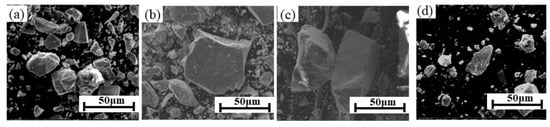
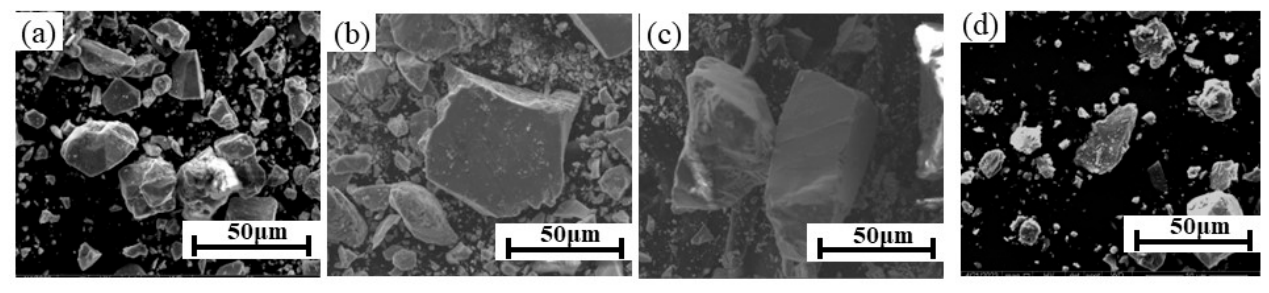
The microstructures of the four magnetite ores are shown in Figure 1. From Figure 1a–d, it is observed that the large particles of Ore A are coated with fine powder and exhibit relatively sharp edges and corners. Ore B has a loose structure, good dispersibility, and relatively uniform particle size compared to the other ores. Ore C features larger particles with smooth fracture surfaces. Ore D displays clear textures, distinct edges and corners, and evident mineral veins. Based on these observations, it can be concluded that Ore C has the poorest pelletizing performance.
Figure 1.
Microstructures of four types of iron ore powders for pellets. (a) Ore A; (b) Ore B; (c) Ore C; (d) Ore D.
3. Experimental Methods
Using the four iron ore concentrates (A, B, C, and D), fluxed pellets were prepared with controlled SiO2 contents ranging from 3.2% to 4.2% and a basicity of 1.18 ± 0.05. The experimental design is detailed in Table 4. Table 4 lists the target SiO2 values and the measured SiO2 contents determined by XRF analysis of the finished pellets.
Table 4.
Compositions of finished pellets under different SiO2-content blending schemes (%).
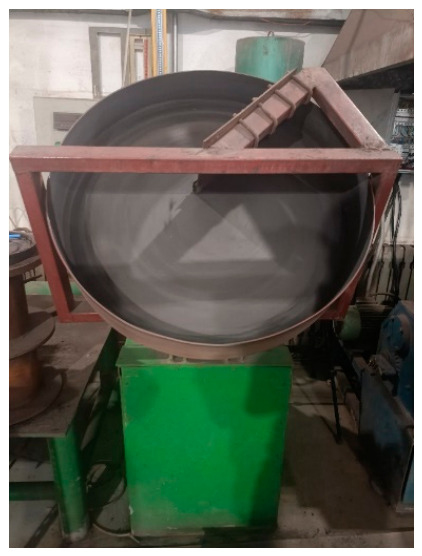
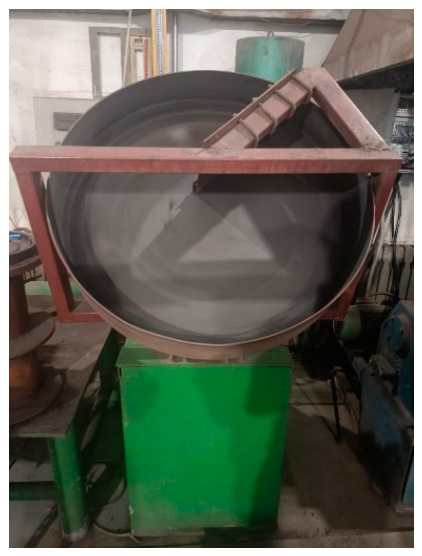
Pelletization was carried out in a disc pelletizer (φ1000 mm) (Jiangyin Nanzha Thermal Instrument Co., Ltd., Jiangyin, Jiangsu, China) operating at a rotation speed of 38 r/min and an inclination angle of 47°. An equipment photograph of the disc pelletizer is shown in Figure 2. Each batch trial processed approximately 5 kg of raw material mixture. The effects of concentrate properties, pelletization time (12, 16, and 25 min), hydrated lime ratio (5.69%, 6.54%, and 7.90%), and bentonite ratio (0.60%, 0.75%, and 0.90%) on green pellet properties were investigated. Green pellets of 10–12.5 mm were screened for drop strength, compressive strength, and moisture content.
Figure 2.
Equipment photograph of the disc pelletizer.
Drop strength was determined by allowing green pellets to fall freely from a height of 0.5 m onto a steel plate, and the number of drops until breakage was recorded. For each condition, 20 randomly selected green pellets (10–12.5 mm diameter) were tested, and the average value was reported. Green pellet compressive strength was measured using an MTS Criterion Model 43 universal testing machine (MTS Systems Corporation, Eden Prairie, MN, USA) equipped with a 50 N load cell. For each batch, 20 randomly selected green pellets were tested at room temperature with a crosshead speed of 5 mm/min, and the average value was reported.
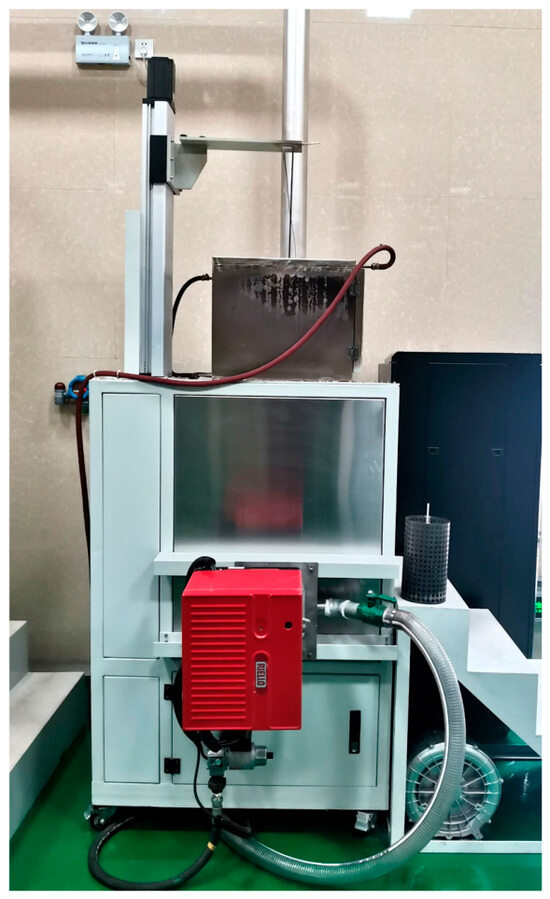
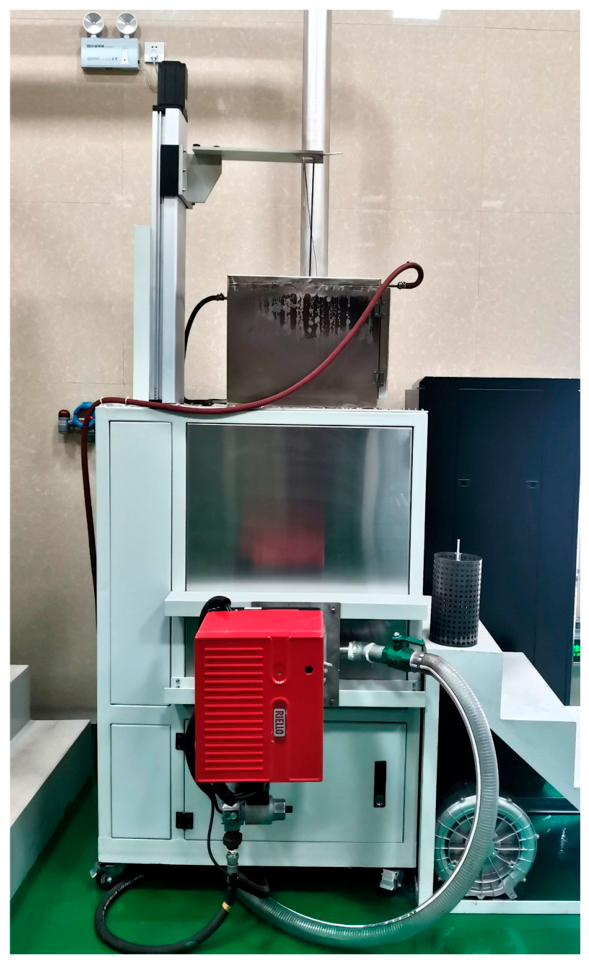
Green pellets with SiO2 contents of 3.2%, 3.6%, and 4.2% (corresponding to blends Nos. 2, 4, and 7 in Table 4, with measured SiO2 contents of 3.19%, 3.58%, and 4.21%, respectively) were subjected to roasting experiments that simulated the thermal regime of a grate-kiln system, comprising preheating, roasting, soaking, and cooling stages. An equipment photograph of the roasting system is shown in Figure 3. Each batch trial processed approximately 500 g of green pellets. A systematic experimental optimization was employed to examine the effects of preheating temperature (950, 1000, and 1050 °C), preheating time (10 and 15 min), roasting temperature (1215, 1230, 1245, 1260, and 1275 °C), roasting time (8, 10, and 12 min), soaking temperature (925, 950, 975, and 1000 °C), and soaking time (3, 4, and 5 min), with the aim of determining the optimal roasting regime.
Figure 3.
Equipment photograph of the roasting system (simulating grate-kiln process).
It should be noted that the preheating experiments at 900 °C (presented in Section 4.2.1) were conducted as a separate preliminary evaluation to investigate the effect of hydrated lime decomposition on preheating behavior, since 900 °C is not within the main experimental design range (950–1050 °C).
The compressive strength of fired pellets was determined according to ISO 4700:2015 [32] (Iron Ore Pellets for Blast Furnace and Direct Reduction Feedstocks—Determination of the Crushing Strength) using an MTS Criterion Model 43 universal testing machine equipped with a 50 kN load cell. For each batch, at least 60 randomly selected pellets (10–12.5 mm diameter) were tested at room temperature. The compressive strength was calculated as the maximum load (in N/pellet) recorded before fracture, using a crosshead speed of 15 mm/min. The average value was reported for each condition.
Reducibility (RI) was measured according to ISO 7215:2015 [33] under isothermal reduction conditions at 900 °C using a reducing gas mixture of 30% CO and 70% N2.
The low-temperature reduction degradation index (RDI) was determined according to ISO 13930:2015 [34]. Pellets were subjected to reduction at 550 °C in a gas mixture of 20% CO, 20% CO2, and 60% N2 for 60 min.
The reduction swelling index (RSI) was measured according to ISO 4698:2022 [35]. Pellets were reduced at 900 °C in a gas mixture of 40% CO and 60% N2 for 60 min.
For each metallurgical property, three independent batches were tested, with three replicate measurements per batch. The average value was reported for each condition.
In addition, scanning electron microscopy with energy dispersive X-ray spectroscopy (SEM-EDS, Zeiss Sigma 300, Carl Zeiss Microscopy GmbH, Jena, Germany) was employed to examine the microstructure and phase composition of the fired pellets. Mercury intrusion porosimetry (Micromeritics AutoPore IV 9500, Micromeritics Instrument Corporation, Norcross, GA, USA) was used to characterize the pore structure, including total porosity and pore size distribution. Thermal treatments (preheating, roasting, and soaking) were conducted in the roasting system shown in Figure 3, with a temperature control accuracy of ±5 °C and a heating rate of 10 °C/min.
4. Results and Discussion
4.1. Pelletizing Process of Medium-Silica Fluxed Pellets
4.1.1. Effect of Concentrate Properties on Green Pellet Quality
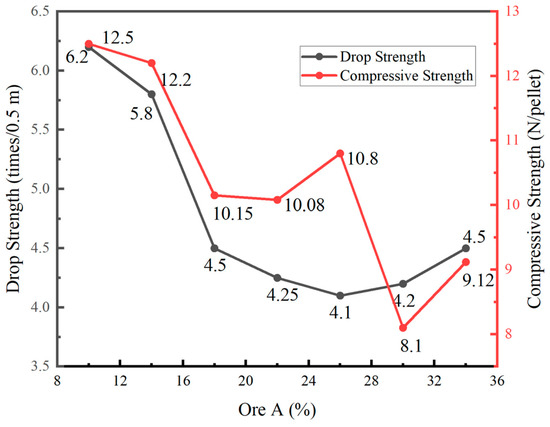
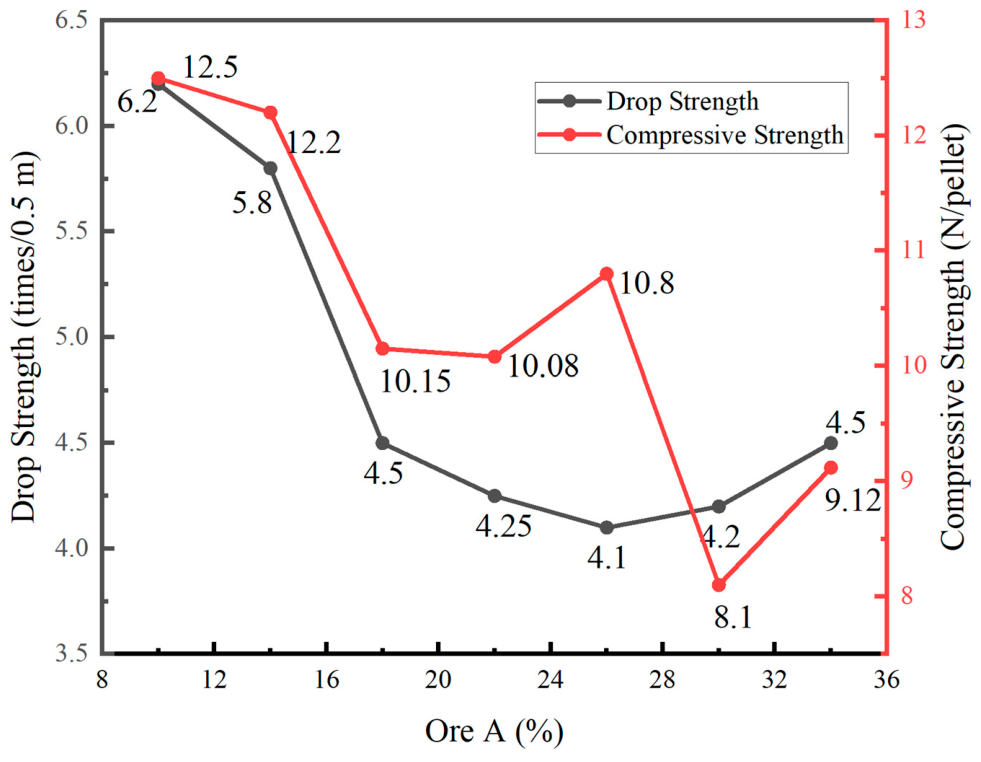
Figure 4 shows the effect of Ore A proportion on the drop strength and compressive strength of green pellets. As the proportion of Ore A increases from 14% to 34%, the drop strength first decreases from 5.8 to 4.1 times/0.5 m and then rises to 4.5 times/0.5 m, whereas the compressive strength declines from 12.2 to 9.12 N/pellet. Ore A has a high SiO2 content, which necessitates a greater addition of hydrated lime to maintain the basicity at 1.18. Hydrated lime possesses natural cementitious properties and excellent pelletizing characteristics, which help improve drop strength. However, Ore A also contains a high proportion of gangue minerals, and its particles have relatively sharp edges and corners, leading to poorer pelletizing performance. As the proportion of Ore A increases markedly, the overall pelletizing performance of the blended ore fines deteriorates, resulting in a decline in green pellet quality.
Figure 4.
Effect of Ore A blending ratio (and corresponding SiO2 content in the blend) on the drop strength and compressive strength of green pellets.
Based on the comprehensive evaluation of concentrate properties and green pellet quality, the optimal ore blending formulation was determined as 22% Ore A (Yanshan-series fines), 35% Ore B (Peruvian fines), 18% Ore C (finely ground South African fines), and 25% Ore D (high-silica Chilean fines). This formulation corresponds to blend No. 4 in Table 4, which achieved the best balance between green pellet strength and pelletizing performance.
4.1.2. Effect of Pelletizing Time
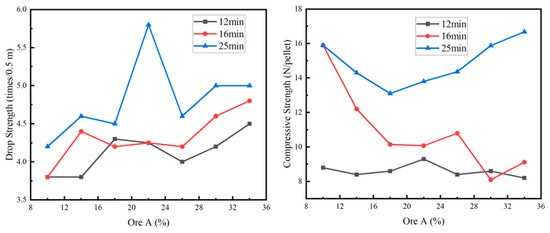
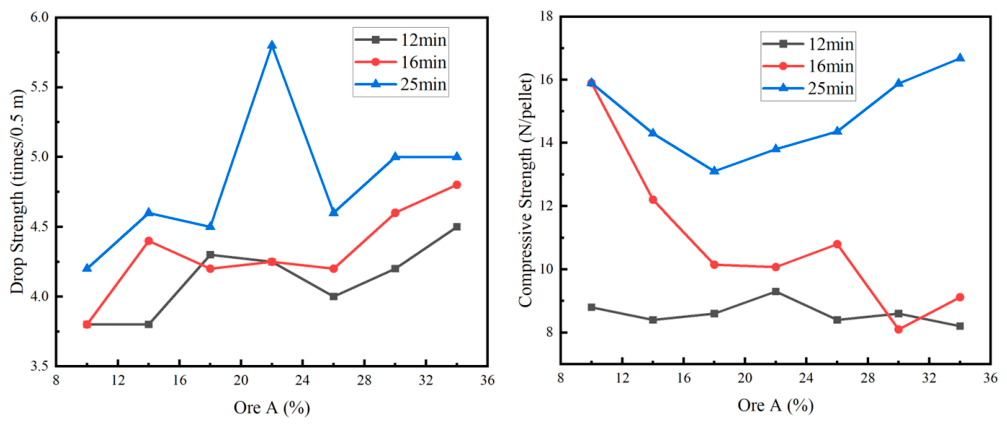
Figure 5 illustrates the influence of pelletizing time on green pellet properties using the optimal formulation (22% ore A, 35% ore B, 18% ore C, and 25% ore D) with 0.75% bentonite and a basicity of 1.18. At 12 min, the compressive strength was generally below 10 N/pellet, which is insufficient to meet the industrial requirement for green pellet handling. Extending the time to 16 min significantly improved the green pellet strength, achieving a compressive strength of 10.08 N/pellet and a drop strength of 4.25 times/0.5 m, meeting the industrial requirements. At 25 min, although the compressive strength further increased, the longer processing time significantly reduces production efficiency and increases energy consumption. Therefore, 16 min was chosen as the optimal pelletizing time, providing sufficient green pellet strength (≥10 N/pellet) while maintaining reasonable production efficiency.
Figure 5.
Effect of pelletizing time on the drop strength and compressive strength of green pellets.
4.1.3. Effect of Hydrated Lime Dosage
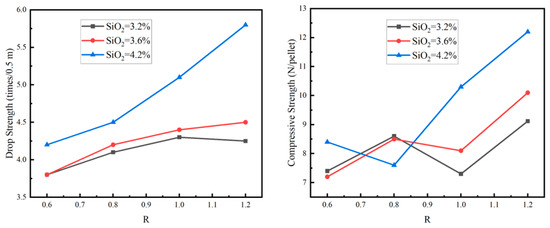
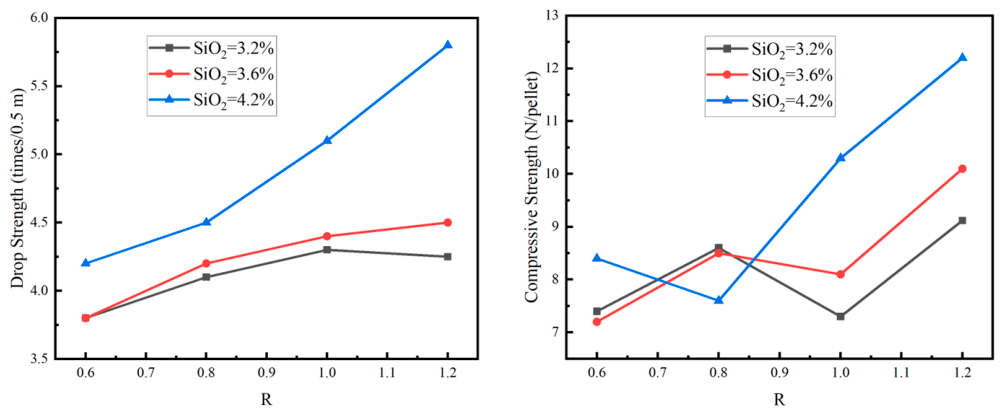
Figure 6 shows the effect of hydrated lime addition (basicity) on green pellet strength. For the same basicity of 1.18, the hydrated lime addition increases with increasing SiO2 content: 5.69% for 3.2% SiO2 (blend No. 2, 14% ore A), 6.54% for 3.6% SiO2 (blend No. 4, 22% ore A), and 7.90% for 4.2% SiO2 (blend No. 7, 34% ore A). These compositions are consistent with Table 4, where different mineral blends were used to achieve different target SiO2 contents. This reflects that higher SiO2 content requires more CaO to maintain the target basicity. Overall, both drop and compressive strengths generally increased with increasing hydrated lime addition, although the trend is not strictly monotonic due to the variations in SiO2 content and mineral blend. The primary phase of hydrated lime is Ca(OH)2, which acts as a binder during pelletization; thus, increasing its ratio generally improves green pellet performance (e.g., drop strength and compressive strength).
Figure 6.
Effects of hydrated lime addition and basicity on the drop strength and compressive strength of green pellets under different SiO2 contents.
4.1.4. Effect of Bentonite Dosage
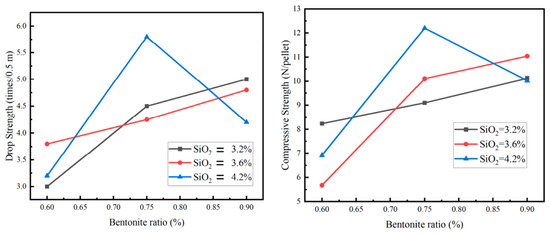
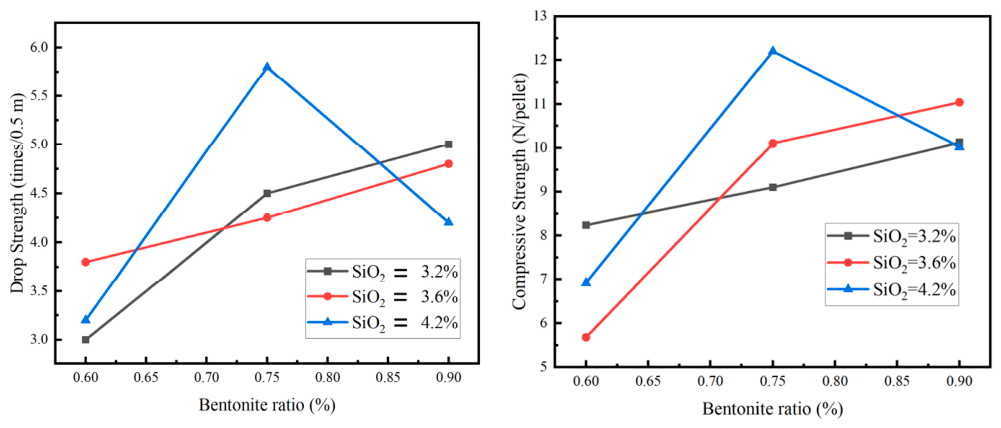
Figure 7 depicts the influence of bentonite ratio on green pellet strength. As the bentonite ratio increases from 0.60% to 0.90%, pellet performance first improves and then deteriorates. At lower ratios, increasing bentonite significantly enhances performance. This improvement is attributed to two factors: (i) bentonite’s high dispersibility optimizes the particle size distribution, reduces capillary diameter, and increases capillary forces; and (ii) after water absorption, bentonite forms colloidal particles that fill interparticle voids, enhancing molecular bonding forces. However, since bentonite is primarily SiO2, excessive addition lowers the fired pellet grade and slows green pellet growth, leading to performance deterioration.
Figure 7.
Effect of bentonite ratio on the drop strength and compressive strength of green pellets.
4.2. Study on the Preheating Process of Medium-Silica Fluxed Pellets
4.2.1. Effect of SiO2 Content on Preheated Pellet Strength
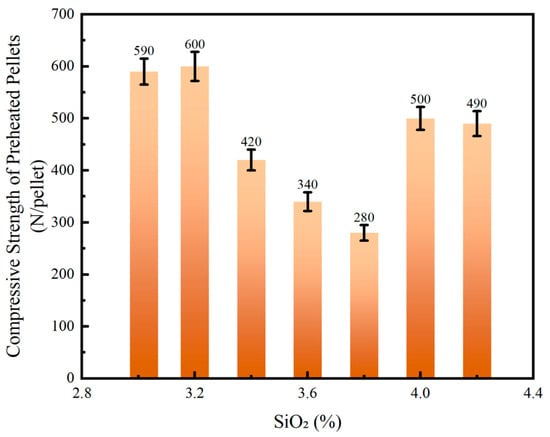
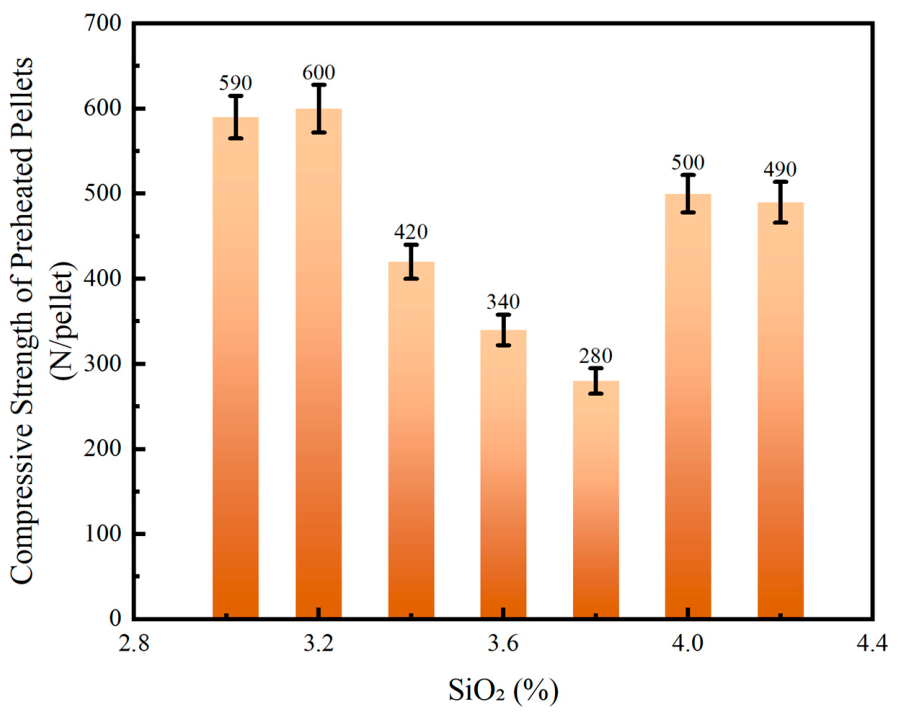
Figure 8 illustrates the effect of SiO2 content on preheated pellet strength at a preheating temperature of 900 °C for 10 min in air. The preheated pellet strength initially decreases as SiO2 content increases from 3.0% to approximately 3.7% but then shows some recovery at higher SiO2 contents (4.0–4.2%). This non-monotonic behavior suggests that the effect of SiO2 content on preheated strength is not simply linear. In this study, hydrated lime was used as the calcium-based flux. Hydrated lime is a high-melting-point material that undergoes endothermic decomposition at elevated temperatures, thereby raising the onset temperature of oxidation and crystal bonding in medium-silica fluxed pellets. Therefore, raising the preheating temperature appropriately is necessary to ensure adequate preheated pellet strength. Similar preheating requirements have been reported in studies on high-silica fluxed pellets, where higher preheating temperatures were found to promote oxidation and crystal bonding [13].
Figure 8.
Effect of SiO2 content on the strength of preheated pellets.
4.2.2. Effect of Preheating Regime
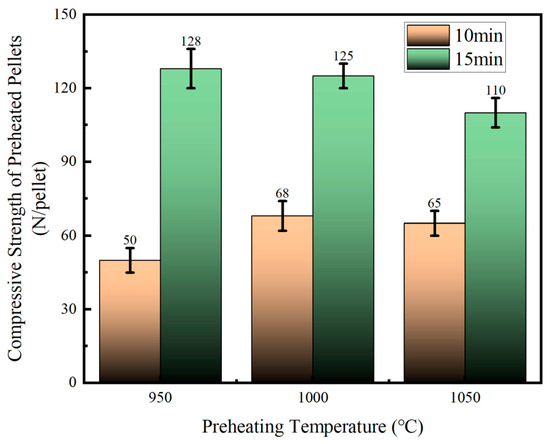
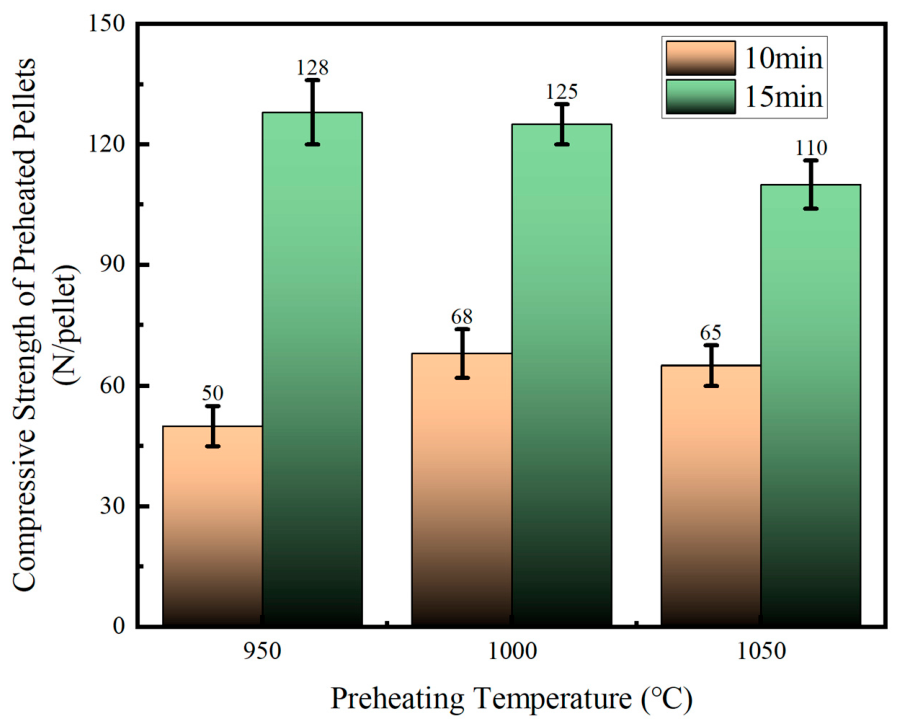
To further investigate factors affecting preheated pellet performance, the effects of preheating temperature and time were examined at different SiO2 levels. Figure 9 shows the effects of preheating temperature and time on preheated pellet strength. At a preheating time of 10 min, the strength increased from 50 N/pellet at 950 °C to 68 N/pellet at 1000 °C and then slightly decreased to 65 N/pellet at 1050 °C. At a preheating time of 15 min, the strength decreased from 128 N/pellet at 950 °C to 125 N/pellet at 1000 °C and further to 110 N/pellet at 1050 °C. These results indicate that 1000 °C is a favorable preheating temperature for achieving adequate pellet strength. Higher temperatures facilitate complete oxidation of magnetite to hematite and promote the initiation of oxidation and crystal bonding; however, excessively high preheating temperatures may lead to over-sintering and reduced strength.
Figure 9.
Effects of preheating temperature and time on the strength of preheated pellets.
4.3. Study on the Roasting Process of Medium-Silica Fluxed Pellets
4.3.1. FactSage Calculation of Liquid Phase
FactSage 8.2 thermochemical software with the FToxide database was used to calculate the liquid phase formation temperature and liquid phase content. The input compositions were based on the seven ore blending schemes listed in Table 5. The calculations were performed under equilibrium conditions at 1 atm with an oxidizing atmosphere (pO2 = 0.21 atm). The selected solution phases included slag, spinel, and olivine. The temperature at which the first liquid appears is referred to as the solidus or incipient melting temperature. To compare the relative liquid-forming tendencies of different formulations, liquid fractions were calculated at 1300 °C as a reference temperature.
Table 5.
Liquid phase formation temperatures and liquid phase contents under different ore blending schemes.
Liquid phase compositions and contents for each formulation were determined using FactSage calculations. The TFe and SiO2 values in Table 5 are consistent with the measured values reported in Table 4. As the SiO2 content increased, the solidus temperature (incipient melting temperature) under equilibrium conditions rose from 1279.81 °C (at 3.02% SiO2) to a peak of 1281.01 °C (at 3.43% SiO2) and then decreased to 1280.68 °C (at 4.21% SiO2). Concurrently, the liquid phase content at 1300 °C increased from 10.96% to 15.91%. For medium-silica fluxed pellets (typically with SiO2 content of 3–5%), it is necessary to control an appropriate amount of liquid phase, which not only balances consolidation strength and permeability, ensuring sufficient bonding of ore particles, but also avoids excessive softening and adhesion, so as to meet the metallurgical performance requirements for blast furnace smelting.
The increase in liquid phase content with increasing SiO2 content (from 10.96% to 15.91%) at the reference temperature of 1300 °C is attributed to the reactions of SiO2 with CaO and Fe2O3 to form low-melting-point phases, including calcium silicates, ferrites, and slag phases. The calculated solidus temperature (the temperature at which the first liquid appears) is approximately 1280 °C, which is slightly higher than the experimental roasting temperatures (1215–1275 °C). Therefore, the liquid fraction results at 1300 °C are presented as a thermodynamic comparison of the relative liquid-forming tendencies of different compositions. The actual formation of liquid phase under the experimental roasting conditions may be facilitated by non-equilibrium effects, the presence of impurities, and local compositional variations within the pellets. Thus, the occurrence of liquid-assisted consolidation below the calculated solidus is discussed as a possible interpretation rather than a confirmed mechanism.
It should be noted that the FactSage calculations were performed at 1300 °C as a reference temperature to compare the liquid phase contents of different formulations. The actual roasting experiments were conducted at lower temperatures (1215–1275 °C) to identify the optimal thermal regime for each composition. Although the calculated solidus temperature is approximately 1280 °C, this does not contradict the experimental roasting temperatures (1215–1275 °C) because (1) the calculations represent equilibrium conditions, whereas roasting is a non-equilibrium process; (2) the presence of fluxes and impurities can lower the effective melting temperature; and (3) local compositional variations within pellets can initiate liquid formation at temperatures below the bulk solidus.
4.3.2. Effect of SiO2 Content on Finished Pellets
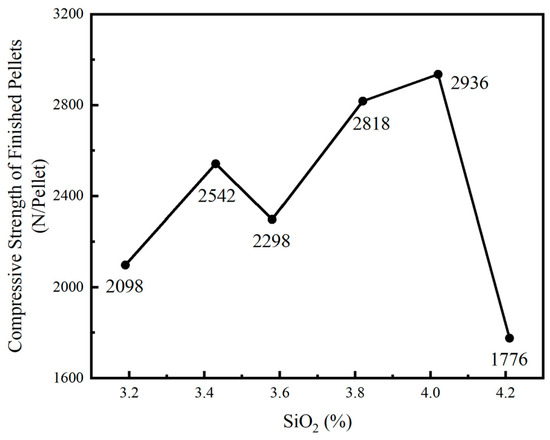
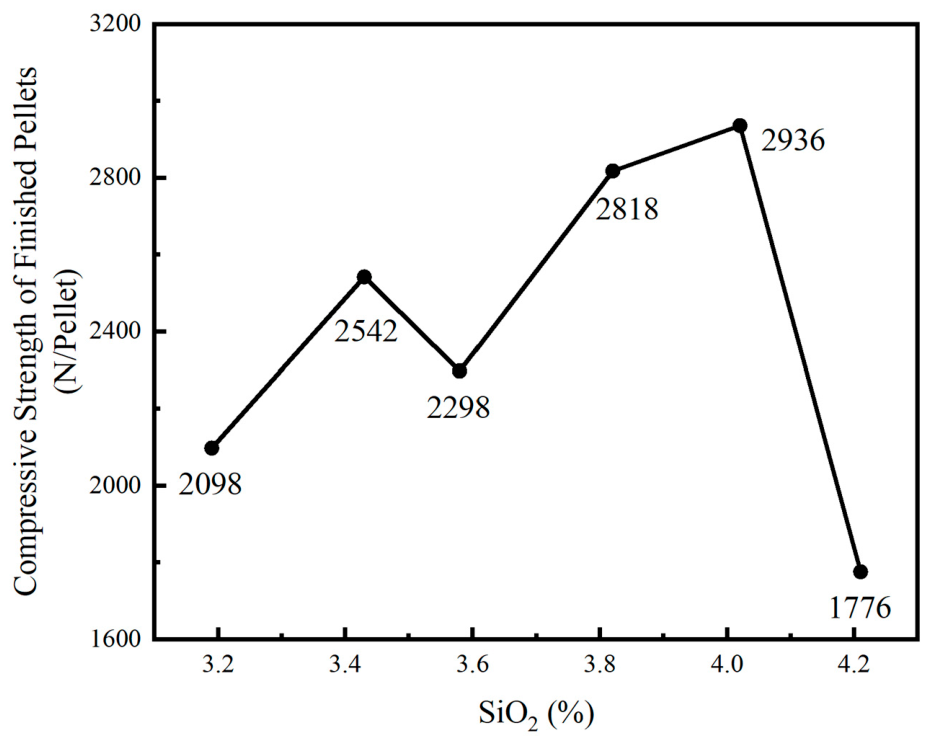
(1) Strength—Figure 10 shows the compressive strength of finished pellets as a function of SiO2 content under a fixed roasting regime (preheating at 1050 °C for 15 min, roasting at 1260 °C for 10 min, and soaking at 1000 °C for 3 min). Under this fixed regime, the maximum compressive strength was observed at approximately 4.0% SiO2, not at 3.6% SiO2. However, it should be noted that the roasting regime was not optimized for each SiO2 content in this fixed-regime test. Through systematic regime optimization for each SiO2 amount (summarized in Table 6), the highest overall compressive strength of 4117 N/pellet was achieved at 3.6% SiO2 (blend No. 4) under the optimized roasting conditions (preheating at 1000 °C for 10 min in air and roasting at 1260 °C for 10 min in air). Thus, 3.6% SiO2 is selected as the overall optimum based on the combination of optimized roasting conditions and the best balance between mechanical strength and metallurgical performance.
Figure 10.
Effect of SiO2 content on the compressive strength of finished pellets.
Table 6.
Effect of roasting regime on the properties of finished pellets.
The initial increase from 3.2% to 3.6% SiO2 is attributed to the formation of an appropriate amount of calcium ferrite liquid phase, which promotes hematite crystallization, grain growth, and solid-phase bonding, thereby enhancing compressive strength; this is consistent with previous studies on fluxed pellets [10,14,21]. However, at 4.2% SiO2, the excessive liquid phase leads to over-softening; moreover, the increased SiO2 content reacts with calcium ferrite to form CaSiO3 glassy phases, which are detrimental to strength, and the excess liquid disperses between Fe2O3 particles, inhibiting further grain growth and increasing porosity. These combined factors result in the observed strength reduction.
The optimal SiO2 content of 3.6% identified in this study is consistent with the findings of Umadevi et al. [14], who reported that appropriate CaO addition promotes liquid phase formation and enhances compressive strength. However, our quantitative finding that a further increase to 4.2% SiO2 leads to a ~10.7% strength reduction (from 4117 to 3675 N/pellet under the optimized roasting regime) due to CaSiO3 glassy phase formation providing new mechanistic insights not previously reported for medium-silica fluxed pellets.
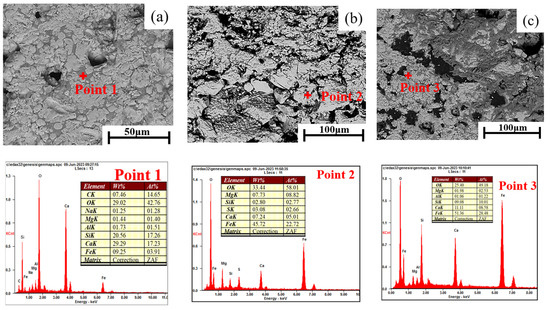
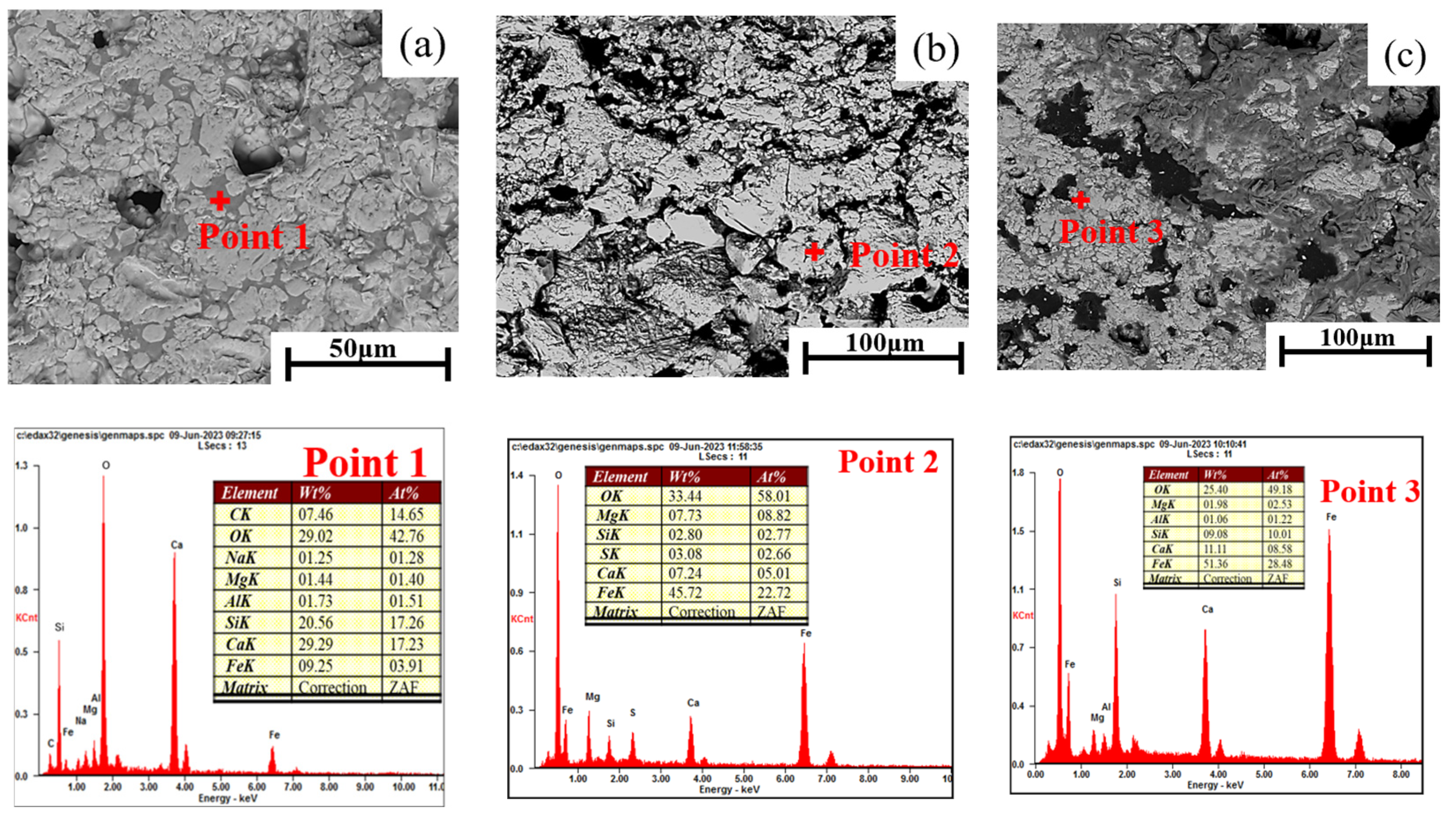
(2) Mineralogical structure—Figure 11 shows the mineral phase evolution. At 3.6% SiO2, EDS point analysis shows a region enriched in Fe, Ca, and O with low Si content, and its elemental composition is consistent with calcium ferrite; combined with SEM morphology, FactSage calculations, and previous studies, this region is interpreted as a calcium ferrite-type bonding phase. At 4.2% SiO2, EDS shows coexisting Fe–Ca–O-rich and Si-rich regions, which is interpreted as the coexistence of ferrite-type and silicate-type phases.
Figure 11.
Effect of SiO2 content on the mineral phase structure of the finished pellets: (a) 3.2% SiO2, (b) 3.6% SiO2, and (c) 4.2% SiO2; EDS spectra of points 1, 2, and 3. Point 1 is located in a Si-rich region of the 3.2% SiO2 pellet, showing Ca and Si as the main components with relatively low Fe content, which is consistent with a silicate phase. Point 2 is located in a Fe-rich region of the 3.6% SiO2 pellet, showing strong Fe, Ca, and O peaks, consistent with a calcium ferrite-type phase. Point 3 is located in a region of the 4.2% SiO2 pellet, showing Fe, Ca, and O peaks but also containing a noticeable amount of Si. While the EDS results are consistent with the presence of calcium ferrite and silicate phases, SEM-EDS point analysis alone cannot unequivocally confirm exact phase compositions or demonstrate that a region was previously liquid or glassy. Therefore, phase assignments are presented as interpretations consistent with the EDS data, and ‘silicate phases (possibly including glassy components)’ is used to reflect the uncertainty regarding glass formation.
Increasing SiO2 from 3.2% to 3.6% enhances strength through two mechanisms: (i) increased calcium ferrite content directly improves strength, and (ii) the ferrite liquid phase promotes densification, iron atom diffusion, Fe2O3 recrystallization, and solid phase bonding. However, a further increase in SiO2 leads to the displacement of Fe2O3 in calcium ferrite (CaO·Fe2O3) by SiO2, forming CaSiO3, which reduces calcium ferrite content and increases the proportion of silicate phases (possibly including glassy components) that are detrimental to strength.
4.3.3. Effect of Roasting Regime
For different SiO2 contents, the roasting regime must be adjusted to control liquid phase formation and ensure adequate strength. Table 6 summarizes the effects of roasting conditions for pellets with 3.2%, 3.6%, and 4.2% SiO2. When SiO2 increases from 3.2% to 3.6%, the roasting temperature can be reduced from 1260 to 1230 °C, and the roasting time can be shortened from 10 to 8 min. This reduction in roasting temperature and time is possible because the moderate increase in SiO2 content (from 3.2% to 3.6%) promotes the reaction of SiO2 with CaO and Fe2O3 to form calcium ferrite liquid phases, which lowers the effective melting temperature of the system and enables sufficient liquid phase formation at lower temperatures and shorter times. Therefore, at 3.6% SiO2, appropriate liquid phase formation can be achieved at a lower roasting temperature and shorter roasting time. When SiO2 further increases to 4.2%, maintaining the roasting temperature at 1230 °C while properly extending the roasting time (from 8 to 10 min) enhances the strength of the roasted pellets. Extending the roasting time is necessary to compensate for the increased liquid phase amount associated with higher SiO2 content, ensuring sufficient recrystallization and consolidation.
The systematic experimental optimization described in Section 3 was used to investigate the effects of preheating temperature (950–1050 °C), preheating time (10–15 min), roasting temperature (1215–1275 °C), roasting time (8–12 min), soaking temperature (925–1000 °C), and soaking time (3–5 min). The results in Figure 10 were obtained under a fixed roasting regime (preheating at 1050 °C for 15 min, roasting at 1260 °C for 10 min, and soaking at 1000 °C for 3 min) to reveal the intrinsic effect of SiO2 content on compressive strength. The optimal roasting conditions for each SiO2 content were determined from the orthogonal experiments and are summarized in Table 6.
4.4. Study on the Metallurgical Properties of Medium-Silica Fluxed Pellets
The porosity, reducibility (RI), low-temperature reduction degradation index (RDI), and reduction swelling index (RSI) of pellets with different SiO2 contents are presented in Table 7. As SiO2 increased from 3.2% to 4.2%, porosity increased from 19.35% to 25.15%, RI increased from 84.13% to 91.31%, RDI+3.15 decreased slightly from 94.86% to 93.95%, and RSI increased from 12.32% to 17.58%, indicating generally favorable metallurgical performance. The increased SiO2 leads to more liquid phase formation, which hinders solid-state bonding between Fe2O3 grains, resulting in increased total porosity from 19.35% to 25.15%. However, the average pore diameter decreased from 8.05 μm to 3.91 μm, indicating that the pore structure becomes finer (more numerous but smaller pores) with increasing SiO2 content. This change in pore size distribution is attributed to the formation of excessive liquid phase at higher SiO2 contents during roasting at 1230–1260 °C, which fills larger pores while creating finer interconnected voids upon cooling. The increased total porosity allows for better contact with reducing gases, enhancing the reduction degree and improving RI. However, it also causes a slight deterioration in the RDI+3.15 and an increase in the RSI.
Table 7.
Metallurgical performance tests of pellets with different SiO2 contents.
Among the three SiO2 contents investigated, the pellets with 3.6% SiO2 exhibited the best overall metallurgical performance. Although the 4.2% SiO2 pellets showed higher RI (91.31%) and higher porosity (25.15%), their RSI (17.58%) exceeded the acceptable limit for blast furnace operation according to the Chinese national standard GB/T 27692-2024 (typically ≤15%). The 3.6% SiO2 pellets achieved a balanced combination of properties: RI of 88.03%, RDI+3.15 of 94.04%, and RSI of 14.20%, all of which meet the standard requirements (RI ≥ 80%, RDI+3.15 ≥ 85%, and RSI ≤ 15%). This balanced performance is attributed to the formation of an appropriate amount of calcium ferrite liquid phase during roasting (as discussed in Section 4.3.2), which promotes hematite grain growth and densification while avoiding the excessive porosity and glassy phase formation that occur at 4.2% SiO2.
According to the Chinese national standard GB/T 27692-2024 Iron Ore Pellets for Blast Furnace, the typical requirements for fluxed iron ore pellets in stable blast furnace operation are RI ≥ 80%, RDI+3.15 ≥ 85%, and RSI ≤ 15%. The pellets with 3.6% SiO2 obtained in this study achieved RI of 88.03%, RDI+3.15 of 94.04%, and RSI of 14.20%, all of which meet the requirements of GB/T 27692-2024.
The porosity increase from 19.35% to 25.15% with increasing SiO2 is consistent with the findings of Li et al. [25] and recent studies on fluxed pellets [16,26], which reported that higher SiO2 content leads to more liquid phase formation and increased porosity in magnesia fluxed pellets. However, our study quantitatively establishes the relationship between porosity, liquid phase content, and metallurgical properties specifically for medium-silica fluxed pellets, providing a more comprehensive understanding for this system.
5. Conclusions
Through systematic experimental investigation and theoretical analysis, this study has conducted an in-depth exploration of the preparation process and metallurgical properties of medium-silica fluxed pellets. The main conclusions are as follows:
- (1)
- Optimal pelletizing performance was achieved with the raw material formulation: 22% ore A, 35% ore B, 18% ore C, and 25% ore D, with 6.54% hydrated lime and 0.75% bentonite. Under optimized pelletizing conditions (basicity of 1.18 and pelletizing time of 16 min), the green pellets at 3.6% SiO2 exhibited a drop strength of 4.25 times/0.5 m and a compressive strength of 10.08 N/pellet, meeting industrial production requirements.
- (2)
- Process optimization showed that the highest-quality green pellets were obtained with the optimal formulation (22% ore A, 35% ore B, 18% ore C, and 25% ore D), 6.54% hydrated lime, 0.75% bentonite, basicity of 1.18 ± 0.05, and pelletizing time of 16 min. A thermal regime consisting of preheating at 1000 °C for 10 min in air followed by roasting at 1230–1245 °C for 8–10 min in air ensured a finished pellet compressive strength of ≥2500 N/pellet.
- (3)
- SiO2 content significantly influenced pellet performance. At 3.6% SiO2 (blend No. 4, 22% ore A), a suitable amount of calcium ferrite liquid phase formed, promoting hematite grain growth and yielding the highest compressive strength of 4117 N/pellet under the optimized roasting regime. At 4.2% SiO2, excessive formation of silicate phases (possibly including glassy components) reduced strength, and the excessive liquid phase increased porosity, resulting in an approximately 10.7% decrease in strength (from 4117 to 3675 N/pellet).
- (4)
- Metallurgical performance tests indicated that pellets with 3.6% SiO2 exhibited the best overall properties, with RI of 88.03%, RDI+3.15 of 94.04%, and RSI of 14.20%. According to the Chinese national standard GB/T 27692-2024 Iron Ore Pellets for Blast Furnace, the typical requirements for fluxed iron ore pellets in stable blast furnace operation are RI ≥ 80%, RDI+3.15 ≥ 85%, and RSI ≤ 15%. The pellets obtained in this study meet these industrial requirements.
- (5)
- From a practical application perspective, the optimized scheme (22% Ore A, 35% Ore B, 18% Ore C, and 25% Ore D; 6.54% hydrated lime; 0.75% bentonite; basicity 1.18 ± 0.05; pelletizing time 16 min) combined with the recommended thermal regime (preheating at 1000 °C for 10 min in air and roasting at 1230–1245 °C for 8–10 min in air) provides a basis for industrial production of medium-silica fluxed pellets. This scheme enables greater use of high-silica iron ore fines (SiO2 > 6%) while maintaining a finished pellet compressive strength of ≥2500 N/pellet and metallurgical indices meeting GB/T 27692-2024. The key practical implication is that industrial production should control liquid phase formation by jointly optimizing SiO2 content, basicity, and roasting temperature, with 3.6% SiO2 recommended as the target for industrial trials. Future studies will focus on industrial-scale validation of these parameters and the long-term performance of such pellets in commercial blast furnace operations.
Author Contributions
Conceptualization, C.Z., Z.Z., and Z.L.; methodology, C.Z., J.Z., Z.Z., Y.W., and Z.L.; investigation, C.Z. and Z.Z.; resources, J.Z., Y.W., and Z.L.; data curation, C.Z. and Z.Z.; writing—original draft preparation, C.Z. and Z.Z.; writing—review and editing, J.Z., Y.W., and Z.L.; visualization, C.Z. and Z.Z.; supervision, J.Z. and Z.L.; project administration, J.Z., Y.W., and Z.L.; funding acquisition, Y.W. and Z.L. All authors have read and agreed to the published version of the manuscript.
Funding
This research was funded by the National Natural Science Foundation of China (52574368), the Young Elite Scientists Sponsorship Program by CAST (YESS20230029), the National Natural Science Foundation of China (52174291), the National Natural Science Foundation of China (52204335), the National Natural Science Foundation of China (52374319), and the National Youth Talent Support Program (GJRC2023008).
Data Availability Statement
The original contributions presented in this study are included in the article. Further inquiries can be directed to the corresponding authors.
Acknowledgments
The authors sincerely thank the editor and reviewers for their valuable comments.
Conflicts of Interest
The authors declare no conflicts of interest.
References
- Ma, L. Study on Liquid Phase Formation and Crystallization Mechanism of Medium-High Silica Fluxed Pellets. Doctoral Dissertation, University of Science and Technology Beijing, Beijing, China, 2025. [Google Scholar]
- Chen, X.; Lin, W.; Li, C.; Huang, Y.; Wang, B.; Lu, S.; Chen, S.; Wang, W. Mineral phase structure evolution during the roasting process of magnesia fluxed pellets. Metall. Mater. Trans. B 2025, 56, 3604–3616. [Google Scholar] [CrossRef] [Scilit]
- Wang, X.; Zhang, W.; Gao, B.; Pan, J. Development and application of large belt-type pellet roasting machine. Iron Steel 2025, 60, 26–35. [Google Scholar]
- Jin, X.W.Y. Prospect on High Ratio Pellet Utilized in Blast Furnace under the Background of Carbon Peaking and Carbon Neutrality. Chin. J. Process Eng. 2022, 22, 1379. [Google Scholar]
- Zhang, J.; Shen, J.; Xu, L.; Zhang, Q. The CO2 Emission Reduction Path towards Carbon Neutrality in the Chinese Steel Industry: A Review. Environ. Impact Assess. Rev. 2023, 99, 107017. [Google Scholar] [CrossRef] [Scilit]
- Chen, M.; Zhou, H.; Wang, C.; Xing, Y.; Zhang, W.; Kou, M.; Wu, S. Influence of Blast Furnace Pellet Proportions on Environmental Impact and Global Warming: A Life Cycle Assessment. Fuel 2025, 381, 133571. [Google Scholar] [CrossRef] [Scilit]
- Guo, Y.; Liu, K.; Chen, F.; Wang, S.; Zheng, F.; Yang, L.; Liu, Y. Effect of basicity on the reduction swelling behavior and mechanism of limestone fluxed iron ore pellets. Powder Technol. 2021, 393, 291–300. [Google Scholar] [CrossRef] [Scilit]
- Fan, X.; Xie, L.; Gan, M.; Chen, X.; Yuan, L. Roasting characteristics and consolidation strengthening mechanism of high-magnesium pellets. J. Cent. South Univ. (Sci. Technol.) 2013, 44, 449–455. [Google Scholar]
- Gan, M.; Fan, X.; Chen, X.; Yuan, L.; Jiang, T.; Zhao, Z. Application of calcium and magnesium additives in oxidized pellets. J. Cent. South Univ. (Sci. Technol.) 2010, 41, 1645–1651. [Google Scholar]
- Jiang, T.; Fan, X.; Li, G. Theory and technology of fluxed pellet production. In Proceedings of the 2014 National Ironmaking Technology Conference, Zhengzhou, China, 9–11 April 2014; Volume 1, pp. 109–117. [Google Scholar]
- Fan, X.; Gan, M.; Jiang, T.; Yuan, L.; Chen, X. Influence of flux additives on iron ore oxidized pellets. J. Cent. South Univ. Technol. 2010, 17, 732–737. [Google Scholar] [CrossRef] [Scilit]
- Zhou, M.; Tang, F.; Zhao, D.; Yang, X.; Wang, J.; Li, J. Experimental study on the addition of magnesia flux and new bentonite in pellets. Iron Steel 2018, 53, 15–19. [Google Scholar]
- Zhang, Y.; Chen, X.; Su, Z.; Liu, S.; Chen, F.; Wu, N.; Jiang, T. Improving properties of fluxed iron ore pellets with high-silica by regulating liquid phase. J. Iron Steel Res. Int. 2021, 29, 1381–1392. [Google Scholar] [CrossRef] [Scilit]
- Umadevi, T.; Kumar, P.; Lobo, N.; Prabhu, M.; Mahapatra, P.B.; Ranjan, M. Influence of pellet basicity (CaO/SiO2) on iron ore pellet properties and microstructure. ISIJ Int. 2011, 51, 14–20. [Google Scholar] [CrossRef] [Scilit]
- Panigrahy, S.; Jena, B.; Rigaud, M. Characterization of bonding and crystalline phases in fluxed pellets using peat moss and bentonite as binders. Metall. Trans. B 1990, 21, 463–474. [Google Scholar] [CrossRef] [Scilit]
- Dwarapudi, S.; Ghosh, T.; Shankar, A.; Tathavadkar, V.; Bhattacharjee, D.; Venugopal, R. Effect of pellet basicity and MgO content on the quality and microstructure of hematite pellets. Int. J. Miner. Process. 2011, 99, 43–53. [Google Scholar] [CrossRef] [Scilit]
- Gao, Q.; Jiang, X.; Zheng, H.; Shen, F. Induration process of MgO flux pellet. Minerals 2018, 8, 389. [Google Scholar] [CrossRef] [Scilit]
- Gao, Q.; Jiang, X.; Wei, G.; Shen, F. Effects of MgO on densification and consolidation of oxidized pellets. J. Cent. South Univ. 2014, 21, 877–883. [Google Scholar] [CrossRef] [Scilit]
- Yang, Z.; Liu, Z.; Chu, M.; Gao, L.; Feng, C.; Tang, J. Effect of basicity on metallurgical properties of fluxed pellets with high MgO content. ISIJ Int. 2021, 61, 1431–1438. [Google Scholar] [CrossRef] [Scilit]
- Dwarapudi, S.; Ranjan, M. Influence of oxide and silicate melt phases on the RDI of iron ore pellets suitable for shaft furnace of direct reduction process. ISIJ Int. 2010, 50, 1581–1589. [Google Scholar] [CrossRef] [Scilit]
- Qiao, H.; Zhang, J.; Wang, Y.; Xu, C.; Liu, Z. Production practice and development trend of calcareous fluxed pellets at home and abroad. J. Iron Steel Res. 2021, 33, 1031–1039. [Google Scholar]
- Ma, L.; Zhang, J.; Wang, Y.; Lu, M.; Cai, Q.; Xu, C.; Li, Z.; Liu, Z. Phase Transition Mechanism of High-Silica Fluxed Pellets during Consolidation. Ironmak. Steelmak. 2023, 50, 637–647. [Google Scholar] [CrossRef] [Scilit]
- Ma, C.; An, G.; Guo, H.; Liu, S.; Gu, D.; Dong, X.; Wang, J. Practice of smelting with ultra-high proportion of basic pellets in Jingtang 5500 m3 blast furnace. Ironmaking 2024, 43, 16–20. [Google Scholar]
- Yi, L.; Li, Y.; Li, J.; Jiang, L.; Xie, Y. Effect of calcium-magnesium fluxes on pellets with high hematite ratio. Sinter. Pelletizing 2021, 46, 57–62+88. [Google Scholar]
- Li, J.; Xin, Z.; Liu, W.; Yang, A.; Liu, L.; Zhang, W. Effect of SiO2 content on properties of magnesia fluxed pellets. Sinter. Pelletizing 2017, 42, 23–27. [Google Scholar]
- Ni, J.; Shi, X.; Bai, C.; Zhang, Y.; Liu, L.; Xiao, H. Compressive strength and microstructure analysis of fluxed pellets during mineralization process. Iron Steel 2024, 59, 36–43. [Google Scholar]
- Pan, X.; Long, Y.; Xu, C.; Ma, B.; Dou, G.; Zhao, B. Study on effect of basicity and roasting temperature on compressive strength of pellets. Iron Steel Vanadium Titan. 2017, 38, 88–93. [Google Scholar]
- Wang, Y.; Hu, Q. Analysis of low-temperature reduction degradation of fluxed pellets. Sinter. Pelletizing 2024, 49, 70–76. [Google Scholar]
- Wang, Z.; Chu, M.; Tang, J.; Xue, X. Effect of reducing atmosphere and gangue composition on reduction swelling of oxidized pellets. J. Northeast. Univ. (Nat. Sci.) 2012, 33, 94–97+102. [Google Scholar]
- Wang, H.; Sohn, H. Effect of CaO and SiO2 on swelling and iron whisker formation during reduction of iron oxide compact. Ironmak. Steelmak. 2011, 38, 447–452. [Google Scholar] [CrossRef] [Scilit]
- GB/T 27692-2024; Iron Ore Pellets for Blast Furnace. Standards Press of China: Beijing, China, 2024.
- ISO 4700:2015; Iron Ore Pellets for Blast Furnace and Direct Reduction Feedstocks—Determination of the Crushing Strength. International Organization for Standardization: Geneva, Switzerland, 2015.
- ISO 7215:2015; Iron Ores for Blast Furnace Feedstocks—Determination of the Reducibility by the Final Degree of Reduction Index. International Organization for Standardization: Geneva, Switzerland, 2015.
- ISO 13930:2015; Iron Ores for Blast Furnace Feedstocks—Determination of Low-Temperature Reduction-Disintegration Indices by Dynamic Method. International Organization for Standardization: Geneva, Switzerland, 2015.
- ISO 4698:2022; Iron Ore Pellets for Blast Furnace Feedstocks—Determination of the Free-Swelling Index. International Organization for Standardization: Geneva, Switzerland, 2022.

Disclaimer/Publisher’s Note: The statements, opinions and data contained in all publications are solely those of the individual author(s) and contributor(s) and not of MDPI and/or the editor(s). MDPI and/or the editor(s) disclaim responsibility for any injury to people or property resulting from any ideas, methods, instructions or products referred to in the content. |
© 2026 by the authors. Licensee MDPI, Basel, Switzerland. This article is an open access article distributed under the terms and conditions of the Creative Commons Attribution (CC BY) license.