Article

Corrosion Response of Co-6Ti-11V-9Cr Alloy in Acidic Chloride Solutions

1
The Guangzhu Electric Power Co., Ltd., Zhuhai SEZ, Zhuhai 519060, China
2
Luoyang Shuangrui Wanji Titanium Industry Co., Ltd., Luoyang 471832, China
3
School of Materials Science and Engineering, Jiangsu University of Science and Technology, Zhenjiang 212100, China
*
Author to whom correspondence should be addressed.
Metals 2026, 16(9), 1024; https://doi.org/10.3390/met16091024
Submission received: 31 July 2026 / Revised: 11 September 2026 / Accepted: 14 September 2026 / Published: 15 September 2026

Abstract

The corrosion response of a Co-6Ti-11V-9Cr superalloy was investigated in 0.05 mol/L H2SO4 containing 0, 0.01, 0.1 or 0.5 mol/L NaCl. Open-circuit potential (OCP), electrochemical impedance spectroscopy (EIS), potentiodynamic polarisation, scanning electron microscopy (SEM) and electrochemical noise (EN) analysis were combined to determine how chloride concentration affects passive-film stability and localised corrosion. Increasing the NaCl concentration shifted both the OCP and corrosion potential in the negative direction. The fitted resistance of the barrier layer decreased from 4.61 × 10⁴ to 0.39 × 10⁴ Ω cm2, whereas the passive current density increased from 4.58 × 10⁻⁶ to 1.78 × 10⁻⁵ A cm−2. SEM and EN analyses further showed that chloride enrichment promoted local passive-film breakdown, changing the surface response from relatively uniform corrosion to localised attack and pitting. These findings provide an experimental basis for assessing Co-Ti-V-based superalloys in acidic chloride-containing service environments.

1. Introduction

Superalloys retain structural stability under high-temperature and high-pressure conditions and typically offer high strength, corrosion resistance and oxidation resistance. They are therefore indispensable structural materials for biomedical, aerospace, energy and petrochemical applications [1,2,3,4,5]. These alloys are commonly based on Co, Fe or Ni. Among them, Ni-based superalloys are the most widely used. Their γ/γ′ strengthening architecture gives them excellent high-temperature strength and oxidation resistance, and Ni-based alloys account for 52.7% of high-temperature components in aerospace systems [6,7]. However, Ni-based alloys remain vulnerable to corrosion-related failure in specific environments, including pipeline transport systems [8,9]. Such degradation can compromise component reliability, cause equipment failure and create safety risks. Developing next-generation structural alloys that combine high toughness with corrosion resistance is therefore a persistent challenge.
Compared with Ni-based alloys, Co-based alloys have intrinsic advantages in wear resistance and chemical corrosion resistance, particularly in sulphidising and acidic media, because of their electronic structure. They are therefore widely used as hard-facing materials [10,11]. Eliaz et al. [12] further showed that Co-based alloys can exhibit better hot-corrosion resistance than Ni-based alloys in environments containing sulphur and vanadium impurities, making them attractive for stationary components in petrochemical equipment. Conventional Co-based alloys, however, lack a coherent γ′ strengthening phase analogous to that in Ni-based superalloys. Their strengthening relies mainly on carbides, which limits their overall performance.
To address this limitation, increasing attention has been directed towards γ′-strengthened Co-based superalloys. In 2006, Sato et al. [13] reported a Co-Al-W superalloy strengthened by a coherent γ/γ′ microstructure. The γ′-Co3(Al,W) phase closely resembles the principal strengthening phase in Ni-based superalloys and has a lattice misfit of only 0.53%, which enables effective precipitation strengthening. First-principles calculations by Yao et al. [14] also indicated that the L12 structure of γ′-Co3(Al,W) is thermodynamically stable and has a higher elastic modulus than the matrix. These findings provided an important basis for Co-Al-W alloy design and stimulated broader research on γ′-strengthened Co-based superalloys [15,16,17]. Within the Co-Ni-Al-W system, Bocchini et al. [18] demonstrated that partial substitution of Al and W by Ti can increase the γ′ volume fraction. The same substitution can also raise the antiphase-boundary energy, thereby impeding dislocation motion and improving high-temperature yield strength.
Although Co-Al-W alloys revived interest in Co-based superalloys, the high density of W restricts their use in weight-sensitive aerospace applications. Makineni et al. [19] therefore proposed a W-free design strategy and developed Co-Al-Mo-Nb alloys in which Mo and Nb stabilise the L12 γ′ phase. This design reduced alloy density while retaining high specific yield strength. Liu et al. [20] further showed that V addition can tune the γ/γ′ lattice misfit to a low-misfit range, suppress γ′ coarsening and improve microstructural stability. Ruan et al. [21] subsequently developed an L12-strengthened Co-Ti-V-based superalloy and compared it directly with the commercial Ni-based alloy IN-939. That alloy reproduced the anomalous yield-strength peak characteristic of Ni-based superalloys and showed comparable, or even higher, mechanical performance above 850 °C.
High-temperature mechanical performance alone is not sufficient for engineering use of Co-Ti-V-based superalloys. In petrochemical and oil-and-gas transport environments, corrosion resistance often governs service life and operational safety. Current studies of Co-Ti-V-based alloys have focused mainly on high-temperature mechanical properties [22,23], whereas corrosion studies have largely considered simpler NaCl-containing media [24]. Zhang et al. [24] reported the cavitation erosion-corrosion behaviour of a Co-6Ti-11V-9Cr superalloy in 3.5% NaCl solution and provided static electrochemical baseline data including corrosion potential and corrosion current density for this alloy under neutral chloride-rich conditions. Their work offers a valuable reference for understanding the corrosion nature of the same Co-Ti-V-Cr-based superalloy. Nonetheless, corrosion behaviour of Co-Ti-V-based superalloys in more aggressive environments, where acidity and chloride ions coexist, remains less well understood. In practical petrochemical and energy-related service environments, Co-based alloy components often encounter acidic media containing both sulphate and chloride impurities. Because aggressive anions are small, mobile and strongly destabilising under acidic conditions, they can penetrate and weaken passive films, thereby reducing corrosion protection.
Accordingly, 0.05 mol/L H2SO4 electrolytes with different NaCl concentrations (0, 0.01, 0.1 and 0.5 mol/L) were adopted in this work, aiming to reveal the influences of chloride ions on passive-film stability and corrosion behaviours of a Co-6Ti-11V-9Cr superalloy under acidic corrosive conditions. This acidic chloride-containing system simulates practical service environments in petrochemical and energy industries, where structural components are subjected to combined attack from H+, sulphate and chloride ions. Keeping the concentration of H2SO4 unchanged, we focus on clarifying the influence of the chloride concentration on the passive-film stability and corrosion responses of a Co-6Ti-11V-9Cr superalloy under an acidic-sulphate background. It should be noted that this experimental design cannot completely separate the individual roles of H+, SO42− and Cl. Further studies using NaCl-only solutions without H2SO4 will help to distinguish the independent effect of chloride ions.

2. Materials and Methods

2.1. Material Preparation

Metallic cobalt, titanium, vanadium and chromium (each 99.9% in purity) were selected as starting materials, and alloy ingots with a nominal composition of Co-6Ti-11V-9Cr were fabricated in a WK-2-type non-consumable vacuum arc-melting furnace. The chemical composition of the alloy, determined by inductively coupled plasma (ICP) analysis, is given in Table 1.

2.2. Microstructural Characterisation

Selective electrochemical etching was conducted in a 1.5 L electrolytic cell containing 10 wt.% oxalic acid solution (pH = 1.2). A constant-voltage mode of 5 V DC was used. After etching, the specimens were immediately removed, ultrasonically cleaned in anhydrous ethanol for 3 min, rinsed with deionised water and dried in cold air. Microstructures were examined using a ZEISS Sigma 500 field-emission scanning electron microscope (SEM; Carl Zeiss Microscopy GmbH, Oberkochen, Germany) operated in high-resolution imaging mode at an accelerating voltage of 15 kV. Elemental distributions were obtained using an OXFORD X-MaxN 20 energy-dispersive X-ray spectroscopy detector (Oxford Instruments NanoAnalysis, Abingdon, UK). Phase composition of the alloy was analysed by an X-ray diffractometer (XRD) over a 2θ scan range of 20–90°, with a scanning rate of 4°/min.

2.3. Electrochemical Measurements

Electrochemical measurements were performed using a Gamry Reference 600+ electrochemical workstation (Gamry Instruments, Inc., Philadelphia, PA, USA) in a conventional three-electrode configuration. The working electrode had an exposed surface area of 100 mm2. The base electrolyte used in all experiments was 0.05 mol/L H2SO4. The target alloy was used as the working electrode, a saturated calomel electrode (SCE) as the reference electrode and a platinum sheet as the counter electrode. Before testing, cathodic polarisation was applied at −1.2 V versus SCE for 120 s to remove the native surface oxide. OCP was then monitored for 1 h until the system reached a quasi-steady state. EIS measurements were collected at the stabilised OCP over 10−2 to 104 Hz with a 10 mV perturbation amplitude. The spectra were fitted using ZView software (version: ZView2). Potentiodynamic polarisation was conducted from −0.5 to +1.2 V versus OCP at 0.333 mV s−1 and was terminated when the current density reached 1 mA cm−2. Each condition was measured three times to evaluate data reproducibility.

2.4. Electrochemical Noise Measurements

Before EN testing, the specimens were rinsed with deionised water, ultrasonically cleaned in anhydrous ethanol and dried with hot air. Measurements were then conducted immediately inside a Faraday shield. The cell used two nominally identical working electrodes from the same batch and an SCE reference electrode. The test media were the four acidic chloride solutions, and the temperature was maintained at 25 ± 2 °C. EN signals were acquired using a Gamry Reference 600+ workstation. The sampling frequency was 10 Hz, the segment length was 1024 points, and the total test duration was 10 h. Data post-processing used detrending and filtering to reduce direct-current drift. Wavelet analysis and shot-noise parameters were then used to assess localised corrosion behaviour.
The corrosion media were 0.05 mol/L H2SO4 + x mol/L NaCl solutions, where x = 0, 0.01, 0.1 and 0.5. OCP, EIS and potentiodynamic polarisation measurements were combined with SEM observations after polarisation. EN analysis was used to further resolve localised corrosion events in the different acidic chloride solutions.

3. Results and Discussion

3.1. Phase Constitution and Microstructure

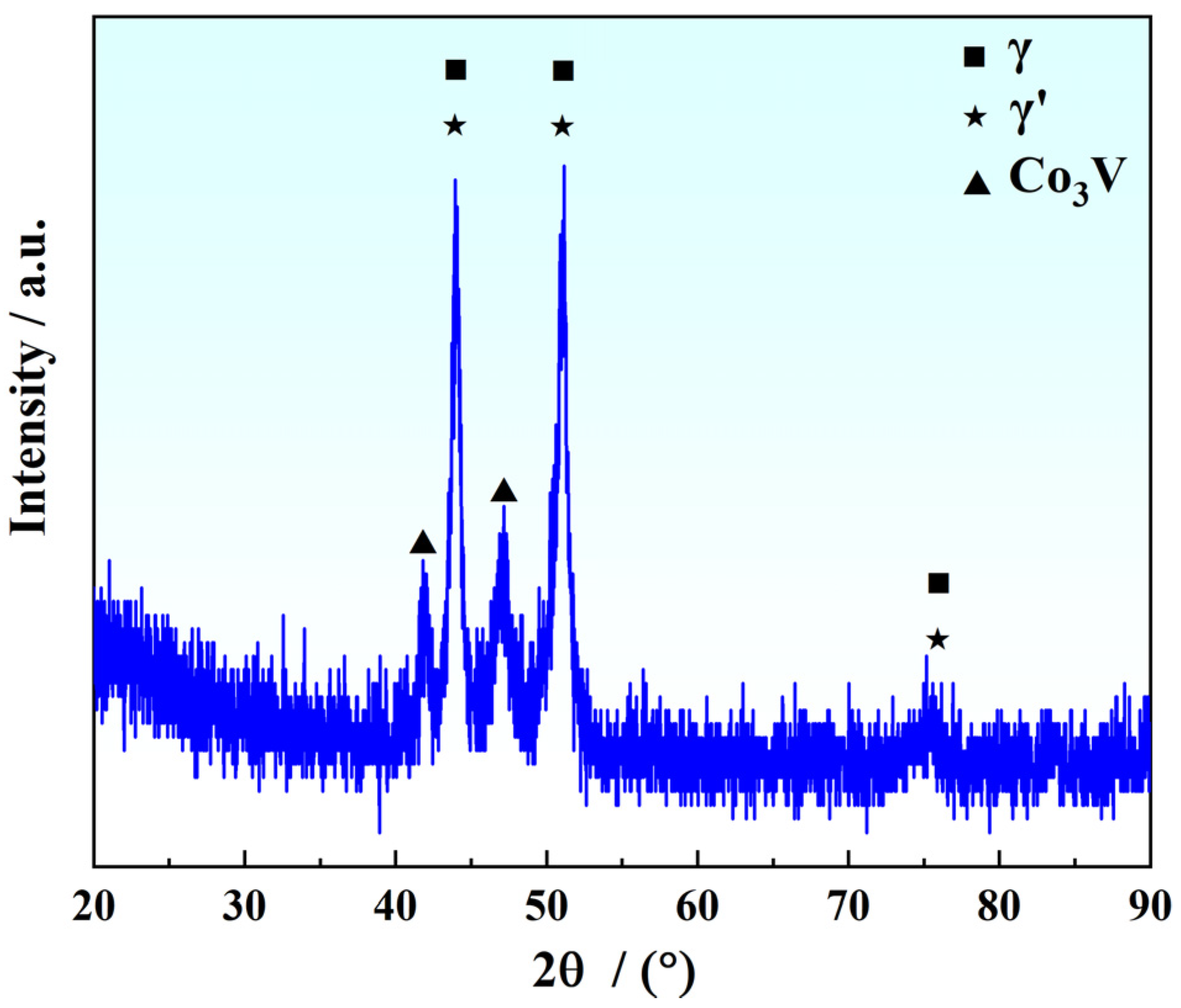
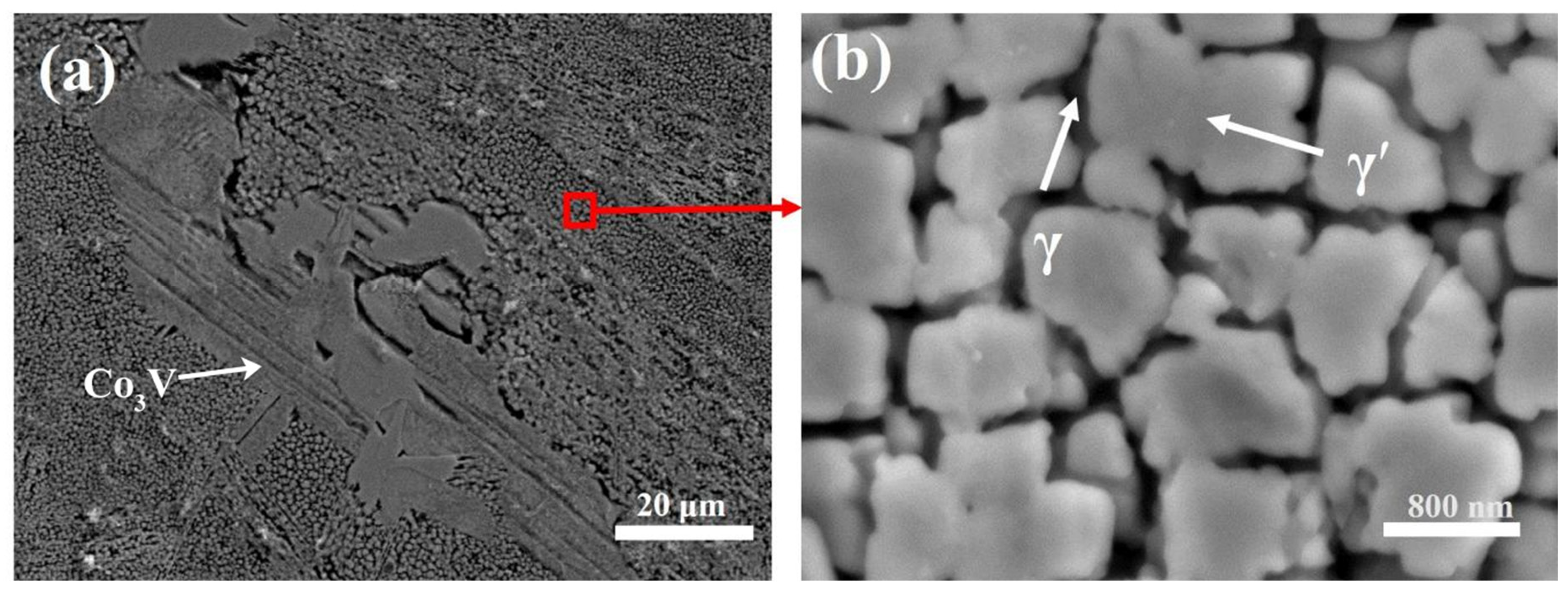
Figure 1 shows the X-ray diffraction pattern of the Co-6Ti-11V-9Cr superalloy. Figure 2 presents the etched SEM microstructure. The alloy contains a γ/γ′ two-phase structure and a Co3V phase. In the magnified γ/γ′ region, grey blocky γ′ precipitates are separated by γ-matrix channels.

3.2. Open-Circuit Potential

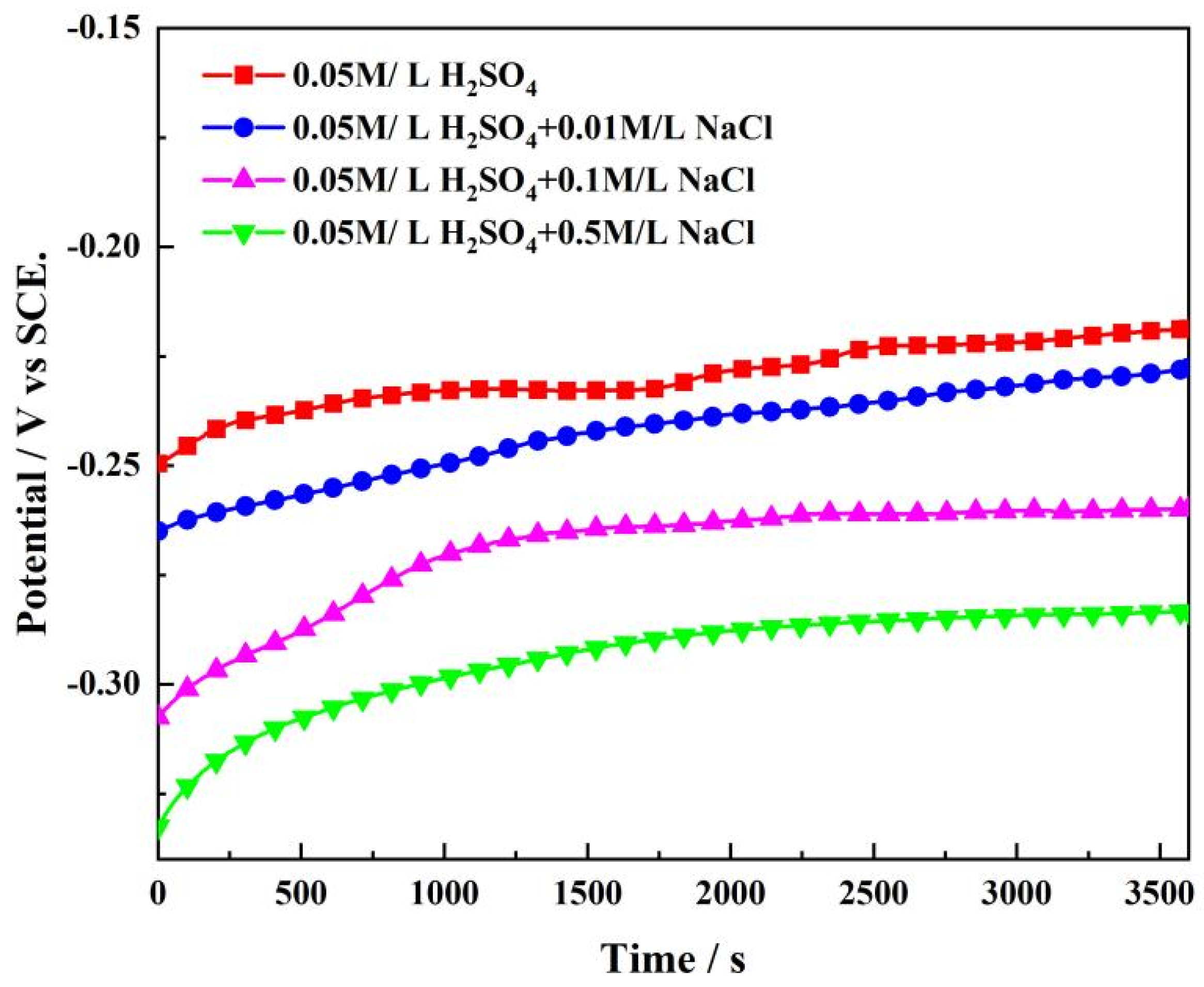
Figure 3 shows the time-dependent OCP of the Co-6Ti-11V-9Cr superalloy in the four acidic chloride solutions. In all solutions, the OCP shifted in the positive direction with time and approached a stable value after approximately 2400 s, indicating that the passive film reached a relatively steady state. As the NaCl concentration increased, the OCP shifted negatively. This trend indicates that chloride ions destabilised the passive film, activated the alloy surface and increased the thermodynamic tendency for corrosion. The highest OCP, approximately −0.22 V versus SCE, was measured in 0.05 mol/L H2SO4 without added NaCl. The lowest OCP, approximately −0.30 V versus SCE, occurred in 0.05 mol/L H2SO4 + 0.5 mol/L NaCl. The OCP response therefore shows that the corrosion tendency increased with the chloride concentration.

3.3. Electrochemical Impedance Spectroscopy

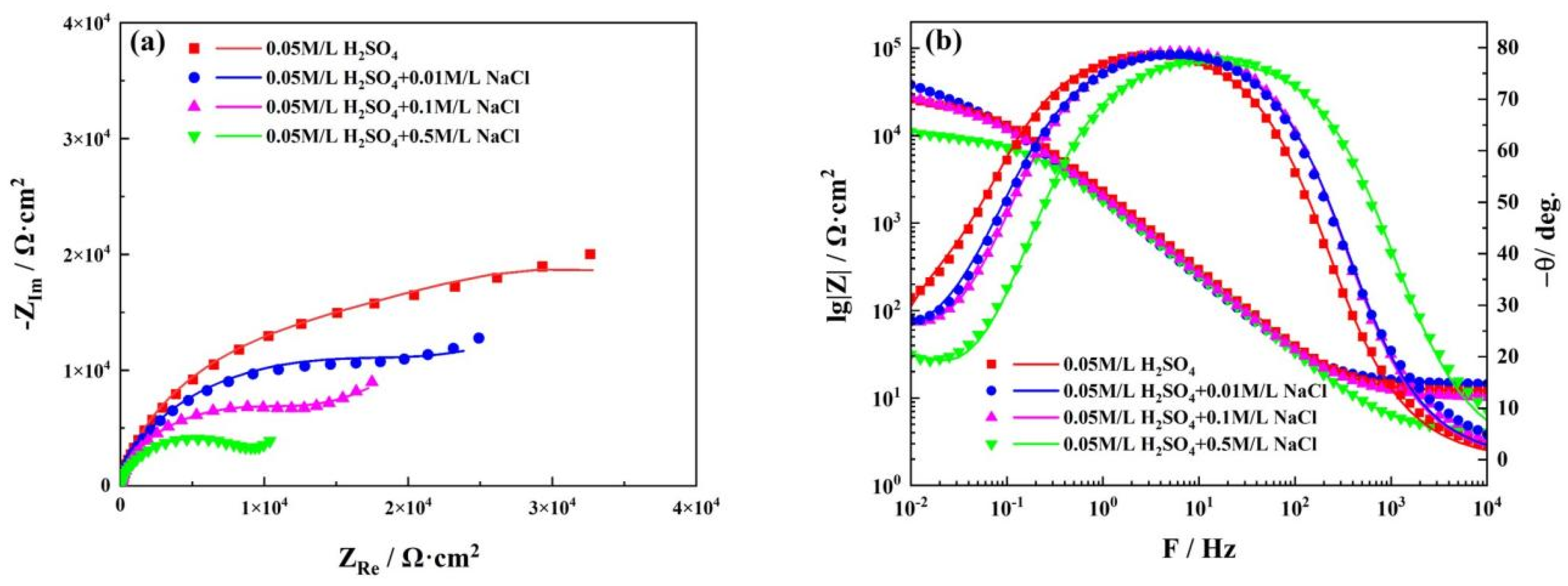
Figure 4 shows the EIS response of the Co-6Ti-11V-9Cr alloy in the four acidic chloride solutions. The spectra had similar overall shapes, suggesting that chloride concentration did not substantially change the passive-film-controlled impedance response. In the Nyquist plots (Figure 4a), all solutions produced depressed capacitive arcs with two time constants, which can be associated with the passive film and the electrochemical double layer. As the chloride concentration increased, the arc height and diameter decreased markedly, indicating a reduction in corrosion resistance.
In the Bode phase plots (Figure 4b), the phase angle approached 0° near 104 Hz, showing that the high-frequency impedance was dominated by solution resistance. Between 102 and 10−1 Hz, the phase angle was close to −80°, consistent with a protective passive film with pseudo-capacitive behaviour. In the middle-to-low-frequency region, the impedance increased as the frequency decreased, and the slope of log|Z| versus log f approached −1. Between 0.1 and 0.01 Hz, the increase in phase angle slowed. These features indicate that corrosion was mainly controlled by charge transport through the passive film and the electrochemical double layer.
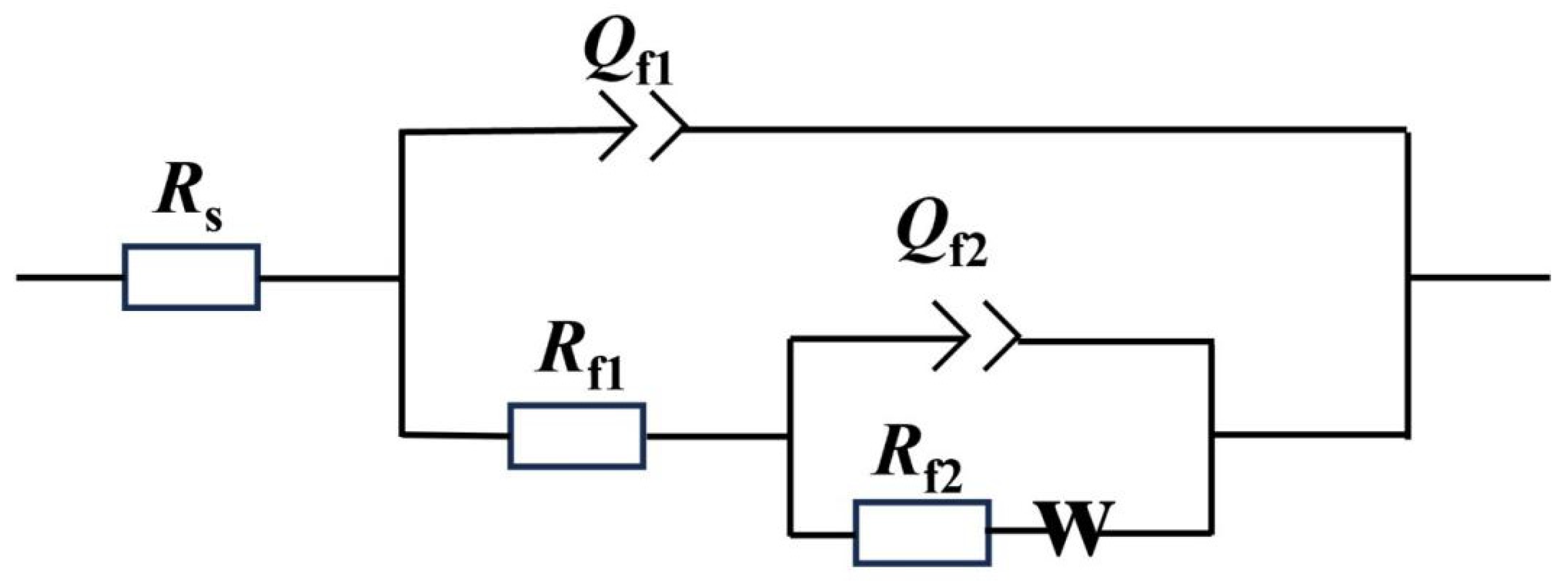
The EIS spectra were fitted using the equivalent circuit shown in Figure 5. The chi-square values were on the order of 10−4, indicating acceptable fitting quality. In this circuit, Rs is the solution resistance and W represents the Warburg impedance associated with diffusion. Q denotes a constant phase element (CPE). Qf1 and Qf2 correspond to the capacitances of the porous outer layer and barrier inner layer, respectively, whereas Rf1 and Rf2 represent their resistances. Because the current distribution on the working electrode surface is non-ideal, the CPE impedance is expressed as
Z CPE = Q 1 ( j w ) n
where j is the imaginary unit (j2 = −1), ω is the angular frequency and n is the CPE dispersion exponent.
The fitted electrochemical parameters were used to estimate the passive-film thickness. According to the power-law model, the film thickness can be calculated from Equations (2) and (3):
C 0 = Q 1 n R p n 1 n
D = ε ε 0 A C 0
where C0 is the passive-film capacitance, ε is the dielectric constant (15.6), ε0 is the vacuum permittivity (8.85 × 10⁻¹⁴ F cm−1), A is the working-electrode area (1.83 cm2), and D is the passive-film thickness.
The fitted EIS parameters are listed in Table 2. The n values of the Co-6Ti-11V-9Cr alloy fell between 0.5 and 1, indicating that the CPE response associated with the passive film combined Warburg-type and capacitive characteristics. For all solutions, the barrier-layer resistance Rf2 was much higher than Rf1, showing that the protective effect of the passive film mainly originated from the inner barrier layer. According to previous reports on Co-Cr-based alloys, the passive film formed on this Co-6Ti-11V-9Cr alloy is tentatively considered to be mainly composed of oxides including Cr2O3 and CoO/Co3O4 [25,26]. The decrease in Rf2 with increasing Cl- concentration suggests that Cl- ions can penetrate and chemically react with the oxide film, leading to the formation of soluble metal–chloride complexes and thereby thinning or destroying the barrier layer. The polarisation resistance Rp, which reflects the resistance to corrosion damage [27], is the zero-frequency limit of the impedance and can be approximated as Rp = Rf1 + Rf2. A higher Rp generally indicates better corrosion resistance. Here, Rp decreased progressively with an increasing NaCl concentration, showing that chloride addition made the alloy more susceptible to corrosion.

3.4. Potentiodynamic Polarisation

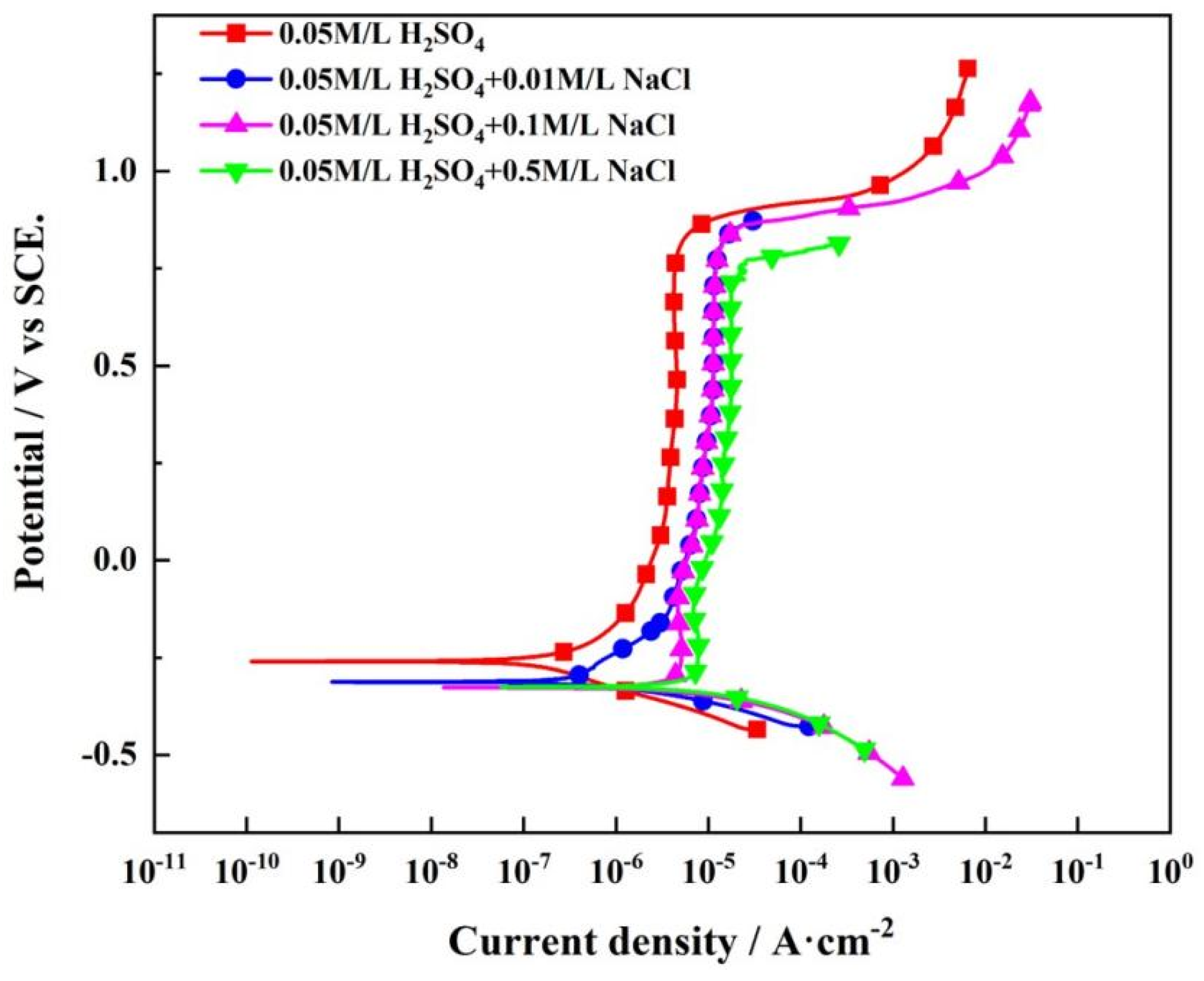
Figure 6 shows the potentiodynamic polarisation curves of the Co-6Ti-11V-9Cr alloy in the four acidic chloride solutions. The alloy exhibited a broad passive region in all media. However, the corrosion potential (Ecorr), corrosion current density (icorr) and passive current density (ip) varied markedly with the NaCl concentration. In 0.05 mol/L H2SO4 without added NaCl, the alloy showed the highest corrosion potential and a relatively low corrosion current density, indicating the lowest corrosion tendency and slowest corrosion rate. As chloride concentration increased, Ecorr shifted negatively and icorr increased, indicating a greater susceptibility to corrosion. The electrochemical parameters were obtained by Tafel fitting. At approximately 0.8 V vs. SCE, the anodic current increases continuously, which is attributed to pitting breakdown of the Cr-rich passive film [28,29]. The pitting potential Epitt can be extracted from potentiodynamic curves and presented in Table. 3. Moreover, SEM observations (Figure 7) confirm the occurrence of localised damage on corroded surfaces. With increasing Cl concentration, the passive region becomes narrower, indicating that Cl deteriorates the stability of passive film and promotes metastable localised corrosion.
The fitted values of Ecorr, icorr and ip are listed in Table 3. Ecorr decreased overall with an increasing NaCl concentration, indicating reduced thermodynamic stability and lower corrosion resistance. The icorr value measured in 0.01 mol/L NaCl was lower than that in the chloride-free solution, suggesting competition between film formation and film dissolution at low chloride concentration, or a difference that should be interpreted together with replicate-test uncertainty. The passive current density increased with chloride concentration. Because a higher ip corresponds to faster passive-film dissolution, this trend indicates that chloride ions accelerated passive-film degradation. The polarisation results therefore support the EIS finding that corrosion resistance declined as the NaCl concentration increased.

3.5. Corrosion Morphology

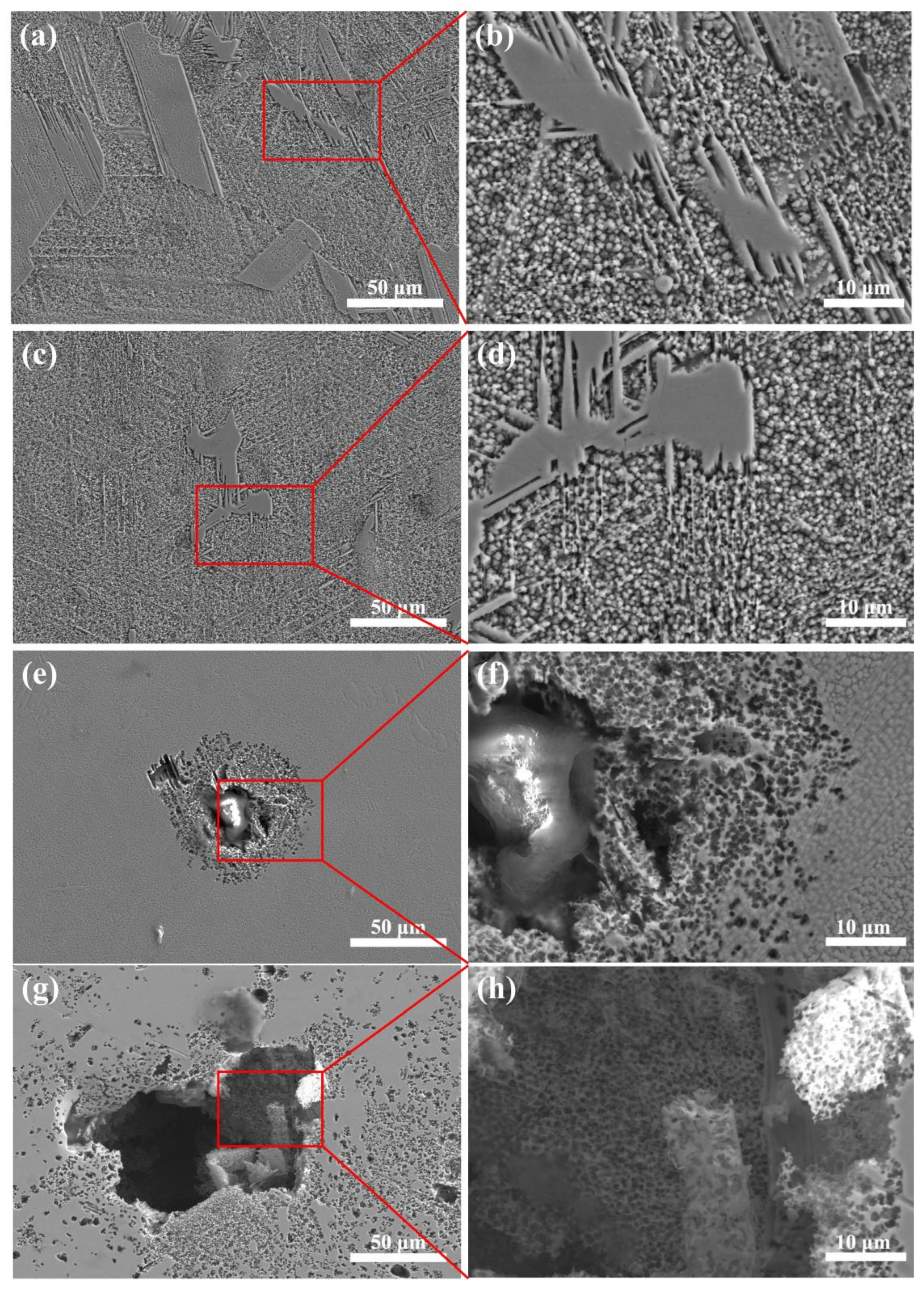
Figure 7 shows the corrosion morphologies of the Co-6Ti-11V-9Cr alloy after polarisation in the four acidic chloride solutions. At low NaCl concentrations (0 and 0.01 mol/L), the surface mainly exhibited relatively uniform corrosion. The high-magnification images in Figure 7b,d show clear γ/γ′ and Co3V regions, with only slight dissolution along phase boundaries. This behaviour indicates that the passive film retained a protective effect and partly suppressed matrix dissolution. When the NaCl concentration was increased to 0.1 and 0.5 mol/L, typical corrosion pits appeared on the surface (Figure 7e,g). This localised attack can be attributed to chloride adsorption and dissolution at weak sites or defects in the passive film. It may also be promoted by dissolution near phase boundaries and electrochemical heterogeneity around secondary phases [30]. Overall, increasing the chloride concentration damaged the passive film, enhanced localised corrosion and reduced corrosion resistance, in agreement with the polarisation results.

3.6. Anodic and Cathodic Reactions

In the acidic electrolytes used in this work, the anticipated cathodic partial reactions are hydrogen evolution as the dominant cathodic process, with a minor contribution from the reduction of dissolved oxygen:
2H+ + 2e → H2
O2 + 4H+ + 4e → 2H2O
The dominance of hydrogen evolution at acidic pH is consistent with previous electrochemical studies on Co–Cr-based alloys in acidic media, in which the anodic dissolution proceeds with the formation of aqueous Co(II) and Cr(II)/Cr(III) species, while the hydrogen evolution reaction dominates the cathodic partial reactions [31,32]. The corresponding anodic dissolution of the alloy can therefore be expressed as
Co → Co2+ + 2e
Cr → Cr3+ + 3e
The initial formation of Cr2+ and its subsequent oxidation to Cr3+ is possible at low pH [29]. The less-noble solutes Ti and V are expected to dissolve in the same manner (M → Mn+ + ne, M = Ti, V). Simultaneously, Cr and Co are oxidised by water and condense into the bilayer passive film resolved by EIS in Section 3.3 [25,26]:
2Cr + 3H2O → Cr2O3 + 6H+ + 6e
Co + H2O → CoO + 2H+ + 2e
3Co + 4H2O → Co3O4 + 8H+ + 8e
In the chloride-free acid, film growth (Equations (8)–(10)) and film dissolution (Equations (11) and (12)) nearly balance at relatively noble potentials; the compact Cr2O3-rich inner barrier layer then accounts for the high Rf2 (Table 2) and the low passive current density (Table 3), and corrosion remains essentially uniform (Figure 6 and Figure 7a,b). The passive film is chemically dissolved by the acidic matrix according to
Cr2O3 + 6H+→ 2Cr3+ + 3H2O
CoO + 2H+ → Co2+ + H2O
and, in the high-potential part of the polarisation scan (above approximately +0.6 V vs. SCE), transpassive oxidation of Cr(III) to soluble chromate may additionally contribute to film thinning [33]:
C r 2 O 3 + 5 H 2 O     2 C r O 4 2 + 10 H + + 6 e
When chloride is present, Cl adsorbs competitively with oxygen-containing species at weak sites of the passive film (defects, γ/γ′ interfaces and Co3V/matrix interfaces) and forms soluble metal–chloride complexes, which locally thin or rupture the film and trigger pit initiation [34,35]:
Men+ + mCl → [MeClm]n−m (Me = Co, Cr)
Inside the occluded pit, rapid metal dissolution generates cations that hydrolyse and thereby acidify the pit environment:
Cr3+ + H2O ⇌ CrOH2+ + H+
while Cl electromigrates into the pit to preserve electroneutrality; the resulting acidified, chloride-rich occluded chemistry is autocatalytic and sustains stable pit growth [35]. The cathodic reactions (Equations (4) and (5)) are then sustained mainly on the surrounding passive surface, and electrons flow through the alloy from the pit (anode) to the passive surface (cathode).
This mechanism consistently accounts for all experimental observations in this work: (i) the negative shifts of OCP (Figure 3) and Ecorr (Table 3) with an increasing NaCl concentration reflect the increasingly dominant anodic activation of the surface by adsorbed chloride; (ii) the decrease of Rf2 and Rp (Table 2) originates from chloride-assisted thinning of the inner barrier layer and complexation of film cations [36,37]; (iii) the rising passive current density ip (Table 3) reflects the accelerated passive-film dissolution described by Equations (10)–(13); and (iv) the SEM morphologies (Figure 7) capture the kinetic consequence of this sequence—at low Cl concentrations most film-breakdown events repassivate, whereas at high Cl concentrations repassivation is progressively suppressed and stable pits dominate, in agreement with the chloride-driven transition from uniform corrosion to localised pitting corrosion.
Figure 7. Corrosion morphologies of the Co-6Ti-11V-9Cr alloy after polarisation in the four acidic chloride solutions: (a,b) 0 mol/L NaCl; (c,d) 0.01 mol/L NaCl; (e,f) 0.1 mol/L NaCl; (g,h) 0.5 mol/L NaCl.
Metals 16 01024 g007
It should be noted that the corrosion products and passive-film constituents suggested in this study, including Cr2O3, CoO and Co3O4, are inferred based on previous investigations on Co-Cr-based alloys rather than directly identified in the present work. No EDS, XRD, or XPS measurements were performed to experimentally verify the corrosion products formed on the alloy surface after immersion in an acidic chloride-containing solution. Therefore, the exact phases and chemical states of the corrosion products and passive film remain unconfirmed. Further surface-analytical characterisations, such as XPS for element chemical states, XRD for phase identification, and EDS mapping for elemental distribution, are required in future research to provide direct experimental evidence and to fully understand the corrosion mechanism of the Co-6Ti-11V-9Cr superalloy.

4. Electrochemical Noise Analysis

4.1. Transient Analysis

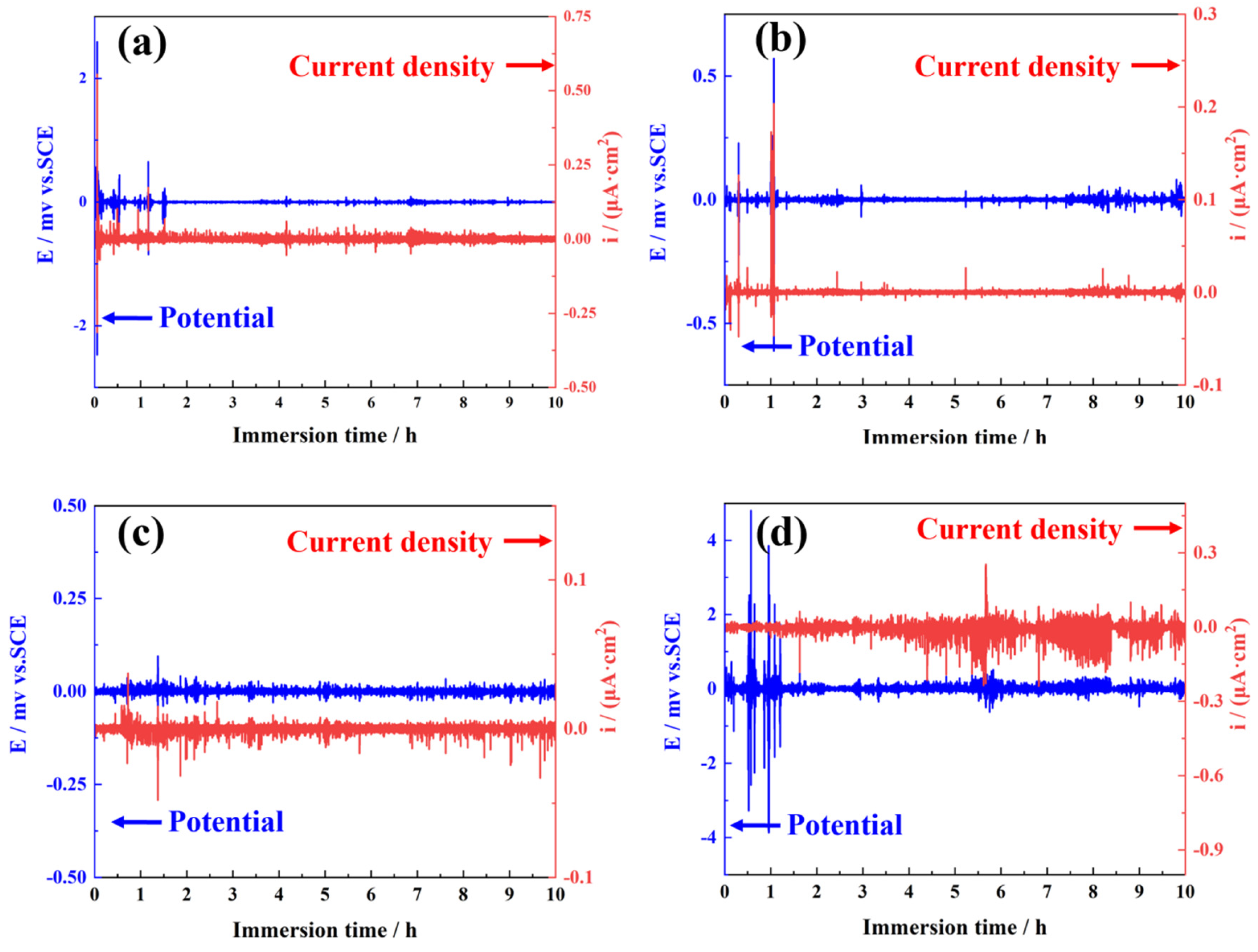
Figure 8 shows the electrochemical potential noise (EPN) and electrochemical current noise (ECN) signals of the Co-6Ti-11V-9Cr alloy in the four acidic chloride solutions. After detrending, the raw noise signals were used to assess the corrosion state of the specimen surface. At low NaCl concentrations, large fluctuations appeared during the early immersion stage (approximately 1 h), indicating local passive-film breakdown followed by repassivation. As the NaCl concentration increased, the amplitudes and peak intensities of both EPN and ECN signals increased, showing enhanced surface activity and a stronger tendency towards localised corrosion.

4.2. Wavelet Analysis

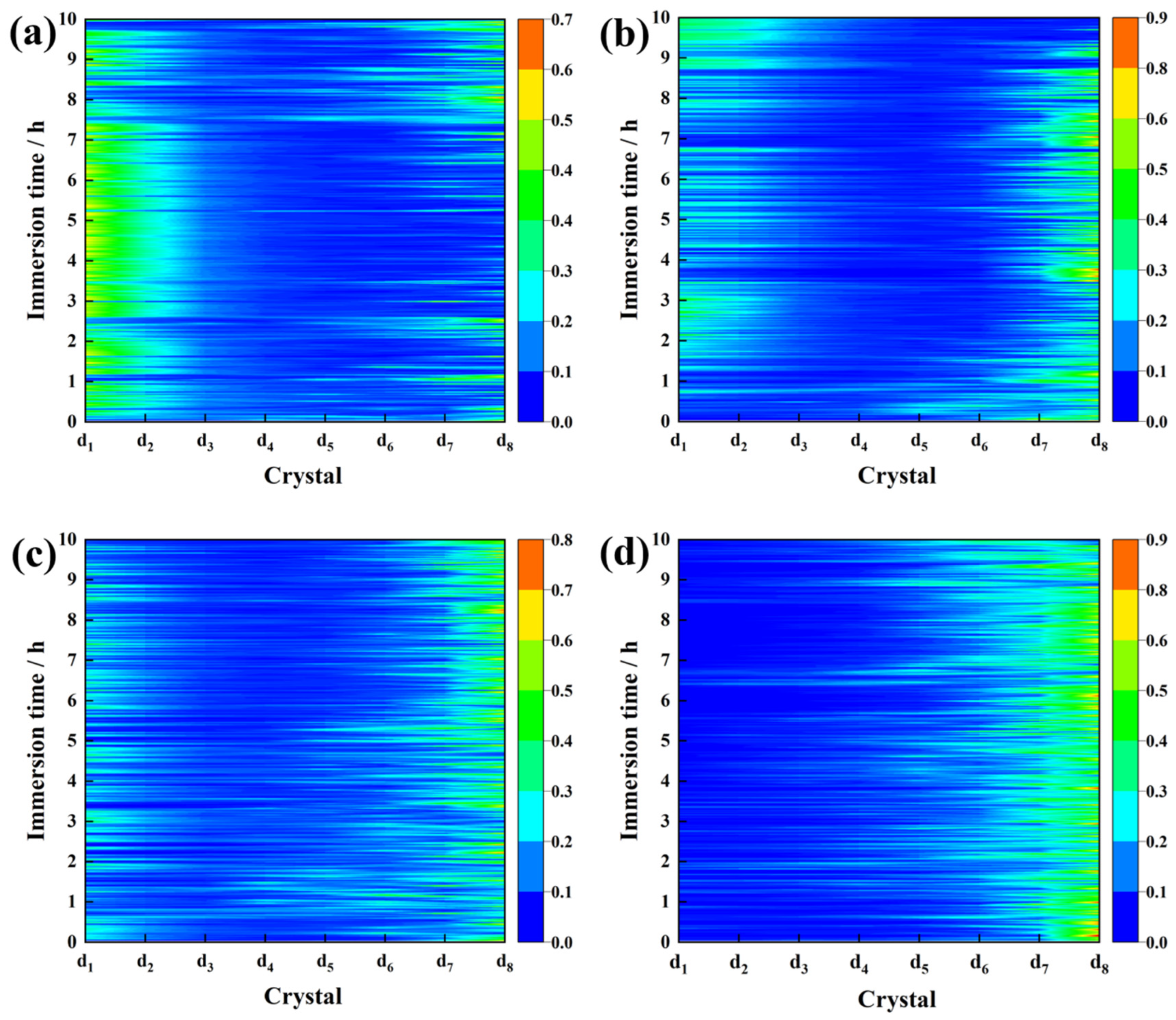
Figure 9 presents the energy distribution plots (EDPs) of current noise for the Co-6Ti-11V-9Cr alloy in the four acidic chloride solutions. In corrosion analysis, the d1–d3, d3–d6 and d6–d8 energy regions are commonly associated with pit initiation/repassivation, metastable pit growth and stable pit growth, respectively [38,39]. In 0.05 mol/L H2SO4, the relative energy was mainly concentrated in d1–d3, with a small contribution from d6–d8. This indicates local passive-film breakdown accompanied by limited local corrosion. When the NaCl concentration increased to 0.01 and 0.1 mol/L, more energy was distributed in d6–d8, indicating enhanced localised corrosion. At 0.5 mol/L NaCl, the energy contribution from d1–d3 became very small, suggesting sustained passive-film dissolution and stable pit growth.

4.3. Shot-Noise Analysis

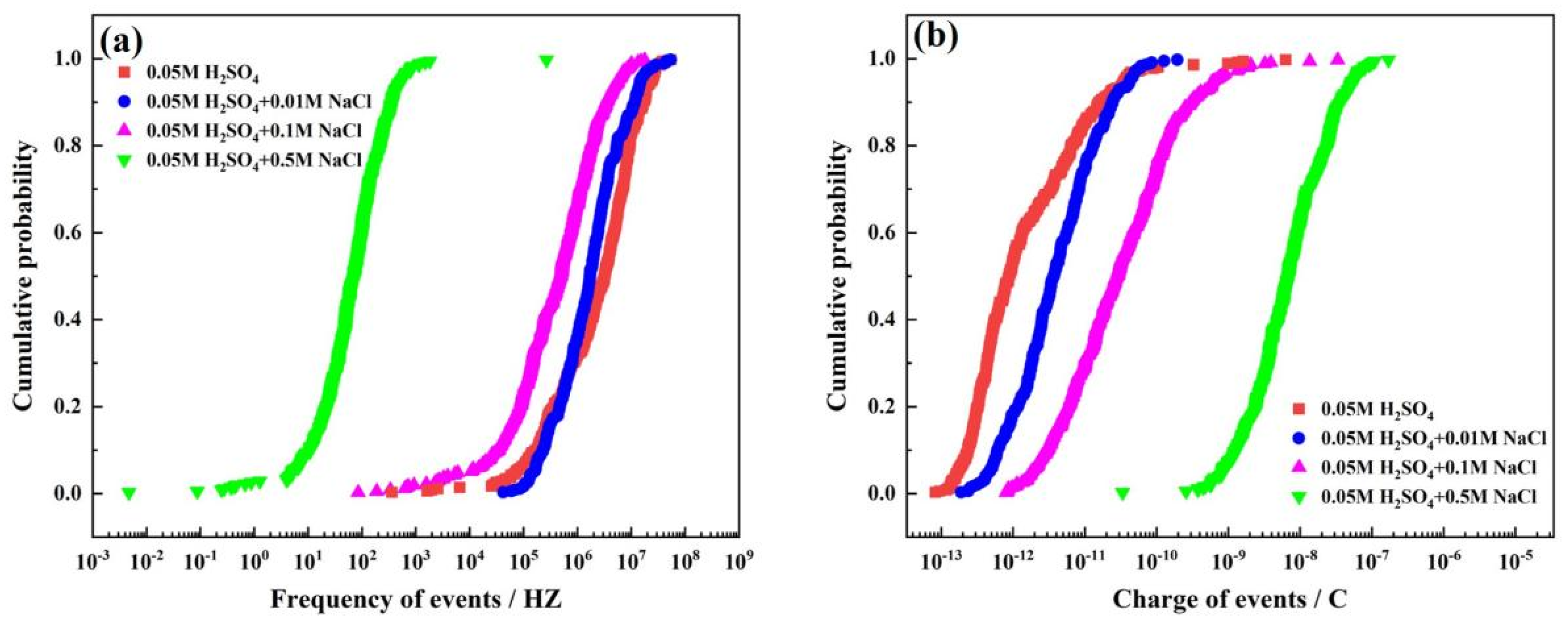
Figure 10 shows the corrosion characteristic parameters of the Co-6Ti-11V-9Cr alloy in the four acidic chloride solutions. The frequency of corrosion events (fn) and the charge per corrosion event (q) were used to evaluate the evolution of corrosion mode. A higher fn indicates a tendency towards more spatially distributed corrosion events, whereas a lower fn suggests stronger localised corrosion. The value of q reflects the charge released by a single corrosion event. A larger q indicates that localised corrosion is more dominant, whereas a smaller q is more consistent with uniform corrosion. In 0.05 mol/L H2SO4, the alloy showed a relatively high fn and low q, indicating a tendency towards uniform corrosion. As the NaCl concentration increased, fn decreased and q increased, showing that the surface became more susceptible to pitting. This trend is consistent with local passive-film dissolution.

5. Conclusions

The corrosion behaviour of the Co-6Ti-11V-9Cr superalloy in four acidic chloride solutions was investigated using electrochemical measurements, SEM corrosion-morphology observations and EN analysis. The main conclusions are as follows:
(1) The higher chloride concentration reduced the stability of the passive state and increased the corrosion tendency.
(2) EIS results showed that the alloy exhibited passive-film-controlled impedance behaviour in all four solutions. With an increasing NaCl concentration, both the barrier-layer resistance Rf2 and the polarisation resistance Rp decreased markedly, indicating that chloride ions weakened the barrier effect of the passive film and reduced corrosion resistance.
(3) Potentiodynamic polarisation showed a broad passive region in all solutions. As the NaCl concentration increased, the passive current density ip rose from 4.58 × 10⁻⁶ to 1.78 × 10⁻⁵ A cm−2, indicating accelerated passive-film dissolution and a faster corrosion process at higher chloride concentration.
(4) Electrochemical noise analysis further revealed the chloride-driven evolution of corrosion modes. Increasing the chloride concentration enlarged the amplitude of potential and current noise transients, and shifted wavelet energy distribution toward stable pit-growth regions. The shot-noise parameters showed a decrease in corrosion-event frequency and an increase in single-event charge, demonstrating the transition from uniform/metastable pitting to stable localised pitting corrosion at higher chloride levels.
It should be noted that all tests in this work were performed in H2SO4-containing acidic media. Further investigations on this alloy using various NaCl concentrations without sulphuric acid would help distinguish the individual roles of H+, SO42− and Cl, which deserve to be explored in future studies.

Author Contributions

Conceptualisation, P.C., W.L., A.K. and X.Z.; methodology, A.K., W.L. and T.C.; Investigation, P.C., P.Z., W.L., A.K., B.G. and T.C.; writing—original draft preparation, A.K., P.Z., W.L., T.C., B.G. and X.Z.; writing—review and editing, P.Z., T.C., B.G. and X.Z.; supervision, X.Z.; funding acquisition, P.C. All authors have read and agreed to the published version of the manuscript.

Funding

This research was funded with the support by Hydrogen Embrittlement Prevention Technology for Boiler 1’s Waterwall (Grant number: ZHP-PY-220041, ZHP-PX-220061, and ZHP-PJ-230030).

Data Availability Statement

The original contributions presented in this study are included in the article. Further inquiries can be directed to the corresponding author.

Conflicts of Interest

Author Peilin Chen, Wenhua Li, Anpeng Kewere, and Bujun Ge were employed by the Guangzhu Electric Power Co., Ltd. of Zhuhai SEZ., and Pengjie Zhang was employed by Luoyang Shuangrui Wanji Titanium Industry Co., Ltd. The remaining authors declare that the research was conducted in the absence of any commercial or financial relationships that could be construed as a potential conflict of interest.

References

  1. Chen, L.Y.; Liang, S.X.; Liu, Y.; Zhang, L.-C. Additive manufacturing of metallic lattice structures: Unconstrained design, accurate fabrication, fascinated performances, and challenges. Mater. Sci. Eng. R Rep. 2021, 146, 100648. [Google Scholar] [CrossRef] [Scilit]
  2. Kaliaraj, G.S.; Siva, T.; Ramadoss, A. Surface functionalized bioceramics coated on metallic implants for biomedical and anticorrosion performance: A review. J. Mater. Chem. B 2021, 9, 9433–9460. [Google Scholar] [CrossRef] [Scilit] [PubMed]
  3. Li, H.; Shao, S.; Ren, X.; Guo, H.; Lou, D.; Xia, W.; Fang, X. Grain boundary character distribution in the CoCrMo alloy processed by selective laser melting and post-heat treatment. J. Mater. Sci. 2020, 55, 16780–16790. [Google Scholar] [CrossRef] [Scilit]
  4. Persdotter, A.; Boll, T.; Jonsson, T. Minor element effect on high temperature corrosion of a low-alloyed steel: Insight into alkali- and chlorine induced corrosion by means of atom probe tomography. Corros. Sci. 2021, 192, 109779. [Google Scholar] [CrossRef] [Scilit]
  5. Klein, L.; Killian, M.S.; Virtanen, S. The effect of nickel and silicon addition on some oxidation properties of novel Co-based high temperature alloys. Corros. Sci. 2013, 69, 43–49. [Google Scholar] [CrossRef] [Scilit]
  6. Pollock, T.M.; Tin, S. Nickel-based superalloys for advanced turbine engines: Chemistry, microstructure and properties. J. Propuls. Power 2006, 22, 361–374. [Google Scholar] [CrossRef] [Scilit]
  7. Kracke, A. Superalloys, the most successful alloy system of modern times: Past, present and future. In Proceedings of the 7th International Symposium on Superalloy 718 and Derivatives, 2010; John Wiley & Sons, Inc.: Boston, MA, USA, 2010; pp. 13–50. [Google Scholar]
  8. Smith, G.D. Corrosion resistance of nickel-containing alloys in petrochemical environments. In Proceedings of the CORROSION 1997, New Orleans, LA, USA, 9–14 March 1997. [Google Scholar]
  9. Leong, A.; Zhang, J.; Rountree, S.D. Kinetics of corrosion and oxidation of Fe- and Ni-based alloys by molten fluoride salt. High Temp. Corros. Mater. 2023, 99, 375–397. [Google Scholar] [CrossRef] [Scilit]
  10. Chuvaree, S.; Mookam, N.; Jamkamon, K. An investigation on TIG hardfacing of cobalt-based alloys on tool steels using desirability function. Arab. J. Sci. Eng. 2025, 51, 17155–17179. [Google Scholar] [CrossRef] [Scilit]
  11. Yu, Q.; Zhang, W.; Shang, J.; Liu, B.; Pei, Y.; Li, Y.; Ao, S. Comparative investigation on the microstructure and corrosion properties of surfacing cobalt alloys by various methods. Surf. Coat. Technol. 2024, 494, 131386. [Google Scholar] [CrossRef] [Scilit]
  12. Eliaz, N.; Shemesh, G.; Latanision, R.M. Hot corrosion in gas turbine components. Eng. Fail. Anal. 2002, 9, 31–43. [Google Scholar] [CrossRef] [Scilit]
  13. Sato, J.; Omori, T.; Oikawa, K.; Ohnuma, I.; Kainuma, R.; Ishida, K. Cobalt-base high-temperature alloys. Science 2006, 312, 90–91. [Google Scholar] [CrossRef] [Scilit] [PubMed]
  14. Yao, Q.; Xing, H.; Sun, J. Structural stability and elastic property of the L12 ordered Co3(Al,W) precipitate. Appl. Phys. Lett. 2006, 89, 161906. [Google Scholar] [CrossRef] [Scilit]
  15. Miura, S.; Ohkubo, K.; Mohri, T. Mechanical properties of Co-based L12 intermetallic compound Co3(Al,W). Mater. Trans. 2007, 48, 2403–2408. [Google Scholar] [CrossRef] [Scilit][Green Version]
  16. Tanaka, K.; Ohashi, T.; Kishida, K.; Inui, H. Single-crystal elastic constants of Co3(Al,W) with the L12 structure. Appl. Phys. Lett. 2007, 91, 181907. [Google Scholar] [CrossRef] [Scilit]
  17. Wang, Y.J.; Wang, C.Y. A comparison of the ideal strength between L12 Co3(Al,W) and Ni3Al under tension and shear from first-principles calculations. Appl. Phys. Lett. 2009, 94, 261909. [Google Scholar] [CrossRef] [Scilit]
  18. Bocchini, P.J.; Sudbrack, C.K.; Noebe, R.D.; Dunand, D.C.; Seidman, D.N. Effects of titanium substitutions for aluminum and tungsten in Co-10Ni-9Al-9W (at%) superalloys. Mater. Sci. Eng. A 2017, 705, 122–132. [Google Scholar] [CrossRef] [Scilit]
  19. Makineni, S.K.; Nithin, B.; Chattopadhyay, K. A new tungsten-free γ-γ′ Co-Al-Mo-Nb-based superalloy. Scr. Mater. 2015, 98, 36–39. [Google Scholar] [CrossRef] [Scilit]
  20. Liu, Y.; Takasugi, T.; Izumi, O. Alloying behavior of Co3Ti. Metall. Trans. A 1986, 17A, 1433–1439. [Google Scholar] [CrossRef] [Scilit]
  21. Ruan, J.J.; Liu, X.J.; Yang, S.Y.; Xu, W.; Omori, T.; Yang, T.; Deng, B.; Jiang, H.; Wang, C.; Kainuma, R.; et al. Novel Co-Ti-V-base superalloys reinforced by L12-ordered γ′ phase. Intermetallics 2018, 92, 126–132. [Google Scholar] [CrossRef] [Scilit]
  22. Li, Y.; Pyczak, F.; Oehring, M.; Wang, L.; Paul, J.; Lorenz, U.; Yao, Z. Thermal stability of γ′ phase in long-term aged Co-Al-W alloys. J. Alloys Compd. 2017, 729, 266–276. [Google Scholar] [CrossRef] [Scilit]
  23. Karpstein, N.; Laplanche, G.; Saksena, A.; Zehl, R.; Bezold, A.; Horst, O.M.; Bürger, D.; Kostka, A.; Zenk, C.H.; Neumeier, S.; et al. Microscopic mechanism of the L12-D019 phase transformation in a Co-base single crystal superalloy. Acta Mater. 2025, 282, 120416. [Google Scholar] [CrossRef] [Scilit]
  24. Zhang, P.J.; Ma, L.; Zhou, P.J.; Yang, L.-L.; Emori, W.; Qiao, Y.-X.; Zhang, Q.-C.; Jiang, Y.-S. Cavitation erosion-corrosion behavior of Co–6Ti–11V–9Cr superalloy in 3.5% NaCl solution. J. Iron Steel Res. Int. 2025, 32, 4440–4453. [Google Scholar] [CrossRef] [Scilit]
  25. Picas, J.A.; Punset, M.; Rupére, E.; Menargues, S.; Martin, E.; Baile, M. Corrosion mechanism of HVOF thermal sprayed WC-CoCr coatings in acidic chloride media. Surf. Coat. Technol. 2019, 371, 378–388. [Google Scholar] [CrossRef] [Scilit]
  26. Milošev, I.; Strehblow, H.H. The composition of the surface passive film formed on CoCrMo alloy in simulated physiological solution. Electrochim. Acta 2003, 48, 2767–2774. [Google Scholar] [CrossRef] [Scilit]
  27. Kong, D.; Ni, X.; Dong, C.; Zhang, L.; Yao, J.; Man, C.; Wang, L.; Xiao, K.; Li, X. Anisotropic response in mechanical and corrosion properties of Hastelloy X fabricated by selective laser melting. Constr. Build. Mater. 2019, 221, 720–729. [Google Scholar] [CrossRef] [Scilit]
  28. Wang, K.; Lan, A.D.; Qiao, J.W. Corrosion behavior of Al0.1CoCrFeNi high entropy alloy in various chloride-containing solutions. Front. Mater. 2021, 7, 533843. [Google Scholar] [CrossRef] [Scilit]
  29. Qiao, Y.; Zhang, W.; AlMasoud, N.; Shen, X.; Zheng, S.; Alomar, T.S.; El-Bahy, Z.M.; Ibrahim, M.M.; Algadi, H.; Liu, W. Improved passivation and anticorrosion behaviors of selective laser melted Inconel 718 alloy in acidic solutions. Adv. Compos. Hybrid. Mater. 2023, 6, 204. [Google Scholar] [CrossRef] [Scilit]
  30. Luo, S.; Huang, W.; Yang, H.; Yang, J.; Wang, Z.; Zeng, X. Microstructural evolution and corrosion behaviors of Inconel 718 alloy produced by selective laser melting following different heat treatments. Addit. Manuf. 2019, 30, 100875. [Google Scholar] [CrossRef] [Scilit]
  31. Contu, F.; Elsener, B.; Böhni, H. Corrosion behaviour of CoCrMo implant alloy during fretting in bovine serum. Corros. Sci. 2005, 47, 1863–1875. [Google Scholar] [CrossRef] [Scilit]
  32. Benea, L.; Ponthiaux, P.; Wenger, F.; Galland, J.; Hertz, D.; Malo, J.Y. Tribocorrosion of stellite 6 in sulphuric acid medium: Electrochemical behaviour and wear. Wear 2004, 256, 948–953. [Google Scholar] [CrossRef] [Scilit]
  33. Hodgson, A.W.E.; Kurz, S.; Virtanen, S.; Fervel, V.; Olsson, C.O.A.; Mischler, S. Passive and transpassive behaviour of CoCrMo in simulated biological solutions. Electrochim. Acta 2004, 49, 2167–2178. [Google Scholar] [CrossRef] [Scilit]
  34. Sato, N. Anodic breakdown of passive films on metals. J. Electrochem. Soc. 1982, 129, 255–260. [Google Scholar] [CrossRef] [Scilit]
  35. Frankel, G.S. Pitting corrosion of metals: A review of the critical factors. J. Electrochem. Soc. 1998, 145, 2186. [Google Scholar] [CrossRef] [Scilit]
  36. Zhou, H.L.; Zhu, H.J.; Yang, K.; Zhang, L.M.; Lu, S.; Qiao, Y.X. Carbon-triggered grain boundary engineering in CoCrFeMnNi HEAs: Decoupling the role of M7C3 precipitates on passive film stability and localized corrosion resistance. Int. J. Miner. Metall. Mater. 2026. Available online: http://ijmmm.ustb.edu.cn/article/doi/10.1007/s12613-026-3372-2 (accessed on 13 September 2026).
  37. Zheng, Z.B.; Liao, X.Y.; Sun, X.; Long, J.; Wang, S.; Qiao, Y.X.; Zheng, K.H. Tailoring reversed austenite and carbide precipitation via tempering to achieve superior impact toughness in high chromium martensitic steels. J. Iron Steel Res. Int. 2026, 33, 137. [Google Scholar] [CrossRef] [Scilit]
  38. Bahrami, M.J.; Shahidi, M.; Hosseini, S.M.A. Comparison of electrochemical current noise signals arising from symmetrical and asymmetrical electrodes made of Al alloys at different pH values using statistical and wavelet analysis. Part I: Neutral and acidic solutions. Electrochim. Acta 2014, 148, 127–144. [Google Scholar] [CrossRef] [Scilit]
  39. Xia, D.H.; Song, S.Z.; Behnamian, Y. Detection of corrosion degradation using electrochemical noise (EN): Review of signal processing methods for identifying corrosion forms. Corros. Eng. Sci. Technol. 2016, 51, 527–544. [Google Scholar] [CrossRef] [Scilit]
Figure 1. X-ray diffraction patterns (XRD) of the Co-6Ti-11V-9Cr superalloy. The identified phases are indexed as γ (FCC Co-based solid solution, JCPDS No. 15-0806), γ′ (L12-ordered Co3Ti phase, JCPDS No. 23-0938) and Co3V (JCPDS No. 12-0378).
Metals 16 01024 g001
Figure 2. Microstructure of the Co-6Ti-11V-9Cr superalloy, (a) Co3V and (b) γ and γ′.
Metals 16 01024 g002
Figure 3. Open-circuit potential of the Co-6Ti-11V-9Cr alloy in the tested solutions.
Metals 16 01024 g003
Figure 4. EIS response of the Co-6Ti-11V-9Cr alloy in the four acidic chloride solutions: (a) Nyquist plots and (b) Bode plots.
Metals 16 01024 g004
Figure 5. Equivalent circuit used to fit the EIS spectra.
Metals 16 01024 g005
Figure 6. Potentiodynamic polarisation curves of the Co-6Ti-11V-9Cr alloy in the four acidic chloride solutions.
Metals 16 01024 g006
Figure 8. Electrochemical potential noise (EPN) and electrochemical current noise (ECN) signals of the Co-6Ti-11V-9Cr alloy in the four acidic chloride solutions: (a) 0 mol/L NaCl; (b) 0.01 mol/L NaCl; (c) 0.1 mol/L NaCl; (d) 0.5 mol/L NaCl.
Metals 16 01024 g008
Figure 9. Relative energy distribution of current noise for the Co-6Ti-11V-9Cr alloy in the four acidic chloride solutions: (a) 0 mol/L NaCl; (b) 0.01 mol/L NaCl; (c) 0.1 mol/L NaCl; (d) 0.5 mol/L NaCl.
Metals 16 01024 g009
Figure 10. Cumulative distributions of (a) fn and (b) q for the Co-6Ti-11V-9Cr alloy in the four acidic chloride solutions.
Metals 16 01024 g010
Table 1. Chemical composition of the Co-6Ti-11V-9Cr superalloy (at.%).
CoTiVCr
Bal.6 ± 0.0211 ± 0.039 ± 0.01
Table 2. EIS fitting parameters for the Co-6Ti-11V-9Cr alloy in the four acidic chloride solutions.
NaCl Concentration0 mol/L0.01 mol/L0.1 mol/L0.5 mol/L
Rs/Ω‧cm211.21 ± 2.3710.54 ± 3.1610.00 ± 4.383.81 ± 5.21
Qf1−1‧cm−2‧sn5.97 × 10−55.84 × 10−57.24 × 10−58.34 × 10⁻⁵
n10.91 ± 0.010.90 ± 0.010.90 ± 0.010.89 ± 0.02
Rf1/Ω‧cm210.99 ± 1.3512.85 ± 2.4815.67 ± 3.116.75 ± 4.26
Qf2−1‧cm−2‧sn4.02 ± 0.03 × 10−52.70 ± 0.09 × 10−51.41 ± 0.19 × 10−52.36 ± 0.25 × 10⁻⁵
n20.87 ± 0.020.88 ± 0.010.96 ± 0.020.92 ± 0.01
Rf2/Ω‧cm24.61 ± 0.12 × 1041.83 ± 0.36 × 1041.26 ± 0.29 × 1040.39 ± 0.18 × 10⁴
W/Ω‧cm2‧s 0.52.23 ± 0.21 × 10−44.03 ± 0.42 × 10−44.14 ± 0.29 × 10−40.13 ± 0.08 × 10⁻⁴
DO/nm0.85 ± 0.111.39 ± 0.241.99 ± 0.041.47 ± 0.13
Table 3. Electrochemical parameters of the Co-6Ti-11V-9Cr alloy in the four acidic chloride solutions.
NaCl ConcentrationEcorr/V vs. SCEicorr/A·cm−2ip/A·cm−2Epitt/V vs. SCE
0 mol/L−0.26 ± 0.015.20 ± 0.13 × 10−74.58 ± 0.11 × 10⁻⁶−0.82 ± 0.06
0.01 mol/L−0.31 ± 0.024.34 ± 0.20 × 10−71.05 ± 0.04 × 10⁻⁵−0.81 ± 0.05
0.1 mol/L−0.32 ± 0.012.75 ± 0.08 × 10−61.14 ± 0.09 × 10⁻⁵−0.82 ± 0.02
0.5 mol/L−0.35 ± 0.039.37 ± 0.0610−61.78 ± 0.08 × 10⁻⁵−0.73 ± 0.11
Disclaimer/Publisher’s Note: The statements, opinions and data contained in all publications are solely those of the individual author(s) and contributor(s) and not of MDPI and/or the editor(s). MDPI and/or the editor(s) disclaim responsibility for any injury to people or property resulting from any ideas, methods, instructions or products referred to in the content.