


Abstract
SACM645 steel is a representative nitriding steel containing aluminum, chromium, and molybdenum, and is widely applied to mechanical components where high surface hardness, wear resistance, and fatigue strength are required. Because its strengthening response is strongly influenced by nitrogen absorption and nitride formation, SACM645 provides a suitable model material for evaluating rapid nitriding processes. In this study, induction heating (IH) nitriding was applied to SACM645 steel in order to clarify the feasibility and characteristics of rapid nitriding under ultrashort processing times. Cylindrical specimens were nitrided at 570 °C various times using high-frequency IH, and the resulting microstructure, nitrogen content profiles, and hardness distributions were systematically analyzed by optical microscopy, SEM/EBSD, EPMA, and microhardness testing. A compound layer accompanied by an increase in surface hardness was formed within only 8 min, with the near-surface hardness reaching 819 HV0.1. The surface nitrogen content rapidly increased to about 7–8 mass%. After the formation of a compound layer, its growth followed diffusion-controlled kinetics, consistent with classical nitriding models. The compound layer was predominantly composed of the ε phase. In the diffusion layer, a strong linear correlation was observed between local nitrogen content and hardness increment, irrespective of nitriding time. These results indicate that IH nitriding enables rapid surface hardening and controlled compound-layer formation within short processing times, providing a rational approach for rapid nitriding of SACM645 steel.
1. Introduction
In recent years, the demand for energy-efficient manufacturing processes has intensified due to the global shift toward decarbonization and sustainability [1]. Components used in automotive, industrial machinery, and energy systems are increasingly required to exhibit superior wear resistance and fatigue performance to extend service life and reduce maintenance demands. Thermochemical surface-hardening technologies, particularly nitriding, play a critical role in meeting these requirements because they enhance surface hardness, wear resistance, and fatigue strength with minimal dimensional distortion. Consequently, nitriding has become an indispensable process across a wide range of industrial applications.
SACM645 steel is a typical aluminum–chromium–molybdenum nitriding steel widely used for mechanical components that require high surface hardness, wear resistance, and fatigue strength. Its high nitriding response is mainly attributed to the formation of fine alloy nitrides and/or carbonitrides involving aluminum and chromium in the diffusion layer, while molybdenum contributes to maintaining mechanical stability during thermal exposure. Because of these characteristics, SACM645 is a suitable material for evaluating how rapid nitrogen absorption and nitride formation affect microstructural evolution and hardness development during ultrashort-time induction heating nitriding.
In conventional gas soft-nitriding processes widely used in industry, a furnace heated to approximately 525–625 °C and an NH3-containing atmosphere are employed to form a compound layer—typically composed of ε-Fe2–3N at the surface and γ′-Fe4N at the interface—together with an underlying diffusion layer [2,3]. In the Fe–N binary system, ε is stable at high nitrogen contents, whereas γ′ forms at lower nitrogen levels [4,5]. For practical nitriding steels, the Fe–N–C ternary system is also important; previous studies have shown that carbon stabilizes the ε phase and have reported the corresponding Lehrer diagram [6,7,8,9,10,11]. The growth behavior of the compound layer has further been described in terms of phase stability in Fe–N and Fe–C–N systems, parabolic thickening kinetics, the influence of nitriding potential (K_N) on ε/γ′ phase constitution, and carbon-content gradients driving phase transformations within the layer [12,13,14]. These insights are essential for understanding hardness evolution and diffusion-zone development in nitrided steels. Moreover, control of the ε/γ′ phase balance has recently gained importance due to its strong influence on fatigue performance, leading to the development of K_N-controlled nitriding, Lehrer diagram-based process design, and hybrid thermochemical–mechanical treatments aimed at optimizing phase constitution and mechanical properties [14,15,16,17,18].
Despite these advances, conventional nitriding treatments require prolonged heating and holding—often several hours—resulting in high energy consumption and limitations in production efficiency. In contrast, induction heating (IH) enables rapid, localized, and non-contact heating, allowing the surface of a component to reach the target temperature within seconds. Because of these advantages, IH has attracted growing interest for small-lot production and potential in-line integration, and several studies have investigated IH-assisted surface-treatment processes combined with reactive gas flow. For example, Takeuchi et al. demonstrated that IH-assisted nitriding with fine-particle peening (FPP) in titanium alloys produces a hardened layer with compressive residual stress, thereby improving wear resistance [19,20,21]. Additionally, recent work has highlighted that heating rate can significantly influence compound-layer formation. However, despite these promising findings, the nitriding behavior of steels under ultra-fast IH processing remains insufficiently understood—particularly regarding nitrogen absorption and diffusion behavior, microstructural evolution, and the resulting hardness distribution.
Based on these considerations, this study aims to elucidate the nitrogen content profiles, hardness distributions, nitrogen-dependent microstructural features, and overall microstructure produced by ultra-short-time induction-heating nitriding of SACM645, a commercially used nitriding steel. This investigation provides fundamental insights into the feasibility and mechanisms of rapid nitriding enabled by IH.
2. Materials and Methods
2.1. Specimen Preparation
SACM645 steel (Daido Steel Co., Ltd., Aichi, Japan) was used as the material in this study. The chemical composition is shown in Table 1. A round bar with a diameter of 50 mm was subjected to quenching and tempering as a pre-treatment. The steel was austenitized at 880 °C for 60 min and quenched in oil, followed by tempering at 690 °C for 120 min and water cooling. From the heat-treated material, cylindrical specimens with a diameter of 10 mm and a length of 10 mm were machined by lathe turning and surface grinding. After machining, the specimens were ultrasonically cleaned in acetone to remove machining oil and surface contaminants.
Table 1.
Chemical composition of SACM645 steel (mass%).
2.2. Surface Heat Treatment by IH
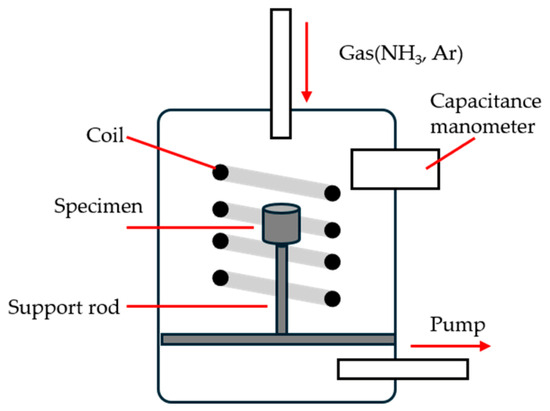
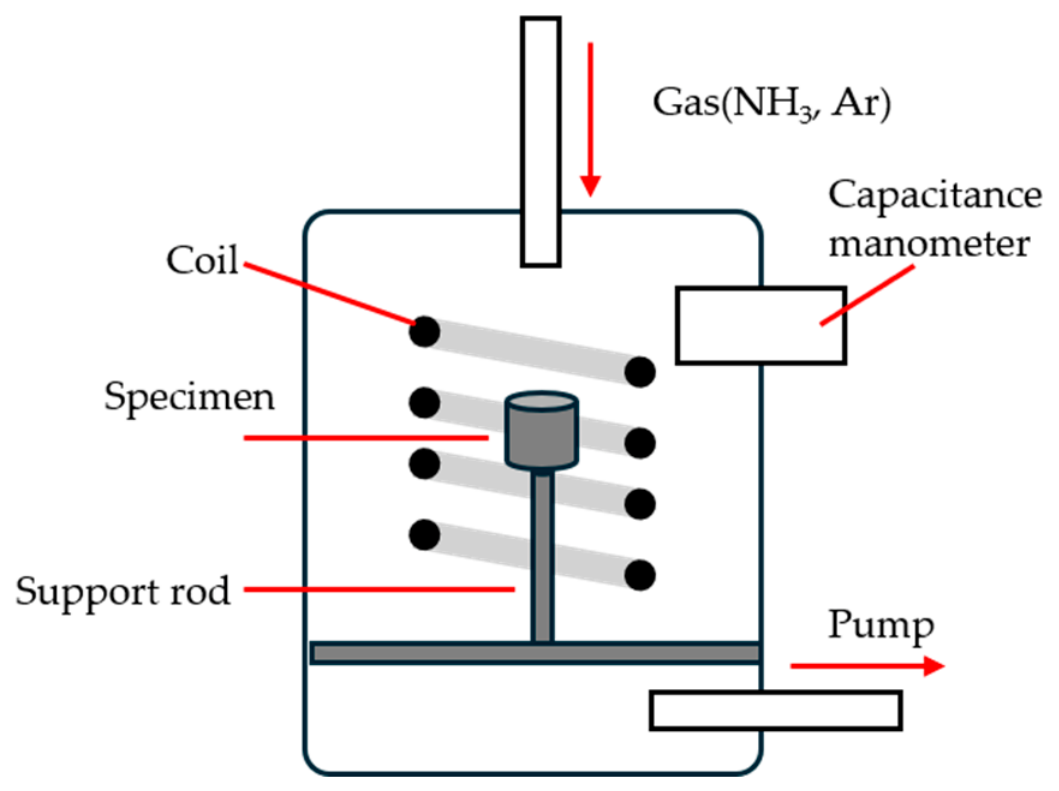
Figure 1 shows a schematic illustration of the high-frequency induction heating nitriding apparatus used in this study. The schematic represents the experimental configuration for ultrashort-time IH nitriding, including the specimen position, induction coil, treatment atmosphere, support rod, and temperature-monitoring thermocouple. The specimens were mounted on a support rod made of a Ni-based alloy (Alloy 600) with a diameter of 3 mm and a length of 110 mm, and positioned at the center of a high-frequency IH coil with an outer diameter of 40 mm and an overall height of 150 mm.
Figure 1.
Schematic illustration of the high-frequency induction heating nitriding apparatus used in this study. The schematic represents the arrangement of the SACM645 steel specimen, induction coil, NH3 gas atmosphere, support rod, and thermocouple for temperature control during ultrashort-time IH nitriding.
After mounting the specimens, degreasing (oxidation) treatment was performed at 490 °C for 9 min in an atmospheric environment, followed by furnace cooling to room temperature. Subsequently, the chamber was evacuated to a pressure of 100 Pa, after which Ar gas was introduced to replace the atmosphere with Ar. The chamber was then evacuated again to below 10 Pa, and NH3 gas was introduced up to the prescribed pressure. Nitriding was performed by high-frequency IH under the conditions summarized in Table 2. In this study, the nitriding time was used as the main experimental variable, whereas the nitriding temperature and initial NH3 pressure were kept constant at 570 °C and 80,000 Pa, respectively. After nitriding, the specimens were furnace-cooled to room temperature. The temperature was monitored and controlled using a thermocouple spot-welded to the side surface of the specimen.
Table 2.
Nitriding conditions for the SACM645 steel specimens. Only the nitriding time was varied, whereas the temperature and initial NH3 pressure were fixed at 570 °C and 80,000 Pa, respectively.
2.3. Measurements of Mechanical Property and Microstructure
After nitriding, the specimens were cut and their cross sections were prepared for characterization. For electron backscatter diffraction (EBSD) analysis, the cross-sectional surfaces were prepared by ion milling to obtain a deformation-free surface, and phase identification in the near-surface region was performed using EBSD attached to a field emission scanning electron microsope (FE-SEM: JEOL JSM-IT800, Tokyo, Japan). Nitrogen content profiles were analyzed using a field emission electron probe microanalyzer (FE-EPMA: JEOL JXA-8530F, Tokyo, Japan). The microstructure of the compound layer was revealed by etching with a 2% nital solution and observed using an optical microscope (OM: OLYMPUS BX53M, Tokyo, Japan). For each specimen, the compound-layer thickness was measured at three different positions on the cross-sectional optical micrographs, and the average value was adopted as the representative compound-layer thickness. Hardness distributions were measured using an automatic Vickers hardness tester (Matsuzawa AMT-X, Akita, Japan) under a load of 0.1 kgf with a dwell time of 15 s. For each depth position, the hardness was measured at three different points, and the average value was adopted as the representative hardness value.
3. Results
3.1. Microstructure
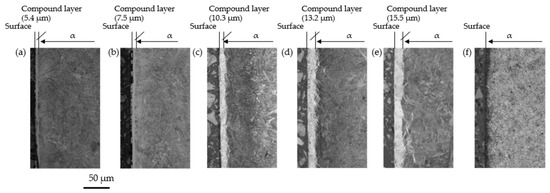
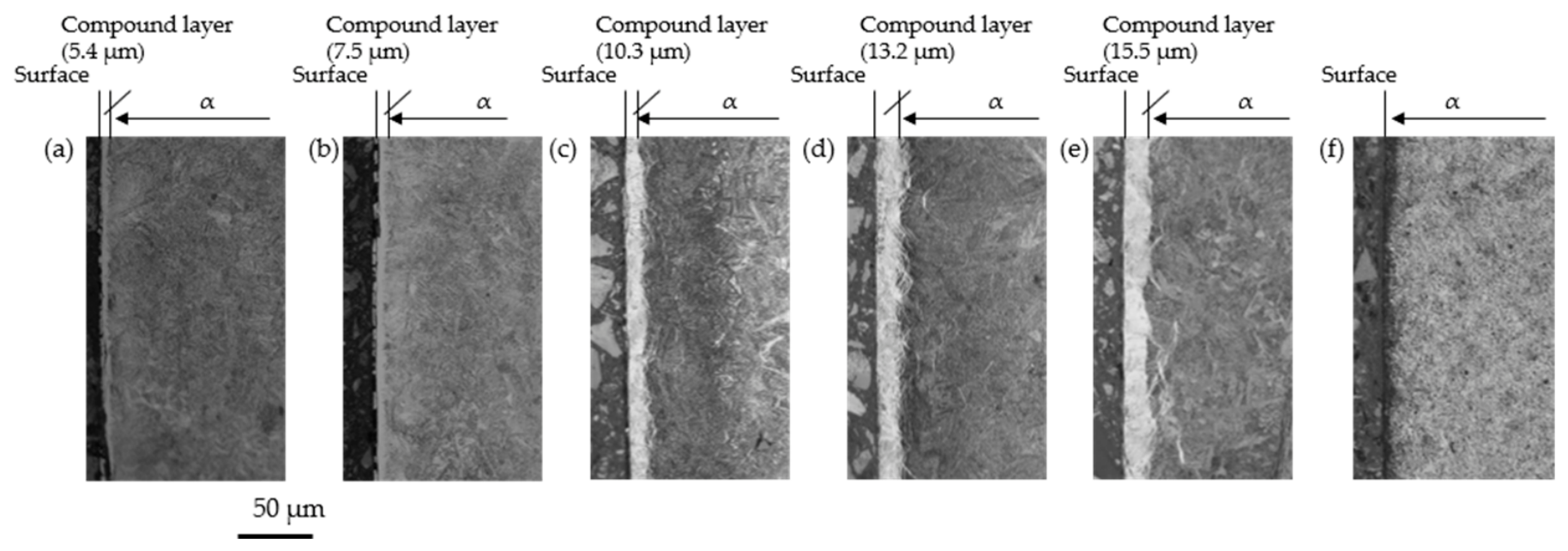
Optical micrographs of the near-surface region of SACM645 steel after IH nitriding for different time are shown in Figure 2. For all nitriding conditions, a white layer was observed in the near-surface region, which is attributed to the formation of a nitrogen compound layer. While the compound layer was formed even after the shortest nitriding time, its thickness increased systematically with increasing nitriding time. The compound layer thickness was approximately 5.4 μm after 8 min of nitriding and increased progressively to about 15.5 μm after 180 min. Because the nitriding temperature (570 °C) was lower than the tempering temperature (690 °C), the tempered microstructure in the interior region was retained.
Figure 2.
Optical micrographs of the near-surface region of SACM645 steel after IH nitriding for different time, revealed by nital etching: (a) 8 min, (b) 16 min, (c) 45 min, (d) 90 min, (e) 180 min, and (f) non-nitriding steel.
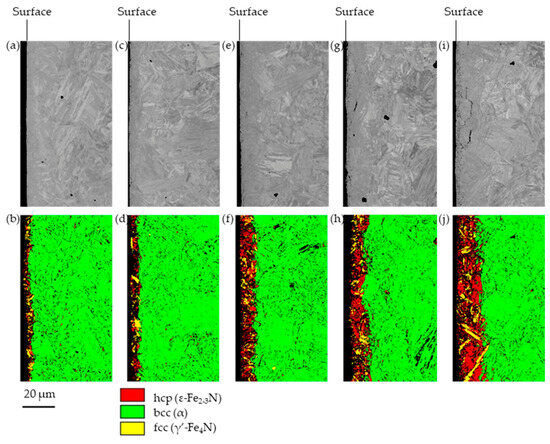
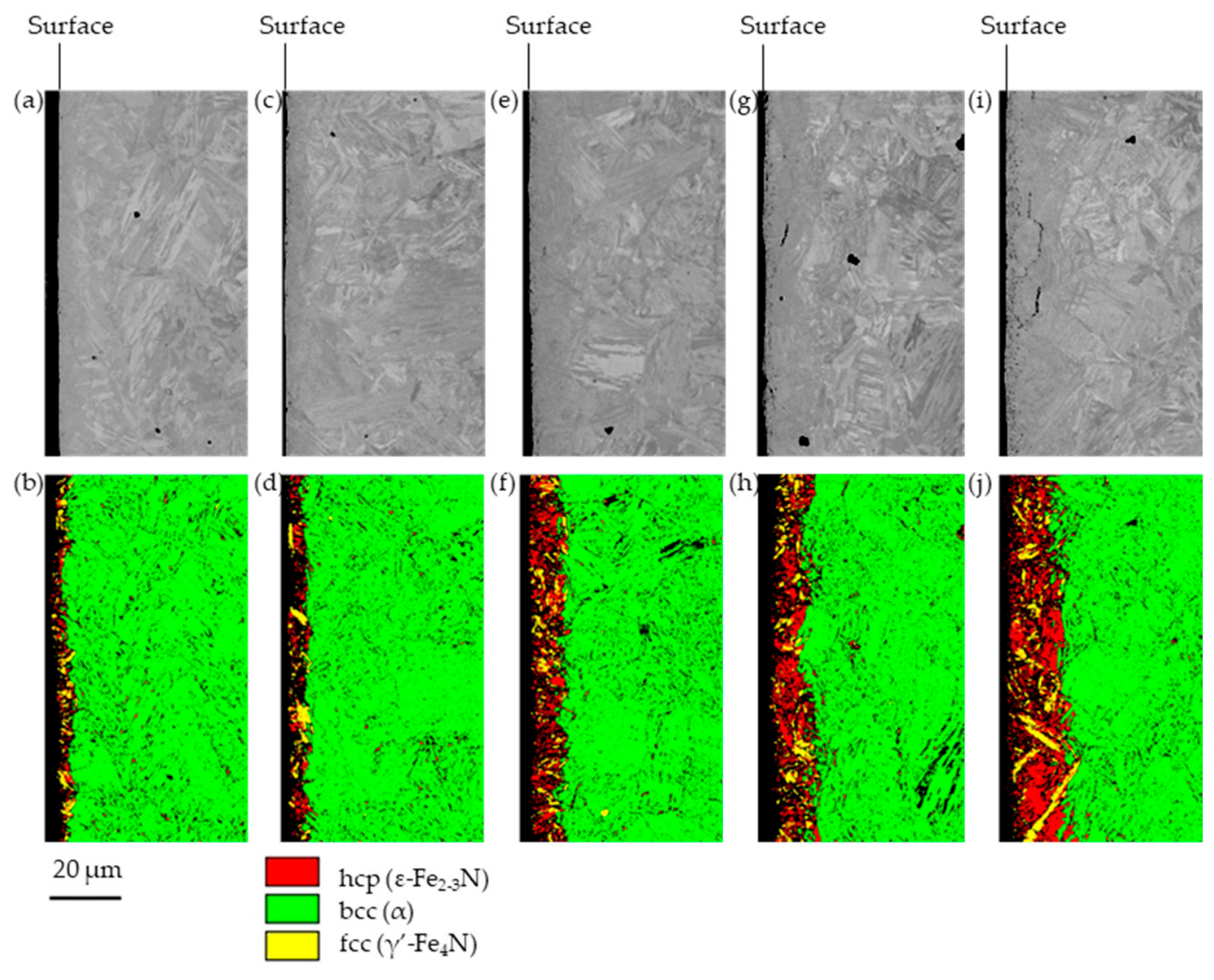
To further characterize the phase constitution and microstructural features of the compound layer, SEM observations and EBSD analyses were conducted. SEM images (upper row) and the corresponding EBSD phase maps (lower row) of the near-surface region after IH nitriding for different time are shown in Figure 3.
Figure 3.
SEM images (upper row) and the corresponding EBSD phase maps (lower row) of the near-surface region of SACM645 steel after IH nitriding for different time: (a,b) 8 min, (c,d) 16 min, (e,f) 45 min, (g,h) 90 min, and (i,j) 180 min.
For specimens nitrided for 45, 90, and 180 min, the compound layer was predominantly identified as an hcp phase, indicating that it mainly consisted of the ε phase (ε-Fe2–3N). Although the compound layer was not strictly single-phase, minor fractions of the γ′ phase (γ′-Fe4N) were locally detected, suggesting a mixed ε/γ′ phase constitution. The matrix microstructure beneath the compound layer exhibited a martensitic morphology, and the compound layer itself also showed a very fine-grained microstructure comparable to that of the matrix. In contrast, for specimens nitrided for shorter time, the compound layer consisted of extremely fine grains, which limited the acquisition of Kikuchi patterns with sufficient quality for reliable phase identification in most regions. As a result, locally unindexed areas and occasional phase misindexing near matrix grain boundaries were observed. Nevertheless, in regions where phase identification was possible, the coexistence of ε and γ′ phases was suggested. Furthermore, for specimens nitrided for 90 and 180 min, fine voids appearing as dark spots were observed within the compound layer, and some of these voids were locally interconnected.
3.2. Nitrogen Content Profiles
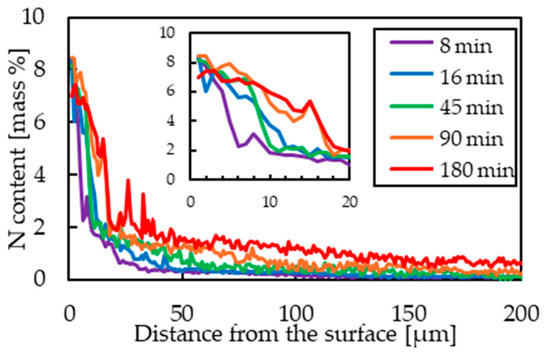
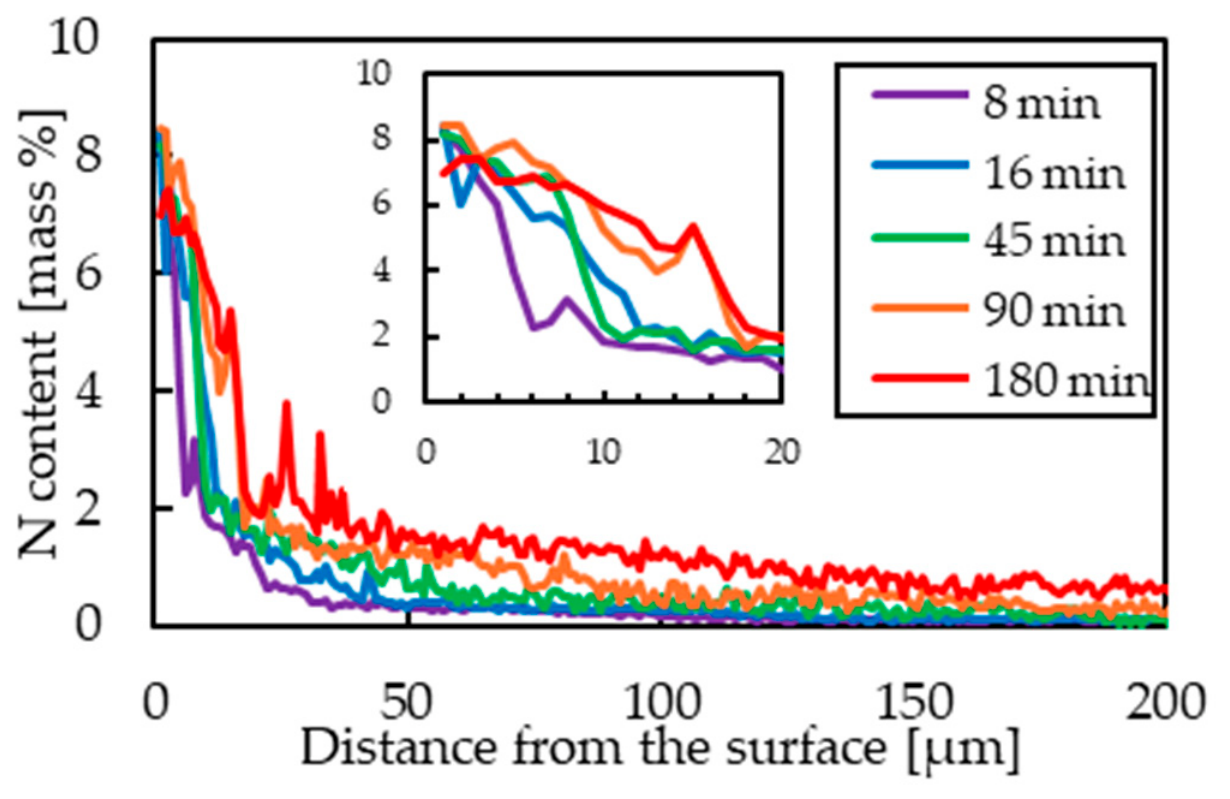
Figure 4 shows the nitrogen content profiles obtained by EPMA line analysis on polished cross sections of SACM645 steel specimens subjected to IH nitriding for different times. The measurements were performed from the specimen surface toward the interior, and the distance from the surface was used as the depth coordinate. In the immediate vicinity of the surface, the nitrogen content increased to approximately 7–8 mass% for all nitriding conditions. Notably, this surface nitrogen content was almost independent of nitriding time, indicating that nitrogen saturation at the surface occurs rapidly under IH conditions. A sharp, spike-like decrease in nitrogen content to approximately 2 mass% was observed at a depth of about 6 μm for 8 min, around 10 μm for 16 and 45 min, and approximately 16 μm for 90 and 180 min. These depths are in good agreement with the compound layer thicknesses determined from microstructural observations and EBSD phase mapping. Therefore, the abrupt decrease in nitrogen content can be interpreted as the boundary between the nitrogen-rich compound layer and the underlying diffusion layer. Below this boundary, the nitrogen content gradually decreased with increasing distance from the surface. At a given depth within the diffusion layer, the nitrogen content increased systematically with increasing nitriding time, indicating enhanced nitrogen penetration and accumulation during prolonged IH nitriding. These results demonstrate that while the surface nitrogen content and compound layer composition rapidly reach a near-saturated state, extended nitriding time primarily contributes to the growth of the compound layer and the enrichment of nitrogen in the diffusion layer [22,23].
Figure 4.
Cross-sectional nitrogen content profiles of SACM645 steel after IH nitriding for different times, measured by EPMA line analysis from the specimen surface toward the interior.
3.3. Hardness
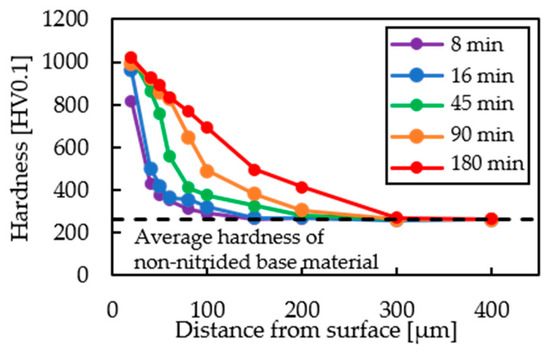
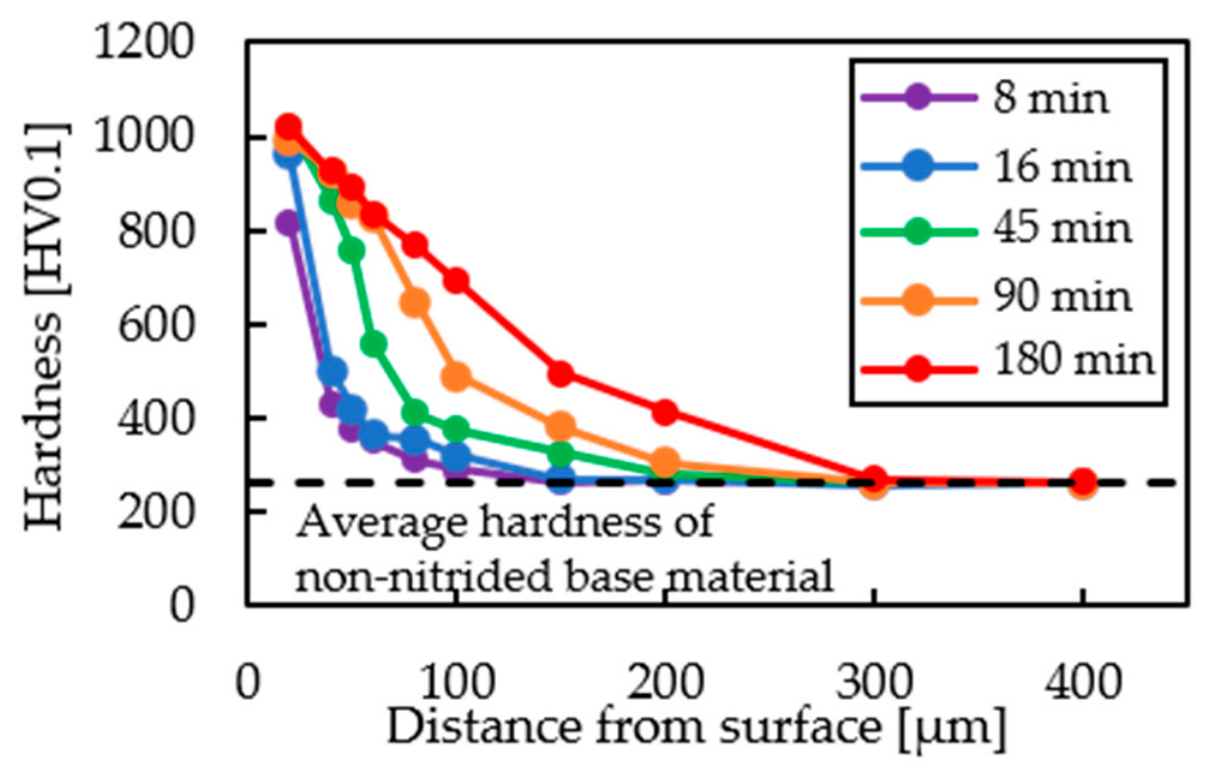
Figure 5 shows the hardness profiles as a function of distance from the surface in SACM645 steel subjected to IH nitriding for different time. Even for the shortest nitriding time of 8 min, the hardness in the near-surface region reached the 819 HV0.1, representing a remarkable increase compared with the average hardness of the substrate, which was approximately 260 HV0.1. This result demonstrates that IH nitriding enables rapid surface hardening within a very short processing time.
Figure 5.
Hardness profiles as a function of distance from the surface in SACM645 steel after IH nitriding for different times.
With increasing nitriding time, the depth over which the hardness remained elevated clearly increased. In addition, the shape of the hardness profiles changed systematically: for shorter nitriding time, the hardness decreased steeply with increasing distance from the surface, whereas for longer nitriding time, the hardness gradient became more gradual and extended to greater depths. This change in profile shape indicates progressive nitrogen diffusion into deeper regions of the steel with prolonged nitriding time.
The depth dependence of hardness shows good correspondence with the nitrogen content profiles obtained by EPMA. In particular, the depth range of enhanced hardness is consistent with that of elevated nitrogen content. This agreement supports the interpretation that the observed hardness increase is primarily governed by nitrogen content. If a hardness increase of more than 50 HV0.1 relative to the substrate is regarded as the effective hardness enhancement caused by the nitrogen diffusion layer, the effective hardened depth was approximately 80 μm for the specimen nitrided for 8 min. In contrast, this depth increased to approximately 200 μm for the specimen nitrided for 180 min. These results demonstrate that while a very high surface hardness can be achieved within a short nitriding time, prolonged IH nitriding is effective in extending the hardened region deeper into the material through enhanced nitrogen diffusion.
4. Discussion
4.1. Key Features of IH Nitriding
The present study demonstrates two distinctive features of IH nitriding when applied to SACM645 steel. The advantage is that the formation of a compound layer accompanied by a pronounced increase in surface hardness can be achieved even within an ultrashort processing time of 8 min. As shown in Figure 2, a white compound layer is already formed at the shortest nitriding time, and the corresponding near-surface hardness reaches 819 HV0.1, as shown by the hardness profiles in Figure 5. These results clearly indicate that IH nitriding enables rapid surface hardening within a timescale far shorter than that required for conventional furnace-based nitriding. In addition, the nitrogen content profiles obtained by EPMA (Figure 4) show that the nitrogen content in the near-surface region rapidly increases to a high level of approximately 7–8 mass% and remains almost independent of further increases in nitriding time. This behavior indicates that IH nitriding rapidly establishes a nitriding-active surface condition characterized by high nitrogen activity at the steel surface. Once this condition is established, the process transitions to a regime governed primarily by nitrogen transport across the compound-layer/diffusion layer interface rather than by surface reaction kinetics.
The rapid formation of the compound layer may also be related to the gas-atmosphere condition employed in the present process. In this study, the chamber was first evacuated and then filled with NH3 gas up to 80,000 Pa, without potential control by H2 dilution as commonly used in conventional controlled gas nitriding. Therefore, the NH3 partial pressure at the beginning of nitriding was relatively high, which likely promoted rapid nitrogen supply to the steel surface and contributed to the early formation of the compound layer.
In addition to the gas-atmosphere condition, the surface condition prior to nitriding may also have contributed to the rapid formation of the compound layer. In the present study, the specimens were subjected to an oxidation treatment before nitriding. Previous studies have reported that oxide films can promote nitriding by acting as catalytically active surfaces for ammonia dissociation and subsequent nitrogen transfer [24]. Such catalytic effects have been reported not only for iron-based materials but also for chromium-containing steels [25]. Therefore, the oxide film formed during the pre-oxidation treatment may have facilitated the establishment of a nitriding-active surface condition and contributed to the early formation of the compound layer in the present SACM645 steel.
However, because the NH3 dissociation rate, local NH3/H2 ratio, and nitriding potential were not directly measured in this study, the respective contributions of IH and gas-atmosphere effects cannot be quantitatively separated. Therefore, the rapid compound-layer formation observed in this study should be interpreted as the combined result of rapid IH heating and the initially high-NH3-pressure atmosphere, rather than as an effect of IH heating alone.
4.2. Diffusion-Controlled Growth of the Compound Layer
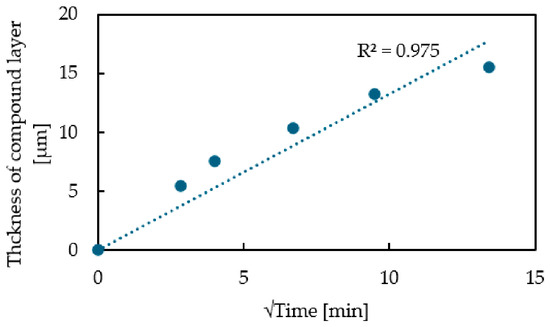
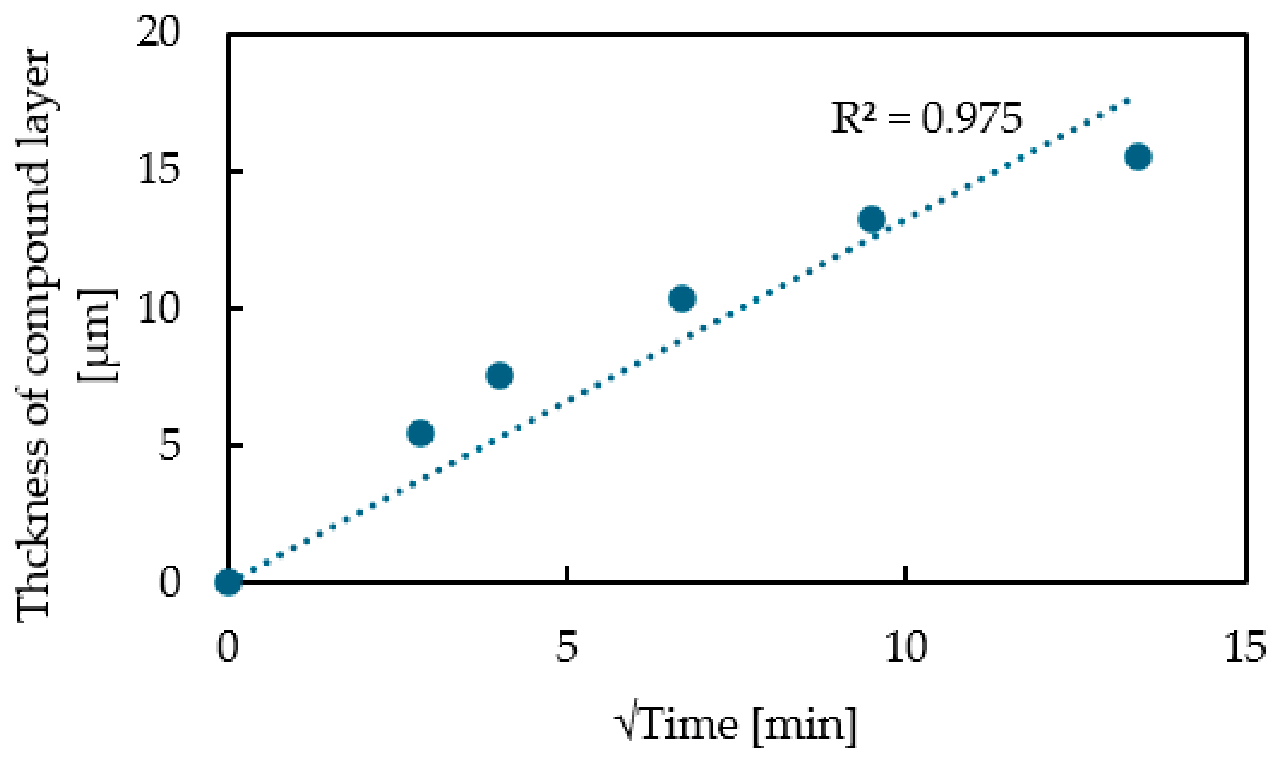
The results of this study reveal that compound-layer growth during IH (IH) nitriding proceeds according to diffusion-controlled kinetics after the formation of a continuous layer. As shown in Figure 6, a clear linear relationship is obtained between the compound-layer thickness and the square root of nitriding time (R2 = 0.975), which is characteristic of parabolic growth behavior. This result indicates that the growth rate decreases with increasing nitriding time as nitrogen transport through the already-formed compound layer becomes increasingly rate-limiting. Such behavior is well consistent with classical descriptions of compound-layer growth in conventional gas nitriding and gas soft nitriding, where diffusion through ε- and/or γ′-phase layers governs the advancement of the compound-layer/diffusion-layer interface [22].
Figure 6.
Relationship between compound-layer thickness and the square root of nitriding time for SACM645 steel after IH nitriding.
The diffusion-controlled nature of compound-layer thickening has been rigorously formulated by Somers and Mittemeijer, who developed analytical growth models for mono- and bilayer iron-nitride compound layers during gaseous nitriding [22]. In their framework, parabolic growth arises from nitrogen diffusion through γ′ and/or ε layers, with local equilibrium assumed at solid/solid interfaces and an effective nitrogen diffusivity controlling the time dependence of layer advance. The good agreement between the present experimental results (Figure 6) and this classical model demonstrates that the governing growth mechanism itself remains unchanged under IH nitriding conditions.
Accordingly, the role of IH is not to alter the fundamental growth law of the compound layer, but rather to accelerate the onset of the diffusion-controlled regime by rapidly establishing a nitriding-active surface with high nitrogen activity, as shown by the rapid surface nitrogen enrichment shown in Figure 4. Once a continuous compound layer has formed, subsequent thickening proceeds according to parabolic kinetics governed by nitrogen diffusion through the nitride layer. From a process-design perspective, this behavior implies diminishing returns in compound-layer thickening at extended treatment times, highlighting the effectiveness of IH nitriding for forming thin but continuous compound layers within short processing time.
The predominance of the ε phase observed in the present compound layers (Figure 3) is also consistent with thermodynamic considerations for practical nitriding steels containing carbon. Previous studies based on experimental and calculated Lehrer diagrams for the Fe–C–N system have demonstrated that carbon stabilizes the ε-(Fe2–3(N,C)) phase relative to the γ′-(Fe4N) phase by expanding the ε stability region toward lower nitriding potentials [6,7,8,9,10,11]. Consequently, ε-rich compound layers are more readily formed in carbon-containing steels than would be expected from the binary Fe–N system alone, which reasonably explains the ε-dominant phase constitution identified by EBSD in the present IH-nitrided SACM645 steel. Although the nitriding potential was not explicitly controlled in this study, the experimental results shown in Figure 3 and Figure 4 suggest that sufficiently high nitriding potential was achieved under the present IH conditions.
On the other hand, SEM observations (Figure 3) revealed that prolonged nitriding led to the formation of fine voids and porosity within the compound layer. Such microstructural features are often associated with extended exposure under high nitrogen activity and the formation of thick ε-rich layers [22,23], indicating that increasing treatment time does not necessarily result in improved compound-layer quality. These results emphasize the importance of optimizing both the near-surface equilibrium nitrogen content and the nitriding time, and they suggest the existence of an optimal processing window in IH nitriding—sufficient to form a continuous compound layer while avoiding excessive microstructural degradation.
4.3. Hardness of Difusion Layer
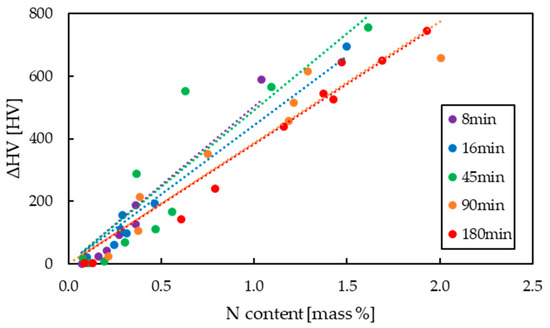
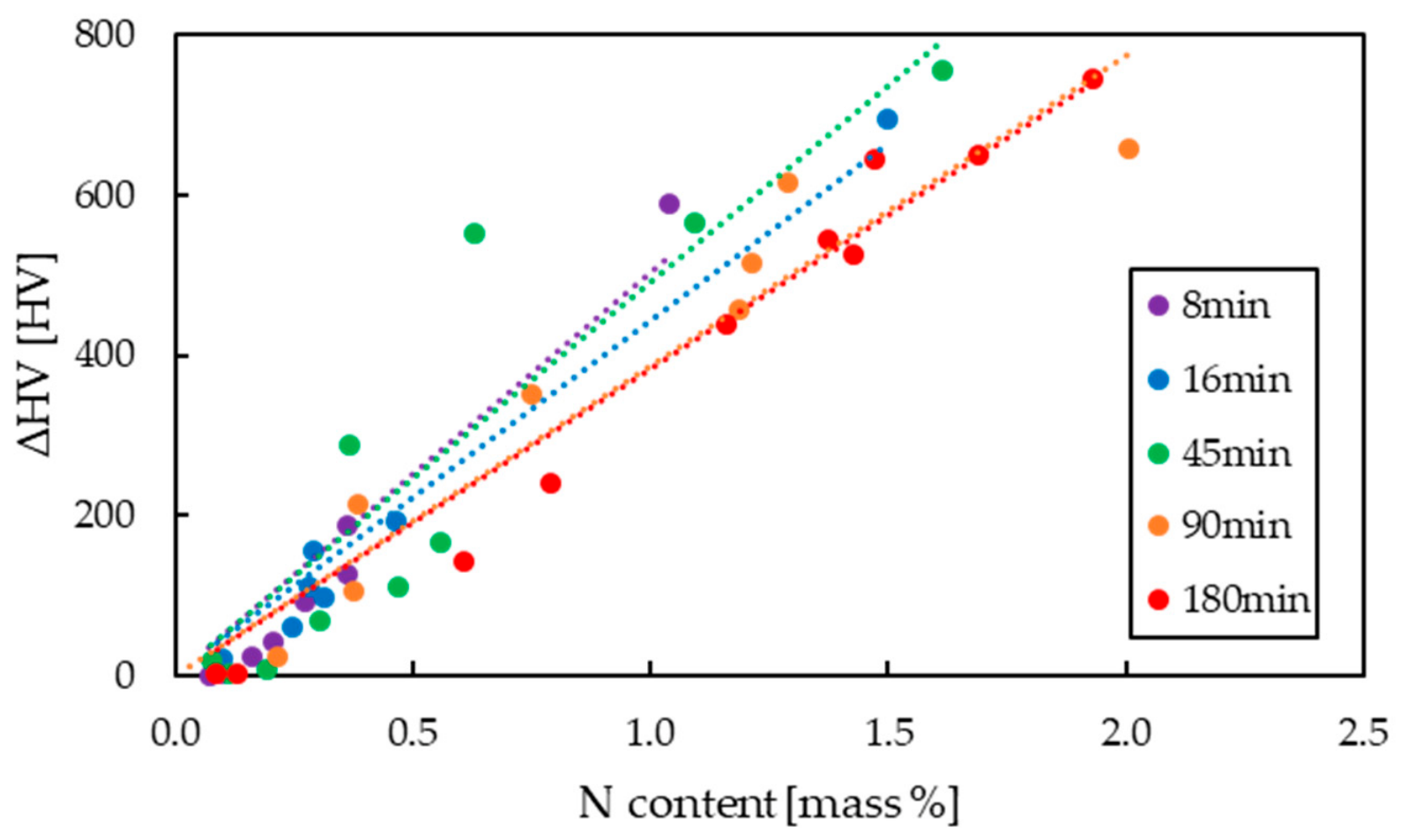
Figure 7 shows the relationship between the local nitrogen content measured by EPMA and the hardness increment relative to the substrate (ΔHV) at the same depth. For each nitriding time, a strong positive correlation is obtained between ΔHV and nitrogen content, with correlation coefficients (R2) ranging from 0.91 to 0.99. Notably, data obtained under different nitriding times collapse onto nearly identical linear trends, indicating that the hardening behavior in the diffusion layer is governed primarily by the local nitrogen content rather than by the nitriding time itself. In other words, nitriding time mainly determines the spatial distribution of nitrogen—i.e., how deeply a given nitrogen content penetrates—whereas the magnitude of local hardening is dictated by the local nitrogen content.
Figure 7.
Relationship between nitrogen content and ΔHV in several conditions.
This behavior is in good agreement with previous studies on nitrided steels. Ishikawa et al. reported that, in gas-nitrided SACM645 steel, the hardness increase in the diffusion layer cannot be explained solely by nitrogen solid-solution strengthening, but is likely associated with the formation of complex carbides or carbonitrides containing aluminum and chromium [26]. Similarly, Hiraoka et al. demonstrated a linear relationship between nitrogen content and hardness increment in the diffusion layer and discussed the strengthening behavior in terms of the volume fraction and characteristic radius of nitrides [13]. More generally, it has been well established that strengthening in the diffusion layer of nitrided steels arises from a combined contribution of nitrogen solid-solution strengthening and precipitation strengthening by fine nitrides or carbonitrides, with the hardness response being strongly correlated with local nitrogen content rather than processing time.
Based on these previous findings, the high ΔHV–nitrogen correlation observed in the present study can be interpreted as the result of dislocation motion being impeded by finely dispersed nitrides and/or carbonitrides whose population is governed by local nitrogen availability. The absence of a pronounced time dependence further suggests that, even under ultrashort IH (IH) nitriding conditions, the effect of processing time on the precipitation state is limited. Provided that a sufficient amount of nitrogen is introduced into the diffusion layer, these strengthening mechanisms operate effectively, which is a key characteristic of the present IH nitriding process.
From a practical viewpoint, the relationship demonstrated here represents a useful “composition–property” linkage between nitrogen content and hardness. If a target hardness profile is specified, the corresponding nitrogen content profile—and hence the required diffusion depth and nitriding time—can be rationally estimated. This enables process design for IH nitriding based on fundamental material response rather than relying solely on empirical trial-and-error.
5. Conclusions
This study demonstrates that induction-heating (IH) nitriding enables rapid surface hardening and controlled compound-layer formation in SACM645 steel within ultrashort processing times, while maintaining diffusion-controlled growth behavior consistent with conventional nitriding mechanisms.
- Rapid surface hardening: A continuous compound layer and a high surface hardness of 819 HV0.1 were achieved within only 8 min of IH nitriding, accompanied by rapid saturation of surface nitrogen content.
- Diffusion-controlled growth: After layer formation, compound-layer growth followed diffusion-controlled (parabolic) kinetics, indicating that IH accelerates the establishment of diffusion-controlled conditions without altering the fundamental growth mechanism.
- Process design implication: Hardening in the diffusion layer was governed primarily by local nitrogen content rather than nitriding time, providing a rational basis for designing IH nitriding processes with short treatment times.
Author Contributions
Conceptualization, K.A., H.H. and T.O.; methodology, K.A.; validation, K.A., H.H. and T.O.; formal analysis, K.A., H.H. and T.O.; investigation, K.A., H.H. and T.O.; resources, F.I.; writing—original draft preparation, K.A.; writing—review and editing, K.S.; supervision, K.S. All authors have read and agreed to the published version of the manuscript.
Funding
This research received no external funding.
Data Availability Statement
The data that support the findings of this study are available from the corresponding authors upon reasonable request.
Conflicts of Interest
Authors Kazuhiro Abe, Hisamitsu Hato, Takeshi Obana, Kazuya Shinagawa were employed by the Research and Development Group, author Fujita Itaru was employed by the Hitachi Construction Machinery Co., Ltd. The authors declare that the research was conducted in the absence of any commercial or financial relationships that could be construed as a potential conflict of interest.
Abbreviations
The following abbreviations are used in this manuscript:
| EPMA | Electron Probe Microanalysis |
| EBSD | Electron Backscatter Diffraction |
| SEM | Scanning Electron Microscopy |
| OM | Optical Microscopy |
| IH | Induction heating |
| HV | Vickers Hardness |
| ΔHV | Hardness Increment Relative to Substrate |
| NH3 | Ammonia |
References
- Sundaramoorthy, S.; Kamath, D.; Nimbalkar, S.; Price, C.; Wenning, T.; Cresko, J. Energy Efficiency as a Foundational Technology Pillar for Industrial Decarbonization. Sustainability 2023, 15, 9487. [Google Scholar] [CrossRef] [Scilit]
- Kim, S.; Yoon, S.; Kim, J.-H.; Park, S. Effect of the Transformation of ε-Fe2-3N into γ′-Fe4N Phase on the Fatigue Strength of Gas-Nitrided Pure Iron. Metals 2020, 10, 823. [Google Scholar] [CrossRef] [Scilit]
- Yamada, Y.; Hirohito, E.; Takahashi, K. Influence of Crystal Structure of Nitride Compound Layer on Torsion Fatigue Strength of Alloy Steel. Metals 2019, 9, 1352. [Google Scholar] [CrossRef] [Scilit]
- Wriedt, H.A.; Gokcen, N.A.; Nafziger, R.H. The Fe-N (Iron-Nitrogen) System. Bull. Alloy Phase Diagr. 1987, 8, 355–377. [Google Scholar] [CrossRef] [Scilit]
- Lehrer, E. Über das Eisen-Wasserstoff-Ammoniak-Gleichgewicht. Z. Elektrochem. 1930, 36, 383–392. [Google Scholar] [CrossRef] [Scilit]
- Slycke, J.; Sproge, L. Kinetics of the Gaseous Nitrocarburising Process. Surf. Eng. 1989, 5, 125–140. [Google Scholar] [CrossRef] [Scilit]
- Kunze, J. Nitrogen and Carbon in Iron and Steel: Thermodynamics. Härterei-Tech. Mitt. 1996, 51, 348–355. [Google Scholar]
- Du, H. A reevaluation of the Fe-N and Fe-C-N systems. J. Phase Equilibria 1993, 14, 682–693. [Google Scholar] [CrossRef] [Scilit]
- Du Marchie van Voorthuysen, E.H.; Chechenin, N.G.; Boerma, D.O. Low-temperature extension of the lehrer diagram and the iron-nitrogen phase diagram. Metall. Mater. Trans. A 2002, 33, 2593–2598. [Google Scholar] [CrossRef] [Scilit]
- Brink, B.K.; Meier, K.; Rasmussen, C.B.; Somers, M.A.J. The ternary Fe-C-N system: Homogeneous distributions of nitrogen and carbon. J. Alloys Compd. 2017, 690, 431–437. [Google Scholar] [CrossRef] [Scilit]
- Hiraoka, Y.; Watanabe, Y.; Umezawa, O. Effect of Carbon Content on Phase Stabilities of γ′ and ε in Compound Layer During Gas Nitriding for Low Alloy Steel. J. Jpn. Soc. Heat Treat 2014, 54, 313–318. [Google Scholar]
- Umehara, T.; Yuya, M. Effects of carbon concentration change on growth of compound layer in surface of nitrided steel. Mater. Trans. 2020, 61, 1070–1076. [Google Scholar] [CrossRef] [Scilit]
- Hiraoka, Y.; Ishida, A. Effect of Nitriding Temperature and Compositions on Diffusion Layer’s Hardness in Gas Nitrided Low Alloy Steel Containing Chromium. Mater. Trans. 2016, 80, 253–258. [Google Scholar] [CrossRef] [Scilit][Green Version]
- Yang, M. Modeling the Gas Nitriding Process of Low Alloy Steels. J. Mater. Eng. Perform. 2013, 22, 1892–1898. [Google Scholar] [CrossRef] [Scilit]
- Hiraoka, Y.; Ishida, A.; Umezawa, O. Effect of Compound Layer Thickness Composed of γ′-Fe4N on Rotated-Bending Fatigue Strength in Gas-Nitrided JIS-SCM435 Steel. Mater. Trans. 2017, 58, 993–999. [Google Scholar] [CrossRef] [Scilit]
- Koga, N.; Yamashita, A.; Kato, R.; Kanebu, R.; Miyake, K.; Hashimoto, Y. Grain refinement of Fe4N compound layer in nitrided steel. Materialia 2024, 37, 102217. [Google Scholar] [CrossRef] [Scilit]
- Zhou, Y.-L.; Xia, F.; Xie, A.-J.; Peng, H.-P.; Wang, J.-H.; Li, Z.-W. A Review—Effect of Accelerating Methods on Gas Nitriding: Accelerating Mechanism, Nitriding Behavior, and Techno-Economic Analysis. Coatings 2023, 13, 1846. [Google Scholar] [CrossRef] [Scilit]
- Maruyama, T.; Umezawa, O. Pore Shape Evolution in Nitrided SCM440H Compound Layer and Its Influence on Pitting Resistance during Rolling-Sliding Contact Fatigue. ISIJ Int. 2025, 65, 1701–1709. [Google Scholar] [CrossRef] [Scilit]
- Takesue, S.; Morita, T.; Misaka, Y.; Komotori, J. Rapid formation of titanium nitride coating by atmospheric-controlled induction-heating fine particle peening and investigation of its wear and corrosion resistance. Results Surf. Interfaces 2023, 11, 100121. [Google Scholar] [CrossRef] [Scilit]
- Takesue, S.; Kikuchi, S.; Misaka, Y.; Morita, T.; Komotori, J. Combined Effect of Gas Blow Induction Heating Nitriding and Post-Treatment with Fine Particle Peening on Surface Properties and Wear Resistance of Titanium Alloy. Mater. Trans. 2021, 62, 1502–1509. [Google Scholar] [CrossRef] [Scilit]
- Takesue, S.; Suyama, R.; Hayama, M.; Koyanagi, Y.; Misaka, Y.; Komotori, J. Effect of surface characteristics on the axial fatigue properties and wear resistance of Ti-6Al-4V alloy nitrided by gas blow induction-heating. Eng. Fail. Anal. 2024, 157, 107933. [Google Scholar] [CrossRef] [Scilit]
- Somers, M.A.J.; Mittemeijer, E.J. Layer-growth kinetics on gaseous nitriding of pure iron: Evaluation of diffusion coefficients for nitrogen in iron nitrides. Metall. Mater. Trans. A 1995, 26, 57–74. [Google Scholar] [CrossRef] [Scilit]
- Torchane, L.; Bilger, P.; Tison, P.; Mater, G. Control of iron nitride layers growth kinetics in the binary Fe-N system. Metall. Mater. Trans. A 1996, 27, 1823–1835. [Google Scholar] [CrossRef] [Scilit]
- Friehling, P.B.; Somers, M.A.J. On the effect of preoxidation on nitriding kinetics. Surf. Eng. 2000, 16, 103–106. [Google Scholar] [CrossRef] [Scilit]
- Li, J.; Yang, X.; Wang, S.; Wei, K.; Hu, J. A rapid D.C. plasma nitriding technology catalyzed by pre-oxidation for AISI4140 steel. Mater. Lett. 2014, 116, 199–202. [Google Scholar] [CrossRef] [Scilit]
- Ishikawa, N.; Shiraga, T.; Sato, K.; Ishiguro, M.; Kabasawa, H.; Kuwahara, Y. Effect of Nitriding Temperature on Gas Nitriding Property of Steels for Nitriding. Tetsu-to-Hagané 1996, 82, 66–71. [Google Scholar] [CrossRef] [Scilit][Green Version]

Disclaimer/Publisher’s Note: The statements, opinions and data contained in all publications are solely those of the individual author(s) and contributor(s) and not of MDPI and/or the editor(s). MDPI and/or the editor(s) disclaim responsibility for any injury to people or property resulting from any ideas, methods, instructions or products referred to in the content. |
© 2026 by the authors. Licensee MDPI, Basel, Switzerland. This article is an open access article distributed under the terms and conditions of the Creative Commons Attribution (CC BY) license.