


Abstract
The ultra-large steam turbine rotor and heavy gas turbine disk are key components of power stations. They are manufactured from very large ingots, and extremely low strain rates are used during forging. In this study, a high-strength CrNiMoV steel, 25Cr1Ni4MoV, was hot-compressed at 1000–1200 °C and strain rates of 0.01–0.0001 s−1, and the resulting deformed microstructures were observed. The peak stress ranged from 17 to 72 MPa. The hot deformation equation was obtained, and the activation energy for deformation was determined to be 329 kJ/mol, which was lower than that reported in previous studies due to the extremely low strain rate. The deformation mechanism is dynamic recrystallization even at a strain rate of 0.0001 s−1. The critical strains for complete dynamic recrystallization were determined. The dynamic recrystallization grain size increased slowly with decreasing ln(Z), where Z is the Zener–Hollomon parameter, within the ln(Z) range of 22–27. However, when ln(Z) was below 21, the dynamic recrystallization grain size increased rapidly. This critical ln(Z) value is a new finding. Strategies for controlling grain size in the production of ultra-large steam turbine rotors and heavy gas turbine disk forgings were provided. Finally, future research directions were discussed.
1. Introduction
The steam turbine rotor and heavy gas turbine disk are key components of thermal, nuclear, and gas power-generation units, and their quality and performance directly affect the safety and service life of power stations [1,2,3,4]. High-strength CrNiMoV steels, such as 30CrNi4MoV [5], 30Cr1Mo1V [6,7], 25Cr2Ni4MoV [8], and 22CrMoNiWV [9], exhibit excellent hardenability and outstanding mechanical properties, particularly high-temperature creep and fatigue performance. They are the primary materials used to manufacture rotors and turbine disks for power-generation units. By adjusting the chemical composition, optimizing the heat treatment process, and regulating the microstructure, their service performance has continued to improve [5,6,7,8,9,10,11,12,13].
Both the steam turbine rotor and heavy gas turbine disk are produced by open-die forging. The flow stress and microstructure evolution during hot deformation, particularly dynamic recrystallization (DRX) behavior, form the basis for microstructure control and forging process design and have been extensively investigated [8,14,15,16]. However, with societal development, the demand for electricity is increasing. To improve power-generation capacity and efficiency, reduce welding seams, and replace welded structures with integral forgings, steam rotor and gas turbine disk forgings are becoming larger. For example, the low-pressure steam rotor in the CAP1400 nuclear power unit and the disk of the F-class heavy gas turbine both have diameters of approximately 3 m, and, particularly for low-pressure rotors, ingots of 600 tons or more are required [17,18]. If a 150 MN hydraulic press (commonly referred to as a 15,000-ton-force press) is used for upsetting, the pressure is 48 MPa when the steel ingot diameter is 2 m and only 21 MPa when the steel ingot diameter is 3 m. These very large ingots undergo extremely slow strain rates during upsetting, which can be as low as 0.0001 s−1 [18]. This deformation rate is much lower than those used in the abovementioned studies. The hot deformation behavior of high-strength CrNiMoV steel at extremely low strain rates remains unclear.
In this study, a high-strength CrNiMoV steel, 25Cr1Ni4MoV, was hot-compressed at extremely low strain rates to simulate forging. The flow behavior was analyzed, the deformation activation energy was calculated, and the microstructure was investigated. The research results are expected to provide a basis for the manufacturing and development of ultra-large steam turbine rotors and heavy gas turbine disk forgings.
2. Materials and Methods
The 25Cr1Ni4MoV steel was melted in a 50 kg vacuum induction furnace (China Iron & Steel Research Institute Group Co., Ltd., Beijing, China). The chemical composition was (wt%) C 0.28, Cr 1.5, Ni 3.8, Mo 0.6, V 0.11, Mn 0.3, Si 0.1, S 0.013, P 0.008, and balance Fe. The ingot was homogenized at 1200 °C for 6 h, forged into a bar with a diameter of 100 mm, and then air-cooled.
Specimens with a diameter of 10 mm and a height of 15 mm were machined from the forged rod. Hot compression tests were performed using a Gleeble3800 (Dynamic Systems Inc., Poestenkill, NY, USA)simulator. Tantalum foil and molybdenum disulfide were used as lubricants between the specimens and the compression dies. The specimens were heated to 1200 °C at 5 °C/s, held at 1200 °C for 10 min, and then cooled to the deformation temperatures at 5 °C/s. The deformation temperatures were 1000, 1100, and 1200 °C, and the strain rates were 0.01, 0.001, and 0.0001 s−1, respectively. After compression to a true strain of 0.9, the specimens were automatically water-cooled within 2 s.
The compressed specimens were cut along the axis. The cutting surfaces were ground with 2000-grit SiC sandpaper and then mechanically polished with 1 μm diamond. The parent austenite grain boundaries were etched using a solution of picric acid, nitric acid, and alcohol at 60 °C for 2 min. The grain morphology was observed using an Axio Observer A1 m optical microscope (ZEISS Group, Oberkochen, Germany). The DRX grain sizes were measured using the intercept method according to the ASTM E112-25 standard [19].
3. Results
3.1. Flow Behavior and Hot Deformation Equation
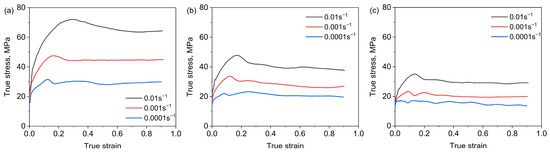
The flow curves of 25Cr1Ni4MoV steel compressed at 1000–1200 °C and strain rates of 0.01–0.0001 s−1 are shown in Figure 1. The peak stresses ranged from 17 to 72 MPa. In the initial stage of deformation at 1000 °C and a strain rate of 0.01 s−1, the flow stress increased with increasing strain, reached a peak at a strain of approximately 0.3, and then slowly decreased (Figure 1a). This decrease was attributed to the softening effect of DRX being greater than the work-hardening effect. When the strain reached 0.7, a steady-state stress plateau appeared. This indicates that complete DRX occurred and that the softening effects of DRX and work hardening reached equilibrium. At a strain rate of 0.001 s−1, the peak strain was less than 0.2, and the beginning of the stress plateau was only ~0.3. At the lowest strain rate of 0.0001 s−1, the flow curve exhibited fluctuations after the peak (Figure 1a). As the deformation temperature increased, the deformation resistance decreased, and complete DRX occurred earlier (Figure 1b,c). The flow curves of 0.000 s−1 in Figure 1a–c and 0.001 s−1 in Figure 1c can be characterized as multi-peak curves, in which a strengthening process followed by a softening process is repeated. It is generally believed that these fluctuations are caused by grain growth [20].
Figure 1.
Flow curves of 25Cr1Ni4MoV steel compressed at temperatures of (a) 1000 °C, (b) 1100 °C, and (c) 1200 °C.
The relationship between stress, strain rate, and temperature during the hot deformation of metals can be described as follows [21]:
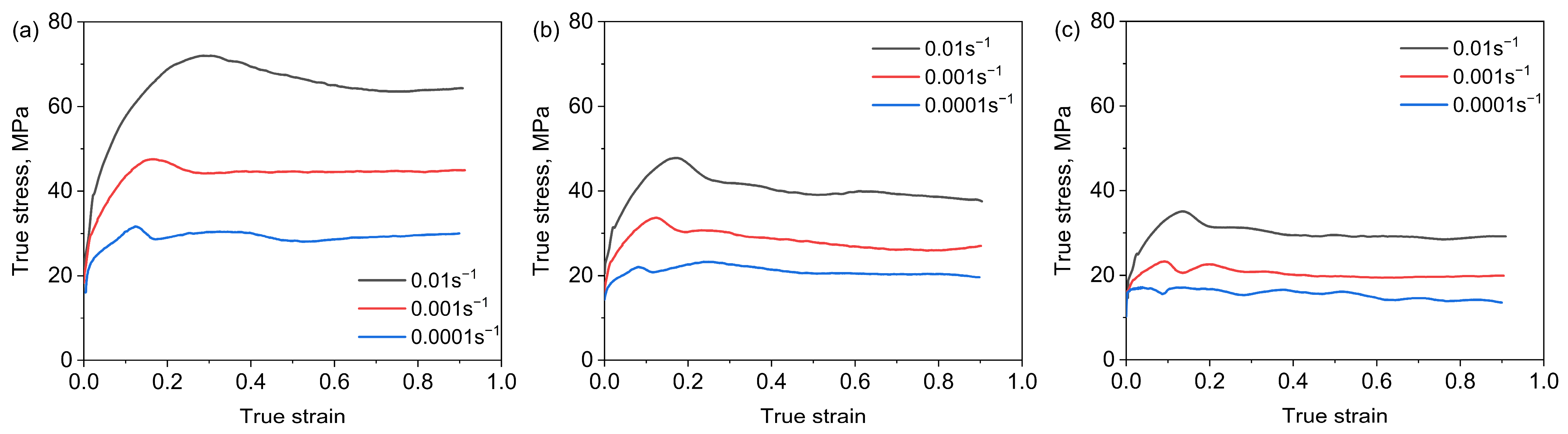
where is the strain rate (s−1), Q is the activation energy for deformation (J/mol), R is the gas constant, T is the temperature (K), and σ is the stress (MPa). A, α, and n are constants. Based on references [21,22], the ln(σ) − ln() and σ − ln() relationships were obtained (Figure 2a,b). Linear fitting was applied to the data points, and the reciprocals of the slopes were averaged to obtain the values of β = 0.184 MPa−1 and n = 6.027. Therefore, α = β/n = 0.0305, which are higher values than those reported in previous studies [14,15,16]. The ln[sinh(ασ)] − ln() and ln[sinh(ασ)] − 1/T relationships are shown in Figure 2c,d. The average values of n and Q were 4.45 and 329 kJ/mol, respectively. The activation energy for deformation was lower than that reported in previous studies [14,15,16]. Besides compositional differences, this was mainly caused by the lower testing strain rate, which promoted the softening effect during deformation. In Figure 2, the correlation coefficients (R2) of all linear fittings are higher than 0.96, and the fitted results are reliable. The hot deformation equation of 25Cr1Ni4MoV steel compressed at 1000–1200 °C and strain rates of 0.01–0.0001 s−1 is as follows:
Figure 2.
Relationships between (a) ln(σ) and ln(), (b) σ and ln(), (c) ln[sinh(ασ)] and ln(), and (d) ln[sinh(ασ)] and 1/T. Dashed lines are the results of linear fitting.
3.2. Z Parameter and Critical Strain for Complete DRX
The Zener–Hollomon [23] (Z) parameter was used to characterize the combined effects of temperature and strain rate on deformation behavior. The Z values (s−1) were calculated using Equation (3), and the results are shown in Table 1:
Table 1.
Z values under different deformation conditions.
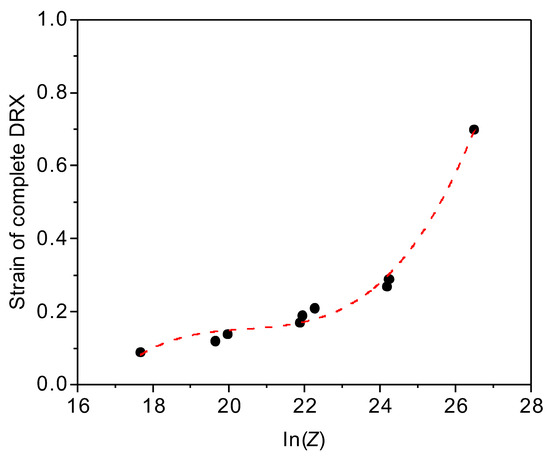
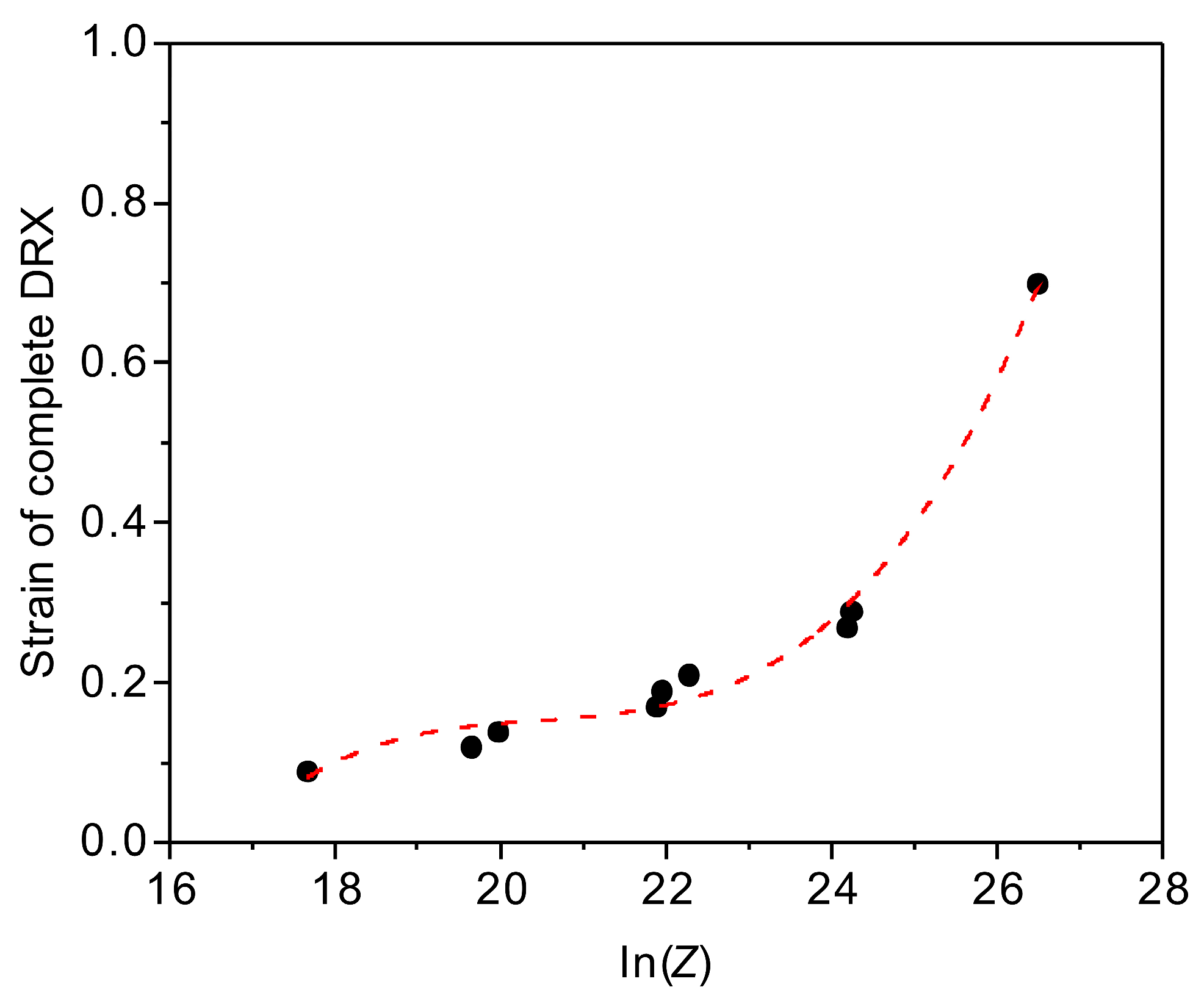
In the flow curves, the beginning of the steady-state stress plateau and the end of the first peak can be considered the critical strains for complete DRX. Based on the strain–stress data, the critical strains for complete DRX were obtained, and their dependence on ln(Z) is shown in Figure 3. The points represent the measured data, and the dashed line represents the fitted result. A cubic polynomial relationship was observed, with a correlation coefficient (R2) of 0.99:
where εDRX is the critical strain for complete DRX.
Figure 3.
Relationship between the critical strain of complete DRX and ln(Z).
3.3. Microstructure
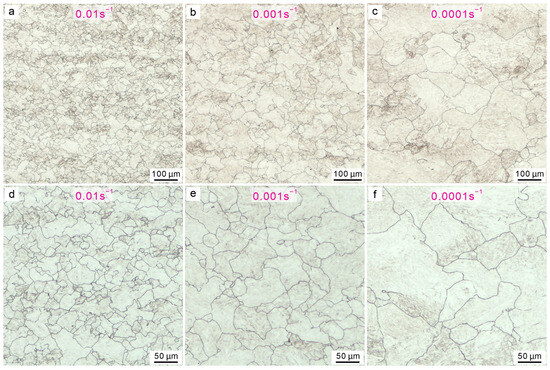
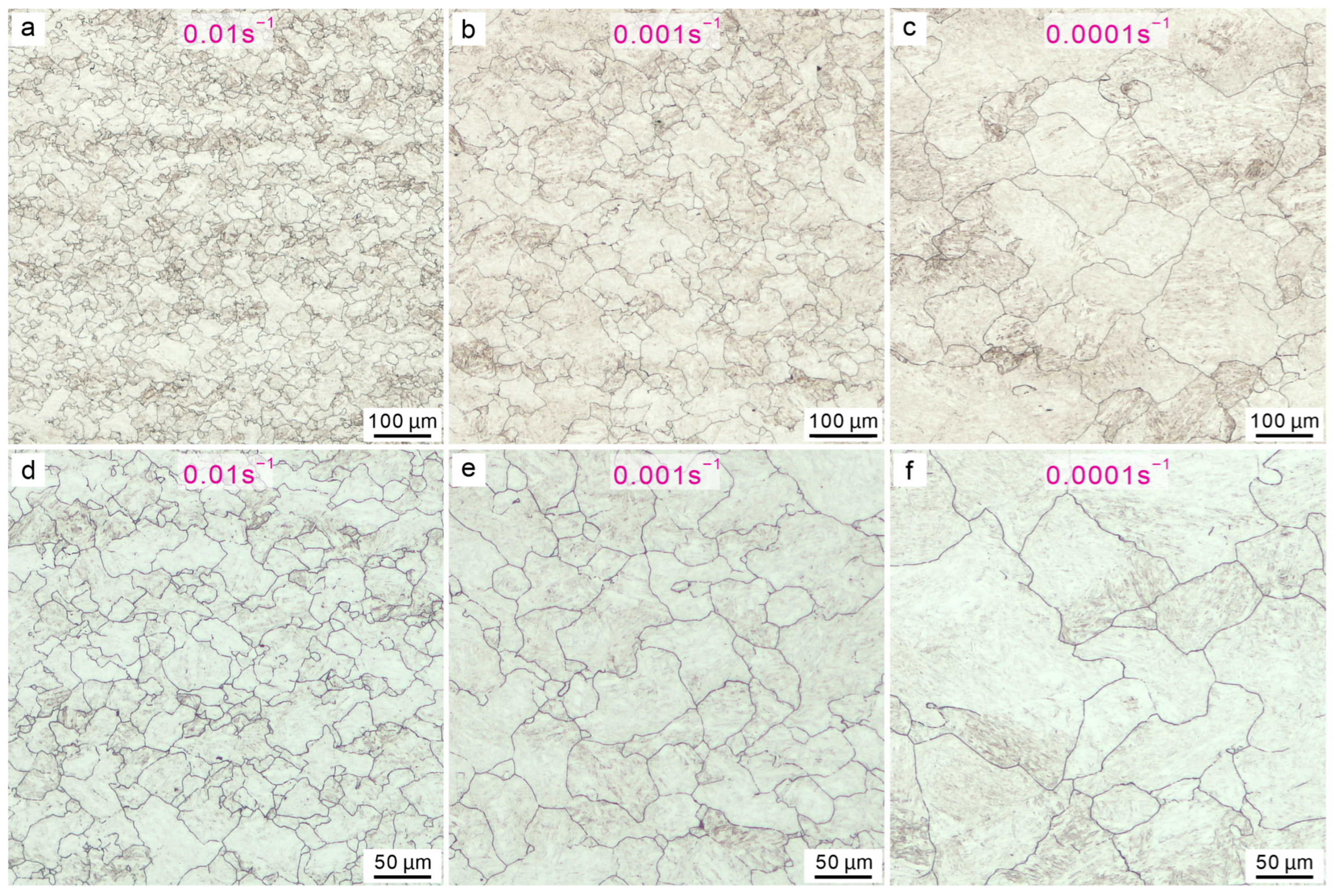
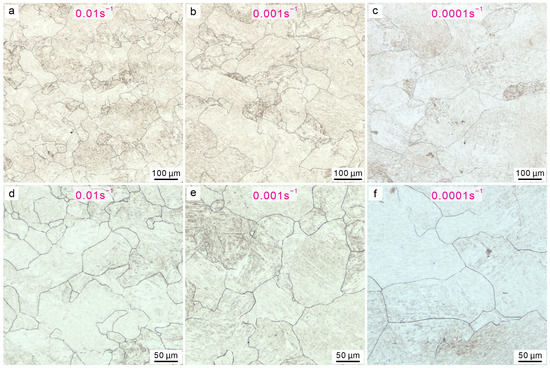
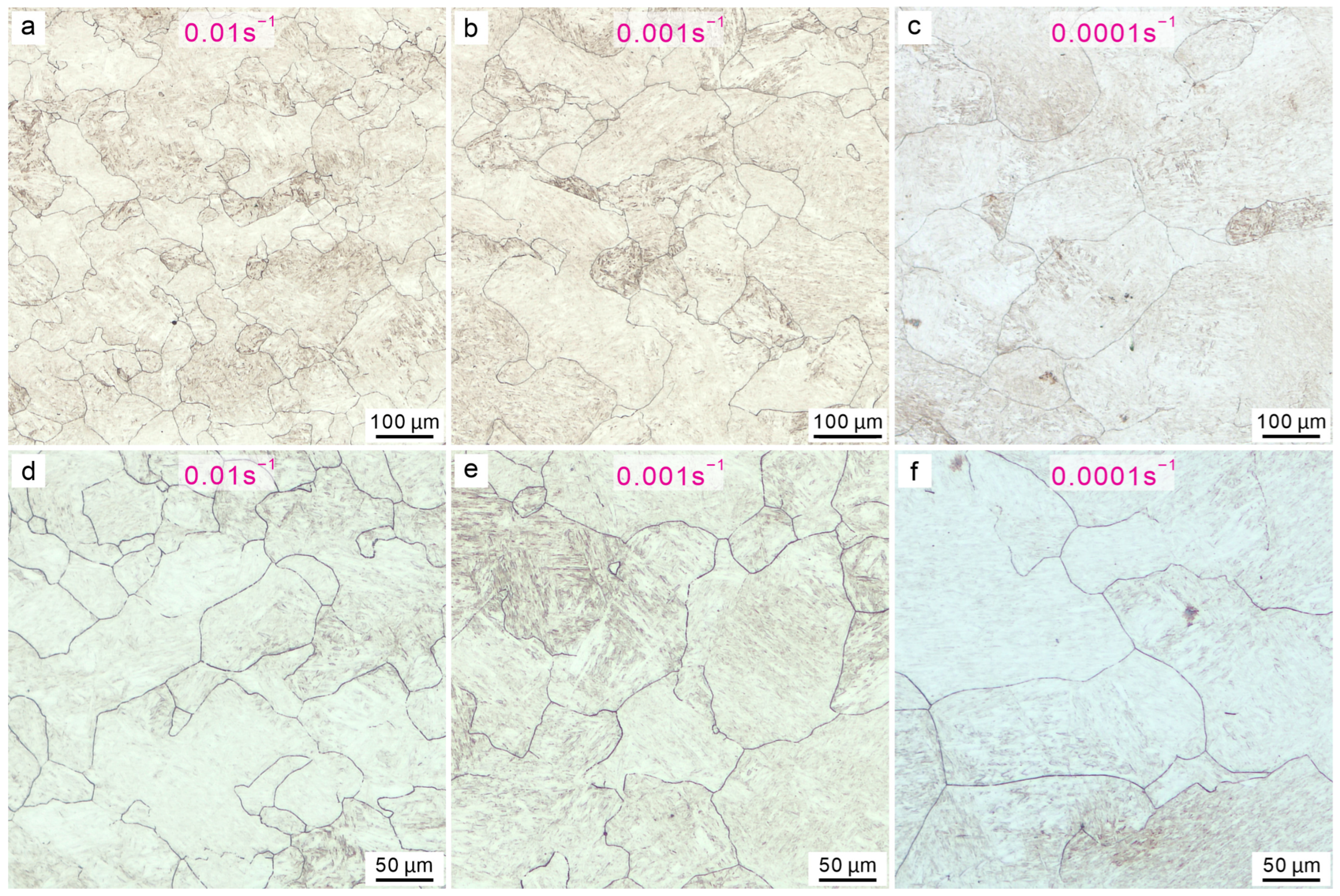
The microstructure of 25Cr1Ni4MoV steel after compression at 1000 °C to a strain of 0.9 is shown in Figure 4. At a strain rate of 0.01 s−1, complete DRX occurred, and the grains were fine (Figure 4a,d). The grain size increased with decreasing strain rate (Figure 4c–f). At a strain rate of 0.0001 s−1, the grain sizes were nonuniform, mainly ranging from 50 to 150 μm (Figure 4c,f). Most grains were not equiaxed, particularly the larger grains. This resulted from the nonuniform migration rate of grain boundaries. Based on the flow curves in Figure 1a, it can be concluded that all grains in Figure 4 are DRX grains.
Figure 4.
Microstructures of 25Cr1Ni4MoV steel compressed at 1000 °C and strain rates of (a,d) 0.01 s−1, (b,e) 0.001 s−1, (c,f) 0.0001 s−1.
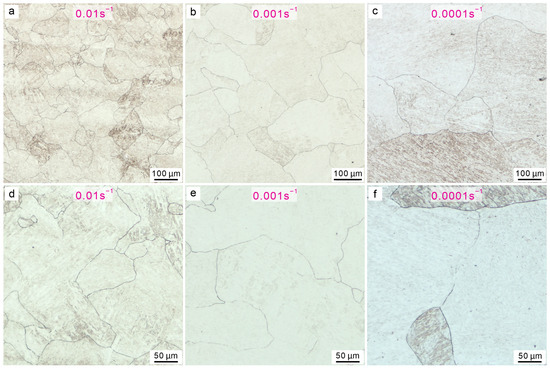
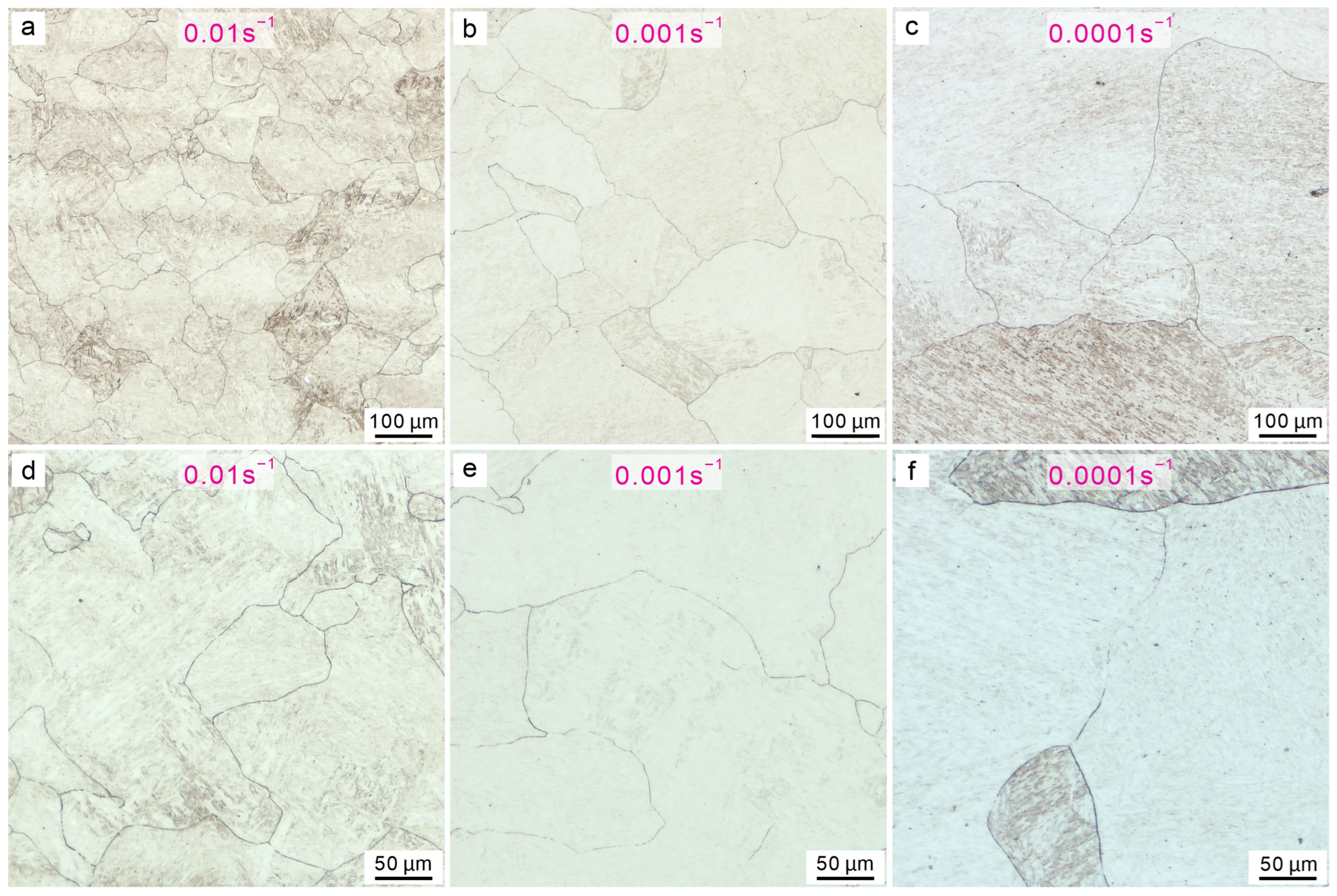
The microstructure of 25Cr1Ni4MoV steel after compression at 1100 °C is shown in Figure 5. Considering the DRX microstructure after compression at 1000 °C (Figure 4), the tested steel was sensitive to compression temperature. Under a specific strain-rate condition, the DRX grain size increased by more than two times as the deformation temperature increased from 1000 to 1100 °C. In Figure 5e,f, the local grain boundaries are discontinuous. The undisplayed grain boundary sections may be low-angle grain boundaries or low-Σ boundaries, which have high resistance to corrosive agents.
Figure 5.
Microstructures of 25Cr1Ni4MoV steel compressed at 1100 °C under different strain rates: (a,d) 0.01 s−1, (b,e) 0.001 s−1, and (c,f) 0.0001 s−1.
The microstructure of 25Cr1Ni4MoV steel after compression at 1200 °C is shown in Figure 6. Due to the high temperature, the grain size was large even when the steel was deformed at 0.01 s−1. In Figure 6c,f (0.0001 s−1), the grains are very large, and one field of view only covers several grains.
Figure 6.
Microstructures of 25Cr1Ni4MoV steel compressed at 1200 °C and under different strain rates: (a,d) 0.01 s−1, (b,e) 0.001 s−1, (c,f) 0.0001 s−1.
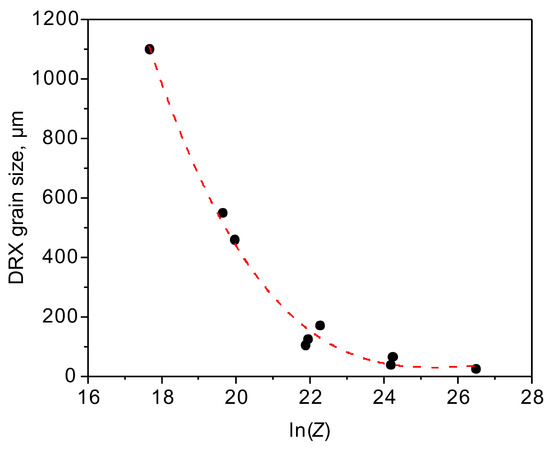
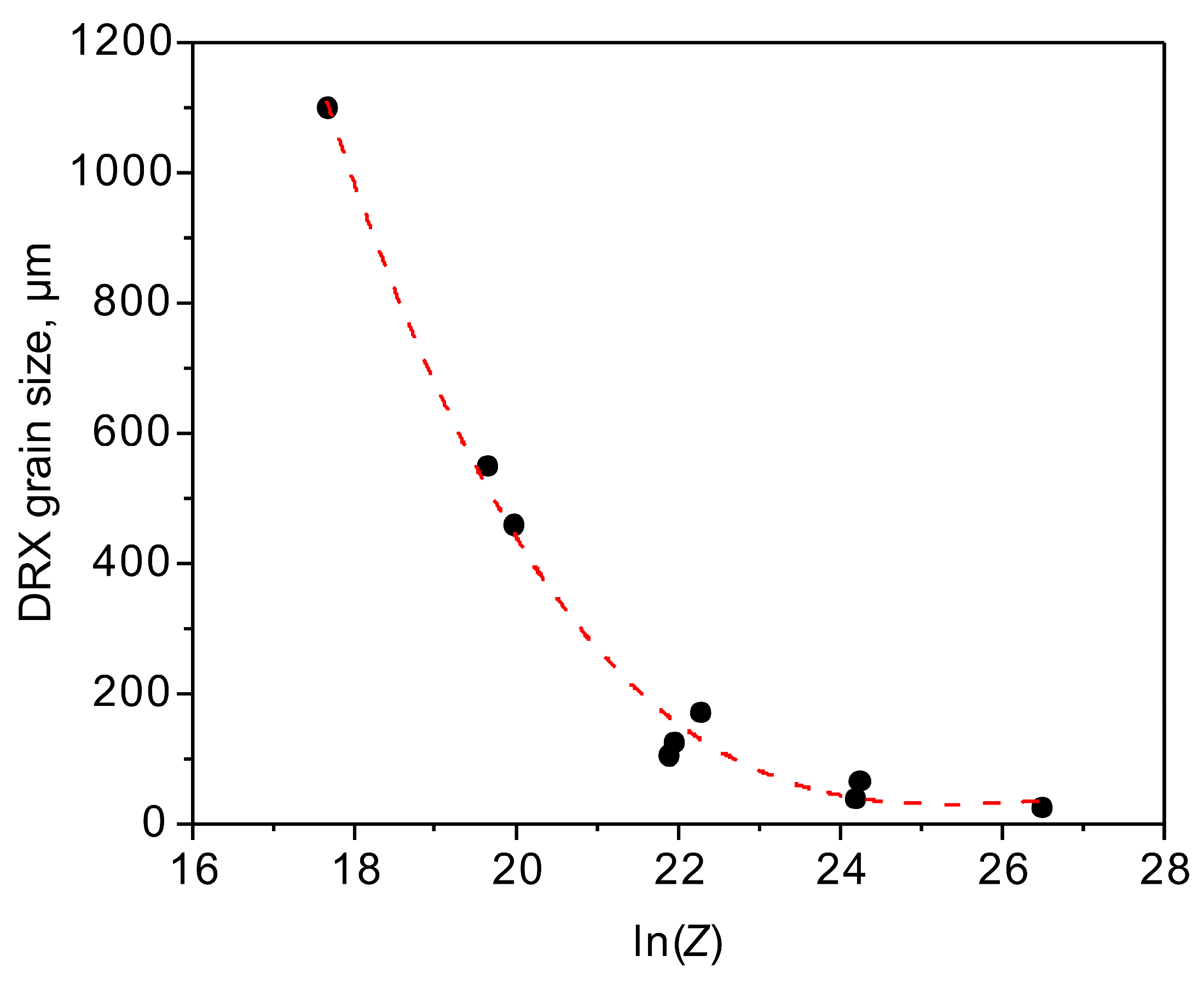
The DRX grain sizes were measured, and the statistical analysis results are shown in Figure 7. The points represent the measured values. The DRX grain size increased slowly with decreasing ln(Z) in the ln(Z) range of 22–27. However, when ln(Z) < 21, the grain size increased rapidly. The dashed line represents the fitted result (R2 = 0.99). A cubic polynomial relationship was observed between the DRX grain size (D, μm) and ln(Z):
Figure 7.
Relationship between DRX grain size and ln(Z).
4. Discussion
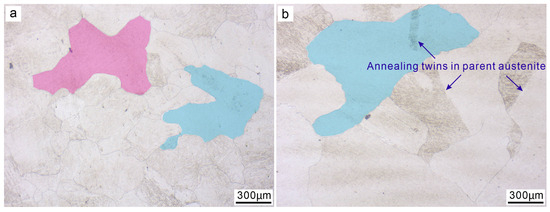
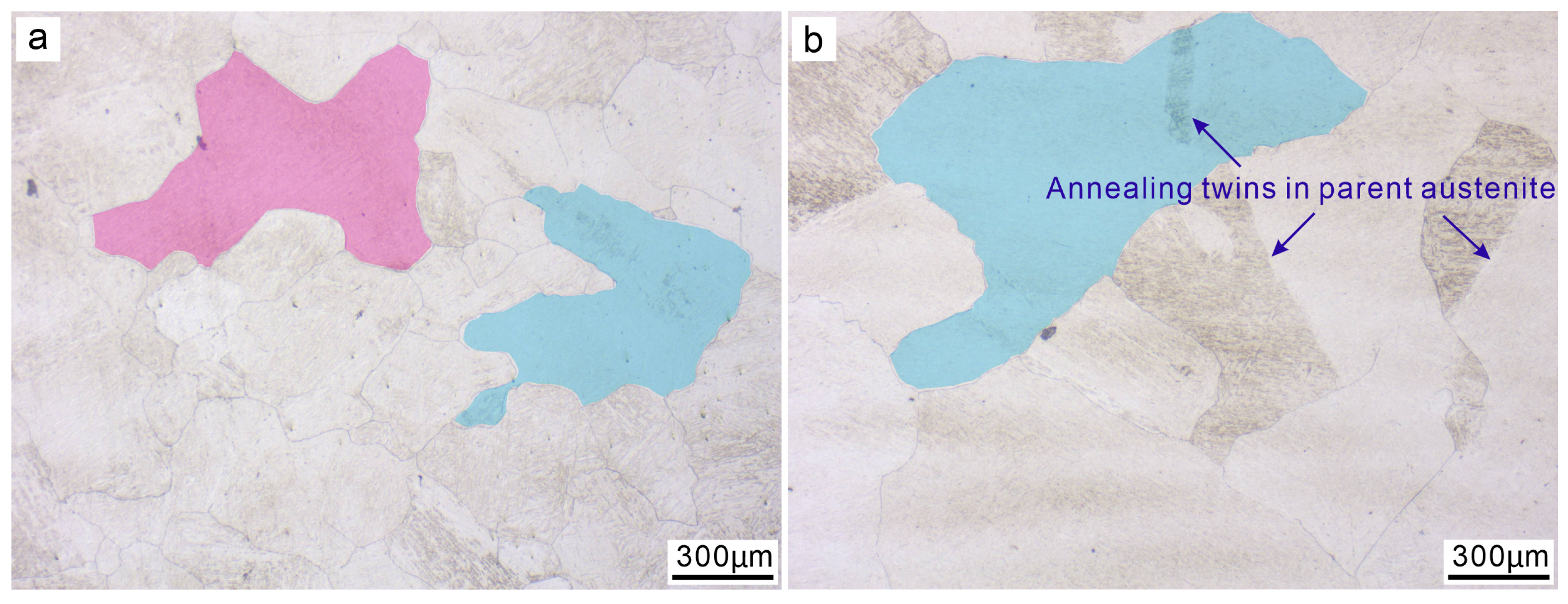
The morphologies of the coarse grains observed at low magnification are shown in Figure 8. These grains are formed through DRX rather than static recrystallization or abnormal grain growth after hot deformation. At an extremely low strain rate (0.0001 s−1), the grains are not only very large but also irregularly shaped. This grain morphology differs from that of annealed grains, which are typically equiaxed. In Figure 8, representative grains are highlighted in different colors. The grain boundaries locally protrude with large curvature, indicating a high migration ability at these locations. During slow deformation, the deformation energy near grain boundaries drives their migration. Additionally, deformation promotes grain rotation, and when a grain rotates into an orientation favorable for merging, its growth is accelerated. This explains why some grains appear particularly prominent at specific locations. DRX involves two stages: nucleation and subsequent grain growth. At a strain rate of 0.0001 s−1, the grain growth rate is very fast, resulting in a large DRX grain size. A characteristic feature of annealing twins is their straight boundaries [24]. The annealing twins in parent austenite are marked in Figure 8b. Twinning results from growth faults occurring during high-angle grain boundary migration [25]. The length of the twins reflects the extent of high-angle grain boundary migration. Clearly, the grains continue to grow during the deformation process. When the material undergoes dynamic recovery, high-angle grain boundaries will not migrate over long distances. Therefore, these annealing twins indicate that the deformation mechanism is DRX rather than dynamic recovery.
Figure 8.
Grain morphologies after compression at a strain rate of 0.0001 s−1 and temperatures of (a) 1100 °C and (b) 1200 °C. Representative grains are highlighted in different colors.
High-strength CrNiMoV steels are prone to microstructure inheritance, making grain refinement through normalizing difficult. Therefore, controlling grain size during hot deformation is very important. Based on the results of this study, the following strategies can be adopted in actual production:
- (1)
- The ln(Z) value during forging should be no less than 21, which requires reducing the deformation temperature and increasing the strain rate.
- (2)
- Because a high ln(Z) parameter increases deformation resistance, large-tonnage presses should be used. In the future, manufacturing low-pressure steam rotors for next-generation CAP1700 nuclear power units will require ingots weighing over 800 tons. Therefore, it is necessary to develop larger-tonnage presses, such as those exceeding 1000 MN.
- (3)
- During the upsetting process, a narrow die can be selected to increase the pressure intensity and achieve a high deformation rate. The ingot undergoes deformation during rotation, replacing the conventional upsetting process.
For actual steam turbine rotors and heavy gas turbine disks, the following topics should be investigated in the future:
- (1)
- Validation of the proposed constitutive equations under industrial forging conditions.
- (2)
- Coupling of the constitutive model with finite-element simulations.
- (3)
- Investigation of microstructure evolution under more complex deformation paths.
- (4)
- Elucidation of DRX mechanisms, which are complex and depend on chemical composition, stacking fault energy, and strain rate [26,27].
- (5)
- Establishment of hot processing maps at different strains and explanations of the efficiency of dissipation and possible flow instability.
Due to the martensitic transformation caused by water cooling, the high-temperature deformation structure of 25Cr1Ni4MoV steel cannot be preserved. This differs from the case of austenitic stainless steels. Therefore, the parent-phase reconstruction technique in electron backscatter diffraction can be used to study DRX and deformation mechanisms. In addition, because thermochemical processing can affect the final mechanical properties of a component [28], the influence of grain size on mechanical properties, including strength, toughness, fatigue performance, and creep resistance, should also be investigated.
5. Conclusions
In this study, 25Cr1Ni4MoV steel was hot-compressed at 1000–1200 °C and strain rates of 0.01–0.0001 s−1, and the resulting deformed microstructures were observed. The following conclusions can be drawn based on the findings of this study:
- (1)
- The peak stress ranged from 17 to 72 MPa. The hot deformation equation was obtained as follows: . The activation energy for deformation was 329 kJ/mol, which was lower than that reported in previous studies due to the extremely low strain rate.
- (2)
- The critical strains for complete DRX were obtained. The relationship between the critical strains and ln(Z) was .
- (3)
- The DRX grain size increased slowly with decreasing ln(Z) in the ln(Z) range of 22–27. However, when ln(Z) < 21, the grain size increased rapidly. This critical ln(Z) value is a new finding. The relationship between the DRX grain size (D) and ln(Z) was .
- (4)
- The grain growth has been discussed, and strategies for controlling the DRX grain size during production of ultra-large steam turbine rotors and heavy gas turbine disk forgings are provided.
Author Contributions
Conceptualization, Z.W. and S.L.; methodology, S.L. and M.Q.; investigation, Z.W., S.L. and M.Q.; writing—original draft, S.L.; writing—review and editing, Z.W.; project administration, Z.W.; funding acquisition, Z.W. All authors have read and agreed to the published version of the manuscript.
Funding
This research was funded by the Advanced Materials-National Science and Technology Major Project, grant number 2025ZD0610400.
Data Availability Statement
The data presented in this study are available on request from the corresponding author, as the data also forms part of an ongoing study.
Conflicts of Interest
The authors declare no conflicts of interest.
Abbreviations
The following abbreviations are used in this manuscript:
| DRX | Dynamic recrystallization |
| Z | Zener–Hollomon |
References
- Su, T.; Huang, Y.; Xuan, F. Stress corrosion cracking growth rate prediction model for nuclear power turbine rotor steel in a simulated environment. J. Mater. Res. Technol. 2023, 23, 830–844. [Google Scholar] [CrossRef] [Scilit]
- Balitskii, A.I.; Ivaskevich, L.M.; Balitskii, O.A. Rotor steels crack resistance and fracture behavior for hydrogen targeted materials ever-widening database. Eng. Fract. Mech. 2022, 260, 108168. [Google Scholar] [CrossRef] [Scilit]
- Zhang, T.; Zhang, R.; Wang, X.; Zhao, Y.; Xu, C.; Zhang, X.; Gong, J.; Tu, S. Precipitates in the failure of a newly developed steel for heavy-duty gas turbine disks under hybrid-controlled creep-fatigue loadings. Int. J. Fatigue 2026, 212, 109830. [Google Scholar] [CrossRef] [Scilit]
- Ding, M.; Zhang, X.; Zhang, X.; Zhao, R.; Li, Z.; Deng, Z.; Jiao, Y.; Park, Y. Considering labyrinth type seals in dynamic response of heavy-duty gas turbine by full length equivalent model: Influence of different seals. Mech. Syst. Signal Process. 2026, 256, 114522. [Google Scholar] [CrossRef] [Scilit]
- Zheng, Y.; Hu, X.; Jiang, H.; Yang, N.; Cui, J.; Song, Y.; Rong, L. Effect of Mn partitioning at grain boundary on aging embrittlement of 30Cr2Ni4MoV rotor steel during long-term aging. J. Mater. Sci. Technol. 2026, 253, 132–145. [Google Scholar] [CrossRef] [Scilit]
- Han, J.; Wang, H.; Zhang, K.; Tong, X.; Liu, H.; Zhang, F.; Wang, X. Microscopic defects formation and microstructure evolution of 30Cr1Mo1V rotor steel subjected to high-temperature fatigue loading. Mater. Sci. Eng. A 2025, 941, 148558. [Google Scholar] [CrossRef] [Scilit]
- Evans, M. The role of primary and tertiary creep in defining the form of the monkman-grant relation using the 4-θ methodology: An application to a 1CrMoV rotor steel. Int. J. Pres. Ves. Pip. 2025, 218, 105627. [Google Scholar] [CrossRef] [Scilit]
- Huang, X.; Guo, S.; Chen, W. Effect of initial grain size on dynamic recrystallization of ultra-large nuclear rotor steel 25Cr2Ni4MoV. Materialia 2025, 39, 102362. [Google Scholar] [CrossRef] [Scilit]
- Procházka, R.; Džugan, J. Low cycle fatigue properties assessment for rotor steels with the use of miniaturized specimens. Int. J. Fatigue 2022, 154, 106555. [Google Scholar] [CrossRef] [Scilit]
- Zheng, Y.; Hu, X.; Jiang, H.; Chen, L.; Yang, N.; Song, Y.; Rong, L. Study on the aging embrittlement mechanism of Si in 30CrNi4MoV rotor steel during long-term aging. Mater. Today Commun. 2026, 50, 114119. [Google Scholar] [CrossRef] [Scilit]
- Long, J.; Zhang, L.; Zhang, Q.; Wang, W.; Zhong, J.; Zhang, J. Microstructure characteristics and low cycle fatigue properties at 230 °C of different weld zone materials from a 100 mm thick dissimilar weld of ultra-supercritical rotor steel. Int. J. Fatigue 2020, 130, 105248. [Google Scholar] [CrossRef] [Scilit]
- Weng, S.; Huang, Y.; Lin, S.; Xuan, F. Stress corrosion crack propagation affected by microstructures for nuclear steam turbine rotor steels in the simulated environment. J. Mater. Res. Technol. 2022, 17, 725–742. [Google Scholar] [CrossRef] [Scilit]
- Zheng, Y.; Hu, X.; Jiang, H.; Song, Y.; Rong, L. Precipitation behavior of G-phase and its effect on mechanical properties of 30Cr2Ni4MoV steel. Mater. Charact. 2025, 219, 114598. [Google Scholar] [CrossRef] [Scilit]
- Ye, L.; Zhai, Y.; Zhou, L.; Wang, H.; Jiang, P. The hot deformation behavior and 3D processing maps of 25Cr2Ni4MoV steel for a super-large nuclear-power rotor. J. Manuf. Processes 2020, 59, 535–544. [Google Scholar] [CrossRef] [Scilit]
- Wang, L.; Qin, J.; Zhai, P.; Jia, H.; Li, M.; Zhu, Y.; Chen, K.; Chen, X.; Wang, Y.; Wang, Z. Microstructural evolution of dynamic recrystallization in 30CrNiMoVW steel during hot compression: Constitutive modeling, kinetic model optimization, and multiscale FEM coupled CA simulation. Def. Technol. 2025, 53, 184–203. [Google Scholar] [CrossRef] [Scilit]
- Guo, A.; Mao, F.; Shi, R.; Lin, Y.; Yin, L.; Yu, B.; Xu, L.; Chen, C.; Yu, H.; Gao, K.; et al. Study on dynamic recrystallization kinetics and microstructural refinement of high-strength 36CrNi3MoV steel during hot deformation. J. Mater. Res. Technol. 2025, 36, 8999–9012. [Google Scholar] [CrossRef] [Scilit]
- Wang, B.; Liu, K.; Liu, Y.; Zhang, W.; Zhao, D. Development of mono-bloc forging for CAP1400 reactor pressure vessel. In Proceedings of the Energy Materials 2014, Xi’an, China, 4–6 November 2014; Springer: Cham, Switzerland, 2014; pp. 443–450. [Google Scholar]
- Wang, Z.; Xue, H.; Zhao, D. Microstructure evolution and surface cracking behavior of superheavy forgings during hot forging. Adv. Mater. Sci. Eng. 2018, 2018, 4780638. [Google Scholar] [CrossRef] [Scilit]
- ASTM E112-25; Standard Test Methods for Determining Average Grain Size. ASTM International: West Conshohocken, PA, USA, 2025.
- Dehghan-Manshadi, A.; Hodgson, P.D. Dynamic recrystallization of austenitic stainless steel under multiple peak flow behaviours. ISIJ Int. 2007, 47, 1799–1803. [Google Scholar] [CrossRef] [Scilit][Green Version]
- Kozłowska, A.; Elanany, K.; Borek, W.; Grajcar, A. Constitutive modeling and the effect of Mn addition on hot deformation behavior of advanced medium-Mn steels. J. Mater. Res. Technol. 2026, 42, 7647–7668. [Google Scholar] [CrossRef] [Scilit]
- Hu, J.; Wang, Y.; Wu, S.; Yao, X.; Liang, Y.; Chen, H. Study on hot compression softening behavior of 22Cr-2.0Mn-1.3Ni-0.5N high-nitrogen nickel-reduced duplex stainless steel under large-strain deformation. Mater. Sci. Eng. A 2026, 958, 149965. [Google Scholar] [CrossRef] [Scilit]
- Zhu, W.; Wang, X.; Li, L.; Cheng, P.; Shao, C.; Wang, D.; Feng, F.; Zhou, P. Dynamic recrystallization and microstructural evolution in 40CrNi2MoV steel during forging. iScience 2025, 28, 112733. [Google Scholar] [CrossRef] [Scilit] [PubMed]
- Qi, J.; Zhang, Z.; Dai, G.; Zhao, X.; Wang, Z. Roles of austenite twin and ferrite in bainite transformation of 42CrMo steel. Mater. Lett. 2025, 388, 135333. [Google Scholar] [CrossRef] [Scilit]
- Wang, Z.; Liu, Y. Formation mechanism and application potential of Σ1 boundary in grain boundary engineering of high nitrogen austenitic stainless steel. Mater. Lett. 2019, 253, 377–380. [Google Scholar] [CrossRef] [Scilit]
- Doherty, R.D.; Hughes, D.A.; Humphreys, F.J.; Jonas, J.J.; Jensen, D.J.; Kassner, M.E.; King, W.E.; McNelley, T.R.; McQueen, H.J.; Rollett, A.D. Current issues in recrystallization: A review. Mater. Sci. Eng. A 1997, 238, 219–274. [Google Scholar] [CrossRef] [Scilit]
- Sakai, T.; Belyakov, A.; Kaibyshev, R.; Miura, H.; Jonas, J.J. Dynamic and post-dynamic recrystallization under hot, cold and severe plastic deformation conditions. Prog. Mater. Sci. 2014, 60, 130–207. [Google Scholar] [CrossRef] [Scilit]
- Haghdadi, N.; Zarei-Hanzaki, A.; Roostaei Ali, A.; Hemmati, A.R. Evaluating the mechanical properties of a thermomechanically processed unmodified A356 Al alloy employing shear punch testing method. Mater. Des. 2013, 43, 419–425. [Google Scholar] [CrossRef] [Scilit]

Disclaimer/Publisher’s Note: The statements, opinions and data contained in all publications are solely those of the individual author(s) and contributor(s) and not of MDPI and/or the editor(s). MDPI and/or the editor(s) disclaim responsibility for any injury to people or property resulting from any ideas, methods, instructions or products referred to in the content. |
© 2026 by the authors. Licensee MDPI, Basel, Switzerland. This article is an open access article distributed under the terms and conditions of the Creative Commons Attribution (CC BY) license.