


Abstract
To address the challenges of low germanium recovery and high reagent consumption during precipitation from strongly acidic solutions, this study developed a two-stage tannin process intensified by microfluidic mixing and systematically examined the synergistic effects of tannin dosage and pH on coordination chemistry. First-stage recovery rose from 45.23% to 91.28% as the tannin ratio increased from 5- to 15-fold, confirming that sufficient ligand promotes dense chelate formation. Optimising pH to 2.0–2.5 deprotonated tannin hydroxyls, enabling electrostatic–chelation synergy with Ge(OH)3+ and yielding 79.88% recovery—a 20.28% improvement over pH 1.5. The staged second-stage process proved particularly effective: at pH 1.5, a “5-fold primary + 15-fold secondary” scheme achieved 92.04% total recovery with only 13.22-fold cumulative tannin, a 46.81% increase over the single-stage 5-fold treatment; at pH 2.5, a “5-fold + 10-fold” combination reached 95.44% recovery with just 8.67-fold reagent. Microfluidic processing refined particle size and intensified the Ge–O vibration at 864 cm−1, indicating more stable coordination. Economic analysis reveals that efficiency plateaus beyond a 17-fold cumulative dosage, making staged addition the cost-effective choice. By harmonising staged coordination with enhanced mass transfer, this approach resolves the inherent conflict between precipitation depth and reagent overuse, delivering a sustainable strategy for germanium recovery.
1. Introduction
As a key strategic scattered metal, germanium (Ge) possesses outstanding semiconductor and optical properties, high carrier mobility, and chemical stability. It holds irreplaceable application value in fields such as infrared optical systems, fibre-optic communications, 5G radio-frequency devices, high-end semiconductor chips [1], photovoltaic solar cells, and defence, aerospace and aviation, and it is a core foundational material underpinning the development of next-generation information technology and high-end manufacturing [2]. China is a key global producer and supplier of germanium, accounting for over 70% of global output (with primary germanium production reaching 96 tonnes in 2024). Yunnan Province accounts for 70% of the nation’s production capacity and serves as a core hub for germanium extraction and deep processing. In nature, germanium rarely forms independent ore deposits; it is primarily found as a trace element dispersed within lead-zinc ores [3], lignite deposits, and smelting waste residues, whilst industrial by-products such as acid leachate from wet zinc smelting fumes serve as the primary secondary raw materials for germanium recovery [4].
Due to its advantages of simple operation, rapid reaction kinetics, high enrichment efficiency and environmental friendliness, the tannin precipitation method has become the mainstream process for germanium extraction via hydrometallurgy in China. However, the traditional mechanically stirred germanium precipitation process faces significant technical bottlenecks [5], and to ensure recovery efficiency, the amount of tannin added must reach 40–50 times the mass amount of germanium [6], far exceeding the theoretical stoichiometric ratio. Even under optimised laboratory conditions, a 30-fold excess of tannin is still required, with a germanium precipitation efficiency of only 61.53%; when the tannin dosage is reduced to 15 times, the recovery rate drops sharply by over 10%. Uneven mass transfer within the stirred system leads to local concentration gradients, exacerbating the competitive coordination and coprecipitation of impurities such as Fe and Zn [7]. Although indium pre-extraction using D2EHPA can improve the germanium recovery rate to 99%, the issues of high tannin consumption and impurity entrainment remain unresolved. Furthermore, poor reaction controllability leads to uneven agglomeration of the precipitate, making solid–liquid separation difficult; consequently, the residual germanium concentration in the filtrate fails to meet the requirements for zinc electrolytic refining.
In response to the above issues, existing research has focused on process optimisation, external field intensification, and technological innovation. Although methods such as stepwise dosing and ultrasonic intensification can improve tannin utilisation, they are unable to overcome the mass transfer limitations imposed by macroscopic stirring. Previous studies have shown that microfluidic technology achieves molecular mixing on the order of 0.01 s through laminar collision jets in micro-reactors, resulting in a volumetric mass transfer coefficient 29 times higher than that of conventional stirring [8]. With a tannin dosage 15 times lower, the germanium precipitation efficiency exceeds 95%, whilst the co-precipitation rates of Fe, Zn, and In are controlled below 12%, 10%, and 2% respectively, demonstrating a revolutionary advantage [9]. However, single-stage microfluidic processes still face bottlenecks such as insufficient utilisation of tannin coordination sites and inadequate germanium precipitation depth in high-acid systems [10]; therefore, two-stage sequential precipitation can improve reagent utilisation and germanium precipitation depth. To date, there have been no reports, either domestically or internationally, of the coupling of microfluidic technology with two-stage germanium precipitation processes.
Based on this, this paper proposes, for the first time, a novel process utilising micro-reactors to achieve germanium-coupled two-stage tannin precipitation, establishing a “first-stage microfluidic pre-complexation—second-stage microfluidic deep precipitation” system. This technology combines the dual advantages of mass transfer enhancement via microfluidics and the hierarchical control of two-stage precipitation: the micro-reactor achieves instantaneous and uniform mixing through micro-confined effects, thereby suppressing the co-precipitation of impurities and enhancing the controllability of the precipitate morphology; the two-stage precipitation optimises reagent distribution and reaction pathways, synergistically overcoming the limitations of insufficient precipitation depth and low mass transfer efficiency in single-stage processes [11]. This study focused on zinc-containing solutions generated during the hydrometallurgical processing of zinc and systematically investigated the effects of parameters such as pH, temperature, flow rate and tannin dosage on the rate of germanium precipitation. Characterisation techniques such as scanning electron microscopy (SEM), energy dispersive spectroscopy (EDS) and X-ray diffraction (XRD) were employed to elucidate the reaction mechanism; a comparison with conventional processes validated the advantages of this method in terms of germanium precipitation efficiency, selectivity and separation performance, thereby opening up a new avenue for the efficient and cost-effective recovery of germanium from complex systems, as well as for the industrial application of microfluidic technology.
2. Materials and Methods
2.1. Materials
The raw material for this study was derived from an indium–iron–germanium-containing leachate extracted from lead–zinc smelting operations at an industrial enterprise in Yunnan Province, China. Following the extraction of indium and iron by solvent extraction, the resulting low-concentration germanium-containing residue (see Table 1 for specific composition) was used as the primary raw material.
Table 1.
Chemical composition of germanium-containing solutions (wt.%).
2.2. Experimental Methods and Equipment
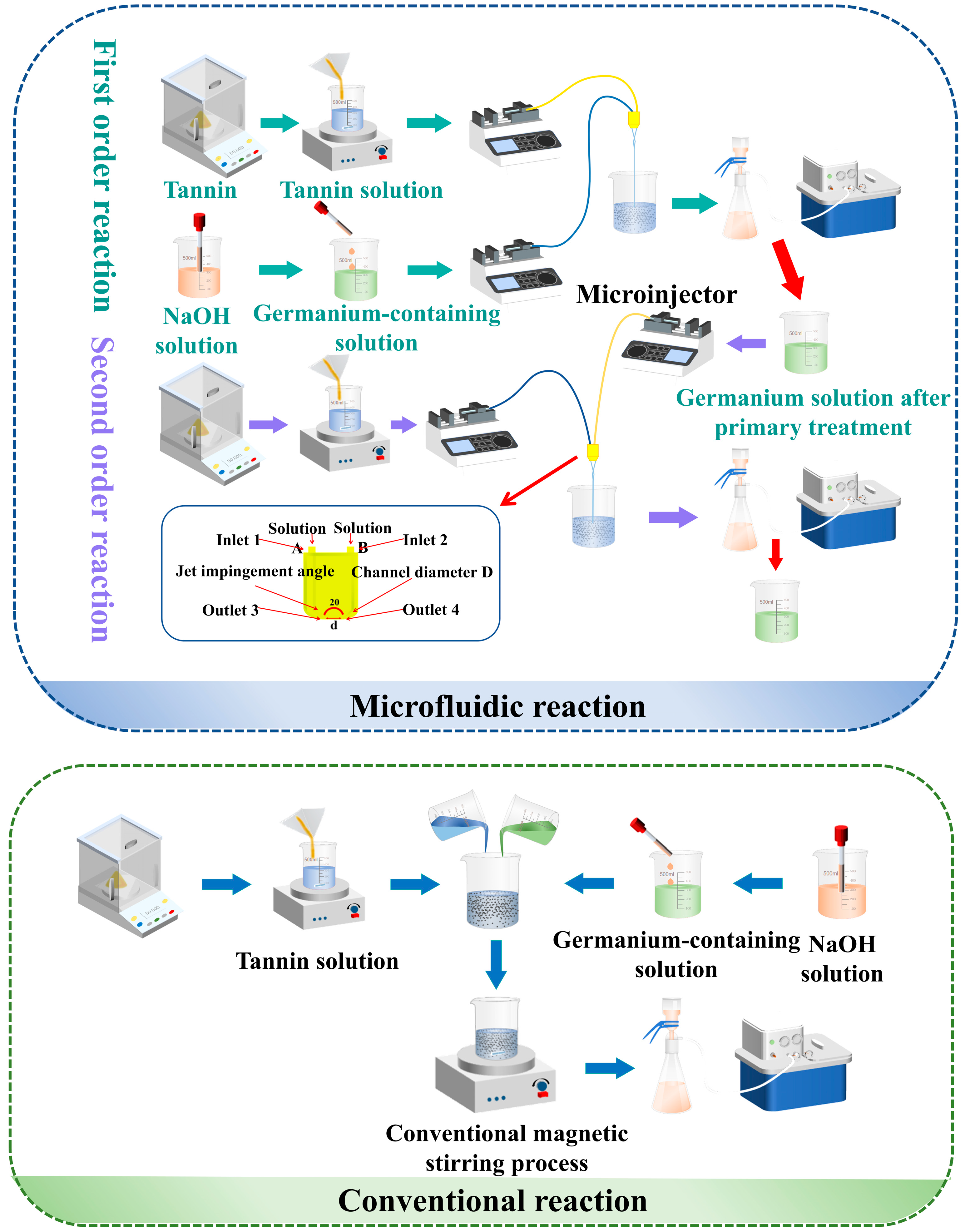
This study employed a two-stage, series-connected progressive deep germanium removal process. The first stage [12] involves coarse germanium removal: a primary tannic acid solution (stream A1) and raw germanium-containing leachate (stream B1) are pumped into a microreactor according to optimised parameters; following instantaneous mixing and reaction, the mixture is filtered to yield primary germanium residue and supernatant. The second stage involves fine germanium removal: a secondary tannic acid solution (stream A2) is pumped into the microreactor together with the filtrate from the first stage (stream B2) for a secondary reaction, ultimately achieving deep removal of germanium and producing secondary germanium residue and filtrate that meet regulatory standards.
In this study, the microfluidic experiments utilised a continuous reaction system constructed using photopolymerisation 3D-printed microreactors independently developed by our research group [9]; the structures of the primary and secondary reactors were identical. The system employed a 90° dual-channel counter-current design, with fluid streams A and B driven by independent syringe pumps: stream A contained a tannic acid solution, whilst stream B contained a germanium solution. The flow rate (0.6–1.21 mm/s) was controlled by adjusting the diameter of the syringes (29 mm for the tannic acid solution in stream A and 50 mm for the germanium solution in stream B) and the pump speed. The micro-reactor channel has an internal diameter of 500 μm. The calculation of residence time can be found in Section S1 of the Supplementary Materials. After being conveyed through separate channels, the two fluid streams collide outside the reactor, forming a laminar liquid film of uniform thickness and stable condition. The entire process always remains in a laminar state, achieving rapid homogenisation within milliseconds through molecular diffusion. This external collision mixing mode differs from traditional internal microchannel structures; solid products generated during the reaction can be discharged directly with the fluid, fundamentally preventing microchannel blockages caused by solid-phase deposition and significantly improving the operational stability and reliability of the continuous system.
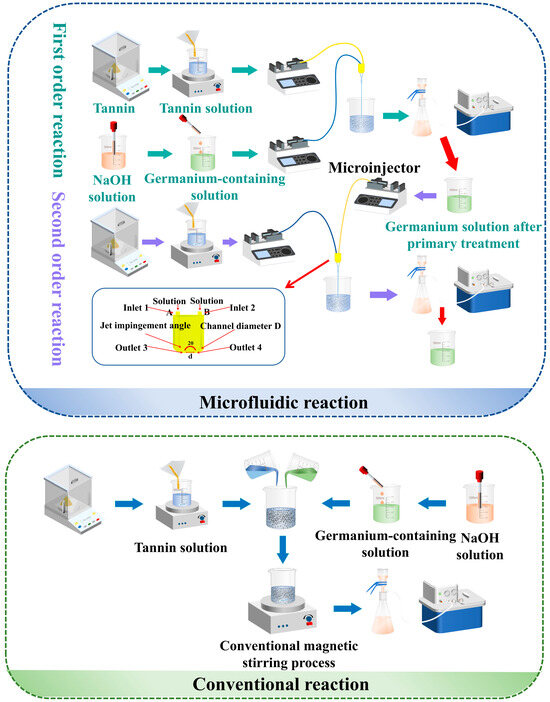
The conventional control experiment was conducted in a 250 mL beaker using mechanical stirring (300 rpm, 30 mm rotor diameter). Conditions such as reactant ratios, temperature and pH were kept consistent with those of the microfluidic experiment; the reaction time was 10 min, followed by filtration after standing for 10 min. The procedures for the microfluidic and conventional control experiments are shown in Figure 1.
Figure 1.
Flowchart of the microfluidic experiment and the conventional control experiment.
2.3. Analytical and Testing Methods
In this study, the volume ratio of the germanium-containing solution to the tannic acid solution was set at 6:1. The amount of tannic acid added is expressed as the tannin dosage, defined as the mass ratio of tannic acid to germanium per litre of germanium-containing solution. The specific calculation method is as follows:
First-stage tannin dosage = Germanium concentration in solution × Solution volume × Tannin dosage factor × Volume ratio.
Total tannin dosage = First-stage tannin dosage + Second-stage tannin dosage.
Total tannin dosage factor = (Initial germanium concentration × First-stage dosage factor + Second-stage germanium concentration × Second-stage dosage factor) ÷ Initial germanium concentration.
The germanium precipitation efficiency (η) is calculated using Equation (1):
η = (C0 − C)/C0 × 100%,
Here, C0 and C represent the concentrations of germanium ions before and after the reaction, respectively.
The reaction products at each stage were separated by vacuum filtration (using a 0.45 μm pore size filter membrane); the solid phase was washed three times with deionised water and anhydrous ethanol, respectively, and set aside after vacuum drying at 60 °C for 12 h. The concentration of metal ions in the liquid phase was determined using ICP-OES (Agilent 5110, Santa Clara, CA, USA). Solid characterisation: Field-emission scanning electron microscopy [13] (SEM; Regulus 8100, Hitachi High‑Tech, Tokyo, Japan) was used to observe the microstructure, accompanied by energy-dispersive spectroscopy (EDS; Ultim Max 100, Oxford Instruments, Abingdon, UK) for elemental analysis; a laser particle size analyser (Mastersizer 3000, Malvern Panalytical, Malvern, UK) was used to determine the particle size distribution; a Fourier-transform infrared spectrometer (FTIR; Nicolet iS50, Thermo Fisher Scientific, Waltham, MA, USA, KBr pellet method, scanning range 400–4000 cm−1) was used to analyse functional groups; and X-ray photoelectron spectroscopy (XPS; ESCALAB 250Xi, Thermo Fisher Scientific, Waltham, USA, Al Kα line) was used to determine the chemical states of the elements. All precipitation and mixing experiments were performed at controlled ambient temperature (20–25 °C) in an air-conditioned laboratory in Kunming, China. The temperature variation during each test was less than ±1 °C, which had no significant effect on the reaction kinetics. All experiments were conducted in triplicate, and the reported values are average results.
3. Results and Discussion
3.1. The Influence of Different Parameters on Single-Stage Reactions
3.1.1. The Influence of Tannin Dosage on the Single-Stage Sedimentation Process
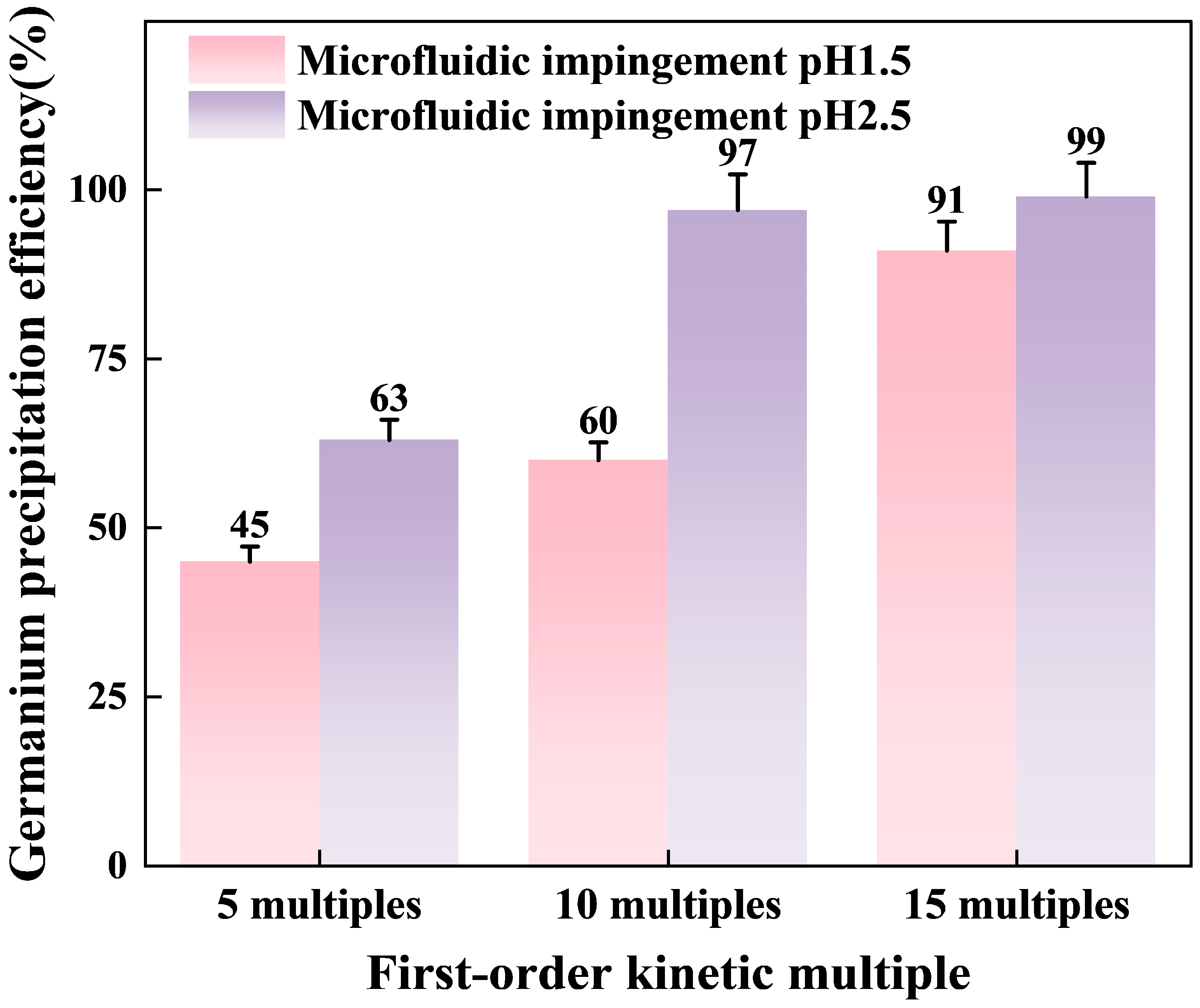
The amount of tannin used in the first-stage reaction directly determines the number of effective ligands available in the solution to bind with germanium ions [14], and is the key factor controlling the efficiency of first-stage germanium precipitation (Figure 2). Under fixed reaction conditions, this study investigated the effects of 5-fold, 10-fold, and 15-fold increases in the first-stage tannin dosage on the germanium precipitation rate. The experimental results indicate that the first-stage germanium precipitation rate shows a significant upward trend with increasing tannin dosage [15]. When the tannin dosage was 5-fold, the precipitation rate was only 45.23%, and the residual germanium concentration in the solution was as high as 123.71 mg/L. This is due to a severe shortage of polyphenolic ligands provided by the tannin, which fails to satisfy the stoichiometric ratio required for the coordination of germanium ions. Consequently, the complexation reaction is incomplete, the nucleation driving force is weak, and a large amount of germanium remains in the solution in ionic form. When the tannin dosage was increased to 10-fold, the germanium precipitation rate rose to 59.60%. The increased ligand concentration enhanced the degree of complexation between the tannin and germanium; however, the reaction still did not reach coordination saturation, and a considerable amount of germanium remained uncomplexed and unprecipitated. Further increasing the primary tannin dosage to 15-fold resulted in a significant rise in the germanium precipitation rate to 91.28%, with the residual germanium concentration rapidly decreasing to 19.70 mg/L. At this point, the system contained sufficient phenolic hydroxyl and carboxyl ligands to form stable polycoordinate complexes with germanium ions, and the reaction approached a state of coordination saturation.
In summary, there is a clear positive correlation between the first-stage germanium precipitation rate and the tannin dosage. At low tannin dosages, there is a shortage of ligands, resulting in incomplete complexation and low germanium precipitation efficiency; increasing the tannin dosage supplements effective ligands, promoting the formation and the precipitation of tannin–germanium complexes; when the first-stage tannin dosage reaches 15-fold, the system essentially achieves complete complexation and highly efficient precipitation.
Figure 2.
Effect of tannin dosage on the reaction (room temperature, molar ratio = 6:1, flow rate = 144.84 mL/min).
3.1.2. The Influence of pH on the Single-Stage Germanium Precipitation Process
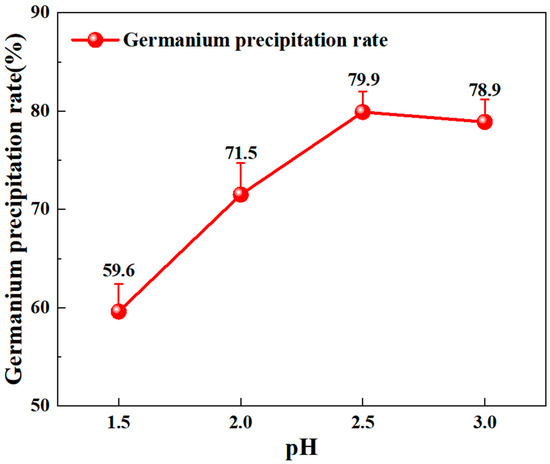
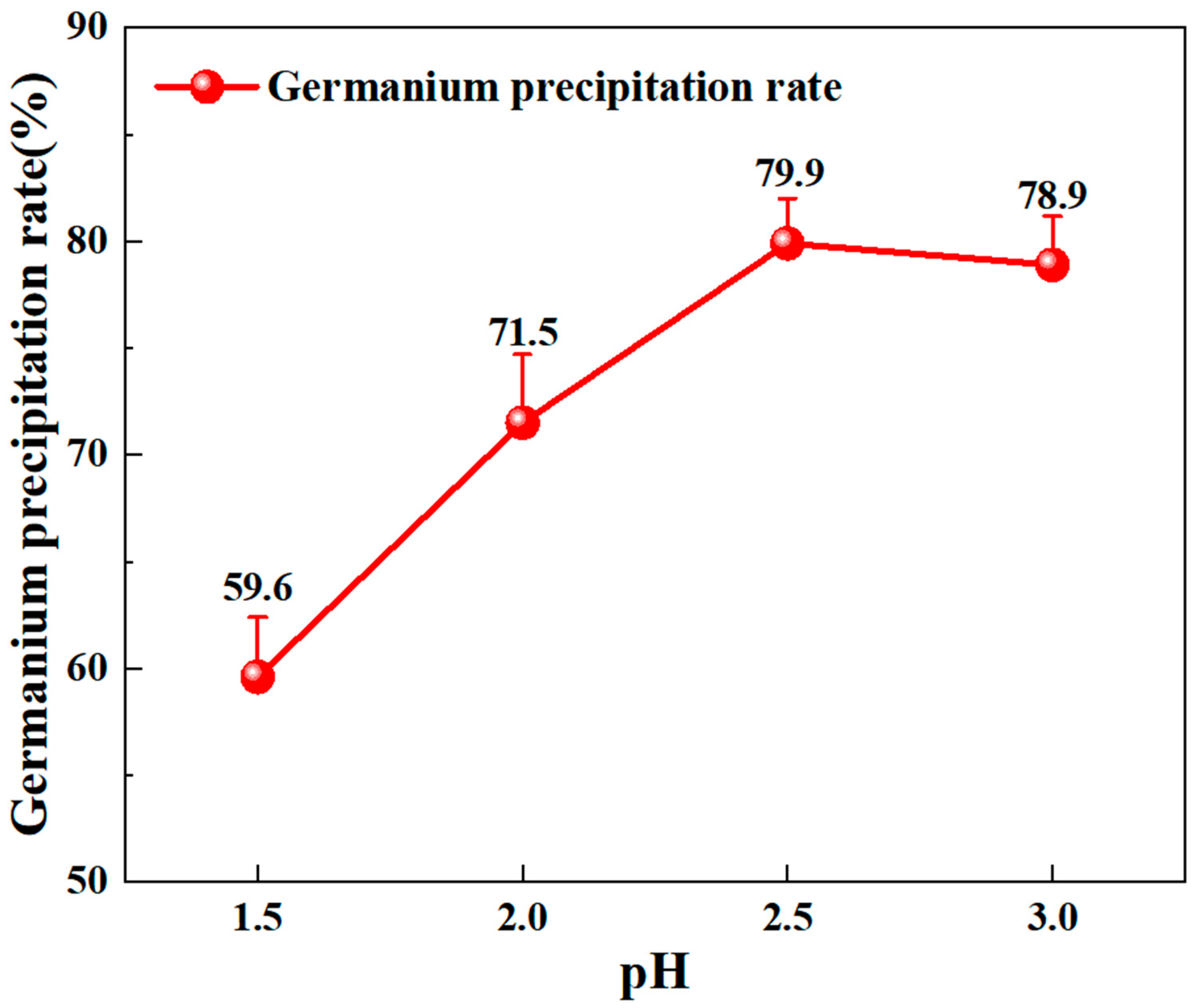
The single-stage microfluidic germanium precipitation experiment shown in Figure 3 indicates that, under conditions of room temperature, a tannin dosage of 20 times the mass of germanium, a volume ratio of 6:1, and a total flow rate of 144.84 mL/min, pH exerts a non-monotonic influence on germanium precipitation efficiency, initially increasing and then decreasing. When pH = 1.5, the precipitation rate is only 59.6%. This strongly acidic environment leads to the high protonation of the phenolic hydroxyl groups in tannins, causing them to lose their coordination activity [14], whilst germanium predominantly exists in the electrically neutral Ge(OH)4 or low-charge Ge4+ forms [15,16]. The interactions between the two are weak, and the high H+ concentration inhibits the deprotonation and condensation of the tannin–germanium complex, hindering precipitation nucleation [17]. As the pH rose to 2.0–2.5, the germanium precipitation rate increased significantly to 71.5% (pH = 2.0) and peaked at 79.9% (pH = 2.5). This is attributed to the partial deprotonation of tannins, forming highly reactive phenolic hydroxyl anions (-O−), whilst germanium hydrolyses into highly reactive Ge(OH)3+/Ge(OH)22+ cations; the two combine efficiently via chelation and electrostatic attraction, and the instantaneous mixing in the microfluidic system (<0.1 s) effectively eliminates localised areas of excessive acidity, ensuring the uniformity of the coordination reaction [9,18]. When the pH is further raised to 3.0, the germanium precipitation rate unexpectedly drops to 78.9%, primarily because the approach to the isoelectric point of tannin (pH ≈ 2.8) induces molecular self-aggregation, masking more than 30% of the coordination sites. Concurrently, the hydrolysis of impurity ions such as Fe3+ and Al3+ intensifies, generating competitive species such as Fe(OH)2+ that consume tannin, whilst excessive hydrolysis of germanium produces negatively charged GeO(OH)3− anions, which undergo electrostatic repulsion with the negatively charged tannin [19].
Figure 3.
Effect of pH on the reaction (room temperature 25 °C, 20-fold tannin concentration, molar ratio = 6:1, flow rate = 144.84 mL/min).
These results reveal that the microfluidic system exhibits optimal germanium precipitation activity within the pH range of 2.0–2.5, with a 34.1% increase in efficiency compared to pH 1.5. With the increase in solution pH, the protonation degree of phenolic hydroxyl groups in tannic acid increases [20], providing more active sites for complexation reactions with germanium species. Consequently, the germanium precipitation efficiency is significantly improved in the pH range of 2.0–2.5. Furthermore, the width of the operational window (ΔpH = 0.5) is significantly superior to that of conventional stirring processes (which require strict control of pH at 2.0 ± 0.2), highlighting the strong adaptability and stability of micro-mixing technology under varying reaction conditions.
3.2. The Influence of Tannin Dosage on Multi-Stage Sedimentation Processes
3.2.1. The Effect of Tannin Dosage on the Germanium Precipitation Process Under pH 1.5 Conditions
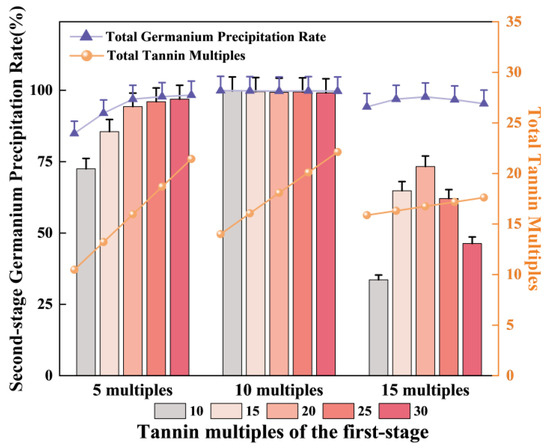
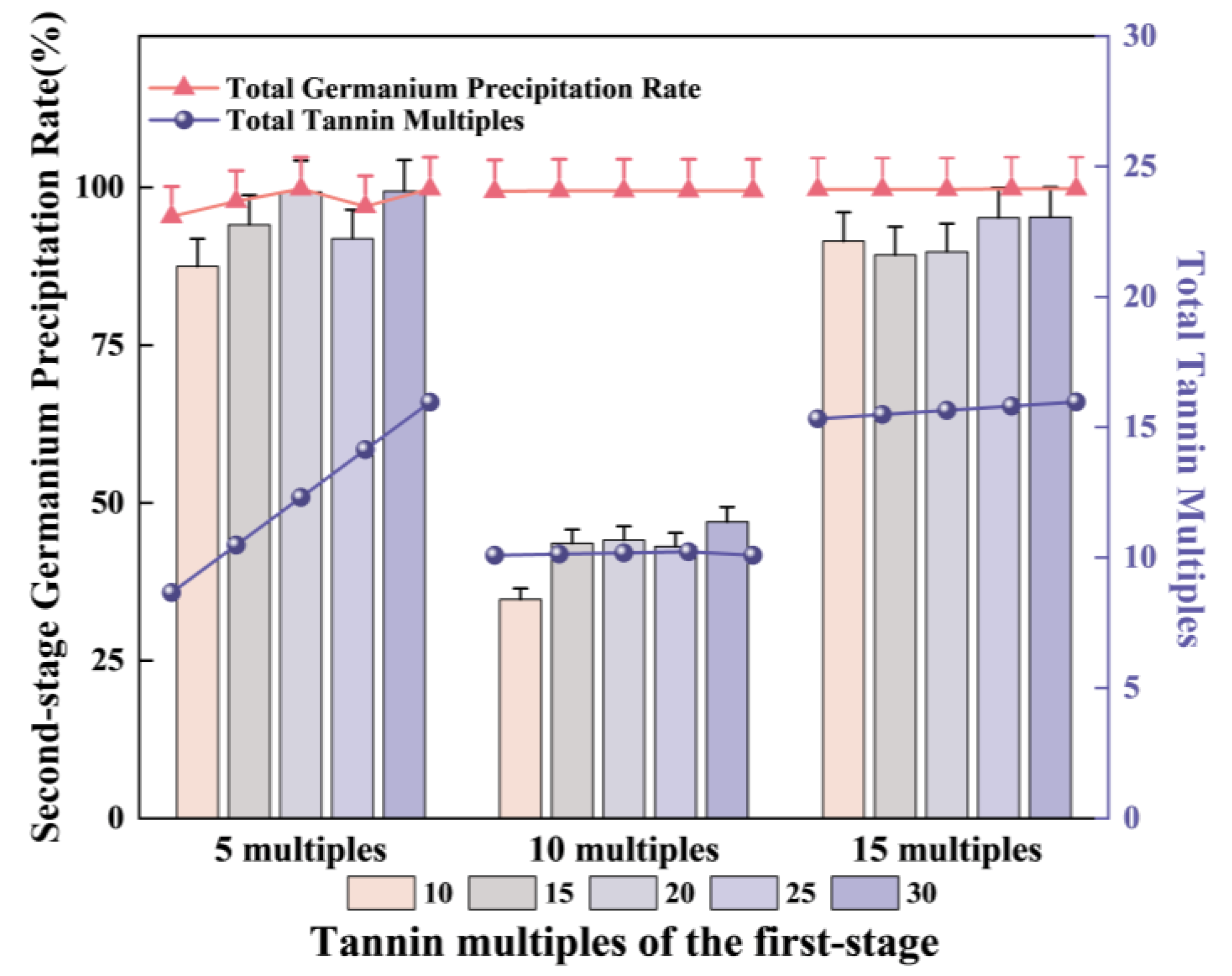
Figure 4 shows the regulation patterns of the first- and second-order germanium precipitation rates in a microfluidic multi-stage germanium precipitation process under strongly acidic conditions (pH = 1.5). The experiments were conducted at room temperature with a volume ratio of 6:1, and a total flow rate of 144.84 mL/min. The bar chart shows the rate of germanium precipitation during the second stage. The triangles indicate the total rate of germanium precipitation, whilst the dots represent the total amount of tannin added to the system, clearly illustrating the synergistic effects of the multi-stage addition strategy on germanium precipitation performance and reagent yield.
Figure 4.
Effect of tannin molar ratio on the reaction at pH 1.5 (room temperature 25 °C, molar ratio = 6:1, flow rate = 144.84 mL/min). The x-axis represents the tannin dosage multiples in the first stage; the legend denotes the tannin dosage multiples in the second stage (10×–30×). The bars represent the second-stage germanium precipitation rate, the triangular line represents the total germanium precipitation rate over both stages, and the dotted line represents the total tannin dosage multiples consumed in both stages.
In a single-stage tannin precipitation system, the precipitation rate increased significantly from 45.23% to 91.28% as the primary tannin dosage was raised from 5-fold to 15-fold. Under strongly acidic conditions, the phenolic hydroxyl groups of tannin are weakly deprotonated [21], resulting in a low concentration of phenolate anions available for coordination with germanium and thus weak chelation. Consequently, a high tannin dosage is required to provide sufficient active ligands that drive the conversion of Ge(OH)4 into stable Tan–H+–Ge complexes [22]. This explains why high reagent consumption is unavoidable in conventional single-stage processes operated at low pH.
By introducing a secondary germanium precipitation stage, the supplementary addition of secondary tannin enables thorough capture of residual germanium ions that did not form complexes in the primary stage (Table 2). The enhanced mass transfer provided by the microfluidic system effectively alleviates the kinetic inhibition caused by the strongly acidic environment, allowing the secondary reaction to efficiently capture the residual germanium and fully demonstrating the technical advantage of the two-stage process.
When the primary tannin dosage was 5-fold, gradually increasing the secondary tannin dosage from 10-fold to 25-fold raised the total germanium precipitation rate stepwise from 70.4% to 94.5%, while the cumulative tannin dosage increased from 10.4-fold to 21.3-fold. When the secondary tannin dosage reached 30-fold, the total precipitation rate plateaued at approximately 95.2%, indicating that the available germanium ions had been largely exhausted.
When the primary tannin dosage was increased to 10-fold and 15-fold, the primary precipitation rates reached 59.6% and 91.28%, respectively, leaving significantly less residual germanium. In these cases, increasing the secondary tannin dosage from 10-fold to 30-fold only marginally raised the total precipitation rate to about 95%. The cumulative tannin dosages remained in the ranges of 14.1–22.1-fold and 15.9–17.6-fold, respectively. Notably, the combination of a 5-fold primary dosage with a 15-fold secondary dosage achieved a high total precipitation rate of 92.04% at a total tannin dose of merely 13.22-fold. Compared with the single-stage process at 15-fold dosage, this approach reduced chemical consumption by 12%, demonstrating the deep-capture capability and efficient reagent utilisation of the two-stage strategy.
Further analysis shows that once the cumulative tannin dosage exceeds 17-fold, the total germanium precipitation rate enters a plateau (increase < 1%). Both the ‘Stage 1: 5-fold + Stage 2: 15-fold’ and ‘Stage 1: 15-fold + Stage 2: 15-fold’ combinations achieve > 92% precipitation, while the former reduces total reagent input by 24%. This confirms that a lower primary tannin dosage coupled with moderate secondary supplementation is an optimised strategy that substantially cuts reagent consumption while maintaining high germanium recovery, effectively overcoming the high-dosage bottleneck of conventional strong-acid processes [23].
Table 2.
Tannin multiplication factors for microfluidic multi-stage reactions at pH 1.5.
3.2.2. The Effect of Tannin Dosage on the Germanium Precipitation Process Under pH 2.5 Conditions
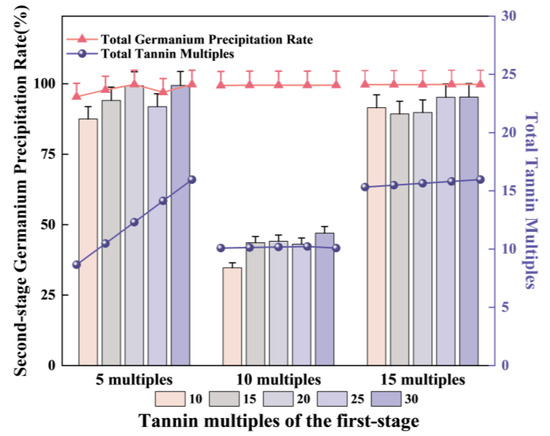
Figure 5 and Table 3 show the experimental results obtained under mild acidic conditions (pH 2.5, adjusted with sodium hydroxide), with other conditions kept identical to those in Section 3.2.1. The bar charts represent the second-stage germanium precipitation rate, the red triangles indicate the total germanium precipitation rate, and the blue line corresponds to the cumulative tannin dosage.
Figure 5.
Effect of tannin molar ratio on the reaction at pH 2.5 (room temperature, molar ratio = 6:1, flow rate = 144.84 mL/min) The x-axis represents the tannin dosage multiples in the first stage; the legend denotes the tannin dosage multiples in the second stage (10×–30×). The bars represent the second-stage germanium precipitation rate, the triangular line represents the total germanium precipitation rate over both stages, and the dotted line represents the total tannin dosage multiples consumed in both stages.
Under this higher pH, the protonation of tannin phenolic hydroxyls is substantially enhanced [24], thereby alleviating the coordination competition between H+ and Ge4+. As a result, the utilisation of active coordination sites is markedly improved compared with the strongly acidic system, and both the multi-stage precipitation behaviour and reagent consumption characteristics differ significantly from those observed at pH 1.5.
When the primary tannin dosage is 5-fold, the second-stage germanium precipitation rate increases continuously with increasing secondary tannin dosage, and the total precipitation rate rises steadily toward saturation. Under these conditions, a considerable amount of residual germanium remains after the primary stage; the secondary addition of tannin ligands, combined with the efficient mass transfer of the microfluidic system, achieves thorough deep capture of the remaining germanium.
When the primary dosage is increased to 10-fold, the primary stage already complexes the vast majority of germanium, leaving very low residual concentrations. As the secondary tannin dosage is raised, the second-stage precipitation rate stays within a low range and changes only gradually; the total precipitation rate is already near its maximum and shows no scope for further improvement. In this regime, the marginal benefit of adding secondary tannins is negligible, and excellent overall performance can be maintained without a significant increase in ligand consumption.
For a primary dosage of 15-fold, the secondary precipitation rate shows a gradual upward trend with increasing secondary tannin dosage, but both the cumulative tannin dosage and the total precipitation rate remain nearly unchanged at a high plateau (>94%). Secondary tannin serves only to capture trace residual germanium [25], further ensuring optimal efficiency while avoiding redundant reagent addition.
A comparative evaluation reveals that the mild acidic conditions at pH 2.5 fully unleash the advantages of the multi-stage stepwise precipitation process [26]. By rationally allocating primary and secondary tannin dosages, the amount of secondary ligand can be precisely adjusted according to the completion degree of the primary precipitation, thereby achieving synergistic optimisation of germanium recovery and reagent economy [27]. The combination of a 5-fold primary dosage with moderate secondary supplementation consistently delivers > 95% germanium precipitation at a lower cumulative tannin dosage, fulfilling the dual goal of high efficiency and low chemical consumption. Compared with the strongly acidic system at pH 1.5, the pH 2.5 system provides superior coordination conditions, enabling stable and efficient germanium precipitation with lower total tannin input while retaining the deep-purification function of the secondary stage. This validates the combined strategy of pH control and multi-stage precipitation as a reliable basis for resource recovery from germanium-containing waste liquids.
Table 3.
Tannin multiplication factors for microfluidic multi-stage reactions at pH 2.5.
3.3. Study on the Mechanism of Tannin Precipitation Using Microfluidics and Conventional Methods
3.3.1. Morphological Characteristics of Tannin–Germanium Complexes (SEM, Particle Size, etc.)
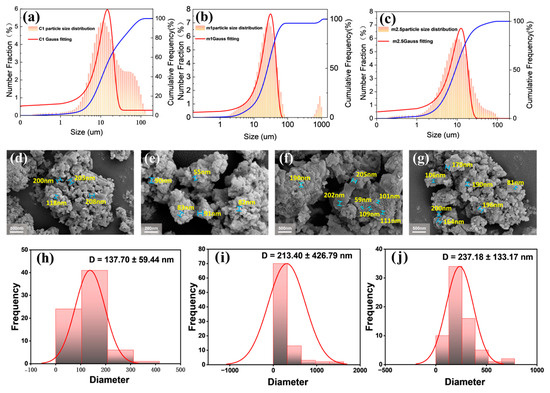
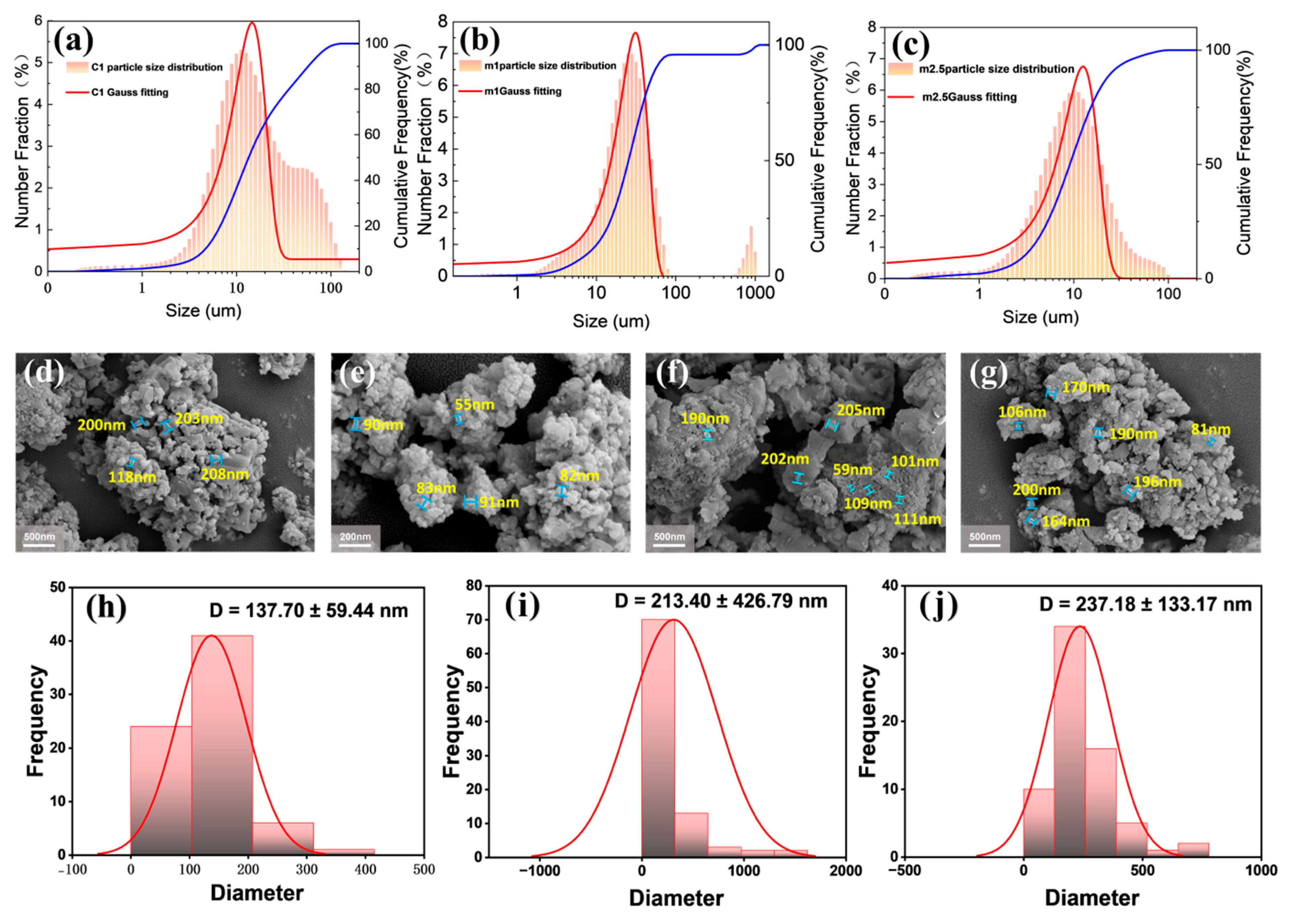
Firstly, comparing the differences in products between the conventional stirring system and the microfluidic system, the particle size distribution results in (a) and (b) show that, under identical conditions of pH = 1.5 and a 5-fold tannin dosage, the particle size distribution range of the C1 sample obtained from the conventional stirring system is wider; the particle size of the main peak in the Gaussian fit is larger [28]; the degree of particle size dispersion is high; and there are a large number of large-sized agglomerated particles. In contrast, the particle size distribution of the microfluidic system’s m1 sample is significantly narrower, with the Gaussian-fitted main peak shifted towards smaller particle sizes and markedly improved particle size uniformity. Combined with the corresponding SEM morphology (d), it can be seen that the microfluidic system achieves a significant refinement of product grain size, with smaller primary grains and agglomerates exhibiting a looser structure and more developed porosity. The above results fully confirm that the microfluidic system, by virtue of the efficient mass transfer and mixing effects within the micrometre-scale channels, can significantly enhance the uniform complexation reaction between tannins and germanium ions, effectively suppressing the abnormal coarsening and excessive agglomeration of precipitate particles, and achieving fine-grained and size-uniform product control. Overall, the precipitation performance is significantly superior to that of conventional stirring processes (Figure 6).
Figure 6.
Morphologicalcharacteristics of tannin–germanium complexes synthesised via microfluidics and conventional methods. (a): Particle size distribution and Gaussian fit results for the precipitated germanium product under conventional stirring conditions (pH = 1.5, single-stage reaction, 5-fold excess tannin); (b): Particle size distribution and Gaussian fit results for the precipitated germanium product under microfluidic conditions (pH = 1.5, single-stage reaction, 5-fold excess tannin); (c): Particle size distribution and Gaussian fitting results of the precipitated germanium product in the microfluidic system under conditions of pH = 2.5 and a 5-fold excess of tannin in the first-stage reaction; (d): SEM characterisation of the product from the microfluidic reaction system during the first-stage reaction under conditions of a 5-fold excess of tannin; (e): SEM characterisation of the product from the microfluidic reaction system under a 5-fold tannin dosage in the first-stage reaction and a 15-fold dosage in the second-stage reaction; (f): SEM characterisation of the product from the microfluidic reaction system at a tannin loading of 15 times the reaction volume during the first-stage reaction; (g): SEM characterisation of the product from the microfluidic reaction system at a tannin loading of 15 times the reaction volume during the first-stage reaction and 10 times the reaction volume during the second-stage reaction. (h): Particle size distribution of the product from the microfluidic reaction system under a 5-fold tannin dosage in the first-stage reaction and a 15-fold dosage in the second-stage reaction; (i): Particle size distribution of the product from the microfluidic reaction system under at a tannin loading of 15 times the reaction volume during the first-stage reaction; (j) Particle size distribution of the product from the microfluidic reaction system at a tannin loading of 15 times the reaction volume during the first-stage reaction and 10 times the reaction volume during the second-stage reaction. The blue line represents the cumulative particle size distribution curve, indicating the proportion of particles smaller than the corresponding size that have accumulated.
Further analysis of the influence of reaction pH on the product characteristics in the microfluidic system reveals that, upon comparing the particle size distributions in (b) and (c) with the SEM morphologies in (d), it is evident that under microfluidic conditions and with a 5-fold amount of single-stage tannin, increasing the reaction pH from 1.5 to 2.5 results in a further narrowing of the particle size distribution of the precipitated germanium product, the average particle diameter continued to decrease, and the particle size distribution became more concentrated; corresponding SEM results showed that the product grains were better dispersed, with a marked reduction in large, dense aggregates, and a more uniform, loose, porous nanoscale grain structure. This indicates that an appropriately elevated pH environment can optimise the complexation activity of tannin molecules; combined with the mass transfer advantages of microfluidics, this has enabled further fine-tuning of the structure of the precipitated products.
Regarding the influence of tannin dosing methods, a comparison of product morphology between a single-stage batch dosing system and a two-stage sequential dosing system revealed that in the single-stage high-dose batch system (Figure 6f, with a tannin dosage of 15 times in the first stage), the product exhibited significant abnormal grain growth and large, dense aggregates, with internal pores extensively blocked. Furthermore, the excess tannin directly led to extensive agglomeration and encapsulation, resulting in inefficient reagent utilisation and coarsening of the product structure. In contrast, systems employing a two-stage sequential addition strategy (Figure 6e,g) exhibited significant advantages in terms of microstructure. Specifically, the product from the 5-fold first-stage + 15-fold second-stage sequential addition (Figure 6e) features fine, uniform grain size, a complete loose and porous structure, and optimal grain dispersion, with no obvious excessive agglomeration or coarse grain structure. Another system with a ratio of 15-fold in the first stage plus 10-fold in the second stage (Figure 6g) similarly exhibits excellent refined morphological characteristics, with an overall structure significantly superior to that of a single-stage, one-off addition system using the same total dosage.
The results indicated that the two-stage stepwise tannin addition reaction possesses clear research value and process advantages: stepwise addition of tannin aligns with the chelation reaction process within the microchannels, enabling the chelation and precipitation of germanium ions to be completed in stages [29]. This approach not only avoids the issues of localised high concentrations and abnormal grain agglomeration and growth caused by a single-stage, single-dose high-concentration tannin addition, but also fully utilises the chelation sites of tannin, thereby enhancing the effective utilisation of the reagent. Whilst refining the microstructure of the precipitate and optimising the particle size distribution, this approach further improves the overall germanium precipitation recovery efficiency, achieving in-depth optimisation of the germanium precipitation process within the microfluidic system.
3.3.2. Phase Composition of Tannin–Germanium Complexes (EDS, XRD, etc.)
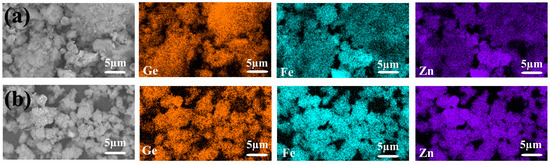
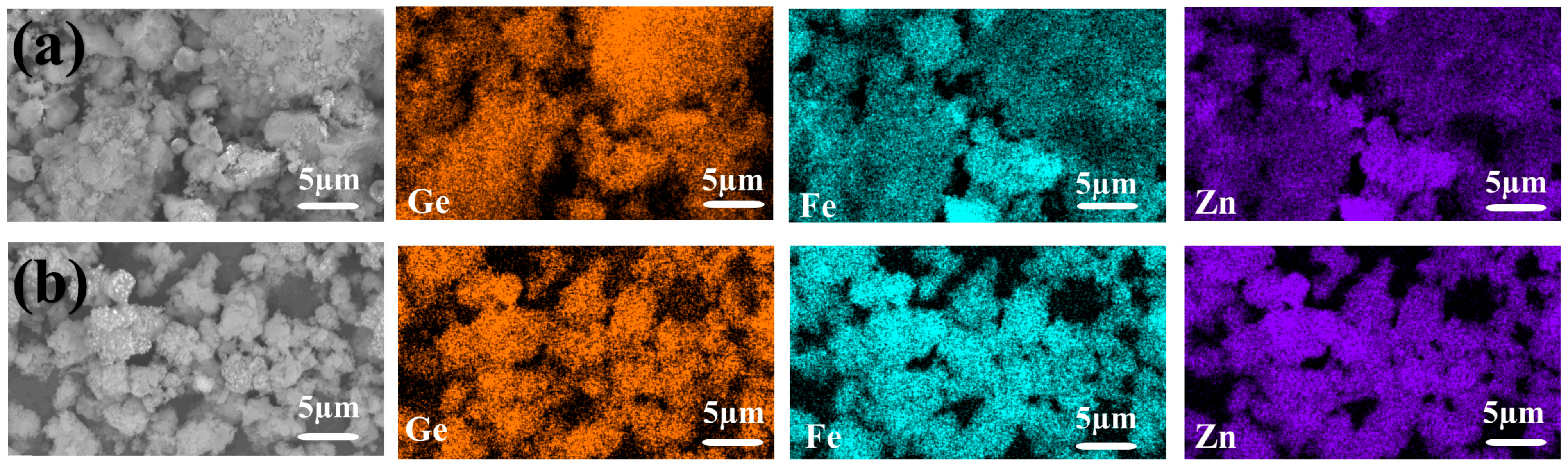
Figure 7a (pH 1.5, conventional stirring, 5-fold concentration) and Figure 7b (pH 1.5, microfluidic stirring, 5-fold concentration) compare the microscopic morphologies of the precipitated products obtained from the two reaction systems using the same amount of tannin. The SEM images clearly show that the products from the conventional stirring system exhibit a disordered morphology with severe agglomeration and non-uniform particle sizes, appearing as an overall mixed structure of irregular lumps and flocs. The particles are heavily adhered to each other, resulting in a small specific surface area. These features are attributed to the non-uniform mixing under macroscopic stirring and excessively large local concentration gradients, which lead to uncontrollable nucleation and growth processes. In contrast, the products obtained from the microfluidic system display a more regular morphology, better dispersion, and more uniform particle size. No obvious large agglomerates are observed, and the particle boundaries are well-defined, indicating that microscale mixing significantly enhances the precipitation nucleation process.
Figure 7.
Phase composition of tannin–germanium complexes synthesised via microfluidics and conventional methods. (a): Conventional mapping; (b): Microfluidic mapping.
3.3.3. Coordination Patterns of Tannin–Germanium Complexes
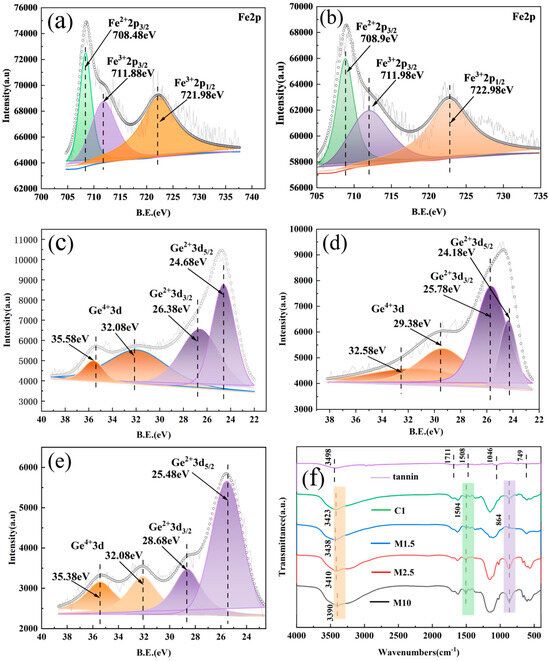
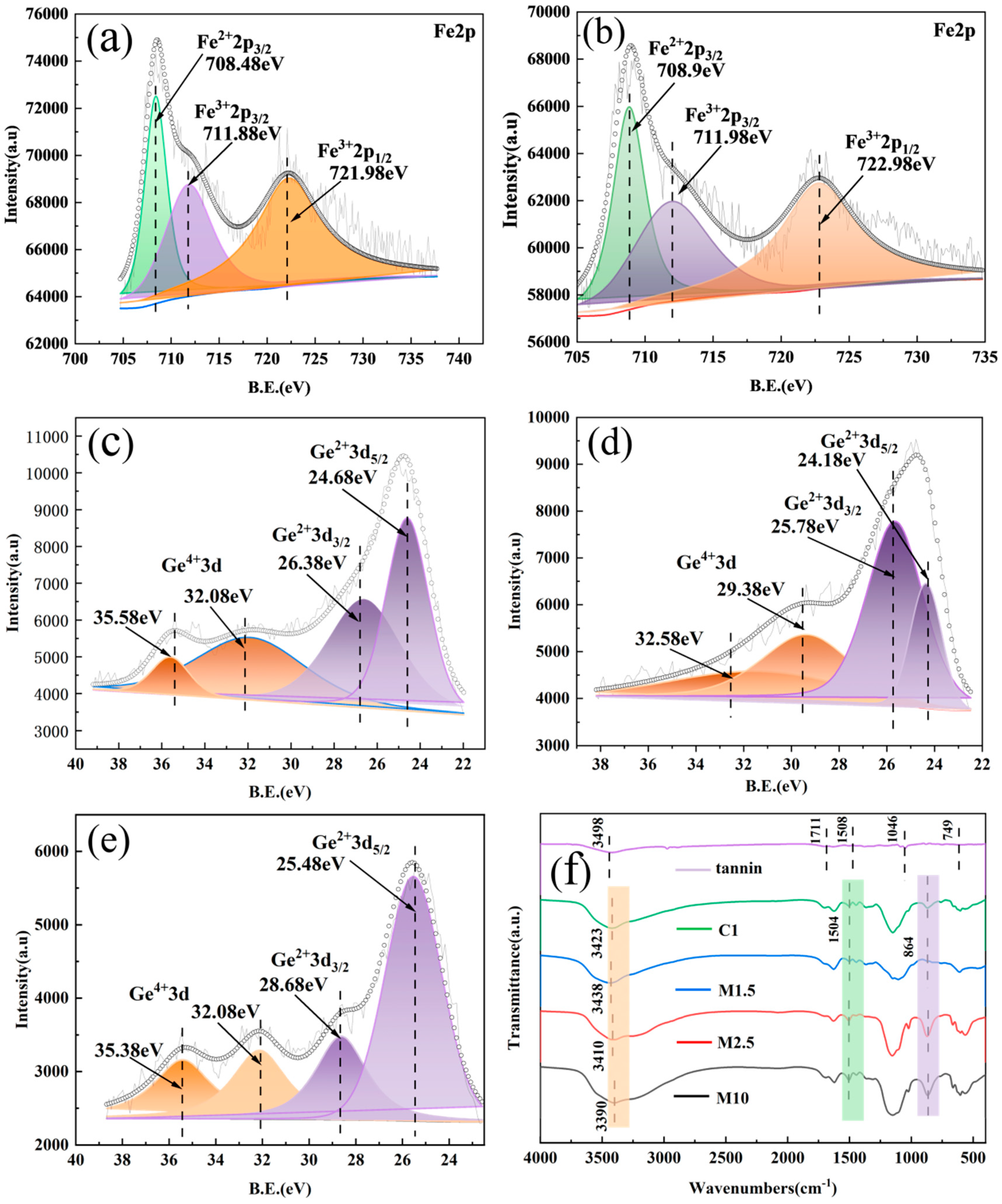
XPS analysis of the tannin–germanium precipitates shown in Figure 8a,b indicates that germanium coexists in all samples in both +2 and +4 oxidation states. In the Ge 3d spectra (Figure 8c–e), the characteristic peaks of the +2 oxidation state are located in the 25.48–25.78 eV range, corresponding to GeO and organic germanium species (such as CH3OGe/C2H3OGe), in which the methyl or ethyl group acts as a neutral ligand, and the oxygen atom in the ether bond balances the Ge2+ charge via its −2 oxidation state; The characteristic peaks of the +4 valence state are distributed between 29.38 and 35.38 eV, originating from Ge(IV) ions bound to carboxylate groups (CxHyO2Ge) or polyhydroxy ligands (CHsOGe); this conclusion is corroborated by time-of-flight mass spectrometry data from previous studies [30]. The key difference lies in the fact that the microfluidic sample (d) containing 5-fold tannin exhibits a significant Ge2+ peak intensity at 25.78 eV, whilst the Ge4+ binding energy is lower (main peaks at 29.38 eV and 32.58 eV), indicating that the micro-mixing environment promotes the formation of metastable organic germanium intermediates; the Ge4+ characteristic peak intensity in the pH 2.5 microfluidic sample (e) was significantly enhanced (35.38 eV), whilst the Ge2+ peak intensity at 25.48 eV increased simultaneously, reflecting a strengthened trend towards the conversion of germanium to higher oxidation states under reduced acidity. The spectral characteristics of the conventional single-stage 5-fold tannin sample (c) are similar to those of a3, but the peak intensities are generally weaker, corroborating the inadequacy of the coordination reaction in the traditional process [31].
Figure 8.
Coordination patterns of tannin–germanium complexes synthesised via microfluidic and conventional methods. (a): High-resolution Fe 2p XPS spectrum of the product from the conventional reaction system at the first reaction stage with a 5-fold excess of tannin; (b): High-resolution Fe 2p XPS spectrum of the product from the microfluidic reaction system at the first reaction stage with a 5-fold excess of tannin; (c): High-resolution Ge 3d XPS spectrum of the product from the conventional reaction system at the first reaction stage with a 5-fold excess of tannin; (d): High-resolution Ge 3d XPS spectrum of the product from the microfluidic reaction system at the first reaction stage with a 5-fold excess of tannin; (e): High-resolution Ge 3d XPS spectrum of the product from the microfluidic reaction system at the first reaction stage with a 5-fold excess of tannin and pH = 2.5; (f): Comparison of FT-IR spectra.
State of iron impurities: The Fe 2p spectra show that Fe3+ is the predominant form in both the conventionally processed sample (a) and the microfluidic sample (b), with the binding energy positions indicating the formation of iron germanate phases (FeGeO3, Fe2GeO4) [28]. Time-of-flight mass spectrometry detected characteristic fragments with atomic mass/z of 207.8 (Fe2(SO4)3) and 351.2 (Fe(SO3H)5), confirming the presence of residual sulphate complexes in the precipitate, which is a typical characteristic of residual acid leaching impurities [32].
Mechanism analysis: Microfluidic technology promotes tannin–germanium-specific coordination by enhancing mass transfer, leading to an increased abundance of the Ge2+ intermediate in sample a2; whereas the pH 2.5 condition (close to the isoelectric point of tannin) optimises ligand conformation, driving an increase in the proportion of the stable Ge4+ phase in sample a3, confirming the regulatory effect of acidic micro-adjustment on the chemical state of germanium precipitates. Analysis of the iron phase, however, revealed that microfluidics did not significantly alter the form in which impurities were present [23].
Figure 8f compares the infrared spectral characteristics of germanium-precipitated products obtained via different processes with those of pure tannic acid. Pure tannic acid exhibits a characteristic stretching vibration peak of the phenolic hydroxyl group at 3498 cm−1, whereas this peak is significantly red-shifted in all germanium-precipitated products: in the conventional stirring system C1 (pH 1.5, 5-fold tannic acid), it is red-shifted to 3423 cm−1, the microfluidic system M1.5 (pH 1.5, 5-fold tannin) shifts to 3438 cm−1, M2.5 (pH 2.5, 5-fold tannin) shifts to 3410 cm−1, and M10 (10-fold tannin) shifts substantially to 3390 cm−1. The order of red-shift magnitude (M10 > M2.5 > M1.5 > C1) directly reflects the coordination strength—the red-shift in the high-tannin microfluidic system M10 reached 108 cm−1, indicating that the phenolic hydroxyl groups of tannins form strong hydrogen bonds with germanium ions, leading to a weakening of the O-H bond energy; this phenomenon is strongly corroborated by the 95% germanium deposition rate data for the M10 system [33].
In the benzene ring vibrational region, the C=C stretching peak at 1508 cm−1 in pure tannic acid shifts in all germanium-doped products: C1 shifts slightly to 1504 cm−1, whilst in the microfluidic systems M1.5, M2.5, and M10, the peak shifts further towards lower wavenumbers, with broadening of the peak shape and increased intensity, revealing a redistribution of the π electron density in the tannic acid benzene ring due to germanium coordination. Analysis of the characteristic coordination bond region shows that: at 1046 cm−1, absorption peaks appear only in the microfluidic-optimised systems M2.5 and M10, attributed to the Ge-O-C asymmetric stretching vibration, whereas C1 and M1.5 lack this peak, confirming that microfluidics promote the formation of Ge-O bonds under pH 2.5 or high tannin conditions. At 864 cm−1, absorption peaks appear in C1, M2.5 and M10 (corresponding to the Ge-O bond symmetric vibration), but M1.5 shows no response; furthermore, the peak intensities in M2.5 and M10 are significantly higher than in C1, highlighting the optimising effect of microfluidics on the coordination structure. At 749 cm−1, C1 exhibits three weak peaks, M1.5 shows only one broad peak, whilst M2.5 and M10 display three sharp, intense peaks, reflecting fundamental differences in the spatial configuration of the tannin–germanium complexes under different processes; the microfluidic system is more conducive to the formation of an ordered coordination structure. This spectroscopic evidence demonstrates that microfluidic technology, by enhancing molecular collisions and proton regulation, significantly increases the strength of the tannin–germanium coordination bonds and the structural orderliness, thereby providing a molecular mechanism for efficient germanium precipitation in highly acidic environments.
3.3.4. The Coordination Mechanism of Tannin–Germanium Complexes
The process of germanium precipitation using tannins is essentially a specific coordination reaction between plant polyphenols and germanium ions; its efficiency and the characteristics of the product are jointly governed by ligand concentration, reaction environment and mass transfer conditions. The primary germanium precipitation stage serves as the main precipitation process, with the amount of tannin directly determining the initial degree of complexation: when the tannin-to-germanium ratio is 5:1, insufficient ligand leads to incomplete complexation of germanium ions, resulting in products predominantly consisting of loose flocculent aggregates (average size approximately 200 nm), with nucleation and growth being limited. Upon increasing the tannin dosage to 15-fold, the sufficient ligand supply promotes complete coordination of germanium ions, resulting in the formation of densely structured, well-defined particles (average size approximately 180 nm), and alleviating the aggregation phenomenon [30]. The secondary germanium precipitation stage achieves deep capture through the addition of ligands: upon adding 15-fold secondary tannin to the 5-fold primary system, residual germanium ions trigger secondary nucleation, significantly refining the average particle size to approximately 90 nm and yielding a nanoscale dispersed structure; even under the highly coordinated conditions of the 15-fold primary system, the addition of 10-fold secondary tannin can further optimise particle dispersion [31]. This indicates that the secondary reaction, through a hierarchical strategy of ‘pre-coordination–deep precipitation’, enhances the specific surface area whilst refining particle size and suppressing aggregation, thereby creating favourable conditions for subsequent solid–liquid separation and germanium enrichment.
The pH environment influences coordination chemistry through a dual mechanism: under strongly acidic conditions (pH 1.5), high concentrations of H+ cause the hydroxyl groups of tannins to become protonated, thereby weakening their coordination ability; at the same time, germanium predominantly exists in the electrically neutral form Ge(OH)4 [16]. The binding energy between the two is low, resulting in a germanium precipitation rate of less than 60% and a loose product structure. When the pH rises to the 2.0–2.5 range, the tannins undergo partial deprotonation to form highly reactive phenolic anions, whilst germanium hydrolyses to form positively charged Ge(OH)3+/Ge(OH)22+. The synergistic action of electrostatic attraction and chelation increases the germanium precipitation rate to approximately 80%. At this point, the environment near the isoelectric point of tannin (pH ≈ 2.8) optimises the ligand conformation; in the infrared spectrum, the characteristic peaks of the Ge–O–C bond (1046 cm−1) and the Ge–O bond (864 cm−1) are significantly enhanced, XPS analysis further detected an increased proportion of the stable Ge4+ phase (binding energy 35.38 eV), confirming that high-valent germanium complexes dominate the precipitation process. When the pH rises to 3.0, self-aggregation of tannin masks the coordination sites, and excessive hydrolysis of germanium ions into GeO(OH)3− anions triggers electrostatic repulsion, causing a slight decline in germanium precipitation efficiency [34].
The core advantages of microfluidic technology lie in enhanced mass transfer and structural optimisation: compared to conventional stirring, molecular-scale mixing (<0.01 s) within the microreactor eliminates local concentration gradients, enabling more uniform and thorough tannin–germanium coordination. SEM-EDS analysis revealed low germanium signals on the surface of the microfluidic products; this is because germanium is densely encapsulated within the particles. XPS further confirmed that this promotes the formation of metastable Ge2+ intermediates (characteristic peak at 25.78 eV), providing new evidence for the complexation pathway; In infrared spectroscopy, the phenolic hydroxyl bond exhibits a red shift of up to 108 cm−1 (in the microfluidic system with 10 times the tannin concentration), and the Ge–O bond vibration peak becomes sharper, indicating a significant enhancement in coordination bond strength and structural stability. These microscopic observations, combined with macroscopic data (95% germanium deposition rate, low co-precipitation rate), collectively reveal that the microfluidic-coupled secondary process overcomes the bottlenecks in germanium deposition depth and product quality under highly acidic conditions through the synergy of hierarchical coordination and mass transfer.
This work clarifies the hierarchical regulation mechanism of “primary nucleation-dominated precipitation—secondary deep capture,” thereby addressing the bottleneck of insufficient germanium precipitation efficiency under high-acidity conditions in conventional processes. The addition of secondary tannin induced secondary nucleation of residual germanium ions, refined the particle size, and suppressed agglomeration, providing molecular-level evidence that the ligand supplementation strategy can significantly optimise the complex yield and product structure. These findings offer a new theoretical paradigm and design rationale for process intensification in polyphenol-based coordination precipitation systems. This technology can reduce tannic acid consumption, significantly shorten the processing time, and eliminate the need for heating, thereby offering considerable economic advantages and strong potential for widespread application. Further work should focus on resolving the thermal decomposition behaviour and coordination structure–activity relationships of the secondary tannin–germanium complexes, and on establishing a coupled kinetic model for the multistage coordination process (450–550 °C), thereby guiding precise scale-up and industrial adaptation of the technology.
4. Conclusions
This study systematically elucidates the synergistic regulation mechanism between the coordination behaviour of tannins and the reaction environment in a microfluidic two-stage germanium precipitation process. The main conclusions are as follows:
- (1)
- The amount of tannin directly determines the initial complexation efficiency. When the tannin dosage was increased from 5-fold to 15-fold, the germanium precipitation rate rose from 45.23% to 91.28%, and the particle size of the compact chelate decreased from 200 nm to 180 nm. Meanwhile, the obtained particles present a well-dispersed and uniform morphology. Once the cumulative tannin dosage exceeds 17-fold, the germanium precipitation rate enters a plateau phase; optimising the staged addition strategy (e.g., 5-fold + 15-fold at pH = 1.5) can reduce reagent costs by 24%.
- (2)
- Under strong acidic conditions (pH = 1.5), tannin protonation and the presence of germanium in the form of Ge(OH)4 result in a germanium precipitation rate of less than 60%; when the pH rises to 2.0–2.5, tannin deprotonation generates -O−, and germanium is converted to Ge(OH)3+; the synergy between electrostatic and chelating interactions brings the germanium precipitation rate to 79.9%. At pH = 3.0, the self-aggregation of tannins and the anionisation of germanium led to a decline in efficiency.
- (3)
- At pH = 1.5, the ‘primary 5-fold + secondary 15-fold’ combination achieved a total germanium precipitation rate of 92.04% at a cumulative tannin dosage of 13.22-fold, representing an increase of 46.81 percentage points compared to the single-stage 5-fold treatment. At pH = 2.5, the “5-fold primary + 10-fold secondary” combination achieved an ultra-high germanium precipitation rate of 95.44% with a cumulative tannin dosage of 8.67-fold, reducing reagent consumption by 42.3%.
- (4)
- Millisecond-scale instantaneous mixing (<0.01 s) refined the product particle size to 90 nm, inhibited agglomeration, sharpened the Ge–O bond peak (864 cm−1) in the infrared spectrum, and XPS confirmed an increased proportion of the stable Ge4+ phase, significantly enhancing the stability of the coordination structure.
In summary, the microfluidic two-stage germanium precipitation process, through staged coordination (primary precipitation + secondary deep capture) and reaction environment control (pH = 2.0–2.5), simultaneously achieves the triple objectives of a germanium recovery rate > 95%, a 24% reduction in reagent costs, and the nanoscale size of the product particles (90 nm), providing efficient, economical and environmentally friendly technical support for the resource recovery of highly acidic waste liquids.
Supplementary Materials
The following supporting information can be downloaded at: https://www.mdpi.com/article/10.3390/met16060644/s1, Section S1: Calculation of Reaction Time for Tannin Two-Phase Flow in Microreactor.
Author Contributions
Conceptualization, S.J. and X.Z.; methodology, S.J.; software, M.F.; validation, Y.L., and D.L.; formal analysis, X.Z.; investigation, L.S.; resources, S.J.; data curation, X.Z.; writing—original draft preparation, Z.Z. and X.Z.; writing—review and editing, X.Z.; visualisation, M.F.; supervision, D.L.; project administration, S.J.; funding acquisition, S.J. All authors have read and agreed to the published version of the manuscript.
Funding
This work was financially supported by the National Natural Science Foundation of China (51964032), the Key Project of the NSFC-Yunnan Provincial Joint Fund (U1302271), and the Scientific and Technological Project of Yunnan Precious Metals Laboratory (YPML-20240502085).
Data Availability Statement
The original contributions presented in this study are included in the article/supplementary material. Further inquiries can be directed to the corresponding authors.
Conflicts of Interest
The authors declare no conflict of interest.
References
- Geng, X.; Liu, Y.; Zhang, W.; Wang, L.; Wen, J.; Sun, J. Recent advances in the recovery of germanium during the zinc refining process. Chem. Eng. J. 2022, 446, 137445. [Google Scholar] [CrossRef] [Scilit]
- Höll, R.; Kling, M.; Schroll, E. Metallogenesis of germanium—A review. Ore Geol. Rev. 2007, 30, 145–180. [Google Scholar] [CrossRef] [Scilit]
- Xu, Y.; Liu, J.; Xia, H.; Pei, Q.; Zhang, Q.; Rao, M.; Peng, S.; Zhang, L. A feasible strategy for the multi-stage separation of valuable metals from zinc hydrometallurgy leaching solution. Sep. Purif. Technol. 2025, 360, 131266. [Google Scholar]
- Arroyo Torralvo, F.; Fernández-Pereira, C.; García Villard, E.; Luna, Y.; Leiva, C.; Vilches, L.; Villegas, R. Low environmental impact process for germanium recovery from an industrial residue. Miner. Eng. 2018, 128, 106–114. [Google Scholar] [CrossRef] [Scilit]
- Sheng, X.; Lin, G.; Huang, Y.; Zhong, Z.; Wang, S.; Hu, T.; Li, S.; Liu, J.; Xia, H.; Cao, H.; et al. Enhanced Zinc Electrodeposition by Multi-Component Low-Concentration Organic Additives and Synergistic Mechanism. J. Sustain. Metall. 2025, 11, 1333–1347. [Google Scholar] [CrossRef] [Scilit]
- Yang, F. Research Progress on Extracting Germanium from Zinc-Germanium Leaching Solution. J. Kunming Univ. Sci. Technol. Nat. Sci. 2021, 46, 9–17. [Google Scholar]
- Kul, M.; Topkaya, Y. Recovery of germanium and other valuable metals from zinc plant residues. Hydrometallurgy 2008, 92, 87–94. [Google Scholar] [CrossRef] [Scilit]
- Song, L.; Zeng, Y.; Liang, M.; Di, H.; Liu, J.; Yang, K.; Zhang, L. Process optimization and mechanism of high-efficiency germanium extracting from zinc oxide dust containing germanium enhanced by ultrasound. Chem. Eng. Process.-Process Intensif. 2023, 191, 109439. [Google Scholar] [CrossRef] [Scilit]
- Drzazga, M.; Chmielarz, A.; Benke, G.; Leszczyńska-Sejda, K.; Knapik, M.; Kowalik, P.; Ciszewski, M. Precipitation of Germanium from Sulphate Solutions Containing Tin and Indium Using Tannic Acid. Appl. Sci. 2019, 9, 966. [Google Scholar] [CrossRef] [Scilit]
- Tan, Z.; Jin, X.; Zhen, Y.; Wei, C.; Li, X.; Deng, Z.; Li, M. Recovery of indium and germanium from In-Ge residue leaching solution using solvent extraction and tannin precipitation. Sep. Purif. Technol. 2023, 323, 124416. [Google Scholar] [CrossRef] [Scilit]
- Dai, J.; Yang, K.; Zhang, L.; Song, L.; Hong, Y.; Liang, M.; Zeng, Y.E.; Di, H. Removal kinetics and reaction mechanism of germanium from waste solutions with tannic acid enhanced by ultrasonic. Chem. Eng. Process.-Process Intensif. 2023, 192, 109491. [Google Scholar]
- Das, A.K.; Islam, M.N.; Faruk, M.O.; Ashaduzzaman, M.; Dungani, R. Review on tannins: Extraction processes, applications and possibilities. South Afr. J. Bot. 2020, 135, 58–70. [Google Scholar] [CrossRef] [Scilit]
- Song, L.-t.; Di, H.-k.; Liang, M.; Zeng, Y.-e.; Yang, K.; Zhang, L.-b. Study on ultrasonic depolymerization of Si-Ge precipitation in zinc oxide dust leaching process. Arab. J. Chem. 2023, 16, 105016. [Google Scholar] [CrossRef] [Scilit]
- Sarquís, P.E.; Menéndez-Aguado, J.M.; Mahamud, M.M.; Dzioba, R. Tannins: The organic depressants alternative in selective flotation of sulfides. J. Clean. Prod. 2014, 84, 723–726. [Google Scholar] [CrossRef] [Scilit]
- Kamran Haghighi, H.; Irannajad, M. Roadmap for recycling of germanium from various resources: Reviews on recent developments and feasibility views. Environ. Sci. Pollut. Res. Int. 2022, 29, 48126–48151. [Google Scholar] [PubMed]
- Liang, D.; Wang, J.; Wang, Y.; Wang, F.; Jiang, J. Behavior of tannins in germanium recovery by tannin process. Hydrometallurgy 2008, 93, 140–142. [Google Scholar] [CrossRef] [Scilit]
- Liu, K.; You, Y.; Lan, J.; Fan, M.; Hong, Y.; Yang, K.; Pei, Q. Ultrasound-induced entropy enhancement of tannic acid for selective germanium extraction from complex solutions. Miner. Eng. 2026, 236, 109951. [Google Scholar]
- Hong, Y.; Di, H.; Li, S.; Yang, K.; Zhang, L. Mechanism of Extracting Germanium from Ge-Containing Solution with Tannins. Metals 2023, 13, 774. [Google Scholar] [CrossRef] [Scilit]
- Cheng, J.; Shen, Y.; Gu, Y.; Xiang, T.; Shen, H.; Wang, Y.; Hu, Z.; Zheng, Z.; Yu, Z.; Wu, Q.; et al. Metal-polyphenol Multistage Competitive Coordination System for Colorimetric Monitoring Meat Freshness. Adv. Mater. 2025, 37, 2503246. [Google Scholar] [CrossRef] [Scilit]
- Di, H.; Hong, Y.; Yang, K.; Zhang, L. Preparation and evaluation of germanium concentrate by ultrasonic purification of tannin germanium residue. J. Environ. Manag. 2024, 366, 121699. [Google Scholar] [CrossRef] [Scilit]
- Shannon, R.D. Revised effective ionic radii and systematic studies of interatomic distances in halides and chalcogenides. Acta Crystallogr. Sect. A 1976, 32, 751–767. [Google Scholar] [CrossRef] [Scilit]
- Zhou, X.; Luo, Y.B.; Sun, L.X.; Zheng, J.H.; Ren, Y.Z.; Zhai, H.H.; Evgeniia, F.; Ju, S.H. Microfluidic chelation of germanium from post-indium extraction waste streams: Coordinative immobilization, process optimization, and environmental risk mitigation. Sep. Purif. Technol. 2026, 384, 136192. [Google Scholar] [CrossRef] [Scilit]
- Huang, J.; Davenport, A.M.; Heffernan, K.; Debela, T.T.; Marshall, C.R.; McKenzie, J.; Shen, M.; Hou, S.; Mitchell, J.B.; Ojha, K.; et al. Electrochemical Anion Sensing Using Conductive Metal-Organic Framework Nanocrystals with Confined Pores. J. Am. Chem. Soc. 2024, 146, 21099–21109. [Google Scholar]
- Xu, Y.; Xia, H.; Zhang, Q.; Jiang, G.; Zhang, L.; Xin, C.; Cai, W. Ultrasonic enhanced hydrazine sulfate acid leaching of low-grade germanium dust. Appl. Energy 2023, 332, 120485. [Google Scholar] [CrossRef] [Scilit]
- Lan, J.; Li, Y.; Zhang, J.; Liu, K.; Zhang, M.; You, Y.; Yang, K.; Pei, Q. Enhanced germanium recovery using a sulfonated tannin-based adsorbent: Performance and mechanistic insights. Miner. Eng. 2026, 243, 110262. [Google Scholar] [CrossRef] [Scilit]
- Zhang, J.; You, Y.; Lan, J.; Li, Y.; Yang, K.; Fan, M. Stoichiometry and growth mechanism of Tannin-Germanium complexes in precipitation processes. Sep. Purif. Technol. 2025, 378, 134602. [Google Scholar] [CrossRef] [Scilit]
- Di, H.; Liang, M.; Yang, K.; Zhang, L. Kinetics and mechanism of ultrasonic enhanced separation of zinc from tannin germanium residue. J. Saudi Chem. Soc. 2024, 28, 101803. [Google Scholar] [CrossRef] [Scilit]
- Di, H.; Liu, D.; Yang, K.; Zhang, L. Mechanism of arsenic removal from tannin--germanium complex augmented by ultrasound. Hydrometallurgy 2022, 213, 105931. [Google Scholar] [CrossRef] [Scilit]
- Huang, Y.; Xie, H.; Chen, Q.; Cao, Y.; Fan, Y.; Peng, W.; Wang, W.; Fu, B. Progress of germanium recovery from lignite and its by-products. Chem. Eng. J. 2025, 526, 171394. [Google Scholar] [CrossRef] [Scilit]
- Jiang, T.; Wang, P.; Liao, C.; Liu, Z.; Zhang, W.; Chen, F.; Liu, F. Novel insights into synergistic mechanisms of germanium extraction via tertiary amine system: Protonation processes and tartaric acid behavior. J. Environ. Chem. Eng. 2026, 14, 120982. [Google Scholar] [CrossRef] [Scilit]
- You, J.; Wei, Z.; Xing, Y.; Gui, X. Thermodynamic analysis and extraction and recovery of germanium from germanium-containing materials: A review. J. Environ. Manag. 2025, 396, 128125. [Google Scholar] [CrossRef] [Scilit] [PubMed]
- Srivastava, R.R.; Ilyas, S. Harnessing germanium from industrial residues and electronic waste for a sustainable energy future. Green Chem. 2025, 27, 14744–14768. [Google Scholar] [CrossRef] [Scilit]
- Geng, X.; Xie, Q.; Zhu, Y.; Yao, G.; Wang, L. An improvement for enrichment and purification of germanium using carbonyl acid extractants. Sep. Purif. Technol. 2025, 356, 129770. [Google Scholar] [CrossRef] [Scilit]
- Drzazga, M.; Ciszewski, M.; Kozłowicz, S.; Kasierot, S. Comparison of germanium recovery from copper(II) sulfate-based solution using tertiary amine and oxime extractant. Miner. Eng. 2024, 218, 108984. [Google Scholar] [CrossRef] [Scilit]

Disclaimer/Publisher’s Note: The statements, opinions and data contained in all publications are solely those of the individual author(s) and contributor(s) and not of MDPI and/or the editor(s). MDPI and/or the editor(s) disclaim responsibility for any injury to people or property resulting from any ideas, methods, instructions or products referred to in the content. |
© 2026 by the authors. Licensee MDPI, Basel, Switzerland. This article is an open access article distributed under the terms and conditions of the Creative Commons Attribution (CC BY) license.