Article

Effect of Solution Treatment on Microstructure and Corrosion Resistance Performance of HIPed Net-Shaped Duplex Stainless Steel SAF2507

1
School of Metallurgy Engineering, Jiangsu University of Science and Technology, Zhangjiagang 215600, China
2
CISRI HIPEX Technology Co., Ltd., Haidian, Beijing 100081, China
*
Author to whom correspondence should be addressed.
Metals 2026, 16(6), 643; https://doi.org/10.3390/met16060643
Submission received: 28 April 2026 / Revised: 4 June 2026 / Accepted: 5 June 2026 / Published: 10 June 2026

Abstract

This study systematically investigates the effect of solution treatment on the microstructure and corrosion resistance of duplex stainless steel SAF2507 fabricated by direct hot isostatic pressing (HIP). The HIP specimens were solution treated at 1080 °C for 1 h, followed by comprehensive characterization using SEM, EDS, EBSD, XRD, XPS, and electrochemical testing in 3.5 wt% NaCl solution. Results indicate that solution treatment effectively dissolved intermetallic precipitates, promoted a more uniform distribution of ferrite and austenite phases, and reduced microstructural heterogeneity. Electrochemical impedance spectroscopy and potentiodynamic polarization tests showed that the treated samples exhibited a wider passive region and higher charge transfer resistance, indicating enhanced passivation behavior. XPS analysis further revealed an increased proportion of Cr2O3 and O2− and decreased Fe hy 3 + and H2O content in the passive film, suggesting improved compactness and chemical stability. Surface morphology analysis confirmed a significant reduction in pitting corrosion after treatment. These findings demonstrate that solution treatment is an effective post-processing method to enhance the corrosion resistance of HIP-fabricated SAF2507 duplex stainless steel.

1. Introduction

Duplex stainless steels (DSSs), especially super duplex grades such as SAF2507, are widely employed in marine, petrochemical, and offshore industries due to their excellent combination of high mechanical strength and superior corrosion resistance, particularly in chloride-containing environments [1,2,3]. SAF2507, characterized by a balanced dual-phase microstructure consisting of approximately equal volumes of austenite and ferrite, offers remarkable resistance to localized corrosion, including pitting and crevice corrosion, as well as stress corrosion cracking [4,5,6].
In recent years, hot isostatic pressing (HIP) has received considerable attention as an advanced manufacturing technique for producing duplex stainless steel (DSS) components. HIP consolidates metal powders or preforms under high temperature and pressure, resulting in fully dense materials with improved mechanical properties and reduced porosity [7,8,9]. However, due to the high alloy content of SAF2507, microstructural changes can occur during the HIP process, including the formation of carbides, nitrides, secondary austenite (γ’), and intermetallic phases such as sigma (σ), chi (χ), and R phases. These secondary phases significantly affect the microstructure, mechanical properties, and especially the corrosion resistance of SAF2507 [10,11]. For instance, David et al. [12] demonstrated that increasing σ phase content leads to a decline in corrosion resistance, while Ramirez et al. [13] reported that the presence of secondary austenite is associated with inferior corrosion performance. Therefore, the elimination or mitigation of these detrimental phases is essential for accurately assessing and improving the corrosion behavior of DSS.
Post-HIP heat treatment, particularly solution treatment, plays a key role in refining the microstructure by dissolving harmful secondary phases, promoting a more uniform distribution of alloying elements, and restoring the optimal ferrite-austenite phase balance [14,15,16]. While conventional DSSs have been widely studied, there is limited research on how solution treatment affects the corrosion behavior of HIP-SAF2507.
This study investigates the effects of solution treatment on the microstructural evolution and corrosion resistance of HIP-SAF2507 duplex stainless steel. Microstructural characterization was carried out using scanning electron microscopy (SEM) and energy-dispersive X-ray spectroscopy (EDS), and corrosion behavior was evaluated through potentiodynamic polarization testing in chloride-containing environments. The results provide valuable insights for optimizing post-HIP thermal treatment strategies to enhance the corrosion resistance and service reliability of DSS components in aggressive environments.

2. Materials and Methods

2.1. Powder Preparation and Hot Isostatic Pressing

Gas-atomized SAF2507 super duplex stainless steel powder (Guanda New Material Technology Co., Ltd., Anshan, China) was encapsulated in a stainless steel capsule, evacuated to below 10 Pa, and sealed. The chemical composition of the stainless steel is shown in Table 1. The HIP process was carried out at 1200 °C under 150 MPa for 2 h, followed by furnace cooling. The consolidated billets were sectioned into blocks (10 × 10 × 20 mm3) using wire electrical discharge machining for subsequent heat treatment and testing.

2.2. Solution Treatment

The HIP samples were subjected to solution treatment at 1080 °C for 1 h in a KSL-1700X muffle furnace (Hefei Kejing Materials Technology Co., Ltd., Hefei, China), followed by immediate water quenching to room temperature (23 ± 2 °C). The heat treatment parameters were selected based on the parameters reported in the following reference [16,17]. This heat treatment was aimed at dissolving potential deleterious secondary phases and restoring the optimal ferrite-austenite balance. Samples before and after solution treatment are referred to as HIP and HT, respectively.

2.3. Phase and Microstructural Characterization

X-ray diffraction (XRD) analysis was performed using an Ultima IV X-ray diffractometer (Shimadzu Corporation, Kyoto, Japan) with Cu Kα radiation (λ = 1.5406 Å), operated at 40 kV and 40 mA. Scans were conducted in the 2θ range of 30°~60° with a step size of 0.02°. Phase identification and semi-quantitative analysis were carried out using Jade 6 software.
Scanning electron microscopy was conducted on polished cross-sections using a Model JSM-6510La (JEOL Ltd., Tokyo, Japan) at 20 kV. Surface preparation involved grinding with SiC papers up to 1200 grit, followed by polishing with 0.05 µm colloidal silica suspension. Elemental distributions and point analyses were obtained using an EDS system. Electron backscatter diffraction (EBSD) was performed on the same SEM platform equipped with an Oxford Symmetry EBSD detector (Oxford Instruments, Abingdon, UK). Analyses were carried out at 20 kV acceleration voltage with a step size of 0.3 µm and a working distance of ~15 mm. EBSD data were processed and analyzed using AztecCrystal2.1 software to determine grain orientation, phase distribution, and misorientation characteristics.

2.4. Electrochemical Testing

Electrochemical experiments were conducted at room temperature using a CHI 600E workstation (CH Instruments, Austin, TX, USA) in a conventional three-electrode cell. The sample served as the working electrode with an exposed area of 1 cm2; a platinum sheet was used as the counter electrode, and an Ag/AgCl electrode (saturated KCl) was used as the reference. Prior to testing, samples were ground to 1200 grit, ultrasonically cleaned in ethanol, rinsed with deionized water, and dried under nitrogen. Detailed information on the working electrodes is shown in Table 2.
Open-circuit potential (OCP) was monitored for 1 h to ensure stability. Electrochemical impedance spectroscopy (EIS) was performed at OCP in the frequency range from 105 to 10−2 Hz using a sinusoidal AC amplitude of 10 mV. The resulting impedance spectra were fitted using the Zview2 software. Potentiodynamic polarization was then conducted from −0.8 to +1.3 V at a scan rate of 1 mV/s. All measurements were carried out in a static 3.5 wt% NaCl solution prepared from analytical-grade reagents and deionized water.

2.5. Surface Characterization After Corrosion

Post-electrochemical corroded surfaces were examined by SEM to analyze localized corrosion morphologies, including pit initiation and propagation features. Three-dimensional surface profiling was carried out using an OLYMPUS OLS5000 laser confocal microscope (Olympus Corporation, Tokyo, Japan) to evaluate pit geometry, including depth and volume. Data from multiple fields of view were averaged to ensure reproducibility.

2.6. X-Ray Photoelectron Spectroscopy (XPS)

To investigate the chemical composition of the passive film formed on the surface of steel, samples before and after solid solution treatment were immersed in a 3.5 wt% NaCl solution for 7 days to ensure the formation of a stable passive film on the surface. XPS analysis was performed using the Thermo Scientific ESCALAB 250Xi system (Thermo Fisher Scientific, Waltham, MA, USA), equipped with a monochromatic Al Kα X-ray source at an energy of 1486.6 eV. Survey and high-resolution spectra were collected for Fe 2p, Cr 2p and O 1s regions. Charge correction was performed using the C1s peak at 284.8 eV as a reference. Depth profiling was achieved via Ar+ sputtering at 2 kV for successive 10 s intervals. Spectral deconvolution and quantitative analysis were performed using Advantage (6.9) software.

3. Results and Discussion

Figure 1 shows the XRD patterns of SAF2507 duplex stainless steel before and after solution treatment. The HIP sample exhibits a two-phase structure consisting predominantly of ferrite (α) and austenite (γ), along with weak diffraction peaks attributed to secondary intermetallic phases (σ phases). After solution treatment at 1080 °C for 1 h, these secondary phase peaks disappear, indicating effective dissolution during thermal exposure. This confirms that the applied heat treatment successfully homogenizes the microstructure by eliminating detrimental precipitates, in agreement with previous findings on super duplex stainless steels subjected to solution annealing [6]. Furthermore, a noticeable rightward shift in the main diffraction peaks is observed in the HT sample compared to the HIP condition. This shift suggests a change in the lattice parameter, commonly associated with a variation in phase composition. The increased intensity of α peaks relative to γ reflections indicates a phase balance shift toward higher ferrite content, while austenite peaks exhibit decreased intensity, suggesting partial dissolution or transformation of the γ phase during heat treatment. Such ferrite enrichment may result from chromium and molybdenum diffusion during solution treatment, stabilizing the ferritic phase at elevated temperature [18,19].
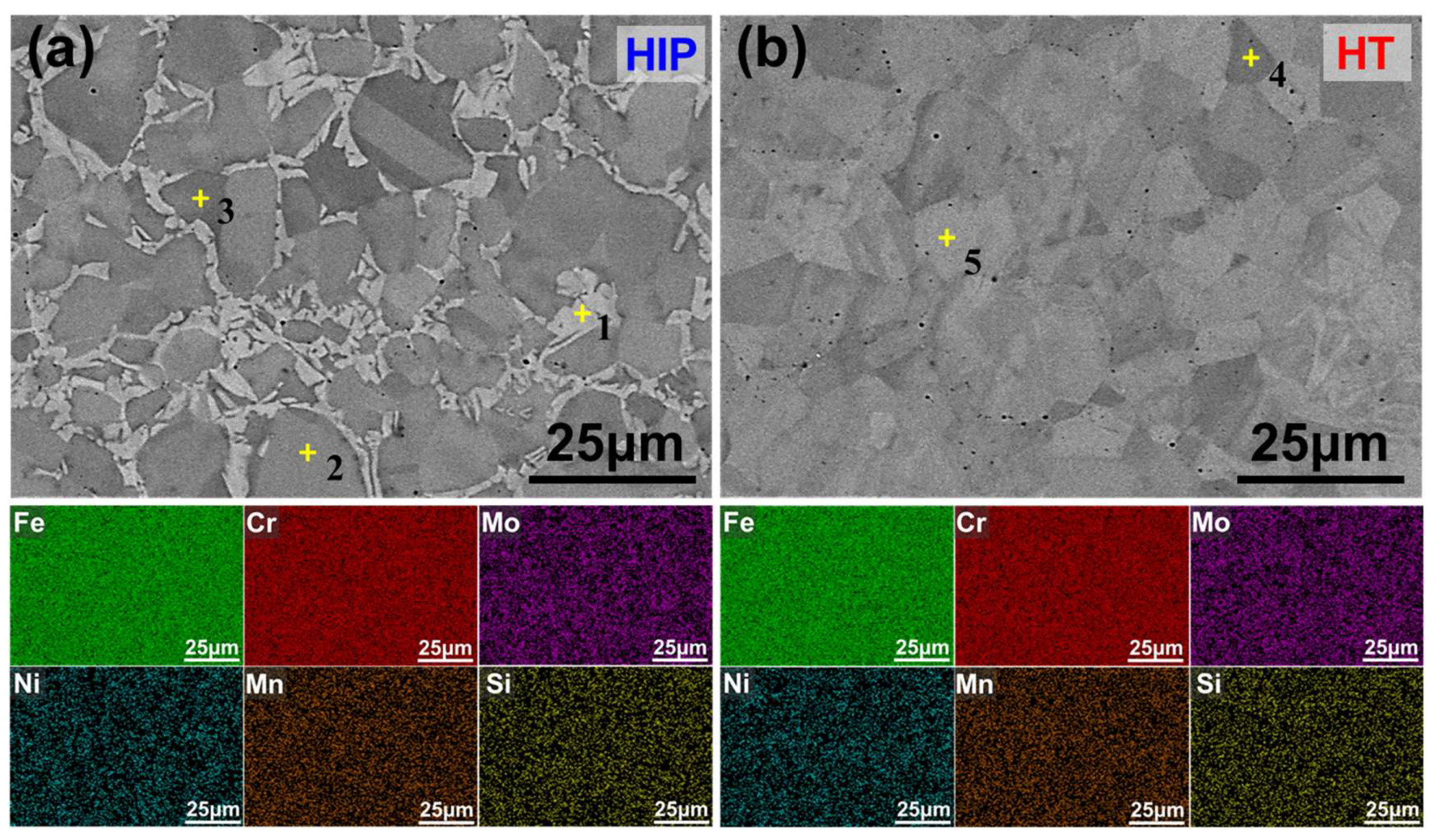
Figure 2 presents the backscattered electron (BSE) images and corresponding EDS elemental mapping of SAF2507 alloy in the HIP (Figure 2a) and HT (Figure 2b) conditions. Significant microstructural changes are observed after solution treatment. In the HIP condition (Figure 2a), the microstructure is characterized by a dual-phase morphology with γ islands distributed along the boundaries of polygonal α grains. Notably, secondary precipitates are visible at the α/γ interfaces and triple junctions. These are commonly identified in duplex stainless steels as intermetallic phases (σ phase), consistent with the XRD results shown in Figure 1. The distribution of alloying elements in the EDS maps supports this interpretation: Cr and Mo are enriched in σ phase regions. Additionally, the Ni map reveals higher intensity in the austenite phase, which is known to stabilize γ, while the ferrite grains exhibit elevated Cr and Mo levels. Table 3 presents the detailed EDS point scan data.
After solution treatment at 1080 °C for 1 h (Figure 2b), the microstructure becomes significantly more homogeneous. The precipitates previously observed at grain boundaries and triple junctions disappear, indicating their complete dissolution during solution annealing. The grain boundaries appear clean and free of secondary phases, suggesting improved microstructural stability. Overall, the solution treatment not only eliminates deleterious secondary phases but also promotes a more stable and chemically uniform duplex microstructure.
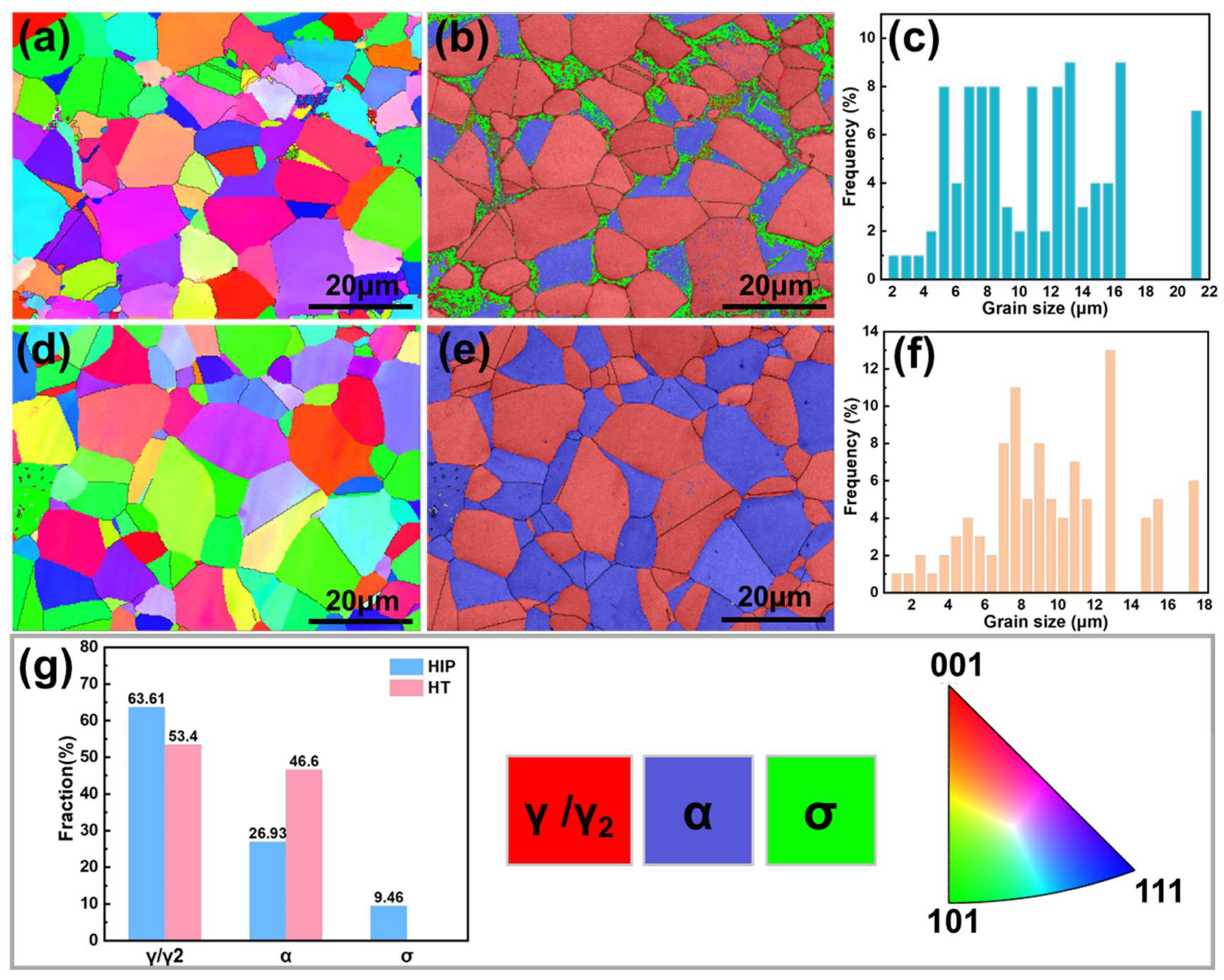
Electron backscatter diffraction was used to further evaluate the phase distribution, grain orientation, and texture characteristics of SAF2507 before and after solution treatment. Figure 3 displays the inverse pole figure (IPF) maps, phase maps, and grain size distributions of the HIP and HT samples. As shown in Figure 3a–c, the HIP sample presents a typical dual-phase microstructure composed of ferrite (α, blue) and austenite (γ/γ2, red), with a significant number of fine precipitates identified as sigma phase (σ, green), primarily located at the α/γ interfaces and triple junctions. The presence of this intermetallic phase is consistent with both XRD (Figure 1) and SEM-EDS (Figure 2) results. The grain structure is relatively fine, with an average grain size of around 10 µm and a high frequency of small grains, as shown by the grain size distribution histogram (Figure 3c). This is attributed to the thermal and pressure conditions of HIP, which promote rapid nucleation and suppress grain growth. After solution treatment (Figure 3 d–f), the sigma phase is almost completely eliminated, and the microstructure becomes cleaner and more homogeneous. The volume fraction of ferrite increases, while austenite content decreases, suggesting a partial transformation of γ into α during thermal exposure. This is quantitatively confirmed by the phase fraction analysis in Figure 3g: the ferrite fraction increases from 26.93% to 46.60%, while austenite drops from 63.61% to 53.40%, and sigma phase is reduced from 9.46% to nearly undetectable levels. These changes are also consistent with the XRD peak intensity shifts discussed previously. In terms of crystallographic orientation, both conditions exhibit a relatively random texture, as indicated by the IPF triangle inset. No strong preferential orientation is observed, suggesting the absence of significant deformation-induced texture.
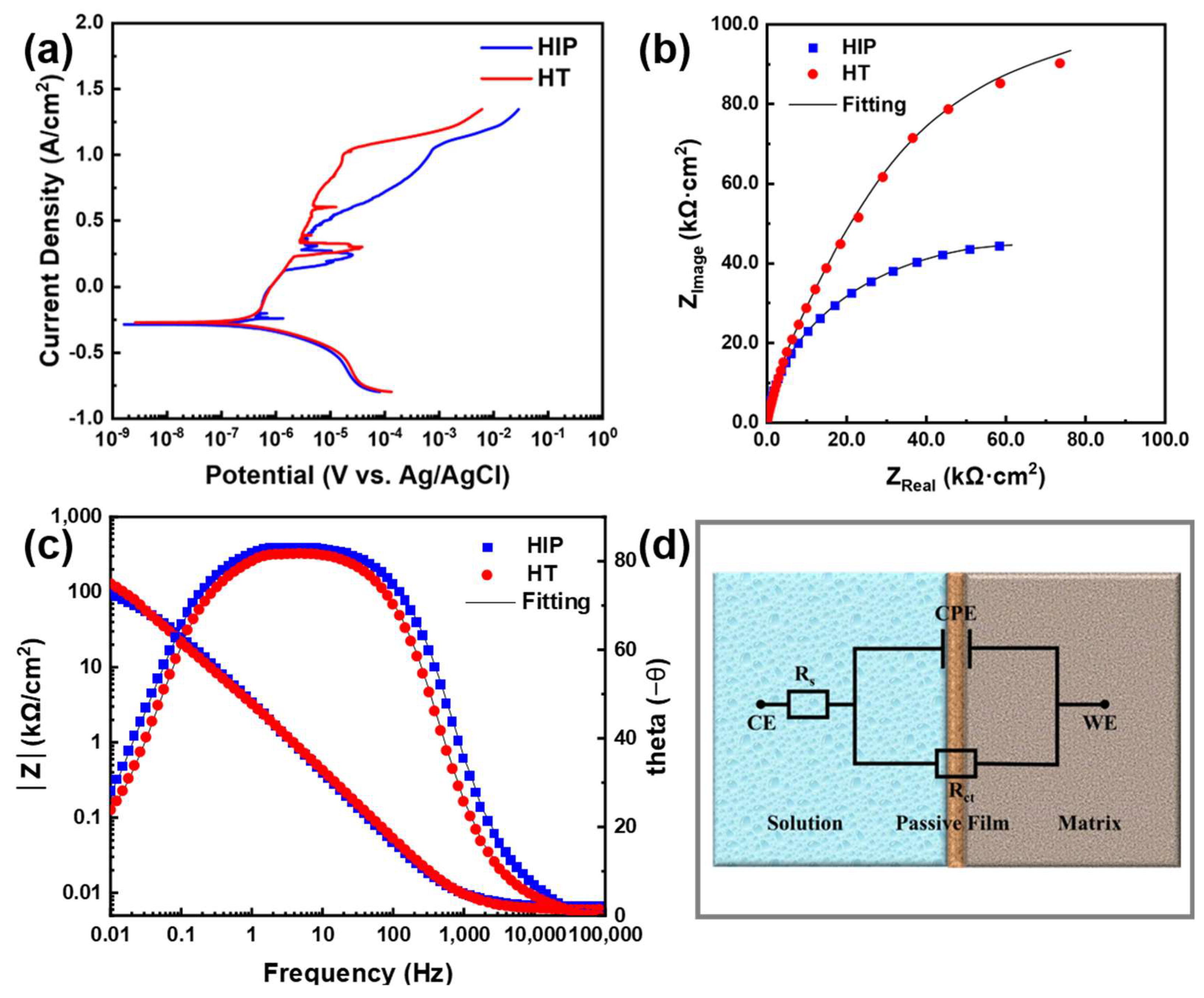
Figure 4a presents the polarization curves of SAF2507 samples before and after solution treatment in 3.5 wt.% NaCl solution at room temperature. The corresponding electrochemical parameters are summarized in Table 4. The results reveal that neither the HIP nor the HT samples exhibit a distinct active-passive transition, suggesting that both are capable of spontaneously forming a passive film. Evidence of metastable pitting further indicates the breakdown and subsequent repair of the passive layer. Compared with the HIP condition, the solution-treated sample exhibits a broader passive region, a slightly lower corrosion current density (Icorr), and a higher pitting potential, indicating an improvement in corrosion resistance after solution treatment.
Figure 4b,c show the Nyquist and Bode plots for both samples under OCP. The order of the capacitive arc radius in the Nyquist plot is as follows: HT>HIP. This indicates that after solution treatment, the charge transfer resistance of SAF2507 increases, leading to improved corrosion resistance, which is consistent with the results from the polarization curves. According to the corresponding Bode plot, the impedance modulus decreases with increasing frequency in the low-frequency range. When the frequency range is 10-102 Hz, the phase angle reaches its maximum (~79°), indicating that surface inhomogeneity leads to non-ideal capacitive behavior [20]. Furthermore, the impedance modulus tends toward a wide plateau within the frequency range of 10–105 Hz. Feng et al. [21] suggested that the wide plateau in the impedance modulus is due to the pseudo-capacitive nature of the compact Cr-rich oxide layer. Therefore, a constant phase element (CPE) is used to replace the ideal pure capacitor. The protective performance of the passive film can be quantitatively analyzed by fitting the EIS data. Figure 4d presents the equivalent circuit model (EEC) used for fitting the EIS data, where Rs represents the solution resistance, and Rct represents the charge transfer resistance at the solution/film interface. CPE is a constant phase element, representing the double-layer capacitance. The equivalent circuit, composed of Rs, Rct, and CPEs, was selected to characterize the electrochemical response of the passive film and its non-ideal capacitive behavior [22]. The fitting parameters are summarized in Table 5. During the EIS testing, due to the near-capacitive nature of the passive film, the electrochemical system essentially reflects the behavior of the solution resistance in the high-frequency region [23]. Therefore, the impedance modulus at 105 Hz for both samples is approximately 6 Ω·cm2, with the corresponding phase angle being close to zero. Furthermore, Rct is a key parameter for passivating alloys, and its value corresponds to the radius of the semicircle in the Nyquist plot, providing a good evaluation of the compactness and stability of the passive film formed on the alloy surface [24,25]. The results show that the HT samples exhibited the highest Rct values, indicating that the corrosion rate of the solution-treated samples in the electrolyte was lower. This is attributed to the elimination of the σ-phase, which improved the integrity of the passivation film; the resulting difficulty in charge transfer between the passive film and the steel enhanced the protective capability of the passive film. These findings are consistent with the results reported in the literature [26]. CPE is used to quantitatively characterize the near-capacitive response of the alloy. The impedance of the CPE can be calculated using the following formula [27]:
ZCPE = Q−1()n
where Q is the constant associated with the capacitance of the CPE; j is the imaginary unit; ω is the angular frequency; and n is the CPE exponent related to surface inhomogeneity. The chi-square (χ2) values remain on the order of 10−3, indicating a high precision of the EIS fit. From Table 5, it can be seen that the n values for the passive films of the two samples are 0.92 and 0.88, respectively. This deviation from the ideal capacitor value (n = 1) is attributed to surface roughness or other surface phenomena. In summary, both the polarization experiments and electrochemical impedance spectroscopy results indicate that the solution-treated sample exhibits superior corrosion resistance compared to the HIP sample.
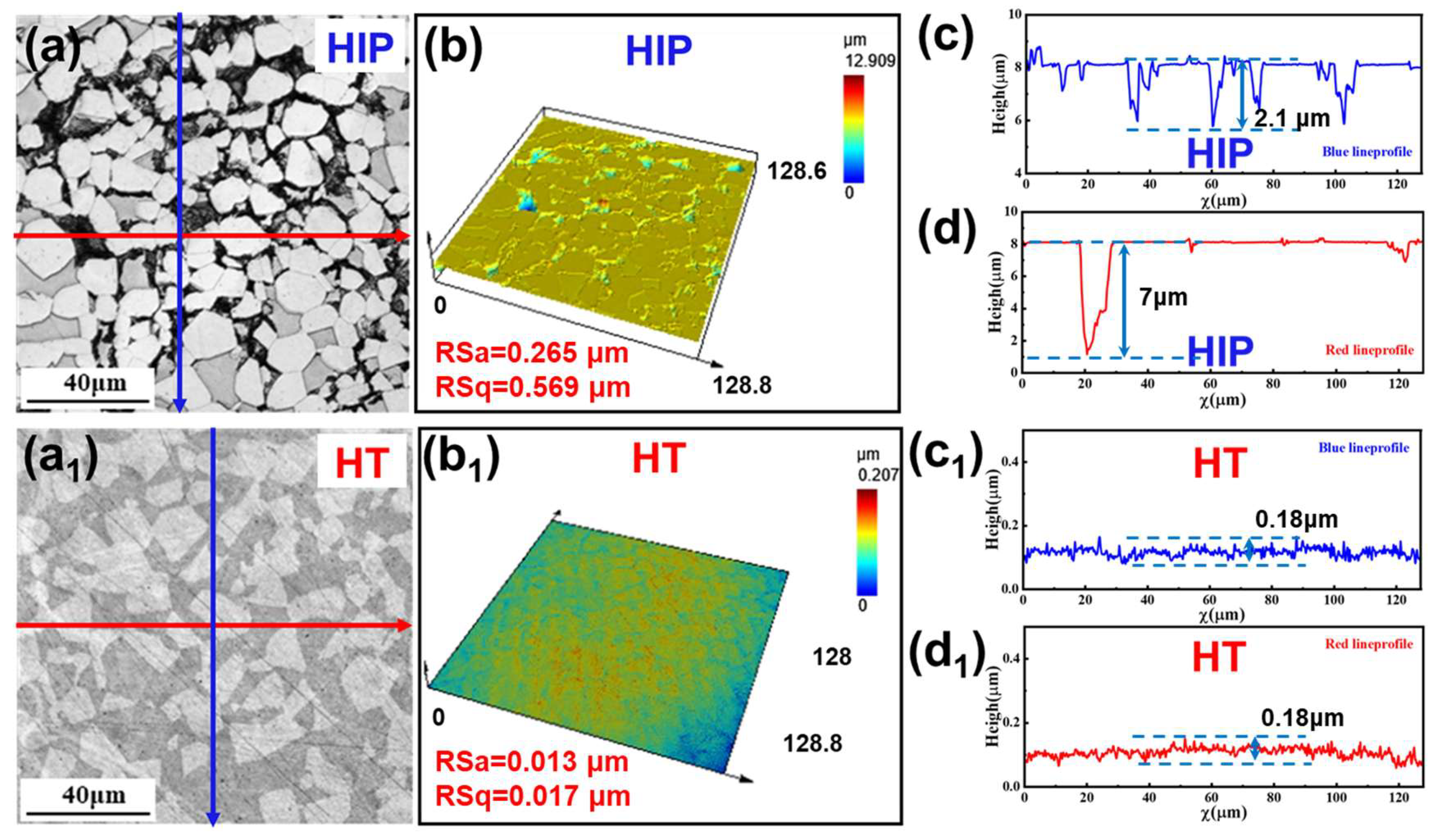
Figure 5a,b show the corrosion morphologies of SAF2507 samples after polarization testing, in both the HIP and HT conditions, as observed by 3D laser confocal microscopy. The surface topography of the HIP sample (Figure 5a) reveals significant localized corrosion, with distinct pit formation and deep, sharp pits. These features suggest a relatively poor stability of the passive film under corrosion conditions. The height profile of the HIP sample (Figure 5b) shows large fluctuations, reflecting the pronounced depth and wide distribution of the pits. In contrast, the surface of the HT sample (Figure 5a1) exhibits much less pronounced pitting corrosion. The overall surface appears smoother, with fewer and smaller pits, indicating improved passivation behavior after solution treatment. The corresponding height profile of the HT sample (Figure 5b1) shows significantly reduced surface roughness (RSa, RSq) compared to the HIP sample. The smaller fluctuations in the height profile suggest that the passive film on the solution-treated sample is more stable, providing better protection against localized corrosion. This result is consistent with the electrochemical data (Figure 4), where the HT sample shows a lower corrosion current density and a more extensive passive region in the polarization curve. This indicates that solution treatment enhances the formation and stability of the passive film, significantly improving the corrosion resistance of SAF2507 in chloride-containing environments.
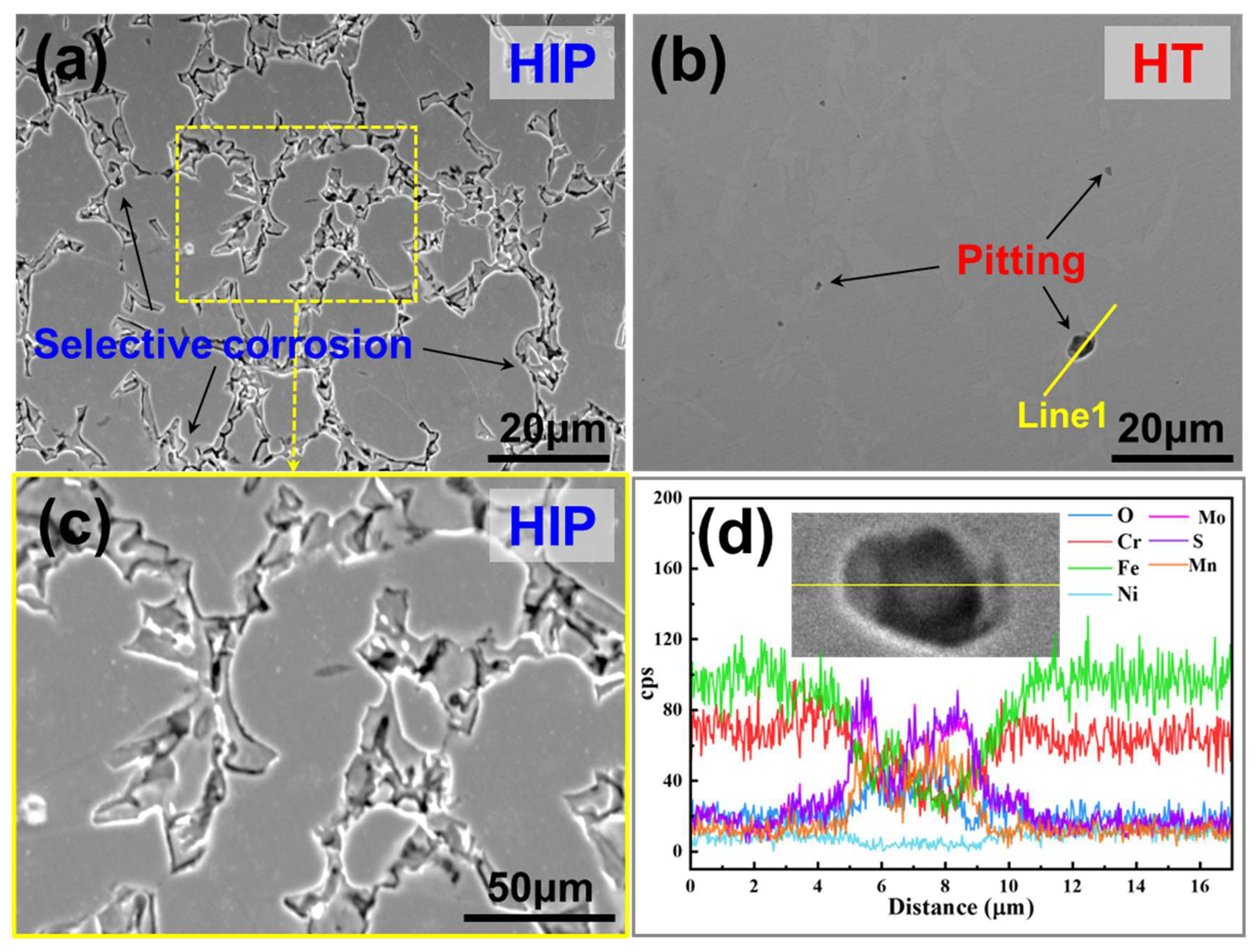
Figure 6 presents the corrosion morphologies of SAF2507 duplex stainless steel specimens before and after solution treatment following polarization testing. In chloride-containing environments, the corrosion process mainly involves anodic metal dissolution (Fe → Fe2+ + 2e) and cathodic oxygen reduction (O2 + 2H2O + 4e → 4OH). As shown, the HIP specimen exhibits numerous corrosion pits propagating along grain boundaries and phase interfaces. Corrosion primarily occurs in regions containing the σ phase, characterized by selective attack along σ-phase boundaries. According to the literature [28,29], during σ-phase precipitation, significant amounts of Cr and Mo are incorporated into the σ phase, resulting in local depletion of these essential alloying elements in adjacent areas, thereby creating corrosion-prone zones and reducing passive film stability. Therefore, passive film breakdown and localized charge transfer processes are considered the dominant rate-determining factors for corrosion propagation. In contrast, the surface of the solution-treated specimen appears smoother and shows significantly fewer corrosion features, indicating the formation of a more stable and compact passive film that effectively suppresses further corrosion. The dominant corrosion mode in the solution-treated sample is pitting. Line-scan EDS analysis in Figure 6d further reveals that the initiation of pitting corrosion is closely associated with the presence of Mo- and Mn-rich sulfide inclusions. These inclusions are susceptible to preferential dissolution in chloride-containing environments, leading to localized passive film breakdown and subsequent pit initiation [30,31].
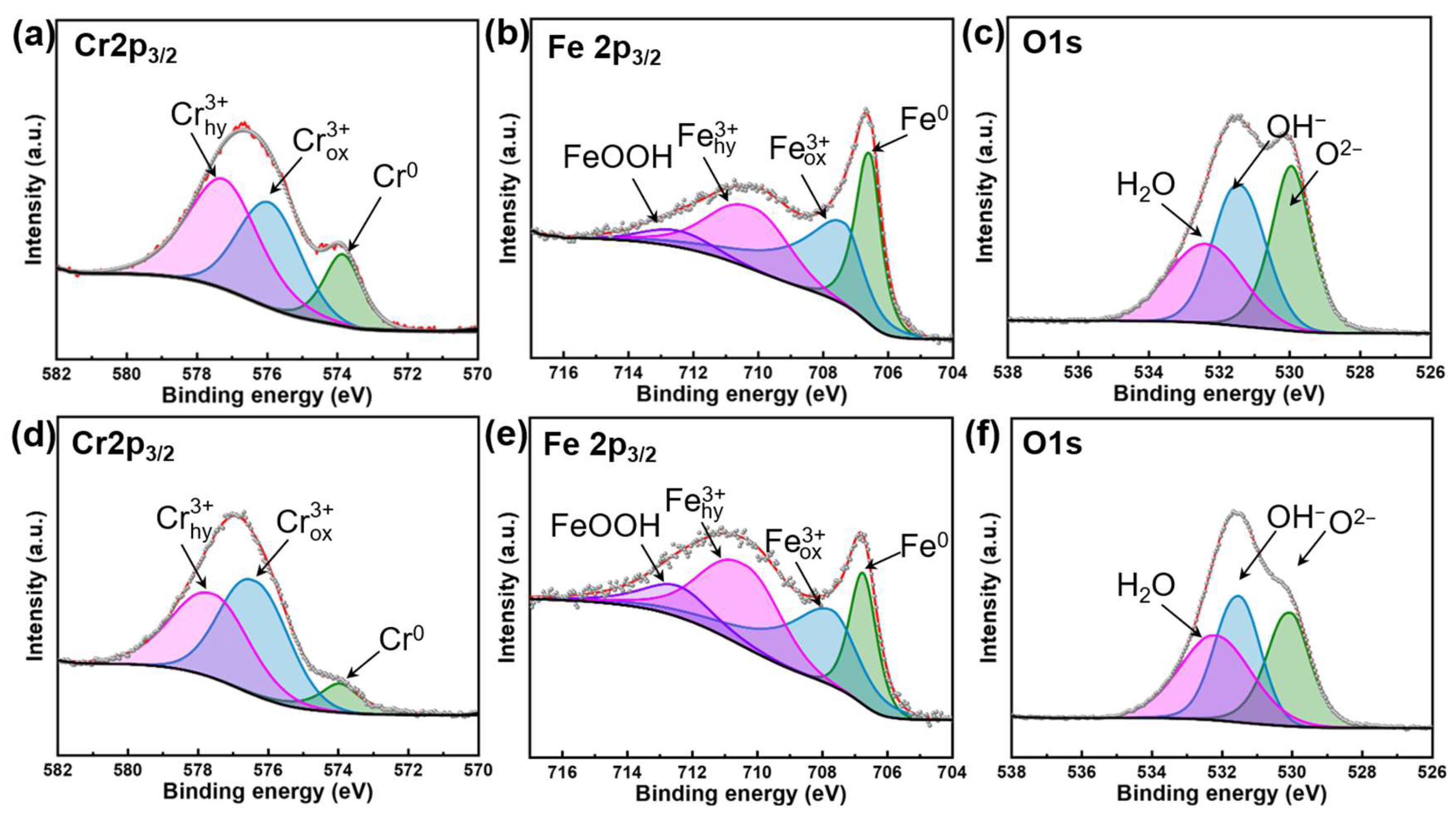
Figure 7 presents the composition of the passive film on SAF2507 samples in two conditions after immersion in 3.5 wt% NaCl solution for 7 days. As shown in Figure 7a,d, the Cr 2p3/2 XPS spectra were deconvoluted into three peaks corresponding to Cr0 (573 ± 0.2 eV), Cr2O3 (576 ± 0.2 eV), and Cr(OH)3 (577 ± 0.2 eV). These results are consistent with previous reports in the literature [32]. It is well known that Cr2O3 is a key component of the passive film [33]. The Fe 2p3/2 spectra were fitted with four peaks, corresponding to Fe0, Fe ox 3 + , Fe hy 3 + , and FeOOH, located at 706 ± 0.2 eV, 707 ± 0.2 eV, 709 ± 0.2 eV, and 711.5 ± 0.2 eV, respectively (Figure 7b,e) [22]. Figure 7c,f display the deconvoluted O 1s spectra of the two samples. Three peaks were identified at binding energies of 529.7 ± 0.2 eV, 531.4 ± 0.2 eV, and 528.9 ± 0.2 eV, corresponding to O2−, OH, and H2O, respectively [34]. The presence of O2− and OH indicates the formation of metal oxides and hydroxides on the alloy surface [35,36].
To further investigate the elemental composition of the passive films, the atomic percentages of the metallic elements in the passive layers of the two HEAs were calculated using the following equation [37]:
C x = I x / S x ( I i / S i )
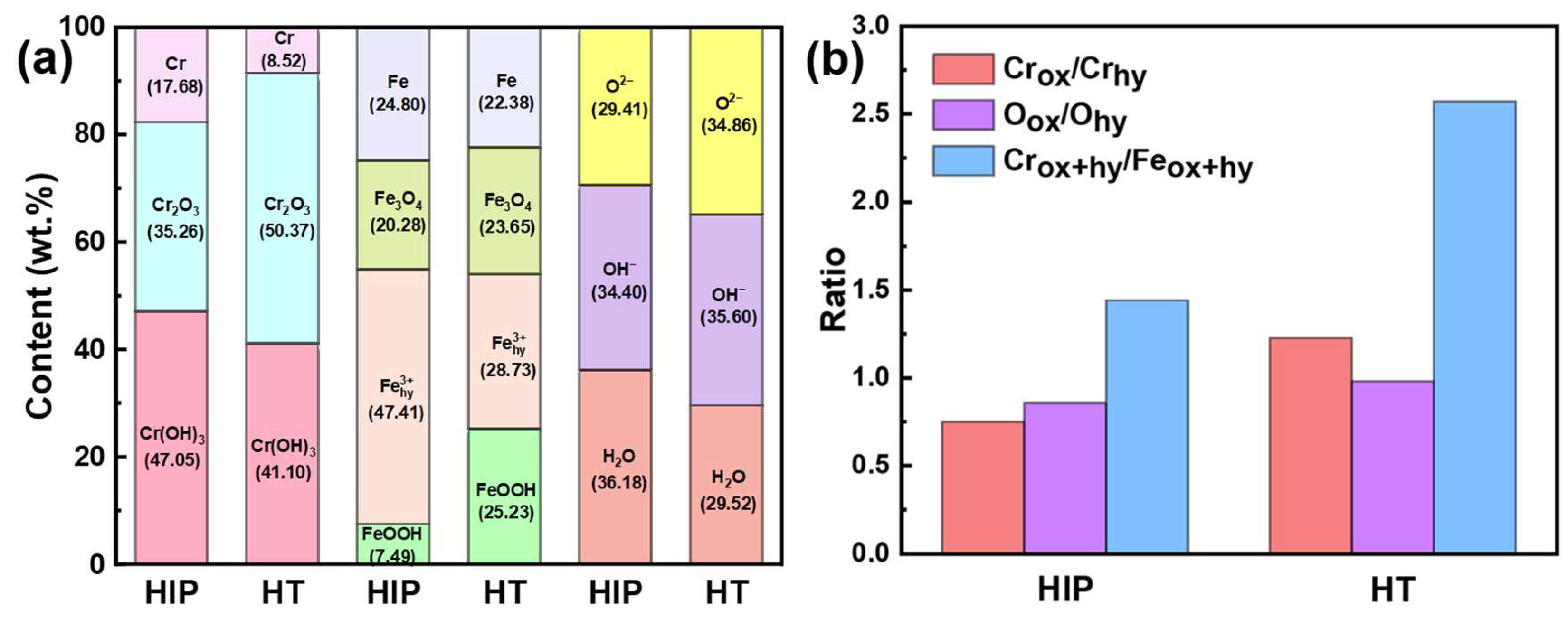
where C x is the atomic percentage of element in the passive films, I x represents the peak intensity corresponding to each element, and S x denotes the sensitivity factor obtained from the XPS instrument. Figure 8a illustrates the chemical states and corresponding cationic fractions of Fe, Cr, and O elements within the passive film of SAF2507 samples before and after solution treatment. The results indicate that it significantly influences stability and corrosion resistance [38,39]. Prior to solution treatment, Fe primarily exists in the form of Fe2O3 (47.41%) and Fe hy 3 + (20.28%), with a small amount of FeOOH (7.49%). Cr is predominantly present as Cr(OH)3 (47.05%), while Cr2O3 accounts for only 35.26%. Additionally, the O element consists mainly of unstable species such as OH (34.40%) and H2O (36.18%). In contrast, after solution treatment, the FeOOH content markedly increases to 25.23%, while the Fe hy 3 + fraction decreases to 28.73%. The Cr2O3 content rises to 50.37%, accompanied by a reduction in Cr(OH)3 to 41.10%. Moreover, the proportion of O2− increases from 29.41% to 34.86%, suggesting that solution treatment promotes the enrichment of more stable oxide species in the passive film, thereby enhancing its density and protective performance [39,40]. To further quantify the stability of the passive film, Figure 8b presents a comparative analysis of the Crox/Crhy, Oox/Ohy, and (Crox+hy)/(Feox+hy) ratios. The results show that the Crox/Crhy and Oox/Ohy ratios increase after solution treatment, with a particularly significant rise in the total (Crox+hy)/(Feox+hy) ratio. This indicates greater enrichment of chromium oxides and a relative reduction of iron oxides in the passive film, contributing to the formation of a denser and more stable passive layer. Consequently, the corrosion resistance of the material in chloride-containing environments is significantly improved [41,42].

4. Conclusions

This study demonstrates that solution treatment significantly improves the microstructural uniformity and corrosion resistance of SAF2507 duplex stainless steel fabricated by direct hot isostatic pressing. The main conclusions are as follows:
(1)
Solution treatment at 1080 °C for 1 h effectively dissolves intermetallic phases and promotes a homogeneous distribution of ferrite and austenite.
(2)
The solution-treated alloy exhibits a slightly lower corrosion current density, together with a wider passive region, higher pitting potential, and improved charge transfer resistance in 3.5 wt.% NaCl solution, indicating enhanced resistance to localized corrosion and improved passive film stability.
(3)
EIS analysis shows that the treated sample has higher charge transfer resistance, suggesting the formation of a denser and more protective passive film.
(4)
XPS results reveal an increased proportion of Cr2O3 and O2− and a decrease in Fe2O3 and H2O in the passive layer, confirming improved film stability.
(5)
Surface and corrosion morphology analyses confirm that solution treatment suppresses selective corrosion and pitting, enhancing the uniformity and protectiveness of the passive film.

Author Contributions

Conceptualization, D.J. and L.C.; methodology, P.Z., J.L. and B.W.; software, B.W. and Z.W.; validation, D.J., L.C. and Z.W.; formal analysis, B.W. and J.L.; investigation, P.Z.; resources, Z.W.; data curation, B.W. and P.Z.; writing-original draft preparation, J.L. and B.W.; writing—review and editing, D.J.; visualization, Z.W.; supervision, L.C.; project administration, D.J.; P.Z. and L.C. All authors have read and agreed to the published version of the manuscript.

Funding

This research received no external funding.

Data Availability Statement

The data presented in this study are available on request from the corresponding author.

Conflicts of Interest

Authors Zhanfang Wu, Pengjie Zhang and Lida Che were employed by the company CISRI HIPEX Technology CO., LTD, Beijing, China. The remaining authors declare that the research was conducted in the absence of any commercial or financial relationships that could be construed as a potential conflict of interest.

References

  1. Salvetr, P.; Školáková, A.; Melzer, D.; Brázda, M.; Duchoň, J.; Drahokoupil, J.; Svora, P.; Msallamová, Š.; Novák, P. Characterization of super duplex stainless steel SAF2507 deposited by directed energy deposition. Mater. Sci. Eng. A 2022, 857, 144084. [Google Scholar] [CrossRef] [Scilit]
  2. Haghdadi, N.; Ledermueller, C.; Chen, H.; Chen, Z.; Liu, Q.; Li, X.; Rohrer, G.; Liao, X.; Ringer, S.; Primig, S. Evolution of microstructure and mechanical properties in 2205 duplex stainless steels during additive manufacturing and heat treatment. Mater. Sci. Eng. A 2022, 835, 142695. [Google Scholar] [CrossRef] [Scilit]
  3. Gunn, R. Duplex Stainless Steels: Microstructure, Properties and Applications; Woodhead Publishing: Sawston, UK, 1997. [Google Scholar]
  4. Zhang, Z.; Zhang, H.; Zhao, H.; Li, J. Effect of prolonged thermal cycles on the pitting corrosion resistance of a newly developed LDX 2404 lean duplex stainless steel. Corros. Sci. 2016, 103, 189–195. [Google Scholar] [CrossRef] [Scilit]
  5. Zhang, X.; Wang, K.; Zhou, Q.; Ding, J.; Ganguly, S.; Marzio, G.; Yang, D.; Xu, X.; Dirisu, P.; Williams, S.W. Microstructure and mechanical properties of TOP-TIG-wire and arc additive manufactured super duplex stainless steel (ER2594). Mater. Sci. Eng. A 2019, 762, 138097. [Google Scholar] [CrossRef] [Scilit]
  6. Zhang, Z.; Zhang, H.; Hu, J.; Qi, X.; Bian, Y.; Shen, A.; Xu, P.; Zhao, Y. Microstructure evolution and mechanical properties of briefly heat-treated SAF 2507 super duplex stainless steel welds. Constr. Build. Mater. 2018, 168, 338–345. [Google Scholar] [CrossRef] [Scilit]
  7. Liu, Z.; Tan, Z.; He, D.; Zhou, Z.; Guo, X.; Shao, W.; Yao, H.; Xue, Y.; Cui, L. Simultaneously improved the strength and ductility of laser powder bed fused Al-Cr-Fe-Ni-V high-entropy alloy by hot isostatic pressing: Microcrack closure and precipitation strengthening. J. Mater. Sci. Technol. 2024, 180, 55–68. [Google Scholar] [CrossRef] [Scilit]
  8. Joseph, J.; Hodgson, P.; Jarvis, T.; Wu, X.; Stanford, N.; Fabijanic, D.M. Effect of hot isostatic pressing on the microstructure and mechanical properties of additive manufactured AlxCoCrFeNi high entropy alloys. Mater. Sci. Eng. A 2018, 733, 59–70. [Google Scholar] [CrossRef] [Scilit]
  9. Li, X.; Wang, Q.; Wei, S.; Lou, W.; Liang, J.; Chen, L.; Xu, L.; Zhou, Y. Microstructure and high-temperature mechanical properties of Cu-W composite prepared by hot isostatic pressing. J. Alloy. Compd. 2024, 970, 172571. [Google Scholar] [CrossRef] [Scilit]
  10. Nilsson, J.-O. Technology, Super duplex stainless steels. Mater. Sci. 1992, 8, 685–700. [Google Scholar]
  11. Angelini, E.; De Benedetti, B.; Rosalbino, F. Microstructural evolution and localized corrosion resistance of an aged superduplex stainless steel. Corros. Sci. 2004, 46, 1351–1367. [Google Scholar] [CrossRef] [Scilit]
  12. Silva, D.D.; Lima, L.S.; Araújo, A.J.; Silva, V.D.; Raimundo, R.A.; Damasceno, I.Z.; Simões, T.A.; Gomes, R.M. The Effect of Microstructural Changes on Mechanical and Electrochemical Corrosion Properties of Duplex Stainless Steel Aged for Short Periods. Materials 2020, 13, 5511–5524. [Google Scholar] [CrossRef] [Scilit]
  13. Ramirez, A.J.; Lippold, J.C.; Brandi, S.D. The relationship between chromium nitride and secondary austenite precipitation in duplex stainless steels. Met. Mater. Trans. A 2003, 34, 1575–1597. [Google Scholar] [CrossRef] [Scilit]
  14. Chen, T.; Yang, J. Effects of solution treatment and continuous cooling on σ-phase precipitation in a 2205 duplex stainless steel. Mater. Sci. Eng. A 2001, 311, 28–41. [Google Scholar] [CrossRef] [Scilit]
  15. Hwang, H.; Park, Y. Effects of heat treatment on the phase ratio and corrosion resistance of duplex stainless steel. Mater. Trans. 2009, 50, 1548–1552. [Google Scholar] [CrossRef] [Scilit]
  16. Ren, X.; Li, S.; Xiong, Z. Isostatic diffusion bonding and post-solution treatment between Cr22Ni5Mo3MnSi and Cr30Ni7Mo3MnSi duplex stainless steels. J. Manuf. Process. 2018, 34, 215–224. [Google Scholar] [CrossRef] [Scilit]
  17. Li, S.; Wang, Y.; Zhang, H.; Li, S.; Wang, G.; Wang, X. Effects of prior solution treatment on thermal aging behavior of duplex stainless steels. J. Nucl. Mater. 2013, 441, 337–342. [Google Scholar] [CrossRef] [Scilit]
  18. Tütük, I.; Ural, M.M.; Özer, G.; Kisasöz, A. Influence of solution treatment process on the properties of duplex stainless steels: A comparative study on microstructure and corrosion properties of UNS S32205 and UNS S32760. Met. Mater. Trans. B 2024, 55, 2916–2921. [Google Scholar] [CrossRef] [Scilit]
  19. Li, J.; Shen, W.; Lin, P.; Wang, F.; Yang, Z. Effect of solution treatment temperature on microstructural evolution, precipitation behavior, and comprehensive properties in UNS S32750 super duplex stainless steel. Metals 2020, 10, 1481. [Google Scholar] [CrossRef] [Scilit]
  20. Allahkaram, S.; Nazari, M.H.; Mamaghani, S.; Zarebidaki, A. Characterization and corrosion behavior of electroless Ni–P/nano-SiC coating inside the CO2 containing media in the presence of acetic acid. Mater. Des. 2011, 32, 750–755. [Google Scholar] [CrossRef] [Scilit]
  21. Feng, L.; Yang, Y.; Zhao, Y.; Ma, K.; Cui, J. Corrosion behaviors and mechanism of AlxCrFeMnCu high-entropy alloys in a 3.5 wt% NaCl solution. Corros. Sci. 2024, 233, 112087. [Google Scholar] [CrossRef] [Scilit]
  22. Xu, Z.; Zhang, H.; Du, X.; He, Y.; Luo, H.; Song, G.; Mao, L.; Zhou, T.; Wang, L. Corrosion resistance enhancement of CoCrFeMnNi high-entropy alloy fabricated by additive manufacturing. Corros. Sci. 2020, 177, 108954. [Google Scholar] [CrossRef] [Scilit]
  23. Zhang, J.; Zhou, Y.; Ren, Z.; Luan, J.; Zhao, Y.; Yang, T. The influence of microstructural evolutions on electrochemical corrosion and passive behavior in precipitation-strengthened high-entropy alloys. Corros. Sci. 2024, 233, 112074. [Google Scholar] [CrossRef] [Scilit]
  24. Hong, M.-S.; Kim, S.-H.; Im, S.-Y.; Kim, J.-G. Effect of ascorbic acid on the pitting resistance of 316L stainless steel in synthetic tap water. Met. Mater. Int. 2016, 22, 621–629. [Google Scholar] [CrossRef] [Scilit]
  25. Zhong, J.-Y.; Sun, M.; Liu, D.-B.; Li, X.-G.; Liu, T.-Q. Effects of chromium on the corrosion and electrochemical behaviors of ultra high strength steels. Int. J. Miner. Met. Mater. 2010, 17, 282–289. [Google Scholar] [CrossRef] [Scilit]
  26. Liu, H.; Jiang, B.; Du, X.; Zheng, X.; Wang, Z.; Yang, H.; Xu, T.; Xiao, A.; Pan, Y.; Yang, W.; et al. The effect of sigma phase of 2507 duplex stainless steel on hydrogen-induced pitting corrosion. Corros. Sci. 2026, 260, 113594. [Google Scholar] [CrossRef] [Scilit]
  27. Zhao, Q.; Pan, Z.; Wang, X.; Luo, H.; Liu, Y.; Li, X. Corrosion and passive behavior of AlxCrFeNi3−x (x = 0.6, 0.8, 1.0) eutectic high entropy alloys in chloride environment. Corros. Sci. 2022, 208, 110666. [Google Scholar] [CrossRef] [Scilit]
  28. Adhe, K.M.; Kain, V.; Madangopal, K.; Gadiyar, H.S. Influence of sigma-phase formation on the localized corrosion behavior of a duplex stainless steel. J. Mater. Eng. Perform. 1996, 5, 500–506. [Google Scholar] [CrossRef] [Scilit]
  29. Hosseini, V.A.; Karlsson, L.; Wessman, S.; Fuertes, N. Effect of sigma phase morphology on the degradation of properties in a super duplex stainless steel. Materials 2018, 11, 933. [Google Scholar] [CrossRef] [Scilit] [PubMed]
  30. Chiba, A.; Muto, I.; Sugawara, Y.; Hara, N. Pit initiation mechanism at MnS inclusions in stainless steel: Synergistic effect of elemental sulfur and chloride ions. J. Electrochem. Soc. 2013, 160, C511–C520. [Google Scholar] [CrossRef] [Scilit]
  31. Li, D.; Huang, F.; Lei, X.; Jin, Y. Localized corrosion of 304 stainless steel triggered by embedded MnS. Corros. Sci. 2023, 211, 110860. [Google Scholar] [CrossRef] [Scilit]
  32. Zhu, M.; He, F.; Yuan, Y.F.; Yin, S.M.; Guo, S.Y.; Pan, J. Effect of aging time on the microstructure and corrosion behavior of 2507 super duplex stainless steel in simulated marine environment. J. Mater. Eng. Perform. 2021, 30, 5652–5666. [Google Scholar] [CrossRef] [Scilit]
  33. Gao, W.-B.; Gu, Y.; Han, Q.-L.; Gu, X.-Y.; Guan, W.; Zhao, S.-B.; Li, W.-H. Corrosion and passivation behavior of sensitized SAF 2507 super-duplex stainless steel in hot concentrated seawater. J. Iron Steel Res. Int. 2025, 32, 3026–3045. [Google Scholar] [CrossRef] [Scilit]
  34. Liu, J.; Yang, S.; Huang, Y.; Yang, H.; Ju, D.; Che, L.; Li, X.; Wu, Z. Effects of nitric acid passivation on the corrosion resistance of CoCrFeMnNi high-entropy alloy prepared by hot isostatic pressing. Mater. Chem. Phys. 2025, 345, 131208. [Google Scholar] [CrossRef] [Scilit]
  35. Liu, J.; Ju, D.; Zhang, J.; Cheng, Y.; Wu, Z.; Che, L.; Li, X.; Lv, Z. Enhance corrosion resistance via passivation treatment for CrMnFeCoNi high-entropy alloy prepared by hot isostatic pressing. Intermetallics 2025, 184, 108846. [Google Scholar] [CrossRef] [Scilit]
  36. Davenport, A.J.; Oblonsky, L.J.; Ryan, M.P.; Toney, M.F. The structure of the passive film that forms on iron in aqueous environments. J. Electrochem. Soc. 2000, 147, 2162–2173. [Google Scholar] [CrossRef] [Scilit]
  37. Liu, J.; Cheng, Y.; Zhang, J.; Chen, C.; Zheng, C.; Ju, D.; Wu, Z.; Che, L.; Li, X.; Lv, Z. Effect of phosphorus on the corrosion resistance of CrMnFeCoNi high-entropy alloys prepared by hot isostatic pressing. J. Alloy. Compd. 2025, 1039, 183157. [Google Scholar] [CrossRef] [Scilit]
  38. Olsson, C.-O.; Landolt, D. Passive films on stainless steels—Chemistry, structure and growth. Electrochim. Acta 2003, 48, 1093–1104. [Google Scholar] [CrossRef] [Scilit]
  39. Liu, M.; Cheng, X.; Li, X.; Pan, Y.; Li, J. Effect of Cr on the passive film formation mechanism of steel rebar in saturated calcium hydroxide solution. Appl. Surf. Sci. 2016, 389, 1182–1191. [Google Scholar] [CrossRef] [Scilit]
  40. Carmezim, M.; Simões, A.; Figueiredo, M.; Belo, M.D.C. Electrochemical behaviour of thermally treated Cr-oxide films deposited on stainless steel. Corros. Sci. 2002, 44, 451–465. [Google Scholar] [CrossRef] [Scilit]
  41. Sun, M.; Yang, Z.; Song, S.; Zhang, J.; Lu, B. Effect of Cr content on microstructure, mechanical, and corrosion properties of CoCr FeMnNi high-entropy alloys fabricated by selective laser melting. Mater. Charact. 2024, 212, 113949. [Google Scholar] [CrossRef] [Scilit]
  42. Liu, J.; Lv, Z.; Wu, Z.; Zhang, J.; Zheng, C.; Chen, C.; Ju, D.; Che, L. Research progress on the influence of alloying elements on the corrosion resistance of high-entropy alloys. J. Alloy. Compd. 2024, 1002, 175394. [Google Scholar] [CrossRef] [Scilit]
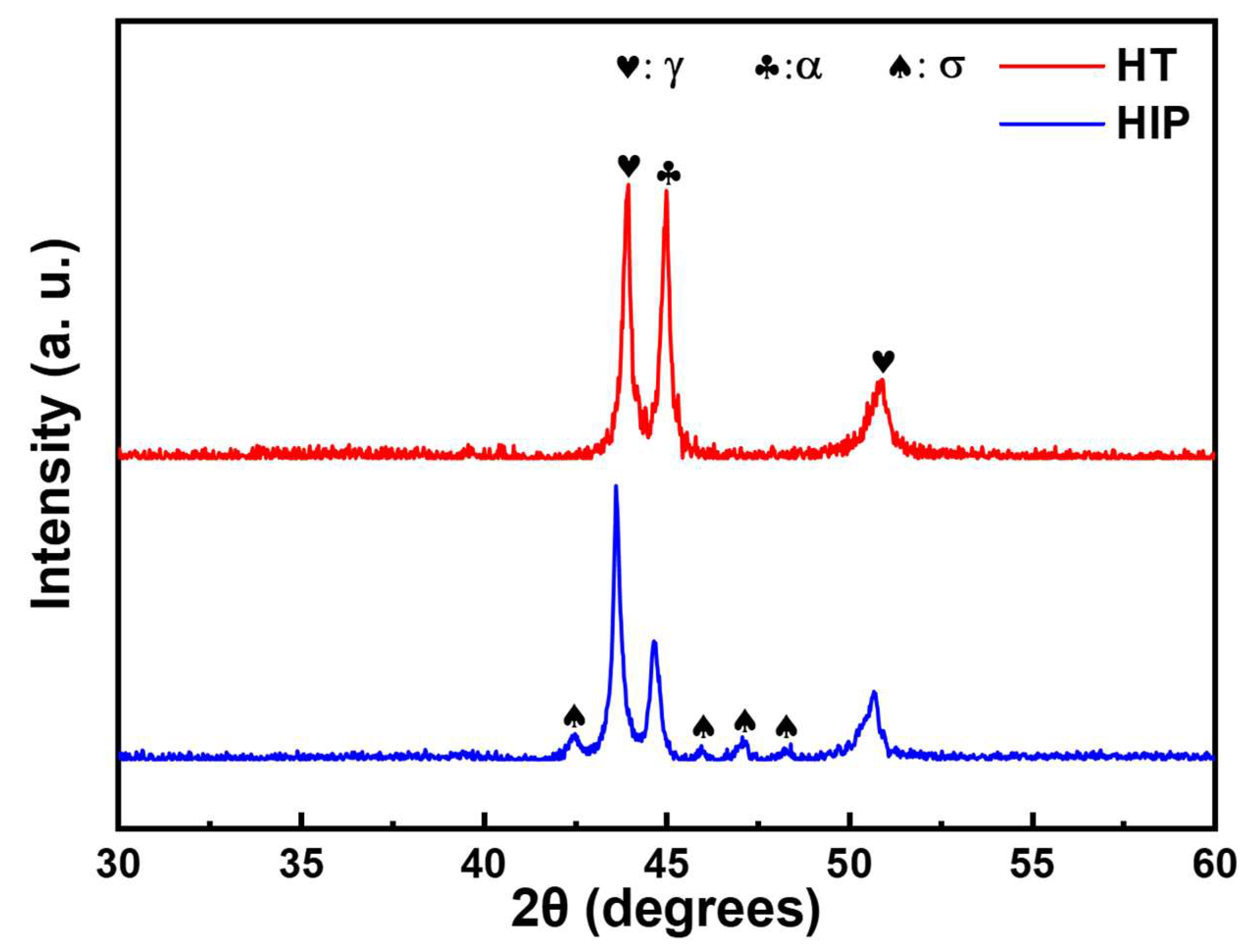
Figure 1. XRD patterns of SAF2507 specimens before and after solution treatment.
Metals 16 00643 g001
Figure 2. SEM micrographs and corresponding EDS elemental mappings of SAF2507 in the HIP and HT conditions. (a) HIP, (b) HT.
Metals 16 00643 g002
Figure 3. EBSD results of SAF2507 before and after solution treatment: (a,d) IPF maps, (b,e) phase maps, (c,f) average grain size distribution, and (g) phase fraction analysis.
Metals 16 00643 g003
Figure 4. (a) Potentiodynamic polarization curves, (b) Nyquist plots, (c) Bode plots, and (d) Equivalent electrical circuit of SAF2507 before and after solution treatment in 3.5 wt% NaCl solution.
Metals 16 00643 g004
Figure 5. LSCM 2D, 3D and corresponding surface height profile images of the two states SAF2507: (a,a1) 2D images, (b,b1) 3D images, and (c,c1,d,d1) surface height profile images.
Metals 16 00643 g005
Figure 6. Microscopic morphology of HIP (a,c) and HT (b) samples after polarization testing; (d) line scan corresponding to (b) in the figure.
Metals 16 00643 g006
Figure 7. High-resolution XPS spectra of Cr 2p, Fe 2p and O 1s for SAF2507 before (ac) and after (df) solution treatment after 7 days of immersion in 3.5 wt% NaCl solution at room temperature.
Metals 16 00643 g007
Figure 8. (a) Contents of various Fe, Cr, and O components and (b) ratios of Crox to Crhy, Oox to Ohy, and Crox+hy to Feox+hy in passive films on surfaces of SAF2507 before and after solution treatment after 7 days of immersion in 3.5 wt% NaCl solution at room temperature.
Metals 16 00643 g008
Table 1. Chemical composition of SAF2507 (wt%).
AlloyFeCrNiMoMnCNSiPS
SAF250761.22525.867.5093.7100.940.0160.230.4870.0220.001
Table 2. Detailed information on electrochemical samples.
SampleProcessNumber of SamplesNumber of Tests
HIPHot isostatic pressing13
HTHot isostatic pressing +
solution treatment
13
Table 3. Chemical composition (wt%) corresponding to each point in Figure 2.
PiontFeCrMoNiMnSiN
156.6829.517.654.850.670.400.24
262.3424.353.228.660.550.350.53
360.4127.945.385.230.700.330.00
461.3125.012.648.561.710.360.42
559.6128.404.675.441.280.360.24
Table 4. Electrochemical parameters in the 3.5 wt% NaCl solution from potentiodynamic polarization curves.
SampleEcorr/VIcorr/A/cm2Epit/V
HIP−0.288 ± 0.023(4.504 ± 0.114) × 10−70.571 ± 0.013
HT−0.272 ± 0.031(4.029 ± 0.121) × 10−71.008 ± 0.015
Table 5. Parameters of the equivalent circuit diagram of the electrochemical impedance spectrum of the SAF2507 sample.
SampleRs/Ω·cm2CPE−1 cm−2 snnRct/Ω·cm2χ2
HIP6.815 ± 0.513(5.56 ± 0.24) × 10−50.923 ± 0.0192767 ± 4000(1.05 ± 0.24) × 10−3
HT6.042 ± 0.341(6.37 ± 0.31) × 10−50.884 ± 0.02234530 ± 6000(1.12 ± 0.24) × 10−3
Disclaimer/Publisher’s Note: The statements, opinions and data contained in all publications are solely those of the individual author(s) and contributor(s) and not of MDPI and/or the editor(s). MDPI and/or the editor(s) disclaim responsibility for any injury to people or property resulting from any ideas, methods, instructions or products referred to in the content.