


Abstract
This study presents an integrated approach for the processing of technogenic tailings from the Balkhash concentrator, combining hydrocyclone classification, microfluidic separation, bioleaching, and geopolymer synthesis. The tailings are characterized by a fine-dispersed silicate matrix and low concentrations of valuable metals, which limit the efficiency of conventional processing methods. Hydrocyclone classification enables effective size separation and stabilization of particle size distribution, providing suitable feed for downstream processes. Microfluidic separation demonstrated selective concentrations of copper, increasing its content in the central fraction up to 0.52–0.58% with recovery up to 70–75% under optimal flow conditions. Bioleaching experiments using acidophilic microorganisms (Acidithiobacillus ferrooxidans and A. thiooxidans) revealed strong dependence on process parameters, achieving maximum recoveries of Cu (63%), Zn (58%), and Fe (43%) at pH 1.8–1.9 and 31–32 °C. The solid residues after bioleaching, composed mainly of aluminosilicates, were successfully utilized for geopolymer synthesis. The obtained geopolymer samples exhibited low water absorption (not exceeding 9.1%) and high compressive strength, meeting the requirements of Kazakhstan standard 26633-2015 (ISO 22965-1). The production of geopolymer materials from these residues contributes to the environmental rehabilitation of tailings storage facilities. The novelty of this work lies in the integration of microfluidic separation with bioleaching for fine tailing processing, enabling both selective metal recovery and subsequent conversion of residues into functional geopolymer materials. The proposed approach provides a sustainable pathway for simultaneous resource recovery and waste valorization, contributing to circular economy strategies in the metallurgical industry.
1. Introduction
Technogenic wastes from mining and metallurgical enterprises of Kazakhstan, including ore processing tailings, metallurgical slags, and gas-cleaning dusts, form substantial accumulated volumes and represent compositionally complex, highly dispersed systems. These materials contain residual concentrations of non-ferrous, rare, and trace metals (Cu, Zn, Fe, Pb, and REEs), as well as environmentally hazardous elements such as As and Pb. The low content of valuable components, combined with high dispersion and the stability of silicate and aluminosilicate phases, significantly limits the efficiency of their processing by conventional methods, leading to the long-term accumulation of technogenic deposits [1].
As a result, a persistent negative impact on the environment is formed, including the risk of acid mine drainage generation and contamination of soils and water resources. This issue is particularly relevant for Kazakhstan, where large volumes of technogenic wastes are concentrated in the regions of Balkhash, Zhezkazgan, and Ust-Kamenogorsk. At the same time, these materials are considered a promising source of secondary mineral resources, the utilization of which enables both a reduction in environmental burden and the expansion of the raw material base for non-ferrous and rare earth metallurgy [2,3,4].
The long-term accumulation of technogenic wastes from mining and metallurgical enterprises leads to the formation of tailings, slags, and dusts containing both valuable and toxic components and is accompanied by oxidation processes, the development of acid mine drainage, and the migration of heavy metals, thereby justifying the need for their processing. Contaminants migrate into soils and groundwater and are also transported in the form of dust by air flow. This leads to the accumulation of toxic elements in soils, their uptake by plants, and subsequent bioaccumulation along food chains. The development of effective technologies for the integrated processing and utilization of such wastes requires reliable data on their chemical, granulometric, and phase composition, as well as their physical and physicochemical properties [5,6,7,8,9,10,11,12,13,14].
The systematization of these data in the form of a unified database will enable algorithmic analysis, classification, and prediction of optimal processing parameters, as well as the assessment of environmental risks associated with the implementation of new technological solutions. Due to the limited efficiency of conventional methods for processing fine-dispersed technogenic wastes, the application of integrated technologies is of particular relevance. A promising approach is the combination of microfluidic separation, which enables selective metal concentration, and bioleaching, which allows metal extraction under mild conditions. Together, these methods enhance processing efficiency while reducing environmental impact. Hydrocyclone classification is one of the fundamental processes in the preparation of mineral and technogenic raw materials, providing efficient separation of suspensions by particle size due to the action of centrifugal forces and a stable vortex flow [15,16,17].
This method is widely used in grinding, thickening, and product finishing operations, as it enables the production of compositionally stable underflow and overflow streams and allows continuous control of the material’s granulometric characteristics. Owing to the compact design, ease of operation, and high throughput, hydrocyclones remain a key tool for processing large volumes of slurries, particularly when the separation of fine-dispersed fractions is required. One of the most challenging streams in mineral processing operations is represented by tailings, which are characterized by a high proportion of fine particles, a wide particle size distribution, and significant variability in mineral composition [18,19]. Such materials complicate thickening, filtration, reprocessing, and hydrometallurgical treatment, as fine fractions deteriorate the sedimentation behavior of slurries, reduce flotation efficiency, and adversely affect the kinetics of subsequent dissolution reactions. Under these conditions, the application of hydrocyclone classification enables preliminary structuring of the material by separating fine fractions and producing narrower size-distribution products suitable for further processing.
Microfluidic systems enable particle separation with minimal consumption of reagents and energy, while providing high precision and reproducibility [20,21,22,23]. For technogenic and mineral suspensions, this makes it possible to rapidly isolate narrow fractions, control size or density distribution, and obtain analytically pure samples. Such an approach is particularly relevant for the study of ash and slag, sludges, catalysts, black mass, and other fine-dispersed materials, where conventional separation methods are bulky, time-consuming, and require large volumes of slurry.
Technogenic wastes of the mining and metallurgical complex, particularly copper ore processing tailings, are considered a promising source of secondary metals under conditions of depletion of primary resources and increasingly stringent environmental regulations.
One such resource is the aged tailings of the Balkhash concentrator, accumulated in volumes exceeding 630 million tons, with a copper content of 0.1–0.4% (~2 million tons of Cu), which determines their significant industrial potential. The tailings are classified as hazard class IV; however, during long-term storage, oxidation of sulfide minerals and migration of Cu2+, Zn2+, and Pb2+ ions into seepage waters may occur [24,25,26]. Therefore, the technogenic accumulations of the Balkhash concentrator are considered an object of dual significance—both an environmental concern and a potential mineral resource for secondary metal recovery.
The tailings represent a fine-dispersed quartz–clay material with sulfide inclusions in the size range of 10–50 μm, which determines the low efficiency of conventional extraction methods. Under these conditions, bioleaching is considered a promising environmentally friendly technology that enables metal mobilization through the activity of acidophilic microorganisms [27,28,29,30,31]. Thus, the aim of this study is to establish the compositional patterns of technogenic wastes and to develop efficient technologies for their integrated processing, enabling the recovery of valuable components while reducing environmental impact.
2. Materials and Methods
The object of this study was aged tailings from the Balkhash concentrator, formed during the flotation processing of copper–porphyry ores, with a Cu content of 0.1–0.4% (~2 million tons of metal). The tailings are represented by a fine-dispersed quartz–clay material with sulfide inclusions (10–50 μm) unevenly distributed within the matrix.
An independent instrumental method—inductively coupled plasma optical emission spectrometry (ICP-OES)—was used to verify the analytical data. The analyses were performed using an ICP-OES PerkinElmer Optima 8000 instrument (PerkinElmer, Waltham, MA, USA). Prior to analysis, all samples were dried to constant weight at 105 °C and ground to a particle size of less than 0.1 mm. Acid digestion of the samples (0.1–0.5 g) was then carried out using several protocols depending on the material type and analytical method applied. For aged flotation tailings characterized by high contents of silica, aluminosilicates, and iron silicate phases, a more aggressive acid mixture of HNO3 + HF + HCl (1:1:1) was used. The samples were subjected to microwave digestion at 160–170 °C using a TANK-eco system for 120 min until complete dissolution of the solid phase. After cooling, the solutions were diluted with distilled water to a final volume of 50 mL, filtered, and analyzed by ICP-OES.
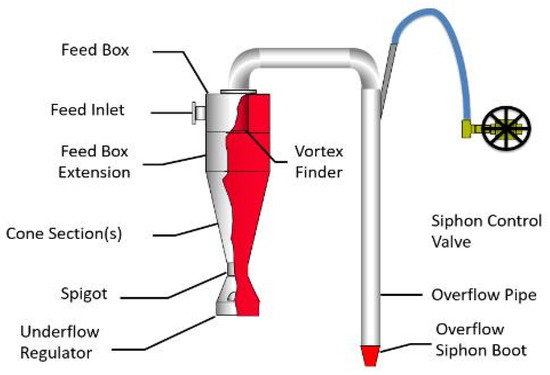
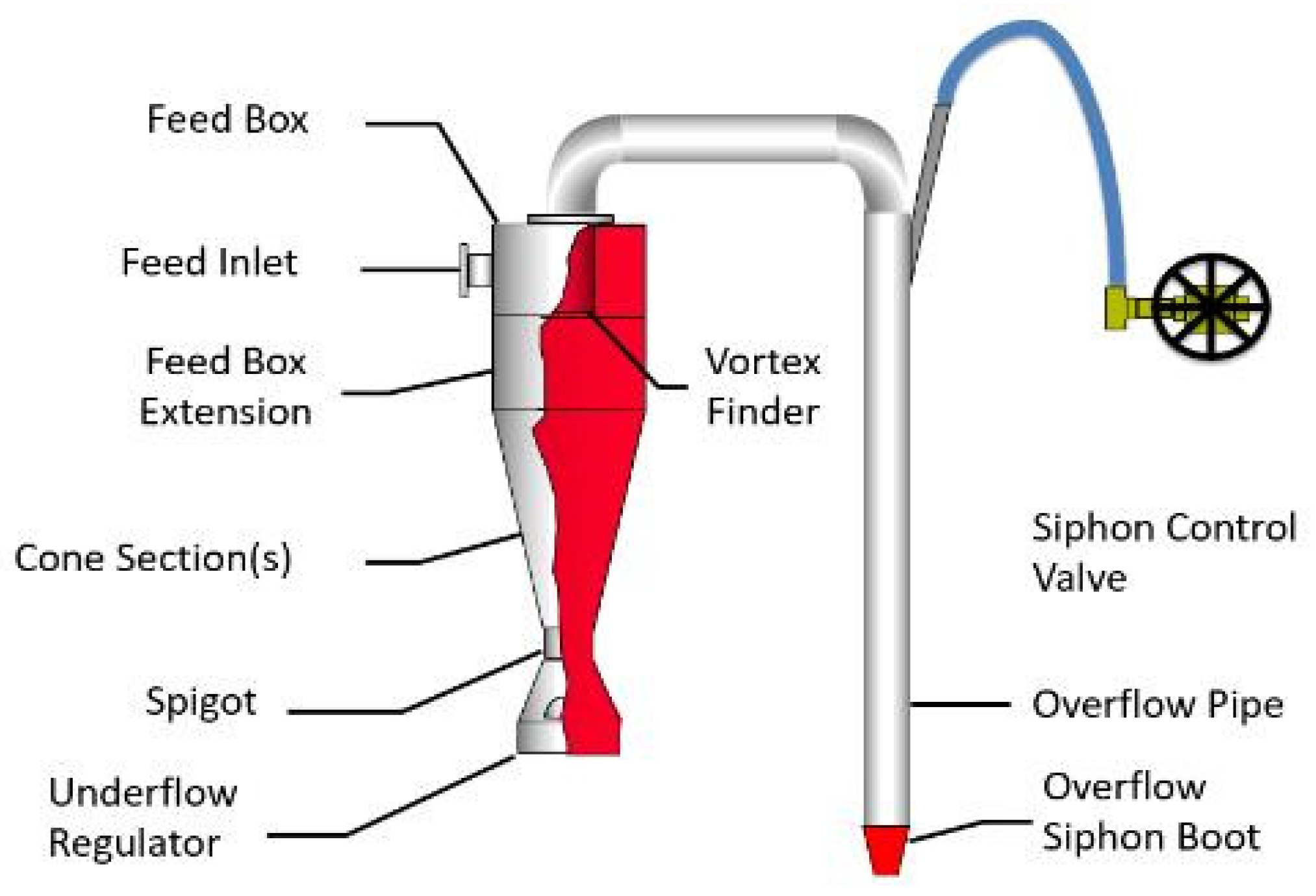
Figure 1 shows the hydrocyclone used for component separation. The hydrocyclone, with an overall height of ~130 cm, consisted of a cylindrical section (quartz tube, L ≈ 450 mm, and D ≈ 45 mm) and a conical section (300–350 mm in height and 15–18° cone angle). The slurry was fed tangentially (Ø 25 mm), the overflow was discharged through an axial outlet pipe (Ø 20 mm), and the underflow (sand fraction) was removed through the bottom outlet (Ø ~25 mm).
Figure 1.
Hydrocyclone for the separation of components of copper ore processing tailings.
Experiments were carried out at a solid content of 5–20% and feed pressures of 0.10–0.50 MPa after reaching steady-state conditions (±3%). Underflow and overflow products were collected and analyzed for particle size distribution using laser diffraction (D10, D50, and D90). The efficiency of the process was evaluated in terms of separation performance, selectivity, sharpness of separation, and fraction misplacement.
2.1. Microfluidic Separation
A microfluidic device was fabricated using two glass plates, between which a thin double-sided adhesive film with a thickness of approximately 150–200 μm was placed. The channel pattern was pre-cut in the film and included three inlets, a straight section with a focusing zone, and a triple outlet at the end. After patterning, the film was bonded to one glass plate and sealed with the second plate, forming a closed microchannel with a width of 300–500 μm along its entire length. Small holes were drilled at the inlet and outlet locations, and PTFE capillary tubes were inserted and fixed. The chip was tested for leakage by passing dyed water at low flow rates.
The selected channel geometry and flow conditions were estimated based on typical laminar flow regimes reported for microfluidic systems. The selected flow conditions correspond to typical laminar regimes in microfluidic channels reported in the literature [32], where copper ore processing tailings, containing significant amounts of fine particles with mixed size-dependent properties, are difficult to separate using conventional methods due to their high heterogeneity and low suspension stability. Reynolds numbers commonly remain within low and moderate ranges for stable hydrodynamic focusing.
For a channel width of 300–500 μm and a depth of 150–200 μm, the Reynolds number at flow rates of 0.15–0.30 mL/min was within the range of Re ≈ 10–30, indicating laminar flow conditions. At a side-to-central flow ratio of 2:1, the width of the focused central stream was estimated to be 50–100 μm, corresponding to the characteristic particle sizes in technogenic suspensions. To further clarify the separation mechanism and identify the fractions most sensitive to microfluidic focusing, the initial tailings were pre-classified into three narrow size ranges: 5–15 μm, 15–30 μm, and 30–50 μm. Each fraction was introduced into the microchannel reactor under identical hydrodynamic conditions: the central flow rate was 0.18 mL/min, each side flow rate was 0.22 mL/min, the side-to-central flow ratio was maintained at 2.5:1, and the solids content did not exceed 1 vol.%.
2.2. Bioleaching of Copper Ore Processing Tailings
Bioleaching was carried out in a 1 L vertical bioreactor equipped with mechanical agitation and aeration through a fine-bubble diffuser. Prior to the experiments, the tailings were dried at 105 °C, ground, and classified to a particle size of <100 μm. The pulp density was maintained at 10–15%, the initial pH was 1.8–2.0, and the temperature was approximately 30 °C.
Acidophilic microorganisms of the genera Acidithiobacillus and Leptospirillum were used as the inoculum at a concentration of 5–10% (v/v), pre-cultivated to the stationary growth phase [33]. The process was conducted under controlled agitation and aeration conditions with continuous monitoring of pH, temperature, and redox potential (Eh). Samples were collected daily, filtered, and analyzed by ICP-OES for Cu, Zn, and Fe concentrations.
2.3. Production of Geopolymers
The residues after bioleaching were dried at 70 °C to constant mass and subsequently ground in a vibration mill to a particle size of approximately 60–80 μm. Classification was carried out using an 80 μm sieve to obtain a homogeneous fraction suitable for alkaline activation. The additive content was maintained within 10–15%. A combined activating solution of NaOH and sodium silicate (water glass) was used, as this system ensures a more complete dissolution of aluminosilicates and provides a balanced concentration of soluble silica and aluminum. The NaOH concentration was 6–10 M, and the modulus of the sodium silicate was 2.2. The solid-to-liquid ratio was maintained in the range of 0.45–0.55.
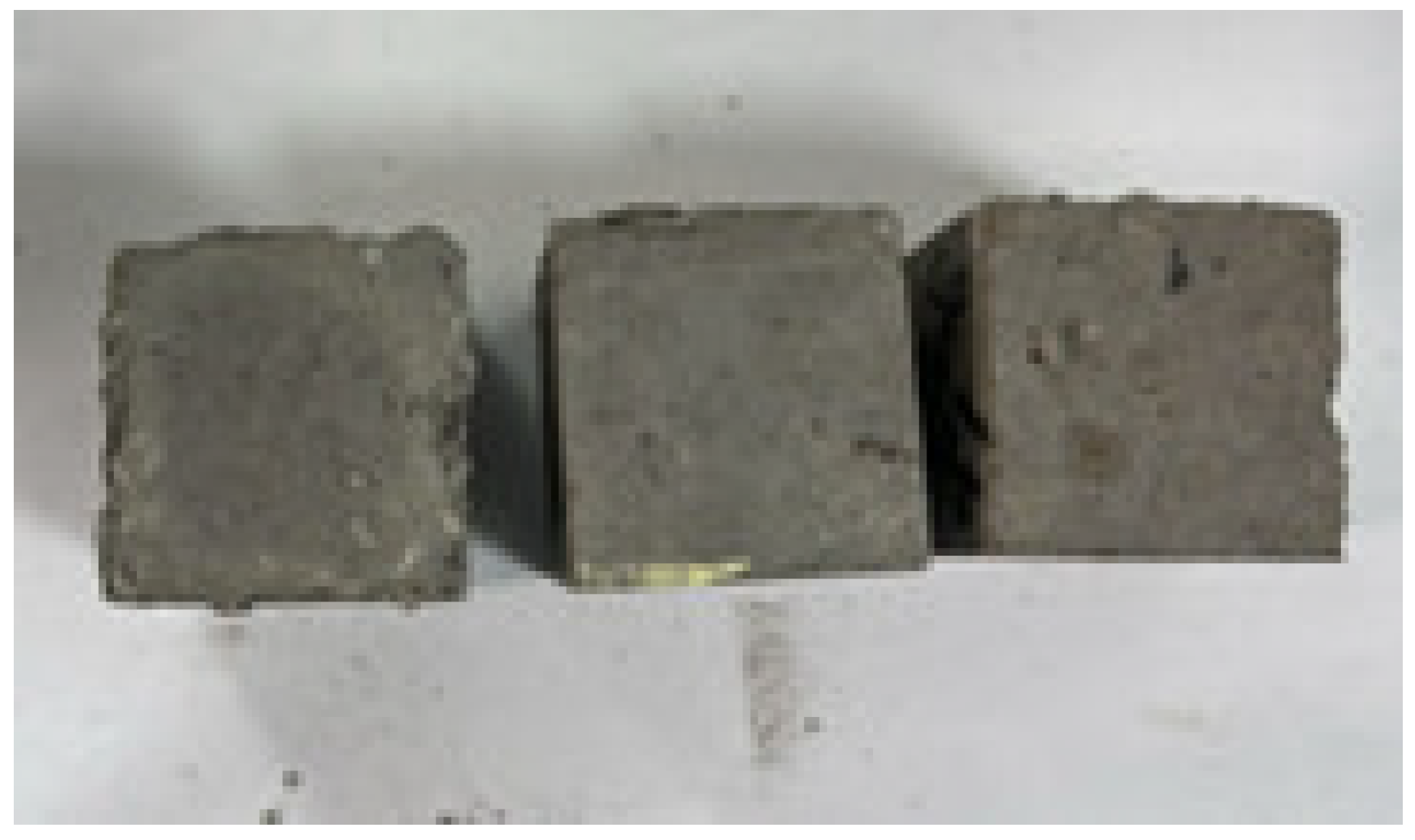
The activation temperature was kept at 25 °C to prevent excessive setting and to ensure uniform progression of the polycondensation reaction. After casting, the samples were cured at 25 °C for 48 h, allowing gradual hardening without surface drying. This was followed by thermal treatment at 50 °C for 24 h to accelerate structure formation and densification. Complete curing was achieved within 5 days, after which the samples were subjected to testing of their physical and physicochemical properties [34]. The appearance of the samples before cleaning and polishing is shown in Figure 2.
Figure 2.
Appearance of geopolymer samples before cleaning and polishing.
Prior to testing, the sample surfaces were cleaned of visible contaminants and, if necessary, the ends were ground to ensure proper geometry during compression. The specimens used for mechanical testing had dimensions of 20 mm each (cubes). The same specimens were subsequently used for determining density and water absorption after completion of the mechanical tests. Water absorption was evaluated based on the mass increase after immersion of the samples in water. Dry specimens were first weighed and then immersed in distilled water for 24 h at 20–25 °C. After removal, surface moisture was gently wiped off with a damp cloth, and the samples were reweighed.
Compressive strength was determined using a universal testing machine at a loading rate that ensured failure of the specimen within 1–2 min. Each geopolymer synthesis condition was tested on at least three parallel specimens; the results were reported as the mean value with standard deviation. The compressive stress was calculated as the ratio of the maximum load to the cross-sectional area of the sample. Based on the obtained values, the influence of activation conditions and system composition on the mechanical properties of the geopolymer was evaluated.
3. Results and Discussion
3.1. Characteristics of Aged Tailings from the Balkhash Concentration Plant
The low content and fine dispersion of sulfide phases limit the efficiency of conventional extraction methods. The matrix exhibits high inertness, which justifies the application of bioleaching involving acidophilic microorganisms. The tailings are characterized by a density of 2.6–2.9 g/cm3, a moisture content of 35–40%, and a pH of 7.0–8.5 and are considered a promising secondary raw material with significant environmental relevance. Table 1 presents the results of the ICP-OES analysis of 49 samples of copper ore processing tailings from the Balkhash concentrator.
Table 1.
Chemical composition of copper ore processing tailings from the Balkhash concentrator (descriptive statistics, ICP-OES).
The analysis of the chemical composition of aged flotation tailings showed that the material is characterized by a stable silicate matrix. Silicon is the dominant component, with an average content of 36.2% and a low coefficient of variation (≈5.4%), indicating the homogeneity of the silicate framework. The concentrations of Al and Fe, at 3.43% and 2.14%, respectively, also exhibit moderate variability (CV ≈ 8%), which corresponds to the stable presence of aluminosilicate and iron-bearing phases in the tailings. The Cu content ranges from 0.21 to 0.37%, with an average value of 0.32%. The relatively higher coefficient of variation (≈11%) reflects the heterogeneous distribution of copper-bearing minerals within the material. The relatively higher coefficient of variation (≈11%) may indicate heterogeneity in the distribution of copper within the material; however, detailed spatial characterization of Cu-bearing phases was not performed in the present study. Zinc is present at approximately 0.76%, with a relatively narrow range of variation (CV ≈ 7.5%). The Ag content varies from 1.50 to 1.80 g/t, with an average of 1.57 g/t and minimal variability (CV ≈ 3.6%), indicating the stability of silver-bearing phases. In contrast, Au exhibits high variability (CV ≈ 19.5%) with an average content of about 0.10 g/t, suggesting its uneven distribution and differences in its mineralogical forms within the technogenic material.
3.2. Hydrocyclone Classification of Enrichment Tailings
Aged flotation tailings from the Balkhash concentrator are characterized by a stable silicate matrix, contain residual amounts of copper and other valuable elements, and exhibit pronounced fine dispersion, with more than 80% of the material composed of particles smaller than 50 μm. These features necessitate preliminary classification prior to further beneficiation or hydrometallurgical processing and provide the rationale for selecting a hydrocyclone as the primary unit for subsequent investigations. Table 2 presents the set of experimental conditions applied in the hydrocyclone classification of the tailing pulp.
Table 2.
Experimental conditions for hydrocyclone classification.
It includes combinations of two factors—solid content (5%, 10%, and 20%) and feed pressure (0.10–0.50 MPa). For each regime, the corresponding slurry flow rate was recorded, varying proportionally with pressure.
An increase in solid content from 5% to 20% at constant pressure results in a decrease in flow rate, which is attributed to the rise in effective viscosity and density of the pulp and, consequently, higher hydraulic losses. At 20% solids, the flow regime shifts toward a denser and more viscous suspension; the Reynolds number decreases, and the damping of turbulent pulsations intensifies. This may contribute to stabilization of the underflow discharge (sand stream), but excessive solid content can reduce separation selectivity due to the smoothing of velocity gradients.
The set of conditions presented in the table covers a range from dilute, low-viscosity flows (5%, 0.10–0.20 MPa) to highly loaded, more viscous regimes (20%, 0.30–0.50 MPa).
The mass yields of underflow (sand) and overflow presented in Table 3 reflect the expected trend for hydrocyclone classification, namely a shift in the separation cut point with increasing feed pressure.
Table 3.
Performance indicators of hydrocyclone classification and mass yields of products under different operating conditions.
Table 3 presents the performance indicators of hydrocyclone classification at a feed pressure of 0.50 MPa and varying solids content (5%, 10%, and 20%). It was established that increasing the solid content leads to a rise in underflow yield from 38.1% to 42.0%. This indicates a more intensive entrainment of particles into the peripheral flow of the hydrocyclone with increasing pulp concentration. At the same time, an increase in the characteristic particle size of the underflow (D50) from 32 to 38 μm is observed, indicating a coarsening of the particle size distribution of the underflow product with increasing solid content. At solid contents of 5, 10, and 20%, the D50 values of the overflow product were 14, 17, and 20 μm, respectively, indicating more efficient separation of the fine-dispersed fraction at lower solid concentrations. The relative sharpness of separation slightly decreases from 1.70 to 1.60, suggesting a minor decline in process selectivity, likely due to increased pulp viscosity and intensified interparticle interactions. However, the detailed particle size distribution data required to construct a Tromp curve are unavailable due to the lack of partition coefficient data for the process. In turn, the overflow yield decreases from 61.2% to 57.5%, which is consistent with the redistribution of material toward the underflow fraction. Such an operating regime ensures stable formation of a fine-dispersed overflow fraction and a coarser underflow product suitable for subsequent beneficiation and hydrometallurgical metal recovery processes.
The hydrocyclone classification was used as a pretreatment step for the tailing pulp, after which the fine-dispersed overflow product was utilized both for subsequent bioleaching and for laboratory microfluidic separation aimed at investigating the selective behavior of microdispersed Cu-bearing fractions.
3.3. Microfluidic Separation
For microfluidic separation in the present study, flotation tailings of copper–porphyry ores from the Balkhash concentrator were used after preliminary hydrocyclone classification. The feed material represented a fine-dispersed quartz–clay matrix with sulfide inclusions in the size range of 14–20 μm.
Upon exiting the focusing region, the flow was split into two products: a central channel containing predominantly coarser and denser particles, and a combined side stream enriched with finer and lighter fractions.
To evaluate separation efficiency, each experiment involved determining not only the mass yields of the fractions but also the copper content in the solid residue of each sample. This approach made it possible to assess whether the copper concentration changed when transitioning from the initial material to the products obtained in the microfluidic cell, as well as to identify the operating conditions under which copper is concentrated in either the central or side fraction.
The copper content in the initial tailings pulp was 0.28%. The distribution of material and copper between the products under different hydrodynamic conditions is presented in Table 4.
Table 4.
Mass yields and Cu content in products of microfluidic separation.
Table 4 demonstrates that the microfluidic cell establishes a stable differentiation between the products: at a central stream mass yield of 35–42%, the Cu content increases to 0.39–0.52%, whereas in the side product, it decreases to 0.11–0.23%. With intensified focusing (regime 4), the fraction of the central stream reaches 42%, and the Cu concentration increases to 0.52%, which is approximately twice as high as in the side channel. The reduction in Cu in the light fraction to 0.11% confirms the effective separation of the main mineral matrix.
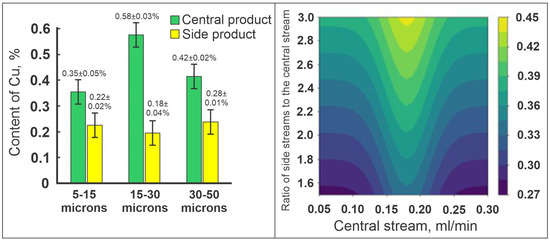
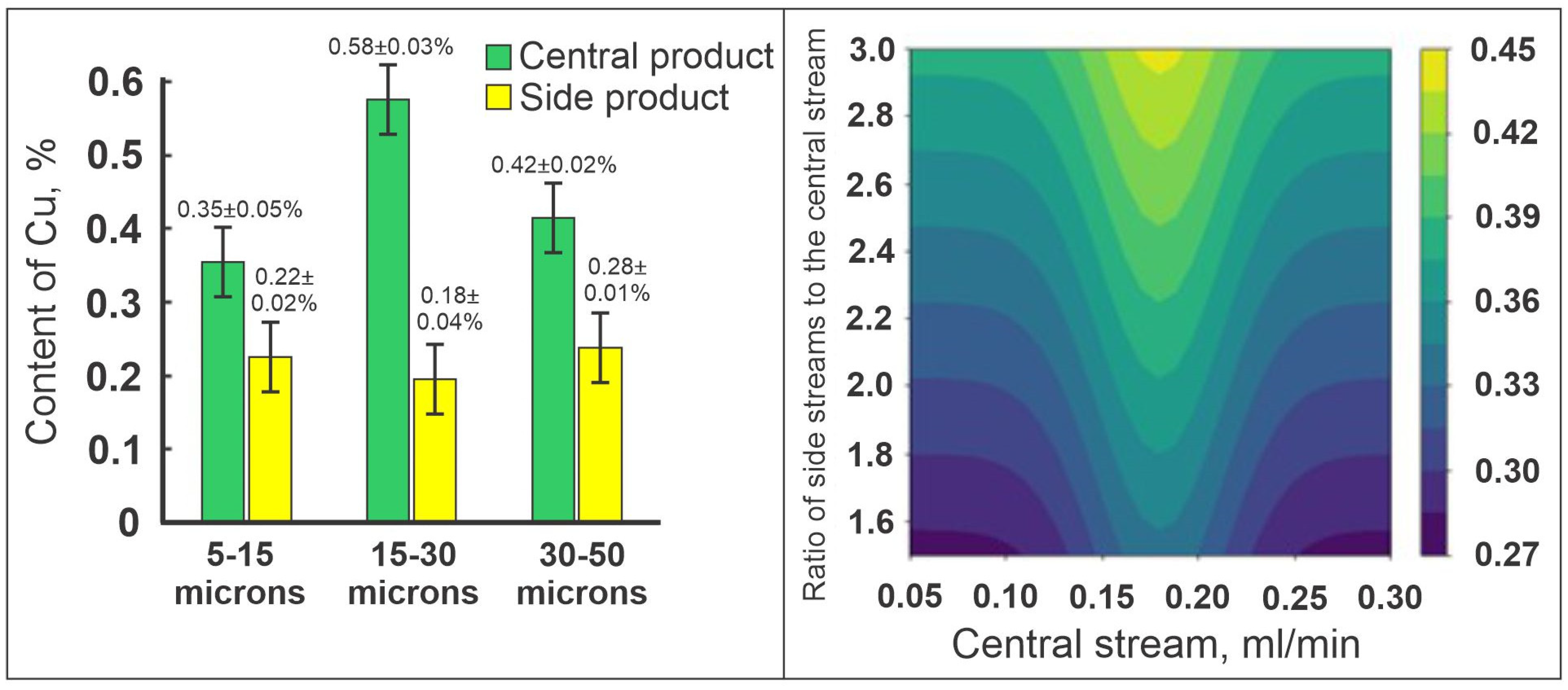
The overall mass and Cu balances are close to 100%, indicating negligible losses and confirming the reliability of the analytical results. Figure 3 shows the variation in Cu concentration in the central product as a function of the central stream flow rate and the ratio of side streams to the central stream.
Figure 3.
Effect of central stream flow rate and side-to-central flow ratio on Cu concentration in the central product and copper distribution across particle size fractions.
As shown in Figure 3, the maximum copper enrichment is achieved in the region of moderate central flow rates (approximately 0.18–0.22 mL/min) and elevated side-to-central flow ratios (2.4–2.9). Under these conditions, the most effective flow focusing occurs, promoting the migration of denser particles toward the central channel and increasing the Cu concentration to 0.44–0.48%.
At lower central flow rates and smaller side-to-central ratios, the copper concentration decreases, which is associated with insufficient separation efficiency and a more uniform distribution of the solid phase across the channel width.
Particle behavior was also found to strongly depend on size fraction. The 5–15 μm fraction shows moderate copper enrichment, whereas the 15–30 μm fraction demonstrates the highest contrast between the central and side streams, providing the greatest and statistically significant increase in Cu content. This confirms that particles within the 15–30 μm size range exhibit the most efficient hydrodynamic focusing and separation behavior under the selected microfluidic conditions. The 30–50 μm fraction demonstrates intermediate results due to the significant presence of low-grade silicate matrix.
Overall, the obtained results indicate that the 15–30 μm size fraction is the most promising for microfluidic copper concentration.
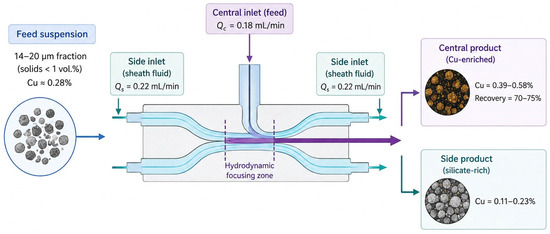
To illustrate the principle of microfluidic separation of flotation tailings, Figure 4 shows a schematic diagram of the device with hydrodynamic flow focusing and separation of the resulting products.
Figure 4.
Schematic diagram of the microfluidic separation process with hydrodynamic focusing for copper-bearing flotation tailings.
It can be seen from Figure 4 that the feed suspension with a particle size fraction of 14–20 μm and a copper content of approximately 0.28% is introduced through the central inlet at a flow rate of mL/min. Sheath fluid is supplied through two side inlets at a flow rate of mL/min, creating a hydrodynamic focusing zone. As a result of particle redistribution within the flow, the material is separated into a central copper-enriched product (Cu = 0.39–0.58%, recovery = 70–75%) and a side silicate-rich product with lower copper content (Cu = 0.11–0.23%).
Thus, the microfluidic system demonstrated stable selectivity when processing fine-dispersed tailings. The most pronounced results were obtained for particles in the 15–30 μm size fraction, where the Cu content in the central product reached 0.58%, corresponding to more than a twofold increase compared to the initial level (0.28%) at a recovery of 70–75%. When processing the initial mixed tailings, the maximum copper concentration in the central channel was 0.52%, with a total yield of the enriched fraction of 42%. These results confirm that microfluidic separation effectively concentrates copper-bearing particles and can serve as a compact pre-concentration stage prior to hydrometallurgical processing. However, the spatial distribution and liberation state of these particles were not directly examined due to the absence of SEM-EDS characterization. It is recommended to carry out future research on mineral liberation, particle locking, and the spatial distribution of Cu-bearing phases that cannot be supported.
3.4. Bioleaching Process
The bioleaching experiments were carried out under varying operating conditions to evaluate the influence of process parameters on metal recovery from copper ore tailings. A total of 24 experiments were performed with pulp density ranging from 10 to 15%, initial pH values of 1.8–2.0, and temperatures of 28–32 °C. The air flow rate varied between 0.5 and 1.0 L/min, while the inoculum dosage ranged from 5 to 10% of the pulp volume. The duration of the experiments was 10–14 days depending on the selected operating conditions. The optimal operating parameters (pH (~1.8), temperature up to 32 °C, enhanced aeration, and increased inoculum dosage (7–10%)) and corresponding metal recovery results are presented in Table 5.
Table 5.
Final metal concentrations in solution and their recovery rates based on bioleaching experiments.
Table 5 demonstrates that, as a result of bioleaching, the metal concentrations in solution are Cu—169 mg/L (recovery 50.17%), Zn—414 mg/L (45.13%), and Fe—817 mg/L (30.71%). This indicates more efficient extraction of copper and zinc compared to iron and confirms the selective nature of the process.
The improvement in metal recovery was observed under conditions of low pH (~1.8), temperatures up to 32 °C, enhanced aeration, and inoculum dosages of 7–10%. Under these operating conditions, the highest concentrations of dissolved Cu, Zn, and Fe were measured in the leachates. The observed results are consistent with conditions commonly reported in the literature as favorable for bioleaching processes involving acidophilic microorganisms. Therefore, these parameters were considered optimal for the treatment of the investigated tailings within the scope of the present study.
3.5. Geopolymer Synthesis from Leaching Residues of Tailings
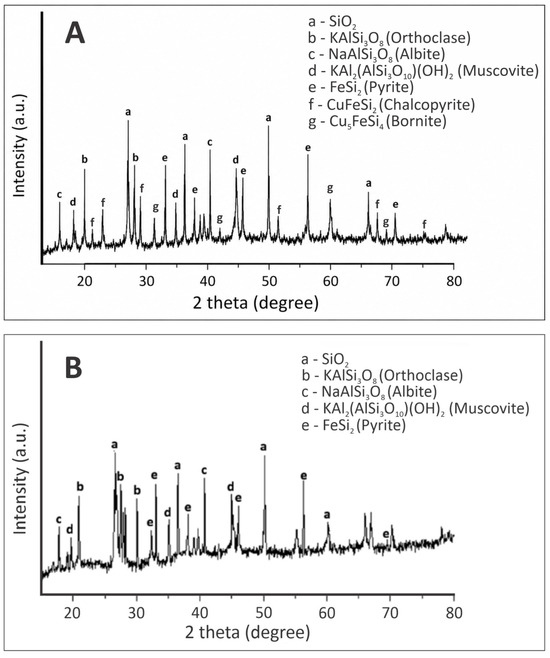
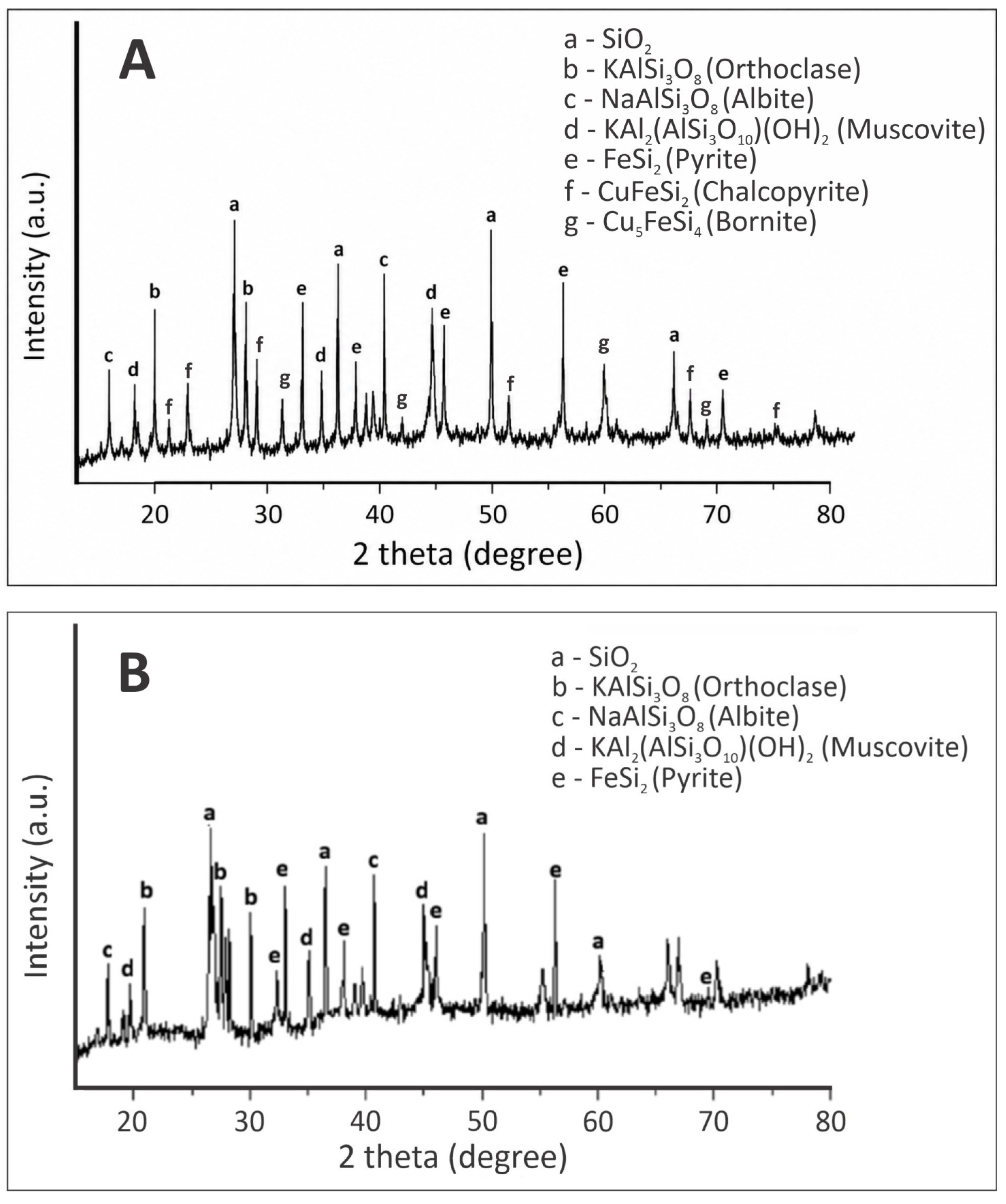
The residues obtained after bioleaching of the tailings are predominantly composed of silicate and aluminosilicate materials (Figure 5).
Figure 5.
X-ray diffraction pattern before (A) and after (B) bioleaching of copper ore flotation tailings.
The mineralogical composition corresponds to a mixture of quartz, feldspars, micas, and sulfide minerals, which is typical for fine-dispersed copper flotation tailings. As shown in Figure 5A, the initial tailings contain pronounced reflections of quartz SiO2 (phase “a”); orthoclase and albite (“b” and “c”); muscovite (“d”); as well as sulfide phases including pyrite (“e”), chalcopyrite (“f”), and bornite (“g”). The presence of chalcopyrite and bornite is consistent with copper being associated, at least partially, with sulfide mineralization.
After bioleaching (Figure 5B), the diffraction pattern still exhibits pronounced peaks of quartz, feldspars, and muscovite, indicating the stability of the silicate matrix under microbial and acidic conditions. At the same time, the intensity of pyrite peaks decreases significantly, while the reflections corresponding to chalcopyrite and bornite almost disappear, reflecting oxidative dissolution and partial decomposition of copper-bearing sulfide phases during bioleaching. This is consistent with the transfer of soluble forms of Cu, Fe, and associated elements into solution at the oxidation stage.
The preservation of the aluminosilicate framework after sulfide removal demonstrates that bioleaching selectively affects reactive sulfide minerals while maintaining the structural integrity of the silicate matrix. The high proportion of reactive aluminosilicates provides the material with the ability for alkaline activation and the formation of a strong inorganic network, forming the basis for subsequent geopolymer synthesis [34,35,36,37].
The results of testing the obtained geopolymer samples are presented in Table 6. An increase in NaOH concentration leads to higher density and reduced water absorption, which is attributed to more intensive dissolution of amorphous Si–Al phases in the raw material and the formation of a greater amount of soluble oligomers. This facilitates the development of a three-dimensional geopolymer network and reduces the proportion of open porosity.
Table 6.
Geopolymer test results.
The effect of metakaolin content is also significant: the addition of 10–15% provides an additional source of reactive Al3+, increases the number of Si–O–Al structural units, and promotes the formation of a denser and stronger matrix. Low or zero metakaolin content results in aluminum deficiency in the system, reducing the degree of polycondensation and leading to a more porous and less homogeneous structure.
The solid-to-liquid ratio determines the rheology of the mixture and influences pore distribution: a higher value (0.55) reduces excess water and leads to lower shrinkage porosity. For systems with moderate NaOH concentration, this results in increased density and strength. However, at higher alkali concentrations, this effect becomes less pronounced, as the activator plays a more dominant role in controlling matrix dissolution than the water content. The obtained compressive strength values ensure an optimal balance between the dissolution of the initial aluminosilicates, the formation of supramolecular structures, and the minimization of porosity. In contrast, lower density and higher water absorption are characteristic of compositions with insufficient activation, corresponding to a reduced number of Si–O–Al bonds and a more fragmented matrix structure. At the next stage, further optimization of this composition was carried out by varying the curing regime while keeping the composition and activation parameters constant. Three curing conditions were investigated.
Bioleaching residues of flotation tailings demonstrated suitability for producing dense geopolymer materials. The synthesized geopolymer samples exhibited a bulk density of 2.0 g/cm3, water absorption above 8.4%, and compressive strength exceeding 24 MPa. The optimal combination of properties was achieved at 10% metakaolin content, 8 M NaOH concentration, and a solid-to-liquid ratio of 0.55, with a two-stage curing regime (25 °C for 2 days followed by 50 °C for 1 day), meeting the requirements of GOST 26633-2015 (ISO 22965-1).
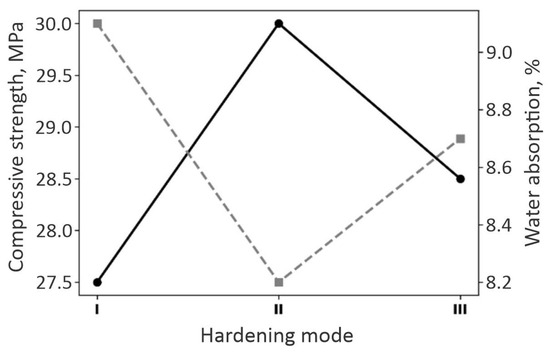
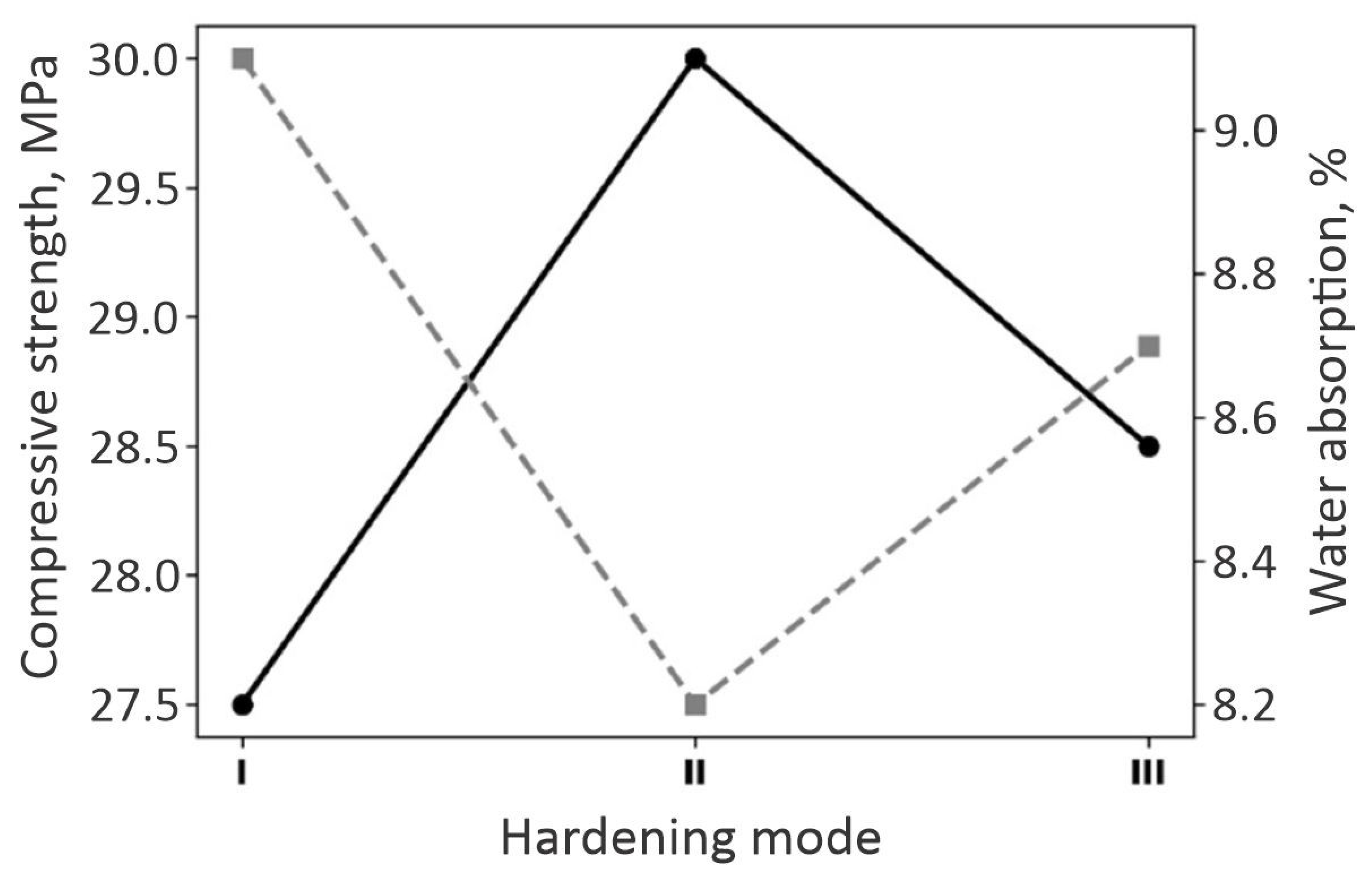
Regime I involved curing at 25 °C for 5 days. Regime II (baseline) consisted of curing at 25 °C for 2 days followed by thermal treatment at 50 °C for 1 day. Regime III included curing at 25 °C for 1 day followed by thermal treatment at 50 °C for 2 days. Figure 6 presents a comparison of three curing regimes for geopolymer samples obtained with the optimal composition, in terms of two key responses—compressive strength and water absorption.
Figure 6.
Effect of curing regime on compressive strength and water absorption of geopolymers.
The strength curve indicates that the maximum value is achieved under regime II, where the combination of initial curing at 25 °C followed by thermal treatment at 50 °C results in the densest structure. The water absorption curve shows the lowest values for the same regime, whereas regimes I and III exhibit increased porosity. The graph confirms that regime II is optimal in terms of the combined properties. The obtained results demonstrate the effectiveness of the selected approach and support the use of this curing regime for producing stable geopolymer materials from leaching residues of aluminosilicate tailings.
Compared with conventional pyrometallurgical processing, which typically requires temperatures above 1200 °C and high energy consumption, the proposed bioleaching process was carried out under mild conditions at 30–32 °C and pH 1.8–2.0. Hydrocyclone classification operated at relatively low pressures of 0.10–0.50 MPa, ensuring effective separation of fine particles without intensive mechanical grinding. In contrast to traditional hydrometallurgical methods requiring high reagent dosages and aggressive acidic conditions, microfluidic separation enabled selective Cu enrichment up to 0.52–0.58% with minimal reagent consumption and low flow rates (0.18–0.22 mL/min). In addition, the conversion of bioleaching residues into geopolymers reduced secondary waste generation and minimized tailing accumulation compared with conventional disposal methods.
4. Conclusions
This study demonstrated the feasibility of an integrated processing route for aged flotation tailings from the Balkhash concentrator (Kazakhstan), combining hydrocyclone classification, microfluidic separation, bioleaching, and geopolymer synthesis.
The investigated tailings are characterized by a stable silicate–aluminosilicate matrix containing residual amounts of valuable metals, including Cu (0.32%), Zn (0.77%), and Fe (2.14%), confirming their potential as a secondary mineral resource. Hydrocyclone classification provided effective pretreatment of the tailings, producing a fine overflow fraction suitable for subsequent microfluidic separation and bioleaching. Stable separation performance was achieved at solid contents of 5–20% and feed pressures up to 0.50 MPa.
Microfluidic separation enabled selective concentration of copper-bearing particles. Under optimal conditions, the Cu content in the central product increased from 0.28% in the feed to 0.52%, and up to 0.58% for the 15–30 μm fraction, with a copper recovery of 70–75%.
Bioleaching using acidophilic microorganisms achieved metal recoveries of 50.17% for Cu, 45.13% for Zn, and 30.71% for Fe under optimized conditions (pH ≈ 1.8, temperature 30–32 °C, enhanced aeration, and 7–10% inoculum dosage), confirming the effectiveness of biohydrometallurgical treatment of low-grade technogenic materials.
XRD analysis demonstrated that the initial tailings consisted predominantly of quartz, feldspars, muscovite, and copper-bearing sulfide minerals. After bioleaching, the intensity of sulfide mineral peaks decreased significantly, whereas the aluminosilicate matrix remained largely unchanged. These results confirm the selective dissolution of sulfide phases and preservation of the mineral framework suitable for subsequent utilization.
Geopolymer materials were produced from bioleaching residues. These construction materials were characterized by high compressive strength (24 MPa) and low water absorption (9.1%), thus meeting the requirements of Kazakhstan standard 26633-2015 (ISO 22965-1). The preserved aluminosilicate composition of the residues contributed to effective geopolymer formation and material performance.
The proposed integrated approach enables both recovery of valuable metals and utilization of processing residues, reducing waste accumulation and supporting circular economy principles in the mining and metallurgical industry.
Author Contributions
A.B.: Writing—Original Draft, Investigation, Validation, Resources. R.A.: Conceptualization, Methodology, Supervision, Writing—Review and Editing, Funding Acquisition. A.Z.: Data Curation, Formal Analysis. L.M.: Visualization, Data Curation. Y.I.: Conceptualization, Methodology, Supervision, Writing—Review and Editing. D.M.: Corresponding Author, Investigation, Validation, Resources. All authors have read and agreed to the published version of the manuscript.
Funding
This research has been funded by the Science Committee of the Ministry of Science and Higher Education of the Republic of Kazakhstan (grant No. BR28712667, “Development of innovative technologies for processing industrial waste from the mining and metallurgical industry to improve efficiency and reduce environmental impact”).
Data Availability Statement
The original contributions presented in this study are included in this article. Further inquiries can be directed to the corresponding author.
Conflicts of Interest
The authors declare no conflict of interest.
References
- Kenzhaliyev, B.K.; Arkad’yevich, K.S.; Anatolyevich, T.S.; Abdulvaliyev, R.A.; Koizhanova, A.; Tussupbayev, N.K.; Kassymova, G.K. Development and Implementation of Innovative Technologies That Ensure an Increase in The Extraction of Non-ferrous, Noble, Rare, Rare-Earth Metals. Teknomekanik 2022, 5, 1–12. [Google Scholar] [CrossRef] [Scilit]
- Kolesnikov, A.; Fediuk, R.; Amran, M.; Klyuev, S.; Klyuev, A.; Volokitina, I.; Bazarkhankyzy, A. Modeling of non-ferrous metallurgy waste disposal with the production of iron silicides and zinc distillation. Materials 2022, 15, 2542. [Google Scholar] [CrossRef] [Scilit] [PubMed]
- Salikhov, V.A.; Strakhov, V.M.; Yedilbaev, A.I. Assessing the content of nonferrous and rare metals in nonclinkering Kazakh coal. Coke Chem. 2021, 64, 279–283. [Google Scholar] [CrossRef] [Scilit]
- Kolesnikov, A.S.; Serikbaev, B.E.; Zolkin, A.L.; Kenzhibaeva, G.S.; Isaev, G.I.; Botabaev, N.E.; Kolesnikova, V.A. Processing of non-ferrous metallurgy waste slag for its complex recovery as a secondary mineral raw material. Refract. Ind. Ceram. 2021, 62, 375–380. [Google Scholar] [CrossRef] [Scilit]
- Kunarbekova, M.; Yeszhan, Y.; Zharylkan, S.; Alipuly, M.; Zhantikeyev, U.; Beisebayeva, A.; Azat, S. The state of the art of the mining and metallurgical industry in Kazakhstan and future perspectives: A systematic review. ES Mater. Manuf. 2024, 25, 1219. [Google Scholar] [CrossRef] [Scilit]
- Atakhanova, Z.; Azhibay, S. Assessing economic sustainability of mining in Kazakhstan. Miner. Econ. 2023, 36, 719–731. [Google Scholar] [CrossRef] [Scilit]
- Duczmal-Czernikiewicz, A.; Baibatsha, A.; Bekbotayeva, A.; Omarova, G.; Baisalova, A. Ore minerals and metal distribution in tailings of sediment-hosted stratiform copper deposits from Poland and Kazakhstan. Minerals 2021, 11, 752. [Google Scholar] [CrossRef] [Scilit]
- Zharmenov, A.A.; Kushakova, L.B.; Sizikova, N.V.; Iskandirov, M.Z. Heap leaching of copper in Kazakhstan: Practice, problems, and prospects. Metallurgist 2025, 68, 1941–1948. [Google Scholar] [CrossRef] [Scilit]
- Feng, S.; Che, J.; Zhang, W.; Zuo, Y.; Wang, C.; Ma, B.; Chen, Y. A sustainable approach for recovering copper and zinc from copper smelting flue dust: Paving the path for waste reduction. Sep. Purif. Technol. 2024, 342, 127037. [Google Scholar] [CrossRef] [Scilit]
- Zhang, J.; Liu, Z.; Liu, Z. An efficient and affordable hydrometallurgical process for co-treatment of copper smelting dust and arsenic sulfide residue. J. Clean. Prod. 2023, 419, 137955. [Google Scholar] [CrossRef] [Scilit]
- Liu, J.; Xie, H.; Han, B. The Utilization of the Copper Smelting Slag: A Critical Review. Minerals 2025, 15, 926. [Google Scholar] [CrossRef] [Scilit]
- Klaffenbach, E.; Montenegro, V.; Guo, M.; Blanpain, B. Sustainable and comprehensive utilization of copper slag: A review and critical analysis. J. Sustain. Metall. 2023, 9, 468–496. [Google Scholar] [CrossRef] [Scilit]
- Phiri, T.C.; Singh, P.; Nikoloski, A.N. The potential for copper slag waste as a resource for a circular economy: A review–Part I. Miner. Eng. 2022, 180, 107474. [Google Scholar] [CrossRef] [Scilit]
- Li, J.; Liao, Y.; Ma, H.; Liu, Q.; Wu, Y. Review on comprehensive recovery valuable metals and utilization of copper slag. J. Sustain. Metall. 2023, 9, 439–458. [Google Scholar] [CrossRef] [Scilit]
- Xie, H.; Sun, R.; Ren, X.; You, Z.; Liu, Y.; Feng, D.; Chen, L. Development of a novel fluidized hydrocyclone concentrator for mineral separation. Sep. Purif. Technol. 2020, 248, 116960. [Google Scholar] [CrossRef] [Scilit]
- Liu, Y.; Cheng, Q.; Zhang, B.; Tian, F. Three-phase hydrocyclone separator–A review. Chem. Eng. Res. Des. 2015, 100, 554–560. [Google Scholar] [CrossRef] [Scilit]
- Zhou, W.; Wang, S.; Cai, C.; Liu, L.; Zhu, J. Experimental Research and Practice of Mineral Separation from Flotation Tailings Based on Self-Spinning Hydrocyclones. Processes 2022, 10, 1478. [Google Scholar] [CrossRef] [Scilit]
- Marmiroli, B.; Rigamonti, L.; Brito-Parada, P.R. Life Cycle Assessment in mineral processing–a review of the role of flotation. Int. J. Life Cycle Assess. 2022, 27, 62–81. [Google Scholar] [CrossRef] [Scilit]
- Wang, C.; Harbottle, D.; Liu, Q.; Xu, Z. Current state of fine mineral tailings treatment: A critical review on theory and practice. Miner. Eng. 2014, 58, 113–131. [Google Scholar] [CrossRef] [Scilit]
- Peng, T.; Qiang, J.; Yuan, S. Sheathless inertial particle focusing methods within microfluidic devices: A review. Front. Bioeng. Biotechnol. 2024, 11, 1331968. [Google Scholar] [CrossRef] [Scilit]
- Gümüşsoy, A.; Başyïğït, M.; Kart, E.U. Economic potential and environmental impact of metal recovery from copper slag flotation tailings. Resour. Policy 2023, 80, 103232. [Google Scholar]
- Bilal, M.; Park, I.; Hornn, V.; Ito, M.; Hassan, F.U.; Jeon, S.; Hiroyoshi, N. The challenges and prospects of recovering fine copper sulfides from tailings using different flotation techniques: A review. Minerals 2022, 12, 586. [Google Scholar] [CrossRef] [Scilit]
- Song, W. Mine-on-a-chip: Megascale opportunities for microfluidics in critical materials and minerals recovery. Lab A Chip 2025, 25, 4461–4472. [Google Scholar] [CrossRef] [Scilit] [PubMed]
- Le, T.N.Q.; Tran, Q.D.; Tran, N.N.; Priest, C.; Skinner, W.; Goodsite, M.; Hessel, V. Critical elements: Opportunities for microfluidic processing and potential for ESG-powered mining investments. Green Chem. 2022, 24, 8879–8898. [Google Scholar] [CrossRef] [Scilit]
- Shevko, V.M.; Karataeva, G.E.; Serzhanov, G.M.; Badikova, A.D.; Abzhanova, A.S. Complex Processing tailings of the Balkhash Concentrating Factory. Biosci. Biotechnol. Res. Asia 2015, 12, 2411–2419. [Google Scholar] [CrossRef] [Scilit]
- Liu, S.; Li, Y.; Zhan, C.; Liu, H.; Wang, Y.; Fang, L. A review of pollutant leaching from tailings: Numerical modeling, transport mechanisms, and pollution control. Environ. Rev. 2026, 34, 1–34. [Google Scholar] [CrossRef] [Scilit]
- Mishra, S.; Panda, S.; Akcil, A.; Dembele, S. Biotechnological avenues in mineral processing: Fundamentals, applications and advances in bioleaching and bio-beneficiation. Miner. Process. Extr. Metall. Rev. 2023, 44, 22–51. [Google Scholar] [CrossRef] [Scilit]
- Olson, G.J.; Brierley, J.A.; Brierley, C.L. Bioleaching review part B: Progress in bioleaching: Applications of microbial processes by the minerals industries. Appl. Microbiol. Biotechnol. 2003, 63, 249–257. [Google Scholar] [CrossRef] [Scilit] [PubMed]
- Watling, H.R. The bioleaching of sulphide minerals with emphasis on copper sulphides—A review. Hydrometallurgy 2006, 84, 81–108. [Google Scholar]
- Tezyapar Kara, I.; Kremser, K.; Wagland, S.T.; Coulon, F. Bioleaching metal-bearing wastes and by-products for resource recovery: A review. Environ. Chem. Lett. 2023, 21, 3329–3350. [Google Scholar] [CrossRef] [Scilit]
- Saim, A.K.; Darteh, F.K. A comprehensive review on cobalt bioleaching from primary and tailings sources. Miner. Process. Extr. Metall. Rev. 2024, 45, 426–452. [Google Scholar] [CrossRef] [Scilit]
- Ferreira, G.; Sucena, A.; Ferrás, L.L.; Pinho, F.T.; Afonso, A.M. Hydrodynamic Entrance Length for Laminar Flow in Microchannels with Rectangular Cross Section. Fluids 2021, 6, 240. [Google Scholar] [CrossRef] [Scilit]
- Abashina, T.; Vainshtein, M. Current Trends in Metal Biomining with a Focus on Genomics Aspects and Attention to Arsenopyrite Leaching—A Review. Microorganisms 2023, 11, 186. [Google Scholar] [CrossRef] [Scilit]
- Wang, Y.S.; Alrefaei, Y.; Dai, J.G. Silico-aluminophosphate and alkali-aluminosilicate geopolymers: A comparative review. Front. Mater. 2019, 6, 106. [Google Scholar] [CrossRef] [Scilit]
- Martin, A.; Pastor, J.Y.; Palomo, A.; Jiménez, A.F. Mechanical behaviour at high temperature of alkali-activated aluminosilicates (geopolymers). Constr. Build. Mater. 2015, 93, 1188–1196. [Google Scholar] [CrossRef] [Scilit]
- Fletcher, R.A.; MacKenzie, K.J.; Nicholson, C.L.; Shimada, S. The composition range of aluminosilicate geopolymers. J. Eur. Ceram. Soc. 2005, 25, 1471–1477. [Google Scholar] [CrossRef] [Scilit]
- Xu, H.; Van Deventer, J.S.J. The geopolymerisation of alumino-silicate minerals. Int. J. Miner. Process. 2000, 59, 247–266. [Google Scholar] [CrossRef] [Scilit]
- ISO 22965-1:2007; Methods of Specifying and Guidance for the Specifier. International Organization for Standardization: Geneva, Switzerland, 2007.

Disclaimer/Publisher’s Note: The statements, opinions and data contained in all publications are solely those of the individual author(s) and contributor(s) and not of MDPI and/or the editor(s). MDPI and/or the editor(s) disclaim responsibility for any injury to people or property resulting from any ideas, methods, instructions or products referred to in the content. |
© 2026 by the authors. Licensee MDPI, Basel, Switzerland. This article is an open access article distributed under the terms and conditions of the Creative Commons Attribution (CC BY) license.