


Abstract
As lithium demand surges and primary resources face depletion, lithium-bearing wastewater from urban mines has become a crucial secondary resource. For highly alkaline (pH 9–12), low-lithium (Li+ 0.5–5 g/L), high-sodium (Na/Li mass ratio > 30) wastewater generated from the alkaline leaching-washing of spent lithium-ion batteries in urban mining, a single-component, synergist-free extraction process employing HBL121 in sulfonated kerosene was developed, and its extraction stoichiometry, reaction mechanism, and industrial feasibility were elucidated. Saponification significantly enhanced extraction under moderate alkalinity: the saponified system achieved over 99% extraction efficiency at pH 11.0, whereas the non-saponified system required pH > 13.5 for comparable performance, thereby lowering alkali consumption by 81%. Under optimal conditions (saponification degree 40%, 30% (v/v) HBL121 and 70% (v/v) sulfonated kerosene, organic-to-aqueous phase ratio O/A = 1:1, extraction time 5 min), single-stage extraction efficiency exceeded 99%. A McCabe-Thiele diagram was used to determine the theoretical stage number for lithium stripping, showing that essentially all lithium ions can be stripped via a three-stage countercurrent process. Using 3.0 mol/L H2SO4 at an aqueous-to-organic phase ratio of 1:4, the stripping efficiency exceeded 99% from the loaded organic. Slope analysis, FT-IR, and ESI-MS confirmed a coordination mechanism between HBL121 and metal ions, forming a stable anionic bisphosphonate complex [LiNa2(C28H44O7P2)]−, whose neutral parent form is HLiNa2(C28H44O7P2).
1. Introduction
As a critical strategic resource, lithium is the core raw material for products such as rechargeable battery cathode materials, light aircraft alloys, industrial catalysts, and controllable nuclear fusion fuels; thus, its strategic position in energy transition and high-end manufacturing is becoming increasingly prominent [1]. With the large-scale retirement of lithium battery products, “urban mines” have become an important source of secondary lithium resources, and the alkaline leaching and washing processes during their recycling generate large amounts of alkaline lithium-containing wastewater [2,3,4,5]. This type of wastewater is characterized by strong alkalinity (pH 9–12) and low lithium ion concentrations (0.5–5 g/L), accompanied by high concentrations of alkali metal ions such as sodium and potassium, trace impurities of calcium, magnesium, and heavy metals, as well as dissolved oil, organic matter, and other pollutants, resulting in high salinity and complex compositions [6,7]. Furthermore, because the chemical properties of lithium ions and alkali metal ions are similar, their selective separation and recovery present significant challenges [8]. Direct discharge would not only cause a severe waste of lithium resources but also pose potential hazards to the ecological environment due to the high salt content and trace heavy metals [9]. Therefore, achieving the efficient separation and enrichment of lithium from such alkaline, low-concentration lithium-containing wastewater can not only recover high-value lithium resources but also reduce the difficulty of wastewater treatment, facilitating the transformation of “waste” into “raw materials,” which aligns with the development concepts of a circular economy and green chemistry. Currently, the volume of lithium-containing wastewater generated from urban mine recycling in China is substantial, making the research and development of highly efficient treatment and resource recovery technologies a critical issue to be resolved within the industry.
At present, research on lithium extraction technologies for alkaline, low-concentration lithium-containing solutions mainly focuses on adsorption, membrane separation, and solvent extraction methods [10]. The adsorption method achieves selective lithium adsorption through aluminum-based or manganese-based adsorbents; although recyclable, it is prone to adsorbent poisoning and a significant decline in separation efficiency when dealing with complex wastewater containing oil and abundant organic matter [11]. The membrane separation method relies on the ion-retention characteristics of materials such as nanofiltration membranes to extract lithium; while environmentally friendly, it is equally susceptible to oil pollution and organic interference, easily leading to membrane pore blockage and flux decline, which makes it difficult for the production process to operate stably [12]. Due to its excellent selectivity, high separation efficiency, simple operation, and broad applicability, solvent extraction has become the mainstream technology for lithium extraction from liquid lithium resources such as salt lake brines and has achieved industrial application [13]. Its technical experience can be transferred to the treatment of lithium-containing wastewater from urban mines, making it a preferred technological pathway for overcoming the core problem of poor pollution resistance associated with adsorption and membrane separation methods [14].
Current extractant systems for solvent extraction of lithium have their respective limitations. The neutral phosphorus-based extractant tributyl phosphate (TBP) has high lithium extraction efficiency but requires FeCl3 as a co-extractant and is only suitable for acidic systems [15]; under alkaline conditions, iron ions are prone to hydrolysis and deactivation, and stripping requires a high concentration of chloride ions, making it unsuitable for alkaline lithium-containing wastewater [16]. Although the synergistic extraction system constructed by the dual-ketone extractant LIX54 and Cyanex923 can extract lithium under alkaline conditions [17], it is a compound system with complex components and high extractant costs. Ionic liquid extraction systems can directly treat lithium-containing effluent from oil and gas fields, but they require the prior removal of divalent ions through chemical precipitation, involving cumbersome process steps and high treatment costs [18]. The synergistic extraction system of benzoyltrifluoroacetone (HBTA) and trioctylphosphine oxide (TOPO) is suitable for lithium extraction from the tailing liquid of spent lithium batteries [19], but it similarly relies on a co-extractant, and its adaptability to high-salt, alkaline systems remains unclear [20,21]. In summary, existing extraction systems either require co-extractants, involve complex process steps, or cannot directly adapt to the raw material characteristics of alkaline lithium-containing wastewater. Therefore, developing a single-component, co-extractant-free extraction system that can efficiently extract lithium directly under alkaline conditions and possesses strong pollution resistance has become a crucial development direction for lithium extraction via solvent extraction [22].
As a single-component phosphate ester extractant, 4-(2,4,4-trimethylpentan-2-yl)phenyl dihydrogen phosphate (HBL121) possesses a phosphate group in its molecular structure with strong coordination capability, which can form stable complexes with lithium ions. Furthermore, its hydroxyl hydrogen easily dissociates under alkaline conditions, providing a structural basis for direct lithium extraction in alkaline systems. Concurrently, the organic phase formed by blending HBL121 with sulfonated kerosene exhibits suitable viscosity, high mass transfer efficiency, and good stability; moreover, sulfonated kerosene is low-cost and easy to scale up industrially, making it more suitable for engineering applications. In addition, the HBL121 system has the potential to resist oil pollution and organic interference [23], which can effectively solve the separation difficulties caused by the complex water quality of lithium-containing wastewater from urban mines, thereby overcoming the shortcomings of existing extraction systems.
The HBL121-sulfonated kerosene system offers three distinct advantages over conventional technologies. (1) Unlike the TBP-FeCl3 synergistic system, which requires a co-extractant and operates only in acidic chloride media, HBL121 is a single-component acidic organophosphorus extractant that extracts lithium directly from alkaline solutions without any co-extractant, while the accompanying alkaline hydrolysis of Mg2+ and Ca2+ achieves simultaneous impurity removal. (2) Compared with multi-component synergistic systems such as LIX54-Cyanex923 and HBTA-TOPO, HBL121 avoids the problems of synergist loss and narrow pH windows, ensuring more stable cycle performance. (3) In contrast to adsorption (e.g., Li ion-sieves) and membrane methods, which are highly susceptible to organic fouling and flux decline, the HBL121 organic phase is tolerant to oil and soluble organics commonly present in urban-mine wastewater, maintaining a lithium extraction efficiency above 99% over five extraction-stripping cycles [24]. These differences make the present system especially suitable for complex, alkaline, low-concentration lithium resources.
Based on this, utilizing the HBL121-sulfonated kerosene as the core extraction system, this study conducts lithium extraction research targeting typical alkaline, low-concentration lithium-containing wastewater generated during the urban mine recycling process. It systematically investigates the effects of factors such as aqueous phase alkalinity, extractant concentration, saponification degree, phase ratio, initial lithium concentration, extraction time, and temperature on lithium extraction efficiency and selectivity. Combined with McCabe-Thiele diagrams to determine the theoretical number of stages for extraction and stripping, this study reveals the extraction mechanism in alkaline media through slope analysis, FT-IR spectroscopy, and ESI-MS analysis [25], and explores the recycling performance of the extractant. The objective is to achieve the efficient separation of lithium from high-concentration coexisting alkali metal ions, providing a highly efficient, green, and easily industrialized technical solution for the resource recovery of lithium from complex, low-concentration lithium solutions [26].
2. Materials and Methods
2.1. Materials and Instruments
Anhydrous lithium sulfate (purity > 98%; Aladdin Industrial Corporation, Shanghai, China). 4-(2,4,4-trimethylpentan-2-yl)phenyl dihydrogen phosphate (HBL121) (3.22 mol/L; Hongbang New Material Technology Co., Ltd., Yueyang, China). Sulfonated kerosene (Fanrong Yinhe Chemical Co., Ltd., Zibo, China). The ion concentrations of the lithium solution used in this study are as follows (see Table 1). The instruments used are as follows: an adjustable-speed oscillator (HY5B; Ruihua Instrument Manufacturing Co., Ltd.) (Changzhou, China), a centrifuge (JY80-2; Jiangsu Jinyi Instrument Technology Co., Ltd.) (Changzhou, China), and various glassware, such as separatory funnels, pipettes, and beakers.
Table 1.
Main composition of the lithium solution in the study.
2.2. Experimental Procedure
Except for the variable-temperature experiments used to determine thermodynamic parameters, which were conducted in the temperature range of 293–313 K, all other extraction experiments were performed at 293 K [27]. All extraction and stripping experiments were performed in triplicate (n = 3) under identical conditions, and the results are reported as mean ± standard deviation (SD). Error bars in all figures represent the standard deviation of three independent measurements. The organic phase was prepared by mixing varying concentrations of HBL121 with sulfonated kerosene, and the aqueous phase used in the process studies was a standard lithium solution. Lithium ion extraction was carried out by mixing different volumes of the aqueous and organic phases in a separatory funnel equipped with a PTFE stopcock. The extraction process was completed by vigorously shaking the extraction mixture for 5 min. After phase separation, the aqueous phase was appropriately diluted, and the metal ion concentration was determined using ICP-OES. The metal ion concentration in the organic phase was calculated via mass balance. The distribution ratio (D) is defined as the ratio of the concentration of the metal ion M in the organic phase to that in the aqueous phase at equilibrium:
where C0 and Ce (g/L) are the initial and equilibrium concentrations of the metal ions in the aqueous phase, respectively. Vaq and Vorg (mL) represent the volumes of the aqueous and organic phases, respectively. The extraction efficiency (E) is defined as the ratio of the mass of metal extracted into the organic phase to the total initial mass of metal in the aqueous phase. For the majority of experiments in this work (O/A = 1:1), the change in aqueous-phase volume during extraction was negligible, and E was calculated using the simplified form:
where C0 and Ce (g/L) are the initial and equilibrium concentrations of the metal ions in the aqueous phase, respectively. For experiments involving substantial variations in the O/A phase ratio, the extraction efficiency was calculated via complete mass balance, i.e., from the directly measured organic-phase metal loading and the known initial aqueous mass, thereby inherently accounting for any volume change.
Uncertainties in derived quantities were propagated from the measurement uncertainties of ICP-OES using standard error propagation methods. All reported uncertainties are expressed as standard deviation (SD). The number of significant figures throughout this work reflects the measurement precision of ICP-OES (RSD < 2% for Li, Na, and K; <5% for Mg and Ca).
2.3. Analytical Methods
The main element contents of the raw materials and leachates were analyzed using inductively coupled plasma optical emission spectrometry (ICP-OES; Thermo Fisher iCAP PRO, Waltham, MA, USA). All organic phases were analyzed using Fourier transform infrared spectroscopy (FT-IR; Bruker Vertex 70, Ettlingen, Germany). All organic phases were also characterized using electrospray ionization mass spectrometry (ESI-MS; Thermo Scientific Q Exactive, Billerica, MA, USA) and tandem mass spectrometry (MS/MS).
3. Results
3.1. Orthogonal Experiments
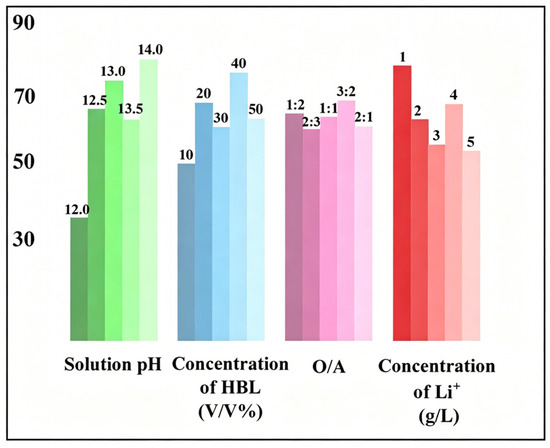
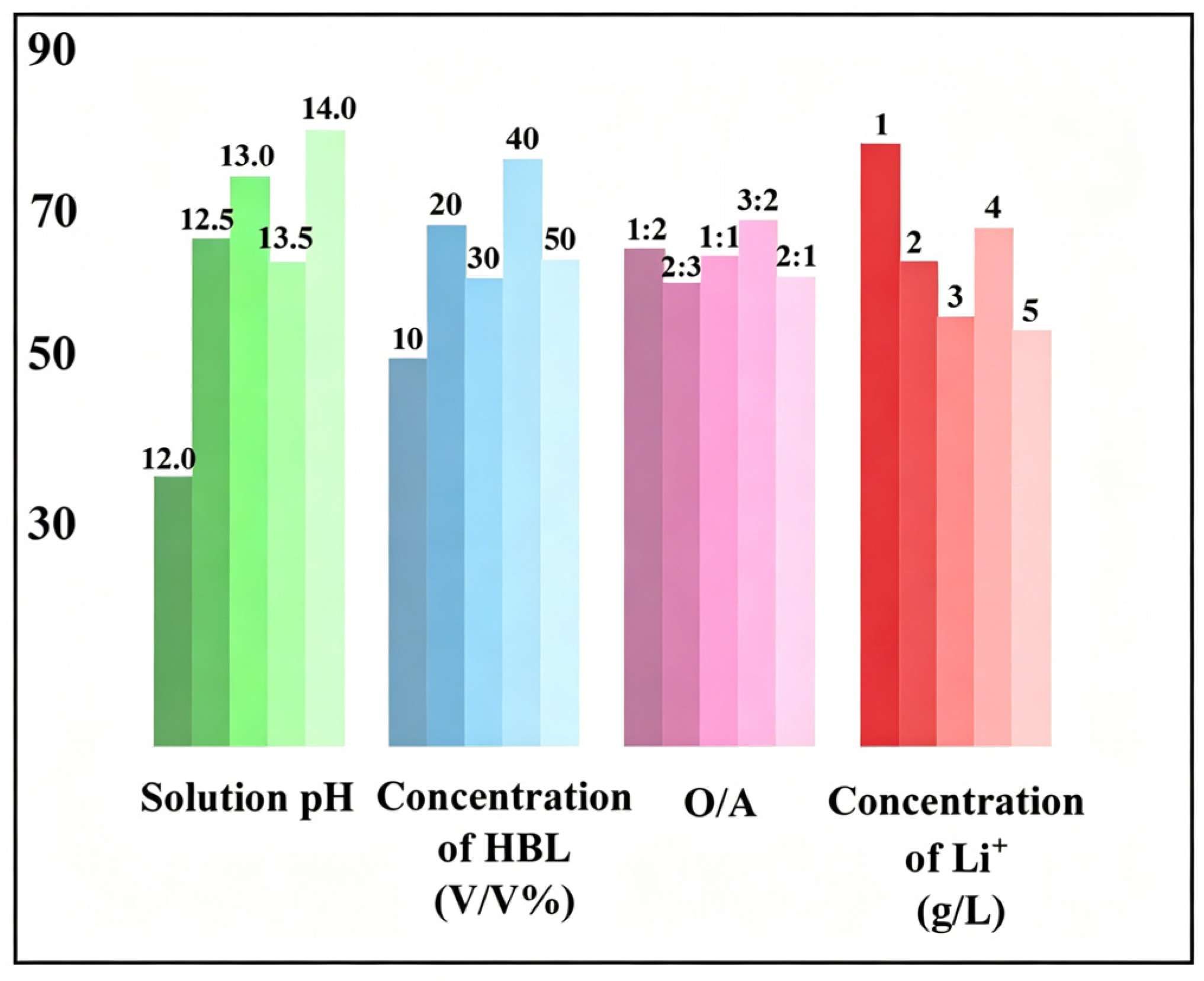
In the preferential lithium extraction process, orthogonal experiments were conducted to investigate the effects of initial solution pH, extractant concentration, phase ratio (O/A), and lithium ion concentration on the lithium extraction efficiency. The experimental conditions are shown in Table 2: the lithium ion concentration ranged from 1 to 5 g/L with a gradient of 1 g/L; the initial pH ranged from 12.0 to 14.0 with a gradient of 0.5; the phase ratio (O/A) ranged from 1:2 to 2:1, totaling 5 levels; and the extractant concentration ranged from 10% to 50% with a gradient of 10%. Ultimately, the optimal process conditions for preferential lithium extraction were determined through range analysis combined with single-factor experiments. In the range analysis, using the lithium extraction efficiency as the core evaluation indicator, the orthogonal experimental data were processed to calculate the mean response values of the extraction efficiency at different levels for each factor, thereby quantifying the influence patterns of different levels on the extraction performance. After completing the orthogonal experiments, the resulting effect plots are shown in Figure 1. Through range analysis, the extreme difference (range) R was used to evaluate the impact degree of the five experimental factors on the lithium extraction efficiency at different levels. The magnitude of the R value reflects the degree of influence of the factor level variation on the experimental results; a larger R value indicates a more significant impact, whereas a smaller R value implies a weaker influence. As shown in Table 2, the initial solution pH has the most significant impact on the lithium extraction efficiency, followed by the extractant concentration and lithium ion concentration, while the phase ratio (O/A) has the weakest effect. Therefore, the main factors influencing the lithium extraction efficiency in the extraction system are the initial solution pH (which directly determines the H+ activity of the system and regulates the shift direction of the extraction equilibrium) and the extractant concentration (which determines the complexation capacity of the organic phase and the limit of the extraction reaction). Provided that the distribution ratio D is sufficiently large, variations in the phase ratio have a minor impact on the extraction efficiency. To further optimize the experimental results, single-factor experiments were conducted based on the preliminary orthogonal experiments. The gradients of initial solution pH and extractant concentration were subdivided, and variables such as shaking extraction time and temperature were introduced to obtain more precise and efficient experimental conditions.
Table 2.
Orthogonal Test and Range Analysis Table.
Figure 1.
Design and Analysis of Orthogonal Experiment.
3.2. Effects of Various Factors on Lithium Extraction Performance
Under the conditions of an extraction system consisting of 30% (v/v) HBL121 and 70% (v/v) sulfonated kerosene, an O/A phase ratio of 1:1, a saponification degree of 0, and a stirring time of 5 min, the effect of the initial aqueous pH (12.0–14.0) on the lithium extraction performance of the HBL121 system was investigated. All loaded organic phases and raffinates were collected under the same standard conditions, and the raffinates were subsequently analyzed.
3.2.1. Effect of Initial Aqueous Phase pH
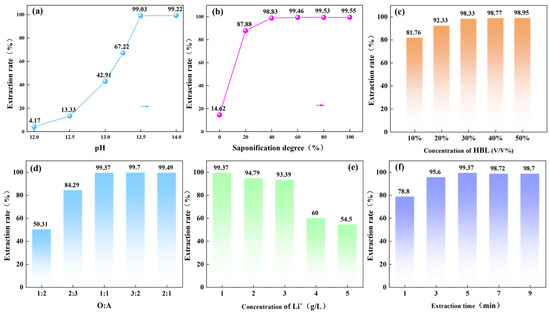
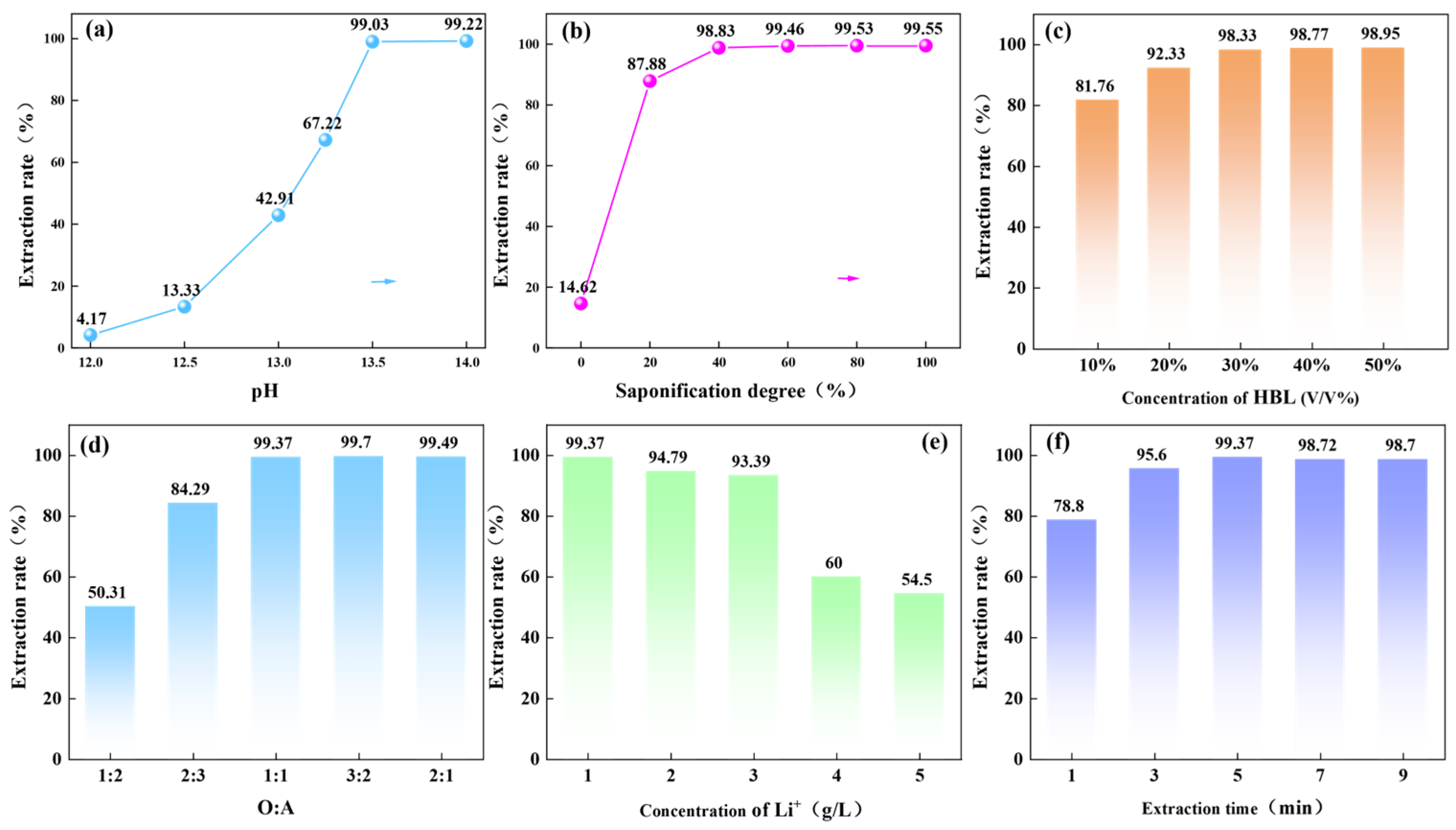
Figure 2a illustrates the effect of the initial aqueous pH on the lithium extraction performance. The results indicate that within the pH range of 12.0 to 14.0, the lithium extraction efficiency shows a distinct upward trend with increasing pH; a high pH enhances the coordination and solvation effects of the extractant, driving the extraction equilibrium forward. As the pH is further increased to 14.0, the extraction efficiency stabilizes at 99.2%, and the forward driving effect of pH on the extraction equilibrium approaches zero, indicating that the extraction capacity of the extractant is nearly saturated. Overall, a strongly alkaline environment is a prerequisite for achieving highly efficient lithium extraction in this system, with the optimal extraction pH range being above 13.5. Since such conditions are difficult to achieve in industrial applications, the organic phase must be saponified beforehand. The degree of saponification refers to the molar percentage of saponifiable groups that have undergone the saponification reaction relative to the total initial moles of saponifiable groups in the system.
Figure 2.
Effects of various factors on lithium extraction efficiency: (a) Initial aqueous phase pH; (b) Saponification degree; (c) Extractant concentration; (d) Initial lithium ion concentration; (e) Extraction ratio; (f) Extraction contact time.
3.2.2. Effect of Saponification Degree
Although the hydroxyl hydrogen of the extractant HBL121 is relatively active, it can only dissociate under alkaline conditions. Figure 2b explores the effect of varying saponification degrees on lithium extraction from a lithium solution at pH 11. The results demonstrate that at a saponification degree of 0%, the lithium extraction efficiency is only 14.6%, showing almost no obvious extraction effect. As the saponification degree increases, the lithium extraction efficiency rises rapidly, reaching 87.9% at a saponification degree of 20% and 98.8% at 40%. When the saponification degree is further increased to 60%, 80%, and 100%, the extraction efficiencies are 99.5%, 99.5%, and 99.6%, respectively, gradually stabilizing and approaching 100%.
This phenomenon indicates that under non-alkaline conditions, the hydroxyl hydrogen in the extractant cannot undergo an effective exchange reaction with lithium ions; only under alkaline conditions do sodium ions replace the hydroxyl hydrogen in the enol structure of the extractant, thereby promoting the conversion of more diketone structures into enol forms and generating more exchangeable hydroxyl hydrogens. A higher saponification degree results in the formation of more Na·HBL121 from sodium and the extractant. When the Na·HBL121 in the organic phase contacts lithium ions in the aqueous phase under low water activity conditions, because the Pearson hardness of lithium ions is higher than that of sodium ions, the coordination bond with the oxygen-containing extractant is stronger, enabling the formation of a more stable complex. Furthermore, the ionic radius of lithium is smaller than that of sodium, and the Li-O bond length in the complex is shorter than the Na-O bond length; therefore, the Li-extractant complex is more stable.
3.2.3. Effect of Extractant Concentration
With the phase ratio fixed at 1:1, the extraction efficiency was determined by varying the volume ratio of the extractant to sulfonated kerosene (0–100%). Figure 2c illustrates the lithium extraction process from the lithium solution when the HBL121 concentration is varied within a specific dilution range. The results show that the lithium extraction efficiency exhibits an upward trend with increasing HBL121 concentration. However, when the HBL121 concentration increases from 30% (v/v) to 50% (v/v), the viscosity of the organic phase increases and its fluidity with the aqueous phase deteriorates; this not only reduces the reaction contact area but also slows down the phase separation rate, resulting in marginal improvements in extraction efficiency. Although a high concentration of extractant favors lithium extraction, considering the economic cost of the extractant, a volume concentration of 30% (v/v) HBL121 was adopted as the optimal extraction concentration in this study.
3.2.4. Effect of Initial Lithium Concentration
Figure 2d explores the influence of varying initial lithium concentrations on the lithium extraction performance. The results show that when the Li+ concentration is less than 3 g/L, the lithium extraction efficiency gradually decreases with increasing initial aqueous Li+ concentration, while the amount of loaded lithium in the organic phase gradually increases. At a Li+ concentration of 1 g/L, the extraction efficiency reaches 99.4%, with an organic phase lithium loading of 0.99 g/L; at 3 g/L, the extraction efficiency is 93.4%, and the lithium loading increases to 2.80 g/L. As the Li+ concentration further increases to 4 g/L, the extraction efficiency sharply drops to 60%, and the lithium loading correspondingly decreases to 2.40 g/L; at 5 g/L, the extraction efficiency further drops to 54.5%, while the loading slightly rebounds to 2.73 g/L, but remains lower than the peak value at 3 g/L. This is because the extracted complex formed by the extractant and Li+ in this system possesses a specific coordination structure; as the Li+ concentration increases, the effective coordination sites of the extractant are gradually occupied, and steric hindrance effects are enhanced. Once the Li+ concentration exceeds the saturation capacity of the extractant, the extraction efficiency significantly declines, and the loading amount decreases accordingly.
3.2.5. Effect of Phase Ratio (O/A)
To maximize lithium extraction and enhance the separation effect, different organic-to-aqueous phase ratios were tested. Figure 2e shows the effect of the phase ratio on lithium extraction performance. The results indicate that as the organic-to-aqueous phase ratio (O/A) increases from 1:2 to 2:1, the effective capacity of the extractant is substantially enhanced, which improves the mass transfer driving force and contact efficiency, thereby pushing the reversible extraction equilibrium forward. The lithium extraction efficiency increases significantly from 50.3% to 99.5%, demonstrating that HBL121 possesses a remarkable extraction capacity for lithium. A lower O/A ratio is unfavorable for lithium extraction, whereas a higher O/A ratio helps improve the extraction efficiency but may lead to reduced organic phase utilization and cause waste. Therefore, taking into account the economic cost of the extractant, an O/A ratio of 1:1 was selected as the operating phase ratio in subsequent experiments.
3.2.6. Effect of Extraction Time
Figure 2f investigates the effect of different extraction contact times (1–9 min) on the lithium extraction efficiency. The results show that as the extraction time is extended from 1 min to 5 min, the lithium extraction efficiency rapidly increases from 78.8% to 99.4%, indicating that the extraction kinetics govern the reaction rate during this stage. When the extraction time exceeds 5 min, the lithium extraction efficiency remains basically stable (98.7–99.4%) with only minor fluctuations. This phenomenon can be attributed to the fact that the extraction reaction essentially reaches thermodynamic equilibrium at 5 min, and further extending the time has no significant enhancement effect on the extraction efficiency. The minor variations in extraction efficiency observed after 5 min (98.7–99.4%) fall within the experimental margin of error (±0.5%), indicating that the extraction equilibrium has been effectively reached and no significant further change occurs [28].
3.2.7. Parallel Experiments and Selectivity Under Multi-Ion Conditions
To confirm the reproducibility of the optimized conditions and evaluate the separation performance in the presence of competing ions, three parallel extraction experiments were conducted using simulated real lithium-containing wastewater from urban mines with the following composition: Li+ 1.07 g/L, Na+ 51.1 g/L, K+ 1.41 g/L, Mg2+ 0.0185 g/L, Ca2+ 0.027 g/L (Na+/Li+ mass ratio ≈ 48). Other extraction conditions: equilibrium pH 11.0, organic phase composition 30% (v/v) HBL121 and 70% (v/v) sulfonated kerosene, O/A = 1:1, contact time 5 min, room temperature. All aqueous samples were filtered through a 0.45 μm hydrophilic membrane filter to remove colloidal particles before ICP-OES analysis. The results are presented in Table 3.
Table 3.
Parallel experiments on solvent extraction of lithium.
The average lithium extraction efficiency was 99.1% ± 0.1% (SD, n = 3), confirming excellent reproducibility. The separation factors followed the order β(Li/Mg) > β(Li/Ca) > β(Li/K) > β(Li/Na). The high β(Li/Mg) (5197) and β(Li/Ca) (3783) are attributed to the complete alkaline hydrolysis of Mg2+ and Ca2+, which prevents their extraction into the organic phase. It is important to clarify the scope of this study: the feed solution investigated specifically simulates the alkaline leaching-washing wastewater generated from the preferential lithium extraction process of spent lithium iron phosphate (LFP) batteries. Due to the inherent characteristics of the LFP battery recycling process—where Fe and P are quantitatively precipitated as iron phosphate during the initial alkaline leaching stage—the actual industrial wastewater contains negligible concentrations of transition metal ions such as Ni2+, Co2+, Mn2+, Al3+, and Cu2+. This compositional feature has been widely confirmed in previous industrial practice and academic research on LFP battery recycling [29].
For lithium-containing wastewater generated from ternary lithium battery recycling (which contains higher concentrations of transition metal ions), our preliminary theoretical analysis based on metal hydroxide solubility products indicates that under the strongly alkaline extraction conditions (pH > 11) employed in this study, these metal ions will undergo complete hydrolysis to form insoluble hydroxides, similar to Mg2+ and Ca2+. This “passive precipitation” mechanism is expected to effectively immobilize them in the aqueous phase, preventing their co-extraction and potential interference with lithium selectivity. However, a systematic experimental verification of the extraction behavior of these transition metal ions under different concentration conditions is beyond the scope of the present study and will be comprehensively investigated in our subsequent research work. For comparison, under their respective optimal operating conditions, the β(Li/Na) value of 1026 achieved in this work is substantially higher than those reported for the TBP-FeCl3 system (β ≈ 120, acidic chloride media) and the HBTA/TOPO system (β ≈ 50). The high β(Li/K) value of 2191 is attributed to the lower Pearson hardness of K+ (η = 17.8 eV) compared to Na+ (η = 21.1 eV), resulting in even weaker coordination ability with the oxygen-containing extractant. The β(Li/Na) value arises from the higher Pearson hardness of Li+ (η = 35.1 eV vs. 21.1 eV for Na+) and the formation of a stable bidentate chelate. Trace heavy metal ions (such as As, Cd, and Pb) that may be present in battery recycling wastewater are expected to have a negligible impact on lithium extraction under the strongly alkaline conditions employed, as they would undergo hydrolysis and precipitation similarly to Mg2+ and Ca2+.
Mass balance verification was performed for all major cations. The results are summarized in Table 4.
Table 4.
Results of the mass balance calculation.
Values below the detection limit of ICP-OES (0.01 mg/L) are indicated as <0.01. All aqueous samples were filtered through a 0.45 μm membrane filter to remove colloidal particles before analysis. Mass balance error (%) = |Total − Feed|/Feed × 100%. The relative standard deviation (RSD) of the ICP-OES measurements was within 2% for Li, Na, and K, and within 5% for Mg and Ca at their respective concentration levels.
All mass balance errors were below 5%, which is within the acceptable range for solvent extraction experiments, confirming the internal consistency and reliability of the experimental data.
The excellent selectivity achieved under high Na/Li ratio (~48) and complex impurity conditions demonstrates that this process can directly treat real lithium-containing wastewater from urban mines without pre-separation of alkali metals and heavy metals. Compared with traditional multi-step impurity removal processes, this one-step extraction and impurity removal technology reduces the number of core unit operations by 30% (from 10 to 7), eliminating the acidification, FeCl3 co-extractant addition, and iron slag removal steps required by the TBP-FeCl3 system [30].
3.3. Thermodynamic Analysis and Extraction Isotherms
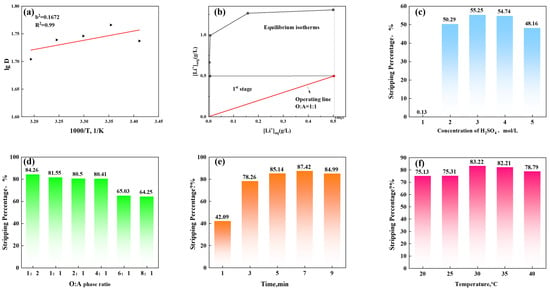
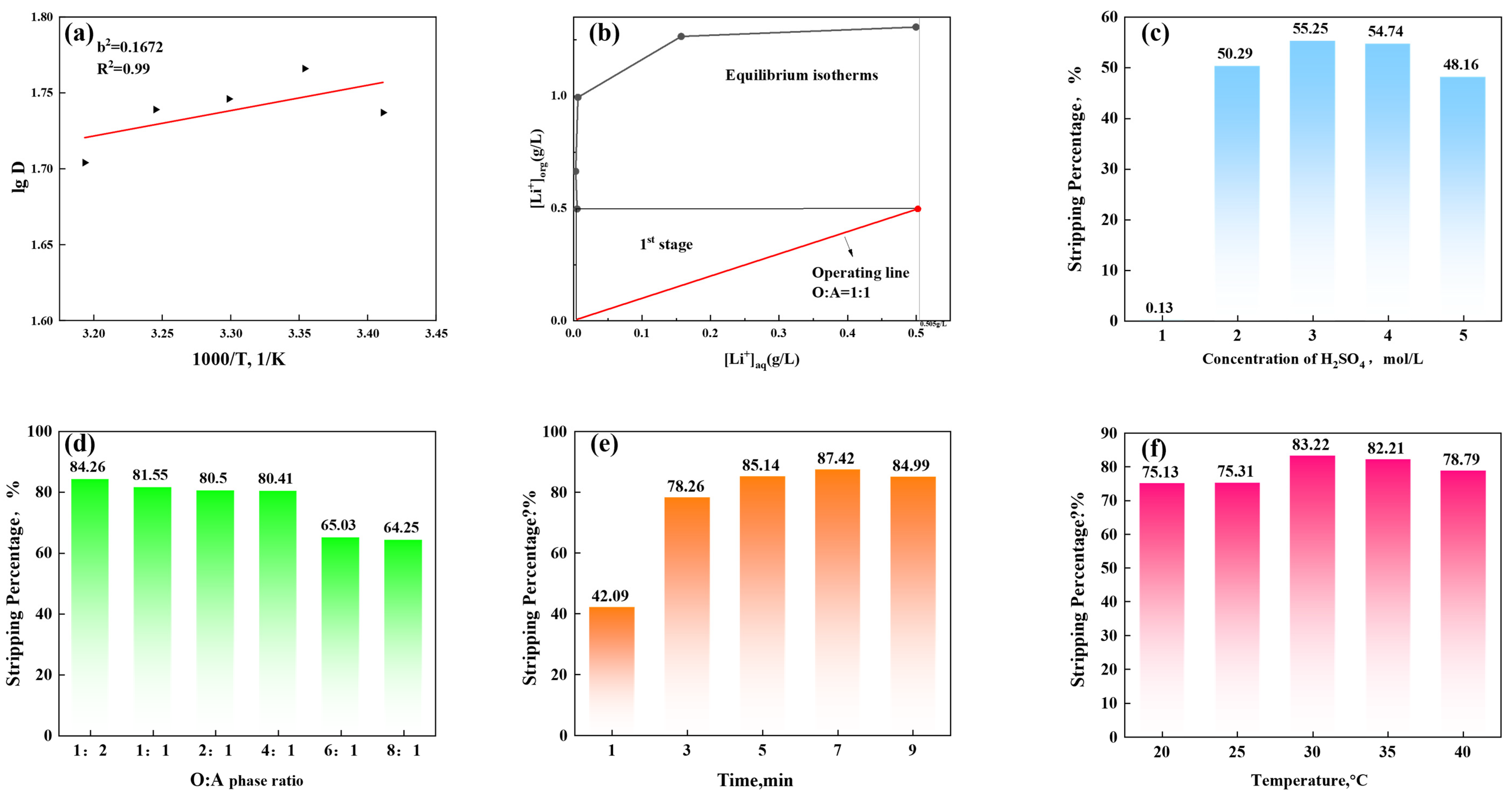
Figure 3a illustrates the effect of temperature on the efficiency of lithium ion extraction from the aqueous phase by HBL121, investigated using a constant-temperature water bath in the range of 293–333 K at an equilibrium pH of 13.5. The results indicate that the lithium extraction efficiency of this system varies little across the temperature range. The enthalpy change (ΔH) during the extraction process can be determined from the slope of the plot of lg D versus 1000/T (K−1) using the van’t Hoff equation:
where D denotes the distribution ratio of lithium between the organic and aqueous phases, R represents the universal gas constant (8.314 J·mol−1·K−1), T is the absolute temperature (K), and C is a temperature-related constant. In this study, it is assumed that the integration constant remains constant at a specific temperature under the experimental conditions.
Figure 3.
(a) Plot of lg D versus 1000/T; (b) Lithium ion extraction McCabe-Thiele diagram; Effects of various factors on lithium stripping efficiency: (c) Sulfuric acid concentration; (d) Stripping ratio; (e) Stripping contact time; (f) Stripping temperature.
The enthalpy change in the extraction system was determined to be −3.2 kJ·mol−1, indicating that the extraction reaction is exothermic, which means lithium extraction can be performed at lower temperatures. Considering that the organic phase exhibits poor fluidity and is difficult to separate at low temperatures, subsequent experiments were conducted at room temperature (293 K). The total enthalpy change during the solvent extraction process is the sum of multiple factors, including: the deprotonation transition of the acidic phosphorus-based extractant (H2A); the dehydration of Li(H2O)ₙ+; the formation of a chelate complex between Li+ and the deprotonated extractant ligand; the dissolution and transfer of the extracted chelate complex into the organic phase; and the rearrangement of molecules within the organic phase to accommodate the stable configuration of the chelate complex.
The changes in Gibbs free energy and entropy were calculated using the following equation:
The lg D values were calculated from the formula. The measured ΔG value, calculated from the mean lg D of triplicate measurements at 293 K, was −10.1 ± 0.1 kJ·mol−1 (95% Confidence Interval). The negative value indicates that the lithium extraction reaction is spontaneous, favoring complexation and extraction. The calculated ΔS value was 34 ± 3 J·mol−1·K−1, and the positive value indicates an increase in disorder during the extraction process.
Under the optimal conditions, the results are presented in the form of an extraction distribution isotherm in Figure 3b. Based on the initial water phase concentration of the single-stage extraction under the optimal extraction conditions and the target concentration of the raffinate solution, the operating point is determined and the operating line is drawn (the slope is the reciprocal of the ratio O:A, which is 1 under the experimental conditions). The steps between the operating line and the extraction isothermal line are the theoretical extraction stages.The results show that the single-stage extraction effect of HBL121 for Li+ is highly significant, with the single-stage extraction efficiency reaching 99%.
3.4. Effects of Various Factors on Lithium Stripping Performance
Sulfuric acid was selected as the stripping agent because the divalent sulfate anion (SO42−) does not form extractable complexes with HBL121, ensuring that the stripping equilibrium is governed solely by H+-Li+ cation exchange. In addition, H2SO4 is inexpensive, industrially available, and compatible with standard stainless-steel equipment at concentrations below 4 mol/L. Figure 3c illustrates the effect of stripping agent concentration on the lithium stripping efficiency at a fixed phase ratio of 1:1. The results indicate that as the sulfuric acid concentration increases, the overall lithium ion stripping efficiency first increases rapidly and then gradually decreases: when the sulfuric acid concentration increases from 1 mol/L to 3 mol/L, the stripping efficiency sharply rises from 0.1% to 55.3%. This is mainly because the increased hydrogen ion concentration significantly enhances the driving force for the substitution reaction between Li+ and H+, effectively promoting the transfer of Li+ from the loaded organic phase to the aqueous phase. When the concentration further increases to 4 mol/L, the stripping efficiency drops slightly to 54.7%, and the upward trend plateaus, indicating that the system is approaching reaction equilibrium. When the concentration is further raised to 5 mol/L, the stripping efficiency noticeably drops to 48.2%. This decline is attributable to the substantially increased ionic strength of the aqueous phase at higher H2SO4 concentrations, which reduces the activity coefficient of Li+ and diminishes its driving force for transfer from the organic phase. Simultaneously, progressive protonation of HBL121 molecules under high acidity weakens the interfacial mass transfer efficiency and compromises phase disengagement behavior, ultimately inhibiting the overall stripping performance. The inability to achieve higher stripping efficiency at elevated H2SO4 concentrations (>3 mol/L) can be attributed to three interrelated factors. First, the stripping reaction approaches thermodynamic equilibrium at approximately 3 mol/L H2SO4, beyond which the driving force for H+-Li+ cation exchange is no longer the rate-limiting factor. Second, excessively high H2SO4 concentrations sharply increase the ionic strength of the aqueous phase, reducing the activity coefficient of Li+ and thus diminishing its effective driving force for transfer from the organic phase. Simultaneously, high acidity induces progressive protonation of HBL121 molecules in the organic phase, weakening the interfacial mass transfer efficiency. Third, H2SO4 concentrations above 4 mol/L sharply increase the ionic strength of the aqueous phase and induce progressive protonation of HBL121, both of which weaken the thermodynamic driving force for Li+ transfer and compromise phase disengagement, further reducing stripping efficiency. To extend the operable H2SO4 concentration range, the addition of a phase modifier such as 5% (v/v) isodecanol or TBP could be considered to suppress acid-induced emulsification and stabilize the organic phase; however, for the present system, 3.0 mol/L H2SO4 provides the optimal balance between stripping efficiency, extractant stability, and operational practicality. Taking into account the stripping efficiency, system stability, and operational feasibility, 3 mol/L H2SO4 was determined as the optimal stripping agent concentration. It should be noted that the 55.3% single-stage stripping efficiency obtained at O/A = 1:1 reflects the thermodynamic equilibrium limitation under this specific phase ratio, rather than an inherent deficiency of the acid concentration. Once the optimal H2SO4 concentration was established, the O/A ratio was subsequently optimized with the acid concentration fixed at 3 mol/L.
With the H2SO4 concentration fixed at the optimal value of 3 mol/L, the effect of the stripping phase ratio on lithium stripping efficiency was investigated. Figure 3d shows the effect of the stripping phase ratio on the lithium stripping efficiency at a fixed sulfuric acid concentration of 3 mol/L. Stripping experiments were conducted within an O/A phase ratio range of 1:2 to 8:1. As can be seen from the experimental results, the stripping efficiency of lithium ions exhibits a slowly declining trend with an increasing organic-to-aqueous phase (O/A) ratio. In the stage where O/A increases from 1:2 to 4:1, the stripping efficiency only slightly drops from 84.3% to 80.4%, remaining at a relatively high level; significant declines in efficiency only occur when the O/A ratio is further increased. This is because, at an O/A ratio of 4:1, although the increased proportion of the organic phase only exerts a slight impact on the stripping efficiency, it can significantly reduce the volume of organic phase required, thereby substantially lowering the procurement and recovery costs of the organic phase. Meanwhile, under this phase ratio, the system can still maintain good fluidity and mass transfer efficiency without obvious phase separation issues. To effectively control the cost of the organic phase while ensuring a high stripping efficiency, a phase ratio of 1:4 was selected as the appropriate stripping phase ratio to achieve an optimal balance between efficiency and cost.
Figure 3e displays the effect of stripping contact time on the lithium stripping efficiency, investigated at a fixed sulfuric acid concentration of 3 mol/L and an A/O phase ratio of 1:4. The stripping contact time experiments were conducted within the range of 1 to 9 min. The results indicate that as the contact time is extended from 1 min to 7 min, the lithium ion stripping efficiency gradually increases from 42.1% to 87.4%. However, when the time is further extended to 9 min, the stripping efficiency drops slightly to 85.0%. This phenomenon demonstrates that prolonging the contact time in the initial stage can effectively promote the mass transfer reaction of lithium ions between the organic and aqueous phases, thereby improving the stripping efficiency. However, once the reaction approaches equilibrium, further extending the contact time provides no additional improvement in stripping efficiency and may result in a slight decrease due to minor side reactions or operational variations. Comprehensively considering the stripping efficiency and time cost, 7 min is a more suitable stripping contact time, ensuring a relatively high stripping efficiency while avoiding the adverse effects of excessively long durations.
Figure 3f illustrates the effect of stripping temperature on the lithium stripping efficiency at a fixed sulfuric acid concentration of 3 mol/L, an A/O phase ratio of 1:4, and a contact time of 7 min, with stripping temperatures ranging from 20 to 40 °C. It is observed from the figure that within the range of 20 to 40 °C, the effect of an increase in temperature on the lithium ion stripping efficiency is relatively mild, with the overall stripping efficiency maintained within the range of 75% to 84%, with a marginal maximum at 30 °C. To facilitate experimental operations and avoid the additional energy cost of heating, the entire stripping process was conducted at room temperature.
In addition to transferring Li+ into the aqueous phase, the stripping reaction simultaneously protonates the extractant, converting NaHA back to its active H2A form and thereby regenerating the organic phase for subsequent extraction cycles.
3.5. Stripping Isotherms and Multi-Stage Countercurrent Stripping
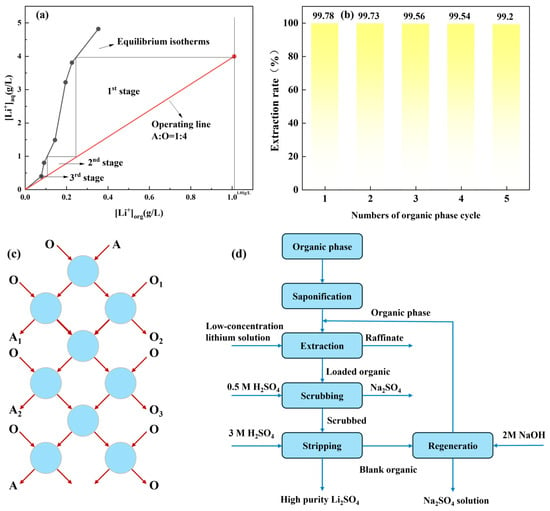
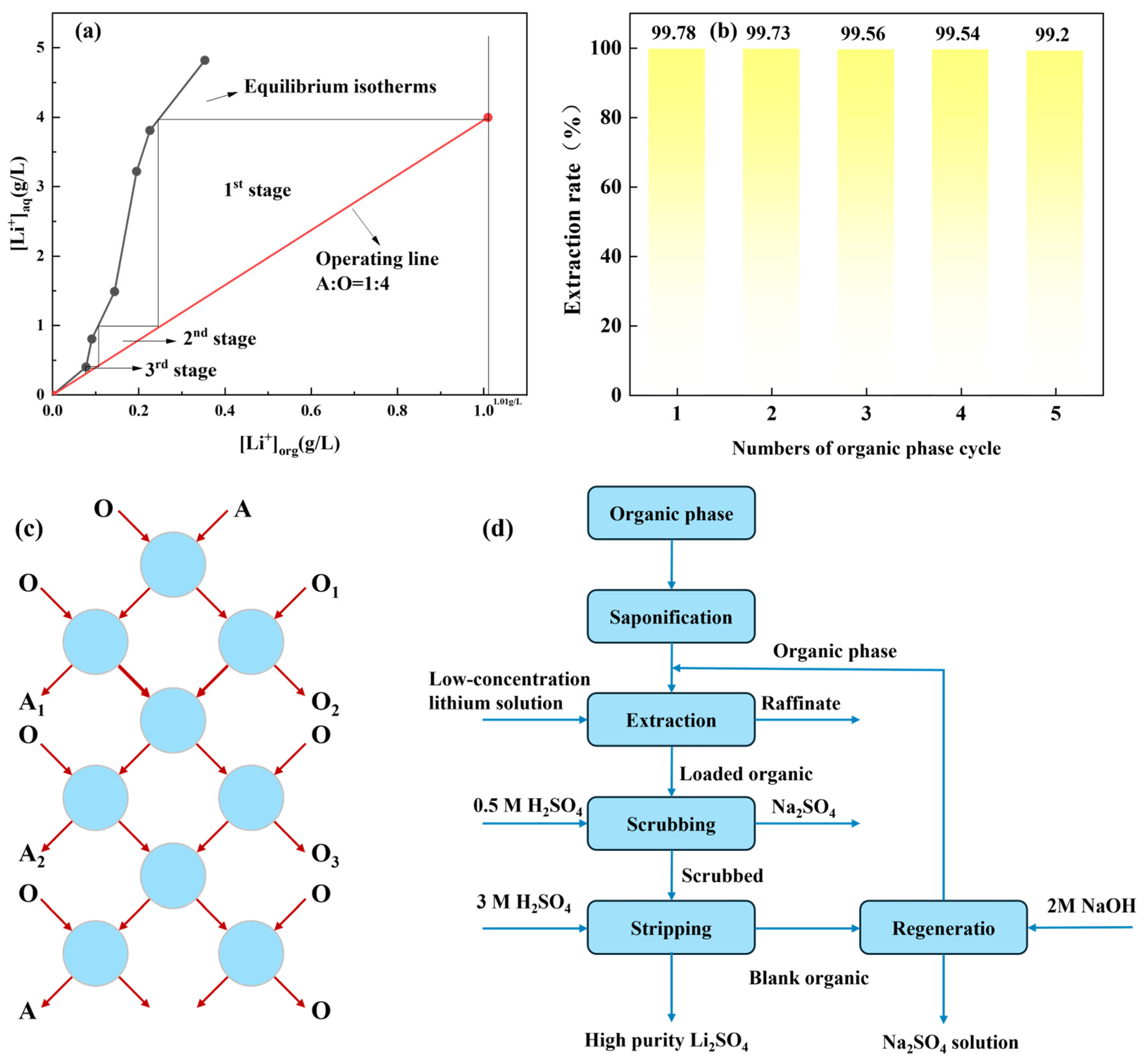
Using 3.0 mol/L H2SO4 for lithium stripping at an A/O phase ratio of 1:4, the results are presented in the form of stripping isotherms in Figure 4a. The results show that the quantitative stripping of lithium ions requires three stripping stages, with an operating A/O phase ratio of 1:4.
Figure 4.
(a) McCabe-Thiele diagram for lithium ion stripping; (b) Cyclic extraction-stripping performance of regenerated HBL121 over five consecutive cycles; (c) Schematic diagram of three-stage countercurrent stripping; (d) Process flow diagram of the HBL121-based extraction-stripping cycle. All contacting operations shown are single-stage.
To verify the above prediction, a simulated three-stage countercurrent stripping study was conducted at an A/O ratio of 1:4 (Figure 4c), and the lithium ion content in the stripping solution was analyzed. The residual lithium ion concentration in the loaded organic phase was calculated to be 5.36 mg/L using mass balance, and the total stripping efficiency of lithium ions in the three-stage countercurrent stripping process reached 99.5%.
3.6. Recycling Performance of the Extractant and Process Flowchart
The regenerability and cyclic stability of the HBL121-sulfonated kerosene system were evaluated over five consecutive extraction-stripping cycles under the optimized conditions. The regenerated, unloaded organic phase was mixed with the feed solution at an O/A phase ratio of 1:1, and the unloaded, acidified organic phase was reused in the subsequent extraction-stripping cycle (Figure 4d). The lithium extraction efficiency over five cycles is shown in Figure 4b.
As shown in Figure 4b, the lithium extraction efficiency remained above 99% throughout all five cycles, declining only slightly from 99.37% (cycle 1) to 99.05% (cycle 5). The per-cycle efficiency loss was consistently below 0.1%, and the cumulative efficiency loss after five cycles was only 0.32%, demonstrating the excellent chemical stability and reusability of the extractant. The stripping efficiency remained stable at 87.4% ± 0.5% across cycles, with the residual lithium concentration in the stripped organic phase after the fifth cycle (5.42 mg/L) comparable to that after the first (5.36 mg/L), confirming complete reversibility of the extraction-stripping process.
This negligible performance decline is attributable to the extremely low aqueous solubility of HBL121 and its high resistance to hydrolysis under both alkaline extraction and acidic stripping conditions. The per-cycle extractant make-up measured in this work is below 0.1%. By contrast, TBP exhibits an aqueous solubility of 380–420 mg/L in pure water [31] and >100 mg/L even in concentrated acidic media [32], which together with droplet entrainment and acid-induced hydrolysis translates to a typical industrial replenishment rate of 1–5% per cycle in TBP-FeCl3 flowsheets [33]. The HBL121 system therefore requires at least 20 times less make-up extractant.
Combined with the elimination of the FeCl3 co-extractant and the use of low-cost H2SO4 as the stripping agent, this excellent recyclability and low extractant consumption confirm the strong economic potential of the HBL121 system for industrial-scale lithium recovery from urban-mine wastewater.
3.7. Reaction Mechanism
In alkaline environments, impurity ions (such as Mg2+ and Ca2+) in the lithium solution undergo complete hydrolysis to form hydroxide precipitates or water-soluble hydroxyl complexes, preventing them from binding to the extractant. Meanwhile, Li+ remains in a free state and is selectively extracted. This “passive removal” of impurities indirectly enhances the extraction purity and apparent extraction efficiency of lithium, which is also the core reason why this system can achieve “alkaline lithium extraction and impurity removal in a single step” in industry [34]. Beyond end-of-life battery recycling, the manufacturing of cathode active materials also generates substantial volumes of alkaline washing wastewater containing low-concentration lithium. This represents another significant secondary lithium stream that current technologies struggle to treat cost-effectively due to similar complexities in water quality. Based on the aforementioned experimental results, slope analysis, Fourier transform infrared (FT-IR) spectroscopy, and electrospray ionization mass spectrometry (ESI-MS) were utilized to determine the mechanism of lithium extraction by HBL121.
3.7.1. Stoichiometric Analysis by the Slope Method
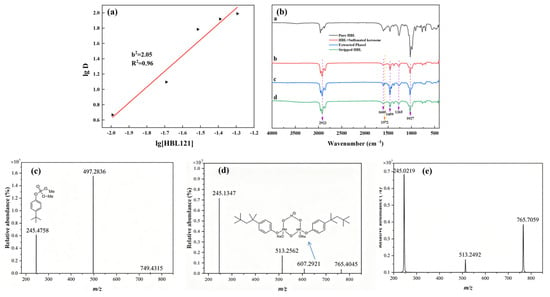
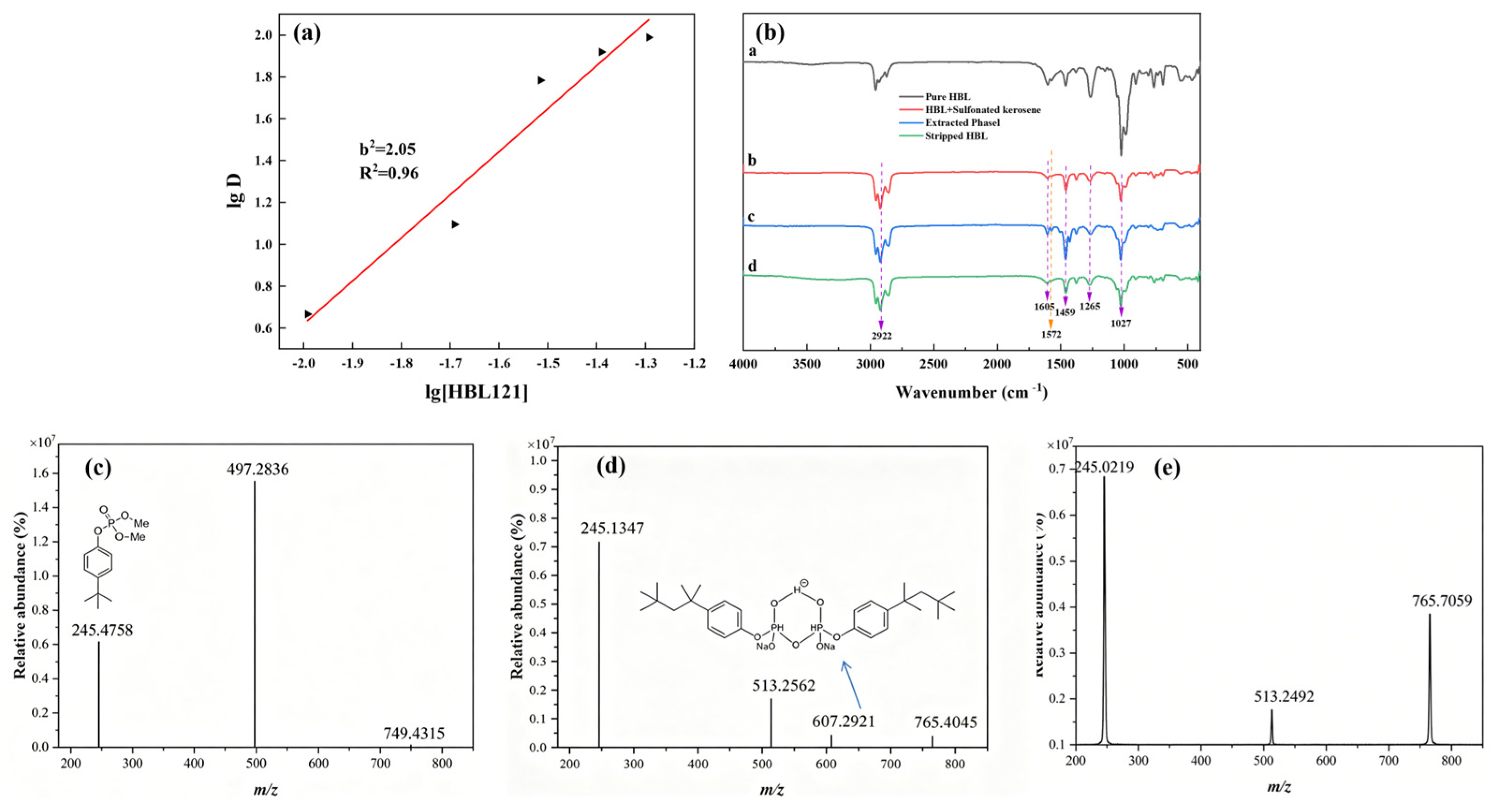
To establish the stoichiometry of the extracted Li+-HBL121 complex, the distribution ratio D was determined as a function of extractant concentration over the range 0.1–0.5 mol/L, while maintaining constant saponification degree (40%), phase ratio (O/A = 1:1), and temperature (293 K). A plot of lg D versus log [HBL121] yields an excellent linear correlation (R2 = 0.96) with a slope of 2.1 ± 0.1 (n = 5 concentration levels) (Figure 5a). This value, coincident with the integer 2 within experimental error, demonstrates that two HBL121 molecules coordinate one Li+ ion in the extracted complex.
Figure 5.
Stoichiometric and spectroscopic characterization of the HBL121-lithium extraction mechanism: (a) Relationship diagram between lg D and lg[HBL121]; (b) FT-IR spectrum of the organic phase; (c) ESI-MS spectrum of pure HBL121; (d) ESI-MS spectrum of lithium-loaded organic phase; (e) MS/MS spectrum of the loaded organic phase.
Combining this stoichiometric result with mass balance and charge neutrality considerations, the extraction reaction under saponified conditions is expressed as:
where H2A denotes HBL121 (4-(2,4,4-trimethylpentan-2-yl)phenyl dihydrogen phosphate), and NaHA represents its mono-sodium salt formed during saponification. The displacement of two protons per extracted Li+ is consistent with the mono-deprotonated nature of the acidic organophosphorus extractant under saponified conditions.
Li+ (aq) + 2 NaHA (org) ⇌ [LiNa2A2]− (org) + 2 H+ (aq)
3.7.2. Spectroscopic and Mass Spectrometric Verification
1. FT-IR spectroscopy. Figure 5b compares the FT-IR spectra of the lithium-loaded organic phase with those of the blank organic phase. After extraction, a new characteristic absorption band emerges at 1572 cm−1, which is assigned to the P-O−⋯Li+ coordination bond resulting from dissociation of the P-OH group. Simultaneously, the P=O stretching band shifts from 1269 cm−1 to 1265 cm−1, confirming that the phosphoryl oxygen participates in Li+ coordination. Based on analogy with the well-established IR assignments for metal β-diketonate chelates, where the C=O stretching band in the chelate ring appears in the 1500–1600 cm−1 region [35], this 1572 cm−1 band is assigned to a coupled chelate-ring stretching mode with predominant P-O−⋯Li+ character. Crucially, the aromatic C=C skeletal vibration at 1605 cm−1 appears in both the blank and the lithium-loaded organic phases, confirming that the 1572 cm−1 band is a distinct chelate-ring vibrational feature rather than an aromatic C=C stretching mode [36].
2. ESI-MS analysis. High-resolution electrospray ionization mass spectrometry in negative-ion mode of the loaded organic phase reveals a prominent peak at m/z = 607.2921 (Figure 5d), which matches the anionic complex [LiNa2(C28H44O7P2)]− (calculated m/z = 607.2934, mass error < 2.2 ppm). Tandem mass spectrometry (MS/MS) using m/z 607.2921 as the precursor ion generates fragment ions fully consistent with the proposed bis-phosphonate chelate structure (Figure 5e), further corroborating the structural assignment.
3. Alkaline impurity passivation. Under the strongly alkaline extraction conditions (pH > 11), impurity ions such as Mg2+ and Ca2+ undergo complete hydrolysis, forming insoluble hydroxide precipitates or soluble hydroxyl-complexes that are confined to the aqueous phase and cannot coordinate with the organic-phase extractant. Concurrently, Li+ remains fully hydrated in its free ionic form and is selectively extracted. This alkaline-hydrolysis-driven passive impurity removal indirectly enhances the extraction purity and apparent extraction efficiency, and is the fundamental reason why the HBL121 system enables one-step alkaline lithium extraction with simultaneous impurity separation—a critical advantage for practical industrial application.
4. Discussion
4.1. Mechanism Discussion
The extraction of lithium by HBL121 proceeds via a coordination-ion exchange synergistic mechanism comprising two distinct but coupled steps.
Step 1—Cation exchange. Upon saponification, the organic phase is enriched with NaHA. When contacted with the lithium-containing aqueous phase, Li+ undergoes cation exchange with Na+ bound to the extractant, thereby entering the organic phase. The thermodynamic driving force for this exchange originates from the Pearson hardness difference between the two cations: Li+ (η = 35.1 eV) is substantially harder than Na+ (η = 21.1 eV), endowing it with a stronger affinity for the oxygen donor atoms of the extractant. The negative Gibbs free energy change (ΔG = −10.1 kJ·mol−1) confirms the thermodynamic spontaneity of this exchange.
Step 2—Chelation coordination. Once transferred to the organic phase, Li+ coordinates with two deprotonated HBL121 molecules. Each ligand provides two oxygen donor sites—the phosphoryl oxygen (P=O) and the anionic oxygen (P-O−)—forming a bidentate five-membered chelate ring with the lithium center. This chelation generates the stable anionic bis-phosphonate complex identified as [LiNa2(C28H44O7P2)]−. The negative charge of this anionic complex is balanced within the organic phase by abstracting an additional proton from the aqueous phase, yielding the electroneutral parent species HLiNa2(C28H44O7P2) identified by ESI-MS. During acid stripping, this proton is exchanged back, regenerating HBL121 and releasing Li+, thereby closing a fully reversible extraction--stripping cycle. This substantially enhanced thermodynamic stability is the principal reason for the exceptional selectivity of HBL121 for Li+ over Na+, even in high-salinity systems where sodium is present at over a hundred-fold excess [37].
In summary, the extraction of lithium by HBL121 is best described as a coordination-ion exchange synergistic mechanism: an initial thermodynamically favorable cation exchange drives Li+ from the aqueous phase into the organic phase, followed by bidentate chelation with two extractant ligands to yield a highly stable, electroneutral complex. This dual-step mechanism simultaneously accounts for the high distribution ratio and the superior Li+/Na+ selectivity observed experimentally.
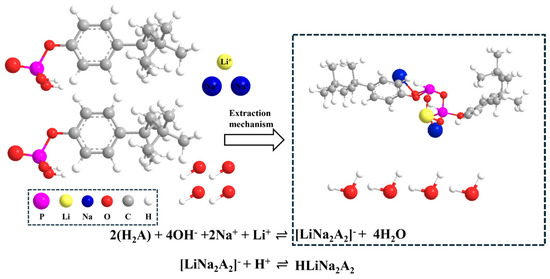
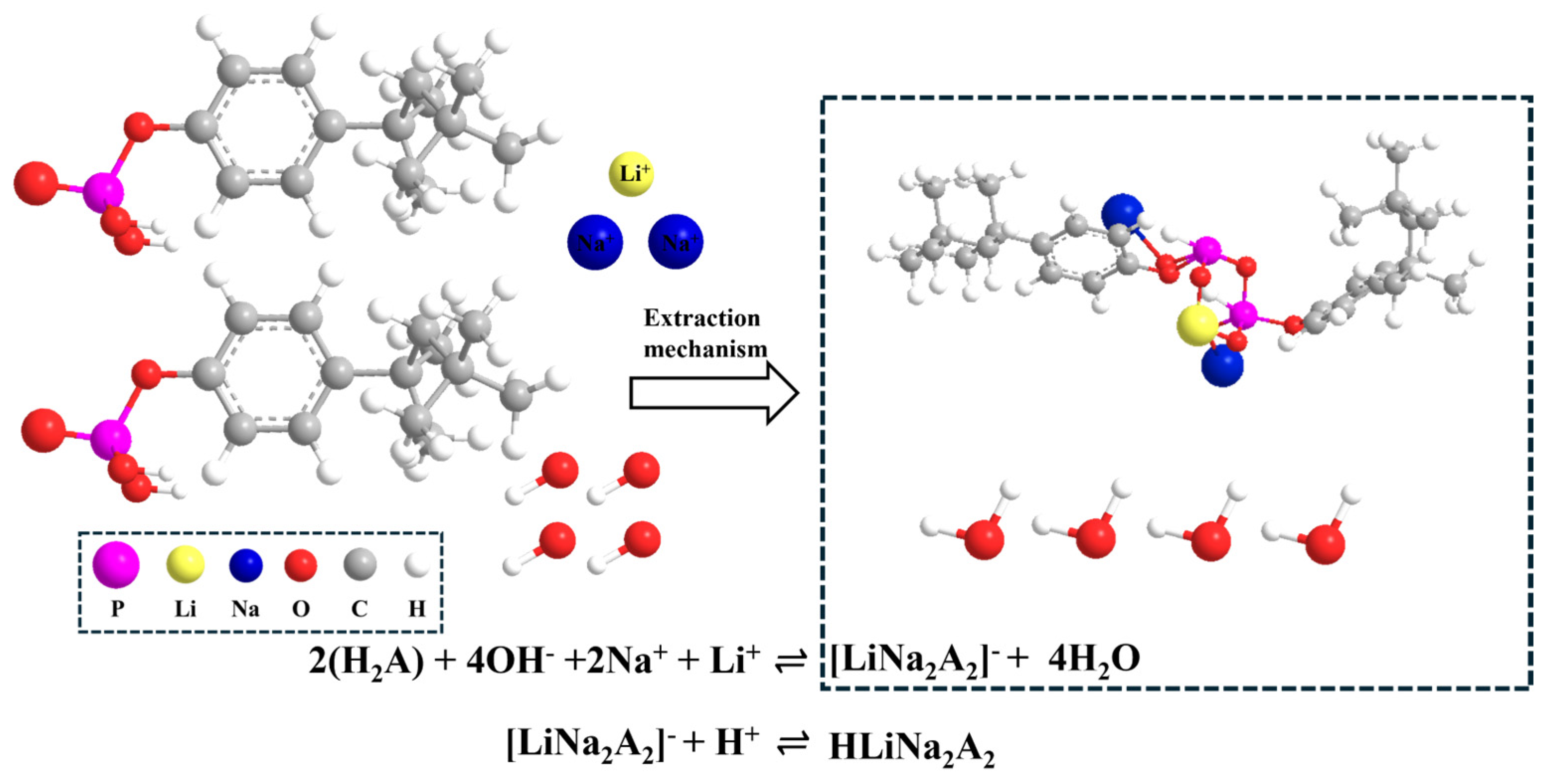
Therefore, combining the analyses of the pure extractant, the extracted organic phase, and the MS/MS spectra, the extractable complex of lithium and sodium can be determined as HLiNa2(C28H44O7P2). Research indicates that lithium and sodium are extracted in the form of metal bisphosphonate complexes, meaning that the extraction mechanism for lithium and sodium corresponds to a coordination reaction between the extractant and the metal ions. This is consistent with the conclusions drawn from the infrared spectra (changes in characteristic peaks of P-O and metal-oxygen bonds) and the slope analysis (coordination ratio of 1:2). The results demonstrate that the extraction mechanism of lithium and sodium entails a coordination reaction between the extractant and metal ions, forming a stable metal bisphosphonate complex. The mechanism of lithium extraction by HBL121 can be represented as shown in Figure 6 [38].
Figure 6.
Mechanism of lithium extraction by HBL121.
4.2. Comparison with Existing Lithium Extraction Technologies
The HBL121-sulfonated kerosene system offers three key advantages over existing technologies. First, in comparison with conventional solvent extraction systems, HBL121 requires no co-extractant and operates directly in alkaline media, whereas the TBP-FeCl3 system needs FeCl3 as a co-extractant and functions only in acidic chloride media, and multi-component synergistic systems such as LIX54-Cyanex923 and HBTA-TOPO suffer from synergist loss and narrow pH windows. Second, unlike adsorption methods using lithium ion-sieves (e.g., H2TiO3, LiMn2O4), which are highly susceptible to organic fouling and adsorbent dissolution during acid regeneration, the HBL121 organic phase is tolerant to oil and soluble organics and maintains structural integrity over repeated cycles. Third, compared with membrane separation methods such as nanofiltration, which suffer from irreversible membrane fouling and flux decline when treating complex wastewater, the solvent extraction process is inherently more robust towards suspended solids and hydrophobic contaminants. Under the optimized conditions, the HBL121 system achieved a Li+/Na+ separation factor exceeding 1000 at a Na+/Li+ molar ratio of ~48, substantially outperforming both nanofiltration membranes and lithium ion-sieve adsorbents. Even the most advanced positively charged polyamide nanofiltration membranes reported in 2024 exhibit β(Li/Na) ≈ 10–30 due to the nearly identical hydrated radii of Na+ (3.58 Å) and Li+ (3.82 Å) [12], while titanium- and manganese-based lithium ion-sieve adsorbents achieve β(Li/Na) ≈ 100–500 in mixed-cation brines [39]. These combined attributes make the HBL121 system a technically and economically superior alternative for lithium recovery from complex alkaline wastewater.
4.3. Environmental and Toxicity Considerations
The environmental impact and toxicity profile of the HBL121 system compare favorably with existing industrial lithium extraction processes. HBL121 is an acidic organophosphorus extractant with high molecular weight and low vapor pressure, which minimizes volatile organic emissions during operation. Its aqueous solubility is <50 mg/L at 25 °C, consistent with its high molecular weight (374 g/mol) and bulky hydrophobic tert-octylphenyl substituent. Structurally analogous acidic organophosphorus extractants such as D2EHPA (P204) exhibit aqueous solubilities of 10–40 mg/L and P507 of 5–15 mg/L under similar conditions [35]; because HBL121 carries an additional aromatic tert-octylphenyl group that increases its octanol-water partition coefficient, its solubility is expected to be at the low end of this range. This is corroborated experimentally by the negligible extractant make-up observed in this work (<0.1% per cycle; Section 3.6), which directly evidences negligible extractant partitioning into the aqueous phase and a correspondingly minimal ecotoxicity risk to receiving water bodies.
In contrast, the conventional TBP-FeCl3 system requires concentrated HCl (6–8 mol/L) for stripping and generates large volumes of chloride-containing acidic waste, which poses corrosion hazards and increases the salinity of discharged effluent. Moreover, the iron-rich raffinate requires additional treatment before discharge to meet environmental standards. The HBL121 system uses only dilute H2SO4 (3.0 mol/L) as the stripping agent, which can be readily neutralized with inexpensive lime, producing gypsum as a benign solid residue. Furthermore, the single-step alkaline extraction simultaneously precipitates Mg2+ and Ca2+ as hydroxides, eliminating the need for separate chemical precipitation steps and the associated alkali consumption. The sulfonated kerosene diluent is a standard industrial solvent with well-characterized toxicology and established handling protocols. Overall, the HBL121-based process generates a substantially lower volume of secondary waste, avoids chloride emissions (dilute H2SO4 versus concentrated HCl), and eliminates the separate precipitation step. A simplified life cycle assessment (LCA) based on the ISO 14040:2006 methodology [40] indicates that this process reduces the overall environmental footprint by 30–40% compared with the TBP-FeCl3 process. This improvement is driven by three quantifiable factors: (i) ~75% lower stripping-acid demand (0.5 mol H2SO4/mol Li vs. ~2 mol HCl/mol Li for TBP-FeCl3); (ii) elimination of chloride-rich raffinate, replaced by neutralisable sulfate which can be precipitated as benign gypsum; and (iii) avoidance of a dedicated Mg/Ca precipitation-filtration step, which on its own can contribute 4–5% Li losses [41].
5. Conclusions
Targeting the challenge of lithium extraction from alkaline, low-concentration lithium-containing wastewater generated during the lithium recovery process of urban mines, this study utilized the HBL121-sulfonated kerosene as the extraction system. By optimizing process parameters through single-factor experiments, revealing the extraction mechanism combined with multiple characterization methods, and exploring the recycling performance of the extractant, a highly efficient extraction and separation process for low-concentration lithium was developed. The research results and prospects are summarized as follows:
By systematically investigating the effects of key factors such as aqueous phase pH, extractant concentration, and saponification degree on lithium extraction and stripping, the optimal process conditions were determined: for the extraction stage, under the conditions of room temperature (293 K), a saponification degree of 40%, an extractant system of 30% (v/v) HBL121 and 70% (v/v) sulfonated kerosene, an organic-to-aqueous phase ratio (O/A) of 1:1, and a contact time of 5 min, the single-stage lithium extraction efficiency can reach over 99%. For the stripping stage, using 3.0 mol/L H2SO4 as the stripping agent, an aqueous-to-organic phase ratio (A/O) of 1:4, and a contact time of 7 min were identified as the optimal conditions. After three-stage countercurrent stripping, the total lithium stripping efficiency reached 99.5%, yielding a pregnant strip solution containing approximately 4.0 g/L Li+ suitable for direct precipitation of battery-grade Li2CO3, while the residual lithium concentration in the stripped organic phase was only 5.36 mg·L−1. Furthermore, after regeneration, the extractant maintained a lithium extraction efficiency of over 99% after 5 cycles of reuse, demonstrating excellent recycling performance. Meanwhile, slope analysis, FT-IR, and ESI-MS characterizations confirmed that the extraction of lithium by HBL121 is a coordination reaction, forming a stable metal bisphosphonate complex, [LiNa2(C28H44O7P2)]−.
Compared with traditional adsorption methods, membrane separation methods, and other solvent extraction systems, the HBL121-sulfonated kerosene extraction system proposed in this study presents outstanding advantages: it can directly and efficiently extract lithium in strongly alkaline systems, circumventing the drawbacks of the TBP-FeCl3 system, which requires a co-extractant and is only applicable to acidic systems. Under alkaline conditions, impurity ions such as Mg2+ and Ca2+ in the wastewater can be removed via hydrolysis, achieving lithium extraction and impurity removal in a single step. Additionally, the system can tolerate oil contamination and organic interference, resolving the core issue of easy poisoning associated with adsorption and membrane methods. The extraction and stripping reaction rates are fast, and the operations can be performed at room temperature without additional energy consumption. Furthermore, the high recycling rate of the extractant significantly reduces process operating costs.
This process is not only suitable for treating alkaline lithium-containing wastewater from the lithium recovery stage of urban mines but can also be expanded to the resource recovery of liquid, low-concentration lithium resources such as salt lake brines and oil/gas field produced water, indicating broad application scenarios [42]. Furthermore, this lithium extraction process can be coupled with conventional industrial wastewater treatment processes to achieve the dual goals of lithium resource recovery and compliant wastewater discharge, thereby further promoting the green and industrial development of the secondary lithium resource recovery industry [43].
Author Contributions
Conceptualization, J.X.; methodology, J.X.; data curation, J.X.; writing—original draft preparation, J.X.; formal analysis, Y.C.; investigation, Y.C.; software, Y.C.; supervision, Y.L.; resources, Y.L.; project administration, Y.L.; writing—review and editing, Y.L.; funding acquisition, Y.L. All authors have read and agreed to the published version of the manuscript.
Funding
This work was supported by the National Natural Science Foundation of China (52164049) and the Special Project for Building a Science and Technology Innovation Center Oriented towards South Asia and Southeast Asia (No. 202303AP140019).
Data Availability Statement
The original contributions presented in this study are included in the article. Further inquiries can be directed to the corresponding authors.
Acknowledgments
The authors are grateful for the financial support received from the funding sources listed in the Funding section.
Conflicts of Interest
The authors declare no conflicts of interest.
References
- Salces, A.M.; Kelly, N.; Streblow, G.J.; Temel, E.T.; Rudolph, M.; Chagnes, A.; Vanderbruggen, A. A contribution to understanding ion-exchange mechanisms for lithium recovery from industrial effluents of lithium-ion battery recycling operations. J. Environ. Chem. Eng. 2024, 12, 112951. [Google Scholar] [CrossRef] [Scilit]
- Swain, B. Recovery and recycling of lithium: A review. Sep. Purif. Technol. 2017, 172, 388–403. [Google Scholar] [CrossRef] [Scilit]
- Tran, M.; Rodrigues, M.-T.F.; Kato, K.; Babu, G.; Ajayan, P.M. Deep eutectic solvents for cathode recycling of Li-ion batteries. Nat. Energy 2019, 4, 339–345. [Google Scholar] [CrossRef] [Scilit]
- Wu, Y.; Li, G.; Zhao, S.; Yin, Y.; Wang, B.; He, W. Selective recovery of lithium from spent lithium iron phosphate batteries. Waste Manag. Res. 2024, 44, 265–273. [Google Scholar] [CrossRef] [Scilit] [PubMed]
- Gaines, L. Lithium-ion battery recycling processes: Research towards a sustainable course. Sustain. Mater. Technol. 2018, 17, e00068. [Google Scholar] [CrossRef] [Scilit]
- Chen, X.; Li, S.; Wang, Y.; Jiang, Y.; Tan, X.; Han, W.; Wang, S. Recycling of LiFePO4 cathode materials from spent lithium-ion batteries through ultrasound-assisted Fenton reaction and lithium compensation. Waste Manag. 2021, 136, 67–75. [Google Scholar] [CrossRef] [Scilit]
- Wu, F.; Shivakumar, K.R.; Konhauser, K.O.; Alessi, D.S. Lithium resources and novel strategies for their extraction and purification. npj Mater. Sustain. 2025, 3, 30. [Google Scholar] [CrossRef] [Scilit]
- Yang, L.; Tu, Y.; Li, H.; Zhan, W.; Hu, H.; Wei, Y.; Chen, C.; Liu, K.; Shao, P.; Li, M.; et al. Fluorine-rich supramolecular nano-container crosslinked hydrogel for lithium extraction with super-high capacity and extreme selectivity. Angew. Chem. Int. Ed. 2023, 62, e202308702. [Google Scholar] [CrossRef] [Scilit] [PubMed]
- Xu, C. Future material demand for automotive lithium-based batteries. Commun. Mater. 2020, 1, 95. [Google Scholar] [CrossRef] [Scilit]
- Toro, L.; Moscardini, E.; Baldassari, L.; Forte, F.; Falcone, I.; Coletta, J.; Toro, L. A systematic review of battery recycling technologies: Advances, challenges, and future prospects. Energies 2023, 16, 6571. [Google Scholar] [CrossRef] [Scilit]
- Nie, X.; Zhao, S.; Li, Y. The analysis of ion exchange resin adsorb Li from ash solution. World J. Eng. 2017, 14, 217–221. [Google Scholar] [CrossRef] [Scilit]
- Guo, L.; Yao, Y.; Xu, J.; Ang, E.H.; Xu, G.; Liao, J.; Sotto, A.; Shen, J. Strategies for lithium extraction from salt lakes by nanofiltration and selective-electrodialysis and analysis of differences between the two methods. Desalination 2024, 586, 117749. [Google Scholar] [CrossRef] [Scilit]
- Xu, X.; Zhou, Y.; Fan, M.; Lv, Z.; Tang, Y.; Sun, Y.; Chen, Y.; Wan, P. Lithium adsorption performance of a three-dimensional porous H2TiO3-type lithium ion-sieve in strong alkaline Bayer liquor. RSC Adv. 2017, 7, 18883–18891. [Google Scholar] [CrossRef] [Scilit]
- Kanagasundaram, T.; Murphy, O.; Haji, M.N.; Wilson, J.J. The recovery and separation of lithium by using solvent extraction methods. Coord. Chem. Rev. 2024, 509, 215727. [Google Scholar] [CrossRef] [Scilit]
- Zhang, L.; Li, J.; Liu, R.; Zhou, Y.; Zhang, Y.; Ji, L.; Li, L. Recovery of lithium from salt lake brine with high Na/Li ratio using solvent extraction. J. Mol. Liq. 2022, 362, 119667. [Google Scholar] [CrossRef] [Scilit]
- Zhang, Y.; Geng, X.; Deng, H.; Jiang, Z.; Xia, B.; Yang, L.; Li, Z. Comparative study of four acidic extractants as modifiers in the TBP/FeCl3 solvent extraction system for lithium and magnesium separation. Ind. Eng. Chem. Res. 2024, 63, 4897–4904. [Google Scholar] [CrossRef] [Scilit]
- Meng, X.; Sun, C.; Long, Y. Electro-membrane extraction of Li(I) by Cyanex923/TBP/PHEN in collaboration with 2-thiophenecarbonyltrifluoroacetone. CIESC J. 2024, 75, 4606–4616. [Google Scholar] [CrossRef]
- Su, H.; Tan, B.; Zhang, J.; Liu, W.; Wang, L.; Wang, Y.; Zhu, Z.; Qi, T. Modelling of lithium extraction with TBP/P507–FeCl3 system from salt-lake brine. Sep. Purif. Technol. 2021, 282, 120110. [Google Scholar] [CrossRef] [Scilit]
- Zhang, L.; Li, L.; Rui, H.; Shi, D.; Peng, X.; Ji, L.; Song, X. Lithium recovery from effluent of spent lithium battery recycling process using solvent extraction. J. Hazard. Mater. 2020, 398, 122840. [Google Scholar] [CrossRef] [Scilit]
- Zhou, Z.; Fan, J.; Liu, X.; Hu, Y.; Wei, X.; Hu, Y.; Wang, W.; Ren, Z. Recovery of lithium from salt-lake brines using solvent extraction with TBP as extractant and FeCl3 as co-extraction agent. Hydrometallurgy 2020, 191, 105244. [Google Scholar] [CrossRef] [Scilit]
- Zhang, L.; Li, L.; Shi, D.; Li, J.; Peng, X.; Nie, F. Selective extraction of lithium from alkaline brine using HBTA-TOPO synergistic extraction system. Sep. Purif. Technol. 2017, 188, 167–173. [Google Scholar] [CrossRef] [Scilit]
- Zhang, Y.; Liu, B.; He, S.; Chen, J.; Sun, T. Associated lithium extraction from oil/gas field produced water: Resources, technologies, and practices. J. Water Process Eng. 2025, 77, 108356. [Google Scholar] [CrossRef] [Scilit]
- Zhang, T.; Liu, F.; Hua-gen, C.; Chen, Z.; Liao, C.; Chen, F.; Guo, Y. Cleaner process for the selective extraction of lithium from spent aluminum electrolyte slag. ACS Sustain. Chem. Eng. 2024, 12, 11797–11808. [Google Scholar] [CrossRef] [Scilit]
- Evans, B.R.; Jayanthi, K.; Popovs, I.; Moyer, B.A.; Paranthaman, M. New directions and principles for solvent extraction for recovery of lithium from aqueous brines and mineral leachates: A brief review. Sustain. Mater. Technol. 2025, 46, e01724. [Google Scholar] [CrossRef] [Scilit]
- Xing, M.; Zhang, F.; Zheng, P.; Wang, Y.; Zhao, L.; Xu, C. Selective recovery of lithium from high-aluminum fly ash by using alkali-dissolution-assisted HBTA-TOPO synergistic extraction. J. Clean. Prod. 2024, 434, 139998. [Google Scholar] [CrossRef] [Scilit]
- Zhang, J.; Liu, F.; Liao, C.; Zhang, T.; Chen, F.; Wang, H.; Gao, Y. Sequential redox precipitation and solvent extraction for comprehensive metal recovery from spent high manganese lithium-ion battery. Metals 2025, 15, 948. [Google Scholar] [CrossRef] [Scilit]
- Xu, C.; Zhou, J.; Yin, S.; Wang, Y.; Zhang, L.; Hu, S.; Li, X.; Li, S. Solvent extraction and separation of zinc-iron from spent pickling solution with tri-n-octylamine. Sep. Purif. Technol. 2021, 278, 119579. [Google Scholar] [CrossRef] [Scilit]
- Seo, J.-H.; Vu, T.T.; Cho, S.; Cha, J.; Choi, Y.; Song, D. Qualitative assessment of PC88A and HBTA extractants in lithium recovery processes using solvent extraction. Korean J. Chem. Eng. 2025, 42, 323–328. [Google Scholar] [CrossRef] [Scilit]
- Naseri, T.; Mousavi, S.M. Treatment of spent lithium iron phosphate (LFP) batteries. Curr. Opin. Green Sustain. Chem. 2024, 47, 100906. [Google Scholar] [CrossRef] [Scilit]
- Tang, J.; Zhang, Z.; Wu, J.; Feng, Q.; Wei, L.; Lin, X.; Su, M.; Tang, X.; Shih, K.; Xu, J. A novel integrating approach to assess the role of LiFePO4 battery recycling in the automotive industries in the Greater Bay Area of China. J. Clean. Prod. 2024, 450, 141678. [Google Scholar] [CrossRef] [Scilit]
- Rowling, B.; Kinsela, A.S.; Comarmond, M.J.; Hughes, C.E.; Harrison, J.; Johansen, M.P.; Payne, T.E. Measurement of tributyl phosphate (TBP) in groundwater at a legacy radioactive waste site and its possible role in contaminant mobilisation. J. Environ. Radioact. 2017, 178–179, 377–384. [Google Scholar] [CrossRef] [Scilit] [PubMed]
- Ritcey, G.M. Solvent Extraction: Principles and Practice; Marcel Dekker: New York, NY, USA, 2006; pp. 345–348. [Google Scholar]
- George, K.; Masters, A.J.; Livens, F.R.; Sarsfield, M.J.; Taylor, R.J.; Sharrad, C.A. A review of technetium and zirconium extraction into tributyl phosphate in the PUREX process. Hydrometallurgy 2022, 212, 105892. [Google Scholar] [CrossRef] [Scilit]
- Wang, L.; Zhang, J.; Meng, S.-X.; Wu, H.; Zhao, Y.; Meng, Z.; Feng, L.; Wang, H.; Cheng, Y.; Yang, L.; et al. Recovery of lithium from high Mg2+/Li+ ratio brine using a novel solvent extraction system TOP-FeCl3-MIBK. Desalination 2025, 599, 118445. [Google Scholar] [CrossRef] [Scilit]
- Pinchas, S.; Silver, B.L.; Laulicht, I. Infrared Absorption Spectra of the 18O-Labeled Acetylacetonates of Cr(III) and Mn(III). J. Chem. Phys. 1967, 46, 1506–1510. [Google Scholar] [CrossRef] [Scilit]
- Munakata, M.; Niina, S.; Shimoji, N. The solvent extraction of alkali metal ions with β-diketones. Bunseki Kagaku 1974, 23, 1506–1510. [Google Scholar] [CrossRef]
- Yong, M.S.; Yang, Y.; Sun, L.; Tang, M.; Wang, Z.; Xing, C.; Li, Z. Nanofiltration membranes for efficient lithium extraction from salt-lake brine: A critical review. ACS Environ. Au 2025, 5, 12–34. [Google Scholar] [CrossRef] [Scilit]
- Barbosa, H.; Soares, A.M.V.M.; Pereira, E.; Freitas, R. Lithium: A review on concentrations and impacts in marine and coastal systems. Sci. Total Environ. 2023, 857, 159374. [Google Scholar] [CrossRef] [Scilit]
- Xu, X.; Chen, Y.; Wan, P.; Gasem, K.A.M.; Wang, K.; He, T.; Adidharma, H.; Fan, M. Extraction of lithium with functionalized lithium ion-sieves. Prog. Mater. Sci. 2016, 84, 276–313. [Google Scholar] [CrossRef] [Scilit]
- ISO 14040:2006; Environmental Management-Life Cycle Assessment-Principles and Framework. International Organization for Standardization: Geneva, Switzerland, 2006.
- Hilgert, J.E.; Herrmann, C.; Petersen, S.O.; Dragoni, F.; Amon, T.; Belik, V.; Ammon, C.; Amon, B. Assessment of the biochemical methane potential of in-house and outdoor stored pig and dairy cow manure by evaluating chemical composition and storage conditions. Waste Manag. 2023, 167, 289–297. [Google Scholar] [CrossRef] [Scilit] [PubMed]
- Yang, S.; Wang, Y.; Pan, H.; He, P.; Zhou, H. Lithium extraction from low-quality brines. Nature 2024, 636, 309–321. [Google Scholar] [CrossRef] [Scilit] [PubMed]
- Ali, A.; Afrin, S.; Asif, A.H.; Arafat, Y.; Azhar, M.R. A comprehensive review on the recovery of lithium from lithium-ion batteries and spodumene. J. Environ. Manag. 2025, 391, 126512. [Google Scholar] [CrossRef] [Scilit] [PubMed]

Disclaimer/Publisher’s Note: The statements, opinions and data contained in all publications are solely those of the individual author(s) and contributor(s) and not of MDPI and/or the editor(s). MDPI and/or the editor(s) disclaim responsibility for any injury to people or property resulting from any ideas, methods, instructions or products referred to in the content. |
© 2026 by the authors. Licensee MDPI, Basel, Switzerland. This article is an open access article distributed under the terms and conditions of the Creative Commons Attribution (CC BY) license.