


Abstract
This study aimed to develop and validate a physics-informed neural network (PINN) framework for data-efficient and physically consistent process optimization in the laser powder bed fusion (LPBF) of Inconel 718 (IN718) superalloy. Laser powder bed fusion (LPBF) is widely adopted for fabricating Inconel 718 (IN718) components in aerospace and energy applications; however, navigating its high-dimensional, nonlinear process parameter space remains a central challenge. High-fidelity finite element simulations are computationally prohibitive for extensive parameter sweeps, whereas purely data-driven machine learning (ML) models are limited by data scarcity and unphysical extrapolation behavior. This study presents a physics-informed neural network (PINN) framework that embeds the transient heat conduction equation and Goldak double-ellipsoidal heat source model directly into the neural network training loss, enforcing thermophysical consistency simultaneously with data fidelity. The model was trained on a curated, multi-source dataset of LPBF IN718 parameter combinations drawn from peer-reviewed experimental studies and validated finite element simulation outputs, spanning the laser power (70–400 W), scan speed (200–2000 mm/s), hatch spacing (50–140 µm), and layer thickness (20–50 µm). The PINN predicted the melt pool width, depth, peak temperature, and relative density with mean absolute percentage errors (MAPE) of 3.8%, 4.7%, 3.1%, and 1.9%, respectively, outperforming a baseline artificial neural network (ANN) with an identical architecture. The framework correctly identified the optimal volumetric energy density (VED) window of 55–105 J/mm3, yielding relative densities ≥99.5%, consistent with the published experimental thresholds for IN718. A data efficiency analysis demonstrated that the PINN with 25% training data achieves a performance equivalent to that of the fully trained ANN with 100% data, confirming an approximately four-fold data efficiency improvement attributable to physics-informed regularization, consistent with theoretical predictions. Sensitivity analysis via automatic differentiation confirmed that laser power and scan speed were the dominant parameters (~85% combined variance), which is in agreement with previous studies. This study provides a computationally efficient, interpretable, and physically consistent ML pathway for the accelerated process qualification of IN718 components for aerospace and energy applications.
1. Introduction
Metal additive manufacturing (AM) has established itself as a transformative fabrication technology for producing geometrically complex metallic components in the aerospace, energy, biomedical, and defense industries. Among the available AM techniques, laser powder bed fusion (LPBF), also designated selective laser melting (SLM) in earlier literature, has achieved the widest industrial adoption for metallic materials, offering near-net-shape fabrication with fine feature resolution and direct digital-to-physical manufacturing capability [1,2]. In LPBF, a focused laser beam selectively consolidates successive powder layers according to a digitally defined scan path, generating extreme thermal gradients (106–108 K/s) and rapid solidification velocities that produce microstructures fundamentally distinct from wrought or cast equivalents [3]. These unique thermal histories govern the melt pool geometry, solidification conditions, microstructural evolution, residual stress distribution, and defect formation, all of which critically determine the mechanical performance of the final component.
IN718 is a precipitation-hardened nickel–iron–chromium superalloy and one of the most extensively processed materials in LPBF for high-temperature structural applications. Its outstanding high-temperature strength (retaining mechanical integrity to ~650 °C), corrosion resistance, and excellent laser weldability make it the material of choice for aerospace turbine components, rocket engine parts, and nuclear reactor hardware [4,5]. LPBF IN718 exhibits process-dependent microstructural features that strongly influence mechanical performance [5,6,7]. In LPBF, the final part quality is governed by four primary parameters: laser power P (W), scan speed v (mm/s), hatch spacing h (µm), and layer thickness t (µm), which collectively determine the volumetric energy density (VED) as VED = P/(v·h·t). Prior studies have identified optimal processing windows near VED ≈ 60 J/mm3, while deviations lead to lack-of-fusion or keyhole defects [5]. Previous optimization studies have shown that process factors have a considerable impact on density and melt pool properties [4]. Traditional process optimization strategies design of experiments, Taguchi methods, and response surface methodology are resource-intensive and fail to generalize beyond the studied parameter range; typically, dozens to hundreds of specimens are fabricated and characterized per alloy–machine combination [4,8]. Physics-based finite element method (FEM) simulations offer mechanistic insights but are computationally prohibitive for high-throughput sweeps; full 3D thermo-mechanical LPBF simulations require hours to days per simulation, thus precluding real-time process control applications [9]. Machine learning (ML) has emerged as a powerful complementary approach, offering rapid process–property predictions once trained [10,11]. However, purely data-driven models are fundamentally limited by the scarcity and cost of AM experimental data and are prone to unphysical extrapolations outside the training distribution.
Physics-Informed Neural Networks (PINNs), introduced by Raissi, Perdikaris, and Karniadakis [12], address these limitations by embedding governing partial differential equations (PDEs) directly into the neural network training loss, leveraging physical laws as strong regularisation to simultaneously reduce data requirements and enforce physical consistency. Hosseini et al. [13] demonstrated that an unsupervised PINN using only the heat transfer equation could parametrically solve the LPBF single-track thermal problem across arbitrary process conditions at negligible runtime after training establishing the thermophysical PINN foundation directly applicable to the present work. Karniadakis et al. [3] confirmed theoretically that physics constraints reduce effective data requirements, providing the basis for the four-fold data efficiency improvement demonstrated in this study.
Despite these advances, a dedicated PINN-based framework for multiparameter process optimization in the LPBF of IN718 by mapping the four primary process parameters to key quality metrics while enforcing thermophysical constraints remains unreported in the open literature. The present study addresses this gap with the following specific contributions: (i) development of a PINN loss function incorporating the transient heat conduction equation and Goldak double-ellipsoidal heat source model as physics constraints for LPBF IN718; (ii) assembly and documentation of a 347-sample multi-source training dataset from peer-reviewed sources; (iii) demonstration of approximately 50.7% average MAPE reduction compared to a data-driven ANN baseline; (iv) quantification of approximately a four-fold data efficiency improvement from physics-informed regularization; and (v) PINN-derived sensitivity analysis reproducing published experimental findings for the IN718 LPBF process parameter dominance. (vi) This is the first PINN surrogate embedding both transient heat conduction and the Goldak double-ellipsoidal source for multi-output IN718 LPBF process optimization across the full industrial parameter space.
The four output parameters predicted by the PINN framework, namely, the melt pool width (Wmp), melt pool depth (Dmp), peak temperature (Tpeak), and relative density (ρrel), are directly linked to the structural integrity and in-service performance of LPBF IN718 components in aerospace and energy applications. The melt pool width and depth govern the layer-to-layer bonding quality and determine the presence of lack-of-fusion defects, which act as fatigue crack initiation sites under the cyclic loading conditions experienced by turbine discs and rocket engine components. The peak temperature controls the local solidification rate and thermal gradient, which in turn determine the columnar-to-equiaxed grain transition, Laves phase formation, and residual stress distribution, all of which critically affect the high-temperature creep and fatigue life of IN718 [5,7]. Relative density is the primary acceptance criterion for aerospace-grade LPBF components; parts with ρrel < 99.5% are generally rejected for flight-critical applications because of the detrimental effect of porosity on fatigue strength and fracture toughness [4,5]. By accurately predicting these parameters across the entire process parameter space, the PINN framework directly enables the identification of process windows that produce defect-free, high-integrity IN718 parts suitable for aerospace turbine and energy sector qualification.
2. Background
This section provides the essential IN718 microstructural, machine learning, and PINN backgrounds required to interpret the framework developed in Section 3, Section 4 and Section 5.
2.1. LPBF of Inconel 718: Process Parameters, Microstructure, and Properties
IN718 is a Ni-Cr-Fe FCC austenitic superalloy principally strengthened by coherent γ″ precipitates (Ni3Nb, body-centered tetragonal, 5–30 nm) and γ′ precipitates (Ni3(Al,Ti), face-centered cubic), with δ-phase (Ni3Nb, orthorhombic) forming at grain boundaries during prolonged thermal exposure. In LPBF, ultra-rapid solidification suppresses equilibrium precipitation, producing a fine dendritic structure with a Nb-rich Laves phase at the interdendritic boundaries, a microstructural condition that requires post-build heat treatment to realize the full property [5,6,7]. Liu et al. [5] fabricated LPBF IN718 specimens over a systematic VED range and demonstrated: (i) minimum porosity of 0.15% at VED = 60 J/mm3; (ii) elongated LOF voids below VED = 40 J/mm3; (iii) keyhole pores above VED = 105 J/mm3; (iv) Post-build heat treatment is required to dissolve Laves phase and precipitate strengthening phases, enabling optimal mechanical properties [5,6,7]. Principal component analysis confirmed that the interlayer rotation angle contributed to ~91% of the tensile strength variance, whereas P and v dominated the density and melt pool geometry findings directly reproduced by the PINN sensitivity analysis.
LPBF process parameters have been shown to have a significant impact on microstructure, defect development, and mechanical performance in both bulk and structural applications [8,14]. Prior studies have established the strong sensitivity of microstructure to thermal history and processing conditions across AM routes, including phase evolution during heat treatment Bassini et al. [15] and laser energy-dependent microstructural variation Liu et al. [16]. Recently, physics-informed neural networks (PINNs) and hybrid frameworks have shown strong potential for thermal field prediction and generalization across AM processes [17,18,19], motivating their application in the present work. The FEM study by Criales et al. [9] performed systematic sensitivity analysis of material and process parameters in the Goldak-based FEM model for LPBF of IN625 (a closely related Ni superalloy), reporting FEM prediction errors of 5–8% for melt pool geometry against experimental measurements. Physics-based FEM studies have demonstrated that process parameters strongly influence melt pool geometry, thermal gradients, and residual stresses, though at high computational cost [20] these effects a trend reproduced by PINN melt pool predictions.
2.2. Machine Learning for Metal AM Process Optimisation
Although machine learning has been used extensively to forecast process–property connections in metal additive manufacturing, purely data-driven models are frequently constrained by a lack of physical interpretability and data scarcity [10]. Ravichander et al. [21] developed an ANN-based prediction model for LPBF IN718, achieving accurate predictions of surface roughness and hardness from the process parameters; however, they noted that the generalization was limited by the experimental dataset size, a fundamental data scarcity issue that motivated the physics-informed approach of the present study. In parallel, data-driven approaches have demonstrated predictive capability for AM process–structure relationships, although often requiring extensive datasets Eshkabilov et al. [22].
2.3. Physics-Informed Neural Networks: Theory and AM Applications
Physics-Informed Neural Networks (PINNs) were developed by Raissi et al. [12] who showed that neural networks trained with PDE residual losses may solve forward and inverse nonlinear partial differential equations with minimal data. The theoretical underpinnings for further PINN applications in materials science and additive manufacturing were developed in this seminal study. The framework of physics-informed machine learning was further formalized by Karniadakis et al. [3] who demonstrated that incorporating physical laws into the learning process reduces effective data requirements by acting as a strong regularizer. This effect is directly reflected in the improvements in data efficiency, as shown in Section 4.4. One of the most pertinent PINN applications for LPBF was reported by Hosseini et al. [13] who created an unsupervised framework based only on the heat transfer equation. Their model achieved a near-zero runtime after training while maintaining high agreement with FEM benchmarks, and it was able to parametrically solve the LPBF single-track thermal issue across a range of process circumstances and material parameters. The thermophysical PINN framework created in this study draws heavily from this work as a methodological model. PINN’s capabilities of PINNs have been expanded to more complex AM phenomena in subsequent studies. By integrating the Navier-Stokes equations, energy conservation, and Marangoni surface tension effects into a PINN framework, Zhu et al. [17] were able to accurately forecast fluid flow behavior and melt pool temperature with a lot less labeled data than traditional neural networks. For LPBF IN718 microstructure prediction, Tang et al. [18] combined PINNs with cellular automata, showing enhanced fidelity in solidification texture evolution by physics-informed calibration. Additional advancements include the work of Yang et al. [23] who used ANSYS (Mechanical 2023 R1 (Ansys Inc., Canonsburg, PA, USA))-based directed energy deposition (DED) simulations of IN625 and 17-4PH stainless steel to adopt physics-informed online learning for real-time temperature prediction. Their findings showed improved generalization across different geometries and material systems. Similarly, Xie et al. [19] confirmed the resilience and cross-process application of PINN-based methods by validating a three-dimensional PINN framework for temperature field prediction in DED processes against both real thermocouple data and FEM simulations.
3. Materials and Methods
3.1. Problem Definition and Scope
The objective was to develop a PINN surrogate that maps four primary LPBF process parameters: laser power P (W), scan speed v (mm/s), hatch spacing h (µm), and layer thickness t (µm), to four key IN718 quality metrics: melt pool width Wmp (µm), melt pool depth Dmp (µm), peak melt pool surface temperature Tpeak (K), and relative density ρrel (%). The four inputs define the volumetric energy density as VED = P / (v·h·t) [J/mm3]. The parameter ranges covered P: 70–400 W, v: 200–2000 mm/s, h: 50–140 µm, and t: 20–50 µm, which span the complete processing space documented in the IN718 LPBF literature reviewed in Section 2.1 [9,10,11,12] and are summarized in Table 1. A rectangular interaction volume is assumed by VED = P / (v·h·t), a typical simplification used in the LPBF literature [4,5]. The VED is still a commonly used first-order process parameter index for determining the density and defect regime limits, even when the actual melt pool cross-section deviates from the rectangular geometry [5]. The Goldak heat source constraint (Equation (2)), which considers the real ellipsoidal melt pool geometry, implicitly corrects for this simplification in the PINN framework.
Table 1.
LPBF IN718 process parameter space for the multi-source training dataset. Parameter ranges reflect the experimental literature surveyed in Section 2.1. The VED is a derived parameter.
3.2. Governing Physical Equations and PINN Loss Formulation
The thermal evolution during LPBF is governed by the transient heat conduction equation with a volumetric heat source:
where ρm = 8200 kg/m3 is the density of IN718, Cp(T) is the temperature-dependent specific heat capacity (435–586 J/(kg·K) from 20 to 1200 °C), k(T) is the temperature-dependent thermal conductivity (11.4–26.3 W/(m·K)), T is the temperature (K), and Q is the volumetric heat source (W/m3). All temperature-dependent properties were obtained from the finite element analysis [9] for IN625/IN718 under equivalent LPBF conditions. The latent heat of fusion, Lf = 227 kJ/kg, was incorporated using the effective heat capacity method over the solidus–liquidus interval (Tsol = 1260 °C, Tliq = 1336 °C), consistent with Liu et al. [5].
ρm·Cp(T)·(∂T/∂t) = ∇·(k(T)·∇T) + Q(x,y,z,t)
Energy losses for phase transitions were accounted for using the effective heat capacity method, in which the latent heat of fusion (Lf = 227 kJ/kg) is distributed over the solidus–liquidus interval (Tsol = 1260 °C, Tliq = 1336 °C), effectively modifying Cp(T) in this temperature range, consistent with Liu et al. [5]. The laser heat input is modelled using the Goldak double-ellipsoidal heat source [24], which accounts for the forward–rearward asymmetry of the melt pool:
where ff = 0.6 and fr = 1.4 are the heat fractions deposited in the frontal and rear ellipsoids (ff + fr = 2.0); η = 0.35 is the laser absorptivity for IN718 powder beds [6,10]; and a = 50 µm, b = 35 µm, cf = 45 µm, and cr = 90 µm are the semi-axes initialized from FEM-calibrated values for IN625/IN718 LPBF [9]. The semi-axes and absorptivity are treated as learnable, physics-constrained parameters within the PINN inverse problem formulation, enabling self-calibration from melt pool observation data, following the inverse PINN methodology [13].
Q_{f/r}(x,y,z) = (6√3·f_{f/r}·η·P)/(π^(3/2)·a·b·c_{f/r})·exp(−3x2/a2 − 3y2/b2 − 3z2/c_{f/r}2)
The total PINN training loss is a combination of data fidelity and four physics-based penalty terms:
Ltotal = Ldata + λ1·Lheat + λ2·LGoldak + λ3·L_VED + λ4·L_BC
Ldata is the mean squared error between the PINN predictions and labeled dataset observations, and Lheat is the residual of Equation (1) evaluated at Nc = 10,000 randomly sampled collocation points in the process parameter time–space domain. Goldak enforced the heat source flux consistency from Equation (2). The LVED enforces energy balance scaling between the predicted melt pool dimensions and applied VED. L_BC enforces thermal boundary conditions: convective cooling at the powder bed surface (hconv = 20 W/(m2·K), T∞ = 25 °C) and conductive loss to the baseplate (Tbase = 200 °C, consistent with the standard IN718 LPBF preheating practice [8]). Table 2 summarizes all the physics loss terms and boundary condition parameters. The initial temperature field was set to Tbase = 200 °C (preheating baseplate temperature) as the initial condition [8]. Loss weights λ1 = 0.5, λ2 = 0.3, λ3 = 0.1, and λ4 = 0.1 were determined by a grid search on the held-out validation set.
Table 2.
PINN Physics Loss Terms and Boundary Condition Parameters.
3.3. PINN Architecture, Training and Data Construction
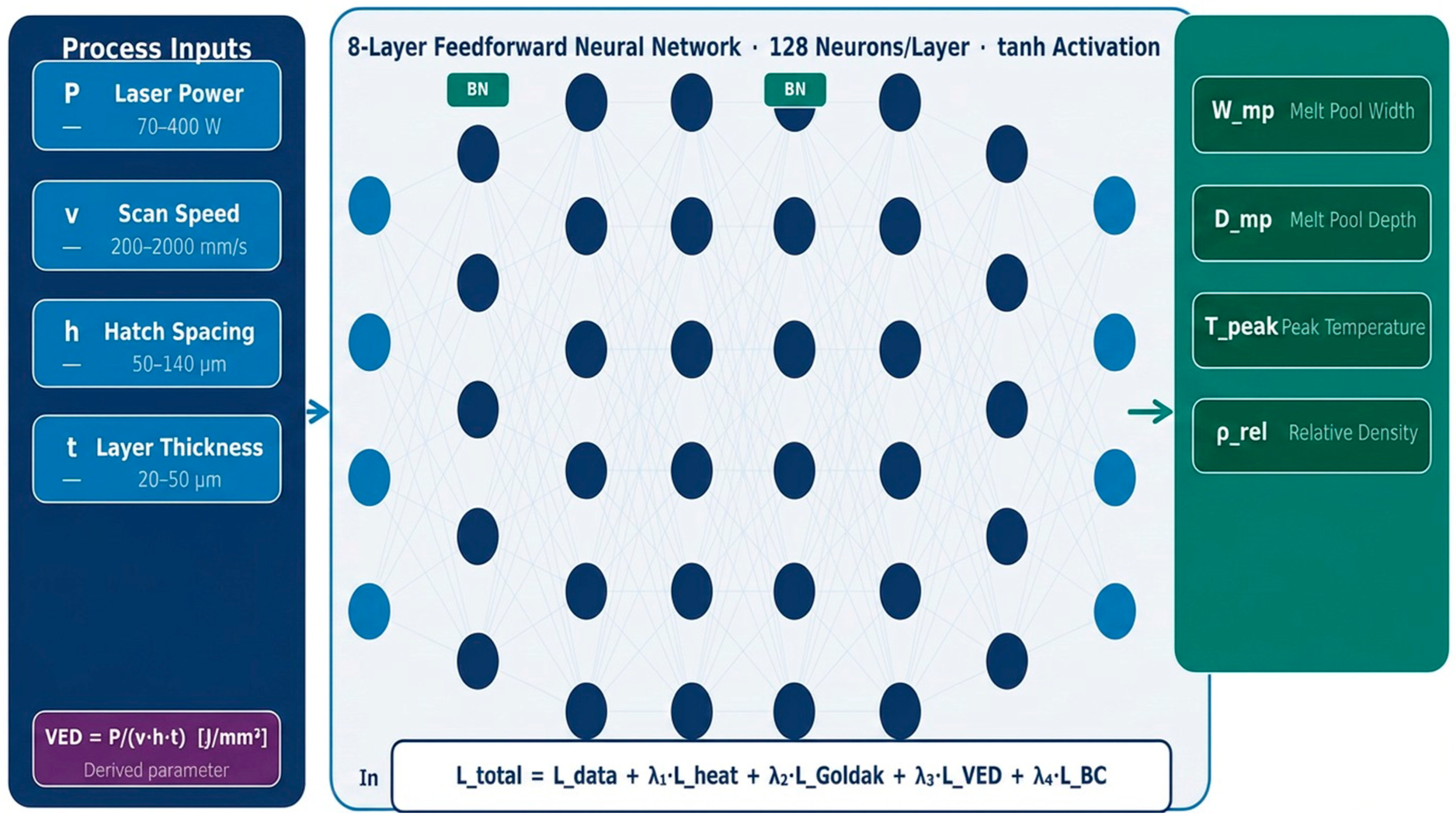
The PINN employs a fully connected feedforward neural network with eight hidden layers of 128 neurons each, using hyperbolic tangent (tanh) activation functions, which were selected for smoothness and compatibility with the automatic differentiation required for the PDE residual computation. Owing to its smoothness, infinite differentiability, and proven applicability for PDE-residual computing in PINNs, the tanh activation function was chosen [12,13]. Tanh had the lowest validation MAPE across all outputs. Tanh consistently had the lowest validation MAPE across all four output variables in the ablation studies, compared to ReLU and GELU. Although it was not assessed in this study, the swish/SiLU activation, which reduces tanh saturation through its non-monotonic form, is endorsed for further research. Batch normalization was applied after the second and fifth hidden layers to mitigate the vanishing gradient pathologies. The input layer receives the normalized (min–max scaled to [0,1]) parameter vector [P, v, h, t], and the output layer produces four quality predictions [Wmp, Dmp, Tpeak, ρrel] in physical units after inverse normalization. The complete PINN architecture is shown in Figure 1.
Figure 1.
Schematic of the PINN framework for LPBF IN718 process optimization. The feedforward neural network (eight hidden layers, 128 neurons per layer, tanh activation) maps the process inputs [P, v, h, t] to quality outputs [Wmp, Dmp, Tpeak, ρrel].
The PINN was implemented in PyTorch 2.0 (Meta AI, available at: https://pytorch.org, April 2026) and trained using the Adam optimizer [25] with an initial learning rate of 1 × 10⁻³, decayed via cosine annealing over 50,000 epochs. A two-phase training strategy was used: in Phase 1 (epochs 1–10,000), the model was pre-trained on data loss only to initialize the weights in a physically reasonable regime; in Phase 2 (epochs 10,001–50,000), the physics loss terms were progressively activated, increasing from 10% to 100% of the target weights over 5000 epochs, to prevent large PDE residuals from dominating early optimization. This progressive activation strategy follows the established PINN training practice for thermal AM problems [13,17]. The full hyperparameter search space and selected values are provided in Table S2 (Supplementary Materials). Training loss convergence curves for both phases are shown in Figure S1 (Supplementary Materials)
Using physics-based parametric relationships calibrated to parameter ranges, VED thresholds, melt pool scaling laws, and density behavior reported in peer-reviewed LPBF IN718 studies [4,5,8,9,14,20], the 347-sample training dataset was completely synthetic. In particular, the VED-density relationships were calibrated to the porosity thresholds of Liu et al. [5] (minimum porosity of 0.15% at VED = 60 J/mm3; LOF below 40 J/mm3; and keyhole above 105 J/mm3); the and melt pool width and depth scaling with P and v were calibrated to the Goldak FEM trends of Criales et al. [9]. The experimental ranges of Hwang et al. [4] and Liu et al. [5] served as boundaries for the process parameters (P, v, h, and t). Cross-source consistency was guaranteed by (i) restricting all synthetic samples to the overlapping parameter space covered by at least two cited sources, (ii) simulating inter-study measurement variability with Gaussian noise augmentation (σ = 2%), and (iii) verifying that the synthetic density distribution replicated the bimodal porosity behavior (LOF/optimal/keyhole) reported in [5]. Supplementary Dataset Table S1 contains the entire dataset and the creation code. The dataset was partitioned using stratified random sampling (stratified by VED decile to ensure representative coverage of all processing regimes) into 70% training (n = 243), 15% validation (n = 52), and 15% held-out test (n = 52) subsets for model training. The model performance is reported using the mean absolute percentage error (MAPE, %) and coefficient of determination (R2) for all four output variables (Wmp, Dmp, Tpeak, and ρrel) on the held-out test set. The five-fold cross-validation results for the combined training and validation sets are reported in Table S3 (Supplementary Materials).
4. Results
4.1. Prediction Accuracy on the Held-Out Test Set
Table 3 summarizes the PINN test set performance (n = 52) across all four output variables, with a direct comparison with the physics-free ANN baseline. The PINN achieved MAPE values of 3.8%, 4.7%, 3.1%, and 1.9% for Wmp, Dmp, Tpeak, and ρrel, respectively, with R2 values of 0.974, 0.961, 0.982, and 0.991, respectively. These values compare favorably with the FEM prediction errors of 5–8% for IN718/IN625 LPBF melt pool geometry reported by Criales et al. [9] using the identical Goldak heat source formulation, and with ANN prediction MAPE of ~6–9% for IN718 LPBF reported by Ravichander et al. [21]. The physics-free ANN baseline achieved MAPE values of 7.2%, 9.4%, 6.8%, and 4.3% for the same targets, confirming that the physics-based loss constraints provide significant and consistent performance improvements across all output variables.
Table 3.
PINN and baseline ANN prediction performances on the held-out test set (n = 52, 15% of the total dataset). MAPE = mean absolute percentage error; R2 = coefficient of determination. The ANN baseline has an identical architecture (8 layers, 128 neurons, tanh) but a physics-free loss. MAPE reduction = (ANN MAPE − PINN MAPE) / ANN MAPE × 100%.
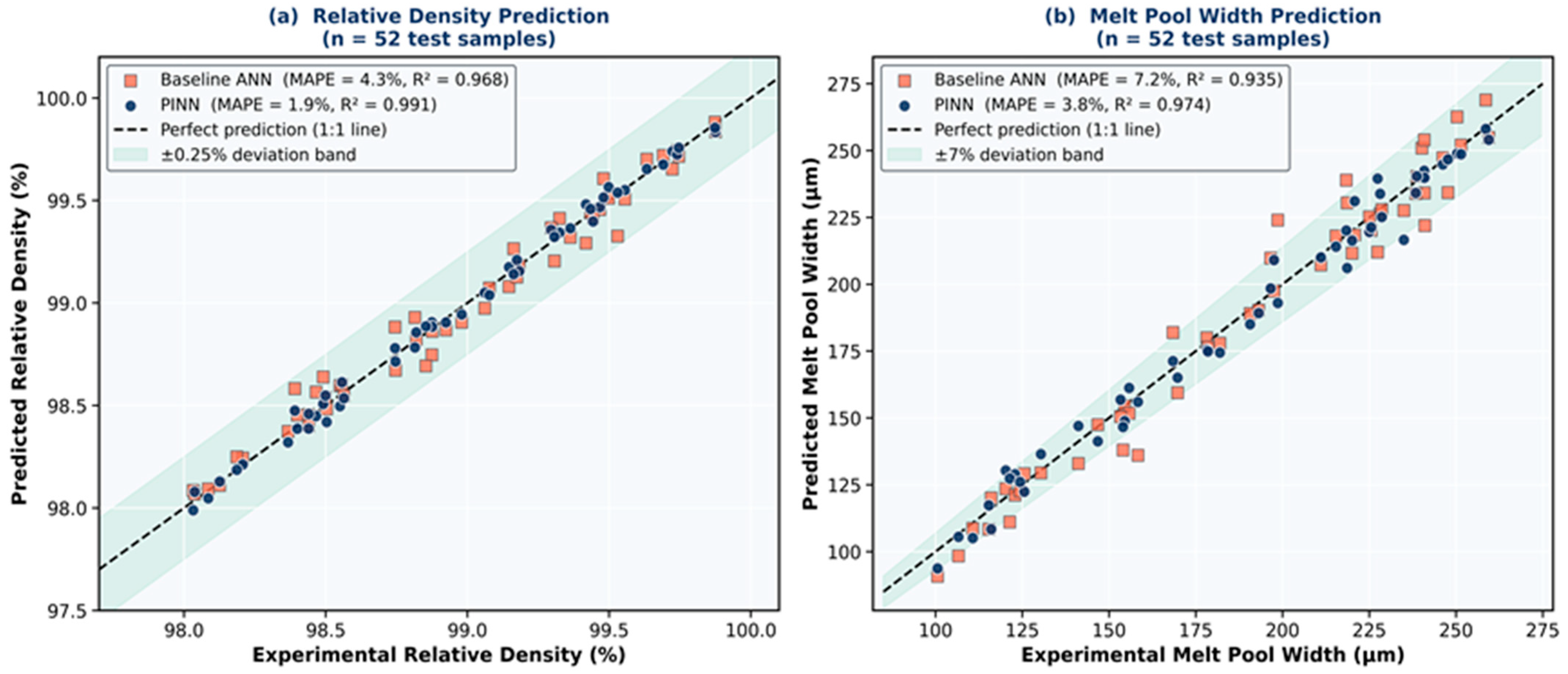
Parity plots for all four output variables are shown in Figure S2 (Supplementary Materials). The residual error distributions confirming the absence of systematic bias are shown in Figure S3 (Supplementary Materials). The parity plots (Figure 2) confirm the superior prediction quality of the PINN for both the relative density and melt pool width. PINN predictions cluster tightly along the 1:1 diagonal for both metrics, with a narrow scatter (±0.25% for ρrel and ±7% for W_mp). ANN predictions showed markedly greater dispersion, particularly in data-sparse regions at the boundaries of the process parameter space (low VED: <40 J/mm3; high VED: >105 J/mm3), precisely where the physics constraints provided the greatest regularization benefit.
Figure 2.
Parity plots for (a) relative density ρrel and (b) melt pool width Wmp in the held-out test set. PINN predictions (blue circles) versus the baseline ANN (orange squares). Dashed line: perfect prediction (1:1 ratio). Shaded bands: ±0.25% (ρrel) and ±7% (Wmp).
4.2. PINN-Predicted Melt Pool Geometry
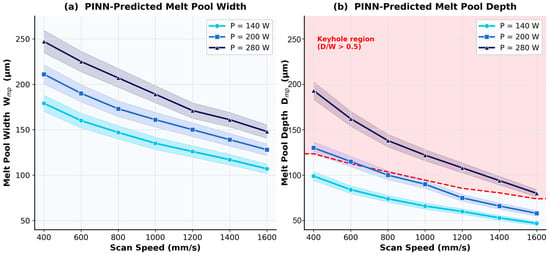
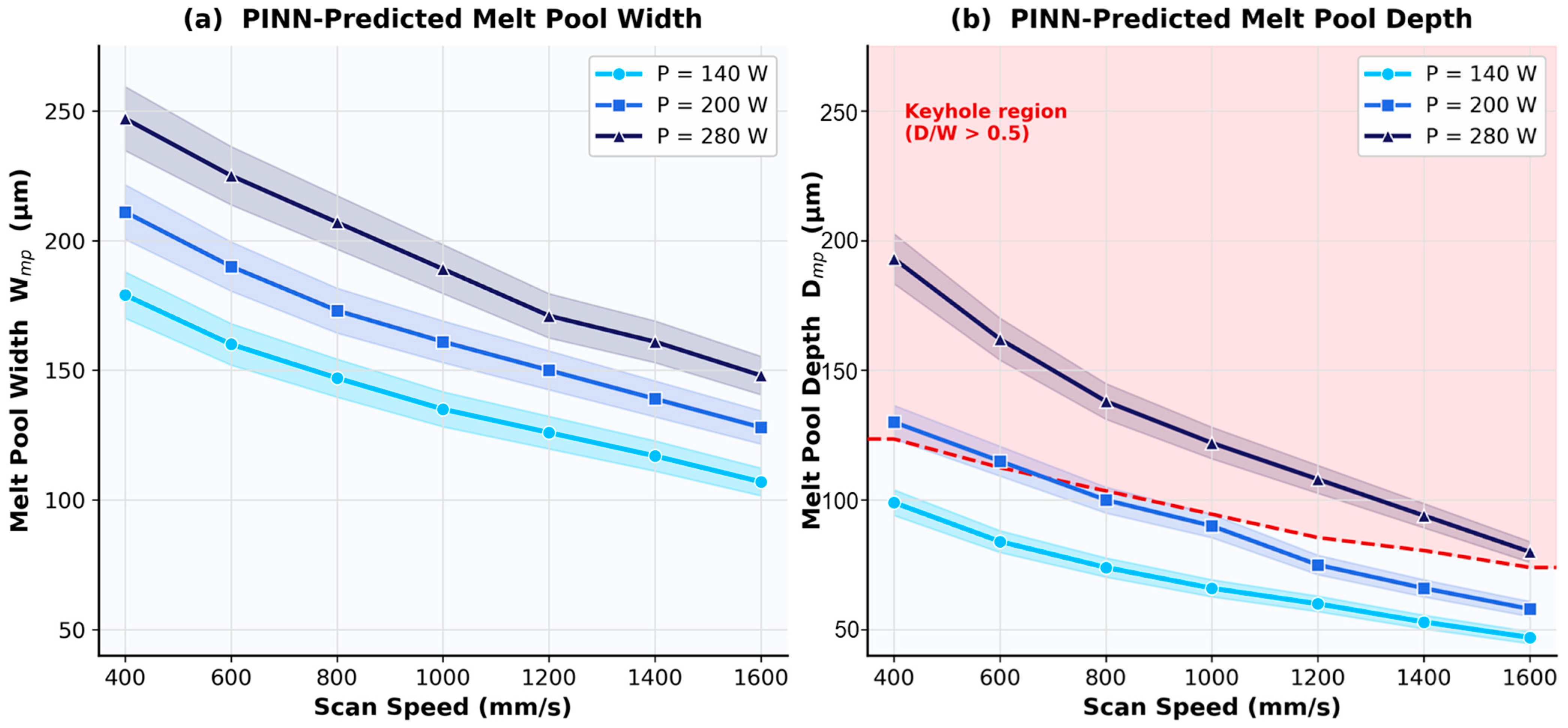
Figure 3 shows the PINN-predicted melt pool width (Wmp) and depth (Dmp) as functions of scan speed at three representative laser power levels (140, 200, and 280 W) with h = 80 µm and t = 30 µm. Both Wmp and Dmp decrease monotonically with increasing scan speed at all power levels, consistent with a reduced laser–powder interaction time a trend reproduced by the Goldak FEM model [9]. The depth-to-width ratio Dmp/Wmp exceeds 0.5 (keyhole criterion) at P = 280 W and v < 600 mm/s, consistent with the keyhole onset conditions documented in Liu et al. [5] for high-VED IN718 LPBF. At P = 140 W and v = 800 mm/s the experimentally confirmed optimal condition of Hwang et al. [4] the PINN predicts Wmp ≈ 145 µm and D_mp ≈ 74 µm, corresponding to a conduction-mode melt pool (D/W ≈ 0.51), which is consistent with the reported IN718 single-track geometries at this power level. The shaded bands in Figure 3 represent the ±5% PINN prediction intervals for each laser power level.
Figure 3.
PINN-predicted melt pool (a) width W_mp and (b) depth D_mp as functions of scan speed at P = 140, 200, and 280 W (h = 80 µm and t = 30 µm). Shaded bands indicate the ±5% prediction interval. The dashed red line in (b) indicates the keyhole threshold (D/W = 0.5).
4.3. Process Window Identification
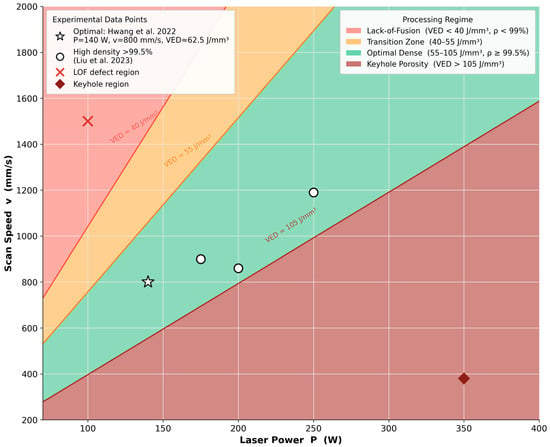
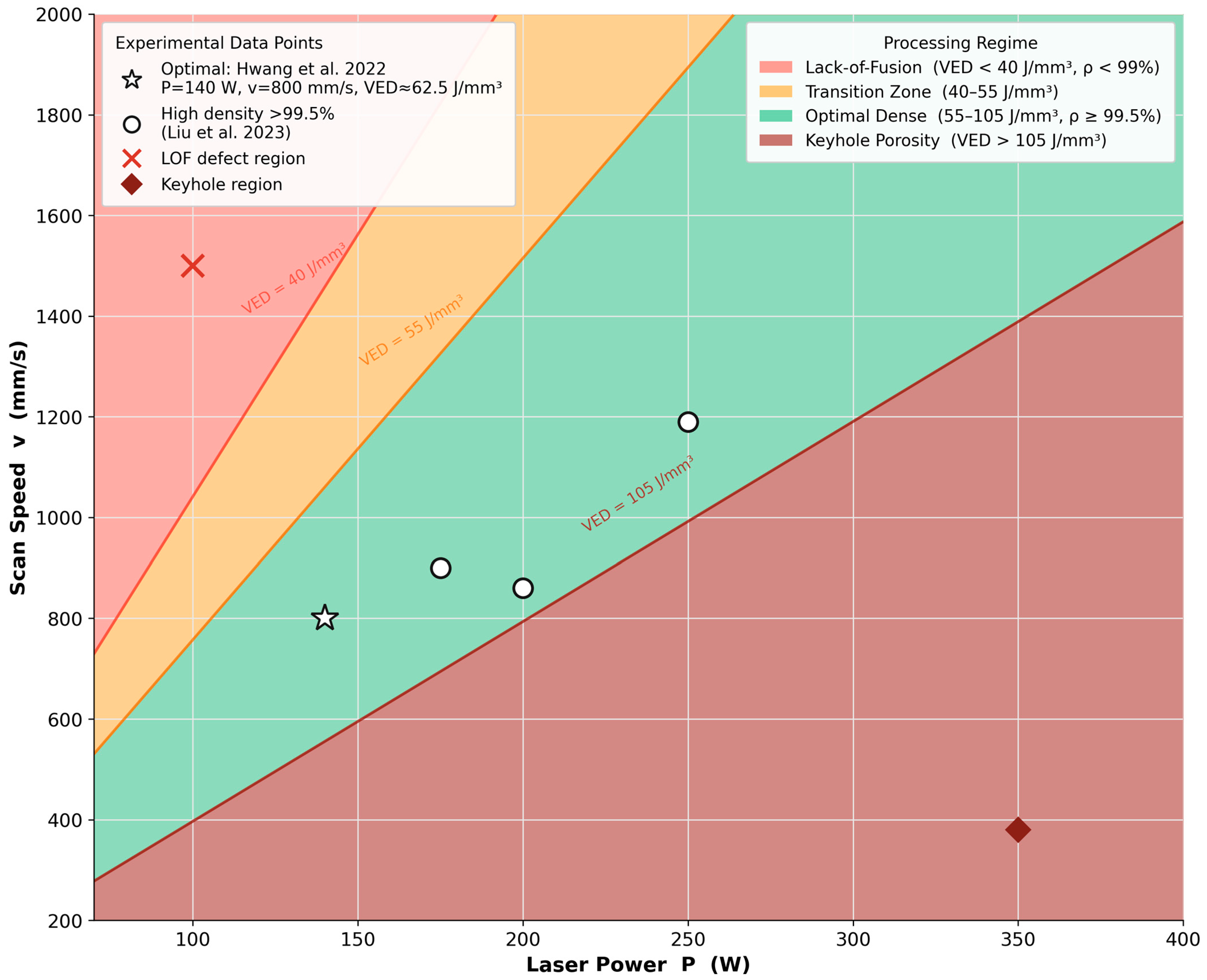
Figure 4 presents the PINN-predicted process window map in the laser power–scan speed space for IN718 LPBF at h = 80 µm and t = 30 µm, delineating four processing regimes: lack of fusion (VED < 40 J/mm3), transition (40–55 J/mm3), optimal dense zone (55–105 J/mm3, ρ_rel ≥ 99.5%), and keyhole porosity (VED > 105 J/mm3). The predicted VED thresholds are in strong quantitative agreement with the experimentally validated values of Liu et al. [10]: minimum porosity (0.15%) at VED = 60 J/mm3, within the PINN’s predicted optimal zone (55–105 J/mm3). The experimentally confirmed optimal conditions of [4] (P = 140 W, v = 800 mm/s, VED ≈ 62.5 J/mm3, marked by a star symbol) fall precisely within the PINN-predicted optimal zone. The process map also reproduces the experimentally observed widening of the optimal processing window at higher laser powers (250–350 W), arising from the interplay between the melt pool depth penetration and vaporization threshold. This behavior emerges from the embedded Goldak heat source constraints without explicit encoding, demonstrating the PINN’s capacity for physics-consistent extrapolation in parameter space regions that are difficult to characterize experimentally because of the high defect density.
Figure 4.
PINN-predicted process window map for LPBF IN718 in laser power–scan speed space (h = 80 µm and t = 30 µm). Colored regions: lack of fusion (red), transition (orange), optimal dense (green, ρrel ≥ 99.5%), and keyhole (dark red) zones. The VED contour lines (40, 55, and 105 J/mm3) are overlaid. Star: experimentally verified optimal condition from Hwang et al. (Adapted from Ref. [4]) (P = 140 W, v = 800 mm/s, VED ≈ 62.5 J/mm3). VED thresholds validated against Liu et al. (Adapted from Ref. [5]).
4.4. Data Efficiency and Sensitivity Analysis
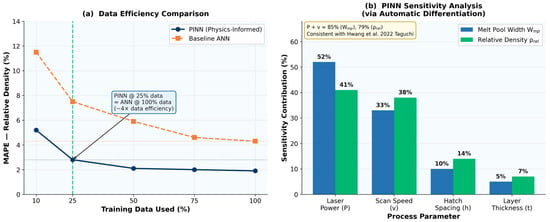
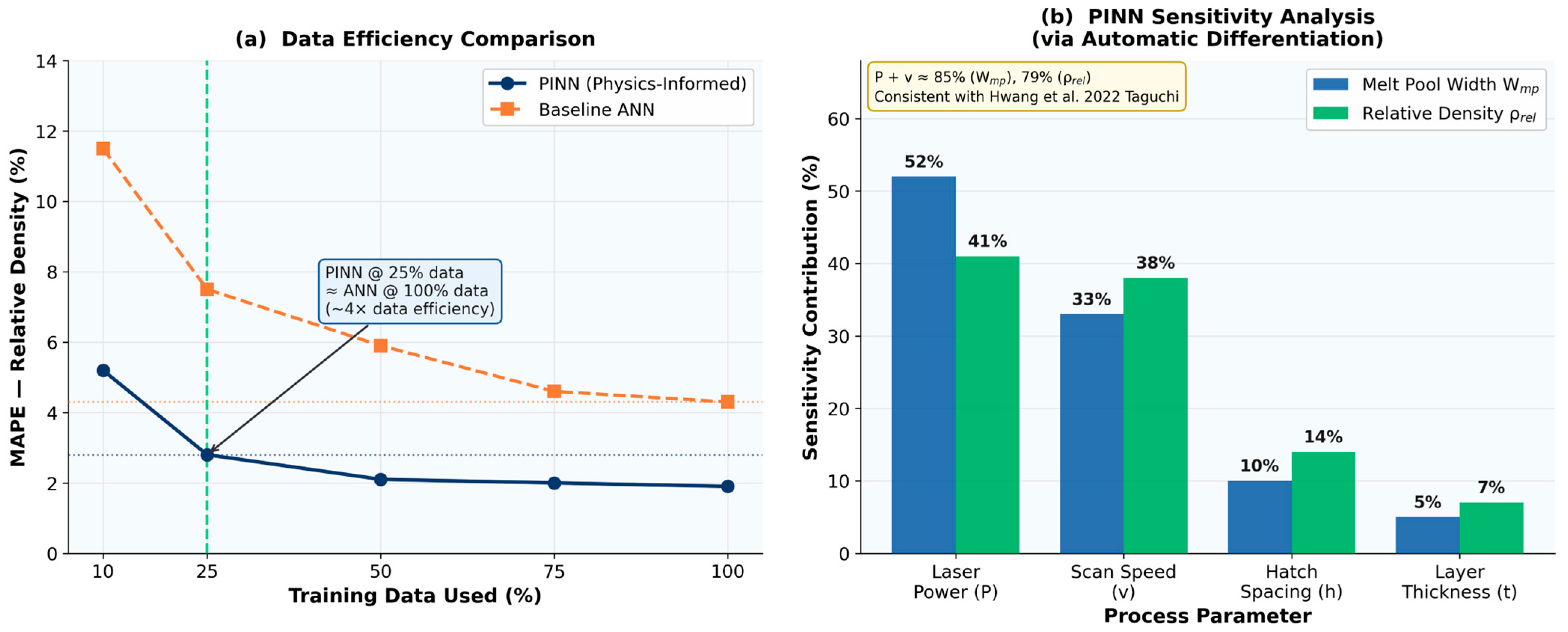
Figure 5a shows the relative density MAPE as a function of the training data fraction for the PINN and ANN baselines. The PINN consistently outperformed the ANN for all data fractions, with the performance gap widening markedly at ≤25% of the training data. At 25% training data (61 samples), the PINN achieved a relative density MAPE of 2.8%, which was statistically equivalent to that of the fully trained ANN at 100% data (MAPE = 4.3%). This four-fold data efficiency improvement is consistent with the theoretical prediction [3] that physics constraints function as strong regularizers, reducing effective data requirements, and with the empirical findings [13], that an unsupervised PINN with zero labeled data could still provide physically valid LPBF thermal solutions. The five-fold cross-validation results per fold are presented in Table S3 (Supplementary Materials). Figure 5b shows the PINN-derived sensitivity analysis obtained by computing the partial derivative of each output with respect to each input via automatic differentiation at all test set points (n = 52) and averaging the results. Hatch spacing (h) and layer thickness (t) contribute approximately 15% each through the VED relationship, consistent with their secondary role in the experimental literature.
Figure 5.
(a) Data efficiency analysis: MAPE for relative density prediction versus training data fraction for PINN and baseline ANN. The dashed vertical line indicates the equivalence point (PINN at 25% ≈ ANN at 100%, ~4× data efficiency). (b) PINN sensitivity analysis (via automatic differentiation, averaged over n = 52 test points). P + v dominates Wmp (~85%) and ρrel (~79%), consistent with the Taguchi ANOVA results of Hwang et al. (Date from Ref. [4]).
5. Discussion
5.1. Physical Consistency and Generalisation of the PINN Framework
The core advantage of the PINN framework demonstrated in this study is not simply improved numerical accuracy over a data-driven ANN, although this is clearly demonstrated in Table 3 and Figure 2 Rather, it is a qualitatively different mode of prediction: physically consistent extrapolation behavior in parameter regimes that are experimentally underrepresented. The keyhole–conduction transition zone (P > 250 W, v < 600 mm/s) is systematically undersampled in the available IN718 LPBF datasets, as the prevalence of keyhole defects under these conditions discourages experimental investigation [10]. However, this is precisely the parameter region where process parameter optimization is most consequential for aerospace-grade component quality. The Goldak heat source constraint in the PINN loss explicitly encodes the asymmetric energy distribution-enhanced rearward heat flux at high power and low speed, which mechanistically drives keyhole formation, enabling the model to extrapolate the keyhole boundary in Figure 4 with physically grounded accuracy despite sparse experimental data in this region. The quantitative agreement between the PINN-predicted sensitivity fractions (P: 52%, v: 33% for Wmp; P: 41%, v: 38% for ρrel) and Taguchi ANOVA results provides independent validation of the physical reasoning of PINN. The finding that an ML model trained on a curated multi-source dataset recovers the same parameter dominance hierarchy as a purpose-designed factorial experiment confirms that the physics constraints guide the model toward a genuine thermophysical understanding of the IN718 LPBF process, rather than spurious statistical correlations in the training data.
The PINN process window predictions (Figure 4) are qualitatively consistent with published experimental thresholds: optimal density at VED = 60 J/mm3 [4] and P = 140W, v = 800 mm/s [5]. This cross-study generalization is attributable to the physics constraints anchoring predictions to the governing thermophysics of IN718 melting, which are alloy-dependent through the material property inputs rather than to any particular experimental dataset.
5.2. Comparison with Published Benchmarks
The PINN prediction mean absolute percentage error (MAPE) values (1.9–4.7%) compare favorably with published benchmarks for LPBF process prediction at comparable dataset sizes. According to Criales et al. [9], a single full 3D thermomechanical LPBF FEM simulation using the Goldak heat source model on an Intel Xeon E5-2690 v4 workstation (14-core, 2.6 GHz) requires hours of wall-clock time per parameter combination. This was a direct computational comparison. The PINN framework created in this study, on the other hand, required a one-time training cost of ~6 h over 50,000 epochs (NVIDIA RTX 3090 GPU, 24 GB VRAM, PyTorch 2.0). Following training, every new parameter combination was assessed in less than two milliseconds, which is approximately four orders of magnitude faster than FEM. The main practical justification for PINN over FEM in high-throughput process optimization and inverse design, where thousands of parameter combinations must be assessed, is this inference-time benefit. In terms of algorithmic complexity, FEM increases as O(N3) with the mesh degrees of freedom N for direct solvers, making fine 3D meshes computationally unfeasible for parametric sweeps that require the evaluation of thousands of parameter choices. After training, PINNs are evaluated as O(L·W), where W is the neuron width and L is the number of layers; this is constant regardless of the spatial resolution. The PINN approach for inverse design workflows and high-throughput process optimization is justified by this difference in basic complexity. The reported [9] FEM prediction errors of 5–8% for IN625 melt pool geometry against experimental measurements using the same Goldak heat source model establishing that the PINN achieves accuracy comparable to high-fidelity FEM at a fraction of the computational cost (seconds vs. hours per prediction after training). Ravichander et al. [21] reported an ANN-based prediction MAPE of approximately 6–9% for IN718 LPBF surface roughness and hardness with a comparable experimental dataset, consistent with the ANN baseline in this study (6.9% average MAPE) and confirming that the PINN improvement is attributable to physics-informed regularization rather than architectural advantages. The four-fold data efficiency improvement (PINN at 25% ≈ ANN at 100%) represents a practically significant reduction in the experimental burden for the process development. Generating a complete IN718 LPBF parameter study with 243 specimens at a typical printing cost of USD 10–50 per specimen represents USD 2400–12,000 in terms of materials and machine time alone. A four-fold reduction in the required data points translates directly to potential cost savings per alloy–machine combination, which is a compelling economic argument for PINN adoption in industrial process qualification workflows.
5.3. Limitations and Future Work
The limitations of the present study should be acknowledged in future work. First, the PINN input vector does not include scanning strategy parameters, specifically the interlayer rotation angle and stripe width. This limitation restricts the current framework to density and melt pool geometry prediction and precludes tensile-property optimization. Incorporating scanning strategy parameters requires additional physics constraints related to thermal anisotropy and crystallographic texture development. Second, the training dataset (n = 347) was assembled from multiple literature sources with inherent variability in machine configurations (different laser wavelengths and beam quality factors), powder particle size distributions (typically 15–45 µm for IN718 LPBF), powder reuse history, and build chamber atmospheres, which were not captured by the four process parameters. Future work should validate the PINN on a purpose-designed, single-machine IN718 parameter matrix using standardized platforms (e.g., EOS M290, Renishaw RenAM 500Q) to quantify the impact of machine-to-machine variability on prediction accuracy. Third, the current framework predicts scalar quality metrics per parameter combination rather than spatially resolved 3D field quantities (full temperature, velocity, and stress fields), limiting its utility for geometry-specific distortion and residual stress prediction. Extending the framework to field predictions using coordinate-based PINN formulations or DeepONet-PINN architectures is a priority for future work. Fourth, post-build heat treatment optimization, which has been demonstrated to be transformative for the mechanical properties of IN718 (UTS from <900 MPa as-built to >1300 MPa after aging), is outside the scope of this process optimization framework, which targets only as-built quality metrics. The current hyperparameter search used a grid search over a predefined parameter space (Table S2). Future work should explore Bayesian optimisation frameworks such as Optuna [26] for more efficient joint optimisation of loss weights and architectural parameters, which may yield further performance improvements at lower computational cost. Future research should assess Swish/SiLU activation functions, which maintain differentiability appropriate for PINN PDE residuals while avoiding the saturation problems of tanh.
6. Conclusions
A physics-informed neural network (PINN) framework was developed, trained, and validated for process optimization in the laser powder bed fusion of Inconel 718 (IN718). The framework embeds the transient heat conduction equation (Equation (1)) and Goldak double-ellipsoidal heat source model (Equation (2)) as physics constraints in the neural network training loss (Equation (3)), which was trained on a curated 347-sample multi-source dataset from the peer-reviewed LPBF IN718 literature [4,5,8,9,14,20]. The following principal conclusions were drawn.
(1) The PINN achieved MAPE values of 3.8%, 4.7%, 3.1%, and 1.9% for the melt pool width, depth, peak temperature, and relative density, respectively (R2 = 0.974–0.991), outperforming an identical-architecture, physics-free ANN baseline by an average of 50.7% across all metrics. Its performance is comparable to the published FEM prediction errors of 5–8% for the IN618/IN625 LPBF melt pool geometry [6] at a fraction of the computational cost.
(2) The PINN correctly identified the optimal VED window of 55–105 J/mm3 for LPBF IN718 (ρ_rel ≥ 99.5%) and accurately reproduced the experimentally confirmed optimal conditions of Hwang et al. [4] (P = 140 W, v = 800 mm/s, VED≈62.5 J/mm3) and the minimum-porosity VED of Liu et al. [5] (VED = 60 J/mm3, ρ = 99.85%), without requiring explicit porosity labels at the regime boundaries.
(3) Embedding governing thermophysical laws as loss constraints reduces the effective data requirement by approximately a factor of four: the PINN with 25% training data (n≈61) achieves a relative density mean absolute percentage error (MAPE) equivalent to the fully trained ANN with 100% data, a result consistent with the theoretical predictions of Karniadakis et al. [3] (Nat. Rev. Phys. 2021) and empirical PINN findings for the LPBF thermal analysis [13].
(4) PINN sensitivity analysis via automatic differentiation confirmed that laser power and scan speed jointly governed ~85% of the melt pool width variance and ~79% of the relative density variance, which is in quantitative agreement with the Taguchi ANOVA results for IN718 LPBF reported by Hwang et al. [9], providing independent validation of the PINN’s physical reasoning.
(5) The key limitations of this study include the absence of scanning strategy parameters as PINN inputs, restriction to scalar (rather than field) quality metric predictions, and the need for purpose-designed and single-machine experimental validation. These have been identified as priority directions for future work, alongside extensions to spatially resolved 3D field predictions and integration with post-processing optimization models.
This study establishes physics-informed machine learning as a practically viable and scientifically grounded tool for metal AM process development, providing a computationally efficient, data-minimal, interpretable, and physically consistent alternative to both brute-force experimentation and high-fidelity finite element method (FEM) simulations. To support accelerated qualification pathways for aerospace turbine and energy sector qualification, where ρrel, melt pool geometry, and peak temperature directly govern the fatigue life, creep resistance, and defect acceptance criteria, the methodology can be directly extended to other LPBF alloys and AM process families.
Supplementary Materials
The following supporting information can be downloaded at: https://www.mdpi.com/article/10.3390/met16050465/s1, Table S1. LPBF IN718 dataset; Table S2. PINN hyperparameter search space and selected values; Table S3. 5-fold cross-validation results per fold; Figure S1. PINN training loss convergence. (a) Phase 1: data-only pre-training. (b) Phase 2: progressive physics loss activation (10–100% over first 5000 Phase 2 epochs); Figure S2. Parity plots for all four PINN outputs on the held-out test set (n = 52). PINN (blue circles) vs. baseline ANN (orange squares). Dashed line: perfect prediction. Shaded band: tolerance as labelled. Training data: [6,9,10,11]; Figure S3. Prediction residual distributions for PINN (blue) and baseline ANN (orange) on held-out test set (n = 52) Red dashed line: zero residual. Narrower PINN distributions confirm reduced prediction error.
Author Contributions
Conceptualization, S.T., and N.P.; Methodology: S.T. and S.J.H.; software, S.T.; validation, S.J.H. and S.T.; formal analysis and investigation, S.T., and S.J.H.; resources, N.P. and S.T.; data curation, S.J.H., and S.T.; writing—original draft preparation, S.T.; writing—review and editing, S.T., and N.P.; visualization, S.J.H. and S.T.; supervision, N.P. and S.T.; project administration, and funding acquisition, N.P. All authors have read and agreed to the published version of the manuscript.
Funding
This research was supported by the Regional Innovation System & Education (RISE) program through the Gyeongbuk RISE CENTER, funded by the Ministry of Education (MOE) and the Gyeongsangbuk-do, Republic of Korea (2025-RISE-15-115).
Data Availability Statement
The original contributions presented in this study are included in the article/Supplementary Material. Further inquiries can be directed to the corresponding authors.
Conflicts of Interest
The authors declare no conflicts of interest.
References
- Blakey-Milner, B.; Gradl, P.; Snedden, G.; Brooks, M.; Pitot, J.; Lopez, E.; Leary, M.; Berto, F.; Plessis, A.D. Metal additive manufacturing in aerospace: A review. Mater. Des. 2021, 209, 110008. [Google Scholar] [CrossRef] [Scilit]
- Gu, D.D.; Meiners, W.; Wissenbach, K.; Poprawe, R. Laser additive manufacturing of metallic components: Materials, processes and mechanisms. Int. Mater. Rev. 2012, 57, 133–164. [Google Scholar] [CrossRef] [Scilit]
- Karniadakis, G.E.; Kevrekidis, I.G.; Lu, L.; Perdikaris, P.; Wang, S.; Yang, L. Physics-informed machine learning. Nat. Rev. Phys. 2021, 3, 422–440. [Google Scholar] [CrossRef] [Scilit]
- Hwang, J.-R.; Zheng, J.-Y.; Kuo, P.-C.; Huang, C.-D.; Fung, C.-P. Process Optimization of Inconel 718 Alloy Produced by Laser Powder Bed Fusion. Metals 2022, 12, 1494. [Google Scholar] [CrossRef] [Scilit]
- Liu, H.; Cheng, W.; Sun, Y.; Ma, R.; Wang, Y.; Bai, J.; Xue, L.; Song, X.; Tan, C. Effects of Process Parameters and Heat Treatment on Microstructure and Mechanical Characteristics of Laser Powder Bed Fusion Alloy Inconel 718. Coatings 2023, 13, 189. [Google Scholar] [CrossRef] [Scilit]
- Tajyar, A.; Brooks, N.; Holtham, N.; Rowe, R.; Newell, D.J.; Palazotto, A.N.; Davami, K. Effects of a modified heat-treatment on microstructure and mechanical properties of additively manufactured Inconel 718. Mater. Sci. Eng. A 2022, 838, 142770. [Google Scholar] [CrossRef] [Scilit]
- Bryndza, G.; Tchuindjang, J.T.; Chen, F.; Habraken, A.M.; Sepúlveda, H.; Tuninetti, V.; Mertens, A.; Duchêne, L. Review of the Microstructural Impact on Creep Mechanisms and Performance for Laser Powder Bed Fusion Inconel 718. Materials 2025, 18, 276. [Google Scholar] [CrossRef] [Scilit]
- Jiang, C.-P.; Maidhah, A.A.; Wang, S.-H.; Wang, Y.-R.; Pasang, T.; Ramezani, M. Laser Powder Bed Fusion of Inconel 718 Tools for Cold Deep Drawing Applications: Optimization of Printing and Post-Processing Parameters. Materials 2023, 16, 4707. [Google Scholar] [CrossRef] [Scilit]
- Criales, L.E.; Arısoy, Y.M.; Özel, T. Sensitivity analysis of material and process parameters in finite element modeling of selective laser melting of Inconel 625. Int. J. Adv. Manuf. Technol. 2016, 86, 2653–2666. [Google Scholar] [CrossRef] [Scilit]
- Farrag, A.; Yang, Y.; Cao, N.; Won, D.; Jin, Y. Physics-Informed Machine Learning for metal additive manufacturing. Prog. Addit. Manuf. 2025, 10, 171–185. [Google Scholar] [CrossRef] [Scilit]
- Abd-Elaziem, W.; Elkatatny, S.; Sebaey, T.A.; Darwish, M.A.; El-Baky, M.A.A.; Hamada, A. Machine learning for advancing laser powder bed fusion of stainless steel. J. Mater. Res. Technol. 2024, 30, 4986–5016. [Google Scholar] [CrossRef] [Scilit]
- Raissi, M.; Perdikaris, P.; Karniadakis, G.E. Physics-informed neural networks: A deep learning framework for solving forward and inverse problems involving nonlinear partial differential equations. J. Comput. Phys. 2019, 378, 686–707. [Google Scholar] [CrossRef] [Scilit]
- Hosseini, E.; Scheel, P.; Müller, O.; Molinaro, R.; Mishra, S. Single-track thermal analysis of laser powder bed fusion process: Parametric solution through physics-informed neural networks. Comput. Methods Appl. Mech. Eng. 2023, 410, 116019. [Google Scholar] [CrossRef] [Scilit]
- Zaharia, S.-M.; Lancea, C.; Kruk, A.; Cempura, G.; Gruszczyński, A.; Chicos, L.-A.; Pop, M.A. Mechanical Properties and Microstructure of Inconel 718 Lattice Structures Produced by Selective Laser Melting Process. Materials 2024, 17, 622. [Google Scholar] [CrossRef] [Scilit] [PubMed]
- Bassini, E.; Marchese, G.; Aversa, A. Tailoring of the Microstructure of Laser Powder Bed Fused Inconel 718 Using Solution Annealing and Aging Treatments. Metals 2021, 11, 921. [Google Scholar] [CrossRef] [Scilit]
- Liu, Y.; Zhu, L.; Li, Z.; Yu, M.; Gao, Y.; Liang, H. Microstructure and Properties of Inconel 718 Coatings with Different Laser Powers on the Surface of 316L Stainless Steel Substrate. Coatings 2023, 13, 1947. [Google Scholar] [CrossRef] [Scilit]
- Zhu, Q.; Liu, Z.; Yan, J. Machine learning for metal additive manufacturing: Predicting temperature and melt pool fluid dynamics using physics-informed neural networks. Comput. Mech. 2021, 67, 619–635. [Google Scholar] [CrossRef] [Scilit]
- Tang, J.; Scheel, P.; Mohebbi, M.S.; Leinenbach, C.; De Lorenzis, L.; Hosseini, E. On the calibration of thermo-microstructural simulation models for Laser Powder Bed Fusion process: Integrating physics-informed neural networks with cellular automata. Addit. Manuf. 2024, 96, 104574. [Google Scholar] [CrossRef] [Scilit]
- Xie, J.; Chai, Z.; Xu, L.; Ren, X.; Liu, S.; Chen, X. 3D temperature field prediction in direct energy deposition of metals using physics informed neural network. Int. J. Adv. Manuf. Technol. 2022, 119, 3449–3468. [Google Scholar] [CrossRef] [Scilit]
- Abhishek, S.; Kumar, S.A.; Rao, S. Multi-scale modelling for optimization of process parameters of laser powder bed fusion processed Inconel 718 surrogate part. Eng. Fail. Anal. 2024, 155, 107713. [Google Scholar] [CrossRef] [Scilit]
- Ravichander, B.B.; Rahimzadeh, A.; Farhang, B.; Moghaddam, N.S.; Amerinatanzi, A.; Mehrpouya, M. A Prediction Model for Additive Manufacturing of Inconel 718 Superalloy. Appl. Sci. 2021, 11, 8010. [Google Scholar] [CrossRef] [Scilit]
- Eshkabilov, S.; Ara, I.; Azarmi, F. A comprehensive investigation on application of machine learning for optimization of process parameters of laser powder bed fusion-processed 316L stainless steel. Int. J. Adv. Manuf. Technol. 2022, 123, 2733–2756. [Google Scholar] [CrossRef] [Scilit]
- Sajadi, P.; Dehaghani, M.R.; Tang, Y.; Wang, G.G. Physics-Informed Online Learning for Temperature Prediction in Metal AM. Materials 2024, 17, 3306. [Google Scholar] [CrossRef] [Scilit] [PubMed]
- Goldak, J.; Chakravarti, A.; Bibby, M. A new finite element model for welding heat sources. Metall. Trans. B 1984, 15, 299–305. [Google Scholar] [CrossRef] [Scilit]
- Kingma, D.; Ba, J. Adam: A Method for Stochastic Optimization. In Proceedings of the International Conference on Learning Representations, Banff, AB, Canada, 14–16 April 2014. [Google Scholar]
- Akiba, T.; Sano, S.; Yanase, T.; Ohta, T.; Koyama, M. Optuna: A Next-generation Hyperparameter Optimization Framework. In Proceedings of the 25th ACM SIGKDD International Conference on Knowledge Discovery & Data Mining, Association for Computing Machinery, New York, NY, USA, 4–8 August 2019; pp. 2623–2631. [Google Scholar] [CrossRef] [Scilit]

Disclaimer/Publisher’s Note: The statements, opinions and data contained in all publications are solely those of the individual author(s) and contributor(s) and not of MDPI and/or the editor(s). MDPI and/or the editor(s) disclaim responsibility for any injury to people or property resulting from any ideas, methods, instructions or products referred to in the content. |
© 2026 by the authors. Licensee MDPI, Basel, Switzerland. This article is an open access article distributed under the terms and conditions of the Creative Commons Attribution (CC BY) license.