


Abstract
To mitigate the poor corrosion resistance of 45 steel components, ZrC-reinforced Ni-based composite coatings were fabricated on 45 steel substrates via laser cladding. The phase composition and microstructure were systematically characterized by XRD, FE-SEM, TEM, and EBSD, and the corrosion performance was evaluated by electrochemical measurements. The results show that the composite coatings consist of a dendritic γ-(Fe, Ni) matrix, interdendritic eutectics, and ZrC second-phase blocks or short dendrites. The volume fraction of ZrC increases with its addition content, while the ZrC grain size is first refined and then coarsened as the scanning velocity increases. IPF orientation analysis reveals that the γ-(Fe, Ni) phase exhibits a preferred <001> crystallographic orientation along the coating thickness direction. The coating with 30 wt% ZrC achieves the optimal corrosion resistance, with a corrosion current density of only 7.18% that of the substrate and a polarization resistance 13.34 times higher.
1. Introduction
As a typical medium-carbon structural steel, 45 steel exhibits excellent comprehensive mechanical properties, acceptable hardenability, and low-cost [1]. It has been widely employed for manufacturing mechanical components such as shafts, gears, and connecting rods. Nevertheless, 45 steel contains no corrosion-resistant alloying elements like Cr and Ni. Consequently, it is susceptible to electrochemical corrosion in humid atmospheres, saline environments, and acidic-alkaline corrosive media [2]. Therefore, it is of great engineering significance to enhance the corrosion resistance of 45 steel via surface modification techniques, so as to extend the service life of components and improve operational safety.
Surface modification represents one of the most efficient strategies to enhance the surface corrosion resistance. Conventional modification methods include electroplating [3], electroless plating [4], and thermal spraying [5]. However, these techniques may suffer from drawbacks such as low bonding strength, high porosity, severe thermal influence, and environmental pollution. In contrast, laser cladding represents a promising technique to fabricate high-performance corrosion-resistant coatings due to its distinct advantages: metallurgical bonding, low dilution rate, and dense microstructure [6,7].
Studies on laser-cladded corrosion-resistant coatings mainly focus on Ni-based [8], Co-based [9], and Fe-based [10] alloy coatings. Lunxiang Li et al. [11] fabricated Ni50 laser-cladded coatings on 45 steel and investigated the effects of molybdenum addition on the electrochemical corrosion behavior. Qian Dong et al. [12] prepared a series of laser-cladded CoCrW-xCu coatings and demonstrated that the synergistic effect of Co, Cr, W, and Cu endowed the CoCrW-2Cu coating with the most compact passive film. Tieming Guo et al. [13] fabricated a Fe-0.3C-15Cr-1Ni alloy coating on the surface of 3Cr13 stainless steel via laser cladding and investigated the effects of different scanning paths on the corrosion resistance. Recently, high-entropy alloys have attracted much attention for their unique single-phase solid-solution structure, offering a new strategy for fabricating corrosion-resistant coatings [14,15].
Cermet composite coatings improve the hardness and wear resistance by introducing ceramic phases into the metallic matrix [16,17]. Ceramic phases exert significant effects on the microstructure and corrosion behavior of coatings, and thus research on the corrosion resistance of cermet composite coatings has attracted increasing attention [18,19]. Haifeng Zhang et al. [20] investigated the electrochemical corrosion performance and passivation behavior of laser-cladded Ni-WC composite coatings on C45E4 steel substrates. Jian Zhang et al. [21] prepared Ni60-WC composite coatings on AISI 304 stainless steel and investigated the effect of WC addition on corrosion resistance. Zhen-Huan Wang et al. [22] investigated the corrosion resistance of laser-cladded Ni60-Ti2AlC composite coatings and found that the coating with 15 wt% Ti2AlC demonstrated optimal corrosion resistance, which was attributed to its refined microstructure and stable passive film. Lijun Wang et al. [23] fabricated an in-situ (Nb, Mo)C-reinforced Ni-based composite coating using a mixed powder of Ni-based alloy, Nb, and Mo2C. The corrosion resistance of the Inconel 600 coating was significantly enhanced by the synergistic addition of 20 wt% Nb and Mo2C.
As a ceramic reinforcing phase, zirconium carbide (ZrC) possesses superior chemical inertness and outstanding corrosion resistance [24,25], which can effectively hinder the penetration of corrosive media and suppress electrochemical corrosion reactions. Hongjie Li et al. [24] fabricated ZrC dispersion-strengthened Ni–W composite coatings via pulse electrodeposition. The results revealed that the corrosion current density of the Ni–W/ZrC composite coating was markedly reduced compared with that of the pure Ni–W coating. Sitian Zhu et al. [25] prepared Cr(III)-ZrC composite coatings via electrodeposition and investigated the effect of ZrC dispersion on the corrosion resistance of the coatings.
Both the type of ceramic reinforcing phase and fabrication technology exert significant effects on the microstructure and properties of coatings. Nevertheless, there are limited studies reported on the corrosion resistance of ZrC-reinforced Ni-based laser-cladded coatings. In this work, ZrC-reinforced Ni-based composite coatings were fabricated on 45 steel substrates by laser cladding. Microstructural characterizations and electrochemical measurements were carried out. The influences of powder composition and laser cladding parameters on microstructure and corrosion resistance were discussed. The obtained results are expected to offer references for enhancing the corrosion resistance of 45 steel and facilitating the engineering application of ZrC-reinforced Ni-based composite coatings.
2. Experimental Procedure
2.1. Materials and Laser Cladding Process
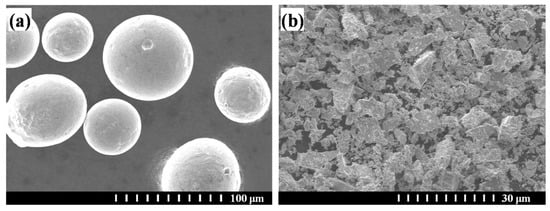
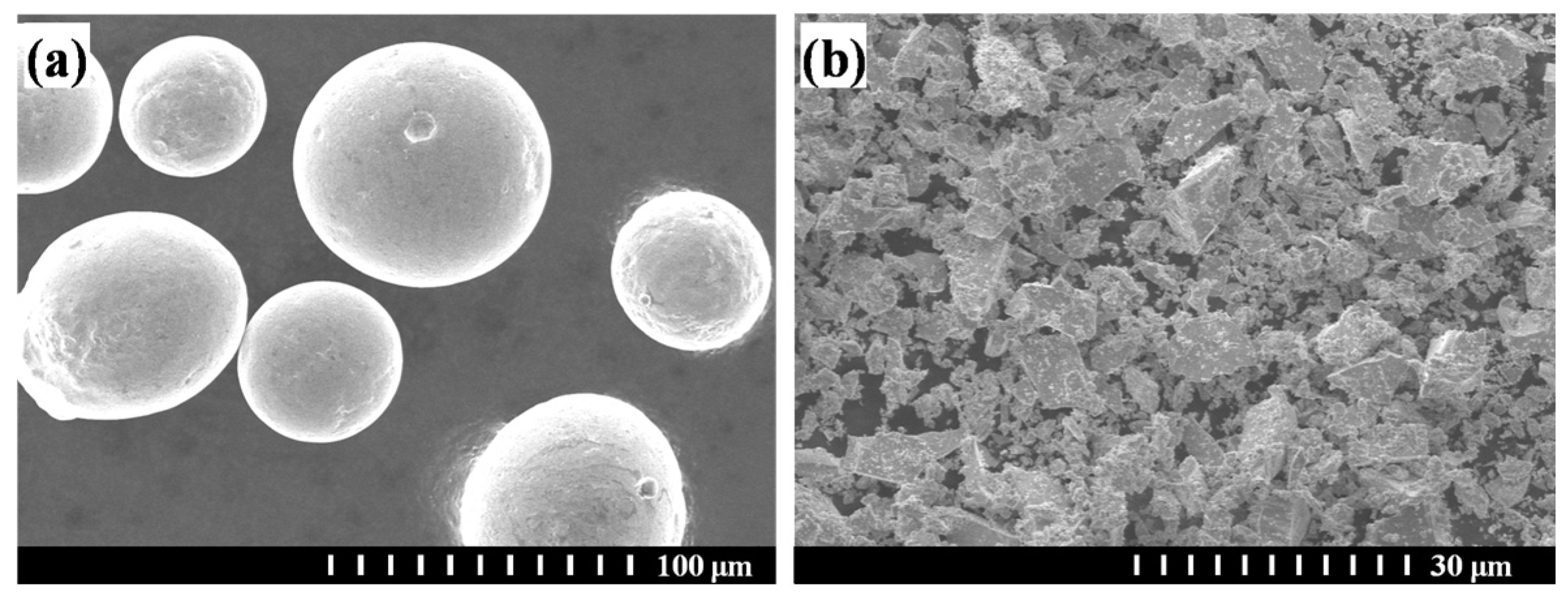
The cladding material was a mixed powder of Ni60A (purity ≥ 99%, +325~−140 mesh) and ZrC (purity ≥ 99.9%, +400~−300 mesh). The Ni60A powder was supplied by BGRIMM Advanced Materials Science & Technology Co., Ltd., Beijing, China, and the ZrC powder was obtained from Shanghai Yaotian New Material Technology Co., Ltd., Shanghai, China. As shown in Figure 1, Ni60A particles are nearly spherical, whereas ZrC particles exhibit polygonal and block-like morphologies. The chemical composition of the self-fluxing Ni60A powder is listed in Table 1. The powder compositions of different specimens are listed in Table 2. The powder mixture was homogenized in a ball mill at a rotational speed of 180 r·min−1 for 0.5 h, with a direction-switching interval of 5 min.
Figure 1.
SEM morphologies of the cladding powders: (a) Ni60A and (b) ZrC.
Table 1.
Chemical composition of Ni60A powder.
Table 2.
Cladding materials and cladding process parameters of the specimens.
45 steel was selected as the substrate with dimensions of 30 mm × 30 mm × 10 mm. The chemical composition of 45 steel is as follows: 0.45 wt% C, 0.25 wt% Si, 0.56 wt% Mn, 0.015 wt% P, and 0.005 wt% S, with the balance Fe. The substrate surface was ground and cleaned. The cladding powders were pre-placed onto the substrate surface using liquid sodium silicate (modulus 3.3) with a mass concentration of 8.5%.
A YLS-4000 fiber laser (IPG Photonics Corporation, Marlborough, MA, USA) was employed to fabricate the coatings on the substrate. The processing parameters were set as follows: laser power (P) of 2 kW, scanning velocities (Vs) of 9, 12, and 15 mm·s−1, laser spot diameter (D) of 3 mm, overlap rate of 33.3%, and shielding gas (argon, 99.9% purity) flow rate of 10–15 L·min−1. The laser cladding process parameters for different specimens are summarized in Table 2.
2.2. Microstructural Characterization
The phase structure of the coatings was characterized by X-ray diffraction (XRD, Ultima-IV, Rigaku Corporation, Akishima, Tokyo, Japan) using Cu Kα radiation (0.154 nm) at 40 kV and 40 mA, across a 2θ range of 10–90° at a scan speed of 20°·min−1.
Coating cross-sections were mechanically polished and subsequently etched in a mixed acid (HF:HNO3:HCl = 2:3:5, by volume). The resultant microstructures were examined via a MIRA-LMS field-emission scanning electron microscope (SEM, TESCAN Group a.s., Brno, Czech Republic), while the corresponding elemental compositions were determined using the attached Xplore energy-dispersive X-ray spectrometer (EDS).
A JEM-2100 high-resolution transmission electron microscope (TEM, JEOL Ltd., Akishima, Tokyo, Japan) was utilized to characterize the morphologies of coatings. Bright-field (BF) images, selected-area electron diffraction (SAED) patterns, and high-resolution TEM (HR-TEM) lattice images were acquired simultaneously.
Electron back-scatter diffraction (EBSD) measurements were carried out on a JSM-7800F field-emission SEM. The EBSD specimens were prepared by mechanical polishing using 0.04 μm silica suspension. EBSD data were collected on the cross-section of the coating. The X, Y, and Z axes of the specimen coordinate system were parallel to the coating width, coating thickness, and laser scanning direction, respectively.
2.3. Electrochemical Experiment
To meet the size requirement of the electrochemical experiment installation, Specimens with dimensions of 10 mm × 10 mm × 10 mm for electrochemical tests were cut by wire-electrode cutting from multi-track cladded specimens. Subsequently, the cladded surface was ground using abrasive papers and polished. All surfaces except the cladded surface were coated with acrylate adhesive.
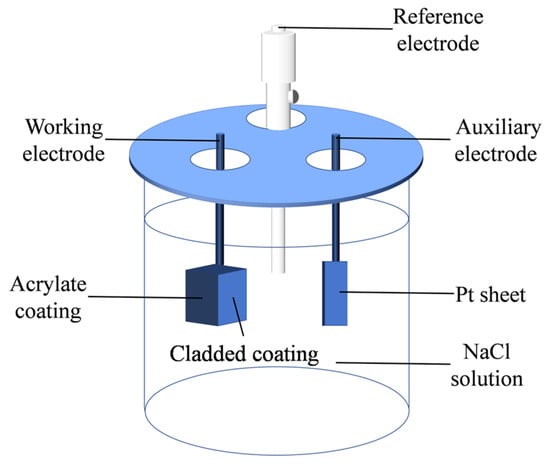
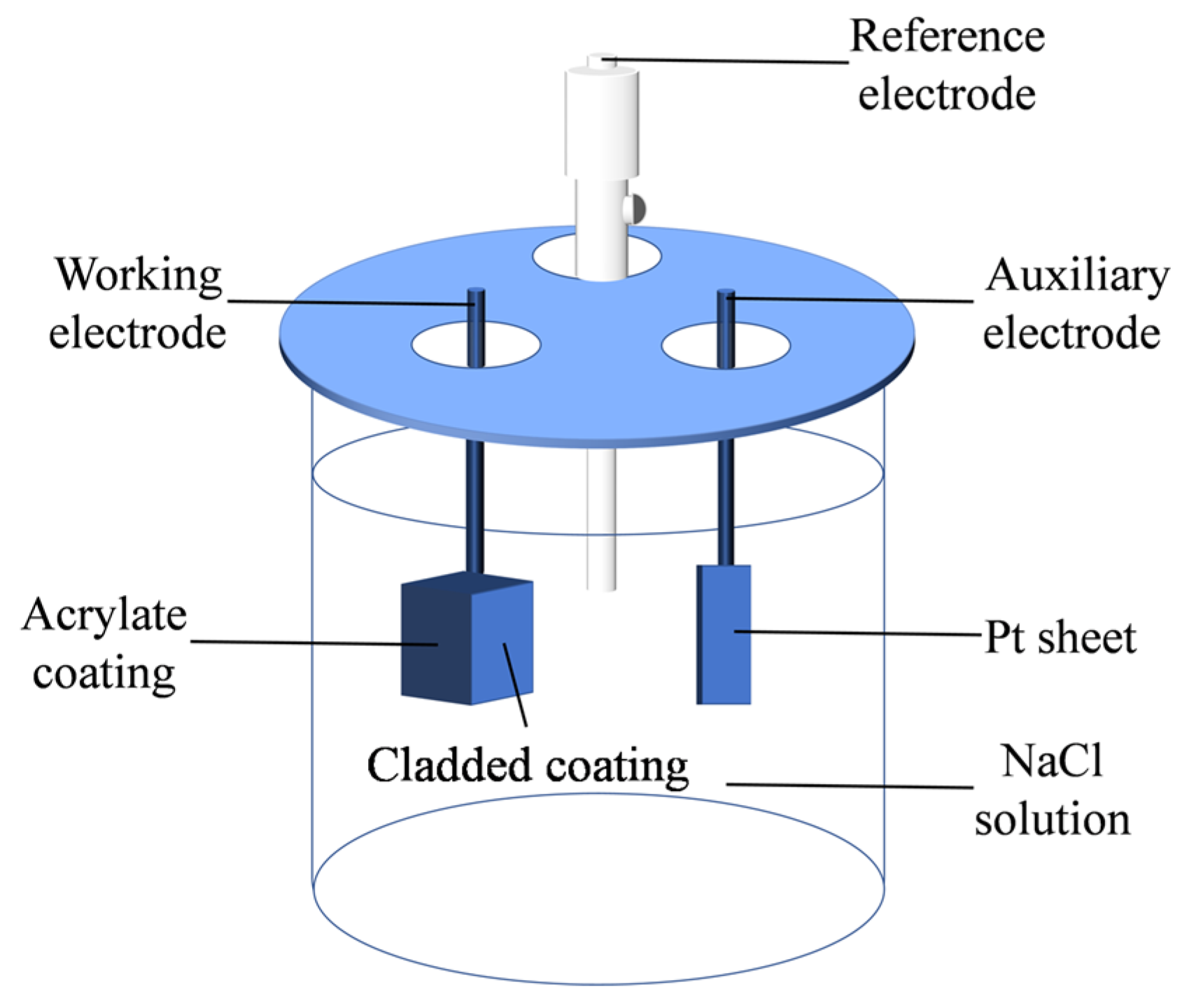
Polarization curves and electrochemical impedance spectroscopy (EIS) were measured on a CHI760E electrochemical workstation. A three-electrode system was adopted: the specimen served as the working electrode, a 15 mm × 15 mm Pt sheet as the auxiliary electrode, and a saturated calomel electrode (SCE) as the reference electrode. A 3.5 wt% NaCl aqueous solution was used as the electrolyte. The schematic diagram of the three-electrode system for electrochemical measurements is shown in Figure 2. Three parallel specimens were tested for each condition during the electrochemical measurements. For polarization curve tests, the potential range was set from −2 V to 1 V with a scanning rate of 10 mV·s−1. The EIS measurements were performed over a frequency range from 0.1 Hz to 105 Hz, with a perturbation amplitude of 5 mV. The open-circuit potential (OCP) was stabilized for 10 min prior to EIS and polarization measurements.
Figure 2.
Diagram of the electrochemical experiment installation.
3. Results and Discussion
3.1. Phase Composition and Microstructure
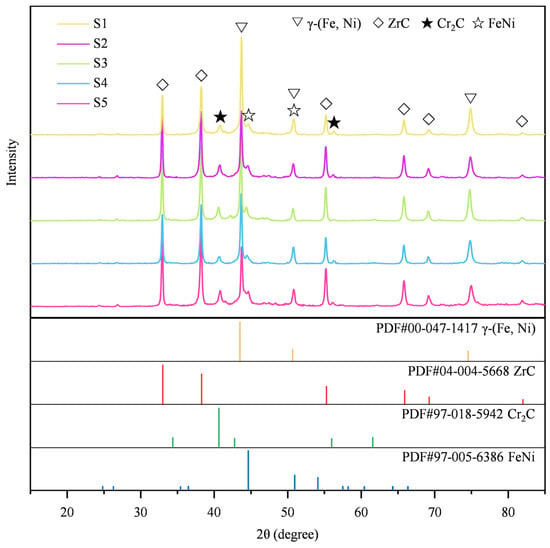
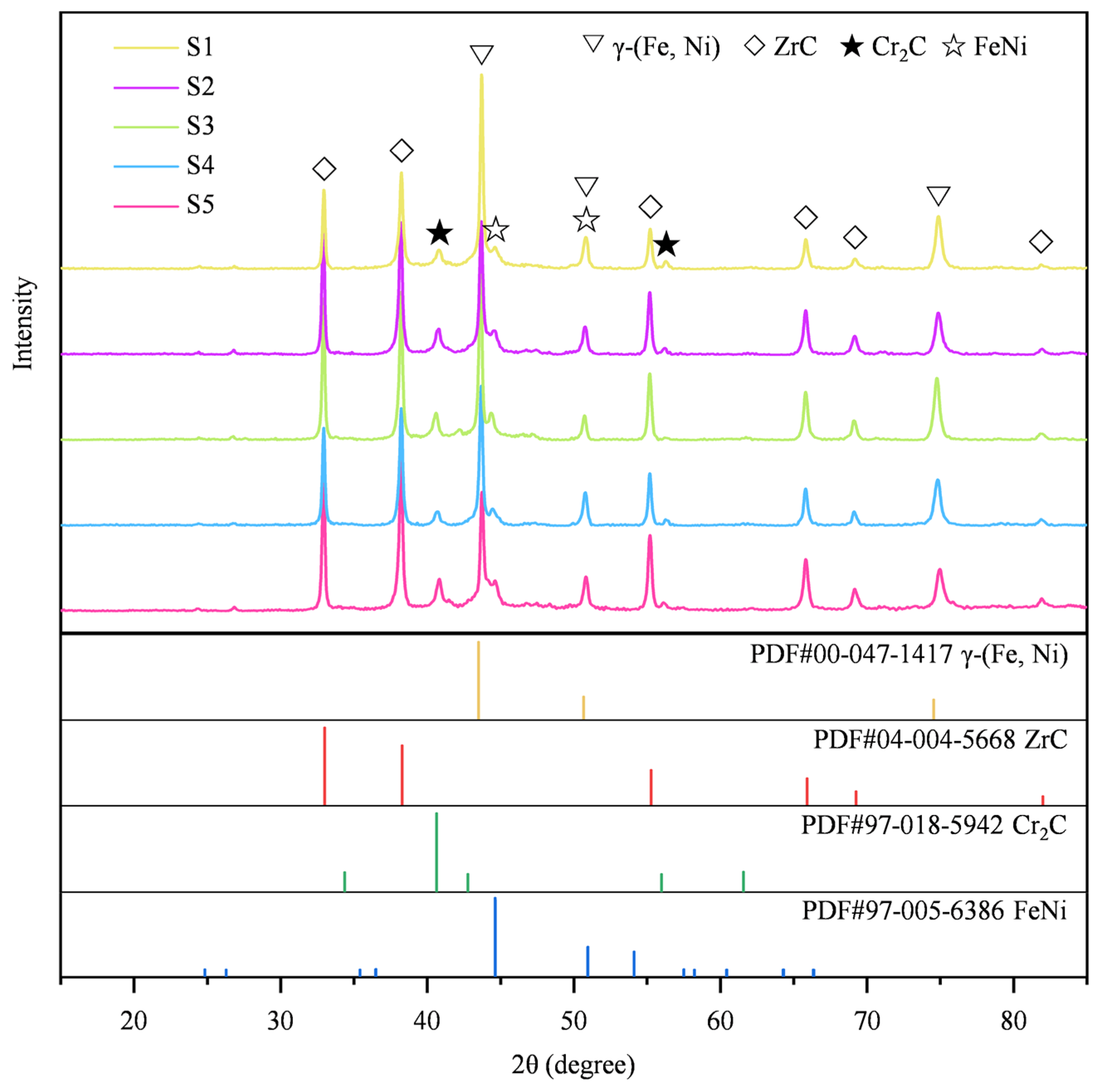
Figure 3 shows the XRD patterns of the cladded coatings. Phase identification reveals that the coating is mainly composed of γ-(Fe, Ni), ZrC, Cr2C, and FeNi. By introducing ZrC into the cladding materials, ZrC was detected in the coating, which confirms the successful preparation of a ZrC-reinforced Ni-based composite coating. ZrC possesses a melting point of approximately 3427 °C [26], which is considerably higher than that of Ni-based alloys (approximately 1027 °C) [27]. Accordingly, the added ZrC only experiences partial melting and decomposition during laser cladding, and thus remains within the coating after solidification. Moreover, ZrC can also be generated via an in situ reaction [28]. Owing to the high chemical affinity between Zr and C, the reaction described by Equation (1) may take place within the molten pool:
Zr + C → ZrC
Figure 3.
XRD patterns of the coatings.
The Gibbs free-energy change (ΔG) of this reaction is −183.90 kJ at 1027 °C, demonstrating that the reaction is thermodynamically spontaneous.
The coating also contains the γ-(Fe, Ni) phase, which originates from the unlimited mutual solubility of Fe and Ni within the face-centered-cubic (fcc) lattice. In the molten pool, Ni is primarily derived from the Ni-based alloy powder, whereas Fe is supplied by the Ni-based alloy as well as dilution from the 45 steel substrate. In addition, phases such as Cr2C and FeNi are also identified in the coating. Of these phases, Cr2C is a metastable phase whose formation is closely associated with the extremely high cooling rate during laser cladding. The system is deviated from equilibrium by rapid solidification, which provides kinetic conditions for the precipitation of metastable phases [29]. FeNi is an ordered intermetallic compound. As can be seen from Figure 3, the S1–S5 coatings exhibit nearly identical diffraction-peak positions, indicating that ZrC addition content and scanning velocity have negligible influence on the phase types.
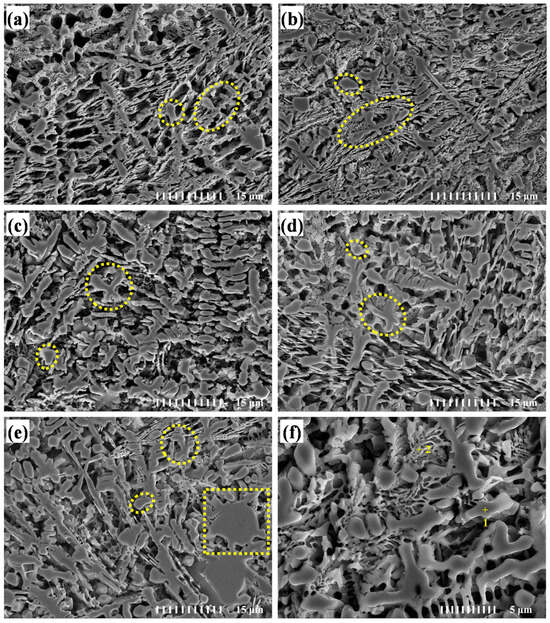
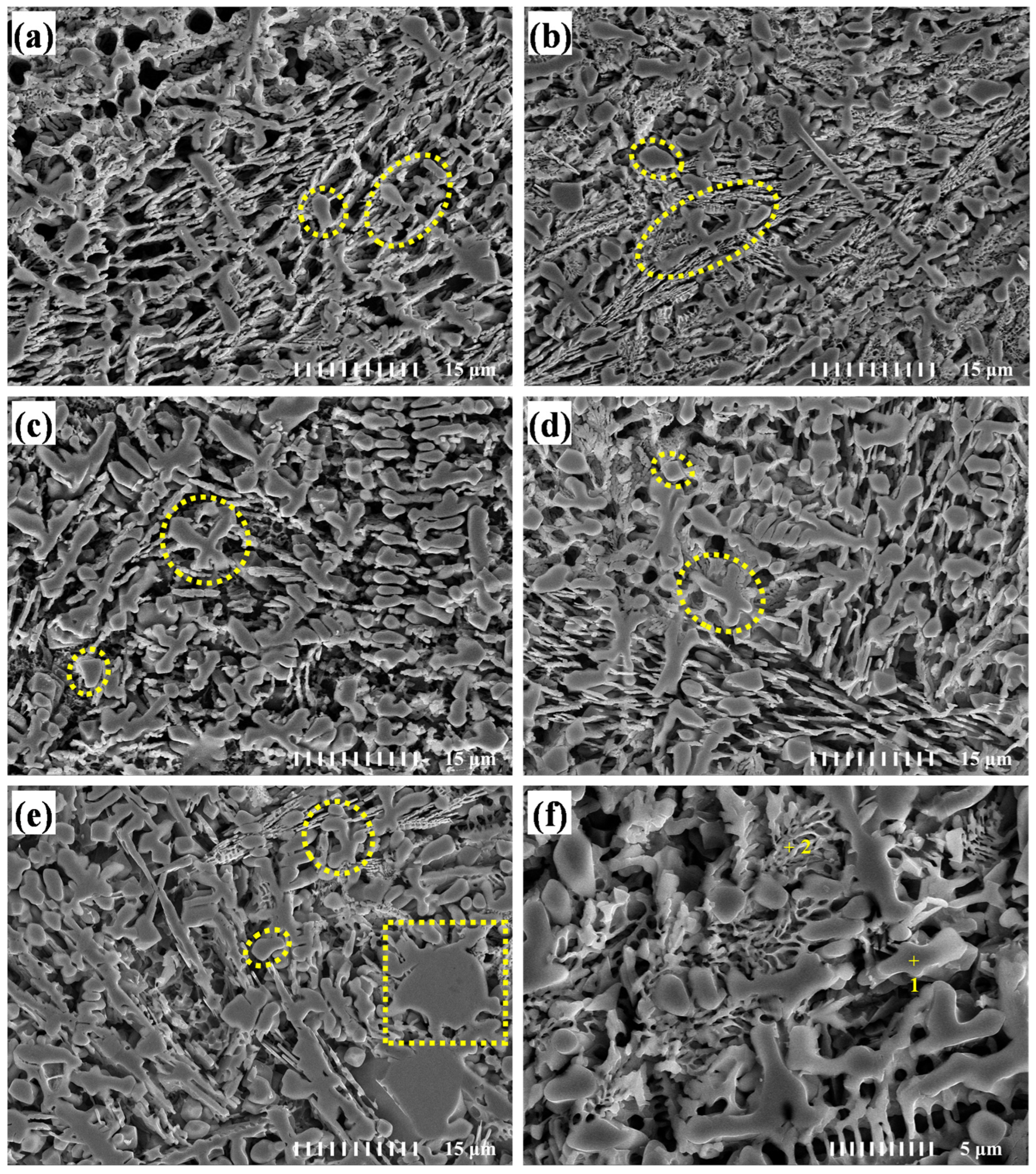
Figure 4 shows the microstructure in the middle region of the cladded coatings. Fine blocks or short dendrites of the second phase are dispersed within the coatings, as marked by the ellipse. Figure 4f presents the high-magnification microstructure of the S2 coating. Apart from the aforementioned second phases (Point 1), eutectics (Point 2) can also be observed in the coating, and the matrix phase exhibits relatively severe corrosion. Previous studies have reported that the matrix of Ni-based composite coatings is generally composed of a γ-Ni solid solution dendrite [30,31]. In conjunction with the XRD results, the matrix phase of the as-prepared coatings can be inferred to be a γ-(Fe, Ni) solid solution. Compared with ceramic phases such as ZrC, the γ-(Fe, Ni) solid solution possesses inferior corrosion resistance. Accordingly, it is preferentially etched during metallographic corrosion.
Figure 4.
Microstructure of the coatings: (a) S1, (b) S2, (c) S3, (d) S4, (e) S5, and (f) high-magnification view of S2. The crosses (+) in (f) mark the positions for EDS point analysis.
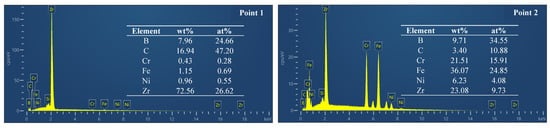
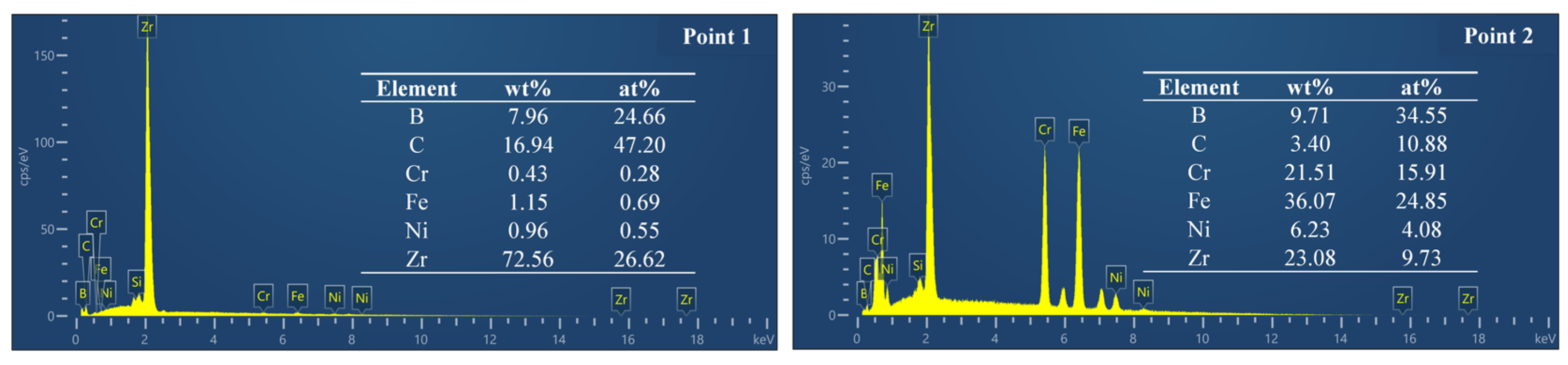
Point-EDS analysis was carried out on these characteristic microstructures, with the results presented in Figure 5. The EDS results reveal that the second phase is mainly enriched in Zr and C. Combined with the XRD phase analysis, this second phase can be tentatively identified as ZrC. The eutectic structure is Cr-rich, which is presumed to host Cr2C carbides. In summary, the microstructure of the cladded coating is mainly composed of γ-(Fe, Ni) dendrites, interdendritic eutectics, and ZrC second-phase blocks or short dendrites.
Figure 5.
EDS results (the points in Figure 4).
Figure 4a–c show the microstructures of cladded coatings with ZrC additions of 30 wt%, 40 wt%, and 50 wt%, respectively. With increasing ZrC addition, the volume fraction of ZrC within the coating increases gradually; meanwhile, the grain size of ZrC rises progressively. Under identical processing conditions with constant laser energy density, the increase in ZrC addition implies a relative decrease in its melting proportion within the molten pool, which contributes to the increased ZrC grain size in the coating.
Figure 4b,d,e illustrate the microstructure evolution of coatings prepared at different laser scanning velocities. A comparison reveals that ZrC grains are refined to a certain extent when the Vs increases from 9 mm·s−1 (Figure 4d) to 12 mm·s−1 (Figure 4b). The elevated Vs raises the cooling rate of the molten pool and shortens the solidification time [32], which suppresses the growth of ZrC grains and consequently results in grain refinement. Nevertheless, when the Vs is further increased from 12 mm·s−1 (Figure 4b) to 15 mm·s−1 (Figure 4e), ZrC grains are not further refined but exhibit coarsening. This is because the excessively high Vs reduces the laser energy density E (defined as E = P/(Vs·D)) [33], which markedly decreases the melting extent of externally added ZrC particles. A portion of the original large ZrC blocks is retained in the coating, as marked by the square in Figure 4e.
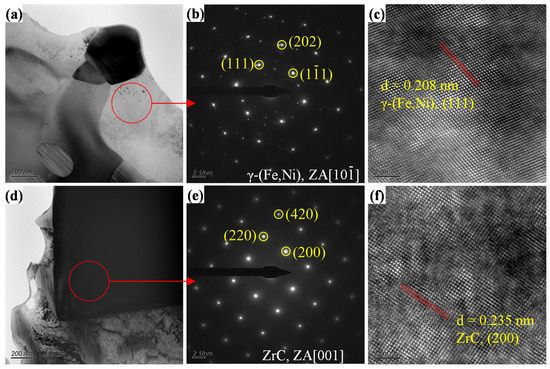
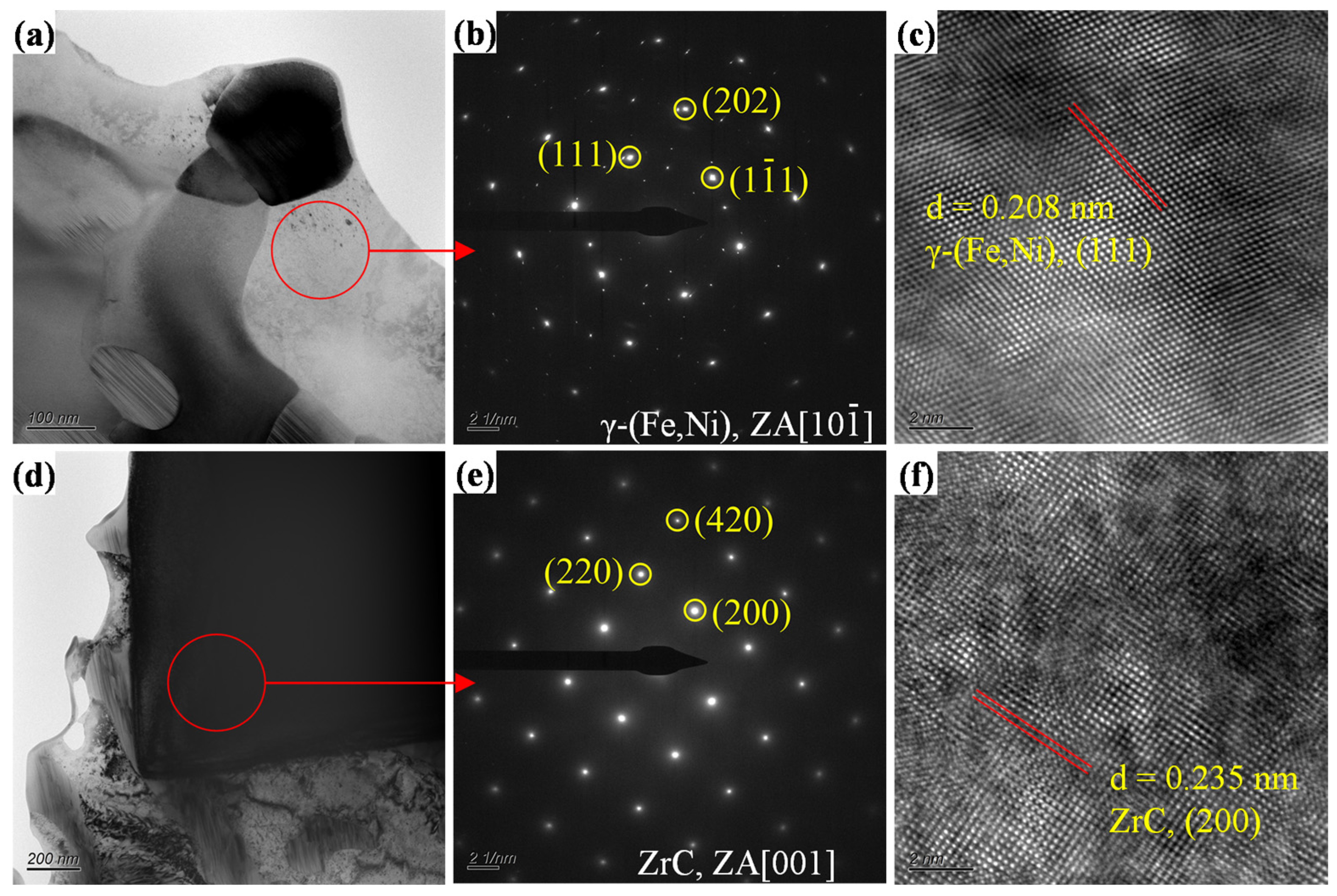
To further identify the phase compositions of the coating, TEM analysis was performed on the S2 coating, and the results are presented in Figure 6. In the BF image, the matrix phase appears as a light-contrast continuous phase (Figure 6a), while the second phase exhibits a dark-contrast blocky morphology (Figure 6d). Through the indexing of SAED patterns, the matrix phase and the second phase are confirmed to be γ-(Fe, Ni) and ZrC, respectively. Specifically, Figure 6b shows the diffraction pattern of the γ-(Fe, Ni) phase along the [10] zone axis, and Figure 6e displays that of the ZrC phase along the [001] zone axis. HR-TEM lattice images of γ-(Fe, Ni) and ZrC are presented in Figure 6c,f. The measured interplanar spacing of 0.208 nm corresponds to the {111} planes of γ-(Fe, Ni), while the spacing of 0.235 nm matches the {200} planes of ZrC.
Figure 6.
TEM results of the S2 coating: (a,d) BF images, (b,e) the corresponding SAED, and (c,f) HR-TEM images. The double lines in (c,f) mark the measured lattice spacing.
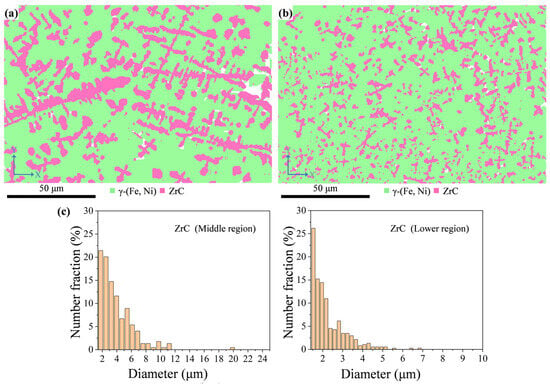
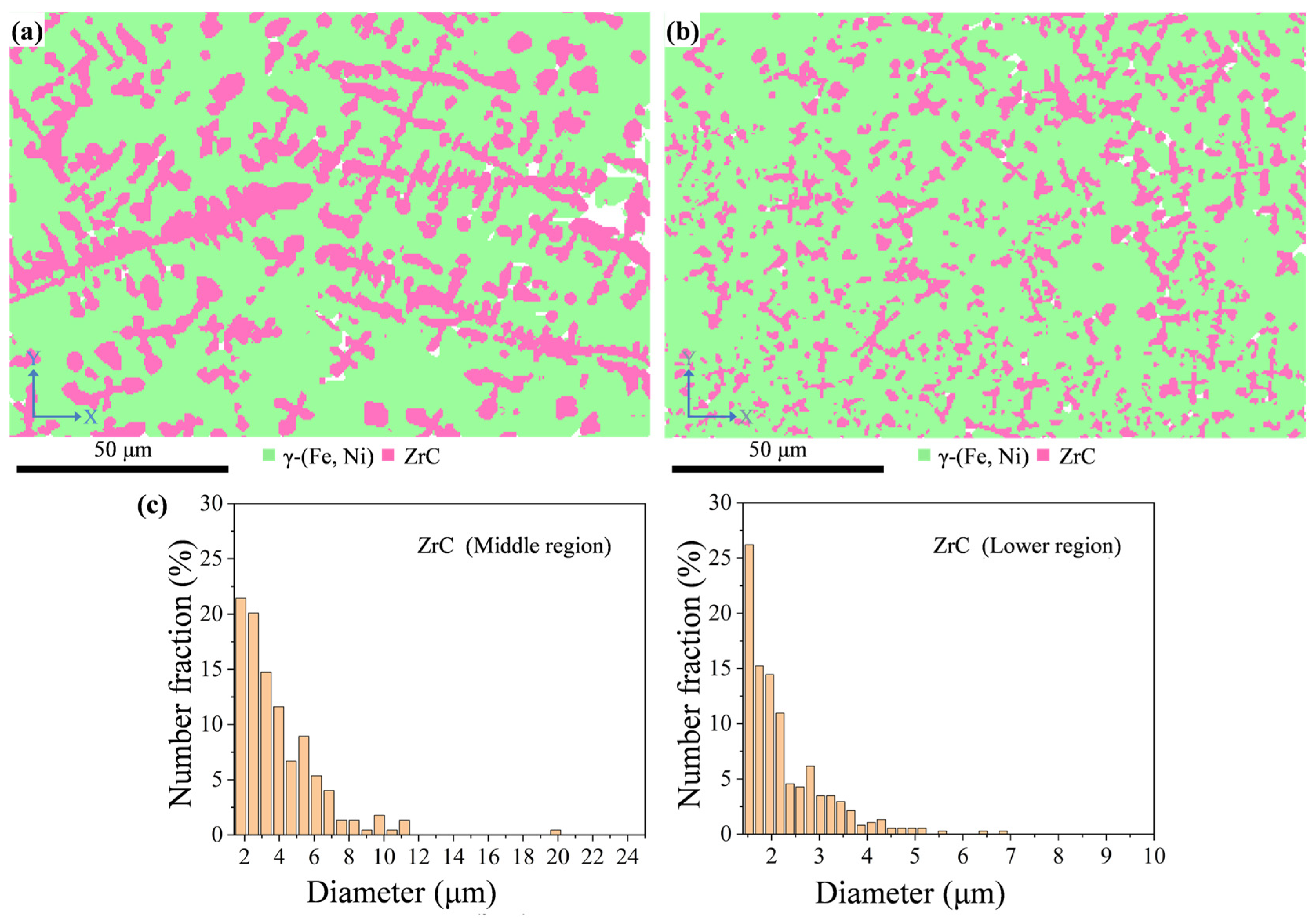
Figure 7 presents the EBSD analysis results of the microstructure in the middle and lower regions of the S2 coating. As shown in Figure 7a, the indexing of Kikuchi patterns indicates that the microstructure in the middle region is primarily composed of the γ-(Fe, Ni) matrix phase and the ZrC second phase, with ZrC exhibiting dendritic or fine blocky morphologies. Similarly, the microstructure in the lower region is also mainly constituted of γ-(Fe, Ni) and ZrC, where ZrC exists in the form of fine dendrites or granular particles and is homogeneously dispersed within the coating (Figure 7b).
Figure 7.
EBSD results of the S2 coating: (a) phase distribution in the middle region, (b) phase distribution in the lower region, and (c) grain size distribution of ZrC.
Figure 7c presents the grain size statistics for ZrC of the S2 coating, with the grain size expressed as the equivalent circle diameter. For the middle region of the coating, the results reveal that approximately 41.5% of ZrC grains fall within the size range of 1.43 μm to 2.88 μm, and the average grain size of ZrC is 3.94 μm. For the lower region, the results indicate that about 41.4% of ZrC grains are distributed in the range of 1.43 μm to 1.85 μm, with an average grain size of 2.26 μm. Compared with the middle region, ZrC grains in the lower region are finer. This can be attributed to the fact that the lower region is in close proximity to the substrate, where favorable heat dissipation conditions lead to a higher cooling rate of the liquid phase [34], thereby suppressing the growth of ZrC grains.
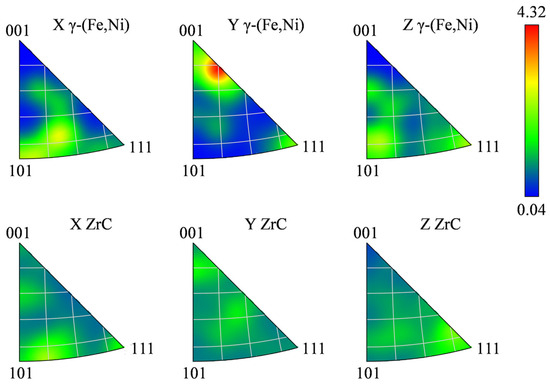
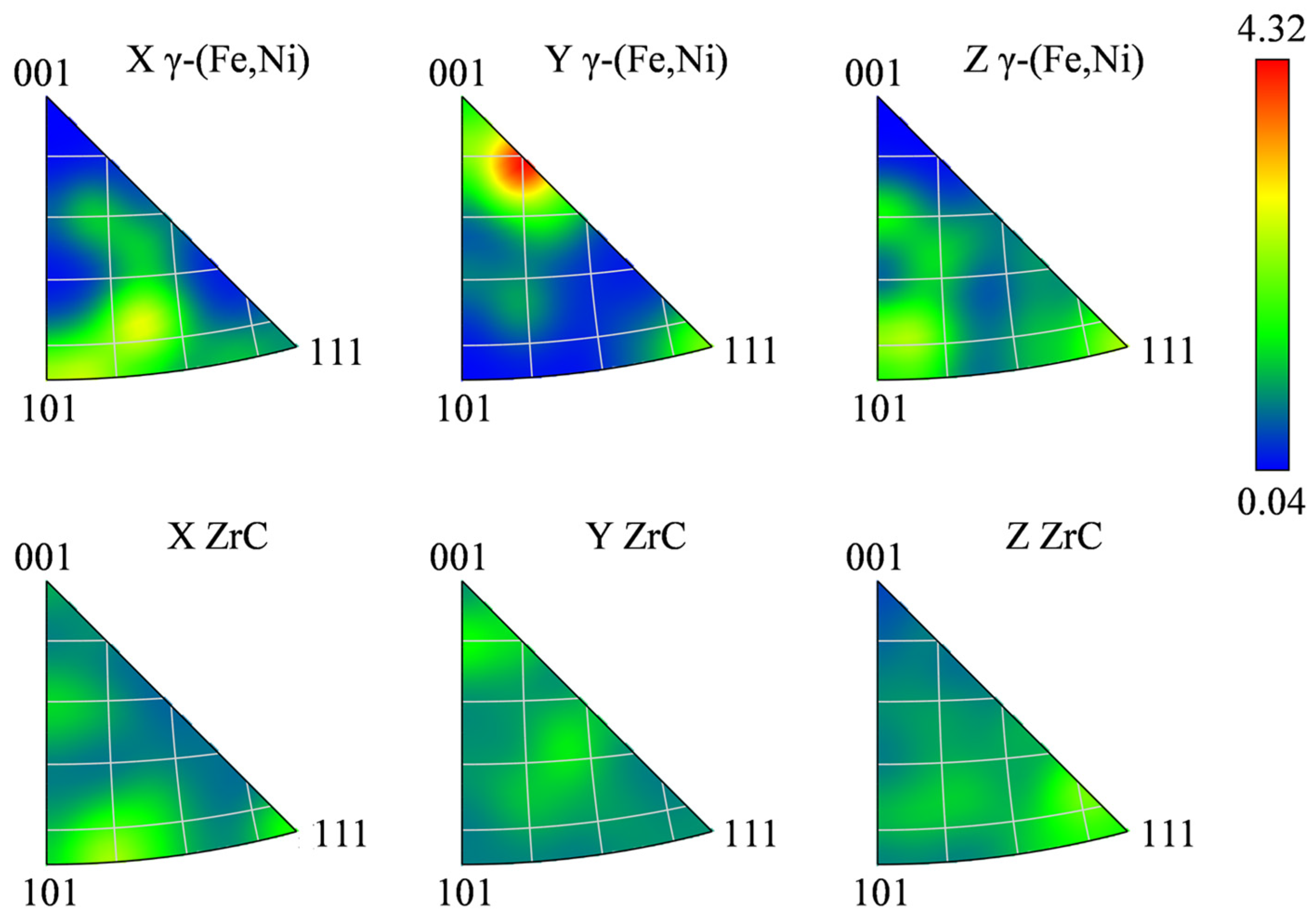
Figure 8 presents the inverse pole-figure (IPF) maps of γ-(Fe, Ni) and ZrC in the lower region of the S2 coating. It can be observed that the <001> crystallographic direction of γ-(Fe, Ni) in the lower region tends to align along the y-axis (coating thickness direction). Given that γ-(Fe, Ni) possesses an fcc structure, its preferred crystallographic orientation is <001> [35]. Since the lower region of the coating is adjacent to the substrate, the temperature gradient is oriented approximately parallel to the y-axis [36]. Consequently, γ-(Fe, Ni) grains with their <001> direction roughly parallel to the y-axis experience favorable growth conditions and achieve preferential growth, leading to the aforementioned solidification texture. In contrast, ZrC in the lower coating exhibits no obvious preferred orientation. This is attributed to the relatively small grain size of ZrC in this region, whose distribution and orientation are susceptible to the convection of the liquid phase, thereby tending to be more uniform.
Figure 8.
IPFs of γ-(Fe, Ni) and ZrC in the lower region of the S2 coating.
3.2. Corrosion Resistance
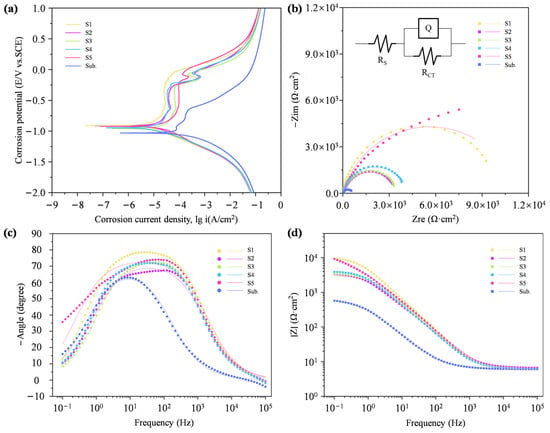
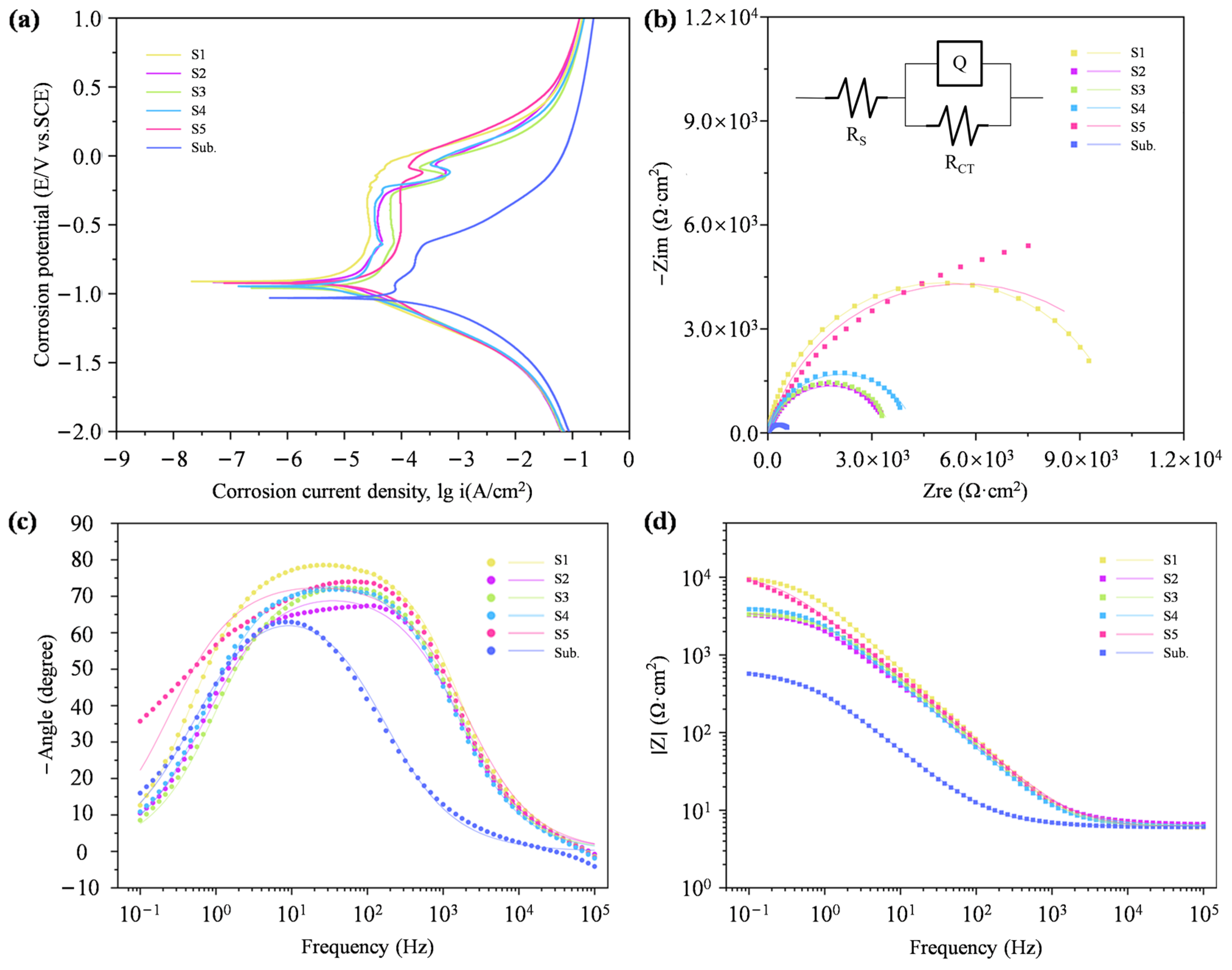
To compare the corrosion resistance of the coatings and the substrate, potentiodynamic polarization measurements were conducted in a 3.5 wt% NaCl solution, and the resulting polarization curves are presented in Figure 9a. The self-corrosion potential (Ecorr) for each curve is identified at the inflection point of the polarization branch. Compared with the substrate, all five coatings (S1–S5) exhibit a positive shift in Ecorr, suggesting enhanced chemical stability and a reduced corrosion tendency. Furthermore, the coatings exhibit a passive region near −0.5 V, whereas no clear passivation behavior is observed for the substrate.
Figure 9.
Electrochemical results of the coatings and the substrate: (a) polarization curves, (b) Nyquist plots, and (c,d) Bode plots.
The Tafel segments of the polarization curves were fitted by linear extrapolation to extract the relevant corrosion kinetic parameters. All extracted parameters are summarized in Table 3, with ηa and ηc representing the anodic and cathodic overpotentials, ba and bc the corresponding Tafel slopes, and icorr the self-corrosion current density. The linear polarization resistance Rp was further derived from the Stern-Geary equation as follows [37]:
Rp = bc·ba·[2.303(bc + ba)·icorr]−1
Table 3.
Fitted results of polarization curves.
As can be seen from the results in Table 3, the S1 coating (with 30 wt% ZrC addition) exhibits the lowest icorr and the highest Rp, indicating the optimal corrosion resistance among all coatings. Its icorr is only 7.18% of that of the substrate, while its Rp reaches 13.34 times the substrate value. For the other four coatings, the icorr ranges from 10.72% to 17.03% of the substrate, and the Rp varies between 5.50 and 8.99 times that of the substrate. Overall, all five coatings exhibit superior corrosion resistance compared to the uncoated substrate.
A comparison of the corrosion resistance of coatings S1–S3 reveals that as the ZrC content increases from 30 to 50 wt%, the icorr gradually rises while the Rp decreases, indicating a progressive deterioration in corrosion resistance. This can be attributed to the substantial corrosion potential difference between ZrC and the γ-(Fe, Ni) matrix. Owing to the higher corrosion potential of ZrC relative to the matrix, galvanic cells tend to form at phase boundaries [38], where the matrix is preferentially subjected to anodic dissolution. As previously discussed, the volume fraction of ZrC within the coatings increases progressively with its addition content. Consequently, the number of micro-galvanic cells increases, thereby accelerating localized corrosion. Therefore, within the investigated ZrC addition range of 30–50 wt%, the corrosion resistance of the coatings exhibits a decreasing trend with increasing ZrC content.
The S4, S2, and S5 coatings correspond to Vs of 9, 12, and 15 mm·s−1, respectively. Comparative analysis reveals that as the Vs increases, the icorr rises while the Rp decreases, suggesting a gradual degradation in corrosion resistance. As noted earlier, the ZrC grains undergo a certain degree of refinement when the Vs increases from 9 to 12 mm·s−1. This refinement enlarges the phase boundary area between ZrC and the γ-(Fe, Ni) matrix, which promotes the formation of galvanic cells and consequently reduces the corrosion resistance. When the Vs is further increased from 12 to 15 mm·s−1, the melting of the externally added ZrC is reduced, leading to coarsening of the ZrC phase and even the retention of large ZrC blocks within the coating. It has been reported that the addition of TiN adversely affects the corrosion resistance by disrupting the continuity of the passive film on the Inconel 625 matrix [39]. Similarly, in the present work, the large ZrC blocks are considered to disrupt the passive film continuity and integrity, thereby impairing the corrosion resistance. In summary, the increased galvanic corrosion dominates the corrosion deterioration when the Vs rises from 9 to 12 mm·s−1. In contrast, the breakdown of the passive film becomes the primary mechanism for performance degradation as the Vs increases from 12 to 15 mm·s−1.
To further characterize the electrochemical corrosion behavior of the samples, EIS measurements were performed. Figure 9b–d presents the results for both the coatings and the substrate, in which the scattered symbols represent the experimental data and the solid lines correspond to the fitted results. The impedance at each frequency is expressed as Z = Zre + j·Zim, where Zre and Zim are the real and imaginary parts of the impedance, respectively, and j denotes the imaginary unit.
As illustrated in Figure 9b, the Nyquist plots for both the coatings and the substrate display a single capacitive arc. Figure 9c presents the phase angle as a function of frequency, where a single peak is observed for each curve, and the phase angles are negative (the ordinate represents the negative of the phase angle). This indicates the presence of one time constant in the electrode process, which corresponds to a single energy storage element in the equivalent circuit. Figure 9d shows the plots of impedance modulus versus frequency, in which the coatings exhibit higher impedance modulus values in the low-frequency region than the substrate, indicating their enhanced charge-blocking capability [40].
Accordingly, an R(QR)-type equivalent circuit (inset of Figure 9b) was employed to fit the impedance spectra. The fitted parameters for each element, together with their corresponding standard deviations (Δ) and chi-squared values (χ2), are summarized in Table 4. In this circuit, Rs represents the solution resistance, Q denotes the constant-phase element (CPE), and Rct corresponds to the charge-transfer resistance. The impedance of the CPE is expressed as follows [41]:
where Y0, j, ω, and n are the proportionality factor, imaginary unit, angular frequency, and CPE exponent, respectively.
ZQ = Y0−1·(jω)−n
Table 4.
Fitted parameters for the elements of the equivalent circuit.
As previously noted, sample S1 exhibits the best corrosion resistance among all coatings, as evidenced by its lowest icorr value. A comparison of the fitted EIS parameters summarized in Table 4 reveals that, among the five coatings, S1 possesses the maximum n and the minimum Y0. The parameters of the CPE, namely n and Y0, are closely associated with the properties of the passive film formed on the electrode surface. Specifically, a larger n value (approaching 1) indicates a more uniform and smoother passive film with fewer surface defects, whereas a smaller Y0 value corresponds to a thicker passive layer. These characteristics are generally indicative of enhanced protective performance, as a compact and homogeneous passive film more effectively impedes electrolyte penetration and charge transfer. Therefore, the superior corrosion resistance of coating S1 can be attributed to its most favorable passive film properties among the tested coatings, which effectively suppress the electrochemical corrosion process.
4. Conclusions
To improve the corrosion resistance of components, ZrC-reinforced Ni-based composite coatings were deposited on 45 steel substrates via laser cladding. Based on the analysis of the microstructure and electrochemical performance of the coatings, the following conclusions are drawn:
- (1)
- The microstructure of the coating is predominantly composed of γ-(Fe, Ni) dendrites, interdendritic eutectics, and ZrC second-phase blocks or short dendrites. With increasing ZrC content, the volume fraction of ZrC within the coating increases. As the scanning velocity increases, the ZrC grains are first refined and then coarsened.
- (2)
- For the coating with 40 wt% ZrC addition prepared at a scanning velocity of 12 mm·s−1, ZrC grains in the lower region are finer than those in the middle region, and the <001> crystallographic direction of γ-(Fe, Ni) in the lower region tends to align along the coating thickness direction.
- (3)
- Increasing ZrC addition and scanning velocity both deteriorate the corrosion resistance of the coatings. Within the ZrC addition range of 30, 40, and 50 wt%, the coating with 30 wt% ZrC exhibits the optimal corrosion resistance at a scanning velocity of 12 mm·s−1, with icorr being only 7.18% of that of the substrate and Rp reaching 13.34 times that of the substrate. This superior performance is attributable to its high CPE exponent n and low proportionality factor Y0, which indicate favorable passive film properties.
Author Contributions
Conceptualization, L.Z.; Methodology, L.Z.; Validation, L.Z.; Formal analysis, L.Z.; Investigation, L.Z.; Data curation, L.Z.; Writing—original draft, L.Z. and Z.Z.; Writing—review & editing, H.L., H.Y. and C.C.; Visualization, L.Z. and Z.Z.; Supervision, H.L., H.Y. and C.C.; Project administration, C.C.; Funding acquisition, C.C. All authors have read and agreed to the published version of the manuscript.
Funding
This work was supported by Tai’an science and technology innovation double ten project—Major achievements transformation project (2024CGZH09).
Data Availability Statement
The data presented in this study are available on request from the corresponding author.
Conflicts of Interest
The authors declare no conflict of interest.
References
- Ma, Q.; Zhang, H.; Lv, Y.; Song, C.; Guo, N.; Xiao, G.; Zhao, W. Microstructure and properties of W0.5Ta0.3MoNbVAlTi1−xZrx high entropy alloy coatings by laser cladding on the surface of 45# steel. Ceram. Int. 2023, 49, 36416–36428. [Google Scholar] [CrossRef] [Scilit]
- Cheng, Y.; Sun, Y.; Zhang, S.; Cheng, W.; Xu, Y.; Wei, S.; Luo, J. Corrosion and wear resistance of inconel 625 and inconel 718 laser claddings on 45 steel. J. Alloys Compd. 2025, 1013, 178368. [Google Scholar] [CrossRef] [Scilit]
- Baiocco, G.; Menna, E.; Mingione, E.; Rubino, G.; Ucciardello, N. Effect of process parameters and film stratification on morphology and performance of auto-lubricating Ni-GnP electroplated coated steel. Eng. Fail. Anal. 2024, 161, 108223. [Google Scholar] [CrossRef] [Scilit]
- Tang, K.; Lang, S.; Wang, H.; Deng, Y.; Jian, W.; Sun, B.; Huang, H.; Ren, L. Strike nickel plating pretreatment enables simultaneous adhesion and tribology enhancement of electroless Ni-P-hBN coatings on 420 stainless steel. Tribol. Int. 2026, 224, 112352. [Google Scholar] [CrossRef] [Scilit]
- Liu, Y.; Yang, M.; Tang, J.; Kim, A.; Kainuma, S. Anticorrosion performance of thermal spray coatings on corroded steel after surface preparation. Surf. Coat. Technol. 2026, 520, 133039. [Google Scholar] [CrossRef] [Scilit]
- Li, G.; Wang, Z.; Yao, L. Component mixing, fluid flow and cooling rate in laser cladding of Fe-Cr-based alloys on 45 steel. Optik 2023, 272, 170318. [Google Scholar] [CrossRef] [Scilit]
- Ge, H.; Ding, S.; Zhang, P.; Fang, H.; Hu, Y.; Yao, J. Influence of overlapping process on the distribution of Cr element in laser cladding 316L powder on 45# steel substrate. Surf. Coat. Technol. 2024, 493, 131249. [Google Scholar] [CrossRef] [Scilit]
- Liu, K.; Wang, L.; Huang, L.; Jing, L.; Li, J. Effect of laser power on microstructure and properties of laser cladding Ni-based composite coating on nickel aluminum bronze alloy. J. Alloys Compd. 2026, 1057, 186952. [Google Scholar] [CrossRef] [Scilit]
- An, Y.; Su, F.; Yao, H.; Sun, J.; Pu, J. Load and potential dependent corrosion-wear synergy of laser cladding CoCrMo coating during tribocorrosion. Tribol. Int. 2026, 223, 112188. [Google Scholar] [CrossRef] [Scilit]
- Liu, D.; Cheng, Y.; Zhou, J.; Wang, Y.; Chen, H.; Ma, K.; Yang, J.; Volodymyr, K.; Petro, S. Investigation on the corrosion degradation behavior of high-speed laser cladding Fe-based coating for hydraulic support columns in mine water. Corros. Sci. 2026, 271, 114162. [Google Scholar] [CrossRef] [Scilit]
- Li, L.; Xue, X.; Qu, H.; Liu, F.; Liu, L.; Chen, X.; Xu, R. Corrosion resistance of molybdenum-modified Ni-50 laser-clad coatings on 45# steel in concentrated brine. Int. J. Electrochem. Sci. 2026, 21, 101280. [Google Scholar] [CrossRef] [Scilit]
- Dong, Q.; Zheng, S.; An, Y.; Pu, J. Effect of copper addition on the microstructure, wear resistance, anti-corrosion and antibacterial behavior of laser cladding CoCrW coatings in marine environment. Surf. Coat. Technol. 2025, 502, 131966. [Google Scholar] [CrossRef] [Scilit]
- Guo, T.; Jiang, Y.; Wei, Y.; Liang, Z.; Dong, K.; Zhang, R.; Ren, G. Effects of laser cladding scanning paths on the microstructure, wear, and corrosion resistance of Fe-0.3C-15Cr-1Ni alloy coatings. Surf. Coat. Technol. 2026, 526, 133332. [Google Scholar] [CrossRef] [Scilit]
- Ding, H.; Qin, T.; Jia, G.; Cui, L.; Kong, D. Heat treatment-improved electrochemical corrosion of laser cladded FeCoCrNiAl and CuCMnNiTi high-entropy alloy coatings. Surf. Interfaces 2026, 97, 110234. [Google Scholar] [CrossRef] [Scilit]
- Yin, M.; Chen, W.; Xie, H.; Yang, Z.; Feng, J.; Zhang, Y.; Chen, Z.; Li, D.; Qiu, Z. Study on electrochemical corrosion behavior of Y2O3-doped AlCrFeNiTi high-entropy alloy laser cladding coatings. J. Mater. Res. Technol. 2026, 42, 2940–2953. [Google Scholar] [CrossRef] [Scilit]
- Zhou, L.; Ma, G.; Wang, H.; Wang, W.; Mou, H.; XianYong, Z.; Zhao, H.; Li, Y.; Tan, N. High-speed laser cladded Ni-based cermet coating with high ceramic phase content derived from core-shell structured powder. Surf. Coat. Technol. 2024, 489, 131110. [Google Scholar] [CrossRef] [Scilit]
- Jiang, Y.; Wang, H.; Hong, H.; Zhu, H.; Liu, X.; Lu, H.; Song, X. Multiscale carbides and W-rich nanophases in laser-cladded WC-12Co coatings and enhanced wear resistance. Int. J. Refract. Met. Hard Mater. 2026, 139, 107845. [Google Scholar] [CrossRef] [Scilit]
- Yuan, J.; Li, X.; Pan, G.; Zhang, S.; Cui, Y.; Zhu, R.; Lu, H.; Song, Q. Effect of SiC-Si4N3 ceramic reinforcement on the microstructure and corrosion resistance to molten aluminum of laser-cladded Co-based coatings. Ceram. Int. 2025, 51, 13493–13506. [Google Scholar] [CrossRef] [Scilit]
- Chen, H.; Cheng, Y.-H.; Liu, D.-T.; Wang, Y.-F.; Zhou, J.-L.; Geng, J.-Y.; Yang, J.-Y.; Jeyaprakash, N. Effect of WC addition on microstructure, wear and corrosion behavior of laser-cladded CoCrFeNiAl coatings. Ceram. Int. 2026, in press. [Google Scholar] [CrossRef] [Scilit]
- Zhang, H.; Guo, H.; Tao, J.; She, W.; Hu, X.; Zhao, C. Study on microstructural control and wear and corrosion resistance of non-contact ultrasonic-assisted Ni-WC laser cladding layers. Mater. Today Commun. 2025, 49, 113786. [Google Scholar] [CrossRef] [Scilit]
- Zhang, J.; Shen, S.; Wang, Y.; Pan, X.; Chen, X.; Sun, S. Microstructure, wear, and corrosion properties of Ni60-WC coatings prepared by induction heating-assisted high-speed laser cladding. Surf. Interfaces 2026, 94, 109417. [Google Scholar] [CrossRef] [Scilit]
- Wang, Z.-H.; Liu, X.-B.; Zhang, C.-Y.; Zhong, R.; Zou, K.; Deng, Q.-Y.; Wang, K.-M.; Gu, J. Study of tribological and salt spray corrosion properties of laser-cladded Ni60-Ti2AlC composite coatings on 316 L stainless steel. Tribol. Int. 2026, 225, 112400. [Google Scholar] [CrossRef] [Scilit]
- Wang, L.; Shi, W.; Chen, D.; Teng, Y.; Yin, Z.; Xue, M. In-situ synthesis of (Nb,Mo) C composite carbides via Mo2C decomposition: A novel strategy for synergistic wear and corrosion resistance in laser-cladded Ni-based coatings. Surf. Coat. Technol. 2026, 534, 133690. [Google Scholar] [CrossRef] [Scilit]
- Li, H.; He, Y.; Luo, P.; Fan, Y.; He, T.; Zhang, Y.; Xiang, Y.; He, Y.; Song, R. Fabrication of the ZrC reinforced Ni W composite coating and exploration of its mechanical properties and corrosion resistance. Surf. Coat. Technol. 2021, 421, 127413. [Google Scholar] [CrossRef] [Scilit]
- Zhu, S.; Xu, Z.; Shen, Q.; Wang, C.; Zhang, L. Achieving superior corrosion protection of Cr(III)-ZrC composite coatings through nonionic-surfactant-mediated ZrC dispersion. Surf. Coat. Technol. 2026, 536, 133785. [Google Scholar] [CrossRef] [Scilit]
- Peterson, G.R.; Carr, R.E.; Marinero, E.E. Zirconium Carbide for Hypersonic Applications, Opportunities and Challenges. Materials 2023, 16, 6158. [Google Scholar] [CrossRef] [Scilit]
- Liu, J.; Chen, Y.; He, D.; Liu, Y.; Chen, H. Dissimilar fabrication of the TC4/Ni60 bimetallic structure by laser melting deposition using a V/Cu transition bilayer. J. Manuf. Process. 2024, 131, 1987–1999. [Google Scholar] [CrossRef] [Scilit]
- Liu, K.; Wang, H.; Shu, C.; Zhou, J.; Li, J.; Wang, C.; Wu, H.; Wang, L. Effect of WC content on microstructure and properties of laser-cladded in-situ reactive ZrC/ZrB2 composite coatings on zirconium alloy. Int. J. Refract. Met. Hard Mater. 2024, 118, 106486. [Google Scholar] [CrossRef] [Scilit]
- Wen, W.; Qi, H.; Sun, S.; Guo, S.; Liao, Z.; Xiong, R.; Wu, Z. Microstructural evolution and governing wear mechanisms of dual-scale Cr-rich carbide reinforced coatings fabricated by extreme high-speed broadband laser cladding. Tribol. Int. 2026, 222, 112172. [Google Scholar] [CrossRef] [Scilit]
- Guan, Z.; Gao, Q.; Jia, D.; Zhao, B.; Wang, X. Effect of TiC content on precipitation microstructure and properties of multi-layer laser-cladded Ni-based composite coatings. J. Mater. Res. Technol. 2026, 42, 11796–11807. [Google Scholar] [CrossRef] [Scilit]
- Liang, F.; Shi, W.; Liu, Y.; Teng, Y.; Chen, D.; Yin, Z.; Xue, M. Synergistic effect of YSZ on wear and corrosion resistance of Laser cladded Ni-based/WC composite coating: Microstructure evolution and underlying mechanisms. Tribol. Int. 2027, 225, 112364. [Google Scholar] [CrossRef] [Scilit]
- Lian, G.; Cai, Z.; Chen, C.; Feng, M.; Zeng, Z. Microstructural evolution of laser cladding IN718 coatings: Multiscale numerical simulation and experiment. Appl. Therm. Eng. 2026, 292, 130357. [Google Scholar] [CrossRef] [Scilit]
- Lv, H.; Liu, Y.; Chen, H.; Liu, J.; Wei, Z. The effects of laser energy density on the re-manufacturing of LZ50 axle via extreme high-speed laser cladding: Microstructure, mechanical property, and fatigue performance. Mater. Sci. Eng. A 2025, 947, 149189. [Google Scholar] [CrossRef] [Scilit]
- Pandey, A.; Choudhary, S.; Gaur, V. A numerical study on microstructural features evolved across the melt pool in additively manufactured IN718 alloy. Mater. Sci. Eng. A 2023, 868, 144763. [Google Scholar] [CrossRef] [Scilit]
- Qiu, Z.; Zhu, H.; Wang, Z.; Muránsky, O.; Wei, T.; Budzakoska-Testone, E.; Davis, J.; Studer, A.; Gu, Q.; Garbe, U.; et al. Crystallographic texture and multiscale boundaries mediated creep anisotropy in additively manufactured Ni-based Hastelloy C276 superalloy. Addit. Manuf. 2024, 83, 104069. [Google Scholar] [CrossRef] [Scilit]
- Zhang, P.; Niu, S.; Dong, G.; Wu, H.; Ge, H.; Yao, J. Study on the formation mechanism of segregation bands during IN718 laser cladding on 316L. Surf. Coat. Technol. 2026, 530, 133541. [Google Scholar] [CrossRef] [Scilit]
- Liu, Z.; Miao, X.; Wu, M.; Jie, D.; Wang, H.; Zhang, Y. Microstructure, corrosive-wear and electrochemical/immersion corrosion behavior of laser cladded TiC/B4C/WC-reinforced WTaNbMo-Y2O3 coatings. Ceram. Int. 2026, in press. [Google Scholar] [CrossRef] [Scilit]
- Wen, W.; Sun, S.; Qi, H.; Liao, Z.; Xiong, R.; Wu, Z. In-situ dual-scale carbides mediated micro-galvanic effects and corrosion degradation in Cr-rich Fe-based composite coatings fabricated via extreme high-speed broadband cladding. Corros. Sci. 2026, 268, 113906. [Google Scholar] [CrossRef] [Scilit]
- Zhao, J.; Luo, D.; Sun, W. Effect of TiN content on the microstructure and properties of laser-cladded nickel-based WC coatings. Ceram. Int. 2026, 52, 24422–24434. [Google Scholar] [CrossRef] [Scilit]
- Ji, Y.; Zhang, C.; Zhang, D.; Zhang, L.; Liu, L.; Liu, K. Corrosion resistance improvement of laser-clad Ni60 composite coatings via Fe-based amorphous-nanocrystalline incorporation. Surf. Coat. Technol. 2026, 536, 133773. [Google Scholar] [CrossRef] [Scilit]
- Zhou, D.; Jiang, D.; Ji, Y.; Song, X.; Zhang, G.; Song, Q.; Wang, C.; Lian, X.; Wang, G.; Suo, T.; et al. In-situ synthesis of compatible ceramic phases by laser cladding for strengthening CoCrNi-based coatings and their tribocorrosion mechanisms. Surf. Coat. Technol. 2026, 528, 133433. [Google Scholar] [CrossRef] [Scilit]

Disclaimer/Publisher’s Note: The statements, opinions and data contained in all publications are solely those of the individual author(s) and contributor(s) and not of MDPI and/or the editor(s). MDPI and/or the editor(s) disclaim responsibility for any injury to people or property resulting from any ideas, methods, instructions or products referred to in the content. |
© 2026 by the authors. Licensee MDPI, Basel, Switzerland. This article is an open access article distributed under the terms and conditions of the Creative Commons Attribution (CC BY) license.