


Abstract
It is well-established that both teacher commitment and the quality of instruction positively influence student achievement. However, the evidence for such constructs and their connections in the context of a developing country such as Pakistan is scarce. This research addresses the interconnections of teachers’ organizational commitment, pedagogical effectiveness, and student performance in Khyber Pakhtunkhwa secondary schools, aligned with the educational reform initiatives in developing nations. A quantitative approach was utilized involving a purposive sample of 348 secondary school educators in Bunir District for triangulation purposes. Based on a validated data collection instrument, the researchers measured the three latent constructs of organizational commitment (affective, normative, and continuance), effective teaching (practice, metacognitive strategy, feedback, and formative assessment), and student performance (cognitive and non-cognitive). Subsequently, the researchers utilized descriptive statistics, correlation, and structural equation modeling for the analyses. The most notable findings in the study were the moderate levels of teacher commitment and instructional effectiveness, and the particularly low levels of student achievement, especially in the non-cognitive dimensions. Teachers’ organizational commitment was positively related to effective teaching, as well as to student achievement. Furthermore, teaching practices served as a mediator of the relationship between teacher commitment and student outcomes, as the direct effect of commitment on outcomes was found to be non-significant. The findings highlight the importance of constructive pedagogical practices as a mediator between teacher commitment and student outcomes. In challenging educational contexts, reinforcing teacher commitment through initiatives such as professional recognition, mentoring within a defined framework, and distributed leadership, combined with ongoing pedagogical training, could amplify student engagement and achievement.
1. Introduction
1.1. Teachers’ Organizational Commitment
The level of organizational commitment is typically measured by employees’ degree of attachment, identification, and involvement in the organization [1]. Committed employees align strongly with the organization’s goal and exert extra effort to achieve that goal. Most importantly, they see and perceive their membership to the organization as long and permanent [2]. While organizational commitment has been described as a multidimensional concept, the three dimensions of organizational commitment can have varying impacts on teacher behaviors as outlined by the researchers [3]. Affective commitment is the emotional connection to school and has been linked to instructional innovation and professional [4]. Normative commitment is a feeling of moral obligation towards the institution and can help to foster organizational expectations compliance [5]. However, there is a cost associated with commitment to continuance that is often seen as a negative factor for leaving the organization, and a link between commitment to continuance and instructional performance is not always obvious. According to the previous studies [6,7], there is a greater relationship between affective commitment and teaching effectiveness than between continuance commitment and teaching effectiveness, so that the quality of the commitment is more important than just the existence of the commitment to the achievement of students’ learning. Psychologically, this attachment is from the three components of identification, involvement, and loyalty [8,9]. Therefore, teachers are likely to strengthen their attachment to the schools if they are supported by policies that are perceived to be fair [10,11].
Teacher commitment has become a prominent focus in educational research due to its correlation with positive instructional practices, new ideas, and ongoing professional growth [12,13]. Studies suggest a positive association between TC and teacher effort, enthusiasm, and commitment to better the teaching and learning processes, and a decrease in student failure [14,15]. Considering the above, TC was included as a central variable for this research.
Ref. [16] identifies commitment as the psychological bond to one’s job, which is influenced by personal conviction and/or social pressure [17]. In both general management and educational research [18], the focus has been on organizational commitment, and more specifically, the emotional commitment to an organization which leads to active involvement and satisfaction in being part of an organization [19]. In educational settings, the available literature has focused on the ways to enhance the emotional bond of teachers and staff.
Research shows that encouragement, authentic concern, and possible optimistic future help teachers start seeing their jobs as meaningful, thus strengthening their emotional bonds to the organization [20,21].
When such conditions are present, teachers are more likely to embrace the organizational goals and value their commitments.
Genuinely committed teachers develop emotional ties with their students, the content and the school. They take ownership of the organization’s goals, exert a great deal of effort toward achieving them and project a long-term commitment to the organization.
Research shows the impact of organizational commitment on teachers’ motivation and behavior, intentions to move to other schools, extra role behaviors and ultimately on other school outcomes such as students’ academic performance, engagement, quality of learning and academic support [22,23,24,25]. The effect of these variables, as of the study, has been noted in both Western and non-Western countries.
1.2. Positive Classroom Environment
Creating a positive classroom environment is vital for effective teaching and learning. A constructive classroom is one where students are actively involved, working cooperatively, and tackling reasonable cognitive processing demands to learn new content [26]. Students are able to attain a high level of understanding of concepts and goals, and teachers are able to accomplish curricular objectives. Therefore, the quality of teaching is vital in determining the level of participation, the quality of achievement, and the level of commitment of the teachers to their profession.
1.3. Effective Teaching Practices
With the significance of a positive classroom climate, effective teaching must have efficient learning, particularly for teachers with high commitment. According to Ref. [27], the quality of education is only realized when the teacher, parent, and the policymakers together with the community share the burden of sustaining improvement and monitoring the students systematically. Inside the schools, the collaboration of peers and the common responsibility for the improvement of the students strengthens this further. Thus, teaching, in a sense, is a multidimensional activity to be developed, rather than a single activity with a fixed endpoint. Ref. [28] supports this by stating that students are able to think at higher levels, maintain a high level of engagement and motivation, develop goals for education beyond high school, and learn in a detailed manner across different content areas as a result of quality, purposeful, and well-structured teaching [29].
Ref. [29] highlights many positive indicators of effective teaching: classroom management, meaningful interaction, higher-order questioning, constructive feedback and support during the teaching process, and successful achievement of learning outcomes. Of these, classroom management is key. Ref. [30] points out that one of the greatest difficulties of teaching a language is keeping different learners’ attention and sustaining their motivation. Even well-designed explanations may be ineffective if the presentation of the content lacks organization and/or clarity. This explains the interdependence of classroom management and teaching effectiveness.
In addition, it is important to cater to the effective and motivational needs of the students with the aim of improving the engagement and motivation of students in learning. Ref. [10] defines classroom management as the activities that teachers perform to structure a classroom environment that is safe, interactive, and motivates students to engage voluntarily. Likewise, classroom management is defined as a fusion of different skills and/or strategies through which order, attention, and academic work effectiveness are achieved and sustained throughout the teaching process. All these different views suggest that classroom management is more than being strict and is more about a fluid and interactive relationship between teachers and students.
Teaching practices in the classroom are most effective when combined with effective classroom management: the techniques used to maintain a productive space for learning in order to reach the learning objectives. When a classroom is well-organized and students are actively engaged, teaching objectives are more readily achieved than in a disorganized classroom. Therefore, learning the techniques of classroom management is not an optional skill but a basic requirement for all teachers and is also a requirement for pre-service teachers, who are expected to show this level of competence during their teaching practice.
In many of the secondary schools in District Bunir, most of which are located in rural areas, behavioral problems are a major barrier to successful teaching. According to Ref. [31] students who are persistently off task, for example, talking, singing, or laughing during lessons, are a barrier to effective instruction, and as a result, students lack a deep understanding of the content. This is a similar problem to what pre-service teachers experience during their in-service training. According to Ref. [32], novice teachers experienced difficulties in dealing with minor disruptions, problematic focusing of the group, managing cooperative learning activities, and timing the distributed practice during a classroom oral assessment [33,34]. Furthermore, gaining the students’ attention was a problem. Given these conditions, pre-service teachers need to go beyond merely hoping things will go well and must incorporate advanced content mastery along with research-based teaching and management strategies through micro-teaching and actual teaching practice.
It is also acknowledged that teachers’ classroom management skills are seen as the cornerstone of effective teaching, allowing for increased student participation and higher quality student learning.
1.4. Learning Outcomes
In line with most views in the current literature, student learning outcomes are divided into two groups, namely, cognitive and non-cognitive outcomes [35,36]. The cognitive outcomes are said to be the improvements in the mental subsystems of the learners, including reasoning, problem solving, and critical thinking [37,38]. The non-cognitive outcomes pertain to the affective and the social aspects, including the students’ motivation, self-efficacy, interest, and their interaction/social skills [39].
Research demonstrates that the learning environment is one factor that can have a positive impact on academic performance [39,40], as well as on creativity [41], self-efficacy [42], motivation [43], satisfaction [44], critical thinking, and problem solving [45]. While a few studies have reported that learning environments do not significantly affect students’ satisfaction [46] or performance [47,48], others have reported positive relationships between learning environments and student outcomes [49]. The inconclusive results call for more research into the interplay among teachers’ organizational commitment, effective instructional behaviors, and students’ learning outcomes. While there is an abundance of literature on related constructs, it is evident that there is a paucity of research exploring the synergistic impact of teachers’ organizational commitment and effective teaching on student outcomes. Hence, the purpose of this study is to transcend this gap and add to the existing literature on teachers’ organizational commitment, effective teaching and the learning outcomes of students.
There are three dimensions to organizational commitment that are commonly used. Affective commitment is when workers have an emotional attachment to and identification with the organization. Normative commitment represents a sense of moral duty to stay in the organization while continuance commitment represents an understanding of the consequences of leaving the organization. Some previous studies indicate that there might be differences in how these dimensions relate to teachers’ professional behaviors, instruction and learning effectiveness [50,51].
1.5. Objectives
- To find out the levels of teachers’ organizational commitment, students’ outcomes and effective teaching practices in secondary schools of Khyber Pakhtunkhwa Pakistan.
- To find out the relationship between teachers’ commitment and students’ outcomes in the schools.
- To analyze the relationship between teachers’ commitment and affective teaching practices in the schools.
- To measure the relationship between effective teaching practices and students’ outcomes in the schools.
1.6. Conceptual Framework
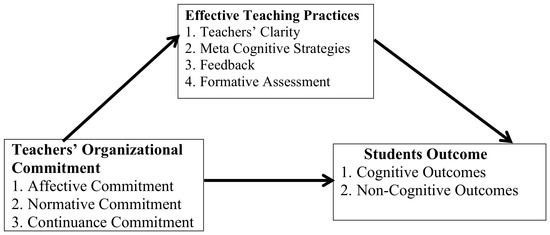
The affective, normative, and continuance commitment of teachers relates to the cognitive and non-cognitive outcomes of students, via the mediation of effective teaching practices and the clarity, meta-cognitive, feedback, and formative strategies of the teachers.
1.7. Theoretical Framework
Revised Model-B by Refs. [51,52], which builds on Pitner’s earlier models, explains how constructive instructional leadership facilitates school effectiveness by acting on human (students and teachers), organizational (professional development), and structural (norms and routines) mediating factors supports Figure 1. Ref. [52] suggests that this model works on the premise that school leaders can enhance overall school performance indirectly by improving teachers’ commitment and instructional practices and by fostering a positive school culture.
Figure 1.
Conceptual model.
The Fornell–Larcker criterion was employed to obtain the discriminant validity results, which are shown in Table 1. The results show that the square root of the Average Variance Extracted (AVE) for each construct is higher than all their correlations with other constructs, which means that the discriminant validity of the constructs of the study is good.
Table 1.
Discriminant validity using the Fornell–Larker criterion (N = 348).
2. Materials and Methods
The study’s design incorporates methodology that employs survey methodology and a quantitative approach. The researchers designed a survey with a set of closed-ended questions to collect data from secondary school teachers.
The sample consisted of secondary school teachers from Bunir District. For the selection of secondary school teachers at government schools in District Bunir, Khyber Pakhtunkhwa, Pakistan, a purposive sampling technique was used. Included in the district were 42 secondary schools, 24 of which were boys’ schools and 18 girls’ schools. Teachers who were experienced in teaching for a minimum of one year and were actively engaged in classroom teaching were invited. The study involved 348 teachers, 174 male and 174 female teachers. It is recognized that to maintain a balanced perspective, equal representation was set out so that both the boys’ and girls’ schools would have a voice.
The sample frame (population) included 348 teachers, 174 females and 174 males, across 42 schools, comprising 18 girls’ schools and 24 boys’ schools.
The survey instrument was designed with the objective of assessing three primary variables, namely teachers’ organizational commitment, effective teaching, and student outcomes, and to examine the interrelationships among these variables. The questionnaire was developed from the literature reports based on previously validated questionnaires. The items for the teachers’ organizational commitment were adapted from the 3-component framework of organizational commitment developed by [53]. Effective teaching practices were adapted from existing resources for the assessment of teaching effectiveness and classroom practice [54]. The student outcomes were assessed using the teacher’s perceptions of cognitive and non-cognitive outcomes from previous educational effectiveness studies [54,55]. All items were evaluated by experts in the field of educational leadership and measurement for contextual appropriateness of secondary schools in Pakistan.
Table 2 below outlines the various methods of evidence used to ensure the survey instrument’s face validity and reliability.
Table 2.
Validity and reliability indices (N = 348).
For detailed analysis of the data, the study used Spearman’s rho, structural equation modeling (SEM), and percentage distribution, and used SPSS and Amos version 26 for analysis.
The metrics in the table confirm that the survey is capable of collecting data as the thresholds for composite reliability (CR), Average Variance Extracted (AVE), and Cronbach’s alpha are set at 0.6, 0.5 and 0.7 respectively [56]).
The AVEs are diagonal, as is evident in Table 2, and the R-squared values are in parentheses. We can confirm that the survey items are distinct from each other, as each AVE is greater than the corresponding R-squared value.
The SEM analysis was performed based on AMOS Version 26. Chi-square/df, comparative fit index (CFI) and root mean square error of approximation (RMSEA) were used to assess model fit. Modification indices, standardized residuals, and theoretical arguments were used to refine the model. Correlated error terms were only included when there was conceptual similarity between indicators and the error terms. The final model achieved acceptable fit indices (CFI = 0.94, RMSEA = 0.071, χ2/df = 3.72).
3. Results
3.1. Levels of Students’ Outcomes
Table 3 shows that teachers viewed an overwhelming majority (81%) as low, and follow-up (70%) perceived low non-cognitive outcomes. Out of the total percentages, the largest share for the cognitive outcomes with low and moderate levels was 15.50% and for the cognitive development moderate level was 10.50%. Teachers perceived 14.50% as high for non-cognitive development, and for non-cognitive outcomes, there was 8.50% in the high category. For overall outcomes of the students, 81.0% perceived low outcomes, 15.0% perceived moderate outcomes, and 4% perceived high outcomes.
Table 3.
Levels for students’ outcomes (N = 348).
Table 4 shows that the greatest proportion of teachers, 67.00%, describes continuance commitment, school level, as moderate. A low level is assigned by 22.00%, and a high level is assigned by 11.00%. Normative commitment shows similar trends, with 60.50% of teachers reporting moderate, 25.50% low, and 15.00% high. Of the teachers, 50% view affective commitment as moderate level, 37.00% as low level, and 13.00% as high level.
Table 4.
Levels for teachers’ organizational commitment (N = 348).
Most (60.00%) of the teachers’ organizational commitment stands at the moderate level, followed by 30.00% low and 10.00% high commitment.
Teaching clarity has been described most frequently by teachers at a moderate level. Most respondents, 60.00%, describe teaching clarity as moderate, 21.00% describe it as low, and 19.00% describe it as high. Most teaching practices are described as moderate clarity.
Most teachers (75.00%) describe the use of metacognitive strategies as moderate. The next most common response was low (19.00%). Very few use metacognitive strategies at a high level (6.00%). Thus, most teachers do not use higher-order metacognitive strategies.
Most teachers (67.00%) describe the use of feedback as moderate. The next most common responses were low (30.00%) and high (3.00%). There appears to be a lack of high-quality feedback practices.
Most teachers (58.77%) describe the use of formative assessment as moderate. The next most common responses were low (34.00%) and high (8.00%). There is room for improving the use of formative assessments.
The overall perception of effective teaching practices is that they are moderate (70.00%). A total of 22.00% perceive them as low and 8.00% as high. Most teachers do not demonstrate high levels of effective teaching practices.
3.2. Relationship Between Teachers’ Organizational Commitment and Students’ Outcomes
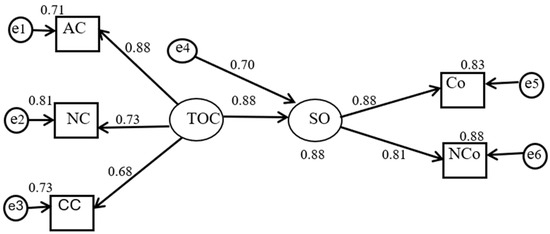
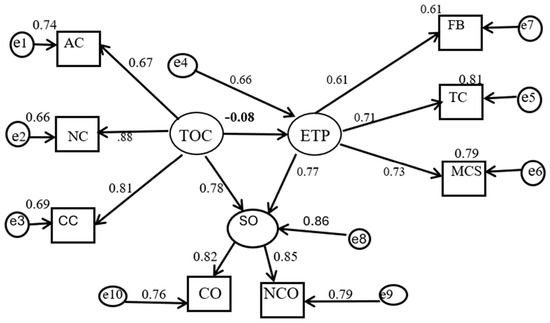
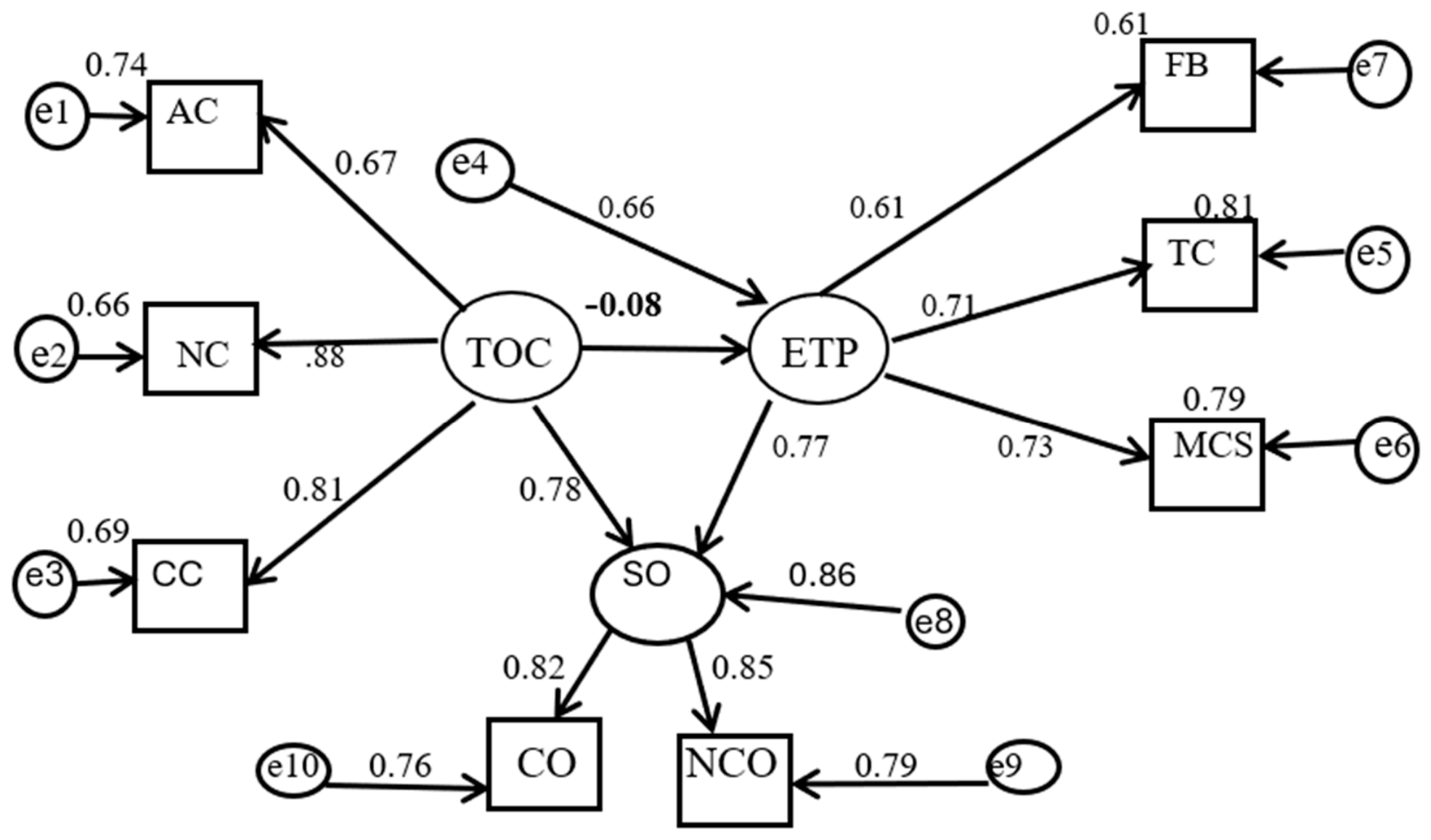
The results of the estimated model are shown in Figure 2. First, one should check the fit of each of the individual components, namely confirmatory fit index (CFI), root means square error of approximation (RMSEA), chi-square, and the total measurement model, confirming each of the measured variables agree. In conducting the structural equation model (SEM), the following fit indices were obtained, CFI = 0.94, RMSEA = 0.071 and the chi-square to degrees of freedom ratio of 3.72, confirming the model meets the good of fit criteria and is ready for further modifications.
Figure 2.
Relationship between TOC and SOs.
As for the type of impact that organizational commitment (OC) has on students’ outcomes (SOs), it is worth noting that one of the effects is significant given that, in Table 5, the level of p is less than 0.05. This effect was verified using the AMOS software that is integrated into the SPSS 26 environment.
Table 5.
Levels for effective teaching practices (N = 348).
In Table 6 below we used structural equation modeling to determine whether there was a significant association between organizations.
Table 6.
The direct effect of teachers’ organizational commitment on students’ outcomes (N = 348).
In Table 7, we have detailed the correlation coefficients of each dimension of teachers’ organizational commitment (TOC) and each dimension of students’ outcomes (SOs) to confirm Figure 2. All the coefficients show a correlation higher than the 0.5 mark, which is considered relevant for a strong correlation and is statistically significant at the 0.01 level. The total correlation for the combined constructs is highly significant and is given by ρ = 0.90, p < 0.01, which further affirms the strong positive correlation across the entire data set.
Table 7.
Correlation between teachers’ organizational commitment and students’ outcomes (N = 348).
3.3. Relationship Between Teachers’ Organizational Commitment and Effective Teaching Practices
To ascertain the presence of a significant association between organizations, we employed structural equation modeling because it enables us to examine measurement error while observing how organizational commitment and effective teaching practices converse with each other. This approach allows us to capture/trace every subtle connection between the two constructs and reveals the results that are documented in the table below.
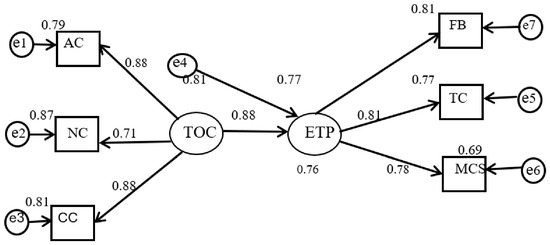
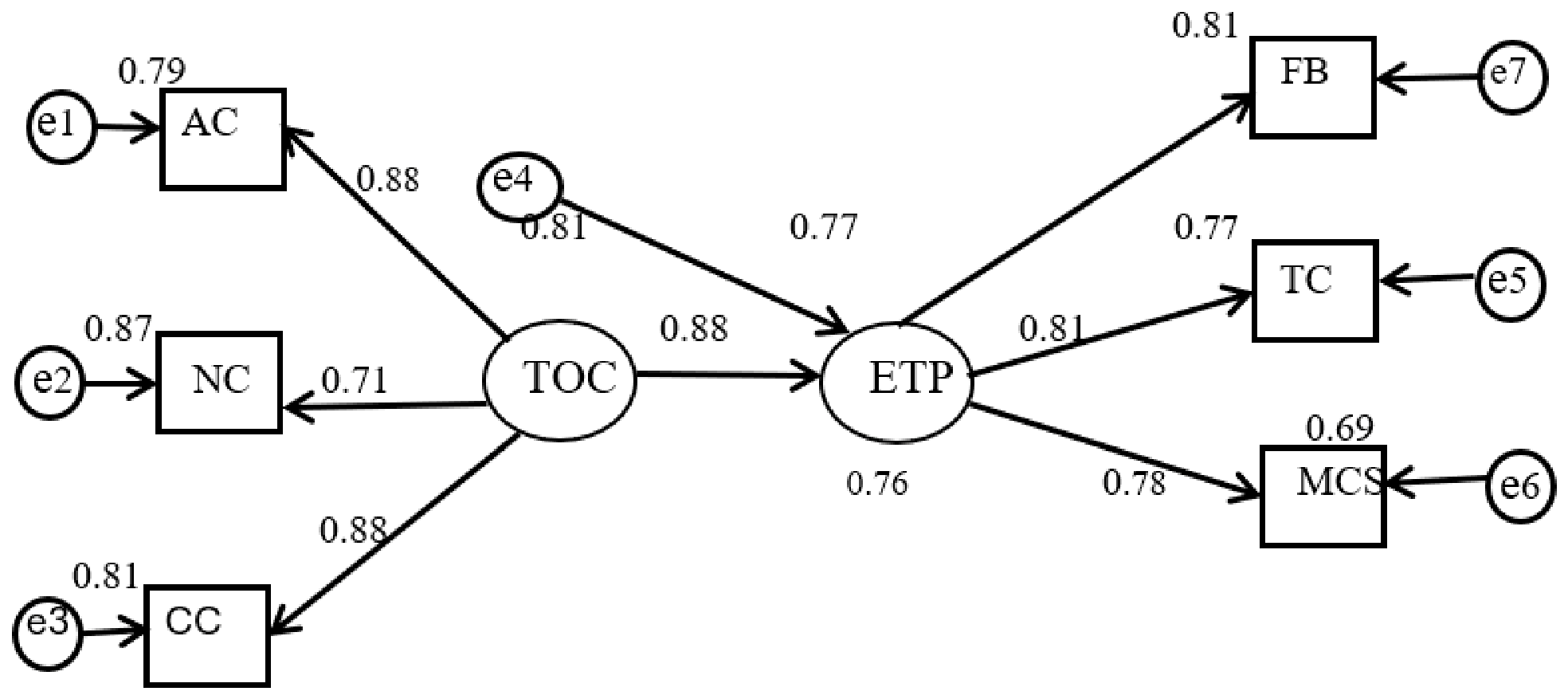
Table 8 provides evidence that teachers’ organizational commitment is significantly related to effective teaching practices, with a p-value of less than 0.05 supporting this assertion. The structural relationship between organizational commitment among teachers and effective teaching practices is shown in Figure 3.
Table 8.
The direct effect of teachers’ organizational commitment on effective teaching practices (N = 348).
Figure 3.
Relationship between TOC and ETPs.
A strong positive correlation was confirmed between the construct of teachers’ organizational commitment (TOC) and effective teaching practices (ETPs) with a correlation coefficient of ρ = 0.923 and a significance level of p < 0.01. In Table 9, all of the separate components of TOC and ETPs showed the same level of strong correlation which was greater than 0.50 and met the significance level of p < 0.01 confirming the accuracy of the total correlations.
Table 9.
Correlation between teachers’ organizational commitment and effective teaching practices (N = 320).
3.4. Correlation Between Effective Teaching Practices and Students’ Outcomes
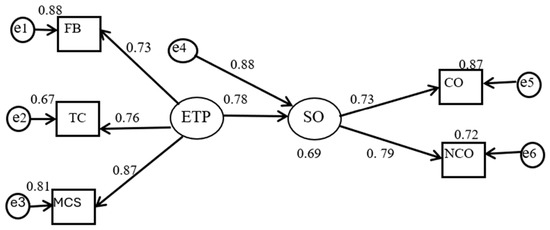
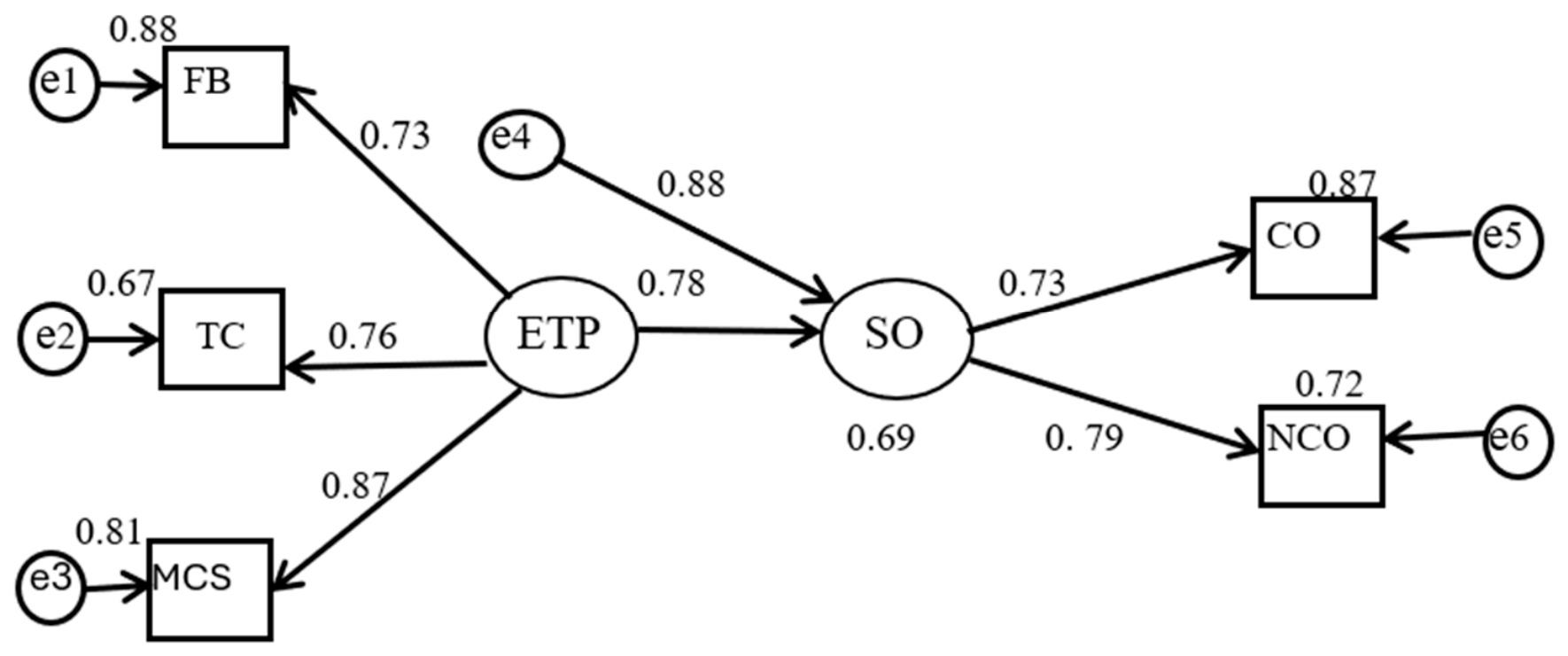
As a continuation of the prior discussion, the results of the parameter estimates were acquired with the use of SEM structural equation modeling, as reported in Table 10 confirmed by Figure 4.
Table 10.
The direct effect of effective teaching practices on students’ outcomes (N = 348).
Figure 4.
Relationship between ETPs and SOs. Note: ETP = effective teaching practice, SO = students’ outcome, CO = cognitive outcome, NCO = non-cognitive outcome, TC = teachers’ clarity, MCS = meta-cognitive strategies, FB = feedback.
Table 11 shows the correlation between the dimensions of effective teaching practices and students’ outcomes to confirm the Figure 4 above.
Table 11.
Correlation between effective teaching practices and student’s outcomes (N = 348).
As per the analysis, there is a considerable positive correlation between the students’ outcomes (SOs) and the effective teaching practices (ETPs) (ρ = 0.736, p < 0.01). An analysis of the data further revealed strong positive correlations, all of which were above 0.50, p < 0.01, for all dimensions of SC and the respective dimensions of Sos as shown in the Figure 5 below.
Figure 5.
Cont.
Table 12 shows that when effective teaching practices take the place of organizational commitment and student outcomes, the main highway is reduced to a side street. When effective teaching practices are added as a mediator, the direct effect of teachers’ organizational commitment on students’ outcomes becomes insignificant in statistics, suggesting that there is a complete mediation effect.
Table 12.
Relationship between teachers’ organizational commitment, effective teaching practices, and students’ outcomes (N = 348).
In short, commitment is now only communicating to learners through the presence of good teaching; the mediation is total and devoid of any direct pathway.
4. Discussion
This paper secures a complex interrelation on teachers’ commitment to schools, use of active teaching strategies, and student learning outcomes in secondary schools of Khyber Pakhtunkhwa. A major finding is the almost zero direct impact of teachers’ commitment on students’ academic performance. On the contrary, when active teaching strategies served as a mediating variable, the indirect impact of commitment on outcomes was evident, positive and substantial. This finding reinforces the principle that the commitment of teachers to their schools is not, in itself, a sufficient condition for academic success. Rather, it becomes effective when purposeful teaching is done in the classroom.
The findings suggested that even when teachers described moderate, affective, normative, and continuance commitment, these dimensions could not sufficiently explain gaps in student achievement. This is inconsistent with Refs. [52,57,58] that found a direct positive relationship between teacher commitment and student achievement, in the case of commitment aimed at high quality education [58]. One potential reason for this difference could be the varying structural and cultural contexts of the educational systems in developed and developing countries. One possible explanation is that some aspects of commitment, specifically the continuance commitment, might represent organizational attachment related to job security and institutional affiliation, instead of the engagement in instructional improvement, but this needs to be examined in further studies to confirm this within the Pakistani education system.
This aligns with Ref. [59], who noted that cultural and systemic barriers often serve as intermediaries in the relationship between teacher commitment and effective practice in the classroom.
In the present study, accomplished pedagogical techniques served as a complete mediator between instructors’ organizational commitment and learner outcomes. Factors such as presentation clarity, formative assessment, constructive feedback, and fostering metacognitive awareness were noted as fundamental. This finding is consistent with Ref. [60], with the influence of interactive pedagogy on learner achievement: impact and implementation strategies, educational research synthesis, designated clarity and feedback are among the most influential on learner achievement. In the same vein, Ref. [28] stated that the use of research-based teaching strategies develops students’ higher-order thinking and deep learning [61]. Thus, even though a strong emotional connection to the institutional mission is a positive feature, students’ learning outcomes will stagnate as long as the commitment is not manifested through consistent, evidence-based teaching practices of the most effective pedagogical techniques.
4.1. Outcomes of Student Learning
Current study data shows that teachers consider their students’ cognitive and non-cognitive achievements uniformly low. This assessment agrees with prior studies in Pakistan pointing out that excessive focus on student examination results leads to low levels of analytical and evaluative skills due to prioritization of rote learning [62,63]. Additionally, motivation, self-efficacy, and creativity are examples of important non-cognitive skills that are insufficiently catered to in the secondary school curriculum [64]. The results indicate that it is not enough to simply rely on teachers’ commitment to improve student achievement. Instead, commitment is linked to learning outcomes when it is manifested in effective teaching and learning in the classroom.
Based on that, the results indicate that there are systemic issues that hinder students’ learning outcomes, as pointed out in the previous research [62,63,64,65] such as teaching based on examinations, low pedagogical innovation, and low emphasis on non-cognitive development.
Teacher’s commitment is clear, but it does not result in desirable student learning outcomes in the absence of effective, evidence-based, teaching practices.
It is interesting to note that 81% of students were perceived as having low cognitive outcomes, which could indicate other issues in education in the district. These problems have been mentioned before in the national and provincial reports, including examination-oriented teaching, small student-centered teaching opportunities, insufficient teaching materials and less focus on higher-order thinking abilities. Some of the contextual factors described herein could explain the poor cognitive and non-cognitive outcomes of this study.
4.2. Comparative Perspective
In comparison to research conducted in Western contexts [66,67], where a positive, direct organizational commitment and student achievement relationship is often reported, the current study indicates that, in Khyber Pakhtunkhwa, this relationship is mediated and dependent on various contextual factors. A similar finding was reported by Ref. [68] in the case of Turkey, where the lack of certain culture and structure tried to weaken the direct relationship of educator commitment and student performance. Collectively, these studies suggest that in non-Western and, particularly, developing countries, unsettled factors like teaching style, in-service training, and school facilities and materials dominate the relationship between educator commitment and student achievement [61].
4.3. Implications
4.3.1. Theoretical Implications
The study re-draws the causal map of educational effectiveness by showing that there is no explanatory power in student achievement for teacher organizational commitment. Sentiment of belonging is not the conduit; pedagogical craftsmanship is. This adds fresh empirical evidence to Ref. [50]’s research that leadership and affective variables affect learning only in and through the micro-processes of classroom instruction.
4.3.2. Practical Implications for Teachers
Commitment, in this case, buys loyalty. In this case, pedagogy buys learning. Therefore, professional development ought to intertwine the two: the nurturing of an emotional attachment to the school so that teachers do not leave, and the development of high-level skills in feedback, formative assessment, and metacognitive talk. The emphasis is on training that moves beyond the one-off workshop and moves into and through classrooms, addressing real-time, contextually relevant teaching problems, and instruction.
4.3.3. Policy Implications
Educational authorities in KPK may think of reinforcing teachers’ professional development programs on formative assessment and feedback practices, metacognitive instruction, and strategies for engaging students in the classroom. Moreover, school-based professional learning communities could facilitate the implementation of teacher commitment to effective classroom practice. This type of targeted intervention could have a more direct impact on student outcomes than interventions that are specifically about organizational commitment.
4.3.4. Future Research Directions
- Expand the coverage: Instead of Bunir, a multi-district sample should be used to facilitate regional comparisons, and to permit the possibility of national generalizability.
- Extend the time span: A longitudinal design should be used to track the evolution of commitment, refinement of practice, and responsiveness of achievement over time.
- Enrich the narrative: Incorporating qualitative interviews with teachers and students would elucidate some of the reasons why high commitment in some classrooms remains untransformed into learning gains.
- Divergent context: Juxtapose urban with rural, public with private, to shed light on how systemic and cultural factors shape the articulation of the commitment–practice–outcome chain.
5. Conclusions
This study investigated the correlations between teachers’ organizational commitment, effective teaching strategies and learners’ learning outcomes in secondary schools in Bunir District (Sargodha) of Punjab, Pakistan. The results showed that the teachers’ commitment and teaching effectiveness were rated as moderate and the student outcomes were rated as relatively low. The organizational commitment of teachers was positively related to effective teaching practices and effective teaching practices were significantly related to learning outcomes of the students.
More importantly, there was complete mediation between the teachers’ organizational commitment and students’ outcomes in the context of effective teaching practices. The results indicate that organizational commitment positively influences student achievement mainly via classroom practices. It builds on previous research by offering data from a developing-country setting and emphasizes the need to increase teachers’ commitment and teaching skills to enhance learning outcomes.
Author Contributions
Conceptualization, N.A. and W.Y.; methodology, N.A., W.Y., and A.O.A.; software, N.A. and M.N.; validation, N.A., W.Y., K.A., and H.N.K.; formal analysis, N.A. and M.N.; investigation, N.A., A.O.A., and K.A.; resources, W.Y. and S.B.M.; data curation, N.A., M.N., and S.B.M.; writing—original draft preparation, N.A.; writing—review and editing, W.Y., A.O.A., K.A., H.N.K., M.N., and S.B.M.; visualization, N.A. and M.N.; supervision, W.Y.; project administration, N.A. and W.Y.; funding acquisition, W.Y. All authors have read and agreed to the published version of the manuscript.
Funding
This research received no external funding.
Institutional Review Board Statement
The study was conducted in accordance with the Declaration of Helsinki and approved by the Ethic Committee of District Education Department, Buner, Pakistan (Approval Code: Not Applicable; Approval Date: 14 July 2025).
Informed Consent Statement
Informed consent was obtained from all subjects involved in the study.
Data Availability Statement
The original contributions presented in this study are included in the article. Further inquiries can be directed at the corresponding author.
Conflicts of Interest
The authors declare no conflict of interest.
References
- Bishop, J.W.; Barney, C.E.; Maynard-Patrick, S.; Scott, D.; Seok, J.Y. Failing to Align Conceptual Definitions with Operational Definitions in Organizational Commitment Research: Truth and Consequences. J. Manag. Issues 2023, 35, 147–169. [Google Scholar]
- Mitterer, D.M.; Mitterer, H.E. The Mediating Effect of Trust on Psychological Safety and Job Satisfaction. J. Behav. Appl. Manag. 2023, 23, 29–41. [Google Scholar] [CrossRef] [Scilit]
- Othman, C.; Busari, A.H.; Sulong, M. The role of followership in enhancing teachers’ organizational commitment dimensions. J. Educ. Learn. (EduLearn) 2025, 19, 1753–1762. [Google Scholar] [CrossRef] [Scilit]
- Kostiv, O.; Rodríguez-Hernández, A.F.; Hernández, J.D. Teachers’ Emotional Commitment: The Emotional Bond That Sustains Teaching. J. Intell. 2025, 13, 158. [Google Scholar] [CrossRef] [Scilit] [PubMed]
- Bañón-Gomis, A.J.; González-Cruz, T.F.; Ruíz-Palomino, P. Organizational moral commitment: A holistic view incorporating both norms and values. Eur. Manag. J. 2025, 12, 101192. [Google Scholar] [CrossRef] [Scilit]
- Bataineh, O.T.; Mahasneh, A.M.; Al-Zoubi, Z.H.; Qablan, A.; Alkaabi, A.M. The relationship between teacher commitment, teacher self-efficacy, and work-related quality of life among science teachers. PLoS ONE 2025, 20, e0326994. [Google Scholar] [CrossRef] [Scilit] [PubMed]
- Subhaktiyasa, P.G. Exploring Lecturer Commitment in the Digital Era: Value, Affective, Continuance, and Normative Dimensions. J. Ilm. Profesi Pendidik. 2025, 10, 1649–1659. [Google Scholar] [CrossRef] [Scilit]
- Bhatnagr, P.; Misra, R. The Impact of Corporate Visual Identity on Job Satisfaction, Engagement and Loyalty in Indian NGOs. Int. J. Organ. Anal. 2025. [Google Scholar] [CrossRef] [Scilit]
- Tejada, K.C.M. Self-Regulated Motivation and Speaking Competence of Pre-Service ESL Teachers in Asynchronous Settings: A Correlational Study. Int. J. Learn. Teach. Educ. Res. 2025, 24, 252–280. [Google Scholar] [CrossRef] [Scilit]
- Burden, P.R. Classroom Management: Creating a Successful K-12 Learning Community; John Wiley & Sons.: Hoboken, NJ, USA, 2025. [Google Scholar]
- Skaalvik, E.M.; Skaalvik, S. Shared Goals and Values in the Teaching Profession, Job Satisfaction and Motivation to Leave the Teaching Profession: The Mediating Role of Psychological Need Satisfaction. Soc. Psychol. Educ. 2023, 26, 1227–1244. [Google Scholar] [CrossRef] [Scilit]
- Geijsel, F.P.; Sleegers, P.J.C.; Stoel, R.D.; Krüger, M.L. The Effect of Teacher Psychological and School Organizational and Leadership Factors on Teachers’ Professional Learning in Dutch Schools. Elem. Sch. J. 2009, 109, 406–427. [Google Scholar] [CrossRef] [Scilit] [PubMed]
- Kolajo, Y. Advancing pedagogical excellence through reflective teaching practice and adaptation. Reflective Pract. 2025, 26, 832–847. [Google Scholar] [CrossRef] [Scilit]
- Choudhury, S.; Chechi, V.K. Review of the Relationship between Teacher Commitment Indicators and Academic Achievement. Int. Interdiscip. Res. J. 2021, 23, 951–959. [Google Scholar]
- Park, J.-H.; Cooc, N.; Lee, K.-H. Relationships between Teacher Influence in Managerial and Instruction-Related Decision-Making, Job Satisfaction, and Professional Commitment: A Multivariate Multilevel Model. Educ. Manag. Adm. Leadersh. 2023, 51, 116–137. [Google Scholar] [CrossRef] [Scilit]
- Berkovich, I.; Hassan, T. Principals’ Digital Transformational Leadership, Teachers’ Commitment, and School Effectiveness. Educ. Inq. 2025, 16, 177–194. [Google Scholar] [CrossRef] [Scilit]
- Bogler, R.; Berkovich, I. A Systematic Review of Empirical Evidence on Teachers’ Organizational Commitment 1994–2018. Leadersh. Policy Sch. 2022, 21, 440–457. [Google Scholar] [CrossRef] [Scilit]
- Kumar, A.; Kumar, A.; Debyani, D.; Vasudevan, A.; Nanda, S. Advancing SDG 4 through Blended Learning: Faculty Engagement and Management Insights from a Diffusion of Innovations Lens. J. Eng. Educ. Transform. 2025, 39, 52–64. [Google Scholar] [CrossRef] [Scilit]
- Berkovich, I.; Eyal, O. Profiles of Emotional Feedback and Their Effect on Principal’s Attributed Charisma and Leader–Member Exchange Quality (LMX). Asia-Pac. Edu. Res. 2021, 30, 349–359. [Google Scholar] [CrossRef] [Scilit]
- Klotz, A.C.; Bolino, M.C. When Quiet Quitting Is Worse than the Real Thing. Harv. Bus. Rev. 2022, 1, 1–5. [Google Scholar]
- Rachman, M.M. Impact of Motivation on Performance: The Role of Organizational Commitment. JMTT 2022, 15, 376–393. [Google Scholar] [CrossRef] [Scilit]
- Dorta-Afonso, D.; González-de-la-Rosa, M.; García-Rodríguez, F.; Romero-Domínguez, L. Effects of High-Performance Work Systems (HPWS) on Hospitality Employees’ Outcomes through Their Organizational Commitment, Motivation, and Job Satisfaction. Sustainability 2021, 13, 3226. [Google Scholar] [CrossRef] [Scilit]
- Manla, V.H. School Climate: Its Impact on Teachers’ Commitment and School Performance. JWEEP 2021, 3, 21–35. [Google Scholar] [CrossRef] [Scilit]
- Tomaszewski, W.; Xiang, N.; Huang, Y.; Western, M.; McCourt, B.; McCarthy, I. The Impact of Effective Teaching Practices on Academic Achievement When Mediated by Student Engagement: Evidence from Australian High Schools. Educ. Sci. 2022, 12, 358. [Google Scholar] [CrossRef] [Scilit]
- Ellikkal, A.; Rajamohan, S. AI-Enabled Personalized Learning: Empowering Management Students for Improving Engagement and Academic Performance. Vilakshan-XIMB J. Manag. 2025, 22, 28–44. [Google Scholar] [CrossRef] [Scilit]
- Salmons, J.; Wilson, L.A. Learning to Collaborate, Collaborating to Learn: Engaging Students in the Classroom and Online, 1st ed.; Routledge: New York, NY, USA, 2023. [Google Scholar] [CrossRef] [Scilit]
- Christogonus-Anyanwu, O.; Imiruaye, J.E. Teachers Workload and Effective Teaching. Int. J. Sci. Res. Educ. 2024, 17, 194–207. [Google Scholar]
- Loes, C.N.; Salisbury, M.H.; Pascarella, E.T. Student Perceptions of Effective Instruction and the Development of Critical Thinking: A Replication and Extension. High. Educ. 2015, 69, 823–838. [Google Scholar] [CrossRef] [Scilit]
- Moshi, T.M.; Hlatshwayo, M.C.; Oyetade, K. Perceived Impact and Effectiveness of VR and AR in Higher Education: Evidence from a South African University of Technology. Int. J. Learn. Teach. Educ. Res. 2025, 24, 281–296. [Google Scholar] [CrossRef] [Scilit]
- Bistari, B.; Mumtazah, N.W.; Mardiyyaningsih, A.N.; Rusdiono, R. How Do Lecturers Implement Case and Project Learning Models to Strengthen the Merdeka Curriculum?: A Study at Tanjungpura University, Indonesia. J. Paedagog. 2024, 11, 777–787. [Google Scholar] [CrossRef] [Scilit]
- Rozimela, Y. Untold Story: Classroom Management Problems and Their Influence on Student-Teachers’ Teaching. In Proceedings of the Fourth International Seminar on English Language and Teaching (ISELT-4), Padang, Indonesia, 11–12 May 2016. [Google Scholar]
- Lapada, A.A.; Miguel, F.F.; Robledo, D.A.R.; Alam, Z.F. Teachers’ Covid-19 Awareness, Distance Learning Education Experiences and Perceptions towards Institutional Readiness and Challenges. Int. J. Learn. Teach. Educ. Res. 2020, 19, 127–144. [Google Scholar] [CrossRef] [Scilit]
- Ma, B.; Chen, L.; Wang, X.; Ding, S. Who Benefits More from the Digital Economy: (Non-)Cognitive Ability and the Labor Income Premium. Int. Rev. Econ. Financ. 2024, 96, 103691. [Google Scholar] [CrossRef] [Scilit]
- Macías, D.F. Classroom Management in Foreign Language Education: An Exploratory Review. Profile Issues Teach. Prof. Dev. 2018, 20, 153–166. [Google Scholar] [CrossRef] [Scilit]
- Vanbecelaere, S.; Van Den Berghe, K.; Cornillie, F.; Sasanguie, D.; Reynvoet, B.; Depaepe, F. The Effects of Two Digital Educational Games on Cognitive and Non-Cognitive Math and Reading Outcomes. Comput. Educ. 2020, 143, 103680. [Google Scholar] [CrossRef] [Scilit]
- Wu, B.; Chang, X.; Hu, Y. A Meta-Analysis of the Effects of Spherical Video-Based Virtual Reality on Cognitive and Non-Cognitive Learning Outcomes. Interact. Learn. Environ. 2024, 32, 3472–3489. [Google Scholar] [CrossRef] [Scilit]
- Wu, C.H.; Weng, T.S.; Liu, C.H. Exploring ChatGPT’s Potential to Enhance Problem-Solving and Critical Thinking in Education. Educ. Technol. Soc. 2025, 28, 310–326. [Google Scholar]
- Irawati, P.R.; Listyani, L. Problems in Classroom Management Encountered by Three English Teachers in a Rural Area in Semarang Regency, Indonesia. Rangsit J. Educ. Stud. 2020, 7, 4659. [Google Scholar] [CrossRef]
- Duckworth, A.L.; Taxer, J.L.; Eskreis-Winkler, L.; Galla, B.M.; Gross, J.J. Self-Control and Academic Achievement. Annu. Rev. Psychol. 2019, 70, 373–399. [Google Scholar] [CrossRef] [Scilit] [PubMed]
- Slimi, N.E. The Role of School and Home Environment in Boosting Students’ Learning Achievement: The Case of Third Year Middle School Teachers and Students at Ahmed Zayed Middle School–Biskra. Master’s Thesis, Mohamed Kheider University, Biskra, Algeria, 2023. [Google Scholar]
- Webster, C.A.; Russ, L.; Vazou, S.; Goh, T.L.; Erwin, H. Integrating Movement in Academic Classrooms: Understanding, Applying and Advancing the Knowledge Base. Obes. Rev. 2015, 16, 691–701. [Google Scholar] [CrossRef] [Scilit] [PubMed]
- Xu, J.; Xu, Y. The Impact of Self-Efficacy on Psychological Resilience in EFL Learners: A Serial Mediation Model. BMC Psychol. 2025, 13, 858. [Google Scholar] [CrossRef] [Scilit] [PubMed]
- Makransky, G.; Borre-Gude, S.; Mayer, R.E. Motivational and Cognitive Benefits of Training in Immersive Virtual Reality Based on Multiple Assessments. Comput. Assist. Learn. 2019, 35, 691–707. [Google Scholar] [CrossRef] [Scilit]
- Chou, S.; Liu, C. Learning Effectiveness in a Web-based Virtual Learning Environment: A Learner Control Perspective. Comput. Assist. Learn. 2005, 21, 65–76. [Google Scholar] [CrossRef] [Scilit]
- Hsia, L.; Lin, Y.; Hwang, G. A Creative Problem Solving-based Flipped Learning Strategy for Promoting Students’ Performing Creativity, Skills and Tendencies of Creative Thinking and Collaboration. Brit J. Educ. Tech. 2021, 52, 1771–1787. [Google Scholar] [CrossRef] [Scilit]
- Hassell, M.D.; Goyal, S.; Limayem, M.; Boughzala, I. Effects of Presence, Copresence, and Flow on Learning Outcomes in 3D Learning Spaces. Adm. Issues J. Educ. Pract. Res. 2012, 2, 62–73. [Google Scholar] [CrossRef] [Scilit]
- Weidlich, J.; Kreijns, K.; Bastiaens, T.J. Individual Differences in Perceptions of Social Presence: Exploring the Role of Personality in Online Distance Learning. Open Educ. Stud. 2021, 3, 188–201. [Google Scholar] [CrossRef] [Scilit]
- Wong, T.A.; Tan, K.T.L.; Darmaraj, S.R.; Loo, J.T.K.; Ng, A.H.H. Social Capital Development in Online Education and Its Impact on Academic Performance and Satisfaction. High. Educ. Ski. Work.-Based Learn. 2025, 15, 205–221. [Google Scholar] [CrossRef] [Scilit]
- Shadiev, R.; Yi, S.; Dang, C.; Sintawati, W. Facilitating Students’ Creativity, Innovation, and Entrepreneurship in a Telecollaborative Project. Front. Psychol. 2022, 13, 887620. [Google Scholar] [CrossRef] [Scilit] [PubMed]
- Hallinger, P.; Heck, R.H. Exploring the Principal’s Contribution to School Effectiveness: 1980–1995*. Sch. Eff. Sch. Improv. 1998, 9, 157–191. [Google Scholar] [CrossRef] [Scilit]
- Ali, N. Teachers’ Perceptions of the Relationship between Principals’ Instructional Leadership, School Culture and School Effectiveness in Secondary Schools in Pakistan. Doctoral Dissertation, University of Malaya, Kuala Lumpur, Malaysia, 2017. [Google Scholar]
- Leithwood, K.; Jantzi, D. Transformational School Leadership for Large-Scale Reform: Effects on Students, Teachers, and Their Classroom Practices. Sch. Eff. Sch. Improv. 2006, 17, 201–227. [Google Scholar] [CrossRef] [Scilit]
- Allen, N.J.; Meyer, J.P. The measurement and antecedents of affective, continuance and normative commitment to the organization. J. Occup. Psychol. 1990, 63, 1–18. [Google Scholar] [CrossRef] [Scilit]
- Mensah, J.Y.; Akayuure, P.; Sam, S.E.; Eduah, S. Impact of Cognitive and Non-Cognitive Factors on Mathematics Achievement among Pre-service Teachers in Ghanaian Colleges of Education. J. Pract. Stud. Educ. 2025, 6, 16–25. [Google Scholar] [CrossRef] [Scilit]
- Zheng, L.; Xiao, Y. The Effect of High-Impact Practices on Vocational College Students’ Non-Cognitive Skills: Mediating Role of Teacher-Student and Student–Student Interactions. Eur. J. Educ. 2025, 60, e70343. [Google Scholar] [CrossRef] [Scilit]
- Hair, J.F., Jr.; MSarstedt; Hopkins, L.; Kuppelwieser, V.G. Partial least squares structural equation modeling (PLS-SEM): An emerging tool in business research. Eur. Bus. Rev. 2014, 26, 106–121. [Google Scholar] [CrossRef] [Scilit]
- Park, I. Teacher Commitment and Its Effects on Student Achievement in American High Schools. Educ. Res. Eval. 2005, 11, 461–485. [Google Scholar] [CrossRef] [Scilit]
- Kumar, A.; Vasudevan, A.; Debyani, D.; Nanda, S.; Rizvi, A.H. Towards Quality Education: AI-Supported English Pedagogy in Humanities and Engineering for SDG Implementation. J. Eng. Educ. Transform. 2025, 39, 65–75. [Google Scholar] [CrossRef] [Scilit]
- McInerney, D.M.; Ganotice, F.A.; King, R.B.; Marsh, H.W.; Morin, A.J.S. Exploring Commitment and Turnover Intentions among Teachers: What We Can Learn from Hong Kong Teachers. Teach. Teach. Educ. 2015, 52, 11–23. [Google Scholar] [CrossRef] [Scilit]
- Chastnyk, O.; Zoria, M.; Poletay, O.; Shumskyi, O.; Klochkova, Y. Exploring the Influence of Interactive Education on Academic Progress: Evaluating Effectiveness and Implementation Approaches. Multidiscip. Rev. 2024, 7, 2024spe029. [Google Scholar] [CrossRef] [Scilit]
- Ruttanakorn, K.; Rojanarata, T. Digitally Enhanced Chunk & Check Learning: An Innovative, Instructor-Friendly Approach Powered by an Open-Source Tool for Effective Laboratory Instruction and Formative Assessment. Int. J. Learn. Teach. Educ. Res. 2025, 24, 1–17. [Google Scholar] [CrossRef] [Scilit]
- Ashraf, M.A. Transforming Education in India: Policies and Practices, 1st ed.; Cambridge Scholars Publishing: Newcastle upon Tyne, UK, 2024. [Google Scholar]
- Murtaza, K.G.; Hui, L. Higher Education in Pakistan: Challenges, Opportunities, Suggestions. Educ. Q. Rev. 2021, 4, 213–219. [Google Scholar] [CrossRef] [Scilit]
- Pervez, A.; Orchard, S. Reimagining Curricula: A Case Study of a Game-Based Approach to Fostering Prosociality and Cross-Subject Learning in Primary Schools. Educ. 3-13 2025, 53, 1142–1161. [Google Scholar] [CrossRef] [Scilit]
- Tandas, J.B. Classroom Assessment Practices of Practice Teachers and Mentoring Support of Cooperating Teachers: Inputs for a School-Based Enhancement Program in the Philippines. Int. J. Learn. Teach. Educ. Res. 2025, 24, 66–96. [Google Scholar] [CrossRef] [Scilit]
- Ly, B. Inclusion Leadership and Employee Work Engagement: The Role of Organizational Commitment in Cambodian Public Organization. Asia Pac. Manag. Rev. 2024, 29, 44–52. [Google Scholar] [CrossRef] [Scilit]
- Somech, A.; Bogler, R. Antecedents and Consequences of Teacher Organizational and Professional Commitment. Educ. Adm. Q. 2002, 38, 555–577. [Google Scholar] [CrossRef] [Scilit]
- Sesen, H.; Basim, N.H. Impact of Satisfaction and Commitment on Teachers’ Organizational Citizenship. Educ. Psychol. 2012, 32, 475–491. [Google Scholar] [CrossRef] [Scilit]

Disclaimer/Publisher’s Note: The statements, opinions and data contained in all publications are solely those of the individual author(s) and contributor(s) and not of MDPI and/or the editor(s). MDPI and/or the editor(s) disclaim responsibility for any injury to people or property resulting from any ideas, methods, instructions or products referred to in the content. |
© 2026 by the authors. Licensee MDPI, Basel, Switzerland. This article is an open access article distributed under the terms and conditions of the Creative Commons Attribution (CC BY) license.