


Abstract
Background: Private and community hosting have emerged as important community-based responses to forced displacement, through which host-country citizens provide accommodation, practical support, and relational care to refugees in domestic and community settings. These hosting arrangements extend hospitality beyond commercial and tourism contexts into everyday spaces of welcome, co-living, and social support. Existing literature has examined a range of hosting experiences, including reasons citizens choose to host, ways hospitality is practiced, challenges arising from hosting, and the impacts of hosting on hosts, refugees, and communities. However, the evidence remains fragmented across disciplines, including migration studies, social work, sociology, public health, and hospitality scholarship. Objective: This scoping review aims to map and synthesize the existing literature on why host-country residents and local hosting actors host refugees, with a focus on hosting motivations, hospitality practices, challenges, and impacts in private and community hosting. Methods: This review will follow the Joanna Briggs Institute methodology for scoping reviews and be reported in accordance with the PRISMA-ScR guidelines. Guided by the Population–Concept–Context framework, the review will include studies involving host-country residents and local hosting actors, engaged in refugee hosting. Literature published in English from 2010 onward will be identified through searches in MEDLINE, CINAHL, PsycINFO, Scopus, Web of Science, Sociological Abstracts, Social Services Abstracts, and selected grey literature sources. Two reviewers will independently screen records and extract data, which will be analyzed descriptively and thematically to map motivations, hospitality practices, challenges, and impacts in private and community hosting. Results: The review will generate a comprehensive map of the literature on refugee hosting in private and community settings. It will identify how hosting is conceptualized and practiced, the motivations driving citizen involvement, the relational and structural challenges associated with hosting, and the reported impacts on hosts, refugees, and communities. It will also highlight system-level support, policy considerations, and gaps requiring further attention through research and practice. Conclusions: This scoping review will provide an interdisciplinary synthesis of evidence on refugee hosting as a form of social and domestic hospitality. The findings will inform future research, policy, and community-based hosting initiatives and will contribute to a deeper understanding of the ethical, relational, and structural dimensions of refugee hospitality and hosting in host countries.
1. Introduction
Global forced displacement has intensified the need for community-based responses that complement formal resettlement and settlement systems. Although many host countries and communities have implemented policies and initiatives intended to welcome and support refugees, newcomers and refugees continue to face significant settlement challenges, including difficulties securing housing due to high costs, financial constraints, limited knowledge of housing systems, and social isolation [1]. To address these challenges, homestay and private hosting initiatives have been developed by a range of actors, including humanitarian and refugee-serving organizations, community groups, and government-led or government-supported programs [2,3,4,5,6,7]. These initiatives involve local residents providing refugees with accommodation in their homes for a set period, where the refugees live with the host family under the same roof [6,8].
Such hosting arrangement can greatly assist in the integration of refugees, providing benefits such as language acquisition [8], employment support and enhanced social connections [3,9], and educational support [10]. The distinctiveness of hosting and homestay initiatives lies in their provision of an intimate household setting, allowing refugees to experience everyday domestic practices in a new society [8,11,12]. For private and homestay hosts, these initiatives offer opportunities to develop new perspectives and empathy among hosting communities [3]. Studies indicate that homestay and private hosting initiatives significantly enhance language skills and facilitate the adoption of intercultural practices through constant exposure to and participation in the daily lives of local hosts [13,14,15,16].
Private hosting including homestay is increasingly used as both a short- and long-term shelter option for displaced people and refugees, particularly women [8]. Several countries have adopted or supported homestay and private hosting initiatives for refugees. For example, the Australian government launched a community placement initiative in which community volunteers offered accommodation to refugees for a specified period. [17]. Similarly, in response to the Russian invasion of Ukraine, the UK government introduced the Homes for Ukraine scheme, which enabled residents to host displaced Ukrainians in private accommodation [18]. In Europe, non-profit, community-based, and government-supported hosting initiatives have also developed alternative accommodation arrangements in response to gaps in formal reception and housing systems [6]. Among these responses, private and community hosting have emerged as important approaches through which host-country citizens, families, and community groups provide accommodation and support to refugees in domestic and community settings [19,20]. These arrangements may include homestay, home-sharing, sponsorship-linked accommodation, and community hosting models; however, community sponsorship is considered within the scope of this review only when it includes hosting, accommodation, or direct community-based support [21].
Refugee hosting extends beyond shelter to include emotional support, practical guidance, social connection, and everyday forms of welcome, including norm-sharing and cultural interpretation [3,4,20]. These practices position hosting as a form of social and domestic hospitality shaped by empathy, altruism, solidarity, civic responsibility, faith, and community engagement [6,22,23]. At the same time, hosting may involve challenges related to emotional strain, co-living, boundary negotiation, privacy, financial pressure, cultural difference, role ambiguity, and uneven access to organizational or policy support [3,13,19,20,24,25].
Hospitality offers a useful conceptual lens for understanding refugee hosting. Within tourism and hospitality scholarship, hospitality has often been explored in commercial and service-oriented environments [26]. However, growing scholarship recognizes hospitality beyond tourism, including hospitality enacted in private homes, communities, and non-commercial settings [7,14,27]. Refugee hosting provides an important context for examining hospitality as a relational, ethical, and everyday practice in which welcome, care, support, and belonging are negotiated within domestic and community spaces [7,25,28].
While innovative and potentially cost-effective, homestay hosting entails complex social dynamics, power relationships, and emotional challenges for both hosts and guests [3,6,7]. Motivations for hosting without financial compensation often stem from cultural ideals of hospitality, moral obligation, humanitarian values, or political activism [29,30]. They can also include dissatisfaction with inadequate public hospitality [29,30], a desire to make a difference despite feeling powerless [31], activism challenging restrictive asylum policies [16], or long-term commitments to social change [23]. Other drivers include opposing refugee detention [17], professional or personal engagement in humanitarian work [32], countering negative societal narratives [16,33], and responding to government calls for assistance [30]. However, hosting presents challenges such as uncertainty over the length of stay, division of responsibilities, and cultural differences, which can strain relationships [34].
Existing literature on refugee hosting is dispersed across disciplines, including migration and hospitality studies, social work, sociology, public health, and community development. Studies have examined host motivations [15], the experience of co-living [22], emotional and relational dimensions of hosting [31], challenges encountered by hosts and refugees [31], and the role of systems, organizations, and policies in supporting or constraining hosting [35]. Some literature has also explored the impacts of hosting on hosts, refugees, and communities, including satisfaction, advocacy, belonging, integration, well-being, and civic engagement [3,6,36]. Several related reviews and protocols have examined important aspects of refugee hosting, including homestay hosting dynamics, refugee well-being, care practices, and service delivery models in private hosting arrangements. However, these reviews have primarily focused on hosting as an accommodation, care, or service-delivery context. The present review complements and extends this literature by centering host-country citizens, families, volunteers, and community groups as hosting actors, with specific attention to why they host, how hospitality is practiced, what challenges arise, and what impacts are reported for hosts, refugees, and communities. By integrating motivations, hospitality practices, challenges, and impacts within one interdisciplinary synthesis, this review will provide a broader conceptual map of private and community refugee hosting as both a settlement response and a form of social and domestic hospitality. Despite this growing body of literature, there is limited synthesis that brings these domains together within a coherent scoping review.
A preliminary search of the literature reveals that no published or ongoing scoping review has comprehensively mapped why host-country citizens host refugees while also synthesizing motivations, hospitality practices, challenges, and impacts across private and community hosting models. This timely review will therefore fill this gap in the literature. It will specifically consolidate interdisciplinary evidence and identify key concepts, patterns, and gaps to inform future research, policy, and community-based hosting initiatives.
2. Review Question/Aims
This scoping review is guided by the following question: What is known from the existing literature about why host-country residents and local hosting actors host refugees, and how motivations, hospitality practices, challenges, and impacts are described across private and community hosting contexts?
The specific aims are to:
- map the motivations reported for why host-country citizens engage in private and community refugee hosting;
- examine how hospitality practices are described and enacted within hosting arrangements;
- identify the challenges associated with hosting at individual, relational, organizational, and structural levels; and
- synthesize the reported impacts of hosting on hosts, refugees, and communities, while identifying gaps and implications for research, practice, and policy.
3. Method
This scoping review will follow the Joanna Briggs Institute (JBI) methodology for scoping reviews [37], which provides a rigorous and transparent approach for identifying, mapping, and synthesizing diverse forms of evidence [37]. The review will also adhere to the Preferred Reporting Items for Systematic Reviews and Meta-Analyses extension for Scoping Reviews (PRISMA-ScR) checklist to support clarity, transparency, and reproducibility [38] (See Supplementary File S1). A preliminary search was conducted to identify any existing or ongoing scoping or systematic reviews related to refugee hosting in private and community contexts. No published or ongoing reviews addressing this specific focus were identified, confirming the originality and need for the proposed synthesis. This protocol was registered on the Open Science Framework (OSF) (https://osf.io/8sem9, accessed on 25 June 2026) to ensure transparency and public accessibility.
3.1. Search Strategy for Identification of Studies
A comprehensive search strategy was developed in consultation with an academic subject expert librarian. The strategy combined controlled vocabulary, where applicable, and free-text terms related to refugee hosting, private hosting, community hosting, homestay, host families, sponsorship, hospitality, motivations, challenges, and impacts. The search strategy will be adapted for each database using appropriate subject headings (e.g., MeSH, CINAHL Headings) and syntax. Truncation and Boolean operators will be applied as appropriate. The search strategy was also peer reviewed by another librarian using the Peer Review Strategy (PRESS) [39]. Studies published in English from 2010 onward will be included. English-language sources will be included due to feasibility constraints, including the absence of dedicated translation resources and the need to ensure accurate interpretation of context-specific concepts such as hospitality, hosting, relational care, and belonging. The 2010 start date was selected to capture contemporary refugee movements and the more recent expansion of private, homestay, community sponsorship, and community-based hosting models in response to forced displacement. The reference lists of all included sources will be screened for additional relevant studies. Relevant grey literature sources will be identified through Google Scholar, ProQuest Dissertations & Theses, policy repositories, and selected organizational websites. Google Scholar will be searched using combinations of the main search concepts, including refugee hosting, private hosting, community hosting, homestay, home-sharing, community sponsorship, hospitality, host motivation, challenges, and impacts. The first 100 results for each search string will be screened by title and short preview, as relevance in Google Scholar typically decreases after the initial results. Potentially relevant sources will be downloaded or bookmarked, imported into Covidence where possible, and screened against the inclusion and exclusion criteria.
Selected organizational and policy sources will include websites and repositories of international agencies, government bodies, and refugee-serving or sponsorship organizations relevant to refugee hosting and community-based accommodation. These may include the United Nations High Commissioner for Refugees, International Organization for Migration, International Federation of Red Cross and Red Crescent Societies, European Union Agency for Asylum, Organization for Economic Co-operation and Development, Migration Policy Institute, Refugee Council, Refugees Welcome International, Reset Communities and Refugees, Canadian Council for Refugees, Immigration, Refugees and Citizenship Canada, and other national or local refugee-serving organizations identified during the search. Search terms, websites searched, dates of searching, and the number of relevant records identified will be documented in a grey literature search log.
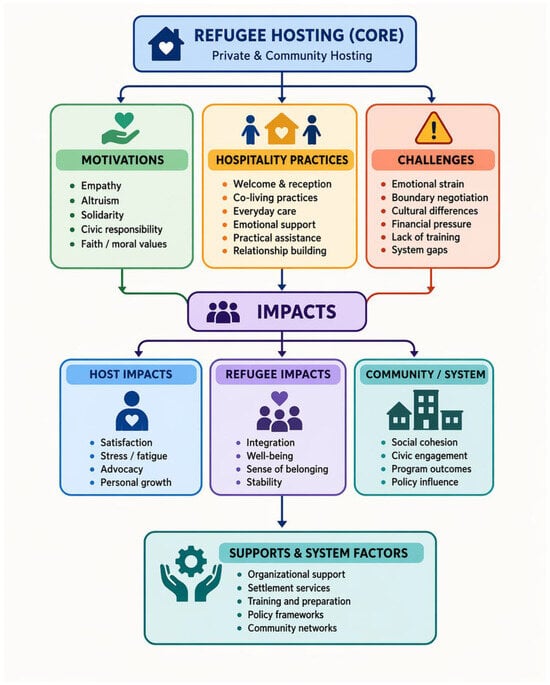
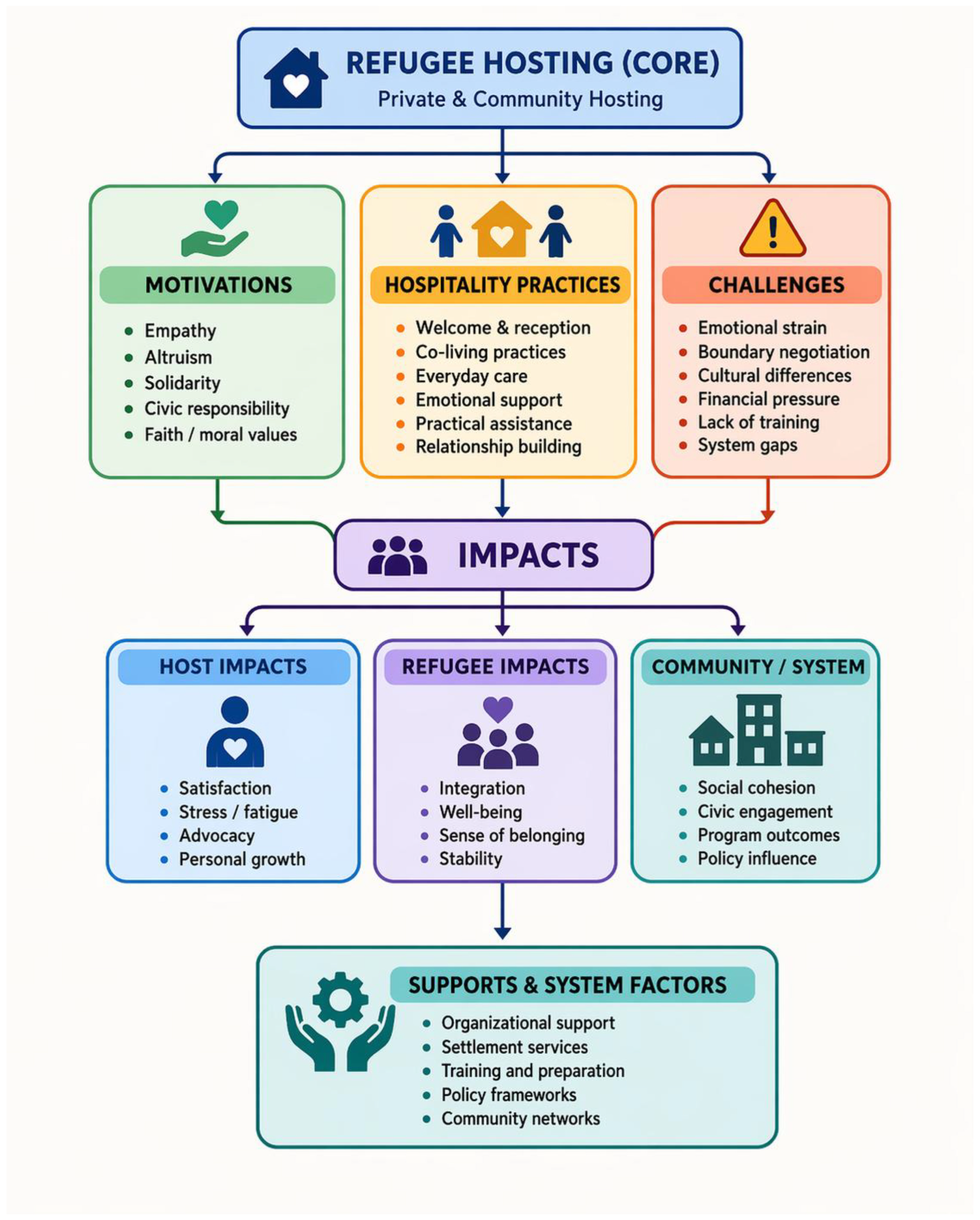
A pilot search was conducted in two databases (see Appendix A) to assess the relevance and sensitivity of the search strategy. Following refinement, the search will be conducted across the following interdisciplinary databases: PsycINFO, Scopus, Web of Science, Sociological Abstracts, and Social Services Abstracts. Relevant grey literature sources will be located from Google Scholar, ProQuest Dissertations & Theses database, policy repositories, and refugee-serving organization websites. All retrieved records/resources will be imported into Covidence, a web-based review management platform, for deduplication, screening, and documentation of study selection decisions. Additionally, the key search concepts and their relationships developed to inform the search strategy are illustrated in Figure 1.
Figure 1.
Term Map Diagram.
3.2. Study Selection and Eligibility Criteria
Study selection will be guided by the JBI Population–Concept–Context framework [37]. To reduce conceptual ambiguity, key hosting-related terms are defined for this review. Private hosting refers to arrangements in which individuals or families in the host country provide accommodation or direct household-based support to refugees or displaced persons. Homestay refers specifically to co-residence, where refugees live under the same roof as a host individual or family for a temporary or defined period. Home-sharing refers to shared domestic accommodation that may involve co-residence or shared use of private living space, but may be organized through formal or informal programs. Community hosting refers to hosting arrangements coordinated or supported by community groups, faith groups, civil society organizations, or local networks, which may include accommodation, practical support, relational support, or accompaniment. Sponsorship-linked accommodation refers to housing or hosting arrangements connected to private, community, or group sponsorship initiatives. Community sponsorship refers to organized citizen or community involvement in refugee reception and settlement; however, for this review, community sponsorship will only be included when it involves a clear hosting, accommodation, or direct community-based support component relevant to motivations, hospitality practices, challenges, or impacts. For Population, eligible studies will include those involving host-country residents and local hosting actors, including individuals, families, volunteers, community groups, sponsoring groups, and relevant service providers engaged in refugee hosting. For Concept, the review will consider evidence related to motivations for hosting refugees, hospitality practices within private and community hosting, challenges or barriers associated with hosting, and impacts of hosting on hosts, refugees, and communities. Relevant concepts may include empathy, altruism, solidarity, civic responsibility, welcome, care, co-living, emotional labor, advocacy, well-being, integration, and belonging. For Context, the review will include private and community hosting in host-country settings, including homestay, home-sharing, host family arrangements, sponsorship-linked accommodation, and community-based hosting initiatives in non-institutional domestic or community settings.
The review will consider peer-reviewed empirical research, including qualitative, quantitative, and mixed-methods studies, as well as grey literature such as policy documents, community and organizational reports, dissertations, theses, and project evaluations. Narrative reviews, scoping reviews, and systematic reviews will be considered where they contribute relevant conceptual or empirical insight. Opinion papers will be included where they clearly demonstrate relevance to the review topic and context. Given feasibility constraints, including the limited resources in terms of translators and to avoid misinterpretation and mistranslation, only English-language sources will be included. The time frame of 2010 onward was selected to capture contemporary refugee waves, hosting models and recent developments in private and community-based hosting. Studies will be excluded if they focus exclusively on institutional accommodation such as camps, shelters, detention centers, or hotels without a private or community hosting component; do not address refugee hosting; do not involve relevant host-country contexts; or were published before 2010. Given feasibility constraints, including the limited availability of professional translation resources and the risk of misinterpretation or mistranslation of culturally and conceptually nuanced literature, only English-language sources will be included. The timeframe of 2010 onward was selected to capture contemporary refugee waves, the growth of private and community-based hosting models, and recent developments in refugee settlement policy and community-led hosting practices. The inclusion and exclusion criteria are presented in Table 1.
Table 1.
Inclusion and exclusion criteria.
3.3. Data Screening and Extraction
All screening will be conducted using Covidence. Two independent reviewers will screen titles and abstracts against the eligibility criteria, followed by full-text reviews of potentially relevant records/sources. Grey literature sources will be screened using the same eligibility criteria as peer-reviewed sources, and the search process will be documented in a structured grey literature search log to support transparency and reproducibility. During extraction, sources will be categorized by type, including primary empirical studies, grey literature, conceptual or theoretical papers, opinion papers, and existing reviews. Primary empirical studies and relevant grey literature will be extracted for evidence on motivations, hospitality practices, challenges, impacts, supports, and policy or organizational factors. Conceptual and opinion papers will be extracted separately for relevant concepts, theoretical framing, ethical considerations, and policy or practice arguments. Existing reviews will be used primarily to identify relevant literature, clarify the state of prior synthesis, and support reference list checking. When primary studies cited in existing reviews meet the inclusion criteria, the original primary studies will be retrieved and extracted directly where available. Disagreements will be resolved through discussion or by involving a third reviewer. Reasons for exclusion at the full-text stage will be documented. The screening and selection process will be presented using a PRISMA-ScR flow diagram. A standardized data extraction table has been developed and will be piloted during the data extraction phase to ensure consistency across reviewers (See Appendix B). The extraction process will capture publication details such as authors, year, country, and source type, as well as study aim, design, population, hosting model, and setting. The extraction process will also document reported motivations for hosting, hospitality practices, challenges, impacts, supports, policy or organizational factors, gaps, and recommendations. The screening and selection process will be documented and reported using a PRISMA-ScR flow diagram, which will summarize the number of records identified, screened, assessed for eligibility, excluded with reasons, and included in the final review; a sample PRISMA-ScR flow diagram template is provided as Supplementary File S2.
3.4. Data Analysis
Extracted data will be imported into NVivo software for coding and managed using descriptive and thematic analysis approaches [40]. Descriptive analysis will also summarize the distribution of studies by year, geography, setting, population, study design, and type of hosting arrangement. Thematic analysis will then be conducted to identify patterns, recurring concepts, and relationships across literature. The analyses will focus on four primary domains: motivations, hospitality practices, challenges, and impacts. Additional cross-cutting themes may include host readiness, emotional and care work, co-living and boundary negotiation, organizational support, policy environments, and sustainability of hosting. Following the initial coding process, related themes and subthemes will be reviewed, refined, and grouped together based on their conceptual similarity within and across the included studies. This iterative process will support the development of a coherent thematic structure that captures the relationships among motivations, hospitality practices, challenges, and impacts in private and community refugee hosting. Given that the purpose of this scoping review is to map the breadth and nature of the evidence, formal quality appraisal using approaches such as CERQual or GRADE will not be undertaken. Instead, the findings will be synthesized descriptively and narratively, with results presented through summary tables, thematic charts, and evidence maps to illustrate patterns, variations, and gaps across different hosting contexts. To avoid double-counting, evidence from existing reviews will not be combined with evidence from primary studies as if it represented new empirical data. If an existing review summarizes a primary study that is also included in this scoping review, only the primary study will be counted in the descriptive mapping of empirical evidence. Reviews will be reported separately as synthesis-level sources and used to contextualize the field, identify gaps, and support comparison with the findings of this review. Similarly, conceptual and opinion papers will be analyzed separately from empirical studies and used to inform conceptual interpretation rather than to estimate the frequency or distribution of empirical findings. This analytic process will enable the research team to identify recurring motivations for hosting, forms of social and domestic hospitality, common barriers and support needs, and the reported impacts of hosting on hosts, refugees, and communities. It will also help highlight promising practices, system-level considerations, and emerging models of inclusive and sustainable refugee hosting relevant to research, policy, and community practice.
3.5. Rigor and Trustworthiness
To enhance the rigor and trustworthiness of the analysis, two reviewers will be actively involved in the coding process and the development of themes to ensure consistency and reduce individual bias. Any discrepancies in coding or interpretation will be resolved through discussion, and where necessary, through consultation with a third reviewer. An audit trail of analytical decisions [41] will be maintained throughout the process to ensure transparency and allow for traceability of how themes were developed and refined. In addition, iterative discussions within the research team will be conducted to critically reflect on emerging findings, refine interpretations, and strengthen the overall credibility and coherence of the synthesis.
4. Results
The results of this scoping review will be presented in both descriptive and narrative formats. A PRISMA-ScR flow diagram will summarize the record/source selection process, including the number of records identified, screened, assessed for eligibility, excluded with reasons, and included in the final review. Included sources will be described by publication year, geography, setting, population, study design, source type, and type of hosting arrangement or model. Findings will be synthesized into summary tables and thematic groupings to map the range of motivations, hospitality practices, challenges, impacts, and contextual factors associated with private and community refugee hosting. The review will also identify reported support, policy considerations, organizational roles, and knowledge gaps. In line with JBI guidance on engaging knowledge users in scoping reviews, preliminary findings will be shared with relevant stakeholders such as refugee-serving organizations, hosting program leaders, and scholars working in migration, community settlement, and hospitality studies. These consultations will be conducted virtually or by phone to assess the relevance and resonance of the findings, and to inform interpretation, knowledge translation and future directions.
5. Discussion
This scoping review will address an emerging and interdisciplinary area of scholarship at the intersection of migration, hospitality, community support, and refugee settlement. By mapping the available evidence, the review will examine why host-country residents and local hosting actors host refugees and how hosting is enacted as a form of private and community-based hospitality. The review will synthesize literature on motivations for hosting, including empathy, moral responsibility, solidarity, faith, civic engagement, and personal commitment, where these are reported in the included sources. It will also map how hospitality practices are described through everyday acts of welcome, emotional and practical support, co-living, advocacy, and relationship-building. Further, the review will examine the emotional, relational, cultural, financial, and structural challenges that shape hosting experiences, as well as reported impacts on hosts, refugees, and communities. Unlike prior reviews that have focused more specifically on homestay dynamics, refugee well-being, or care and service delivery, this review is designed to map the hosting experience from the perspective of host-country actors while also connecting motivations, hospitality practices, challenges, and impacts across private and community hosting contexts. By mapping the available evidence, the review will provide a clearer understanding of why host-country citizens host refugees and how hosting is enacted as a form of private and community-based hospitality. The review is expected to identify motivations driving hosting, from empathy and moral responsibility to solidarity, faith, civic engagement, and personal commitment. It is also expected to show how hospitality is practiced through everyday acts of welcome, emotional and practical support, co-living, advocacy, and relationship-building. Further, the review will identify the emotional, relational, cultural, financial, and structural challenges that shape hosting experiences, as well as the impacts of hosting on hosts, refugees, and communities.
Given the interdisciplinary nature of the topic, the review will bring together literature currently scattered across migration studies, social work, public health, community development, sociology, and hospitality scholarship. In doing so, the review will contribute to a more integrated understanding of refugee hosting as a relational and ethical practice situated within domestic and community spaces. The findings will also identify system-level supports and policy gaps that influence the sustainability and inclusiveness of refugee hosting models.
5.1. Implications
The findings of this review will have important implications for research, practice, policy, and hospitality scholarship. For research, the scoping review will identify conceptual, methodological, and contextual gaps in the existing literature on refugee hosting, including areas such as motivations for hosting, variations across private and community hosting models, and long-term impacts on hosts, refugees, and communities. Mapping how hosting is studied across disciplines will help guide future empirical and theoretical work on refugee hosting, social hospitality, citizen engagement, informal care, and community-based settlement. Findings will also inform the development of more focused qualitative, quantitative, or mixed-methods studies examining host preparedness, relational dynamics, boundary negotiation, advocacy, and sustainability of hosting arrangements.
For practice, the review will provide useful insight for refugee-serving organizations, community sponsorship groups, settlement agencies, and hosts by identifying the forms of support, preparation, and coordination that strengthen hosting experiences. Findings may inform the design of host training resources, readiness assessments, trauma- and culturally responsive guidance, and mechanisms for ongoing emotional, social, and practical support. The review may also help community organizations those in social work or helping professional roles better understand host needs, anticipate common challenges, and develop more sustainable models of accompaniment and service coordination.
For policy, the review may inform the development of coordinated, ethical, and inclusive hosting frameworks that recognize both the opportunities and the demands of private and community hosting. This includes policy attention to host preparation, safeguarding, role clarity, financial and service support, and coordination across community and settlement systems. The findings may also support policies that value hosting not simply as a housing solution, but as a relational and community-based settlement practice requiring appropriate oversight, equity-oriented design, and sustainable infrastructure.
5.2. Contribution to Hospitality Studies
This scoping review makes a substantive contribution to hospitality studies by advancing the conceptualization of hospitality beyond its traditional focus on commercial, tourism, and service-oriented settings. By examining refugee hosting in private and community contexts, the review positions hospitality as an everyday, relational, and ethically grounded practice enacted within domestic and civic spaces rather than institutionalized environments. In doing so, it extends the field’s understanding of hospitality into the realm of social hospitality, where acts of welcome, care, and co-living are shaped by interpersonal relationships, moral commitments, and community engagement.
The review contributes theoretically by integrating insights from migration, social care, and community-based research into hospitality scholarship. It foregrounds key dimensions often underexplored in traditional hospitality literature, including empathy, altruism, solidarity, emotional labor, boundary negotiation, and reciprocity. These dimensions highlight hospitality not simply as a transactional service, but as a dynamic and negotiated social process that unfolds over time and is influenced by power relations, cultural differences, and structural conditions.
Empirically, the review maps how hospitality is practiced in real-world hosting arrangements, offering a nuanced understanding of how hosts navigate the tensions between welcome and limits, care and capacity, and inclusion and personal boundaries. It also sheds light on the impacts of hosting, including the ways in which hospitality practices can foster belonging, social integration, advocacy, and community cohesion, while at the same time generating emotional strain and requiring sustained support. Methodologically, the review contributes by synthesizing a fragmented body of interdisciplinary literature and organizing it into a coherent framework centered on motivations, practices, challenges, and impacts. This provides a foundation for future hospitality research that engages with non-commercial and community-based forms of hosting, as well as comparative studies across different cultural and policy contexts.
Finally, this review contributes to the growing discourse on hospitality ethics and responsibility, highlighting refugee hosting as a site where questions of justice, equity, and inclusion are actively negotiated. By situating hospitality within broader social and political contexts, the review encourages hospitality scholars to engage more deeply with issues of displacement, migration, and global inequality, thereby expanding the scope and relevance of the field.
5.3. Strengths and Limitations
A key strength of this review is its broad interdisciplinary scope, which will allow the mapping of evidence from peer-reviewed and grey literature sources across various disciplines. The use of JBI methodology and PRISMA-ScR guidance will support methodological rigor, transparency, and reproducibility. Another strength is the review’s integration of motivations, hospitality practices, challenges, and impacts within one synthesis, offering a more comprehensive understanding of refugee hosting.
Several limitations should also be acknowledged. First, the restriction of the review to English-language sources may exclude relevant evidence published in other languages and may increase the risk of language bias. This is particularly important because refugee hosting is practiced across diverse linguistic and national contexts. However, this restriction was necessary due to feasibility constraints, the lack of professional translation resources, and the need to preserve conceptual accuracy when interpreting nuanced terms related to hospitality, hosting, care, responsibility, and belonging. Second, the breadth of the topic may result in substantial heterogeneity across study designs, populations, hosting countries, contexts, and findings, limiting direct comparison. Third, as a scoping review, the aim is to map the breadth of evidence rather than assessing the strength and effectiveness of causal relationships.
6. Conclusions
This scoping review will provide a comprehensive overview of why host-country citizens host refugees and how motivations, hospitality practices, challenges, and impacts are described across private and community hosting settings. By synthesizing evidence across migration studies, hospitality scholarship, social work, public health, sociology, and community development, the review will generate a more integrated understanding of refugee hosting as a relational, ethical, and structurally situated practice.
The findings will inform future research by identifying conceptual, methodological, and contextual gaps in the existing literature, including areas requiring further study such as host preparedness, boundary negotiation, emotional labour, long-term impacts, and differences across hosting models and policy contexts. For policy, the review will highlight the need for coordinated and ethical hosting frameworks that include role clarity, safeguarding, financial and practical support, trauma- and culturally responsive guidance, and sustainable partnerships between governments, settlement agencies, and community organizations. For community-based practice, the findings may support the development of host training, readiness assessment tools, ongoing support mechanisms, and evidence-informed resources for organizations involved in private and community hosting. This review will contribute to the development of more inclusive, supported, and sustainable refugee hosting systems by clarifying how hospitality is practiced, what motivates hosts, what challenges arise, and what forms of support are needed to protect the well-being of both hosts and refugees. The review will complement existing syntheses while offering a distinct contribution by foregrounding host-country citizens’ motivations and practices alongside the relational, ethical, and structural challenges and impacts of hosting.
Supplementary Materials
The following supporting information can be downloaded at: https://www.mdpi.com/article/10.3390/soc16070205/s1, File S1: PRISMA_ScR Checklist; File S2: PRISMA.
Author Contributions
Conceptualization, A.A.-H., Y.M.Y., K.M., M.E., R.A.-S. and S.G.; methodology, A.A.-H., Y.M.Y., K.M. and S.G.; software, A.A.-H.; validation, A.A.-H., Y.M.Y., K.M., M.E., R.A.-S. and S.G.; formal analysis, A.A.-H.; investigation, A.A.-H., Y.M.Y. and K.M.; resources, A.A.-H., M.E., R.A.-S. and S.G.; data curation, A.A.-H.; writing—original draft preparation, A.A.-H.; writing—review and editing, A.A.-H., Y.M.Y., K.M., M.E., R.A.-S. and S.G.; visualization, A.A.-H.; supervision, A.A.-H.; project administration, A.A.-H.; funding acquisition, A.A.-H. All authors have read and agreed to the published version of the manuscript.
Funding
This scoping review is part of a broader research program on refugee hosting and community-based settlement. This work is funded by the Social Sciences and Humanities Research Council of Canada Insight Grant program (# 435-2026-1595).
Institutional Review Board Statement
Not applicable.
Informed Consent Statement
Ethics approval was not required for this manuscript, as it involves the analysis of publicly available literature and does not include human participants, personal data, or identifiable information.
Data Availability Statement
All supporting materials, including the search strategy and data extraction tool, are provided in the Appendix A and Appendix B. Further details may be obtained from the corresponding author.
Acknowledgments
The authors thank the academic librarian and authors who supported the refinement of the search strategy and protocol development.
Conflicts of Interest
The authors declare no conflicts of interest. The funding body had no role in the design of the study, data collection, analysis, interpretation, or manuscript preparation.
Appendix A. Search Strategy
Example Search Strategy (MEDLINE via PubMed):
(refugee* OR “asylum seeker*” OR “forced migrant*” OR “displaced person*” OR newcomer*)
AND (host* OR “private hosting” OR “community hosting” OR homestay OR “home sharing” OR “home share” OR “host family” OR sponsorship OR “refugee sponsorship” OR “community sponsorship”) AND (hospitality OR hospitableness OR welcome OR “social hospitality” OR “co-living” OR “shared living” OR “home environment”) AND (motivation* OR empathy OR altruism OR solidarity OR attitude* OR readiness OR satisfaction OR advocacy OR challenge* OR barrier* OR impact* OR outcome* OR experience*)
Filters: English; 2010–2026
Example Search Strategy (CINAHL)
(refugee* OR “asylum seeker*” OR “forced migrant*” OR “displaced person*”) AND
(host* OR “private hosting” OR “community hosting” OR homestay OR “home sharing” OR “host family” OR sponsorship) AND (hospitality OR welcome OR “social hospitality” OR “shared living”) AND (motivation* OR empathy OR altruism OR challenge* OR barrier* OR impact* OR experience*)
Limiters: English language; 2010–2026
Appendix B. Data Extraction Table
| Author, Year | Country | Aim | Design/Methods | Population/Sample | Hosting Model | Motivations | Hospitality Practices | Challenges | Impacts | Supports/Gaps | Key Findings |
References
- Schick, M.; Zumwald, A.; Knöpfli, B.; Nickerson, A.; Bryant, R.A.; Schnyder, U.; Müller, J.; Morina, N. Challenging future, challenging past: The relationship of social integration and psychological impairment in traumatized refugees. Eur. J. Psychotraumatology 2016, 7, 28057. [Google Scholar] [CrossRef] [Scilit] [PubMed]
- Agblorti, S.K.M. Humanitarian assistance to refugees in rural Ghana: Implications for refugee–host relations. Nor. Geogr. Tidsskr.–Nor. J. Geogr. 2011, 65, 75–82. [Google Scholar] [CrossRef] [Scilit]
- Alrawadieh, Z.; Altinay, L.; Urbančíková, N.; Hudec, O. Refugees at home: The role of hospitableness in fostering pro-social attitudes and behaviours towards refugees. Int. J. Contemp. Hosp. Manag. 2023, 36, 3052–3071. [Google Scholar] [CrossRef] [Scilit]
- Baban, F.; Rygiel, K. Living with others: Fostering radical cosmopolitanism through citizenship politics in Berlin. Ethics Glob. Politics 2017, 10, 98–116. [Google Scholar] [CrossRef] [Scilit]
- Bassoli, M.; Campomori, F. A policy-oriented approach to co-production. The case of homestay accommodation for refugees and asylum seekers. Public Manag. Rev. 2022, 26, 770–792. [Google Scholar] [CrossRef] [Scilit]
- Bassoli, M.; Luccioni, C. Homestay Accommodation for Refugees (in Europe). A Literature Review. Int. Migr. Rev. 2023, 58, 1532–1567. [Google Scholar] [CrossRef] [Scilit]
- Burrell, K. Domesticating Responsibility: Refugee Hosting and the Homes for Ukraine Scheme. Antipode 2024, 56, 1191–1211. [Google Scholar] [CrossRef] [Scilit]
- Al-Hamad, A.; Metersky, K. Homestays can help refugee women get to grips with life in a new country. In The Conversation; Toronto Metropolitan University: Toronto, ON, Canada, 2024. [Google Scholar]
- Al-Hamad, A.; Yasin, Y.M.; Metersky, K.; Guruge, S. “Home Away From Home”: A Critical Metaphor Analysis of Displaced Ukrainian Women’s Experiences With Their Canadian Hosts. Glob. Qual. Nurs. Res. 2025, 12, 23333936251353210. [Google Scholar] [CrossRef] [Scilit] [PubMed]
- Ran, G.J.; Join-Lambert, H. Influence of family hosting on refugee integration and its implication on social work practice: The French case. Eur. J. Soc. Work 2020, 23, 461–474. [Google Scholar] [CrossRef] [Scilit]
- Al-Hamad, A.; Yasin, Y.M.; Metersky, K.; Guruge, S.; Mahsud, K. Homestay Hosting Dynamics and Refugee Well-Being: Protocol for a Scoping Review. JMIR Res. Protoc. 2024, 13, e56242. [Google Scholar] [CrossRef] [Scilit] [PubMed]
- Sirriyeh, A. Hosting strangers: Hospitality and family practices in fostering unaccompanied refugee young people. Child Fam. Soc. Work 2013, 18, 5–14. [Google Scholar] [CrossRef] [Scilit]
- Caron, M. Hosting as shelter during displacement: Considerations for research and practice. J. Int. Humanit. Action 2019, 4, 5. [Google Scholar] [CrossRef] [Scilit]
- Carpi, E.; Pınar Şenoğuz, H. Refugee hospitality in Lebanon and Turkey. On making ‘the Other’. Int. Migr. 2019, 57, 126–142. [Google Scholar] [CrossRef] [Scilit]
- Gardner, J.; Lenette, C.; Al Kalmashi, R. Who is the Host? Interrogating Hosting from Refugee-Background Women’s Perspectives. J. Intercult. Stud. 2022, 43, 621–638. [Google Scholar] [CrossRef] [Scilit]
- Hebbani, A.; Angus, D. ‘Charity begins at home’: Public perceptions of the homestay initiative for asylum seekers in Australia. Aust. Journal. Rev. 2016, 38, 83–100. [Google Scholar]
- Hebbani, A.; Khawaja, N.G.; Famularo, J. Hosting an asylum seeker in Australia: A nationwide exploratory study. Aust. Psychol. 2016, 51, 154–163. [Google Scholar] [CrossRef] [Scilit]
- Kenyon, M. Homes for Ukraine: ‘It Was Unclear Where to Turn to for Help’; Local Government Chronicle: London, UK, 2023. [Google Scholar]
- Al-Hamad, A.; Yasin, Y.M.; Metersky, K.; Guruge, S.; Hingorani, M.; Gare, C. Picturing the ambiguity of homestay: A photovoice exploration of Ukrainian refugee women’s experiences with their Canadian hosts in Toronto. Cogent Arts Humanit. 2025, 12, 2472536. [Google Scholar] [CrossRef] [Scilit]
- Al-Hamad, A.; Yasin, Y.M.; Metersky, K.; Guruge, S.; Jung, G.; Mahsud, K. Homestay hosting dynamics and refugee well-being: Scoping review. Interact. J. Med. Res. 2024, 13, e58613. [Google Scholar] [CrossRef] [Scilit] [PubMed]
- Al-Hamad, A.; Yasin, Y.M.; Yasin, L.; Zhang, A. Mapping Care Practices and Service Delivery Models for Refugee and Displaced Families in Private Hosting Arrangements: A Scoping Review. Nurs. Rep. 2025, 15, 293. [Google Scholar] [CrossRef] [Scilit] [PubMed]
- Bilgihan, A.; Hanks, L.; Line, N.D.; Mody, M.A. Rethinking the role of hospitality in society: The HOST model. Int. J. Contemp. Hosp. Manag. 2024, 36, 2256–2272. [Google Scholar]
- Boccagni, P.; Giudici, D. Entering into domestic hospitality for refugees: A critical inquiry through a multi-scalar view of home. Identities 2022, 29, 787–806. [Google Scholar]
- Al-Saqaff, N. The role of host national contact in the mental health of displaced Ukrainians in the Netherlands. Ment. Health Soc. Incl. 2024, 28, 66–103. [Google Scholar] [CrossRef] [Scilit]
- Caron, C. Hosting the displaced–and being hosted. Forced Migr. Rev. 2017, 55, 56–58. [Google Scholar]
- Blain, M.; Lashley, C. Hospitableness: The new service metaphor? Developing an instrument for measuring hosting. Res. Hosp. Manag. 2014, 4, 1–8. [Google Scholar] [CrossRef] [Scilit]
- Farahani, F. Hospitality and hostility: The dilemmas of intimate life and refugee hosting. J. Sociol. 2021, 57, 664–673. [Google Scholar] [CrossRef] [Scilit]
- Brown, P.; Gill, S.; Halsall, J.P. The impact of housing on refugees: An evidence synthesis. Hous. Stud. 2024, 39, 227–271. [Google Scholar] [CrossRef] [Scilit]
- Monforte, P.; Maestri, G.; d’Halluin, E. ‘It’s like having one more family member’: Private hospitality, affective responsibility and intimate boundaries within refugee hosting networks. J. Sociol. 2021, 57, 674–689. [Google Scholar] [CrossRef] [Scilit]
- Schrooten, M.; Claeys, J.; Debruyne, P.; Deleu, H.; Geldof, D.; Gulinck, N.; Loosveldt, G.; Peersman, W.; Van Acker, K.; Van Dam, S. # FreeSpot: Private accommodation of Ukrainian refugees in Belgium; Social Work Research Centre & Centre for Family Studies (Odisee University of Applied Sciences): Brussels, Belgium, 2022. [Google Scholar]
- Gunaratnam, Y. ‘Not in my name’: Empathy and intimacy in volunteer refugee hosting. J. Sociol. 2021, 57, 707–724. [Google Scholar]
- Frederiksen, S.E.; Haller, L.; Uhr, T. Motivations and views on state support for refugees: Distinguishing between politically and socially engaged. Glob. Netw. 2025, 25, e12514. [Google Scholar]
- Merikoski, P. ‘At least they are welcome in my home!’ Contentious hospitality in home accommodation of asylum seekers in Finland. Citizsh. Stud. 2021, 25, 90–105. [Google Scholar]
- Macklin, A. Working against and with the State: From Sanctuary to Resettlement. Migr. Soc. 2021, 4, 31–46. [Google Scholar] [CrossRef] [Scilit]
- Luccioni, C. Migration, Hospitality, Justice: Looking at Refugee Hosting Initiatives to Question the Migration/Hospitality Nexus. ILCEA 2023, 50. [Google Scholar] [CrossRef] [Scilit]
- Bachour, M.-K. Can Canada become home without a house? The intersectional challenges to housing and settlement among refugees. Hous. Stud. 2024, 39, 2504–2526. [Google Scholar]
- Peters, M.D.J.; Marnie, C.; Tricco, A.C.; Pollock, D.; Munn, Z.; Alexander, L.; McInerney, P.; Godfrey, C.M.; Khalil, H. Updated methodological guidance for the conduct of scoping reviews. JBI Evid. Synth. 2020, 18, 2119–2126. [Google Scholar] [CrossRef] [Scilit] [PubMed]
- McGowan, J.; Straus, S.; Moher, D.; Langlois, E.V.; O’Brien, K.K.; Horsley, T.; Aldcroft, A.; Zarin, W.; Garitty, C.M.; Hempel, S. Reporting scoping reviews—PRISMA ScR extension. J. Clin. Epidemiol. 2020, 123, 177–179. [Google Scholar] [CrossRef] [Scilit] [PubMed]
- McGowan, J.; Sampson, M.; Salzwedel, D.M.; Cogo, E.; Foerster, V.; Lefebvre, C. PRESS Peer Review of Electronic Search Strategies: 2015 Guideline Statement. J. Clin. Epidemiol. 2016, 75, 40–46. [Google Scholar] [CrossRef] [Scilit] [PubMed]
- Braun, V.; Clarke, V.; Hayfield, N. ‘A starting point for your journey, not a map’: Nikki Hayfield in conversation with Virginia Braun and Victoria Clarke about thematic analysis. Qual. Res. Psychol. 2022, 19, 424–445. [Google Scholar] [CrossRef] [Scilit]
- Carcary, M. The research audit trail: Methodological guidance for application in practice. Electron. J. Bus. Res. Methods 2020, 18, 166–177. [Google Scholar] [CrossRef] [Scilit]

Disclaimer/Publisher’s Note: The statements, opinions and data contained in all publications are solely those of the individual author(s) and contributor(s) and not of MDPI and/or the editor(s). MDPI and/or the editor(s) disclaim responsibility for any injury to people or property resulting from any ideas, methods, instructions or products referred to in the content. |
© 2026 by the authors. Licensee MDPI, Basel, Switzerland. This article is an open access article distributed under the terms and conditions of the Creative Commons Attribution (CC BY) license.