


Abstract
The rapid diffusion of generative artificial intelligence (AI) is fundamentally reshaping conditions of learning and education. Whilst the prevailing focus of contemporary research has been on digital competencies, academic integrity, efficiency, and ethical governance, there has been comparatively less attention paid to the way generative AI is embedded within broader media practices and across educational contexts. This conceptual paper develops learning-related media repertoires as a specification of a repertoire-oriented perspective to the specific characteristics of generative AI. The paper posits that generative AI should not be regarded as a mere additional medium, but rather as a technology with the capacity to reconfigure the relationships between existing repertoire elements. There are three dimensions of this structural change: transformations in knowledge acquisition, the redistribution of epistemic activities between learners and AI, and changing functional relationships between media. Furthermore, the paper introduces a repertoire-oriented perspective on emerging inequalities related to generative AI (AI gap), highlighting how differences in individual media practices, social support, institutional conditions, and societal media environments shape learners’ opportunities to benefit from AI. The paper extends the learning-related media repertoire perspective to examine the relational and socially embedded transformation of learning practices under the conditions of deep mediatization.
1. How Generative AI Became Part of Current Media Repertoires
The advent of generative artificial intelligence (AI) has swiftly transformed the technological and communicative environment within which prevalent media practices are unfolding. Since the public release of ChatGPT in late 2022, generative AI applications have evolved from relatively novel technological artifacts into widely accessible media services used for diverse purposes [1]. Recent data suggest that generative AI has become increasingly integrated into everyday life. By late 2024, 45% of the U.S. population aged 18–64 had used generative AI [2], while approximately one-third of individuals aged 16–74 in the European Union reported using such tools in 2025, primarily for private purposes, but also for work or formal education [3]. Research on children and adolescents has also indicated that generative AI is becoming an integral component of their daily digital practices, encompassing educational support, information seeking, and practical problem solving [4]. These developments illustrate not merely the diffusion of a novel technology, but rather a more profound transformation of the societal media environment under conditions of deep mediatization [5]. As Hepp et al. emphasize, communicative AI must be understood in relation to broader societal communication processes rather than as an isolated form of human–machine interaction [6].
The increasing relevance of generative AI is closely related to its multifunctionality [2,3,4]. A comprehensive review of the extant research identifies a broad range of motivations and perceived benefits, including productivity, learning, creative work, social interaction, and leisure [1,7]. It has been demonstrated that a single application has the capacity to function as an information source, writing assistant, tutor, translator, brainstorming partner, or conversational counterpart. The multifunctionality is of particular pertinence in light of the fact that generative AI has the capacity to consolidate functions that have previously been dispersed across different media and communication platforms. Rather than necessarily replacing established media, AI applications may become integrated into existing practices of searching, producing, interpreting, and evaluating information [8]. Concurrently, qualitative research indicates an increasing normalization of generative AI in quotidian life, underscoring the impact of institutional and technological environments on its adoption [9]. The significance of this phenomenon is twofold: the expansion of available media options, and the potential to transform the relationship between existing media and media practices.
These developments are of particular significance in educational contexts. Learning practices have long involved combinations of search engines, websites, textbooks, videos, writing tools, and communication platforms, embedded in social domains such as families, schools, universities, and peer groups [10,11]. The integration of generative AI into a variety of learning practices is a contemporary phenomenon. For instance, the technology can support information seeking, elucidate concepts, generate or revise texts, and provide feedback. Its capacity to engage in varied phases of learning raises questions concerning the structuring of epistemic activities and the relationships among learners, media, educators, and other social actors. Consequently, the educational significance of generative AI cannot be comprehensively grasped by examining individual applications, competencies, or learning outcomes in isolation. Instead, the focus should be directed towards the broader configurations of media practices in which AI becomes embedded.
In light of these considerations, this paper proposes a conceptual framework that extends the prevailing perspective of learning-related media repertoires to the distinctive characteristics of generative AI. While the concept has previously been proposed as a means of understanding the relationship between individual media practices and their social and institutional contexts for education [12,13], the present paper develops this perspective further by examining how generative AI may transform the relationships between the elements of such media repertoires. The study identifies three dimensions of potential structural change: transformations in knowledge acquisition, the redistribution of epistemic activities between learners and generative AI, and changes in the functional relationships between media. Furthermore, the paper proposes a repertoire-oriented perspective on emerging inequalities related to generative AI, exploring how individual media practices, social support, institutional conditions, and the broader societal media environment influence learners’ access to AI benefits.
The argument is developed through a conceptual engagement with research on generative AI, learning, media repertoires, and digital inequalities. Section 2 analyzes the ramifications of generative AI on the field of learning. The selection of literature was made with the intention of addressing the educational uses and implications of generative AI. Particular attention was paid to its integration into learning practices and its effects on epistemic activities. The third and fourth sections of this article introduce the concept of the media repertoire and its specification, which is the learning-related media repertoire. Section 5 identifies three dimensions through which generative AI may contribute to structural changes in learning-related media repertoires. Section 6 draws from research on digital inequalities and the digital divide to examine how differences in access, competencies, social support, and institutional conditions may shape AI-related learning opportunities. The ensuing section deliberates on the ramifications and limitations of the proposed framework, while concomitantly delineating prospective avenues for future empirical research.
2. The Impact of Generative AI on Learning
Digital media have long influenced the way learners seek information, communicate with educators and other learners, produce texts, solve problems, and organize knowledge. These practices occur in a variety of educational settings, including informal, non-formal, and formal educational contexts alike [10,11]. Generative AI introduces novel possibilities to these established practices, yet its educational significance extends beyond the mere availability of another digital learning tool. Empirical research has demonstrated an increasing integration of generative AI into various academic activities, including information seeking, summarizing, explaining complex concepts, generating ideas, writing, and preparing for examinations. However, these practices differ considerably in their purposes and in the extent to which students rely on AI systems. For instance, an investigation of 490 university students identified five distinct profiles of reliance on ChatGPT, ranging from low overall reliance to more specific patterns of use for knowledge acquisition, feedback and planning, or the completion of assignments [14]. Similarly, a large-scale study of college students found that the use of ChatGPT varied according to task, institutional context, and individual characteristics, particularly in relation to writing and programming activities [15]. These findings suggest that generative AI does not simply become part of learning as a uniform resource. Rather, it is appropriated in different ways and integrated into existing academic practices according to learners’ needs, prior experiences, and educational contexts. Further studies of students’ academic practices illustrate this diversity. Farinosi and Melchior [16], for example, examined university students’ practices and attitudes towards generative AI and identified uses such as summarizing, clarifying, and generating content, alongside reservations concerning reliability and appropriate use. A global survey of more than 23,000 higher education students similarly identified brainstorming, text summarization, and finding research articles as common applications. The survey also documented reservations about relying on AI-generated information [17]. Empirical evidence from research conducted within problem-based learning environments suggests that students cultivate distinct individual and collaborative practices surrounding generative AI. These practices are developed in the context of navigating its inherent limitations and the formal and informal regulations that govern its utilization [18]. A comprehensive review of the extant literature reveals a consensus that AI use is not confined to isolated interactions between an individual learner and a technological application. Instead, it becomes embedded in broader learning arrangements involving academic tasks, existing information sources, peers, teachers, and institutional expectations.
The integration of generative AI has also implications for the practices of educators and the organization of teaching. A survey of 318 educators examined how teachers perceive the implications of ChatGPT for teaching and assessment and which changes they consider necessary in response to generative AI [19]. Research with secondary school mathematics teachers likewise indicates that educators contemplate the integration of generative AI within the context of subject-specific teaching practices and their pedagogical and technological knowledge [20]. A further examination of teachers’ integration processes reveals a variety of appropriation forms, ranging from preliminary utilization to more extensive integration into teaching practices [21]. These findings suggest that the integration of generative AI into an existing learning environment does not entail a simple substitution of existing elements. The integration of generative AI can impact various aspects of pedagogical practice, including the processes of lesson preparing, the creation of learning materials, the methods of providing feedback, the designs of assessments, and the roles that teachers play in fostering students’ engagement with knowledge. The resulting changes are not determined by the technology itself; rather, they are negotiated in relation to pedagogical objectives, institutional rules, professional knowledge, and the existing organization of teaching and learning.
A significant attribute of generative AI is its multifunctionality. A learner may use the same application to search for information, request an explanation, generate examples, formulate a text, translate material, or obtain feedback. The relevance of this multifunctionality lies in the increasing interconnectedness of activities across various media, resources, and social actors, which are now increasingly converging within a single interface. Consequently, generative AI can play a pivotal role in a wide range of activities, including knowledge access, processing, production, and evaluation. As Knaus argues, the conceptualization of generative and communicative AI should extend beyond a mere technical understanding of their functions [22]. The relevance of these technologies for education lies in its capacity to create new experiential and communicative spaces, as well as its increasing participation in the formation of knowledge and opinion.
From an educational perspective, this development gives rise to inquiries regarding the organization and distribution of epistemic activities. Conventional learning practices frequently necessitate that learners identify pertinent information, select and compare sources, interpret content, formulate an understanding, and produce an answer or text. The potential of generative AI to facilitate these activities is noteworthy, though it should be acknowledged that its capabilities are not (yet) perfected. This shift has been described in terms of cognitive or epistemic delegation, whereby certain activities that were previously performed by learners can be delegated to algorithmic systems, while others remain with the learner or become distributed between learner and system [1,22]. The empirical differences between students who primarily use generative AI for information retrieval, those who seek feedback and explanations, and those who delegate the production of assignments illustrate that epistemic delegation can take different forms. These practices also imply different relationships between AI-generated outputs and other learning resources. For instance, students may use AI to obtain an initial explanation and subsequently consult academic literature, or they may rely on AI-generated summaries in place of engaging directly with original sources. The educational inquiry, therefore, encompasses not merely the facilitation of tasks by AI, but rather the identification of cognitive and epistemic activities that persist as integral components of the learner’s practice in the presence of generative AI. Writing and knowledge production illustrate this particularly clearly. Generative AI has the potential to automate the formulation, structuring, revision, summarization, and translation of texts, thereby potentially reducing the effort required for specific forms of production. Writing can be considered an integral component of the cognitive process, facilitating the organization of knowledge, the development of arguments, and the articulation of understanding. Depending on the way the technology is utilized, AI-supported writing has the potential to either facilitate or circumvent these processes. Therefore, the empirical findings on students’ use of generative AI for summarizing and content generation must be considered in relation to the specific learning activities and pedagogical arrangements in which these practices occur. AI applications can either promote cognitive engagement and collaborative learning or serve primarily as a shortcut around learning activities [22]. Therefore, the educational significance of AI cannot be inferred from its technical capabilities alone. Rather, it is contingent upon the relationship between technology, learner, task, and learning context.
A similar ambivalence concerns information seeking and knowledge evaluation. The utilization of generative AI has the potential to facilitate the comprehension of complex subjects by offering swift explanations and synthesizing information in a manner that enables effective orientation within the subject matter. Concurrently, the outputs may be factually inaccurate, biased, selective, or misleading while maintaining a linguistic coherence. Consequently, users must establish a new relationship between the accessibility and reliability of knowledge. Research indicates that users are conscious of the necessity to verify outputs while concurrently integrating generative AI into their habitual practices [9]. Research on student use indicates the presence of both practical benefits and reservations regarding the reliability and appropriate use of AI-generated information [16,17]. Therefore, the challenge for learning is not exhausted by teaching learners that AI can produce incorrect information. The issue at hand pertains to the distribution of epistemic responsibility, namely, who is responsible for the search, interpretation, evaluation, verification, and ultimate decision regarding the acceptance of an AI-generated answer as adequate.
These developments also pose challenges to approaches that primarily emphasize individual AI competencies. AI literacy and AI-related competencies are undoubtedly important for enabling learners to interact critically and responsibly with AI systems [23]. However, an exclusive focus on competencies may result in treating generative AI as a discrete interaction between an autonomous learner and a technological tool. Empirical studies have demonstrated that students’ and teachers’ practices are influenced not only by individual preferences and capabilities but also by institutional policies, disciplinary requirements, teaching arrangements, and opportunities for guidance and collaboration [15,18,19,20,21]. The functionality of the same AI application can vary significantly depending on its utilization context, including independent use at home, collaborative use among peers, under guidance from a teacher, or incorporation into an institutional learning environment. A variety of factors influence how artificial intelligence is adopted. These include educational expectations, rules concerning the use of generative AI, the availability of support resources, prior experiences with media, and the learner’s existing repertoire of digital practices. Consequently, disparities in educational outcomes may emerge from not only variations in access to AI or individual AI competencies, but also from the divergent incorporation of AI within prevailing practices and social contexts.
Taken together, the empirical findings point to changes that extend beyond the adoption of individual AI applications. Generative AI can profoundly impact various facets of education, including the way learning activities are conducted, the distribution of epistemic responsibilities, the relationship between learners and established information sources, and the organization of teaching and learning within institutional frameworks. These changes occur at different yet interconnected levels. At the micro level, it has the capacity to modify the way individual activities such as searching, writing, explaining, and checking are executed. At the meso level, it has the capacity to modify the relationships among learners, educators, peers, and educational institutions. At the macro level, its rapid diffusion contributes to broader changes in the organization of knowledge, communication, and education. The determination of whether these developments constitute an expansion, transformation, or displacement of existing learning practices [24] cannot be made by studying generative AI use in isolation. This observation highlights a significant conceptual gap in the current landscape of educational research. Research on AI literacy, competencies, learning outcomes, academic integrity, and the opportunities and risks of AI provides important insights into individual capabilities and particular applications [24,25,26,27]. Empirical studies have begun to document the existence of heterogenous patterns of student and teacher use. However, these findings are often examined in relation to particular tasks, applications, or educational outcomes. There has been limited research on how different AI-related practices are connected to one another and to established media practices, the influence of social and institutional contexts on these configurations, and the potential changes to relationships between the elements of existing learning arrangements resulting from the integration of generative AI. Addressing this gap necessitates a shift in the analytical focus from the individual use of AI to the broader configuration of media practices in which AI is situated. The media repertoire approach, which will be introduced in the following section, provides a conceptual foundation for this shift. This approach enables the examination of not only the media utilized by learners but also the way their functions and relationships evolve, change, and how these configurations are embedded within social domains.
3. The Media Repertoire Approach
Conventionally, research on media and media practices predominantly focused on the utilization of specific media technologies, platforms, or genres (e.g., television, the Internet, social media, or gaming). Such medium-centered approaches yielded significant insights into the functions and consequences of specific media. However, they provide only a limited account of how people organize their everyday media use across different devices and applications [28]. In a deep mediatized society, media practices seldom occur through isolated technologies. Individuals commonly utilize a variety of media for distinct purposes, in different situations, and in conjunction with one another [29]. The emergence of the media repertoire approach was partly motivated by this limitation. As posited by Hasebrink and Popp [28], media repertoires are conceptualized as patterns resulting from selective media use. This perspective emphasizes that media practices are shaped by individual preferences and choices. Subsequent to the initial development of this perspective, Hasebrink and Domeyer [30] advanced it further by conceptualizing media repertoires as configurations of different media-related practices. From this perspective, the relevant object of analysis is not a single medium but the composition of an individual’s repertoire and, crucially, the relationships among its components. A media repertoire, therefore, can be conceptualized as a relatively stable yet potentially changing configuration of media-related practices exhibited by an individual. This paradigm posits a user-centered approach, emphasizing the role of the individual in shaping and navigating their media environment. This concept extends beyond a mere enumeration of all media technologies a person possesses, has access to, or has ever utilized. Instead, it comprises media practices that are meaningful and relevant from the actor’s perspective. These practices are connected through specific routines, purposes, social relationships, and contexts. The various forms of media may fulfill complementary functions, exhibit overlap, serve as substitutes for one another, or become interconnected through sequential or simultaneous practices.
Consequently, the analytical focus transcends the identification of media components within an individual’s media repertoire. The focal point of this theoretical framework is the examination of the interrelationships among their functions, temporal organization, and practical relevance. Changes in a media repertoire may, consequently, involve the addition or disappearance of a medium. However, they may also occur through shifts in the relationships between existing elements [31]. This relational character occupies a central position in the media repertoire approach, given that the composition of media repertoires and the relationships between their components are both pertinent [30]. A media repertoire is not merely a random collection of media or the sum of individual media choices. It constitutes a patterned configuration of practices that is meaningful in relation to the individual actor’s everyday life.
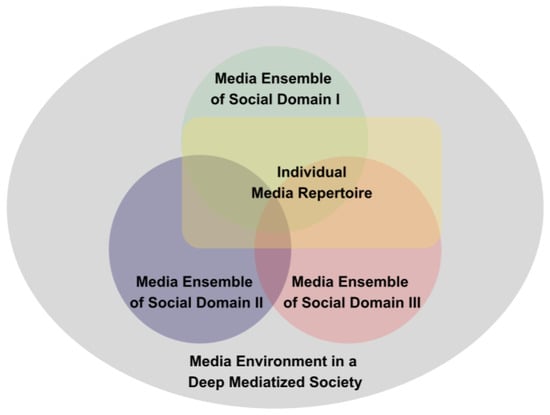
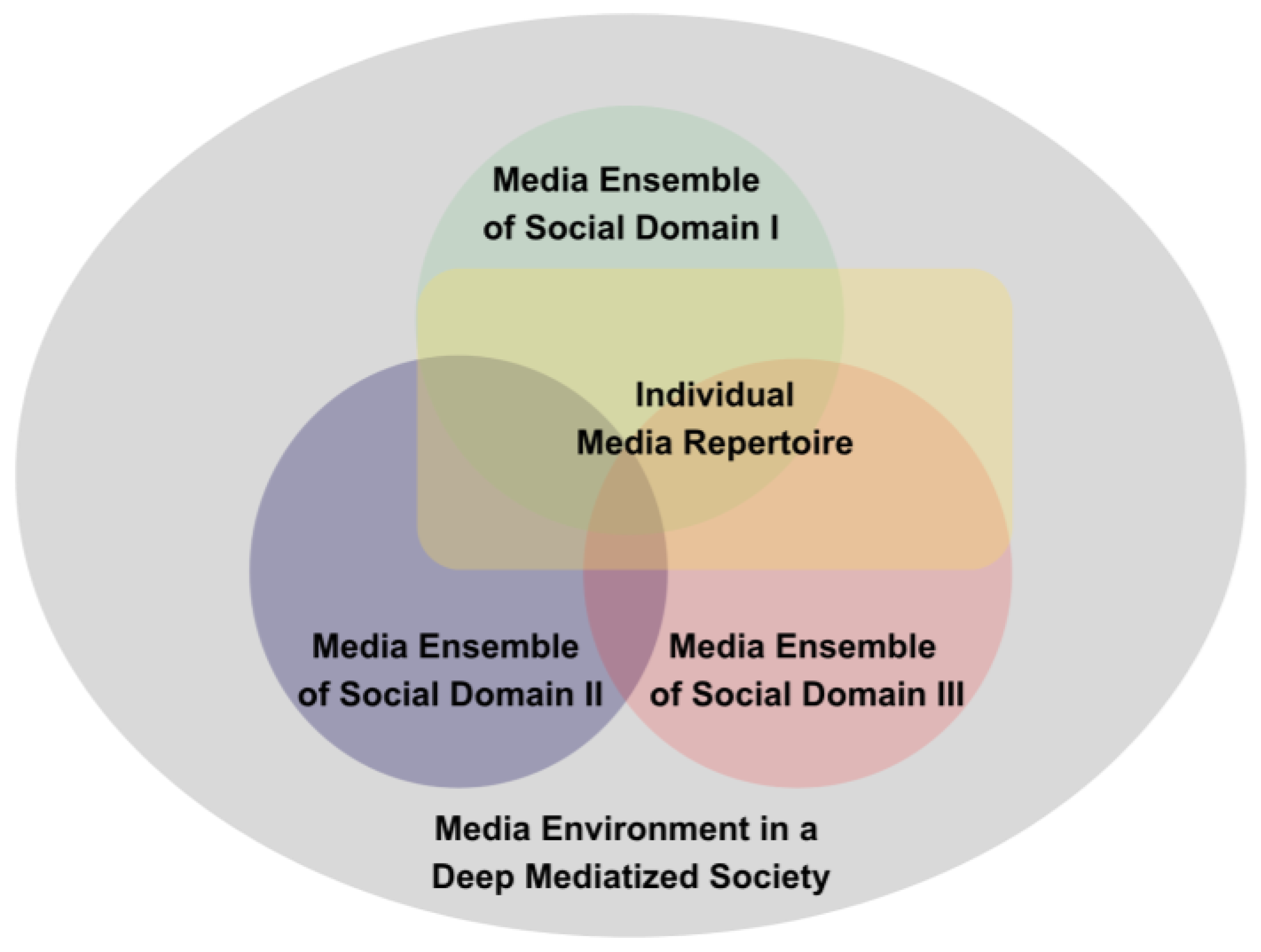
An individual media repertoire does not evolve independently of the social contexts in which media practices occur. In their work, Hasebrink and Hepp [29] propose a distinction between two analytical perspectives that are interconnected: the individual media repertoire and the media ensemble of a social domain. Social domains refer to collectivities and organizations such as families, schools, workplaces, friendship groups, or other contexts in which people interact and communicate. From the perspective of a social domain, the media ensemble is defined as the array of media available to the actors involved in that domain, along with their spatial arrangement. From the individual vantage point, the media repertoire is constituted by the media-related practices through which the individual engages with and navigates various social domains. Media practices are therefore shaped through the interrelation between individual repertoires and the media ensembles of the social domains in which individuals participate. The delineation between individual media repertoires and media ensembles facilitates an examination of how media practices are embedded in divergent social contexts. For instance, a school may provide access to specific digital platforms and establish rules for their use, while a family or peer group may offer different media resources, expectations, and forms of support. Individuals partake in a variety of social domains, encountering an array of media-related expectations and practices that may be incommensurate or even contradictory. Consequently, the development of their individual media repertoires is influenced by the interaction with diverse media ensembles rather than being constrained by a single social context. In contrast, individuals’ media practices also contribute to shaping the media ensembles of the domains in which they participate. For example, the establishment of new applications in classroom activities or changes in shared practices that alter communication within a peer group are indicative of this dynamic.
The third level of analysis is the macro level of the societal media environment. While media repertoires refer to individuals and media ensembles to particular social domains, the media environment refers to the broader configuration of media available within a society at a particular point in time. In the context of deep mediatization, this environment is characterized by increasing differentiation, connectivity, omnipresence, rapid technological innovation, and datafication [5]. These developments establish the overarching conditions that shape the organization and transformation of social domains and individual media practices. Consequently, the societal media environment does not merely serve as an external backdrop or a direct determinant of individual media use. It provides the technological, infrastructural, economic, and communicative conditions within which media ensembles and individual media repertoires develop. To illustrate, the increasing availability of networked media and platform-based services can modify the media accessible in schools, families, and workplaces. Conversely, institutional decisions and social practices influence the adoption, regulation, and integration of these technologies into everyday routines. The societal media environment is, as such, continuously reproduced and transformed through the practices and arrangements of social domains and individuals.
As illustrated in Figure 1, the three levels should not be interpreted as a linear hierarchy. Instead, they are recursively related. Shifts in the societal media environment can modify the media ensembles of social domains. Concurrent alterations within social domains may also influence the media repertoires of individuals. Concurrently, modifications in individual media practices may precipitate transformations within social domains and, in aggregate, engender more widespread changes in the media environment. In light of these observations, Hasebrink and Hepp [29] have proposed an integrated approach, advocating for the interweaving of individual media repertoires and social-domain media ensembles within research methodologies. This integration of perspectives challenges the conventional treatment of these entities as discrete objects of study, thereby fostering a more comprehensive and dynamic understanding of social phenomena. The three analytical levels, when considered collectively, establish a framework for the examination of media practices. This relational model is especially pertinent in the context of deep mediatization. The increasing differentiation, innovation, and connectivity of media do not simply result in an increase in the amount of media that is added to people’s everyday lives. Instead, they transform the relationships between media, social actors, and social domains.
Figure 1.
Relationship Between the Media Environment, Media Ensembles, and Individual Media Repertoire (own illustration).
Research on media repertoires has primarily focused on patterns of selective media use, the composition of individual repertoires, and the relationships between media and content across increasingly convergent media environments [28,30]. Subsequent research has expanded this perspective to encompass audience practices and evolving media repertoires, including their development over time and their embeddedness in social relationships and communicative figurations [31,32]. However, educational processes and the interrelations between media practices across formal and informal learning contexts have received comparatively less systematic attention. Research on young people’s media use and educational outcomes has frequently concentrated on individual practices, usage duration, or problematic patterns of media use. This has often produced contradictory findings while insufficiently accounting for social contexts and the interplay between different media practices [12,33].
4. From Media Repertoires to Learning-Related Media Repertoires
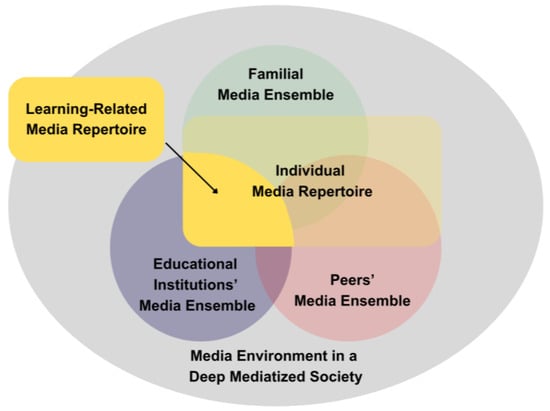
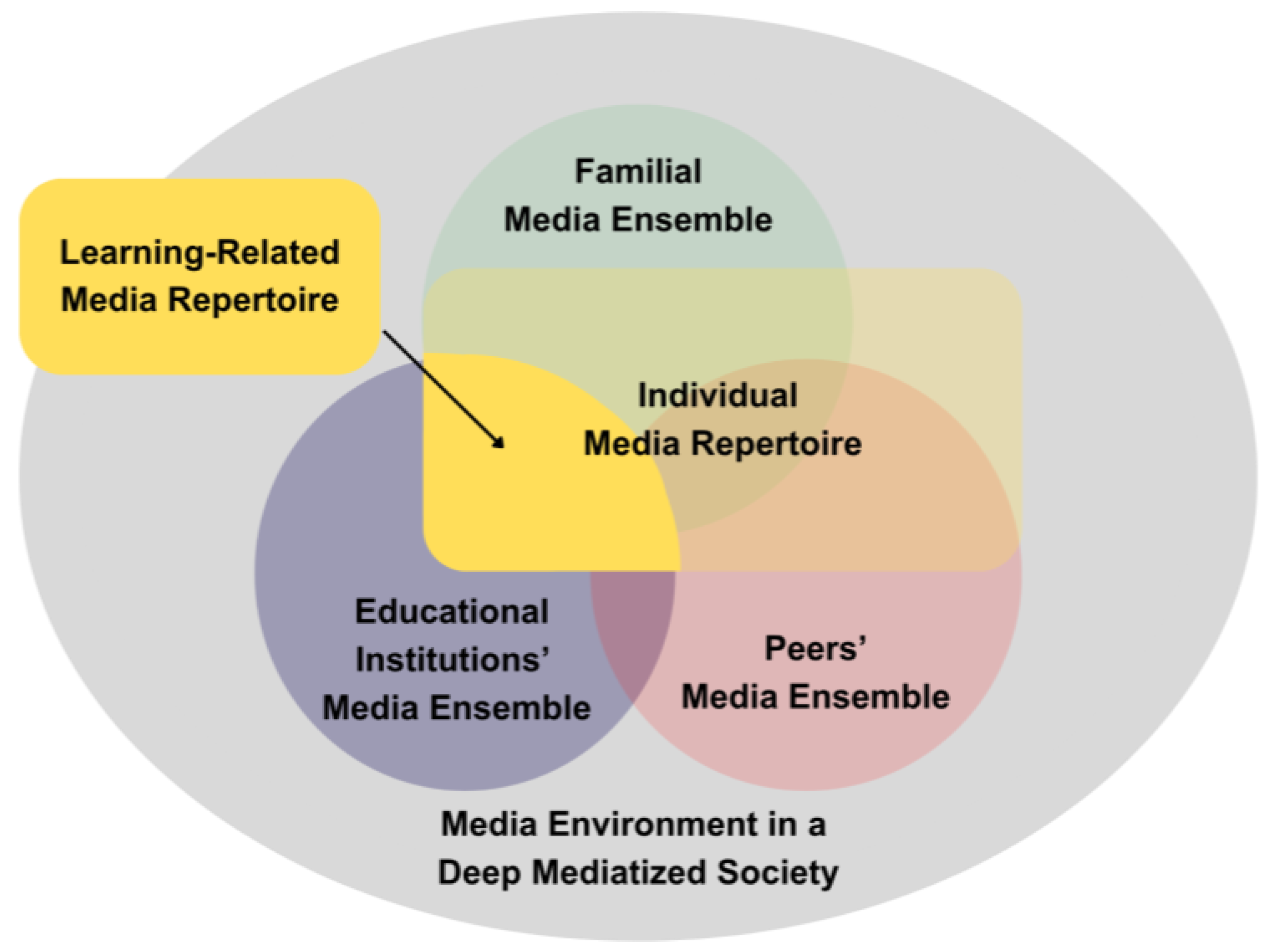
The concept of the learning-related media repertoire is predicated on the media repertoire approach, applied specifically to educational and learning contexts. The proposal was made to examine the relationship between adolescents’ media practices, educational processes, and the social and societal conditions in which learning takes place. The perspective conceptualizes educationally relevant media repertoires as a point of intersection between informal and formal education [12,13]. The present paper takes this conceptual foundation as its starting point and further develops it in relation to the specific characteristics of generative AI. The learning-related media repertoire can be conceptualized as a relatively stable yet dynamic configuration of media practices that are pertinent to an individual’s learning and educational activities in informal, non-formal, and formal educational contexts. The configuration of such media repertoires is influenced by a multifaceted interplay of individual preferences and routines, social relationships, institutional requirements, and the broader societal media environment, as illustrated by Figure 2. Figure 2 locates the learning-related media repertoire within the individual media repertoire because the repertoire concept takes the individual actor as its analytical point of reference: it is at this level that learning-related practices become observable and are configured into a pattern. This conceptualization deliberately avoids reducing learning-related media repertoires to educational technologies. The learning-related media repertoire may encompass a variety of formats, including those designed for educational purposes, such as learning management systems or digital textbooks. Additionally, it may also include media that, while not primarily designed for educational purposes, nevertheless become relevant to the learning process. Such media may include search engines, video platforms, social media, messaging services, and generative AI. The pivotal criterion, therefore, is not the official classification of a technology as an educational medium. The criterion is whether a media practice becomes relevant within an individual person’s learning-related activities.
Figure 2.
The Learning-Related Media Repertoire (own illustration based on Kreutz & Kramer [12]).
The learning-related media repertoire is not conceived as a separate theory, but as a domain-specific specification of the media repertoire approach [13]. It retains the core assumptions of the framework: repertoires are configurations of practices, they are analyzed relationally, and they are embedded in media ensembles and the media environment [29]. What the specification adds is threefold. First, the boundary of the learning-related media repertoire is drawn by learning relevance rather than by media type or genre; a medium belongs to the repertoire if and only if it becomes relevant to an individual’s learning-related activities. Second, the learning-related media repertoire spans formal, non-formal, and informal educational contexts, whose institutional logics (e.g., assessment, curricular requirements, and school regulations) may conflict with the expectations of families and peers and thereby structure the repertoire in a specific way. Third, the learning-related media repertoire is analyzed with regard to its relation to educational processes [12]; it is therefore treated not only as a pattern of use but as a condition under which learning practices, and the distribution of epistemic activities among media, take shape.
The actor-oriented perspective does not exclude social factors. Conversely, learning-related media repertoires must be understood in relation to social contexts. A variety of social domains—for instance, families, peers, teachers, schools, and universities—provide a range of media ensembles, resources, expectations, norms, and forms of support. The resulting learning-related media repertoire is indicative of both individual choices and the possibilities and constraints created by these contexts. This concept is therefore consistent with a broader relational approach to media and education. The inquiry deviates from the conventional question of whether a given technology exerts a favorable or unfavorable influence on the act of learning. Instead, it delves into the intricate dynamics between media practices and their interrelation with educational processes. Recent papers have explicitly proposed the perspective centered on the learning-related media repertoire for comprehending the association between adolescents’ media consumption and academic performance. Kreutz and Kramer [12] posit that research focusing on individual media practices frequently disregards the social and societal factors that shape their meaning and educational relevance. The learning-related media repertoire perspective integrates individual media practices with social and societal conditions.
The theoretical underpinnings of generative AI necessitate further elaboration, as it integrates diverse media functions with forms of dialogical interaction and mediation. Consequently, its function in the learning process transcends that of a mere information medium. Firstly, generative AI constitutes an element of the individual media repertoire through which learners access, process, and produce knowledge. Secondly, its conversational interface facilitates iterative dialogue, the articulation of follow-up inquiries, and the development or refinement of ideas, thereby rendering generative AI a dialogical interaction partner. Thirdly, generative AI can function as an intermediary between learners, knowledge, and other media by summarizing, contextualizing, or connecting information from disparate sources. These roles are interconnected and may be manifested within a single learning practice. The significance of the medium in question is twofold. Firstly, it provides a variety of functions. Secondly, it shapes interactions and relationships between learners, knowledge, other media, and social actors.
Moreover, the potential of generative AI to modify the relationships between existing elements of the learning-related media repertoire is of particular significance. A learner may utilize a search engine in a divergent manner, particularly in instances where an AI-generated answer is made available within the search environment itself. Consequently, a textbook may become a source for verifying AI-generated information rather than the primary source of initial orientation. Consequently, educators may increasingly assume the role of facilitators, assisting students in evaluating and contextualizing AI-generated outputs, as opposed to merely providing information. Peers may utilize AI collectively and engage in discussions or comparisons of generated responses. It is therefore hypothesized that generative AI may reconfigure not only the composition of learning-related media repertoires, but also the relationships between their elements. The present paper aims to extend the concept of the learning-related media repertoire by examining these potential structural changes. The subsequent section proposes three dimensions for analyzing the potential impact of generative AI on the relationships between media practices and learning contexts.
5. Structural Changes in Learning-Related Media Repertoires Due to Generative AI
As demonstrated in the preceding discussion, media repertoires are characterized not only by their individual elements but also by the relationships between these elements. These relationships may involve complementary functions, overlapping uses, substitution, or sequential and simultaneous connections between media practices [30]. Based on this relational understanding, three dimensions can be distinguished for the purpose of analyzing how generative AI may transform learning-related media repertoires. These aspects encompass the following: first, the processes of knowledge acquisition; second, the distribution of epistemic activities; and third, the functional relationships between learning-related media.
The first dimension, the process of knowledge acquisition, pertains to alterations in the way learners seek, obtain, examine, and evaluate knowledge. The focus is on the processes through which learners engage with information and develop an understanding of a subject. Generative AI can transform how learners acquire knowledge. By empowering learners to articulate inquiries in natural language, request explanations, pose follow-up questions, and investigate alternative viewpoints within an ongoing dialogue, generative AI holds the promise of enhancing the learning experience. Rather than primarily navigating lists of external sources, learners can initially engage with AI-generated responses and subsequently consult other sources to verify or contextualize them. Search engines, textbooks, and specialist websites may therefore assume a different position in the process of knowledge acquisition. These resources may be used less for initial orientation and more for checking, extending, or contextualizing information. An observable indication of change would be a shift in the sequence and frequency of information-seeking practices. For example, when learners increasingly begin inquiries with an AI system and use other sources at later stages.
The second dimension, the distribution of epistemic activities, concerns the division of tasks and responsibilities involved in producing, processing, and evaluating knowledge. The primary focus is not on the way information is accessed, but rather on the activities that learners perform, the activities that are delegated to generative AI, and the activities that are shared with other actors. The advent of generative AI has rendered the delegation and sharing of activities such as summarization, translation, text drafting, example generation, argument structuring, and solution development a possibility. The epistemic delegation does not necessarily imply a withdrawal of learners from these activities [24]. Instead, the scope and manner of their participation is subject to variation. They may engage in the formulation of tasks, the selection and refinement of generated material, the validation of results, or the reconstruction of arguments themselves. The analytical focus is therefore on how epistemic responsibilities are distributed between learners, AI systems, and other actors. Empirically, changes could be identified by examining which tasks learners perform independently, which they delegate wholly or partly, and which they undertake collaboratively with AI or other people.
The third dimension pertains to changes in the functional relationships between the elements of a learning-related media repertoire. The inquiry focuses on the ongoing complementarity, functional convergence, substitution, and connection of media in new sequences or simultaneous practices. In contrast to the initial two dimensions, the primary objective of this third dimension is the configuration of relationships between media. To illustrate this point, consider the functional overlap between generative AI and search engines, explanatory websites, or digital learning materials. These media are used to provide information or explanations, and as such, they demonstrate a functional overlap with generative AI. Concurrently, it has the potential to serve as a complementary resource to textbooks or specialist sources when these are utilized in conjunction with AI-generated responses. Substitution may occur when learners increasingly use AI applications for functions previously performed by other media, such as consulting explanatory websites or using translation tools. New sequential connections may emerge when AI-generated content is transferred to a word-processing application, checked against a textbook, or discussed with peers. The phenomenon of simultaneous connections arises in instances where AI tools are integrated directly into software designed for writing software or learning platforms. The provided illustrations demonstrate that structural change pertains to the configuration of the entire learning-related media repertoire. This phenomenon may be observed when the functions assigned to specific media change, when previously separate media are used together, when one medium increasingly replaces another, or when new sequences and combinations of media practices emerge. Consequently, generative AI may not only influence the composition of a media repertoire, but also reshape the relationships among its components, thereby altering their interdependence.
The three dimensions provide complementary analytical perspectives on potential changes in learning-related media repertoires. Distinctions can be made based on the primary analytical focus on the respective phenomena. In the context of knowledge acquisition, the focus is on how learners engage with and evaluate information. Epistemic activities, by contrast, concern the actors responsible for specific knowledge-related tasks. Media relationships, finally, concern the way the functions and connections between repertoire elements are altered. A single learning situation may encompass multiple dimensions concurrently. For instance, the integration of generative AI in the creation of classroom presentations may transform the process of information seeking, redistribute writing and summarizing tasks, and establish novel connections between AI and presentation software. These dimensions also provide points of departure for empirical research. Conversely, the mere presence or frequency of AI use should not be taken as an indication of impending structural changes. To that end, an examination of changes over time or a comparison of different configurations of learning-related media repertoires is required. A variety of indicators have been identified as relevant to this study, including shifts in the functions assigned to individual media, changes in the frequency and sequence of media combinations, the emergence or disappearance of complementary or substitutive relationships, and changes in the distribution of epistemic activities. The three dimensions are therefore not intended as empirically established effects of generative AI, but as an analytical framework for identifying and examining possible structural transformations.
6. Emerging Inequalities as Differences in Learning-Related Media Repertoire Structures
The increasing incorporation of generative AI into conventional learning practices also gives rise to concerns regarding digital inequality. As access to AI technologies broadens, it cannot be assumed that learners benefit from these technologies equally or are able to integrate them into their learning practices in the same ways [34,35]. The concept of the AI gap refers here to inequalities in learners’ opportunities to access, appropriate, and benefit from generative AI in educational contexts. Therefore, it encompasses not only disparities in access to AI applications and the requisite infrastructure, but also variations in the integration of generative AI into prevailing learning practices, the evaluation of its outputs, and the educational benefits that learners can derive from its utilization. This understanding is rooted in research on the digital divide, which has demonstrated that digital inequalities extend beyond access to differences in skills and patterns of use, as well as in the ability to translate digital resources into benefits in other areas of life [36,37,38].
The learning-related media repertoire perspective facilitates the examination of these inequalities across the three distinct yet interrelated analytical levels. These levels include the societal media environment, the media ensembles of social domains, and individual media repertoires. The application of the digital divide framework at these levels underscores the emergence of inequality stemming from the interplay of societal conditions, institutional and social contexts, and individual practices. At the macro level, the societal media environment exerts a profound influence on the general conditions that shape the access and utilization of generative AI by learners. Inequalities may emerge from disparities in technological availability, digital infrastructure, the distribution of AI services, and regulatory conditions. The accessibility of functionalities, the conditions under which they are available, and their associated costs may be further influenced by the structures and business models employed by commercial platforms. These conditions establish the broader opportunities and constraints within which generative AI can become part of learning-related media repertoires. At the meso level, media ensembles within social domains—such as schools, universities, families, and peer groups—shape the resources and support available to learners. Educational institutions vary significantly in terms of their technological infrastructure, policies, pedagogical approaches, and opportunities to develop AI-related competencies. Furthermore, families and peer groups offer varying degrees of technical assistance, knowledge, encouragement, and normative guidance. Institutional restrictions or the absence of guidance may impose limitations on the utilization of generative AI reflectively. Conversely, the presence of a supportive environment can promote the integration of AI into existing learning practices [39,40,41]. At the micro level, inequalities become apparent in the composition and everyday use of individual learning-related media repertoires. Learners may differ in their access to devices and applications, as well as in their competencies, routines, prior experiences, and ability to connect AI with other sources of information and learning resources. For instance, learners may employ the same AI system in different ways. Some may rely primarily on generated answers to complete tasks, while others may use generative AI to explore questions, compare perspectives, verify information, and develop their own arguments [39,42,43,44]. These discrepancies should not be interpreted as individual deficiencies. Rather, these variances are shaped by the social and institutional contexts in which learners operate.
The three levels are interrelated rather than independent sources of inequality. For instance, constrained institutional access to adequate AI instruments, in conjunction with an absence of pedagogical guidance, may constrain the prospects of learners cultivating and consolidating AI-related practices. Conversely, a supportive family and school environment may enable learners to integrate AI into a broader repertoire of information sources, learning materials, and social support. The resulting differences in individual practices are therefore connected to the conditions of the social domains and the wider societal media environment. These inequalities can be further elucidated by contrasting repertoire configurations. A comparatively advantageous configuration may combine access to reliable AI services with established practices of consulting textbooks, specialist sources, and teachers or peers to verify and contextualize AI-generated content. In such a configuration, learners can use AI for initial orientation or drafting while retaining opportunities for independent evaluation and discussion. A potentially disadvantageous configuration may involve limited access to appropriate services, minimal guidance from schools or families, and a strong reliance on AI-generated answers without access to complementary sources or opportunities for verification. In this scenario, while learners may have access to generative AI, they may encounter limited opportunities to evaluate its outputs critically or to incorporate it into more extensive learning processes. These examples serve merely as analytical illustrations, rather than empirically validated types of learning-related media repertoires.
The AI gap, therefore, pertains to disparities in the composition, relational organization, and social embedding of learning-related media repertoires, rather than merely the utilization of generative AI by learners. This perspective establishes a connection between the analysis of inequality and the three dimensions of potential structural change that were discussed in the preceding section. The phenomenon of unequal opportunities can be considered from three distinct perspectives. Firstly, it pertains to the way learners acquire and evaluate knowledge through AI. Secondly, it addresses the distribution of epistemic activities among learners and AI. Thirdly, it concerns the combination of generative AI with other media and learning resources, as well as its potential substitution of these resources. For instance, learners who have access to supportive social and institutional environments may be better positioned to combine AI with other sources and retain responsibility for evaluating information. Other individuals may encounter a limited number of opportunities to establish such connections.
The learning-related media repertoire perspective thus shifts the analysis of AI-related inequality from individual access or competence to the interplay of individual practices, social support, institutional conditions, and the societal media environment. It also circumvents an overly individualistic understanding of AI literacy. The ability to use AI reflectively is contingent not only on individual dispositions but also on the resources, expectations, and opportunities available within learners’ social contexts. The AI gap, therefore, can be conceptualized as an inequality in the opportunities to develop and sustain learning-related media repertoires in which generative AI can be used critically and productively.
7. Conclusions for Educational Research
Generative AI is increasingly becoming part of everyday media environments and learning practices. The review of extant research revealed that inquiries have been made into questions of AI literacy, academic integrity, efficiency, ethics, and regulation. However, approaches that prioritize generative AI as a standalone technology may fail to consider its integration within broader configurations of media practices and the potential alterations to the relationships between existing media, social actors, and learning activities that result from this integration. This paper has applied the learning-related media repertoire, a domain-specific specification of the media repertoire approach, as a relational framework for examining the role of generative AI in contemporary educational processes. Its contribution lies not in a new theory of media repertoires, but in specifying how the repertoire framework must be adapted to learning contexts and to generative AI. The central argument of this conceptual framework is that generative AI should not be understood as merely an additional technology, but rather as a potential catalyst for profound structural changes in the configurations of media practices through which learning occurs. A triad of dimensions has been identified that elucidate this transformation. These dimensions include changes in knowledge acquisition through dialogical interaction, the redistribution of epistemic activities between learners and generative AI, and the reconfiguration of functional relationships between media. Taken together, these dimensions illustrate how generative AI may affect not only individual learning activities but also the organization and social embeddedness of learning-related media repertoires. These dimensions are inherently interconnected and can only be understood adequately through an examination of the technologies and outcomes in their entirety, rather than through the isolation of any individual element. Consequently, the concept of the learning-related media repertoire shifts the focus from the effects of generative AI as a discrete tool to the structural conditions under which AI-mediated learning occurs. To comprehend the educational significance of generative AI, it is necessary to examine not only the actions of learners in relation to AI, but also the way AI reorganizes the relationships among learners, knowledge, media, and the social contexts of learning. The relational perspective under consideration provides a foundation for the investigation of the educational possibilities and inequalities that emerge as generative AI becomes embedded in everyday learning practices.
In the context of educational research, this perspective entails a shift in focus from isolated AI applications and individual competencies to the relationships between media practices, epistemic activities, and social contexts. It establishes a framework for investigating how learners combine generative AI with existing media, which activities they retain or delegate, how the roles of other media and social actors change, and how these practices are shaped by institutional and social conditions. It also offers a way to examine AI-related inequalities beyond access by considering how repertoire configurations are shaped by individual resources, social support, institutional arrangements, and the wider societal media environment. Accordingly, the perspective of media and AI literacy should encompass not only knowledge of individual technologies but also the capacity to critically navigate relationships between media, sources of knowledge, and epistemic practices. This encompasses the capacity to evaluate AI-generated information, to contrast it with other sources, to deliberate on which epistemic activities can be delegated, and to acknowledge the limitations of AI-supported knowledge production. Educational institutions, therefore, play an instrumental role in shaping the conditions under which learners can develop and apply these capabilities. Institutional learning environments must provide more than just access to AI technologies; they must also provide pedagogical guidance, opportunities for critical reflection, and possibilities to connect AI-supported activities with other media, knowledge resources, and social forms of learning.
However, the proposed framework is not without its limitations. The present concept is conceptual and has not yet been empirically validated. The three dimensions are intended to function as complementary analytical perspectives, rather than as mutually exclusive or fully independent categories. They may overlap within individual learning practices. Furthermore, the extent to which the framework can be applied across different age groups, educational phases, subject areas, and institutional settings remains to be examined. The examples discussed in this paper are therefore illustrative and should not be understood as empirically established or representative configurations. The rapid development of generative AI may alter specific applications, functionalities, and conditions of access. The framework should therefore be regarded as an analytical point of departure that can be further developed in response to technological and educational developments.
Subsequent research should employ empirical methodologies to investigate the developmental trajectories of these three dimensions across various educational phases and social contexts. A range of research methodologies, including longitudinal, biographical, and comparative studies, hold potential for investigating the evolution of AI-mediated knowledge acquisition and production. These studies could also examine how relationships between repertoire elements are reconfigured and how these processes are shaped by different institutional and social conditions. A qualitative approach could provide insights into how learners integrate generative AI into their existing learning-related media repertoires, how they evaluate and verify AI-generated outputs, and which epistemic activities they retain, share, or delegate. Subsequent research should also examine the relationships between generative AI and other elements of the media repertoire. The implementation of comparative studies across a variety of educational settings has the potential to elucidate the way institutional policies, pedagogical approaches, and social support influence the configuration of these entities. It is imperative to direct particular attention to the disparities in opportunities to access, utilize, and benefit from generative AI. Furthermore, it is necessary to examine the repertoire configurations that may facilitate or impede critical and independent learning. Such research should also explore the conditions under which these transformations support reflective learning or reproduce existing inequalities. The learning-related media repertoire, therefore, provides an analytical framework for understanding AI-mediated learning as a socially embedded and evolving configuration of practices. This framework does not presume that generative AI necessarily transforms learning in a particular direction. The fundamental question guiding educational research is not merely whether generative AI enhances learning or whether learners possess the necessary competencies to utilize it. This paradigm shift in knowledge acquisition, epistemic activities, media interconnectivity, and learning across social domains is a consequence of generative AI. In this respect, the present paper extends the original perspective of the learning-related media repertoire by specifying its analytical potential for examining generative AI. Its contribution lies not in treating AI as a separate object of investigation, but in foregrounding the changing relations between media, epistemic activities, learners, and their social and institutional environments. This relational perspective provides a foundation for investigating the conditions under which generative AI becomes part of learning practices and the ways in which its integration may reproduce or transform existing educational inequalities.
Funding
This research received no external funding.
Institutional Review Board Statement
Not applicable.
Informed Consent Statement
Not applicable.
Data Availability Statement
No new data were created or analyzed in this study. Data sharing is not applicable to this article.
Conflicts of Interest
The author declares no conflicts of interest.
References
- Skjuve, M.; Brandtzaeg, P.B.; Følstad, A. Why Do People Use ChatGPT? Exploring User Motivations for Generative Conversational AI. First Monday 2024, 29, 1–23. [Google Scholar] [CrossRef] [Scilit]
- Bick, A.; Blandin, A.; Deming, D.J. The Rapid Adoption of Generative AI; w32966; National Bureau of Economic Research: Cambridge, MA, USA, 2024. [Google Scholar] [CrossRef] [Scilit]
- Eurostat Digital Economy and Society Statistics—Households and Individuals. Available online: https://ec.europa.eu/eurostat/statistics-explained/index.php?title=Digital_economy_and_society_statistics_-_households_and_individuals#Source_data_for_tables_and_figures (accessed on 30 July 2026).
- Staksrud, E.; Mascheroni, G.; Milosevic, T.; Ni Bhroin, N.; Olafsson, K.; Şengül-İnal, G.; Stoilova, M. European Children’s Use and Understanding of Generative AI: EU Kids Online 2026; London School of Economics and Political Science: London, UK, 2026. [Google Scholar]
- Hepp, A. Deep Mediatization, 1st ed.; Key Ideas in Media & Cultural Studies; Routledge: London, UK, 2019. [Google Scholar]
- Hepp, A.; Bolin, G.; Guzman, A.; Loosen, W. Mediatization and Human-Machine Communication: Trajectories, Discussions, Perspectives. HMC 2024, 7, 7–21. [Google Scholar] [CrossRef] [Scilit]
- Han, Z.; Zhao, H.; Chen, J.; Yin, S. The Perceived Outcomes of Generative Artificial Intelligence in Users’ Everyday Life. Aslib J. Inf. Manag. 2025, 1–20, ahead-of-print. [Google Scholar] [CrossRef] [Scilit]
- Ligot, D.V. How People Actually Use Generative AI: An Integrative Analysis of Real-World Use-Cases 2026; SSRN 2026; Elsevier: Amsterdam, The Netherlands, 2026. [Google Scholar] [CrossRef] [Scilit]
- Lupton, D.; Bailey-Charteris, B. ‘You Can’t Put the Cat Back in the Bag Once It’s out’: Australians’ Understandings, Practices and Imaginaries Concerning Generative AI. Big Data Soc. 2026, 13, 20539517261442430. [Google Scholar] [CrossRef] [Scilit]
- Degner, M.; Moser, S.; Lewalter, D. Digital Media in Institutional Informal Learning Places: A Systematic Literature Review. Comput. Educ. Open 2022, 3, 100068. [Google Scholar] [CrossRef] [Scilit]
- Scheiter, K. Lernen und Lehren mit digitalen Medien: Eine Standortbestimmung. Z. Erzieh. 2021, 24, 1039–1060. [Google Scholar] [CrossRef] [Scilit]
- Kreutz, K.; Kramer, M. The Controversial Relationship Between Adolescents’ Media Use and School Performance: A Call for a Repertoire-Oriented Perspective. Weizenbaum J. Digit. Soc. 2026, 6, 1–21. [Google Scholar] [CrossRef]
- Kramer, M.; Kammerl, R.; Potzel, K.; Wartberg, L. Bildungsbezogene Medienrepertoires als Schnittstelle informeller und formaler Bildung—Ein Überblick und neue Perspektiven für die Forschung. In Bildung für eine Digitale Zukunft; Scheiter, K., Gogolin, I., Eds.; Edition ZfE; Springer VS: Wiesbaden, Germany, 2023; pp. 159–185. [Google Scholar]
- Stojanov, A.; Liu, Q.; Koh, J.H.L. University Students’ Self-Reported Reliance on ChatGPT for Learning: A Latent Profile Analysis. Comput. Educ. Artif. Intell. 2024, 6, 100243. [Google Scholar] [CrossRef] [Scilit]
- Baek, C.; Tate, T.; Warschauer, M. “ChatGPT Seems Too Good to Be True”: College Students’ Use and Perceptions of Generative AI. Comput. Educ. Artif. Intell. 2024, 7, 100294. [Google Scholar] [CrossRef] [Scilit]
- Farinosi, M.; Melchior, C. ‘I Use ChatGPT, but Should I?’ A Multi-Method Analysis of Students’ Practices and Attitudes Towards AI in Higher Education. Eur. J. Educ. 2025, 60, e70094. [Google Scholar] [CrossRef] [Scilit]
- Ravšelj, D.; Keržič, D.; Tomaževič, N.; Umek, L.; Brezovar, N.; Iahad, N.A.; Abdulla, A.A.; Akopyan, A.; Aldana Segura, M.W.; AlHumaid, J.; et al. Higher Education Students’ Perceptions of ChatGPT: A Global Study of Early Reactions. PLoS ONE 2025, 20, e0315011. [Google Scholar] [CrossRef] [Scilit]
- Otto, S.; Ejsing-Duun, S.; Lindsay, E. Disruptive Tensions and Emerging Practices: An Exploratory Inquiry into Student Perspectives on Generative Artificial Intelligence in a Problem-Based Learning Environment. Educ. Inf. Technol. 2025, 30, 19111–19140. [Google Scholar] [CrossRef] [Scilit]
- Bower, M.; Torrington, J.; Lai, J.W.M.; Petocz, P.; Alfano, M. How Should We Change Teaching and Assessment in Response to Increasingly Powerful Generative Artificial Intelligence? Outcomes of the ChatGPT Teacher Survey. Educ. Inf. Technol. 2024, 29, 15403–15439. [Google Scholar] [CrossRef] [Scilit]
- Busuttil, L.; Calleja, J. Teachers’ Beliefs and Practices About the Potential of ChatGPT in Teaching Mathematics in Secondary Schools. Digit. Exp. Math. Educ. 2025, 11, 140–166. [Google Scholar] [CrossRef] [Scilit]
- Song, Z.; Qin, J.; Jin, F.; Cheung, W.M.; Lin, C.-H. A Case Study of Teachers’ Generative Artificial Intelligence Integration Processes and Factors Influencing Them. Teach. Teach. Educ. 2025, 165, 105157. [Google Scholar] [CrossRef] [Scilit]
- Knaus, T. Why AI Matters for Education—An Exploration in Seven Arguments. Z. Für Bild. 2026, 16, 473–493. [Google Scholar] [CrossRef]
- Yu, W. A Conceptual Framework for AI Literacy with a Focus on Competency. Int. J. Artif. Intell. Educ. 2025, 35, 2975–2992. [Google Scholar] [CrossRef] [Scilit]
- Bauer, E.; Greiff, S.; Graesser, A.C.; Scheiter, K.; Sailer, M. Looking Beyond the Hype: Understanding the Effects of AI on Learning. Educ. Psychol. Rev. 2025, 37, 45. [Google Scholar] [CrossRef] [Scilit]
- De Witt, C.; Gloerfeld, C.; Wrede, S.E. (Eds.) Künstliche Intelligenz in der Bildung; Springer Fachmedien Wiesbaden: Wiesbaden, Germany, 2023. [Google Scholar]
- Fu, Y.; Weng, Z.; Wang, J. Examining AI Use in Educational Contexts: A Scoping Meta-Review and Bibliometric Analysis. Int. J. Artif. Intell. Educ. 2025, 35, 1388–1444. [Google Scholar] [CrossRef] [Scilit]
- Kasneci, E.; Sessler, K.; Küchemann, S.; Bannert, M.; Dementieva, D.; Fischer, F.; Gasser, U.; Groh, G.; Günnemann, S.; Hüllermeier, E.; et al. ChatGPT for Good? On Opportunities and Challenges of Large Language Models for Education. Learn. Individ. Differ. 2023, 103, 102274. [Google Scholar] [CrossRef] [Scilit]
- Hasebrink, U.; Popp, J. Media Repertoires as a Result of Selective Media Use. A Conceptual Approach to the Analysis of Patterns of Exposure. Communications 2006, 31, 369–387. [Google Scholar] [CrossRef] [Scilit]
- Hasebrink, U.; Hepp, A. How to Research Cross-Media Practices? Investigating Media Repertoires and Media Ensembles. Convergence 2017, 23, 362–377. [Google Scholar] [CrossRef] [Scilit]
- Hasebrink, U.; Domeyer, H. Media Repertoires as Patterns of Behaviour and as Meaningful Practices: A Multimethod Approach to Media Use in Converging Media Environments. Particip. J. Audience Recept. Stud. 2012, 9, 757–779. [Google Scholar]
- Potzel, K.; Draheim, S.; Domdey, P.; Lampert, C.; Kammerl, R. Changes in Young People’s Media Repertoires. Longitudinal Insights from a Communicative Figurational Approach. M&K 2024, 72, 280–296. [Google Scholar] [CrossRef] [Scilit]
- Hasebrink, U.; Hölig, S. Deconstructing Audiences in Converging Media Environments. In Media Convergence and Deconvergence; Sparviero, S., Peil, C., Balbi, G., Eds.; Global Transformations in Media and Communication Research—A Palgrave and IAMCR Series; Palgrave Macmillan: Cham, Switzerland, 2017; pp. 113–133. [Google Scholar]
- Gnambs, T.; Stasielowicz, L.; Wolter, I.; Appel, M. Do Computer Games Jeopardize Educational Outcomes? A Prospective Study on Gaming Times and Academic Achievement. Psychol. Pop. Media 2020, 9, 69–82. [Google Scholar] [CrossRef] [Scilit]
- Wu, Y. Integrating Generative AI in Education: How ChatGPT Brings Challenges for Future Learning and Teaching. JARE 2023, 2, 6–10. [Google Scholar] [CrossRef] [Scilit]
- Hadar Shoval, D. Artificial Intelligence in Higher Education: Bridging or Widening the Gap for Diverse Student Populations? Educ. Sci. 2025, 15, 637. [Google Scholar] [CrossRef] [Scilit]
- Van Dijk, J. The Digital Divide; Polity Press: Cambridge, MA, USA; Medford, MA, USA, 2020. [Google Scholar]
- Oliveira, A.F.; Leote De Carvalho, M.J.; Sousa, C. Young People’s Diversity and Digital Media: A Systematic Review (2010–2022). Media Commun. 2024, 12, 8237. [Google Scholar] [CrossRef] [Scilit]
- Van Dijk, J.A.G.M. Digital Divide: Impact of Access. In The International Encyclopedia of Media Effects; Rössler, P., Hoffner, C.A., Zoonen, L., Eds.; Wiley: Hoboken, NJ, USA, 2017; pp. 1–11. [Google Scholar]
- O’Dea, X. Generative AI: Is It a Paradigm Shift for Higher Education? Stud. High. Educ. 2024, 49, 811–816. [Google Scholar] [CrossRef] [Scilit]
- Kurban, C.F.; Şahin, M. The Impact of ChatGPT on Higher Education: Exploring the AI Revolution; Emerald Publishing Limited: West Sussex, UK, 2024. [Google Scholar]
- Rubim, L.S.; De Souza Nogueira Da Silva, F.G. Does Generative AI Reduce or Reproduce Educational Inequality? Cultural Capital and AI Use Across Different School Contexts. In Proceedings of the 2026 IEEE Digital Education and MOOCS Conference (DEMOcon); IEEE: Timisoara, Romania, 2026; pp. 1–8. [Google Scholar]
- Fang, L.; Zhou, X. From Tool to Co-Learner: Exploring Student Engagement with GenAI Through the Lens of Social Constructivism. Eval. Rev. 2025, 0193841X251411618. [Google Scholar] [CrossRef] [Scilit]
- Cai, Q.; Lin, Y.; Yu, Z. Factors Influencing Learner Attitudes Towards ChatGPT-Assisted Language Learning in Higher Education. Int. J. Hum.–Comput. Interact. 2024, 40, 7112–7126. [Google Scholar] [CrossRef] [Scilit]
- Lovett, N. Individual Differences in Generative AI Effectiveness: An Empirical Puzzle for HRD Research. New Horiz. Adult Educ. Hum. Resour. Dev. 2026. [Google Scholar] [CrossRef] [Scilit]
Disclaimer/Publisher’s Note: The statements, opinions and data contained in all publications are solely those of the individual author(s) and contributor(s) and not of MDPI and/or the editor(s). MDPI and/or the editor(s) disclaim responsibility for any injury to people or property resulting from any ideas, methods, instructions or products referred to in the content. |
© 2026 by the author. Licensee MDPI, Basel, Switzerland. This article is an open access article distributed under the terms and conditions of the Creative Commons Attribution (CC BY) license.