


Abstract
Entrepreneurial intention is shaped by both individual and social factors. Family support can play an important role, particularly for individuals from business families. This study examines the relationships between family moral and instrumental support and entrepreneurial intention. It also examines whether conflict competence strengthens these relationships. The study uses data from 423 university students in Saudi Arabia with at least one parent who is self-employed or a majority business owner. Confirmatory factor analysis and multiple regression were used to analyze the data. The results show that both family moral and instrumental support are positively related to entrepreneurial intention, with moral support showing a stronger relationship. Conflict competence also strengthens both relationships, although its moderating role is stronger for moral support. These findings show that family support may be more closely related to entrepreneurial intention when students are better able to manage disagreement within the family. The study contributes to the literature by showing how different forms of family support and conflict competence work together in shaping the entrepreneurial intention of the next generation.
1. Introduction
Family relationships play an important role in entrepreneurial activity by providing social ties, resources, and support. At the same time, strong family involvement may create constraints on entrepreneurial decisions and change [1]. Previous studies have examined several factors that connect family businesses with the entrepreneurial intentions of the next generation [2,3,4,5,6]. Family support is one such factor. It may take the form of moral encouragement or practical assistance and can shape how the next generation views entrepreneurship and their future career choices [7,8]. However, family support does not mean that family members always agree. Different views may arise over business decisions, investment, succession, or change [1]. Family members may also have different expectations and interests. How these disagreements are managed can have important consequences for both the family and the business [9]. Thus, understanding the role of family support requires attention not only to the resources families provide but also to how individuals manage conflict within the family.
Despite this growing research on family influence and entrepreneurial intention, an important gap remains. One stream of research on the next generation has mainly examined how family background and family support are related to entrepreneurial or succession intentions [2,7,8]. A separate stream has examined conflict and its management within family firms [9,10,11]. These two streams, however, have rarely been brought together. Consequently, we still know little about why people who receive family support may differ in how they use that support when considering entrepreneurship. In particular, less attention has been given to the role of individuals’ ability to manage family disagreement while benefiting from family support.
This study addresses this gap by introducing conflict competence (CC) as an individual capability that helps explain how a person deals with disagreement while still making use of family support. Individuals with higher conflict competence may be better able to manage different views and expectations within the family. This may help them continue to benefit from moral and instrumental support. This argument is consistent with family-business research showing that conflict management matters for family and business outcomes [9,10]. It is also consistent with the view that conflict management can shape intergenerational relationships within family firms [11]. In this study, internal family conflict refers to disagreements among family members concerning expectations, relationships, or business-related decisions. It is different from external conflict that involves actors outside the family, such as competitors or other business stakeholders. The present study focuses on how individuals manage disagreement within the family when considering a possible entrepreneurial role. It does not measure external conflict or test its consequences.
The context in which these relationships are examined is also important. Family support and family relationships may not have the same meaning across different social and cultural settings [12,13]. This is particularly relevant in Saudi Arabia, where strong family ties and religious and social values can shape individual career and entrepreneurial choices [3]. Therefore, findings on the entrepreneurial intentions of the next generation from Western settings may not fully explain these relationships in the Saudi context. Research on entrepreneurial intention in developing countries also remains limited and requires further attention [14].
Saudi Arabia presents a unique setting for this study for several reasons. Firstly, Vision 2030, a strategic framework to transform Saudi Arabia, aims to boost local employment and provide talented young people with the necessary skills to realize ambitious goals and focus on entrepreneurship, particularly in future-oriented industries. Secondly, the government supports programs that aim to increase entrepreneurial intention among the young generation, as they represent over 50% of the entire population [15]. Thirdly, Saudi Arabia has a rich family business history; even the government has recognized its essential role in maintaining the sustainability of the economy by establishing the “National Center for Family Business.” These contextual features make it valuable to examine family support in Saudi Arabia. However, they should not be taken to mean that all Saudi families share identical values, expectations, or approaches to entrepreneurship. Family practices and individual experiences can differ substantially.
Within this Saudi context, the role of conflict competence appears to have received limited empirical attention. More specifically, little is known about the relationship between family conflict competence and entrepreneurship in Saudi Arabia. Accordingly, the present study examines the relationships between family moral support (FMS), family instrumental support (FIS), and entrepreneurial intention (EI), as well as the moderating role of conflict competence (CC). The study moves beyond the question of whether family support is associated with EI and examines whether CC helps explain when this relationship is stronger. In the context of this study, CC involves possessing the awareness and skills required to manage conflict successfully and efficiently to make it productive [16]. CC acknowledges that family members may have different views and objectives. This can lead to conflict as they steer the business in different directions. FIS refers to resources and practical assistance provided by family members, whereas FMS refers to emotional and psychological encouragement that can strengthen an individual’s confidence and motivation toward entrepreneurship [17].
The present study is guided by the following research question: How are FMS and FIS related to EI, and how does CC shape these relationships among university students with a parental business background?
To fulfil the primary objective of the study, institutional theory [18] is applied to better contextualize this relationship and understand the link between social factors and entrepreneurial intentions [19,20]. Institutional theory, with particular attention to informal institutions, can arguably provide a comprehensive conceptual understanding of the mechanism that drives entrepreneurial intention among students in the Saudi context. Given that entrepreneurship is a socially embedded phenomenon, examining the Saudi context characterized by deep religious values as well as a conservative and family-oriented culture might reveal interesting findings. Furthermore, the Kingdom of Saudi Arabia is shifting its policies to increase entrepreneurial activity under the 2030 vision.
This research significantly contributes to both theoretical and practical realms. Theoretically, the study deepens our understanding of how environmental factors, particularly informal institutions, may be related to entrepreneurial intention within the unique context of family businesses in Saudi Arabia. Additionally, the study introduces and explores CC as a moderating variable in the relationship between FMS, FIS, and EI. CC is shown to be a factor that can strengthen the relationship between family support and EI. This exploration contributes to the literature by underscoring the importance of conflict management skills in supporting the successful transmission of entrepreneurial intention within family businesses.
Practically, the findings of the present study are anticipated to guide the development of support policies that promote entrepreneurial activity in Saudi Arabia and potentially across the broader Middle East as well as North Africa. Understanding how informal institutions are associated with entrepreneurship can help policymakers and business leaders create environments that nurture and sustain entrepreneurial ventures [6,21]. For instance, the study’s insights could lead to developing programs that enhance family support mechanisms, promote conflict resolution skills, or offer targeted resources to aspiring entrepreneurs from family business backgrounds. Additionally, the lessons learned from this research could be generalized to regions with similar socio-cultural dynamics, providing a valuable framework for supporting entrepreneurship in various contexts.
This study is constructed as follows: after this introduction, we develop the theoretical framework and present our proposed hypotheses. Next, we outline the methodological design used to test these hypotheses. The last two parts discuss the main findings, including implications. Lastly, the conclusion includes future research directions as well as the limitations of the study.
2. Theoretical Background
Institutional theory provides the main theoretical foundation for this study. It explains how the institutional environment can shape behavior and individual choices. North [18] distinguishes between formal rules and informal constraints, such as norms, traditions, and accepted codes of behavior. Scott [22] also explains how institutions shape individual goals and actions and recognizes the family as an important social institution. From this perspective, the family can be viewed as an informal institution that shapes the values, expectations, and choices of its members. Its influence is mainly informal and relational rather than based on formal rules. Institutional theory is appropriate for this study because entrepreneurial intention does not develop in isolation; it is formed within social environments that may influence how individuals interpret opportunities, evaluate possible career paths, and perceive the support available to them. In particular, the family can transmit expectations and establish informal standards concerning work, business participation, and the next generation’s possible involvement in a family enterprise. Therefore, in addition to providing a coherent basis for examining how family support is associated with EI, this theory allows individual differences in responding to family influences to be considered.
In the Saudi context, family relationships may be particularly relevant because family ties and cultural norms can shape the choices of younger family members [6]. For individuals from business families, this influence may be expressed through family expectations, approval, encouragement, and practical support. In this study, these forms of support are examined as moral and instrumental family support. FMS encompasses emotional encouragement and family approval. It can make an entrepreneurial choice feel more accepted and strengthen an individual’s confidence in pursuing it. FIS is more practical. It can include financial assistance, useful information, business knowledge, social networks, and other forms of practical help. These resources can make a future role in the business appear more achievable. In this way, FMS provides emotional and social encouragement, whereas FIS provides practical resources. Both forms of support are therefore expected to be positively related to EI [2,7,8].
Given that family members may have different expectations, interests, or opinions about entrepreneurial decisions, CC may help individuals manage these differences while maintaining supportive family relationships. Individuals with higher CC may therefore be better able to benefit from the moral and instrumental support available to them. Previous research shows that the way conflict is managed matters for family and business outcomes [9,10]. It can also shape relationships between generations within family firms [11]. CC therefore does not replace the institutional role of the family. Rather, it helps explain why some individuals may be better able to benefit from family support than others. Accordingly, higher conflict competence is expected to strengthen the relationships between FMS and FIS and EI.
3. Hypotheses Development
3.1. Entrepreneurial Intentions and Family Support
EI has been a major focus of entrepreneurship research for decades. Studies in this area aim to define the key elements that may affect the new venture creation process [23]. Accordingly, several variables have been used to measure EI, and these variables can be categorized as either traits and personal characteristics of entrepreneurs, or contextual factors in entrepreneurship. Much of the prior research has provided empirical support for these theories [24,25,26,27]. However, previous studies have also highlighted similarities among them and identified a lack of standard measurement instruments for EI and its antecedents [28,29]. Liñán et al. [28] found that the main models used to measure entrepreneurial intention were limited and rarely incorporated environmental factors.
Environmental variables have been found to operate directly and indirectly on intentions to start a business [30]. Consequently, it is understandable that the models mentioned above omit these variables. Liñán et al. [28] found that it is uncommon to incorporate environmental factors in intention models. Environmental factors have ranged from socioeconomic to institutional ones, depending on the country’s context [12]. North [18,31] defined institutional economics as “the rules of the game in a society.” Based on this assumption, the institutional condition may help or hinder entrepreneurial actions or behaviors [23,32]. North [18] proposed that there are two types of institutions: formal institutions that incorporate laws and regulations and informal ones that represent cultural norms. The interaction between them may, in turn, have a positive impact on economic development. The type of skills and knowledge established by an economy’s structure should influence the path of change and progressively modify the institutional framework [31]. Within this perspective, this study aims to examine how informal institutions relate to EI; it provides contextual evidence of family conflict competence and the entrepreneurial intention of the next generation in the Saudi Arabian context. In this study, the family is considered an informal institution because family norms, expectations, and relationships can shape individuals’ career-related decisions. FMS and FIS represent two forms of support within this family environment. Institutionalism is vital because it focuses on how decisions and patterns do not arise solely from abstract individuals; instead, institutions and traditions can guide individual choices.
Based on the current context, the antecedents identified by Liñán et al. [28], the weaker evidence resulting from previous models, and contextual variations [28,33] suggest the need for a more robust theoretical framework. To accurately understand how environmental elements are related to EI, to remain consistent with more recent studies [30,34], and to address the limitations posed by other theories, this paper presents institutional economics theory as the chosen theoretical framework [18,31]. Several studies have shown a growing recognition of sociocultural factors and their significant relationship with the entrepreneurial process [32,35,36]. Guerrero and Marozau [23] noted that informal institutions, such as cultural and behavioral norms, take a longer time to change. They also noted that these institutional conditions may affect the entrepreneurial process from idea realization to venture creation [23]. They also developed an instrument to examine the relationship between formal institutional factors and EI based on data from the World Bank’s Doing Business reports. Overall, the results appear to give very minimal support for the impact of formal institutional factors, but more impact seems to come from social norms, the informal institutions of need, and parental experience. These findings support examining family support as a contextual factor associated with EI.
Although cultural consistency cannot be assumed across all individuals, Saudi citizens are often described as upholding a strong moral code and cultural values, including hospitality, loyalty, and a sense of duty to support their families and community. The family is a central social unit through which these values are expressed, and it forms the basis of social circles for most people. It also provides them with emotional and financial support. Saudis are generally known for their loyalty and support to their families, especially in terms of protecting close family members. They place their family’s wishes, especially those of their parents, over their own preferences. These general cultural descriptions provide context for the current study. Relatedly, Alrubaishi et al. [3] explored the role of cultural context in family business research in Saudi Arabia. They highlighted how family business can contribute to directing entrepreneurial behaviors. In addition to emphasizing the significance of family ties as well as culture for the entrepreneurial behavior of family businesses in general, they show the impact of Islamic capital on the transfer of family legacy. For the main purpose of this research, institutional economics, particularly informal institutions, will serve as the theoretical framework. The literature below discusses the value of environmental factors by exploring the role of informal institutional factors and the indirect role of the moderating variable created by the environment in the relationship to informal institutional factors.
3.2. FMS, FIS, and Students’ Entrepreneurial Intention
Regarding social capital in general and family support in particular, informal institutions remain important in the venture creation process [37]. Engle et al. [38] found that informal institutional factors, including social norms and parental experience, were more important for EI than formal institutional factors. Their findings also showed differences across countries, suggesting that the social context matters when examining entrepreneurial intention. Within this informal family environment, support can take different forms. FMS refers to encouragement, approval, and emotional support from family members. It can strengthen an individual’s confidence and motivation to pursue entrepreneurship. FIS is more practical and includes resources and assistance that can assist an individual in pursuing entrepreneurial activities [17]. The two forms of support therefore work in different ways. FMS may provide encouragement and approval, while FIS is more likely to provide practical help and resources. This distinction is particularly relevant in the Saudi context, where the entrepreneurial choices of the next generation are believed to be shaped by strong family ties [3,6].
Family values and expectations may also become a source of moral support when they are expressed through approval and encouragement of an entrepreneurial career. In this sense, FMS does not refer to moral rules or ethical codes. Rather, it refers to the encouragement and approval that individuals receive from their families when considering entrepreneurship. From an institutional perspective, these forms of family support can be considered to be informal mechanisms through which family norms and expectations shape individual behavior. Institutional theory is traditionally concerned with how various groups and organizations secure their positions and legitimacy by conforming to the rules and norms of the institutional environment [39]. Individual behavior is based on the mandatory aspects of professional, organizational, and social interaction. Institutions guide behavior by defining what is suitable or expected in various situations [19]. That is, institutions can influence behavior because of a social obligation to behave in ways that are consistent with what an organization or an individual is expected to do. Some societies have certain norms that can facilitate and encourage entrepreneurship, whereas others discourage entrepreneurial activities, or make it difficult to pursue entrepreneurial opportunities.
Since family support is essential in Saudi entrepreneurs’ personal and career lives [3], this study expects moral support to be vital in individual decisions toward entrepreneurship. Welsh et al. [40] found that FMS in Saudi Arabia is usually gained through parents, siblings, relatives, and friends. In a similar collective society context, a study showed that FMS might alter personal attitudes toward work or career choices [41]. Recent research found that entrepreneurs who launch their businesses early and have finished fewer gestation activities benefit more from emotional support than those who launch their businesses later and have completed more gestation activities [42]. This intangible support is one of the main factors that this study expects to encourage students to become entrepreneurs by providing them with the confidence to establish their ventures. In other words, when parents demonstrate genuine concern for and care about their children’s feelings about starting their venture, this may increase their intention to be their own bosses. Accordingly, we propose the following hypothesis:
H1.
FMS is positively related to EI.
Another part of social capital is instrumental support. FIS is pivotal to positively motivating students to consider entrepreneurship as a career choice, and the evidence supporting this position is relatively robust [42,43]. This practice, which is tangible, functional, and practical, can take various forms such as providing financial aid, offering problem-solving assistance, and introducing them to a potential investor or supplier [43]. Eddleston and Powell [44] noted that transferring skills and behaviors from family to their children’s entrepreneurial mindsets may provide a work–life balance and contribute to a successful business. Nielsen [45] noted that instrumental support could increase the probability of new venture survival and growth. Since this tangible support is expected to be high in collective societies that promote and encourage individuals to become entrepreneurs, this study expects this relationship to be positive among Saudi Arabian students; therefore, we propose this hypothesis:
H2.
FIS is positively related to EI.
3.3. The Direct and Moderation Effect of Conflict Competence
Family business conflicts occur with internal and external constituents [46]. Conflicts within family businesses are also expected to create adverse effects on individuals’ entrepreneurship. Powell and Eddleston [47] noted that “work-family conflicts are inevitable due to competing time demands and behavioral expectations as well as a spillover of stress and strain from one role to the other.” Le Breton-Miller et al. [48] highlighted the negative effects of family conflicts on decision-making. They also pointed to the negative impact that families may have on business startups and establishments by interfering with business management.
CC refers to the ability to manage emotional or tense situations, tactfully bring disagreements into the open, and define solutions that everyone can endorse [46]. CC is a valuable practice that can lead to high-functioning and more satisfying relationships and enhance well-being and productivity [49]. On the other hand, mismanagement of conflicts or poor competence may lead to low self-confidence. Consequently, when an individual feels that a conflict is intense and difficult to address, it might result in improper energy allocation and miscommunications that may eventually squander opportunities [46]. Thus, we expect that a high level of conflict competence will be positively associated with EI.
H3.
CC is positively related to EI.
Young entrepreneurs are thought to rely heavily on their families and friends to succeed, and instrumental and emotional support can improve their capacity to identify, assess, and seize business opportunities [42]. Young potential entrepreneurs who feel competent enough to manage conflicts in their family business are more likely to be capable of overcoming the challenges and obstacles facing them in the business [46]. Families experience a range of emotions, including warmth, intimacy, tenderness, love, consolation, and happiness, as well as resentment, jealousy, ambivalence, and rage. These emotions transfer easily into the business sphere, making conflicts more prevalent. Thus, young adults who take measures to avoid conflict when possible and take rapid and effective measures when conflicts happen are more suitable to be entrepreneurs. To further investigate this concept, we examined whether CC moderates the relationship between emotional and instrumental support and EI. Thus, the second set of hypotheses we propose here is as follows:
H4.
CC positively moderates the relationship between FMS and EI, such that the positive relationship becomes stronger at higher levels of CC.
H5.
CC positively moderates the relationship between FIS and EI, such that the positive relationship becomes stronger at higher levels of CC.
4. The Conceptual Model of the Research
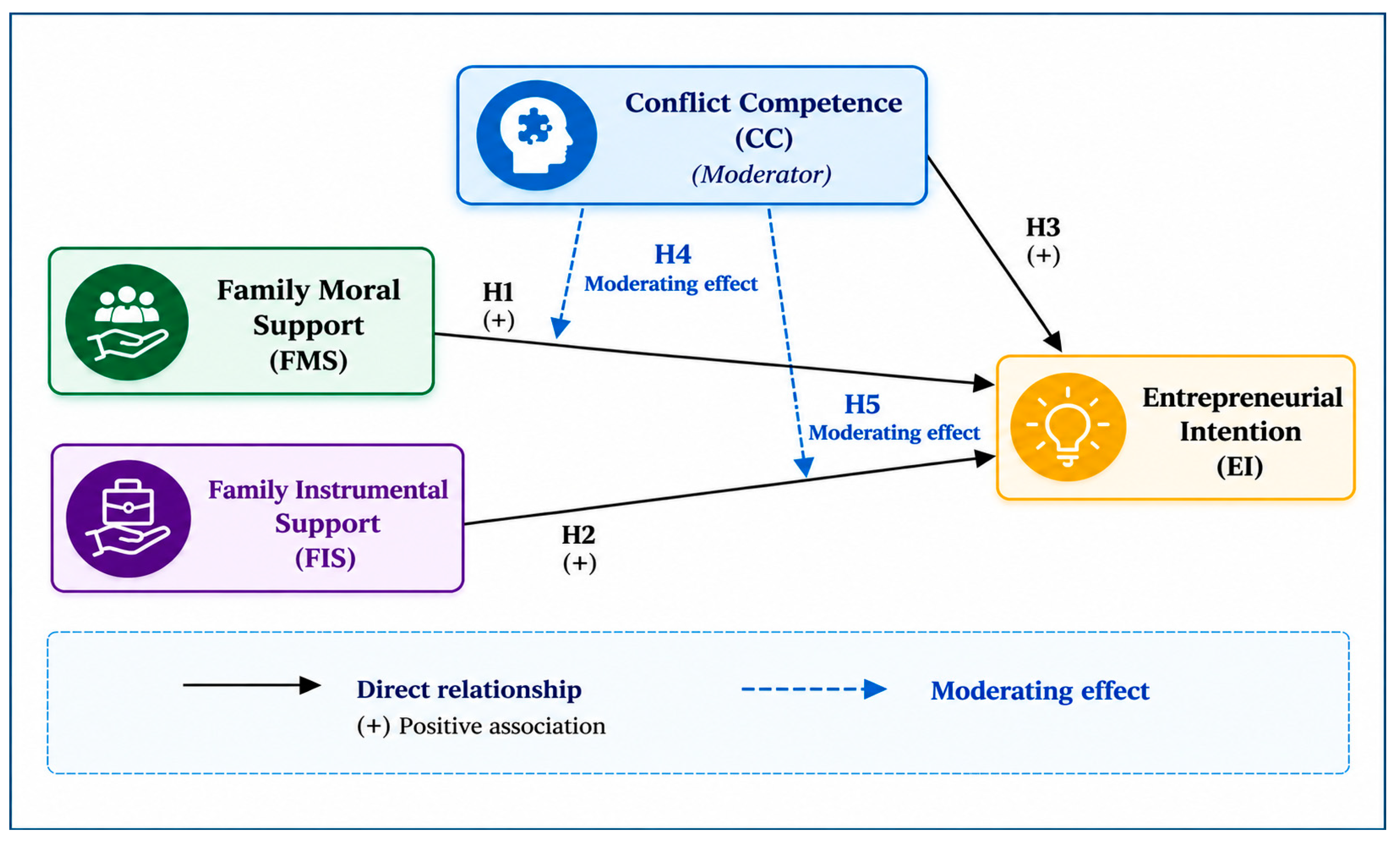
In Figure 1, the research model shows a direct relationship between FMS and FIS and EI and the moderating role of CC.
Figure 1.
Research conceptual model (created by the author).
5. Methodology
5.1. Sample
The present study used data from the Saudi sample of the global university entrepreneurial spirit students’ survey (GUESSS) 2018, a large international research project on university students’ entrepreneurial activities and intentions. Data were collected through an online survey, which is an effective way to reach university students across different institutions and countries [50]. GUESSS is conducted internationally with the support of country coordinators and participating universities [51,52]. A total of 1641 Saudi students completed the 2018 survey. The analytical sample was restricted to respondents who reported that at least one parent was self-employed or a majority business owner, because the study examines family support in a parental business context. This criterion provides a relevant family-business context for examining the proposed relationships. After applying this criterion and excluding incomplete responses, the final sample consisted of 423 students. The use of GUESSS data is also consistent with previous research on students’ entrepreneurial and career intentions [2,51], gender and entrepreneurship [52], and family support [21]. Therefore, the GUESSS data provide an appropriate basis for examining the relationships proposed in this study. However, detailed information on the distribution of respondents across participating Saudi universities was not available in the dataset used for this study. In addition, because participation in GUESSS was voluntary and the present study applied a specific selection criterion, the final sample may be subject to selection and non-response bias and should not be considered representative of all Saudi university students.
5.2. Variables
Table 1 reports the descriptions of the variables included in this study. Entrepreneurial intention (EI) is the dependent variable. EI was measured using six items that capture the intention to pursue an entrepreneurial career through taking over or succeeding the family business, used here as a proxy for EI. In the context of this study, which focuses on students with a parental business background, this operationalization of EI is consistent with family-business research that treats succession intention as a form of entrepreneurial intention for the next generation [2,53]. A 7-point Likert scale ranging from 1 (strongly disagree) to 7 (strongly agree) was used to measure these items. The scale was originally developed by Liñán and Chen [29] and has been widely used and validated in previous studies (e.g., [54,55]).
Table 1.
Descriptive Statistic of the Variables, Reliability and Convergent Analysis.
Both the FMS and FIS scales were designed to measure perceptions of support received from the family [17]. It has been demonstrated philosophically and empirically that what matters most is not how social support manifests itself but how it is perceived [37]. Each construct is based on a 7-point Likert scale (1 strongly disagree to 7 strongly agree), and their validity and distinctiveness have been established in the literature [21,41]. While FIS is tangible, practical, and direct, FMS takes the form of emotional or psychological value (i.e., empathy, encouragement, love, and trust) [42,43].
CC was measured using a four-item scale adapted from Welsh et al. [41] and Powell and Eddleston [47]. In the current study, CC refers to an individual’s perceived ability to respond constructively to difficult situations, manage reactions, and find appropriate ways to deal with challenges. The scale was rated on a 7-point Likert scale ranging from 1 (very low competence) to 7 (very high competence).
The analysis controlled for gender, age, marital status, family size, and work status because previous research suggests that these characteristics may be related to EI and entrepreneurial activity. Age has been associated with differences in entrepreneurial activity across life stages [56], while gender differences in entrepreneurial perceptions and intentions have been documented among university students [57]. Marital status may also be relevant because family responsibilities can influence individuals’ willingness and flexibility to pursue entrepreneurial activities [58,59]. Family size was included because family responsibilities and household structure may shape individuals’ participation in entrepreneurial activities [20]. Finally, work status was controlled because working with parents may provide direct exposure to the family business and influence students’ entrepreneurial choices [60]. Higher education was initially considered as a control variable; however, it was excluded from the revised analysis because it showed very limited variation in the present sample.
5.3. Data Analysis
Exploratory factor analysis (EFA) was conducted to examine the underlying structure of the measurement items. Principal Axis Factoring (PAF) was used as the extraction method. The suitability of the data for factor analysis was assessed through the use of the Kaiser–Meyer–Olkin (KMO) measure as well as Bartlett’s test of sphericity. Factor loadings were then examined to assess how well the items represented their respective constructs. Hair et al. [61] indicated that Cronbach’s alpha value should be above 0.7 and not exceed 1 to be considered adequately reliable. Second, based on Yong and Pearce [62]), this research applied the Kaiser–Meyer–Olkin (KMO) measure in order to determine the suitability of the dataset for EFA (a KMO value above 0.6 is preferred, with higher values being more favorable), and Bartlett’s test of sphericity was used to ensure statistical significance.
As shown in Table 1, the findings revealed that the four variables (EI, FMS, FIS, and CC) all exceeded the recommended minimum of 0.60. Bartlett’s tests were statistically significant for all four constructs (p < 0.001). These findings indicate that the data were suitable for factor analysis. The EFA results indicated a four-factor structure based on the 16 measurement items. Confirmatory factor analysis (CFA) was subsequently conducted to assess the measurement model. Model fit was evaluated using the reported fit indices, while factor loadings, reliability, convergent validity, and discriminant validity were examined to assess the quality of the measures. Table 1 presents the psychometric properties and fit indices for the latent variables used in our study, demonstrating that each variable aligns well with the proposed hypotheses. Specifically, the results show that the scales for EI (Cronbach’s alpha = 0.954, KMO = 0.903, Comparative Fit Index “CFI” = 0.920, Tucker–Lewis Index “TLI” = 0.920), FIS (Cronbach’s alpha = 0.879, KMO = 0.720, CFI = 1, TLI = 1), FMS (Cronbach’s alpha = 0.866, KMO = 0.750, CFI = 1, TLI = 1), and CC (Cronbach’s alpha = 846, KMO = 0.808, CFI = 0.987, TLI = 0.960) all show strong internal consistency and favorable model fit.
The Cronbach’s alpha values demonstrated a good internal consistency for all scales, with values ranging from 0.846 to 0.954, which surpass the commonly accepted threshold of 0.70. This shows that the items within each scale reliably measure the underlying construct. Additionally, the Kaiser–Meyer–Olkin (KMO) measure of sampling adequacy for each scale is well above the recommended minimum of 0.60, with values ranging from 0.720 to 0.903, indicating that the data are suitable for factor analysis. Moreover, the fit indices for the CFA models provide further evidence of the robustness of our measurement models. The CFI values, which range from 0.920 to 1, and TLI values, which range from 0.920 to 1, are all at or above the recommended cutoff of 0.90, suggesting that the models have a good fit to the data. These indices demonstrate that the hypothesized factor structure is well supported by the empirical data. The results indicate that the measurement models for all observed variables not only meet but exceed the acceptable thresholds for model fit, thereby confirming the validity of these latent constructs. This level of validity and reliability underscores the strength of our methodological approach, ensuring that the constructs accurately reflect the empirical data as posited by the theoretical framework [63].
The study used ordinary least squares (OLS) multiple linear regression analysis to examine the relationships between FMS, FIS, CC, and EI. The analysis was also used to test the moderating role of conflict competence by including the relevant interaction terms. OLS was considered appropriate because EI was treated as a continuous dependent variable and the model included multiple predictors [64]. Model explanatory power was assessed using R2, which indicates the proportion of variance in entrepreneurial intention explained by the predictors. The regression coefficients and their statistical significance were used to test the proposed hypotheses. All analyses were conducted using STATA 14.1.
6. Results
Table 2 summarizes the demographic characteristics of the sample. The respondents had an average age of approximately 26 years (M = 26.53). Most respondents were male (376, 88.89%), while 47 (11.11%) were female. Most of the respondents were single (381, 90.07%), while 42 (9.93%) were married, divorced, or widowed. In terms of education, 412 respondents (97.40%) had completed secondary education or above. In addition, 331 respondents (78.25%) reported having at least two older siblings. Finally, 67 respondents (15.84%) reported working with their parents.
Table 2.
Descriptive statistics of the demographic characteristics.
Second, Table 3 reports the results of the Pearson correlation analysis that was conducted to evaluate the relationships between EI and the independent variables (FMS, FIS, and CC) and control variables (age, gender, marital status, higher education, family size, and work status). Table 3 indicates a positive relationship between EI and FMS) r = 0.3744, p ≤ 0.01). There is also a positive correlation between EI and FIS (r = 0.3446, p ≤ 0.01). EI was also positively correlated with CC (r = 0.313, p ≤ 0.01). Regarding demographic variables, gender had a negative relationship with entrepreneurial intention (r = −0.0912, p ≤ 0.10). Because gender was coded as 1 for male and 0 for female, the negative correlation indicates that male respondents reported lower EI in the bivariate analysis. Work status presents a significant positive relationship with entrepreneurial intention (r = 0.108, p ≤ 0.05); this means that students who work with their parents have a stronger intention to continue with their family business. Additionally, the study calculated the variance inflation factor (VIF) for each independent variable; the aim was to check for multicollinearity concerns. The results that appear in the last column of Table 3 show that all VIFs were well below the level (VIF < 4). These results indicate that multicollinearity is not an issue in our dataset [61].
Table 3.
Correlation matrix.
The results of three regression models are reported in Table 4. In the first model, we analyzed the relationship between EI as the dependent variable and (FIS, FMS, and CC) as independent variables. We also added (age, gender, marital status, higher education, family size, and work status) as control variables. Then, the study used the first procedure to introduce the interaction terms and analyze the moderating role of conflict competence in the relationship between FIS and EI. In Model 3, the researchers repeated the same process and added the second interaction between FMS and CC. The three models were statistically significant; the R2 values, which indicate the proportion of variance accounted for in the dependent variable, ranged from 0.21 to 0.22, indicating a reasonably good model [65].
Table 4.
Regression results of dependent variable (EI).
Hypothesis 1, which suggested that FMS is positively related to entrepreneurial intention, was supported (β = 0.224, p < 0.01) (Model 1). Hypothesis 2, which proposed that FIS is positively related to entrepreneurial intention, was also strongly supported (β = 0.134, p < 0.05). Similarly, Hypothesis 3, which proposed a positive association between CC and EI, was supported (β = 0.210, p < 0.01), meaning students who perceived themselves competent in managing conflicts have a stronger intention to start their ventures. Regarding the control variables, both age and gender reported a negative and significant association with entrepreneurial intention (Age: β = −0.022, p < 0.10) (Gender: β = −0.318, p < 0.05). Thus, the model was assessed for its predictive capability, yielding a p-value of 0.01, with an R-squared value of 0.211.
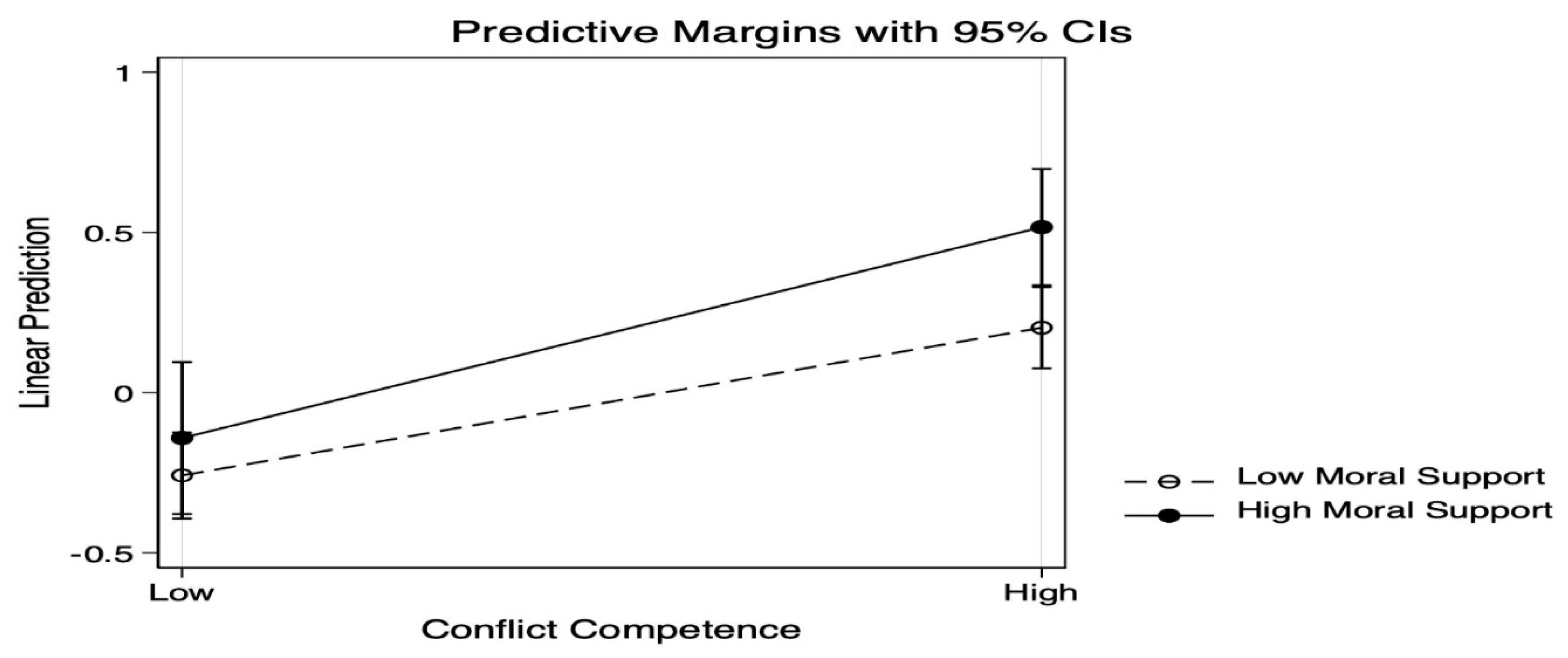
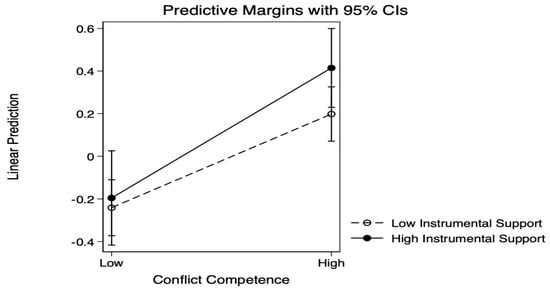
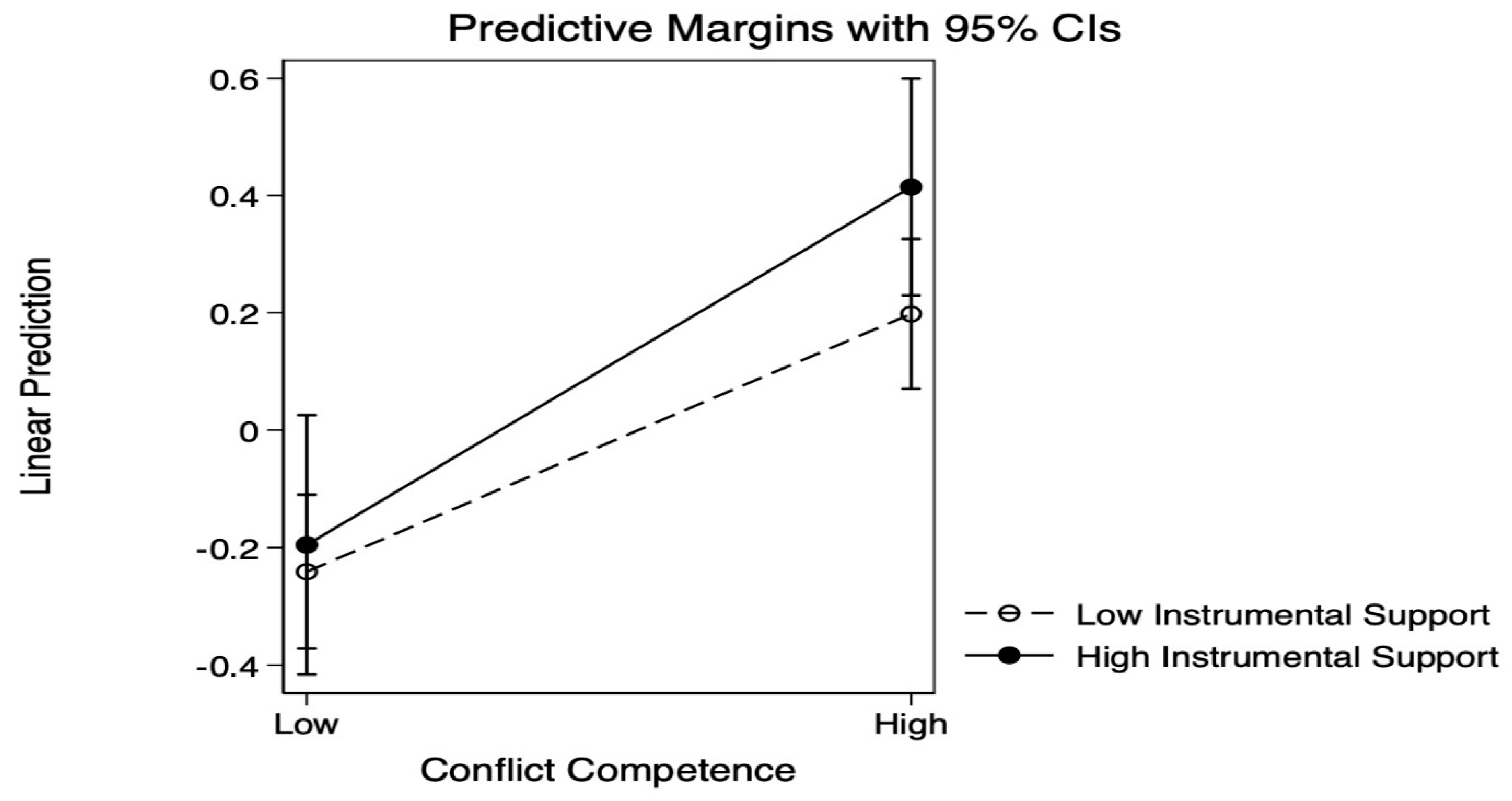
In Models 2 and 3, the study examined the moderating role of conflict competence in relation to each type of family support. The results indicated that the interaction of conflict competence strengthened the relationship between FMS and EI (β = 0.099; p < 0.05). Hence, Hypothesis 4 is supported. Additionally, this result reinforces the early speculation regarding the stronger impact of emotional support and the indirect role of conflict competence in the relationship with family support. Models 2 and 3 were statistically significant at p-value = 0.01 with R2 = 0.218 and 0.22, indicating a higher percentage of explained variance than model 1. The interaction between FIS and CC was also positive and significant (β = 0.085; p < 0.10). Consequently, Hypothesis 5 is also supported, meaning that CC moderates the relationship between FIS and entrepreneurial intention, such that the positive relationship between FIS and EI becomes stronger. Figure 2 and Figure 3 visualize the moderation effect by plotting the moderating role of conflict competence on EI and each form of family support. As the figures show, when CC was inserted between each form of family support and entrepreneurial intention, FMS had a greater impact than FIS. It is worth noting that the coefficients of all control variables remained stable, and FMS was more strongly related to EI than was FIS.
Figure 2.
Linear Prediction of Entrepreneurial Intention (Family Moral Support).
Figure 3.
Linear Prediction of Entrepreneurial Intention (Family Instrumental Support).
7. Discussion
Using a sample of 423 university students who had at least one parent who was self-employed or a majority business owner, this study examines family support and entrepreneurial intention. It focuses on two forms of family support: FMS and FIS. It also examines whether CC moderates these relationships. The study is mainly based on institutional theory [18,22]. This theory helps explain how the family, as an informal institution, can shape individual choices through its values, expectations, and support. Previous research has also shown the importance of informal institutions in the entrepreneurial context [23,66].The results show that both FMS and FIS are positively related to entrepreneurial intention. Thus, H1 and H2 are supported. The finding for FMS is consistent with previous research on the role of family in shaping the entrepreneurial intentions and career choices of the next generation [2,7]. Lyons et al. [8] also found that parental emotional support is positively related to succession intention among next-generation family business members, which is consistent with the association between FMS and EI observed in this study. The positive relationship between FIS and EI also supports H2. Practical help and access to family resources may make entrepreneurship easier to consider as a career choice. In simple terms, the two forms of support may work in different ways. FMS gives encouragement and approval. FIS provides practical help as well as resources. Both can make entrepreneurship a more attractive and achievable choice.
These findings are consistent with the institutional perspective used in this study. However, other explanations are also possible. For example, FMS may increase a student’s confidence in pursuing entrepreneurship. FIS may make starting a business seem more feasible. This suggests that family support may be related to entrepreneurial intention through more than one mechanism. These relationships may not be experienced in the same way by all students. Family expectations and the meaning of support may differ according to individual and social characteristics. For example, gender, age, education, and position within the family may shape how students interpret family encouragement or practical assistance. The same form of support may therefore be more meaningful to some students than to others. This may be particularly relevant in a family-oriented social context, where career decisions can involve both individual preferences and family expectations. The present study did not test these differences directly. However, they suggest that family support should not be viewed as a fixed experience that operates in the same way for every individual. Future studies could examine whether these characteristics change how family support is related to EI.
The results also support the moderating role of conflict competence. Higher conflict competence strengthens the positive relationships between both forms of family support and entrepreneurial intention. Family support does not mean that there will be no disagreement. A student may receive encouragement and practical help while still disagreeing with family members about starting a business. Differences may arise over family expectations, available resources, or business decisions. Students who feel more capable of managing such disagreements may be better able to maintain family support and benefit from it. This may explain why family support has a stronger relationship with entrepreneurial intention when CC is higher. This explanation is consistent with earlier family business research on conflict management [9,10,11].
The results also show that FMS has a stronger positive relationship with EI than FIS. CC positively moderates both relationships, but the evidence is stronger for family moral support (β = 0.099, p ≤ 0.05) than for family instrumental support (β = 0.085, p ≤ 0.10). Therefore, the result for FIS should be interpreted more cautiously. The stronger moderating role of conflict competence for FMS may also have a possible explanation. FMS is closely connected to encouragement, approval, and emotional relationships within the family. These forms of support may be more sensitive to disagreement between family members. When students can manage disagreement constructively, they may be better able to maintain family encouragement even when different views exist. FIS is different. It involves more practical forms of assistance and resources. Such support may remain useful even when some disagreement exists. This may help explain why conflict competence has a stronger moderating role in the relationship between FMS and EI than in the relationship involving family instrumental support. However, this explanation was not directly tested in the present study and should therefore be examined in future research.
8. Implications
Our findings have both theoretical and practical implications. The first theoretical implication concerns the importance of context in understanding entrepreneurial intention. Previous research has emphasized that entrepreneurial activity should be understood within the social and cultural context in which it occurs [12,13]. In the Saudi context, family relationships are particularly important because family ties can shape the choices of younger family members [6]. Socioemotional wealth provides a useful theoretical perspective for understanding the importance that family businesses place on family relationships and continuity. However, socioemotional wealth was not directly measured in this study and is therefore not treated as a tested mechanism. The findings of this study specifically show that FMS and FIS are positively related to entrepreneurial intention among the students examined in this study. This is consistent with previous research showing that practical and emotional social support can be important for entrepreneurial activity [42,43]. Thus, the study contributes by showing the importance of examining different forms of family support when studying entrepreneurial intention among Saudi university students from business families.
The second important implication concerns the role of conflict competence in shaping the relationship between each form of family support and entrepreneurial intention. Is family moral support more important than family instrumental support? Can conflict competence affect the relationship between family support and student entrepreneurial intentions? The findings indicated that conflict competence significantly moderated the relationship between students’ intentions to start a business and both forms of family support, but it showed a higher moderating effect on family moral support than family instrumental support. A previous study supported this result of the higher impact of family moral support than family instrumental support in increasing entrepreneurial intention [67]. Students can improve their relationships and communicate their expectations regarding future career intentions by resolving conflicts [46]. Having a conflict-competent student is among the core competencies for entrepreneurship, and this implies addressing conflicts with authority before they escalate [5]. Thus, underscoring the significance of conflict management skills can ensure the successful transmission of entrepreneurial intention within family businesses. In other words, parents interested in developing entrepreneurial mindsets among their children must create a conducive environment that allows them to develop conflict resolution skills.
In terms of theory, this research contributes to the entrepreneurship literature in three ways. First, it proposes and tests the alignment of institutional theory [18,31] to understand how different forms of family support relate to entrepreneurial intentions. Second, it proposes and tests the role of conflict competence as an exploratory factor to strengthen each form of family support and entrepreneurial intentions [5]. Third, it proposes and tests how family support and conflict competence are essential to contextualization within different nations [12,13]. Based on the findings, the students’ entrepreneurial intention benefited most from family moral support, whereas family instrumental support had less impact, as evidenced by involving interaction factors like conflict competence. Previous empirical and conceptual studies in entrepreneurship have paid less attention to this phenomenon. In short, the findings extend the family-support literature by showing that the value of family support may depend partly on an individual’s ability to manage disagreement within the family. This adds an individual capability to the institutional explanation of how family relationships shape entrepreneurial intention.
Practically, policymakers can benefit from these findings by creating supportive policies to increase entrepreneurial activity in Saudi Arabia or similar contexts. Informal institutions like family support and conflict competence are evident in increasing entrepreneurial activity [6,21]. Entrepreneurial ventures result from an entrepreneurial eco-friendly system [1], which includes the proactive role of policymakers and leaders to understand societal changes. Policymakers should provide a program that educates parents and students about how to handle family conflict to produce a more positive outcome that leads the younger generation to increase their entrepreneurial spirit. In addition, these results should encourage other nations with similar contexts to support entrepreneurial activities among their younger generation.
9. Conclusions
Students’ intention toward business creation is a subject that has attracted considerable interest globally, specifically in countries that are shifting their resources and policies to empower this future entrepreneurial generation for economic development. By using institutions as a framework, the study aimed to examine the fundamental roots of informal institutions, specifically focusing on family support and conflict competence in relation to students’ entrepreneurial intention in Saudi Arabia. The findings of this study suggest that students’ entrepreneurial intention has a positive linkage to different forms of family support, whereas family moral support is more important to them when conflict competence is involved.
10. Limitations and Future Research
The present study faced several limitations that can provide an avenue for future studies. First, the GUESSS data allow for analyzing students at an early stage of their careers. However, the limitations of the data set should be acknowledged. There was not enough information about the data collection procedure, such as how the team collected the data at the university level and how many students were invited to complete the survey. These constraints limited our ability to calculate the response rate. In addition, there was not enough information about the “readiness” of participating students to respond. This also limits our ability to address issues of non-response bias. In addition, because the study relies on self-reported data collected through a single survey, the findings may be subject to common-method bias.
Second, the empirical evidence of our findings contributes to theory in general and practice within the Saudi nation. The GUESSS data were collected from students in Saudi Arabia for the first time in 2018. A longitudinal analysis should provide a better understanding of the findings of our tested factors within the context of a nation that is undergoing several institutional changes to foster entrepreneurship. In addition, the student sample is commonly used among researchers to test entrepreneurial intention [2,30] because university students represent a relevant and vital group to investigate, as they are likely to be future leaders and decision-makers in these businesses. Thus, there is a debate among studies using students as a representative sample [2]; future studies should investigate employees who are still in their early careers and compare their samples with students’ samples to fill this gap.
Third, the study provides contextual evidence on family conflict competence and the entrepreneurial intention of the next generation within the Saudi Arabian context. Although family moral and instrumental support and conflict competence have not been extensively examined together, the study built upon items from existing measures (e.g., [17,41,68]). The measures used in this study showed acceptable reliability and validity; however, their validity should be further examined in future studies. More importantly, the findings are based specifically on Saudi university students whose parents own businesses. Therefore, the results should not be generalized to the wider student population, entrepreneurs, or individuals in other cultural and institutional contexts. Future research could test the proposed model with different populations and across countries, particularly in family-oriented societies [6]. Such comparative research could provide a better understanding of whether the relationships identified in this study remain consistent across different cultural and institutional settings.
Finally, unlike most previous studies that adopted theoretical frameworks such as the Entrepreneurial Event [69] and TPB theory [70], we argue that the theory of institutional economics can be a possible theoretical framework for understanding the main-effects hypotheses. This approach is consistent with the studies of Aparicio et al. [30] and Guerrero et al. [34], which applied this theory to understand the environmental elements that affect entrepreneurial intention among students. These studies pointed out the limitations of the two theoretical frameworks, especially in the measurement of environmental factors. Future studies should examine these relationships of the factors by adding formal institutional factors and examining the interaction between both institutions to understand the dynamics of their relationship with students’ intention to launch a business.
Author Contributions
Conceptualization, A.M.A., S.M.A. and A.E.E.S.; methodology, A.M.A., S.M.A. and A.Z.; formal analysis, A.M.A., A.Z. and A.E.E.S.; investigation, A.M.A. and S.M.A.; validation, A.Z. and A.E.E.S.; writing—original draft preparation, A.M.A. and S.M.A.; writing—review and editing, A.M.A., S.M.A., A.Z., A.S.A. and A.E.E.S.; supervision, A.M.A. and A.Z.; project administration, A.S.A.; proofreading & Funding, A.S.A. and A.E.E.S. All authors have read and agreed to the published version of the manuscript.
Funding
This research was supported by the Deanship of Scientific Research, Vice Presidency for Graduate Studies & Scientific Research, King Faisal University, Saudi Arabia [KFU264574]. This research was supported by University of Business and Technology (Jeddah, Saudi Arabia). The authors would like to express their profound gratitude for such support which contributed to the publication of this research.
Institutional Review Board Statement
The study was conducted per the Declaration of Helsinki and approved by Princess Nourah bin Abdulrahman University–HAP-01-R-059—2023.
Informed Consent Statement
Informed consent was obtained from all subjects involved in the study.
Data Availability Statement
The data are available from the author of this study upon request.
Conflicts of Interest
The authors declare no conflicts of interest.
References
- Bichler, B.F.; Kallmuenzer, A.; Peters, M.; Petry, T.; Clauss, T. Regional entrepreneurial ecosystems: How family firm embeddedness triggers ecosystem development. Rev. Manag. Sci. 2022, 16, 15–44. [Google Scholar] [CrossRef] [Scilit]
- Laspita, S.; Breugst, N.; Heblich, S.; Patzelt, H. Intergenerational transmission of entrepreneurial intentions. J. Bus. Ventur. 2012, 27, 414–435. [Google Scholar] [CrossRef] [Scilit]
- Alrubaishi, D.; McAdam, M.; Harrison, R. Culture, Islamic capital and the entrepreneurial behaviour of family firms in Saudi Arabia. Int. J. Entrep. Behav. Res. 2021, 27, 1476–1501. [Google Scholar] [CrossRef] [Scilit]
- Zhu, F.; Zhou, H. Perceived parental care and next-generation family members’ succession intentions: The sequential-mediating role of general self-efficacy and perceived person-job fit. Manag. Organ. Rev. 2022, 18, 319–357. [Google Scholar] [CrossRef] [Scilit]
- Ardyan, E.; Sutrisno, T.F.; Padmawidjaja, L. New value creation and family business sustainability: Identification of an intergenerational conflict resolution strategy. Heliyon 2023, 9, e15841. [Google Scholar] [CrossRef] [Scilit] [PubMed]
- Alshibani, S.M.; Aljarodi, A.M. Family embeddedness and next generation aspirations to take over the family business: Insights from the MENA region. Int. J. Emerg. Mark. 2024; ahead-of print. [CrossRef] [Scilit]
- Hahn, D.; Minola, T.; Bosio, G.; Cassia, L. The impact of entrepreneurship education on university students’ entrepreneurial skills: A family embeddedness perspective. Small Bus. Econ. 2021, 55, 257–282. [Google Scholar] [CrossRef] [Scilit]
- Lyons, R.; Ahmed, F.U.; Clinton, E.; O’Gorman, C.; Gillanders, R. The impact of parental emotional support on the succession intentions of next-generation family business members. Entrep. Reg. Dev. 2024, 36, 516–534. [Google Scholar] [CrossRef] [Scilit]
- Sorenson, R.L. Conflict management strategies used in successful family businesses. Fam. Bus. Rev. 1999, 12, 133–146. [Google Scholar] [CrossRef] [Scilit]
- Yan, J.; Sorenson, R.L. The influence of Confucian ideology on conflict in Chinese family business. Int. J. Cross Cult. Manag. 2004, 4, 5–17. [Google Scholar] [CrossRef] [Scilit]
- De Clercq, D.; Belausteguigoitia, I. Intergenerational strategy involvement and family firms’ innovation pursuits: The critical roles of conflict management and social capital. J. Fam. Bus. Strategy 2015, 6, 178–189. [Google Scholar] [CrossRef] [Scilit]
- Aljarodi, A.; Lopez, T.; Alfahaid, T. Different approaches of context in quantitative entrepreneurship research. In How to Make your Doctoral Research Relevant; Edward Elgar Publishing: Cheltenham, UK, 2020. [Google Scholar]
- Welter, F. Contextualizing entrepreneurship—Conceptual challenges and ways forward. Entrep. Theory Pract. 2011, 35, 165–184. [Google Scholar] [CrossRef] [Scilit]
- Al-Qadasi, N.; Zhang, G.; Al-Awwaqi, M.A.; Alshebami, A.S.; Aamer, A. Factors influencing entrepreneurial intention of university students in Yemen: The mediating role of entrepreneurial self-efficacy. Front. Psychol. 2023, 14, 1111934. [Google Scholar] [CrossRef] [Scilit] [PubMed]
- Hashim, S. Women entrepreneurs in the Gulf States: Taking stock and moving forward. Entrep. Reg. Dev. 2023, 35, 841–884. [Google Scholar] [CrossRef] [Scilit]
- Deutsch, M. The Resolution of Conflict: Constructive and Destructive Processes; Yale University Press: New Haven, CT, USA, 1973. [Google Scholar]
- Turner, S.L.; Alliman-Brissett, A.; Lapan, R.T.; Udiipi, S.; Ergun, D. The career-related parent support scale. Meas. Eval. Couns. Dev. 2003, 36, 83–94. [Google Scholar] [CrossRef] [Scilit]
- North, D. Institutions, economic theory and economic performance. In Institutions, Institutional Change and Economic Performance; Cambridge University Press: New York, NY, USA, 1990. [Google Scholar]
- Aljarodi, A.; Thatchenkery, T.; Urbano, D. Female Entrepreneurial Activity and Institutions: Empirical Evidence from Saudi Arabia. Res. Glob. 2022, 4, 100102. [Google Scholar] [CrossRef] [Scilit]
- Noguera, M.; Alvarez, C.; Merigo, J.M.; Urbano, D. Determinants of female entrepreneurship in Spain: An institutional approach. Comput. Math. Organ. Theory 2015, 21, 341–355. [Google Scholar] [CrossRef] [Scilit]
- Edelman, L.F.; Manolova, T.; Shirokova, G.; Tsukanova, T. The impact of family support on young entrepreneurs’ start-up activities. J. Bus. Ventur. 2016, 31, 428–448. [Google Scholar] [CrossRef] [Scilit]
- Scott, W.R. The adolescence of institutional theory. Adm. Sci. Q. 1987, 32, 493–511. [Google Scholar] [CrossRef] [Scilit] [PubMed]
- Guerrero, M.; Marozau, R. Assessing the influence of institutions on students’ entrepreneurial dynamics: Evidence from European post-socialist and market-oriented economies. Small Bus. Econ. 2022, 60, 503–519. [Google Scholar] [CrossRef] [Scilit]
- Botelho, T.; Harrison, R.; Mason, C. Business angel exits: A theory of planned behaviour perspective. Small Bus. Econ. 2021, 57, 583–602. [Google Scholar] [CrossRef] [Scilit]
- Duong, C.D.; Le, T.L. ADHD symptoms and entrepreneurial intention among Vietnamese college students: An empirical study. J. Entrep. Emerg. Econ. 2021, 15, 1–20. [Google Scholar] [CrossRef] [Scilit]
- Maleki, A.; Moghaddam, K.; Cloninger, P.; Cullen, J. A cross-national study of youth entrepreneurship: The effect of family support. Int. J. Entrep. Innov. 2021, 24, 44–57. [Google Scholar] [CrossRef] [Scilit]
- Su, Y.; Zhu, Z.; Chen, J.; Jin, Y.; Wang, T.; Lin, C.-L.; Xu, D. Factors influencing entrepreneurial intention of university students in China: Integrating the perceived university support and theory of planned behavior. Sustainability 2021, 13, 4519. [Google Scholar] [CrossRef] [Scilit]
- Linan, F.; Urbano, D.; Guerrero, M. Regional variations in entrepreneurial cognitions: Start-up intentions of university students in Spain. Entrep. Reg. Dev. 2011, 23, 187–215. [Google Scholar] [CrossRef] [Scilit]
- Linan, F.; Chen, Y.-W. Development and cross-cultural application of a specific instrument to measure entrepreneurial intentions. Entrep. Theory Pract. 2009, 33, 593–617. [Google Scholar] [CrossRef] [Scilit]
- Aparicio, S.; Turro, A.; Noguera, M.; Urbano, D. From entrepreneurial intentions to entrepreneurial behavior: The role of institutional factors. In Quality Management for Competitive Advantage in Global Markets; IGI Global: Hershey, PA, USA, 2021; pp. 110–135. [Google Scholar]
- North, D.C. The contribution of the new institutional economics to an understanding of the transition problem. In Wider Perspectives on Global Development; Springer: Berlin/Heidelberg, Germany, 2005; pp. 1–15. [Google Scholar]
- Aljarodi, A.; Thatchenkery, T.; Urbano, D. The influence of institutions on early-stage entrepreneurial activity: A comparison between men and women in Saudi Arabia. J. Entrep. Emerg. Econ. 2023, 15, 1028–1049. [Google Scholar] [CrossRef] [Scilit]
- Delmar, F.; Davidsson, P. Where do they come from? Prevalence and characteristics of nascent entrepreneurs. Entrep. Reg. Dev. 2000, 12, 1–23. [Google Scholar] [CrossRef] [Scilit]
- Guerrero, M.; Urbano, D.; Fayolle, A. Entrepreneurial activity and regional competitiveness: Evidence from European entrepreneurial universities. J. Technol. Transf. 2016, 41, 105–131. [Google Scholar] [CrossRef] [Scilit]
- Noguera, M.; Alvarez, C.; Urbano, D. Socio-cultural factors and female entrepreneurship. Int. Entrep. Manag. J. 2013, 9, 183–197. [Google Scholar] [CrossRef] [Scilit]
- Thornton, P.H.; Ribeiro-Soriano, D.; Urbano, D. Socio-cultural factors and entrepreneurial activity: An overview. Int. Small Bus. J. 2011, 29, 105–118. [Google Scholar] [CrossRef] [Scilit]
- Alshibani, S.M.; Volery, T. Social support and life satisfaction among entrepreneurs: A latent growth curve modelling approach. Int. J. Manpow. 2021, 42, 219–239. [Google Scholar] [CrossRef] [Scilit]
- Engle, R.L.; Schlaegel, C.; Dimitriadi, N. Institutions and entrepreneurial intent: A cross-country study. J. Dev. Entrep. 2011, 16, 227–250. [Google Scholar] [CrossRef] [Scilit]
- Scott, W.R. Institutions and Organizations: Ideas, Interests and Identities; Sage Publications: Thousand Oaks, CA, USA, 2014. [Google Scholar]
- Welsh, D.H.; Memili, E.; Kaciak, E.; Al Sadoon, A. Saudi women entrepreneurs: A growing economic segment. J. Bus. Res. 2014, 67, 758–762. [Google Scholar] [CrossRef] [Scilit]
- Welsh, D.H.; Memili, E.; Kaciak, E. An empirical analysis of the impact of family moral support on Turkish women entrepreneurs. J. Innov. Knowl. 2016, 1, 3–12. [Google Scholar] [CrossRef] [Scilit]
- Klyver, K.; Honig, B.; Steffens, P. Social support timing and persistence in nascent entrepreneurship: Exploring when instrumental and emotional support is most effective. Small Bus. Econ. 2018, 51, 709–734. [Google Scholar] [CrossRef] [Scilit]
- Cogan, A.; Pret, T.; Cardon, M.S. Everyday social support processes: Household members’ instrumental and emotional support of entrepreneurs. Int. Small Bus. J. 2022, 40, 537–563. [Google Scholar] [CrossRef] [Scilit]
- Eddleston, K.A.; Powell, G.N. Nurturing entrepreneurs’ work-family balance: A gendered perspective. Entrep. Theory Pract. 2012, 36, 513–541. [Google Scholar] [CrossRef] [Scilit]
- Nielsen, M.S. Passing on the good vibes: Entrepreneurs’ social support. Int. J. Entrep. Innov. 2020, 21, 60–71. [Google Scholar] [CrossRef] [Scilit]
- Pieper, T.M.; Astrachan, J.H.; Manners, G.E. Conflict in family business: Common metaphors and suggestions for intervention. Fam. Relat. 2013, 62, 490–500. [Google Scholar] [CrossRef] [Scilit]
- Powell, G.N.; Eddleston, K.A. Linking family-to-business enrichment and support to entrepreneurial success: Do female and male entrepreneurs experience different outcomes? J. Bus. Ventur. 2013, 28, 261–280. [Google Scholar] [CrossRef] [Scilit]
- Le Breton-Miller, I.; Miller, D.; Bares, F. Governance and entrepreneurship in family firms: Agency, behavioral agency and resource-based comparisons. J. Fam. Bus. Strategy 2015, 6, 58–62. [Google Scholar] [CrossRef] [Scilit]
- Gagne, M.; Sharma, P.; De Massis, A. The study of organizational behaviour in family business. Eur. J. Work Organ. Psychol. 2014, 23, 643–656. [Google Scholar] [CrossRef] [Scilit]
- Dillman, D.A.; Smyth, J.D.; Christian, L.M. Internet, Phone, Mail, and Mixed-Mode Surveys: The Tailored Design Method; John Wiley & Sons: Hoboken, NJ, USA, 2014. [Google Scholar]
- Bergmann, H.; Hundt, C.; Sternberg, R. What makes student entrepreneurs? On the relevance (and irrelevance) of the university and the regional context for student start-ups. Small Bus. Econ. 2016, 47, 53–76. [Google Scholar] [CrossRef] [Scilit]
- Gimenez-Jimenez, D.; Edelman, L.F.; Dawson, A.; Calabrò, A. Women entrepreneurs’ progress in the venturing process: The impact of risk aversion and culture. Small Bus. Econ. 2020, 58, 1091–1111. [Google Scholar] [CrossRef] [Scilit]
- Zellweger, T.; Sieger, P.; Halter, F. Should I stay or should I go? Career choice intentions of students with family business background. J. Bus. Ventur. 2011, 26, 521–536. [Google Scholar] [CrossRef] [Scilit]
- Moriano, J.A.; Gorgievski, M.; Laguna, M.; Stephan, U.; Zarafshani, K. A cross-cultural approach to understanding entrepreneurial intention. J. Career Dev. 2012, 39, 162–185. [Google Scholar] [CrossRef] [Scilit]
- Alshibani, S.M.; Olaru, D.; Volery, T. The influence of work-family conflict and enhancement on the wellbeing of the self-employed and their spouses: A dyadic analysis. Work Employ. Soc. 2024, 38, 1128–1147. [Google Scholar] [CrossRef] [Scilit]
- Wagner, J.; Sternberg, R. Start-up activities, individual characteristics, and the regional milieu: Lessons for entrepreneurship support policies from German micro data. Ann. Reg. Sci. 2004, 38, 219–240. [Google Scholar] [CrossRef] [Scilit]
- Sánchez-Escobedo, M.C.; Díaz-Casero, J.C.; Hernández-Mogollón, R.; Postigo-Jiménez, M.V. Perceptions and attitudes towards entrepreneurship: An analysis of gender among university students. Int. Entrep. Manag. J. 2011, 7, 443–463. [Google Scholar] [CrossRef] [Scilit]
- Zhao, H.; Seibert, S.E. The big five personality dimensions and entrepreneurial status: A meta-analytical review. J. Appl. Psychol. 2006, 91, 259–271. [Google Scholar] [CrossRef] [Scilit] [PubMed]
- Hmieleski, K.M.; Baron, R.A. Entrepreneurs’ optimism and new venture performance: A social cognitive perspective. Acad. Manag. J. 2009, 52, 473–488. [Google Scholar] [CrossRef] [Scilit]
- Zellweger, T.M.; Chrisman, J.J.; Chua, J.H.; Steier, L.P. Social structures, social relationships, and family firms. Entrep. Theory Pract. 2019, 43, 207–223. [Google Scholar] [CrossRef] [Scilit]
- Hair, J.F.; Black, W.C.; Babin, B.J.; Anderson, R.E.; Tatham, R.L. Multivariate Data Analysis; Pearson: Upper Saddle River, NJ, USA, 2010. [Google Scholar]
- Yong, A.G.; Pearce, S. A beginner’s guide to factor analysis: Focusing on exploratory factor analysis. Tutor. Quant. Methods Psychol. 2013, 9, 79–94. [Google Scholar] [CrossRef] [Scilit]
- Hair, J.F.; Black, W.C.; Babin, B.J.; Anderson, R.E. Multivariate Data Analysis, 7th ed.; Pearson: Upper Saddle River, NJ, USA, 2013. [Google Scholar]
- Cohen, J.; Cohen, P.; West, S.G.; Aiken, L.S. Applied Multiple Regression/Correlation Analysis for the Behavioral Sciences; Routledge: New York, NY, USA, 2013. [Google Scholar]
- Cohen, J. Statistical power analysis. Curr. Dir. Psychol. Sci. 1992, 1, 98–101. [Google Scholar] [CrossRef] [Scilit]
- Escandon-Barbosa, D.; Urbano-Pulido, D.; Hurtado-Ayala, A. Exploring the relationship between formal and informal institutions, social capital, and entrepreneurial activity in developing and developed countries. Sustainability 2019, 11, 550. [Google Scholar] [CrossRef] [Scilit]
- Gomez-Mejia, L.R.; Cruz, C.; Berrone, P.; De Castro, J. The bind that ties: Socioemotional wealth preservation in family firms. Acad. Manag. Ann. 2011, 5, 653–707. [Google Scholar] [CrossRef]
- Danish, A.Y.; Smith, H.L. Female entrepreneurship in Saudi Arabia: Opportunities and challenges. Int. J. Gend. Entrep. 2012, 4, 216–235. [Google Scholar] [CrossRef] [Scilit]
- Shapero, A.; Sokol, L. The social dimensions of entrepreneurship. In Encyclopedia of Entrepreneurship; Prentice-Hall: Englewood Cliffs, NJ, USA, 1982; pp. 72–90. [Google Scholar]
- Ajzen, I. The theory of planned behavior. Organ. Behav. Hum. Decis. Process. 1991, 50, 179–211. [Google Scholar] [CrossRef] [Scilit]

Disclaimer/Publisher’s Note: The statements, opinions and data contained in all publications are solely those of the individual author(s) and contributor(s) and not of MDPI and/or the editor(s). MDPI and/or the editor(s) disclaim responsibility for any injury to people or property resulting from any ideas, methods, instructions or products referred to in the content. |
© 2026 by the authors. Licensee MDPI, Basel, Switzerland. This article is an open access article distributed under the terms and conditions of the Creative Commons Attribution (CC BY) license.