


Abstract
The consolidation of digital society has transformed the communication practices of new generations, and with them, the literacy demands facing higher education. In this context, the video essay emerges as a practice situated at the intersection of technological innovation, social change, and university education: based on audiovisual analysis, it requires its creators to interpret, argue, and communicate through images. This study examines how Generation Z university students appropriate the video essay as a practice of audiovisual literacy and a communication strategy of their own. A qualitative case study was conducted on 24 sixth-semester students in the Communication program at Universidad Técnica del Norte (Ibarra, Ecuador), combining the production of video essays, classroom observation, and focus groups; the 15 highest-rated video essays were purposively selected for in-depth analysis through thematic coding. Within this high-performing corpus, students redefined the video essay as a language of their own: they incorporated visual codes from the platforms they used but oriented them toward critical and sustained argumentation, which nuances techno-deterministic readings of this generation. The study provides situated evidence from an underrepresented region and offers insights for rethinking digital literacy in the university education of media communicators.
1. Introduction
A college student swipes up, and in less than a minute, she has watched a dozen vertical videos, each fifteen seconds long. Hours later, in class, she must create a video essay of up to ten minutes that makes a case about a film. The term is used here in the sense developed in film studies—a work of audiovisual criticism that argues about films through their own images and sounds—and not in the broader senses it has in other fields, such as an academic lecture presented on video or a hybrid documentary–fiction piece. Much of the tension running through contemporary digital society—and the educational institutions tasked with shaping it—lies between these two gestures: fragmented consumption and reflective production. The consolidation of a media ecosystem saturated with screens has not only transformed how information circulates but has also reshaped the communication practices of new generations, and with them, the literacy demands facing higher education [1,2].
This transformation particularly challenges Generation Z, defined by the Pew Research Center as the cohort born between 1997 and 2012 [3]. Unlike previous generations, its members do not remember a world without constant connectivity: they are, in Prensky’s well-known formulation, “digital natives” for whom technological mediation is constitutive rather than acquired [4]—a notion that has since been widely contested for overstating the homogeneity of digital skills within a generation [5,6,7]. Several studies have characterized their communication profile by a preference for short, immediately consumable content—so-called “snackable” formats—and by a decisive shift toward online video over traditional media [8,9]. Platforms like TikTok not only capture their attention but have redefined the grammar of youth audiovisual storytelling and self-representation [10,11]. Understanding how this generation produces—and not merely consumes—audiovisual discourse has thus become a central issue for the social sciences: youth communication practices serve as an early indicator of broader transformations in the digital public sphere, understood here as the set of social media platforms and online spaces in which public conversation increasingly takes place.
The video essay lies at the intersection of this visual culture and critical reflection. Emerging in film studies as a form of criticism “in sound and image” that demands a rhetoric distinct from that of written academic text [12], and drawing on the longer tradition of the essay film [13,14], the video essay migrated from academic circles to digital platforms, where it is now a popular and recognizable genre [15]. Its defining feature is twofold: it draws on audiovisual analysis—the careful deconstruction of shot, editing, sound, and narrative [16,17,18]—but transforms it into a communicative act directed at an audience. It is, simultaneously, a method of interpretation and a strategy of expression. This duality makes it particularly revealing for studying a generation that argues and takes a stance with images as much as with words, and places it squarely in the realm of audiovisual literacy that digital societies demand of their citizens.
However, the phenomenon contains a tension that the literature has not resolved and that should be made explicit. On the one hand, much of the research describes Generation Z based on its fragmented consumption and low tolerance for lengthy formats [9,10]. On the other hand, the video essay demands exactly the opposite: sustained attention, an argumentative structure, and a close reading of the audiovisual material. Is the video essay, then, a format alien to the logic of this generation, or rather a bridge between its visual fluidity and the demands of critical thinking? This divergence points to a fundamental debate in the study of digital society: the opposition between techno-deterministic readings, which attribute youth behaviors to the properties of devices [19], and approaches that understand technology and society as mutually constitutive, where young people appear as a participatory and “prosumer” culture capable of re-signifying the media they use [20,21,22]—that is, of giving media texts new meanings by relocating them in their own contexts, concerns, and questions. This study aligns with the second perspective but subjects it to empirical testing rather than simply accepting it.
Through educommunication and media literacy, this second interpretation has gained ground. Jenkins’s notion of convergence culture [20] and the concept of prosumer citizenship [21] argue that young people are not passive recipients, but rather producers of meaning whose media literacy can and should be cultivated in educational settings [23,24]. In fact, it has been argued that media literacy constitutes, in and of itself, a form of critical expression that is not acquired simply by being born in the digital age, but rather requires explicit training [25], and its dimensions—from the reception of messages to their production—have been systematized in media competence frameworks [26,27,28,29]. In this vein, recent research has developed educommunication formats and products aimed at strengthening Generation Z’s critical thinking in the face of misinformation and information fragmentation [30,31,32], reviving an agenda that Ibero-American educommunication in particular has been advocating for decades [33,34]. The video essay, rooted in film analysis, is part of this effort: it compels the producer to interpret, select, prioritize, and argue, transforming passive viewing into a critical exercise, and potentially, into a pedagogical innovation for university education in communication.
In the Ecuadorian context, studies on digital competencies in higher education have focused primarily on teacher training and virtual learning environments [35]. However, there is a dearth of empirical studies examining how students themselves appropriate audiovisual formats as a literacy practice and a communication strategy. This gap is significant because educational contexts in the region have their own technological, cultural, and institutional conditions, and frameworks developed in other regions cannot simply be transferred to them. Studying these contexts brings the voices of historically underrepresented regions into debates about the digital society.
This study addresses that gap through a qualitative case study on sixth-semester (third-year) students in the Communication program at Universidad Técnica del Norte (Ibarra, Ecuador). The main objective is to understand how these young people appropriate the video essay—built upon film analysis—as an audiovisual literacy practice and a communication strategy specific to their generation. This objective gives rise to three research questions: (i) What audiovisual analysis operations do students employ when producing a video essay? (ii) What communicative functions—expressive, argumentative, identity-related—do they attribute to this format? and (iii) To what extent does the video essay link their daily digital consumption with a reflective and critical practice? As a starting proposition, we argue that far from being alien to Generation Z, the video essay functions as a meeting point between their visual fluency and the demands of rigorous analysis.
2. Materials and Methods
2.1. Research Design
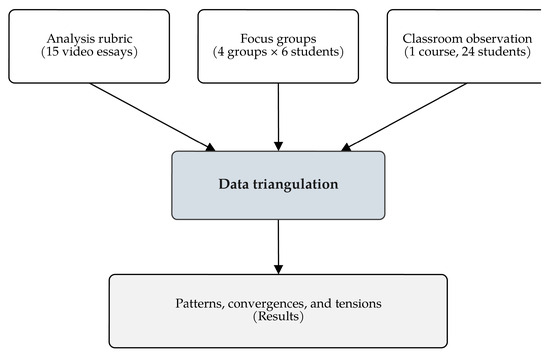
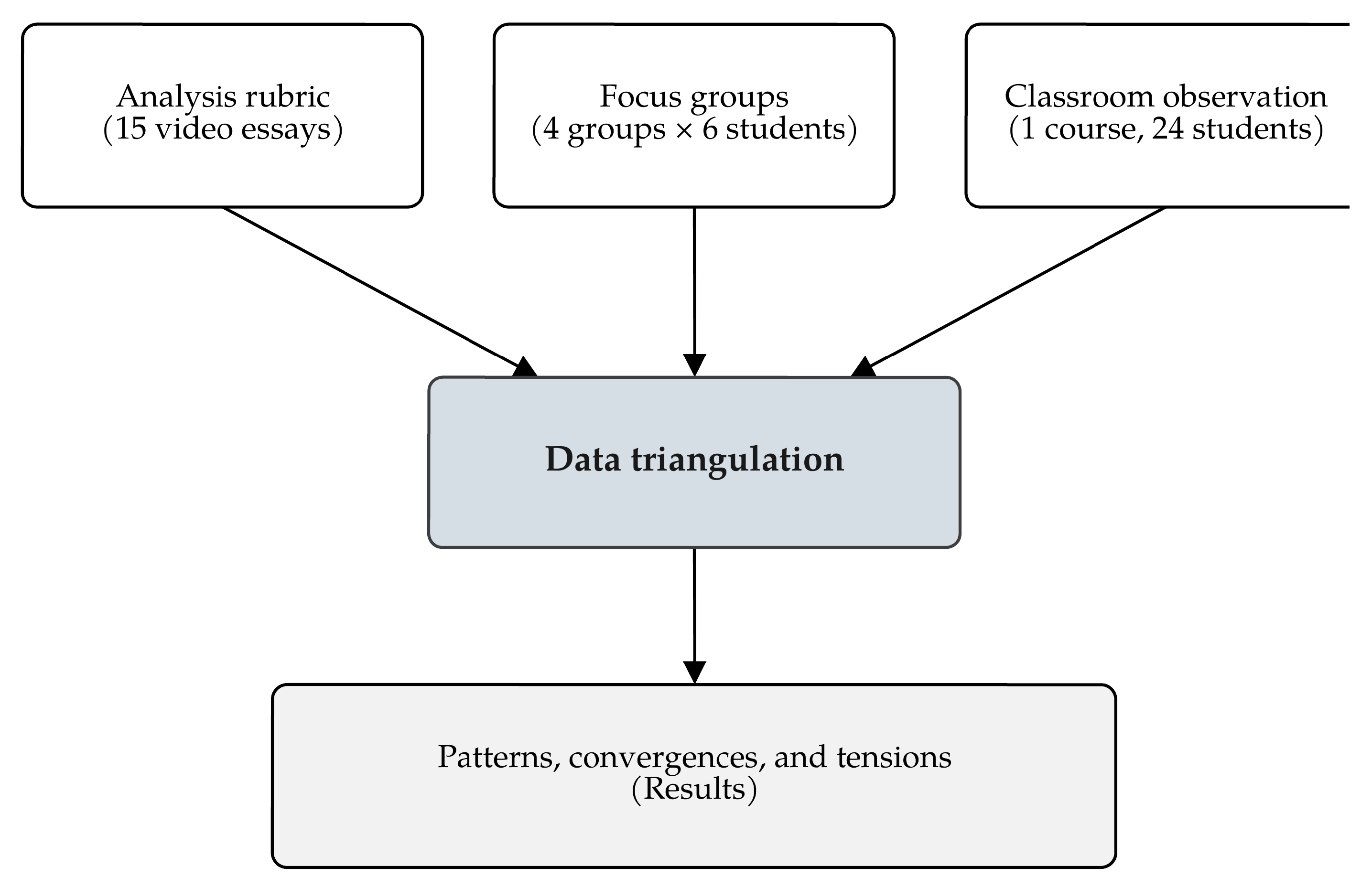
A qualitative approach was adopted using a single-case study [36,37], aimed at gaining an in-depth understanding of how a group of Generation Z university students appropriates the video essay as a practice of audiovisual literacy and a communicational strategy. A case study is appropriate for examining a contemporary phenomenon within its real-world context, without separating it from the institutional and cultural conditions that shape it. The research combined three sources of evidence—analysis of the video essays produced, focus groups, and classroom observation—which allowed for data triangulation and strengthened the credibility of the interpretations [38,39] (Figure 1).
Figure 1.
Methodological design and triangulation of evidence sources.
2.2. Context and Participants
The study was conducted in the Communication program at Universidad Técnica del Norte (Ibarra, Ecuador) between late March and early May 2026. The participants were the 24 students enrolled in the sixth semester of this eight-semester undergraduate program, that is, in their third year of study (12 men and 12 women, aged between 19 and 21). The video essay was produced within Cine (Cinema), a film studies course taught in the sixth semester; the assignment was therefore approached from the perspective of film analysis and audiovisual criticism rather than as a general multimedia task. The entire group carried out the activity as part of their regular coursework and took part in the focus groups and observed sessions; for the in-depth analysis of the audiovisual products, purposive sampling was applied, selecting the 15 highest-rated video essays. This selection was made by the team of faculty researchers using a common evaluation rubric (described in Section 2.4), with the aim of focusing the analysis on cases that demonstrated a more comprehensive development of the dimensions of interest.
The two faculty researchers scored the 24 video essays independently with the rubric, and after reconciling their ratings by consensus, retained the 15 works with the highest overall assessment as the analytical corpus. This purposive criterion was intended to focus the qualitative analysis on the productions that most fully displayed the three dimensions of interest; consequently, the findings characterize the most developed expression of the group’s competence rather than its average performance—a scope condition we return to in Section 4.4. This strategy corresponds to what Patton describes as intensity sampling: the selection of information-rich cases that manifest the phenomenon of interest intensely, but not as extreme or deviant cases [40]. It is consistent with the aim of the study, which is not to estimate how widespread the competence is, but to understand how it unfolds when it does emerge. Accordingly, all findings derived from the product analysis refer exclusively to this high-performing corpus and are not generalized to the whole group of 24 students, nor to Generation Z as a whole; the focus-group and observation data, which did involve the whole group, were used to contextualize these products rather than to extend their conclusions to the less successful works.
2.3. The Task: Production of the Video Essay
Each student individually produced a video essay of up to ten minutes. Each video essay was based on a film chosen by the student. Before production, all participants attended a training session on the video essay, which covered its origins in audiovisual criticism, its rhetorical features, how it differs from commentary and reviews, and the stages of its production. The assignment did not prescribe a fixed format. Instead, it asked students to construct, in their own voice, a reasoned interpretation of the chosen film. In total, the students produced 24 video essays, and 15 of them formed the analyzed corpus (see Section 2.2).
2.4. Instruments and Data Collection
One essential instrument employed in this study was a video essay analysis rubric: a three-dimensional analysis matrix designed for the qualitative analysis of the video essays. The same matrix was used to rate them, which allowed the selection of the corpus described in Section 2.2. The dimensions of analysis are as follows: (1) thematic appropriation of the reference film; (2) narrative structure of the video essay; and (3) expressive resources of digital environments. The indicators of each dimension are detailed in Table 1 and the complete instrument in Appendix A.1. Dimensions D2 and D3 each included a coherence indicator rated on a scale of 1 to 5 (1 = very low or absent development of the indicator; 5 = excellent, fully developed), and the matrix closed with an overall assessment (1–5) and a concluding summary of strengths, areas for improvement, and cross-cutting patterns. The indicators assess function rather than mere presence; for example, “use of film clips” refers to how the clips selected from the reference film support the student’s argument, and not only to how well they are technically integrated. The categories of D2 and D3 were derived from established models of film analysis [16,17,18] and from the dimensions of media competence related to language, technology, and aesthetics [26].
Table 1.
Video essay analysis matrix: dimensions and indicators.
Focus groups: Four focus groups of six students each were conducted (24 participants in total), following the thematic outline presented in Appendix A.2; each group met for approximately 30 min in every class session over a period of two weeks, so that the four groups had a similar amount of contact time. The sessions explored the students’ experience in viewing and analyzing different films and cinematic genres, as well as how they translated that interpretation into an audiovisual project created from their own perspective. This technique provided insight into the motivations, creative decisions, and self-perceptions that are not directly observable in the final product. Session transcripts were anonymized before analysis.
Classroom observation: Throughout the process, the research team conducted direct observation during the class sessions of the Cine course (a single class group of 24 students), documenting work dynamics, recurring questions, and the decisions students made while creating their video essays.
Project descriptions: Some students submitted, together with their video essays, a brief written description of their project explaining their aims and creative decisions. Because these descriptions were not available for every case, they were used only as complementary evidence of the intentions stated by their authors (e.g., E1–E3), and not as a systematic data source.
2.5. Data Analysis
The analysis was conducted manually using a hybrid procedure that combined deductive and inductive categories. Initially, the 15 video essays were analyzed deductively using the described matrix: two researchers completed the rubric for each product and compared their ratings, resolving discrepancies by consensus to strengthen interpretive reliability. In a second stage, the focus group transcripts and observation records were subjected to thematic analysis [41,42]: the three dimensions of the rubric were used as starting categories, while unexpected subthemes emerged from the students’ voices, which were incorporated inductively. Finally, the three sources were triangulated to identify convergences, tensions, and cross-cutting patterns, which form the basis of the results shown in Section 3. The type of relationship with the reference film (D1) was coded according to explicit criteria. A video essay was coded as replication when it mainly retold the plot or restated the message of the film, even when this was accompanied by evaluative commentary of the kind found in a review; as re-signification when it used the film to build a thesis of its own that relocated the meaning of the film in a different context or concern—typically the author’s present, the Latin American context, or a social issue not central to the film—so that the film functioned as evidence for that thesis; and as contrast when it questioned or argued against the perspective of the film. Since every video essay involves some degree of interpretation, interpretation as such was not treated as a separate category: re-signification designates a specific type of interpretation, one that changes the frame of reference of the film rather than explaining it on its own terms. Finally, in reporting the results, we distinguish three levels of evidence: features observed in the products (rubric analysis), intentions stated by the students (focus groups, and where available, project descriptions), and our own analytical interpretations, which are presented as such.
2.6. Ethical Considerations
Under Ecuadorian regulations, non-clinical and non-interventional educational research does not require review by a Research Ethics Committee for Human Subjects (CEISH); the study was therefore conducted in accordance with the Code of Ethics of Universidad Técnica del Norte, approved by the University’s Honorable Consejo Universitario on 11 October 2012, which establishes the protection of personal data, privacy, and confidentiality as binding obligations, and with the core principles of the Declaration of Helsinki [43] (see the Institutional Review Board Statement). Before data collection, all 24 students, all of whom were of legal age (19–21 years), were informed about the aims of the study, the procedures involved (the use of their video essays as research material, their participation in focus groups, and classroom observation), and the intended academic dissemination of the results. Written informed consent was obtained from all participants; it explicitly covered the research use of their video essays, of their project descriptions where available, and of anonymized quotations from the focus groups. Participation in the research was voluntary: although the video essay was a regular course assignment, consenting to the use of the products and testimonies for research purposes, as well as taking part in the focus groups, had no bearing on course grades. Participants were also informed that they could withdraw their consent at any time without any academic consequence. To minimize the influence of the instructor–student relationship, course grades were finalized and communicated before the research analysis of the video essays began, and the focus groups were moderated by a member of the research team who was not responsible for grading the course. To ensure confidentiality and anonymity, participants are identified exclusively by alphanumeric codes (E1–E15 for the analyzed corpus), no names or other identifying details are reported, and testimonies are quoted without attribution to identifiable individuals. The rubric sheets, focus-group transcripts, and observation records were anonymized before analysis and used exclusively for the purposes of this study.
3. Results
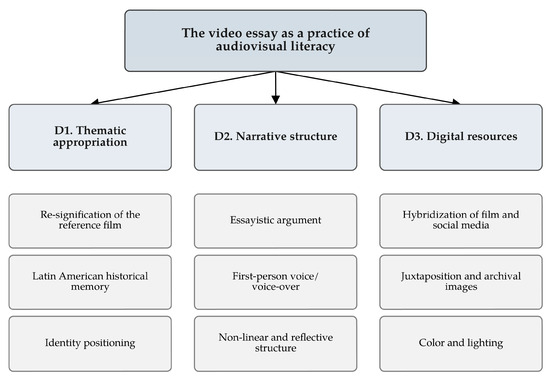
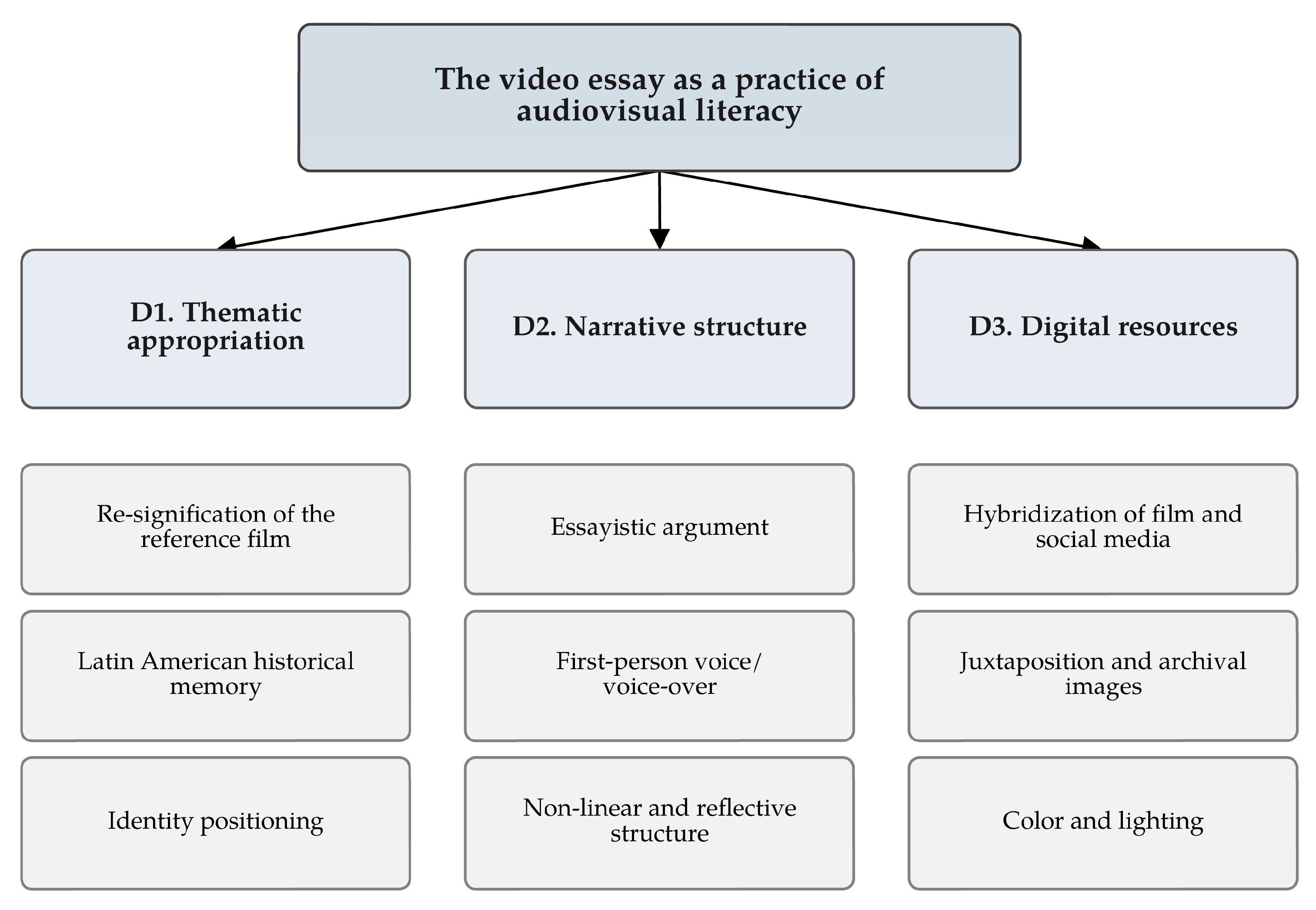
A triangulated analysis of the fifteen selected video essays, the four focus groups, and the observation records revealed consistent patterns across the three dimensions examined. Within this high-performing corpus, and far from reproducing the logic of fragmented consumption often attributed to Generation Z, the students used the video essay as a space for argumentative development and personal positioning, linking the codes of the platforms they use—that is, their audiovisual conventions of editing, rhythm, format, and address—with a critical view of social reality. The overall assessments of the analyzed products ranged from 3.5 to 5 on the 1–5 scale (mean = 4.4; median = 4): seven essays were rated 4, six were rated 5, one was rated 4.5, and one was rated 3.5. These values describe the 15 works selected for in-depth analysis and should not be read as the average performance of the 24 students. Figure 2 summarizes the categories and subthemes that organize the presentation of the results.
Figure 2.
Map of the categories and subthemes emerging from the analysis.
3.1. Thematic Appropriation: From the Reference Film to One’s Own Voice
The selection of films revealed a marked orientation toward historical memory cinema and social drama. As shown in Table 2, the great majority of the corpus (13 out of 15) focused on narratives of conflict and memory: nine video essays drew from works set during World War II or its aftermath or in the European context, and four were rooted in Latin American memory (dictatorships, disappearances, and Ecuadorian cases), while the remaining two explored family, identity, and cinematic form.
Table 2.
Thematic distribution of the video essay corpus (n = 15).
Beyond the chosen theme, the decisive feature was the treatment: rather than merely summarizing the plot, the students used the film as a starting point to address broader social concerns, articulated in their own voices. Thus, a process of re-signification—rather than mere replication—of the reference film prevailed (14 out of the 15 cases; Table 3), in which the film served as a tool for reflecting on the present and history itself.
Table 3.
Summary of the video essays analyzed.
This shift from summary to interpretation was clearly expressed by one of the participants, who described her experience in these terms:
“It was a way of understanding that cinema is not just entertainment. I found it so valuable how cinema can connect us to eras and situations that aren’t analyzed in our time and that are part of historical memory. It sparked my creativity, allowing me to discuss the context in which the film was made and transform it visually, so that my social media followers can see that talking about a film in a video essay isn’t just about summarizing the plot; there’s a context that exists beyond the image.”
This testimony encapsulates the central finding of this dimension: the explicit awareness that film analysis goes beyond plot and requires reconstructing a historical and social context. Consistent with this, a recurring feature was the impulse to contextualize; the video essays incorporated an account of what was happening during the era portrayed, building bridges between the cinematic narrative and its backdrop. The analysis sheets confirm this orientation: in “Valkyrie” (E1), the author of this video essay shifted the film’s theme—control over destiny—toward a reflection on the “normalization of evil” and the need to know “a story told in a different way”; in “Dunkirk” (E2), the war context was re-signified as a meditation on time, survival, and “collective silence and its consequences”; and in “The Sleeping Voice” (E3), the Spanish postwar period became a reflection on “silenced women” and on silence as an act of resistance that does not renounce identity.
Particularly revealing was the way in which some students connected global references with Latin American and Ecuadorian memory. An illustrative case is that of a student (E4), who starting from the theme of the children of the Falklands, connected it with the Ecuadorian documentary “Con mi corazón en Yambo”, linking disappearance and mourning in two different contexts. We interpreted this gesture as a process of critical appropriation: the external reference becomes a tool for naming a reality that is both personal and local. Collectively, the video essays in the corpus brought to light social concerns—memory, political violence, loss—and a clear sense of identity on the part of their authors, who recognized themselves as part of the stories they were telling.
3.2. Narrative Structure: Voice as the Core of the Plot
In their narrative construction, students employed both non-linear structures and reflective linear structures. When they opted for non-linearity, they organized the material through temporal jumps, thematic associations, and juxtapositions, in line with the editing conventions of the social media platforms they used in their everyday lives, such as TikTok and YouTube; when they chose a linear sequence, it was subordinated to an argumentative purpose, as in “Dunkirk” (E2), described in its profile as a “linear-reflective” structure that progresses to the rhythm of a countdown. In the cases in which the structure was documented (13 out of 15; Table 3), the narrative form served the argument: it allowed the past and the present to be linked, or the specific case to be connected to a broader reflection.
A cross-cutting finding was the construction of the plot in an essayistic style. The analyzed profiles agreed in characterizing the argumentative mode as essayistic, “because it combines personal reflection and audiovisual interpretation.” This category, central to video essay theory, emerged in the students’ practice without being prescribed by the assignment, which we interpreted as a sign that the format was embraced in its specificity and not as a mere illustrated commentary. The author’s voice emerged as the backbone of the narrative. Most students used their own voice to drive the plot; some did so through a voice-over narration that, according to the case studies, “guides the emotional analysis and connects the scenes with universal human experiences.” The authorial presence was explicit and recognizable, manifested in specific stylistic markers—close-ups, an emphasis on the psychological perception of time, an emotional narrative centered on silence—which suggest that the video essay was approached as an expressive practice in its own right. Thematic-narrative coherence was rated at levels 4 to 5 across the corpus, in line with the overall assessments reported in Table 3.
3.3. Expressive Resources of Digital Environments
The third dimension showed the hybridization between cinematic language and the codes of digital platforms. Students combined archival footage from the period with film clips and used image juxtaposition to relate historical data to the work’s theme, visually reinforcing their argument. This technique of visual contrast functioned as an analytical resource: the image did not merely illustrate but argued. The use of color and lighting was intentional, as the students’ own project descriptions show. In “Valkyrie” (E1), for example, the filmmaker employed dark tones and a red hue associated, according to her project description, with “the blood shed during the period of history depicted.” Similarly, the authors of “Dunkirk” (E2) and “The Sleeping Voice” (E3) explained in their project descriptions that they chose cool and dark palettes to build tension and a climate of repression. In “Argentina, 1985” (E5), the use of real news footage from the period of the military juntas reinforced the documentary grounding of the narrative, drawing on the evidentiary conventions of documentary film [44].
Alongside these cinematographic techniques, elements characteristic of youth digital culture appeared. The use of bloopers, fast and dynamic editing rhythms, and specific formats drew on the aesthetics of platforms like TikTok or YouTube, which the students incorporated into a product intended to provoke reflection. Far from trivializing the content, this blend suggests an ability to adapt codes from one domain to another, putting social media resources at the service of a sustained argument. The products alone cannot show whether each of these choices was a deliberate transfer or a partial reproduction of familiar platform habits; what the evaluation sheets do show is that these resources served the argument rather than functioning as ornament. The coherence between resources and plot was rated predominantly at level 4, and the observations in the evaluation sheets highlight that “the editing aids understanding of the content” and that “the integration of image, sound, and narration allows for reflection on the topic addressed.”
3.4. The Video Essay According to Its Creators: A Deeper Connection
The focus groups provided an interpretive dimension that the final products alone did not reveal. When describing their experience, the students repeatedly drew on a lexical field linked to the themes they explored—power, war, disappearance, grief, resilience—which points to the significance of social concerns in their engagement with the format. Even more significant was the way they conceptualized the video essay: for them, it represented a new way of connecting online, one that was deeper than the short formats to which they were accustomed. In contrast to fast-paced and ephemeral consumption, they perceived the video essay as a space to say something with substance and to be heard in a different way.
This finding is central to the study’s objectives. The participants did not describe the task as an academic imposition alien to their world, but rather as a qualitatively distinct extension of their online communication practices. For this group, the video essay thus emerged as a meeting point between the participants’ visual fluency and the demands of rigorous analysis, which nuances, at least for this case, interpretations that reduce this generation to distraction and superficiality.
4. Discussion
The results of this study provide answers to the three research questions and bring into sharper focus the debate raised in the Introduction: the contrast between techno-deterministic interpretations of Generation Z and approaches that view technology and society as mutually constitutive. Within the limits of the selected corpus, the evidence leans toward the second perspective but qualifies it: students appear neither as the scattered consumers described in part of the literature [9,10,19] nor as spontaneously competent “prosumers” simply because they were born into a digital environment [4]. In this respect, our findings converge with critical reviews of the “digital native” thesis, which found little evidence of a generationally homogeneous competence and stressed the variability of skills within the same cohort [5,6,7]. What the data reveal is a competence that is activated and becomes critical when mediated by an educational tool—in this case, the video essay.
In relation to previous research, the findings can be summarized at three levels. They confirm studies showing that critical media literacy develops when it is explicitly cultivated [25,32] and that the video essay functions as a form of knowledge production rather than as a summary [12,15]. They qualify both the generational portrait centered on fragmented consumption [9,19] and celebratory accounts of young people as spontaneous prosumers [4,20]: the competence observed was real, but it was mediated by a pedagogical framework and documented only in the most accomplished productions. Finally, they challenge the assumption that a preference for short formats implies an inability to sustain audiovisual argumentation, although this challenge is limited to the corpus analyzed. Section 4.1, Section 4.2 and Section 4.3 develop these points in relation to each research question.
4.1. From Replication to Re-Signification: A Critical Appropriation
In response to the first research question, the most consistent finding is that students did not summarize the films, but rather re-signified them. Fourteen out of the fifteen cases systematized in Table 3 established a relationship of re-signification with the reference film, using it as a starting point to reflect on issues of memory, justice, political violence, and mourning; only one case (E12) worked through contrast. This shift from summary to interpretation is precisely the operation that distinguishes the video essay from the review and that the tradition of videographic criticism identifies as its defining feature: thinking with and through images, not merely about them [12]. That undergraduate students arrive at this operation, even in an incipient form, suggests that the format has a specific educational value: to build an argument, students must select, order, and juxtapose images and sounds, which turns film viewing into an exercise of interpretation and audiovisual argumentation that a written summary or an illustrated commentary does not demand to the same degree.
This finding converges with the literature that conceives the video essay as a form of knowledge production rather than as an illustrated summary [12,14,15], and with the essayistic tradition in which the moving image becomes a means of thought [13]. It also resonates with Halbwachs’s notion that memory is constructed within social frameworks [45]: the students did not merely retrieve the past depicted in the films but re-inscribed it in frameworks that were meaningful to them. However, this literature has largely been produced by and for scholars and experienced critics [12,15] and says little about novice practitioners. Our results extend it by showing that the re-signifying operation can also emerge among undergraduates working under curricular conditions; at the same time, because the analysis focused on the highest-rated works, this extension should be tested against less successful productions before it can be considered characteristic of student video essays in general.
The direction that this re-signification took is, moreover, significant for the objectives of this study. Far from limiting themselves to the global references they mostly chose—World War II, the Spanish postwar period—several students reoriented them toward Latin American and Ecuadorian memory. The most eloquent case was the video essay that connected the children of the Falklands with the documentary “Con mi corazón en Yambo” (E4), but the trend is recurrent: four out of the fifteen essays (E4–E7; Table 2) were anchored in Latin American contexts of dictatorship, disappearance, or political memory—among them “Argentina, 1985”, “La noche de los lápices”, and “La muerte de Jaime Roldós”—and a fifth (E8, “En el nombre de la hija”) drew on contemporary Ecuadorian cinema. This gravitation toward the local suggests that, in this corpus, the video essay worked as a vehicle for identity construction: a tool for young Ecuadorians to articulate, from their own perspective, a history they feel is their own. It is precisely this kind of situated evidence, coming from a region underrepresented in debates about digital society, that the field needs.
4.2. The Hybridization of Codes as Media Competence
The second research question (What communicative functions do students attribute to the format?) is answered by the hybridization observed in the third dimension. The students combined resources from cinematic language (archival images, meaningful juxtaposition, intentional use of color and lighting) with codes specific to the digital platforms they used (fast editing rhythms, bloopers, TikTok and YouTube formats). We interpret this mixture not as contamination or trivialization, but as the manifestation of media literacy in action. As has been argued, media literacy is a form of critical expression that does not arise spontaneously, but rather requires cultivation [25]; what is observed here is students shifting codes from one field to another, putting the resources of digital culture at the service of a sustained argument. This interpretation requires caution: because the analysis relied mainly on the finished products, intentionality can be documented only where students stated it—in their project descriptions and in the focus groups—and we cannot rule out that some platform codes were reproduced by habit rather than consciously transferred.
This result engages directly with the notion of convergence culture [20,22]: the authors of the analyzed video essays acted as producers who reconfigured and recombined media materials, not as passive recipients. But the study adds an important nuance for the sociology of technology: that prosumer capacity was not automatic. It unfolded within a pedagogical framework—a prompt, prior training, a rubric—that guided and elevated it. Herein lies the study’s contribution to the discussion on the co-construction of technology, society, and education: technology provides the grammars (the platforms, the formats), but it is educational mediation that transforms them into critical audiovisual literacy. The findings thus point neither to technological determinism nor to digital spontaneity, but to co-construction.
Not all the literature would read this hybridization so favorably. Critical approaches to platform culture warn that the grammars of TikTok or YouTube are not neutral but are shaped by engagement metrics and commercial logics [2], and media-education scholars caution against celebratory accounts that equate media production with critical understanding [24]. Our data partly support this caution: in the corpus, platform codes appeared subordinated to an argument, but the study did not examine whether students reflected explicitly on the economic and algorithmic conditions of those platforms—a dimension that media and information literacy frameworks consider central [26,29]. Conversely, the results converge with intervention research showing that critical media literacy improves when it is explicitly taught [32], with studies of transmedia literacy that document how teenagers acquire production skills in informal settings and argue for bringing them into formal education [46], and with research on youth expression on TikTok that recognizes the platform’s potential for identity and political expression while noting its constraints [11,47]. The contribution of the present study lies in documenting one concrete pedagogical device through which such informal skills were redirected toward sustained argumentation.
4.3. The Video Essay as a Bridge Between Consumption and Critical Production
The third research question (To what extent does the video essay link everyday digital consumption with a reflective practice?) is answered by one of the most revealing findings from the focus groups: the students perceived the format as “a new, deeper way of connecting online.” This formulation, emerging from their own voices, challenges the rigid dichotomy between fragmented consumption and reflective production with which we began this article. For the participants, the video essay does not stand in opposition to their online practices: it extends and deepens them. In the analyzed corpus, students who habitually consumed short, fast-paced videos produced, within an appropriate pedagogical framework, reasoned and socially situated audiovisual discourses.
This interpretation is consistent with research showing that young people’s digital practices depend on the social contexts in which they take place, rather than on technology alone [22,48,49]. It also nuances, without contradicting, the generational portrait that emphasizes distraction and a preference for short formats [8,9,19]: our results do not dispute those descriptions of consumption, but suggest that consumption preferences do not determine production capacities when a pedagogical framework demands sustained argumentation. This claim, however, rests on a selected corpus of high-performing productions and on students’ self-perceptions; whether the same bridge operates among students who struggled with the task remains an open question.
This finding has implications for university education in communication, and more broadly, for education in the digital society. It suggests that the pedagogical response to the culture of scrolling does not lie in opposing it, but in building bridges from its own codes toward critical reflection. The video essay, in this sense, can be considered a low-cost and relevant pedagogical innovation: it leverages skills that students already possess and reorients them toward audiovisual literacy, historical memory, and critical thinking.
4.4. Study Limitations
This work has limitations that should be acknowledged. First, it is a single-case study, with 24 participants from a single institution and an in-depth analysis of a subset of video essays; its findings are not statistically generalizable, although they may be analytically transferable to similar contexts [36,39]. Second, the purposive selection of the 15 highest-rated cases, useful for examining the phenomenon in its most developed form, excluded the nine less successful works and may therefore present an overly optimistic picture of the group’s competence. The findings should thus be read as describing the most developed expressions of audiovisual literacy within this group, not the performance of all 24 students, much less that of Generation Z as a whole; future research should analyze the lower-rated video essays to identify the obstacles in the process and possible contradictory cases. Third, the same rubric was used both to select the corpus and to analyze it, which may have reinforced the visibility of the dimensions it was designed to capture; the inductive coding of the focus groups and observation records partly offsets this risk. Fourth, students’ intentions were inferred from their products, their project descriptions, and the focus groups; these sources do not allow us to fully distinguish a conscious transfer of platform codes from habitual imitation, a question that future studies could address through process interviews or think-aloud protocols during editing. Finally, the analysis was conducted manually by the research team; while double coding and consensus-based cross-checking reinforce its reliability, the use of qualitative analysis software in subsequent studies would allow for the systematization of larger corpora. These limitations open up avenues for further research: comparative studies across institutions, longitudinal designs, and the incorporation of the video essays’ own digital audiences.
5. Conclusions
This study sought to understand how Generation Z university students appropriate the video essay—a format rooted in film analysis—as a practice in audiovisual literacy and as a communication strategy of their own. The evidence gathered from the Communication program at Universidad Técnica del Norte suggests that, at least in its most accomplished expressions, the video essay functions as a meeting point between these students’ visual fluency and the demands of critical thinking, rather than as a format alien to their way of thinking.
Three conclusions summarize the study’s findings, which refer to the corpus of the 15 highest-rated video essays and to the testimonies of the group. First, in the analyzed corpus, students did not simply summarize films, but reinterpreted them, using them as a tool to explore issues of memory, justice, and grief, and frequently reorienting them toward Latin American and Ecuadorian historical memory. Second, in their productions, they hybridized the codes of cinematic language with the grammars of the digital platforms they used, which points to a media literacy that is not spontaneous, but rather is activated and becomes critical within an educational framework. Third, the participants themselves viewed the video essay as a form of “deeper” connection within networks, which challenges the rigid opposition between fragmented consumption and reflective production.
Taken together, these findings, while limited to a single case, lend support to a non-techno-deterministic reading of digital society: technology provides the grammars, but it is educational mediation that transforms them into critical audiovisual literacy. The video essay can thus be considered a relevant and low-cost pedagogical innovation for university education in communication, capable of articulating social change, youth digital culture, and education. As situated evidence from a region underrepresented in international debates, the study invites future research to explore comparative and inter-institutional designs, to incorporate the reception of these products by digital audiences, and to investigate the obstacles of the creative process by including lower-rated productions, with the aim of consolidating the video essay as a literacy tool in the digital society under construction.
Author Contributions
Conceptualization, A.V.; methodology, A.V. and N.A.-L.; formal analysis, J.E. and N.A.-L.; investigation, A.V. and N.A.-L.; resources, A.M.; writing—original draft preparation, A.V. and A.M.; writing—review and editing, A.V., J.E. and N.A.-L.; visualization, A.M.; supervision, J.E., A.M. and N.A.-L. All authors have read and agreed to the published version of the manuscript.
Funding
This research was funded by Universidad Técnica del Norte (UTN) under the Investiga UTN 2025 call, project code 0000001507 (Funding Code: InvestigaUTN-2025-1507). The APC was funded by Universidad Técnica del Norte.
Institutional Review Board Statement
This study is educational and social-science research (non-clinical, non-biomedical, and non-interventional) and therefore, under Ecuadorian legislation, does not fall within the scope of mandatory review by an accredited Research Ethics Committee for Human Subjects (CEISH), overseen by the Ministry of Public Health. The research was conducted under the binding Code of Ethics of Universidad Técnica del Norte, approved by the University’s Honorable Consejo Universitario on 11 October 2012, which mandates ethical oversight of all research undertaken by its professors, researchers, and students. The study observed the Code’s principles of data protection and privacy, confidentiality, and integrity, as well as the core underlying principles of the Declaration of Helsinki—respect for persons, informed and voluntary participation, confidentiality, and minimization of risk to participants.
Informed Consent Statement
Written informed consent was obtained from all participants involved in the study, including consent for the anonymized use of their video essays and testimonies for research and publication.
Data Availability Statement
The data presented in this study (anonymized rubric sheets and focus-group transcripts) are available on request from the corresponding author. They are not publicly available due to privacy restrictions concerning student productions and testimonies.
Acknowledgments
The authors thank the sixth-semester students of the Communication program at Universidad Técnica del Norte for their participation. During the preparation of this revised manuscript, the authors used the generative AI tool Claude Opus 5.5 (Anthropic) for language editing and to support the revision of the text in response to the reviewers’ comments. The authors have reviewed and edited the output and take full responsibility for the content of this publication.
Conflicts of Interest
The authors declare no conflicts of interest.
Abbreviations
The following abbreviations are used in this manuscript:
| UTN | Universidad Técnica del Norte |
| D1–D3 | Dimensions of analysis 1 through 3 (rubric) |
| E1–E15 | Codes of the analyzed video essays and their authors |
| AI | Artificial Intelligence |
Appendix A
Appendix A.1. Video Essay Analysis Matrix (Complete Rubric)
Instrument applied to each video essay, organized into three dimensions plus an evaluative summary.
Identification data: Video essay No.; student/author; historical period; reference film; duration; date of analysis.
Dimension 1—Thematic appropriation of the reference film: central theme of the video essay; central theme of the film; type of relationship (replication/re-signification/contrast); personal experiences or insights that emerge; identified social concerns; author’s identity positioning; observations.
Dimension 2—Narrative structure of the video essay: type of structure (linear/non-linear/circular/other); opening; plot development; closing; presence and use of the narrative voice; plot construction (inductive/deductive/essayistic); recognizable authorial hallmarks; thematic-narrative coherence (1–5); observations.
Dimension 3—Expressive resources of digital environments: visual resources (editing, effects, typography, color); sound/musical resources; use of film clips or fragments; intertextuality or cultural references; elements specific to digital platforms (editing rhythm, subtitles, formats, memes); coherence between resources and plot (1–5); observations.
Summary and overall assessment: main strengths; areas for improvement; cross-cutting patterns; relevant unique features; overall assessment (1–5) with justification.
Appendix A.2. Thematic Outline for the Focus Groups
Areas that guided the four sessions (one per group of six students).
Experience of viewing and analyzing the selected films and genres.
Process of translating that analysis into an original audiovisual proposal.
Creative decisions: choice of theme, structure, voice, and resources.
Relationship between the video essay and their usual practices of consumption and creation on social media.
Perception of the video essay as a form of expression and communication.
References
- Castells, M. La Era de la Información. Vol. 1: La Sociedad Red; Alianza Editorial: Madrid, Spain, 2005. [Google Scholar]
- van Dijck, J. The Culture of Connectivity: A Critical History of Social Media; Oxford University Press: Oxford, UK, 2013. [Google Scholar]
- Dimock, M. Defining Generations: Where Millennials End and Generation Z Begins; Pew Research Center: Washington, DC, USA, 2019. [Google Scholar]
- Prensky, M. Digital Natives, Digital Immigrants. On Horiz. 2001, 9, 1–6. [Google Scholar] [CrossRef] [Scilit]
- Bennett, S.; Maton, K.; Kervin, L. The ‘digital natives’ debate: A critical review of the evidence. Br. J. Educ. Technol. 2008, 39, 775–786. [Google Scholar] [CrossRef] [Scilit]
- Selwyn, N. The digital native—Myth and reality. Aslib Proc. 2009, 61, 364–379. [Google Scholar] [CrossRef] [Scilit]
- Kirschner, P.A.; De Bruyckere, P. The myths of the digital native and the multitasker. Teach. Teach. Educ. 2017, 67, 135–142. [Google Scholar] [CrossRef] [Scilit]
- Seemiller, C.; Grace, M. Generation Z Goes to College; Jossey-Bass: San Francisco, CA, USA, 2016. [Google Scholar]
- Cortés Quesada, J.A.; Barceló Ugarte, T.; Fuentes Cortina, G. El consumo audiovisual de los Millennials y la Generación Z: Preferencia por los contenidos snackables. Doxa Comun. 2023, 36, 303–320. [Google Scholar] [CrossRef] [Scilit]
- Cervi, L. TikTok and Generation Z. Theatre Danc. Perform. Train. 2021, 12, 198–204. [Google Scholar]
- Stahl, C.C.; Literat, I. #GenZ on TikTok: The collective online self-portrait of the social media generation. J. Youth Stud. 2023, 26, 925–946. [Google Scholar] [CrossRef] [Scilit]
- Grant, C.A.; Keathley, C.; Mittell, J. The Videographic Essay: Criticism in Sound and Image, 2nd ed.; Caboose Books: Montreal, QC, Canada, 2019. [Google Scholar]
- Biemann, U. (Ed.) Stuff It: The Video Essay in the Digital Age; Institute for Theory of Art and Design: Zurich, Switzerland, 2003. [Google Scholar]
- Álvarez López, C.; Martin, A. Introduction to the audiovisual essay: A child of two mothers. NECSUS Eur. J. Media Stud. 2014, 3, 81–87. [Google Scholar] [CrossRef] [Scilit]
- Kiss, J.; van den Berg, T. Film Studies in Motion: From Audiovisual Essay to Academic Research Video; Scalar: Los Angeles, CA, USA, 2016; Available online: http://scalar.usc.edu/works/film-studies-in-motion/ (accessed on 11 October 2026).
- Casetti, F.; Di Chio, F. Cómo Analizar un Film; Paidós: Barcelona, Spain, 1991. [Google Scholar]
- Aumont, J.; Marie, M. Análisis del Film; Paidós: Barcelona, Spain, 1990. [Google Scholar]
- Bordwell, D.; Thompson, K. Film Art: An Introduction, 11th ed.; McGraw-Hill: New York, NY, USA, 2017. [Google Scholar]
- Twenge, J.M. iGen; Atria Books: New York, NY, USA, 2017. [Google Scholar]
- Jenkins, H. Convergence Culture: Where Old and New Media Collide; NYU Press: New York, NY, USA, 2006. [Google Scholar]
- García-Ruiz, R.; Ramírez-García, A.; Rodríguez-Rosell, M.M. Educación en alfabetización mediática para una nueva ciudadanía prosumidora. Comunicar 2014, 22, 15–24. [Google Scholar] [CrossRef] [Scilit]
- Jenkins, H.; Ito, M.; Boyd, D. Participatory Culture in a Networked Era; Polity Press: Cambridge, UK, 2016. [Google Scholar]
- Livingstone, S. Media literacy and the challenge of new information and communication technologies. Commun. Rev. 2004, 7, 3–14. [Google Scholar] [CrossRef] [Scilit]
- Buckingham, D. The Media Education Manifesto; Polity Press: Cambridge, UK, 2019. [Google Scholar]
- Caldeiro-Pedreira, M.C.; Aguaded, J.I. “Estoy aprendiendo, no me molestes”: La competencia mediática como forma de expresión crítica de nativos e inmigrantes digitales. Redes 2015, 12, 26–45. [Google Scholar]
- Ferrés, J.; Piscitelli, A. La competencia mediática: Propuesta articulada de dimensiones e indicadores. Comunicar 2012, 19, 75–82. [Google Scholar] [CrossRef]
- Pérez-Rodríguez, M.A.; Delgado-Ponce, Á. De la competencia digital y audiovisual a la competencia mediática: Dimensiones e indicadores. Comunicar 2012, 20, 25–34. [Google Scholar] [CrossRef] [Scilit]
- Gutiérrez-Martín, A.; Tyner, K. Medios sociales y alfabetización mediática. Educación y competencias digitales. Comunicar 2012, 19, 31–39. [Google Scholar] [CrossRef]
- United Nations Educational, Scientific and Cultural Organization (UNESCO). Media and Information Literacy Curriculum for Teachers; United Nations Educational, Scientific and Cultural Organization (UNESCO): Paris, France, 2011. [Google Scholar]
- Pérez-Escoda, A.; Pedrero Esteban, L.M. Retos del periodismo frente a las redes sociales, las fake news y la desconfianza de la generación Z. Rev. Lat. Comun. Soc. 2021, 79, 67–85. [Google Scholar] [CrossRef] [Scilit]
- Benítez-Aranda, N.; Carbonell-Alcocer, A.; Gertrudix, M. Alfabetización mediática inmersiva para la Generación Z desde una perspectiva informativa local. AdComunica 2025, 29, 93–118. [Google Scholar] [CrossRef] [Scilit]
- Mesquita-Romero, W.; Fernández-Morante, C.; Cebreiro-López, B. Alfabetización mediática crítica para mejorar la competencia del alumnado. Comunicar 2022, 30, 47–57. [Google Scholar] [CrossRef] [Scilit]
- Aguaded, J.I.; Cabero, J. (Eds.) Tecnologías y Medios Para la Educación en la e-Sociedad; Alianza Editorial: Madrid, Spain, 2013. [Google Scholar]
- Aparici, R. (Ed.) Educomunicación: Más Allá del 2.0; Gedisa: Barcelona, Spain, 2010. [Google Scholar]
- Basantes-Andrade, A.; Cabezas-González, M.; Casillas-Martín, S. Digital Competences in e-Learning. Case Study: Ecuador. In Technology, Sustainability and Educational Innovation (TSIE); Advances in Intelligent Systems and Computing; Springer: Cham, Switzerland, 2020; Volume 1110, pp. 85–94. [Google Scholar] [CrossRef] [Scilit]
- Yin, R.K. Case Study Research and Applications: Design and Methods, 6th ed.; SAGE: Thousand Oaks, CA, USA, 2018. [Google Scholar]
- Stake, R.E. The Art of Case Study Research; SAGE: Thousand Oaks, CA, USA, 1995. [Google Scholar]
- Flick, U. An Introduction to Qualitative Research, 6th ed.; SAGE: London, UK, 2018. [Google Scholar]
- Lincoln, Y.S.; Guba, E.G. Naturalistic Inquiry; SAGE: Newbury Park, CA, USA, 1985. [Google Scholar]
- Patton, M.Q. Qualitative Research & Evaluation Methods, 4th ed.; SAGE: Thousand Oaks, CA, USA, 2015. [Google Scholar]
- Braun, V.; Clarke, V. Using thematic analysis in psychology. Qual. Res. Psychol. 2006, 3, 77–101. [Google Scholar] [CrossRef] [Scilit]
- Saldaña, J. The Coding Manual for Qualitative Researchers, 4th ed.; SAGE: London, UK, 2021. [Google Scholar]
- World Medical Association. World Medical Association Declaration of Helsinki: Ethical principles for medical research involving human participants. JAMA 2025, 333, 71–74. [Google Scholar] [CrossRef] [Scilit] [PubMed]
- Nichols, B. Introduction to Documentary, 3rd ed.; Indiana University Press: Bloomington, IN, USA, 2017. [Google Scholar]
- Halbwachs, M. La Memoria Colectiva; Prensas Universitarias de Zaragoza: Zaragoza, Spain, 2004. [Google Scholar]
- Scolari, C.A.; Masanet, M.-J.; Guerrero-Pico, M.; Establés, M.-J. Transmedia literacy in the new media ecology: Teens’ transmedia skills and informal learning strategies. Prof. Inf. 2018, 27, 801–812. [Google Scholar] [CrossRef] [Scilit]
- Literat, I.; Kligler-Vilenchik, N. TikTok as a key platform for youth political expression: Reflecting on the opportunities and stakes involved. Soc. Media Soc. 2023, 9, 20563051231157595. [Google Scholar] [CrossRef] [Scilit]
- Boyd, D. It’s Complicated: The Social Lives of Networked Teens; Yale University Press: New Haven, CT, USA, 2014. [Google Scholar]
- Livingstone, S.; Sefton-Green, J. The Class: Living and Learning in the Digital Age; NYU Press: New York, NY, USA, 2016. [Google Scholar]

Disclaimer/Publisher’s Note: The statements, opinions and data contained in all publications are solely those of the individual author(s) and contributor(s) and not of MDPI and/or the editor(s). MDPI and/or the editor(s) disclaim responsibility for any injury to people or property resulting from any ideas, methods, instructions or products referred to in the content. |
© 2026 by the authors. Licensee MDPI, Basel, Switzerland. This article is an open access article distributed under the terms and conditions of the Creative Commons Attribution (CC BY) license.