


Simple Summary
Honeybee breeding aims to improve traits such as productivity, health, and survival, but honeybees differ fundamentally from most domesticated animals. A honeybee colony is a complex society composed of a queen and thousands of genetically diverse workers whose collective characteristics are also strongly influenced by their environment and change throughout the season. This makes colony performance difficult to predict and challenges breeding approaches based mainly on selecting and reproducing a limited number of high-performing colonies. This review examines how the particular biology of honeybees generates and maintains diversity, how environmental conditions and changes over time influence colony characteristics, and what these features mean for breeding. It argues that honeybee improvement should be considered at the population rather than only at the colony level. Maintaining diverse and locally adapted populations while applying different levels of human selection could help reconcile breeding objectives with conservation. Such an approach may support productive honeybee populations while preserving the diversity and capacity to adapt that they need to respond to changing environments.
Abstract
This narrative review examines how eusociality reshapes breeding strategies in Apis mellifera and why honeybee colony phenotypes should be interpreted within a population-based framework. Rather than treating colonies as isolated breeding entities, we examine how genetic variation is generated, redistributed, and maintained through reproductive processes, gene flow, and evolutionary forces acting across interconnected populations. The review synthesises evidence on honeybee reproductive genetics, environmental and nutritional influences, management practices, and temporal variation in colony phenotypes. Together, these dimensions motivate a Genotype × Environment × Time (G × E × T) perspective for interpreting colony performance and improving phenotypic evaluation. Existing breeding programmes demonstrate that selective improvement of colony traits is achievable, while highlighting potential trade-offs between genetic gain, inbreeding, and the maintenance of adaptive diversity. Building on this synthesis, we propose a conceptual framework integrating population-based selection and landscape-scale conservation through a gradient of human selection intensity, from protected conservation populations to managed hybridisation zones. This framework aims to reconcile genetic improvement with the preservation of locally adapted diversity and long-term adaptive potential. Its practical feasibility and comparative effectiveness remain to be evaluated empirically.
1. Introduction
In conventional agricultural species, phenotypic evaluation is predominantly centred on direct productivity metrics and economic performance at the individual level, with genetic progress achieved through controlled mating, pedigree tracking, and trait-based selective breeding [1]. In contrast, Apis mellifera occupies a unique position in animal agriculture: its biological and economic performance arises from a eusocial organisation in which reproductive asymmetry, division of labour, and distributed behavioural specialisation generate traits at the colony level. This superorganism structure limits the direct transposition of breeding frameworks developed for individually selected livestock species.
Consequently, the phenotype of a honeybee colony cannot be interpreted as the expression of a single genotype. Instead, colony phenotypes emerge from interactions among genetically diverse individuals, environmental conditions, and temporal dynamics operating simultaneously within the superorganism.
By examining the biological consequences of eusociality in honeybees, this review argues that colony phenotypes must be interpreted within a broader population-based framework. We show how the mechanisms generating and maintaining genetic diversity within and among colonies shape phenotypic variation, influence adaptation, and ultimately affect breeding outcomes. Building on these foundations, we propose that population-based mass selection and conservation-oriented approaches may be more consistent with honeybee biology than breeding strategies centred on a limited number of elite lineages.
Within a single apiary, substantial phenotypic variation is typically observed among colonies. Even colonies originating from the same maternal lineage often exhibit markedly different developmental trajectories, productivity, behaviour, and survival. Understanding the origin of this variation is fundamental because it forms the biological basis upon which both natural and artificial selection operate.
This article presents a narrative and conceptual review based on scientific literature collected progressively during the author’s doctoral research and subsequent investigations. Relevant publications were identified primarily through Google Scholar and selected according to their scientific relevance to the questions addressed, including honeybee reproductive biology, population genetics, phenotypic variation, genotype-by-environment interactions, breeding strategies, and conservation. Rather than following a predefined systematic search and screening protocol, the review integrates evidence from these interconnected research fields to examine how honeybee eusociality influences colony phenotypes and their interpretation in breeding programmes. The resulting synthesis provides the biological and theoretical foundations for a proposed population-based breeding and conservation framework, whose operational effectiveness remains to be empirically evaluated.
1.1. Intrinsic Mechanisms Generating Genetic Diversity in Apis mellifera (Section 2, Section 3 and Section 4)
Honeybee colony consists of thousands of genetically diverse individuals with varying degrees of relatedness, belonging to different developmental stages and age cohorts, and exposed to heterogeneous environmental conditions. Phenotypic variation among honeybee colonies is not merely the consequence of environmental noise but arises from biological mechanisms intrinsic to Apis mellifera that continuously generate and maintain genetic diversity. These mechanisms operate at multiple biological scales, from inheritance and mating systems to colony reproduction and population dynamics (Box 1).
Box 1. Major biological mechanisms promoting genetic diversity in Apis mellifera.
- Haplodiploid sex determination exposes recessive alleles directly in males, increasing the efficiency of natural selection [2].
- Extremely high recombination rates [3,4,5].
- The csd sex-locus mechanism and complementary sex determination [6,7,8,9].
- Enhanced diversity carried by drone-laying workers.
- Asynchronous sexual maturation of drones and virgin queens.
- Aerial mating outside the hive, with long-distance mating flights of virgin queens and shorter-range flights of drones that reduce inbreeding [10].
- Drone Congregation Areas (DCAs), which gather thousands of drones originating from numerous colonies [11].
- Extreme polyandry (see Supplementary Table S3).
- Sperm-use dynamics within the spermatheca (“pangamy versus clumping”), which may influence the socio-genetic structure of colonies [12,13,14,15,16,17,18,19].
- Patriline-specific heritable traits [20,21].
- Swarming behaviour, an r-selected reproductive strategy operating under strong natural selection [22,23].
- Large effective population sizes [24,25].
In addition to these genetic mechanisms, environmental conditions and beekeeping practices contribute substantially to phenotypic variation among colonies. Colony location, landscape composition, resource availability, climate, disease pressure, and management practices can all influence colony development, behaviour, productivity, and survival. Because these factors often interact, their individual effects are difficult to isolate experimentally, and colonies exposed to seemingly similar conditions may nevertheless exhibit markedly different phenotypes.
Time represents a third fundamental dimension shaping honeybee phenotypes. At the genetic level, temporal processes include development from egg to adult age-related polyethism and changes in colony demographic structure. At the environmental level, temporal variation encompasses fluctuations in resource availability, pathogen pressure, climate, and seasonal colony dynamics. The interaction of genetic variation, environmental heterogeneity, and temporal dynamics generates a highly complex phenotypic system. This complexity supports a G × E × T framework in which time is as fundamental as genotype and environment in shaping honeybee colony phenotypes. Consequently, both genetic and environmental effects vary through time, making colony phenotypes inherently dynamic rather than fixed attributes of stable biological entities.
Section 2, Section 3 and Section 4 examine these three dimensions separately. Section 2 focuses on the biological mechanisms that generate and redistribute genetic diversity, Section 3 examines environmental factors, nutrition, disease pressure, management practices, and their genotype-by-environment interactions (GEI) as drivers of phenotypic variation, and Section 4 explores how temporal dynamics interact with both genotype and environment to influence colony performance over time.
1.2. Consequences for Phenotyping and Breeding Frameworks (Section 5 and Section 6)
Unlike most livestock species, honeybee colonies are dynamic entities whose composition, organisation, and performance change continuously through time. Consequently, phenotypic measurements obtained at a single biological level or during a limited period may provide only a partial representation of colony phenotype.
These characteristics complicate the estimation of genetic value and breeding index that challenge the direct application of breeding frameworks developed for individually selected animals.
Accordingly, Section 5 and Section 6 argue that the biological characteristics of honeybees, together with the G × E × T framework developed throughout this review, naturally lead to a population-based perspective for phenotyping, selection, and management. Section 5 examines colony phenotypes as emergent outcomes of interacting genetic, environmental, and temporal factors and discusses the resulting limitations and challenges associated with phenotyping, trait interpretation, and standardisation. Building on these considerations, Section 6 then explores how these insights support adaptive breeding and conservation frameworks in which populations are managed under different intensities of human selection, ranging from sanctuary populations exposed primarily to natural selection to innovation and hybridisation populations subjected to increasingly directed breeding objectives.
2. Genetic Drivers of Phenotypic Variation
2.1. High Rate of Recombination in Apis mellifera
Recombination during meiosis reshuffles genetic material through exchanges between homologous chromosomes, generating new allelic combinations. In most animals, recombination is limited—typically one or two chiasmata per chromosome pair—but recombination rate (RR) varies widely across taxa [26]. In A. mellifera, RR reaches extreme values unmatched among metazoans, making recombination a major biological driver of phenotypic variation.
2.1.1. Comparative Recombination Rate
The honeybee genome (~250 Mb; n = 16 chromosomes) exhibits RR estimates ranging from 19 cM/Mb [3] to 37 cM/Mb [4]. These values are an order of magnitude higher than in related or similarly sized genomes, including Bombus terrestris: 4.4 cM/Mb [27], Average Hymenoptera: 7.12 ± 5.13 cM/Mb [27], Diptera: 1.03 ± 1.14 cM/Mb, Coleoptera: 2.48 ± 1.31 cM/Mb.
Only small-genome eukaryotes such as Saccharomyces cerevisiae (340 cM/Mb) exhibit higher genome-scaled RR [26]. Current evidence indicates that Apis possesses the highest crossing-over rate recorded in any metazoan [4,28].
2.1.2. Genomic Distribution
Recombination hotspots are distributed across the honeybee genome, with rates reaching 143 cM/Mb in 125 kb windows [3], 197.7 cM/Mb in 200 kb windows [4], corresponding to ~5.7 crossovers per chromosome pair per meiosis. Chromosomes 1, 2, and 6 contain the highest density of recombination hot regions. Genome-wide analyses reveal strong correlations between RR and GC content, nucleotide diversity, gene density and copy number variation [4,29]. In addition to crossovers, non-crossing gene conversion events occur approximately 30× more often than crossovers [30], further contributing to GC-biased transmission of alleles [5].
2.2. The csd Gene Mechanism Promotes Heterozygosity at the Sex Locus
Sex determination in A. mellifera follows a complementary sex determination (csd) system, in which heterozygosity at the sex locus produces females, whereas hemizygosity (haploidy) or homozygosity (diploidy) produces males [31,32]. This system confers honeybees a distinctive genetic structure: viable males are haploid and derive from unfertilized eggs, while diploid male larvae—produced when a queen mates with a genetically related drone—are eliminated by workers during early development [6]. Consequently, the csd mechanism exerts strong selective pressure for high allelic diversity and avoidance of inbreeding, both of which contribute to overall genetic variation at the colony and population levels.
2.2.1. Haplodiploidy and Pedigree Structure
Because drones develop from unfertilized eggs, they carry a haploid genome identical to that of their mother’s gametes. Early apicultural geneticists (Newell 1915; summarized by [33]) referred to drones as “flying gametes” rather than members of a new generation. Modern interpretations of honeybee genealogies [34,35] consequently treat only females as generational units, underscoring the atypical logic of inheritance in haplodiploids. From a genetic perspective, queens therefore contribute directly to both female and male lineages, as drones originate from unfertilised eggs and represent expressed maternal gametes.
2.2.2. Consequences of Sex-Locus Homozygosity: “Shot Brood”
When queens mate with related drones—common under instrumental insemination with same-mother males—approximately 50% of fertilized eggs become homozygous at the csd locus and develop into diploid males [36,37]. Workers recognize and remove these larvae, resulting in the characteristic “shot brood” or “shotgun brood” pattern. This brood loss dramatically reduces colony performance and constitutes a major risk in closed breeding systems.
2.2.3. Molecular Architecture of the Sex Locus
The honeybee csd locus, located near the telomeric region of chromosome 8 [32,38], was mapped by Hasselmann and Fondrk [39] and cloned by positional cloning [6]. The csd gene encodes an SR-type protein with an N-terminal RS domain, a hypervariable region, rich in Asn/Tyr repeats, a C-terminal proline-rich domain.
This structural variability is central to allelic specificity. The csd protein is homologous to Drosophila Transformer (Tra), a key regulator of sex determination. Heteroallelic csd combinations trigger female development through female-specific splicing of the feminizer (fem) transcript, which subsequently regulates downstream sex-determination processes together with Transformer-2 (tra2) [40,41].
2.2.4. High Allelic Diversity at the csd Locus
Allelic richness at the csd locus is exceptionally high. Early estimates reported 53–87 alleles in surveyed populations and extrapolated a worldwide diversity of approximately 116–145 alleles [42]. Subsequent studies have suggested that global csd diversity may be substantially higher than these initial estimates [43].
2.3. Enhanced Diversity Carried by the Drones Laid by the Workers
2.3.1. Drone Genetic Origins
In honeybees, drones originate from unfertilized haploid eggs and therefore carry only the genome of their mother (Figure 1). Typically, most drones in a queenright colony are produced by the queen. Depending on season and colony conditions, queens may generate up to 20,000 drones per year [44], although lower values such as 4830 drones have also been reported [45].
Figure 1.
Drones laid by the queen. The spermatozoa of one drone are haploid and genetically identical. Dashed arrows indicate the continuation of the process, with additional drones produced by the queen and additional spermatozoa produced by each drone.
Workers can also lay haploid eggs, although in queenright colonies this occurs at extremely low frequencies (≈0.12% of drones; [45]). However, in queenless colonies—particularly when there is no potential for requeening— worker ovary activation becomes common. Under such circumstances, a large cohort of workers develops functional ovaries, while others provide brood care, allowing the colony to rear up to 6000 worker-origin drones [44]. Worker policing collapses in such colonies, enabling worker-laid eggs to develop.
The evolutionary logic of this system is straightforward: in a colony that has lost its queen and cannot replace her, the only remaining opportunity for genetic transmission is through the production of drones by workers. These workers transmit not only their own maternal genome but also the paternal genome inherited from drones that had previously mated the queen. Worker reproduction therefore preserves, to some extent, the genetic legacy of the dead queen and her mates. Because drones from queenless colonies derive from numerous workers belonging to different patrilines, they incorporate the recombination during queen oogenesis and the recombination in multiple workers originating from distinct patrilines (Figure 2).
Figure 2.
Drone-laying workers increase genetic diversity of drones. Dashed arrows indicate the continuation of the process, with additional drone-laying workers and additional drones produced by each worker.
As a result, the genetic diversity of drones produced by worker-laying colonies can exceed that of drones laid exclusively by a single queen. This genomic diversity has population-level consequences, especially during the mating season when such drones join DCAs (Figure 3).
Figure 3.
Multiple mating of a virgin queen. Dashed arrows and ellipses indicate the continuation of the process, with additional drone-laying queens, drone-laying workers, drones, or gametes. Pink shading represents the virgin queen’s ovaries and oocytes, while blue shading represents haploid drones and their spermatozoa, which are genetically identical within each drone.
2.3.2. Fitness and Fertility of Drones
Whether drones produced by queens and workers differ in fitness remains unresolved. Drone fertility, expressed primarily as sperm quantity and quality, is strongly influenced by developmental and nutritional conditions.
Queen-laid drones typically emerge slightly heavier than worker-laid drones (≈17% heavier at emergence; [46]), yet these differences diminish over time. Studies under semi-arid conditions similarly found that queen-derived drones had greater fertility than worker-derived drones [47].
Other studies contradict these findings. For instance, worker-derived drones may receive better larval care in queenless colonies [48]. They may be larger and carry more spermatozoa [49]. Egg size from worker-laid eggs is significantly larger (up to +22% volume; [50]), suggesting modified provisioning.
Nutritional limitation experiments yielded mixed results. Several studies suggested that pollen deprivation after emergence does not significantly affect male fecundity or sperm production [51,52,53], implying that male sexual maturation is largely completed during pupation.
Overall, sperm counts range from 3.6 to 12 million per drone [54], and drone body size positively correlates with sperm number [55]. The conflicting findings underline that environmental factors and colony status influence drone quality more strongly than their maternal origin.
Despite these uncertainties, one conclusion is robust: drones have undergone strong sexual selection [51] and are highly specialized for a single biological function—mating once, after which they die.
2.4. Multiple Mating as a Factor of Genetic Diversity Within the Colony and Between Colonies
Honeybee reproductive biology is structured to avoid inbreeding and maximize genetic diversity [11]. Polyandry, DCAs, and asynchronous sexual maturation of queens and drones all contribute to this diversity.
2.4.1. Differential Sexual Development Timing
Drone development to full sexual maturity takes approximately 36 days, whereas queens reach sexual maturity in about 22 days [56]. Virgin queens arise under different colony contexts (swarming, supersedure, or emergency replacement), and drone production is regulated by workers, environmental cues, and colony-level demographic needs. These asynchronous developmental trajectories reduce the likelihood that a virgin queen will mate with drones from her own colony.
2.4.2. Aerial Mating Limits Inbreeding
Queens fly to DCAs to mate in the air, ensuring they do not mate with drones from their own colony. Queens typically fly to more distant DCA, whereas drones preferentially fly to the nearest one [17]. This spatial behaviour ensures natural outcrossing at a landscape scale.
2.4.3. The DCA Organisation
DCAs are stable locations hosting large numbers of drones often reaching around 10,000 individuals [57]. Genetic analyses have shown that drones at a single DCA can originate from hundreds of surrounding colonies, with at least 243 colonies identified in one study [11]. Drones can fly up to 5 km and frequently drift between colonies, although many remain faithful to their natal hive [58]. DCAs therefore represent genetic melting points where drones from many colonies mix. The effective sex ratio in the mating environment is highly skewed (1 queen: 1000–2000 drones).
2.4.4. Mating Frequency and Effective Paternity
Polyandry is one of the most distinctive reproductive characteristics of A. mellifera and a major generator of intracolony genetic diversity. Most queens mate with 12–14 drones on average, with reported minima of six and maxima of 26 [59]. Other studies have documented even higher mating frequencies under certain environmental conditions [60,61,62] (See Supplementary Table S3). These multiple matings have profound consequences for the representation of patrilines and effective paternity within the colony.
During the mating flight, a queen accumulates 100–200 million spermatozoa in her reproductive tract [63]. However, only a small proportion is ultimately stored: approximately 5 million spermatozoa are transferred to the spermatheca, after about 90% of the ejaculate has been expelled [17]. Sperm stored in the spermatheca can remain viable for years, although quality declines with queen age [64]. During the fertilisation of an individual oocyte, queens release on average approximately two spermatozoa from the spermatheca, although this number can range from 1 to >400 depending on queen age and physiological condition [65].
Whether sperm from different drones mix homogeneously in the spermatheca remains an unresolved question. Some studies support the idea of sperm clumping or stratification of patrilines [17], whereas others find no evidence of patriline bias and advocate for a fully mixed sperm pool [14,66]. Both mixing and clumping studies typically analyse one or very few queens and may capture only part of the temporal dynamics of sperm homogenisation. Early work using morphological mutants suggested that patriline proportions vary over time, albeit without consistent suppression or dominance of particular subfamilies [12].
A queen may lay up to 1.5 million fertilised eggs during her lifetime [65]. However, effective paternity represents the number of equally contributing paternal lineages that would produce the observed distribution of patriline frequencies among offspring. It therefore differs from the actual number of mating drones, particularly when paternal contributions are unequal.
Classical estimates assume equal sperm mixing and equal representation of patrilines [67]. Recent molecular studies, however, challenge this assumption. Cryptic patrilines have been detected in colonies [68], and behavioural mechanisms such as kin recognition or biased brood care may influence larval survival and adult representation of subfamilies. This raises the possibility that some patrilines may be under-represented or transient within colonies.
In addition, drones themselves contribute variable numbers of spermatozoa (ranging from 3.6 to 12 million per drone; [54]), and drone fertility is influenced by environmental factors, larval nutrition, and colony status. Thus, the relative contribution of drones to the queen’s stored sperm depends not only on the number of mates but also on drone sperm quality. However, current evidence suggests minimal intra-spermathecal sperm competition [13], although the precise dynamics of sperm use still require further investigation.
These uncertainties have significant implications for colony phenotyping. If the genetic composition of worker cohorts changes through time —as a result of patriline turnover, non-random sperm use, or differential subfamily survival— then the colony itself becomes a genetically dynamic unit, not a static one. This temporal genetic fluidity complicates the assessment of colony-level traits and challenges breeding strategies that implicitly assume stable patriline representation.
Overall, the number of mating drones, the quantity and quality of sperm stored, and the pattern of sperm utilisation collectively determine effective paternity, shaping intracolony genetic architecture and influencing behavioural diversity, disease resilience, and colony performance. Beyond increasing intracolonial diversity, polyandry profoundly modifies the genetic architecture of the colony itself. The following sections examine how multiple mating generates colonies composed of interacting genetic subfamilies and why this complexity has major consequences for phenotyping and breeding.
2.5. Implication of Multiple Mating
2.5.1. Colony Genetic Mosaicism and Intracolonial Relatedness
Intracolony genetic diversity in A. mellifera arises primarily from the combined effects of high meiotic recombination during queen oogenesis and extreme polyandry. Together, these processes generate colonies composed of genetically heterogeneous worker populations structured into multiple subfamilies (patrilines) [13,19,34].
Two hierarchical levels of paternal genetic structure can be distinguished (Supplementary Table S1). First, within colonies, workers sired by the same drone share an identical paternal haploid genome while differing in their maternally recombined haplotypes, forming supersister groups. Under the assumption of unrelated parents, workers belonging to the same patriline exhibit an expected relatedness of r = 0.75, whereas workers belonging to different patrilines (half-sisters) exhibit an expected relatedness of r = 0.25 [34,69].
Second, at the population level, because drones are haploid and carry recombinant genetic material originating from their mothers, mating at drone congregation areas (DCAs) connects colonies through multiple maternal lineages originating from the surrounding population [35,70]. Consequently, a virgin queen acquires paternal genetic contributions originating from numerous colonies across the landscape, and the genetic architecture of her colony reflects both her reproductive history and the genetic composition of the broader mating population.
Several complementary coefficients have been proposed to describe genetic relationships in haplodiploid societies, including kinship coefficients, Wright’s relatedness coefficients, and directional genetic transmission coefficients [34,71]. Together, these metrics characterise the complex relatedness structure generated by haplodiploidy, recombination, and polyandry (Supplementary Table S2).
The resulting colony constitutes a genetic mosaic composed of multiple related but genetically distinct subfamilies. Colony organisation emerges from interactions among individuals occupying different positions within this complex network of genetic relationships [72,73,74]. This hierarchical genetic structure provides the basis for understanding how genetically distinct subfamilies contribute to colony organisation and collective phenotypes.
2.5.2. From Genetic Diversity to Functional Heterogeneity
Beyond their differences in genetic relatedness, workers belonging to distinct patrilines may exhibit different functional characteristics. Genomic, transcriptomic, and behavioural studies have documented patriline-specific variation in behavioural tendencies, developmental trajectories, disease susceptibility, survivorship, learning ability, and task allocation [72,75,76].
Consequently, intracolonial genetic diversity creates a heterogeneous workforce in which genetic subfamilies contribute differently to colony activities. This functional heterogeneity broadens the range of physiological and behavioural responses expressed within the colony, potentially enhancing colony flexibility and resilience under variable environmental conditions.
This diversity has also stimulated longstanding questions regarding kin recognition and nepotism. Because workers belonging to the same patriline are more closely related to one another than to workers from different patrilines, it has been proposed that workers may preferentially direct cooperative behaviours towards closer relatives, thereby increasing their inclusive fitness [77,78]. However, support for nepotistic behaviour remains limited and controversial. While some studies have reported evidence consistent with kin discrimination, others failed to detect significant preferential treatment of close relatives [79,80]. Overall, colony-level cooperation appears to largely override individual kin preferences.
Beyond generating functional heterogeneity, the coexistence of multiple genetically distinct patrilines raises a more fundamental question: how should the genotype of a honeybee colony itself be defined?
2.5.3. What Is the Genotype of a Colony?
The concept of colony genotype in A. mellifera differs fundamentally from the classical definition of an individual genotype. While the genotype of an individual refers to its genetic constitution, the honeybee colony consists of thousands of genetically distinct individuals belonging to multiple patrilines and interacting within a social environment. Consequently, the genotype of a colony cannot be represented by a single genome, including that of the queen.
A useful conceptual distinction can therefore be made between the realised colony genotype composition and the potential colony genotype repertoire. These terms are used here as operational and descriptive constructs rather than as equivalents of the classical individual genotype.
At any given time, the realised colony genetic composition can be represented by the queen’s genotype and the multiset of worker genotypes present in the colony, accounting for their relative abundances:
denotes the colony-level genetic composition, and the subscript “real” refers to the realised genetic composition of the colony at time t, including the queen’s genotype and the genotypes and abundances of workers actually present, where gQ is the queen’s diploid genotype, gk is a distinct diploid worker genotype, nk(t) represents the number of workers carrying that genotype at time t, and K(t) is the number of distinct worker genotypes represented in the colony. Their relative frequency of each worker genotype can therefore be expressed as:
This formulation preserves the distinction between the queen’s genotype and the genetically heterogeneous worker population, while explicitly accounting for changes in worker genotype representation through time. Workers belonging to the same patriline share an identical paternal haploid genome but may differ in their maternally inherited recombinant haplotypes. Consequently, patriline identity and individual worker genotype are related but distinct levels of genetic description.
For simplicity, this formulation considers the queen and adult worker population. It may be extended to include brood and drones where relevant. Queen replacement must also be accounted for, since workers produced by a previous queen may temporarily coexist with those produced by her successor.
One particularly remarkable aspect of honeybee reproductive biology is that the potential genetic repertoire of a colony is largely determined shortly after the queen’s mating flights. During this brief period, the queen acquires and stores sperm from multiple drones, creating a reservoir of paternal genomes that may contribute to colony composition throughout her lifetime. The potential worker genotypic repertoire can therefore be conceptualised as the set of diploid genotype that may arise from combinations of recombinant maternal haplotypes and paternal haplotypes represented in the queen’s stored sperm. This potential repertoire may be expressed as:
where
- h: one maternal haploid genotype, produced by meiotic recombination during queen oogenesis.
- represents the set of possible recombinant maternal haplotypes generated during queen meiosis;
- d: one paternal haploid genotype, carried by a spermatozoon.
- represents the set of distinct paternal haplotypes carried by viable sperm stored in the spermatheca;
- ∈ means belongs to.
- ⊕ denotes the formation of a diploid genotype from one maternal and one paternal haplotype.
The potential colony genetic composition can then be represented as:
refers to the potential colony genotypic repertoire, comprising the queen’s genotype and the set of possible worker genotypes determined by maternal meiotic recombination and the paternal haplotypes represented in stored sperm. Unlike _real(t), this representation describes genetic possibilities rather than the actual abundances or frequencies of genotypes within the colony. gQ represents the queen’s diploid genotype and represents the potential repertoire of worker genotypes.
This formulation distinguishes the genetic identity of the queen from the possible genotypes of her offspring. It represents a theoretical genotypic space rather than the actual frequencies of offspring genotypes produced. The realisation of particular combinations depends on sperm viability and use, meiotic processes, fertilisation, and offspring viability. In particular, not all fertilised eggs necessarily develop into viable female offspring, notably because of the complementary sex determination system.
One potentially informative approach would be to characterise both the queen’s genome and the sperm stored within her spermatheca. Such analyses could help estimate the maternal and paternal genetic contributions available for future worker production, although reconstructing distinct paternal haplotypes from pooled sperm may require additional sequencing or phasing approaches. Direct examination of the spermathecal contents generally requires sacrificing the queen, limiting its practical application in routine breeding programmes.
However, only a fraction of this potential genotypic space is represented within the colony at any given moment. In theory, all patrilines generated from the stored sperm have the potential to contribute to colony composition. In practice, their relative representation may change through time. Workers from different patrilines can differ in behaviour, physiology, disease susceptibility, longevity, learning ability, and task allocation [72,73,75]. Consequently, environmental and social conditions may not affect all subfamilies equally. Disease outbreaks, parasite pressure, nutritional stress, climatic variation, demographic changes, or behavioural specialisation may alter the relative contribution of different patrilines to colony function.
As a result, the realised colony genetic composition should not be viewed simply as a random representation of the potential genotypic repertoire, but as the outcome of continuous ecological and social filtering processes acting on genetically diverse subfamilies. Consequently, the relative contribution of different patrilines to colony function may vary through time despite a stable queen genotype and mating history. This distinction between potential and realised genotype is particularly relevant in eusocial organisms, where colony phenotype emerges from the collective activity of thousands of individuals whose relative genetic contributions may vary according to environmental and social context.
Recent genomic approaches such as pooled whole-genome sequencing (Pool-Seq) provide useful estimates of colony-level allele frequencies while reducing sequencing costs [81,82]. Nevertheless, such methods do not reconstruct individual patrilines, pedigree structure, or temporal changes in genotype representation. Sequencing a single worker captures only one recombinant genotype among thousands, whereas sequencing the queen reveals only the maternal component of colony diversity.
Despite major advances in genomics, comprehensive characterisation of the genetic architecture of an entire eusocial colony remains beyond current practice. A comprehensive characterization of colony genetic composition would require the genotyping of large numbers of individuals sampled repeatedly through time, allowing reconstruction of patriline diversity, demographic turnover, and temporal variation in genetic composition. These limitations have important implications for colony phenotyping, breeding value estimation, conservation genetics, and the development of biologically realistic breeding programmes.
This perspective naturally leads to a further question: if colony phenotype depends not only on the presence of multiple genotypes but also on their relative representation and interactions within the social environment, to what extent do genotype-by-genotype interactions contribute to colony-level traits?
2.5.4. Genotype-by-Genotype Interactions
In honeybee colonies, thousands of workers belonging to different patrilines cooperate, compete, and influence one another’s development and behaviour. Consequently, colony-level phenotypes cannot always be predicted from the additive effects of individual genotypes alone. Genetic subfamilies may differ in behavioural tendencies, task allocation, learning ability, disease resistance, physiology, longevity, and responsiveness to environmental stimuli [72,73,75]. Through social interactions, these differences can generate non-additive effects whereby the phenotypic contribution of a genotype depends partly on the genetic composition of the surrounding social environment.
At the colony level, phenotype emerges from continuous interactions among thousands of genetically heterogeneous individuals belonging to multiple patrilines and operating within a socially integrated superorganism. These interactions are mediated through pheromonal communication, trophallaxis, vibrational signalling, brood care, collective defence [83], thermoregulation, and foraging recruitment [84]. Queen mandibular pheromones regulate worker reproduction, behaviour, and gene expression [85,86], whereas brood pheromones influence nurse physiology and colony nutritional organisation [87,88]. Similarly, trophallaxis enables not only food exchange but also the transfer of hormones, proteins, microbiota, and signalling molecules among colony members. Through these behavioural and physiological feedbacks, genetically diverse workers become integrated into a coordinated social system whose collective properties cannot be inferred from isolated individuals alone.
Consequently, the honeybee colony can be viewed as a distributed biological information-processing system [74,89,90], in which thousands of interacting genomes collectively generate emergent phenotypes that cannot be predicted from isolated individuals alone.
Within this framework, colony phenotype emerges from both the genetic composition of the colony and the interactions occurring among its constituent genomes (Figure 4). Such interactions may influence gene expression, behaviour, physiology, and colony organisation, generating forms of social epistasis that extend beyond classical individual-based genetic models [83,89,91]. Colony performance therefore depends not only on the diversity of genotypes present, but also on how these genotypes interact and are organised within the social network of the superorganism.
Figure 4.
Genetic architecture of the honeybee colony in a closed population with open mating. * Excluding drifting workers from other colonies, drones produced by the colony, and drifting drones originating from other colonies. The pink inset is illustrated in greater detail in Supplementary Figure S1. References cited in the figure: Laidlaw and Page, 1984 [12]; Moritz and Southwick, 1992 [34]; Page, 1988 [44]; Visscher,1989 [45]; Rangel and Fischer, 2019 [54]; Amiri et al., 2017 [59]; Baer, 2016 [65]; Woyke, 1966 [92].
The genetic architecture of a honeybee colony cannot be fully characterised by its genotypic composition alone, because interactions among genetically distinct individuals may influence the expression of collective phenotypes. However, these interactions represent relationships among individuals rather than additional genetic components. A conceptual description of the colony’s genetic–social architecture can therefore be expressed as:
where:
- : genetic–social architecture of the colony at time t.
- : realised colony genetic composition, as defined in Section 2.5.3.
- : genotype-dependent interactions between the queen and workers, including reproductive, chemical, and behavioural interactions.
- : genotype-dependent interactions among workers, including those belonging to different patrilines.
This formulation distinguishes colony genetic composition from the structure of its genotype-dependent social interactions. Such interactions may influence gene expression, behaviour, physiology, and the organisation of collective activities. Their nature and relative contributions may also vary with colony demography and environmental conditions.
Importantly, this representation is descriptive and conceptual. It does not imply that the genotype-dependent components of social interactions can currently be quantified independently or that their causal contributions to colony phenotype have been established. Identifying these effects would require experimental designs capable of distinguishing genetic composition, social interactions, and environmental influences.
As Moritz et al. [92] anticipated, understanding honeybee genetics ultimately requires moving beyond the description of patriline frequencies toward the characterisation of interactions among genetic subfamilies. The ability to identify, isolate, phenotype, and quantify these interactions may prove essential for disentangling the complex genetic architecture underlying emergent colony-level traits.
Colony performance reflects not only its genetic composition but also the functional interactions among genetically distinct individuals. Consequently, intracolonial genetic diversity and patriline frequencies alone may be insufficient to predict colony-level phenotypes. Integrating genetic characterisation with functional phenotyping could help identify how genotype-dependent social interactions influence colony performance under different environmental and temporal conditions
Yet intracolonial genetic interactions represent only one component of a broader evolutionary system. The mechanisms by which colonies reproduce, exchange genetic material, and are exposed to natural selection further shape the distribution of genetic diversity within populations. These population-level processes are examined in the following sections.
2.6. Colony Reproduction and Natural Selection in Honeybee Populations
Swarming is the primary natural mode of colony reproduction in A. mellifera, also called colony fission. The production of swarms is itself influenced by colony genotype, queen age, colony demography, and environmental conditions [22]. When colony population size, brood area, pheromonal signalling, or nest congestion exceed regulatory thresholds the colony initiates swarm preparations [23]. The mother colony produces multiple queen cells, and approximately one-third to one-half of the workers—along with the old queen—leave to establish a new nest site. This process redistributes colonies across the landscape and creates opportunities for colonizing new environments.
Swarming has major evolutionary implications. The departing swarm carries a subset of the worker patrilines represented in the original colony, while the founding queen retains her genotype and stored sperm repertoire. Consequently, although the initial worker composition of the swarm represents a genetic sample of the parental colony, its potential offspring genotypic repertoire remains largely determined by the original queen’s mating history. Meanwhile, the parent colony rears a replacement queen that will subsequently undertake mating flights and acquire a new combination of drone genotypes [22,23]. In some highly swarm-prone colonies, additional virgin queens may also depart in secondary or tertiary swarms, a tendency that varies among subspecies and breeding lines [93]. Consequently, colony reproduction through swarming generates new colonies that differ genetically from one another despite sharing a common origin. Through this process, genetic diversity generated by recombination and polyandry is continuously redistributed among colonies and across the landscape.
Following establishment, newly founded colonies face a series of ecological challenges, including nest-site suitability, resource availability, climatic constraints, pathogen pressure, and overwinter survival. Colony mortality can be substantial, with overwinter losses often ranging between 10 and 30% depending on environmental conditions [94]. As a result, swarming acts as the reproductive engine of honeybee populations, whereas natural selection acts as a filtering process that eliminates poorly adapted colonies while favouring those best suited to local conditions. Colonies that survive these environmental filters subsequently contribute disproportionately to the next generation through swarming and drone production, thereby increasing the representation of successful genetic combinations within local populations. In many respects, this process resembles a naturally operating population-level selection system, in which large numbers of newly founded colonies are continuously subjected to environmental evaluation and selective filtering. Unlike managed breeding programmes, however, selection is performed directly by local ecological conditions rather than predefined human criteria.
This combination of colony reproduction and selective filtering creates a self-organising evolutionary system operating at the population level. Recombination, polyandry, and independent mating events continuously generate novel genetic combinations; swarming redistributes this diversity among colonies and across landscapes; and natural selection modify the relative contributions of these genetic combinations to subsequent generations. Together, these processes shape the genetic composition and adaptive trajectories of honeybee populations.
2.7. From the Genetic Colony-Level to the Genetic Population-Level
At the population level, the genetic composition of each honeybee colony is not independent of the surrounding regional gene pool but reflects its diversity and reproductive connectivity. Through polyandrous mating at drone congregation areas, queens acquire genetic material from numerous drones originating from different colonies, thereby linking the genetic composition of individual colonies to broader population-level processes. Swarming further contributes to this connectivity by redistributing colonies and their genetic diversity across the landscape.
This organisation means that genetic variation is not confined within colonies but is continuously generated, exchanged, redistributed, and filtered across generations. Thus, colony phenotypes emerge not only from the genetic composition of individual colonies, but also from the broader genetic and ecological context in which they are embedded.
The long-term consequences of these processes are illustrated by the emergence of distinct A mellifera subspecies and ecotypes, each characterised by specific combinations of behavioural, physiological, morphological, and life-history traits [24,93]. Over thousands of generations, local populations have been shaped by interactions among genetic diversity, environmental heterogeneity, and natural selection, producing adaptive phenotypic variation across contrasting ecological regions.
Consequently, honeybee colonies should not be considered only as units of production or management, but also as components of larger evolutionary systems.
Although individual colonies remain the operational units of phenotypic evaluation and selection, their reproductive contributions influence genetic change across the broader population. Breeding and conservation strategies should therefore consider both colony-level performance and population-level processes, including mating structure, gene flow, genetic diversity and long-term adaptive potential.
2.8. Functional and Adaptive Consequences of Genetic Diversity
Honeybee reproductive and population-level mechanisms contribute to the generation, redistribution, and maintenance of genetic variation within and among colonies. Numerous studies have reported positive associations between intracolonial genetic diversity and colony-level performance across a range of biological functions (Box 2). These findings suggest that genetic diversity contributes to colony organisation and functioning, influencing reproduction, behaviour, physiology, health, and fitness. However, the magnitude and direction of these effects may depend on the traits considered, environmental conditions, and interactions among genetic subfamilies. Furthermore, correlations between genetic diversity and colony performance do not necessarily demonstrate direct causal relationships. The adaptive consequences of intracolonial genetic diversity should therefore be considered in a context-dependent framework rather than assumed to be uniformly beneficial.
Box 2. Effects of intracolonial genetic diversity on honeybee colony performance.
Genetic diversity:
- increases the number of sperm stored in the spermatheca [55,62]
- enhances queen attractiveness and worker retinue responses [95]
- reduces the risk of “shot brood” by limiting homozygosity at the sex locus [96,97,98,99]
- enhances division of labour within the colony [21,73,100,101,102,103,104,105,106]
- stabilises brood-nest temperature [107,108]
- improves communication among workers [109,110,111]
- reduces disease incidence via social and genetic immunity mechanisms [83,91,112,113,114,115,116,117,118]
- increases productivity by:
- ○
- enhancing foraging performance and resource acquisition [100,102,103,110,111,119,120,121]
- ○
- improving adaptation to environmental fluctuations [72,103,107]
- ○
- increasing survival probabilities [70,116,122]
- improves colony growth [116,122]
- enhances overall colony fitness [91,103,107,108,116,123,124]
Although numerous studies demonstrate beneficial effects of intracolonial genetic diversity, these effects are not necessarily uniform across traits or genetic combinations. Controlled comparisons of single- and multiple-patriline colonies using equal insemination volumes have demonstrated lower performance of genetically uniform colonies for several traits, suggesting that the benefits of polyandry cannot be attributed solely to the quantity of semen inseminated [110,125]). Nevertheless, single-drone insemination represents an experimentally imposed condition of extremely low paternal diversity and does not establish that increasing mating frequency necessarily improves performance across the natural range of polyandry. Experimental evidence also indicates that interactions among patrilines can either enhance or reduce colony performance [126], while naturally occurring variation in polyandry has shown no significant association with certain individual immune parameters [127]. More recently, Delaplane et al. [128] demonstrated contrasting responses to increasing mating frequency, with a nonlinear relationship for brood production but continued reductions in Varroa infestation. Together, these findings suggest that the functional consequences of genetic diversity depend not only on the number of patrilines present, but also on their genetic composition, interactions, and the traits being evaluated.
3. Non-Genetic Effects on Phenotypic Variation and Genotype by Environment Interactions
Phenotypic variation among honeybee colonies arises not only from genetic architecture and reproductive processes but also from a wide range of environmental, ecological and management-related factors. These non-genetic drivers can act synergistically or antagonistically, may vary at multiple spatial and temporal scales, and often interact with colony demography and genotype, making their independent assessment particularly challenging. Because these influences cannot be experimentally controlled or replicated in identical conditions across years, establishing causal relationships between specific environmental variables and colony-level traits remains difficult.
Non-genetic determinants operate at two hierarchical levels:
Colony-site level, including microenvironmental conditions such as hive orientation, shade, wind exposure, nest substrate, temperature buffering capacity, and local floral resource patches. These variables are difficult to isolate experimentally, as exact site conditions are unique to each colony.
Apiary-site level, encompassing landscape composition, climate, forage diversity and continuity, disease pressure, pesticide exposure, and beekeeper management. Although these conditions are more amenable to comparative or long-term studies, such work requires substantial monitoring effort and extensive environmental measurements, including light intensity, temperature fluctuations, water availability (rainfall, hygrometry, dew), plant species richness and floral abundance, pollen availability and seasonal pollen flows, nectar flow dynamics, soil type and associated vegetation structure, ecosystem composition and succession, circadian rhythm perturbations, seasonality, climate change impacts, environmental toxicants, pathogen and parasite prevalence, beekeeping practices such as colony density, queen replacement, colony splitting, supplemental or artificial nutrition, varroa management, treatments, honey/pollen harvesting, and shifting.
The central challenge is determining how to isolate the effect of a single non-genetic factor, given that environmental and management-related drivers typically covary. Additionally, the repeatability of experiments across years and regions is limited. Consequently, significant phenotypic variation is expected both among and across apiaries exposed to distinct environmental landscapes and management regimes.
3.1. Beekeeping Practices and Their Influence on Colony Phenotype
Large-scale surveys demonstrate that beekeeping practices can override or reinforce environmental stressors [129]. In addition, genetic-by-management interactions influence colony productivity and survival, with certain genotypes performing better under specific beekeeping conditions [130], i.e., colonies re-queening [131], migratory beekeeping can increase exposure to pesticides but improve forage access [132], colony density affects disease transmission dynamics [133], feeding practices modulate brood area and foraging recruitment [134,135] and disease-control treatments influence parasite loads, pathogen prevalence, colony survival, and productivity [136,137,138]. Thus, management decisions can amplify, buffer, or transform phenotypic expression.
3.2. Environmental and Nutritional Determinants of Honeybee Phenotype
Environmental conditions and nutritional resources shape honeybee phenotypes across three interconnected biological scales: the individual bee, the colony, and the population of colonies. Because honeybees rely exclusively on floral resources for their nutritional needs, the composition and diversity of the surrounding landscape directly influence the physiological, behavioural, and developmental traits of both workers and queens [139,140]. These individual-level traits, in turn, scale up to affect colony-level performance, resilience, and fitness. Furthermore, apiary density may modulates resource availability. Remarkably, although numerous studies have investigated potential competition between managed honey bees and wild pollinators [141,142], the extent to which managed honey bee colonies compete with one another for floral resources remains poorly documented. Even less is known about potential intraspecific competition between managed colonies and wild endemic honeybee populations occupying the same landscape. Nevertheless, increasing colony densities are expected to increase local demand for nectar and pollen resources, particularly when floral resources are limited.
3.2.1. Individual-Level Phenotype: Physiological, Developmental, and Behavioural Responses
Environmental and nutritional conditions exert profound effects on the phenotype of individual honeybees, from oocyte provisioning in queens, eggs, larva, pupa through to adult life. These effects are mediated by both the genetic background of the queen and workers, and the colony’s nutritional status [143,144,145]. Queens adjust egg size and provisioning in response to colony size and food availability [144,146], with smaller colonies receiving larger eggs and starvation leading to increased egg investment. Egg weight and viability are modulated by queen age, season, brood nest temperature, and genetic stock [64,147,148,149,150]. Additionally, workers can influence egg-laying rate and potentially egg characteristics [145].
At the molecular level, maternally-derived RNAs and proteins stored in oocytes influence early embryonic fitness and may shape later phenotypes [151,152,153]. Vitellogenin (Vg), whose synthesis is influenced by colony nutrition, also mediates trans-generational immune priming by binding pathogen fragments (PAMPs), thereby enhancing embryo resistance before hatching [154,155,156]. The mTORC1 pathway has been proposed to regulate oocyte provisioning under nutritional stress [157].
During larval development, the rate of growth, weight gain, and organ differentiation are highly sensitive to nutrition and environmental cues [149,158,159]. Larvae can increase their body mass ~1500-fold before pupation, fueled by protein- and lipid-rich diets, notably royal jelly [149]. Larval fat body development, critical for endocrine signaling and metamorphosis, follows a tightly regulated trajectory modulated by nutrient availability [160,161,162]. Environmental parameters including colony strength, brood temperature, humidity, pollen availability, and disease presence significantly affect larval physiology [149,163,164].
Nutrition is a key mechanistic driver of these developmental differences. In A. mellifera, caste determination provides the most striking example: variation in larval diet composition is sufficient to direct genetically identical larvae toward queen or worker developmental trajectories [165,166,167].
In adult workers, the quality and diversity of pollen diets influence immune gene expression [168,169], hypopharyngeal gland development [170,171], vitellogenin levels [172], and detoxification capacity [173]. Disease tolerance [174,175], lifespan [176,177,178,179], and behavioral maturation also respond to nutritional quality. Environmental variation modulates these nutritional pathways. Workers from florally diverse landscapes exhibit improved immunity, gland development, and longevity, while those from impoverished habitats show reduced physiological function [176]. Poor or imbalanced nutrition thus constrains individual phenotypic potential and narrows the colony’s pool of functional traits.
3.2.2. Colony-Level Phenotype: Emergent Properties and Superorganism Performance
Colony phenotype emerges from the aggregate physiological states, behavioural interactions, and task allocations of thousands of workers—each shaped by their nutritional and environmental experiences. Consequently, landscape-driven variation in forage quality and quantity translates into measurable colony-level outcomes.
Environmental heterogeneity and floral resource availability influence brood viability and brood area [180,181], colony growth rate [182,183], seasonal population dynamics [176,184,185], pathogen prevalence, including viral loads and Varroa-associated stress [186,187,188,189], foraging behaviour and efficiency, including recruitment, learning, and landscape exploitation [190,191,192], overwinter survival, a major determinant of colony fitness [94,187,193,194].
Colonies situated in simplified agricultural landscapes often experience nutritional bottlenecks resulting in reduced brood rearing [195,196], destabilised microbiome composition [197], impaired thermoregulation [198,199], heightened disease susceptibility, and lower overwinter survival. Although supplemental feeding can mitigate acute shortages, artificial diets do not fully reproduce the biochemical complexity or functional benefits of natural pollen.
The strong dependence of both individual and colony-level traits on the proximate nutritional environment highlights the complexity of phenotyping in honeybees. In this context, nutrigenomics and nutrigenetics provide complementary frameworks to disentangle GEI, by investigating how genetic variation modulates nutritional responses and how diet influences gene expression profiles, respectively. These approaches offer valuable insights into the mechanisms driving phenotypic plasticity and colony performance under variable environmental conditions.
3.2.3. Nutrigenomics: Gene Expression Responses to Nutrition
Nutrigenomics study how dietary inputs regulate gene expression, physiological states, and functional outcomes at the molecular level. In honeybees, this field offers a mechanistic framework to understand how nutrition influences developmental and behavioural plasticity, disease resistance, and social organisation. Because bees rely entirely on floral resources for essential nutrients even subtle differences in dietary composition can elicit substantial changes in gene expression.
Recent findings align with earlier theories of nutritional-social interactions in eusocial insects, where variation in individual nourishment and endocrine responses governs caste differentiation and division of labour [200]. Nutrigenomic studies have since shown that dietary variation modulates multiple molecular systems in honeybees:
Immune function: Protein-rich, diverse pollen diets upregulate key immune genes (e.g., defensin, hymenoptaecin, abaecin), enhancing pathogen resistance and colony resilience [168]. Conversely, poor nutrition suppresses immune expression and increases disease susceptibility [168,172].
Detoxification and oxidative stress: Nutritional enrichment boosts expression of detoxification enzymes (e.g., P450 monooxygenases, glutathione S-transferases) and antioxidant pathways, improving bees’ capacity to manage pesticides and environmental toxins [169].
Physiological development: Nutrient-driven expression profiles modulate glandular activity (e.g., hypopharyngeal glands), tissue differentiation, and caste development trajectories [169,177].
Endocrine activity and behavioural maturation: Diet affects juvenile hormone and vitellogenin levels, regulating the timing of task transitions (e.g., from nursing to foraging). Nutritional deficits accelerate these transitions, often reflecting colony stress [201].
Gut microbiome: Diet modulates gut microbial composition, and microbial metabolites influence neurophysiological gene expression [202,203] and behavioural responsiveness [204]. This diet–microbiome–brain axis introduces an emerging dimension of nutrigenomics
Together, these studies establish nutrition as a central molecular integrator linking environment to gene regulation, immune competence, detoxification capacity, endocrine signalling, and cognitive performance—thereby shaping colony-level phenotype and resilience.
3.2.4. Nutrigenetics: Genotype by Nutrition Interactions
Nutrigenetics explores how genetic variation modulates an organism’s response to nutritional environments. In the honeybee superorganism, this interaction is especially complex due to intracolonial genetic diversity arising from polyandry. Each colony comprises multiple worker subfamilies (patrilines) sharing the queen’s highly recombined genome but differing in their paternal haplotypes. This genetic mosaic produces divergent physiological and behavioural responses to the same nutritional inputs.
At the worker subfamily level, studies have demonstrated consistent patriline-specific variation in traits directly or indirectly linked to nutrition: Gustatory responsiveness and sugar sensitivity influence food acceptance and foraging recruitment [205,206], task thresholds and activation levels vary with genotype, modulating labour division [69,207,208], foraging specialisation (nectar vs. pollen) and starvation resistance show genetic determinism [21,209], Developmental and behavioural maturation vary by genotype [210], as does microbiome composition, which affects nutrient assimilation and neural functioning [211,212].
At the colony level, genetic diversity generated by queen polyandry translates into enhanced nutritional resilience and performance. Colonies with higher patriline diversity exhibit improved brood rearing, pollen collection, food conversion, and overall productivity, particularly under variable or limited resource conditions [110,124]. This diversity increases the likelihood that some subfamilies possess genotypes better suited to specific nutritional environments, promoting functional complementarity. Such intracolonial variation ensures a broader range of gustatory sensitivity, metabolic capacities, and behavioural plasticity among workers [102,111,119,213] thereby buffering colonies against nutritional stress and supporting stable development and immune function in heterogeneous landscapes.
At the subspecies level, geographic races of A. mellifera (e.g., A. m. mellifera, A. m. ligustica or A. m. carnica) exhibit genetically shaped nutritional ecotypes adapted to local floral landscapes, climatic conditions, and disease pressures [214,215,216].
Altogether, genotype by environment interactions (GEI) are major drivers of honeybee phenotypic plasticity, colony performance, and local adaptation. Recognising these interactions is essential for developing population-based breeding strategies integrated with landscape-scale conservation programmes, as colony fitness ultimately emerges from the interplay between intracolonial genetic diversity and environmental heterogeneity. However, these interactions are not static. Their magnitude and direction may vary throughout development, across worker age classes, between seasons, and among years. Consequently, understanding honeybee phenotypes requires considering time as a third fundamental dimension interacting with both genotype and environment, leading to a G × E × T framework.
4. Temporal Dynamics in Honeybee Phenotypes: G × E × T Framework
Time is a central dimension shaping honeybee phenotype at multiple scales. Because colony-level traits result from the dynamic interplay between genotype, environment, and within-colony demography; temporal fluctuations—both across years and within a single season—profoundly influence the expression of behavioural, physiological, and productivity-related traits. These shifts create challenges for phenotypic assessment, experimental repeatability, and interpretation of trait variation within and between colonies.
Importantly, environmental conditions themselves are not static but fluctuate continuously through time. Floral resource availability, climatic conditions, pathogen pressure, pesticide exposure, and colony density all vary across daily, seasonal, and interannual timescales. Consequently, colonies experience Environmental by Time interactions, whereby the nature and intensity of environmental pressures change over time. These fluctuations generate shifting selective landscapes that continuously modify colony performance, survival, and reproductive success. Under such conditions, adaptation depends not only on the ability of colonies to respond to a given environment but also on their capacity to cope with environmental variability itself.
4.1. Across-Year Dynamics: Short Colony Lifespan and r-Strategy
Compared with classical livestock species, the honeybee colony—considered as a superorganism—has a short functional lifespan. While rare colonies may persist for 5–8 years [94,217], typical unmanaged colonies rarely survive beyond three years [218], and modern apiculture practices, including annual requeening and treatment-related stress, often reduce this to a single season of effective productivity [219].
Honeybee colonies follow an r-selected reproductive strategy, characterised by rapid population expansion, early reproduction, and the frequent generation of new colonies via swarming. Empirical estimates indicate that while only ~10% of first-year colonies initiate swarming, this probability increases to ~30% in the second year and ~50% by the third [220]. Consequently, colony identity is not temporally stable (Figure 5). It also shifts through processes such as natural swarming, supersedure, and queen turnover, often leading to changes in both genotype (via queen replacement) and phenotype (via altered demography and environment interaction).
Figure 5.
Theoretical honeybee colony demography over time in temperate climate with spring and autumn colony development.
These demographic events introduce temporal drift in observed traits, making it difficult to attribute phenotypic differences across years to genetic factors alone. Observed trait variation may be confounded by environmental noise, colony ageing, pathogen load accumulation. Therefore, multi-year comparisons between colonies must be interpreted cautiously, as they rarely reflect genotype in isolation, but rather composite outcomes of genotype, environment, and time.
4.2. Within-Season Dynamics: Resource and Demography
Seasonal variation adds a second layer of complexity to phenotypic expression. The timing, quantity, and quality of the spring pollen flow is a major determinant of early colony growth, with nutrient-rich pollen stimulating brood production [221], hypopharyngeal gland development [222], and forager recruitment [223]. Conversely, summer dearths, late-season blooms, or climatic anomalies (e.g., heatwaves, drought) can constrain floral resource availability, leading to nutritional stress and shifts in colony dynamics. Reduced pollen intake alters brood quantity and quality [223], impacts worker lifespan and turnover rates [224], and decreases the expression of resistance traits against parasites and pathogens [174,225]. Foraging intensity and pollen source preference are modulated in response to changing resource landscapes [221,226], often favouring low-quality or previously avoided plants [227]. These behavioural shifts are accompanied by changes in hygienic behaviour and grooming responses [228], potentially weakening colony defence mechanisms. As a result, colony-level productivity, queen replacement dynamics, and swarming probability may be altered [229]. Environmental unpredictability further accentuates inter-colony variation in growth and performance, even under similar genetic backgrounds [230]. Such seasonal fluctuations highlight the need to assess colony phenotypes within a temporal and ecological context.
Further, honeybee colonies undergo rapid demographic renewal during the active season. Summer workers live only 30 to 50 days, meaning the entire colony workforce turns over several times during a season. Each new age-cohort composed by several genetics subfamilies reflects a different age structure, metabolic state, immune readiness, and behavioural role. This internal demographic flux is not neutral: because many colony-level traits (e.g., foraging intensity, hygienic behaviour, thermoregulation) are age-structured and depend on subfamilies genotype, phenotypic outputs will vary significantly depending on when a colony is sampled.
In contrast, winter bees, physiologically distinct with higher vitellogenin levels and lipid reserves, live 120–180 days and bridge the seasonal foraging gap. The transition between summer and winter phenotypes involves complex hormonal and behavioural shifts, which are in turn shaped by colony nutritional status, photoperiod, temperature, and pathogen pressure [231]. Thus, colony phenotype across a season is never static, but rather moves through a succession of transient equilibria, each shaped by internal demography and external ecological conditions.
Consequently, colony phenotype should be understood as an environment-dependent and time-sensitive emergent property rather than a fixed attribute of a stable biological individual. Environmental conditions continuously fluctuate through time, modifying the selective pressures experienced by colonies and generating strong Environment by Time interactions. Simultaneously, colony demography undergoes continuous renewal, with changing age structures and differential contributions of worker subfamilies to colony activities. Consequently, the effective genotype expressed at the colony level may itself vary through time as different patrilines contribute disproportionately to behavioural, physiological, and social functions [232]. Colony phenotype therefore emerges from the dynamic interaction between genotype, environment, and time, highlighting the necessity of adopting a G × E × T framework when studying honeybee biology, phenotyping, breeding, and conservation.
5. Phenotyping Through G × E × T
The preceding sections demonstrate that honeybee phenotypes emerge from the interaction of complex genetic architectures, heterogeneous environmental conditions, and temporal dynamics operating simultaneously at multiple biological scales. Unlike most domesticated livestock species, where individuals can be phenotyped and selected as relatively stable biological entities, honeybee colonies are transient superorganisms characterised by continuous demographic turnover, potential shift among patriline frequencies, age-dependent task allocation, fluctuating environmental conditions, and dynamic social interactions.
Consequently, phenotypic measurements obtained from a colony represent only a temporal snapshot of an underlying biological system that is constantly changing. Colony phenotype is therefore not a fixed property but a dynamic expression of G × E × T interactions. These characteristics create major challenges for phenotyping design, trait interpretation, genetic evaluation, and breeding strategies.
5.1. Emergent Phenotype of Honeybee Colony: The Functional Unit of Selection
In A. mellifera, colony phenotype arises from the integration of multiple biological hierarchies—individual bees, age cohorts, genetic subfamilies, and their interactions with environmental variables across time. This emergent phenotype reflects the superorganism nature of the colony and is considered the primary unit of selection in both ecological and breeding contexts.
The performance of a colony is not a simple additive function of individual traits but an emergent property that emerges from interactions among colony components and whose expression varies through time. As such, colony traits are inherently interdependent [233]. For example, high honey production alone does not define a high-quality colony if it is accompanied by poor disease resistance, low overwintering survival, or excessive swarming tendency. Colony-level traits are typically polygenic and quantitative, resulting from the interaction of multiple genetic loci combined with environmental and management influences. Moreover, these traits are strongly contextual and plastic, being modulated by colony age, seasonal dynamics, local environmental conditions, resource availability, and beekeeping practices. Consequently, colony phenotype should be interpreted as a dynamic, integrative expression of genetic potential shaped continuously by environmental and temporal factors.
The dynamic interplay of G × E × T interactions complicate the assessment of colony performance over short timescales and calls into question the relevance of phenotyping at isolated biological levels. While individual-level measurements (e.g., worker physiology, foraging behaviour, queen reproductive traits) provide mechanistic insights, they fail to capture the integrated, emergent properties of the colony. Similarly, caste-specific, age-group-specific, or patriline-level traits are informative but insufficient in isolation. Nevertheless, phenotyping at these lower biological levels remains essential for understanding the mechanisms underlying colony function. Measurements performed on individual queens, workers, drones, brood stages, age cohorts, or genetic subfamilies have provided major insights into behavioural maturation [73,84], division of labour [21,72], reproductive biology [17,22], nutritional physiology [168,169,186], disease resistance [20,234,235], social immunity [83], and the consequences of polyandry [91,116,124]. Likewise, some measurements performed on only a few individuals—or even a single bee—such as mitochondrial haplotypes, wing morphometrics, genomic markers, or pathogen screening, can provide valuable information on lineage identity, introgression, population structure, genetic diversity, disease status or colony health. Such approaches are therefore indispensable for mechanistic, genetic, and conservation studies. However, they describe specific biological components rather than the integrated expression of colony performance.
Given that colony function arises from the interaction among these subunits, the emergent colony phenotype represents the lowest biologically meaningful level of phenotypic assessment. It is at this level that biological processes such as brood production, disease resistance, foraging dynamics, and productivity manifest holistically.
A finer decomposition of worker–worker interactions (Iworkers−workers) may be expressed as:
This formulation integrates both genetic stratification (via patriline identity) and temporal/demographic dynamics (via age cohorts), acknowledging that worker behaviour, physiology, and influence on colony performance vary across both lineage and life stage. Such an approach opens the door to social epistasis analysis, where subfamily identity and temporal structure become central variables in breeding and experimental design.
Therefore, if we consider the phenotype of a colony (Pcolony) as an emergent property resulting from genetic, social, and environmental interactions at a specific time (t), a conceptual expression can be proposed:
where:
- Pqueen = the phenotypic contribution of the queen (e.g., egg-laying rate, pheromone production, genotype)
- Pworkers = the aggregated phenotypic effects of the worker population (from multiple patrilines and age classes)
- = Interactions between the queen and her worker offspring
- = Social genetic and age group interactions among workers
- E = environmental effects (nutrition, climate, landscape, pathogens, management)
- IG×E(t) = genotype-by-environment interactions to colony phenotype at time t, accounting conceptually for the dependence of genetic effects on environmental conditions.
This formulation underscores the multi-level and dynamic nature of colony phenotypes, where individual contributions are embedded within a network of social and ecological interactions. Importantly, these interaction terms are non-additive and often non-linear, meaning that emergent colony traits (e.g., hygienic behaviour, thermoregulation, productivity) cannot be inferred simply by summing individual phenotypes. Moreover, the relative contributions of each term may vary over time, as worker cohorts are replaced, potential sperm use shifts, and environmental conditions fluctuate. This highlights the temporal dimension of colony phenotype architecture, further justifying the inclusion of time in the theoretical frameworks as G × E × T interactions.
5.2. Limitations of Current Phenotyping Approaches
Despite considerable efforts to standardise honeybee breeding and performance evaluation, phenotyping remains one of the major limitations of selection programmes. Most colony traits are inherently complex because they emerge from the interactions among thousands of individuals, their environment, and temporal dynamics. As a result, obtaining phenotypic measurements that accurately reflect colony genetic potential remains challenging.
Many traits routinely assessed in breeding schemes rely on semi-quantitative scoring systems based on observer perception, including aggressiveness, calmness on combs, swarming tendency, or hygienic behaviour [236,237]. Although practical for large-scale evaluations, such measurements remain partially subjective and may vary among observers, regions, management systems, and cultural contexts. Even apparently simple measurements, such as estimating colony population size or brood abundance, may differ substantially among operators.
A second limitation arises from the temporal nature of colony phenotypes. Most assessments are performed at a single time point or during a restricted period of the season. However, colony phenotype is continuously modified by demographic turnover, fluctuations in resource availability, climatic conditions, pathogen pressure, colony developmental stage, and seasonal processes. Consequently, the same colony may express markedly different phenotypes depending on when measurements are performed.
Furthermore, phenotypic observations often represent indirect proxies of underlying biological processes. Colony productivity, brood development, overwintering success, or behavioural traits emerge from complex interactions among genetic, environmental, physiological, nutritional, and social factors. Single measurements therefore rarely capture the full biological complexity underlying colony performance.
Together, these limitations indicate that phenotypic measurements should not be interpreted as fixed descriptors of colony genetic value. Rather, they represent context-dependent observations influenced by the interaction of genotype, environment, and time. Recognising this limitation is essential for developing more robust phenotyping strategies capable of supporting both breeding and conservation objectives.
5.3. Trait Classification Frameworks and Standardisation Challenges
Colony phenotyping has long been the cornerstone of honeybee breeding programmes. Large-scale European initiatives such as SMARTBEES and operational genetic evaluation systems such as BeeBreed have greatly contributed to the standardisation of performance testing protocols and the implementation of BLUP-based breeding value estimation at the colony level [238,239,240]. These programmes represent major advances towards data-driven selection and more objective evaluation of colony performance.
Standardisation of colony-level phenotyping has also been addressed through dedicated data-management frameworks. Cauia et al. (2011) [241] proposed a structured database for honeybee breeding programmes integrating morphological, behavioural, developmental, productive, and disease-resistance traits. Their approach incorporates repeated seasonal measurements of colony strength, standardised comparisons among breeding candidates, and the calculation of selection indices. Although not specifically designed to estimate G × E × T interactions, this framework illustrates how systematic phenotypic recording can provide an operational foundation for longitudinal colony evaluation. A comprehensive classification of honeybee phenotypic traits, linking historical breeding terminology to contemporary trait definitions and potential quantitative measurements, is provided in Supplementary Table S4.
Nevertheless, further progress depends on the development of phenotyping approaches that are both more quantitative and more biologically informative. Traditional colony assessments often rely on relatively coarse indicators, such as visual estimates of adult bee populations, brood abundance, food reserves, or behavioural scores. While operationally efficient, these measurements may lack precision and can be influenced by observer bias and environmental conditions.
Recent technological developments provide opportunities to improve phenotypic characterisation. These include standardised measurements of brood area [242,243], quantitative estimation of colony population size [243,244], image-based assessment of brood and food stores [242,245,246] automated monitoring systems [247], behavioural tracking [248], and molecular or physiological indicators of colony condition. In addition, integrating information on the quantity, quality, and diversity of nutritional resources may provide a more comprehensive understanding of colony functional status and adaptive capacity [196,249].
However, implementing such approaches presents substantial practical challenges. Quantitative phenotyping is often labour-intensive, requires specialised equipment and trained personnel, and may require repeated measurements over multiple seasons or years to adequately capture temporal variability and G × E × T interactions. These constraints impose considerable logistical and financial burdens that currently limit their large-scale implementation.
Consequently, the challenge is not merely to increase measurement precision, but to develop phenotyping frameworks capable of capturing the dynamic and multilevel nature of honeybee phenotypes.
This perspective may require a shift in breeding philosophy. Phenotyping should not be viewed exclusively as a tool for identifying a small number of elite colonies. Instead, it may serve to guide population-level adaptation by identifying colonies that consistently fail to meet predefined adaptive or production thresholds while maintaining broad genetic diversity among the remaining population. In such a framework, the objective shifts from maximizing the performance of a few exceptional colonies to progressively improving the adaptive performance of the breeding population as a whole. These considerations suggest that, although colonies remain the operational unit of phenotyping, the breeding population may represent the most appropriate biological unit for long-term genetic improvement. The implications of this shift in perspective are explored in the following section.
5.4. Towards an Operational Longitudinal Phenotyping Framework
An operational evaluation of G × E × T interactions requires a longitudinal experimental design in which genetically related colonies are evaluated across contrasting environments and multiple temporal stages. Ideally, queens belonging to replicated genetic families should be distributed among apiaries representing different environmental conditions, while management practices and phenotyping procedures are standardised. Measurements should be repeated throughout the active season and, where feasible, across successive years. Such a design would allow genetic differences in colony performance to be assessed alongside their environmental and temporal dependence.
Within this framework, the temporal dimension (T) may be parameterised using several complementary variables, including season or phenological stage, year, colony age, queen age, and time elapsed since colony establishment or queen replacement. Seasonal and interannual variation should be distinguished whenever the experimental design permits. Changes in colony demography, such as worker population size and age structure, may also be recorded as time-dependent explanatory variables. Patriline frequencies and turnover could provide additional genetic information where repeated genotyping is feasible, although such measurements would generally be more appropriate for research-oriented studies than routine large-scale breeding evaluations.
For operational implementation, a minimum phenotyping dataset could include adult bee population, brood area, honey and pollen reserves, queen status and laying activity, hygienic behaviour, Varroa infestation, colony productivity, and overwinter survival. As an illustrative sampling framework, core colony assessments could be conducted at four standardised seasonal stages: spring development, early summer, late summer, and the pre-winter period, followed by an assessment of overwinter survival. Additional measurements should be scheduled according to trait-specific dynamics, particularly for Varroa infestation, hygienic behaviour, and queen reproductive activity. Phenological stages may provide more comparable sampling references than fixed calendar dates across contrasting environments. The frequency and intensity of measurements should ultimately be adapted to local conditions, breeding objectives, and the temporal resolution required for the traits investigated.
Automated monitoring technologies may complement conventional colony assessments by providing continuous or high-frequency measurements of hive weight, temperature, and other environmental or behavioural indicators. Such systems could help characterise short-term fluctuations and seasonal trajectories that remain undetected through periodic inspections. However, automated measurements generally provide indirect indicators of biological processes and should not be considered substitutes for direct assessments of colony strength, health, or reproductive performance. Combining standardised field observations with continuous monitoring, where feasible, would improve the temporal resolution of phenotypic datasets while maintaining their biological interpretability.
To illustrate how G × E × T interactions could be investigated using established statistical approaches, a conventional longitudinal mixed-effects formulation can be considered. For a given quantitative colony-level trait, one possible illustrative model is:
where:
- y{gajt} represents the phenotypic observation of colony j, belonging to genetic group g, evaluated in environment a at time t;
- μ is the overall mean;
- G represents differences among identifiable genetic groups or lineages, characterised through pedigree or genomic information where available. This simplified representation does not explicitly distinguish queen and worker genetic effects;
- E represents environmental differences among apiaries, landscapes, or management conditions;
- T represents temporal variation, such as season, year, or developmental stage;
- G × E, G × T, E × T, and G × E × T represent the corresponding interaction effects;
- uj represents a colony-specific random effect accounting for persistent differences among colonies and the non-independence of repeated observations within the same colony.
- ε{gajt} represents residual variation, with temporal correlation accommodated where necessary.
This formulation represents a conceptual extension of conventional genotype-by-environment models rather than a distinct statistical methodology. Repeated-measures mixed models can account for persistent colony effects and correlations among successive observations, while reaction-norm approaches can quantify differences in genetic responses along measured environmental or temporal gradients. More elaborate models may incorporate genetic relationship matrices, nonlinear responses, and time-varying environmental covariates.
Importantly, the estimation of genetic interactions requires sufficient genetic replication and connectivity across environments and time. Repeated observations of genetically unrelated colonies within individual apiaries would not, by themselves, allow genetic, environmental, and temporal effects to be distinguished reliably. Replicated genetic families, appropriate allocation among sites, and sufficient repeated observations are therefore necessary. Under natural mating conditions, uncertainty regarding paternal contributions further limits the precision with which genetic effects can be attributed to particular lineages. Where available, pedigree reconstruction, controlled mating, or genomic information may improve genetic connectedness and model interpretation.
Queen replacement also requires particular consideration because it modifies the reproductive genetic background of a colony. Such events should be documented and accounted for explicitly rather than treated solely as ordinary temporal variation. Similarly, colony losses and incomplete longitudinal records must be considered when interpreting survival and performance trajectories.
The proposed framework therefore provides a testable basis for examining whether genetic differences in colony performance remain consistent across environmental conditions and temporal stages. Its practical implementation would require validation through appropriately replicated, multi-environment and longitudinal studies before being adopted as a routine breeding evaluation method.
6. Population-Based Breeding and Conservation Frameworks
The previous sections have highlighted the remarkable complexity of honeybee phenotypes, which emerge from interactions among genetic variation, environmental heterogeneity, and temporal dynamics operating simultaneously at multiple biological scales. Unlike many livestock species, honeybee phenotypes are not solely determined by individual genotypes but arise from the collective functioning of colonies composed of thousands of interacting individuals, themselves embedded within larger populations connected through gene flow, mating systems, ecological interactions, and evolutionary processes [34,35,250,251,252].
These biological characteristics present both opportunities and challenges for selective breeding. Significant genetic progress has been achieved for traits such as honey production, hygienic behaviour, gentleness, spring development, and resistance to parasites through controlled mating and quantitative genetic approaches [253,254,255]. However, simulation studies and empirical breeding programmes have also revealed the potential consequences of intensive directional selection, including increased inbreeding, loss of genetic diversity, reduced effective population size, and erosion of adaptive potential [251,256,257].
In the context of rapidly changing environmental conditions, the challenge therefore extends beyond the identification of superior colonies. Climate change, emerging pathogens, novel pesticides, changing floral resources, and evolving management practices continuously modify the selective pressures experienced by honeybee populations.
Because energetic and nutritional resources are finite, colonies cannot maximise all biological functions simultaneously. Nutrients collected from the environment must be continuously allocated among brood production, maintenance, immunity, thermoregulation, detoxification, reproduction, and survival. Consequently, colony phenotypes emerge not only from genetic and environmental variation but also from resource allocation decisions that generate physiological and behavioural trade-offs. Understanding these trade-offs is therefore essential for interpreting colony performance and predicting responses to environmental change and selective breeding.
Consequently, breeding strategies optimized for present conditions may not necessarily maximize future adaptation. This raises a fundamental question: should honeybee improvement focus solely on maximizing current performance, or should it also aim to preserve the evolutionary processes that enable future adaptation?
The following sections examine this question by exploring the strengths and limitations of contemporary breeding approaches and by proposing a population-based framework in which breeding and conservation are viewed as complementary components of a broader adaptive management strategy.
6.1. From Colony Improvement to Adaptive Population Management
Traditional breeding programmes are largely based on the identification and propagation of superior individuals. This paradigm has been highly successful in many domesticated livestock species, where breeding objectives are generally focused on maximizing the frequency of desirable alleles associated with production, health, or behavioural traits. Similar approaches have been progressively implemented in honeybees through controlled mating stations, instrumental insemination, pedigree reconstruction, breeding value estimation, and BLUP-based selection schemes [253,254,255].
These methods have demonstrated that substantial genetic gains can be achieved for numerous colony-level traits of economic and biological importance, confirming that selective breeding remains an effective tool despite the biological complexity of honeybee colonies. Simulation studies consistently predict substantial genetic gains for colony-level traits under selective breeding. Using models that account for haplodiploidy, polyandry, and the combined effects of queens and workers on colony performance, Kistler et al. [257] demonstrated strong improvements in breeding values over multiple generations of selection. Similarly, Moritz [251], Omholt and Ådnøy [256] predicted significant responses to selection for quantitative traits, particularly under mass-selection strategies.
These theoretical predictions are supported by empirical breeding programmes. The European BeeBreed initiative and the Canadian programme described by Maucourt et al. [255] both reported sustained improvements in traits such as honey production, hygienic behaviour, spring development, gentleness, and swarming tendency. Collectively, these studies demonstrate that selective breeding is a powerful tool capable of improving colony performance.
Established honeybee breeding programmes already account for several distinctive features of eusocial genetic architecture. BLUP-based approaches incorporate queen and worker genetic effects, pedigree relationships, and environmental influences to estimate breeding values and improve selection accuracy [238,253]. The distinction between these approaches and the population-based framework proposed here therefore does not lie in the unit of phenotypic evaluation, which remains the colony, but primarily in the organisation of selection and reproductive contributions at the population level.
Rather than concentrating reproduction among a limited number of highly ranked breeding lineages, the proposed strategy emphasises phenotypic evaluation across a broad, locally adapted breeding population, the progressive exclusion of poorly performing colonies, and the maintenance of multiple contributing maternal and paternal lineages. Its objective is to improve the adaptive performance of the population while limiting the loss of genetic diversity and excessive concentration of reproductive contributions. These population-level objectives are not inherently incompatible with BLUP-based genetic evaluation, which could complement such a framework where sufficient pedigree or genomic information is available.
However, the expected genetic response depends strongly on mating structure. Theoretical and simulation studies have demonstrated that uncontrolled mating can substantially reduce genetic gain when unselected drones contribute extensively to the mating population [258,259,260]. Natural mating within geographically isolated or otherwise managed mating populations may provide greater control over paternal contributions, but its effectiveness depends on the composition and connectivity of the surrounding drone population. Consequently, the proposed framework should be regarded as a breeding-management hypothesis whose genetic gains, maintenance of diversity, and operational costs require empirical comparison with established selection schemes.
However, the reproductive biology and population structure of honeybees fundamentally differ from those of most domesticated animals. Queens mate with numerous drones originating from large mating populations, generating extensive gene flow through DCAs [11,57]. Furthermore, swarming, drifting, robbing behaviour, colony reproduction, beekeeper-mediated colony movements, and pathogen transmission continuously connect colonies within larger ecological and genetic networks. As a consequence, colonies cannot be considered fully independent breeding units but rather represent transient expressions of a broader population gene pool. Beyond gene flow, colonies are also ecologically interconnected through competition for floral resources, robbing behaviour, drifting workers, and pathogen transmission. Colony performance therefore depends not only on its own genetic composition but also on the ecological and epidemiological context generated by neighbouring colonies [133,261]. Such interactions reinforce the view that colony phenotypes emerge within population-level networks rather than as isolated expressions of individual genotypes.
This improvement is not achieved without evolutionary consequences. By definition, selection modifies allele frequencies, alters genetic variance, and changes population structure. Simulation studies consistently identify a trade-off between genetic gain and the maintenance of diversity. Mass selection generally produces greater genetic progress but also accelerates inbreeding and reduces effective population size [251,256]. In honeybees, these effects are particularly important because reduced allelic diversity at the csd locus increases the frequency of diploid drones and decreases brood viability. More recent simulations incorporating polyandry and colony-level genetic architecture reached similar conclusions, showing that mass selection generated higher performance gains but also substantially higher inbreeding levels, whereas polyandry reduced inbreeding while maintaining comparable genetic progress [257]. Thus, while selective breeding can effectively improve targeted traits, it simultaneously modifies the evolutionary properties of populations. From an evolutionary perspective, genetic diversity should not be viewed merely as a reservoir of neutral variation but as the substrate upon which future adaptation depends. Maintaining diversity is therefore not opposed to genetic improvement; rather, it is a prerequisite for the long-term sustainability of selection itself.
The challenge becomes even more pronounced when considering the dynamic nature of adaptation. The previous sections have shown that colony performance is not a fixed attribute but an emergent outcome of G × E × T interactions. Under such conditions, the phenotypes that maximize productivity under current environmental conditions may not necessarily confer optimal performance under future climates, novel pathogen pressures, or changing nutritional landscapes. Indeed, adaptation depends not only on the presence of favourable alleles but also on the capacity of populations to generate new phenotypic combinations through recombination, genetic diversity, and natural selection.
Consequently, the long-term objective of honeybee improvement may extend beyond maximizing colony performance alone and include the maintenance of adaptive evolutionary processes. This broader perspective extends the principles of Darwinian beekeeping, an approach that advocates allowing natural selection to contribute to colony adaptation while reducing excessive reliance on human-directed selection [262,263,264,265]. Rather than focusing exclusively on the multiplication of a limited number of elite colonies, Darwinian approaches emphasize the adaptive value of population-level evolutionary processes, local adaptation, and natural selection acting under real environmental conditions [266].
While colony-level selection remains an essential component of breeding programmes, sustainable improvement may require maintaining the adaptive capacity of populations as a whole. From this perspective, honeybee breeding can be viewed not simply as the propagation of elite colonies but as a form of adaptive population management in which productivity, resilience, evolutionary potential, and conservation become interconnected objectives.
6.2. Selection Reshapes Evolutionary Trajectories Through Trait Interdependence and Trade-Offs
The consequences of selective breeding extend beyond changes in genetic diversity and inbreeding levels. By altering the frequency of specific alleles and trait combinations, selection influences the direction of evolutionary change itself. Consequently, breeding should not be viewed solely as a process of improving desirable characteristics, but also as a process that constrains alternative evolutionary trajectories.
This distinction is particularly important because colony performance emerges from numerous interconnected physiological, behavioural, developmental, and ecological traits. As a result, selection rarely acts on a single trait in isolation. Improvements in one component of colony performance may be accompanied by correlated responses in other traits due to pleiotropy, genetic linkage, physiological constraints, or resource allocation trade-offs. Such relationships are common throughout biology and reflect the finite energetic and developmental resources available to organisms [1,267,268,269].
Honeybee breeding provides several examples of this complexity. Selection for hygienic behaviour has successfully improved the removal of diseased or parasitized brood and contributed to enhanced colony health in many breeding programmes [254,255]. However, hygienic behaviour requires worker time, sensory activity, and colony resources that could otherwise be allocated to foraging, brood care, or other tasks. Although the net benefits of hygienic behaviour often outweigh these costs under current disease pressures, the existence and magnitude of associated trade-offs remain incompletely understood.
Although empirical evidence remains limited, physiological trade-offs may also occur at deeper biological levels. Colony productivity depends on the allocation of nutrients toward brood production, foraging activity, metabolic maintenance, immune function, detoxification processes, and long-term survival. For example, the insect fat body plays central roles in nutrient storage, immunity, oxidative stress responses, detoxification, endocrine regulation, and longevity [270,271]. Selection favouring rapid spring development, intense brood production, or high productivity may therefore influence physiological allocation patterns in ways that are not immediately visible through standard breeding evaluations. Although such mechanisms remain poorly explored in honeybee breeding, they illustrate how selection may favour particular adaptive strategies while reducing investment in alternative functions that become important under different environmental conditions.
The implications of these trade-offs extend beyond the traits directly targeted by breeders. Because selection acts on interconnected physiological, behavioural, developmental, and reproductive systems, it inevitably alters the range of phenotypic combinations available within populations. Consequently, breeding does not simply increase the frequency of desirable traits; it also determines which genetic combinations, adaptive strategies, and evolutionary pathways remain available to future generations. Selection therefore acts not only on present performance but also on the future evolutionary trajectory of honeybee populations.
6.3. Adaptive Potential as a Breeding Objective
6.3.1. Beyond Current Performance
Conventional breeding programmes are generally evaluated according to their capacity to improve colony performance over successive generations. Under relatively stable environmental conditions, such an objective is both logical and effective, as the traits contributing to productivity, health, and management suitability can be progressively enhanced through selection. The preceding section suggests that selective breeding influences not only current performance but also the evolutionary options available to future populations. This raises a further question: what should breeding programmes ultimately optimize?
A central assumption underlying most breeding programmes is that the phenotypes considered desirable today will remain advantageous in the future. Yet environmental conditions experienced by honeybees are becoming increasingly dynamic. Climate change is altering temperature regimes, flowering phenology, and resource availability. Pathogen communities continue to evolve, novel parasites and diseases emerge, pesticide exposure changes through time, and landscapes are continuously modified by agricultural intensification and urbanization. Under such conditions, future selective pressures cannot be predicted with certainty.
This uncertainty raises a fundamental question: what constitutes the value of a population? Traditional breeding frameworks often define population value according to the average performance of its colonies. However, evolutionary theory suggests that population value may also reside in its capacity to respond to future selective pressures. In other words, adaptation depends not only on the quality of existing phenotypes but also on the ability of populations to generate new phenotypic combinations when environmental conditions change.
From this perspective, adaptive potential may represent a distinct biological property that complements current performance. While colony productivity measures how well populations perform under present conditions, adaptive potential reflects their capacity to continue adapting under future conditions. These two objectives are not necessarily identical. A highly optimized population may achieve exceptional performance in a specific environment while simultaneously exhibiting reduced evolutionary flexibility if genetic diversity and alternative adaptive strategies have been eroded through prolonged directional selection.
Consequently, long-term sustainability may require balancing immediate genetic gain against the preservation of adaptive capacity. Such a balance does not imply abandoning selective breeding. Rather, it suggests that breeding programmes should consider not only which phenotypes are currently desirable but also how selection influences the evolutionary opportunities available to future generations.
6.3.2. Sources of Adaptive Potential
Adaptive potential emerges from multiple biological processes operating simultaneously within populations. Genetic diversity provides the raw material upon which natural and artificial selection can act. Recombination continuously generates novel combinations of alleles, while mutation introduces additional variation over longer evolutionary timescales. In honeybees, polyandry further contributes to intracolonial and population-level diversity by increasing the number of patrilines represented within colonies [99,272].
However, adaptive potential cannot be reduced to genetic diversity alone. The maintenance of locally adapted populations, ecological heterogeneity, behavioural variation, and phenotypic plasticity also contributes to the ability of populations to respond to changing environments.
Adaptive potential is also embodied in the locally adapted populations that have emerged throughout the natural range of A. mellifera. Numerous subspecies and regional ecotypes exhibit distinct combinations of morphological, behavioural, physiological, developmental, and life-history traits associated with local climatic conditions, resource availability, pathogen pressures, and seasonal constraints [24,214,215,273]. These populations can be viewed as evolutionary experiments conducted over thousands of generations, each representing a particular adaptive solution to a specific ecological context. Consequently, conserving locally adapted populations preserves not only genetic diversity but also adaptive strategies that may become increasingly valuable under future environmental change.
Throughout their evolutionary history, honeybee populations have adapted to highly diverse climatic conditions ranging from northern continental environments to Mediterranean, tropical, and arid regions. These adaptations emerged through long-term interactions among genetic variation, environmental conditions, and natural selection operating at population scales.
Importantly, adaptive potential is often difficult to measure directly because it concerns future possibilities rather than current performance. Colonies carrying rare alleles or uncommon trait combinations may contribute little to present breeding objectives while nevertheless providing critical evolutionary resources under future environmental conditions. Likewise, populations that appear suboptimal according to current production criteria may harbour adaptations that become advantageous under novel climatic, nutritional, or disease pressures.
The preservation of adaptive potential therefore requires maintaining not only genetic diversity but also the evolutionary processes that continuously generate, test, and reshape biological variation. In this sense, adaptation should be viewed as an ongoing population-level process rather than a fixed endpoint that can be permanently achieved through selection.
6.3.3. Reframing Non-Selection as an Adaptive Management Strategy
Within modern breeding programmes, non-selection is often perceived as the absence of genetic improvement. Under this view, populations that are not subjected to artificial selection are considered genetically stagnant or unmanaged, while selection is regarded as the primary mechanism through which adaptation and progress occur. Although this interpretation is understandable from a production-oriented perspective, it does not fully reflect the evolutionary processes operating within honeybee populations.
From a biological perspective, non-selection does not imply the absence of selection. Honeybee populations that are not subjected to artificial breeding continue to experience powerful selective pressures arising from climate, resource availability, pathogens, parasites, predators, competition, and colony reproduction. Natural selection continuously filters phenotypes through differential survival and reproductive success, favouring trait combinations that increase fitness within local environmental conditions. Consequently, unmanaged populations remain evolutionarily dynamic even in the absence of deliberate human intervention.
Several naturally surviving populations illustrate this principle. Feral colonies in the Arnot Forest in the United States persisted for decades despite the presence of Varroa destructor, demonstrating that adaptation can emerge under sustained natural selection [274,275]. Similar observations have been reported from untreated survivor populations on the island of Gotland in Sweden [276,277,278], in France [279], in Norway [280], in South Africa [281], and in long-term survivor-selection programmes conducted under commercial beekeeping conditions [282]. Collectively, these studies demonstrate that honeybee populations can evolve mechanisms allowing long-term persistence in the presence of Varroa destructor without systematic chemical control.
These observations are consistent with the principles of Darwinian beekeeping, which advocate management practices that allow natural selection to contribute to colony adaptation while minimizing unnecessary human intervention [283]. Similarly, survival-based approaches such as the “Bond test” developed by Kefuss and colleagues demonstrate that artificial selection can be partially aligned with natural selection by preferentially propagating colonies capable of surviving local environmental and parasite pressures without intensive intervention [282,284]. Together, these examples illustrate that breeding and natural selection need not be viewed as opposing forces. Rather, they can operate synergistically, with natural selection continuously filtering adaptive variation while breeders influence the direction and intensity of that filtering process. Importantly, such populations are not improving toward predefined production goals but toward increased fitness under local environmental constraints.
Nevertheless, the interpretation of these survivor populations remains an active area of debate. Survival does not necessarily imply the evolution of parasite resistance. Different populations may survive through reduced mite reproduction, behavioural resistance, altered colony demography, increased swarming, viral tolerance, or even reduced parasite virulence [281,285,286]. Consequently, selecting solely for colony survival may favour either resistance or tolerance mechanisms, which may have different epidemiological consequences. Recent analyses have highlighted that tolerance-based survival could permit the maintenance of higher parasite burdens and potentially increase pathogen transmission within managed and wild bee communities [287]. Distinguishing resistance from tolerance therefore remains essential when interpreting the outcomes of natural-selection-based breeding programmes.
This distinction highlights a fundamental difference between artificial and natural selection. Artificial selection typically focuses on a limited number of measurable traits that are considered desirable under current management conditions. Natural selection, in contrast, acts simultaneously on the entire phenotype and integrates a much broader set of ecological, physiological, behavioural, developmental, and reproductive factors. As a result, natural selection may preserve trait combinations whose adaptive value is not immediately apparent from production-based evaluations.
The concept of non-selection therefore deserves reconsideration. Rather than representing the absence of improvement, non-selection may function as a strategy for preserving evolutionary processes. Populations subjected to little or no artificial selection can maintain genetic diversity, rare alleles, locally adapted gene complexes, and alternative adaptive strategies that might otherwise be lost through strong directional selection. These populations may serve as reservoirs of evolutionary potential, providing the raw material from which future adaptations can emerge.
This perspective becomes increasingly relevant under conditions of environmental uncertainty. Because future selective pressures cannot be predicted with confidence, it is impossible to determine which genetic combinations will prove most valuable in coming decades. Under such circumstances, preserving a diversity of evolutionary trajectories may be as important as maximizing current performance. Consequently, non-selection should not necessarily be viewed as an alternative to breeding, but rather as one component of a broader adaptive management framework in which different levels of artificial selection coexist with natural evolutionary processes.
Viewed in this way, breeding and non-selection are not opposing strategies but complementary approaches operating along a continuum of artificial selection intensity. While intensive breeding can accelerate the improvement of specific traits, populations maintained under reduced or absent artificial selection may preserve components of adaptive genetic diversity that would otherwise be lost through directional selection. Their integration into a broader conservation–breeding framework is, however, a conceptual management proposal rather than an empirically validated strategy for maximising long-term adaptive potential.
Importantly, the maintenance of natural evolutionary processes does not necessarily guarantee population persistence or genetic diversity. Small or fragmented populations may experience genetic drift, inbreeding, reduced effective population size, and the loss of allelic diversity, including at the csd locus. Similarly, introgression from surrounding commercial populations may compromise local genetic integrity, while changing pathogen pressures, parasite–host co-evolution, and emerging diseases may threaten population viability. Conservation populations subjected to minimal artificial selection may therefore require active monitoring and protective management without imposing production-oriented selection.
The effectiveness of this approach should be evaluated through longitudinal monitoring of demographic and genetic indicators, including effective population size (Ne), genetic diversity and inbreeding, csd allelic diversity, introgression rates, overwinter survival, and reproductive success. Where feasible, estimates of the number and genetic diversity of drone-producing source colonies contributing to local mating populations should complement direct monitoring of DCAs. Parasite burdens, pathogen prevalence, and colony survival should also be assessed to distinguish adaptive responses from demographic decline or epidemiological risks. Together, these indicators would allow the proposed management strategy to be evaluated, adapted, or reconsidered according to observed population dynamics.
6.4. Integrating Breeding and Conservation
Historically, breeding and conservation have often been approached as distinct, and sometimes conflicting, objectives. Breeding programmes generally seek to increase the frequency of desirable traits through directional selection, whereas conservation initiatives focus on preserving genetic diversity, maintaining local populations, and limiting genetic erosion. This apparent opposition has frequently generated tensions between production-oriented and conservation-oriented approaches to honeybee management.
However, the preceding discussion suggests that such a dichotomy may be overly simplistic. Selective breeding depends fundamentally on the availability of genetic variation, while genetic variation itself is maintained through evolutionary processes operating within populations over time. Consequently, conservation and breeding are not independent activities but rather interconnected components of the same adaptive system.
The history of animal breeding repeatedly illustrates this relationship. Genetic improvement relies on the existence of heritable variation upon which selection can act. Whenever diversity becomes excessively reduced, selection responses tend to decline because populations approach genetic uniformity. In contrast, populations maintaining high levels of genetic variation retain a greater capacity to respond to both artificial and natural selection. Thus, conservation does not merely preserve historical genetic resources; it also safeguards the evolutionary potential required for future improvement.
This relationship may be particularly important in honeybees. The reproductive biology of the species, characterized by polyandry, extensive gene flow, colony-level selection, and strong environmental interactions, naturally promotes the generation and maintenance of diversity at multiple biological scales. Moreover, the broad geographic distribution of A. mellifera has produced numerous locally adapted populations shaped by distinct climatic conditions, pathogen communities, floral resources, and management histories [24,273].
The conservation value of these populations is highlighted by numerous studies documenting the erosion of native honeybee diversity through introgression and large-scale queen movements across Europe [25,273,288,289,290,291]. Population genetic analyses have revealed extensive admixture in several regions and a progressive reduction in the genetic integrity of some endemic populations, particularly A. mellifera [292,293]. These observations illustrate how directional breeding and unrestricted gene flow may inadvertently contribute to the loss of locally adapted genetic resources. Because gene flow among colonies is largely mediated through DCAs, the preservation of mating connectivity across landscapes may be as important as the preservation of colonies themselves. Conservation strategies may therefore benefit from considering not only the protection of locally adapted populations but also the maintenance of the mating structures that sustain population-level genetic exchange.
These populations collectively represent an immense reservoir of adaptive variation that cannot be fully captured by any single breeding programme [294,295,296]. Importantly, these locally adapted populations represent adaptive solutions already tested by natural selection under diverse ecological conditions, providing a complementary source of innovation to that generated by artificial breeding programmes.
From an evolutionary perspective, conservation therefore serves a function that extends beyond the preservation of subspecies or historical lineages. Conservation maintains alternative adaptive strategies, rare alleles, locally adapted gene complexes, and evolutionary trajectories that may become valuable under future environmental conditions. At the same time, breeding transforms part of this diversity into immediate gains in colony performance and management suitability. The two processes are therefore complementary: conservation maintains adaptive possibilities, whereas breeding exploits part of those possibilities to address present needs.
Rather than viewing conservation and breeding as competing objectives, it may be more useful to consider them as different expressions of adaptive population management operating at different points along a continuum of selection intensity. Such a perspective allows current productivity and future evolutionary resilience to be pursued simultaneously. The challenge then becomes not whether populations should be selected, but how different levels of artificial and natural selection can be organized to maximize both immediate performance and long-term adaptive potential.
A second level consists of conservation populations managed to preserve the genetic integrity and adaptive characteristics of native subspecies or regional ecotypes. Unlike sanctuary populations, conservation populations may involve active management, including controlled mating, monitoring of introgression, genomic characterization, and maintenance of effective population size.
The primary objective of these populations is to conserve evolutionary lineages and local adaptations while maintaining sufficient genetic diversity to avoid excessive inbreeding. Such programmes already exist for several subspecies of A. mellifera, including conservation initiatives for A. m. mellifera, A. m. ligustica, A. m. carnica, A. m. iberica, A. m. siciliana, A. m. caucasica and other locally adapted populations. Beyond preserving taxonomic diversity, these programmes contribute to the maintenance of adaptive variation generated through long-term interactions between populations and their environments. These initiatives illustrate a range of approaches, including protected conservation areas, controlled mating systems, genomic monitoring, conservation breeding, and international conservation networks. Collectively, they aim to preserve locally adapted genetic resources while maintaining the evolutionary potential necessary for future adaptation [296].
6.5. An Integrated Conservation–Breeding Framework for Adaptive Honeybee Improvement
The preceding sections suggest that neither intensive artificial selection nor the complete absence of management alone is sufficient to ensure the long-term sustainability of honeybee populations. While intensive breeding can accelerate genetic gain, it may progressively reduce genetic diversity and adaptive flexibility. Conversely, populations evolving exclusively under natural selection preserve evolutionary processes but do not necessarily satisfy the economic and management requirements of modern apiculture.
Rather than considering conservation and breeding as opposing strategies, we propose an integrated population-based framework in which different populations perform complementary evolutionary functions. The objective is not simply to improve colony performance, but to organise the continuous capture, preservation, and transfer of adaptive variation from naturally evolving populations toward economically valuable breeding populations.
Within this framework, natural selection continuously generates and filters adaptive variation, conservation populations preserve this diversity, breeding populations amplify desirable traits while maintaining broad genetic diversity, and dedicated crossing populations convert improved pure strains into commercial stocks.
The proposed framework comprises three levels of artificial selection, followed by a dedicated stage of hybrid production and commercial utilisation (Figure 6). Natural evolutionary sanctuaries and associated conservation populations are intended to remain genetically connected through shared mating networks, whereas dedicated breeding and hybridisation populations require progressively greater control over mating and gene flow, according to their respective objectives.
Figure 6.
An integrated conservation–breeding framework.
6.5.1. Natural Evolutionary Sanctuaries
The first component consists of sanctuary populations maintained under little or no intentional human selection. Within the proposed framework, these populations are intended to maintain ongoing evolutionary processes, including mutation, recombination, natural selection, and gene flow, potentially contributing adaptive genetic variation to associated conservation populations. Their capacity to fulfil this function nevertheless depends on maintaining viable population sizes, sufficient genetic diversity, and appropriate reproductive connectivity.
Their objective is not to maximize productivity but to maintain ongoing evolutionary processes. Natural mating, swarming, competition, predation, parasites, pathogens and local environmental conditions continuously generate and filter adaptive variation. These populations therefore constitute the primary evolutionary engine of the entire breeding system.
Unlike conventional breeding populations, sanctuary populations are not managed to produce superior colonies. Instead, they generate novel adaptive combinations that may subsequently become valuable under future environmental conditions.
6.5.2. Conservation Populations
The second component consists of protected conservation populations sharing the same mating network (DCA) as sanctuary populations. Their objective is to preserve the genetic integrity of locally adapted subspecies while allowing natural evolutionary processes to continue. Human intervention remains minimal and is restricted to preventing introgression, removing obvious hybrids or severely diseased colonies, and maintaining sufficient effective population size. Because these populations remain genetically connected to sanctuary populations, they preserve not only existing diversity but also the adaptive variation continuously generated by natural selection. Importantly, these populations also constitute the genetic source from which breeding material is periodically sampled.
6.5.3. Adaptive Within-Strain Breeding Populations
Adaptive breeding populations represent the interface between conservation and genetic improvement. Rather than introducing external genetic material, larvae or queens are periodically obtained from conservation populations and transferred into dedicated breeding areas possessing their own isolated mating system. The objective is to improve economically important traits while maintaining the genetic identity of the original subspecies.
Selection is based primarily on recurrent, population-based mass selection combining the elimination of unsuitable genetic contributions with the multiplication of colonies meeting predefined beekeeping objectives. Individual colonies constitute the units of phenotypic evaluation and selection, whereas the breeding population represents the target of long-term genetic improvement.
Colonies failing to meet established performance, health, behavioural, or adaptation criteria are excluded from reproductive multiplication. Depending on their condition and management context, these colonies may be allowed to decline through natural mortality or undergo queen replacement using genetic material from colonies meeting the breeding objectives. Conversely, colonies satisfying the required criteria are retained and multiplied to contribute to subsequent generations. Rather than concentrating reproduction on a limited number of exceptionally high-performing colonies, this strategy seeks to multiply a broad range of suitable colonies, thereby maintaining multiple maternal lineages and preserving genetic diversity within the breeding population. Selection pressure results from the reduced reproductive contribution of unsuitable colonies and the increased contribution of colonies meeting established breeding objectives.
The objective is to progressively improve population performance while maintaining sufficient genetic variation for continued adaptation. The effectiveness of this approach depends on the selection thresholds applied, the number and reproductive contributions of retained colonies, and the genetic composition of the associated drone population. Natural mating within geographically isolated or otherwise managed mating populations remains the preferred method of reproduction. However, the degree of mating isolation and the genetic composition of participating drones must be considered, since uncontrolled paternal contributions may reduce the response to selection and introduce unwanted genetic material. Instrumental insemination or controlled mating stations may therefore complement natural mating when necessary to maintain population identity and achieve specific breeding objectives.
Under this framework, genetic improvement is expected to arise from progressive changes in allele frequencies across a broad breeding population, rather than from the intensive multiplication of a few exceptional colonies. By combining the reduced reproductive contribution of unsuitable colonies with the multiplication of numerous colonies meeting predefined objectives, the strategy seeks to balance directional selection, genetic gain, and the maintenance of adaptive diversity. Its effectiveness, including the preservation of effective population size, nevertheless requires empirical evaluation.
6.5.4. Innovation and Hybridisation Populations
The relative merits of selection within local populations (Zone 3, Figure 6) versus inter-racial hybridization (Zone 4, Figure 6) have been debated since the early development of scientific honeybee breeding. Ruttner [297] argued that neither approach is universally superior; rather, their value depends on the breeding objective. Selection within a geographical subspecies exploits the substantial genetic variation present among locally adapted populations while preserving adaptations to regional climates, floral resources, seasonal brood cycles, pathogens, and overwintering conditions. Such programmes can improve economically important traits—including honey production, colony development, disease resistance, and behaviour—while maintaining the adaptive genetic architecture shaped by natural selection. Their long-term success, however, depends on effective mating control, sufficiently large breeding populations, and continued management to preserve genetic diversity.
By contrast, inter-racial hybridization seeks to combine genetically differentiated populations to exploit heterosis and complementary trait combinations. F1 hybrids frequently exhibit increased colony vigour, rapid spring development, and improved honey production, making hybrid breeding attractive for commercial beekeeping. However, hybrid performance depends strongly on the parental combinations, heterosis is generally not maintained beyond the F1 generation, and subsequent generations often display greater phenotypic variability together with the reappearance of undesirable traits. Moreover, indiscriminate replacement of local populations by imported breeding stock may progressively erode locally adapted genetic diversity, reducing the evolutionary potential upon which future breeding ultimately depends.
While Ruttner [297] presented intra-racial selection and inter-racial hybridization as alternative breeding strategies, the breeding schemes we suggest can integrate both approaches within a hierarchical breeding framework (Figure 6 and Figure 7).
Figure 7.
Example of a controlled inter-racial hybrid breeding scheme.
Rather than representing competing philosophies, conservation and recurrent selection within locally adapted populations provide the genetic foundation for subsequent hybrid development. Conservation populations maintain adaptive diversity and serve as long-term reservoirs of genetic variation from which superior pure breeding lines are continuously selected. These improved pure lines subsequently become parental stocks for controlled hybridization, allowing breeders to exploit heterosis while avoiding the genetic replacement of the original locally adapted populations. In this framework, conservation is no longer viewed as an endpoint separate from commercial breeding, but rather as the essential upstream component that continuously supplies improved breeding material for downstream innovation.
This integrated breeding pipeline requires appropriate spatial and genetic organisation. Conservation populations must remain reproductively protected to preserve local adaptation and maintain effective population size, whereas hybrid production should occur in dedicated breeding systems using controlled mating, such as isolated mating stations or instrumental insemination. At the landscape scale, this implies a territorial organisation of mating areas. Protected conservation zones maintain locally adapted populations under recurrent selection, while separate breeding zones are dedicated to the production and evaluation of commercial hybrids. Such regulatory separation, supported by geographic isolation and appropriate legislation governing queen importation and mating areas, allows innovation through hybrid breeding without compromising the long-term conservation of native genetic resources.
Consequently, hybrid breeding should not be regarded as an alternative to conservation-oriented selection, but rather as its downstream application within an integrated breeding strategy. Long-term genetic progress depends on maintaining diverse, locally adapted conservation populations that continuously generate improved pure breeding lines while preserving the adaptive genetic variation required to respond to future environmental, pathological, and production challenges. Under this framework, conservation, pure-line improvement, and hybrid breeding become complementary stages of a single breeding system, reconciling the historical dichotomy proposed by [297] with the objectives of modern honeybee breeding.
Such an organised breeding framework provides mutual benefits for both commercial beekeeping and biodiversity conservation. Beekeepers benefit from sustained access to genetically improved pure lines and high-performing commercial hybrids, whereas conservation programmes benefit from clear objectives, dedicated conservation populations, and the long-term maintenance of adaptive genetic diversity. Rather than competing for resources, breeding and conservation become interdependent components of a coordinated genetic management strategy.
This approach is particularly relevant throughout Europe, the Middle East, and Africa, which together constitute the native range and evolutionary centre of A. mellifera. These regions harbour numerous subspecies and locally adapted ecotypes that represent irreplaceable reservoirs of evolutionary and functional diversity. Organising breeding programmes at regional or national scales—through protected conservation areas, recurrent within-subspecies selection, and dedicated hybrid production systems—would allow the sustainable exploitation of this diversity while safeguarding its long-term persistence. Such territorial organisation could simultaneously support commercial queen production, maintain the genetic integrity of native populations, reduce uncontrolled introgression from imported stocks, and preserve the evolutionary potential required to respond to future environmental, pathological, and climatic challenges.
6.5.5. Implementation Barriers and Governance Requirements
The implementation of the proposed conservation–breeding framework depends on the spatial organisation and reproductive connectivity of honeybee populations. Importantly, the four population components should not be regarded as completely isolated genetic units. Natural evolutionary sanctuaries and associated conservation populations are intended to share mating networks, whereas dedicated breeding and hybridisation populations require different degrees of reproductive separation according to their management objectives.
Although DCAs may remain geographically stable over successive years, individual drones can visit several congregation areas during a single flight, demonstrating that these sites are not necessarily independent reproductive units [298]. Furthermore, uncertainties remain concerning the spatial distribution of natural mating and the factors determining the formation and use of DCAs [299]. Consequently, the presence of geographically distinct DCAs does not necessarily imply reproductive isolation. The establishment of conservation and breeding territories should therefore consider landscape configuration, surrounding colony distributions, drone movements, and the potential contribution of unmanaged or commercially maintained colonies to local mating populations.
Gene flow represents a particularly important challenge. Introgression from neighbouring apiaries, imported queens, migratory colonies, or commercially produced hybrids may compromise the genetic integrity of conservation populations. Bertrand et al. (2015) [300] demonstrated the value of combining colony and DCA sampling to monitor mitochondrial haplotype diversity and assess conservation efforts in a protected population of A. m. mellifera in France. However, mitochondrial markers alone cannot resolve individual paternal contributions or provide a comprehensive assessment of nuclear genomic introgression. Complementary nuclear genetic markers or genomic approaches would therefore be necessary where more detailed estimates of reproductive connectivity and introgression are required.
Geographic separation, coordinated mating management, and controlled mating stations may help reduce undesirable gene flow between populations, although their effectiveness depends on local environmental and demographic conditions. Instrumental insemination provides more direct control over paternal genetic contributions to individual queens and may therefore complement natural mating when strict control of parentage is required. However, controlling individual matings does not ensure reproductive isolation at the population or landscape scale. The effectiveness of territorial conservation measures would therefore need to be evaluated through repeated genetic monitoring and assessments of surrounding drone populations.
Institutional implementation would also require coordination among beekeepers, breeding organisations, conservation programmes, landowners, and relevant public authorities. Agreements concerning apiary establishment, queen introductions, mating management, disease surveillance, genetic monitoring, and access to protected areas would need to reflect the legal and socioeconomic conditions of each territory. Existing regulations concerning bee movements, animal health, conservation, and mating stations vary across jurisdictions, while transboundary initiatives may require additional cooperation.
As emphasised by Pajero et al. (2025) [296], the effective conservation of locally adapted honeybee populations requires more than geographic isolation. Conservation strategies must also consider surrounding beekeeping activities, the genetic composition of mating populations, coordinated drone management, regular genetic monitoring, and the active participation of local beekeepers. Formal recognition and appropriate legal protection may further strengthen conservation initiatives by limiting uncontrolled introductions and supporting long-term territorial management.
The importance of institutional and legal protection is illustrated by comparative genomic studies of A. m. mellifera conservation populations in Switzerland and France. In the Swiss canton of Glarus, where a conservation area was established in 1977 and beekeeping is supported by cantonal legislation restricting the use of non-native honeybee subspecies, genomic analyses revealed comparatively low levels of introgression and an absence of highly admixed queens in the sampled conservation population. In contrast, a conservation population in Savoie, France, relying primarily on voluntary agreements among beekeepers, exhibited substantially greater admixture [301,302]. Although these observational comparisons cannot establish a direct causal effect of legislation, they illustrate the potential importance of enforceable territorial protection, coordinated mating management, and genetic monitoring for maintaining the integrity of native honeybee populations. Importantly, the higher genomic homozygosity observed in conserved Swiss populations also highlights the need to monitor inbreeding alongside introgression [302]. Effective conservation therefore requires maintaining both population identity and sufficient genetic diversity for long-term evolutionary viability. The proposed framework should therefore be understood as a context-dependent management strategy rather than a universally applicable spatial arrangement. Its feasibility would need to be assessed through local reproductive and population-genetic studies, stakeholder coordination, and longitudinal monitoring of genetic diversity, introgression, and reproductive connectivity.
7. Conclusions: Toward an Evolutionary Framework for Honeybee Improvement
Honeybee breeding differs fundamentally from the breeding of most domesticated species because colony phenotypes emerge from interactions among thousands of genetically diverse individuals operating within changing environmental and temporal contexts. Throughout this review, we have shown that honeybee phenotypes are shaped by the combined effects of intrinsic biological mechanisms, environmental heterogeneity, and temporal dynamics acting across multiple biological scales. Consequently, colony performance cannot be regarded as a fixed property of individual genotypes, but rather as an emergent property of genetically heterogeneous colonies whose composition and functioning vary across environmental and temporal contexts.
These biological characteristics challenge colony phenotyping, breeding strategies based exclusively on controlled mating, intensive directional selection, and the propagation of a limited number of elite colonies. Although such approaches have demonstrated considerable success in improving economically important traits, they may progressively reduce the adaptive diversity upon which future genetic improvement ultimately depends.
We therefore propose that honeybee breeding should no longer be viewed solely as the optimisation of colony performance but as the management of adaptive populations. Within this evolutionary framework, natural selection, conservation, and artificial selection are not competing processes but complementary components of a single breeding strategy. Naturally evolving populations may generate and maintain adaptive variation, provided that demographic and genetic conditions allow their long-term persistence. Conservation populations aim to maintain genetic diversity and the evolutionary processes underlying local adaptation; adaptive breeding populations seek to improve economically valuable traits while maintaining broad reproductive participation and genetic diversity; and dedicated crossing populations combine selected strains to produce hybrids for commercial use.
This framework transforms the relationship between conservation and breeding. Rather than functioning as isolated activities, conservation may provide an important reservoir of adaptive diversity supporting long-term genetic improvement, while breeding becomes the mechanism by which part of this diversity is progressively translated into agronomically valuable traits. In this way, natural selection itself becomes an integral component of the breeding programme rather than an external evolutionary force acting independently of it.
Such an approach may offer a more resilient strategy for honeybee improvement under accelerating environmental change. Climate change, emerging pathogens, habitat degradation, and changing agricultural practices continually modify the selective pressures experienced by honeybee populations. Because these future conditions cannot be predicted with certainty, the long-term objective of breeding should extend beyond maximizing present-day performance to maintaining the evolutionary capacity of populations to generate future adaptive solutions.
Translating this conceptual framework into practice will require coordinated, long-term experimental evaluation. A priority should be to establish replicated pilot programmes across contrasting environments, combining longitudinal colony phenotyping with population-level genetic monitoring. Such programmes should assess not only productivity, health, and survival, but also effective population size, genetic diversity, csd allelic diversity, introgression, and reproductive connectivity within mating populations. Selection intensity, the proportion of colonies contributing to subsequent generations, and mating management should be adapted to local ecological and demographic conditions. Comparisons with established breeding programmes would then help determine whether integrating conservation and population-based selection provides measurable benefits in terms of genetic gain, resilience, and long-term adaptive potential. These evaluations should also consider practical constraints, including disease management, implementation costs, and coordination among beekeepers, breeders, conservation organisations, and public authorities.
Ultimately, the greatest value of a honeybee population may lie not only in the performance of its best colonies but in its capacity to continuously produce new generations of well-adapted colonies. Preserving this adaptive potential while progressively translating it into sustainable genetic improvement may represent one of the central challenges—and opportunities—for honeybee breeding in the twenty-first century.
Supplementary Materials
The following supporting information can be downloaded at https://www.mdpi.com/article/10.3390/insects17111187/s1: Table S1: Honeybee worker relatedness; Table S2: Genetic relationships in honeybees (Apis mellifera); Table S3: Chronological overview of reported estimates of queen mating frequency, paternal lineages, and effective paternity in honeybees; Table S4: Classification of honeybee phenotypic traits. Figure S1: Haplodiploid reproduction and caste differentiation in honeybees.
Funding
This research received no external funding.
Institutional Review Board Statement
Not applicable.
Informed Consent Statement
Not applicable.
Data Availability Statement
No new experimental data were generated for this narrative review. The literature-derived information supporting the review is presented in the article and the Supplementary Materials.
Acknowledgments
The author would like to thank Lionel Garnery (CNRS, France) for his valuable scientific discussions, collaboration, and critical review of the manuscript.
Conflicts of Interest
The author declares no conflicts of interest.
Abbreviations
The following abbreviations are used in this manuscript:
| DCA | Drone Congregation Area |
| GEI | Genotype-by-Environment Interaction |
| G × E × T | Genotype by Environment by Time Interactions |
| RR | Recombination Rate |
References
- Falconer, D.S. Introduction to Quantitative Genetics, 4th ed.; Mackay, T.F.C., Ed.; Longman: Harlow, UK, 1996. [Google Scholar]
- Wilson, E.O. The Insect Societies; Belknap Press: Cambridge, MA, USA, 1971. [Google Scholar]
- Beye, M.; Gattermeier, I.; Hasselmann, M.; Gempe, T.; Schioett, M.; Baines, J.F.; Schlipalius, D.; Mougel, F.; Emore, C.; Rueppell, O.; et al. Exceptionally high levels of recombination across the honey bee genome. Genome Res. 2006, 16, 1339–1344. [Google Scholar] [CrossRef] [Scilit] [PubMed]
- Liu, H.; Zhang, X.; Huang, J.; Chen, J.-Q.; Tian, D.; Hurst, L.D.; Yang, S. Causes and consequences of crossing-over evidenced via a high-resolution recombinational landscape of the honey bee. Genome Biol. 2015, 16, 15. [Google Scholar] [CrossRef] [Scilit] [PubMed]
- Wallberg, A.; Glemin, S.; Webster, M.T. Extreme recombination frequencies shape genome variation and evolution in the honeybee, Apis mellifera. PLoS Genet. 2015, 11, e1005189. [Google Scholar] [CrossRef] [Scilit] [PubMed]
- Beye, M.; Hasselmann, M.; Fondrk, M.K.; Page, R.E.; Omholt, S.W. The gene csd is the primary signal for sexual development in the honeybee and encodes an SR-type protein. Cell 2003, 114, 419–429. [Google Scholar] [CrossRef] [Scilit] [PubMed]
- Beye, M. The dice of fate: The csd gene and how its allelic composition regulates sexual development in the honey bee, Apis mellifera. BioEssays 2004, 26, 1131–1139. [Google Scholar] [CrossRef] [Scilit] [PubMed]
- Bilodeau, L.; Avalos, A.; Danka, R.G. Genetic diversity of the complementary sex-determiner (csd) gene in two closed breeding stocks of Varroa -resistant honey bees. Apidologie 2020, 51, 1125–1132. [Google Scholar] [CrossRef] [Scilit]
- Kolics, É.; Parrag, T.; Házi, F.; Szepesi, K.; Heltai, B.; Mátyás, K.; Kutasy, B.; Virág, E.; Taller, J.; Orbán, L.; et al. An alternative, high throughput method to identify csd alleles of the honey bee. Insects 2020, 11, 483. [Google Scholar] [CrossRef] [Scilit] [PubMed]
- Koeniger, N.; Koeniger, G.; Pechhacker, H. The nearer the better? Drones (Apis mellifera) prefer nearer drone congregation areas. Insectes Sociaux 2005, 52, 31–35. [Google Scholar] [CrossRef] [Scilit]
- Baudry, E.; Solignac, M.; Garnery, L.; Gries, M.; Cornuet, J.; Koeniger, N. Relatedness among honeybees (Apis mellifera) of a drone congregation. Proc. R. Soc. London. Ser. B Biol. Sci. 1998, 265, 2009–2014. [Google Scholar] [CrossRef] [Scilit]
- Laidlaw, H.H.; Page, R.E. Polyandry in honey bees Apis mellifera: Sperm utilization and intracolony genetic relationships. Genetics 1984, 108, 985–997. [Google Scholar] [CrossRef] [Scilit] [PubMed]
- Moritz, R.F.A. Intracolonial worker relationship and sperm competition in the honeybee (Apis mellifera L.). Experientia 1986, 42, 445–448. [Google Scholar] [CrossRef] [Scilit]
- Franck, P.; Coussy, H.; Le Conte, Y.; Solignac, M.; Garnery, L.; Cornuet, J.-M. Microsatellite analysis of sperm admixture in honeybee. Insect Mol. Biol. 1999, 8, 419–421. [Google Scholar] [CrossRef] [Scilit] [PubMed]
- Franck, P.; Solignac, M.; Vautrin, D.; Cornuet, J.-M.; Koeniger, G.; Koeniger, N. Sperm competition and last-male precedence in the honeybee. Anim. Behav. 2002, 64, 503–509. [Google Scholar] [CrossRef] [Scilit]
- Schlüns, H.; Koeniger, G.; Koeniger, N.; Moritz, R.F.A. Sperm utilization pattern in the honeybee (Apis mellifera). Behav. Ecol. Sociobiol. 2004, 56, 458–463. [Google Scholar] [CrossRef] [Scilit]
- Koeniger, G.; Koeniger, N.; Ellis, J.; Connor, L.J. Mating Biology of Honey Bees (Apis mellifera); Muir, R., Kim, R., Eds.; Wicwas Press LLC: Kalamazoo, MI, USA, 2014; p. 155. [Google Scholar]
- Gençer, H.V.; Kahya, Y. Sperm competition in honey bees (Apis mellifera L.): The role of body size dimorphism in drones. Apidologie 2020, 51, 1–17. [Google Scholar] [CrossRef] [Scilit]
- Robert, E.; Page, J. Sperm Utilization in Social Insects. Annu. Rev. Entomol. 1986, 31, 297–320. [Google Scholar] [CrossRef]
- Rothenbuhler, W.C. Behavior genetics of nest cleaning in honey bees. IV. Responses of F1 and backcross generations to disease-killed brood. Am. Zool. 1964, 4, 111–123. [Google Scholar] [CrossRef] [Scilit] [PubMed]
- Robinson, G.E.; Page, R.E. Genetic determination of nectar foraging, pollen foraging, and nest-site scouting in honey bee colonies. Behav. Ecol. Sociobiol. 1989, 24, 317–323. [Google Scholar] [CrossRef] [Scilit]
- Winston, M.L. The Biology of the Honey Bee; Harvard University Press: Cambridge, MA, USA, 1991. [Google Scholar]
- Seeley, T.D. Honeybee Democracy; Princeton University Press: Princeton, NJ, USA, 2010. [Google Scholar]
- Ruttner, F. Biogeography and Taxonomy of Honeybees; Springer: Cham, Switzerland, 1988. [Google Scholar]
- Requier, F.; Garnery, L.; Kohl, P.L.; Njovu, H.K.; Pirk, C.W.W.; Crewe, R.M.; Steffan-Dewenter, I. The conservation of native honey bees is crucial. Trends. Ecol. Evol. 2019, 34, 789–798. [Google Scholar] [CrossRef] [Scilit] [PubMed]
- Li, W.; Freudenberg, J. Two-parameter characterization of chromosome-scale recombination rate. Genome Res. 2009, 19, 2300–2307. [Google Scholar] [CrossRef] [Scilit]
- Wilfert, L.; Gadau, J.; Schmid-Hempel, P. Variation in genomic recombination rates among animal taxa and the case of social insects. Heredity 2007, 98, 189–197. [Google Scholar] [CrossRef] [Scilit] [PubMed]
- Meznar, E.R.; Gadau, J.; Koeniger, N.; Rueppell, O. Comparative linkage mapping suggests a high recombination rate in all honeybees. J. Hered. 2010, 101, S118–S126. [Google Scholar] [CrossRef] [Scilit] [PubMed]
- Kent, C.F.; Minaei, S.; Harpur, B.A.; Zayed, A. Recombination is associated with the evolution of genome structure and worker behavior in honey bees. Proc. Natl. Acad. Sci. USA 2012, 109, 18012–18017. [Google Scholar] [CrossRef] [Scilit] [PubMed]
- Bessoltane, N.; Toffano-Nioche, C.; Solignac, M.; Mougel, F. Fine scale analysis of crossover and non-crossover and detection of recombination sequence motifs in the honeybee (Apis mellifera). PLoS ONE 2012, 7, e36229. [Google Scholar] [CrossRef] [Scilit] [PubMed]
- Dzierzon, G. ü.d.v.H. Direktor Stöhr im ersten und zweiten Kapitel des General-Gutachtens aufgestellten Fragen. Bienen-Zeitung 1845, 1, 32. [Google Scholar]
- Hunt, G.J.; Page, R.E., Jr. Linkage analysis of sex determination in the honey bee (Apis mellifera). Mol. Gen. Genet. 1994, 244, 512–518. [Google Scholar] [CrossRef] [Scilit] [PubMed]
- Laidlaw, H.H.; Page, R.E. Mating designs. Bee Genet. Breed. 1986, 323, 344. [Google Scholar]
- Moritz, R.; Southwick, E.E. Bees as Superorganisms: An Evolutionary Reality; Springer Science & Business Media: Berlin/Heidelberg, Germany, 1992. [Google Scholar]
- Laidlaw, H.H.; Page, R.E. Queen Rearing and Bee Breeding; Wicwas Press: Kalamazoo, MI, USA, 1997. [Google Scholar]
- Ruttner, F.; Mackensen, O. The genetics of the honeybee. Bee World 1952, 33, 71–79. [Google Scholar] [CrossRef] [Scilit]
- Woyke, J. Drone larvae from fertilized eggs of the honeybee. J. Apic. Res. 1963, 2, 19–24. [Google Scholar] [CrossRef] [Scilit]
- Beye, M.; Moritz, R.F.; Epplen, C. Sex linkage in the honeybee Apis mellifera detected by multilocus DNA fingerprinting. Naturwissenschaften 1994, 81, 460–462. [Google Scholar] [CrossRef] [Scilit] [PubMed]
- Hasselmann, M.; Fondrk, M.K.; Page, R.E.; Beye, M. Fine scale mapping in the sex locus region of the honey bee (Apis mellifera). Insect Mol. Biol. 2001, 10, 605–608. [Google Scholar] [CrossRef] [Scilit] [PubMed]
- Kaskinova, M.D.; Nikolenko, A.G. csd gene of honeybee: Genetic structure, functioning, and evolution. Russ. J. Genet. 2017, 53, 297–301. [Google Scholar] [CrossRef] [Scilit]
- Otte, M.; Netschitailo, O.; Weidtkamp-Peters, S.; Seidel, C.A.M.; Beye, M. Recognition of polymorphic csd proteins determines sex in the honeybee. Sci. Adv. 2023, 9, eadg4239. [Google Scholar] [CrossRef] [Scilit] [PubMed]
- Lechner, S.; Ferretti, L.; Schöning, C.; Kinuthia, W.; Willemsen, D.; Hasselmann, M. Nucleotide variability at its limit? Insights into the number and evolutionary dynamics of the sex-determining specificities of the honey bee Apis mellifera. Mol. Biol. Evol. 2014, 31, 272–287. [Google Scholar] [CrossRef] [Scilit] [PubMed]
- Zareba, J.; Blazej, P.; Laszkiewicz, A.; Sniezewski, L.; Majkowski, M.; Janik, S.; Cebrat, M. Uneven distribution of complementary sex determiner (csd) alleles in Apis mellifera population. Sci. Rep. 2017, 7, 2317. [Google Scholar] [CrossRef] [Scilit] [PubMed]
- Page, R.E.; Erickson, E.H., Jr. Reproduction by Worker Honey Bees (Apis mellifera L.). Behav. Ecol. Sociobiol. 1988, 23, 117–126. [Google Scholar] [CrossRef] [Scilit]
- Visscher, P.K. A quantitative study of worker reproduction in honey bee colonies. Behav. Ecol. Sociobiol. 1989, 25, 247–254. [Google Scholar] [CrossRef] [Scilit]
- Gençer, H.V.; Firatli, Ç. Reproductive and morphological comparisons of drones reared in queenright and laying worker colonies. J. Apic. Res. 2005, 44, 163–167. [Google Scholar] [CrossRef] [Scilit]
- Zaitoun, S.; Al-Majeed Al-Ghzawi, A.; Kridli, R. Monthly changes in various drone characteristics of Apis mellifera ligustica and Apis mellifera syriaca. Entomol. Sci. 2009, 12, 208–214. [Google Scholar] [CrossRef] [Scilit]
- Woyke, J. Increased food supply to all larvae after dequeening honey bee colonies. J. Apic. Res. 1999, 38, 117–123. [Google Scholar] [CrossRef] [Scilit]
- Mazeed, A.M. Morphometry and number of spermatozoa in drone honeybees (Hymenoptera: Apidae) reared under different conditions. Eur. J. Entomol. 2011, 108, 673. [Google Scholar] [CrossRef] [Scilit]
- Gençer, H.V.; Woyke, J. Eggs from Apis mellifera caucasica laying workers are larger than from queens. J. Apic. Res. 2006, 45, 173–179. [Google Scholar] [CrossRef] [Scilit]
- Stürup, M.; Baer-Imhoof, B.; Nash, D.R.; Boomsma, J.J.; Baer, B. When every sperm counts: Factors affecting male fertility in the honeybee Apis mellifera. Behav. Ecol. 2013, 24, 1192–1198. [Google Scholar] [CrossRef] [Scilit]
- Czekońska, K.; Chuda-Mickiewicz, B.; Samborski, J. Quality of honeybee drones reared in colonies with limited and unlimited access to pollen. Apidologie 2015, 46, 1–9. [Google Scholar] [CrossRef] [Scilit]
- Nguyen, V. Effects of Protein Nutrition and Pollen Supplementation of Honeybee (Apis mellifera L.) Colonies on Characteristics of Drones with Particular Reference to Sexual Maturity. Master’s Thesis, University of Western Sydney, Hawkesbury, NSW, Australia, 1995. [Google Scholar]
- Rangel, J.; Fisher, A. Factors affecting the reproductive health of honey bee (Apis mellifera) drones—A review. Apidologie 2019, 50, 759–778. [Google Scholar] [CrossRef] [Scilit]
- Schlüns, H.; Schlüns, E.A.; van Praagh, J.; Moritz, R.F.A. Sperm numbers in drone honeybees (Apis mellifera) depend on body size. Apidologie 2003, 34, 577–584. [Google Scholar] [CrossRef] [Scilit]
- Graham, J.M.; Langstroth, L.L.; Dadant; Sons. The Hive and the Honey Bee: A New Book on Beekeeping Which Continues the Tradition of Langstroth on the Hive and the Honeybee, Revised ed.; Dadant & Sons: Hamilton, IL, USA, 2015; 1057p. [Google Scholar]
- Koeniger, N.; Koeniger, G.; Gries, M.; Tingek, S. Drone competition at drone congregation areas in four Apis species. Apidologie 2005, 36, 211–221. [Google Scholar] [CrossRef] [Scilit]
- Reyes, M.; Crauser, D.; Prado, A.; Le Conte, Y. Flight activity of honey bee (Apis mellifera) drones. Apidologie 2019, 50, 669–680. [Google Scholar] [CrossRef] [Scilit]
- Amiri, E.; Strand, M.K.; Rueppell, O.; Tarpy, D.R. Queen quality and the impact of honey bee diseases on queen health: Potential for interactions between two major threats to colony health. Insects 2017, 8, 48. [Google Scholar] [CrossRef] [Scilit] [PubMed]
- Moritz, R.F.A.; Lattorff, H.M.G.; Neumann, P.; Kraus, F.B.; Radloff, S.E.; Hepburn, H.R. Rare royal families in honeybees, Apis mellifera. Naturwissenschaften 2005, 92, 488–491. [Google Scholar] [CrossRef] [Scilit] [PubMed]
- Kraus, F.B.; Neumann, P.; Moritz, R.F.A. Genetic variance of mating frequency in the honeybee (Apis mellifera L.). Insectes Sociaux 2005, 52, 1–5. [Google Scholar] [CrossRef] [Scilit]
- Delaney, D.A.; Keller, J.J.; Caren, J.R.; Tarpy, D.R. The physical, insemination, and reproductive quality of honey bee queens (Apis mellifera L.). Apidologie 2011, 42, 1–13. [Google Scholar] [CrossRef] [Scilit]
- Woyke, J. Natural and artificial insemination of queen honeybees. Bee World 1962, 43, 21–25. [Google Scholar] [CrossRef] [Scilit]
- Al-Lawati, H.; Bienefeld, K. Maternal age effects on embryo mortality and juvenile development of offspring in the honey bee (Hymenoptera: Apidae). Ann. Entomol. Soc. Am. 2009, 102, 881–888. [Google Scholar] [CrossRef] [Scilit]
- Baer, B.; Collins, J.; Maalaps, K.; den Boer, S.P.A. Sperm use economy of honeybee (Apis mellifera) queens. Ecol. Evol. 2016, 6, 2877–2885. [Google Scholar] [CrossRef] [Scilit] [PubMed]
- Brodschneider, R.; Arnold, G.; Hrassnigg, N.; Crailsheim, K. Does patriline composition change over a honey bee queen’s lifetime? Insects 2012, 3, 857–869. [Google Scholar] [CrossRef] [Scilit] [PubMed]
- Tarpy, D.R.; Nielsen, D.I. Sampling error, effective paternity, and estimating the genetic structure of honey bee colonies (Hymenoptera: Apidae). Ann. Entomol. Soc. Am. 2002, 95, 513–528. [Google Scholar] [CrossRef] [Scilit]
- Withrow, J.M.; Tarpy, D.R. Cryptic “royal” subfamilies in honey bee (Apis mellifera) colonies. PLoS ONE 2018, 13, e0199124. [Google Scholar] [CrossRef] [Scilit] [PubMed]
- Page, R.E.; Robinson, G.E. The genetics of division of labour in honey bee colonies. In Advances in Insect Physiology; Evans, P.D., Ed.; Academic Press: Cambridge, MA, USA, 1991; Volume 23, pp. 117–169. [Google Scholar]
- Vanengelsdorp, D.; Meixner, M.D. A historical review of managed honey bee populations in Europe and the United States and the factors that may affect them. J. Invertebr. Pathol. 2010, 103, S80–S95. [Google Scholar] [CrossRef] [Scilit] [PubMed]
- Oxley, P.R.; Oldroyd, B.P. The genetic architecture of honeybee breeding. In Advances in Insect Physiology; Advances in Insect Physiology; Academic Press: Cambridge, MA, USA, 2010; Volume 39, pp. 83–118. [Google Scholar]
- Page, R.E.; Robinson, G.E.; Fondrk, M.K.; Nasr, M.E. Effects of worker genotypic diversity on honey bee colony development and behavior (Apis mellifera L.). Behav. Ecol. Sociobiol. 1995, 36, 387–396. [Google Scholar] [CrossRef]
- Robinson, G.E. Regulation of division of labor in insect societies. Annu. Rev. Entomol. 1992, 37, 637–665. [Google Scholar] [CrossRef] [PubMed]
- Seeley, T.D. The Wisdom of the Hive: The Social Physiology of Honey Bee Colonies; Harvard University Press: London, UK, 1995. [Google Scholar]
- Lattorff, H.M.G.; Moritz, R.F.A. Genetic underpinnings of division of labor in the honeybee (Apis mellifera). Trends Genet. 2013, 29, 641–648. [Google Scholar] [CrossRef] [Scilit] [PubMed]
- Harpur, B.A.; Kent, C.F.; Molodtsova, D.; Lebon, J.M.D.; Alqarni, A.S.; Owayss, A.A.; Zayed, A. Population genomics of the honey bee reveals strong signatures of positive selection on worker traits. Proc. Natl. Acad. Sci. USA 2013, 111, 2614–2619. [Google Scholar] [CrossRef] [Scilit] [PubMed]
- Getz, W.M.; Brückner, D.; Parisian, T.R. Kin structure and the swarming behavior of the honey bee Apis mellifera. Behav. Ecol. Sociobiol. 1982, 10, 265–270. [Google Scholar] [CrossRef] [Scilit]
- Page, R.E.; Robinson, G.E.; Fondrk, M.K. Genetic specialists, kin recognition and nepotism in honey-bee colonies. Nature 1989, 338, 576–579. [Google Scholar] [CrossRef] [Scilit]
- Carlin, N.F.; Frumhoff, P.C. Nepotism in the honey bee. Nature 1990, 346, 706–707. [Google Scholar] [CrossRef] [Scilit]
- Mateo, J.M. Kin-recognition abilities and nepotism as a function of sociality. Proc. R. Soc. London. Ser. B Biol. Sci. 2002, 269, 721–727. [Google Scholar] [CrossRef] [Scilit] [PubMed]
- Inbar, S.; Cohen, P.; Yahav, T.; Privman, E. Comparative study of population genomic approaches for mapping colony-level traits. PLoS Comput. Biol. 2020, 16, e1007653. [Google Scholar] [CrossRef] [Scilit] [PubMed]
- Eynard, S.E.; Vignal, A.; Basso, B.; Canale-Tabet, K.; Le Conte, Y.; Decourtye, A.; Genestout, L.; Labarthe, E.; Mondet, F.; Servin, B. Reconstructing queen genotypes by pool sequencing colonies in eusocial insects: Statistical methods and their application to honeybee. Mol. Ecol. Resour. 2022, 22, 3035–3048. [Google Scholar] [CrossRef] [Scilit]
- Cremer, S.; Armitage, S.A.O.; Schmid-Hempel, P. Social Immunity. Curr. Biol. 2007, 17, R693–R702. [Google Scholar] [CrossRef] [Scilit] [PubMed]
- Johnson, B.R. Division of labor in honeybees: Form, function, and proximate mechanisms. Behav. Ecol. Sociobiol. 2010, 64, 305–316. [Google Scholar] [CrossRef] [Scilit] [PubMed]
- Grozinger, C.M.; Sharabash, N.M.; Whitfield, C.W.; Robinson, G.E. Pheromone-mediated gene expression in the honey bee brain. Proc. Natl. Acad. Sci. USA 2003, 100, 14519–14525. [Google Scholar] [CrossRef] [Scilit] [PubMed]
- Grozinger, C.M.; Fan, Y.; Hoover, S.E.R.; Winston, M.L. Genome-wide analysis reveals differences in brain gene expression patterns associated with caste and reproductive status in honey bees (Apis mellifera). Mol. Ecol. 2007, 16, 4837–4848. [Google Scholar] [CrossRef] [Scilit] [PubMed]
- Le Conte, Y.; Mohammedi, A.; Robinson, G.E. Primer effects of a brood pheromone on honeybee behavioural development. Proc. R. Soc. London. Ser. B Biol. Sci. 2001, 268, 163–168. [Google Scholar] [CrossRef] [Scilit] [PubMed]
- Alaux, C.; Le Conte, Y.; Adams, H.; Rodriguez-Zas, S.; Grozinger, C.; Sinha, S.; Robinson, G. Regulation of brain gene expression in honey bees by brood pheromone. Genes Brain Behav. 2009, 8, 309–319. [Google Scholar] [CrossRef] [Scilit] [PubMed]
- Robinson, G.E.; Grozinger, C.M.; Whitfield, C.W. Sociogenomics: Social life in molecular terms. Nat. Rev. Genet. 2005, 6, 257–270. [Google Scholar] [CrossRef] [Scilit] [PubMed]
- Holldobler, B.; Wilson, E.O. The Superorganism: The Beauty Elegance and Strangeness of Insect Societies; WW Norton & Company: New York, NY, USA, 2009. [Google Scholar]
- Seeley, T.D.; Tarpy, D.R. Queen promiscuity lowers disease within honeybee colonies. Proc. R. Soc. B Biol. Sci. 2007, 274, 67–72. [Google Scholar] [CrossRef] [Scilit] [PubMed]
- Moritz, R.F.; Crozier, R.H.; Pamilo, P. Sociogenetics in insects: Introduction. In Proceedings of the Chemistry and Biology of Social Insects: Proceedings of the 10th International Congress, München, Germany, 18–22 August 1986; Verlag J. Peperny: München, Germany, 1987; pp. 331–332. [Google Scholar]
- Adam, B. In Search of the Best Strains of Bees; Northern Bee Books: Mytholmroyd, UK, 1983. [Google Scholar]
- Döke, M.A.; Frazier, M.; Grozinger, C.M. Overwintering honey bees: Biology and management. Curr. Opin. Insect Sci. 2015, 10, 185–193. [Google Scholar] [CrossRef] [Scilit] [PubMed]
- Richard, F.J.; Tarpy, D.R.; Grozinger, C.M. Effects of insemination quantity on honey bee queen physiology. PLoS ONE 2007, 2, e980. [Google Scholar] [CrossRef] [Scilit] [PubMed]
- Crozier, R.H.; Pamilo, P. Evolution of Social Insect Colonies; Oxford University: Oxford, UK, 1996. [Google Scholar]
- Page, R.E., Jr. The evolution of multiple mating behavior by honey bee queens (Apis mellifera L.). Genetics 1980, 96, 263–273. [Google Scholar] [CrossRef] [Scilit]
- Ratnieks, F.W. The evolution of polyandry by queens in social Hymenoptera: The significance of the timing of removal of diploid males. Behav. Ecol. Sociobiol. 1990, 26, 343–348. [Google Scholar] [CrossRef] [Scilit]
- Tarpy, D.; Page, R. Sex determination and the evolution of polyandry in honey bees (Apis mellifera). Behav. Ecol. Sociobiol. 2002, 52, 143–150. [Google Scholar] [CrossRef] [Scilit]
- Dreller, C. Division of labor between scouts and recruits: Genetic influence and mechanisms. Behav. Ecol. Sociobiol. 1998, 43, 191–196. [Google Scholar] [CrossRef] [Scilit]
- Kolmes, S.A.; Winston, M.L.; Fergusson, L.A. The division of labor among worker honey bees (Hymenoptera: Apidae): The effects of multiple patrilines. J. Kans. Entomol. Soc. 1989, 62, 80–95. [Google Scholar]
- Mattila, H.R.; Seeley, T.D. Extreme polyandry improves a honey bee colony’s ability to track dynamic foraging opportunities via greater activity of inspecting bees. Apidologie 2013, 45, 347–363. [Google Scholar] [CrossRef] [Scilit]
- Oldroyd, B.; Rinderer, T.; Buco, S. Intra-colonial foraging specialism by honey bees (Apis mellifera) (Hymenoptera:Apidae). Behav. Ecol. Sociobiol. 1992, 30, 291–295. [Google Scholar] [CrossRef] [Scilit]
- Oldroyd, B.P.; Rinderer, T.E.; Schwenke, J.R.; Buco, S.M. Subfamily recognition and task specialisation in honey bees (Apis mellifera L.) (Hymenoptera: Apidae). Behav. Ecol. Sociobiol. 1994, 34, 169–173. [Google Scholar] [CrossRef]
- Robinson, G.E.; Page, R.E. Genetic determination of guarding and undertaking in honey-bee colonies. Nature 1988, 333, 356–358. [Google Scholar] [CrossRef] [Scilit]
- Robinson, G.E.; Page, R. Genetic basis for division of labor in an insect society. In The Genetics of Social Evolution; SAGE Publications: Thousand Oaks, CA, USA, 1989; pp. 61–80. [Google Scholar]
- Jones, J.C.; Myerscough, M.R.; Graham, S.; Oldroyd, B.P. Honey bee nest thermoregulation: Diversity promotes stability. Science 2004, 305, 402–404. [Google Scholar] [CrossRef] [Scilit] [PubMed]
- Oldroyd, B.P.; Fewell, J.H. Genetic diversity promotes homeostasis in insect colonies. Trends Ecol. Evol. 2007, 22, 408–413. [Google Scholar] [CrossRef] [Scilit] [PubMed]
- Carr-Markell, M.K.; McDonald, K.M.; Mattila, H.R. Intracolonial genetic diversity increases chemical signaling by waggle-dancing honey bees, Apis mellifera. Insectes Sociaux 2013, 60, 485–496. [Google Scholar] [CrossRef] [Scilit]
- Mattila, H.R.; Burke, K.M.; Seeley, T.D. Genetic diversity within honeybee colonies increases signal production by waggle-dancing foragers. Proc. Biol. Sci. 2008, 275, 809–816. [Google Scholar] [CrossRef] [Scilit] [PubMed]
- Mattila, H.R.; Seeley, T.D. Does a polyandrous honeybee queen improve through patriline diversity the activity of her colony’s scouting foragers? Behav. Ecol. Sociobiol. 2011, 65, 799–811. [Google Scholar] [CrossRef] [Scilit]
- Hamilton, W. Kinship, recognition, disease, and intelligence: Constraints of social evolution. Anim. Soc. Theor. Facts 1987, 81–100. [Google Scholar]
- Palmer, K.A.; Oldroyd, B.P. Evidence for intra-colonial genetic variance in resistance to American foulbrood of honey bees (Apis mellifera): Further support for the parasite/pathogen hypothesis for the evolution of polyandry. Naturwissenschaften 2003, 90, 265–268. [Google Scholar] [CrossRef] [Scilit] [PubMed]
- Schmid-Hempel, P. Parasites in Social Insects; Princeton University Press: Princeton, NJ, USA, 1998; Volume 60. [Google Scholar]
- Sherman, P.W.; Seeley, T.D.; Reeve, H.K. Parasites, Pathogens, and Polyandry in Social Hymenoptera. Am. Nat. 1988, 131, 602–610. [Google Scholar] [CrossRef] [Scilit] [PubMed]
- Tarpy, D.R. Genetic diversity within honeybee colonies prevents severe infections and promotes colony growth. Proc. Biol. Sci. 2003, 270, 99–103. [Google Scholar] [CrossRef] [Scilit] [PubMed]
- Tarpy, D.R.; Seeley, T.D. Lower disease infections in honeybee (Apis mellifera) colonies headed by polyandrous vs. monandrous queens. Naturwissenschaften 2006, 93, 195–199. [Google Scholar] [CrossRef] [Scilit] [PubMed]
- Wilson-Rich, N.; Spivak, M.; Fefferman, N.H.; Starks, P.T. Genetic, individual, and group facilitation of disease resistance in insect societies. Annu. Rev. Entomol. 2009, 54, 405–423. [Google Scholar] [CrossRef] [Scilit] [PubMed]
- Eckholm, B.J.; Anderson, K.E.; Weiss, M.; DeGrandi-Hoffman, G. Intracolonial genetic diversity in honeybee (Apis mellifera) colonies increases pollen foraging efficiency. Behav. Ecol. Sociobiol. 2011, 65, 1037–1044. [Google Scholar] [CrossRef] [Scilit]
- Kraus, F.B.; Gerecke, E.; Moritz, R.F. Shift work has a genetic basis in honeybee pollen foragers (Apis mellifera L.). Behav. Genet. 2011, 41, 323–328. [Google Scholar] [CrossRef] [Scilit] [PubMed]
- Lobo, J.A.; Kerr, W.E. Estimation of the number of matings in Apis mellifera: Extensions of the model and comparison of different estimates. Ethol. Ecol. Evol. 1993, 5, 337–345. [Google Scholar] [CrossRef] [Scilit]
- Tarpy, D.R.; Vanengelsdorp, D.; Pettis, J.S. Genetic diversity affects colony survivorship in commercial honey bee colonies. Naturwissenschaften 2013, 100, 723–728. [Google Scholar] [CrossRef] [Scilit] [PubMed]
- Fuchs, S.; Moritz, R.F.A. Evolution of extreme polyandry in the honeybee Apis mellifera L. Behav. Ecol. Sociobiol. 1999, 45, 269–275. [Google Scholar] [CrossRef] [Scilit]
- Mattila, H.R.; Seeley, T.D. Genetic diversity in honey bee colonies enhances productivity and fitness. Science 2007, 317, 362–364. [Google Scholar] [CrossRef] [Scilit] [PubMed]
- Fuchs, S.; Schade, V. Lower performance in honeybee colonies of uniform paternity. Apidologie 1994, 25, 155–168. [Google Scholar] [CrossRef] [Scilit]
- Oldroyd, B.P.; Rinderer, T.E.; Harbo, J.R.; Buco, S.M. Effects of intracolonial genetic diversity on honey bee (Hymenoptera: Apidae) colony performance. Ann. Entomol. Soc. Am. 1992, 85, 335–343. [Google Scholar] [CrossRef] [Scilit]
- Wilson-Rich, N.; Tarpy, D.R.; Starks, P.T. Within- and across-colony effects of hyperpolyandry on immune function and body condition in honey bees (Apis mellifera). J. Insect. Physiol. 2012, 58, 402–407. [Google Scholar] [CrossRef] [Scilit] [PubMed]
- Delaplane, K.; Hagan, K.; Vogel, K.; Bartlett, L. Mechanisms for polyandry evolution in a complex social bee. Behav. Ecol. Sociobiol. 2024, 78, 39. [Google Scholar] [CrossRef] [Scilit]
- Steinhauer, N.; Vanengelsdorp, D.; Saegerman, C. Prioritizing changes in management practices associated with reduced winter honey bee colony losses for US beekeepers. Sci. Total Environ. 2021, 753, 141629. [Google Scholar] [CrossRef] [Scilit] [PubMed]
- Harpur, B.A.; Minaei, S.; Kent, C.F.; Zayed, A. Management increases genetic diversity of honey bees via admixture. Mol. Ecol. 2012, 21, 4414–4421. [Google Scholar] [CrossRef] [Scilit] [PubMed]
- Tarpy, D.R.; Hatch, S.; Fletcher, D.J.C. The influence of queen age and quality during queen replacement in honeybee colonies. Anim. Behav. 2000, 59, 97–101. [Google Scholar] [CrossRef] [Scilit] [PubMed]
- Simone-Finstrom, M.; Li-Byarlay, H.; Huang, M.H.; Strand, M.K.; Rueppell, O.; Tarpy, D.R. Migratory management and environmental conditions affect lifespan and oxidative stress in honey bees. Sci. Rep. 2016, 6, 32023. [Google Scholar] [CrossRef] [Scilit] [PubMed]
- Nolan, M.P.; Delaplane, K.S. Distance between honey bee Apis mellifera colonies regulates populations of Varroa destructor at a landscape scale. Apidologie 2017, 48, 8–16. [Google Scholar] [CrossRef] [Scilit] [PubMed]
- Mortensen, A.N.; Jack, C.J.; Bustamante, T.A.; Schmehl, D.R.; Ellis, J.D. Effects of supplemental pollen feeding on honey bee (Hymenoptera: Apidae) colony strength and Nosema spp. infection. J. Econ. Entomol. 2019, 112, 60–66. [Google Scholar] [CrossRef] [Scilit] [PubMed]
- Ricigliano, V.A.; Williams, S.T.; Oliver, R. Effects of different artificial diets on commercial honey bee colony performance, health biomarkers, and gut microbiota. BMC Vet. Res. 2022, 18, 52. [Google Scholar] [CrossRef] [Scilit] [PubMed]
- van Dooremalen, C.; Gerritsen, L.; Cornelissen, B.; van der Steen, J.J.M.; van Langevelde, F.; Blacquière, T. Winter survival of individual honey bees and honey bee colonies depends on level of varroa destructor infestation. PLoS ONE 2012, 7, e36285. [Google Scholar] [CrossRef] [Scilit] [PubMed]
- Jack, C.J.; Ellis, J.D. Integrated pest management control of Varroa destructor (Acari: Varroidae), the most damaging pest of Apis mellifera L. (Hymenoptera: Apidae)) colonies. J. Insect Sci. 2021, 21, 6. [Google Scholar] [CrossRef] [Scilit] [PubMed]
- Gray, D.; Goslee, S.; Kammerer, M.; Grozinger, C.M. Effective pest management approaches can mitigate honey bee (Apis mellifera)colony winter loss across a range of weather conditions in small-scale, stationary apiaries. J. Insect Sci. 2024, 24, 15. [Google Scholar] [CrossRef] [Scilit] [PubMed]
- Alaux, C.; Allier, F.; Decourtye, A.; Odoux, J.-F.; Tamic, T.; Chabirand, M.; Delestra, E.; Decugis, F.; Le Conte, Y.; Henry, M. A ‘Landscape physiology’ approach for assessing bee health highlights the benefits of floral landscape enrichment and semi-natural habitats. Sci. Rep. 2017, 7, 40568. [Google Scholar] [CrossRef] [Scilit] [PubMed]
- St. Clair, A.L.; Zhang, G.; Dolezal, A.G.; O’Neal, M.E.; Toth, A.L. Diversified farming in a monoculture landscape: Effects on honey bee health and wild bee communities. Environ. Entomol. 2020, 49, 753–764. [Google Scholar] [CrossRef] [Scilit] [PubMed]
- Mallinger, R.E.; Gaines-Day, H.R.; Gratton, C. Do managed bees have negative effects on wild bees? A systematic review of the literature. PLoS ONE 2017, 12, e0189268. [Google Scholar] [CrossRef] [Scilit] [PubMed]
- Wojcik, V.A.; Morandin, L.A.; Davies Adams, L.; Rourke, K.E. Floral resource competition between honey bees and wild bees: Is there clear evidence and can we guide management and conservation? Environ. Entomol. 2018, 47, 822–833. [Google Scholar] [CrossRef] [Scilit] [PubMed]
- Roberts, W.C.; Taber, S. Egg-weight variance in honey bees. Ann. Entomol. Soc. Am. 1965, 58, 303–306. [Google Scholar] [CrossRef] [Scilit]
- Amiri, E.; Le, K.; Melendez, C.V.; Strand, M.K.; Tarpy, D.R.; Rueppell, O. Egg-size plasticity in Apis mellifera: Honey bee queens alter egg size in response to both genetic and environmental factors. J. Evol. Biol. 2020, 33, 534–543. [Google Scholar] [CrossRef] [Scilit] [PubMed]
- Fine, J.D.; Shpigler, H.Y.; Ray, A.M.; Beach, N.J.; Sankey, A.L.; Cash-Ahmed, A.; Huang, Z.Y.; Astrauskaite, I.; Chao, R.; Zhao, H.; et al. Quantifying the effects of pollen nutrition on honey bee queen egg laying with a new laboratory system. PLoS ONE 2018, 13, e0203444. [Google Scholar] [CrossRef] [Scilit] [PubMed]
- Hejtmanek, J. O variabilite vc elich vajic ek. On the variability of the eggs of the honeybee. Ved. Pr. Vyzk. Ust. Vcelar. CSAZV Dole 1961, 2, 169–196. [Google Scholar]
- Taber, S.; Roberts, W.C. Egg weight variability and its inheritance in the honey bee. Ann. Entomol. Soc. Am. 1963, 56, 473–476. [Google Scholar] [CrossRef] [Scilit]
- Nelson, J.A. The Embryology of the Honey Bee; Princeton University Press: Princeton, NJ, USA, 1915. [Google Scholar]
- Jay, S.C. The development of honeybees in their cells. J. Apic. Res. 1963, 2, 117–134. [Google Scholar] [CrossRef] [Scilit]
- Doull, K.M. The effects of different humidities on the hatching of the eggs of honeybees. Apidologie 1976, 7, 61–66. [Google Scholar] [CrossRef] [Scilit]
- Al-Ghamdi, A.A.; Al-Khaibari, A.M.; Omar, M.O. Consumption rate of some proteinic diets affecting hypopharyngeal glands development in honeybee workers. Saudi. J. Biol. Sci. 2011, 18, 73–77. [Google Scholar] [CrossRef] [Scilit] [PubMed]
- Hu, X.; Ke, L.; Wang, Z.; Zeng, Z. Dynamic transcriptome landscape of Asian domestic honeybee (Apis cerana) embryonic development revealed by high-quality RNA sequencing. BMC Dev. Biol. 2018, 18, 11. [Google Scholar] [CrossRef] [Scilit] [PubMed]
- Wegener, J.; Huang, Z.Y.; Lorenz, M.W.; Bienefeld, K. Regulation of hypopharyngeal gland activity and oogenesis in honey bee (Apis mellifera) workers. J. Insect Physiol. 2009, 55, 716–725. [Google Scholar] [CrossRef] [Scilit] [PubMed]
- Amiri, E.; Herman, J.J.; Strand, M.K.; Tarpy, D.R.; Rueppell, O. Egg transcriptome profile responds to maternal virus infection in honey bees, Apis mellifera. Infect. Genet. Evol. 2020, 85, 104558. [Google Scholar] [CrossRef] [Scilit] [PubMed]
- Salmela, H.; Amdam, G.V.; Freitak, D. Transfer of immunity from mother to offspring is mediated via egg-yolk protein vitellogenin. PLoS Pathog. 2015, 11, e1005015. [Google Scholar] [CrossRef] [Scilit] [PubMed]
- Harwood, G.; Amdam, G.; Freitak, D. The role of vitellogenin in the transfer of immune elicitors from gut to hypopharyngeal glands in honey bees (Apis mellifera). J. Insect Physiol. 2019, 112, 90–100. [Google Scholar] [CrossRef] [Scilit] [PubMed]
- Li, J.; Zhang, L.; Feng, M.; Zhang, Z.; Pan, Y. Identification of the proteome composition occurring during the course of embryonic development of bees (Apis mellifera). Insect Mol. Biol. 2009, 18, 1–9. [Google Scholar] [CrossRef] [Scilit] [PubMed]
- Nelson, J.A.; Sturtevant, A.P.; Lineburg, B. Growth and Feeding of Honeybee Larvae; US Department of Agriculture: Portland, OR, USA, 1924. [Google Scholar]
- Thrasyvoulou, A.T.; Benton, A.W. Rates of growth of honeybee larvae. J. Apic. Res. 1982, 21, 189–192. [Google Scholar] [CrossRef] [Scilit]
- Wirtz, P. Differentiation in the Honeybee Larva: A Histological, Electron-Microscopical and Physiological Study of Caste Induction in Apis mellifera mellifera L. Ph.D. Thesis, Wageningen University, Wageningen, The Netherlands, 1973. [Google Scholar]
- Bishop, G.H. Growth rates of honey bee larva. J. Exp. Zool. 1961, 146, 11–20. [Google Scholar] [CrossRef] [Scilit]
- Wang, D.-I. Growth Rates of Young Queen and Worker Honeybee Larvae. J. Apic. Res. 1965, 4, 3–5. [Google Scholar] [CrossRef] [Scilit]
- Dietz, A.; Haydak, M.H. Caste determination in honey bees. I. The significane of moisture in larval food. J. Exp. Zool. 1971, 177, 353–357. [Google Scholar] [CrossRef] [Scilit] [PubMed]
- Ellis, M.B.; Nicolson, S.W.; Crewe, R.M.; Dietemann, V. Hygropreference and brood care in the honeybee (Apis mellifera). J. Insect Physiol. 2008, 54, 1516–1521. [Google Scholar] [CrossRef] [Scilit] [PubMed]
- Zhu, K.; Liu, M.; Fu, Z.; Zhou, Z.; Kong, Y.; Liang, H.; Lin, Z.; Luo, J.; Zheng, H.; Wan, P.; et al. Plant microRNAs in larval food regulate honeybee caste development. PLoS Genet. 2017, 13, e1006946. [Google Scholar] [CrossRef] [Scilit] [PubMed]
- Slater, G.P.; Yocum, G.D.; Bowsher, J.H. Diet quantity influences caste determination in honeybees (Apis mellifera). Proc. Biol. Sci. 2020, 287, 20200614. [Google Scholar] [CrossRef] [Scilit] [PubMed]
- Alhosin, M. Epigenetics mechanisms of honeybees: Secrets of royal jelly. Epigenet. Insights 2023, 16, 25168657231213717. [Google Scholar] [CrossRef] [Scilit] [PubMed]
- Alaux, C.; Ducloz, F.; Crauser, D.; Le Conte, Y. Diet effects on honeybee immunocompetence. Biol. Lett. 2010, 6, 562–565. [Google Scholar] [CrossRef] [Scilit] [PubMed]
- Di Pasquale, G.; Salignon, M.; Le Conte, Y.; Belzunces, L.P.; Decourtye, A.; Kretzschmar, A.; Suchail, S.; Brunet, J.L.; Alaux, C. Influence of pollen nutrition on honey bee health: Do pollen quality and diversity matter? PLoS ONE 2013, 8, e72016. [Google Scholar] [CrossRef] [Scilit] [PubMed]
- Crailsheim, K. The flow of jelly within a honeybee colony. J. Comp. Physiol. B 1992, 162, 681–689. [Google Scholar] [CrossRef] [Scilit]
- DeGrandi-Hoffman, G.; Chen, Y.; Huang, E.; Huang, M.H. The effect of diet on protein concentration, hypopharyngeal gland development and virus load in worker honey bees (Apis mellifera L.). J. Insect Physiol. 2010, 56, 1184–1191. [Google Scholar] [CrossRef] [Scilit] [PubMed]
- Alaux, C.; Dantec, C.; Parrinello, H.; Le Conte, Y. Nutrigenomics in honey bees: Digital gene expression analysis of pollen’s nutritive effects on healthy and varroa-parasitized bees. BMC Genom. 2011, 12, 496. [Google Scholar] [CrossRef] [Scilit] [PubMed]
- Barascou, L.; Sene, D.; Barraud, A.; Michez, D.; Lefebvre, V.; Medrzycki, P.; Di Prisco, G.; Strobl, V.; Yañez, O.; Neumann, P.; et al. Pollen nutrition fosters honeybee tolerance to pesticides. R. Soc. Open Sci. 2021, 8, 210818. [Google Scholar] [CrossRef] [Scilit] [PubMed]
- Dolezal, A.G.; Toth, A.L. Feedbacks between nutrition and disease in honey bee health. Curr. Opin. Insect Sci. 2018, 26, 114–119. [Google Scholar] [CrossRef] [Scilit] [PubMed]
- DeGrandi-Hoffman, G.; Chen, Y. Nutrition, immunity and viral infections in honey bees. Curr. Opin. Insect Sci. 2015, 10, 170–176. [Google Scholar] [CrossRef] [Scilit] [PubMed]
- Donkersley, P.; Rhodes, G.; Pickup, R.W.; Jones, K.C.; Wilson, K. Honeybee nutrition is linked to landscape composition. Ecol. Evol. 2014, 4, 4195–4206. [Google Scholar] [CrossRef] [Scilit] [PubMed]
- Di Pasquale, G.; Alaux, C.; Le Conte, Y.; Odoux, J.F.; Pioz, M.; Vaissiere, B.E.; Belzunces, L.P.; Decourtye, A. Variations in the availability of pollen resources affect honey bee health. PLoS ONE 2016, 11, e0162818. [Google Scholar] [CrossRef] [Scilit] [PubMed]
- Brown, A.F.; Rodriguez, V.; Brzoska, C.; Pfister, J.; Neumann, P.; Retschnig, G. Dream team for honey bee health: Pollen and unmanipulated gut microbiota promote worker longevity and body weight. Front. Sustain. Food Syst. 2022, 6, 864741. [Google Scholar] [CrossRef] [Scilit]
- Najarpoor, A.; Mohamadzade Namin, S.; Ghosh, S.; Jung, C. Impact of carbohydrate sources on the longevity and physiological traits of the European honey bee workers. Sci. Rep. 2025, 15, 29532. [Google Scholar] [CrossRef] [Scilit] [PubMed]
- Donkersley, P.; Rhodes, G.; Pickup, R.W.; Jones, K.C.; Power, E.F.; Wright, G.A.; Wilson, K. Nutritional composition of honey bee food stores vary with floral composition. Oecologia 2017, 185, 749–761. [Google Scholar] [CrossRef] [Scilit] [PubMed]
- Lee, K.V.; Goblirsch, M.; McDermott, E.; Tarpy, D.R.; Spivak, M. Is the brood pattern within a honey bee colony a reliable indicator of queen quality? Insects 2019, 10, 12. [Google Scholar] [CrossRef] [Scilit] [PubMed]
- Avni, D.; Hendriksma, H.P.; Dag, A.; Uni, Z.; Shafir, S. Nutritional aspects of honey bee-collected pollen and constraints on colony development in the eastern Mediterranean. J. Insect Physiol. 2014, 69, 65–73. [Google Scholar] [CrossRef] [Scilit] [PubMed]
- Alburaki, M.; Steckel, S.J.; Williams, M.T.; Skinner, J.A.; Tarpy, D.R.; Meikle, W.G.; Adamczyk, J.; Stewart, S.D. Agricultural landscape and pesticide effects on honey bee (Hymenoptera: Apidae) biological traits. J. Econ. Entomol. 2017, 110, 835–847. [Google Scholar] [CrossRef] [Scilit] [PubMed]
- Hatjina, F.; Costa, C.; Büchler, R.; Uzunov, A.; Drazic, M.; Filipi, J.; Charistos, L.; Ruottinen, L.; Andonov, S.; Meixner, M.D.; et al. Population dynamics of European honey bee genotypes under different environmental conditions. J. Apic. Res. 2014, 53, 233–247. [Google Scholar] [CrossRef] [Scilit]
- Quinlan, G.; Milbrath, M.; Otto, C.; Smart, A.; Iwanowicz, D.; Cornman, R.S.; Isaacs, R. Honey bee foraged pollen reveals temporal changes in pollen protein content and changes in forager choice for abundant versus high protein flowers. Agric. Ecosyst. Environ. 2021, 322, 107645. [Google Scholar] [CrossRef] [Scilit]
- Brodschneider, R.; Crailsheim, K. Nutrition and health in honey bees. Apidologie 2010, 41, 278–294. [Google Scholar] [CrossRef] [Scilit]
- DeGrandi-Hoffman, G.; Chen, Y.; Rivera, R.; Carroll, M.; Chambers, M.; Hidalgo, G.; de Jong, E.W. Honey bee colonies provided with natural forage have lower pathogen loads and higher overwinter survival than those fed protein supplements. Apidologie 2016, 47, 186–196. [Google Scholar] [CrossRef] [Scilit]
- Bosco, L.; Yañez, O.; Schauer, A.; Maurer, C.; Cushman, S.A.; Arlettaz, R.; Jacot, A.; Seuberlich, T.; Neumann, P.; Schläppi, D. Landscape structure affects temporal dynamics in the bumble bee virome: Landscape heterogeneity supports colony resilience. Sci. Total Environ. 2024, 946, 174280. [Google Scholar] [CrossRef] [Scilit] [PubMed]
- Maurer, C.; Schauer, A.; Yañez, O.; Neumann, P.; Gajda, A.; Paxton, R.J.; Pellissier, L.; Schweiger, O.; Szentgyörgyi, H.; Vanbergen, A.J.; et al. Species traits, landscape quality and floral resource overlap with honeybees determine virus transmission in plant–pollinator networks. Nat. Ecol. Evol. 2024, 8, 2239–2251. [Google Scholar] [CrossRef] [Scilit] [PubMed]
- Danner, N.; Keller, A.; Härtel, S.; Steffan-Dewenter, I. Honey bee foraging ecology: Season but not landscape diversity shapes the amount and diversity of collected pollen. PLoS ONE 2017, 12, e0183716. [Google Scholar] [CrossRef] [Scilit] [PubMed]
- Tsuruda, J.M.; Chakrabarti, P.; Sagili, R.R. Honey bee nutrition. Vet. Clin. N. Am. Food Anim. Pract. 2021, 37, 505–519. [Google Scholar] [CrossRef] [Scilit] [PubMed]
- Hollands, G.; Snaddon, J.L.; Newland, P.L.; Sharkh, S.M. The impact of landscape complexity and composition on honey bee visual learning. J. Exp. Biol. 2025, 228. [Google Scholar] [CrossRef] [Scilit] [PubMed]
- Ricigliano, V.A.; Mott, B.M.; Floyd, A.S.; Copeland, D.C.; Carroll, M.J.; Anderson, K.E. Honey bees overwintering in a southern climate: Longitudinal effects of nutrition and queen age on colony-level molecular physiology and performance. Sci. Rep. 2018, 8, 10475. [Google Scholar] [CrossRef] [Scilit] [PubMed]
- Mainardi, G.; Sponsler, D.; Minaud, E.; Vardakas, F.; Charistos, L.; Requier, F.; Hatjina, F.; Steffan-Dewenter, I. Floral diversity enhances winter survival of honeybee colonies across climatic regions. J. Appl. Ecol. 2025, 62, 1487–1497. [Google Scholar] [CrossRef] [Scilit]
- Dolezal, A.G.; St. Clair, A.L.; Zhang, G.; Toth, A.L.; O’Neal, M.E. Native habitat mitigates feast–famine conditions faced by honey bees in an agricultural landscape. Proc. Natl. Acad. Sci. USA 2019, 116, 25147–25155. [Google Scholar] [CrossRef] [Scilit] [PubMed]
- Quinlan, G.M.; Grozinger, C.M. Chapter Five—Honey bee nutritional ecology: From physiology to landscapes. In Advances in Insect Physiology; Harrison, J.F., Ed.; Academic Press: Cambridge, MA, USA, 2023; Volume 64, pp. 289–345. [Google Scholar]
- Motta, E.V.S.; Moran, N.A. The honeybee microbiota and its impact on health and disease. Nat. Rev. Microbiol. 2024, 22, 122–137. [Google Scholar] [CrossRef] [Scilit] [PubMed]
- Minaud, É.; Rebaudo, F.; Davidson, P.; Hatjina, F.; Hotho, A.; Mainardi, G.; Steffan-Dewenter, I.; Vardakas, P.; Verrier, E.; Requier, F. How stressors disrupt honey bee biological traits and overwintering mechanisms. Heliyon 2024, 10, e34390. [Google Scholar] [CrossRef] [Scilit] [PubMed]
- Minaud, E.; Rebaudo, F.; Mainardi, G.; Vardakas, P.; Hatjina, F.; Steffan-Dewenter, I.; Requier, F. Temperature in overwintering honey bee colonies reveals brood status and predicts colony mortality. Ecol. Indic. 2024, 169, 112961. [Google Scholar] [CrossRef] [Scilit]
- Moritz, R.F. Nourishment and sociality in honeybees. In Nourishment and Evolution in Insect Societies; Hunt, J.H., Nalepa, C.A., Eds.; Westview Press: Boulder, CO, USA, 1994; pp. 345–390. [Google Scholar]
- Wang, H.; Zhang, S.-W.; Zeng, Z.-J.; Yan, W.-Y. Nutrition affects longevity and gene expression in honey bee (Apis mellifera) workers. Apidologie 2014, 45, 618–625. [Google Scholar] [CrossRef] [Scilit]
- Zhang, Z.; Mu, X.; Shi, Y.; Zheng, H. Distinct roles of honeybee gut bacteria on host metabolism and neurological processes. Microbiol. Spectr. 2022, 10, e02438-02421. [Google Scholar] [CrossRef] [Scilit] [PubMed]
- Cabirol, A.; Moriano-Gutierrez, S.; Engel, P. Neuroactive metabolites modulated by the gut microbiota in honey bees. Mol. Microbiol. 2024, 122, 284–293. [Google Scholar] [CrossRef] [Scilit] [PubMed]
- Liberti, J.; Kay, T.; Quinn, A.; Kesner, L.; Frank, E.T.; Cabirol, A.; Richardson, T.O.; Engel, P.; Keller, L. The gut microbiota affects the social network of honeybees. Nat. Ecol. Evol. 2022, 6, 1471–1479. [Google Scholar] [CrossRef] [Scilit] [PubMed]
- Scheiner, R.; Page, R.E.; Erber, J. The effects of genotype, foraging role, and sucrose responsiveness on the tactile learning performance of honey bees (Apis mellifera L.). Neurobiol. Learn. Mem. 2001, 76, 138–150. [Google Scholar] [CrossRef] [Scilit] [PubMed]
- Scheiner, R.; Page, R.E.; Erber, J. Sucrose responsiveness and behavioral plasticity in honey bees (Apis mellifera). Apidologie 2004, 35, 133–142. [Google Scholar] [CrossRef] [Scilit]
- Page, R.E., Jr.; Erber, J.; Fondrk, M.K. The effect of genotype on response thresholds to sucrose and foraging behavior of honey bees (Apis mellifera L.). J. Comp. Physiol. A 1998, 182, 489–500. [Google Scholar] [CrossRef] [Scilit] [PubMed]
- Page, R.E.; Erber, J. Levels of behavioral organization and the evolution of division of labor. Naturwissenschaften 2002, 89, 91–106. [Google Scholar] [CrossRef] [Scilit] [PubMed]
- Wang, Y.; Kaftanoglu, O.; Brent, C.S.; Page, R.E., Jr.; Amdam, G.V. Starvation stress during larval development facilitates an adaptive response in adult worker honey bees (Apis mellifera L.). J. Exp. Biol. 2016, 219, 949–959. [Google Scholar] [CrossRef] [Scilit] [PubMed]
- Toth, A.L.; Robinson, G.E. Worker nutrition and division of labour in honeybees. Anim. Behav. 2005, 69, 427–435. [Google Scholar] [CrossRef] [Scilit]
- Maes, P.W.; Rodrigues, P.A.P.; Oliver, R.; Mott, B.M.; Anderson, K.E. Diet-related gut bacterial dysbiosis correlates with impaired development, increased mortality and Nosema disease in the honeybee (Apis mellifera). Mol. Ecol. 2016, 25, 5439–5450. [Google Scholar] [CrossRef] [Scilit] [PubMed]
- Kešnerová, L.; Emery, O.; Troilo, M.; Liberti, J.; Erkosar, B.; Engel, P. Gut microbiota structure differs between honeybees in winter and summer. ISME J. 2020, 14, 801–814. [Google Scholar] [CrossRef] [Scilit] [PubMed]
- Eckholm, B.J.; Huang, M.H.; Anderson, K.E.; Mott, B.M.; DeGrandi-Hoffman, G. Honey bee (Apis mellifera) intracolonial genetic diversity influences worker nutritional status. Apidologie 2015, 46, 150–163. [Google Scholar] [CrossRef] [Scilit]
- Büchler, R.; Costa, C.; Hatjina, F.; Andonov, S.; Meixner, M.D.; Conte, Y.L.; Uzunov, A.; Berg, S.; Bienkowska, M.; Bouga, M.; et al. The influence of genetic origin and its interaction with environmental effects on the survival of Apis mellifera L. colonies in Europe. J. Apic. Res. 2014, 53, 205–214. [Google Scholar] [CrossRef] [Scilit]
- Meixner, M.D.; Büchler, R.; Costa, C.; Francis, R.M.; Hatjina, F.; Kryger, P.; Uzunov, A.; Carreck, N.L. Honey bee genotypes and the environment. J. Apic. Res. 2014, 53, 183–187. [Google Scholar] [CrossRef] [Scilit]
- Meixner, M.D.; Kryger, P.; Costa, C. Effects of genotype, environment, and their interactions on honey bee health in Europe. Curr. Opin. Insect Sci. 2015, 10, 177–184. [Google Scholar] [CrossRef] [Scilit] [PubMed]
- Bozina, K. How long does the queen live. Pchelovodstvo 1961, 38, 13. [Google Scholar]
- Seeley, T.D. Life history strategy of the honey bee, Apis mellifera. Oecologia 1978, 32, 109–118. [Google Scholar] [CrossRef] [Scilit] [PubMed]
- Page, R.E.; Peng, C.Y.S. Aging and development in social insects with emphasis on the honey bee, Apis mellifera L. Exp. Gerontol. 2001, 36, 695–711. [Google Scholar] [CrossRef] [Scilit] [PubMed]
- Jean-Prost, P.; Médori, P. Apiculture: Know the Bee, Manage the Apiary; Intercept Limited: Andover, UK, 1994. [Google Scholar]
- Neupane, K.R.; Thapa, R.B. Pollen collection and brood production by honeybees (Apis mellifera L.) under Chitwan condition of Nepal. J. Inst. Agric. Anim. Sci. 2005, 26, 143–148. [Google Scholar] [CrossRef] [Scilit]
- DeGrandi-Hoffman, G.; Gage, S.L.; Corby-Harris, V.; Carroll, M.; Chambers, M.; Graham, H.; Watkins deJong, E.; Hidalgo, G.; Calle, S.; Azzouz-Olden, F.; et al. Connecting the nutrient composition of seasonal pollens with changing nutritional needs of honey bee (Apis mellifera L.) colonies. J. Insect Physiol. 2018, 109, 114–124. [Google Scholar] [CrossRef] [Scilit] [PubMed]
- Ulgezen, Z.N.; van Dooremalen, C.; van Langevelde, F. Why does resource availability matter for honeybee colonies in spring? Insectes Sociaux 2025, 72, 405–411. [Google Scholar] [CrossRef] [Scilit]
- Rueppell, O.; Bachelier, C.; Fondrk, M.K.; Page, R.E. Regulation of life history determines lifespan of worker honey bees (Apis mellifera L.). Exp. Gerontol. 2007, 42, 1020–1032. [Google Scholar] [CrossRef] [Scilit] [PubMed]
- Requier, F.; Odoux, J.-F.; Henry, M.; Bretagnolle, V. The carry-over effects of pollen shortage decrease the survival of honeybee colonies in farmlands. J. Appl. Ecol. 2017, 54, 1161–1170. [Google Scholar] [CrossRef] [Scilit]
- Pankiw, T.; Page, R.E. Genotype and colony environment affect honeybee (Apis mellifera L.) development and foraging behavior. Behav. Ecol. Sociobiol. 2001, 51, 87–94. [Google Scholar] [CrossRef] [Scilit]
- Wood, T.J.; Kaplan, I.; Szendrei, Z. Wild bee pollen diets reveal patterns of seasonal foraging resources for honey bees. Front. Ecol. Evol. 2018, 6, 210. [Google Scholar] [CrossRef] [Scilit]
- Kandel, M.; El-Ansary, R.E.; Gomaa, M.B.M.; Abdel-Hameed, K.M.A.; Zaitoun, A.F.M. Evaluation of hygienic behaviour in different status of managed honey bee colonies. Alex. Sci. Exch. J. 2024, 45, 11–20. [Google Scholar] [CrossRef] [Scilit]
- Becher, M.A.; Osborne, J.L.; Thorbek, P.; Kennedy, P.J.; Grimm, V. REVIEW: Towards a systems approach for understanding honeybee decline: A stocktaking and synthesis of existing models. J. Appl. Ecol. 2013, 50, 868–880. [Google Scholar] [CrossRef] [Scilit] [PubMed]
- Walton, A.; Toth, A.L.; Dolezal, A.G. Developmental environment shapes honeybee worker response to virus infection. Sci. Rep. 2021, 11, 13961. [Google Scholar] [CrossRef] [Scilit] [PubMed]
- Knoll, S.; Pinna, W.; Varcasia, A.; Scala, A.; Cappai, M.G. The honey bee (Apis mellifera L., 1758) and the seasonal adaptation of productions. Highlights on summer to winter transition and back to summer metabolic activity. A review. Livest. Sci. 2020, 235, 104011. [Google Scholar] [CrossRef] [Scilit]
- Page, R.E.; Fondrk, M.K. The effects of colony-level selection on the social organization of honey bee (Apis mellifera L.) colonies: Colony-level components of pollen hoarding. Behav. Ecol. Sociobiol. 1995, 36, 135–144. [Google Scholar] [CrossRef]
- Adam, B. Breeding the Honeybee: A Contribution to the Science of Beebreeding; Northern Bee Books: Mytholmroyd, UK, 1982; p. 118. [Google Scholar]
- Spivak, M.; Reuter, G.S. Performance of hygienic honey bee colonies in a commercial apiary. Apidologie 1998, 29, 291–302. [Google Scholar] [CrossRef] [Scilit]
- Evans, J.D.; Aronstein, K.; Chen, Y.P.; Hetru, C.; Imler, J.L.; Jiang, H.; Kanost, M.; Thompson, G.J.; Zou, Z.; Hultmark, D. Immune pathways and defence mechanisms in honey bees Apis mellifera. Insect Mol. Biol. 2006, 15, 645–656. [Google Scholar] [CrossRef] [Scilit] [PubMed]
- Büchler, R.; Andonov, S.; Bienefeld, K.; Costa, C.; Hatjina, F.; Kezic, N.; Kryger, P.; Spivak, M.; Uzunov, A.; Wilde, J. Standard methods for rearing and selection of Apis mellifera queens. J. Apic. Res. 2013, 52, 1–30. [Google Scholar] [CrossRef] [Scilit]
- Uzunov, A.; Costa, C.; Panasiuk, B.; Meixner, M.; Kryger, P.; Hatjina, F.; Bouga, M.; Andonov, S.; Bienkowska, M.; Conte, Y.L.; et al. Swarming, defensive and hygienic behaviour in honey bee colonies of different genetic origin in a pan-European experiment. J. Apic. Res. 2014, 53, 248–260. [Google Scholar] [CrossRef] [Scilit]
- Brascamp, E.W.; Bijma, P. Methods to estimate breeding values in honey bees. Genet. Sel. Evol. 2014, 46, 53. [Google Scholar] [CrossRef] [Scilit]
- Uzunov, A.; Büchler, R.; Bienefeld, K. Performance Testing Protocol. A Guide for European Honey Bee Breeders. 2015. Available online: https://www.smartbees-fp7.eu/resources/Publications/2016/ENG_SMARTBEES-Protocol-for-performance-testing_2015_ISBN.pdf (accessed on 1 October 2026).
- Uzunov, A.; Brascamp, E.W.; Du, M.; Bijma, P.; Büchler, R. Breeding values in honey bees. Bee World 2023, 100, 9–14. [Google Scholar] [CrossRef] [Scilit]
- Cauia, E.; Siceanu, A.; Patruica, S.; Bura, M.; Sapcaliu, A.; Magdici, M. A standardized data base for honeybee colonies evaluation, with application in honeybee breeding programs. Econ. Manag. Financ. Mark. 2011, 6, 1146–1151. [Google Scholar]
- Colin, T.; Bruce, J.; Meikle, W.G.; Barron, A.B. The development of honey bee colonies assessed using a new semi-automated brood counting method: CombCount. PLoS ONE 2018, 13, e0205816. [Google Scholar] [CrossRef] [Scilit] [PubMed]
- Capela, N.; Dupont, Y.L.; Rortais, A.; Sarmento, A.; Papanikolaou, A.; Topping, C.J.; Arnold, G.; Pinto, M.A.; Rodrigues, P.J.; More, S.J.; et al. High accuracy monitoring of honey bee colony development by a quantitative method. J. Apic. Res. 2023, 62, 741–750. [Google Scholar] [CrossRef] [Scilit]
- Delaplane, K.S.; Steen, J.v.d.; Guzman-Novoa, E. Standard methods for estimating strength parameters of Apis mellifera colonies. J. Apic. Res. 2013, 52, 1–12. [Google Scholar] [CrossRef] [Scilit]
- Dainat, B.; Dietemann, V.; Imdorf, A.; Charriere, J.D. A scientific note on the ‘Liebefeld Method’ to estimate honey bee colony strength: Its history, use, and translation. Apidologie 2020, 51, 422–427. [Google Scholar] [CrossRef] [Scilit]
- Lazarov, S.; Dineva, G. An innovative method for determining the area of the capped brood in bee colonies. J. Hyg. Eng. Des. 2022, 39, 236–241. [Google Scholar]
- Meikle, W.G.; Holst, N. Application of continuous monitoring of honeybee colonies. Apidologie 2015, 46, 10–22. [Google Scholar] [CrossRef] [Scilit]
- Marchal, P.; Buatois, A.; Kraus, S.; Klein, S.; Gomez-Moracho, T.; Lihoreau, M. Automated monitoring of bee behaviour using connected hives: Towards a computational apidology. Apidologie 2020, 51, 356–368. [Google Scholar] [CrossRef] [Scilit]
- Vaudo, A.D.; Tooker, J.F.; Grozinger, C.M.; Patch, H.M. Bee nutrition and floral resource restoration. Curr. Opin. Insect Sci. 2015, 10, 133–141. [Google Scholar] [CrossRef] [Scilit] [PubMed]
- Page, R.E.; Laidlaw, H.H. Closed population honeybee breeding. Bee World 1985, 66, 63–72. [Google Scholar] [CrossRef] [Scilit]
- Moritz, R.F.A. Comparison of within-family and mass selection in honeybee populations. J. Apic. Res. 1986, 25, 146–153. [Google Scholar] [CrossRef] [Scilit]
- Seeley, T.D. The Lives of Bees: The Untold Story of the Honey Bee in the Wild; Princeton University Press: Princeton, NJ, USA, 2019. [Google Scholar]
- Bienefeld, K.; Ehrhardt, K.; Reinhardt, F. Genetic evaluation in the honey bee considering queen and worker effects—A BLUP-animal model approach. Apidologie 2007, 38, 77–85. [Google Scholar] [CrossRef] [Scilit]
- Büchler, R.; Berg, S.; Le Conte, Y. Breeding for resistance to Varroa destructor in Europe. Apidologie 2010, 41, 393–408. [Google Scholar] [CrossRef] [Scilit]
- Maucourt, S.; Fortin, F.; Robert, C.; Giovenazzo, P. Genetic progress achieved during 10 years of selective breeding for honeybee traits of interest to the beekeeping industry. Agriculture 2021, 11, 535. [Google Scholar] [CrossRef] [Scilit]
- Omholt, S.W.; Ådnøy, T. Effects of various breeding strategies on diploid drone frequency and quantitative traits in a honey bee population. Theor. Appl. Genet. 1994, 89, 687–692. [Google Scholar] [CrossRef] [Scilit] [PubMed]
- Kistler, T.; Basso, B.; Phocas, F. A simulation study of a honeybee breeding scheme accounting for polyandry, direct and maternal effects on colony performance. Genet. Sel. Evol. 2021, 53, 71. [Google Scholar] [CrossRef] [Scilit] [PubMed]
- Plate, M.; Bernstein, R.; Hoppe, A.; Bienefeld, K. The importance of controlled mating in honeybee breeding. Genet. Sel. Evol. 2019, 51, 74. [Google Scholar] [CrossRef] [Scilit] [PubMed]
- Du, M.; Bernstein, R.; Hoppe, A.; Bienefeld, K. A theoretical derivation of response to selection with and without controlled mating in honeybees. Genet. Sel. Evol. 2021, 53, 17. [Google Scholar] [CrossRef] [Scilit] [PubMed]
- Du, M.; Bernstein, R.; Hoppe, A.; Bienefeld, K. Short-term effects of controlled mating and selection on the genetic variance of honeybee populations. Heredity 2021, 126, 733–747. [Google Scholar] [CrossRef] [Scilit] [PubMed]
- Fürst, M.; McMahon, D.P.; Osborne, J.; Paxton, R.; Brown, M. Disease associations between honeybees and bumblebees as a threat to wild pollinators. Nature 2014, 506, 364–366. [Google Scholar] [CrossRef] [Scilit] [PubMed]
- Seeley, T. Darwinian beekeeping: An evolutionary approach to apiculture. Am. Bee J. 2017, 157, 277–282. [Google Scholar]
- Robinson, G. Darwinian bee-keeping: Lessons from the wild. Nature 2019, 571, 34–36. [Google Scholar] [CrossRef] [Scilit]
- Neumann, P.; Blacquière, T. The Darwin cure for apiculture? Natural selection and managed honeybee health. Evol. Appl. 2017, 10, 226–230. [Google Scholar] [CrossRef] [Scilit] [PubMed]
- Neumann, P.; Beaurepaire, A.; Bouga, M.; Brodschneider, R.; Carreck, N.L.; Dahle, B.; de Miranda, J.R.; de Sousa, R.T.; Dietemann, V.; Eliash, N.; et al. Darwin’s solution: Honeybees survive mite vectors and viruses through natural selection. Trends Parasitol. 2026, 42, 716–728. [Google Scholar] [CrossRef] [Scilit] [PubMed]
- Blacquière, T.; Boot, W.; Calis, J.; Moro, A.; Neumann, P.; Panziera, D. Darwinian black box selection for resistance to settled invasive Varroa destructor parasites in honey bees. Biol. Invasions 2019, 21, 2519–2528. [Google Scholar] [CrossRef] [Scilit]
- Stearns, S.C. Trade-offs in life-history evolution. Funct. Ecol. 1989, 3, 259–268. [Google Scholar] [CrossRef] [Scilit]
- Roff, D.A. Life History Evolution; Sinauer Associates: Sunderland, MA, USA, 2002; ISBN 978-0-87893-756-1. [Google Scholar]
- Zera, A.J.; Harshman, L.G. The physiology of life history trade-offs in animals. Annu. Rev. Ecol. Syst. 2001, 32, 95–126. [Google Scholar] [CrossRef] [Scilit]
- Li, S.; Yu, X.; Feng, Q. Fat body biology in the last decade. Annu. Rev. Entomol. 2019, 64, 315–333. [Google Scholar] [CrossRef] [Scilit] [PubMed]
- Arrese, E.L.; Soulages, J.L. Insect fat body: Energy, metabolism, and regulation. Annu. Rev. Entomol. 2010, 55, 207–225. [Google Scholar] [CrossRef] [Scilit] [PubMed]
- Page, R.E., Jr.; Metcalf, R.A. A population investment sex ratio for the honey bee (Apis mellifera L.). Am. Nat. 1984, 124, 680–702. [Google Scholar] [CrossRef] [Scilit] [PubMed]
- De la Rúa, P.; Jaffé, R.; Dall’Olio, R.; Muñoz, I.; Serrano, J. Biodiversity, conservation and current threats to European honeybees. Apidologie 2009, 40, 263–284. [Google Scholar] [CrossRef] [Scilit]
- Seeley, T.D. Honey bees of the Arnot Forest: A population of feral colonies persisting with Varroa destructor in the northeastern United States. Apidologie 2007, 38, 19–29. [Google Scholar] [CrossRef] [Scilit]
- Seeley, T.D.; Tarpy, D.R.; Griffin, S.R.; Carcione, A.; Delaney, D.A. A survivor population of wild colonies of European honeybees in the northeastern United States: Investigating its genetic structure. Apidologie 2015, 46, 654–666. [Google Scholar] [CrossRef] [Scilit]
- Fries, I.; Imdorf, A.; Rosenkranz, P. Survival of mite infested (Varroa destructor) honey bee (Apis mellifera) colonies in a Nordic climate. Apidologie 2006, 37, 564–570. [Google Scholar] [CrossRef] [Scilit]
- Locke, B.; Fries, I. Characteristics of honey bee colonies (Apis mellifera) in Sweden surviving Varroa destructor infestation. Apidologie 2011, 42, 533–542. [Google Scholar] [CrossRef] [Scilit]
- Locke, B.; Conte, Y.L.; Crauser, D.; Fries, I. Host adaptations reduce the reproductive success of Varroa destructor in two distinct European honey bee populations. Ecol. Evol. 2012, 2, 1144–1150. [Google Scholar] [CrossRef] [Scilit] [PubMed]
- Le Conte, Y.; de Vaublanc, G.; Crauser, D.; Jeanne, F.; Rousselle, J.-C.; Bécard, J.-M. Honey bee colonies that have survived Varroa destructor. Apidologie 2007, 38, 566–572. [Google Scholar] [CrossRef] [Scilit]
- Oddie, M.A.Y.; Dahle, B.; Neumann, P. Norwegian honey bees surviving Varroa destructor mite infestations by means of natural selection. PeerJ 2017, 5, e3956. [Google Scholar] [CrossRef] [Scilit] [PubMed]
- Strauss, U.; Dietemann, V.; Human, H.; Crewe, R.M.; Pirk, C.W. Resistance rather than tolerance explains survival of savannah honeybees (Apis mellifera scutellata) to infestation by the parasitic mite Varroa destructor. Parasitology 2016, 143, 374–387. [Google Scholar] [CrossRef] [Scilit] [PubMed]
- Kefuss, J.; Vanpoucke, J.; Bolt, M.; Kefuss, C. Selection for resistance to Varroa destructor under commercial beekeeping conditions. J. Apic. Res. 2015, 54, 563–576. [Google Scholar] [CrossRef] [Scilit]
- Seeley, T.D. Life-history traits of wild honey bee colonies living in forests around Ithaca, NY, USA. Apidologie 2017, 48, 743–754. [Google Scholar] [CrossRef] [Scilit]
- Kefuss, J.; Vanpoucke, J.; De Lahitte, J.D.; Ritter, W. Varroa tolerance in France of intermissa bees from Tunisia and their naturally mated descendants: 1993–2004. Am. Bee J. 2004, 144, 563–568. [Google Scholar]
- Locke, B. Natural Varroa mite-surviving Apis mellifera honeybee populations. Apidologie 2016, 47, 467–482. [Google Scholar] [CrossRef] [Scilit]
- Locke, B.; Thaduri, S.; Stephan, J.G.; Low, M.; Blacquière, T.; Dahle, B.; Le Conte, Y.; Neumann, P.; de Miranda, J.R. Adapted tolerance to virus infections in four geographically distinct Varroa destructor-resistant honeybee populations. Sci. Rep. 2021, 11, 12359. [Google Scholar] [CrossRef] [Scilit] [PubMed]
- Sokolov, N.A.; Boots, M.; Bartlett, L.J. Avoiding the tragedies of parasite tolerance in Darwinian beekeeping. Proc. R. Soc. B Biol. Sci. 2025, 292, 20242433. [Google Scholar] [CrossRef] [Scilit] [PubMed]
- Jensen, A.B.; Palmer, K.A.; Boomsma, J.J.; Pedersen, B.V. Varying degrees of Apis mellifera ligustica introgression in protected populations of the black honeybee, Apis mellifera mellifera, in northwest Europe. Mol. Ecol. 2005, 14, 93–106. [Google Scholar] [CrossRef] [Scilit] [PubMed]
- Oleksa, A.; Chybicki, I.; Tofilski, A.; Burczyk, J. Nuclear and mitochondrial patterns of introgression into native dark bees (Apis mellifera mellifera) in Poland. J. Apic. Res. 2011, 50, 116–129. [Google Scholar] [CrossRef] [Scilit]
- Muñoz, I.; Henriques, D.; Johnston, J.S.; Chávez-Galarza, J.; Kryger, P.; Pinto, M.A. Reduced SNP panels for genetic identification and introgression analysis in the dark honey bee (Apis mellifera mellifera). PLoS ONE 2015, 10, e0124365. [Google Scholar] [CrossRef] [Scilit] [PubMed]
- Muñoz, I.; De la Rúa, P. Wide genetic diversity in Old World honey bees threaten by introgression. Apidologie 2021, 52, 200–217. [Google Scholar] [CrossRef] [Scilit]
- Bouga, M.; Alaux, C.; Bienkowska, M.; Büchler, R.; Carreck, N.L.; Cauia, E.; Chlebo, R.; Dahle, B.; Dall’Olio, R.; De la Rúa, P.; et al. A review of methods for discrimination of honey bee populations as applied to European beekeeping. J. Apic. Res. 2011, 50, 51–84. [Google Scholar] [CrossRef] [Scilit]
- Wallberg, A.; Han, F.; Wellhagen, G.; Dahle, B.; Kawata, M.; Haddad, N.; Simões, Z.L.P.; Allsopp, M.H.; Kandemir, I.; De la Rúa, P.; et al. A worldwide survey of genome sequence variation provides insight into the evolutionary history of the honeybee Apis mellifera. Nat. Genet. 2014, 46, 1081–1088. [Google Scholar] [CrossRef] [Scilit] [PubMed]
- Wragg, D.; Eynard, S.E.; Basso, B.; Canale-Tabet, K.; Labarthe, E.; Bouchez, O.; Bienefeld, K.; Bieńkowska, M.; Costa, C.; Gregorc, A.; et al. Complex population structure and haplotype patterns in the Western European honey bee from sequencing a large panel of haploid drones. Mol. Ecol. Resour. 2022, 22, 3068–3086. [Google Scholar] [CrossRef] [Scilit] [PubMed]
- Chen, C.; Parejo, M.; Momeni, J.; Langa, J.; Nielsen, R.O.; Shi, W.; Vingborg, R.; Kryger, P.; Bouga, M.; Estonba, A.; et al. Population structure and diversity in European honey bees (Apis mellifera L.)—An empirical comparison of pool and individual whole-genome sequencing. Genes 2022, 13, 182. [Google Scholar] [CrossRef] [Scilit] [PubMed]
- Parejo, M.; Kryger, P.; Bouga, M.; Dall’Olio, R.; Kandemir, I.; Costa, C. Conserving locally adapted honey bees. In Sustainable Honey Bee Breeding: A Scientific Guide for Future Beekeeping; Costa, C., Meixner, M., Carreck, N., Uzunov, A., Büchler, R., Eds.; Springer Nature: Cham, Switzerland, 2025; pp. 53–65. [Google Scholar]
- Ruttner, F. Methods of breeding honeybees: Intra-racial selection or inter-racial hybrids? Bee World 1968, 49, 66–72. [Google Scholar] [CrossRef] [Scilit]
- Woodgate, J.L.; Makinson, J.C.; Rossi, N.; Lim, K.S.; Reynolds, A.M.; Rawlings, C.J.; Chittka, L. Harmonic radar tracking reveals that honeybee drones navigate between multiple aerial leks. iScience 2021, 24, 102499. [Google Scholar] [CrossRef] [Scilit] [PubMed]
- Otis, G.W. Where do honey bees (Apis mellifera) mate? Apidologie 2026, 57, 3. [Google Scholar] [CrossRef] [Scilit]
- Bertrand, B.; Alburaki, M.; Legout, H.; Moulin, S.; Mougel, F.; Garnery, L. MtDNA COI-COII marker and drone congregation area: An efficient method to establish and monitor honeybee (Apis mellifera L.) conservation centres. Mol. Ecol. Resour. 2015, 15, 673–683. [Google Scholar] [CrossRef] [Scilit] [PubMed]
- Parejo, M.; Wragg, D.; Gauthier, L.; Vignal, A.; Neumann, P.; Neuditschko, M. Using whole-genome sequence information to foster conservation efforts for the European dark honey bee, Apis mellifera mellifera. Front. Ecol. Evol. 2016, 4. [Google Scholar] [CrossRef] [Scilit]
- Gmel, A.I.; Guichard, M.; Dainat, B.; Williams, G.R.; Eynard, S.; Vignal, A.; Servin, B.; Neuditschko, M. Identification of runs of homozygosity in Western honey bees (Apis mellifera) using whole-genome sequencing data. Ecol. Evol. 2023, 13, e9723. [Google Scholar] [CrossRef] [Scilit] [PubMed]
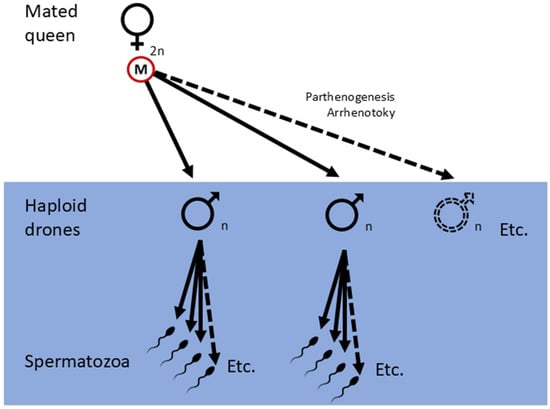
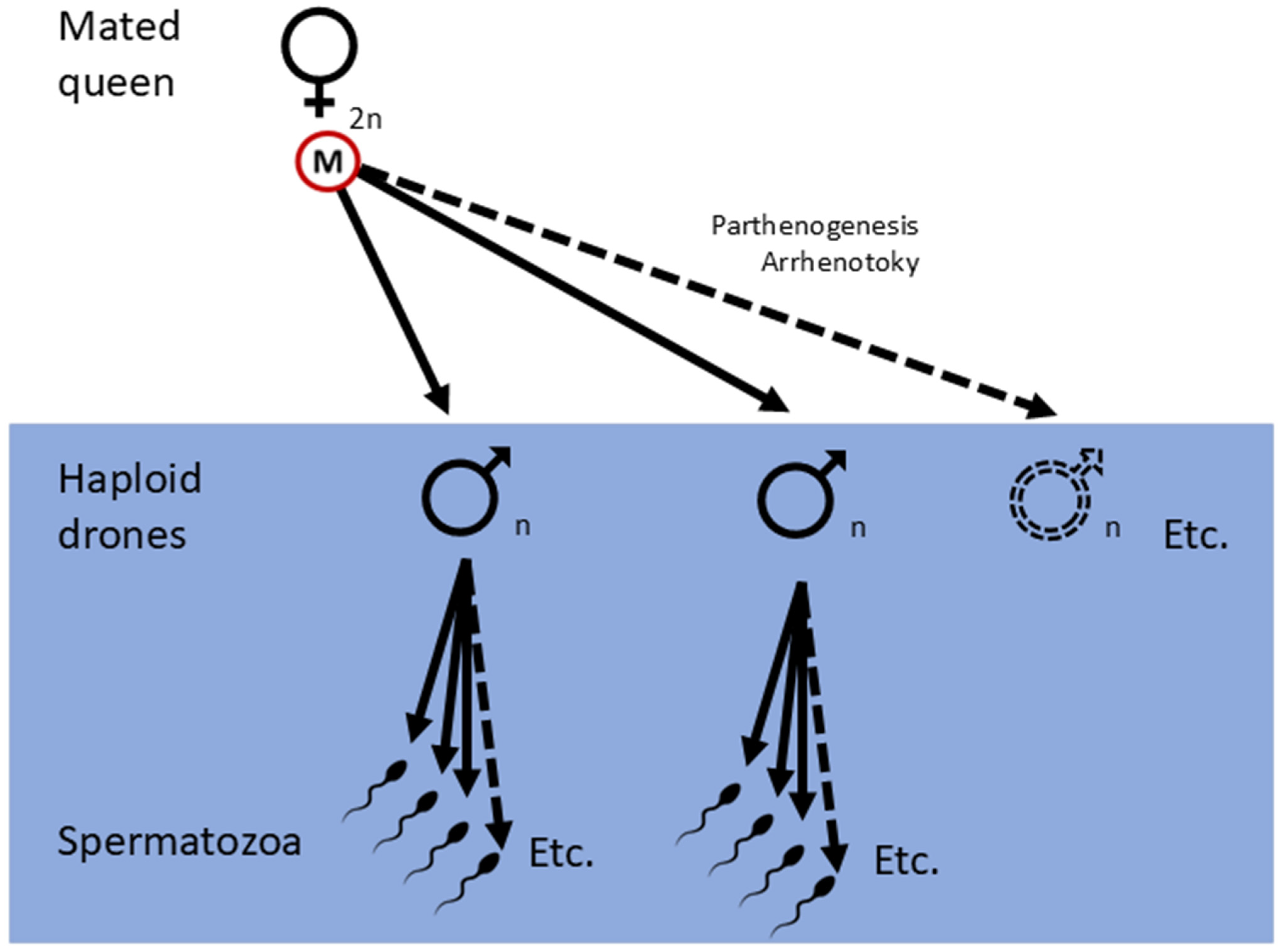
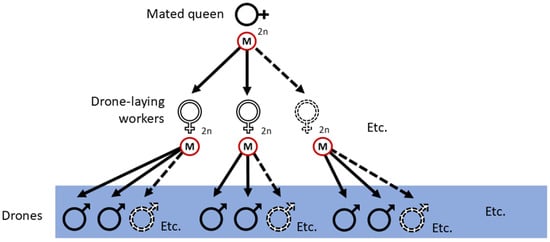
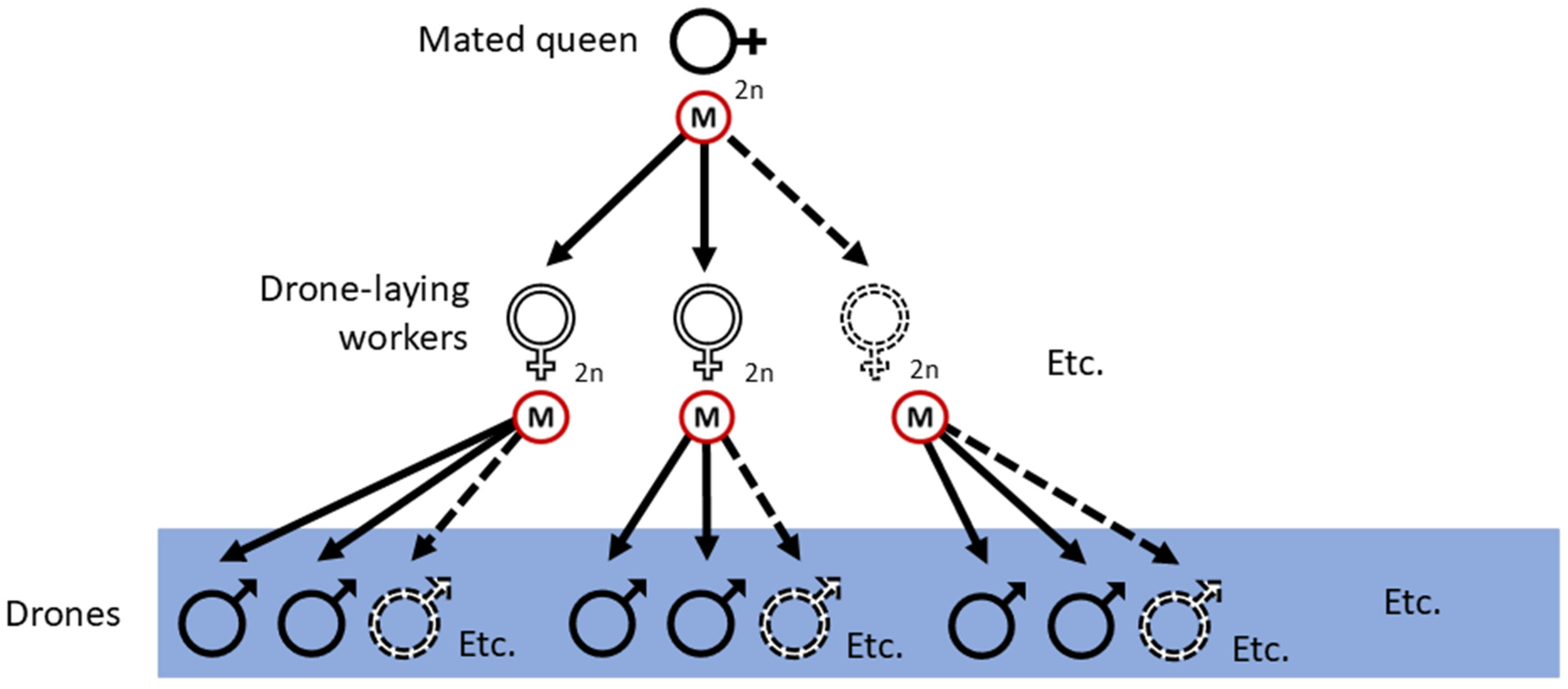
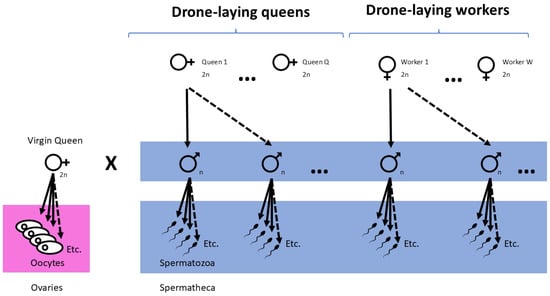
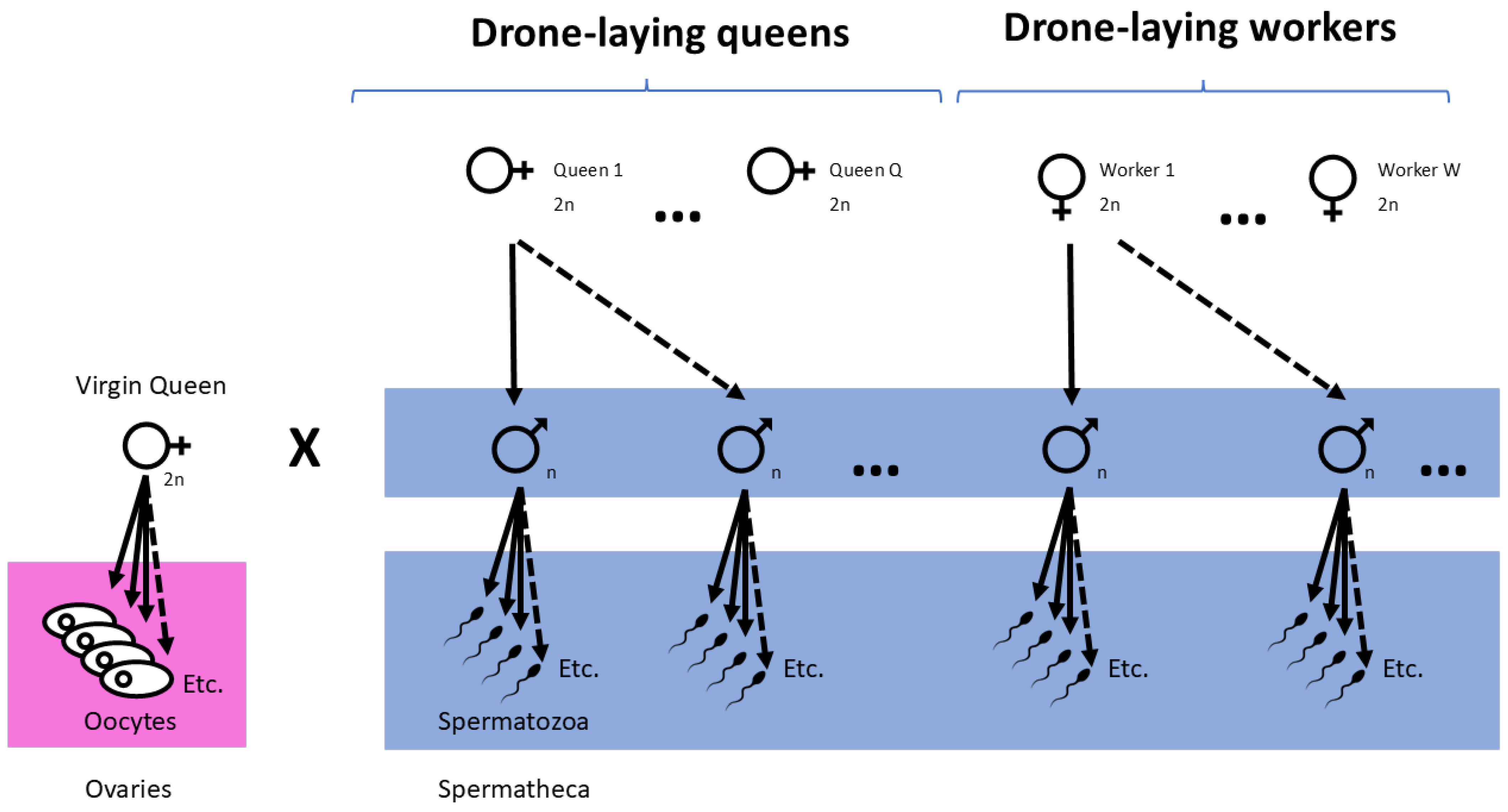
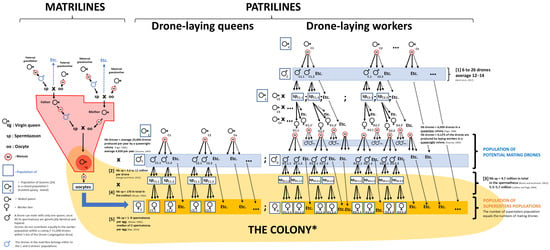
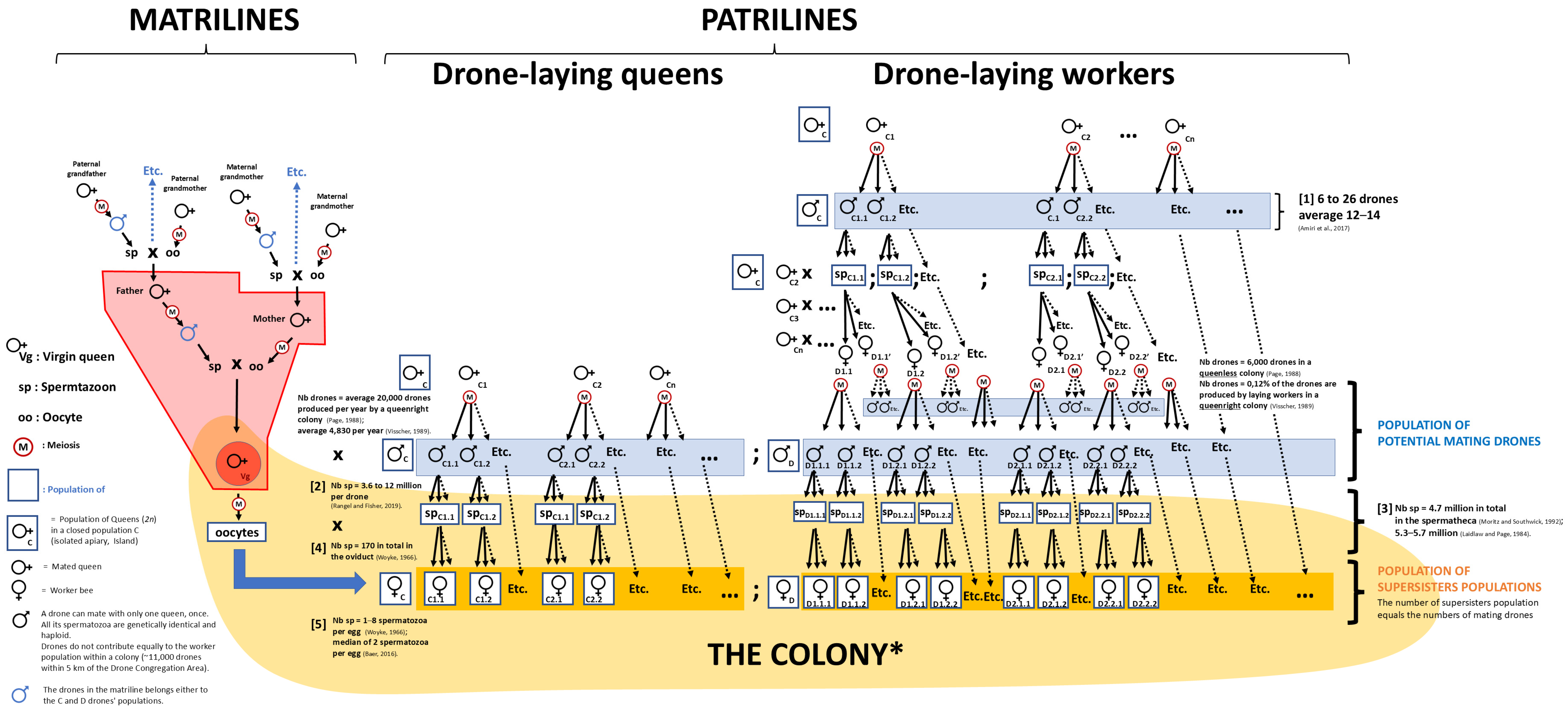
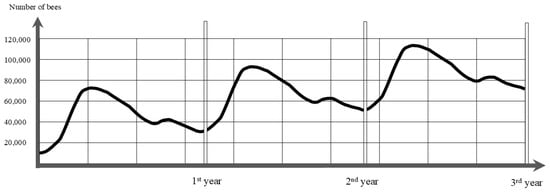
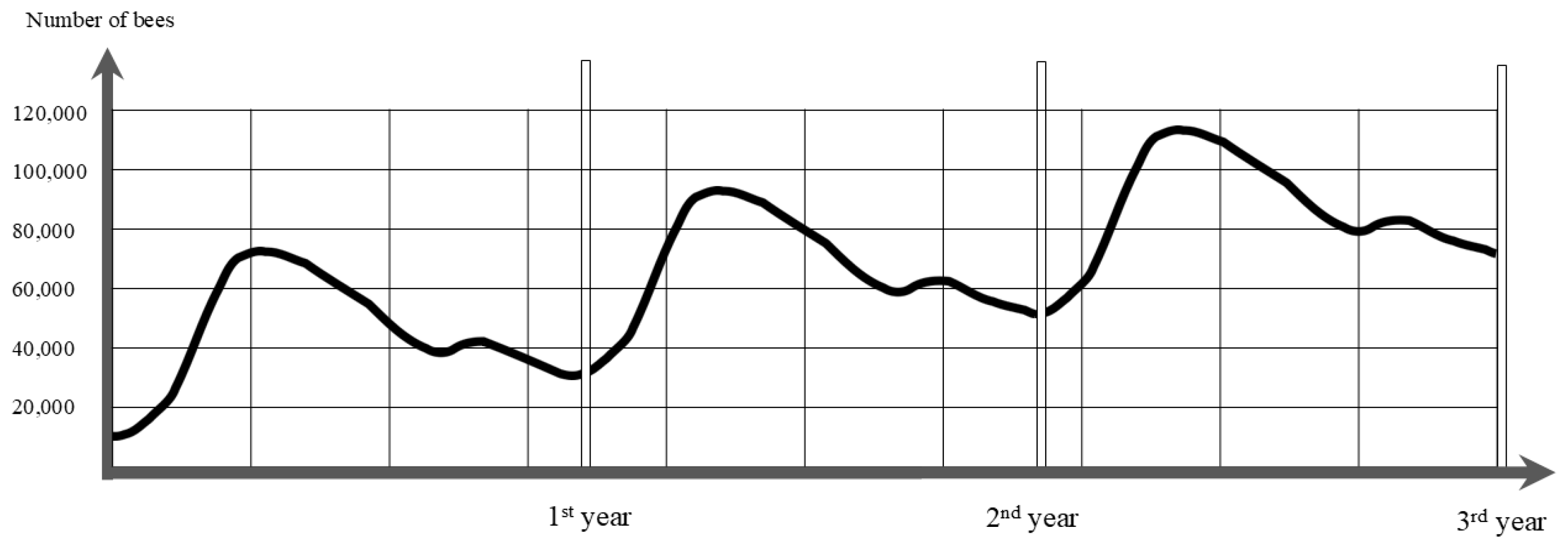
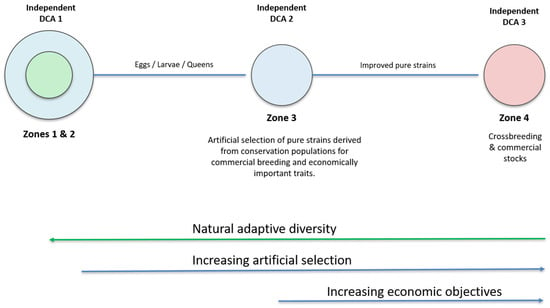
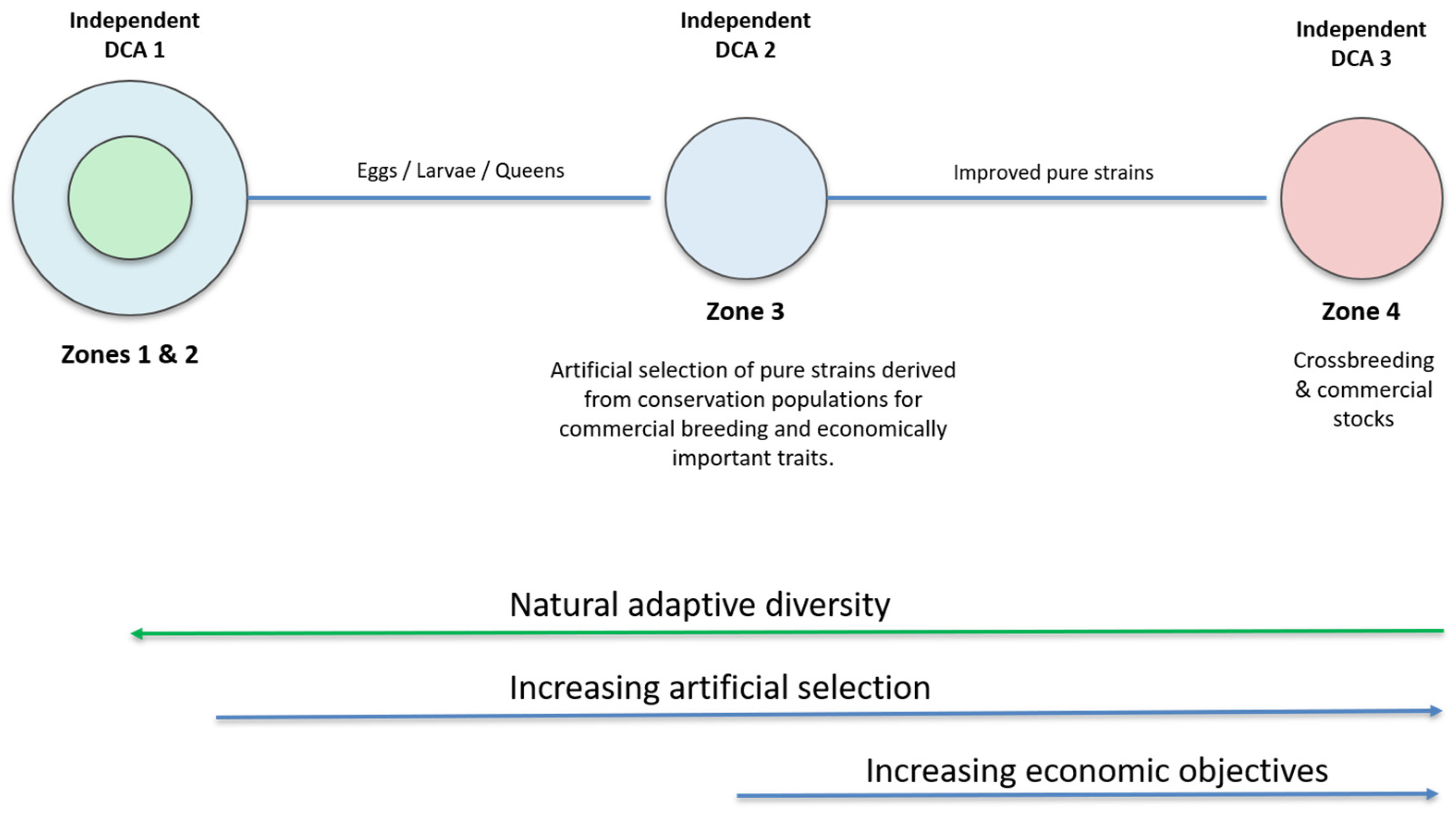
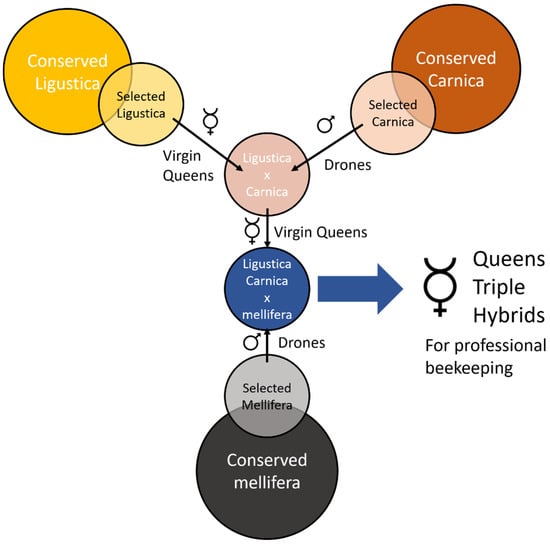
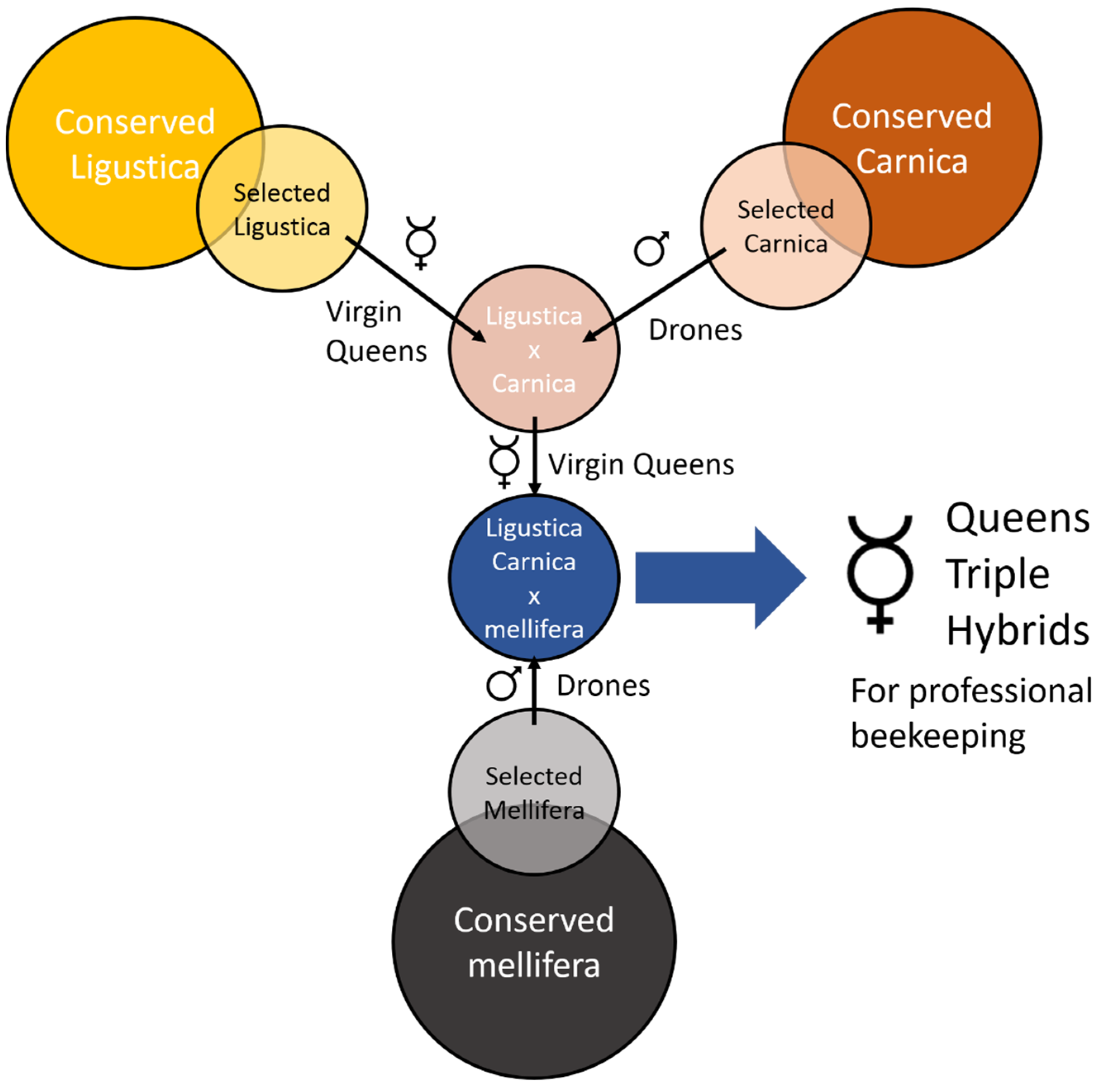
Disclaimer/Publisher’s Note: The statements, opinions and data contained in all publications are solely those of the individual author(s) and contributor(s) and not of MDPI and/or the editor(s). MDPI and/or the editor(s) disclaim responsibility for any injury to people or property resulting from any ideas, methods, instructions or products referred to in the content. |
© 2026 by the author. Licensee MDPI, Basel, Switzerland. This article is an open access article distributed under the terms and conditions of the Creative Commons Attribution (CC BY) license.