


Simple Summary
Scale insects are major pests of agriculture, forestry, and ornamental plants worldwide, and the ladybird Novius penicillioides is an important natural enemy of the cottony cushion scale Icerya jacobsoni. Because insects are cold-blooded, their growth, survival, and reproduction depend heavily on temperature, yet the thermal limits of this ladybird have not been studied. We reared N. penicillioides at six constant temperatures from 17 to 32 °C and recorded how long it took to develop and how many survived. At five of these temperatures (17–29 °C), we also recorded how many eggs each female laid and how quickly its population grew. The ladybird developed fastest at the highest temperatures, but it survived and reproduced best between 20 and 26 °C. At 29 °C, egg production dropped sharply, and at 32 °C, egg hatching fell dramatically, indicating that these temperatures are close to the upper limit this insect can tolerate. Our results suggest that this ladybird may cope less well with hot weather than its prey, which means it could become less effective at controlling scale insects as the climate warms. We recommend releasing it when average daily temperatures are between 20 and 26 °C, and avoiding releases during hot summer periods.
Abstract
The cottony cushion scale Icerya jacobsoni is a serious pest of agriculture and forestry, and the ladybird Novius penicillioides is an important predator of this pest. Temperature strongly affects insect development and reproduction, but the thermal biology of N. penicillioides remains unknown. Here, N. penicillioides was reared at six constant temperatures (17–32 °C) for immature development and survival, and at five temperatures (17–29 °C) for adult reproduction and life table analysis. Developmental duration decreased with rising temperature, whereas survival and fecundity were highest at 20–26 °C. Egg hatch rate fell to 0.25 at 32 °C, and fecundity at 29 °C was 84.3% lower than at 20 °C. The intrinsic rate of increase and finite rate of increase peaked at 26 °C (0.091 and 1.095), identifying this as the optimal temperature for population growth. The lower developmental threshold for the egg-to-adult period was 3.76 °C, with a degree-day requirement of 476.19 degree-days. At 32 °C, only 18% of immatures reached adulthood and the few surviving females failed to reproduce, indicating that the upper thermal limit for population growth lies between 29 and 32 °C. Given that natural enemies often have lower optimal temperatures than their prey, a thermal asymmetry may exist between N. penicillioides and I. jacobsoni, and continued warming could reduce its summer control efficacy. These findings provide key thermal parameters for optimizing mass rearing and field release strategies of this predator.
1. Introduction
Scale insects (Coccoidea) constitute a major group of pests affecting agriculture, forestry, and horticultural production worldwide [1]. In recent years, species of the genus Icerya have emerged as serious threats to a wide range of crops and ornamental plants, with particularly severe impacts in forestry [2,3]. Icerya jacobsoni Green (Hemiptera: Monophlebidae) is a highly polyphagous pest that causes substantial damage to economically important crops and landscape plants across its distribution range. Both nymphs and adult females aggregate on tender shoots and the undersides of leaves, where they feed on plant sap. Their honeydew secretions promote the development of sooty mold, which impairs photosynthesis and ultimately leads to leaf yellowing, premature abscission, and in severe cases, plant death [4]. In China, I. jacobsoni has become established in several provinces, including Guangdong, Guangxi, and Fujian, with recorded hosts spanning more than 20 plant families, such as Magnoliaceae, Moraceae, Euphorbiaceae, and Myrtaceae [5,6]. This broad host range and expanding distribution pose a persistent threat to agricultural and forestry production.
Chemical insecticides remain the primary tactic for managing scale insect pests. However, the cryptic habits, hydrophobic waxy secretions, and symbiotic gut microorganisms of these insects substantially reduce the efficacy of conventional chemical control [7,8]. The waxy layer covering the insect body limits the penetration of insecticide solutions, which often compels growers to increase application rates and, consequently, accelerates the development of resistance [8]. Moreover, I. jacobsoni is covered with waxy secretions at all developmental stages and closely resembles the related species I. aegyptiaca in morphology, which frequently leads to misidentification and further complicates monitoring and control efforts [6]. Overreliance on chemical pesticides also poses risks to human and animal health, contributes to environmental bioaccumulation, and harms natural enemy populations [8]. Consequently, biological control using natural enemies has become an increasingly important component of sustainable management strategies for I. jacobsoni.
Ladybirds are important predatory natural enemies of scale insects and have a long history of application in biological control. The successful introduction of Novius cardinalis for the control of the cottony cushion scale, Icerya purchasi, represents a classic example of biological control that has remained effective in many regions worldwide since its first application in 1888 [9]. Novius penicillioides Tao & Wang (Coleoptera: Coccinellidae) is an important predator of I. jacobsoni [10]. Larvae of this ladybird preferentially attack nymphs of I. jacobsoni, with a marked preference for second-instar nymphs, often leaving only the empty integument after feeding [3]. Adults also consume eggs and nymphs, frequently causing body fluid outflow and coagulation during feeding. A single larva of N. penicillioides can consume 25 to 40 eggs or nymphs of I. jacobsoni per day, indicating considerable predatory potential. Elucidating the biological characteristics of N. penicillioides and its responses to environmental factors is therefore essential for optimizing its use in biological control programs.
Insects are ectotherms, and their body temperature and life activity rhythms are closely dependent on ambient temperature [11]. Temperature regulates not only developmental rate, survival, fecundity, and population growth parameters but also geographic distribution and seasonal occurrence patterns [12]. Ladybird beetles exhibit considerable plasticity in reproductive output and development in response to thermal variation, with constant and fluctuating temperatures differentially affecting their fitness traits [13]. Moreover, thermal conditions during larval development modulate developmental plasticity, including the rate of limb regeneration [14]. The four developmental stages—egg, larva, pupa, and adult—differ in their thermal sensitivity, with eggs being the most sensitive and adults the most tolerant to cold stress [15], making ladybirds suitable subjects for investigating insect thermal adaptation. Under global climate warming, the increasing frequency of extreme heat events may profoundly affect the pest control efficacy of predatory ladybirds. Therefore, a systematic assessment of how temperature influences the ecological adaptation of predatory ladybirds is an important scientific foundation for optimizing biological control strategies under climate change.
Previous studies have demonstrated that the inhibitory effects of high-temperature stress on insect reproduction are widespread. When ambient temperature exceeds the optimal range, insects tend to allocate more energy to thermotolerance, such as the synthesis of heat shock proteins, thereby diverting resources away from reproduction and creating a survival-reproduction trade-off [16]. High temperatures can also directly impair oocyte development and inhibit vitellogenin synthesis, leading to reduced fecundity and lower egg hatch rates [17]. The effects of temperature on the biological traits of coccinellids have been documented in several species. For example, pupal heat stress significantly reduces cumulative fecundity, egg hatch rate, and adult longevity in Harmonia axyridis [18]. In Coccinella septempunctata, extreme high temperatures significantly decrease adult and egg survival, fecundity, and egg hatch rate, with effects intensifying as the duration of exposure increases [19]. However, for N. penicillioides, a dominant natural enemy of I. jacobsoni, no systematic study has examined its development, survival, reproduction, and population growth parameters across a temperature gradient. In particular, its adaptive responses across a broad thermal range of 17–32 °C remain unexplored. Notably, the optimal developmental temperature of natural enemies is often lower than that of their host pests, making them more susceptible to suppression under high-temperature conditions [20]. Thus, under climate warming, the control efficacy of ladybirds and other natural enemies may face greater challenges, underscoring the urgent need for systematic thermal adaptation studies to assess this risk.
In the present study, six constant temperature treatments (17, 20, 23, 26, 29, and 32 °C) were established to systematically measure the developmental duration, survival rate, adult fecundity, and longevity of N. penicillioides. An age-specific life table was constructed to calculate the net reproductive rate, intrinsic rate of increase, finite rate of increase, and mean generation time. This study aimed to: (1) clarify the comprehensive effects of temperature on the development, survival, and reproduction of this ladybird; and (2) identify the optimal temperature range for population growth and the upper thermal tolerance threshold. The results will provide a scientific basis for optimizing mass-rearing protocols and field release strategies of N. penicillioides based on climatic data.
2. Materials and Methods
2.1. Insect Rearing
The stock colony of I. jacobsoni used in this study was obtained from the Engineering Research Center of Biological Control at South China Agricultural University, where it had been maintained on Codiaeum variegatum (L.) for multiple generations. The predator N. penicillioides was sourced from the same institute’s greenhouse colony and was reared on I. jacobsoni infesting C. variegatum. Prior to the experiments, both I. jacobsoni and N. penicillioides had been continuously reared on C. variegatum for several generations to ensure acclimatization to the experimental conditions. All insect cultures were maintained in an environmental chamber set at 26 ± 1 °C, 75 ± 10% relative humidity, and a photoperiod of 14 L: 10 D. The C. variegatum plants used for rearing were cultivated in plastic pots with a diameter of 15 cm and were fertilized as needed with a compound fertilizer containing N:P:K at a ratio of 13:7:15 to sustain healthy plant growth.
2.2. Development and Survival of N. penicillioides Immatures Under Different Temperatures
To evaluate the effect of temperature on the developmental duration and survival of N. penicillioides, eggs laid on the same day were placed on moistened filter paper in Petri dishes. Six constant temperature treatments (17, 20, 23, 26, 29, and 32 °C) were set in separate incubators, with 100 eggs observed per temperature. Hatching was checked daily. Upon emergence, neonates were individually transferred to fresh leaf disks bearing nymphs of I. jacobsoni and reared singly. Except during the pupal stage, leaf disks were replaced daily. The developmental progress and survival of each immature stage were monitored daily until adult emergence. Each temperature treatment was replicated three times.
2.3. Reproduction and Adult Longevity of N. penicillioides Under Different Temperatures
Five constant temperature treatments (17, 20, 23, 26, and 29 °C) were established to assess the reproductive performance and adult longevity of N. penicillioides. The 32 °C treatment was excluded from the adult experiment because adult emergence at this temperature was extremely low, making it impossible to obtain sufficient mating pairs for replication. Newly emerged adults were paired and reared individually in Petri dishes. Fresh prey and leaf disks were supplied daily, and the number of eggs laid and adult survival were recorded each day until the death of all individuals.
2.4. Data Analysis
Developmental duration, adult longevity, preoviposition period, and total fecundity per female of N. penicillioides were compared among temperature treatments using one-way analysis of variance (ANOVA), followed by Duncan’s multiple range test for mean separation when significant differences were detected (p < 0.05). Survival rates, which are proportional (binomial) data, were analyzed using a generalized linear model (GENLIN) with a binomial distribution and a logit link function. Pairwise comparisons among temperature treatments were performed using the sequential Bonferroni method, with differences considered significant at p < 0.05. The relationship between developmental rate and temperature for each life stage and the entire generation was described by a linear regression model: V(t) = (1/K) × T − C/K, where V(t) denotes the developmental rate in days at temperature T (°C), K represents the required heat units in degree-days, and C is lower developmental threshold [21]. For stages where the linear model was not applicable, a Logistic model was used: V(T) = k/(1 + ea−bT), where k is the maximum developmental rate and a and b are model coefficients.
Life table parameters were calculated according to the procedures of Birch [22]. The following equations were employed:
where x denotes the age of N. penicillioides measured in days, is the survival at a specific time x and is the average number of female offspring generated by each surviving female adult within the age interval x. T refers to the mean generation time, defined as the average age at which females produce offspring. is the net reproductive rate, representing the average number of offspring that an individual in the population is expected to produce over its lifetime. The intrinsic rate of increase () describes the rate at which a population expands in size in the absence of density-dependent factors that might otherwise regulate it, while λ represents the finite rate of increase, indicating the factor by which the population size must be multiplied to project the population size in the subsequent time unit, assuming a stable age distribution.
R0 = ∑lxmx,
T = ∑xlxmx/R0,
rm = lnR0/T,
λ = exp (rm),
3. Results
3.1. Effects of Temperature on Development and Survival of N. penicillioides
Temperature exerted a significant influence on the developmental duration of each immature stage as well as the overall preimaginal period of N. penicillioides (Table 1). Across the tested temperature range, developmental times generally decreased with increasing temperature; however, the magnitude of this reduction varied among different thermal intervals. The egg stage lasted longest at 17 °C (11.22 ± 0.24 d) and progressively shortened as temperature rose, reaching a minimum of 4.16 ± 0.30 d at 32 °C, with no significant difference observed between 29 °C and 32 °C. The combined larval duration (four instars) was greatest at 17 °C (19.70 ± 0.34 d) and declined markedly with increasing temperature, reaching 9.99 ± 0.14 d at 23 °C; at 26 °C, it increased to 12.24 ± 0.42 d, and at 29 °C and 32 °C, the durations were 8.24 ± 0.43 d and 10.27 ± 0.55 d, respectively. The pupal stage shortened considerably between 17 °C and 23 °C (from 7.58 ± 0.13 d to 4.70 ± 0.19 d), whereas only minor changes were recorded between 26 °C and 32 °C (ranging from 5.96 ± 0.14 d to 4.07 ± 0.33 d). The total developmental period from egg to adult was longest at 17 °C (38.50 ± 0.36 d) and shortest at 23 °C (21.86 ± 0.15 d), slightly extended to 23.75 ± 0.44 d at 26 °C, and further reduced to 18.30 ± 0.46 d and 18.51 ± 0.51 d at 29 °C and 32 °C, respectively, with no significant difference between the two highest temperatures. Notably, the fourth-instar duration did not follow the overall decreasing trend with temperature. It remained relatively short at 17–23 °C (4.72 ± 0.17, 3.14 ± 0.08, and 3.14 ± 0.11 d, respectively), increased markedly to 6.69 ± 0.26 d at 26 °C, and then decreased again to 3.09 ± 0.21 d and 4.14 ± 0.22 d at 29 °C and 32 °C, respectively.
Table 1.
Developmental time (in days) of different stages of N. penicillioides at six constant temperatures (Means ± SE).
Temperature significantly affected egg hatch rate and total preimaginal survival from egg to adult, whereas its effect on larval survival at individual instars and pupal survival was not significant (Table 2). Egg hatch rate was highest at 20 °C (0.99 ± 0.01), followed by 23 °C (0.96 ± 0.02) and 26 °C (0.95 ± 0.02), and declined to 0.89 ± 0.03 at 17 °C and 0.81 ± 0.04 at 29 °C, reaching a minimum of 0.25 ± 0.04 at 32 °C (Wald χ2 = 146.307, df = 5, p < 0.001). In contrast, survival of first-, second-, third-, and fourth-instar larvae and pupae remained consistently high across all temperatures (mostly > 0.90), with no significant differences detected among temperature treatments (p > 0.05). Total survival from egg to adult was highest at 23 °C and 26 °C (both 0.86 ± 0.04), followed by 20 °C (0.81 ± 0.04) and 17 °C (0.75 ± 0.04), and declined sharply at 29 °C (0.62 ± 0.05) and 32 °C (0.18 ± 0.04) (Wald χ2 = 114.440, df = 5, p < 0.001).
Table 2.
Survival of different stages of N. penicillioides at six constant temperatures (Means ± SE).
3.2. Degree-Day Requirement of N. penicillioides
The fitted relationships between developmental rate and temperature for each life stage are presented in Table 3. For the egg, first-, second-, and third-instar larvae, and the overall egg-to-adult period, developmental rate increased linearly with temperature, with R2 values ranging from 0.8752 to 0.9790. Based on the linear model, the lower developmental thresholds for the egg, first-, second-, and third-instar larvae, and the egg-to-adult period were estimated as 5.73, 10.41, 9.01, 11.09, and 3.76 °C, respectively, with corresponding degree-day requirements of 119.05, 31.35, 27.93, 32.47, and 476.19 degree-days.
Table 3.
Linear and logistic model fitting of developmental rate against temperature for each stage of N. penicillioides.
For the fourth-instar larva and pupa, however, developmental rate did not show a significant linear relationship with temperature, with R2 values of only 0.0119 and 0.5925, respectively. The fourth-instar duration at 26 °C (6.69 d) was abnormally extended, causing the developmental rate at this temperature to deviate markedly from the linear trend. The pupal duration at 26 °C (5.96 d) was longer than at 23 °C (4.70 d) and 29 °C (4.73 d), exhibiting a non-monotonic fluctuation that likewise departed from linearity. Consequently, the lower developmental threshold and degree-day requirement could not be reliably estimated for these two stages using the linear model. The Logistic model provided a substantially better fit for the fourth instar and pupa, with R2 values of 0.9295 and 0.9850, respectively. Therefore, the relationship between developmental rate and temperature for these two stages is described using the Logistic model, and their linear-model estimates of lower developmental threshold and degree-day requirement are not reported.
3.3. Effects of Temperature on Adult Longevity and Reproduction of N. penicillioides
Temperature significantly influenced the preoviposition period, fecundity, and adult longevity of N. penicillioides (Table 4). The preoviposition period was shortest at 20 °C (6.5 ± 0.43 d) and remained relatively short at 23 °C (6.8 ± 0.39 d) and 26 °C (7.6 ± 0.40 d), with no significant differences among these three treatments. It was slightly longer at 17 °C (7.90 ± 0.34 d) and increased markedly to 12.9 ± 0.64 d at 29 °C, which was significantly longer than all other treatments. Total fecundity per female was highest at 20 °C (343.30 ± 35.68 eggs), significantly surpassing all other treatments. At 17 °C, 23 °C, and 26 °C, fecundity values reached 247.80 ± 29.10, 209.00 ± 30.78, and 252.40 ± 25.24 eggs, respectively, with no significant differences among these three temperatures. At 29 °C, however, fecundity dropped drastically to 53.90 ± 15.93 eggs. The relationship between temperature (T) and total fecundity per female (Y) was described by a quadratic equation: Y = −1162.7 + 141.87T − 3.413T2 (r = 0.9381, p < 0.05). Adult longevity declined with rising temperature: it was longest at 20 °C (128.40 ± 9.16 d), followed by 17 °C (112.30 ± 6.62 d), with no significant difference between these two treatments; it decreased significantly to 91.10 ± 7.01 d at 23 °C and further to 85.00 ± 8.84 d and 72.00 ± 7.77 d at 26 °C and 29 °C, respectively, with the latter two not significantly different from each other.
Table 4.
Preovipositional period, ovipostion, and longevity of N. penicillioides (Means ± SE).
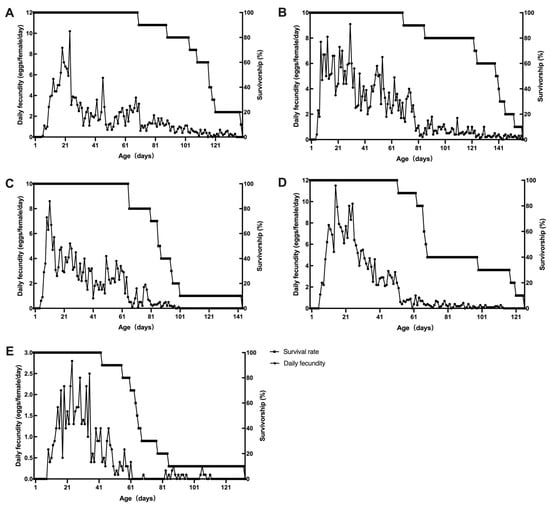
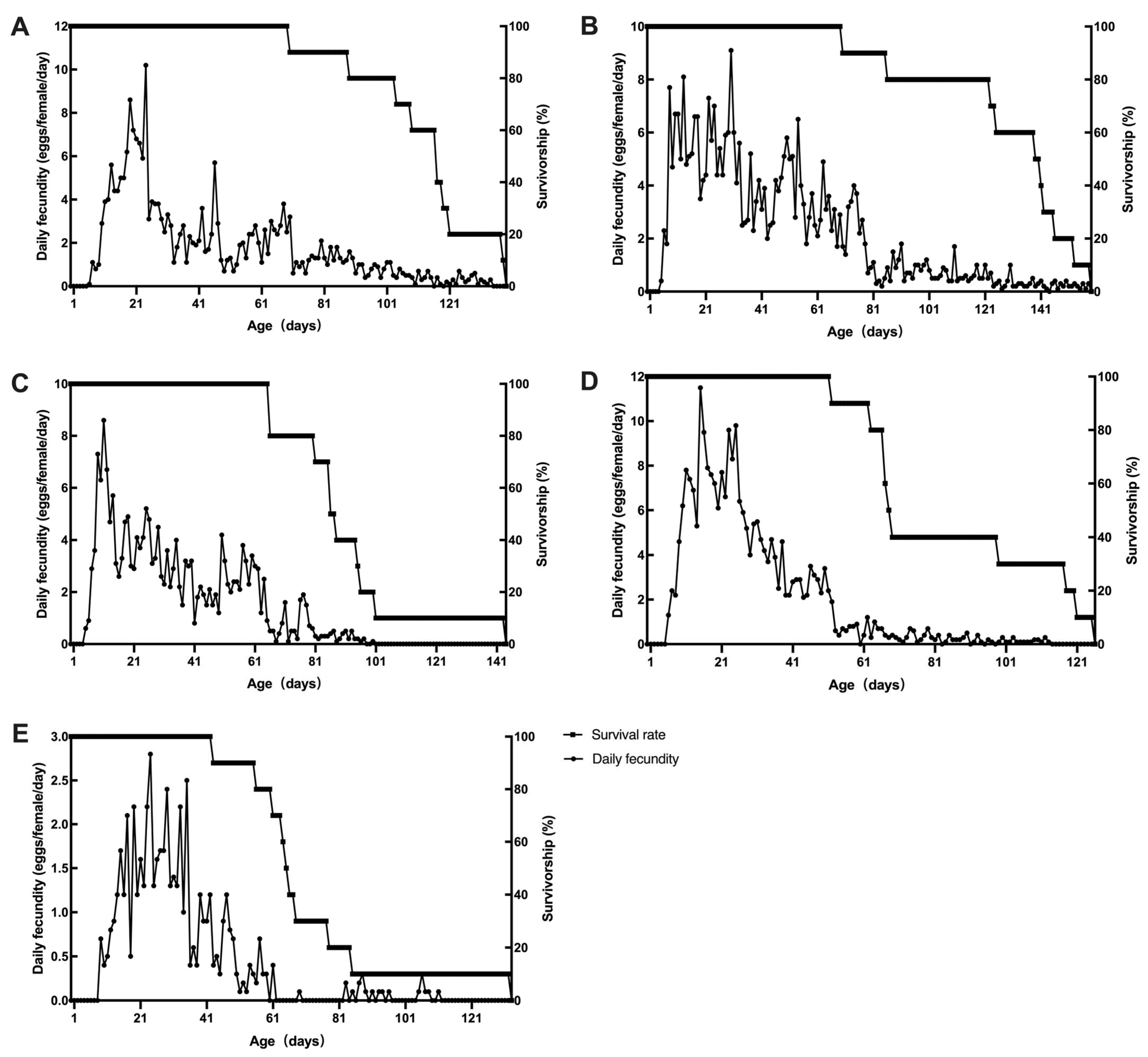
Daily oviposition patterns differed markedly among temperature treatments (Figure 1). At 20 °C, egg-laying extended over the longest period, with relatively high daily fecundity maintained during the early and middle stages of adult life. At 26 °C, oviposition was concentrated in the early and middle stages, with a pronounced peak during the early adult stage. At 23 °C, daily fecundity peaked early and remained elevated during the early adult stage. At 17 °C, oviposition was more evenly distributed, with several moderate peaks. At 29 °C, daily fecundity remained low throughout the reproductive period and fluctuated considerably. Adult mortality was not concentrated during the preoviposition period at any temperature. At 17 °C and 20 °C, survival remained high until approximately 80–100 days of age before declining, whereas at 23 °C, 26 °C, and 29 °C, mortality became more pronounced between 70 and 80 days of age, corresponding to the mid-oviposition period.
Figure 1.
Daily fecundity and survival rate of adult females of N. penicillioides at different temperatures. (A): 17 °C; (B): 20 °C; (C): 23 °C; (D): 26 °C; (E): 29 °C.
3.4. Life Table Parameters of N. penicillioides at Different Temperatures
Life table parameters of N. penicillioides, including the net reproductive rate (R0), intrinsic rate of increase (rm), finite rate of increase (λ), and mean generation time (T), were calculated for the five temperatures at which reproduction occurred (17, 20, 23, 26, and 29 °C) based on the age-specific life table theory (Table 5). The net reproductive rate varied substantially across temperatures, reaching its maximum at 20 °C (132.45), followed by 26 °C (105.48), with values of 87.30 and 86.75 at 17 °C and 23 °C, respectively, and dropping to the minimum of 13.68 at 29 °C. The intrinsic rate of increase increased gradually with temperature from 17 °C to 26 °C, peaking at 0.091 at 26 °C, and then decreased to 0.056 at 29 °C, which was identical to the value recorded at 17 °C. The finite rate of increase followed the same trend as the intrinsic rate, being highest at 26 °C (1.095) and equal at 17 °C and 29 °C (1.058). The mean generation time consistently shortened with increasing temperature, from a maximum of 79.72 d at 17 °C to a minimum of 46.32 d at 29 °C.
Table 5.
Life table parameters of N. penicillioides at different temperatures (Means ± SE).
Considering developmental duration, survival rate, fecundity, and life table parameters collectively, the highest population growth potential, as indicated by the peak intrinsic rate of increase (0.091), was observed at 26 °C, where preimaginal survival (0.86) also remained at relatively high levels. These findings suggest that 26 °C represents the optimal temperature for population increase of this ladybird species. In contrast, the sharp decline in egg hatch rate (0.25) and extremely low overall preimaginal survival (0.18) at 32 °C, together with the severe reduction in fecundity (53.9 eggs per female) at 29 °C, indicate that temperatures in the range of 29–32 °C approach the upper sublethal thermal limits for this species.
4. Discussion
In the present study, the developmental duration of N. penicillioides generally decreased as temperature increased, which is consistent with the general rule that metabolic rates accelerate with rising temperature within the tolerance range of insects [12,23,24]. An unexpected pattern was observed in the fourth-instar duration, which peaked at 26 °C (6.69 d) and was significantly longer than at both lower (17–23 °C) and higher (29–32 °C) temperatures. We cannot fully resolve the underlying mechanism with the current dataset, and this point warrants further investigation using detailed observations of prepupal behavior and energy reserves. Importantly, this anomaly does not affect the overall conclusion that 20–26 °C is the optimal thermal window for N. penicillioides, since the total egg-to-adult duration at 26 °C remained short (23.75 d) and the intrinsic rate of increase was highest at this temperature. Consistent with this overall pattern, both survival and fecundity peaked in the moderate temperature range (20–26 °C), while high temperatures (29–32 °C) caused a sharp decline in egg hatch rate and a substantial reduction in fecundity. This pattern of “accelerated development accompanied by reduced fitness” aligns closely with classical theory on insect thermal adaptation and reveals a trade-off between developmental rate and survival/reproduction. The range of 20–26 °C appears to be optimal for the growth and development of N. penicillioides. This result differs from the optimal range of 23–29 °C reported by Yao et al. [25] for Serangium japonicum, suggesting that different ladybird species have evolved differentiated thermal adaptation strategies over long-term evolution.
The results of this study are consistent with reports on other coccinellid species. In Nephus arcuatus, both the intrinsic rate of increase and the net reproductive rate reached their highest values at 30 °C, but fecundity dropped sharply to 136.6 eggs at 35 °C, indicating a pronounced inhibitory effect of high temperature on reproduction [26]. In Coccinella septempunctata, survival and fecundity declined significantly under extreme high temperatures of 36–39 °C [19]. In Harmonia axyridis, exposure of pupae to 35 °C resulted in significantly lower cumulative fecundity and egg hatch rate in adults compared with the control group [18]. In the present study, fecundity per female at 29 °C (53.9 eggs) was 84.3% lower than that at 20 °C (343.3 eggs), and the egg hatch rate at 32 °C (0.25) was 73.7% lower than that at 26 °C (0.95). This high-temperature sensitivity is consistent with the above species, indicating that coccinellids exhibit a high degree of conservation in their temperature response patterns. The lower developmental threshold and effective accumulated temperature are useful indicators of the potential distribution of insects [27]. N. penicillioides requires a threshold temperature of 3.76 °C and 476.19 degree-days to complete the egg-to-adult period, which differs markedly from the values reported by Yao et al. [25] for S. japonicum (lower developmental threshold of 9.41 °C and 285.71 degree-days). This indicates significant variation in thermal requirements among ladybird species. These parameters are reported here for the first time and provide a quantitative basis for predicting the occurrence periods of this species in different climatic regions. It should be noted that the linear degree-day model was not applicable to the fourth instar and pupa, as their developmental rates departed from linearity (R2 = 0.0119 and 0.5925, respectively). For these two stages, the Logistic model provided a better fit (R2 = 0.9295 and 0.9850). This limitation should be considered when using the thermal constants reported here for phenological prediction.
The sharp decline in fecundity at high temperatures can be explained from the perspective of energy allocation. When ambient temperature exceeds the optimal range, insects tend to allocate more energy to thermotolerance, such as the synthesis of heat shock proteins, thereby diverting resources away from reproductive investment and forming a survival-reproduction trade-off. Transcriptomic studies on Spodoptera litura have confirmed that heat shock protein genes are significantly upregulated under thermal stress, whereas reproduction-related genes and cell cycle-related genes are suppressed, indicating that insects undergo metabolic reprogramming from reproductive function toward survival adaptation under heat stress [28]. In addition, high temperatures may directly impair oocyte development or inhibit vitellogenin synthesis, leading to reduced fecundity and lower egg hatch rates [29]. High temperatures can also induce a significant increase in reactive oxygen species (ROS) levels in insects. When the rate of ROS generation exceeds the scavenging capacity of antioxidant enzymes, lipid peroxidation and cell membrane damage occur, which in turn affect the normal function of reproductive tissues [30,31]. In the present study, the inhibitory effect of high temperature on reproduction was manifested in both the extension of the preoviposition period and the shortening of the reproductive duration of females.
The intrinsic rate of increase (rm) is the best integrated indicator for evaluating the cumulative effects of temperature on insect populations. In this study, both rm (0.091) and λ (1.095) reached their highest values at 26 °C. Although total fecundity per female was highest at 20 °C (343.3 eggs), the longer mean generation time (70.98 d) limited further increases in rm. This indicates that the optimal temperature for reproduction is not equivalent to the optimal temperature for population growth [12,32]. A similar conclusion was reached by Papanikolaou et al. [33] for Propylea quatuordecimpunctata, in which the net reproductive rate was highest at 25 °C but the intrinsic rate of increase was highest at 30 °C. Zarghami et al. [26] also reported for N. arcuatus that rm was highest at 30 °C, but although development was fastest at 35 °C, fecundity declined substantially. The rm value of N. penicillioides at 26 °C (0.091) in this study is similar to those reported by Ren et al. [34] for Nephaspis oculatus and by Huang et al. [35] for Axinoscymnus cardilobus at the same temperature, but lower than those reported by Tanigoshi and McMurtry [36] for Stethorus picipes and by Yao et al. [25] for S. japonicum. These differences may be related to factors such as prey species, host plants, and predator sex ratio.
As an integrated parameter reflecting developmental rate, survival, and fecundity, rm is the optimal indicator for evaluating the thermal adaptation of natural enemy insects. The results of this study provide key temperature parameters for the mass rearing and field release strategies of N. penicillioides: it is recommended to release this ladybird during seasons when the daily mean temperature is 20–26 °C to maximize population establishment and pest control efficacy. When the daily mean temperature in the field consistently exceeds 29 °C in summer, the release of eggs or newly hatched larvae should be avoided, as their survival and subsequent fecundity are extremely low. The successful establishment of any insect population depends on temperature [37], and the temperature parameters obtained in this study can provide a direct basis for the introduction and release of N. penicillioides. Notably, the optimal developmental temperature of natural enemies is often lower than that of their herbivorous pests [20]. In this study, the optimal temperature for population growth of N. penicillioides was 26 °C, whereas its prey I. jacobsoni, a scale insect of tropical origin, may have a higher upper thermal tolerance threshold. This asymmetry in temperature responses between natural enemy and pest implies that under continued climate warming, the control efficacy of N. penicillioides against I. jacobsoni during hot summer months may be further weakened. Future climate warming may lead to reduced control efficacy of N. penicillioides in some low-latitude regions, necessitating the development of adaptive management strategies in advance.
It should be noted that this study was conducted under laboratory conditions with constant temperature, constant humidity, and abundant food, and did not simulate realistic ecological factors such as diurnal temperature variation, ultraviolet radiation, and fluctuations in prey density in the field. Studies on other insects have shown that temperature fluctuations during development can reduce male fitness and limit adaptive potential [38], while daily temperature amplitude significantly affects longevity, fecundity, and thermal tolerance [39]. Mean temperature and temperature variation interact to shape life history strategies, heat tolerance, and body size [40], and temperature effects on fitness extend across developmental stages to adult body mass, longevity, and energy reserves [41]. Constant-temperature experiments tend to overestimate the actual adaptive capacity of insects under high temperatures, because the absence of a nocturnal low-temperature recovery period prevents insects from mitigating daytime heat stress through behavioral regulation, such as migrating to cooler microhabitats [12]. Therefore, the 29–32 °C tolerance threshold obtained in this study should be regarded as an upper reference value for field applications. Future studies should combine field cage experiments with diurnal temperature variation treatments to further verify the field applicability of the temperature thresholds obtained here. Notably, rapid evolution of heat tolerance has been documented in natural insect populations over decadal timescales [42], suggesting that the thermal limits observed in this study may not be fixed and could shift under sustained climate warming.
5. Conclusions
This study characterized the thermal adaptation of N. penicillioides across the range of 17–32 °C. Developmental duration of all immature stages generally decreased with increasing temperature, whereas the optimal temperatures for survival and reproduction did not coincide. The range of 20–26 °C represented the suitable thermal window, with the highest intrinsic rate of increase (0.091) and finite rate of increase (1.095) recorded at 26 °C, identifying this temperature as optimal for population growth. The lower developmental threshold for the egg-to-adult period was 3.76 °C, with a corresponding degree-day requirement of 476.19 degree-days. Given that the optimal temperature of natural enemies is often lower than that of their prey, a thermal asymmetry may exist between N. penicillioides and I. jacobsoni, and continued climate warming could compromise the control efficacy of this predator during summer months. Field releases are therefore recommended during seasons when the daily mean temperature ranges from 20 to 26 °C, whereas the release of eggs or newly hatched larvae should be avoided when daily mean temperatures consistently exceed 29 °C. These findings reveal a potential asymmetry in thermal adaptation between the predator and its prey, providing a basis for assessing the stability of biological control under climate warming, as well as key thermal parameters for the mass rearing and release strategy optimization of this natural enemy.
Author Contributions
Conceptualization, J.P. and X.W.; methodology, J.P., J.L. and C.H.; software, C.H., S.A.; validation, J.L.; formal analysis, J.L.; investigation, J.P. and J.L.; resources, X.W.; data curation, J.L. and C.H.; writing—original draft preparation, J.P.; writing—review and editing, J.P. and S.A.; visualization, S.A.; supervision, X.W.; project administration, X.W.; funding acquisition, X.W. All authors have read and agreed to the published version of the manuscript.
Funding
This research was funded by Foundation of Yunnan Daguan Laboratory (Grant No. YNDG202402YY02), the Central Government’s Guide to Local Science and Technology Development Fund Projects of Guangdong Province (Grant No. 2026B0202050003), and the Special Project for Promoting Coordinated Urban-Rural Regional Development through the Introduction of Scientific and Technological Achievements to Counties and Townships in Guangdong Province (Grant No. 2025B0202010005).
Data Availability Statement
The data presented in this study are available on request from the corresponding author.
Conflicts of Interest
The authors declare no conflicts of interest.
References
- Hodek, I.; Honek, A. Scale insects, mealybugs, whiteflies and psyllids (Hemiptera, Sternorrhyncha) as prey of ladybirds. Biol. Control 2009, 51, 232–243. [Google Scholar] [CrossRef] [Scilit]
- Beshr, S.M. Scanning electron microscopy of Icerya aegyptiaca (Douglas, 1890) (Hemiptera: Monophlebidae). Alex. Sci. Exch. J. 2015, 36, 365–371. [Google Scholar] [CrossRef] [Scilit][Green Version]
- Peng, J.; Liang, J.F.; Zheng, S.Q.; Muhammad, H.B.; Ali, S.; Wang, X.M. Demographic characteristics of Novius penicillioides (Coleoptera, Coccinellidae) in relation to Icerya jacobsoni (Hemiptera, Monophlebidae) reared on different host plants. Agronomy 2025, 15, 2457. [Google Scholar] [CrossRef] [Scilit]
- Tang, X.L.; Wen, Y.J. A preliminary study on the biology of the Icerya jacobsoni. For. Environ. Sci. 2024, 40, 114–118. [Google Scholar]
- Zhang, J.Y.; Bi, K.K.; Wu, C.; Huo, L.Z.; Deng, J.R.; Sun, L.H. Research on occurrence trends of plant disease and insect pests of ficus in Guangzhou. Garden 2020, 9, 8–14. [Google Scholar]
- Zhang, C.; Guo, J.N.; Yang, T.T.; Huang, S.B. Comparison of morphological characteristics of Icerya aegyptiaca (Douglas) and I. iacobsoni Green (Hemiptera, Coccomorpha, Monophlebidae). J. Environ. Entomol. 2023, 45, 828–832. [Google Scholar]
- Zhou, Y.; Wu, J.Y.Z.; Lin, S.K.; He, J.L.; Deng, Y.Y.; He, J.C.; Cheng, D.M. The synergistic effects of rosehip oil and matrine against Icerya aegyptiaca (Douglas) (Hemiptera: Coccoidea) and the underlying mechanisms. Pest Manag. Sci. 2022, 78, 3424–3432. [Google Scholar] [CrossRef] [Scilit]
- Namadara, S.; Uthandi, S.; Rangasamy, A.; Malaichamy, K.; Venkatesan, M.; Narayanan, M.B.; Murugaiyan, S. Comprehensive review of the microbial approach to Mealybug management. Int. J. Trop. Insect Sci. 2025, 45, 465–486. [Google Scholar] [CrossRef] [Scilit]
- Pang, H.; Ren, S.X.; Zeng, T.; Pang, X.F. Species Diversity and Utilization of Ladybird Beetles in China; Guangdong Science & Technology Press: Guangzhou, China, 2004; pp. 109–113. [Google Scholar]
- Tao, X.H.; Lü, L.L.; Lin, L.; Zhou, J.H.; Wei, X.Y.; Wang, X.M. Review of the genus Novius Mulsant (Coleoptera: Coccinellidae) from China with description of four new species. Zootaxa 2024, 5528, 668–691. [Google Scholar] [CrossRef] [Scilit]
- Colinet, H.; Sinclair, B.J.; Vernon, P.; Renault, D. Insects in fluctuating thermal environments. Annu. Rev. Entomol. 2015, 60, 123–140. [Google Scholar] [CrossRef] [Scilit]
- Zhao, Y.; Jiang, Y.Y.; Shi, Y.Y.; Hu, Y.J.; Huang, L.; Hou, Y.M. Research progress on thermal adaptability of Lepidoptera insects. J. Biosaf. 2025, 34, 103–113. [Google Scholar]
- Singh, S.; Mishra, G.; Omkar. Plasticity in reproductive output and development in response to thermal variation in ladybird beetle, Menochilus sexmaculatus. J. Therm. Biol. 2018, 71, 180–188. [Google Scholar] [CrossRef] [Scilit]
- Rai, S.; Mishra, G.; Omkar. Effect of larval thermal conditions on limb regeneration in a ladybird beetle, Cheilomenes sexmaculata. J. Exp. Zool. Part A 2023, 339, 825–837. [Google Scholar] [CrossRef] [Scilit]
- Salehi Pourani, M.; Mahdian, K.; Izadi, H.; Basirat, M.; Samih, M.A. Cold tolerance and supercooling points of two ladybird beetles (Col.: Coccinellidae): Impact of the diet. Cryobiology 2019, 91, 61–68. [Google Scholar] [CrossRef] [Scilit]
- Zhao, F.; Zhang, W.; Hoffmann, A.A.; Ma, C.S. Night warming on hot days produces novel impacts on development, survival and reproduction in a small arthropod. J. Anim. Ecol. 2014, 83, 769–778. [Google Scholar] [CrossRef] [Scilit]
- Gruntenko, N.E.; Bownes, M.; Terashima, J.; Sukhanova, M.Z.; Raushenbach, I.Y. Heat stress affects oogenesis differently in wild-type Drosophila virilis and a mutant with altered juvenile hormone and 20-hydroxyecdysone levels. Insect Mol. Biol. 2003, 12, 393–404. [Google Scholar] [CrossRef] [Scilit]
- Awde, D.N.; Řeřicha, M.; Knapp, M. Increased pupal temperature has reversible effects on thermal performance and irreversible effects on immune system and fecundity in adult ladybirds. Commun. Biol. 2023, 6, 838. [Google Scholar] [CrossRef] [Scilit]
- Zhao, F.; Bu, Y.L.; Han, H.; Cheng, Z.; Wang, D.; He, Y.Z. Effects of periodical extremely high temperature on the growth, development and reproduction of sevenspotted lady beetle Coccinella septempunctata. J. Plant Prot. 2023, 50, 129–135. [Google Scholar]
- Furlong, M.J.; Zalucki, M.P. Climate change and biological control: The consequences of increasing temperatures on host-parasitoid interactions. Curr. Opin. Insect Sci. 2017, 20, 39–44. [Google Scholar] [CrossRef] [Scilit]
- Ding, Y.Q. The Theory and Application of Insect Population Mathematic Ecology; Science Press: Beijing, China, 1980. [Google Scholar]
- Birch, L.C. The Intrinsic rate of natural increase in an insect population. J. Anim. Ecol. 1948, 17, 15–26. [Google Scholar] [CrossRef] [Scilit]
- Zhao, H.; Han, Y.; Fei, Y.H.; Gan, H.F.; Liu, T.A.; Lei, C.Y.; Li, Y.J.; Song, Y.Q.; Wang, J.J.; Lou, B.H.; et al. Temperature-driven development and reproduction in Cacopsylla citrisuga (Hemiptera: Psyllidae): Insights from an age-stage, two-sex life table analysis. J. Econ. Entomol. 2025, 118, 625–634. [Google Scholar] [CrossRef] [Scilit]
- Lee, Y.S.; Baek, S.; Lee, J.; Lee, H.A.; Lee, J.H. Temperature-dependent development and oviposition models of Illeis koebelei (Coleoptera: Coccinellidae). J. Asia-Pac. Entomol. 2018, 21, 888–897. [Google Scholar] [CrossRef] [Scilit]
- Yao, S.L.; Huang, Z.; Ren, S.X.; Mandourb, N.; Ali, S. Effects of temperature on development, survival, longevity, and fecundity of Serangium japonicum (Coleoptera: Coccinellidae), a predator of Bemisia tabaci Gennadius (Homoptera: Aleyrodidae). Biocontrol Sci. Techn. 2011, 21, 23–34. [Google Scholar] [CrossRef] [Scilit]
- Zarghami, S.; Kocheili, F.; Mossadegh, M.S.; Allahyari, H.; Rasekh, A. Effect of temperature on population growth and life table parameters of Nephus arcuatus (Coleoptera: Coccinellidae). Eur. J. Entomol. 2014, 111, 199–206. [Google Scholar] [CrossRef] [Scilit]
- Campbell, A.; Frazer, B.D.; Gilbert, N.; Gutierrez, A.P.; Mackauer, M. Temperature requirement of some aphids and their parasites. J. Appl. Ecol. 1974, 11, 431–438. [Google Scholar] [CrossRef] [Scilit]
- Kumar, H.; Sagar, D.; Rathinam, M.; Verma, S.; Deeksha, M.G.; Rupali, J.S.; Ashok, K.; Sreevathsa, R.; Subramanian, S. Transcriptomic insights into thermal stress reveal physiological trade-off between thermal stress adaptation and reproductive investment in Spodoptera litura. Comp. Biochem. Phys. D. 2026, 60, 101947. [Google Scholar] [CrossRef] [Scilit]
- Yang, S.Y.; Peng, S.H.; Wang, A.; Jia, J.J.; Wu, Q.X.; Yang, X.F.; Zhou, S.H. The ZcVg3 gene regulates the reproduction and lifespan of female Zeugodacus cucurbitae (Coquillett) mediated by short-term high temperatures. Insects 2024, 15, 499. [Google Scholar] [CrossRef] [Scilit]
- Izadi, H.; Cuthbert, R.N.; Haubrock, P.J.; Renault, D. Advances in understanding Lepidoptera cold tolerance. J. Therm. Biol. 2024, 125, 103992. [Google Scholar] [CrossRef] [Scilit]
- Du, Y.; Ma, C.S.; Zhao, Q.H.; Ma, G.; Yang, H.P. Effects of heat stress on physiological and biochemical mechanisms of insects: A literature review. Acta Ecol. Sin. 2007, 27, 1565–1572. [Google Scholar]
- Islam, Y.; Güncan, A.; Fan, Y.; Zhou, X.; Naeem, A.; Shah, F.M. Age-stage, two-sex life table and predation parameters of Harmonia axyridis Pallas (Coleoptera: Coccinellidae), reared on Acyrthosiphon pisum (Harris) (Hemiptera: Aphididae), at four different temperatures. J. Econ. Entomol. 2022, 159, 106029. [Google Scholar] [CrossRef] [Scilit]
- Papanikolaou, N.E.; Milonas, P.G.; Kontodimas, D.C.; Demiris, N.; Matsinos, Y.G. Life table analysis of Propylea quatuordecimpunctata (Coleoptera: Coccinellidae) at constant temperatures. Ann. Entomol. Soc. Am. 2014, 107, 158–162. [Google Scholar] [CrossRef] [Scilit]
- Ren, S.X.; Stansly, P.A.; Liu, T.X. Life history of the whitefly predator Nephaspis oculatus (Coleoptera: Coccinellidae) at six constant temperatures. Biol. Control 2002, 23, 262–268. [Google Scholar] [CrossRef] [Scilit][Green Version]
- Huang, Z.; Ren, S.X.; Musa, P.D. Effect of temperature on development, survival, longevity, and fecundity of the Bemisia tabaci Gennadius (Homoptera: Aleyrodidae) predator, Axinoscymus cardilobus (Coleoptera: Coccinellidae). Biol. Control 2008, 46, 209–215. [Google Scholar] [CrossRef] [Scilit]
- Tanigoshi, L.K.; McMurtry, J.A. The dynamics of predation of Stethorus picopes (Coleoptera: Coccinellidae) and Typhlodromus floridanus on the prey Oligonychus punicae (Acarina: Phytoseiidae, Tetranychidae): Part I. Comparative life history and life table studies. Hilgardia 1977, 8, 237–288. [Google Scholar] [CrossRef] [Scilit]
- van Lenteren, J.C.; Bale, J.; Bigler, F.; Hokkanen, H.M.T.; Loomans, A.J.M. Assession risks of releasing exotic biological control agents of arthropod pests. Annu. Rev. Entomol. 2006, 51, 609–643. [Google Scholar] [CrossRef] [Scilit]
- Saxon, A.D.; O’Connor, M.C.; Hoffmann, A.A. Temperature fluctuations during development reduce male fitness and may limit adaptive potential in tropical rainforest Drosophila. J. Evol. Biol. 2018, 31, 405–415. [Google Scholar] [CrossRef] [Scilit]
- Xing, K.; Zhao, F. Acclimation effects of natural daily temperature variation on longevity, fecundity, and thermal tolerance of the Diamondback moth (Plutella xylostella). Insects 2022, 13, 309. [Google Scholar] [CrossRef] [Scilit]
- Hoffman, A.; Stahlschmidt, Z. Plasticity in response to mean temperature and temperature variation—from life history to heat tolerance and melanism. J. Exp. Biol. 2026, 229, jeb250706. [Google Scholar] [CrossRef] [Scilit]
- Carlassara, M.; Khorramnejad, A.; Oker, H.; Bahrami, R. Population-specific responses to developmental temperature in the arboviral vector Aedes albopictus: Implications for climate change. Glob. Change Biol. 2024, 30, e17226. [Google Scholar] [CrossRef] [Scilit]
- Ardelan, A.; Tsai, A.; Will, S.; McGuire, R.; Amarasekare, P. Increase in heat tolerance following a period of heat stress in a naturally occurring insect species. J. Anim. Ecol. 2023, 92, 2039–2051. [Google Scholar] [CrossRef] [Scilit]

Disclaimer/Publisher’s Note: The statements, opinions and data contained in all publications are solely those of the individual author(s) and contributor(s) and not of MDPI and/or the editor(s). MDPI and/or the editor(s) disclaim responsibility for any injury to people or property resulting from any ideas, methods, instructions or products referred to in the content. |
© 2026 by the authors. Licensee MDPI, Basel, Switzerland. This article is an open access article distributed under the terms and conditions of the Creative Commons Attribution (CC BY) license.