


Simple Summary
Rice production suffers heavy damage from piercing-sucking pests such as planthoppers. Planting flowering functional plants along rice field bunds is an eco-friendly strategy to boost natural enemy insects and cut pesticide use. Sesame can supply nectar and pollen for beneficial insects, but we still lack multi-year field data and direct proof whether the key predatory mirid bug Cyrtorhinus lividipennis preys on brown planthoppers in sesame-enhanced rice fields. We set up two-year field trials comparing rice fields with sesame-planted bunds and ordinary control fields. We also ran laboratory DNA degradation tests and molecular gut-content PCR to verify predation. Our results showed that bund-grown sesame increased populations of the predatory mirid and suppressed rice pests, with stronger effects during mid-late rice growth stages. Molecular tests confirmed field predation by C. lividipennis on brown planthoppers. This study supports using sesame strips as an auxiliary pest-control measure within rice eco-friendly integrated pest management.
Abstract
Habitat management using flowering plants on rice bunds and field ridges surrounding rice paddies can enhance conservation biological control by supporting beneficial predatory insects. However, multi-year field evidence for sesame (Sesamum indicum) when deployed as these bund-side flowering strips, and there is no molecular gut-content confirmation that the key predatory mirid bug Cyrtorhinus lividipennis preys upon rice planthoppers pests under field conditions. Over a two-year field experiment, we compared rice paddies with sesame-planted bunds against control paddies without bunds. We surveyed major piercing-sucking pests (brown planthoppers Nilaparvata lugens, white-backed planthoppers Sogatella furcifera, leafhoppers, and thrips) and their primary predator C. lividipennis throughout different rice phenological growth stages. PCR-based laboratory digestion assays were used to quantify the detectability of N. lugens DNA in the gut of laboratory-reared and field-collected C. lividipennis. Sesame-planted bunds significantly increased natural-enemy abundance (C. lividipennis) and reduced planthoppers, leafhopper, and thrips densities. Treatment effects varied by rice stage, with suppression mainly occurring from booting/heading to grain filling and no significant differences at tillering, and effects at maturity were weak. In the laboratory, N. lugens DNA detection declined from 68.75% at 0 h to 0% at 16 h after feeding. In the field, 37.5% of C. lividipennis from sesame-bund paddies tested positive for N. lugens DNA. These findings provide field and molecular evidence that sesame-planted bunds conserve C. lividipennis and contribute to suppression of piercing-sucking rice pests, supporting their use as an auxiliary habitat-management tactic in rice integrated pest management.
1. Introduction
Rice is a staple food for more than half of the global population, and its sustainable production is central to food security. However, rice yields and quality are persistently constrained by insect pests, especially sap-feeding planthoppers, leafhoppers, and thrips, as well as lepidopteran stem borers and leaf folders [1,2,3]. These pests frequently cause substantial yield losses and destabilize rice agroecosystems across major rice-growing regions. For decades, rice pest management has heavily relied on synthetic insecticides, which has triggered a suite of adverse ecological consequences, accelerated pest resistance, mortality of non-target natural enemies, biodiversity erosion within farmland, and widespread environmental contamination [4,5]. Natural enemies play crucial ecological and economic roles in rice pest management, serving as key biological agents for achieving green pest management and sustainable agriculture [4,6,7,8,9]. Against this background, habitat manipulation, a core component of integrated pest management (IPM), has received increasing attention [10,11,12,13]. As one key tactic of conservation biological control, this strategy modifies field habitats by establishing functional plant strips to conserve natural enemy populations, strengthen natural pest suppression services, and reduce dependency on chemical inputs [10,14,15,16,17].
Rice field bunds and adjacent non-crop habitats are important semi-natural components of paddy ecosystems [18,19]. They can provide shelter, nectar, pollen, alternative prey, and overwintering sites for predators and parasitoids, thereby supporting natural enemy conservation and pest suppression [20,21,22,23]. Flowering plants established on rice bunds have been widely used in ecological engineering, and several plant species can increase natural enemy abundance and reduce pest populations [24,25,26,27,28,29]. Sesame [Sesamum indicum L. (Pedaliaceae)] is a particularly promising functional plant because its flowers provide accessible nectar and pollen to multiple natural enemies without strongly benefiting key rice pests [30,31,32]. Previous studies have shown that sesame can enhance the performance of the predatory mirid bug, Cyrtorhinus lividipennis Reuter (Hemiptera: Miridae), improve parasitoid longevity and fecundity, and increase parasitism of planthopper eggs [27,31,33]. Sesame has also been used as a banker plant for zoophytophagous predators such as Nesidiocoris tenuis (Reuter) (Hemiptera: Miridae) [34,35,36,37]. Nevertheless, most evidence comes from short-term or single-stage studies, and the multi-year field effects of sesame planted on rice bunds on rice planthoppers, leafhoppers, thrips, and their key predator C. lividipennis remain insufficiently documented.
The mirid bug C. lividipennis is a dominant in-field predator of rice planthoppers [i.e., brown planthoppers Nilaparvata lugens (Stål) (Hemiptera: Delphacidae), and white-backed planthoppers Sogatella furcifera (Stål) (Hemiptera: Delphacidae)] and contributes substantially to natural biological control in paddy fields, especially because it preys on planthopper eggs and nymphs [31,38,39]. Conventional field population surveys can only reveal temporal synchrony between predator and pest abundances but cannot directly verify actual predation events occurring under field conditions [39,40]. Molecular predator gut-content analysis provides a powerful tool for identifying predator-prey trophic links, especially for small or cryptic arthropods [40,41]. Multiplex real-time PCR assays have been developed to detect DNA of multiple rice planthoppers in predator guts, including N. lugens [39]. Because prey DNA degrades after ingestion, laboratory measurements of DNA detectability over digestion time are essential for interpreting field positive rates [39,40]. Yet direct molecular evidence that C. lividipennis preys on N. lugens in rice fields with sesame-planted bunds is still lacking.
To address these gaps, this study combined a two-year field experiment with molecular predator gut-content analysis. The specific objectives were to (1) compare the population dynamics of brown planthoppers (N. lugens), white-backed planthoppers (S. furcifera), leafhoppers, thrips, and C. lividipennis between rice paddies with sesame-planted bunds and control paddies; (2) determine the post-feeding digestion dynamics of N. lugens prey DNA in C. lividipennis under laboratory conditions; and (3) detect N. lugens prey DNA in field-collected C. lividipennis to provide direct molecular evidence of in-field predation. This work provides multi-year field demographic data together with molecular trophic evidence for the application of bund-planted sesame as a functional plant and delivers empirical support for habitat-manipulation-based IPM strategies in rice production.
2. Materials and Methods
2.1. Experimental Site and Plant Materials
Field experiments were carried out from June to October in both 2023 and 2024 at Banlian Village, Bayi Township, Nanchang County, Nanchang City, Jiangxi Province, China (28°32′ N, 115°57′ E). The rice cultivar Taiyou 398 (Jiangxi Modern Seed Industry, Nanchang, China) and sesame cultivar Ganzhi-9 (Jiangxi Academy of Agricultural Sciences, Nanchang, China) were used in this study. In 2023, rice seedlings were transplanted on July 27 and harvested in late October; sesame was sown on August 8 and harvested in late October. In 2024, rice was direct-seeded on July 9 and harvested in late October, while sesame was sown on July 20 and harvested in early October.
Two treatments were established in independent field plots: rice fields with sesame planted along surrounding field bunds (treatment) and conventional rice fields without sesame intercropping on bunds (control). Each treatment contained three replicate plots. Each experimental plot covered a rectangular area of 900 m2 (25 m × 36 m). Spacing of more than 50 m was maintained between replicate plots within the same treatment, as well as between adjacent plots of different treatments, to mitigate edge effects and insect dispersal interference. All plots were managed following local conventional agronomic practices, with no chemical insecticides or pest-control agents applied. The width of each field bund was 70 cm, and the sesame strip was 50 cm in width. Sesame was sown along the full-perimeter bunds of each rectangular plot, giving a total sesame-strip length of 122 m per plot.
2.2. Field Survey of Dominant Arthropods
Arthropod surveys commenced at the rice tillering stage and continued until one week prior to rice harvest in 2023 and 2024. We monitored population dynamics of rice pests including rice planthoppers, rice leafhoppers and thrips, together with their natural predator mirid bug, C. lividipennis. Each experimental rice plot was divided into 20 sampling points arranged in a 4 × 5 grid. Sampling points were evenly distributed across the inner area of each plot, with the outermost sampling points situated 5–6 m from the plot perimeter (field bunds). This buffer distance avoided sampling in the immediate border zone adjacent to bunds and reduced potential edge-effect bias driven by arthropod immigration from bund habitats. At each sampling point, the beat-plate method was adopted: a white rectangular plastic tray (50 cm long × 30 cm wide × 6 cm high) was used to sample two rice hills. The number of pests and natural enemies in each tray was counted rapidly.
Brown planthoppers and white-backed planthoppers were distinguished directly in the field according to diagnostic morphological traits. Leafhoppers [predominantly Nephotettix spp. (Hemiptera: Cicadellidae)] and thrips [predominantly Stenchaetothrips biformis (Bagnall) (Thysanoptera: Thripidae)] were pooled as functional groups, because species-level identification could not be completed during rapid field counts. The predatory mirid bug C. lividipennis was preliminarily identified in the field by its distinctive morphology; representative specimens were subsequently confirmed in the laboratory under a stereomicroscope using standard taxonomic keys to differentiate it from other co-occurring Miridae. The 20 subsampling points within each plot were averaged to produce one mean value per plot for each sampling date. Field counts were converted to population density per 100 rice hills:
where N was the converted density (ind. per 100 hills), and n was the insect count at each sampling point (ind. per two hills).
Individual sampling points represented subsamples rather than independent replicates. Surveys were performed approximately every seven days; sampling dates were adjusted by one day in advance or delayed under rainy weather conditions.
2.3. Molecular Assays for Predation of Cyrtorhinus lividipennis on Nilaparvata lugens
Experimental individuals of both the predatory mirid bug C. lividipennis and brown planthoppers were originally field-collected from rice paddies in July 2025 from the experimental field of the Institute of Plant Protection, Jiangxi Academy of Agricultural Sciences, Jiangxi Province, China (115°56′59″ N, 28°32′30″ E). Brown planthoppers were reared on rice plants of cultivar Taiyou 398 (Jiangxi modern seed industry, Nanchang, China), while C. lividipennis was maintained by feeding brown planthopper nymphs. Both species were continuously mass-reared for three successive generations in insect cages (50 cm × 50 cm × 50 cm) prior to bioassays. All colonies were maintained under laboratory conditions (26 ± 1 °C, 70 ± 5% RH, and a 16 L:8 D photoperiod). Newly emerged C. lividipennis adults (2–3 days post-eclosion; 200 individuals in total, 20 adults for each post-feeding time point) were individually placed in 3.5 cm Petri dishes and starved for 24 h. Each starved adult was provided with one second-instar N. lugens nymph as prey. The moment when predation was completed was defined as t = 0, and individuals that failed to finish consuming prey within 2 h were discarded. Predators were collected at 0, 1, 2, 4, 6, 8, and 16 h post-feeding, and naturally dead individuals were excluded. Collected specimens were preserved in absolute ethanol and stored at −20 °C. Total genomic DNA was extracted from individual C. lividipennis using a TIANamp Micro DNA Kit (Tiangen Biotech, Beijing, China) following the manufacturer’s instructions. Species-specific primers for N. lugens were adopted from Wang et al. [42]: BPH-F: TTGATTTCGAGGTTCGTCTGTATG and BPH-R: ACATGCACAAATCACCACAGAGT. The polymerase chain reaction (PCR) thermal-cycling profile for N. lugens-specific primer pair was as follows: an initial denaturation step at 95 °C for 5 min, followed by 35 cycles consisting of denaturation at 94 °C for 15 s, annealing at 55 °C for 30 s, and extension at 72 °C for 1 min. A final extension was performed at 72 °C for 5 min, and reactions were held at 4 °C indefinitely upon completion. PCR was applied to detect prey DNA, and positive detection rates of N. lugens in predator guts across different digestion durations were calculated [39].
Field-collected C. lividipennis individuals were immediately immersed in absolute ethanol upon sampling, transported to the laboratory, and stored at −20 °C. The positive prey DNA detection rate for field samples was determined using the same protocol as for laboratory specimens.
2.4. Statistical Analysis
All statistical analyses were conducted in R software (version 4.3.1) [43]. The experimental unit was the plot, with three replicate plots per treatment. All statistical analyses were performed on plot-level mean values, not individual subsample data, to avoid pseudoreplication. Generalized linear mixed-effects models (GLMMs) with a negative binomial distribution were fitted via the ‘glmmTMB’ function from the glmmTMB package [44] to assess the effects of sesame intercropping on the abundance of rice planthoppers, the key predator C. lividipennis, and other pests (thrips and leafhoppers). Treatment (sesame-intercropped bunds versus control), rice developmental stage (tillering, booting, heading, grain-filling and maturity), and their interaction were included as fixed effects. Given substantial inter-annual environmental variation, including differences in weather conditions, data collected in 2023 and 2024 were analyzed separately. Year was not included as either a fixed or random effect in the GLMMs. Plot identity (ID) was incorporated as a random intercept to account for temporal autocorrelation derived from repeated sampling within each experimental plot. All GLMMs achieved successful convergence without singular-fit warnings. Plot ID was specified as a random intercept to account for repeated sampling over time within each plot. We acknowledge that the random effect had a relatively small number of levels (n = 3 replicate plots per treatment), which may limit the precision of variance component estimates.
Significance of fixed factors was tested via Type II Wald χ2 tests using the ‘Anova’ function in the car package [45]. Where significant interaction terms occurred, separate sub-models were constructed to evaluate treatment effects for each individual rice growth stage. Model diagnostics, including overdispersion, were assessed using the ‘testDispersion’ function from the R package DHARMa (version 0.5.0), with this ratio compared against chi-square residuals. Graphical visualizations were generated using GraphPad Prism 9.0.
3. Results
3.1. Effects of Sesame-Planted Field Bunds on Population Dynamics of Rice Planthoppers
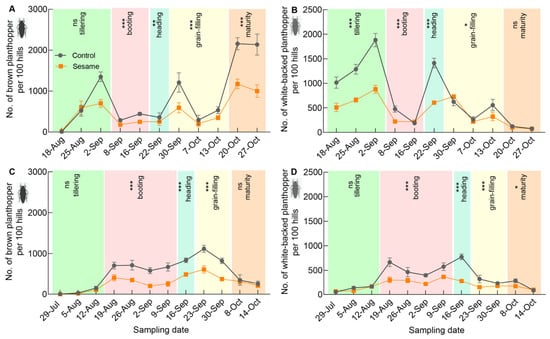
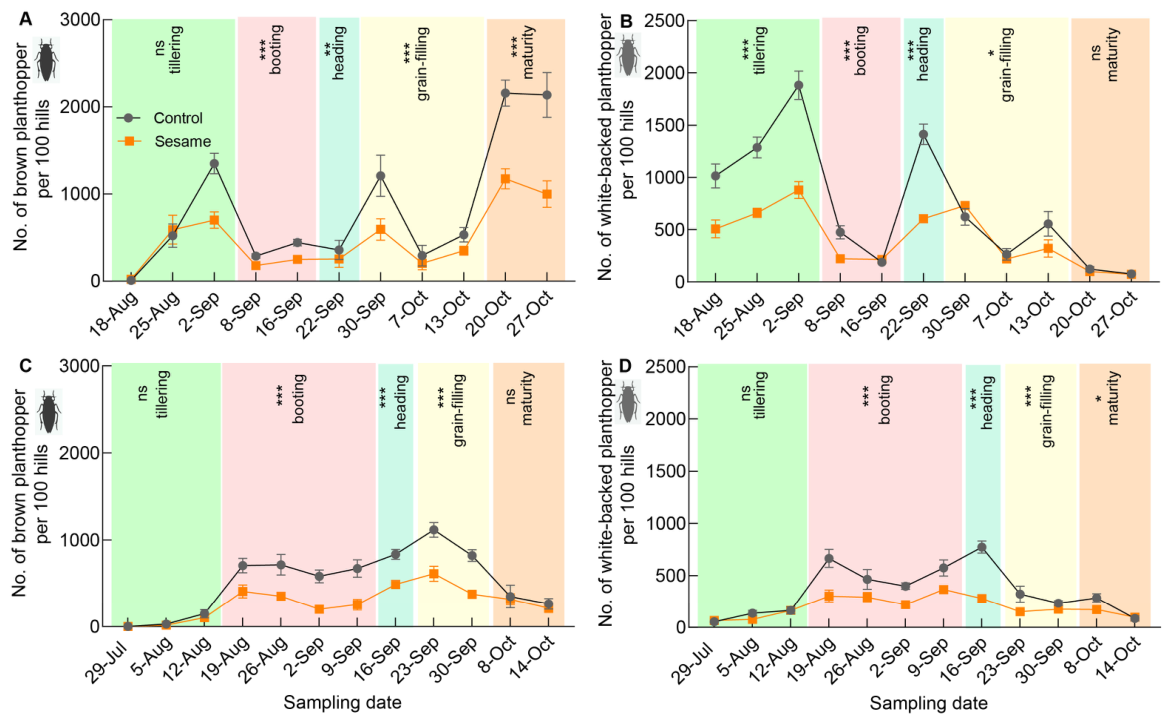
Cumulative total captures of focal piercing-sucking pests across the two-year sampling period are presented in Table S1. In 2023, total captures of brown planthoppers were 11,162 (control) and 6384 (sesame bunds), and white-backed planthoppers were 9483 (control) and 5443 (sesame bunds). In 2024, total captures were 4996 (control) and 2845 (sesame bunds) for white-backed planthoppers, and 7494 (control) and 4017 (sesame bunds) for brown planthoppers. In both 2023 and 2024, the densities of brown planthoppers and white-backed planthoppers were significantly affected by sesame planted on field bunds, rice phenological stage, and their interaction (Figure 1). Brown planthoppers abundance was significantly influenced by treatment, rice phenology, and their interaction in both years (2023: Treatment, df = 1; χ2 = 135.40; p < 0.001; Rice stage, df = 4; χ2 = 1260.85; p < 0.001; Treatment: Rice stage, df = 4; χ2 = 24.34; p < 0.001; 2024: Treatment, df = 1; χ2 = 438.09; p < 0.001; Rice stage, df = 4; χ2 = 1363.79; p < 0.001; Treatment: Rice stage, df = 4; χ2 = 63.19; p < 0.001). For white-backed planthoppers: treatment, rice stage, and the treatment × rice-stage interaction all exerted significant effects in 2023 (Treatment: df = 1; χ2 = 336.04; p < 0.001; Rice stage: df = 4; χ2 = 1808.50; p < 0.001; Treatment: Rice stage: df = 4; χ2 = 85.17; p < 0.001) and 2024 (Treatment: df = 1; χ2 = 326.03; p < 0.001; Rice stage: df = 4; χ2 = 1212.60; p < 0.001; Treatment: Rice stage: df = 4; χ2 = 63.95; p < 0.001).
Figure 1.
Mean (±SE) abundance of brown planthoppers, Nilaparvata lugens (A,C), and white-backed planthoppers, Sogatella furcifera (B,D), in control and sesame-intercropped bund fields in 2023 (A,B) and 2024 (C,D). Shaded background indicates rice tillering, booting, heading, grain-filling, and maturity stages, respectively. ns p > 0.05, * p < 0.05, ** p < 0.01, *** p < 0.001.
Separate stage-wise analyses revealed that sesame-planted bunds significantly reduced the population densities of both planthoppers species mainly from the booting/heading stage through grain filling in both sampling years. By contrast, treatment effects were inconsistent at the tillering stage: only white-backed planthoppers showed a significant treatment response in 2023, whereas no significant effects were detected for either planthoppers species at tillering in 2024 (Table 1).
Table 1.
Effects of treatment (sesame intercrop vs. control) on the abundance of piercing-sucking rice pests and predatory mirid bug Cyrtorhinus lividipennis at the different rice phenological stages in 2023 and 2024. Estimates, degrees of freedom, χ2-values, and p-values are retrieved from generalized linear mixed models tested with a Wald chi-square test.
3.2. Effects of Sesame-Planted Field Bunds on Population Dynamics of the Planthopper Predator Cyrtorhinus lividipennis
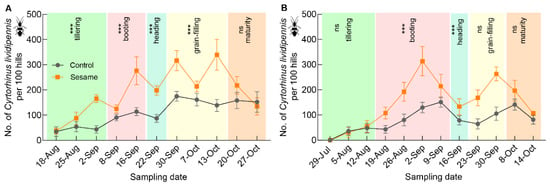
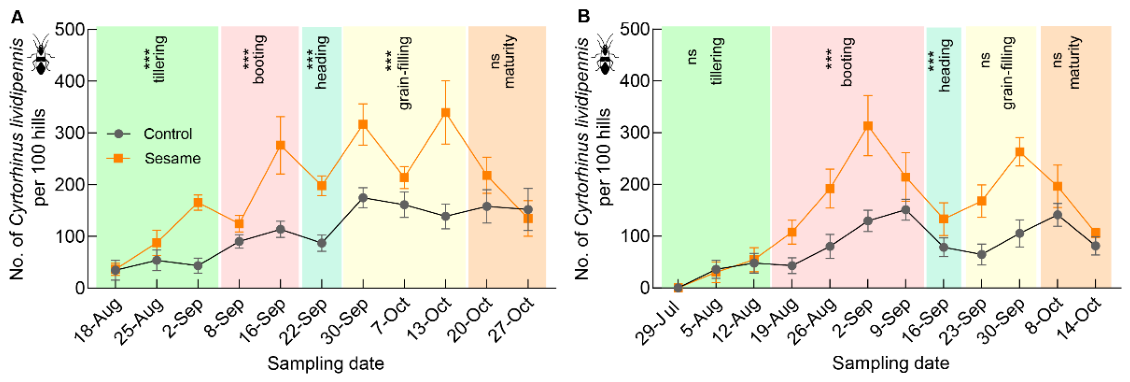
Total cumulative captures of the predatory mirid bug C. lividipennis over the two-year survey are provided in Table S1. In 2023, 2042 individuals were collected from control plots and 2845 from sesame-bund plots; in 2024, 1246 individuals were captured in control plots versus 2042 in sesame-bund plots. Both in 2023 and 2024, sesame-planted field bunds significantly increased the abundance of the predatory mirid bug C. lividipennis, alongside significant effects of rice phenological stage and the treatment-by-phenology interaction (Figure 2). In 2023, C. lividipennis density differed significantly by treatment (df = 1; χ2 = 178.55; p < 0.001), rice stage (df = 4; χ2 = 367.86; p < 0.001), and the treatment × rice-stage interaction (df = 4; χ2 = 30.04; p < 0.001). In 2024, significant effects were detected for treatment (df = 1; χ2 = 147.64; p < 0.001), rice stage (df = 4; χ2 = 319.71; p < 0.001), and the treatment-stage interaction (df = 4; χ2 = 30.12; p < 0.001). Stage-wise analyses revealed that sesame-planted bunds substantially boosted C. lividipennis populations across tillering to grain-filling stages in 2023, while significant population enhancement was restricted to booting and heading stages in 2024. At rice maturity, no significant treatment difference was detected for either planthoppers species in 2023. In 2024, a significant treatment effect was observed for brown planthoppers, while no significant difference was found for white-backed planthoppers (Table 1).
Figure 2.
Mean (±SE) abundance of the predatory mirid bug Cyrtorhinus lividipennis in control and sesame-intercropped bund fields in 2023 (A) and 2024 (B). Shaded background indicates rice tillering, booting, heading, grain-filling, and maturity stages, respectively. ns p > 0.05, *** p < 0.001.
3.3. Effects of Sesame-Planted Field Bunds on Population Dynamics of Rice Leafhoppers and Thrips
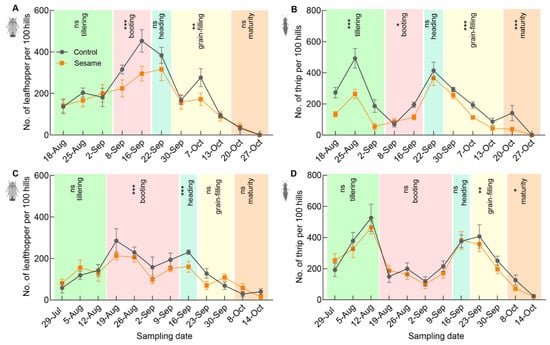
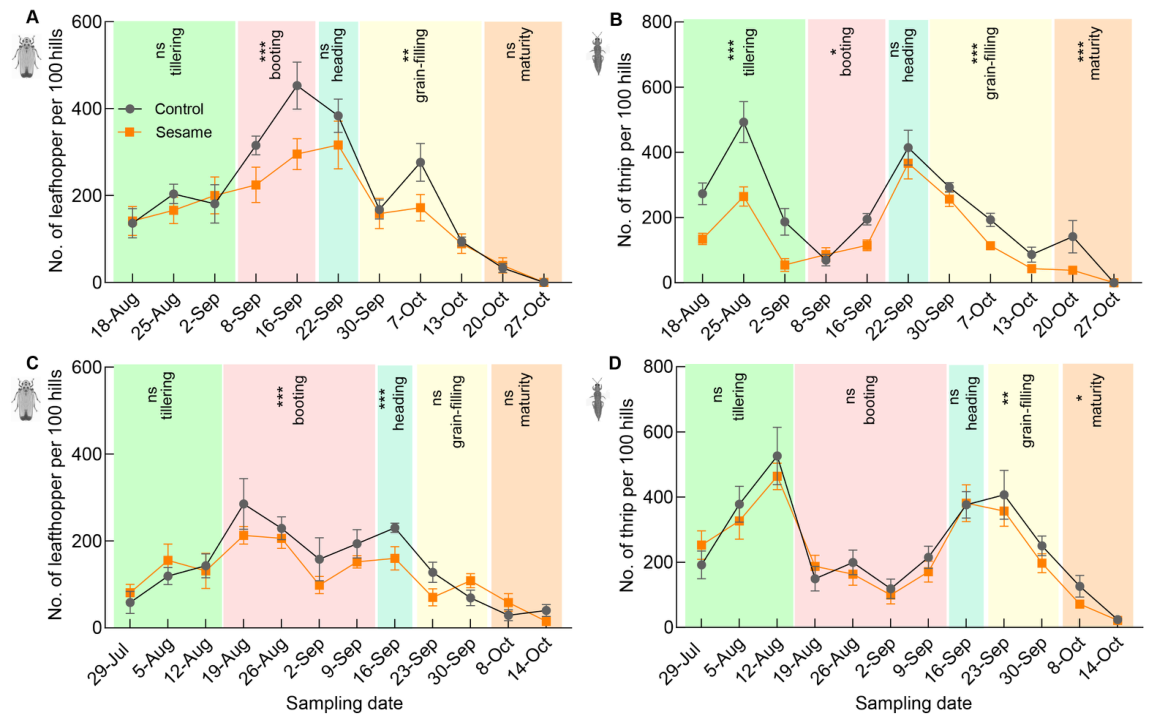
Cumulative captures of leafhoppers and thrips across the two-year survey are provided in Table S1. Total leafhopper counts were 2690 (control) and 2160 (sesame bunds) in 2023, and 2017 (control) and 1786 (sesame bunds) in 2024. For thrips, total captures were 2809 (control) and 2176 (sesame bunds) in 2023, and 3551 (control) and 3229 (sesame bunds) in 2024. Both in 2023 and 2024, leafhopper densities were significantly affected by sesame-planted field bunds, rice phenological stage, and their interaction (Figure 3A,C). In 2023, leafhopper abundance differed significantly by treatment (df = 1; χ2 = 31.59; p < 0.001), rice stage (df = 4; χ2 = 760.12; p < 0.001), and their interaction (df = 4; χ2 = 15.37; p = 0.004). Similarly, in 2024, significant effects were detected for treatment (df = 1; χ2 = 12.32; p < 0.001), rice stage (df = 4; χ2 = 433.52; p < 0.001), and the treatment–stage interaction (df = 4; χ2 = 17.97; p = 0.001). Stage-wise analyses revealed that sesame-planted bunds reduced leafhopper populations mainly at the booting and heading stages in both years, while no treatment differences were observed at tillering, grain-filling, or maturity stages (Table 1). Thrips abundance was significantly affected by sesame bund planting and rice phenology in 2023 (Figure 3B), together with a significant treatment × rice-stage interaction (Treatment: df = 1; χ2 = 104.59; p < 0.001; Rice stage: df = 4; χ2 = 637.24; p < 0.001; Treatment: Rice stage: df = 4; χ2 = 45.27; p < 0.001). In 2024, thrips density responded significantly to treatment and rice developmental stage (Figure 3D), but their interaction was not statistically significant (Treatment: df = 1; χ2 = 6.69; p = 0.010; Rice stage: df = 4; χ2 = 763.90; p < 0.001; Treatment: Rice stage: df = 4; χ2 = 6.97; p = 0.138). Stage-specific comparisons indicated that sesame-planted bunds suppressed thrips populations primarily at booting and grain-filling stages in 2023, whereas the treatment effect in 2024 was consistent across rice phenological stages without pronounced stage-dependent variation (Table 1).
Figure 3.
Mean (±SE) abundance of leafhoppers (A,C) and thrips (B,D) in control and sesame-intercropped bund fields in 2023 (A,B) and 2024 (C,D). Shaded background indicates rice tillering, booting, heading, grain-filling, and maturity stages, respectively. ns p > 0.05, * p < 0.05, ** p < 0.01, *** p < 0.001.
3.4. Molecular Assays of Predation by Cyrtorhinus lividipennis on Nilaparvata lugens Under Field Conditions
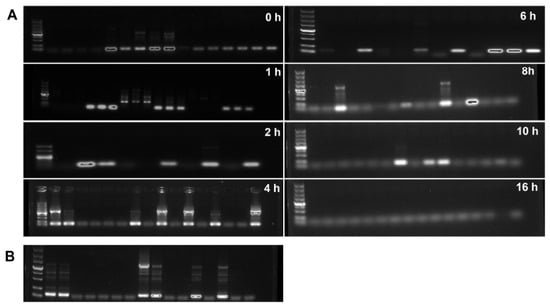
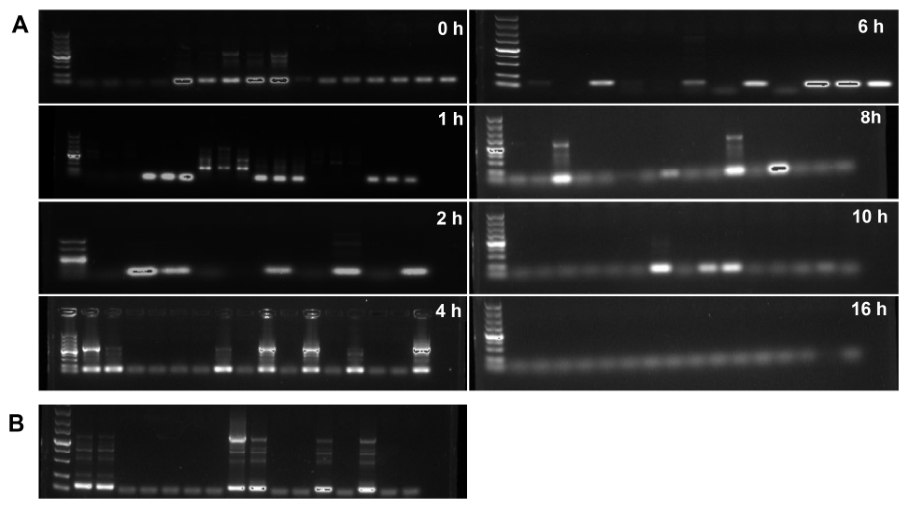
In the laboratory feeding experiment, the positive detection rate of N. lugens prey DNA within C. lividipennis guts declined progressively with increasing post-feeding digestion time (Figure 4). The prey DNA positive rate was 68.75% (11/16) at 0 h after feeding, 56.25% (9/16) at 1 h, 50.00% (5/10) at 2 h, 43.75% (7/16) at 4 h, 41.67% (5/12) at 6 h, 25.00% (4/16) at 8 h, 18.75% (3/16) at 10 h, and dropped to 0% (0/16) at 16 h post-feeding, indicating that prey DNA of N. lugens could no longer be amplified from predator gut contents after 16 h of digestion. Under field conditions, the field-collected C. lividipennis individuals yielded a N. lugens prey-DNA positive detection rate of 37.50% (6/16), providing molecular evidence for in situ predation of C. lividipennis on N. lugens in rice paddies with sesame-planted bunds.
Figure 4.
PCR-amplified products of Nilaparvata lugens DNA detected in Cyrtorhinus lividipennis adult gut contents. (A) Electrophoretic profiles from laboratory digestion assays across a time series (0–16 h post-predation). (B) Electrophoretic results for field-sampled C. lividipennis.
4. Discussion
Two consecutive years of field experiments demonstrated that planting sesame along rice field bunds significantly increased field abundances of the predatory mirid bug C. lividipennis while concurrently suppressing populations of rice planthoppers, leafhoppers, and thrips. Significant treatment-by-rice-phenology interactions were consistently detected across both experimental years, indicating that pest-suppressive and predator-boosting effects of sesame bund strips were strongly dependent on rice growth stages rather than being uniformly effective throughout the entire growing season. Complementary molecular assays provided supplementary trophic information: laboratory feeding experiments documented the time-dependent degradation pattern of N. lugens prey DNA within C. lividipennis digestive tracts, and gut-content PCR of field-collected predators yielded direct molecular confirmation of field predation on brown planthoppers. Collectively, our results highlight that bund-planted sesame exerts stage-dependent biological control services in paddy ecosystems.
The suppressive effects of sesame-planted bunds on rice planthoppers are consistent with previous reports that nectar-producing plants and habitat diversification can reduce rice planthopper populations by enhancing natural enemies [18,24,26,27]. In rice ecological engineering, sesame has been shown to benefit C. lividipennis and parasitoids of planthoppers, which can translate into stronger biological control [27,30,31]. The stronger treatment effects from booting/heading to grain filling likely reflect the phenological matching between pest population growth and natural enemy establishment. During early tillering, planthoppers densities are often relatively low, and generalist predators may still be colonizing the crop or relying on alternative prey [20,46]. As rice enters the booting and heading stages, planthoppers populations increase rapidly, and the predator populations supported by sesame nectar and pollen can exert stronger top-down control [27,31]. This stage-dependent pattern is also consistent with the idea that habitat management effects are not uniform throughout the cropping season but depend on crop phenology and natural enemy population build-up [14,21].
The increased abundance of C. lividipennis in sesame-bund plots is one of the key findings of this study. Cyrtorhinus lividipennis is a major predator of rice planthopper eggs and nymphs, and its conservation can contribute substantially to planthoppers regulation [31,38]. Sesame flowers provide nectar and pollen, which can improve predator survival, longevity, fecundity, and predation capacity [31,34,35,36,47]. In addition, rice bunds planted with sesame can serve as refuge habitats that support predator establishment and movement into the crop [20,26,27]. The population enhancement of C. lividipennis was concentrated in the middle and late rice stages, while no treatment difference occurred at maturity. This pattern may be related to rice plant nutritional quality, prey availability, and the flowering phenology of sesame. It may also reflect seasonal migration and dispersal dynamics, because C. lividipennis can co-migrate with planthoppers across regions [33]. Thus, sesame-planted bunds appear to strengthen predator populations when planthopper pressure is increasing, but the effect weakens as the rice crop matures.
Leafhopper suppression in sesame-bund plots is also broadly consistent with previous work showing that vegetation strips and diversified rice landscapes can reduce leafhopper abundance, sometimes additively with varietal resistance [20]. For thrips, however, the treatment with stage interaction was significant in 2023 but not in 2024. This indicates some year-to-year variation in the strength and stage specificity of sesame effects. Such variation may arise from differences in initial pest density, weather conditions, rice growth, or the local phenology of natural enemy communities. Therefore, the thrips results should be interpreted cautiously: sesame-planted bunds may contribute to thrips suppression, but the effect is not equally strong across years or stages. More generally, the present results do not suggest that sesame-planted bunds alone can fully suppress rice pests. Rather, they support the view that habitat management should be integrated with other IPM tactics, such as resistant varieties, rational fertilization, and reduced-risk pesticides, to achieve robust and sustainable pest control [2,20,48].
The molecular results provide an important complement to the population data. The laboratory digestion experiment showed that N. lugens prey DNA could be detected in C. lividipennis guts shortly after feeding but declined rapidly and became undetectable by 16 h. This is consistent with the general principle that prey DNA detectability is time-limited and must be interpreted within a digestion window [39,40]. The field detection rate of 37.5% demonstrates that C. lividipennis indeed consumed N. lugens in rice paddies with sesame-planted bunds. This is direct trophic evidence that complements previous reports based on population correlation or laboratory predation assays [31,39]. However, the positive detection rate should not be converted directly into predation rate or prey consumption. A positive PCR result only indicates that prey DNA was present in the gut at sampling; it does not indicate how many prey individuals were consumed, whether the predation event occurred recently, or whether the predator also fed on other prey. The detection probability is influenced by digestion time, meal size, temperature, primer sensitivity, sampling interval, and the availability of alternative prey [39,40]. The relatively limited sample size in this study further cautions against quantitative extrapolation. Therefore, the molecular evidence should be interpreted as qualitative confirmation of in-field predation, rather than a precise measure of predation intensity.
The pest-suppressive effect observed here is most likely driven by enhanced predator abundance, especially the conservation of C. lividipennis through sesame-provided floral resources and bund habitat. This is supported by the simultaneous increase in C. lividipennis and decrease in planthoppers populations, and by the molecular detection of N. lugens DNA in field-collected predators. Similar predator-mediated mechanisms have been reported for sesame and other flowering plants in rice ecosystems [18,26,27,31]. However, we cannot rule out potential behavioral effects of sesame volatile compounds on herbivores. Some plant extracts and volatile compounds can repel rice planthoppers while attracting C. lividipennis [49,50], and herbivore-induced plant volatiles can mediate natural enemy foraging [38,51]. Whether sesame itself releases behaviorally active volatiles that directly interfere with planthopper host location or reproduction was not tested in this study. Thus, a direct repellent or volatile-mediated mechanism remains a possible secondary explanation, but further behavioral and chemical ecology experiments are required before any conclusion can be drawn.
Several limitations should be acknowledged. First, the experimental fields were not treated with chemical insecticides. In real rice production, farmers often apply insecticides, which can kill natural enemies and weaken the benefits of habitat management [5,27,38,51]. Therefore, the effectiveness of sesame-planted bunds in conventionally sprayed fields may differ from that observed here. Second, the molecular analysis had a limited sample size and could provide only qualitative evidence of predation because prey DNA degrades within hours and positive rates cannot be equated with predation rates [39,40]. Additionally, in this field survey, leafhoppers and thrips were recorded as pooled functional groups rather than resolved to species level. This grouping was necessary given the constraints of rapid in-field counting, and regional surveys indicate that assemblages were dominated by Nephotettix spp. (leafhoppers) and S. biformis (thrips). Finally, only one sesame-bund configuration was evaluated. Bund width, sesame strip width, sowing date, and spatial arrangement can influence natural enemy movement and pest suppression [20,21,25,52]. The gradient effects of these design parameters were not examined.
5. Conclusions
From an applied perspective, planting sesame on rice field bunds is a low-cost and environmentally compatible habitat-management measure that can enhance C. lividipennis populations and contribute to the suppression of planthoppers, leafhoppers, and thrips. It can therefore be recommended as an auxiliary tool in rice IPM programs, particularly in ecological engineering schemes that aim to reduce pesticide dependence [18,23,53,54,55]. However, it should not be viewed as a substitute for other management tactics. Rather, it should be integrated with resistant varieties, rational water and nutrient management, and judicious pesticide use to achieve stable pest control [1,2,20]. Future research should prioritize several directions. First, multi-site and multi-year trials should verify regional applicability under diverse agroecological conditions. Second, behavioral and chemical ecology studies should examine whether sesame volatiles, nectar, or pollen directly affect C. lividipennis and pest behavior. Third, field trials should evaluate the performance of sesame-planted bunds under realistic pesticide-use scenarios, because pesticide applications may alter natural enemy populations and biological control outcomes [5,27]. Finally, future work should consider landscape context, because the effects of flower strips and habitat management can vary with landscape complexity and the composition of surrounding non-crop habitats [13,56,57,58,59]. Addressing these questions will help translate sesame-bund habitat management into a more reliable and scalable strategy for sustainable rice pest management.
Supplementary Materials
The following supporting information can be downloaded at: https://www.mdpi.com/article/10.3390/insects17101066/s1, Table S1: Total number of insect individuals (individual/100 hills) sampled across treatments and years during the two-year field survey. Total counts of brown planthoppers (Nilaparvata lugens), white-backed planthoppers (Sogatella furcifera), leafhoppers, thrips, and the predatory mirid bug Cyrtorhinus lividipennis collected from rice plots with sesame-planted bunds and control bunds in 2023 and 2024. Sampling was performed using the beat-plate method across different rice phenological stages.
Author Contributions
L.H.: methodology, formal analysis, investigation, data curation, writing—original draft, writing—review and editing; J.W.: conceptualization, methodology, software, validation, visualization, formal analysis, resources, writing—original draft, writing—review and editing; X.-W.Q.: investigation, writing—review and editing; S.W.: conceptualization, validation; H.-F.C.: resources, validation; J.-H.H.: resources, validation; Z.-X.C.: resources, validation; Z.-X.L.: conceptualization, resources, validation; F.G.: conceptualization, resources, validation; H.-Y.W.: conceptualization, methodology, project administration, resources, supervision, validation, writing—review and editing; Y.-Y.L.: conceptualization, funding acquisition, investigation, methodology, project administration, resources, supervision, validation, writing—review and editing. All authors have read and agreed to the published version of the manuscript.
Funding
This research was supported by the National Natural Science Foundation of China (32260710) and the National Key R&D Program of China (2023YFD1400800).
Data Availability Statement
The original contributions presented in this study are included in the article. Further inquiries can be directed to the corresponding authors.
Acknowledgments
We thank Séverin Hatt from Natagriwal ASBL, Belgium, for his substantial support and valuable guidance on data analysis in this study. We also thank Ke Liang, an undergraduate student at Guangdong Medical University, China, for the assistance with field surveys and data organization.
Conflicts of Interest
The authors declare no conflicts of interest.
References
- Abbas, D.; Haider, K.; Ullah, F.; Liaqat, U.; Akhtar, N.; Li, Y.B.; Hou, M.L. Molecular mechanisms of insect resistance in rice and their application in sustainable pest management. Insects 2026, 17, 111. [Google Scholar] [CrossRef] [Scilit] [PubMed]
- Gebreegziabiher, G.K.; Kou, S.; Shen, X.; Li, X.; Yang, X.; Li, S.; Huang, B.; Jiang, C.; Liu, W.; Zhu, Z.; et al. Optimizing habitat management to boost beneficial insect populations for effective rice pest control. Insects 2026, 17, 754. [Google Scholar] [CrossRef] [Scilit] [PubMed]
- Savary, S.; Willocquet, L.; Pethybridge, S.J.; Esker, P.; McRoberts, N.; Nelson, A. The global burden of pathogens and pests on major food crops. Nat. Ecol. Evol. 2019, 3, 430–439. [Google Scholar] [CrossRef] [Scilit] [PubMed]
- Lou, Y.G.; Zhang, G.R.; Zhang, W.Q.; Hu, Y.; Zhang, J. Biological control of rice insect pests in China. Biol. Control 2013, 67, 8–20. [Google Scholar] [CrossRef] [Scilit]
- Wan, N.F.; Fu, L.; Dainese, M.; Kiær, L.P.; Hu, Y.Q.; Xin, F.; Goulson, D.; Woodcock, B.A.; Vanbergen, A.J.; Spurgeon, D.J.; et al. Pesticides have negative effects on non-target organisms. Nat. Commun. 2025, 16, 1360. [Google Scholar] [CrossRef] [Scilit] [PubMed]
- Wang, Z.Z.; Ye, K.; Tong, Z.T.; Lu, Z.X.; Zhang, W.Q.; Zhu, Z.R.; Chen, X.X. Natural enemies and their applications in the biological control of major rice pests. Plant Prot. 2025, 51, 238–256. [Google Scholar]
- Zang, L.; Wang, S.; Zhang, F.; Desneux, N. Biological control with Trichogramma in China: History, present status, and perspectives. Annu. Rev. Entomol. 2021, 66, 463–484. [Google Scholar] [CrossRef] [Scilit] [PubMed]
- Gontijo, L.M.; Torres, J.B.; Abram, P.K.; Alfaro-Tapia, A.; Arredondo-Bernal, H.C.; Biondi, A.; Cloyd, R.A.; Costamagna, A.C.; Desneux, N.; D’Ottavio, M.; et al. Insect biological control: A global perspective. Entomol. Gen. 2025, 45, 879–904. [Google Scholar] [CrossRef] [Scilit]
- Qi, S.J.; Wang, J.; Zhao, J.J.; Liu, C.F.; Wang, S.; Desneux, N. Arthropod natural enemies in biological control: A systematic bibliometric analysis 2016–2025. Insects 2026, 17, 609. [Google Scholar] [CrossRef] [Scilit] [PubMed]
- Dong, Z.; Yang, Q.; Wyckhuys, K.A.G.; Ouyang, F.; Gurr, G.M.; Han, P.; Gonzalez-Chang, M.; van der Werf, W.; Men, X.; Ge, F. Use of functional plants to enhance pest biological control in farming landscapes: Progress and prospects. Entomol. Gen. 2026, 46, 21–37. [Google Scholar] [CrossRef] [Scilit]
- Wang, M.; Zhang, F.; Su, Y.; Hui, C.; Ge, F.; Zhang, Y.; Ouyang, F. Intercropping cotton with maize enhances biological control of aphids by the predatory lacewing Chrysoperla Sinica. Entomol. Gen. 2026, 46, 121–131. [Google Scholar] [CrossRef] [Scilit]
- Yan, X.; Zhang, X.; Liu, Y.; Yang, D.; Wang, H.; Zhang, Y. Enhancing agricultural biodiversity and pest control through strategic herbaceous strips: Insights from a two-year field experiment. Entomol. Gen. 2026, 46, 761–769. [Google Scholar] [CrossRef] [Scilit]
- Moreno, A.; Madrid-Lopez, W.; Maldonado-Santos, E.; Lavandero, B. Landscape context mediates the effects of flower strips on natural enemies and pest suppression in agricultural landscapes. Entomol. Gen. 2026, 46, 859–869. [Google Scholar] [CrossRef] [Scilit]
- Gurr, G.M.; Wratten, S.D.; Landis, D.A.; You, M. Habitat management to suppress pest populations: Progress and prospects. Annu. Rev. Entomol. 2017, 62, 91–109. [Google Scholar] [CrossRef] [Scilit] [PubMed]
- Lu, Z.; Zhu, P.; Gurr, G.M.; Zheng, X.; Read, D.M.Y.; Heong, K.L.; Yang, Y.; Xu, H. Mechanisms for flowering plants to benefit arthropod natural enemies of insect pests: Prospects for enhanced use in agriculture. Insect Sci. 2014, 21, 1–12. [Google Scholar] [CrossRef] [Scilit] [PubMed]
- Wang, J.; Li, S.; Yuan, W.; Hatt, S.; Fang, Y.; Jin, Z.; Wang, S. Ecological wisdom: Functional plant Cosmos bipinnata enhances fitness traits of predator Harmonia axyridis strengthening biological control in greenhouse production. Agric. Commun. 2025, 3, 100097. [Google Scholar] [CrossRef] [Scilit]
- Hatt, S.; Tan, X.; Ben Fekih, I.; Francis, F.; Noel, G.; Osawa, N.; Pan, Y.; Segers, A.; Wang, S.; Wyckhuys, K.A.G.; et al. Steering biological control through agroecosystem diversification: The case of Harmonia axyridis. Entomol. Gen. 2026, 46, 5–20. [Google Scholar] [CrossRef] [Scilit]
- Gurr, G.M.; Lu, Z.; Zheng, X.; Xu, H.; Zhu, P.; Chen, G.; Yao, X.; Cheng, J.; Zhu, Z.; Catindig, J.L.; et al. Multi-country evidence that crop diversification promotes ecological intensification of agriculture. Nat. Plants 2016, 2, 16014. [Google Scholar] [CrossRef] [Scilit] [PubMed]
- Zhang, H.; Wang, J.Y.; You, C.M.; Woodcock, B.A.; Chen, Y.J.; Wan, N.F.; Ji, X.Y. A floral resource enhances parasitoid-mediated pest control and increases rice yields. Agric. Ecosyst. Environ. 2026, 412, 110694. [Google Scholar] [CrossRef] [Scilit]
- Horgan, F.G.; Crisol Martinez, E.; Stuart, A.M.; Bernal, C.C.; de Cima Martin, E.; Almazan, M.L.P.; Fame Ramal, A. Effects of vegetation strips, fertilizer levels and varietal resistance on the integrated management of arthropod biodiversity in a tropical rice ecosystem. Insects 2019, 10, 328. [Google Scholar] [CrossRef] [Scilit] [PubMed]
- Westphal, C.; Vidal, S.; Horgan, F.G.; Gurr, G.M.; Escalada, M.; Ho Van, C.; Tscharntke, T.; Heong, K.L.; Settele, J. Promoting multiple ecosystem services with flower strips and participatory approaches in rice production landscapes. Basic Appl. Ecol. 2015, 16, 681–689. [Google Scholar] [CrossRef] [Scilit]
- Zhou, Z.Y.; Huang, X.C.; Meng, L.; Xie, T.Z.; Li, B.P. Arthropod diversity on plants at field margins of organic farming paddy rice. Chin. J. Ecol. 2011, 30, 1347–1353. [Google Scholar]
- Zhu, P.; Zheng, X.; Johnson, A.C.; Chen, G.; Xu, H.; Zhang, F.; Yao, X.; Heong, K.; Lu, Z.X.; Gurr, G.M. Ecological engineering for rice pest suppression in China. A review. Agron. Sustain. Dev. 2022, 42, 69. [Google Scholar] [CrossRef] [Scilit]
- Krishnan, M.; Sreeja, P.; Karthikeyan, K.; Revi, S. Floral resources as ecological tools to enhance natural enemies for pest management in rice ecosystem. Plant Sci. Today 2026, 13, 1–8. [Google Scholar] [CrossRef] [Scilit]
- Wang, J.; Xu, Q.; Hatt, S.; Li, S.; Di, N.; Jin, L.; Yang, H.; Desneux, N.; Wang, S. Optimizing conservation biological control through spatial arrangement of companion plants in agroecosystems. Entomol. Gen. 2026, 46, 39–47. [Google Scholar] [CrossRef] [Scilit]
- Yele, Y.; Chander, S.; Suroshe, S.S.; Nebapure, S.; Tenguri, P.; Sundaran, A.P. Ecological engineering in low land rice for brown plant hopper, Nilaparvata lugens (Stål) management. PeerJ 2023, 11, e15531. [Google Scholar] [CrossRef] [Scilit] [PubMed]
- Zhu, P.; Zheng, X.; Zhang, F.; Xu, H.; Yang, Y.; Chen, G.; Lu, Z.; Johnson, A.C.; Gurr, G.M. Quantifying the respective and additive effects of nectar plant crop borders and withholding insecticides on biological control of pests in subtropical rice. J. Pest Sci. 2018, 91, 575–584. [Google Scholar] [CrossRef] [Scilit]
- Gong, B.; Wang, J.; Hatt, S.; Desneux, N.; Wang, S.; Jin, L. Intercropping with aromatic plants enhances natural enemy communities facilitating pest suppression in tea plantations. Arthropod-Plant Interact. 2024, 18, 753–761. [Google Scholar] [CrossRef] [Scilit]
- Cui, H.; Ma, G.; Wang, Z.; Li, Y.; Li, L.; Song, Y.; Guo, W.; Lv, S.; Men, X.; Fang, O. Harnessing functional intercropping: Sorghum-cotton systems enhance biological control and boost yield. Entomol. Gen. 2026, 46, 89–97. [Google Scholar] [CrossRef] [Scilit]
- Zhu, P.; Gurr, G.M.; Lu, Z.; Heong, K.; Chen, G.; Zheng, X.; Xu, H.; Yang, Y. Laboratory screening supports the selection of sesame (Sesamum indicum) to enhance Anagrus spp. parasitoids (Hymenoptera: Mymaridae) of rice planthoppers. Biol. Control 2013, 64, 83–89. [Google Scholar] [CrossRef] [Scilit]
- Zhu, P.; Lu, Z.; Heong, K.; Chen, G.; Zheng, X.; Xu, H.; Yang, Y.; Nicol, H.I.; Gurr, G.M. Selection of nectar plants for use in ecological engineering to promote biological control of rice pests by the predatory bug, Cyrtorhinus lividipennis, (Heteroptera: Miridae). PLoS ONE 2014, 9, e108669. [Google Scholar] [CrossRef] [Scilit] [PubMed]
- Zhu, P.; Wang, G.; Zheng, X.; Tian, J.; Lu, Z.; Heong, K.L.; Xu, H.; Chen, G.; Yang, Y.; Gurr, G.M. Selective enhancement of parasitoids of rice Lepidoptera pests by sesame (Sesamum indicum) flowers. Biocontrol 2015, 60, 157–167. [Google Scholar] [CrossRef] [Scilit]
- Zhou, X.; Zhang, H.; Pan, Y.; Li, X.; Jia, H.; Wu, K. Comigration of the predatory bug Cyrtorhinus lividipennis (Hemiptera: Miridae) with two species of rice planthopper across the South China Sea. Biol. Control 2023, 179, 105167. [Google Scholar] [CrossRef] [Scilit]
- Biondi, A.; Zappala, L.; Di Mauro, A.; Garzia, G.T.; Russo, A.; Desneux, N.; Siscaro, G. Can alternative host plant and prey affect phytophagy and biological control by the zoophytophagous mirid Nesidiocoris tenuis? Biocontrol 2016, 61, 79–90. [Google Scholar] [CrossRef] [Scilit]
- Nakaishi, K.; Fukui, Y.; Arakawa, R. Reproduction of Nesidiocoris tenuis (Reuter) on Sesame. Jpn. J. Appl. Entomol. Zool. 2011, 55, 199–205. [Google Scholar] [CrossRef] [Scilit]
- Yano, E. Biological control using zoophytophagous bugs in Japan. J. Pest Sci. 2022, 95, 1473–1484. [Google Scholar] [CrossRef] [Scilit]
- Zhang, Y.-L.; Jiang, S.; Liu, Y.-Q. Assessment of the rearing efficacy and predation ability of sesame-reared Nesidiocoris tenuis. J. Environ. Entomol. 2024, 46, 807–813. [Google Scholar]
- Lou, Y.G.; Cheng, J.A. Role of rice volatiles in the foraging behaviour of the predator Cyrtorhinus lividipennis for the rice brown planthopper Nilaparvata lugens. Biocontrol 2003, 48, 73–86. [Google Scholar] [CrossRef] [Scilit]
- Wang, G.-H.; Wang, X.-Q.; Qiao, F.; Zhu, Z.-R.; Cheng, J.-A. Development and preliminary application of a triplex real-time polymerase chain reaction assay for evaluating predation on three planthoppers in a rice ecosystem. Mol. Ecol. Resour. 2013, 13, 811–819. [Google Scholar] [CrossRef] [Scilit] [PubMed]
- Sheppard, S.K.; Harwood, J.D. Advances in molecular ecology: Tracking trophic links through predator-prey food-webs. Funct. Ecol. 2005, 19, 751–762. [Google Scholar] [CrossRef] [Scilit]
- Xiao, D.; Xu, Q.X.; Chen, X.; Du, X.Y.; Desneux, N.; Thomine, E.; Dai, H.J.; Harwood, J.D.; Wang, S. Development of a molecular gut-content identification system to identify aphids preyed upon by the natural enemy Coccinella septempunctata. Entomol. Gen. 2021, 41, 591–599. [Google Scholar] [CrossRef] [Scilit]
- Wang, X.; Wang, G.; Jiang, Y.; Wu, Y.; Zhu, Z.; Cheng, J. Study on predation of spiders on brown rice planthopper Nilaparvata lugens in rice ecosystem through molecular probe method. J. Environ. Entomol. 2022, 44, 381–390. [Google Scholar]
- R Core Team. R: A Language and Environment for Statistical Computing, version 4.3.1; R Foundation for Statistical Computing: Vienna, Austria, 2023. [Google Scholar]
- Brooks, M.E.; Kristensen, K.; van Benthem, K.J.; Magnusson, A.; Berg, C.W.; Nielsen, A.; Skaug, H.J.; Mächler, M.; Bolker, B.M. glmmTMB balances speed and flexibility among packages for zero-inflated generalized linear mixed modeling. R J. 2017, 9, 378–400. [Google Scholar] [CrossRef] [Scilit]
- Fox, J.; Weisberg, S. An R Companion to Applied Regression; Sage Publications: Thousand Oaks, CA, USA, 2019. [Google Scholar]
- Settle, W.H.; Ariawan, H.; Astuti, E.T.; Cahyana, W.; Hakim, A.L.; Hindayana, D.; Lestari, A.S. Managing tropical rice pests through conservation of generalist natural enemies and alternative prey. Ecology 1996, 77, 1975–1988. [Google Scholar] [CrossRef] [Scilit]
- Wu, L.J.; Xu, X.F.; Qin, Y.; Zhao, D.K.; Wang, X.P.; Miao, Y.Y.; Liu, X.W.; Lu, Z.X.; Zhu, P.Y. Impact of some nectar producing plants on the longevity, fecundity, and predatory efficiency of Tytthus chinensis. Chin. J. Appl. Entomol. 2025, 62, 646–653. [Google Scholar]
- Wan, N.F.; Woodcock, B.A.; Scherber, C.; Wyckhuys, K.A.G.; Li, Z.; Qian, X. Leaving synthetic pesticides behind. Science 2025, 388, 712–713. [Google Scholar] [CrossRef] [Scilit] [PubMed]
- Khan, M.M.; Huang, Q.; Wagan, T.A.; Hua, H.; Cai, W.; Zhao, J. Behavioral response of Nilaparvata lugens (Stal), Cyrtorhinus lividipennis Reuter and Paederus fuscipes Curtis to three synthetic volatile chemical compounds. J. Asia-Pac. Entomol. 2020, 23, 269–276. [Google Scholar] [CrossRef] [Scilit]
- Zhao, J.; Farid, I.M.; Long, M.; Elgizawy, K.; Ren, Z.; Cai, W.; Ma, W.; Hua, H. The repellent activities of plant ethanolic extracts and their derived compounds against three species of rice planthoppers and their potential side-effects on the main predator, Cyrtorhinus lividipennis. J. Pest Sci. 2024, 97, 897–909. [Google Scholar] [CrossRef] [Scilit]
- Chang, X.; Guo, Y.; Xie, Y.; Ren, Y.; Bi, Y.; Wang, F.; Fang, Q.; Ye, G. Rice volatile compound (E)-β-caryophyllene induced by rice dwarf virus (RDV) attracts the natural enemy Cyrtorhinus lividipennis to prey on RDV insect vectors. Pest Manag. Sci. 2024, 80, 874–884. [Google Scholar] [CrossRef] [Scilit] [PubMed]
- Zhang, W.; Huang, S.; Zhang, Y.; Han, G.; Zhou, X.; Zhang, J.; Ge, F.; Cai, Z. Linking flower strip-based floral resource provisioning to predator dispersal and multi-species aphid control in cotton. Entomol. Gen. 2026, 46, 893–901. [Google Scholar] [CrossRef] [Scilit]
- Wang, J.; Li, S.; Fang, Y.; Zhang, F.; Jin, Z.Y.; Desneux, N.; Wang, S. Enhanced and sustainable control of Myzus persicae by repellent plants in organic pepper and eggplant greenhouses. Pest Manag. Sci. 2022, 78, 428–437. [Google Scholar] [CrossRef] [Scilit] [PubMed]
- Yang, Q.; Li, Z.; Ouyang, F.; Men, X.; Zhang, K.; Liu, M.; Guo, W.; Zhu, C.; Zhao, W.; Reddy, G.V.P.; et al. Flower strips promote natural enemies, provide efficient aphid biocontrol, and reduce insecticide requirement in cotton crops. Entomol. Gen. 2023, 43, 421–432. [Google Scholar] [CrossRef] [Scilit]
- Zhang, X.; Cai, Z.; Wang, Y.; Han, G.; Liang, X.; Li, Z.; Xiao, Y.; Ge, F. Functional flower strip intercropping enhances predator attraction and aphid suppression in apple orchards. Entomol. Gen. 2026, 46, 945–954. [Google Scholar] [CrossRef] [Scilit]
- Hatt, S.; Doering, T.F. The interplay of intercropping, wildflower strips and weeds in conservation biological control and productivity. J. Pest Sci. 2025, 98, 159–174. [Google Scholar] [CrossRef] [Scilit]
- Novaes, D.R.; Baraldini, J.G.N.; Togni, P.H.B. Spatial scale mismatches between pest and natural enemies challenge conservation biological control in tropical organic agroecosystems. J. Pest Sci. 2026, 99, 79. [Google Scholar] [CrossRef] [Scilit]
- Todd, L.E.; Suchoff, D.H.; Levenson, H.K. A survey of beneficial insects in Southeast USA sesame (Lamiales: Pedaliaceae) fields. Environ. Entomol. 2026, 55, nvag041. [Google Scholar] [CrossRef] [Scilit] [PubMed]
- Wan, N.F.; Li, M.; Shen, S.; Zhou, J.X.; Zhu, Y.T.; Woodcock, B.A.; Hu, Y.Q.; Nakagawa, S.; Tilman, D.; Hector, A.; et al. Plant diversity modifies multi-trophic interactions in croplands, grasslands and forests. Sci. Adv. 2026, 12, eaeb8680. [Google Scholar] [CrossRef] [Scilit] [PubMed]

Disclaimer/Publisher’s Note: The statements, opinions and data contained in all publications are solely those of the individual author(s) and contributor(s) and not of MDPI and/or the editor(s). MDPI and/or the editor(s) disclaim responsibility for any injury to people or property resulting from any ideas, methods, instructions or products referred to in the content. |
© 2026 by the authors. Licensee MDPI, Basel, Switzerland. This article is an open access article distributed under the terms and conditions of the Creative Commons Attribution (CC BY) license.