You are currently viewing a new version of our website. To view the old version click .

Insects, Volume 12, Issue 8

August 2021 - 100 articles

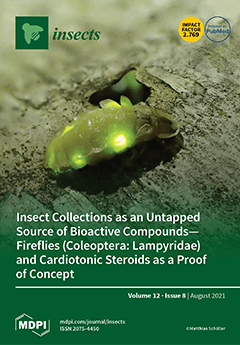
Cover Story: Insect collections represent a global repository with billions of dried specimens. Being highly sought-after by predators, insects possess a tremendous variety of defensive compounds. Many insect-derived metabolites are of pharmacological interest and can also be used to test evolutionary hypotheses. This study used museum specimens of fireflies (Coleoptera: Lampyridae) to test for the occurrence of toxic bufadienolides. Toxins, including five novel compounds, were found in 21 firefly species. Some of the specimens were more than 100 years old, demonstrating that even very old specimens contain extractable natural products. Due to the use of a non-destructive approach, the study shows that chemical analysis and the preservation of valuable specimens are not in conflict. View this paper
  • Issues are regarded as officially published after their release is announced to the table of contents alert mailing list .
  • You may sign up for email alerts to receive table of contents of newly released issues.
  • PDF is the official format for papers published in both, html and pdf forms. To view the papers in pdf format, click on the "PDF Full-text" link, and use the free Adobe Reader to open them.

Articles (100)

  • Article
  • Open Access
3 Citations
2,900 Views
12 Pages

23 August 2021

To determine the significance of mitochondrial genome characteristics in revealing phylogenetic relationships and to shed light on the molecular evolution of the Coeliadinae species, the complete mitochondrial genomes (mitogenomes) of five Coeliadina...

  • Article
  • Open Access
41 Citations
5,709 Views
11 Pages

Baseline Susceptibility of Spodoptera frugiperda Populations Collected in India towards Different Chemical Classes of Insecticides

  • Mahesh Kulye,
  • Sonja Mehlhorn,
  • Debora Boaventura,
  • Nigel Godley,
  • Sreedevi Kodikoppalu Venkatesh,
  • Thimmaraju Rudrappa,
  • Tara Charan,
  • Dinesh Rathi and
  • Ralf Nauen

23 August 2021

Fall armyworm (FAW), Spodoptera frugiperda, is a major pest of maize in the Americas and recently invaded the Eastern hemisphere. It was first detected in India in 2018 and is considered a major threat to maize production. FAW control largely relies...

  • Article
  • Open Access
16 Citations
4,950 Views
14 Pages

Nutritional Composition of Honey Bee Drones of Two Subspecies Relative to Their Pupal Developmental Stages

  • Sampat Ghosh,
  • Pascal Herren,
  • Victor Benno Meyer-Rochow and
  • Chuleui Jung

23 August 2021

We examined the contents of nutritional importance, i.e., amino acids, fatty acids and minerals of different developmental stages of drones of two honey bee subspecies, namely Apis mellifera carnica and A. m. mellifera. The results revealed that, in...

  • Article
  • Open Access
8 Citations
4,690 Views
11 Pages

23 August 2021

Each fall, monarch butterflies in eastern North America undergo an extraordinary long-distance migration to wintering areas in central Mexico, where they remain until returning northward in the spring. Migrants survive the overwintering period by met...

  • Article
  • Open Access
3 Citations
2,893 Views
11 Pages

Taxonomic Description of Stenodiplosis tectori n. sp. (Diptera: Cecidomyiidae), a Seed Parasite of Cheatgrass, Anisantha tectorum, Based on Morphological and Mitochondrial DNA Data

  • Brian G. Rector,
  • Raymond J. Gagné,
  • Juan Manuel Perilla López,
  • Kirk C. Tonkel,
  • Marie-Claude Bon,
  • Fatiha Guermache and
  • Massimo Cristofaro

22 August 2021

Cheatgrass is an annual grass species from Eurasia that has become invasive in much of western North America. It has been implicated in recent increases in the frequency, size, and intensity of wildfires, contributing to severe economic, environmenta...

  • Article
  • Open Access
30 Citations
4,000 Views
16 Pages

Effect of Soy Leaf Flavonoids on Pea Aphid Probing Behavior

  • Katarzyna Stec,
  • Bożena Kordan and
  • Beata Gabryś

22 August 2021

Flavonoids detected in soybean Glycine max (L.) Merr. (Fabaceae) cause various alterations in the metabolism, behavior, and development of insect herbivores. The pea aphid Acyrthosiphon pisum (Harris) (Hemiptera: Aphididae) poses potential threat to...

  • Article
  • Open Access
6 Citations
3,272 Views
9 Pages

20 August 2021

Studies were carried out in the laboratory to understand the optimum environmental conditions at which the ectoparasitoid, Habrobracon hebetor Say (Hymenoptera: Braconidae), can paralyze and lay eggs when reared on the larvae of the stored product pe...

  • Article
  • Open Access
2 Citations
2,909 Views
22 Pages

20 August 2021

In this study, the complete mitochondrial genomes (mitogenomes) of Hestina persimilis and Hestinalis nama (Nymphalidae: Apaturinae) were acquired. The mitogenomes of H. persimilis and H. nama are 15,252 bp and 15,208 bp in length, respectively. These...

  • Article
  • Open Access
5 Citations
3,628 Views
18 Pages

20 August 2021

Aedes aegypti is a significant vector for many tropical and subtropical flavivirus diseases. Only the female mosquito transmits pathogens, while the male plays a vital role in mating and species continuity. This study explored the total proteomes of...

  • Article
  • Open Access
2 Citations
4,085 Views
22 Pages

19 August 2021

Tick cell culture facilitates research on the biology of ticks and their role as vectors of pathogens that affect humans, domestic animals, and wildlife. Because two-dimensional cell culture doesn’t promote the development of multicellular tissue-lik...

of 10

Get Alerted

Add your email address to receive forthcoming issues of this journal.

XFacebookLinkedIn
Insects - ISSN 2075-4450