You are currently viewing a new version of our website. To view the old version click .

Insects, Volume 12, Issue 10

October 2021 - 108 articles

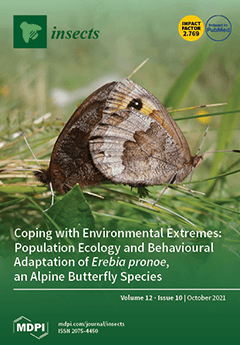
Cover Story: High alpine meadows harbour rich butterfly diversity, but this diversity is threatened by climate change and changes in agricultural practices. To understand how species can be conserved, in- depth studies of their ecological requirements are necessary. This is why we analysed the ecology of the water ringlet Erebia pronoe in a study area in the eastern central Alps near Großglockner. We analysed the behaviour, resource use and population structure of this species. In general, Erebia pronoe adults use a wide array of resources combined with a slight specialisation to avoid niche overlap with closely related species. The resulting ecological flexibility seems to be an adaptation to unpredictable environmental conditions. The combination of opportunism and modest specialisation is a good basis for coping with future changes. View this paper
  • Issues are regarded as officially published after their release is announced to the table of contents alert mailing list .
  • You may sign up for email alerts to receive table of contents of newly released issues.
  • PDF is the official format for papers published in both, html and pdf forms. To view the papers in pdf format, click on the "PDF Full-text" link, and use the free Adobe Reader to open them.

Articles (108)

  • Article
  • Open Access
10 Citations
3,155 Views
17 Pages

14 October 2021

The vATPase holoenzyme consists of two functional subcomplexes, the cytoplasmic (peripheral) V1 and the membrane-embedded V0. Both V1 and V0 sectors contain eight subunits, with stoichiometry of A3B3CDE3FG3H in V1 and ac8c’c”def(Voa1p) in V0 respecti...

  • Article
  • Open Access
10 Citations
4,220 Views
16 Pages

14 October 2021

We present an analysis of arthropod diversity patterns in native forest communities along the small elevation gradient (0–1021 m a.s.l.) of Terceira island, Azores (Portugal). We analysed (1) how the alpha diversity of Azorean arthropods responds to...

  • Article
  • Open Access
2 Citations
3,018 Views
20 Pages

Characterizing Billbug (Sphenophorus spp.) Seasonal Biology Using DNA Barcodes and a Simple Morphometric Analysis

  • Marian M. Rodriguez-Soto,
  • Douglas S. Richmond,
  • Ricardo A. Ramirez,
  • Xi Xiong and
  • Laramy S. Enders

13 October 2021

Billbugs (Sphenophorus spp.) are a complex of grass-feeding weevil species that reduce the aesthetic and functional qualities of turfgrass. Effective billbug monitoring and management programs rely on a clear understanding of their seasonal biology....

  • Article
  • Open Access
4 Citations
3,506 Views
19 Pages

13 October 2021

The Asian citrus psyllid, Diaphorina citri Kuwayama is devastating the citrus industry worldwide. It transmits ‘Candidatus Liberibacter asiaticus’, the pathogen of Huanglongbing in citrus. RNA interference is an excellent tool for functional genomics...

  • Article
  • Open Access
9 Citations
6,055 Views
12 Pages

13 October 2021

Knowledge of insect population density is crucial for establishing management and conservation tactics and evaluating treatment efficacies. Here, we propose a simple and universal method for estimating the most probable absolute population density an...

  • Article
  • Open Access
34 Citations
3,978 Views
13 Pages

Heat Shock Protein 70 Family in Response to Multiple Abiotic Stresses in the Silkworm

  • Shou-Min Fang,
  • Qian Zhang,
  • Yu-Li Zhang,
  • Gui-Zheng Zhang,
  • Ze Zhang and
  • Quan-You Yu

12 October 2021

The 70 kDa heat shock proteins play important roles in protecting organisms against environmental stresses, which are divided into stress-inducible forms (HSP70s) and heat shock cognates (HSC70s). In this study, heat shock protein 70 family was ident...

  • Article
  • Open Access
10 Citations
4,068 Views
12 Pages

12 October 2021

Asian citrus psyllid Diaphorina citri Kuwayama (Hemiptera: Psyllidae) is an important economic pest of citrus crops because it vectors the causal pathogen of huanglongbing (HLB; aka citrus greening). Population suppression of D. citri with insecticid...

  • Article
  • Open Access
7 Citations
4,510 Views
16 Pages

Responses to Developmental Temperature Fluctuation in Life History Traits of Five Drosophila Species (Diptera: Drosophilidae) from Different Thermal Niches

  • Tommaso Manenti,
  • Anders Kjærsgaard,
  • Toke Munk Schou,
  • Cino Pertoldi,
  • Neda N. Moghadam and
  • Volker Loeschcke

11 October 2021

Temperature has profound effects on biochemical processes as suggested by the extensive variation in performance of organisms across temperatures. Nonetheless, the use of fluctuating temperature (FT) regimes in laboratory experiments compared to cons...

  • Article
  • Open Access
14 Citations
2,928 Views
15 Pages

11 October 2021

Bark beetles overcome the toxic terpenoids produced by pine trees by both detoxifying and converting them into a pheromone system. Detoxification enzymes such as cytochrome P450s, glutathione S-transferases, and carboxylesterases are involved in the...

  • Article
  • Open Access
1 Citations
2,769 Views
16 Pages

11 October 2021

Effective approaches to exploiting the biomass of the abundant invasive weed Mikania micrantha Kunth are limited. Termites have been a focus of significant attention as mediators of biomass-processing owing to their ability to digest lignocellulose....

of 11

Get Alerted

Add your email address to receive forthcoming issues of this journal.

XFacebookLinkedIn
Insects - ISSN 2075-4450