You are currently viewing a new version of our website. To view the old version click .

Insects, Volume 12, Issue 10

October 2021 - 108 articles

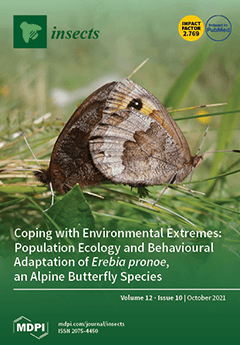
Cover Story: High alpine meadows harbour rich butterfly diversity, but this diversity is threatened by climate change and changes in agricultural practices. To understand how species can be conserved, in- depth studies of their ecological requirements are necessary. This is why we analysed the ecology of the water ringlet Erebia pronoe in a study area in the eastern central Alps near Großglockner. We analysed the behaviour, resource use and population structure of this species. In general, Erebia pronoe adults use a wide array of resources combined with a slight specialisation to avoid niche overlap with closely related species. The resulting ecological flexibility seems to be an adaptation to unpredictable environmental conditions. The combination of opportunism and modest specialisation is a good basis for coping with future changes. View this paper
  • Issues are regarded as officially published after their release is announced to the table of contents alert mailing list .
  • You may sign up for email alerts to receive table of contents of newly released issues.
  • PDF is the official format for papers published in both, html and pdf forms. To view the papers in pdf format, click on the "PDF Full-text" link, and use the free Adobe Reader to open them.

Articles (108)

  • Review
  • Open Access
3 Citations
3,341 Views
14 Pages

18 October 2021

Lupins (Lupinus spp.) are an ancient yet important legume crop. In Europe, the protein-rich seeds serve as livestock feed and have the potential to be a healthy vegetarian component of human diets. In some regions in north-eastern Europe, lupins are...

  • Article
  • Open Access
8 Citations
3,717 Views
25 Pages

NO Synthesis in Immune-Challenged Locust Hemocytes and Potential Signaling to the CNS

  • Stella Bergmann,
  • Jan-Phillipp Gerhards,
  • Anne Schmitz,
  • Stefanie C. Becker and
  • Michael Stern

18 October 2021

Similar to vertebrates, insects are exposed to a broad variety of pathogens. The innate insect immune system provides several response mechanisms such as phagocytosis, melanization, and the synthesis of antimicrobial or cytotoxic compounds. The cytot...

  • Review
  • Open Access
5 Citations
3,801 Views
23 Pages

17 October 2021

The record of immature insects from the non-marine Purbeck and Wealden groups (Lower Cretaceous) of southern England is reviewed and expanded. Fossils of adult terrestrial insects are locally common, but terrestrial immature remains are restricted to...

  • Article
  • Open Access
13 Citations
3,366 Views
11 Pages

Parasite Prevalence May Drive the Biotic Impoverishment of New England (USA) Bumble Bee Communities

  • Anne L. Averill,
  • Andrea V. Couto,
  • Jeremy C. Andersen and
  • Joseph S. Elkinton

16 October 2021

Numerous studies have reported a diversity of stressors that may explain continental-scale declines in populations of native pollinators, particularly those in the genus Bombus. However, there has been little focus on the identification of the local-...

  • Article
  • Open Access
10 Citations
2,999 Views
18 Pages

15 October 2021

The variegated cutworm Peridroma saucia (Hübner) is a worldwide pest that causes serious damage to many crops. To recognize sex pheromones and host plant volatiles, insects depend on olfactory chemoreception involving general odorant-binding proteins...

  • Review
  • Open Access
20 Citations
9,428 Views
11 Pages

15 October 2021

There has been a resurgence in the cultivation of industrial hemp, Cannabis sativa L., in the United States since its recent legalization. This may facilitate increased populations of arthropods associated with the plant. Hemp pests target highly mar...

  • Review
  • Open Access
29 Citations
7,408 Views
16 Pages

Biodiversity in and around Greenhouses: Benefits and Potential Risks for Pest Management

  • Gerben J. Messelink,
  • Jérôme Lambion,
  • Arne Janssen and
  • Paul C. J. van Rijn

14 October 2021

One of the ecosystem services of biodiversity is the contribution to pest control through conservation and stimulation of natural enemies. However, whether plant diversity around greenhouses is beneficial or a potential risk is heavily debated. In th...

  • Article
  • Open Access
3 Citations
2,933 Views
26 Pages

14 October 2021

A comparative morphological study of the members of the subgenus Metallotimarcha revealed that Caucasian Timarcha hummelii is a separate species, which differs from European members of the subgenus (T. metallica, T. corinthia, T. gibba) by the intern...

  • Article
  • Open Access
13 Citations
3,202 Views
18 Pages

Full-Length SMRT Transcriptome Sequencing and SSR Analysis of Bactrocera dorsalis (Hendel)

  • Huili Ouyang,
  • Xiaoyun Wang,
  • Xialin Zheng,
  • Wen Lu,
  • Fengping Qin and
  • Chao Chen

14 October 2021

Bactrocera dorsalis (Hendel), as one of the most notorious and destructive invasive agricultural pests in the world, causes damage to over 250 different types of fruits and vegetables throughout tropical and subtropical areas. PacBio single-molecule...

  • Article
  • Open Access
12 Citations
4,562 Views
15 Pages

Monitoring Mitochondrial Function in Aedes albopictus C6/36 Cell Line during Dengue Virus Infection

  • María E. Santana-Román,
  • Paola Maycotte,
  • Salvador Uribe-Carvajal,
  • Cristina Uribe-Alvarez,
  • Nayeli Alvarado-Medina,
  • Mohsin Khan,
  • Aleem Siddiqui and
  • Victoria Pando-Robles

14 October 2021

Aedes aegypti and Aedes albopictus mosquitoes are responsible for dengue virus (DENV) transmission in tropical and subtropical areas worldwide, where an estimated 3 billion people live at risk of DENV exposure. DENV-infected individuals show symptoms...

of 11

Get Alerted

Add your email address to receive forthcoming issues of this journal.

XFacebookLinkedIn
Insects - ISSN 2075-4450