You are currently on the new version of our website. Access the old version .

Insects, Volume 10, Issue 2

February 2019 - 26 articles

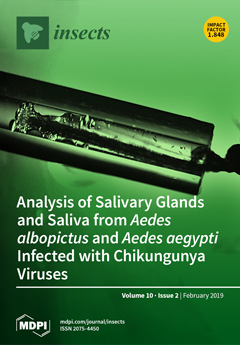
Cover Story: Analysis of salivary glands and saliva from Aedes albopictus and Aedes aegypti infected with chikungunya viruses. Saliva collection (cover) from an Aedes al. infected with Chikungunya virus (CHIKV). The proboscis of the mosquito is inserted into a micropipette containing oil to collect saliva. This study shows that if introduced in the western hemisphere, some CHIKV genotypes may pose even a greater risk of transmission by both Aedes species. View this paper
  • Issues are regarded as officially published after their release is announced to the table of contents alert mailing list .
  • You may sign up for email alerts to receive table of contents of newly released issues.
  • PDF is the official format for papers published in both, html and pdf forms. To view the papers in pdf format, click on the "PDF Full-text" link, and use the free Adobe Reader to open them.

Articles (26)

  • Article
  • Open Access
35 Citations
9,706 Views
14 Pages

Mosquito Larvicidal Activity of the Essential Oils of Erechtites Species Growing Wild in Vietnam

  • Nguyen Huy Hung,
  • Prabodh Satyal,
  • Ho Viet Hieu,
  • Nguyen Thi Hong Chuong,
  • Do Ngoc Dai,
  • Le Thi Huong,
  • Thieu Anh Tai and
  • William N. Setzer

3 February 2019

Mosquito-borne infections are a constant problem in Vietnam, and mosquito vector control is a primary approach to control these infections. Essential oils represent environmentally friendly alternatives to synthetic pesticides for mosquito control. T...

  • Article
  • Open Access
13 Citations
4,769 Views
11 Pages

Cold Response of the Mediterranean Fruit Fly (Ceratitis capitata) on a Lab Diet

  • Farhan J.M. Al-Behadili,
  • Vineeta Bilgi,
  • Junxi Li,
  • Penghao Wang,
  • Miyuki Taniguchi,
  • Manjree Agarwal,
  • Yonglin Ren and
  • Wei Xu

3 February 2019

Cold treatment at 0.0 °C with different exposure durations (0–12 days) was applied to the Mediterranean fruit fly Ceratitis capitata (Wiedemann) fed on a lab diet. The examined developmental stages were early eggs (<6 h), late eggs (>...

  • Article
  • Open Access
5 Citations
5,355 Views
9 Pages

3 February 2019

The growing awareness that microbial symbionts residing in mosquito midguts can interrupt transmission of vector-borne diseases has stimulated interest in understanding their potential role in mosquito biology. Fluorescent proteins are powerful molec...

  • Article
  • Open Access
7 Citations
5,132 Views
17 Pages

Homologs of Human Dengue-Resistance Genes, FKBP1B and ATCAY, Confer Antiviral Resistance in Aedes aegypti Mosquitoes

  • Seokyoung Kang,
  • Dongyoung Shin,
  • Derrick K. Mathias,
  • Berlin Londono-Renteria,
  • Mi Young Noh,
  • Tonya M. Colpitts,
  • Rhoel R. Dinglasan,
  • Yeon Soo Han and
  • Young S. Hong

2 February 2019

Dengue virus (DENV) is transmitted by mosquitoes and is a major public health concern. The study of innate mosquito defense mechanisms against DENV have revealed crucial roles for the Toll, Imd, JAK-STAT, and RNAi pathways in mediating DENV in the mo...

  • Case Report
  • Open Access
6 Citations
3,179 Views
5 Pages

1 February 2019

Many African termite species are true soil-feeders: how can they coexist, sometimes with high densities? How do they separate their trophic niches? Preliminary results suggest that two coexisting Cubitermes species forage in different soil layers, an...

  • Article
  • Open Access
31 Citations
6,475 Views
14 Pages

Analysis of Salivary Glands and Saliva from Aedes albopictus and Aedes aegypti Infected with Chikungunya Viruses

  • Irma Sanchez-Vargas,
  • Laura C. Harrington,
  • William C. Black and
  • Ken E. Olson

1 February 2019

Chikungunya virus (CHIKV) is a medically important mosquito-borne virus transmitted to humans by infected Aedes (Stegomyia) species. In 2013–2014, Ae. aegypti transmitted CHIKV to humans in the Caribbean and in 2005–2006, Ae. albopictus t...

  • Article
  • Open Access
42 Citations
11,951 Views
12 Pages

Fluorescent Pan Traps Affect the Capture Rate of Insect Orders in Different Ways

  • Mani Shrestha,
  • Jair E. Garcia,
  • Justin H. J. Chua,
  • Scarlett R. Howard,
  • Thomas Tscheulin,
  • Alan Dorin,
  • Anders Nielsen and
  • Adrian G. Dyer

1 February 2019

To monitor and quantify the changes in pollinator communities over time, it is important to have robust survey techniques of insect populations. Pan traps allow for the assessment of the relative insect abundance in an environment and have been promo...

  • Article
  • Open Access
7 Citations
4,464 Views
17 Pages

1 February 2019

The bamboo mosquito, Tripteroides bambusa (Yamada) (Diptera: Culicidae), is a common insect across East Asia. Several studies have looked at the ecology of Tr. bambusa developmental stages separately, but little is known about the factors associated...

  • Article
  • Open Access
15 Citations
5,455 Views
17 Pages

Proteomic Analysis of the Venom from the Ruby Ant Myrmica rubra and the Isolation of a Novel Insecticidal Decapeptide

  • John Heep,
  • Alica Klaus,
  • Tobias Kessel,
  • Maximilian Seip,
  • Andreas Vilcinskas and
  • Marisa Skaljac

1 February 2019

Ants are a biodiverse group of insects that have evolved toxic venom containing many undiscovered bioactive molecules. In this study, we found that the venom of the ruby ant Myrmica rubra is a rich source of peptides. LC-MS analysis revealed the pres...

  • Article
  • Open Access
32 Citations
7,657 Views
13 Pages

Attraction of Female Aedes aegypti (L.) to Aphid Honeydew

  • Daniel A. H. Peach,
  • Regine Gries,
  • Nathan Young,
  • Robyn Lakes,
  • Erin Galloway,
  • Santosh Kumar Alamsetti,
  • Elton Ko,
  • Amy Ly and
  • Gerhard Gries

1 February 2019

Plant sugar is an essential dietary constituent for mosquitoes, and hemipteran honeydew is one of the many forms of plant sugar that is important to mosquitoes. Many insects rely on volatile honeydew semiochemicals to locate aphids or honeydew itself...

of 3

Get Alerted

Add your email address to receive forthcoming issues of this journal.

XFacebookLinkedIn
Insects - ISSN 2075-4450