


Abstract
Graphene and its derivatives are widely recognized as effective reinforcements due to their unique mechanical, thermal and lubrication performance. Incorporation of these reinforcements into polyamide-imide (PAI) coating matrix has shown significant potential for improving the tribological performance. Here, the mechanisms underlying the tribological improvement enabled by graphene oxide (GO) are investigated via frictional experiments and molecular dynamics simulations. It was found that the coefficient of friction (COF) of PAI coating is reduced upon the addition of GO over the range of 100–400 MPa and 20–100 mm/s, with a maximum reduction of ~25% achieved at 200 MPa and 60 mm/s. Simulations reveal that the friction reduction arises from strong adhesion interactions between the embedded GO sheets and PAI molecular chains, which inhibit the shear-induced mobility of the chains during the friction process. This mechanism enables a further reduction in the COF of the GO/PAI composite coating by increasing the interfacial adhesion through the tailored modulations of surface morphology and chemistry of the GO sheets. These findings pave the way for advancing the rational design and application of graphene-based composite coatings with highly improved tribological performance.
1. Introduction
Energy conservation has emerged as a hot topic in response to the challenges of energy shortage and climate change. It was estimated that energy dissipation by friction accounts for ~1/5 of the world’s total energy consumption [1]. This considerable energy loss urgently demands the development of novel strategies for friction reduction. Polyamide-imide (PAI) coatings have attracted considerable attention due to their high mechanical strength, outstanding thermal stability and corrosion resistance, as well as excellent anti-friction and anti-wear properties [2]. These properties enable PAI coatings suitable to be employed as lubrication protective films in key tribological components, including bearings [3], gears [4], seal rings [5] and hydraulic pistons [6]. Further, improvement in the tribological performance of PAI coatings has been consistently pursued for their long service lifetime and operational reliability under increasingly harsh environments in advanced modern industries.
Recent studies have demonstrated that the tribological properties of PAI coating could be highly improved by incorporating nanoparticles, such as Ag2S [7], Cu2S [8] and graphene [9]. Among them, graphene, a two-dimensional honeycomb lattice of sp2 carbon atoms, holds great potential as a reinforcement phase due to its unique mechanical, thermal and electrical properties. For example, Chu et al. reported that the coefficient of friction (COF) of PAI coatings is decreased by 31.7% through the incorporation of 3 wt.% graphene nanoplatelets under a high load of 20 N [9]. Such friction reduction was attributed to the hardness improvement of graphene/PAI composite coatings induced by the high mechanical strength and fracture toughness of graphene [9]. In another related work [10], the tribology improvement mechanism of graphene was attributed to its high thermal conductivity, which facilitates rapid heat dissipation at friction interfaces and thereby inhibits the adhesive wear of PAI coatings at elevated temperatures. Our previous study found that the incorporation of conductive graphene nanoplatelets enhances the anti-friction properties of PAI coatings under current-carrying friction by suppressing arc discharge at friction interfaces [11]. However, these proposed enhancement mechanisms are primarily inferred from ex situ post-test analyses of the worn surfaces, which limits the understanding of structural evolution at buried friction interfaces for rational design of novel graphene-based PAI composite coatings with superior tribological performance.
To overcome such limitations, molecular dynamics (MD) simulations provide a powerful method by real-time monitoring the trajectories of individual atoms in friction systems. MD simulations have been widely used so far to establish the structure-property relationship of graphene/polymer composite coatings for the further improvement of their lubrication performance [12,13]. Li et al. thought that the interfacial adhesive strength between the embedded graphene sheets and polymer chains plays a significant role in the tribological performance of graphene/polymer-based coatings [14]. Based on this understanding, Yuan et al. bonded polyhedral oligomeric silsesquioxane molecules on graphene oxide (GO) for enhancing the interfacial adhesion, and correspondingly, the COF of GO/polyimide coating is further decreased by 12.5% after the chemical bonding [15]. Another simulation work also validates that the KH550-grafted GO has better tribology improvement on polyimide coating than GO due to the stronger interfacial adhesion between the grafted KH550 groups and the polyimide chains under the mechanical interlocking effect [16]. It is expected that the friction mechanisms elucidated through MD simulations offer crucial foundations to significantly improve the tribological performance of graphene/PAI composite coatings by tailoring the structures and properties of graphene.
In this work, we propose a multi-scale material design strategy for achieving the improved tribological performance of GO/PAI composite coatings based on the combination of friction experiments and MD simulations. GO/PAI composite coatings were prepared on a copper substrate via the high-temperature solidification method, and their friction behavior was tested under different normal loads and sliding velocities using ball-on-disk tribometry. MD simulations were performed to reveal the mechanism by which the incorporation of GO enhances the frictional performance of PAI coatings. Inspired by these mechanistic insights, a novel approach was developed to further improve the frictional performance of GO/PAI composite coatings by modulating the surface morphology and adhesion characteristics of GO. These observations provide an insight into promoting high-performance graphene/polymer-based composite coatings capable of operating in harsh conditions.
2. Methods
(1) Sample preparation
GO/PAI composite coatings were prepared on pure copper substrate by the high-temperature solidification method. The detailed parameters and steps involved in the coating preparation can be found in our previous work [11]. In brief, graphite powders with the lateral size of 1~5 μm (supplied by Xianfeng Nano Material Technology Co., Ltd., Nanjing, China ) were first oxidized via Hummer’s method. The resulting GO powders were uniformly dispersed into PAI resin (purchased from Tianyi Chemical Co., Ltd., Qinyang, China) under high-velocity mechanical stirring at 440 r/min to obtain 3 wt.% GO/PAI mixtures. These mixtures were sprayed onto a copper substrate and dried at 80 °C. Prior to the spraying, the substrate was polished and sandblasted with 280-mesh glass beads at room temperature, followed by ultrasonic washing with deionized water. The solidification of the GO/PAI composite coating was conducted at a moderate temperature of 220 ± 10 °C for 20 min to avoid thermal degradation and oxidation of PAI molecular chains. For comparison, a pure PAI coating without graphene addition was also fabricated following the same steps.
(2) Ball-on-disk friction tests
Tribological properties of GO/PAI composite coatings were evaluated using a ball-on-disk CMS tribometer (CSM Instruments, Peseux, Switzerland) in linear reciprocating modes. Copper balls were used as the sliding counterpart and slid against the sample surface for 4000 sliding cycles under ambient conditions. Prior to the friction test, the copper balls were cleaned with acetone to remove surface contaminants. A constant normal load was applied to the copper balls during the test for stable contact at the friction interfaces. The tribological performance of the coatings was quantitatively evaluated by COF, which is given by , where Ff and Fn are the friction force and normal load on the copper balls, respectively. To reduce the measurement errors, each friction test was repeated three times under the same friction conditions.
(3) Characterizations
Transmission electron microscopy equipped with energy dispersive spectroscopy (TEM/EDS) was conducted under a vacuum environment and at room temperature to identify the morphology and chemical composition of the GO particles. The types of oxygen-containing functional groups on GO particles were determined by Fourier transform infrared (FT-IR) spectroscopy at a spectrum range of 500~4000 cm−1. The microstructures of GO particles and GO/PAI composite coatings were examined by Raman spectroscopy with a spot size below 1 μm and excitation wavelength of 532 nm. The laser power in the Raman analysis was limited to 2 mW to avoid thermal effects.
(4) MD Simulations
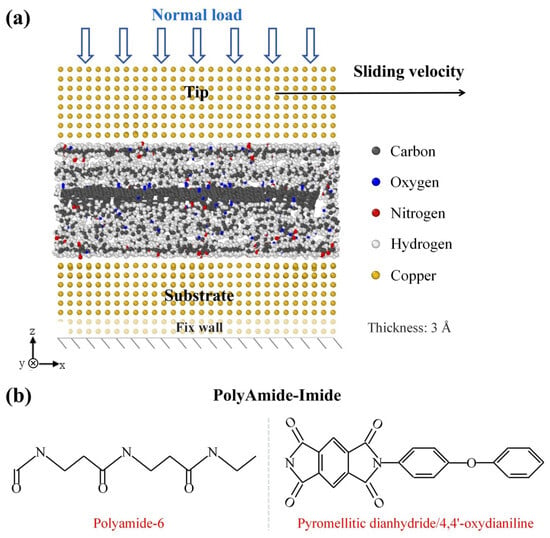
Based on the topographic geometry at friction interfaces in experiments, an atomistic model consisting of a substrate-supported GO/PAI composite coating sliding against a copper tip is constructed, as shown in Figure 1a. Oxidation is achieved by grafting oxygen-containing functional groups onto carbon atoms on both sides of the graphene surface with an oxidation degree of 5%. PAI molecular chain is composed of polyamide-6 and pyromellitic dianhydride/4,4′-oxydianiline at a molar mass ratio of 1:1 to mimic the configuration characterized by amide bonds (-CO-NH-) and imide rings (-CO-N-CO-) alternately in its backbone, as shown in Figure 1b. The GO/PAI composite coating is modeled by first placing one GO nanosheet with the in-plane size of 48.3 × 50.9 Å2 into an empty cell box. Subsequently, some PAI molecular chains are packed into the cell using the Monte Carlo method to achieve a bulk density of 1.4 g/cm3 that is close to the experimentally measured value [17]. To replicate the high-temperature solidification process used in experiments, these packed PAI molecular chains then experience a melt-quenching procedure to finally achieve a thermally equilibrated state at 300 K. Periodic boundary conditions are imposed on the x- and y-directions, while a free boundary condition is applied on the z-direction.
Figure 1.
(a) Atomistic model of a copper substrate-supported GO/PAI composite coating sliding against a copper layer tip. Carbon, oxygen, nitrogen, hydrogen and copper atoms are represented by gray, blue, red, white and yellow circles, respectively. (b) Atomic structure of PAI composed of polyamide-6 and pyromellitic dianhydride/4,4′-oxydianiline at a molar mass ratio of 1:1.
Sliding simulations are performed by applying a constant velocity to the tip along the x-direction. Throughout the siding simulations, a normal load along the z-direction is imposed on the tip to maintain contact with GO/PAI composite coatings, and the tip is treated as a rigid body without any geometry deformations. Prior to the sliding simulations, the entire sliding system is relaxed for 100 ps at 300 K for thermal equilibrium. The atoms at the bottommost layer of the copper substrate with a thickness of 3 Å are fixed to prevent the movement of the sliding system during the sliding simulations. The lateral force experienced by the tip along the sliding direction is recorded at each time step, and the friction force is calculated by averaging the lateral force over 100 consecutive time steps.
MD simulations are carried out using the open-source package Large-scale Atomic/Molecular Massively Parallel Simulator (LAMMPS) [18]. Evolution of friction interfaces is visualized by Open Visualization Tool (OVITO) [19] and Visual Molecular Dynamics (VMD) [20]. The Condensed-phase Optimized Molecular Potentials for Atomistic Simulation Studies (COMPASS) [21] force field is employed to describe the interatomic interactions, where the non-bonding interatomic interactions are modeled by a 12-6 Lennard-Jones potential [22] with the cutoff distance of 12 Å. A time step of 1 fs is used for all simulations.
3. Results
(1) Morphology and structure of as-received samples
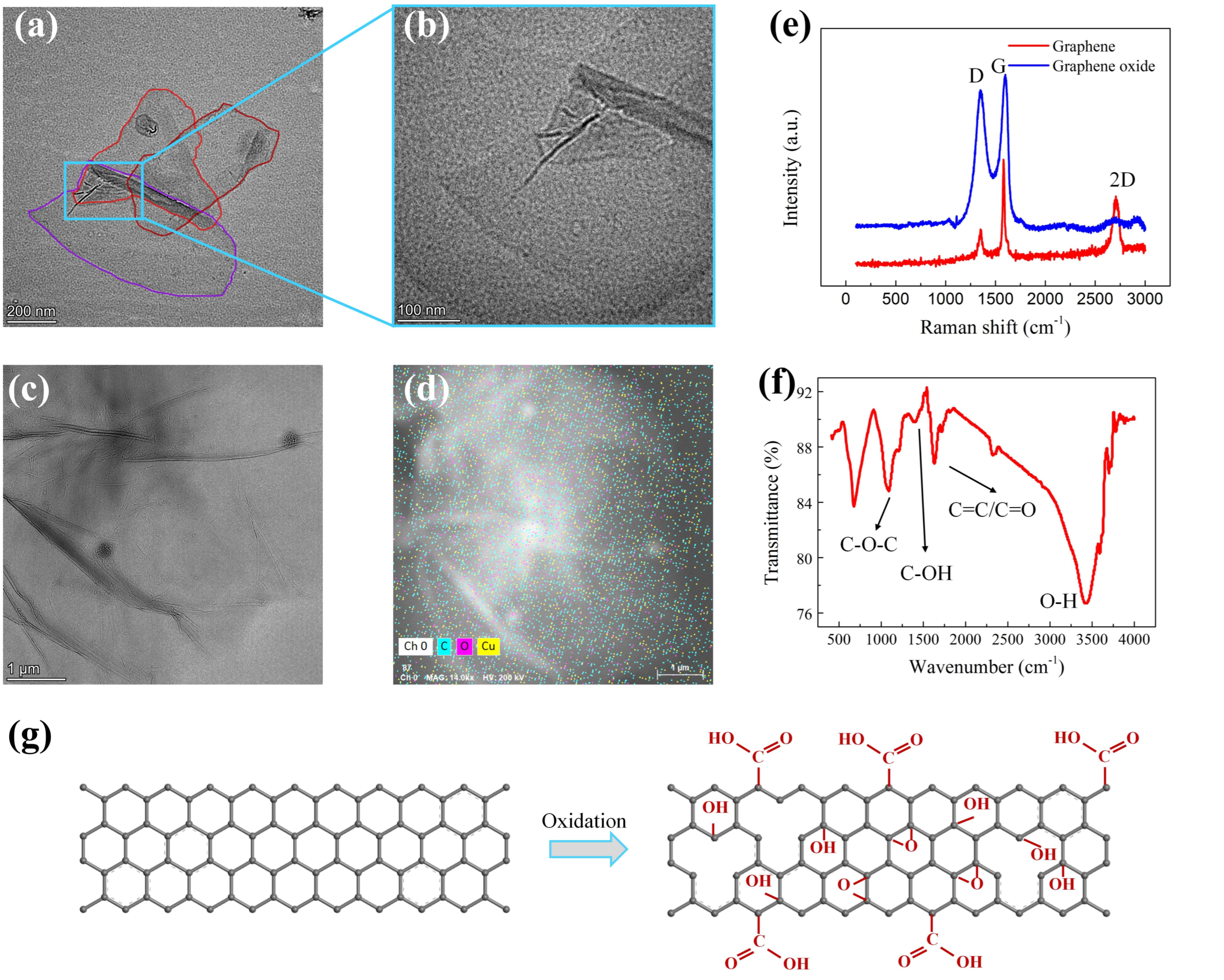
Figure 2a shows that three graphene nanoplatelets with the averaged size of ~2 μm2 are stacked within the graphite powder. These nanoplatelets exhibit a relatively flat and smooth basal plane enabled by their well-ordered sp2 carbon structure. However, a wrinkled morphology is observed at their edge domains, as shown in Figure 2b. The formation of such wrinkling can be attributed to the high surface energy at the edge induced by unsaturated dangling bonds, which is in good agreement with findings reported in simulations [23]. The oxidation treatment would increase the number of wrinkling structures in the basal plane of the graphene nanoplatelets, as shown in Figure 2c. This morphological evolution might be explained by the further increase in surface energy due to the strong electrostatic repulsion between the negatively charged oxygen-containing functional groups introduced during the oxidation (Figure 2d).
Figure 2.
(a) Low-resolution and (b) high-resolution TEM images of graphite powder. (c) TEM image and (d) corresponding EDS element mapping micrograph of GO powder. (e) Raman spectrum and (f) FT-IR spectrum of GO/PAI composite coatings on copper substrate. (g) Schematic of the evolution in atomic structure of graphene upon oxidation.
Figure 2e depicts Raman spectra of unoxidized graphene/PAI coating and GO/PAI coating on the copper substrate. It is shown that the Raman spectrum of unoxidized graphene/PAI composite coating exhibits three peaks at Raman shifts of ~1350, ~1560, and ~2700 cm−1, corresponding to D, G, and 2D bands, respectively. According to previous studies [24], the appearance of the D band arises from symmetry-breaking defects and disorders of the carbon network in graphene, while the G band represents the in-plane vibrational modes of sp2 carbon atoms in their intrinsic hexagonal lattice. Therefore, the appearance of a weak D band and a strong G band in the Raman spectrum indicates that graphene nanoplatelets retain a well-ordered hexagonal lattice structure with minimal atomic defects. However, substantial atomic-scale defects are introduced into the graphene lattice upon oxidation, as indicated by a rise in the intensity ratio of D and G peaks from 0.36 to 0.92.
To identify the types of atomic-scale defects generated by the oxidation process, FT-IR spectroscopy is employed to analyze the elemental composition of GO particles, as shown in Figure 2f. The absorption bands at ~1090 cm−1 and ~1400 cm−1 result from the stretching vibrations of C-O-C and C-OH groups, respectively, confirming the introduction of epoxy and hydroxyl groups onto the graphene lattice upon the oxidation [25]. The peak at ~1630 cm−1 is associated with the stretching vibration of C=C bonds in pure graphene lattice or C=O bonds from the introduced carboxyl groups [26]. The presence of these absorption bands indicates the formation of strong covalent bonding between these oxygen-containing functional groups and carbon atoms in the atomic structure of GO. Further, the broad absorption band centered at ~3420 cm−1 is assigned to the O-H stretching vibration, which arises either from the hydroxyl groups grafted on GO particles or from the water molecules absorbed at the GO surface with the improved hydrophilicity [27].
Based on the characterizations, a schematic diagram of the structural evolution in graphene during the oxidation process is presented in Figure 2e. Initially, pristine graphene exhibits a perfect two-dimensional honeycomb lattice composed of sp2 carbon atoms, which contributes to its good chemical inertness. However, the chemical activity of graphene is significantly enhanced by the introduction of sp2-sp3 hybridization defect and vacancy defect during the oxidation. These defects can serve as anchor sites for the covalent attachment of hydroxyl, carboxyl and epoxy groups on the GO surface.
(2) Friction behavior of GO/PAI coatings
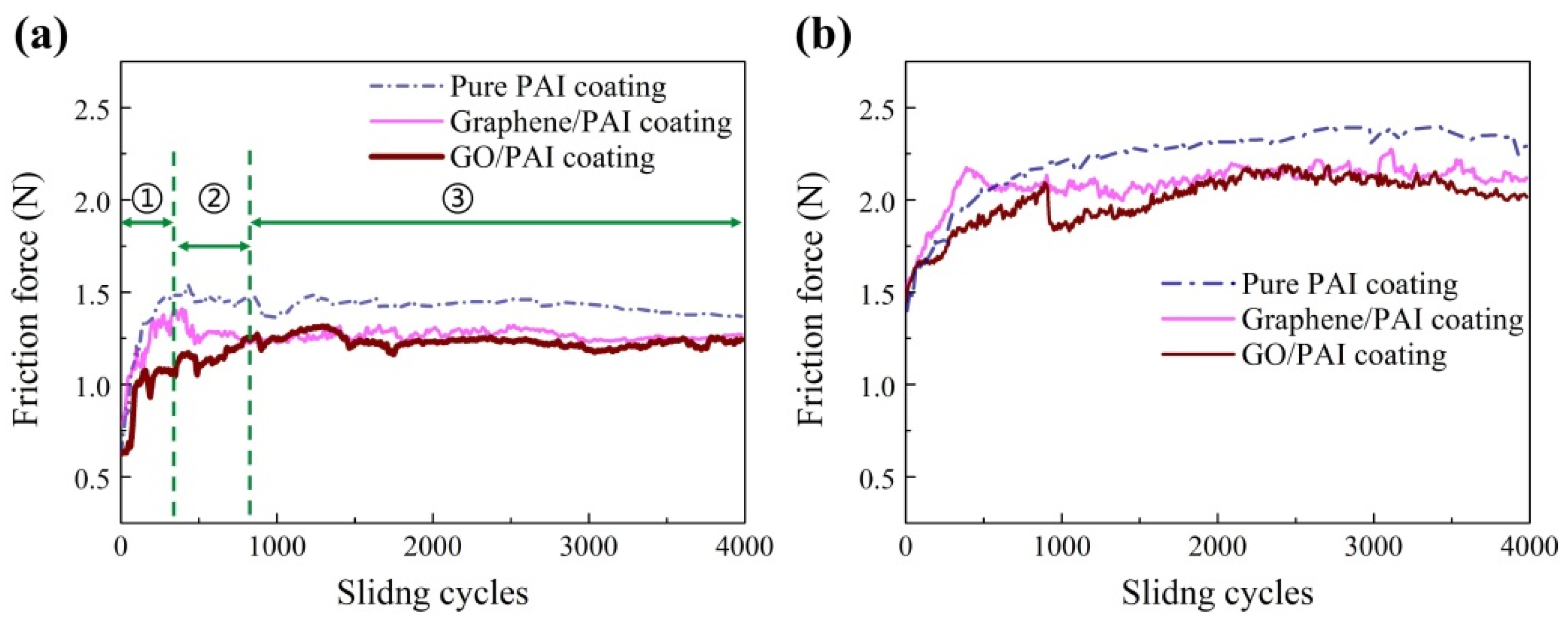
Figure 3a shows the evolution of the friction force as a function of sliding cycles for the experimental samples under an applied load of 200 MPa. Based on the evolution characteristics, the friction process can be divided into the initial rising stage, running-in stage and steady stage. During the rising stage, the friction force increases sharply, which is attributed to the high contact and shear stresses between surface asperities at the friction interface. Following the initial peak, the friction force gradually decreases. This decrease results from the progressive wear of surface asperities, which reduces the localized interfacial contact and shear stresses. Eventually, these stresses reach a stable value, leading to small fluctuations in the frictional force in the final steady stage.
Figure 3.
Friction force versus sliding cycle for pure PAI coating, unoxidized graphene/PAI composite coating and GO/PAI composite coating under normal loads of (a) 200 MPa and (b) 400 MPa.
A similar three-stage friction evolution is observed at the high load of 400 MPa, as shown in Figure 3b. When the load is increased from 200 to 400 MPa, however, the duration of the running-in stage is reduced due to the increased interfacial contact and shear stresses. It is noted that under varied loads, the friction force of PAI coating is reduced by the addition of graphene nanoplatelets and decreases further when graphene oxidation is performed. These results demonstrate that the tribological performance of the PAI coating matrix is enhanced markedly by adding GO particles.
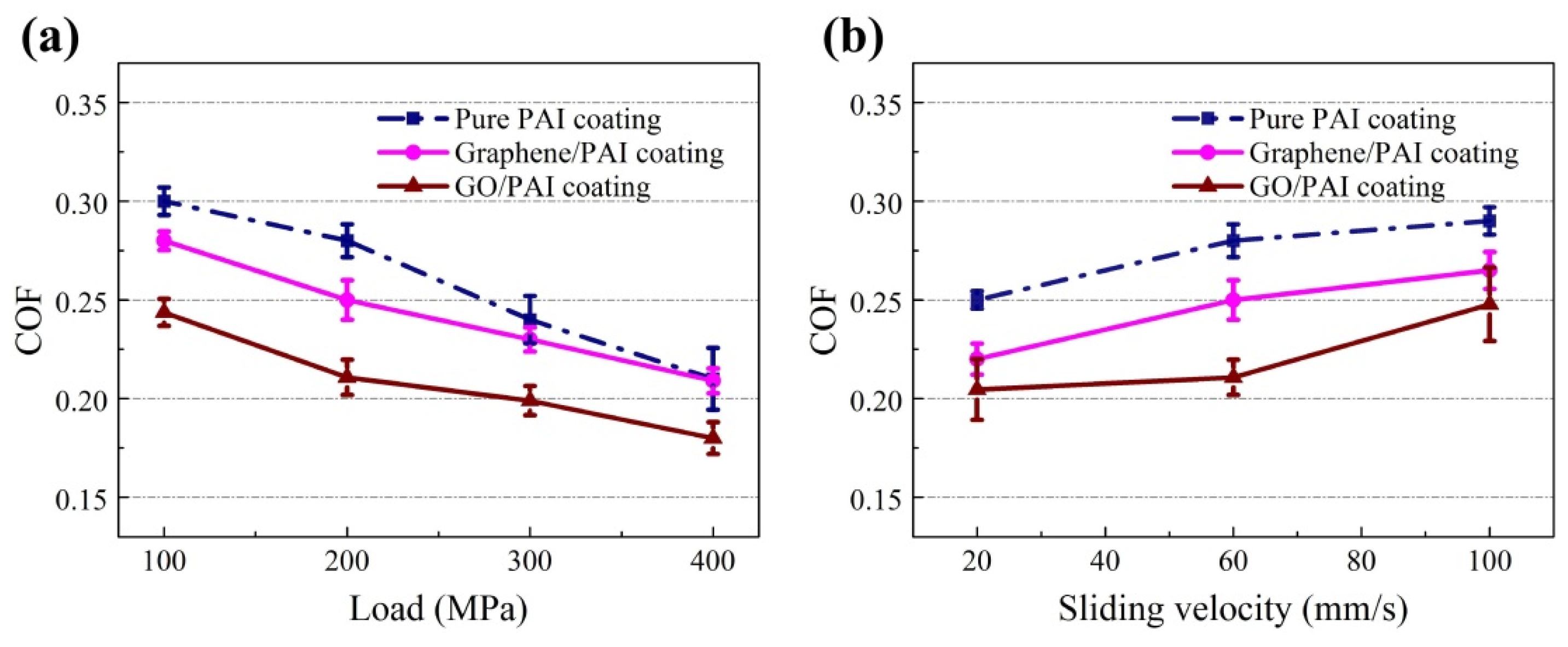
To quantitatively evaluate such tribological enhancement, COFs of pure PAI coating, unoxidized graphene/PAI composite coating and GO/PAI composite coating are calculated by recording the averaged friction force over the steady stage. Figure 4a demonstrates that the GO/PAI composite coating has the lowest COF among all tested coatings under a fixed sliding velocity of 60 mm/s. At an applied load of 200 MPa, the COF of PAI coating is reduced by 16% when graphene nanoplatelets are added, and such reduction is further enhanced to 25% upon oxidation. In addition, COFs of all three coatings exhibit a negative correlation with the load. This negative correlation is attributed to the increased number of contacted surface asperities, leading to a decrease in the contact stress on individual asperities at friction interfaces. Most importantly, this load-dependent reduction is more pronounced for the GO/PAI composite coating, which is because the embedded GO particles are rapidly exfoliated from the coating matrix to lubricate the friction interfaces.
Figure 4.
COFs of pure PAI coating, unoxidized graphene/PAI composite coating and GO/PAI composite coating under different (a) loads and (b) sliding velocities.
The friction behavior of the GO/PAI composite coating also exhibits a strong dependence on sliding velocity. Figure 4b shows that the COFs of all three coatings have a positive correlation with sliding velocity at a fixed load of 200 MPa. Notably, the GO/PAI composite coating maintains a lower COF than pure PAI coating and unoxidized graphene/PAI composite coating under varied sliding velocities, further demonstrating the robust tribological improvement of GO. However, the tribology improvement is degraded as the sliding velocity increases. This degradation is because wear debris containing hard GO particles would accumulate at friction interfaces to act as three-body abrasive particles. Overall, these results indicate that the tribology improvement of GO on PAI coating can be modulated by friction conditions, which is consistent with previously reported observations in graphene/polymer composites [10,28,29,30].
4. Discussion
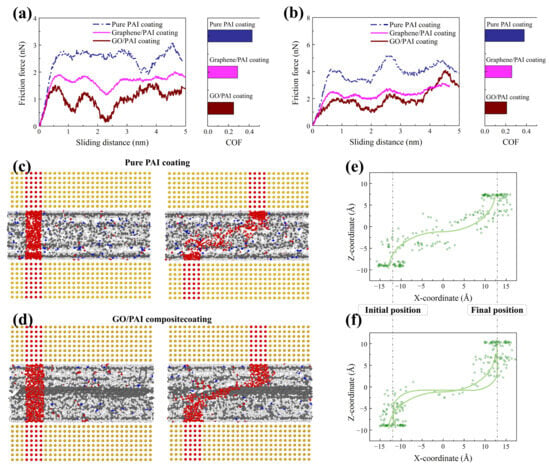
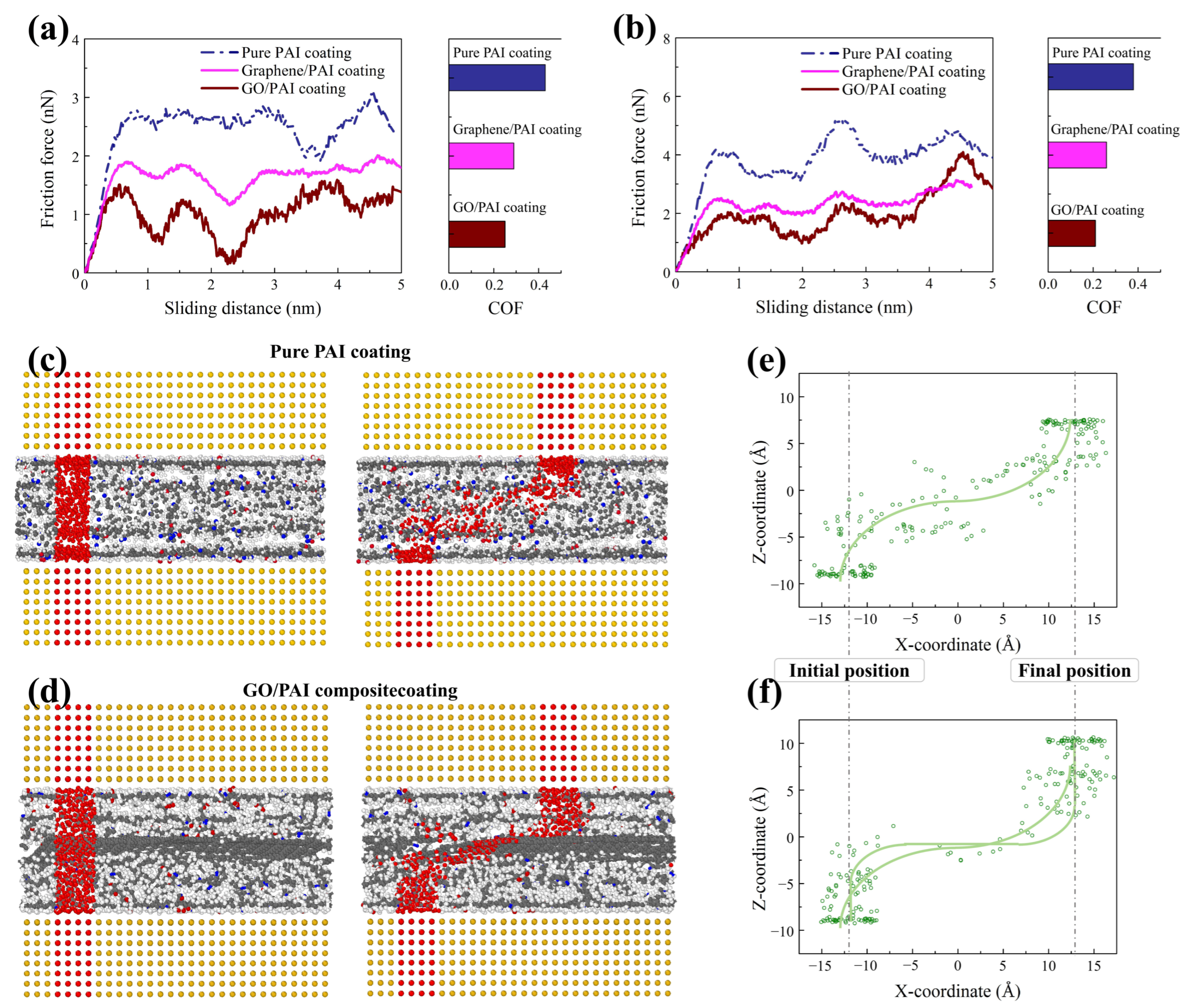
To elucidate the friction reduction mechanism of adding GO into the PAI coating matrix, the structural evolution of friction interfaces during the sliding simulations is investigated via MD simulations. It is shown that the friction forces of pure PAI coating, unoxidized graphene/PAI composite coating and GO/PAI composite coating increase sharply during the initial sliding stage, followed by a gradual stabilization with small fluctuations caused by thermal equilibrium in the sliding system (Figure 5a,b). This friction evolution, with an initial rising stage and a final steady stage, is in good consistency with that observed in friction experiments (Figure 3), which validates the reliability of our model in capturing the tribology improvement mechanism of GO. The absence of a distinct running-in stage is attributed to the geometry of single-asperity contact at friction interfaces modeled in MD simulations [16].
Figure 5.
MD simulations of friction force versus sliding distance and COF for pure PAI coating, unoxidized graphene/PAI composite coating and GO/PAI composite coating under normal loads of (a) 200 MPa and (b) 400 MPa. Snapshots of atomic configurations for (c) pure PAI coating and (d) GO/PAI composite coating at the initial and final sliding states. The red line denotes a frozen region to visualize the shear behavior of the coatings during the sliding process. Distributions of carbon atoms in the frozen region at the final sliding state for (e) pure PAI coating and (f) GO/PAI composite coating.
Based on the friction evolution characteristics, the average friction force over the final steady stage is used to calculate the COF of coatings during the sliding simulations for the quantitative comparison with those obtained from friction experiments. At a low load of 200 MPa, the COF of PAI coating is calculated to be reduced by ~20% through incorporating graphene nanoplatelets, being in good agreement with the experimental measurements (Figure 5a). Further, the friction reduction increases to ~30% when oxygen-containing functional groups are grafted onto graphene nanoplatelets embedded in PAI coating matrix. This tribology improvement of GO is observed at a high low load of 400 MPa, where the GO/PAI composite coating exhibits the lowest COF among all modeled coatings (Figure 5b). It is also noted that the COFs of all three coatings exhibit a weak dependence on the normal load, which is different from the negative load dependence observed experimentally (Figure 4). This weak dependence originates from the stable contact and shear stresses at friction interfaces modeled by single-asperity contact under varied load conditions.
The interfacial evolution behavior during the sliding simulations provides critical insights into the tribology improvement mechanism of GO. Figure 5c shows that pure PAI coating has an obvious internal shear motion when sliding against the copper tip, indicating the strong dependence of friction behavior on the shear strength of the coating. A previous study pointed out that the shear strength of polymer-based coatings is significantly improved by adding graphene-based reinforcements due to their high mechanical strength [12]. Consistent with this mechanism, the enhanced shear resistance in the GO/PAI composite coating effectively suppresses the internal shearing motion, as shown in Figure 5d.
To further reveal the mechanisms of friction reduction by incorporating GO, the motion trajectories of carbon atoms in polymer chains are monitored throughout the sliding process. Figure 5e shows that the PAI molecules at the bottom of the pure coating remain nearly fixed at their initial positions due to the interfacial adhesion with the substrate, while those on the coating surface are driven to move following the sliding copper tip. Such movement gives rise to the internal shear deformation within pure PAI coating. However, the PAI molecules on the surface of the GO/PAI composite coating are inhibited from moving under the adhesion effect of the embedded GO sheets, as shown in Figure 5f. The inhibition reduces the internal shearing in the composite coating, which is responsible for its lower COF.
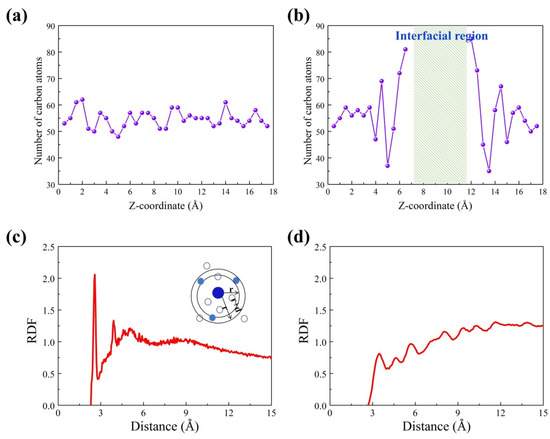
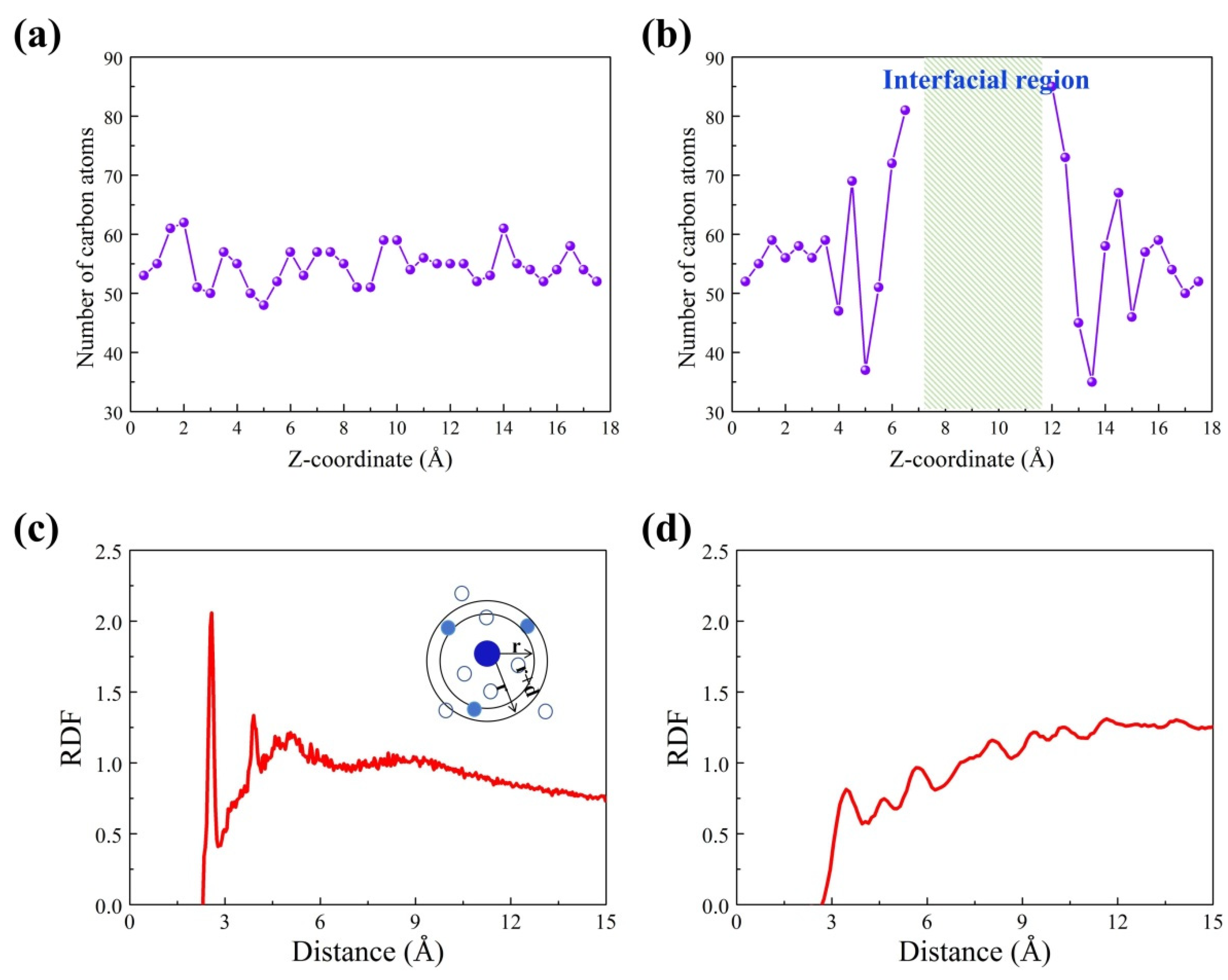
The friction behavior of graphene/polymer-based composite coating was previously reported to be highly dependent on its microstructure [31]. Figure 6a reveals that carbon atoms in the polymer chains are uniformly distributed along the z-direction for pure PAI coating, confirming its amorphous nature as reported in a previous study [32]. For GO/PAI composite coating, an interfacial region is formed around the GO sheets, which is characterized by a local aggregation of carbon atoms in the polymer chains caused by the non-bonding carbon-carbon interatomic adhesive interactions between the GO sheets and the polymer chains.
Figure 6.
Number of carbon atoms in polymer chains along the z-direction for (a) pure PAI coating and (b) GO/PAI composite coating. The shaded region in (b) indicates the formation of an interfacial region between GO sheets and PAI molecular chains. Radial distribution function of carbon-carbon atom pairs for (c) pure PAI coating and (d) GO/PAI composite coatings. The inset in (c) depicts a schematic of the calculation for the radial distribution function.
The effect of GO incorporation on the microstructure of PAI coating is quantitatively evaluated by the radial distribution function of carbon-carbon atom pairs in PAI coating, which is given by:
where r represents interatomic distance, dN denotes the number of carbon atoms at interatomic distance ranging from r and r + dr, and is the average density of the coating. Figure 6c demonstrates that the RDF curve of pure PAI coating only exhibits a single main peak at r = 2.58 Å, which corresponds to the equilibrium carbon-carbon bond length distance described in the simulations. The absence of additional peaks suggests the long-range disordered distribution of carbon atoms in pure PAI coating. For comparison, the radial distribution function of carbon-carbon atom pairs in the GO/PAI composite coating is presented in Figure 6d. It is found that multiple well-defined peaks appeared at the radial distribution function curve of the GO/PAI composite coating. This indicates the ordered distribution of carbon atoms within the composite coating, which is responsible for the increase in its shear strength through the incorporation of GO sheets.
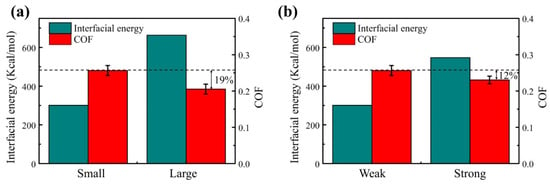
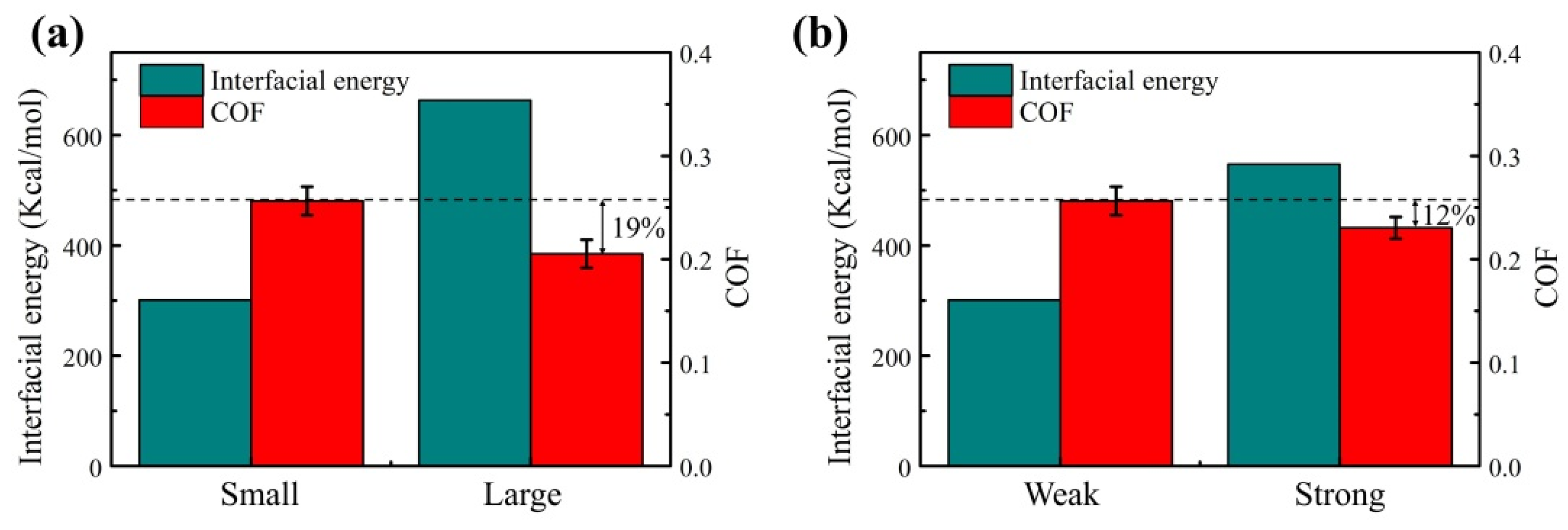
Based on the above analysis, the friction reduction by GO incorporation can be attributed to its adhesion effect on PAI molecular chains, which largely suppresses the shear-induced motion of the chains during the sliding process and thus enhances the shear strength of the GO/PAI composite coating. This mechanism also accounts for the better tribology improvement of GO than unoxidized graphene, as the highly increased adhesion enabled by mechanical locking between oxygen-containing functional groups and the PAI chains [33]. To further validate the proposed improvement mechanism, additional sliding simulations were performed to evaluate the variation in the friction behavior of the GO/PAI composite coating with the interfacial energy between the GO sheets and the PAI molecular chains. It is shown that the stronger interfacial adhesion achieved by expanding the in-plane size or increasing the surface adhesion of the GO sheets could lead to a further reduction in COF of the GO/PAI composite coating (Figure 7a,b).
Figure 7.
Validation of the tribology improvement mechanism of GO by improving the interfacial energy between GO sheets and PAI molecular chains achieved through (a) expanding the in-plane size or (b) increasing the surface adhesion of GO sheets.
5. Conclusions
In summary, the improvement mechanism of GO on the tribological properties of PAI coating is studied through the combined experiment and simulation methods. Experimental results demonstrate that the COF of PAI coating is reduced by the incorporation of graphene nanoplatelets under various normal loads and sliding velocities. At the load of 200 MPa and the velocity of 60 mm/s, the friction reduction was measured to be ~16% when graphene nanoplatelets were added into the PAI coating matrix. Such reduction is further enhanced to ~25% following graphene oxidation. Complementary MD simulations reveal that the friction reduction arises from the interfacial adhesion between the embedded graphene nanoplatelets and the PAI molecular chains, which inhibit the shear-induced motion of the chains during the friction process. Further, the introduction of oxygen-containing functional groups on GO sheets increases the interfacial adhesion, which is responsible for the lower COF of the GO/PAI composite coating than the unoxidized graphene/PAI composite coating. Based on the improvement mechanism, the anti-friction properties of the GO/PAI composite coating are further improved by modulating the interfacial adhesion through expanding the in-plane size and increasing the surface adhesion of the GO sheets. This work offers a feasible route to the low-frictional energy dissipation under the lubrication of novel GO/PAI composite coatings with improved tribological performance by the targeted surface modification of GO.
Author Contributions
Conceptualization, J.L.; Software, Y.L.; Validation, X.C.; Formal analysis, X.S. and J.Z.; Investigation, J.Z.; Data curation, X.S.; Writing—original draft, X.S. and Y.L.; Writing—review & editing, J.L. and X.C.; Supervision, J.L. and J.Z.; Funding acquisition, J.L. All authors have read and agreed to the published version of the manuscript.
Funding
This research was funded by the Natural Science Foundation of Hunan Province (Grant No. 2024JJ6060) and the National Natural Science Foundation of China (Grant No. 52405173).
Data Availability Statement
The data presented in this study are available on request from the corresponding author.
Conflicts of Interest
The authors declare no conflicts of interest.
References
- Holmberg, K.; Erdemir, A. Influence of Tribology on Global Energy Consumption, Costs and Emissions. Friction 2017, 5, 263–284. [Google Scholar] [CrossRef] [Scilit]
- Li, B.; Jiang, X.; Wan, H.; Chen, L.; Ye, Y.; Zhou, H.; Chen, J. Fabrication and Tribological Behaviors of a Novel Environmental Friendly Water-Based PAI-PTFE-LaF3 Bonded Solid Lubricating Composite Coating. Tribol. Int. 2018, 121, 400–409. [Google Scholar] [CrossRef] [Scilit]
- Mallakpour, S.; Zadehnazari, A. Synthesize Procedures, Mechanical and Thermal Properties of Thiazole Bearing Poly(amid-Imide) Composite Thin Films Containing Multiwalled Carbon Nanotubes. Colloid Polym. Sci. 2013, 291, 1525–1534. [Google Scholar] [CrossRef] [Scilit]
- Li, B.; Jiang, X.; Wan, H.; Chen, L.; Ye, Y.; Zhou, H.; Chen, J. Optimum hydrophilic modification of lanthanum trifluoride nanoparticles and their application in enhancing tribological properties of eco-friendly water-based bonded solid lubricating coatings. Tribol. Int. 2018, 125, 1–11. [Google Scholar] [CrossRef] [Scilit]
- Shen, C.; Khonsari, M.M.; Spadafora, M.; Ludlow, C. Tribological performance of polyamide-imide seal ring under seawater lubrication. Tribol. Lett. 2016, 62, 39. [Google Scholar] [CrossRef] [Scilit]
- Zhang, Y.; Chen, L.; Ma, Y.; Wu, Y.; Wang, T.; He, Q.; Gao, M. In-situ monitoring and failure mechanism of PAI/PTFE lubricating coating under salt spray tribocorrosion. Wear 2026, 593, 206601. [Google Scholar]
- Ma, Y.; Ye, Y.; Wan, H.; Chen, L.; Zhou, H.; Chen, J. In-Situ Synthesis Strategy of Monodispersed Ag2S Nanoparticles to Modify Wear Resistance of Polyamide-Imide Nanocomposite Lubricating Coatings. Tribol. Lett. 2019, 67, 118. [Google Scholar] [CrossRef] [Scilit]
- Xi, Z.; Wan, H.; Chen, L.; Zhou, H.; Chen, J. Strengthening Mechanism of In-Situ Synthesized Cu2S Nanoparticles on Tribological Performance of Polyamide-Imide Bonded Solid Lubricating Coatings. Prog. Org. Coat. 2022, 166, 106807. [Google Scholar] [CrossRef] [Scilit]
- Chu, T.; Huang, X.; Tao, G.; Zhu, J.; Luo, T.; Yi, H.; Yang, H.; Huang, A.; Peng, C.; Yang, J.; et al. Experimental Study on the Performance of High Anti-Wear Nano-Graphene Modified Polyamide-Imide Composite Coatings. Prog. Org. Coat. 2025, 204, 109201. [Google Scholar] [CrossRef] [Scilit]
- Li, B.; Jiang, X.; Wu, Y.; Wan, H.; Chen, L.; Ye, Y.; Zhou, H.; Chen, J. Green Waterborne PAI-Graphite Bonded Solid-Lubricating Coatings: Promising Lubricating Materials with Robust Mechanical and Tribological Properties. Prog. Org. Coat. 2019, 132, 211–220. [Google Scholar] [CrossRef] [Scilit]
- Li, J.; Fang, X.; Bai, L.; Zhang, J. Tribology improvement of graphene/polyamide-imide composite coating under current-carrying friction. Surf. Eng. 2025, 41, 861–870. [Google Scholar] [CrossRef] [Scilit]
- Li, P.; Hou, Y.; Chen, H.; Bai, Y.; Yang, D.; Sheng, Q.; Zhu, S.; Yu, L. Mechanical and Tribological Properties of Layered Epoxy Coatings Synergistically Enhanced by Graphene and Polytetrafluoroethylene: Molecular Dynamics Simulations and Experimental Verification. Mater. Today Commun. 2024, 40, 109892. [Google Scholar] [CrossRef] [Scilit]
- Jiao, X.; Huang, G.; Zhang, Y.; Li, J.; Peng, C.; Wang, G. Tribological Performance Under Silica Debris in PAO-Fe Interfaces: An Atomistic Study. Coatings 2026, 16, 91. [Google Scholar] [CrossRef] [Scilit]
- Li, C.; Wang, S.; Wang, Q. A molecular dynamics simulation study on enhancement of mechanical and tribological properties of polymer composites by introduction of graphene. Carbon 2017, 111, 538–545. [Google Scholar] [CrossRef] [Scilit]
- Yuan, R.; Ji, L.; Wu, Y.; Li, H.; Ju, P.; Chen, L.; Zhou, H.; Chen, J. “Plate-Anchor” Shaped POSS-Functionalized Graphene Oxide with Self-Fixing Effect in Polyimide Matrix: Molecular Dynamic Simulations and Experimental Analysis. Compos. Sci. Technol. 2019, 176, 103–110. [Google Scholar] [CrossRef] [Scilit]
- Liu, C.; Song, J.; Zhao, G.; Ding, Q. Improving Surface Wear Resistance of Polyimide by Inserting KH550 Grafted GO. Polymers 2023, 15, 2577. [Google Scholar] [CrossRef] [Scilit]
- Chalykh, A.E.; Stepanenko, V.Y.U.; Aliev, A.D. Adhesion and energy characteristics of rigid-chain polymer surface: Polyamidoimides. Polymers 2020, 12, 2956. [Google Scholar] [CrossRef] [Scilit]
- Plimpton, S. Parallel Algorithms for Short-Range Molecular Dynamics. J. Comput. Phys. 1995, 117, 119–175. [Google Scholar] [CrossRef] [Scilit]
- Stukowski, A. Visualization and Analysis of Atomistic Simulation Data with OVITO-the Open Visualization Tool. Model. Simul. Mater. Sci. Eng. 2010, 18, 015012. [Google Scholar] [CrossRef] [Scilit]
- Humphrey, W.; Dalke, A.; Schulten, K. Visual Molecular Dyanmics. J. Mol. Graph. 1996, 14, 33–38. [Google Scholar] [CrossRef] [Scilit]
- Sun, H. The COMPASS force field: Parameterization and validation for phosphazenes. Comput. Theor. Polym. Sci. 1998, 8, 229–246. [Google Scholar] [CrossRef] [Scilit]
- Girifalco, L.A.; Hodak, M.; Lee, R.S. Carbon Nanotubes, Buckyballs, Ropes, and a Universal Graphitic Potential. Phys. Rev. B 2000, 62, 13104–13110. [Google Scholar] [CrossRef] [Scilit]
- Li, C.; Tang, W.; Tang, X.-Z.; Yang, L.; Bai, L. A molecular dynamics study on the synergistic lubrication mechanisms of graphene/water-based lubricant systems. Tribol. Int. 2021, 167, 107356. [Google Scholar] [CrossRef] [Scilit]
- Li, J.; Bai, L.; Liu, B.; Tang, X.; Peng, J.; Zhou, R.; Tan, L.; Peng, Y. C60 Filling-Enabled Tribological Improvement of Graphene in Conformal Contact with a Rough Substrate. Carbon 2023, 206, 157–165. [Google Scholar] [CrossRef] [Scilit]
- Wu, H.; Zhang, Y.; Long, S.; Zhang, L.; Jie, X. Tribological Behavior of Graphene Anchored Mg-Al Layered Double Hydroxide Film on Mg Alloy Pre-Sprayed Al Coating. Appl. Surf. Sci. 2020, 530, 146536. [Google Scholar] [CrossRef] [Scilit]
- Che, Y.; Sun, Z.; Zhan, R.; Wang, S.; Zhou, S.; Huang, J. Effects of Graphene Oxide Sheets-Zirconia Spheres Nanohybrids on Mechanical, Thermal and Tribological Performances of Epoxy Composites. Ceram. Int. 2018, 44, 18067–18077. [Google Scholar] [CrossRef] [Scilit]
- Song, W.; Chen, P.; Yan, J.; Zhu, W.; Ji, H. The Tribological Properties of Reduced Graphene Oxide Doped by N and B Species with Different Configurations. ACS Appl. Mater. Interfaces 2020, 12, 29737–29746. [Google Scholar] [CrossRef] [Scilit] [PubMed]
- Yu, Z.; Pei, X.; Zhang, Y.; Wang, Q.; Wang, T. Tribological properties of polyimide composite coatings synergistically reinforced by metal-organic frameworks modified carbon fibers and graphite. Tribol. Int. 2025, 201, 110289. [Google Scholar] [CrossRef] [Scilit]
- Su, J.; Ouyang, Y.; Yin, L.; Shi, Z.; Zhou, C.; Wang, H.; Hu, B. Advancing Wind Turbine Gearbox Durability with Eco-Friendly GO Nanolubricants: CFD Simulation-Experiment Synergy for Understanding Flow Dynamics, Wear Suppression and Surface Restoration Mechanisms. Tribol. Int. 2026, 213, 111034. [Google Scholar] [CrossRef] [Scilit]
- Aliyu, I.K.; Mohammed, A.S.; Al-Qutub, A. Tribological Performance of UHMWPE/GNPs Nanocomposite Coatings for Solid Lubrication in Bearing Applications. Tribol. Lett. 2018, 66, 144. [Google Scholar] [CrossRef] [Scilit]
- Van Sang, L.; Sugimura, N.; Washizu, H. Graphene as Solid Lubricant Vertically Buried into Iron Contact Surface by Annealing for Superlubricity. Tribol. Int. 2022, 165, 107288. [Google Scholar] [CrossRef] [Scilit]
- Wang, C.; Dang, T.; Fillon, M.; Fan, X.; Xie, Z.; Cao, J. The Investigation of Correspondence between Molecular Dynamics Simulations and Experiments of PTFE-PAI Polymer Coating with Si3N4. Prog. Org. Coat. 2026, 212, 109867. [Google Scholar] [CrossRef] [Scilit]
- Zhao, B.; Yu, X.; Liu, Y.; Yang, L.; Zhang, Z.; Zhang, B. Frictional Characteristics of Heterostructure Film Composed of Graphene and H-BN with the Consideration of Defects. Tribol. Int. 2021, 153, 106607. [Google Scholar] [CrossRef] [Scilit]
Disclaimer/Publisher’s Note: The statements, opinions and data contained in all publications are solely those of the individual author(s) and contributor(s) and not of MDPI and/or the editor(s). MDPI and/or the editor(s) disclaim responsibility for any injury to people or property resulting from any ideas, methods, instructions or products referred to in the content. |
© 2026 by the authors. Licensee MDPI, Basel, Switzerland. This article is an open access article distributed under the terms and conditions of the Creative Commons Attribution (CC BY) license.